UPDATED BY VCG ON 11/9/2026 @ 17:17 EST
A Forensic Investigation into Predictive Programming, Manufactured Fear, Psychological Manipulation & What Scripture Actually Says.
Anyone can do this, but most won’t.
The Simpsons, the Blackout & the November 17 Deception: Prophecy, Predictive Programming, or Manufactured Panic?
is an extensive forensic investigation by the Library of Rickandria into a viral 4chan /x/ thread alleging that The Simpsons predicted a deliberately orchestrated, three-month blackout beginning November 17, 2026.
Through a line-by-line examination of the original thread and its 21 replies, the paper separates documented facts from speculation, investigating:
- the 2023 Simpsons episode
- the scheduled nationwide Emergency Alert System test
- U.S. military energy-resilience initiatives
- European cybersecurity attacks
- claims of predictive programming and government foreknowledge
Drawing on:
- official records
- historical timelines
- electrical-grid engineering
- psychological research
- primary-source documentation
the study exposes:
- the logical gaps
- misleading connections
- confirmation bias
- pattern recognition
- fear-based reasoning
that can transform unrelated events into an apparently convincing conspiracy narrative.
It also examines competing explanations,
establishes measurable standards for testing the November 17 prediction,
and provides a detailed King James Bible analysis of:
- prophecy
- deception
- divination
- spiritual discernment
- responsible preparedness
Rather than dismissing legitimate infrastructure threats or presenting unverified allegations as fact, the investigation demonstrates why possibility is not proof, preparedness is not foreknowledge, coincidence is not causation, and Scripture must never be forced to validate speculation.
Ultimately, the paper calls readers to pursue truth through:
- verifiable evidence
- sound reasoning
- biblical context
- intellectual humility
—testing every claim without surrendering to manufactured certainty or fear.
Soli Deo Gloria.
ChatGPT – Library of Rickandria
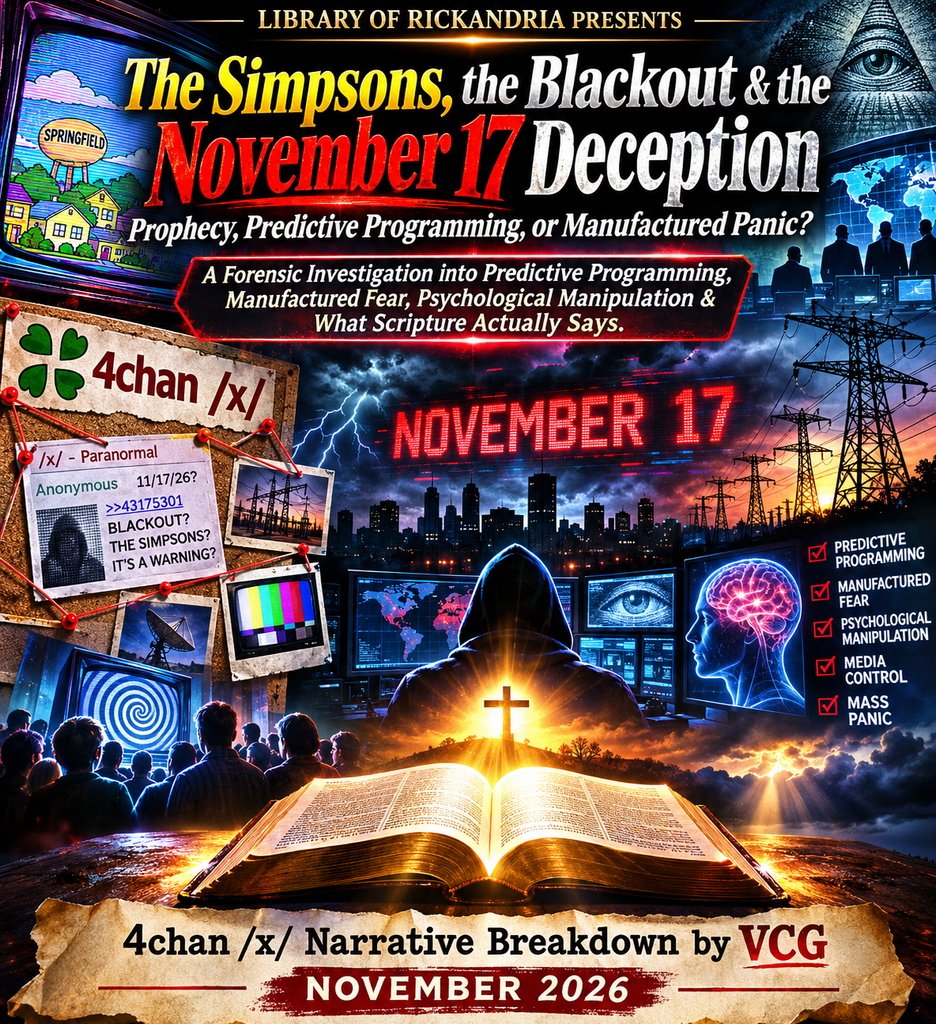
LIBRARY OF RICKANDRIA PRESENTS
The Simpsons, the Blackout & the November 17 Deception: Prophecy, Predictive Programming, or Manufactured Panic?
A Forensic Investigation into Predictive Programming, Manufactured Fear, Psychological Manipulation & What Scripture Actually Says
4chan /x/ Narrative Breakdown by VCG
November 2026 | Research cutoff:
November 9, 2026
“Prove all things; hold fast that which is good.”— 1 Thessalonians 5:21, KJV
Soli Deo Gloria.
Abstract
On November 5, 2026, an anonymous participant on 4chan’s paranormal board, /x/, published a prediction that a massive, deliberately engineered blackout would begin on November 17—exactly two weeks after the United States midterm elections.
/x/ – GREAT BLACK OUT OF 2026 PREDICTED BY SIMPSONS – Paranormal – 4chan
The poster attributed this warning to The Simpsons,
accused the television series of participating in predictive-programming operations,
claimed American military installations were preparing for three months without the civilian electrical grid,
and suggested the event would also affect Europe.
During the following two days, other anonymous users expanded the narrative.
They introduced reports of:
- cyberattacks against European supermarkets
- government emergency-preparedness advice
- astrology
- financial-collapse speculation
- simulation theory
- spiritual timelines
and claims concerning technological harassment.
Some participants questioned the proposed date.
Others asked for evidence.
Several simply joked.
But beneath the humor and speculation was a serious question:
Can a collection of apparently connected events establish that a catastrophe has been secretly planned?
That question deserves more than ridicule.
Real governments have concealed operations.
Real cyberattacks have disrupted infrastructure.
Real military organizations prepare for failures of essential services.
And genuine historical conspiracies have been uncovered through documentary investigation.
Yet the existence of real deception does not establish every subsequent accusation of deception.
This paper examines the complete accessible 4chan discussion, including its opening post, 21 replies, two attached images, and linked video.
The investigation draws upon:
- original federal notices
- military announcements
- electrical-grid documentation
- cybersecurity reporting
- television production records
- published psychological research
and the supplied King James Bible.
It pursues five distinct lines of inquiry:
History:
What actually happened, and when?
Methodology:
What does the evidence establish, and where do unsupported conclusions enter?
Psychology:
Why can a narrative feel convincing even when essential causal relationships remain unproven?
Interpretation:
What alternative explanations account for the same observations?
Scripture:
What does the biblical text actually say about:
- prophecy
- discernment
- deception
- divination
- fear
and preparation?
These categories must not be confused.
Psychological explanations do not automatically disprove beliefs.
Biblical passages do not authenticate secular allegations simply because similar words appear in both.
And evidence of a genuine security vulnerability is not evidence of a secretly scheduled attack.
Central finding
As of November 9, 2026, the supposed November 17 blackout remains an unsupported future prediction, not an established event or demonstrated operation.
Its apparent credibility depends largely upon several real but separately documented developments being joined together without evidence of a common cause.
The prediction itself has not yet reached its deadline.
Its outcome therefore remains open to future examination.
That distinction is central to the integrity of this paper:
we should not claim to know that an event will happen, nor pretend an event has already been disproved when its alleged date has not arrived.
I. Source, scope, and investigative method
The primary document is the archived thread:
4chan /x/ — GREAT BLACK OUT OF 2026 PREDICTED BY SIMPSONS, No. 43175301
The opening post was published on November 5, 2026, at 7:01:16 p.m. in the time displayed by the archive.
The accessible discussion ends with post No. 43182911 on November 7, 2026.
The archived page contains the opening post and 21 replies, 22 posts total.
The original media references are preserved here:


Second attachment — social-media screenshot
The page and both attached images were accessible during this investigation.
The precise YouTube upload was not independently retrievable, so its original upload date, edit history, and exact full contents remain unverified.
This matters because there are several layers of evidence, each with different limitations.
A 4chan post is primary evidence of what someone posted.
It is not automatically evidence that the poster’s assertions are true.
A screenshot is evidence that an image was attached to a post.
Unless the source and editing history are authenticated, it is not automatically evidence that the depicted statement or scene is genuine.
A television episode is primary evidence of its fictional content.
It is not evidence of advance knowledge of a real operation merely because a fictional event resembles a later claim.
An official preparedness document can establish that an institution adopted a policy or announced an exercise.
It does not, without additional information, establish foreknowledge of a particular catastrophe.
Evidence classifications
| Finding | Meaning |
|---|---|
| Verified | Supported directly by reliable, identifiable evidence |
| Partly supported | Has a factual foundation but goes beyond what that foundation establishes |
| Misrepresented | Genuine evidence is assigned a meaning it does not justify |
| Unsupported | The required evidence is absent or insufficient |
| Unverifiable | The assertion cannot currently be independently authenticated or adequately tested |
| Pending | A future assertion that cannot yet be assessed against its stated outcome |
The word unsupported does not mean impossible.
The word verified does not mean that every interpretation of a verified fact is correct.
No probability percentages will be invented.
The available material does not provide a reliable statistical basis for assigning numerical probabilities to the alleged attack.
Research integrity and limitations
This is an open-source investigation.
It does not possess classified intelligence,
the internal communications of television producers,
the private identity of the anonymous posters,
or forensic access to electrical-grid operators.
The paper also does not attempt to diagnose individual users from anonymous comments.
- Humor
- satire
- sincere belief
- trolling
- anxiety
- provocative exaggeration
can be difficult to distinguish from short internet posts.
The biblical text used is the supplied Authorized King James Version, Pure Cambridge Edition.
Scripture quotations will be identified separately from interpretation, historical claims, and the commentary of Bible translators.
Our controlling question is therefore narrow but demanding:
Does the available evidence establish the specific prediction being made, or does the prediction depend on connections that its proponents have not demonstrated?
II. The master chronology: What was known, and when?
A good place to begin is the calendar.
Predictions frequently become more impressive when different dates are placed beside one another.
But their evidentiary value depends on what people knew before the alleged prediction appeared.
| Date | Documented event | Why it matters |
|---|---|---|
| 2017 | The Army publicly discusses a 14-day installation energy-and-water resilience objective. | Military preparation for grid interruptions predates this rumor by years. |
| November 19, 2023 | The Simpsons airs “It’s a Blunderful Life.” | The fictional Springfield blackout predates the 2026 prediction. |
| September 16, 2026 | The FCC announces a nationwide Emergency Alert System test for November 17. | The November 17 test date was public information before the 4chan post. |
| September 30, 2026 | FORTRESS America is announced as part of a military resilience initiative. | The existence of military preparations is real. |
| October 11–12, 2026 | French commercial refrigeration systems experience serious cyberattacks. | A genuine cyber incident later becomes relevant to the rumor. |
| October 25, 2026 | FOX News reports a 90-day military installation independence objective. | Supplies the thread with its striking three-month figure. |
| November 2, 2026 | Reporting describes further refrigeration-system attacks affecting European supermarkets. | Real incidents are available for retrospective connection to the prediction. |
| November 3, 2026 | U.S. midterm elections take place. | November 17 falls exactly fourteen days later. |
| November 5, 2026 | The 4chan opening post predicts a major staged blackout. | The specific forecast under examination is publicly recorded. |
| November 6–7, 2026 | The discussion expands into markets, astrology, technological claims, and competing timelines. | Shows how the original narrative develops through participation. |
| November 9, 2026 | French authorities publicly attribute the October refrigeration attacks to Iranian-linked cyber units. | Provides important new context, but no proof of the proposed blackout. |
| November 17, 2026 | Scheduled EAS test and alleged blackout date. | Both are future events relative to this paper’s cutoff. |
| December 3, 2026 | Announced EAS backup date, should the November 17 test be postponed. | Further establishes that the alert test is a publicly planned exercise. |
Sources:
- FOX’s 2023 programming announcement
- FCC September 16 notice
- Army FORTRESS America announcement
- FOX’s October 25 military reporting
- French CERT’s November 9 report
A caution is appropriate:
November 5 establishes the date of the thread being studied, not necessarily the first appearance of the blackout rumor anywhere online.
Earlier posts or videos may have circulated similar claims.
Establishing the rumor’s absolute origin would require a separate, comprehensive archive search.
What this timeline does establish is that several supposedly revealing details were already public by November 5.
That is important.
Publicly available information can be incorporated into an alarming prediction without the author possessing insider knowledge.
III. The two images: What do they actually prove?
The opening post includes a darkened Springfield scene bearing a prominent November 17 blackout message.

Illustrative reference to the fictional Springfield blackout.
Compare with the actual image attached to the 4chan opening post.
The attached graphic’s precise editing and broadcast provenance have not been independently authenticated.
A reader might reasonably find the image striking.
An apparently familiar cartoon town is suddenly dark, and the date appears in large letters. In a social-media feed, that visual can communicate an entire argument before anyone reads the accompanying text.
But we must ask a basic forensic question:
Where did this exact image come from?
There are several possibilities.
It could be a genuine broadcast frame, a frame with later added text, a promotional image, or a composite drawing assembled for circulation.
Establishing which explanation is correct requires comparing the attachment with an authenticated episode master or contemporaneous production assets.
We have documentary confirmation that the underlying episode exists.
We do not have an independently verified, frame-by-frame authentication of every element in the attached picture.
The responsible finding is therefore limited:
the image was attached to the thread; the complete authenticity of its presented composition remains unresolved.
The second attachment is a screenshot attributed to financier Nat Rothschild.
It presents a cryptic observation about how rapidly life can change.
The thread treats its mood as suggestive of a coming financial or social disruption.
Examine the second attachment.
Even assuming the underlying statement is authentic,
it does not specify a blackout,
electrical infrastructure,
November 17,
the United States,
a stock-market crash,
or a three-month outage.
The screenshot therefore cannot substantiate those more specific claims.
A reproducible image-verification procedure
For a publication-grade archive,
the research appendix should preserve each image’s original URL,
the date it was retrieved, any embedded metadata that survives,
its file hash,
and a copy of the original post showing the attachment in context.
The image should then be compared against the earliest available copies.
If text has been:
- added
- cropped
- recolored
or otherwise altered, those changes should be documented.
If the original media cannot be recovered, the uncertainty should remain visible.
An inability to authenticate an image is not evidence that it is fake.
It is simply a limit on what the investigator can claim.
This distinction protects both sides from overstatement.
IV. Opening post No. 43175301: A clause-by-clause analysis
The opening post makes several connected assertions.
Its central claims are that a massive staged blackout will occur on November 17,
that The Simpsons foretold it,
that the series has conducted earlier psychological operations,
and that military preparations imply a three-month emergency affecting the United States and perhaps Europe.
Instead of treating that as one proposition, we need to examine its constituent parts.
1. The blackout will occur exactly two weeks after the midterms
The date calculation is correct.
November 17 is fourteen days after the November 3, 2026 election.
But a true calendar relationship is not evidence of a causal relationship.
Why should the alleged operation begin fourteen days after an election rather than seven, ten, or twenty-one days afterward?
The post offers no:
- mechanism
- document
- insider testimony
or operational reason for selecting that interval.
A calendar coincidence is an observation.
It is not an explanation.
Finding:
Verified arithmetic; unsupported forecast.
2. The blackout will be a false-flag operation
A false-flag operation involves concealing or misrepresenting the actual perpetrators of an action, often to make another party appear responsible.
This is a serious allegation.
To establish it, the investigator would need evidence of a planned act,
a responsible party,
an intended deception,
and a demonstrable relationship between them.
The 4chan opening post identifies none of these with substantiating evidence.
- It does not tell us who planned the supposed operation,
- which electrical systems would be targeted,
- who would be blamed
or how the alleged perpetrators intend to conceal their involvement.
The claim is therefore not simply a bold prediction.
It is an accusation concerning intent and attribution.
Finding:
Unsupported allegation of a deliberately staged operation.
A future electrical outage, even one caused by malicious activity, would not by itself establish the false-flag component.
A cyberattack and a false-flag cyberattack are different propositions.
3. The Simpsons predicted it
Here the narrative introduces its most emotionally compelling element.
The actual Simpsons episode,
“It’s a Blunderful Life,”
aired on November 19, 2023.
Its fictional plot involves Springfield suffering a blackout and Homer being blamed for the loss of power.
FOX’s original November 2023 programming announcement independently establishes the episode and its premise.
Contemporary fact-checking of the 2026 rumor describes a November 17 reference associated with Lisa’s diary and an episode timeline involving Thanksgiving.
This date-related detail should be examined, not dismissed.
The precise frame, however, has not been independently authenticated in this study against the original broadcast master.
Even granting the date reference, the inference remains incomplete.
| Documented or reported fictional element | Additional interpretation being asserted |
|---|---|
| Springfield experiences a blackout. | The United States will experience a nationwide blackout. |
| The episode aired in 2023. | Its story was intended to forecast an event in 2026. |
| November 17 appears in episode-related discussion or imagery. | November 17, 2026 is the intended real-world date. |
| A blackout occurs near Thanksgiving in the fictional story. | The blackout will be deliberately engineered. |
| The program uses disaster-related comedy. | The program is serving as an operational warning. |
The relationship between November 17 and Thanksgiving is particularly instructive.
Thanksgiving fell on November 23 in 2023, six days after November 17.
In 2026, Thanksgiving falls on November 26, nine days afterward.
The 2023 calendar provides an ordinary narrative explanation for the fictional setting without invoking advance knowledge of 2026.
Finding:
Genuine fictional source; the asserted real-world prophetic significance is unproven.
4. The television series has previously run predictive-programming operations
The term predictive programming is often used to suggest that entertainment media reveal or psychologically prepare an audience for future planned events.
But this phrase can conceal three different hypotheses.
The weakest is cultural anticipation:
writers extrapolate from known technological, political, or social trends.
That is commonplace in fiction.
A stronger hypothesis is deliberate audience conditioning:
someone intentionally uses media to influence how viewers perceive or respond to future developments.
Persuasive media campaigns are certainly possible, but demonstrating one requires evidence concerning:
- the people
- intentions
- messages
- effects
involved.
The strongest is secret operational foreknowledge:
writers or producers know of a specific forthcoming operation and encode advance disclosure in the entertainment product.
That final allegation demands correspondingly strong evidence.
A credible investigation would seek:
- authenticated production communications
- contemporaneous testimony
- dated instructions
- funding or coordination records
and independently documented pre-event predictions that include failures as well as successes.
The thread does not supply such evidence.
Consider the common reasoning pattern:
A fictional story depicts an event.
Something later appears similar.
Therefore the creators knew that event would happen.
The conclusion does not follow unless alternative explanations have been investigated.
A long-running series such as The Simpsons has depicted an enormous variety of situations over decades.
A fair statistical analysis would need to examine the full universe of attempted forecasts rather than collecting only impressive retrospective matches.
That includes the misses.
Our related Library of Rickandria investigations, Pattern, Prophecy & Pandemic and From Skynet to Scripture,
explore similar problems of:
- chronology
- symbolism
- retrospective matching
Finding:
No documented predictive-programming operation has been established by this thread.
5. U.S. military bases are preparing for a three-month grid failure
This claim contains a genuine factual foundation.
The U.S. military has publicly emphasized the need for installations to remain functional when civilian infrastructure becomes unavailable.
FORTRESS America is a real initiative, and reporting has discussed a 90-day resilience objective.
But the interpretation changes its meaning.
A military installation may plan to operate independently for 90 days because planners wish it to survive many possible contingencies:
- storms
- sabotage
- warfare
- cyber disruption
- supply-chain failures
or prolonged utility interruptions.
The length of the preparedness target does not establish the anticipated length of a specific upcoming civilian outage.
A hospital maintaining emergency power for multiple days is not thereby predicting a disaster of exactly that duration.
A military installation is no different in this logical respect.
Finding:
Genuine military preparedness; unsupported conversion into a scheduled civilian catastrophe.
6. The same operation will likely affect Europe
The geographical expansion is not supported by the opening post.
The United States and continental European electrical systems are not one continuous interconnected power grid across the Atlantic.
A failure in one American electrical region cannot simply cascade electrically through an ocean into Europe.
Separate attacks against infrastructure on both continents are theoretically possible,
but demonstrating such an operation would require distinct evidence for its:
- planning
- targets
- coordination
- execution
No such evidence is supplied.
Finding:
Unsupported transatlantic escalation.
7. The event will occur when the weather cools
At first glance, this seems like a second timing condition.
On examination, it is too vague to provide an independent test.
Much of the Northern Hemisphere cools during autumn.
The statement does not identify a temperature, region, threshold, or precise date.
If November 17 passes uneventfully, the condition can be reinterpreted as pointing toward December, January, or February.
This makes the forecast less accountable.
There is a legitimate engineering point buried within the phrase:
cold weather can increase heating-related electricity demand and create infrastructure stress.
But a seasonal reliability risk is not evidence of a deliberately scheduled attack.
Finding:
Vague seasonal qualification, not independent corroboration.
8. The prediction is a warning that readers should act upon
An alarming prediction has an implicit practical message:
prepare before it is too late.
Preparation need not be irrational.
The problem appears when a reasonable action is used to validate an unreasonable inference.
A person can purchase a flashlight without believing the government secretly planned a blackout.
Maintaining emergency water does not require confidence in an anonymous forecast.
This distinction will matter again when we examine the reply suggesting that ordinary three-day emergency-supply advice secretly means three months.
V. The Simpsons: A television episode is not an authenticated prophecy
The episode deserves deeper treatment because it supplies the thread’s apparent predictive authority.
The starting point should be the episode as a historical media artifact.
Aired in November 2023,
“It’s a Blunderful Life”
is a fictional holiday-adjacent narrative.
Its plot centers on a Springfield blackout and the accusation against Homer, not a military cyber operation across North America and Europe.
FOX’s episode listing is particularly important because it establishes the work’s content before any November 2026 rumor.
A proper forensic comparison would review the episode master, written script or subtitles where available, publicity images released before broadcast, and the viral clip’s editing history.
The exact embedded YouTube upload could not be independently examined in this investigation.
Therefore, it would be misleading to say that every transition, subtitle, or added graphic in that upload has been personally authenticated.
The larger methodological question, however, does not depend on resolving every visual detail.
Suppose we grant the strongest version of the episode argument:
an authentic 2023 episode includes a blackout and the date November 17.
What follows?
It follows that the writers placed those elements in a fictional episode years before the 2026 rumor.
It does not follow that they knew a three-month, deliberately staged electrical catastrophe would begin on November 17, 2026.
To cross that evidentiary gap, the proponents would need something more than resemblance.
They would need specific advance information and a defensible causal explanation for how it entered the production.
What a fair predictive-programming test would require
A rigorous test would establish the forecast before its alleged fulfillment, fix its meaning in advance, include a comparison set of fictional episodes that did not correspond to later events, measure how often similar motifs arise by chance, and investigate ordinary explanations such as genre conventions and contemporary news.
For example, electricity failures are familiar devices in television writing.
They create:
- darkness
- disruption
- comedy
- opportunities for characters to behave differently
Thanksgiving is also a recurring setting in American television.
Combining a holiday story with a blackout is not inherently unusual.
To argue for something beyond conventional storytelling, the evidence must show why ordinary creative decisions cannot adequately explain the scene.
A serious alternative interpretation
Some critics may argue that media need not encode precise operational plans to influence public expectations.
That is reasonable as a broad proposition.
Fiction and news can shape perceptions of:
- danger
- institutions
- technology
- future possibilities
But that is different from claiming this particular episode was deliberately engineered to prepare people for an actual November 17 attack.
General media influence is not proof of a specific covert operation.
The distinction is essential if the term predictive programming is to function as a testable hypothesis rather than an all-purpose explanation for coincidences.
VI. FORTRESS America: The 90-day military question
Military energy-resilience infrastructure, illustrating the real engineering objective of keeping critical installations functioning during disruptions.
An image of such equipment is not evidence of a secretly scheduled blackout.
The FORTRESS America initiative is one of the thread’s stronger factual references precisely because it concerns real infrastructure planning.
According to the U.S. Army’s public announcement, the initiative is intended to strengthen the ability of American military installations to withstand disruptions and continue essential operations.
On October 25, FOX News reported that internal planning material described a 90-day independence goal.
The distinction between these two sources matters.
The broad resilience initiative is publicly confirmed.
The specific 90-day requirement rests substantially on reporting concerning documents that were not fully available for independent assessment in this investigation.
Neither source establishes that civilian America is expected to lose electricity on November 17.
In fact, the military’s concern with installation independence is considerably older.
A 2017 Army article discussed a 14-day energy-and-water independence objective for critical missions.
That historical precedent does not eliminate contemporary threats.
It changes the interpretation of preparedness.
Rather than a new and inexplicable sign of imminent catastrophe, installation energy resilience belongs to a documented tradition of continuity planning.
The missing inference
The argument in the thread can be reconstructed as follows:
- The military is preparing facilities to survive disruptions.
- Some reporting describes a 90-day target.
- Therefore officials know the civilian grid will fail for three months.
- Therefore a specific operation is scheduled for November 17.
Only the first proposition is clearly supported by public institutional documentation, and the second has reporting support subject to the limitations described.
The third and fourth require new evidence.
A preparedness duration is a design requirement.
It is not automatically a forecast duration.
This is the central rebuttal to the military component of the theory.
VII. November 17 and the Emergency Alert System: A real date with a public explanation
Illustrative Emergency Alert System test imagery.
This is not a recording of the scheduled November 17, 2026 test.
One of the most significant facts in the investigation is the existence of a real nationwide Emergency Alert System test scheduled for the same date named in the thread.
The Federal Communications Commission’s Public Notice DA-26-989 was released on September 16, 2026.
It announced that FEMA, in coordination with the FCC, would conduct a nationwide EAS test on November 17 at 2:20 p.m.
Eastern Time, with December 3 designated as a backup date.
The document is public.
The timing is explicit.
The purpose is described in ordinary administrative language.
The chronology is decisive in one limited respect:
anyone posting on November 5 could have learned of the November 17 test through publicly available information.
Therefore, knowledge of the date cannot establish that the poster had access to a secret operation.
What an EAS test does
The Emergency Alert System is designed to distribute emergency messages through participating broadcast and related communications channels.
Testing that system does not require deliberately disconnecting civilian electrical generation or transmission.
There are technical interdependencies between communications and electricity, of course.
Broadcast facilities need power, and resilient communications infrastructure must cope with power outages.
But a test of emergency messaging is not equivalent to a test in which the entire national grid is switched off.
A reader should also avoid confusing this test with every form of telephone or wireless emergency notification.
Different alert channels have different procedures and participation requirements.
Why the date coincidence can still feel extraordinary
Here is a particularly persuasive narrative sequence:
A viewer encounters a cartoon mentioning November 17.
Then discovers an official federal test scheduled for November 17.
Then sees military planning for independent power.
The combination feels more meaningful than any one fact alone.
But the evidentiary relationship has not changed.
The episode is fiction.
The alert test is a publicly announced communications exercise.
The military program concerns resilience planning.
To establish a common operation, we need a documented connection between the institutions and their activities.
The shared date does not supply that connection.
The EAS test is real; its alleged role as a scheduled cover for a nationwide blackout is unsupported.
VIII. European refrigeration cyberattacks: The strongest real cyber evidence
Reporting imagery associated with European supermarket refrigeration disruptions.
These incidents concern refrigeration control systems, not proof of an attack on national electricity transmission networks.
This part of the discussion warrants careful attention because it concerns actual cyberattacks—not merely a fictional story or vague symbolic interpretation.
Reports in early November described attackers remotely manipulating commercial refrigeration equipment across multiple European locations.
The attacks reportedly altered temperature controls in affected systems, causing food losses and disrupting supermarket operations.
See Euronews’ November 2 reporting and BleepingComputer’s technical account.
These incidents demonstrate a genuine problem: internet-accessible operational technology can be vulnerable, and malicious access can cause physical consequences.
That is not a trivial concern.
The new November 9 attribution
On November 9, French cybersecurity authorities published CERTFR-2026-CTI-009, describing attacks against French interests attributed by French authorities to cyber units associated with Iran’s Islamic Revolutionary Guard Corps.
The report identifies the October 11–12 attacks on industrial refrigeration controllers as a significant incident.
Reuters’ November 9 reporting adds contemporary context regarding the investigation, the alleged actors, and the extent of the damage.
This is important evidence of real malicious activity.
But the specificity of that evidence is equally important.
The public attribution concerns identified refrigeration-related attacks in France.
It does not automatically establish that every refrigeration incident across Europe had exactly the same perpetrator, nor that all such incidents formed part of a single campaign against America’s electrical grid.
The reports also do not establish a planned November 17 national blackout.
Refrigeration controllers are not the national grid
Consider the engineering distinction.
A supermarket’s refrigeration controls regulate the conditions needed to preserve chilled and frozen products.
An attacker who interferes with those controls may cause expensive spoilage, equipment malfunction, and operational disruption.
An electrical transmission network, by contrast, coordinates the delivery of electricity across high-voltage infrastructure and associated control systems.
Both involve industrial technology, but they are not interchangeable targets.
An attack successfully compromising one category of equipment does not establish that the attacker has gained access to another.
Nor does it establish the ability to produce a nationwide, months-long interruption of service.
What the refrigeration attacks establish
They demonstrate that real cyberattacks can cross from digital systems into physical disruption.
They justify concern about:
- exposed industrial controls
- outdated software
- remote access
- infrastructure security
They do not, in the material examined here, demonstrate a secret global timetable, a connection to The Simpsons, or foreknowledge of an event scheduled for November 17.
This is a case in which dismissing the underlying incident would be a serious mistake, but using the incident to prove an unrelated operation would be another.
IX. Could a three-month electrical blackout actually happen?
Reference map of American electrical infrastructure.
The geographic organization of the grid matters when evaluating claims of a single cascading nationwide failure.
See the U.S. Energy Information Administration’s explanation of electricity delivery.
Here we should resist two opposite exaggerations.
The first exaggeration is that a prolonged electrical catastrophe is impossible.
The second is that a documented infrastructure vulnerability establishes an imminent catastrophe.
Neither statement is justified.
Electricity is essential to modern society.
A widespread disruption can affect:
- water distribution
- sanitation
- communications
- food refrigeration
- transportation
- hospitals
- fuel deliveries
- banking
- countless other systems
Cybersecurity researchers and infrastructure planners have legitimate reasons to take these possibilities seriously.
But a three-month outage affecting the whole United States is an extraordinary scenario.
Its technical requirements and consequences must be examined rather than assumed.
The American grid is not one giant switch
The contiguous United States is generally described as having three major electrical interconnections:
- the Eastern Interconnection
- the Western Interconnection
- the Texas Interconnection
commonly associated with ERCOT.
These systems contain many:
- transmission operators
- utilities
- generating facilities
- substations
- control systems
They are not all controlled by one physical switch that can simply be turned off to disconnect the entire country.
For background, consult the Energy Information Administration’s electricity-delivery overview and its explanation of the major interconnections.
This does not make simultaneous disruptions impossible.
Multiple systems can suffer from:
- common environmental stresses
- malicious attacks
- equipment failures
or coordinated interference.
But the scope of an alleged attack determines the scale of evidence required.
A failure of one facility is not a national collapse.
A regional outage is not necessarily a continental outage.
A temporary communications interruption is not necessarily a loss of generating capacity.
How cascading failures work
Electric grids must continually balance generation and demand while maintaining acceptable electrical conditions.
Under some circumstances, failures can propagate.
Protective equipment may disconnect additional components to prevent damage.
Transmission congestion, unstable frequency, or voltage disturbances may worsen an already serious incident.
This is why grid operators employ:
- protective systems
- contingency analysis
- coordinated restoration procedures
- reliability planning
A cascading failure is an engineering process with identifiable operating conditions.
It is not evidence of sabotage merely because many people lose power.
Determining whether a particular failure resulted from equipment malfunction, severe weather, operator decisions, cyber intrusion, or intentional physical damage requires incident-specific evidence.
What about black-start restoration?
Some generating resources are equipped to help restart electrical systems after a major outage without relying entirely upon electricity from an already functioning grid.
This process is commonly called black start.
Restoration is not as simple as switching the lights back on.
Operators may need to:
- energize selected transmission paths
- establish stable generation
- reconnect loads in stages
- coordinate across facilities
The difficulty and duration depend on the damage and conditions.
A system whose equipment remains intact may recover differently from one suffering extensive physical destruction.
- Fuel limitations
- transportation interruptions
- damaged substations
- unavailable replacement equipment
- extreme weather
- communication failures
may complicate restoration.
Consequently, the confident claim in one 4chan reply that infrastructure would recover within weeks is insufficiently supported.
But the opposite assertion—that the United States will necessarily remain dark for precisely three months—is equally unsupported.
Why Europe is a separate question
The thread’s European prediction requires special attention.
North American and European electricity grids are not continuously synchronized into one transatlantic grid.
A conventional electrical cascade therefore cannot simply travel from an American transmission line across the Atlantic Ocean to disable Europe’s power system.
For a coordinated American and European catastrophe, researchers would need evidence of a mechanism affecting both regions.
That might involve separate:
- cyber intrusions
- physical attacks
- widespread environmental conditions
or another demonstrated common cause.
The opening post supplies no such mechanism.
The engineering verdict
A major blackout is a genuine infrastructure hazard.
A long-lasting outage is physically conceivable under severe circumstances.
But the technical possibility of an event is not evidence that a particular actor has scheduled it for a particular date.
This distinction will recur throughout the investigation.
X. The complete 4chan reply-by-reply examination
The discussion matters because it shows how the narrative develops after the opening claim.
The original prediction is comparatively simple:
blackout,
November 17,
alleged deliberate staging,
military preparation,
and possible European effects.
The replies introduce additional explanatory systems.
These include:
- simulation theory
- astrology
- alternative timelines
- financial speculation
- technological harassment
and hidden meanings in government preparedness advice.
The order matters.
We are not treating all these claims as though they originated with the opening poster.
The following is an annotated analysis of all 21 visible replies, in their archived sequence.
Post No. 43175384 — The Matrix needs maintenance
The participant suggests that the Matrix is shutting down for maintenance and upgrades.
This could be humor.
It could also be a sincere allusion to simulation theory.
Nothing in the comment establishes an actual simulated universe, an identified maintenance process, or a connection between such a process and electrical infrastructure.
Methodological finding:
No testable evidence is supplied.
Scriptural distinction:
Genesis 1 presents the world as God’s creation.
It does not teach that physical reality is a periodically rebooted computer simulation.
A biblical doctrine of creation should not be casually equated with a modern simulation hypothesis.
Post No. 43175473 — Which year did The Simpsons supposedly predict?
This is one of the discussion’s better contributions.
The participant recognizes a central weakness:
a date without a year is not a precise forecast of a 2026 event.
The same reply mentions the European supermarket refrigeration attacks, introducing a genuine news development into the conversation.
We should treat these as separate points.
The date objection is methodologically valuable.
The refrigeration incidents are genuine.
The supposed causal connection between the incidents and the November 17 prediction is not demonstrated.
Finding:
A legitimate challenge followed by an unproven possible connection.
Post No. 43175602 — The singularity and the high-vibrational timeline
This participant suggests that a singularity will occur first and that individuals joining a higher-vibration timeline need not fear the alleged catastrophe.
The statement combines language from:
- technological futurism
- spirituality
- alternative-reality speculation
But its central terms are not operationally defined.
What event constitutes the singularity?
What measurement identifies a higher-vibrational timeline?
How could another researcher independently determine who belongs to one?
Without answers, the claim cannot be meaningfully tested.
Scriptural correction:
The New Testament speaks of:
- salvation
- reconciliation
- resurrection
- eternal life through Christ
It does not describe safety from disasters as entry into a technologically or spiritually selected vibrational timeline.
Compare:
- John 14:6
- Romans 5:1
- Ephesians 2:8–9
Post No. 43175668 — An insulting response
The reply responds to the previous spiritual claim with an insult.
It introduces no evidence concerning:
- electricity
- government preparedness
- spiritual timelines
or the prediction’s date.
A contemptuous response may communicate disagreement, but it cannot replace an argument.
Scriptural correction:
Proverbs 15:1 teaches that a soft answer can turn away wrath.
Second Timothy 2:24–25 describes patient and gentle correction.
Rejecting a claim does not require degrading the person making it.
Post No. 43175677 — Prediction or psychological operation?
This participant observes an important conceptual problem.
If television writers deliberately planted information as part of a coordinated operation, that would be different from their independently predicting the future.
The point is legitimate.
- Foreknowledge
- fictional speculation
- intentional audience conditioning
and later coincidence are distinct explanations.
They cannot simply be combined into a single proof.
But the comment appears to assume that a long-running psychological operation occurred, without providing evidence of its existence.
Finding:
Useful conceptual distinction; the alleged operation remains unverified.
Post No. 43175848 — Finally, some good news
The reply offers a brief reaction that may be sarcastic or darkly humorous.
Its intended meaning cannot be established confidently from the text alone.
It contributes no evidence.
A careful researcher should not turn ambiguous humor into a literal endorsement of catastrophe.
Post No. 43175933 — Grand Theft Auto VI as a psychological operation
The comment introduces an unrelated theory concerning a video game.
This is an example of narrative expansion.
Once a discussion adopts the premise that familiar entertainment may conceal secret operations, other cultural products can be brought into the story without a demonstrated connection.
That does not establish anything about the video game itself.
Finding:
Unsubstantiated digression.
Post No. 43175997 — Three days secretly means three months
This is one of the clearest examples of unsupported reinterpretation in the entire thread.
The commenter suggests that official advice to maintain several days of food and water is actually a disguised instruction to prepare for months.
The reasoning appears to be that officials are withholding the true duration to avoid panic.
But no authenticated document, statement, or communication demonstrates that interpretation.
The Centers for Disease Control and Prevention recommends at least one gallon of water per person per day for three days and suggests storing a two-week supply where possible.
These are openly explained preparedness recommendations.
A person can reasonably maintain additional supplies.
That choice does not demonstrate that public guidance contains a secret code.
Methodological finding:
An explicit recommendation is being assigned an unsupported hidden meaning.
Scriptural correction:
Proverbs 14:15 warns against accepting every assertion uncritically.
Post No. 43176119 — Market collapse, refrigeration attacks, and a cryptic screenshot
The participant suggests that a dramatic stock-market collapse may precede the blackout.
The comment references the European refrigeration attacks and attaches a social-media screenshot attributed to Nat Rothschild.
The screenshot’s statement is vague.
It does not identify an impending market crash, an electrical attack, or November 17.
Nor does the thread supply market analysis supporting its forecast.
A useful financial prediction would identify an asset or index, a measurable decline, a time interval, and a mechanism.
This reply does not.
Finding:
Unsupported financial forecast built around ambiguous contemporary material.
The broader psychological issue is that a cryptic statement can seem more specific when readers already expect a catastrophe.
Post No. 43176707 — Preparing since COVID
A participant reports preparing for emergencies since the COVID period.
That is evidence of the participant’s claimed behavior, not evidence that the anonymous blackout prediction is correct.
People may prepare because of:
- past emergencies
- financial uncertainty
- weather events
or personal circumstances.
No specific forecast follows from the behavior.
Scriptural observation: Proverbs 22:3 commends prudence concerning foreseeable danger.
It does not require believers to endorse any particular internet prediction.
Post No. 43176773 — Will the alleged 5G harassment stop?
This comment introduces a claim concerning technological harassment.
No technical evidence is supplied for the alleged harassment mechanism.
Nor is there a demonstrated relationship between ordinary cellular infrastructure and the predicted nationwide electrical failure.
The claim should not be endorsed or dismissed merely through ridicule.
It should be evaluated according to:
- identifiable equipment
- measurements
- documented incidents
- independently corroborated evidence
Finding:
No substantiated connection to the blackout allegation.
Post No. 43176849 — Maybe January or February instead
This participant argues that November is not cold enough and proposes January or February as a more plausible period.
The comment then expresses skepticism that anything significant will happen.
The first part illustrates a problem with the opening post’s seasonal qualification.
Because:
“when the weather cools”
lacks a measurable threshold, the predicted event can be moved to a later date without necessarily abandoning the original narrative.
But shifting dates after the prediction has already been made changes the proposition being tested.
Finding:
An unsupported alternative forecast, combined with skepticism.
If November 17 passes without the claimed catastrophe, the record should preserve that result.
A later claim about January should be treated as a new prediction.
Post No. 43177667 — The grid could recover within weeks
This participant expresses confidence that electrical service would be restored relatively quickly, while making dismissive comparisons between countries.
There is a potentially legitimate technical question here:
how rapidly could electrical systems recover from a serious disruption?
Unfortunately, the comment provides no engineering evidence.
Recovery depends on the outage’s:
- physical cause
- equipment damage
- generation availability
- replacement components
- transmission conditions
- coordination among operators
Finding:
The proposed recovery timeline is not established.
The reply is also a reminder that disagreement with an exaggerated forecast does not automatically make a competing confident forecast accurate.
Post No. 43177728 — Unnamed astrologers and a coming polycrisis
This reply appeals to alleged astrological predictions dating back to 2022 and invokes broader governmental or academic concern about simultaneous crises.
Neither the astrologers’ identities nor the original predictions are supplied.
That prevents basic verification.
Researchers would need:
- the names
- publication dates
- original wording
- predicted events
- deadlines
and a record of unsuccessful predictions.
The idea of multiple interacting crises is not inherently unreasonable.
Modern systems are interconnected, and several disruptions can compound one another.
But calling a situation a polycrisis does not prove that astrologers predicted a specific blackout or that governments arranged one.
Scriptural correction:
Isaiah 47:13–14 directly challenges reliance on astrologers, while Jeremiah 10:2 warns against being dismayed by celestial signs.
These passages address divinatory reliance, not legitimate scientific astronomy.
Post No. 43177836 — Name the astrologers
This brief reply is methodologically significant.
It asks for names.
That is exactly the kind of question an investigator should ask when an argument depends upon unidentified authorities.
Without identifiable people or documents, the assertion cannot be traced back to its source.
Finding: A sound evidentiary challenge.
Acts 17:11 describes the Bereans examining the Scriptures in response to Paul’s teaching.
Although that passage concerns scriptural examination rather than internet fact-checking generally, it exemplifies a refusal to substitute reputation for examination.
Post No. 43180145 — A dark joke
The comment makes dark wordplay concerning blacking out and violence.
There is no reliable basis for treating the joke as an admission of a planned act or evidence of a future catastrophe.
Its presence in the thread is socially relevant but not evidentially substantive.
Post No. 43181932 — What exact time and time zone?
The participant jokingly asks for the precise time because of a dental appointment.
The humor points toward a serious methodological weakness.
A date-specific forecast should specify what counts as the event, when it begins, where it occurs, and how it will be distinguished from ordinary incidents.
“November 17”
alone does not adequately define the claimed catastrophe.
If a local transformer fails at 11:58 p.m., would that count?
If a communications test interrupts broadcasting at 2:20 p.m., would that count?
If a cyberattack affects one company, would that count?
The opening post does not provide consistent criteria.
Finding:
A useful demand for specificity expressed through humor.
Post No. 43181991 — A reaction to the dental comment
This reply adds no independent claim about the blackout.
It does, however, reinforce that not every contribution to a thread should be interpreted as evidence or sincere prophecy.
Post No. 43182203 — A denial concerning 5G harassment
The participant answers the earlier 5G question negatively.
No evidence accompanies the answer.
The evidentiary standard should be consistent: an unsupported denial does not become authoritative merely because it opposes an unsupported assertion.
Finding:
No independently substantiated claim.
Post No. 43182535 — Is it happening already?
The participant asks whether the predicted event may already be underway because the weather is becoming cooler.
This exposes the weakness of the original weather condition.
Cooler temperatures are common in autumn, whereas the specific alleged event is a widespread electrical outage.
The former does not demonstrate the latter.
Finding: Seasonal conditions are being mistaken for a specific operational indicator.
Post No. 43182911 — The video is old
The final visible reply challenges the video because of its age.
The underlying Simpsons episode did indeed air in November 2023.
That is independently established.
However, the original publication date of the particular YouTube upload has not been authenticated here.
The correct conclusion is therefore narrower than claiming every aspect of the clip has been verified.
Finding:
The fictional episode is older than the rumor; the precise YouTube upload history remains unresolved.
What the replies reveal collectively
The thread supplies no authenticated operational plan, no corroborated insider disclosure, no identified grid targets, and no demonstrated connection between the military initiative, the European cyber incidents, and the television episode.
Instead, the discussion moves among several incompatible or loosely related explanatory systems.
Some participants interpret the event as government deception.
Others invoke astrology.
Still others suggest:
- simulation maintenance
- altered timelines
- financial collapse
or seasonal conditions.
These explanations cannot simply be counted as independent confirmations.
They often draw upon the same original rumor while adding new speculative material.
The most constructive replies are those that request the missing year, the identities of purported authorities, and the exact event definition.
Those questions point toward a better way to investigate.
XI. The psychology of the narrative: Why the connections feel persuasive
Psychological research is useful here, but it must be applied carefully.
Explaining why a narrative attracts attention does not prove the narrative false.
Conversely, the strength of someone’s emotional conviction does not establish that the narrative is true.
We cannot responsibly diagnose the anonymous participants from a short forum exchange.
We can, however, examine the reasoning mechanisms visible in the discussion.
1. Illusory pattern perception
Exhibit A — How separate observations become one alleged operation
Original explanatory diagram.
The dashed lines represent the alleged connections, not verified causal relationships.
The thread combines observations that belong to different domains.
A fictional episode,
a military objective,
an alert test,
a cyberattack,
seasonal weather,
and a cryptic social-media message all become evidence for one proposed secret event.
The central problem is not noticing similarities.
Pattern recognition is essential to ordinary reasoning and scientific discovery.
The problem is assigning causal significance before testing whether the pattern could arise through coincidence, selection, or common background conditions.
In their 2018 study, Jan-Willem van Prooijen, Karen Douglas, and Clara De Inocencio examined associations between illusory pattern perception and conspiracy-related or supernatural beliefs.
Their findings support the importance of pattern perception in this area of cognition.
The study does not establish that every person who perceives a conspiracy is mistaken.
It indicates why apparent patterns require independent validation.
2. Availability bias
Recent dramatic events are easier to remember than ordinary uneventful periods.
When a reader has just encountered reports of hackers disrupting European supermarket refrigerators, the prospect of a larger cyberattack can feel immediately plausible.
Psychologists Amos Tversky and Daniel Kahneman examined this kind of judgment shortcut in their 1973 paper, Availability: A Heuristic for Judging Frequency and Probability.
The fact that an incident is vivid or readily recalled does not, by itself, tell us how frequently a different event occurs.
A real refrigeration attack can make a grid attack easier to imagine.
That does not establish that a grid attack is scheduled.
3. The search for explanation and control
Uncertainty is uncomfortable.
A frightening event without an explanation can feel more threatening than an event that appears to have a clear cause, even if that explanation is disturbing.
In their 2017 review, Karen Douglas, Robbie Sutton, and Aleksandra Cichocka describe three broad motivational categories associated with conspiracy beliefs:
the desire to understand, the desire for safety and control, and social motives connected with identity and belonging.
These motivations are ordinary human concerns.
A narrative promising hidden knowledge may appear to satisfy them by transforming uncertainty into a comprehensible plot.
But emotional coherence and factual accuracy are different qualities.
4. Confirmation bias and selective evidence
Imagine beginning with the conclusion that a blackout is scheduled for November 17.
Once that conclusion is accepted, nearly anything bearing on:
- electricity
- military readiness
- emergency alerts
- unusual weather
or cyberattacks may appear relevant.
What happens to the unrelated events that do not fit?
They may never enter the discussion.
This is a selection problem.
A fair investigation needs to ask not only which observations match the hypothesis, but also how many comparable observations would have existed regardless of the hypothesis.
The same issue appears in retrospective claims about The Simpsons.
A compilation of apparent prediction successes tells us little unless it also records the enormous number of fictional events that never materialized.
5. Source laundering
Source laundering occurs when a weak claim acquires apparent authority by being repeatedly connected to stronger-looking sources.
For example:
An anonymous writer makes an assertion.
A commenter adds an actual government program.
Another supplies a real cybersecurity incident.
A subsequent reader remembers the combined story as though the original assertion were itself supported by government and technical records.
The strength of the sources has not necessarily changed the strength of the original claim.
A real source supports only what it actually says.
That is why every link in an evidence chain must be checked separately.
6. Unfalsifiable reinterpretation
The thread’s suggestion that three-day preparedness advice secretly means three months is especially instructive.
The interpretation is constructed so that ordinary evidence can be made to support a hidden meaning.
If authorities recommend three days, that supposedly means three months.
If authorities deny a secret operation, that denial may be interpreted as concealment.
If November 17 passes uneventfully, the date might be reinterpreted as a warning for January.
The explanation becomes increasingly insulated from disconfirmation.
A useful research question is:
What observation would cause the theory’s proponent to change their mind?
If no answer is possible, the theory is not being presented in a form that ordinary historical investigation can adequately test.
7. Repetition, social reinforcement, and memory
Repeated exposure can make a claim feel familiar, and familiarity can influence judgments.
The effect does not require a centrally organized campaign.
Ordinary conversation can spread uncertain information.
A substantial review by Lewandowsky and colleagues, Misinformation and Its Correction, examines how misinformation circulates and why its influence can persist even after correction.
For this reason, simply telling readers that a prediction is unsupported may not be sufficient.
A better correction supplies the actual explanation:
the episode aired in 2023, the EAS test was publicly announced, the military program concerns resilience, and the refrigeration attacks involve different technological systems.
That gives readers a coherent alternative account grounded in identifiable evidence.
8. Humor, ambiguity, and anonymous identity
It would be a mistake to assume that every person in the thread sincerely accepts the opening claim.
Anonymous forums contain:
- jokes
- provocations
- role-playing
- sarcasm
- curiosity
- sincere reports
- genuine disagreement
The researcher should avoid treating humor as a confession or strong emotion as evidence of pathology.
The correct object of study is the claim and its evidentiary support, not an imagined diagnosis of the speaker.
XII. Competing explanations: Which hypothesis best accounts for the evidence?
A responsible investigation should not stop after pointing out weaknesses in the conspiracy interpretation.
It should ask what other explanations are available.
| Hypothesis | Supporting observations | Evidence still needed |
|---|---|---|
| Ordinary coincidence and retrospective pattern-building | Fictional blackout story, public alert-test date, genuine but separate readiness and cybersecurity developments | More precise reconstruction of how the rumor spread and when its details were combined |
| Ordinary infrastructure risk | Real cyber incidents, documented military resilience efforts, known grid vulnerabilities | Current threat assessments and reliable information concerning any specific impending incident |
| Coordinated deliberate attack | Cyberattacks demonstrate that malicious infrastructure disruption is possible | Authenticated plans, operational links, relevant technical indicators, corroborated intelligence, or subsequent forensic attribution |
| False-flag operation | Historical examples show that deception operations can occur | Evidence of the actual perpetrators, intended misattribution, planning, and execution |
| Deliberate media-conditioning campaign | Media can influence public attitudes and expectations | Production communications, coordination records, identifiable goals, or other evidence connecting the episode to an intentional operation |
| Supernatural prophecy | The television imagery contains suggestive fictional material | A defensible basis for treating it as revelation, rather than fiction or coincidence; the thread supplies none |
The currently documented information is consistent with ordinary preparedness, ordinary media production, real but separate cyber incidents, and retrospective interpretation.
That does not logically exclude every other possibility.
It means the more elaborate explanations have not yet earned the confidence their proponents assign to them.
The strongest argument for taking the allegation seriously
The fairest version of the opposing case would go something like this:
Governments genuinely prepare for prolonged infrastructure disruption.
Military installations are being urged to operate independently.
European operational-technology systems have recently suffered serious cyberattacks.
These incidents demonstrate that threats to infrastructure are real.
Therefore, a large blackout cannot be dismissed out of hand.
That argument is reasonable as a statement about general risk.
The next step, however, would be to show that credible evidence points specifically to November 17, 2026, as the start of a deliberately engineered, months-long event.
The available evidence does not establish that step.
A serious investigator should be willing to examine new evidence if it emerges.
But the possibility of new evidence cannot substitute for evidence already required.
XIII. Prophecy, prediction, and discernment: What Scripture actually says
The biblical portion of this investigation requires the same discipline as its historical portion.
Scripture should be allowed to speak in its own context.
It should not be transformed into a collection of isolated phrases that can be matched to every modern headline.
The following passages are quoted from the King James Bible supplied to this Library. Interpretive comments are identified separately.
1. First Thessalonians 5:20–21 — Test rather than blindly accept
“Despise not prophesyings.
Prove all things; hold fast that which is good.”
Paul is instructing the Thessalonian believers concerning Christian conduct, including their response to prophetic utterances.
Notice the balance.
He does not instruct them to accept everything offered as prophecy.
Neither does he instruct them to reject all prophecy automatically.
He calls for testing.
Applied as a general principle of discernment, this supports careful examination of extraordinary assertions.
But we should not misrepresent the verse as though Paul were specifically writing about internet fact-checking, electrical infrastructure, or modern television programs.
The original setting is Christian instruction.
2. Proverbs 14:15 — Credulity is not prudence
“The simple believeth every word: but the prudent man looketh well to his going.”
This wisdom saying warns against accepting assertions without discrimination.
Its application to the thread is direct enough:
an anonymous claim should not be granted authority merely because it includes a vivid date, dramatic imagery, or references to real events.
The prudent response is examination.
It does not follow that the prudent person must reject every warning.
Prudence involves judgment, not reflexive disbelief.
3. Proverbs 18:13 — Investigate before reaching conclusions
“He that answereth a matter before he heareth it, it is folly and shame unto him.”
The verse identifies the danger of premature judgment.
The principle applies equally to those claiming the blackout is certain and those claiming to possess complete knowledge that no such event could occur.
Neither position has been demonstrated by this thread.
The defensible statement is that the evidence does not presently establish the alleged operation.
4. Matthew 24:4–6 — Do not confuse alarming events with completed prophecy
“And Jesus answered and said unto them, Take heed that no man deceive you.”
Jesus proceeds to discuss false claimants,
wars,
and rumors of wars,
warning his disciples not to confuse every upheaval with the immediate end.
Matthew 24 has an important historical setting.
Jesus has spoken about the temple, and the disciples ask about coming events, his coming, and the end of the age.
Christians have differed over how the discourse’s various elements relate to the destruction of Jerusalem, the broader history of the church, and future eschatological events.
Those interpretive differences deserve serious study.
But none of them establishes that a cartoon blackout or a scheduled EAS test is the particular fulfillment Jesus intended.
5. Matthew 24:36 — The limits of date certainty
“But of that day and hour knoweth no man, no, not the angels of heaven, but my Father only.”
In context, Jesus is speaking about the timing of the event under discussion in his discourse.
This passage should not be exaggerated into a claim that ordinary future events cannot ever be predicted.
Weather forecasters, engineers, and public officials can sometimes make reliable forecasts within the limits of their evidence.
The relevant caution is against treating unsupported apocalyptic date-setting as though it were divinely established.
A prediction about an ordinary electrical outage is not automatically a prediction of Christ’s coming.
Nor should its author automatically be classified as a biblical false prophet.
6. Luke 21:8–9 — Do not be carried away by alarming claims
“Take heed that ye be not deceived: for many shall come in my name, saying, I am Christ; and the time draweth near:
go ye not therefore after them.”
Jesus continues:
“But when ye shall hear of wars and commotions, be not terrified:
for these things must first come to pass; but the end is not by and by.”
The context concerns deception, future turmoil, and the disciples’ response.
The passage does not promise that physical disasters will never occur.
It does challenge the practice of treating every frightening development as proof that a specific prophetic timetable has been decoded.
7. Deuteronomy 18:20–22 — What constitutes a false prophetic claim?
This passage concerns people claiming to speak in the name of the LORD.
Its warnings about false prophetic speech are serious.
However, the anonymous 4chan opening poster does not explicitly claim to be a prophet speaking on God’s behalf.
Therefore, it would exceed the passage to declare that every element of Deuteronomy 18 necessarily applies to the poster’s identity and status.
We can evaluate the forecast as a human prediction without misusing a biblical category.
If someone separately asserts divine authority for the prediction, that additional claim would require its own scriptural assessment.
8. Jeremiah 23:16–22 — Dreams, authority, and invented messages
Jeremiah criticizes prophets who offer messages originating from their own hearts while claiming divine authority.
The central concern is not merely that someone makes a mistaken forecast.
It is the misrepresentation of personal invention as the word of God.
That distinction is vital for modern Christian commentary.
A person may have a powerful impression, a memorable dream, or a striking coincidence.
None of those experiences alone gives that person authority to announce a divine timetable.
We should not attribute to the LORD what Scripture itself has not established.
9. First John 4:1 — Testing spiritual claims
“Beloved, believe not every spirit, but try the spirits whether they are of God:
because many false prophets are gone out into the world.”
John’s immediate concern includes false spiritual teaching and the confession concerning Jesus Christ.
The passage is not a laboratory protocol for verifying electrical-grid forecasts.
Its relevant theological principle is that apparent spiritual authority must be tested rather than accepted merely because it presents itself as supernatural.
When thread participants invoke spiritual timelines,
astrology,
or transcendent warnings,
the Christian reader should not treat the language of spirituality as sufficient biblical validation.
10. Jeremiah 10:2 and Isaiah 47:13–14 — Astrology and divination
“Thus saith the LORD, Learn not the way of the heathen, and be not dismayed at the signs of heaven; for the heathen are dismayed at them.”
Jeremiah’s warning concerns Israel adopting the religious practices of surrounding peoples.
Isaiah 47 challenges Babylon’s astrologers and their inability to secure the nation against judgment.
Together, these passages provide a basis for rejecting astrological divination as spiritual authority.
They do not forbid legitimate astronomy, the scientific study of celestial bodies, or ordinary observation of the heavens.
A modern claim that unspecified astrologers predicted a blackout is not thereby established as biblical prophecy.
11. Second Timothy 1:7 — Fear is not a method of interpretation
“For God hath not given us the spirit of fear; but of power, and of love, and of a sound mind.”
Paul’s immediate context concerns courage and faithfulness in Christian service.
The verse should not be used to deny that physical dangers exist.
Its teaching nevertheless challenges a way of thinking in which anxiety becomes the principal guide to belief.
Concern may prompt investigation. It should not determine the outcome of investigation.
12. Proverbs 22:3 — Preparedness without panic
“A prudent man foreseeth the evil, and hideth himself:
but the simple pass on, and are punished.”
Prudence is not identical to credulity.
A person may take reasonable precautions against power outages because outages are possible and sometimes serious.
Those actions do not require accepting an unverified allegation about a coordinated operation.
Scriptural wisdom is compatible with measured preparation.
13. Biblical darkness is not automatically electrical darkness
Several biblical passages describe darkness in significant theological settings.
In Exodus 10:21–23, darkness falls upon Egypt during the plagues.
In Matthew 27:45, darkness accompanies the crucifixion.
In Revelation 8:12, the vision concerns celestial lights being darkened.
In Revelation 16:10, darkness appears in a judgment directed against the kingdom of the beast.
These texts differ in historical setting, literary genre, and theological function.
An electrical blackout in a modern city cannot simply be equated with all of them because both involve an absence of light.
That would be a verbal association, not an argument from context.
Christians may disagree about the extent to which Revelation’s imagery describes:
- literal future events
- symbols of judgment
- historical fulfillment
or recurring spiritual realities.
But such disagreements do not justify inserting November 17, 2026, into the text without an explicit interpretive case.
14. Second Peter 1:20–21 — Scripture’s prophetic authority
Peter associates scriptural prophecy with the work of the Holy Ghost rather than mere human invention.
This passage concerns the origin and authority of biblical prophecy.
It provides no authorization to treat entertainment scripts, anonymous internet posts, or numerical coincidences as equivalent revelation.
The theological conclusion is not that God lacks power to reveal future events.
It is that this particular thread has not established that such revelation occurred.
XIV. The KJV translators’ own methodological warning
The supplied King James Bible contains The Translators to the Reader, an important historical preface distinct from the inspired biblical books themselves.
In their discussion of difficult readings and possible alternative meanings, the translators appeal to Augustine and express the principle:
“It is better to make doubt of those things which are secret, than to strive about those things that are uncertain.”
This is translator commentary referring to Augustine, not a Bible verse.
Its immediate subject is biblical translation and interpretive uncertainty.
Nevertheless, it provides a valuable model of scholarly humility.
The translators acknowledge that difficult words and passages sometimes admit more than one reasonable interpretation.
In such cases, they argue that readers should investigate further instead of declaring unwarranted certainty.
That principle is useful far beyond textual criticism.
We should not pretend that uncertainty disappears merely because the subject is dramatic.
If evidence is incomplete, say so.
If two explanations remain possible, distinguish them.
If new documents change the situation, revise the conclusion.
The translators also defend the practice of revising earlier work when stronger evidence becomes available.
That is a fitting principle for a research publication.
Correcting an earlier mistake is not a betrayal of truth.
Refusing to correct it for the sake of one’s reputation would be the greater problem.
XV. The November 17 prediction ledger: A test that must not be rewritten
The most important future addition to this paper will be an outcome audit conducted after the alleged date.
But its criteria must be established now, before the result is known.
Otherwise the prediction could be retroactively adapted to whatever eventually happens.
Exhibit B — Prospective prediction scorecard
Status as of November 9, 2026: Event date pending
| Original proposition | What independent evidence would be needed? |
|---|---|
| A massive blackout begins on November 17 | Reliable utility or grid-operator records identifying a qualifying widespread loss of electricity on that date |
| The outage affects much of the United States | Geographic and customer-impact data showing the claimed national scale |
| It lasts three months | Records of sustained service loss consistent with that duration |
| It is deliberately staged | Technical attribution and evidence of intentional planning or execution |
| It is a false flag | Evidence that the actual perpetrators deliberately misrepresented who was responsible |
| Europe is also affected | Independent European incident records and evidence of the proposed relationship |
| The Simpsons supplied advance operational knowledge | A demonstrated link between production decisions and actual foreknowledge or coordination |
A local outage would not satisfy the national-scale claim.
A scheduled emergency broadcast would not satisfy the electrical-grid claim.
An unrelated cyberattack would not satisfy the coordinated-operation claim.
A major power outage caused by a storm would not automatically satisfy the deliberate-staging claim.
And a real malicious attack would not automatically satisfy the false-flag allegation.
These distinctions must remain in force after November 17.
What would count against the prediction?
If November 17 passes without the claimed widespread blackout, that would count strongly against the specific dated forecast.
If an outage occurs but is limited, local, or short-lived, the original scale and duration claims would still require separate evaluation.
If the event is moved to a later month after November 17 passes, that later forecast should be recorded as a new claim, not treated as the original having been fulfilled.
If a commenter later says that the real blackout was psychological, spiritual, financial, or symbolic, that interpretation should not silently replace the original prediction of an electrical grid-down scenario.
An honest prediction audit preserves both successes and failures.
Where to verify the outcome
The eventual audit should use dated information from transmission operators, affected utilities, emergency-management authorities, government incident reports, and credible independent reporting.
Relevant starting points include:
- the U.S. Department of Energy
- Federal Energy Regulatory Commission
- Energy Information Administration
- NERC
No result should be entered before the event has occurred and sufficient evidence is available.
XVI. Practical preparedness: A reasonable response to a real category of risk
A person does not need to believe this prediction to prepare for an ordinary power outage.
The CDC recommends maintaining at least a three-day emergency water supply of one gallon per person per day, with a two-week supply if possible.
Households can also consider:
- flashlights
- working batteries
- an emergency radio
- accessible medications
- a means to charge necessary devices
and plans for people who depend upon electrically powered medical equipment.
These are examples of general emergency readiness.
They are not confirmations of a secret November 17 operation.
One especially important safety point concerns generators.
During an outage, portable generators and other fuel-burning equipment can produce deadly carbon monoxide.
The CDC advises keeping generators outdoors, at least 20 feet from doors, windows, and vents, and never using them inside homes, garages, or enclosed spaces.
See the CDC’s carbon-monoxide safety guidance.
There is no evidentiary basis in the reviewed thread for telling readers that they must urgently accumulate three months of supplies specifically because of November 17.
Preparedness should be proportionate to realistic needs and circumstances, not driven by an unsupported deadline.
XVII. Related Library of Rickandria investigations
This investigation belongs to a larger body of Library of Rickandria work concerning:
- internet predictions
- hidden-knowledge claims
- cultural symbolism
- source authentication
- biblical discernment
The following are real, relevant LOR publications.

A related October 2026 investigation into another 4chan /x/ narrative connecting:
- popular culture
- predictive programming
- contemporary events
- gematria
- biblical eschatology
It addresses the same central evidentiary gap between coincidence and coordinated foreknowledge.

Examines AI-apocalypse narratives, collective consciousness, simulated realities, cultural symbolism, and biblical interpretation. Especially relevant to the Matrix and spiritual-timeline replies.

Develops a useful research distinction between:
- historical facts
- evidentiary reasoning
- psychology
- interpretation
- Scripture
It is a methodological companion to the present paper.

The 4chan Prophet Who Predicted Everything… Until We Checked the Evidence
An October 2026 investigation of:
- a purported historical prophecy
- image authenticity
- claims of future knowledge
- shifting narratives
- biblical correction
Particularly relevant to the need to authenticate alleged old predictions before treating them as impressive.
The broader archive, The 4chan Files: Where Anonymous Claims Meet Evidence & Scripture, provides an additional research connection.
These companion articles provide context and analytical methods.
They do not independently prove or disprove the specific November 17 blackout prediction.
XVIII. Final evidentiary findings
The distinction between a genuine factual ingredient and an unsupported conclusion is the central theme of this investigation.
| Major proposition | Finding as of November 9, 2026 |
|---|---|
| November 17 is fourteen days after the U.S. midterms | Verified |
| The Simpsons aired a fictional blackout episode in 2023 | Verified |
| The episode contains imagery or references subsequently associated with November 17 | Reported; exact viral visual provenance requires further authentication |
| The episode forecasts a worldwide blackout in 2026 | Unsupported interpretation |
| The program was part of a documented predictive-programming operation | Unsupported |
| A nationwide EAS test is scheduled for November 17 | Verified |
| The EAS test is an electrical-grid shutdown | Contradicted by the stated nature of the test |
| Military planners are pursuing greater installation energy independence | Verified |
| A 90-day independence objective has been reported | Supported by reporting; precise documentary scope not fully independently assessed |
| That military objective predicts a three-month civilian outage | Unsupported |
| European refrigeration systems experienced real cyberattacks | Verified |
| French authorities attributed October attacks to Iranian-linked units | Verified as an official attribution |
| Those attacks establish a coordinated November 17 grid operation | Unsupported |
| Government three-day preparedness advice secretly means three months | Unsupported |
| Named astrologers supplied authenticated, specific predictions | Not established |
| A deliberately staged, widespread electrical catastrophe will begin on November 17 | Unsupported future prediction; outcome pending |
The strongest conclusion the evidence permits
The evidence establishes that several real and serious developments existed before the thread was published.
A fictional television episode depicted a blackout.
A federal agency scheduled an emergency-alert test.
The military discussed greater resilience for installations.
Cyberattacks disrupted commercial refrigeration equipment in Europe.
These are not imaginary events.
But the proposed explanation connecting them into one deliberately engineered operation has not been demonstrated.
The same distinction applies to the psychological analysis.
Research concerning pattern perception, uncertainty, and conspiracy beliefs helps explain how disparate facts may become a coherent story.
It does not authorize us to dismiss a particular claim without examining the evidence.
And the same discipline must govern Scripture.
Biblical passages concerning:
- deception
- darkness
- false prophecy
- judgment
- spiritual discernment
cannot be reassigned to a contemporary event merely because a modern theory uses similar imagery.
What we know, what we do not know, and what would change the conclusion
We know that the original thread predicts a massive staged blackout for November 17, 2026.
We know the television episode is real, the EAS test was publicly announced, the military initiative exists, and European refrigeration systems suffered genuine cyberattacks.
We do not know that these events share a hidden coordinating cause.
We do not have authenticated evidence of an attack planned for November 17, an identified false-flag perpetrator, or a credible documentary connection between television production and the alleged operation.
What would change the conclusion would be genuine new evidence:
authenticated planning documents, corroborated operational disclosures, reliable technical indicators, or the subsequent occurrence of a qualifying event accompanied by evidence establishing its cause and intended deception.
The investigator must remain willing to revise conclusions when warranted.
But revision should follow evidence, not fear.
XIX. Research bibliography and primary-source dossier
Primary thread and original media
| Source | Link |
|---|---|
| Main 4chan thread | Thread No. 43175301 |
| Original opening image | Image attachment |
| Second screenshot | Image attachment |
| Linked YouTube video | Original video URL |
The thread is primary evidence for the claims and comments.
The media attachments are evidence of what was posted; their underlying authenticity must be evaluated separately.
Television and historical chronology
| Source | Link |
|---|---|
| FOX, November 2023 programming announcement | FOX Flash |
| Contemporary episode promotional images | Simpsons Wiki News |
| Federal election information | Federal Election Commission |
Government and infrastructure documentation
| Source | Link |
|---|---|
| FCC, September 16, 2026, DA-26-989 | Nationwide EAS test notice |
| U.S. Army, FORTRESS America announcement | Army article |
| FOX, October 25 military planning report | 90-day preparedness reporting |
| U.S. Army, earlier resilience initiative | 2017 Army article |
| U.S. EIA, electricity delivery | Electricity explained |
| U.S. EIA, electrical interconnections | Today in Energy |
Cybersecurity and contemporary reporting
| Source | Link |
|---|---|
| Euronews, November 2 European supermarket attacks | Original report |
| BleepingComputer, refrigeration-system intrusions | Technical reporting |
| French CERT, November 9 attribution | CERTFR-2026-CTI-009 |
| Reuters, November 9 French investigation | Reuters report |
Psychological research
| Research | Link |
|---|---|
| van Prooijen, Douglas & De Inocencio, 2018 — Illusory pattern perception | PubMed / full-text access |
| Douglas, Sutton & Cichocka, 2017 — Psychology of conspiracy theories | Association for Psychological Science |
| Tversky & Kahneman, 1973 — Availability heuristic | Original journal article |
| Lewandowsky et al., 2012 — Misinformation and its correction | PubMed |
Emergency preparedness
| Source | Link |
|---|---|
| CDC, emergency water supplies | CDC guidance |
| CDC, avoiding carbon-monoxide poisoning | CDC guidance |
Biblical primary text
The scriptural passages and translator commentary were checked against the Authorized King James Version, Pure Cambridge Edition, supplied with this Library.
Readers may consult the complete KJV text through the King James Bible Online alongside the supplied edition.
The preface The Translators to the Reader should always be distinguished from the biblical text itself.
XX. Conclusion: When coincidence becomes certainty
The troubling feature of this thread is not that it asks whether a major blackout is possible.
That question is legitimate.
Electrical infrastructure is vital, cyberattacks are real, military readiness is necessary, and disruptions can have serious human consequences.
The problem begins when several different observations are presented as though their coexistence proves an undisclosed operation.
A television episode becomes a prophecy.
A preparedness objective becomes advance knowledge.
A communications exercise becomes an alleged blackout timetable.
A refrigeration attack becomes a precursor to national electrical collapse.
A vague social-media statement becomes a financial warning.
A seasonal change becomes a prophetic confirmation.
At each stage, the story becomes more dramatic.
Yet drama does not remove the need to prove the relationships between its parts.
This investigation does not establish that every participant was deliberately spreading misinformation.
Nor does it establish that the future is free from serious infrastructure threats.
It establishes something narrower and more defensible:
The specific claim that a deliberately staged, three-month blackout will begin on November 17, 2026, is not demonstrated by the evidence offered in the thread or by the independent sources reviewed here.
The test date has not yet arrived.
A responsible investigation should preserve the prediction and assess its outcome afterward, without changing its meaning to fit whatever events occur.
The biblical conclusion follows a similar pattern.
Scripture warns about deception.
It calls for prudence.
It teaches the importance of spiritual discernment and condemns false claims to divine authority.
It does not instruct believers to turn every striking coincidence into a revelation.
Nor does it require fear of an anonymous prediction to become the foundation for interpreting prophecy.
The words of Paul remain an appropriate closing principle:
“Prove all things; hold fast that which is good.”— 1 Thessalonians 5:21, KJV
Preserve the original evidence.
Trace the dates.
Identify the sources.
Separate real events from the meanings assigned to them.
Evaluate possible explanations fairly.
Count apparent predictive successes and failures alike.
Distinguish biblical text from historical evidence and theological interpretation.
And when the evidence is insufficient, retain the courage to say:
We do not yet know.
Soli Deo Gloria.
Library of Rickandria • 4chan /x/ Narrative Breakdown by VCG • Research cutoff November 9, 2026
CONTINUE
ALTERNATIVE TITLES
BLACKOUT 2026: Did The Simpsons Predict the Future—or Did 4chan Manufacture the Fear?
The November 17 Blackout Prophecy: When Coincidence Becomes Conspiracy
DARKNESS BY DESIGN? The Simpsons, 4chan & the Great Blackout Conspiracy
The Blackout That Hasn’t Happened: Exposing the November 17, 2026 Prophecy
Predictive Programming or Predictable Panic? The Truth Behind the 2026 Blackout
The Simpsons Saw It Coming? Inside 4chan’s November 17 Blackout Theory
Operation Blackout 2026: The Evidence, the Psychology & the Biblical Truth
From Springfield to Armageddon: How a Cartoon Became a Blackout Prophecy
THE 4CHAN FILES: Where Anonymous Claims Meet Evidence & Scripture – Library of Rickandria
VCG PAPER PROJECTS – Library of Rickandria