
The Divine Spark Deception: A Line-by-Line Fact-Check of Predictive History’s Jesus Narrative
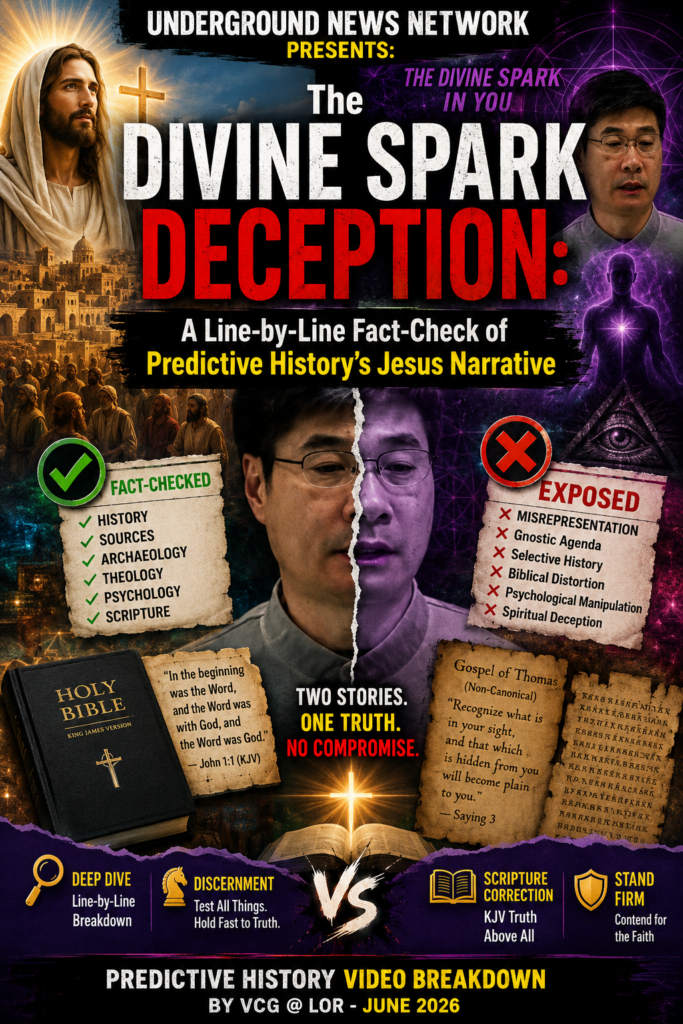
BY VCG @ LOR 6/14/2026
Soli Deo Gloria.
I found the core deception pattern in the transcript:
it repeatedly misstates Christianity, then rebuts the caricature; it elevates Gnostic/self-divinizing “spark” language over Scripture; and it makes historical claims with mixed accuracy, often sliding from “scholars debate” into “we know for sure.”
Methodology for the full breakdown
For each timestamped claim, use this grid:
| Layer | Test |
|---|---|
| Transcript claim | What exactly is asserted? |
| Fact-check | Is it historically supported, debated, false, or speculative? |
| Rhetoric/psychology | What framing device is used? |
| Scripture correction | What saith the Scripture, KJV? |
| Verdict | True, partial, misleading, false, heretical |
Opening section: first major claims
1) “Jesus is the son of God and God himself… this is confusing.”
The video frames the Incarnation as incoherence rather than doctrine.
Scripture does not teach a pagan-style god impregnating a woman; it teaches the eternal Word made flesh:
“In the beginning was the Word, and the Word was with God, and the Word was God,”
and
“the Word was made flesh.”
Correction:
mystery is not contradiction.
The Son is not a created second god; Christ is the eternal Word manifest in flesh.
2) “Christianity says believe in Jesus or burn in hell… aggressive religion.”
The transcript presents evangelism as coercive aggression.
It cites Christian exclusivity but strips out mercy, repentance, and witness.
The video says Christians must convert others because otherwise people:
“will burn in hell.”
KJV correction:
Christ commanded preaching repentance and remission of sins “among all nations,” not forced conversion.
3) “Miracles mean don’t question it, just believe.”
This is a psychological smear.
Biblical faith is not anti-question; Christ opened understanding that they:
“might understand the scriptures.”
Verdict:
false framing.
The Bible appeals to:
- fulfilled Scripture
- eyewitness testimony
- doctrine
- conscience
4) “What we know for sure: Jesus was born maybe about 4 BCE in Galilee.”
Partly wrong.
Many scholars date Jesus’ birth around 6–4 BC, but Britannica lists Bethlehem for his birth and Jerusalem for his death; Jesus was associated with Nazareth/Galilee in life, but “born in Galilee” is not the standard claim. (Encyclopedia Britannica)
Verdict:
partial fact mixed with location error.
5) “John the Baptist was Jesus’ teacher; Jesus was one of his students.”
Jesus was baptized by John, and their ministries are historically linked, but “teacher/student” is stronger than the evidence.
Bible Odyssey summarizes Jesus as baptized by John before his Galilean ministry. (Bible Odyssey)
KJV correction:
John says Christ:
“is preferred before me:
for he was before me.”
6) “Romans crucified Jesus; we don’t know why.”
Historically, Rome executed Jesus under Pontius Pilate.
Britannica states Pilate presided at Jesus’ trial and ordered the crucifixion. (Encyclopedia Britannica)
Crucifixion was commonly used for:
- enslaved people
- pirates
- political crimes
Verdict:
Rome’s role is true;
“we don’t know why”
is too dismissive.
The Gospel charge “King of the Jews” is politically intelligible.
7) “James inherited Jesus’ movement; the movement was called the Ebionites.”
James was an important leader in the Jerusalem church. (Encyclopedia Britannica)
But identifying the original apostolic church simply as “Ebionites” is misleading; Britannica’s James article does not make that equation, and the Ebionite label is later and contested.
Verdict:
speculative compression presented as certainty.
8) “The Bible blames the Jews; this caused persecution.”
The warning is needed:
collective blame of Jews is wicked and historically dangerous.
Yet the video swings into another error by implying the Gospel account is therefore fabricated.
The transcript says the “story is not true” and argues Jews would not betray Jews to Rome.
Correction:
Scripture shows both Roman authority and certain leaders involved; it does not license hatred of Jews.
- Jesus
- Mary
- the apostles
and the first church were Jewish.
9) “The Romans wrote the Bible to blame Jews.”
This is one of the largest unsupported claims.
The transcript says
“it was the Romans who wrote this story”
and
“Christianity is invention of the Romans.”
Fact-check:
that is not mainstream history.
The New Testament writings long predate imperial Christianity; Rome persecuted Christians before later imperial patronage.
10) “The Gospel of Thomas records the true teachings of Jesus.”
The transcript calls Thomas the “true teachings of Jesus.”
Britannica identifies the Gospel of Thomas as noncanonical, 114 sayings, traditionally attributed to Thomas, and written in the mid-2nd century. (Encyclopedia Britannica)
KJV correction:
any “secret sayings” gospel that turns Christ into self-gnosis must be tested against apostolic Scripture.
Key spiritual diagnosis
The “divine spark” teaching replaces Christ in you by faith with godhood already inside you by nature.
That is the old serpent’s pattern:
self-exaltation through forbidden “knowledge.”
The transcript even says one should seek knowledge:
“even if it means… disobeying God.”
KJV rebuke:
“Do not err, my beloved brethren.”
“Every good gift and every perfect gift is from above.”
Bottom-line verdict
This video is not neutral history.
It is a Gnostic reinterpretation of Jesus using selective scholarship, anti-institution framing, and psychological pressure to move the listener from Jesus Christ the Son of God to the self as divine spark.
The central correction is John 1: Christ is not a symbol pointing you back to your own divinity; He is the Word made flesh, the only begotten Son, full of grace and truth.
PART 2 — The Jewish Authorities, Pilate, and the “Romans Invented Christianity” Narrative
This is where the video moves from historical discussion into ideological reconstruction.
The pattern becomes:
- Question the Gospel account.
- Introduce real historical complexities.
- Replace the Gospel narrative with speculation.
- Present speculation as more likely than Scripture.
Claim #11
“The Jewish priests would never have handed Jesus over to the Romans.”
The presenter argues:
Jews argue with each other all the time.
Therefore Jewish leaders would not seek Jesus’ death.
Therefore the Gospel account is suspicious.
Problem #1 — Non Sequitur
The conclusion does not follow.
The fact that Jewish debate existed does not mean political or religious leaders never sought punishment for perceived threats.
The Second Temple period was full of intense conflicts:
- Pharisees
- Sadducees
- Essenes
- Zealots
- Herodians
- Temple aristocracy
These groups often opposed each other fiercely.
The existence of debate does not eliminate the possibility of conspiracies.
Psychology Technique
The video uses:
Selective Framing
It presents:
“Jews debate.”
while omitting:
“Religious authorities sometimes suppress perceived threats.”
The listener subconsciously concludes:
“If Jews debated freely, Jesus couldn’t have been targeted.”
That conclusion does not logically follow.
Claim #12
“Jews had an unwritten rule not to betray Jews to Rome.”
The presenter argues:
Jews would not hand fellow Jews over to Rome.
This is presented as historical certainty.
The problem:
There is no universally recognized historical rule proving this claim.
In fact, the period is filled with examples of cooperation between some Jewish elites and Roman authorities.
The Temple leadership worked with Rome regularly.
Herodian rulers worked with Rome.
Tax collectors worked with Rome.
Various factions sought Roman favor.
The historical situation was far more complicated than the video suggests.
Claim #13
“Therefore the Gospel story is probably false.”
This is the leap.
Notice the move:
Step 1
Create doubt.
Step 2
Suggest alternative explanation.
Step 3
Treat alternative explanation as more likely.
This is a classic persuasion structure.
Not proof.
Not evidence.
Persuasion.
Claim #14
“The Romans wrote the story.”
This is where the presentation becomes highly speculative.
The transcript eventually argues:
Romans wrote the story.
Christianity is a Roman invention.
This is not mainstream scholarship.
Not even close.
Why This Fails Historically
The earliest Christian movement:
- began among Jews
- centered in Jerusalem
- spread before Rome adopted Christianity
- suffered Roman persecution
The earliest Christians were not Roman propagandists.
They were frequently victims of Roman authority.
The idea that Romans invented Christianity struggles to explain:
- Paul’s letters
- early church communities
- Christian martyrs
- first-century Christian writings
all existing before imperial Christianity.
Claim #15
“Paul changed Jesus.”
This is one of the most common modern revisionist arguments.
The idea:
Jesus taught one thing.
Paul invented another thing.
Christianity became Paul’s religion.
The problem:
Paul’s letters are among the earliest Christian documents we possess.
And Paul repeatedly appeals to traditions he himself received.
Example:
1 Corinthians 15 records an early resurrection creed.
Most scholars—even skeptical ones—recognize this tradition predates Paul.
Meaning:
Paul was transmitting existing beliefs.
Not inventing them.
Claim #16
“The real Jesus taught the Divine Spark.”
Now we arrive at the destination.
Everything before this was groundwork.
The video’s central thesis is not actually about history.
It is about identity.
It wants to move the audience from:
Biblical Christianity
to
Self-Divinization
The Gospel becomes:
“Discover the divine within yourself.”
rather than
“Repent and believe on the Lord Jesus Christ.”
The Ancient Pattern
This is why many scholars identify “Divine Spark” theology with Gnostic thought.
The basic formula:
- Humans possess hidden divinity.
- Salvation is secret knowledge.
- Sin is ignorance.
- Christ reveals inner godhood.
Notice how different this is from Scripture.
Scripture Correction
Biblical Gospel:
Man’s problem:
- sin
Gnostic Gospel:
- ignorance
Biblical solution:
- Christ’s atonement
Gnostic solution:
- secret knowledge
Biblical Christ:
- Savior
Gnostic Christ:
- Revealer
Biblical salvation:
- reconciliation to God
Gnostic salvation:
- self-realization
Those are fundamentally different systems.
The Most Important Psychological Move
The video repeatedly attacks:
- miracles
- atonement
- resurrection
- judgment
while elevating:
- hidden wisdom
- secret knowledge
- inner enlightenment
This appeals strongly to modern audiences because it allows people to feel spiritual without submitting to divine authority.
You can keep your autonomy.
Keep your ego.
Keep your worldview.
And still feel enlightened.
That is why these narratives spread so effectively online.
Summary of Part 2
| Claim | Verdict |
|---|---|
| Jews debated so Jesus wouldn’t be targeted | False reasoning |
| Jews never handed Jews to Rome | Historically unsupported |
| Gospel account therefore false | Non sequitur |
| Romans invented Christianity | Historically fringe |
| Paul invented Christianity | Misleading |
| Divine Spark was Jesus’ true message | Gnostic interpretation, not apostolic Christianity |
The deeper you go into the transcript, the clearer it becomes that the video’s real target is not historical reconstruction.
The target is replacing Christ-centered salvation with self-centered enlightenment while retaining Jesus as a symbolic teacher rather than the risen Lord.
Next section we can tackle the Gospel of Thomas, the “divine spark” doctrine itself, Jungian psychology influences, modern New Age parallels, and the specific sayings the presenter uses to reinterpret Jesus.
PART 3 — The Gospel of Thomas, the Divine Spark, and the Gnostic Reversal of the Gospel
This is where the video’s real theological foundation becomes visible.
Everything earlier prepared the audience to distrust:
- the Gospels
- the apostles
- the Church
- the resurrection narrative
- the atonement
Once confidence is weakened, the presenter introduces an alternative source.
That source is usually some version of:
“The hidden teachings of Jesus.”
Historically, this is the hallmark of Gnosticism.
The First Warning Sign
Whenever you hear:
“The Church hid the real teachings.”
or
“The secret Jesus is different from the public Jesus.”
or
“The true message was suppressed.”
you are entering territory occupied for nearly 2,000 years by Gnostic systems.
The ancient Church encountered these exact claims repeatedly.
Nothing here is new.
Only repackaged.
Claim #17
“The Gospel of Thomas contains the true teachings of Jesus.”
The transcript elevates Thomas as preserving the authentic Jesus over against the canonical Gospels.
This sounds persuasive until one asks:
Why?
What evidence shows Thomas preserves earlier teachings than:
- Matthew
- Mark
- Luke
- John
The problem is that the evidence generally points the other direction.
Many scholars date Thomas to the 2nd century.
Meanwhile:
Paul’s letters,
Mark,
Matthew,
Luke,
and John
all emerge substantially earlier.
Thus, Thomas appears later, not earlier.
Psychology Technique
Notice the emotional appeal.
People love discovering:
Secret Knowledge
It creates the feeling:
“I know something the masses don’t.”
This is one of the most powerful psychological incentives in human behavior.
The Bible calls it pride.
Gnosticism calls it enlightenment.
The Core Gnostic Formula
Ancient Gnosticism taught:
The Problem
You forgot who you are.
The Solution
Wake up.
The Goal
Discover your divine nature.
The Savior
The one who reminds you.
Notice:
No atonement.
No substitution.
No repentance.
No cross.
No judgment.
No reconciliation.
No Savior needed.
Only awakening.
Compare to Scripture
Biblical Christianity:
Man is fallen.
Gnosticism:
Man is asleep.
Biblical Christianity:
Man needs forgiveness.
Gnosticism:
Man needs knowledge.
Biblical Christianity:
Christ saves.
Gnosticism:
Christ teaches.
Biblical Christianity:
The Cross is central.
Gnosticism:
The Cross becomes symbolic.
These are not minor differences.
These are different religions.
The Serpent’s Original Message
One reason many theologians see Gnosticism as echoing Eden is because of the pattern.
Genesis:
God says obey.
The serpent says:
Ye shall be as gods.
The temptation was not atheism.
The temptation was self-exaltation.
Not:
“There is no God.”
But:
“You can become like God.”
That is much closer to Divine Spark theology.
Claim #18
“Jesus came to show us our divinity.”
This is usually the heart of the argument.
The presenter reframes Christ from:
Savior
to
Mirror
Jesus becomes someone revealing what humanity already is.
This sounds uplifting.
But Scripture teaches the opposite direction.
The Gospel is not:
“Discover your inner divinity.”
The Gospel is:
“Repent and believe.”
The Great Reversal
Notice the inversion.
Biblical Gospel:
God descends to save man.
Divine Spark Gospel:
Man ascends to become divine.
Biblical Gospel:
Grace.
Divine Spark:
Self-realization.
Biblical Gospel:
Faith in Christ.
Divine Spark:
Faith in self.
This is why the systems cannot be merged.
The Use of Thomas Saying 3
A favorite passage often cited is Thomas Saying 3.
The idea:
The kingdom is within you.
The Gnostic interpretation:
You are divine.
You simply need awakening.
But this interpretation imports assumptions into the text.
Even if one accepted Thomas as historical (which is disputed), the leap from:
“Kingdom within”
to
“You are God”
does not automatically follow.
The presenter inserts the conclusion he wants.
The Jungian Connection
Although the video presents itself as history, much of its structure resembles modern psychological spirituality.
Common themes:
- shadow integration
- self-discovery
- inner awakening
- hidden self
- divine potential
These themes became popular through:
- Jungian psychology
- New Age spirituality
- Human Potential movements
Jesus is transformed into an archetype.
Not Lord.
Not Savior.
Not King.
An archetype.
Why This Appeals to Modern Audiences
Because it removes offense.
The biblical Gospel confronts.
The Divine Spark flatters.
The biblical Gospel says:
You are a sinner.
The Divine Spark says:
You are secretly divine.
The biblical Gospel demands repentance.
The Divine Spark demands self-exploration.
One wounds pride.
One feeds pride.
Therefore, one spreads more easily.
Claim #19
“Sin is ignorance.”
This idea appears repeatedly beneath the surface.
The presenter tends to replace moral rebellion with misunderstanding.
But Scripture does not define sin merely as ignorance.
Sin is transgression.
Rebellion.
Disobedience.
The problem is not simply lack of information.
Satan knows much more theology than most people.
Knowledge alone does not save.
The Missing Cross
The most revealing feature of the entire video may be what receives little emphasis.
The Cross.
If Jesus is primarily a wisdom teacher,
the Cross becomes unnecessary.
If Jesus is primarily revealing inner divinity,
the Cross becomes symbolic.
If Jesus is primarily awakening consciousness,
the Cross becomes a metaphor.
Yet the apostles preached:
Christ crucified.
Not Christ enlightened.
Not Christ self-actualized.
Not Christ the archetype.
Christ crucified.
The Real Historical Question
The video asks:
Why did Jesus become the most influential person in history?
But then avoids the explanation given by the earliest Christians themselves.
The apostles did not say:
“He taught us hidden knowledge.”
They said:
He died.
He was buried.
He rose again.
The resurrection claim is the center of apostolic Christianity.
Once that center is removed, a different religion emerges.
Summary of Part 3
| Video Theme | Biblical Teaching |
|---|---|
| Divine Spark | Created humanity |
| Secret knowledge | Public Gospel |
| Self-discovery | Repentance |
| Awakening | Redemption |
| Inner divinity | New birth |
| Jesus as revealer | Jesus as Savior |
| Hidden teachings | Apostolic doctrine |
| Self-realization | Reconciliation with God |
The Strategic Objective
The deeper pattern emerging is:
- Undermine confidence in Scripture.
- Undermine confidence in the apostles.
- Undermine confidence in the Cross.
- Introduce secret teachings.
- Replace salvation with self-realization.
- Recast Jesus as an enlightened guide.
That framework is far closer to ancient Gnosticism than to the Christianity taught by the apostles.
The video’s “Divine Spark” thesis is not merely an alternative historical interpretation; it functions as a replacement gospel.
PART 4 — The Psychological Architecture of the Video
At this point we move beyond individual claims and examine how the persuasion mechanism works.
This is where the video becomes most interesting.
Not because of history.
Because of psychology.
The Four-Step Persuasion Funnel
The entire presentation follows a remarkably common pattern used in:
- New Age spirituality
- Esoteric movements
- Gnostic revivals
- Alternative history channels
- Conspiracy-based religious narratives
Step 1
Destroy confidence.
Step 2
Create uncertainty.
Step 3
Offer hidden knowledge.
Step 4
Replace the original belief system.
That structure appears repeatedly throughout the transcript.
Stage One
Undermine Authority
The first target is always authority.
Notice the targets chosen:
- Church
- Bible
- Apostles
- Christian doctrine
- Resurrection narrative
The goal is not merely critique.
The goal is destabilization.
The audience must lose confidence before accepting a replacement.
Stage Two
Manufacture Cognitive Dissonance
The presenter repeatedly asks:
Isn’t this confusing?
Doesn’t this raise questions?
How does that make sense?
Those questions themselves are legitimate.
The issue is what follows.
Rather than presenting multiple possibilities,
the video often implies:
If you cannot explain everything immediately,
the traditional explanation must be false.
That is not historical reasoning.
That is rhetorical pressure.
Psychological Technique:
False Dilemma
The audience is pushed toward:
Either:
- Christianity makes perfect sense instantly
OR
- Christianity is false
But reality is more complex.
A doctrine can be difficult without being false.
A mystery can remain mysterious without being irrational.
Example
The Trinity.
The video treats it as contradiction.
Christian theology treats it as mystery.
Those are not identical categories.
Something can exceed human understanding without violating logic.
Stage Three
Become the Trusted Guide
After undermining traditional authorities, the presenter assumes a new role:
The Revealer
Notice how often the language becomes:
“What we really know.”
“What scholars really say.”
“What actually happened.”
This creates a subtle psychological transfer.
Trust moves from:
Scripture
to
Presenter.
Authority Transfer
This is extremely important.
The audience begins by questioning:
- pastors
- churches
- apostles
Then slowly learns to trust:
- the narrator
The old authority is removed.
A new authority is installed.
Stage Four
Secret Knowledge
Now the audience is prepared.
Because once trust has shifted,
the presenter can introduce:
- Hidden Truth
- Lost Teachings
- Suppressed Wisdom
- Divine Spark
This activates a powerful human desire:
The desire to belong to the enlightened few.
Why Secret Knowledge Feels Powerful
Because it gives three emotional rewards.
Reward #1
Intellectual Superiority
The listener feels:
“I see what others don’t.”
This is extremely intoxicating.
Reward #2
Spiritual Superiority
The listener feels:
“I am awakening.”
Not merely learning.
Awakening.
That language creates emotional investment.
Reward #3
Identity
The listener becomes:
Not a student.
Not a believer.
An initiate.
Someone who knows hidden truths.
That identity is psychologically sticky.
The Hero Narrative
The video quietly recasts the listener as the hero.
Biblical Christianity:
Christ is the hero.
Divine Spark spirituality:
You are the hero.
Notice the shift.
Biblical Story
You need saving.
Christ saves.
Divine Spark Story
You need awakening.
You save yourself.
One exalts Christ.
One exalts self.
The Appeal to Modern Individualism
This is one reason these narratives thrive online.
Modern culture already teaches:
- trust yourself
- follow your truth
- create your reality
- discover your authentic self
The Divine Spark message fits perfectly.
It baptizes individualism in spiritual language.
The Psychological Flattery Test
A useful rule:
When evaluating spiritual teachings ask:
Does this message flatter me?
or
Does this message confront me?
The Gospel wounds pride before healing the soul.
The Divine Spark usually does the opposite.
It comforts pride immediately.
The Rebranding of Sin
Notice how modern spiritual systems frequently redefine sin.
Instead of:
Rebellion
they substitute:
Ignorance
Instead of:
Guilt
they substitute:
Trauma
Instead of:
Repentance
they substitute:
Self-discovery
Each replacement sounds gentler.
But it changes the entire system.
Why the Cross Becomes an Obstacle
The Cross presents a major problem for Divine Spark theology.
Because the Cross says:
You cannot save yourself.
The Divine Spark says:
You already possess the solution.
These cannot coexist comfortably.
One of them must eventually give way.
That is why many alternative Jesus narratives reduce the Cross to:
- symbolism
- myth
- metaphor
- initiation
rather than atonement.
The Archetype Strategy
Another psychological move:
Transform Jesus from person to symbol.
Instead of:
Jesus Christ
becoming
The Christ Principle
Instead of:
The Son of God
becoming
A consciousness state
Instead of:
Historical resurrection
becoming
Psychological transformation
Once that shift occurs, Christianity becomes infinitely customizable.
Because symbols can mean anything.
Historical events cannot.
The Hidden Emotional Appeal
Many people are drawn to Divine Spark teaching not because of evidence.
But because of emotional relief.
It offers:
- spirituality without submission
- enlightenment without repentance
- transcendence without judgment
- divinity without holiness
That combination is enormously attractive to modern audiences.
Scripture’s Warning About Another Gospel
One reason early Christians fought Gnostic teachings so aggressively is because they recognized the pattern.
The danger was not atheism.
The danger was:
A Jesus who sounds similar
but teaches something different.
A gospel that uses Christian words
but changes their meaning.
A spirituality that appears deeper
while moving people away from Christ.
The Core Deception
The video’s deepest move may be this:
It persuades people that the highest truth is not:
God above you
but
God within you
Not:
Worship
but
Self-realization
Not:
Repent
but
Awaken
Not:
Christ crucified
but
Christ as symbol
That is the fundamental inversion underneath the “Divine Spark” framework.
Summary of Part 4
Historical Layer
Uses selective scholarship.
Philosophical Layer
Replaces revelation with self-discovery.
Psychological Layer
Offers empowerment through hidden knowledge.
Spiritual Layer
Recasts salvation as awakening.
Strategic Layer
Moves trust away from Scripture and toward esoteric interpretation.
Key Takeaway
The strongest rebuttal to the video is not merely proving a few facts wrong.
The stronger rebuttal is exposing the framework itself:
It begins by questioning Christianity, but it ends by replacing Christ with the self.
In Part 5 we can dissect the video’s use of mythology, Jung, perennialism, comparative religion, “all religions teach the same thing,” and the recurring esoteric claim that Jesus was merely one enlightened master among many.
PART 5 — Comparative Religion, Perennialism, and the “All Religions Teach the Same Thing” Narrative
Now we arrive at the philosophical engine driving much of Predictive History’s framework.
Although the video discusses Jesus, it is actually advancing a broader worldview.
The worldview is roughly:
All religions are saying the same thing.
Jesus is one enlightened teacher among many.
The Divine Spark is the common truth behind every tradition.
This sounds tolerant.
It sounds sophisticated.
It sounds unifying.
But historically and philosophically it collapses under scrutiny.
The Hidden Assumption
The presenter repeatedly compares Jesus with:
- Socrates
- Zarathustra
- Buddha
- mythological figures
- sages
- wisdom teachers
The implication is subtle:
Jesus belongs in the same category.
Not Lord.
Not Messiah.
Not Son of God.
Just another teacher.
The audience is gently encouraged to place Christ on a shelf with every other spiritual figure.
The Comparative Religion Trap
The argument works like this:
Step 1
Find superficial similarities.
Examples:
- compassion
- love
- morality
- wisdom
Step 2
Ignore differences.
Step 3
Conclude all religions teach the same thing.
This is one of the most common mistakes in comparative religion.
Example
Christianity:
God becomes man.
Buddhism:
No Creator God.
Islam:
Jesus is not God.
Hinduism:
Multiple incompatible metaphysical systems.
Gnosticism:
Salvation through hidden knowledge.
These are not variations of one doctrine.
These are fundamentally different worldviews.
Psychology Technique
Compression
The presenter compresses enormous differences into vague similarities.
For example:
Christianity
Love God.
Buddhism
Compassion.
Stoicism
Virtue.
Hindu traditions
Self-realization.
Then concludes:
“They all teach love.”
But once details are examined, the systems diverge radically.
The Perennial Philosophy
What the video often resembles is something called:
Perennialism
The belief that:
All religions contain the same hidden truth.
Different symbols.
Same reality.
Different myths.
Same essence.
Different teachers.
Same message.
Why Perennialism Is Popular
Because it removes conflict.
It allows someone to say:
Jesus was right.
Buddha was right.
Krishna was right.
Hermes was right.
Everyone was right.
The emotional appeal is obvious.
Nobody has to be wrong.
The Problem
Contradictory claims cannot all be true simultaneously.
Example:
Christianity:
Jesus is God.
Islam:
Jesus is not God.
Both cannot be true in the same sense.
One must be wrong.
Or both must be wrong.
But both cannot be correct simultaneously.
The Video’s Solution
The usual solution is:
Redefine Jesus
Not as:
Historical Christ
But as:
Universal spiritual archetype.
Once Jesus becomes an archetype, contradictions disappear.
Because symbols are infinitely flexible.
The Jungian Influence
Many modern “Divine Spark” interpretations borrow heavily from Jung.
Jesus becomes:
- archetype of the Self
- symbol of individuation
- image of psychological wholeness
Notice what happens.
Jesus is no longer primarily:
Savior
He becomes:
Symbol
This is a radical transformation.
The Archetype Problem
Archetypes can be useful.
But Christianity does not claim:
Jesus symbolizes resurrection.
It claims:
Jesus rose.
That distinction matters.
One is psychological.
The other is historical.
Why History Matters
The New Testament repeatedly grounds faith in events.
Not ideas.
Not symbols.
Events.
If Christ merely symbolizes transformation:
Christianity becomes philosophy.
If Christ rose:
Christianity becomes history.
The apostles argued the second.
The video gradually shifts toward the first.
The Mythology Strategy
Notice how alternative Jesus narratives frequently blur:
- mythology
- religion
- symbolism
- history
The audience begins to think:
“Maybe all sacred stories are essentially myths.”
Then:
“Maybe Jesus is a mythic hero.”
Then:
“Maybe resurrection is symbolic.”
Then:
“Maybe awakening is the real message.”
This progression happens constantly in modern spiritual media.
The Hero’s Journey Replacement
Another common move:
Jesus becomes an example of the Hero’s Journey.
Instead of:
Redeemer
He becomes:
Pattern
Instead of:
Savior
He becomes:
Template
The Cross becomes:
Your struggle.
The Resurrection becomes:
Your growth.
The Kingdom becomes:
Your consciousness.
Notice how everything moves inward.
The Direction of Worship Changes
Biblical Christianity:
Focus upward.
God.
Christ.
Lordship.
Holiness.
Worship.
The Divine Spark framework:
Focus inward.
Self.
Potential.
Consciousness.
Awakening.
Self-realization.
The center shifts.
Why This Feels Profound
Because humans naturally enjoy hearing that they possess hidden greatness.
It is emotionally satisfying.
It is empowering.
It feels liberating.
The problem is that emotional satisfaction is not evidence.
A doctrine is not true because it feels expansive.
The Missing Category: Sin
One thing that becomes increasingly absent from perennial spirituality is sin.
Not mistakes.
Not wounds.
Not ignorance.
Sin.
Why?
Because sin introduces moral accountability.
And accountability introduces judgment.
And judgment introduces the need for a Savior.
The Divine Spark system avoids this by redefining the problem entirely.
The Modern Repackaging
Ancient Gnosticism taught:
You contain divine light.
Modern spirituality says:
You contain divine consciousness.
Ancient Gnosticism taught:
Wake up.
Modern spirituality says:
Raise your vibration.
Ancient Gnosticism taught:
Hidden knowledge.
Modern spirituality says:
Expanded awareness.
The vocabulary changes.
The structure remains remarkably similar.
The Real Question
The video asks:
Why is Jesus unique?
But eventually answers:
He isn’t.
That is the hidden conclusion.
Jesus becomes:
- sage
- mystic
- teacher
- guide
- archetype
Anything except what the earliest Christians proclaimed.
Why Jesus Was Actually Unique
Historically, the earliest Christians did not spread because:
Jesus taught generic morality.
Many teachers did that.
They spread because they believed:
- He fulfilled prophecy.
- He died for sins.
- He rose from the dead.
- He was Lord.
Remove those claims and the uniqueness largely disappears.
That is precisely why alternative Jesus narratives must remove them.
The Central Inversion
The video’s deepest philosophical move is:
From Revelation
to
Discovery
Truth is no longer revealed by God.
Truth is discovered within.
That sounds subtle.
It changes everything.
Summary of Part 5
| Biblical Christianity | Divine Spark / Perennial Framework |
|---|---|
| Christ is unique | Christ is one teacher among many |
| Truth revealed by God | Truth discovered within |
| Historical resurrection | Symbolic awakening |
| Salvation | Self-realization |
| Worship God | Discover self |
| Repentance | Enlightenment |
| Lordship | Consciousness |
Key Conclusion
The video’s comparative-religion approach appears broad-minded, but it accomplishes something very specific:
It dissolves the uniqueness of Jesus into a universal spirituality where every religion becomes a variation of the same hidden message.
Once that move is complete, Christianity is no longer Christianity.
Jesus is retained as a symbol, but His claims, His atonement, His resurrection, and His uniqueness are gradually removed and replaced with the doctrine of the Divine Spark.
Part 6 would tackle the strongest historical claims directly:
the dating of sources, the reliability of the Gospels, the resurrection question, the Gospel of Thomas compared verse-by-verse with the canonical Gospels, and the scholarly evidence the video cites versus what mainstream scholarship actually says.
PART 6 — The Historical Claims: What Mainstream Scholarship Actually Says
This is where many viewers assume the video is strongest.
The presenter repeatedly invokes:
“What scholars know.”
“What historians agree.”
“What we know for sure.”
The problem is not that scholarship is irrelevant.
The problem is that the video often blurs the distinction between:
Consensus
and
Speculation.
Rule #1
Whenever someone says:
“Scholars know…”
Ask:
Which scholars?
How many?
What evidence?
What level of agreement?
A historical claim is not strengthened simply by saying “scholars.”
Claim #20
“We only know four things about Jesus.”
The video narrows historical certainty to a tiny list:
- born around 4 BCE
- associated with John the Baptist
- crucified
- movement inherited by James
Then implies nearly everything else is uncertain.
This is misleading.
Most historians would affirm significantly more.
Widely Accepted Historical Points
Even many non-Christian scholars accept:
- Jesus existed.
- He was Jewish.
- He lived in Galilee.
- He preached publicly.
- He gathered disciples.
- He was baptized by John.
- He was crucified under Pilate.
Many also accept:
- followers genuinely believed they saw the risen Christ.
Notice:
Accepting that followers believed they saw Him is not the same as proving resurrection.
But it is still historically significant.
The video tends to minimize this.
Claim #21
“The Gospels are unreliable because there are four different versions.”
The presenter points to differences between:
- Matthew
- Mark
- Luke
- John
and implies unreliability.
This sounds powerful initially.
Until we ask:
What would we expect?
If four independent witnesses tell exactly the same story word-for-word,
historians become suspicious.
Minor variation is normal.
In fact, expected.
Psychology Technique
The video treats:
Variation
as
Contradiction.
Those are not identical.
Example:
One witness says:
“It was morning.”
Another says:
“The sun had risen.”
Those are different descriptions.
Not contradictory.
Claim #22
“The Gospels were written too late.”
This is one of the most common internet claims.
The argument:
Jesus died around 30 AD.
The Gospels appeared decades later.
Therefore unreliable.
Historical Reality
Ancient history rarely works like modern journalism.
Most ancient biographies were written decades after the events.
That alone does not invalidate them.
Otherwise enormous portions of ancient history disappear.
The real question is:
How close are the sources?
What traditions existed before the writings?
How were they preserved?
Paul Changes Everything
Here is where the timeline becomes important.
Paul’s letters are generally dated before the written Gospels.
Many fall within roughly 20–30 years of the crucifixion.
That is extremely early by ancient standards.
Even skeptical scholars frequently acknowledge this.
The Resurrection Creed
One of the strongest historical data points is found in 1 Corinthians 15.
Paul describes a tradition he received.
Not invented.
Received.
The creed includes:
- Christ died
- was buried
- rose again
- appeared to witnesses
Most scholars agree this tradition predates the letter itself.
Many date it extremely early.
Possibly within a few years of the crucifixion.
That is devastating to the idea that resurrection developed centuries later.
Claim #23
“The Resurrection Story Grew Over Time.”
The video leans toward a legendary development model.
The idea:
Simple teacher.
Then legend.
Then divine figure.
Then resurrection mythology.
Problem
The earliest sources already contain high Christology.
Very early.
Much earlier than many internet theories assume.
The resurrection is not appearing centuries later.
It appears near the beginning.
The James Problem
The presenter appeals heavily to James.
This is understandable.
James is valuable historically.
But notice what often happens.
James gets separated from apostolic Christianity.
As though:
James taught one thing.
Paul taught another.
Church invented another.
This reconstruction frequently lacks evidence.
Claim #24
“The Gospel of Thomas Preserves Earlier Material.”
This claim sounds impressive.
Until we compare content.
Thomas contains sayings that sound ancient.
But it also contains highly developed ideas associated with later Gnostic thought.
This creates a problem.
If the document contains later theological layers,
its value as a pure first-century source becomes questionable.
The Dating Problem
Many viewers assume:
Thomas = hidden ancient gospel.
Reality:
Dating Thomas is heavily debated.
Even scholars favorable to Thomas usually recognize substantial complexity.
The video tends to present the most optimistic interpretation as established fact.
Claim #25
“The Canon Was Chosen for Political Reasons.”
This is one of the most popular myths online.
The narrative:
Many gospels existed.
Powerful church leaders suppressed alternatives.
Winners wrote history.
Reality
Politics played roles in church history.
No serious historian denies that.
But that does not mean canon formation was arbitrary.
The major reason books gained authority was because churches already regarded them as apostolic.
This process began long before later councils.
The Constantine Myth
Another recurring claim in alternative history circles:
Constantine created Christianity.
This survives because it is easy to remember.
Not because it is strong history.
The problem:
Christianity existed long before Constantine.
The New Testament existed long before Constantine.
Christian martyrs existed long before Constantine.
Churches existed long before Constantine.
Thus Constantine cannot create what already existed.
Claim #26
“Jesus Never Claimed Divinity.”
The video often implies this.
Yet even many non-Christian scholars recognize that Jesus made extraordinary claims.
The debate is not:
Did Jesus claim anything unique?
The debate is:
How should those claims be interpreted?
The video frequently acts as though divine claims emerged later.
The evidence is more complicated.
The Resurrection Question
Here is where history reaches its limit.
History can establish:
- crucifixion
- empty tomb arguments
- witness claims
- early belief
History cannot place the resurrection in a laboratory.
At some point the question becomes:
What best explains the evidence?
The video simply assumes supernatural explanations are impossible.
But that is a philosophical assumption.
Not a historical conclusion.
The Hidden Assumption
This is crucial.
The video appears historical.
But underneath is a prior commitment:
Miracles do not happen.
If that assumption is accepted beforehand,
resurrection is automatically rejected.
No evidence could ever be sufficient.
The conclusion is predetermined.
Why This Matters
Because many viewers mistake:
Methodological Naturalism
for
Historical Proof.
They are not the same thing.
One begins with:
“No miracles allowed.”
The other asks:
“What happened?”
Those approaches can reach very different conclusions.
The Strongest Historical Fact
Ironically, one of the strongest historical facts may be this:
Something happened.
Something powerful enough to transform:
- frightened followers
- skeptical relatives
- persecutors like Paul
into people willing to suffer and die proclaiming Christ.
The video spends enormous effort explaining away resurrection.
But it still must explain that transformation.
Final Assessment of the Historical Case
Strong Historical Claims in the Video
✓ Jesus existed.
✓ Jesus was baptized by John.
✓ Jesus was crucified.
✓ James was important.
Weak or Misleading Claims
✗ We only know four things.
✗ Romans invented Christianity.
✗ Paul invented Christianity.
✗ Gospel of Thomas preserves the true Jesus.
✗ Canon formation was purely political.
✗ Resurrection developed centuries later.
✗ Constantine created Christianity.
Key Conclusion
The video presents itself as a historical correction to Christianity.
But when its strongest historical claims are examined, a recurring pattern emerges:
Areas of scholarly debate are presented as certainty, while evidence supporting the apostolic account is minimized or excluded.
The result is not neutral history.
It is a reconstruction designed to move the audience from:
Jesus Christ the risen Lord
to
Jesus the enlightened revealer of humanity’s hidden divine potential.
That shift is the central thesis of the entire presentation.
The next and final section should be PART 7 — The Ultimate Rebuttal: Why the Divine Spark Gospel and the Gospel of Jesus Christ Cannot Both Be True, bringing together theology, psychology, history, and Scripture into a concluding case.
PART 7 — The Ultimate Rebuttal: Why the Divine Spark Gospel and the Gospel of Jesus Christ Cannot Both Be True
After examining:
- the history,
- the psychology,
- the source claims,
- the Gospel of Thomas arguments,
- the Gnostic framework,
we arrive at the central question.
Not:
Is the Divine Spark inspiring?
Not:
Is it interesting?
Not:
Does it sound spiritual?
But:
Is it true?
And more specifically:
Can the Divine Spark Gospel and the Gospel preached by Jesus and His apostles both be true?
The answer is no.
Not because they emphasize different things.
Because they define reality differently.
The Two Gospels
The entire debate can be reduced to two competing stories.
Gospel #1
The Gospel of Jesus Christ
God created man.
Man sinned.
Man became separated from God.
Christ came.
Christ died for sins.
Christ rose again.
Repent.
Believe.
Be reconciled to God.
Gospel #2
The Divine Spark Gospel
Humanity possesses hidden divinity.
The problem is ignorance.
Jesus reveals secret truth.
Awaken.
Realize your divine nature.
Become what you already are.
These are not two versions of the same message.
They are opposites.
Different Problem
Christianity:
Sin
Divine Spark:
Ignorance
That difference changes everything.
Different Solution
Christianity:
Atonement
Divine Spark:
Enlightenment
Different Savior
Christianity:
Jesus saves.
Divine Spark:
Jesus teaches.
Different Goal
Christianity:
Reconciliation with God.
Divine Spark:
Realization of self.
Different Direction
Christianity:
Look upward.
Divine Spark:
Look inward.
Everything flows from this.
The Great Question
Ask:
Why did Jesus die?
The answer exposes the entire system.
Biblical Answer
Christ died:
for sins.
The Cross is central.
The Cross is necessary.
Without it there is no Gospel.
Divine Spark Answer
The Cross becomes:
- metaphor
- initiation
- symbol
- teaching device
Notice what disappears.
Substitution.
Redemption.
Sacrifice.
Atonement.
Why Gnosticism Hates the Cross
Historically this is important.
Ancient Gnostics often struggled with the Cross.
Why?
Because the Cross declares:
You cannot save yourself.
The Divine Spark declares:
You already contain salvation.
Those claims collide.
The Eden Pattern
Now we reach the deepest level.
The Divine Spark message resembles something very old.
The serpent’s strategy was never:
“There is no God.”
The serpent’s strategy was:
Ye shall be as gods.
The temptation was self-exaltation.
Not atheism.
Not materialism.
Self-divinization.
The Reversal of Worship
Biblical Christianity:
God is holy.
Man worships God.
Divine Spark spirituality:
Divinity is within.
The self becomes sacred.
The center of gravity moves.
Subtly.
But decisively.
Why the Message Feels Good
Because it flatters the human heart.
Consider the difference.
Christianity says:
You are fallen.
You need forgiveness.
You need grace.
You need a Savior.
Divine Spark says:
You are already divine.
You need awakening.
You need realization.
You need knowledge.
One wounds pride.
The other comforts pride.
Which do you think human nature naturally prefers?
The Missing Holiness of God
One thing largely absent from Divine Spark spirituality is:
The holiness of God.
The biblical God is not merely consciousness.
Not merely energy.
Not merely being itself.
He is holy.
Righteous.
Judge.
King.
Creator.
The Divine Spark framework frequently dissolves those distinctions.
God becomes an impersonal spiritual principle.
Why Jesus Offends Modern Spirituality
Because Jesus refuses to remain a symbol.
He makes claims.
Exclusive claims.
Difficult claims.
Claims that demand response.
Modern spirituality often wants Jesus as:
- teacher
- mystic
- sage
But not:
- Lord
- Judge
- King
The biblical Jesus refuses that reduction.
The Historical Apostles
One of the strongest points against the Divine Spark theory is the apostles themselves.
What did they preach?
Not:
“Discover your divinity.”
Not:
“Awaken your inner light.”
Not:
“Recover hidden knowledge.”
They preached:
Christ crucified.
Christ risen.
Repentance.
Faith.
Forgiveness.
Resurrection.
Judgment.
The apostolic message is remarkably consistent.
The Thomas Problem
This is why Thomas becomes necessary.
Because if someone wants a Divine Spark Jesus,
the canonical Gospels become difficult.
The apostolic writings become difficult.
Paul becomes difficult.
Acts becomes difficult.
The Cross becomes difficult.
The Resurrection becomes difficult.
So alternative texts become attractive.
Not because they are earlier.
But because they fit the desired conclusion.
The Deepest Psychological Insight
The video repeatedly frames Christianity as:
confusing.
irrational.
contradictory.
Then presents the Divine Spark as:
elegant.
simple.
empowering.
This is psychologically effective.
But truth is not measured by emotional elegance.
Reality is not required to flatter us.
The Final Historical Problem
If Jesus merely taught:
“Discover the divine within yourself,”
why did the earliest Christians become obsessed with:
- His death?
- His resurrection?
- His lordship?
Why not simply preserve His wisdom teachings?
Why build everything around the Cross?
The Divine Spark model never adequately explains this.
The apostolic model does.
The Ultimate Test
A simple question exposes the difference.
Ask:
Who is the hero?
Christianity
Jesus.
Divine Spark
You.
That distinction explains nearly everything.
Final Verdict on the Video
Historical Assessment
Mixes genuine scholarship with speculative reconstruction.
Psychological Assessment
Uses uncertainty, authority transfer, and secret knowledge dynamics.
Philosophical Assessment
Rooted more in perennialism and Gnostic themes than apostolic Christianity.
Theological Assessment
Presents a fundamentally different gospel.
The “Divine Spark” narrative presented in Predictive History’s Secret History #22 is not merely an alternative interpretation of Jesus—it is an alternative religion.
By redefining sin as ignorance, salvation as awakening, Christ as a revealer rather than a Savior, and the Kingdom of God as self-realization rather than reconciliation with God, the video replaces the apostolic Gospel with a modernized form of Gnostic spirituality.
Its method relies on selective historical skepticism, psychological appeals to hidden knowledge, and philosophical assumptions drawn from perennialism and modern spiritual individualism.
While some historical observations are valid, the video’s central thesis depends upon speculative conclusions presented as certainty.
The ultimate divide is simple.
The Gospel of Jesus Christ declares that humanity needs redemption from sin through the death and resurrection of the Son of God.
The Divine Spark gospel declares that humanity already possesses divinity and merely needs awakening.
These two messages cannot be harmonized because they diagnose different problems, offer different solutions, and point to different saviors.
One points to Christ.
The other points to self.
Soli Deo Gloria.
The deepest issue is not history.
The deepest issue is whether Jesus came to reveal your hidden divinity—or whether He came to save sinners.
That is the dividing line running through the entire video.
ALTERNATE TITLES
The Divine Spark Deception: Fact-Checking Predictive History’s Jesus Narrative
Exposing the “Divine Spark of Jesus”: A Line-by-Line Rebuttal
Predictive History vs. Scripture: What the Video Gets Wrong About Jesus
The Secret History of a False History: Debunking “The Divine Spark of Jesus”
How Predictive History Rewrites Jesus, Christianity, and History
Another Jesus, Another Gospel: Exposing the Divine Spark Heresy
The Divine Spark Lie: A Biblical Response to Predictive History
Jesus Christ or the Divine Spark? Testing the Spirits Behind Secret History #22
From Gnosticism to YouTube: The Ancient Heresy Behind “The Divine Spark of Jesus”
Ye Shall Be as Gods: The Hidden Message Behind Predictive History’s Jesus
I Fact-Checked “The Divine Spark of Jesus”—It Was Worse Than I Expected
The Truth About Predictive History’s Jesus Video
This Viral Jesus Video Is Misleading Millions
What They Won’t Tell You About the “Divine Spark of Jesus”
The Divine Spark of Jesus EXPOSED: History, Psychology, and Scripture
The Divine Spark of Jesus: A Historical, Psychological, and Biblical Analysis
Fact-Checking Secret History #22: Jesus, Gnosticism, and Historical Revisionism
Evaluating Predictive History’s Claims About Jesus: Sources, Scholarship, and Scripture
The Divine Spark Deception: A Line-by-Line Fact-Check of Predictive History’s Jesus Narrative