
When the Gods Feared the Flood: Fact-Checking the Anunnaki, Atrahasis & Genesis
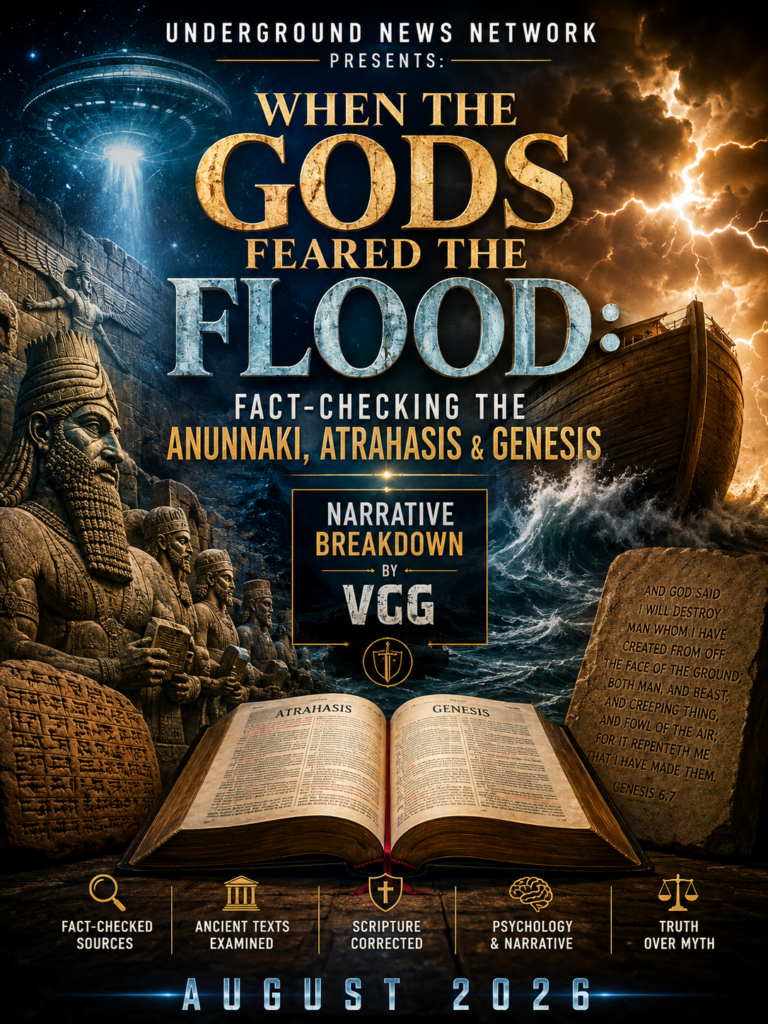
BY VCG ON 8/3/2026
A
- Textual
- Historical
- Psychological
- Biblical
Rebuttal of “If It Was Aliens”
Soli Deo Gloria
Executive verdict
The video is not a faithful reading of one ancient document, and it does not provide evidence for extraterrestrials.
It is principally a retelling of the Akkadian Atrahasis Epic, but it repeatedly calls the flood hero Ziusudra, who belongs to a separate Sumerian flood composition.
It also appears to borrow at least one recognizable feature from Tablet XI of Gilgamesh and adds modern connective material—most significantly the allegation that Enki gave humanity
“forbidden knowledge,”
“the secrets of heaven,”
and thereby
“corrupted mankind.”
Those statements are not securely preserved in the corresponding portion of Atrahasis.
The authentic Mesopotamian material is historically important.
It demonstrates that ancient Mesopotamians possessed creation-and-flood traditions involving:
- divine councils
- human overpopulation
- a warned survivor
- a vessel
- animals
- sacrifice
and post-flood measures.
But the material calls the Anunnaki gods, not extraterrestrial visitors; it contains no:
- spacecraft
- other planets
- genetic laboratories
- gold-mining program
or extraterrestrial migration.
Assyriological reference works classify the Anunnaki as a group of Mesopotamian deities within that culture’s pantheon. (ORACC)
The uploaded transcript will be treated as the record of what the video says.
Because it contains automatic-transcription errors and repeated clauses, I group adjacent lines into coherent claim units while covering every substantive part of the narration.
1. Methodology
This evaluation follows the research structure preserved in the VCG project manual:
- original statement
- historical analysis
- KJV-first biblical analysis
- linguistic considerations
- psychological and logical analysis
- missing context
- alternative interpretations
- conclusion
and recommendation.
It also follows the manual’s requirement to separate fact, interpretation, speculation, and rhetoric.
Each passage receives five tests:
Textual test:
Does an identifiable ancient text actually say it?
Source-identity test:
Is the passage from Atrahasis, the Sumerian Flood Story, Gilgamesh, or a modern reconstruction?
Historical test:
What does the tablet establish about ancient belief—and what does it not establish about actual history?
Biblical test:
Does the comparison represent Genesis accurately and in context?
Psychological test:
How might the mode of presentation influence belief independently of evidence?
The verdict terminology will be:
- Substantially authentic: a fair paraphrase of a preserved ancient passage.
- Smoothed reconstruction: based on an ancient passage, but presented with gaps and uncertainties removed.
- Conflation: material or names from separate texts treated as one story.
- Unsupported interpolation: wording or claims not supported by the corresponding preserved text.
- Invalid inference: an alien conclusion that does not follow from the evidence.
2. What ancient source is really being narrated?
Atrahasis
Most of the video follows the Old Babylonian Atrahasis Epic:
lesser gods perform hard labor, revolt, and are relieved when humanity is created from clay mixed with a slaughtered god’s flesh and blood.
Humans multiply and become noisy; Enlil sends plague and famine, but Enki helps Atrahasis frustrate those measures.
A flood is then decreed, Enki warns Atrahasis through a wall, and Atrahasis survives in a boat with his household and animals.
Afterward, population controls are instituted.
The fullest Old Babylonian version was written on three tablets during the reign of Ammi-saduqa, conventionally placed in the seventeenth century BC.
The British Museum identifies its hero as Atrahasis, not Ziusudra. (British Museum)
The Sumerian Flood Story
Ziusudra is the survivor in a separate, fragmentary Sumerian composition.
In it, Ziusudra receives a warning, survives a seven-day storm, opens the vessel to sunlight, sacrifices, and is eventually granted extraordinary life in Dilmun.
Much of the boat-building section is missing. (ETCSL)
Gilgamesh, Tablet XI
Utnapishtim is the survivor in the flood account incorporated into the Akkadian Epic of Gilgamesh.
The British Museum’s famous Flood Tablet is Tablet XI and explicitly identifies Ea as the god who reveals the plan and tells Utnapishtim to construct a boat. (British Museum)
Immediate source problem
The video narrates the plot of Atrahasis while calling the hero Ziusudra.
That is comparable to retelling the life of Moses while repeatedly naming him Abraham.
The figures are analogues within related traditions, but they are not interchangeable names inside one surviving composition.
A fair comparative retelling could say:
“The flood hero is called Ziusudra in the Sumerian story, Atrahasis in an Old Babylonian epic, and Utnapishtim in Gilgamesh.”
The video instead obscures those distinctions.
3. Transcript-name corrections
Several odd expressions are transcription errors rather than what the narrator probably intended:
| Transcript form | Probable intended form |
|---|---|
| “akihi,” “yugi,” “igi” | Igigi, a class of gods |
| “absolute” | Apsu, the subterranean freshwater realm |
| “mommy” | Mami, also called Nintu in the epic |
| “cow cow” | Kalkal, Enlil’s gatekeeper |
| “Nusco/Nusuku” | Nusku, Enlil’s minister |
| “inertia” | Probably Ennugi |
| “Ishkar” | Ishkur/Adad, the storm god |
| “zia sudra” | Ziusudra, although the relevant hero should usually be Atrahasis |
| “Geshtu” | Geshtu-e/We-ila, depending on recension and translation |
| “serapo disease” | A transliterated disease term rendered differently by translators |
These repairs do not cure the larger problem: the story’s principal hero remains misidentified.
4. Detailed timestamp analysis
0:01–0:58 — The gods perform humanlike labor
Video claim
The gods once carried crushing workloads.
The Igigi dug the canals and riverbeds of the Tigris and Euphrates while the Anunnaki occupied higher positions.
Historical fact-check
This is substantially faithful to the beginning of Atrahasis.
The poem begins with a reversal of ordinary human life:
before humans existed, lower-ranking gods performed the labor later assigned to people.
They dug waterways and carried burdens. (Livius)
Nothing here describes extraterrestrials.
It is a theological-social myth:
Mesopotamian human labor and class hierarchy are projected into the divine realm.
The gods have:
- overseers
- laborers
- workloads
- channels
- revolts
- assemblies
because the story imagines the cosmos through the institutions of Mesopotamian society.
Biblical correction
Genesis presents an entirely different Creator:
“In the beginning God created the heaven and the earth.”—Genesis 1:1
God creates by command.
He is not one laborer among many and is not dependent upon canals that other gods must excavate.
Humanity is later commissioned to cultivate and rule creation, but not because God is exhausted:
“So God created man in his own image… male and female created he them. And God blessed them…”—Genesis 1:27–28
Biblically, work is originally a blessed vocation under God’s dominion; in Atrahasis, human labor is devised to relieve divine drudgery.
Psychological and methodological note
Opening with recognizably ancient names and rivers creates an authority halo.
Authentic details can make later, unsupported additions feel equally ancient.
Historical authenticity must therefore be checked line by line; it cannot be transferred from one accurate paragraph to every later claim.
Verdict:
Substantially authentic mythology; no alien evidence.
0:58–2:09 — The Igigi revolt
Video claim
After years of intolerable labor, the lesser gods burn their tools, abandon their spades, and surround Enlil’s dwelling at night.
Historical fact-check
This is substantially authentic Atrahasis.
The laboring gods destroy or burn their implements and confront Enlil.
The basic labor-revolt narrative is not a modern invention. (Livius)
Biblical correction
The episode portrays the gods as finite, vulnerable, socially divided beings.
Enlil can be surprised, surrounded, awakened, and made fearful.
The God of Scripture is not one member of an unstable divine ruling class:
“The LORD hath prepared his throne in the heavens; and his kingdom ruleth over all.”
—Psalm 103:19
The comparison is not
“two different names for the same God.”
It is a fundamental contrast between biblical monotheism and a polytheistic divine society.
Psychology
The revolt humanizes the deities.
That makes the story memorable, but vividness is not evidence of literal historical biography.
Mythological gods routinely embody recognizable human institutions, emotions, and conflicts.
Verdict:
Accurate summary of the epic; incompatible with the biblical doctrine of God.
2:09–4:52 — Enlil fears attack; the gods investigate
Video claim
Enlil has weapons brought, is protected by Nusku, summons Anu and Enki, and asks who leads the rebellion.
The Igigi answer that every one of them has joined because the labor is killing them.
Historical fact-check
The core sequence is present in Atrahasis:
Enlil is alarmed, the divine assembly convenes, and Nusku communicates with the rebels.
The rebels collectively protest their excessive labor. (Livius)
The video’s speech is much smoother than the tablets.
Ancient texts are damaged and reconstructed from multiple copies.
A responsible presentation should mark uncertain restorations, broken lines, and editorial transitions instead of presenting every sentence as perfectly preserved.
Biblical correction
Biblical heavenly beings can serve God, but they do not force the LORD to negotiate by threatening his residence.
Psalm 103 describes angels as ministers who do his commandments, while the LORD’s kingdom rules over all.
Methodological failure
The narration does not distinguish:
preserved words;
restored words;
modern paraphrase;
transitions invented to make the story cinematic.
That omission becomes especially serious later, when modern ideas are inserted into damaged passages.
Verdict:
Broadly authentic, but presented with excessive textual certainty.
4:52–6:04 — Anu sympathizes with the rebels
Video claim
Enlil wants a rebel selected for destruction, but Anu acknowledges that the workers’ suffering is legitimate and that their cries were ignored.
Historical fact-check
Anu’s recognition that the labor was excessive accords with the ancient story.
The divine assembly does not simply punish the rebels; it seeks a new labor arrangement. (Livius)
Biblical correction
Scripture also teaches that God hears oppression, but for a different reason.
He is righteous, not pressured by an opposing divine faction.
In Exodus 3, God hears Israel’s cry and acts according to covenant and justice.
The distinction matters:
- Atrahasis: competing gods reach a political accommodation.
- Scripture: the one God judges according to his own holy character.
“He is the Rock, his work is perfect: for all his ways are judgment:
a God of truth and without iniquity, just and right is he.”—Deuteronomy 32:4
Verdict:
Authentic mythic politics; not a parallel to the biblical character of God.
6:04–6:53 — Enki proposes creating humanity
Video claim
Enki proposes that Mami create mortal humans so humanity can bear the yoke and work of the gods.
Historical fact-check
This is one of the clearest and most important statements in Atrahasis.
Humanity is created to assume the labor previously imposed on the lesser gods. (Livius)
Biblical correction
Genesis does place humanity in a garden
“to dress it and to keep it,”
but the purpose and status of humanity are radically different:
“And the LORD God formed man of the dust of the ground, and breathed into his nostrils the breath of life; and man became a living soul.”—Genesis 2:7
“And the LORD God took the man, and put him into the garden of Eden to dress it and to keep it.”—Genesis 2:15
The First Gate & the Fourth Rider – Library of Rickandria
Genesis combines service with:
- dignity
- divine breath
- moral responsibility
- fellowship
- blessing
- dominion
Atrahasis makes humanity a labor solution.
A superficial parallel—humans work the land—must not conceal the theological opposition.
Verdict:
Authentic Atrahasis; directly contradicts Genesis concerning human purpose.
6:53–8:55 — Clay mixed with the blood and flesh of a slain god
Video claim
Mami cannot create alone; Enki must prepare the clay.
A god possessing intelligence is slaughtered, and his flesh and blood are mixed with clay.
A human and god are thus combined, and a “ghost” or spirit persists as a reminder.
Historical fact-check
The basic episode is authentic.
In surviving versions, a god identified by names such as Geshtu-e or We-ila is killed, and Mami mixes clay with the god’s flesh and blood.
The passage links the slain deity with intelligence and with the human spirit or consciousness.
Exact wording differs among copies and translators. (Livius)
What it does not say
It does not describe:
DNA;
chromosomes;
a laboratory;
surgical equipment;
cloning;
extraterrestrial biology;
gene splicing.
“Clay plus divine blood”
is ritual-mythological anthropology.
Reading twenty-first-century biotechnology into it is technological eisegesis:
importing modern concepts into ancient symbolic language.
Biblical correction
Genesis says neither that Adam contained the blood of a murdered deity nor that humanity is a hybrid species.
Man’s material formation is from the ground; life comes through the LORD’s breath.
The divine image in Genesis 1:26–27 is not a biological sample.
It concerns humanity’s God-given:
- identity
- representation
- relationship
and rule under God.
Verse 27 immediately returns to the singular:
“So God created man in his own image…”
Therefore,
“Let us make man”
cannot responsibly be converted into
“a group of extraterrestrial genetic engineers made humans.”
Verdict:
Authentic mythic creation motif; alien-genetic interpretation unsupported.
8:55–10:08 — Fourteen pieces, male and female births
Video claim
Mami and Enki divide the clay into fourteen pieces, producing seven males and seven females, paired for gestation and birth.
Historical fact-check
This broadly follows the birth-creation section of Atrahasis.
The womb goddesses, paired clay pieces, male and female formation, and a gestational period are part of the narrative. (Livius)
Missing context
This is not an account of the universal biological production of every human individual.
It is an etiological myth explaining human:
- reproduction
- childbirth
- midwifery
- ritual practices through divine prototype
Biblical correction
Genesis likewise affirms humanity as male and female, but without fourteen prototype wombs, divine blood, or a slain god:
“Male and female created he them.”—Genesis 1:27
The similarity
“male and female are created”
is too general to establish copying or alien intervention.
The surrounding explanations are profoundly different.
Verdict:
Fair paraphrase of Atrahasis; no scientific or extraterrestrial content.
10:08–10:56 — Human multiplication becomes intolerable noise
Video claim
Humans spread rapidly.
Their population and noise disturb Enlil’s sleep, so he orders a disease to reduce them.
Historical fact-check
This is central to Atrahasis.
Humanity’s increasing “noise” or tumult disturbs Enlil, producing successive attempts at population reduction:
- plague
- famine
- eventually flood
(The Metropolitan Museum of Art)
Scholars debate the semantic and social implications of the noise—
- literal sound
- social disorder
- overpopulation
- rebellion
or a combination.
The video presents only the most literal, personalized version:
Enlil cannot sleep.
Biblical correction
In Genesis, multiplication is initially a blessing:
“Be fruitful, and multiply, and replenish the earth…”—Genesis 1:28
The biblical flood is not caused by population or noise:
“GOD saw that the wickedness of man was great in the earth…”
“The earth also was corrupt before God, and the earth was filled with violence.”
—Genesis 6:5, 11
This is arguably the most important difference between the two flood theologies:
- Atrahasis: humanity is a population-management problem.
- Genesis: humanity is judged for moral corruption and violence.
Verdict:
Authentic Mesopotamian theme; video viewers must not substitute it for Genesis.
10:56–12:48 — The plague and the misnamed hero
Video claim
A wise man in Shuruppak called “Ziusudra” appeals to Enki.
Enki tells the people to cease ordinary worship and direct offerings to Namtar, the plague deity. Namtar is shamed or appeased and removes the disease.
Historical fact-check
The strategy belongs to Atrahasis, but the protagonist in this epic is Atrahasis, not Ziusudra.
The hero’s special relationship with Enki/Ea enables him to thwart the plague.
The people concentrate offerings on the responsible deity, who lifts the affliction. (The Metropolitan Museum of Art)
Calling him Ziusudra creates a false impression that the entire twenty-six-minute account comes from the Sumerian Ziusudra tablet.
Biblical correction
The biblical God is not one specialized deity who must be manipulated against another.
Nor is sacrifice divine food:
“If I were hungry, I would not tell thee:
for the world is mine, and the fulness thereof.
Will I eat the flesh of bulls, or drink the blood of goats?”—Psalm 50:12–13
Prayer and sacrifice in Scripture operate within:
- covenant
- repentance
- thanksgiving
- atonement
- obedience
—not as leverage in a competition between hungry gods.
Verdict:
Real Atrahasis material under the wrong hero’s name.
12:48–16:11 — Famine, drought, social collapse, and cannibalism
Video claim
When humanity again becomes noisy, Enlil causes:
- drought
- crop failure
- infertility
- starvation
- slavery
and eventually cannibalism.
The hero once again follows Enki’s instructions, directing worship to the storm god until rain returns.
Historical fact-check
The long famine and its escalating horrors are genuinely part of Atrahasis.
The text depicts bodily deterioration, family breakdown, the selling of family members, and cannibalism.
Enki again helps Atrahasis frustrate the divine plan. (Geha)
The video nevertheless converts fragmentary poetic material into a continuous screenplay.
It does not notify the viewer where tablets are broken or where translators disagree.
Biblical correction
Scripture contains famine judgments and horrifying covenant consequences, but it never depicts the LORD as losing a contest with another deity who has been embarrassed by offerings.
God’s judgments remain under one sovereign moral government.
The Bible’s own rule for distinguishing the LORD from false gods is not simply
“which being can produce rain?”
It is the whole revelation of God’s:
- identity
- covenant
- righteousness
- prophecy
- creation
and redemptive acts.
Psychology
Graphic descriptions of mothers, daughters, and children create powerful emotional engagement.
Emotion does not make the material false, but it can reduce the audience’s attention to source problems.
A compelling story tends to be processed as a unified whole even when it has been assembled from different sources.
Research on narrative persuasion finds that narrative absorption can shift beliefs and may reduce active counterargument, although narratives are not invariably more persuasive than equally informative non-narrative presentations. (Cambridge University Press)
Verdict:
Ancient core is genuine; presentation hides textual uncertainty.
16:11–17:23 — Enlil accuses Enki
Video claim
Enlil complains that Enki was supposed to regulate the people but instead released resources and increased human knowledge.
Historical fact-check
There are preserved lines involving the gods’ prior assignments, Enki’s control over resources, and Enki’s undermining of population-reduction measures.
However, this part of the tablet is heavily damaged.
Large portions are missing. (Geha)
A careful edition visibly marks the gaps.
The video does not.
Verdict: Based on an authentic dispute, but presented with unjustified continuity.
17:00–18:40 — “Secrets of heaven” and “forbidden knowledge”
Video claim
The narration says that Enki:
bestowed the secrets of heaven upon mankind;
caused knowledge to increase;
corrupted humanity;
gave forbidden knowledge;
taught humans to shame the gods;
caused humanity to despoil the earth.
Textual fact-check
This is the most serious distortion in the video.
The corresponding Atrahasis passage contains extensive lacunae.
In Stephanie Dalley’s translation, the surviving context moves from Enki’s role in releasing produce and regulating the balance, through a major broken section, to accusations that he imposed the gods’ workload and “noise” on humanity and participated in killing the god used for human creation.
The explicit speech about “secrets of heaven,” “forbidden knowledge,” corruption, and despoiling the earth is not securely present in the preserved lines. (Geha)
The video has apparently inserted a thematic bridge resembling:
Genesis 3 and forbidden knowledge;
Genesis 6 and earthly corruption;
Watcher traditions about forbidden arts;
Prometheus giving knowledge to humanity;
modern ancient-astronaut claims about advanced teaching.
That bridge is then narrated in the same authoritative tone as the genuine text.
Why this matters
This is source laundering.
Authentic ancient words surround a modern interpolation, causing the inserted material to inherit the authority of the tablet.
A responsible narration would say:
“Several lines are missing here.
Enlil’s surviving accusation concerns Enki’s interference with population control and his role in human creation.
Some modern retellings speculate about forbidden knowledge, but that wording is not preserved in this section.”
Biblical correction
Genesis 3 does contain prohibited knowledge, but the roles are different:
- The LORD gives the prohibition.
- The serpent contradicts God.
- The human pair willingly transgresses.
- Knowledge is not presented as extraterrestrial science donated by humanity’s benevolent engineer.
Genesis 6 identifies:
- wickedness
- corrupt desire
- violence
and the corruption of “all flesh” as the cause of judgment.
It does not identify Enki or the Anunnaki.
Verdict:
Unsupported interpolation placed at the video’s most theologically suggestive point.
18:40–19:59 — Enki is ordered to produce a flood
Video claim
Enlil blames Enki for humanity and demands that Enki’s own power be used to destroy his people.
Enki objects but is compelled to swear an oath.
Historical fact-check
The broader conflict is authentic: the divine assembly resolves upon the flood, Enki objects or distances himself from the destructive decision, and he is constrained by an oath.
The tablet is again damaged, so the exact dialogue should be presented cautiously. (Geha)
Biblical correction
Genesis contains no coalition forcing a reluctant creator to destroy his own subjects.
The LORD himself declares judgment and himself establishes the means of preservation:
“And God said unto Noah, The end of all flesh is come before me; for the earth is filled with violence…”
“But with thee will I establish my covenant…”—Genesis 6:13, 18
Judgment and salvation are not divided between hostile gods.
Both proceed from the one God, who remains just, merciful, sovereign, and covenantally faithful.
Verdict:
Authentic polytheistic conflict; not the Genesis account under different names.
19:59–20:40 — Warning through the reed wall
Video claim
Unable to speak openly because of his oath, Enki communicates indirectly through a reed wall and warns the hero.
Historical fact-check
This is an authentic and famous Mesopotamian motif.
Enki/Ea addresses the wall rather than ostensibly addressing Atrahasis directly, thereby circumventing the oath. (Geha)
Once again, however, the hero here is Atrahasis.
The Sumerian Ziusudra story also contains a wall-warning motif, which shows the relationship among the traditions, but that does not make all their wording one document. (ETCSL)
Biblical correction
God speaks directly to Noah.
There is no divine legal trick, no wall used to deceive the divine assembly, and no conflict between the revealer and the judge.
This matters theologically.
The Mesopotamian survivor lives because one deity covertly frustrates other deities.
Noah lives by grace within the publicly declared purpose and covenant of the one God.
Verdict:
Authentic motif, wrong hero identification, sharply different theology.
20:40–21:14 — “Dismantle your house and build a boat”
Video claim
The hero is told to reject possessions, save living things, dismantle his house, build a boat, roof it over, construct decks, and waterproof it with bitumen.
Historical fact-check
These instructions are substantially grounded in the ancient flood traditions.
The preservation of life, renunciation of possessions, roofing, decks, and bitumen are all recognizable Mesopotamian elements. (Geha)
“Design of a circle”
Circular flood-boat instructions are not necessarily a modern fabrication.
A separate Old Babylonian “Ark Tablet,” interpreted within the Atrahasis tradition, famously describes an enormous circular coracle-type vessel.
The unusual shape is related to known Mesopotamian rivercraft, not extraterrestrial technology. (The Guardian)
Biblical correction
The Genesis ark is not circular:
“The length of the ark shall be three hundred cubits, the breadth of it fifty cubits, and the height of it thirty cubits.”—Genesis 6:15
It is made of gopher wood, coated with pitch, divided into rooms, and built with lower, second, and third stories.
The shared use of waterproofing and decks is understandable in flood vessels.
The different shapes demonstrate that the accounts should not be collapsed into one supposedly technical alien blueprint.
Verdict:
Mostly authentic Mesopotamian boat material; alien interpretation invalid.
21:14–22:13 — The hero deceives the elders and loads life aboard
Video claim
The hero tells the elders that Enki and Enlil are estranged and that he must leave Shuruppak.
Craftsmen help build the vessel; living creatures, family, and friends are placed aboard.
Historical fact-check
This broadly follows Atrahasis.
The hero offers a cover story concerning his departure and Enki’s displeasure, and the vessel is prepared with assistance. (Geha)
Some details are expanded by paraphrase.
“The best of all species,”
for example, gives the material a modern biological sound that exceeds what should be inferred from ancient animal-list language.
Biblical correction
Noah is not portrayed as deceiving his neighbors to conceal a divine civil war.
He obeys the command of God:
“Thus did Noah; according to all that God commanded him, so did he.”—Genesis 6:22
Second Peter calls Noah
“a preacher of righteousness,”
which differs from the video’s secretive initiate escaping through divine favoritism.
Verdict:
Authentic plot with dramatic modernization.
22:13–23:32 — The flood lasts seven days
Video claim
The hero feasts with the people but is internally terrified.
The storm arrives, the boat is released, darkness covers the land, bodies float upon the water, and the flood rages for seven days before subsiding.
Historical fact-check
The hero’s distress, the violence of the storm, divine terror, human destruction, darkness, and a seven-day catastrophe are Mesopotamian flood elements.
Atrahasis depicts the flood as so terrible that even the gods react in horror and deprivation. (Geha)
Biblical correction
Genesis distinguishes several periods:
seven days of waiting before the onset;
forty days and forty nights of rain;
waters prevailing for 150 days;
a longer recession before the earth is dry.
“The rain was upon the earth forty days and forty nights.”
“And the waters prevailed upon the earth an hundred and fifty days.”
—Genesis 7:12, 24
The video’s seven-day flood should therefore not be presented as though it were simply Genesis with Mesopotamian names.
Verdict:
Authentic Mesopotamian flood duration; contradistinct from Genesis.
23:32–24:02 — The raven that never returns
Video claim
After the storm, the hero opens a window and releases a raven.
The raven does not return; the waters recede.
Historical fact-check
The bird-test motif is famous in Gilgamesh Tablet XI.
The surviving Atrahasis ending is fragmentary and does not securely preserve this exact raven episode in the same continuous form.
The video is therefore likely combining its Atrahasis framework with a detail preserved in the Gilgamesh flood account.
The British Museum identifies the Flood Tablet as Tablet XI of Gilgamesh, with Utnapishtim—not Ziusudra or Atrahasis—as its survivor. (British Museum)
Biblical correction
Genesis says:
“And he sent forth a raven, which went forth to and fro, until the waters were dried up from off the earth.”—Genesis 8:7
Noah then sends a dove three times.
The transcript omits the dove sequence entirely and changes the raven’s action to a simple non-return.
Thus, the bird motif demonstrates relationship or shared tradition, but the details are not identical.
Verdict:
Likely Gilgamesh/Genesis-associated material inserted into an Atrahasis retelling.
24:02–24:20 — Sacrifice and the gods gathering “like flies”
Video claim
The survivor offers sacrifice.
Hungry gods smell it and swarm around the offering like flies.
Historical fact-check
The comparison of the gods to flies around the offering is an authentic and striking Mesopotamian image.
In the story, the flood has eliminated the humans who supplied offerings, leaving the gods deprived. (Geha)
Biblical correction
Genesis 8:20–21 also records Noah’s burnt offering and the LORD smelling
“a sweet savour.”
Scripture must interpret Scripture:
Psalm 50 explicitly denies that God is physically hungry or nourished by sacrificial meat.
Therefore:
- Mesopotamian theology: the gods suffer deprivation when human offerings cease.
- Biblical theology: sacrificial language signifies acceptance and covenantal response, not divine nutrition.
The similarity of sacrificial aroma should not erase the Bible’s explicit denial that God depends upon food.
Verdict:
Authentic Mesopotamian passage; superficial resemblance conceals opposite doctrines of divine self-sufficiency.
24:20–24:58 — Enlil discovers that life survived
Video claim
Enlil sees the boat and becomes enraged because the gods had sworn that no life would escape.
Enki admits that he preserved life in defiance of the assembly.
Historical fact-check
This is substantially authentic.
Enlil is furious at the survival, and Enki/Ea defends or acknowledges his role in preserving humanity. (Geha)
Biblical correction
The LORD is neither surprised nor defeated by Noah’s survival.
Survival was his declared plan:
“But with thee will I establish my covenant…”—Genesis 6:18
“And the LORD shut him in.”—Genesis 7:16
In Genesis, the ark demonstrates the success of God’s judgment-and-salvation plan.
In the Mesopotamian story, it demonstrates the successful subversion of one divine faction by another.
Verdict:
Authentic and theologically incompatible with Genesis.
24:58–25:53 — Post-flood population controls
Video claim
Enki and Mami institute:
- infertility
- miscarriage
- infant mortality
- premature death
- religious celibacy
to keep the human population under control.
Historical fact-check
The core idea is authentic: post-flood measures limit births and population.
The text mentions infertility, infant mortality, and classes of women who do not bear children.
The passage is fragmentary, and its ancient social and cultic terms require careful translation. (Geha)
The phrase
“let religion make some of them celibate”
is a tendentious modernization.
“Religion” is not a personal actor in the tablet.
The text refers to particular classes or cultic offices whose members are prevented from bearing children.
Biblical correction
Genesis moves in the opposite direction:
“And God blessed Noah and his sons, and said unto them, Be fruitful, and multiply, and replenish the earth.”—Genesis 9:1
God then establishes a covenant with Noah, his descendants, and every living creature, promising that the waters will not again become a flood destroying all flesh.
The bow in the cloud is the covenant token.
The contrast could hardly be stronger:
- Atrahasis: survival is followed by reproductive restrictions to control troublesome humanity.
- Genesis: survival is followed by blessing, fruitfulness, moral accountability, and covenant.
Verdict:
Authentic population-control conclusion, inaccurately paraphrased in places; directly opposite Genesis 9.
5. The “forbidden knowledge” insertion in full context
Because it is the video’s most consequential distortion, it deserves a consolidated finding.
What is securely present
The ancient story does accuse Enki of:
undermining previous attempts to reduce humanity;
assisting Atrahasis;
participating in humanity’s creation;
transferring divine labor onto humans;
contributing to the human “noise” problem.
What the video adds
It supplies a polished accusation that Enki:
gave humans heavenly secrets;
gave forbidden knowledge;
increased knowledge;
corrupted humankind;
taught humanity to shame the gods;
caused humans to despoil the earth.
The surviving tablet in that section is visibly broken, with a substantial gap between the surrounding ideas.
The modern material is effectively inserted into the missing space. (Geha)
Probable rhetorical purpose
Whether intentional or not, this insertion links four popular narratives:
Enki as the benevolent rebel;
the serpent as a liberator bringing knowledge;
Watchers teaching forbidden arts;
extraterrestrials accelerating human civilization.
But the connection is created by the retelling, not demonstrated from the tablet.
6. Genesis and Atrahasis: controlled comparison
| Subject | Genesis | Atrahasis tradition |
|---|---|---|
| Ultimate deity | One sovereign Creator | A divided pantheon |
| Creation of humans | God’s image; dust and divine breath | Clay mixed with slain god’s flesh and blood |
| Human purpose | Blessing, dominion, cultivation, fellowship, obedience | Relief of the gods’ labor |
| Multiplication | Divine blessing | Becomes a population/noise problem |
| Cause of flood | Wickedness, corruption, violence | Noise/overpopulation and failed population controls |
| Warning | God directly tells Noah | Enki secretly circumvents the divine assembly |
| Survivor | Noah finds grace and is righteous in his generation | Atrahasis is Enki’s wise devotee |
| Vessel | 300 × 50 × 30 cubits; wooden, pitched, three levels | Varies by tradition; some versions describe a circular or differently proportioned vessel |
| Storm chronology | Forty days of rain; waters prevail 150 days | Seven-day storm in major Mesopotamian versions |
| Divine reaction | God remains sovereign | Gods become frightened, hungry, divided |
| Sacrifice | Accepted; covenantal context; God is not hungry | Gods gather around the restored food supply |
| Post-flood order | Covenant, moral accountability, “be fruitful” | Infertility, infant death, and non-childbearing classes to limit population |
| Final theology | Righteous judgment joined with grace and covenant | Divine crisis management within a fallible pantheon |
The shared narrative architecture is real. The theological opposition is equally real.
Genesis does not merely remove a few Mesopotamian god names.
It systematically transforms the moral meaning of:
- creation
- judgment
- salvation
- sacrifice
- human dignity
and the post-flood world.
7. Do the parallels prove that Genesis copied Mesopotamia?
No single inference is compelled by the parallels.
Several models have been proposed:
Direct or indirect literary dependence
A biblical author or tradition may have known Mesopotamian flood literature and deliberately recast it.
Shared ancient Near Eastern tradition
Different societies may have inherited and reshaped older regional flood memories.
Common historical memory
The traditions may preserve memories of one or more catastrophic floods, later interpreted differently.
Polemical correction
Genesis may intentionally confront pagan flood theology:
the true God is not hungry, frightened, divided, deceptive, or irritated merely by human existence.
Combination
Oral memory, actual regional floods, literary transmission, and theological polemic could all have contributed.
The age of a surviving tablet proves that the story existed by that period.
It does not by itself prove:
that the tablet’s gods literally existed;
that its version is the original human account;
that every detail is eyewitness history;
that Genesis was copied directly from that exact tablet;
that extraterrestrials caused the flood.
The Metropolitan Museum distinguishes the Sumerian Ziusudra story, Old Babylonian Atrahasis, and later Gilgamesh forms while recognizing their related flood traditions. (The Metropolitan Museum of Art)
8. Archaeological correction
Actual cuneiform tablets establish that ancient Mesopotamians wrote and transmitted these stories.
They do not archaeologically verify that Enki, Enlil, Mami, or the Anunnaki were physical visitors.
Flood deposits have been found at several Mesopotamian sites, but they do not form one simple, universally synchronized archaeological layer.
For example, the flood layer excavated at Ur was recognized as too early to identify automatically with the flood associated with the Ziusudra tradition, while other sites produced deposits from different contexts and dates.
These discoveries support the unsurprising reality of severe river flooding in Mesopotamia, but they do not independently authenticate every mythological detail. (Penn Museum)
The proper archaeological conclusion is modest:
Ancient Mesopotamian settlements experienced destructive floods, and Mesopotamian literature developed major flood traditions.
The evidence does not warrant:
Therefore, the Anunnaki were extraterrestrials who engineered humanity.
9. The Anunnaki are not identified as aliens
What the term establishes
In Mesopotamian sources, the Anunnaki are a category or assembly of deities.
Their precise membership and function vary by period and composition.
Sometimes they are leading gods; in other contexts they have underworld or judicial associations. (ORACC)
What the video fails to establish
The transcript never produces an ancient line saying that the Anunnaki:
came from another planet;
traveled through outer space;
possessed spacecraft;
colonized Earth;
altered human DNA;
required gold for an atmosphere;
came from Nibiru;
wore space suits;
built launch facilities.
Those familiar claims belong to modern ancient-astronaut literature, not to the supplied narration.
Logical analysis
The argument implicitly becomes:
- Ancient people spoke of powerful nonhuman beings.
- Modern people call powerful nonhuman space travelers aliens.
- Therefore, the ancient gods were aliens.
That is an equivocation.
A mythological deity is not converted into an extraterrestrial biological organism merely by replacing the word “god” with “alien.”
A conclusion requires positive evidence, not only a modern category into which the story can be imaginatively placed.
Alien verdict:
Unsupported.
10. Psychological and rhetorical analysis
These observations describe possible effects of the presentation.
They do not establish the creator’s private intentions.
A. Priming through the title
“IF IT WAS ALIENS” supplies the interpretive frame before the evidence is heard.
Once primed, viewers may mentally translate every occurrence of “god,” “sky,” “creation,” or “knowledge” into alien technology.
But a frame is not a finding.
The proper order is:
establish what the text says;
evaluate historical categories;
test competing explanations;
only then draw a conclusion.
The title reverses that order.
B. Narrative transportation
The video creates one flowing dramatic story with:
- recognizable protagonists
- conflict
- suffering
- rebellion
- secret knowledge
- catastrophe
- rescue
That structure encourages the audience to experience the material as a coherent remembered event rather than as fragmentary texts from different periods.
Experimental and meta-analytic research shows that narrative presentations can affect attitudes and beliefs; immersion may also reduce active counterargument in some circumstances. (Cambridge University Press)
C. Source-monitoring confusion
Human memory often preserves content more readily than its exact source.
Source-monitoring research includes the misattribution of familiarity and the incorporation of fictional or imagined material into remembered fact. (PubMed)
The video creates ideal conditions for this error:
Atrahasis’s story;
Ziusudra’s name;
a Gilgamesh-associated raven;
modern “forbidden knowledge” language;
Genesis-like corruption terminology;
all become remembered as “what the Sumerian tablets say.”
D. Processing fluency
Proper names, smooth narration, repeated divine titles, and uninterrupted chronology make the presentation easy to process.
Ease of processing can be mistaken for truth or scholarly certainty.
Research on the illusory-truth effect consistently finds that repetition can increase perceived truth even though repetition supplies no new evidence. (PubMed Central (PMC))
The practical safeguard is not merely to repeat the opposing conclusion.
It is to restore the source boundaries:
“This line is Atrahasis.”
“This name is Ziusudra.”
“This bird appears in Gilgamesh.”
“This sentence is a modern insertion.”
“This portion of the tablet is broken.”
E. Authority transfer
Because many early details are authentic, viewers may grant authority to later additions.
This resembles a valid credential being used to authenticate an invalid claim.
Authentic premise:
Atrahasis says humans were made from clay and divine blood.
Unsupported attachment:
Therefore this describes alien genetic engineering.
Authentic premise:
Enki repeatedly aids humanity.
Unsupported attachment:
Therefore the tablet says Enki gave forbidden extraterrestrial science.
F. False precision
Detailed:
- names
- speeches
- dates
- dramatic sequences
give an impression of exact preservation.
Yet the ancient manuscripts contain broken lines, alternate recensions, disputed readings, and restoration brackets.
Removing uncertainty does not make a source more accurate.
It makes the retelling more confident than the evidence.
G. Pattern completion
Once the viewer recognizes similarities to Genesis—boat, animals, flood, sacrifice, bird—the mind naturally seeks a single unified explanation.
But pattern recognition must be followed by discrimination.
A valid comparison asks both:
- What is similar?
- What is different, and are the differences central or incidental?
Here the differences concern the identities of God and man, the moral cause of judgment, the means of salvation, and the covenant afterward.
They are central.
H. “Forbidden history” appeal
The idea that an ancient text reveals a truth suppressed by conventional religion offers intellectual excitement and a sense of privileged discovery.
It may encourage the viewer to treat scholarly caution as evidence of concealment rather than as ordinary textual discipline.
That response makes the theory difficult to falsify:
agreement becomes confirmation;
disagreement becomes suppression;
missing evidence becomes proof it was hidden.
A sound hypothesis must identify what evidence could show it to be wrong.
11. Scriptural correction of the video’s complete worldview
God is one, not a coalition
“I am the LORD, and there is none else, there is no God beside me.”—Isaiah 45:5
“I have made the earth, and created man upon it…”—Isaiah 45:12
The Anunnaki council cannot be equated with the LORD without overturning the Bible’s explicit testimony.
God is not dependent upon human food
“If I were hungry, I would not tell thee…”—Psalm 50:12
The gods gathering like flies therefore reflects the theology Scripture rejects.
Humanity is not divine slave stock
Humanity bears God’s image, receives blessing, and is given responsible dominion.
Humanity is not made from murdered divine blood
Adam is formed from dust and receives life through God’s breath.
The flood is moral judgment
Genesis repeatedly identifies wickedness, corruption, and violence—not noise—as its cause.
Noah survives by grace and covenant
“But Noah found grace in the eyes of the LORD.”—Genesis 6:8
The ark is not an unauthorized escape engineered by a rival deity.
God is not surprised by the survivor
God commands the ark, shuts Noah in, remembers Noah, and establishes the post-flood covenant.
The post-flood command is fruitfulness
The biblical response is not permanent population suppression but renewed blessing joined with the sanctity of life and moral accountability.
Pagan gods are not alternative creators
Scripture sometimes describes pagan sacrifice as directed to devils rather than to God:
“They sacrificed unto devils, not to God; to gods whom they knew not…”—Deuteronomy 32:17
Paul carefully distinguishes the idol itself from the spiritual reality of idolatrous worship:
“The things which the Gentiles sacrifice, they sacrifice to devils, and not to God.”—1 Corinthians 10:20
That does not authorize us to turn every line of Mesopotamian mythology into a literal biography of a particular demon.
It gives a biblical theological evaluation of idolatry, not permission to abandon historical and literary analysis.
12. What the video gets right
Fairness requires recognizing its legitimate content.
The video correctly conveys that:
- Atrahasis begins with divine labor and revolt.
- Humans are created to bear the gods’ workload.
- Clay and the blood/flesh of a slain god are used.
- Humanity’s multiplication and noise provoke successive divine measures.
- Enki repeatedly protects the human hero.
- A flood is decreed.
- The hero receives a warning involving a wall.
- A boat is built and waterproofed.
- Family and animals survive aboard it.
- The storm lasts seven days in the Mesopotamian tradition.
- Sacrifice follows.
- The gods gather around the offering.
- Enlil is angry that anyone survived.
- Population controls conclude the Atrahasis solution.
These features are real ancient literature, not a wholesale modern fabrication. (Livius)
13. What the video gets wrong
Its principal failures are:
It misnames the protagonist
The Atrahasis narrative is repeatedly assigned to Ziusudra.
It collapses separate traditions
Sumerian Ziusudra, Old Babylonian Atrahasis, and Gilgamesh’s Utnapishtim are treated as though they came from one continuous tablet.
It hides textual damage
Broken and disputed sections are narrated as complete dialogue.
It inserts forbidden-knowledge claims
The “secrets of heaven,” “forbidden knowledge,” corruption, and despoiling language is not securely preserved in the corresponding Atrahasis passage.
It modernizes ancient categories
Ritual creation becomes suggestive of biotechnology; cultic classes become
“religion making people celibate.”
It invites an alien inference without alien evidence
The title supplies what the tablets do not.
It fails to compare Genesis contextually
Similar motifs are highlighted while the opposite concepts of God, humanity, judgment, sacrifice, and covenant are neglected.
14. Final factual ratings
| Question | Finding |
|---|---|
| Are the Mesopotamian tablets real? | Yes. |
| Is much of the narrated story ancient? | Yes. |
| Is it all one Ziusudra text? | No. |
| Is the main narrative actually Atrahasis? | Yes. |
| Are the manuscripts fragmentary? | Yes. |
| Does the corresponding tablet clearly say Enki gave “forbidden knowledge”? | No. |
| Does the text describe alien genetics? | No. |
| Does “Anunnaki” mean an established extraterrestrial species? | No evidence. |
| Are there genuine similarities with Genesis? | Yes. |
| Are the two accounts theologically equivalent? | No. |
| Do parallels alone prove direct biblical copying? | No. |
| Do parallels disprove Genesis? | No. |
| Do the tablets prove the flood exactly as narrated in either tradition? | No; they prove that the traditions existed. |
| Is “aliens” the best historical explanation? | No positive evidence is supplied. |
Conclusion
The strongest accurate description of this video is:
A dramatic, partially accurate retelling of the Babylonian Atrahasis Epic, mislabeled with the Sumerian hero Ziusudra, blended with material from related flood traditions and modern forbidden-knowledge language, then framed by an alien hypothesis that the ancient texts themselves do not establish.
The video’s authentic features deserve serious study.
They illuminate the religious world in which ancient Near Eastern peoples understood labor, reproduction, divine order, catastrophe, and sacrifice.
But careful comparison does not reduce Genesis to an Anunnaki story.
Genesis presents a sustained correction of the very theological concepts prominent in Atrahasis:
- God does not need workers to relieve his exhaustion.
- God does not require food.
- God is not frightened by the flood.
- God does not quarrel with rival creators.
- Humanity is not disposable slave stock.
- Human multiplication is not inherently offensive.
- Judgment is morally grounded in wickedness and violence.
- Noah’s survival is not a cosmic conspiracy.
- The flood concludes with covenant and blessing, not a policy of infant death and suppressed fertility.
The Mesopotamian stories portray gods made in the image of human empires:
- hierarchical
- hungry
- divided
- irritable
- vulnerable
and politically calculating.
Genesis declares man made in the image of the one sovereign God.
That is not a minor variation.
It is the dividing line between the two worldviews.
VCG PAPER PROJECTS – Library of Rickandria
When the Gods Feared the Flood: Fact-Checking the Anunnaki, Atrahasis & Genesis