
An Ominous Announcement? A Fact-Checked, Psychological & Biblical Analysis of Media Framing in U.S.–Iran War Reporting
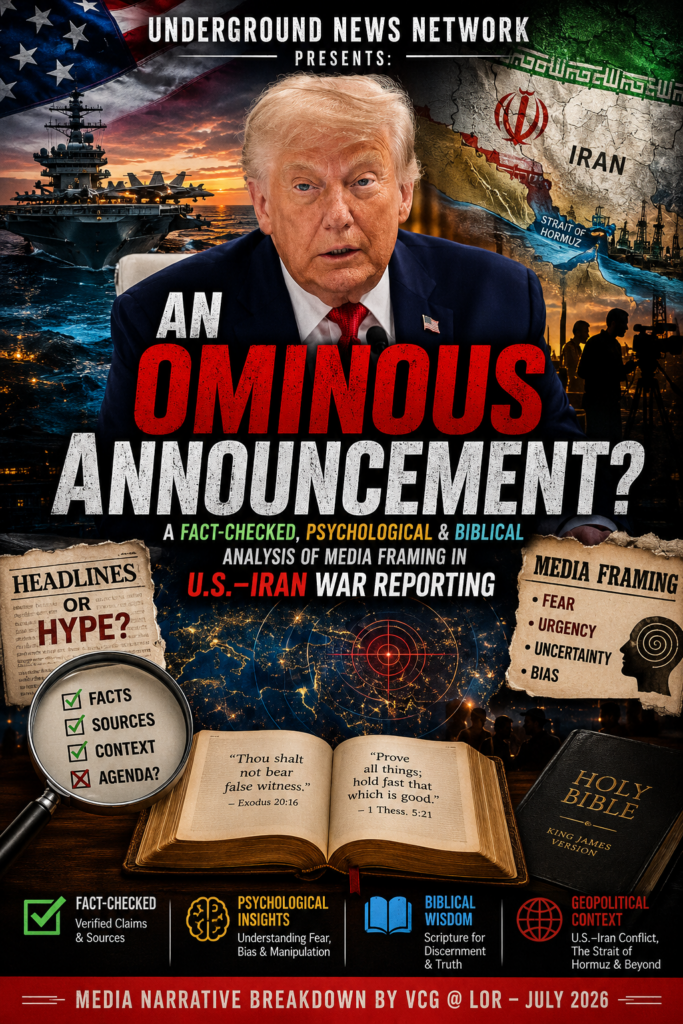
VCG @ LOR 7/13/2026
Soli Deo Gloria.
The article is not wholly fabricated, but it is poorly disciplined journalism:
it mixes:
- real events
- unverified claims
- loaded adjectives
- vague sourcing
- speculation
and compressed chronology.
Donald Trump makes ominous speech announcement as tensions with Iran explode
Its chief defect is not that every assertion is false; rather, it repeatedly presents interpretation with the emotional force of fact.
1. Method used for this examination
I evaluated each statement under five headings:
- Verifiable fact: supported by official records or multiple reputable reports.
- Attributed claim: someone genuinely said it, but the underlying assertion remains unproved.
- Inference: a conclusion drawn from circumstances rather than directly established.
- Loaded framing: language that supplies an emotional judgment without adding evidence.
- Omission: relevant context withheld in a way that may distort the reader’s impression.
For biblical evaluation, I am not asking whether Scripture endorses:
- Trump
- Iran
- NATO
or American foreign policy.
Scripture does not authorize us to baptize a political faction.
The questions are narrower:
- Is the report truthful?
- Are claims distinguished from proof?
- Is fear being cultivated unnecessarily?
- Are rulers treated either as messiahs or monsters?
- Are readers encouraged to exercise righteous judgment?
The governing biblical standards include:
“Thou shalt not bear false witness against thy neighbour.” — Exodus 20:16
“He that answereth a matter before he heareth it, it is folly and shame unto him.” — Proverbs 18:13
“He that is first in his own cause seemeth just; but his neighbour cometh and searcheth him.” — Proverbs 18:17
“Prove all things; hold fast that which is good.” — 1 Thessalonians 5:21
Line-by-line analysis
Headline
“Donald Trump makes ominous speech announcement as tensions with Iran explode”
What is factual
Trump did announce a Thursday evening national address, according to the article’s quotation of his social-media announcement. The larger context of renewed American-Iranian hostilities is also real. Reuters and other reporting confirm renewed strikes, retaliatory attacks, disruption in the Strait of Hormuz, and Trump’s announcement of a blockade and 20% cargo charge. (Reuters)
What is misleading
“Ominous” is not a fact. It is the publication’s emotional interpretation.
The announcement itself, as quoted, merely gives a time:
“President Trump will be making a Speech to the Nation on Thursday evening, at 9 P.M. Eastern.”
Nothing in that wording states that the address concerns:
- war
- assassination
- retaliation
or emergency action.
The ominousness is imported by the headline.
“Tensions … explode” is also metaphorical intensification. Actual attacks had occurred, so serious language is warranted. Nevertheless, “explode” is chosen partly for emotional impact and partly as a war-related pun.
Psychological method
The headline combines:
- Ambiguity: the subject of the address is unknown.
- Threat: military escalation and a possible assassination plot.
- Immediacy: a prime-time address is forthcoming.
- Curiosity gap: the reader must click to learn what may happen.
Uncertain future threats are especially effective at producing anticipatory anxiety. Research distinguishes anxiety from immediate fear partly by its relationship to uncertain or unpredictable danger. (Nature)
Anxiety can also increase information-seeking when people perceive large changes in their environment. Thus, “Trump will speak, no one knows why, war is escalating” is an efficient engagement formula. (Nature)
Better wording
Trump announces Thursday national address amid renewed U.S.-Iran fighting
That preserves the news value without pretending the publication knows the speech will be ominous.
Scriptural correction
Scripture does not forbid warning of genuine danger. Noah warned of judgment; Joseph prepared for famine; watchmen were expected to sound an alarm. But a warning should correspond to known evidence.
“The simple believeth every word:
but the prudent man looketh well to his going.” — Proverbs 14:15
The reader should distinguish an actual military danger from a journalist’s atmosphere-building adjective.
Byline
“Story by Mataeo Smith”
The byline identifies the writer but tells us nothing about the reporting process. The article contains no visible documentary links, interview descriptions, or explanation of whether the author independently verified the claims.
That does not prove misconduct. It does mean the reader must evaluate the article chiefly through its evidence, not the writer’s authority.
Biblically, reputation can matter, but it does not replace examination:
“The simple believeth every word…”
Paragraph 1
“President Donald Trump announced that he will address the nation during prime time on Thursday night without offering additional details.”
Verdict: Mostly factual, but incompletely sourced
The quotation presented later supports the announcement and time. At the time the article was published—Monday, July 13, 2026—Thursday meant July 16, 2026. The article would have been clearer had it stated the full date.
“Without offering additional details”
appears fair if the quoted announcement was all that accompanied the notice. However, the article should link directly to the post or an official White House schedule.
The current White House live page, when indexed on July 13, did not itself establish the announced Thursday subject. (The White House)
Correction
Trump announced a national address for 9 p.m. Eastern on Thursday, July 16. The announcement did not identify its subject.
Scriptural principle
Precision is part of truthfulness. A statement can be technically true yet needlessly vague.
Paragraph 2
“It’s unclear what the speech will be about, but it will come amid rising tensions in the Middle East.”
Verdict: Fair, with an important limitation
The first clause is an honest acknowledgment of uncertainty.
The second is factual. Renewed U.S. strikes, Iranian retaliation, shipping disruption, and competing claims over the Strait of Hormuz establish genuine escalation. (Reuters)
The logical problem is the connective “but.” It encourages the reader to associate the unidentified speech with Iran without evidence that Iran will actually be the subject.
This is an example of juxtaposition framing: two facts are placed together so that readers naturally infer a causal or thematic connection.
Better wording
The White House has not disclosed the subject. The announcement comes during renewed U.S.-Iran hostilities, although the article has not established that the address will concern Iran.
“President Trump has floated the idea that his life is in imminent danger as the U.S. ramps up strikes against Iran.”
Verdict: Overstated and psychologically loaded
There were reported concerns about an Iranian assassination plot, and Trump reportedly described himself as a leading Iranian target. Reports also said he had issued retaliatory instructions in the event of his death. (The Wall Street Journal)
But “floated the idea that his life is in imminent danger” is imprecise.
Questions the article does not answer:
- Did Trump use the word imminent?
- Was he describing a new, time-specific threat?
- Was he discussing Iran’s longstanding desire for revenge over the killing of Qasem Soleimani?
- Was he speaking literally, rhetorically, or conditionally?
- How credible did U.S. intelligence judge the specific plot?
The Wall Street Journal reporting summarized in search results said Israeli intelligence had warned of a possible plot, but the threat was not universally regarded as fully credible. (The Wall Street Journal)
Therefore, the article converts a disputed threat assessment into a more vivid formulation.
Correction
Trump has said Iran may seek to assassinate him, while reporting indicates that officials differed over the credibility or immediacy of a recently reported plot.
Scriptural correction
Neither credulity nor mockery is appropriate. A death threat against a ruler should be taken seriously, but an allegation remains an allegation until established.
“The prudent man looketh well to his going.”
Paragraph 3
“The president made the announcement via Truth Social.”
Verdict: Plausible and apparently accurate
The original article reproduces the announcement. However, it should have linked the primary post.
“‘President Trump will be making a Speech to the Nation on Thursday evening, at 9 P.M. Eastern,’ the post read.”
Verdict: Directly attributed quotation
This is one of the article’s strongest lines because it gives the reader the source’s exact wording rather than paraphrasing it emotionally.
Notice, however, that the quotation itself contains none of the headline’s “ominous” content.
That contrast is important: the article’s strongest evidence does not support its strongest emotional framing.
Scriptural principle
A direct, accurately preserved quotation is preferable to embellishment:
“A faithful witness will not lie.” — Proverbs 14:5
Paragraph 4
“According to the president, the flimsy ceasefire deal with Iran that purportedly guaranteed it would never acquire a nuclear weapon is ‘over,’ but the Islamic Republic is ‘dying’ to make a deal.”
This sentence has several problems.
1. “According to the president”
This properly attributes at least part of the claim to Trump rather than stating it as settled fact.
2. “Flimsy”
It is unclear whether “flimsy” is Trump’s adjective or the journalist’s. The quotation marks do not surround it.
If it is the journalist’s word, it is editorial commentary. If it is Trump’s word, it should be placed in quotation marks and sourced.
3. “Ceasefire deal … guaranteed it would never acquire a nuclear weapon”
This formulation is unclear and probably conflates distinct matters:
- a ceasefire or temporary cessation of hostilities;
- a negotiating framework;
- nuclear restrictions or assurances;
- freedom of navigation through the Strait.
Contemporary reporting describes a tentative or interim understanding, including efforts to reopen the Strait and move negotiations forward, rather than an easily characterized absolute guarantee that Iran would “never” possess a nuclear weapon. (Reuters)
A proper article should name the agreement, date it, identify its signatories, and quote the operative nuclear provision.
4. “Purportedly”
This word signals skepticism but does not explain what is being disputed.
Does the author doubt:
- that an agreement existed?
- that it contained nuclear assurances?
- that Iran intended to honor it?
- that such a guarantee was enforceable?
“Purportedly” lets the writer imply unreliability without doing the evidentiary work.
5. “‘Over’”
This is a political declaration. Whether an agreement is legally terminated may depend upon its terms, the actions of both parties, and formal notice. Trump can announce the U.S. position; that does not independently settle every legal or diplomatic question.
6. “‘Dying’ to make a deal”
This is Trump’s characterization of Iran’s intentions. It may be rhetoric, negotiation pressure, an intelligence-based assessment, or wishful thinking.
The mental state of a foreign government cannot be established merely because a political leader asserts it.
Correction
Trump declared the recent understanding with Iran finished and claimed Tehran was eager to resume negotiations. The article does not provide the agreement’s text or independent evidence establishing Iran’s present negotiating position.
Scriptural correction
Scripture warns against pretending to know inward motives without sufficient evidence:
“For what man knoweth the things of a man, save the spirit of man which is in him?” — 1 Corinthians 2:11
That verse concerns the limits of human knowledge and should not be stretched beyond its context. The relevant principle is that inward intentions require evidence; they should not be declared merely because they suit a political narrative.
Paragraph 5
“Iranian officials have not publicly confirmed Trump’s claim…”
Verdict: Appropriate caution, assuming the author conducted an adequate search
This is good journalistic language because it distinguishes Trump’s assertion from Iranian confirmation.
But “have not publicly confirmed” is not the same as “have denied.” Nor does silence prove the claim false.
Better wording
The article found no public Iranian statement confirming Trump’s description of Tehran as eager for a deal.
That would disclose the evidentiary limit more honestly.
“…which he made during a speech last week at the NATO summit in Turkey…”
Verdict: Substantially accurate, geographically imprecise
The 2026 NATO summit was held in Ankara, Türkiye, on July 7–8, 2026. NATO’s official site confirms the place and dates. (NATO)
“Turkey” is understandable in ordinary American English, but “at the NATO summit in Ankara” would be more precise.
The article should also identify the speech or press appearance and provide a transcript or video timestamp. NATO’s records confirm Trump’s attendance. (NATO)
“…where he bragged about killing high-ranking members of the regime’s leadership.”
Verdict: Loaded characterization
Whether Trump “bragged” depends on tone, context, and exact wording. The article does not quote the relevant passage.
A journalist may reasonably describe boastful speech as bragging, but in a fact-checking context the exact words should come first.
The phrase “members of the regime’s leadership” is also awkward. It should identify who was killed, when, by whom, and under what operation.
Correction
Trump praised U.S. military operations that killed senior Iranian officials. The article characterizes his delivery as bragging but does not quote the passage.
Biblical evaluation
The Bible does not forbid a government from acknowledging military success, but it repeatedly warns against pride, bloodlust, and self-exaltation.
“Let another man praise thee, and not thine own mouth.” — Proverbs 27:2
“Rejoice not when thine enemy falleth, and let not thine heart be glad when he stumbleth.” — Proverbs 24:17
That does not mean justice may never be celebrated. Scripture itself contains songs of deliverance after military victory. The correction is against delighting in death as spectacle or treating human killing as material for personal vanity.
Paragraph 6
“In the same speech, he assailed Iran for an alleged plot to assassinate them and called the country ‘scum.’”
Grammatical problem
“Assassinate them” has no clear plural antecedent. It likely means assassinate him.
That error is especially serious in a sentence about a death threat because it creates uncertainty about the alleged targets.
“Alleged plot”
This is proper caution. The plot was reported, but its credibility and details were contested or not fully public. (The Wall Street Journal)
“Called the country ‘scum’”
The article should clarify whether Trump called:
Iran as a nation “scum,”
the Iranian government,
specific plotters,
the Revolutionary Guards,
or named officials.
Those are morally and politically different statements.
Calling an entire people “scum” would unjustly collapse millions of image-bearing human beings into the conduct of rulers or military actors. Calling alleged assassins “scum” remains degrading rhetoric but is narrower.
Biblical correction
Scripture recognizes wicked rulers, violent men, and evil institutions. It does not require morally neutral language. Jesus called some leaders hypocrites and “whited sepulchres.” John the Baptist called certain hearers a “generation of vipers.”
Yet biblical rebuke is aimed at actual sin and should not dissolve whole populations into contempt.
“Honour all men.” — 1 Peter 2:17
This does not mean approving all conduct. It means recognizing the human dignity and moral accountability of persons, including enemies.
“Later, he left Turkey aboard his old Air Force One jet at the urging of Secret Service officials…”
Verdict: Reported, not fully established in the article
Multiple outlets reported that Trump switched to the older VC-25A aircraft after security concerns arose concerning the Qatari-donated jet. The Wall Street Journal’s reporting is the strongest source surfaced here. (The Wall Street Journal)
However, the article should say “according to reporting by…” rather than presenting private security advice as an uncontested directly known fact.
“…who said the new $400 million jet gifted by Qatar lacked the military capabilities to protect him and his staff.”
Verdict: Broadly grounded, but overgeneralized
The jet was reported as a Qatari gift valued around $400 million and was undergoing accelerated modification for presidential use. Reuters reported the retrofit and concerns surrounding the arrangement. (Reuters)
Reports indicated that it lacked some of the mature defensive, communications, or hardening capabilities of the long-serving presidential aircraft. (The Wall Street Journal)
But the blanket phrase “lacked the military capabilities to protect him” sounds as though the aircraft had no protective capacity.
The more accurate point is comparative:
It reportedly lacked some tested or fully installed protective and command capabilities available on the older presidential aircraft.
Omitted context
The article does not explain that:
the aircraft had undergone a rapid retrofit;
officials disputed how unsafe or incomplete it was;
Trump publicly offered another explanation for the switch;
accepting the gift had already generated ethics, cost, and security controversy.
A complete account would include these competing statements.
Paragraph 7
“As a conflict over control of the Strait of Hormuz threatens to sabotage efforts to end their war…”
Verdict: Broadly reasonable but imprecise
The dispute over passage, control, tolls, blockades, and attacks in the Strait plainly endangered negotiations and ceasefire arrangements. (Reuters)
But “their war” is vague. “Their” refers to the United States and Iran, but the article should name the conflict and explain its status.
“Control” also needs legal qualification. Both sides may claim practical authority, but the legal regime governing transit passage is not equivalent to sovereign ownership of the entire Strait. AP’s fact-focused account notes that both U.S. and Iranian control claims raise serious questions under international navigation norms. (AP News)
Correction
Renewed disputes over navigation and military enforcement in the Strait of Hormuz threatened the temporary U.S.-Iran arrangement.
“…the U.S. and Iran exchanged another round of attacks on Sunday.”
Verdict: Supported
Reports confirm renewed exchanges involving U.S. strikes and Iranian attacks against military facilities or regional targets during the weekend preceding July 13. (Reuters)
The phrase “exchanged” may imply symmetry, however.
A rigorous report should specify:
which side acted first in that particular sequence;
the number and nature of attacks;
military and civilian targets;
casualties;
each side’s stated justification.
“In an effort to make it more difficult for Iranian forces to assault commercial vessels…”
Verdict: Statement of U.S. purpose, not independently proved purpose
The article attributes the next clause to the U.S. military but phrases this motive in the journalist’s own voice.
It should say:
The U.S. military said the strikes were intended to reduce Iran’s ability to attack commercial shipping.
That makes clear the distinction between official justification and independently verified motive or effect.
“…in the vital Gulf canal…”
Factual error in terminology
The Strait of Hormuz is a natural strait, not a canal.
A canal is generally an artificial waterway, such as the Suez Canal or Panama Canal. Calling Hormuz a canal is a basic geographical error.
This is a small word with large implications: it suggests rushed writing or inadequate editing in an article about a central strategic location.
Correction
“…in the strategically vital strait.”
“…the U.S. military claimed to have struck dozens of targets on Sunday night.”
Verdict: Appropriately attributed, but incomplete
“Claimed” correctly signals that the military is the source.
Yet the article provides no:
CENTCOM release,
target list,
damage assessment,
satellite confirmation,
independent witness reporting,
explanation of whether “targets” means aim points, installations, vehicles, or individual structures.
Official CENTCOM reporting confirms U.S. enforcement activity associated with the blockade, but every operational number still requires careful attribution. (Central Command)
Paragraph 8
“Four individuals were killed, according to Iranian media.”
Verdict: Proper attribution, weak specificity
This may be accurate as a report of what Iranian media said. But “individuals” tells the reader almost nothing.
Were they:
civilians?
IRGC members?
local police?
port workers?
officials?
unidentified bodies?
The article should name the outlet and state whether independent confirmation existed.
Correction
Iranian state or state-linked media reported four deaths; the article did not identify the victims or provide independent confirmation.
Scriptural principle
Casualty claims must not be treated as rhetorical counters. Every death concerns an accountable human life.
“The Revolutionary Guards of Iran claimed to have assaulted U.S. military installations in Kuwait, Jordan, Bahrain, and Oman…”
Verdict: Attributed but potentially overbroad
Reports support Iranian claims of attacks against U.S. sites in Bahrain, Kuwait, and Oman. Some summaries do not consistently include Jordan in that particular exchange. (The Guardian)
Because wartime claims are frequently incomplete, propagandistic, mistaken, or strategically selective, the article should source each country separately.
“Assaulted” is also less precise than “launched missiles or drones at.”
“…where officials claimed to have intercepted projectiles.”
Ambiguity
“Where” could refer to all four countries, but it is unclear which officials reported which interceptions.
This is source laundering by aggregation: several distinct national claims are compressed into one sentence, making the overall narrative sound more firmly established than each component may be.
Correction
Officials in several affected countries reported intercepting incoming missiles or drones, though the article does not identify which interceptions occurred in each state.
Paragraph 9
“A few hours later, President Trump declared that the U.S. would impose a 20% tariff on all cargo passing through the Strait…”
Substantive issue: “Tariff” may be the wrong legal term
Trump announced a 20% charge, toll, or reimbursement demand connected to securing passage through the Strait. Reuters described it as a 20% charge on cargo, while other reports used “fee” or “toll.” (Reuters)
A tariff normally refers to a tax on imported or exported goods imposed through a state’s customs authority. A passage charge tied to naval protection is not automatically a tariff in the ordinary legal sense.
The article should preserve Trump’s exact term and explain that the legal mechanism and enforceability were unclear.
“All cargo passing through”
That is also potentially misleading. A charge may be calculated according to cargo value, vessel value, shipment, passage, insurance arrangement, or another basis. The report does not explain the mechanism.
International-law context
AP reported that both American and Iranian attempts to impose controls or tolls conflict with widely recognized norms of unimpeded transit passage, although neither the U.S. nor Iran has ratified the 1982 U.N. Convention on the Law of the Sea. Many navigation principles are nevertheless treated as customary law. (AP News)
The article omits this major issue.
“…and reinstate its naval blockade of Iran.”
Verdict: Supported, but legally and geographically underexplained
Trump did announce reinstatement of a blockade involving Iranian ports and associated shipping. CENTCOM had previously described blockade enforcement measures against vessels entering or exiting Iranian ports. (Reuters)
The article should distinguish:
blockading Iranian ports,
controlling passage through the Strait generally,
escorting commercial vessels,
stopping Iranian-flagged ships,
imposing charges on unrelated international cargo.
Those are not interchangeable policies.
A naval blockade can also carry grave implications under the law of armed conflict. The article treats it as one dramatic sentence rather than examining its scope, authority, humanitarian consequences, and escalation risk.
Scriptural correction
Romans 13 teaches that civil rulers possess real governing authority, including the sword:
“For he beareth not the sword in vain…” — Romans 13:4
But the verse does not declare every state use of force righteous. Rulers remain under God’s judgment. Scripture condemns unjust violence, deceit, oppression, and pride whether practiced by individuals or kings.
Christians should therefore avoid two errors:
- anarchic dismissal: rulers have no legitimate coercive authority;
- civil idolatry: whatever my favored ruler does is automatically just.
Paragraph 10
“The Revolutionary Guards claimed that by meddling in the canal…”
Again, the Strait is not a canal.
“Meddling” is also likely a paraphrase of Iranian rhetoric. If that is the IRGC’s characterization, it should be quoted or clearly attributed. Otherwise, the journalist appears to adopt Iran’s framing.
The same action can be described as:
- “meddling,” from Iran’s perspective;
- “protecting navigation,” from the U.S. perspective;
- “coercive maritime control,” in more neutral analytical language.
Good reporting identifies whose frame is being used.
“…which typically handles 20% of international cargo…”
Verdict: Likely inaccurate or badly misstated
The commonly cited strategic statistic concerns roughly one-fifth of global petroleum liquids consumption or oil trade, and a substantial portion of liquefied natural gas flows—not 20% of all international cargo in every category.
AP’s current account refers to the Strait as critical for global oil and gas transport. Reuters likewise emphasizes its centrality to oil shipments. (Reuters)
Saying “20% of international cargo” is far broader and would include containerized goods, grain, vehicles, metals, manufactured products, and other trade unrelated to the standard Hormuz statistic.
Correction
The Strait is a critical route for global oil and gas shipments, carrying roughly one-fifth of internationally significant petroleum flows by commonly cited measures.
The exact percentage varies by year and by whether the measure is oil consumption, seaborne oil trade, petroleum liquids, or total energy shipments. A responsible article must name the denominator.
“…the U.S. was endangering the world’s oil and gas supplies.”
Verdict: A genuine Iranian claim with plausible underlying concern, not an uncontested conclusion
Military escalation in Hormuz can plainly threaten shipping, insurance availability, energy prices, and physical supply. Oil prices rose sharply after the renewed blockade and closure declarations. (MarketWatch)
However, causation is contested:
- Iran’s attacks and closure threats endanger shipping.
- U.S. strikes, blockade enforcement, and toll demands may also increase risk.
- Commercial actors may withdraw because of danger created by both sides.
- Political statements themselves can move markets.
The article ends on the IRGC’s accusation without balancing it with Iran’s own contribution to the crisis.
Correction
The IRGC blamed U.S. intervention for threatening energy flows. In practice, attacks, closure threats, blockade measures, and competing control claims by both sides have disrupted shipping and increased market risk.
Biblical evaluation
“A false balance is abomination to the LORD:
but a just weight is his delight.” — Proverbs 11:1
The immediate context concerns dishonest weights, but the moral principle applies analogically: do not measure one party’s conduct by a strict standard and the other’s by a forgiving one.
Overall factual verdict
Claims that are substantially supported
- Trump announced a Thursday 9 p.m. national address.
- The subject was not disclosed in the quoted announcement.
- U.S.-Iran tensions had seriously escalated.
- The 2026 NATO summit occurred in Ankara on July 7–8.
- Trump attended the summit.
- Reports existed of an Iranian assassination threat or plot.
- Trump switched to an older Air Force One aircraft amid security concerns.
- The Qatari-donated aircraft was valued at approximately $400 million.
- U.S. and Iranian forces had exchanged attacks.
- Trump announced a renewed blockade and a 20% cargo-related charge.
- Strait disruption threatened oil and gas markets.
Claims or formulations needing correction
- “Ominous” is opinion, not fact.
- The speech’s connection to Iran is suggested, not established.
- “Imminent danger” is stronger than the available public evidence.
- “Flimsy” is unsourced editorial language unless it is a direct quotation.
- The supposed nuclear “guarantee” is not explained or documented.
- Iran’s being “dying” for a deal is Trump’s unverified assessment.
- “Bragged” is interpretive and should be supported by quotation.
- “Assassinate them” is grammatically defective.
- The precise target of the word “scum” is unclear.
- Private Secret Service advice should be explicitly sourced.
- The Qatari jet’s deficiencies are described too absolutely.
- The Strait of Hormuz is repeatedly and incorrectly called a canal.
- Casualty and interception claims are insufficiently identified.
- The 20% measure may be a fee or toll, not technically a tariff.
- “20% of international cargo” is almost certainly a distortion of an energy-shipping statistic.
The article’s rhetorical and psychological architecture
The article follows a recognizable engagement pattern:
1. Begin with an information vacuum
A speech is announced, but its subject is unknown.
Uncertainty makes the reader seek closure.
2. Place the vacuum beside the worst available context
Iranian attacks, American strikes, assassination threats, military aircraft, and a blockade are placed around the unknown speech.
The reader is nudged to imagine that the speech will announce something grave.
3. Personalize geopolitical danger
Instead of beginning with shipping, diplomacy, or law, the article emphasizes Trump’s possible death.
Personal threat is emotionally easier to process than strategic policy.
4. Use vivid evaluative words
“Ominous,” “explode,” “flimsy,” “dying,” “bragged,” “scum,” “assaulted,” and “meddling” create a high-arousal narrative.
Research has found that moral-emotional language contributes to the spread of political content online. Out-group animosity is also associated with increased social-media engagement. (PNAS)
This does not prove that the writer consciously manipulated readers. It shows that the article uses features known to attract attention and amplification.
5. Alternate attribution and narration
Some claims are carefully attributed:
- “according to the president,”
- “Iranian media,”
- “the Revolutionary Guards claimed.”
Others are narrated as fact even when they also derive from disputed or anonymous reporting.
This creates an uneven standard of certainty.
6. End on a global catastrophe frame
The final image is danger to the world’s oil and gas supplies.
That gives the article a widening structure:
unknown speech → threatened president → regional attacks → global energy peril.
It is narratively effective but evidentially loose.
A biblical framework for receiving political war news
Do not panic
“And ye shall hear of wars and rumours of wars:
see that ye be not troubled…” — Matthew 24:6
In context, Christ was instructing his disciples concerning coming upheavals, not promising that wars are unimportant. “Be not troubled” means that alarming events must not overthrow faithful judgment.
Do not spread unverified reports
“Thou shalt not raise a false report…” — Exodus 23:1
This forbids originating or participating in false testimony. In modern practice, sharing a sensational headline without reading or checking it can make a person an unwitting carrier of falsehood.
Hear both sides
“He that is first in his own cause seemeth just; but his neighbour cometh and searcheth him.” — Proverbs 18:17
This applies to:
White House claims,
Iranian claims,
military briefings,
anonymous intelligence accounts,
partisan media,
anti-Trump reporting,
pro-Trump reporting.
Pray for rulers without idolizing them
“I exhort therefore, that, first of all, supplications, prayers, intercessions, and giving of thanks, be made for all men; For kings, and for all that are in authority…” — 1 Timothy 2:1–2
Prayer for Trump’s safety and wisdom is biblically appropriate. So is prayer for civilians, servicemembers, Iranian people, and regional leaders.
Prayer does not require declaring Trump righteous in every act. Paul commanded prayer for rulers under a pagan imperial system.
Reject hatred of peoples
National governments may act wickedly. Military institutions may commit aggression. Assassination plots may be evil. Yet Persians, Americans, Israelis, Arabs, and all other peoples remain human beings descended from Adam and accountable to God.
God “hath made of one blood all nations of men…” — Acts 17:26
Remember the limits of political power
“Put not your trust in princes, nor in the son of man, in whom there is no help.” — Psalm 146:3
That rebukes both political messianism and political terror. No president, supreme leader, alliance, army, or news organization is the believer’s final refuge.
A more responsible rewritten report
President Donald Trump announced Monday that he would deliver a national address at 9 p.m. Eastern on Thursday, July 16, but the announcement did not identify the subject.
The address is scheduled amid renewed fighting between the United States and Iran, although no public evidence cited in the announcement establishes that Iran will be the focus of the speech.
Trump has recently discussed reported Iranian threats against his life and has claimed that Tehran is eager to return to negotiations. Iranian officials have not publicly confirmed his description of their negotiating position.
Trump made related remarks during the NATO summit held in Ankara, Türkiye, on July 7–8. During that trip, he returned aboard the older presidential VC-25A aircraft rather than the recently modified Boeing 747 donated by Qatar. News reports said security officials were concerned that the newer aircraft did not yet possess all the tested defensive and command capabilities of the existing Air Force One fleet, although officials offered differing public explanations for the switch.
U.S. and Iranian forces exchanged attacks during the weekend amid renewed disputes over commercial navigation through the Strait of Hormuz. The U.S. military said it struck Iranian military targets connected to attacks on commercial shipping. Iranian media reported fatalities, while Iran’s Revolutionary Guards claimed attacks against U.S. facilities in several regional states. Some details from both sides remained independently unconfirmed.
Trump later announced the reinstatement of a naval blockade involving Iranian ports and proposed a 20% charge connected to cargo moving through the Strait. The legal basis, method of collection, and international enforceability of that charge were not immediately clear.
The Strait of Hormuz is a natural waterway and a major route for global petroleum and liquefied-natural-gas shipments. Renewed attacks, closure threats, blockade operations, and competing claims of control have reduced shipping activity and increased concerns about energy prices and a wider regional war.
The original article contains a legitimate news core, but its presentation is sensational, imprecise, and under-sourced. The prudent conclusion is neither “everything is fake” nor “the headline must be true.”
It is:
serious events are occurring, but this particular report does not consistently distinguish verified facts from rhetoric, official claims, and inference.