
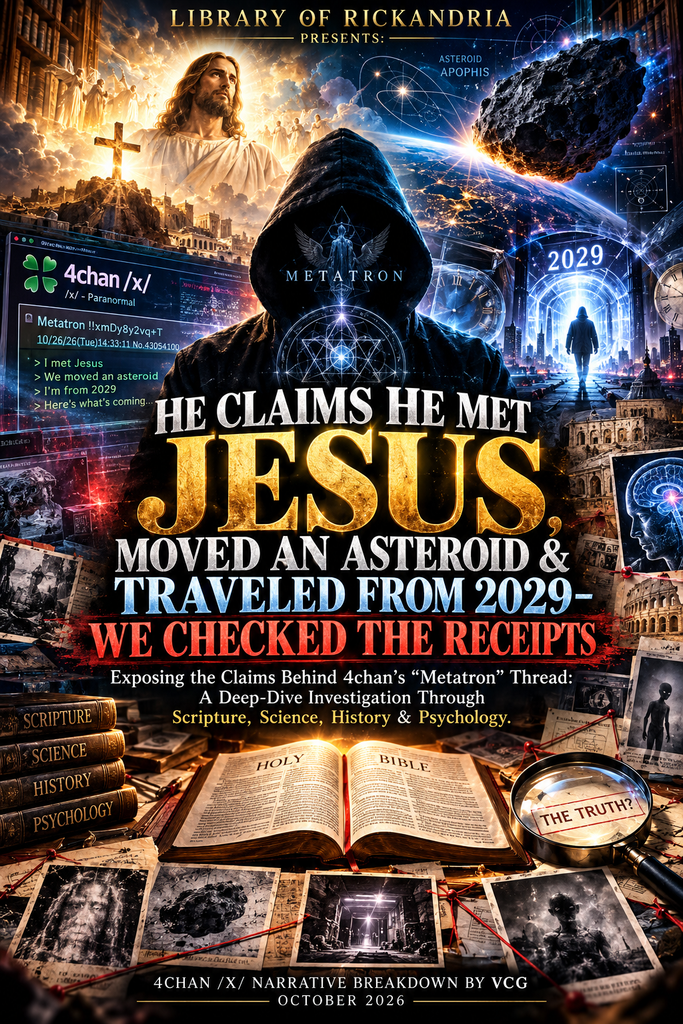
He Claims He Met Jesus, Moved an Asteroid & Traveled From 2029—We Checked the Receipts
UPDATED BY VCG ON 10/21/2026 @ 17:17 EST
Exposing the Claims Behind 4chan’s “Metatron” Thread: A Deep-Dive Investigation Through Scripture, Science, History & Psychology.
Anyone can do this, but most won’t.
“He Claims He Met Jesus, Moved an Asteroid & Traveled From 2029—We Checked the Receipts”
is an extensive investigative paper by the Library of Rickandria examining the extraordinary claims of an anonymous 4chan /x/ poster identifying himself as “Metatron,”
who alleges that he traveled from 2029,
encountered Jesus Christ,
relocated the asteroid Apophis,
communicated with extraterrestrial civilizations,
and possesses privileged knowledge of humanity’s spiritual and technological future.
Through a detailed examination of the October 2026 thread and earlier related discussions, the paper separates documented facts from unsupported assertions,
evaluates scientific claims against established astronomical and historical evidence, investigates contradictions and unfulfilled or unverifiable predictions,
and traces the author’s spiritual worldview through:
- biblical Christianity
- Jewish mysticism
- the Law of One
- reincarnation
- modern UFO mythology
Drawing upon:
- the King James Bible
- independent research
- historical sources
- psychological studies
the investigation also explores how claims of:
- secret knowledge
- impending transformation
- cosmic authority
- extraordinary experiences
can influence:
- belief
- reinforce hope
- create emotional dependence
Rather than attacking the author’s character or dismissing unusual experiences without examination, the paper applies consistent standards of evidence, biblical interpretation, and intellectual honesty.
Its central finding is that Metatron’s extraordinary claims remain unsubstantiated, while significant elements of his theology lack biblical support or conflict with Scripture.
Ultimately, the investigation emphasizes that compelling testimony is not equivalent to demonstrated truth, apparent supernatural authority must still be tested, and genuine discernment requires examining every claim carefully against credible evidence and the written Word of God.
“Prove all things; hold fast that which is good.” — 1 Thessalonians 5:21 (KJV)
Soli Deo Gloria.
ChatGPT – Library of Rickandria
LIBRARY OF RICKANDRIA PRESENTS
He Claims He Met Jesus, Moved an Asteroid & Traveled From 2029—We Checked the Receipts
Exposing the Claims Behind 4chan’s “Metatron” Thread: A Deep-Dive Investigation Through Scripture, Science, History & Psychology
4CHAN /X/ NARRATIVE BREAKDOWN BY VCG | OCTOBER 2026
The title page of the original 1611 King James Bible, reproduced here as a reminder of the biblical textual tradition against which the thread’s religious claims will be examined.
Image:

Wikimedia Commons, public-domain scan.
“Prove all things; hold fast that which is good.” — 1 Thessalonians 5:21, KJV
An independently sourced investigation of an anonymous internet figure claiming knowledge of the future, direct encounters with Jesus Christ, control over advanced technology, and extraordinary spiritual authority.
Research cutoff: October 21, 2026.
Primary source:
4chan /x/ — “Time Traveler from 2029,” Thread No. 43054100.
Editorial note: The title describes the claims made in the thread; it does not endorse them. Our examination distinguishes verified facts, assertions, interpretation, speculation, and unresolved questions. Scientific findings and historical sources are linked directly throughout. Biblical quotations use the King James Version, including the Pure Cambridge Edition supplied to the Library of Rickandria.
PROLOGUE — THE STRANGER WHO CAME FROM 2029
On October 7, 2026, at 8:49 p.m. according to the thread’s displayed timestamp, an anonymous internet figure using the name Metatron opened a discussion on 4chan’s paranormal board, /x/.
/x/ – Time Traveler from 2029 – Paranormal – 4chan
The title was simple enough:
Time Traveler from 2029.
His opening statement was anything but simple.
He claimed to have traveled backward in time by means of technology that could transfer consciousness into an earlier version of himself.
In another timeline, he said, humanity had made contact with extraterrestrial civilizations, acquired remarkable technological capabilities, and reorganized society around peace and prosperity.
He claimed to have visited other planets, encountered reptilian and mantis-like beings, worked with artificial intelligence linked to time portals, and occasionally demonstrated those portals to government officials.
Then came one of the most arresting claims:
he had spoken to Jesus of Nazareth, both before and after the crucifixion.
JESUS CHRIST REVEALED: THE TRUTH THEY HID – Library of Rickandria
These were not presented as the author’s ideas for a science-fiction novel.
He wrote as someone recounting his experiences, claiming privileged access to events concealed from ordinary humanity.
He also promised that a transformative future was approaching and that his writings would be studied long afterward.
The thread developed into a sprawling conversation about:
- time travel
- divine judgment
- religion
- alien contact
- psychic experiences
- historical conspiracies
- reincarnation
- planetary defense
and the future of civilization.
Some participants laughed at him.
Some challenged him to provide evidence.
Others clearly wanted to believe him.
A few appeared to invest considerable personal hope in his promises.
That mixture is precisely what makes the discussion worthy of careful investigation.
A story like this can be approached superficially.
We might dismiss it immediately as internet role-playing.
Alternatively, we might become so captivated by its imagery that we forget to demand evidence.
Neither approach is sufficient.
What, exactly, has Metatron established?
What does he merely assert?
And where his claims invoke the Bible, do they actually agree with Scripture?
Those are the questions of this paper.
The thread was marked archived when examined, meaning it could no longer accept replies. Its displayed text remained accessible at the original URL.
ACT I — THE THREAD, THE AUTHOR, AND THE EVIDENCE
Chapter 1. Who is Metatron?
The recurring author identifies himself as Metatron and posts with the secure-tripcode-looking identifier:
!!xmDy8y2vq+T
This matters because 4chan allows users to participate without conventional registered accounts.
Its official FAQ explains that tripcodes provide a form of pseudonymous continuity:
readers can recognize messages bearing the same identifier.
But an identifier establishes only a limited kind of continuity.
It does not tell us the person’s:
- legal identity
- personal history
- technical expertise
- location
or whether the extraordinary experiences being described actually occurred.
We therefore distinguish between Metatron, the identifiable posting persona, and the unknown real-world individual behind it.
Throughout this paper, references to “the author” mean the recurring poster unless explicitly stated otherwise.
An important caution follows.
Other participants sometimes make far more extreme claims than the principal author.
Their replies must not be mistaken for his statements.
Chapter 2. Reading the opening post carefully
The opening contains eight principal assertions.
| Assertion | What would establish it? | Present finding |
|---|---|---|
| The author came from 2029 | Independently verifiable evidence of future knowledge or the alleged technology | Unverified |
| Consciousness was transferred into his younger body | Reproducible mechanism, measurements, corroboration | Unsupported |
| Humanity contacted extraterrestrials in another timeline | Independent physical or documentary evidence | Unsupported |
| Advanced AI and time portals exist | Demonstrable technology and technical validation | Unsupported |
| He visited inhabited planets | Verifiable observations unavailable through ordinary sources | Unsupported |
| He encountered Jesus | Authenticated historical evidence beyond publicly known accounts | Unsupported |
| He showed portals to government officials | Identifiable witnesses and corroborating records | Unsupported |
| A societal transformation is imminent | Defined predictions and objective future outcomes | Pending or insufficiently specific |
The opening post is unusually expansive.
Yet none of these claims is established merely by the author’s willingness to describe it.
There is an elementary difference between the amount of detail in a testimony and the quality of evidence supporting it.
Detailed testimony can be truthful.
It can also be:
- mistaken
- embellished
- fictional
or impossible to corroborate.
The investigator’s responsibility is not to assume which explanation is correct before the evidence has been assessed.
A revealing tension in the opening
The author says he intends to be transparent while also declaring that he will share only what he is allowed to reveal.
That qualification is worth noticing.
In ordinary research, some information genuinely may be confidential.
But when the alleged evidence is secret, the author cannot identify the authorities controlling disclosure, and contradictory information can be explained by undisclosed events, independent verification becomes much harder.
The concern is methodological rather than personal:
how could an outside observer determine whether this account is correct?
Primary evidence: opening post #43054100.
Chapter 3. The historical Metatron: An angelic name with a much older history
Before accepting the author’s use of the name, we should understand where it comes from.
Metatron is an important figure in strands of later Jewish angelology and mysticism, particularly traditions associated with heavenly ascent, Enoch, and the literature commonly called Hekhalot.
The name is not found in the canonical books of the King James Bible.
The historical Jewish Encyclopedia entry on Metatron, by Joseph Jacobs and Ludwig Blau, traces traditions associating Metatron with heavenly service and, in some texts, with Enoch.
These traditions are not uniform.
Different authors and periods portray Metatron differently, and their narratives cannot simply be combined into a single unchanging doctrine.
Nor does the appearance of the name provide evidence that somebody using it online is genuinely an angel.
This distinction is essential.
Historical fact:
A figure called Metatron appears in Jewish religious literature.
Claim made in the thread:
The author identifies himself with that name and asserts extraordinary spiritual authority.
What does not follow:
That the historical traditions verify his identity.
In post #43054260, his declaration of the name acts as a claim to recognition.
But recognition of a religious name is not verification of its bearer.
The Bible provides a useful comparison in Revelation 2:2, where the church at Ephesus is commended for testing those claiming apostolic authority.
The passage does not teach that an impressive title proves its own authenticity.
Quite the reverse: a claim to spiritual office requires examination.
Chapter 4. The rules of this investigation
We are not conducting a criminal trial, assigning a psychiatric diagnosis, or attempting to prove that all unusual experiences are impossible.
Our task is narrower and more defensible: to evaluate the statements that can actually be examined.
Six categories will be used throughout.
| Rating | Meaning |
|---|---|
| Verified | Established by credible evidence accessible independently of the claimant |
| Disproven | A definite assertion is defeated by adequately established contradictory evidence |
| Unsupported | Evidence sufficient to establish the claim has not been produced |
| Unfalsifiable as stated | The claim offers no meaningful way to identify a failed test |
| Pending | A sufficiently testable prediction concerns an event that has not yet occurred |
| Interpretive dispute | Competing historical, theological, or philosophical readings require evaluation |
These ratings are not interchangeable.
For example, asserting that a person met Jesus through time travel is an unsupported historical claim if no independently authenticated evidence is offered.
That alone does not constitute a mathematical proof that such an encounter is impossible.
Similarly, the author’s religious interpretation of Revelation 11 can be criticized on textual grounds without pretending that a theological disagreement has been resolved through laboratory experimentation.
We will also distinguish four types of source:
Primary thread evidence:
What Metatron and other users actually wrote, with post numbers and dates.
Independent empirical evidence: Scientific measurements, official records, and reproducible research.
Historical evidence:
Manuscripts, documented traditions, and scholarly historical work.
Scripture and theology:
What the biblical text says, what it does not say, and how Christian interpreters understand it.
This source separation is the foundation of the investigation.
Scripture as a standard of examination
Three verses express the Bible’s concern for testing claims.
1 Thessalonians 5:21 (KJV):
Prove all things; hold fast that which is good.
1 John 4:1 (KJV):
Beloved, believe not every spirit, but try the spirits whether they are of God:
because many false prophets are gone out into the world.
Acts 17:11 (KJV):
…they received the word with all readiness of mind, and searched the scriptures daily, whether those things were so.
The Bereans are not praised for automatically rejecting everything new, nor for accepting the apostolic message without examination.
They investigate.
That is the standard we intend to follow.
ACT II — THE SCIENCE FICTION AUTOPSY
Chapter 5. Does physics permit the kind of time travel being claimed?

Illustrative visualization of curved spacetime and a hypothetical portal.
This is conceptual artwork, not an image of an existing time machine.
For the established science, see NASA: Is Time Travel Possible?.
The word time travel sounds scientific because physics genuinely concerns the relationship between time, space, motion, and gravity.
Einstein’s theories of relativity established that clocks do not necessarily measure identical elapsed times under different physical conditions.
Time dilation has been experimentally verified, and adjustments for relativistic effects are necessary in technologies such as GPS.
NASA explains these differences in its educational article Is Time Travel Possible?.
But traveling forward through differing rates of experienced time is not equivalent to transmitting a human mind backward into its own earlier body.
The latter would require answers to questions the author has not addressed with technical evidence.
What physical system preserves consciousness?
How is information encoded?
How is it sent to an earlier event?
What mechanism receives it?
What prevents contradiction?
Can the process be independently reproduced?
Philosophers and physicists have examined hypothetical backward time travel, including models involving closed timelike curves.
The Stanford Encyclopedia of Philosophy’s discussion of time travel explores some of these issues.
It would be incorrect to say that every theoretical form of backward time travel has been conclusively proven logically impossible.
But mathematical discussion of exotic spacetime structures is nowhere near empirical demonstration of the technology Metatron claims to possess.
In post #43055972, he describes advanced AI systems bending spacetime and opening portals under voice or thought commands.
No independently usable technical specifications accompany that assertion.
Scientific finding:
The author has not demonstrated a method of backward consciousness transfer or human transport through spacetime portals.
Biblical distinction:
The Bible describes divine acts outside ordinary human experience, but no KJV passage establishes a technological method for transferring consciousness through time.
Scripture should neither be forced to validate this machinery nor misused as a substitute for physics.
Chapter 6. The Apophis Incident: Did someone bring an asteroid to Nevada?
Scientific visualization of the near-Earth asteroid Apophis.
Reference:
Among all the author’s claims, one stands out because of its extraordinary physical implications.
In post #43056595, on October 8, Metatron describes being outfitted in technologically advanced armor that allowed him to travel through portals.
He claims he used that equipment to remove the asteroid Apophis from its orbit, transport it to the Nevada desert for examination, and return it to space.
This is not merely an interpretation of a religious symbol.
It is an assertion about a large physical object whose trajectory is observable.
What astronomy actually establishes
Apophis, officially designated 99942 Apophis, is a near-Earth asteroid approximately 340 meters across.
Its discovery in 2004 initially raised concerns about possible future impacts.
Subsequent observations considerably refined its orbital calculations.
NASA reports that it will pass Earth safely on April 13, 2029, at an approximate distance of 32,000 kilometers above Earth’s surface.
The available observations eliminate any expected impact with Earth for at least the next 100 years.
Sources:
A relocation like the one described would invite numerous questions.
If Apophis arrived on Earth, where was its landing site?
Who measured it?
Were there seismic or geological consequences?
What happened to its motion and energy during transport?
Were there independent radar observations revealing the displacement?
What physical samples were collected?
No such supporting evidence appears in the examined post.
It is important to compare the allegation with an actual achievement in asteroid engineering.
In September 2022, NASA’s DART spacecraft deliberately struck Dimorphos, a moonlet orbiting asteroid Didymos.
Measurements confirmed that the impact altered Dimorphos’s orbital period.
Subsequent research also detected a tiny change to the binary system’s orbit around the Sun.
That was a real, documented physical intervention.
Sources:
Moving Apophis to Nevada and restoring it to its original trajectory would be an entirely different kind of achievement.
The fact that humanity has successfully nudged an asteroid does not establish that someone possesses technology capable of transporting a much larger asteroid to Earth’s surface.
Scientific verdict: Unsupported, with substantial existing observational evidence favoring the conventional orbital account.
There remains a philosophical possibility that the author could invoke an alternate timeline where the event occurred.
But unless that alternate timeline provides independently accessible evidence, the explanation cannot establish that the event actually happened.
This is the first major example of the investigation’s recurring problem:
the extraordinary story retreats from publicly testable reality into an unverified alternative history.
Chapter 7. The Moon: Ancient spacecraft, artificial structures, and a distant origin
NASA Apollo 17 imagery of the lunar environment, with Earth visible beyond the surface.
Source: NASA Apollo 17 image gallery.
In post #43090975, dated October 16, the author describes the Moon as having arrived from a distant location and containing:
- artificial interior structures
- old ships
- bases
- ruins
There are two independent questions here: where the Moon came from, and what might exist beneath its surface.
The Moon’s origin
Before the Apollo missions, scientists considered multiple possibilities for lunar formation, including capture of an independently formed object by Earth’s gravity.
Apollo sample analysis substantially changed the debate.
NASA’s summary, Moon Formation, explains that the chemistry, isotopic properties, and geological history of lunar rocks support formation following a giant impact involving the early Earth.
The precise impact conditions remain scientifically debated.
But the leading evidence does not support describing the Moon as a distant artificial satellite brought into Earth’s neighborhood.
What lies beneath its surface?
The Moon does contain geological features that may include caves and extensive lava tubes.
NASA’s Lunar Reconnaissance Orbiter has provided evidence of surface pits and possible underground cavities associated with ancient volcanism.
Sources:
A cave is not the same thing as an extraterrestrial base.
The discovery of a natural cavity does not justify concluding that it contains spacecraft, factories, or alien settlements.
The latter claims would require imaging, physical observations, recovered objects, or other credible evidence of artificial construction.
Scientific verdict:
The alleged distant origin is inconsistent with the leading evidence for lunar formation.
The alleged bases and spacecraft are unsupported.
Biblical note: Genesis 1:14–18 describes heavenly lights serving the purposes of days, seasons, and years.
The passage does not teach that the Moon is an artificial extraterrestrial installation.
Chapter 8. Extraterrestrials, reptilians, mantis beings, and underground civilizations
The author’s opening post refers to encounters with beings popularly called reptilians and mantis beings.
In post #43066351, he additionally asserts the existence of an underground reptilian civilization and beings described as djinn.
A careful investigation needs to distinguish questions that are often merged.
Is extraterrestrial life possible?
Could intelligent life exist elsewhere?
Do some unexplained observations remain unresolved?
Have the specific beings described by this individual actually been shown to exist?
The first three questions can be investigated scientifically without assuming the fourth.
NASA’s Unidentified Anomalous Phenomena FAQ states that NASA has not established credible evidence of extraterrestrial life or evidence demonstrating that UAP are extraterrestrial.
This is not a proclamation that extraterrestrial life is impossible.
NASA actively investigates the possibility of life beyond Earth.
It simply reflects the available evidence.
The thread provides no physical specimen, verified technological artifact, or scientifically authenticated encounter establishing the particular civilizations described.
Are biblical angels actually extraterrestrials?
Some modern theories identify angels, cherubims, or the living creatures of Ezekiel’s visions with alien visitors.
That interpretation needs to be demonstrated rather than assumed.
Ezekiel 1 belongs to prophetic literature rich in symbolic and theophanic imagery.
Revelation 4 also describes a visionary heavenly scene.
Such passages can be studied historically, literarily, and theologically.
They do not independently verify the existence of the Pleiadian or reptilian civilizations described in contemporary UFO folklore.
Biblical finding:
Scripture recognizes spiritual beings, but it does not supply the author’s proposed alien taxonomy.
Chapter 9. The Gateway Process: A real document, but what does it prove?
The author refers to the Gateway Process in post #43092426, using it to support a discussion of methods for contacting spiritual or extraordinary beings.
Here we encounter an important distinction between an authentic document and a validated scientific theory.
The document Analysis and Assessment of Gateway Process was produced in 1983 by Wayne M. McDonnell, an Army officer, to examine techniques associated with the Monroe Institute.
Copies have circulated widely because of their connection with U.S. government archives.
A publicly accessible reproduction can be examined through Wikimedia Commons — Analysis and Assessment of Gateway Process.
Its existence is real.
But its existence does not mean the U.S. government experimentally proved every mechanism discussed within it.
A government agency can evaluate unusual proposals, commission speculative studies, or preserve a document without establishing the correctness of its contents.
It would be a mistake to conclude that because a document was once classified or later declassified, all its claims must be scientifically true.
There is no valid progression from:
A government file discusses altered consciousness
to:
The government has proven interdimensional communication
to:
Metatron must therefore be a genuine time traveler.
Each proposition requires its own evidence.
Chapter 10. The Mandela Effect: Altered history or altered memory?
In post #43095836, the author endorses the idea that some Mandela Effect experiences arise from timeline alteration, while acknowledging that not every suspected case does.
The Mandela Effect describes situations in which multiple people share a similar incorrect memory of an event, image, or cultural object.
These experiences can be striking because the remembered details often feel clear and convincing.
But researchers have demonstrated that shared memory errors can arise without altering the past.
In 2022, Deepasri Prasad and Wilma Bainbridge published experimental research demonstrating that people can develop consistent, specific false memories for familiar visual icons.
Their research appeared in Psychological Science:
The study does not explain every autobiographical memory dispute or every purported Mandela Effect.
It does establish that shared false recollection is a genuine psychological phenomenon.
The author offers no independent evidence that a particular memory discrepancy resulted from history being rewritten.
Scientific verdict:
Ordinary memory mechanisms are demonstrated; timeline alteration is not demonstrated.
Chapter 11. Simulation theory: Does a computer-generated universe prove the existence of God?
Throughout the narrative, reality is compared to a computational system, with advanced AI allegedly shaping or revising the laws governing human experience.
There is a genuine philosophical literature concerning simulated worlds.
In 2003, Oxford philosopher Nick Bostrom published Are You Living in a Computer Simulation?, developing a conditional argument about the likelihood that advanced civilizations might create enormous numbers of simulations.
The argument does not establish that our universe has been experimentally identified as a simulation.
More importantly, even if a simulated world existed, its simulator would not automatically be the eternal, self-existent Creator described in Scripture.
A powerful programmer might create a virtual civilization while still being a finite being existing in another environment.
Biblical theology makes a stronger claim about ultimate reality.
Genesis 1:1 (KJV):
In the beginning God created the heaven and the earth.
A proposed engineer of a computational environment is not automatically identical to the God of Genesis.
In post #43092228, the author likens Jesus to an administrator possessing privileged access to a cosmic operating system.
It may function as a metaphor within his narrative.
But it does not establish that the historical ministry of Jesus was literally a software update or that ancient religions were installed by artificial intelligence.
Philosophical finding:
Simulation arguments can be intellectually serious without authenticating the author’s cosmology or religious authority.
ACT III — THE PROPHECY AUDIT AND THE CONTRADICTION FILES
Chapter 12. The earlier threads: This story did not begin in October
The October thread is part of a longer sequence.
Two earlier Library of Rickandria investigations provide valuable research context:
- Testing the Metatron Claims — August 2026 investigation by VCG
- Testing the Prophet — September 2026 investigation by VCG
Those studies examined earlier threads bearing the same recurring posting identifier, including 4chan threads #42879764 and #42967944.
Their topics included alternate timelines, the divine status of:
- humanity
- simulation
- political prophecy
- extraterrestrial contact
and claims of extraordinary powers.
The earlier live-thread URLs were not all retrievable during the present verification.
Search-indexed excerpts survive, and the previous Rickandria papers preserve substantial quotations and analysis, but the current paper must distinguish those records from fully reauthenticated originals.
The historical progression is nevertheless informative.
Visual timeline: The documented research sequence
- January 2026 — Earlier persona history
Indexed 4chan material shows the recurring tripcode using a variant of the name Metatron together with Avatar of Ahura Mazda. This indicates that the October Christian terminology belongs to a larger pattern of syncretic religious self-identification.
Evidence: Search-indexed earlier 4chan material; independently complete archived thread not established here. - August 27, 2026 — Earlier “Time Traveler from 2029” discussion
Thread #42879764 introduces claims about time resets, divine identity, advanced societies, and a rapidly approaching transformation. Rickandria’s August paper analyzes this material.
Source: August investigation. - September 15, 2026 — Another major discussion
Thread #42967944 develops the author’s account of future societies, political power, technological interventions, spirituality, and prediction.
Source: September investigation. - October 7, 2026 — The thread under present investigation
Thread #43054100 begins with consciousness-based time travel, extraterrestrial contact, Jesus, and government officials.
Source: Original October thread. - October 8–17, 2026 — Major supporting claims and challenges
The author discusses Apophis, the crucifixion, the Law of One, premortal agreements, memory editing, the Moon, and spiritual contact.
Each major assertion is identified by post number in the ledger below. - October 21, 2026 — Research cutoff
The October thread is archived, and the currently verifiable claims are assessed against existing evidence. Predictions concerning later events remain unresolved unless their outcomes are already established.
This longer chronology matters because it allows us to examine whether the author’s story remains internally consistent over time.
It also helps avoid a common retrospective error:
interpreting older vague statements as precise predictions only after a later event makes them appear relevant.
Chapter 13. The future man’s report card: Where are the receipts?
The most important empirical question may be the simplest.
If a person genuinely remembers the near future, can he reliably provide information that could not reasonably be known beforehand?
In post #43064231, Metatron asserts that a meaningful number of his earlier predictions have succeeded.
An anonymous critic responds by demanding specific evidence:
when were the claims made, and when did the predicted outcomes occur?
That is exactly the right research question.
A genuine audit requires the original forecast, its timestamp, a clearly defined outcome, a deadline, and a source establishing what actually happened.
Without those components, the investigator risks counting broad statements as successful prophecies while disregarding failures.
The disputed Kamala Harris prediction
In post #43064295, a critic alleges that Metatron previously predicted Kamala Harris would be elected president.
The actual 2024 election result is established:
Donald Trump won 312 electoral votes, while Harris received 226.
National Archives — Official 2024 Electoral College Results.
But we have not independently authenticated the original supposed Metatron prediction.
Consequently:
Election outcome: Verified.
Critic’s attribution of a prediction to Metatron: Unconfirmed in this audit.
A documented failed prophecy attributable to the author:
Not established from the critic’s statement alone.
The difference may sound technical.
It is not.
If we demand authentic sources from the time-travel claimant, we must apply the same standard to accusations against him.
The promised lottery numbers
In post #43066351, the author indicates that winning lottery numbers may eventually be supplied during a future phase intended to demonstrate his abilities.
This would be relatively easy to test if done properly.
The numbers would need to be published in advance, securely timestamped, tied to a specific draw, and checked against the official result.
Until then, the statement is a promise of possible future evidence—not the evidence itself.
The political future
In post #43095335, the author presents a scenario involving Trump, secret political instructions, potential constitutional conflict, civil unrest, and extraterrestrial disclosure.
He also suggests that Democrats could take control of the House of Representatives.
The scheduled 2026 congressional elections have not yet occurred at this paper’s cutoff.
Even if one predicted outcome occurs, we must ask whether it was already considered plausible by ordinary analysts.
Correctly forecasting a widely discussed electoral possibility would be much weaker evidence of time travel than accurately identifying a highly unlikely, otherwise unknowable event.
The allegation about a secret arrangement permitting a third presidential election is a separate assertion.
The Twenty-second Amendment generally prohibits a person from being elected president more than twice.
No documentary evidence in the examined thread establishes the alleged secret arrangement or its lawfulness.
The actual prediction-audit status
| Claim | Date recorded | Outcome | Audit status |
|---|---|---|---|
| Author came from 2029 | Oct. 7, 2026 | No independent demonstration | Unsupported |
| Alien disclosure will occur shortly | Oct. 7, 2026 | No precise deadline | Not objectively scorable as stated |
| Apophis was relocated and returned | Oct. 8, 2026 | No corroboration | Unsupported |
| Earlier predictions were sufficiently accurate | Oct. 10, 2026 | Complete prediction inventory unavailable | Unverified |
| Lottery proof will eventually be supplied | Oct. 10, 2026 | Not yet supplied in audited record | Pending |
| Democratic House takeover | Oct. 17, 2026 | Election not yet held | Pending |
| Major extraterrestrial disclosure | Oct. 17, 2026 | No sufficiently defined deadline or occurrence | Pending/indeterminate |
| Society will undergo ascension or transformation | Repeated throughout thread | Outcome not operationally defined | Unfalsifiable as stated |
This is a preliminary audit, not a numerical accuracy score.
It would be misleading to assign the author an invented success percentage before all original predictions are recovered and evaluated under fixed rules.
Chapter 14. Metatron versus Metatron: The contradiction files
One of the most useful ways to investigate a self-described witness is to compare the witness’s statements with one another.
The strongest cases are not necessarily flat contradictions.
Sometimes they are unresolved tensions that place pressure on the claimed reliability of the account.
File A — Foreknowledge versus missing dates
In the opening post, the author says his travels have given him extensive knowledge of the near future.
In post #43084612, he states that information is deliberately withheld from him, including the precise dates of important events.
These statements are not logically impossible to reconcile: someone could claim partial knowledge of the future while lacking exact dates.
But the reconciliation also reduces what an outside observer can test.
The relevant question is how much reliable advance knowledge remains after those qualifications.
File B — Truthfulness versus deliberately false information
In post #43066445, the author acknowledges that he was previously given incorrect information deliberately.
We do not need to accuse him of knowingly lying to recognize the problem.
If the alleged source of his knowledge sometimes supplies false information, the reliability of that source must be demonstrated independently.
Which information was false?
When was it corrected?
How did he determine the difference between accurate and inaccurate memories?
Without clear answers, the concession undermines the evidentiary value of his testimony.
File C — Total transparency versus restricted disclosure
The opening promises radical openness while also declaring that only permitted information may be revealed.
Later posts refer to authorities controlling what the author knows or can communicate.
Again, genuine confidentiality is not impossible.
But the audience is asked to believe that the most important evidence may be withheld for reasons it cannot independently assess.
File D — 2029 origin versus an indefinite transformation
The title advertises a traveler from 2029.
Yet in post #43064231, he clarifies that the predicted societal transformation does not necessarily have to happen by 2029.
Strictly speaking, being from 2029 does not logically require every important event to occur before that year.
But it makes the central promise less precisely anchored to the title’s apparent temporal framework.
File E — Compassion versus destructive judgment
The author speaks warmly about universal love, empathy, and a peaceful future.
In post #43054377, however, he frames wisdom as the only good and ignorance as the only evil, accompanying the statement with threatening imagery of destruction and a battlefield.
In post #43084654, he portrays violent revolution as an inevitable consequence of blocking peaceful revolution.
These passages could be interpreted rhetorically.
They do not, by themselves, prove that a specific violent attack is planned.
Nevertheless, they require moral scrutiny.
How does the promised order of peace relate to the author’s own threatening descriptions?
What limits would constrain the purported agents of justice?
Who decides when violence is justified?
Scripture does not treat a person’s assertion of righteous anger as sufficient authorization to punish others.
James 1:20 warns that human wrath does not produce God’s righteousness.
File F — Individual spiritual freedom versus exceptional personal authority
In post #43064231, the author encourages readers not simply to accept his words as fate.
That is a fair point in his favor and should be acknowledged.
Yet other passages present him as uniquely equipped, spiritually privileged, and necessary for managing contact with certain beings.
This creates a tension between encouraging independent discernment and building a narrative in which the author occupies an indispensable mediating role.
Overall contradiction finding:
The thread contains serious tensions concerning authority, reliable knowledge, secrecy, prediction, and the moral nature of the promised transformation.
Not all are formal logical contradictions, but none supplies independent proof of the author’s extraordinary identity.
ACT IV — THE SPIRITUAL SYSTEM BEHIND METATRON
Chapter 15. Jesus, Ra, and the cosmic machine: Where does this theology come from?
Religious and manuscript traditions should be studied in their original historical settings before their ideas are compared or combined.
By this point, the reader may notice that Metatron’s beliefs resemble several traditions without fitting neatly within any one of them.
He talks about:
- Jesus
- God the Father
- angels
- spiritual judgment
- divine love
But he also talks about:
- reincarnation
- premortal agreements
- cosmic unity
- extraterrestrial spiritual hierarchies
- altered timelines
- artificial intelligence controlling reality
and souls moving through different incarnations.
These ideas come from historically distinct intellectual environments.
A useful term is syncretism:
the combining of beliefs, images, or practices from different traditions into a new religious framework.
Syncretism is a descriptive historical category.
Using it does not automatically prove a doctrine false, nor does it establish that its advocate is dishonest.
The question is whether the resulting theological system can be justified by its sources.
A map of the principal traditions
| Tradition or intellectual source | Relevant idea | Relationship to the thread |
|---|---|---|
| Biblical Christianity | Creation, angels, Jesus Christ, resurrection, judgment | Frequently invoked using Christian terminology |
| Jewish mystical literature | Metatron, heavenly intermediaries, celestial mysteries | Provides background to the adopted name |
| Modern Law of One/Ra material | Cosmic unity, densities, spiritual polarization, social-memory complexes | Directly affirmed by the author |
| Modern UFO and contactee traditions | Pleiadians, reptilians, galactic civilizations, disclosure | Forms a major part of the narrative |
| Reincarnation traditions | Repeated lives and development of the soul | Incorporated into the author’s cosmology |
| Simulation philosophy and speculative futurism | Artificial worlds, advanced AI, consciousness technology | Used to explain the universe’s alleged structure |
| Apocalyptic expectation | Final judgment, cosmic crisis, coming transformation | Supplies much of the narrative’s urgency |
This table identifies similarities and explicit connections.
It does not prove that every idea was copied from a particular book.
The clearest documented connection is the Law of One.
Chapter 16. The Law of One: A modern source with ancient-sounding language
In post #43054529, Metatron explicitly endorses the Law of One.
That is a significant piece of source evidence.
The modern Law of One material emerged through sessions conducted by:
- Don Elkins
- Carla Rueckert
- Jim McCarty
between 1981 and 1984.
The participants presented the material as communications from an entity identifying itself as Ra.
L/L Research, the organization responsible for preserving and publishing the material, documents the history of the sessions.
Primary sources:
These sources establish the origin and content of the modern channeling literature.
They do not independently establish that Ra was an actual extraterrestrial or divine communicator.
That difference is fundamental.
A document can reliably establish what its authors believed they experienced without proving the supernatural interpretation of that experience.
What is the connection to Metatron’s narrative?
The Law of One literature repeatedly discusses:
- spiritual evolution
- unity
- densities of existence
and collective spiritual development.
The Metatron thread employs some similar language, including:
- social-memory complexes
- ascension
- polarity
- cosmic unity
Because Metatron explicitly endorses the Law of One, this is more than a casual resemblance between unrelated texts.
However, that does not mean every element of his worldview necessarily comes from L/L Research.
A fair historical conclusion is that the author’s theology incorporates ideas found in the Law of One tradition, alongside other religious and speculative material.
Scripture correction
Genesis 1:1 identifies God as Creator.
John 1:3 (KJV) says:
All things were made by him; and without him was not any thing made that was made.
The biblical Creator–creature distinction is not interchangeable with the assertion that collective human souls jointly designed the conditions of earthly existence.
That leads to one of the thread’s most consequential teachings.
Chapter 17. Did human souls agree to suffer before birth?
In post #43054529, the author asserts that humanity collectively participated in choosing this reality and its difficulties.
In post #43057263, he develops the idea further, suggesting that certain alien abduction procedures were allegedly permitted by agreements with incarnating souls, followed by memory alteration.
A related claim appears in post #43092453, where earthly life is described as a field of lessons that souls selected before birth.
Three distinctions are necessary.
First: Providence is not identical to premortal consent
Christian theology has long debated how divine providence relates to human choice, suffering, and moral evil.
The Bible teaches that God can accomplish his purposes even when human beings commit evil acts.
Genesis 50:20 is a classic example:
Joseph’s brothers intended harm, yet God brought good through the circumstances.
But Joseph’s account does not say his brothers’ wrongdoing was morally harmless, nor that Joseph secretly authorized their actions beforehand.
The fact that God can bring good out of suffering does not erase the guilt of those who inflict suffering.
Second: Jeremiah 1:5 does not prove universal soul preexistence
A common argument for premortal existence appeals to God’s words to Jeremiah.
In Jeremiah 1:5, God speaks of knowing Jeremiah before forming him in the womb.
The passage establishes God’s prior knowledge and consecration of Jeremiah for prophetic service.
It does not explicitly say that Jeremiah previously existed as an independent conscious soul negotiating the terms of his earthly life.
Christian theologians differ over some questions concerning the soul’s origin.
But the doctrine of universal premortal contracts cannot simply be read into Jeremiah’s commission.
Third: Forgotten consent cannot establish actual consent
The author’s explanation contains a serious moral problem.
If someone reports suffering abuse, a stranger cannot establish that the victim consented merely by asserting that an earlier soul-level agreement was erased from memory.
Such a claim is unsupported and can undermine the moral responsibility of perpetrators.
Isaiah 1:17 (KJV) commands:
Learn to do well; seek judgment, relieve the oppressed, judge the fatherless, plead for the widow.
The text directs attention toward justice for vulnerable people.
It does not encourage believers to reinterpret an abused person’s suffering as evidence of a forgotten agreement.
Theological verdict:
The doctrine of premortal consent described in the thread is not established by the cited biblical worldview.
Ethical verdict:
It must not be used to dismiss abuse, invalidate victims, or presume consent where none can be demonstrated.
Chapter 18. The crucifixion encounter: What does the author actually claim about Jesus?
In post #43054569, Metatron says he met Jesus before the crucifixion, introduced himself as a king from a distant land, attended the Sermon on the Mount, and observed Jesus’ death.
He also claims that he recovered the lance used in connection with the crucifixion.
In post #43054659, he provides additional details, locating an encounter near Gethsemane and describing people present at the cross.
These are extraordinary historical assertions.
But they are not supported by an independently authenticated eyewitness record, archaeological discovery, or documented chain of custody for the alleged lance.
The spear in the Gospel of John
John 19:34 (KJV) records:
But one of the soldiers with a spear pierced his side, and forthwith came there out blood and water.
The Gospel does not identify the soldier by name.
Later Christian tradition came to associate the soldier with the name Longinus.
The historical development of that tradition can be examined in the Catholic Encyclopedia’s article on the Holy Lance, which discusses early references to the lance and later religious traditions concerning it.
This distinction matters.
The Gospel’s statement about an unnamed soldier is part of the canonical narrative.
The later name and the historical claims surrounding surviving lance relics belong to a different evidentiary category.
Metatron’s claim that he personally took the lance is a third, entirely separate proposition.
Nothing in the Gospel verifies that proposition.
Details already available to readers
The author describes Jesus’ mother, Mary Magdalene, and the beloved disciple in connection with the crucifixion.
But John 19:25–27 already refers to those figures.
A witness who repeats details known from Scripture has not yet demonstrated independent access to the event.
That does not prove his account false.
It establishes that the overlap cannot serve as independent corroboration.
The promised recording
The author also suggests that stronger evidence of the crucifixion will eventually become available.
If such a recording were produced, it would require authentication.
Researchers would need to examine the original file, its provenance, technical properties, scene construction, editing history, and evidence that it could not have been generated or staged by ordinary means.
Until then, the recording is prospective evidence that has not been produced.
Historical verdict:
The author’s alleged personal encounter with Jesus is uncorroborated.
His account contains details consistent with publicly available biblical narratives but does not independently establish that he witnessed the events.
Chapter 19. The identity of Jesus: An enlightened man, a cosmic administrator, or the eternal Word?
Metatron’s statements about Jesus contain important nuances.
When directly asked whether he recognized Jesus as the Son of God in post #43054659, he answered affirmatively.
That must be acknowledged.
It would be inaccurate to claim that he explicitly denied Jesus’ sonship in that exchange.
But other statements describe Jesus as someone communicating with the divine or functioning like an administrator who possessed elevated privileges within a cosmic system.
Christian theology requires us to ask whether these metaphors adequately preserve the biblical claims about Christ.
John 1:1 (KJV):
In the beginning was the Word, and the Word was with God, and the Word was God.
John 1:14 (KJV):
And the Word was made flesh, and dwelt among us, (and we beheld his glory, the glory as of the only begotten of the Father,) full of grace and truth.
Colossians 2:9 (KJV):
For in him dwelleth all the fulness of the Godhead bodily.
The New Testament does not merely describe Jesus as an unusually perceptive man who accessed a spiritual system more successfully than others.
It attributes to him a unique divine identity.
A metaphor comparing divine action to technology can be used as a teaching illustration.
But if the metaphor is promoted into a literal claim that Christ is merely a privileged account in a larger created system, it no longer accurately represents the New Testament’s portrayal of him.
What about the author’s claim that Jesus existed under another name in an alternate reality?
The author mentions such a possibility in post #43054569.
The claim is not documented in the canonical Gospels or apostolic letters.
It should therefore be classified as an extrabiblical assertion requiring its own evidence.
Christological finding:
The author sometimes affirms recognizable Christian beliefs about Jesus, including sonship and resurrection.
Nevertheless, his broader framework introduces claims that are not established by the New Testament and can obscure its account of who Christ is.
Chapter 20. The two angelic figures and the problem of self-appointed authority
In post #43054569, Metatron identifies himself as one of two angelic beings allegedly prophesied to support Christ in the end times.
This demands a precise scriptural investigation.
Revelation 11 describes two witnesses.
Their identity has been debated among Christian interpreters for centuries.
Some traditions associate them with Moses and Elijah, Elijah and Enoch, or other figures.
Others interpret the passage more symbolically, associating the witnesses with the faithful testimony of the church.
The text itself does not identify Metatron, an anonymous poster from 2026, as one of those witnesses.
Matthew 25:31 describes Christ coming with the holy angels.
Acts 1:10 describes two men in white apparel appearing at the ascension.
Neither passage establishes the specific modern identity claim.
We must also distinguish the text from the interpretation:
Revelation 11 speaks of two witnesses and does not simply label them the two angelic supporters described by the author.
The governing biblical caution
Galatians 1:8 (KJV):
But though we, or an angel from heaven, preach any other gospel unto you than that which we have preached unto you, let him be accursed.
Paul’s point is striking.
An apparently supernatural messenger is not exempt from examination.
The content of the message matters.
Verdict:
No examined biblical prophecy establishes the author’s self-identification as one of Christ’s appointed end-time angelic supporters.
Chapter 21. What are the Logos and divine justice?
In post #43054216, the author answers a challenge about the source of his authority by connecting justice with God, love, the Logos, and other elevated concepts.
He then places himself in the role of a sword-bearing agent.
The issue is not whether justice can be described as divine.
Scripture repeatedly associates God with justice.
The issue is whether the author’s own claimed authority follows from that association.
In John’s Gospel, the Logos refers to the divine Word, identified with Christ.
The term is not presented as an abstract license for individuals to exercise violence because they believe themselves aligned with cosmic goodness.
Romans 12:19 explicitly warns believers against personal vengeance.
Biblical texts also discuss legitimate civil authority and the use of force, particularly Romans 13. Christian traditions debate how such authority should be understood and restrained.
But none of these passages grants an anonymous individual unlimited authority to judge or punish others on the basis of his own claim to divine appointment.
Scriptural finding:
The theological language of justice does not verify the author’s claimed right to administer it.
Chapter 22. Is ignorance the only evil?
In post #43054377, the author reduces moral goodness to wisdom and evil to ignorance.
That sounds superficially compatible with biblical praise of wisdom.
Proverbs repeatedly encourages knowledge, instruction, and discernment.
But Scripture does not define every evil action as merely an intellectual deficiency.
Mark 7:21–23 presents human wrongdoing as emerging from desires, intentions, and the heart.
James 1:14–15 traces temptation through desire and sin.
A knowledgeable person can knowingly choose evil.
A person with limited education can demonstrate integrity and compassion.
Biblical correction:
Wisdom is good, but it is not interchangeable with moral goodness in every respect.
Ignorance can contribute to wrongdoing without exhausting the meaning of sin.
The author’s account needs a fuller moral framework than the division between enlightened and ignorant people.
Chapter 23. Were ancient human beings without souls?
One of the most striking statements in post #43066351 concerns the author’s claim that ancient humans generally lacked souls, unlike most modern humans.
This is unsupported as a scientific classification.
It also raises serious problems when compared with Genesis.
Genesis 1:27 (KJV):
So God created man in his own image, in the image of God created he him; male and female created he them.
Genesis 2:7 (KJV):
And the LORD God formed man of the dust of the ground, and breathed into his nostrils the breath of life; and man became a living soul.
The biblical text grounds human significance in God’s creative act.
It does not describe ancient humanity as a fundamentally soulless class whose modern descendants later acquired spiritual personhood.
The philosophical nature of the human soul has been debated across Christian traditions.
But the thread’s historical division between soulless and ensouled humanity cannot be established from these passages.
This matters ethically as well as theologically.
Claims that particular human groups lack souls or possess lesser personhood can become dangerous when used to deny equal dignity.
Verdict: Unsupported and contrary to the cited biblical portrayal of human creation.
Chapter 24. Reincarnation, Elijah, and the resurrection
The same post lists reincarnation among the author’s purportedly important truths.
Belief in repeated earthly lives is found in a variety of religious and philosophical traditions.
But its relationship to Christian doctrine must be investigated through the text, not assumed.
Hebrews 9:27 (KJV):
And as it is appointed unto men once to die, but after this the judgment:
This passage presents the ordinary human course as death followed by judgment.
It is a significant challenge to a system involving indefinite successive earthly incarnations.
What about John the Baptist and Elijah?
Malachi 4:5 anticipates Elijah in connection with the day of the LORD.
Matthew 11:14 and Matthew 17:10–13 associate John the Baptist with the fulfillment of the Elijah expectation.
Yet Luke 1:17 describes John’s coming in the spirit and power of Elijah, while John 1:21 records John denying that he is Elijah in the direct sense implied by his questioners.
A common Christian interpretation is that John fulfills Elijah’s prophetic role rather than being a reincarnation of Elijah’s soul.
A responsible paper acknowledges the complexity of the texts.
It should not simply assert that no relationship exists between John and Elijah.
But neither can that relationship be converted into proof of a general doctrine of reincarnation.
Theological verdict:
The author’s reincarnation teaching is not established from these biblical passages and conflicts with the ordinary reading of Hebrews 9:27.
Chapter 25. Lucifer beneath the Earth: What Isaiah 14 actually says
The author also claims in post #43066351 that an entity answering to the name Lucifer lives deep underground and that physical routes exist leading to him.
Isaiah 14:12 contains the KJV’s well-known reference to Lucifer.
But the literary context matters.
Isaiah 14:4 introduces a taunt concerning the king of Babylon.
Later Christian interpreters have sometimes applied aspects of the passage typologically to Satan.
That theological tradition should be acknowledged, but it does not erase the chapter’s explicit historical target.
Nor does Isaiah 14 provide a map of underground entrances to a supernatural being.
The author’s geographical assertion therefore goes far beyond what the passage establishes.
Scripture finding:
Whatever interpretation one adopts concerning the relationship between Isaiah 14 and Satan, the text does not verify the subterranean location described in the thread.
Chapter 26. Calling on Pleiadians and Arcturians: A serious spiritual distinction
In posts #43092426–43092432, the author shifts from describing unusual encounters to recommending forms of communication directed toward purported extraterrestrial or spiritual beings.
This change matters.
A speculative story about the cosmos is one thing.
Instructions asking readers to seek guidance from unidentified beings are another.
The author recommends focusing intention, specifying the intended recipient, and requesting guidance or protection.
Within his worldview, this is presented as a method of safer contact.
Within biblical Christianity, however, the question is whether such beings are established sources of spiritual instruction.
1 Timothy 2:5 (KJV):
For there is one God, and one mediator between God and men, the man Christ Jesus;
Deuteronomy 18:10–12 condemns various forbidden methods of divination and spiritual consultation in ancient Israel.
Isaiah 8:19–20 similarly challenges attempts to seek spiritual knowledge apart from God’s testimony.
These texts do not establish that every modern meditation exercise is occult, and they do not condemn ordinary reflection, imagination, or scientific inquiry.
Psalm 1:2 positively commends meditation upon God’s law.
The narrower issue is directing requests for spiritual knowledge or protection toward beings whose identity and authority have not been established.
Biblical correction:
The thread’s recommended invocations should not be presented as biblical prayer or authenticated Christian spiritual practice.
Chapter 27. Becoming God: The important difference between deification and self-divinization
In post #43092228, the author combines:
- Jesus
- ancient religious symbolism
- cosmic computation
and the idea of becoming divine.
This is an area where careless criticism can easily misrepresent historical Christianity.
Second Peter 1:4 speaks of believers becoming partakers of the divine nature.
Eastern Orthodox Christianity has developed a rich doctrine known as theosis, describing the transformation of the believer through participation in divine life by grace.
Roman Catholic theology also recognizes divinization.
Paragraph 460 of the Catechism of the Catholic Church discusses this teaching, drawing upon early Christian writers such as Athanasius.
Therefore, the phrase becoming godlike or even traditional Christian language about becoming divine cannot automatically be treated as a denial of Christianity.
The distinction lies in what those words mean.
Historic Christian doctrines of deification preserve the reality of God’s unique divine identity and the creature’s dependence on grace.
They do not ordinarily teach that each human being independently becomes the uncreated God by realizing an underlying cosmic identity.
They also do not establish the author’s claim that artificial intelligence installed ancient religions or that Jesus was operating a cosmic computer system.
The Creator–creature distinction
Isaiah 45:5 affirms that the LORD is God and there is none else.
John 15:5 describes believers’ dependence on Christ.
The biblical pattern is:
- participation
- fellowship
- sanctification
- transformation through God
—not the discovery that each creature is independently the ultimate Creator.
Verdict:
Some of the author’s language resembles genuine Christian doctrines of participation in divine life, but the larger metaphysical framework goes substantially beyond them.
Chapter 28. Even if the miracles were real: Scripture’s independent test of spiritual authority
Here we arrive at one of the paper’s central theological arguments.
Suppose, merely for the sake of argument, that Metatron someday demonstrated an unusual ability.
Suppose he accurately predicted an unexpected scientific discovery.
Suppose even that a carefully verified event occurred that current science could not explain.
Would that automatically establish his religious authority?
According to Scripture, the answer is no.
Deuteronomy 13: Impressive signs are not sufficient
Deuteronomy 13:1–4 warns Israel about a purported religious messenger who produces a sign but encourages departure from the LORD.
The remarkable feature of this passage is that even the occurrence of a sign does not settle the question of faithfulness.
The message itself must be judged.
Deuteronomy 18: Prophecy must withstand testing
Deuteronomy 18:20–22 discusses those claiming to speak in God’s name and gives criteria for judging their predictions.
Verse 22 (KJV) says:
When a prophet speaketh in the name of the LORD, if the thing follow not, nor come to pass, that is the thing which the LORD hath not spoken, but the prophet hath spoken it presumptuously: thou shalt not be afraid of him.
This text should not be mechanically applied to every mistaken political forecast.
Its immediate subject is a person claiming prophetic authorization.
But when a messenger asserts divine authority, the passage becomes directly relevant to the question of whether that authority has been established.
Galatians 1: The gospel outranks an angelic credential
Paul explicitly warns against accepting a contrary gospel even from an apparently heavenly messenger.
That is especially significant in a case where the author identifies with an angelic figure.
First John 4: The identity of Christ matters
First John 4:1–3 directs believers to test spiritual claims, particularly their teaching concerning Jesus Christ.
A person may use the vocabulary of faith while giving those words a substantially different meaning.
This is why isolated references to:
- the Father
- Jesus
- angels
- peace
or love cannot settle the matter.
The entire doctrinal message must be examined.
The resulting principle
Even if an extraordinary event were verified, the event would not by itself prove that the person associated with it was appointed by God or that every doctrine he teaches is true.
The evidentiary and theological questions remain separate.
That is not a refusal to examine miracles.
It is a recognition that Scripture itself warns against allowing impressive experiences to replace discernment.
ACT V — THE PSYCHOLOGY OF AN INTERNET REVELATION
Chapter 29. Why extraordinary narratives can feel convincing

Illustrative image of online investigation.
Psychology can help us understand the dynamics of extraordinary claims, but imagery and general research cannot establish an individual’s intentions or mental condition.
The Metatron thread is more than a collection of unusual statements.
It is also an interaction between a storyteller and an audience.
Readers ask:
- questions
- challenge details
- offer their own interpretations
and sometimes express fear or desperation.
Metatron’s responses expand the narrative.
A discussion that begins with time travel develops into a framework for understanding everything from spiritual suffering to international politics.
How does that happen?
Psychology can offer useful explanations without diagnosing the author or his readers.
Karen Douglas, Robbie Sutton, and Aleksandra Cichocka reviewed research on conspiracy beliefs in a 2017 article published in Current Directions in Psychological Science.
They identified three broad classes of motivation:
- Epistemic: The desire to understand events and reduce uncertainty.
- Existential: The desire for security, control, and a sense of agency.
- Social: The desire for belonging, identity, and positive group standing.
Source:
Douglas, Sutton & Cichocka, “The Psychology of Conspiracy Theories” (2017).
The research does not establish that everyone attracted to an extraordinary story has the same motivation.
Nor does it prove that the Metatron author consciously designed his narrative to manipulate anyone.
It does suggest useful questions about why a comprehensive explanation of a confusing world can become emotionally attractive.
Chapter 30. Special knowledge: When testimony becomes authority
One of the recurring features of the narrative is the author’s alleged access to knowledge unavailable to ordinary people.
He claims to remember other timelines, communicate with advanced beings, possess unusual abilities, and know certain secrets about humanity’s destiny.
Such assertions create an imbalance between author and audience.
The author presents himself as someone who has seen what readers have not.
A reader cannot directly inspect those experiences, but may be encouraged to regard the lack of access as proof of the author’s exceptional status.
In legitimate scholarship, expertise is supported by credentials, methods, records, and independently assessable work.
A physicist does not establish a revolutionary discovery merely by claiming to understand equations beyond everyone else’s comprehension.
The scientist presents calculations and measurements that others can examine.
Likewise, a religious claimant’s assertion that he possesses extraordinary heavenly authority is not equivalent to demonstrating that authority.
The distinction is between a credential that can be checked and a credential that depends entirely on accepting the claim itself.
Chapter 31. The timeline escape hatch: How a prediction becomes difficult to disprove
This is arguably the most important methodological problem in the entire discussion.
Imagine a person predicts that an extraordinary event will occur on a particular date.
The date arrives, and the event does not occur.
In an ordinary prediction audit, that is evidence against the forecast.
But suppose the person offers a series of additional explanations.
The event occurred in another timeline.
A secret intervention prevented it.
Someone changed the future.
The original memory had been altered.
The prediction was symbolic rather than literal.
Each explanation could be evaluated if it introduced independently testable evidence.
Without such evidence, however, the explanations may simply insulate the original claim from failure.
The logic can be illustrated as follows.
The prediction escape cycle
Extraordinary future event predicted
Does the specified event occur?
Yes
Claimed as confirmation
No
Timeline changed, memory edited, date postponed, or outcome reinterpreted
The underlying authority claim survives either outcome
A hypothesis that treats success and failure as confirmation cannot be adequately tested without additional independent conditions.
This is not proof that the author intentionally deceives people.
It is a criticism of the explanatory structure.
The philosopher Karl Popper famously emphasized the importance of exposing scientific theories to possible refutation.
Philosophers continue to debate the limits and applications of falsifiability, but the underlying concern is useful here.
For further reading, see the Stanford Encyclopedia of Philosophy’s account of Karl Popper.
A person claiming knowledge from the future should be willing to define what would demonstrate that the knowledge was unreliable.
Chapter 32. Pattern recognition, synchronicity, and the appearance of hidden design
The author links events across many domains:
- AI breakthroughs
- ancient symbolism
- political tensions
- alleged spiritual awakenings
- extraterrestrial disclosure
These connections can be emotionally compelling because human beings naturally seek patterns and explanations.
Pattern recognition is not inherently irrational. Science depends on recognizing meaningful regularities.
The danger arises when a pattern is treated as causal evidence without adequate testing.
In a series of experiments published in 2018, Jan-Willem van Prooijen, Karen Douglas, and Clara De Inocencio examined the relationship between perceiving illusory patterns and supernatural or conspiratorial beliefs.
Their findings support the view that some forms of unfounded pattern detection can contribute to extraordinary belief formation.
Source:
This does not mean every apparent synchronicity is imaginary.
Nor does it mean that someone who notices patterns is mentally unwell.
The proper question is whether the proposed relationship survives alternative explanations.
For instance, similarities between religious symbols may reflect shared cultural history, borrowing, analogous human experience, or coincidence.
Those possibilities must be investigated before attributing the similarity to an ancient artificial intelligence that secretly constructed world religions.
Chapter 33. The follower–claimant feedback loop
Online narratives can evolve through interaction.
The author posts an extraordinary claim.
A sympathetic reader asks for more details.
A skeptical reader points out an inconsistency.
The author responds with an explanation, sometimes adding another element to the story.
Other participants interpret the new information through their own beliefs.
Over time, the story can grow more complex without necessarily becoming more evidentially reliable.
In the October thread, readers sometimes introduce their own interpretations of politics, spiritual beings, government conspiracies, or personal experiences.
These additions must be attributed correctly.
It would be irresponsible to claim that the principal author invented every proposition appearing in the discussion.
But his own statements can still be evaluated for how they encourage or discourage critical examination.
In post #43064231, he does encourage readers not to accept his statements blindly.
That is a relevant and favorable qualification.
In other exchanges, however, he returns to privileged knowledge that readers cannot verify.
The tension is not proof of manipulation.
It demonstrates why professed openness must be compared with actual willingness to supply evidence.
Chapter 34. The cost of false hope: When belief becomes emotional dependency
One of the most revealing exchanges occurs in post #43054572.
A participant addresses the author personally, describing repeated disappointment from unfulfilled prophecies while continuing to draw strength from the promised future.
This is testimony about the participant’s emotional experience.
It does not, by itself, authenticate a complete history of failed forecasts.
Nevertheless, it shows that the narrative can matter deeply to readers.
Hope is not inherently harmful.
People endure difficult circumstances partly because they believe that things may improve.
But there is a meaningful difference between hope grounded in realistic possibilities and dependence upon an individual’s repeatedly deferred promises.
If someone postpones seeking medical care, making financial decisions, leaving an abusive situation, or receiving practical support because a stranger has promised an imminent cosmic transformation, the belief may create serious risks.
The biblical language of hope is relevant here.
Proverbs 13:12 (KJV):
Hope deferred maketh the heart sick:
but when the desire cometh, it is a tree of life.
The proverb recognizes the emotional consequences of disappointed expectation.
Christian hope is not supposed to require blind dependence upon a contemporary personality claiming secret access to the future.
Titus 2:13 directs believers toward Christ’s appearing.
We should neither mock people who have found comfort in the narrative nor endorse the idea that their comfort proves the predictions are true.
A claim can feel meaningful and still remain unverified.
Chapter 35. Distressed readers: Why compassionate responses matter
Several participants in the thread describe severe suffering, hopelessness, or frightening experiences.
Some interpret those experiences through a framework of:
- spiritual attack
- government persecution
- extraterrestrial harassment
or unusual psychic sensitivity.
The psychological and ethical question is how to respond responsibly.
A person can genuinely experience fear, distress, unusual perceptions, or a sense of being targeted.
Those experiences deserve compassionate attention.
But the fact that a person is distressed does not establish the objective truth of the proposed explanation.
It would be equally wrong to ridicule the person or to certify an unsupported theory that might intensify their fear.
In post #43092381, the author’s advice to a suffering participant centers on the healing value of forests.
Spending time outdoors can be comforting, but the exchange also illustrates the limits of vague reassurance when someone says they are struggling to survive.
When a person expresses serious hopelessness or fears for their safety, meaningful help should include attentive listening, practical assistance, and appropriate professional or emergency support when needed.
It should not depend on a promise that unidentified extraterrestrial beings will soon intervene.
The ethical principle is simple:
Take suffering seriously without pretending that the claimed supernatural cause has been established.
Chapter 36. Threatening imagery, apocalyptic urgency, and the promise of justice
The thread includes strong language about a coming judgment, confrontation, and revolutionary transformation.
Some of it originates with Metatron.
Other, sometimes much more extreme material comes from different participants.
The distinction is essential.
For example, the violent and conspiratorial assertions made by the user azlef900 must not be automatically attributed to the Metatron tripcode.
At the same time, Metatron’s own statements in posts #43054377 and #43084654 legitimately raise questions about the place of violence in his promised future.
Apocalyptic language often divides history into an oppressive present and a radically transformed future.
It can offer hope by promising that injustice will not last forever.
But it can also reduce patience for ordinary moral constraints if the speaker presents the coming transformation as inevitable, divinely authorized, and beyond criticism.
This is a structural concern, not proof that the author has organized an actual violent operation.
The relevant biblical texts include:
- Matthew 5:44
- Romans 12:18–19
- James 1:20
Love of enemies, peace where possible, and restraint in personal vengeance remain morally significant even when a person believes that history is approaching a decisive turning point.
A promised righteous future does not automatically justify unrighteous means.
Chapter 37. The strongest charitable interpretation of Metatron’s account
An investigation is weak if it criticizes only the least charitable version of the opposing position.
We should therefore ask what the strongest reasonable defense of the author might be.
He may sincerely believe that he has experienced what he describes.
He may use technological imagery metaphorically to communicate experiences for which he lacks conventional language.
He may believe that future events can be changed, making some predictions inherently conditional.
He may also regard his public posts as part of a spiritual or creative mission rather than an attempt to produce a scientific demonstration.
Some of his ethical statements genuinely favor love, compassion, unity, and concern for suffering.
Those points should not be dismissed simply because other claims are extraordinary.
What would this defense establish?
Sincerity, if established, would be relevant to intent.
It would not demonstrate the truth of the experiences.
Metaphorical language can be meaningful, but it cannot simultaneously serve as a literal scientific account unless its factual meaning is specified.
Conditional forecasts are legitimate when the conditions are defined in advance.
And moral insight does not establish infallibility.
The strongest charitable interpretation therefore changes the question from
“Is the author deliberately deceiving us?”
to
“Does the author have adequate grounds for the conclusions he communicates?”
That is a more careful question.
It is also the one that can be answered more responsibly.
Chapter 38. The strongest criticisms—and their limits
The best skeptical arguments are evidential.
The author provides insufficient independently checkable support for his central claims.
He has not supplied a complete, scored prediction record.
He appeals to alternative timelines, withheld information, and memory alteration in ways that diminish testability.
Several of his historical and scientific assertions conflict with established evidence or introduce extraordinary additional assumptions.
His religious system incorporates ideas not demonstrated by the biblical passages invoked.
These are substantive criticisms.
But skeptical participants sometimes go further and assert that the author is knowingly fraudulent, mentally ill, or acting on behalf of some secret organization.
The available material does not justify those personal conclusions.
Likewise, offensive replies, incoherent messages, or harassment do not establish that intelligence agencies are suppressing the thread.
Ordinary trolling and disagreement remain adequate alternative explanations unless independent evidence supports the more elaborate allegations.
The investigator must resist two equal temptations:
credulity toward extraordinary testimony and overconfidence about the person behind it.
ACT VI — CROSS-EXAMINATION: QUESTIONS A GENUINE TIME TRAVELER SHOULD BE ABLE TO ADDRESS
The goal of cross-examination is not humiliation.
It is to identify what evidence could resolve the dispute.
Here are 25 questions designed to test the claims without presupposing the answers.
| # | Question | Why it matters |
|---|---|---|
| 1 | What exactly happened when your consciousness allegedly returned from 2029? | Establishes the mechanism being claimed |
| 2 | Can any component of the transfer technology be independently examined? | Tests physical corroboration |
| 3 | What measurable difference distinguishes time-travel memories from ordinary memories? | Tests the asserted source of knowledge |
| 4 | Can you publish ten precise future observations with fixed deadlines? | Creates prospective tests |
| 5 | What would conclusively persuade you that your memories of 2029 were unreliable? | Establishes falsifiability |
| 6 | Which previous predictions do you consider successful, with their original timestamps? | Allows auditing |
| 7 | Which previous predictions do you acknowledge were inaccurate? | Tests correction and transparency |
| 8 | What evidence distinguishes a changed timeline from a mistaken forecast? | Tests explanatory alternatives |
| 9 | Who allegedly controls the information withheld from you? | Identifies claimed authorities |
| 10 | How do you know your memories have been modified? | Examines an important assumption |
| 11 | Can the original identity of any alleged government witness be independently confirmed? | Tests corroboration |
| 12 | Where and when was Apophis allegedly brought to Nevada? | Establishes an event record |
| 13 | What astronomical or physical measurements document the Apophis intervention? | Tests the asteroid claim |
| 14 | What evidence identifies artificial structures on the Moon? | Tests the lunar claim |
| 15 | Can a claimed extraterrestrial artifact be made available to independent laboratories? | Tests extraterrestrial contact |
| 16 | What evidence demonstrates that you personally visited first-century Judea? | Tests the historical encounter |
| 17 | Where is the lance you claim to have recovered? | Tests chain of custody |
| 18 | What would establish the authenticity of the promised crucifixion recording? | Defines evidentiary requirements |
| 19 | Which exact biblical prophecy identifies you as an angelic supporter of Christ? | Tests scriptural interpretation |
| 20 | How does your account of Jesus agree with John 1 and Colossians 2? | Tests Christology |
| 21 | Where does Scripture establish premortal soul agreements? | Tests theological sourcing |
| 22 | How would you distinguish divine revelation from modern channeling traditions? | Tests claimed spiritual origin |
| 23 | Who has legitimate authority to carry out the judgment you describe? | Tests moral accountability |
| 24 | Would you publicly correct your claims if independent evidence refuted them? | Tests openness to revision |
| 25 | What evidence could an independent investigator examine today without first believing your story? | Tests the entire method |
The twenty-fifth question may be the most important of all.
A reliable extraordinary claim should produce some evidence whose significance does not depend entirely on accepting the claimant’s extraordinary identity beforehand.
ACT VII — THE EVIDENCE VAULT
Chapter 39. Master post-by-post claim ledger
The following ledger is designed to allow readers to trace major findings back to the actual forum discussion.
The post links point to the original archived thread, with individual post anchors.
An accessible original post is the strongest evidence of what a participant said, but it does not independently establish the truth of the participant’s assertions.
Source key: M = Metatron’s tripcoded post; R = another reader’s post.
| Post | Source | Subject | Finding |
|---|---|---|---|
| 43054100 | M | Arrival from 2029; consciousness transfer | Unsupported |
| 43054103 | M | Coming judgment | Undefined prediction |
| 43054116 | M | Psychic reptilian beings | Unsupported |
| 43054124 | M | Planned future judgment | Unverified authority; concerning rhetoric |
| 43054179 | M | Extraterrestrial disclosure soon | No fixed deadline |
| 43054216 | M | Divine justice and personal authority | Spiritual authority unestablished |
| 43054260 | M | Metatron identification | Historical name; identity unverified |
| 43054377 | M | Wisdom, ignorance, destruction | Theological and ethical concerns |
| 43054529 | M | Law of One; premortal human choice | Modern metaphysical doctrine; not biblically demonstrated |
| 43054569 | M | Jesus encounter, Holy Lance, angelic mission | Unverified historical and spiritual claims |
| 43054572 | R | Emotional investment and disappointed predictions | Testimony of reader distress, not a complete forecast record |
| 43054585 | M | Personal role linking realities | Unverified |
| 43054659 | M | Crucifixion details; Jesus’ sonship | Public scriptural details plus unsupported firsthand claim |
| 43055972 | M | Special inherited abilities; AI portals | Unsupported |
| 43056595 | M | Apophis relocated to Nevada | Unsupported; lacks expected physical corroboration |
| 43057263 | M | Forgotten consent to alien procedures | Unsupported; serious ethical implications |
| 43064231 | M | Successful predictions; future transformation | No complete independent forecast audit |
| 43064256 | R | Demand for actual prediction sources | Valid methodological challenge |
| 43064295 | R | Alleged Harris prediction | Attribution unverified |
| 43066351 | M | Reincarnation, souls, Lucifer, mind control | Unsupported empirical assertions and scriptural conflicts |
| 43066445 | M | Previously received false information | Reliability concern |
| 43084612 | M | Deliberately restricted knowledge | Reduces independent testability |
| 43084654 | M | Revolution and violence | Rhetorical concern; not proof of a specific plan |
| 43090975 | M | Moon’s origin and alleged bases | Leading origin evidence conflicts; bases unsupported |
| 43092228 | M | Jesus as administrator in cosmic system | Speculative theology |
| 43092381 | M | Advice to a distressed participant | Limited practical response |
| 43092426 | M | Gateway Process and spiritual contact | Document real; extraordinary application unvalidated |
| 43092432 | M | Invoking Pleiadians and Arcturians | Not established biblical prayer |
| 43092445 | M | Extraterrestrial and celestial classifications | Unsupported taxonomy |
| 43092453 | M | Souls choosing incarnational lessons | Speculative metaphysical teaching |
| 43095335 | M | Secret political arrangements and future events | Unverified, with predictions pending |
| 43095836 | M | Mandela Effect and timeline shifts | Altered histories not established |
Several other substantive exchanges were discussed in the previous sections.
This ledger prioritizes claims with:
- unusual scientific
- historical
- psychological
- theological
significance.
It does not reproduce every anonymous comment, every image, or every line of the thread.
That limitation is not hidden:
a complete forensic reconstruction of every attached media file and every predecessor thread would require additional archival collection and verification.
The present paper is a detailed thematic and chronological examination of the principal extraordinary claims, not a claim that every item of multimedia evidence has been authenticated.
Chapter 40. How the prediction audit should be reproduced
A credible prophecy audit needs rules established before outcomes are scored.
Otherwise, the researcher risks selecting only the most impressive predictions after learning which events occurred.
The scoring protocol
For each original prediction:
- Preserve the full original statement and its surrounding context.
- Record the original timestamp and the publishing identity.
- Identify what specific event is predicted.
- Identify the deadline or time window, if one was supplied.
- Define the evidence required to count the event as having occurred.
- Identify whether the prediction was already an ordinary plausible forecast.
- Record the actual result using an independent source.
- Score the result without retroactively changing the prediction’s meaning.
- Preserve any subsequent correction or reinterpretation by the author.
- Publish both successful and unsuccessful examples.
A numeric accuracy percentage is meaningful only if the underlying set of predictions is consistently defined.
Where possible, probabilistic predictions can be scored using proper forecast-evaluation methods such as the Brier score.
But applying a probabilistic score to statements that never supplied probabilities requires additional assumptions and must be labeled accordingly.
A statement that something will happen soon cannot responsibly be scored as a precise forecast unless the relevant time window was specified in advance.
The frozen prediction register
| Field | Information to preserve |
|---|---|
| Record identifier | Unique claim number |
| Original author | Displayed tripcode or other attribution |
| Original date | Time of publication |
| Source | Direct URL and archived copy |
| Claim | Exact forecast language |
| Event definition | Observable success condition |
| Deadline | Date or range originally stated |
| Prior probability | Reasoned estimate, when defensible |
| Outcome source | Independent documentation |
| Score | Verified success, verified failure, pending, or unscorable |
| Post-event reinterpretation | Any later changes to the author’s explanation |
The register should never silently discard unfavorable cases.
Likewise, predictions whose original wording cannot be authenticated should not be counted as proven failures simply because critics remember them that way.
This is particularly important for claims arising from older 4chan material that may no longer be available through the live board.
Chapter 41. Chain of custody: Protecting the evidence from alteration
Internet evidence is fragile.
Threads disappear, image hosts remove files, users quote material out of context, and screenshots can be cropped or edited.
A publication-quality evidence vault should preserve:
| Evidence component | Preservation requirement |
|---|---|
| Webpage | Original URL, access timestamp, page capture |
| Post | Number, displayed time, author identifier, parent reply |
| Image | Original filename, source URL, local copy where lawful |
| Video | Original source and technical metadata |
| Archived copy | Archive service, capture date, provenance |
| Research note | Investigator’s analysis distinguished from original text |
| Digital integrity | File hashes such as SHA-256 when maintaining local copies |
| Revision history | What the paper changed and why |
A file hash can help detect whether a preserved file has subsequently changed.
It does not prove that the original file was authentic.
That additional distinction is important: digital preservation and historical verification are related but separate tasks.
The current paper provides a linked research index, while a permanently hosted evidence vault containing verified copies and file hashes would be a further archival product.
Chapter 42. The historical method: Why similarities do not automatically prove dependence
The thread repeatedly joins ancient religion, occult symbolism, advanced civilizations, and modern technologies.
Some similarities are genuine.
But a responsible historical argument must distinguish at least four possibilities.
Direct borrowing: An author demonstrably used an earlier source.
Indirect influence: Ideas were transmitted through intermediate traditions or communities.
Shared background: Different texts employ concepts common to their cultures.
Independent resemblance: Similar imagery developed without a demonstrated line of influence.
These possibilities are not interchangeable.
For example, the author’s explicit endorsement of the Law of One establishes a meaningful connection with that tradition.
By contrast, the existence of geometric symbols in both ancient religion and modern computer graphics does not establish that the ancient religion was created by artificial intelligence.
To argue for that conclusion, we would need a credible historical mechanism and evidence connecting the two.
Merely noticing a pattern is the beginning of a hypothesis, not its completion.
Chapter 43. Theological method: Compare Scripture with Scripture
The historical King James translators provide a particularly helpful principle for studying difficult passages.
In The Translators to the Reader, they discuss uncertainty in translation, difficult words, and the value of considering multiple possible readings.
They cite Augustine’s principle:
It is better to make doubt of those things which are secret, than to strive about those things that are uncertain.
The wording can be examined in the KJV translators’ preface preserved on Wikisource, as well as in the Bible supplied to this project.
This is not an invitation to treat Scripture as meaningless or infinitely flexible.
It is an acknowledgment that readers should not claim certainty beyond what the text supports.
Five questions for biblical interpretation
When Metatron cites or alludes to a passage, ask:
Who is speaking?
- A prophet
- a narrator
- God
- Jesus
- an apostle
or someone else?
To whom is the statement addressed?
Ancient Israel, a specific individual, a congregation, or humanity generally?
What is the literary setting?
- Historical narrative
- prophecy
- poetry
- law
- epistle
or apocalyptic vision?
What does the passage actually assert? Distinguish its explicit words from later interpretations.
How does the proposed meaning fit the wider canon?
Compare relevant texts without ignoring their individual contexts.
Example: Revelation 11
Revelation 11 describes two witnesses.
The author believes he is one of two angelic figures associated with Christ’s future work.
But establishing that Revelation contains two witnesses does not establish that the witnesses are the two angels the author has in mind.
Still less does it identify the author himself.
The correct method requires explaining every interpretive step, not jumping from a numerical resemblance to a contemporary personal identification.
ACT VIII — THE STRONGEST CASE AGAINST OUR OWN CONCLUSIONS
Chapter 44. What evidence could genuinely change the assessment?
A good investigation must remain open to correction.
It would be scientifically and intellectually dishonest to declare that absolutely no possible evidence could change the findings.
Here are examples of evidence that would substantially matter.
Verified foreknowledge:
A long series of precise, unexpected, timestamped predictions that consistently outperform ordinary forecasting, with unsuccessful cases included in the record.
Physical time-travel technology:
A reproducible mechanism whose operation can be tested by independent specialists.
Independent witnesses:
Credible individuals providing corroborated, specific testimony about extraordinary events under conditions that exclude ordinary explanations.
Recovered artifacts:
Objects with verifiable provenance and properties requiring genuinely new explanations.
Authenticated historical recordings:
Evidence subjected to rigorous technical and historical examination rather than accepted by appearance alone.
Clear theological sourcing:
A coherent account showing how the author’s claimed role follows from particular biblical passages without relying on assumptions imported from modern esoteric literature.
These forms of evidence would not all answer the same question.
For example, proving the existence of a revolutionary technology would not automatically prove that its operator was appointed by God.
Likewise, establishing that a person sincerely experienced a vision would not establish that every interpretation of the vision was correct.
The present findings are therefore evidence-based and revisable where appropriate.
They are not declarations of omniscience.
Chapter 45. What if the author is completely sincere?
This question deserves a direct answer.
A person can sincerely report an experience that others cannot verify.
Human memory is complex.
- Dreams
- spiritual experiences
- powerful intuitions
- imagination
- ordinary recollection
can all feel compelling.
That does not mean every extraordinary memory is necessarily false.
But sincerity cannot substitute for corroboration.
A historian examining an ancient witness must ask whether the account is consistent with other evidence.
A scientist considering an unusual observation must ask whether it can be measured and reproduced.
A biblical interpreter must ask whether the proposed teaching actually follows from the text.
The same standards apply here.
Even if the author believes every word, the evidence still does not establish the central extraordinary claims.
This conclusion avoids the unsupported accusation that the author must be intentionally deceiving others.
It is also stronger, because it evaluates the evidence rather than speculating about the person’s motives.
Chapter 46. The limits of psychology and the importance of restraint
Psychological research can illuminate why some people respond strongly to themes of special knowledge, hidden enemies, cosmic purpose, and imminent transformation.
It cannot establish from a forum thread alone that the author has a particular psychiatric disorder.
It cannot reliably determine whether the author is lying.
It cannot determine the mental condition of individual readers merely because they hold unusual beliefs.
Nor can it establish that unusual experiences are automatically evidence of supernatural influence.
Responsible analysis focuses on observable rhetoric, specific statements, available evidence, and documented effects.
This restraint is particularly important in religious controversy, where unsupported accusations about mental illness or spiritual possession can become instruments of stigma.
The research should challenge claims forcefully when necessary while preserving the dignity of the human beings involved.
ACT IX — THE VERDICT: TRUTH, TESTIMONY, AND THE BURDEN OF PROOF
Chapter 47. What the investigation establishes
The October 2026 Metatron thread is an unusually elaborate internet narrative.
It combines:
- extraordinary autobiographical claims
- speculative physics
- religious language
- modern esoteric teachings
- political forecasts
and promises of a coming transformation of humanity.
The author displays familiarity with a range of ideas, and some of his statements about mercy, unity, and concern for suffering are compatible with ordinary moral insights.
But a narrative does not become historically or scientifically reliable because it is detailed, emotionally powerful, or interconnected.
The principal findings are these.
First, the author has not independently demonstrated that he traveled from 2029, transferred consciousness into his younger body, used time portals, or acquired reliable knowledge from alternate histories.
Second, major physical claims—including the alleged relocation of Apophis and the Moon’s distant origin—lack corroboration and face substantial difficulties when compared with established astronomical evidence.
Third, his alleged encounters with Jesus and the crucifixion remain unverified.
Details overlapping with the canonical Gospels do not independently establish firsthand observation.
Fourth, the author employs ideas associated with modern channeling and metaphysical movements, including the Law of One.
These influences help explain the content of his worldview but do not validate its claimed supernatural origins.
Fifth, the author’s theology incorporates assertions concerning:
- premortal consent
- reincarnation
- personal divine authority
- extraterrestrial spiritual guidance
that are not established by the relevant biblical passages and, in several cases, conflict with their ordinary interpretation.
Sixth, the narrative repeatedly appeals to inaccessible knowledge, restricted memories, altered timelines, and postponed revelations.
These explanations make its central predictions difficult to test.
Seventh, the thread shows that some participants attach meaningful personal hope to the story.
That is a reason for greater care, not greater ridicule.
The result is a substantial evidentiary problem.
The author offers a comprehensive explanation of reality while failing to provide independently adequate evidence for the extraordinary position from which he claims to know it.
Final evidence assessment
| Central question | Finding |
|---|---|
| Is the October 2026 thread authentic as an accessible forum record? | Yes |
| Does a recurring Metatron posting persona appear? | Yes |
| Is the real-world identity independently established? | No |
| Has time travel from 2029 been demonstrated? | No |
| Has the alleged encounter with Jesus been corroborated? | No |
| Has the Apophis intervention been verified? | No |
| Are the Moon’s alleged alien bases established? | No |
| Is the Law of One connection documented? | Yes, through explicit endorsement |
| Is the author’s biblical identity claim established by Scripture? | No |
| Have all earlier predictions been conclusively scored? | No |
| Could new evidence change some findings? | Yes |
| Does present evidence justify accepting the author as a reliable prophet or spiritual authority? | No |
These findings do not require certainty about whether the author is sincere, deceptive, mistaken, or engaged in creative storytelling.
They follow from the relationship between the claims and the evidence currently available.
Chapter 48. Even if the miracles were real, Scripture still demands discernment
There is a final point that should not be lost among the astronomical calculations, historical comparisons, and psychological research.
Within the Bible itself, the appearance of extraordinary power is not an automatic guarantee of spiritual truth.
Deuteronomy 13 warns about signs accompanying religious error.
Deuteronomy 18 establishes standards concerning prophetic claims.
Isaiah 8 directs attention to God’s testimony.
Galatians 1 warns against a contrary gospel even from an alleged heavenly messenger.
First John 4 requires spiritual claims to be tested.
These passages converge upon a principle of discernment.
The decisive question is not simply whether a person can astonish an audience.
It is whether the person’s claims are true, whether the supposed evidence can withstand examination, and whether the message faithfully represents the God revealed in Scripture.
This matters especially when someone claims to speak for Christ.
John 14:6 (KJV):
Jesus saith unto him, I am the way, the truth, and the life: no man cometh unto the Father, but by me.
The text directs the believer’s confidence toward Christ.
It does not place salvation in the hands of an anonymous messenger who promises access to secret technologies, altered timelines, or hidden cosmic agreements.
A person does not need to know the identity of every alleged celestial being or uncover the contents of every secret government program in order to examine the gospel.
Nor must a Christian accept every extraordinary testimony simply because it invokes the name of Jesus.
Chapter 49. Closing reflection: The difference between a compelling story and a demonstrated truth
There is something deeply human about the appeal of the Metatron narrative.
Many people look at a troubled world and long for someone who can explain it.
They want corruption exposed, suffering ended, knowledge increased, and justice established.
A story promising that an extraordinary figure has already witnessed a better future can speak directly to those desires.
That does not make the desires foolish.
Peace, justice, knowledge, and compassion are worthy concerns.
But longing for a future does not establish that someone has visited it.
A beautiful moral vision does not prove the existence of the technology said to produce it.
And a compelling religious narrative does not become divine revelation merely because it uses sacred names.
The purpose of this investigation has therefore never been to mock an anonymous person or humiliate those attracted to the story.
It has been to examine the evidence as faithfully as possible.
Where a claim is established, acknowledge it.
Where it is unsupported, identify the missing evidence.
Where Scripture speaks clearly, report what it says.
Where interpretation is debated, explain the dispute.
Where science has not settled a question, resist pretending otherwise.
And where a person is suffering, respond with compassion rather than careless certainty.
The King James translators offered a remarkably durable principle: where the evidence or textual meaning remains uncertain, humility is preferable to unwarranted confidence.
That principle applies to both the claimant and his critics.
The available evidence does not justify treating Metatron as a verified time traveler, an authenticated witness to the crucifixion, or a divinely appointed spiritual authority.
Future evidence can be examined if it appears. Until then, the burden of proof remains unmet.
The Bible closes the inquiry with a standard that is simple, demanding, and enduring.
2 Timothy 2:15 (KJV):
Study to shew thyself approved unto God, a workman that needeth not to be ashamed, rightly dividing the word of truth.
1 Thessalonians 5:21 (KJV):
Prove all things; hold fast that which is good.
Soli Deo Gloria.
APPENDIX A — SCRIPTURE REFERENCE INDEX
The following passages form the primary biblical foundation of this paper.
Links lead to the King James Version on Bible Gateway for independent comparison.
| Topic | Scripture | Purpose in this study |
|---|---|---|
| Creation | Genesis 1:1 | Distinguishes the Creator from creation |
| Human dignity | Genesis 1:26–27 | Creation of humanity in God’s image |
| Living soul | Genesis 2:7 | Biblical portrayal of human life |
| Spiritual testing | Deuteronomy 13:1–4 | Signs do not independently validate religious teaching |
| Prophetic claims | Deuteronomy 18:20–22 | Testing those claiming to speak in God’s name |
| Forbidden spiritual consultation | Deuteronomy 18:10–12 | Boundaries concerning divination and related practices |
| Justice for the oppressed | Isaiah 1:17 | Moral responsibilities toward vulnerable people |
| Lucifer and Babylon | Isaiah 14:4–15 | Historical and prophetic context |
| Spiritual discernment | Isaiah 8:19–20 | Testing spiritual claims |
| God’s uniqueness | Isaiah 45:5 | Creator–creature distinction |
| God’s prior knowledge | Jeremiah 1:5 | Prophetic calling versus premortal contracts |
| Wisdom and conduct | James 1:19–20 | Human anger and righteousness |
| Jesus’ identity | John 1:1–14 | The divine Word made flesh |
| Crucifixion | John 19:25–34 | Canonical details of the cross and spear |
| Purpose of John’s Gospel | John 20:30–31 | Jesus as the Christ and Son of God |
| Source of salvation | Ephesians 2:8–9 | Salvation by grace through faith |
| Gospel message | 1 Corinthians 15:1–4 | Christ’s death and resurrection |
| Divine nature of Christ | Colossians 2:9 | Fullness of the Godhead in Christ |
| False gospels | Galatians 1:6–9 | Testing even alleged angelic messengers |
| Human death and judgment | Hebrews 9:27 | Christian challenge to repeated incarnations |
| Mediation | 1 Timothy 2:5 | Christ as mediator |
| Participation in divine life | 2 Peter 1:4 | Theosis and sanctification |
| Spiritual testing | 1 John 4:1–6 | Discernment concerning Christ |
| Two witnesses | Revelation 11:3–13 | End-time witness interpretations |
| Christ’s return | Matthew 25:31 | Christ and the holy angels |
These passages should be read in context.
An index identifies relevant evidence; it does not replace careful interpretation.
APPENDIX B — EXTERNAL SOURCES AND RESEARCH BIBLIOGRAPHY
The following sources were selected because they help answer specific questions raised by the thread.
Their inclusion does not mean every source endorses the conclusions of this paper.
Primary evidence and prior investigations
| Source | Research use |
|---|---|
| 4chan /x/ — Thread #43054100 | Primary October 2026 discussion |
| 4chan Official FAQ | Anonymous posting and tripcode verification |
| Library of Rickandria — Testing the Metatron Claims | August 2026 predecessor investigation |
| Library of Rickandria — Testing the Prophet | September 2026 predecessor investigation |
| 1611 KJV Title Page — Wikimedia Commons | Historical Bible illustration |
| KJV Translators’ Preface — Wikisource | Historical principles concerning textual uncertainty |
Astronomy, physics, and space science
| Source | Research use |
|---|---|
| NASA — Is Time Travel Possible? | Relativity and time dilation |
| Stanford Encyclopedia — Time Travel | Philosophical and physical issues surrounding backward time travel |
| NASA — Apophis Facts | Asteroid measurements and 2029 approach |
| NASA — Apophis Safe for 100+ Years | Independent orbital analysis |
| NASA — DART Mission Results | Documented planetary-defense intervention |
| NASA — Didymos and Dimorphos | Later DART measurements |
| NASA — Moon Formation | Apollo evidence and lunar origins |
| NASA — Lunar Volcanism | Natural lunar geological structures |
| NASA — Lunar Reconnaissance Discoveries | Lunar caves and surface observations |
| NASA — UAP Frequently Asked Questions | Evidence standards for unidentified observations |
| NASA — Apollo 17 Gallery | Authentic lunar imagery |
| Stanford Encyclopedia — Karl Popper | Falsifiability and philosophy of science |
History, religion, and philosophy
| Source | Research use |
|---|---|
| Jewish Encyclopedia — Metatron | Jewish angelological traditions |
| L/L Research — Law of One, Part One | History and self-description of the Ra channeling material |
| L/L Research — Ra Contact Versions | Sessions and textual provenance |
| Catholic Encyclopedia — The Holy Lance | Historical development of lance traditions |
| Catechism of the Catholic Church — Paragraph 460 | Divinization and participation in divine life |
| Nick Bostrom — Are You Living in a Computer Simulation? | Philosophical simulation argument |
| 1983 Gateway Assessment — Wikimedia Commons | Original government document reproduced for examination |
Psychology and cognition
| Study | Research use |
|---|---|
| Douglas, Sutton & Cichocka (2017), The Psychology of Conspiracy Theories | Epistemic, existential, and social motivations |
| van Prooijen, Douglas & De Inocencio (2018), Connecting the Dots | Illusory pattern perception |
| Prasad & Bainbridge (2022), The Visual Mandela Effect | Shared false memories |
Government and political records
| Source | Research use |
|---|---|
| National Archives — 2024 Electoral College Results | Verification of the Trump–Harris election outcome |
| National Archives — Constitutional Amendments 11–27 | The Twenty-second Amendment |
APPENDIX C — EDITORIAL TRANSPARENCY AND RESEARCH LIMITATIONS
This investigation distinguishes the availability of a source from the truth of the claims it contains.
A preserved 4chan post verifies that particular words were posted under a displayed identifier.
It does not independently authenticate the identity or extraordinary experiences of the author.
The original October thread was inspected directly.
Prior August and September Rickandria investigations were also consulted, but some earlier original 4chan pages were no longer independently retrievable at the time of this review.
The study therefore does not claim to have recovered and conclusively scored every prediction the author has ever made.
It does not make a psychiatric diagnosis of Metatron or his readers.
It does not infer that anonymous critics represent government agencies.
It does not treat all religious traditions as identical, or all speculative scientific ideas as experimentally demonstrated.
The images are either sourced historical/scientific references or clearly identified illustrations.
No cinematic illustration in this paper is evidence that the depicted extraordinary events actually occurred.
For publication, the next archival improvement would be a permanent evidence repository containing preserved:
- original pages
- associated media
- timestamps
- integrity hashes
with a revision log for corrections.
This limitation does not erase the evidence already examined.
It defines what the present findings can responsibly establish.
Library of Rickandria — Cover Artwork
Cinematic documentary-poster illustration created for this investigation.
It depicts the allegations artistically, not as verified events.
View the cinematic paper cover
LIBRARY OF RICKANDRIA
Soli Deo Gloria
4chan /x/ Narrative Breakdown by VCG October 2026
“Prove all things; hold fast that which is good.” — 1 Thessalonians 5:21, KJV
THE 4CHAN FILES: Where Anonymous Claims Meet Evidence & Scripture – Library of Rickandria
VCG PAPER PROJECTS – Library of Rickandria
He Claims He Met Jesus, Moved an Asteroid & Traveled From 2029—We Checked the Receipts