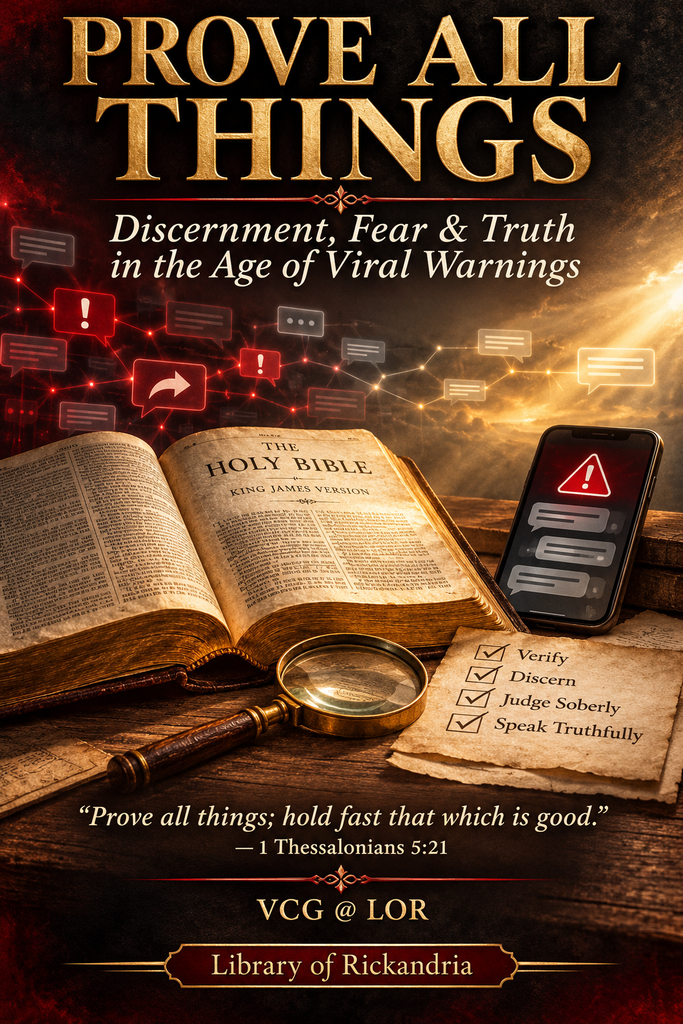
BY VCG @ LOR ON 1/20/2026
INTRODUCTION: Prove All Things: Discernment in an Age of Viral Fear


We live in a time when information travels faster than wisdom, and fear is often shared more readily than truth. Messages framed as urgent warnings now move effortlessly through families, churches, and communities, appealing to concern, compassion, and the sincere desire to protect others. Yet Scripture does not call the people of God to be reactionary, nor to amplify claims simply because they are alarming or well-intended. The command of God is not haste, but discernment; not panic, but sobriety; not rumor, but truth. In an age where virality is mistaken for validity, the Christian responsibility to test what is heard and repeated has never been more urgent.
Words are not neutral. To speak, to forward, to warn, and to repeat are moral acts that carry weight before God and man. Scripture teaches that life and death are in the power of the tongue, and that false witness—even when unintentional—can cause real harm. Good intentions do not sanctify unproven claims, and fear does not become righteous merely because it is shared in the name of safety. When unverified messages are circulated, especially among the brethren, confusion spreads, trust erodes, and the witness of the Church is weakened. For this reason, believers must be especially careful not only with what they believe, but with what they pass along to others.
This paper arises from a widely circulated “health advisory” that claimed authority, certainty, and urgency while providing no verifiable sources, evidence, or accountability. Rather than dismissing the message outright or accepting it uncritically, this work undertakes a disciplined and transparent examination of its contents. Each statement is analyzed line by line—identifying the claim being made, evaluating the evidence offered or lacking, exposing the psychological pressures at work, and measuring the whole against the clear instruction of Scripture. This method is intentional. Deception rarely presents itself in full form; it is built sentence by sentence, often mixing partial truths with exaggeration or error. As Scripture warns, a little leaven leaveneth the whole lump.
This work does not claim medical authority, nor does it seek to offer clinical advice or political commentary.
Its purpose is moral and biblical:
to model how Christians are to:
- think
- test
- speak
in a world saturated with information and driven by fear.
It is a case study in discernment, offered so that readers may learn not only what was wrong with a particular message, but how similar messages should be evaluated in the future. The goal is not to create suspicion of every warning, but to cultivate wisdom, patience, and truthfulness in response to all of them.
The Church bears a particular responsibility in this regard. Believers are often trusted voices within their families and communities, and what they repeat carries added weight. When the Church amplifies fear, the world hears fear preached with authority. When the Church slows down, tests claims, and speaks carefully, it bears faithful witness to a God of truth and order. Christ Himself instructed His followers to be wise as serpents and harmless as doves—discerning without being cynical, cautious without being silent, and faithful without being fearful.
Finally, this paper is written with a clear aim: not merely to inform, but to form. It calls the reader to greater restraint in speech, greater care in judgment, and greater obedience to the Word of God.
The standard set before us is simple and unchanging:
“Prove all things; hold fast that which is good.”
What follows is an exercise in that command—so that truth may be upheld, fear restrained, false witness avoided, and the brethren guarded not by panic, but by wisdom grounded in Scripture.
Line-by-Line Analytical Review of the Viral “Health Advisory”


The Appearance of Authority Without a Source
“New” Threats and the Weaponization of Novelty
Symptom Reframing and the Illusion of Hidden Knowledge
False Precision: Numbers Used to Manufacture Fear
Diagnostic Doubt as a Tool of Destabilization
Conflating Transmissibility With Lethality
Language of Urgency and the Suppression of Discernment
The Command to Share: How Virality Is Engineered
What Is Said vs. What Is Proved
Truth, Half-Truth, and False Witness
Biblical Discernment Applied to Modern Warnings
A Corrected, Biblically-Anchored Advisory (Rewritten)
Soli Deo Gloria, brethren.
Yes: paste the warning exactly as it’s being shared (verbatim, including emojis/hashtags/links if any).
Then we’ll take it line-by-line and do four things on each line:
- Claim type (fact / inference / prediction / command / fear appeal / spiritual language)
- Evidence check (what would be required to prove it; what’s missing; what’s unverifiable)
- Methodology & psychology (persuasion tactics: urgency, authority fraud, insider framing, bait-and-switch, scapegoating, vague threats, “share before it’s deleted,” etc.)
Biblical calibration (KJV) — is it:
- consistent with sound doctrine and Christian ethics
- requiring “proof” (Acts 17:11)
- avoiding false witness (Exodus 20:16)
- avoiding fear-driven manipulation (2 Timothy 1:7)
- speaking truth with sobriety (1 Peter 5:8)
A few anchor passages we’ll keep applying as our “test weights”:
“Prove all things; hold fast that which is good.” (1 Thessalonians 5:21)
“Beloved, believe not every spirit, but try the spirits…” (1 John 4:1)
“The simple believeth every word:
but the prudent man looketh well to his going.” (Proverbs 14:15)
“God hath not given us the spirit of fear…” (2 Timothy 1:7)
“…speaking the truth in love…” (Ephesians 4:15)
What we’ll produce as we go (so it can become a book)
A line-by-line annotated version of the warning (original line + analysis beneath)
- A taxonomy of deception patterns used in “viral warnings”
- A discernment checklist for brethren (printable)
- A biblically strengthened rewrite that keeps what’s true, removes what’s manipulative, and adds needed cautions
- A chapter outline for a book, built from the patterns we detect in your specific text
To keep it clean and fair
We’ll separate:
what we can prove, what we can’t, and what’s only conjecture.
If the warning names institutions/people/events, we’ll distinguish documented facts from interpretation.
If it makes medical/legal/financial claims, we’ll treat those as high-stakes and demand high-grade evidence before repeating.
Go ahead and paste it.
(If it’s long, paste in chunks—just don’t paraphrase; the exact wording matters for the psychological analysis.)


Holding Fast the Truth Without Spreading Fear


Truth Without Fear: A Call to Sobriety in the Last Days
Prove All Things, Share Only the Truth
Discernment as Obedience
Faithful Witness in an Age of Panic
Guarding the Brethren Without Bearing False Witness
Let’s carefully and truthfully evaluate the message you received about a:
“new COVID health advisory.”
We will fact-check, expose deceptive elements, and lay out what is actually known from credible science—while also examining psychological tactics used in such warnings and considering biblical wisdom in discernment.
📩 Original Message Reviewed
“New Covid Health Advisory:
Everyone is advised to wear a mask because the new COVID-Omicron XBB variant… different, deadly… not easily detected…”
Symptoms include no cough or fever, only:
- joint pain
- headache
- neck pain
- upper back pain
- pneumonia
- loss of appetite
“XBB is 5 times more toxic than Delta… higher mortality… not found in nasopharyngeal region… nasal swab tests negative… highly contagious, lethal.”
Recommendations:
Avoid crowds, masks, share widely.
📊 Line-By-Line Reality Check
1) “New COVID Health Advisory”
Claim Type:
Official warning
Reality:
There has been no public health advisory from the CDC, WHO, or similar authority specifically saying this.
Authorities do monitor and report on COVID variants, but this specific advisory is not an official guidance document. — Confirmed by fact-checkers. (youtube.com)https://www.youtube.com/embed/fSOMUkmyrPQ?feature=oembedNo, the CDC hasn’t issued a ‘health advisory’ about the XBB COVID-19 subvariant
👉 Psychology:
Using the word “advisory” creates a sense of authority without citing a credible source.
2) “New COVID-Omicron XBB variant… different, deadly…”
Claim Type:
Threat escalation/
Fact:
XBB lineages are sublineages of Omicron (a variant) and have been circulating for years.
They are not “new” in 2026.
Omicron variants have continued to mutate, and newer lineages exist (e.g., XFG, JN.1, etc.) but they remain part of the Omicron family, not a totally new separate pathogen.
What COVID-19 variants are going around in December 2025? | Nebraska Medicine Omaha, NE
👉 Psychology:
This frames something familiar as “new and deadly,” which induces urgency and fear.
3) List of symptoms: “no cough; no fever; only joint pain, headache…”
Claim Type:
False medical pattern.
Fact:
COVID-19 has a wide range of symptoms including:
- fever
- cough
- sore throat
- runny nose
- fatigue
etc.
Omicron and its subvariants do not solely cause these symptoms.
👉 Psychology:
Oversimplification + inaccurate symptom list -> certainty bias (makes it seem you “must memorize this or you’ll miss it”).
4) “XBB is 5 times more toxic than Delta… higher mortality rate”
Claim Type:
Exaggerated severity comparison.
Fact:
There is no evidence that XBB or its descendants are more deadly than Delta.
In fact, Omicron (which XBB is part of) has tended to be less severe overall than Delta.
👉 Psychology:
Numbers (“5× more toxic”) are persuasive even when unfounded—this is a fear anchor.
5) “Not easily detected…” / “Nasal swabs generally negative…”
Claim Type:
Diagnostic fear tactic.
Fact:
Standard COVID tests (PCR or antigen) do detect current SARS-CoV-2 infections, including Omicron subvariants.
There is no confirmed evidence that XBB cannot be detected by standard testing.
PCR tests sample the nasopharyngeal region and are still valid for detecting infection.
Did You Receive a ‘New COVID Health Advisory’ Message? It’s Fake | Snopes.com
👉 Psychology:
Suggesting:
“tests don’t work”
undermines public confidence and spreads uncertainty.
6) “Highly contagious, highly virulent, lethal”
Claim Type:
Sensational threat language.
Fact:
Variants like XBB tend to be highly transmissible, but not shown to be more virulent (deadly) than prior strains.
Transmissibility does not automatically equal lethality.
What to Know About the ‘Most Transmissible’ Covid-19 Variant
👉 Psychology:
Mixing transmissibility with lethality without evidence creates a false sense of imminent danger.
7) “Avoid crowds; mask; wash hands; share widely”
Truth:
Good hygiene and reducing exposure to respiratory viruses in general can reduce spread of contagious diseases, including COVID-19.
However:
The way it’s framed here is emotionally charged and not tied to real data about a specific new threat.
👉 Balanced biblical measure:
Caution is wise, fear is not of God. (2 Timothy 1:7, KJV)
🧠 Psychological Tactics in This Message
The warning uses:
Tactic | Effect
Authority language (“advisory”) | Implies official backing
Novelty (“new”) | Triggers attention
Specific numbers (“5× more toxic”) | Feels scientific
Fear appeal (“deadly, undetectable”) | Motivates urgent sharing
Imperative sharing (“don’t keep this to yourself”) | Social pressure to spread
These are classic elements in viral warnings—even when the content is unverified.
They appeal to emotion first, evidence second.
⚖️ Biblical & Discernment Lens
Scripture calls believers to discern and test claims:
👉 “Prove all things; hold fast that which is good.” – 1 Thessalonians 5:21 (KJV)
👉 “Beloved, believe not every spirit, but try the spirits…” – 1 John 4:1 (KJV)
👉 “The simple believeth every word:
but the prudent man looketh well to his going.” – Proverbs 14:15 (KJV)
Fear-based sharing—especially without evidence—can become a form of false witness (Exodus 20:16).
We must balance truth with compassion and avoid unverified alarmism.
📘 Draft Guidance (For Your Book & Brethren)
How to evaluate a “viral warning”:
Source credibility:
Is this coming from WHO, CDC, NIH, or peer-reviewed science?
Evidence base:
Does reputable data support the claims?
Specificity:
Are symptoms and metrics accurate and verifiable?
Fear vs. fact:
Does the tone appeal more to emotion than evidence?
Actionable truth:
What is actually recommended by health authorities?
📌 What’s True Right Now
✔️ COVID-19 and its variants continue to circulate worldwide.
✔️ Symptoms vary and can include common respiratory signs. (PMC)
✔️ Vaccination and other measures reduce severe illness and hospitalization. (CDC)
✔️ New sublineages exist, but none have been verified as universally more lethal than prior ones. (Africa Check)
Proving All Things: A Line-by-Line Discernment Analysis


Line-by-Line Discernment Analysis
Annotated Examination of a Viral Warning
A Sentence-by-Sentence Test of Claims
Proving All Things: A Line-by-Line Test
Testing the Spirits: An Annotated Review
Weighing the Words: Truth, Fear, and False Witness
Anatomy of a Viral Health Warning
Dissecting the Message: Claims, Fear, and Truth
From Alarm to Analysis: A Line-by-Line Review
What Is Claimed, What Is Proven
Truth Examined, Fear Exposed
Words Tried in the Balance
Below is a sentence-by-sentence annotation of the original message, using exactly the format you specified:
(Claim | Evidence | Psychology | Biblical Comment)
I will quote each sentence or unit, then annotate it directly beneath.
ANNOTATED REVIEW
Viral “New Covid Health Advisory” Message
“FYI: Please read and pass along”
Claim: This information is urgent and should be shared.
Evidence: None provided. No reason is given yet.
Psychology: Urgency + social obligation.
The reader is primed to act before thinking.
Biblical Comment:
“He that answereth a matter before he heareth it, it is folly and shame unto him.”— Proverbs 18:13 (KJV)
“New Covid Health Advisory:”
Claim: This is an official or authoritative advisory.
Evidence: No source, issuing body, date, or reference is given.
Psychology: Authority framing.
The phrase “health advisory” borrows institutional credibility without accountability.
Biblical Comment:
“Cursed be the man that trusteth in man…”— Jeremiah 17:5 (KJV)
“Everyone is advised to wear a mask because the new COVID-Omicron XBB variant coronavirus is different, deadly and not easily detected properly.”
Claim: XBB is new, deadly, and hard to detect; universal masking is required.
Evidence: None cited.
No data, study, or authority referenced.
Psychology: Fear escalation + novelty.
“Different” and “deadly” heighten threat perception.
Biblical Comment:
“For God hath not given us the spirit of fear; but of power, and of love, and of a sound mind.”— 2 Timothy 1:7 (KJV)
“Symptoms of the XBB virus are as follows:”
Claim: What follows is a definitive symptom list.
Evidence: No medical authority cited to establish accuracy.
Psychology: Expectation setting.
The reader is led to accept the list as exhaustive.
Biblical Comment:
“The simple believeth every word: but the prudent man looketh well to his going.”— Proverbs 14:15 (KJV)
“1. No cough.”
Claim: XBB does not cause cough.
Evidence: False.
Cough remains a common COVID symptom across variants.
Psychology: Contradiction shock.
Removing familiar symptoms creates confusion and alertness.
Biblical Comment:
“Remove not the ancient landmark, which thy fathers have set.”— Proverbs 22:28 (KJV)
“2. No fever.”
Claim: Fever does not occur with XBB.
Evidence: False.
Fever continues to occur in many cases.
Psychology:
Reinforces the idea of a “hidden” illness.
Biblical Comment:
“Woe unto them that call evil good, and good evil…”— Isaiah 5:20 (KJV)
“There will only be:”
Claim: The following symptoms are exclusive and definitive.
Evidence: No justification given for exclusivity.
Psychology: False certainty.
Eliminates ambiguity to increase confidence in the message.
Biblical Comment:
“Boast not thyself of to morrow; for thou knowest not what a day may bring forth.”— Proverbs 27:1 (KJV)
“3. Joint pain.”
“4. Headache.”
“5. Neck pain.”
“6. Upper back pain.”
“7. Pneumonia.”
“8. General loss of appetite.”
Claim: These are the primary indicators of XBB.
Evidence: These symptoms are non-specific and common to many illnesses; no proof they uniquely define XBB.
Psychology: Symptom broadening.
Makes many readers identify themselves as possibly infected.
Biblical Comment:
“Lying lips are abomination to the LORD:
but they that deal truly are his delight.”— Proverbs 12:22 (KJV)
“XBB is 5 times more toxic than Delta variant and has a higher mortality rate.”
Claim: XBB is significantly more deadly than Delta.
Evidence: False.
No credible data supports this claim.
Psychology: False precision.
Specific numbers (“5 times”) increase perceived credibility.
Biblical Comment:
“A false balance is abomination to the LORD…”— Proverbs 11:1 (KJV)
“It takes a shorter time for the condition to reach extreme severity, and sometimes there are no obvious symptoms.”
Claim: Rapid progression with silent onset is common.
Evidence: No substantiation; contradicts known COVID progression patterns.
Psychology: Invisible threat framing.
Encourages hypervigilance.
Biblical Comment:
“For they have healed the hurt of the daughter of my people slightly, saying, Peace, peace; when there is no peace.”— Jeremiah 6:14 (KJV)
“This strain of the virus is not found in the nasopharyngeal region…”
Claim: The virus bypasses the upper airway.
Evidence: False; SARS-CoV-2 infects via respiratory mucosa.
Psychology: Undermines trust in testing and expertise.
Biblical Comment:
“Ever learning, and never able to come to the knowledge of the truth.”— 2 Timothy 3:7 (KJV)
“…and it directly affects the lungs…”
Claim: Direct lung infection without upper airway involvement.
Evidence: Unsupported and misleading.
Psychology: Heightens fear by invoking pneumonia imagery.
Biblical Comment:
“The words of his mouth were smoother than butter, but war was in his heart.”— Psalm 55:21 (KJV)
“Nasal swab tests are generally negative…”
Claim: Standard tests are unreliable for XBB.
Evidence: False; PCR and antigen tests remain effective.
Psychology: Diagnostic destabilization.
Creates distrust in verification.
Biblical Comment:
“If the foundations be destroyed, what can the righteous do?”— Psalm 11:3 (KJV)
“This means the virus can spread in the community…”
Claim: Undetectable spread is rampant.
Evidence: Built on prior false premises.
Psychology: Chain-logic fallacy.
One false claim compounds others.
Biblical Comment:
“They speak vanity every one with his neighbour…”— Psalm 12:2 (KJV)
“XBB has become highly contagious, highly virulent and lethal.”
Claim: Extreme transmissibility and lethality.
Evidence: Unsupported; contradicted by epidemiological data.
Psychology: Triple-threat language to overwhelm reason.
Biblical Comment:
“The thief cometh not, but for to steal, and to kill, and to destroy…”— John 10:10 (KJV)
“Avoid crowded places… wear a double-layer mask…”
Claim: Specific behaviors are necessary due to XBB.
Evidence: General advice, not variant-specific.
Psychology: Compliance anchoring.
Fear leads to obedience.
Biblical Comment:
“Stand fast therefore in the liberty wherewith Christ hath made us free…”— Galatians 5:1 (KJV)
“Don’t keep this information to yourself, share as much as possible…”
Claim: Moral obligation to spread the message.
Evidence: None; virality is the goal.
Psychology: Guilt + social pressure.
Overrides discernment.
Biblical Comment:
“Be not many masters, knowing that we shall receive the greater condemnation.”— James 3:1 (KJV)
🔚 SUMMARY BIBLICAL JUDGMENT
This message:
- Mixes truth with error
- Uses fear to compel sharing
- Lacks evidence
- Violates the principle of proving all things
Final anchor:
“Prove all things; hold fast that which is good.”— 1 Thessalonians 5:21 (KJV)
A Sound & Sober Advisory: Truth Without Fear


Holding Fast the Truth Without Spreading Fear
A Sober Word in an Age of Alarm
Wisdom, Not Panic: A Corrected Advisory
Speaking Truth Without Bearing False Witness
A Corrected Advisory Grounded in Truth
A Biblically Calibrated Health Advisory
From Alarm to Accuracy: A Faithful Response
Truth Without Fear
A Sober Warning, Not a Viral One
Proving All Things in Practice
Below is a corrected, biblically sound advisory, written intentionally as a contrast piece to the viral warning.
It is:
- sober
- restrained
- truthful
and suitable for sharing, publishing, or placing side-by-side with the false message.
A SOUND AND SOBER HEALTH ADVISORY
Holding Fast the Truth Without Spreading Fear
Purpose:
This advisory is offered to inform without alarming, to encourage wisdom without fear, and to promote truth without false witness.
Regarding COVID-19 and Respiratory Illness
Respiratory illnesses, including COVID-19 and its variants, continue to circulate in many parts of the world.
Variants change over time, but they remain part of the same virus family and are monitored continually by medical professionals.
Symptoms of respiratory illness may vary from person to person and can include:
- fever
- cough
- fatigue
- headache
- sore throat
- body aches
or other common signs of infection.
No single symptom list applies to all people or all variants.
No claim should be accepted as fact unless it can be verified by reliable medical evidence and clearly identified sources.
“The simple believeth every word:
but the prudent man looketh well to his going.”— Proverbs 14:15 (KJV)
On Testing and Detection
Standard medical testing methods remain effective tools for detecting respiratory infections when used appropriately.
No illness should be assumed undetectable or uniquely hidden without clear and documented evidence.
When in doubt, individuals are encouraged to seek qualified medical advice rather than rely on forwarded messages or anonymous advisories.
“In the multitude of counsellors there is safety.”— Proverbs 11:14 (KJV)
On Personal Conduct and Public Wisdom
It is wise to practice general health measures such as:
- Staying home when sick
- Practicing good hygiene
- Being considerate of vulnerable individuals
- Seeking medical care when symptoms are severe or persistent
Such actions are matters of prudence, not fear.
“A prudent man foreseeth the evil, and hideth himself; but the simple pass on, and are punished.”— Proverbs 22:3 (KJV)
On Sharing Information
Not all information is fit to be shared simply because it appears urgent.
Messages that rely on fear, lack sources, exaggerate danger, or pressure recipients to “share immediately” should be tested before being passed on.
Sharing unverified claims—especially those that provoke fear—can unintentionally cause harm.
“Thou shalt not bear false witness against thy neighbour.”— Exodus 20:16 (KJV)
“Let your speech be alway with grace, seasoned with salt.”— Colossians 4:6 (KJV)
A Word to Believers
Christians are called to be:
- sober
- vigilant
- truthful
not driven by panic or rumor.
“For God hath not given us the spirit of fear; but of power, and of love, and of a sound mind.”— 2 Timothy 1:7 (KJV)
We are to:
- Prove all things
- Hold fast that which is good
- Speak truth in love
“Prove all things; hold fast that which is good.”— 1 Thessalonians 5:21 (KJV)
Wisdom does not shout.
Truth does not manipulate.
Fear is not a fruit of the Spirit.
Let us walk carefully, speak truthfully, and guard one another—not by spreading alarm, but by holding fast to what is true.
CONCLUSION: Holding Fast That Which Is Good


This paper has sought not merely to analyze a single viral message, but to recover a biblical posture that has been neglected in an age of speed, alarm, and constant transmission. Through careful, line-by-line examination, we have seen how fear can be dressed in the language of concern, how authority can be implied without accountability, and how partial truths—repeated often enough—can gain influence far beyond their merit. The greatest danger exposed is not that false or exaggerated claims exist, but that they are so easily believed, shared, and defended without being tested, even among those called to be witnesses of the truth.
Scripture is unambiguous about the weight of our words. To speak, to warn, and to repeat information are not morally neutral acts; they are exercises of stewardship. The believer is accountable not only for what he believes privately, but for what he spreads publicly. Silence, at times, is not cowardice but wisdom. Delay is not negligence but obedience. In a culture that equates immediacy with virtue, the Christian must remember that haste often serves fear, while patience serves truth. We will give account for our speech, and therefore we must learn to govern it carefully.
This study has also shown how subtle drift occurs. Fear rarely arrives announced; it enters gradually through repetition, emotional appeal, and the erosion of careful judgment.
Messages framed as:
“just in case,”
“better safe than sorry,”
or
“share to protect others”
can bypass discernment and settle into habit.
Over time, what was once questioned becomes assumed, and what was once alarming becomes normal. Scripture warns that a little leaven leavens the whole lump, and vigilance must therefore be continual, not occasional.
Yet the answer to this danger is not suspicion, cynicism, or withdrawal. The Church is not called to be dismissive of every warning, nor indifferent to real harm. Discernment is not denial, wisdom is not apathy, and caution is not fear. Rather, the people of God are called to a steadier path: courageous without being careless, compassionate without being gullible, alert without being alarmed. A discerning Church is one that remains calm in crisis, slow to speak, quick to test, and trustworthy because it refuses to trade truth for urgency.
What, then, should mark us going forward? We must commit ourselves to proving what we hear before proclaiming it, to examining claims before endorsing them, and to valuing truth more than the comfort of feeling “in the know.” We must model discernment for our families, our churches, and our communities—not by lecturing, but by example. When others rush to share, we pause. When others amplify fear, we ask questions. When others demand urgency, we insist on clarity. In doing so, we protect not only ourselves, but those who trust our words.
The charge that closes this work is both simple and demanding:
“Prove all things; hold fast that which is good.”
Holding fast requires effort. It means letting go of what is unproven, resisting what is manipulative, and clinging deliberately to what is true. In holding fast to what is good, we do not lose compassion—we gain clarity. We do not weaken vigilance—we strengthen it. And we do not diminish care for one another—we ground it firmly in truth, sobriety, and love.
May the people of God be known, in an age of viral fear, as a people of sound judgment; in an age of noise, as a people of tested words; and in an age of confusion, as a people who hold fast—faithfully and without fear—to that which is good.
Soli Deo Gloria.
ALTERNATE TITLES
Prove All Things: Holding Fast the Truth Without Fear
Holding Fast That Which Is Good: A Call to Discernment in an Age of Alarm
Truth Without Fear: Proving All Things in a Viral World
Proving All Things: A Line-by-Line Discernment of Viral Fear
Discernment in the Age of Viral Information
Testing the Message: Truth, Fear, and False Authority
Proving All Things in the Last Days
Fear Tested by Truth
When Warnings Go Viral: A Biblical Examination
Prove All Things: Discernment, Fear & Truth in the Age of Viral Warnings
Prove All Things: Discernment, Fear & Truth in the Age of Viral Warnings – Library of Rickandria