
The Georgia Guidestones: Fact, Conspiracy, Eugenics & a Biblical Examination
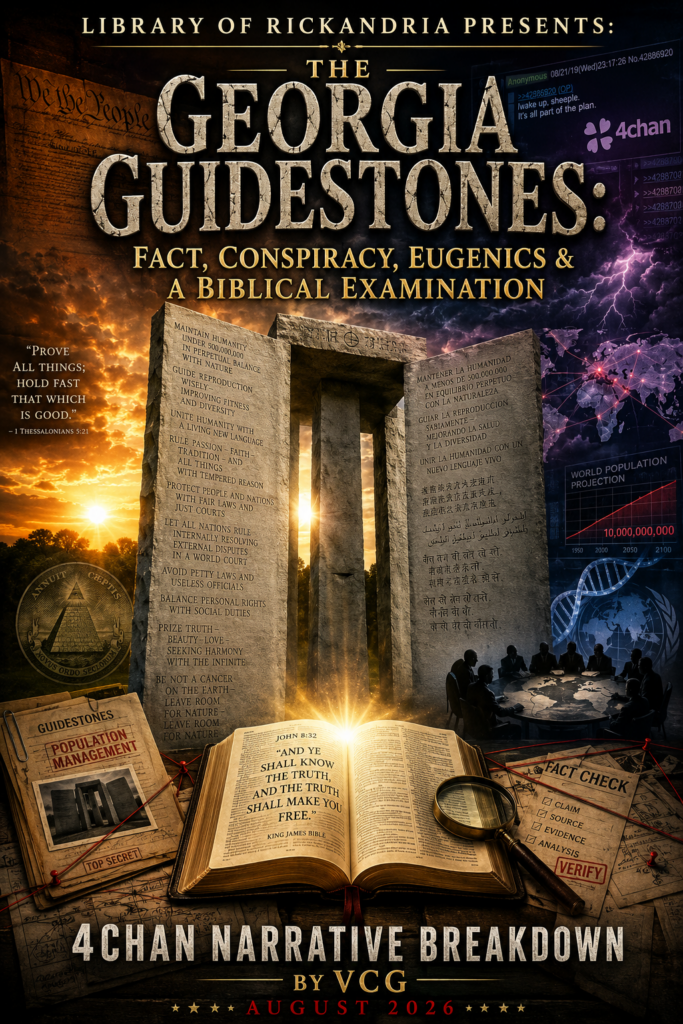
UPDATED BY VCG ON 8/29/2026 @ 17:17 EST
I want to share a heartfelt cause with my audience. Conner Blaisdell-Greene, a brave Airforce Sr. Airman, recently lost his battle with cancer, leaving his family in financial distress. Every donation, no matter how small, can help cover his funeral costs and ease their burden during this difficult time. Please consider clicking the link below to contribute or share Conner’s story with others. Your support truly matters.
Until We Meet Again
Spoken Tribute
Abstract
Few American monuments accumulated as much mythology as the Georgia Guidestones. Erected in rural Elbert County, Georgia, in 1980, the granite structure combined astronomical features with ten short instructions concerning population, reproduction, language, government, individual rights, nature, reason, and spirituality. Its anonymous sponsorship made it an almost perfect object for speculation. Over the following four decades the stones were alternately described as a humanitarian time capsule, a manifesto for enlightened government, a eugenic monument, a blueprint for a New World Order, or even the “Ten Commandments of the Antichrist.” In July 2022 an unknown person bombed the monument; county authorities subsequently demolished the unstable remainder. As of 2026, no one has been charged with the bombing.
This paper examines a 4chan /x/ thread posted on August 28–29, 2026, in which anonymous participants debate what the Guidestones actually represented. Rather than choosing in advance between the thread’s “innocent monument” and “Satanic depopulation conspiracy” camps, the analysis works outward from primary evidence. Of particular importance is Common Sense Renewed, a 1986 book published under the name Robert Christian. Its author claims to have originated the Guidestones and authored their inscriptions. The book substantially clarifies otherwise ambiguous phrases on the stones, especially those concerning population and reproduction.
The documentary evidence leads to a conclusion more serious than the monument’s defenders generally admit but narrower than its most conspiratorial critics claim. The Guidestones’ associated literature really does advocate enormous population reduction, selective reproduction, government direction of reproductive behavior, and limited world government. Those facts do not require speculation. At the same time, the evidence examined here does not establish a Satanic or Druid conspiracy, an Atlantean connection, an order to murder billions of people, a World Economic Forum operation, an engineered Deepwater Horizon disaster, a recurring “solar micronova” apocalypse, or a ritual requirement that elites publicly announce future crimes.
The biblical examination reaches a similarly discriminating conclusion. Scripture supports justice, responsible stewardship, truth, social responsibility, rational examination, and peaceful conduct. Those ideas do not become evil because the Guidestones mentioned them. The deeper biblical conflict concerns human nature and political sovereignty: Scripture presents human beings as created in the image of God, whereas the Guidestones’ explanatory philosophy allows self-appointed social authorities to classify, manage, and selectively reproduce human populations according to judgments of social fitness.
The governing principle of this investigation is therefore not credulity and not reflexive debunking, but the apostolic command:
“Prove all things; hold fast that which is good.”— 1 Thessalonians 5:21, KJV
I. What We Are Actually Investigating
The 4chan thread begins with a reasonable question wrapped in an unnecessary insult. The original poster looks at the Georgia Guidestones, sees principles that initially appear fairly ordinary, and asks why Christians considered the monument evil. The poster also understands the structure as guidance intended for humanity after a catastrophic war or other global disaster.
That interpretation is not invented.
Reporting on the Guidestones has long documented a post-catastrophe dimension to the project. The monument was deliberately built to endure, and R. C. Christian reportedly explained that it should preserve instructions capable of assisting the remnants of humanity after catastrophic events.
But that is where careful research must slow down.
There are at least four different questions that people repeatedly collapse into one:
What did the granite inscription literally say?
What did the anonymous sponsor intend those words to mean?
What political or philosophical system would be required to implement them?
What later conspiracy theories have been attached to them?
Those are not interchangeable questions.
A phrase may be ambiguous on the stone yet clarified elsewhere by its author. A political proposal may be objectionable without being Satanic. A conspiracy can be possible without being proven. And an environmental observation can be correct even when an anti-human conclusion drawn from it is morally indefensible.
That distinction—between statement, context, inference, and speculation—is the methodological foundation of this paper.
II. The Historical Ground Beneath the Myth
The Georgia Guidestones were unveiled on March 22, 1980, in Elbert County, Georgia. They consisted principally of four large upright granite slabs surrounding a central stone and supporting a capstone. The monument weighed roughly 119 tons. Its design incorporated astronomical functions: alignments related to the Sun’s seasonal positions, a channel directed toward the celestial pole, and a feature for marking noon.
The commissioner called himself R. C. Christian and openly acknowledged that this was a pseudonym. He approached Joe Fendley of the Elberton Granite Finishing Company to have the monument constructed and dealt with banker Wyatt Martin concerning the project’s finances. The New Georgia Encyclopedia states that the man’s public identity and the identity of the organization he represented were not established in the conventional historical record available when its entry was last revised.
Later investigators have proposed identities. A 2015 documentary, for example, argued that the sponsor was Iowa physician Herbert H. Kersten; an EBSCO historical overview describes that case as resting on circumstantial evidence. In 2026, Atlanta Journal-Constitution reporting discussed investigators pursuing the creator’s background and referred to previous documentary work claiming to have identified him. Because the public record remains uneven and because the ideological text can be analyzed without solving the civil-identity question, this paper will continue to call the sponsor R. C. Christian.
That choice is important. We should not manufacture certainty simply because identifying a mysterious person makes the story more satisfying.
What was actually carved on the monument?
The Guidestones’ ten English instructions concerned a population ceiling of 500 million, directed reproduction and human “fitness,” a common auxiliary language, rule by reason, just laws and courts, national self-government combined with an international court, restraint in law and bureaucracy, a balance between rights and duties, pursuit of truth/beauty/love, and protection of nature. The capstone framed the project as guidance toward an “age of reason.” The same principal text appeared in eight modern languages, with additional ancient-language inscriptions on the capstone.
Already we can see why disagreement developed.
“Fair laws and just courts”
sounds unobjectionable.
“Guide reproduction wisely”
leaves unanswered the much more consequential question:
who guides it, by what authority, and using what means?
Likewise,
“maintain humanity under 500,000,000”
sounds quite different if it is addressed to 100,000 hypothetical survivors after a nuclear catastrophe than if it is addressed to the more than four billion people who were already alive when the monument appeared.
That ambiguity is the center of the 4chan debate.
Fortunately, there is evidence beyond the granite.
III. The Primary Source That Changes the Discussion
In 1986, Graphic Publishing Company of Lake Mills, Iowa, published Common Sense Renewed under the name Robert Christian. WorldCat independently catalogs the book as a 1986 publication under that author name.
The importance of the book lies in a direct claim by its author:
“I am the originator of the Georgia Guidestones and the sole author of its inscriptions.”
We cannot independently prove from that sentence alone that the writer’s civil identity was identical with the man who physically commissioned the stones. But as primary-source evidence of the ideology publicly attached to the R. C. Christian identity, the book is indispensable.
And it fundamentally changes the interpretation.
The writer explicitly says the Guidestones address present and future generations, not merely hypothetical survivors. He advocates prompt population control, several generations of very small families, legal and social pressure against what he considers irresponsible reproduction, incentives and disincentives affecting childbearing, and circumstances in which private reproductive wishes would yield to state interests.
He then states plainly:
“A reduction in total numbers is essential…”
The next stage is selective rather than merely numerical. The book discusses encouraging reproduction among people judged socially or biologically desirable, discouraging it among others, and compares deliberate improvement of human inheritance with selective breeding practiced in domesticated plants and animals.
That is not an accusation supplied by a conspiracy website.
It is in the document associated with the monument’s own claimed originator.
The same source also advocates a limited but effective world government, while simultaneously preserving substantial national authority over internal affairs. It therefore supports concern about supranational political authority while contradicting the stronger claim that the writer sought the immediate abolition of every nation into one homogeneous global state.
This is the first major conclusion of the investigation:
The Guidestones were genuinely envisioned as a durable message across time, including the possibility of catastrophe. But the documentary evidence does not support restricting their meaning to a post-apocalyptic scenario. Their associated manifesto applies the program to the existing world as well.
IV. The 500-Million Question
The first inscription is the source of most of the controversy.
One side of the 4chan argument insists that the word maintain must mean that the instruction was written only for a future population already below 500 million.
The other side hears 500 million and immediately translates it into “kill everybody above that number.”
Neither approach is methodologically sufficient.
United Nations demographic estimates assessed in 1980 placed world population at approximately 4.432 billion.
Reducing 4.432 billion to 500 million would mean a decline of approximately 88.7 percent.
That arithmetic matters.
But arithmetic does not identify the mechanism.
A population can decline through lower fertility over generations, mortality, migration within particular territories, war, famine, disease, coercive birth restrictions, voluntary family planning—or some combination of mechanisms. Therefore, the number alone does not prove mass killing.
The accompanying 1986 text resolves part of the ambiguity because it explicitly advocates reducing human numbers and regulating reproduction. It still does not direct readers to kill billions of currently living people.
That brings us to an important word used repeatedly in the thread.
Is “genocide” accurate?
In everyday speech, people sometimes use genocide as a synonym for enormous mass killing.
Legally and historically, the term is more specific.
Article II of the United Nations Genocide Convention defines genocide around acts committed with intent to destroy, wholly or partly, a national, ethnical, racial, or religious group as such. The enumerated acts include killing, serious harm, destructive living conditions, measures intended to prevent births, and forcible transfer of children.
The Guidestones evidence examined here does not establish that protected-group intent.
Therefore, the careful conclusion is:
The documented ideology contains coercive reproductive and eugenic elements.
It advocates dramatic population reduction.
It does not, on the evidence examined here, constitute an explicit written instruction to commit genocidal mass killing.
This is not semantic hair-splitting.
When the evidence already supports a grave accusation, inflating that accusation makes the argument weaker rather than stronger.
V. Walking Through the 4chan Thread
Now that the historical foundation is in place, we can return to the thread and evaluate it in sequence.
The goal is not to decide which anonymous faction is “our side.” It is to ask, post by post, what survives contact with evidence.
Post No. 42886920 — The Original Question
The OP essentially asks: why was this considered evil, were Christians overreacting, and was the monument not simply meant as guidance after a major catastrophe?
The strongest part of the post is its willingness to question an inherited narrative. A monument should not be condemned merely because somebody online labeled it “NWO.”
The weakest part is that the OP moves too quickly from one legitimate historical context—the catastrophe scenario—to an exclusive interpretation.
There really is historical support for a survival/rebuilding purpose.
But the 1986 manifesto addresses existing society, calls population management urgent, and explicitly proposes population reduction and reproductive regulation. The catastrophe interpretation is therefore real but incomplete.
The Christian question also cannot be resolved by asking whether every sentence sounds evil. Christians may affirm individual principles such as justice or truth while rejecting the philosophical framework within which they have been placed.
The opening insult—
“was it just christians being stupid”
—does no analytical work. It primes the discussion to become tribal before the evidence has even been examined.
Post No. 42886943 — “Leave Room for Nature”
The next participant notices that the final environmental instruction repeats the appeal to leave room for nature.
The observation is correct. The repetition is part of the monument.
There is no biblical reason Christians must oppose conservation.
Psalm 24 begins:
“The earth is the LORD’S, and the fulness thereof; the world, and they that dwell therein.”
Biblical dominion is therefore not ownership independent of God.
The real theological problem lies elsewhere: the Guidestones describe humanity itself with the metaphor of a planetary cancer. Scripture can condemn human sin, greed, violence, waste, and destruction without redefining mankind as a malignant growth on God’s creation.
Post No. 42886956 — NWO and “Ten Commandments of the Antichrist”
Another poster says the structure is interesting but questions why it became associated with the New World Order and with
“Ten Commandments of the Antichrist.”
That skepticism is warranted as far as the Antichrist label is concerned.
There is no historical evidence presented in the thread establishing that the monument was commissioned by the biblical Antichrist or constituted his ten commandments.
More importantly, Scripture supplies an actual theological use of the term. First John does not define antichrist as “anything involving international government.” It connects antichrist specifically with denial concerning Christ and the Father and Son.
“Who is a liar but he that denieth that Jesus is the Christ?
He is antichrist, that denieth the Father and the Son.”— 1 John 2:22
That does not mean Christians must approve the Guidestones.
It means biblical vocabulary should retain biblical definitions.
As for global governance, the suspicion has more documentary foundation. Common Sense Renewed really does advocate limited world government. The mistake is not noticing globalist political philosophy; the mistake is leaping from that fact to a specific prophetic identity Scripture itself does not establish.
Post No. 42887114 — Druids, Obama, Cybele, BP, Atlantis and “Loosh”
At this point the thread makes its first major leap away from documentary evidence.
A poster explicitly traces the story to what the poster calls a “larp on GLP,” then connects the monument with a pagan/Druid faction, Obama, Cybele, the Deepwater Horizon oil spill, climate false flags, “loosh,” and ancient Atlantis.
The source-description should stop us immediately.
A story does not become stronger because it is elaborate.
Nor does an anonymous claimant gain credibility merely because later events can be fitted into his narrative.
The Deepwater Horizon disaster received extensive technical investigation. The U.S. Department of the Interior investigation identified failures involving well design, cement barriers, testing, blowout prevention, detection, training, and risk management. That does not logically prove that no person anywhere ever acted improperly; it does mean we possess a substantial engineering explanation and no affirmative evidence in this thread connecting the disaster to Guidestones sponsors, Druids, climate rituals, or “loosh.”
The Atlantis claim has the same problem.
The monument’s astronomical design is real.
That does not transform southern Georgia into documented Atlantean ritual territory.
A crucial rule of investigation emerges here:
A connection must be demonstrated, not merely imaginable.
Post No. 42887135 — “Satanic Stones,” Genocide and Total Control
The next post calls the Guidestones Satanic and treats genocide and total control as obvious features of the project.
This is a useful example of a statement whose middle is stronger than its outer edges.
“Satanic” has not been historically established.
“Genocide,” used as a legal characterization, goes beyond the evidence examined above.
But concern about political control over reproduction turns out to be substantially grounded.
The author’s own explanatory program places reproduction within the legitimate reach of society and government and contemplates coercive social mechanisms.
Therefore, a stronger rebuttal would remove the claims that cannot be proved and retain the one that can:
The primary-source ideology allows unusually intrusive governmental authority over human reproduction and explicitly favors selective population reduction.
We do not make that criticism stronger by calling every element Satanic.
Post No. 42887157 — “Without Christianity There Is No Satanism”
This comment mixes a useful distinction with poor historical reasoning.
There is an important sense in which modern Satanism emerged within societies deeply shaped by Christianity. Scholarship on Satanism traces the development of “Satanism” from an accusation into an eventual self-designated religious identity, with organized modern Satanism especially associated with twentieth-century developments such as Anton LaVey’s movement.
But the history of the Satan figure does not begin with Christianity.
Scholarly literature traces satan terminology and related adversarial figures through the Hebrew Bible and Second Temple Jewish literature. The later Christian Satan develops in continuity with earlier Jewish concepts even though the terminology and theology become more consolidated in Christian writings.
So, a more accurate statement is:
Modern organized Satanism is historically post-Christian. The religious history of Satan/satan figures is not.
The comment “history is fake” is more consequential than it appears.
If every historical source contradicting one’s theory can simply be classified as fake, then the theory becomes protected against evidence.
At that point we are no longer investigating history.
We are insulating a belief.
Post No. 42887182 — “What Matters Is What They Believe”
This poster argues that the investigator’s own beliefs are irrelevant and that the worldview of the suspected actors is what matters.
As a methodological principle, that is partly right.
If we are investigating someone’s motivation, we should indeed ask what that person believed.
But the sentence requires two additional steps:
Who exactly is they?
What evidence establishes what they believed?
Without those questions,
“they believe X”
becomes a container into which the researcher can pour anything.
Ironically, the Guidestones case gives us a much stronger alternative. We possess an explanatory book attributed to the monument’s claimed originator. We do not need to guess what a hypothetical Druid cabal believed when we can examine what the associated writer actually proposed.
Good investigation prefers documentary evidence over psychic reconstruction.
Post No. 42887210 — The Dolmen/Graffiti Question
A participant asks who writes graffiti on “the Dolmen.”
No identifiable monument, author, inscription, date, or causal connection is established in the post.
There is therefore nothing substantial to fact-check.
This illustrates a frequent feature of conspiracy discourse: associative insinuation.
A mysterious image, symbol, monument, phrase, or anecdote is introduced beside another mystery. Because the two objects are emotionally similar, the reader begins to experience them as evidentially connected.
But adjacency is not causation.
Before the connection enters an argument, an investigator should require identification, provenance, dating, and a demonstrated relationship.
Post No. 42887300 — The WEF “Great Reset”
Another poster says the stones evoke the World Economic Forum’s “Great Reset.”
As a comparison of themes, this is not absurd.
Both bodies of rhetoric include environmental concerns, global coordination, long-term planning, and social organization.
But chronology prevents us from treating resemblance as proof of institutional origin.
The Georgia Guidestones were unveiled in 1980. The World Economic Forum publicly announced the initiative branded “The Great Reset” on June 3, 2020, forty years later. The WEF described its program in terms of building more sustainable, resilient, and equitable economic and social arrangements after the COVID-19 crisis.
Therefore:
“This reminds me of the Great Reset”
is an interpretation.
“The WEF was behind the Georgia Guidestones”
requires evidence that the thread does not provide.
And there is an additional irony.
We do not need a WEF connection to establish that the Guidestones’ associated author favored supranational governance. He says so himself.
The documented argument is stronger than the speculative one.
Post No. 42887336 — “How Is That Expected to Be Done?”
This may be the most methodologically productive comment in the entire thread.
The poster notices that attractive language about enlightened reason and wise reproduction can conceal a much more consequential question:
How would
“guide reproduction wisely”
actually be implemented?
That is exactly the question serious political analysis should ask.
Abstract principles often sound humane because the coercive mechanism has been omitted.
“Improve society.”
“Promote fitness.”
“Maintain balance.”
“Guide reproduction.”
Every one of those sentences changes morally depending on who decides, who obeys, who can refuse, what penalties exist, and which human beings are classified as undesirable.
Here the primary source vindicates much of the poster’s concern. The associated manifesto does not leave reproduction wholly voluntary and private.
The poster’s language about a literal “hidden hand” is not established.
But the underlying question about technocratic power is sound.
This is a good example of how skepticism should work:
turn vague language into operational questions.
Post No. 42887403 — Insults and the “Depop Stones”
The thread then returns to factional insult and calls the structure a depopulation monument.
The insult contributes nothing.
The population characterization, however, is not baseless. The book associated with the sponsor expressly favors population reduction.
This distinction matters because aggressive rhetoric often obscures the strongest argument a speaker actually possesses.
Research into online commenting also gives us reason not to assume that anonymity alone explains such behavior. An experimental study by Leonie Rösner and Nicole Krämer found that participants exposed to aggressive peer-comment norms used more aggressive language themselves. Anonymity did not have a straightforward direct effect, though it showed a tendency to strengthen conformity to an aggressive norm.
That does not diagnose this anonymous poster.
It does suggest a better model than “anonymous people simply become monsters”: communication norms can become contagious inside groups.
Once ridicule becomes the local language, careful qualification begins to look like weakness.
Post No. 42887440 — The Anti-Human Argument
One of the longest posts condemns humanity for pollution, waste, luxury consumption, mistreatment of animals, exploitation of labor, overpopulation, and ecological destruction before concluding that humanity ought to be eradicated.
This post deserves careful treatment because several of its premises address genuine evils.
Human influence on the climate system is not imaginary. The IPCC concludes that human influence has unequivocally warmed the atmosphere, ocean, and land and has contributed to widespread changes in the climate system.
Exploitation in global mineral supply chains is likewise real. The U.S. Department of Labor reports child labor in mica extraction in India and Madagascar, including dangerous mining activities.
Those facts should trouble the conscience.
But the conclusion—
“humans need to be eradicated”
—does not follow from them.
That is a non sequitur.
From pollution one can infer a need to reduce pollution.
From exploitative mining one can infer a need to end child exploitation.
From habitat destruction one can infer a duty to protect habitat.
From cruel treatment of animals, one can infer moral responsibility toward animals.
None logically yields:
therefore, exterminate the species capable of moral responsibility.
There is also a striking internal contradiction. The writer condemns human beings for treating living creatures as disposable and answers that evil by treating human beings themselves as disposable.
Biblically, the correction is direct.
Genesis does not call man a cancer.
“So God created man in his own image, in the image of God created he him; male and female created he them.”
The same passage gives humanity dominion and responsibility within creation.
Psalm 24 simultaneously prevents us from turning dominion into absolute ownership:
“The earth is the LORD’S, and the fulness thereof…”
The biblical position therefore resists two opposite errors.
Creation is not disposable because mankind has dominion.
Mankind is not disposable because creation has value.
Post No. 42887543 — Public “Disclosure” of the Plan
The next theory says powerful actors must publicly reveal their intentions and that removal of the monument after implementation begins somehow releases them from responsibility for secrecy.
This theory has a severe methodological problem: it can explain opposite outcomes equally well.
If the plan is hidden, secrecy proves conspiracy.
If the plan is public, disclosure proves conspiracy.
If the warning remains, the continuing notice proves conspiracy.
If it disappears, removal proves implementation.
A theory structured this way becomes difficult or impossible to falsify.
The proper response is not
“elites never conspire.”
History would refute that.
The proper response is:
What evidence establishes this particular rule of disclosure?
Who follows it?
Where is it documented?
What observation would show that the theory is wrong?
If no possible observation can count against a claim, the claim is not functioning as a historical hypothesis. It is functioning as an interpretive system.
Post No. 42887802 — Reduce Humanity to 500 Million
This poster summarizes the first Guidestone as reducing humanity to 500 million and equates that reduction with genocide.
After examining Common Sense Renewed, the reduction portion is substantially supported.
The genocide portion remains too strong for the evidence.
The best correction is:
The associated ideology advocates bringing human population dramatically downward through state-influenced reproductive policy and selective reproduction.
That statement is already serious.
It does not require inserting a mass-execution order the source never gives.
Post No. 42887870 — “Maintain,” the Astronomical Instrument and a Solar Micronova
This poster makes three distinguishable claims.
First, the poster emphasizes that the inscription says maintain, not reduce.
Literally, that observation is correct.
Contextually, however, the associated manifesto explicitly says reduction is necessary. The lexical defense therefore fails once the author’s explanatory text is considered.
Second, the poster notes the monument’s astronomical functions.
That is true. The Guidestones really did incorporate celestial and solar alignments. This was engineering, not an invention of later conspiracy theorists.
Third, the poster suggests a possible
“solar micronova.”
Here an interesting vocabulary trap appears.
Micronova is a genuine astronomical term. In 2022, astronomers reported localized thermonuclear explosions on certain accreting magnetic white dwarf stars. The observed phenomenon involves material from a companion star being funneled toward magnetic regions on the white dwarf, where localized fusion events occur.
That discovery does not provide evidence that our Sun periodically undergoes a civilization-destroying “micronova.”
The scientific term is real.
The claimed application is unsupported.
This is a recurring research lesson: finding a legitimate scientific word inside a theory does not validate the theory built around it.
Post No. 42887875 — People Treated Like Cattle
A critic imagines a totalitarian system in which an elite council controls life down to intimate relationships and human breeding.
The thread provides no evidence that the Guidestones’ author proposed a council assigning everyone’s spouse.
That detail is an extrapolation.
But the cattle/breeding analogy is not wholly imported by critics. The associated text itself analogizes improvement of human heredity to selective human control over domesticated organisms.
Scientifically, this belongs within the historical family of eugenic reasoning.
The National Human Genome Research Institute defines eugenics as the discredited attempt to improve human “fitness” through selective breeding for inherited traits and notes the history of classifying people into categories of “fit” and “unfit.”
This does not mean genetics is fake.
Human traits obviously can have genetic components.
The problem is the political and scientific leap from heritability to state authority to rank reproductive worth.
Modern genomics has revealed highly complex, polygenic architectures for traits such as intelligence. That reality does not rescue the simplistic social project of deciding which classes of persons should contribute more or less to the future population.
The ethical concern is therefore not imaginary.
It simply needs to remain attached to what the evidence actually shows.
Post No. 42887882 — Nations Still Rule Internally
A defender points out that the inscription itself lets nations govern their internal affairs while sending external disputes to a world court.
That is a legitimate correction to the claim that the stones plainly demand abolition of all national government.
The associated book also discusses retaining reasonable national autonomy.
But it simultaneously advocates limited world government and world law.
Therefore, both extremes should be rejected.
The Guidestones are not merely traditional national sovereignty.
They are also not an explicit blueprint for a culturally uniform planetary dictatorship.
The author’s model is closer to layered sovereignty: internal national rule under some supranational legal structure.
Whether one considers that wise is a political question.
But accuracy comes before approval or disapproval.
Post No. 42887902 — “Keep” Versus “Reduce”
A participant mocks the attempt to distinguish the two words.
Mockery aside, the factual issue can now be resolved more cleanly than either poster resolves it.
The inscription says maintain.
The 1986 exposition says reduce.
The 1980 population was approximately 4.432 billion.
Therefore it is incorrect to use the word maintain as proof that the ideological program contained no contemporary population-reduction component.
But it remains equally incorrect to pretend that the inscription itself tells readers how that reduction should occur.
Both statements can be true simultaneously.
Post No. 42887927 — World Court Means the End of Sovereignty
This poster treats international adjudication as necessarily abolishing meaningful national and individual sovereignty.
That conclusion does not follow from the concept of an international court by itself.
The existing International Court of Justice offers a useful comparison. Only states may be parties in contentious cases, and the Court’s contentious jurisdiction depends upon state consent through recognized legal mechanisms. States do not cease to possess governments, domestic law, languages, or national identities because an international judicial institution exists.
That does not settle the political wisdom of stronger future supranational authority.
It merely shows that:
international court ≠ logically necessary abolition of nationhood.
Again, the author’s actual proposal is serious enough. He wanted limited world government.
There is no benefit in converting it into something more absolute than the document supports.
Posts No. 42887931 and 42887934 — The Strongest Defense of the Guidestones
Here the defender argues that the monument was never evil because its population instruction was intended for survivors after civilization had been devastated. The poster initially mistypes the figure as 500,000 and is corrected to 500 million.
This is probably the strongest argument available to the monument’s defenders because the post-catastrophe tradition is historically real.
If only 100,000 people survived a nuclear catastrophe, a warning against rebuilding population beyond ecological carrying capacity would not imply killing contemporary billions.
But that hypothetical cannot erase the later explanatory text.
The book’s writer says the project concerns present as well as future generations and applies population-management arguments to the world in which he was living.
The most accurate conclusion is therefore:
The monument did possess a post-catastrophe legacy function.
The ideology attached to it was not restricted to post-catastrophe survivors.
This distinction dissolves much of the thread’s false either/or argument.
Post No. 42887949 — The Builders Blew It Up; WTC Analogy
The thread then asserts that the same people who built the Guidestones destroyed them and compares this with a claim that the people who built the World Trade Center later demolished it.
The first statement is unsupported.
The Georgia Bureau of Investigation reported that unknown individuals detonated an explosive device at approximately 4 a.m. on July 6, 2022. The damaged remainder was subsequently demolished for safety.
Four years later, reporting in 2026 still described the case as unsolved and stated that no one had been arrested or charged. Investigators had new leads, but a lead is not a conviction.
We therefore cannot responsibly say:
Christians did it.
The original sponsors did it.
The builders did it.
A specific political movement did it.
The available evidence does not yet establish the perpetrator.
The WTC analogy has the same problem. NIST’s investigation concluded that impact damage, dislodged fireproofing, fires, and resulting structural failures initiated the Twin Towers’ collapses. NIST reports finding no corroborating evidence for a pre-planted controlled-demolition scenario. One should accurately note that NIST did not perform every test requested by controlled-demolition advocates; nevertheless, “the original builders demolished it” is not evidence—it is another claim requiring its own evidentiary chain.
Comparing one unproven claim to another does not make either one stronger.
Post No. 42887957 — The Tangent
The final visible post introduces an unrelated animation reference.
No meaningful Guidestones claim is advanced, so there is nothing substantive to test.
And that itself teaches something about online research.
Threads rarely remain disciplined.
A researcher must know when a new comment contributes evidence and when it merely contributes atmosphere.
VI. What the Thread Gets Right
After all of that correction, it would be a mistake to conclude that the conspiracy-minded participants discovered nothing.
Some of their suspicions were closer to the documentary evidence than the dismissive participants realized.
The associated ideology really did contemplate world government.
It really did contemplate population reduction.
It really did regard reproduction as a legitimate object of social and political direction.
It really did favor selective reproduction.
And it really did frame the project around an
“Age of Reason.”
Those are not inventions produced by paranoid internet culture.
The thread’s strongest question is therefore not:
“Are secret Satanists telling us their plan?”
It is:
“What political power would be required to implement these attractive-sounding abstractions?”
That question can be asked without believing a single rumor about Atlantis.
VII. What the Thread Gets Wrong
The opposite error is the attempt to make every mystery part of one total explanation.
Druids.
Cybele.
Obama.
Deepwater Horizon.
Atlantis.
Loosh.
The WEF.
Micronovae.
9/11.
Satanic disclosure requirements.
Once all of these elements are placed into the same interpretive network, the theory gains emotional coherence but loses evidentiary resolution.
Real conspiracies usually become more specific as evidence accumulates.
Bad conspiracy theories become more expandable.
Every new unexplained event is absorbed.
Every contradiction becomes camouflage.
Every denial becomes proof of secrecy.
Every public statement becomes proof of disclosure.
A theory that can consume everything can eventually distinguish nothing.
VIII. The Psychology of the Thread
Psychological analysis must be handled with considerable restraint.
We do not know who the anonymous posters are.
We do not know their:
- personalities
- histories
- mental health
- education
- religious commitments
or motives.
Therefore it would be irresponsible to diagnose individual participants.
Psychological research is useful here only as a framework for understanding recurring patterns of reasoning.
Epistemic, existential and social motives
Karen Douglas, Robbie Sutton, and Aleksandra Cichocka summarize research suggesting that conspiracy beliefs may appeal to three broad classes of motives: epistemic motives involving understanding and certainty, existential motives involving security and control, and social motives involving one’s self-image or group identity. Importantly, the authors also caution that conspiracy beliefs do not necessarily succeed in satisfying those needs.
The Guidestones are unusually fertile soil for all three.
They present an epistemic puzzle:
Who built this?
An existential puzzle:
What disaster were they expecting?
And a social puzzle:
Which group is behind it, and which group can see through it?
That does not make every suspicion irrational.
It explains why the subject is psychologically magnetic.
Pattern perception
Research by Jan-Willem van Prooijen, Karen Douglas, and Clara De Inocencio found associations between illusory pattern perception and belief in conspiratorial or supernatural explanations. Experiments involved perceptions of patterns in random coin tosses and chaotic paintings.
Again, we should not use this finding as a weapon:
“Someone believes a conspiracy, therefore they are hallucinating patterns.”
That would itself be bad reasoning.
The research instead warns us that human minds are extremely good at building coherent patterns—sometimes even where independent causal connection has not been demonstrated.
The Georgia thread supplies a textbook environment for that temptation because so many evocative symbols already exist.
Anonymous benefactor.
Astronomical monument.
Multiple languages.
Population limits.
World government.
Secret identity.
Explosion.
Once that foundation exists, unrelated mysteries can attach almost effortlessly.
Group language and aggression
The thread also demonstrates how quickly investigation becomes tribal.
One side attacks Christians.
Another uses anti-gay slurs.
Others dismiss opponents as shills, globalists, “Abrahamists,” or defenders of genocide.
Research on online commenting cautions against a simplistic anonymity explanation. Rösner and Krämer found that an aggressive peer norm significantly increased aggressive wording, while anonymity by itself did not show the straightforward direct effect popular assumptions might predict.
The practical lesson for research is profound:
Tone is not evidence.
An insulting person can be factually correct.
A polite person can be factually wrong.
A person on “our side” can exaggerate.
A person on the opposing side can notice the decisive fact.
The investigator must retain permission to agree with one sentence and reject the next.
IX. Methodological Lessons from the Guidestones
The thread allows us to identify several recurring errors that matter far beyond this particular subject.
Ambiguity must be resolved with context
“Guide reproduction wisely”
is ambiguous in isolation.
The proper response is neither to assume benevolent voluntary family planning nor to assume death camps.
The proper response is to search for contemporary explanatory material from the author.
In this case, that material exists.
Possibility is not probability
Could wealthy political actors privately coordinate?
Obviously.
History contains endless examples.
Does that fact make any particular proposed network probable?
No.
The evidence must identify actors, communications, means, motive, chronology, and causal relationship.
Similarity is not genealogy
The Guidestones resemble later Great Reset rhetoric in some respects.
That makes comparative analysis legitimate.
It does not establish organizational descent.
The same distinction applies whenever two movements share environmental, internationalist, technocratic, religious, or utopian vocabulary.
Ideas can recur independently.
Mystery is not evidence of occultism
The sponsor’s anonymity contributed enormously to the monument’s mythology.
But anonymity itself proves only anonymity.
A person might hide his identity because of occult affiliation, political fear, personal vanity, a desire to create mystique, professional consequences, privacy, or dozens of other reasons.
Until evidence selects among those possibilities, the responsible answer remains uncertain.
Official explanations are evidence, not revelation
Skeptics sometimes make the opposite mistake of treating institutional reports as infallible.
That is not necessary either.
The Department of the Interior’s Deepwater Horizon findings and NIST’s WTC investigation should be evaluated for methods, data, assumptions, scope, and limitations.
But rejecting an official explanation carries an evidentiary obligation.
One does not defeat a detailed engineering investigation merely by using the word false flag.
A primary source can be worse than the conspiracy story
This case provides an especially important lesson.
Sometimes the conspiracy embellishment is not needed because the documentary record is already deeply troubling.
The Guidestones do not need Atlantean Druids to become ethically serious.
Their associated manifesto’s reproductive politics are enough.
X. Eugenics: What the Word Means Here
Because “eugenics” is frequently used as an insult, we should define it before applying it.
The National Human Genome Research Institute describes eugenics as a discredited belief that selective breeding for inherited traits can improve the “fitness” of future human generations. Historically, such movements divided people into the “fit” and “unfit” and became entangled with racism, ableism, class prejudice, coercive sterilization, exclusion, and other abuses.
That definition fits the relevant portion of the Guidestones ideology unusually well.
The concern is not merely:
“People should make responsible decisions about having children.”
The concern is the move toward:
socially classifying desirable and undesirable reproductive contributors and directing the future population accordingly.
That is eugenic reasoning.
At the same time, scientific criticism should be precise.
The fact that historical eugenics was scientifically crude does not mean hereditary influences are fictional.
Modern behavioral genetics shows that many human traits have genetic components.
What it does not provide is a simple scientific warrant for dividing citizens into socially “fit” and “unfit” breeding classes.
The moral problem also remains even if predictive genetics became vastly more powerful.
A technically accurate estimate of a trait would still not answer:
Who has authority to decide reproductive worth?
Which traits count as desirable?
How should disability be valued?
What happens when citizens refuse?
What prevents social prejudice from becoming biological policy?
Science can describe inheritance.
It cannot, by itself, supply the moral authority to rank the human value of persons.
XI. The Biblical Examination
We can now examine the Guidestones biblically without forcing every statement into a predetermined category.
Some principles overlap with biblical morality.
Some are religiously vague.
Some become dangerous primarily through their proposed implementation.
And some reflect an anthropology fundamentally different from Scripture.
The First Guidestone: Population Under 500 Million
The Bible supplies no divinely revealed maximum human population of 500 million.
The number is therefore not a biblical doctrine.
Genesis instead establishes two foundational principles:
“So God created man in his own image…”
and:
“Be fruitful, and multiply, and replenish the earth…”
This should not be abused into a claim that every society must pursue infinite demographic growth regardless of resources. Scripture does not provide a modern population-policy spreadsheet.
What Genesis does establish is that human multiplication appears initially as blessing rather than pathology and that human beings possess a dignity grounded in divine creation.
That sharply differs from a philosophy that can treat surplus human beings primarily as environmental liabilities.
Psalm 139 reinforces the personal rather than merely statistical dimension of human life:
“I will praise thee; for I am fearfully and wonderfully made…”
The biblical concern is therefore not numbers alone.
It is who has authority over human life and how persons are valued.
The Second Guidestone: Reproduction, Fitness and Diversity
This is the most serious biblical conflict.
There is nothing wrong with wisdom in parenthood.
Scripture repeatedly teaches responsibility.
But the associated Guidestones program goes beyond parental responsibility into state-guided reproductive selection.
Exodus 1 supplies an important moral parallel, though it should not be misused as a prophecy specifically about the Guidestones.
Pharaoh views the multiplication of a people as a political problem:
“Behold, the people of the children of Israel are more and mightier than we:
Come on, let us deal wisely with them; lest they multiply…”
The text then records increasingly oppressive state measures.
The point is not that every population policy equals Pharaoh.
The point is that Scripture gives Christians reason to be cautious whenever political authorities redefine human fertility chiefly as a demographic variable to be managed for state interests.
Psalm 82 adds the opposite obligation of rulers:
“Defend the poor and fatherless:
do justice to the afflicted and needy.
Deliver the poor and needy…”
That cuts directly against evaluating economically weak people chiefly as reproductive burdens.
Biblical justice asks how power protects the vulnerable.
Eugenic government asks which vulnerable populations should reproduce less.
Those are very different moral trajectories.
The Third Guidestone: A Living New Language
A shared auxiliary language is not inherently evil.
Human beings already use international languages to trade, conduct diplomacy, publish science, and communicate across cultures.
Genesis 11 is sometimes invoked too quickly here, as though speaking one language were itself the sin of Babel. The biblical episode is more complex than that.
Pentecost offers a useful New Testament counter-picture.
The unity produced by the Spirit does not require linguistic erasure:
“every man heard them speak in his own language”
and:
“we do hear them speak in our tongues the wonderful works of God.”
Unity and linguistic diversity coexist.
Interestingly, the Guidestones’ explanatory text itself says the proposed shared language need not eliminate national languages.
So the strongest biblical criticism is not:
one auxiliary language is Satanic.
It is simply that human unity must not be confused with salvation, and linguistic coordination cannot substitute for reconciliation with God.
The Fourth Guidestone: Faith and Tradition Ruled by Tempered Reason
Christianity has no biblical mandate to glorify irrationality.
Paul says:
“Prove all things; hold fast that which is good.”
Biblical faith is not supposed to mean refusing examination.
The conflict therefore is not faith versus thought.
The conflict concerns the final authority by which truth is judged.
The Guidestones project explicitly frames its hoped-for future as an Age of Reason in which collective human intelligence progressively manages political, biological, and social problems.
Biblically, reason is a gift exercised by creatures.
It is not the sovereign before whom divine revelation must stand trial.
A Christian can therefore affirm disciplined reasoning while rejecting the elevation of autonomous human judgment into mankind’s ultimate authority.
The Fifth Guidestone: Fair Laws and Just Courts
There is no reason to call this principle evil merely because it appears on the monument.
Scripture repeatedly commands justice.
Psalm 82 condemns unjust judgment and commands rulers to defend those who are vulnerable.
The biblical examination should therefore say plainly:
Fair laws and genuinely just courts are good principles.
A critique loses credibility when it feels obligated to convert every sentence spoken by an ideological opponent into wickedness.
Truth requires discrimination.
The Sixth Guidestone: National Government and a World Court
Scripture does not contain a verse saying that every international court is the Antichrist.
Nor does it teach that every existing nation-state possesses eternal divine sovereignty.
Political structures change throughout biblical history.
The theological limit is higher:
“For the kingdom is the LORD’S:
and he is the governor among the nations.”— Psalm 22:28
No nation possesses ultimate sovereignty.
Neither does any international institution.
Christians can therefore prudentially debate international courts while refusing to treat either nationalism or global government as salvific.
The Guidestones author explicitly envisioned limited world government. That political proposal deserves ordinary political scrutiny: what powers would it possess, how would those powers be restrained, how could officials be removed, what jurisdiction would remain national, and what protections would individuals retain?
Those are stronger questions than simply shouting “NWO.”
The Seventh Guidestone: Petty Laws and Useless Officials
As written, this principle is difficult to oppose.
Scripture certainly knows the danger of oppressive government and unjust rulers.
The important practical question is who decides which laws are petty and which offices are useless.
But nothing in the sentence itself constitutes a distinctively anti-Christian doctrine.
A fair biblical analysis should say so.
The Eighth Guidestone: Rights and Social Duties
Again, the abstract principle is not foreign to Christianity.
Scripture does not present human beings as isolated individuals who owe nothing to families, neighbors, communities, rulers, churches, or the poor.
The danger appears when “social duties” become infinitely expandable while personal rights become conditional.
That concern becomes concrete when the associated reproductive program says private reproductive preferences may yield to governmental interests.
So the sentence itself is not necessarily objectionable.
The political philosophy used to define the balance may be.
This distinction between principle and implementation is one of the most important lessons in the entire monument.
The Ninth Guidestone: Truth, Beauty, Love and “the Infinite”
Truth, beauty, and love are not evil words.
First Corinthians says charity:
“rejoiceth not in iniquity, but rejoiceth in the truth.”
But biblical Christianity does not finally identify God as an undefined philosophical “Infinite.”
The monument’s language is intentionally nonsectarian.
Its accompanying text presents a generalized spiritual framework rather than the Christian gospel.
A Christian critique should therefore identify the issue accurately:
The language is religiously insufficient and theologically different, not evidence that the words “truth,” “beauty,” or “love” are themselves deceptive.
Christians should be particularly careful here.
If we train ourselves to distrust good words merely because an opponent uses them, we surrender the words rather than define them biblically.
The Tenth Guidestone: Humanity as a Cancer on Earth
This may be the monument’s most revealing metaphor.
Environmental destruction is real.
Pollution is real.
Extinction is real.
Waste is real.
Human greed is real.
The biblical answer does not require denying any of those facts.
But Scripture simultaneously declares:
“The earth is the LORD’S, and the fulness thereof; the world, and they that dwell therein.”
Notice both halves.
The earth belongs to God.
And those who dwell in it are included in the statement.
Humanity does not own the planet absolutely.
But neither is humanity an invasive malignancy accidentally infecting someone else’s world.
Genesis identifies mankind as an image-bearer entrusted with dominion.
The biblical correction to environmental destruction is therefore stewardship, repentance, justice, restraint, and gratitude—not misanthropy.
XII. Is the Monument “Satanic”?
We should distinguish three different propositions.
The first is:
Some teachings associated with the Guidestones conflict with Scripture.
That is strongly defensible.
The second is:
Some ideas can serve anti-Christian forms of political or spiritual humanism.
That is an interpretation that can be argued.
The third is:
The physical monument was commissioned as a literal Satanic ritual object by Satanists.
That is a historical claim requiring historical evidence.
The sources examined here do not establish it.
This distinction does not minimize spiritual discernment.
It disciplines it.
First John gives Christians actual doctrinal criteria for antichrist teaching.
We should use the categories Scripture gives us rather than invent prophetic certainty around an American granite monument.
That is particularly important because the historical Satan tradition itself is more complicated than the thread suggests. Jewish satan/adversary traditions predate Christianity, while modern organized self-identified Satanism develops much later in a heavily Christian cultural environment.
History should not be rewritten merely to make a theological argument easier.
XIII. The Destruction of the Guidestones
The final irony of the story is that a monument supposedly built to survive catastrophe was destroyed not by nuclear war or planetary disaster but by a human being with an explosive.
The GBI says an unknown person or persons detonated an explosive device at roughly 4 a.m. on July 6, 2022. The blast destroyed a substantial part of the structure; authorities then demolished what remained because of safety concerns.
The political atmosphere before the bombing matters historically.
The monument had been repeatedly condemned, and 2022 Georgia gubernatorial candidate Kandiss Taylor publicly called for its destruction through governmental action. That establishes a climate of hostility.
It does not establish the identity of the bomber.
By April 2026, the Atlanta Journal-Constitution reported that no one had been arrested or charged. Its investigation uncovered new leads and additional information about the suspected vehicle and explosives, but those developments still did not amount to a solved case. A July 2026 AJC commentary likewise described the crime as unresolved.
Therefore responsible writing must still say:
Unknown perpetrator.
Anything more definite currently belongs to hypothesis rather than established history.
There is also an ethical point worth making.
A person can believe the Guidestones taught dangerous ideas while also believing they should not have been bombed.
Studying, rebutting, preserving, contextualizing, and publicly disputing a historical object are all alternatives to destroying it.
An argument is not defeated when its granite is shattered.
XIV. A Better Way to Investigate Conspiracy Claims
The Georgia Guidestones provide an almost ideal case study because genuine secrecy, genuine disturbing ideology, genuine political controversy, and genuinely unsupported conspiracy narratives all coexist.
That combination teaches a better research method.
Begin with the exact statement.
Identify the earliest source.
Establish provenance.
Ask what is known about the author.
Search for contemporary explanatory material.
Separate explicit statement from reasonable inference.
Separate reasonable inference from possibility.
Separate possibility from allegation.
Then ask what evidence would disprove the allegation.
Only after that should psychological, political, or theological interpretation begin.
This protects the researcher from two equal and opposite temptations.
The first is institutional credulity:
“Authorities say it is harmless, therefore stop asking questions.”
The second is conspiratorial credulity:
“Authorities deny it, therefore the theory is confirmed.”
Neither is genuine skepticism.
Skepticism worthy of the name applies its standards symmetrically.
XV. The Most Important Finding
After following the thread through every turn, the strongest finding is surprisingly simple.
The most serious case against the Georgia Guidestones does not require the wildest conspiracy theories.
One does not need Atlanteans.
One does not need Druids.
One does not need loosh.
One does not need Obama-as-Cybele.
One does not need a manufactured oil spill.
One does not need a solar micronova.
One does not need the World Economic Forum.
One does not need an occult law requiring elites to disclose their plans.
The associated primary literature itself provides ample material for criticism.
It envisions human population as something political authority should actively manage.
It explicitly favors substantial numerical reduction.
It favors selective reproduction.
It imagines supranational government.
And it places extraordinary confidence in enlightened human reason as the organizing intelligence capable of directing humanity’s future.
That is enough to warrant serious historical, political, scientific, ethical, and biblical examination.
Adding weak accusations to strong evidence does not expose the truth more completely.
It gives critics of the investigation easier targets.
XVI. Final Assessment
So—were the Georgia Guidestones simply an innocent survival manual?
No.
The post-catastrophe component is historically real, but the associated 1986 manifesto applies the ideology to present society and advocates active population and reproductive policy.
Were they an explicit command to murder nearly ninety percent of humanity?
The available text does not say that.
The numerical ceiling would represent an enormous reduction relative to the 1980 population, but the documentary material emphasizes fertility control and selective reproduction rather than an explicit program of killing.
Were they eugenic?
The associated ideology clearly enters eugenic territory.
Its selective-reproduction program closely matches the defining logic of eugenics: directing human reproduction in order to increase traits judged desirable and reduce those judged undesirable.
Did they advocate global governance?
Yes, in a qualified form.
The author speaks of limited world government and international law while retaining national internal authority.
Were they proven Satanic ritual stones?
No historical evidence examined here establishes that claim.
Were all concerns about them irrational conspiracy theories?
Clearly not.
Some of the deepest concerns are confirmed by the sponsor’s own associated writing.
Were:
- the WEF
- Druids
- Atlantis
- Deepwater Horizon
- 9/11
- “loosh”
or solar micronovae shown to be part of the Guidestones project?
No.
The thread supplies association, not a demonstrated causal chain.
Were Christians justified in examining the monument biblically?
Certainly.
Were Christians justified in attaching every available conspiracy claim to it?
No.
And that final distinction may be the most important biblical correction of all.
Scripture does not command believers to be gullible toward official narratives.
Neither does it authorize gullibility toward alternative narratives.
The biblical standard is truth.
“Prove all things; hold fast that which is good.”— 1 Thessalonians 5:21
And:
“Charity…rejoiceth not in iniquity, but rejoiceth in the truth.”— 1 Corinthians 13:6
Those two commands belong together.
Truth without charity becomes factional cruelty.
Charity without truth becomes sentimentality.
And suspicion without evidence becomes another form of credulity.
The Georgia Guidestones deserve criticism because some of the ideas associated with them genuinely deserve criticism. But that criticism is strongest when it refuses to bear false witness—even against an ideology we oppose.
The biblical answer to technocratic dehumanization is not anti-intellectualism.
The answer to environmental destruction is not environmental indifference.
The answer to global political ambition is not political mythology.
The answer to eugenic judgment is not denial of genetics.
And the answer to conspiracy is not the assumption that conspiracies never happen.
The answer is disciplined truth-seeking under a higher view of human worth and a higher view of sovereignty.
The Guidestones’ vision places tremendous confidence in enlightened humanity’s capacity to manage humanity.
Scripture begins somewhere fundamentally different.
Humanity does not create its own worth.
“So God created man in his own image…”
Humanity does not ultimately own the world it attempts to manage.
“The earth is the LORD’S…”
Human rulers are not the final governors of history.
“For the kingdom is the LORD’S:
and he is the governor among the nations.”
And justice is measured not by how efficiently society manages those it considers burdensome, but in part by how it treats the weak:
“Defend the poor and fatherless: do justice to the afflicted and needy.”
That is the deepest difference between the two visions.
The central problem with the Guidestones is therefore not that every sentence carved upon them was evil.
It is that beneath several attractive principles lies a theory of human management in which sufficiently enlightened people may decide how numerous humanity should be, which reproductive outcomes should be encouraged, and which should be discouraged.
The biblical response is neither panic nor vandalism.
It is examination.
Read the inscription.
Read the author’s explanation.
Check the history.
Test the science.
Identify the inference.
Reject the invention.
Compare the philosophy with Scripture.
And then, having proved the matter as carefully as the evidence permits:
hold fast that which is good.
Selected Source Base
- Georgia Guidestones, New Georgia Encyclopedia. Historical overview covering R. C. Christian, Joe Fendley, Wyatt Martin, construction, inscriptions, astronomical functions, controversies, and the 2022 destruction.
- Robert Christian, Common Sense Renewed. Graphic Publishing Company, 1986. WorldCat confirms the bibliographic record; the digitized text contains the claimed authorship statement and elaborates the Guidestones’ political and reproductive philosophy.
- United Nations population records. UN demographic estimates assessed in 1980 placed world population at approximately 4.432 billion.
- United Nations Convention on the Prevention and Punishment of the Crime of Genocide. Used to distinguish colloquial mass-death language from the legal definition of genocide.
- National Human Genome Research Institute, “Eugenics.” Used for the historical and scientific definition of selective-breeding eugenics and the “fit/unfit” framework.
- International Court of Justice. Official materials concerning state consent, contentious jurisdiction, and the limited analogy between an international court and total supranational sovereignty.
- World Economic Forum, June 3, 2020 Great Reset announcement. Used to establish the chronology and public description of the WEF initiative rather than assuming a direct Guidestones connection.
- Georgia Bureau of Investigation. Official account of the July 6, 2022 explosion and subsequent safety demolition.
- Atlanta Journal-Constitution, 2026 investigation. Used for the current status of the unresolved bombing investigation and new investigative leads.
- U.S. Department of the Interior, Deepwater Horizon investigation. Used to compare the thread’s false-flag allegation with the documented engineering and safety failures identified by investigators.
- National Institute of Standards and Technology, WTC investigation. Used in evaluating the thread’s analogy to intentional demolition of the World Trade Center.
- European Southern Observatory, micronova discovery. Establishes what astronomers actually mean by micronova: localized thermonuclear events associated with certain accreting magnetic white dwarfs.
- Intergovernmental Panel on Climate Change. Used to distinguish legitimate evidence of anthropogenic environmental effects from the anti-human conclusion drawn by one participant.
- U.S. Department of Labor child-labor reports. Used to verify that hazardous child labor in mica production is a real concern rather than dismissing every premise in the anti-human post.
- Douglas, Sutton & Cichocka, “The Psychology of Conspiracy Theories”; van Prooijen, Douglas & De Inocencio, “Connecting the Dots”; Rösner & Krämer, “Verbal Venting in the Social Web.” Used cautiously to discuss epistemic/existential/social motives, illusory pattern perception, and the influence of aggressive online group norms without diagnosing individual 4chan posters.
- Oxford scholarship on Satan and Satanism. Used to distinguish the pre-Christian Jewish history of satan/adversary concepts from much later organized self-identified Satanism.
- King James Bible, Pure Cambridge Edition. Primary scriptural text for the biblical examination: Genesis 1; Exodus 1; Psalms 22, 24, 82, and 139; Acts 2; 1 Corinthians 13; 1 Thessalonians 5; and 1 John 2.
VCG Final Verdict
The Georgia Guidestones should neither be sanitized nor mythologized.
Their documented ideological background provides legitimate grounds for serious criticism: radical population reduction, eugenic reproductive reasoning, political management of fertility, and supranational governmental aspirations.
Their undocumented mythology should remain labeled as such: Satanic ritual sponsorship, Druid control, Atlantis, loosh harvesting, an engineered Deepwater Horizon spill, WEF authorship, a solar micronova warning, self-destruction by the original builders, and ritual public disclosure have not been demonstrated by the evidence reviewed here.
The difference between those categories is not a concession to the Guidestones.
It is the difference between investigation and storytelling.
Soli Deo Gloria.
VCG NOTES: The Georgia Guidestones: Fact, Conspiracy, Eugenics & a Biblical Examination
4CHAN THREAD & POST BREAKDOWNS – Library of Rickandria
VCG PAPER PROJECTS – Library of Rickandria
The Georgia Guidestones: Fact, Conspiracy, Eugenics & a Biblical Examination
The Georgia Guidestones: Fact, Conspiracy, Eugenics & a Biblical Examination – Library of Rickandria