
Hell, Reason, Reincarnation, NDEs, Consciousness, Sin & the Character of God
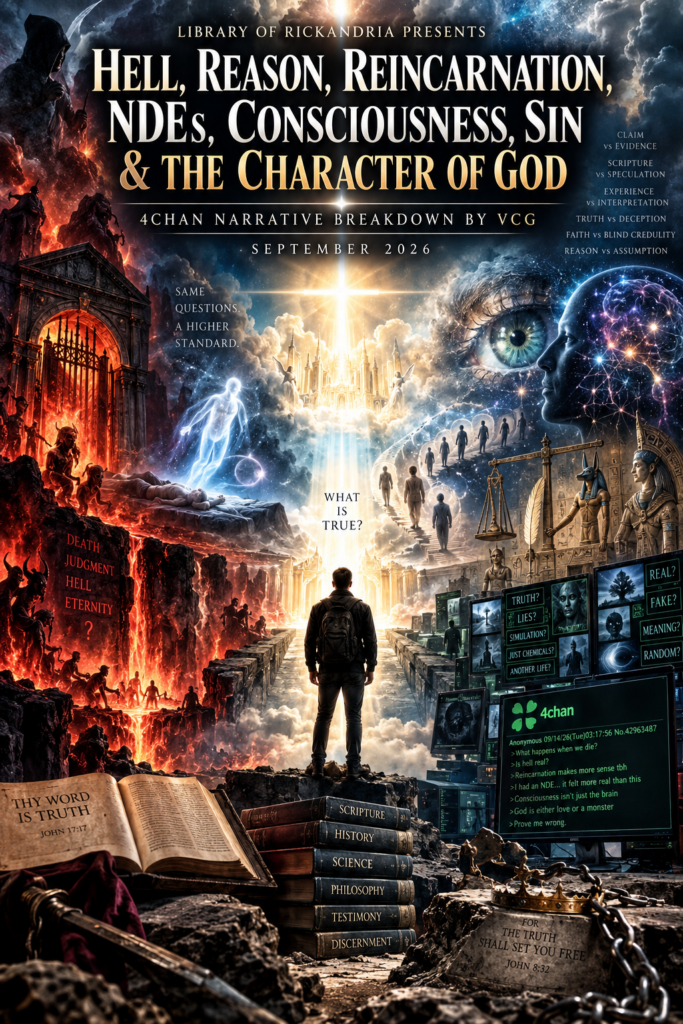
UPDATED BY VCG ON 9/15/2026 @ 13:13 EST
Anyone can do this, but most won’t.
ChatGPT – Library of Rickandria
Abstract
A thread posted to 4chan’s /x/ board in September 2026 begins with a deceptively simple question:
what if hell is not merely punishment, but a developmental environment for souls who rely on reason rather than –
“blind faith”
/x/ – What if Hell is just a necessary stage of developm – Paranormal – 4chan
From there, the conversation expands rapidly.
Anonymous posters introduce:
- reincarnation
- near-death experiences
- Robert Monroe
- idealist theories of consciousness
- Egyptian concepts of the soul
- “third density”
- karmic consequences
- divine foreknowledge
- arguments about sin and forgiveness
- criticism of Christianity
and eventually antisemitic claims about Jews and the Talmud.
The result is not one coherent worldview.
It is a collision of several:
- Christian and Christian-adjacent theology
- New Age reincarnation models
- occult and “prison planet” cosmologies
- philosophical idealism
- materialist skepticism
- anti-religious polemic
- ethnic conspiracy rhetoric
Treating all of these posts as though they represent one anonymous author would distort the evidence.
This paper therefore approaches the thread as a collection of claims rather than as a single manifesto.
For each major claim, five questions are kept distinct:
What does the poster actually say?
What historical or empirical evidence bears on it?
What logically follows from that evidence?
What psychological dynamics may help explain the discussion without diagnosing its participants?
And, finally, what does the biblical text actually teach?
The investigation finds that the thread contains several real questions and several true historical anchors.
Near-death experiences are genuine reported phenomena worthy of study.
Consciousness remains scientifically and philosophically difficult.
Ancient Egyptians did distinguish aspects of the person such as the ka and ba and portrayed a weighing of the heart.
Modern reincarnation researchers have collected cases that deserve careful examination.
Religious ideas can be socially manipulated.
Christian traditions do disagree over the nature of final punishment.
The problem of suffering and divine foreknowledge is not trivial.
But these true or reasonable starting points repeatedly become bridges to conclusions the evidence does not establish.
NDE testimony becomes proof of reincarnation.
Robert Monroe becomes someone who allegedly “confirmed” the geography of heaven.
Egyptian judgment imagery becomes God’s actual mechanism of judgment.
Modern channeled “density” terminology becomes cosmic physics.
Psychological observations about death anxiety become proof that religion was invented to control people.
Biblical images of fire are converted into a soul-recycling furnace.
Ezekiel’s dry bones become souls rehabilitated through hell even though Ezekiel explicitly identifies the bones as
“the whole house of Israel.”
The recurring structure of the thread can therefore be summarized as:
real question or true anchor → speculative bridge → comprehensive metaphysical system.
The problem is usually not the first step.
It is the bridge.
For biblical quotations, this paper uses the supplied King James Bible, Pure Cambridge Edition, as its controlling English text.
1. Why This Thread Is Worth Taking Seriously
There is a temptation when reading /x/ to dismiss everything as trolling, role-playing, psychosis, or adolescent provocation.
That would be an easy mistake.
Some posts are plainly jokes.
Some are insults.
Some contain prejudice.
Some use AI-generated or meme-like imagery.
But underneath the noise are questions people have asked for centuries:
Does faith require the abandonment of reason?
What happens after death?
Could punishment be remedial rather than retributive?
What is consciousness?
Can extraordinary experiences reveal realities inaccessible to ordinary perception?
If God knows everything beforehand, how can human responsibility be meaningful?
Why would a good God create a world containing terrible suffering?
Is sin an objective reality or simply a religious category?
Does Christianity teach that loyalty matters more than goodness?
Could fear of death explain religion?
Those questions do not become unserious merely because they appear on an anonymous imageboard.
The thread itself ran from the opening post, No. 42963487, into a long series of responses that moved from hell and faith into:
- reincarnation
- NDEs
- consciousness
- ancient Egyptian religion
- divine judgment
- sin
and the moral character of God.
The task, then, is not to mock the thread. It is to slow it down.
2. Method: Five Different Questions That Must Not Be Confused
The most important methodological decision in this paper is to refuse to let different kinds of evidence impersonate one another.
A 4chan post can prove that somebody wrote something.
It cannot, by itself, prove that the thing written is true.
An ancient Egyptian funerary text can prove that certain Egyptians held a particular religious conception.
It cannot, merely because it is ancient, prove that the conception accurately describes the afterlife.
An NDE report can be evidence that a person remembers undergoing an extraordinary experience.
The memory alone does not automatically determine what caused the experience.
A psychological mechanism can help explain why someone might believe something.
It does not establish whether the belief is true or false.
And Scripture can establish what biblical Christianity teaches for readers who are asking what the text says.
CHRISTIANITY – Library of Rickandria
Citing Scripture is not the same thing as giving an unbeliever laboratory proof of the metaphysical reality described in Scripture.
That distinction matters repeatedly throughout this paper.
2.1 Source hierarchy
| Source class | What it can reasonably establish | What it cannot establish by itself |
|---|---|---|
| Original 4chan thread | What particular anonymous posts claimed | Whether the claims are true |
| Biblical text | What the biblical writings state and how passages constrain Christian doctrine | Independent laboratory demonstration of supernatural events |
| Peer-reviewed empirical study | What investigators observed under specified conditions | A metaphysical interpretation exceeding the data |
| Historical scholarship / primary ancient sources | What beliefs, texts, practices, or intellectual developments existed | That the ancient belief was metaphysically true |
| Philosophical scholarship | Logical possibilities, arguments, distinctions, problems | Experimental verification |
| Primary occult/New Age material | What a movement or practitioner actually teaches | Independent confirmation of that teaching |
| Personal testimony | What someone reports remembering or experiencing | Automatic identification of the experience’s ultimate cause |
| Meme, diagram, anonymous screenshot | Rhetorical or cultural information | Reliable causal evidence merely because it looks technical |
2.2 Verdict terminology
This paper uses terms such as:
- established
- strongly supported
- plausible
- unresolved
- weakly supported
- contradicted
- biblically unsupported
- biblically contradicted
“Biblically contradicted”
has a precise meaning here.
It means that a proposition conflicts with the biblical text or with a conclusion strongly constrained by that text.
It does not mean,
“therefore a non-Christian has been scientifically compelled to accept Christianity.”
Similarly,
“empirically unsupported”
does not mean
“metaphysically impossible.”
It means the evidence currently cited does not establish the proposition.
That humility matters.
The methodological posture is well summarized in the biblical instruction:
“Prove all things; hold fast that which is good.”— 1 Thessalonians 5:21
The surrounding passage does not command credulity toward spiritual claims.
It commands discernment.
Acts 17 likewise praises the Bereans because they received a message seriously while still
“search[ing] the scriptures daily, whether those things were so.”
And 1 Peter 3:15 instructs Christians to be prepared to give “a reason” for their hope, while doing so
“with meekness and fear.”
The Bible’s own epistemic posture is therefore difficult to reconcile with the OP’s simple opposition between reason and faith.
3. Research Limitations
Several limitations should remain visible throughout the paper.
The posters are anonymous.
We cannot responsibly infer that two posts made by “Anonymous” were written by the same person unless the thread metadata establishes it.
We therefore should not construct one grand psychological portrait of “the poster.”
Nor can an Internet thread support psychiatric diagnosis.
A strange metaphysical claim is not a clinical diagnosis.
A hostile remark is not a clinical diagnosis.
Even the post reporting unusual “silence” after nearly a decade is too ambiguous to interpret psychologically without far more information.
The thread is also ephemeral.
The present analysis reflects the version retrieved on September 15, 2026. Posts or media may later disappear.
Finally, the opening image could not be reliably evaluated in the original review.
No interpretation of unavailable imagery should be invented merely to make the analysis appear complete.
These are not inconveniences to conceal.
They are part of responsible source criticism.
4. A Map of the Conversation
The thread develops in roughly six movements.
It begins with hell as spiritual development:
perhaps rational people enter hell because strong souls need a harder path.
It then shifts toward reincarnation and soul evolution.
Hell becomes purification, quarantine, a resetting mechanism, or one environment among many incarnations.
A third movement introduces NDEs and Robert Monroe as purported empirical confirmation.
At this point testimony begins being treated as cosmography.
The fourth movement moves into consciousness metaphysics:
consciousness may be more fundamental than computation, persons may be awareness-units, and “third density” language appears.
The fifth movement introduces Egyptian religion, sin, karma-like consequence, and cosmic accountability.
The final movement centers on the character of God:
- foreknowledge
- suffering
- worship
- loyalty
- divine justice
- forgiveness
and whether Christianity describes a good God or a cosmic dictator.
Mixed into this are anti-religious and explicitly antisemitic claims that require separate treatment.
Seeing the thread this way helps because the argument changes while the vocabulary remains similar.
“Hell” in one post means Christian final punishment.
In another it means earthly embodiment.
In another it means a temporary soul-repair facility.
In another it means psychological distance from God.
Those propositions cannot simply be added together.
5. Definitions Before Debate
5.1 Hell, Sheol, Hades, Gehenna, and the lake of fire
Popular English discussion tends to use hell as though Scripture contains one technical term with one uniform meaning.
The textual history is more complicated.
The Hebrew Bible uses Sheol, commonly associated with the realm or condition of the dead.
The New Testament uses terms including Hades and Gehenna, while Revelation develops its distinctive imagery of the lake of fire and the second death.
Scholarship on early Jewish and Christian eschatology emphasizes that these traditions developed in a world containing Hebrew, Jewish apocalyptic, Greco-Roman, and other ancient conceptions of the dead.
The KJV sometimes renders different underlying terms with the English word hell.
Consequently, the English word alone cannot carry all exegetical work.
This becomes especially important in Revelation 20. The KJV says that
“death and hell were cast into the lake of fire,”
followed immediately by
“This is the second death.”
Whatever interpretation one adopts, hell in that verse cannot simply be identical to the lake of fire, because the former is pictured as being cast into the latter.
5.2 Reincarnation and resurrection
These are not synonyms.
Reincarnation ordinarily means repeated embodiment of the same continuing personal principle or soul in multiple earthly lives.
Resurrection, in biblical Christian usage, means the raising of the dead into the eschatological life or judgment God appoints.
The New Testament’s dominant hope is resurrection rather than serial earthly reincarnation. John 5 speaks of those
“in the graves”
coming forth to either
“the resurrection of life”
or
“the resurrection of damnation.”
Paul likewise makes resurrection central enough to say that if Christ was not raised, Christian faith is vain.
5.3 Soul and spirit
Biblical vocabulary concerning human nature is richer than the modern phrase
“ghost inside a machine.”
Scripture speaks of:
- body
- soul
- spirit
- heart
- mind
- flesh
- life
- breath
in overlapping ways.
Christian thinkers therefore differ on the exact philosophical model of human composition.
For this paper, it is enough to avoid pretending that the biblical word soul automatically proves one later philosophical theory.
5.4 Consciousness and qualia
Consciousness refers broadly to subjective awareness or experience.
Qualia is philosophical terminology for the felt character of experience:
what redness looks like, pain feels like, music sounds like, and so forth.
The fact that consciousness remains difficult to explain does not itself establish materialism, dualism, panpsychism, idealism, or reincarnation.
Recent consciousness research continues to test competing theoretical frameworks rather than announcing a universally accepted solution.
A major preregistered adversarial collaboration published in Nature in 2025 tested predictions associated with global neuronal workspace theory and integrated information theory without delivering the kind of simple final victory often implied in Internet arguments about consciousness.
5.5 Near-death experience
An NDE is a reported experience associated with actual or perceived proximity to death or severe physiological crisis.
Typical reports may include:
- altered time
- light
- deceased persons
- out-of-body perspective
- peace
- distress
or other features.
“NDE occurred”
and
“the NDE’s metaphysical interpretation is correct”
are different propositions.
5.6 Faith
The thread repeatedly equates faith with believing without reason.
That is one conception of faith, but it is not the only philosophical conception, nor does it exhaust biblical usage.
Philosophical treatments of religious faith commonly distinguish faith as:
- trust
- commitment
- assent
- confidence
or combinations of cognitive and practical orientation; faith need not simply mean believing against the evidence.
5.7 Sin
Within Christianity, sin is a moral and theological category, not a physical substance.
The New Testament can define sin as transgression—
“sin is the transgression of the law”
—and can also call failure to do known good sin.
One may challenge the underlying theology.
But
“sin is not a measurable object”
is not by itself an argument that the moral category is meaningless.
6. The Historical Question: Did Christianity Simply Invent Hell?
One skeptical poster argues, in effect, that hell is a fabrication created to frighten and control people.
There is a historical question buried underneath the polemic, and it deserves a historical answer.
Ideas about death and postmortem judgment did develop over time.
The Hebrew Bible’s language of Sheol is not identical to every later Christian image of fiery punishment. Second Temple Jewish literature displays expanded resurrection, judgment, angelological, and apocalyptic expectations.
New Testament texts then employ language including:
- Hades
- Gehenna
- resurrection
- outer darkness
- punishment
- destruction
- judgment
and eventually Revelation’s lake of fire.
Early Christians continued debating:
- intermediate states
- resurrection
- immortality
- punishment
- restoration
That historical development is real.
But development is not the same as fabrication.
To establish deliberate fabrication for social control, one would need evidence of the:
- relevant agents
- chronology
- intentional invention
- transmission mechanism
- documentary support
The 4chan thread provides none.
A concept having a history does not make it fictional.
Astronomy has a history.
Constitutional law has a history.
Medicine has a history.
Human beings can:
- refine
- distort
- combine
- clarify
or reinterpret ideas without that process alone telling us whether the final proposition is true.
Likewise, religious institutions can use doctrines manipulatively without proving that those doctrines were originally manufactured for manipulation.
That distinction will recur throughout the thread.
7. Walking Through the Thread
7.1 Post 42963487: Hell as development for rational souls
The opening proposal asks us to imagine that hell develops stronger souls, particularly those who choose reason rather than
“blind faith.”
As speculation, the proposal is coherent enough to discuss.
As a biblical doctrine, it has two immediate problems.
First, Scripture does not oppose reasoning and faith in the simplistic way the post assumes.
Paul “reasoned” from the Scriptures; the Bereans checked claims; believers are told to
“prove all things”
Christians are instructed to provide reasons for hope.
Second, no biblical passage presented by the thread establishes the proposed developmental mechanism.
The ordinary New Testament pattern is not:
skepticism → hell school → stronger soul → new incarnation.
Hebrews instead says:
“And as it is appointed unto men once to die, but after this the judgment.”— Hebrews 9:27
The argument of Hebrews immediately parallels the once-for-all character of human death and Christ’s once-for-all offering.
This does not answer every question about intermediate states or final punishment.
It does, however, make routine reincarnation a very unnatural reading of the text.
Verdict: philosophically imaginable; biblically unsupported; based initially on a false reason-versus-faith dichotomy.
7.2 Post 42963578: The “left-hand path” and becoming one’s own god
The conversation then moves toward a recognizably esoteric motif: spiritual independence culminating in self-deification.
That belongs more naturally to certain occult or modern esoteric frameworks than to biblical Christianity.
The distinction is important because Christianity certainly contains strong language about believers becoming “partakers” of divine life, being transformed into Christ’s likeness, and receiving glory.
But participating in God’s life is not the same proposition as becoming the independent ultimate God.
The biblical narrative begins with Creator and creature as a fundamental distinction.
Genesis 1 does not present creation as fragments of God gradually remembering their own deity; it presents God as creating heaven and earth.
So a Christian may discuss:
- transformation
- sanctification
- resurrection
- glorification
- participation
without converting them into occult self-apotheosis.
Verdict: an esoteric interpretation, not a doctrine established by the biblical text.
7.3 Post 42963588: Everyone experiences both heaven and hell
Here the model becomes cyclic: apparently everyone eventually passes through both.
The difficulty is straightforward.
Jesus’ judgment scene in Matthew 25 presents differentiation, not universal sequential visitation.
One group inherits the kingdom while the other goes to punishment.
John 5 likewise speaks of a resurrection “of life” and a resurrection “of damnation.”
Revelation 20 depicts judgment followed by a final separation associated with the book of life and the lake of fire.
Christians disagree about what exactly these images imply concerning:
- duration
- conscious experience
- destruction
- restoration
- symbolism
But none of these texts straightforwardly teaches that all people rotate through heaven and hell as developmental environments.
Verdict: biblically contradicted as stated.
7.4 Post 42963603: Distance from God, Ezekiel’s dry bones, and God as “scriptwriter”
This post contains three different ideas.
The first—that heaven and hell can be understood in relation to nearness or alienation from God—has a genuine theological pedigree.
Scripture can speak in terms of:
- presence
- fellowship
- departure
- exclusion
- communion
- estrangement
But
“hell simply means metaphysical absence of God”
needs qualification.
Psalm 139 says:
“Whither shall I go from thy spirit?
or whither shall I flee from thy presence?
If I ascend up into heaven, thou art there:if I make my bed in hell, behold, thou art there.”
Whatever one makes of the KJV’s rendering of Sheol here, the theological point of the psalm is God’s inescapable presence.
Second Thessalonians 1:9 can speak of
“everlasting destruction from the presence of the Lord, and from the glory of his power.”
The safest synthesis is therefore not that God ceases to exist in some region of reality, but that judgment entails exclusion from God’s favorable fellowship, blessing, and manifested glory.
The second claim concerns Ezekiel 37.
Here there is very little ambiguity because the chapter interprets its own vision.
After Ezekiel sees a valley of dry bones restored to life, God says:
“Son of man, these bones are the whole house of Israel…”
The chapter continues by speaking of Israel’s lost hope, opened graves, restoration, God’s Spirit, and return to the land.
Whatever broader canonical resurrection implications a Christian theologian may find in the imagery, the text itself does not identify the bones as souls being rehabilitated in hell.
That is not interpretation from the immediate context. It is importing an external system into the image.
The third idea is that God is effectively the cosmic scriptwriter.
That metaphor expresses strong providence, but metaphors can overreach.
Scripture affirms sovereignty while still speaking meaningfully about:
- command
- rebellion
- repentance
- responsibility
- willing
- judgment
- human action
Calling God the “scriptwriter” may be one philosophical model.
It is not a biblical term that resolves every question about causation and freedom.
Verdict:
partial theological analogy combined with a clear misreading of Ezekiel and an unproven determinist metaphor.
7.5 Posts 42963612–42963695: “Life is hell,” abandonment, survival, and divine favoritism
A cluster of posts moves from abstract afterlife speculation into existential protest.
One poster suggests earthly life may itself be hell.
Another describes hell in terms of having no help.
Another states that God has never helped.
Another reduces earthly existence to
“kill or be killed.”
Another wonders whether God simply likes some people and hates others.
These should not all receive the same kind of answer.
A person’s statement that he or she has felt abandoned by God is experiential testimony.
It cannot be disproved by throwing a verse at the person.
Indeed, the Bible itself preserves prayers of divine absence.
Psalm 42 depicts tears
“day and night.”
Psalm 77 asks:
“Will the Lord cast off for ever?
and will he be favourable no more?
Is his mercy clean gone for ever?”
The presence of such lament within Scripture is significant.
Biblical faith does not require pretending suffering feels easy.
But
“I have experienced abandonment”
and
“therefore reality literally is hell”
are different propositions.
Similarly,
“kill or be killed”
is not an adequate empirical description of human social existence.
Modern work on cooperation treats cooperative behavior as a pervasive phenomenon requiring explanation alongside competition, not as an illusion.
Human beings:
- cooperate
- sacrifice
- form families
- build institutions
- care for strangers
- punish defectors
- compete
- exploit
- forgive
- wage war
Any anthropology that selects only one side of that range is incomplete.
The favoritism claim also requires careful biblical correction.
Romans 2 describes God’s judgment as “according to truth” and concludes:
“For there is no respect of persons with God.”
It then explicitly applies accountability to Jew and Gentile.
The existence of biblical election is not the same claim as arbitrary caprice.
Christians disagree significantly over election and providence.
But
“God’s decisions are indistinguishable from random personal favoritism”
is not simply the biblical doctrine stated in another tone.
8. Is Suffering the Meaning of Life?
Post 42963764 suggests that perhaps suffering itself is the meaning of life.
Christian Scripture can assign formative value to suffering.
Trials can produce patience.
Affliction can refine faith.
Suffering can expose dependence and produce endurance.
But Scripture does not make suffering the ultimate good.
First Peter can compare tested faith to precious metal tried by fire.
Yet the point of the testing is not suffering for suffering’s sake; it is faith, salvation, praise, honor, and glory.
The Christian ending is not an eternally preserved torture curriculum.
Revelation’s final vision says:
“there shall be no more death, neither sorrow, nor crying, neither shall there be any more pain.”
That is a decisive clue.
If suffering were the ultimate meaning of existence, its promised abolition would be difficult to explain.
Suffering may be meaningful without being the meaning.
9. Post 42963800: “Humans Don’t Go to Hell”
This post argues that eternal suffering applies only to inherently immortal beings rather than human beings.
Matthew 25 creates difficulty for that claim.
Jesus says the fire was
“prepared for the devil and his angels,”
but the same judgment scene applies punishment language to human beings separated at judgment:
“And these shall go away into everlasting punishment: but the righteous into life eternal.”
The precise interpretation of everlasting punishment is debated among Christians.
That debate is legitimate.
But the narrower claim that punitive eschatological judgment excludes humans is not compatible with the passage as written.
Revelation 20 likewise distinguishes the devil’s fate from the subsequent judgment of
“the dead, small and great,”
after which those not found in the book of life are cast into the lake of fire.
Verdict:
biblically contradicted in its categorical form.
10. Violence, Insults, and Reaction Posts
Several contributions contain violent rhetoric, insults, mockery, or simple agreement.
They should be recorded without being artificially promoted into philosophical positions.
An insult is not evidence.
A threat is not evidence.
Agreement is not independent corroboration.
Likewise, a hostile Christian response does not demonstrate Christian doctrine, and an obscene anti-Christian response does not establish atheism.
This seems obvious when stated calmly.
Online arguments routinely forget it.
11. Consciousness: Where the Thread Touches a Real Scientific and Philosophical Problem
Posts 42963828 and 42966203 ask whether consciousness can be reduced to computation and whether subjective awareness may be more fundamental than the processes displayed within it.
This is one of the stronger portions of the discussion because it points toward an unresolved problem rather than merely asserting a complete answer.
Neuroscience has made enormous progress in correlating conscious states with brain activity, manipulating conscious contents, studying anesthesia and disorders of consciousness, and testing theoretical predictions.
But the philosophical question of why and how physical processing is accompanied by subjective experience remains disputed.
That does not mean
“science has failed, therefore the soul exists.”
Nor does it mean
“brains process information, therefore consciousness has been metaphysically reduced to computation.”
Those are both larger conclusions.
A major 2025 adversarial collaboration tested prominent predictions associated with global neuronal workspace theory and integrated information theory.
Its importance lies partly in the fact that consciousness science remains an active contest among explanatory models rather than a field with one universally accepted theory.
The 4chan poster’s “screen” analogy—consciousness as the field in which experience appears—is philosophically recognizable.
But an analogy is not an experiment.
If consciousness is like a screen, we still must ask:
What is the screen?
Does it depend on a brain?
Can it exist independently?
Can it carry personal identity?
Does it survive death?
Can it reincarnate?
None of those conclusions is contained in the metaphor.
Verdict: the problem is real; the thread’s metaphysical solution is not established.
12. Fire as Purification: A Context Problem
Post 42964582 suggests the flames of hell purify the soul.
There is a reason this idea initially feels biblical:
Scripture really does use fire as an image of purification and testing.
The problem is assuming that every occurrence of fire has the same function.
Fire in Scripture can signify:
- refining
- testing
- divine presence
- destruction
- temporal judgment
- sacrifice
or final judgment.
First Peter uses tested-by-fire imagery for faith.
Revelation uses fire in a very different judgment context.
One cannot reason:
“Fire sometimes purifies”
therefore
“eschatological fire always purifies”
therefore
“hell is a reincarnation cleansing chamber.”
That is a semantic transfer across contexts.
The proper question is not,
“What does fire symbolize somewhere in the Bible?”
It is,
“What function does the fire have in this particular passage?”
13. Reason, Deception, and the Self-Sealing Theory
Posts 42964855 and 42964922 highlight another problem.
If people who rationally question a spiritual theory are said to be spiritually underdeveloped, then skepticism itself becomes evidence for the theory.
That creates a self-protecting system.
A similar pattern appears when one says:
“If you accept my account, you are awakening.”
“If you reject it, that proves the deception still controls you.”
“If contrary evidence appears, deceptive entities planted it.”
“If no evidence appears, the entities successfully hid themselves.”
A theory structured like this cannot easily lose.
Christianity can be abused in exactly the same way.
One could say every disagreement proves spiritual blindness.
But Scripture itself contains tests of claims and warnings not to accept even apparently supernatural testimony merely because it is supernatural.
Paul writes:
“But though we, or an angel from heaven, preach any other gospel unto you than that which we have preached unto you, let him be accursed.”
The extraordinary character of the messenger does not override the prior doctrinal standard.
That is an important correction to both credulous paranormalism and credulous religious sensationalism.
14. “What If There Is No Soul?”
Post 42965648 asks the question directly.
That question cannot be dismissed.
If the soul is being invoked as an explanatory entity, one may reasonably ask what is meant by it and why we should think it exists.
Biblically, human beings are described using soul and spirit language, but Christianity’s final hope does not rest merely on the persistence of a disembodied ghost.
Resurrection is central.
John 5 places the eschatological future in resurrection language.
First Corinthians 15 does the same so emphatically that Paul argues Christianity collapses if Christ has not risen.
This is significant because popular debates often make Christianity sound more Platonic than biblical:
“Your body is disposable; the real you is a ghost escaping matter.”
The New Testament’s hope is richer than that.
Whatever intermediate-state theology one adopts, redemption culminates in resurrection and renewed creation.
15. The Antisemitic Turn
Post 42965717 introduces a claim about divine favoritism toward Jews using ethnic mockery.
Later posts escalate this into assertions about “the Talmud,” Gentiles, and the alleged view that non-Jews are equivalent to cattle.
This needs a methodological correction before a theological one.
A source-critical claim about rabbinic literature requires at minimum a traceable source:
- tractate
- folio or passage
- textual form
- translation
- context
- speaker
- genre
- legal status
- historical setting
The thread supplies none of that.
The Hebrew term goy fundamentally means a nation or people-group; its later common use for a non-Jew does not make “cattle” its lexical meaning.
Historical scholarship on Jewish usage and rabbinic views of Gentiles describes a much more complex landscape than Internet quote compilations suggest.
There is a second logical error.
Suppose someone found an authentic objectionable statement in one rabbinic source.
It still would not follow that:
that sentence = the entire Talmud,
the entire Talmud = all Judaism,
all Judaism = every Jewish person,
and therefore every Jewish person privately believes the sentence.
That is collective attribution masquerading as textual criticism.
Christian readers should recognize the problem immediately.
If someone took one statement by one medieval Christian, stripped away context, and said,
“This is what every Christian believes,”
the method would be obviously defective.
The biblical correction is also important.
Paul can affirm Israel’s covenantal significance while simultaneously writing:
“For there is no difference between the Jew and the Greek:
for the same Lord over all is rich unto all that call upon him.”
Revelation pictures the redeemed as coming from:
“every kindred, and tongue, and people, and nation.”
Biblical election therefore cannot responsibly be converted into a racial theory of human worth.
16. God as Dictator: The Stronger Version of the Objection
Post 42965946 depicts God as a cosmic dictator who manufactures suffering until people break and submit.
The causal mechanism asserted in that post is unsupported.
We do not have evidence that every increase in a person’s suffering is an intentionally calibrated coercive step designed to force submission.
But beneath the rhetoric is one of the strongest objections in the thread:
If God knowingly created a world in which creatures undergo terrible suffering and then requires allegiance, how is that morally different from a ruler creating dependence and demanding loyalty?
That question deserves better than:
“because God said so.”
Philosophy of religion distinguishes several forms of the problem of evil.
A strict logical argument attempts to show that God and evil cannot coexist.
Evidential arguments instead contend that the amount, distribution, or apparent gratuitousness of suffering counts against an all-powerful and perfectly good God.
Responses include:
- free-will defenses
- soul-making accounts
- skeptical-theist approaches
- greater-good proposals
and other theodicies.
None is universally accepted.
The Bible itself does not respond to suffering by denying its horror.
Job protests.
The Psalms lament.
Creation groans.
Death is called an enemy.
The final Christian hope is that death itself will be destroyed.
Paul explicitly calls death
“the last enemy.”
So the Christian answer cannot simply be:
“Suffering is secretly wonderful.”
Biblically, some suffering can be used redemptively while suffering and death themselves remain enemies within a fallen creation.
That distinction matters.
17. “Hell Was Invented Because Humans Fear Death”
Post 42966185 makes two claims that need separating.
The first is historical: hell was invented to control people.
As already noted, the thread does not provide the documentary evidence required to establish deliberate invention.
The second is psychological: religion emerges from fear of death.
There is a serious psychological literature on mortality awareness.
Terror-management theory proposes that awareness of mortality can motivate defense of cultural worldviews and self-esteem.
A large earlier meta-analysis reported measurable mortality-salience effects across many experiments.
But the literature is not equivalent to the slogan:
“religion exists because people are afraid to die.”
A review focused on death anxiety and religion concluded that evidence for death anxiety as a major causal origin of religiosity is weak and inconsistent.
A more recent systematic review of the terror-management literature has also emphasized heterogeneity, statistical limitations, and the likelihood that some published effects were exaggerated, while not concluding that mortality effects are simply nonexistent.
This is exactly why psychology should not be turned into a truth detector.
Perhaps mortality anxiety helps explain why certain people find certain religious ideas attractive.
It could also help explain why some people find materialist extinction narratives emotionally attractive, if those narratives protect autonomy or identity.
The psychological origin of a belief does not decide the belief’s truth.
Otherwise we commit the genetic fallacy: rejecting or accepting a proposition because of where we think it came from rather than because of evidence for the proposition itself.
18. Earth as Hell and Reincarnation as Escape
Post 42966198 proposes that material earthly existence is the real hell and that death leads back into a rebirth loop.
This resembles several ancient and modern religious systems more closely than canonical Christianity.
There is an internal tension worth noticing.
If
“hell doesn’t exist”
means there is no postmortem Christian hell, but
“earth is hell”
means embodied existence is a prison, then hell has changed definitions mid-argument.
That is not necessarily incoherent if clearly stated, but it prevents one formulation from disproving the other.
Biblically, matter itself is not the enemy.
Creation begins as God’s creation.
The Christian hope is resurrection.
John 6 repeatedly locates the believer’s bodily hope in being raised
“at the last day.”
Revelation ends not with redeemed souls permanently escaping creation, but with a
“new heaven and a new earth”
and God dwelling with humanity.
That is difficult to reconcile with the idea that embodiment as such is a hellish containment mechanism.
19. The “Soul Purification Furnace”
Post 42966248 describes hell as a mechanism that cleans or resets souls before reincarnation, accompanied by elaborate technical imagery.
This is a particularly useful case study in visual authority.
A diagram with:
- chambers
- energy flows
- percentages
- processing stages
or technological labels can create the feeling that a mechanism has been described.
But the appearance of mechanism is not evidence of mechanism.
To turn the proposed:
“soul furnace”
into an empirically testable model, we would need operational definitions.
What is a soul?
What measurable property is being purified?
How is its pre-process state detected?
How is its post-process state detected?
What observation uniquely predicts the furnace model over:
- purgatory
- reincarnation
- hallucination
- metaphor
- memory construction
or nonexistence?
What conceivable result would falsify the mechanism?
The thread does not supply those things.
So the diagram functions rhetorically rather than experimentally.
This is not a criticism of visual art.
It is a criticism of mistaking illustration for measurement.
20. NDEs: The Evidence Hierarchy
At this point the thread increasingly treats NDEs as direct maps of postmortem reality.
The subject deserves more care than either reflexive dismissal or immediate belief.
A useful evidence hierarchy distinguishes four levels:
| Level | What we have | What it supports |
|---|---|---|
| 1 | A person reports an extraordinary experience | The person remembers/reporting an extraordinary experience |
| 2 | Similar motifs recur across cases | There may be recurrent phenomenology worthy of explanation |
| 3 | Prospective physiological and resuscitation studies | Timing, brain-state, memory, and awareness questions can be investigated |
| 4 | Independently verified perceptions inaccessible through normal means | Potentially stronger evidence requiring careful replication and controls |
The jump the thread makes is from levels 1–3 directly to:
therefore demons project hell, therefore consent controls escape, therefore reincarnation occurs, therefore heaven has particular levels.
Those conclusions are not contained in the data.
The multicenter AWARE-II study examined 567 in-hospital cardiac arrests.
Of the survivors, a smaller number were available for structured interviews, and some reported memories or perceptions categorized by investigators as suggestive of conscious experience.
Physiological monitoring also produced intriguing observations during CPR.
But the hidden visual target was not identified by any participant, while only one participant identified the auditory stimulus.
That study is interesting.
It does not prove that NDEs are meaningless hallucinations.
It also does not prove a mapped afterlife.
The restrained conclusion is stronger than either extreme:
reported conscious experience around cardiac arrest deserves continued investigation; the available prospective evidence does not establish the thread’s reincarnation or hell cosmology.
21. Robert Monroe: What Was Actually “Confirmed”?
Post 42966312 says Robert Monroe essentially confirmed the model.
That word does too much work.
Monroe became famous for reporting out-of-body experiences and for developing methods intended to facilitate altered states.
The important question is not whether he was sincere.
It is whether controlled testing confirmed the extraordinary claims attributed to him.
A recent review of laboratory OBE work discusses psychologist Charles Tart’s eight laboratory sessions with Monroe.
Monroe did not successfully identify the concealed five-digit target.
In one session, however, he reported details concerning a technician and a man elsewhere in the building that were later said to correspond to an unexpected visit.
That kind of incident is precisely why the history of OBE research remains interesting rather than trivial.
But one anomalous correspondence plus failed formal target identification is not “confirmation” of:
heaven realms, reincarnation, or escapable hell.
Reviews of the wider target-identification literature describe mixed results and continued replication problems.
The correct wording is therefore:
Monroe provided extensive testimony and participated in experiments containing some intriguing reports, but controlled testing did not establish the full metaphysical system later attached to his name.
That is less exciting than “confirmed.”
It is also more accurate.
22. The Strongest Case for Reincarnation
A fair paper should not investigate only the weakest reincarnation claims.
Researchers associated with the University of Virginia tradition, beginning especially with Ian Stevenson and continuing through later investigators, have assembled large collections of children who report apparent memories of previous lives.
A 2021 scoping review examined 78 academic studies of claimed past-life memories.
Most involved children; case reports and interviews dominated the literature, with document analysis also frequently used.
The authors explicitly called for methodological improvements in future studies.
Some individual cases are striking.
A 2024 published case report describes a child who made numerous statements about an alleged previous identity, with investigators judging several details correct, along with a bodily feature interpreted as compatible with an injury in the proposed previous life.
This evidence deserves more respect than simply saying,
“Children make things up.”
But it also deserves more restraint than saying,
“Reincarnation has been proven.”
Observational reincarnation cases face recurring methodological questions:
- information leakage
- family contact
- cultural expectation
- selective recording
- retrospective reconstruction
- coincidence
- fraud
- cryptomnesia
- interviewer effects
- publication selection
and difficulty obtaining truly prospective documentation.
A case may remain puzzling after some alternatives are considered.
“Puzzling”
is not synonymous with
“reincarnation demonstrated.”
The strongest defensible conclusion is that some cases are sufficiently unusual to justify continued investigation, while the evidence base remains largely observational and does not establish the elaborate soul-evolution cosmology asserted in the thread.
And even if reincarnation were someday empirically established, another argument would still be required to prove hell is the purification mechanism between lives.
Those are separate hypotheses.
23. “Holographic Hell,” Consent, and Demonic Contracts
Post 42966259 proposes something more specific: hellish NDEs are holographic control environments, demonic entities depend upon consent, and escape can be relatively easy once the mechanism is understood.
The word holographic sounds scientific.
But no connection is demonstrated between the physics or mathematical uses of holographic concepts and the particular NDE mechanism being asserted.
This is a recurring rhetorical pattern in paranormal discourse: borrow a term with legitimate scientific prestige and use it metaphorically until the metaphor begins to sound experimental.
Likewise, no controlled evidence is supplied for a universal demonic consent law.
Christian Scripture certainly contains spiritual deception.
It speaks of:
- Satan
- demons
- temptation
- false spirits
- principalities
- powers
Ephesians 6, for example, describes spiritual conflict using such language.
But biblical demonology does not contain the specific rule:
a demon cannot affect or detain a person unless that person agrees to a metaphysical contract.
That mechanism belongs to the thread’s synthesis, not to the cited Scripture.
24. “Admit You Were Tricked”: When a Theory Becomes Unfalsifiable
Post 42966307 says that the trick loses power once the victim admits being tricked.
That may be useful advice in some psychological situations.
Recognizing manipulation can weaken manipulation.
As metaphysics, however, the formulation can become self-sealing.
Imagine the exchange:
“How do you know the system is real?”
“Because people trapped inside it cannot see it.”
“I don’t see evidence.”
“That proves how trapped you are.”
The objection has been converted into confirming evidence.
A fair worldview must expose itself to some possibility of correction.
That does not mean every metaphysical proposition has to be falsifiable in precisely the Popperian sense appropriate to a simple laboratory hypothesis.
Philosophy of science itself treats the boundary between science and pseudoscience as more complex than the slogan
“if it is not falsifiable, it is meaningless.”
But the general epistemic concern remains:
A theory that explains every possible outcome equally well explains very little.
25. “Third Density”: Tracing the Vocabulary
Post 42966393 speaks of “third density,” souls as awareness-units, and higher development through levels of consciousness.
That terminology has an identifiable modern provenance.
The Law of One or Ra Material emerged from a series of sessions conducted by L/L Research in the early 1980s.
The organization describes the material as the product of a form of telepathic channeling, attributes the voice to an entity or collective called “Ra,” and repeatedly uses a system of densities, including “third density” as a stage associated with self-consciousness or self-awareness.
That provenance tells us something important.
It tells us where the terminology comes from.
It does not tell us that the channeling is genuine.
Nor is “third density” a biblical term.
Nor is it an established unit in consciousness science.
This is exactly the kind of distinction source criticism is meant to preserve:
verified provenance ≠ verified metaphysics.
26. Ancient Egypt: What the Thread Gets Right
Post 42966518 invokes Egyptian ka, ba, and the weighing of the heart.
Unlike several claims in the thread, these have genuine historical foundations.
Ancient Egyptian religion did distinguish multiple components or aspects of personhood.
Museum scholarship describes the ka in connection with vital or life force and the ba as an individualized aspect of the person involved in postmortem existence.
Egyptian mortuary religion also prominently portrays the heart being weighed against Ma’at, representing order, truth, or justice.
Scenes of judgment can include Anubis attending the scales, Thoth recording the result, Osiris presiding, and the devourer Ammut threatening the failed dead.
So the historical statement
“Ancient Egyptians possessed a complex soul anthropology and heart-weighing judgment imagery”
is well supported.
The next statement is not:
“Therefore the biblical God literally weighs a soul against an Egyptian feather according to the thread’s density model.”
That is a synthesis constructed by the poster.
Historical similarity alone does not establish identity.
Nor does it establish borrowing.
Two traditions can both contain judgment without describing the same judgment.
27. Egypt and Christianity Side by Side
| Ancient Egyptian framework | Biblical Christian framework |
|---|---|
| Multiple aspects such as ka and ba | Biblical body/soul/spirit language, without the Egyptian taxonomy |
| Ma’at as cosmic order/truth/justice | God’s righteousness and judgment |
| Heart weighed against Ma’at | Judgment by God/Christ; no feather mechanism stated |
| Osiris associated with judgment of dead | Christ given authority to judge |
| Anubis and Thoth in judgment iconography | No corresponding biblical mechanism |
| Postmortem continuation within Egyptian funerary cosmology | Resurrection, judgment, eternal life/death imagery |
| Funerary rites and preservation intimately connected to afterlife conception | Christian hope grounded centrally in Christ’s resurrection rather than Egyptian funerary technology |
The similarities are interesting.
The differences are substantial.
Neither should be hidden.
28. The Psychology of the Thread Without Diagnosing the Posters
Psychology can illuminate this thread, but it can also become a weapon.
If we say,
“You believe because of cognitive bias,”
while treating our own beliefs as purely rational, we have learned very little.
Four psychological areas are particularly relevant.
28.1 Online disinhibition
John Suler’s classic account of the online disinhibition effect identifies factors including:
- anonymity
- invisibility
- asynchronicity
- dissociative imagination
- minimized authority
These conditions can help explain why anonymous Internet spaces often combine unusually intimate disclosure with unusually aggressive language.
That describes the environment.
It does not diagnose an individual poster.
And Suler’s work should not be flattened into
“anonymous posts reveal the real personality.”
Online behavior can amplify, fragment, role-play, or suppress different aspects of a person.
28.2 Motivated reasoning
Ziva Kunda’s influential review on motivated reasoning showed how desired conclusions can influence which beliefs and evidence people retrieve and evaluate while still operating through apparently reasoned processes.
That applies to everyone in the thread.
The paranormal believer may interpret every anomaly as evidence of the unseen system.
The Christian may interpret every contrary spiritual experience as demonic without further investigation.
The atheist may interpret every religious experience as fear-conditioning before examining it.
The conspiracy-minded poster may interpret missing evidence as evidence of suppression.
The psychological lesson is not:
“their side is biased.”
It is
“human reasoning is vulnerable to directional pressure.”
28.3 Loss of control and pattern perception
Experimental work by Whitson and Galinsky found that reduced feelings of control can increase illusory pattern perception across several kinds of tasks, including superstitious and conspiracy-related judgments.
This can help us understand why large invisible causal systems may become especially attractive under uncertainty.
It cannot tell us that any specific invisible system is therefore false.
Again, explanation of belief formation is not adjudication of truth.
28.4 Mortality and worldview defense
Awareness of death can influence how people defend identities and worldviews.
Terror-management research has documented such effects, though the size, reliability, and interpretation of those effects remain debated.
This means death anxiety belongs in the conversation.
It does not mean religion has been explained away.
29. The Psychology of the Paper Itself
A source-critical paper should apply the same suspicion to itself.
A Christian researcher can feel motivated to protect Christianity from embarrassing Internet claims.
A skeptic can feel motivated to explain supernatural beliefs away.
A paranormal investigator can feel motivated to preserve mystery.
A researcher who has spent weeks on a theory can become invested in finding confirmation.
This is why transparent source standards matter more than confidence.
The cure for bias is not to announce oneself unbiased.
It is to construct procedures that make correction easier.
30. Image and Meme Forensics
The thread repeatedly uses imagery to stabilize speculative ideas.
This matters because humans do not process a technical diagram the same way we process a paragraph saying,
“I am guessing.”
A machine-like diagram implies engineering.
A cosmic hierarchy implies taxonomy.
Numbers imply measurement.
Labels imply discovery.
Arrows imply mechanism.
A photorealistic AI image implies observation even when no observation occurred.
Some thread images even bear generation-oriented filenames associated with modern AI media workflows.
That is not evidence of deception—the image may openly be illustrative—but it reinforces the need to distinguish visualization of a claim from documentation of a phenomenon.
The soul-processing diagrams should therefore be read as conceptual art unless independent evidence establishes the mechanism they depict.
A beautiful map of Middle-earth does not make Middle-earth geography empirical.
The same principle applies here.
31. Is Heaven Run by More “Competent” Souls?
Posts 42966407 and 42966431 compare spiritual hierarchy to pilots, judges, or nuclear-plant operators.
This is actually a decent analogy for one narrow point.
Hierarchy is not automatically tyranny.
We routinely allow people with greater competence or appropriate authority to perform tasks others cannot safely perform.
But the analogy cannot prove the spiritual hierarchy exists.
Nor can competence alone establish moral worthiness.
A brilliant tyrant can be competent.
A technologically advanced civilization could be evil.
A powerful angel would not become God merely by possessing more power.
Christian worship is therefore not grounded merely in the proposition:
“God is stronger.”
Revelation presents God as worthy because he is Creator and presents the Lamb as worthy in relation to redemption.
The moral and ontological claims are doing work that sheer power cannot.
32. The Disability and Embodiment Objection
Post 42966455 raises an important internal challenge to the soul-development theory.
If embodied people have radically different:
- cognitive
- neurological
- physical
- social
and environmental capacities, why would those limitations straightforwardly reveal the “competence” of an underlying soul?
Suppose a theory says someone is spiritually underdeveloped because he cannot perform at the level of another person.
If the same theory says embodiment heavily constrains what the soul can express, then observable performance no longer directly measures soul development.
The theory begins undermining its own test.
Christian anthropology should be especially careful here.
The Bible does not equate intellectual ability with spiritual worth.
It does not teach that disability is proof of an inferior soul.
And Jesus explicitly rejects simplistic inferences from suffering to unusually severe personal guilt in several contexts.
This is one place where the thread’s developmental hierarchy risks turning contingent human limitations into metaphysical rankings without justification.
33. “Sin Is Made Up”
Post 42966515 says sin is simply invented.
The first question should be: invented in what sense?
The English word is conventional.
Specific religious classifications can be historically conditioned.
People can misuse the category.
Religious communities can disagree about applications.
None of those facts proves there is no objective moral reality.
Murder is not made unreal because cultures disagree about homicide laws.
Fraud is not unreal because legal systems define it differently.
Justice is not unreal because philosophers disagree about justice.
Within the biblical system, sin includes transgression of God’s law and failure to do known good.
Whether God exists and possesses moral authority is a further question.
But the logical route must be:
Does God exist?
What is the nature of moral obligation?
Has God revealed moral requirements?
What counts as violation?
It cannot simply be:
Sin is not a physical particle, therefore sin is fictional.
That is a category error.
34. Sin Is Not Karma
Post 42966528 compares sin to a law of consequence resembling gravity: do wrong and the consequences eventually return.
There is a biblical intuition nearby.
Scripture teaches sowing and reaping.
Actions have consequences.
God judges.
But the Bible repeatedly refuses simplistic karmic arithmetic.
Psalm 73 opens with a crisis precisely because wicked people can prosper:
“I was envious at the foolish, when I saw the prosperity of the wicked.”
The psalmist’s moral crisis exists because immediate earthly outcomes do not mechanically track moral desert.
The entire book of Job likewise resists the idea that suffering can be reverse-engineered into a simple measure of guilt.
So:
biblical moral consequence ≠ impersonal karmic physics.
Final judgment may reconcile moral accounts that earthly life does not.
That is different from claiming that every wrong deed automatically rebounds in symmetrical fashion during ordinary life.
35. Is Christianity About Being Good or Being Loyal?
Posts 42966537–42966548 raise one of the thread’s better ethical objections.
If a torturer can simply “submit” to God and be forgiven, while a morally decent unbeliever is condemned, does Christianity value loyalty more than goodness?
There is a distorted version of Christianity in which salvation becomes a password:
say the correct formula, join the correct group, and moral transformation no longer matters.
The New Testament does not support that caricature.
Grace is central.
Forgiveness can indeed extend to terrible sinners.
That is intentionally scandalous.
But forgiveness is not the declaration that evil never mattered.
Nor is biblical faith mere verbal affiliation.
First John tightly binds love of God to love of neighbor:
“If a man say, I love God, and hateth his brother, he is a liar…”
And:
“We love him, because he first loved us.”
Jesus likewise joins the two great commandments:
love God with heart, soul, and mind, and love neighbor as oneself.
So the dichotomy:
“goodness or loyalty?”
is too simple.
Within Christianity, right relation to God is supposed to transform conduct toward other persons.
When confession becomes a substitute for repentance, the problem is not that the critic misunderstood Christianity completely.
The problem may be that Christians themselves sometimes present cheap grace.
That criticism is worth hearing.
36. “If You Love God, God Loves You”
Post 42966567 presents divine-human love almost transactionally:
respect God and he respects you, love God and he loves you.
First John reverses the causal order:
“We love him, because he first loved us.”
The surrounding passage says God’s love was manifested in sending his Son.
So Christian theology does not begin with humans giving God sufficient affirmation to trigger divine affection.
Nor does God need worship because of psychological insecurity.
Psalm 50 even portrays God rejecting the notion that sacrifices feed some divine need:
“If I were hungry, I would not tell thee:
for the world is mine, and the fulness thereof.”
The biblical case for worship is instead that God is Creator, holy, good, righteous, and worthy.
Whether that case succeeds philosophically is open to argument.
But it should at least be represented accurately.
37. Divine Foreknowledge: The Thread’s Final Serious Question
Posts 42966589–42966591 bring the discussion to a classical problem.
If God knew before creating the world exactly what would happen, including:
- sin
- suffering
- disbelief, damnation
and every human choice, in what meaningful sense is God not responsible for the resulting world?
This is not a silly objection.
The philosophical problem of theological foreknowledge and human freedom has generated sophisticated positions for centuries.
Contemporary philosophy still distinguishes different models of:
- foreknowledge
- necessity
- freedom
- providence
- temporal knowledge
- counterfactual possibility
One distinction is essential:
knowing an event will happen is not logically identical to causing the event in the same way its immediate agent causes it.
A spectator who infallibly knew what a murderer would choose would not thereby wield the knife.
But that analogy does not dissolve the theological problem, because God is not merely a spectator.
In classical Christian thought God knowingly creates and sustains the world in which the action occurs.
The deeper question therefore remains:
Why create this world while knowing its entire history?
Different Christian traditions answer differently.
Augustinian and Reformed approaches emphasize divine sovereignty and ordered providence.
Arminian approaches emphasize libertarian human response.
Molinism invokes divine knowledge of counterfactual creaturely choices.
Other thinkers revise conventional models of divine temporal knowledge.
The paper does not need to pretend these disagreements are trivial.
A useful conclusion is simply:
foreknowledge is not automatically equivalent to coercive causation, but divine creation plus exhaustive foreknowledge still generates a serious providential question.
A Christian answer must address that stronger version.
38. Faith Versus “Blind Faith”
We can now return to the OP’s framing.
The thread repeatedly assumes that reason belongs to the skeptic and faith belongs to the person who stops asking questions.
That does not describe the biblical ideal.
Acts depicts Paul reasoning publicly.
The Bereans verify claims against Scripture.
First Thessalonians commands testing.
First Peter commands believers to give reasons.
Luke’s Gospel itself opens with language about investigation, ordering testimony, and certainty.
Christian faith certainly includes trust beyond what can be exhaustively demonstrated.
But so does nearly every human life.
Trust becomes irrational when it persists contrary to decisive evidence or becomes immunized against examination—not merely because trust exists.
The more useful contrast is therefore not:
faith versus reason.
It is:
responsible trust versus irresponsible credulity.
39. What Scripture Actually Says About Death, Judgment, and Resurrection
The thread constructs a sequence resembling:
earth life → death → hell purification → escape or rehabilitation → reincarnation → further soul development → higher density → heaven.
The canonical passages being discussed point in another direction.
Hebrews:
“it is appointed unto men once to die, but after this the judgment.”
Daniel:
“many of them that sleep in the dust of the earth shall awake, some to everlasting life, and some to shame and everlasting contempt.”
Jesus in John:
“all that are in the graves shall hear his voice,
And shall come forth…”
followed by resurrection to life or damnation.
Paul:
Christ is raised as firstfruits, then those belonging to Christ are raised, and death itself is finally destroyed.
Revelation:
the dead are raised and judged, followed by the second death and then the new creation.
This yields a broad biblical structure:
creation → human life → death → judgment/resurrection → final destiny/new creation.
There are genuine debates concerning the intermediate state and the exact nature of final punishment.
Routine reincarnation is not the obvious missing piece.
It is a different system.
40. What Scripture Does Not Say
A great deal of confusion disappears when we distinguish what Scripture says from what later speculation adds.
The canonical material examined in this paper does not teach that human souls are ranked by “density”; that hell is an arc furnace erasing souls between lives; that demons require contractual consent before inflicting postmortem illusions; that NDE subjects can escape hell by recognizing holographic projection; that Egyptian heart-weighing is the mechanism used by the biblical God; that Robert Monroe revealed the geography of heaven; that people repeatedly reincarnate until spiritually competent; that human moral quality has literal metaphysical weight; or that faith means refusing rational examination.
Those ideas may be investigated on other grounds.
They should simply stop being presented as though they came out of the biblical text.
41. Ezekiel 37 as a Case Study in Hermeneutics
The dry-bones argument deserves special treatment because it illustrates how Scripture gets absorbed into an external system.
The wrong method goes like this:
There are bones.
The bones become alive.
Therefore these are dead souls.
Dead souls may be in hell.
Therefore the passage depicts souls leaving hell after rehabilitation.
Every step adds something.
The text’s own explanation instead says:
“these bones are the whole house of Israel.”
It describes Israel saying that its hope is lost.
God promises to open graves, restore his people, put his Spirit in them, and bring them into their own land.
A Christian canonical reading may additionally see resurrection themes.
But any secondary reading must respect the primary identification rather than erase it.
This illustrates the difference between exegesis and eisegesis.
Exegesis asks what the text is doing.
Eisegesis makes the text perform a role already assigned by an outside system.
42. Hell Is Not Simply “Where God Isn’t”
Another common simplification deserves its own correction.
It is reasonable to describe damnation as separation from God’s favorable presence.
It is less accurate to say that God is literally absent from part of reality.
Psalm 139’s language makes the latter difficult.
Revelation 14 even describes judgment occurring
“in the presence of the holy angels, and in the presence of the Lamb.”
So the better theological formulation is:
final judgment involves exclusion from God’s favorable fellowship and blessing under God’s continuing sovereignty.
That is more precise than a metaphysical distance meter.
43. Christian Views of Final Punishment
A fair paper should acknowledge that Christians do not all interpret the final-judgment texts identically.
Broadly, contemporary discussion includes at least three major families.
| View | Basic claim | Typical emphasis |
|---|---|---|
| Eternal conscious punishment | Final punishment of the lost is conscious and unending | “everlasting punishment,” unending judgment imagery |
| Conditional immortality / annihilationism | The lost ultimately perish or undergo irreversible destruction rather than endless conscious suffering | death, destruction, second death |
| Universal reconciliation | God’s judgment is ultimately restorative and all persons are eventually reconciled | universal-restoration texts, restorative divine purpose |
Philosophical and theological reference literature recognizes these as genuine alternatives within debates over Christian eschatology.
They should not be treated as if they are equally represented in all periods or traditions.
Nor can they all be simultaneously correct in their strongest forms.
But acknowledging the debate matters because otherwise “Christian hell” becomes whatever one Internet critic or preacher happens to describe.
Notice something else.
Even universal-reconciliation arguments are not automatically the thread’s reincarnation model.
A Christian universalist may argue for eventual restoration without teaching:
- repeated earthly lives
- third-density progression
- holographic demon traps
or Egyptian soul scales.
So disagreement over hell does not validate the thread’s machinery.
44. The Problem of Evil and the Character of God
The title of this paper ends with the most important phrase: the character of God.
The question underneath the memes is not merely
“Is hell hot?”
It is:
Can the God described by Christianity be both sovereign and good?
The Bible does not answer that by redefining good as:
“whatever the stronger being does.”
It repeatedly attributes:
- righteousness
- truth
- justice
- mercy
- holiness
- patience
and goodness to God.
Psalm 98 says he judges
“with righteousness”
and
“with equity.”
Romans 2 says his judgment is
“according to truth”
and that he shows no respect of persons.
First John says:
“God is love.”
But the same Bible also contains:
- wrath
- judgment
- destruction
- suffering
- severe texts
The intellectually responsible response is not to hide either side.
The theological question is whether those attributes can be coherently reconciled within the biblical story of:
- creation
- rebellion
- judgment
- redemption
- resurrection
- restoration
Christians answer yes.
Critics dispute the reconciliation.
That is the real debate.
45. Worship: Neediness or Worthiness?
The thread asks whether a God demanding worship resembles an insecure dictator demanding affirmation.
That objection depends heavily on what worship is thought to accomplish.
If God needs praise to maintain emotional stability, the criticism has force.
But classical biblical theism does not portray God as nutritionally or psychologically dependent upon worshippers.
Psalm 50 explicitly mocks the idea that God needs sacrificial food.
Revelation grounds God’s worthiness in creation:
“for thou hast created all things…”
and the Lamb’s worthiness in redemption.
The logic is therefore intended to be:
God is worthy → creatures recognize that worth.
Not:
God lacks affirmation → creatures must supply it.
A critic may still reject the first premise.
But that is the correct proposition to debate.
46. A Better Account of the Thread’s Strongest Skeptical Points
The skeptical side should be steelmanned before it is rebutted.
Its strongest points are not the insults.
They are these:
The person claiming hell exists bears some burden to explain how the claim is known.
Extraordinary subjective experience does not automatically establish objective cosmology.
A morally worthy God should not be confused with merely a powerful being.
Divine foreknowledge and creation raise a serious problem concerning evil.
Religious institutions can exploit fear.
Christians genuinely disagree about aspects of hell and sin.
If a worldview dismisses all contrary evidence as deception, it becomes epistemically dangerous.
The existence of suffering should not be papered over with slogans.
These are good questions.
The skeptical argument becomes weaker when it then leaps to conclusions not established by those questions:
therefore religion was deliberately invented;
therefore all religious experience is mortality anxiety;
therefore Christians are irrational;
therefore Jews collectively hold dehumanizing secret beliefs;
therefore anything not directly observable cannot exist.
A careful argument should not demand rigor from one’s opponent and then abandon it oneself.
47. A Better Account of the Thread’s Strongest Paranormal Points
The paranormal side also has stronger arguments than its weakest diagrams.
Its strongest observations include:
NDEs are real reported phenomena.
Some reports remain difficult to explain confidently.
Consciousness is not philosophically trivial.
A purely reductive account of subjective experience is not yet universally established.
Some reincarnation cases contain unusual correspondences deserving investigation.
Ancient cultures developed sophisticated accounts of personhood and postmortem judgment.
Human beings may indeed overestimate the completeness of current materialist explanation.
All of that can be granted.
What cannot be granted without additional evidence is the next leap:
therefore reincarnation;
therefore soul quarantine;
therefore a purification furnace;
therefore holographic demons;
therefore consent contracts;
therefore third density;
therefore Robert Monroe confirmed the system.
The paranormal case becomes stronger, not weaker, when it stops claiming more than its evidence can bear.
48. Self-Sealing Systems on Both Sides
It would be unfair to discuss self-sealing paranormal beliefs without noticing secular versions.
A paranormal self-sealing claim might say:
“You reject this because entities manipulated you.”
A religious self-sealing claim might say:
“You reject my interpretation because you are spiritually blind.”
A skeptical self-sealing claim might say:
“Every apparent spiritual experience is generated by the brain, and no conceivable experience could count against that assumption.”
A conspiracy self-sealing claim might say:
“The lack of documentation proves how successful the cover-up is.”
The common problem is not the conclusion.
It is the insulation of the conclusion from correction.
Intellectual humility requires the dangerous question:
What evidence would make me reduce my confidence?
A person who cannot answer that question should notice the warning light.
49. A Compact Fallacy and Reasoning Index
| Pattern | Example in the thread | Correction |
|---|---|---|
| False dichotomy | Reason or faith | Faith can involve reasoned trust |
| Genetic fallacy | Religion arises from fear, therefore false | Origin of belief does not determine truth |
| Argument from ignorance | No direct demonstration, therefore nonexistent | Absence of proof and proof of absence differ |
| Appeal to antiquity | Egyptians believed it, therefore true | Ancient belief establishes history, not truth |
| Appeal to popularity | Many cultures disagree with Christianity, therefore Christianity false | Consensus alone is not decisive |
| Anecdotal overreach | NDE testimony therefore mapped afterlife | Experience and interpretation must be separated |
| Equivocation | “Hell” shifts between afterlife punishment and earthly embodiment | Define the term consistently |
| Category error | Sin is not physical, therefore unreal | Moral categories need not be physical objects |
| Illicit semantic transfer | Fire purifies somewhere, therefore all hell-fire purifies | Context determines function |
| Self-sealing reasoning | Disbelief proves one is deceived | Specify possible disconfirming evidence |
| Collective attribution | A disputed religious text claim becomes “what Jews believe” | Establish source, context, and actual distribution of belief |
| Scientific-sounding metaphor | Holographic hell / density / soul mechanics | Define measurable mechanism and evidence |
| Diagrammatic authority | Technical soul-processing chart | Illustration is not measurement |
| Poisoning the well | Believers/skeptics dismissed by insult | Address the proposition |
| Hasty generalization | Some religious abuse → religion invented for abuse | Specific misuse does not establish total origin |
50. Claim–Evidence Matrix
The table below compresses the line-by-line findings.
“Biblical status” refers only to consistency with the biblical texts relevant to the claim.
| Post | Main issue | Evidence status | Biblical status | Assessment |
|---|---|---|---|---|
| 42963487 | Hell develops rational souls | No independent evidence supplied | Unsupported | Speculative |
| 42963578 | Left-hand self-deification | Esoteric model | Contrary to Creator/creature framework | Non-Christian synthesis |
| 42963588 | Everyone experiences heaven and hell | No evidence | Conflicts with judgment separation | Contradicted as stated |
| 42963603 | Hell = distance from God | Theological metaphor | Partly useful but too simple | Needs qualification |
| 42963603 | Dry bones = hell souls | Text contradicts identification | Ezek. 37 says house of Israel | Misreading |
| 42963603 | God = scriptwriter | Philosophical analogy | Not a biblical technical doctrine | Unresolved analogy |
| 42963612 | Earthly life is hell | Existential/metaphorical claim | Not biblical identity | Metaphor, not demonstrated cosmology |
| 42963624 | Hell is absence of help | Experiential metaphor | Not biblical definition | Subjective formulation |
| 42963651 | God never helped poster | Personal testimony | Cannot adjudicate externally | Not fact-checkable |
| 42963662 | Life is kill-or-be-killed | Overgeneralization | Incomplete anthropology | Weak |
| 42963681 | God arbitrarily favors people | Philosophical accusation | Romans 2 rejects partiality | Not established |
| 42963764 | Suffering is life’s meaning | Philosophical possibility | Suffering can form; not ultimate end | Too broad |
| 42963800 | Humans never go to hell | Contradicted by judgment passages | Matt. 25 / Rev. 20 include humans | Biblically contradicted |
| 42963807 | Violent rhetoric | No argument | — | Evidentially irrelevant |
| 42963828 | Consciousness as computation | Live scientific/philosophical issue | Scripture does not supply computation theory | Unresolved |
| 42964582 | Hell-fire purifies | Fire can purify in some texts | Not established for all judgment fire | Context error |
| 42964855 | Spiritual deception | Possible within Christian theology | Scripture warns of deception | Does not prove specific case |
| 42964922 | Reason implies underdevelopment | Self-protecting theory | Scripture commends testing | Weak |
| 42965648 | Perhaps no soul | Philosophical challenge | Bible uses soul/spirit and resurrection | Not empirically settled here |
| 42965717 | Ethnic favoritism | Prejudicial assertion | Biblical salvation includes nations | Unsupported |
| 42965946 | God coerces through suffering | Causal claim unsupported | Problem of evil remains serious | Rhetorically overstated |
| 42966162 | Christian joy in torment | Satirical caricature | Scripture does not authorize sadism | Straw-man when universalized |
| 42966185 | Hell invented for control | No historical proof supplied | Historical development ≠ fabrication | Unsupported |
| 42966185 | Religion from death fear | Psychology more complex | Not a biblical question alone | Overstated |
| 42966185 | Talmud/Jews/goy claim | No proper citation | Collective ethnic inference invalid | Unsupported/prejudicial |
| 42966198 | Earth is literal hell/rebirth loop | Metaphysical speculation | Conflicts with resurrection framework | Biblically unsupported |
| 42966203 | Consciousness is underlying screen | Philosophical idealism | Not directly taught | Unresolved |
| 42966248 | Soul-cleansing furnace | Diagram but no measurement | Not taught | Unsupported |
| 42966259 | Holographic demonic hell | No experimental evidence | Mechanism not taught | Unsupported |
| 42966307 | Admit deception to escape | Psychological possibility | Can become self-sealing | Epistemically weak as universal rule |
| 42966312 | NDEs prove reincarnation | NDEs do not establish conclusion | Conflicts with ordinary biblical sequence | Overclaim |
| 42966312 | Monroe confirmed heaven | Controlled evidence mixed/failed target | Not biblical evidence | False overstatement |
| 42966331 | Fiction analogy | Logically useful reminder | Neutral | Correct methodological point |
| 42966376 | Show how hell is known | Legitimate burden-of-proof challenge | Christian answer ultimately revelatory | Strong question |
| 42966392 | Unusual “silence” report | Ambiguous testimony | — | No diagnosis warranted |
| 42966393 | Pure consciousness universe | Philosophical metaphysics | Not biblical cosmology | Unestablished |
| 42966393 | Third density | Traceable to Law of One | Not biblical terminology | Modern channeled framework |
| 42966407 | Powerful ruler may be tyrant | Philosophical moral question | Power alone ≠ biblical worthiness | Strong distinction |
| 42966431 | Higher beings like qualified operators | Analogy only | Does not prove hierarchy | Possible analogy |
| 42966455 | Body limits undermine soul ranking | Strong internal objection | Bible does not rank disabled as inferior souls | Strong criticism |
| 42966472 | Insult | No evidence | — | Irrelevant |
| 42966483 | Approval | No new evidence | — | Irrelevant |
| 42966515 | Sin is made up | Assertion | Scripture defines sin | Category requires argument |
| 42966518 | Ka/Ba historically real | Historically supported | Not biblical anthropology | True history, wrong synthesis |
| 42966518 | God uses Egyptian feather scale | No evidence | Not taught | Unsupported |
| 42966528 | Sin works like karmic gravity | Metaphor | Psalm 73/Job resist immediate karma | Misleading |
| 42966537 | Salvation = loyalty password | Caricature of cheap grace | Faith, repentance, love linked | Incomplete |
| 42966548 | Christians disagree on sin | True in application | Disagreement does not erase category | Valid observation, invalid inference |
| 42966567 | Humans love first, then God loves | Theological assertion | 1 John reverses order | Biblically contradicted |
| 42966573 | Worship resembles tyranny | Philosophical objection | Depends on God’s worth/character | Serious question beneath rhetoric |
| 42966578 | Insult | No evidence | — | Irrelevant |
| 42966580 | Sin only harming defenseless | Too narrow | Biblical sin broader | Incomplete definition |
| 42966581 | Cosmic accountability | Philosophically/theologically coherent | Broadly closer to biblical account | Requires theology |
| 42966589 | Foreknowledge creates responsibility problem | Genuine philosophical problem | Multiple Christian models | Strong objection requiring care |
| 42966591 | “Consequences” response | Too brief to solve problem | Judgment exists, but mechanism unresolved | Insufficient answer |
The underlying post sequence is documented in the retrieved thread.
51. What the Thread Is Actually Doing
Once the individual posts are laid out, a larger pattern becomes visible.
The thread does not move by building one argument brick by brick.
Instead it accumulates associations.
Hell is associated with fire.
Fire is associated with purification.
Purification is associated with soul development.
Soul development is associated with reincarnation.
Reincarnation is associated with NDEs.
NDEs are associated with OBEs.
OBEs are associated with Monroe.
Monroe is associated with altered consciousness.
Altered consciousness is associated with idealism.
Idealism is associated with Law-of-One densities.
Ancient soul language is associated with Egypt.
Egyptian judgment is associated with God’s judgment.
The associations create an atmosphere of convergence.
But convergence by association is not the same as independent evidentiary convergence.
For evidence to converge, separate lines of evidence must genuinely support the same proposition.
If the Egyptian evidence proves only that Egyptians believed in Ma’at, and the NDE evidence proves only that people report NDEs, and Monroe proves only that Monroe reported OBEs, then combining all three does not magically produce evidence for a soul-recycling furnace.
This is perhaps the most important methodological lesson in the entire thread.
52. Source Laundering
A related phenomenon is source laundering.
A claim begins anonymously.
Someone attaches an ancient tradition.
The claim now feels historically grounded.
Someone attaches scientific language.
It now feels technically grounded.
Someone attaches a Bible verse.
It now feels scripturally grounded.
Someone attaches personal testimony.
It now feels experientially grounded.
But if none of those sources actually entails the original proposition, the claim has accumulated prestige rather than evidence.
This is why source criticism asks not merely:
“Is there a citation?”
but:
“Does the citation actually support the sentence attached to it?”
53. Where the Thread Is Asking the Right Questions
A good rebuttal should leave the reader with more than demolished claims.
The thread is right to ask whether faith can become intellectually lazy.
It is right to insist that personal experience and public demonstration differ.
It is right that consciousness remains difficult.
It is right that NDE reports deserve investigation.
It is right that ancient religious ideas can illuminate how humans have thought about death.
It is right that religious institutions can manipulate fear.
It is right that Christians disagree about the interpretation of hell.
It is right that divine foreknowledge raises difficult questions.
It is right that greater power does not automatically equal greater goodness.
It is right that suffering should not be trivialized.
It is right that a worldview should explain how it knows what it claims to know.
And it is right that Christians should be willing to subject their interpretations to examination.
Those concessions do not weaken the Christian response.
They clarify what actually has to be answered.
54. Where the Thread Overreaches
Its largest overreaches can now be stated plainly.
It treats possibility as evidence.
It treats experience as interpretation.
It treats ancient precedent as verification.
It treats diagrams as mechanisms.
It treats unresolved consciousness science as proof of idealism.
It treats unusual reincarnation cases as proof of a whole reincarnation cosmology.
It treats Monroe testimony as experimental confirmation.
It treats psychological influence as proof of falsity.
It treats biblical imagery as detachable components that can be inserted into unrelated metaphysical systems.
It treats ethnic religious traditions as collective psychology.
And it repeatedly changes definitions without acknowledging that the argument has changed.
55. The Scripture-First Correction
If the question is specifically what Scripture teaches, a much simpler picture emerges.
God is Creator rather than one consciousness-unit among many.
Human beings live once and face judgment.
The dead are raised.
Christ’s resurrection is foundational to Christian hope.
Final judgment differentiates destinies.
The final Christian horizon is renewed creation, the abolition of death, and God’s dwelling with his people.
Faith is not presented as a ban on investigation.
Spiritual claims are to be tested.
Love of God cannot be detached from love of neighbor.
Sin is moral rebellion and failure, not metaphysical “low density.”
Judgment is presented as truthful and impartial, not arbitrary ethnic favoritism.
These propositions do not answer every philosophical question.
But they establish the boundaries within which a recognizably biblical Christian account has to operate.
56. Final Assessment
The opening thought experiment is imaginative:
Perhaps hell is not merely punishment.
Perhaps it develops souls who resist blind belief.
The thread then tries to make that imaginative possibility explanatory.
That is where the evidence begins to thin.
Near-death experiences do not currently establish the thread’s afterlife map.
Robert Monroe did not experimentally confirm the cosmology attributed to him.
Reincarnation research contains interesting cases but remains heavily observational and does not establish soul-furnace metaphysics.
Consciousness remains scientifically and philosophically unsettled, but mystery is not proof of idealism.
Egyptian ka, ba, and heart-weighing traditions are historically genuine but do not authenticate a Christian-Egyptian hybrid judgment mechanism.
“Third density” can be traced to a modern channeled corpus rather than to Scripture or established consciousness science.
Psychological research shows that:
- mortality awareness
- motivated reasoning
- perceived control
and online anonymity can influence human cognition and behavior, but these mechanisms do not determine the truth or falsity of Christianity, materialism, or paranormal claims.
And the biblical texts repeatedly resist the thread’s reincarnation framework.
The clearest problem may be Ezekiel 37.
The poster needs the bones to be souls undergoing postmortem development.
The text says:
“these bones are the whole house of Israel.”
That is the difference between allowing Scripture to interpret the system and forcing Scripture to illustrate a system built elsewhere.
The strongest skeptical challenge, meanwhile, should not be dismissed:
How do you know?
Christians should welcome that question rather than fear it.
The answer should distinguish historical argument from revelation, testimony from proof, interpretation from text, and confidence from certainty.
Paul himself makes Christianity vulnerable to a historical claim.
If Christ has not risen, he says, Christian preaching and faith are vain.
That is not the structure of a theory designed to be true under every possible circumstance.
At the same time, skeptics must live under the same evidentiary standard.
One cannot demand proof of hell and then assert without proof that hell was intentionally fabricated.
One cannot criticize supernatural believers for psychological projection and then treat death anxiety as a complete explanation of religion when the psychological literature does not warrant it.
One cannot condemn Christians for dogmatism while turning “materialism” into an assumption no possible experience could challenge.
And one cannot demand careful textual interpretation of Scripture while accepting unsourced allegations about the Talmud or an entire ethnic population.
The proper conclusion is therefore neither:
Believe every supernatural story.
Nor:
Reject everything that exceeds current explanation.
It is:
Prove all things.
Ask what the source actually says.
Ask what kind of claim is being made.
Ask what evidence would be expected if it were true.
Ask what alternatives have been excluded.
Ask whether the conclusion is larger than the data.
Ask whether psychology is being used to understand people or dismiss them.
Ask whether a historical parallel is being mistaken for an identity.
Ask whether a Bible verse is being interpreted in context or conscripted into an outside mythology.
Ask what would change your mind.
And where the evidence ends, say that the evidence ends.
That approach does not eliminate mystery.
It prevents mystery from becoming a license to invent certainty.
Appendix A — Evidence Ladder
For future /x/ investigations, a useful ladder is:
Claim → provenance → primary evidence → independent corroboration → alternative explanations → reproducibility where applicable → logical inference → theological interpretation.
Each level should be marked before moving to the next.
A claim that stops at testimony should remain testimony.
A claim that reaches historical verification should be called historically verified.
A claim that reaches reproducible empirical support may be called empirically supported.
A metaphysical conclusion should never quietly inherit certainty from evidence that established only a lower rung.
Appendix B — A Research Protocol for Paranormal Claims
A practical protocol can be summarized in six questions.
First, what exactly happened?
Second, what was recorded before the alleged verification rather than reconstructed afterward?
Third, who had access to the relevant information?
Fourth, what ordinary explanations have actually been tested rather than merely dismissed?
Fifth, what result would count against the paranormal interpretation?
Sixth, does the conclusion match the evidence, or has a narrow anomaly been inflated into a complete cosmology?
That framework would improve both skeptical and paranormal investigation.
Appendix C — A Research Protocol for Alleged Religious Quotations
Claims such as “the Talmud says X,” “the Bible says X,” “the Egyptians taught X,” or “early Christians believed X” should be subjected to textual provenance.
For an ancient or religious quotation, identify the work, passage, manuscript or textual tradition where relevant, translation, speaker, literary genre, historical context, and reception.
Then ask whether the sentence represents the whole tradition, one disputed voice within the tradition, a hypothetical argument, a rejected position, a narrative character, or a normative teaching.
The absence of those steps is one of the easiest ways misinformation becomes “ancient wisdom.”
Appendix D — Selected Research Sources and Their Role
| Source | Why it matters |
|---|---|
| Original /x/ Thread No. 42963487 | Primary source for what posters actually claimed |
| KJV Pure Cambridge Edition supplied for this project | Controlling English Scripture text |
| AWARE-II cardiac-arrest study | Prospective evidence concerning recalled consciousness around cardiac arrest; did not establish an afterlife map |
| Review of laboratory OBE research including Monroe | Corrects claim that Monroe experimentally “confirmed” heaven/OBE cosmology |
| Scoping review of past-life-memory studies | Establishes the character and methodological structure of reincarnation research |
| 2024 past-life-memory case report | Example of comparatively strong case-report evidence without converting a case into proof of cosmology |
| 2025 consciousness adversarial collaboration | Demonstrates active empirical testing and unsettled theory landscape |
| Suler, online disinhibition | Helps explain anonymous Internet interaction without diagnosing posters |
| Kunda, motivated reasoning | Framework for symmetrical analysis of believer and skeptic reasoning |
| Whitson & Galinsky, illusory pattern perception | Evidence relating loss of control to perceived patterns |
| Death-anxiety / terror-management literature | Qualifies simplistic “religion exists because fear of death” claims |
| Metropolitan Museum Egyptian resources | Historical grounding for Ma’at, heart weighing, and Egyptian postmortem concepts |
| L/L Research primary Law-of-One material | Establishes provenance of “third density” terminology as modern channeled teaching |
| Scholarship on early Christian/Jewish eschatology | Historical context for Sheol, Hades, Gehenna and developing judgment traditions |
| Stanford Encyclopedia / philosophical literature on hell | Fair taxonomy of Christian views rather than treating one popular model as universal |
| Philosophy of faith | Corrects the equation of faith with irrational belief by definition |
| Philosophy of evil and foreknowledge | Establishes that the thread touches genuine unresolved philosophical debates |
| Scholarship on goy and rabbinic Gentile discourse | Corrects unsourced ethnic claims and shows historical complexity |
Conclusion
Thread No. 42963487 is valuable precisely because it is messy.
It gives us, in compressed Internet form, an encounter between several modern ways of thinking about death.
One voice wants judgment to become development.
Another wants death to become reincarnation.
Another wants NDEs to become maps.
Another wants consciousness to become fundamental substance.
Another reaches backward to Egypt.
Another reaches toward modern channeling.
Another rejects the whole structure as psychological fear.
Another asks why God would create any of it.
Those questions deserve different answers because they are different kinds of questions.
History should be answered historically.
Psychology should be answered psychologically.
Science should be answered empirically.
Philosophy should be answered argumentatively.
Biblical claims should be answered exegetically.
And none should be permitted to borrow the authority of another without doing the work.
The most reliable principle to carry out of the thread is therefore not an occult formula or an anti-religious slogan.
It is the simpler discipline already present in Scripture:
“Prove all things; hold fast that which is good.”
That does not ask us to fear questions.
It asks us to become harder to deceive.
VCG NOTES: Hell, Reason, Reincarnation, NDEs, Consciousness, Sin & the Character of God
4CHAN THREAD & POST BREAKDOWNS – Library of Rickandria
VCG PAPER PROJECTS – Library of Rickandria
Hell, Reason, Reincarnation, NDEs, Consciousness, Sin & the Character of God
Hell, Reason, Reincarnation, NDEs, Consciousness, Sin & the Character of God – Library of Rickandria