
Testing the Panic: A Biblical, Historical, Psychological & Methodological Critique of The Satanic Cult Conspiracy
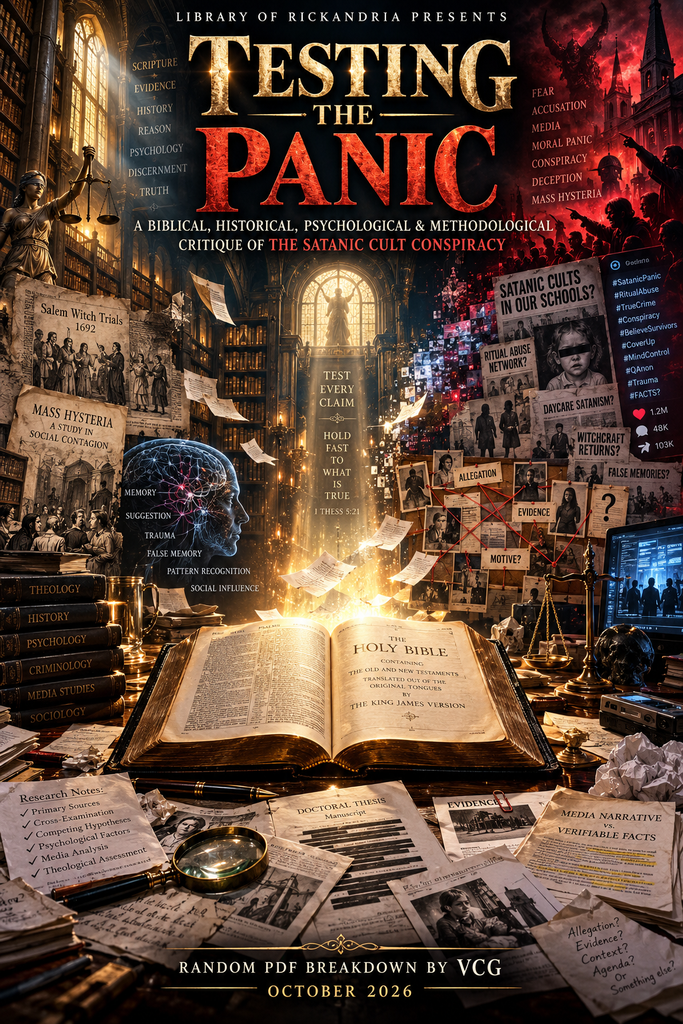
UPDATED BY VCG ON 10/04/2026 @ 08:50 EST
Anyone can do this, but most won’t.
ChatGPT – Library of Rickandria
LIBRARY OF RICKANDRIA PRESENTS
TESTING THE PANIC
A Biblical, Historical, Psychological & Methodological Critique of The Satanic Cult Conspiracy
Random PDF Breakdown by VCG
October 2026
Research cutoff: 4 October 2026
Soli Deo Gloria
TABLE OF CONTENTS
Executive Abstract
1. Introduction: What This Paper Is Testing
2. What This Paper Does—and Does Not—Claim
3. Terms, Evidentiary Vocabulary, and Source Hierarchy
4. A Short Historical Timeline: From Satanic Panic to 2026
5. Reading Oake Fairly: Her Questions, Corpus, and Framework
6. The Historical Satanic Panic: What Was Actually Disproved?
7. Memory, Suggestion, Testimony, and Survivor Claims
8. The Rabbit Hole: Auditing Oake’s Research Method
9. The Allegations: Real Categories, Unproven Connections
10. Dot-Connecting, Numerology, Art, and “Hidden in Plain Sight”
11. Authority, Testimony, DYOR, and the Epistemology of Distrust
12. Scapegoating: When Blame Becomes Collective Guilt
13. Catastrophising: Urgency Versus Threat Inflation
14. Legitimising: Real Facts Inside Unsupported Narratives
15. Consensus? Narrative Coherence Versus Shared Belief
16. Real Satanists, Real Extremists, and the Danger of Overcorrection
17. When the Debunkers Were Wrong
18. When the Conspiracists Were Wrong
19. Case-Study Laboratory: Six Claims, One Method
20. Absence of Evidence, Evidence of Absence, and Bayesian Common Sense
21. Standards of Proof, Witness Epistemology, and Naming Living People
22. Steelmanning Oake
23. Steelmanning Oake’s Critics
24. Scripture Correction: Text, Interpretation, and Unsupported Application
25. Red-Teaming This Paper: What Would Change Our Minds?
26. What Research Would Actually Settle More of This?
27. Master Evidentiary Verdict
28. Final General Conclusion
Appendix A — The Rickandria Evidence Protocol
Appendix B — Confidence-Coded Master Claim Table
Appendix C — Researcher’s One-Page Checklist
Endnotes
Bibliography
EXECUTIVE ABSTRACT
Bethan Juliet Oake’s 2025 University of Leeds doctoral thesis, The Satanic Cult Conspiracy: How Online Conspiracy Theory Discourses Construct Moral Panic, argues that contemporary online Satanic-cult conspiracy discourse represents a new and ongoing Satanic moral panic.
Oake bases that conclusion on a qualitative discourse analysis of 979 English-language posts collected manually from:
- Twitter/X
- TikTok
between October 2022 and March 2023.
Her analysis identifies recurring allegations of:
- physical harm
- coercion
- control
- apocalypse
as well as recurring forms of support including:
“dot-connecting,”
interpreting art as reality,
“hidden in plain sight”
symbolism,
survivor and former-member testimony,
rejection of mainstream authority,
and
“do your own research.”
She then develops a four-part framework—
- scapegoating
- catastrophising
- legitimising
- consensus
—for determining when conspiracy discourse becomes moral panic.
This paper accepts much of Oake’s descriptive analysis while challenging the certainty of her final diagnosis.
Her corpus is well suited to showing what kinds of narratives circulate within an online Satanic-conspiracy milieu and what an interested user may encounter while deliberately following a social-media:
“rabbit hole.”
It is not equally well suited to measuring:
- population prevalence
- unique believers
- sincerity of belief
- ordinary platform exposure
- internal hierarchy
or broad social consensus.
Oake herself acknowledges that she did not quantify theme prevalence or engagement, that her design was limited in measuring hierarchy, that her data were English-language and platform-bounded, and that volatility—the classical criterion that a moral panic eventually subsides—remained unresolved.
The paper’s main methodological criticism is therefore not that Oake failed to find real phenomena.
She did.
It is that narrative recurrence and moral-panic-like processes are demonstrated more securely than one unified, socially measurable moral panic.
Classical moral-panic theory treats disproportionality as a central criterion; Oake explicitly summarizes the classical model that way.
Yet her adapted framework does not independently measure whether concern is proportionate to independently established reality.
That omission matters.
A genuine criminal exposure campaign can also:
- identify wrongdoers
- use urgent rhetoric
- connect claims to wider evidence
and display strong internal agreement.
Without a reality test, justified alarm and moral panic can become structurally difficult to distinguish.
Independent fact-checking also complicates any simple binary between irrational conspiracists and reality-based debunkers.
The historical Satanic Panic did involve grave false allegations and evidentiary failures.
Yet governments really have conducted covert unethical programs such as MKULTRA.
Powerful offenders such as Jeffrey Epstein really have committed serious sexual crimes.
Adrenochrome is a real chemical, although the child-harvesting mythology surrounding it is unsupported.
The World Economic Forum really did publicly launch an initiative called the Great Reset, although that fact does not establish secret Satanic depopulation.
Major organizations really do identify as Satanist, although the Church of Satan and The Satanic Temple officially reject belief in a literal Satan.
Violent occult/extremist currents such as the Order of Nine Angles are real.
And by 2025–2026, U.S. authorities were publicly warning about 764 and related violent online networks coercing minors and vulnerable people into:
- sexual exploitation
- self-harm
- violence
and other abuse.
The correct rule is therefore:
REAL COMPONENTS DO NOT PROVE THE GRAND THEORY.
And equally:
A FALSE GRAND THEORY DOES NOT MAKE EVERY COMPONENT IMAGINARY.
The biblical audit reaches a parallel conclusion.
Scripture presents:
- Satan
- spiritual warfare
- occult practice
- idolatrous sacrifice
- false prophets
- human conspiracy
and deception as real categories.
Yet Scripture simultaneously:
- forbids false reports
- requires grave accusations to be diligently investigated
- values corroboration
- warns against deciding a matter before hearing it
- commands believers to test spiritual claims
and defines spiritual warfare in terms of:
- truth
- righteousness
- faith
- Scripture
- prayer
and the gospel rather than rumor or indiscriminate human demonization.
CHRISTIANITY – Library of Rickandria
The final verdict is therefore narrower than Oake’s:
Oake convincingly demonstrates a substantial contemporary online Satanic-conspiracy milieu containing multiple processes associated with moral-panic formation.
Her qualitative design alone does not definitively establish one unified, socially widespread, ongoing Satanic moral panic under all the classical criteria she invokes.
The governing principle of this paper is:
NEITHER PANIC NOR DENIAL.
PROVE THE BRIDGE.
1. INTRODUCTION: WHAT THIS PAPER IS TESTING
This paper began with a simple question.
What happens if we take Oake’s thesis seriously enough to fact-check both her subjects and her rebuttals?
That requires resisting two temptations.
The first is to treat Satanic-conspiracy discourse as one enormous package.
If one piece is real, the whole package feels vindicated.
The second is to treat debunking the same way.
If one spectacular allegation is false, everything adjacent to it gets placed into the same mental folder marked panic.
Neither method is careful enough.
Oake’s thesis is useful precisely because it forces us to look at the architecture of contemporary Satanic allegations.
She does not simply ask whether people believe in Satanic cults.
She examines what the alleged cult:
- supposedly does
- whom participants accuse
- what evidence they cite
- how the narrative absorbs current events
- how online communities construct authority
and how all of this may produce a moral panic.
The thesis’s own repository abstract describes the project as an attempt to analyze the breadth of contemporary discourse across:
- Twitter/X
- TikTok
and determine whether it indicates a new wave of Satanic moral panic.
The difficult part is that Oake’s object of study sits at the intersection of several different kinds of truth claims.
Some are historical.
Did the Satanic Panic produce false accusations?
Some are psychological.
How does suggestion affect memory?
Some are methodological.
What can a purposive social-media corpus establish?
Some are sociological.
What counts as a moral panic?
Some are legal.
Was a person:
- charged
- convicted
- acquitted
or exonerated?
Some are theological.
Does Scripture present Satan as real?
What does Revelation 13 actually say?
Those questions cannot all be answered by one method.
A court judgment cannot settle Satan’s ontology.
A Bible verse cannot prove a living celebrity committed a crime.
A psychology experiment cannot prove an individual allegation false.
A discourse analysis cannot determine that Satan is metaphysically nonexistent.
The purpose of Testing the Panic is therefore not simply to rebut Oake.
It is to keep the evidentiary lanes separate long enough to see what each one actually proves.
2. WHAT THIS PAPER DOES—AND DOES NOT—CLAIM
This paper does not argue that Satan is unreal.
THE ORIGIN & HISTORY OF SATAN: FROM FALLEN ANGEL TO WORLD ICON – Library of Rickandria
It does not argue that conspiracies are impossible.
It does not argue that:
- governments
- corporations
- churches
- intelligence agencies
- wealthy people
- police
- medical institutions
or news organizations are incapable of serious deception.
It does not argue that:
- organized trafficking
- coercive groups
- ritualized violence
- occult organizations
or violent extremist networks cannot exist.
It does not argue that every delayed or recovered memory is false.
It does not argue that survivor testimony is worthless.
It also does not argue that because those categories can be real, a specific accusation should therefore be believed.
The fact that trafficking exists does not prove Pizzagate.
The fact that MKULTRA existed does not prove a present-day Satanic trauma-programming system.
The fact that Jeffrey Epstein committed serious sexual offenses does not establish the guilt of everybody who met him.
The fact that adrenochrome exists chemically does not establish child harvesting.
The fact that modern Satanist organizations exist does not establish ritual murder.
The fact that Scripture teaches spiritual warfare does not identify a modern social group as Paul’s “principalities.”
The relevant questions remain:
What is established?
What is inferred?
What evidence connects them?
The last question is what this paper calls:
PROVING THE BRIDGE.
3. TERMS, EVIDENTIARY VOCABULARY, AND SOURCE HIERARCHY
A conspiracy is treated neutrally here as covert coordination among multiple actors toward some end.
A conspiracy theory is a claim or explanatory model alleging such covert coordination.
The label itself is not treated as a truth-value.
A moral panic is used in the tradition of Stanley Cohen and Goode and Ben-Yehuda:
a socially amplified construction of moral threat associated with:
- concern
- hostility
- consensus
- disproportionality
- volatility
Oake reproduces these five classical features and explicitly describes disproportionality in terms of:
- exaggerated numbers
- damage
- moral offensiveness
or risk.
Unsupported means the presently available evidence is inadequate to affirm the claim.
Unverified means its truth remains unresolved.
Overstated means a narrower proposition is supported but the wording exceeds it.
Contradicted is reserved for claims that reliable evidence affirmatively conflicts with.
False is used where the stronger conclusion is warranted.
The source hierarchy in this paper is proposition-specific.
- Primary court judgments
- government records
- declassified documents
- original scientific research
- original surveys
and direct organizational statements are preferred where they answer the actual question.
Peer-reviewed reviews and monographs are used for synthesis.
Journalism is used where appropriate for contemporary context.
Advocacy and organizational sources are used mainly to establish what those organizations themselves claim.
Social-media posts are treated as strong evidence that a statement circulated, but not automatically as evidence that the statement was true.
This paper also distinguishes:
CATEGORY
Can this kind of thing exist?
INSTANCE
Did this particular event occur?
CONNECTION
Are several real events part of one hidden system?
A great deal of weak conspiracy reasoning moves from category directly to connection.
A great deal of weak debunking does the reverse:
one proposed connection fails, therefore the category itself is dismissed.
Both moves are rejected here.
4. A SHORT HISTORICAL TIMELINE: FROM SATANIC PANIC TO 2026
The modern story is older than TikTok.
The publication of Michelle Remembers in 1980 helped popularize an influential therapeutic narrative of recovered Satanic ritual abuse.
During the 1980s, daycare allegations such as the McMartin Preschool case became defining episodes in a wider Satanic Panic.
McMartin produced years of litigation and no convictions; it later became a major case study in suggestive interviewing and child testimony.
By 1992, FBI behavioral specialist Kenneth Lanning had spent years examining ritual-abuse allegations.
His conclusion was not that child abuse was fictional.
It was that investigators had been unable to document the widespread organized Satanic-cult system being alleged, and that cases had to be investigated from facts outward rather than ritual interpretations inward.
That distinction is crucial.
The historical lesson is not:
Organized abuse cannot happen.
It is:
Organized abuse should not be converted into a Satanic cosmology without evidence.
In the same period, evangelical performer Mike Warnke’s highly influential claim that he had been a Satanic high priest was subjected to extensive Christian journalistic investigation and severely challenged on chronology and corroboration.
The significance of that episode is theological as much as historical:
Christians did not need to deny Satan, Christ, or conversion in order to investigate one man’s story.
The 1993 West Memphis murders became entangled with Satanic-Panic imagery.
Damien Echols, Jason Baldwin, and Jessie Misskelley were convicted; they later entered Alford pleas in 2011 while maintaining innocence.
The legal history should not be simplified into a formal exoneration that did not occur.
In 2024, the Arkansas Supreme Court reversed a lower court on Echols’s request for further DNA testing.
In 2015, the English Family Court rejected the extraordinary Satanic-abuse allegations associated with Hampstead after extensive fact-finding.
In 2016, Pizzagate demonstrated what happens when internet certainty becomes physical intervention.
Edgar Maddison Welch entered Comet Ping Pong armed and fired his rifle while motivated at least partly by unfounded trafficking rumors.
The Department of Justice prosecuted him.
That case remains one of the clearest examples of a false online allegation producing offline danger.
QAnon emerged in 2017 and eventually absorbed themes of:
- elite child abuse
- apocalyptic struggle
- hidden operations
- secret corruption
Yet one of Oake’s useful findings is that contemporary Satanic-conspiracy discourse cannot simply be reduced to QAnon.
In 2020, #SaveTheChildren became entangled with QAnon-related discourse.
The same year, the World Economic Forum publicly launched a project explicitly called The Great Reset.
The latter matters because:
“the Great Reset never existed”
is bad debunking.
The public initiative was real.
The unsupported step is the move from its documented policy language to secret Satanic depopulation.
Oake collected her dissertation’s primary social-media material from October 2022 through March 2023.
In 2024, Klofstad and colleagues published survey research using a 2022 U.S. national sample of 2,001 respondents.
They reported that, depending on the item, as many as roughly one-third endorsed allegations involving:
Satanic cult abuse, government sex trafficking, or agendas to “groom” children.
That survey is important because it supplies a kind of evidence Oake’s qualitative corpus cannot:
population-level endorsement estimates.
It still does not, by itself, establish historical increase, causation, or one unified community.
Oake’s dissertation was completed in 2025.
Then the landscape became more uncomfortable.
In March 2025, the FBI warned of a sharp increase in activity associated with “764” and related violent online networks that target vulnerable people, including minors, through:
- blackmail
- sexual exploitation
- self-harm
- animal cruelty
- suicide-related coercion
By February 19, 2026, FBI Boston said it was investigating more than 350 subjects nationwide tied to networks commonly referred to as 764, involving all 56 FBI field offices.
Federal prosecutions continued.
In June 2026, one 764-associated offender received a 30-year sentence for sexually exploiting minors and cyberstalking.
That timeline leaves us with an uncomfortable but productive truth:
history contains both spectacular false accusations and genuine hidden abuse.
A method that cannot tell those apart is not adequate.
5. READING OAKE FAIRLY: HER QUESTIONS, CORPUS, AND FRAMEWORK
Oake’s research has two broad tasks.
First, she asks what contemporary Satanic-cult conspiracy discourse contains.
Second, she asks whether it represents a moral panic.
Her chosen method is digital discourse analysis across:
- Twitter/X
- TikTok
She describes intentionally:
“going down the rabbit hole”
beginning with search terms, following accounts and hashtags, moving through replies and recommendations, and allowing the platforms themselves to lead her toward related content.
After six months, she selected 1,012 posts for initial analysis and retained 979 after removing, among other things, duplicates, suspected bots, and suspected parody.
The corpus was unevenly distributed:
- 66 percent Twitter/X
- 21 percent Instagram
- 13 percent TikTok
Oake reasonably argues that post length and platform format complicate any simple inference from those percentages because one TikTok or Instagram post can contain much more material than a short tweet.
Her thematic map is useful.
The allegations divide broadly into physical harm, coercion and control, and apocalypse.
The forms of support include:
- dot-connecting
- art/life interpretation
- hidden in plain sight
- survivor and former-member testimony
- charismatic authorities
- stigmatized knowledge
- rejection of mainstream authority
and:
“do your own research.”
The more controversial move comes next.
Oake argues that conspiracy discourse is indicative of moral panic when it exhibits:
scapegoating;
catastrophizing;
legitimizing;
and, if those are present, consensus regarding the targets, threat, and evidence.
At the end of Chapter 7, she reframes the consensus question around whether the overall narrative is cohesive and consistent.
She answers yes even while acknowledging that some posters may disagree on details or:
“may not even entirely believe”
the narratives.
That is an interesting theoretical move.
It is also the point at which narrative consensus begins to substitute for belief consensus.
We will return to it.
6. THE HISTORICAL SATANIC PANIC: WHAT WAS ACTUALLY DISPROVED?
The strongest historical version of the skeptical case is this:
Investigators did not substantiate the vast multigenerational Satanic system alleged during the late-twentieth-century Panic.
Lanning’s 1992 guide says that it had been impossible to document the widespread existence of the problem at the alleged scale and advises investigators to focus upon facts while considering alternative explanations.
That is strong evidence.
The weaker skeptical version is:
Therefore no:
- occult-associated crime
- ritualized violence
- organized sexual exploitation
or abusive secret group has ever existed.
That does not follow.
The difference matters because overstated debunking is one of the mechanisms by which distrust grows.
If the reader is told:
“Nothing remotely like this ever happens,”
and later discovers documented cases of covert programs, organized exploitation, or extremist networks, the reader may reasonably downgrade the source that overstated the rebuttal.
The historical Panic teaches something more precise:
THE SCALE, STRUCTURE, AND CONNECTIONS MUST BE PROVED.
That lesson is strong enough.
We do not need to inflate it.
7. MEMORY, SUGGESTION, TESTIMONY, AND SURVIVOR CLAIMS
The recovered-memory debate is another area where slogans do damage.
Modern memory science supports the proposition that autobiographical memory is reconstructive and can be influenced by suggestion.
It also does not support the blanket assertion that every memory recovered after a period of non-recall is false.
Dodier, Barzykowski, and Souchay explicitly argue for evaluating recovered traumatic memories along a continuum.
Retrieval after highly suggestive procedures is more problematic than spontaneous retrieval triggered by meaningful cues, and they state directly that not all recovered memories of trauma are false.
This gives us a better framework for SRA testimony.
A witness’s statement is evidence.
It is not nothing.
But its weight depends on:
how the memory was elicited;
whether suggestion occurred;
when the account first appeared;
whether outside information contaminated it;
whether its details remain materially consistent;
whether apparently independent witnesses influenced each other;
and whether external records corroborate the claim.
The psychological lesson is therefore neither:
Believe every survivor claim literally
nor:
Recovered memory equals false memory.
It is:
RETRIEVAL CONTEXT AND CORROBORATION MATTER.
This distinction is especially important in Oake’s Chapter 5, where survivor and former-member testimony functions as a trusted form of knowledge.
8. THE RABBIT HOLE: AUDITING OAKE’S RESEARCH METHOD
Oake’s “rabbit hole” method is clever when the question matches it.
Suppose we ask:
What does a user encounter after deliberately pursuing Satanic-conspiracy content?
Her method is well suited.
She:
- searched relevant terms
- watched posts
- followed accounts
- moved through replies
and received recommendations.
She records that within roughly one week her TikTok For You page had become a “flood” of conspiracy content.
That observation is valuable.
But it demonstrates a recommendation pathway conditioned by sustained interest.
It does not demonstrate what an ordinary user with no prior interest sees.
This is not a defect if the claim remains appropriately limited.
It becomes a defect only when personalized exposure is silently converted into social prevalence.
The same principle applies to the 979 posts.
They are a substantial qualitative corpus.
They are not 979 independent believers.
One person can produce many posts.
One post can be copied by many accounts.
A repost can be ironic.
A user can operate several accounts.
A bot can reproduce material.
Oake knows this and explicitly says her study was not designed to quantify how many people engage in the rhetoric.
That admission should materially constrain claims about consensus.
Another criticism sometimes made of qualitative work should not be made carelessly here.
A single primary coder does not automatically invalidate reflexive thematic analysis.
Braun and Clarke specifically warn against treating coding-reliability measures as universal requirements for every form of thematic analysis.
The better questions are:
Were coding decisions transparent?
Were negative cases considered?
Did prior theory excessively constrain what could be seen?
Did the conclusions stay within the design’s actual reach?
That is where the meaningful criticism lies.
9. THE ALLEGATIONS: REAL CATEGORIES, UNPROVEN CONNECTIONS
Oake’s Chapter 4 works well as taxonomy.
The discourse contains claims of:
- ritual abuse
- cannibalism
- torture
- murder
- trafficking
- mind control
- spiritual control
- elite domination
- technological apocalypse
- the Mark of the Beast
- transhumanism
and other threats.
The mistake would be to assume that because the assembled grand theory is unsupported, every noun within it must be fictional.
Consider:
human trafficking;
secret government programs;
elite sexual abuse;
Satanist organizations;
violent extremists;
dissociative disorders;
adrenochrome;
international policy initiatives.
All of these correspond to real categories or entities in some sense.
The problem is usually not:
Every individual fact is fake.
The problem is:
The connective architecture is not demonstrated.
This is the paper’s central distinction:
CATEGORY
Can such a thing exist?
INSTANCE
Did this alleged event occur?
CONNECTION
Are these real things part of the same hidden system?
The third proposition needs evidence of its own.
10. DOT-CONNECTING, NUMEROLOGY, ART, AND “HIDDEN IN PLAIN SIGHT”
Human beings must recognize patterns.
Science depends on pattern recognition.
Criminal investigation depends on it.
History depends on it.
So the problem is not:
“connecting dots”
in itself.
The question is:
WHAT ESTABLISHES THE LINE?
van Prooijen, Douglas, and De Inocencio found that conspiracy and supernatural belief were associated with greater illusory pattern perception in several experimental settings.
That finding does not establish that a specific conspiracy allegation is false.
Using it that way would commit a genetic fallacy:
We know why you believe it; therefore it did not happen.
Psychology can explain cognitive vulnerability.
Reality must still be checked.
Numerology creates a related problem.
If the analyst may freely change:
- spellings
- alphabets
- numerical systems
- date formats
- arithmetic operations
- inclusion criteria
- target words
meaningful-looking coincidences become easier to generate.
The biblical text itself uses numbers meaningfully.
Revelation 13 explicitly tells the reader to:
“count the number of the beast”
and gives 666.
But it also ties that number to the Beast, his name, worship, and an economic system.
The text does not license unlimited post-hoc number hunting.
Art and symbolism need the same restraint.
A Satanic symbol can actually be Satanic.
A performer may deliberately invert Christian imagery.
An artist can intentionally provoke.
But evidence climbs a ladder:
symbol present;
meaning established;
intent established;
personal belief established;
group affiliation established;
criminal activity established;
individual participation established.
One cannot jump from the first rung to the last.
“Hidden in plain sight”
often becomes especially problematic because it can make the theory self-sealing.
If evidence is hidden:
secrecy.
If evidence is visible:
revelation of the method.
If the accused denies it:
deception.
If journalists reject it:
cover-up.
If journalists report it:
exposure.
Every possible outcome is assimilated.
A theory that cannot lose evidence very easily acquires evidence too easily.
11. AUTHORITY, TESTIMONY, DYOR, AND THE EPISTEMOLOGY OF DISTRUST
Oake is persuasive when she shows how mainstream rejection can become proof within conspiratorial epistemology.
If institutional agreement supports the theory and institutional disagreement also supports the theory, institutional evidence no longer has any capacity to falsify.
But the alternative cannot be:
mainstream authority is automatically trustworthy.
MKULTRA alone should end that argument.
The 1977 U.S. Senate hearing documents the CIA’s behavioral-modification research program and the problem of experiments involving unwitting subjects.
The correct lesson is not:
Governments always lie.
Nor:
Governments never conduct secret wrongdoing.
It is:
Institutional claims must be evaluated proposition by proposition.
“Do your own research”
contains the same duality.
Independent checking is good.
Confirmation-only searching is not research.
Wineburg and McGrew’s work on professional fact-checkers found that skilled evaluators often use lateral reading:
they leave an unfamiliar site and investigate the source through independent external material rather than remaining trapped inside the site’s own presentation.
The Bereans provide an unusually appropriate biblical parallel:
they received what they heard with readiness, then searched to determine whether it was so.
The posture is open but not gullible.
12. SCAPEGOATING: WHEN BLAME BECOMES COLLECTIVE GUILT
Oake’s moral-panic case is strongest where discourse moves from vague elites to identifiable groups and assigns them generalized criminal guilt.
Antisemitic examples are particularly serious because modern Satanic/child-blood narratives can reproduce motifs with a long documented history.
The U.S. Holocaust Memorial Museum defines blood libel as the false allegation that Jews use the blood of non-Jewish children for ritual purposes and documents its role in persecution and mass violence.
When contemporary discourse combines:
Jewish identity;
child blood;
ritual murder;
secret social control;
and Satanism,
we are not dealing merely with policy criticism.
Oake is justified in calling that scapegoating.
But the concept needs a boundary.
If investigators expose real offenders and accurately assign blame, that is not scapegoating merely because hostility results.
A useful definition therefore needs one of the following:
misallocated guilt;
unsupported guilt;
generalized guilt;
collective guilt;
or causal blame exceeding the evidence.
Otherwise the framework risks classifying ordinary moral judgment as panic.
The same point applies to LGBTQ people.
A traditional Christian moral judgment about sexual behavior is one claim.
An allegation that an LGBTQ person is a pedophile, groomer, or member of a Satanic cult is another.
The first cannot be used as evidence for the second.
Equally, disagreement with gender-related policy is not automatically panic.
NHS England’s 2024 policy made puberty-suppressing hormones unavailable as a routine commissioned treatment for minors with gender incongruence or dysphoria.
In 2026 it also consulted on a policy proposition that masculinizing and feminizing hormones should not routinely be commissioned through the children’s service.
At the research cutoff, that was a consultation process, not a final settled policy.
These facts do not validate demonization of transgender people.
They demonstrate that real medical-evidence disputes can coexist with culture-war panic.
13. CATASTROPHISING: URGENCY VERSUS THREAT INFLATION
Oake defines catastrophizing around an urgent moral threat demanding immediate action.
That captures a real rhetorical pattern.
Yet urgency alone cannot distinguish panic from justified warning.
If a child is genuinely being abducted, “act now” is appropriate.
The better distinction is:
URGENCY
The matter requires prompt action.
THREAT INFLATION
The scale, probability, imminence, or severity of the threat is presented beyond what evidence supports.
The second is much closer to the classical concept of disproportionality.
Oake’s corpus plainly contains catastrophic framing:
- apocalyptic war
- imminent destruction
- mass depopulation
- total corruption
- civilization-level threat
That tells us something important about rhetoric.
Whether the rhetoric is panic still depends partly upon whether the asserted threat is proportionate to reality.
14. LEGITIMISING: REAL FACTS INSIDE UNSUPPORTED NARRATIVES
Oake uses legitimizing for the process of connecting conspiratorial claims to real social issues or:
“kernels of truth.”
She has identified something real.
But the term is somewhat loaded.
Every good investigation tries to connect its claim to reality.
If the connection is valid, it is evidence.
If the connection is invalid, it is pseudo-evidence.
A more neutral term before adjudication would be:
ISSUE-LINKING
or:
EVIDENTIARY BRIDGING.
Adrenochrome is an excellent example.
The chemical exists.
PubChem lists it as a real compound associated with oxidation of epinephrine.
That does not establish:
child harvesting;
rejuvenation;
ritual consumption;
or a global elite network.
The real noun becomes a rhetorical anchor for an unsupported story.
The Great Reset works similarly.
The WEF actually announced a public initiative under that name in June 2020.
That fact validates criticism of debunkers who claimed the phrase or initiative was invented.
It does not validate secret depopulation claims.
MKULTRA was real.
That fact does not prove a modern Satanic programming system.
Epstein’s offenses were real.
The 2019 federal indictment alleged sexual exploitation of dozens of underage girls and a system involving associates and recruitment.
That does not prove criminal guilt by association.
The DOJ Inspector General later documented extraordinary failures surrounding Epstein’s detention but said it found no evidence contradicting the FBI’s conclusion that there was no criminality associated with his death.
One can distrust that conclusion.
Distrust is not evidence of murder.
15. CONSENSUS? NARRATIVE COHERENCE VERSUS SHARED BELIEF
Chapter 7 is where the thesis’s final diagnosis becomes most vulnerable.
Oake knows that the community is internally diverse.
Some reject QAnon.
Some embrace it.
Some trust Trump.
Some distrust him.
Some think older Satanic Panic claims were deliberate disinformation.
Some posters may troll.
Some may perform.
Some may monetize.
Some may be:
“half-believers.”
Oake resolves this by asking whether the overall narrative remains cohesive.
She says it does, even though posters:
“may not even entirely believe”
what they share.
That supports a useful concept:
NARRATIVE CONSENSUS.
But classical moral-panic consensus is stronger.
Oake herself quotes the classical criterion as a:
“widespread agreement”
that the threat exists, is serious, and something should be done.
These should be separated.
We can distinguish four levels:
Discursive consensus:
similar claims recur.
Community consensus:
members of an identifiable network substantially agree.
Belief consensus:
those members sincerely regard the central proposition as true.
Societal consensus:
a broader social segment shares the concern.
Oake strongly establishes the first.
She provides suggestive evidence of the second.
Her method is not designed to measure the third well.
Her 979-post corpus cannot independently establish the fourth.
Klofstad and colleagues’ national survey adds evidence about broader endorsement.
Their 2,001-person 2022 sample found substantial belief in several related accusations.
That strengthens the case that the phenomenon is not merely a tiny fringe.
It still does not turn all of the different allegations into one bounded community or one moral panic automatically.
16. REAL SATANISTS, REAL EXTREMISTS, AND THE DANGER OF OVERCORRECTION
Oake’s Chapter 8 is valuable because she refuses the simplistic claim that no actual Satanist organizations or dangerous Satanically influenced currents exist.
The Church of Satan officially says it is atheistic, uses Satan as a metaphor, and rejects literal sacrifice.
The Satanic Temple likewise says it does not believe in the literal existence of Satan or the supernatural, while insisting that its Satanism constitutes a genuine religion with symbolism, community, practice, and shared values.
Therefore two claims should both be rejected:
Every Satanist literally worships the Devil.
and:
Nobody genuinely identifies as Satanist; it is all merely a joke.
The organizations’ own self-descriptions contradict both simplifications.
The Church of Satan also explicitly treats Halloween as meaningful within its Satanic framework, calling it the fall climax and describing it as important to Satanists.
That does not validate Halloween child-sacrifice folklore.
It shows why:
“Halloween has no Satanic significance whatsoever”
is too categorical.
Then there is O9A.
Research on Order of Nine Angles material and adjacent neo-fascist accelerationist networks documents real intersections among:
- occult transgression
- violent extremism
- terrorism-related milieus
Again:
one real extremist current does not establish one global Satanic hierarchy.
But it does mean the skeptic should not pretend Satanic or occult ideology is always mere decorative theater.
Sometimes ideology may be causal.
Sometimes constitutive.
Sometimes theatrical.
Often mixed.
Case-specific investigation is required.
17. WHEN THE DEBUNKERS WERE WRONG
One of the easiest ways to destroy trust in fact-checking is to deny something that is easily verifiable.
Several corrections are therefore necessary.
Adrenochrome exists.
The unsupported claims concern its alleged harvesting and use, not its chemistry.
The Great Reset existed.
The WEF publicly announced it.
The unsupported claims concern secret Satanic or exterminatory intent.
Modern Satanist organizations exist.
Their beliefs vary, and major organizations are non-theistic.
Halloween has explicit significance within at least some modern Satanist self-understanding.
That does not establish ritual murder.
Real occult/extremist currents exist.
Real covert child-exploitation networks exist online.
The FBI’s 2025–2026 warnings concerning 764 make blanket denial untenable.
Some pediatric gender-medicine questions involve genuine evidence disputes.
That does not establish Satanic intent or justify abuse of transgender people.
Bad debunking helps conspiracy culture because each obvious error becomes evidence that critics cannot be trusted.
The better strategy is narrower correction.
18. WHEN THE CONSPIRACISTS WERE WRONG
The reverse ledger is just as important.
A symbol does not prove murder.
A celebrity association does not prove criminal participation.
MKULTRA does not prove every mind-control allegation.
Epstein does not prove every elite-network claim.
Adrenochrome does not prove child harvesting.
The Great Reset does not prove Satanic depopulation.
Jewish identity does not prove ritual murder, Satanism, or global control.
LGBTQ identity does not prove pedophilia or grooming.
The existence of Satanists does not prove child sacrifice.
A failed prediction cannot be rescued indefinitely by asserting that the event happened secretly.
Fifty reposts are not fifty witnesses.
Revelation 13 does not identify a vaccine merely because buying and selling are mentioned.
“Hidden in plain sight”
is not a biblical law requiring occultists to preannounce crimes.
The same evidentiary rule applies no matter how morally disturbing the allegation.
19. CASE-STUDY LABORATORY: SIX CLAIMS, ONE METHOD
| Case | Established | Unsupported extension | Verdict |
|---|---|---|---|
| Hampstead | A spectacular Satanic-abuse narrative circulated and was rejected after extensive Family Court fact-finding. | That every child-abuse allegation is false. | False allegation; real harm. |
| Pizzagate | Unfounded trafficking rumors helped motivate an armed intervention at Comet Ping Pong. | That the restaurant operated the alleged trafficking system. | False theory with offline consequences. |
| MKULTRA | A covert CIA behavioral-research program existed and involved serious ethical violations. | That contemporary Satanic trauma-programming claims are therefore true. | Real covert program misused as universal precedent. |
| Epstein | Serious sexual offending and federal trafficking allegations were real. | That all associates participated, that a Satanic system controlled the crimes, or that murder caused his death. | Real elite crime surrounded by unsupported expansion. |
| Adrenochrome | The chemical is real. | Child harvesting, rejuvenation, ritual use, global network. | Real component inside unsupported mythology. |
| 764/O9A milieu | Violent online exploitation networks exist; occult/extremist influence exists in some adjacent milieus. | One worldwide multigenerational Satanic cult. | Real threat requiring precise description. |
This table explains the paper’s method better than:
“true versus debunked.”
Different components can have different verdicts.
20. ABSENCE OF EVIDENCE, EVIDENCE OF ABSENCE, AND BAYESIAN COMMON SENSE
“Absence of evidence is not evidence of absence”
contains an important warning.
Failure to find something does not always demonstrate nonexistence.
But the slogan is incomplete.
If a hypothesis predicts that strong evidence should exist, repeated failure to find that evidence can count against the hypothesis.
The question is:
IF THE CLAIM WERE TRUE, WHAT EVIDENCE SHOULD WE EXPECT?
A small covert group may leave little trace.
A supposed decades-long international system involving thousands of:
- murders
- hospitals
- police
- entertainment companies
- financial networks
- biological remains
- numerous ritual sites
and huge numbers of perpetrators predicts a much larger footprint.
Bayesian reasoning gives this intuition a formal structure.
Evidence supports a hypothesis when that evidence is more expected if the hypothesis is true than under competing explanations.
A pentagram in an intentionally Satanic performance is expected both under:
sincere Satanic symbolism
and:
deliberate theatrical provocation.
It therefore distinguishes those explanations poorly.
Authenticated operational communications describing an actual crime, later matched to forensic evidence, would distinguish them far more strongly.
The lesson is simple:
GOOD EVIDENCE DISCRIMINATES AMONG EXPLANATIONS.
And dependent evidence should not be multiplied as if independent.
One rumor repeated by twenty accounts remains one source genealogy.
21. STANDARDS OF PROOF, WITNESS EPISTEMOLOGY, AND NAMING LIVING PEOPLE
The same evidence can justify different actions at different thresholds.
A rumor may justify checking.
A credible witness may justify opening an investigation.
A newspaper publicly naming somebody as a ritual child murderer should require far more.
A criminal conviction requires a formal legal burden.
Historical scholarship usually speaks in degrees of confidence rather than criminal standards.
The key distinction is:
WORTH INVESTIGATING ≠ ESTABLISHED GUILT.
Witnesses should be evaluated by:
- competence
- opportunity
- provenance
- contamination
- independence
- consistency
- specificity
- corroboration
- alternative explanations
This paper also rejects guilt by association.
Being photographed with an offender establishes a photograph.
Being in an address book establishes an entry.
Travel records establish travel.
None automatically establishes participation in the offense.
For living persons, allegations should remain allegations unless adjudicated or independently established.
The paper therefore maintains the distinction among:
charged;
convicted;
acquitted;
civilly liable;
exonerated;
accused;
and associated with.
Accuracy is particularly important where accusations can destroy lives.
22. STEELMANNING OAKE
A fair critique should state the strongest version of the thesis before rejecting anything.
Oake can reasonably reply that qualitative discourse analysis was never designed to estimate national prevalence.
Criticizing it for not being a probability survey would therefore be unfair if her claims remain focused on discourse.
She can also say that moral panics do not require majority belief.
Relatively bounded communities can generate substantial harm.
She can argue that digital panic differs from older broadcast panic.
- Memes
- trolls
- uncertain believers
- influencers
- algorithms
and user participation may produce a socially consequential panic without one centralized ideological constituency.
Her:
“consensus of narrative”
could therefore be understood as an intentional updating of moral-panic theory rather than a mistake.
And disproportionality does not always need a population survey. =
In a case such as Hampstead, the allegation can be shown to be grossly disproportionate because the underlying story itself was judicially rejected.
These are serious answers.
They substantially strengthen Oake’s case.
They do not fully justify the certainty of:
“confirmed.”
That stronger wording implies more than:
moral-panic-like rhetoric exists.
It implies that the broader phenomenon itself has been sufficiently identified.
That requires:
- clearer boundaries
- social scale
- consensus
and reality comparison than the 979-post corpus provides on its own.
23. STEELMANNING OAKE’S CRITICS
The serious critic of Oake has a strong case too.
Governments have conducted secret wrongdoing.
Abuse has been institutionally concealed.
Powerful people have sexually exploited minors.
Trafficking exists.
Modern Satanists exist.
Violent occult/extremist groups exist.
Witnesses sometimes reveal hidden crimes.
Official denial can be self-interested.
The 764 cases prove that internet-based coercive child-exploitation networks are not simply the stuff of urban legend.
The critic is therefore entitled to reject:
“Authorities would never do that.”
The critic is not yet entitled to say:
“Therefore authorities did this.”
That second proposition needs evidence.
The scale of the alleged conspiracy also changes expected traces.
Secrecy reduces observability.
Scale increases it.
A theory involving a handful of actors can remain hidden more easily than a theory involving thousands of:
- killings
- hospitals
- governments
- entertainment industries
- generations of participants
24. SCRIPTURE CORRECTION: TEXT, INTERPRETATION, AND UNSUPPORTED APPLICATION
The biblical portion of this paper follows a strict three-level rule.
TEXT
What does the KJV actually say?
INTERPRETATION
What conclusions reasonably follow, acknowledging legitimate disputes?
UNSUPPORTED APPLICATION
Where does a modern claim go beyond what the text identifies?
This matters because Scripture presents a far more interesting picture than either camp often admits.
Satan
Job presents Satan as an intelligent actor who speaks, accuses, and acts within limits imposed by God.
Within the biblical narrative, Satan is therefore more than a social symbol.
But Job does not establish that every human tragedy is individually attributable to Satan.
Spiritual warfare
Ephesians says:
“we wrestle not against flesh and blood”
but against:
- principalities
- powers
- rulers of darkness
- spiritual wickedness
The same passage gives the believer:
- truth
- righteousness
- the gospel of peace
- faith
- salvation
- the word of God
and prayer.
That affirms spiritual warfare.
It does not identify:
- Jews
- LGBTQ people
- doctors
- teachers
- politicians
- celebrities
- the WEF
or any other modern group as those principalities.
False reports
Exodus says:
“Thou shalt not raise a false report”
and:
“Keep thee far from a false matter.”
It also warns against following a multitude into evil judgment.
There is no exemption for accusations made in the name of spiritual warfare.
Diligent investigation
Deuteronomy 13 describes a serious allegation of hidden religious apostasy.
Its command is:
“inquire, and make search, and ask diligently; and, behold, if it be truth, and the thing certain…”
The seriousness of the spiritual accusation does not lower the evidentiary threshold.
It increases the need for investigation.
Cross-examination
Proverbs says:
“He that answereth a matter before he heareth it, it is folly and shame unto him.”
And:
“He that is first in his own cause seemeth just; but his neighbour cometh and searcheth him.”
That rebukes both conspiratorial credulity and reflexive debunking.
Spiritual claims must be tested
First John says:
“believe not every spirit, but try the spirits whether they are of God.”
The immediate context concerns false prophets and Christological confession.
It is not permission to label a politician demon-possessed by intuition.
Prophecy and testing
First Thessalonians says:
“Despise not prophesyings.”
Then:
“Prove all things; hold fast that which is good.”
Biblical openness and biblical scrutiny coexist.
Real conspiracy
Acts 23 explicitly describes more than forty men coordinating to kill Paul:
“they were more than forty which had made this conspiracy.”
The account includes:
- actors
- plan
- target
- deception
- intelligence
- countermeasures
The Bible therefore does not teach that conspiracies are impossible.
It teaches that a real conspiracy is an actual arrangement among people that can, at least sometimes, leave evidence.
Revelation 13
Revelation 13 connects:
- the Mark with the Beast
- worship
- the Beast’s name
- the number of his name
- economic restriction
- 666
The text does not say:
COVID vaccine;
QR code;
digital currency;
microchip;
CERN;
or WEF.
Those are modern identifications and require arguments not supplied simply by quoting:
“buy or sell.”
Antisemitic misuse
Romans 11 identifies Paul himself as:
“an Israelite, of the seed of Abraham”
and warns Gentile believers:
“Boast not against the branches.”
Whatever one makes of Revelation’s:
“synagogue of Satan”
language, the New Testament does not permit the universal ethnic proposition:
Jews are Satanic.
Bloodline demonology is an imported theory, not contextual exegesis.
The central biblical conclusion is therefore:
SCRIPTURE PERMITS US TO NAME EVIL.
SCRIPTURE DOES NOT PERMIT US TO INVENT THE GUILTY.
And equally:
FALSE SATANIC ACCUSATIONS DO NOT MAKE SATAN UNREAL.
THE REALITY OF SATAN DOES NOT MAKE SATANIC ACCUSATIONS TRUE.
25. RED-TEAMING THIS PAPER: WHAT WOULD CHANGE OUR MINDS?
A critique of self-sealing theories should specify its own revision conditions.
What evidence would substantially strengthen a claim of a large coordinated Satanic criminal network?
Multiple genuinely independent witnesses supplying matching non-public information.
Authenticated internal communications.
Financial records.
Forensic evidence with chain of custody.
Verified locations.
Operational documents.
Communications establishing command or membership.
Prospective predictions of activity later confirmed.
Independent investigations reaching the same core result from different source chains.
What would materially strengthen Oake’s strongest moral-panic conclusion?
Repeated representative surveys.
Historical comparison showing increase.
Unique-user and network analysis.
Direct measures of belief strength.
Clear evidence of identifiable community consensus.
Objective measurement of disproportionality.
Influencer/hierarchy analysis.
Longitudinal evidence of eruption, persistence, and decline.
If those data emerge, this paper’s confidence should change.
That is not weakness.
That is the point of the method.
26. WHAT RESEARCH WOULD ACTUALLY SETTLE MORE OF THIS?
The ideal successor to Oake’s thesis would combine methods.
Qualitative discourse analysis should remain because it preserves the richness of the narratives.
Representative surveys should estimate belief.
Repeated surveys should establish trend.
Network analysis should distinguish unique users from duplication and identify influential nodes.
Controlled fresh-account experiments should test recommendation pathways without prior personalization.
Participant interviews should distinguish:
- belief
- speculation
- performance
- trolling
- irony
Case-level fact-checking should independently evaluate major allegations so that disproportionality has an empirical baseline.
Cross-cultural and non-English research should test whether the phenomenon travels under different terminology.
That would allow us to measure:
discourse;
belief;
reach;
network structure;
truth-status;
and:
change over time.
Only then can:
“one new Satanic moral panic”
be tested at the scale the phrase implies.
27. MASTER EVIDENTIARY VERDICT
| Domain | Assessment |
|---|---|
| Historical warning about the Satanic Panic | Strong |
| Existence of contemporary Satanic-conspiracy discourse | Strong |
| Oake’s thematic taxonomy | Strong |
| Identification of false accusation and scapegoating | Strong |
| Analysis of online evidentiary rhetoric | Strong |
| 979-post corpus for thematic breadth | Strong |
| 979-post corpus for prevalence | Not designed to establish it |
| Rabbit-hole method for discoverability | Strong |
| Rabbit-hole method for ordinary baseline exposure | Weak / not established |
| Psychology as explanation of belief mechanisms | Useful |
| Psychology as proof an allegation is false | Invalid inference |
| Narrative coherence | Strongly demonstrated |
| Sincere belief consensus | Not directly measured |
| Population-level consensus | Requires outside evidence |
| Scapegoating criterion | Useful if blame is shown to be misallocated/generalized |
| Catastrophising criterion | Useful if urgency is distinguished from threat inflation |
| Legitimising criterion | Better treated neutrally as issue-linking before adjudication |
| Independent measurement of disproportionality | Insufficient |
| Volatility | Incomplete by Oake’s own admission |
| Purely grassroots character | Partially supported; overly binary |
| “New and ongoing Satanic moral panic” as hypothesis | Plausible |
| “Definitively confirmed” moral panic | Overstated |
| Warning against panicking about conspiracy theorists | Strong and valuable |
| Real self-described Satanism | Established |
| All Satanism as literal Devil worship | False as a generalization |
| Real occult/extremist violence | Established in specific milieus |
| O9A/764 as proof of worldwide SRA | Unsupported leap |
| Satan as only a social symbol | Not established by sociological method; contrary to biblical ontology used here |
| Biblical spiritual warfare | Explicit text |
| Biblical warrant for indiscriminate modern Satanic accusation | Absent |
The overall judgment is therefore:
Oake demonstrates a substantial contemporary Satanic-conspiracy milieu exhibiting multiple processes associated with moral-panic formation.
She does not demonstrate, with sufficient methodological independence, that the entire heterogeneous phenomenon constitutes one definitively confirmed, socially widespread, ongoing Satanic moral panic under all of the classical criteria she invokes.
That is not a rejection of the thesis.
It is a narrowing of its conclusion to what its evidence can carry.
28. FINAL GENERAL CONCLUSION
The deepest problem in The Satanic Cult Conspiracy is not really Satanism.
It is evidence.
How should we investigate claims of extraordinary evil without becoming either gullible or dismissive?
History gives us reasons for both caution and vigilance.
The Satanic Panic teaches that a community can become collectively certain and still accuse innocent people.
Hampstead teaches that adults can harm children while believing they are uncovering child abuse.
Pizzagate teaches that an unsupported online theory can motivate armed intervention.
Memory research teaches that testimony can be:
- genuine
- sincere
- contaminated
- accurate
- distorted
or some combination requiring careful evaluation.
MKULTRA teaches that governments can secretly conduct unethical programs.
Epstein teaches that powerful offenders can commit serious sexual crimes and operate among influential people.
Adrenochrome teaches that a real scientific term can be embedded inside unsupported mythology.
The Great Reset teaches that dismissing a publicly documented initiative as imaginary only makes fact-checkers easier to distrust.
Modern Satanist organizations teach that explicit Satanic identity can be real while literal Devil worship is not universal.
O9A and 764 teach that genuinely dangerous extremist and abusive networks can coexist with exaggerated or false Satanic narratives.
The Bible adds another layer.
It teaches Satan.
It also teaches false witness.
It teaches spiritual warfare.
It also says the struggle is not against flesh and blood.
It teaches conspiracy.
It also teaches diligent inquiry.
It teaches prophecy.
It also commands testing.
It teaches judgment.
It also says:
“Thou shalt not raise a false report.”
When hidden religious corruption is alleged, it says:
“inquire, and make search, and ask diligently.”
When the first case sounds persuasive, Proverbs says another comes and searches it.
When spiritual claims appear, John says not to believe every spirit.
When prophecy is discussed, Paul says:
“Prove all things; hold fast that which is good.”
That gives us a position less emotionally satisfying than either extreme, but considerably stronger.
SATAN MAY BE REAL.
CONSPIRACIES MAY BE REAL.
ABUSE MAY BE REAL.
INSTITUTIONAL CORRUPTION MAY BE REAL.
FALSE MEMORY MAY BE REAL.
FALSE ACCUSATION MAY BE REAL.
MORAL PANIC MAY BE REAL.
NONE OF THESE REALITIES PROVES THE NEXT ONE.
Every bridge must still be demonstrated.
If the evidence establishes a conspiracy, follow it.
If it establishes a false accusation, correct it.
If a survivor is corroborated, say so.
If a debunker gets a factual point wrong, correct the debunker.
If an institution possesses strong evidence, examine it.
If institutional evidence fails, do not substitute prestige for proof.
If Scripture speaks explicitly, say exactly what it says.
If Scripture does not identify the modern:
- person
- technology
- party
- organization
or event, do not manufacture the identification.
And where evidence permits only uncertainty:
DO NOT COUNTERFEIT CERTAINTY.
That is where this paper lands.
Not with denial of darkness.
Not with fascination with darkness.
Not with automatic confidence in authorities.
Not with automatic suspicion of authorities.
Not with blind trust in testimony.
Not with contempt for testimony.
Not with biblical reductionism.
Not with sociological reductionism.
But with a method:
NEITHER PANIC NOR DENIAL.
PROVE THE BRIDGE.
Soli Deo Gloria.
APPENDIX A — THE RICKANDRIA EVIDENCE PROTOCOL
When an extraordinary allegation appears:
1. Define the claim precisely.
Do not investigate a fog.
2. Find the earliest primary source.
Who first said it?
3. Authenticate the evidence.
Is the:
- image
- document
- quote
- recording
or post genuine?
4. Recover the original context.
What came immediately before and after?
5. Trace source dependence.
Do twenty sources reduce to one?
6. Seek genuinely independent corroboration.
- Witnesses
- documents
- money
- communications
- locations
- physical evidence
7. Search against your preferred conclusion.
What is the strongest contrary evidence?
8. Test competing explanations.
- Coincidence
- ordinary crime
- satire
- aesthetics
- error
- suggestion
- fraud
- misunderstanding
9. Separate category, instance, and connection.
Can it happen?
Did it happen here?
Are these events actually linked?
10. Ask what traces the theory predicts.
If true, what evidence should reasonably exist?
11. Distinguish theology from forensics.
A biblical category does not name a modern suspect.
A sociological theory does not settle ontology.
12. State confidence honestly.
Supported.
Probable.
Possible.
Unverified.
Unsupported.
Contradicted.
And before sharing a grave accusation, ask one more question:
WOULD I ACCEPT THIS EVIDENTIARY STANDARD IF THE ACCUSED PERSON WERE SOMEONE I LOVED?
APPENDIX B — CONFIDENCE-CODED MASTER CLAIM TABLE
| Claim | Assessment | Confidence | What could change it? |
|---|---|---|---|
| Historical Satanic Panic produced grave false accusations | Supported | High | Major contrary archival evidence |
| Widespread organized SRA at alleged scale was substantiated | Not supported by major investigations | High | Independent forensic/documentary evidence |
| Isolated occult/ritualized crime is impossible | False as blanket claim | High | — |
| Oake maps contemporary discourse effectively | Supported | High | Severe replication/coding problems |
| Oake’s sample measures prevalence | No | High | Different sampling design |
| Rabbit-hole method measures discoverability | Supported | High | Controlled contradictory evidence |
| Personalized feed measures ordinary exposure | Not established | High | Controlled account comparisons |
| Contemporary Satanic discourse exceeds QAnon | Supported | High | — |
| Narrative coherence exists | Supported | High | Strong contrary analysis |
| Belief consensus is established | Not directly | High | Interviews/surveys/network evidence |
| Disproportionality is independently measured | Insufficiently | High | External reality comparison |
| One ongoing moral panic is definitively confirmed | Overstated | Moderate-high | Stronger prevalence, consensus, reality, longitudinal evidence |
| Adrenochrome exists | Supported | Very high | Established chemistry |
| Child-harvesting adrenochrome narrative established | Unsupported | High | Forensic/documentary evidence |
| MKULTRA existed | Supported | Very high | Primary records |
| MKULTRA proves modern Satanic programming | Unsupported | High | Direct modern evidence |
| Great Reset existed publicly | Supported | Very high | Primary WEF record |
| Great Reset proves Satanic depopulation | Unsupported | High | Authenticated evidence of that intent |
| Modern Satanist organizations exist | Supported | Very high | Organizational records |
| All Satanists literally worship Satan | Contradicted as generalization | High | Group/person-specific evidence |
| O9A-like violent occult extremism exists | Supported | High | Current research |
| 764-related violent exploitation exists | Supported | Very high | FBI/DOJ records and convictions |
| 764 proves worldwide SRA | Unsupported | Very high | Organizational bridge evidence |
| Satan is merely a cultural symbol | Not established by sociology | High as methodological claim | Ontological/theological argument required |
| Scripture teaches spiritual warfare | Explicit text | Very high | — |
| Scripture identifies modern political/social enemies in Ephesians 6 | Unsupported application | High | Explicit textual/historical case |
| Revelation 13 identifies COVID vaccination as the Mark | Unsupported application | High | Much stronger textual/historical fulfillment case |
APPENDIX C — RESEARCHER’S ONE-PAGE CHECKLIST
Before believing, publishing, reposting, or dismissing a grave claim:
What exactly is being alleged?
Where did it originate?
Have I seen the original evidence?
Is it authentic?
What does it directly establish?
What am I adding by inference?
Are my sources genuinely independent?
Is there external corroboration?
What contrary evidence exists?
What would prove the theory wrong?
What evidence should exist if the theory were true?
Am I confusing association with participation?
Am I confusing a real category with a particular instance?
Am I confusing two real facts with proof that they are connected?
Am I using psychology to avoid answering the factual question?
Am I treating authority as evidence instead of evaluating its evidence?
Am I using one historical institutional scandal as proof of another allegation?
If Scripture is involved, what does the passage explicitly say?
What is interpretation?
What is modern application?
Would I use the same standard against someone on my own side?
What confidence level does the evidence actually warrant?
ENDNOTES
1. Bethan Juliet Somerville Oake, The Satanic Cult Conspiracy: How Online Conspiracy Theory Discourses Construct Moral Panic (PhD diss., University of Leeds, 2025). The White Rose repository identifies the thesis and summarizes its research purpose.
2. Oake’s final framework requires scapegoating, catastrophising, legitimising, and consensus; her Chapter 7 ultimately treats overall narrative cohesion as sufficient despite differences in detailed belief. See The Satanic Cult Conspiracy, especially Chapters 6–7.
3. Kenneth V. Lanning, Investigator’s Guide to Allegations of “Ritual” Child Abuse (FBI National Center for the Analysis of Violent Crime, 1992). The Office of Justice Programs summary states that widespread existence of the alleged problem could not be documented and emphasizes fact-centered investigation and consideration of alternative explanations.
Investigator’s Guide to Allegations of “Ritual” Child Abuse | Office of Justice Programs
4. Oake’s own limitations include platform restriction, lack of quantitative theme-prevalence measures, lack of engagement measurement, limited ability to assess hierarchy, English-only content, and unresolved volatility. See The Satanic Cult Conspiracy, Chapter 9 and its limitations discussion.
5. Jan-Willem van Prooijen, Karen M. Douglas, and Clara De Inocencio, “Connecting the Dots: Illusory Pattern Perception Predicts Belief in Conspiracies and the Supernatural,” European Journal of Social Psychology 48, no. 3 (2018): 320–335.
6. Olivier Dodier, Krystian Barzykowski, and Céline Souchay, “Recovered Memories of Trauma as a Special (or Not So Special) Form of Involuntary Autobiographical Memories,” Frontiers in Psychology 14 (2023).
7. Jessica Udry and Sarah J. Barber, “The Illusory Truth Effect: A Review of How Repetition Increases Belief in Misinformation,” Current Opinion in Psychology 56 (2024): 101736.
The illusory truth effect: A review of how repetition increases belief in misinformation – PubMed
8. Sam Wineburg and Sarah McGrew, “Lateral Reading and the Nature of Expertise: Reading Less and Learning More When Evaluating Digital Information,” Teachers College Record 121, no. 11 (2019).
9. Sander van der Linden, “Misinformation: Susceptibility, Spread, and Interventions to Immunize the Public,” Nature Medicine 28 (2022): 460–467. The review discusses susceptibility to misinformation and corrective interventions and notes the limited evidence for broad, reliable backfire effects.
Misinformation: susceptibility, spread, and interventions to immunize the public | Nature Medicine
10. U.S. Senate Select Committee on Intelligence and Subcommittee on Health and Scientific Research, joint hearing concerning Project MKULTRA, August 3, 1977.
11. National Library of Medicine, PubChem, “Adrenochrome,” CID 5898.
Adrenochrome | C9H9NO3 | CID 5898 – PubChem
12. World Economic Forum, “The Great Reset: A Unique Twin Summit to Begin 2021,” June 3, 2020.
The Great Reset: A Unique Twin Summit to Begin 2021 > Press releases | World Economic Forum
13. The Satanic Temple, official “Frequently Asked Questions.” The organization denies belief in a literal Satan and describes its Satanism as a genuine non-theistic religion.
Answers to the most common questions about The Satanic Temple – TST
14. Church of Satan, “F.A.Q. Fundamental Beliefs.” The organization describes itself as atheistic, treats Satan metaphorically, and rejects literal sacrifice.
F.A.Q. Fundamental Beliefs – Church of Satan
15. Church of Satan, “F.A.Q. Holidays.” The organization explicitly discusses Halloween as a meaningful Satanic observance.
F.A.Q. Holidays – Church of Satan
16. United States Holocaust Memorial Museum, “Blood Libel,” Holocaust Encyclopedia.
Blood Libel: History and Impact | Holocaust Encyclopedia
17. Casey Klofstad et al., “The New Satanic Panic,” Political Science Quarterly 140, no. 2 (2025): 249–268; first published online August 28, 2024. The study used a 2022 national U.S. survey of 2,001 respondents.
New Satanic Panic | Political Science Quarterly | Oxford Academic
18. James P. Walsh and Dallas Hill, “Social Media, Migration and the Platformization of Moral Panic: Evidence from Canada,” Convergence 29, no. 3 (2023): 690–712.
19. Virginia Braun and Victoria Clarke, “One Size Fits All? What Counts as Quality Practice in (Reflexive) Thematic Analysis?” Qualitative Research in Psychology 18, no. 3 (2021): 328–352.
20. Association of Internet Researchers, Internet Research: Ethical Guidelines 3.0.
21. Federal Bureau of Investigation, “Violent Online Networks Target Vulnerable and Underage Populations Across the United States and Around the Globe,” March 6, 2025.
22. Federal Bureau of Investigation, Boston Division, “FBI Boston Warns of Nihilistic Violent Extremists Targeting Children and Vulnerable Victims Online,” February 19, 2026.
23. U.S. Department of Justice, “Leaders of 764 Arrested and Charged for Operating Global Child Exploitation Enterprise,” April 2025. DOJ expressly notes that criminal charges are allegations and that defendants remain presumed innocent unless proven guilty.
24. U.S. Department of Justice, “Violent Extremist Network ‘764’ Member Sentenced to 30 Years for Sexually Exploiting Minors and Cyberstalking,” June 16, 2026.
25. U.S. Department of Justice, Office of Inspector General, Investigation and Review of the Federal Bureau of Prisons’ Custody, Care, and Supervision of Jeffrey Epstein (2023). The OIG documented severe staff failures while reporting that it found no evidence contradicting the FBI’s determination that no criminal act caused Epstein’s death.
26. NHS England, “Clinical Policy: Puberty Suppressing Hormones,” March 12, 2024.
NHS England » Clinical policy: puberty suppressing hormones
27. NHS England, consultation concerning prescribing masculinising and feminising hormones for children and adolescents with gender incongruence or dysphoria, 2026. At the research cutoff, this material represented a consultation and draft policy process rather than a final settled policy.
See also the NHS England public consultation guide:
28. Scripture quotations are from The Holy Bible, King James Version, Pure Cambridge Edition. Key methodological and theological passages used in this paper include Deuteronomy 13:14; Deuteronomy 19:15; Exodus 23:1–7; Proverbs 18:13, 17; 1 Thessalonians 5:19–21; 1 John 4:1–3; Ephesians 6:10–18; Acts 23:12–21; Romans 11; Job 1–2; Psalm 106:37–38; 1 Corinthians 10:20; and Revelation 13.
BIBLIOGRAPHY
Association of Internet Researchers. Internet Research: Ethical Guidelines 3.0. 2020.
Braun, Virginia, and Victoria Clarke. “One Size Fits All? What Counts as Quality Practice in (Reflexive) Thematic Analysis?” Qualitative Research in Psychology 18, no. 3 (2021): 328–352.
Church of Satan. “F.A.Q. Fundamental Beliefs.” Accessed October 4, 2026.
F.A.Q. Fundamental Beliefs – Church of Satan
Church of Satan. “F.A.Q. Holidays.” Accessed October 4, 2026.
F.A.Q. Holidays – Church of Satan
Dodier, Olivier, Krystian Barzykowski, and Céline Souchay. “Recovered Memories of Trauma as a Special (or Not So Special) Form of Involuntary Autobiographical Memories.” Frontiers in Psychology 14 (2023): 1268757.
Federal Bureau of Investigation. “Violent Online Networks Target Vulnerable and Underage Populations Across the United States and Around the Globe.” March 6, 2025.
Federal Bureau of Investigation, Boston Division. “FBI Boston Warns of Nihilistic Violent Extremists Targeting Children and Vulnerable Victims Online.” February 19, 2026.
Goode, Erich, and Nachman Ben-Yehuda. Moral Panics: The Social Construction of Deviance. 2nd ed. Malden, MA: Wiley-Blackwell, 2009.
Klofstad, Casey A., Olyvia Christley, Amanda B. Diekman, Adam M. Enders, John Funchion, Ashley Hemm, et al. “The New Satanic Panic.” Political Science Quarterly 140, no. 2 (2025): 249–268. First published online August 28, 2024.
New Satanic Panic | Political Science Quarterly | Oxford Academic
Lanning, Kenneth V. Investigator’s Guide to Allegations of “Ritual” Child Abuse. Quantico, VA: FBI National Center for the Analysis of Violent Crime, 1992.
Investigator’s Guide to Allegations of “Ritual” Child Abuse | Office of Justice Programs
Lanning, Kenneth V. “Child Sex Rings: A Behavioral Analysis for Criminal Justice Professionals Handling Cases of Child Sexual Exploitation.” National Center for Missing & Exploited Children / U.S. Department of Justice.
National Library of Medicine. PubChem. “Adrenochrome.” PubChem Compound Summary for CID 5898. Accessed October 4, 2026.
Adrenochrome | C9H9NO3 | CID 5898 – PubChem
NHS England. “Children and Young People’s Gender Services: Implementing the Cass Review Recommendations.” 2024.
NHS England. “Clinical Policy: Puberty Suppressing Hormones.” March 12, 2024.
NHS England » Clinical policy: puberty suppressing hormones
NHS England. “Clinical Policy: Prescribing of Masculinising and Feminising Hormones for Children and Adolescents Who Have Gender Incongruence or Dysphoria — Public Consultation Guide.” March 9, 2026.
NHS England. “Prescribing Masculinising and Feminising Hormones for Children and Adolescents.” Public consultation, 2026.
Oake, Bethan Juliet Somerville. The Satanic Cult Conspiracy: How Online Conspiracy Theory Discourses Construct Moral Panic. PhD diss., University of Leeds, 2025. White Rose eTheses Online.
Re P and Q (Children: Care Proceedings: Fact Finding) [2015] EWFC 26. Family Division of the High Court of Justice, March 19, 2015.
The Satanic Temple. “Frequently Asked Questions.” Accessed October 4, 2026.
Answers to the most common questions about The Satanic Temple – TST
Udry, Jessica, and Sarah J. Barber. “The Illusory Truth Effect: A Review of How Repetition Increases Belief in Misinformation.” Current Opinion in Psychology 56 (2024): 101736.
The illusory truth effect: A review of how repetition increases belief in misinformation – PubMed
United States Department of Justice. “Jeffrey Epstein Charged in Manhattan Federal Court with Sex Trafficking of Minors.” July 8, 2019.
United States Department of Justice. “Leaders of 764 Arrested and Charged for Operating Global Child Exploitation Enterprise.” April 2025.
United States Department of Justice. “North Carolina Man Pleads Guilty to Charges in Armed Assault at Northwest Washington Pizza Restaurant.” March 24, 2017.
United States Department of Justice. “Violent Extremist Network ‘764’ Member Sentenced to 30 Years for Sexually Exploiting Minors and Cyberstalking.” June 16, 2026.
United States Department of Justice, Office of Inspector General. Investigation and Review of the Federal Bureau of Prisons’ Custody, Care, and Supervision of Jeffrey Epstein. Washington, DC, 2023.
United States Holocaust Memorial Museum. “Blood Libel.” Holocaust Encyclopedia. Accessed October 4, 2026.
Blood Libel: History and Impact | Holocaust Encyclopedia
United States Senate Select Committee on Intelligence and Subcommittee on Health and Scientific Research. Project MKULTRA, the CIA’s Program of Research in Behavioral Modification. Joint Hearing, August 3, 1977.
van der Linden, Sander. “Misinformation: Susceptibility, Spread, and Interventions to Immunize the Public.” Nature Medicine 28 (2022): 460–467.
Misinformation: susceptibility, spread, and interventions to immunize the public | Nature Medicine
van Prooijen, Jan-Willem, Karen M. Douglas, and Clara De Inocencio. “Connecting the Dots: Illusory Pattern Perception Predicts Belief in Conspiracies and the Supernatural.” European Journal of Social Psychology 48, no. 3 (2018): 320–335.
Walsh, James P., and Dallas Hill. “Social Media, Migration and the Platformization of Moral Panic: Evidence from Canada.” Convergence 29, no. 3 (2023): 690–712.
Wineburg, Sam, and Sarah McGrew. “Lateral Reading and the Nature of Expertise: Reading Less and Learning More When Evaluating Digital Information.” Teachers College Record 121, no. 11 (2019): 1–40.
World Economic Forum. “The Great Reset: A Unique Twin Summit to Begin 2021.” June 3, 2020.
The Great Reset: A Unique Twin Summit to Begin 2021 > Press releases | World Economic Forum
The Holy Bible, King James Version, Pure Cambridge Edition. Cambridge: Cambridge University Press, 1909. User-supplied research edition.
ADDITIONAL LEGAL AND CASE SOURCES
Arkansas Supreme Court. Echols v. State, 2024 Ark. 61. Opinion concerning Damien Echols’s request for additional DNA testing.
Texas Governor’s Office. Texas Task Force on Concert Safety Report. April 2022. Produced following the Astroworld Festival crowd disaster.
Governor Greg Abbott’s Texas Task Force on Concert Safety – April 2022 Report
ADDITIONAL HISTORICAL AND RELIGIOUS-STUDIES SOURCES
Barkun, Michael. A Culture of Conspiracy: Apocalyptic Visions in Contemporary America. 2nd ed. Berkeley: University of California Press, 2013.
A Culture of Conspiracy by Michael Barkun – Paper – University of California Press
Barkun, Michael. “Conspiracy Theories as Stigmatized Knowledge.” Diogenes 62, nos. 3–4 (2015): 114–120.
Conspiracy theories as stigmatized knowledge | Diogenes | Cambridge Core
Cohen, Stanley. Folk Devils and Moral Panics. 3rd ed. London: Routledge, 2002.
Folk Devils and Moral Panics – 1st Edition – Stanley Cohen – Routledge
Douglas, Karen M., Robbie M. Sutton, and Aleksandra Cichocka. “The Psychology of Conspiracy Theories.” Current Directions in Psychological Science 26, no. 6 (2017): 538–542.
The Psychology of Conspiracy Theories – PMC
Victor, Jeffrey S. Satanic Panic: The Creation of a Contemporary Legend. Chicago: Open Court, 1993.
ADDITIONAL MEMORY AND TESTIMONY RESEARCH
Brewin, Chris R., and Bernice Andrews. “Creating Memories for False Autobiographical Events in Childhood: A Systematic Review.” Applied Cognitive Psychology 31, no. 1 (2017): 2–23.
Creating Memories for False Autobiographical Events in Childhood: A Systematic Review – PMC
Ceci, Stephen J., Mary Lyndia Crotteau Huffman, Elliott Smith, and Edward Loftus. “Repeatedly Thinking About a Non-Event: Source Misattributions Among Preschoolers.” Consciousness and Cognition 3, no. 3–4 (1994): 388–407.
Repeatedly Thinking about a Non-event: Source Misattributions among Preschoolers – ScienceDirect
ADDITIONAL ONLINE RESEARCH AND EPISTEMOLOGY SOURCES
Ballantyne, Nathan, Jared B. Celniker, and David Dunning. “‘Do Your Own Research.’” Social Epistemology 38, no. 3 (2024): 302–317.
“Do Your Own Research”: Social Epistemology: Vol 38 , No 3 – Get Access
ADDITIONAL EXTREMISM SOURCES
Combating Terrorism Center at West Point. “The Iron March Forum and the Evolution of the ‘Skull Mask’ Neo-Fascist Network.” CTC Sentinel 14, no. 10 (2021).
Colin, M. “‘And the Devil Marches with Us’: Aesthetics and Accelerationism in the Order of Nine Angles.” Terrorism and Political Violence.
ADDITIONAL CONTEMPORARY CULTURAL SOURCES
Drag Story Hour. “About.” Organizational history stating that Drag Story Hour began in San Francisco in 2015.
Euronews. “Balenciaga Apologises for Controversial Ad Campaigns Involving Children and Court Documents.” 2022.
Balenciaga designer, CEO apologize for ad campaign featuring children | Euronews
4CHAN THREAD & POST BREAKDOWNS – Library of Rickandria
VCG PAPER PROJECTS – Library of Rickandria