
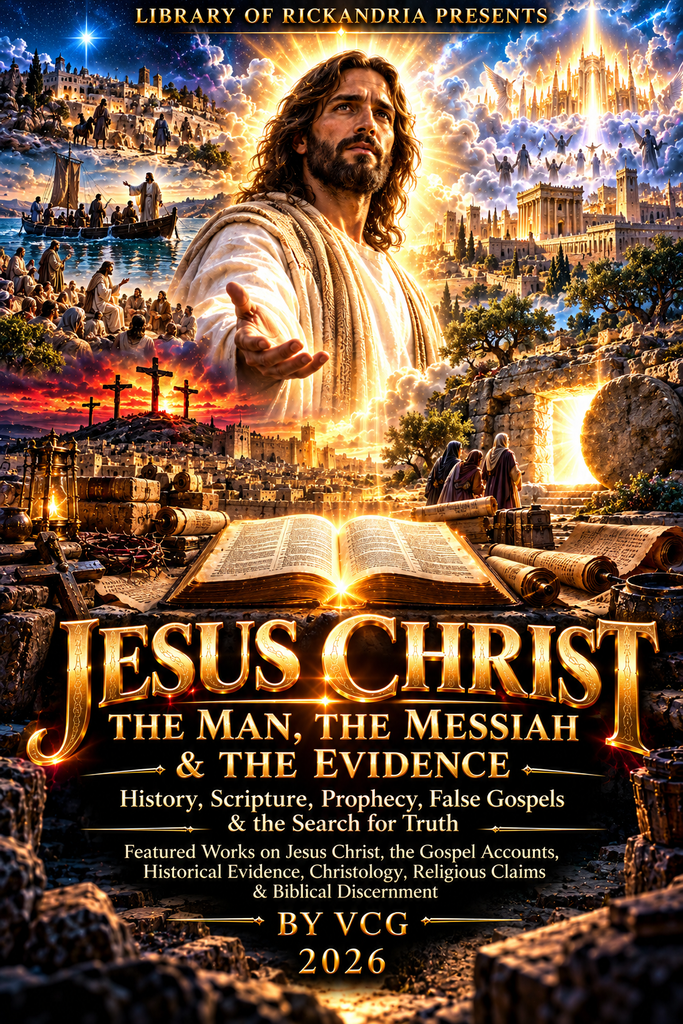
JESUS CHRIST: THE MAN, THE MESSIAH & THE EVIDENCE: History, Scripture, Prophecy, False Gospels & the Search for Truth
UPDATED BY VCG ON 10/26/2026 @ 16:16 EST
LIBRARY OF RICKANDRIA PRESENTS
JESUS CHRIST: THE MAN, THE MESSIAH & THE EVIDENCE
History, Scripture, Prophecy, False Gospels & the Search for Truth
Featured Works on Jesus Christ, the Gospel Accounts, Historical Evidence, Christology, Religious Claims & Biblical Discernment
Research & Investigations by VCG | 2025–2026
“But these are written, that ye might believe that Jesus is the Christ, the Son of God; and that believing ye might have life through his name.” — John 20:31, KJV
Introduction: Who Is Jesus Christ?
Few figures have been discussed, worshipped, criticized, reinterpreted or invoked more often than Jesus of Nazareth.
The Gospels present him as the promised Christ, a teacher of extraordinary authority, the crucified and risen Lord.
Historical scholarship examines the first-century Jewish setting in which he lived and the earliest surviving testimony concerning him.
Christian theology asks what it means to call him the Son of God, the Word made flesh, and the Saviour of the world.
Modern internet discussions add still more claims:
Was Jesus invented by Rome?
Was he borrowed from Osiris?
Did he travel to India or America?
Were his teachings hidden by conspirators?
Did he actually return centuries ago?
Was he merely one expression of universal consciousness?
Do anonymous visions and alleged messages reveal a different Jesus?
These questions do not all belong to the same category.
Some can be tested using dated manuscripts, ancient historians or documentary records.
Others require careful interpretation of biblical texts.
Still others are philosophical proposals, personal testimonies or unverified speculation.
The Library of Rickandria’s Jesus Christ research collection contains 20 featured works—a major Christ-centered manual and 19 investigations and critiques—addressing these questions through the King James Bible, historical sources, reasoning and evaluation of modern claims.
This hub is not a substitute for reading the Gospels.
It is a guide to the investigations, preserving their individual subjects while distinguishing what Scripture says, what historical sources support, what theologians interpret, and what remains unproven.
Begin With the Biblical Jesus
Before examining competing stories about Christ, read the principal passages that establish the New Testament’s portrait.
His birth and historical setting.
Matthew 1–2 and Luke 1–2 situate Jesus within Israel’s history, under identifiable political rulers and among ordinary families.
His identity.
John 1:1–14 describes the Word who was with God, was God, and became flesh.
Mark 8:29 records Peter’s confession,
“Thou art the Christ.”
The interpretation of Christ’s deity, humanity and relationship to the Father is a major subject of Christian theology.
His ministry.
The Gospels describe Jesus teaching, healing, challenging hypocrisy, welcoming children, calling for repentance and announcing the kingdom of God (Mark 1; Matthew 5–7; Luke 4; Mark 10).
His death.
The New Testament places his crucifixion under Pontius Pilate and understands it in relation to sin, atonement and reconciliation (Mark 15; John 19; 1 Corinthians 15:3).
His resurrection.
The four Gospels report resurrection appearances; Paul passes on an early Christian proclamation in 1 Corinthians 15:3–8.
Their theological significance is central to Christian belief.
The historical study of ancient testimony and the confession that God raised Jesus should be distinguished rather than confused.
His promised return.
- Matthew 24
- Acts 1:9–11
- 1 Thessalonians 4
and Revelation contain relevant teachings and visions.
Christians disagree over some interpretations of prophetic timing, but confident modern date-setting should never masquerade as the wording of Scripture.
A useful guide is Jesus’ own statement:
“Search the scriptures; for in them ye think ye have eternal life:
and they are they which testify of me.” — John 5:39, KJV
THE TWENTY FEATURED WORKS
PART I — WHO IS JESUS? HISTORY, THE GOSPELS & HIS IDENTITY
01. JESUS CHRIST REVEALED — THE TRUTH THEY HID
A comprehensive Christ-centered manual on Scripture, history and competing portrayals of Jesus
This earlier Library of Rickandria e-manual explores Jesus’ identity before Bethlehem, biblical prophecies, the incarnation, the “missing years,” Jesus in Islam and other religious traditions, proposed Grail and bloodline narratives, interpretations of the Second Coming, and claims concerning institutions and secret societies.
It is an extensive, explicitly confessional theological work, not simply a neutral historical survey.
Its assertions about suppressed knowledge, particular religious groups, travels to India and the identification of Old Testament figures with Christ should be assessed individually:
some are biblical teachings, some theological interpretations and some historical hypotheses requiring corroboration.
Key question:
What do the Gospel and apostolic writings establish about Christ, and which further claims belong to later interpretation or speculation?
Scripture for comparison:
- John 1:1–14
- Colossians 1:15–20
- Hebrews 1–2
- 1 Corinthians 15
02. CHRISTOLOGY IN THE ANONYMOUS AGORA
Is Jesus truly God, truly man, subordinate to the Father—or some combination?
This examination of a 4chan discussion studies arguments about the Father and Son, Christ’s obedience, the title “firstborn,” the incarnation, and the difference between Jesus and angels.
It also corrects decontextualized or prejudicial claims that intruded into the debate.
The work compares passages sometimes placed in opposition—such as John 14:28 and 1 Corinthians 15:28 on one side, and John 1, Colossians 1 and Hebrews 1–2 on the other.
It distinguishes biblical statements from the terminology later Christian theology developed to relate them.
Key question:
Can an interpretation account for both Christ’s genuine humanity and the New Testament’s extraordinary claims about him without ignoring inconvenient passages?
Scripture for comparison:
- John 1
- Philippians 2:5–11
- Hebrews 1–2
- 1 Timothy 2:5
03. JESUS, EHRMAN & THE EVIDENCE
Textual criticism, doubts about Christianity and the historical Jesus
An anonymous participant encounters the historical scholarship of Bart Ehrman and begins questioning the faith he hopes is true.
The discussion grows to include textual variants, Gospel authorship, the historical Jesus, early Christian literature, Roman sources, the resurrection and the problem of evil.
Rather than assuming that every Christian defense is sound or every skeptical objection is decisive, this study separates legitimate scholarly questions from exaggeration, weak apologetics and unsupported claims.
Historical evidence about Christian origins does not automatically settle every theological question, but neither may theology erase relevant history.
Key question:
How should readers distinguish a real manuscript or authorship question from the conclusion that Christianity has therefore been disproved?
Scripture for comparison:
- Luke 1:1–4
- 1 Corinthians 15
- Acts 17:11
04. “ONLY FOUR ANONYMOUS GOSPELS” & “PAUL COULDN’T QUOTE JESUS”
What are the earliest surviving sources for Jesus?
This source-focused paper examines a familiar online argument:
that the Gospels were late anonymous inventions and Paul could not quote Jesus because no actual teacher stood behind Christian origins.
It acknowledges that Paul’s undisputed letters generally predate the written Gospels, and that the Gospel narratives do not identify their writers in a modern first-person signature.
It then shows why those observations do not eliminate early Christian testimony, Paul’s references to Jesus’ teachings, his contact with Peter and James, or non-Christian ancient sources.
Key question:
What do the dates and literary characteristics of our sources actually tell us—and what do they not tell us?
Scripture for comparison:
- 1 Corinthians 7:10–11; 11:23–26; 15:3–8
- Galatians 1:18–19
05. “IT IS ALL BS”: ARCHETYPES, EUHEMERISM & THE HISTORICAL JESUS
Does a religious figure’s symbolic significance prove he was invented?
This critique responds to a claim that Jesus, Yahweh and other biblical figures are merely archetypes derived from ancient nobles.
It explains the distinction between archetypal storytelling, euhemerism (explaining gods as deified historical people) and the historical evidence for individual figures.
The study argues that Christian narratives may use patterns drawn from Israel’s Scriptures without implying that the historical Jesus never lived.
It refers to Paul’s early testimony and later Jewish and Roman historical references.
Key question: Is a meaningful resemblance between stories proof that the individuals represented never existed?
Scripture for comparison:
- Galatians 1:18–19
- Luke 1:1–4
- 1 Corinthians 15:3–8
06. “CHRIST IS KING” IS BRAINWASHING?
The antiquity of Christ’s kingship and the misuse of religious slogans
An October 2026 thread claims that the proclamation “Christ is King” was invented in the twentieth century as an instrument of political manipulation.
The study checks early Christian references, nineteenth-century sermons and hymns, the 1925 institution of the Feast of Christ the King, and the expression’s political uses.
It distinguishes the ancient Christian doctrine of Christ’s kingship from later movements that may appropriate religious language for coercive or partisan purposes.
Key question:
Does an expression’s political misuse disprove its biblical basis or earlier history?
Scripture for comparison:
- John 18:36–37
- 1 Timothy 6:15
- Revelation 19:16
PART II — OTHER JESUSES: MYTHOLOGY, GNOSTICISM & RELIGIOUS COMPARISONS
07. WAS JESUS REALLY OSIRIS?
Egyptian mythology, Baphomet, Saturn and Childhood’s End
A theory arising from the science-fiction story Childhood’s End connects Jesus to Osiris, Baphomet, Saturn, and the Gnostic Demiurge.
The study traces the different origins and meanings of these figures and the symbols used in the argument.
It recognizes that art and myth often share imagery, but separates deliberate fictional symbolism and historical parallels from claims that distinct religious figures were secretly one being.
Key question:
What evidence would be required to turn symbolic resemblance into proof of common historical identity?
Scripture for comparison:
- John 1:1–14
- 1 Corinthians 15
- Colossians 1:15–20
08. DID JESUS TEACH WU WEI?
Daoist philosophy, Christian teaching and fabricated historical connections
A comparison between Jesus’ teaching and the Daoist concept of wu wei develops into a sprawling discussion of lost gospels, contested history and supposed institutional conspiracies.
The investigation explains the relevant philosophical vocabulary and asks whether similarities concerning striving, anxiety and self-denial demonstrate borrowing.
Its conclusion is carefully limited: meaningful comparisons are possible, but similar ethical themes do not establish identical doctrines or direct historical influence.
Key question:
When are two religious teachings comparable, and when does comparison become a claim of undocumented borrowing?
Scripture for comparison:
- Matthew 6:25–34
- Luke 9:23
- John 14:6
09. THE DEVIL IS IN THE DETAILS: JESUS, LUCIFER & OCCULT HAND SIGNS
Religious iconography and the danger of visual guilt by association
A collage of hand gestures in images of Jesus, Buddha, Shiva and Baphomet inspires claims of a hidden shared religion and an occult identification of Jesus with Lucifer.
The paper examines Christian blessing gestures, South Asian mudras, the history of occult iconography and the interpretive leaps made from images.
A gesture may be historically meaningful without meaning the same thing in every setting.
Key question:
Can similar-looking gestures establish shared doctrine, conspiracy or supernatural identity? Not without much more evidence.
Scripture for comparison:
- John 8:12
- 2 Corinthians 11:14
- 1 John 4:1
10. JESUS, GNOSTICISM & THE HIDDEN-LINEAGE THESIS
Essenes, Egypt, Akhenaten, Paul and the supposed suppression of Christianity’s origins
This investigation reconstructs a proposed secret transmission line from Egyptian religion through the Essenes and Jesus into Gnostic groups and later esoteric societies, with Paul and canon formation cast as mechanisms of suppression.
It acknowledges genuine questions about Second Temple Jewish sects, the development of the New Testament canon, textual variants and the diversity of early Christianity.
Those facts, however, do not by themselves document the claimed hidden lineage.
Key question: Is there a verifiable chain of texts and historical transmission, or only similarities combined into a compelling story?
Scripture for comparison:
- John 18:20
- 1 Corinthians 15
- Colossians 2:8
11. YHWH, SATAN & THE GOD OF JESUS
Examining a modern Marcionite-style separation of the Old and New Testaments
An online argument identifies the God of Israel with Satan and presents Jesus as revealing a completely different deity.
This study examines ancient Marcionite and Gnostic comparisons, uses of John 8 and the interpretation of difficult Old Testament passages.
It highlights a major textual problem for an absolute separation:
the Gospels portray Jesus quoting Israel’s Scriptures, invoking Moses and speaking of the Father recognized by his Jewish interlocutors.
Key question:
Does Jesus reject the identity of Israel’s God, or does the theory depend on isolating particular verses from their surrounding context?
Scripture for comparison:
- John 5:39–47
- John 8:44–54
- Matthew 5:17–18
PART III — THE CROSS, THE RETURN OF CHRIST & CLAIMS ABOUT HISTORY
12. WAS JESUS SUPPOSED TO RETURN 2,000 YEARS AGO?
Missing centuries, a secret millennium and competing interpretations of prophecy
Beginning with the difficult question of apparent nearness in New Testament prophecy, the source discussion moves toward assertions that hundreds of years have been erased, Christ already reigned for a thousand years, and official history conceals the truth.
The investigation studies early Christian expectations, the destruction of Jerusalem in AD 70, competing approaches to Christ’s return, and independent methods for dating historical events.
It takes the original timing question seriously without accepting the alleged secret millennium.
Key question:
How should New Testament timing language be interpreted, and what evidence would a radically altered chronology require?
Scripture for comparison:
- Matthew 24
- Acts 1:7–11
- 2 Peter 3:8–9
- Revelation 20
13. DEATH IS FAKE? JESUS WAS IN AMERICA?
A conspiracy theory about geography, chronology and physical reality
This examination addresses a claim that death is unreal, the events of Jesus’ life happened in North America, and much of the accepted historical and geographical record is fabricated.
The discussion also includes assertions about warfare, ancient objects and the meaning of bodily life.
The research compares the proposals with archaeology, historical manuscripts, ordinary physical evidence and the biblical presentation of death and resurrection.
Key question:
What independent historical evidence could establish a relocation of first-century Judean events to another continent?
Scripture for comparison:
- Luke 2
- John 19–20
- 1 Corinthians 15
14. HITLER, JESUS & THE TIMELINE THAT NEVER WAS
A false messiah, Holocaust denial and alternative-history reasoning
A provocative counterfactual question about Jesus’ return in a world where Nazi Germany won World War II develops into Holocaust denial, antisemitic conspiracy claims and attempts to portray Hitler as a messianic figure.
The study uses historical records and Scripture to reject those distortions.
It explains why authentic fragments of history cannot be used to erase the larger documented record and why political worship must not be confused with Christian faith.
Key question:
How can a true historical detail be repurposed to support a conclusion that the full historical record contradicts?
Scripture for comparison:
- Matthew 24:4–5, 36
- John 18:36
- Revelation 19:16
PART IV — REVELATIONS, ALTERNATE GOSPELS & CLAIMS OF SUPERNATURAL AUTHORITY
15. “ARE WE ALL GOD?” — THE 4CHAN THREAD THAT TRIED TO REWRITE JESUS
Universal consciousness and the distinction between Creator and creature
A discussion proposes that every person is one consciousness, individual identity is illusory, and Jesus disclosed universal godhood rather than the traditional Christian Gospel.
The paper evaluates philosophical arguments about the self, neuroscience, theosis and biblical passages involving divine unity.
It distinguishes bearing God’s image or being united with Christ from the very different claim that every individual is literally the one Creator.
Key question:
Does biblical unity with God erase personal identity or make all persons numerically identical to God?
Scripture for comparison:
- Genesis 1:27
- John 17
- Psalm 82
- John 10:34–36
16. THE GOSPEL ACCORDING TO 4CHAN
Alien creators, trapped souls and self-salvation
This paper dissects an alternative cosmology in which extraterrestrial engineers made humanity, Earth is a prison for reincarnating souls, and spiritual liberation comes through personal awakening rather than the saving work of Jesus.
It traces the account’s relationships with modern spiritual literature, Gnostic ideas and near-death speculation, while distinguishing the narrative’s compelling themes from evidence for its literal claims.
Key question:
What happens to the meaning of the Gospel when sin, grace, the cross and resurrection are replaced by a mechanism of escape through secret knowledge?
Scripture for comparison:
- John 3:16–17
- Ephesians 2:8–9
- Hebrews 9:27
- 1 Corinthians 15
17. HE CLAIMS HE MET JESUS, MOVED AN ASTEROID & TRAVELED FROM 2029
Testing a self-proclaimed messenger’s extraordinary testimony
An anonymous participant calling himself “Metatron” alleges travel from the future, personal encounters with Jesus, unusual powers over the asteroid Apophis, and knowledge of extraterrestrials and humanity’s destiny.
The study compares testable astronomical and chronological details with the poster’s claims while examining the differences between a powerful experience, an assertion of spiritual authority and independently verified evidence.
Key question:
What specific observations could confirm or disconfirm a person claiming supernatural knowledge of the future?
Scripture for comparison:
- Matthew 24:23–26
- 1 John 4:1
- 1 Thessalonians 5:21
18. ANOTHER JESUS, ANOTHER SPIRIT
A troubling personal report, occult theories and responsible discernment
A forum poster describes an allegedly supernatural presence that presents itself as Jesus.
The replies broaden into angelic communications, occultism, hidden groups, alleged persecution and competing psychological explanations.
The investigation carefully separates what someone reports experiencing from claims about what caused the experience.
It evaluates relevant biblical teaching without treating an anonymous narrative as proof of spiritual attack or dismissing the person’s distress.
Key question: How can spiritual claims be tested without making unsupported diagnoses or intensifying fear?
Scripture for comparison:
- 2 Corinthians 11:3–4
- 1 John 4:1
- 2 Timothy 1:7
PART V — FEAR, FALSE ACCUSATIONS & THE ETHICS OF DISCERNMENT
19. FEAR NOT — BUT FEAR GOD
Jesus, moral courage and a disputed modern “credo”
This study examines Bruce Charlton’s commentary on ideas attributed to Miles Mathis concerning Jesus, fear, reincarnation, the cross and the resurrection.
It contrasts ordinary fear, fear of human threats and biblical reverence for God.
The study emphasizes that the biblical command not to fear does not cancel every form of caution or the
“fear of the LORD,”
and that reducing Jesus’ mission to the elimination of fear omits central New Testament claims about the cross and resurrection.
Key question:
Can one true theme of Jesus’ teaching become misleading when made into an explanation for his entire mission?
Scripture for comparison:
- Matthew 10:28
- 2 Timothy 1:7
- 1 Corinthians 15:3–4
20. LIES ABOUT JESUS & CHILDREN
Responding to a severe historical allegation with evidence rather than outrage
This paper addresses a serious defamatory online allegation about Jesus and children.
The article examines what surviving ancient sources report about the reasons for his execution and whether any evidence supports the accusation.
It finds no credible basis for the claim.
The broader methodological point is important:
attaching a shocking modern comparison to an ancient individual does not produce an ancient source, a witness, or a documented offense.
The evidence must be assessed without minimizing real abuse or turning accusations into entertainment.
Key question:
What is the difference between an accusation designed to provoke disgust and an allegation supported by relevant historical records?
Scripture for comparison:
- Mark 10:13–16
- Matthew 18:1–6
- John 19:19
A Research Map: Evidence, Interpretation & Claims
| Subject | What may be established | What requires separate argument |
|---|---|---|
| Jesus in first-century history | Early Christian sources situate Jesus in Roman Judea; later Jewish and Roman references provide additional testimony | The complete theological meaning of his identity and work |
| The four Gospels | They are ancient Christian narratives with complex composition and transmission histories | That every traditional attribution or modern skeptical reconstruction must be accepted without examination |
| Paul’s letters | Several Pauline letters are among the earliest surviving Christian writings and transmit teachings about Jesus | That their earlier date either proves or disproves the entire Gospel tradition |
| Resurrection | Early Christians proclaimed that Jesus was raised and reported appearances | Assessing the event itself entails historical, philosophical and theological questions |
| Comparative mythology | Different religious traditions may share motifs and symbols | That similar motifs prove one deity is another or that direct copying occurred |
| Prophetic timelines | Biblical passages and historical events can be studied and dated | That a modern chronology conspiracy or predicted return date is therefore established |
| Personal revelations | Someone may sincerely report an encounter or vision | That the reported source was Jesus or that additional supernatural claims are factual |
| Internet allegations | A post or image documents what somebody alleged | The truth of the allegation or the identity and motive of its author |
Suggested Reading Order
1. Establish the Gospel.
Begin with John 1–3, Mark 1, John 19–21, and 1 Corinthians 15.
Then read Jesus Christ Revealed with the relevant Bible passages open, distinguishing its scriptural claims from later historical hypotheses.
2. Investigate the sources.
Read Only Four Anonymous Gospels, Jesus, Ehrman & the Evidence, and “It Is All BS.”
These help distinguish the historical Jesus from later philosophical arguments and internet claims.
3. Study who Christ is.
Read Christology in the Anonymous Agora and “Christ Is King” Is Brainwashing?, comparing biblical passages about Christ’s humanity, deity and kingship.
4. Compare alternative narratives.
Read the Osiris, Wu Wei, Hidden-Lineage, Hand Signs, and YHWH investigations, keeping similarities, historical transmission and theological equivalence separate.
5. Test prophecy and modern testimony.
Read Secret Millennium, The Gospel According to 4chan, Are We All God?, and 2029 Traveler before examining the remaining studies on historical distortions, fear and false allegations.
Frequently Asked Questions
Did Jesus of Nazareth exist historically?
The prevailing conclusion of historical scholarship is that Jesus was a historical first-century Jewish figure who was crucified under Pontius Pilate.
That conclusion is distinct from accepting every theological claim made about him.
Do we know who wrote the four Gospels?
The Gospels are traditionally attributed to Matthew, Mark, Luke and John.
Their narratives do not identify their authors with modern signatures, and scholars debate their composition and sources.
This is a genuine historical question—not proof that no early Jesus tradition existed.
Was the divinity of Jesus invented at the Council of Nicaea?
No. Beliefs and texts describing Christ in exalted or divine terms predate Nicaea in AD 325.
The council and later theological debates helped define how competing interpretations of Father, Son and divine nature would be articulated; they did not create all earlier claims about Christ from nothing.
Did Jesus go to India or North America?
The canonical Gospels do not document such journeys.
Modern claims about India and radically relocated Gospel geography require verifiable historical sources; gaps in the narratives do not themselves supply that evidence.
Was Jesus copied from Osiris, Mithras or other ancient gods?
Shared symbols and broad motifs do not establish direct borrowing, and alleged parallels must be compared using the actual ancient sources and their dates.
Some comparisons may be worth exploring; simplistic one-to-one identifications frequently go beyond the evidence.
Is the resurrection a historical claim or a theological claim?
It is both a claim about an event and the central proclamation of Christian faith.
Historians can study the sources, their dates, their claims and early Christian conviction.
The conclusion that God raised Jesus also involves philosophical and theological judgment about the cause and meaning of the reported event.
Did Jesus teach that every person is literally God?
The New Testament speaks about people bearing God’s image, becoming children of God and being united with Christ.
These teachings should not be confused with the claim that each individual is numerically identical to the Creator.
Has Jesus already returned and completed the millennium?
Christians interpret some prophetic texts in preterist, futurist, historicist, idealist and combined ways.
Assertions that an otherwise undocumented thousand-year earthly reign has already happened require evidence beyond symbolic architecture and altered chronology claims.
How should claims of a personal encounter with Jesus be evaluated?
Treat the person respectfully, examine the content and context, consider ordinary explanations when appropriate, and do not confuse sincerity with verification.
Christians may compare spiritual teachings with Scripture while avoiding unsupported claims about a person’s health or circumstances.
Primary Texts & Further Study
Read first:
Matthew, Mark, Luke and John; Acts 1–2; Romans 5–8; 1 Corinthians 15; Philippians 2;
Colossians 1; Hebrews 1–2; and Revelation 19–22, in the King James Bible.
For historical study:
Examine Paul’s authentic early letters, the Gospel manuscript tradition, Josephus’ Antiquities of the Jews and Tacitus’ Annals.
The texts differ in proximity to events, genre, purpose and transmission, and should not be treated as interchangeable witnesses.
For competing traditions:
Study the actual ancient and late-antique sources before relying on modern claims about Gnosticism, Egypt, Daoism, the Essenes or secret lineages.
For online claims:
Follow citations back to original publications, verify dates, and distinguish satire, personal experience, interpretation, hearsay and direct evidence.
Explore the Wider Library
- WHO IS GOD? — Nature of God, Suffering & Divine Justice
- CHRISTIANITY — Scripture, Salvation & Theology
- THE 4CHAN FILES — Where Anonymous Claims Meet Evidence & Scripture
- VCG PAPER PROJECTS
- JESUS CHRIST — Basecamp Companion Index
Final Perspective: Begin and End With the Actual Sources
Jesus Christ is not served by weak historical arguments, exaggerated claims of suppression or uncritical repetition of rumors.
Neither is serious investigation served by dismissing Christian testimony merely because it is religious.
The responsible task is to read the Gospels carefully, examine the earliest witnesses, recognize genuine scholarly questions, evaluate competing interpretations fairly and refuse to manufacture certainty where evidence is absent.
For Christian readers, the central proclamation remains the death and resurrection of Jesus Christ (1 Corinthians 15:3–4), not the latest anonymous explanation of a hidden timeline, secret bloodline or cosmic escape mechanism.
“Jesus saith unto him, I am the way, the truth, and the life:
no man cometh unto the Father, but by me.” — John 14:6, KJV
Soli Deo Gloria — To God alone be the glory.
LIBRARY OF RICKANDRIA | RESEARCH BY VCG | 2025–2026
The “Lost Years” of Jesus & Alleged Asian Appearances – Library of Rickandria
Ash Maiz’s Biggest Error: The REAL Reason Israel Rejected Jesus Christ – Library of Rickandria
THE 4CHAN FILES: Where Anonymous Claims Meet Evidence & Scripture – Library of Rickandria
VCG PAPER PROJECTS – Library of Rickandria