
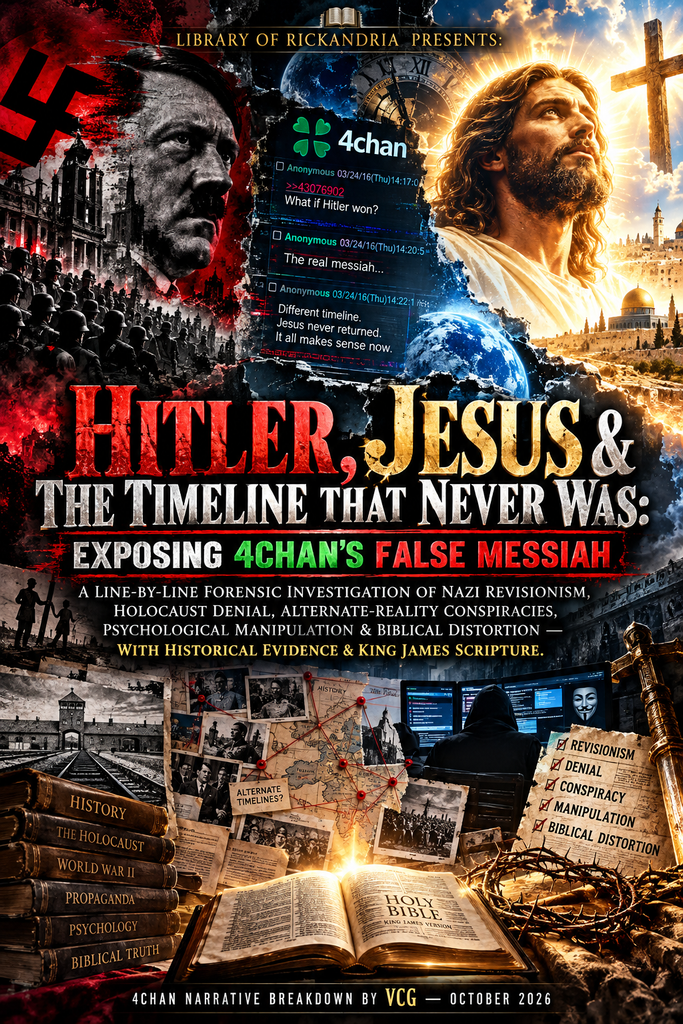
Hitler, Jesus & the Timeline That Never Was: Exposing 4chan’s False Messiah
UPDATED BY VCG ON 10/14/2026 @ 18:18 EST
A Line-by-Line Forensic Investigation of Nazi Revisionism, Holocaust Denial, Alternate-Reality Conspiracies, Psychological Manipulation & Biblical Distortion — With Historical Evidence & King James Scripture.
Anyone can do this, but most won’t.
Hitler, Jesus & the Timeline That Never Was: Exposing 4chan’s False Messiah is a comprehensive, line-by-line forensic investigation of a disturbing October 2026 4chan discussion that attempts to intertwine Adolf Hitler, Jesus Christ, Nazi revisionism, Holocaust denial, alternate timelines, and biblical prophecy into a conspiratorial narrative. Drawing upon primary historical documents, Holocaust archives, peer-reviewed psychological research, and the King James Bible, the Library of Rickandria systematically dismantles historical distortions, exposes logical fallacies, examines psychological mechanisms such as scapegoating, motivated reasoning, moral inversion, and conspiratorial thinking, and demonstrates how genuine historical facts can be manipulated to support fundamentally false conclusions. Particular attention is given to the attempted portrayal of Hitler as a messianic figure, the misuse of the Haavara Agreement and Auschwitz camp infrastructure, antisemitic collective-guilt accusations, and speculative interpretations of the Antichrist and Second Coming. By carefully distinguishing documented history from conjecture, psychological analysis from personal judgment, and Scripture from theological interpretation, this investigation reveals how political mythology can masquerade as historical truth and divine revelation. Its central message is uncompromising: truth must be established through verifiable evidence, sound reasoning, historical context, and faithful examination of Scripture—not manufactured timelines, ideological deception, or counterfeit messiahs. Soli Deo Gloria.
ChatGPT – Library of Rickandria
/x/ – Would Jesus come back if Hitler won the war? – Paranormal – 4chan
Hitler, Jesus & the Timeline That Never Was: Exposing 4chan’s False Messiah
LIBRARY OF RICKANDRIA PRESENTS
A Line-by-Line Forensic Investigation of Nazi Revisionism, Holocaust Denial, Alternate-Reality Conspiracies, Psychological Manipulation & Biblical Distortion — With Historical Evidence & King James Scripture
4chan Narrative Breakdown by VCG — October 2026
Research date: October 14, 2026
Primary source:
4chan /x/ Thread No. 43076902 — “Would Jesus come back if Hitler won the war?”
ABSTRACT
On October 13, 2026, an anonymous participant on 4chan’s paranormal board, /x/, opened a discussion asking whether Jesus Christ would return if Adolf Hitler had won World War II.
/x/ – Would Jesus come back if Hitler won the war? – Paranormal – 4chan
The question was unusual, but it was not especially complicated.
It involved a hypothetical historical outcome and a Christian theological expectation.
What followed was considerably more revealing.
Within approximately twenty-five hours, the discussion had developed into a collection of:
- alternate-history theories
- Holocaust-denial arguments
- claims about Nazi Germany’s supposed benevolence toward Jewish people
- allegations of Jewish control over world events
and attempts to identify Adolf Hitler with Jesus Christ.
Other participants challenged these claims.
Some offered legitimate criticism.
Others resorted to mockery, sweeping psychological judgments, or equally unsupported predictions.
One contributor compared Hitler’s death and subsequent reputation to Christ’s crucifixion and the early growth of Christianity.
Another used the existence of a swimming facility at Auschwitz and an actual 1933 emigration agreement to portray the Nazi dictator as a Jewish protector.
Still another imagined that Germany had won in an original timeline and that our present history was somehow the altered version.
The exchange is a useful case study because several different kinds of reasoning are operating at once.
There are factual historical assertions that can be tested against archival records.
There are counterfactual scenarios that can be considered but not verified as actual events.
There are psychological interpretations that may help explain the rhetoric without telling us the identities or private motives of the posters.
And there are biblical claims that must be examined according to the words and context of Scripture.
This investigation examines all nineteen posts visible in the October 14 research snapshot, reconstructs the reply relationships, independently checks the major historical claims, and compares the theological assertions with the King James Version of the Holy Bible.
It also considers the wider history of Christianity under Nazi rule, the development of religious antisemitism, the psychology of conspiratorial belief, and the methodological difference between genuine historical investigation and narratives that cannot be disproved.
The central conclusion is straightforward:
The thread provides no credible evidence that Hitler was Jesus, that Nazi victory occurred in another original historical timeline, or that Jewish people collectively engineered the Second World War’s outcome.
Its apparent supporting evidence consists largely of historical fragments removed from context, speculative connections, and assertions for which adequate documentation is absent.
The purpose of this paper is not to ridicule anonymous individuals.
It is to determine exactly where claims stop being supported by the available evidence.
I. WHY THIS THREAD DESERVES A CAREFUL INVESTIGATION
There is an understandable temptation to dismiss a discussion like this without examining it.
A question about Hitler winning World War II, Christ returning, and an illegitimate alternative timeline sounds more like the premise of speculative fiction than an argument about historical reality.
But dismissing the subject simply because it sounds strange would not help us understand how the claims are assembled.
In this thread, the most consequential assertions are not all invented from nothing.
Some begin with real historical material.
There genuinely was an agreement facilitating Jewish emigration from Nazi Germany to Palestine in the 1930s.
There genuinely was a firewater reservoir at Auschwitz that acquired features resembling those of a swimming pool.
Canadian prime minister Louis St-Laurent genuinely used language about the European powers’ former assumption of superiority.
Christianity genuinely grew from a first-century Jewish movement to a major religion within the Roman Empire.
Each observation is capable of independent verification.
The trouble begins when those observations are made to support conclusions they cannot establish.
An agreement permitting some Jews to leave Germany becomes supposed proof that Hitler protected Jews.
A reservoir becomes supposed proof that Auschwitz was not a site of mass murder.
A criticism of European imperialism becomes evidence of a secret racial war.
The growth of Christianity becomes a prediction of the eventual vindication of Nazism.
This is the pattern the paper investigates.
We must distinguish the authenticity of an isolated fact from the validity of the conclusion drawn from it.
A fact may be genuine and the argument built around it entirely false.
Our governing standards
The investigation follows six principles.
First, establish exactly what was said.
A critic should not invent a more extreme version of an argument merely because the original is objectionable.
Second, examine the best available evidence.
- Whenever possible
- prefer contemporary documents
- physical records
- archival collections
and specialist historical scholarship over unsourced internet summaries.
Third, follow chronology.
What happened in 1933 cannot be used by itself to erase what happened in 1941, 1942, or 1944.
Fourth, inspect each inference.
Evidence of one proposition does not necessarily establish the next proposition.
Fifth, separate psychology from diagnosis.
We can identify rhetorical patterns without knowing whether a poster is:
- sincere
- joking
- angry
- frightened
or intentionally deceptive.
Sixth, distinguish Scripture from interpretation.
We can quote the King James Bible precisely while acknowledging that Christians disagree about certain prophetic passages.
A useful biblical summary appears in 1 Thessalonians 5:21:
Prove all things; hold fast that which is good.
That instruction should apply to arguments on every side of this discussion.
Evidential classifications
| Classification | Meaning |
|---|---|
| Documented | Supported by identifiable evidence that readers can examine |
| False | Contradicted by established evidence |
| Misleading | Based on a real fact but misrepresenting its context or significance |
| Unsubstantiated | Lacking sufficient supporting evidence |
| Speculative | A hypothesis, counterfactual, or possibility not established as fact |
| Interpretive | Dependent on a particular reading of historical, psychological, or biblical material |
| Rhetorical | Primarily an insult, joke, emotional expression, or provocation |
Not every unsupported statement can be definitively disproved.
Sometimes the appropriate conclusion is simply that we do not know.
That distinction is essential to honest investigation.
II. THE PRIMARY-SOURCE CASE FILE
The discussion began on Tuesday, October 13, 2026, at 16:35:58, according to the timestamp displayed by 4chan.
The opening poster used the name TNB.
By the October 14 research cutoff, the source displayed nineteen posts.
The last visible message was numbered 43081585 and timestamped 17:37:03.
These are the timestamps displayed by the website; no independent timezone conversion has been applied.
The primary record can be examined here:
Original 4chan /x/ discussion, No. 43076902
The central question was:
Would Jesus come back if Hitler won the war?
The accompanying text wondered whether an Antichrist would exist in such a world and whether the present reality represented a false alteration of an original timeline.
The thread’s development is important.
It did not begin with a detailed Nazi theological manifesto.
It began with a speculative question.
The more explicitly extremist propositions entered through subsequent replies.
The reply structure
The source contains several overlapping conversational branches rather than one continuous argument.
The opening post received responses about:
- religion
- Halloween
- European power
- historical skepticism
- Christ’s identity
- apocalyptic expectations
- political ideology
One participant challenged the idea of historical certainty.
A later participant used that comment to introduce an alternative-timeline theory.
Another contributor criticized passive apocalyptic fantasies.
That criticism provoked an accusation that Jews were preparing to use artificial intelligence to obtain control.
A separate chain moved from a general critique of political inaction to personal insult, followed by an explicitly neo-Nazi identification and a wish for nuclear destruction.
These relationships matter because different anonymous posts should not automatically be attributed to the same individual or ideological faction.
We cannot responsibly assume that every participant agreed with every preceding claim.
III. THE POST-BY-POST FORENSIC EXAMINATION
Post 1 — No. 43076902: The timeline that should not exist
The opening author asks whether Christ would return if Hitler won World War II, whether an Antichrist would arise, and whether our actual historical world might be an illegitimate alternative to one in which Germany prevailed.
Three different questions are being combined.
The first is theological:
does Christ’s return depend upon the outcome of a particular human war?
The second is prophetic:
how would biblical expectations of antichrist operate in an imagined alternative history?
The third is metaphysical:
could the timeline we inhabit be an altered, inferior version of another reality?
The Bible does not provide a calendar in which Nazi victory is a prerequisite for Christ’s appearing.
Matthew 24:36 states:
But of that day and hour knoweth no man, no, not the angels of heaven, but my Father only.
Acts 1:7 similarly warns against claiming knowledge of times and seasons that remain under divine authority.
These verses do not settle every disagreement about eschatology.
They do establish that a supposed connection between Hitler’s military fortunes and the timing of Christ’s return cannot simply be assumed.
The alternate-reality claim raises a different problem.
One can imagine a world in which Germany won the war.
Historical novelists have done precisely that.
But imagining a possible history is not the same as discovering that such a history actually occurred.
The Stanford Encyclopedia of Philosophy’s discussion of the many-worlds interpretation explains a serious interpretation of quantum mechanics.
It does not establish that political events have secretly been rewritten or that one historical branch possesses special moral legitimacy.
Even if one accepted a many-worlds interpretation, a further argument would be necessary to show how a person in this world could identify another branch as the supposedly authentic one.
The poster supplies no such argument.
Finding:
The theological question is legitimate as a hypothetical.
The claim that our timeline is a false historical replacement is unsupported.
Post 2 — No. 43076908: New Age spirituality enters the discussion
The original participant asks whether New Age teachers in the imagined alternate reality would still describe human existence as a process of spiritual development.
The question is phrased mockingly.
There is an important distinction here between Christian spiritual growth and the various beliefs commonly grouped under New Age spirituality.
Christian sanctification, as presented in passages such as Romans 8:29 and 2 Peter 3:18, concerns spiritual transformation within the framework of Christian faith.
New Age traditions are diverse.
Some incorporate reincarnation, spiritual evolution, or metaphysical accounts of consciousness that differ considerably from orthodox Christian theology.
One cannot refute all these ideas by treating them as interchangeable.
Nor can a fictional alternative historical timeline tell us what religious beliefs its inhabitants would necessarily hold.
Finding:
This is a rhetorical hypothetical, not an established argument.
Post 3 — No. 43076911: The false-idol accusation
Another participant tells the opening author to discuss the subject elsewhere and accuses the poster of worshipping false idols.
The accusation raises a potentially significant biblical concern.
Exodus 20:3 forbids placing other gods before the LORD.
Isaiah 42:8 presents divine glory as belonging uniquely to God.
If a political leader is being treated as a savior in a religious sense, a Christian critique of idolatry becomes relevant.
But the respondent does not establish whether the original author literally worships Hitler, sees him as a historical hero, or merely enjoys provoking others with a disturbing hypothetical.
Those beliefs should not be confused.
Finding:
The biblical category of idolatry is relevant, but the personal accusation is not demonstrated.
Post 4 — No. 43076919: Provocation acknowledged
The opening participant indicates an interest in provoking the site’s religious users.
This does not reveal everything about the author’s beliefs.
It does, however, warn us against reading the opening question as necessarily sincere theological inquiry.
The writer may be testing reactions, mocking religion, promoting an ideology, or combining several of these purposes.
We cannot determine which from the available material.
Methodological lesson:
The more provocative a statement, the more important it becomes to distinguish its wording from assumptions about the author’s intentions.
Proverbs 18:13 warns against answering before hearing the matter.
That principle applies to criticism as much as to belief.
Post 5 — No. 43077009: Halloween as a conversational aside
The next participant responds with a brief joke suggesting that religious users are occupied with Halloween.
There is no developed historical or theological claim here.
A more elaborate rebuttal would risk manufacturing an argument that the contributor never made.
Finding: Rhetorical aside; no substantial proposition requiring refutation.
Post 6 — No. 43077271: The claim of European defeat
This is where the discussion changes considerably.
A participant argues that Hitler’s victory would have preserved European dominance for centuries.
The poster then introduces an alleged calculation by someone named Epstein, a quotation attributed to Louis St-Laurent, and the proposition that the world wars were part of a long campaign against Europeans.
The claims need to be separated.
Would Hitler’s victory have meant European victory?
Not necessarily.
Nazi Germany sought to dominate much of Europe by military force.
Its wars devastated European countries and involved the systematic persecution and murder of European civilian populations.
The Nazi invasion of Poland in September 1939 began the European phase of the Second World War.
Germany later conquered or occupied substantial portions of the continent and attacked the Soviet Union.
A German military victory would not automatically have constituted a victory for Europeans collectively.
One would need to define whose interests counted as European interests and explain how the Nazi racial hierarchy, military occupations, and plans for eastern conquest would have benefited the populations subjected to them.
See the United States Holocaust Memorial Museum’s history of World War II in Europe.
What about the Epstein statistic?
The post attributes a figure of forty percent to an unspecified Epstein.
No sufficiently identifiable source has been established for this statement.
Even before examining its historical truth, we must ask what the percentage measures.
Forty percent of what?
Population? Territory? Economic power? Political influence? Military capacity?
A numerical assertion without a defined measure has no clear evidentiary meaning.
The source would need to be identified, the original words reproduced accurately, and the calculation explained.
Until then, the statistic should not be used as evidence.
Did Louis St-Laurent refer to Europe’s supermen?
Yes, the relevant expression is historically authentic.
But the context changes its meaning.
Louis St-Laurent, Canada’s prime minister during the 1956 Suez Crisis, criticized the assumption that European powers possessed a permanent right to govern or dominate other peoples.
His remark concerned the conduct of European imperial powers during the confrontation over Egypt.
It was not a statement endorsing Nazi racial ideology.
The context can be checked through the Dictionary of Canadian Biography and scholarly discussion of Canada’s role during the Suez Crisis.
The poster uses a real historical expression in a substantially different ideological context.
This is one of the clearest examples of quotation distortion in the entire discussion.
Were both world wars simply genocides against Europeans?
This framing confuses distinct historical categories.
The world wars were large-scale international conflicts with:
- military
- political
- economic
- imperial
- ideological
causes.
They included genocides and other atrocities.
But it does not follow that the wars as a whole were secretly designed as one continuous genocide against Europeans.
Such a claim would require evidence identifying the supposed perpetrators, their coordinated objectives, their planning, and the means by which that plan was implemented.
No such evidence appears in the post.
Finding:
The central racial-historical narrative is unsupported.
The St-Laurent quotation is genuine but miscontextualized, and the statistical claim remains unverifiable.
Post 7 — No. 43078063: When skepticism becomes indiscriminate
This participant responds with a sarcastic sequence questioning belief in:
- wars
- deaths
- maps
- documents
and the claim that Hitler represented the interests of his admirers.
The final implication is that people who identify themselves with Hitler may have misunderstood his actual relationship to them.
The post is ambiguous.
It may be ridiculing extreme historical skepticism rather than seriously denying the existence of nations or wars.
That possibility matters.
If it is satire, the correct analysis is rhetorical.
If it is intended literally, the reasoning is inadequate.
Historical events are not established merely because one textbook or government reports them.
They are established by converging evidence from numerous independent records.
In the case of Nazi crimes, this evidence includes documents produced by the Nazi administration itself, records recovered from military and security institutions, photographs, testimony, camp infrastructure, and postwar investigations.
The USHMM’s examination of evidence introduced at Nuremberg describes how the prosecution assembled these different forms of proof.
Historical skepticism becomes selective when evidence that threatens a preferred belief is rejected automatically while unsupported claims favorable to that belief are accepted.
The final remark about Hitler’s followers contains a potentially valid warning:
political identification with a leader does not establish that the leader was acting for one’s interests.
Finding:
The post makes a reasonable point about political identification, but its broader skepticism is not developed into a testable argument.
Post 8 — No. 43078541: An obscene attack on Jesus
A participant makes a crude sexual insult about Jesus being in hell.
The remark is not accompanied by a theological argument.
The biblical response is nevertheless straightforward.
Acts 2:31, discussing Christ’s resurrection, states:
He seeing this before spake of the resurrection of Christ, that his soul was not left in hell, neither his flesh did see corruption.
First Corinthians 15:3–4 places Christ’s death, burial, and resurrection at the center of the apostolic message.
Christians differ in how they understand the language of Christ’s descent to the dead, particularly in relation to the meaning of the Greek term Hades.
But the New Testament does not depict the risen Christ as permanently confined to hell.
Finding:
The post is an insult rather than a reasoned theological objection.
Its implied claim contradicts the New Testament’s account of the resurrection and exaltation of Christ.
Post 9 — No. 43079095: The alleged identity of Hitler and Jesus
This is the central post in the entire investigation.
The participant explicitly identifies Hitler as Jesus, argues that Hitler protected Jews through swimming facilities and an emigration agreement, and attributes both Jesus’ death and Hitler’s downfall to Jewish collective hostility.
Several distinct falsehoods are combined.
First: Hitler was not Jesus Christ
This is both a historical and a theological issue.
Historically, Jesus of Nazareth was a first-century Jewish figure living under Roman rule.
Adolf Hitler was a twentieth-century German political leader.
Within the New Testament, Jesus is identified in relation to Abraham and David, the incarnation of the Word, his crucifixion, resurrection, and future appearing.
The New Testament does not present the Messiah as a political identity that later rulers acquire through resemblance or nationalist achievement.
Acts 1:11 anticipates the return of the same Jesus who ascended.
Matthew 24:5 warns that false claims to messianic identity will arise.
The post supplies no coherent biblical explanation of how Hitler could satisfy the scriptural identity of Christ.
Second: Auschwitz’s swimming facility does not disprove mass murder
The camp did contain a firewater reservoir at Auschwitz I that was fitted with swimming-related features.
That is a real historical detail.
The Auschwitz-Birkenau State Museum has examined the structure and the testimonies concerning it.
Its explanation is important because it does not simply deny the existence of the feature.
The museum acknowledges it, explains its physical history, and shows why Holocaust deniers’ conclusions do not follow.
The facility was originally associated with firewater storage, and the purpose and use of its later swimming-related additions remain matters requiring careful attention to testimony.
Even if the structure had been used recreationally by particular prisoners or camp personnel, this would not invalidate the documented extermination operations elsewhere in the camp complex.
The argument commits a fundamental logical error:
using a localized fact to negate a larger historical process established independently.
Read the museum’s detailed examination:
Auschwitz-Birkenau State Museum — “Camp infrastructure denies extermination”.
Third: The “Havana Accord” is almost certainly a confused reference to the Haavara Agreement
The Haavara or Transfer Agreement was a real 1933 arrangement facilitating the emigration of German Jews to British Mandatory Palestine, while allowing some assets to be transferred through trade involving German goods.
The USHMM reports that more than sixty thousand German Jews immigrated to Palestine during the 1930s, most under the agreement’s terms.
See USHMM — Refugees.
But the agreement does not demonstrate that Hitler generally protected Jews.
The political and historical setting was one of mounting Nazi pressure on German Jews to leave.
The state increasingly restricted Jewish economic activity, imposed discriminatory laws, and deprived emigrants of property.
Later Nazi policy progressed to deportation and systematic mass murder.
The USHMM’s study of German Jewish refugees, 1933–1939 describes the pressures driving Jewish emigration.
The factual statement that some Jews emigrated under a particular arrangement is compatible with the historical conclusion that the same regime later murdered millions of Jews.
There is no contradiction.
The error is treating one episode in an evolving policy as if it conclusively defined the entire period.
Fourth: The claim that Jews collectively killed Christ is an abuse of history and Scripture
The New Testament identifies various participants in the events surrounding Jesus’ death, including particular Jewish authorities, Pontius Pilate, Roman officials, and others.
The execution took place under Roman authority.
The presence of Jewish participants in the Gospel narratives does not establish hereditary or collective guilt for every Jewish person across subsequent centuries.
That accusation, often described historically as the charge of deicide, became a major source of Christian anti-Jewish hostility.
The USHMM’s history of antisemitism from the early church to 1400 explains its development and consequences.
Paul’s discussion of Israel in Romans 9–11 is especially relevant.
Romans 11:1 states:
I say then, Hath God cast away his people?
God forbid.
For I also am an Israelite, of the seed of Abraham, of the tribe of Benjamin.
Romans 11:18 warns Gentile believers:
Boast not against the branches.
But if thou boast, thou bearest not the root, but the root thee.
Whatever one’s position on covenant theology, dispensationalism, or the modern political state of Israel, this passage cannot honestly be converted into a command to hate Jewish people.
Fifth: Hitler’s death was not a second crucifixion
The analogy also fails as a historical account.
Hitler died by suicide on April 30, 1945, as Soviet forces approached his Berlin bunker.
See USHMM — Hitler Commits Suicide.
There is no historical basis for describing that event as a second crucifixion engineered by Jews collectively.
The claim converts a military defeat and an individual suicide into a myth of sacred martyrdom.
Finding:
The post’s core assertions are historically false, scripturally indefensible, or based on misleading interpretations of real historical details.
It is the strongest example in the thread of political mythology being presented as Christian theology.
Post 10 — No. 43079180: The promise that something extraordinary is coming
This participant criticizes internet communities that continually anticipate a world-changing event.
The examples include:
- alien disclosure
- political salvation
- apocalyptic destruction
and the arrival of a figure who will vindicate a group’s beliefs.
There is an identifiable psychological pattern worth examining.
A movement can maintain commitment by promising that a decisive event is always imminent.
If the event fails to happen, the expected date may be revised or the prediction reinterpreted.
The problem is particularly serious when the prediction is constructed so that its failure can never count against it.
But the respondent overstates the criticism.
The fact that many predictions fail does not prove that all future events of a particular kind are impossible.
Nor does it justify claiming knowledge of the emotional lives of every anonymous participant.
The respondent’s assertion that nothing extraordinary is coming is itself a prediction unsupported by the information provided.
Scripturally, the relevant distinction is between watchfulness and presumption.
Matthew 24:42 calls for watchfulness.
James 2:17 rejects a merely verbal faith without corresponding works.
A serious Christian interpretation of prophecy should not become an excuse to abandon ordinary responsibility.
Finding:
The criticism of perpetual imminent-vindication narratives has merit, but the post replaces a valid caution with sweeping and unsupported conclusions.
Post 11 — No. 43079275: Hitler’s death compared with Christ’s crucifixion
This participant offers a more developed comparison between Hitler and Christ.
The argument proceeds through several similarities:
both allegedly confronted the same underlying enemy; both supposedly achieved something significant through death; both had persecuted followers; Christianity eventually gained prominence; therefore Hitler’s followers might ultimately experience a comparable historical vindication.
The analogy is rhetorically structured, but its key premises fail.
The supposed common enemy
The writer never establishes the identity or historical continuity of the alleged enemy.
First-century Roman Judea and twentieth-century Nazi Germany were very different political settings.
A claim that both figures confronted the same secret hostile structure requires much more than thematic resemblance.
It requires evidence.
The meaning of their deaths
According to the New Testament, Christ’s death belongs to a theological account of redemption and resurrection.
Mark 10:45 states that the Son of man came to minister and give his life as a ransom for many.
Hitler led a dictatorship responsible for aggressive warfare, systematic racial persecution, and genocide.
He died by suicide as the dictatorship was collapsing.
The mere fact that two influential figures died does not create moral or theological equivalence between them.
The persecution analogy
Some early Christians were persecuted for their religious commitments.
After World War II, numerous members of Nazi organizations faced investigation or prosecution for their involvement in documented crimes.
Those circumstances are not automatically comparable.
The legality and fairness of particular prosecutions can be studied individually, but prosecution for proven crimes is not inherently evidence of religious martyrdom.
The three-century argument
The participant points to Christianity’s eventual prominence within the Roman Empire.
The historical outline is broadly correct but incomplete.
Christianity grew during the first centuries after Jesus.
The religion received significant imperial toleration under Constantine and Licinius in 313, and Nicene Christianity received official imperial status under Theodosius I in 380.
But the fact that one religious movement grew over several centuries does not establish a general law under which Nazism must experience the same trajectory.
This is a false analogy.
The misuse of Logos
John 1:1 identifies the Word, or Logos, with God.
John 1:14 identifies the incarnation of that Word.
The passage does not describe Logos as a general force that guarantees the eventual political triumph of whichever movement claims to possess it.
In John’s Gospel, the Word is identified with Jesus Christ.
Finding:
The author constructs a series of superficial historical parallels, but the argument does not establish relevant equivalence.
It substitutes resemblance for proof.
Post 12 — No. 43079296: The Art Bell time-travel meme
The participant responds with an image referencing Art Bell and time travel.
There is no accompanying historical claim to verify.
The post appears to function as a humorous or skeptical cultural reference within the alternate-timeline discussion.
Finding: Image-based reaction, not a developed argument.
Post 13 — No. 43079299: A brief dismissal of Jesus
This message contains a very short reference to Jesus without developing a proposition.
It would be methodologically improper to infer a detailed theology or psychological motive from such limited material.
Finding: Insufficient substantive content for analysis.
Post 14 — No. 43081428: The Nazi infiltration conspiracy
This participant claims that the Nazi Party had been infiltrated by Jews from its beginning, supposedly explaining its eventual defeat.
The claim offers no identified infiltrators, documentary records, operational structure, or verifiable chain of influence.
It is also inconsistent with the well-established character of the Nazi state’s antisemitic program.
Nazi ideology treated Jews as an alleged racial enemy.
The regime imposed discriminatory legislation, stripped Jewish people of rights, organized mass deportations, and participated in the murder of approximately six million Jews.
See USHMM — Nazi Antisemitism.
Historically, allegations that Jews were secretly responsible for German military failures have been recurring elements of antisemitic propaganda.
This post resembles that tradition.
It offers a psychologically convenient explanation: a preferred movement did not fail because of its own policies and decisions; it failed because hidden enemies allegedly prevented success.
But the explanation has no demonstrated evidential basis.
Finding: Unsupported antisemitic conspiracy allegation.
Post 15 — No. 43081435: The original timeline returns
This respondent mentions Philip K. Dick’s The Man in the High Castle and returns to the idea that Germany may have won in an original timeline.
The novel imagines an Axis victory as part of an alternative-history literary setting.
That makes it relevant to the cultural history of such speculation.
It does not make it historical evidence.
The author additionally suggests that Hitler was compromised from the beginning by unspecified enemies.
Again, no identifying evidence is provided.
The post combines literary possibility with a hidden-betrayal explanation.
The result is an argument that cannot be reliably tested because the relevant agents, mechanism, and alternative reality are all unspecified.
Finding:
The literary reference is authentic; the proposed historical implications are not established.
Post 16 — No. 43081441: Artificial intelligence and ethnic scapegoating
This participant responds angrily to the anti-apocalyptic criticism.
The message accuses Jews collectively of predatory conduct and claims they intend to use artificial general intelligence to obtain power.
No supporting evidence is presented.
There are legitimate questions about powerful AI systems.
Who controls them?
What safeguards are necessary?
Could technological monopolies threaten privacy, employment, civil liberties, or political accountability?
Those questions can be investigated.
But none demonstrates that Jewish people as an ethnic or religious population are coordinating a secret plan.
The argument substitutes collective identity for evidence of specific actors and actions.
Its emotional intensity does not increase its factual reliability.
James 1:20 states:
For the wrath of man worketh not the righteousness of God.
This does not imply that all anger about injustice is inherently illegitimate.
It warns against treating anger itself as sufficient proof of righteousness.
Finding: Unsupported collective accusation and rhetorical escalation.
Post 17 — No. 43081530: Fascism, communism, and financial control
This is one of the more complex contributions.
The participant argues that fascism requires enemies, eventually collapses through internal corruption, and resembles Soviet communism in its instability.
The post then moves into claims about Soviet economic collapse, informal exchange networks, bank runs, decentralized currencies, and financial exclusion.
It is tempting to treat the message as one argument.
It is actually a sequence of claims, and their evidential strength varies considerably.
Fascism and political instability
The claim that fascist systems often rely on identifying enemies is historically defensible as an interpretive generalization.
Nazi propaganda repeatedly represented designated populations and political movements as existential threats.
However, the proposition that every fascist regime must collapse by a single inevitable internal process is not established.
The historical question would require comparison across different authoritarian systems, institutions, economic structures, and military circumstances.
Soviet communism and collapse
The Soviet Union’s dissolution involved serious economic dysfunction, nationalist movements, political reforms, and a weakening central authority.
The collapse cannot adequately be explained as the simple consequence of privileged citizens refusing to share resources with poorer citizens.
A useful scholarly reference is The Cambridge History of the Cold War, “The Collapse of the Soviet Union, 1990–1991”.
The meaning of blat
The participant references blat, a genuine Soviet social and economic phenomenon.
It describes the use of personal networks and informal connections to obtain goods, services, or favors in an environment characterized by shortages and bureaucratic restrictions.
Alena Ledeneva’s scholarship documents its significance.
See Ledeneva, “Blat,” International Encyclopedia of Anthropology.
But the existence of blat does not establish that mass refusal to use the ruble caused the Soviet Union to collapse.
The post leaps from a real social practice to an unsupported explanation of state dissolution.
Does a bank run collapse a country?
A bank run can damage or destroy a financial institution, especially one suffering underlying financial weaknesses.
But a bank run does not inevitably cause an entire country to collapse.
A July 2026 Federal Reserve Bank of New York study examining thousands of historical bank runs found that strong banks often survived runs, while banks with weak fundamentals were more vulnerable.
See Federal Reserve Bank of New York — “Bank Runs With and Without Bank Failure”.
The claim that a bank run necessarily causes national collapse is false.
Are decentralized currencies feared because they prevent political exclusion?
This is a claim about institutional motives.
Financial institutions and governments have diverse reasons for regulating digital assets, including:
- financial stability
- fraud prevention
- privacy
- taxation
- sanctions
- criminal activity
One may disagree with particular regulations or argue that financial exclusion is misused.
But establishing that all restrictions are primarily instruments of political oppression would require specific evidence.
The post supplies none.
Trading Places
The reference to the film Trading Places functions as an illustration of financial exclusion and economic vulnerability.
A film can illustrate an idea.
It cannot establish the actual motives of a contemporary banking institution.
Finding: This contribution contains recognizable economic concepts and partly defensible political observations, but repeatedly extends them beyond what the evidence supports.
It is useful precisely because it shows that misinformation does not always begin with entirely false premises.
Post 18 — No. 43081558: The conversation deteriorates
This reply dismisses the earlier angry participant through a personal insult.
It supplies no new factual evidence.
An insult may express contempt, but it does not establish the falsity of an allegation.
The correct response to an unsupported conspiracy claim is to identify the missing evidence and explain the failure of reasoning.
Finding: Ad hominem response; no independent evidential contribution.
Post 19 — No. 43081585: Neo-Nazi symbolism and destructive rhetoric
The final visible reply uses the identifier 14/88 SS.
That combination is a recognized neo-Nazi and white-supremacist signal.
The Anti-Defamation League documents the meanings of the numbers and explains why context must be considered when interpreting them.
Here, the combination with SS and an antisemitic message makes the intended association unusually clear.
The writer blames Jews collectively for firearms restrictions and expresses a wish for catastrophic destruction of the writer’s own country.
No legislative history or evidence is offered to connect those restrictions to Jewish people collectively.
The reply illustrates how a political grievance can be transformed into a generalized accusation against an ethnic population.
It is also necessary to distinguish destructive rhetoric from an operational threat.
The visible message does not itself establish that the poster has a plan or capability to carry out violence.
Finding:
Explicit extremist symbolism, unsupported ethnic scapegoating, and destructive rhetoric.
IV. THE HISTORICAL RECORD: WHAT ACTUALLY HAPPENED
The thread repeatedly treats Nazi Germany as a hypothetical civilization-saving project whose downfall requires a hidden explanation.
Before considering such theories, we should establish the historical sequence.
The following chronology is deliberately concise.
It is not a complete history of Nazism, but it identifies developments directly relevant to the thread’s claims.
| Year | Event | Historical significance |
|---|---|---|
| 1933 | Hitler becomes German chancellor; Nazi dictatorship develops | Organized persecution of political opponents and Jews intensifies |
| 1933 | Haavara Agreement | Facilitates emigration of some German Jews to Palestine |
| 1935 | Nuremberg racial laws | Jews are deprived of citizenship rights and subjected to racial classification |
| 1938 | November pogroms, commonly called Kristallnacht | Major organized wave of violence against Jewish communities |
| 1939 | Germany invades Poland | Beginning of the European phase of World War II |
| 1941 | Germany invades the Soviet Union | Large-scale mass shootings of Jews by German forces and collaborators |
| 1942 | Wannsee Conference | Coordination of the continental-scale program of Jewish extermination |
| 1943 | Warsaw Ghetto Uprising and Stroop Report | Contemporary German documentation of violent suppression and deportations |
| 1944 | Continuing killing operations and deportations | The genocide proceeds even as Germany’s military position deteriorates |
| 1945 | Auschwitz is liberated; Hitler dies; Germany surrenders | Collapse of the Nazi dictatorship |
Sources:
USHMM — Adolf Hitler: Key Dates, USHMM — World War II in Europe, USHMM — Nuremberg Evidence.
The scale of the Holocaust
The established historical estimate is that approximately six million Jewish:
- men
- women
- children
were murdered by Nazi Germany and its allies and collaborators.
The figure is not derived from one witness or one document.
It is reconstructed from German records, records of transports and killing operations, demographic comparisons, and other evidence.
The USHMM identifies approximately 2.7 million Jewish victims murdered at killing centers, around two million killed in mass shootings and related massacres,
and many others murdered through:
- deprivation
- disease
- violence
and other means.
See USHMM — “How Many People Did the Nazis Murder?”.
The distinction between methods matters because Holocaust denial sometimes focuses on disputes about one particular facility and then treats those disputes as grounds for denying every other killing operation.
That does not follow.
The historical evidence covers multiple locations, methods, years, and administrative organizations.
The documentary chain
The strength of the historical case lies partly in the independence of its sources.
Consider four different forms of evidence.
1. The Wannsee Conference Protocol
The surviving protocol from January 20, 1942, records a meeting of senior Nazi officials involved in coordinating the so-called Final Solution.
The document is especially revealing because it was produced by participants in the Nazi state.
It was not created decades afterward by a hostile commentator.
It should also be understood chronologically: large-scale mass murder had already begun before the conference.
The meeting coordinated and expanded an existing genocidal process.
Source:
National WWII Museum — “Coordinating the Destruction of an Entire People”.
2. Einsatzgruppen reports
German killing units recorded mass shooting operations during the war against the Soviet Union.
These records provide evidence generated within the perpetrators’ own administrative system.
The documents can be studied alongside local evidence, testimony, and demographic records.
Source: USHMM — Evidence at Nuremberg.
3. The Stroop Report
SS commander Jürgen Stroop compiled photographs and reports documenting the destruction of the Warsaw Ghetto following the uprising in 1943.
The materials were introduced as evidence at Nuremberg.
Source:
United States National Archives educational record — Stroop Report Photographs.
4. Physical remains and camp archives
The Auschwitz-Birkenau State Museum preserves original camp records, postwar testimony, photographs, and other documentary materials.
Its holdings include administrative records produced by the camp authorities.
Source: Auschwitz-Birkenau State Museum — Archival Collections.
These different categories are significant because they can corroborate one another.
Historical confidence increases when records created for different purposes by different participants converge on the same events.
That is a very different evidentiary situation from relying on a single quotation or internet screenshot.
V. HOW A SMALL TRUTH BECOMES A LARGE FALSEHOOD
Three examples in the thread deserve closer attention because they demonstrate a recurring method of distortion.
Case Study A: The swimming-pool argument
Observed fact: Auschwitz I contained a firewater reservoir fitted with swimming-related features.
Unsupported inference:
Therefore, prisoners must have enjoyed good conditions and extermination did not take place.
The inference fails because the fact concerns a particular structure while the conclusion concerns the history of the entire camp complex.
Auschwitz included different facilities serving different functions over time.
The existence of:
- a water reservoir
- hospital
- workshop
- orchestra
or recreational feature does not establish that everyone imprisoned there was treated alike.
Nor does it eliminate documentary and physical evidence of mass murder.
The proper historical question is not simply whether a feature existed.
It is who constructed it, when it was built, who used it, for what purpose, and what independent evidence shows about the larger institution.
The Auschwitz-Birkenau State Museum addresses precisely those questions.
Primary institutional analysis
The error is not in noticing the structure.
The error is in assigning it explanatory power it cannot possess.
Case Study B: The Haavara Agreement
Observed fact:
A 1933 agreement facilitated the emigration of some Jews from Nazi Germany to Palestine.
Unsupported inference:
Therefore, Nazi Germany’s policies toward Jews were fundamentally protective.
This inference fails through selective chronology.
A government may pursue forced emigration during one period and mass murder during another.
The existence of an earlier arrangement does not erase later acts.
The documents must be placed in their proper temporal sequence.
USHMM — German Jewish Refugees, 1933–1939
A careful researcher does not suppress the Haavara Agreement merely because extremists misuse it.
The correct response is to explain it accurately.
Historical truth is better served by context than by omission.
Case Study C: Louis St-Laurent’s remark
Observed fact:
St-Laurent criticized the age in which Europe’s supposedly superior powers assumed they could govern the world.
Unsupported inference:
The quotation proves the existence of the poster’s proposed racial-historical struggle.
The inference fails because the original setting was the 1956 Suez Crisis.
The remark concerned imperial power, international relations, and the rights of smaller nations.
A quotation can be authentic while its use in a new argument is misleading.
Researchers should therefore insist on seeing quotations in their original document, speech, or reliable historical account.
Dictionary of Canadian Biography — Louis St-Laurent
The underlying lesson applies well beyond this thread.
A historical quotation is not self-interpreting.
Its meaning depends on who said it, to whom, when, and in response to what circumstances.
VI. JESUS WAS JEWISH: A CHRISTOLOGICAL FACT THE THREAD CANNOT EVADE
The thread’s most serious theological problem is its effort to appropriate Jesus while treating the Jewish people as an intrinsically hostile population.
The New Testament does not permit that history to be ignored.
Matthew opens with the genealogy of Jesus Christ in relation to David and Abraham.
Luke places Jesus within the story of Israel.
John 4:22 records Jesus saying that salvation is of the Jews.
Paul identifies himself as an Israelite in Romans 11:1.
The earliest apostles were Jewish.
Christianity emerged within first-century Jewish religious life before becoming a movement that included large numbers of Gentiles.
These are foundational historical and biblical facts.
They do not settle every disagreement between Jewish and Christian understandings of Messiah.
But they make it impossible to separate Jesus from Jewish history and identity without fundamentally altering the New Testament’s presentation of him.
The significance of Romans 9–11
These chapters require particular care.
Paul addresses the place of Israel within God’s purposes and the inclusion of Gentile believers.
Interpretations differ among Christian traditions.
Some emphasize covenantal continuity, some emphasize future national restoration, and others understand the church’s relationship to Israel differently.
Yet Paul’s warning against Gentile arrogance is unmistakable.
Romans 11:20:
Well; because of unbelief they were broken off, and thou standest by faith.
Be not highminded, but fear:
Paul does not teach that Gentile believers may despise Jewish people.
He warns against precisely the attitude of boasting over the branches.
One should also avoid forcing a contemporary political interpretation into the passage without establishing the textual connection.
The biblical Israel discussed by Paul and the modern state of Israel are not automatically interchangeable categories.
Responsible interpretation must explain when a historical, national, covenantal, or theological meaning is intended.
VII. WHO KILLED JESUS? HISTORY, SCRIPTURE, AND COLLECTIVE GUILT
The thread presents Jewish people as collectively responsible for Christ’s death.
That accusation has a long and painful history.
It is necessary to distinguish the Gospel narratives, the actual Roman execution, later Christian interpretation, and subsequent anti-Jewish propaganda.
Historically, crucifixion was a Roman form of execution.
Jesus was executed under the authority of Pontius Pilate.
The Gospel accounts also describe particular Jewish authorities involved in the proceedings leading to his death.
A careful reading must acknowledge both facts.
But it would be an invalid inference to assign guilt to every Jewish person then living, much less every Jewish person born afterward.
Acts 4:27 identifies multiple parties associated with opposition to Jesus, including:
- Herod
- Pontius Pilate
- Gentiles
- people of Israel
The Christian theological interpretation of Christ’s death further introduces questions of sin, redemption, divine purpose, and human responsibility that cannot be reduced to ethnic accusation.
The history of the deicide charge
Over the centuries, some Christian leaders and movements treated the Jewish population collectively as responsible for killing Christ.
This charge contributed to anti-Jewish discrimination and persecution.
The USHMM’s historical resources trace the development of such beliefs and their consequences.
Antisemitism in History: From the Early Church to 1400
Christian Persecution of Jews Over the Centuries
This history matters because the thread’s claim that Jewish people killed Jesus and later caused Hitler’s defeat does not represent an independent discovery.
It repurposes an older collective-guilt accusation for a modern extremist narrative.
The Christian response should acknowledge historical failures within Christian communities rather than deny that they occurred.
Scriptural fidelity does not require defending every historical action committed by people who professed Christianity.
VIII. CHRISTIANITY AND THE THIRD REICH: COLLABORATION, RESISTANCE, AND COMPLICITY
A serious investigation must also confront the actual relationship between churches and Nazi Germany.
It would be historically false to claim that every Christian in Germany supported Hitler.
It would also be false to claim that the Christian churches uniformly resisted the regime.
The history is more difficult.
Germany in 1933 was overwhelmingly Christian in religious affiliation.
Many Protestants and Catholics welcomed elements of Hitler’s rise, especially promises of national renewal and opposition to communism.
Other Christians resisted parts of Nazi ideology, particularly efforts to subordinate church teaching and institutions to the state.
Some eventually became active opponents of the regime.
Positive Christianity
The Nazi Party’s platform referred to Positive Christianity.
That language appealed to religious Germans, but it was embedded within a political program defined by racial nationalism.
It did not represent straightforward continuity with historic Christian orthodoxy.
The movement known as the Deutsche Christen, or German Christians, sought to bring Protestant religious life into alignment with Nazi ideology.
This included attempts to reshape the church according to racial and nationalist priorities.
The Confessing Church
The Confessing Church arose partly in opposition to the German Christians movement and attempts to subordinate Protestant institutions to political authority.
Its Barmen Declaration emphasized the church’s allegiance to Jesus Christ rather than a worldly leader.
However, this resistance was often focused on church independence and doctrine.
It did not mean that every member opposed antisemitism or actively protected Jews.
Individual resistance
Dietrich Bonhoeffer became involved in resistance to the Nazi regime and was executed in April 1945.
Martin Niemöller opposed state interference with the churches and spent years in concentration camps.
Their actions matter.
But they should not be used to create the misleading impression that organized Christianity as a whole was consistently resistant.
The USHMM documents extensive:
- accommodation
- silence
- selective resistance
and examples of individual rescue.
Its historical overview is particularly valuable:
USHMM — The German Churches and the Nazi State
The lessons are uncomfortable but necessary.
Religious language can be used to resist authoritarianism.
It can also be used to legitimize authoritarianism.
The fact that someone invokes Jesus does not establish that their political program is consistent with his teachings.
IX. THE ANTICHRIST QUESTION: WHAT THE BIBLE ACTUALLY SAYS
The opening post asks whether there would be an Antichrist in a hypothetical world where Germany won World War II.
That question cannot responsibly be answered without distinguishing biblical texts from later interpretive systems.
Antichrist in John’s epistles
First John 2:18 says:
Little children, it is the last time:
and as ye have heard that antichrist shall come, even now are there many antichrists; whereby we know that it is the last time.
The verse contains both an expectation of antichrist and the observation that multiple antichrists already existed in John’s day.
First John 2:22 identifies denial concerning Jesus and the Father as central to the term.
First John 4:1–3 also describes the importance of confessing Jesus Christ come in the flesh.
The immediate Johannine context is therefore theological and Christological.
The man of sin
Second Thessalonians 2 describes a figure associated with rebellion, lawlessness, and self-exaltation.
Many Christians connect this passage to their understanding of a future Antichrist.
Other interpreters understand the passage with greater reference to events or institutions in earlier Christian history.
The term antichrist itself is not used in the passage.
That distinction matters.
The beast of Revelation
Revelation 13 describes a beast exercising authority and receiving worship.
Later Christian interpretation has frequently connected the beast with antichrist.
Yet the word antichrist does not appear in Revelation.
The connection is interpretive rather than an explicit use of the same term.
Four major interpretive approaches
Futurist interpretations generally understand substantial portions of Revelation as awaiting fulfillment in future events.
Preterist interpretations emphasize fulfillment in the historical circumstances of the first-century church and Roman world.
Historicist interpretations identify the prophetic visions with developments across the history of Christianity.
Idealist interpretations emphasize recurring spiritual and political realities represented symbolically in apocalyptic imagery.
These categories simplify a complex scholarly debate, and individual interpreters sometimes combine approaches.
Academic discussion of futurist interpretation appears in The Oxford Handbook of the Book of Revelation.
The essential finding is that none of these approaches is established merely by imagining a German victory in World War II.
If someone identifies Hitler, an Allied leader, or any modern political figure as a particular prophetic character, that identification must be defended from the biblical text and historical evidence.
It cannot be smuggled into the interpretation as an assumption.
X. THE SECOND COMING AND THE DANGER OF PROPHETIC OVERCONFIDENCE
The thread assumes that the fate of twentieth-century Germany might control the timing or nature of Christ’s return.
There is no demonstrated biblical basis for that assumption.
Matthew 24 contains warnings about:
- deception
- false Christs
- tribulation
and the coming of the Son of man.
It also contains warnings against unwarranted certainty concerning timing.
Acts 1:7 places the times and seasons under the Father’s authority.
Second Peter 3 addresses the relationship between divine promise, human expectation, and the apparent delay of judgment.
These passages have generated different theological interpretations.
But their existence does not authorize a person to declare that Christ would have returned in 1945 if a particular political coalition had prevailed.
That proposition would require an additional revelation that the thread does not possess.
A careful biblical researcher should resist two opposing errors.
The first is treating every contemporary crisis as the definitive fulfillment of prophecy.
The second is treating failed speculative predictions as proof that biblical eschatology itself is meaningless.
The proper question is what the passages actually teach, what historical setting informs them, and what their language can reasonably support.
XI. THE ALTERNATE-TIMELINE TRAP: PHYSICS, FICTION, AND METAPHYSICS
The opening post and later reply concerning The Man in the High Castle depend on the possibility of an alternate history in which Nazi Germany won.
This requires distinguishing three very different ideas.
Counterfactual history
A historian may ask what could have happened if a major event had unfolded differently.
Such questions can illuminate causation.
For example, an inquiry into the consequences of a different military decision may clarify why a real decision mattered.
But counterfactual history does not claim the imagined outcome actually occurred.
Alternate-history fiction
Philip K. Dick’s The Man in the High Castle imagines a world resulting from Axis victory.
The novel explores political power, historical uncertainty, and the nature of reality through fiction.
Its literary premise does not provide evidence of another existing timeline.
The many-worlds interpretation
The many-worlds interpretation is a serious philosophical and physical account of quantum mechanics.
But its use in popular discussions often extends far beyond what the theory establishes.
Even granting the possibility of multiple branches, a person cannot simply name an imagined historical outcome and declare it to be the original world.
What observable evidence would distinguish that proposition from fiction?
How would such evidence be obtained?
What would make a particular branch more authentic than another?
The thread answers none of these questions.
See the Stanford Encyclopedia of Philosophy — Many-Worlds Interpretation.
Finding: The alternate-timeline theory is not supported by historical evidence or by any demonstrated implication of quantum physics.
XII. THE PSYCHOLOGY OF CONSPIRACY BELIEF
Psychology can help us understand the kinds of reasoning visible in this discussion.
It cannot establish the private mental states of anonymous participants.
That distinction must remain explicit.
In their 2017 review, Karen Douglas, Robbie Sutton, and Aleksandra Cichocka identified three broad classes of motives relevant to conspiracy beliefs: epistemic, existential, and social.
Douglas, Sutton, and Cichocka — “The Psychology of Conspiracy Theories”.
These categories offer a useful framework.
Epistemic motives: the desire for explanation
People naturally want to understand why events happen.
Large historical disasters create difficult questions.
Why did Germany lose?
Why do societies change?
Why do powerful movements collapse?
A conspiracy narrative may offer an apparently simple explanation where the documented history is complex.
The trouble is not the desire for an explanation.
It is the substitution of an unsupported explanation for a more adequately evidenced one.
Existential motives: the desire for control
- Political defeat
- technological change
- social uncertainty
- personal powerlessness
can make hidden-control narratives emotionally attractive.
A theory that everything is secretly organized by identifiable enemies may feel more coherent than a world shaped by numerous conflicting actors and unpredictable events.
But psychological appeal is not historical proof.
Social motives: identity and belonging
Conspiracy beliefs can also reinforce a sense of belonging to a group that allegedly understands what outsiders cannot see.
The supposed possession of hidden knowledge becomes a marker of identity.
This can make contrary evidence seem less like information and more like an attack on the group.
The thread’s recurring distinction between those who supposedly know the original timeline and those who accept conventional history illustrates that rhetorical possibility.
It does not prove the actual motives of the posters.
XIII. FIVE REASONING MECHANISMS VISIBLE IN THE THREAD
1. Illusory pattern perception
Human beings are naturally inclined to detect patterns.
That ability is essential to learning and survival.
But it can also lead us to perceive meaningful connections where the available evidence does not support them.
Research by Jan-Willem van Prooijen, Karen Douglas, and Clara De Inocencio examined relationships between illusory pattern perception and conspiracy beliefs.
In this thread, events separated by nearly two thousand years are arranged into one continuous struggle between supposedly identical forces.
No documentary mechanism establishing such continuity is provided.
The pattern is asserted before it is demonstrated.
2. Moral disengagement
Albert Bandura’s research describes mechanisms through which harmful conduct may be morally reframed, its consequences minimized, or blame shifted onto victims.
Bandura — “Moral Disengagement in the Perpetration of Inhumanities”.
The thread offers a recognizable rhetorical example when a contributor describes Hitler as a protector of Jews while accusing Jews themselves of engineering his destruction.
Victims become aggressors.
A perpetrator becomes a benefactor.
The moral meaning of the historical events is inverted.
This does not establish why the anonymous writer adopted the claim, but it describes what the argument does.
3. Self-sealing explanations
A self-sealing theory explains contrary evidence in ways that protect the original belief from revision.
Consider the following sequence:
A movement is assumed to possess exceptional historical importance.
The movement fails.
Its failure is attributed to hidden infiltration.
The absence of documents proving infiltration is attributed to concealment.
The theory can therefore survive virtually any evidence.
This makes it difficult to test.
The relevant question is not whether secret plots ever occur.
They do.
The question is what observations would distinguish this particular alleged plot from an invented explanation.
4. Contradictory beliefs within a larger conspiratorial worldview
Research by Michael Wood, Karen Douglas, and Robbie Sutton found that endorsement of mutually contradictory conspiracy theories can be positively associated when both fit a broader worldview of hidden deception.
Wood, Douglas, and Sutton — “Dead and Alive: Beliefs in Contradictory Conspiracy Theories”.
This helps explain a potential feature of discussions like ours.
One participant may portray Hitler as extraordinarily powerful and historically destined to prevail, while another explains his failure through a supposedly successful infiltration.
These assertions need not be logically consistent if the larger narrative—that official history conceals the truth—becomes more important than consistency between specific claims.
Again, this is a general psychological framework, not a diagnosis.
5. Scapegoating
Scapegoating occurs when blame for complex problems is assigned to a person or group without adequate causal evidence.
The thread repeatedly attributes unrelated events to Jewish people collectively.
- Military defeat
- technological change
- sexual abuse
- financial restrictions
- political dissatisfaction
are placed within one ethnic accusation.
That resembles longstanding patterns of antisemitic propaganda documented by the USHMM.
The crucial logical distinction is between investigating demonstrable wrongdoing by particular actors and assigning responsibility by ethnic identity.
The former can be evidence-based.
The latter is not made factual merely by repetition.
XIV. THE DISINFORMATION TOOLKIT: FIFTEEN ERRORS TO RECOGNIZE
| Reasoning error | Example from the discussion | Why it fails |
|---|---|---|
| Cherry-picking | Selecting the Auschwitz reservoir while ignoring the broader record | Isolated evidence cannot replace the total evidence |
| False analogy | Comparing Hitler’s death with Christ’s crucifixion | Superficial similarities do not establish meaningful equivalence |
| Unsupported attribution | The alleged Epstein statistic | No identifiable source or defined measure |
| Quotation distortion | Louis St-Laurent’s remark | Original context contradicts the implied meaning |
| Selective chronology | Using Haavara to erase later genocide | An early policy does not cancel later events |
| Collective-guilt fallacy | Blaming all Jews for Jesus’ execution | Particular actions cannot be imputed to an entire population |
| Scapegoating | Blaming Jews for unrelated modern problems | Causal evidence is absent |
| Non sequitur | A swimming facility existed, therefore mass murder did not | The conclusion does not follow |
| Equivocation | Treating political leadership as messianic salvation | Distinct meanings of savior are conflated |
| Appeal to secret knowledge | The supposed original Nazi-victory timeline | No independent verification is supplied |
| Unfalsifiability | Every contrary document is allegedly fabricated | The claim lacks meaningful conditions of disproof |
| Motivated reasoning | Explaining Nazi defeat entirely through infiltration | The preferred conclusion governs the explanation |
| Ad hominem | Responding through insults | Character attacks do not resolve factual questions |
| Hasty generalization | A bank run means national collapse | A limited phenomenon becomes an unsupported universal rule |
| False certainty | Predicting that nothing transformative will ever happen | The future is asserted without sufficient grounds |
Recognizing these errors is not a substitute for studying the underlying facts.
It is a way to identify where further evidence is required.
A claim should not be rejected merely because someone names a fallacy.
The investigator should demonstrate the specific failed inference.
XV. A BIBLICAL COMPARISON: CHRIST VERSUS THE POLITICAL FALSE-MESSIAH NARRATIVE
The distinction between Jesus’ biblical identity and the political mythology developed in the thread can be summarized directly.
| Question | New Testament teaching | Problem with the thread’s claim |
|---|---|---|
| Who is Jesus? | The Jewish Messiah, the incarnate Word, the risen Christ | Political resemblance cannot transfer that identity to Hitler |
| What is his kingdom? | John 18:36 distinguishes its origin from earthly political power | Territorial conquest is not proof of messianic rule |
| What is the significance of his death? | The apostolic message connects it with redemption and resurrection | Hitler’s suicide does not satisfy that account |
| How are disciples instructed to exercise greatness? | Mark 10:42–45 emphasizes service | Domination and racial supremacy contradict that model |
| How should Gentile believers regard Israel? | Romans 11 warns against boasting and arrogance | Collective Jewish blame violates the thrust of that warning |
| What about false Christs? | Matthew 24 warns of deceptive messianic claims | A modern ruler’s alleged divine identity needs serious scrutiny |
| Who knows the timing of Christ’s return? | Matthew 24:36 and Acts 1:7 warn against presumptuous certainty | World War II counterfactuals provide no prophetic timetable |
| How should claims be tested? | 1 Thessalonians 5:21 commands examination | Unsupported speculation must not be treated as revelation |
John 18:36 in context
Jesus says:
My kingdom is not of this world:
if my kingdom were of this world, then would my servants fight, that I should not be delivered to the Jews:
but now is my kingdom not from hence.
This verse should not be oversimplified into the assertion that Christ has no authority over the world.
Christian theology has traditionally understood Christ’s kingship as universal in important respects.
The point in this immediate passage is that his kingdom does not derive its authority from the ordinary structures of earthly power.
Jesus rejects the implication that his kingship can be defined by the political struggle Pilate is investigating.
That context matters when a modern dictator is described as a messianic figure because of military force or political ambition.
Mark 10:42–45 in context
Jesus contrasts rulers who exercise lordship over others with the conduct he requires of his disciples.
Greatness is expressed through service.
This principle does not by itself settle every Christian debate about legitimate government, military service, or punishment.
But it does undermine the idea that racial domination is an identifying characteristic of Christ’s saving mission.
Romans 11 in context
Paul warns Gentile Christians against arrogance toward Jewish people.
He also develops a complex account of unbelief, grace, continuity, and divine promise.
Christians have interpreted this account in different ways.
Yet none of those differences requires treating Jewish people as an inherently conspiratorial or collectively guilty population.
That is the key correction relevant to this thread.
XVI. A NOTE FROM THE KING JAMES TRANSLATORS: HUMILITY BEFORE DIFFICULT QUESTIONS
The supplied Pure Cambridge Edition includes the historical preface titled The Translators to the Reader.
This preface is not itself biblical Scripture.
It is a document explaining the translators’ principles and judgments.
One passage is especially appropriate to our investigation.
The translators acknowledge that some biblical words and passages involve genuine difficulties.
They defend the usefulness of alternative readings and caution against unwarranted dogmatism.
In discussing uncertainty, they appeal to a principle attributed to Augustine:
It is better to make doubt of those things which are secret, than to strive about those things that are uncertain.
The significance is not that every interpretation is equally valid.
The translators themselves distinguish matters they regard as clear from matters requiring careful investigation.
Their point is that responsible readers should not pretend certainty where the evidence does not warrant it.
This is particularly relevant to the subject of alternate timelines, modern prophetic identifications, and claims about hidden historical control.
When Scripture does not disclose the answer to a hypothetical, we should not invent one and call it revelation.
A useful accompanying passage is Deuteronomy 29:29:
The secret things belong unto the LORD our God:
but those things which are revealed belong unto us and to our children for ever, that we may do all the words of this law.
The distinction between the revealed and the speculative is a proper starting point for Christian investigation.
XVII. THE DIGITAL ENVIRONMENT: WHY THE CONVERSATION ESCALATES
The nineteen visible posts are too small a sample to support broad claims about all 4chan users.
Nevertheless, the sequence itself permits some observations.
The original question is provocative.
An early response accuses the author of idolatry.
The original author signals an interest in provoking religious participants.
Subsequent replies introduce increasingly ideological material.
Certain posters attempt historical justification.
Others respond with insults.
The discussion eventually includes explicit extremist symbolism and catastrophic rhetoric.
This sequence does not prove that every participant became more extreme.
It shows that the thread, considered as a conversation, accumulated more extreme material over time.
The architecture of anonymous online discussion can make several things easier.
Participants may adopt shocking language without publicly attaching it to an enduring identity.
Irony and sincerity can become difficult to distinguish.
A short provocative statement can generate numerous replies without undergoing any serious evidential examination.
Arguments may be rewarded with attention for their emotional force rather than their accuracy.
These are plausible features of the discussion’s rhetorical environment, not conclusions about the mental health or personal biographies of its users.
A useful distinction: provocation versus persuasion
A post written primarily to provoke may have little interest in persuading a careful reader.
Its success may be measured by whether it generates outrage.
That changes how a researcher should respond.
One should neither ignore its factual content nor become trapped in its emotional framing.
The most effective answer is often to identify the exact proposition, ask what evidence would establish it, and return to the historical or biblical record.
Insults may be emotionally satisfying.
They rarely improve the evidential quality of a discussion.
XVIII. HOW TO INVESTIGATE CLAIMS LIKE THESE IN PRACTICE
An effective forensic method should be reproducible.
When encountering a questionable claim, begin with its precise wording.
Then identify the kind of statement being made.
Is it a documentable historical event?
A numerical assertion?
A quotation?
A theological interpretation?
A psychological explanation?
A prediction?
A hypothetical?
The category determines what evidence is appropriate.
Historical claims
Require identifiable records, chronology, provenance, and independent corroboration.
A quotation should be traced to its original context whenever possible.
A photograph should be checked for date, location, photographer, and provenance.
An alleged organization should be investigated through identifiable members, documents, finances, and actions.
Numerical claims
Require a definition of the quantity being measured.
A percentage without a numerator, denominator, reference population, and time period is not meaningful statistical evidence.
Psychological claims
Should distinguish established population-level research from speculation about an individual.
One anonymous message is not sufficient for a clinical diagnosis.
Biblical claims
Require examination of the passage, surrounding context, genre, relevant language, and parallel biblical texts.
A biblical word should not be given a modern meaning simply because the modern meaning suits the argument.
Speculative claims
Must be identified as speculative.
A hypothesis does not become a fact by being emotionally appealing or difficult to disprove.
The decisive methodological question
For every substantial claim, ask:
What evidence would show that this conclusion is wrong?
A serious historical explanation should expose itself to possible correction.
If the theory treats every possible observation as confirmation, it cannot meaningfully discriminate between truth and invention.
XIX. THE EVIDENCE LEDGER
This ledger records the principal claims examined and identifies the supporting evidence or remaining limitation.
| Claim | Finding | Source or limitation |
|---|---|---|
| Hitler won World War II in an original timeline | Unsubstantiated speculation | No verifiable historical evidence supplied |
| Nazi victory would have ensured European prosperity | Unsupported counterfactual | Nazi conquest and occupation undermine the premise |
| Epstein calculated a forty-percent European defeat | Unverified | Attribution and statistic undefined |
| St-Laurent’s remark supports Nazi racial ideology | Misleading | Original context concerns the Suez Crisis |
| Auschwitz’s swimming facility disproves extermination | False | Auschwitz-Birkenau State Museum |
| The Haavara Agreement proves Hitler protected Jews generally | False inference | USHMM refugee and emigration histories |
| Hitler was Jesus Christ | Historically and biblically false | New Testament Christology and modern historical chronology |
| Jews collectively killed Christ | False collective-guilt claim | Gospel context, Roman execution, Romans 9–11 |
| Jews secretly infiltrated and destroyed Nazism | Unsupported conspiracy | No adequate specific evidence |
| Christianity’s rise predicts Nazi vindication | Invalid analogy | Distinct movements, circumstances, purposes, and beliefs |
| Many-worlds physics establishes the original timeline | Unsupported | Stanford Encyclopedia of Philosophy |
| Soviet collapse resulted from rejection of the ruble | Unsupported reduction | Cambridge historical scholarship |
| A bank run necessarily collapses a nation | False universal proposition | Federal Reserve historical research |
| AGI is part of a collective Jewish takeover | Unsupported conspiracy | No identifiable supporting evidence |
| The final poster uses recognizable neo-Nazi symbolism | Documented | ADL symbol reference and contextual wording |
The ledger also demonstrates why the same verdict should not be mechanically applied to every post.
Some contain false statements.
Some contain real information applied incorrectly.
Others are jokes, insults, or unverifiable hypotheticals.
Maintaining those distinctions improves the integrity of the investigation.
XX. FINAL ANALYSIS: HOW THE FALSE-MESSIAH NARRATIVE IS CONSTRUCTED
We can now return to the opening question.
Would Jesus have returned if Hitler had won World War II?
The Bible does not supply the information necessary to answer that counterfactual with certainty.
Nor does history provide evidence that Germany won in an original timeline subsequently overwritten by another reality.
Those two limitations should have constrained the discussion from the beginning.
Instead, some participants built an expanding narrative in which Nazi Germany became the representative of an allegedly suppressed historical destiny.
Hitler’s defeat was transformed from a documented military and political collapse into evidence of secret betrayal.
An actual emigration agreement became proof of supposed benevolence toward Jews.
A firewater reservoir became an argument against mass murder.
An anti-imperial quotation became part of a racial conspiracy.
Christianity’s historical growth became a prediction of future Nazi vindication.
Finally, the historical Jesus was replaced by a political figure whose conduct and identity bear no meaningful correspondence to the New Testament’s account of the Messiah.
The crucial movement is from evidence to mythology.
Real historical details are not necessarily denied.
They are reorganized into a story that gives them meanings they cannot support.
The historical verdict
The documentary evidence for Nazi persecution and the Holocaust is extensive and mutually corroborating.
The thread’s Holocaust-denial argument fails.
Its allegations of collective Jewish orchestration lack adequate evidence.
Its proposed alternate timeline has no established empirical foundation.
The methodological verdict
The most significant failures involve selective chronology, false analogy, quotation distortion, unsupported attribution, and conclusions insulated from meaningful testing.
The thread provides examples of how a person can begin with a real observation and nevertheless reach an invalid conclusion.
The psychological verdict
Research on conspiracy belief, illusory pattern perception, and moral disengagement offers useful conceptual tools for examining the rhetoric.
These tools do not authorize diagnosing anonymous participants.
The defensible conclusion concerns their arguments, not their private mental states.
The theological verdict
The New Testament does not identify Hitler with Jesus Christ.
It does not establish that Christ’s return depended upon Nazi victory.
It does not authorize collective hatred of Jewish people.
It does not permit an earthly dictator’s death to be equated with Christ’s saving work simply through rhetorical parallels.
The ethical verdict
The pursuit of truth should not become an excuse for contempt, reckless accusation, or retaliatory propaganda.
A false claim should be corrected because it is false.
An authentic document should be acknowledged even when extremists misuse it.
A difficult biblical passage should be studied rather than forced into a predetermined interpretation.
And uncertainty should be admitted where it remains.
XXI. CONCLUSION: TRUTH DOES NOT REQUIRE A FABRICATED TIMELINE
The opening premise of this thread is that history might be wrong in a very particular way.
Perhaps, the question suggests, the world should have developed toward a different outcome.
Perhaps the wrong side won.
Perhaps the present is only an altered substitute for a more authentic reality.
But the investigation finds no credible evidence for that conclusion.
What we do find is a revealing example of how dissatisfaction with history can develop into the reinterpretation of evidence, the manufacture of hidden explanations, and the appropriation of religious language.
The problem is not that someone asked a strange question.
Strange questions can be valuable.
The problem begins when a preferred answer becomes immune to evidence.
The historian has a duty to examine documents honestly.
The psychologist has a duty to distinguish observed patterns from speculation about individuals.
The theologian has a duty to distinguish the biblical text from interpretations imposed upon it.
And anyone claiming to seek truth has a duty to apply those standards consistently, even when the resulting conclusions challenge personal expectations.
The scriptural standard is not a command to accept everything.
It is an instruction to test.
Prove all things; hold fast that which is good.— 1 Thessalonians 5:21, KJV
That is the appropriate answer to this thread.
Not historical mythology.
Not a manufactured Messiah.
Not collective guilt.
Not certainty about secret timelines.
But careful evidence, honest reasoning, and Scripture interpreted in context.
Soli Deo Gloria.
APPENDIX A — PRIMARY THREAD RECORD
The following index preserves the visible post order and supplies direct links.
Descriptions are paraphrases, not verbatim transcriptions.
| Post | Displayed date/time | Subject |
|---|---|---|
| 43076902 | Oct. 13, 16:35:58 | Hitler victory, Christ’s return, Antichrist, alternate timeline |
| 43076908 | Oct. 13, 16:37:14 | Mocking question about New Age spiritual development |
| 43076911 | Oct. 13, 16:37:25 | Accusation of false-idol worship |
| 43076919 | Oct. 13, 16:38:34 | Admission of interest in provoking religious users |
| 43077009 | Oct. 13, 17:00:48 | Halloween remark |
| 43077271 | Oct. 13, 17:57:10 | European dominance, Epstein statistic, St-Laurent quotation |
| 43078063 | Oct. 13, 21:09:38 | Historical skepticism and political identification |
| 43078541 | Oct. 14, 00:12:01 | Obscene insult concerning Jesus |
| 43079095 | Oct. 14, 04:11:05 | Hitler–Jesus identification, Auschwitz, Haavara, collective guilt |
| 43079180 | Oct. 14, 04:46:24 | Criticism of apocalyptic and political fantasies |
| 43079275 | Oct. 14, 05:56:38 | Comparison of Hitler and Christ, martyrdom, Logos |
| 43079296 | Oct. 14, 06:11:25 | Art Bell time-travel image |
| 43079299 | Oct. 14, 06:13:09 | Brief reference to Jesus |
| 43081428 | Oct. 14, 16:47:46 | Nazi infiltration conspiracy |
| 43081435 | Oct. 14, 16:49:22 | The Man in the High Castle, original timeline, compromised Hitler |
| 43081441 | Oct. 14, 16:50:27 | Antisemitic allegation involving AGI |
| 43081530 | Oct. 14, 17:19:50 | Fascism, Soviet collapse, blat, banking, decentralized currency |
| 43081558 | Oct. 14, 17:27:54 | Personal insult |
| 43081585 | Oct. 14, 17:37:03 | Neo-Nazi symbolism, scapegoating, destructive rhetoric |
Research limitation: This index reflects the inspected snapshot, not a guarantee that no later replies were posted. The original thread and attached media should be preserved separately before the source disappears. Individual post links may cease to work after archival removal.
APPENDIX B — DOCUMENTARY VISUAL SOURCES
These links provide the source pages for the historical images accompanying this paper.
| Exhibit | Source and explanation |
|---|---|
| A. Wannsee Conference Protocol | National WWII Museum — surviving protocol reproduced and explained |
| B. Nuremberg Trials | German Federal Archives — historical courtroom photography and documentation |
| C. Auschwitz liberation | Dzieje.pl — wartime and liberation-era photographic record |
| D. Codex Sinaiticus | Codex Sinaiticus Project — digitized biblical manuscript and scholarly documentation |
| E. Auschwitz firewater reservoir | Auschwitz-Birkenau State Museum — institutional investigation with relevant imagery |
| F. Stroop Report | National Archives / DocsTeach — primary-source photographs from the Warsaw Ghetto |
Editorial note:
The cinematic Library of Rickandria cover created for this investigation is illustrative artwork.
It should not be described as an archival photograph or authentic reproduction of the 4chan posts. Any reconstructed message-board text, dates, or imagery should be identified as artwork.
APPENDIX C — SCRIPTURE REFERENCE INDEX
All biblical quotations and references in this paper use the King James Version.
The supplied Holy Bible, Pure Cambridge Edition was consulted as the textual basis.
Portable external reading links are included for independent checking.
| Passage | Subject |
|---|---|
| Deuteronomy 29:29 | Secret and revealed things |
| Exodus 20:3,16 | Idolatry and false witness |
| Matthew 1 | Genealogy of Jesus Christ |
| Matthew 24 | False Christs, tribulation, and the coming of the Son of man |
| Mark 10:42–45 | Authority, service, and Christ’s mission |
| John 1:1–14 | The Word and the incarnation |
| John 4:22 | Salvation and Jewish history |
| John 18:36–37 | Christ’s kingdom |
| Acts 1:7–11 | Times, seasons, ascension, and return |
| Acts 2:22–36 | Death and resurrection of Christ |
| Acts 4:24–28 | Participants in opposition to Jesus |
| Romans 9–11 | Israel, Gentiles, faith, and divine promises |
| 1 Corinthians 15:1–8 | Apostolic testimony concerning Christ |
| 1 Thessalonians 5:21 | Testing claims |
| 2 Thessalonians 2 | Lawlessness and the man of sin |
| 1 John 2:18–22 | Antichrist |
| 1 John 4:1–3 | Testing spirits |
| Revelation 13 | The beast and its authority |
APPENDIX D — SELECTED HISTORICAL AND SCHOLARLY BIBLIOGRAPHY
Historical documentation
United States Holocaust Memorial Museum. Evidence of the Holocaust Presented at Nuremberg. Documentation of the evidentiary record assembled for the postwar trials.
United States Holocaust Memorial Museum. How Many People Did the Nazis Murder?. Explanation of death estimates and evidentiary methods.
Auschwitz-Birkenau State Museum. Camp Infrastructure Denies Extermination. Examination of Holocaust-denial claims involving facilities at Auschwitz.
United States Holocaust Memorial Museum. Refugees. Historical discussion of migration, refugee restrictions, and the Haavara Agreement.
United States Holocaust Memorial Museum. German Jewish Refugees, 1933–1939. Emigration policy and the difficulties confronting Jewish refugees.
United States Holocaust Memorial Museum. The German Churches and the Nazi State. Institutional responses, accommodation, resistance, and complicity.
United States Holocaust Memorial Museum. Antisemitism in History: From the Early Church to 1400. Historical roots of collective-guilt claims and religious persecution.
National WWII Museum. Coordinating the Destruction of an Entire People: The Wannsee Conference. Documentary context of the conference.
United States National Archives, DocsTeach. Photographs from the Stroop Report. Primary-source photographic documentation of the suppression of the Warsaw Ghetto Uprising.
Dictionary of Canadian Biography. Louis Stephen St-Laurent. Historical context for the Canadian prime minister’s political career and Suez-era statements.
Psychology and reasoning
Douglas, Karen M., Robbie M. Sutton, and Aleksandra Cichocka. 2017. The Psychology of Conspiracy Theories. Current Directions in Psychological Science.
van Prooijen, Jan-Willem, Karen M. Douglas, and Clara De Inocencio. 2018. Connecting the Dots: Illusory Pattern Perception Predicts Belief in Conspiracies and the Supernatural. European Journal of Social Psychology.
Wood, Michael J., Karen M. Douglas, and Robbie M. Sutton. 2012. Dead and Alive: Beliefs in Contradictory Conspiracy Theories. Social Psychological and Personality Science.
Bandura, Albert. 1999. Moral Disengagement in the Perpetration of Inhumanities. Personality and Social Psychology Review.
Political, financial, and philosophical context
Cambridge University Press. The Collapse of the Soviet Union, 1990–1991. In The Cambridge History of the Cold War.
Ledeneva, Alena. Blat. The International Encyclopedia of Anthropology.
Correia, Sergio, Stephan Luck, and Emil Verner. 2026. Bank Runs With and Without Bank Failure. Federal Reserve Bank of New York Staff Report 1198.
Stanford Encyclopedia of Philosophy. Many-Worlds Interpretation of Quantum Mechanics. Philosophical and physical background.
Oxford University Press. Forms of Futuristic Interpretation of Revelation in the Modern Period. In The Oxford Handbook of the Book of Revelation.
Anti-Defamation League. 1488 Hate Symbol. Reference for the extremist symbolism appearing in the final post.
APPENDIX E — RESEARCH LIMITATIONS AND CORRECTIONS STANDARD
A forensic paper is strengthened by stating what it has not established.
The following limitations remain.
The Epstein quotation:
The original source and meaning of the alleged forty-percent statistic have not been verified. The paper therefore does not treat it as an authentic quotation or numerical result.
The alternate-timeline theory:
No verifiable empirical evidence for the alleged original Nazi-victory timeline has been identified. Its precise metaphysical formulation remains unclear.
The anonymous posters:
Their identities, ages, locations, intentions, sincerity, and mental health cannot be established from the thread.
The attached images:
The historical conclusions above rely on the textual claims and independently examined records. Not every attached 4chan image has been independently authenticated.
The prophetic interpretations:
The paper distinguishes explicit biblical wording from the contested interpretive connections among antichrist, the man of sin, and Revelation’s beast.
The thread’s completeness:
Nineteen posts were visible at the research cutoff. Later additions, removals, or changes would require a new audit.
Publication corrections:
If a more reliable source emerges, a quotation is shown to be misattributed, or an evidential claim requires qualification, the paper should be updated transparently rather than silently altered.
This commitment is part of the method, not an admission of failure.
A conclusion worthy of confidence must remain open to correction by better evidence.
THE LIBRARY OF RICKANDRIA
Historical evidence. Scriptural context. Psychological insight. Intellectual honesty.
4chan Narrative Breakdown by VCG — October 2026
Soli Deo Gloria.
THE 4CHAN FILES: Where Anonymous Claims Meet Evidence & Scripture – Library of Rickandria
VCG PAPER PROJECTS – Library of Rickandria
Hitler, Jesus & the Timeline That Never Was: Exposing 4chan’s False Messiah
Hitler, Jesus & the Timeline That Never Was: Exposing 4chan’s False Messiah – Library of Rickandria