
“Christ Is King” Is Brainwashing? The 4chan Thread That Got 2,000 Years of History Wrong
UPDATED BY VCG ON 10/19/2026 @ 16:16 EST
A Forensic Investigation of Biblical Kingship, Historical Revisionism, Political Hijacking, Psychological Manipulation & the Scriptures They Overlooked.
Anyone can do this, but most won’t.
“Christ Is King” Is Brainwashing? The 4chan Thread That Got 2,000 Years of History Wrong
is a comprehensive, six-part forensic investigation by the Library of Rickandria examining an October 18, 2026, 4chan /x/ thread that portrayed the Christian proclamation
“Christ is King”
as a twentieth-century invention associated with:
- fascism
- theocracy
- psychological manipulation
Drawing upon:
- the King James Bible
- original Hebrew and Greek texts
- early Christian writings
- nineteenth-century sermons and hymnals
- Vatican documents
- historical scholarship
and peer-reviewed psychological research, the paper systematically dismantles the thread’s central historical claim while carefully distinguishing ancient Christian doctrine from its later political applications.
The investigation traces Christ’s kingship from the New Testament and early Church Fathers through Charles Spurgeon’s documented 1861 declaration and nineteenth-century hymnody, demonstrating that the expression predates Pope Pius XI’s establishment of the feast of Christ the King in 1925.
It also examines the Cristero War, the Vatican’s complex relationship with fascism, modern extremist appropriation, and the biblical evidence that Jesus was presented as both King and a recipient of worship.
Psychological research reveals that repetition can influence belief but does not, by itself, constitute brainwashing or coercive control.
Through a detailed examination of all eight surviving forum posts, the paper additionally evaluates unsupported allegations of censorship and government infiltration, rhetorical manipulation, and the limitations of anonymous digital evidence.
Ultimately, the investigation concludes that
“Christ is King”
is an ancient Christian confession whose historical legitimacy must be distinguished from the intentions, political agendas, and conduct of those who invoke it.
Its governing principle is that Scripture must be examined in context, history must be established through verifiable records, and accusations must be judged by evidence rather than repetition, speculation, or ideological preference.
ChatGPT – Library of Rickandria
THE LIBRARY OF RICKANDRIA • INVESTIGATIVE RESEARCH SERIES • PART I OF VI
“Christ Is King” Is Brainwashing?
The 4chan Thread That Got 2,000 Years of History Wrong
A Forensic Investigation of Biblical Kingship, Historical Revisionism, Political Hijacking, Psychological Manipulation & the Scriptures They Overlooked
4chan /x/ Narrative Breakdown by VCG
October 2026
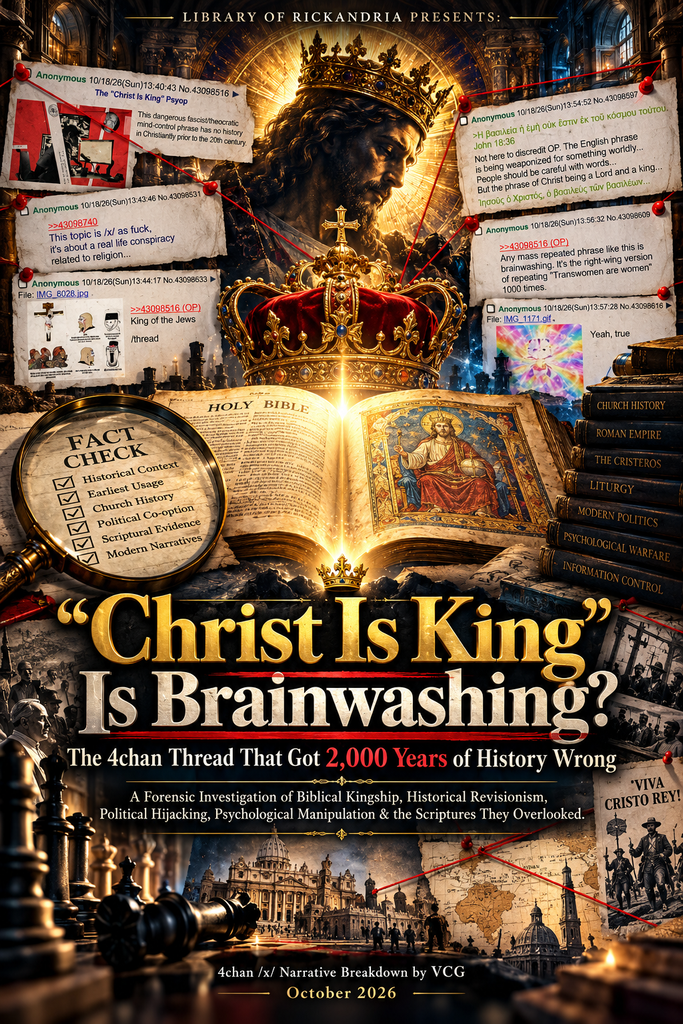
Cover artwork for the Library of Rickandria investigation.
This is an artistic composition, not a historical photograph or an authenticated reproduction of the thread.
“Prove all things; hold fast that which is good.” — 1 Thessalonians 5:21, King James Version
Abstract
On October 18, 2026, an anonymous contributor to 4chan’s /x/ board published a thread titled The “Christ Is King” Psyop.
Its central accusation was striking:
the Christian proclamation:
“Christ is King”
supposedly had no history before the twentieth century and was a dangerous expression associated with:
- fascism
- theocracy
- psychological manipulation
The author offered what appeared to be a researched historical explanation.
They identified:
- an early-twentieth-century hymn by Charles Reign Scoville
- Pope Pius XI’s institution of the feast of Christ the King in 1925
- the Mexican Cristero War
- changes in Catholic liturgical practice
- contemporary political controversies
These events were assembled into a narrative suggesting that an apparently ancient Christian declaration was actually a modern instrument of political and psychological control.
Other anonymous contributors challenged or reinforced aspects of that argument.
One respondent cited the Greek New Testament and emphasized that the royal identity of Jesus long preceded modern politics.
Another claimed that repeating “Christ is King” amounted to brainwashing and asserted that Jesus never wanted to be worshipped.
Still others speculated about censorship, federal provocateurs, and the motives of Christian participants.
The exchange raises several questions that deserve serious investigation.
Is “Christ is King” an ancient Christian confession or a modern invention?
What did the earliest Christians actually believe about Jesus’ royal identity?
What did Pope Pius XI establish in 1925, and how did his actions relate to the political crises of his era?
Did the Cristero War transform an older expression into a militant slogan?
Can repeated religious language function as psychological manipulation?
And how should Christians distinguish an affirmation of Christ’s kingship from attempts to place human political authorities beyond criticism?
The surviving evidence already reveals a major weakness in the opening accusation.
The New Testament explicitly presents Jesus in royal terms.
The second-century Christian writer Justin Martyr describes Christ as King in his interpretation of the Hebrew Scriptures.
More decisively for the specific English-language claim, Charles Haddon Spurgeon used the words “Christ is King” in a sermon delivered in 1861, and Priscilla J. Owens’s hymn Go, Tell the Nations is catalogued in an 1885 hymnal.
These sources predate Scoville’s hymn and the 1925 Catholic feast.
However, correcting the historical error does not require denying the political uses of Christian language.
The Catholic feast had a genuine political-theological dimension.
The Cristeros employed ¡Viva Cristo Rey! during an armed conflict.
Modern political movements have also adopted Christian expressions in contexts that must be examined individually.
The historical origin of a religious belief, the political intentions of a particular speaker, and the psychological effects of repetition are different questions.
Evidence for one cannot simply be substituted for evidence for another.
This paper therefore examines the thread through five complementary fields:
- historical research
- biblical exegesis
- original-language analysis
- political theology
- psychology
It also evaluates the limitations of the screenshots as digital evidence.
Our purpose is neither to dismiss every criticism of Christian political rhetoric nor to accept an accusation simply because it is presented with dates and historical references.
Our objective is to determine what can actually be established—and to distinguish it from speculation, theological interpretation, and unsupported inference.
PART I — THE THREAD THAT DISAPPEARED
Chapter 1. The accusation
The investigation begins with a screenshot.
It shows a thread on 4chan’s /x/ board, identified as No. 43098516.
The opening message is dated Sunday, October 18, 2026, at 13:40:43, according to the displayed forum timestamp.
The title reads:
The “Christ Is King” Psyop
The attached image uses a red-and-black visual composition.
Beneath the title, the anonymous poster introduces the argument with a sweeping declaration:
This dangerous fascist/theocratic mind-control phrase has no history in Christianity prior to the 20th century.
This is the central claim around which the entire discussion develops.
Exhibit A.
The opening post of thread No. 43098516, preserved in the supplied screenshot.
Original thread address:
What makes the opening post interesting is that the author does not stop with an insult or a general accusation.
Instead, they build an argument around several identifiable historical events.
The post begins by discussing a hymn attributed to Charles Reign Scoville, whose lifetime is given as 1869–1938.
It credits De Loss Smith with the music and discusses a discrepancy between publication dates of 1906 and 1908.
The author then states:
You can find no earlier English-language use of the exact phrase “Christ is King” in print.
That is a specific historical proposition.
Unlike a judgment about whether religious language feels manipulative, it can be investigated by examining dated publications.
The writer then asks who popularized the expression in the 1920s and identifies Pope Pius XI.
The post connects the 1925 encyclical Quas Primas to the collapse of several European dynasties, the rise of fascism and communism, and the growth of militant nationalism.
Next, it identifies the Mexican Cristero War of 1926–1929 as an event that gave the expression a militant and popular political dimension.
The writer continues with a description of the feast’s position in the Catholic calendar between 1925 and 1970, its movement after the Second Vatican Council, and its continued use in Christian liturgy and devotion.
Finally, the post turns to 2024 and later political controversies, referring to online public figures who adopted the phrase and prompted arguments about whether it had been politically appropriated.
The structure is worth noticing.
The author moves from a supposed historical discovery to a larger psychological and political accusation.
The implicit argument is approximately this:
Premise 1
The phrase allegedly has no Christian history before the twentieth century.
Premise 2
Important twentieth-century uses occurred amid political conflict, nationalism, and religious struggles.
Implied conclusion
The phrase is inherently a modern political or psychological manipulation device.
The argument contains a serious problem.
Even if the examples of twentieth-century political use are historically accurate, they cannot by themselves establish that the expression originated during that period.
Nor does involvement in political conflict establish that every use of an expression has the same purpose.
The author would need to prove both the historical origin and the alleged psychological mechanism.
As we will see, the historical origin claim fails.
The psychological accusation is far more speculative than the opening post acknowledges.
But before correcting it, we need to understand the surviving evidence and its limitations.
Chapter 2. What the screenshots actually preserve
Four screenshots were supplied for this investigation.
Together, they preserve eight visible posts.
We should be careful with the word preserve.
The screenshots document what was displayed when they were captured.
They do not independently establish that the original thread was complete, that the images have never been altered, or that the anonymous authors were who they claimed to be.
The screenshots remain useful primary evidence for the visible statements, but they are not a complete forensic archive.
The following table reconstructs the sequence.
| Post number | Displayed time | Content |
|---|---|---|
| 43098516 | 13:40:43 | Original accusation about historical origins, fascism, and mind control |
| 43098531 | 13:43:46 | Allegation that an earlier religious discussion was rapidly archived |
| 43098533 | 13:44:17 | Image-based reply referring to the King of the Jews |
| 43098577 | 13:51:11 | Allegation that federal agents were posting as radical Christians |
| 43098597 | 13:54:52 | Biblical response quoting John 18:36–37, Revelation 19:16, and 1 Timothy 6:15 |
| 43098609 | 13:56:32 | Assertion that repeated phrases constitute brainwashing and that Jesus did not want worship |
| 43098616 | 13:57:28 | Brief agreement with the preceding assertion |
| 43098688 | 14:16:14 | Dismissal of Christian discussion and contributors |
All times are displayed as October 18, 2026.
Their timezone is not verified.
These identifiers represent forum posts, not authenticated individual identities.
We cannot determine from this record whether any two posts were written by the same person.
Exhibit B — The missing-thread allegation
The second visible contribution claims that a previous thread, No. 43097940, had unexpectedly gone to the archive after seven replies.
Exhibit B. Post No. 43098531.
This screenshot records a participant’s allegation; it does not independently verify the earlier thread’s moderation or archival history.
The poster suggests that someone may have intentionally removed or suppressed the discussion because of its religious subject matter.
This is an allegation, not a demonstrated fact.
We do not have the complete earlier thread, its archival history, or a moderation record identifying why it became inaccessible.
The observation is that the participant reported an unexpectedly rapid disappearance.
The interpretation is that administrators deliberately suppressed a religious discussion.
Those two claims are not equivalent.
Exhibit C — The image response and federal-agent allegation
The next screenshots introduce an image referring to the “King of the Jews,” followed by another poster’s claim that federal agents were posing as radical Christian contributors.
Exhibit C. Posts No. 43098533 and No. 43098577.
The image attached to post No. 43098533 is small in the surviving screenshot.
Some visual elements suggest political or religious caricature, but the original image has not been independently recovered at full resolution.
It would be irresponsible to claim certainty about every symbol or the author’s precise intention.
The subsequent accusation concerning federal agents is even more difficult to verify.
No documentary evidence, identifiable source, investigative finding, or technical attribution accompanies it.
A claim that agents may sometimes operate undercover is not evidence that specific anonymous posts in this thread were written by agents.
This distinction will become important when we examine conspiracy attribution and online psychology.
Exhibit D — The biblical dispute
The largest surviving screenshot contains the most substantive theological exchange.
Exhibit D. Posts No. 43098597, 43098609, 43098616, and 43098688.
Post No. 43098597 quotes the Greek text of John 18:36 and identifies further biblical passages concerning Christ’s royal identity.
It argues that political exploitation of Christian language should not be confused with the much older tradition of Christ’s kingship.
That is an important distinction and one we will investigate carefully.
Post No. 43098609 takes a different approach.
It maintains that repeated use of the phrase amounts to brainwashing and claims that Jesus did not want worship.
These are separate propositions.
One is psychological.
The other is theological and textual.
They require different kinds of evidence.
The following short reply agrees with this argument but offers no additional support.
The final post uses dismissive language and advises readers to avoid engaging with Christian contributors.
By the end of the preserved discussion, the topic has moved far beyond its original chronological question.
It now includes alleged:
- historical invention
- state surveillance
- religious worship
- online provocation
- political extremism
- the effects of repetition
Our task is to disentangle those claims rather than allow them to reinforce one another merely because they appear in the same conversation.
Chapter 3. The 404 problem: Was the thread censored?
The original thread URL has been reported as returning 404.
A missing online discussion can understandably arouse suspicion, especially when the subject concerns religion, ideology, or government power.
But suspicion is not proof.
4chan’s own documentation explains that threads expire and are pruned by its software.
On many boards, material remains accessible for a relatively short period before disappearing from the ordinary board pages.
The official 4chan FAQ states that the availability of posts can be limited to hours or days.
It also distinguishes routine pruning from moderator or janitor removal.
The platform’s archive documentation further explains that, where board archives are supported, archived threads may remain accessible temporarily before automatic deletion.
This gives us several possible explanations for an unavailable page.
| Possible explanation | What we would need to verify it |
|---|---|
| Automatic pruning | Thread activity and board expiration records |
| Temporary archival followed by deletion | Confirmed archival history |
| Moderator or janitor removal | Reliable moderation evidence |
| Technical or retrieval issue | Server or archive-status evidence |
| Deliberate ideological suppression | Evidence establishing both intentional removal and its motive |
A 404 alone does not allow us to select one of these explanations.
We should also distinguish deletion from censorship.
Deletion is an observable event when independently verified.
Censorship is an interpretation concerning intentional restriction or suppression of expression, frequently involving a disputed motive.
A moderator might remove a post for many reasons, including rules unrelated to the opinion expressed.
An automatically expired post requires no human decision at all.
The earlier participant’s allegation therefore remains unverified.
This does not mean that deliberate suppression is impossible.
It means the surviving record does not establish that it happened.
A useful biblical principle
Proverbs 18:13 (KJV) says:
He that answereth a matter before he heareth it, it is folly and shame unto him.
The immediate biblical context concerns wise judgment and the importance of hearing a matter properly.
Applying that principle to digital evidence is an ethical interpretation, not a claim that Proverbs specifically addresses online archives.
Nevertheless, the principle is relevant:
we should not treat an unexplained disappearance as proof of a particular conspiracy without first establishing the facts.
Chapter 4. Our research method: What is Scripture, what is history, and what is interpretation?
A major problem with the thread is that different types of claims are treated as though they can all be proven in the same way.
They cannot.
The following distinctions govern this paper.
Historical evidence
Historical research examines dated records:
- manuscripts
- sermons
- hymnals
- letters
- institutional documents
- accounts of public events
If a hymn printed in 1885 contains “Christ is King,” it establishes that the English expression was in use by 1885, assuming the bibliographic date and text are authenticated.
It does not necessarily establish the first time anyone ever said it.
It also does not establish whether the theology expressed by the hymn is true.
Historical records can establish what someone wrote and what was published, but they cannot resolve every religious truth claim.
Scriptural evidence
The Bible contains numerous descriptions of Jesus as King.
For this investigation, the King James Version is the principal English scriptural witness, supplemented by the relevant Hebrew and Greek texts.
We will distinguish the actual wording of Scripture from conclusions drawn by later interpreters.
For example, Revelation 19:16 explicitly identifies Christ through the title King of kings and Lord of lords.
That supports the biblical antiquity of the doctrine.
But it does not establish the first appearance of the complete modern English sentence “Christ is King.”
That narrower question belongs to English-language history.
Theological interpretation
Christians have historically disagreed about the political implications of divine kingship.
- Catholic political theology
- Protestant views of church and state
- Eastern Orthodox traditions
and Christian pacifist interpretations do not all reach identical conclusions.
Some traditions emphasize the public duties of Christian rulers.
Others emphasize the institutional distinction between church and state.
Others reject coercive expressions of political power in the name of Christ.
The theological question must therefore be examined through actual texts and traditions rather than assuming one Christian political position represents every Christian.
Psychological evidence
Psychological research can show that:
repetition
familiarity
group identity
social rewards
social pressure
influence beliefs and behavior.
But repetition is not automatically coercion.
People repeat:
- scientific principles
- historical quotations
- national pledges
- religious prayers
- songs
- political slogans
for many different reasons.
Whether a repeated statement functions as manipulation depends on its context and associated methods.
We will distinguish ordinary learning and ritual from deceptive influence, threats, suppression of questioning, and coercive control.
Digital evidence
The screenshots preserve the visible messages.
They do not establish the posters’:
- real identities
- private intentions
- political affiliations
or coordination.
A claim about federal provocateurs requires evidence connecting actual people or institutions to the relevant posts.
The material supplied does not contain that evidence.
The standard of proof
Throughout the paper, every major claim will be classified according to its evidentiary status.
| Classification | Meaning |
|---|---|
| Verified | Directly supported by reliable documentary or textual evidence |
| Substantially supported | Supported in its main point, but requiring qualification |
| False | Contradicted by reliable evidence |
| Unsupported | Evidence presented does not justify the conclusion |
| Unverified | The necessary evidence has not been established |
| Interpretive | Depends on a reasoned reading rather than a simple documentable fact |
| Contested | Relevant scholarly or theological interpretations differ |
This framework does not assume that one side of the thread must be right about everything.
An argument can contain both correct facts and incorrect conclusions.
A Christian respondent can offer an accurate quotation and still make an unsupported claim about someone’s motives.
A critic of Christianity can identify a genuine historical abuse while making an inaccurate statement about the origin of a doctrine.
The purpose of the classifications is to prevent those errors from being hidden inside a larger narrative.
Chapter 5. The first major finding
Before we begin the full historical reconstruction in Part II, it is worth introducing the two pieces of evidence that most directly challenge the opening accusation.
Finding One — An 1861 sermon
In The First Sermon in the Tabernacle, delivered March 25, 1861, the English Baptist preacher Charles Haddon Spurgeon stated:
Christ is King of politics as well as theology.
Source:
The Spurgeon Library — The First Sermon in the Tabernacle.
The significance is immediate.
These exact English words were being used in Christian preaching decades before 1900.
The political dimension of the statement is also important.
We cannot honestly claim that all political applications of Christ’s kingship began with Pope Pius XI.
Finding Two — An 1885 hymnal
Priscilla J. Owens’s hymn Go, Tell the Nations begins:
Go, tell the nations, Christ is King
The hymn appears in the catalogued 1885 publication Augsburg Songs for Sunday Schools and Other Services, No. 104, issued by the Lutheran Publication Society in Philadelphia.
Sources:
The underlying edition’s full page should be checked when preparing an archival facsimile, but the dated bibliographic entry provides a strong, independently traceable lead.
Together, these sources are sufficient to overturn the proposed twentieth-century beginning.
They also demonstrate why we must not confuse a hymn’s twentieth-century publication date with the beginning of the expression’s history.
The New Testament and early Christian writings push the underlying doctrine back much further.
That is where the next part of the investigation begins.
Sources consulted for Part I
All links below lead to external resources rather than internal citation references.
1. 4chan, Official FAQ. The platform’s explanation of thread expiration, pruning, and removal.
2. 4chan, Official API Documentation:
Archives.
Explains the behavior and temporary nature of archived threads.
4chan-API/pages/Archive.md at master · 4chan/4chan-API · GitHub
3. The Spurgeon Library. Charles Haddon Spurgeon, The First Sermon in the Tabernacle, March 25, 1861.
The First Sermon in the Tabernacle | The Spurgeon Library
4. Hymnary. Augsburg Songs for Sunday Schools and Other Services, Lutheran Publication Society, 1885
Augsburg Songs for Sunday Schools and other services | Hymnary.org
5. Hymnary. Priscilla J. Owens, Go, Tell the Nations, hymn text and documented publication history.
Go, Tell the Nations | Hymnary.org
6. The Vatican. Pope Pius XI, Quas Primas, December 11, 1925. Primary evidence concerning the Catholic feast of Christ the King.
Quas Primas (December 11, 1925)
7. Original forum source. 4chan /x/, thread No. 43098516, October 18, 2026.
The investigation relies on the supplied screenshots because the original page is reported unavailable.
END OF PART I OF VI
Next: Part II — Before Fascism, Before the Slogan: The Ancient and English-Language History of Christ’s Kingship
We will examine:
- the Hebrew and Greek foundations
- Justin Martyr
- Irenaeus
- Origen
- Augustine
- the creeds of Nicaea and Constantinople
- Spurgeon’s nineteenth-century sermon
- the 1885–1895 hymnals
- the Scoville attribution
Continue to Part II
THE LIBRARY OF RICKANDRIA • INVESTIGATIVE RESEARCH SERIES • PART II OF VI
Before Fascism, Before the Slogan
The Ancient and English-Language History of Christ’s Kingship
Continuing the investigation of 4chan /x/ thread No. 43098516.
Chapter 6. The question the opening poster got wrong
The entire historical accusation turns on a deceptively simple question:
When did Christians begin saying that Christ is King?
The anonymous poster answers by pointing to the early twentieth century, particularly a hymn associated with Charles Reign Scoville and the institution of a Catholic feast in 1925.
But to investigate this properly, we need to distinguish three things that are frequently confused.
First, there is the biblical claim that Jesus possesses royal or messianic authority.
Second, there is the history of Christians expressing that belief through:
- preaching
- theological argument
- prayer
- hymns
- creeds
Third, there is the modern use of those words as a slogan, including political uses that may carry meanings different from those intended by earlier Christians.
These histories overlap, but they are not interchangeable.
A nineteenth-century hymn can demonstrate that Christians used particular English words at a particular date.
It cannot tell us when the earliest Christians first developed their beliefs about Jesus.
Likewise, a Christian statement quoted from a second-century Greek author through a nineteenth-century English translation establishes the antiquity of the underlying idea.
It does not establish that English speakers used those exact words in antiquity.
This distinction may sound technical, but it is central to honest historical research.
An argument about the origin of a phrase is not the same as an argument about the origin of a doctrine.
And neither question, by itself, establishes whether a modern use of the phrase is benevolent, politically extremist, or psychologically manipulative.
We will follow the evidence backward from the surviving historical texts, then forward through the centuries to the particular English expression disputed in the thread.
Chapter 7. Before Christianity: The royal and messianic foundations in Hebrew Scripture

Where Did Hebrew Come From? – Bible Odyssey
Historical visual reference:
Hebrew biblical manuscript tradition.
The Hebrew Scriptures provide the literary and religious background for early Christian claims about Jesus’ kingship.
Explore manuscript collections through the National Library of Israel.
Christian claims concerning Jesus’ kingship did not appear in an intellectual vacuum.
Jesus and his earliest followers lived within the world of ancient Jewish religion, and the New Testament writers repeatedly interpreted Jesus through Israel’s Scriptures.
The royal tradition is much older than Christianity itself.
7.1. What do the Hebrew terms actually mean?
Three words are particularly important.
| Hebrew | Transliteration | Meaning | Importance |
|---|---|---|---|
| מֶלֶךְ | Melek | King | Ordinary Hebrew term for a ruler or monarch |
| מַלְכוּת | Malkût | Kingship, kingdom, royal rule | Expresses the authority or reign associated with a king |
| מָשִׁיחַ | Māšîaḥ | Anointed one | Used in contexts involving kings, priests, and other consecrated figures |
The word māšîaḥ is the source of the English term Messiah.
Importantly, it does not literally mean “king.”
Anointed individuals could hold different offices.
The Greek Christos, from which English derives Christ, similarly means “anointed one.”
It is the wider biblical tradition that connects the Messiah with the promised Davidic king.
The Hebrew lexical distinction can be checked against the Brown–Driver–Briggs and Strong’s entries for māšîaḥ.
This distinction matters because the earliest Christians did not invent a new word meaning king and arbitrarily attach it to Jesus.
They understood him through an established collection of:
- royal
- prophetic
- priestly
- messianic
expectations.
7.2. The promise to David: 2 Samuel 7
One of the fundamental passages appears in 2 Samuel 7.
God promises David a dynastic future and speaks of a kingdom and throne enduring beyond the life of an individual ruler.
2 Samuel 7:16 (KJV):
And thine house and thy kingdom shall be established for ever before thee:
thy throne shall be established for ever.
The immediate historical setting concerns David’s royal dynasty and his successor.
Later Jewish and Christian interpreters understood the passage in relation to broader expectations about the future of David’s kingdom.
Christians ultimately connected the promise to Jesus.
That connection becomes explicit in Luke’s Gospel.
The important point at this stage is that the idea of divinely authorized and enduring kingship was already present in the Hebrew Scriptures.
7.3. Psalm 2: The LORD’s anointed king
Psalm 2:6 (KJV):
Yet have I set my king upon my holy hill of Zion.
The psalm presents God’s chosen ruler in relation to earthly nations and rulers.
Within its ancient literary setting, the psalm concerns divine authority and royal legitimacy.
Christian interpreters subsequently applied it to Jesus, including in Acts 4:25–28 and Acts 13:33.
The application is theological interpretation.
It should not be confused with an assertion that the original historical audience knew the later Christian identity of Jesus.
7.4. Psalm 110: Kingship and priesthood
Psalm 110 became especially important in early Christian interpretation because it combines language of:
- exaltation
- authority
- priesthood
The opening verse declares:
Psalm 110:1 (KJV):
The LORD said unto my Lord, Sit thou at my right hand, until I make thine enemies thy footstool.
Later in the psalm, verse 4 refers to a priest after the order of Melchizedek.
The New Testament repeatedly uses Psalm 110 in arguments about Jesus’ exaltation and priesthood.
This connection becomes essential when we examine Justin Martyr, who explicitly associates Christ’s royal and priestly identities.
7.5. Isaiah 9: The ruler whose government has no end
Isaiah 9:6–7 describes a ruler connected with:
- peace
- justice
- David’s throne
The King James Version says:
Of the increase of his government and peace there shall be no end, upon the throne of David, and upon his kingdom
This belongs to the prophetic and royal framework from which Christian messianic interpretation developed.
Jewish and Christian traditions disagree about its ultimate referent.
That disagreement should be acknowledged rather than erased.
7.6. Daniel 7: A kingdom that shall not pass away
Daniel 7 describes a vision in which one like a son of man receives dominion and a kingdom.
Daniel 7:14 (KJV):
And there was given him dominion, and glory, and a kingdom, that all people, nations, and languages, should serve him
The passage continues by describing an everlasting dominion.
Daniel’s vision has generated substantial debate regarding its original historical context and the identification of the figure.
Nevertheless, its influence on Christian descriptions of Jesus is unmistakable.
In the Gospels, Jesus repeatedly uses the designation “Son of man,” and passages concerning his authority and future manifestation echo Daniel’s imagery.
What these passages establish
They do not establish the exact English phrase “Christ is King” in pre-Christian texts, which would be an obvious historical impossibility.
They establish something more fundamental.
The Hebrew Scriptures already contained the royal, messianic, and everlasting-kingdom traditions that the earliest Christians interpreted in relation to Jesus.
Christian claims about Jesus’ kingship arose within this older scriptural environment.
That makes the suggestion of a twentieth-century theological invention historically untenable.
Chapter 8. The Greek New Testament: Was Jesus described as King?

British Library digitizes earliest surviving copy of New Testament–Aleteia
Historical visual reference:
Codex Sinaiticus, a fourth-century Greek biblical manuscript.
The manuscript is centuries later than the original New Testament writings and is shown as evidence of the transmission tradition, not as an autograph.
We now arrive at the New Testament itself.
This is where the anonymous poster’s historical thesis meets its most serious difficulty.
Royal terminology is not peripheral to the Gospel narratives.
It appears in accounts of Jesus’:
- birth
- public ministry
- trial
- crucifixion
- exaltation
- anticipated reign
8.1. The meaning of the Greek terms
| Greek | Transliteration | Basic sense |
|---|---|---|
| βασιλεύς | Basileus | King |
| βασιλεία | Basileia | Kingship, kingdom, royal rule |
| Χριστός | Christos | Anointed one, Messiah |
| κύριος | Kyrios | Lord, master |
| προσκυνέω | Proskyneō | Bow down, pay homage, worship |
These meanings depend on context.
In particular, basileia can refer to the reign or exercise of royal authority, rather than only a geographical kingdom.
Similarly, kyrios may designate ordinary social authority in some contexts and divine lordship in others.
The Greek titles should therefore be examined within their passages instead of being treated as automatically identical.
8.2. Luke 1:32–33: A royal promise before Jesus’ birth
Luke’s Gospel identifies Jesus with the Davidic royal promise.
Luke 1:32–33 (KJV):
He shall be great, and shall be called the Son of the Highest:
and the Lord God shall give unto him the throne of his father David:
And he shall reign over the house of Jacob for ever; and of his kingdom there shall be no end.
The connection to 2 Samuel 7 is apparent.
Luke presents Jesus not simply as a teacher who later acquired political symbolism, but as the figure through whom an enduring Davidic reign is to be realized.
Whether one accepts Luke’s theological claim is a separate question.
Historically, the text demonstrates that royal messianic language belongs to early Christian literature.
8.3. Matthew 2:2: King of the Jews
In Matthew’s infancy narrative, the visitors from the east ask:
Where is he that is born King of the Jews?
This is Matthew 2:2 (KJV).
The claim of kingship appears at the beginning of the Gospel narrative.
Matthew subsequently depicts the title as a source of conflict with existing political authority.
The New Testament therefore does not present Jesus’ royal identity as an idea suddenly created after the age of the apostles.
8.4. John 18:36–37: The nature of Jesus’ kingdom
The exchange between Jesus and Pontius Pilate is especially important because it appears in the 4chan discussion itself.
John 18:36 (KJV):
My kingdom is not of this world:
if my kingdom were of this world, then would my servants fight, that I should not be delivered to the Jews:
but now is my kingdom not from hence.
The Greek phrase at the opening of this verse is:
Ἡ βασιλεία ἡ ἐμὴ οὐκ ἔστιν ἐκ τοῦ κόσμου τούτου.
The preposition ek (ἐκ) communicates origin or source.
Jesus distinguishes the source and character of his kingdom from the political order that surrounds him.
The statement about his servants not fighting is essential to the meaning.
But the following verse must also be considered.
In John 18:37, Pilate asks whether Jesus is a king.
Jesus replies:
Thou sayest that I am a king.
He continues by describing his mission to bear witness to the truth.
Read together, the passages distinguish Christ’s kingship from the methods of ordinary political domination without simply denying his royal identity.
This distinction will matter later when we evaluate attempts to enlist Christ’s authority in contemporary political movements.
For the historical argument, however, the evidence is straightforward:
John presents Jesus discussing his kingship within the Gospel itself.
8.5. Revelation 19:16: King of kings
The most explicit royal designation appears in Revelation.
Revelation 19:16 (KJV):
And he hath on his vesture and on his thigh a name written, KING OF KINGS, AND LORD OF LORDS.
The Greek expression is:
Βασιλεὺς βασιλέων καὶ κύριος κυρίων.
It means King of kings and Lord of lords.
Revelation employs apocalyptic imagery, and interpreters disagree about the historical and future fulfillment of many of its visions.
But within the book’s narrative, the royal identity of Christ is unmistakable.
This language is not a twentieth-century slogan inserted into Christianity from outside.
It is part of the New Testament’s own theological presentation.
The supplied King James Bible also preserves John 18:36–37 and other royal passages in their traditional English wording.
What the New Testament evidence proves—and what it does not
The New Testament documents royal descriptions of Jesus in the first-century Christian literary tradition.
It does not establish how every later political movement understood those descriptions.
Nor does it prove that the exact English sentence “Christ is King” had already been printed before English existed.
The correct conclusion is more precise:
Christ’s royal identity is integral to the New Testament.
The modern English confession expresses a much older biblical claim.
Chapter 9. The early Church Fathers: What Christians said long before modern political ideologies
We have established the New Testament’s royal language.
But a critic might reasonably ask whether those passages were interpreted in the same way by Christians in the centuries immediately following the apostles.
This is where early Christian literature becomes indispensable.
The writers commonly called the Church Fathers did not all agree on every theological question, and their writings are not interchangeable with Scripture.
They do, however, provide historical evidence of what particular Christian communities believed, debated, and taught.
Several of these writers are especially relevant to our investigation.
9.1. Justin Martyr — approximately AD 100–165
Justin lived in the Roman Empire during the second century.
His surviving works include defenses of Christianity and the Dialogue with Trypho, a literary debate over the interpretation of Jewish Scripture.
The work is usually placed around the middle of the second century, although its exact date is uncertain.
In Chapter 34 of the Dialogue, Justin argues that Psalm 72 has a deeper messianic significance than its application to Solomon.
He describes Christ with a remarkable series of titles:
For Christ is King, and Priest, and God, and Lord
Primary text:
Justin Martyr, Dialogue with Trypho, Chapter 34 — New Advent.
Consider what we have just established.
An early Christian author was explicitly arguing that Christ possessed royal authority approximately eighteen centuries before the 1925 Catholic feast.
Justin did not merely use a passing metaphor.
His argument connects Christ’s kingship to:
- Psalm 72
- Psalm 110
- suffering
- exaltation
and an everlasting kingdom.
In Chapter 36, he also interprets Psalm 24’s “King of glory” in relation to Christ.
The royal language forms part of an extensive theological argument.
But there is an important qualification.
Justin wrote in Greek.
The English phrase quoted above comes from the nineteenth-century translation published in The Ante-Nicene Fathers.
The translation is evidence of Justin’s theological argument. It is not evidence of second-century English usage.
That distinction is essential to the paper’s credibility.
We should also acknowledge that Justin’s dialogue contains harsh polemics against Jewish interpretations of Scripture.
The text demonstrates what a second-century Christian apologist argued; it does not establish that his opponent’s views were fairly represented or that every aspect of Justin’s rhetoric should be endorsed.
Historical sources must be read in context, including where that context complicates a preferred narrative.
Finding:
Christ’s kingship is explicitly present in second-century Christian interpretation.
The ancient doctrine cannot be explained as a twentieth-century political invention.
9.2. Irenaeus of Lyon — late second century
Irenaeus wrote against teachings he believed departed from Christianity’s apostolic foundations.
His work Against Heresies contains one of the important surviving summaries of what he considered the common faith of the churches.
In Book I, Chapter 10, Irenaeus describes Jesus Christ as:
our Lord, and God, and Saviour, and King
Primary text:
Irenaeus, Against Heresies, Book I, Chapter 10 — Christian Classics Ethereal Library.
The surrounding passage addresses Christ’s:
- incarnation
- resurrection
- exaltation
- judgment
and the final acknowledgment of his authority.
This matters because Irenaeus presents kingship as part of a wider statement of Christian belief.
He is not describing a political slogan recently adopted by an organization.
He is describing a religious confession he understands to be central to Christianity.
Whether his presentation accurately represents every Christian community of the second century is a separate historical question.
But the presence of the royal title in his writing is clear.
9.3. Origen of Alexandria — approximately AD 185–253
Origen of Alexandria gives us an opportunity to examine an ancient Christian distinction between Christ’s authority and earthly political power.
In Against Celsus, Book VIII, Chapter 4, Origen discusses divine lordship and the superiority of Christ over rulers.
He argues that Christ’s authority extends across political territories, bringing people from different nations into allegiance to him.
But there is a significant nuance.
Origen uses the title “King of kings” in a discussion that explicitly concerns God, while also describing Christ’s superiority to rulers and the distinct relationship of the Father and Son.
We should not flatten those distinctions merely to collect more quotations.
The broader argument concerns divine sovereignty, Christ’s mission, and Christian loyalty in a world governed by earthly powers.
Primary text:
Origen, Against Celsus, Book VIII — New Advent.
Elsewhere in Book VIII, Origen discusses Christian participation in public life, military service, and the welfare of rulers.
The text offers evidence that questions about Christianity and political authority were already being debated in the ancient world.
These debates were not invented in 1925.
9.4. Augustine of Hippo — AD 354–430

Come avvenne la conversione di sant’Agostino – La Nuova Bussola Quotidiana
The historical source examined below is his theological writing, not the artwork.
In The City of God, Augustine of Hippo develops one of Christianity’s most influential accounts of earthly and divine political communities.
Book XVII, Chapter 4, discusses the relationship between Israel’s historical kingship and priesthood and their fulfillment in Christ.
Augustine describes the coming of one who is both priest and king, with an everlasting rule.
Primary text:
Augustine, The City of God, Book XVII, Chapter 4 — New Advent.
Augustine’s contribution is especially important because he distinguishes the city of God from the earthly city.
These are not simply two geographical states.
His account concerns communities formed by different loves, loyalties, and ultimate purposes.
Consequently, Augustine’s political theology cannot simply be reduced to the proposition that a government becomes God’s kingdom whenever its rulers invoke Christian language.
He affirmed Christ’s kingship while developing a much more complicated understanding of earthly political authority.
The details of his political thought remain subjects of scholarly debate.
Still, the historical evidence is decisive for our immediate question.
Christ’s kingship was not new to Augustine.
He treated it as part of the Christian interpretation of Scripture.
The patristic evidence summarized
| Author | Approximate period | Evidence |
|---|---|---|
| Justin Martyr | Second century | Explicit description of Christ as King |
| Irenaeus | Late second century | King included among titles of Jesus in a summary of Christian belief |
| Origen | Third century | Christ’s authority examined in relation to divine sovereignty and earthly rulers |
| Augustine | Late fourth–early fifth century | Christ interpreted as everlasting priest and king |
These writers differ considerably in their theological methods and political circumstances.
Their diversity is part of the historical evidence.
But their writings make one point impossible to deny:
Christ’s kingship was a recognized subject of Christian theology centuries before modern fascism, modern nationalism, or the institution of the Catholic feast in 1925.
Chapter 10. Nicaea and Constantinople: The ancient creeds—and a historical error in Quas Primas
The early church councils are often mentioned when discussing the development of Christian doctrine.
For this investigation, two councils are especially relevant.
The First Council of Nicaea convened in AD 325.
The First Council of Constantinople convened in AD 381.
The creedal tradition associated with these councils became foundational for much of Catholic, Orthodox, and Protestant Christianity.
But there is a historical detail here that deserves special attention.
10.1. The original Nicene Creed of 325
The 325 creed affirmed the identity of Jesus Christ as the Son of God and his consubstantiality with the Father.
It also affirmed his future judgment.
However, the original surviving text did not include the later clause describing his kingdom as having no end.
10.2. The expanded creed associated with 381
The fuller formulation traditionally associated with Constantinople contains:
whose kingdom shall have no end.
This statement is clearly relevant to the royal identity of Christ.
It confirms that the doctrine was part of Christian creedal expression many centuries before the modern period.
Historian Philip Schaff reproduces the earlier and expanded forms side by side in The Creeds of Christendom.
Historical source:
Philip Schaff, The Creeds of Christendom, Volume I — Christian Classics Ethereal Library.
See the section comparing the original Nicene Creed of 325 with the expanded creed of 381.
A further qualification matters: the precise development of the expanded creed is complex.
Related formulations circulated before 381, and its later authoritative reception is part of its history.
We should not suggest that every element of the longer creed suddenly appeared for the first time during a single meeting.
10.3. What Pope Pius XI got imprecise
In paragraph 5 of his 1925 encyclical Quas Primas, Pope Pius XI describes the Council of Nicaea as having added the everlasting-kingdom clause to the creed.
Primary source:
Quas Primas, paragraph 5 — Vatican.
The surviving creedal texts do not support that precise attribution to the original 325 formulation.
This is a genuine historical imprecision in an important primary source.
It is worth identifying for two reasons.
First, it demonstrates that even authoritative institutional documents require careful historical reading.
Second, correcting it does not undermine the central argument that Christ’s kingship is ancient.
The clause remains part of early Christian creedal tradition, and the doctrine appears in sources preceding both councils.
We should not minimize an error simply because it appears in a document that otherwise supports our conclusions.
That would be the same kind of selective treatment we are criticizing in the 4chan thread.
Finding:
The ancient creeds affirm Christ’s enduring kingdom.
The original 325 and expanded 381 formulations must be distinguished accurately.
Chapter 11. The nineteenth-century English evidence: The claim collapses
We have traced Christ’s kingship through Hebrew Scripture, the New Testament, early Christian writers, and ancient creedal development.
Now we return to the original poster’s narrower claim:
You can find no earlier English-language use of the exact phrase “Christ is King” in print.
This is where the documentary evidence becomes particularly direct.
11.1. Charles Haddon Spurgeon — March 25, 1861
Spurgeon was one of Victorian Britain’s most prominent Protestant preachers.
On March 25, 1861, he delivered a sermon titled The First Sermon in the Tabernacle.
During that sermon, Spurgeon discussed the public responsibility of Christian preaching.
He argued that Christ’s authority was relevant to theological teaching and political life.
His words were:
Christ is King of politics as well as theology.
Primary source:
The Spurgeon Library — The First Sermon in the Tabernacle.
Independent historical edition:
Christian Classics Ethereal Library — Spurgeon’s Sermons, Volume 7, 1861.
This is one of the most consequential findings of the investigation.
It does not merely show that someone described Christ as a king before 1900.
It contains the exact words “Christ is King.”
And it does so in an unmistakably Christian sermon published decades before Scoville’s hymn and Pius XI’s encyclical.
There is another reason the passage deserves attention.
Spurgeon is talking about politics.
That complicates a different part of the original poster’s narrative:
the suggestion that the political application of Christ’s kingship began in the twentieth century.
Spurgeon’s political theology was not identical to that of Pope Pius XI.
He emphasized the independence of the church from state control while asserting that Christian preaching could address political conduct.
He argued that ministers should not be silent simply because a subject involved powerful rulers.
A reader may agree or disagree with that position.
But it is indisputably part of nineteenth-century Protestant religious discourse.
The historical conclusion is straightforward.
The exact English phrase and an explicitly political interpretation of Christ’s kingship existed before the twentieth century.
11.2. Priscilla J. Owens — An 1885 hymnal

Victorian Era 1888 THE STANDARD CHURCH HYMNAL Songbook Antique HC RARE C.C.Cline | eBay
Illustrative nineteenth-century hymnal imagery, not a verified reproduction of the particular page.
The identified source is Augsburg Songs (1885), hymn No. 104.
The next example comes from Christian hymnody.
The hymn Go, Tell the Nations, attributed to Priscilla J. Owens, opens with the words:
Go, tell the nations, Christ is King
Hymnary identifies an appearance in Augsburg Songs for Sunday Schools and Other Services, published by the Lutheran Publication Society in Philadelphia in 1885.
The hymn is No. 104, with music attributed to the Reverend W. L. Remsberg.
Source:
Hymnary — Augsburg Songs for Sunday Schools and Other Services (1885), No. 104.
This example is especially valuable because it resembles the kind of evidence the original poster attempted to use.
It is an English Christian hymn.
Its date is earlier than the one the poster proposed.
It uses the disputed words directly.
And it appears in a religious collection intended for Sunday schools and other services.
There is no need to speculate about hidden political intentions to explain the wording.
The hymn itself belongs to a Christian missionary tradition.
What did Owens’s hymn actually teach?
The hymn presents Christ’s kingship in connection with:
- creation
- divine authority
- the crucifixion
- salvation
- missionary proclamation
It also reflects the religious assumptions and missionary outlook of its nineteenth-century Protestant context.
Those assumptions can be studied and criticized in their own right.
But the hymn does not require fascism or twentieth-century nationalism to explain why the author called Jesus King.
Its central imagery derives from biblical and Christian devotional traditions.
Historical finding:
The expression was documented in English Protestant hymnody decades before the Catholic feast of 1925.
11.3. Another hymnal appearance — 1889
The hymn is also indexed in Gospel Chimes, published in 1889, as hymn No. 9.
The indexed first line again identifies Christ as King.
This provides evidence of circulation in additional nineteenth-century Christian publishing.
The publication is listed among the hymn’s appearances in Hymnary’s searchable instance records.
This claim rests on the catalogue record; an independently inspected original page has not been included in the present evidence package.
That qualification should remain in the final archival edition.
11.4. The 1895 missionary hymnal
Owens’s hymn appears again in Missionary Services and Hymnal, fifth edition, 1895, No. 46.
Source:
Hymnary — Missionary Services and Hymnal (1895), hymn No. 46.
This record demonstrates that the expression continued to appear in church literature during the nineteenth century.
The hymn was not an isolated twentieth-century invention.
At this point, the historical argument has passed a decisive threshold.
The poster alleged that earlier English examples could not be found.
We have a dated 1861 sermon and multiple nineteenth-century hymnal records.
Even if further research were to challenge one bibliographic entry, the independently documented Spurgeon sermon would still disprove the claim.
11.5. Why we should not claim to have discovered the absolute first use
There is an important limitation to acknowledge.
The sources found here establish that “Christ is King” appeared before 1900.
They do not establish when the expression was first spoken in English or when it was first printed anywhere.
The complete historical record would require examination of earlier:
- books
- pamphlets
- sermons
- newspapers
- manuscript collections
- digitized corpora
Different:
- spellings
- punctuation
- capitalization
- translations
might also conceal earlier examples.
It would be poor methodology to criticize someone for making an unsupported first-occurrence claim and then immediately make an equally unsupported claim of our own.
For the purposes of this investigation, we do not need to determine the absolute first occurrence.
We only need to test the proposition that none existed before the twentieth century.
The evidence answers that question.
The proposition is false.
Chapter 12. Charles Reign Scoville: Correct evidence, incorrect conclusion
We can now return to the hymn upon which the opening poster based their English-language chronology.
The hymn is titled Christ Is King.
Its author is credited as Charles Reign Scoville, and its composer as De Loss Smith.
Hymnary documents the hymn in Songs of the King, edited by Scoville and Smith and published in Chicago in 1906.
It appears as hymn No. 2.
Historical source:
Hymnary — Songs of the King (1906).
Another identifiable printing appears in Revival Praises, published in 1907, No. 172.
Source:
Hymnary — Revival Praises (1907), No. 172.
The 1907 printing attributes the text to Scoville and the tune to Smith.
The lyrics concern Christ’s:
- life
- crucifixion
- resurrection
- ascension
- expected return
Its refrain concludes with the declaration that Christ is King.
What did the original poster get right?
The hymn is real.
The basic authorship attribution is supported.
The 1906 publication date is supported by the surviving hymnal record.
The existence of later editions also explains why someone examining different hymn databases might encounter differing dates.
What did the original poster get wrong?
The poster treated that hymn as though it marked the beginning of the English expression.
But Spurgeon used the words in 1861.
Owens’s hymn was catalogued in 1885 and appeared in later nineteenth-century collections.
And the underlying Christian doctrine had been expressed in Greek and other languages long before either writer lived.
The problem, therefore, is not a fabricated historical source.
It is an unsupported conclusion drawn from a genuine source.
This illustrates a common research error:
mistaking the earliest example one has personally located for the earliest example that existed.
A discovery date is not an origin date.
And a prominent twentieth-century publication is not evidence that all earlier uses were absent.
Chapter 13. The historical verdict: What the documentary evidence establishes
We can now reconstruct the relevant stages without collapsing them into a single origin story.
HISTORICAL EVIDENCE TIMELINE
- Ancient Hebrew Scriptures
Royal, Davidic, and messianic traditions provide the framework later used by Christian interpreters. - First-century Christian literature
The New Testament identifies Jesus with royal titles and an everlasting kingdom. - Second-century Christianity
Justin Martyr and Irenaeus explicitly describe Christ as King. - Fourth–fifth centuries
The creedal tradition and Augustine’s writings express the enduring royal identity of Christ. - 1861
Spurgeon uses the exact English expression in a sermon that also discusses politics. - 1885–1895
Owens’s hymn appears in catalogued Protestant hymnals. - 1906–1907
Scoville’s Christ Is King appears in documented hymn publications. - 1925
Pope Pius XI institutes the annual Catholic feast of Christ the King, an event we will examine closely in Part III.
The timeline resolves the central historical question but leaves other questions open.
We can now state, with documentary support, that Christ’s kingship is an ancient Christian belief and that the exact English expression existed during the nineteenth century.
We cannot automatically conclude that every modern use of the phrase carries the same meaning.
We also cannot conclude that Christian language has never been employed to support authoritarian politics or religious coercion.
Those would be separate historical claims requiring separate evidence.
The evidence supports a more precise conclusion.
The doctrine is ancient.
The English expression predates the twentieth century.
The modern political uses must be evaluated individually.
A final observation about historical revisionism
The word revisionism is sometimes used as though revising a historical account must be dishonest.
That is not necessarily true.
Responsible historians revise earlier interpretations when new evidence appears.
What is objectionable is not revision itself, but the distortion, exclusion, or selective use of evidence to support a predetermined story.
The 4chan opening post presents a chronology in which the twentieth century appears to explain the entire history of the phrase.
But that chronology omits documented earlier uses.
It cannot sustain the conclusion assigned to it.
The correction does not require an appeal to hidden motives.
We need not determine whether the anonymous writer was:
- careless
- misinformed
- deliberately provocative
or working from an incomplete database.
The available evidence cannot reliably establish those intentions.
It is enough to say that the historical claim is wrong—and to demonstrate why.
Source register — Part II
The following links provide the primary texts and historical records used in this section.
They are included directly so the references can be retained when the paper is copied.
Biblical and original-language sources
- Codex Sinaiticus Project — manuscript photographs, transcription, and history. A fourth-century witness to the Greek biblical textual tradition.
- Hebrew lexicon — Māšîaḥ, Strong’s H4899. Lexical evidence for the meaning and usage of “anointed one.”
- King James Version — Bible Gateway. Publicly accessible comparison text; biblical quotations in this paper also follow the supplied KJV edition.
Early Christian sources
- Justin Martyr, Dialogue with Trypho, Chapters 31–47. Chapter 34 contains the explicit royal description of Christ.
- Irenaeus, Against Heresies, Book I, Chapter 10. Contains the confession identifying Christ as King.
- Origen, Against Celsus, Book VIII. Discusses divine sovereignty, Christ’s authority, and relations with rulers.
- Augustine, The City of God, Book XVII. Chapter 4 discusses Christ’s enduring kingship and priesthood.
- Philip Schaff, The Creeds of Christendom, Volume I. Compares the 325 and expanded 381 creeds.
- Pope Pius XI, Quas Primas (1925). Paragraph 5 contains the attribution concerning the Nicene Creed discussed above.
Nineteenth- and twentieth-century English evidence
- Charles Haddon Spurgeon, The First Sermon in the Tabernacle (1861).
- Augsburg Songs for Sunday Schools and Other Services (1885), hymn No. 104.
- Hymnary’s publication records for Priscilla J. Owens’s Go, Tell the Nations.
- Missionary Services and Hymnal (1895), hymn No. 46.
- Songs of the King (1906), edited by Charles Reign Scoville and De Loss Smith.
- Revival Praises (1907), hymn No. 172.
END OF PART II OF VI
Next: Part III — The Vatican, the Crown, and the State
The next installment will examine Quas Primas paragraph by paragraph, the political setting of 1925, the relationship between the papacy and fascism, the Cristero War, and the 1969–1970 liturgical reform.
We will distinguish what the original poster got right from what the evidence does not support.
Continue to Part III
THE LIBRARY OF RICKANDRIA • INVESTIGATIVE RESEARCH SERIES • PART III OF VI
The Vatican, the Crown, and the State
How an Ancient Christian Doctrine Became a Twentieth-Century Political Battleground
A historical investigation of Pope Pius XI, the 1925 feast of Christ the King, Fascist Italy, the Mexican Cristero War, and the Catholic liturgical reforms of 1969–1970.
Chapter 14. December 11, 1925: What actually happened?
On December 11, 1925, Pope Pius XI issued an encyclical titled Quas Primas.
The document formally established the feast of Christ the King throughout the Roman Catholic Church.
This is the historical event at the center of the 4chan poster’s explanation.
Historical photograph of Pius XI at his desk, dated 1923.

Image source:
The opening poster identifies Pius XI as the person who popularized the expression during the 1920s.
There is an important truth here.
The pope did establish a worldwide Catholic observance devoted specifically to Christ’s kingship.
Its annual repetition helped make that theme prominent in Catholic worship, preaching, and religious education.
But there is a problem with presenting that institutional development as the beginning of the expression’s history.
Pius XI himself explicitly described Christ’s kingship as an established doctrine and devotional tradition.
We do not have to infer that from later historians.
The encyclical says so.
14.1. The primary document
The official text is available directly from the Vatican:
Pope Pius XI, Quas Primas, December 11, 1925 — Complete English Text
The document contains 33 numbered paragraphs.
It explains the biblical foundations of Christ’s kingship, the pope’s view of its relation to civil authority, the perceived dangers of secularization, and the reasons for establishing an annual feast.
In paragraph 6, Pius XI explains that the 1925 Holy Year had provided an opportunity to celebrate Christ’s kingship and that petitions had been received from cardinals, bishops, and ordinary believers requesting a formal observance.
He therefore decided to conclude the Holy Year by instituting the feast.
This distinction matters.
The encyclical describes an institutional decision made in response to existing devotion and contemporary circumstances.
It does not describe the creation of a new theological claim.
14.2. The pope’s own acknowledgment of the older tradition
In paragraph 7, Pius XI writes:
It has long been a common custom to give to Christ the metaphorical title of “King”.
He then develops his argument that Christ’s kingship is not merely metaphorical but also belongs to him in a deeper theological sense.
The sentence establishes that Pius XI regarded the title as longstanding.
Paragraph 26 goes further.
There, the pope explains that the way had already been prepared for the feast by writings and devotional practices circulating since the preceding century.
He specifically mentions publications from different parts of the world, written in different languages, and the dedication of families and nations to the Sacred Heart of Jesus.
This is significant.
The very encyclical cited by the 4chan author acknowledges a substantial pre-1925 history of Christ’s kingship.
The pope was not claiming to have invented the doctrine.
He was explaining why he believed the Catholic Church should give it a new annual celebration.
14.3. A revealing earlier document from 1922
The story becomes more interesting when we look three years earlier.
On December 23, 1922, Pius XI published his first encyclical, Ubi Arcano Dei Consilio.
Its subject was the restoration of peace through the reign of Christ.
The encyclical’s central theme was already expressed in its title and program:
the peace of Christ in the kingdom of Christ.
In paragraph 48, Pius XI explains that Christ reigns through his teachings, love, and the imitation of his example, while also arguing that Christian principles are relevant to social life.
Primary source:
Ubi Arcano Dei Consilio, December 23, 1922.
This earlier encyclical shows that the 1925 feast formed part of a larger program already underway in Pius XI’s pontificate.
That program linked spiritual renewal with social peace and the relationship between Christianity and public institutions.
One may agree or disagree with its political implications.
But it cannot reasonably be described as a doctrine suddenly invented in December 1925.
Chapter 15. Reading Quas Primas paragraph by paragraph
This chapter is central to the investigation because it allows us to test the anonymous poster’s interpretation against the actual document.
We should neither defend the encyclical by overlooking its political content nor condemn it by attaching meanings that the source does not establish.
Let us examine the paragraphs most relevant to the thread.
Paragraphs 7–12: The scriptural and theological foundations
Pius XI begins by discussing how Christ has historically been called King.
He connects the title to biblical passages concerning:
- the Messiah
- the Davidic kingdom
- divine authority
- Christ’s exaltation
He distinguishes the figurative sense in which Christ reigns over human hearts from what he regards as Christ’s objective royal authority.
These paragraphs are theological arguments rather than detached historical descriptions.
The pope’s interpretation is Catholic and Christological.
Readers from other traditions may contest elements of his reasoning.
Nevertheless, the source itself shows that his account is grounded in texts considerably older than the twentieth century.
Finding:
The encyclical presents Christ’s kingship as inherited biblical doctrine, not a recent political invention.
Paragraphs 13–16: What kind of king?
Pius XI proceeds to describe the nature of Christ’s authority.
Paragraph 14 identifies Christ as lawgiver and judge.
The encyclical connects his kingship with:
- teaching
- moral obligation
- judgment
- redemption
- priestly mediation
These concepts belong to the Christian theological tradition, but their political implications require careful interpretation.
A moral lawgiver is not automatically the same thing as an earthly head of state.
A divine judge is not automatically the same thing as a human dictator.
At the same time, asserting that Christ has authority over all human conduct can become the basis for claims about the responsibilities of public institutions.
Pius XI makes that connection explicitly in the following paragraphs.
Paragraph 17: Christ and civil affairs
This is one of the most important passages in the encyclical.
The pope rejects the idea that Christ’s authority has no relevance to civil life.
In the same paragraph, he acknowledges that Jesus did not exercise ordinary earthly rule during his ministry.
This produces an important distinction within the pope’s argument.
Christ’s authority is universal in principle, but it was not exercised by Jesus as an ordinary territorial monarch.
This is a theological interpretation of passages such as John 18:36.
A reader may challenge how the pope moves from that principle to the authority of religious institutions or the duties of governments.
That is a legitimate subject of debate.
But it would be inaccurate to claim the pope simply confused Jesus with an ordinary political ruler.
The encyclical recognizes that distinction and then argues for broader implications.
Paragraphs 18–19: The authority of rulers and the obedience of citizens
Here the encyclical becomes more explicitly political.
Pius XI argues that Christ’s authority extends across humanity, including people who are not Catholic.
He also argues that earthly rulers should understand their authority as answerable to a higher moral order.
Paragraph 19 associates the recognition of Christ’s kingship with public peace, responsible governance, and citizens’ obedience.
This deserves careful treatment because the language of obedience can be interpreted in more than one direction.
On the one hand, Pius XI insists that rulers do not possess unlimited authority in their own right.
They are accountable to God and should govern for the common good and the dignity of those under them.
That places a theological limitation upon arbitrary human power.
On the other hand, the same passage sacralizes the duties of public authority and obedience in a way that raises serious questions about religious pluralism and resistance to unjust government.
These questions cannot simply be dismissed.
Christians who reject the pope’s political theology may nevertheless affirm Christ’s kingship.
Likewise, a secular critic can reasonably object to the political implications of this document without proving that the underlying Christian doctrine is modern or fascist.
Finding:
The encyclical contains genuine political theology.
The political implications deserve criticism or defense on their own merits.
Paragraphs 20–23: Why establish a recurring feast?
These paragraphs are particularly relevant to the thread’s accusation of psychological manipulation.
Pius XI argues that liturgical observances help teach and reinforce religious beliefs.
In paragraph 21, he contrasts formal doctrinal statements with the recurring experience of religious feasts.
His argument is that annual celebrations reach ordinary believers through:
- ritual
- teaching
- communal participation
- emotional engagement
That is a clear acknowledgment that repeated ceremonies influence religious understanding.
But the original poster’s accusation goes beyond this evidence.
Religious formation is not automatically the same thing as coercive psychological manipulation.
An annual feast can influence:
- memory
- identity
- belief
- emotion
So can:
- a national commemoration
- classroom ceremony
- public memorial
or traditional song.
To establish brainwashing, we would need additional evidence concerning:
- coercive methods
- deception
- control of information
- punishment of dissent
or other mechanisms restricting independent judgment.
The encyclical establishes an intention to strengthen religious belief through liturgical practice.
It does not establish that every participant was subjected to coercive mind control.
The psychology of repetition and manipulation will receive its own detailed treatment in Part V.
Paragraphs 24–25: The pope’s opposition to secularism
These paragraphs identify what Pius XI regarded as one of the central problems of the age:
anticlericalism and the exclusion of Christianity from public institutions.
The document’s language is strongly critical of efforts to remove religious authority from public life.
This is not merely a devotional meditation.
Pius XI was advocating a vision of society in which Christianity—and the Catholic Church’s teaching role—would receive public recognition.
A modern supporter of religiously neutral government may oppose that vision.
A Protestant may object to the role assigned to the Catholic hierarchy.
A Catholic may regard the document as a defense of the rights of the Church and the moral responsibilities of governments.
The historical investigation does not need to resolve those disagreements to identify the source accurately.
Paragraph 26: The historical admission that undermines the origin claim
This is one of the most decisive paragraphs for the paper.
Pius XI explains that the movement toward the feast had developed through publications and practices since the preceding century.
He acknowledges a history of devotion rather than announcing a previously unknown doctrine.
This admission agrees with the independent nineteenth-century evidence examined in Part II.
Even without Spurgeon’s 1861 sermon and Owens’s hymn, the 1925 encyclical itself would give us reason to investigate earlier publications.
The original poster’s claim therefore encounters a direct problem inside one of the very documents used to support it.
Paragraph 28: The institution of the feast
This paragraph formally institutes the celebration.
The pope establishes the feast on the final Sunday of October, immediately before All Saints’ Day.
He also prescribes the renewal of the dedication of humanity to the Sacred Heart of Jesus.
For 1925 itself, he provides a special observance on October 31.
The distinction between the annual rule and the special arrangement for the inaugural year is worth preserving in a meticulous historical account.
The feast was a new universal liturgical observance in the Roman rite, not the beginning of belief in Christ’s kingship.
Paragraph 32: The state and Christian principles
The final political implications are made especially explicit here.
Pius XI argues that nations, rulers, and public authorities should acknowledge Christ’s authority.
He further maintains that Christian principles should influence legislation, justice, and the moral education of young people.
This is substantive political theology.
It is also one of the strongest reasons not to describe the encyclical as wholly apolitical.
But there is an equally important distinction.
The pope’s Catholic vision of public authority is not identical to fascism, even though authoritarian political actors might attempt to use religious ideas for their own objectives.
To establish a relationship between a specific ideology and a specific doctrine, we need evidence of actual historical influence, institutional cooperation, or shared political commitments.
A similar vocabulary of authority does not establish identical origins.
The primary-source audit
| Paragraphs | What the encyclical establishes | Assessment |
|---|---|---|
| 6–7 | The feast formalized an already established religious tradition | Contradicts invention claim |
| 8–16 | Christ’s kingship is grounded in Catholic biblical and theological interpretation | Ancient doctrinal foundation |
| 17–19 | Christ’s authority has implications for civil society and rulers | Genuine political content |
| 20–23 | Repeated liturgical celebration is intended to strengthen belief | Religious formation; not proof of coercion |
| 24–25 | The pope opposed anticlericalism and secularization | Explicit historical-political motivation |
| 26 | Earlier publications and devotions helped prepare the feast | Direct evidence of prior history |
| 28 | The feast was formally instituted on the final Sunday of October | Verified administrative event |
| 32 | Public authorities should recognize Christian moral principles | Explicit Catholic political theology |
All paragraph references are to the official Vatican text of Quas Primas.
A conclusion we should not evade
The opening poster did not invent the fact that the 1925 feast had political significance.
It did.
But the poster incorrectly treated a modern institutional development as though it were the origin of an ancient Christian doctrine.
The historical truth is more interesting—and more complicated—than either a sweeping denunciation or an unquestioning defense.
Chapter 16. Fascism, monarchy, and the Vatican: A relationship more complicated than the thread suggests
Historical photograph associated with the signing of the Lateran Pacts, February 11, 1929.
Benito Mussolini signs in the presence of Cardinal Pietro Gasparri.
Image:

Rai Cultura, The Lateran Pacts.
The opening post connects the 1925 feast to the upheaval of European politics following World War I.
That context deserves serious consideration.
In the years after the war, several long-established ruling dynasties had fallen.
The Russian Revolution had transformed the political situation in Eastern Europe.
Italian Fascism had emerged as a political movement, and Benito Mussolini became prime minister in 1922.
Catholic leaders were confronting a world in which older assumptions about:
- religion
- monarchy
- governmen
- society
were being challenged.
But we must distinguish historical context from a demonstrated causal explanation.
16.1. Did the fall of European dynasties motivate the encyclical?
The original poster specifically mentions:
- the Hohenzollerns
- Romanovs
- Habsburgs
- Ottomans
Their loss of political power belongs to the wider postwar environment.
Yet Quas Primas does not establish that these dynastic collapses were the direct reason Pius XI instituted the feast.
The pope’s stated reasons focus on spiritual renewal, the Holy Year, the recognition of Christ’s authority, and resistance to secularism.
The original author supplies no private correspondence, official planning record, or contemporary testimony establishing the proposed dynastic motive.
The connection is therefore an interpretation of the historical setting, not a demonstrated fact.
This distinction matters because the surrounding events can make a story sound convincing even when its central causal claim remains unproven.
16.2. Were the Vatican and Fascist Italy political opponents?
Sometimes.
Were they also capable of negotiation and institutional cooperation?
Yes.
Neither a uniformly antagonistic nor a uniformly cooperative account captures the historical record.
A major example is the Lateran Pacts of February 11, 1929.
These agreements between the Holy See and the Kingdom of Italy resolved the longstanding Roman Question and established the territorial sovereignty of Vatican City.
They also included arrangements concerning the legal position of the Catholic Church in Italy.
The agreements were signed by Cardinal Pietro Gasparri, representing the Holy See, and Benito Mussolini, representing the Italian government.
This is not speculation.
The Vatican maintains the original treaty documentation.
Primary source:
Holy See — Lateran Pacts, February 11, 1929.
The agreement demonstrates that the papacy and Mussolini’s government were able to reach a major political settlement.
It does not demonstrate that every Catholic doctrine supported Fascist ideology.
It also does not mean the settlement was free of political consequences or moral controversy.
The Vatican gained recognized territorial sovereignty and a new legal relationship with Italy.
The Fascist government gained the political advantages associated with resolving a longstanding dispute.
A comprehensive history must acknowledge both.
16.3. The 1931 conflict: Non abbiamo bisogno
Two years after the Lateran Pacts, the relationship had become sharply contentious.
On June 29, 1931, Pius XI issued Non abbiamo bisogno.
The encyclical addressed Fascist interference with Catholic organizations, particularly Catholic Action, and criticized attempts by the political regime to dominate youth formation.
The document identifies elements of Fascist ideology and practice that the pope regarded as incompatible with Catholic faith.
Primary source:
Pius XI, Non abbiamo bisogno, June 29, 1931.
The text is important because it documents an actual ideological and institutional conflict between the papacy and the Fascist regime.
It also requires careful reading.
Paragraph 62 explicitly clarifies that the pope was not condemning the Fascist party as such in its entirety.
His condemnation addressed particular teachings and activities he considered irreconcilable with Catholic doctrine.
That detail prevents us from exaggerating the strength or scope of the condemnation.
Nevertheless, the source directly contradicts a simplistic picture of the papacy and fascism as one unified ideological project.
16.4. The 1937 warning against making the state an idol
The historical picture becomes clearer still in 1937.
Pius XI issued Mit brennender Sorge, addressing conditions in Nazi Germany.
In paragraph 8, he condemns the elevation of:
- race
- nation
- state
or political power to a divine or absolute status.
The document opposes the idolatrous exaltation of political institutions and national identity.
Primary source:
Pius XI, Mit brennender Sorge, March 14, 1937.
Nazi Germany and Fascist Italy were distinct regimes, even though they developed political alliances and shared some ideological features.
The encyclical should therefore be understood in its German context rather than substituted for the history of Italian Fascism.
Still, it demonstrates that the papacy’s theological commitments could also supply arguments against the absolutization of state, nation, and race.
This creates an important distinction for our investigation.
Christ’s kingship can be interpreted as placing moral limits on earthly rulers, but particular Christians have also used religious authority to legitimate earthly power.
The historical record contains both possibilities.
16.5. Does a shared appeal to authority make two movements identical?
No.
A political movement may demand obedience.
A religious institution may also teach obedience.
But the existence of that shared vocabulary does not establish that the movements have identical origins, doctrines, or objectives.
We must ask more precise questions.
Who is supposed to obey whom?
Under what conditions?
What limits apply to authority?
Is dissent permitted?
What institutions possess power?
How are minorities treated?
What happens when political commands conflict with conscience?
Those questions are more informative than simply attaching a label such as fascist to any religious statement about kingship.
They also allow us to recognize real authoritarian behavior where the evidence establishes it.
Historical finding
The papacy’s relationship with Fascist Italy included:
- accommodation
- significant treaty-making
- institutional conflict
- theological criticism
The 1925 feast belongs within that complicated political environment.
But the evidence does not establish that the proclamation “Christ is King” originated in fascism or was invented to serve the Fascist state.
Chapter 17. Mexico, 1926–1929: When “Christ the King” became a battle cry
Historical photograph of Cristero generals at Coalcomán, Michoacán, circa 1927.
Source:

Wikimedia Commons historical photograph and file information.
The original poster next turns from Rome to Mexico.
This is one of the strongest parts of the historical narrative because the expression genuinely became associated with an armed religious rebellion.
The Cristero War, generally dated from 1926 to 1929, involved Catholic insurgents fighting the Mexican government during a prolonged conflict over:
- religious freedom
- church authority
- revolutionary reform
- the powers of the state
The insurgents were known as Cristeros partly because of their battle cry:
¡Viva Cristo Rey! — Long live Christ the King!
That association is well documented.
But as with the 1925 encyclical, the details matter.
17.1. The conflict did not begin in 1926
The roots of the Cristero War reach back into nineteenth-century Mexican history.
Liberal reformers sought to reduce the political, legal, and economic power of the Catholic Church.
Conflicts intensified after the Mexican Revolution beginning in 1910 and the Constitution of 1917, which contained substantial restrictions on organized religious activity and clerical participation in public life.
Under President Plutarco Elías Calles, these restrictions were enforced more aggressively.
In 1926, the government issued legislation establishing penalties for violations of constitutional provisions concerning religious institutions and clergy.
Historian David C. Bailey describes the enforcement measures and the growing confrontation between Catholic organizations and the government.
Historical study:
The conflict therefore emerged from a much longer struggle over the relationship between church and state.
It was not created by the words:
“Christ is King.”
17.2. The Catholic resistance was not one uniform movement
The original post describes the Cristeros as Catholic fighters opposing the Calles government.
That is broadly correct, but it leaves out important differences among the participants.
Catholic resistance included:
- nonviolent protest
- economic boycotts
- lay organization
- local efforts to preserve worship
- armed revolt
Not every Catholic opposed the government in the same way.
Not every bishop or priest adopted the same approach.
And not every Catholic community joined the armed rebellion.
Matthew Butler’s scholarship is especially valuable here.
In Popular Piety and Political Identity in Mexico’s Cristero Rebellion, Butler argues that rural Catholic identities and political loyalties were complex and could not be reduced to material interests or a single uniform religious outlook.
Scholarly source:
His further research on local religious practice also documents clergy and laypeople attempting to preserve religious life under conditions of state pressure.
Journal article:
Matthew Butler, “Keeping the Faith in Revolutionary Mexico,” The Americas.
These studies challenge any account that treats every Catholic participant as a soldier or every act of resistance as an armed action.
17.3. The National League for the Defense of Religious Liberty
An important organization was the Liga Nacional Defensora de la Libertad Religiosa—the National League for the Defense of Religious Liberty.
It was established on March 14, 1925.
That date is worth noting because it predates the December 1925 publication of Quas Primas.
The League was formed amid Mexico’s longstanding church-state conflict and organized resistance to restrictions on Catholic religious activity.
The Mexican National Institute of Historical Studies of the Revolutions of Mexico provides an account of the organization’s foundation and background.
Historical source:
INEHRM — La Liga Nacional Defensora de la Libertad Religiosa.
This does not establish that the later armed rebellion was already inevitable in March 1925.
It does establish that organized Catholic opposition in Mexico was developing before the papal feast was instituted.
That is another reason to avoid imagining a simple chain in which Rome created a new slogan and Mexico immediately adopted it.
The political and religious history was already underway.
17.4. The suspension of public worship and outbreak of rebellion
In 1926, Mexican church authorities suspended public worship in response to the government’s enforcement measures.
Various Catholic communities then participated in increasingly militant resistance.
By early 1927, armed rebellion had expanded across parts of the country, particularly in western and central Mexico.
The conflict included:
- guerrilla warfare
- government military operations
- religious persecution
- political reprisals
and substantial suffering among civilians.
Bailey’s study describes violence and abuses by both sides.
That observation must be handled carefully.
It does not mean that every act committed by each side was morally equivalent, or that questions of responsibility disappear because multiple parties committed abuses.
It means the historian must investigate particular acts and distinguish the causes, scale, character, and responsibility of the violence.
The evidence should not be selectively narrated to sanctify one side or demonize an entire population.
17.5. Why ¡Viva Cristo Rey! mattered
The cry had religious, emotional, and political meanings.
For many participants it expressed loyalty to Christ, devotion to the Catholic faith, and resistance to what they regarded as persecution.
In a military setting, the same words also became a rallying cry.
This is an example of a religious expression acquiring a specific political function.
But its use in armed conflict does not establish that it was invented for armed conflict.
The distinction should now be familiar.
A religious title can be ancient.
A slogan built around that title can acquire new meanings under particular historical circumstances.
And those later meanings can become politically controversial.
All three propositions may be true.
17.6. What happened in 1929?
The conflict formally reached a negotiated settlement in June 1929.
The negotiations involved Mexican authorities, Catholic representatives, and important diplomatic participation by United States Ambassador Dwight Morrow.
The settlement permitted a resumption of ordinary Catholic worship under agreed conditions.
Bailey describes the difficult political and diplomatic negotiations, together with the rebellion’s decline following the return of public religious services.
Historian Julia G. Young emphasizes that the conflict did not simply disappear in 1929.
Its tensions continued, and sporadic uprisings and political consequences extended beyond the formal peace.
Scholarly source:
Julia G. Young, “Revolution and the Cristeros,” The Oxford Handbook of Mexican History.
The Cristero evidence summarized
| Proposition | Finding |
|---|---|
| The Cristero War occurred in 1926–1929 | Verified |
| The rebels used ¡Viva Cristo Rey! | Verified |
| The slogan acquired a militant political function | Verified |
| The conflict arose solely because of the 1925 papal feast | Unsupported |
| All Mexican Catholics supported armed rebellion | False |
| Both the government and insurgents committed abuses | Historically documented, with responsibility requiring case-specific analysis |
| The Cristero War originated Christ’s kingship doctrine | False |
A necessary theological distinction
The fact that an armed movement invoked Christ does not establish that every action it undertook was consistent with the teachings of Jesus.
Matthew 20:25–28 presents leadership through service rather than domination.
John 18:36 distinguishes Jesus’ kingdom from ordinary worldly political power.
Romans 13 discusses governing authorities, while Acts 5:29 establishes an obligation to obey God when human commands conflict with divine authority.
Christians disagree about how these passages apply to war, state power, and resistance to persecution.
The texts do not authorize us to dismiss those disagreements by appealing only to a slogan.
Historical finding:
The original poster correctly identifies a major militant use of the expression.
But a later militant use does not establish the origin or inherent meaning of an older religious confession.
Chapter 18. If Christ is King, what does that mean for earthly government?
We have now examined two historical settings in which Christ’s kingship acquired explicit political significance:
the Catholic feast instituted in 1925 and the Mexican Cristero conflict.
Both raise a deeper question.
Does affirming Christ’s kingship require Christians to support a particular form of government?
The answer depends on which Christian tradition is being examined and how its interpreters understand the relevant biblical passages.
Christianity does not possess one universally accepted modern political program.
The distinction becomes clearer when we compare the major theological approaches.
18.1. The Catholic political theology of Quas Primas
Pius XI argued that Christ’s authority extends to society and public institutions.
He believed civil government should recognize the moral authority of Christ and Christian principles.
He also distinguished Christ’s kingship from ordinary earthly monarchy.
This was a particular Catholic account of the relationship between:
- divine authority
- church
- state
It should not be treated as automatically representative of every Christian tradition.
18.2. Protestant interpretations
Protestant political theology has never been uniform.
Some Protestant traditions have supported confessional states and the public enforcement of religious norms.
Others have emphasized institutional separation between church and government, religious liberty, and the freedom of conscience.
The example of Charles Haddon Spurgeon, examined in Part II, is particularly revealing.
Spurgeon declared Christ King over politics and theology while strongly opposing state control of the church.
His position demonstrates that the public relevance of Christian belief does not necessarily imply support for a state-controlled church or an absolute monarchy.
It also demonstrates that Christian political theology did not suddenly appear in the twentieth century.
18.3. Christian pacifist interpretations
Anabaptist and other Christian pacifist traditions have frequently emphasized Jesus’ teaching about nonviolence, love of enemies, and the distinction between his kingdom and worldly systems of coercion.
These interpreters often turn to:
- Matthew 5
- Matthew 20
- John 18
Their argument is not necessarily that Jesus lacks royal authority.
It is that his authority should not be confused with the:
- violence
- domination
- political methods
associated with ordinary earthly kingdoms.
18.4. Eastern Orthodox interpretations
Eastern Orthodox Christian political thought developed within different imperial and ecclesiastical circumstances.
Its historical interpretations of relations between church and empire include concepts often discussed under the term symphonia, concerning cooperation between ecclesiastical and civil authority.
But Orthodox history also contains debates, conflicts, and criticisms of excessive state domination of the church.
It would be inaccurate to treat symphonia as one unchanging political formula applied uniformly throughout Orthodox history.
18.5. What does the New Testament require?
Several passages impose moral constraints upon Christians who claim to act in Christ’s name.
Matthew 20:26 (KJV):
But it shall not be so among you:
but whosoever will be great among you, let him be your minister;
Jesus contrasts the domination practiced by rulers with the service expected of his disciples.
In John 18:36, he distinguishes the source and character of his kingdom from the political order confronting him.
In 1 Corinthians 7:23, Paul warns believers against becoming servants of men.
Yet Romans 13:1–7 discusses the authority of civil government, and Acts 5:29 affirms the obligation to obey God rather than men when those obligations conflict.
These passages have been interpreted in different ways throughout Christian history.
They do not permit us to bypass the difficult questions concerning:
- government
- coercion
- conscience
- justice
One conclusion, however, is important for this investigation:
Acknowledging Christ’s kingship does not automatically transfer Christ’s authority to a modern politician, political party, or state.
If a human leader claims that criticism of the government is equivalent to rebellion against Christ, that claim requires independent theological justification.
Merely repeating “Christ is King” does not supply it.
Chapter 19. The liturgical reform of 1969–1970: Why the feast moved

Gods of Mylapore walking tour: Journey Through Living Traditions in Chennai | Pelago
Illustrative image of Catholic liturgical symbolism.
This is not a photograph documenting the 1969 calendar commission.
The original poster’s next chronological observation concerns the feast’s position in the Catholic calendar.
Here, the poster is substantially correct.
When Pius XI instituted the observance in 1925, he assigned it to the last Sunday of October, immediately preceding All Saints’ Day.
The Second Vatican Council initiated broader reforms of Catholic liturgical practice, and the feast’s placement was subsequently changed.
19.1. The original date
Paragraph 28 of Quas Primas prescribed the final Sunday of October.
That position placed the feast near All Saints’ Day and allowed it to express Christ’s royal authority through an annual universal Catholic observance.
In the Roman Rite, the celebration became a regular part of liturgical life.
Catholic:
- publications
- sermons
- parish observances
- devotional materials
reinforced the theme over subsequent decades.
This was an institutional development with real consequences for the phrase’s visibility.
But it should not be confused with the creation of the doctrine.
19.2. What changed in 1969?
On February 14, 1969, Pope Paul VI issued Mysterii Paschalis.
The document approved a revised universal Roman calendar and general norms for the liturgical year.
It emphasized the Paschal Mystery—Christ’s death and resurrection—as central to the organization of Christian worship.
Primary source:
Pope Paul VI, Mysterii Paschalis, February 14, 1969.
The calendar reform came into effect on January 1, 1970.
The solemnity of Christ the King was placed on the final Sunday of Ordinary Time, which is also the final Sunday of the liturgical year before Advent.
The revised title identifies the celebration as the Solemnity of Our Lord Jesus Christ, King of the Universe.
The Universal Norms on the Liturgical Year and the Calendar, paragraph 6, explicitly assign it to the last Sunday in Ordinary Time.
19.3. Why does the new position matter?
The last Sunday of the liturgical year emphasizes the consummation of salvation history.
The biblical readings associated with the solemnity direct attention toward Christ’s reign, judgment, and the final fulfillment of God’s purposes.
This produces a particular theological emphasis.
Rather than focusing primarily upon the public recognition of Christ’s authority within present social arrangements, the placement emphasizes his ultimate reign over creation and history.
But the two interpretations are not necessarily mutually exclusive.
Catholic theology can maintain that Christ possesses authority in the present while also looking toward the final manifestation of that authority.
The reform therefore changed the feast’s liturgical setting and emphasis.
It did not revoke the Catholic Church’s belief in Christ’s kingship.
19.4. Did every Catholic community abandon the October date?
No.
Some communities using older forms of the Roman liturgical calendar continue to observe the feast on the final Sunday of October.
The post-1969 general Roman calendar and older liturgical calendars must therefore be distinguished.
It is more accurate to say that the revised general Roman calendar moved the feast, not that every Catholic liturgical observance everywhere changed identically.
19.5. What does the change establish?
It establishes that the Roman Catholic Church revised its calendar and adjusted the theological emphasis communicated by the feast’s annual placement.
It does not establish that Christ’s kingship was abandoned.
It does not establish that the title was invented in 1925.
And it does not demonstrate that the previous or revised observance constituted brainwashing.
Those additional conclusions would require evidence not supplied by the calendar change itself.
Liturgical chronology
| Date | Event | Historical meaning |
|---|---|---|
| December 11, 1925 | Quas Primas issued | Feast formally instituted |
| Original annual arrangement | Final Sunday of October | Celebration immediately before All Saints’ Day |
| February 14, 1969 | Mysterii Paschalis issued | Revised Roman liturgical calendar approved |
| January 1, 1970 | Reform takes effect | New general calendar becomes operative |
| Revised observance | Final Sunday of Ordinary Time | Christ’s kingship emphasized at the conclusion of the liturgical year |
The United States Conference of Catholic Bishops confirms the current observance and its origins in 1925.
Institutional reference:
USCCB — Solemnity of Our Lord Jesus Christ, King of the Universe.
Chapter 20. The original poster’s historical claims: Final examination
We can now return to the precise statements in post No. 43098516 and evaluate the twentieth-century historical argument as a whole.
Claim: Pope Pius XI popularized the title in the 1920s.
Finding: Substantially supported, with important qualifications.
Pius XI established an annual Catholic feast devoted to Christ’s kingship in 1925.
This provided a major institutional means of reinforcing the doctrine.
However, the claim becomes false if it means the pope originated the title or introduced it for the first time into Christian worship.
The encyclical itself acknowledges earlier traditions.
Claim: The timing was deliberate because European dynasties had fallen and fascism and communism were rising.
Finding:
Partly plausible as historical interpretation; the asserted causation is not established.
The political upheavals were real.
The encyclical clearly reflects concern about secularism, public morality, and the relationship between Christian teaching and government.
But the poster does not provide sufficient evidence to establish the collapse of the named dynasties as the particular motive for the feast.
Historical background cannot be substituted for documentary proof of a specific intention.
Claim: The Cristero War gave the title a militant popular meaning.
Finding: Substantially supported.
The Cristeros used ¡Viva Cristo Rey! during armed resistance.
The phrase acquired a recognizable military and political role in that setting.
However, the conclusion must be limited to that context.
A militant use of an older religious title does not establish that the title was invented for militant purposes.
Claim: From 1925 to 1970 the feast became a worldwide part of Catholic worship.
Finding:
Broadly correct.
The feast was established for annual observance throughout the Catholic Church and became especially prominent in the Roman Rite.
However, differences between Catholic liturgical traditions and local practice should not be overlooked.
Claim: After Vatican II, the celebration moved to the final Sunday of the liturgical year.
Finding: Correct for the revised general Roman calendar.
The reform was approved in 1969 and took effect in 1970.
The change emphasized Christ’s final reign and the culmination of salvation history.
Claim:
The phrase remained primarily Catholic and broadly Christian in liturgical settings until recent political controversies.
Finding: Partly plausible, but insufficiently demonstrated as a quantitative claim.
The phrase certainly continued in Catholic and Protestant devotion.
Its relative prevalence in:
- liturgical
- private
- political
contexts would require systematic examination of:
- publications
- sermons
- newspapers
and other records.
The poster provides no such quantitative study.
Claim: The twentieth-century political history proves that “Christ is King” is inherently fascist or a mind-control expression.
Finding:
Unsupported.
The preceding facts do not establish that conclusion.
Some historically documented uses were political and militant.
Others were:
- devotional
- liturgical
- missionary
or theological.
The existence of several uses prevents us from assigning one political meaning to every occurrence.
The psychological accusation must be assessed separately through actual research concerning repetition, influence, and coercive control.
That investigation will follow in Part V.
Chapter 21. Historical synthesis: An ancient confession in a modern political world
The evidence now allows us to offer a more complete historical interpretation.
By 1925, Christ’s kingship had already been part of Christianity for many centuries.
It appeared in:
- the New Testament
- early Christian theological argument
- creedal tradition
- preaching
- worship
and nineteenth-century English hymnody.
The Catholic feast was therefore not a new theological invention.
It was a deliberate institutional expression of an older belief.
That institutional expression was shaped by the circumstances of its age.
Pius XI believed that secularization, anticlericalism, and the weakening of public recognition of Christianity threatened the moral and social order.
His encyclical argued for Christ’s authority in both private and public life.
Those political implications were real, and they warrant independent theological and political scrutiny.
The Vatican’s relationship with Fascist Italy was similarly complicated.
Negotiation and cooperation existed alongside ideological criticism and conflict.
The Cristero War demonstrated that the language of Christ’s kingship could become a battle cry under conditions of religious-political confrontation.
And the reforms of 1969–1970 showed how the Catholic Church could alter the celebration’s position and theological emphasis without abandoning the doctrine.
These developments did not all produce the same meaning.
They represent different historical applications of an older religious claim.
What the evidence permits us to say
The 1925 feast was a genuine religious and political development.
The Cristero use was genuinely militant.
The Vatican’s interactions with authoritarian governments deserve criticism and historical investigation where warranted.
Religious ceremonies can influence collective identity and belief.
None of these statements establishes that the underlying biblical confession was invented in the twentieth century.
Nor does any of them establish that all modern uses of the phrase are innocent.
The correct method is to examine each use in its historical and social context.
What the evidence does not permit us to say
We cannot conclude that every person invoking Christ’s kingship seeks political domination.
We cannot conclude that every Catholic interpretation of Christ’s social kingship is fascist.
We cannot conclude that religious-political abuses are impossible simply because the underlying doctrine is biblical.
And we cannot infer hidden psychological or political intentions from the words alone.
The evidence supports a more disciplined conclusion.
An ancient Christian confession can be appropriated for modern political purposes.
That appropriation deserves scrutiny, but it does not rewrite the confession’s origin.
The distinction is fundamental.
It allows us to criticize authoritarian uses of religious language without pretending that the underlying religious language has no legitimate historical existence.
It also requires those who affirm Christ’s kingship to examine whether their conduct and political commitments reflect the biblical teachings associated with that confession.
The question is not merely whether someone says the words.
It is what they mean by them, what they claim those words authorize, and what they do in consequence.
Source Register — Part III
The sources below are divided into primary documents and historical scholarship.
The complete URLs are retained for copying into a research manuscript.
A. Primary documents
1. Pope Pius XI — Ubi Arcano Dei Consilio (1922)
The pope’s earlier program concerning social peace and the kingdom of Christ.
Ubi Arcano Dei Consilio (23 December 1922)
2. Pope Pius XI — Quas Primas (1925)
The primary document instituting the feast of Christ the King. Especially relevant are paragraphs 6–7, 13–21, 24–28, and 32.
Quas Primas (December 11, 1925)
3. The Lateran Pacts (1929)
Official Vatican documentation of the agreements between the Holy See and the Kingdom of Italy, signed by Cardinal Pietro Gasparri and Benito Mussolini.
Patti lateranensi, 11 febbraio 1929 – Segreteria di Stato, card. Pietro Gasparri
4. Pope Pius XI — Non abbiamo bisogno (1931)
The encyclical criticizing aspects of Fascist ideology and state interference in Catholic organizations.
Non Abbiamo Bisogno (June 29, 1931)
5. Pope Pius XI — Mit brennender Sorge (1937)
The encyclical criticizing the idolatrous elevation of state, nation, and race in the context of Nazi Germany.
Mit Brennender Sorge (March 14, 1937)
6. Pope Paul VI — Mysterii Paschalis (1969)
Approval of the revised general Roman calendar, taking effect in 1970.
Mysterii Paschalis (February 14, 1969)
7. Universal Norms on the Liturgical Year and the Calendar
Paragraph 6 identifies the last Sunday of Ordinary Time as the Solemnity of Our Lord Jesus Christ, King of the Universe.
8. United States Conference of Catholic Bishops — Christ the King
Official explanation of the solemnity’s current placement and its institution in 1925.
Solemnity of Our Lord Jesus Christ, King of the Universe | USCCB
B. Historical scholarship and institutional research
9. David C. Bailey — ¡Viva Cristo Rey!: The Cristero Rebellion and the Church-State Conflict in Mexico (1974)
A major historical study examining the conflict, violence, diplomacy, and 1929 settlement.
¡Viva Cristo Rey!: The Cristero Rebellion and the Church-State Conflict in Mexico | JSTOR
10. Matthew Butler — Popular Piety and Political Identity in Mexico’s Cristero Rebellion (2004)
Research examining the diversity of local Catholic loyalties and the religious motivations of rural communities.
11. Matthew Butler — “Keeping the Faith in Revolutionary Mexico”
A study of clergy, laity, worship, and passive resistance during the Cristero conflict.
12. Julia G. Young — “Revolution and the Cristeros”
A scholarly overview emphasizing the conflict’s longer historical origins, transnational dimensions, and consequences after 1929.
Revolution and the Cristeros | The Oxford Handbook of Mexican History | Oxford Academic
13. Instituto Nacional de Estudios Históricos de las Revoluciones de México — The National League for the Defense of Religious Liberty
Mexican historical research on the League founded in March 1925.
La Liga Nacional de la Libertad Religiosa
14. Damián López — “La guerra cristera (México, 1926–1929): Una aproximación historiográfica”
A historiographical survey examining competing scholarly interpretations of the Cristero conflict.
C. Historical images
15. Pope Pius XI at his desk, historical photograph
A Desio un percorso multimediale per conoscere Pio XI
16. Signing of the Lateran Pacts, Rai Cultura
I patti lateranensi | Storia | Rai Cultura
17. Cristero generals at Coalcomán, Michoacán, circa 1927
File:Grupo de generales cristeros en Coalcomán.jpg – Wikimedia Commons
END OF PART III OF VI
Next: Part IV — The King They Misunderstood: Scripture, Worship, and the Nature of Christ’s Kingdom
We will examine:
- John 18:36–37 in Greek,
- the royal titles in Revelation
- the worship of Jesus in Matthew and John
- Hebrews 1
- the debated referent of 1 Timothy 6:15
and the claim that Jesus never wanted worship.
We will also compare the strongest biblical interpretations of Christ’s kingship and examine what Scripture does—and does not—authorize regarding human political authority.
Continue to Part IV
THE LIBRARY OF RICKANDRIA • INVESTIGATIVE RESEARCH SERIES • PART IV OF VI
The King They Misunderstood
Scripture, Worship, and the Nature of Christ’s Kingdom
A Biblical and Original-Language Examination of:
- John 18
- Revelation 19
- the Worship of Jesus
- the Claims Made in 4chan Thread No. 43098516
Christ Pantocrator, sixth-century encaustic icon from Saint Catherine’s Monastery, Sinai.
Pantocrator means “Almighty” or “Ruler of All.”
This is an early Christian artistic representation, not an eyewitness portrait of Jesus.
Historical image and provenance:

“My kingdom is not of this world.” — John 18:36, KJV
Chapter 22. The biblical question beneath the internet argument
In the previous parts of this investigation, we established that Christ’s kingship is not a twentieth-century invention.
The historical record takes us from the New Testament through early Christian writings, ancient creeds, nineteenth-century sermons, and Protestant hymnody.
The institution of the Roman Catholic feast in 1925 therefore represents a later development in an older tradition.
But demonstrating antiquity does not establish that every interpretation of Christ’s kingship is correct.
That brings us to the deeper problem exposed by the surviving 4chan discussion.
What did Jesus and the New Testament writers actually teach about:
- kingship
- worship
- authority
and obedience?
One participant argued that modern political activists were exploiting a genuine Christian confession for worldly purposes.
Another went further, asserting that repetition of “Christ is King” constituted brainwashing and that Jesus never wanted to be worshipped.
Those statements require a different investigation from the historical research already completed.
We must distinguish three questions:
- Royal identity: Does the New Testament describe Jesus as King?
- Religious honor: Does the New Testament portray Jesus receiving worship, and how should that worship be understood?
- Human political authority: Does acknowledging Christ’s kingship authorize a person, party, government, or religious institution to demand unquestioning human obedience?
These questions overlap, but they cannot be treated as identical.
A Christian may accurately identify Jesus as King and still misapply that doctrine to politics.
A critic may correctly identify abuses of religious authority while inaccurately claiming that Jesus rejected worship.
And a biblical passage may support a theological conclusion without settling every modern political controversy.
To examine these matters, we will use the King James Version as our principal English biblical text, with reference to the underlying Greek and Hebrew.
The aim is not merely to assemble proof-texts.
We need to read each passage in its literary and historical setting.
Chapter 23. Post No. 43098597: The Greek-scripture rebuttal
PRIMARY THREAD EVIDENCE • OCTOBER 18, 2026 • 13:54:52
The first substantial biblical response appears in post No. 43098597.
The anonymous contributor begins by quoting the Greek opening of John 18:36:
Ἡ βασιλεία ἡ ἐμὴ οὐκ ἔστιν ἐκ τοῦ κόσμου τούτου.
The writer then explains that the purpose is not simply to discredit the opening poster.
Instead, the concern is that modern people may be using Christ’s kingship for worldly objectives.
The respondent observes that people sometimes pursue desired political results without sufficiently considering the means or consequences.
The post also invokes the eventual judgment of Christ and warns that words can have consequences.
Finally, the author draws attention to three scriptural passages:
- John 18:37
- Revelation 19:16
- 1 Timothy 6:15
This response is important for two reasons.
First, it challenges the false assumption that royal language concerning Christ began in the twentieth century.
Second, it acknowledges that an ancient Christian expression may be misused in a contemporary political setting.
That distinction is one of the strongest features of the reply.
However, we should not accept its conclusions merely because the writer quotes Greek.
Greek quotations must be verified, translated, and interpreted in their context.
The use of an original language can clarify a passage.
It is not, by itself, proof of theological expertise or an argument’s correctness.
Let us begin with the passage the respondent places first.
Chapter 24. John 18:36 — “My kingdom is not of this world”
Christ Before Pilate, painted by Mihály Munkácsy in 1881.
An artistic representation of the Roman trial narrative, not a first-century historical photograph.
Image and background:
MagellanTV historical-art feature.
The setting of John 18 is essential.
Jesus has been arrested and brought before Pontius Pilate, the Roman governor of Judea.
Pilate’s principal concern is political: is Jesus claiming to be a king in a way that could challenge Roman authority?
In the Roman world, kingship was not merely a religious metaphor.
A rival claim to rule could be understood as an act of political rebellion.
Pilate therefore asks Jesus whether he is the King of the Jews.
Jesus’ response is recorded in John 18:36.
24.1. The complete KJV text
John 18:36 (KJV):
Jesus answered, My kingdom is not of this world:
if my kingdom were of this world, then would my servants fight, that I should not be delivered to the Jews:
but now is my kingdom not from hence.
Read directly:
John 18:36, King James Version.
The first phrase is well known, but the remainder of the verse is equally important.
Jesus does not simply declare that his kingdom is different.
He explains the difference in relation to the use of force.
If his kingdom originated from the present worldly order, his servants would be fighting to prevent his capture.
They are not doing so.
This contrast is central to the passage’s meaning.
24.2. The Greek text
The opening clause reads:
Ἡ βασιλεία ἡ ἐμὴ οὐκ ἔστιν ἐκ τοῦ κόσμου τούτου.
A close English rendering is:
My kingdom is not from this world.
The key terms are:
| Greek | Transliteration | Meaning |
|---|---|---|
| ἡ βασιλεία | hē basileia | The kingdom, reign, royal authority |
| ἡ ἐμή | hē emē | Mine, belonging to me |
| οὐκ ἔστιν | ouk estin | Is not |
| ἐκ | ek | From, out of, originating from |
| τοῦ κόσμου τούτου | tou kosmou toutou | This world |
Source:
Greek text and grammatical analysis of John 18:36.
The preposition ἐκ (ek) deserves attention.
It ordinarily expresses source or origin, although its precise significance depends on the construction.
In this context, Jesus contrasts the origin and character of his kingship with the power structures surrounding Pilate.
He is not necessarily claiming that his kingdom has no relevance to anything occurring on earth.
Rather, he describes a kingdom whose authority is not derived from the present worldly political order.
This interpretation is supported by the explanation immediately following the opening statement.
24.3. “Then would my servants fight”
The relevant Greek verb is:
ἠγωνίζοντο — ēgōnizonto
It comes from agōnizomai, a verb associated with struggling, contending, or striving.
The word can refer to different kinds of struggle in different contexts.
Here, the setting is Jesus’ arrest and transfer to the authorities.
The struggle envisaged is resistance to his capture.
Jesus explains that his servants are not fighting to prevent that outcome.
That observation places a serious constraint upon attempts to portray military coercion as the defining characteristic of his kingship.
But it is important not to force the text to answer questions it does not explicitly settle.
John 18:36 directly concerns the nature of Jesus’ kingship and the refusal of his servants to fight to prevent his arrest.
Christians have drawn broader implications for:
- pacifism
- warfare
- government
- political resistance
Those are theological interpretations that require consideration of additional biblical passages.
24.4. What does “not from hence” mean?
The final phrase in the KJV is:
but now is my kingdom not from hence.
The Greek is:
νῦν δὲ ἡ βασιλεία ἡ ἐμὴ οὐκ ἔστιν ἐντεῦθεν.
The final word, enteuthen (ἐντεῦθεν), means “from here” or “from this place.”
It reinforces the distinction already made.
Jesus’ authority is not sourced in the political order presently confronting him.
Classical commentaries differ in their emphasis, but generally recognize that the verse distinguishes Christ’s kingship from the ordinary exercise of imperial or territorial power.
For comparison, see Ellicott, Meyer, and other commentaries on John 18:36.
24.5. An important historical and translation caution: “the Jews”
The KJV says Jesus would otherwise have been defended against being delivered
“to the Jews.”
This wording must be read in its narrative context.
Jesus was Jewish.
His disciples were Jewish.
The earliest Christian movement emerged from Jewish religious life.
The Greek expression tois Ioudaiois can refer to Jewish people, Judeans, or particular Jewish authorities depending on context.
In the immediate narrative, the issue concerns the leadership involved in handing Jesus over to Roman jurisdiction.
The verse should not be used to assign collective blame to Jewish people for Jesus’ death.
Such a conclusion does not follow from the circumstances described in John 18 and ignores the Jewish identities of Jesus and his earliest followers.
A responsible biblical investigation must distinguish the Gospel’s description of particular events and conflicts from later collective accusations against an entire people.
24.6. Does John 18:36 teach that Christianity must be apolitical?
Not necessarily.
Jesus does not say that his teaching has no implications for:
- justice
- law
- government
or public life.
Nor does he instruct Pilate to become head of a Christian political state.
The passage distinguishes his kingship from the ordinary political means of securing royal power.
The precise implications for modern government are debated among Christian traditions.
For instance, Christian pacifists have emphasized the verse as a foundation for nonviolent discipleship.
Other Christians have distinguished Jesus’ mission from the duties of legitimate civil government.
But neither position can be established merely by isolating the words
“not of this world.”
Finding on John 18:36
The text supports two conclusions simultaneously:
Jesus claims a kingdom, and he distinguishes that kingdom from ordinary worldly political power.
This is not a contradiction.
It is part of the distinctive character of John’s presentation of Jesus.
The anonymous respondent was therefore justified in using the verse to question the political exploitation of Christian language.
The verse does not support the opening poster’s implication that Jesus’ royal identity was invented by modern political movements.
Chapter 25. John 18:37 — Did Jesus acknowledge being a King?
The next verse makes the issue even clearer.
John 18:37 (KJV):
Pilate therefore said unto him, Art thou a king then?
Jesus answered, Thou sayest that I am a king.
To this end was I born, and for this cause came I into the world, that I should bear witness unto the truth.
Every one that is of the truth heareth my voice.
Source:
Pilate understands the preceding statement as a claim involving kingship.
He therefore asks Jesus directly whether he is a king.
25.1. The Greek reply
The central phrase reads:
Σὺ λέγεις ὅτι βασιλεύς εἰμι.
A fairly literal rendering is:
You say that I am a king.
The Greek includes the expression:
βασιλεύς εἰμι — basileus eimi —
“I am a king.”
But the grammar requires care.
Jesus frames the statement with “You say,” an expression whose rhetorical force can vary according to context.
Some commentators interpret it as a conventional affirmation.
Others understand it as a qualified acknowledgment that redirects the meaning of the title.
The surrounding verses are therefore decisive.
Jesus has just spoken of his kingdom.
He now explains his mission in terms of bearing witness to truth.
Source:
John 18:37 — Greek and historical commentaries.
25.2. Kingship and truth
Jesus concludes:
Every one that is of the truth heareth my voice.
His answer does not describe a military organization, territorial expansion, or a coercive claim to Pilate’s political office.
Instead, he connects his mission to truth.
This provides an important test for anyone who invokes Christ’s authority.
A claim about Christ cannot be made true through:
- repetition
- political loyalty
- institutional prestige
or coercion.
It must be examined according to the content and truth of the claim itself.
That principle is especially relevant to the 4chan thread.
The original poster alleges that repetition produces submission.
The biblical passage associates Jesus’ authority with truth rather than with the mere ability to compel agreement.
25.3. The danger of reading only one verse
John 18:36 and John 18:37 must be read together.
The first explains why Jesus’ kingdom does not operate through ordinary worldly political methods.
The second explains his royal identity in relation to truth.
Reading only the first verse can lead to the mistaken conclusion that Jesus rejected kingship altogether.
Reading only the second can lead someone to overlook the distinctive character of his kingship.
Together, they present a more careful picture.
John’s Gospel affirms Jesus’ royal identity while challenging conventional assumptions about political rule.
That is the context missing when the expression “Christ is King” is treated as though it automatically means domination by an earthly political movement.
Chapter 26. Revelation 19:16 — “KING OF KINGS, AND LORD OF LORDS”

Rene Girard: No, Christianity Is Not A Religion Of Peace! | Artur Rosman
Illustrative medieval Christian imagery inspired by the Book of Revelation.
Apocalyptic art is evidence of later Christian interpretation, not an eyewitness depiction of the events described.
The next passage cited by post No. 43098597 is Revelation 19:16.
This is the most direct biblical answer to anyone claiming that royal descriptions of Jesus are foreign to Christianity.
Revelation 19:16 (KJV):
And he hath on his vesture and on his thigh a name written, KING OF KINGS, AND LORD OF LORDS.
Source:
Revelation 19:16, King James Version.
26.1. The Greek expression
The original-language title reads:
Βασιλεὺς βασιλέων καὶ κύριος κυρίων
Transliterated:
Basileus basileōn kai kyrios kyriōn.
Translated:
King of kings and Lord of lords.
The construction intensifies the royal title.
The meaning is not simply that Jesus is one ruler among many. It represents supremacy over other kings and lords.
In the wider biblical world, similar language was used to express extraordinary political or divine sovereignty.
Daniel 2:37 calls Nebuchadnezzar a king of kings, while Deuteronomy 10:17 speaks of God as God of gods and Lord of lords.
The same kind of superlative expression appears in Revelation, where it receives its distinctive Christian theological application.
26.2. Who bears the title in Revelation 19?
The surrounding passage describes the rider on the white horse, identified as Faithful and True and as the Word of God.
The figure is associated with judgment, victory, and royal authority.
Within Christian interpretation, this figure is identified with the exalted Christ.
This is not a casual or speculative association.
It follows from the narrative and the wider Christology of Revelation.
The book’s imagery is apocalyptic, however, and Christians disagree about how literally its descriptions should be understood.
Some interpret the scene primarily as a future visible manifestation of Christ.
Others emphasize the symbolic portrayal of divine judgment and Christ’s victory over oppressive powers.
These differences concern the mode and timing of fulfillment, not whether Revelation attributes the title to Christ.
26.3. Does Revelation teach political domination?
Revelation presents Christ as the ultimate victor over hostile powers.
Its imagery includes judgment and violent conflict.
Therefore, it would be too simplistic to say that the New Testament contains no imagery of force, conquest, or judgment.
But it would be equally simplistic to treat Revelation 19 as a practical instruction authorizing a contemporary movement to undertake violence in Christ’s name.
The passage is a vision of divine judgment.
It is not a commission granting a particular politician, government, or political organization the authority to identify its enemies with God’s enemies.
That distinction is fundamental.
The existence of divine judgment in biblical theology does not, by itself, authorize human beings to claim the power to execute that judgment.
Anyone proposing such a conclusion must demonstrate it from additional biblical argument.
26.4. Revelation 17:14 confirms the royal title
Revelation 17:14 provides a related statement:
for he is Lord of lords, and King of kings
The surrounding verse concerns the Lamb and those associated with him.
This is particularly important because it connects the royal title explicitly to the Lamb, a central Christological figure in Revelation.
The passage therefore strengthens the identification made in Revelation 19.
Finding on Revelation
Revelation explicitly describes Christ through exalted royal titles.
That establishes the biblical antiquity of the belief.
It does not establish that every modern political claim made in the name of Christ is legitimate.
The anonymous Greek-speaking respondent was correct to direct attention to this text.
Chapter 27. 1 Timothy 6:15 — A biblical citation requiring greater care
The respondent’s third reference is 1 Timothy 6:15.
This passage contains language similar to Revelation.
1 Timothy 6:15 (KJV):
Which in his times he shall shew, who is the blessed and only Potentate, the King of kings, and Lord of lords;
Source:
At first glance, the verse may appear to provide another straightforward instance of Jesus being called King of kings.
But the grammar and context deserve examination.
27.1. Who is the “blessed and only Potentate”?
The preceding verse refers to the appearing of our Lord Jesus Christ.
Verse 15 then describes the one who will reveal or manifest that appearing.
Verse 16 continues by speaking of one who possesses immortality and dwells in unapproachable light, whom no man has seen or can see.
Many interpreters understand these descriptions primarily as referring to God the Father.
Others emphasize the applicability of the royal titles to Christ and the relationship between the divine identities described in the New Testament.
The commentaries collected at 1 Timothy 6:15, Bible Hub show the range and the reasons for preferring God the Father as the immediate referent.
The Greek phrase δυνάστης (dynastēs), translated “Potentate” in the KJV, refers to a ruler or one possessing power.
It is not the same word as basileus, though both appear in this verse.
27.2. Why this distinction matters
A careful researcher should not cite 1 Timothy 6:15 as though its immediate referent were undisputed.
The passage certainly belongs to the New Testament’s theology of supreme divine authority.
But Revelation 17:14 and 19:16 offer clearer evidence for the explicit application of the title King of kings to Christ.
The strongest argument is not always the one with the greatest number of quotations.
It is the one in which every passage is interpreted with the appropriate attention to context.
Finding on 1 Timothy 6:15
The respondent correctly identified another important biblical occurrence of the royal title.
However, the immediate referent is debated, and the passage should not be presented as an unqualified duplicate of Revelation 19:16.
This does not weaken the broader historical conclusion.
It strengthens the integrity of the biblical analysis.
Chapter 28. The most serious theological accusation: “Jesus never wanted to be worshipped”
PRIMARY THREAD EVIDENCE • POST NO. 43098609 • OCTOBER 18, 2026
The next respondent makes two claims.
The first concerns repetition and psychological manipulation.
That question will be investigated in Part V.
The second is theological:
Jesus never wanted to be worshipped
This assertion deserves close examination because it goes beyond criticizing political misuse.
It makes a broad claim about Jesus’ own religious teaching and intentions.
There are at least three ways the statement might be understood.
One possibility is that Jesus rejected all religious reverence directed toward himself.
Another is that Jesus accepted respect or homage but rejected worship in the strict sense reserved for God.
A third possibility is that the speaker is expressing a non-Trinitarian interpretation of Jesus’ relationship with the Father.
These positions are not identical.
Before evaluating them, we need to examine what the New Testament actually records.
28.1. The Greek word proskyneō
The Greek verb frequently translated “worship” is:
προσκυνέω — proskyneō.
The word can refer to bowing down, paying homage, or offering worship.
Its meaning depends on the context.
In a political or social setting, bowing before a ruler may express respect or submission.
In a religious setting, the same bodily act may express worship.
This linguistic flexibility matters.
It would be a mistake to argue that every occurrence of proskyneō automatically establishes that the recipient was being worshipped as God.
But the flexibility also does not allow us to dismiss every occurrence of worship directed toward Jesus as merely ordinary politeness.
The surrounding narrative must determine the meaning.
A basic lexical reference is available through Strong’s G4352, proskyneō.
28.2. Matthew 14:33 — The disciples worship Jesus
Matthew records Jesus walking upon the sea and Peter attempting to come toward him.
After Jesus enters the ship and the wind ceases, the disciples respond.
Matthew 14:33 (KJV):
Then they that were in the ship came and worshipped him, saying, Of a truth thou art the Son of God.
Source:
The response combines an act described as worship with a confession of Jesus’ identity.
This makes it difficult to reduce the action to an ordinary greeting.
A non-Trinitarian interpreter may argue that the act expresses extraordinary homage rather than worship of Jesus as the one God.
That position can be discussed.
But the text unquestionably portrays the disciples performing an act of proskyneō toward Jesus.
28.3. Matthew 28:9 — The women worship the risen Jesus
The resurrection narrative provides another direct example.
Matthew 28:9 (KJV):
And as they went to tell his disciples, behold, Jesus met them, saying, All hail.
And they came and held him by the feet, and worshipped him.
Source:
The details are significant.
The women recognize the risen Jesus, take hold of his feet, and worship him.
The narrator does not describe Jesus rebuking them.
Instead, he speaks to them and instructs them to deliver a message to his disciples.
This is important evidence against a categorical claim that Jesus rejected every act of worship directed toward him.
The precise theological meaning of the act remains subject to interpretation, but the narrative itself must be acknowledged.
28.4. Matthew 28:17 — The disciples worship, but some doubt
Matthew also records an appearance of the risen Jesus to his disciples.
Matthew 28:17 (KJV):
And when they saw him, they worshipped him:
but some doubted.
Source:
This passage is particularly interesting because worship and doubt appear together.
Matthew does not depict a uniform group in which everyone possesses identical confidence.
The statement that some doubted invites further interpretive questions:
what exactly did they doubt, and how does that relate to their act of worship?
The narrative does not answer every such question.
But it does state that the disciples worshipped Jesus.
Immediately afterward, Jesus declares that all authority has been given to him in heaven and earth and commissions them to make disciples.
The proximity of worship and delegated authority is relevant to Christian interpretation.
Again, the question is not whether everyone must accept Matthew’s theological claims.
The historical-literary fact is that the Gospel portrays worship directed toward the risen Jesus.
28.5. John 9:38 — An important textual variation
The supplied KJV contains another striking account.
John 9:38 (KJV):
And he said, Lord, I believe.
And he worshipped him.
The passage concerns the man who had been blind and whose sight Jesus restored.
Source:
But here we need to acknowledge a textual-critical complication.
Some early manuscripts omit the words corresponding to John 9:38 and part of verse 39.
Other manuscript witnesses preserve the longer reading found in the King James Version.
The NET Bible’s textual notes discuss the evidence, including the importance of Papyrus 75 and Codex Sinaiticus among witnesses to the shorter form.
Source:
NET Bible textual notes on John 9:38–39.
This does not mean the KJV passage should be silently discarded.
It means that its textual history should be disclosed.
The argument that Jesus received worship does not depend exclusively on John 9:38.
Matthew and other New Testament passages provide independent evidence.
The responsible conclusion is that John 9:38 supports the argument within the KJV textual tradition, while the manuscript variation should be acknowledged in a scholarly analysis.
Chapter 29. John 5:23 — What Jesus says about honoring the Son
The Gospel of John contains a passage that is particularly important because it records Jesus speaking about the honor due to the Son.
John 5:23 (KJV):
That all men should honour the Son, even as they honour the Father.
He that honoureth not the Son honoureth not the Father which hath sent him.
Source:
29.1. The Greek comparison
The crucial phrase reads:
ἵνα πάντες τιμῶσι τὸν υἱὸν καθὼς τιμῶσι τὸν πατέρα
A close translation is:
That all may honor the Son just as they honor the Father.
Source:
John 5:23, original Greek text.
The verb is timaō (τιμάω), meaning to honor or value.
It is not the same verb as proskyneō.
That distinction deserves attention.
Jesus is speaking about honor, not employing the exact vocabulary found in Matthew’s worship accounts.
Nevertheless, the comparison is substantial.
The Son is to receive honor in relation to the honor given to the Father.
29.2. Does John 5:23 settle the doctrine of the Trinity?
The passage is significant within Trinitarian theology, but one verse does not by itself provide a complete formulation of the later doctrine of the Trinity.
Trinitarian interpreters understand the honor due to the Son in relation to his divine identity and unity with the Father.
Non-Trinitarian interpreters may emphasize that the Son is sent by and receives authority from the Father.
Those interpretations differ, but neither can responsibly erase the explicit statement that the Son is to be honored.
The wider passage, especially John 5:19–30, must be considered.
29.3. Does the passage contradict the claim that Jesus rejected worship?
At minimum, it directly contradicts the suggestion that Jesus wanted no religious honor directed toward himself.
It is not a simple standalone command in which Jesus says,
“Worship me.”
But it is a statement that all should honor the Son as they honor the Father.
Combined with Matthew’s accounts of worship directed toward Jesus, the passage makes the anonymous poster’s categorical assertion difficult to sustain.
Finding:
John 5:23 supports the New Testament’s presentation of Jesus as a legitimate recipient of extraordinary religious honor.
Its full theological interpretation remains contested among Christian traditions.
Chapter 30. Hebrews 1:6 — The angels commanded to worship the Son
The Epistle to the Hebrews provides further evidence.
Hebrews 1:6 (KJV):
And again, when he bringeth in the firstbegotten into the world, he saith, And let all the angels of God worship him.
Source:
The opening chapter of Hebrews contrasts the Son with the angels.
The author presents the Son as occupying a superior position and uses several passages from the Hebrew Scriptures to develop that argument.
Hebrews 1:6 is especially relevant because the author applies the command to worship to the Son.
30.1. The Greek text
The central expression reads:
καὶ προσκυνησάτωσαν αὐτῷ πάντες ἄγγελοι θεοῦ
A close translation is:
And let all the angels of God worship him.
The verb proskynesatōsan is a form of the same Greek verb we examined earlier, proskyneō.
The identity of the recipient is established by the passage’s argument concerning the Son.
30.2. Where does the quotation come from?
Here, original-language study reveals an interesting textual issue.
The quotation resembles Psalm 97:7 and a passage found in the Greek tradition of Deuteronomy 32:43.
The words in Hebrews correspond especially closely to the Greek Deuteronomy tradition, although the relationship among the ancient textual forms has been debated.
The traditional Hebrew text of Deuteronomy 32:43 does not contain the complete Greek wording quoted in Hebrews.
This illustrates why studying the ancient versions can be important when examining New Testament quotations of the Old Testament.
The author of Hebrews is drawing upon an established scriptural tradition and applying it to the Son.
For comparison, see Hebrews 1:6 and its Old Testament sources and the collected exegetical commentaries.
30.3. Why this matters for the worship question
Within the argument of Hebrews, the Son is not being portrayed as an ordinary religious teacher who must reject every act of reverence.
He is presented as the recipient of angelic worship or homage commanded in Scripture.
The precise metaphysical conclusions drawn from the passage are debated among Christian traditions.
But the text cannot be reconciled easily with a categorical claim that the New Testament forbids all worshipful honor directed toward Jesus.
Chapter 31. Revelation 5: Worship of the Lamb
This Will Change Your Mass Experience… – Lily and Lamb
Artistic interpretation of the Lamb of God in the Ghent Altarpiece by Hubert and Jan van Eyck.
The work reflects fifteenth-century Christian theology and symbolism.
Artwork reference:
The Ghent Altarpiece research and conservation project.
Revelation 5 is among the most important New Testament passages concerning divine worship and the identity of Christ.
The chapter describes a heavenly throne room, a sealed book, and the Lamb who is worthy to open it.
Within Revelation’s symbolic language, the Lamb represents Christ.
31.1. Revelation 5:12
The heavenly beings declare:
Worthy is the Lamb that was slain to receive power, and riches, and wisdom, and strength, and honour, and glory, and blessing.
This is not merely a description of Jesus receiving respectful acknowledgment from an earthly audience.
It is a vision of heavenly praise directed toward the Lamb.
31.2. Revelation 5:13
The following verse extends the praise universally:
Blessing, and honour, and glory, and power, be unto him that sitteth upon the throne, and unto the Lamb for ever and ever.
The wording is significant.
Praise is directed both to the one sitting upon the throne and to the Lamb.
In the literary context of Revelation, the two are distinguished but participate together in the heavenly scene of honor.
Source:
Revelation 5, KJV and Greek parallel.
31.3. Revelation 5:14
The four living creatures respond with “Amen,” and the elders fall down in worship.
The KJV includes the expression concerning worship of the one who lives for ever and ever.
There is a textual variation here: the longer wording in the traditional Greek text is not present in all critical Greek editions.
That variation should not be concealed.
Nevertheless, Revelation 5:13 itself clearly depicts praise addressed to the enthroned one and the Lamb.
The chapter’s broader picture is one of heavenly worship in which the Lamb occupies an extraordinary position.
31.4. The distinction between the Father and the Lamb
The passage does not collapse the Father and the Son into one undifferentiated figure.
The one sitting upon the throne and the Lamb are described distinctly.
This distinction is important to Trinitarian theology, which does not simply teach that the Father and Son are the same person.
It is also significant to non-Trinitarian interpretations, which emphasize the biblical distinction between God and Christ.
But a difference in theological interpretation does not erase the literary evidence.
Revelation depicts the Lamb as receiving universal heavenly honor.
Finding on Revelation 5
The New Testament portrays the Lamb receiving extraordinary religious praise in the heavenly throne room.
This supplies strong evidence against the assertion that Christian worship of Jesus originated as a modern political manipulation.
Chapter 32. Thomas’s confession: “My Lord and my God”
The Gospel of John contains another particularly significant passage.
After the resurrection, Thomas initially refuses to accept the testimony of the other disciples without seeing Jesus himself.
The narrative describes Jesus appearing again and inviting Thomas to examine the evidence.
Thomas responds:
John 20:28 (KJV):
And Thomas answered and said unto him, My Lord and my God.
Source:
32.1. The Greek expression
Ὁ κύριός μου καὶ ὁ θεός μου.
Transliterated:
Ho kyrios mou kai ho theos mou.
Translated:
My Lord and my God.
The Greek narrative introduces the confession by saying Thomas answered and spoke to him, meaning Jesus.
This is important.
The words are addressed directly to Jesus in the narrative.
32.2. How have Christians interpreted this?
Traditional Trinitarian interpretation understands Thomas’s statement as an explicit confession of Christ’s deity.
Some non-Trinitarian interpreters understand the statement through the distinction between the Father and the Son, or through the representative authority granted to Christ.
These interpretations differ, and their arguments extend beyond this verse.
But the immediate grammar should not be obscured:
Thomas addresses Jesus with the words
“My Lord and my God.”
A detailed discussion of the grammar and interpretive possibilities is available in the NET Bible notes on John 20:28.
32.3. Does Jesus rebuke Thomas?
No rebuke is recorded.
Jesus responds by speaking about Thomas’s belief and the blessedness of those who have not seen and yet believe.
That narrative response is significant.
It stands in contrast to other New Testament passages in which attempts to worship human or angelic figures are explicitly rejected.
Chapter 33. When worship is refused: Peter and the angels
We need to examine those contrasting passages because they help us understand how worship is treated within the New Testament.
33.1. Peter refuses worship
In Acts 10, Cornelius meets Peter and falls at his feet.
Acts 10:25–26 (KJV):
And as Peter was coming in, Cornelius met him, and fell down at his feet, and worshipped him.
But Peter took him up, saying, Stand up; I myself also am a man.
Peter does not simply accept the action.
He explicitly corrects Cornelius.
His explanation emphasizes his own human status.
33.2. The angel refuses worship
In Revelation 19:10, John falls before an angel.
The angel commands him not to do so and directs worship toward God.
The same pattern appears in Revelation 22:8–9.
The New Testament therefore contains explicit examples of inappropriate worship being corrected.
Source:
Acts 10:25–26, Revelation 19:10, and Revelation 22:8–9.
33.3. Why the contrast matters
In Matthew 28, worship is directed toward Jesus, and no comparable refusal is recorded.
In John 20, Thomas addresses Jesus as Lord and God, and no correction of the title is recorded.
In Hebrews 1, the angels are directed to worship the Son.
In Revelation 5, heavenly praise is offered to the Lamb alongside the one seated upon the throne.
The comparison is relevant.
However, it should be treated as a cumulative narrative and theological argument, not as a mechanical linguistic proof.
The same Greek word can be used in contexts of worship or homage, and the New Testament’s Christological passages must be interpreted together.
The strongest responsible conclusion
The categorical statement:
“Jesus never wanted to be worshipped”
cannot be sustained simply by appealing to Jesus’ teaching about worshipping God.
The New Testament includes numerous passages in which Jesus receives extraordinary honor, is portrayed as the recipient of worship, or is associated with heavenly worship.
The precise explanation of his relationship to the Father remains a subject of Christian theological interpretation.
But the evidence cannot honestly be summarized as a complete rejection of worship directed toward Jesus.
Chapter 34. The strongest counterarguments: Did Jesus direct worship toward the Father?
A careful investigation should address the passages most likely to be cited by those who reject the worship of Jesus.
There are important texts in which Jesus emphasizes:
- the Father
- divine oneness
- obedience
- the distinction between God and his Messiah
Those passages must not be ignored.
34.1. Matthew 4:10 — Worship God alone
When tempted by Satan, Jesus says:
Thou shalt worship the Lord thy God, and him only shalt thou serve.
This is Matthew 4:10 (KJV).
The statement recalls Deuteronomy 6:13 and Israel’s exclusive loyalty to God.
It represents a foundational biblical prohibition against idolatry.
Does it establish that Jesus rejected worship directed toward himself?
That conclusion depends on how one understands Jesus’ identity and relationship to God.
Trinitarian theology holds that worship of the Son does not violate worship of the one God, because the Son shares the divine identity while remaining personally distinct from the Father.
Non-Trinitarian interpretations commonly emphasize the command as evidence that worship in the ultimate sense belongs to the Father.
The disagreement is theological.
But any interpretation must also account for Matthew’s later depictions of worship directed toward the risen Jesus.
Selecting only Matthew 4:10 and ignoring Matthew 28 is not an adequate examination of Matthew’s Gospel.
34.2. John 17:3 — The Father as the only true God
In his prayer to the Father, Jesus says:
John 17:3 (KJV):
And this is life eternal, that they might know thee the only true God, and Jesus Christ, whom thou hast sent.
This verse is central to many non-Trinitarian interpretations.
It explicitly distinguishes the Father from Jesus Christ and describes the Father as the only true God.
Trinitarian interpreters understand the statement within John’s broader presentation of the Son’s relationship to the Father, including John 1:1, 5:23, and 20:28.
Non-Trinitarian interpreters emphasize its grammatical and theological distinction.
The point for this paper is not to resolve the complete doctrine of God through a single verse.
It is to recognize that a responsible study of Christ’s kingship must consider both the extraordinary honor given to the Son and the distinctions made between the Son and the Father.
34.3. 1 Corinthians 8:6 — One God and one Lord
Paul writes:
1 Corinthians 8:6 (KJV):
But to us there is but one God, the Father, of whom are all things, and we in him; and one Lord Jesus Christ, by whom are all things, and we by him.
The verse explicitly distinguishes the Father and Jesus Christ.
It also attributes a sweeping mediating role to Jesus in relation to creation and the life of believers.
Some interpreters understand the verse as incorporating Jesus into the biblical confession of the one God’s identity.
Others understand it as distinguishing the one God, the Father, from the Messiah whom God has exalted.
Both interpretations must address the actual wording.
34.4. 1 Corinthians 15:24–28 — Christ’s reign and final submission
This passage is especially relevant because it explicitly concerns kingship.
Paul describes Christ’s reign, the defeat of his enemies, and the final delivery of the kingdom to God the Father.
1 Corinthians 15:25 (KJV):
For he must reign, till he hath put all enemies under his feet.
In verse 28, Paul describes the Son himself as subject to the one who subjected all things to him, so that God may be all in all.
This passage does not deny Christ’s reign.
It affirms it.
But it describes that reign within a relationship between the Son and the Father that has been interpreted differently by Christian theologians.
Traditional Trinitarian interpretations often distinguish the Son’s mediatorial role and economic submission from the equality of divine nature.
Non-Trinitarian interpretations commonly understand the passage as evidence of the Son’s ultimate subordination to God.
The dispute is significant.
Neither interpretation should erase the explicit statement that Christ reigns.
34.5. A balanced conclusion on these objections
The New Testament simultaneously presents Jesus as the exalted Messiah, the recipient of extraordinary honor, and the one whose authority is related to God the Father.
These features became central to later Christian debates about Christology and the Trinity.
The historical development of those doctrines is a legitimate area of study.
But the anonymous poster’s sweeping claim that Jesus did not want worship bypasses the very passages that must be explained.
A defensible argument would need to address:
- Matthew 14 and 28
- John 5 and 20
- Hebrews 1
- Revelation 5
and the passages emphasizing the Father’s authority.
The forum post does not do that.
Chapter 35. A King who serves: The New Testament’s challenge to human domination
The Washing of the Feet, by Tintoretto, Museo Nacional del Prado.
The painting portrays Jesus serving his disciples, a theme central to John 13.
Museum reference:
We have established that the New Testament describes Jesus as King and portrays him receiving exceptional religious honor.
But what does it mean to follow such a king?
This question is particularly important when the language of Christ’s kingship is used in politics.
The Gospels contain teachings that challenge the ordinary patterns of human power.
35.1. John 6:15 — Jesus refuses forced enthronement
After feeding the multitude, Jesus perceives that people intend to make him king by force.
John 6:15 (KJV):
When Jesus therefore perceived that they would come and take him by force, to make him a king, he departed again into a mountain himself alone.
The narrative is striking.
Jesus does not simply accept the kingship that the crowd wishes to impose upon him.
He withdraws.
This should not be interpreted as a denial of his royal identity, since John’s Gospel later presents him discussing his kingship with Pilate.
It does demonstrate a refusal to embrace a particular form of popular political enthronement.
Source:
35.2. Matthew 20:25–28 — Authority as service
Jesus contrasts the behavior of earthly rulers with the expectations placed upon his disciples.
Matthew 20:25–26 (KJV):
Ye know that the princes of the Gentiles exercise dominion over them, and they that are great exercise authority upon them.
But it shall not be so among you:
but whosoever will be great among you, let him be your minister;
The contrast is direct.
Jesus does not present domination as the model for leadership among his followers.
He presents service.
This should constrain any interpretation that treats religious kingship as unlimited human domination.
The passage is addressed specifically to the disciples and their relationships.
Its application to modern political institutions involves theological reasoning rather than an automatic transfer of the command.
35.3. Luke 22:25–27 — The one who rules must serve
Luke records a related teaching.
Jesus says that kings of the Gentiles exercise lordship and that those possessing authority are called benefactors.
He then tells his followers that greatness among them must be understood differently.
He concludes by identifying himself as one who serves.
This is an important counterweight to political interpretations that focus exclusively upon sovereignty and obedience.
A biblical doctrine of Christ’s authority that ignores Jesus’ model of service is incomplete.
35.4. John 13 — The washing of the disciples’ feet
John’s Gospel places a dramatic act of humility at the heart of Jesus’ final instruction.
Jesus washes his disciples’ feet and then tells them to follow his example.
The teacher and Lord serves those who follow him.
The scene is not a denial of his authority.
Rather, it demonstrates how that authority is expressed.
A theological interpretation of Christ’s kingship must account for this act alongside Revelation’s exalted royal imagery.
To read only the imagery of divine power while ignoring the example of service is to distort the wider biblical presentation.
35.5. John 15:15 — Servants and friends
Jesus tells his disciples:
Henceforth I call you not servants; for the servant knoweth not what his lord doeth:
but I have called you friends;
This is John 15:15 (KJV).
The wider passage emphasizes:
- love
- obedience
- discipleship
and the communication of the Father’s purposes.
Jesus is not abolishing every concept of service or obedience.
But he is deliberately describing a relationship that includes:
- friendship
- disclosure
- love
That is difficult to reconcile with a model in which the defining feature of discipleship is unquestioning submission to human intermediaries.
35.6. 1 Corinthians 7:23 — Do not become servants of men
Paul writes:
Ye are bought with a price; be not ye the servants of men.
This is 1 Corinthians 7:23 (KJV).
Its immediate context concerns a believer’s calling and social condition, including slavery and freedom.
It should not be detached from that context and used as though it eliminates every legitimate human obligation.
Still, it provides an important principle: Christian belonging to Christ cannot simply be converted into unconditional human ownership.
A political organization claiming Christ’s authority does not thereby establish unlimited rights over the conscience of its members.
Chapter 36. Earthly government: Obedience, resistance, and conscience
The New Testament does not contain only criticisms of human domination.
It also includes passages discussing legitimate political authority.
This makes the issue more complex than either a purely authoritarian or a purely apolitical interpretation suggests.
36.1. Romans 13:1–7
Paul instructs believers to recognize governing authorities and describes civil power in relation to order and the punishment of wrongdoing.
The passage has played a major role in Christian political theology.
Some traditions emphasize it as a foundation for obedience to government.
Others stress that Paul’s account of legitimate authority should not be interpreted as moral approval of every possible government action.
The text itself must be read alongside the wider New Testament.
36.2. Acts 5:29
When the apostles face a demand that conflicts with their religious mission, Peter and the others reply:
We ought to obey God rather than men.
This is Acts 5:29 (KJV).
The passage establishes an important limitation upon obedience to human authorities.
A government, religious institution, or political leader cannot automatically claim divine authority merely by demanding compliance.
Where a human command is understood to conflict with God’s command, the apostles affirm a higher obligation.
Different Christians disagree about how to determine and apply that conflict, but the principle is plainly present.
36.3. Revelation 13 — When political power becomes idolatrous
Revelation also depicts a beast receiving political power and demanding allegiance.
Christians have understood this imagery differently, including interpretations concerning Roman imperial power, later historical empires, and future political systems.
But the text unquestionably presents a negative portrayal of political power demanding religiously charged allegiance.
This is an important counterweight to simplistic readings of Romans 13.
The New Testament is capable of describing civil authority as serving a legitimate purpose while also depicting political authority becoming oppressive and idolatrous.
These passages must be interpreted together.
36.4. The conclusion for modern political movements
A modern leader who says “Christ is King” has made a statement about Christ.
That declaration does not automatically establish that the leader’s political judgment is correct.
It does not make criticism of the leader equivalent to rebellion against God.
It does not prove that the leader’s policies conform to Christian ethics.
And it does not exempt the leader from accountability for deception, injustice, or abuse.
The biblical claim concerns Christ’s authority.
A further argument would be required to transfer any particular authority to a human political organization.
Chapter 37. The theological findings applied to the two 4chan replies
We can now evaluate the biblical portions of posts No. 43098597 and No. 43098609.
Post No. 43098597 — The Greek-scripture respondent
The respondent is correct that the biblical language of Christ’s kingship long predates modern European political movements.
John 18:36 is relevant because it distinguishes Jesus’ kingdom from ordinary worldly political power.
John 18:37 is relevant because Jesus discusses his royal identity in connection with truth.
Revelation 19:16 explicitly identifies Christ as King of kings and Lord of lords.
The citation of 1 Timothy 6:15 also belongs to biblical language about supreme divine authority, although its immediate referent requires greater exegetical care.
The respondent’s warning against using religion to achieve worldly objectives is a theological and ethical judgment that can be considered in light of the teachings of Jesus.
But the biblical quotations do not establish the hidden motivations of particular anonymous internet users.
Finding: Substantially correct in biblical substance, with interpretive and evidentiary qualifications.
Post No. 43098609 — The claim that Jesus rejected worship
The assertion that Jesus never wanted to be worshipped is not supported as a categorical description of the New Testament.
Matthew records worship directed toward Jesus.
John presents Jesus requiring honor for the Son and records Thomas addressing him as Lord and God.
Hebrews describes angels being commanded to worship the Son.
Revelation depicts heavenly praise directed toward the Lamb.
The exact theological meaning of these passages is interpreted differently among Trinitarian and non-Trinitarian traditions.
Nevertheless, their existence must be acknowledged.
The original statement does not engage with them.
Finding:
The claim is contradicted in its sweeping form by major New Testament passages.
The broader Christological debate remains interpretive.
The separate claim concerning psychological manipulation requires evidence from psychology and the study of coercive influence.
It cannot be established merely by asserting that religious repetition resembles an unrelated political slogan.
That will be the subject of Part V.
Chapter 38. Final biblical synthesis: What kind of King does the New Testament present?
The evidence now allows a more complete answer than either side of the online argument initially provided.
The New Testament presents Jesus as:
- Messiah
- Lord
- Son
- King
It associates him with the Davidic promises, portrays him discussing his kingship with Pilate, and describes him through exalted royal titles in Revelation.
It also records worship or extraordinary religious honor directed toward him.
At the same time, Jesus’ teachings distinguish his authority from ordinary patterns of political domination.
He refuses a forced earthly enthronement.
He tells his disciples that their model of leadership must be service.
He washes their feet.
He connects his mission with truth.
And the New Testament contains warnings against misplaced human allegiance and the idolatrous elevation of political authority.
These strands belong together.
The image of a reigning Christ cannot simply be detached from the teaching of a serving Christ.
Nor can the humility of Jesus be used to erase the royal authority attributed to him in the same New Testament.
The relationship between divine kingship and human political power remains an important subject of Christian theological disagreement.
Catholic, Protestant, Orthodox, and Christian pacifist traditions differ in their conclusions.
But there is a strong biblical reason to distinguish Christ’s authority from the authority claimed by any modern political movement.
A political party is not Christ.
A government is not the kingdom of God merely because its rulers invoke religious language.
A human leader is not made infallible by repeating a biblical confession.
And acknowledging Christ’s kingship does not eliminate the obligation to examine claims, reject falsehood, or hold human authorities accountable.
The final scriptural judgment
The statement “Christ is King” is a recognizable expression of ancient New Testament teaching.
The claim that Jesus never received or accepted worshipful honor is incompatible with several important New Testament narratives and theological passages, though their doctrinal interpretation remains debated.
The New Testament also provides substantial grounds for questioning attempts to transform Christ’s kingship into unrestricted human domination.
Those findings can coexist.
The biblical legitimacy of a confession does not guarantee the moral legitimacy of every use of that confession.
That is the distinction our investigation must preserve.
Source Register — Part IV
The following external sources are retained as direct links for copying into the completed research paper.
Primary biblical texts
| Reference | Direct source |
|---|---|
| John 18:36–37 | KJV text |
| Revelation 17:14; 19:16 | KJV text |
| 1 Timothy 6:13–16 | KJV text |
| Matthew 14:22–33 | KJV text |
| Matthew 28 | KJV text |
| John 5:19–23 | KJV text |
| John 9:35–39 | KJV text |
| John 20:24–29 | KJV text |
| Hebrews 1 | KJV text |
| Revelation 5 | KJV text |
| Matthew 4:10; John 17:3 | KJV comparison |
| 1 Corinthians 8:6; 15:24–28 | KJV comparison |
| Matthew 20:25–28; John 6:15 | KJV comparison |
| Romans 13; Acts 5:29; Revelation 13 | KJV comparison |
Greek-language and exegetical resources
1. John 18:36 — Greek text and grammatical analysis.
Includes comparisons across Greek editions.
John 18:36 Greek Text Analysis
2. John 18:37 — Exegetical commentaries.
Examines the meaning of Jesus’ reply to Pilate.
3. Greek lexicon — Proskyneō, G4352.
The vocabulary of bowing, homage, and worship.
Strong’s Greek: 4352. προσκυνέω (proskuneó) — To worship, to bow down, to prostrate oneself
4. John 5:23 — Original Greek text.
The command to honor the Son as the Father is honored.
John 5:23 – Original Greek Text
5. Hebrews 1:6 — Exegetical commentaries.
Discusses the angels’ worship and its Old Testament textual sources.
6. 1 Timothy 6:15 — Exegetical commentaries.
Explains the debate over the immediate referent of the royal titles.
7. John 20:28 — NET Bible notes.
Discusses Thomas’s confession and grammatical interpretations.
8. John 9:38–39 — NET Bible textual notes.
Documents manuscript variation affecting the worship account.
9. Revelation 5 — KJV and Greek parallel.
Allows comparison of the heavenly praise given to the one on the throne and to the Lamb.
Art and historical-image sources
10. Christ Pantocrator, sixth-century icon, Saint Catherine’s Monastery, Sinai.
File:Christ Icon Sinai 6th century.jpg – Wikimedia Commons
11. Mihály Munkácsy, Christ Before Pilate (1881).
What Language Did Jesus Speak? – Articles by MagellanTV
12. Tintoretto, The Washing of the Feet, Museo Nacional del Prado.
El lavatorio. Especial Bicentenario – Actividad – Museo Nacional del Prado
13. The Ghent Altarpiece — research and conservation project.
END OF PART IV OF VI
Next: Part V — The Psychology of a Slogan: Repetition, Brainwashing, Online Manipulation, and the 4chan Narrative
The next installment will examine the:
- illusory truth effect
- religious repetition
- persuasion versus coercive control
- conformity
- online disinhibition
- the psychological language of the original post
and the allegations of censorship and federal provocateurs.
Every claim will be evaluated against the available evidence and relevant psychological research.
Continue to Part V
THE LIBRARY OF RICKANDRIA • INVESTIGATIVE RESEARCH SERIES • PART V OF VI
The Psychology of a Slogan
Repetition, Brainwashing, Online Manipulation, and the 4chan Narrative
A Psychological and Digital-Forensic Investigation of Posts No. 43098516, 43098531, 43098577, 43098609, 43098616, and 43098688
Primary evidence:
The surviving screenshot containing post No. 43098609 and several replies.
The statements analyzed below come from the screenshots; psychological findings come from independently identified research.
“The simple believeth every word:
but the prudent man looketh well to his going.” — Proverbs 14:15, King James Version
Chapter 39. The accusation that changes the argument
Our investigation has established that the Christian proclamation “Christ is King” is not a twentieth-century invention.
Its biblical foundations, early theological history, and documented nineteenth-century English usage have been examined in the preceding parts.
We now turn to a different claim.
Even if an expression is ancient, can repeating it manipulate people?
This question emerges most clearly in post No. 43098609, published at 13:56:32 according to the surviving screenshot.
The anonymous contributor declares:
Any mass repeated phrase like this is brainwashing.
The writer compares the religious confession to the repeated assertion of an unrelated contemporary political position, then concludes that the phrase implants a mentality of subservience in those who repeat it.
The response also claims that Jesus never wanted worship, an assertion examined separately in Part IV.
The psychological accusation deserves its own investigation because it rests upon a real phenomenon: repetition can influence human judgments.
But the poster moves from that general observation to a much stronger conclusion.
The implied argument is that repeating a declaration produces psychological submission, irrespective of whether the statement is true, whether the speaker freely accepts it, or what the surrounding circumstances are.
That is not what psychological science establishes.
There are several different processes that must be distinguished:
- Familiarity can affect how credible a statement feels.
- Repetition can strengthen memory and learned associations.
- Shared language can reinforce social identity.
- Groups can create pressures toward conformity.
- Authorities can use repetition alongside threats, deception, isolation, or punishment.
- People may also repeat beliefs voluntarily because they consider them meaningful or true.
The existence of one process does not establish the presence of every other process.
In particular, the fact that a sentence is repeated does not prove that its audience has been deprived of independent judgment.
To understand why, we need to look at the research.
Chapter 40. The illusory truth effect: Why repetition sometimes makes statements seem more believable
One of the most thoroughly studied effects of repetition is known as the illusory truth effect.
The basic finding is that people sometimes judge information to be more believable after encountering it repeatedly.
This can happen even when the information is false.
A repeated claim may become easier to recognize and mentally process.
That feeling of familiarity can influence the reader’s judgment about whether the claim is true.
Psychologists call this ease of processing processing fluency.
But processing fluency is not the same thing as evidence.
A statement can become familiar without becoming more accurate.
40.1. The 2010 meta-analysis
In 2010, Alice Dechêne, Christoph Stahl, Jochim Hansen, and Michaela Wänke published The Truth About the Truth: A Meta-Analytic Review of the Truth Effect in Personality and Social Psychology Review.
Their analysis examined 51 studies of repetition and perceived truth.
The results supported the existence of the truth effect while also identifying differences between methods of measuring it and conditions that influence its magnitude.
Peer-reviewed source:
Dechêne et al. (2010), The Truth About the Truth.
This research provides a legitimate foundation for concern about repeated misinformation.
But notice what it does not establish.
The reviewed experiments largely concerned judgments about factual statements.
They did not demonstrate that repeating a religious confession inevitably produces authoritarian political loyalty, loss of free will, or a particular moral character.
Those would require additional research.
40.2. The 2015 experiment: Knowledge does not always prevent the effect
Lisa K. Fazio, Nadia M. Brashier, B. Keith Payne, and Elizabeth J. Marsh published an influential study in 2015 titled Knowledge Does Not Protect Against Illusory Truth.
The researchers examined whether participants’ existing knowledge would prevent familiar but false statements from appearing credible.
Their experiments found that repetition could increase perceived truthfulness even when participants possessed relevant factual knowledge.
The authors described situations in which people neglected information they already knew while making a judgment influenced by familiarity.
Peer-reviewed source:
Fazio et al. (2015), Journal of Experimental Psychology: General, 144(5), 993–1002.
An accessible full-text PDF is available here.
The finding is significant.
Knowledge alone does not guarantee immunity from the influence of repetition.
Yet the study still does not justify the original poster’s universal claim.
An increase in perceived truthfulness is a measurable change in judgment.
It is not equivalent to psychological enslavement.
40.3. The 2018 experiments: Repetition and online misinformation
A study by Gordon Pennycook, Tyrone D. Cannon, and David G. Rand examined the effects of repeated exposure to false news headlines.
The research was published in Journal of Experimental Psychology: General in 2018.
Participants evaluated news headlines, some of which they had encountered earlier.
The researchers found that prior exposure increased perceived accuracy for false news headlines, including under conditions where participants had encountered warnings about disputed content.
However, entirely implausible claims presented a boundary condition in their experiments.
Peer-reviewed, open-access source:
Pennycook, Cannon, and Rand (2018), Prior Exposure Increases Perceived Accuracy of Fake News.
The study offers a useful numerical illustration.
Perceived accuracy of false news headlines — Study 2

Study 2 means from Pennycook, Cannon & Rand (2018).
Four-point accuracy scale, where 1 = not at all accurate and 4 = very accurate.
This is not a measurement of religious belief.
Published means: 1.65 for previously unseen false headlines versus 1.77 for previously shown false headlines.
The standardized difference was reported as approximately d = 0.25 in this comparison.
The repeated headlines were judged somewhat more accurate on average.
But the effect should not be exaggerated.
The difference was modest, and the previously seen false headlines still received relatively low average accuracy ratings.
The research demonstrates that repetition can matter without implying that everybody exposed to a false claim comes to believe it.
40.4. The 2024 review: What the broader literature now indicates
Jessica Udry and Sarah J. Barber published a review in Current Opinion in Psychology in April 2024 titled The Illusory Truth Effect: A Review of How Repetition Increases Belief in Misinformation.
The review discusses repetition effects involving factual misinformation, fake news headlines, and conspiracy claims.
It also examines interventions intended to reduce the effect, including encouraging people to attend carefully to accuracy and explaining the effect itself.
Peer-reviewed source:
Udry and Barber (2024), Current Opinion in Psychology, Volume 56, Article 101736.
This review reinforces an important distinction.
Repetition can influence perceived truth, but its effects vary with the nature of the claim, prior beliefs, context, and the way accuracy is evaluated.
The research does not show that every repeated statement possesses the same persuasive power.
Nor does it show that a familiar statement must be false.
40.5. A particularly relevant new study from January 2026
A newly published study is especially useful for our investigation because it examines the repetition of conspiracy claims.
Shauna M. Bowes and Lisa K. Fazio published Does Repetition Increase Perceived Truth Equally for Conspiracy and Trivia Statements? A Registered Replication Report on January 7, 2026.
The researchers compared repeated conspiracy statements with ordinary factual claims, matching the statements according to their initial plausibility.
Their findings indicated that repetition increased perceived accuracy for both kinds of statements.
When baseline plausibility was matched, the magnitude of the repetition effect was similar.
Open-access research:
Bowes and Fazio (2026), Psychonomic Bulletin & Review.
This is particularly important in a discussion involving an anonymous conspiracy forum.
It indicates that conspiratorial statements are not automatically immune to repetition-based credibility effects.
The research does not establish that the posters in this thread were manipulated.
It does, however, caution us against assuming that repetition becomes suspicious only when used by religious speakers.
A false accusation repeated frequently may also become more familiar and credible.
40.6. What the research actually establishes
The findings can be summarized carefully.
| Proposition | Scientific assessment |
|---|---|
| Repetition can increase perceived truthfulness | Supported |
| Repetition can affect judgments even when prior knowledge is available | Supported |
| Repetition can affect judgments about misinformation | Supported |
| The effect is equally strong for every statement and situation | Not supported |
| Repetition proves a statement is false | False |
| Repetition inevitably causes loss of independent judgment | Not established |
| Every repeated religious confession is brainwashing | Not established |
The anonymous poster therefore begins with a real psychological concern but extends it beyond the evidence.
Repetition is a possible mechanism of influence.
It is not, by itself, proof of coercion, falsehood, or psychological domination.
Chapter 41. “Brainwashing”: A powerful accusation in need of a definition
The word brainwashing carries considerable emotional force.
It suggests that an individual’s thinking has been systematically controlled or replaced by the will of another person or organization.
But in ordinary conversation the term is often used loosely.
Someone may call an advertisement brainwashing because it appears repeatedly.
Another person may use the same label for:
- political propaganda
- religious instruction
- military discipline
or a strongly held opinion they dislike.
That breadth creates a problem for scientific analysis.
If the term describes almost every kind of influence, it becomes difficult to determine what specific behavior it identifies.
41.1. Persuasion is not the same thing as coercion
Persuasion involves attempts to influence another person’s beliefs, attitudes, or conduct through communication.
Persuasion can be ethical or unethical.
It may rely on evidence and reasoning, emotional appeals, social identity, or misleading statements.
Coercion is different.
It involves pressure or constraints that undermine a person’s freedom of action, often through threats, intimidation, punishment, or significant control over their circumstances.
A person can be persuaded without being coerced.
A person can also experience coercion even when no particular slogan is repeated.
The distinction is crucial when evaluating religious activity.
A congregation freely singing the same hymn every week is not necessarily experiencing coercion.
A religious authority threatening people with social isolation, deprivation, or punishment unless they recite an imposed declaration raises very different ethical and psychological questions.
The words alone do not tell us which situation is occurring.
41.2. What concrete indicators would make a manipulation claim stronger?
Instead of applying the imprecise label brainwashing, researchers should look for observable practices.
These might include systematic deception,
restricting access to alternative viewpoints,
intimidating dissenters,
imposing severe penalties for disagreement,
controlling social relationships,
or making people dependent upon a leader’s approval.
Such practices can occur in:
- religious
- political
- interpersonal
or other institutional settings.
They are not unique to any particular religion.
A useful illustration of how evidence of coercive behavior is assessed appears in the United Kingdom Home Office’s statutory guidance on coercive and controlling behavior.
The guidance identifies patterns involving:
- intimidation
- isolation
- threats
- humiliation
- manipulation
- monitoring
and restrictions on autonomy.
Government source:
UK Home Office, Controlling or Coercive Behaviour: Statutory Guidance Framework (2023).
That guidance concerns a particular legal framework for personally connected relationships in England and Wales.
It is not a diagnostic tool for religious organizations or anonymous internet forums.
Its relevance here is methodological: serious allegations of coercion require evidence of patterns of conduct and their consequences, not merely the observation that a sentence is repeated.
41.3. Applying the distinction to post No. 43098609
What evidence does the respondent provide?
The visible post identifies repetition and asserts a resulting mentality of submission.
It does not provide information about an identifiable speaker or organization imposing the words.
It does not establish:
- threats
- punishments
- isolation
- deception
or restrictions on a person’s freedom to disagree.
It does not present a study of people who repeat the phrase, nor does it measure changes in their psychological autonomy.
The inference from repetition to coercive mental control is therefore unsupported.
This does not prove that nobody has ever misused the phrase coercively.
It means that the screenshot does not establish such coercion.
A responsible conclusion must remain no broader than the evidence.
Chapter 42. Ritual, repetition, and religious identity: What psychology can—and cannot—tell us
The psychological analysis below concerns religious rituals generally, not any particular congregation pictured.
The repeated use of religious language is hardly unusual.
Christian worship has long included:
- prayers
- creeds
- Scripture readings
- hymns
and recurring observances.
The Lord’s Prayer is repeated in many Christian communities.
The Psalms have been sung and recited across centuries.
Liturgical traditions repeat words of praise, confession, and thanksgiving.
These practices can be examined through psychology without assuming in advance that they are either harmful or beneficial.
42.1. Why do human beings repeat meaningful words and actions?
Repetition has several recognizable functions.
It supports memory.
It helps individuals learn shared language.
It creates continuity between past and present experiences.
It may regulate attention and emotion.
And, when practiced collectively, it can reinforce a sense of belonging.
These functions are not inherently religious.
They can be observed in:
- education
- music,
- athletics
- commemorations
- family traditions
and other social practices.
A repeated phrase may communicate information.
It may also express:
- commitment
- identity
- reverence
- solidarity
or remembrance.
To understand it, we must ask what the participants believe they are doing.
42.2. A peer-reviewed review of ritual psychology
In 2018, Nicholas M. Hobson, Juliana Schroeder, Jane L. Risen, Dimitris Xygalatas, and Michael Inzlicht published The Psychology of Rituals: An Integrative Review and Process-Based Framework.
The article appeared in Personality and Social Psychology Review.
The authors examined research from:
- social psychology
- cognitive science
- anthropology
- behavioral economics
- neuroscience
They organized the psychological functions of ritual around three major areas:
- Regulation of emotion
- regulation of performance-related goals
- regulation of social connection
Peer-reviewed source:
Hobson et al. (2018), The Psychology of Rituals.
This is important because repeated religious actions can serve purposes other than communicating factual propositions.
When Christians sing “Christ is King,” they may be expressing a belief already held, participating in worship, recalling a theological teaching, or identifying themselves with a religious community.
These are not necessarily attempts to persuade someone who does not believe the statement.
The illusory truth effect, by contrast, is generally studied through judgments about the accuracy of presented information.
The two research areas overlap, but they should not be treated as identical.
42.3. The distinction between remembering and believing
Suppose someone repeats a historical date until they remember it.
That repetition increases familiarity and memory.
But its success does not determine whether the date is historically correct.
Similarly, someone may repeatedly recite a creed because they believe it is true.
Repetition can reinforce their commitment, but the repetition itself does not establish the creed’s truth or falsity.
The truth of a historical claim must be examined historically.
The truth of a scientific claim must be examined scientifically.
The interpretation of a biblical claim must be examined through its texts, historical context, and the arguments surrounding it.
A psychological mechanism cannot substitute for that work.
42.4. When ritual becomes a legitimate subject of concern
There are circumstances in which repeated religious practices can be associated with coercive control.
For example, a group might impose declarations of loyalty to a human leader and punish members who question them.
Alternatively,
a religious authority might discourage contact with outsiders,
suppress access to contrary evidence,
or demand obedience in matters beyond the authority legitimately entrusted to that person.
Those are observable behaviors that can be investigated.
The fact that a practice is religious does not exempt it from criticism.
But the fact that a practice is repetitive does not establish that those behaviors are occurring.
The relevant question is not merely whether participants repeat a sentence.
It is whether they can:
- understand
- evaluate
- question
- accept
or reject the statement without improper coercion.
Finding on religious repetition
Ritual repetition can shape:
- memory
- identity
- emotion
- group relationships
Those influences do not automatically establish brainwashing.
The original poster’s claim overlooks that distinction.
Chapter 43. Social conformity: How groups influence what people say
The next issue is group pressure.
People do not evaluate every statement in isolation.
They are influenced by:
- social relationships
- expectations
- identities
and the perceived reactions of others.
This influence can be subtle.
Someone may agree with an opinion because they believe it is correct.
Another person may publicly agree because they wish to avoid exclusion.
A third may agree because several respected people have already expressed the same view.
These are different processes.
43.1. Compliance and conformity in psychological research
Robert B. Cialdini and Noah J. Goldstein published a major review titled Social Influence: Compliance and Conformity in the Annual Review of Psychology in 2004.
The authors discuss social influence in relation to three broad human motivations:
- accurately understanding reality
- maintaining social relationships
- preserving a favorable sense of identity
Peer-reviewed source:
Cialdini and Goldstein (2004), Social Influence: Compliance and Conformity.
This research provides a useful framework for understanding online discussions.
People sometimes adopt a position because it appears consistent with a community’s expectations.
They may also adopt a position because the community supplies evidence they consider convincing.
The motives are not mutually exclusive.
A person can be both genuinely persuaded and socially influenced.
43.2. Applying this to the 4chan replies
Post No. 43098616 contains a short statement of agreement:
Yeah, true
The reply appears near the post claiming that repetition constitutes brainwashing.
The visible record suggests agreement with the surrounding discussion, but the short message does not provide enough detail to establish precisely which proposition the writer endorses.
It also provides no independent evidence.
The distinction between agreement and corroboration is essential.
If ten people repeat an unsupported historical allegation, the allegation does not become supported by ten independent sources.
They may all be relying on the same initial statement.
In that situation, numerical agreement can create an appearance of consensus without increasing the underlying evidentiary foundation.
This is not unique to anonymous forums.
It can occur in:
- religious communities
- political organizations
- social-media groups
- ordinary conversation
43.3. The appearance of consensus
Repeated agreement can make a position appear more widely accepted than the available evidence warrants.
But our screenshots do not provide the information necessary to measure the actual consensus of 4chan users.
We have only a small surviving selection of posts.
We do not know how many people read the discussion, how many agreed, whether additional replies existed outside the screenshots, or whether multiple posts came from the same individual.
Consequently, we cannot treat the visible replies as a statistically meaningful sample of public opinion.
The correct conclusion is narrower:
Some visible contributors agreed with the accusation, some introduced unrelated suspicions, and one offered a substantive biblical correction.
Anything beyond that requires additional evidence.
Chapter 44. Anonymous forums and the online disinhibition effect
The environment in which a statement appears can shape how it is expressed.
A person writing under an ordinary public identity may communicate differently from someone posting anonymously in a forum where provocation and confrontation are common.
But anonymity is not synonymous with dishonesty.
It can allow people to ask sensitive questions, discuss unpopular opinions, or share experiences without exposing their identity.
It can also reduce accountability for insulting or deceptive behavior.
Both possibilities matter.
44.1. John Suler’s research
In 2004, psychologist John Suler published The Online Disinhibition Effect in CyberPsychology & Behavior.
He described six interacting factors that can contribute to changes in online behavior, including:
- anonymity
- invisibility
- delayed communication
and the perceived reduction of authority.
Peer-reviewed source:
John Suler (2004), The Online Disinhibition Effect.
The theory distinguishes between forms of disinhibition that encourage openness and those that encourage hostility or destructive conduct.
It does not suggest that anonymous behavior automatically reveals a person’s hidden personality.
Nor does it permit a psychologist to identify the real motivations of a particular anonymous poster merely from one message.
44.2. How anonymity affects the evidentiary record
In the screenshots, most visible contributors appear under the default anonymous designation.
Each post has a number, but that number identifies the post rather than establishing a persistent authenticated identity.
We therefore cannot determine whether apparent agreement reflects several different individuals or repeated participation by the same person.
We also cannot establish whether a provocative message was intended sincerely, sarcastically, humorously, or as an attempt to provoke anger.
The words provide some evidence of the position being expressed.
They provide far less evidence of the author behind them.
This is an important distinction when interpreting post No. 43098577, which accuses federal agents of posing as radical Christians.
Anonymous communication may make deception possible.
It does not demonstrate that deception occurred.
44.3. The final post: Dismissal instead of argument
Post No. 43098688 advises readers not to engage with Christian threads or contributors, using deliberately derogatory language.
Psychologically, this is not evidence that the underlying religious claim is false.
It is an attempt to influence participation in the discussion.
The post encourages avoidance and social dismissal rather than examination of the claims.
That does not mean a person is obligated to respond to every online argument.
Disengaging from abusive or unproductive discussions may be reasonable.
But the use of insults supplies no historical, theological, or scientific evidence.
If a contributor wants to challenge the antiquity of Christ’s kingship, they must provide sources.
If they want to challenge Christian worship, they must engage the relevant biblical passages.
If they want to establish psychological manipulation, they must identify and document the mechanism.
Disparaging the people who hold a belief does not answer those questions.
Finding on online disinhibition
Anonymity and online forum dynamics can affect:
- tone
- candor
- aggression
- social interaction
They do not allow us to infer the identity, coordination, or psychological condition of particular anonymous users.
The screenshots show provocative rhetoric.
They do not establish a covert operation.
Chapter 45. Conspiracy thinking: When an explanation goes beyond the available evidence
The surviving thread contains more than a dispute over Christian history.
It also includes two allegations concerning hidden activity.
One participant suggests that an earlier discussion was deliberately suppressed.
Another claims that federal agents were posing as radical Christian contributors.
These claims have something in common.
Both attempt to explain an observable situation through the suspected actions of concealed parties.
That does not automatically make them false.
- Government infiltration
- political surveillance
- organized propaganda
and suppression of information are real historical phenomena.
But identifying those phenomena in a particular case requires evidence connecting actual actors to actual actions.
The existence of historical precedents is not proof that a particular allegation is correct.
45.1. Why do conspiracy explanations appeal to people?
Psychologists Karen M. Douglas, Robbie M. Sutton, and Aleksandra Cichocka examined this question in a 2017 review titled The Psychology of Conspiracy Theories.
They identified three broad categories of motivations associated with conspiracy beliefs.
Epistemic motivations concern the desire to understand events and explain uncertainty.
Existential motivations concern feelings of safety, control, and vulnerability.
Social motivations concern the desire to maintain a positive understanding of oneself and one’s group.
The authors emphasize that research has more thoroughly investigated motivations for conspiracy beliefs than their consequences.
Peer-reviewed source:
Douglas, Sutton, and Cichocka (2017), The Psychology of Conspiracy Theories.
These findings help explain why conspiracy narratives may be attractive.
They do not permit us to diagnose the motivations of the anonymous contributors in this thread.
We cannot determine from the screenshots whether anyone was genuinely frightened, seeking group approval, deliberately provoking others, or simply proposing a speculative possibility.
Psychological research identifies possible mechanisms at a general level.
It does not supply missing biographical evidence about particular individuals.
45.2. Post No. 43098531: The alleged disappearing thread
Primary evidence:
Post No. 43098531, concerning an earlier thread identified as No. 43097940.
The respondent reports that the earlier discussion had gone to the archive after seven replies and presents this as unusual.
The central inference is that someone may have intentionally interfered with the conversation.
But an unexplained disappearance does not establish its cause.
The official 4chan FAQ explains that threads ordinarily expire and are pruned automatically. Moderators and janitors may also remove content.
Those are different explanations.
To establish deliberate suppression, investigators would need independent evidence identifying a removal event and supporting a conclusion about why it occurred.
A missing page alone does not provide that evidence.
45.3. Post No. 43098577: Federal provocateurs
Primary evidence:
Posts No. 43098533 and No. 43098577.
The allegation about federal agents appears in the latter post.
The respondent claims that actual federal agents were posing as radical Christian right-wing contributors and attempting to incite reactions.
This is a much more serious accusation.
It attributes conduct to a government institution and suggests an organized operation.
But the screenshot contains no:
- supporting documents
- attributable testimony
- technical records
or independent investigation connecting government personnel to the visible posts.
Consequently, the allegation remains unverified.
It would be inappropriate to assign identities or institutional affiliations to anonymous participants on this basis.
The correct distinction is:
A provocative post is evidence of provocation in the ordinary rhetorical sense.
It is not evidence that the author is a government provocateur.
45.4. What would an actual investigation require?
A serious investigation into coordinated activity would need independently corroborated information.
Relevant evidence might include:
- authenticated public statements
- credible official records
- demonstrable coordination
- verified admissions
or other material that reliably establishes the participation of the alleged actors.
Even then, correlation between suspicious events would not automatically prove a coordinated campaign.
The investigation would need to identify the participants, their conduct, and the connection between them.
None of this evidence appears in the supplied screenshots.
We should therefore preserve the allegations as allegations.
45.5. The danger of explaining every disagreement through hidden actors
A further problem arises when any contrary opinion can be explained as evidence of infiltration.
Suppose someone disagrees with the historical accusation.
They are then accused of being an agent.
If someone agrees, their agreement is treated as independent confirmation.
If the discussion disappears, disappearance becomes proof of suppression.
Under such a framework, almost every possible outcome can be made to support the original suspicion.
That creates a serious problem of falsifiability.
A useful explanation should make it possible to identify evidence that would count against it.
If no conceivable evidence could change the conclusion, the claim is no longer being evaluated through an ordinary evidentiary process.
This observation applies equally to religious and anti-religious claims.
A Christian should not dismiss every critic as an agent of evil.
A critic should not dismiss every Christian respondent as an undercover operative.
Both approaches evade the burden of evidence.
Chapter 46. Echo chambers, selective evidence, and the illusion of consensus
The phrase echo chamber is frequently used when discussing online political or religious communities.
But it is another term that needs careful handling.
In research, echo chambers generally concern patterns of communication in which people disproportionately interact with others who share similar views or encounter information that reinforces their existing positions.
The exact processes differ by platform.
46.1. What the research finds
A 2021 study published in Proceedings of the National Academy of Sciences examined social-media interaction and information-sharing patterns across:
- Gab
The researchers analyzed more than 100 million pieces of content concerning controversial topics.
They studied the tendency of like-minded users to cluster together and the diffusion of information within those networks.
The results showed important evidence of such clustering, while also revealing meaningful differences between platforms.
Peer-reviewed source:
Cinelli et al. (2021), The Echo Chamber Effect on Social Media.
This research is relevant to the general problem of online reinforcement.
But there is a limitation.
The study did not examine this specific 4chan thread.
Its platform findings cannot simply be transferred unchanged to /x/.
To establish that this discussion functioned as an echo chamber, we would need a much larger record of interaction and information exposure.
The screenshots do not provide that record.
46.2. Selective historical evidence
The opening poster’s use of Scoville’s hymn illustrates a related problem.
A real historical source is identified.
The source is then treated as though it establishes the beginning of an expression’s history.
But earlier documented examples are absent from the narrative.
As Parts I and II demonstrated, nineteenth-century Christian publications contradict that proposed beginning.
The important question is why those examples were omitted.
The evidence does not establish whether the omission was deliberate.
It might reflect an incomplete search, reliance on a secondary source, misunderstanding of a database, or selective presentation.
We cannot know the writer’s motive.
But we can assess the resulting argument.
It is historically incomplete.
46.3. Confirmation bias and the researcher’s responsibility
A researcher may favor evidence that agrees with an existing expectation.
This is one reason adversarial testing is valuable.
If our thesis is that the phrase predates 1900, we should search for evidence that challenges our dates and attributions.
If our thesis is that the phrase has been politically misused, we should investigate examples that may contradict an overly innocent account.
If our thesis is that repetition is psychologically influential, we should examine the conditions under which its effects are smaller or absent.
This approach makes the argument more reliable.
It also means acknowledging genuine evidence against preferred conclusions.
In our investigation, that includes the political content of Quas Primas, the armed use of ¡Viva Cristo Rey!, and modern extremist appropriation of Christian language.
Those facts should not be erased.
But they also should not be made to establish an origin they cannot historically support.
Chapter 47. A forensic analysis of the thread’s rhetoric
We can now examine how the visible posts construct their arguments.
This is a rhetorical analysis, not a diagnosis of the participants.
It identifies patterns in the wording and structure of the messages.
It does not establish that the authors deliberately selected those patterns to manipulate readers.
47.1. Loaded language in the opening sentence
The original poster begins by describing “Christ is King” through the terms fascist, theocratic, dangerous, and mind-control.
These are not neutral historical descriptions.
They establish a negative interpretive frame before the reader encounters the evidence.
The effect is to encourage the reader to see the subsequent dates and historical references through the lens of political and psychological danger.
A historically careful opening would first establish the chronology and only then evaluate the political uses.
Starting with the conclusion risks making the evidence serve the accusation rather than testing the accusation against the evidence.
47.2. Chronological association
The opening post connects the phrase with events occurring during the rise of fascism, communism, and militant nationalism.
Those events are real.
But chronological proximity does not establish causation.
A religious practice instituted during a particular political period may have been influenced by the period’s conditions.
That does not establish that its underlying doctrine originated with the period’s political movements.
The original author does not adequately distinguish these possibilities.
47.3. Associative reasoning
The Cristero War provides a genuine example of militant religious language.
But treating that example as proof that the phrase is inherently militant extends the evidence beyond its proper scope.
The inference has the following form:
A political or military movement used a phrase.
Therefore, the phrase itself must be political or military in origin and nature.
That conclusion does not follow.
A phrase can acquire new social functions without losing its earlier history.
47.4. The false analogy in post No. 43098609
The respondent compares religious repetition with repeated contemporary political messaging.
The analogy suggests that the two practices operate identically.
But that conclusion requires evidence about their function, context, and effects.
Two phrases may both be repeated without expressing the same type of claim.
One may be intended as religious worship, another as a political declaration, another as a factual assertion.
Their psychological effects may overlap, but the similarity of repetition alone cannot establish that they are functionally identical.
An analogy can help formulate a question.
It cannot substitute for research.
47.5. Unsupported attribution in post No. 43098577
The claim about federal provocateurs attributes the conversation to hidden actors.
No evidence establishing that attribution appears in the screenshot.
The allegation can influence how readers interpret other posts, encouraging them to treat ordinary disagreement as evidence of a concealed operation.
But the evidentiary requirement remains unchanged.
Attribution requires corroboration.
47.6. Social reinforcement in post No. 43098616
The short agreement contributes no independent historical or psychological evidence.
Its role in the conversation is primarily expressive.
It indicates some form of approval or agreement.
That is not the same as verification.
47.7. Dismissal in post No. 43098688
The final visible reply encourages readers to avoid Christian discussion and contributors.
Its derogatory language may discourage participation or establish an in-group boundary.
But it does not address the historical sources, biblical texts, or psychological research.
The argument remains unanswered.
Rhetorical evidence table
| Post | Observable pattern | What it establishes | What it does not establish |
|---|---|---|---|
| 43098516 | Threatening labels and selective chronology | The author presents an accusatory historical narrative | That the phrase originated in fascism |
| 43098531 | Suspicion following an unavailable thread | The author suspected suppression | That deliberate censorship occurred |
| 43098533 | Image-based religious or political reference | A visual response was posted | Its author’s full intent |
| 43098577 | Hidden-actor attribution | A government-operation allegation was made | That federal agents participated |
| 43098597 | Scripture-based correction | A respondent supplied relevant biblical texts | That every modern use is innocent |
| 43098609 | Repetition-based psychological claim | The author equates repetition with brainwashing | That coercive control occurred |
| 43098616 | Brief agreement | A respondent expressed approval | Independent corroboration |
| 43098688 | Derogatory dismissal | A respondent discouraged engagement | The truth or falsity of Christianity |
The table illustrates why the entire conversation cannot be reduced to a simple opposition between believers and unbelievers.
Different participants make different kinds of claims.
Some are historical.
Some are theological.
Some are psychological.
Others concern allegedly hidden actors.
Each requires its own standard of verification.
Chapter 48. Can the phrase be psychologically weaponized?
We should now consider the strongest defensible version of the original concern.
Could “Christ is King” be used to intimidate, exclude, or manipulate people?
Yes, in particular contexts.
That possibility should not be dismissed merely because the confession is ancient or biblical.
A religious expression can be used sincerely in worship.
It can also be used provocatively to target another person, signal allegiance to an extremist movement, or imply that a human political position possesses divine authority.
The same words can therefore have different functions depending on the circumstances.
48.1. Meaning depends partly on use
Consider the difference between a congregation singing a hymn and a political activist directing the same words toward a person as an expression of hostility.
The verbal content may be identical.
The speaker’s:
- intentions
- surrounding behavior
- audience
- consequences
may differ dramatically.
A proper investigation should examine the full interaction.
This is why the history of a phrase does not settle the morality of every modern use.
The reverse is also true.
An abusive modern use does not erase the phrase’s earlier religious history.
48.2. How would we investigate political weaponization?
We would look for evidence connecting the words to identifiable conduct.
Relevant evidence might include accompanying:
- statements
- threats
- harassment
- explicit exclusionary messages
- organizational publications
or patterns of coordinated action.
A particular speaker’s public record might clarify whether the words are being used as an ordinary confession or as part of a broader ideological message.
But we should not infer such intentions merely from the phrase itself.
This distinction also matters when evaluating political movements that use Christian language.
The question is not simply what title they invoke.
It is what they claim that title permits them to do.
48.3. An important distinction between coercion and offense
A statement may be offensive to someone without constituting psychological coercion.
Likewise, a statement may be delivered politely while forming part of an abusive system.
The outward emotional tone is not a sufficient measure.
Evidence of coercion requires consideration of actual:
- power
- choices
- threats
- dependencies
- consequences
That is why a rigorous analysis must move beyond labels such as brainwashing and examine observable behavior.
48.4. Does biblical legitimacy provide immunity from criticism?
No.
Parts II through IV established that Christ’s kingship is deeply rooted in Christian Scripture and theology.
That finding does not confer automatic legitimacy upon every person or organization that repeats the expression.
If a modern leader invokes Christ to demand unjust treatment of others, that conduct requires independent moral and theological examination.
If a movement uses religious language while threatening people, the threatening conduct must be evaluated.
If an institution uses a confession to suppress access to information or punish reasonable questions, those practices deserve scrutiny.
The biblical origin of a statement cannot be used to excuse abuse.
But neither can the existence of abuse be used to falsify a historical account of the statement’s origins.
Both errors should be rejected.
Chapter 49. How to resist manipulation without rejecting reason, history, or faith
The research reviewed in this part suggests several principles for evaluating persuasive claims.
The most important is to distinguish familiarity from evidence.
A statement may feel credible because it is repeatedly encountered, not because its supporting evidence has improved.
Researchers studying the illusory truth effect have found that directing attention toward accuracy can help reduce some repetition-related errors.
The review by Udry and Barber identifies such accuracy-focused approaches as promising, while recognizing that their effects are not universal.
Source:
For this investigation, the corresponding research discipline is straightforward.
Before accepting a claim, examine the original source.
Establish what it actually says.
Determine whether its date and attribution are reliable.
Consider whether the conclusion follows from the evidence.
Then look for credible counterexamples.
That process should be applied regardless of whether the statement supports or challenges Christianity.
An example from the thread
The opening poster claimed that no English Christian use of “Christ is King” existed before the twentieth century.
Rather than accepting or rejecting that claim based on religious affiliation, we looked for dated publications.
The research identified an 1861 sermon and nineteenth-century hymn records.
The historical claim could therefore be evaluated independently of the emotional force of the original accusation.
That is exactly how a claim should be tested.
A biblical parallel
Acts 17:11 (KJV) praises people who:
searched the scriptures daily, whether those things were so.
The immediate passage concerns the reception and examination of Paul’s teaching.
Its ethical application to our investigation is that claims about Scripture should be examined through Scripture rather than accepted merely because they are confidently asserted.
Similarly, 1 Thessalonians 5:21 instructs believers to prove all things and hold fast what is good.
These passages do not supply a modern experimental psychology.
They do encourage examination rather than uncritical acceptance.
That is compatible with the methodological discipline employed throughout this paper.
The responsibility applies to every side
A Christian should be willing to examine difficult historical evidence concerning:
- religious persecution
- authoritarian politics
- the misuse of Scripture
A critic of Christianity should be willing to examine evidence that contradicts an accusation of modern invention.
A researcher should be willing to correct errors in sources they otherwise consider valuable.
And an anonymous forum participant should not be treated as either infallible or automatically dishonest merely because of the environment in which they post.
The same evidentiary standard should apply to everyone.
Chapter 50. Final psychological and forensic findings
We can now evaluate the principal psychological allegations in the thread.
| Claim | Evidence-based finding |
|---|---|
| Repetition can make claims seem more believable | Supported by experimental psychology |
| People may be influenced by familiar statements even when they possess relevant knowledge | Supported |
| Repeated rituals can influence emotion and group identity | Supported as a general phenomenon |
| Every repeated phrase is brainwashing | Unsupported |
| Repetition proves the words are false | False |
| A person who repeats “Christ is King” necessarily develops a servile mentality | Not established |
| Anonymous online communication can encourage disinhibited behavior | Supported as a general mechanism |
| Brief agreement provides independent evidence for another claim | No |
| The earlier thread’s disappearance proves censorship | Unverified |
| Federal agents were posing as Christian contributors in this thread | Unverified |
| Religious language can be used coercively in particular circumstances | Possible and requires case-specific evidence |
| Ancient religious origins prove every modern use is harmless | False |
These conclusions are not a defense of every use of Christian language.
They are an assessment of what the evidence establishes.
50.1. Where the original poster was right to raise a question
Repetition can influence belief.
Group identity can shape public agreement.
Religious symbols can be politically appropriated.
Anonymous online discussions can encourage provocation.
Hidden coordination and deliberate deception are legitimate subjects for investigation when there is evidence that makes them plausible.
Those are reasonable areas of inquiry.
50.2. Where the argument fails
The opening poster and several respondents move beyond those possibilities to unsupported conclusions.
They classify an ancient Christian confession as inherently manipulative.
They treat repetition as though it necessarily destroys independent judgment.
They imply that a missing thread establishes suppression.
And one contributor attributes posts to federal agents without providing evidence sufficient to identify such participants.
These conclusions are not established by the screenshots or by the psychological literature.
50.3. Where the Christian response must also remain disciplined
It would be equally inappropriate to conclude that Christian symbols cannot be manipulated simply because they have biblical origins.
History demonstrates that religious language can be employed in coercive, exclusionary, or politically extreme settings.
The psychological question is therefore not whether someone uses Christian words.
It is whether the circumstances reveal:
- deception
- improper pressure
- intimidation
- restricted choice
or other harmful mechanisms.
That distinction allows legitimate criticism without inventing a false historical origin.
Conclusion to Part V
The psychology of repetition is real.
Familiar statements can seem more credible.
Rituals can shape identity and emotion.
Social groups can influence public agreement.
Anonymity can change the way people communicate.
These findings help us understand why slogans—religious or political—can be influential.
But none establishes that every repeated religious declaration is brainwashing.
Nor does a psychological theory of repetition establish whether a theological statement is true or false.
Those questions require other forms of evidence.
The surviving 4chan thread illustrates how easily separate claims can become entangled.
Historical chronology is used to support a psychological accusation.
Political controversies become explanations for religious origins.
An unavailable webpage becomes a suspected act of censorship.
Provocative comments become allegations of state infiltration.
Each inference requires evidence that the thread does not adequately provide.
Yet the discussion also raises a legitimate warning:
words can be used in ways that differ from their original meaning, and invoking religious authority does not excuse manipulation.
The proper response is neither automatic suspicion nor unquestioning loyalty.
It is careful examination.
A confession may be ancient, a political appropriation may be modern, and a particular use may be harmful.
Establishing one fact does not erase the others.
The most important distinction is between influencing another person’s thinking and coercively controlling it.
Every serious claim about manipulation must begin there.
Source Register — Part V
The following publications and documents support the psychological and digital-forensic analysis.
Full external URLs are supplied to preserve the research references when copied.
A. Repetition and the illusory truth effect
1. Dechêne, Alice; Stahl, Christoph; Hansen, Jochim; and Wänke, Michaela (2010).
The Truth About the Truth: A Meta-Analytic Review of the Truth Effect. Personality and Social Psychology Review, 14(2), 238–257.
Meta-analysis examining 51 studies of repetition and subjective truth judgments.
The truth about the truth: a meta-analytic review of the truth effect – PubMed
DOI:
2. Fazio, Lisa K.; Brashier, Nadia M.; Payne, B. Keith; and Marsh, Elizabeth J. (2015).
Knowledge Does Not Protect Against Illusory Truth. Journal of Experimental Psychology: General, 144(5), 993–1002.
Experimental research showing that repetition can influence truth judgments even where participants possess relevant knowledge.
Knowledge does not protect against illusory truth – PubMed
Full-text PDF:
https://bear.warrington.ufl.edu/brenner/mar7588/Papers/fazio-jepgen2015.pdf
DOI:
Knowledge does not protect against illusory truth.
3. Pennycook, Gordon; Cannon, Tyrone D.; and Rand, David G. (2018).
Prior Exposure Increases Perceived Accuracy of Fake News. Journal of Experimental Psychology: General, 147(12), 1865–1880.
Experimental research examining the effects of prior exposure on evaluations of false news headlines.
Prior exposure increases perceived accuracy of fake news – PMC
DOI:
Prior exposure increases perceived accuracy of fake news.
4. Udry, Jessica, and Barber, Sarah J. (2024).
The Illusory Truth Effect: A Review of How Repetition Increases Belief in Misinformation. Current Opinion in Psychology, 56, 101736.
Review of repetition effects and approaches to reducing misinformation-based credibility errors.
The illusory truth effect: A review of how repetition increases belief in misinformation – PubMed
DOI:
5. Bowes, Shauna M., and Fazio, Lisa K. (2026).
Does Repetition Increase Perceived Truth Equally for Conspiracy and Trivia Statements? A Registered Replication Report. Psychonomic Bulletin & Review, 33, Article 39.
Open-access replication study comparing repetition effects for conspiracy and factual statements matched on plausibility.
DOI:
B. Ritual, conformity, and social influence
6. Hobson, Nicholas M.; Schroeder, Juliana; Risen, Jane L.; Xygalatas, Dimitris; and Inzlicht, Michael (2018).
The Psychology of Rituals: An Integrative Review and Process-Based Framework. Personality and Social Psychology Review, 22(3), 260–284.
Reviews ritual psychology with emphasis on emotion, goal regulation, and social connection.
The Psychology of Rituals: An Integrative Review and Process-Based Framework
DOI:
7. Cialdini, Robert B., and Goldstein, Noah J. (2004).
Social Influence: Compliance and Conformity. Annual Review of Psychology, 55, 591–621.
Review of social influence, conformity, self-concept, and interpersonal motivations.
Social Influence: Compliance and Conformity | Annual Reviews
C. Anonymous communication, conspiracy belief, and information networks
8. Suler, John (2004).
The Online Disinhibition Effect. CyberPsychology & Behavior, 7(3), 321–326.
Examines how anonymity, invisibility, delayed communication, and related factors may affect online behavior.
The online disinhibition effect – PubMed
DOI:
The Online Disinhibition Effect – John Suler, 2004
9. Douglas, Karen M.; Sutton, Robbie M.; and Cichocka, Aleksandra (2017).
The Psychology of Conspiracy Theories. Current Directions in Psychological Science, 26(6).
Reviews epistemic, existential, and social motivations associated with conspiracy beliefs.
The Psychology of Conspiracy Theories – Current Directions in Psychological Science – APS
DOI:
10. Cinelli, Matteo; De Francisci Morales, Gianmarco; Galeazzi, Alessandro; Quattrociocchi, Walter; and Starnini, Michele (2021).
The Echo Chamber Effect on Social Media. Proceedings of the National Academy of Sciences, 118(9), e2023301118.
Cross-platform study of information diffusion and interaction among like-minded users.
The echo chamber effect on social media – PMC
DOI:
The echo chamber effect on social media | PNAS
D. Coercion and digital-forensic context
11. United Kingdom Home Office (2023).
Controlling or Coercive Behaviour: Statutory Guidance Framework.
Provides examples of observable patterns of intimidation, isolation, manipulation, and restrictions on autonomy within its specific legal context.
Controlling or coercive behaviour: statutory guidance framework (accessible) – GOV.UK
12. 4chan — Official FAQ.
Describes ordinary thread expiration, automatic pruning, and the possibility of moderator or janitor removal.
13. 4chan — Official Archive API Documentation.
Documents the behavior of supported board archives and temporary thread availability.
4chan-API/pages/Archive.md at master · 4chan/4chan-API · GitHub
14. Original 4chan thread No. 43098516.
Original reported URL; unavailable at the time of the investigation.
The paper relies on the four supplied screenshots for its account of the surviving posts.
END OF PART V OF VI
Next: Part VI — The Final Evidence Vault: Every Post on Trial, the Strongest Counterarguments, and the Complete Findings
The concluding installment will bring the:
- historical
- biblical
- theological
- political
- psychological
investigations together.
It will include a consolidated claim-by-claim verdict, the strongest legitimate criticisms of political misuse, the methodological limitations of the case, a reproducible evidence appendix, and the final research judgment.
Continue to Part VI
THE LIBRARY OF RICKANDRIA • INVESTIGATIVE RESEARCH SERIES • PART VI OF VI • FINAL REPORT
The Final Evidence Vault
Every Post on Trial, the Strongest Counterarguments, and the Complete Findings
A Forensic, Historical, Biblical, and Psychological Assessment of 4chan /x/ Thread No. 43098516
VCG • OCTOBER 2026
History Detectives: Uncovering Clues to Solve Historical Mysteries – LearningMole
“He that is first in his own cause seemeth just; but his neighbour cometh and searcheth him.” — Proverbs 18:17, King James Version
Chapter 51. The question that remains after five parts of investigation
We began with an accusation: that “Christ is King” was a twentieth-century invention, and that its repetition amounted to a form of political and psychological control.
The original poster presented a chronology that seemed convincing.
It included:
- recognizable names
- dates
- documents
- political conflicts
Other contributors responded with biblical quotations, accusations of hidden government activity, agreement, and ridicule.
In the preceding five parts, we investigated those claims through history, biblical languages, theology, political institutions, and psychological research.
Now we can bring the findings together.
There is a temptation at this stage to declare that the entire thread was nonsense and move on.
That would be a mistake.
Some of its historical observations were correct.
Pope Pius XI really did institute the Catholic feast of Christ the King in 1925.
The Cristero War really did make ¡Viva Cristo Rey! a battle cry.
The twentieth century did witness significant political applications of Christian kingship language.
Modern extremist appropriation is also a documented problem.
The opening poster’s failure was not that every date was invented.
It was that the correct dates were arranged into a misleading account of origins.
The evidence establishes that the doctrine of Christ’s kingship is ancient, and that the exact English expression appeared in Christian publications before the twentieth century.
But that does not excuse every modern use.
Likewise, psychology establishes that repetition can influence judgments, without establishing that repeating a Christian confession automatically amounts to brainwashing.
These distinctions lead to the central finding of our investigation:
The historical origin of a religious confession, the beliefs expressed by its words, the intentions of a particular speaker, and the psychological consequences of its use are four separate questions.
An investigation becomes unreliable when evidence answering one of those questions is presented as though it settles the other three.
This final report will assess every visible post, give the strongest reasonable objections their full weight, identify the limitations of our evidence, and present a source register for independent verification.
PART VI-A — THE PRIMARY EVIDENCE VAULT
Chapter 52. What has actually survived?
Before passing judgment on the claims, we must identify the record we possess.
Four screenshots were provided to the Library of Rickandria.
Together, they show eight posts associated with thread No. 43098516.
The original thread address is:
The original page is unavailable at that URL.
The investigation therefore relies on the preserved screenshots rather than a recovered original forum archive.
Exhibit A — The original accusation
Exhibit A.
Opening post No. 43098516, displayed at 13:40:43 on October 18, 2026.
Its chronology and central historical accusation are examined below.
This is the foundation of the discussion.
It contains the claim that the expression has no pre-twentieth-century Christian history, followed by references to Scoville, Pius XI, the Cristeros, Catholic liturgical reform, and modern controversies.
The most important distinction is between the statements visible in the screenshot and the historical conclusions they attempt to establish.
The first are preserved evidence.
The second must be independently verified.
Exhibit B — The alleged disappeared discussion
Exhibit B. Post No. 43098531, claiming that earlier thread No. 43097940 had unexpectedly entered the archive after seven replies.
This post supplies evidence that a contributor suspected suppression.
It does not establish that suppression occurred.
Exhibit C — The image and government-provocateur accusation
Exhibit C. Posts No. 43098533 and No. 43098577. The former contains an image reference and the words “King of the Jews”; the latter alleges that federal agents were posing as radical Christian contributors.
Neither post contains enough verifiable information to identify the participants or prove the alleged government involvement.
Exhibit D — Scripture, brainwashing, agreement, and dismissal
Exhibit D. The remaining four visible replies. These include the Greek New Testament correction, the psychological accusation, an expression of agreement, and a dismissive response.
This screenshot provides the clearest contrast between two different approaches to the controversy.
One participant attempts to distinguish Christian doctrine from political misuse through Scripture.
Another asserts that the act of repetition itself constitutes brainwashing.
That disagreement became the subject of our biblical and psychological investigations.
Why these images matter
The screenshots are the primary evidence for what the visible contributors wrote.
They are not independent authentication of the forum’s original records.
We have not recovered a complete server-side record, authenticated the participants, or established the original context of every attached image.
The distinction matters because researchers should not turn a preserved screenshot into evidence for facts it cannot prove.
Digital evidence inventory
The four PNG files were inspected in the active research environment.
Their dimensions and SHA-256 checksums are recorded below.
| Exhibit | Dimensions | File size |
|---|---|---|
| A | 1481 × 342 px | 265,709 bytes |
| B | 1478 × 86 px | 46,893 bytes |
| C | 933 × 245 px | 67,817 bytes |
| D | 1476 × 592 px | 247,390 bytes |
SHA-256 checksum register
For checking whether later copies match the four PNG files used in this investigation.
Exhibit A
f190af124ea0d57f6ff3650c38a22f4562fe15ba947cb9b3ce87797883caa40e
Exhibit B
e6652defae2195927ef909d8509f8ce8866f7b220d7150ea21e482d27854268f
Exhibit C
b156078fe9485fb96edac060237f5b92f79c21c0163236c134745effe1ed22db
Exhibit D
2f51310ba3a27c77430a6fb1777d559dd03019c0e5182d2cc0e2afe7b4b2f093
Copy checksum register
These checksums are useful for verifying whether a later file is byte-for-byte identical to the copy examined here.
They do not prove that the screenshots were originally captured from 4chan without alteration. Authentication of the original capture would require additional provenance.
This is an important distinction between file integrity and historical authenticity.
Chapter 53. The evidence standard: What constitutes a verdict?
A conclusion is only as strong as the evidence supporting it.
We have therefore used the following categories throughout the investigation.
| Finding | Meaning |
|---|---|
| Verified | Directly supported by reliable textual or documentary evidence |
| Substantially supported | Correct in its principal claim, with qualifications |
| False | Contradicted by strong evidence |
| Unsupported | The evidence does not establish the conclusion |
| Unverified | The necessary evidence has not been recovered or authenticated |
| Interpretive | A reasoned conclusion about meaning, context, or significance |
| Contested | Competing scholarly or theological interpretations exist |
These labels matter because a single forum post can contain several different claims.
The opening post, for example, contains an accurate date for Quas Primas alongside an inaccurate claim about the earliest English use.
Assigning one blanket verdict to the entire post would obscure that distinction.
Likewise, a respondent might cite Scripture accurately while making a judgment about political motives that cannot be independently verified.
The objective is not to grade participants according to whether they agree with Christianity.
It is to determine which particular propositions survive examination.
PART VI-B — EVERY POST ON TRIAL
Chapter 54. Post No. 43098516: The opening accusation
The original poster deserves a careful assessment because the opening message contains nearly the entire historical argument.
Its most serious error appears in its first sentence.
Accusation 1: The expression is a twentieth-century invention
Verdict: False.
The New Testament identifies Jesus through royal and messianic language. Justin Martyr explicitly describes Christ as King in Dialogue with Trypho, Chapter 34, written during the second century.
Justin wrote in Greek, so that example establishes the ancient doctrine rather than the precise English wording.
But the nineteenth-century English evidence is also decisive.
On March 25, 1861, Charles Haddon Spurgeon used the words:
Christ is King of politics as well as theology.
His sermon is preserved by The Spurgeon Library.
Priscilla J. Owens’s hymn Go, Tell the Nations is also catalogued in an 1885 Christian hymnal.
The record is available at Hymnary, Augsburg Songs (1885), No. 104.
These examples refute the opening historical assertion.
They do not establish the first-ever use of the English words. They establish that the proposed twentieth-century beginning is wrong.
Accusation 2: Scoville’s hymn was the earliest English use
Verdict: False as a claim of historical priority; the hymn itself is genuine.
Charles Reign Scoville’s Christ Is King, with music credited to De Loss Smith, belongs to documented early-twentieth-century Christian hymnody.
The 1907 Revival Praises printing is independently indexed by Hymnary, including the authorship and musical attribution.
Source:
History Detectives: Uncovering Clues to Solve Historical Mysteries – LearningMole
This is a real publication. It is not the earliest documented Christian expression of the disputed English words.
The author appears to have mistaken a known instance for an original instance.
We cannot determine whether that error resulted from an incomplete search, a misleading secondary source, or deliberate selection.
The historical conclusion is nevertheless wrong.
Accusation 3: Pope Pius XI popularized the expression in 1925
Verdict: Substantially supported as an institutional development, but not as an origin.
Pius XI established the feast of Christ the King through Quas Primas on December 11, 1925.
This gave the doctrine an important annual place in Catholic worship.
But paragraph 26 of the encyclical explicitly acknowledges earlier publications and devotional practices concerning Christ’s kingship.
Source:
Quas Primas (December 11, 1925)
The document therefore undermines the claim that the doctrine began with the pope’s decision.
Accusation 4: The feast was instituted because European dynasties had fallen and fascism and communism were rising
Verdict: Plausible historical context, but the asserted specific causal explanation is unverified.
Europe’s political transformation after World War I is a real part of the background.
Pius XI’s encyclical also contains unmistakable concerns about secularization, anticlericalism, social order, and civil authority.
But the opening poster does not provide evidence establishing the collapse of the particular dynasties listed as the decisive motive behind the feast.
The encyclical offers its own stated reasons, including the 1925 Holy Year and the existing devotional movement.
Historical context can support interpretation.
It cannot replace evidence of a particular intention.
Accusation 5: The Cristero War militarized the slogan
Verdict: Substantially supported in its historical setting.
The Cristeros used ¡Viva Cristo Rey! during the Mexican conflict of 1926–1929.
That is a genuine instance of religious language serving as a political and military rallying cry.
David C. Bailey’s historical study documents the conflict’s longstanding religious-political origins, armed struggle, violence, and negotiations.
Source:
¡Viva Cristo Rey!: The Cristero Rebellion and the Church-State Conflict in Mexico | JSTOR
But military use in one historical conflict does not establish the invention or universal meaning of an older Christian confession.
Accusation 6: The Catholic feast moved after Vatican II
Verdict: Correct for the revised general Roman calendar.
The feast was originally assigned to the final Sunday of October.
The revised Roman calendar authorized in 1969, effective in 1970, placed it on the last Sunday of the liturgical year.
The change is historically meaningful but irrelevant to proving an alleged twentieth-century origin.
Accusation 7: The expression became controversial in modern online politics
Verdict: Supported, with an important chronological qualification.
Public controversies surrounding the expression were prominent in 2024.
Russell Moore addressed its use by white nationalists and antisemitic provocateurs in a March 28, 2024, article for Christianity Today.
Source:
‘Christ Is King’ Is Not the Slogan Some White Nationalists Want It to Be – Christianity Today
In March 2026, Associated Press journalist Peter Smith examined competing uses of the expression across contemporary American religious and political debates.
Source:
‘Christ is king’ now a charged phrase in US political debates | AP News
These sources support the existence of genuine controversy.
They do not establish that 2024 was the first occasion on which the phrase was politically contested.
Indeed, the political history documented in this paper stretches much further back.
Overall finding on the original post
The post contains genuine historical observations assembled around a false claim of origin.
Its chronology should be corrected without denying the political developments it accurately identifies.
Final verdict: Historically unreliable in its central thesis, partially accurate in its supporting chronology, and unsupported in its blanket characterization of the phrase as mind control.
Chapter 55. Post No. 43098531: The alleged censorship
The second visible post refers to an earlier thread, No. 43097940.
Its author expresses surprise that the discussion appeared to enter the archive after seven replies and suggests that forum personnel may have disliked the topic.
The suspicion is understandable as a question.
But the surviving evidence does not establish deliberate suppression.
4chan’s official FAQ explains that threads routinely expire and are automatically pruned. It also acknowledges moderator and janitor removals.
The FAQ further states that ordinary users cannot reliably determine how often moderation has taken place, partly because there is no complete public deletion record.
The result is an evidentiary problem.
The thread’s disappearance may have occurred through several different mechanisms.
We do not possess sufficient information to determine which mechanism operated in the earlier case.
Nor do we possess evidence of the alleged motive.
The author has therefore moved from an observation to an explanation without establishing the connection.
Final verdict: Unverified allegation of deliberate suppression.
This does not prove that censorship never occurs on anonymous forums. It means censorship has not been demonstrated in this case.
Chapter 56. Post No. 43098533: “King of the Jews”
The third visible post includes an attached image and the words:
King of the Jews
It also contains a brief thread-ending expression.
The original attached image has not been independently recovered at its full reported resolution.
Its reduced appearance in the screenshot is insufficient for a reliable examination of every figure and symbol.
That limits what we can conclude about its intended message.
The written phrase, however, has an unmistakable New Testament connection.
John 19:19 (KJV):
And Pilate wrote a title, and put it on the cross.
And the writing was, JESUS OF NAZARETH THE KING OF THE JEWS.
The inscription was part of the Roman crucifixion narrative.
It identified the charge or royal claim associated with Jesus.
Within the Gospel account, the title also becomes an instrument of mockery and political humiliation.
That historical-literary context matters.
A crucial theological correction
Jesus was Jewish.
His mother was Jewish.
The apostles were Jewish.
The earliest Christian movement emerged within Jewish religious life.
A Christian proclamation concerning Jesus’ kingship cannot responsibly be used to erase his Jewish identity.
If a contemporary image uses Jewish stereotypes to ridicule or threaten Jewish people, that would require independent moral criticism.
But because the particular image remains too small to interpret reliably, its author’s precise intention should not be asserted.
Final verdict: The written title is biblical; the image’s full rhetorical meaning remains undetermined.
Chapter 57. Post No. 43098577: The federal-provocateur accusation
The fourth visible contributor claims that federal agents were posting as radical Christian right-wingers to provoke other participants.
The allegation is serious because it attributes hidden conduct to a government organization.
Yet the post provides no independently verifiable evidence connecting government personnel to the discussion.
- No authenticated admission
- official document
- investigative report
or verified attribution accompanies the claim.
Its presence in the thread establishes one thing: someone made the accusation.
It does not establish that the accusation was true.
Why historical precedents are insufficient
Government surveillance and undercover operations have occurred historically.
That is not disputed.
But a general historical precedent cannot establish that a particular anonymous internet message was written by a government operative.
The same would be true if someone alleged that a Christian organization, political party, or private company had secretly coordinated the posts.
Each specific attribution requires evidence.
The psychological dimension
Research on conspiracy beliefs suggests that people may seek hidden explanations when events appear suspicious, threatening, or difficult to understand.
But research of this kind cannot identify the actual motives of the anonymous contributor.
We should not respond to an unsupported conspiracy allegation with an unsupported psychological diagnosis.
Final verdict: Unverified allegation with no demonstrated connection to the participants in the thread.
Chapter 58. Post No. 43098597: The respondent who cited Greek Scripture
This is the strongest substantive reply preserved in the thread.
The respondent quotes John 18:36 and directs attention to John 18:37, Revelation 19:16, and 1 Timothy 6:15.
The response makes a distinction between the ancient Christian understanding of Christ’s kingship and the possibility of its modern political exploitation.
That distinction is well founded.
What the respondent got right
John 18:36 describes Jesus’ kingdom as not originating from the present worldly order.
John 18:37 continues the discussion of his royal identity and connects his mission with truth.
Revelation 19:16 explicitly identifies the exalted Christ as King of kings and Lord of lords.
These passages establish that the religious content of the proclamation long predates the twentieth century.
What needs qualification
The response suggests that the phrase’s royal meaning goes back to ancient Judean messianic tradition.
The underlying royal and messianic expectations do belong to ancient Jewish Scripture.
But the specific identification of Jesus as their fulfillment is Christian interpretation.
Those two historical stages should be distinguished.
There is also an exegetical complication with 1 Timothy 6:15.
The royal titles are present, but interpreters debate whether the immediate referent is God the Father or Christ.
Revelation 19:16 is the more direct text for identifying Christ personally as King of kings.
The respondent’s ethical concern
The writer warns that modern people may use religious language to pursue political objectives without adequate regard for their means or consequences.
That concern is compatible with several New Testament teachings.
But Scripture alone does not disclose the private motivations of particular anonymous contributors.
To establish that someone is deliberately manipulating religion, we would need evidence concerning their conduct and intentions.
Final verdict: A substantially sound biblical correction, with qualifications concerning historical interpretation and personal motives.
Chapter 59. Post No. 43098609: Repetition and the rejection of worship
This post contains the thread’s clearest psychological accusation and its most direct theological error.
The author declares:
Any mass repeated phrase like this is brainwashing.
The same post asserts:
Jesus never wanted to be worshipped
These are distinct propositions.
The psychological claim
Research demonstrates that repeated statements can become more familiar and may consequently receive higher perceived-truth ratings.
For example, Pennycook, Cannon, and Rand’s 2018 study found that prior exposure increased perceived accuracy of certain false news headlines.
Source:
Prior exposure increases perceived accuracy of fake news – PMC
But repetition is not equivalent to coercive control.
It may serve:
- memory
- worship
- identity
- education
- persuasion
or ritual.
To establish coercion, we need evidence of additional practices such as threats, manipulation, restricted choice, or punishment of dissent.
No such evidence is provided in the post.
The sweeping psychological conclusion therefore fails.
The theological claim
The New Testament repeatedly portrays worship or extraordinary religious honor directed toward Jesus.
Matthew 14:33 describes the disciples worshipping him.
Matthew 28:9 and 28:17 describe worship directed toward the risen Jesus.
John 5:23 calls for the Son to be honored as the Father is honored.
Hebrews 1:6 describes angels being commanded to worship the Son.
Revelation 5 portrays heavenly praise directed toward the Lamb.
The Greek verb proskyneō can mean worship or reverential homage, depending on context. Christian interpreters disagree over some of the doctrinal conclusions drawn from these passages.
Nevertheless, the categorical statement that Jesus never received or accepted worshipful honor is not an adequate description of the New Testament.
Final verdict: Unsupported psychological generalization and a theological assertion contradicted in its sweeping form by major New Testament passages.
Chapter 60. Post No. 43098616: Agreement without corroboration
The seventh visible contributor offers a brief statement:
Yeah, true
The post also contains an attached image.
Its exact intended relationship to every preceding assertion is not explained.
It appears to express agreement, but it supplies no additional historical source, biblical argument, or psychological evidence.
We must distinguish the social function of agreement from the evidentiary function of independent corroboration.
A person can agree sincerely without having investigated a claim.
Several people can repeat the same error.
An expression of agreement is therefore evidence of the respondent’s apparent reaction, not proof that the underlying argument is correct.
Final verdict: Expression of agreement; no independent evidentiary contribution.
Chapter 61. Post No. 43098688: Dismissal instead of examination
The final visible contribution tells readers to ignore Christian threads and contributors.
Its language is derogatory and dismissive.
It does not address the disputed dates, the historical sources, the Greek passages, or the psychological research.
No substantive counterargument is offered.
Of course, people are free to decide that an online conversation is unproductive and disengage.
But there is a difference between choosing not to participate and providing a reasoned rebuttal.
Insults cannot establish that a historical source is inaccurate.
They cannot establish that a theological interpretation is false.
And they cannot establish psychological coercion.
Final verdict: Dismissive rhetoric with no substantive contribution to resolving the controversy.
PART VI-C — THE STRONGEST COUNTERARGUMENTS
Chapter 62. The best criticism of “Christ is King” is not the one made by the opening poster
One of the dangers of writing a rebuttal is that the author may spend so much time correcting false accusations that genuine problems become invisible.
That would weaken this investigation.
The strongest criticism of contemporary political uses of “Christ is King” does not require inventing a twentieth-century origin.
It begins by acknowledging the ancient Christian meaning and asking how that meaning is being used today.
A historically informed critic might present the following argument:
Christianity has long affirmed Christ’s kingship. Religious institutions have sometimes interpreted that kingship as requiring particular political arrangements. Christian language has been used both to resist oppressive governments and to legitimize them. Some contemporary extremists now use the same language to communicate hostility toward Jews, religious minorities, or political opponents. Because the phrase is genuinely Christian, its religious legitimacy can make extremist appropriation harder to identify when the surrounding context is ignored.
That argument deserves serious attention.
Unlike the original poster’s explanation, it does not depend on a false history.
It also distinguishes the confession itself from what particular people do with it.
The first strong objection: Religious authority can become political domination
Quas Primas provides evidence that Christ’s kingship has been understood to have public and political implications.
Pius XI argued that civil rulers should recognize Christ’s authority and that Christian principles should inform public life.
These teachings raise legitimate questions about government, religious liberty, dissent, and the rights of those who do not share the Catholic faith.
A critic can challenge the political implications of Quas Primas without denying that its theology has ancient roots.
The same applies to Protestant or Orthodox interpretations that assign a public role to Christian authority.
The crucial question is how an institution interprets its religious mandate and what limits it recognizes upon its own power.
The second strong objection: Religion has sometimes been used to legitimize authoritarian states
History contains examples of religious communities accommodating authoritarian governments.
Christian institutions have not always defended the rights of minorities or resisted unjust uses of power.
Some leaders have identified national prosperity, military success, or political loyalty with divine approval.
These practices deserve examination and criticism.
But they are not sufficient to demonstrate that every Christian confession of kingship is authoritarian.
To make that argument, we would need to establish that the authoritarian meaning is inherent in the doctrine rather than a particular interpretation or misuse.
The existence of Christian resistance to authoritarian rule complicates such a conclusion.
This leads to an especially revealing historical example.
Chapter 63. The Barmen Declaration of 1934: When Christ’s authority was invoked against Nazi control

Historical visual reference to the German Confessing Church and the 1934 Barmen synod.
For the authenticated declaration and its institutional history, consult the Evangelical Church in Germany’s primary-source presentation.
In May 1934, representatives of Lutheran, Reformed, and United Protestant churches met in Barmen, Germany.
Their purpose was to resist the distortion of Christian teaching by the pro-Nazi German Christians movement and the political subordination of the churches to National Socialist ideology.
The resulting Barmen Theological Declaration emphasized the unique lordship of Jesus Christ.
This is particularly important to the present investigation.
The declaration did not reject Christ’s sovereignty as an authoritarian twentieth-century invention.
Instead, it appealed to Christ’s authority in resisting the attempt to make a political ruler or ideology supreme within the church.
The declaration’s first thesis identifies Jesus Christ as the decisive Word of God to which the church must listen.
Its second thesis emphasizes that Christ’s claim extends to the whole of Christian life.
Its fifth thesis addresses the state directly.
It recognizes the state’s responsibilities concerning justice and peace while rejecting attempts to make the state the total authority over human life.
The declaration also rejects the church’s assumption of the state’s particular responsibilities.
The complete English text is published by the Evangelical Church in Germany:
Why this document matters
Here we have a twentieth-century Christian confession of Christ’s lordship being used to resist the political domination of the church.
That is almost the reverse of the narrative implied by the original 4chan post.
It does not mean every signer or member of the Confessing Church consistently opposed every aspect of Nazi policy.
The historical conduct of German Protestant churches under National Socialism was complicated, and opposition to Nazi interference in church affairs was not always the same as comprehensive opposition to antisemitic persecution.
Those distinctions should be preserved.
Nevertheless, Barmen demonstrates something important:
The claim that Christ possesses supreme authority has been used to challenge the absolutization of earthly political power, not only to support it.
This does not settle every modern argument over Christian nationalism.
It does establish that the political implications of Christ’s lordship are historically diverse.
Chapter 64. The strongest contemporary concern: Antisemitic appropriation
The most serious modern controversy surrounding “Christ is King” concerns cases in which the phrase is used alongside hostility toward Jewish people.
This is not an imaginary issue.
It is documented in contemporary reporting and in criticism from Christian leaders themselves.
64.1. Russell Moore’s 2024 warning
On March 28, 2024, Russell Moore published an article in Christianity Today titled:
“Christ Is King” Is Not the Slogan Some White Nationalists Want It to Be.
Moore argued that white nationalists and antisemitic provocateurs were attempting to use the proclamation in ways contrary to Christianity’s own account of Jesus.
He emphasized that Jesus was Jewish and that his kingship cannot be reduced to the political domination sought by extremist movements.
Source:
‘Christ Is King’ Is Not the Slogan Some White Nationalists Want It to Be – Christianity Today
This is a theological argument from within Christianity, not a rejection of Christianity.
Moore affirms the confession while condemning particular ways of using it.
64.2. Associated Press reporting in March 2026
On March 5, 2026, Associated Press journalist Peter Smith examined the growing political controversy.
The article described ordinary Christian use of the expression, political uses associated with Christian nationalism, and examples in which the words were paired with antisemitic rhetoric.
It also reported on a 2025 study by the Network Contagion Research Institute examining the phrase’s use within extremist social-media activity.
The report described its analysis of posts from 2021 through 2024 and the appropriation of the expression in anti-Jewish contexts.
Importantly, the Associated Press account also distinguished those uses from ordinary religious confessions and from political figures who invoked Christ’s kingship while denouncing antisemitism.
External source:
‘Christ is king’ now a charged phrase in US political debates | AP News
The Associated Press account is an independent journalistic source documenting the controversy. The figures and conclusions attributed to the Network Contagion Research Institute are reported findings, not a dataset independently reanalyzed in this paper.
That qualification matters.
64.3. Why the context matters
Imagine two different circumstances.
In the first, a congregation sings a hymn describing Jesus as King during an ordinary religious service.
In the second, a political activist uses the same words immediately alongside threats or explicitly anti-Jewish stereotypes.
The literal words may be identical.
Their social and moral functions are not.
It would be irresponsible to treat the first as automatically equivalent to the second.
It would also be irresponsible to excuse the second simply because the words possess an ancient Christian meaning.
This is the central difficulty of political appropriation.
A phrase may retain a legitimate religious meaning while being deliberately employed for harmful purposes in a particular setting.
Neither fact cancels the other.
64.4. Antisemitism, anti-Zionism, and political disagreement
A further distinction is necessary.
Antisemitism concerns hostility, prejudice, or discrimination directed toward Jews as Jews.
Zionism concerns Jewish national self-determination, historically associated with the establishment and continued existence of Israel as a Jewish state.
Criticism of policies pursued by the Israeli government, disagreement with forms of nationalism, opposition to Zionism, and antisemitism are related in public debate but are not automatically identical categories.
The meaning of a particular statement depends on its content and context.
Criticism of Israeli government policy does not by itself establish hatred of Jewish people.
Conversely, anti-Jewish stereotypes, collective blame, dehumanizing statements, and conspiratorial allegations about Jews do not become harmless simply because they are framed as political criticism.
A serious investigation must examine what was actually said.
This is particularly important when religious language becomes part of disputes involving Israel, Palestine, Jewish identity, Christian theology, and nationalism.
64.5. The Christian scriptural problem with anti-Jewish hostility
The New Testament does not permit Christianity’s Jewish origins to be erased.
Jesus was Jewish.
Paul was Jewish.
The earliest apostles were Jewish.
Christian Scripture is deeply rooted in the Hebrew Bible and the religious life of ancient Israel.
In Romans 11, Paul addresses the relationship between Jewish and Gentile believers.
Romans 11:18 (KJV):
Boast not against the branches.
But if thou boast, thou bearest not the root, but the root thee.
The immediate argument concerns Gentile believers and their relationship to Israel.
Paul explicitly warns against boasting or presumption.
Christian traditions differ in their interpretation of Romans 9–11, particularly concerning the relationship between Israel and the church.
But the passage is plainly relevant to efforts to turn Christian identity into contempt for Jewish people.
64.6. The Catholic Church’s rejection of collective Jewish guilt
In 1965, the Second Vatican Council issued Nostra aetate.
Paragraph 4 addressed the Catholic Church’s relationship with the Jewish people.
It rejected the attribution of Jesus’ death to all Jewish people then living or to Jewish people today.
It also condemned antisemitism.
Primary source:
This document is particularly important because it addresses a genuine historical problem within Christian history.
Christians have participated in anti-Jewish persecution and have sometimes misused biblical passages to justify hostility.
The appropriate response is not to deny that history.
It is to examine it honestly and distinguish those abuses from responsible scriptural interpretation.
The finding on contemporary appropriation
The evidence supports three conclusions.
First, the confession of Christ’s kingship is ancient.
Second, modern extremists have sometimes used the expression in antisemitic or exclusionary contexts.
Third, neither the antiquity of the confession nor its modern misuse determines the meaning of every individual occurrence.
Each use must be considered in context.
That is a stronger and more defensible conclusion than the original poster’s categorical accusation.
Chapter 65. A second strong objection: Can religious repetition manipulate people?
The psychological challenge also deserves its strongest possible formulation.
As reviewed in Part V, repeated exposure can increase perceived truthfulness.
The phenomenon is known as the illusory truth effect.
A major study by Pennycook, Cannon, and Rand found that prior exposure increased the perceived accuracy of some false news headlines.
Source:
Prior exposure increases perceived accuracy of fake news – PMC
Research on ritual also indicates that repeated practices can influence emotion, identity, and social connection.
These findings are real.
But the stronger objection is not that every repeated religious phrase is brainwashing.
It is that repetition can become one element of an abusive system when combined with coercive social and institutional practices.
That proposition is considerably more defensible.
How to distinguish religious practice from coercive control
A repeated confession may be part of voluntary worship.
It may express a belief that participants understand and freely affirm.
It may reinforce belonging and identity.
In another setting, a declaration might become a compulsory loyalty test.
Members could be threatened with exclusion, humiliation, economic consequences, or other sanctions if they refuse to repeat it.
The psychological significance would be very different.
The words alone do not tell us which situation exists.
We must investigate the surrounding practices.
Does the 4chan thread establish such a system?
No.
The original poster supplies no identifiable religious institution whose members were coerced into repeating the phrase.
No testimony concerning such coercion is presented.
No study measuring psychological harm among people repeating the phrase is supplied.
The screenshot therefore does not establish the conclusion.
The possibility of coercive religious practice remains a legitimate subject of investigation.
But a possible mechanism is not evidence that the mechanism operated in the particular case under examination.
This is the same standard we applied to the allegations of censorship and federal provocation.
PART VI-D — THE CONSOLIDATED EVIDENCE MATRIX
Chapter 66. Every major claim, assessed together
We can now evaluate the thread without allowing its different subjects to become confused.
The following table combines the findings from all six parts of this investigation.
| Claim | Finding | Principal evidence |
|---|---|---|
| Christ’s kingship has no history before the twentieth century | False | New Testament, Justin Martyr, Irenaeus, Augustine |
| The exact English expression is a twentieth-century invention | False | Spurgeon, 1861; hymnal records from 1885 onward |
| Charles Reign Scoville wrote a hymn titled Christ Is King | Verified | Hymnary records |
| Scoville originated the English phrase | False | Earlier dated publications |
| Pius XI instituted the Catholic feast in 1925 | Verified | Quas Primas |
| The Catholic feast created the doctrine | False | Earlier texts; Quas Primas §§7, 26 |
| The encyclical had political implications | Verified | Quas Primas §§17–19, 24–25, 32 |
| The feast was instituted specifically because European dynasties fell | Unverified | No demonstrated direct causal evidence |
| The doctrine is inherently fascist | Unsupported | Ancient origins and diverse historical uses |
| The Vatican and Fascist Italy cooperated politically in certain respects | Verified | Lateran Pacts, 1929 |
| The Vatican also criticized aspects of Fascist ideology | Verified | Non abbiamo bisogno, 1931 |
| The Cristeros used ¡Viva Cristo Rey! | Verified | Historical scholarship |
| The Cristero conflict created Christ’s kingship | False | Earlier theological and English-language evidence |
| The Roman calendar was revised in 1969–1970 | Verified | Mysterii Paschalis |
| Modern extremists have appropriated the expression | Documented | Contemporary reporting and Christian criticism |
| Every person using the phrase is an extremist | Unsupported | Diverse religious and political contexts |
| The New Testament identifies Jesus as King | Verified | Luke 1, John 18, Revelation 17 and 19 |
| The New Testament portrays worship directed toward Jesus | Verified | Matthew 14 and 28, Hebrews 1, Revelation 5 |
| Jesus categorically rejected all worshipful honor | Contradicted in its sweeping form | Gospel and apostolic texts |
| 1 Timothy 6:15 unambiguously identifies Jesus as its immediate referent | Contested | Context and exegetical debate |
| Repetition can increase perceived credibility | Verified | Experimental psychology |
| Every repeated religious phrase is brainwashing | Unsupported | Research does not establish this universal claim |
| Religious language can be used coercively | Supported as a possibility | Context-dependent; requires case evidence |
| An earlier 4chan thread was deliberately censored | Unverified | No moderation or archival proof |
| Federal agents participated in this discussion | Unverified | No attributable evidence |
| The brief agreement reply independently proves the preceding claim | No | Agreement is not corroboration |
| The dismissive final reply disproves Christianity | No | It supplies no substantive argument |
The cumulative pattern is revealing.
The opening poster’s principal chronological claim fails.
Several of its supporting dates are correct.
The biblical reply contains substantial evidence.
The psychological accusation exceeds what the research establishes.
And the allegations of hidden operations remain unverified.
The most defensible result is therefore neither an absolute vindication of every modern Christian slogan nor a condemnation of the confession itself.
It is a differentiated historical and evidentiary judgment.
PART VI-E — LIMITATIONS AND REPRODUCIBILITY
Chapter 67. What this investigation cannot establish
A research paper becomes stronger when it identifies its limits.
Several limitations remain significant.
67.1. The original thread was not recovered in full
The four screenshots preserve eight visible posts.
They do not prove that the original thread contained only eight posts.
Other contributions may have appeared outside the captured material.
Those possible missing replies could provide context, challenges, explanations, or additional accusations not represented here.
Accordingly, our conclusions concern the surviving discussion rather than every message ever associated with thread No. 43098516.
67.2. The screenshots have not been independently authenticated against forum records
The files were inspected and checksummed.
But a file checksum only demonstrates whether two copies are identical.
It does not establish that an image has never been modified before it entered the research collection.
Independent authentication would require additional provenance, such as an archived page, original capture records, or trusted contemporaneous documentation.
The investigation therefore treats the screenshots as supplied evidence of their visible contents.
67.3. Anonymous participants cannot be identified
The post numbers do not establish personal identity.
We cannot determine whether multiple posts came from the same individual.
Nor can we establish the participants’ private intentions, institutional affiliations, or psychological conditions.
Speculation about government involvement cannot overcome that limitation.
67.4. The historical word search is not exhaustive
We have demonstrated pre-twentieth-century English use.
But we have not searched every surviving English manuscript, sermon, book, newspaper, or hymn collection.
The 1861 Spurgeon sermon is the earliest independently verified English occurrence highlighted in this investigation.
That does not establish that Spurgeon was the first person to use the words.
The phrase may be attested earlier.
The historical claim we can support is more limited and sufficient: the alleged twentieth-century origin is false.
The 1885 hymnal record is independently catalogued, though a comprehensive bibliographic edition would benefit from reproducing an authenticated page from the original physical publication.
67.5. The patristic quotations are translations
Justin Martyr wrote in Greek.
Other early Christian works survive in different linguistic and textual traditions.
Their English translations establish how scholars have rendered the relevant passages.
They do not establish the existence of English formulations in antiquity.
The proper historical conclusion concerns the antiquity of the underlying doctrine.
67.6. Scripture and theology are not the same kind of evidence as psychology
The biblical passages establish what the texts say.
Theological reasoning interprets their meaning within particular traditions.
Psychological experiments examine human behavior under specified conditions.
Historical documents establish what people wrote or did in particular settings.
One method cannot settle every question addressed by the others.
A claim may be doctrinally orthodox within a Christian tradition without becoming empirically proven through a psychological experiment.
Similarly, a psychological finding about repetition cannot establish that a biblical proposition is false.
67.7. Contemporary reporting does not establish every speaker’s motive
The Associated Press and other sources document modern political controversies and examples of extremist appropriation.
That reporting supports discussion of particular public cases.
It does not justify assigning extremist intentions to everyone who repeats the same words.
Each specific use requires examination of context.
67.8. This investigation has not resolved every dispute within Christian political theology
Christians differ over the relationship between church and state, nonviolence, political authority, the duties of rulers, and the interpretation of apocalyptic Scripture.
Our findings do not resolve all those disagreements.
They establish that the doctrine of Christ’s kingship is ancient and that its political application has never been uniform.
That conclusion is historically defensible without requiring complete theological agreement.
Chapter 68. A reproducible research protocol
Readers should be able to test the paper’s conclusions rather than simply trust them.
The following protocol can be applied to each major claim.
Step 1 — Locate the original statement
Begin with the screenshots.
Identify the post number and exact wording.
Avoid relying exclusively on a later paraphrase.
The four exhibits above constitute the surviving record for this paper.
Step 2 — Classify the type of claim
Determine whether the statement concerns history, Scripture, language, psychology, political interpretation, or a factual allegation about an individual or institution.
Different kinds of evidence are required.
Step 3 — Identify the primary source
For the earliest English wording, begin with Spurgeon’s dated sermon and the historical hymn records.
For Pius XI’s position, read Quas Primas.
For the biblical claims, examine the relevant KJV passages alongside the Greek and Hebrew where necessary.
For the Mexican conflict, consult historical scholarship based on archival records.
For psychological claims, begin with peer-reviewed experimental research and reviews.
Step 4 — Read the surrounding context
A quotation may be genuine but misleading when removed from its context.
John 18:36 must be read alongside John 18:37.
Quas Primas must be read as a complete theological and institutional argument, not merely as a date in a timeline.
The Cristero slogan must be interpreted within Mexico’s longer church-state conflict.
A psychological result must be interpreted within the conditions of the experiment that produced it.
Step 5 — Search for counterevidence
Attempt to disprove the conclusion.
For example, anyone asserting that Scoville coined the expression should search earlier sermon and hymnal collections.
Anyone asserting that Christ’s kingship necessarily supports fascism should examine historical examples of Christians appealing to Christ’s authority against authoritarian states.
Anyone asserting that the expression is never used harmfully should examine documented examples of modern extremist appropriation.
The objective is not to find evidence that feels reassuring.
It is to test the conclusion.
Step 6 — Record uncertainty
When a claim is unverified, retain that status.
Do not replace missing information with an invented explanation.
When interpretations differ, identify the disagreement.
When a source has limitations, disclose them.
This is how research remains capable of correction.
Step 7 — Keep the bibliography linked to the relevant claims
A source register should identify not merely what was consulted but why the source matters.
The bibliography below is organized accordingly.
PART VI-F — CONSOLIDATED BIBLIOGRAPHY
Chapter 69. Principal sources for the complete six-part investigation
This bibliography consolidates the main external sources used throughout the research. The links are retained in full so they can be copied directly into a manuscript, citation manager, or research archive.
A. The original digital evidence
1. 4chan /x/, Thread No. 43098516, October 18, 2026. Original reported URL. The page is unavailable; the analysis relies on the four surviving screenshots supplied for this investigation.
2. 4chan Official FAQ. Primary documentation concerning thread pruning, expiration, moderator removals, and the limitations of publicly identifying moderation events.
3. 4chan Archive API Documentation. Technical documentation concerning supported archives and archived-thread availability.
4chan-API/pages/Archive.md at master · 4chan/4chan-API · GitHub
B. Scripture and original-language research
4. The Holy Bible, King James Version. The English biblical text used throughout the investigation, with the supplied Pure Cambridge Edition as the principal working copy.
King James Version (KJV) – Version Information – BibleGateway.com
5. John 18:36–37, King James Version. Jesus’ explanation of his kingdom and his reply to Pilate.
John 18:36-37 KJV – Jesus answered, My kingdom is not of – Bible Gateway
6. Revelation 17:14 and 19:16, King James Version. The title King of kings and Lord of lords.
Revelation 17:14;19:16 KJV – These shall make war with the Lamb, and – Bible Gateway
7. Matthew 28, King James Version. The resurrection narratives and worship directed toward Jesus.
Matthew 28 KJV – In the end of the sabbath, as it began – Bible Gateway
8. Hebrews 1, King James Version. The presentation of the Son and the command for the angels to worship him.
Hebrews 1 KJV – God, who at sundry times and in divers – Bible Gateway
9. Revelation 5, King James Version. The heavenly praise directed toward the Lamb and the one upon the throne.
Revelation 5 KJV – And I saw in the right hand of him that – Bible Gateway
10. Greek Interlinear: John 18:36. Original-language comparison for the nature and origin of Jesus’ kingdom.
Revelation 5 KJV – And I saw in the right hand of him that – Bible Gateway
11. Greek Lexicon: Proskyneō, Strong’s G4352. The vocabulary of worship, reverence, and homage.
Strong’s Greek: 4352. προσκυνέω (proskuneó) — To worship, to bow down, to prostrate oneself
12. 1 Timothy 6:15, Exegetical Commentaries. The debated immediate referent of the titles King of kings and Lord of lords.
C. Early Christian and creedal sources
13. Justin Martyr, Dialogue with Trypho, Chapters 31–47. Chapter 34 explicitly describes Christ as King.
CHURCH FATHERS: Dialogue with Trypho, Chapters 31-47 (Justin Martyr)
14. Irenaeus, Against Heresies, Book I, Chapter 10. Includes Christ’s royal title within a summary of Christian belief.
CHURCH FATHERS: Against Heresies, I.10 (St. Irenaeus)
15. Origen, Against Celsus, Book VIII. Early Christian arguments concerning divine sovereignty, rulers, and political obligations.
CHURCH FATHERS: Contra Celsum, Book VIII (Origen)
16. Augustine, The City of God, Book XVII. Discussion of Christ’s everlasting kingship and priesthood.
CHURCH FATHERS: City of God, Book XVII (St. Augustine)
17. Philip Schaff, The Creeds of Christendom, Volume I. Comparison of the original Nicene Creed and the expanded Nicene-Constantinopolitan tradition.
D. Nineteenth-century English-language evidence
18. Charles Haddon Spurgeon, The First Sermon in the Tabernacle, March 25, 1861. Contains the exact English expression and an explicitly political application.
The First Sermon in the Tabernacle | The Spurgeon Library
19. Augsburg Songs for Sunday Schools and Other Services, 1885, No. 104. Catalogued appearance of Priscilla J. Owens’s hymn Go, Tell the Nations.
20. Priscilla J. Owens, Go, Tell the Nations. Hymn text and publication history.
Go, Tell the Nations | Hymnary.org
21. Missionary Services and Hymnal, 1895, No. 46. Another documented nineteenth-century appearance.
22. Charles Reign Scoville, Christ Is King, in Revival Praises, 1907, No. 172. Documents authorship, musical attribution, and early-twentieth-century publication.
Revival Praises 172. Come friends sing, of the faith that’s so dear to me | Hymnary.org
E. Catholic institutional and political history
23. Pope Pius XI, Ubi Arcano Dei Consilio, 1922. The pope’s earlier program concerning peace and the reign of Christ.
Ubi Arcano Dei Consilio (23 December 1922)
24. Pope Pius XI, Quas Primas, December 11, 1925. Primary document instituting the Catholic feast of Christ the King.
Quas Primas (December 11, 1925)
25. The Lateran Pacts, February 11, 1929. Official Vatican documentation of the settlement with the Kingdom of Italy.
Patti lateranensi, 11 febbraio 1929 – Segreteria di Stato, card. Pietro Gasparri
26. Pope Pius XI, Non abbiamo bisogno, June 29, 1931. Criticism of aspects of Fascist ideology and state interference with Catholic institutions.
Non Abbiamo Bisogno (June 29, 1931)
27. Pope Pius XI, Mit brennender Sorge, March 14, 1937. Criticism of the absolutization of race, nation, and state in Nazi Germany.
Mit Brennender Sorge (March 14, 1937)
28. The Barmen Theological Declaration, May 31, 1934. An example of Protestant resistance to the subordination of Christian teaching to Nazi ideology.
29. Second Vatican Council, Nostra aetate, October 28, 1965. Paragraph 4 addresses the Jewish people, rejects collective Jewish guilt for Jesus’ death, and condemns antisemitism.
30. Pope Paul VI, Mysterii Paschalis, February 14, 1969. The revised Roman liturgical calendar, effective in 1970.
Mysterii Paschalis (February 14, 1969)
F. Mexico and the Cristero War
31. David C. Bailey, ¡Viva Cristo Rey!: The Cristero Rebellion and the Church-State Conflict in Mexico. University of Texas Press, 1974. Major historical study of the conflict and negotiated settlement.
¡Viva Cristo Rey!: The Cristero Rebellion and the Church-State Conflict in Mexico | JSTOR
32. Matthew Butler, Popular Piety and Political Identity in Mexico’s Cristero Rebellion: Michoacán, 1927–29. Explores local religious loyalties and political identities.
33. Julia G. Young, “Revolution and the Cristeros,” The Oxford Handbook of Mexican History. Examines the conflict’s historical origins, consequences, and transnational dimensions.
Revolution and the Cristeros | The Oxford Handbook of Mexican History | Oxford Academic
G. Psychology and social influence
34. Dechêne et al. (2010), “The Truth About the Truth: A Meta-Analytic Review of the Truth Effect.” A review of experimental work concerning repetition and perceived truth.
The truth about the truth: a meta-analytic review of the truth effect – PubMed
35. Fazio et al. (2015), “Knowledge Does Not Protect Against Illusory Truth.” Demonstrates that prior knowledge does not always prevent repetition-related truth judgments.
Knowledge does not protect against illusory truth – PubMed
36. Pennycook, Cannon, and Rand (2018), “Prior Exposure Increases Perceived Accuracy of Fake News.” Experimental evidence concerning repetition and the perceived accuracy of false headlines.
Prior exposure increases perceived accuracy of fake news – PMC
37. Udry and Barber (2024), “The Illusory Truth Effect: A Review of How Repetition Increases Belief in Misinformation.” Reviews relevant psychological mechanisms and possible interventions.
The illusory truth effect: A review of how repetition increases belief in misinformation – PubMed
38. Hobson et al. (2018), “The Psychology of Rituals: An Integrative Review and Process-Based Framework.” Explains how rituals can influence emotion, goals, and social connection.
The Psychology of Rituals: An Integrative Review and Process-Based Framework
39. Cialdini and Goldstein (2004), “Social Influence: Compliance and Conformity.” Review of conformity, social motivation, and persuasion.
Social Influence: Compliance and Conformity | Annual Reviews
40. John Suler (2004), “The Online Disinhibition Effect.” Research concerning changes in behavior under conditions of online anonymity and invisibility.
The online disinhibition effect – PubMed
41. Douglas, Sutton, and Cichocka (2017), “The Psychology of Conspiracy Theories.” A review of motivations and mechanisms associated with conspiracy beliefs.
42. Cinelli et al. (2021), “The Echo Chamber Effect on Social Media.” Cross-platform research on information diffusion and interaction among like-minded users.
The echo chamber effect on social media – PMC
H. Contemporary interpretation and political controversy
43. Russell Moore, “‘Christ Is King’ Is Not the Slogan Some White Nationalists Want It to Be,” Christianity Today, March 28, 2024. A Christian critique of antisemitic and white-nationalist appropriation.
‘Christ Is King’ Is Not the Slogan Some White Nationalists Want It to Be – Christianity Today
44. Peter Smith, “‘Christ Is King’ Becomes a Loaded Phrase in US Political Debates,” Associated Press, March 5, 2026. Examines ordinary Christian confession, nationalist interpretations, and extremist appropriation.
‘Christ is king’ now a charged phrase in US political debates | AP News
PART VI-G — FINAL RESEARCH JUDGMENT
Chapter 70. What the thread revealed, and what it did not
After six parts of investigation, we return to the sentence with which the controversy began.
The original poster claimed that “Christ is King” had no Christian history before the twentieth century.
That claim is false.
The New Testament presents Jesus through royal and messianic titles. Second-century Christian writers explicitly describe Christ as King. The English expression is documented in nineteenth-century preaching and hymnody.
The historical case does not depend on an appeal to tradition alone.
It rests on identifiable texts and dated publications that readers can examine.
The opening poster also suggested that the expression’s political significance arose from twentieth-century events.
That account contains genuine history, but it requires substantial correction.
Pius XI established a Catholic feast in 1925. His encyclical addressed civil government and the public authority of Christ, but it also acknowledged older devotion.
The Mexican Cristeros used ¡Viva Cristo Rey! as a battle cry during armed conflict. That was a real political and military application, not the invention of the underlying doctrine.
Modern extremist appropriation is likewise documented. But an extremist use cannot be projected backward onto every prior use of the expression.
The psychological accusation fails for a related reason.
Repetition can influence judgments and reinforce identity.
Yet influence is not automatically coercion. Familiarity is not proof of truth, but neither is it proof of falsehood.
The thread supplies no evidence establishing that every person repeating “Christ is King” has experienced psychological domination.
The allegation of federal provocateurs remains unverified.
The alleged censorship of the earlier discussion remains unverified.
And the assertion that Jesus never wanted worship is contradicted, in its sweeping form, by major New Testament passages describing worship or extraordinary religious honor directed toward him.
70.1. What the critics got right
Christian language can be politically exploited.
Religious institutions have sometimes made claims concerning government that deserve criticism.
Christians have sometimes participated in authoritarian movements and anti-Jewish persecution.
Religious ritual can influence belief and identity.
These matters should not be dismissed.
They require the same historical and ethical rigor as the false origin claim.
70.2. What the critics got wrong
The existence of a modern political controversy does not establish a modern theological origin.
The existence of historical violence associated with a slogan does not establish that the slogan is inherently violent.
The psychological effect of repetition does not establish that every repeated religious declaration is brainwashing.
And the existence of anonymous provocative posts does not establish the participation of covert government agents.
Each of those conclusions requires evidence that the thread does not provide.
70.3. What Christians should take from the investigation
The historical evidence supports the antiquity of Christ’s kingship.
But it also challenges careless uses of that confession.
The New Testament does not simply portray Jesus as an exalted ruler.
It also portrays him as a teacher of truth, a servant, and one who rebukes domination among his followers.
In Matthew 20, he contrasts worldly rule with service.
In John 18, he distinguishes his kingdom from political power originating in the present worldly order.
In John 13, he washes his disciples’ feet.
In Revelation, his royal authority is ultimately exalted.
A responsible Christian political interpretation must account for all these passages rather than selecting only those most compatible with a preferred political program.
The biblical affirmation of Christ’s authority does not render a human ruler infallible.
It does not establish that a contemporary political party possesses divine authority.
And it does not eliminate the Christian obligation to examine conduct, pursue truth, or resist injustice.
The confession that Christ is King should never become an excuse to make a human being king beyond criticism.
That conclusion is theological interpretation supported by the wider biblical argument, not an assertion that Scripture dictates one complete modern political system.
70.4. What skeptics should take from the investigation
A critic need not accept the theological truth of Christ’s kingship to acknowledge its historical antiquity.
Historical research can establish that Christians believed and proclaimed something without requiring the historian to affirm the belief personally.
Likewise, a skeptic can criticize specific political uses without claiming that the entire confession was fabricated during the rise of fascism.
The stronger criticism is precise.
It identifies actual speakers, statements, conduct, institutions, and consequences.
It does not depend on rewriting history.
70.5. What everyone should take from the investigation
The most important lesson concerns the difference between a convincing narrative and a supported conclusion.
A narrative may contain genuine historical events.
It may name real institutions and quote real documents.
It may connect those facts in a way that feels explanatory.
Yet its conclusion may still be wrong.
That is what happened with the opening post.
It assembled real twentieth-century developments around a demonstrably false assertion about origins.
The proper response was not to dismiss the entire discussion.
It was to separate the claims, examine the evidence, correct the errors, and preserve the valid observations.
That method remains necessary whenever religion, politics, history, and psychology become entangled.
Final statement of findings
The documentary record establishes the following:
Christ’s kingship is an ancient Christian doctrine. It belongs to the New Testament and early Christian theological tradition.
The exact English expression predates the twentieth century. It is documented in nineteenth-century preaching and hymnody.
The feast instituted in 1925 was a new celebration of an older belief. Its political-theological implications were real, but it did not create the doctrine.
The Cristero War demonstrates a militant historical use, not the origin of the confession.
Modern extremists have sometimes appropriated the expression. Those uses deserve criticism based on their actual context and conduct.
Repetition can influence belief, but repetition alone does not establish brainwashing.
The surviving screenshots do not establish censorship, government infiltration, or the private intentions of anonymous participants.
We are left with a conclusion that is less sensational than the original accusation, but considerably more defensible.
An ancient confession can be used sincerely, interpreted politically, and sometimes exploited harmfully. Those possibilities must be distinguished rather than collapsed into one accusation.
That is where the historical, biblical, psychological, and forensic evidence converge.
Epilogue — Searching the Scriptures, Testing the Evidence
The King James translators, in The Translators to the Reader, argued that the pursuit of truth should take precedence over personal reputation.
They understood that correction is not necessarily an attack upon a text or a tradition.
It may be part of treating that tradition seriously.
The same principle should guide the present investigation.
The original poster’s historical error should be corrected.
The biblical respondent’s strongest arguments should be acknowledged.
The uncertainties surrounding the forum archive should remain uncertainties.
And genuine abuses of religious language should be examined without allowing those abuses to erase the history of Christianity itself.
We should neither accept an accusation merely because it is repeated nor reject one merely because it is uncomfortable.
We should investigate.
The biblical principle is expressed in Proverbs 18:17 (KJV):
He that is first in his own cause seemeth just; but his neighbour cometh and searcheth him.
The verse concerns judgment and the danger of hearing only one side of a matter.
Its application to the research is appropriate: an initial argument may sound convincing until its evidence is tested.
And Acts 17:11 (KJV) commends those who:
searched the scriptures daily, whether those things were so.
The responsibility is not to abandon discernment in the presence of religious language.
Nor is it to abandon historical evidence in the presence of political suspicion.
It is to examine both.
Let Scripture establish what Scripture says.
Let history establish what history records.
Let evidence establish what can be proven.
LIBRARY OF RICKANDRIA
4chan /x/ Narrative Breakdown by VCG
October 2026
Soli Deo Gloria.
END OF PART VI — END OF THE SIX-PART INVESTIGATION
THE 4CHAN FILES: Where Anonymous Claims Meet Evidence & Scripture – Library of Rickandria
VCG PAPER PROJECTS – Library of Rickandria
“Christ Is King” Is Brainwashing? The 4chan Thread That Got 2,000 Years of History Wrong