
YHWH, Satan & the God of Jesus: A Biblical, Historical, Psychological & Comparative Analysis of a Modern Marcionite 4chan Argument
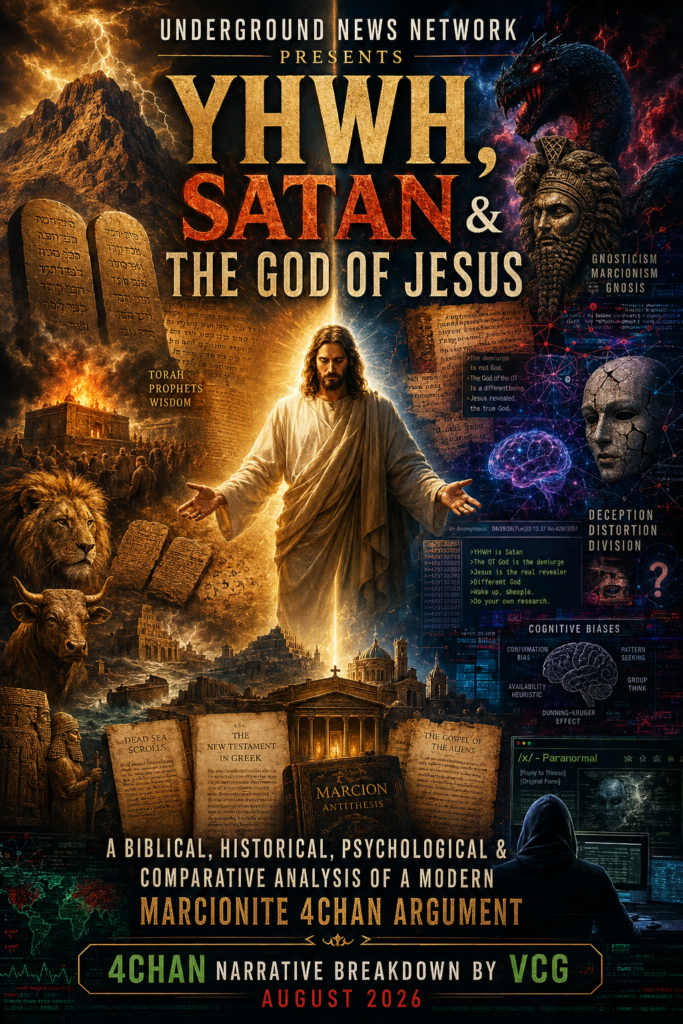
UPDATED BY VCG ON 8/13/2026 @ 15:51 EST
I want to share a heartfelt cause with my audience. Conner Blaisdell-Greene, a brave Airforce Sr. Airman, recently lost his battle with cancer, leaving his family in financial distress. Every donation, no matter how small, can help cover his funeral costs and ease their burden during this difficult time. Please consider clicking the link below to contribute or share Conner’s story with others. Your support truly matters.
Anyone can do this, but they won’t.
ChatGPT – Library of Rickandria
I’ll treat the thread as a set of discrete claims rather than as one argument: preserve each post’s wording/context, classify the claim type, verify it against primary/strong secondary sources, then compare its theological assertions with the KJV text you supplied. I’ll also separate what the poster actually says from inference about rhetoric/psychology, so we don’t “diagnose” anonymous users from text alone.
/x/ – The god of the Old Testament is not – Paranormal – 4chan
I’ve confirmed the live thread and preserved its post numbers. The core argument is not just “OT bad / NT good”; it mixes Marcionite/Gnostic-style separation of the Testaments, a misreading of John 8, comparative-myth claims about Enlil/Enki, conspiracy folklore, the problem of evil, and several internal biblical claims that actually conflict with one another.
A decisive textual point has already emerged from the KJV itself: John 8:44 does not identify Israel’s God as the devil. In the same speech Jesus says, “it is my Father that honoureth me; of whom ye say, that he is your God” (John 8:54), and says Moses “wrote of me” (John 5:46). That creates a direct internal problem for the thread’s central reading.
The comparative-religion section is more mixed than the thread makes it sound. The Atrahasis tradition really does contain population/noise, plague/famine/flood, and an Enki/Ea warning—so those parallels should not be dismissed. But the thread then combines Atrahasis with the separate Ziusudra tradition and leaps from literary resemblance to “Enlil became Yahweh / Enki became Satan,” for which the ancient texts do not supply the missing identity argument.
Soli Deo Gloria.
I went through the live /x/ thread, its linked /his/ precursor, the supplied KJV Pure Cambridge Edition, primary/academic material on the Mesopotamian flood traditions, Marcionism/Gnostic traditions, the psychology literature, and the thread’s scientific/statistical claims.
The result is considerably more interesting than simply saying “4chan is wrong.”
Executive conclusion
The thread’s central proposition — “the God of the Old Testament/YHWH is Satan, and Jesus warned us about YHWH” — does not survive contextual reading of the New Testament it appeals to. Its strongest proof-text, John 8:44, is contradicted by the immediate Johannine context: Jesus distinguishes the devil from God, identifies his Father with the God his opponents claim to worship, identifies Abraham positively, says Moses wrote about him, and elsewhere answers Satan by quoting the Torah’s command to worship “the Lord thy God.” (4chan)
The historical background is not invented. The broad idea that the Creator/Old Testament God differs from Jesus’ Father is ancient, most famously associated with Marcion, while various Gnostic systems developed hostile demiurge traditions. But Marcion’s actual position is not simply “YHWH = Satan,” and the thread combines Marcionism, Gnostic demiurgy, Mesopotamian mythology, Prometheus, UFO/NHI folklore, “egregores,” AI metaphysics, Mandela-effect claims, and modern conspiracy material into a new syncretic package. (Oxford Reference)
The comparative-Mesopotamian material contains some genuine facts. Atrahasis really does feature human overpopulation/noise, Enlil attempting plague/famine/flood, Enki/Ea helping the flood survivor, and later population controls. Ancient flood traditions really do predate the surviving biblical manuscripts. But the poster merges different versions and then makes an unsupported identity leap: similarities between Enlil, YHWH, Zeus, etc. do not establish that one deity “became” another. (ETCSL)
The philosophical problem of suffering raised by several posters is genuine and should not be trivialized. But “Christianity says every instance of suffering is explained by free will” is neither an adequate description of the Bible nor of philosophy of religion. Even contemporary philosophical discussion recognizes that a free-will defense primarily addresses moral evil and does not automatically account for disease, natural disaster, and other natural evils. (Stanford Encyclopedia of Philosophy)
So my final classification is:
Central thesis: contradicted by its own canonical source base.
Historical antecedents: real.
Mesopotamian parallels: partly real, substantially overstated.
YHWH = Enlil = Satan: unsupported.
John 8:44 proof: contextually untenable.
Circumcision proof: false dichotomy.
Hosea/Revelation animal proof: badly confuses literary allusion and identity.
2 Samuel 24 / 1 Chronicles 21: a genuine textual-theological problem worth studying, but not an identity statement.
Problem of evil: serious argument, but it does not establish YHWH=Satan.
Mandela/NHI/egregore/AI material: unevidenced as presented.
I. Methodology
I am using five separate questions for every claim:
- What exactly does the poster claim? Not what we think he means.
- What kind of claim is it? Biblical, historical, linguistic, scientific, philosophical, psychological, or purely rhetorical.
- What is the best evidence? For Scripture, your supplied KJV first; for Mesopotamia, ancient texts and reputable academic/museum material; for psychology/science, scholarly/official sources.
- Does the cited evidence entail the conclusion? Similarity is not automatically identity; association is not causation; moral revulsion is not historical identification.
- What remains unresolved after rebuttal? A poor argument against Christianity does not make every Christian answer adequate.
There is an especially relevant methodological warning from biblical scholarship. Samuel Sandmel famously called excessive construction of historical dependence from superficial similarities “parallelomania.” The methodological error is not noticing parallels—parallels may be real—but turning resemblance into derivation or identity without establishing the historical bridge. (Scholarly Publishing Collective)
That distinction will matter repeatedly.
II. The central thesis
No. 42813267 — “The god of the Old Testament is not the God of the New Testament … Yahweh is Satan”
That is the OP’s explicit thesis. (4chan)
Biblical verdict: contradicted
The canonical problem for this theory is enormous because Jesus repeatedly connects himself and his Father to Israel’s Scriptures rather than exposing their deity as Satan.
The single most damaging verse to the theory occurs in the very chapter the OP uses.
John 8:54 KJV:
“…it is my Father that honoureth me; of whom ye say, that he is your God.”
That is extraordinary in this discussion. Jesus does not say:
“You worship the devil whom you falsely call God.”
He says that the one whom they call their God is his Father, while accusing them of failing actually to know him. The distinction is between their profession and their moral/spiritual relationship, not between two deities.
Jesus then speaks positively of Abraham:
“Your father Abraham rejoiced to see my day…”
— John 8:56
And earlier:
“For had ye believed Moses, ye would have believed me: for he wrote of me.”
— John 5:46
If Moses were transmitting the religion of Satan, this is an extremely strange way for Jesus to identify Satan’s writings.
The contradiction becomes even more explicit in the temptation narrative. Satan tempts Jesus, and Jesus answers Satan:
“Thou shalt worship the Lord thy God, and him only shalt thou serve.”
— Matthew 4:10
Jesus is quoting Deuteronomy, the very Mosaic corpus the theory would assign to the false YHWH. The Torah’s God is invoked against Satan.
That does not settle every philosophical question about difficult Old Testament passages. It does settle whether the canonical NT straightforwardly teaches “Israel’s LORD = Satan”: it does not.
III. No. 42813272 — John 8:44
The poster says Jesus told “the priests of Yahweh, the Pharisees”:
“You belong to your father, the devil…” (4chan)
There are several problems.
1. “Father” is being used morally
The argument throughout John 8 concerns whose conduct the disputants resemble.
They claim Abraham:
“Abraham is our father.”
Jesus replies that if they were Abraham’s children, they would do Abraham’s works.
They claim God:
“We have one Father, even God.”
Jesus responds:
“If God were your Father, ye would love me…”
Then:
“Ye are of your father the devil, and the lusts of your father ye will do.”
The logic is behavior → moral parentage.
This interpretation is not something invented to evade Gnosticism. Scholarship notes that John 8:44 actually became a contested passage in early Christian debates: alternative grammatical interpretations were exploited by groups developing evil-creator theories, while other early interpreters understood the fatherhood in terms of imitation and participation. (OUP Academic)
2. John 8:54 removes the ambiguity for this thread’s thesis
Again:
“my Father … of whom ye say, that he is your God.”
Thus:
- their claimed God = Jesus’ Father;
- their actual moral father, because they imitate murder and lies = devil.
The poster collapses those two categories.
3. John itself reinforces moral fatherhood
Compare 1 John 3:
“He that committeth sin is of the devil…”
and:
“he that doeth righteousness is righteous…”
That is moral allegiance, not biological or national genealogy.
Verdict
John 8:44 does not establish YHWH = Satan. It works against that interpretation when 8:54 is included.
IV. No. 42813275 — “OT pro-circumcision / NT anti-circumcision”
This initially sounds stronger than it is. (4chan)
OT
Genesis 17 does institute circumcision as the sign of Abraham’s covenant.
That part is correct.
NT
But the NT is not simply anti-circumcision.
Paul says in Galatians 5:
“if ye be circumcised, Christ shall profit you nothing.”
But keep reading:
“whosoever of you are justified by the law; ye are fallen from grace.”
And then:
“For in Jesus Christ neither circumcision availeth any thing, nor uncircumcision; but faith which worketh by love.”
The issue is not:
foreskin = good.
The issue is:
physical circumcision does not justify a person before God and must not be imposed as the basis of Gentile salvation.
Romans 4 explicitly appeals to Abraham himself to make that argument: Abraham’s faith was counted for righteousness before circumcision, and circumcision subsequently became a “sign” and “seal.”
That is development within the Abrahamic argument, not “Paul discovered Abraham’s God was Satan.”
V. Philippians 3:2 — “dogs, evildoers, mutilators”
The linked /his/ thread treats Philippians 3:2 as especially powerful:
circumcision was instituted in Genesis; Paul calls circumcisers dogs/evil/mutilators; therefore its author was evil. (4chan)
But the KJV itself exposes what Paul is doing:
“Beware of dogs, beware of evil workers, beware of the concision.
For we are the circumcision, which worship God in the spirit…”
— Philippians 3:2–3
There is deliberate Greek wordplay:
- katatomē = cutting/mutilation, KJV “concision”
- peritomē = circumcision
Paul sarcastically devalues fleshly confidence while immediately reclaiming “circumcision” spiritually. Lexical resources likewise identify the wordplay. (Blue Letter Bible)
And Paul immediately reminds the reader:
“Circumcised the eighth day, of the stock of Israel…”
The polemic is against reliance on the flesh for righteousness.
It is not evidence that Paul thought the God of Abraham was Satan.
VI. No. 42813278 / 42813362 — “So Satan created the world?” / “No, God did; Satan rules it”
This exchange exposes an internal instability in the theory. (4chan)
Classical Marcionism associated the Old Testament God with the creator/demiurge. Oxford’s summary states that Marcion’s Creator/Demiurge disclosed in Genesis was distinct from the God revealed in Jesus. (Oxford Reference)
But the thread says instead:
God created the world.
Satan only rules it.
Now compare Genesis:
“In the beginning God created the heaven and the earth.”
And John:
“All things were made by him…”
— John 1:3
The Johannine Word becomes flesh as Jesus in John 1. Thus John identifies Christ with the creative work rather than rescuing humanity from an alien creator.
The NT does indeed call Satan “the prince of this world” in Johannine language and portrays the world as under evil influence.
But ruler/usurper/influencer ≠ creator ≠ ultimate owner.
Revelation 12 describes Satan being defeated and thrown down:
“the great dragon was cast out, that old serpent, called the Devil, and Satan…”
That text distinguishes:
- “our God,”
- “his Christ,”
- and their enemy, Satan.
It cannot naturally be read as saying all three are secretly the same being.
VII. No. 42813280 — “Gods get their powers from worship”
The poster suggests divine power rises and falls with the number and devotion of worshippers. (4chan)
Biblical verdict: opposite
Acts 17 is almost a direct refutation:
“God that made the world and all things therein…”
“Neither is worshipped with men’s hands, as though he needed any thing…”
Biblically, worship does not charge God’s battery. God is depicted as the giver:
“he giveth to all life, and breath, and all things.”
Could one invent an occult metaphysics in which lesser beings gain power from attention? Certainly. But the thread provides no evidence establishing that such beings exist or that their power follows worshiper numbers.
So this is metaphysical assertion, not fact.
VIII. No. 42813356 — “Yahweh and Satan are roles played by the demiurge; this cosmos is a show”
This is recognizably closer to certain Gnostic cosmologies than to Marcion proper. (4chan)
The historical comparison is worth taking seriously.
In the Apocryphon of John, the demiurgic ruler Yaldabaoth appears as a grotesque lion-faced serpent and arrogantly claims supremacy. (Gnosis)
So the poster’s imagery did not arise from nowhere.
But that establishes:
“Some ancient Gnostic Christians told a story like this.”
It does not establish:
“That story is historically or metaphysically true.”
Nor does it mean Marcion = every Gnostic system. Modern scholarship expressly warns that classification of Marcion as simply “Gnostic” can obscure significant differences. Marcion’s distinctive project focused strongly on scriptural contradiction rather than elaborate secret cosmology. (Wikipedia)
IX. No. 42813404 / 42813472 — “Believe in the God Jesus called Father”; “belief and fruit are the same”
The first statement contains something recognizably Christian but is incomplete. (4chan)
John 14 does not teach generic belief in an undefined Father:
“I am the way, the truth, and the life: no man cometh unto the Father, but by me.”
And 1 John 2 explicitly binds Father and Son:
“He is antichrist, that denieth the Father and the Son.”
“Whosoever denieth the Son, the same hath not the Father…”
“Belief and fruit are the same thing”
Not quite.
The Bible strongly connects genuine faith with fruit, but does not simply make the concepts identical.
James:
“faith, if it hath not works, is dead…”
and:
“I will shew thee my faith by my works.”
That makes works evidence/expression/completion of faith in James’s argument.
The poster’s practical instinct — professions of religion that produce cruelty are suspect — is biblically defensible.
The equation “faith = fruit” is too crude.
X. No. 42813407 — Enlil, Enki, Ziusudra, Noah
This is the most factually interesting part of the thread. (4chan)
We need to separate what is right from what is reconstructed.
“Humanity became numerous; Enlil sent plagues”
Substantially correct for Atrahasis.
The Met’s overview of Atrahasis explains that humans multiply, their noise disturbs Enlil, and Enlil attempts population control first by plague and then famine. (The Metropolitan Museum of Art)
So this is not merely internet fan-fiction.
“Enki helps humanity”
Also substantially correct.
When Enlil orders the flood, Enki warns Atra-hasis and tells him to build a boat preserving family and animals. (The Metropolitan Museum of Art)
“Enki teaches Ziusudra”
This conflates related but distinct traditions.
The surviving Sumerian flood story uses Zi-ud-sura/Ziusudra. The divine assembly decrees a flood and a warning is communicated through a wall. Oxford’s ETCSL translation preserves this material. (ETCSL)
The Akkadian Atrahasis story uses Atra-hasis.
The later Gilgamesh flood narrative uses Uta-napishtim/Utnapishtim.
The poster is moving details between them.
“Birds released from the ark”
True of the Gilgamesh version.
Uta-napishtim sends out:
- dove,
- swallow,
- raven. (The Metropolitan Museum of Art)
But because the surviving Ziusudra text is fragmentary, we should not pretend every later Gilgamesh detail appears there.
“Animals are saved”
Yes.
Both Ziusudra material and later flood traditions involve preservation of animal life. (ETCSL)
“Later population control by infertility, infant death, celibate classes”
Substantially grounded in Atrahasis.
The post-flood solution includes limiting human reproduction, classes of women who do not bear children, and infant-taking demons. (The Metropolitan Museum of Art)
So again: there is legitimate ancient material underneath this.
XI. Where the Enlil argument breaks
The thread then says:
Enlil learned monotheism from Enki.
Enlil became “Yahweh of Armies.”
Enki was transformed into Satan.
Enlil → Zeus → Yahweh.
Enki → Prometheus → Satan. (4chan)
This is where comparison becomes speculation.
1. Targeted ritual ≠ monotheism
If humans direct offerings toward the deity responsible for a particular plague, that does not mean they have adopted philosophical monotheism.
They are still operating in an explicitly polytheistic cosmos.
“Worship this god to stop his plague” does not equal:
“Only one God exists.”
2. Similar role ≠ same deity
To establish that “Enlil became YHWH,” we would need evidence such as:
- historical transmission;
- identifiable cultic continuity;
- linguistic/name development;
- direct textual borrowing;
- shared distinctive attributes beyond generic storm/kingship/judgment motifs;
- intermediate witnesses documenting transformation.
The thread supplies none.
It notices analogous roles and then simply inserts an equals sign.
That is precisely the type of inference comparative scholarship warns against. (Scholarly Publishing Collective)
3. The flood stories also contain significant differences
In Atrahasis, the crisis begins with excessive human population/noise disturbing Enlil.
Genesis says:
“the wickedness of man was great in the earth…”
The theological rationale is moral corruption and violence.
The Mesopotamian gods are portrayed with anthropomorphic needs and disputes to a degree unlike Genesis’ God.
That does not prove independence; cultural relationship between ancient Near Eastern flood traditions is a legitimate historical question.
It does prove that “same story therefore same deity” is too simplistic.
XII. “Women in White” / NHI / UFO / four-coloured flag
The poster claims a non-human faction has influenced religions for millennia, appears as white-clothed women/bovine beings, gives prophecy, operates UFOs, and possesses a four-colored flag appearing across religions. (4chan)
I searched specifically for this claim.
What turns up is essentially the same modern paranormal/UFO assertion circulating in social-media/interview material, not an established archaeological or historical corpus demonstrating such a civilization or NHI faction. (Instagram)
So:
Claim status: unsupported.
This does not mean “we have scientifically proven no unidentified phenomenon ever exists.”
It means the specific historical proposition—
an identifiable NHI faction called/characterized as Women in White has manipulated world religions for thousands of years
—has not been evidenced here.
The methodology is backwards: first assembling motifs and then assuming a single hidden agent caused them.
XIII. “This isn’t a new theory” — Cathars and Marcion
This is partly correct. (4chan)
Marcion’s second-century theology sharply separated the Creator/God of the OT from the previously unknown God revealed in Christ. Oxford summarizes the distinction plainly. (Oxford Reference)
So the general idea:
“The God described in the Hebrew Scriptures is not Jesus’ Father”
is ancient.
But the exact package:
YHWH = Satan = Enlil; Enki = Satan/Prometheus; NHI women manipulate religions; gods run on worship; Mandela changes; archon/AI/egregore
is not “ancient Marcionism.”
Calling that entire modern synthesis “Marcionism” obscures rather than clarifies its genealogy.
XIV. Mandela-effect Bible changes
Twice somebody says simply:
“research the mandela effect bible changes.” (4chan)
There is no actual claim to test because no verse is specified.
This matters methodologically.
A falsifiable version would be:
“I remember KJV verse X containing wording A, but every historical edition before year Y contains wording B.”
Then we compare:
- dated printed Bibles;
- manuscript witnesses;
- photographs/scans;
- quotations in books written before the alleged change;
- textual apparatuses.
The Dead Sea Scrolls alone demonstrate that biblical manuscripts physically existed long before modern internet-era “reality shift” claims; the Qumran material dates back into the centuries before and around the beginning of the Common Era. (The Library of Congress)
There is experimental research on the “Mandela Effect” as shared, specific false memory. That means shared recollection itself is not evidence that physical history changed.
Until somebody supplies a particular Bible verse and claimed former wording:
no factcheck is possible beyond “unsupported as stated.”
XV. The problem of evil — No. 42813511 / 42813667
This part deserves more respect than several other posts.
The poster asks, roughly:
If God is good, why permit so much suffering? Why invoke “free choice”? Why don’t professing Christians actually alleviate evil? Why does Christ leave and return instead of simply remaining? (4chan)
There are several different arguments here.
A. “Free will explains all suffering”
The poster is right that free will by itself is not a sufficient account of all suffering.
Academic philosophy recognizes exactly this difficulty: earthquakes, disease and other natural evils do not obviously result from human moral choice, so a free-will defense does not automatically answer them. (Stanford Encyclopedia of Philosophy)
So a Christian response that merely says:
“free will, next question”
is inadequate.
B. But the Bible does not blame every sufferer on personal choice
The biblical corpus itself refuses that simple equation.
Job’s friends repeatedly assume suffering must correspond straightforwardly to personal wrongdoing. The book does not vindicate their simplistic calculus.
John 9 likewise has the disciples ask concerning a man born blind whether he or his parents sinned. Jesus rejects that binary.
Thus:
“Bible = every sufferer freely chose his suffering” is a straw man.
C. “Christ left humanity”
The canonical answer is more nuanced.
Jesus does physically depart in the ascension tradition.
But in John 14 he says:
“I will pray the Father, and he shall give you another Comforter…”
“I will not leave you comfortless: I will come to you.”
So the Christian narrative is not:
Jesus abandoned Earth completely.
It is:
- bodily departure/ascension;
- gift of the Spirit;
- continuing divine presence;
- promised consummation/return.
Whether one accepts that theology is another question. But the thread attacks a form the text itself does not assert.
D. Hypocritical believers
Here the critic lands a legitimate biblical blow.
If Christians preach righteousness while refusing mercy, justice, generosity, truth, or love, the NT itself condemns hypocrisy.
James says:
“faith without works is dead.”
The existence of hypocritical Christians does not logically prove Christianity false, but Christians cannot answer the charge by pretending hypocrisy does not matter.
XVI. “1.8 billion abortions”
The statistic is repeatedly screamed without a date range or source. (4chan)
WHO’s current fact sheet estimates approximately 73 million induced abortions worldwide per year. (World Health Organization)
Therefore, a cumulative total around 1.8 billion might be mathematically conceivable over a sufficiently long multi-decade interval, but the thread never specifies:
- years;
- dataset;
- what “public abortion” means;
- whether the figure is induced abortions;
- geographical coverage.
So “1.8 billion public abortions” is not a properly sourced statistic as written.
The moral/theological question it is being used to raise is another version of the problem of evil.
Even if the statistic were perfectly correct, the logic would still require another argument:
God permits terrible event X
therefore God is literally Satan.
That conclusion does not follow merely from the premise.
One can argue that suffering is evidence against an omnipotent benevolent God. Philosophers do exactly that.
But “therefore YHWH and Satan are historically the same entity” is a completely different proposition requiring completely different evidence.
XVII. “He who denies the Father denies me”
The poster places this in quotation marks as though quoting Scripture. (4chan)
That is not the KJV wording.
The relevant text is 1 John 2:22–23:
“He is antichrist, that denieth the Father and the Son.”
and:
“Whosoever denieth the Son, the same hath not the Father…”
This matters because the actual statement makes Father and Son inseparable in confession.
It does not read:
whoever disagrees with a particular identification of Yahweh automatically denies Jesus.
But neither can one invoke 1 John to construct a Father disconnected from the Son.
XVIII. “Jesus is an egregore / archon / AI”
These statements are assertions, not arguments. (4chan)
Three separate categories are being fused:
- egregore — occult/esoteric concept of a collective psychic entity;
- archon — term with ancient Greek and Gnostic meanings;
- AI — modern technological category.
Saying “X = Y = Z” does not supply evidence that those categories describe the same ontological phenomenon.
The rhetorical technique is powerful because each word comes preloaded with associations.
Methodologically, however, the argument currently has the form:
These concepts feel structurally similar to me.
Therefore they describe one hidden being.
That is not sufficient.
XIX. No. 42813782 — “No one has seen the Father; people saw YHWH; therefore YHWH cannot be the Father”
This is considerably better constructed than many thread arguments. (4chan)
John 1:18 KJV:
“No man hath seen God at any time; the only begotten Son… he hath declared him.”
John 6 further specifies:
“Not that any man hath seen the Father, save he which is of God…”
Meanwhile, OT passages depict people encountering:
- “the angel of the LORD,”
- divine glory,
- human-form manifestations,
- visions,
- and scenes in which the LORD is spoken of as appearing.
So what do we do?
What the thread assumes
- Somebody “sees YHWH.”
- John says nobody has seen the Father.
- Therefore YHWH ≠ Father.
But premise 1 equivocates on seeing.
The OT itself already distinguishes divine manifestation from unrestricted vision of God’s essence. Exodus 33 famously has God tell Moses:
“Thou canst not see my face: for there shall no man see me, and live.”
So the phenomenon did not first become a problem in John.
Traditional Christian interpretation
Christian theologians have commonly understood OT appearances as theophanies—mediated manifestations of God—and some specifically identify certain appearances with the preincarnate Son.
That latter identification is interpretation, not something every OT appearance explicitly announces.
But it shows why:
“a human saw a manifestation”
does not logically equal:
“a human perceived the Father’s unmediated divine essence.”
And once again John 8:54 explicitly calls Jesus’ Father the one his opponents say is their God.
So the proposed conclusion still does not follow.
XX. No. 42814044 — “Pain is not real”
This is factually wrong. (4chan)
The International Association for the Study of Pain defines pain as:
an unpleasant sensory and emotional experience associated with, or resembling that associated with, actual or potential tissue damage. (IASP)
Importantly, IASP emphasizes:
- pain and nociception are not identical;
- pain is genuinely experienced;
- biological, psychological, and social factors influence it.
Saying pain consists partly in neural processing does not mean pain is unreal.
That is like saying:
sight depends upon the nervous system; therefore seeing is unreal.
The philosophical mistake is confusing being mediated by the brain with not existing.
And absence of pain sensation does not make tissue damage disappear. Congenital inability to feel pain is dangerous precisely because injuries can occur without the protective warning normally supplied by pain.
So this section is not a successful solution to the problem of suffering.
It redefines the experience away.
XXI. The antisemitic material
Several posts replace arguments with slurs, ethnic conspiracy language, “golem,” “JIDF,” claims about Jews as hidden manipulators, etc. (4chan)
Those statements provide no evidence for the theological thesis.
The US Holocaust Memorial Museum identifies conspiracy/scapegoating portrayals of Jews as recurring features of antisemitism. (Holocaust Encyclopedia)
More importantly for our biblical method:
ethnic abuse cannot establish exegesis.
Whether John 8:44 means X is determined by:
- grammar,
- context,
- Johannine usage,
- related passages,
not by contempt for Jews.
Indeed, Jesus, the apostles, Abraham, Moses, and the prophets under discussion are all located within Israel’s history.
A theory that requires insulting Jews to make John 8 work has already abandoned textual argument.
XXII. No. 42813749 — “Outward religion, inward corruption”
This respondent is basically right. (4chan)
Jesus repeatedly condemns outward religiosity that masks inward corruption.
That reading actually fits John 8 far better than “their deity is secretly Satan.”
The John 8 argument is:
You claim Abraham/God as Father, but your deeds contradict your claim.
That is why “father” can shift rhetorically from Abraham/God to the devil.
The ethical criticism is internal to biblical religion.
XXIII. No. 42816640 — Pharisees “agents of Satan because they are rabbinical”
This contains both a good point and historical compression. (4chan)
Good point
Jesus does criticize religious traditions when they override God’s commandment.
And:
merely claiming to be godly does not make a person righteous
is thoroughly biblical.
Problem
Calling first-century Pharisees simply “rabbinical” can be anachronistic if it implies fully developed later Rabbinic Judaism already existed unchanged.
There is historical continuity between Pharisaic traditions and later rabbinic Judaism, but they are not interchangeable labels without qualification.
“Cast the first stone”
The John 8 adultery episode depicts scribes and Pharisees testing Jesus with Moses’ law.
But nothing in the scene says:
therefore the God who gave Moses’ law is Satan.
If anything, Jesus exposes hypocrisy while continuing to distinguish sin from righteousness.
XXIV. Revelation’s counterfeit imagery
No. 42816640 argues that evil imitates divine imagery, especially the beast “like a lamb.” (4chan)
This is a plausible literary interpretation.
Revelation 13:11:
another beast has “two horns like a lamb” but “spake as a dragon.”
The image quite naturally suggests counterfeit resemblance.
This matters because it provides a much better explanation of similarities between divine and beast imagery than:
similar imagery = identical being.
Biblical apocalyptic literature frequently depicts false powers mimicking, parodying, or arrogating divine authority.
Similarity may be precisely the point because they are opponents.
XXV. “God doesn’t need worship; lower gods do”
The first half is biblical.
Acts 17:
God is not served “as though he needed any thing.”
The second half—
lower gods literally need worship/human sacrifice to maintain themselves—
is not demonstrated.
Ancient religions certainly contain offerings, food for gods, sacrifices, and cultic reciprocity.
The Atrahasis/Gilgamesh tradition famously presents gods responding to sacrificial offerings. (The Metropolitan Museum of Art)
But that historical fact does not prove such entities objectively exist and metabolize human worship as energy.
Separate:
what ancient worshippers/texts believed
from
what exists metaphysically.
XXVI. The tenth plague / firstborn of Egypt
No. 42818694 raises one of the morally hardest OT narratives. (4chan)
We should not evade it.
The thread accurately identifies that Exodus attributes the death of Egypt’s firstborn to divine judgment and connects Israel’s escape with Passover blood.
Missing context
Earlier in Exodus, Pharaoh’s regime enslaves Israel and orders Hebrew male children killed.
Later God calls Israel:
“my son, even my firstborn”
and warns Pharaoh concerning his refusal to release that son.
So the plague is narratively presented as judgment upon an oppressive imperial system.
But context is not erasure
A critic can still ask:
How is the death of children morally just?
That is a serious theological question.
Christian and Jewish interpreters have proposed different accounts involving:
- divine judgment;
- corporate identity in the ancient world;
- God’s authority over life and death;
- retributive judgment upon Egypt;
- literary/theological dimensions of the plague narrative.
Critics may still judge those answers inadequate.
What does not follow is:
I morally reject this act
therefore the actor is historically identical to Satan.
That requires an additional premise:
The true God could never perform any lethal judgment.
But the New Testament itself contains divine judgment, so separating OT from NT does not make judgment disappear.
Hebrews 10, for example, after saying Christ offered one sacrifice for sins forever, also speaks of coming judgment and:
“The Lord shall judge his people.”
Marcion’s “OT judgment / NT love” contrast becomes difficult to maintain if the NT is read whole.
XXVII. “God demands worship or torture”
The post caricatures but does touch a real theological question. (4chan)
Christian Scripture does teach judgment and does demand allegiance to God.
So the best response is not:
“The Bible never says anything like that.”
It does.
The correction is to the alleged motive.
Acts 17 explicitly says God does not need human service.
In biblical theology, worship is owed because God is Creator and good—not because lack of worship starves him.
Whether eternal punishment is just is its own large theological debate, including disagreements over:
- eternal conscious punishment,
- conditional immortality/annihilation,
- universalist interpretations.
That controversy should not be smuggled into “God needs worship energy.”
XXVIII. “Jesus was the final sacrifice, yet tells followers to bear a cross”
This is a category error. (4chan)
Yes, Hebrews explicitly says:
“the offering of the body of Jesus Christ once for all”
and:
“one sacrifice for sins for ever.”
So on the thread’s question:
Yes. In Hebrews’ theology Christ is the final/once-for-all sin offering.
But Jesus’ command:
“deny himself, and take up his cross, and follow me”
is a call to costly discipleship, self-denial, and willingness to suffer—not a command that each Christian become another atoning sacrifice.
The same word/image can perform different theological functions.
XXIX. Pharaoh as divine intercessor
The historical part of No. 42818785 is broadly credible: Egyptian kingship did portray the king as divine/mediatorial within cultic ideology. Egyptian religious sources and modern historical summaries describe the pharaoh as mediator or high priest between gods and people. (World History Encyclopedia)
The next statement—
“there may or may not be an angel influencing Pharaoh”
—is speculation.
Exodus does not need that hypothesis to explain the scene.
The quoted Exodus 10 confession simply shows Pharaoh acknowledging sin and asking Moses to intercede.
That actually undermines a simplistic claim that Pharaoh understands YHWH as merely another hostile demon.
XXX. “Yahweh and Yeshua are the same thing”
No. 42818814 gestures toward a genuine Christian theological idea but expresses it linguistically badly. (4chan)
YHWH and Yeshua are not the same Hebrew name.
Yeshua is a Hebrew/Aramaic form associated with the name represented in Greek as Iēsous, from which English “Jesus” ultimately derives.
Trinitarian Christianity can nevertheless make a theological claim that the Son shares the divine identity of Israel’s God.
That is very different from saying:
the lexical items “YHWH” and “Yeshua” are identical.
Also, Trinitarian Christianity does not say Jesus is the Father.
It says the Father and Son are personally distinct while sharing the one divine being.
Non-Trinitarian Christian traditions interpret these matters differently, but none of that turns the two names into the same word.
XXXI. “YHWH is the serpent; Jesus is YHWH; his daddy is El/Saturn”
No. 42818919 combines several different traditions. (4chan)
Biblically, Revelation gives us an explicit serpent identification:
“that old serpent, called the Devil, and Satan…”
It does not say:
“that old serpent, called YHWH.”
So if Revelation is the authority, the textual identification is Satan ↔ serpent.
The “El/Saturn” claim belongs to a different comparative-religion stream involving ancient Northwest Semitic El and later cross-cultural identifications of gods.
Even where ancient or later writers identify foreign deities with one another, this is interpretatio—cross-cultural equivalence—not proof that the biblical Father literally is the planet Saturn or the Roman Titan.
The thread again moves from:
somebody equated A with B within comparative mythology
to:
A and B are objectively the same supernatural person.
Those are very different claims.
XXXII. Lion-headed serpent
The final poster says the lion head and serpent body “inherently” symbolize the polarity of good and evil. (4chan)
The first half of this motif is historically real.
The Apocryphon of John describes its demiurgic figure in lion-serpent imagery. Surviving translations include the figure of a lion-faced serpent with fiery/lightning-like eyes. (Gnosis)
But:
“therefore lion + serpent inherently means good/evil polarity”
is an interpretive assertion.
Symbols are contextual.
A lion can symbolize:
- royal power,
- danger,
- Christ,
- Satan,
- Judah,
- empire,
depending on text.
A serpent can symbolize:
- evil/deception,
- danger,
- wisdom,
- healing,
- judgment,
depending on context.
Symbols do not have a single metaphysical dictionary definition.
XXXIII. The linked /his/ thread: Hosea 13 vs Revelation 13
This is probably the OP’s second strongest argument after John 8.
The earlier thread says:
Hosea has YHWH depicted as lion/leopard/bear.
Revelation’s Beast is lion/leopard/bear.
Therefore YHWH is the Beast. (4chan)
Let’s put the texts beside one another.
Hosea 13
God says:
“I will be unto them as a lion: as a leopard by the way…”
“I will meet them as a bear…”
Notice the grammar: simile.
God will attack apostate Israel like ferocious animals.
Revelation 13
The Beast:
“was like unto a leopard, and his feet were as the feet of a bear, and his mouth as the mouth of a lion…”
The resemblance is real.
But Revelation immediately says:
“the dragon gave him his power…”
and then:
“he opened his mouth in blasphemy against God.”
That is devastating to “the Beast = God.”
The Beast:
- receives power from dragon;
- blasphemes God;
- wars against God’s saints.
The text itself distinguishes Beast, Dragon, and God.
XXXIV. Daniel is the missing literary context
The /his/ thread notices that Daniel also has these animals but strangely treats that as confirmation. (4chan)
In Daniel 7 the beasts include:
- lion,
- bear,
- leopard,
- fourth beast.
They represent kingdoms/imperial powers.
Revelation 13 combines Daniel’s imagery into a composite monster.
That provides a very natural literary explanation:
Revelation’s Beast embodies the predatory imperial kingdoms of Daniel.
Therefore the fact that Hosea can also use lion/bear/leopard imagery for divine judgment does not identify God with Revelation’s Beast.
Same vocabulary is not same referent.
To give an obvious example:
1 Peter calls Satan a roaring lion.
Revelation calls Christ the Lion of Judah.
Therefore:
lion imagery ≠ ontological identity.
Otherwise one could “prove” Christ = Satan with one shared metaphor.
That shows the methodological defect clearly.
XXXV. John 1:18 and OT appearances — linked thread
As above, the linked thread reasons:
no one saw Father; people saw YHWH; YHWH isn’t Father. (4chan)
But John itself resolves its theology through the Son as revealer:
“the only begotten Son… he hath declared him.”
And John 6 clarifies that the Son uniquely sees the Father.
This is much closer to:
unseen God → revealed through Son
than:
OT God = Satan → Jesus introduces unrelated deity.
XXXVI. 2 Corinthians 3 — old covenant veil
The linked thread quotes Paul’s veil language as though it supports a satanic Old Testament deity. (4chan)
But Paul’s actual argument is covenantal transformation.
He describes the Mosaic ministry as possessing glory, even while contrasting it with the surpassing glory of the new covenant.
That is why Paul’s argument is:
old covenant → fulfilled/surpassed in Christ
not:
Satan’s covenant → God’s covenant.
The same Paul elsewhere says:
“the law is holy, and the commandment holy, and just, and good”
— Romans 7:12.
Marcion’s reading requires intensifying Paul’s contrast beyond Paul’s own descriptions of the Torah.
XXXVII. Luke 19 — “slay them before me”
The earlier thread correctly brings up Luke 19:27 against an overly sentimental contrast between “violent OT God” and “harmless NT Jesus.” (4chan)
This is important.
Even if one debates precisely how every element in the parable maps onto God, Jesus’ teaching undeniably contains judgment imagery.
So:
OT God = judgment
Jesus’ Father = never judgment
doesn’t survive the NT.
Matthew 25, Revelation, Hebrews and other NT passages make the same broader point.
The thread’s own evidence therefore undermines the simplistic Marcionite moral dichotomy.
XXXVIII. Moses’ death + Jude 9
The linked thread claims:
- Moses dies while still vigorous.
- YHWH buried him.
- The devil later disputes over Moses’ body.
- Therefore YHWH = devil. (4chan)
That is a non sequitur.
Jude 9 reads:
“Michael the archangel, when contending with the devil he disputed about the body of Moses… said, The Lord rebuke thee.”
Notice the grammatical relationships:
- Michael;
- devil;
- Lord.
Michael tells the devil:
The Lord rebuke thee.
That distinguishes the Lord from the devil.
The fact that both Deuteronomy and Jude concern Moses’ body does not mean every agent associated with that body is identical.
That’s like saying:
Joseph of Arimathaea handled Jesus’ body.
Roman soldiers handled Jesus’ body.
Therefore Joseph = Roman soldiers.
Association is not identity.
XXXIX. The genuine hard case: 2 Samuel 24:1 vs 1 Chronicles 21:1
Here the thread identifies a real parallel requiring explanation. (4chan)
2 Samuel 24:1 KJV:
“the anger of the LORD was kindled against Israel, and he moved David against them…”
1 Chronicles 21:1:
“And Satan stood up against Israel, and provoked David to number Israel.”
We should not pretend those sentences are identical.
There is a genuine difference in stated agency.
Possible interpretations include:
1. Primary and secondary agency
God sovereignly permits/ordains an event that Satan performs as secondary agent.
That resembles Job, where Satan acts only within limits established by God.
2. Chronicler’s theological reframing
Chronicles may express the event using a more developed concept of adversarial agency than Samuel’s formulation.
3. “Satan/adversary” semantic issue
The Hebrew term has a history of use meaning “adversary” as well as becoming a proper designation for Satan.
Scholars debate aspects of that development.
What the texts do not say
Neither says:
“YHWH is another name for Satan.”
In fact Chronicles 21 continues:
“God was displeased with this thing…”
David then confesses to God, receives God’s judgment through Gad, and asks the LORD for mercy—all while “Satan” has already been introduced as a distinct provocateur.
So this is real evidence of complex divine/secondary agency or differing retelling, not identity.
It deserves study. It does not prove the thesis.
XL. “The whole earth belongs to God” vs “the evil one controls the world”
The linked thread juxtaposes:
OT:
earth belongs to YHWH.
NT:
world lies in wickedness / Satan is prince of world.
Therefore, supposedly:
same ruler. (4chan)
This equivocates on ownership/ultimate sovereignty versus temporary rebellious influence.
Revelation’s own plot depicts Satan:
- deceiving the world;
- being cast down;
- being opposed by God;
- having “a short time”;
- eventually being judged.
A rebel can exercise jurisdiction without being the ultimate sovereign.
John 14 says “prince of this world,” but Jesus immediately adds:
“and hath nothing in me.”
So the designation does not equate the prince with the Father.
XLI. Forty years versus forty days
The linked thread says:
YHWH tested Israel forty years.
Satan tested Jesus forty days.
Therefore similar tester = same entity. (4chan)
There really is an intentional parallel.
But the conclusion is backwards.
Jesus’ wilderness temptation clearly recapitulates Israel’s wilderness experience.
How do we know?
Because Jesus answers Satan with passages from Deuteronomy connected with Israel’s wilderness testing.
Most strikingly:
Satan tempts Jesus.
Jesus replies:
“Thou shalt worship the Lord thy God, and him only shalt thou serve.”
Thus the literary structure is:
- Israel was God’s son in wilderness and failed;
- Jesus, God’s Son, enters wilderness;
- Satan tempts him;
- Jesus remains faithful to the God of Deuteronomy.
The parallel distinguishes the tempter from the God Jesus obeys.
It does not identify them.
XLII. “Masoretic Rabbis tricked you”
The linked thread simply asserts this. (4chan)
It’s not an argument.
The Masoretic tradition is indeed fundamental to the received Hebrew text used in later Judaism and many Christian Old Testament translations.
But we possess witnesses outside the medieval Masoretic codices:
- Dead Sea biblical manuscripts;
- Septuagint tradition;
- Samaritan Pentateuch;
- ancient quotations and translations.
The Dead Sea Scrolls include biblical manuscripts dating centuries before medieval Masoretes. (The Library of Congress)
Thus claims of deliberate medieval corruption can actually be tested against earlier witnesses.
The existence of textual variants is real.
The conclusion:
“therefore rabbis secretly transformed YHWH into God”
requires manuscript evidence.
None is produced.
XLIII. The psychology of the thread
This section needs caution.
I cannot diagnose anonymous posters with a psychiatric condition from a handful of messages, nor would that be useful.
We can, however, analyze the reasoning environment and rhetorical mechanisms.
1. Illusory pattern amplification
Research has found associations between illusory pattern perception and belief in conspiracy or supernatural claims. (PubMed Central (PMC))
The thread repeatedly follows:
A resembles B.
B resembles C.
Therefore A = B = C.
Examples:
- Enlil → Zeus → YHWH;
- Enki → Prometheus → Satan;
- lion/bear/leopard → same deity;
- Moses’ body → same actor;
- 40 years → 40 days → same tempter;
- storm imagery → same god;
- serpent imagery → same cosmic entity.
Pattern detection is necessary for scholarship.
The problem is failing to ask:
What observations would distinguish coincidence, literary borrowing, shared cultural vocabulary, typological reuse, polemical inversion, and actual identity?
2. Confirmation asymmetry
Evidence resembling the theory is admitted immediately.
Counterevidence is reinterpreted as:
deception proves how deceptive the hidden entity is.
That risks making the theory self-sealing.
A useful test for any worldview is:
What evidence could prove me wrong?
If the answer is “anything apparently disproving the theory merely proves the conspiracy is more sophisticated,” the claim has ceased functioning as an ordinary falsifiable historical hypothesis.
3. Moral intuition becomes identity evidence
Several arguments effectively say:
I judge act X evil.
Satan is evil.
Therefore the actor of X is Satan.
The moral premise may deserve serious debate.
But the identity inference is invalid.
Compare:
Person A commits murder.
Person B is a murderer.
Therefore A = B.
No.
Shared moral classification is not numerical identity.
4. Motif aggregation
The thread accumulates:
- flood;
- serpent;
- lion;
- storm;
- circumcision;
- sacrifice;
- suffering;
- UFOs;
- white women;
- cows;
- four colors;
- Saturn;
- AI.
Large motif collections create a powerful subjective impression of convergence.
But as the search space expands, finding some resemblance becomes increasingly easy.
Good comparative methodology therefore asks for specific, rare, ordered correspondences plus a plausible historical channel, not just increasing piles of motifs.
5. Emotional salience
Child death, circumcision, abortion, suffering, war and eternal punishment are emotionally intense subjects.
That does not make emotional responses irrational.
But high emotional salience can shift the debate from:
What does the text say?
to:
Any deity who did this must be my preselected evil entity.
The proper method keeps moral evaluation and historical identification separate.
6. Identity-protective rhetoric
Once posters divide into:
- “Christians,”
- “Jews,”
- “goyim,”
- conspirators,
- dupes,
- awakeneds,
disagreement becomes evidence of group identity rather than an opportunity to test claims.
That makes correction harder because conceding a fact can feel like joining the enemy camp.
7. Anonymous-board disinhibition
The thread contains escalating insults, sexual/racial abuse, all-caps mockery and contempt in place of argument.
This is consistent with well-established observations about online disinhibition in anonymous environments, but that is a population-level explanatory framework, not a diagnosis of these particular posters.
And rhetorically it matters because ridicule creates a false sense that a claim has already been refuted.
It has not.
XLIV. What the thread actually gets right
A fair analysis should preserve these points.
1. The problem of evil is real
Christian theology must face suffering, including apparently gratuitous suffering.
“Free will” alone does not settle it. (Stanford Encyclopedia of Philosophy)
2. Christians can be hypocrites
The Bible itself says so, repeatedly.
3. Ancient Near Eastern flood parallels are real
They should neither be denied nor panicked over. (ETCSL)
4. Marcionite/Gnostic alternatives really existed
The concept is historically ancient, not an invention of 4chan. (Oxford Reference)
5. 2 Samuel 24 / 1 Chronicles 21 is a legitimate exegetical issue
It deserves more than a dismissive harmonization.
6. Paul radically relativizes physical circumcision
That is true.
What is false is turning that into “Paul identified Abraham’s God as Satan.”
7. Revelation deliberately employs counterfeit divine imagery
The lamb-like beast speaking as dragon strongly supports an imitation/parody reading.
XLV. The five strongest biblical corrections
If someone presented this entire thread and we could answer with only five passages, I would use these.
1. John 8:54
“my Father … of whom ye say, that he is your God.”
This directly undermines the thread’s use of John 8:44.
2. John 5:46
“had ye believed Moses, ye would have believed me: for he wrote of me.”
Jesus does not portray Moses as Satan’s prophet.
3. Matthew 4:10
Against Satan, Jesus quotes the Torah:
“Thou shalt worship the Lord thy God, and him only shalt thou serve.”
This may be the cleanest anti-Marcionite passage in the entire discussion.
4. Revelation 13:6
The Beast:
“opened his mouth in blasphemy against God…”
The Beast therefore cannot simply be identified with the God he blasphemes without overriding the sentence’s subject-object distinction.
5. Jude 9
Michael disputes with the devil and says:
“The Lord rebuke thee.”
Again:
Lord ≠ devil inside the sentence itself.
XLVI. The deeper theological error
At bottom the thread does not begin with John 8 or Hosea.
It begins with an unstated theological axiom:
A perfectly good God would never judge violently, command anything I regard as harmful, permit profound suffering, or act in ways I presently cannot morally reconcile.
Then it reads the canon through that axiom:
- Jesus teaches love.
- Some OT passages portray terrifying judgment.
- Love and judgment cannot coexist in one God.
- Therefore two gods.
- Evil judgment belongs to Satan.
- Therefore OT LORD = Satan.
- Every similarity thereafter becomes confirmation.
That is essentially the structure associated historically with the Marcionite problem. (Encyclopedia.com)
But the canonical Bible refuses premise 3.
The OT contains:
- mercy,
- forgiveness,
- covenant love,
- patience,
- compassion.
The NT contains:
- judgment,
- wrath,
- condemnation,
- destruction,
- apocalyptic punishment.
Therefore the actual canonical contrast is not:
OT = wrath / NT = love.
Both Testaments contain mercy and judgment.
The theological question then becomes much harder:
How can perfect goodness and divine judgment coexist?
That is the real issue.
Changing the label from “God” to “Satan” does not answer it unless one first proves that the biblical authors themselves make that identification.
They don’t.
XLVII. Final evidentiary scorecard
| Claim | Finding |
|---|---|
| YHWH is Satan | Contradicted by canonical context / historically unsupported |
| Jesus reveals a different God from Moses | Contradicted by Jesus’ positive appeal to Moses and Israel’s God |
| John 8:44 proves YHWH is the devil | False contextual inference |
| John 1:18 proves OT appearances are Satan | Non sequitur; manifestation vs unseen Father not distinguished |
| OT pro-circumcision / NT anti-circumcision | Oversimplified |
| Philippians 3 calls circumcision itself satanic | False; pun attacks fleshly confidence/compulsion |
| Satan exercises power in fallen world | Biblically supported with qualifications |
| Satan created world | Contradicted by NT creation texts |
| gods gain literal power from worship | Unsupported; biblical God explicitly needs nothing |
| Marcion-like theology is ancient | True |
| Gnostic evil-demiurge traditions existed | True |
| Enlil used plague/famine/flood against overpopulated humanity in Atrahasis | Substantially true |
| Enki warned flood survivor | True |
| Ziusudra = Atrahasis in same story | Conflation of traditions |
| Birds released after Mesopotamian flood | True in Gilgamesh version |
| Enlil became YHWH | No demonstrated evidence |
| Enki became Satan/Prometheus | Comparative speculation |
| Women-in-White NHI manipulate religions | Unsupported |
| Mandela effect proves Bible physically changed | No evidence supplied |
| 1.8 billion “public abortions” | Unverifiable as stated; no timeframe/source |
| Free will solves all suffering | No; neither Bible nor philosophy warrants that simplification |
| Pain is unreal | Scientifically false |
| Hosea animal imagery proves YHWH = Revelation Beast | False identity inference; Daniel is crucial context |
| Revelation Beast blasphemes God | Explicitly true |
| Moses-body passages prove YHWH = devil | False; Jude explicitly distinguishes Lord and devil |
| 2 Sam 24 and 1 Chron 21 differ in stated agency | True and exegetically important |
| Difference proves LORD = Satan | Does not follow |
| Satan’s world-rule means Satan owns/created world | Equivocation |
| Jesus’ 40 days / Israel’s 40 years are related | Very likely intentional literary/typological parallel |
| Therefore YHWH tempted Jesus | Contradicted by the narrative |
| Christ is final sacrifice | Explicitly affirmed in Hebrews |
| Bearing one’s cross repeats Christ’s sacrifice | Category error |
| “Yeshua” = “YHWH” linguistically | False |
| Lion-headed serpent occurs in Gnostic traditions | True |
| Lion-serpent inherently means good/evil polarity everywhere | Unsupported universalization |
Final conclusion
The thread is best understood as a modern syncretic reassembly of an ancient theological objection.
Its ancient core is serious:
How can the God of judgment portrayed in portions of the Hebrew Bible be the Father revealed through Jesus Christ?
Marcion answered:
He isn’t.
Various Gnostic systems developed even more radical demiurgic answers.
Canonical Christianity answered:
The Creator, the God of Abraham, Moses and the prophets, is the God revealed in Christ; the apparent tensions must therefore be reconciled within the character and purposes of the one God.
The 4chan thread tries to revive the first answer, but its proof-texting repeatedly collides with the very New Testament it invokes.
John 8:44 becomes John 8:54.
Moses becomes John 5:46.
Satan’s temptation becomes Matthew 4:10.
The Beast becomes Revelation 13:6.
Moses’ body becomes Jude 9.
Circumcision becomes Galatians 5:6.
The “needy God” becomes Acts 17:24–25.
The “final sacrifice contradiction” becomes Hebrews 10:10–14.
The Mesopotamian material deserves serious comparative study—but precisely because it is real, it should not be abused. Atrahasis, Ziusudra and Gilgamesh should be distinguished rather than blended. Genuine parallels should be acknowledged rather than feared. And historical relationship must be demonstrated rather than created by placing three names beside one another:
Enlil → Zeus → YHWH
Enki → Prometheus → Satan
That is a hypothesis in search of its evidentiary bridge.
And on the moral issue, Christianity gains nothing by pretending the hard passages are easy. The firstborn of Egypt, conquest narratives, divine judgment, suffering, hell, and God’s providence deserve direct examination. But intellectual honesty cuts both ways: a disturbing biblical passage is not evidence that its speaker is Satan merely because Satan is also evil.
The strongest correction remains Jesus’ own sentence in the chapter on which the entire theory is built:
“it is my Father that honoureth me; of whom ye say, that he is your God.” — John 8:54 KJV
That one verse does not answer every problem of evil or every difficult Old Testament judgment.
But it does answer the specific claim that Jesus’ warning in John 8 reveals Israel’s God to be the devil.
It does not.
4CHAN THREAD & POST BREAKDOWNS – Library of Rickandria
VCG PAPER PROJECTS – Library of Rickandria