
“Jesus Was Supposed to Return 2,000 Years Ago… So, What Happened?” The 4chan /x/ Prophecy Thread That Unleashed 700 Missing Years, a Secret Millennium, False Christs & an End-Times Conspiracy
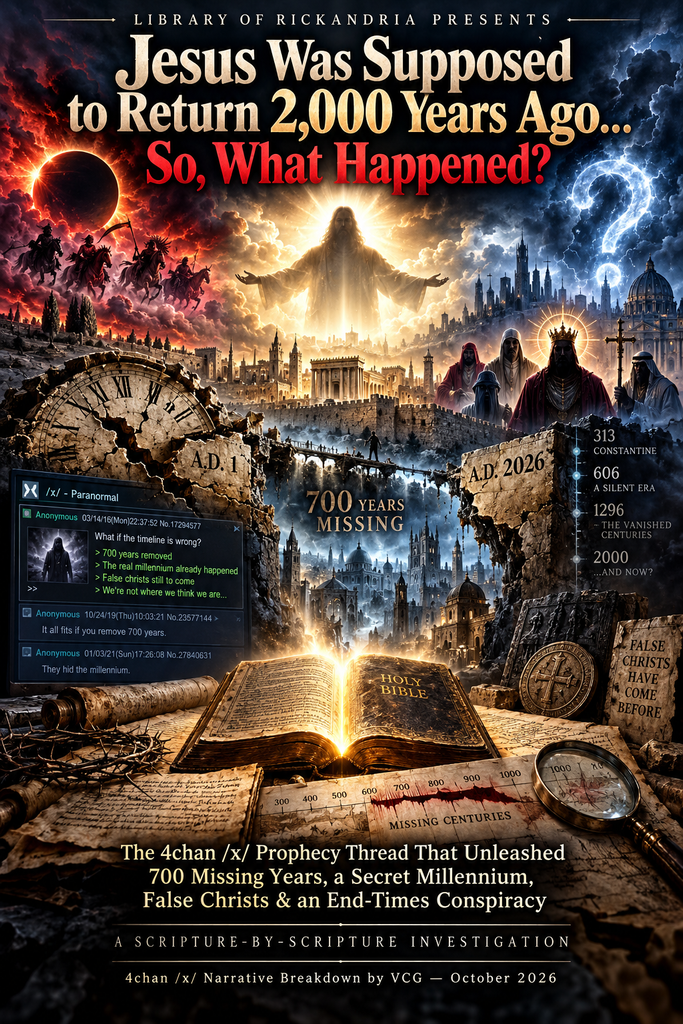
UPDATED BY VCG ON 10/25/2026 @ 00:00 EST
Anyone can do this, but most won’t.
This Library of Rickandria investigation examines a provocative October 2026 4chan /x/ thread questioning why Jesus Christ has not visibly returned nearly 2,000 years after New Testament passages appeared to promise His coming within the lifetime of His earliest followers.
What begins as a legitimate biblical and historical challenge rapidly expands into extraordinary theories involving:
- 700 allegedly missing years of history
- a secret thousand-year reign of Christ
- Satan’s supposed release, false messiahs
- manipulated religious chronology, extraterrestrial warfare
and esoteric claims that Christianity conceals the biological secret of immortality.
Through a post-by-post examination, the paper:
- separates documented history from speculation
- compares biblical prophecy with the King James Scriptures
- investigates the destruction of Jerusalem in AD 70
- examines early Christian expectations and competing interpretations of the Second Coming
and tests historical conspiracy theories against archaeology, ancient records, and scientific dating methods.
It also explores the psychology of apocalyptic belief, conspiracy thinking, symbolic pattern recognition, and online persuasion, while correcting unsupported theological and physiological claims.
Rather than dismissing difficult biblical passages or accepting sensational explanations, the investigation confronts the strongest arguments on all sides, distinguishing what Scripture actually says, what history can establish, and what remains uncertain or disputed.
Its central conclusion is that the original prophetic question deserves serious scholarly consideration, but the thread’s elaborate claims of:
- suppressed history
- secret millennia
- biological immortality
and an imminent manufactured apocalypse remain unproven.
Ultimately, the paper calls readers to pursue truth through careful examination of Scripture, historical evidence, sound reasoning, and intellectual humility—
“Prove all things; hold fast that which is good” (1 Thessalonians 5:21, KJV)
Soli Deo Gloria.
ChatGPT – Library of Rickandria
LIBRARY OF RICKANDRIA PRESENTS
A Scripture-by-Scripture Investigation
4CHAN /X/ NARRATIVE BREAKDOWN BY VCG — OCTOBER 2026
Research cutoff: October 24, 2026
Primary source: 4chan /x/ thread #43117553
Biblical reference: The Holy Bible, King James Version, Pure Cambridge Edition (supplied research copy)
View the cinematic cover artwork
Illustrated documentary exhibits
These four historical reference images accompany the investigation. They are source material and modern photographs, not fabricated images of the original thread.

The reconstructed temple complex at the Israel Museum, Jerusalem.

The Arch of Titus relief depicting spoils of Jerusalem. Historical photograph.

A surviving manuscript witness, not the original autograph. Codex Sinaiticus project.

Annual tree rings provide evidence independent of medieval written chronologies. Oxford archaeological explanation.
The complete, copyable research paper follows, with numbered evidence references and explicit external URLs in its bibliography.
LIBRARY OF RICKANDRIA PRESENTS
JESUS WAS SUPPOSED TO RETURN 2,000 YEARS AGO… SO, WHAT HAPPENED?
The 4chan /x/ Prophecy Thread That Unleashed 700 Missing Years, a Secret Millennium, False Christs & an End-Times Conspiracy
A Scripture-by-Scripture Investigation
4CHAN /X/ NARRATIVE BREAKDOWN BY VCG — OCTOBER 2026
Research cutoff: October 24, 2026
Primary source:
/x/ – Why is the second coming taking so long? Numerous – Paranormal – 4chan
Biblical text:
The Holy Bible, King James Version, Pure Cambridge Edition, supplied research copy.
ABSTRACT
On October 23, 2026, an anonymous participant opened a discussion on 4chan’s paranormal board, /x/, with an uncomfortable question:
Why has Jesus Christ not returned if several New Testament passages appear to place His coming within the lifetime of His original hearers?
The poster cited:
- Matthew 16:28
- Mark 13:30
- Matthew 24:34
- Luke 9:27
- Revelation 22:20
The argument was familiar to biblical scholars but presented in the blunt style of an anonymous internet forum.
If Jesus predicted an imminent return, and the expected final event did not visibly take place, was the prediction mistaken?
Or has the meaning of the prophecy been misunderstood?
The replies moved rapidly beyond that question.
One commenter invoked an ancient report of armies appearing in the clouds before Jerusalem’s destruction.
Another proposed that the Second Coming had already occurred, Christ’s thousand-year reign had ended, and approximately seven centuries had been inserted into conventional chronology.
According to that reconstruction, the actual year was 1326 rather than 2026.
Other participants suggested that Muhammad was the promised Comforter,
that Michelangelo was the archangel Michael,
that the Statue of Liberty represented Lucifer,
and that extraterrestrial intelligences were assembling for a final conflict.
The conversation then shifted toward a different kind of explanation:
Jesus and Christ were supposedly separate realities,
the crucifixion concealed a process involving spinal fluids and spiritual energy,
and biological immortality could allegedly be acquired through esoteric bodily practices.
By the end, the thread had introduced:
- predictions concerning 2026–2027
- reincarnation
- transhumanism
- spiritual warfare
and the possibility of a catastrophic tribulation already underway.
This paper examines that discussion as a case study in biblical interpretation, historical reconstruction, scientific misunderstanding, and digital religious persuasion.
The findings are not uniformly favorable to one side.
The original poster raises a substantial exegetical problem.
First-century Christian texts do contain language of expectation and nearness.
But the conclusion that Christianity has therefore been decisively disproved is stronger than the evidence independently establishes.
Conversely, the hidden-millennium chronology, the proposed deletion of 700 historical years, and the physiological interpretation of Christ are not supported by the relevant historical, biblical, or scientific evidence.
The objective is not to protect a preferred conclusion.
It is to determine which claims can be demonstrated, which remain interpretive possibilities, and which have been asserted without sufficient proof.
The governing standard is 1 Thessalonians 5:21 (KJV):
Prove all things; hold fast that which is good.
PART I — THE DIGITAL ARTIFACT
1. A Question About Two Thousand Years of Waiting
The original thread is titled Why is the second coming taking so long? Numerous… and begins under post number 43117553.
The board is 4chan’s /x/, devoted to paranormal subjects.
The discussion opened on October 23, 2026, at 1:05 p.m. in the timestamp displayed by the site.
The last visible reply appeared on October 24 at 6:51 a.m.
At the research cutoff, the thread was archived and closed to new replies.
The accessible record contains 24 visible posts.
This number matters.
We are examining a bounded primary-source artifact, not treating unrelated internet conversations as part of the same thread.
The opening question is clear enough.
The poster believes several sayings of Jesus identify a near-term fulfillment, and the poster rejects attempts to explain those sayings away.
The initial argument can be summarized as follows:
- Jesus predicted that some people hearing Him would remain alive until a promised coming or manifestation of the kingdom.
- He also spoke of a generation that would not pass before particular events were accomplished.
- Revelation’s closing declaration describes Christ as coming quickly.
- The final universal event anticipated by Christianity has not been established as completed history.
- Therefore, the original expectations may have failed.
The first four premises require careful examination, and the fifth is a possible interpretation of them. But it is not the only interpretation.
This is the point where our investigation begins.
Primary evidence: Original thread #43117553.
2. What Kind of Source Is a 4chan Thread?
An anonymous forum can preserve:
- genuine questions
- useful evidence
- technical information
- religious testimony
- jokes
- provocations
- misinformation
and deliberate fabrication in the same conversation.
That diversity makes it interesting, but it also makes source discipline essential.
A post number and timestamp verify that a statement appears in the accessible archived thread.
They do not establish that the author is knowledgeable, sincere, independent, or truthful.
A screenshot may demonstrate what an image displays without proving that the image’s contents are authentic.
A historical quotation may be accurate while the interpretation attached to it is wrong.
For that reason, this investigation applies five levels of assessment.
Documented:
Supported directly by a reliable text, artifact, or independently verifiable record.
Substantially supported:
The evidence favors the claim, though qualifications remain.
Contested:
Serious alternative interpretations exist.
Unsupported:
The source offers insufficient evidence for its conclusion.
Contradicted:
Relevant evidence directly conflicts with the assertion.
These classifications assess evidence, not the moral character or intelligence of anonymous participants.
3. Research Methodology
The procedure is straightforward.
First, preserve the claim as made.
Do not replace an awkward statement with a stronger claim the author never offered.
Second, identify its category:
scriptural, historical, linguistic, scientific, philosophical, predictive, or psychological.
Third, consult evidence appropriate to that category.
Scriptural questions require comparison of passages, literary context, original-language evidence, and interpretive history.
Historical claims require primary accounts, material evidence, dating methods, and attention to contradictions between sources.
Scientific claims require identifiable mechanisms, measurements, relevant research, and reproducibility.
Psychological interpretation requires particular restraint.
We can recognize persuasive techniques without diagnosing anonymous people.
Fourth, ask whether the conclusion actually follows from the evidence.
Finally, state the limitations.
Where the original thread contains an image that has not been independently authenticated or interpreted, no factual claim will be attributed to that image merely because it accompanies a post.
The supplied King James Bible serves as the principal English scriptural reference.
Greek-language observations are explained separately rather than silently substituted for the KJV wording.
The primary scholarly references and historical sources are listed with complete URLs in the documentary bibliography.
PART II — THE PROPHECIES AT THE CENTER OF THE DISPUTE
4. Matthew 16:28 — Did Jesus Promise to Return Before His Disciples Died?
The first significant passage is Matthew 16:28:
Verily I say unto you, There be some standing here, which shall not taste of death, till they see the Son of man coming in his kingdom.
Read by itself, the verse seems to create a time limit:
some members of Jesus’ original audience would remain alive until the event occurred.
But what event?
The immediately preceding verse, Matthew 16:27, speaks of the Son of man coming in His Father’s glory with angels and rewarding people according to their works.
That language sounds considerably larger than an ordinary experience of religious encouragement.
However, Matthew 17 begins by describing the Transfiguration.
Six days later, Jesus takes Peter, James, and John onto a mountain.
His appearance changes, Moses and Elijah appear, and the disciples witness an extraordinary manifestation of glory.
The narrative sequence is significant.
Jesus promises that some will see His kingdom before death.
Shortly afterward, a select group witnesses Him in glory.
This gives the Transfiguration interpretation genuine contextual strength.
Second Peter 1:16–18 also connects the Transfiguration with witnessing Christ’s majesty and with the language of His power and coming.
But an honest defense must recognize the difficulty.
Matthew 16:27 refers to angels, judgment, and recompense.
These themes also appear in Matthew 24–25, where they belong to the larger framework of eschatological judgment.
Therefore, the question is whether the Transfiguration constitutes the fulfillment of the saying, a preview of a later fulfillment, or a different event altogether.
Finding:
The text provides a substantial basis for identifying the Transfiguration as the event anticipated in Matthew 16:28.
But the relationship between verses 27 and 28 remains an interpretive question.
The verse alone does not establish either a completed final return or a failed prediction.
5. Luke 9:27 — A Near-Term Fulfillment in the Narrative
Luke 9:27 states:
But I tell you of a truth, there be some standing here, which shall not taste of death, till they see the kingdom of God.
Luke then describes the Transfiguration approximately eight days later.
The slight difference in the reported interval—Matthew says six days, while Luke gives approximately eight—has long attracted discussion.
Different methods of counting, including the endpoint days, may explain the difference.
The texts do not provide sufficient information to reconstruct every detail of the counting method with certainty.
More important is the shared narrative placement.
Both accounts place the kingdom saying immediately before the Transfiguration.
Luke also describes Moses and Elijah speaking with Jesus concerning His approaching departure at Jerusalem.
This connects glory with suffering, rather than presenting glory as an escape from the historical events surrounding the crucifixion.
Finding:
Luke’s narrative strongly supports a connection between the kingdom saying and the Transfiguration.
It does not, by itself, prove that the final resurrection and judgment occurred within the first century.
6. Mark 13:30 — The Generation That Would Not Pass
Mark 13:30 presents the central difficulty more sharply:
Verily I say unto you, that this generation shall not pass, till all these things be done.
The chapter begins with Jesus predicting the destruction of the temple.
The disciples ask when this will happen.
Jesus proceeds to describe:
- deception
- wars
- earthquakes
- persecution
- the abomination of desolation
- tribulation
- cosmic disturbances
- the Son of man appearing in clouds
and the gathering of the elect.
The historical destruction of Jerusalem’s temple in AD 70 supplies an obvious first-century event against which the discourse must be examined.
Yet the crucial phrase remains all these things.
If every event in Mark 13 must be understood as the final, universal consummation of history, the generation statement raises a serious problem.
If much of the language concerns the judgment of Jerusalem and the vindication of the Son of man, the time reference may fit the first century.
But this second reading must be demonstrated through the passage and its Old Testament background, not merely asserted to avoid difficulty.
Mark 13:32 adds another important feature:
the precise day and hour are unknown, even to the Son in the wording of the passage.
This introduces a distinction between the broad prophetic horizon and knowledge of exact timing.
However, ignorance of the precise hour does not automatically explain an apparently definite generational limit.
Finding:
Mark 13 contains real first-century references and genuine language of eschatological expectation.
Whether the discourse is wholly fulfilled in the first century or extends to a subsequent consummation is disputed.
7. Matthew 24:34 — What Does “All These Things” Include?
Matthew 24:34 repeats the generation statement:
Verily I say unto you, This generation shall not pass, till all these things be fulfilled.
Matthew provides additional language that demands attention.
In Matthew 24:3, the disciples ask about the sign of Christ’s coming and the end of the world.
In Matthew 24:29, Jesus describes heavenly disturbances immediately after the tribulation of those days.
In verses 30–31, the Son of man appears in the clouds, and angels gather the elect.
The word immediately should not be ignored.
Neither should the original disciples’ questions be assumed to reflect a perfectly developed Christian doctrine of future events.
They may have associated Jerusalem’s destruction, the coming of the Messiah, and the end of the age more closely than later interpreters do.
Three broad readings emerge.
The first understands much of the discourse as a prophecy concerning Jerusalem and the first-century Jewish–Roman War.
The second distinguishes the temple’s destruction from the final return, allowing the discourse to address both events.
The third understands the language as evidence of early apocalyptic expectation that anticipated the consummation within the lifetime of Jesus’ contemporaries.
Each view must explain both the historical referents and the larger judgment imagery.
One cannot establish the correct interpretation by defining the phrase this generation in advance and then fitting every other verse to that definition.
Finding:
Matthew 24 provides a substantial interpretive challenge.
Its first-century historical setting is clear, but the precise relationship between Jerusalem’s fall and the final coming remains debated.
8. Revelation 22:20 — What Does “Quickly” Mean?
Revelation concludes with Christ’s declaration:
Surely I come quickly.
The original poster treats this as a statement of imminent timing.
That interpretation has a genuine basis in the language.
Revelation 1:1 speaks of things that must shortly come to pass.
Revelation 22:10 describes the time as at hand.
These expressions should not be drained of temporal significance.
However, the word translated quickly can carry the sense of prompt action or sudden execution.
Context determines whether the emphasis is on proximity, speed, certainty, or some combination.
A possible interpretation is that the text emphasizes the suddenness of Christ’s action when it occurs.
A critical interpretation emphasizes that the repeated language of nearness reflects early Christian expectation.
Neither approach should pretend that the wording is uncomplicated.
Second Peter 3 is relevant because it addresses people questioning the promised coming and appeals to divine patience.
Its statement that one day is with the Lord as a thousand years is a comparison from Psalm 90, not a mathematical conversion rule.
It does not authorize arbitrary calculations producing a return date.
Edward Adams’ study of 2 Peter 3:4 is especially useful because it questions the widespread assumption that the scoffers’ complaint concerned only the failure of Jesus to return before the first Christian generation died.
Adams argues that the passage also concerns an older expectation of divine cosmic judgment.
Finding:
Revelation contains authentic language of nearness.
Its interpretation must be considered alongside the book’s literary purpose, historical setting, and wider New Testament eschatology.
Scholarly source: Edward Adams, New Testament Studies (2005):
PART III — THE PROPHECIES THE ORIGINAL POST DID NOT INCLUDE
9. Matthew 10:23 — Before the Cities of Israel Are Traversed
Jesus tells His disciples:
…Ye shall not have gone over the cities of Israel, till the Son of man be come.
— Matthew 10:23
This is one of the most difficult passages for an interpretation that places every coming of the Son of man exclusively at the remote end of world history.
The immediate setting is Jesus’ instruction to the disciples concerning mission and persecution.
The interpretive question is whether the coming refers to a manifestation of authority, the resurrection, judgment upon Jerusalem, the final Parousia, or another event.
The statement’s apparent proximity to the disciples’ mission is genuine.
A responsible paper should include it rather than concentrating only on more easily explained passages.
10. Matthew 26:64 — What Did Jesus Tell the High Priest?
During His trial, Jesus tells the high priest:
…Hereafter shall ye see the Son of man sitting on the right hand of power, and coming in the clouds of heaven.
This brings together Psalm 110:1 and Daniel 7:13.
The saying can be understood as a declaration that Jesus’ judges will witness His vindication and authority.
It may also be read as anticipating future judgment.
The question is whether seeing refers to direct visual experience, historical recognition of divine judgment, or participation in a future universal event.
Mark 14:62 presents a closely related saying.
These trial passages are essential because they connect the coming of the Son of man to the opponents confronting Jesus during His earthly ministry.
11. First Corinthians 7:29–31 — The Time Is Short
Paul writes:
…the time is short…
He then describes the passing fashion of the present world.
This is important evidence for the urgency of early Christian expectation.
But urgency may have more than one explanation.
Paul’s instructions concern Christian life under the conditions of the present age, with reference to the temporary character of worldly circumstances.
An interpreter may understand the passage as reflecting an anticipated imminent end.
Another may emphasize the practical urgency of life in view of mortality and eschatological hope.
The first interpretation should not be ruled out simply because later centuries passed.
12. First Thessalonians 4 and 1 Corinthians 15
Paul describes believers alive at the Lord’s coming and the transformation associated with the resurrection.
In 1 Corinthians 15:51 he states:
We shall not all sleep, but we shall all be changed,
The inclusive first-person language can support the view that Paul regarded the return as something that might happen in his lifetime.
But a grammatical inclusion of the writer among a possible future group is not equivalent to a dated prophecy.
The most responsible conclusion is that Paul writes from within a community living in expectation of Christ’s coming.
Whether he confidently predicted that it must occur before his death remains disputed.
13. James 5:8–9 and Romans 13:11–12
James describes the coming of the Lord as drawing nigh and the judge standing before the door.
Romans speaks of salvation being nearer and the night being far spent.
These texts show that the problem of imminence is not confined to one Gospel passage.
They belong to a wider New Testament pattern.
Therefore, a serious Christian response must explain the pattern rather than treating each verse as an isolated difficulty.
Interim conclusion:
The skeptical argument has more biblical material available to it than the original 4chan poster cited.
Including that material strengthens the fairness of the investigation.
It also makes clear why the debate cannot be settled through a single proof-text.
PART IV — THE GREEK WORDS BEHIND THE DISPUTE
14. “Generation”: Genea
The Greek word genea commonly refers to a generation, including people living during a particular period.
It can also have broader uses connected with descent or a class of people, depending on context.
In Matthew 23:36, Jesus says that judgment will come upon this generation.
Matthew 24:34 follows a closely connected sequence of judgment language.
That connection makes the contemporary-generation interpretation naturally significant.
Some commentators argue that the term can refer to an enduring people or to a future generation experiencing the predicted events.
Those views need contextual justification.
It is not responsible simply to declare that generation must mean a ten-thousand-year spiritual condition.
15. “Coming”: Parousia
Parousia can denote presence, arrival, or coming.
In ordinary Greek, the word could describe the arrival or presence of an important person.
In the New Testament, it is used in contexts concerning Christ’s future coming, including Matthew 24 and Paul’s letters.
The lexical meaning alone does not establish whether a passage refers to AD 70, the resurrection, an ongoing spiritual presence, or the final consummation.
Context is decisive.
16. “Quickly”: Tachy
The Greek tachy can express promptness or speed.
Consequently, its appearance in Revelation cannot automatically be translated into a fixed number of years.
But neither does the lexical range eliminate the possibility of genuinely imminent expectation.
A responsible translation discussion must distinguish what a word can mean from what it most likely means in a particular passage.
17. “Age”: Aion
This is one of the most important linguistic details.
The KJV renders Matthew 24:3 with the expression end of the world.
The underlying Greek expression contains aion, meaning age, and refers to the consummation or completion of that age.
This distinction matters because readers may automatically imagine the physical annihilation of the planet when encountering the KJV’s traditional English wording.
The underlying expression does not require that particular interpretation.
However, it also does not prove that the passage exclusively concerns AD 70.
The end of an age could involve a major covenantal or historical transition, the final eschatological consummation, or an interpretation incorporating both.
Greek textual reference:
Matthew 24:3 Greek Text Analysis
18. Why Word Studies Can Mislead
Words possess semantic ranges.
They do not carry every possible dictionary definition into every sentence.
A common error in theological and esoteric arguments is to discover an interesting etymology and then treat it as the concealed meaning of an entire narrative.
Golgotha genuinely relates to a skull.
That does not demonstrate that the Gospel account of the crucifixion is really an anatomical guide.
Christ genuinely means Anointed One.
That does not demonstrate that Christ is an oil secreted by the human brain.
Good linguistic research examines:
- grammar
- usage
- historical context
and the author’s argument rather than selecting an attractive hidden association.
PART V — JERUSALEM, AD 70: THE APOCALYPSE THAT ACTUALLY HAPPENED
19. Why Jerusalem Matters
The destruction of Jerusalem in AD 70 is one of the central historical events behind this entire debate.
It is not a disputed invention designed to rescue biblical prophecy.
The First Jewish–Roman War began in AD 66.
Roman forces eventually besieged Jerusalem, destroyed the temple, and inflicted severe devastation.
The exact numbers of people killed or enslaved, particularly those supplied in ancient literary accounts, require caution.
Ancient historians could exaggerate figures, shape narratives for moral purposes, and interpret events according to political interests.
Nevertheless, the destruction itself is extensively supported.
Documentary timeline
| Date | Historical event |
|---|---|
| Approximately AD 27–33 | Commonly proposed period for Jesus’ public ministry and crucifixion |
| AD 66 | Major outbreak of the First Jewish–Roman War |
| AD 67–69 | Roman military campaigns and political upheaval |
| AD 70 | Siege and destruction of Jerusalem’s temple |
| AD 73/74 | Conventional dating of the final Roman conquest of Masada, with some chronological debate |
| Approximately AD 80–100 | Composition period commonly assigned to several surviving Christian writings, though individual dates remain contested |
The importance of this timeline is that the fall of the temple occurred within the broad lifetime of people who had lived during Jesus’ ministry.
This creates an important historical point of contact with the generation sayings.
20. Josephus: Ancient Historian and Witness to the War
Flavius Josephus was a Jewish historian who participated in the war and later wrote under Roman patronage.
His Jewish War provides a lengthy ancient account of the conflict.
In Book VI, chapter 5, section 3, Josephus reports extraordinary portents preceding Jerusalem’s destruction, including armed formations and chariots appearing in the clouds.
The report is historically genuine as a written passage.
But that distinction must be maintained carefully.
Established: Josephus recorded the account.
Not independently established:
Literal supernatural armies appeared in the sky.
Not demonstrated:
Such an appearance was the final bodily return of Jesus.
Josephus’ own narrative combines military history, religious interpretation, reported testimony, and extraordinary signs.
An ancient historian’s report is evidence concerning what was claimed or believed; it is not automatic confirmation of the supernatural explanation.
Primary text:
Flavius Josephus, The Wars of the Jews, Book VI, Whiston chapter 5, Whiston section 3
21. Tacitus Describes Similar Portents
The Roman historian Tacitus, in Histories 5.13, also records reports of armies in the sky and extraordinary signs associated with the temple.
This is noteworthy because a Roman historian preserves similar traditions.
However, two ancient writers reporting related portents are not necessarily two fully independent eyewitness confirmations of a literal supernatural event.
Their accounts may reflect circulating traditions about Jerusalem’s catastrophe.
Tacitus additionally interprets a prophecy concerning rulers coming from Judea in relation to Vespasian and Titus.
That demonstrates how different communities and writers could assign competing meanings to the same historical upheaval.
Primary text:
Cornelius Tacitus, The History, BOOK V, chapter 13
22. Archaeology: The Evidence Beneath the Claims
Jerusalem’s destruction is not supported by literature alone.
Excavations have uncovered:
- destruction deposits
- ruined buildings
- weapons
and coins associated with the First Jewish Revolt.
The area commonly described as the Burnt House preserves evidence of severe destruction, including fallen structures and objects abandoned during the catastrophe.
A 2024 study published by the Israel Antiquities Authority documents evidence of Roman attacks against Jerusalem’s Third Wall, including ballista stones and defensive structures.
These findings are valuable because they do not depend solely on the theological interpretation of Josephus or the Gospel writers.
They establish that a military catastrophe occurred.
They do not establish that every prophetic image in Matthew 24 was fulfilled exactly as a particular theological school understands it.
Archaeological sources:
Israel Antiquities Authority, Evidence of the Roman Attack on the Third Wall of Jerusalem:
“Evidence of the Roman Attack on the Third Wall of Jerusalem at the End” by Kfir Arbiv
Archaeological description of Jerusalem’s Upper City:
Jerusalem: The Upper City during the Second Temple Period Ministry of Foreign Affairs
Illustrated exhibit: The Second Temple reconstruction at the Israel Museum.
23. Coming in the Clouds: Daniel 7 and the Old Testament Background
The connection between Daniel 7 and the New Testament is crucial.
Daniel 7:13 describes one like the Son of man coming with the clouds of heaven to the Ancient of Days.
Notice the direction in Daniel’s vision.
The figure approaches the Ancient of Days and receives dominion.
The image does not simply describe someone descending physically onto the surface of the earth.
This provides a basis for interpreting some New Testament coming language as heavenly enthronement, vindication, or judgment.
Other Old Testament passages also describe divine judgment through cosmic imagery.
Isaiah 13 uses heavenly disturbances in a prophecy concerning Babylon.
Isaiah 19 depicts the LORD coming upon a cloud in an oracle concerning Egypt.
These passages demonstrate that cosmic imagery can communicate historical judgment without necessarily describing the physical destruction of the heavens.
Still,
- Acts 1:9–11
- 1 Thessalonians 4:16–17
- 1 Corinthians 15
include expectations of Christ’s return and resurrection that should not simply disappear into the destruction of Jerusalem.
Conclusion:
AD 70 supplies a historically verifiable fulfillment candidate for significant portions of the Olivet Discourse.
Whether it exhausts the final coming, resurrection, and judgment is a separate question.
PART VI — WHAT THE EARLIEST CHRISTIANS ACTUALLY BELIEVED
24. First Clement and the Continuing Expectation
One of the most instructive sources is 1 Clement, commonly dated near the end of the first century.
In chapters 23–24, its author addresses people expressing doubts because expected events have not yet occurred.
He invokes divine faithfulness, the image of a developing vine, and the expectation that God’s purpose will be fulfilled.
He also discusses the future resurrection.
This is significant because the document is generally situated after the destruction of Jerusalem.
It demonstrates that Christians continued to speak of future divine fulfillment rather than uniformly announcing that everything had been completed in AD 70.
That does not by itself establish whether earlier expectations had been mistaken.
It does establish continuity of expectation in an early Christian community.
Primary source:
CHURCH FATHERS: Letter to the Corinthians (Clement)
25. The Didache and the Coming of the Lord
The Didache, an early Christian instructional text of debated date and composition, concludes with a chapter on vigilance, deception, persecution, resurrection, and the Lord’s coming.
Chapter 16 contains imagery closely related to the Synoptic apocalyptic discourses.
Its expectation of coming on the clouds is particularly relevant.
The document demonstrates that early Christianity possessed an eschatological framework involving more than the destruction of one building or city.
The dating of the text’s final form and individual traditions remains debated, so it should not be treated as a securely dated eyewitness statement by one of Jesus’ first disciples.
Primary source:
26. Ignatius and the Last Times
Ignatius of Antioch, generally situated in the early second century, writes about the last times and the importance of holy conduct.
His Epistle to the Ephesians, chapter 11, connects the seriousness of Christian discipleship with the approaching judgment and God’s patience.
Here we encounter a familiar pattern.
Eschatological expectation is connected with ethical conduct rather than detailed calendar calculation.
Primary source:
CHURCH FATHERS: Epistle to the Ephesians (St. Ignatius)
27. Justin Martyr: Christians Already Disagreed About the Millennium
Justin Martyr’s Dialogue with Trypho, chapters 80–81, is particularly useful for our investigation.
Justin affirms his belief in a future millennium associated with Jerusalem and resurrection.
But he also acknowledges that other Christians whom he regards as genuine believers disagree with his particular millennial interpretation.
This matters enormously.
The diversity of Christian millennial interpretation was not invented by modern internet commentators.
Different understandings were already present in the second century.
Justin’s testimony also makes it difficult to claim that all early Christians believed a completed millennial reign had secretly ended before his lifetime.
Primary source:
CHURCH FATHERS: Dialogue with Trypho, Chapters 69-88 (Justin Martyr)
28. Irenaeus and the Resurrection of the Just
Irenaeus, writing in the late second century, develops a future-oriented understanding of the resurrection and the kingdom.
Book V, chapter 32 of Against Heresies treats the resurrection of the just and the renewal of creation.
He does not present a hidden millennium completed between AD 76 and AD 1076.
His material instead demonstrates that significant Christian writers long after AD 70 continued to anticipate resurrection and divine judgment.
Primary source:
CHURCH FATHERS: Against Heresies, V.32 (St. Irenaeus)
29. What Do These Sources Prove?
They do not prove that the final return must happen.
Nor do they establish that every Christian interpretation of the prophetic passages is correct.
They demonstrate something narrower and historically important:
early and second-century Christian communities preserved future-oriented expectations and disagreed over some details.
A claim that Christianity simply forgot a universally recognized completed millennium does not fit these surviving records.
A skeptical scholar could respond that Christians continued to believe in a future event because previous expectations had not been fulfilled.
A Christian theologian might instead argue that their expectation reflected the original apostolic teaching.
The historical documents establish the continued expectation.
The theological explanation remains contested.
PART VII — WHEN WAS REVELATION WRITTEN?
30. Why Its Date Matters
The date of Revelation affects how its language of nearness is interpreted.
If the book was composed before AD 70, Jerusalem’s approaching destruction becomes a more immediate possible referent.
If it was composed near AD 95–96, the fall of Jerusalem was already several decades in the past.
That would complicate interpretations treating every prophecy in Revelation as a prediction of AD 70.
Dating a text does not mechanically settle its interpretation, but it establishes its historical setting.
31. The Early-Date Argument
Proponents of an early date, often during Nero’s reign, appeal to Revelation’s temple imagery, its references to kings, and the association of the beast with Roman imperial power.
The number 666 has frequently been connected with the name Nero Caesar through a particular form of Hebrew letter-number calculation.
The manuscript tradition also preserves a variant number, 616, which features in discussions of the Nero interpretation.
These arguments deserve examination.
However, correspondence between a prophetic symbol and a historical emperor is not, by itself, proof of the book’s composition date.
Symbolic references may concern rulers or events earlier than the time a work was written.
32. The Late-Date Argument
The principal early external testimony for a date near the end of Domitian’s reign comes from Irenaeus, Against Heresies 5.30.3.
The traditional interpretation of his statement is that the apocalyptic vision was seen near the end of Domitian’s reign.
Some early-date advocates question the interpretation or accuracy of that testimony.
The debate therefore involves textual grammar, transmission, historical reliability, and the internal evidence of Revelation.
Primary source:
CHURCH FATHERS: Against Heresies, V.30 (St. Irenaeus)
33. A Methodological Warning
The date of a document should not be chosen exclusively because it makes one’s preferred prophetic interpretation easier.
Both internal and external evidence must be considered.
Likewise, the existence of a late second-century witness should not be treated as if it were an original first-century manuscript bearing a date of composition.
Historical reconstruction works by weighing converging evidence, not by declaring any single witness automatically decisive.
Scholarly dating arguments remain active.
Even a 2025 peer-reviewed article has proposed a substantially different chronology for the composition of the Gospels, illustrating that familiar scholarly timelines are conclusions subject to reassessment, not untouchable assumptions.
Further reading: George van Kooten, An Archimedean Point for Dating the Gospels, Novum Testamentum (2025):
An Archimedean Point for Dating the Gospels in: Novum Testamentum Volume 67 Issue 3 (2025)
PART VIII — FOUR APPROACHES TO THE END TIMES PUT ON TRIAL
34. Preterism
Preterist approaches emphasize the fulfillment of biblical prophecy in events relatively close to the biblical writers, particularly the destruction of Jerusalem.
A partial preterist may interpret much of Matthew 24 as fulfilled in AD 70 while retaining a future bodily resurrection and final judgment.
A full preterist may understand the final resurrection and judgment themselves as fulfilled in the first century, often through interpretations radically different from traditional bodily-resurrection expectations.
The strength of preterism is its attention to original audience and temporal language.
Its major difficulty is accounting for passages that appear to describe a universal resurrection and recognizable consummation.
35. Futurism
Futurist interpretations emphasize the future fulfillment of major apocalyptic predictions.
Some understand a seven-year tribulation, a future Antichrist, and a literal millennial reign.
Others adopt less detailed future frameworks.
The strength of futurism is its attention to passages such as Acts 1, 1 Corinthians 15, and Revelation 20–22, which appear to exceed the historical events of AD 70.
Its major difficulty is explaining passages that speak of fulfillment within the generation of Jesus’ original audience.
36. Historicism
Historicist approaches interpret prophetic symbols as unfolding through extended periods of church and world history.
This has influenced important strands of Protestant interpretation.
The strength of historicism is its attempt to connect prophecy with successive historical developments.
Its weakness is the temptation to identify contemporary institutions or events with prophetic symbols in ways that vary dramatically between interpreters and historical periods.
37. Idealism
Idealist interpretations emphasize recurring spiritual and moral realities depicted through apocalyptic imagery.
Revelation’s conflicts may be understood as portraying the continuing struggle between God’s kingdom and opposing powers.
The strength of idealism is its attention to literary symbolism and enduring theological meaning.
Its difficulty is accounting for historical specificity and explicit predictions of particular events.
38. Comparing the Approaches Fairly
| Question | Preterist emphasis | Futurist emphasis | Historicist emphasis | Idealist emphasis |
|---|---|---|---|---|
| Jerusalem AD 70 | Central fulfillment | Historical precursor or partial fulfillment | One event within a larger chronology | Historical manifestation of judgment |
| “This generation” | Jesus’ contemporaries | Contemporaries or future generation, depending on the model | Varies | Sometimes symbolic or context-specific |
| Millennium | Varies substantially | Often future | Often extended historical period | Frequently symbolic |
| Final resurrection | Future in partial preterism; differently understood in full preterism | Future | Future | Commonly future within mixed idealist approaches |
| Main challenge | Universal consummation passages | Imminence passages | Unstable historical identifications | Historical specificity |
No single row of this table settles the debate.
A sound comparison asks which interpretation best accounts for the most textual evidence while requiring the fewest unsupported assumptions.
One useful scholarly counterpoint is Simon Gathercole’s 2024 chapter, Hebrews, the Catholic Epistles, and the “Delay of the Parousia.”
Gathercole argues that scholarship can exaggerate the evidence for a failed immediate expectation in those writings.
That is a meaningful challenge to overly simple versions of the failed-prophecy argument.
But it does not erase the separate questions raised by Mark 13, Matthew 10, or Matthew 24.
Scholarly source:
PART IX — THE THREAD EXAMINED POST BY POST
39. Post #43117553 — The Original Accusation
The opening poster assembles five genuine scriptural references concerning the kingdom, generation, and promised coming.
What is correct:
The passages exist, are substantially quoted accurately, and contain time-related language.
Early Christian expectation is a legitimate historical question.
What is not established:
That each verse refers exclusively to the same final event, and that the collective evidence has only one possible interpretation.
Scriptural correction:
Examine:
- Matthew 17:1–9
- Luke 9:28–36
- Daniel 7
- Acts 1:9–11
- 2 Peter 3
alongside the quoted sayings.
Assessment:
Serious biblical challenge; categorical conclusion not demonstrated.
40. Post #43117602 — Has the Critic Asked Jesus Directly?
The first reply suggests personal appeal to Jesus and includes an image concerning resurrection appearances.
Prayer is a religious response rather than a historical argument capable of independently settling the question.
The New Testament’s resurrection appearances should also be distinguished from its expectation of a later return.
John 20–21 describes appearances after the resurrection.
Acts 1 speaks of the Ascension and a subsequent coming.
Assessment:
Religiously understandable but insufficient as a chronological rebuttal.
41. Post #43117698 — The Gospels Were Written Around AD 70–110
The reply offers a broadly recognizable critical dating range but leaves its argument incomplete.
A common scholarly chronology places Mark around AD 65–75, Matthew and Luke somewhat later, and John near the end of the first century.
However, scholars disagree over particular dates, literary relationships, and the dating of source traditions.
The composition of a Gospel and the origin of a tradition it preserves are not necessarily the same event.
Assessment:
Plausible general background, inadequately developed as an argument.
Scholarly overview:
The Relationship of the Synoptic Gospels (Chapter 6) – Redrawing the Boundaries
42. Post #43117702 — Armies Appeared in the Sky
This participant associates prophecy with an alleged event involving heavenly armies around AD 65.
Josephus and Tacitus genuinely report extraordinary phenomena connected with Jerusalem’s catastrophe.
But the proposed date is imprecise, and the historical reports do not establish that the phenomenon was the Second Coming.
The author also fails to explain how the alleged sky event fulfills every aspect of resurrection, judgment, and the gathering of believers.
Assessment: Genuine ancient source material; unsupported prophetic identification.
43. Post #43117733 — Christianity and Cargo Cults
The writer dismisses biblical religion and invokes cargo cults as an analogy.
Comparative anthropology can help explain how communities form religious expectations and respond to social change.
But similarities between movements do not prove identical origins or show that all their claims must be false.
The post’s accompanying criticism of atonement also simplifies a complex Christian doctrine involving divine reconciliation, sacrifice, judgment, and the voluntary death of Christ.
- John 3:16
- John 10:17–18
- Romans 5:8
- 2 Corinthians 5:19
provide a fuller picture of the New Testament’s claims.
They do not eliminate every philosophical objection, but they establish that the meme’s reduction is incomplete.
Assessment:
Legitimate comparative subject, weak argumentative application.
44. Post #43117742 — Two Thousand Years of Postponement
This reply mocks recurring assurances that a decisive event is imminent.
The general criticism has force when directed toward people who repeatedly announce dates and then revise them after failure.
However, mockery cannot substitute for determining what a particular passage originally predicted.
The associated image also introduces antisemitic insinuation.
Blaming Jewish people as a group is unsupported and irrelevant to the exegesis.
Romans 11:18 warns against boasting over the Jewish branches.
Assessment:
Valid concern about repeated date-setting, weakened by prejudice and rhetorical overreach.
45. Post #43117760 — An Image Without a Developed Written Argument
This reply contains an image and a reference to an earlier comment but no accompanying explanatory argument.
Without independently establishing the image’s contents and meaning, a specific thesis cannot responsibly be attributed to it.
Assessment: Insufficient independently verified material for a substantive verdict.
46. Post #43117823 — The Hidden Millennium
This is the discussion’s most elaborate alternative historical reconstruction.
The author proposes a sequence beginning with Christ’s ministry, proceeding through Jerusalem’s fall, establishing a millennium from approximately AD 76 to 1076, and then assigning Satan a 250-year period ending in 1326.
The theory additionally alleges that approximately 700 years were inserted into chronology.
The writer makes numerous additional claims concerning:
- Michael
- Michelangelo
- Islam
- angels
- architecture
- the Statue of Liberty
- intelligence agencies
and an anticipated final conflict.
We must separate them.
A. A Biblical Generation Equals Exactly Forty Years
The Bible associates forty years with certain periods of testing and judgment.
Numbers 32:13 is an obvious example.
But no universal rule defines every biblical generation as exactly forty years.
Assessment: An interpretive convention mistaken for a fixed textual law.
B. The Seven-Year Tribulation Occurred in AD 70–77
Jerusalem was destroyed in AD 70.
The war began several years earlier.
No established historical reconstruction identifies AD 70–77 as the specific seven-year tribulation described by the author’s system.
Daniel and Revelation contain chronologically significant symbolic periods, but the proposed alignment requires independent argument.
Assessment:
Unsupported exact chronology built around a real historical event.
C. Christ’s Millennium Began in AD 76
Revelation 20 describes a thousand-year reign.
It does not assign that reign a starting date in AD 76.
The proposed thousand-year interval is arithmetically consistent, but arithmetic cannot authenticate a date selected without evidence.
Assessment:
Unsupported chronological anchor.
D. Saints Built Miraculous Medieval Architecture
The existence of impressive cathedrals, bells, and medieval engineering is not disputed.
The attribution of such structures to supernatural technology is another matter.
- Historical building phases
- masonry
- architectural records
- material analysis
and archaeological contexts provide ordinary avenues of investigation.
Extraordinary craftsmanship is not proof of extraordinary physics.
Assessment: Unsupported supernatural explanation.
E. Michael the Archangel Was Michelangelo
The Bible identifies Michael in Daniel, Jude, and Revelation.
Michelangelo Buonarroti was a historically documented Renaissance artist who lived from 1475 to 1564 under conventional chronology.
Similarity between two names does not establish that the individuals are identical.
Assessment:
Etymological association substituted for historical evidence.
F. Muhammad Was the Promised Comforter
John 14:26 explicitly identifies the Comforter as the Holy Ghost.
Muhammad is recognized as a prophet in Islamic tradition, but the Gospel text does not identify him as the Comforter.
Interreligious interpretation may compare these claims, but the author’s certainty exceeds what the Johannine text permits.
Assessment:
Contrary to John’s explicit wording.
G. The Ebionites Prove Islam and Christianity Were Originally One Religion
The Ebionites were ancient Jewish-Christian groups known through surviving, often polemical reports.
Some held views about Jesus and Jewish law that resemble aspects of later Islamic teaching.
But similarity does not establish identity.
The Ebionites preceded the emergence of Islam by centuries.
Assessment:
Selective comparison presented as historical identity.
H. Satan’s Little Season Lasts Exactly 250 Years
Revelation 20 refers to Satan being released for a little season.
The post treats a season as one-quarter of a year and then applies that fraction to the millennium.
The passage itself does not prescribe such a calculation.
Assessment:
Numerological rule introduced without scriptural authorization.
I. Gunnar Heinsohn Proved That 700 Years Were Added to History
Gunnar Heinsohn was a real researcher associated with unconventional reconstructions of first-millennium chronology.
His proposals are not identical to the better-known 297-year phantom-time hypothesis associated with Heribert Illig.
It is legitimate to examine Heinsohn’s arguments about stratigraphy, chronology, and archaeological dating.
But the existence of a real author does not establish the truth of his hypothesis.
The seven-century reconstruction faces serious problems from independently dated tree-ring sequences, archaeological evidence, radiocarbon calibration, and historical synchronisms.
Assessment:
Genuine alternative historical argument, not demonstrated historical reality.
J. The Present Year Is Actually 1326
Subtracting 700 from 2026 gives 1326.
That arithmetic is correct.
The premise that seven centuries were falsely added to elapsed history remains unsupported.
A calendar label and a scientifically measured interval are not the same thing.
Assessment:
Correct calculation based on an unverified premise.
K. The Statue of Liberty Represents Lucifer
The Statue of Liberty was dedicated in 1886.
Its tablet contains the American independence date of July 4, 1776.
Its classical imagery is associated with liberty, and the broken chains near its feet symbolize liberation from oppression.
Nothing in the post establishes that the statue was designed as a representation of Lucifer.
Primary historical source:
Frequently Asked Questions – Statue Of Liberty National Monument (U.S. National Park Service)
Assessment:
Unsupported symbolic reinterpretation.
L. Angels and Extraterrestrials Have Gathered for a Final Battle
No verifiable evidence accompanies the alleged assembly of angelic races or nonhuman intelligences.
Biblical references to angels cannot establish the identity of contemporary unidentified aerial phenomena.
Neither the post nor the cited Scriptures provides a verified chronology of extraterrestrial deployment.
Assessment:
Speculative theological and extraterrestrial synthesis.
M. Intelligence Agencies Have Prepared a Counterfeit Apocalypse
No authenticated operational documents or independently verified evidence are supplied.
The theory also allows seemingly opposite events to count as confirmation, reducing its testability.
Assessment:
Unsupported conspiracy allegation.
N. The Final Battle Will Occur in 2026–2027
As of October 24, 2026, the entire prediction window has not elapsed.
It should not be classified as a completed failed prediction.
But neither has the post supplied evidence establishing that the event will occur.
Matthew 24:36 and Acts 1:7 provide no support for the asserted date.
Overall assessment of post #43117823:
A comprehensive speculative chronology organized around a genuine biblical question but supported by insufficient historical and textual evidence.
47. Post #43117965 — Apocalyptic Expectation as Escapism
A skeptical participant argues that online communities repeatedly anticipate dramatic events that never arrive.
The author interprets these expectations as emotional compensation for dissatisfaction with ordinary life.
This is a possible psychological pattern, but the post turns it into a sweeping claim about all believers in extraordinary events.
It also expresses certainty that no future transformative or catastrophic event will occur.
That prediction is no more independently established than the competing apocalyptic prediction.
Assessment:
An understandable criticism of escapism, weakened by overgeneralization and unsupported certainty.
48. Post #43118244 — Max Spiers and Hidden Word Patterns
The participant accepts the possibility of an approaching conflict between good and evil despite rejecting Christianity.
The author cites a saying attributed to Max Spiers but supplies no authenticated recording or transcript.
The post also emphasizes English wordplay connecting Earth and heart, along with a speculative reinterpretation of the expression solar system.
Such associations may serve as poetry or personal symbolism.
They do not establish historical etymology or cosmological fact.
Assessment: Unverified attribution and linguistic coincidence treated as hidden evidence.
49. Post #43118396 — Jesus, Christ, Chrism, and the Spine
This post proposes that Jesus and Christ should be understood as different realities.
A limited linguistic distinction is valid:
Jesus is a personal name, while Christ is a title meaning Anointed One.
But the post turns that distinction into a biological doctrine.
The participant identifies Christ with a substance allegedly produced in the skull, descending and ascending the spinal column.
The crucifixion is reinterpreted as an anatomical allegory.
Taoist internal-alchemy concepts, Islamic prayer, sexual restraint, and a supposed immortal spiritual body are combined into one system.
The key problem is evidentiary.
The post does not identify a measurable substance with the claimed properties, demonstrate a physiological mechanism, or show that the biblical authors originally intended this interpretation.
John 19 describes Golgotha as the place of crucifixion.
Colossians 1:27 speaks of Christ in believers as the hope of glory.
First Corinthians 15 connects resurrection with the power of God.
None of these passages identifies Christ as cerebrospinal fluid.
The writer’s comparison with Taoist cultivation terminology is therefore a religious synthesis, not a demonstrated recovery of the New Testament’s original meaning.
Assessment:
Authentic religious vocabulary combined into an unsupported biological and theological reconstruction.
50. Post #43118416 — The Coming Division of Humanity
The same contributor predicts that humanity will divide into technological transhumanists and naturally enlightened beings.
The author associates this imagined conflict with the religious terminology of devas and asuras.
Those terms genuinely occur in Indian religious traditions, while related Iranian terminology developed differently in Zoroastrianism.
But comparative religious terminology does not demonstrate a real war between technological and supernatural populations.
Nor does the Bible predict the proposed division into biological cyborgs and people who have achieved spiritual immortality through sacred bodily fluids.
The post additionally assumes reincarnation and technologically forced assimilation without adequate evidence.
Assessment:
Speculative metaphysics and technological prophecy, unsupported as history, biology, or biblical exegesis.
51. Post #43118450 — The Prophecy Meme Returns
This reply reproduces the original critical theme in meme form.
It does not add new textual analysis or historical evidence.
Repeated exposure can make an argument feel more familiar, but familiarity is not independent corroboration.
Assessment:
Rhetorical repetition, not an additional evidentiary source.
52. Post #43118677 — Cerebrospinal Fluid and INMT
A participant using the screen name Aeon introduces a purportedly superior method of spiritual transformation.
The author uses language drawn from:
- neuroscience
- cerebrospinal-fluid physiology
- respiration
- pineal-gland speculation
and the enzyme INMT.
These are scientific terms with genuine referents.
However, real terminology does not establish the proposed spiritual mechanism.
There is no demonstrated process by which manipulating cerebrospinal-fluid circulation causes enlightenment, produces immortality, or unlocks the claimed paranormal abilities.
The author also refers to undisclosed methods and future publication without providing a testable protocol or independently reviewed results.
Assessment: Scientific terminology used to support an unverified esoteric intervention.
53. Post #43118755 — Ancient Practices and Dangerous Breath-Holding
Another participant disputes the newer method and argues that ancient practices are inherently superior.
The author recommends extreme breath suspension and associates near-death experiences with activation of a spiritual serpent.
The assertion that ancient techniques must be better because they are older is an appeal to antiquity.
More importantly, deliberately pushing breath-holding beyond severe discomfort is dangerous.
Prolonged oxygen deprivation can cause loss of consciousness and injury.
Extended breath-holding and hyperventilation are especially hazardous in aquatic settings.
The American Red Cross and other aquatic safety organizations explicitly warn about hypoxic blackout.
The experiment proposed in the post should not be attempted.
Safety source:
2022-Hypoxic-Blackout-Joint-Statement-Red-Cross-Y-USA-Swimming-1-10-2022.pdf
Assessment:
Unsupported assertions combined with potentially dangerous practical advice.
54. Post #43118761 — Recursive Trust and Financial Incentives
This participant offers an obscure statement linking repeated trust, social atmosphere, money, and further belief.
The wording does not permit a confident reconstruction of a specific allegation.
Financial incentives can influence religious movements or online personalities, and claims of exploitation deserve examination where evidence exists.
But this post does not document a payment, organized scheme, or particular victim.
Assessment:
Vague suspicion rather than a substantiated financial accusation.
55. Post #43118773 — The Holy Spirit as a Rising Serpent
The earlier esoteric advocate expands the theory and identifies the Holy Spirit with spiritual energy moving through the body.
Biblical imagery is undeniably flexible.
The lion, for example, can symbolize different figures in different passages.
But this does not establish that every spiritual interpretation of a serpent is equally supported.
John 14:26 names the Comforter as the Holy Ghost and describes His teaching role.
Acts 5:3–4 and 1 Corinthians 12 describe the Holy Spirit in ways incompatible with reducing Him to a secretion.
The participant also repurposes the oil of Matthew 25 and the cistern imagery of Proverbs 5 as references to bodily fluids.
In their literary settings, these passages concern readiness and marital faithfulness respectively.
Their meanings should not be replaced by a proposed physiological process without evidence.
Assessment: Symbolic parallels extended beyond the biblical context.
56. Post #43118917 — A Reader Requests Instructions
This participant expresses interest in the theory and asks how to begin the alleged transformation.
This is a significant moment.
A speculative explanation has moved from abstract discussion toward possible behavioral influence.
We cannot determine from the message whether the writer actually attempted anything.
But the exchange demonstrates why scientific and medical claims require particularly careful scrutiny when readers might act upon them.
Assessment:
Evidence of engagement and persuasive effect, not validation of the proposed mechanism.
57. Post #43119411 — Jewish People Are Blamed for Christ’s Delay
This post blames Jewish people for preventing Jesus’ return and adds personal claims about Christ’s family.
No evidence is supplied.
The accusation belongs to an antisemitic scapegoating pattern rather than to serious biblical interpretation.
Acts 1:7 assigns the times and seasons to the Father’s authority.
Romans 11 warns against arrogance toward the Jewish people.
The New Testament does not teach that Jewish ethnicity possesses the power to obstruct Christ’s return.
Assessment:
Unsupported personal claims and ethnic prejudice.
58. Post #43120794 — The Central Objection Has Not Been Answered
A participant points out that the hidden-chronology theory fails to address the original claim concerning fulfillment within the first generation or century.
This is one of the most valuable methodological observations in the thread.
Even a successful correction to historical chronology would not automatically demonstrate that the entire set of biblical predictions had been fulfilled.
The theory would still need to identify what happened, when it happened, and how those events correspond to the relevant texts.
The reply’s hundred-year description is less precise than the underlying generation language, but its main criticism is valid.
Assessment:
Substantially correct methodological challenge.
59. Post #43120851 — Could the Original Poster Be Wrong?
The participant asks whether the original poster has considered the possibility of being mistaken.
The question is brief but useful.
It applies equally to the skeptic, the Christian apologist, the millennial chronology revisionist, and the advocate of sacred-fluid immortality.
Proverbs 18:17 reminds the reader that an initial claim can appear convincing until it is subjected to examination.
Assessment:
Sound principle of intellectual humility.
60. Post #43120854 — Reincarnation and Long-Lived Beings
Another contributor proposes that the generation promises might refer to reincarnated humans, jinn, or a persistent human condition lasting thousands of years.
These possibilities are not established by the Gospel context.
The expression some standing here identifies actual hearers present in the narrative.
There is no textual indication that Jesus was referring to long-lived nonhuman beings hidden within His audience.
Nor does the surrounding passage instruct the reader to reinterpret physical death as repeated reincarnation.
Assessment:
Speculative reinterpretation requiring assumptions external to the text.
61. Post #43120906 — The Tribulation Is More Than Halfway Finished
This participant announces that the world has already passed the midpoint of a seven-year tribulation.
No verifiable starting date, event sequence, or scriptural calculation accompanies the assertion.
Christian traditions also disagree about whether a future seven-year tribulation is the correct interpretation of Daniel and Revelation.
Assessment:
Unsupported contemporary prophetic timetable.
62. Post #43120910 — Fear of the Predicted Catastrophe
The final participant responds with a distressed expression suggesting that immediate death would be preferable to enduring the imagined catastrophe.
The comment does not demonstrate that any apocalypse is imminent.
It does, however, reveal how catastrophic predictions can affect readers emotionally.
Matthew 24:6 warns against being unnecessarily troubled by reports of war and upheaval.
Assessment:
Expression of distress in response to an unverified claim.
PART X — THE MISSING 700 YEARS: AN INDEPENDENT HISTORICAL AUDIT
63. Historical Anomalies Are Not Automatically Historical Fabrications
The hidden-chronology theory makes an extraordinary assertion: a substantial portion of conventionally recorded history did not occur when historians say it did, or has been duplicated within a misleading chronology.
This is more than a dispute about the dating of a particular king or manuscript.
It would affect the chronological alignment of numerous civilizations and classes of evidence.
A fair investigation should nevertheless distinguish between the theory’s original arguments and exaggerated versions circulated online.
Gunnar Heinsohn’s published proposals can be examined as arguments concerning archaeological stratigraphy and first-millennium chronology.
They should not automatically be equated with every detail added by anonymous internet participants.
A relevant related investigation is available from the Library of Rickandria:
Who Stole 700 Years of History?
64. The Tree-Ring Problem
Dendrochronology uses patterns of annual tree growth.
Researchers match overlapping sequences of wider and narrower growth rings across multiple timbers.
These overlapping sequences can extend a regional chronology backward through time.
The important point is that annual growth does not depend on a medieval chronicler deciding what year to call a particular period.
If seven centuries of physical elapsed time were globally fictitious, researchers would need to explain the independently counted and cross-matched annual sequences.
Dendrochronology has its own limitations.
Some regions lack suitable wood samples.
Timber can be reused.
Not every preserved object contains enough rings to yield a secure date.
But these limitations do not establish the deletion of seven centuries.
University of Oxford explanation:
Dendrochronology | Archaeology of East Oxford
65. Radiocarbon Calibration
Radiocarbon dating measures the remaining carbon-14 in suitable organic material.
Because atmospheric carbon-14 concentrations have varied, radiocarbon ages must be calibrated against independently dated records.
The IntCal20 calibration curve incorporates extensive data, including tree-ring sequences and other natural archives.
This does not mean every radiocarbon date is precise or immune to error.
Contamination, sample association, reservoir effects, and calibration uncertainties require proper treatment.
But the method supplies an independent framework with which historical chronology can be tested.
Scientific reference:
66. Astronomical Records
Ancient societies recorded eclipses and planetary phenomena.
Some records can be compared with modern astronomical calculations.
These observations can provide chronological anchors independent of later medieval narrative traditions.
NASA’s historical overview describes ancient Chinese eclipse records and their use in reconstructing changes in Earth’s rotation.
Astronomical records require interpretation and can be ambiguous, but they do not support simply deleting seven centuries from the shared chronology.
NASA source:
History of Eclipses – NASA Science
67. Archaeological Stratigraphy
Stratigraphy examines the relationships among archaeological deposits, structures, cuts, rebuilding episodes, and objects.
A simple principle is that an undisturbed layer deposited above another generally postdates the material beneath it.
But real sites are complicated.
People demolish buildings, reuse foundations, dig pits, repair walls, disturb graves, and transport objects into new contexts.
Consequently, an apparent absence of expected layers at one location does not prove that an entire period of world history is fictitious.
A serious chronological revision needs to account for the actual stratigraphic relationships across many securely documented excavations.
68. Coins, Inscriptions, and Cross-Cultural Evidence
Coins can identify rulers, political authorities, mints, and monetary systems.
Inscriptions can connect people to offices, reigns, military units, and building phases.
Written traditions from regions with different political histories may also be synchronized through trade, diplomacy, warfare, and astronomy.
Each class of evidence contains uncertainties.
Yet the convergence of independent classes is far more significant than a single unusual feature in a medieval building.
A theory that deletes 700 years must explain why these diverse records appear consistent without relying on a constantly expanding conspiracy.
69. What Would Count as Evidence for the Hypothesis?
A compelling demonstration would require more than a list of suspicious similarities.
It would require a fully specified alternative chronology capable of predicting archaeological sequences better than conventional chronology.
The revised sequence would need to reconcile independently dated material from different regions and explain contradictions without special pleading.
It would also need to produce new, successful predictions about evidence not selected in advance to support the theory.
Until then, the proposed deletion remains unproven.
Historical assessment:
The 700-year chronology is an extraordinary, insufficiently demonstrated reconstruction.
It should not be presented as an established correction to world history.
PART XI — THE SACRED OIL THEORY: ANATOMY, ALCHEMY, AND SCRIPTURE
70. Why the Theory Sounds Plausible at First
The sacred-oil explanation borrows elements from several bodies of knowledge.
Human beings have spinal columns.
Cerebrospinal fluid circulates through the central nervous system.
The Greek word Christ refers to an anointed person.
The Bible contains references to oil, lamps, serpents, resurrection, and inner transformation.
Various spiritual traditions describe disciplined bodily practice and altered states of consciousness.
Each observation is real within its own context.
The problem arises when they are linked together as though their coexistence proves one hidden biochemical mechanism.
71. What Cerebrospinal Fluid Actually Does
Cerebrospinal fluid is a real component of nervous-system physiology.
It circulates through the brain’s ventricular system and spaces surrounding the brain and spinal cord.
Its functions include mechanical protection, support of the central nervous system, and participation in the regulation and movement of substances.
Its movement can be influenced by physiological processes including cardiac and respiratory dynamics.
But these functions do not demonstrate a sacred substance descending and ascending the spine to create immortality.
The body does not have an established medical process corresponding to the post’s claimed crucifixion of chrism in the skull.
72. The Thirty-Three Vertebrae Argument
Human vertebral anatomy is commonly described as having thirty-three vertebrae, although the exact arrangement varies and several vertebrae are normally fused into the sacrum and coccyx.
The number can be symbolically associated with the traditionally estimated age of Jesus at His crucifixion.
But that numerical similarity does not demonstrate a biological resurrection mechanism.
A number appearing in both an anatomical description and a religious tradition is a correspondence, not a causal explanation.
73. DMT, INMT, and the Pineal Gland
N,N-dimethyltryptamine, or DMT, is a real chemical compound.
INMT is an enzyme relevant to discussions of endogenous DMT synthesis.
Scientific research into these subjects is legitimate.
However, the 2018 review by David Nichols, N,N-dimethyltryptamine and the pineal gland: Separating fact from myth, cautions against unsupported claims connecting pineal DMT release with dreaming, birth, and near-death experiences.
Research concerning endogenous DMT does not establish that a person can produce immortality through spinal-fluid manipulation or religious exercises.
Scientific source:
N,N-dimethyltryptamine and the pineal gland: Separating fact from myth – PubMed
74. Taoist Internal Alchemy and Christian Resurrection
Taoist traditions contain concepts involving jing, qi, shen, and internal cultivation.
Different texts and schools interpret these concepts in different ways.
Some forms of internal alchemy use imagery of an immortal embryo or spiritual transformation.
These traditions can be studied comparatively alongside Christian mysticism and resurrection theology.
But comparison is not identity.
The existence of a Taoist cultivation metaphor does not establish that Paul’s resurrection teaching secretly describes the same practice.
In 1 Corinthians 15, Paul relates the resurrection of believers to the resurrection of Christ and to divine transformation.
He does not instruct readers to circulate a bodily secretion as the mechanism of eternal life.
75. The Crucifixion Is Presented as a Historical Event
The New Testament contains symbolism surrounding Christ’s death.
It also explicitly presents the crucifixion as an event involving a particular person in a historical setting.
First Corinthians 15:3–4 describes Christ dying, being buried, and rising.
The Gospel narratives place the crucifixion under Roman authority.
An interpreter may reflect symbolically on the significance of the cross.
But replacing the historical claim with an anatomical allegory changes the nature of what the texts say.
76. What Would a Scientific Demonstration Require?
The sacred-fluid theory would need to identify a specific substance.
Researchers would then need to measure its production, movement, and physiological effects.
The intervention would need to be described clearly enough for independent testing.
Relevant control groups would be necessary.
Claims of immortality or extraordinary biological transformation would require direct observable evidence.
No such demonstration appears in the thread.
77. The Medical Safety Boundary
Religious meditation, ordinary breathing awareness, and contemplative practices should not be confused with dangerous attempts to induce oxygen deprivation.
The thread contains instructions encouraging extreme breath-holding despite severe discomfort.
Such instructions are not a valid test of enlightenment or immortality.
They create avoidable medical danger.
This paper does not recommend attempting them.
Conclusion:
The sacred-oil doctrine is a speculative synthesis of religious symbolism and physiological terminology.
It is not demonstrated by the biblical texts or established scientific research.
PART XII — THE PSYCHOLOGY OF A DIGITAL APOCALYPSE
78. From a Narrow Question to a Total Explanation
The most revealing feature of the thread is its progression.
It begins with a recognizable biblical question.
Then a historical suggestion appears.
Soon another participant introduces an alternative chronology explaining supposedly hidden centuries, a secret golden age, and the coming final battle.
Further replies introduce extraterrestrial intelligences, spiritual chemistry, reincarnation, biological immortality, and transhumanism.
The discussion expands from the interpretation of several verses into an explanation of almost everything.
This progression does not prove intentional manipulation.
It does illustrate the attraction of comprehensive narratives:
theories in which otherwise unrelated events become parts of one concealed design.
79. Three Psychological Motives
Research by Karen Douglas, Robbie Sutton, and Aleksandra Cichocka identifies three broad categories of motives associated with conspiracy beliefs.
Epistemic motives:
The desire to understand confusing events and reduce uncertainty.
Existential motives:
The desire for safety, predictability, and a sense of control.
Social motives:
The desire to maintain a valued identity or membership in a meaningful group.
These motives are ordinary human concerns.
Their existence does not imply that every person who questions conventional history is psychologically disordered or that every unconventional theory is false.
A theory must still be judged by evidence.
Research source:
The Psychology of Conspiracy Theories – PMC
80. The Larger Research Literature
A 2023 meta-analysis examined 170 studies and more than 158,000 participants concerning psychological correlates of conspiratorial thinking.
The results indicate several recurring associations, including threat perception and certain cognitive and personality variables.
But the research also found substantial heterogeneity.
That means no simple psychological stereotype adequately describes everyone who holds such beliefs.
Research source:
81. How the Thread’s Claims Become Harder to Test
Several recurring argumentative mechanisms appear.
Hidden Knowledge
The chronology writer claims access to a suppressed historical structure.
The sacred-oil writer claims access to the concealed biological meaning of Christian doctrine.
These explanations offer intellectual exclusivity:
the reader is invited to become someone who sees what ordinary scholars and religious authorities supposedly cannot.
Such an invitation can be attractive, but special access is not evidence.
Selective Pattern Recognition
The thread treats word similarities, numerical associations, historical coincidences, and religious symbols as parts of one system.
A sound investigation asks whether those relationships are statistically, linguistically, or historically meaningful.
A coincidence is not invalid simply because it is a coincidence.
It becomes misleading when the coincidence is promoted into proof of causation or hidden identity.
Self-Sealing Explanations
An explanation becomes difficult to falsify if contrary evidence is immediately interpreted as proof of deliberate concealment.
The thread’s claim that a disclosure event might be simultaneously genuine and staged is an example.
If every possible outcome confirms the theory, the theory has lost much of its evidentiary value.
Authority Through Technical Language
Terms from neuroscience, alchemy, historical chronology, and biblical Greek can create an impression of expertise.
But a speaker’s use of advanced vocabulary does not guarantee that the terms have been employed accurately.
The appropriate response is to examine definitions and mechanisms, not to be impressed by complexity alone.
Escalating Expectations
The 2026–2027 prediction introduces a near-term horizon.
A specific horizon can increase attention and urgency.
It can also create opportunities for subsequent reinterpretation if the predicted event fails to occur.
This possibility should be monitored as a reasoning pattern, not assumed to describe the individual poster’s future conduct.
82. Why Failed Prophecy Research Requires Nuance
Leon Festinger and colleagues’ When Prophecy Fails is frequently invoked to explain why some groups maintain beliefs despite apparent predictive failure.
However, this classic case and its interpretation have themselves been subjects of historical and methodological criticism.
Research does not establish that every failed prophecy makes believers more committed.
Some abandon their beliefs, some reinterpret them, and others reorganize their expectations.
The response depends on social circumstances, individual commitment, available interpretations, and other factors.
Therefore, an investigator should observe how a particular community reacts instead of assuming the outcome in advance.
83. The Skeptic Is Not Immune to Bias
The dismissive replies also deserve examination.
The assertion that all apocalyptic hope is emotional escapism is an overgeneralization.
So is the categorical declaration that no future extraordinary event can occur.
Psychological explanations of belief do not establish whether the proposition believed is true.
A person may accept a correct conclusion for bad reasons.
A person may reject an incorrect conclusion for equally weak reasons.
The purpose of psychological analysis is to identify possible mechanisms of persuasion, not to replace historical proof.
PART XIII — WHAT WOULD ACTUALLY PROVE OR DISPROVE THE CLAIMS?
84. A Practical Evidence Matrix
| Claim | What would support it? | Present assessment |
|---|---|---|
| Jesus predicted an event within the first generation | Clear contextual exegesis connecting the sayings to a defined event | Strong textual basis for near-term expectation; referent disputed |
| The Transfiguration fulfilled Matthew 16:28 | Narrative sequence and apostolic interpretation | Contextually substantial |
| AD 70 fulfilled the Olivet Discourse | Coherent comparison of Gospel imagery with first-century history | Strong for Jerusalem-related predictions; scope contested |
| The final resurrection already occurred | A coherent account of 1 Corinthians 15, Acts 1, Revelation 20–21, and the historical referents | Not established as completed history |
| The millennium began in AD 76 | Independent scriptural and historical evidence establishing that start date | Unsupported |
| Seven centuries were added to history | Alternative chronology reconciling independent dating systems | Unsupported |
| Muhammad is John’s promised Comforter | Textual basis overcoming John 14:26 | Contrary to the explicit Gospel identification |
| Sacred fluid produces immortality | Measurable mechanism and reproducible physiological evidence | No established evidence |
| An extraterrestrial final battle begins in 2026–2027 | Precise advance prediction and independently verified events | Unverified prediction |
| The Jewish people are obstructing Christ’s coming | Credible evidence and a coherent biblical basis | Baseless and prejudicial |
The matrix exposes a recurring problem: theories are frequently defended by material that does not test their most important assertion.
A historical parallel is not evidence for a precise millennium.
A wordplay coincidence is not proof of hidden physiology.
A bodily sensation is not a demonstration of eternal life.
And a genuine textual difficulty is not automatically a refutation of every Christian truth-claim.
PART XIV — THE STRONGEST SKEPTICAL CASE AND THE STRONGEST SCRIPTURAL RESPONSE
85. The Skeptical Case at Its Strongest
A serious critic need not rely on memes or conspiracies.
The strongest skeptical argument is much simpler.
Jesus is portrayed in the Synoptic Gospels as announcing the nearness of God’s kingdom.
Certain passages connect the coming of the Son of man with the lifetime of contemporaries.
Paul and other early Christian writers speak with urgency about the approaching consummation.
The generation language of Mark 13 and Matthew 24 is particularly difficult to interpret as wholly unrelated to Jesus’ contemporaries.
If the relevant predictions referred to the final public transformation of history, and if that transformation was expected within the first century, the apparent nonfulfillment constitutes a substantial theological problem.
That argument is coherent.
It cannot be dismissed merely by appealing to the existence of mystery or by redefining every temporal expression as unlimited divine time.
86. The Scriptural Response at Its Strongest
A serious Christian response should also be more substantial than a single proof-text.
Matthew and Luke place the kingdom promise immediately before the Transfiguration.
Daniel 7 supplies an Old Testament framework in which the Son of man receives authority and is vindicated.
Jerusalem’s destruction supplies a real first-century judgment event.
Old Testament prophetic imagery demonstrates that heavenly disturbances and cloud-coming language can communicate historical divine judgment.
At the same time,
- Acts 1
- 1 Corinthians 15
- Revelation 20–22
preserve future-oriented expectations that may exceed the events of AD 70.
The resulting interpretation may distinguish the kingdom’s inauguration, first-century judgment, and final consummation.
But that distinction must be justified textually.
It cannot be assumed merely because it protects a theological conclusion.
87. What Remains Unresolved?
The most difficult questions concern how the biblical writers themselves understood the relationship among these events.
Did Jesus intend one unified event or several historically separated fulfillments?
Did the disciples understand His sayings correctly?
Do the Gospel writers present the destruction of Jerusalem as an accomplished judgment while retaining a future consummation?
How should the apocalyptic language of:
- Daniel
- Isaiah
- Mark
- Matthew
and Revelation be related?
These are precisely the questions serious biblical scholarship continues to investigate.
Scholarly counterpoints:
Simon Gathercole, Hebrews, the Catholic Epistles, and the “Delay of the Parousia”:
Mark Harris, The Comings and Goings of the Son of Man:
The Comings and Goings of the Son of Man in: Biblical Interpretation Volume 22 Issue 1 (2014)
Paul Foster, The Eschatology of the Gospel of Matthew:
The eschatology of the Gospel of Matthew – University of Edinburgh Research Explorer
The historical and theological investigation should remain open to the evidence rather than demanding false certainty.
PART XV — FINAL EVIDENTIARY VERDICT
88. What the Thread Gets Right
The opening poster raises a real biblical question.
The New Testament contains language of imminence, generation, and approaching judgment.
It is not intellectually responsible to suppress that evidence.
The historical destruction of Jerusalem in AD 70 also provides a substantial point of comparison with the Olivet Discourse.
The thread’s reference to ancient accounts of heavenly portents has a genuine documentary basis in Josephus and Tacitus, although the supernatural claims themselves are not independently verified.
Some commenters also identify legitimate methodological problems:
unexplained prophetic postponements, overconfident date-setting, and failure to answer the original time-limit argument.
These points deserve recognition.
89. Where the Thread Goes Wrong
The more elaborate responses frequently move beyond the available evidence.
The alleged completed millennium is assigned dates the Bible does not supply.
The 700-year chronology is asserted without overcoming independent archaeological and scientific dating evidence.
Michelangelo is equated with an archangel through name similarity.
Muhammad is identified as the Johannine Comforter despite the Gospel’s explicit wording.
Biblical anointing is redefined as a physiological secretion.
Subjective sensations are treated as proof of spiritual transformation.
Speculative intelligence operations are invoked without authenticated documentation.
And some participants redirect legitimate religious disagreement into ethnic prejudice.
None of these moves resolves the original exegetical problem.
90. Why the Thread Matters
The conversation is valuable not because it reveals a verified hidden apocalypse, but because it shows how competing explanatory systems develop around an unresolved question.
One person encounters difficult biblical language.
Another proposes a historical fulfillment.
A third introduces a secret chronology.
Others add mystical biology, extraterrestrials, and an approaching catastrophe.
The original issue becomes surrounded by increasingly elaborate stories.
The danger is that complexity itself begins to resemble proof.
But a detailed narrative can be internally elaborate and still be poorly supported.
91. The King James Translators’ Own Warning About Certainty
The supplied King James Bible contains prefatory material explaining the translators’ approach to difficult texts.
In The Translators to the Reader, they defend acknowledging alternative senses where the text admits meaningful uncertainty.
They also warn against making overly confident pronouncements about difficult matters.
This preface is not inspired Scripture, but its methodological advice is relevant.
The translators recognized that faithful treatment of Scripture does not require pretending every interpretive difficulty has vanished.
It can require patient comparison, historical investigation, and modesty.
92. Conclusion
The question that opened the 4chan thread deserves to be asked.
The New Testament’s language concerning the coming of Christ, the kingdom of God, the passing generation, and the end of the age raises substantial historical and interpretive questions.
The destruction of Jerusalem provides an important first-century fulfillment candidate.
The Transfiguration provides another contextually significant possibility for certain sayings.
Early Christian writings demonstrate continuing expectation and genuine diversity in interpreting the millennium and final judgment.
None of this establishes the thread’s claims about missing centuries, supernatural medieval technology, secret biological immortality, or a scheduled extraterrestrial apocalypse.
Nor does the fact that such claims are unsupported demonstrate that every skeptical objection to Christianity is wrong.
The intellectually responsible position is to distinguish the strength of each argument.
The original prophecy question is substantial.
The hidden-history and sacred-fluid explanations are not established.
The anticipated final consummation remains a theological expectation rather than a verified past historical event.
A genuine investigation cannot guarantee that every question will end in a simple answer.
It can, however, prevent uncertainty from becoming an excuse for invention.
And it can refuse to manufacture certainty where Scripture, history, or science does not supply it.
The appropriate conclusion is not that an anonymous internet forum has disproved Christianity, revealed a concealed millennium, or discovered the biochemical secret of resurrection.
It is that serious questions about prophecy demand better evidence than the thread’s most dramatic contributors provide.
The words of 1 Thessalonians 5:21 remain an appropriate governing principle:
Prove all things; hold fast that which is good.
Soli Deo Gloria.
DOCUMENTARY APPENDIX A — ORIGINAL THREAD INDEX
Board: 4chan /x/ — Paranormal
Thread number: 43117553
Opened: October 23, 2026
Last visible reply: October 24, 2026
Visible posts: 24
Status at examination: Archived
The following links point to individual posts in the original thread. Readers can compare the analysis with the primary record.
| Post number | Central subject |
|---|---|
| 43117553 | The original failed-prophecy accusation |
| 43117602 | Asking Jesus directly |
| 43117698 | Gospel composition dates |
| 43117702 | Armies in the sky |
| 43117733 | Cargo-cult comparison |
| 43117742 | Repeated prophetic postponement |
| 43117760 | Image-only response |
| 43117823 | Hidden millennium and 700 missing years |
| 43117965 | Apocalyptic expectation as escapism |
| 43118244 | Max Spiers and hidden wordplay |
| 43118396 | Christ consciousness and sacred oil |
| 43118416 | Transhumanism and enlightened humanity |
| 43118450 | The prophecy meme |
| 43118677 | Cerebrospinal fluid and INMT |
| 43118755 | Ancient techniques and extreme breath-holding |
| 43118761 | Trust and financial speculation |
| 43118773 | Serpent symbolism and anointing |
| 43118917 | Reader requests instructions |
| 43119411 | Antisemitic obstruction claim |
| 43120794 | Chronology does not answer the original objection |
| 43120851 | Challenge to reconsider the argument |
| 43120854 | Reincarnation and long-lived beings |
| 43120906 | Alleged ongoing tribulation |
| 43120910 | Fear of anticipated catastrophe |
DOCUMENTARY APPENDIX B — BIBLICAL REFERENCE CONCORDANCE
| Subject | Scripture |
|---|---|
| The coming kingdom | Matthew 16:27–17:9; Luke 9:26–36; Mark 9:1–8 |
| Mission and the Son of man | Matthew 10:23 |
| Jesus before the high priest | Matthew 26:64; Mark 14:62 |
| Destruction of Jerusalem | Matthew 24; Mark 13; Luke 21 |
| The cloud-coming imagery | Daniel 7:13–14; Isaiah 13; Isaiah 19 |
| Christ’s ascension and return | Acts 1:9–11 |
| Early Christian expectation | Romans 13:11–12; 1 Corinthians 7:29–31; James 5:8–9 |
| The resurrection of the dead | 1 Corinthians 15; 1 Thessalonians 4:13–18 |
| The question of delay | 2 Peter 3:3–13; Psalm 90:4 |
| The millennium | Revelation 20 |
| The new heaven and earth | Revelation 21–22 |
| The rumored immortality of John | John 21:20–23 |
| The Comforter | John 14:16–26; John 16:7–15 |
| Christ and the indwelling Spirit | Colossians 1:24–29; Romans 8 |
| The meaning of resurrection | 1 Corinthians 15:35–57 |
| Anointing and spiritual teaching | 1 John 2:20–27 |
| The wise and foolish virgins | Matthew 25:1–13 |
| The cistern imagery | Proverbs 5:15–20 |
| Testing prophetic claims | Deuteronomy 18:20–22; Jeremiah 28:9 |
| Examining evidence | Acts 17:11; Proverbs 18:17; 1 Thessalonians 5:21 |
| Warning against deception | Matthew 24:4–6, 23–26; 1 John 4:1 |
| Warning against prejudice and arrogance | Romans 11:17–24 |
DOCUMENTARY APPENDIX C — SOURCE BIBLIOGRAPHY
The following references provide directly accessible external links to the principal historical sources, scholarly discussions, scientific studies, and image documentation used in this investigation.
Primary Discussion
1. 4chan /x/, Thread No. 43117553. October 23–24, 2026.
/x/ – Why is the second coming taking so long? Numerous – Paranormal – 4chan
Ancient Historical Sources
2. Flavius Josephus. The Jewish War, Book VI, Chapter 5, Section 3. Reported portents before Jerusalem’s destruction.
Flavius Josephus, The Wars of the Jews, Book VI, Whiston chapter 5, Whiston section 3
3. Cornelius Tacitus. Histories, Book V, Chapter 13. Portents and the Roman interpretation of Judean prophecy.
Cornelius Tacitus, The History, BOOK V, chapter 13
4. First Clement. Chapters 23–24. Early Christian expectation, divine faithfulness, and resurrection.
CHURCH FATHERS: Letter to the Corinthians (Clement)
5. The Didache. Chapter 16. Watchfulness, tribulation, resurrection, and the coming of the Lord.
6. Ignatius of Antioch. Epistle to the Ephesians, Chapter 11.
CHURCH FATHERS: Epistle to the Ephesians (St. Ignatius)
7. Justin Martyr. Dialogue with Trypho, Chapters 80–81. Millennial expectation and early Christian diversity.
CHURCH FATHERS: Dialogue with Trypho, Chapters 69-88 (Justin Martyr)
8. Irenaeus. Against Heresies, Book V, Chapter 30. The dating testimony concerning Revelation.
CHURCH FATHERS: Against Heresies, V.30 (St. Irenaeus)
9. Irenaeus. Against Heresies, Book V, Chapter 32. The resurrection and the kingdom.
CHURCH FATHERS: Against Heresies, V.32 (St. Irenaeus)
Biblical Scholarship
10. Edward Adams. “Where Is the Promise of His Coming? The Complaint of the Scoffers in 2 Peter 3.4.” New Testament Studies 51, no. 1 (2005): 106–122.
11. Simon Gathercole. “Hebrews, the Catholic Epistles, and the ‘Delay of the Parousia.’” The Oxford Handbook of Hebrews and the Catholic Epistles (2024).
12. Mark Harris. “The Comings and Goings of the Son of Man: Is Matthew’s Risen Jesus ‘Present’ or ‘Absent’?” Biblical Interpretation 22, no. 1 (2014): 51–70.
The Comings and Goings of the Son of Man
in: Biblical Interpretation Volume 22 Issue 1 (2014)
13. Paul Foster. “The Eschatology of the Gospel of Matthew.” University of Edinburgh research record.
The eschatology of the Gospel of Matthew – University of Edinburgh Research Explorer
14. George van Kooten. “An Archimedean Point for Dating the Gospels.” Novum Testamentum (2025).
An Archimedean Point for Dating the Gospels in: Novum Testamentum Volume 67 Issue 3 (2025)
15. J. V. M. Sturdy. “The Relationship of the Synoptic Gospels.” In Redrawing the Boundaries: The Date of Early Christian Literature.
The Relationship of the Synoptic Gospels (Chapter 6) – Redrawing the Boundaries
16. Greek Text Reference. Matthew 24:3, including the Greek phrase concerning the consummation of the age.
Matthew 24:3 Greek Text Analysis
Archaeology and Chronology
17. Kfir Arbiv. “Evidence of the Roman Attack on the Third Wall of Jerusalem at the End of the Second Temple Period.” Atiqot 111 (2024). Israel Antiquities Authority.
“Evidence of the Roman Attack on the Third Wall of Jerusalem at the End” by Kfir Arbiv
18. Archaeological Description. “Jerusalem: The Upper City during the Second Temple Period.” Evidence concerning the Burnt House.
Jerusalem: The Upper City during the Second Temple Period Ministry of Foreign Affairs
19. University of Oxford. “Dendrochronology.” Archaeology of East Oxford.
Dendrochronology | Archaeology of East Oxford
20. Historic England. “Scientific Dating.” Technical overview of archaeological dating methods.
Scientific Dating | Historic England
21. Reimer and colleagues. “The IntCal20 Northern Hemisphere Radiocarbon Age Calibration Curve.” Radiocarbon (2020).
22. NASA. “History of Eclipses.”
History of Eclipses – NASA Science
23. National Park Service. “Statue of Liberty: Frequently Asked Questions.” Official historical interpretation of the statue’s symbolism.
Frequently Asked Questions – Statue Of Liberty National Monument (U.S. National Park Service)
24. Library of Rickandria. “Who Stole 700 Years of History?” Related October 2026 historical investigation.
Scientific and Medical Literature
25. David E. Nichols. “N,N-dimethyltryptamine and the Pineal Gland: Separating Fact from Myth.” Journal of Psychopharmacology 32, no. 1 (2018): 30–36.
N,N-dimethyltryptamine and the pineal gland: Separating fact from myth – PubMed
26. American Red Cross, YMCA of the USA, and USA Swimming. Joint statement on hypoxic blackout and dangerous extended breath-holding.
2022-Hypoxic-Blackout-Joint-Statement-Red-Cross-Y-USA-Swimming-1-10-2022.pdf
Psychology and Research Methodology
27. Karen M. Douglas, Robbie M. Sutton, and Aleksandra Cichocka. “The Psychology of Conspiracy Theories.” Current Directions in Psychological Science 26, no. 6 (2017): 538–542.
The Psychology of Conspiracy Theories – PMC
28. “The Conspiratorial Mind: A Meta-Analytic Review of Motivational and Personological Correlates.” Psychological Bulletin (2023).
Image and Visual Documentation
29. The Israel Museum’s Second Temple Model. University of Michigan, Land of Israel/Palestine Image Database.
Jerusalem: Model of the Second Temple · The Land of Israel / Palestine: Image Database
30. Arch of Titus, Jerusalem Spoils Relief. Wikimedia Commons photographic documentation.
File:Arch Titus, relief Jerusalem treasure, Forum Romanum, Rome, Italy.jpg – Wikimedia Commons
31. Codex Sinaiticus Project. Manuscript preservation and digitization.
32. University of Oxford. Archaeological explanation of tree-ring chronology, including visual documentation.
Dendrochronology | Archaeology of East Oxford
PUBLICATION NOTES AND LIMITATIONS
This paper evaluates the visible archived thread as available on October 24, 2026.
It does not establish the real-world identities, intentions, or sincerity of anonymous posters.
A surviving written report of a supernatural claim is evidence that the claim was recorded, not necessarily that the alleged supernatural event occurred.
The source documents used in this paper have different evidentiary functions.
The KJV supplies the principal English biblical text.
Ancient historians provide testimony concerning past events.
Archaeology supplies material evidence.
Modern scholarship offers interpretations subject to debate.
Psychological studies illuminate general research findings, not diagnoses of particular anonymous participants.
The paper’s illustrations are documentary aids.
Modern reconstructions of Jerusalem should not be mistaken for contemporaneous photographs, and cinematic imagery should not be presented as archaeological evidence.
The 2026–2027 prediction remains within its announced period at the research cutoff.
Its proposed fulfillment has not been independently verified.
Historical and theological interpretations are distinguished wherever the evidence permits.
Claims that remain unresolved are not represented as definitively solved.
LIBRARY OF RICKANDRIA
4CHAN /X/ NARRATIVE BREAKDOWN BY VCG
OCTOBER 2026
SOLI DEO GLORIA
“Prove all things; hold fast that which is good.” — 1 Thessalonians 5:21, KJV
THE 4CHAN FILES: Where Anonymous Claims Meet Evidence & Scripture – Library of Rickandria
VCG PAPER PROJECTS – Library of Rickandria