UPDATED BY VCG ON 11/01/2026 @ 11:11 EST
An Exhaustive Line-by-Line Investigation Through Scripture, History, Science & the Psychology of Fear
Anyone can do this, but most won’t.
This comprehensive Library of Rickandria investigation,
“DON’T GO INTO THE LIGHT? The 4chan Soul-Trap Conspiracy on Trial,”
examines a disturbing October 2026 discussion on 4chan’s paranormal board, /x/, in which an alleged encounter with a deceased husband sparks extraordinary claims about:
- reincarnation traps
- deceptive lights
- astral imprisonment
- archons
- spiritual manipulation
and the fate of the human soul after death.
Through a detailed, line-by-line examination of all 19 replies, the paper separates documented facts from:
- anonymous testimony
- religious traditions
- psychological interpretations
- unsupported supernatural speculation
Drawing upon:
- ancient Gnostic writings
- the teachings of Seraphim Rose
- modern near-death experience research
- bereavement psychology
- neuroscience
- the King James Bible
the investigation traces the historical origins of these beliefs while exposing the logical contradictions, fear-based narratives, and unverified assumptions underlying the modern soul-trap theory.
Particular attention is given to the dangers of confusing personal experiences with objective evidence, assigning spiritual blame to grieving families, and misusing Scripture to support elaborate cosmic conspiracy theories.
Ultimately, the paper finds no credible evidence establishing that the afterlife operates as a reincarnation prison controlled by hidden entities.
Instead, it contrasts these claims with the biblical teachings of:
- death
- judgment
- salvation through Jesus Christ
- bodily resurrection
emphasizing that Christian hope rests not in secret knowledge or escaping deceptive spiritual machinery, but in God’s authority and Christ’s victory over death.
Its central message is a call to discernment:
investigate extraordinary claims without surrendering to fear, distinguish what is known from what is merely believed, and test every spiritual assertion against evidence, sound reasoning, and Scripture.
Soli Deo Gloria.
ChatGPT – Library of Rickandria
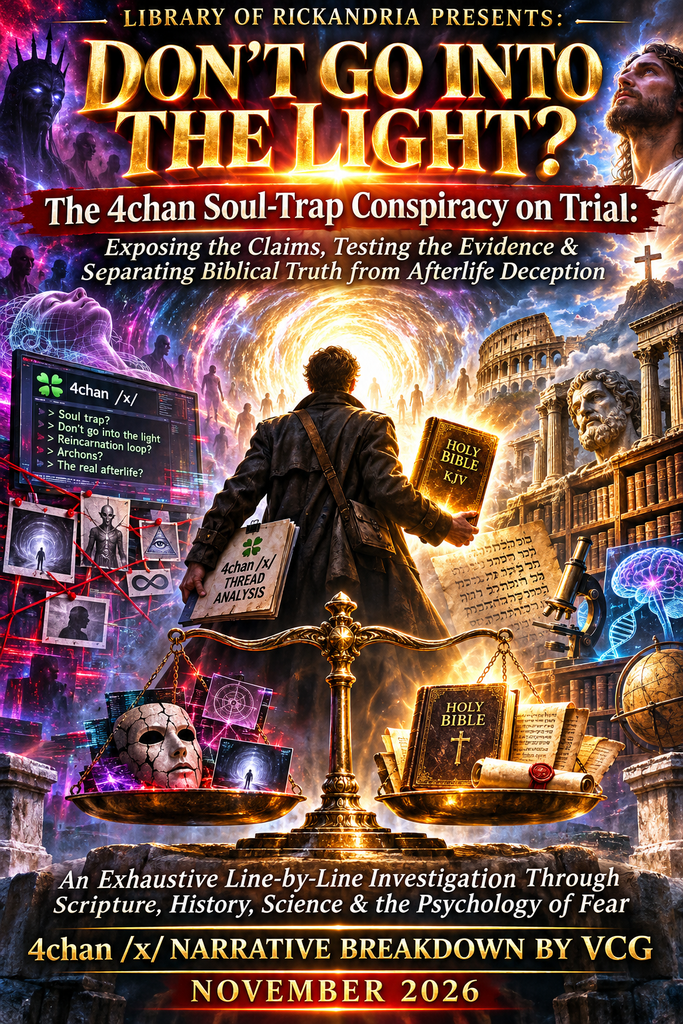
LIBRARY OF RICKANDRIA PRESENTS
DON’T GO INTO THE LIGHT?
The 4chan Soul-Trap Conspiracy on Trial: Exposing the Claims, Testing the Evidence & Separating Biblical Truth from Afterlife Deception
An Exhaustive Line-by-Line Investigation Through Scripture, History, Science & the Psychology of Fear
4chan /x/ NARRATIVE BREAKDOWN BY VCG
NOVEMBER 2026
LIBRARY OF RICKANDRIA · INDEPENDENT RESEARCH PAPER · REVISED AND EXPANDED EDITION
“Prove all things; hold fast that which is good.”— 1 Thessalonians 5:21, King James Version
ABSTRACT
On October 29, 2026, an anonymous participant on 4chan’s paranormal board, /x/, opened a discussion with a disturbing screenshot.
/x/ – >don’t go into the light >still get stuck anyways – Paranormal – 4chan
The image reproduced a Reddit-style account attributed to a person claiming to communicate with her deceased husband.
According to the account, the husband had disappeared during a war, was presumed dead, and had allegedly avoided moving toward a mysterious light after death.
He was now described as remaining in an intermediate space, unable to join other deceased people.
The opening message reduced this troubling narrative to an unsettling question:
what happens if someone refuses to enter the light but still becomes trapped?
What followed was a remarkable collection of competing explanations.
Some participants claimed that the light was a mechanism for reincarnation.
Others argued that the man remained in a lower astral realm.
Several blamed emotional attachment between husband and wife.
One suggested that the military might have fragmented his soul.
Another introduced teachings associated with Orthodox writer Seraphim Rose.
Later replies invoked:
- archons
- spiritual sovereignty
- ancient Hebrew language
- extraterrestrial impersonation
- alleged psychological operations
The thread was not a coherent body of evidence.
It was a developing collection of:
- stories
- interpretations
- religious references
- fears
- confident assertions about matters that no participant had independently demonstrated
Nevertheless, the discussion raises serious questions.
Can people really communicate with the dead?
What do near-death experiences establish about consciousness?
Where did the modern reincarnation-trap narrative originate?
Do ancient Gnostic texts support it?
Did Seraphim Rose actually teach what an online screenshot attributes to him?
Can grief affect a deceased person’s spiritual condition?
And what does the King James Bible teach about death, judgment, resurrection, spiritual deception, and the authority of Jesus Christ?
This investigation examines the opening testimony and all 19 replies preserved in the archived discussion.
It combines:
- primary-source analysis
- historical comparison
- linguistic examination
- contemporary scientific research
- cognitive psychology
and a contextual study of Scripture.
Its purpose is neither to ridicule people reporting unusual experiences nor to invent certainty where evidence is lacking.
The central findings are:
- The opening testimony remains independently unverified.
- The thread’s supernatural explanations frequently contradict one another.
- Some of its historical and religious references are genuine, but their existence does not establish the modern soul-trap theory.
- Bereavement research and consciousness studies provide important context without explaining every individual experience.
- The New Testament’s central framework of creation, death, judgment, redemption, and bodily resurrection differs substantially from the thread’s proposed system of reincarnation, hidden cosmic jailers, and liberation through secret knowledge.
- The claim that bereaved relatives can spiritually imprison their loved ones is unsupported and potentially harmful.
At its heart, this paper investigates a larger problem:
how an uncertain personal experience can become an apparently authoritative account of the universe when speculation is repeatedly mistaken for evidence.
PART I — THE THREAD AND THE EVIDENCE
1. The question that began the investigation
The primary source is 4chan /x/ thread No. 43145721, opened on Thursday, October 29, 2026, at 20:10:53 according to the archived page.
The discussion contains the original post and 19 replies, ending on October 31, 2026.
The opening post is exceptionally brief.
It contrasts the familiar warning against entering the light with the possibility of remaining trapped anyway.
That small observation creates the entire problem the thread attempts to solve.
If the light is dangerous, avoiding it should supposedly offer protection.
But what if avoiding it leads to another prison?
The participants respond by proposing different explanations of what happens after death.
As we will see, their explanations do not agree about the purpose of the light, the nature of the alleged prison, the identity of the supposed captors, or the method of escape.
That disagreement matters.
Before investigating whether the proposed afterlife system is real, we must first determine whether the people describing it are even talking about the same thing.
Primary evidence
Exhibit 1A — Opening testimony
Primary attachment
File: Screenshot_20261029_162112.png · 816 × 319 pixels

View the original Reddit-style screenshot embedded in the 4chan thread
The image contains an apparent online comment by Amazing_Web_6330, describing a deceased husband, alleged communication with him, and an attempted move into a different reality.
Exhibit 1B — Seraphim Rose screenshot
File: Screenshot.jpg · 702 × 837 pixels · Attached to post #43149179

View the original Nick Hinton / Seraphim Rose screenshot
This attachment introduces a historically identifiable Orthodox theological tradition into the discussion.
The links above point directly to the actual images posted in the thread, rather than reconstructed or fictionalized versions.
2. What the first screenshot actually says
We should begin with the document itself, before accepting any of the explanations supplied beneath it.
The comment describes a woman who believes she can communicate with the ghost of her husband.
Significantly, she acknowledges uncertainty about whether the alleged communicator is really him.
She explains that he had been missing in a war, that a body was presumed to be his based upon items found with it, and that the remains had been buried without DNA testing.
She then describes what her husband supposedly told her.
He had experienced a dreamlike condition before becoming aware of his situation.
The woman says she had desperately prayed for his return and later began hearing a whisper in her head.
According to her account, the voice could predict aspects of her future.
She interprets this as possible access to a timeline.
The terminology then changes from ghost communication to reality shifting.
She describes an attempt to move together into a reality where both spouses are alive.
Finally, the alleged husband is said to have chosen not to approach the light and instead to remain in an intermediate space.
He apparently cannot interact with other deceased people because they have moved beyond it.
The narrator ends by asking what to make of the information.
There are several important distinctions here.
First, the screenshot establishes the existence of an account, not the reality of the reported events.
A genuine screenshot of a claim is not independent confirmation that the claim is true.
Second, the narrator is uncertain about the identity of the alleged communicator.
We should preserve that uncertainty rather than rewriting the account as established contact with a dead husband.
Third, the narrative combines different types of claim.
It includes potentially checkable historical assertions about a missing service member; subjective experiences involving a perceived voice; claims of supernatural knowledge; and an extraordinary proposal involving alternate realities.
Each requires a different investigative method.
Fourth, the account contains no independently documented demonstration of its extraordinary claims.
No military records, identity-confirmation documents, controlled predictions, or independently witnessed communications accompany the screenshot.
The proper starting conclusion is therefore narrow:
this is an extraordinary personal narrative, with some elements potentially investigable but none of its supernatural mechanisms independently established.
3. The missing Reddit original: why source provenance matters
The screenshot displays a Reddit-style username, voting controls, and a relative timestamp.
Those details may help locate its source, but they do not provide the original post’s full context.
Searches for the account name and distinctive wording did not establish an authenticated original Reddit permalink.
Consequently, important questions remain open.
Was the comment made in a reality-shifting community, a bereavement discussion, or another forum?
What question was the author answering?
Were there follow-up comments?
Did the author clarify the war, the husband’s identity, or the meaning of shifting?
Was the account serious, fictional, or role-playing?
We cannot settle those matters from the screenshot alone.
This is a classic problem in digital source criticism.
A screenshot may preserve accurate words while removing the context necessary to understand them.
If the parent discussion explicitly invited imaginative or fictional responses, that would substantially change how we assessed the testimony.
If the author supplied detailed, independently verifiable information elsewhere, that would also matter.
Neither possibility should be assumed.
Source status:
screenshot authenticated as an attachment to the 4chan thread; underlying Reddit authorship, context, and account history not independently authenticated.
4. The military identification claim
One of the most serious allegations concerns the supposed burial of an incorrectly identified body.
But the screenshot does not supply the man’s name, military service, nationality, conflict, date of disappearance, or burial location.
Without those details, no investigator can identify the underlying casualty case.
It would also be mistaken to assume that an absence of DNA testing automatically invalidates a historical identification.
Military and forensic identification can involve several forms of evidence, including fingerprints, dental records, medical or anthropological comparisons, documented circumstances of recovery, and DNA analysis.
The exact methods differ across institutions, historical periods, and circumstances.
The question is not merely whether DNA was used.
It is whether the identification was adequately supported by the available evidence under the procedures applicable to that case.
Here, we have no identification record to examine.
The claim remains unresolved, and the unrelated suggestion that military authorities somehow split the man’s soul has no demonstrated connection to forensic identification at all.
PART II — THE RESEARCH METHOD
5. How we will judge the claims
A serious inquiry needs a consistent standard.
For this paper, five kinds of questions must remain separate.
Historical questions concern what people wrote, when they wrote it, and how ideas developed.
Finding an ancient text about archons proves that such a text exists; it does not establish that archons operate an actual reincarnation system.
Empirical questions concern observable evidence.
If a person claims to predict the future, we ask whether exact predictions can be recorded in advance and verified independently.
Psychological questions concern perception, grief, memory, attention, suggestibility, reasoning, and social influence.
Recognizing potential psychological mechanisms does not justify diagnosing anonymous people or accusing them of dishonesty.
Theological questions concern the beliefs of religious communities.
An Orthodox writer’s account of the afterlife must be understood within his tradition before it is compared with ancient Gnostic writings or modern paranormal claims.
Biblical questions concern the actual wording and context of Scripture.
We must distinguish what a passage explicitly states from what an interpreter infers.
We will also classify findings as verified, partly supported, unsupported, contradicted, subjective testimony, or unresolved. These labels concern the evidence for a particular claim, not the character of the person making it.
One of the most important rules is this:
Unsupported does not automatically mean impossible.
But possibility is not proof.
A useful reminder from the King James translators
In The Translators to the Reader, the translators discuss uncertain passages and caution against pretending that difficult matters are settled.
They write:
“It is better to make doubt of those things which are secret, than to strive about those things that are uncertain.”
This appears in the prefatory material of the KJV edition supplied for this investigation, in the section defending alternative marginal readings where interpretation is genuinely difficult.
The historical preface is not inspired Scripture.
Nevertheless, its emphasis on humility and careful examination offers a valuable standard for this investigation.
We should neither assert supernatural certainty from anonymous testimony nor claim that every mystery has already been solved by science.
Our conclusions must be no stronger than the evidence permits.
PART III — EVERY REPLY EXAMINED
6. A line-by-line reconstruction of the discussion
We will now follow the actual sequence of replies.
The archived post numbers provide a reproducible record of what each participant contributed.
Where the original uses insults or inflammatory language, I will summarize rather than reproduce it unnecessarily.
Post #43145739 — The alleged spiritual cords
The first reply suggests that the woman has tied spiritual cords to her husband.
This is an important beginning because it introduces a causal explanation that is absent from the evidence.
The screenshot says the woman desperately wants her husband back.
The commenter interprets that longing as a force capable of keeping him trapped after death.
But the reasoning depends upon three unproved assumptions:
that the reported ghost is actually the husband, that a mechanism of spiritual attachment exists, and that a living person’s wishes can control a deceased person’s location.
None is demonstrated.
The commenter moves from apparent uncertainty to emphatic confidence without presenting additional evidence.
Psychological assessment:
Grief naturally involves continued emotional bonds with the deceased.
Transforming such bonds into an alleged mechanism of imprisonment risks making ordinary mourning appear dangerous.
Biblical examination:
Romans 12:15 encourages compassion toward those who mourn.
John 11:33–36 shows Jesus deeply moved by grief and weeping at Lazarus’s tomb.
Neither passage teaches that love or sorrow can imprison the dead.
Finding:
Unsupported causal speculation.
Post #43145752 — Avoiding the light supposedly prevents reincarnation
The second respondent proposes a more complete afterlife mechanism.
According to this explanation, declining the light is how someone avoids reincarnation, but doing so leaves the person trapped near the earthly world.
The commenter then offers two possible reasons for the husband’s confusion:
an attachment to his former body or interference by the military.
Notice the sudden escalation.
The original testimony contains no evidence establishing a reincarnation process.
Yet this reply treats the process as known and begins explaining the difficulties associated with escaping it.
The allegation of military soul fragmentation is even more speculative.
It introduces an extraordinary clandestine capability without identifying any procedure, institution, document, or reproducible observation.
Scriptural examination:
Hebrews 9:27–28 presents human death and judgment in connection with Christ’s once-for-all sacrifice.
The KJV states:
“And as it is appointed unto men once to die, but after this the judgment:”
The immediate context contrasts Christ’s single sacrificial offering with the repeated sacrifices associated with the former covenant.
The text supports a fundamentally different understanding of death from an indefinitely repeating series of reincarnations.
That does not mean Hebrews tells us precisely what every dying person will perceive.
It means the thread’s proposed reincarnation machinery is not part of the passage’s teaching.
Finding:
Unsupported supernatural mechanism, combined with an unsupported allegation of military interference.
Post #43145759 — The husband is supposedly in a void
The next participant rejects the description of a repeating death event and substitutes an undefined void.
There is no additional evidence here.
We have simply replaced one supposed invisible location with another.
A useful scientific question would be: what observation distinguishes the claimed void from the lower astral realm, a dream, or a subjective experience interpreted as a location?
The thread offers none.
Biblical examination: Biblical terms relating to death—such as Sheol, Hades, and the grave—cannot automatically be identified with this undefined void. Their meanings must be studied in context.
Finding:
A competing assertion, not an independently demonstrated correction.
Post #43146902 — The lower astral and waiting relatives
A later respondent suggests that the husband occupies the lower astral region closest to the physical world.
The commenter also claims that deceased parents sometimes remain there to assist living family members before moving into a higher source or light.
This is a more developed metaphysical map.
But where does it come from?
There is no citation to an ancient manuscript, independently verified observation, or theological authority in the post itself.
The claim may resemble ideas found in modern astral-projection literature, but resemblance does not establish it as fact.
Scriptural examination:
Hebrews 12:1 speaks of a great cloud of witnesses.
Its immediate context is Hebrews 11, which recounts examples of faith.
Christians have interpreted aspects of heavenly awareness differently, but Hebrews 12 does not establish a lower astral waiting room or claim that deceased relatives guide souls through it.
Finding:
A recognizable esoteric interpretation without supporting evidence for its proposed geography.
Post #43146978 — The light is a reincarnation trap
This reply reduces the entire theory to one categorical statement:
the light supposedly functions as a reincarnation trap.
The poster provides no observations, source, argument, or experimental evidence.
The statement illustrates how repetition can make a proposition sound established.
If a claim appears frequently enough across online discussions, people may begin regarding it as background knowledge rather than a hypothesis requiring proof.
But familiarity does not establish truth.
Biblical examination:
The Bible sometimes associates light with God and divine truth, while also warning that appearances can deceive.
Neither fact establishes what a person is experiencing during an NDE.
Finding:
Unsupported universal assertion.
Post #43147041 — The husband’s own attachment is blamed
This participant believes the husband remains close to his wife because he has not abandoned his earthly attachments.
Compare that with #43145739.
The first respondent blamed the wife’s attachment.
This respondent blames the husband’s.
The explanations are different, but both confidently describe an invisible cause.
The disagreement is not by itself proof that both are false. It does show that neither explanation can simply be accepted as common knowledge shared by the group.
Scriptural examination:
Philippians 1:21–23 expresses Paul’s desire to depart and be with Christ, while also recognizing the importance of continued earthly life.
Nothing in the passage suggests that emotional attachment to family automatically controls one’s postmortem destination.
Finding: Unsubstantiated interpretation of the alleged husband’s motives.
Post #43149143 — Ridicule replaces reasoning
This poster responds to the reincarnation-trap claim with a hostile dismissal.
No supporting argument is provided.
The comment is useful only as evidence of the discussion’s social atmosphere.
Ridicule does not establish that a claim is false, just as confident enthusiasm does not make one true.
Scriptural examination:
James 3:9–10 warns against contradictory and destructive uses of speech.
A serious investigation should criticize bad reasoning without resorting to degrading those who advance it.
Finding:
Rhetorical hostility without evidentiary value.
Post #43149179 — Seraphim Rose enters the discussion
This is one of the most important contributions because the participant supplies an image referring to an identifiable theological writer.
The screenshot attributes to Nick Hinton a summary of the teachings of Orthodox hieromonk Seraphim Rose.
The summary connects astral projection and near-death experiences with an aerial realm, toll houses, deceptive spirits, and biblical descriptions of Satan’s authority in the air.
Unlike the thread’s anonymous assertions about spiritual cords, this claim has a recognizable historical basis.
Seraphim Rose really did write about aerial toll houses and the dangers he associated with deceptive spiritual encounters.
But several questions remain.
Does the screenshot accurately summarize him?
Does the passage describe all NDEs or particular interpretations of them?
Did Rose teach a reincarnation trap?
And how much of this teaching follows directly from Scripture rather than later tradition?
These questions cannot be settled merely by displaying his name.
The historical examination in Part IV addresses them in detail.
For now, the critical biblical passages are Ephesians 2:2 and 2 Corinthians 11:14.
The former refers to the prince associated with the power of the air.
The latter warns that Satan may appear as an angel of light.
Both are genuine biblical statements.
Neither independently establishes the literal geography or mechanisms described by modern soul-trap commentators.
Finding:
Historically grounded reference, but the screenshot is a secondary interpretation and does not independently prove its supernatural explanation.
Post #43149390 — Can someone remain fully conscious in limbo?
This participant asks how complete conscious awareness could be maintained in a dreamlike intermediate state.
The question is more useful than many of the preceding answers because it identifies something the theory has not explained.
Human beings experience varying degrees of awareness during dreams, lucid dreams, sleep transitions, and other altered states.
But the existence of those experiences does not establish a supernatural location outside the physical world.
The additional question is whether the supposed limbo state exists at all.
Scientific context: Research on lucid dreaming, dissociation, and reality shifting provides plausible comparisons, but none validates the particular postmortem interpretation.
Finding: Legitimate question based on an unverified premise.
Post #43149414 — Recognition supposedly propels the soul upward
This respondent proposes that recognizing one’s location in the lower astral realm causes a sudden movement to a higher region.
We now have another new rule of the alleged afterlife.
But how was this rule discovered?
Can it be tested?
What distinguishes ascent from a sensation of motion occurring during a dream or other altered state?
The thread does not answer.
Scriptural examination:
2 Corinthians 12:2–4 describes Paul’s extraordinary experience of being caught up to the third heaven.
Paul expressly acknowledges uncertainty about whether he was in or out of the body.
The passage does not provide a technique for navigating astral levels.
Finding: Unsupported spiritual-navigation claim.
Post #43150851 — The thrill of sudden movement
This participant describes excitement associated with the sudden-motion sensation.
The statement may reflect a sincerely remembered sensation.
There is no basis for assuming otherwise.
But the sensation and its proposed explanation are different things.
Feeling movement does not independently establish movement through an invisible realm.
The brain integrates visual, vestibular, proprioceptive, and other sensory information into our experience of bodily position and motion.
Disturbances or alterations in those processes can contribute to unusual experiences of movement and embodiment.
Finding: Subjective report; supernatural interpretation not independently established.
Post #43150973 — A request for an explanation
This respondent asks the original spiritual-cord commenter to explain.
That is a reasonable request.
The proper next step after encountering an extraordinary assertion is to ask what it means and what evidence supports it.
Scriptural examination:
Acts 17:11 commends the Bereans for searching the Scriptures to examine what they were being taught.
Their example is particularly valuable here:
the authority of a claim must not be established merely by the confidence of the speaker.
Finding:
Appropriate request for clarification.
Post #43150991 — An eternity of isolation
Another participant imagines the husband becoming psychologically distressed through endless isolation.
This adds a disturbing consequence to the alleged predicament.
Yet the thread has not established that the husband is in a void, that he will remain there forever, or that the described environment operates according to human psychological expectations.
A speculative premise is being extended into a frightening prediction.
Scriptural examination:
Scripture discusses judgment and the consequences of death with great seriousness.
It does not authorize assigning an identifiable stranger to an invented eternal fate.
Finding: Fear-inducing speculation built upon an unverified scenario.
Post #43151005 — Grief allegedly turns loved ones into ghosts
This comment expands the earlier spiritual-cord theory.
The participant claims that a living person’s refusal to release someone emotionally can prevent the deceased person from departing.
The writer then treats the narrator’s wording as evidence that she caused the alleged husband’s predicament.
This is perhaps the most pastorally troubling assertion in the thread.
The narrator’s grief becomes both the evidence and the alleged cause of a supernatural imprisonment.
That is circular reasoning.
There is no reliable experimental evidence that grief can imprison the dead, nor does the Bible teach this mechanism.
Psychological examination:
Bereavement involves continuing bonds with the deceased.
Those bonds may be expressed through:
- memories
- dreams
- conversation
- religious practices
or a perceived continuing presence.
These experiences do not establish supernatural coercion.
Scriptural examination:
1 Thessalonians 4:13–18 addresses grieving believers with resurrection hope.
Paul does not instruct them that their mourning could trap their deceased loved ones.
Finding:
Unsupported causal claim with significant potential to intensify grief-related guilt.
Post #43151014 — Can the deceased escape someone else’s grief?
The next commenter asks whether a ghost could escape the influence of a person who refuses to release them.
This reveals the consequences of accepting the earlier premise.
An unverified mechanism is now being used to generate further questions about escape and captivity.
The question is understandable.
But before developing an elaborate rescue theory, we should return to the underlying claim.
Has anyone established that such emotional imprisonment is possible?
No evidence in the thread does so.
Finding:
A reasonable question about an unsupported premise.
Post #43151080 — Sovereignty, sacred language, and archons
This lengthy reply dramatically changes the direction of the discussion.
The author repeatedly declares superiority over numerous beings, categories, and alleged dimensions, then supplies a Hebrew-sounding phrase corresponding to God’s self-identification in Exodus 3:14.
The post proposes that asserting personal sovereignty can prevent deception by archons.
It also anticipates criticism by claiming that the archons will attempt to persuade readers that the declaration is foolish.
Several issues arise.
First, an ancient divine name is being repurposed as an alleged human liberation formula.
Second, the claim of absolute individual supremacy is in considerable tension with biblical teachings about God’s unique sovereignty.
Third, the warning about hostile critics makes the theory resistant to correction.
If opposition can automatically be attributed to archonic manipulation, ordinary examination becomes difficult.
The post contains apparent satire, internet slang, and provocative ethnic references.
Its tone does not provide a reliable means of determining whether the author is entirely serious.
We should therefore examine its propositions without assuming that every sentence represents a sincere metaphysical belief.
Scriptural examination:
Exodus 3:14 identifies the LORD in the context of God’s calling of Moses.
It does not teach human beings to assume the Creator’s identity as a postmortem defensive technique.
Finding:
Unverified spiritual method, misleading application of sacred language, and self-protecting conspiracy reasoning.
Post #43152315 — The unexplained YouTube link
This respondent supplies a YouTube video link without explaining its relevance.
The link appearing in the thread establishes only that someone posted it.
It does not establish what the video argues or whether its contents are accurate.
Primary link:
YouTube video supplied in post #43152315.
The video’s contents were not independently authenticated for this examination.
Accordingly, the video is retained as an unresolved lead rather than treated as supporting evidence.
Finding:
Unresolved external source.
Post #43152446 — Archons at every waypoint
This commenter endorses the personal-sovereignty theory and asserts that archons attempt to deceive souls at various transition points.
The reply adds confidence but no independent evidence.
One anonymous participant agreeing with another does not establish the existence of the proposed entities.
Scriptural examination:
John 10:27–29 emphasizes Christ’s relationship with his sheep and their security in his and the Father’s power.
The passage does not present salvation as the outcome of successfully asserting sovereignty over cosmic gatekeepers.
Finding:
Unsupported repetition of an unverified system.
Post #43152476 — The alien impersonation theory
The final participant rejects the supposed forced choice between reincarnation and confinement, calling it a misleading operation associated with archons.
The poster then asserts that most ghosts are not human spirits and speculates that the alleged husband is an extraterrestrial impersonator.
This introduces yet another competing explanation.
The post supplies a numerical estimate, but no data set, measurement method, sample, or source establishing it.
The purported extraterrestrial identity is likewise unsupported.
What makes this response especially revealing is that it accuses competing explanations of being part of the deception.
Instead of resolving the disagreement, the disagreement itself becomes additional evidence of a conspiracy.
Biblical examination:
The New Testament certainly warns about deception and false spiritual claims.
But those warnings do not license unverified accusations about aliens, demons, or the spiritual identities of people involved in ordinary human experiences.
Finding:
Unsupported statistical claim, unverified impersonation theory, and self-sealing conspiratorial interpretation.
7. What the completed reply chain reveals
The 19 replies produce several mutually incompatible explanations.
| Explanation | Posts associated with it | Unresolved problem |
|---|---|---|
| The widow’s grief detains the husband | #43145739, #43151005 | No demonstrated spiritual-cord mechanism |
| Avoiding the light prevents reincarnation but causes confinement | #43145752, #43146978 | No verified reincarnation or light-trap mechanism |
| The husband occupies a void | #43145759 | No defined or independently observable location |
| The husband occupies the lower astral realm | #43146902, #43149414 | No reproducible evidence for the proposed geography |
| His own attachment keeps him near his wife | #43147041 | No independent evidence of motive or causation |
| Spirits may deceive souls in an aerial realm | #43149179 | Historical theological basis exists, but modern application is unproven |
| Personal sovereignty defeats archons | #43151080, #43152446 | No demonstrated protective method |
| The alleged husband is an impersonating entity | #43152476 | No evidence identifying such an entity |
We should not pretend that contradiction alone disproves every underlying possibility.
The more significant problem is that none of these explanations has been independently established, yet many participants speak as though the afterlife’s mechanisms were already known.
There is also a notable progression from uncertainty toward fear.
The original narrator asks what to make of an experience.
The thread gradually suggests that the husband may be trapped, that grief may be responsible, that hostile entities control the process, and that the only protection is knowledge unavailable to ordinary people.
The evidentiary foundation has not improved.
The claims have merely become more elaborate.
That distinction will become increasingly important as we examine where the underlying ideas came from.
PART IV — WHERE DID THE SOUL-TRAP THEORY COME FROM?
8. Ancient Gnosticism: real texts, disputed interpretations

Historical manuscript evidence should not be confused with proof of the supernatural claims contained in ancient texts.
Source:
Claremont Colleges Digital Library.
The term archon did not originate on 4chan.
It has a long history in Greek vocabulary and in ancient religious literature.
Some texts conventionally classified as Gnostic describe rulers of the material cosmos, spiritual captivity, ignorance, and liberation.
But this history is more complicated than contemporary prison-planet discussions often acknowledge.
Gnosticism is not the name of one universally agreed ancient religion with one authoritative book and one consistent theology.
Scholars such as Karen King have criticized the tendency to group diverse religious movements under that single category.
The writings conventionally classified as Gnostic vary in cosmology, their treatment of the material world, and their accounts of salvation.
Sources:
Karen L. King, What Is Gnosticism? (Harvard University Press, 2003)
Nicola Denzey Lewis, “Gnosticism,” Oxford Bibliographies in Biblical Studies
This matters because modern theories often combine passages from different ancient writings into an apparently unified explanation of reality.
That unified system may not have existed in antiquity.
8.1 The Secret Book of John
One especially relevant text is the Apocryphon of John, also known as the Secret Book of John.
The text describes a complex divine emanation system and a subordinate creator figure often associated with Yaldabaoth.
It presents a dramatic account of cosmic ignorance and the human condition.
In its different recensions, themes of spiritual bondage, ignorance, and the fate of souls appear prominently.
The work is preserved in multiple ancient Coptic witnesses, including manuscripts associated with the Nag Hammadi discoveries.
Primary text:
Marvin Meyer’s translation, The Secret Book of John, Gnostic Society Library
What does this establish?
It establishes that certain ancient religious writers explored cosmologies in which human existence involved subjection to lower powers.
It does not establish that the physical universe is actually operated by those powers.
Nor does it establish that contemporary near-death visions of bright lights are artificial reincarnation mechanisms.
The distinction is fundamental.
An ancient text can provide evidence of a belief’s antiquity.
It cannot serve as independent empirical confirmation of the belief merely because it is ancient.
8.2 The First Apocalypse of James: an especially close parallel
Another important text is the First Apocalypse of James.
Here the historical resemblance becomes particularly interesting.
In this work, James is instructed concerning his identity and a postmortem encounter with celestial toll collectors.
Sarah Parkhouse’s 2021 article in the Harvard Theological Review examines how this ancient text develops themes associated with the Gospel of John, including identity, death, ascension, and the confrontation with heavenly gatekeepers.
The comparison is especially relevant to the 4chan post that advocates declarations of spiritual sovereignty.
There really are ancient texts in which the departing soul must declare its identity to supernatural interrogators.
That is a meaningful historical parallel.
But we must distinguish three questions.
Did ancient religious writers describe such encounters? Yes.
Did those descriptions influence later religious or esoteric movements?
In some cases, historical influence can be investigated and documented.
Do these texts establish that modern souls must defeat archons by reciting sacred formulas?
No.
The historical similarity does not validate the supernatural mechanism.
The strongest correction is not to deny the historical parallel.
It is to explain precisely what that parallel does and does not prove.
9. Seraphim Rose and the aerial toll houses
The second screenshot deserves more than a quick rebuttal because it refers to an actual and influential Christian writer.
Seraphim Rose was an American Orthodox monk whose writings included discussions of spiritual deception, religious traditions, and life after death.
His book The Soul After Death, published around 1980, examines accounts of apparent encounters with the spiritual world through the framework of Eastern Orthodox theology.
The book includes chapters dealing with out-of-body experiences, the aerial realm, toll houses, occult literature, reincarnation, and resurrection.
A useful source for checking its original structure is the published table of contents of The Soul After Death.
9.1 What is the Orthodox toll-house teaching?
In some Orthodox sources, the departing soul undergoes a form of spiritual testing or accusation associated with the particular judgment.
Angels, demons, sins, repentance, and the state of the soul appear within these descriptions.
The imagery is found in hagiographical narratives, spiritual writings, and some liturgical contexts.
However, Orthodox authors differ over the significance and literalness of the descriptions.
The historical dispute became prominent after the publication of Rose’s book.
A particularly useful scholarly source is Paul Ladouceur’s review, “Orthodox Theologies of the Afterlife,” in St Vladimir’s Theological Quarterly 62:1 (2018), pages 51–72.
Read Ladouceur’s full scholarly review.
Ladouceur emphasizes that Orthodox traditions concerning the afterlife contain several strands of thought.
He criticizes attempts to reduce the whole tradition to a single detailed toll-house system.
This is an important qualification.
The existence of toll-house imagery within Orthodox tradition does not mean that every Orthodox theologian understands its details identically.
9.2 What did the 1980 synod decide?
On December 2, 1980, according to the modern calendar date recorded in the source, the Synod of Bishops of the Russian Orthodox Church Outside Russia considered the controversy involving Rose and his critic, Deacon Lev Puhalo.
The statement acknowledges that the discussion concerns matters not fully revealed, while also defending the legitimacy of traditional teachings that Puhalo had challenged.
It did not simply declare that the entire subject was nonsense.
Nor did it establish every dramatic detail of the toll-house narratives as a universally binding dogmatic formula.
Primary historical record:
ROCOR Synod, “The Debate Over Aerial Toll-Houses,” December 1980
Rose’s own response to criticism also survives:
Seraphim Rose, “Answer to a Critic,” appendix to The Soul After Death
These materials demonstrate why an isolated social-media screenshot is insufficient.
We need to read what Rose wrote, what his critics argued, and what the relevant ecclesiastical response actually said.
9.3 An important correction: Rose opposed reincarnation
There is an especially revealing contradiction between Rose’s teaching and some of the 4chan comments.
Rose criticized reincarnation as incompatible with Orthodox Christian teaching about judgment and resurrection.
His discussion is reproduced in the article “On the Heresy of Reincarnation,” attributed to The Soul After Death.
Read the reproduced Seraphim Rose discussion on reincarnation.
Therefore, combining Rose’s aerial toll-house discussion with the assertion that souls are routinely recycled through reincarnation can misrepresent his theology.
Even if Rose considered some near-death experiences susceptible to spiritual deception, that is not the same as teaching a universal reincarnation machine.
The two claims must not be treated as interchangeable.
9.4 Does Ephesians 2:2 establish aerial toll houses?
The passage calls attention to the prince of the power of the air.
But the surrounding argument concerns the former condition of sinners and God’s saving grace in Christ.
The theological question is whether later descriptions of postmortem spiritual testing can be inferred from that language.
Some Orthodox interpreters believe the broader biblical and patristic tradition supports their understanding.
Other Christian interpreters regard the passage as teaching spiritual opposition without describing the geography of the afterlife.
Both positions must be distinguished from the much stronger claim that the verse proves a system of deceptive reincarnation lights.
Finding:
The Orthodox tradition is historically authentic and deserves accurate representation.
But its existence does not independently validate the 4chan soul-trap theory.
10. Robert Monroe, loosh, and the modern prison-planet narrative
Another part of the broader history concerns Robert A. Monroe.
Monroe became known for writings describing experiences he interpreted as occurring outside the body.
His book Far Journeys appeared in 1985.
The publication is documented through WorldCat’s bibliographic record and Google Books.
The book contains the influential loosh narrative, later associated in online discussions with claims of energy harvesting and humanity functioning as a spiritual farm.
But an important limitation must be preserved.
The October 29 thread under examination does not itself develop an explicit loosh-harvesting argument.
Monroe is relevant because his work forms part of the broader modern environment in which prison-planet, astral-projection, and soul-trap theories circulate.
It would be methodologically misleading to pretend that the participants directly cited him when they did not.
For a closer examination of that particular subject, the Library of Rickandria has already published related research:
THE LOOSH TRAP: Are Demons Feeding on Your Fear?
REINCARNATION, SOUL TRAPS & LOOSH FARMING — LOR Research Collection
These are companion investigations.
They should be read as analyses of related claims, not as independent proof that the claims are true.
11. Reality shifting: the modern element hiding in plain sight
One of the most revealing details in the opening screenshot is its use of the language of shifting.
The narrator refers to a desired alternative reality and describes attempts to bring her husband there.
This terminology is recognizable within the online reality-shifting subculture.
Eli Somer, Etzel Cardeña, Ramiro Figueiredo Catelan, and Nirit Soffer-Dudek examined the phenomenon in their paper:
The study was published online in 2021 and later appeared in the journal’s 2023 volume.
The researchers examined shifting as described by participants in online communities, comparing it with phenomena involving:
- imagination
- lucid dreaming
- hypnosis
- dissociation
- immersive daydreaming
In shifting communities, DR commonly means desired reality, while CR means current reality.
That does not establish that alternative universes can literally be visited.
It explains the cultural vocabulary through which some people interpret their experiences.
This is a particularly important distinction for our thread.
Before assuming that the narrator possesses knowledge of a postmortem realm, we must recognize that her description is partly shaped by an already existing online framework.
The anonymous commenters then add other frameworks, including astral projection, spiritual cords, and archonic reincarnation.
What looks like a single supernatural explanation is actually a combination of multiple interpretive systems.
12. The historical timeline
| Period | Source or development | What is historically established |
|---|---|---|
| Early Christian centuries | Diverse religious writings later classified as Gnostic | Some texts describe cosmic rulers, salvation through knowledge, and spiritual ascent |
| Late antiquity | Coptic manuscripts, including the Nag Hammadi collection | Physical evidence that these writings circulated and were preserved |
| Medieval and later Christian traditions | Orthodox writings concerning judgment and aerial testing | A developing and variously interpreted body of theological literature |
| 1980 | Seraphim Rose, The Soul After Death | A modern Orthodox treatment and a documented controversy |
| 1985 | Robert Monroe, Far Journeys | A published modern esoteric account influencing later loosh discussions |
| 2020 onward | Growth of online reality-shifting communities | A documented internet subculture with its own vocabulary and practices |
| October 2026 | 4chan thread #43145721 | A combination of these concepts with an unverified bereavement narrative |
This timeline establishes historical context.
It does not establish an uninterrupted secret lineage from the ancient Gnostic writers to the 2026 anonymous commenters.
Such a lineage would require evidence of actual transmission, citation, borrowing, or documented influence.
Similarity of ideas is not the same as proof of historical descent.
PART V — SCIENCE, CONSCIOUSNESS, AND THE DYING BRAIN
13. What happens during a near-death experience?

What Scientists Now Know About Repairing Memories
This is an anatomical research illustration, not an image of a near-death experience or proof of an afterlife theory.
Source:
Smithsonian Magazine, research on memory and brain imaging.
Near-death experiences are among the most fascinating subjects in contemporary consciousness research.
People sometimes report vivid experiences associated with medical emergencies, including a perceived separation from the body, unusual awareness, light, encounters with familiar figures, and profound emotions.
These reports should be investigated carefully.
The experiences are real as experiences being reported.
Their ultimate explanations are not all settled.
We must distinguish:
- The event that occurred medically.
- The person’s later recollection.
- The physiological processes occurring around that time.
- The interpretation the person gives the experience.
- The independently verifiable information, if any, supplied by the experience.
Those are separate questions.
A person’s conviction that an experience occurred outside the body does not itself establish the objective location of consciousness during that event.
Equally, identifying possible neurological mechanisms does not justify dismissing the person’s experience as insignificant.
14. The AWARE-II study
One of the most important scientific studies to consider is the 2023 AWARE-II investigation led by Sam Parnia and colleagues.
The study examined awareness and related brain activity during cardiac arrest and cardiopulmonary resuscitation across 25 hospitals.
Parnia et al., “AWAreness during REsuscitation — II,” Resuscitation, 2023
AWARE-II · 2023 · IN-HOSPITAL COHORT
567
Cardiac-arrest patients studied
53
Survived
28
Completed interviews
11
Reported memories or perceptions suggestive of consciousness
6
Reported transcendent recalled experiences of death
No participant identified the visual test image; one of the 28 interviewed survivors identified the auditory stimulus.
These results reflect the study’s small interviewed survivor sample, not all cardiac-arrest patients.
Source:
The research also reported EEG activity consistent with the possibility of organized cognitive processing during CPR, including activity observed after extended periods of resuscitation.
The authors argued that consciousness-related processes may occur during cardiac arrest.
This is scientifically significant.
However, several qualifications are essential.
The study did not demonstrate that consciousness had permanently separated from the brain.
It did not establish that the visual contents of participants’ experiences corresponded to objectively observed external environments.
Nor did it identify any reincarnation mechanism.
Low survival rates limited the study’s ability to test some of its hypotheses.
The study is a reason to continue serious research, not a reason to declare that the 4chan metaphysical system has been confirmed.
Cardiac arrest is not the same as brain death
Another important medical distinction concerns terminology.
Cardiac arrest involves cessation of effective circulation, but resuscitation can sometimes restore circulation and survival.
Death by neurologic criteria involves an entirely different medical determination, including permanent loss of the relevant brain functions under established clinical criteria.
The 2023 consensus guideline published in Neurology details the requirements for evaluating brain death.
A person who survives cardiac arrest after resuscitation should not automatically be described as having recovered from formally established brain death.
Confusing these conditions can greatly exaggerate what a near-death study demonstrates.
15. What neuroscience can explain—and what remains uncertain
In March 2025, Charlotte Martial and colleagues published a review proposing an integrated neuroscientific model of near-death experiences.
Martial et al., “A Neuroscientific Model of Near-Death Experiences,” Nature Reviews Neurology, 2025
The model examines interacting physiological and psychological mechanisms, including altered cerebral blood flow, oxygen and carbon dioxide disturbances, neural excitability, neurotransmitter activity, and responses to extreme threat.
Its value lies in combining possible mechanisms rather than assuming that a single factor explains every feature of every reported experience.
But the proposed model has also attracted criticism.
For example, Birk Engmann questioned aspects of the research methodology and the difficulty of attributing complex conscious experiences to particular neurological processes.
This debate matters because it prevents two opposite mistakes.
One mistake is to claim that neuroscience has already explained every reported NDE in complete detail.
The other is to claim that any remaining mystery proves the existence of archons, soul traps, or consciousness traveling between universes.
Neither position is justified.
An incomplete explanation is not proof of a particular alternative explanation.
Science can investigate physiological states, recorded experiences, and independently verifiable observations.
It cannot legitimately turn an untested metaphysical theory into an established scientific conclusion.
16. Why people may experience the presence of the dead
The opening screenshot is not simply a near-death narrative.
It is a bereavement narrative.
That distinction is extremely important.
Karina Stengaard Kamp and colleagues published an interdisciplinary review in Schizophrenia Bulletin examining sensory and quasi-sensory experiences of deceased loved ones.
Kamp et al., “Sensory and Quasi-Sensory Experiences of the Deceased in Bereavement,” 2020
The review reports that such experiences can include sensed presence, voices, visions, dreams, and other perception-like phenomena.
Across studies with varying definitions and populations, estimates of reporting at least one such experience ranged from 47% to 82%.
That range should not be interpreted as a universal population prevalence estimate.
It summarizes results from different studies using different methods.
Importantly, the researchers emphasize that many of these experiences are benign and are not, by themselves, evidence of psychiatric illness.
That finding has immediate relevance.
The woman in the screenshot describes hearing a whisper and continuing to communicate with someone she believes may be her deceased husband.
This is the kind of account that deserves compassionate and careful interpretation.
The available evidence does not allow us to diagnose her, confirm supernatural contact, or accuse her of fabrication.
Possible contributions include grief-related perception, memory, inner speech, dream experiences, cultural expectations, or other psychological and medical processes.
Those possibilities are not equally applicable to every individual.
Without interviewing the person, understanding her circumstances, and gathering corroborating information, we cannot determine which explanation best describes her experience.
The responsible conclusion is not that grief proves ghost communication—or that ghost communication proves mental illness.
It is that bereavement-related experiences are a recognized subject of legitimate scientific study, and a supernatural explanation requires additional evidence.
17. Could the alleged predictions be tested?
The narrator claims that the perceived communicator can predict aspects of her future.
Unlike an undefined astral realm, a sufficiently specific prediction is potentially testable.
But a useful test would require more than remembering accurate predictions after the fact.
A stronger method would involve registering the predictions in advance, stating exactly what outcome is predicted, setting a deadline, recording all predictions rather than only successful ones, and assessing results independently.
There would also need to be safeguards against ordinary information leakage and retrospective reinterpretation.
For example, a prediction that something emotionally significant will happen soon is too vague to distinguish reliably from coincidence.
A precise, time-stamped prediction of an event unknown to the narrator, followed by independent verification under controlled conditions, would be more evidentially interesting.
Even then, an accurate prediction would not by itself establish that the source was the deceased husband.
It would raise further questions about the mechanism and identity of the alleged communicator.
This is how a careful investigation progresses: by narrowing uncertainty rather than assuming that one unexplained observation proves an entire spiritual system.
PART VI — WHAT SAITH THE SCRIPTURE?
18. Reading the Bible without forcing it into the thread’s cosmology

A Newly Digitized Bible Reveals the Origins of the King James Version
Source:
Text & Canon Institute, “A Newly Digitized Bible Reveals the Origins of the King James Version”.
The King James Bible provides a coherent theological framework for examining the thread, but it must be handled carefully.
Our task is not to find isolated verses containing words such as light, air, spirit, prison, or power and fit them into a modern afterlife theory.
We must consider who is speaking, the original audience, the context of the passage, and the argument being made.
That standard applies whether we agree or disagree with the 4chan participants.
18.1 Death, judgment, and resurrection
Hebrews 9:24–28 compares Christ’s once-for-all sacrifice with the repeated sacrificial ministry associated with the former covenant.
Human death and judgment serve as part of that comparison.
The passage presents a fundamentally linear account of death and judgment rather than a recurring cycle of earthly incarnations.
However, we should not force the passage to answer questions it never directly addresses.
It does not provide a detailed account of near-death imagery or every aspect of consciousness between death and resurrection.
1 Corinthians 15 provides the broader Christian hope.
Paul’s argument centers on Christ’s resurrection and the future resurrection of believers.
The significance of the body is especially important.
In 1 Corinthians 15:42–44, Paul contrasts corruption with incorruption, dishonor with glory, and weakness with power.
He also distinguishes the natural body from the spiritual body.
This should not be read as though Paul simply wanted human beings to abandon embodiment forever.
Within the chapter, resurrection represents transformation and victory over death.
That differs substantially from the idea that humanity’s primary problem is being forced into bodies by deceptive cosmic rulers.
18.2 Creation is not presented as an evil prison
Genesis 1:26–31 presents human beings as creatures made in God’s image.
The created order is described as very good at the conclusion of the chapter.
That affirmation is difficult to reconcile with versions of the soul-trap theory in which the material universe is fundamentally an evil enclosure designed by an inferior or malicious creator.
Christian theology certainly recognizes the fallen condition of the world.
But the biblical narrative distinguishes creation’s original goodness from the entrance of sin, suffering, and death.
The solution presented in Scripture is not simply the escape of an imprisoned divine spark from matter.
It is reconciliation with God, redemption through Christ, and resurrection.
18.3 Is spiritual deception biblical?
Yes.
2 Corinthians 11:13–15 warns about deceptive religious workers and describes Satan appearing as an angel of light.
1 John 4:1–3 instructs believers to test spiritual claims.
Those passages provide legitimate biblical grounds for caution.
But the application matters.
The context of 2 Corinthians 11 concerns false apostles and deceptive religious authority.
The immediate context of 1 John 4 concerns discernment in relation to claims about Jesus Christ.
Neither passage directly teaches that the bright light reported during some NDEs is an artificial reincarnation gateway.
One cannot move from the possibility of deceptive light to the certainty that every unusual light is deceptive.
That is a non sequitur.
18.4 Principalities and powers: what does Paul actually teach?
Several New Testament passages discuss spiritual rulers and powers.
Ephesians 2:1–10 refers to the prince of the power of the air while emphasizing salvation through God’s grace.
Ephesians 6:10–18 addresses spiritual conflict and the armor of God.
Colossians 1:15–20 emphasizes Christ’s supremacy over creation, including created authorities.
Colossians 2:13–15 describes Christ’s triumph over principalities and powers.
Read together, the passages establish an important theological theme:
spiritual opposition is real within Paul’s worldview, but Christ remains supreme over the powers.
They do not describe an independent system of archonic officials who possess final authority over human destiny.
Nor do they present secret knowledge or personalized mantras as the means of salvation.
18.5 Can the living consult the dead?
Deuteronomy 18:9–14 includes prohibitions concerning divination, familiar spirits, and consultation with the dead.
Isaiah 8:19–20 directs the people toward God’s law and testimony rather than mediums and other spiritistic sources.
These passages deserve special attention because the original Reddit-style testimony describes ongoing attempts at communication with a deceased person.
From the perspective of the biblical texts, deliberate consultation with the dead is not endorsed as a means of obtaining knowledge.
However, a distinction is necessary.
A person unexpectedly experiencing a vivid dream, perceived voice, or sense of presence has not necessarily engaged in deliberate necromancy.
The moral and theological evaluation of intentionally seeking spirit communication should not be indiscriminately imposed on every involuntary bereavement experience.
18.6 What about the witch of Endor?
1 Samuel 28:7–20 describes Saul consulting a woman associated with a familiar spirit and an appearance identified in the narrative as Samuel.
Christian interpreters have long debated aspects of this episode.
Some read the account as an extraordinary appearance of Samuel permitted by God.
Others have proposed a deceptive spirit or other explanation.
Regardless of which interpretation is accepted, the narrative does not endorse Saul’s actions.
Indeed, 1 Chronicles 10:13–14 explicitly condemns his decision to consult a familiar spirit.
Therefore, the Endor account cannot responsibly be used as a universal instruction to communicate with the departed.
It also cannot establish that every unusual experience of a deceased loved one is necessarily demonic.
Both conclusions exceed what the text demonstrates.
18.7 Does the Bible describe the dead as conscious?
This is a more complicated theological question than the 4chan discussion recognizes.
Some Christian interpreters emphasize passages such as Philippians 1:21–23, where Paul describes departing and being with Christ.
Others emphasize death-as-sleep language and passages such as Ecclesiastes 9:5–6.
The passage in Ecclesiastes must be read within the book’s reflection on life, death, and human experience under the sun.
There are also different interpretations of Luke 23:43, including disagreements concerning punctuation and the timing of the promised presence in paradise.
Christian traditions do not all describe the intermediate state in the same way.
The theological disagreement should be acknowledged honestly.
But neither the conscious-intermediate-state position nor the unconscious-intermediate-state position establishes the particular astral geography described in the 4chan thread.
18.8 Luke 16: the rich man and Lazarus
Luke 16:19–31 depicts a rich man and Lazarus experiencing dramatically different circumstances after death.
There is a continuing debate over whether every narrative detail should be understood literally or as part of a parabolic teaching.
The central moral and theological themes involve wealth, neglect of the poor, judgment, and the sufficiency of the testimony available through Moses and the prophets.
The passage does not describe a reincarnation tunnel.
Nor does it portray deceased relatives moving freely between the living and the dead to deliver secret information.
In fact, the narrative emphasizes a barrier separating the respective conditions described.
Whatever its proper interpretation, it cannot simply be equated with modern astral-projection literature.
18.9 Is there a biblical spirit prison?
1 Peter 3:18–22 includes the difficult reference to spirits in prison.
Christians have offered differing interpretations concerning the identity of these spirits, the time of Christ’s proclamation, and the relationship to the days of Noah.
Some read the passage as describing a proclamation to fallen spirits.
Others interpret it through Christ’s activity in the time of Noah or through different understandings of his death and resurrection.
The point is not that the passage lacks significance.
It is that an acknowledged interpretive difficulty cannot be used as a blank space into which we insert an entire modern prison-planet system.
The text does not identify its prison as the void described in the 4chan thread.
18.10 God’s name is not a human escape password
The phrase invoked in post #43151080 resembles the Hebrew expression Ehyeh Asher Ehyeh from Exodus 3:14.
The KJV renders the phrase:
“I AM THAT I AM”
Other translations express aspects of the verbal form through future-oriented wording.
A useful comparison of Hebrew translation traditions appears in this Exodus 3 translation study.
The context concerns God’s identity and his promise to act for Israel.
There is no instruction in Exodus 3 for human beings to repeat the divine name as a technique for asserting supremacy over the Creator.
The difference between recognizing God’s authority and claiming God’s authority for oneself is essential.
19. The Hebrew and Greek language audit
Ancient-language terminology frequently appears in esoteric literature because it can give an argument an impression of historical precision.
But an ancient word does not automatically possess the modern meaning being attached to it.
| Term | General meaning or usage | Necessary caution |
|---|---|---|
| Nephesh — נֶפֶשׁ | Life, living being, person, or soul, depending on context | Not automatically a detachable immortal energy unit |
| Ruach — רוּחַ | Wind, breath, spirit | Meaning depends on the passage and subject |
| Sheol — שְׁאוֹל | Realm of the dead or grave-related language in the Hebrew Bible | Cannot simply be identified with the internet concept of a void |
| Psychē — ψυχή | Life, person, soul | Not proof of an astral body capable of visiting alternate timelines |
| Pneuma — πνεῦμα | Wind, breath, spirit | Cannot automatically be equated with modern consciousness-field theories |
| Hadēs — ᾅδης | Realm of the dead in Greek usage and biblical contexts | Not necessarily identical to later descriptions of hell |
| Geenna — γέεννα | Gehenna, associated with judgment | Must be distinguished from Hades in relevant passages |
| Archōn — ἄρχων | Ruler, chief, authority | Not every occurrence denotes a Gnostic cosmic jailer |
| Archai — ἀρχαί | Principalities, beginnings, or ruling powers according to context | Related vocabulary does not prove Paul endorsed later Gnostic cosmology |
| Ehyeh Asher Ehyeh — אֶהְיֶה אֲשֶׁר אֶהְיֶה | God’s self-identification in Exodus 3:14 | Not presented as a mantra conferring divine sovereignty upon humans |
This illustrates why lexical study matters.
Words must be interpreted within their language, literary setting, and historical context.
Importing a modern paranormal meaning into an ancient word, then claiming that the ancient text confirms the modern idea, is circular reasoning.
20. The 20-passage scriptural evidence ledger
The following passages form the core biblical comparison for the paper.
| KJV passage | Main subject | Relevance to the thread |
|---|---|---|
| Genesis 1:26–31 | Creation and human dignity | Challenges the view of embodiment as inherently evil |
| Exodus 3:13–15 | God’s name | Corrects the misuse of divine self-identification |
| Deuteronomy 18:9–14 | Forbidden divination | Relevant to deliberate attempts to consult the dead |
| 1 Samuel 28:7–20 | Saul and Endor | A difficult biblical account requiring careful interpretation |
| Ecclesiastes 9:5–10 | The dead and earthly life | Important to disputes about postmortem consciousness |
| Ecclesiastes 12:7 | The spirit returning to God | No description of human grief imprisoning spirits |
| Isaiah 8:19–20 | Revelation and spirit consultation | Warns against seeking guidance from the dead |
| Isaiah 45:5–7 | Divine uniqueness | Challenges assertions of autonomous divinity |
| Luke 16:19–31 | Death and moral accountability | Does not establish a reincarnation machine |
| Luke 23:39–43 | Christ and the dying criminal | Relevant to paradise and the intermediate state |
| John 5:24–29 | Judgment and resurrection | Central alternative to reincarnation |
| John 10:27–30 | The security of Christ’s sheep | Salvation is not presented as an astral escape challenge |
| Romans 8:35–39 | God’s love and spiritual powers | Emphasizes divine security |
| 1 Corinthians 15 | Bodily resurrection | Foundational to Christian eschatology |
| 2 Corinthians 11:13–15 | Deceptive religious appearance | Does not prove every reported light is deceptive |
| 2 Corinthians 12:1–4 | Paul’s extraordinary vision | Not a manual for astral travel |
| Ephesians 2:1–10 | Spiritual opposition and grace | Places salvation in God’s action |
| Ephesians 6:10–18 | Spiritual warfare | Does not establish postmortem toll stations |
| Hebrews 9:24–28 | Christ’s offering, death, judgment | Strongly contrasts with repeated-incarnation theories |
| Revelation 20:11–15 | Final judgment | Describes final divine judgment rather than cosmic recycling |
These passages should be read alongside their surrounding chapters.
The table is an index of relevant texts, not a substitute for exegesis.
PART VII — THE PSYCHOLOGY OF THE SOUL TRAP
21. How uncertainty becomes apparent certainty
The thread illustrates how one uncertain story can support increasingly elaborate interpretations when participants begin treating earlier speculation as an established fact.
The process does not require deliberate deception.
People may sincerely attempt to make sense of something that unsettles them.
But sincerity does not protect an explanation from error.
Research in cognitive and social psychology has examined why conspiracy narratives can become appealing, particularly when they appear to explain frightening or confusing events.
Karen Douglas, Robbie Sutton, and Aleksandra Cichocka identified three broad categories of motivation in their 2017 review:
- Epistemic motives involving explanation and understanding.
- Existential motives involving safety and control.
- Social motives involving personal or group identity.
Douglas, Sutton, and Cichocka, “The Psychology of Conspiracy Theories,” 2017
This research should not be reduced to a claim that anyone who questions conventional explanations has a psychological disorder.
Conspiracies can occur, and institutions can deceive.
The issue is whether a particular explanation is supported by evidence.
21.1 Pattern perception
Human beings naturally search for patterns.
That capacity is enormously useful. It allows us to recognize faces, detect danger, discover relationships, and learn from experience.
But it can also cause us to perceive meaningful connections in ambiguous or random information.
Van Prooijen, Douglas, and De Inocencio investigated associations between illusory pattern perception and belief in conspiracy theories or supernatural explanations.
Their findings support the importance of pattern perception as one contributing cognitive mechanism.
Applied to our thread, the concern is that participants may connect a grief narrative, ancient religious vocabulary, modern paranormal experiences, and alleged government interference without establishing genuine causal relationships.
21.2 Confirmation bias
Once a person adopts a theory, new information may be evaluated primarily according to how well it fits that theory.
Consider the possible reasoning:
A bright light appears.
It is interpreted as the trap.
No light appears.
That absence is interpreted as another part of the trap.
A familiar person appears.
The person is interpreted as an impersonator.
A religious text contains a similar idea.
The similarity is interpreted as confirmation.
Someone disputes the theory.
The critic is interpreted as an agent of the deception.
This is not a fair evidentiary system.
A useful theory should specify what observations would count against it, not merely offer explanations for everything imaginable.
21.3 The appeal of secret knowledge
Several participants present the afterlife as a dangerous environment that ordinary people misunderstand.
They imply that survival depends upon recognizing the hidden rules before death.
This gives the theory emotional force.
The believer is no longer simply frightened.
The believer may feel equipped with knowledge that others lack.
But this sense of empowerment can be deceptive when the underlying mechanism is unverified.
We should distinguish the psychological feeling of possessing secret knowledge from evidence that the knowledge is accurate.
21.4 Fear and the imagined consequences of being wrong
The thread’s central warning concerns an outcome that could hardly be more frightening: eternal spiritual imprisonment.
This creates a powerful emotional incentive to accept whatever method of escape is proposed.
But severity of a possible consequence does not establish the probability of the event.
A person can be very frightened by a hypothetical danger that has not been demonstrated.
This is why extraordinary claims involving death, punishment, and eternal suffering deserve especially careful scrutiny.
21.5 The special problem of anonymous forums
Anonymous discussion can encourage candid questions and unusual intellectual exploration.
It can also make it difficult to evaluate credibility.
We do not know whether the participants have direct experience, whether they are repeating stories, whether they are joking, or whether they intend to provoke others.
The mixture of serious claims, slang, insults, and apparent satire in this particular thread makes those uncertainties especially significant.
A researcher should not assign motives or diagnoses based solely upon anonymous posts.
The proper method is to assess the statements themselves.
22. The conspiracy that cannot be disproved
This brings us to what may be the paper’s most important philosophical problem.
Some theories are structured so that almost any outcome can be interpreted as further confirmation.
The final 4chan participant describes rival explanations as part of an archonic operation.
The sovereignty-mantra post similarly anticipates rejection by alleging that hostile beings will encourage disbelief.
In both cases, criticism can be absorbed into the theory.
Suppose someone supplies strong evidence against the proposed reincarnation mechanism.
The believer might reply that the evidence was manufactured by the archons.
Suppose researchers cannot reproduce the claimed phenomenon.
The believer might argue that the entities deliberately concealed themselves.
Suppose a religious scholar demonstrates that an ancient text has been misinterpreted.
The believer might conclude that the scholar is spiritually compromised.
Such responses may protect the belief from revision without providing new evidence.
This is known as a self-sealing style of reasoning.
The important nuance is that difficulty of falsification does not automatically establish that a proposition is false.
Some philosophical and theological propositions are not straightforwardly testable through experiments.
But when a theory makes concrete claims about identifiable events, predictions, mechanisms, and external actors, those claims should still be evaluated against available evidence.
The 4chan narrative repeatedly crosses from metaphysical speculation into claims about actual people and supposed events.
It cannot reasonably demand the status of established knowledge while exempting itself from ordinary evidentiary scrutiny.
23. The pastoral consequences of afterlife fear
One of the most serious aspects of the discussion is the accusation that a grieving person may be responsible for imprisoning her deceased spouse.
This should not be treated as harmless entertainment.
A grieving person may already struggle with regret, uncertainty, loneliness, or feelings of unfinished responsibility.
An unsupported explanation that assigns supernatural consequences to mourning can intensify those burdens.
There is no adequate evidence that ordinary grief traps souls.
And the passages of Scripture most directly concerned with bereavement do not teach that doctrine.
In John 11, Jesus responds to death and grief with compassion.
In 1 Thessalonians 4, Paul directs mourning believers toward resurrection hope.
In Romans 12:15, believers are called to share one another’s sorrow.
None of those passages establishes that mourners can detain the dead against their will.
A pastoral response to someone describing a perceived encounter with a deceased loved one should therefore be compassionate and careful.
The experience can be discussed without declaring it demonic, inventing a supernatural explanation, or dismissing the person.
If it causes serious distress or interferes with daily functioning, professional support may be appropriate.
The goal is to help someone understand the experience without adding unnecessary fear or guilt.
PART VIII — THE STRONGEST COUNTERARGUMENTS
24. What would a serious advocate of the soul-trap theory say?
A thorough paper should not examine only the weakest claims made by anonymous internet commenters.
We should also consider the strongest arguments someone might offer in favor of a more developed version of the theory.
Counterargument 1:
Many people report similar near-death experiences
This is a legitimate observation.
Some NDE reports contain recurring features, including light, separation from the body, and encounters with apparently familiar beings.
But similarities in reported experiences do not establish a single supernatural explanation.
Human beings also share neurological structures, psychological responses, cultural symbols, and expectations.
The existence of common features deserves research.
It does not establish that the light is a trap.
Assessment:
The similarity of reports is an appropriate subject of investigation; the proposed reincarnation mechanism remains unverified.
Counterargument 2:
Some people report apparently verifiable experiences during cardiac arrest
Certain NDE accounts include claims of accurate observations made under unusual medical circumstances.
Such cases deserve careful examination.
The crucial questions concern timing, documentation, information leakage, witness independence, medical records, and whether the observations were recorded before being verified.
AWARE-II demonstrates that researchers are attempting to investigate awareness prospectively.
But the study does not establish that consciousness survives permanent brain death or that any postmortem trap exists.
Assessment:
A legitimate research question, not proof of the thread’s cosmology.
Counterargument 3:
Ancient religions independently warned about hostile cosmic rulers
There are genuine ancient parallels.
The Apocryphon of John and the First Apocalypse of James contain concepts relevant to cosmic rulers and spiritual ascent.
However, historical evidence must distinguish independent development from borrowing, shared cultural influences, or modern reinterpretation.
Even genuinely independent similarities would not, by themselves, establish that the supernatural accounts are factually correct.
Assessment: Historically significant; metaphysical conclusion not established.
Counterargument 4:
Scripture warns that Satan can appear as an angel of light
That warning is genuine.
The problem lies in applying it universally to a different category of experience.
Second Corinthians 11 concerns deceptive religious authority.
The passage does not identify every luminous experience as satanic, nor does it teach that all dying people are forced to choose between reincarnation and ghostly imprisonment.
Assessment:
Genuine biblical warning, but the proposed application exceeds the text.
Counterargument 5:
The Bible contains extraordinary encounters with the dead
Yes.
The account of Saul and Endor, the transfiguration of Jesus, and several passages concerning the intermediate state involve unusual spiritual subject matter.
But those narratives must be examined individually.
They cannot simply be collected into a modern system of astral travel and reincarnation.
Assessment: Authentic biblical material, but the claimed system does not follow.
Counterargument 6:
Was John the Baptist Elijah reincarnated?
Some advocates of reincarnation point to Matthew 11:14, where Jesus identifies John with the Elijah who was to come.
But Luke 1:17 describes John coming in Elijah’s spirit and power, while John 1:21 records John’s denial that he is Elijah.
Within the combined Gospel context, the identification is most naturally understood in relation to prophetic role and fulfillment, rather than literal reincarnation.
Assessment:
A real interpretive question, but the broader textual evidence does not support the proposed reincarnation doctrine.
Counterargument 7:
What if the system is designed to conceal evidence?
This possibility is logically difficult to disprove in the abstract.
But it does not provide positive evidence that the system exists.
A hypothesis cannot reasonably become more credible merely because someone claims its evidence has been deliberately hidden.
The stronger approach is to specify particular events, documents, mechanisms, or predictions that could be independently investigated.
Assessment:
Possible concealment does not substitute for affirmative evidence.
PART IX — THE FINAL EVIDENCE LEDGER
25. What survives scrutiny?
| Major claim | Historical status | Scientific status | Biblical assessment |
|---|---|---|---|
| People report experiences involving deceased loved ones | Documented | Documented phenomenon | Must distinguish involuntary experiences from intentional spirit consultation |
| The narrator’s husband is communicating with her | Anonymous testimony | Not independently verified | Scripture does not establish this identification |
| The buried remains were misidentified | Potentially investigable claim | Insufficient case information | Not determined by Scripture |
| Literal reality shifting between universes occurs | Modern online belief documented | Not demonstrated | No established biblical teaching of the practice |
| The light is a reincarnation trap | Contemporary theory documented | Not demonstrated | In tension with death, judgment, and resurrection theology |
| Deceased people occupy lower astral regions | Esoteric traditions documented | Not independently demonstrated | No direct biblical establishment of this geography |
| A grieving person can imprison a deceased loved one | Claim documented in the thread | No demonstrated mechanism | Unsupported by the relevant biblical passages |
| Ancient texts discuss cosmic rulers | Historically established | Does not verify supernatural entities | Must distinguish ancient Gnostic cosmologies from the canonical New Testament |
| Seraphim Rose wrote about aerial toll houses | Historically established | Theological interpretation, not empirical demonstration | A debated tradition requiring careful contextual examination |
| Personal sovereignty mantras defeat archons | Claim documented in the thread | No demonstrated protective effect | Not taught in Exodus 3:14 |
| Military personnel can fragment souls | Anonymous allegation | No supporting evidence supplied or identified | No biblical basis demonstrated |
| Most ghosts are extraterrestrial impersonators | Anonymous assertion | No supporting statistical or identification evidence | Not established by Scripture |
The pattern is consistent.
The thread contains authentic examples of religious vocabulary, historical teachings, subjective experiences, and recognizable cultural beliefs.
But those genuine elements do not demonstrate the larger system assembled from them.
26. What evidence would change the conclusions?
A good investigation must remain open to correction.
If an authenticated Reddit original provided substantially different context, the provenance assessment would need to change.
If identifiable military records established that the alleged husband was incorrectly declared dead, the historical assessment would need to change.
If rigorously controlled research established the transmission of specific, otherwise unavailable information through a claimed deceased communicator, the empirical assessment would require revision.
If a historical manuscript were shown to have been misdated or misrepresented, the genealogy of the beliefs would need correction.
If a biblical interpretation failed to account for the surrounding context or relevant linguistic evidence, the theological analysis would need revision.
These are not concessions to the soul-trap theory.
They are the conditions under which an evidence-based investigation remains intellectually honest.
The investigator must apply the same standard of correction to his own conclusions that he demands of others.
PART X — LIBRARY OF RICKANDRIA COMPANION INVESTIGATIONS
The October 29 discussion belongs to a much broader collection of modern internet narratives concerning consciousness, spiritual deception, reincarnation, archons, and supposed cosmic imprisonment.
The following Library of Rickandria publications provide directly relevant background.
They are linked as companion analyses and contextual research, not as independent scientific verification of extraordinary claims.
| Library of Rickandria investigation | Relationship to this paper |
|---|---|
| REINCARNATION, SOUL TRAPS & LOOSH FARMING | Research collection bringing together related investigations |
| THE SOUL TRAP TRAP: Did 4chan Uncover the Afterlife—or Expose a Spiritual Deception? | Examination of another 2026 thread involving near-death experiences and spiritual authority |
| Is Earth a Soul Trap? The Terrifying Reincarnation Theory That Collapses Under Scrutiny | A related investigation of reincarnation and prison-planet claims |
| THE LOOSH TRAP: Are Demons Feeding on Your Fear? | Research into emotional-energy harvesting claims and their origins |
| DOES EVIL REALLY PAY? 4chan’s Darkest Archon Conspiracy EXPOSED | Analysis of archons, karma, spiritual imprisonment, and related theories |
| Is Earth a Human Farm? The 4chan Jupiter Ascending Conspiracy Put on Trial | Comparison between speculative human-harvesting claims and evidence |
| The Oversoul, Archons & the Architecture of Consciousness | Examination of consciousness cosmologies and alleged archonic influence |
| Serpents, Archons & Reptilians | Related biblical, historical, and psychological investigation of archon imagery |
Together, these studies provide a broader research context for examining the recurring prison-planet narrative.
The present paper contributes something distinct:
a detailed investigation of a claim originating in bereavement, followed by anonymous commenters attempting to explain the alleged fate of one deceased individual.
PART XI — CONCLUSION
27. Don’t go into the light? What can we actually say?
The warning sounds simple.
Do not approach the light.
But our investigation reveals that its simplicity is misleading.
The original testimony does not establish that a deceased husband communicated with his wife, that he rejected a postmortem light, or that he became trapped in an intermediate realm.
Those are elements of an unverified account.
The subsequent commenters do not resolve the uncertainty.
Instead, they offer competing theories.
One blames the widow’s grief.
Another blames the husband’s own attachments.
Others invoke reincarnation, a void, lower astral regions, military interference, deceptive spirits, archons, and extraterrestrial impersonation.
Some of those ideas have recognizable historical precedents.
Others come from contemporary internet culture.
A few correspond to subjects that scientists legitimately study, such as experiences of continued presence during bereavement and altered consciousness associated with medical crises.
But none of those connections establishes the extraordinary system as a whole.
The historical record confirms that ancient religious writers discussed cosmic rulers and spiritual ascent.
It confirms that Orthodox writers, including Seraphim Rose, explored traditions concerning the soul after death.
It confirms that modern authors and online communities developed elaborate accounts of astral projection, loosh, and reality shifting.
What it does not confirm is that the dead are recycled through a deceptive light operated by hidden entities.
The scientific record establishes that people can have profound and unusual conscious experiences during serious physiological crises.
It also establishes that bereaved people sometimes perceive the presence of deceased loved ones.
These phenomena deserve serious study.
But no credible evidence examined for this paper demonstrates that grief can imprison the dead, that an individual can literally shift into another universe, or that a soul-trap mechanism has been identified.
Scripture provides another perspective.
The Bible teaches creation, human moral responsibility, the reality of spiritual deception, death, divine judgment, Christ’s victory, and the resurrection.
It contains difficult passages concerning the intermediate state and spiritual beings.
Those passages should be studied patiently, without forcing them into a modern paranormal framework.
The New Testament’s central account of salvation is not a program of secret knowledge, self-deification, or navigation through hostile astral checkpoints.
It centers upon the grace of God and the saving work of Jesus Christ.
This leads to a final question.
What is the greater danger: an invisible cosmic trap that has not been demonstrated, or the very visible habit of allowing fear and speculation to govern what we believe?
The second danger can be studied directly.
We can examine how an anonymous story becomes a theory, how a theory becomes an unquestioned assumption, and how disagreement is reinterpreted as further evidence of deception.
We can identify the emotional pressure created by frightening claims about eternity.
And we can choose not to impose unsupported supernatural guilt upon people who are already grieving.
The most responsible conclusion is therefore neither mockery nor panic.
It is disciplined discernment.
The evidence does not establish the existence of the alleged soul trap.
The historical parallels deserve study but do not prove the theory.
The scientific questions deserve continued investigation without exaggeration.
And the Bible deserves to be read in its own context, with neither its clear teaching ignored nor its difficult passages forced into unwarranted certainty.
The Apostle Paul’s conclusion in 1 Corinthians 15:26 remains especially fitting:
“The last enemy that shall be destroyed is death.”
The Christian hope presented in that chapter is not that believers become sufficiently knowledgeable to outwit the machinery of death.
It is that God will defeat death through Christ and the resurrection.
Soli Deo Gloria.
RESEARCH BIBLIOGRAPHY & PRIMARY-SOURCE ARCHIVE
The following external links are included directly so that a reader copying the paper can locate the original sources.
A. Primary thread and digital evidence
1. 4chan, /x/ — Paranormal, thread No. 43145721, October 29–31, 2026. Read the archived thread.
2. Original opening screenshot, Screenshot_20261029_162112.png. View source image.
3. Seraphim Rose-related screenshot attached to post #43149179. View source image.
4. YouTube link submitted in post #43152315. Original linked video. Contents not independently authenticated in this study.
B. Consciousness, near-death experiences, and bereavement
5. Parnia, Sam, et al. (2023). “AWAreness during REsuscitation — II: A Multi-Center Study of Consciousness and Awareness in Cardiac Arrest.” Resuscitation, 191, 109903. PubMed. DOI: 10.1016/j.resuscitation.2023.109903.
6. Martial, Charlotte, et al. (2025). “A Neuroscientific Model of Near-Death Experiences.” Nature Reviews Neurology, 21, 297–311. Full article.
7. Engmann, Birk. (2025). “Perils and Pitfalls of Near-Death Experience Research.” Nature Reviews Neurology. Correspondence.
8. Greer, David M., et al. (2023). “Pediatric and Adult Brain Death/Death by Neurologic Criteria Consensus Guideline.” Neurology, 101(24), 1112–1132. Open-access guideline.
9. Kamp, Karina Stengaard, et al. (2020). “Sensory and Quasi-Sensory Experiences of the Deceased in Bereavement: An Interdisciplinary and Integrative Review.” Schizophrenia Bulletin, 46(6), 1367–1381. Open-access review.
10. Somer, Eli, et al. (2021/2023). “Reality Shifting: Psychological Features of an Emergent Online Daydreaming Culture.” Current Psychology. Open-access study.
C. Psychology and methodology
11. Douglas, Karen M., Robbie M. Sutton, and Aleksandra Cichocka. (2017). “The Psychology of Conspiracy Theories.” Current Directions in Psychological Science, 26(6), 538–542. Open-access article.
12. Van Prooijen, Jan-Willem, Karen M. Douglas, and Clara De Inocencio. (2018). “Connecting the Dots: Illusory Pattern Perception Predicts Belief in Conspiracies and the Supernatural.” European Journal of Social Psychology, 48(3), 320–335. Open-access article.
D. Ancient religious texts and historical scholarship
13. The Secret Book of John / Apocryphon of John. Translation by Marvin Meyer. English translation.
14. The First Apocalypse of James. English translation, Gnostic Society Library.
15. Parkhouse, Sarah. (2021). “Identity, Death, and Ascension in the First Apocalypse of James and the Gospel of John.” Harvard Theological Review, 114(1), 51–71. Cambridge University Press.
16. King, Karen L. (2003). What Is Gnosticism? Harvard University Press. Bibliographic reference.
17. Denzey Lewis, Nicola. “Gnosticism.” Oxford Bibliographies in Biblical Studies. Scholarly reference.
E. Seraphim Rose and Orthodox theological sources
18. Rose, Seraphim. The Soul After Death. Published book contents and bibliographic information.
19. Rose, Seraphim. “Answer to a Critic,” appendix to The Soul After Death. Read text.
20. Russian Orthodox Church Outside Russia, Synod of Bishops (1980). Discussion concerning aerial toll houses and The Soul After Death. Historical record.
21. Ladouceur, Paul. (2018). “Orthodox Theologies of the Afterlife.” St Vladimir’s Theological Quarterly, 62(1), 51–72. Full scholarly review, PDF.
F. Modern esoteric literature and forensic methodology
22. Monroe, Robert A. (1985). Far Journeys. Doubleday. WorldCat bibliographic record.
23. U.S. Army Human Resources Command. “Army Casualty and Mortuary Affairs Frequently Asked Questions.” Official identification procedures.
24. Defense POW/MIA Accounting Agency. “DPAA Laboratory.” Official forensic identification methodology.
G. Biblical source texts
25. The Holy Bible, King James Version, Pure Cambridge Edition, supplied for this investigation.
26. The Translators to the Reader, preface to the King James Version, 1611. Historical text, Wikisource.
27. King James Version, searchable biblical text and chapter context.
Publication notes
This investigation reflects sources examined through November 1, 2026.
The original 4chan thread was accessible as an archived discussion at the time of examination.
The original Reddit permalink and the linked video’s contents remained unverified.
The scientific and historical sources are cited for the specific claims they support.
Reports of supernatural experiences are treated as reports, not independently established supernatural events.
Theological conclusions are distinguished from historical facts and empirical findings.
The illustrations and cinematic Library of Rickandria cover artwork are editorial artwork, not photographic evidence of the supernatural phenomena discussed.
LIBRARY OF RICKANDRIA
4chan /x/ Narrative Breakdown by VCG
NOVEMBER 2026
SOLI DEO GLORIA
THE 4CHAN FILES: Where Anonymous Claims Meet Evidence & Scripture – Library of Rickandria
VCG PAPER PROJECTS – Library of Rickandria