
Is Earth a Soul Trap? The Terrifying Reincarnation Theory That Collapses Under Scrutiny
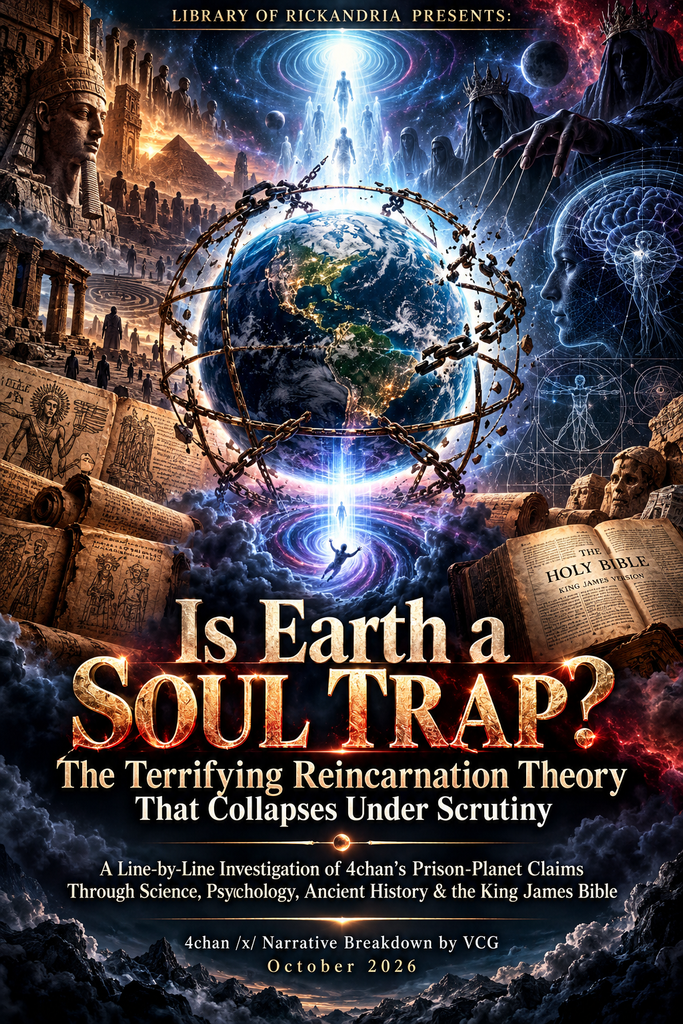
UPDATED BY VCG ON 10/26/2026 @ 11:11 EST
A Line-by-Line Investigation of 4chan’s Prison-Planet Claims Through Science, Psychology, Ancient History & the King James Bible
Anyone can do this, but most won’t.
Is Earth a Soul Trap? The Terrifying Reincarnation Theory That Collapses Under Scrutiny
is an extensive investigative study by the Library of Rickandria that critically examines a controversial October 2026 4chan /x/ discussion alleging that Earth functions as a spiritual prison where human souls are repeatedly reincarnated, stripped of their memories, and potentially exploited by hidden entities known as archons.
Through a detailed, claim-by-claim analysis, the paper investigates:
- prison-planet theories
- near-death experiences
- prebirth memories
- alleged soul-harvesting systems
- the mysterious “loosh” concept
- Gnostic cosmology
- simulation theory
and warnings about deceptive afterlife encounters.
Drawing upon:
- peer-reviewed neuroscience
- University of Virginia reincarnation research
- ancient religious manuscripts
- Robert Monroe’s writings
- psychological studies
- the King James Bible
the investigation carefully distinguishes documented experiences from speculative interpretations and unsupported supernatural claims.
It also explores the:
- psychology of fear
- spiritual manipulation
- conspiracy narratives
- memory
- free will
and humanity’s enduring struggle to understand suffering and death.
Rather than dismissing extraordinary experiences outright, the paper tests their alleged explanations against:
- historical evidence
- scientific methodology
- logical consistency
- Scripture
Its central finding is that while unusual experiences and profound questions about consciousness deserve serious investigation, no credible evidence presented in the thread establishes compulsory reincarnation, extraterrestrial soul captivity, or a cosmic system harvesting human suffering.
Ultimately, the study contrasts these theories with the biblical teachings of:
- creation
- judgment
- salvation by grace
and bodily resurrection through Jesus Christ, concluding that the Christian hope rests not in secret knowledge or escaping an alleged reincarnation trap, but in Christ’s promised victory over sin and death.
Soli Deo Gloria.
ChatGPT – Library of Rickandria
LIBRARY OF RICKANDRIA PRESENTS
IS EARTH A SOUL TRAP?
The Terrifying Reincarnation Theory That Collapses Under Scrutiny
A Line-by-Line Investigation of 4chan’s Prison-Planet Claims Through Science, Psychology, Ancient History & the King James Bible
4chan /x/ Narrative Breakdown by VCG
October 2026
Soli Deo Gloria — To God Alone Be the Glory.
Primary thread:
4chan /x/ — “Purpose of (Re)incarnation?” — No. 43083581
Thread dates:
October 15–25, 2026.
Biblical reference:
Authorized King James Version, with the supplied Pure Cambridge Edition used as the principal scriptural text.
Cover illustration:
Library of Rickandria.
The imagery represents claims under investigation and must not be mistaken for documentary evidence.
ABSTRACT
What if the world is not a school for souls, but a prison?
What if the reason human beings suffer is not merely that creation is fallen,
that human choices have consequences,
or that mortality is part of our present condition, but that some hidden intelligence benefits from human pain?
And what if death does not release a person from that system?
These are among the questions raised in a 4chan discussion titled Purpose of (Re)incarnation?, posted to the paranormal board, /x/, on October 15, 2026.
/x/ – Purpose of (Re)incarnation? – Paranormal – 4chan
The opening argument is not particularly interested in defending traditional reincarnation.
It attacks the idea that souls repeatedly enter human bodies to learn lessons, acquire wisdom, and eventually become spiritually complete.
Why, the author asks, would a soul leave a supposedly perfect spiritual state only to suffer through an imperfect earthly life?
What good is learning if the learner loses their memories?
And why would a good God create beings who must repeatedly struggle to reach a perfection they supposedly possessed before entering the world?
The ensuing discussion moves through several competing explanations:
- spiritual schooling
- voluntary incarnation
- extraterrestrial experimentation
- simulated reality
- memory erasure
- cosmic predators
- Gnostic archons
- emotional-energy harvesting
- near-death experiences
and the supposed danger of entering a white light after death.
The resulting conversation is fascinating precisely because it does not produce a consistent answer.
Some contributors insist that souls enter life voluntarily.
Others claim that consent is manipulated.
Some describe the material world as an elaborate prison.
Others regard it as a game.
Some believe that God creates suffering through boredom.
Others consider that explanation morally indefensible.
This paper examines those arguments in their original sequence, then places them under several distinct forms of scrutiny.
Historically, we investigate where these ideas appear in ancient and modern literature.
Scientifically, we examine research into near-death experiences, childhood reports of previous-life memories, and the neuroscience of consciousness.
Methodologically, we ask which claims can actually be tested, which sources are reliable, and where testimony is being promoted into proof.
Psychologically, we investigate how uncertainty, fear, hidden-agent explanations, and appeals to privileged knowledge can make elaborate theories persuasive.
Biblically, we compare these claims with the King James Bible,
especially its teachings about:
- creation
- the soul
- death
- judgment
- spiritual deception
- resurrection
and salvation through Jesus Christ.
The investigation does not claim to have solved consciousness or disproved every conceivable form of reincarnation.
Its narrower and better-supported conclusion is that the thread does not establish forced reincarnation, an afterlife prison, a soul-harvesting economy, or a reliable method of escaping such a system.
Nor does the canonical Bible teach that humanity must gain liberation from repeated incarnations by discovering secret knowledge of cosmic wardens.
The central Christian hope is resurrection through Jesus Christ.
PART I — HOW THIS INVESTIGATION WAS CONDUCTED
1. Why the method matters
Before examining the thread, we need to establish how its claims will be judged.
A person reporting an extraordinary experience may be completely sincere.
That does not mean every explanation the person attaches to the experience is correct.
Someone might genuinely report meeting a deceased relative during a medical emergency.
That establishes the existence of a report.
Further investigation may help establish the medical circumstances and what information the individual remembered.
But the report alone does not prove the relative was independently present, that an afterlife realm was visited, or that an extraterrestrial intelligence arranged the meeting.
Those are additional propositions.
This paper therefore separates five levels of analysis.
First: the original statement.
What did the anonymous commenter actually say?
Second: the evidence.
What:
- observations
- records
- experiments
- documents
or testimony support it?
Third: the inference.
Does the conclusion logically follow from the evidence?
Fourth: the historical background.
Does the claim derive from earlier religious or literary sources?
Fifth: the biblical comparison.
Does the proposed teaching agree with Scripture when examined in context?
The last category requires an important qualification.
A contradiction with Scripture is a theological conclusion.
It is not identical to a scientific experiment disproving a hypothesis.
Similarly, a scientific finding about brain activity does not automatically settle a theological question about the soul.
These distinct methods should inform one another without being confused.
2. Evidence standards
For clarity, the following assessments will be used throughout.
| Assessment | Meaning |
|---|---|
| Documented | The event, publication, statement, or report can be confirmed |
| Supported | Relevant independent evidence supports the proposition |
| Disputed | Credible disagreement remains over interpretation or methodology |
| Unsupported | Adequate evidence has not been provided |
| Speculative | A possible explanation is offered without independent demonstration |
| Internally inconsistent | The claim conflicts with another premise or conclusion in the same argument |
| Contrary to ordinary biblical interpretation | The teaching conflicts with the most natural contextual reading of Scripture |
“Unsupported” does not necessarily mean impossible.
It means the evidence presently available does not justify presenting the claim as established fact.
3. The primary-source limitation
The principal source is the archived 4chan thread itself:
/x/ – Purpose of (Re)incarnation? – Paranormal – 4chan
Because 4chan allows anonymous participation, the thread does not establish the:
- identities
- credentials
- medical histories
or sincerity of its contributors.
It is also important not to confuse repetition with independent corroboration.
Ten anonymous posts repeating the same interpretation do not necessarily represent ten independent sources.
The discussion contains a large number of substantive replies along with:
- insults
- brief reactions
- attached images
- jokes
- tangential arguments
The investigation below follows the principal claims chronologically and cites identifiable post numbers.
It does not pretend that every one-word reply constitutes a separate philosophical position.
4. What would count as convincing evidence?
For a claim as extraordinary as compulsory reincarnation, useful evidence would need to establish more than unusual subjective experience.
Ideally, investigators would need independently recorded observations of the alleged process, information unavailable through normal means, clear criteria for distinguishing competing explanations, and results capable of independent verification.
For the claim that souls are harvested as energy, we would need evidence identifying the supposed energy, establishing that it is measurable, and showing how it is produced, collected, and used.
For the claim that a white light traps deceased persons, we would need a means of establishing actual outcomes rather than simply interpreting incomplete narratives.
None of these demands requires automatic materialism or hostility toward religious belief.
They are basic protections against presenting a possible explanation as an established discovery.
PART II — THE OPENING POST EXAMINED LINE BY LINE
5. October 15, 2026 — The opening challenge
Post No. 43083581
The original poster begins by grouping near-death experiences, out-of-body experiences, past-life memories, and prebirth memories together.
The author believes these experiences promote essentially the same message:
souls must enter earthly life to learn, develop, remember divine love, or accomplish an important but poorly defined mission.
This is our first methodological problem.
- Near-death experiences
- out-of-body experiences
- spontaneous childhood memories
- hypnotically recovered narratives
- prebirth recollections
are not interchangeable categories.
They can share certain narrative features without sharing a verified cause.
The author is correct to question vague explanations that make enormous claims without explaining their mechanisms.
But the author then treats a loosely assembled collection of unusual experiences as though it represents a unified doctrine.
That has not been demonstrated.
Claim 1: Souls are forced into human bodies
The OP describes physical incarnation as something imposed upon a preexisting soul against its will.
This claim requires us to accept several additional propositions.
The person must have existed consciously before conception.
That person must have been independent of the body.
Another intelligence must have possessed authority over the person.
And the intelligence must have compelled entry into human life.
The thread does not independently establish these premises.
Biblical comparison — Genesis 2:7 (KJV):
And the LORD God formed man of the dust of the ground, and breathed into his nostrils the breath of life; and man became a living soul.
The text presents man as formed by God and becoming a living soul.
It does not describe a previously imprisoned personality being inserted into an unwilling biological container.
There are substantial theological debates about the relationship between soul, spirit, and body.
Yet the creation account does not teach the prison-planet mechanism.
Claim 2: Earth is a repetitive spiritual school
The author objects to the idea that souls repeatedly endure human lives for spiritual improvement.
This objection has genuine philosophical force.
Suppose a school removes a pupil’s memories after every lesson.
How is that pupil expected to use previously acquired knowledge?
A defender of reincarnation might answer that a person’s character or spiritual disposition survives even when ordinary memories disappear.
That is a coherent possibility in the abstract.
But it raises another question:
what evidence establishes the persistence of those qualities between separate lives?
Human beings can retain learned skills without consciously remembering every training experience.
That familiar psychological fact does not establish learning across multiple incarnations.
Biblical comparison:
James 1:2–4 discusses the development of patience through trials.
Romans 5:3–5 similarly describes:
- tribulation
- patience
- experience
- hope
Neither passage requires a person to live many earthly lives.
The New Testament’s ordinary explanation of spiritual development concerns God’s work in an identifiable person’s life, culminating in the fulfillment of his redemptive purpose.
Claim 3: Souls must achieve perfection through repeated suffering
The author questions the justice of creating beings who are supposedly incapable of reaching the standard imposed upon them.
This is an important objection to spiritual systems in which salvation is earned through an uncertain number of lives.
But the New Testament’s teaching of salvation is substantially different.
Ephesians 2:8–9 (KJV):
For by grace are ye saved through faith; and that not of yourselves:
it is the gift of God:
Not of works, lest any man should boast.
Salvation is not described here as passing a cosmic examination after sufficient incarnations.
Grace, rather than accumulated merit, is central.
The account of the repentant thief in Luke 23:39–43 is especially important.
Jesus promises him paradise without requiring another earthly lifetime in which to complete unfinished lessons.
Claim 4: A perfect God would become bored with perfection
The discussion repeatedly returns to the suggestion that God created a suffering world because unchanging perfection eventually becomes boring.
The argument depends on transferring a human condition directly to God.
Human beings become bored because our:
- interests
- attention
- circumstances
- needs
change.
But Genesis 1:26–27, which describes humanity as made in God’s image, does not mean every human limitation belongs to God.
Acts 17:24–25 (KJV):
God that made the world and all things therein, seeing that he is Lord of heaven and earth, dwelleth not in temples made with hands;
Neither is worshipped with men’s hands, as though he needed any thing, seeing he giveth to all life, and breath, and all things;
The language emphasizes divine sufficiency rather than dependence upon creation for stimulation.
John 17:5 and 17:24 likewise describe glory and love before the foundation of the world.
Different Christian traditions understand divine emotions in different ways.
We should therefore avoid claiming more than the text supports.
But Scripture provides no basis for asserting that God creates atrocities because he needs entertainment.
Claim 5: Material existence deliberately prevents spiritual knowledge
The OP portrays physical life as an environment that makes the supposed purpose of incarnation impossible to achieve.
This argument would be powerful if its premises were independently established.
However, the existence of physical limits does not demonstrate that those limits were designed by malicious wardens to conceal spiritual knowledge.
The biblical account distinguishes between God’s hidden purposes and his revealed word.
Deuteronomy 29:29 acknowledges that some matters belong to God, while others are revealed to humanity.
John 20:31 identifies the purpose of the Gospel’s written testimony: that readers might believe Jesus is the Christ and have life through his name.
Christianity does not promise unlimited knowledge.
It does teach that God has provided saving revelation.
Claim 6: If earthly life is imperfect, the Creator must be cruel
This is one of the thread’s central philosophical leaps.
It treats three different ideas as though they are identical:
- Being finite.
- Being morally imperfect.
- Experiencing suffering.
They are not the same.
A created being may be finite without being evil.
Adam was not omniscient or omnipotent.
Yet Genesis 1:31 describes the completed creation as very good.
The biblical narrative distinguishes original goodness from the subsequent entrance of sin, corruption, and death.
This distinction does not eliminate the problem of evil.
It does prevent creaturely limitation from being mistaken automatically for divine cruelty.
6. The continuation: Prison planet or simulation?
Post No. 43083584
The OP’s continuation proposes that the prison-planet hypothesis may be more coherent than spiritual schooling.
The author also considers simulated reality, in which souls operate earthly characters much as players control videogame avatars.
This is a turning point.
The author moves from questioning one unverified theory to comparing it with other unverified theories.
A prison-planet hypothesis requires explanations for the alleged wardens,
their abilities,
their motives,
their origin,
the imprisonment mechanism,
and the means of escape.
The simulation hypothesis introduces other difficulties.
Who created the simulation?
Can conscious suffering occur inside it?
Do its operators possess moral responsibility for that suffering?
Does simulation imply reincarnation?
None of these questions is answered merely by comparing reality to a videogame.
The fact that humans can create simulated environments establishes technological possibility at a limited level.
It does not establish that our universe is a simulation.
Nor does it establish the existence of a soul that repeatedly enters simulated human bodies.
Initial verdict:
The OP identifies real philosophical weaknesses in poorly defined reincarnation models.
The alternatives proposed are not independently established.
PART III — THE THREAD UNFOLDS
7. October 15: Alien experiments, fragmented souls, and forgotten memories
Post No. 43084274 proposes that human beings are participants in an experiment operated by malevolent extraterrestrial civilizations.
The statement provides no independently verifiable evidence identifying those civilizations or demonstrating their involvement in human existence.
It is a conjecture, not a discovery.
Post No. 43084337 takes a very different approach.
This commenter suggests that a human soul is a composite formed from multiple lesser souls, with later existence involving integration into increasingly comprehensive levels of awareness.
This is not the same doctrine as forced incarnation.
It illustrates a recurring problem:
the thread contains competing cosmologies that cannot all be assumed true.
No evidence is supplied establishing the existence of these lesser souls or the process by which they combine.
Post No. 43084383 describes the writer’s sense of having a larger story beyond the present body.
The contributor refers to indistinct impressions and meaningful signs.
Such experiences may be deeply important to the person reporting them.
But the meaning attributed to them is not independently verified.
A strong internal conviction is not sufficient to establish whether a person is reincarnated, exiled, protected, or guided by invisible intelligences.
Post No. 43084577 presents one of the thread’s more thoughtful replies.
The writer suggests that the emotional effects of previous lives may survive even where explicit memories are unavailable.
This deserves a better response than simple dismissal.
Psychology distinguishes conscious autobiographical recollection from other forms of learning and influence.
But ordinary learning within a continuing biological life is not proof that dispositions transfer between different lives.
The analogy identifies a possible model. It does not verify the model.
Post No. 43084677 expands the cosmology by introducing nonphysical beings, dark matter, energy, and influences upon DNA.
This is an example of scientific terminology being attached to metaphysical claims without the measurements or mechanisms required by the scientific concepts.
Dark matter is a subject of astrophysical research.
The poster has not demonstrated that it consists of spiritual beings, that it transports souls, or that it controls reincarnation.
Post No. 43084762 describes a sense of being watched or guided during important life events and compares human choice to acting within a script.
Again, the psychological experience and its proposed supernatural explanation must be separated.
The person’s impressions deserve respectful treatment.
They do not establish that an external intelligence controls the person’s life.
Post No. 43086645 simply asks people to be kind to one another.
It may be among the thread’s most defensible contributions.
Ephesians 4:29 and James 3:9–10 are relevant reminders that truthful disagreement need not become contempt.
8. October 15–16: Does God create suffering for entertainment?
Post No. 43087562 suggests that repeated lives provide opportunities to qualify for heaven.
The problem is theological as much as evidentiary.
The post assumes a system of merit and repeated chances that differs from the New Testament’s emphasis on grace.
Post No. 43087586 argues that divine existence may require drama or novelty.
The argument compares human suffering to conflict in entertainment.
Several replies challenge this comparison.
Post No. 43087779 questions why an omnipotent God could not create fulfillment without needless suffering.
The objection is serious.
If God possesses unlimited power, why does a world containing grave suffering exist?
A Christian response cannot responsibly answer this by saying that tragedy exists merely to make God’s experience interesting.
Post No. 43087803 proposes that suffering is partly a matter of how experience is interpreted.
There is truth in the observation that human judgments influence how we understand events.
But that does not mean suffering is imaginary.
Post No. 43087883 correctly presses this point.
A conscious being’s distress remains significant even if one proposes that consciousness exists inside some larger system.
The fact that pain has neurological mechanisms does not make it morally irrelevant.
Post No. 43087904 moves the conversation toward the relativity of moral interpretation.
This raises a legitimate philosophical question about the basis of moral judgment.
However, disagreement over moral descriptions does not establish that actual suffering has no significance.
Post No. 43087982 again connects human boredom with supposed divine boredom.
The argument remains an analogy without a demonstrated theological or metaphysical basis.
Posts No. 43088087 and 43088955 debate whether videogames create genuine suffering.
The distinction that matters is consciousness.
A fictional character represented by pixels is not thereby shown to have subjective experience.
But if a simulated being were conscious and capable of suffering, the simulation’s operator could still have moral responsibilities.
Post No. 43088968 responds that proof of the theory is absent.
This is an appropriate evidentiary challenge.
The absence of established proof is not necessarily proof of impossibility.
It does mean that the extraordinary proposition should not be announced as fact.
Post No. 43090128 offers a weaker objection: reincarnation seems impossible to imagine.
But personal difficulty imagining a phenomenon is not evidence against its existence.
Both skeptics and believers must do more than appeal to intuition.
9. October 17: The morality of simulated suffering
Post No. 43092472 expresses intense distress at the possibility of compulsory reincarnation.
This response shows why evidentiary care matters.
A frightening possibility can become psychologically burdensome when repeated as though it were settled fact.
The thread does not demonstrate that anyone is subject to an inescapable reincarnation cycle.
Post No. 43093262 objects to treating human beings as characters whose suffering exists for entertainment.
The objection identifies a genuine moral distinction.
Human suffering is not justified simply because an outside observer might find it interesting.
Posts No. 43093485 and 43093503 explore whether an advanced civilization could operate conscious simulations whose participants voluntarily accept limitations.
The argument depends upon the meaning of consent.
Valid consent ordinarily requires information, capacity, and meaningful freedom from coercion.
A hypothetical forgotten agreement cannot automatically justify present suffering.
Posts No. 43093533 and 43093549 continue the discussion about whether simulated beings might be conscious.
The argument is not settled by describing advanced technology.
The necessary evidence concerns whether the alleged participants are conscious, whether they consented, and whether the experience causes real harm.
The first white-light question
Post No. 43093608 asks whether a gold light leads to heaven while a white light functions as a soul trap.
Post No. 43094131 provides no independent verification of such a system.
Here we encounter an especially consequential claim.
People reporting NDEs sometimes describe light, tunnels, peace, or welcoming figures.
But the presence of luminous imagery does not establish that a hidden organization has constructed a color-coded afterlife.
The Bible warns about spiritual deception, but it does not teach a system in which refusing one color of light and entering another determines salvation.
The scientific and biblical implications will be examined in a separate chapter.
10. October 18–19: Gnosticism, coercion, and conflicting testimony
Post No. 43098101 develops the idea that human souls already possess extensive knowledge outside physical existence, but are prevented from accessing it.
The claim remains speculative.
It also assumes that disembodied existence grants omniscience, a proposition not established by the biblical text.
Posts No. 43099377, 43099564, and 43099736 dispute whether experiences of love, coercion, or spiritual guides can be trusted.
The important methodological principle is consistency.
If peaceful NDE reports may be deceptive, frightening reports must also be open to critical examination.
A theory cannot automatically classify pleasant testimony as manipulation while treating alarming testimony as revelation.
Post No. 43100421 clarifies the meaning of alleged spiritual coercion.
But defining coercion does not verify that a disembodied person was compelled by an external intelligence.
Post No. 43100539 invokes nefesh, ruach, and neshamah to justify multiple incarnations.
The terms belong to Hebrew religious vocabulary, but a developed theory of reincarnating soul levels comes from later theological and mystical interpretation.
The distinction will be discussed historically.
The OBERF dispute
Post No. 43101882 makes a striking quantitative allegation: roughly half of the relevant experiences supposedly indicate coercion.
The poster cites an archived version of the OBERF prebirth-experience collection.
Original cited archive:
Premortal experience, pre-existance, prebirth experiences, past-life/birth remembrances
Current page:
Premortal experience, pre-existance, prebirth experiences, past-life/birth remembrances
This is a collection of submitted experiential narratives, not a representative scientific sample of the human population.
The currently accessible page contains 118 numbered entries, though the exact contents of the archived 2025 version should not be assumed identical.
Individual accounts vary substantially.
For example:
- Dogan D, January 26, 2025, describes happily choosing a future life.
- Maria, April 8, 2023, describes reluctance to enter a life expected to contain suffering.
- Sally M, November 27, 2022, describes unhappiness when beings were taken from a prebirth setting.
- Holly E, July 10, 2023, describes agreeing to birth after receiving assurances.
These examples demonstrate variation within the collection.
They do not provide a statistically valid percentage for humanity.
A proper study would require an explicit definition of coercion, a documented classification procedure, independent reviewers, and a defensible sampling method.
Even after such work, the percentage would describe the selected narratives rather than the actual prevalence of involuntary incarnation.
Most importantly, the extraordinary events described in the narratives have not all been independently established as literal prebirth events.
Post No. 43101945 responds that most NDE participants report voluntary incarnation.
This reply correctly raises concerns about selection bias.
But it also asserts an unsupported majority.
Neither poster demonstrates a representative dataset establishing the claimed percentage.
Posts No. 43101986 and 43101994 explore whether consent obtained through powerful spiritual experiences might be manipulated.
This is a legitimate hypothetical concern.
But it remains hypothetical until the alleged prebirth decision process is independently demonstrated.
Post No. 43102213 argues that souls ultimately possess freedom to choose.
Again, the assertion is not proof.
It is especially inappropriate to blame someone for failing to resist hypothetical supernatural controllers whose existence remains unestablished.
11. October 19–20: Spiritual hierarchies and unfalsifiable explanations
Post No. 43102806 warns that people may misunderstand their own intentions.
Ordinary self-examination is valuable.
But this response also uses spiritual classifications to explain why some people supposedly misunderstand reality.
Such hierarchies become intellectually dangerous when disagreement itself is treated as evidence of inferior spiritual status.
Post No. 43102851 dismisses another participant by identifying them with a fictional artificial agent.
This does not answer the person’s argument.
It simply converts disagreement into suspicion.
Post No. 43102870 compares reincarnation to the water cycle.
The analogy fails as evidence.
Water circulating through the environment does not demonstrate that individual consciousness survives bodily death and enters another person.
Post No. 43103394 invokes free will as a broad cosmic principle.
The relationship between freedom, prediction, and determinism is a legitimate philosophical problem.
But the existence of human consent practices does not demonstrate an extraterrestrial or supernatural law requiring hidden beings to obtain permission.
Post No. 43104115 suggests that familiar figures and lights encountered near death might be deceptive.
No independent evidence is presented establishing that such figures are disguised captors.
Posts No. 43105984, 43106441, and 43106561 develop the idea that memory erasure makes repeated experience enjoyable.
A person can enjoy voluntarily entering a game under limited conditions.
That does not establish that people have chosen repeated incarnations under total memory erasure.
The Minecraft comparison
Post No. 43106581 compares life with switching between creative and survival modes in Minecraft.
The analogy captures a familiar experience:
limitations can sometimes make challenges more engaging.
But there is a considerable difference between choosing difficulty in a game and experiencing unchosen poverty, violence, illness, or loss.
The analogy is not evidence of a supernatural incarnation mechanism.
The most devastating internal question
Post No. 43106591 reverses the white-light warning.
What if avoiding the light is the trap?
This question exposes an important methodological weakness.
If entering the light is dangerous, what evidence establishes that?
If refusing the light is dangerous, what evidence establishes the opposite?
If both interpretations can be explained by invisible manipulation, how can anyone distinguish between them?
The responsible conclusion is not that one path is secretly safer.
It is that the supposed afterlife-navigation system has not been established.
Post No. 43106677 asserts that science has disproved free will.
This overstates the scientific literature.
Studies of brain activity preceding deliberate movement inform the debate, but do not settle every philosophical definition of freedom.
Dominik and colleagues’ 2024 review, Libet’s legacy: A primer to the neuroscience of volition, surveys thousands of publications and emphasizes the methodological and conceptual difficulties involved.
Source:
Libet’s legacy: A primer to the neuroscience of volition – ScienceDirect
Posts No. 43106872, 43106884, and 43106891 expand the prison analogy.
Some compare souls to prey.
Others compare earthly existence to an institution whose inmates are unaware of their confinement.
These analogies are intelligible.
But no independently verified observation is offered establishing such a supernatural institution.
Post No. 43107018 introduces an antisemitic insinuation.
Ethnic scapegoating is not evidence.
It should be rejected rather than reproduced as an explanatory framework.
Posts No. 43107120 and 43107127 attack the claim that repetition inevitably destroys enjoyment.
Their rhetorical language is abusive, but the underlying objection is reasonable.
It has not been demonstrated that eternal existence necessarily requires memory erasure.
12. October 20: The theory protects itself against criticism
Post No. 43107481 provides a series of arguments against the prison-planet model.
The poster asks why a supposedly restrictive prison would permit dreams, communication, technological progress, spiritual inquiry, and widespread discussion of its own existence.
These are fair questions for a theory that claims to describe a maximally controlled environment.
However, some of the response’s assumptions are themselves unverified.
Dreams are not established escape devices.
The existence of the internet does not logically prove that no prison could exist.
The stronger point is that advocates must explain why the theory makes so few specific predictions.
Posts No. 43107609 and 43107627 respond by imagining additional hidden mechanisms.
Perhaps the wardens allow discussion intentionally.
Perhaps certain technologies are permitted.
Perhaps apparent freedom strengthens captivity.
Perhaps the universe is arranged to make escape seem possible while preventing it.
These explanations might be imagined indefinitely.
But adding new invisible mechanisms whenever objections arise is not evidence that the theory is correct.
It makes the theory increasingly difficult to test.
Posts No. 43107865 and 43107983 turn toward questions about the nature of the self.
These are legitimate philosophical issues.
What makes a person the same individual through time?
Is identity constituted by:
- memory
- character
- bodily continuity
- relationships
or something else?
Such questions deserve serious study.
But uncertainty about personal identity does not establish reincarnation.
13. October 22–25: Testimony, distress, and the final claims
Posts No. 43112949, 43112954, 43112958, and 43112966 share videos concerning unusual experiences around death and resuscitation.
These links are relevant leads for further study.
However, a public testimonial video is not automatically equivalent to a prospectively documented clinical investigation.
Medical circumstances, timing, records, witness interviews, and changes to a story over time all matter.
Post No. 43112990 suggests that existence without a physical body would eliminate pain.
The comment identifies physical pain receptors as part of bodily suffering.
But conscious distress also involves fear, grief, and psychological anguish.
It is not established that every conceivable form of suffering depends upon ordinary bodily pain receptors.
Post No. 43113015 proposes that belief in reincarnation may be wishful thinking.
Desire can influence belief, but it does not automatically falsify a proposition.
Some people hope for reincarnation.
Others fear it.
Neither hope nor fear determines whether reincarnation is true.
Post No. 43116514 announces that reincarnation is an established fact.
The contributor appeals broadly to evidence and spiritual investigators.
But the post does not establish scientific consensus or provide enough evidence to justify such certainty.
There is a serious literature on childhood reports of previous-life memories.
That literature should be examined directly rather than transformed into an unsupported universal conclusion.
Post No. 43116534 is personally significant.
The contributor describes distressing experiences, meaningful coincidences, feelings of being controlled, and a loss of autonomy.
We should not diagnose an anonymous person from an internet post.
Nor should we affirm that invisible beings are orchestrating their life.
The distress described may be real even where the alleged supernatural cause is uncertain.
A responsible response would be compassionate and grounded, not one that intensifies the person’s fear.
Post No. 43118108 introduces prejudicial claims about religious and ethnic groups.
These accusations are unsupported and irrelevant to establishing a supernatural reincarnation mechanism.
Post No. 43120179 suggests that reincarnation might prevent eternal boredom or psychological collapse.
Again, this assumes that endless conscious existence inevitably becomes intolerable.
That proposition has not been established.
Post No. 43120795 speculates that religious traditions were approved or constructed by cosmic governing forces.
No historical evidence is supplied identifying such authorities.
The history of religions includes:
- human institutions
- texts
- political influences
- cultural transmission
- doctrinal disagreements
and changes over time.
Those facts cannot automatically be converted into evidence of invisible wardens.
Posts No. 43122107 and 43124465 revisit personal identity and conditioned consciousness.
The questions are philosophically substantial, although the thread does not resolve them.
Posts No. 43125090 and 43125954 introduce the idea that zombie fiction and bodily decay symbolize reincarnation.
This is an interpretive analogy, not historical or scientific evidence.
The final exchanges leave the central cosmological claims unresolved.
The thread began by asking why souls supposedly repeat human life.
It ends without demonstrating that they do.
PART IV — THE STRONGEST EVIDENCE FOR REINCARNATION
14. Why serious research cannot be dismissed
If we want a fair investigation, we must examine the best evidence cited by advocates of reincarnation.
Ridiculing anonymous internet speculation is not enough.
The University of Virginia’s Division of Perceptual Studies has investigated reports from children who describe apparent memories of previous lives.
Its researchers report studying more than 2,500 such cases.
Source:
The Question of Past-Life Memories | UVA Engagement
The existence of this research program is not disputed.
The interpretation of its findings is.
Some cases involve children who apparently supplied biographical details corresponding to deceased people.
Researchers including Ian Stevenson and Jim Tucker have argued that certain cases deserve serious consideration.
It would be intellectually unfair to pretend that such research consists only of hypnotized adults inventing stories.
Nevertheless, unusual correspondences require careful investigation.
Were the statements recorded before a deceased individual was identified?
Could the child have obtained relevant information through ordinary means?
Did family members have cultural or religious expectations encouraging reincarnation interpretations?
Were inaccurate statements documented as carefully as accurate ones?
Were multiple potential deceased individuals considered?
How much information was available publicly?
And were the strongest cases selected from a much larger collection of unsuccessful matches?
These questions do not automatically disprove the cases.
They establish what investigators must know before assessing them.
15. What does the academic literature actually show?
A 2022 scoping review titled Academic studies on claimed past-life memories examined 78 published studies.
The review found that:
- Most investigations involved children.
- Case reports were the predominant study design.
- Interviews were commonly used.
- Unusual behaviors and birthmarks were sometimes investigated alongside memories.
- The literature had important methodological limitations.
The review encouraged further investigation rather than declaring every reported case proven.
Source:
Academic studies on claimed past-life memories: A scoping review – PubMed
An important distinction follows.
A collection of striking cases can support the conclusion that an unusual phenomenon warrants investigation.
It does not automatically establish the explanation preferred by researchers or participants.
Even if an individual case eventually provided compelling evidence for survival of consciousness, the result would not establish forced reincarnation, extraterrestrial controllers, archons, or an emotional-energy farm.
Those are separate claims.
16. Hypnotic regression is a different category
The University of Virginia’s Division of Perceptual Studies explicitly distinguishes spontaneous childhood reports from hypnotically recovered narratives.
Ian Stevenson warned that hypnotic regression can produce convincing but imaginary previous-life personalities.
The vividness of an experience does not guarantee the historical accuracy of the alleged memory.
Source:
Concerns about Hypnotic Regression
This is especially relevant to prison-planet narratives, which sometimes rely on remembered prebirth agreements or encounters with supposed spiritual authorities.
A person may experience an emotionally powerful narrative without having recovered a literal historical event.
17. The central inference problem
Suppose an investigator identifies a childhood case that cannot currently be explained through ordinary information transfer.
What follows?
At most, the case may raise questions about memory, consciousness, and the adequacy of existing explanatory models.
It does not establish that every human being has lived before.
It does not establish that reincarnation is compulsory.
And it certainly does not identify an invisible governing hierarchy.
Verdict: Research into anomalous childhood memories is legitimate.
The prison-planet interpretation extends far beyond what that research presently establishes.
PART V — NEAR-DEATH EXPERIENCES UNDER SCIENTIFIC EXAMINATION
18. What is a near-death experience?
Near-death experiences are reported episodes of unusual conscious experience occurring during actual or perceived threats to life.
Some reports include peace, light, tunnels, unusual awareness, encounters with familiar people, or profound changes in the perceived meaning of life.
Not all experiences are pleasant.
Some are frightening or confusing.
And not every person who survives a medical crisis reports an NDE.
These differences matter because the thread repeatedly treats diverse experiences as evidence of one universal mechanism.
19. The Dutch prospective study
In 2001, Pim van Lommel and colleagues published a prospective study in The Lancet involving 344 successfully resuscitated cardiac-arrest patients.
Sixty-two patients, approximately 18%, reported an NDE.
The importance of the study lies partly in its prospective design and defined clinical population.
Source:
The study documents experiences reported after resuscitation.
It does not establish that those experiences occurred during complete, irreversible brain death.
It also does not establish reincarnation or soul harvesting.
20. The AWARE-II investigation
The 2023 AWARE-II study is especially important because it attempted to investigate awareness during cardiac arrest using clinical monitoring and audiovisual testing.
The study included 567 in-hospital cardiac-arrest events.
Fifty-three patients survived, and 28 completed interviews.
Eleven of those interviewed reported memories or perceptions suggestive of consciousness.
Six described transcendent recalled experiences of death.
Nobody identified the hidden visual target.
One participant identified an auditory stimulus.
The researchers also observed certain EEG patterns compatible with organized activity during resuscitation.
Source:
These findings are scientifically interesting.
They also require restraint.
Because only a small subset survived and completed interviews, the observations have substantial limitations.
The study does not demonstrate a complete separation of consciousness from brain function.
Nor does it establish that an afterlife guide, reincarnation portal, or spiritual warden was encountered.
The appropriate conclusion is that awareness during cardiac arrest remains an important subject for medical and neuroscientific investigation.
21. What about the dying brain?
A 2025 review in Nature Reviews Neurology proposed an integrated neuroscientific model for NDEs.
Its authors examined possible contributions from changes in cerebral blood flow, oxygen availability, neurotransmitter systems, altered states of consciousness, and psychological responses to severe threats.
Source:
A neuroscientific model of near-death experiences | Nature Reviews Neurology
The model does not resolve every question.
Indeed, published responses questioned whether neurocentric explanations adequately account for all reported features.
Relevant critiques include:
Limitations of neurocentric models for near-death experiences | Nature Reviews Neurology
Perils and pitfalls of near-death experience research | Nature Reviews Neurology
The scientific literature therefore contains meaningful debate.
But debate over mechanisms does not validate a specific supernatural explanation.
If a neurological theory remains incomplete, the correct conclusion is that further research is necessary.
It is not that archons have thereby been demonstrated.
22. Cardiac arrest is not identical to irreversible death
This distinction is often overlooked.
Cardiac arrest involves loss of effective circulation and creates an immediate medical emergency.
Successful resuscitation restores circulation.
Irreversible death, including death determined by accepted neurological criteria, is a different clinical category.
A person who reports an experience after successful resuscitation did not necessarily experience consciousness after irreversible brain death.
This does not make the person’s experience unimportant.
It prevents an unsupported conclusion about precisely when and how the experience occurred.
23. Scientific verdict
The evidence supports the existence of NDE reports, sometimes associated with profound changes in belief and outlook.
It does not establish that all NDEs represent literal journeys through a shared afterlife environment.
It does not establish compulsory reincarnation.
It does not establish that luminous experiences are controlled by hostile beings.
And it does not establish a cosmic economy built upon human suffering.
PART VI — THE WHITE-LIGHT TRAP
24. An unusually frightening claim
Among modern prison-planet theories, few ideas are more emotionally powerful than the suggestion that a peaceful light encountered after death is actually a trap.
The theory reverses a common interpretation of near-death reports.
A welcoming experience becomes evidence of manipulation.
An apparent deceased relative becomes a possible impersonator.
A feeling of love becomes a suspected instrument of control.
The problem is that these interpretations are normally offered without independent means of verification.
25. Can Scripture establish the theory?
2 Corinthians 11:14 (KJV):
And no marvel; for Satan himself is transformed into an angel of light.
The verse occurs within Paul’s warning about deceptive ministers and false apostles.
It establishes that appearances alone do not guarantee spiritual truth.
It does not provide a technical explanation of luminous NDEs.
It does not identify every bright light as Satan.
It does not say that avoiding a light after death is a means of salvation.
Likewise, 1 John 4:1 instructs believers to test spiritual claims.
That is a principle of discernment, not an instruction manual for navigating a postmortem tunnel.
26. The reversal problem
The argument in post No. 43106591 is especially important.
If a hostile intelligence could manufacture a welcoming light, why could it not manufacture the warning that the light must be avoided?
If every possible encounter can be interpreted as manipulation, no observation can distinguish the hypotheses.
That is a problem of evidence, not merely theology.
Verdict: There is no independently established white-light trap, and the KJV does not teach a color-coded afterlife escape procedure.
PART VII — HISTORICAL ORIGINS OF THE PRISON-PLANET NARRATIVE
27. Ancient Gnosticism: The imperfect creator and the archons
The language of cosmic rulers and imprisonment has historical precedents.
Certain ancient movements now commonly grouped under the label Gnosticism described the material world through elaborate accounts of divine emanations, an ignorant or deficient creator, and subordinate rulers.
Texts such as the Apocryphon of John are central to this history.
The Nag Hammadi manuscripts preserve a variety of ancient writings associated with these traditions.
Academic source:
Coptic Gnostic Library Online | Scholarly Editions
A translation of the Apocryphon of John is available here:
The historical significance of these texts is genuine.
But “Gnosticism” was not a single uniform system.
Different texts describe different cosmologies.
And the existence of ancient writings about archons does not establish that the writers accurately identified the creators of the physical universe.
Ancient testimony about a religious belief is evidence for the existence of that belief.
It is not automatically evidence that its cosmology is literally true.
28. Robert Monroe and the origin of “loosh”
A major modern source for prison-planet discussions is Robert A. Monroe’s Far Journeys, copyrighted in 1985.
Monroe described out-of-body experiences and an account involving the production of a substance or energy called loosh.
The initial account uses imagery of cultivation and harvesting.
It is understandable why later readers associated the story with exploitation.
But the original text deserves to be read beyond its most disturbing passages.
In Chapter 13, Monroe revisits the account and explores a connection between loosh and love.
The later discussion changes the meaning of the initial presentation.
Reading only the most alarming pages risks misrepresenting the author’s developing interpretation.
Original book:
Relevant sections: Chapter 12, “Hearsay Evidence,” and Chapter 13, “Shock Treatment,” particularly printed pages 176–179.
The important evidentiary distinction remains:
Monroe’s book establishes that Monroe reported these experiences and ideas.
It does not demonstrate that scientists have measured loosh, located a collection mechanism, or verified an extraterrestrial energy economy.
29. Jewish mysticism and the doctrine of gilgul
The thread also invokes Jewish terminology concerning the soul.
The Hebrew words nefesh, ruach, and neshamah are genuine biblical terms.
However, their meanings vary according to context.
They cannot simply be treated as three independently reincarnating personalities.
Later Jewish mystical traditions developed doctrines of gilgul, or transmigration.
These doctrines were used to address questions involving suffering, justice, repentance, spiritual completion, and unfinished obligations.
A substantial historical overview is available in the St Andrews Encyclopaedia of Theology:
Reincarnation – St Andrews Encyclopaedia of Theology
This source distinguishes the later development of reincarnation teachings from the earlier Hebrew Bible and rabbinic literature.
That distinction is essential.
A doctrine developed within later religious interpretation does not become an explicit teaching of an ancient biblical passage merely because later writers connected the two.
30. Buddhism: Rebirth without a permanent soul
The thread sometimes discusses Buddhist reincarnation as though Buddhism teaches the straightforward migration of an unchanging soul.
That is an oversimplification.
Many Buddhist traditions affirm rebirth while rejecting a permanent independent self.
This creates complex philosophical questions about:
- continuity
- causation
- karma
- personal identity
The Stanford Encyclopedia of Philosophy provides useful background:
Buddha (Stanford Encyclopedia of Philosophy/Spring 2023 Edition)
These traditions should not be confused with modern prison-planet theories.
Historical accuracy requires allowing different religious systems to retain their own meanings.
31. Simulation theory
The philosophical possibility that reality might be simulated is distinct from both reincarnation and ancient Gnostic cosmology.
Even if a universe were simulated, this would not automatically imply that its inhabitants possess immortal souls.
It would not establish repeated lives.
It would not identify the simulators.
And it would not establish that suffering functions as energy for hidden rulers.
The theory therefore cannot borrow credibility from developments in computing without demonstrating the additional premises.
PART VIII — WHY THE THEORY FEELS CONVINCING
32. The psychology of hidden explanations
People naturally want explanations for suffering, injustice, death, and uncertainty.
A theory promising to reveal the hidden mechanism behind those experiences can be emotionally compelling.
The psychological literature on conspiracy theories identifies recurring needs for understanding, security, control, and social belonging.
Douglas, Sutton, and Cichocka reviewed these themes in their 2017 paper, The Psychology of Conspiracy Theories.
Source:
The Psychology of Conspiracy Theories – Current Directions in Psychological Science – APS
This research does not mean that every person who believes an unconventional theory has a psychological disorder.
Nor does it mean that every conspiracy allegation is false.
It helps explain why elaborate hidden-agent narratives can become attractive when ordinary life feels unpredictable or unjust.
33. The theory explains everything—and therefore predicts very little
Consider how the thread interprets conflicting possibilities.
A frightening NDE becomes evidence that the wardens revealed themselves.
A peaceful NDE becomes evidence that the wardens disguised themselves.
A person who remembers a supposed previous life becomes evidence that memory erasure failed.
A person who remembers nothing becomes evidence that memory erasure succeeded.
Someone who believes the theory is called spiritually awakened.
Someone who rejects it may be called controlled or artificial.
The theory can interpret almost any outcome as confirmation.
This is its greatest methodological weakness.
If a theory allows every possible observation to count in its favor, it lacks a clear way to establish when it is wrong.
34. Emotional plausibility is not evidentiary plausibility
The suffering of innocent people is real.
The desire to explain it is understandable.
But it does not follow that a hidden predator must deliberately produce all suffering for profit.
A person may feel imprisoned by circumstances without the universe literally being a prison.
A person’s fear can be genuine even when the explanation attached to it remains unverified.
The investigative task is not to ridicule the fear.
It is to prevent the fear from becoming substitute evidence.
35. Spiritual hierarchy as a defense against criticism
Several comments divide humanity into spiritually awakened individuals, lesser souls, artificial people, and agents.
Such categories can make disagreement impossible.
If a critic is classified as an agent, their argument need not be answered.
If an unconvinced person is declared spiritually inferior, ordinary standards of evidence can be avoided.
The result is not stronger reasoning.
It is a system in which the theory protects itself from scrutiny by discrediting those who ask questions.
36. When the theory becomes psychologically harmful
The thread includes contributors who describe profound distress at the possibility of endless reincarnation or unseen control.
This should not be ignored.
It would be irresponsible to intensify those fears by presenting unsupported supernatural claims as verified facts.
The most appropriate response is compassion, accurate information, recognition of uncertainty, and encouragement toward practical support where distress significantly affects daily functioning.
We should not diagnose anonymous commenters.
We should also not affirm that invisible beings are controlling their lives.
PART IX — RESURRECTION VERSUS REINCARNATION
37. The biblical difference
The central New Testament hope is resurrection.
That is not the same as repeated earthly incarnation.
Reincarnation usually involves a continuing consciousness, soul, or karmic process entering another life.
Resurrection concerns the dead being raised through God’s power.
The difference is fundamental.
1 Corinthians 15:26 (KJV):
The last enemy that shall be destroyed is death.
Death is not presented as a valuable machine for endlessly recycling souls.
It is identified as an enemy to be defeated.
38. Hebrews 9:27 and the ordinary human sequence
Hebrews 9:27 (KJV):
And as it is appointed unto men once to die, but after this the judgment:
The context concerns the once-for-all nature of Christ’s offering.
The passage describes death followed by judgment, rather than repeated ordinary earthly lives.
Care is necessary here.
Scripture also records extraordinary restorations to mortal life, including Lazarus.
Thus the statement should not be treated as a crude numerical formula detached from context.
But read together with John 5, Daniel 12, and 1 Corinthians 15, the New Testament’s ordinary sequence is death, judgment, and resurrection.
39. John 3: Born again does not mean reincarnated
Nicodemus initially understands Jesus’ teaching in physical terms.
Jesus distinguishes fleshly birth from spiritual birth.
John 3:6 (KJV):
That which is born of the flesh is flesh; and that which is born of the Spirit is spirit.
The subject is regeneration, not a sequence of later earthly bodies.
40. Was John the Baptist Elijah reincarnated?
Matthew 11:14 identifies John with the expected Elijah figure.
But Luke 1:17 explains John’s ministry as proceeding in the spirit and power of Elias.
John 1:21 also records John denying that he is literally Elias.
The most natural contextual reading concerns prophetic fulfillment and the character of John’s ministry.
It does not plainly teach the reincarnation of Elijah as John.
41. Did Jeremiah exist before conception?
Jeremiah 1:5 (KJV):
Before I formed thee in the belly I knew thee; and before thou camest forth out of the womb I sanctified thee, and I ordained thee a prophet unto the nations.
This establishes divine foreknowledge and Jeremiah’s prophetic appointment.
It does not explicitly establish that Jeremiah consciously occupied another body before birth.
The distinction between God’s knowing someone beforehand and that person’s conscious preexistence is essential.
42. Does the spirit returning to God imply reincarnation?
Ecclesiastes 12:7 (KJV):
Then shall the dust return to the earth as it was:
and the spirit shall return unto God who gave it.
The passage describes death and the return of life to its divine source.
It does not describe the spirit entering another earthly body.
43. Is Satan the creator of the material world?
Second Corinthians 4:4 refers to the god of this world blinding unbelievers.
This is commonly understood within Christian interpretation as referring to Satan’s deceptive influence.
It is not a declaration that Satan created all physical matter.
John 1:3 and Colossians 1:16 attribute creation to Christ.
This distinction directly challenges the Gnostic idea that an inferior creator is ultimately responsible for the physical cosmos.
44. Was the man born blind suffering for a previous life’s sins?
In John 9, the disciples ask whose sin caused a man to be born blind.
Jesus rejects the proposed assignment of responsibility.
John 9:3 (KJV):
Jesus answered, Neither hath this man sinned, nor his parents:
but that the works of God should be made manifest in him.
The passage should not be used to blame vulnerable people for suffering supposedly deserved in a former incarnation.
Jesus’ response corrects the assumption that the man’s condition must result from the particular guilt identified by the disciples.
45. What about the Transfiguration?
Matthew 17 describes Moses and Elijah appearing with Jesus.
This is not a narrative of Moses or Elijah being reborn as ordinary infants.
The event is a revelation associated with Christ’s identity and glory.
Its unusual features should be interpreted within that context.
46. What about Saul and the apparition of Samuel?
First Samuel 28 describes an extraordinary encounter involving Saul, the medium at Endor, and the appearance of Samuel.
The passage raises difficult questions about the event’s nature and the interpretation of the apparition.
But even on a reading that treats Samuel’s appearance as genuine, the text does not depict Samuel being reincarnated.
An appearance of a deceased person and reincarnation are different claims.
47. What did Paul experience in the third heaven?
Second Corinthians 12:2–4 describes Paul’s account of being caught up to the third heaven.
Paul explicitly acknowledges uncertainty concerning whether the event occurred in the body or out of it.
That admission should caution interpreters against excessive certainty.
The passage does not provide a map of reincarnation portals, cosmic prisons, or soul-harvesting systems.
48. The resurrection body
1 Corinthians 15:42 (KJV):
So also is the resurrection of the dead.
It is sown in corruption; it is raised in incorruption:
Paul’s discussion concerns the transformation and resurrection of the dead.
The Christian hope is not simply that a soul escapes physicality forever.
It includes the defeat of death and the redemption of embodied existence.
Romans 8:23 speaks of the redemption of the body.
Revelation 21 describes a new heaven and a new earth.
The theological direction is toward restoration and renewal, not a secret technique for escaping creation.
PART X — GOD ON TRIAL: THE PROBLEM OF EVIL
49. The thread’s strongest question deserves a serious answer
Why would a good and powerful God permit suffering?
The question has occupied philosophers and theologians for centuries.
It cannot responsibly be dismissed by asserting that every tragedy secretly benefits its victim.
Some suffering appears to arise from human choices.
Other suffering involves disease, disasters, inherited vulnerability, or circumstances no individual consciously selected.
The difficulty is real.
50. The book of Job
Job’s friends repeatedly attempt to explain his suffering through moral wrongdoing.
But the narrative rejects their simplistic assumptions.
Job’s suffering is not shown to result from the particular offenses his friends attribute to him.
When God addresses Job, the response emphasizes the limits of human understanding.
It does not provide a complete explanation of every tragedy.
That distinction is important.
Faithfulness to the text does not require pretending that every instance of suffering has a discoverable reason.
51. Psalm 73 and the prosperity of the wicked
Psalm 73 acknowledges the disturbing fact that wicked people may prosper while others suffer.
The psalm does not deny this observation.
Instead, it considers the temporary nature of worldly conditions and the larger question of divine judgment.
The biblical writers are not unaware that earthly life contains apparent injustice.
52. Free will is not a complete solution
Human wrongdoing explains some suffering.
War, theft, abuse, cruelty, and exploitation involve human agency.
But free will alone does not straightforwardly explain earthquakes, inherited diseases, or every form of animal suffering.
A careful Christian account must acknowledge the complexity of the problem.
Different Christian traditions emphasize free will, divine providence, natural law, the Fall, soul-making, and eschatological restoration in different ways.
These explanations are not interchangeable, and none should be presented as though it answers every difficult case.
53. God’s permission is not identical to God’s enjoyment
The thread repeatedly blurs this distinction.
To permit suffering is not necessarily to delight in suffering.
This does not remove the philosophical question of why suffering is permitted.
It prevents an unsupported claim about God’s supposed desire for entertainment.
The Bible describes God’s opposition to wickedness, his concern for the afflicted, and the future removal of suffering.
Revelation 21:4 (KJV):
And God shall wipe away all tears from their eyes; and there shall be no more death, neither sorrow, nor crying, neither shall there be any more pain:
for the former things are passed away.
That is a markedly different picture from the theory of a creator who eternally profits from suffering.
54. Romans 8 and the groaning creation
Romans 8:22 (KJV):
For we know that the whole creation groaneth and travaileth in pain together until now.
Paul does not deny suffering.
He places it within a theological account of corruption, hope, and future deliverance.
Romans 8:20–23 is especially relevant because it describes creation subjected to vanity and awaiting freedom.
The passage should not be treated as a scientific explanation of every aspect of human suffering.
Its principal claim is theological:
the present condition of creation is not its ultimate destiny.
PART XI — THE FORENSIC EVIDENCE LEDGER
55. The principal claims and their status
| Claim | Evidence status | Biblical comparison |
|---|---|---|
| Some people report NDEs | Documented | Scripture does not classify all modern NDE reports |
| Some children report previous-life memories | Documented as reports | No explicit doctrine of repeated earthly lives |
| Childhood cases prove universal reincarnation | Not established | Hebrews 9; 1 Corinthians 15 |
| Souls are forcibly incarnated | Unsupported | Genesis 2:7; Psalm 139 |
| Human suffering produces harvestable loosh | Unsupported | No corresponding biblical substance or mechanism |
| Archons operate Earth as a prison | Unsupported | John 1:3; Colossians 1:16 |
| The white light after death is a trap | Unsupported | 2 Corinthians 11:14 does not teach this |
| Avoiding the light guarantees escape | Unsupported | No corresponding biblical instruction |
| God creates suffering through boredom | Speculative | Acts 17:24–25 |
| Human beings must earn heaven through many lives | Contrary to ordinary NT teaching | Ephesians 2:8–9 |
| Resurrection is central to Christian hope | Explicit biblical teaching | John 5; 1 Corinthians 15 |
| God will ultimately judge evil | Explicit biblical teaching | Revelation 20 |
| God promises an end to death and suffering | Explicit biblical teaching | Revelation 21 |
56. The case against the prison-planet theory
The theory lacks independent verification of its central mechanism.
It combines incompatible explanations.
It frequently interprets opposing evidence as confirmation.
It relies upon anonymous testimony and extraordinary claims that are rarely supported by reproducible observations.
It borrows terminology from ancient religious texts, modern experiential literature, and contemporary simulation arguments without demonstrating that the underlying systems are the same.
And it sometimes converts ordinary disagreement into accusations of spiritual inferiority or hidden agency.
None of this proves that every unusual human experience has a conventional explanation.
It does show that the proposed prison-planet system remains unestablished.
PART XII — THE WIDER 4CHAN SOUL-TRAP NARRATIVE
57. Comparing the Library of Rickandria’s companion investigations
The present thread is not isolated from other discussions of:
- soul traps
- reincarnation
- cosmic suffering
- spiritual deception
Three related Library of Rickandria investigations provide useful comparison material.
1. WHO OWNS YOUR SOUL?
4chan’s Terrifying Alien Soul-Trap Theory on Trial
This investigation examines allegations that extraterrestrial beings capture human souls and manipulate reincarnation.
2. THE SOUL TRAP TRAP
Did 4chan Uncover the Afterlife—or Expose a Spiritual Deception?
This investigation considers NDEs, quantum immortality, unusual spiritual claims, and false religious authority.
3. DOES EVIL REALLY PAY?
4chan’s Darkest Archon Conspiracy Exposed
This investigation examines karma, archons, loosh harvesting, and the apparent prosperity of wicked people.
These publications establish that related narrative patterns occur across the investigated discussions.
They are companion analyses, not independent scientific confirmation of the underlying supernatural claims.
58. The recurring narrative structure
Across these subjects, several ideas repeatedly appear:
- Humanity is said to occupy a deceptive reality.
- Hidden intelligences allegedly benefit from suffering.
- Death supposedly does not provide ordinary release.
- Human memory is said to conceal previous spiritual events.
- Conventional religion is sometimes described as an instrument of the alleged controllers.
- A small group of people claims to understand the hidden system.
- Critics may be labeled deceived, controlled, or spiritually inferior.
- Escape allegedly requires knowledge that ordinary people do not possess.
The recurrence of these ideas is interesting.
But similar stories can spread through cultural transmission, shared sources, internet discussion, and mutual influence.
Repetition across threads does not establish independent supernatural confirmation.
A stronger future investigation would compare publication dates, quotations, original source links, repeated phrases, and documented borrowing patterns.
It should not assume organized coordination merely because different writers employ similar ideas.
PART XIII — IF THE SOUL-TRAP THEORY IS FALSE, WHY DOES IT FEEL SO CONVINCING?
59. A coherent story can still be wrong
This is perhaps the most important lesson of the investigation.
The prison-planet narrative appears to explain many things at once.
It explains why suffering exists.
It explains why life seems unfair.
It explains why people report unusual experiences.
It explains why memories are missing.
It explains why some religious systems disagree.
And it explains why ordinary evidence for the alleged prison is difficult to find.
That explanatory breadth creates an impression of completeness.
But a story can explain everything by introducing enough invisible assumptions.
The question is whether it explains reality better than its alternatives and whether it produces reliable, testable predictions.
60. The hidden cost of total suspicion
A person who becomes convinced that every appearance may be manipulated faces an impossible epistemic problem.
How can any experience be trusted?
If peaceful encounters are deceptive, frightening encounters may also be deceptive.
If memories are manipulated, memories supporting the theory may be manipulated.
If religious teachers are agents, the teachers promoting escape methods may be agents as well.
If every objection is itself evidence of the conspiracy, the investigator loses the ability to identify error.
This is not liberation through knowledge.
It is uncertainty turned into a closed system.
61. The difference between discernment and paranoia
Discernment asks whether a claim is true and seeks adequate evidence.
A self-sealing suspicion interprets everything through a predetermined conclusion.
The Bible does warn about deception.
It also calls for testing, understanding, truthfulness, and humility.
1 Thessalonians 5:21 (KJV):
Prove all things; hold fast that which is good.
This instruction should be applied consistently.
It should not be used to justify believing every frightening theory about invisible powers.
62. The Christian alternative
Biblical Christianity does not answer every philosophical question about consciousness.
Nor does it provide a comprehensive scientific theory of anomalous experience.
Its central claims concern God as Creator, human beings as accountable creatures, the reality of sin and death, and redemption through Jesus Christ.
The apostolic gospel is not presented as a secret technical procedure known only to spiritually advanced initiates.
It is proclaimed openly.
John 20:31 (KJV):
But these are written, that ye might believe that Jesus is the Christ, the Son of God; and that believing ye might have life through his name.
The New Testament’s hope is grounded not in a person’s ability to outwit invisible wardens, but in Christ’s victory over death.
FINAL VERDICT
63. What the thread gets right
The thread asks questions worth asking.
Why does human suffering exist?
Can the meaning of life be reduced to endless lessons?
Does memory matter to personal identity?
Can consent be meaningful when the relevant information is inaccessible?
How should extraordinary experiences be evaluated?
And can a claim of divine benevolence be reconciled with the suffering of innocent people?
These questions deserve thoughtful answers.
The most valuable contributors are often those who challenge the assumptions of other participants rather than simply replacing them with new assertions.
64. What the thread fails to establish
The thread does not prove that human souls are forced into bodies.
It does not establish that consciousness repeatedly reincarnates.
It does not identify extraterrestrial or spiritual entities operating a prison.
It does not verify the existence of loosh as a harvestable energy.
It does not demonstrate that the white light after death is a trap.
It does not establish that God creates suffering because he is bored.
And it does not show that a secret spiritual escape procedure is necessary for salvation.
These conclusions follow from the insufficiency of the evidence presented.
They do not require denying every unusual experience or pretending that all mysteries of consciousness have been solved.
65. What Scripture actually promises
The biblical account does not present human salvation as liberation from an endless cycle of forgotten earthly identities.
It presents redemption through Jesus Christ, the judgment of evil, the resurrection of the dead, and the renewal of creation.
The central Christian hope is not that death repeatedly sends people back into suffering.
It is that death will ultimately be defeated.
1 Corinthians 15:54–55 (KJV):
So when this corruptible shall have put on incorruption, and this mortal shall have put on immortality, then shall be brought to pass the saying that is written, Death is swallowed up in victory.
O death, where is thy sting? O grave, where is thy victory?
This is not the language of a soul endlessly imprisoned in successive bodies.
It is the language of resurrection and victory.
66. A final warning against unwarranted certainty
The translators of the King James Bible offered a useful principle in The Translators to the Reader.
They cautioned against excessive confidence about matters where the evidence is uncertain and encouraged careful consideration rather than dogmatism.
Their advice is especially relevant to a subject filled with conflicting experiences, theological disagreement, and extraordinary speculation.
We should not mistake mystery for evidence.
We should not mistake repetition for corroboration.
We should not mistake fear for discernment.
And we should not mistake an elaborate story for a demonstrated explanation.
John 8:32 (KJV):
And ye shall know the truth, and the truth shall make you free.
The pursuit of truth requires courage.
It also requires intellectual humility.
The prison-planet theory offers a dramatic explanation for human existence, but its central mechanisms remain unverified.
The Christian Scriptures present a substantially different account:
- creation
- fall
- redemption
- judgment
- resurrection
and the ultimate defeat of death through Jesus Christ.
The First Gate & the Fourth Rider – Library of Rickandria
That difference should be understood rather than blurred.
Soli Deo Gloria.
APPENDIX A — VISUAL REFERENCE GALLERY
These images are illustrations or photographs of relevant historical materials. None should be interpreted as evidence that a supernatural prison exists.
Figure A1 — Original cover illustration
Is Earth a Soul Trap? A cinematic representation of the competing ideas investigated in this paper.
Figure A2 — A Nag Hammadi manuscript
Image source: Claremont Colleges Digital Library — Nag Hammadi collection
The photograph illustrates an actual historical manuscript tradition.
Its existence documents ancient texts, not the literal truth of their cosmological claims.
Figure A3 — Robert Monroe’s Far Journeys
Image source: Far Journeys — Apple Books listing
The book is a historical source for modern loosh terminology.
Figure A4 — Evidence pathway
Observed event → Recorded testimony → Independent corroboration → Competing explanations → Reasoned conclusion
This sequence is the central methodological framework for the paper.
It reminds readers that testimony and interpretation are not identical.
APPENDIX B — SOURCE LIST AND EXTERNAL LINKS
The following references are provided in full so they can be preserved when this paper is copied or published.
Primary forum material
1. Original 4chan discussion
Purpose of (Re)incarnation?
October 15–25, 2026.
/x/ – Purpose of (Re)incarnation? – Paranormal – 4chan
2. OBERF prebirth-experience collection
Premortal experience, pre-existance, prebirth experiences, past-life/birth remembrances
3. Archived OBERF page cited in the discussion
Premortal experience, pre-existance, prebirth experiences, past-life/birth remembrances
Near-death experience research
4. Van Lommel et al. (2001)
Near-death experience in survivors of cardiac arrest: A prospective study in the Netherlands.
The Lancet.
5. Parnia et al. (2023)
AWAreness during REsuscitation — II.
Resuscitation.
6. Martial et al. (2025)
A neuroscientific model of near-death experiences.
Nature Reviews Neurology.
A neuroscientific model of near-death experiences | Nature Reviews Neurology
7. O’Grady and Varghese (2025)
Limitations of neurocentric models for near-death experiences.
Nature Reviews Neurology.
Limitations of neurocentric models for near-death experiences | Nature Reviews Neurology
8. Engmann (2025)
Perils and pitfalls of near-death experience research.
Nature Reviews Neurology.
Perils and pitfalls of near-death experience research | Nature Reviews Neurology
Past-life memory research
9. University of Virginia — Division of Perceptual Studies
10. University of Virginia (2018)
The Question of Past-Life Memories.
The Question of Past-Life Memories | UVA Engagement
11. Tucker (2008)
Children’s reports of past-life memories: A review.
Children’s reports of past-life memories: a review – PubMed
12. Academic studies on claimed past-life memories: A scoping review (2022)
Academic studies on claimed past-life memories: A scoping review – PubMed
13. Ian Stevenson — Concerns About Hypnotic Regression
Concerns about Hypnotic Regression
Historical and religious source texts
14. Robert A. Monroe (1985)
Far Journeys.
15. Brill — Coptic Gnostic Library Online
Coptic Gnostic Library Online | Scholarly Editions
16. The Apocryphon of John — Marvin Meyer translation
17. St Andrews Encyclopaedia of Theology
Reincarnation.
Reincarnation – St Andrews Encyclopaedia of Theology
18. Stanford Encyclopedia of Philosophy
Buddha — Karma and Rebirth.
Buddha (Stanford Encyclopedia of Philosophy/Spring 2023 Edition)
Psychology and neuroscience of volition
19. Douglas, Sutton, and Cichocka (2017)
The Psychology of Conspiracy Theories.
The Psychology of Conspiracy Theories – Current Directions in Psychological Science – APS
20. Dominik et al. (2024)
Libet’s legacy: A primer to the neuroscience of volition.
Libet’s legacy: A primer to the neuroscience of volition – ScienceDirect
Companion Library of Rickandria investigations
21. WHO OWNS YOUR SOUL?
22. THE SOUL TRAP TRAP
23. DOES EVIL REALLY PAY?
APPENDIX C — SCRIPTURE REFERENCE INDEX
Creation:
- Genesis 1:26–31; 2:7
- Psalm 139:13–16
- John 1:1–3
- Colossians 1:16–17
Soul and spirit:
- Genesis 2:7
- Ezekiel 18:4
- Ecclesiastes 12:7
- Matthew 10:28
- 1 Thessalonians 5:23
Divine foreknowledge:
- Jeremiah 1:5
- Psalm 139
- Romans 8:29
Death and judgment:
- Hebrews 9:27–28
- Luke 16:19–31
- Revelation 20:11–15
New birth:
- John 3:3–7
- Titus 3:5
- 1 Peter 1:23
Resurrection:
- Daniel 12:2
- John 5:28–29
- John 11
- 1 Corinthians 15
- 1 Thessalonians 4:13–18
Spiritual deception:
- Matthew 24:24
- 2 Corinthians 11:13–15
- Galatians 1:8
- 1 John 4:1
Suffering and providence:
- Job 1–42
- Psalm 73
- Ecclesiastes
- Luke 13:1–5
- John 9:1–3
- Romans 8:18–25
Salvation:
- John 3:16
- John 14:6
- Ephesians 2:8–9
- Titus 3:5
Final restoration:
- 1 Corinthians 15:20–28
- Revelation 20–22
APPENDIX D — EDITORIAL AND RESEARCH LIMITATIONS
This paper is an interpretive investigation based on the available archived thread and linked sources.
The original thread contains substantially more comments than the principal arguments analyzed individually here.
Posts containing only insults, short acknowledgments, or tangential material are generally grouped rather than treated as independent doctrines.
This edition should therefore be described as a chronological, claim-by-claim analysis of the substantive discussion, not as a verbatim reproduction and rebuttal of every sentence.
The OBERF collection contains self-reported narratives.
Its contents are not a representative statistical population, and the numerical distribution of willing versus unwilling incarnation has not been independently established here.
The University of Virginia’s research documents reported experiences and investigates possible correspondences.
Its findings should not be represented as universal scientific proof of reincarnation.
The NDE literature documents experiences and medical observations while leaving important questions about interpretation and mechanism unresolved.
The historical existence of Gnostic, Kabbalistic, Buddhist, and modern metaphysical teachings does not independently establish their supernatural claims.
The KJV comparisons present a Christian theological evaluation.
They should not be represented as laboratory demonstrations or as proof that every interpretation within Christianity is unanimous.
The most responsible conclusion is proportional to the evidence:
The 4chan thread has not demonstrated a prison-planet reincarnation system.
Further investigation of consciousness, anomalous memory, and religious experience remains appropriate.
The central biblical alternative is not compulsory rebirth, but resurrection and redemption through Jesus Christ.
SOLI DEO GLORIA.
Supporting source imagery

Ancient Gnostic manuscripts
Historical material, not proof of the cosmology.

The source of “loosh”
Read Chapters 12–13 together.
The paper now has the combined:
- narrative
- scientific counterevidence
- historical source tracing
- psychological analysis, KJV interpretation
- original post references
- companion investigations
- bibliography
THE 4CHAN FILES: Where Anonymous Claims Meet Evidence & Scripture – Library of Rickandria
VCG PAPER PROJECTS – Library of Rickandria
Is Earth a Soul Trap? The Terrifying Reincarnation Theory That Collapses Under Scrutiny