UPDATED BY VCG ON 11/5/2026 @ 17:17 EST
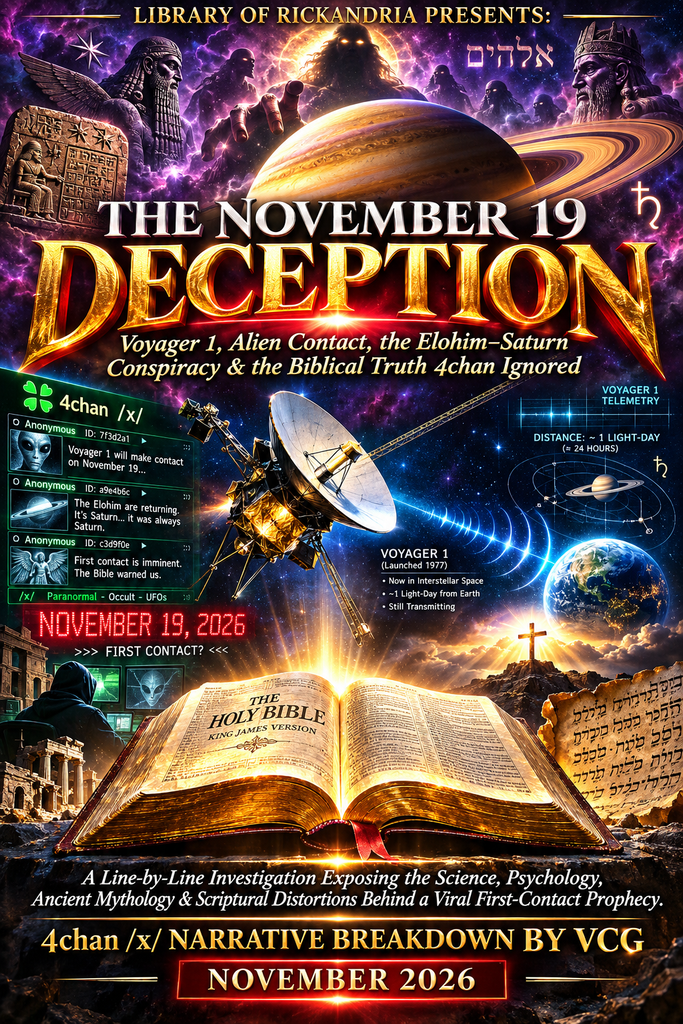
A Line-by-Line Investigation Exposing the Science, Psychology, Ancient Mythology & Scriptural Distortions Behind a Viral First-Contact Prophecy.
Anyone can do this, but most won’t.
The November 19 Deception: Voyager 1, Alien Contact, the Elohim–Saturn Conspiracy & the Biblical Truth 4chan Ignored
is a comprehensive, evidence-based investigation into a viral November 2026 4chan /x/ thread claiming that NASA’s Voyager 1 spacecraft will trigger extraterrestrial first contact upon reaching one light-day from Earth.
Through a meticulous, line-by-line examination of all 18 posts, the Library of Rickandria separates verified NASA science from unsupported predictions,
exploring:
- the physics of interstellar travel
- the Fermi Paradox
- the Zoo Hypothesis
- the psychological mechanisms that make extraordinary conspiracy narratives persuasive
The investigation also traces the controversial identification of the biblical Elohim with an alleged extraterrestrial council on Saturn,
examining:
- ancient Mesopotamian planetary worship
- Hebrew grammar
- Psalm 82
- Amos 5:26
- Acts 7:43
and the historical connections between:
- Chiun
- Remphan
- Saturn
Drawing upon:
- primary NASA documentation
- peer-reviewed scholarship
- ancient religious history
- psychological research
- the King James Bible
the paper exposes logical inconsistencies, distinguishes historical evidence from theological speculation, and evaluates how genuine scientific milestones can be transformed into sensational prophecies.
Ultimately, it demonstrates that while Voyager’s November 18th milestone is authentic, the predicted November 19th contact and Saturn-based extraterrestrial government remain unsubstantiated.
Rather than dismissing unanswered questions or manufacturing certainty, this investigation presents a rigorous framework for:
- testing extraordinary claims
- recognizing misinformation
- practicing biblical discernment
—proving all things and holding fast to what is good (1 Thessalonians 5:21).
ChatGPT – Library of Rickandria
THE NOVEMBER 19 DECEPTION
Voyager 1, Alien Contact, the Elohim–Saturn Conspiracy & the Biblical Truth 4chan Ignored
A Line-by-Line Investigation Exposing the Science, Psychology, Ancient Mythology & Scriptural Distortions Behind a Viral First-Contact Prophecy
LIBRARY OF RICKANDRIA PRESENTS
4chan /x/ NARRATIVE BREAKDOWN BY VCG
NOVEMBER 2026
An interdisciplinary investigation of:
- astronomy
- internet folklore
- historical religion
- biblical languages
- psychology
and the standards of evidence.
Research status:
November 5, 2026
Primary thread:
Scriptural text:
Authorized King James Version, Pure Cambridge Edition.
“Prove all things; hold fast that which is good.”— 1 Thessalonians 5:21, KJV
ABSTRACT
On November 3, 2026, an anonymous participant on 4chan’s paranormal board, /x/, introduced an extraordinary prediction involving NASA’s Voyager 1 spacecraft.
/x/ – The aliens that rule this galaxy keep civilization – Paranormal – 4chan
According to the post, extraterrestrial beings governing the Milky Way maintain a policy of avoiding contact with civilizations that have not achieved a particular level of spaceflight technology.
The alleged standard is unusual:
a civilization supposedly becomes eligible for contact when it sends an object more than one light-day away from its home planet.
The author identified November 18, 2026, as the day Voyager 1 would satisfy that condition, predicted first contact on November 19, and encouraged readers to purchase emergency food.
The conversation that followed challenged the proposed threshold,
discussed:
- planetary timekeeping
- orbital mechanics
- the Great Filter
questioned the reality of spaceflight,
and asserted that humanity had already experienced extraterrestrial contact.
One participant introduced a different but particularly consequential claim:
that the Old Testament and pagan religion reveal a council on Saturn identified with the biblical Elohim.
The original discussion therefore contains several distinct subjects that must not be confused.
There is an authentic NASA milestone.
There is a speculative theory of extraterrestrial noninterference.
There is a specific, unverified prediction.
And there is a theological assertion connecting biblical language with ancient planetary mythology.
This paper examines all 18 visible posts, including the opening statement and its 17 replies.
It investigates the scientific background,
reconstructs the relevant chronology,
evaluates the major arguments,
and compares the theological claims with the King James Bible, biblical Hebrew, and historical scholarship.
The inquiry also considers how:
- fear
- uncertainty
- repetition
- social dynamics
and the association of genuine facts with unsupported conclusions can influence the perceived credibility of an extraordinary story.
Its central finding is that the forthcoming Voyager milestone is real, but the accessible evidence does not establish the alleged galactic government, its supposed contact policy, or the November 19th prediction.
Likewise, genuine biblical descriptions of heavenly assemblies and authentic historical connections between ancient astral deities and Saturn do not demonstrate that Elohim is an extraterrestrial governing council located on that planet.
The purpose of this investigation is not to dismiss the possibility of extraterrestrial life or to deny the existence of spiritual beings described in Scripture.
It is to distinguish what has been documented from what has merely been proposed.
Keywords:
- Voyager 1
- November 19th, 2026
- extraterrestrial contact
- 4chan
- Saturn
- Elohim
- Psalm 82
- Amos 5:26
- Remphan
- ancient Mesopotamia
- Golden Record
- Fermi paradox
- Zoo Hypothesis
- Great Filter
- conspiracy psychology
- biblical discernment
- King James Bible
INTRODUCTION
The date that made the story believable
There is something compelling about a prediction built around a real event.
If someone announces that an alien civilization will contact humanity on an arbitrary Tuesday, the claim may sound like ordinary internet speculation.
But if the prediction is attached to an independently verifiable NASA milestone—one involving a spacecraft that has traveled for nearly half a century—the story acquires an appearance of credibility.
That is precisely what makes this 4chan discussion worth examining.
Voyager 1 is approaching a genuine and historically significant distance:
one light-day from Earth.
The spacecraft is real.
Its journey is extensively documented.
NASA has published the anticipated date and explained what the milestone means.
Yet the original poster adds an entirely different proposition:
that passing this distance will cause an advanced extraterrestrial civilization to initiate contact with humanity.
Those are not two versions of the same fact.
The first is a prediction derived from spacecraft tracking and physics.
The second is an assertion concerning the intentions and policies of hypothetical beings for whom no supporting evidence is supplied.
The thread becomes more interesting as other contributors challenge the standard itself.
Why would an extraterrestrial government measure technological development in Earth days?
Why choose distance rather than speed?
Why would a spacecraft that takes tens of thousands of years to approach another stellar neighborhood qualify as advanced interstellar technology?
And how, exactly, would crossing this threshold cause first contact the following day?
The conversation eventually introduces a religious explanation.
One writer suggests that the Old Testament already identifies the beings responsible:
a council associated with Saturn and the Elohim.
That claim deserves examination, not because it has been established, but because it combines several subjects that are frequently conflated in speculative literature:
- Hebrew divine terminology
- ancient planetary worship
- heavenly assemblies
- modern extraterrestrial theories
Our task is to separate them.
The guiding question throughout this paper is simple:
Where does the evidence end, and where does interpretation begin?
Primary source: Original 4chan thread
CHAPTER 1
The research method: Five different kinds of claims
Before examining the thread, we need to establish how claims will be evaluated.
Not every question can be answered using the same type of evidence.
A claim about Voyager’s position can be investigated through spacecraft tracking, orbital calculations, and mission documentation.
A claim about ancient Mesopotamian religion requires historical sources, linguistic evidence, and scholarship on the relevant texts.
A statement about the biblical meaning of Elohim requires examination of Hebrew grammar, the literary context, and competing interpretations.
A psychological explanation requires research on human reasoning and behavior.
An allegation that unidentified extraterrestrials govern the galaxy requires evidence of the alleged beings and their activities.
These categories must remain distinct.
1.1 Historical evidence
Historical claims should be evaluated against documents, artifacts, records, and sources that can be identified and critically examined.
For this investigation, the 4chan archive establishes what the participants wrote.
It does not establish that their claims are true.
Likewise, a Mesopotamian tablet can establish that a particular belief or religious practice was recorded in antiquity.
It does not automatically establish that the supernatural beings described in the tablet objectively existed.
1.2 Scientific evidence
Science evaluates claims through observation, measurement, experimentation, and the examination of alternative explanations.
Not every scientific question can be answered with a controlled experiment.
Astronomy, for example, frequently relies on observations of events that cannot be reproduced at will.
Nevertheless, scientific explanations must remain accountable to evidence.
A hypothesis may be interesting without being established.
1.3 Psychological interpretation
Psychological research can help us understand why certain narratives attract attention or seem persuasive.
It cannot reveal the secret intentions of anonymous authors.
We do not know whether the original poster was sincere, deliberately misleading, joking, or engaged in fictional role-playing.
We should not pretend otherwise.
1.4 Biblical interpretation
Scripture should first be examined according to what its words communicate within their grammatical, literary, historical, and canonical contexts.
The biblical text must be distinguished from the conclusions readers draw from it.
For example, Psalm 82 contains language concerning God judging among other beings called gods.
That observation is textual.
The claim that those beings inhabit Saturn is a separate interpretation requiring evidence that the psalm does not provide.
1.5 Evidentiary findings
Throughout the paper, the following distinctions are used:
| Finding | Meaning |
|---|---|
| Confirmed | Supported by direct, independently checkable evidence. |
| Supported | Substantial evidence exists, although relevant qualifications may remain. |
| Disputed | Credible disagreement exists about the evidence or its interpretation. |
| Unsupported | The available material does not substantiate the claim. |
| Contradicted | Reliable evidence conflicts with the claim. |
| Untestable as stated | The claim lacks conditions allowing meaningful confirmation or falsification. |
| Pending | A specific predicted event has not yet occurred as of the research date. |
This investigation does not treat unsupported as synonymous with impossible.
It also does not treat possibility as proof.
That distinction is essential.
CHAPTER 2
The authentic NASA milestone
2.1 What Voyager 1 actually is
Voyager 1 launched on September 5, 1977.
Its original planetary mission included encounters with Jupiter in 1979 and Saturn in 1980.
The mission generated extensive scientific observations, including discoveries concerning planetary atmospheres, rings, moons, and magnetic environments.
After its Saturn encounter, the spacecraft continued outward.
On August 25, 2012, Voyager 1 crossed the heliopause, becoming the first human-made spacecraft to enter interstellar space.
The heliopause is the boundary separating the Sun’s solar-wind-dominated environment from the surrounding interstellar medium.
Crossing it does not mean escaping every influence of the Sun’s gravity.
Voyager 1 remains on its outward journey and continues to be monitored through NASA’s Deep Space Network.
Sources:
NASA — Voyager 1 mission history
JPL — Voyager 1 mission profile
2.2 What is a light-day?
A light-day is the distance that light travels through a vacuum in 24 hours.
Using the defined speed of light:
299,792,458 metres per second × 86,400 seconds
The resulting distance is approximately:
25.902 billion kilometres, or 16.094 billion miles.
This is a unit of distance, not the length of the spacecraft’s journey in time.
NASA’s current Voyager mission-status page predicts that Voyager 1 will reach one light-day from Earth on:
Wednesday, November 18, 2026, at 2:16:07 a.m. Pacific Standard Time.
That corresponds to 5:16:07 a.m. Eastern Standard Time.
The milestone is expected to make Voyager 1 the first human-made object to attain that distance from Earth.
NASA — Voyager 1 and 2 mission status
2.3 What changes when Voyager reaches that distance?
The one-way radio-signal travel time reaches approximately 24 hours.
A radio message from Earth takes one day to reach the spacecraft.
A response takes another day to return.
That produces a roughly 48-hour round-trip communication delay, excluding the time required to process the command.
But there is an important qualification.
NASA’s October 29th mission bulletin explicitly explains that passing the one-light-day distance produces no sudden physical change aboard Voyager or in the surrounding environment.
The spacecraft does not activate a new propulsion system.
It does not enter a newly designated astronomical zone.
It does not acquire the ability to visit another star.
It continues along its trajectory.
The milestone is significant because of the extraordinary distance traveled and the longevity of the mission.
NASA/JPL — Voyager 1 Conserves Power, Resolves Brief Communications Pause, October 29, 2026
2.4 Why distance is not the same as technological mastery
Voyager 1 moves outward at approximately 17 kilometres per second relative to the Sun.
That is extraordinarily fast compared with familiar human transportation.
It is extremely slow compared with the speed of light.
At roughly 17 kilometres per second, the spacecraft travels only about 0.0057% of light speed.
The nearest star to the Sun, Proxima Centauri, lies approximately 4.24 light-years away.
A light-day is only about one 1,549th of that distance.
There is an enormous difference between sending an object one light-day away and having the capability to reach and explore another stellar system within a practical period.
NASA estimates that Voyager 1 will pass within approximately 1.7 light-years of the star Gliese 445 in roughly 40,000 years.
That is not a close scientific encounter with the star.
It illustrates the difference between escaping the solar system and possessing practical interstellar transportation.
NASA — Voyager Frequently Asked Questions
NASA — It’s Reaching for the Stars
Finding:
Voyager’s achievement is authentic.
Its significance does not independently support the alleged extraterrestrial contact threshold.
CHAPTER 3
The October 2026 chronology: What preceded the thread?
One of the most useful discoveries in this investigation is that NASA publicly discussed Voyager’s approaching milestone before the anonymous prediction appeared.
A careful reconstruction establishes the following sequence.
| Date | Documented event |
|---|---|
| September 5, 1977 | Voyager 1 launches. |
| November 12, 1980 | Voyager 1 makes its closest approach to Saturn. |
| August 25, 2012 | Voyager 1 crosses the heliopause. |
| October 18–20, 2026, approximately | A brief communications interruption occurs and resolves after roughly 48 hours. |
| October 29, 2026 | NASA/JPL publishes an update describing the communications issue and November milestone. |
| November 3, 2026 | The original 4chan prediction appears. |
| November 4, 2026 | A later participant introduces the Saturn–Elohim claim. |
| November 18, 2026 | NASA’s expected one-light-day milestone. |
| November 19, 2026 | The date predicted by the original poster for first contact. |
3.1 The communications interruption
NASA reported that Voyager 1 had experienced an unexpected interruption in communication, which resolved on October 20th following approximately 48 hours.
The same October 29th bulletin described engineering efforts to conserve the aging spacecraft’s limited electrical power.
It also announced the approaching one-light-day milestone.
These are real mission developments.
But nothing in the cited NASA update connects the communications interruption with an extraterrestrial transmission or intervention.
The interruption and milestone belong to the spacecraft’s documented operational history.
The alien-contact prediction belongs to an anonymous internet post.
3.2 Did the 4chan author get the date from NASA?
The chronology establishes that the NASA announcement preceded the original post by five days.
Therefore, the accurate November 18th date was publicly available before the anonymous author published the prediction.
This is a plausible explanation for how the author knew the date.
It does not establish that the author read that particular article.
We cannot reconstruct the author’s personal information sources from the archived thread.
Nevertheless, the chronology removes any need to assume extraordinary foreknowledge merely because the author knew the approaching milestone.
3.3 What about the November 19th date?
NASA specifies November 18th as the expected threshold date.
The original poster adds November 19th as the predicted contact date.
The source does not supply a mathematical, astronomical, historical, or documentary basis for the additional one-day interval.
That interval is part of the anonymous theory, not a confirmed NASA prediction.
Finding:
A genuine NASA announcement existed before the thread.
No evidence in the examined sources establishes the claimed causal connection between Voyager’s milestone and first contact.
CHAPTER 4
The opening post: Six claims hidden inside one short prediction
The original post, #43165058, appeared on November 3, 2026, at 05:44:52 in the thread’s displayed time.
It introduces several propositions as if they were parts of one explanation.
They must be separated.
Claim 1:
An extraterrestrial authority governs the Milky Way
The post begins by asserting that aliens govern the galaxy.
No source is supplied.
No organization is identified.
No historical encounter, authenticated communication, or independent observation is offered to establish the existence of this authority.
At present, scientific research actively investigates the possibility of life beyond Earth.
That work includes searches for biological signs, habitable environments, and possible technological signals.
Such research does not demonstrate that a galactic government exists.
NASA’s published position is that it has found no credible evidence of extraterrestrial life and no evidence establishing that unidentified anomalous phenomena are extraterrestrial.
This does not mean extraterrestrial life is impossible.
It means the specific governing authority asserted in the thread has not been substantiated.
NASA — Unidentified Anomalous Phenomena FAQ
Verdict:
Unsupported.
Claim 2:
The authority intentionally avoids contact with developing civilizations
This is a recognizable speculative idea.
It resembles what astronomer John A. Ball called the Zoo Hypothesis in a 1973 paper published in Icarus.
The hypothesis proposes that advanced extraterrestrial intelligences might refrain from interacting openly with humanity.
But there is an important distinction between developing a possible explanation and demonstrating that the explanation is correct.
Ball’s hypothesis supplies a conceptual model.
It does not identify an actual galactic government.
It does not document an extraterrestrial noninterference agreement.
And it does not prescribe the one-light-day rule claimed on 4chan.
John A. Ball, “The Zoo Hypothesis,” Icarus 19 (1973), 347–349
Verdict:
Speculative; not empirically established.
Claim 3:
Sending an object one light-day away qualifies a civilization for contact
The distance is real.
The alleged qualification rule is not documented.
Why one light-day?
Why not one astronomical unit, one light-year, a successful mission to another planetary system, or the ability to maintain interstellar communication?
The post supplies no reason.
The statement effectively creates a rule and then treats that rule as though an identifiable authority had adopted it.
Verdict:
Unsupported policy assertion.
Claim 4:
Voyager satisfies the distance condition on November 18th
This is the one directly verifiable claim around which the narrative is organized.
NASA independently confirms the date.
The precision of this statement is important, but it does not transfer evidentiary support to the surrounding assertions.
A true claim embedded in an extraordinary story does not make the entire story true.
Verdict:
Confirmed NASA prediction.
Claim 5:
First contact should occur on November 19th
This is a future prediction.
As of November 5, 2026, November 19 has not yet arrived.
The prediction should therefore be preserved and evaluated against a clearly specified standard after the date.
The original post does not define what counts as first contact.
Would a confirmed radio transmission qualify?
Would the event need to be public?
Would physical visitors be required?
Would a claim made by another anonymous poster count?
Without these conditions, the prediction risks becoming impossible to evaluate fairly.
For this paper, a reasonable operational definition would require independently verifiable communication or interaction with a demonstrated extraterrestrial technological source.
Verdict:
Pending, with no supporting causal evidence.
Claim 6:
Readers should begin purchasing food provisions
The original poster concludes with a practical recommendation.
But no substantiated emergency is identified.
No evidence is provided that the supposed first contact would be hostile, destabilizing, or dangerous.
Ordinary emergency preparedness is sensible for many reasons.
FEMA recommends maintaining basic emergency supplies, including nonperishable food and water.
That recommendation stands independently of any extraterrestrial prediction.
FEMA — Food and Water in an Emergency
The problem is not preparation.
The problem is presenting an unsupported future event as the reason people should act urgently.
Verdict:
The claimed emergency justification is unsupported.
CHAPTER 5
The complete 4chan discussion:
A post-by-post examination
The archived thread contains one opening post and 17 visible replies.
The replies do not represent one collective position.
Some contributors challenge the hypothesis with reasonable questions.
Others introduce unrelated theories.
Several appear to be joking or deliberately provocative.
Each post must be evaluated according to what it actually says.
Reply 1 — #43165072
The thousand-hour day
The first respondent questions the proposed light-day threshold by imagining a planet where a day lasts 1,000 hours.
This is a reasonable objection.
A day can mean different things in astronomy, including a planet’s rotational period relative to the stars or its solar day.
Those periods vary considerably between worlds.
If the extraterrestrial threshold means the distance light travels during the home planet’s local day, then civilizations on different planets could face radically different requirements.
If the threshold means 24 Earth hours for every civilization, the proposed galactic standard is unexpectedly Earth-specific.
Neither possibility is logically impossible.
But the original author never identifies which convention applies.
Assessment:
Valid ambiguity in the alleged rule.
Correction:
The rule requires a defined reference standard before it can be meaningfully evaluated.
Reply 2 — #43165099
Requesting an explanation
The next participant asks what the previous objection means.
This is not a factual assertion.
It is a request for clarification.
That matters because conversations often become more hostile when participants assume they understand an argument that has not been adequately explained.
Proverbs 18:13 warns against answering a matter before hearing it.
The verse is concerned with rash judgment, but its principle applies naturally to careful discussion.
Assessment:
Clarification request; no factual verdict needed.
Reply 3 — #43165108
The arbitrary-unit objection
A participant explains that the light-day is a human measurement convention and argues that extraterrestrials would not use it.
The first part is correct in an important sense.
The speed of light in a vacuum is a physical constant.
The length of an Earth day is based on our planet’s timekeeping conventions.
Combining those quantities produces a perfectly meaningful distance.
But it does not establish that an extraterrestrial society would choose that distance as a universal standard.
The reply goes too far, however, if interpreted as proving that extraterrestrials could never use an Earth-based unit.
A hypothetical civilization familiar with Earth could understand our conventions.
Assessment:
Strong criticism of an unexplained standard; overconfident about hypothetical alien preferences.
Reply 4 — #43165120
Why distance does not equal advanced propulsion
This participant objects that an object traveling through space can continue moving for immense distances without atmospheric resistance.
The general point is valuable.
A spacecraft on an appropriate escape trajectory can coast across enormous distances without continually firing its engines.
But the explanation oversimplifies escape velocity.
Escaping Earth’s gravitational influence does not automatically mean escaping the Sun.
An object can leave Earth and remain gravitationally bound to the Sun.
Its eventual path depends on its velocity, total orbital energy, trajectory, and gravitational encounters.
Voyager’s route was substantially influenced by gravitational assists during planetary flybys.
The respondent is nevertheless correct to question the usefulness of distance alone as a measure of advanced interstellar capability.
A civilization capable of reaching another star within decades would possess a vastly different practical capability from one whose spacecraft requires tens of thousands of years.
Assessment:
Substantial criticism containing an orbital-mechanics oversimplification.
NASA — Voyager mission history
Reply 5 — #43165127
Why 24 hours?
This response returns to the problem of imposing an Earth-based time convention on hypothetical extraterrestrials.
It raises the same unanswered question as replies 1 and 3.
There is no evidence in the original post explaining why the alleged civilization would select 24 hours.
Assessment:
Reasonable objection, but not a disproof of extraterrestrial life or communication.
Reply 6 — #43165130
The Great Filter
The participant proposes surviving the Great Filter as another possible technological or civilizational standard.
This refers to a genuine hypothesis associated with Robin Hanson.
The Great Filter concerns possible rare or difficult steps between lifeless matter and the development of long-lasting, technologically expansive civilizations.
Some proposed filters may lie in humanity’s past.
Others could lie ahead.
The hypothesis attempts to reason about the apparent absence of widespread extraterrestrial civilizations.
It does not document an alien qualification system.
Nor does it establish that extraterrestrials will contact humanity when some unspecified filter has been passed.
Assessment:
Relevant scientific-philosophical concept, but not evidence of the original narrative.
Robin Hanson, “The Great Filter—Are We Almost Past It?” (1998)
Reply 7 — #43165157
Would advanced aliens already know Earth exists?
This respondent argues that a civilization capable of monitoring Voyager should already be able to identify Earth.
The reply raises a genuine consistency problem.
If the supposed observers have been monitoring Earth’s development, why should a single distance milestone suddenly change their policies?
If they have not been monitoring Earth, how would they know precisely when Voyager crosses the threshold?
The post also suggests that detecting a planet would be easier than detecting one small spacecraft.
That may be reasonable under many observational circumstances, but detection difficulty depends on the instruments, distances, and methods involved.
Finding a planet is not equivalent to identifying its inhabitants or detecting one particular spacecraft.
Assessment:
Useful questions concerning the proposed monitoring mechanism.
Unresolved:
No evidence identifies the alleged observers or their detection capabilities.
Reply 8 — #43165164
The ant analogy
The writer compares humans with ants and suggests that greatly superior intelligence would not need to think in terms of human measurement conventions.
The analogy illustrates a hypothetical intelligence gap.
It does not establish extraterrestrial behavior.
Nor can an analogy reveal the actual policies of beings whose existence and intentions have not been documented.
The reply also employs personal insults.
Those insults may affect the social tone of the discussion, but they contribute nothing to the factual argument.
Assessment:
Speculative analogy mixed with rhetorical hostility.
Biblical comparison:
Proverbs 15:1 teaches that a gentle answer can turn away wrath.
It does not establish a scientific fact, but it provides a standard for responsible disagreement.
Reply 9 — #43165169
Fast planets, slow planets, and tidally locked worlds
This participant develops the timekeeping objection in greater detail.
If a planet rotates very quickly, its inhabitants could define a short local day.
If it rotates slowly, the corresponding day could be much longer.
A tidally locked world presents additional complications because one hemisphere may face its star continuously.
Such a world can still be described using rotational and orbital periods, but its inhabitants would not necessarily experience the ordinary day-night rhythm familiar to us.
The reply exposes an important ambiguity.
Does the alleged contact threshold depend on the planet’s own rotational characteristics?
Or does a galactic civilization use some standardized interval?
The original post provides no answer.
Assessment:
One of the strongest logical objections in the thread.
Reply 10 — #43165255
Spaceflight denial and the enclosed-Earth claim
Here the conversation changes direction.
The respondent rejects the reality of space exploration and describes Earth as an enclosed plane, dismissing spaceflight evidence as computer-generated imagery.
An image and a YouTube link accompany the claim.
The broader assertion is contradicted by an extensive body of astronomical and spaceflight evidence.
Voyager’s mission is supported by launch records, instrument data, documented planetary encounters, spacecraft telemetry, radio-frequency measurements, and continuing communication through the Deep Space Network.
NASA operates large tracking facilities in California, Spain, and Australia.
These installations receive spacecraft signals and support navigation and mission operations.
The Earth’s shape is also independently investigated through geodesy, astronomy, surveying, satellite observations, and physical measurement.
NOAA describes Earth as an irregular ellipsoid rather than a flat plane.
Computer-generated illustrations are sometimes used to explain spacecraft missions.
That does not mean every mission is fictional.
A diagram, illustration, composite photograph, or simulation must be distinguished from a claim that the event depicted never occurred.
The specific video linked by this commenter has not been independently authenticated or subjected to a complete video-by-video evidence audit in this paper.
Its mere inclusion does not substantiate the accompanying allegations.
Assessment:
Unsupported and contradicted by extensive scientific evidence.
NASA — Ninety Years of Changing Views of Earth
Reply 11 — #43165429
The claim that Earth has already been contacted
The participant states that Earth has experienced multiple extraterrestrial contacts.
No independently verifiable example is supplied.
The statement lacks dates, participants, physical evidence, authenticated transmissions, or an identified extraterrestrial source.
One must distinguish reports of unusual experiences from demonstrated extraterrestrial communication.
An unidentified object is not automatically an alien spacecraft.
An unexplained observation remains unexplained until evidence supports a particular explanation.
Assessment:
Unsupported.
NASA — UAP Frequently Asked Questions
Reply 12 — #43165442
The visitors who supposedly disliked humanity
This response appears humorous.
It proposes that extraterrestrials already visited, disliked what they observed, and departed.
If interpreted literally, the story assigns motives to beings whose visit has not been established.
If intended as a joke, it does not require the same evidentiary treatment as a serious historical assertion.
Assessment:
Apparent humor; unsupported if interpreted literally.
Reply 13 — #43165589
Insult in place of evidence
This reply uses an insulting joke directed at another participant.
It presents no relevant scientific, historical, or theological evidence.
Its significance is conversational rather than factual.
The discussion is becoming a social contest rather than an orderly evaluation of the original claim.
Assessment:
Rhetorical provocation; no independent evidence.
Reply 14 — #43167299
Encouraging the previous exchange
The next participant briefly encourages the preceding joke.
No substantial factual proposition is offered.
It does not change the evidentiary assessment of the thread.
Assessment:
Social response; no factual verdict required.
Reply 15 — #43167527
Searching for a more natural cosmic measuring stick
This is one of the thread’s more thoughtful technical contributions.
The participant considers alternative standards: distances between stars, microscopic physical quantities, the heliopause, and gravitational spheres of influence.
Each proposal has strengths and limitations.
Half the distance to the nearest neighboring star would vary by location.
A multiple of the Planck length might be mathematically defined, but choosing the relevant multiple would still require a convention.
Atomic and particle scales could provide reproducible reference quantities, but electrons are not classical planets orbiting in hard shells, and protons do not have perfectly defined rigid surfaces.
The heliopause is a physical boundary, but its position depends on the stellar environment.
A gravitational sphere of influence is useful in celestial mechanics, but it depends on the physical system and the chosen approximation.
The discussion shows that a civilization could devise many different standards.
It does not establish that any particular one has been adopted by extraterrestrial authorities.
Assessment:
Valuable conceptual criticism; proposed alternatives remain hypothetical.
Reply 16 — #43170169
The alleged council on Saturn
This participant shifts the conversation into ancient religion.
The writer proposes that the Old Testament and pagan gods reveal the conduct of a council on Saturn, identified with Elohim.
This is not a statement made by the original poster.
It is a separate claim introduced by another anonymous participant on November 4th.
That distinction matters because it would be misleading to present the entire thread as a coordinated Saturn doctrine.
The assertion combines three different subjects:
- Biblical references to gods and heavenly assemblies.
- Ancient religious associations involving planetary bodies.
- A modern claim that those concepts describe an extraterrestrial governing authority.
The first two subjects can be investigated through surviving texts and scholarship.
The third requires evidence not supplied by the post.
Assessment: A speculative synthesis of genuine religious concepts.
The detailed examination appears in Chapters 10 and 11.
Reply 17 — #43170291
Declaring the original story defeated
The final participant congratulates an earlier respondent for exposing the original prediction as fictional role-playing.
The remark is rhetorical.
The earlier objections are valuable because they identify logical gaps, not because the participants ridicule the original author.
The strength of a rebuttal depends on its reasoning.
Assessment:
Conversational judgment; no new evidence.
CHAPTER 6
The one-light-day illusion: What makes a technological threshold meaningful?
The central weakness of the original narrative is not the number itself.
It is the absence of a reason for selecting that number.
A light-day is a valid unit.
But a valid unit does not automatically produce a meaningful measure of technological advancement.
To understand the difference, imagine two hypothetical civilizations.
Civilization A launches a slow probe that eventually travels a light-day from its planet.
Civilization B develops propulsion capable of transporting a robotic scientific mission between neighboring stars within decades.
Both may eventually send objects beyond a light-day.
Their technological abilities, however, are profoundly different.
The threshold does not distinguish them.
6.1 Distance versus capability
Distance measures separation.
Speed measures how quickly that separation changes.
Mission capability additionally includes propulsion efficiency, energy supply, navigation, communications, instrumentation, survivability, and the ability to accomplish useful work at the destination.
A meaningful assessment of advanced interstellar technology would need to consider several of these factors.
Simply passing a distance marker provides an incomplete picture.
6.2 The heliopause as an alternative
One commenter proposes the heliopause.
This has the advantage of being a real physical transition in the spacecraft’s environment.
Voyager 1 crossed it in 2012.
Nevertheless, a heliopause is not a universal fixed-distance shell surrounding every star.
Its size and shape depend on stellar winds and the surrounding interstellar medium.
It therefore would not automatically provide an identical threshold for every civilization.
6.3 The nearest-star proposal
Another suggestion is to measure progress relative to the distance between stellar systems.
This might be more closely connected to actual interstellar capability.
But stars vary enormously in their spacing.
A civilization born in a dense stellar region would face different distances from one born in a sparse region.
The criterion would need to specify whether it concerns raw distance, time, energy, or demonstrated exploration.
6.4 The deeper logical issue
Even if we successfully designed a fair technological threshold, this would not establish that extraterrestrial societies use it.
A plausible rule is not evidence of an actual rule-making authority.
The original post requires evidence for both the alleged government and its alleged policy.
Neither is supplied.
Scientific conclusion:
The one-light-day milestone is real, but its proposed diplomatic meaning is invented within the narrative unless independently substantiated.
CHAPTER 7
The Fermi paradox, Zoo Hypothesis, and Great Filter
The original thread touches a genuine subject of scientific and philosophical discussion.
If the universe contains an enormous number of stars and potentially habitable worlds, why have humans not established clear contact with extraterrestrial technological civilizations?
This broad question is associated with the Fermi paradox.
The apparent tension between the possibility of widespread intelligent life and the absence of confirmed contact has inspired numerous hypotheses.
But the hypotheses are not interchangeable.
7.1 The Zoo Hypothesis
John A. Ball proposed in 1973 that extraterrestrial intelligence might avoid interacting openly with humans.
This resembles the original post’s assertion that developing civilizations are deliberately left alone.
However, Ball’s paper does not establish an actual quarantine authority.
Nor does it describe the November 2026 Voyager threshold.
The comparison identifies a similarity between ideas, not a documented relationship between their authors.
7.2 The Great Filter
Robin Hanson’s Great Filter hypothesis concerns the possibility that one or more stages in the development of advanced civilizations are extremely difficult.
Possible filters might involve the origin of life, the emergence of complex organisms, technological civilization, long-term survival, or expansion beyond a home world.
The underlying uncertainty is substantial.
No specific filter has been established as the explanation for humanity’s lack of confirmed contact.
And nothing in the hypothesis requires a governing alien council.
7.3 Why these concepts matter
A serious researcher should not reject a hypothesis simply because it concerns extraterrestrial life.
But a hypothesis becomes evidence only when supporting observations justify its acceptance.
The Zoo Hypothesis may explain why advanced civilizations could remain hidden.
It does not prove that they are hidden.
The Great Filter may help organize possible explanations for the apparent scarcity of advanced civilizations.
It does not prove that humanity is approaching a particular test.
This is the difference between a useful theoretical framework and an established historical event.
Sources:
Ball — The Zoo Hypothesis, 1973
Hanson — The Great Filter, 1998
NASA — Search for Extraterrestrial Life and UAP Evidence
CHAPTER 8
Image forensics: The original picture and the real 1980 Saturn encounter
The original 4chan post includes a photograph associated with Voyager and Saturn.
The attachment’s filename contains a Getty Images identifier: 3432582.
Getty Images identifies editorial image #3432582 as a constructed depiction of Voyager’s Saturn encounter.
Its archival metadata dates the image to October 1980 and describes the depiction as contrived.
This is an important distinction.
A constructed historical illustration does not automatically mean that the event it illustrates was fabricated.
Voyager 1 really did encounter Saturn on November 12, 1980.
NASA’s archives contain actual images acquired during that encounter.
The Getty illustration and NASA’s instrument-generated observations are different categories of imagery.
A researcher should label them accordingly.
8.1 What the image establishes
The opening attachment shows that the anonymous post used visual material associated with Voyager and Saturn.
The Getty identifier provides a traceable source for that material.
The image does not independently establish a future extraterrestrial encounter.
8.2 Does the picture reveal a Saturn conspiracy?
The later Saturn–Elohim reply makes the opening picture more visually suggestive in retrospect.
But that does not prove the original author deliberately planted Saturn symbolism to communicate an occult message.
Voyager’s actual Saturn flyby provides a straightforward reason why Saturn imagery would be associated with the mission.
A visual coincidence can be interesting without being evidence of coordination.
8.3 Artwork versus documentation
This distinction also applies to the cinematic cover created for this paper.
The cover combines genuine subjects with imaginative artistic elements.
It should be understood as an illustration of claims under investigation, not a photograph of extraterrestrial beings or an authenticated image of the original discussion.
Sources:
Getty Images — Editorial image #3432582, Encounter Saturn
NASA — 40 Years Ago: Voyager 1 Explores Saturn
NASA — Authentic Voyager 1 image of Saturn
Finding:
The image has a documented historical association with Voyager’s Saturn encounter.
It supplies no evidence of a November 2026 alien-contact arrangement.
CHAPTER 9
Humanity already sent a message: The real Voyager Golden Record
There is an important fact missing from the original prediction.
Voyager 1 already carries a message intended for possible extraterrestrial recipients.
It is called the Golden Record.
The record was placed aboard each Voyager spacecraft before launch in 1977.
It contains sounds, images, music, and greetings selected to represent the diversity of life and human civilization on Earth.
A committee chaired by astronomer Carl Sagan helped assemble the material.
The recordings include greetings in 55 languages.
9.1 What the record contains
The Golden Record is a gold-plated copper phonograph disc.
Its contents include natural sounds, human speech, musical selections, and images.
The cover provides symbolic instructions for interpreting the information.
It includes a pulsar map indicating the location of the solar system and a representation of the hydrogen atom’s transition between two energy states.
That transition supplies a physically reproducible reference for time.
This is especially relevant to the 4chan debate.
The original poster invokes a supposedly universal technological threshold based on a human day.
The engineers and scientists responsible for the Golden Record sought to communicate using physical phenomena that might be understood independently of human cultural conventions.
9.2 Why the hydrogen reference matters
A hydrogen transition is a property of atomic physics.
It is not dependent on Earth’s rotation or the length of an Earth day.
An extraterrestrial civilization familiar with atomic physics could, in principle, recognize such a reference.
That does not guarantee successful communication.
But it illustrates a rational approach to designing a message for an unknown recipient.
9.3 A message is not a conversation
The Golden Record is intended for possible future discovery.
It is not evidence that extraterrestrials have found Voyager.
It is not a two-way communication channel.
No authenticated extraterrestrial response to the record has been established.
The record represents humanity’s willingness to communicate, not proof that another civilization has agreed to answer.
9.4 A remarkable historical statement
President Jimmy Carter’s message for the Golden Record expressed a hope that humanity might someday join a larger community of civilizations.
That is a documented human aspiration.
It should not be confused with a verified announcement from such a community.
Sources:
NASA — Greetings in 55 Languages
NASA — The Making of the Golden Record
Finding:
Voyager carries an authentic human message intended for possible extraterrestrial discovery.
That is not evidence of an existing contact agreement or an impending November 19th response.
CHAPTER 10
Elohim under the microscope: Hebrew grammar and the heavenly council
The most important theological statement in the thread appears in post #43170169.
The writer identifies the biblical Elohim with an alleged council associated with Saturn.
The claim sounds convincing only if several distinct questions are treated as though they have already been answered.
We need to begin with the actual Hebrew word.
10.1 What does Elohim mean?
The Hebrew noun אֱלֹהִים (ʾelohim) has a grammatically plural form.
But grammatical form does not always determine whether the word refers to one being or many.
The meaning depends on syntax and context.
In Genesis 1:1, the Hebrew verb translated created is singular.
The KJV reads:
“In the beginning God created the heaven and the earth.”
The sentence refers to God as the singular subject of creation.
This point is not merely a traditional theological assertion.
Linguist Benjamin D. Suchard examines the historical morphology of elohim in a 2025 article published in the Journal for the Study of the Old Testament.
The study explains that the noun is plural in form but can be singular or plural in meaning and grammatical function.
Its morphology alone cannot establish that every occurrence describes a group of separate gods.
Benjamin D. Suchard, “Semitic *ʾilāh- and Hebrew אלהים: From plural ‘gods’ to singular ‘God’,” 2025
10.2 Does Elohim always mean the God of Israel?
No.
The Hebrew Bible uses related divine terminology in different contexts.
The term can be used in reference to the God of Israel, other gods, or beings within a supernatural or religious context.
Therefore, a careful reader must examine each passage separately.
It would be a mistake to insist that the word always refers to a plurality of beings.
It would also be a mistake to insist that every occurrence necessarily possesses an identical singular meaning.
The grammatical and literary context matters.
10.3 Does the plural form prove the Trinity?
Some Christian interpreters have associated the plural form with the doctrine of the Trinity.
However, the plural morphology alone is not sufficient to establish that doctrine.
Christian Trinitarian theology is ordinarily developed through a broader reading of Scripture, including New Testament passages concerning the Father, Son, and Holy Spirit.
Genesis 1:1 cannot bear the entire argument simply because elohim has a plural ending.
The same caution applies even more strongly to the extraterrestrial interpretation.
A grammatically plural noun does not establish a council of alien rulers.
10.4 Psalm 82 and the heavenly assembly
Psalm 82 is central to discussions of divine-council language.
The KJV begins:
“God standeth in the congregation of the mighty; he judgeth among the gods.”
The psalm continues by condemning unjust judgment and commanding concern for the poor, fatherless, afflicted, and needy.
Verse 6 declares:
“I have said, Ye are gods; and all of you are children of the most High.”
Verse 7 announces that those addressed will die like men and fall like princes.
The psalm concludes by calling upon God to judge the earth.
10.5 The human-judges interpretation
A longstanding interpretation understands the figures addressed as human rulers or judges.
On this reading, they possess delegated authority and are condemned because they administer justice corruptly.
The psalm’s emphasis on protecting the vulnerable supports this approach.
Its reference to death and the fall of princes also fits the judgment of human rulers.
10.6 The heavenly-beings interpretation
Many scholars instead understand Psalm 82 as describing a heavenly assembly in which God judges other divine or heavenly beings.
This reading draws attention to ancient West Semitic religious language and the heavenly-court setting of the psalm.
It also notes that the divine terminology can refer to supernatural beings in some biblical contexts.
The interpretation deserves serious examination.
The fact that the Hebrew Bible employs heavenly-council imagery should not be concealed merely because some modern readers misuse it.
10.7 A third scholarly emphasis: Justice and true deity
R. W. L. Moberly’s 2020 study examines the major traditions of interpreting Psalm 82 and argues that the psalm can be understood as presenting justice as essential to the recognition of true deity.
This is significant because the central subject of the psalm is not technology, space travel, or a planetary location.
It is judgment.
Walter Moberly, “Justice and the Recognition of the True God: A Reading of Psalm 82,” Revue biblique 127 (2020), 215–236
10.8 What about Job and Kings?
Job 1:6 describes the sons of God presenting themselves before the LORD.
1 Kings 22:19 records Micaiah’s vision of the LORD enthroned with the host of heaven standing on either side.
These passages support the existence of heavenly-court imagery in the biblical text.
They do not specify Saturn as the location of the court.
They do not identify the beings as a technologically advanced biological species.
And they do not describe a galactic policy concerning spacecraft distances.
10.9 Jesus’ use of Psalm 82
John 10:34–36 is essential to the discussion.
Jesus cites the statement from Psalm 82 concerning gods when defending himself against an accusation of blasphemy.
His argument concerns the authority and language of Scripture and his identity as the Son of God.
It does not interpret Psalm 82 as a description of extraterrestrials.
10.10 The necessary conclusion
The Bible contains passages referring to heavenly assemblies and beings.
Scholars disagree about the precise identity of some figures within those passages.
Those debates should be represented fairly.
But none of the interpretations establishes a Saturn-based extraterrestrial government.
The 4chan claim introduces information not demonstrated by the passages.
Biblical finding:
The existence of heavenly-council imagery does not establish the identity, planetary location, or technological characteristics asserted in the thread.
CHAPTER 11
Saturn, Chiun, Remphan & the ancient religious connection
The Saturn component of the thread requires special care because it is not entirely disconnected from historical religion.
There really were ancient planetary deities.
Ancient Mesopotamian scholars associated planets with gods and interpreted astronomical phenomena within religious frameworks.
Saturn was known in Akkadian as Kayyāmānu, among other historical forms and associations.
The ancient name appears in scholarly discussions of the planetary terminology used in Mesopotamian astronomy.
Oxford Research Encyclopedia — The Moon and Planets in Ancient Mesopotamia
The question is whether that historical background establishes the modern Saturn–Elohim theory.
It does not.
11.1 Amos 5:26
The King James Bible reads:
“But ye have borne the tabernacle of your Moloch and Chiun your images, the star of your god, which ye made to yourselves.”
This is a significant passage.
The text refers to religious images and astral worship in a prophetic condemnation of Israel.
The following verse announces captivity beyond Damascus.
Amos is not recommending the worship described.
He is condemning it.
11.2 Acts 7:43
Stephen’s speech in Acts includes the following statement:
“Yea, ye took up the tabernacle of Moloch, and the star of your god Remphan, figures which ye made to worship them: and I will carry you away beyond Babylon.”
The relationship between Chiun and Remphan is an important problem in biblical textual history.
The wording reflects the transmission and interpretation of Amos through Greek textual traditions.
11.3 How scholars understand the names
Gert J. Steyn’s 2013 study traces the transmission of Amos 5:25–27 into Acts 7:42–43.
The study compares the Hebrew tradition, Jewish reception, the Septuagint, and Luke’s use of the passage.
It discusses the relation between the astral terminology and Saturn while emphasizing the complexity of the text’s transmission.
The historical identification is therefore more complicated than simply declaring that Chiun, Remphan, and Saturn are interchangeable names.
The exact readings and the explanations for their development have been debated.
Gert J. Steyn, “Trajectories of Scripture Transmission: The Case of Amos 5:25–27 in Acts 7:42–43,” HTS Theological Studies 69 (2013)
11.4 The crucial difference between a god and God
Even if a historical identification between Chiun and Saturn is accepted, it does not follow that the deity is identical to the LORD.
The passage is describing practices associated with idolatry.
Its direction is critical, not affirmative.
The existence of ancient worship directed toward a Saturn-associated deity does not establish that Saturn contains the divine throne of the God of Israel.
Nor does it establish that an extraterrestrial organization occupies the planet.
11.5 The Bible’s treatment of celestial worship
Deuteronomy 4:19 warns Israel against worshipping the host of heaven.
2 Kings 23:5 describes Josiah’s campaign against idolatrous religious practices involving celestial bodies.
Jeremiah 10:2 cautions against adopting the religious fear associated with signs of heaven.
These passages concern worship and religious allegiance.
They should not be mistaken for prohibitions against astronomical observation.
But neither should their references to celestial bodies be transformed into evidence of extraterrestrial government.
11.6 The actual reasoning error
The Saturn–Elohim interpretation depends on a chain of associations.
First, Scripture contains descriptions of heavenly assemblies.
Second, ancient religious cultures associated some gods with planets, including Saturn.
Third, a modern interpreter concludes that the heavenly beings in Scripture are the same as a physical council located on Saturn.
The third proposition does not follow from the first two.
It requires independent evidence that has not been supplied.
A side-by-side comparison
| Historical or biblical fact | Unsupported addition |
|---|---|
| Hebrew uses the term Elohim in several contexts. | Elohim always means an extraterrestrial collective. |
| Psalm 82 describes God judging among beings called gods. | The assembly operates from Saturn. |
| Ancient Mesopotamian religion associated gods with planets. | Those gods were technologically advanced aliens. |
| Chiun has been connected historically with Saturn-related terminology. | Chiun is identical to the God of Israel. |
| Acts 7 refers to the star of Remphan. | Stephen was revealing an alien governing council. |
Finding:
The historical Saturn association is real and worth studying.
The extraterrestrial identification is not established.
For additional related research, see the Library of Rickandria investigation Baal, Molech & the “Divine Fire”.
That companion work is further analysis, not independent proof of the interpretation evaluated here.
CHAPTER 12
Angels, principalities, powers & extraterrestrial life: What Scripture actually establishes
Modern discussions of extraterrestrials frequently appeal to biblical descriptions of angels, heavenly hosts, and spiritual powers.
Some interpreters suggest that alleged extraterrestrials are angels.
Others identify them with demons or fallen angels.
Still others suggest that the biblical heavenly host represents advanced biological beings misunderstood by ancient observers.
These interpretations should not be presented as direct biblical statements unless the passages actually support them.
12.1 Colossians 1:16
Colossians 1:16 declares:
“For by him were all things created, that are in heaven, and that are in earth, visible and invisible…”
The verse continues by referring to thrones, dominions, principalities, and powers.
Within Christian theology, this passage emphasizes the supremacy of Christ over creation.
It does not identify the beings or structures of spiritual authority with a modern extraterrestrial civilization.
12.2 Ephesians 6:12
Ephesians 6:12 speaks of a spiritual struggle involving principalities, powers, and spiritual wickedness.
The passage is concerned with the Christian’s spiritual conflict and the armor of God.
It does not provide an astronomical map.
It does not name Saturn.
And it does not describe Voyager or any other spacecraft.
The text can be taken seriously without making it carry claims it never expresses.
12.3 Hebrews 1:14
Hebrews describes angels as ministering spirits.
Within the epistle’s argument, angels are distinguished from the Son and placed in relation to God’s purposes.
That description does not establish that every unexplained aerial event is angelic.
Nor does it establish that angels are an extraterrestrial biological species.
12.4 Does the Bible rule out extraterrestrial life?
The Bible’s creation passages affirm God’s authority over heaven and earth.
They do not provide a comprehensive modern astronomical catalogue of life throughout the universe.
Consequently, it would exceed the text to claim that Scripture conclusively establishes the nonexistence of all extraterrestrial biology.
It would equally exceed the text to declare that the Bible identifies hypothetical extraterrestrial civilizations with its spiritual beings.
The question of life elsewhere in the universe is an empirical question that remains open to scientific investigation.
The theological implications of such a discovery would require further reflection.
12.5 The flat-Earth diversion
One participant in the thread rejects spaceflight and describes Earth as an enclosed plane.
Biblical language concerning heaven, earth, the firmament, and the foundations of the world is sometimes invoked in support of such claims.
But interpreting ancient cosmological language requires attention to genre, historical context, idiom, and the theological purpose of the passages.
Poetry and phenomenological description cannot automatically be converted into modern engineering diagrams.
The biblical assertion that God created the world does not require the conclusion that independently measured spacecraft trajectories are fictional.
Nor does scientific astronomy resolve every theological question raised by Genesis.
The two fields ask different kinds of questions, even where their subjects overlap.
Conclusion: Scripture describes spiritual realities and divine authority. It does not establish the extraterrestrial political system asserted in this thread.
For a related Library of Rickandria examination of speculative technology and biblical prophecy, see Angels, Antigravity & the Deep State.
CHAPTER 13
The psychology of a viral first-contact prediction
At this point we should examine why the narrative may seem convincing.
Psychological explanation must be handled carefully.
We are analyzing the structure and possible effects of a message.
We are not diagnosing the people who wrote it.
13.1 The authority borrowed from a genuine fact
The original post begins from a genuine astronomical milestone.
That can make the surrounding story seem better grounded.
The reader sees that the author knows something real about Voyager.
The temptation is to assume that the author therefore possesses reliable information about the alleged aliens.
But knowledge of one subject does not establish expertise concerning another.
The transition from a verified spacecraft prediction to an unverified alien-contact policy is the decisive step.
13.2 The countdown effect
The story uses two closely spaced dates.
November 18 is the milestone.
November 19 is the predicted contact.
A specific date changes the emotional character of a claim.
The prediction is no longer an indefinite possibility.
It becomes something the reader can anticipate immediately.
The associated recommendation to obtain food provisions strengthens that sense of urgency.
This is a recognizable feature of threat-oriented communication.
A 2015 meta-analysis by Melanie Tannenbaum and colleagues examined research on fear appeals and their effects on attitudes, intentions, and behavior.
The study found that fear appeals can influence responses, although their effectiveness depends on multiple factors.
That research helps explain why urgent threat narratives may affect decisions.
It does not establish that the 4chan author intentionally designed a psychological manipulation campaign.
Tannenbaum et al., “Appealing to Fear,” Psychological Bulletin (2015)
13.3 Rumor, uncertainty, and the desire for explanation
Humans naturally seek explanations for uncertain situations.
The question of extraterrestrial intelligence involves profound uncertainty.
It is therefore well suited to speculation.
Research on rumor has examined the roles of uncertainty, perceived importance, anxiety, and social involvement.
Ralph Rosnow’s 1991 discussion emphasizes that rumor formation and circulation cannot be adequately explained by a single simple formula.
The combination of uncertainty and emotional relevance helps explain why some stories become compelling.
Rosnow, “Inside Rumor: A Personal Journey,” American Psychologist (1991)
13.4 Repetition and the illusory truth effect
Another relevant phenomenon is the illusory truth effect.
Repeated claims can become more familiar and easier to process.
That familiarity can increase their perceived credibility.
In a 2015 study, Lisa Fazio and colleagues found that repetition can influence judgments even when participants possess relevant prior knowledge.
This does not mean everyone automatically believes repeated misinformation.
It means repetition can affect perceived truthfulness under some circumstances.
Fazio et al., “Knowledge Does Not Protect Against Illusory Truth,” Journal of Experimental Psychology: General (2015)
The Saturn–Elohim theory may benefit from such familiarity among readers already exposed to recurring internet narratives about ancient gods, extraterrestrials, and hidden cosmic government.
That is a possible psychological mechanism, not a demonstrated explanation of this individual writer’s beliefs.
13.5 Pattern recognition and symbolic connections
Human perception is especially sensitive to patterns.
This ability is indispensable.
Without it, scientific discovery and ordinary reasoning would be impossible.
But pattern recognition can also lead people to connect events that lack a demonstrated causal relationship.
Saturn is an actual planet.
Voyager actually visited Saturn.
Ancient cultures actually associated deities with Saturn.
The Hebrew Bible actually contains divine-council imagery.
Those statements are meaningful individually.
The error occurs when their coexistence is treated as proof that they form one hidden explanation.
A pattern can generate a hypothesis.
It does not validate the hypothesis.
13.6 Humor, ridicule, and social reinforcement
Several participants in the discussion use sarcasm or insults.
These exchanges may encourage agreement within particular groups, but they do not establish factual correctness.
It is possible to make a good argument while behaving rudely.
It is also possible to express a false argument politely.
Scientific and historical evaluation must remain separate from social performance.
13.7 The role-playing possibility
The final reply describes the original prediction as fictional role-playing.
That interpretation is plausible in an anonymous imageboard environment.
But the archive does not prove the original writer’s intentions.
The author may have been joking, role-playing, speculating sincerely, or deliberately misleading others.
We should not claim to know.
The factual assessment of the prediction does not require that knowledge.
Psychological conclusion:
The narrative combines a real event, an extraordinary hidden-world explanation, a near-term deadline, and a recommendation for action.
These features can make a story persuasive without establishing that it is true.
Related Library of Rickandria investigations include The Doom Dot, The 4chan Prophet Who Predicted Everything… Until We Checked the Evidence, and Can a Thought Kill?.
These are companion examinations of similar evidentiary and psychological problems, not independent confirmation of the Voyager claims.
CHAPTER 14
The November 19 prediction audit: How to test it fairly
The original prediction is specific enough to be examined after the stated date.
But only if we resist changing its meaning after the fact.
As of November 5, 2026, November 19th remains in the future.
This paper therefore records the claim as a prediction rather than reporting an outcome that has not yet occurred.
14.1 What exactly is being predicted?
The original author predicts first contact following Voyager 1’s expected arrival at one light-day from Earth.
The alleged cause is a rule maintained by an extraterrestrial civilization.
There are two components:
An observable prediction:
An extraterrestrial contact event occurs on or around November 19th.
A causal explanation:
The event occurs because Voyager passed the alleged technological threshold.
These must be evaluated separately.
Even if an extraordinary event were observed on November 19th, that coincidence alone would not establish the alleged galactic policy.
14.2 What would count as confirmation?
For purposes of this investigation, meaningful confirmation would require evidence such as:
- An authenticated communication or interaction.
- Reliable documentation allowing independent examination.
- Substantial evidence identifying an extraterrestrial technological source.
- Independent corroboration sufficient to distinguish the event from deception, misidentification, or natural phenomena.
The appearance of a new anonymous prediction would not satisfy these requirements.
Neither would an ambiguous aerial observation or an unexplained radio signal automatically establish first contact.
An initially unexplained event is not equivalent to a confirmed extraterrestrial event.
14.3 What would count against the prediction?
If November 19th passes without a publicly verifiable first-contact event, that would count against the prediction as ordinarily understood.
It would not logically prove that extraterrestrial life exists nowhere.
It would not prove that no civilization has ever observed Earth.
It would undermine the specific expectation expressed in this thread.
14.4 What about secret contact?
A later claim that contact occurred secretly would not confirm the original public expectation unless independently verifiable evidence were produced.
Likewise, changing November 19th into an unspecified future date would modify the prediction rather than fulfill it.
A prediction cannot be made effectively immune to failure by continually redefining its terms.
14.5 The pre-event record
| Item | Recorded position as of November 5, 2026 |
|---|---|
| Original source | Post #43165058 |
| Post date | November 3, 2026 |
| NASA milestone | November 18, 2026 |
| Predicted contact | November 19, 2026 |
| Alleged mechanism | Extraterrestrial noninterference threshold |
| Evidence for mechanism | None supplied in the post |
| Contact definition | Not specified by the original author |
| Current status | Prediction pending |
| Required follow-up | Independent assessment after November 19 |
14.6 Post-event research protocol
A later update to this paper should record the date and time of examination, identify the evidence searched, document relevant official or independent reports, and state whether the originally specified event was confirmed.
The update should not alter the original wording or retroactively redefine success.
The most informative outcome would be a transparent statement distinguishing what was observed from what remains unverified.
CHAPTER 15
Biblical discernment: Testing extraordinary claims without misusing Scripture
The purpose of biblical discernment is not to force every modern controversy into a prophetic framework.
It is to examine what Scripture actually teaches.
Several passages provide useful principles for this investigation.
15.1 1 Thessalonians 5:21 — Test carefully
“Prove all things; hold fast that which is good.”
The immediate context concerns Christian instruction, including the treatment of prophetic speech.
The instruction emphasizes discernment rather than uncritical acceptance.
It is not a modern laboratory manual.
Nevertheless, careful testing is consistent with its broader moral principle.
15.2 Acts 17:11 — Examine the Scriptures
The Bereans are commended for receiving the word with readiness while searching the Scriptures to determine whether the message was supported.
The passage encourages serious examination.
A persuasive teacher should not be granted exemption from scrutiny merely because the teacher uses biblical language.
15.3 Proverbs 18:13 — Understand before answering
Proverbs warns against responding to a matter before hearing it.
This cautions against superficial rebuttal.
A researcher should first establish what a person actually claimed.
In this investigation, that means distinguishing the original poster’s extraterrestrial prediction from the later Saturn–Elohim assertion.
15.4 Deuteronomy 18:22 — Testing claimed prophecy
Deuteronomy 18 addresses someone who claims to speak in the LORD’s name.
The passage provides a test concerning unfulfilled predictions made under claimed divine authority.
But the original 4chan post does not claim to speak in the LORD’s name.
Therefore, applying the passage as if the author were formally claiming biblical prophetic authority would exceed the situation.
The prediction can still be tested empirically.
The biblical category must simply be used accurately.
15.5 Jeremiah 10:2 — Fear of celestial signs
Jeremiah warns Israel against adopting the religious practices and fear associated with heavenly signs among the nations.
The immediate setting concerns idolatry and pagan religious custom.
The verse should not be presented as a prohibition against studying astronomy.
Its relevance here is narrower: celestial phenomena should not automatically become objects of religious fear.
15.6 2 Timothy 1:7 — Sound-mindedness
Paul tells Timothy:
“For God hath not given us the spirit of fear; but of power, and of love, and of a sound mind.”
The verse addresses courage and faithfulness in Christian ministry.
It does not promise that believers will never face danger.
But it is relevant to the ethical problem of allowing unsupported rumors to govern decisions through panic.
15.7 Colossians 1:16 — Christ’s supremacy over creation
Christian theology interprets this passage as affirming Christ’s supremacy over everything created, visible and invisible.
That includes whatever realities exist beyond humanity’s present knowledge.
But it does not identify unidentified phenomena as particular spiritual beings.
15.8 The translators’ own counsel concerning uncertainty
There is an especially fitting principle in the KJV translators’ preface, The Translators to the Reader, included in the supplied Bible edition.
When discussing difficult and disputed readings, the translators cite Augustine’s advice:
“It is better to make doubt of those things which are secret, than to strive about those things that are uncertain.”
This is a historical theological statement, not a canonical Bible verse.
Its importance lies in the translators’ willingness to acknowledge uncertainty where the evidence does not justify confidence.
They also defend the usefulness of examining alternative readings rather than pretending every difficult passage is beyond dispute.
This is particularly appropriate for the ancient names Chiun and Remphan and the competing interpretations of Psalm 82.
We should not make a doctrine more certain than the evidence supporting it.
Biblical conclusion:
Scripture supports careful examination and responsible judgment.
It does not justify inventing certainty about alien councils, cosmic governments, or specific contact dates.
CHAPTER 16
The evidence ledger: What survives examination?
The following table summarizes the principal factual and interpretive claims.
| Claim | Evidence-based assessment | Main source |
|---|---|---|
| Voyager 1 launched in 1977. | Confirmed | NASA mission history |
| Voyager 1 encountered Saturn in 1980. | Confirmed | NASA Saturn history |
| Voyager 1 entered interstellar space in 2012. | Confirmed | NASA mission history |
| Voyager is expected to reach one light-day from Earth on November 18, 2026. | Confirmed official prediction | NASA mission status |
| NASA experienced a brief October 2026 communications interruption. | Confirmed | JPL bulletin |
| The milestone causes a physical transformation in Voyager. | Contradicted | JPL bulletin |
| A galactic authority governs developing civilizations. | Unsupported | Original thread |
| That authority uses one light-day as its contact threshold. | Unsupported | Original thread |
| Extraterrestrial first contact occurs November 19. | Pending and unsupported as a prediction | Original thread |
| The Zoo Hypothesis is a genuine scientific proposal. | Confirmed as a published hypothesis | Ball, 1973 |
| The Great Filter is a genuine hypothesis. | Confirmed as a published hypothesis | Hanson, 1998 |
| Earth is an enclosed plane and spaceflight is fictional. | Contradicted by extensive evidence | NOAA |
| Earth has experienced verified extraterrestrial contact. | Not established by evidence examined | NASA UAP FAQ |
| Voyager carries a message intended for possible extraterrestrial recipients. | Confirmed | NASA Golden Record |
| Elohim is plural in grammatical form. | Confirmed | Suchard, 2025 |
| Elohim always refers to several separate beings. | Linguistically incorrect as a universal claim | Suchard, 2025 |
| Scripture contains heavenly-council imagery. | Supported by biblical texts | Psalm 82 |
| Ancient Mesopotamian religion associated Saturn with divine terminology. | Historically supported | Oxford |
| Chiun and Remphan are involved in an ancient textual tradition associated with Saturn. | Supported, with textual complexities | Steyn, 2013 |
| Elohim is an extraterrestrial council governing from Saturn. | Unsupported | Psalm 82 |
| Fear-oriented messages can influence behavior. | Supported by psychological research | Tannenbaum et al., 2015 |
| Repetition can increase perceived truthfulness. | Supported under studied conditions | Fazio et al., 2015 |
CHAPTER 17
Final synthesis: What the thread actually teaches us
The original post begins with a genuine achievement.
Voyager 1 has traveled farther from Earth than any other human-made object.
Its approaching one-light-day milestone is a remarkable testament to human engineering, scientific curiosity, and decades of sustained mission operations.
That achievement deserves recognition.
But the 4chan post attaches an extraordinary explanation to the milestone.
The proposed extraterrestrial government has not been demonstrated.
Its alleged rule concerning technological civilizations has not been documented.
The selection of one light-day has not been justified.
The mechanism by which the threshold would produce first contact has not been explained.
And the November 19th prediction remains unverified.
Several participants correctly notice logical weaknesses in the story.
Others introduce errors of their own.
The discussion therefore cannot be divided neatly between one mistaken original author and a group of uniformly correct respondents.
Truth must be established claim by claim.
The Saturn–Elohim assertion illustrates an additional problem.
Real historical facts can be assembled into a speculative conclusion without proving the connection.
Ancient people associated divine beings with planets.
The Hebrew Bible describes heavenly assemblies.
The names Chiun and Remphan appear in passages connected with astral worship.
These observations deserve serious historical and theological study.
But they do not establish the proposed extraterrestrial council.
The biblical passages condemn idolatry, discuss judgment, and affirm divine authority.
They do not describe the technological governance system introduced by the anonymous poster.
Psychological research adds another layer of understanding.
A precise date can create anticipation.
An authentic NASA announcement can make surrounding speculation seem credible.
A looming deadline can encourage urgency.
Repeated stories about ancient gods and hidden cosmic powers can acquire familiarity.
Yet none of these effects determines whether the original claim is true.
The task of research is to test the claim itself.
That means preserving the original wording, examining independent evidence, and being willing to state uncertainty where uncertainty remains.
The central findings
First:
Voyager’s November 18 distance milestone is genuine and scientifically meaningful.
Second:
The claim that this milestone activates an extraterrestrial first-contact policy is unsupported.
Third:
The November 19th prediction is testable in principle but remains pending as of this paper’s research date.
Fourth:
The ancient Saturn associations are historically relevant but do not establish the proposed Elohim identification.
Fifth:
The King James Bible contains authentic heavenly-council imagery, but its context does not support the claim that God is an extraterrestrial council governing from Saturn.
Sixth:
The psychological appeal of the narrative is understandable, but persuasion and proof must remain distinct.
The deepest lesson of the thread is not that every strange idea must be dismissed.
It is that evidence cannot be replaced with enthusiasm, fear, coincidence, or an imaginative connection between ancient and modern subjects.
A real scientific milestone should not be made to testify to events it does not demonstrate.
A genuine ancient religious tradition should not be treated as proof of a modern conspiracy merely because the symbolism resembles it.
And Scripture should never be forced to answer questions that its words do not actually address.
The strongest approach is neither careless credulity nor reflexive ridicule.
It is disciplined examination.
CONCLUSION
One light-day from Earth—not one step closer to proving the conspiracy
Voyager 1’s journey is one of the extraordinary scientific accomplishments of the modern age.
When the spacecraft reaches one light-day from Earth, the milestone will mark the endurance of a machine launched in 1977, the ingenuity of the people who designed it, and the ability of human beings to study environments far beyond their own planet.
It will not, by that fact alone, demonstrate that an alien civilization has been observing humanity under an undisclosed noninterference agreement.
It will not establish a universal galactic technological standard.
It will not demonstrate that ancient heavenly beings reside on Saturn.
And it will not transform an anonymous internet prediction into a confirmed event.
The November 19th claim must be evaluated after November 19th.
Until then, the proper conclusion is not certainty about what will happen.
It is clarity about what has—and has not—been established.
For the biblical student, the same discipline applies to Scripture.
The word Elohim deserves careful linguistic examination.
Psalm 82 deserves interpretation in context.
Amos and Acts deserve attention to their textual and historical backgrounds.
Ancient planetary religion deserves serious historical study.
But none of those subjects should be reduced to a convenient explanation for a contemporary internet story.
The KJV translators themselves counseled humility when addressing uncertain matters.
That humility is not weakness.
It is an essential condition of responsible inquiry.
We close where we began, with the instruction of 1 Thessalonians 5:21:
“Prove all things; hold fast that which is good.”
Soli Deo Gloria.
APPENDIX A
Source bibliography and verification links
The following sources are organized by their function.
All URLs are direct links without UTM tracking parameters.
A. Primary thread and NASA documentation
1. Original 4chan discussion.
4chan /x/, thread No. 43165058, November 3–4, 2026.
/x/ – The aliens that rule this galaxy keep civilization – Paranormal – 4chan
2. NASA Science.
Where Are Voyager 1 and Voyager 2 Now?
Where Are Voyager 1 and 2 Now? – NASA Science
3. NASA Jet Propulsion Laboratory.
NASA’s Voyager 1 Conserves Power, Resolves Brief Communications Pause. October 29, 2026.
4. NASA Science.
Voyager 1: The Farthest Spacecraft.
Voyager 1: The Farthest Spacecraft — NASA Science
5. NASA Jet Propulsion Laboratory.
Voyager 1 Mission Profile.
6. NASA Science.
Voyager Frequently Asked Questions.
Frequently Asked Questions – NASA Science
7. NASA Jet Propulsion Laboratory.
Deep Space Network Now.
Deep Space Network Now | NASA Jet Propulsion Laboratory (JPL)
8. NASA Science.
UAP Frequently Asked Questions.
9. NASA.
40 Years Ago: Voyager 1 Explores Saturn.
40 Years Ago: Voyager 1 Explores Saturn – NASA
10. NASA Science.
Voyager 1 Approaches Saturn — Full Disk.
Saturn Approach – Full Disk – NASA Science
11. Getty Images.
Encounter Saturn, editorial image #3432582.
A contrived photograph of NASA spacecraft Voyager’s encounter with… News Photo – Getty Images
B. The Golden Record and extraterrestrial communication
12. NASA Science.
Golden Record Overview.
Golden Record Overview – NASA Science
13. NASA Science.
Golden Record Cover.
Golden Record Cover – NASA Science
14. NASA Science.
Golden Record Contents.
Golden Record Contents – NASA Science
15. NASA Science.
Greetings to the Universe in 55 Different Languages.
Golden Record Greetings – NASA Science
16. NASA Science.
Making of the Golden Record.
Making of the Golden Record – NASA Science
C. Scientific hypotheses
17. Ball, John A. (1973).
“The Zoo Hypothesis.” Icarus, 19(3), 347–349.
The zoo hypothesis – ScienceDirect
18. Hanson, Robin. (1998).
“The Great Filter—Are We Almost Past It?”
D. Biblical language, ancient religion, and textual history
19. Suchard, Benjamin D. (2025).
“Semitic *ʾilāh- and Hebrew אלהים: From plural ‘gods’ to singular ‘God’.” Journal for the Study of the Old Testament.
Semitic *ʾilāh- and Hebrew אלהים: From plural ‘gods’ to singular ‘God’ – Benjamin D. Suchard, 2025
20. Moberly, R. W. L. (2020).
“Justice and the Recognition of the True God: A Reading of Psalm 82.” Revue biblique, 127(2), 215–236.
21. Steyn, Gert J. (2013).
“Trajectories of Scripture Transmission: The Case of Amos 5:25–27 in Acts 7:42–43.” HTS Theological Studies, 69(1).
22. Oxford Research Encyclopedia of Planetary Science.
“The Moon and Planets in Ancient Mesopotamia.”
23. King James Bible Online.
Psalm 82.
24. King James Bible Online.
Amos 5.
25. King James Bible Online.
Acts 7.
The biblical quotations in this paper were also checked against the supplied Holy Bible, Authorized King James Version, Pure Cambridge Edition, including the translators’ prefatory material.
E. Psychological research
26. Tannenbaum, Melanie B., et al. (2015).
“Appealing to Fear: A Meta-Analysis of Fear Appeal Effectiveness and Theories.”
Psychological Bulletin, 141(6), 1178–1204.
Appealing to fear: A meta-analysis of fear appeal effectiveness and theories.
27. Fazio, Lisa K., et al. (2015).
“Knowledge Does Not Protect Against Illusory Truth.” Journal of Experimental Psychology: General, 144(5), 993–1002.
Knowledge does not protect against illusory truth.
28. Rosnow, Ralph L. (1991).
“Inside Rumor: A Personal Journey.” American Psychologist, 46(5), 484–496.
Inside rumor: A personal journey.
F. Scientific verification and ordinary preparedness
29. NOAA National Ocean Service.
“Is the Earth Round?”
30. NASA.
“Ninety Years of Our Changing Views of Earth.”
90 Years of Our Changing Views of Earth – NASA
31. FEMA.
Food and Water in an Emergency.
APPENDIX B
Related Library of Rickandria investigations
These works provide useful companion research, particularly on religious claims, internet rumor, psychological mechanisms, and evidence evaluation.
They are listed as related publications rather than independent verification of the specific November 19 prediction.
Library of Rickandria — Main Research Library
Library of Rickandria – OUR GREATEST FEARS MANIFEST DUE TO OUR LACK OF KNOWLEDGE.
Baal, Molech & the “Divine Fire”
A historical, biblical, and evidentiary examination of ancient religious associations.
Angels, Antigravity & the Deep State
An investigation into secret-technology claims, extraordinary aerospace allegations, and biblical interpretation.
The Doom Dot
An examination of online predictions, astrology, rumor, psychological bias, and biblical discernment.
The 4chan Prophet Who Predicted Everything… Until We Checked the Evidence
A related case study in extraordinary predictions and historical verification.
The 4chan Prophet Who Predicted Everything… Until We Checked the Evidence – Library of Rickandria
Anonymous Against God
A theological and epistemological analysis of claims involving religion, hidden metaphysics, and Saturn symbolism.
Anonymous Against God: Theology, Psychology & Epistemology on 4Chan /x/ – Library of Rickandria
Can a Thought Kill?
An investigation into psychological suggestion, unusual experiences, and unsupported supernatural claims.
Dimensional Confusion
A scientific, philosophical, and biblical examination of speculative claims about higher dimensions.
APPENDIX C
Illustrated research exhibits and publishing notes
The following figure records provide direct source pages for the images accompanying this paper.
Figure 1 — The November 19 Deception.
Original Library of Rickandria cinematic cover.
The figures, forum-like text, symbols, and biblical imagery are illustrative.
The artwork should not be presented as an authenticated NASA photograph or a screenshot of the original 4chan thread.
Figure 2 — Voyager 1’s authentic Saturn imagery.
NASA/JPL-Caltech, October 18, 1980.
Saturn Approach – Full Disk – NASA Science
Figure 3 — Voyager’s historical journey.
NASA mission chronology and spacecraft documentation.
Voyager 1: The Farthest Spacecraft — NASA Science
Figure 4 — The Deep Space Network.
NASA/JPL, spacecraft tracking and communication facilities.
Deep Space Network Now | NASA Jet Propulsion Laboratory (JPL)
Figure 5 — The Voyager Golden Record.
NASA/JPL, message intended for possible extraterrestrial recipients.
Golden Record Cover – NASA Science
Figure 6 — The Saturn textual investigation.
Recommended original research diagram:
Elohim → biblical context; Chiun/Remphan → textual history; Saturn → ancient astral religion.
Arrows should indicate documented relationships only, not speculative identifications.
The bibliography links and the source pages above should be preserved when this paper is republished.
Getty’s archival image is rights-managed and should not be reproduced without the necessary permission.
APPENDIX D
Scheduled post-prediction assessment
Research note prepared November 5, 2026.
This paper should retain the original prediction unchanged.
After November 19th, a dated addendum may be added using the following structure:
Assessment date:
To be entered after November 19th, 2026.
Original prediction:
Public first contact following Voyager 1’s expected arrival at one light-day from Earth.
Observed evidence:
To be documented from independently verifiable records.
Verification sources:
To be identified and linked.
Finding:
Confirmed, unsupported, contradicted, or unresolved according to the available evidence.
Limits of conclusion:
Failure of this particular prediction would not establish the nonexistence of extraterrestrial life.
This appendix is intentionally left unresolved rather than reporting an event that has not yet occurred.
FINAL WORD
A true fact can be surrounded by false assumptions.
An ancient text can be accurately quoted and incorrectly interpreted.
A scientific milestone can be genuine while the extraordinary prediction attached to it remains unsupported.
The purpose of this investigation is to preserve those distinctions.
Truth does not become stronger when uncertainty is concealed.
It becomes clearer when every claim is tested according to the evidence appropriate to it.
“Prove all things; hold fast that which is good.”
1 Thessalonians 5:21 — King James Version
SOLI DEO GLORIA
LIBRARY OF RICKANDRIA
4chan /x/ Narrative Breakdown by VCG
November 2026
THE 4CHAN FILES: Where Anonymous Claims Meet Evidence & Scripture – Library of Rickandria
VCG PAPER PROJECTS – Library of Rickandria