
“Can a Thought Kill?” Inside 4chan’s Darkest Psychic Claims: A Forensic Investigation of Mind Control, Occult Power, Psychological Deception & What Science & Scripture Actually Reveal
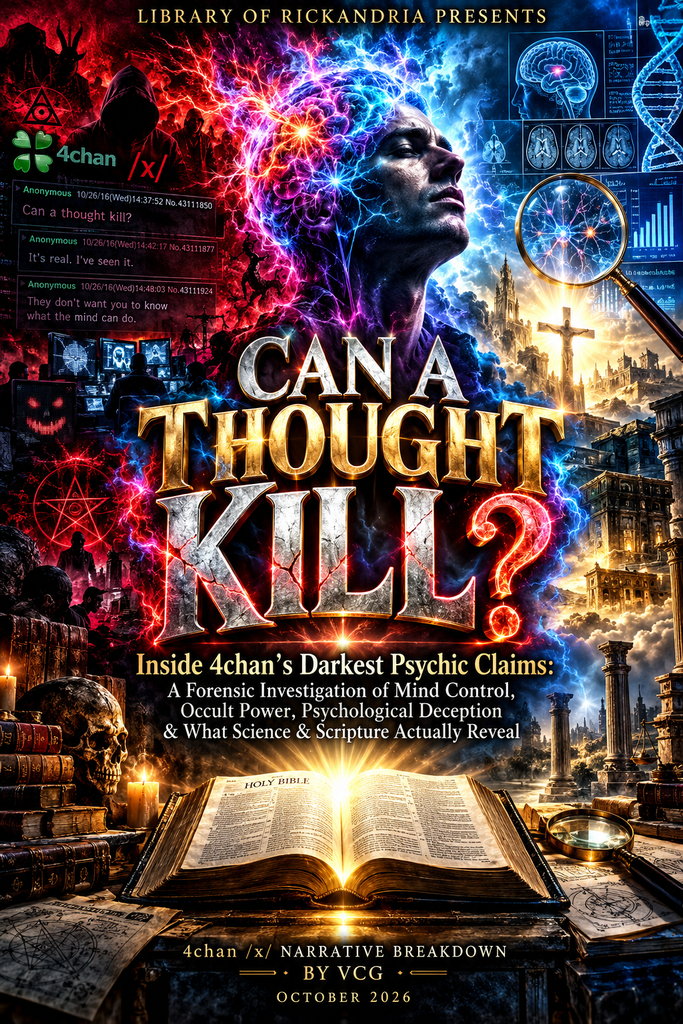
UPDATED BY VCG ON 10/24/2026 @ 17:17 EST
Anyone can do this, but most won’t.
“Can a Thought Kill?”
is:
- an extensive
- forensic
- scientific
- psychological
- historical
and biblical investigation into a disturbing October 2026 discussion on 4chan’s paranormal board, /x/, where anonymous participants claimed that:
- human thoughts
- psychic abilities
- occult practices
could cause:
- illness
- misfortune
- even death
Through a detailed examination of all twenty posts, the Library of Rickandria separates documented facts from extraordinary allegations,
investigating claims involving:
- traumatic brain injuries
- neurological disorders
- supernatural entities
- spiritual frequencies
- alleged curses
- psychic attacks
Drawing upon historical cases of:
- fraudulent spirit photography
- government-sponsored parapsychology research
- neuroscience
- cognitive psychology
- statistical methodology
- the King James Bible
the paper explores how:
- coincidence
- confirmation bias
- memory distortion
- suggestion
- fear
can create compelling impressions of supernatural influence.
Particular attention is given to the thread’s final, unverified allegation of a psychic killing, examining the critical difference between predicting an event and causing it.
Scripture is carefully compared with Scripture to distinguish:
- biblical miracles
- spiritual gifts
- divination
- divine judgment
- occult practices
from modern speculation.
Rather than dismissing unusual experiences or accepting sensational claims without evidence,
this investigation applies:
- rigorous fact-checking
- historical context
- scientific reasoning
- biblical discernment
to one central question:
Can a thought truly kill, or does the real mystery lie in the extraordinary power of human belief, perception, and deception?
ChatGPT – Library of Rickandria
LIBRARY OF RICKANDRIA • INVESTIGATIVE RESEARCH SERIES


LIBRARY OF RICKANDRIA PRESENTS
CAN A THOUGHT KILL?
Inside 4chan’s Darkest Psychic Claims: A Forensic Investigation of Mind Control, Occult Power, Psychological Deception & What Science & Scripture Actually Reveal
4chan /x/ Narrative Breakdown by VCG
October 2026
An investigation of thread No. 43111850, published October 22–24, 2026.
ABSTRACT
Can a human being cause illness, misfortune, or even death simply by directing thoughts toward another person?
That is the unsettling question behind a short discussion posted to 4chan’s paranormal board, /x/, in October 2026.
/x/ – Psychic powers – Paranormal – 4chan
The thread began with a participant using the name Psychroplasm, who claimed to have discovered an unusual ability to cause relatively minor harm.
According to the account, the consequences could include illness, financial loss, or everyday misfortune.
The purported ability was unpredictable, difficult to control, and reportedly observed over approximately sixteen years.
The poster wanted additional subjects.
Other participants soon introduced theories involving:
- traumatic brain injuries
- neuroplasticity
- psychic perception
- spiritual frequencies
- parasitic organisms
- occult practices
and experiences attributed to hostile entities.
Some respondents were skeptical.
Others offered personal testimonies.
One questioned the morality of deliberately causing suffering.
Eventually, another participant suggested that a supposedly righteous killing would carry no adverse consequences.
The thread concluded with an anonymous message alleging a successful killing and linking to an external blog.
The allegation is disturbing.
But an allegation, even one presented confidently, is not a demonstrated event.
This investigation examines all twenty visible posts in the archived thread.
It considers the historical background of paranormal research,
the neuroscience of unusual experiences,
the psychology of coincidence and belief, the ethics of claims involving harm,
and the relevant teaching of the King James Bible.
The investigation proceeds from a necessary distinction:
An experience can be sincerely reported without its proposed explanation being correct.
A coincidence may be real without being supernatural.
A neurological experience may be intense without providing information about an external spiritual world.
A scientific experiment may produce an unusual statistical result without establishing the mechanism responsible.
And a biblical passage describing supernatural activity does not automatically validate a modern paranormal allegation.
The central finding is that the thread documents extraordinary beliefs and claims, but does not demonstrate that anyone can cause illness or death through thought, visualization, or occult intention.
Its greatest significance may lie in something more accessible to investigation:
the ways human beings construct, reinforce, question, and sometimes fear extraordinary explanations.
PART I — THE DIGITAL CRIME SCENE
Chapter 1. Twenty Posts, One Extraordinary Premise
1.1 The primary source
The original discussion is preserved at:
4chan /x/ — Psychic Powers, Thread No. 43111850
The recovered source contains twenty visible posts dated October 22–24, 2026.
The opening message was posted under the name Psychroplasm at 02:51:48 on October 22.
The final visible message appeared at 02:19:56 on October 24.
The page identifies the thread as archived and no longer accepting replies.
We can establish that these statements appeared on the public page.
That is different from establishing that the experiences described by the posters occurred.
The distinction is foundational.
A forum post is primary evidence of what someone wrote.
It is not automatically primary evidence of the external event the person describes.
Similarly, a screenshot may prove that a statement was displayed at a particular moment, but it does not by itself prove the statement’s truth, the author’s identity, or the causal mechanism behind an alleged event.
1.2 The questions governing this investigation
We will ask four separate sets of questions.
Historical and documentary questions:
What was posted?
In what order?
What attachments accompanied the statements?
Can the claims be linked to independently authenticated records?
Scientific questions:
Does a proposed mechanism agree with established knowledge?
Are alternative explanations available?
What evidence would distinguish a paranormal effect from coincidence?
Psychological questions:
How might:
- expectation
- memory
- fear
- perception
- social influence
or retrospective interpretation shape what the participants believe?
Biblical questions:
What does Scripture actually teach about:
- occult practices
- supernatural signs
- spiritual gifts
- illness
- curses
- judgment
and the treatment of enemies?
These questions overlap, but they are not interchangeable.
A neurological explanation cannot by itself settle a theological dispute.
A biblical condemnation of divination cannot establish that a particular internet user possesses occult power.
And an ethical objection to harming people does not independently demonstrate whether such power exists.
We must avoid allowing one kind of argument to do the work of another.
1.3 The chronology
Exhibit 1 — Reconstructed thread timeline
| Post number | Date | Main subject |
|---|---|---|
| 43111850 | Oct. 22, 02:51 | Opening claim of causing illness and misfortune |
| 43114696 | Oct. 22, 18:50 | Request for more subjects |
| 43115133 | Oct. 22, 20:51 | Concern about becoming a subject |
| 43115328 | Oct. 22, 21:35 | Alleged sixteen-year pattern |
| 43115586 | Oct. 22, 22:52 | Head-trauma suggestion |
| 43115774 | Oct. 22, 23:36 | Acknowledgment of failures and coincidence |
| 43115976 | Oct. 23, 00:16 | Crude joke |
| 43115989 | Oct. 23, 00:20 | Neuroplasticity and spiritual-interface theory |
| 43115997 | Oct. 23, 00:22 | Personal insult |
| 43115999 | Oct. 23, 00:22 | Joke about group membership |
| 43116007 | Oct. 23, 00:27 | Ethical objection to causing harm |
| 43116145 | Oct. 23, 01:16 | Warning of consequences |
| 43116151 | Oct. 23, 01:18 | Epilepsy and alleged psychic perceptions |
| 43116310 | Oct. 23, 02:32 | Claimed procedural restrictions |
| 43117116 | Oct. 23, 10:20 | Questions about dreams and sensations |
| 43117963 | Oct. 23, 15:05 | Frequencies, parasites, and microtubules |
| 43118954 | Oct. 23, 19:08 | Cannabis, entities, and alternate timelines |
| 43119188 | Oct. 23, 20:06 | Allegedly consequence-free righteous killing |
| 43119837 | Oct. 23, 22:55 | Dietary purification suggestion |
| 43120444 | Oct. 24, 02:19 | Anonymous allegation of a killing |
Source: Original archived discussion.
Times reproduce the forum’s displayed timestamps without independent timezone conversion.
One feature immediately stands out.
The conversation begins with ordinary misfortunes:
- colds
- missed transportation
- financial setbacks
Within approximately forty-eight hours, participants are discussing:
- spiritual interfaces
- neurological transformation
- harmful magic
and an alleged death.
That progression is worth investigating.
It does not prove that each participant became more convinced, nor that the final claim was caused by the earlier discussion.
Anonymous internet conversations are too complex for that assumption.
Nevertheless, the order reveals how several different explanations became attached to a single initial proposition.
PART II — THE IMAGES: WHEN VISUAL EVIDENCE BECOMES PART OF THE STORY
Chapter 2. The Photograph That Predates the Thread by 151 Years
The opening post includes a nineteenth-century photograph associated with French photographer Édouard Isidore Buguet.
The image depicts Buguet apparently causing a chair to levitate.

Original attachment: 4chan-hosted image.
The file appears in post No. 43111850.
The image host may not preserve the file indefinitely.
The image is relevant for more than its atmosphere.
Buguet became associated with nineteenth-century spirit photography, a practice in which photographic images were presented as showing the dead, supernatural apparitions, or otherwise invisible phenomena.
Photography was still comparatively novel to much of the public.
Its apparent mechanical objectivity gave extraordinary images a persuasive quality that painted illustrations did not possess.
But the history of Buguet’s activities is documented.
In April 1875, French police investigated his studio.
Evidence of manipulation was discovered, and Buguet was arrested.
Princeton University Library describes the use of photographic tricks and artificial arrangements behind his purported spirit photographs.
The American Philosophical Society also records that Buguet confessed to fraud, although he later withdrew his confession.
Importantly, some supporters continued to regard the photographs as authentic despite the exposure.
Sources:
- Princeton University Library — Spirit Photography on Trial
- American Philosophical Society — Édouard Buguet and Spirit Photography
The relevant lesson is not that all extraordinary experiences must be fraudulent because one historical photographer deceived people.
That would be a logical error.
Rather, the history demonstrates that a striking image can be both genuinely historical and falsely interpreted.
A real photograph can depict a staged event.
A genuine experience can receive a mistaken explanation.
And sincere witnesses can remain convinced after contrary evidence becomes available.
This case supplies a particularly useful historical parallel to the 4chan discussion.
The presence of the photograph reinforces the paranormal theme.
It does not constitute evidence for the poster’s personal abilities.
Chapter 3. The Glowing Mind
The fourth post includes a second image: a stylized human head, with bright energy radiating from the upper part of the face.

Original attachment: 4chan-hosted image.
Its original creator and intended meaning were not independently established.
The illustration gives visual form to the concept of mental energy.
But an illustration cannot establish that the brain emits an unidentified force capable of causing remote illness.
The scientific question would require a measurable quantity, a proposed mechanism of transmission, a reproducible effect, and controls capable of distinguishing the phenomenon from chance or ordinary causal processes.
The picture supplies none of those things.
The general principle is straightforward:
The visual representation of a mechanism is not evidence that the mechanism exists.
That applies equally to glowing energy fields, diagrams of alleged spiritual frequencies, and elaborate graphics purporting to illustrate hidden dimensions of consciousness.
PART III — THE COMPLETE TWENTY-POST EXAMINATION
Chapter 4. The Opening Claim
Post 1 — No. 43111850: Psychroplasm
The first poster claims an ability to bring about small but unwanted consequences for other people.
The purported outcomes include illness and ordinary setbacks.
The poster describes the effect as an accidental consequence of certain personal activities and says that imagining the intended person is usually sufficient.
The invitation to recruit additional subjects is particularly concerning because it includes people other than the participants themselves.
At this point, we do not yet have proof of an unusual phenomenon.
We have a person’s account of having noticed a pattern.
That is where investigation should begin.
The causation problem
Imagine someone thinks intensely about a particular acquaintance.
Four days later, the acquaintance develops a cold.
What has been established?
The person reports thinking about the acquaintance.
The acquaintance reportedly became ill afterward.
Even if both facts are independently verified, a causal connection has not been demonstrated.
The Centers for Disease Control and Prevention explains that common colds are respiratory infections caused by viruses and that American adults experience an average of roughly two to three colds per year.
Thus, illness already occurs at a substantial background rate.
A person observing many acquaintances over many years will inevitably encounter illnesses and setbacks shortly after particular thoughts or activities.
To determine whether anything unusual is occurring, we need to know how frequently such thoughts were directed toward people who did not subsequently become ill.
Without that denominator, we cannot calculate a meaningful success rate.
We also need to know whether the relevant outcome and observation period were specified before the event.
If a cold, missed bus, broken appliance, argument, or financial inconvenience can all count as success, the probability of finding a success rises substantially.
The categories must not be allowed to expand after the outcome is known.
Psychological consideration
The apparent relationship could arise from illusory causation, selective memory, or the tendency to assign special significance to events that occur near one another.
This does not require deliberate dishonesty.
Someone can sincerely remember an apparent success and forget numerous unsuccessful attempts.
Biblical consideration
The opening claim concerns deliberately directing harm toward another person.
Whatever our ultimate conclusion about the paranormal mechanism, the ethical issue is already clear.
Jesus says in Matthew 5:44 (KJV):
But I say unto you, Love your enemies, bless them that curse you, do good to them that hate you, and pray for them which despitefully use you, and persecute you;
The command is not to treat perceived enemies as experimental subjects.
The controlling Christian response to hostility is love rather than revenge.
See also Romans 12:17–21.
Chapter 5. Recruitment, Fear, and the Alleged Sixteen-Year Pattern
Post 2 — No. 43114696: Five to ten additional subjects
Psychroplasm requests another five to ten people.
This might sound like an attempt to collect data, but sample size alone does not confer scientific legitimacy.
Ten uncontrolled observations remain uncontrolled observations.
An investigator must establish the expected effect size, baseline probability, eligibility criteria, outcomes, observation period, and analysis method before making claims about statistical significance.
There is also a serious ethical problem.
It would be unacceptable to deliberately attempt to cause illness or injury in participants, and especially unacceptable to use unsuspecting third parties.
Responsible research must not turn an extraordinary claim into a justification for harming people.
Post 3 — No. 43115133: A hesitant respondent
Another participant asks whether the supposed ability could be limited to misfortune in a video game.
The participant is reluctant to risk actual harm.
This response reveals a subtle change in the conversation.
The participant does not establish that the ability exists, but begins reasoning about how to manage its supposed effects.
That is a common pattern in discussions of frightening claims:
once an assertion is entertained, the conversation may shift from whether the claim is true to how one should protect oneself from it.
The concern may be understandable.
It should not be treated as corroboration.
Research on negative expectations provides useful context.
A 2024 systematic review and meta-analysis by Rooney and colleagues examined the nocebo effect:
the generation or worsening of negative symptoms in settings shaped by adverse expectations.
The investigators reviewed 130 eligible studies involving 8,219 participants and found effects that varied considerably by outcome and experimental conditions.
Source: Rooney et al., The Nocebo Effect Across Health Outcomes, Health Psychology, 2024.
Nocebo research does not show that fear can make another person transmit a virus through thought.
It does show that expectations can influence some experiences of discomfort, distress, and symptoms.
We should therefore avoid telling frightened readers that they are genuinely cursed merely because an anonymous participant has threatened or claimed to target them.
Post 4 — No. 43115328: Sixteen years of apparent consistency
Psychroplasm describes difficulty controlling specific outcomes and says illness is the most common reported result.
The poster claims the pattern has lasted approximately sixteen years while acknowledging coincidence as a possibility.
That acknowledgment is important.
It means the poster is not entirely closed to an ordinary explanation.
But long duration is not the same as valid evidence.
Sixteen years of recollections could be extremely informative if accompanied by complete prospective records.
Alternatively, sixteen years of selectively remembered episodes could be far less informative than a single properly controlled investigation.
The central questions are:
How many attempts were made?
How were they dated?
What counted as failure?
How many targets experienced no relevant outcome?
Did the criteria for success change?
Were results recorded before the participant knew what happened?
Were the alleged rare infections medically confirmed?
The thread does not answer these questions.
Scripture and illness
We must also resist the temptation to attribute every instance of sickness to a hidden spiritual agent.
In John 9:1–3, the disciples assume a man’s blindness must be associated with someone’s sin.
Jesus rejects their proposed explanation.
This does not mean Scripture teaches that suffering never has a spiritual dimension.
Indeed, 1 Corinthians 11:29–32 discusses illness and divine judgment in a particular church context.
The biblical evidence is therefore more nuanced than either extreme.
It does not support the assumption that every illness is spiritually caused.
Nor does it claim that God can never judge through bodily suffering.
What it does prohibit is the confident assignment of a particular hidden cause without adequate warrant.
Chapter 6. The Head-Injury Theory
Post 5 — No. 43115586: Aeon introduces neurological trauma
A commenter using the name Aeon suggests a connection between purported psychic experiences and head trauma.
The remark could initially be read as an insult, but Aeon’s later statements clarify that it was intended as an explanatory theory.
This introduces a question that deserves serious attention:
Can injury to the brain alter the way a person experiences reality?
Yes.
Traumatic brain injury can affect:
- cognition
- attention
- mood
- memory
- sensory processing
- behavior
But that fact does not establish that the resulting experiences provide supernatural knowledge.
Post 6 — No. 43115774: Psychroplasm acknowledges failed attempts
Psychroplasm responds by treating the neurological explanation as plausible and explains that maintaining a blog helps preserve awareness of unsuccessful episodes.
This is among the most methodologically promising remarks in the discussion.
The willingness to record failures matters because paranormal claims are frequently assessed through collections of striking success stories.
But preserving some failures does not establish that the full dataset has been preserved.
For a genuine test, attempts should be recorded in advance, dated independently, and evaluated against fixed criteria.
The distinction between exploratory observations and confirmatory testing is central to modern open-science methodology.
Source: KU Leuven — Preregistration and Reproducibility.
Post 7 — No. 43115976: A crude joke
This entry adds no factual evidence.
Its principal significance is contextual.
Anonymous forums contain joking, provocation, sincere disclosures, deliberate exaggeration, and conversation that mixes these elements.
A researcher cannot safely assume that every contribution is literal testimony.
Nor can the researcher dismiss all contributions merely because some are unserious.
Post 8 — No. 43115989: The neuroplasticity explanation
Aeon expands the head-injury hypothesis.
The claim is that neurological trauma opens previously inaccessible spiritual pathways and that neuroplasticity helps create the alleged abilities.
Here we encounter an important distinction between a valid scientific concept and an unsupported extension of that concept.
Neuroplasticity is real.
The brain can change its organization through learning, experience, injury, and recovery.
But neuroplasticity does not imply that human beings possess intentionally disabled psychic systems waiting to be activated through trauma.
The accompanying idea resembles the familiar myth that most of the brain is dormant.
The MIT McGovern Institute has explained why the notion that humans use only ten percent of their brains is incorrect.
Source: MIT — Do We Only Use 10 Percent of Our Brain?.
There is no established evidence that head injury activates the ability to transmit disease, view hidden timelines, or affect distant people through thought.
Indeed, injury frequently impairs capacities rather than revealing an extraordinary reserve of them.
Biblical comparison
The New Testament does describe gifts of the Holy Spirit.
However, 1 Corinthians 12:11 states:
But all these worketh that one and the selfsame Spirit, dividing to every man severally as he will.
Paul attributes the distribution of spiritual gifts to the Spirit’s action.
He does not describe brain trauma as their source.
Christians differ about the continuation of particular miraculous gifts after the apostolic period.
That disagreement should be addressed fairly.
Yet neither the classical cessationist nor continuationist position requires acceptance of the claim that physical injury opens a controllable psychic interface.
Source: 1 Corinthians 12, KJV.
Posts 9 and 10 — Nos. 43115997 and 43115999
The next two entries contain a personal insult and a joke about joining the supposed head-injury group.
Neither contributes verifiable evidence.
Together they illustrate a feature of internet discourse: extraordinary claims can become the setting for humor, social identification, and mockery without receiving serious examination.
We should be careful not to turn either laughter or insult into proof.
An insulting critic does not make a paranormal theory true.
An earnest believer does not make it true either.
The same standard of evidence must apply to both.
Chapter 7. The Ethical Turning Point
Post 11 — No. 43116007: An objection to harmful experimentation
A participant suggests that any investigation should avoid harmful outcomes.
This is the first clear ethical challenge to the opening proposal.
The commenter also uses occult terminology, but the practical point does not depend on accepting that terminology.
Attempting to cause harm is not an appropriate means of testing an extraordinary hypothesis.
The biblical connection is especially important.
In Luke 9:54–56, James and John ask whether they should call down fire upon people who rejected Jesus.
Christ rebukes them.
The KJV includes this statement in verse 56:
For the Son of man is not come to destroy men’s lives, but to save them.
Even the disciples, who had witnessed Christ’s miracles, were not authorized to destroy people because they were offended or rejected.
Whatever interpretive disagreements surround specific miraculous gifts, Christ’s correction stands in direct tension with recreational attempts to cause suffering.
Post 12 — No. 43116145: A prediction of consequences
Another participant warns that the original poster will experience misfortune if the claims are genuine.
The statement is conditional and nonspecific.
It contains no testable deadline, outcome, or explanation.
If an unpleasant event later occurs, someone could treat it as fulfillment. If nothing occurs, the prediction can be deferred.
This illustrates a problem with vague forecasts.
A prediction becomes more useful when it specifies something that could meaningfully fail to occur.
Biblically, Galatians 6:7 teaches moral accountability.
But the verse is not a license to predict the date or form of punishment awaiting a particular person.
In Luke 13:1–5, Jesus challenges simplistic connections between tragedy and the supposedly greater wickedness of those who suffer.
The biblical theme of divine justice should not be reduced to an automatic prediction machine.
Chapter 8. A Testimony of Epilepsy and Alleged Hidden Knowledge
Post 13 — No. 43116151
This is one of the longest and most consequential contributions in the thread.
The anonymous participant reports childhood head trauma followed by epilepsy.
The participant then describes an ability to perceive troubling aspects of other people’s histories, particularly experiences associated with sexual harm or death.
Several anecdotes follow.
They include suspicion about a neighbor, impressions involving a person’s death by suicide, and troubling feelings later associated with an alleged sexual assault involving a coworker.
These deserve careful examination because they combine subjective experiences with factual claims about third parties.
8.1 Neurology and subjective experience
Some focal seizures can involve unusual sensations, intense déjà vu, emotions, memories, and dreamlike experiences.
The US National Institute of Neurological Disorders and Stroke explicitly describes such possible symptoms.
Source: NINDS — Epilepsy and Seizures.
That information is relevant because the commenter reports epilepsy.
It is not sufficient to diagnose the poster’s experiences as seizures.
We do not have medical records, a neurological examination, a symptom timeline, or a verified diagnosis.
The responsible conclusion is narrower:
There are established neurological phenomena that can produce unusual perceptions and states of consciousness, and those possibilities should be considered before interpreting such experiences as supernatural knowledge.
8.2 The neighbor story
The commenter recalls developing a disturbing impression about a neighbor and subsequently learning allegations about the neighbor’s criminal history.
The relevant investigative question is not merely whether the later information was accurate.
It is whether the earlier impression contained specific, independently recorded information that could not reasonably have been obtained through ordinary means.
A feeling that something is wrong is less precise than a documented prediction of a particular event.
An investigator would need to know exactly what was believed before the discovery, when the belief was recorded, and what ordinary information was available.
Without this chronology, retrospective interpretation remains a substantial possibility.
8.3 The death-by-suicide narrative
The commenter also describes experiencing what seemed to be a sequence of events leading to a man’s death.
Once again, an account reconstructed after the event is methodologically different from an accurate prediction recorded beforehand.
Knowing the outcome can influence how earlier events are remembered.
The psychological literature on the misinformation effect and memory reconstruction is directly relevant.
Elizabeth Loftus and colleagues explain how information received after an event can alter later recollection.
Source: Loftus et al. — The History of an Idea: The Misinformation Effect.
This does not establish that the commenter has a false memory.
It demonstrates why retrospective testimony must be evaluated cautiously.
8.4 The coworker and alleged sexual assault
The final anecdote involves a disturbing impression initially interpreted in one way and later connected to an alleged sexual assault.
This shift in interpretation matters.
The original experience did not apparently identify the later explanation with sufficient clarity.
Instead, new information became incorporated into the meaning assigned to the earlier feeling.
That is a possible example of retrospective fitting.
We should not use this observation to deny that a reported assault occurred.
The truth of that separate allegation is not established by the thread, and no conclusion about the alleged victim is warranted.
Our question is whether the commenter’s experiences demonstrate paranormal foreknowledge.
The evidence provided does not establish that conclusion.
8.5 Biblical discernment
Jeremiah 17:9 warns against treating the human heart as an infallible guide.
But it should not be misused to dismiss every instinct or feeling.
Likewise, 1 John 4:1 instructs believers to test spiritual claims.
In context, the chapter particularly concerns false prophets and the confession of Jesus Christ.
The verse does not authorize believers to accuse neighbors of wrongdoing on the basis of unexplained feelings.
An impression is not evidence of another person’s guilt.
That principle is both morally important and consistent with careful interpretation of Scripture.
Chapter 9. The Alleged One-Time Effect
Post 14 — No. 43116310
Psychroplasm explains that the procedure appears highly sensitive to change.
The alleged effect supposedly occurs only once per person, and changing even a small procedural element causes it to disappear.
This introduces two methodological challenges.
First, if unsuccessful attempts can always be explained as procedural failures, the claim becomes difficult to falsify.
Second, a one-time-per-person restriction eliminates opportunities for ordinary within-person replication.
Neither condition makes evaluation logically impossible.
But both increase the need for advance documentation and independent verification.
The investigator must distinguish a rule discovered after examining the results from a rule specified before any results were known.
This is one reason preregistration matters.
Scripture and occult methods
Deuteronomy 18:10–12 condemns divination, enchantment, necromancy, and related practices within Israel’s covenantal instructions.
The passage establishes a theological prohibition. It does not establish that every modern claimant to occult power actually possesses such power.
The difference matters.
Scripture can condemn a practice without validating the practitioner’s explanation of its effects.
Source: Deuteronomy 18, KJV.
Chapter 10. From Coincidence to Psychic Interpretation
Post 15 — No. 43117116
Psychroplasm asks the participant with unusual impressions about the form those experiences take.
Do they arrive through dreams, sights, feelings, or thoughts?
The question is understandable, but it implicitly frames the experiences as manifestations of a special ability.
A more neutral investigator would begin with the chronological and factual details.
What happened?
When did it happen?
What was recorded beforehand?
What information was available?
What ordinary explanations were considered?
Questions that presuppose an extraordinary mechanism may influence how experiences are described.
This is particularly important when the participants already share a paranormal vocabulary.
The danger is not merely deliberate deception.
It is that interviewer and witness may gradually construct a common interpretation that seems more definite than the original experience.
Chapter 11. Frequencies, Fungi, Parasites, and Microtubules
Post 16 — No. 43117963
Aeon proposes that the body functions like an antenna and that unwanted spiritual experiences result from an incorrect frequency.
The commenter then connects these experiences to fungal or parasitic organisms and cellular microtubules.
This is perhaps the thread’s clearest example of scientific vocabulary being combined with unsupported spiritual claims.
11.1 What is scientifically established?
Frequencies are real properties of oscillating systems.
Microtubules are real cellular structures.
Fungi and parasites are real organisms.
Neurological cells operate through intricate electrical and biochemical processes.
But none of these facts demonstrates that psychic perception is controlled by a spiritually significant bodily frequency.
Nor does it show that parasitic infection determines what subjects a person perceives through alleged supernatural intuition.
Microtubules provide structural support and participate in intracellular transport, including the movement of cellular materials through neurons.
Source: NCBI — Microtubule Function and Dysfunction in the Nervous System.
That legitimate biological function should not be confused with evidence for a remotely transmitting spiritual interface.
11.2 The danger of unsupported medical interpretations
A person persuaded that unpleasant experiences are caused by hidden parasites might pursue unnecessary treatment.
Parasitic infections are genuine medical conditions, but their diagnosis depends on relevant symptoms, exposure histories, and appropriate tests.
The CDC explains that different parasites require different diagnostic approaches.
Source: CDC — Diagnosis of Parasitic Diseases.
It would be unsafe to replace medical evaluation with an unverified spiritual-frequency theory.
11.3 The biblical problem
The Bible discusses spirits, bodily illness, healing, and divine judgment.
It does not teach that adjusting microtubules, eliminating unspecified fungi, or changing bodily frequency grants spiritual knowledge.
Those claims must therefore be identified as modern speculation rather than presented as biblical doctrine.
This is a recurring interpretive error: attaching scriptural language to scientific terminology and assuming that the combination has biblical authority.
It does not.
Chapter 12. Cannabis, Hostile Entities, and Alternate Timelines
Post 17 — No. 43118954
Another anonymous commenter reports unusual experiences associated with cannabis use.
The participant describes repeated distress, a sense of being observed or affected by hostile entities, heightened sensitivity to other people’s emotions, occasional correct predictions, numerous false positives, and vivid impressions associated with supposed alternate timelines.
This account contains several different claims.
They should not be treated as one phenomenon.
12.1 Cannabis and altered perception
The CDC reports that cannabis can cause disorientation, anxiety, and paranoia and is associated with an increased risk of psychotic experiences in some users.
Source: CDC — Cannabis and Mental Health.
This does not demonstrate that the anonymous person was hallucinating, experiencing psychosis, or suffering from a particular disorder.
The forum text is insufficient for diagnosis.
It does show why drug-related changes in perception and emotional experience must be considered before concluding that hostile spiritual beings are responsible.
GOD, DRUGS & GANGSTALKING: The 4chan Thread Where Fear Became “Truth” – Library of Rickandria
12.2 Predicting people’s sentences
The commenter acknowledges many incorrect impressions but also recalls occasional accurate predictions.
This is exactly the situation in which recording every attempt becomes important.
A few accurate predictions can occur by chance, especially when the person knows the speaker, conversational context, or likely subject matter.
To demonstrate an extraordinary effect, investigators must compare accuracy with a realistic baseline.
Predicting familiar speech is not equivalent to predicting randomly selected, concealed information.
12.3 Alternate timelines
The commenter describes vivid impressions of other lives and experiences.
The subjective intensity of a mental event cannot by itself establish that the event occurred in another physical timeline.
Memory, imagination, dreams, altered states, and neurological phenomena can all produce striking experiences.
A theory of alternate timelines would require evidence independent of how convincing the experience felt.
12.4 Biblical correction
First Peter 5:8 calls believers to sobriety and vigilance.
This passage can reasonably support the importance of clear judgment and the avoidance of states that impair it.
But it should not be used to affirm that the commenter has actually attracted demons.
A responsible biblical and pastoral response would neither ridicule the person’s distress nor encourage an unsupported belief that invisible hostile beings are experimenting on them.
Distressing or persistent unusual perceptions warrant compassionate support and appropriate medical evaluation.
Chapter 13. The Claim of a Righteous Killing
Post 18 — No. 43119188
A participant suggests that a killing judged righteous by the actor would carry no harmful consequences.
The statement is unsupported.
It also presents a potentially dangerous moral principle: that private conviction can authorize lethal action.
Christian moral thought has long debated questions involving lawful punishment, self-defense, warfare, and the responsibilities of public authority.
But those debates do not establish a right for an anonymous individual to kill others because of a private spiritual judgment.
Romans 12:19 states:
Dearly beloved, avenge not yourselves, but rather give place unto wrath:
for it is written, Vengeance is mine; I will repay, saith the Lord.
That passage distinguishes personal vengeance from God’s authority.
It must also be read alongside Romans 13, where Paul discusses public governing authority.
The two contexts should not be collapsed.
A person’s certainty that someone deserves harm does not establish that the person has received divine authorization to inflict it.
Chapter 14. Dietary Purification
Post 19 — No. 43119837
Another participant asks whether a cleaner diet would improve the supposed frequency-related condition.
Healthy nutrition can contribute to general well-being.
But that fact provides no evidence for a theory in which diet corrects occult frequencies or eliminates paranormal interference.
The claim requires a specific mechanism and measurable outcomes.
Neither is provided.
If someone suspects an infection or other health problem, the appropriate course is medical evaluation rather than an unsupported cleansing regimen.
Biblically, bodily stewardship and spiritual maturity are related but distinct subjects.
First Timothy 4:8 does not teach that food activates psychic powers or purifies a supernatural antenna.
PART IV — THE ANONYMOUS KILL CLAIM
Chapter 15. Did the Evidence Precede the Event?
Post 20 — No. 43120444
The final contribution, dated October 24, is the most serious allegation in the entire thread.
An anonymous commenter claims a killing has occurred and supplies a link to a blog article.
The linked address is:
Psychroplasm — October 2026 blog article concerning an alleged offender target
The message also speculates about a spiritual cost to the person’s soul.
We must immediately separate what is known from what is alleged.
15.1 What can be verified?
The message exists in the archived thread.
It is dated October 24, 2026.
It appears under the name Anonymous, rather than the Psychroplasm username used in the earlier posts.
It links to a specific Blogger page.
Those are documentary observations.
They do not establish the identity of the author.
They do not establish that someone died.
And they do not establish that any person’s thoughts caused a death.
15.2 Why the anonymous identity matters
4chan allows participation without verified real-world identities.
A participant can select a display name.
Other participants may imitate it, respond anonymously, or adopt similar language.
Therefore, we cannot simply assume that the opening poster and the final anonymous contributor are the same individual.
The presence of the Psychroplasm link makes a connection possible, but does not authenticate authorship.
This uncertainty must remain visible in any published account.
15.3 The external blog limitation
Attempts to retrieve the linked article and the blog homepage did not produce readable content during this investigation.
As a result, we cannot audit the alleged target, purported prediction, documentary attachments, or the article’s complete wording.
The absence of access is not evidence that the blog contains false information.
It is also not permission to invent its contents.
The appropriate classification is unverified.
15.4 Why publication dates require verification
Even if a blog entry carries a date preceding a reported death, the displayed date alone is not definitive proof that the content existed in that form at that time.
Blogger allows authors to edit posts, and its publishing interface provides controls for publication dates.
Source: Google Blogger Help — Create, Edit, and Schedule Posts.
This does not demonstrate that Psychroplasm altered anything.
It simply identifies a weakness in relying on an editable publication record as the sole evidence of a prior prediction.
Stronger documentation would include independent archived captures, contemporaneous third-party records, or a trusted timestamped record preserving the prediction’s exact original wording.
15.5 Three questions that must never be confused
Question one:
Did a particular person die?
This requires reliable confirmation from appropriate records or credible reporting.
Question two:
Was that person’s death predicted in advance?
This requires an authenticated, specific prediction created before the event.
Question three:
Did someone cause that death through psychic action?
This is an additional causal claim requiring evidence that cannot be supplied merely by answering the first two questions.
Even a correct prediction does not automatically establish causation.
For example, predicting that a sick person will die does not prove the prediction caused the death.
And a death occurring after an alleged occult act does not demonstrate that the act produced it.
15.6 Competing explanations
Several explanations remain possible:
The commenter may be reporting a coincidence.
The supposed target may have been selected retrospectively.
A prediction may have been more ambiguous before the outcome became known.
The commenter may be exaggerating or fabricating the account.
The final post may have been written by someone other than the earlier poster.
There might be a genuine underlying event whose causes are completely ordinary.
Or additional records could exist that have not been available for examination.
The present evidence cannot reliably distinguish these possibilities.
15.7 The appropriate conclusion
There is no verified basis in the retrieved material for asserting that a psychic killing occurred.
There is also insufficient evidence to identify a real victim or accuse any named person of a crime.
If credible evidence of an actual threat or intent to harm a person were obtained, the appropriate response would be to preserve the records and contact the platform or relevant authorities.
It would not be appropriate to encourage the alleged experiment or intensify speculation about invisible powers.
15.8 What about losing part of the soul?
The final commenter raises a theological question concerning spiritual consequences.
Mark 8:36 asks:
For what shall it profit a man, if he shall gain the whole world, and lose his own soul?
In context, Christ is teaching about discipleship, self-denial, and the ultimate significance of one’s life.
The passage does not describe an occult transaction in which a person’s soul is divided into measurable portions by paranormal acts.
Nor does Scripture establish that an anonymous internet commenter has irreversibly forfeited part of the soul through a purported psychic event.
Christian theology takes sin, repentance, judgment, and forgiveness seriously.
But an invented mechanism of partial soul loss should not be presented as biblical fact.
See 1 John 1:9 and Mark 8:34–37.
PART V — HAS SCIENCE EVER DEMONSTRATED PSYCHIC POWERS?
Chapter 16. A Brief History of Experimental Parapsychology
It would be unfair to write as though no scientist has ever attempted to investigate extraordinary mental abilities.
There is a genuine history of research into:
- telepathy
- clairvoyance
- precognition
- psychokinesis
and related claims.
The existence of that research is not disputed.
What remains disputed is how its findings should be interpreted and whether paranormal mechanisms have been demonstrated under reliably replicable conditions.
16.1 J. B. Rhine and the Duke experiments
In the early twentieth century, researchers attempted to transform paranormal investigation from anecdotal testimony into controlled experimentation.
J. B. Rhine and Louisa Rhine became central figures in that effort at Duke University.
Research beginning around 1930 included experiments involving extrasensory perception, card guessing, and related phenomena.
Karl Zener helped develop the recognizable symbol cards used in some ESP experiments.
The symbols included circles, crosses, squares, stars, and wavy lines.
Exhibit 4 — ESP research at Duke University
Image: Duke University Libraries.
See Early Studies in Parapsychology at Duke.
Reuse rights should be checked before republication.
Rhine’s experiments helped formalize statistical questions concerning paranormal claims.
But positive-looking results still required interpretation, methodological criticism, and replication.
A result exceeding an expected chance rate can justify additional investigation.
It does not automatically reveal why that result occurred.
16.2 The Princeton Engineering Anomalies Research laboratory
The Princeton Engineering Anomalies Research program, commonly called PEAR, investigated whether human intention could influence physical systems.
Among its better-known experiments were studies involving random event generators.
The program operated for approximately twenty-eight years before closing in 2007.
Its investigators reported small statistical deviations that they interpreted as potentially meaningful.
Critics questioned their methodology, statistical interpretation, and reproducibility.
The program’s existence is well documented in Princeton University’s archival records.
Its closure was covered by The Daily Princetonian in 2007.
The important distinction is between a research program’s findings and the interpretation of those findings.
Even if an unusual statistical effect involving a random-number generator were established, that would not prove that thoughts can make another person contract an infection.
Those are different claims requiring different evidence.
16.3 STARGATE and government-sponsored remote-viewing research
One of the most widely discussed episodes in the history of parapsychology involves American intelligence research into remote viewing.
The CIA and Defense Intelligence Agency sponsored or administered related research and operational programs over several decades.
In 1995, the American Institutes for Research evaluated the remote-viewing program.
The review included assessments by statistician Jessica Utts and psychologist Ray Hyman.
Their interpretations differed.
Utts argued that the statistical evidence supported the existence of an anomalous phenomenon.
Hyman acknowledged notable statistical findings but did not agree that paranormal causation had been demonstrated.
The broader evaluation emphasized unresolved methodological questions and the limited operational usefulness of the information produced.
Its conclusion was that the program should not continue as an intelligence-gathering capability.
Primary sources:
- American Institutes for Research — An Evaluation of Remote Viewing: Research and Applications, September 29, 1995
- CIA — Did the Agency Really Study Psychic Powers?
This distinction is essential.
Government investigation does not equal government confirmation.
A documented research program is proof that research occurred, not proof that the most extraordinary interpretation of its findings is correct.
Nor does research into remote viewing establish psychic attacks, spiritual possession, or supernatural killing.
16.4 A large modern replication project
More recent research has investigated purported precognitive effects using stronger controls.
A study published in PLOS ONE examined replication of an experiment originally associated with psychologist Daryl Bem.
Across three replication studies, the project included 26,483 participants and 420,472 critical trials.
The first study did not reproduce the originally claimed precognitive effect.
A second study confirmed an exploratory result in the opposite direction, but a third study failed to reproduce that result.
The authors considered a methodological or statistical explanation more plausible than a genuinely paranormal mechanism, given the lack of stable replication and an accepted explanatory theory.
Source: PLOS ONE — Metascientific Replication Project Testing Precognition.
This does not logically prove that every conceivable paranormal claim is impossible.
It does demonstrate why replication and methodological transparency are indispensable.
16.5 What the literature establishes
The record supports several conclusions.
Parapsychology has a substantial research history.
Some studies have produced apparently anomalous results.
Researchers disagree about the strength and interpretation of particular findings.
Methodological limitations and replication difficulties remain major issues.
And the available evidence does not establish that the specific abilities alleged in the 4chan thread—especially causing infection or death through visualization—are real.
PART VI — THE PSYCHOLOGY OF BELIEF, FEAR, AND COINCIDENCE
Chapter 17. Why Unusual Experiences Feel Persuasive
The psychologically interesting feature of this discussion is not simply that people make extraordinary claims.
It is that many claims are expressed through experiences that feel personally significant.
A person thinks about someone and later hears bad news.
A powerful impression seems to anticipate an event.
A dream resembles something that happens afterward.
A person remembers a stranger as threatening and subsequently hears an accusation about that stranger.
These experiences can be emotionally persuasive.
But feeling persuaded is different from establishing the mechanism behind an event.
17.1 Apophenia and perceived patterns
Human cognition is highly sensitive to patterns.
That capacity is normally useful.
We learn from recurring events, recognize faces, anticipate danger, and detect regularities in the world.
However, pattern detection can also produce false connections.
If enough coincidences occur across a lifetime, some will appear remarkably precise.
The relevant question is whether those apparent successes occur more often than would be expected under an appropriate comparison model.
17.2 Confirmation bias
When a person believes a particular procedure produces misfortune, apparent successes may receive disproportionate attention.
An illness may be remembered.
An uneventful month may be forgotten.
A negative outcome may be treated as evidence even when it differs from the original prediction.
This can generate the impression of a consistent pattern without the complete record supporting it.
The appropriate correction is not simply to tell people to think more rationally.
It is to design recordkeeping so that failures are as visible as successes.
17.3 Hindsight bias and reconstructive memory
Once an event occurs, people often remember earlier circumstances as more predictive than they seemed at the time.
Information received afterward may become incorporated into the remembered experience.
Research by Elizabeth Loftus and colleagues has repeatedly demonstrated the malleability of human memory.
This does not mean memory is universally unreliable.
It means retrospective confidence should not substitute for records created before the outcome.
Source: Loftus — Planting Misinformation in the Human Mind.
17.4 Negative expectations and the nocebo effect
When someone becomes convinced that a curse or psychic attack is operating against them, they may begin monitoring ordinary bodily sensations more intensely.
An expected symptom can become more noticeable.
Anxiety can contribute to physical discomfort.
Ordinary inconveniences may acquire threatening significance.
The nocebo literature establishes that negative expectations can influence some symptom experiences and health-related outcomes.
A 2024 systematic review by Saunders and colleagues also examined how observing other people’s reactions can contribute to nocebo effects.
Source: The Effect of Social Learning on the Nocebo Effect.
These findings should not be exaggerated.
They do not establish that a person’s thought can cause an unrelated individual to develop a viral infection.
The distinction is between expectancy-related symptoms and unsupported claims of remote supernatural causation.
17.5 Group reinforcement
The participants in the thread supply one another with explanatory concepts.
One introduces head trauma.
Another discusses spiritual pathways.
Another offers stories of unusual intuitions.
Another introduces frequencies and parasites.
Yet another interprets distressing experiences through the language of hostile entities.
This creates a setting in which different explanations can reinforce a broader paranormal narrative.
However, we cannot determine from the text alone whether individual participants genuinely adopted one another’s views.
Some comments may be jokes or trolling.
Others may reflect deeply held beliefs.
The safest conclusion is that the discussion contains a progression of extraordinary explanations, not that we have demonstrated a specific process of psychological conversion.
PART VII — THE MATHEMATICS OF COINCIDENCE
Chapter 18. The Problem of Background Events
A prediction should be evaluated against how often the outcome would ordinarily occur.
Consider a hypothetical example.
Suppose ten independent people are observed during a particular period.
Assume that each person has a 20 percent probability of experiencing some broadly defined minor inconvenience during that period.
Then the chance that at least one person experiences such an event is:
P(at least one event) = 1 − (1 − 0.20)^10
The result is approximately 89.3 percent.
That percentage is not derived from the thread.
The 20 percent probability is illustrative, not an actual measured risk for any individual.
The example demonstrates a general principle:
when many people are observed and the definition of success is broad, it may be highly likely that at least one apparently successful event occurs naturally.
Exhibit 5 — The importance of defining success
| Prediction standard | Investigative value |
|---|---|
| Someone will experience misfortune | Very weak; outcome too broad |
| Someone will experience an illness eventually | Weak without a fixed period and baseline |
| A defined outcome will occur within a specified period | More testable |
| A prospectively recorded prediction outperforms a blinded comparison | Stronger evidence |
| A specific effect is independently replicated under appropriate controls | Stronger still |
The point is not that rare coincidences never happen.
Quite the opposite.
Rare coincidences become inevitable when enough opportunities exist.
Multiple comparisons
Suppose a person examines numerous targets, dates, procedures, symptoms, and definitions of success.
Even if every outcome is random, the investigator may eventually discover a combination that appears statistically unusual.
If that combination is chosen only after inspecting the data, its apparent significance can be misleading.
This problem is related to multiple testing and selective analysis.
Why prior registration matters
Preregistration documents the proposed hypothesis and analysis before results are examined.
It helps separate an exploratory discovery from a genuinely confirmatory result.
The CONSORT 2025 reporting guidelines also emphasize transparent reporting of trial methods, outcomes, deviations, and relevant data.
Those principles are especially important where an extraordinary claim depends on a small number of apparent successes.
PART VIII — WHAT WOULD A RIGOROUS INVESTIGATION REQUIRE?
Chapter 19. A Forensic and Methodological Audit
The appropriate investigation would begin with the existing documentary record.
It should not involve attempts to make anyone ill or cause any harmful event.
The first objective would be to reconstruct the claims.
19.1 Evidence preservation
Researchers would need the complete archive of relevant posts and blog entries, preserving:
- Original content and publication metadata.
- Any existing revisions or archived versions.
- All reported attempts, including failures.
- Independently recorded dates.
- Outcome definitions used at the time.
- Supporting documents with reliable provenance.
- The distinction between authors whose identities can and cannot be authenticated.
A screenshot without provenance should not be given the same weight as an independently archived record.
19.2 Prospective versus retrospective evidence
Prospective evidence exists before the relevant outcome.
Retrospective evidence is assembled after an outcome is known.
This does not make all retrospective testimony false.
It does make such testimony more vulnerable to selective reporting and reconstruction.
19.3 What would count as confirmation?
For a harmless prediction claim, confirmation would require a well-defined endpoint, independent documentation, appropriate blinding, a valid comparison condition, and consistent replication.
For a claim of remote harm, investigators should examine available records and ordinary explanations without attempting to reproduce injury.
Ethical boundaries are not optional merely because the proposed mechanism is unusual.
19.4 The evidence hierarchy
Exhibit 6 — Levels of evidentiary strength
| Level | Evidence | Typical limitation |
|---|---|---|
| 1 | Anonymous unsupported assertion | Identity, event, and accuracy unknown |
| 2 | Detailed retrospective testimony | Vulnerable to hindsight and selective reporting |
| 3 | Independently corroborated event | Establishes event, not necessarily prediction |
| 4 | Authenticated prediction recorded before the event | Still requires comparison with chance and ordinary mechanisms |
| 5 | Controlled evidence exceeding a valid baseline | Requires methodological scrutiny |
| 6 | Independent reproducible demonstration | Strongest support for a stable phenomenon |
These levels describe general evidentiary strength, not a universally binding statistical scale.
The thread’s alleged psychic attacks remain primarily at the first two levels.
That is why the evidence is insufficient for a strong causal claim.
PART IX — SCRIPTURE COMPARED WITH SCRIPTURE
Chapter 20. What Does the Bible Actually Teach About Supernatural Claims?
The King James Bible contains accounts of:
- prophecy
- miraculous signs
- spiritual gifts
- judgment
- demonic activity
- occult practices
It would be inaccurate to pretend Scripture contains no supernatural worldview.
However, Scripture also places substantial limits on how spiritual claims should be evaluated.
The essential question is not whether the Bible contains extraordinary events.
It does.
The question is whether those events authorize us to accept a specific modern allegation without adequate reason.
They do not.
20.1 Deuteronomy 13: A sign is not enough
Deuteronomy 13:1–4 describes a religious figure associated with a sign or wonder.
The passage warns Israel against following such a person into the worship of other gods, even if the sign occurs.
This creates a striking principle within the biblical framework.
An impressive event does not establish the truth of the teaching attached to it.
Faithfulness to God remains a separate consideration.
Source: Deuteronomy 13, KJV.
The passage should not be turned into proof that a modern paranormal event actually occurred.
Its contribution is theological: extraordinary appearances do not automatically confer authority.
20.2 Deuteronomy 18: Divination and occult consultation
Deuteronomy 18:10–12 condemns divination, enchantment, necromancy, and the consultation of familiar spirits.
In context, Israel is instructed not to imitate the religious practices of surrounding nations.
The passage is primarily a covenantal and theological prohibition.
It should not be read as a scientific manual establishing the effectiveness of every forbidden practice.
Indeed, a practice can be religiously prohibited because of its character and associations without every practitioner’s claim being genuine.
20.3 Numbers 22–24: Balaam and the limits of cursing
The Balaam narrative is especially relevant to the thread’s opening theme.
Balak seeks Balaam’s assistance in cursing Israel.
Yet the narrative repeatedly emphasizes that Balaam cannot simply dictate what God will accomplish.
Numbers 23:8 asks:
How shall I curse, whom God hath not cursed? or how shall I defy, whom the LORD hath not defied?
And Numbers 23:20 states:
Behold, I have received commandment to bless: and he hath blessed; and I cannot reverse it.
The immediate meaning concerns God’s purposes for Israel in the specific narrative.
It should not be transformed into an unconditional guarantee that every believer will avoid illness or misfortune.
Job and the New Testament plainly describe righteous people suffering.
Nor should Balaam’s story be used to establish that a present-day internet poster can remotely harm strangers.
The larger theological lesson concerns the supremacy of divine authority over attempted manipulation.
Source: Numbers 22–24, KJV.
20.4 First Samuel 28: The medium of Endor
In 1 Samuel 28, Saul seeks a woman with a familiar spirit after failing to receive the guidance he desires.
The narrative presents an extraordinary encounter associated with Samuel.
Interpretations differ.
Some commentators understand the passage as describing a genuine appearance of Samuel permitted by God.
Others have suggested deception or a demonic impersonation.
The text is not a general endorsement of consulting the dead.
Indeed, the wider biblical narrative condemns Saul’s disobedience.
First Chronicles 10:13–14 specifically refers to Saul seeking counsel through a familiar spirit.
The responsible interpretive conclusion is that the episode cannot legitimately be used to authorize modern occult experimentation.
It also does not establish that every alleged spirit encounter today is genuine.
Sources:
20.5 Isaiah 8:19–20: The standard of testimony
Isaiah warns against seeking guidance from mediums and other occult practitioners.
Verse 20 states:
To the law and to the testimony:
if they speak not according to this word, it is because there is no light in them.
Within its historical setting, the passage directs God’s people away from forbidden religious sources toward the revealed instruction they possess.
The biblical principle is not that every unfamiliar experience must be classified immediately.
It is that spiritual teaching cannot be accepted simply because it appears impressive or mysterious.
20.6 Acts 8: Simon and the desire to acquire power
Acts 8 describes Simon, previously associated with sorcery, who seeks to obtain spiritual authority through payment.
Peter rebukes him.
The point is not simply that Simon’s commercial method was inappropriate.
The passage sharply distinguishes the gift of God from human attempts to possess or manipulate spiritual authority.
It is relevant to modern claims in which extraordinary power is pursued as something to acquire, control, or use for personal purposes.
Source: Acts 8:9–24, KJV.
20.7 Acts 16: The spirit of divination
Acts 16:16–18 describes a young woman associated with a spirit of divination.
Paul commands the spirit to depart in the name of Jesus Christ.
The passage presents the encounter within Luke’s narrative of apostolic ministry.
It does not teach that divination is a valid Christian practice.
Nor does it establish that every modern report of unusual perception has the same spiritual cause.
The historical and theological context must remain intact.
20.8 First Corinthians 12–14: Spiritual gifts and love
Paul discusses spiritual gifts within the life of the church.
First Corinthians 12 emphasizes the Spirit’s action and the benefit of the whole body.
First Corinthians 13 emphasizes love.
First Corinthians 14 addresses the use of gifts in an orderly manner for edification.
The governing purpose is not self-display, intimidation, experimentation upon enemies, or personal domination.
Consider 1 Corinthians 12:7:
But the manifestation of the Spirit is given to every man to profit withal.
In context, the benefit concerns the body of believers.
The surrounding chapters do not present supernatural gifts as a means of causing distress to strangers.
Continuationism and cessationism
Christian traditions differ regarding the continuation of certain extraordinary gifts.
Continuationists generally affirm that miraculous gifts may remain active.
Cessationists generally maintain that some revelatory or sign gifts were particularly associated with the foundational apostolic period.
The arguments involve biblical exegesis, church history, and theological reasoning.
But neither perspective establishes that the alleged illnesses and death in this thread were caused by psychic influence.
A claim about present-day spiritual gifts must still be evaluated on its own merits.
20.9 First John 4: Testing the spirits
First John 4:1 states:
Beloved, believe not every spirit, but try the spirits whether they are of God:
because many false prophets are gone out into the world.
The immediate context concerns false prophets, theological confession, and the truth concerning Jesus Christ.
The passage teaches discernment, but it should not be stripped of that context and turned into a universal diagnostic formula for every unusual sensation.
A disturbing dream, frightening thought, or unexplained feeling is not automatically evidence of demonic activity.
20.10 Romans 12 and Luke 9: The moral boundary
Whatever someone believes about paranormal abilities, Christians are not authorized to take private vengeance.
Romans 12:21 concludes:
Be not overcome of evil, but overcome evil with good.
Luke 9:54–56 shows Christ rebuking the disciples’ desire to call down destruction.
These passages provide a direct ethical response to the thread’s harmful ambitions.
Power, even if genuine, would not automatically confer moral permission.
And an unsupported claim of power certainly does not.
PART X — CURSES, SUFFERING, AND DIVINE JUDGMENT
Chapter 21. Does Misfortune Prove That Someone Has Been Spiritually Attacked?
The temptation to infer a hidden cause from visible suffering is ancient.
A person becomes sick.
A financial crisis occurs.
Someone experiences a tragedy.
Another observer concludes that a curse, sin, enemy, demon, or divine punishment must be responsible.
The Bible contains important warnings against such reasoning.
21.1 The example of Job
The book of Job explicitly challenges simplistic interpretations of suffering.
Job’s friends attempt to explain his distress through assumptions about guilt.
Their reasoning repeatedly exceeds what they know.
The reader receives a perspective on the narrative that the friends lack.
This difference is central to the book.
We should therefore be cautious when assigning hidden spiritual causes to another person’s misfortunes.
21.2 John 9 and Luke 13
John 9 challenges a proposed explanation of blindness.
Luke 13 challenges the assumption that victims of tragedies were greater sinners than others.
Both passages reveal the danger of treating suffering as transparent evidence of a particular person’s moral condition.
21.3 The qualification: Scripture does describe judgment
It would be equally inaccurate to claim that Scripture never associates suffering with judgment.
Certain passages do make such associations.
But their existence does not authorize ordinary readers to identify every illness or accident as a specific divine punishment.
The interpretive question is whether the biblical text provides that connection in the case being studied.
A modern anonymous claim supplies no such authority.
21.4 Are believers guaranteed freedom from curses?
Some readers appeal to passages such as Numbers 23:23 or Galatians 3:13.
These deserve careful interpretation.
Numbers 23 concerns God’s covenant purposes toward Israel in Balaam’s narrative.
Galatians 3 discusses Christ, the law, and redemption from the law’s curse.
Neither passage should be reduced to a guarantee that every Christian will avoid physical suffering, illness, persecution, or hardship.
The New Testament itself describes believers experiencing all of these.
The paper’s conclusion is therefore limited but important:
The fact that someone suffers does not establish that another person cursed them.
And the fact that someone believes they have cursed another person does not establish that the person’s misfortune was caused by that belief.
PART XI — INTERNET CULTURE AND THE CONSTRUCTION OF PARANORMAL NARRATIVES
Chapter 22. Why Anonymous Communities Matter
An anonymous forum is not a controlled research environment.
It is a social environment in which participation is comparatively easy, personal identity is uncertain, and contributions may combine sincerity with performance.
Some people use anonymity to disclose experiences they would not discuss publicly.
Others use it to provoke, entertain, or experiment with ideas.
Those motivations cannot be established for each poster without additional evidence.
The thread illustrates several conversational tendencies.
22.1 Shared explanatory vocabulary
Terms such as:
- psychic power
- spiritual interface
- negative energy
- entities
and frequencies allow participants to describe unlike experiences within a shared conceptual framework.
That vocabulary may make the accounts feel related.
But similarity of language does not demonstrate a common underlying mechanism.
22.2 Scientific language as an appearance of authority
Neuroplasticity, microtubules, parasites, and frequencies are legitimate scientific terms.
When they are inserted into unsupported explanations, their familiarity can create an impression of technical credibility.
The key question is whether the proposed relationship is actually demonstrated.
A real scientific word does not validate every sentence containing it.
22.3 Moral escalation
The thread’s conversation moves from minor misfortune to explicit discussion of killing.
This does not prove that participants were preparing real-world violence.
But it does show why harmful claims should be treated responsibly.
A paranormal narrative should not become an excuse for threats or cruelty.
22.4 Avoiding psychological overreach
We should not diagnose anonymous participants as psychotic, delusional, manipulative, or deceptive based solely on their forum posts.
Those conclusions would exceed the evidence.
The proper analysis identifies possible cognitive and social mechanisms while acknowledging that the individuals’ actual circumstances remain unknown.
PART XII — THE EVIDENCE LEDGER
Chapter 23. What Is Established, What Is Plausible, and What Remains Unsupported?
Exhibit 7 — Consolidated findings
| Claim | Assessment | Explanation |
|---|---|---|
| The 4chan thread contains twenty visible posts | Verified | Directly observable in the archived page |
| Psychroplasm claimed the ability to cause illness and setbacks | Verified as a statement | Does not verify the claimed ability |
| The original attachment depicts Buguet’s alleged levitation photography | Verified | Historical photographic subject identifiable |
| Buguet was exposed in a spirit-photography fraud investigation | Historically documented | Supported by Princeton and APS records |
| Colds are caused by respiratory viruses | Established | Supported by CDC |
| Brain injury can affect cognition and perception | Established | Supported by neurological research |
| Certain seizures can involve unusual sensory and emotional experiences | Established | Supported by NINDS |
| Neuroplasticity activates dormant psychic powers | Unsupported | No established causal evidence |
| Parasites control spiritual frequencies through microtubules | Unsupported | Scientific concepts are combined without demonstrated mechanism |
| Cannabis can alter perception and contribute to paranoia in some people | Supported | Does not diagnose this participant |
| Negative expectations can affect some symptoms | Supported | Does not establish remote illness transmission |
| Parapsychology has a genuine research history | Verified | Duke, Princeton, and government programs documented |
| Some parapsychology experiments have reported statistical anomalies | Verified as research findings | Paranormal interpretation remains disputed |
| Remote viewing was demonstrated as a reliable intelligence method | Not established | 1995 operational review found insufficient utility |
| Psychroplasm caused an infection through visualization | Not demonstrated | No adequate causal evidence |
| The final anonymous poster caused a death | Unverified | Authorship, event, chronology, and causation unconfirmed |
| The Bible condemns occult consultation and divination in relevant passages | Textually supported | See Deuteronomy 18 and Isaiah 8 |
| Christian teaching permits private revenge through psychic power | Contradicted by relevant passages | See Matthew 5, Luke 9, and Romans 12 |
| A paranormal act consumes measurable portions of the soul | No demonstrated biblical basis | Not taught by the cited biblical passages |
The evidence ledger is not intended to replace the preceding reasoning.
It is a summary of the distinctions that reasoning supports.
The central result is straightforward:
The historical existence of paranormal research is established.
Certain neurological and psychological explanations are supported by science.
The biblical prohibitions against private vengeance and occult practices are textually grounded.
But the specific claim that thoughts can remotely cause another person’s illness or death is not demonstrated by the thread.
PART XIII — CONCLUSION
Chapter 24. Can a Thought Kill?
The title invites a dramatic answer.
The evidence requires a careful one.
Human thoughts matter.
They influence:
- decisions
- emotions
- attention
- memory
- communication
- behavior
They can contribute to actions that help or harm others.
Expectations may influence certain symptoms.
Beliefs can shape how experiences are interpreted.
And words expressing threats can cause real distress.
But those established facts are not the same as demonstrating that thoughts alone can transmit infection, cause random accidents, or kill distant people through an unidentified psychic force.
The 4chan thread does not supply the evidence necessary to demonstrate such an ability.
Its strongest documentary value lies in showing how several people describe and interpret extraordinary experiences.
Its strongest psychological lesson is that personally convincing patterns require external verification.
Its strongest methodological lesson is that success stories cannot be evaluated properly without failures, baseline rates, fixed criteria, and authenticated chronology.
Its strongest historical lesson comes from cases such as Buguet’s photographs: sincere conviction and striking imagery do not guarantee a correct explanation.
And its strongest biblical lesson concerns the distinction between spiritual authority and self-directed power.
Scripture does contain supernatural accounts.
But those accounts do not give modern claimants permission to inflict harm, declare themselves spiritually authoritative, or bypass the duty to examine evidence.
James 3:17 (KJV) states:
But the wisdom that is from above is first pure, then peaceable, gentle, and easy to be intreated, full of mercy and good fruits, without partiality, and without hypocrisy.
That is a fitting standard for the ethical claims examined here.
The final allegation of a death remains unverified.
The proposed mechanism remains unsupported.
The identity behind the anonymous closing message remains uncertain.
And the historical, scientific, psychological, and biblical questions must remain distinguishable.
We need not dismiss every unusual experience to reject an explanation that has not been demonstrated.
Nor must we accept every supernatural claim merely because our worldview allows for the existence of supernatural realities.
Careful inquiry requires more than skepticism.
It requires accuracy, fair consideration, evidence, and the willingness to acknowledge uncertainty.
The King James Bible expresses a related standard in 1 Thessalonians 5:21:
Prove all things; hold fast that which is good.
That is the principle by which this thread should be judged.
APPENDIX A — PRIMARY-SOURCE AND IMAGE RECORD
Original thread
4chan /x/, Psychic powers, No. 43111850.
/x/ – Psychic powers – Paranormal – 4chan
Opening photograph
Édouard Isidore Buguet, Effet fluidique, as reproduced in the original discussion.
1792651908097899.jpg (250×347)
Second image
Stylized illustration of a human head radiating light.
1792719341394649.jpg (1000×925)
Linked Psychroplasm blog
Linked October 2026 article
It worked! I eliminated an offender (or predicted his death)
The blog links were not accessible for substantive review during this investigation.
Image provenance notice:
The first two images were recovered from the actual thread.
Their presence does not establish the truth of the accompanying paranormal claims.
Direct 4chan media links may expire.
Publication or republication of images should also respect any applicable third-party rights.
Cinematic cover-art notice:
The separately generated Can a Thought Kill? poster is illustrative artwork.
Its simulated computer screens, forum messages, and dates are not authentic screenshots from the thread and must not be presented as documentary evidence.
APPENDIX B — RESEARCH BIBLIOGRAPHY
Primary historical and documentary sources
1. 4chan. Psychic Powers, /x/, thread No. 43111850, October 22–24, 2026.
/x/ – Psychic powers – Paranormal – 4chan
2. Princeton University Library. Spirit Photography on Trial, 2017. Historical research concerning Édouard Buguet.
Spirit Photography on Trial | Graphic Arts
3. American Philosophical Society. Spirit Photography: Édouard Buguet. Historical investigation and reception of fraudulent photographic evidence.
Spirit Photography APS online exhibit
4. Duke University Libraries. Early Studies in Parapsychology at Duke. Historical exhibition on the Rhines, ESP research, and laboratory methods.
About the Exhibit · Early Studies in Parapsychology at Duke · Duke University Library Exhibits
5. Princeton University Library. Princeton Engineering Anomalies Research Laboratory Records.
Princeton Engineering Anomalies Research Laboratory Technical Notes, 1983-2005 – Finding Aids
6. The Daily Princetonian. Weird Science Loses Its Home, 2007.
Weird science loses its home – The Princetonian
7. Mumford, Michael D.; Rose, Andrew M.; Goslin, David A. An Evaluation of Remote Viewing: Research and Applications. American Institutes for Research, September 29, 1995.
CIA-RDP96-00791R000200180006-4.pdf
8. Central Intelligence Agency. Ask Molly: Did CIA Really Study Psychic Powers?
Ask Molly: Did CIA Really Study Psychic Powers? – CIA
Neuroscience and medical sources
9. Centers for Disease Control and Prevention. About Common Cold, 2026.
About Common Cold | Common Cold | CDC
10. National Institute of Neurological Disorders and Stroke. Epilepsy and Seizures.
Epilepsy and Seizures | National Institute of Neurological Disorders and Stroke
11. MIT McGovern Institute for Brain Research. Do We Only Use 10 Percent of Our Brain?, 2024.
Do we only use 10 percent of our brain? – MIT McGovern Institute
12. Jang and colleagues. Microtubule Function and Dysfunction in the Nervous System, 2024.
Microtubule function and dysfunction in the nervous system – PMC
13. Centers for Disease Control and Prevention. Cannabis and Mental Health, 2024.
Cannabis and Mental Health | Cannabis and Public Health | CDC
14. Centers for Disease Control and Prevention. Diagnosis of Parasitic Diseases, 2024.
Diagnosis of Parasitic Diseases | Parasites | CDC
Psychology, replication, and methodology
15. Rooney, T., Sharpe, L., Todd, J., Tang, B., and Colagiuri, B. The Nocebo Effect Across Health Outcomes: A Systematic Review and Meta-Analysis. Health Psychology, 2024.
The nocebo effect across health outcomes: A systematic review and meta-analysis – PubMed
16. Saunders, C., and colleagues. The Effect of Social Learning on the Nocebo Effect: A Systematic Review and Meta-Analysis, 2024.
17. Loftus, Elizabeth F. Planting Misinformation in the Human Mind: A 30-Year Investigation of the Malleability of Memory. Learning & Memory, 2005.
Planting misinformation in the human mind: A 30-year investigation of the malleability of memory
18. Loftus, Elizabeth F., and colleagues. The History of an Idea: The Misinformation Effect, published online 2025.
19. PLOS ONE. Metascientific Replication Project With the Advanced Meta-Experimental Protocol of the Transparent Psi Project, 2025.
20. National Research Council. Enhancing Human Performance: Issues, Theories, and Techniques, 1988.
Enhancing Human Performance: Issues, Theories, and Techniques | The National Academies Press
21. Swets, John A., and Bjork, Robert A. Enhancing Human Performance: An Evaluation of “New Age” Techniques Considered by the U.S. Army. Psychological Science, 1990.
22. Hopewell, Sally, and colleagues. CONSORT 2025 Statement: Updated Guideline for Reporting Randomised Trials. BMJ, 2025.
CONSORT 2025 statement: updated guideline for reporting randomised trials | The BMJ
23. KU Leuven. Preregistration — Open Science.
Preregistration — Open Science
24. Google Blogger Help. Create, Edit, Manage, or Delete a Post.
Create, edit, manage, or delete a post – Blogger Help
Biblical source
25. The Holy Bible, King James Version. The supplied Pure Cambridge Edition has been used for biblical quotations and scriptural comparison.
An externally accessible passage reference is available through:
King James Version (KJV) – Version Information – BibleGateway.com
Principal passages examined include:
- Deuteronomy 13
- Deuteronomy 18:9–14
- Numbers 22–24
- 1 Samuel 28
- Job 1–2
- Isaiah 8:19–20
- Matthew 5:43–48
- Matthew 7:21–23
- Luke 9:54–56
- Luke 13:1–5
- John 9:1–3
- Acts 8:9–24
- Acts 16:16–18
- Romans 12:17–21
- 1 Corinthians 11–14
- Galatians 3
- Galatians 5–6
- 1 Thessalonians 5:19–22
- 1 Timothy 4
- 1 Peter 5:8
- 1 John 1:9
- 1 John 4:1–3
- James 3:13–18
LIBRARY OF RICKANDRIA
4CHAN /X/ NARRATIVE BREAKDOWN BY VCG
OCTOBER 2026
End of investigation.
SOLI DEO GLORIA.
THE 4CHAN FILES: Where Anonymous Claims Meet Evidence & Scripture – Library of Rickandria
VCG PAPER PROJECTS – Library of Rickandria