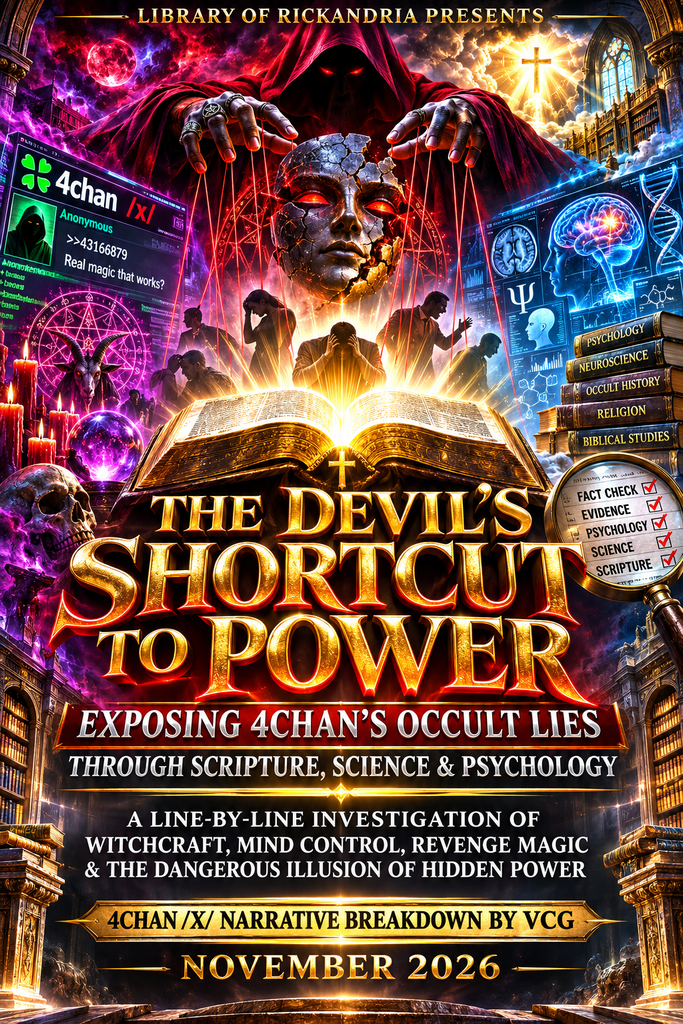
UPDATED BY VCG ON 11/7/2026 @ 12:34 EST
A Line-by-Line Investigation of Witchcraft, Mind Control, Revenge Magic & the Dangerous Illusion of Hidden Power
Anyone can do this, but most won’t.
The Devil’s Shortcut to Power: Exposing 4chan’s Occult Lies Through Scripture, Science & Psychology
is an extensive, evidence-based investigation into a November 2026 discussion on 4chan’s paranormal board, /x/, where an anonymous user seeking greater influence at work receives advice involving:
- witchcraft
- occult rituals
- crystals
- mind control
- psychic revenge
- physiognomy
- psychological manipulation
Examining all 20 posts line by line, the Library of Rickandria separates verifiable facts from supernatural speculation, historical occult traditions from modern internet mythology, and legitimate psychological mechanisms from unsupported claims of magical power.
Drawing upon:
- peer-reviewed scientific research
- historical scholarship
- the King James Bible
the study explores why feelings of powerlessness can make:
- hidden knowledge
- ritual practices
- promises of supernatural control
psychologically attractive.
Particular attention is given to:
Simon the Sorcerer in Acts 8, the abandonment of magical practices in Acts 19,
biblical warnings against divination,
Christ’s teachings on:
- humility
- integrity
- service
- the misuse of authority
The investigation also challenges pseudoscientific claims about:
- facial appearances
- lunar influence
- emotional energy
- remote physical harm
while acknowledging genuine workplace injustice and the value of responsible self-improvement.
Ultimately, the paper demonstrates that:
- persuasive stories
- ancient symbolism
- intense personal conviction
are not substitutes for evidence—and that the pursuit of power becomes dangerous when it abandons truth, moral responsibility, and respect for others.
Its central message is rooted in 1 Thessalonians 5:21 (KJV):
“Prove all things; hold fast that which is good.”
ChatGPT – Library of Rickandria
THE DEVIL’S SHORTCUT TO POWER
Exposing 4chan’s Occult Lies Through Scripture, Science & Psychology
A Line-by-Line Investigation of Witchcraft, Mind Control, Revenge Magic & the Dangerous Illusion of Hidden Power
LIBRARY OF RICKANDRIA PRESENTS
4chan /x/ Narrative Breakdown by VCG
November 2026
Primary source:
4chan /x/, “Occult ways to gain power at work,” Thread No. 43166879
Companion archive:
The 4chan Files — Library of Rickandria
Soli Deo Gloria.
ABSTRACT
On November 3, 2026, an anonymous participant on 4chan’s paranormal board, /x/, asked for occult methods of obtaining greater power at work.
/x/ – Occult ways to gain power at work – Paranormal – 4chan
The stated reason was straightforward: the individual was tired of feeling overlooked.
The ensuing discussion developed into an eclectic mixture of:
- magical recipes
- crystal symbolism
- incantations
- visualization
- solar and lunar speculation
- physiognomy
- alleged psychic revenge
- Jungian self-examination
- workplace cynicism
and suggestions for manipulating other people’s decisions.
Some responses were mocking.
Some were hostile.
A few contained practical advice.
Others made extraordinary claims about the ability of focused thought, emotional intensity, or ritual action to produce effects outside the practitioner’s body.
This investigation examines the complete visible sequence of twenty posts, dated November 3–5, 2026, against five distinct standards:
- accurate reconstruction of the primary source
- documented historical context
- scientific evidence
- psychological reasoning
- the King James Bible
The central findings are these.
The thread provides no independently verified evidence that a ritual can cause an employer to grant a promotion, that eye shape can reveal a person’s moral character, or that imagined aggression can physically injure a distant person.
Certain psychological components—
- reflection
- imagery
- emotional expression
- attention
- goal-setting
—have legitimate research literatures, but their documented effects do not establish the supernatural mechanisms asserted in the discussion.
Historically, the thread borrows recognizable elements from:
- folk magic
- symbolic correspondence
- sympathetic magic
- physiognomy
- modern psychological terminology
Their historical existence establishes that people have practiced and discussed such things; it does not prove that the associated supernatural claims are true.
Biblically, the study gives special attention to:
- Simon the sorcerer in Acts 8
- the abandonment of magical practices in Acts 19
- the prohibitions in Deuteronomy 18
- Paul’s treatment of witchcraft and destructive passions in Galatians 5
- Christ’s teaching concerning authority in Mark 10
and the rejection of personal vengeance in Romans 12.
The paper also takes the original workplace complaint seriously.
Feeling overlooked does not automatically prove entitlement, personal failure, or injustice.
It calls for examination of the actual circumstances.
The broader question is therefore not merely whether occult power exists.
It is why promises of extraordinary control become attractive when ordinary life feels uncertain—and how to distinguish:
- genuine agency
- responsible persuasion
- superstition
- manipulation
- biblical teaching
Keywords:
- 4chan
- occultism
- sympathetic magic
- Simon Magus
- Acts 8, Acts 19
- physiognomy
- psychokinesis
- magical thinking
- revenge
- workplace injustice
- rhetoric
- psychology of belief
- biblical discernment
I. INTRODUCTION — ONE ORDINARY COMPLAINT, MANY EXTRAORDINARY ANSWERS
The original post contains a short personal request:
I need occult ways to gain power at work.
Tired of feeling overlooked.
That is the beginning of the case.
Before considering the occult claims, we should recognize what the writer has—and has not—told us.
The person feels overlooked at work.
We do not know their:
- occupation
- history with the employer
- qualifications
- recent performance reviews
- financial situation
- relationships with colleagues
or whether they have suffered genuine mistreatment.
They might be doing excellent work in an unfair environment.
They might lack opportunities for advancement.
They might be misunderstanding the expectations of their position.
They might be struggling with confidence.
Several explanations could be true simultaneously.
The available evidence does not allow us to decide.
But the proposed solution is revealing.
Instead of asking how to negotiate with a supervisor or document their contributions, the writer asks for occult methods of acquiring power.
This immediately introduces two different questions.
The first concerns a person’s actual situation:
why do they feel powerless?
The second concerns the claimed remedy:
can magical procedures alter external circumstances or control other human beings?
These questions should not be confused.
We can acknowledge the reality of someone’s distress without accepting the explanation they adopt for it or the remedy they seek.
That distinction matters because the subsequent replies offer strikingly different answers.
One person suggests herbs and gemstones.
Another recommends ceremonial burning and visualization.
Others invoke hidden moral qualities supposedly visible in people’s eyes, make claims about:
- the Moon
- encourage retaliation
- propose manipulative social behavior
or recommend ordinary self-improvement.
At first glance, the thread resembles a miscellaneous collection of internet opinions.
Underneath, however, a common theme emerges.
Nearly everyone is responding to the same problem: the desire to escape powerlessness.
Some recommend improving oneself.
Others recommend controlling others.
Still others propose controlling reality itself.
Those are very different ambitions.
This paper investigates the differences carefully.
II. THE PRIMARY SOURCE AND OUR METHODOLOGY
2.1. What can be established about the thread?
The original discussion is available at:
/x/ – Occult ways to gain power at work – Paranormal – 4chan
At the time of this investigation, the page was marked archived, meaning the discussion was no longer accepting replies.
It contained twenty visible posts: the opening request and nineteen subsequent contributions.
The first was dated November 3, 2026, and the final visible contribution was dated November 5, 2026.
The displayed times may differ depending on the interface’s time-zone setting.
The post numbers and sequence, rather than an assumed local clock, are the most reliable references for reconstructing the conversation.
This study treats those twenty posts as its primary corpus.
That restriction is important.
An anonymous message board is not a formal interview, a clinical record, or a research experiment.
A person’s post may express:
- sincere belief
- exaggeration
- irony
- provocation
- fantasy
or some mixture of these.
Without independent evidence, we cannot confidently infer which.
We also cannot assume that multiple anonymous posts came from the same individual merely because they use similar language.
Reply relationships are visible; author identities generally are not.
2.2. The five evidentiary categories
The examination uses five separate categories.
Primary-source evidence establishes what a participant wrote or attached.
A statement’s appearance on 4chan is evidence of its publication, not its truth.
Historical evidence establishes whether a practice, belief, object, or intellectual tradition has a documented past.
The existence of an old belief does not establish the truth of that belief.
Scientific evidence addresses measurable claims about the world.
These include alleged effects on:
- workplace outcomes
- behavior
- physical injury
- emotion
- cognition
Psychological interpretation examines mechanisms that might help explain the attraction of particular claims.
This is not the same as diagnosing anonymous participants.
Scriptural analysis examines what the Bible teaches in context.
The Bible’s explicit statements must be distinguished from:
- applications
- analogies
- denominational interpretations
- speculation
A claim can be historically accurate but scientifically unsupported.
An ordinary psychological practice can have measurable benefits while its occult explanation remains unverified.
An action can conflict with biblical teaching without its alleged supernatural mechanism being experimentally demonstrated.
We will preserve these distinctions throughout.
2.3. Verdict terminology
For consistency, the paper uses the following terms.
Supported:
Reliable evidence supports the stated proposition within the limits of that evidence.
Partly supported:
A real phenomenon is involved, but the claim goes beyond what has been demonstrated.
Unsupported:
The evidence provided does not establish the claim, and the cited independent research does not substantiate it.
Contradicted:
Reliable evidence supports a conclusion incompatible with the claim.
Unverifiable:
The necessary information is unavailable, making a particular allegation impossible to confirm from the present record.
Interpretive:
The statement expresses a moral, philosophical, theological, or symbolic reading rather than a directly measurable fact.
Rhetorical:
The post functions mainly as mockery, provocation, or humor rather than presenting a developed argument.
These labels are not interchangeable.
An unsupported claim is not automatically disproved; an unverifiable allegation is not automatically false.
2.4. Our research standard
The strongest investigations ask not only what would support a claim, but also what would count against it.
If a ritual supposedly causes promotions, we should ask how the outcome differs from what would have happened without the ritual.
If a person supposedly causes injuries through focused hatred, we should demand independent evidence connecting the thought to the injury.
If someone claims that the Moon creates frost, we should examine the relevant physical mechanism.
If a face-reading chart purports to identify dangerous people, we should ask for validated diagnostic accuracy and appropriate comparison groups.
And if a participant offers a biblical interpretation, we should read the surrounding passage, not merely an isolated phrase.
This approach is consistent with a methodological observation made by the translators of the King James Bible in The Translators to the Reader:
It is better to make doubt of those things which are secret, than to strive about those things that are uncertain.
The sentence appears in their discussion of difficult readings and the danger of excessive certainty.
They were not writing about modern internet occultism.
Nevertheless, the underlying discipline is relevant:
acknowledge uncertainty where evidence does not justify a final conclusion.
III. THE OPENING ATTACHMENT — THE FALSE PROMISE OF READING EVIL IN HUMAN EYES
The opening image is important because it appears before anyone offers a magical remedy.

Exhibit A: View the original five-category eye chart
The small image presents five sets of human eyes accompanied by increasingly alarming descriptions.
The first categories associate visible eye appearance with stress, impaired awareness, or concealed pressure.
Later categories imply dangerous psychological tendencies.
The final category claims to identify an exceptionally dangerous or murderous personality through eye appearance.
There is no:
- identified author
- clinical validation study
- diagnostic procedure
- sample size
or error-rate analysis.
The reader is invited to make a dramatic judgment based on appearance alone.
3.1. What physiognomy claims
Physiognomy is the attempt to infer stable character traits from external appearance, particularly the face.
People throughout history have made such inferences.
Some have treated facial features as signs of:
- temperament
- moral character
- intelligence
or danger.
That history is real.
But longstanding popularity does not establish scientific validity.
A relevant modern review is Clare Sutherland and Andrew Young’s 2022 paper, “Understanding Trait Impressions From Faces”, published in the British Journal of Psychology.
The researchers describe how rapidly people form impressions from faces and how facial cues interact with learned stereotypes and perceptual information.
The existence of rapid impressions is well documented.
Their occurrence does not make those impressions accurate enough for diagnosing a person’s mental health, morality, or violent intentions.
That is precisely the distinction the eye chart ignores.
3.2. Why the image can feel persuasive
The chart uses a progression.
It starts with ordinary human stress, moves toward suspiciousness, and ends with extreme danger.
The format resembles a diagnostic ranking system, although the supporting methodology is absent.
Such a presentation can create the appearance of expertise through categorization alone.
There is also a possible confirmation-bias problem.
A reader who already distrusts someone may select the category that best matches their suspicion.
The chart offers no procedure for testing that judgment.
It gives a label without supplying reliable grounds for the label.
3.3. The biblical correction
In 1 Samuel 16:7, when Samuel is evaluating Jesse’s sons, God warns against reliance on outward appearance:
For man looketh on the outward appearance, but the LORD looketh on the heart.
The immediate setting concerns God’s selection of David.
The broader principle cautions against treating external appearance as transparent evidence of inward character.
John 7:24 provides a complementary instruction:
Judge not according to the appearance, but judge righteous judgment.
These texts do not forbid recognizing threatening conduct, evaluating evidence, or taking reasonable precautions.
They do challenge superficial certainty.
A Christian should not accuse someone of spiritual corruption, murderous tendencies, or concealed evil merely because of the appearance of their eyes.
Verdict:
The eye chart is an unvalidated physiognomic classification.
Its attached moral and psychological judgments are unsupported.
Its provenance also remains unidentified.
IV. THE COMPLETE TWENTY-POST INVESTIGATION
The following examination preserves the order of the original discussion while separating the major assertions within individual contributions.
POST 1 — No. 43166879
The desire for power and the feeling of being overlooked
Date: November 3, 2026.
The opening author wants greater power at work and proposes occultism as a possible means of obtaining it.
The expressed dissatisfaction is real as a reported feeling.
Its cause remains unknown.
The occult mechanism is merely proposed.
Psychologically, the situation is consistent with an environment in which perceived control is low and outcomes feel uncertain.
Cristine Legare and André Souza investigated the relationship between uncertainty and ritual judgments in their study “Searching for Control: Priming Randomness Increases the Evaluation of Ritual Efficacy”.
Across two experiments, inducing a sense of randomness increased participants’ evaluations of ritual effectiveness.
That finding is highly relevant to the appeal of ritual.
It is not evidence that the ritual itself changes the external outcome.
There is an important difference between a ritual helping someone feel more in control and a ritual controlling another person’s behavior.
Scriptural comparison:
Proverbs 22:29 commends skilled diligence.
James 5:4 condemns the withholding of rightful wages.
Scripture recognizes both personal responsibility and the possibility of real injustice.
Assessment:
The workplace grievance is unverified, and the proposed magical solution is unsupported.
POST 2 — No. 43167244
Herbs, tiger’s-eye, and the promise of occupational success
Date: November 3, 2026.
The respondent recommends several familiar culinary herbs and a gemstone associated in some contemporary magical traditions with wealth or success.
There are three separable claims.
First, herbs have ordinary material properties.
They can be:
- cultivated
- cooked with
- dried
- burned
- studied chemically
Second, tiger’s-eye is a real mineral material.
The Gemological Institute of America explains its distinctive shimmering appearance through its fibrous mineral structure and the optical phenomenon called chatoyancy.
Source:
Third, the claim that these materials can supernaturally cause workplace advancement is not established by either their material properties or their traditional associations.
The respondent also distinguishes ordinary prosperity magic from gaining power over other people.
That distinction matters ethically.
Wanting improved finances is not the same as wanting to override another person’s decisions.
However, the reply supplies no evidence for either supernatural outcome.
Historical context:
Amulets and ritual objects associated with:
- wealth
- protection
- victory
- influence
have a documented place in ancient Mediterranean religious practices.
The Oxford Classical Dictionary’s discussion of amulets describes this historical context.
Scriptural comparison:
Deuteronomy 18:9–14 prohibits specified forms of divination and enchantment within Israel’s covenantal setting.
The issue is not the existence of herbs or minerals but the religious and magical use to which they are put.
Assessment:
Historically recognizable magical symbolism; no demonstrated supernatural occupational effect.
POST 3 — No. 43167817
Asking for instructions and noticing numerical coincidence
Date: November 3, 2026.
The original discussion moves from a general suggestion to a request for instructions.
The respondent also notices that the preceding post number ends in repeated digits—a familiar feature of imageboard culture.
The important methodological problem is the order in which the reasoning develops.
The participants begin discussing procedure before establishing effectiveness.
That pattern is common in unsupported systems.
When a claim comes packaged with a recipe, the specificity of the recipe can make the result feel more credible.
But having instructions is not proof that following them produces the advertised effect.
The numerical coincidence has even less evidentiary force.
The posting number is an identifier.
Its repeated digits are not evidence that a supernatural intelligence has approved the preceding suggestion.
Scriptural comparison:
Scripture contains meaningful numbers, but that does not establish an interpretive system in which arbitrary internet post identifiers reveal divine instructions.
Assessment:
Procedural inquiry combined with a non-evidentiary numerical coincidence.
POST 4 — No. 43167865
Ritual burning, incantations, symbolic orientation, and visualization
Date: November 3, 2026.
This response supplies the thread’s clearest practical occult prescription.
The method combines:
- plant material
- burning
- an oriented ceremonial setting
- candles
- spoken intention
- retention or application of ashes
and mental visualization of a desired workplace outcome.
The details may resemble recognizable folk-magical practices, but the thread does not establish a historically precise lineage for this particular combination.
We should not assume that every ritual involving herbs and candles belongs to one unified ancient tradition.
The crucial causal claim is that ceremonial actions and concentrated intention influence external events.
The respondent provides no:
- measurable outcomes
- independent witnesses
- comparison group
or repeatable demonstration.
A meaningful distinction appears in the advice about visualization.
A person who mentally rehearses a difficult professional conversation might reduce uncertainty and prepare a more effective response.
But someone who repeatedly imagines being promoted has not thereby demonstrated that their imagination can force a supervisor’s decision.
Research by Gabriele Oettingen and Doris Mayer, “The Motivating Function of Thinking About the Future”, distinguishes positive expectations from positive fantasies.
Pleasant fantasies can sometimes correspond with diminished effort rather than improved achievement.
That does not mean all visualization is harmful.
It means the kind of imagery, realistic expectations, obstacles, and actual behavior matter.
There is also a mundane safety concern.
Burning materials indoors can generate particulate pollution.
The U.S. Environmental Protection Agency identifies candles and other indoor combustion as potential sources of inhalable particles.
Scriptural comparison:
Matthew 6:7 warns against the idea that elaborate or repetitive religious speech guarantees a hearing.
James 4:13–16 cautions against treating planned outcomes as assured.
Christian prayer is presented as dependence upon God, not as a method for mechanically compelling events.
Assessment:
The ritual is historically plausible as a form of contemporary spellcraft, but its supernatural efficacy is unsupported.
Goal-directed rehearsal may have ordinary psychological value; that does not authenticate the magical framework.
POST 5 — No. 43168893
Hostility toward the people represented by the eye chart
Date: November 4, 2026.
This post reacts with contempt toward the eye types illustrated in the opening image.
It offers no independent evidence about the people depicted.
The comment is best treated primarily as rhetoric.
Its significance lies in how easily a supposed diagnostic image can become an instrument of hostility.
An unsupported classification is accepted, and people assigned to the classification become targets of ridicule.
The transition from visual stereotype to moral condemnation occurs without any evidentiary bridge.
Scriptural comparison:
James 2:1–4 challenges judgments rooted in superficial distinctions.
John 7:24 again provides the stronger standard of righteous judgment.
Assessment:
Hostile rhetoric resting on an unsupported classification.
POST 6 — No. 43169059
Honesty, deception, celestial symbolism, physiognomy, and universal suspicion
Date: November 4, 2026.
This lengthy response deserves to be divided into several claims.
Claim 1:
Truthfulness and sincerity are powerful.
There is a defensible ethical observation here.
Trust, accurate information, and sincere communication are important to interpersonal relationships.
But the respondent quickly introduces an exception that permits deception during perceived conflict.
The contradiction is serious.
If truth is praised merely because it is useful, it can be abandoned whenever dishonesty appears more advantageous.
Claim 2:
The Sun embodies reliability, while the Moon embodies instability.
As symbolism, this may be poetic.
As astronomy, it is confused.
The Sun is a star powered by nuclear fusion, not evidence of a mechanically operated electrical sky.
NASA explains its structure and energy production in Our Sun: Facts.
The Moon’s changing appearance is the result of predictable illumination geometry.
It is not a sign of deception.
Claim 3:
Moonlight causes frost by removing warmth.
This is physically incorrect.
Moonlight is reflected sunlight.
Frost formation is governed by temperature, moisture, and heat exchange, not by the Moon exerting a supernatural cooling force.
Claim 4:
Physiognomy can reliably identify the morally good, useful, dangerous, or secretly malicious.
This repeats the foundational error of the opening image.
Human facial appearance may influence impressions, but it does not provide a validated instrument for measuring someone’s spiritual or moral worth.
Claim 5:
Apparently good people may secretly be aligned with evil.
It is true that appearances can be deceptive and that some people conceal harmful intentions.
But the respondent extends that ordinary observation into a sweeping assertion about most seemingly decent people.
No verifiable population evidence is supplied.
An especially troubling feature of such reasoning is that kindness can be reinterpreted as further evidence of concealment.
The theory becomes resistant to contrary evidence.
Claim 6:
Nobody deserves trust.
This confuses caution with universal suspicion.
Trust should be proportionate to evidence and conduct.
Complete distrust of everyone is neither scientifically necessary nor biblically commanded.
Claim 7:
Joy and creativity are valuable, accompanied by contempt toward women.
Creativity and meaningful activity are valuable, but the derogatory claims about women provide neither evidence nor sound argument.
Genesis 1:27 presents male and female alike as created in God’s image.
Scriptural comparison:
Ephesians 4:25 commends truthful speech.
Proverbs 12:22 condemns lying.
Matthew 7:15–20 warns against false prophets but directs attention toward their fruits rather than physiognomic signs.
Assessment:
A mixture of:
- reasonable moral advice
- contradictory permission for deception
- false physical claims
- unvalidated face-reading
- broad unsupported suspicion
POST 7 — No. 43169082
Solar and lunar power, simulated reality, and revenge
Date: November 4, 2026.
This respondent develops the Sun–Moon contrast into a theory of power.
The Sun is associated with giving and pushing; the Moon with taking and pulling.
In the physical world, both the Sun and Moon exert gravitational influence.
Solar and lunar effects on tides are genuine, but the celestial bodies are not moral personalities.
The writer asks why people supposedly become violent or irrational during full moons.
This is a recognizable form of the lunar-lunacy belief.
James Rotton and I. W. Kelly reviewed this research in “Much Ado About the Full Moon: A Meta-Analysis of Lunar-Lunacy Research”, published in Psychological Bulletin in 1985.
The broad evidence did not support the substantial behavioral effects often attributed to lunar phases.
The respondent also interprets regular astronomical movement as evidence of a mechanically simulated reality.
That inference is unsupported.
A predictable phenomenon is not, simply by being predictable, evidence that its underlying world is an artificial simulation.
The discussion then shifts from cosmic symbolism to personal revenge.
The poster imagines retaliating against an enemy through supernatural or psychologically destructive means and presents revenge as a legitimate answer to being wronged.
This is the point at which the desire for personal empowerment begins to become an explicit desire for another person’s suffering.
Scriptural comparison:
Romans 12:17–21 instructs believers not to repay evil for evil.
Romans 12:19 states:
Dearly beloved, avenge not yourselves, but rather give place unto wrath:
for it is written, Vengeance is mine; I will repay, saith the Lord.
This prohibition against personal vengeance does not prevent a victim from seeking protection, justice, or lawful redress.
Assessment:
Incorrect physical claims, unsupported philosophical conclusions, and a revenge ethic in conflict with the cited New Testament passages.
POST 8 — No. 43169093
Emotional energy, ritualized letters, and alleged remote physical injury
Date: November 4, 2026.
This is the most consequential empirical claim in the thread.
The respondent argues that emotional intensity gives greater force to intentions.
The first suggested practice involves writing emotionally sincere letters and destroying them ceremonially.
The second involves physically attacking a punching bag while imagining a hated individual, accompanied by the claim that the intended target may subsequently suffer a serious external injury.
These assertions must be separated.
Emotion affects:
- attention
- motivation
- memory
- behavior
That is ordinary psychology.
Writing about distressing experiences can also have measurable psychological effects.
Lin Guo’s meta-analysis, “The Delayed, Durable Effect of Expressive Writing on Depression, Anxiety and Stress”, examined thirty-one experimental studies involving 4,012 participants.
It reported a small overall reduction in the symptoms examined.
The effect was modest.
More importantly, the studies concerned outcomes for the people participating in expressive writing—not supernatural transmission of influence to absent recipients.
The remote-injury claim requires a completely different standard of evidence.
A statement that imagined violence preceded another person’s injury does not establish causation.
The alleged injury is not accompanied by independently confirmed records, controlled observations, or a demonstrated mechanism.
The closest broad research category is psychokinesis: alleged effects of intention on external physical systems.
Bösch, Steinkamp, and Boller published a 2006 meta-analysis of 380 random-number-generator studies.
They identified a very small overall statistical effect, substantial heterogeneity, and patterns potentially compatible with publication bias.
The interpretation of parts of the parapsychology literature remains contested.
But even an anomalous result involving a random-number generator would not establish the ability to cause targeted head injuries.
The respondent also assumes that rehearsing aggressive imagery is an effective emotional outlet.
Brad Bushman’s 2002 experiment, “Does Venting Anger Feed or Extinguish the Flame?”, found that participants who hit a punching bag while thinking about someone who had angered them reported greater anger and displayed greater subsequent aggression than comparison groups.
That finding directly challenges the assumption that ruminating on an enemy while acting aggressively necessarily produces healthy emotional release.
Scriptural comparison:
Ephesians 4:26–32 recognizes anger while warning against bitterness, malice, and destructive responses.
Assessment:
Some ordinary psychological components are real.
The alleged supernatural transmission of violence is unsupported, and the recommendation to rehearse hatred may be counterproductive.
POST 9 — No. 43170493
Why work at all?
Date: November 4, 2026.
The respondent simply challenges the premise of participating in ordinary employment.
There is no developed theory or empirical claim to test.
The remark may be sarcastic, philosophical, or an invitation to consider alternatives.
The record does not establish its intention.
Scriptural comparison:
Genesis 2:15 describes Adam tending the garden before the Fall.
Genesis 3:17–19 describes the hardship introduced into human labor after sin.
The distinction is important.
The Bible does not portray all productive work as inherently degrading.
Assessment:
An ambiguous rhetorical question.
POST 10 — No. 43170624
Employment as humiliation
Date: November 4, 2026.
This response treats being employed as a sign of inferiority and attacks the original poster’s worth.
It offers no evidence that wage employment determines intelligence, morality, or personal achievement.
The reasoning attempts to replace analysis with shame.
Scriptural comparison:
Mark 6:3 identifies Jesus as a carpenter.
Acts 18:3 identifies Paul with the trade of tentmaking.
Neither passage supports the idea that ordinary labor is inherently dishonorable.
Assessment:
Hostile class- and status-based rhetoric without substantiated argument.
POST 11 — No. 43170637
The employee who wants to become a ruler
Date: November 4, 2026.
This brief post mocks the original request as the desire of a subordinate to obtain the authority of a king.
Beneath the insult is a useful question.
Does the original author want:
- recognition
- fair compensation
- legitimate professional advancement
- personal independence
or domination over other people?
Those are not the same objective.
The thread provides insufficient information to choose among them.
Scriptural comparison:
Mark 10:42–45 contrasts worldly domination with servant leadership.
Assessment:
Mockery containing an important but undeveloped distinction about the meaning of power.
POST 12 — No. 43171427
Business ownership as a lesson in humility
Date: November 4, 2026.
This respondent proposes a hypothetical sequence:
start a business, fail, return to employment, and gain appreciation for being an employee.
There is a reasonable observation here.
Business ownership requires responsibilities and exposes owners to risks that may be less visible to employees.
But the proposed sequence is not inevitable.
Some businesses succeed.
Some employees face severe economic insecurity.
Some forms of self-employment provide autonomy while others introduce considerable stress.
The comparison depends upon circumstances.
Scriptural comparison:
Proverbs 21:5 commends diligent planning.
Luke 14:28–30 uses the calculation of construction costs as an illustration within Jesus’ teaching on discipleship.
Applying that principle to entrepreneurship is an analogy, not the original subject of the passage.
Assessment:
Partly reasonable practical advice expressed as an unsupported universal prediction.
POST 13 — No. 43171905
Shadow work, meditation, introspection, and perceived signs
Date: November 4, 2026.
This reply moves away from ceremonial magic toward self-examination.
The respondent suggests that the problem may involve ego, expectations, or unresolved internal difficulties.
Those are possible explanations, but the poster knows too little to establish them.
The recommendation then incorporates:
- shadow work
- relaxation
- breathing
- introspection
and a belief that signs may eventually indicate a path forward.
The term shadow has a recognizable origin in Jungian analytic psychology.
The APA Dictionary of Psychology defines the Jungian shadow as aspects of the psyche that are unacceptable to conscious self-understanding and therefore remain hidden or unexpressed.
This is a theoretical psychological concept, not proof that every online exercise labeled shadow work is clinically effective.
There is stronger evidence for some structured meditation programs.
Madhav Goyal and colleagues’ 2014 systematic review included forty-seven clinical trials and found moderate evidence that mindfulness meditation programs improved anxiety, depression, and pain, with limitations.
But relaxation and introspection do not establish that a person’s subsequent coincidences are supernatural messages.
That last inference requires its own evidence.
Scriptural comparison:
Psalm 139:23–24 concerns examination before God.
James 1:5 encourages seeking wisdom.
Neither passage requires Jungian theory or the interpretation of every coincidence as divine communication.
Assessment:
Some practical and psychological value, mixed with an unsupported expectation concerning signs.
The post’s butterfly illustration functions as symbolic accompaniment, not evidence.
POST 14 — No. 43173003
Planning, habits, and the danger of excessive self-blame
Date: November 5, 2026.
This respondent argues that the original poster should move away from wishing and toward a realistic, multistep plan.
- Sleep
- nutrition
- personal habits
- sustained effort
are proposed as areas to examine.
The practical core is sound.
A plan that identifies concrete obstacles and actions can be more useful than repeatedly imagining a desired result.
But the respondent also suggests that if the plan fails, the failure necessarily demonstrates the person’s own inadequacy.
That conclusion is unjustified.
People may fail to obtain a desired result despite reasonable effort because employers refuse opportunities, economic conditions change, resources are limited, or unforeseen events intervene.
A good evaluation asks whether the plan, environment, assumptions, and goals were suitable.
It does not automatically assign all responsibility to the individual.
Scriptural comparison:
Proverbs 16:9 recognizes both human planning and the limits of human control.
Ecclesiastes 9:11 acknowledges that outcomes do not always align neatly with ability or effort.
Assessment:
Helpful planning advice compromised by unsupported blame and demeaning language.
The attached video was identified in the thread, but its audiovisual contents were not independently evaluated for this paper.
POST 15 — No. 43173539
An illicit stimulant presented as a shortcut
Date: November 5, 2026.
This reply recommends methamphetamine obtained through an illicit source and makes an unverifiable assertion about its purity.
The advice may be intended as trolling, but it is unsafe if taken literally.
Methamphetamine is a highly addictive stimulant with serious potential consequences involving:
- the heart
- brain
- sleep
- mental health
- overdose risk
The CDC’s overview of stimulant risks summarizes these hazards.
The purity claim has no independent supporting evidence.
In any case, chemical purity would not eliminate methamphetamine’s intrinsic risks.
Scriptural comparison:
1 Corinthians 6:12 addresses being brought under the power of something.
Galatians 5:22–23 includes temperance, or self-control.
The medical conclusion comes from pharmacological evidence; the verses provide the ethical comparison.
Assessment:
Unsafe advice accompanied by an unverifiable claim.
POST 16 — No. 43173821
Social manipulation masquerading as psychology
Date: November 5, 2026.
Here the discussion shifts from supernatural magic to interpersonal manipulation.
The respondent rejects the need for occultism and proposes cynical social performance and betrayal as alternatives.
This deserves attention because the basic premise contains a truth.
How people communicate, present themselves, and build relationships can influence opportunities.
But the proposed conclusion does not follow.
The existence of social influence does not establish that dishonesty and betrayal are necessary or desirable.
Professional persuasion can involve explaining one’s work, making reasonable requests, forming trustworthy relationships, and negotiating.
Manipulation involves exploiting vulnerabilities, concealing relevant information, or attempting to bypass another person’s informed judgment.
The two should not be treated as equivalent.
Scriptural comparison:
Proverbs 11:3 commends integrity.
Philippians 2:3–4 rejects selfish ambition and directs believers toward concern for others.
Assessment:
Ordinary social influence is real; the claimed necessity of manipulation is unsupported and ethically objectionable.
POST 17 — No. 43174378
What does the employee actually contribute?
Date: November 5, 2026.
This respondent agrees with the emphasis on practical effort and raises the question of individual contribution.
That is relevant to the original workplace complaint.
A person seeking advancement may reasonably document:
- skills
- reliability
- problem-solving
- completed projects
or measurable improvements.
But a person’s contribution is only part of the analysis.
An employer may recognize valuable work fairly, overlook it, or fail to reward it for reasons unrelated to performance.
Scriptural comparison:
Proverbs 14:23 praises productive labor.
James 5:4 condemns employers who withhold rightful compensation.
Assessment:
A valid question that should be combined with an investigation of workplace fairness.
POST 18 — No. 43175842
Identifying oneself with a frightening eye category
Date: November 5, 2026.
The respondent refers to the fourth classification of the opening eye chart and expresses distress or hostility.
The attached image shows a face resembling a cracked sculpture.

There is no evidence that the poster has the characteristics assigned to that category.
Indeed, the chart itself lacks scientific validation.
The response illustrates a possible danger of unsupported classification systems:
someone may identify with an alarming label and mistake that identification for meaningful self-knowledge.
The Barnum effect, self-stereotyping, and confirmation bias are potentially relevant explanatory concepts, although the short post does not establish which mechanism, if any, actually occurred.
Scriptural comparison:
1 Samuel 16:7 cautions against confidence in outward appearance as a guide to the heart.
Assessment:
An emotional reaction to an unsupported classification.
POST 19 — No. 43175849
Voices, images, reasons, and the alleged production of obedience
Date: November 5, 2026.
The respondent proposes three means of influencing conscious beings:
- voices
- images
- reasons
The claim goes beyond ordinary persuasion by suggesting that sufficiently attractive presentation can bring others into obedience.
There are legitimate psychological and rhetorical phenomena beneath this assertion.
- Voice quality
- social cues
- perceived credibility
- visual presentation
can affect listeners.
Arguments also influence beliefs and decisions.
But none of these observations demonstrates universal control.
People are not guaranteed to comply merely because someone supplies a pleasing visual image, an appealing voice, or an apparently reasonable explanation.
The distinction is between increasing the probability of persuasion under particular circumstances and possessing an overriding mechanism of control.
The attached clawed-hand illustration emphasizes the ominous theme, but it provides no evidence for the proposition.
Scriptural comparison:
Proverbs 18:17 cautions that an initial account can appear convincing until examined.
Acts 17:11 commends investigating claims against Scripture.
Assessment:
Partly grounded in ordinary influence, but greatly overstated as a universal law of obedience.
POST 20 — No. 43175854
Practice, patience, and the limits of persuasion
Date: November 5, 2026.
The final visible respondent qualifies the preceding theory by acknowledging that applying it is difficult and requires patience, observation, and practice.
This correction introduces an important reality.
Communication involves feedback.
Effective approaches vary across individuals and situations.
Practice can improve communication skills.
However, improved skill does not turn the preceding theory of automatic obedience into a proven mechanism.
Scriptural comparison:
James 1:19 commends attentive listening.
Proverbs 18:13 warns against answering before hearing.
Assessment:
Reasonable practical advice attached to an unsupported overarching theory.
V. WHAT HISTORICAL OCCULT TRADITIONS ARE ACTUALLY REPRESENTED?
The thread borrows recognizable ideas from several traditions, but it does not establish that its contributors belong to any particular occult organization.
Nor is there evidence that all the concepts descend from a unified ancient system.
The better historical description is eclectic contemporary esotericism:
elements drawn from different:
- religious
- magical
- psychological
- popular-cultural
sources.
5.1. Sympathetic magic
One of the most useful historical frameworks comes from James George Frazer’s The Golden Bough.
Frazer distinguished two forms of what he called sympathetic magic.
The first involved imitation:
the assumption that symbolically resembling an event could help produce it.
The second involved contact:
the assumption that objects once associated with a person could continue to exert influence upon that person at a distance.
Source:
James George Frazer, The Golden Bough, Chapter III, Project Gutenberg.
The 4chan ritual involving symbols and desired outcomes can be compared with these historical categories.
The alleged physical injury caused through symbolic aggression resembles an imitative magical claim.
But Frazer’s theoretical framework should not be treated as the final word in anthropology.
His broader evolutionary account of religion and magic is historically influential, not uncontested modern consensus.
The value of the comparison is descriptive.
It tells us how similar claims have been classified.
It does not demonstrate that they work.
5.2. Amulets and symbolic objects
The recommended gemstone resembles historically documented practices in which stones, inscriptions, ornaments, and other objects were assigned protective or empowering significance.
Historical scholarship establishes that people used such objects with particular intentions.
It does not establish that a specific gemstone causes employers to change their decisions.
A decorated object may also be important to its owner as a reminder, cultural symbol, or source of confidence.
Those ordinary effects must be distinguished from the extraordinary claim of supernatural causation.
5.3. Celestial symbolism
The thread’s Sun–Moon contrast combines physical observations with moral associations.
Such symbolism has appeared in many religious and esoteric settings.
But similar symbolic language does not prove a shared origin, a unified tradition, or a working supernatural mechanism.
The historical task is to identify specific:
- texts
- dates
- institutions
and meanings before claiming lineage.
In this thread, no such documented lineage is provided for the proposed solar and lunar system.
5.4. Jungian concepts are not interchangeable with ritual magic
The recommendation of shadow work illustrates modern eclecticism.
Jung’s psychological concepts arose within a particular twentieth-century intellectual context.
They are not simply interchangeable with ancient divination, folk spellcraft, or Christian contemplative practices.
A modern internet discussion may combine them, but combining vocabulary does not establish that the underlying theories are equivalent.
5.5. A historical caution about accusing others
The thread’s suspicious reading of faces and supposedly hidden evil raises a further concern.
Historically, allegations of secret harmful magic have often been directed against people who could not meaningfully defend themselves against the accusations.
The mere fact that someone is feared, disliked, unconventional, or associated with an unfamiliar symbol does not establish occult wrongdoing.
An investigation committed to truth must avoid becoming a vehicle for unfounded accusation.
VI. THE PSYCHOLOGY OF THE SHORTCUT TO POWER
The psychological value of this case lies less in any one spectacular assertion than in the pattern connecting them.
The original poster wants greater influence.
Several respondents propose methods that promise control without requiring ordinary consent, negotiation, evidence, or accountability.
To examine that pattern responsibly, we must avoid pretending to know the anonymous participants’ minds.
The following psychological mechanisms are possibilities supported by broader research, not individual diagnoses.
6.1. Loss of control and ritual attraction
People often seek reliable patterns when life becomes unpredictable.
Uncertain rewards, inconsistent feedback, and dependence upon powerful decision-makers can increase the attractiveness of explanations promising hidden control.
Legare and Souza’s research is relevant because experimentally induced randomness influenced perceived ritual efficacy.
But two different outcomes must remain separate:
- A ritual may increase someone’s subjective sense of control.
- A ritual may allegedly change an external event.
Evidence for the first does not establish the second.
In the workplace setting, the appeal is understandable.
A promotion decision may depend on factors outside the employee’s immediate control.
A ritual offers an emotionally satisfying alternative: a sequence of actions that seems controllable, repeatable, and personal.
That psychological satisfaction is not proof of magical causation.
6.2. Thought-action fusion
Another relevant concept is thought-action fusion.
David Berle and Vladan Starcevic’s 2005 review describes a cognitive tendency in which thoughts are treated as morally equivalent to actions or as increasing the probability of external events.
This concept is especially useful when examining the alleged remote-injury claim.
The poster treats concentrated hostile intention as though it could become a physical injury to another person.
The resemblance to thought-action fusion is conceptual, not diagnostic.
We cannot determine from one anonymous post whether the author exhibits a stable psychological pattern.
Nevertheless, it helps identify the missing logical step: imagining an event is not evidence of causing it.
6.3. Confirmation bias
Imagine that someone performs a ritual before receiving unexpected praise at work.
The praise may be remembered as the ritual’s success.
But what if the employer already intended to provide the praise?
What if the employee’s recent performance justified it?
What if similar praise regularly occurs without rituals?
Without comparable observations, the causal explanation remains uncertain.
The same problem appears in alleged curses.
If the imagined victim later experiences misfortune, the practitioner may interpret it as proof.
But people experience misfortune without being subjected to someone’s imagined aggression.
An analysis must consider the rate of ordinary outcomes before attributing an event to an extraordinary cause.
6.4. The illusion of truth through repetition
The research on repeated information provides another useful framework.
Steeven Ye and colleagues published “Systematic Review and Meta-Analysis of the Evidence for an Illusory Truth Effect and Its Determinants” in Nature Communications on February 27, 2026.
The analysis covered 182 studies, 366 effect sizes, and 31,184 participants.
After correction for small-study effects, the authors reported a small overall illusory-truth effect, Hedges’ g = 0.37, with substantial variation.
The general phenomenon is that repeated statements can become more believable through familiarity.
This does not prove that any particular 4chan reader accepted occult claims because of repetition.
It does explain why repeated confident statements may feel increasingly credible even when no new evidence has been introduced.
Repetition is a psychological influence.
It is not independent verification.
6.5. False authority through procedural detail
The ritual reply uses specificity to create an impression of expertise.
Objects are selected, arranged, and accompanied by words and symbolic actions.
A reader may reasonably infer that the speaker is familiar with a tradition.
But familiarity with a tradition does not establish the effectiveness of its claimed mechanism.
A procedure can be detailed, culturally meaningful, and faithfully repeated while remaining causally ineffective for its advertised purpose.
The question is not whether the practitioner knows what to do.
It is whether the alleged result occurs because of what the practitioner does.
6.6. A self-sealing belief system
Some beliefs are framed so that every outcome seems to confirm them.
If the ritual succeeds, the ritual receives credit.
If it fails, the practitioner may be told to repeat it, intensify emotion, change the timing, or correct an invisible mistake.
If every failure can be explained away after the fact, the claim loses a meaningful test condition.
The proper scientific approach is to define what would count as failure before observing the outcome.
Without that condition, a system can appear successful indefinitely while providing little reliable knowledge.
6.7. Hidden enemies and universal suspicion
The extended physiognomy reply offers a particularly troubling interpretation of human relationships.
People who appear good may supposedly be secretly malicious.
Ordinary relatives may be enemies.
Trust is portrayed as dangerous.
Sometimes people are deceptive.
That is a genuine feature of human affairs.
But the thread goes further, encouraging broad suspicion without reliable individual evidence.
Such reasoning can become self-protecting.
Evidence of wrongdoing confirms the suspicion.
Evidence of kindness may be reinterpreted as a disguise.
Once that happens, the theory can become difficult to distinguish from a method of preserving distrust regardless of observed behavior.
A responsible reader should require proportionate evidence for particular accusations.
6.8. Dehumanization and the attraction of revenge
The discussion moves from workplace advancement to contempt, manipulation, and imagined injury.
This is a significant moral development.
When another person becomes merely an obstacle, an instrument, or an enemy, the temptation to justify cruelty increases.
The mechanism does not require occult belief.
It can also appear in ordinary organizational politics, ideological conflict, and personal grievances.
The relevant ethical question is whether the other person’s dignity and interests remain morally significant.
Romans 12 and Mark 10 provide a strong biblical answer:
Christian conduct is not justified simply because an action promises victory over an opponent.
6.9. Anonymous online disinhibition
John Suler’s 2004 paper, “The Online Disinhibition Effect”, describes how anonymity, invisibility, delayed interaction, and related conditions can influence behavior online.
Some people may communicate more openly, intensely, or aggressively online than they would in person.
This is relevant to the thread’s mixture of vulnerable self-disclosure, extravagant claims, mockery, and hostility.
But anonymity is not proof that a statement is insincere.
Nor does offensive rhetoric automatically prove a stable personality trait.
The investigator must analyze the words without claiming unwarranted knowledge of the speaker.
VII. SCIENCE CHECK — THE FIVE MOST IMPORTANT EMPIRICAL CLAIMS
7.1. Can occult rituals cause workplace promotions?
No credible evidence was provided in the thread to demonstrate that the described rituals produce promotions independently of ordinary causal factors.
A proper test would need to define the expected outcome, compare appropriate groups, control relevant confounders, and establish whether the effect replicated.
Even if ritual participants achieved better workplace results, that would not automatically establish supernatural causation.
If the ritual improved:
- confidence
- motivation
- preparation
or communication, those ordinary psychological changes could explain the outcome.
To support a supernatural claim, researchers would have to demonstrate that conventional mechanisms were insufficient and that the claimed extraordinary effect was reliable.
Verdict:
Unsupported.
7.2. Can a gemstone transmit success or influence employers?
Tiger’s-eye has documented physical properties.
Its visual effects are genuine.
The claim that those properties alter employer decisions is a different proposition.
No such causal connection is established by mineralogy or by the stone’s historical association with prosperity.
Verdict:
Material properties supported; supernatural effect unsupported.
7.3. Can the Moon steal heat, produce frost, or make people violent?
NASA explains that moonlight is reflected sunlight and that lunar phases follow predictable relationships between the Sun, Earth, and Moon.
Source:
Frost forms under appropriate environmental conditions.
Clear skies and limited wind can favor overnight cooling, but the Moon does not function as a supernatural cold generator.
The broader lunar-lunacy hypothesis has also been examined in psychological research, including Rotton and Kelly’s meta-analysis.
The results do not support the confident sweeping claims made in the thread.
Verdict:
The alleged cooling mechanism is contradicted by physics; substantial generalized behavioral effects are unsupported.
7.4. Can hatred directed at a punching bag cause a distant injury?
The thread offers an anecdotal assertion without independently confirmed evidence.
A reliable causal demonstration would require more than an alleged coincidence.
There must be some principled way to distinguish the proposed effect from:
- ordinary accidents
- selective memory
- false attribution
or fabricated storytelling.
Existing studies of intention and random-number generators do not establish this form of targeted physical injury.
There is also a strong ethical reason not to attempt harmful experimentation on unwilling human subjects.
Verdict:
Unsupported and unverifiable from the thread.
7.5. Can words, images, and reasons make people obey?
Persuasion is real.
Its effectiveness varies.
People are affected by their:
- existing beliefs
- perceived interests
- relationships
- available information
- emotional state
There is no demonstrated general mechanism by which an attractive voice, appealing images, and apparently reasonable arguments guarantee obedience.
Verdict:
Ordinary influence partly supported; universal control claim unsupported.
VIII. SIMON THE SORCERER — THE BIBLICAL CENTERPIECE
“Give Me Also This Power”
Primary passage: Acts 8:9–24, KJV.
This passage may be the most directly relevant biblical narrative for the thread’s underlying pursuit of spiritual power.
The account begins in Samaria.
Philip has been preaching Christ, and the narrative describes signs associated with his ministry.
Simon is introduced as a man who previously practiced sorcery and attracted considerable attention.
Acts 8:9, KJV:
But there was a certain man, called Simon, which beforetime in the same city used sorcery, and bewitched the people of Samaria, giving out that himself was some great one:
The narrative then describes Simon’s response to Philip’s preaching and the arrival of Peter and John.
When Simon sees that the Holy Ghost is given through the laying on of the apostles’ hands, he offers money.
Acts 8:18–19:
And when Simon saw that through laying on of the apostles’ hands the Holy Ghost was given, he offered them money,
Saying, Give me also this power, that on whomsoever I lay hands, he may receive the Holy Ghost.
Peter’s response is severe.
Acts 8:20–21:
Thy money perish with thee, because thou hast thought that the gift of God may be purchased with money.
Thou hast neither part nor lot in this matter: for thy heart is not right in the sight of God.
8.1. What Simon actually seeks
Simon does not merely ask to understand a doctrine.
He asks to obtain a particular spiritual capacity.
His request follows observation of the apostles’ ministry, and he attempts to secure the desired ability through payment.
The narrative presents a profound confusion between receiving a divine gift and acquiring control over divine power.
That is the central theological parallel to our modern thread.
The anonymous 4chan poster seeks occult power to improve an unsatisfactory situation.
Simon seeks an extraordinary spiritual ability.
The objectives are not identical, but both raise the question of whether spiritual realities are being approached as instruments of self-advancement.
8.2. What Peter actually condemns
Peter’s rebuke focuses upon Simon’s assumption that God’s gift can be purchased and upon the condition of Simon’s heart.
The passage does not teach that spiritual gifts are commodities available to the highest bidder.
Nor does it establish that manipulating spiritual forces is equivalent to the Christian reception of the Holy Ghost.
The issue is the attempted instrumentalization of divine power.
8.3. What the passage does not prove
The passage does not automatically prove that every modern occult claim is effective.
It does not establish that every person pursuing magical practices has Simon’s exact motives.
Nor does it justify accusing contemporary individuals of possessing hidden supernatural powers.
The legitimate comparison concerns orientation toward power, not an unsupported identification of persons.
8.4. What became of Simon?
Acts 8:24 records Simon asking Peter to pray for him.
The immediate narrative does not provide a complete later biography.
Subsequent Christian literature developed additional accounts of Simon Magus, including stories involving rivalry with Peter, Rome, and extraordinary public demonstrations.
These later traditions should not be silently read back into Acts 8.
For example, the Cleveland Museum of Art’s The Fall of Simon Magus, associated with the studio of Pompeo Batoni, illustrates a later tradition involving Simon’s attempted flight.
That episode is not narrated in Acts 8.
A more directly relevant medieval illustration is found in the Morgan Library’s Hours of Catherine of Cleves, depicting Simon’s attempt to purchase Peter’s power.
The distinction between biblical narrative and later artistic tradition is essential.
Theological conclusion:
Acts 8 challenges the desire to possess spiritual power as a controllable asset.
It redirects the discussion toward the heart, repentance, and the character of God’s gift.
IX. EPHESUS — WHEN MAGICAL PRACTICES WERE ABANDONED
Primary passage: Acts 19:13–20, KJV.
The account of Ephesus provides another relevant comparison.
Acts 19 describes itinerant exorcists attempting to use the name of Jesus, the consequences narrated in that episode, public confession among believers, and the abandonment of practices described as curious arts.
Acts 19:18–20 states:
And many that believed came, and confessed, and shewed their deeds.
Many of them also which used curious arts brought their books together, and burned them before all men:
and they counted the price of them, and found it fifty thousand pieces of silver.
So mightily grew the word of God and prevailed.
9.1. The historical setting
Ephesus was a major city of Roman Asia, with significant religious, commercial, and civic importance.
Its association with Artemis is historically documented.
UNESCO’s Ephesus World Heritage profile describes the city’s successive settlements, Roman monuments, and religious history.
Ancient Mediterranean magical practices also included protective amulets, inscriptions, and specialized formulas.
Scholarly discussion of amulets includes the formulas known as Ephesia Grammata, historically associated with Ephesian traditions.
But historical reconstruction must remain disciplined.
The existence of magical practices in the ancient Mediterranean does not allow us to declare every contemporary internet ritual a direct continuation of Ephesian practices.
9.2. The significance of the books
The text describes people relinquishing materials associated with their former practices.
The monetary value emphasizes the seriousness of the action.
We should not invent a modern dollar conversion for the fifty thousand pieces of silver without resolving what precise coinage, valuation, and economic comparison are intended.
The central narrative point is clear enough without such speculation.
The people abandon practices they had previously valued.
9.3. The economic dimension
A later section of Acts 19 describes conflict involving Demetrius and craftsmen associated with shrines of Artemis.
The account connects religious controversy with economic interests.
This is a useful historical observation.
Religious beliefs, commercial activity, and social authority may interact.
But one must not assume that every modern spiritual practitioner is financially motivated, or that every religious disagreement conceals an economic conspiracy.
The text describes a particular conflict in Ephesus.
9.4. Comparing the two kinds of burning
The 4chan ritual includes burning materials to obtain a desired result.
Acts 19 describes the burning of materials as an expression of abandoning prior magical practices.
The outward act of burning is superficially similar, but its purpose within each account is fundamentally different.
The first is proposed as a means of acquiring power.
The second is presented as a renunciation of former practices.
Theological conclusion:
Acts 19 does not provide a Christian model for adapting occult rituals into a better technique.
Its narrative moves in the opposite direction.
X. WITCHCRAFT, DIVINATION, AND THE DANGER OF CARELESS WORD STUDIES
10.1. Deuteronomy 18 and the original covenant setting
Deuteronomy 18:9–14 names several prohibited practices associated with the religious environment Israel was warned not to imitate.
These include:
- divination
- enchantment
- witchcraft
- consultation with familiar spirits
- wizardry
- necromancy
in the KJV’s terminology.
The passage must first be understood in its historical and covenantal context.
Christians commonly regard its moral warnings as relevant beyond ancient Israel, especially when compared with related New Testament passages.
But careful interpretation should not flatten all unusual experiences, cultural symbols, or psychological practices into one undifferentiated category called witchcraft.
The passage identifies particular forms of religious practice.
It does not prohibit ordinary gardening, cooking, wearing gemstones as decoration, using legitimate medicine, or performing ordinary professional work.
10.2. The Greek term pharmakeia
Galatians 5:20 includes the word translated as witchcraft in the King James Version.
The relevant Greek term is pharmakeia.
Its broader historical linguistic range includes references to drugs, potions, poisoning, and sorcery depending upon context.
The Greek lexical entry at StudyLight presents these related senses and identifies sorcery as the relevant contextual meaning in Galatians 5:20.
This does not justify the claim that every modern pharmaceutical product is condemned by the verse.
Such reasoning commits an etymological error.
A word’s historical associations do not determine the meaning of every modern derivative.
Likewise, the fact that certain ancient magical practices used potions does not turn all medical treatment into occultism.
10.3. Galatians 5 and the neglected moral context
Paul’s list of the works of the flesh includes witchcraft.
But the same surrounding text includes hatred, wrath, strife, and other destructive forms of conduct.
This matters because the thread treats revenge, contempt, and manipulation as routes toward empowerment.
Even apart from any judgment concerning the effectiveness of magical practices, the moral direction of those recommendations conflicts with the passage’s treatment of destructive passions.
Galatians 5:22–23 presents an alternative:
But the fruit of the Spirit is love, joy, peace, longsuffering, gentleness, goodness, faith,
Meekness, temperance:
against such there is no law.
The contrast is not simply between a weak person and a powerful person.
It is between fundamentally different patterns of character.
10.4. Isaiah 8 and the proper object of inquiry
Isaiah 8:19–20 directs God’s people away from seeking guidance through familiar spirits and toward God’s law and testimony.
The immediate passage concerns a community tempted to seek alternative supernatural authorities.
Its relevance is especially clear when the 4chan discussion recommends gaining knowledge or influence through hidden spiritual means.
But we should not use Isaiah 8 as a substitute for empirical fact-checking.
It supplies a theological standard concerning spiritual authority.
A separate scientific analysis is still needed for claims about astronomy, physiology, psychology, or remote physical effects.
10.5. 1 John 4 and testing spiritual claims
First John 4:1 begins:
Beloved, believe not every spirit, but try the spirits whether they are of God:
because many false prophets are gone out into the world.
The immediate context concerns testing claims associated with prophetic teaching and the confession of Jesus Christ.
It is not merely a general instruction to feel suspicious whenever something unusual happens.
The passage requires discrimination rather than automatic belief.
It also rejects the idea that every extraordinary presentation carries divine authority.
XI. THE SUN, THE MOON, AND FALSE COSMOLOGY
The thread’s cosmological claims deserve a separate scientific examination because they are presented as though ordinary celestial phenomena reveal moral realities.
11.1. Solar physics
The Sun is a star consisting primarily of hydrogen and helium.
Its energy production is explained by nuclear fusion in its core.
It is not scientifically described as a mechanically operated artificial lamp.
NASA provides a clear summary of the relevant physics in Sun: Facts.
This does not settle every philosophical question about why the universe exists.
It does establish that the poster’s proposed physical explanation conflicts with modern solar science.
11.2. Lunar phases
The Moon’s phases result from the changing portion of its sunlit hemisphere visible from Earth.
The Moon is not concealing information when it wanes or waxes.
Its changing appearance is predictable through orbital geometry.
The University of Iowa’s lunar phases diagram provides a useful educational visualization.
11.3. Frost and moonlight
The Moon does not supply a special negative energy that removes terrestrial warmth.
The physical processes involved in frost formation concern surface temperature, atmospheric moisture, and heat exchange.
A clear night can be favorable for radiative cooling.
But the presence of visible moonlight does not establish that the Moon is causing that cooling.
11.4. Lunar behavior claims
Popular culture frequently associates full moons with unusual behavior.
The thread uses dramatic questions about institutionalized or imprisoned people as though the examples prove a causal effect.
They do not.
An anecdote requires comparison with what happens during other lunar phases.
A credible investigation must also consider reporting practices, selective attention, seasonality, and other confounding factors.
The 1985 Rotton and Kelly meta-analysis remains an important historical review of the topic, although ongoing research should also be evaluated on its merits.
11.5. The simulation inference
The respondent moves from predictable astronomical patterns to the suggestion that reality is simulated.
This is a philosophical leap.
Regularity is compatible with multiple interpretations of nature.
The existence of stable laws does not independently identify the ultimate source of those laws.
Conclusion:
The physical claims are either contradicted or unsupported, and the simulation conclusion is not established by the astronomical observations supplied.
XII. VOICES, IMAGES, AND REASONS — PERSUASION IS NOT MIND CONTROL
The final exchanges in the thread offer a simplified theory of social influence.
Although they are framed in terms of binding and obedience, they overlap superficially with familiar ideas in rhetoric.
The comparison should be made carefully.
12.1. Aristotle’s three persuasive appeals
Aristotle’s Rhetoric distinguishes persuasion involving the speaker’s character, the emotional state of the audience, and the arguments presented.
These are commonly summarized as ethos, pathos, and logos.
The Stanford Encyclopedia of Philosophy’s discussion of Aristotle’s Rhetoric explains these distinctions.
The 4chan author’s voice-image-reason framework resembles this general concern with different dimensions of influence.
But the frameworks are not identical.
Nor is there evidence that the anonymous poster consciously borrowed from Aristotle.
12.2. Credibility is not truth
A speaker can sound credible while presenting false information.
Visual materials can be impressive without proving the claims attached to them.
An argument can appear logical while containing hidden assumptions or invalid conclusions.
These distinctions are particularly important in occult discourse.
Dramatic symbolism, scientific terminology, and confident delivery can give the impression of expertise without supplying adequate evidence.
The correct response is not to disregard presentation entirely.
It is to avoid treating persuasive presentation as a substitute for factual verification.
12.3. Influence is not domination
People influence one another constantly.
Parents instruct children.
Teachers explain evidence.
Employers provide feedback.
Friends persuade one another.
The moral status of influence depends partly upon the methods, intentions, and treatment of the other person.
A truthful request respects the possibility of refusal.
Manipulation may attempt to conceal relevant facts or exploit emotional vulnerabilities.
The 4chan theory is troubling because its ultimate aim is not mutual understanding but obedience.
12.4. The biblical correction
Proverbs 18:17 reminds readers that a case may appear persuasive until another person examines it.
Acts 17:11 commends careful examination of teaching.
Second Corinthians 4:2 rejects deceitfulness in the handling of God’s word.
Mark 10:42–45 challenges leadership understood primarily as domination.
Together these passages offer a different model: speak truthfully, examine claims carefully, and exercise responsibility without treating other people as objects to be controlled.
XIII. WHAT IF THE EMPLOYEE REALLY IS BEING TREATED UNFAIRLY?
A criticism of the occult solution should not become a dismissal of the original problem.
Feeling overlooked is not automatically evidence of entitlement.
Workplace injustice is a genuine subject of organizational research.
Jason Colquitt and colleagues’ 2001 meta-analysis of 183 organizational justice studies distinguished multiple dimensions of perceived fairness and examined their relationships with employee outcomes.
Four categories are particularly useful.
Distributive justice concerns the fairness of outcomes, such as rewards, compensation, or promotions.
Procedural justice concerns the fairness of the procedures used to make decisions.
Interpersonal justice concerns dignity and respect in treatment.
Informational justice concerns the adequacy and honesty of explanations.
These categories provide a much more useful starting point than assuming that occult forces are responsible for professional frustration.
An employee who receives no promotion may ask whether the standards were clear, whether performance was assessed fairly, whether comparable people were treated consistently, and whether the explanation was truthful.
That is an evidence-based inquiry.
13.1. A practical four-week investigation
Week One:
Establish the facts.
- Document achievements
- responsibilities
- performance feedback
- changes in workload
and specific incidents involving recognition or compensation.
Separate observed events from assumptions about the motives of others.
Week Two:
Request clarity.
Ask what specific criteria determine advancement, whether relevant opportunities exist, and what measurable improvements would make the employee a stronger candidate.
Week Three: Take constructive action.
Address a realistic skill gap, improve a professional process, prepare evidence of completed work, or explore opportunities elsewhere.
Week Four:
Reassess.
Compare actual developments with the original concerns.
If standards remain opaque, opportunities are absent, or mistreatment is ongoing, consider appropriate organizational, professional, or legal channels.
This approach is not guaranteed to yield a promotion.
Its strength is that it produces information and actions that can be evaluated.
13.2. A biblical balance
Proverbs 22:29 commends diligence.
Colossians 3:23 emphasizes wholehearted service.
James 5:4 condemns economic wrongdoing against laborers.
The passages should not be interpreted selectively.
The Bible does not authorize employers to exploit workers in the name of diligence.
Neither does it teach employees that every unsatisfactory outcome proves wrongdoing by others.
Truthful examination requires both responsibility and justice.
XIV. HOW SHOULD THESE SUPERNATURAL CLAIMS ACTUALLY BE TESTED?
One of the paper’s most important additions is a transparent account of what would count as adequate evidence.
14.1. The promotion ritual
An investigator would first need a precise claim.
Does the ritual allegedly increase promotions within thirty days?
Does it affect recognition from supervisors?
Does it improve interview performance?
Does it work independently of the practitioner’s behavior?
These are different hypotheses.
A defensible study would require suitable comparison groups, predefined outcomes, measures of performance, and attention to confounding variables.
If ritual participants became more confident and subsequently performed better, researchers would still have to distinguish ordinary psychological pathways from the proposed supernatural pathway.
14.2. The physiognomy chart
A valid assessment would require a clearly defined outcome.
What exactly is being predicted?
Clinical psychosis?
Violent offending?
Dishonesty?
Workplace misconduct?
These are different constructs requiring different standards.
Researchers would need a representative sample, validated outcome measures, blinded assessments, error-rate analysis, and tests of generalizability.
A chart that cannot specify its categories or demonstrate its accuracy is not a reliable diagnostic instrument.
14.3. The remote-injury allegation
The allegation cannot be evaluated solely from the poster’s account.
Researchers would require independent documentation and a method of demonstrating causation rather than coincidental timing.
The ethical limits are obvious:
deliberately attempting to injure an unwitting person is not an acceptable research method.
The responsible task is to evaluate existing evidence and avoid harmful experimentation.
14.4. The lunar-behavior hypothesis
A credible analysis would compare behavioral outcomes across lunar phases using appropriate controls.
Relevant outcomes should be defined in advance.
Large datasets, seasonal adjustments, institutional practices, and multiple-testing problems must be considered.
A dramatic incident occurring during a full moon has little evidentiary meaning without comparison data.
14.5. The persuasion claim
Persuasive influence can be studied by measuring attitude changes, decisions, and behavior under controlled conditions.
But a claim of unavoidable obedience is much stronger than a claim of a modest increase in persuasion.
The proposed mechanism must therefore be tested against resistance, disagreement, prior knowledge, and competing incentives.
14.6. What would count as failure?
This question is indispensable.
If a ritual fails and the answer is always to repeat it, increase emotion, use more materials, or wait indefinitely, then no clear failure condition has been supplied.
A credible empirical theory needs predictions that distinguish successful results from unsuccessful ones.
Without such boundaries, apparent certainty can grow even when knowledge does not.
XV. A COMPARATIVE SCRIPTURAL STUDY OF POWER
The central biblical passages can now be considered together.
15.1. Power as something desired
Acts 8 depicts Simon attempting to obtain a spiritual ability.
The narrative challenges the assumption that divine gifts can be purchased or possessed as instruments of personal authority.
15.2. Power as something renounced
Acts 19 describes people abandoning practices associated with their former religious lives.
The narrative contrasts attachment to magical practices with the growing influence of the Christian message.
15.3. Power as domination
Mark 10:42–45 contrasts worldly domination with servant leadership.
The passage places responsibility and service at the center of Christian greatness.
15.4. Power as retaliation
Romans 12:17–21 rejects personal vengeance and the repayment of evil with evil.
The passage does not deny wrongdoing.
It forbids allowing wrongdoing to become justification for responding in kind.
15.5. Power under divine sovereignty
Psalm 75:6–7 speaks of God as judge who brings down and raises up.
The passage concerns divine judgment and should not be reduced to a promise of workplace promotion.
Its broader theological implication is that human status and ambition are not ultimate authorities.
15.6. Power and discernment
First Thessalonians 5:21 states:
Prove all things; hold fast that which is good.
In its immediate context, the instruction belongs to Paul’s discussion of prophecy and discernment within the Christian community.
The broader principle remains useful: claims should be examined, and what survives scrutiny should be retained.
The biblical model does not encourage gullibility.
But neither does it encourage arbitrary accusations or the transformation of uncertainty into confident assertions of hidden evil.
XVI. THE THREAD’S LARGER MORAL PATTERN
After examining the individual posts, the conversation can be understood through four competing approaches to power.
The first is ritualized control.
It proposes that symbolic actions and personal intention can directly alter circumstances.
The second is retaliatory control.
It proposes that anger, revenge, and imagined punishment can restore power to the injured person.
The third is manipulative control.
It proposes that other people should be influenced through calculated appearances, insincere relationships, and psychological exploitation.
The fourth is responsible agency.
It emphasizes self-examination, practical planning, personal competence, truthful communication, and the assessment of actual circumstances.
These approaches are not equivalent.
The first three may appeal strongly to someone who believes ordinary methods have failed.
They promise a reduction in dependence upon the cooperation, judgment, or freedom of other people.
The fourth accepts that human agency is real but limited.
It acknowledges that effort matters while refusing to guarantee success.
That limitation makes it less spectacular.
It also makes it more intellectually responsible.
XVII. THE COMPLETE CLAIM–EVIDENCE–SCRIPTURE DOSSIER
| Post | Central assertion | Evidentiary assessment | Primary scriptural comparison |
|---|---|---|---|
| 43166879 | Occult power might solve workplace frustration | Unsupported proposed remedy; workplace conditions unknown | Proverbs 22:29; James 5:4 |
| 43167244 | Herbs and tiger’s-eye influence success | Historical magical associations; supernatural effect unsupported | Deuteronomy 18:9–14 |
| 43167817 | Ritual instructions and repeated digits have significance | No demonstrated supernatural effect | Deuteronomy 18:14 |
| 43167865 | Ceremony and visualization produce advancement | Magical effect unsupported; some ordinary mental rehearsal may help | Matthew 6:7; James 4:13–16 |
| 43168893 | Eye appearance warrants hostility | Unsupported stereotyping | John 7:24; James 2 |
| 43169059 | Faces reveal character; Sun and Moon have moral powers | Physiognomy unsupported; physical claims contradicted | 1 Samuel 16:7; Ephesians 4:25 |
| 43169082 | Lunar forces explain behavior; revenge restores power | Physical and behavioral claims unsupported or contradicted | Romans 12:17–21 |
| 43169093 | Strong hatred can remotely cause injury | Unsupported and unverifiable | Ephesians 4:26–32 |
| 43170493 | Ordinary employment should be questioned | Ambiguous rhetoric | Genesis 2:15 |
| 43170624 | Employment proves inferiority | Unsupported insult | Mark 6:3; Acts 18:3 |
| 43170637 | The worker wants royal domination | Rhetorical characterization | Mark 10:42–45 |
| 43171427 | Business failure teaches appreciation of employment | Overgeneralized practical prediction | Proverbs 21:5 |
| 43171905 | Shadow work and meditation reveal a path | Some reflection methods supported; signs unverified | Psalm 139:23–24; James 1:5 |
| 43173003 | Planning is better than wishing; failure proves personal defect | Planning partly supported; blame unsupported | Proverbs 16:9 |
| 43173539 | Illicit methamphetamine is a useful shortcut | Unsafe and unsupported | 1 Corinthians 6:12 |
| 43173821 | Manipulation and betrayal produce advancement | Social influence real; ethical necessity unsupported | Proverbs 11:3 |
| 43174378 | Individual contribution should be examined | Reasonable, but incomplete | Proverbs 14:23; James 5:4 |
| 43175842 | The eye chart’s fourth category provides meaningful identity | Unvalidated label | 1 Samuel 16:7 |
| 43175849 | Voice, image, and apparent reason produce obedience | Influence partly supported; guaranteed obedience unsupported | Proverbs 18:17 |
| 43175854 | Persuasive skill requires practice and patience | Plausible ordinary advice | James 1:19 |
The dossier does not attempt to assign a single belief system to all contributors.
It records each contribution separately.
XVIII. LIMITATIONS AND RESEARCH INTEGRITY
Several limitations should remain visible.
The contributors are anonymous.
Their:
- identities
- affiliations
- motives
- personal histories
have not been established.
The presence of a claim in a thread does not demonstrate sincere belief.
Some comments may be:
- jokes
- exaggerations
- deliberate provocation
or creative storytelling.
The opening eye chart’s provenance is unidentified.
The images do not establish the truth of the claims associated with them.
The video attachment was not evaluated as audiovisual evidence.
Scientific studies cited in this paper differ in:
- design
- sample size
- research question
- evidentiary strength
Findings about:
- ritual beliefs
- anger
- expressive writing
- meditation
or persuasion should not be generalized beyond what the studies actually measured.
A psychological model can describe a possible mechanism without establishing that the model explains a particular anonymous person’s behavior.
Similarly, a biblical prohibition does not scientifically demonstrate the efficacy of the prohibited practice.
Historical evidence that people believed in magic does not demonstrate that magic produced the alleged outcome.
Theological interpretation can establish what a biblical text teaches within a given interpretive framework, but it should not be disguised as laboratory evidence.
These limitations do not weaken the investigation.
They protect it from making the same mistake it criticizes: claiming more than the evidence can support.
XIX. CONCLUSION — THE POWER TO CONTROL IS NOT THE SAME AS THE POWER TO ACT RIGHTLY
The discussion began with an ordinary frustration.
Someone felt overlooked.
The first responses offered magical methods for obtaining success.
The discussion then wandered into:
- alleged supernatural influence
- speculative astronomy
- dangerous face-reading
- fantasies of revenge
- psychological manipulation
- ridicule
- practical self-improvement
The resulting thread is not a reliable manual for obtaining power.
It is a revealing example of how several different ideas about power can become entangled.
There is power as professional competence.
There is power as persuasion.
There is power as authority.
There is power as self-control.
And there is the fantasy of power as the ability to override uncertainty, manipulate others, or make reality obey one’s wishes.
The evidence does not establish that the proposed magical procedures produce workplace advancement or targeted physical injuries.
The psychological research does explain why:
- rituals
- repeated claims
- striking symbols
- narratives of hidden control
may become attractive.
Historical research demonstrates that similar kinds of magical reasoning have appeared in many periods and cultural settings.
The Bible offers a different set of priorities.
Simon in Acts 8 seeks spiritual power in the wrong manner, and Peter directs attention to the condition of his heart.
The believers in Acts 19 abandon their former magical practices.
Paul rejects witchcraft and destructive interpersonal passions in Galatians 5.
Jesus challenges domination as the measure of greatness in Mark 10.
Romans 12 rejects personal vengeance.
These passages do not all address identical situations, but together they provide a coherent Christian critique of the pursuit of power divorced from truth, love, and moral responsibility.
The most important correction is therefore not merely that the thread’s spectacular claims remain unsupported.
It is that the desire to escape powerlessness can become morally dangerous when it transforms other people into obstacles to be controlled.
An individual may be genuinely wronged and still be responsible for responding truthfully.
An employee may deserve greater recognition without possessing a right to manipulate the decisions of others.
A Christian may affirm spiritual realities without treating every anonymous account of occult influence as fact.
And an investigator may take unusual claims seriously without surrendering the standards of evidence.
The questions worth asking are more demanding than the original request:
What power is actually being sought?
What evidence establishes that it exists?
By what means is it pursued?
Whom might those means harm?
And how does the pursuit compare with the character and teaching of Jesus Christ?
The thread promises shortcuts.
A careful investigation asks for proof.
Scripture asks deeper questions about the heart.
The governing standard remains:
Prove all things; hold fast that which is good.— 1 Thessalonians 5:21, KJV
Soli Deo Gloria.
APPENDIX A — PRIMARY-SOURCE AND IMAGE RECORD
Original discussion: 4chan /x/, Occult ways to gain power at work, No. 43166879, November 3–5, 2026.
/x/ – Occult ways to gain power at work – Paranormal – 4chan
Opening eye chart:
1793745884020820.jpg (325×550)
Butterfly attachment, post 43171905:
1793846118231372.jpg (750×1000)
Cracked-face attachment, post 43175842:
1793934867898064.jpg (500×666)
Clawed-hand attachment, post 43175849:
1793935053076353.png (945×712)
The visual materials are included as evidence of what appeared in the original discussion, not as validation of the theories advanced by participants.
Original-media availability may change after the thread expires.
APPENDIX B — SCRIPTURE DOSSIER
The following passages are important to the investigation.
Quotations and comparisons in the paper are based upon the Authorized King James Version, using the supplied Pure Cambridge Edition as the principal biblical research text.
| Passage | Subject | Interpretive caution |
|---|---|---|
| Genesis 1:27 | Humanity in God’s image | Equal human dignity does not depend on appearance or status |
| Genesis 2:15 | Work before the Fall | Work itself should not be equated with punishment |
| Deuteronomy 18:9–14 | Divination and prohibited practices | Ancient Israel’s setting must be recognized |
| 1 Samuel 16:7 | Appearance and the heart | Concerns the selection of David |
| Psalm 75:6–7 | Divine judgment and elevation | Not a guaranteed promise of corporate promotion |
| Psalm 139:23–24 | Examination before God | Not a mandate for occult introspection |
| Proverbs 11:3 | Integrity and deceit | Addresses moral conduct |
| Proverbs 18:17 | Evaluating competing accounts | Calls for further examination |
| Isaiah 8:19–20 | Seeking God rather than familiar spirits | Concerns spiritual authority |
| Matthew 6:7 | Repetitious prayer | Does not condemn all repetition in prayer |
| Matthew 7:15–20 | Recognizing false prophets | Context concerns their fruits |
| Mark 10:42–45 | Authority and service | Directly challenges domination |
| Acts 8:9–24 | Simon the sorcerer | Separate biblical narrative from later legend |
| Acts 17:11 | Examining teaching | Refers directly to scriptural examination |
| Acts 19:13–20 | Abandonment of magical practices | Burning books is described as renunciation |
| Romans 12:17–21 | Personal vengeance | Does not forbid lawful protection |
| Galatians 5:19–23 | Witchcraft, destructive passions, fruit of the Spirit | Interpret the Greek terminology in context |
| Ephesians 4:25–32 | Truth, anger, and kindness | Condemns destructive responses to anger |
| Ephesians 6:10–18 | Spiritual warfare | Does not validate arbitrary occult accusations |
| James 4:13–16 | Human plans and uncertainty | Teaches humility concerning outcomes |
| James 5:4 | Exploitation of laborers | Demonstrates concern for economic injustice |
| 1 Thessalonians 5:21 | Discernment | Immediate context includes prophecy |
| 1 John 4:1–6 | Testing spiritual claims | Not every extraordinary claim authenticates itself |
Online KJV reading reference:
King James Version (KJV) – Version Information – BibleGateway.com
APPENDIX C — SELECTED SCHOLARLY AND SCIENTIFIC BIBLIOGRAPHY
The references below are organized by subject. Links are provided as clean URLs without tracking parameters.
Primary source and Library of Rickandria
4chan /x/. “Occult Ways to Gain Power at Work.” Thread No. 43166879. November 2026.
/x/ – Occult ways to gain power at work – Paranormal – 4chan
Library of Rickandria. The 4chan Files: Where Anonymous Claims Meet Evidence & Scripture.
THE 4CHAN FILES: Where Anonymous Claims Meet Evidence & Scripture – Library of Rickandria
Library of Rickandria. “Can a Thought Kill?” Inside 4chan’s Darkest Psychic Claims: A Forensic Investigation of Mind Control, Occult Power, Psychological Deception & What Science & Scripture Actually Reveal.
Library of Rickandria. Testing the Spirits: A Fact-Checked Analysis of Occult Claims, Psychological Mechanisms & Biblical Error in a 4chan “Superpowers” Thread.
Library of Rickandria. Outward Appearance & Spiritual Authority: A Critical Analysis of Beauty, Charisma, Occult Power & Biblical Discernment.
Library of Rickandria. When Words Become “Magic”: A Linguistic, Psychological, Historical & Biblical Analysis of the Claim That Curse Words Are Literal Curses.
Library of Rickandria. Remote Viewing Under Examination: A Scientific, Psychological, Historical & Biblical Analysis of a 4chan Experiment.
These Library of Rickandria publications are companion investigations and methodological comparisons.
They should not be treated as independent experimental confirmation of paranormal claims.
Psychology, cognition, and human behavior
Berle, David, and Vladan Starcevic. “Thought-Action Fusion: Review of the Literature and Future Directions.” Clinical Psychology Review 25, no. 3 (2005): 263–284.
Thought-action fusion: review of the literature and future directions – PubMed
Bushman, Brad J. “Does Venting Anger Feed or Extinguish the Flame? Catharsis, Rumination, Distraction, Anger, and Aggressive Responding.” Personality and Social Psychology Bulletin 28, no. 6 (2002): 724–731.
Goyal, Madhav, et al. “Meditation Programs for Psychological Stress and Well-Being: A Systematic Review and Meta-Analysis.” JAMA Internal Medicine 174, no. 3 (2014): 357–368.
Guo, Lin. “The Delayed, Durable Effect of Expressive Writing on Depression, Anxiety and Stress: A Meta-Analytic Review of Studies With Long-Term Follow-Ups.” British Journal of Clinical Psychology 62, no. 1 (2023): 272–297.
Legare, Cristine H., and André L. Souza. “Searching for Control: Priming Randomness Increases the Evaluation of Ritual Efficacy.” Cognitive Science 38, no. 1 (2014): 152–161.
Searching for control: priming randomness increases the evaluation of ritual efficacy – PubMed
Suler, John. “The Online Disinhibition Effect.” CyberPsychology & Behavior 7, no. 3 (2004): 321–326.
The Online Disinhibition Effect – John Suler, 2004
Sutherland, Clare A. M., and Andrew W. Young. “Understanding Trait Impressions From Faces.” British Journal of Psychology 113, no. 4 (2022): 1056–1078.
Understanding trait impressions from faces – PMC
Ye, Steeven, et al. “Systematic Review and Meta-Analysis of the Evidence for an Illusory Truth Effect and Its Determinants.” Nature Communications 17 (2026), article 3270.
American Psychological Association. Dictionary of Psychology, “Shadow.”
Organizational psychology
Colquitt, Jason A., et al. “Justice at the Millennium: A Meta-Analytic Review of 25 Years of Organizational Justice Research.” Journal of Applied Psychology 86, no. 3 (2001): 425–445.
Oettingen, Gabriele, and Doris Mayer. “The Motivating Function of Thinking About the Future: Expectations Versus Fantasies.” Journal of Personality and Social Psychology 83, no. 5 (2002): 1198–1212.
The motivating function of thinking about the future: Expectations versus fantasies.
Parapsychology and astronomical claims
Bösch, Holger, Fiona Steinkamp, and Emil Boller. “Examining Psychokinesis: The Interaction of Human Intention With Random Number Generators—A Meta-Analysis.” Psychological Bulletin 132, no. 4 (2006): 497–523.
Rotton, James, and I. W. Kelly. “Much Ado About the Full Moon: A Meta-Analysis of Lunar-Lunacy Research.” Psychological Bulletin 97, no. 2 (1985): 286–306.
Much ado about the full moon: a meta-analysis of lunar-lunacy research – PubMed
NASA. Moon Phases.
NASA. Sun: Facts.
University of Iowa. Lunar Phases, educational astronomy material.
Part 1: Lunar Phases | Imaging the Universe – Physics and Astronomy | The University of Iowa
Ancient religion, magic, and historical interpretation
Frazer, James George. The Golden Bough: A Study in Magic and Religion, third edition, Chapter III: Sympathetic Magic.
UNESCO World Heritage Centre. Ephesus.
Ephesus – UNESCO World Heritage Centre
Oxford Classical Dictionary. “Amulets,” by H. S. Versnel.
amulets | Oxford Classical Dictionary | Oxford Academic
Morgan Library & Museum. The Hours of Catherine of Cleves, Simon Magus Seeks to Buy Peter’s Power, circa 1440.
146. MS M.917/945, p. 72–f. 109r | The Hours of Catherine of Cleves | The Morgan Library & Museum
Cleveland Museum of Art. The Fall of Simon Magus, studio of Pompeo Batoni, circa 1745–1750.
The Fall of Simon Magus | Cleveland Museum of Art
Stanford Encyclopedia of Philosophy. Aristotle’s Rhetoric.
Aristotle’s Rhetoric (Stanford Encyclopedia of Philosophy/Summer 2024 Edition)
StudyLight. Greek Lexicon, Strong’s G5331, pharmakeia.
Strong’s #5331 – Old & New Testament Greek Lexical Dictionary – StudyLight.org
Gemological Institute of America. Tiger’s-Eye Quartz.
Public health and safety
U.S. Environmental Protection Agency. Indoor Particulate Matter.
Indoor Particulate Matter | US EPA
Centers for Disease Control and Prevention. Stimulants: Overdose Prevention.
Stimulants | Overdose Prevention | CDC
FINAL RESEARCH NOTE
This paper examines a specific archived internet discussion.
It does not establish that every occult practitioner shares the claims made there, that the anonymous contributors belong to a particular spiritual organization, or that their statements are all sincere.
Its purpose is to distinguish documented statements from:
- historical claims
- scientific findings
- psychological interpretations
- theological conclusions
- unsupported speculation
A story can be vivid without being verified.
A symbol can be meaningful without possessing the physical power attributed to it.
A person can be sincere without being correct.
An unusual claim can be investigated seriously without being accepted automatically.
And a biblical warning against occult practice should never become an excuse to invent evidence, accuse innocent people, or disregard the precise meaning of Scripture.
Truth requires more than confidence. It requires care.
LIBRARY OF RICKANDRIA
4CHAN /X/ NARRATIVE BREAKDOWN BY VCG
NOVEMBER 2026
Soli Deo Gloria.
THE 4CHAN FILES: Where Anonymous Claims Meet Evidence & Scripture – Library of Rickandria
VCG PAPER PROJECTS – Library of Rickandria
The Devil’s Shortcut to Power: Exposing 4chan’s Occult Lies Through Scripture, Science & Psychology