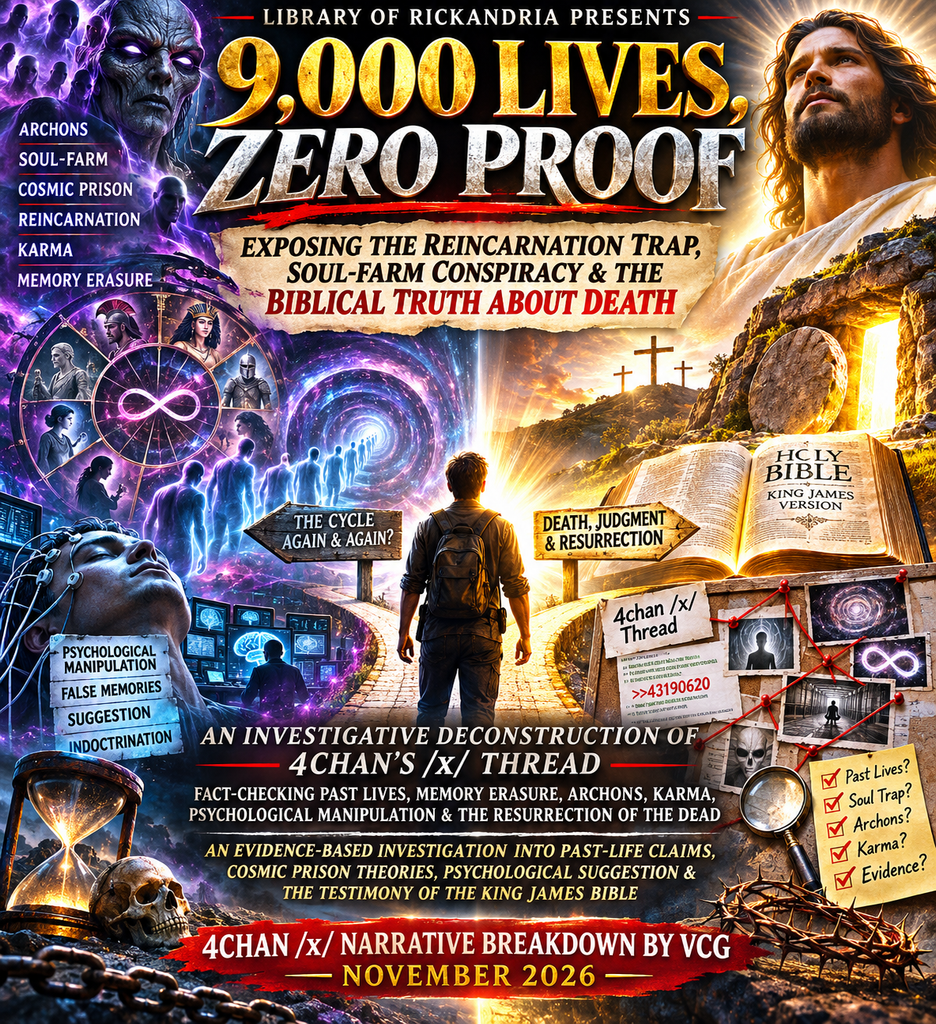
UPDATED BY VCG ON 11/13/2026 @ 20:20 EST
An Investigative Deconstruction of 4chan’s /x/ Thread — Fact-Checking Past Lives, Memory Erasure, Archons, Karma, Psychological Manipulation & the Resurrection of the Dead
An Evidence-Based Investigation into Past-Life Claims, Cosmic Prison Theories, Psychological Suggestion & the Testimony of the King James Bible.
Cover concept:
the competing imagery of cosmic captivity and biblical resurrection.
This illustration represents claims under examination; it is not evidence that a soul trap exists.
Anyone can do this, but most won’t.
9,000 Lives, Zero Proof: Exposing the Reincarnation Trap, Soul-Farm Conspiracy & the Biblical Truth About Death
is an extensive investigative examination of a November 2026 4chan /x/ thread that challenges:
- reincarnation
- erased past-life memories
- karmic lessons
and the theory that Earth functions as a spiritual prison or soul-harvesting farm.
Through a line-by-line analysis of the discussion, the paper separates documented facts from speculation, examines the origins of:
- reincarnation beliefs
- Gnostic archons
- Robert Monroe’s “loosh” concept
and modern cosmic-prison narratives, while investigating scientific research into:
- consciousness
- childhood past-life memories
- hypnosis, false memories
- psychological suggestion
It also explores the philosophical problems of:
- personal identity
- suffering
- spiritual manipulation
and the claim that souls must repeatedly return to Earth to learn lessons.
Drawing upon:
- historical scholarship
- peer-reviewed research
- the King James Bible
the investigation distinguishes scientific uncertainty from theological interpretation and evaluates claims that reincarnation was suppressed by the early Christian Church.
Ultimately, the paper finds that although certain extraordinary memory reports deserve serious investigation, the elaborate theories of compulsory reincarnation, cosmic imprisonment, and emotional-energy harvesting lack convincing independent verification.
In contrast, Scripture presents a fundamentally different understanding of human destiny:
- one earthly life
- divine judgment
- salvation through Jesus Christ
and the promised resurrection of the dead.
The central message is a call to test extraordinary claims against evidence, sound reasoning, historical context, and Scripture—seeking truth rather than surrendering to fear, speculation, or spiritual deception.
ChatGPT – Library of Rickandria

Primary discussion:
4chan /x/, Thread #43190620, November 9–13, 2026.
Biblical reference:
King James Version, using the supplied Pure Cambridge Edition.
Research focus:
- Religious history
- consciousness
- memory
- reincarnation reports
- psychology
- source criticism
- moral philosophy
- Christian theology
Guiding Scripture — 1 Thessalonians 5:21 (KJV):
Prove all things; hold fast that which is good.
Abstract
Suppose you have lived nine thousand lives.
You have:
- worked
- suffered
- learned languages
- practiced skills
- formed relationships
and encountered nearly every kind of human experience.
Yet here you are again, apparently starting from nothing.
You cannot remember your supposed earlier families.
You cannot speak the languages you allegedly mastered.
You cannot automatically perform the work you supposedly practiced for centuries.
What happened to everything you learned?
That question appeared on 4chan’s paranormal board on November 9, 2026.
/x/ – So you’ve reincarnated over 9000 times, got your m – Paranormal – 4chan
It was written sarcastically, but beneath the insults was a recognizable philosophical objection to the idea that Earth functions as a school for reincarnating souls.
The responses did not produce a single coherent defense.
Instead, participants introduced competing explanations:
- erased memories
- cosmic imprisonment
- emotional-energy harvesting
- past-life regression
- hidden spiritual identities
- karmic debts
- altered timelines
and deliberate limitations imposed for spiritual development.
Other participants rejected reincarnation altogether.
One attempted to disprove it through genetics.
Another connected repeated cycles of suffering and punishment to Christianity.
The conversation became a small but revealing example of how extraordinary ideas evolve on the internet.
This paper examines the discussion in its original sequence, then widens the investigation to the historical origins of reincarnation, the psychology of memory and belief, the strongest available research concerning alleged past-life experiences, and the origins of modern soul-trap theories.
The final sections compare these claims with Scripture, particularly the biblical teachings concerning human:
- creation
- death
- judgment
- salvation
- resurrection
The investigation reaches several distinct conclusions.
The original poster raises a genuine difficulty for reincarnation models that promise cumulative learning, but the criticism does not disprove every model of rebirth.
Some reported past-life cases warrant careful investigation, although they do not establish a scientifically accepted reincarnation mechanism.
The elaborate prison-planet and loosh-farming claims go well beyond the available evidence.
The ordinary Christian interpretation of Scripture presents a fundamentally different hope:
not repeated earthly incarnations, but resurrection and everlasting life through Jesus Christ.
These conclusions belong to different categories of reasoning.
- Scientific findings
- historical documentation
- philosophical analysis
- theological interpretation
must not be confused with one another.
An extraordinary explanation may be emotionally powerful, internally elaborate, and historically interesting without being demonstrated to be true.
PART I — HOW THIS INVESTIGATION WORKS
Chapter 1. Before we examine the thread
An anonymous internet discussion presents a particular challenge to anyone trying to investigate it seriously.
The participants rarely provide credentials.
They may exaggerate.
They may be joking.
They may believe what they are writing, or they may be performing a character for an audience.
A comment can also be logically interesting even when its author is being deliberately provocative.
That is why this investigation begins with a simple distinction:
The thread establishes what people wrote, not whether what they wrote is true.
The archived conversation is primary evidence for the discussion itself.
It is not primary evidence for an invisible cosmic prison, past-life memory transfer, or the existence of reincarnation.
To investigate those further claims, we need independent sources.
The evidence hierarchy
| Category | What it can establish | What it cannot establish by itself |
|---|---|---|
| Original thread | What a participant claimed, and when | Whether the claim is true |
| Historical manuscripts | What earlier authors or communities taught | That their supernatural beliefs were objectively correct |
| Scientific research | Observed phenomena, correlations, and experimentally tested explanations | Every possible metaphysical conclusion |
| Personal testimony | What a person reports experiencing | That the person’s explanation of the experience is correct |
| Philosophical reasoning | Whether premises and conclusions are logically connected | That a logically possible system actually exists |
| Biblical exegesis | What a passage communicates within its literary and theological context | A laboratory demonstration of a supernatural event |
We will use six recurring verdicts:
- supported
- partly supported
- unsupported
- contradicted
- not empirically testable as stated
- biblical interpretation
Unsupported does not mean impossible.
Contradicted means there is substantial evidence against the stated proposition.
A biblical interpretation is a reading of Scripture, which must be assessed by examining the text and its context.
Chapter 2. What constitutes responsible biblical correction?
The King James translators themselves left us an important methodological example.
In The Translators to the Reader, they acknowledged that some biblical words and expressions present genuine difficulties.
They defended giving readers alternative marginal interpretations where appropriate rather than forcing certainty about uncertain details.
Their preface includes the maxim that it is better to acknowledge uncertainty about hidden matters than argue dogmatically about what is unresolved.
That principle is particularly useful here.
We should not invent what Scripture says to answer questions Scripture does not directly address.
Nor should we treat every ancient religious text as though it carried the same authority as the Bible.
For this paper, passages are interpreted by examining their immediate context, comparing relevant Scripture, considering historical and linguistic information, and distinguishing direct statements from later theological inference.
A discussion of Hebrews 9:27, for example, must include its argument about Christ’s once-for-all sacrifice.
A discussion of John the Baptist and Elijah must examine Luke 1:17 and John 1:21, not merely Matthew 11:14.
The aim is careful reading, not proof-texting.
Chapter 3. The original thread
SOURCE RECORD
4chan /x/ — Thread #43190620
Opening post: November 9, 2026, 7:47:55 a.m. (time displayed by the thread)
Last visible reply: November 13, 2026, 7:43:45 a.m.
Status: Archived when retrieved
Scope: Original post and 35 replies, including posts without substantive text
Read the complete original discussion
The opening post begins by challenging the idea of having lived over nine thousand lives while possessing no recognizable accumulation of skills.
In the ensuing responses, people move from reincarnation to:
- loosh farming
- revenge
- DNA
- hypnosis
- former kingship
- repeating timelines
- karma
- archons
and finally the possibility that suffering is necessary to make happiness meaningful.
That progression will matter later because it shows how different and sometimes incompatible beliefs become attached to the same original question.
PART II — THE THREAD, EXAMINED IN ORDER
Chapter 4. The opening argument: Nine thousand lives and nothing to show for them
Post #43190620 | November 9, 2026
The opening post does not begin by asking whether reincarnation exists.
It begins by temporarily granting reincarnation and asking whether one popular explanation of its purpose makes sense.
That is an important distinction.
The argument is directed especially at the Earth-school theory:
the idea that human beings return repeatedly to:
- learn lessons
- acquire wisdom
- mature spiritually
If that is true, the poster asks, why don’t the supposed lessons appear in ordinary human competence?
4.1. The number 9,000
We should establish immediately that the number is rhetorical.
The thread provides no evidence that any particular human being has lived nine thousand lives.
Different religious traditions also have different understandings of rebirth.
Some regard existence as extending through innumerable lives, but the details vary substantially.
Therefore, nine thousand cannot be treated as a scientifically established count or a numerical premise applicable to every reincarnation theory.
Verdict: Unsupported numerical assumption.
4.2. The memory-wipe problem
The poster assumes that each life is followed by the erasure of memories.
If repeated existence really functions as education, this creates a problem.
Education normally depends upon some continuity between earlier and later learning.
Imagine attending school every year but having your knowledge erased each summer.
Under those conditions, it becomes difficult to explain how the curriculum produces cumulative intellectual progress.
A defender could respond that spiritual lessons remain at an unconscious level, even when conscious memories disappear.
That response is logically possible, but it introduces a new question:
How do we independently detect and measure the supposedly retained lessons?
If there is no agreed observable consequence of successful spiritual learning, the Earth-school theory becomes difficult to distinguish from a world in which no such schooling occurs.
4.3. Why aren’t we all unusually talented?
The poster moves from memory to competence.
After thousands of supposed lifetimes, shouldn’t people demonstrate remarkable proficiency in some field?
This is a reasonable criticism of theories that predict retained abilities, but it overlooks an important distinction.
Not all knowledge is the same.
Conscious recollection of a childhood event differs from the procedural ability to ride a bicycle or play an instrument.
Neuroscience recognizes distinctions between forms of memory and the brain systems supporting them.
However, there is no established biological mechanism by which the learned contents of one deceased person’s brain are transferred into another person’s developing brain.
The objection is therefore conditional.
If reincarnation guarantees cumulative skills, the absence of those skills is a problem.
If reincarnation does not guarantee cumulative skills, the objection does not directly refute it.
But the theory must still supply independent evidence for reincarnation itself.
4.4. Physical labor and athletic skill
The poster argues that thousands of lifetimes involving hard labor should result in extraordinary athletic ability.
Yet:
- physical endurance
- manual dexterity
- coordination
- strength
- sport-specific technique
are different competencies.
A farmer’s experience does not automatically confer the skills of a gymnast.
A skilled builder is not necessarily an accomplished swimmer.
The underlying issue remains:
What, precisely, would transfer between lives?
Without a mechanism or predictive model, the supposed accumulation of abilities cannot be evaluated reliably.
4.5. Relationships and the lessons of abuse
The poster then turns toward interpersonal behavior.
Shouldn’t someone who has experienced countless previous relationships recognize dangerous people immediately?
This is where the opening argument becomes morally sensitive.
Human relationships are complicated.
Abusive behavior may involve:
- manipulation
- intimidation
- economic dependence
- isolation
- threats
- coercion
Experience does not eliminate human vulnerability.
We must not suggest that victims of abuse are deficient students who have failed a repeated spiritual lesson.
The difficulty is even more serious for karmic interpretations that imply present suffering is deserved because of wrongdoing in an earlier life.
A historical or theological theory cannot establish that a particular victim earned mistreatment.
Biblical examination — John 9:1–3.
When Jesus encounters a man blind from birth, the disciples ask whose sin caused his condition.
Jesus rejects their proposed explanation in that case.
The passage does not establish an exhaustive doctrine explaining every instance of suffering.
It does demonstrate the danger of confidently assigning personal blame to someone experiencing hardship.
4.6. Relearning languages
Why, the poster asks, must people repeatedly learn languages?
This is a sharper version of the memory problem because language acquisition requires substantial learning.
If previous linguistic competencies survive, there ought to be observable consequences.
If they do not survive, the idea of accumulating practical knowledge through reincarnation becomes less convincing.
A defender could propose that only moral development is retained.
But that is a materially different theory from the one promising accumulated skills.
It must be examined on its own terms.
4.7. Animals and instinct
The poster claims that animals possess reliable instincts about what, when, and how much to eat, while human beings remain confused.
That comparison exaggerates animal competence.
Animals do not possess perfect dietary knowledge.
Feeding behavior can involve:
- innate preferences
- learning
- ecological constraints
- social information
- experience
The scientific problem is the poster’s implied idealization of animal instinct.
The philosophical problem is treating differing kinds of intelligence as evidence for or against earlier lives.
Neither provides a reliable test of reincarnation.
4.8. Human illness and nutritional uncertainty
The suggestion that health problems demonstrate forgotten lessons is also mistaken.
Illness can arise from:
- infections
- inherited conditions
- environmental exposure
- injury
- aging
and other causes unrelated to someone’s knowledge of nutrition.
Even exceptional medical understanding does not guarantee perfect personal health.
Biblical comparison:
Paul speaks of enduring weakness in 2 Corinthians 12:7–10.
Timothy is described as having recurring ailments in 1 Timothy 5:23.
Neither passage interprets illness as evidence of defective spiritual education in an earlier incarnation.
4.9. Music, art, and public speaking
The opening poster then asks why people are not automatically skilled at music, visual art, or public speaking.
The argument assumes that people must have mastered these skills in earlier lives.
But occupying an aristocratic or wealthy position does not guarantee mastery of the arts. Nor is artistic excellence exclusive to the wealthy.
More importantly, there is no demonstrated cross-life transfer process.
Scriptural comparison — Exodus 31:2–5:
Bezalel’s craftsmanship is described as a gift from God.
Scripture does not attribute his abilities to earlier incarnations.
4.10. Everyday skills: Building, weaving, farming, and cooking
This is arguably the strongest practical example in the opening post.
Unlike aristocratic hobbies, ordinary work such as:
- cooking
- sewing
- construction
- animal care
has been widespread across human societies.
If people have supposedly lived thousands of ordinary lives and retain substantial practical ability, why do they not display more widespread inherited competence?
Still, the criticism only becomes decisive against a theory that actually promises that kind of retention.
A scientific test would require identifying people with alleged previous-life abilities, documenting their actual performance, and comparing their results with suitable controls while excluding normal learning and information exposure.
4.11. Are these genuine logical contradictions?
The poster concludes that defenders need to repair the inconsistencies in their Earth-school narrative.
Some objections are stronger than others.
A genuine contradiction would arise if a theory simultaneously claimed that every lifetime reliably preserves the abilities learned before and denied any need to explain why those abilities are absent.
But a theory merely lacking evidence is not automatically self-contradictory.
We should distinguish:
- A contradiction, where two claims cannot both be true.
- An unsupported premise, where a claim lacks sufficient evidence.
- An explanatory gap, where a theory does not explain an important observation.
- An untestable assertion, where no clear observation could count against the claim.
The opening post provides a useful internal critique, although its sarcastic presentation substitutes ridicule for evidence in several places.
Opening-post verdict:
Partly successful as a challenge to cumulative Earth-school theories; insufficient as a universal refutation of reincarnation.
Chapter 5. November 9: From memory erasure to cosmic imprisonment
The first day of replies introduces the terms and assumptions that dominate the subsequent conversation.
Post #43190631 — A personal dismissal
The first reply tells the original poster to stop projecting.
This is not a rebuttal.
Psychological projection is a real concept, but identifying it requires substantially more evidence than disagreement with a person’s argument.
Whether the poster has a personal insecurity has no bearing on whether memory survives death.
Biblical comparison — Proverbs 18:13:
Scripture warns against answering before adequately hearing a matter.
Verdict: Personal attack; no evidential contribution.
Post #43191157 — Is memory erasure proof of a loosh farm?
The next important commenter suggests that memory erasure is evidence the system is rigged and that Earth functions as a loosh farm operated by interdimensional criminals.
Notice the progression:
The commenter begins with an unverified claim about past lives, assumes deliberate memory erasure, then identifies malicious operators and an exploitative purpose.
Each step adds a new premise.
Even granting reincarnation temporarily, none of the later steps follows automatically.
One might imagine reincarnation without erasure.
One might imagine loss of memory without deliberate intervention.
One might imagine deliberate intervention without emotional harvesting.
The loosh-farming conclusion therefore requires independent evidence.
Biblical correction:
Ephesians 6:12 speaks of spiritual conflict. It does not identify a mechanism by which unseen beings harvest emotional energy from reincarnated humans.
Colossians 1:16–17 also presents all created powers as existing through Christ, not as ultimate authorities over existence.
Verdict:
Unsupported supernatural mechanism.
Post #43191183 — Past-life regression, recovered memories, and YouTube
This commenter argues that many people already remember earlier lives and that paid past-life regression can reveal them.
The psychological questions raised here are important.
A memory can feel extraordinarily vivid without accurately representing an event that happened.
In 2009, researchers induced alleged past-life memories in 64 young adult men through hypnotic procedures.
Reports varied with hypnotizability, and their contents reflected cultural and religious expectations.
The study demonstrated that such narratives can be produced; it did not establish that the described previous lives occurred.
See Pyun and Kim, Experimental Production of Past-Life Memories in Hypnosis.
A subsequent experiment demonstrated that suggested historical or fictional identities could influence the identities participants produced during past-life regression.
See Creating Past-Life Identity in Hypnotic Regression.
The commenter also invokes the popularity of paranormal YouTube channels.
Popularity establishes an audience, not factual reliability.
A channel may contain interesting testimony, but each case must be examined independently.
Subscriber counts cannot substitute for primary records.
The linked video should likewise not be treated as verified evidence without inspecting its contents and sources.
Biblical comparison: Deuteronomy 18:10–12 condemns prohibited divination and related practices.
That does not mean all therapeutic hypnosis is necessarily divination; a distinction must be made between clinical techniques and attempts to obtain hidden spiritual knowledge.
Verdict: Claims that some people report past-life memories are supported.
Claims that hypnotic regression reliably recovers actual previous lives are unsupported.
Post #43191200 — Why memories supposedly must be erased
The next commenter offers an explanation: without erasure, someone reincarnated after being murdered might seek revenge against a surviving killer.
This is an imaginative ethical problem, but not evidence for a cosmic memory-management system.
It also creates a further difficulty.
Why would an allegedly powerful spiritual authority need to erase everyone’s memories to prevent particular acts of revenge?
Could it not protect people through other means?
The proposed explanation is possible as fiction. It has not been demonstrated as reality.
Scripture — Romans 12:19:
Vengeance belongs to God, rather than to individuals seeking personal retaliation.
Biblically, moral justice does not depend on preventing reincarnated people from identifying former enemies.
Verdict:
Speculative explanation.
Post #43191219 — Genetics allegedly disproves the soul
This reply presents a biological argument against reincarnation.
The commenter equates an individual’s DNA with their soul and says modern genetics proves that the individual can exist only once.
The conclusion does not follow.
DNA is the hereditary molecule that contributes to biological development and function.
The soul is a philosophical or theological concept that has not been established as identical to DNA.
Even genetically identical twins are distinct persons.
Genetics can help explain biological individuality, but it cannot independently settle whether an immaterial soul exists, survives death, or inhabits another body.
See the National Library of Medicine’s explanation of cell division, meiosis, and heredity.
Genesis 2:7 — KJV:
And the LORD God formed man of the dust of the ground, and breathed into his nostrils the breath of life; and man became a living soul.
The verse describes God’s creation of a living human being. It does not define the soul as a genetic sequence.
Verdict:
Invalid inference from real biological science.
Post #43191307 — The revenge explanation is challenged
This commenter attacks the revenge theory by observing that a murderer could already be dead by the time a supposed victim reincarnated and matured.
That is a fair objection to the proposed explanation’s universality.
The personal insult adds nothing.
A more useful reply would simply ask why a system allegedly preventing revenge would erase memories in circumstances where revenge was impossible.
Verdict:
Relevant logical objection, weakened by insult.
Posts #43191387 and #43191868 — Ridicule and racial hostility
These posts introduce personal insults, including racist abuse.
They establish nothing concerning the afterlife.
Their relevance is primarily rhetorical:
the discussion is drifting from evaluating claims toward establishing social dominance through contempt.
Biblical correction — James 3:9–10:
The contradiction between honoring God and cursing human beings is directly relevant.
Verdict:
No substantive evidence.
Post #43191886 — Remembering former kingship and destroyed worlds
A commenter using the name Xenia claims to remember previous lives as a king and to have destroyed entire worlds.
This statement may be satire, performance, metaphor, or sincerely held belief.
We cannot determine which from the text.
If the claim is intended literally, it requires independently verifiable details.
No identifiable former kingdom, date, documentary record, or testable historical claim is supplied.
The reference to Zeus appearing as a beggar invokes recognizable classical mythological imagery, but such imagery cannot authenticate the claimed biography.
Biblical comparison:
James 4:13–16 warns against boastful assumptions about human power and certainty.
Verdict: Uncorroborated extraordinary testimony.
Post #43191892 — Two thousand years of remembered lives
Another commenter claims to have occupied numerous historical social positions over approximately two millennia.
This includes figures as different as a beggar, sorcerer, aristocrat, and barbarian.
The commenter also claims continuity of sex and European ancestry across these lives.
There is no independently verifiable evidence supplied for either the sequence of lives or the proposed continuity.
The further assertion of loosh harvesting creates another claim requiring additional evidence.
Biblical comparison:
Acts 17:26 speaks of humanity’s common origin and God’s providence over nations.
It does not establish separate ancestral reincarnation cycles.
Verdict:
Uncorroborated personal narrative.
Posts #43191929 and #43192743 — Mutual recognition
Two short replies jokingly recognize extraordinary reincarnation claims.
These are best understood as social interaction rather than independent corroboration.
An agreement between anonymous internet accounts is not necessarily a second evidential source.
It is possible the comments are humorous, sincere, or performative.
Their content alone cannot establish which.
Verdict: No independently testable claim.
Post #43192755 — Choosing one’s next appearance
The commenter expresses a preference concerning sex, ancestry, and physical appearance in a future life.
A preference is not evidence that reincarnation occurs or that future bodies can be selected.
The possibility of negotiating one’s characteristics also introduces a claim about spiritual control over biological development.
Biblical comparison — Psalm 139:13–16:
The Psalm presents human formation as known to God, not as the result of bargaining with supposed reincarnation administrators.
Verdict:P
ersonal wish based on an unverified system.
Chapter 6. November 10: Timeline loops, karmic debts, and archons
Post #43194636 — Would remembering previous lives remove the fear of death?
This commenter proposes that recovered memories would make people less afraid of dying and improve their current abilities.
That is a psychological prediction, not an established consequence.
A remembered experience might produce reassurance.
It might also produce grief, fear, guilt, or distress.
The result would depend upon what the person remembered, how the experience was interpreted, and whether the memory was accurate.
Even if reduced fear were observed, that would not authenticate the supposed previous life.
Biblical comparison — Philippians 3:13–14:
Paul’s attention is directed toward his present calling and future hope in Christ, not the recovery of earlier earthly identities.
Verdict:
Untested psychological hypothesis.
Posts #43194643 and #43194664 — Repeating timelines
One commenter claims to be reliving existence with memory intact.
Another expresses hope of returning to an alternative timeline where past disappointments never occurred.
These are different claims from ordinary reincarnation.
Reincarnation typically concerns successive lives.
Timeline looping concerns repeating or revisiting a sequence of events.
The existence of theoretical physics literature discussing unusual spacetime models does not establish that either commenter is traveling through or repeating time.
No dated predictions, independently verified repetitions, or reproducible effects are supplied.
Biblical comparison:
Scripture describes providence, history, death, and resurrection; it does not teach that human beings routinely restart their earthly biographies.
Verdict:
Unsupported personal claims.
Post #43194752 — The strongest objection to the original poster
This brief commenter points out that reincarnation does not necessarily entail retained life skills.
That objection is correct.
A theory cannot be disproved by refuting a prediction it never made.
However, the reply also exposes the need to define the theory more carefully.
Does something persist between lives?
If so, what persists?
Does the person remain numerically identical?
Does moral character persist?
Are habits transferred?
Is there an enduring soul?
Without clear answers, the term reincarnation may refer to very different propositions.
Verdict: Logically sound criticism of the opening poster’s broad generalization.
Post #43194774 — A karmic debt so great that the world must be healed
The commenter introduces a supposed identity as a karmic friction point, suggesting that present suffering and responsibility arise from severe wrongs committed during earlier lives.
The post’s tone contains obvious elements of humor, so we should not assume complete literal commitment.
Still, the underlying theology deserves examination.
The concept can become self-confirming.
If someone suffers, that supposedly proves they are paying a debt.
If they encounter conflict, that supposedly proves they are provoking growth.
If their circumstances improve, that supposedly proves their spiritual obligations are being fulfilled.
This creates the danger of interpreting nearly every outcome as evidence of the original idea.
The moral danger is significant:
people may come to believe that abuse, poverty, disability, or other hardships are punishments they deserve for actions they cannot remember.
Biblical correction — Ephesians 2:8–9:
Salvation is presented as the gift of grace, not as repayment of debts accumulated through multiple incarnations.
Verdict:
Unverified karmic explanation with potentially harmful moral implications.
Post #43194813 — Another retaliatory insult
The commenter replies to an earlier offensive post with further abuse.
No new evidence appears.
Scripture — Romans 12:17:
Christians are instructed not to repay evil for evil.
Verdict:
No substantive argument.
Post #43196586 — Reincarnation administrators and preferred bodies
The commenter proposes that bodily traits may change between lives while a broader identity remains stable.
They also suggest that beings controlling reincarnation could grant favorable circumstances.
This introduces several unverified assumptions at once.
It presumes reincarnation, continuity of identity, agents controlling birth, and the possibility of negotiating with those agents.
No independent evidence is presented for any of these mechanisms.
Verdict:
Unsupported elaboration.
Post #43196609 — Talents attributed to poisoning
The commenter reports possessing abilities but associates them with alleged poisoning.
The visible post provides no evidence establishing poisoning, its nature, or a causal relationship with the claimed abilities.
It would be inappropriate to accept or dismiss a personal medical allegation on this evidence alone.
Nor does the allegation independently address reincarnation.
Verdict:
Unverified testimony with no demonstrated causal mechanism.
Posts #43196631 and #43196668 — Human worth and the need for love
One commenter uses dehumanizing language. Another responds by urging greater kindness.
The second comment is a morally important interruption.
The thread has repeatedly evaluated people according to competence, spiritual advancement, supposed cosmic importance, and hidden history.
But human dignity should not be made conditional upon any of those things.
Genesis 1:27 — KJV:
So God created man in his own image, in the image of God created he him; male and female created he them.
A person’s worth does not depend on being spiritually advanced, unusually talented, or able to recount a spectacular cosmic biography.
Verdict:
Primarily ethical discussion, not evidence for reincarnation.
Post #43196700 — The AI-generated birth-chart explanation
This reply identifies the earlier karmic identity description as material generated through Google’s AI when prompted about a birth chart.
This matters because it clarifies the source of the terminology.
An AI-generated description may sound authoritative and personally specific even when it is based upon speculative or unverified premises.
If the system is asked to explain an astrology chart in karmic terms, it may produce a fluent karmic interpretation.
That interpretation does not authenticate the birth chart’s supernatural significance.
The exact interaction was not available for independent reproduction.
Verdict: Relevant clarification about provenance; no proof of the karmic claims.
Post #43196786 — Archons harvesting human talent
The commenter jokingly combines Plato’s cave, archons, and the opening post’s discussion of basket weaving.
The absurdity of the image suggests deliberate parody.
Nevertheless, it illustrates how quickly an unexplained absence of talent can be attributed to invisible exploitation.
If the claim were intended literally, it would need independent evidence of a harvesting entity, the alleged extraction mechanism, and observable effects.
Ancient texts can establish that ideas about lesser cosmic rulers existed.
They cannot establish that those rulers operate a present-day talent-harvesting industry.
Verdict: Likely satire; unsupported if read literally.
Posts #43196861 and #43196881 — Would endless existence become unbearable?
A commenter argues that endless continuation at the present level of consciousness would become psychologically intolerable. Another agrees.
The underlying concern is understandable.
But Christian eternal life is not presented merely as an unlimited extension of present mortal limitations.
1 Corinthians 15:53 — KJV:
For this corruptible must put on incorruption, and this mortal must put on immortality.
Paul’s doctrine concerns transformed existence.
The psychological argument against endless ordinary mortality therefore does not directly refute the biblical concept of glorified resurrection life.
Verdict: Philosophical speculation based on an assumption that Christian resurrection does not require.
Chapter 7. November 11–13: Earth as a joy planet, the higher self, and repeated hell cycles
Post #43199462 — Fellowship among supposed timeline loopers
This reply expresses solidarity with the earlier looping claims.
It contains no independently verifiable information.
Verdict: Social affirmation rather than evidence.
Post #43199527 — God and nature supposedly prefer gradual progress
The commenter offers a philosophical remark about gradual development.
Gradual biological and psychological processes are real.
However, their existence does not establish the recurrence of individual human lives.
Biblical comparison — Ecclesiastes 3:1: Scripture describes appointed seasons without making those seasons proof of reincarnation.
Verdict: General reflection, not evidence.
Post #43200361 — Empty reply
The post refers to the original discussion but supplies no substantive argument.
Verdict:
Not assessable.
Post #43200385 — Earth is not a prison; it is a joy planet
This is the thread’s most developed counter-narrative to cosmic imprisonment.
The commenter suggests that memory erasure allows people to enjoy experiences repeatedly.
They argue that suffering creates the necessary contrast by which goodness can be appreciated.
The conclusion is that Earth is effectively a paradise rather than a prison.
Let us separate the claims.
First: People may indeed wish they could enjoy a favorite film or book again without remembering the ending.
That is an ordinary psychological observation.
It does not establish the existence of a pre-birth memory-erasure system.
Second: Contrasts can help human beings recognize qualities.
We may appreciate safety more deeply after danger or health more deeply after illness.
But it does not follow that danger, cruelty, and illness must exist for safety, love, and goodness to be real.
That would confuse a method of learning with a necessary condition for existence.
Third: The conclusion that all suffering exists by design requires evidence.
The commenter does not supply it.
Biblical correction — Genesis 1:31:
And God saw every thing that he had made, and, behold, it was very good.
The creation narrative describes goodness before the entrance of human sin.
Revelation 21:4 — KJV:
And God shall wipe away all tears from their eyes; and there shall be no more death, neither sorrow, nor crying, neither shall there be any more pain:
for the former things are passed away.
Within the biblical worldview, goodness does not require the perpetual existence of evil.
The promised removal of suffering is presented as fulfillment, not deprivation.
Verdict: Philosophically interesting but unsupported as an explanation of reincarnation; its claim that evil is necessary for good is strongly challenged by the biblical account.
Post #43200390 — Personal attack
This post ridicules the previous commenter and makes a reference to psychiatric treatment.
An anonymous statement cannot establish a psychiatric diagnosis.
Verdict:
No relevant evidence.
Post #43200496 — Free will and the hidden higher self
This commenter proposes that memories from earlier lives would interfere with present spiritual development.
The visible person supposedly forgets, while a higher self retains the complete record.
There is a genuine philosophical issue here: memory influences preference and choice.
However, influence does not automatically mean the destruction of free will.
We routinely make decisions based on memories and previous experience.
A coherent free-will theory would need to explain why memories from earlier incarnations uniquely interfere with freedom.
The higher self is also introduced without independent evidence.
If its memories cannot be observed, measured, or distinguished from ordinary unconscious processing, the claim remains speculative.
Biblical comparison — Romans 8:16:
The passage concerns the Holy Spirit bearing witness with the believer’s spirit.
It does not establish an unseen trans-incarnational self containing thousands of personal histories.
Verdict:
Philosophical hypothesis with unsupported metaphysical assumptions.
Post #43203744 — Punctuation only
No substantive claim is supplied.
Post #43203769 — Forgetting in order to rediscover
The commenter argues that limitation, repetition, and rediscovery make existence meaningful.
There is real philosophical appeal in the idea that creative activity requires uncertainty and limitation.
But there is a difference between voluntarily learning something new and being forcibly deprived of knowledge allegedly gained in an earlier existence.
The commenter does not establish that reincarnation occurs, that the forgetting is deliberate, or that it serves a beneficial purpose.
Biblical comparison:
Lamentations 3:22–23 celebrates God’s renewed mercies without teaching repeated incarnation.
Verdict:
Meaningful philosophical reflection, not empirical evidence.
Post #43203799 — Cinemas allegedly hypnotize audiences
This commenter asserts that cinemas hypnotize patrons to make familiar films seem new.
No evidence is given for a systematic practice of inducing autobiographical amnesia in moviegoers.
Ordinary immersion in a film should not be confused with the verified erasure of memory.
Verdict:
Unsupported allegation.
Post #43205631 — A commenter points to personal talent
The commenter challenges the original poster’s assumption that everyone is untalented and cites praise received for performing ability.
That is a legitimate objection to broad claims about universal incompetence.
But exceptional talent in one life cannot establish the existence of another.
Biblical comparison — Romans 12:6:
Scripture recognizes differences in gifts without attributing them to previous-life training.
Verdict:
Relevant criticism of overgeneralization; not evidence for reincarnation.
Post #43205686 — A repeated cycle of hell supposedly connected to Christ
This is the most important explicitly Christian claim in the discussion.
The commenter suggests that someone may pass through hell multiple times, progressively learning purity, and associates the process with Christ.
The claim combines several distinct concepts:
- punishment
- purification
- cosmic repetition
- karma-like progression
- Christian terminology
The KJV does not describe a cycle in which human souls repeatedly pass through hell before reincarnating for additional lessons.
Hebrews 9:27 — KJV:
And as it is appointed unto men once to die, but after this the judgment:
This verse belongs to a larger argument about Christ’s sacrifice and the once-for-all nature of his offering.
Revelation 20:11–15 describes divine judgment.
1 Corinthians 15 describes resurrection.
Neither supplies the repeated hell-school curriculum proposed in the comment.
There are disagreements among Christians concerning the duration and nature of final punishment.
Those disagreements deserve separate treatment.
They do not establish a biblical system of repeated karmic hell cycles.
Verdict:
Unsupported syncretic theological claim.
Post #43205744 — The boulder and the possibility of regression
The commenter asks what a boulder symbolizes and says people can regress.
The statement is too ambiguous to establish a specific reincarnation mechanism.
Regression can mean a psychological process, an induced hypnotic experience, or a return to a prior state in an imagined narrative.
These meanings must not be conflated.
Verdict:
Ambiguous assertion lacking supporting evidence.
Post #43205756 — Humanity as cosmic livestock
This commenter challenges the optimism of the joy-planet theory.
They point toward ecological predation and suggest humans may likewise be livestock to higher beings.
The objection to minimizing suffering has force.
People whose lives have involved severe hardship may reasonably reject the characterization of Earth as an uncomplicated paradise.
But the existence of predation in nature does not demonstrate that humans are being harvested by hidden extraterrestrial or spiritual beings.
A further causal argument and independent evidence are required.
Biblical comparison — Romans 8:20–22:
Creation is described as subject to suffering and corruption.
Scripture does not identify that condition with an extraterrestrial livestock operation.
Verdict:
Serious moral criticism followed by an unsupported supernatural inference.
Post #43207854 — Empty reply
No substantive argument is visible.
Post #43209515 — Can hypnosis recover earlier lives?
The thread ends with a person asking whether past-life memories can be unlocked and whether hypnosis could reveal the fragments composing their soul.
This is an appropriate place to bring the investigation back to practical consequences.
Hypnosis can produce vivid subjective experiences.
It is not a validated historical method for establishing the reality of previous incarnations.
A 2025 review of experimental research reported that hypnosis did not improve accurate recall in the reviewed studies and could increase confidence in recollections of events that had never occurred.
Source:
Krackow, Rashed, and Thompson, Does Hypnosis Aid Memory Retrieval? (2025).
Anyone considering past-life regression deserves to know that a compelling memory-like experience may be sincerely felt without corresponding to an actual historical event.
Biblical comparison — 2 Corinthians 5:17:
Paul describes new life in Christ, not the recovery of hidden identities from earlier incarnations.
Final reply verdict:
A sincere-seeming question to which the evidence supports a cautious answer.
Chapter 8. What the discussion actually demonstrates
The thread is valuable not because it establishes a new theory of the afterlife, but because it reveals how several incompatible theories can coexist within one conversation.
One participant says memory erasure is evidence of imprisonment.
Another says it prevents revenge.
Another says it protects free will.
Another says it creates enjoyment.
One commenter claims to remember previous lives.
Another claims to repeat the same timeline without forgetting.
Some regard suffering as evidence of oppression; others call it essential to happiness.
These explanations cannot all be accepted as a single coherent doctrine without resolving their differences.
This is the central lesson of the thread.
An explanation should not be considered established merely because it can be adapted to accommodate every possible outcome.
The thread provides:
- testimony
- philosophical arguments
- speculative cosmologies
- jokes
- unsupported scientific assertions
It does not provide a documented demonstration of reincarnation or a mechanism of soul farming.
For a closer Library of Rickandria comparison involving another 4chan reincarnation discussion, see The Soul Trap Exposed: Are We Reincarnated, Ascending… or Being Deceived?.
PART III — WHERE DID THESE IDEAS COME FROM?
Chapter 9. Reincarnation did not begin on 4chan

Exhibit A — Ancient religious manuscripts
The Nag Hammadi codices are physical witnesses to late-antique religious literature.
They help historians reconstruct the ideas of particular communities.
They do not, simply by existing, prove the supernatural cosmologies described in those writings.
Historical manuscript photograph.
Source:
Biblical Archaeology Society.
Before we can understand modern reincarnation arguments, we need to establish that the word reincarnation is often used for beliefs that are not identical.
This is especially important because the 4chan commenters move freely between:
- Eastern religious concepts
- Greek philosophy
- modern metaphysical literature
- Christian terminology
Those systems cannot simply be combined without regard for their original meanings.
9.1. Hindu traditions: Samsara and liberation
Within major Hindu traditions, samsara describes the recurring cycle of birth, death, and rebirth.
Karma concerns action and its consequences, although different Hindu traditions explain the relationship between action, moral causation, and future existence in different ways.
Many Hindu schools also teach an enduring self, or atman, but their metaphysical interpretations differ substantially.
Rebirth is generally not understood merely as an educational program designed to make people better at ordinary occupations.
The ultimate aim is often liberation from the cycle itself, rather than an unlimited series of successful earthly careers.
For background, see Encyclopaedia Britannica’s discussion of reincarnation and the Stanford Encyclopedia of Philosophy’s survey of classical Indian concepts of personhood.
9.2. Buddhism: Rebirth without an eternal personal self
Buddhist teachings create a particularly important challenge for the opening post.
Classical Buddhist accounts of rebirth generally reject the existence of a permanent, unchanging personal self.
This is associated with the doctrine of anatta, often translated as not-self.
Consequently, Buddhist rebirth should not simply be described as an immortal personality moving unchanged from one body into another.
Philosophical debates concern how causal continuity can exist without an eternal self.
That is a very different question from whether an individual should remember nine thousand previous sets of professional skills.
The distinction is discussed in the Stanford Encyclopedia of Philosophy: Personhood in Classical Indian Philosophy.
Stanford Encyclopedia of Philosophy
Methodological consequence:
The original 4chan argument cannot be treated as an equally effective criticism of every Hindu and Buddhist school.
9.3. Jainism and the moral consequences of action
Jain traditions also teach rebirth and liberation, while placing distinctive emphasis on the:
- soul
- karma
- nonviolence
- moral discipline
Their account of karma differs from both the typical Buddhist account and many modern Western descriptions of karma as a universal system of rewards and punishments.
The modern statement that someone is suffering because they were a bad person in a former life is not an adequate summary of the philosophical diversity of Indian traditions.
For broader comparative context, see Britannica: Jainism and Britannica: Karma.
9.4. Ancient Greece: Transmigration and the philosophical soul
Rebirth ideas also appeared in Greek philosophical and religious traditions.
They are associated with figures and schools including Pythagorean traditions, Empedocles, and Plato.
Plato discusses the fate of souls and recurring embodiment through philosophical dialogues and myths.
The accounts are not identical in their purposes or details.
One particularly relevant example is the Myth of Er in Book X of Plato’s Republic, where souls choose future lives.
This supplies historical evidence that the idea of souls selecting lives predates modern New Age spirituality by many centuries.
However, it does not establish that such selection actually occurs.
Source:
Plato, Republic, Book X, in the Perseus Digital Library.
The distinction between philosophical myth and independently established reality is essential.
9.5. The modern Earth-school explanation
The idea that souls choose or experience repeated earthly lives as part of a curriculum appears in various modern spiritual and esoteric settings.
Some versions emphasize moral progress.
Others emphasize personal growth, soul contracts, chosen suffering, and the supposedly educational purpose of relationships.
Those claims should be studied as specific systems rather than attributed indiscriminately to ancient Hinduism, Buddhism, or Christianity.
A particularly important Western development is Allan Kardec’s nineteenth-century Spiritism.
Kardec’s The Spirits’ Book includes discussions of successive incarnations, progress of the soul, and the forgetting of previous lives.
This gives the modern memory-erasure discussion a relevant nineteenth-century predecessor.
For a related Library of Rickandria analysis involving Kardec, childhood memories, and other reincarnation claims, see Reincarnation, Memory & the Afterlife.
Chapter 10. The historical development of the prison-planet narrative
The modern soul-trap worldview resembles several older religious and philosophical systems, but resemblance alone does not establish direct borrowing.
Exhibit B — Historical comparison of concepts
- Ancient Indian religious traditions
Cycles of rebirth, moral causation, and liberation develop in different philosophical and religious settings. - Ancient Greek philosophy
Transmigration, the soul’s destiny, and selection of future lives appear in philosophical and mythological accounts. - Early centuries of Christianity
Some Gnostic movements develop elaborate accounts of cosmic rulers, inferior creators, and liberation through hidden knowledge. - Nineteenth-century Western esotericism
Spiritism and other movements promote new interpretations of reincarnation and spiritual progress. - Twentieth-century visionary literature
Robert Monroe’s Far Journeys introduces the influential loosh narrative in 1985. - Twenty-first-century internet communities
Reincarnation, archons, loosh, near-death experiences, simulation hypotheses, and science-fiction imagery are combined into modern prison-planet theories.
This is a conceptual chronology, not a proven chain of direct influence between every tradition.
10.1. Ancient Gnosticism and the material world
The term Gnosticism is often used for a diverse range of late-antique religious movements.
Some associated texts describe the physical cosmos as the work of an inferior creator, commonly termed the demiurge.
Other divine beings or rulers may govern portions of the cosmos.
Salvation may be presented as escape from ignorance and return to a higher spiritual realm.
These ideas have obvious thematic similarities to the modern prison-planet narrative.
But we must avoid treating Gnosticism as one uniform religion with a single, universally accepted cosmology.
The Internet Encyclopedia of Philosophy’s overview of Gnosticism explains both its major themes and its significant diversity.
Internet Encyclopedia of Philosophy
Some modern writers borrow vocabulary such as archon, demiurge, and gnosis, then use it in ways that cannot be directly traced to a specific ancient document.
Historical vocabulary does not guarantee historical continuity of meaning.
10.2. The Nag Hammadi discovery
In 1945, a collection of Coptic manuscripts was discovered near Nag Hammadi in Egypt.
The surviving codices provide important evidence for the study of ancient religious movements, including several often classified as Gnostic.
They are historically significant because they preserve writings that can be compared with accounts produced by ancient critics of those movements.
Yet a manuscript is evidence that a text existed and circulated.
It is not automatic verification of the worldview contained within that text.
Consider the difference between finding a manuscript describing a cosmic ruler and independently demonstrating the existence of that ruler.
Those are fundamentally different accomplishments.
10.3. Is the biblical Satan identical to the Gnostic demiurge?
Some modern conspiracy accounts collapse:
- the God of the Old Testament
- Satan
- the demiurge
- archons
into one supposed cosmic administration.
That interpretation is incompatible with the ordinary reading of the biblical creation narrative.
Genesis 1 presents the Creator as the source of an originally good creation.
John 1:1–3 identifies the Word with the divine activity of creation.
Colossians 1:16–17 describes visible and invisible powers as created through Christ and dependent on him.
Ancient Gnostic writings sometimes reinterpret or reverse biblical accounts.
Their reinterpretations are important historical evidence of what particular groups believed, but they should not be attributed to Scripture without demonstrating that the biblical authors themselves intended those meanings.
For a related Library investigation, see The Oversoul, Archons & the Architecture of Consciousness.
Chapter 11. Robert Monroe and the original loosh account

Exhibit C — Far Journeys (1985)
Robert A. Monroe’s book is an identifiable source behind modern loosh discussions.
Its importance to this investigation lies in documenting the development of the idea, not in independently verifying the experiences it describes.
Book-cover image.
Source:
Apple Books listing for Robert Monroe’s Far Journeys.
The most recognizable term in the modern soul-farming narrative is loosh.
Its association with Robert Monroe is historically traceable.
Monroe was known for describing out-of-body experiences and developing methods intended to explore unusual states of consciousness.
In Far Journeys, he presents an extraordinary narrative in which life on Earth is connected with producing a valuable nonphysical substance.
At first, the account can sound like an elaborate farming allegory.
Life creates the substance.
Emotional experience and suffering become associated with its production.
Human beings appear to occupy a troubling position within the system.
But the narrative does not stop there.
11.1. The part often omitted from internet retellings
In the later portions of Monroe’s account, the supposed substance is explicitly connected with love.
The story develops beyond the simple proposition that powerful beings harvest fear and pain.
This is important because modern summaries sometimes preserve the frightening imagery while neglecting the later attempt to reinterpret the system.
In Chapter 13, Shock Treatment, Monroe considers a connection between the supposed energy, human emotional development, and love.
The original literary narrative is therefore more complex than the straightforward claim that demons consume negative emotions.
Source for historical study:
A Library discussion of its interpretation is available in The Loosh Farm Thesis.
11.2. What Monroe’s account can establish
It can establish that a particular author publicly described a loosh-based cosmology.
It can establish that later writers had an identifiable source of terminology and imagery.
It can also establish that the narrative contains multiple interpretations of its alleged spiritual system.
It cannot independently establish that loosh is a measurable substance.
Nor does it establish that invisible agents control reincarnation or alter the memories of newborn children.
11.3. The missing measurement
If loosh is a kind of energy, what are its observable properties?
Can it be detected by an instrument?
Does its quantity change under identifiable conditions?
Can independent laboratories distinguish it from ordinary neurological, endocrine, or physiological processes?
Does any observation uniquely identify an alleged harvesting agent?
Until such questions can be answered with independent evidence, the cosmic-farming mechanism remains unverified.
That is not a claim that every conceivable nonphysical reality has been disproven.
It is a claim about the actual evidential state of this particular assertion.
11.4. The difference between history and mythology
Monroe’s book is historically important as a source.
The reported visionary experiences are part of the testimony.
The alleged existence of loosh is a metaphysical claim.
The existence of interdimensional harvesting facilities would be a further factual claim.
The belief that archons operate those facilities is another claim again.
Each step requires its own justification.
Modern prison-planet narratives often treat this collection of separate assertions as though it were one established system.
It is not.
For more detailed Library examinations, consult The Loosh Trap: Are Demons Feeding on Your Fear? and Is Earth a Soul Trap?.
Chapter 12. Are near-death experiences evidence of a deceptive white-light trap?
Although the original thread does not contain a developed near-death-experience argument, the subject is closely related to modern prison-planet claims.
The most common version alleges that a bright light encountered near death is a lure intended to return souls to another incarnation.
That claim combines at least three distinct propositions:
A person reports an experience of light.
The experience corresponds to an actual external phenomenon.
The phenomenon is deliberately produced by beings seeking to trap the person.
The first is a documented kind of testimony.
The second requires further investigation.
The third cannot be inferred from the first two.
12.1. What medical research has investigated
The AWARE-II study, published in 2023, examined reports of awareness and memories in people who survived cardiac arrest.
Researchers studied 567 in-hospital cardiac arrests across participating sites.
Fifty-three patients survived, and twenty-eight completed interviews.
Among those interviewed, some reported memories or experiences suggestive of consciousness during the broader resuscitation period.
The study also monitored brain activity and included tests designed to identify awareness.
No interviewed participant identified the visual target, while one identified an auditory stimulus.
The findings warrant investigation of how consciousness and memory relate to cardiac arrest and resuscitation.
They do not demonstrate that people enter a deceptive reincarnation portal.
Source:
Parnia and colleagues, AWAreness during REsuscitation — II (2023).
PubMed
12.2. What would actually prove a soul trap?
A reported light would not suffice.
Researchers would need evidence establishing a specific external system, its operators, its purpose, and its causal connection to subsequent births.
The prison-planet model currently lacks such a demonstrated evidential chain.
Biblical distinction:
John 14:1–6 centers the believer’s hope upon Christ.
Scripture does not instruct believers to avoid every bright appearance near death as a suspected reincarnation device.
At the same time, Matthew 24:24 and 1 John 4:1 caution against deception.
Those warnings should not be expanded into an invented afterlife navigation manual.
For a related LOR paper, see The Soul Trap Trap: Did 4chan Uncover the Afterlife—or Expose a Spiritual Deception?.
PART IV — MEMORY, CONSCIOUSNESS & THE SCIENCE OF REINCARNATION CLAIMS
Archival correction:
A complete count of the original source identifies 43 visible posts — the opening post and 42 replies.
This replaces the preliminary count of 35 replies given earlier.
Chapter 13. The extraordinary problem of memory

Home | Department of Neuroscience
Exhibit D — Conceptual neuroscience illustration.
Neural systems involved in memory can be studied biologically; the existence of a separate cross-life memory store has not been demonstrated.
Let us return to the original poster’s strongest question.
If we have lived before, where did our knowledge go?
This question sounds simple, but answering it requires distinguishing several kinds of memory.
13.1. Autobiographical memory
Autobiographical memory concerns the events of one’s personal history.
It includes remembering places, relationships, conversations, important experiences, and the sense that an event happened to oneself.
This is what most people mean when they say they remember their childhood or a particular experience from years ago.
Such recollection depends on complex interactions among brain systems, including structures important for encoding and retrieving memories.
13.2. Procedural memory
Procedural learning concerns acquired skills.
A person may perform a familiar action fluently without consciously recalling every occasion on which the skill was practiced.
Riding a bicycle is a familiar example.
It is therefore mistaken to assume that all kinds of learning and memory must behave identically.
But this does not solve the reincarnation problem.
Biological neuroscience has documented the involvement of the nervous system in learning.
It has not established a process by which one person’s learned procedural abilities are transferred into another developing brain after death.
13.3. Infantile amnesia
Most adults remember relatively little from the earliest years of childhood.
This is an established developmental phenomenon.
Its existence is sometimes invoked as an analogy for supposed past-life amnesia.
But the analogy does not constitute evidence.
Infantile amnesia concerns memory development within a person’s current life.
Reincarnation concerns the proposed persistence or transfer of identity across death.
Those are different questions.
A scientific explanation for forgetting infancy cannot simply be extended to explain reincarnation without demonstrating the relevant connection.
13.4. Brain injury and the continuity of self
Changes in brain functioning can alter a person’s:
- memory
- judgment
- behavior
- emotional expression
and ability to perform learned tasks.
This creates a challenge for simplistic accounts in which the soul is assumed to contain all conscious abilities independently of the brain.
If memories are held by an immaterial self, why can physical damage substantially alter access to them?
There are possible philosophical responses.
A dualist might argue that the brain is an interface through which an immaterial mind expresses itself.
But that response needs evidence of the proposed interface.
It does not become established merely because it is conceivable.
13.5. Three different possibilities
A complete investigation should keep three hypotheses separate.
Hypothesis A:
Memory depends entirely upon biological processes.
On this account, there is no independent memory store surviving bodily death.
Hypothesis B: Some aspect of consciousness survives death.
That would not automatically demonstrate reincarnation or retention of practical skills.
Hypothesis C: Consciousness survives and acquires another earthly body.
This is a stronger claim requiring additional evidence.
A fourth hypothesis—intentional memory erasure by cosmic rulers—adds yet another mechanism.
These hypotheses should not be treated as interchangeable.
Chapter 14. The strongest evidence for reincarnation deserves examination
A paper titled 9,000 Lives, Zero Proof would be intellectually incomplete if it examined only the weakest internet arguments.
The serious test is whether the strongest reported cases support a conclusion that ordinary explanations cannot adequately account for.
14.1. Ian Stevenson and the University of Virginia
Psychiatrist Ian Stevenson became well known for investigating reports from children who appeared to remember previous lives.
His work helped establish the research program later associated with the University of Virginia’s Division of Perceptual Studies.
Researchers documented cases involving children who reportedly gave names, places, occupational information, circumstances of death, or other details apparently corresponding to deceased individuals.
Some reports included unusual behaviors or bodily marks allegedly associated with previous deaths.
The University of Virginia has accumulated thousands of such reports.
The existence of the reports is not in dispute.
The interpretation is.
For an overview by one of the researchers, see Jim B. Tucker, Children’s Reports of Past-Life Memories: A Review (2008).
14.2. The October 2026 study
Exhibit E — University of Virginia’s reported findings
1,678
Selected reports analyzed
16 mo.
Median alleged interval between lives
40%
Reported average reduction for most unexpected deaths
These values describe the research dataset and its reported association.
They are not measurements establishing that reincarnation actually occurred.
In October 2026, the University of Virginia announced a systematic analysis of 1,678 selected cases from its collection.
The researchers found an association between the unexpectedness of the supposed previous person’s death and a shorter interval before the reported next birth.
The median alleged interval was sixteen months.
The most unexpected deaths were associated with an average reduction of approximately forty percent in the reported interval.
The research team also examined cultural and psychological variables.
The association reportedly remained after the adjustments conducted, including analyses involving families whose religious background did not affirm reincarnation.
These findings are interesting.
They should not be dismissed without reading the methods.
But it is equally important to understand their limitations.
The cases had already been selected for particular evidential characteristics.
They were not a random sample of all births, all deaths, or all children.
The underlying matching process also matters.
A statistical association within selected claimed reincarnation cases does not independently demonstrate that the deceased persons actually became the children.
The researchers themselves explicitly declined to claim that their results proved reincarnation.
Read the university’s October 18, 2026 research announcement.
The published study is linked from that announcement.
14.3. Why pre-verification documentation matters
Imagine a child saying several unusual things.
Years later, a family identifies a deceased person whose biography resembles some of those statements.
If investigators interview witnesses only after the match is identified, those witnesses may remember the child’s statements differently from how they occurred.
They may unconsciously emphasize correct details and forget incorrect ones.
This does not require deliberate lying.
Memory is reconstructive, and hindsight can influence recollection.
Now imagine that the child’s exact statements were written down, dated, and preserved before anyone identified the supposedly previous person.
That would be more valuable evidence.
A review in the Society for Psychical Research’s Psi Encyclopedia explains why these cases are especially important.
A historical analysis found that, among approximately 2,500 University of Virginia cases recorded by 2005, thirty-three had statements documented before verification began.
That was approximately 1.3 percent of the collection at that time.
The review also discusses additional cases and differences among the standards for documenting claims before verification.
Source:
Reincarnation Cases with Records Made Before Verifications.
This limitation does not automatically invalidate every other case.
It does mean that late-recorded cases require particular caution when assessing the accuracy of reported statements.
14.4. The significance of the better-documented cases
A strong case would include several independently recorded, specific statements before the supposed previous person was identified.
The information would need to be unusual enough to reduce the likelihood of accidental matching.
Investigators would need to establish that the child’s family had not already obtained the information through ordinary means.
Incorrect statements would need to be documented as carefully as correct ones.
Independent investigators should then assess alternative candidates without knowing which deceased person had been proposed.
This would produce a much stronger evidential foundation than retrospective interviews alone.
14.5. The James Leininger case
One of the most widely discussed American cases concerns James Leininger.
As a child, Leininger reportedly made statements later associated with a naval aviator killed during the Second World War.
The case has received sustained attention because of its specificity and the apparent historical matches.
But the documentary chronology has also been contested.
Questions include which statements were recorded before identification, what information had already been available to the family, how memories were reconstructed afterward, and how much weight to assign to the most striking details.
Researchers and critics have published opposing analyses.
This is precisely the kind of case that deserves detailed examination rather than a quick declaration that it proves or disproves reincarnation.
The Library has already examined the research dispute in Reincarnation, Memory & the Afterlife: A Critical Examination of the James Leininger Case.
That companion paper provides references to work by Tucker, Michael Sudduth, James Matlock, and others.
14.6. Could consciousness survive without reincarnation?
Even if researchers someday established that a person possesses genuine information inexplicable through ordinary learning, several interpretations would remain possible.
Some might favor reincarnation.
Others might favor another theory of survival after death.
Still others might argue for an unknown information-transfer process.
The evidence would have to distinguish these alternatives.
It is not enough to establish that an event is unusual.
The proposed explanation must be better supported than its competitors.
Scientific conclusion: Research into spontaneous childhood past-life reports remains controversial and contains unresolved questions.
Some cases deserve careful investigation.
The available findings do not establish the specific prison-planet cosmology of the 4chan /x/ thread.
Chapter 15. Hypnosis: A convincing experience is not always an accurate memory
One of the most practically consequential claims in the thread is that anyone can pay to recover earlier lives.
This claim is attractive because it offers an apparent solution to the memory-erasure problem.
Instead of arguing about reincarnation, a person can supposedly experience it directly.
But the central question is not whether hypnosis can produce a vivid experience.
It is whether that experience accurately represents a historical event.
15.1. How suggestion can influence recollection
Imagine a practitioner saying:
Return to the moment just before your previous life ended.
The wording already assumes a previous life existed.
The person undergoing the procedure is therefore invited to construct an experience within that framework.
The resulting images may feel spontaneous.
But feeling spontaneous does not guarantee that they emerged independently of the suggestion.
The 2009 past-life hypnosis experiment discussed earlier is relevant precisely because the reported experiences were influenced by hypnotizability and culture.
A separate experiment demonstrated that suggested identities could shape the supposed past-life personalities participants described.
These results do not establish that every reported memory is fabricated.
They establish that the procedure is vulnerable to suggestion.
15.2. False memories and confidence
A person can become highly confident in a recollection without the recollection being accurate.
This is not limited to spiritual matters.
Experimental psychology has repeatedly examined false memories, misleading questions, source-monitoring errors, and the effects of suggestion.
A 2025 review of hypnosis and memory concluded that hypnotic procedures did not enhance accurate recall in the experimental studies reviewed and sometimes increased false recollections.
See Does Hypnosis Aid Memory Retrieval? and Remembering What Did Not Happen.
The practical conclusion is clear.
The confidence or emotional intensity of a hypnotically induced memory is not sufficient evidence that the event actually occurred.
15.3. The difference between clinical hypnosis and past-life regression
It would be a mistake to suggest that the scientific problems of past-life regression invalidate every clinical use of hypnosis.
Hypnotic procedures have been studied in clinical contexts, including pain management and certain therapeutic applications.
The evidential question depends on the specific use.
Using hypnosis as part of an evidence-informed clinical intervention is not equivalent to claiming that the procedure can establish previously unknown historical lives.
These should be assessed separately.
15.4. Why the method matters morally
If a person is persuaded that they previously committed terrible acts, deserved their present suffering, or are trapped in an invisible cosmic prison, those beliefs can affect their everyday life.
A practitioner should not implant certainty about unverified histories.
Nor should emotionally vulnerable people be encouraged to interpret distress as evidence of secret cosmic punishment.
The ethical priority is to avoid creating potentially harmful convictions through suggestive procedures.
Chapter 16. Personal identity: What exactly survives?
This may be the deepest philosophical problem in the entire investigation.
Suppose a person dies.
Later, a child is born.
The child has a different body, a different brain, different parents, different experiences, and no conscious recollection of the deceased individual.
In what sense would the two persons be one and the same?
16.1. Memory continuity
One possible answer is that personal identity depends upon connected memories.
But this produces difficulties.
We do not remember every moment of our own lives.
We often forget much of childhood.
Yet we normally regard the adult and the earlier child as the same person.
Therefore, remembering every event cannot be a necessary condition of ordinary personal identity.
Memory alone is also not obviously sufficient.
If a person’s memories could somehow be copied into two different people, would both become that person?
The problem becomes more difficult when duplication and competing claims of identity are considered.
The Stanford Encyclopedia of Philosophy’s article on personal identity examines these problems in detail.
16.2. Biological continuity
Another account grounds identity in the continuation of a living organism.
This offers a relatively clear account of identity throughout ordinary biological life.
But it leaves difficult questions about survival after death.
A reincarnation theory involving a completely different organism cannot simply appeal to ordinary bodily continuity.
16.3. Soul continuity
A third account proposes that an immaterial soul persists through bodily change.
This may provide a conceptual basis for saying that two different bodies belong to the same continuing individual.
But it raises an epistemological problem.
How could an investigator determine that the soul in one body is numerically identical to the soul formerly associated with another?
Merely asserting continuity does not establish it.
16.4. The Buddhist challenge to enduring identity
Some Buddhist theories do not propose a permanent soul moving between bodies.
Instead, they describe causal continuity without an unchanging self.
From that perspective, the original poster’s demand that a later person possess the same practical abilities may misunderstand the doctrine being criticized.
The relevant question becomes how moral causality and continuity can operate without an enduring personal substance.
That is a philosophical issue distinct from the Christian doctrine of resurrection.
16.5. Christianity and continuity between death and resurrection
The Christian account also faces serious philosophical questions.
How does God preserve personal identity through death?
What makes the resurrected person the same person who lived and died?
How can transformation preserve identity without preserving every limitation of mortal existence?
The New Testament does not supply a complete philosophical account of the mechanics.
But it does make a specific theological claim.
Resurrection is God’s act of raising the dead, rather than a process in which souls repeatedly become unrelated earthly infants.
Paul addresses bodily continuity and transformation in 1 Corinthians 15:35–54.
The details are debated among Christian theologians.
What is clear is that Paul’s central concern is resurrection, not a succession of karmically assigned human lifetimes.
Chapter 17. DNA is neither reincarnation nor the soul
The thread’s genetic argument illustrates a common reasoning mistake.
A real scientific fact is invoked to settle a question that the fact does not address.
DNA influences biological development and is transmitted through reproduction.
Genetic variation helps explain differences between organisms.
None of this establishes that DNA is identical to consciousness or a soul.
Even identical twins, who have very similar genetic sequences, remain distinct persons.
Environmental and developmental differences also influence human characteristics.
See research on genetic and environmental effects in identical twins.
Genetic science can provide important evidence regarding heredity and biological individuality.
It does not, by itself, settle the metaphysical question of the soul.
The correct conclusion is narrower: The thread’s DNA-based refutation of reincarnation fails because its premises do not establish its conclusion.
That does not mean reincarnation is true.
It means a scientifically unsound argument cannot be used to prove its falsity.
PART V — THE PSYCHOLOGY OF BELIEF, FEAR & SPIRITUAL IDENTITY
Chapter 18. Why can a cosmic prison theory feel persuasive?
A frightening explanation of the world does not become false simply because it is frightening.
Nor does a comforting explanation become true because it offers relief.
But emotions can influence how people evaluate evidence.
The prison-planet narrative gives several difficult human experiences a single organizing explanation.
Why do innocent people suffer?
Because the system allegedly profits from suffering.
Why do people not remember past lives?
Because their memories were deliberately erased.
Why is the alleged prison difficult to identify?
Because its operators conceal themselves.
Why do conventional institutions reject the theory?
Because they supposedly cannot see the system, or are themselves implicated in it.
This creates an explanation that appears to account for everything.
Its weakness is the absence of a reliable way to distinguish it from other explanations.
18.1. Conspiratorial belief and psychological motivation
Researchers have examined the psychological factors associated with conspiracy beliefs.
A major 2025 systematic review and meta-analysis considered 279 independent studies involving more than 137,000 participants.
The authors found statistical associations between conspiracy beliefs and three broad motivational categories:
the desire for understanding, the desire for security, and social motivations involving identity and belonging.
The correlations were relatively modest and varied substantially between studies.
Source:
PubMed
We must not misuse these findings.
They do not justify claiming that every believer in a conspiracy theory is fearful, intellectually deficient, or psychologically unstable.
Nor do they allow us to infer the motives of anonymous commenters.
They help explain why certain narratives may appeal to people under some circumstances.
18.2. The temptation of total explanations
There is something psychologically satisfying about a theory that unifies many problems.
A person may struggle with injustice, confusing relationships, illness, uncertainty, and fear of death.
The soul-trap explanation offers one source behind all of them.
But an explanation’s scope is not sufficient evidence of its truth.
Scientific theories also seek unifying explanations, but they are expected to produce consequences that can be checked independently.
A narrative that explains every result after the fact without excluding any possible outcome does not meet the same standard.
Chapter 19. When missing evidence becomes evidence of concealment
Exhibit F — The self-sealing explanation
The diagram represents one recurring reasoning pattern in the thread.
It does not describe every reincarnation theory or every person who believes in rebirth.
A useful test is to ask what would happen if the evidence looked different.
Suppose someone reports no memories of an earlier life.
A believer may say this proves erasure.
Suppose someone reports vivid memories.
The same believer may say this proves reincarnation.
Suppose someone has extraordinary skills.
They may be attributed to past lives.
Suppose someone has no unusual skills.
The absence may be interpreted as deliberate limitation.
When every possible observation supports the theory, the theory becomes resistant to correction.
This is what we mean by a self-sealing explanation.
To improve it, a proponent would need to specify conditions under which the claim would be unlikely or false.
For example, a theory of procedural-memory transfer should predict which abilities survive, how often they appear, and what independent comparison would distinguish them from ordinary learning.
Without those predictions, the claim remains too flexible.
Chapter 20. Karma, justice, and the danger of blaming victims
The karmic-friction post deserves closer examination because it connects suffering with alleged previous-life wrongdoing.
People understandably desire a world in which justice ultimately prevails.
If someone commits evil, we want accountability.
If someone suffers innocently, we want restoration.
But the desire for justice can produce a dangerous assumption:
that every person’s present circumstances must already be deserved.
Psychologists refer to related patterns as just-world beliefs.
Some studies find that stronger just-world assumptions can be associated with negative evaluations of victims under particular conditions.
One 2005 experiment, for example, examined how such beliefs affected judgments in a scenario involving sexual aggression.
Source:
Murray, Spadafore, and McIntosh, Belief in a Just World and Social Perception.
This does not mean all beliefs in cosmic justice necessarily produce victim-blaming.
It means that a particular inference deserves special caution.
The proposition that suffering may eventually lead someone toward growth is very different from the proposition that the suffering was deserved.
20.1. Biblical examination: Job
The Book of Job is especially relevant.
Job’s friends repeatedly attempt to explain his suffering in terms of moral wrongdoing.
Their reasoning is attractive because it preserves a simple relationship between conduct and consequence.
But the narrative challenges their certainty.
Job’s suffering cannot be reduced to the guilt-assignment formula his friends employ.
In Job 42:7, God rebukes the friends for failing to speak rightly concerning him.
This does not mean moral conduct has no consequences.
It means that suffering alone does not establish personal guilt.
20.2. Biblical examination: John 9
The man born blind provides a closely related example.
The disciples ask whose sin explains his condition.
Jesus rejects their proposed attribution in that particular case.
A contemporary theory claiming that a person suffers because of wrongdoing committed in an unknown earlier incarnation makes a similar moral leap.
Without evidence, it risks assigning guilt where none has been established.
20.3. Grace versus the repayment of karmic debt
Christian theology certainly teaches accountability.
Galatians 6:7 describes moral sowing and reaping.
But the New Testament also teaches forgiveness, grace, reconciliation, and salvation through Christ.
The central message is not that human beings must undergo enough incarnations to repay an accumulating metaphysical debt.
Titus 3:5 — KJV:
Not by works of righteousness which we have done, but according to his mercy he saved us,
This contrast should not be exaggerated into the claim that Christians believe actions are unimportant.
The New Testament repeatedly teaches that conduct matters.
The distinction concerns the basis of salvation and the proposed mechanics of spiritual destiny.
Chapter 21. Extraordinary spiritual identities
Several commenters describe themselves in exalted or unusual spiritual terms.
Former kings.
Destroyers of worlds.
Karmic catalysts.
Ancient travelers.
Participants in cosmic cycles.
It would be irresponsible to diagnose anonymous writers from these statements.
They may be joking, role-playing, sincerely reporting unusual beliefs, or experimenting with narrative identities.
But the literary function of such claims can still be studied.
21.1. The special-knowledge narrative
A person who believes they possess access to hidden cosmic history may feel that ordinary criticism fails to reach their position.
Other people allegedly cannot remember what the special individual remembers.
The lack of public evidence is then explained by the exclusivity of the knowledge.
This may create an asymmetric argument.
The person making the claim can invoke private experience, while the critic is expected to disprove something inaccessible.
That is not a fair evidential standard.
The claimant should provide whatever independent evidence the claim reasonably requires.
21.2. How social reinforcement changes a discussion
An anonymous discussion board can reward dramatic statements.
The most memorable comment is not necessarily the best-supported comment.
Insults, extraordinary claims, ironic agreement, and provocative imagery can attract attention.
When other participants join the performance, the thread may acquire an atmosphere of shared knowledge without acquiring actual corroboration.
This is particularly important when reading statements that appear to confirm one another.
Multiple comments are not necessarily multiple independent witnesses.
21.3. A note on psychological humility
One recent review of research on conspiratorial belief warns that simplistic assumptions about believers deliberately rejecting factual information are not always supported by appropriate study designs.
Source:
Winter, Conspiracy Belief and the Willful Ignorance of Information (2025).
That is an important corrective.
We should not assume that people hold unusual beliefs because they hate evidence.
Some sincerely want to understand what they have experienced.
The appropriate response is careful evaluation without ridicule.
PART VI — WAS REINCARNATION REMOVED FROM CHRISTIANITY?
Chapter 22. The allegation that the early Church suppressed a lost doctrine
One frequently repeated claim in modern reincarnation literature is that Christianity originally accepted reincarnation but removed it from official doctrine in the sixth century.
The story often identifies the Second Council of Constantinople in A.D. 553.
Sometimes Emperor Justinian or Empress Theodora is assigned a special role.
We should begin with the historical question.
What actual documents establish that the biblical text once contained a reincarnation doctrine that was subsequently removed?
A proper answer would require identifiable passages in earlier manuscripts, corresponding alterations in later manuscripts, and evidence connecting those changes to the alleged suppression.
The accusation cannot be established merely by pointing toward theological controversy.
Chapter 23. Origen: Preexistence is not identical to reincarnation
Origen was one of the most influential and controversial early Christian thinkers.
His writings examined the nature of:
- souls
- creation
- divine freedom
- spiritual progress
- final restoration
Some of his surviving or reconstructed positions concerning the preexistence of rational beings became associated with later theological disputes.
But we must distinguish two doctrines.
Preexistence:
A soul or rational being existed before its earthly embodiment.
Reincarnation:
A person or continuing spiritual principle undergoes successive earthly births.
The first does not necessarily entail the second.
Origen’s surviving writings contain passages that criticize doctrines of transmigration, including transmigration into animals.
There are scholarly disagreements about aspects of his cosmology, especially because portions of his work survive through translations and disputed transmission histories.
The more responsible conclusion is that his theology cannot be summarized simply as mainstream modern reincarnation.
Source:
Stanford Encyclopedia of Philosophy — Origen.
Chapter 24. What happened in A.D. 553?
The Second Council of Constantinople is a genuine historical event.
Its principal proceedings concerned controversies associated with the Three Chapters.
Anti-Origenist condemnations are also associated with the sixth-century theological setting, although the precise relationship between some surviving anathemas and the council itself requires historical care.
The texts concern issues such as preexistence, the fall of rational beings, bodies, and restoration.
They are not a documented record of editors removing an established reincarnation passage from the New Testament.
Primary historical material can be examined in the collection of conciliar texts and anathemas.
A University of Glasgow master’s thesis directly examines the claim that Origen taught reincarnation and that the doctrine was removed at the council.
The thesis argues against that popular account.
Source:
Dan R. Schlesinger, Did Origen Teach Reincarnation? (University of Glasgow, 2016).
There have been differing scholarly interpretations of how much interest in transmigration existed among various early Christian and Gnostic groups.
Those differences should be acknowledged rather than concealed.
But disagreement about the beliefs of individual writers is not evidence that the canonical New Testament once taught repeated earthly incarnations and was later censored.
The manuscript question
A particularly strong historical test would be to produce a pre-sixth-century biblical manuscript containing an unmistakable passage that teaches repeated human reincarnation, then show its documented removal afterward.
The suppression narrative has not supplied such a demonstration.
That is the decisive evidential gap.
Chapter 25. Why the distinction matters for Christian theology
The New Testament is organized around a particular understanding of redemption.
Christ dies and rises.
Believers are reconciled to God through him.
Death and judgment are addressed.
The resurrection of the dead is promised.
The new creation is presented as the culmination of God’s purposes.
A karmic cycle of repeated earthly incarnations operates through substantially different concepts.
One should not assume these systems are interchangeable merely because both address moral transformation or life beyond death.
They may share questions.
They do not necessarily share answers.
The difference becomes especially evident in Paul’s teaching concerning resurrection.
PART VII — THE BIBLICAL ACCOUNT OF THE SOUL, DEATH & RESURRECTION

Exhibit G — The King James Bible and the history of its transmission
This historical frontispiece illustrates the early printed King James Bible tradition.
The biblical quotations in this paper use the supplied Pure Cambridge Edition, not this displayed historical copy.
Historical image:
1611 frontispiece preserved in a 1613 KJV volume, College of St George, Windsor.
Chapter 26. What is a living soul?
Genesis 2:7 — KJV:
And the LORD God formed man of the dust of the ground, and breathed into his nostrils the breath of life; and man became a living soul.
This is foundational for the biblical anthropology of humanity.
The verse describes the formation of the human body, God’s imparting of life, and the resulting living person.
The Hebrew word commonly translated soul is nephesh.
Its biblical range of meaning is broader than the modern idea of an invisible substance temporarily occupying a body.
Depending on context, it can refer to a living being, life, a person, or aspects of the inner person.
This matters because modern discussions sometimes assume that the English word soul always means an independently existing immortal entity capable of entering different bodies.
That assumption cannot simply be imposed upon every biblical use of the word.
26.1. Body, breath, and life
The Hebrew concept of ruach likewise carries meanings involving spirit, breath, or wind, depending on context.
Biblical language describes human beings through several interrelated terms.
The interpretation of those terms has produced real disagreements among theologians about the intermediate state and the nature of consciousness after death.
But none of these terms independently establishes repeated human reincarnation.
26.2. The New Testament’s use of soul and spirit
The Greek word psyche is often translated as soul or life.
The Greek word pneuma can mean spirit, breath, or wind in different contexts.
Their meaning must be determined from individual passages.
For example, Matthew 10:28 distinguishes between body and soul.
Other passages speak of death, resurrection, and the whole human person.
It is therefore inappropriate to build an entire system of reincarnation on the assumption that every biblical reference to a soul describes the same kind of independently traveling entity.
For a related extended Library study, see Beyond the Dust: The Human Soul from Creation to Resurrection.
Chapter 27. Death, Sheol, Hades, and final judgment
One difficulty in English theological discussion is that several biblical terms may be represented by the word hell in the King James Version.
They do not all carry exactly the same range of meaning.
Sheol is a Hebrew term associated with the realm of the dead or the condition and destination of the departed.
Hades is a Greek term associated with the realm of the dead.
Gehenna appears in New Testament judgment language.
The lake of fire appears especially in Revelation’s final judgment imagery.
These should be examined in their literary contexts rather than collapsed into one undifferentiated system.
27.1. Ecclesiastes 12:7
The passage describes the dust returning to the earth and the spirit returning to God who gave it.
It establishes a theological relationship between human mortality and God as the source of life.
It does not describe reincarnation or a return to another earthly family.
27.2. Luke 16:19–31
The account of the rich man and Lazarus portrays contrasting postmortem destinies.
Christians disagree about whether every detail is intended as literal description or belongs to the illustrative form of the narrative.
But the passage does not teach that either individual is assigned another earthly birth.
27.3. Revelation 20:11–15
The passage presents divine judgment, the opening of books, and the final consequences associated with the book of life.
It does not present a succession of reincarnations as the standard route toward purification.
There is also an important distinction in Revelation 20:14:
death and hell are themselves cast into the lake of fire.
This is not a picture of ordinary souls completing repeated school terms in a temporary cosmic classroom.
For an expanded treatment of differing Christian interpretations of punishment and judgment, see Hell Unveiled.
Chapter 28. Hebrews 9:27 — One death and judgment
The verse most commonly cited in Christian discussions of reincarnation is Hebrews 9:27.
And as it is appointed unto men once to die, but after this the judgment:
Its significance should be understood through the surrounding argument.
Hebrews 9 discusses priestly sacrifice, covenant, and the once-for-all significance of Christ’s offering.
The author draws a comparison between the ordinary human appointment with death and Christ’s sacrificial work.
The ordinary pattern is one mortal life followed by judgment.
This stands in strong tension with a system of repeated earthly lives followed by additional opportunities to complete karmic lessons.
There are extraordinary biblical narratives involving people raised to mortal life after death, such as Lazarus in John 11.
These do not represent reincarnation into another newborn body.
Nor do they undermine the passage’s ordinary theological pattern.
Interpretive conclusion:
Hebrews 9:27 strongly supports the traditional Christian rejection of successive ordinary earthly incarnations.
It should not be misused as a claim that God is incapable of performing extraordinary restorations to life.
Chapter 29. What does it mean to be born again?
John 3:3 — KJV:
Jesus answered and said unto him, Verily, verily, I say unto thee, Except a man be born again, he cannot see the kingdom of God.
This verse is sometimes quoted in reincarnation discussions.
But the dialogue immediately clarifies the issue.
Nicodemus misunderstands the expression in relation to ordinary physical birth.
Jesus responds by speaking of birth through water and the Spirit.
The movement of the conversation is away from ordinary physical birth and toward spiritual regeneration.
Jesus is not teaching Nicodemus that he must die and return as another baby.
The concept is transformation through the Spirit.
This is reinforced by John 1:12–13, which describes the children of God through a birth distinct from ordinary human generation.
Verdict: John 3 teaches spiritual rebirth, not repeated reincarnation.
Chapter 30. Was John the Baptist the reincarnation of Elijah?
This is perhaps the most commonly cited apparent biblical support for reincarnation.
Matthew 11:14 — KJV:
And if ye will receive it, this is Elias, which was for to come.
The statement needs to be compared with three other passages.
In John 1:21, John the Baptist denies being Elijah.
In Luke 1:17, the angel describes John’s ministry as operating in the spirit and power of Elijah.
In 2 Kings 2:11, Elijah is taken up into heaven.
The most common Christian interpretation is that John fulfills Elijah’s prophetic role.
He comes with the character and mission associated with Elijah.
The passage need not mean that Elijah’s personal soul was reincarnated as John.
The role-fulfillment interpretation also accounts for the otherwise difficult combination of Matthew 11:14 and John 1:21.
A responsible reading should consider both passages.
It should not isolate one expression and ignore the others.
Chapter 31. Jeremiah 1:5 and the question of preexistence
Jeremiah 1:5 — KJV:
Before I formed thee in the belly I knew thee;
Some people argue that this establishes the existence of Jeremiah’s soul before conception.
The verse certainly speaks of God’s prior knowledge and calling of Jeremiah.
But the text does not explicitly say Jeremiah previously lived another human life.
It does not describe memories, former parents, reincarnation cycles, or karmic debts.
The theological question of divine foreknowledge is not identical to the philosophical question of personal preexistence.
And preexistence itself would still be different from repeated incarnation.
Verdict:
The passage does not establish reincarnation.
Chapter 32. The man born blind: Was the disciples’ question about past-life sin?
John 9:1–3 contains a question about whether suffering might be connected to sin.
The disciples ask whether the man or his parents sinned.
Some reincarnation advocates interpret the question as evidence that the disciples believed the man might have sinned in an earlier life.
But the text does not specify that explanation.
Ancient assumptions about prenatal wrongdoing, family responsibility, and divine punishment must also be considered.
More importantly, the disciples’ question is not the same as Jesus’ teaching.
Jesus rejects the proposed cause in this particular case.
A question asked by a disciple cannot automatically be treated as endorsed doctrine.
Verdict: John 9 provides no clear affirmative teaching of reincarnation.
Chapter 33. Sowing, reaping, and the doctrine of karma
Galatians 6:7 — KJV:
Be not deceived; God is not mocked:
for whatsoever a man soweth, that shall he also reap.
Moral consequences are a serious biblical theme.
Human actions matter.
Choices can produce results that extend far beyond the immediate moment.
But the phrase sowing and reaping does not establish that present suffering is the repayment of debts from previous lives.
Paul’s argument concerns the moral and spiritual life of the believer.
It should not be transformed into an unrelated cosmology simply because some of its language resembles the idea of karma.
Verdict:
Biblical moral accountability is not equivalent to a documented system of karmic reincarnation.
Chapter 34. Do principalities and powers support the archon theory?
Ephesians 6:12 — KJV:
For we wrestle not against flesh and blood, but against principalities, against powers, against the rulers of the darkness of this world, against spiritual wickedness in high places.
This verse explicitly acknowledges spiritual opposition.
But it does not explain the modern concept of loosh.
Nor does it say that evil spirits operate memory-erasure systems, control reproductive reincarnation cycles, or extract a measurable form of emotional energy.
Those claims cannot be derived merely from the presence of the words principalities and powers.
Colossians 2:15 also depicts Christ’s triumph over hostile powers.
The New Testament’s theological emphasis is not that unseen powers hold the final authority over redeemed humanity.
Colossians 1:16–17 places the created order, including invisible powers, under Christ’s creative authority.
Verdict:
Scriptural recognition of spiritual warfare does not validate modern soul-farming mechanisms.
Chapter 35. The heart of the matter: Resurrection

Exhibit H — Symbolic resurrection artwork.
The image is a theological illustration, not an archaeological reconstruction of a verified tomb.
The decisive difference between biblical Christianity and recurrent-incarnation systems appears in 1 Corinthians 15.
Paul does not describe souls returning to infancy until they achieve adequate spiritual development.
He describes the resurrection of the dead.
1 Corinthians 15:20 — KJV:
But now is Christ risen from the dead, and become the firstfruits of them that slept.
The argument proceeds from Christ’s resurrection to the future resurrection of those belonging to him.
Paul compares the present mortal condition with the transformed resurrection state.
1 Corinthians 15:42 — KJV:
So also is the resurrection of the dead.
It is sown in corruption; it is raised in incorruption:
And in verse 53:
For this corruptible must put on incorruption, and this mortal must put on immortality.
The transformation is central.
The biblical promise is not merely that an invisible consciousness continues to exist.
It is that death is overcome through God’s saving action.
35.1. The biblical destination
Revelation 21–22 completes this vision with the new heaven, new earth, and new Jerusalem.
The final hope involves divine presence, restoration, and the removal of death and suffering.
It is not presented as an endless cycle of moral examinations requiring repeated earthly births.
35.2. An important distinction
Christian traditions disagree on aspects of the intermediate state, resurrection chronology, and final punishment.
Those debates should not be erased.
But the prominence of resurrection in the New Testament is not seriously in doubt.
The various theological traditions may interpret its details differently, while still recognizing it as a foundational Christian doctrine.
The central biblical contrast is therefore resurrection rather than reincarnation.
PART VIII — EARTH SCHOOL, PRISON PLANET, OR FALLEN CREATION?
Chapter 36. Three explanations for the problem of suffering
The discussion presents two sharply different explanations for the world.
One suggests that suffering is produced because invisible rulers profit from it.
The other suggests that suffering is deliberately included so that goodness can be appreciated.
Christian Scripture offers a third framework:
creation is good, sin and suffering are real, human beings remain accountable, and God’s redemptive purpose culminates in the restoration of creation.
These perspectives should be compared without pretending that every theological and philosophical difficulty has been solved.
| Question | Earth-school theory | Prison-planet theory | Biblical creation and redemption |
|---|---|---|---|
| Why are human beings here? | To experience and develop through repeated lives | To serve a hidden exploitative system | Humanity exists through God’s creative purpose |
| Why do people suffer? | Often interpreted as instruction or karmic consequence | Often interpreted as exploitation | Interpreted within a fallen and suffering creation, with multiple causes |
| Why is the truth difficult to know? | Spiritual forgetfulness or developmental limitation | Deliberate concealment by controlling powers | Human limitation, sin, and the need for revelation and discernment |
| What happens after death? | Another incarnation, depending on the tradition | Alleged recycling through a deceptive system | Judgment and resurrection, with differing Christian accounts of the intermediate state |
| What is liberation? | Completion of lessons or release from rebirth | Escape from cosmic captors | Redemption through Christ and the final defeat of death |
These are broad comparative descriptions.
- Hindu
- Buddhist
- New Age
- Christian
traditions include substantial internal diversity.
The table should not be mistaken for proof of any system.
Chapter 37. Is evil necessary for goodness?
The joy-planet commenter makes an intuitively attractive argument.
We appreciate warmth after cold.
We appreciate safety after danger.
We may appreciate health after illness.
Therefore, the commenter suggests, evil must exist for goodness to be meaningful.
But this conclusion goes beyond the examples.
Knowing something more vividly through contrast does not establish that its opposite must exist.
A person can understand mathematical truth without first believing every possible mathematical falsehood.
A person can appreciate kindness without personally experiencing every conceivable form of cruelty.
Similarly, love is not logically dependent on the perpetual existence of hatred.
There is an important distinction between epistemic contrast, which concerns how something becomes known, and metaphysical necessity, which concerns what must exist.
The commenter moves from the first to the second without establishing the transition.
The biblical alternative
Genesis 1 presents creation as good before the narrative of human disobedience.
Revelation 21 presents a restored creation without death, sorrow, or pain.
The biblical narrative therefore does not treat evil as an eternally necessary ingredient of goodness.
This does not resolve every philosophical question about why God permits suffering now.
It does establish that the Christian theological destination is not an endless balance between goodness and evil.
Chapter 38. Does the food chain prove humanity is being farmed?
The final comments challenge the joy-planet theory by pointing to predation.
That challenge deserves attention.
Natural ecosystems contain suffering, death, competition, and dependence.
The existence of predation complicates simplistic claims that everything in nature is designed exclusively for immediate human comfort.
But the claim that humanity is being farmed by invisible beings does not follow.
A terrestrial predator can be identified through observation, biological investigation, and ecological relationships.
The supposed cosmic predator has not been established through comparable evidence.
A metaphor about human exploitation may be meaningful as philosophical literature.
It becomes a factual claim only when someone asserts that such an exploitative supernatural system actually exists.
At that point, evidence is required.
Scripture and creation’s suffering
Romans 8:20–22 describes creation in terms of bondage, suffering, and expectation.
Christian interpreters differ concerning the exact relationship between the Fall, the natural world, and the history of animal death.
It would be misleading to present every detail of that question as settled by a single verse.
What the passage plainly contributes is that creation’s present condition is not presented as its ultimate destiny.
The Christian hope is restoration.
PART IX — HOW COULD THESE CLAIMS ACTUALLY BE TESTED?
Chapter 39. A reproducible protocol for past-life reports
A careful researcher should be able to explain what evidence would strengthen or weaken a hypothesis before seeing the results.
That principle is especially important for claims involving memory, personal identity, and extraordinary experiences.
Here is a research design that could improve upon retrospective case collection.
Phase 1: Record claims before searching
When a child spontaneously describes an apparent earlier life, record their exact words.
Preserve dates, original audio where appropriate, and the circumstances in which each statement arose.
Avoid repeated leading questions.
Do not attempt to make the statements more precise through suggestive interviewing.
Phase 2: Separate claims by specificity
A statement such as I lived in a village is relatively general.
A statement identifying an unusual occupation, distinctive location, documented event, and particular personal relationship may be more informative.
All statements should be recorded, including those that appear inaccurate.
The purpose is to avoid counting only successful matches.
Phase 3: Control ordinary information exposure
Investigators should document whether the child or family had access to relevant information.
This includes:
- family conversations
- television
- books
- social media
- public records
and encounters with other people.
Unconscious learning must be considered.
A person may know something without remembering where the knowledge came from.
Phase 4: Use blinded candidate matching
Independent evaluators should be given the recorded statements and multiple possible deceased individuals.
They should not initially be told which person has already been identified as the supposed match.
The study should measure whether the alleged match is consistently ranked above plausible alternatives.
Phase 5: Count failures and ambiguous matches
Every claim should receive a documented evaluation.
Correct.
Incorrect.
Ambiguous.
Unverifiable.
The categories should be defined before investigators begin matching.
An apparent success rate is difficult to interpret if unsuccessful statements disappear from the record.
Phase 6: Establish statistical expectations
Researchers must consider how many candidate individuals were available.
A set of statements may appear remarkable when compared with one deceased person, but less remarkable if investigators searched thousands of possible biographies.
This is a version of the multiple-comparisons problem.
The evidential value of a match depends partly on the opportunity to find one by chance.
Phase 7: Independent replication
Researchers who disagree about reincarnation should be able to analyze the records.
The work should be reproducible without relying entirely on the conclusions of the original investigator.
An adequately anonymized dataset would help independent assessment while protecting participants’ privacy.
Phase 8: Ethical safeguards
Children should not be pressured to adopt a past-life identity.
Families should not be encouraged to treat a child as the continuation of a deceased stranger without careful consideration.
Researchers should avoid creating distress, reinforcing uncertain memories, or allowing publicity to interfere with development.
The goal is accurate investigation, not obtaining dramatic testimony.
Chapter 40. A proposed test of the cumulative-skills theory
The opening poster’s complaint could be made much more precise.
Suppose a spiritual theory claims that specific skills survive reincarnation.
That theory should predict a measurable difference between two populations.
One group might consist of children who spontaneously report detailed previous-life occupations.
Another might consist of comparable children without such reports.
Researchers could examine performance on relevant tasks.
For example, if a child claims to have been a skilled musician, investigators could assess abilities that would not ordinarily be expected from the child’s current exposure and training.
Controls would be necessary for age, development, family environment, ordinary practice, and prior access to music.
The same approach could be adapted for languages or practical skills, although the interpretation of results would remain complicated.
A result showing unusual skill would not automatically prove reincarnation.
Researchers would still need to evaluate genetic, developmental, environmental, and educational explanations.
But pre-specified tests would move the conversation beyond a merely rhetorical exchange.
The key methodological improvement is moving from a theory that explains everything afterward to one that makes predictions beforehand.
Chapter 41. What would constitute evidence for a loosh farm?
We can apply the same standard to the cosmic-prison theory.
Its advocates would first need to define the proposed substance or process.
If loosh is energy in a physical sense, does it have measurable units or effects?
If it is a nonphysical substance, what observable phenomenon distinguishes its presence from its absence?
If suffering supposedly increases production, what specific prediction follows?
If an external entity harvests it, how is that entity identified independently of the original belief?
And if every failed measurement is explained as deliberate concealment, what result could ever count against the theory?
A proposed experiment cannot be designed properly until these questions are answered.
At present, the modern loosh-farming thesis does not possess a validated mechanism that could support the sweeping claims made in the thread.
That limitation should be stated clearly without pretending that scientific investigation has settled every conceivable metaphysical question.
PART X — THE CONSOLIDATED EVIDENCE LEDGER
Chapter 42. What survived the investigation?
| Claim under investigation | Finding | Source or biblical reference |
|---|---|---|
| Each person has lived over 9,000 previous lives | Unsupported numerical assertion | Original post #43190620 |
| Reincarnation necessarily produces accumulated practical skills | Not true of every rebirth doctrine; transfer mechanism unestablished | SEP: Indian Personhood |
| Past-life memories are universally erased | Unsupported | No demonstrated universal mechanism |
| Memory loss proves a hostile system | Invalid inference | Posts #43191157 and #43191200 |
| Hypnosis can generate apparent past-life memories | Supported | Experimental study |
| Hypnotically recovered lives are reliable historical memories | Unsupported | 2025 research review |
| Some children report specific apparent previous-life memories | Documented | Tucker review |
| Some prior-recorded cases contain unusual matches | Documented and debated | SPR case review |
| The UVA researchers established that reincarnation occurs | Not what the researchers concluded | October 2026 findings |
| DNA is identical to the soul | Unsupported | Genetics does not establish that equivalence |
| Ancient texts describe cosmic rulers or archons | Historically supported | IEP: Gnosticism |
| These beings have been shown to harvest human talents | Unsupported | Post #43196786 |
| Monroe described loosh in Far Journeys | Historically supported | Far Journeys |
| Loosh has been independently demonstrated as a harvested substance | Not established | No validated measurement supplied |
| Near-death experiences prove a white-light trap | Unsupported | AWARE-II does not establish such a trap |
| Human suffering is necessarily deserved karmic repayment | Unsupported moral attribution | Job; John 9 |
| Evil must exist for good to exist | Philosophically disputed; not established | Genesis 1:31; Revelation 21:4 |
| Jesus taught repeated hell cycles | No adequate biblical basis | Hebrews 9; Revelation 20 |
| Origen’s writings involved questions of soul preexistence | Historically supported, with interpretive complexity | SEP: Origen |
| Reincarnation was removed from the Bible in A.D. 553 | No demonstrated historical or manuscript basis | Glasgow thesis |
| The New Testament teaches resurrection | Explicit biblical teaching | 1 Corinthians 15; John 5; John 11 |
| The New Testament teaches compulsory soul recycling | Not established by the cited texts | Hebrews 9; 1 Corinthians 15 |
The strength of the evidence varies
It is important not to treat this table as an exercise in assigning the same negative verdict to everything.
Some statements are clearly documented historical facts.
Some scientific findings are real but open to interpretation.
Some claims are philosophical proposals.
Some are supernatural assertions without independently testable consequences.
Others are interpretations of Scripture that require contextual reading.
The most serious error would be to collapse all of these into a single category.
PART XI — WHAT IF WE ARE ASKING THE WRONG QUESTION?
Chapter 43. Remembering a past life versus being raised from the dead
We began with an apparently straightforward challenge.
If someone has lived nine thousand times, why don’t they possess nine thousand lifetimes of accumulated knowledge?
That question remains interesting.
But the investigation has uncovered a deeper problem.
What would remembering another life actually prove?
Suppose a person could accurately recount an event that occurred before they were born.
That would be an extraordinary finding.
It would demand careful investigation.
But an accurate account of an earlier event would not automatically establish that the person was the individual who originally experienced it.
The distinction between possessing information and possessing personal identity remains crucial.
We can learn about the past without having lived it.
We can remember dreams that never happened.
We can sincerely misattribute the source of information.
And in speculative theories, we might imagine forms of information transfer that are not reincarnation.
A genuine anomaly would therefore create questions before it settled them.
43.1. The question Christianity asks
The Christian doctrine of resurrection begins from a different foundation.
The central claim is not that human beings have already lived innumerable forgotten lives.
It is that Jesus Christ died and rose from the dead, and that the future resurrection of the dead is bound to his victory over death.
The truth of that claim is a matter of Christian historical and theological conviction, not something demonstrated by the past-life research discussed in this paper.
Paul’s own argument in 1 Corinthians 15 explicitly connects Christian hope to the truth of Christ’s resurrection.
His reasoning does not depend on remembered former occupations or recovered cosmic biographies.
It depends on the claim that God has acted decisively in Christ.
43.2. The two visions of salvation
In some reincarnation systems, liberation involves release from recurring existence.
In the prison-planet narrative, liberation requires escaping hidden controlling powers.
In Christianity, redemption is centered upon reconciliation with God through Jesus Christ and the defeat of death.
The systems may share concerns about suffering and the destiny of the person.
But their accounts of salvation are substantially different.
43.3. The significance of grace
The modern Earth-school model can sound morally appealing because it suggests that every person eventually has enough opportunities to improve.
Yet a system of countless opportunities is not necessarily a system of grace.
If spiritual freedom ultimately requires a soul to complete an almost endless sequence of lessons and repayments, the burden remains upon the soul’s performance.
The New Testament teaches that salvation is grounded in Christ’s saving work.
That is a theological claim, not a scientific disproof of reincarnation.
But it is the primary biblical distinction.
43.4. Why this matters to the original thread
The original poster assumes that the purpose of multiple lives is to produce progressively better human beings.
That is one version of reincarnation.
The prison-planet respondents assume that repeated lives exist because some hidden power benefits from them.
The joy-planet respondent assumes that repetition exists because rediscovery itself is pleasurable.
Each assigns a different purpose to the same alleged process.
The biblical account offers neither repeated karmic schooling nor compulsory exploitation as the foundation of human destiny.
Its emphasis is creation, accountability, redemption, resurrection, and the new creation.
Chapter 44. What the thread gets right—and what it gets wrong
The original poster is right to demand explanatory consistency.
If a theory promises cumulative spiritual learning, its proponents should explain how progress is recognized.
If it claims memories are intentionally erased, it should provide a reason to accept the claim beyond the absence of memories.
If it claims an invisible prison exists, it should offer evidence of the prison.
And if it attributes suffering to hidden moral debts, it should not assign guilt without justification.
But the original poster is wrong to assume that every reincarnation doctrine necessarily predicts mastery of ordinary practical skills.
Some respondents are right that memories and personal identity are more complicated than the opening post suggests.
They are wrong, however, when they treat additional speculation as though it resolves the evidential problem.
The genetics commenter is right that heredity and biological individuality matter.
They are wrong to equate DNA with the soul.
The past-life regression commenter is right that people can report vivid experiences.
They are wrong to assume such experiences must represent actual earlier lives.
The joy-planet commenter is right that limitations can contribute to appreciation and discovery.
They are wrong to infer that evil must therefore exist.
The prison-planet commenter is right that suffering and injustice demand serious moral attention.
They are wrong to infer from those realities that invisible beings have established a cosmic livestock industry.
And the commenter invoking repeated hell cycles is right that Christian theology addresses purity, judgment, and eternal destiny.
The mistake is joining those themes to a system of recurring incarnations without adequate scriptural support.
Chapter 45. Limitations of this investigation
The limitations belong in the paper, not hidden in the footnotes.
First, this is an investigation of an archived anonymous conversation.
It cannot establish the real identities, motives, or private convictions of the commenters.
Second, the post texts were accessible, but not every attached image or video was independently authenticated and analyzed.
The conclusions concerning those attachments are therefore limited.
Third, the wider literature on reincarnation is much larger than the sources examined here.
The paper addresses important examples and research disputes, not every case ever published.
Fourth, research on:
- consciousness
- memory
- hypnosis
- near-death experiences
does not settle every metaphysical question.
Lack of demonstrated evidence for a particular theory is not equivalent to proof that every imaginable version is impossible.
Fifth, biblical interpretation involves:
- literary
- historical
- linguistic
- theological
judgments.
The paper adopts the ordinary Christian reading of resurrection and judgment while acknowledging genuine disagreements about particular passages.
Finally, the existence of a Christian theological alternative is not, by itself, an empirical experiment disproving reincarnation.
A research paper gains credibility by making these limitations explicit.
FINAL CONCLUSION
Nine thousand lives—and the question that remains
The 4chan thread begins with ridicule.
It asks why a person who supposedly lived thousands of previous lives remains so ordinary.
The responses become progressively more elaborate.
One person proposes deliberate forgetting.
Another proposes a cosmic farm.
Another suggests a system of revenge prevention.
Another invokes genetics.
Others describe:
- former lives
- hidden spiritual identities
- timelines
- karmic debts
- archons
and a world designed around enjoyment.
By the end of the discussion, the original question has expanded into a struggle between entirely different explanations of existence.
That progression tells us something important about human reasoning.
When faced with uncertainty, we are often tempted to replace one difficult explanation with a more elaborate one.
The new explanation may be more emotionally satisfying.
It may incorporate more symbols, historical references, mystical terminology, and extraordinary claims.
But complexity is not evidence.
The stronger scientific studies of alleged past-life memories deserve serious attention.
They raise questions that should be investigated with appropriate methods.
Yet those findings do not demonstrate a universal reincarnation system, and they certainly do not establish the added machinery of archons, emotional-energy harvesting, or compulsory memory erasure.
Historical research can explain where these ideas came from.
Psychology can help explain how experiences and beliefs are formed, reinforced, and interpreted.
Philosophy can expose assumptions about personal identity, justice, and consciousness.
Scripture offers a distinct account of human life and destiny.
In the New Testament, death is not portrayed as a revolving classroom door through which human beings pass indefinitely.
The central Christian hope is the resurrection of the dead through Jesus Christ.
John 11:25 — KJV:
Jesus said unto her, I am the resurrection, and the life:
he that believeth in me, though he were dead, yet shall he live:
The final conclusion, therefore, is not that every imaginable form of reincarnation has been scientifically disproven.
It is that the specific claims advanced in this thread do not establish reincarnation, and the additional soul-farm theories remain unverified.
The biblical alternative is not an elaborate explanation of invisible reincarnation technology.
It is the promise of life through Christ.
The most important lesson for the reader is methodological as well as theological:
Do not confuse an interesting story with a demonstrated fact, an unusual experience with its proposed explanation, an ancient doctrine with historical proof, or a biblical word with a doctrine that the passage does not teach.
We should examine extraordinary claims with intellectual honesty.
We should not ridicule those who report unusual experiences.
We should acknowledge uncertainty where uncertainty remains.
And when we turn to Scripture, we should allow the text to speak in its own context rather than forcing it to confirm our expectations.
1 Thessalonians 5:21 — KJV:
Prove all things; hold fast that which is good.
Soli Deo Gloria.
APPENDIX A — THE ORIGINAL THREAD ARCHIVE
Chronological source index
This index records the posts examined in Part II. Times are as displayed in the archived thread; no independent conversion to a specified local time zone has been made.
Original source: 4chan /x/ — Thread #43190620.
| Post ID | Date and time, 2026 | Principal topic |
|---|---|---|
| 43190620 | Nov. 9, 07:47:55 | Opening challenge: 9,000 lives and lost skills |
| 43190631 | Nov. 9, 07:51:19 | Personal dismissal |
| 43191157 | Nov. 9, 11:32:23 | Memory erasure and loosh farming |
| 43191183 | Nov. 9, 11:41:41 | Past-life regression and YouTube testimony |
| 43191200 | Nov. 9, 11:45:36 | Erased memories as revenge prevention |
| 43191219 | Nov. 9, 11:50:04 | DNA identified with the soul |
| 43191307 | Nov. 9, 12:21:26 | Objection to the revenge theory |
| 43191387 | Nov. 9, 12:45:00 | Insult |
| 43191868 | Nov. 9, 14:55:37 | Racist dismissal |
| 43191886 | Nov. 9, 15:02:41 | Former kingship and destroyed worlds |
| 43191892 | Nov. 9, 15:04:38 | Two thousand years of earlier lives |
| 43191929 | Nov. 9, 15:12:37 | Playful rivalry |
| 43192743 | Nov. 9, 18:23:45 | Mutual recognition |
| 43192755 | Nov. 9, 18:26:07 | Preferred future appearance |
| 43194636 | Nov. 10, 03:02:39 | Memories, death, and accumulated knowledge |
| 43194643 | Nov. 10, 03:05:13 | Looping with memory intact |
| 43194664 | Nov. 10, 03:08:40 | Alternative timelines |
| 43194752 | Nov. 10, 03:48:09 | Reincarnation need not transfer skills |
| 43194774 | Nov. 10, 03:54:07 | Karmic debt and spiritual identity |
| 43194813 | Nov. 10, 04:06:33 | Retaliatory insult |
| 43196586 | Nov. 10, 14:39:39 | Reincarnation authorities and physical traits |
| 43196609 | Nov. 10, 14:44:49 | Talent attributed to poisoning |
| 43196631 | Nov. 10, 14:50:54 | Dehumanizing statement |
| 43196668 | Nov. 10, 15:03:15 | Compassion and love |
| 43196700 | Nov. 10, 15:08:46 | AI-generated birth-chart interpretation |
| 43196786 | Nov. 10, 15:28:45 | Archons and talent harvesting |
| 43196861 | Nov. 10, 15:51:30 | Objection to endless consciousness |
| 43196881 | Nov. 10, 15:56:26 | Agreement |
| 43199462 | Nov. 11, 04:28:28 | Timeline-loop affirmation |
| 43199527 | Nov. 11, 04:56:39 | Gradual development |
| 43200361 | Nov. 11, 10:52:06 | Empty reply |
| 43200385 | Nov. 11, 10:59:47 | Joy-planet theory and necessity of evil |
| 43200390 | Nov. 11, 11:01:33 | Personal attack |
| 43200496 | Nov. 11, 11:33:44 | Free will, memory, and the higher self |
| 43203744 | Nov. 12, 01:38:58 | Punctuation only |
| 43203769 | Nov. 12, 01:47:58 | Forgetting to rediscover |
| 43203799 | Nov. 12, 02:00:03 | Cinema hypnosis allegation |
| 43205631 | Nov. 12, 13:00:59 | Personal talent |
| 43205686 | Nov. 12, 13:14:50 | Hell cycles and Christ |
| 43205744 | Nov. 12, 13:26:18 | Regression and boulder imagery |
| 43205756 | Nov. 12, 13:28:03 | Humans as alleged livestock |
| 43207854 | Nov. 12, 20:15:00 | Empty reply |
| 43209515 | Nov. 13, 07:43:45 | Hypnosis and accessing past lives |
The original discussion contains several attachments and links to external media.
The three YouTube links visible in the posts, with unnecessary query parameters removed, are:
Video linked in post #43191183
Video linked in post #43191886
Video linked in post #43191929
These are source leads, not independently authenticated evidence for the commenters’ claims.
APPENDIX B — SELECTED EXTERNAL BIBLIOGRAPHY
They are grouped by their role in the investigation rather than being presented as sources of equal evidential authority.
1. Primary discussion and biblical texts
4chan /x/. Thread #43190620, November 9–13, 2026.
The Holy Bible, King James Version. The supplied Pure Cambridge Edition was used for biblical quotations and comparisons.
Online KJV chapter references:
Hebrews 9 — Christ’s sacrifice, death, and judgment
1 Corinthians 15 — The resurrection of the dead
2. Research concerning reported reincarnation memories
Tucker, Jim B. “Children’s Reports of Past-Life Memories: A Review.” Explore, 2008.
University of Virginia. “Surprising Pattern Emerges in Reincarnation Reports.” October 18, 2026.
University research announcement
Psi Encyclopedia / Society for Psychical Research. “Reincarnation Cases with Records Made Before Verifications.”
Research overview and case descriptions
Stanford Encyclopedia of Philosophy. “Personal Identity.”
Philosophical discussion of continuity and identity
3. Hypnosis and false-memory research
Pyun, Young Don, and Yun Joo Kim. “Experimental Production of Past-Life Memories in Hypnosis.” International Journal of Clinical and Experimental Hypnosis, 2009.
“Creating Past-Life Identity in Hypnotic Regression.” Research examining suggestion and constructed identities.
Krackow, Elisa, Jihan Rashed, and Islay Thompson. “Does Hypnosis Aid Memory Retrieval? A Review of Steven Jay Lynn’s Research.” International Journal of Clinical and Experimental Hypnosis, 2025.
“Remembering What Did Not Happen: The Role of Hypnosis in Memory Recall and False Memories Formation.” 2025.
Kihlstrom, John F. “Hypnosis, Delayed Recall, and the Principles of Memory.” 1994.
4. Neuroscience, genetics, and animal behavior
Rodríguez-Moreno, Antonio, and Ole Paulsen. “Long-Term Potentiation in the Brain: A Synaptic Memory Mechanism.” Physiological Reviews, 2026.
Magee, Jeffrey C. “Behavioral Timescale Synaptic Plasticity: Properties, Elements and Functions.” Nature Neuroscience, 2026.
National Library of Medicine. Educational overview of genetic inheritance and cellular division.
Hertel, Anne G., and colleagues. “Ontogeny Shapes Individual Dietary Specialization in Female European Brown Bears.” Nature Communications, 2024.
This study supports the paper’s correction of the opening post’s claim that animals automatically possess perfect dietary knowledge.
In the bears studied, maternal influence and social learning contributed to dietary specialization.
5. Near-death experiences
Parnia and colleagues. “AWAreness during REsuscitation — II: A Multi-Center Study of Consciousness and Awareness in Cardiac Arrest.” Resuscitation, 2023.
The study investigates awareness and reported experiences during resuscitation. It is not evidence establishing a white-light reincarnation trap.
6. Psychological research
Biddlestone, Mikey, and colleagues. “Reasons to Believe: A Systematic Review and Meta-Analytic Synthesis of the Motives Associated with Conspiracy Beliefs.” Psychological Bulletin, 2025.
Murray, John D., Jo Ann Spadafore, and William D. McIntosh. “Belief in a Just World and Social Perception: Evidence for Automatic Activation.” 2005.
Winter, Kevin. “Conspiracy Belief and the Willful Ignorance of Information.” Current Opinion in Psychology, 2025.
7. Ancient religion and Christian history
Stanford Encyclopedia of Philosophy. “Personhood in Classical Indian Philosophy.”
Internet Encyclopedia of Philosophy. “Gnosticism.”
Stanford Encyclopedia of Philosophy. “Origen.”
Schlesinger, Dan R. Did Origen Teach Reincarnation? A Response to Neo-Gnostic Theories of Christian Reincarnation with Particular Reference to Origen and to the Second Council of Constantinople (553). University of Glasgow, 2016.
Nicene and Post-Nicene Fathers. Historical texts associated with the Second Council of Constantinople and the anti-Origenist controversies.
Conciliar documents and anathemas
Origen. Contra Celsum, Book I.
Historical English translation
8. Robert Monroe and the modern loosh narrative
Monroe, Robert A. Far Journeys. 1985.
Library of Rickandria.
The Loosh Farm Thesis: A Forensic, Psychological, Historical & Biblical Examination.
Monroe’s book is a source for the history of the loosh narrative.
It is not an independently controlled scientific demonstration of the proposed supernatural process.
APPENDIX C — RELATED LIBRARY OF RICKANDRIA RESEARCH
The following Library of Rickandria papers were located on the public site.
They address closely related material and can serve as companion readings, comparative investigations, or starting points for further research.
They should be treated as related Library publications, not as independent confirmation merely because another Library paper reaches a similar conclusion.
| LOR research paper | Relationship to this investigation |
|---|---|
| Reincarnation, Memory & the Afterlife | James Leininger, childhood memory claims, and methodology |
| The Soul Trap Exposed | Reincarnation, spiritual ascension, and 4chan belief systems |
| The Loosh Farm Thesis | Robert Monroe and modern energy-harvesting narratives |
| The Loosh Trap: Are Demons Feeding on Your Fear? | Spiritual parasites, fear, and biblical interpretation |
| Is Earth a Soul Trap? | Reincarnation and the cosmic-prison hypothesis |
| The Soul Trap Trap | Near-death experiences and alleged afterlife deception |
| Does Evil Really Pay? | Archons, karma, suffering, and moral justice |
| Is Earth a Human Farm? | Science fiction and alleged cosmic harvesting |
| The Oversoul, Archons & the Architecture of Consciousness | Consciousness, hidden rulers, and metaphysical cosmology |
| Beyond the Dust: The Human Soul from Creation to Resurrection | Biblical anthropology and the soul |
| Hell Unveiled | Death, punishment, judgment, and theological interpretation |
The Library’s broader collection is available at Reincarnation, Soul Traps & Loosh Farming.
APPENDIX D — IMAGE SOURCES AND EDITORIAL NOTES
The following source links accompany the historical images used in the paper.
They are included so the visual material can be located again when the manuscript is copied into another publishing environment.
Exhibit A — Nag Hammadi manuscript
Historical manuscript photograph and accompanying discussion
Exhibit C — Robert Monroe’s Far Journeys
Book cover and publication listing
Exhibit G — Early King James Bible frontispiece
College of St George, Windsor: historical KJV frontispiece
All other conceptual imagery in the paper, including the cosmic tunnel, neuroscience illustration, and resurrection artwork, is illustrative rather than documentary.
These images should not be used as evidence for the supernatural claims discussed.
For publication, reproduce historical images only under their applicable licensing or permission conditions.
The original 4chan attachments should also be assessed individually before reuse.
Publication and source-integrity statement
This November 2026 research edition integrates the discussion of 4chan Thread #43190620 with historical research, scientific evidence, cognitive psychology, philosophy, comparative religion, and King James Bible interpretation.
The original thread is treated as the primary source for the comments being investigated.
Published research is cited for the empirical findings attributed to it.
Historical texts and scholarly references are used to reconstruct the development of religious ideas.
Scripture is examined as the theological authority of the Christian framework adopted by the Library of Rickandria.
No claim of divine inspiration, prophetic revelation, or scientific certainty beyond the available evidence is made on behalf of this investigation.
The material is intended to encourage careful examination, informed disagreement, and continued study.
LIBRARY OF RICKANDRIA
4CHAN /x/ NARRATIVE BREAKDOWN BY VCG
NOVEMBER 2026
Soli Deo Gloria.
1 Thessalonians 5:21 — KJV
Prove all things; hold fast that which is good.
ALTERNATIVE TITLES
THE GREAT SOUL TRAP DECEPTION: 9,000 Lives, Erased Memories & the Reincarnation Lie
WHO STOLE YOUR PAST LIVES? The Reincarnation Conspiracy Under Biblical and Scientific Scrutiny
REINCARNATION EXPOSED: The 4chan Thread That Unravels the Earth-School Theory
THE 9,000-LIFE PARADOX: If We’ve Lived Before, Why Do We Know Nothing?
TRAPPED BY DESIGN? Archons, Loosh Farms, False Memories & the Truth About the Afterlife
BORN AGAIN OR BORN AGAIN AND AGAIN? Reincarnation on Trial Before Scripture
THE COSMIC PRISON PARADOX: Are Souls Recycled—or Is Humanity Being Deceived?
THE REINCARNATION RABBIT HOLE: Where Ancient Mysticism, Modern Psychology & Scripture Collide
THE 9,000-LIFE PARADOX: Reincarnation, the Soul Trap & the Resurrection of the Dead
THE 4CHAN FILES: Where Anonymous Claims Meet Evidence & Scripture – Library of Rickandria
VCG PAPER PROJECTS – Library of Rickandria