UPDATED BY VCG ON 11/18/2026 @ 18:18 EST
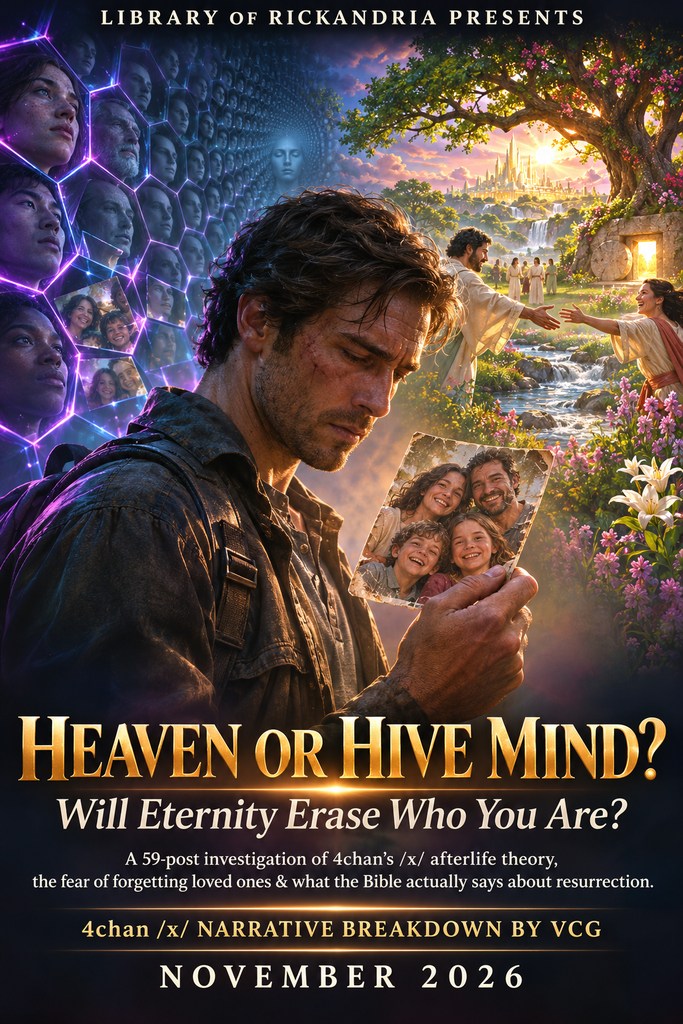
A 59-post investigation of 4chan’s /x/ afterlife theory, the fear of forgetting loved ones & what the Bible actually says about resurrection.
Anyone can do this, but most won’t.
Heaven or Hive Mind? examines all 59 posts in a 4chan /x/ thread that claims worshiping God will erase your identity.
The investigation takes seriously the two questions beneath that claim:
If God changes what you desire, are you still free?
And if someone you love is absent, how could you remember them without grieving forever?
Drawing on psychology, religious history, and a close reading of Scripture, the paper finds no biblical basis for a collective mind or the erasure of loved ones from memory.
Scripture promises an end to mourning without explaining exactly how every sorrow will be healed.
Its clearest picture of personal identity after death comes at the empty tomb, where the risen Jesus calls Mary by name.
ChatGPT – Library of Rickandria
4chan /x/ Narrative Breakdown by VCG · November 2026
Soli Deo Gloria.
Cover illustration.
The family photograph puts a face on the thread’s most difficult question.
The accusation
An anonymous poster on 4chan’s paranormal board opened a thread titled Beware “Heaven” with a warning.
/x/ – Beware “Heaven” – Paranormal – 4chan
Worship God, the poster claimed, and after death you will be absorbed into a collective mind.
Everything that made you a distinct person will disappear.
The replies took the idea in several directions.
Some welcomed the prospect of losing the ego.
Others imagined a trap involving reincarnation, a simulation, or an astral realm.
One made the objection that gives the thread its emotional weight:
If someone you love is absent from heaven, how could you remember them and still be happy?
Original 4chan thread · Readable archive mirror. boards.4chan.org
The opening claim is about what happens to the person.
The family objection is about what happens to love and grief.
The free-will debate is about who has a say in what the person becomes.
Those are three different questions.
The clearest Christian evidence for the first comes from the resurrection of Jesus and Paul’s argument in 1 Corinthians 15. Jesus can be recognized after death, and Paul says those who belong to Christ will be raised imperishable.
The texts about grief and freedom deserve the same close reading, especially where they leave details open. Luke 24 · 1 Corinthians 15. bible.usccb.org
How the thread was checked
The archive contains 59 posts and seven attachment listings from November 16–17, 2026.
I compared the indexed 4chan page with the readable mirror and followed the posts in order.
The review uses close paraphrase, with post numbers for checking the exact wording.
Repeated quotes inside replies were treated as references to earlier posts.
The original image host returned an access error, so the analysis of attachments is limited to their listings and what the comments say about them.
The illustrations in this paper are editorial artwork. Archive mirror. boards.4chan.org
A post can document a claim without verifying its explanation.
A dream report, for example, establishes what someone says they experienced.
A theory about where the dream came from needs corroboration.
The same principle applies to historical claims.
A resemblance between two ideas can suggest a comparison, while establishing that one tradition teaches the other requires reading its texts.
Psychological research can explain why a framing is persuasive without telling us a poster’s motives or mental state.
Scripture is read here within its literary and theological context.
An apocalyptic vision, a parable, a letter, and a Gospel narrative each make their case differently.
Understanding Psychological Reactance: New Developments and Findings – PMC
Evidence ledger
| Claim | What the thread supplies | Finding |
|---|---|---|
| Worship merges people into one consciousness. | The opener’s assertion. | Unsupported. The biblical texts depict distinct persons united in worship, love, and service. |
| Joy requires forgetting loved ones. | An inference about what remembering must feel like. | Scripture promises an end to mourning. The proposed deletion of specific memories exceeds the passages. |
| A person whose desires change has lost their identity and freedom. | An argument equating identity, desire, and ability. | The inference fails as stated. Whether a profound change is coercive is a further question. |
| A poster remembers heaven before birth. | A vivid first-person report and an attachment listing. | The testimony is documented. Its date and proposed origin are unverified. |
| Some living people lack real personhood. | Labels, ethnic generalizations, and unspecified observations. | No verifiable criterion. One reply turns the theory into explicit antisemitic dehumanization. |
| Seven images accompanied the discussion. | Attachment listings on the archived thread. | All seven listings are accounted for. Image contents and provenance remain independently unverified. |
What do we mean by “heaven”?
The opener puts the alleged erasure at death.
Several replies answer with descriptions of what Christians expect at the resurrection or in the new creation.
Here is the sequence the discussion keeps collapsing.
Death → The interval before resurrection → Bodily resurrection → Life in the renewed creation
| Stage | Where to read | What the passages contribute |
|---|---|---|
| Death and the interval before resurrection | Luke 23:39–43 · Philippians 1:19–26 | Jesus speaks of paradise to the man beside him. Paul speaks of departing and being with Christ. |
| Bodily resurrection | 1 Thessalonians 4:13–18 · 1 Corinthians 15:20–26, 35–58 | Paul looks ahead to the dead rising and the perishable putting on imperishability. |
| The renewed creation | Revelation 21–22 | God dwells with his people. Death and mourning end. The final vision includes a city, a river, the tree of life, service, and reigning. |
Christians differ over the interval, including whether the dead are conscious while awaiting resurrection.
For example, the Seventh-day Adventist statement on death and resurrection describes the dead as unconscious until they are raised.
That disagreement concerns the interval. In Paul’s argument, the resurrection itself remains indispensable.
In Revelation’s closing vision, the holy city comes down and God dwells with his people.
The direction of the vision matters when a thread assumes eternal life means escaping embodiment altogether.
What Happens After Death According to the Bible | Adventist.org
1 Corinthians, CHAPTER 15 | USCCB
Revelation, CHAPTER 21 | USCCB
The people heaven would have to make you forget
Look again at the photograph on the cover.
The fear in post #43222637 is that God would have to take away the faces in that photograph to make eternal joy possible.
Put the objection as strongly as it deserves:
If I remember them and still love them, how could their absence ever stop hurting?
A person asking that question may be weighing what it means to remain faithful to someone they love.
The answer begins by taking that love seriously.
(58) /x/ – Archived – Beware “Heaven” – Paranormal – 4chan
/x/ – Beware “Heaven” – Paranormal – 4chan
Isaiah 65:16–19 is the first passage to examine because it actually uses the language of forgetting.
Verse 16 identifies former troubles.
The following verses turn to God’s new creation and the joy of Jerusalem.
The passage supports the idea that former suffering will lose its hold.
It gives no list of people whose existence must be removed from consciousness.
Revelation 6:9–11 provides another piece of evidence.
The martyrs remember what happened to them and ask God how long justice will take.
This scene comes before the final renewal, so it cannot establish how every memory is experienced afterward.
It does show that, in Revelation’s own imagery, awareness of God and awareness of one’s earthly history can coexist.
Isaiah 65:16-19 KJV – That he who blesseth himself in the – Bible Gateway
Isaiah 65:16-19 NIV;KJV – Whoever invokes a blessing in the land – Bible Gateway
Revelation 21:1–5 gives the promise its final form.
God wipes away tears, and death, mourning, and pain pass away.
The image locates the action in God’s care for the people who have suffered.
The thread supplies a psychological mechanism of its own and treats it as the only conceivable one.
Even earthly bereavement gives reason to question that assumption.
A systematic review of continuing bonds after loss found that an ongoing inner relationship with the deceased can be associated with both comfort and distress.
Grief research cannot tell us how eternity will feel.
It can help us see that retaining a memory and experiencing it in precisely the same way forever are separate propositions.
Revelation, CHAPTER 21 | USCCB
The impact of continuing bonds following bereavement: A systematic review – PubMed
Paul himself expresses anguish for others in Romans 9:1–3.
A Christian reader has biblical grounds to take that anguish seriously and to trust the promise that God will end mourning.
The passages leave open the exact experience of memory and recognition.
They also give us no warrant to pronounce the fate of a particular loved one on the basis of this discussion.
Romans 9:1-5 KJV – I say the truth in Christ, I lie not, – Bible Gateway
Revelation 21:1-5 KJV – And I saw a new heaven and a new earth: – Bible Gateway
If God changes what you want, are you still free?
Imagine someone who once took pleasure in humiliating others.
Years later, after seeing the damage they caused, they have lost the appetite for it.
Their change can be so deep that the old behavior feels almost unthinkable.
They are still the person accountable for that past.
The example shows how continuity can survive a major change in what a person wants.
Philosophers distinguish this question of persistence over time from the question of which traits someone uses to describe themselves.
Personal Identity (Stanford Encyclopedia of Philosophy)
Now make the skeptic’s case stronger.
Suppose someone secretly alters your desires and makes you approve of the alteration.
Would your approval prove that you were free?
Approval after the fact would be a weak test.
We would also want to know consent, whom the change serves, whether it restores the capacity to understand and act, and whether the same person can own their history.
One purpose of the thought experiment is to show why:
“you’ll like it when you get there”
leaves the deepest objection unanswered.
The distinction between choosing freely and merely approving one’s motives is a real issue in philosophy.
Personal Identity and Ethics (Stanford Encyclopedia of Philosophy)
CHURCH FATHERS: City of God, Book XXII (St. Augustine)
The Christian answer depends on what Scripture says the change does.
Romans 6 describes sin as a power that enslaves and depicts people responding from the heart.
Romans 8:29 describes conformity to the Son in the context of a family with many members.
1 John 3:2 says believers are already God’s children and will be like Christ, while acknowledging how much remains undisclosed.
Augustine goes further by arguing that the inability to sin can be a greater freedom when the will is fully healed.
His answer will persuade to the extent that one accepts his account of sin as a disorder of the will and goodness as its fulfillment.
The thread skips that argument when it assumes that the power to choose evil is what makes a person free.
Augustine of Hippo (Stanford Encyclopedia of Philosophy)
The 59-post breakdown
The post numbers below follow the archived order.
Read alongside the full thread mirror
Posts 1–19 · Worship, memory, and freedom
- #43222450 · Worship leads to absorption, and absorption destroys the person.
The post gives no evidence for the first step and assumes that shared worship requires a shared mind.
In Luke 24, the risen Jesus shows his hands and feet and eats before his disciples.
In 1 Corinthians 15, Paul describes the dead being raised in a transformed condition.
Revelation 7 depicts a multitude from many peoples worshiping together.
Their unity is visible precisely because many people are doing something together.
1 Corinthians, CHAPTER 15 | USCCB
Revelation 7 KJV – And after these things I saw four – Bible Gateway
- #43222529 · An image is offered as a picture of heaven.
Later replies identify it as a comic and discuss its apparent reference to the Sun.
The accessible record supports that description of the exchange.
Fiction can explore a model of the afterlife.
Evidence for the model would have to come from elsewhere.
- #43222535 · Image only.
The archive lists IMG_2077.png.
The visible post supplies no accompanying argument, and the image itself could not be independently examined.
- #43222543 · Heaven allegedly consists of worship every moment forever.
Revelation 7:15 does describe service before God day and night.
Revelation 22:3–5 also describes seeing God’s face and reigning.
The poster takes one image of continual worship and turns it into an exhaustive schedule.
Psalm 16:11 gives a further reason to question the portrayal of divine presence as an endless chore.
Revelation 7 KJV – And after these things I saw four – Bible Gateway
Revelation, CHAPTER 22 | USCCB
- #43222588 · Most people in Britain are called spiritually dead and treated as expendable.
The post offers no criterion or evidence for its claim about Britain.
Ephesians 2 uses spiritual death as a metaphor and immediately turns to mercy and being made alive.
James 3 roots the dignity of other people in their likeness to God.
This is an early turn from fearing the loss of one’s own personhood to denying it to others.
Dehumanization: an integrative review – PubMed
- #43222594 · Perhaps God has already removed them.
The question presupposes an event that the earlier reply never establishes.
Who was removed, what happened, and what evidence could identify divine agency?
The attachment filename contains YHWH.
That supplies no answer to any of those questions.
- #43222596 · Heaven is imagination, and human beings are God.
The ability to imagine a world gives no evidence that the person imagining it is divine.
Genesis gives human beings the dignity of bearing God’s image.
Romans distinguishes the Creator from creation.
- #43222619 · You remain yourself, and only the body changes.
The first half recognizes continuity.
The second excludes changes Scripture explicitly envisages.
Romans 12 speaks of a renewed mind, and Paul’s resurrection argument includes a transformed body.
Personal continuity leaves room for both.
1 Corinthians, CHAPTER 15 | USCCB
- #43222637 · God must erase memories of absent family and remove every passion.
The first half assumes that love and memory necessarily produce unending distress.
The chapter above shows where the biblical evidence stops.
The second half defines everything personally important as an idol.
Colossians names covetousness as idolatry, while 1 Timothy says God supplies things for enjoyment.
The problem is giving something God’s place.
Enjoying it does not establish that it occupies that place.
Isaiah 65:16-19 KJV – That he who blesseth himself in the – Bible Gateway
Revelation, CHAPTER 21 | USCCB
Colossians 3:5, 1 Timothy 6:17 KJV – Mortify therefore your members which – Bible Gateway
- #43222641 · Heaven is imagined as immediate sexual gratification.
The post reads as a joke or fantasy.
As theology, it would require an argument for making appetite the center of eternal life.
Jesus’ answer to the Sadducees says people neither marry nor are given in marriage in the resurrection.
He is answering their puzzle about resurrection and marriage.
The passage leaves many questions about embodied life open.
- #43222655 · Worship and enjoyment coexist.
The writer also reports a previous visit and partial restoration of memory in a maternity ward.
The first claim agrees with Scripture’s depiction of joy in God’s presence.
The second needs independent dating and corroboration.
Childhood-amnesia research documents the relative scarcity of adult autobiographical memories from the first years of life.
Source-monitoring research gives an additional reason to distinguish a vivid memory from certainty about its origin.
Neither study establishes what this writer experienced.
- #43222665 · Life’s artifacts survive, pain is forgotten, and misunderstanding and false love end.
Revelation promises the end of pain and mourning.
Paul describes present knowledge as partial in a chapter about the endurance of love.
The claim about preserved personal objects is additional speculation, as is the precise description of how painful memories are handled.
Revelation, CHAPTER 21 | USCCB
1 Corinthians, CHAPTER 13 | USCCB
- #43222667 · The writer expects to dislike heaven.
That tells us how they react to the version on offer.
Research on affective forecasting shows that people can overweight a salient feature when predicting future feelings.
Here the salient feature is supposed compulsory activity.
The research explains a possible feature of the prediction and says nothing about what heaven actually feels like.
Focalism: a source of durability bias in affective forecasting – PubMed
- #43222673 · Near-endless gardens would make it enjoyable.
Revelation’s river and tree of life make the garden association understandable.
The extent of the gardens and the other poster’s predicted enjoyment come from the person replying.
Revelation, CHAPTER 22 | USCCB
- #43222677 · Can a person sin there?
Revelation excludes what defiles the holy city.
Romans describes liberation from sin as freedom.
The philosophical question is whether freedom depends on having the option to sin.
Revelation, CHAPTER 21 | USCCB
- #43222691 · The writer fears the gods are taking “Lilly” away.
The lines move from longing and difficulty getting closer to claims about divine interference and a rival’s faith.
The longing is intelligible from the post.
Who is acting, what the other person wants, and whether gods are involved all remain unverified.
(40) /x/ – Archived – Beware “Heaven” – Paranormal – 4chan
1 Corinthians, CHAPTER 13 | USCCB
- #43222704 · A reply questions whether Lilly shares the writer’s faith, then predicts their disappointment.
The opening question asks for evidence.
The prediction that follows is itself a guess about someone else’s feelings.
Neither side establishes Lilly’s view.
- #43222705 · The redeemed will understand sin and lose the desire for it.
The basic idea fits a Christian account of healed desire.
The post goes further when it predicts a specific feeling of disgust.
Love of the good, understanding an evil, and feeling revulsion are distinct experiences.
Revelation, CHAPTER 22 | USCCB
- #43222708 · Changed desire supposedly proves that freedom and identity have vanished.
The reply equates what I can do, what I want to do, and who I am.
Each needs its own argument.
Augustine’s stronger claim, that a perfected will can be free even when it cannot sin, directly addresses the objection the thread is reaching for.
CHURCH FATHERS: City of God, Book XXII (St. Augustine)
Posts 20–35 · Borrowed traditions and competing heavens
- #43222709 · S.L.M. offers a private cosmology.
The post’s main lines, in order, make the following claims.
| Claim | Check |
|---|---|
| Sin is psychic and negative things are unreal. | Mark 7:20–23 locates the origin of evil in the heart and names harmful acts, including theft and murder. Inner motive and outward harm coexist. |
| Heavenly joy makes negative thought impossible. | Revelation 21:4 promises an end to mourning and pain. The post adds a specific rule about how thought works. |
| Each person has a different heaven. Picture everything that made you happy and put it there. | The exercise can reveal what a person values. Revelation 21:2–3 depicts a shared city and divine presence. |
| Matter, sickness, and harmful things cannot cross over. | Revelation supplies grounds for an end to death and pain. 1 Corinthians 15:42–44 describes a body raised imperishable. The physical mechanism asserted in the post is unsupported. |
| Heaven is masculine energy, and femininity belongs to hell. | Genesis 1:27 gives both male and female God’s image. Galatians 3:26–29 gives both inheritance in Christ. Revelation even uses a bride as an image of the holy city. |
| Entry depends on seeking and wanting heaven. Few enter because they confuse willingness with conversion or coercion. | Scripture calls people to respond. John 6:37, 44 also speaks of the Father drawing people. The post supplies no evidence for its theory of why few enter. The aside about fleeing negativity adds no intelligible criterion. |
| Everyone ultimately enters, and the world ends only then. | The post has already said some will never go. Those assertions require reconciliation. Revelation 20:11–15 depicts judgment. Acts 1:7 leaves the timing under the Father’s authority. |
Genesis 1:26-31, Galatians 3:26-29 KJV – And God said, Let us make man in our – Bible Gateway
Revelation 20-22 KJV – And I saw an angel come down from – Bible Gateway
1 Corinthians, CHAPTER 15 | USCCB
- #43222716 · The preceding post is dismissed as Christian nonsense.
The target combines biblical vocabulary with gendered energies and a speculative timetable.
A religious insult cannot tell readers which claims actually come from Christianity.
- #43222724 · Kabbalah allegedly teaches absorption, and the Spirit supposedly gives everyone identical knowledge.
Rabbinic uses of tikkun olam include measures for the public good.
Lurianic Kabbalah uses the language of repair and the restoration of divine sparks.
Modern social-ethical usage has its own history.
The post cites no Jewish text teaching its hive-mind model.
Its Christian alternative has a different problem.
In John 14:26 the Spirit teaches, and in 1 Corinthians 12:11 the Spirit apportions gifts.
The database analogy overlooks that agency.
Paul’s movement from partial to fuller knowledge in 1 Corinthians 13 gives no promise of identical memories or omniscience at death.
The Buzz Lightyear analogy does illustrate one logical point:
two beings could possess the same information and remain numerically distinct.
It supplies no evidence they will receive that information.
Mishnah Gittin | Posen Library
Tikkun in Lurianic Kabbalah | My Jewish Learning
1 Corinthians 12-13 KJV – Now concerning spiritual gifts, – Bible Gateway
- #43222726 · Nature, alien ancestry, shared childhood, and Cain and Abel become parts of one memoir.
The lines about gifts, curiosity, and grief tell us what the relationship means in the story.
The claims of alien ancestry and a Pleiadian connection to Abel’s death require historical evidence.
In the Mesopotamian texts, the Anunnaki are a group of gods whose roles vary across sources.
Genesis gives its own account of Cain and Abel.
The closing accusations of jealousy add another inference about people’s motives.
Ancient Mesopotamian Gods and Goddesses – Anunna (Anunnaku, Anunnaki) (a group of gods)
(34) /x/ – Archived – Beware “Heaven” – Paranormal – 4chan
- #43222728 · Mainstream Christians supposedly reject the Bible when they reject hive-mind theology.
This needs a verse that teaches absorption.
John 17 is a natural place to look for unity.
Jesus prays for people who believe, love, and bear witness in the world.
The purposes of that prayer are intelligible without a fusion of minds.
- #43222740 · Thoughtless civilizations inhabit higher-density realms, and a hostile creator uses thoughts to bind people to samsara.
The post gives density no measurable meaning.
A civilization without thought or communication, populated by beings aware of everything around them, requires a clearer account of awareness and civilization.
Its claim about thought as absorbed hate supplies no evidence or test.
Buddhist accounts of cyclic existence and suffering involve ignorance, craving, and attachment.
The hostile creator who implants thought is the poster’s addition.
Genesis calls creation good, and Romans treats the mind as capable of renewal.
Buddha (Stanford Encyclopedia of Philosophy/Spring 2023 Edition)
- #43222747 · The writer recalls an ancient life among gods, giants, and alien relatives.
The opening invokes Eve and “Lilly.”
If the latter is meant as Lilith, the familiar first-wife story is associated with later Jewish folklore, particularly the Alphabet of Ben Sira.
The middle of the post presents ancient warfare, cave-dwelling humans, accessible deities, and giants in stone cities.
Genesis mentions the Nephilim in a brief, difficult passage.
It provides no corroboration for the post’s alien wives or cities.
The closing domestic scenes make the loss feel personal.
The text alone cannot settle whether the account is roleplay, metaphor, or sincerely offered recollection.
Genesis 4-6 KJV – And Adam knew Eve his wife; and she – Bible Gateway
(33) /x/ – Archived – Beware “Heaven” – Paranormal – 4chan
- #43222753 · A reply defends nirvana and calls aversion a poison.
The teaching has a recognizable basis.
In SN 38.1, nibbāna is characterized by the ending of greed, hatred, and delusion.
The insults aimed at critics add no evidence.
Buddhist liberation deserves to be explained in its own terms before anyone equates it with a heaven or a hive mind.
Buddha (Stanford Encyclopedia of Philosophy/Spring 2023 Edition)
- #43222757 · A mock-nonsense reply.
It signals ridicule and adds no factual or theological claim.
- #43222760 · Sin is excluded from the city.
That is consistent with Revelation 21:27.
The verse addresses what can enter the holy city.
A theory of the redeemed person’s will requires a further argument.
Revelation, CHAPTER 21 | USCCB
- #43222764 · Two reply links put the exclusion of sin beside the freedom objection.
The post adds no premise.
Its juxtaposition identifies the precise point at issue.
- #43222769 · Saints, local gods, Gaia, archons, jhāna, and grace are put into one account.
Honoring saints and worshiping a local deity raise different historical and theological questions.
Acts 14 gives a Christian example of refusing divine honors and directing worship to the living Creator.
Calling another poster Gaia or an archon supplies no evidence about who they are.
In MN 39, jhāna refers to stages of meditative absorption.
Identifying one with Christian heaven requires an argument.
The reply’s claim that heaven cannot be earned has a point of contact with Ephesians 2, where grace saves and good works follow.
Speculation about reunions, former lives, and vampires comes from the poster.
Acts of the Apostles, CHAPTER 14 | USCCB
MN 39 The Greater Discourse at Assapura | Mahā Assapura Sutta | sutta on dhammatalks.org
- #43222770 · The will survives, angelic rebellion proves freedom, and reincarnation is optional.
Jude and 2 Peter speak of angelic rebellion.
Those passages leave open the precise capacities of glorified humans.
The optional-reincarnation claim needs its own evidence.
Hebrews places death and judgment alongside Christ’s once-for-all offering, while Paul’s account centers on resurrection.
Jude 6, 2 Peter 2:4, Hebrews 9:27-28 KJV – And the angels which kept not their – Bible Gateway
1 Corinthians, CHAPTER 15 | USCCB
- #43222773 · Angels and Satan are mocked as distractions from awakening.
The post assumes its own definition of spiritual awakening.
Ephesians 6 gives spiritual powers a place in the Christian account of conflict.
Connecting that passage to a specific anonymous person would take independent evidence.
- #43222776 · Free will exists only in earthly life.
The post asserts a single rule for both heaven and hell without defining freedom.
Revelation depicts meaningful activity in the renewed creation.
Augustine offers an influential account of how the perfected will can be active and free while no longer capable of sin.
Revelation, CHAPTER 22 | USCCB
CHURCH FATHERS: City of God, Book XXII (St. Augustine)
- #43222777 · Another poster’s anger is attributed to Satan’s grip.
A brief exchange provides little basis for assessing temperament and still less basis for identifying a spiritual cause.
James asks readers to be quick to hear and slow to speak or anger.
That instruction applies to everyone in the exchange.
(18) /x/ – Archived – Beware “Heaven” – Paranormal – 4chan
Posts 36–48 · Ego, judgment, and the “NPC” claim
- #43222786 · Losing ego, responsibility, and worry sounds wonderful.
Ego could mean pride, self-image, or being a distinct subject at all.
The relief promised by losing pride is a different proposition from ceasing to be a person.
Revelation’s last chapter portrays relief from the curse alongside service and reigning.
Revelation, CHAPTER 22 | USCCB
- #43222809 · Agreement proves the reader has seen heaven in a dream.
The reader whose comment prompted the claim reported a preference, not a dream.
Dream research studies reported experience and its correlates, and gives no way to infer this alleged dream from someone’s agreement.
Jeremiah 23 also shows that claims of revelatory dreams can be scrutinized.
The neural correlates of dreaming – PubMed
Jeremiah 23:25-32 KJV – I have heard what the prophets said, – Bible Gateway
- #43222824 · If everyone is a sinner, nobody is.
The conclusion reverses the premise.
A property can apply universally and retain its meaning.
The undefined reference to duality does nothing to fill the logical gap.
Paul uses universal sin to explain humanity’s need for grace.
- #43222829 · “NPCs” inhabit a lower astral heaven and are destined for the second death.
The post invents a class, assigns its members an afterlife, and declares their fate settled.
Revelation identifies the second death with the lake of fire in its judgment vision.
The text supplies no astral waiting room or spiritual test of which neighbors count as real people.
Genesis gives humanity God’s image.
The Good Samaritan gives a concrete account of what to do when a neighbor needs help.
Revelation 20:11-15 KJV – And I saw a great white throne, and him – Bible Gateway
- #43222838 · The theory is blamed on Jewish conditioning and demonic possession.
This is antisemitic scapegoating.
The post cites no Jewish text for the theory and gives no evidence of possession.
Romans 11 tells Gentile believers to guard against arrogance toward Jewish branches and affirms the enduring character of God’s gifts and calling.
- #43222840 · The universal-sin argument is dismissed.
The response is brief and supplies no reasoning.
The underlying logical objection is simple:
the prevalence of wrongdoing does not cancel its moral significance.
(12) /x/ – Archived – Beware “Heaven” – Paranormal – 4chan
- #43223032 · The Jewish people are said to lack the spiritual constitution to survive death.
The appeal to long observation gives no account of what was observed, how a comparison group was chosen, or how anyone’s postmortem fate was confirmed.
The proposed group soul and its alleged fate remain unsupported.
The final lines elevate isolation into proof of spiritual rank.
This gives the theory a way to protect itself from criticism:
disagreement can be counted as evidence that the critic belongs to the herd.
Romans 11 confronts the ethnic arrogance directly, and research on dehumanization explains the significance of depicting other people as if they were interchangeable mechanisms.
(11) /x/ – Archived – Beware “Heaven” – Paranormal – 4chan
Dehumanization: an integrative review – PubMed
- #43223109 · Sin is denied, and the S.L.M. handle is attributed to a chatbot or an attached entity.
First John directly challenges the denial of sin.
The account attribution has no independent provenance.
A repeated display name, writing style, and psychiatric insult cannot identify who or what produced the posts.
- #43223550 · A brief approving response to the thought of effectively disappearing.
The line can be read as agreement or irony.
It gives no evidence that worship produces disappearance.
Paul’s account treats resurrection as victory over death.
(11) /x/ – Archived – Beware “Heaven” – Paranormal – 4chan
1 Corinthians, CHAPTER 15 | USCCB
- #43223585 · Heaven is described as free from materialism.
If the word means making possessions the highest good, Matthew 6 supports the concern.
If it means the Christian hope excludes embodiment, Luke and Paul give clear counterevidence.
Paul still speaks of a body when he describes it as spiritual.
1 Corinthians, CHAPTER 15 | USCCB
- #43223839 · God wants the writer as an individual.
In John 10, the shepherd calls his own by name, knows them, and gives them eternal life.
The same chapter speaks of one flock.
Being part of a people and being known as a person fit the same biblical image.
- #43223847 · A crude analogy distinguishes lacking a desire from lacking freedom.
Always declining a choice can be consistent with having it available.
That helps against the original inference.
The more demanding case is a person who cannot choose evil because of who they have become.
Augustine takes up that question explicitly.
(9) /x/ – Archived – Beware “Heaven” – Paranormal – 4chan
CHURCH FATHERS: City of God, Book XXII (St. Augustine)
- #43223859 · Most of the world supposedly imagines paradise as endless sex with 72 virgins.
The majority claim comes with no survey or definition of whose beliefs are counted.
Qur’an 56 includes companions among several images of paradise.
The number 72 appears in Jāmiʿ al-Tirmidhī 1663, in a report concerning a martyr.
The post generalizes that report and adds its own characterization.
Surah Al-Waqi’ah — Full Surah, Read, Listen and Study – Quran.com
Posts 49–59 · Prebirth memory, meditation, and resurrection
- #43223887 · A writer reports remembering heaven before birth.
This is the thread’s most detailed testimony.
Its claims become clearer when read in their original sequence.
| Detail in the report | What it establishes |
|---|---|
| The place is identified as heaven before birth. | That is the writer’s interpretation of the recollection. The proposed date is unverified. |
| Purple transparent walls, a cloud-like floor, blue medical chairs, and one or two displays. | The setting is vivid and described through familiar categories. No object or location can be independently identified from the post. |
| The writer remembers devotion to God, hears that someone went to hell, and gives several possible chair counts. | The account contains both confidence and explicit uncertainty. The other person’s fate remains uncorroborated. |
| Sympathy for the condemned person gives way to disapproval. | This records an emotional and moral shift inside the story. |
| God allegedly demands immediate entry into the world and threatens a generation with hell. | No deadline or generational rule is verified. Romans 2:6–11 speaks of impartial judgment. |
| The writer expresses love for God and is told that the feeling will reverse. | The dialogue conveys fear of separation. The speaker’s identity cannot be authenticated from a recollection alone. |
| God seems to be the same kind of being as the angels. Some rebel angels seem worthy of sympathy. | Hebrews 1 distinguishes the Son from the angels. 2 Corinthians 11:14 gives reason to question spiritual authority inferred from appealing appearances. |
| A physician-like figure is identified as God, with a different appearance in a later vision. | The change is part of the report. The attachment is unverified and could at most illustrate a resemblance as remembered. |
The AWARE II study offers a useful methodological comparison.
Researchers prospectively studied reported experiences associated with cardiac arrest and attempted audiovisual verification.
That design shows the value of trying to check details independently.
The study concerns cardiac arrest and resuscitation, while this post claims a prebirth experience.
- #43223893 · Sin is recast as a timeline problem.
The line may be playful.
Read literally, it gives no definition of its timeline, no mechanism, and no evidence for its proposed limit on God.
James describes how temptation develops into sin through human desire.
The timeline theory leaves that moral mechanism unexplained.
(4) /x/ – Archived – Beware “Heaven” – Paranormal – 4chan
- #43223913 · The self is called a narrative, self-talk a small psychosis, and meditation a way to stop suffering.
Autobiography and self-image contribute to the experience of being oneself.
Their role leaves open who has that experience.
The more practical idea, that a person can observe a thought without immediately treating it as fact or acting on it, has support in research on decentering.
Ordinary inner speech is also a studied part of cognition, and the post misuses a clinical term by equating it with psychosis.
A systematic review found some meditation programs improved outcomes such as anxiety, depression, or pain in studied populations.
The evidence supports a bounded claim about some kinds of distress.
Decentering and Related Constructs: A Critical Review and Metacognitive Processes Model – PMC
Inner Speech: Development, Cognitive Functions, Phenomenology, and Neurobiology – PubMed
- #43224233 · The writer discussing the narrative self is labeled an NPC.
The label has now been applied to people with opposing views.
It allows the reply to dismiss another person’s account of their inner life without dealing with the argument.
(2) /x/ – Archived – Beware “Heaven” – Paranormal – 4chan
Dehumanization: an integrative review – PubMed
- #43224593 · The comic allegedly depicts a device for capturing time travelers.
As a joke or fictional reading, the line needs little unpacking.
As a claim about physics, it would need an observed incident or a testable mechanism.
Established relativistic time differences supply no evidence for the device.
Is Time Travel Possible? | NASA Space Place – NASA Science for Kids
(1) /x/ – Archived – Beware “Heaven” – Paranormal – 4chan
- #43224804 · Tibetan bardos are presented as a reincarnation trap with guaranteed escape.
There is a historical point of contact.
The Bardo Thödol tradition describes intermediate states and appearances practitioners are instructed to recognize.
The Rubin Museum documents peaceful and wrathful imagery and teachings concerning liberation or rebirth.
The thread adds a motive behind every appearance and guarantees escape given enough time. Neither conclusion follows from the cited tradition.
Paul’s Christian account gives embodied resurrection a positive place in the defeat of death.
Rahbin collection, peaceful and wrathful deities
- #43224805 · The Sun’s end is a local matter, and advanced technology could allow escape.
The astronomical correction is sound. NASA expects the Sun to enter its red-giant phase in roughly five billion years.
Whether a hypothetical civilization could move whatever the comic depicts depends on the setting, its energy and infrastructure, and capabilities assumed by the reply.
(0) /x/ – Archived – Beware “Heaven” – Paranormal – 4chan
- #43225744 · Christianity, Judaism, and Islam teach resurrection, while Hindu thought is compared to absorption.
The strongest part is the return to resurrection.
Luke presents the risen Jesus as bodily present and continuous with the Jesus the disciples knew.
Paul uses sowing and raising to express continuity through transformation.
Daniel 12 depicts sleepers in the dust awakening, and Qur’an 75 speaks of the reassembly of bones and fingertips.
Those texts establish the idea of resurrection in their respective settings without making their theologies interchangeable.
The Hindu comparison needs finer distinctions.
1 Corinthians, CHAPTER 15 | USCCB
Daniel 12:2 | The Sefaria Library
Surah Al-Qiyamah Ayahs 3-4 – Read, Listen, Translation, Tafsir – Quran.com
- #43229057 · Hindu schools disagree, but Buddhism is blamed for the annihilation idea.
The correction about Hindu diversity holds.
Classical Vedānta includes Śaṅkara’s nondualism, Rāmānuja’s qualified nondualism, and Madhva’s dualism.
Talking about a separate soul returning to Brahman assumes a relationship these schools understand differently.
The post’s universal statement about karma is too broad.
Early Buddhist thought also rejects both eternalism and annihilationism when framed as competing fates of an enduring self.
Its account of non-self deserves to be read on its own terms.
God and Other Ultimates (Stanford Encyclopedia of Philosophy)
Buddha (Stanford Encyclopedia of Philosophy/Spring 2023 Edition)
SN 22.59: The Characteristic of Nonself (English) – Khandha Saṃyutta – SuttaCentral
- #43231212 · Link to the opener only.
The archive displays no added argument.
- #43231806 · The thread ends with a brief expression of laughter.
It adds no claim to evaluate.
Why the theory travels
The word hive does much of the work before the opener supplies any argument.
It asks the reader to imagine coercion first and evaluate worship inside that picture.
Psychological reactance describes how a perceived threat to freedom can provoke resistance.
Some replies accept the same premise and welcome it because they hear a promise of relief from worry.
That split shows how much depends on the meaning of ego and on what each reader thinks they would lose.
The thread moves between:
- pride
- preferences
- autobiographical memory
- personhood
as though they could all be removed with the same switch.
Understanding Psychological Reactance: New Developments and Findings – PMC
(0) /x/ – Archived – Beware “Heaven” – Paranormal – 4chan
The label NPC shows what that confusion can do to the way people treat one another.
The opening fear is that my inner life will be taken away.
Later, people in Britain, Jewish people, and the poster discussing meditation are treated as if their inner lives could simply be dismissed.
The label offers no observable test of who is conscious.
It works socially by stripping credibility and dignity from the person being labeled.
The move becomes explicit antisemitism in #43223032, where one writer turns speculation about souls into a collective judgment against Jews.
Dehumanization: an integrative review – PubMed
(0) /x/ – Archived – Beware “Heaven” – Paranormal – 4chan
Paul offers a useful picture of unity in 1 Corinthians 12.
A body needs many members, and an eye cannot dismiss a hand simply because the hand does something different.
Paul is addressing the life of a church.
The passage shows what Christian unity means in a setting we can recognize:
people who belong to one another still have distinct gifts, responsibilities, and needs.
In John 17 that unity has a purpose, so that others may see and believe.
In John 10 it is a flock whose shepherd calls his own by name.
Together, the passages give us reasons to read Christian communion as a relationship between persons.
1 Corinthians 12 KJV – Now concerning spiritual gifts, – Bible Gateway
Related Library of Rickandria investigations
The NPC Delusion follows the origins and theological consequences of the claim that some people are spiritually empty.
The Soul Trap Trap examines the idea that the apparent afterlife is a deceptive system of captivity.
“Are We All God?” investigates a related attempt to recast distinct persons as one consciousness and tests the thread’s reading of Jesus.
“Prove All Things” examines another /x/ thread about heaven, earthly pleasures, the Akashic record, and spiritual claims.
Divine Signal or Mind Game? looks at how personal experiences are interpreted as divine speech and how Christians can test those interpretations.
DIVINE SIGNAL OR MIND GAME? Are You Hearing God—or Just Hearing Yourself? – Library of Rickandria
The 4chan Files collects the wider series of post-by-post investigations.
THE 4CHAN FILES: Where Anonymous Claims Meet Evidence & Scripture – Library of Rickandria
Epilogue · He calls her by name
Editorial illustration of John 20:11–18.
Mary turns toward the voice that knows her name.
John 20:11-18 KJV – But Mary stood without at the sepulchre – Bible Gateway
Mary Magdalene stands outside the tomb weeping.
When she sees Jesus, she takes him for the gardener.
She asks where the body has been laid because that is still the only way she knows to look for him.
Then Jesus says her name.
She recognizes him and later tells the disciples what she has seen.
John 20:11-18 KJV – But Mary stood without at the sepulchre – Bible Gateway
John gives us a scene of recognition, and Paul gives us the language of a body raised imperishable.
The thread’s proposed machinery of absorption finds no footing in either.
The details of how God will heal every sorrow remain beyond what these passages disclose.
What John gives us is particular and human.
A woman is grieving someone she loves.
The risen Jesus knows who she is.
He calls her by name.
1 Corinthians, CHAPTER 15 | USCCB
THE 4CHAN FILES: Where Anonymous Claims Meet Evidence & Scripture – Library of Rickandria
VCG PAPER PROJECTS – Library of Rickandria
HEAVEN OR HIVE MIND? Will Eternity Erase Who You Are?
HEAVEN OR HIVE MIND? Will Eternity Erase Who You Are? – Library of Rickandria