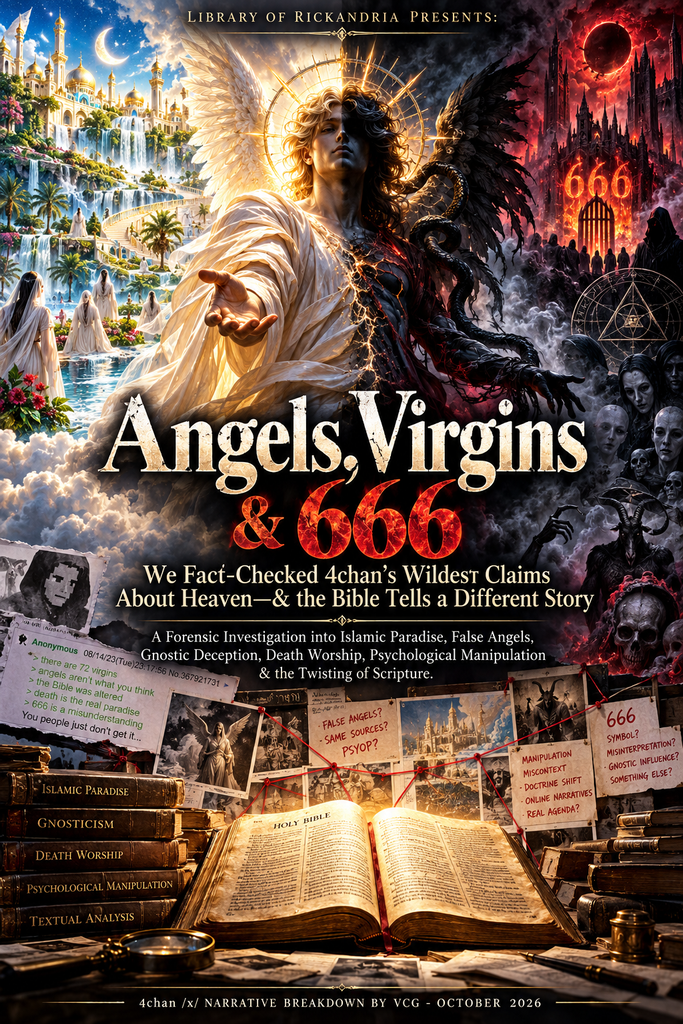
UPDATED BY VCG ON 10/23/2026 @ 09:11 EST
A Forensic Investigation into Islamic Paradise, False Angels, Gnostic Deception, Death Worship, Psychological Manipulation & the Twisting of Scripture.
Anyone can do this, but most won’t.
“Angels, Virgins & 666: We Fact-Checked 4chan’s Wildest Claims About Heaven—& the Bible Tells a Different Story”
is a comprehensive, Scripture-centered forensic investigation into a controversial October 2026 discussion on 4chan’s /x/ paranormal board.
Beginning with an anonymous user’s disturbing dream involving an allegedly angelic voice, the paper systematically examines 26 posts containing extraordinary claims about:
- Islamic Paradise,
- the seventy-two virgins tradition
- fallen angels
- Gnostic cosmology
- the Demiurge
- reincarnation
- death worship
- the number 666
- religious manipulation
- the resurrection of Jesus Christ
Drawing upon:
- the King James Bible
- Islamic primary sources
- historical scholarship
- textual criticism
- psychological research
the investigation separates documented facts from:
- folklore
- speculation
- satire
- logical fallacies
- misleading interpretations of Scripture
It exposes historical misconceptions, examines the psychology of online disinformation and belief formation, and directly challenges the claim that Jesus endorsed unrestricted sexual relationships in the resurrection by examining His actual teachings in Matthew 22:23–33.
Rather than dismissing every unusual claim outright, the paper applies consistent standards of:
- evidence
- intellectual honesty
- biblical discernment
showing where assertions are:
- demonstrably false
- disputed
- unsupported
or unverifiable.
Ultimately, the investigation contrasts sensational Internet narratives with the New Testament’s central message:
- Jesus Christ’s resurrection
- the defeat of death
- divine judgment
and the promise of eternal life in God’s presence.
Its guiding principle is simple:
Truth must be established through:
- evidence
- historical context
- careful reasoning
- rightly divided Scripture
—not emotional manipulation, invented authority, or confident speculation.
Soli Deo Gloria.
ChatGPT – Library of Rickandria
LIBRARY OF RICKANDRIA PRESENTS
ANGELS, VIRGINS & 666
We Fact-Checked 4chan’s Wildest Claims About Heaven—& the Bible Tells a Different Story
A Forensic Investigation into Islamic Paradise, False Angels, Gnostic Deception, Death Worship, Psychological Manipulation & the Twisting of Scripture
4chan /x/ Narrative Breakdown by VCG — October 2026
An Independent Biblical, Historical, Psychological, and Source-Critical Investigation
Soli Deo Gloria
Cover illustration:
Library of Rickandria.
This is symbolic artwork, not a documentary depiction of events or evidence of supernatural beings.
Decorative forum excerpts within the artwork are fictionalized.
ABSTRACT
On October 20, 2026, an anonymous user on 4chan’s paranormal board, /x/, asked a provocative question:
was the Islamic description of heavenly companions accurate, and could a disturbing dream involving a seemingly angelic voice tell us something about the afterlife?
/x/ – Are Muslims right that the afterlife will be a sex – Paranormal – 4chan
The question itself was already complicated.
It combined a religious claim,
an unverifiable personal experience,
a supernatural interpretation,
and a sexually inappropriate message.
Each of these required a different kind of investigation.
Over the next several days, the discussion moved far beyond the original question.
Participants introduced claims about:
- seventy-two heavenly companions
- suicide terrorism
- the medieval Assassins
- mistranslated Arabic
- Gnostic cosmology
- the Demiurge
- reincarnation
- Santa Muerte
- the number 666
- religious manipulation
- the teachings of Jesus Christ
One participant claimed that death had defeated Jesus.
Another suggested that death itself was God.
The First Gate & the Fourth Rider – Library of Rickandria
Another asserted that the Christian understanding of 666 resulted from Jewish manipulation.
The final visible reply attributed to Jesus an interpretation of resurrected life that contradicts the central point of the Gospel passage being cited.
What makes this thread interesting is not simply its collection of unusual claims.
It is the way several different forms of reasoning appear alongside one another:
- personal testimony
- satire
- historical folklore
- social prejudice
- esoteric speculation
- theological argument
- unsupported certainty
This paper examines the original post and twenty-five visible replies, along with their attached images and external link, as a small case study in how religious information is presented, challenged, and distorted in anonymous online discussions.
Four lines of inquiry guide the investigation.
Historically, we ask which claims can be corroborated by primary documents and credible scholarship.
Methodologically, we ask whether the evidence offered actually supports the conclusions being drawn.
Psychologically, we examine communication patterns, cognitive biases, and possible mechanisms of online belief formation without claiming to diagnose anonymous individuals.
Biblically, we compare specific theological claims with the King James Version of Scripture, considering literary context and relevant parallel passages.
The conclusions are necessarily differentiated.
Some statements are demonstrably inaccurate.
Others are recognizable jokes.
Some are genuine subjects of scholarly disagreement.
Others are subjective experiences that cannot be independently verified.
The governing principle is simple:
the strength of a conclusion should not exceed the strength of the evidence supporting it.
PART I — THE PRIMARY-SOURCE RECORD
1. The Thread We Are Actually Investigating
Primary source:
4chan /x/, Thread No. 43109012
The thread began on Tuesday, October 20, 2026, at 17:36:03 according to the timestamp displayed on 4chan.
The last visible reply in the record examined here was posted on Friday, October 23, 2026, at 08:15:31.
The retrieved record contains twenty-six posts in total:
the opening post and twenty-five replies.
Seven attached images appear in the thread, although one was not successfully retrieved during review.
The thread also contains a YouTube hyperlink.
Those numbers define the scope of this paper.
They should not be taken as proof that the discussion never received later additions.
The original post is No. 43109012, and the final examined post is No. 43116879.
It is important to distinguish a chronological sequence from a coordinated conversation.
Some posts directly reply to others; some independently return to the opening question; others introduce unrelated subjects.
The record does not establish how many distinct people participated, because most posts are anonymous.
Nor does the record establish that the thread became viral, was organized by a particular group, or formed part of a psychological operation.
Those would require additional evidence.
2. Why This Thread Deserves Careful Analysis
A typical response to such a discussion might be to dismiss the entire exchange as anonymous trolling.
That would be understandable, but incomplete.
Anonymous Internet discussions often bring together genuine questions and unserious answers.
A person may sincerely ask about an experience, while someone else responds with a joke, an ideological slogan, a religious teaching, or a half-remembered historical story.
Once these are placed in the same discussion, readers can begin treating them as parts of a single explanation.
That is where the danger of confusion arises.
A vivid legend can become supposed history.
A controversial scholarly hypothesis can become an established fact.
A personal dream can become alleged revelation.
A biblical comparison can become a doctrine never taught in the passage.
The task of a careful researcher is to take these statements apart and examine them separately.
We should not assume that every unusual statement is false merely because it appears on 4chan.
But neither should we grant it credibility merely because it is mysterious, dramatic, or expressed confidently.
PART II — HOW THE CLAIMS WERE TESTED
3. Our Research Method
This investigation uses five categories of assessment.
| Classification | Meaning |
|---|---|
| Supported | Reliable evidence directly supports the proposition. |
| Partly supported | The proposition contains a genuine factual element but adds unsupported or misleading claims. |
| Disputed | Relevant scholars or interpreters reasonably disagree. |
| Unsupported | The available evidence does not establish the claim. |
| Contradicted | Relevant evidence or the cited source directly conflicts with the claim. |
A sixth category applies to certain experiences: not independently verifiable.
This distinction matters because an alleged supernatural dream is not the same kind of question as the date of a medieval fortress.
One may be difficult or impossible to verify externally, while the other can be investigated using surviving records.
The paper does not treat all claims as though they were equally testable.
3.1 Historical evidence
Historical assertions are tested against:
- chronology
- identifiable primary sources
- documentary evidence
- specialist scholarship
If someone claims that a medieval organization invented an idea contained in a much earlier text, the dates become decisive.
If a story survives mainly through hostile legends written long after the events described, that weakens its evidentiary value.
3.2 Biblical evidence
Biblical claims are examined first through the supplied King James Bible, comparing relevant passages rather than isolating a sentence.
The distinction between the text and our interpretation is maintained throughout.
For example, Matthew 22:30 explicitly addresses marriage in the resurrection.
Whether a particular theological system can explain every detail of resurrected existence is a larger interpretive question.
3.3 Psychological interpretation
Psychological research can help identify how people communicate, form beliefs, react to uncertainty, or detect patterns.
But it cannot reveal the private motives of anonymous forum participants.
We cannot diagnose a poster from a paragraph.
Nor can we determine whether an insulting comment was sincere, satirical, or intended to provoke.
3.4 Logical evaluation
Sometimes a claim is defective even before historical evidence is considered.
For example:
Religious leaders can manipulate promises of an afterlife.
Therefore no afterlife exists.
The conclusion does not follow from the premise.
The first proposition may be historically true in certain cases.
The second requires independent argument.
Likewise:
Someone dreamed that an angel spoke.
Therefore an angel actually spoke.
The report does not independently establish the identity or origin of the voice.
3.5 Source transparency
Every major external research claim is accompanied by a clickable reference.
Scripture passages are identified by book, chapter, and verse.
Original posts are identified by their post numbers.
Images are distinguished from historical artifacts and theological evidence.
This does not eliminate the possibility of error, but it makes the investigation open to checking and correction.
PART III — THE ORIGINAL POST: A DREAM, A VOICE, AND AN AFTERLIFE
4. Post No. 43109012 — Was the Voice Angelic?
Posted October 20, 2026, at 17:36:03
The original poster asked whether Muslims were correct about an afterlife containing many virgin companions.
The poster then reported a recent dream in which a seemingly angelic voice made a sexually inappropriate comment.
The poster acknowledged uncertainty about its origin, suggesting it might instead have been demonic.
This opening contains several distinct claims.
The first is comparative theology:
what does Islamic scripture actually teach about Paradise?
The second is personal testimony:
did the person experience the dream being described?
The third is supernatural interpretation:
was the voice angelic, demonic, or something else?
The fourth is moral:
what should be made of the disturbing content attributed to the voice?
These questions must not be treated as interchangeable.
4.1 What does the dream establish?
At most, the thread establishes that an anonymous person reported having this experience.
There is no independent dream diary, contemporaneous record, or other evidence confirming what occurred during sleep.
Even if the report is sincere, it does not follow that the voice originated from an external spiritual being.
Research on dreaming and sleep-related perception shows that people can experience vivid sounds, voices, visual impressions, and apparent presences during sleep or the transition between sleep and waking.
A useful review is Flavie Waters and colleagues’ study, “What Is the Link Between Hallucinations, Dreams, and Hypnagogic–Hypnopompic Experiences?”.
The Cleveland Clinic’s explanation of hypnagogic hallucinations also describes how striking perceptual experiences can occur during the transition into sleep.
None of this proves what happened to the original poster.
The person described a dream, not necessarily a waking hallucination or an episode of sleep paralysis.
Those are distinct phenomena.
The research simply establishes that an internally generated voice is a plausible category of explanation.
A supernatural source has not been demonstrated.
4.2 What does Scripture say about spiritual discernment?
The most direct biblical principle appears in 1 John.
1 John 4:1 — KJV
“Beloved, believe not every spirit, but try the spirits whether they are of God:
because many false prophets are gone out into the world.”
The instruction is not to accept every impressive experience as divine.
Nor is it permission to declare every strange dream demonic.
Consider also Deuteronomy 13:1–4.
Even an apparently extraordinary sign must be evaluated against fidelity to God.
Jeremiah 23:25–32 warns about people presenting dreams as divine authority without warrant.
Second Corinthians 11:14 warns that Satan may present himself in the appearance of an angel of light.
These passages justify caution.
They do not allow us to conclude, from the available evidence, that a literal demon visited the poster.
UNDERSTANDING DEMONS: Spiritual Warfare, Modern Myths & Biblical Discernment – Library of Rickandria
4.3 The moral question
The reported dream voice made a disturbing sexual statement involving a person whose age was redacted in the source.
If the intended subject was a minor, any encouragement toward sexual exploitation would be unacceptable.
Christian ethical teaching does not grant authority to a message merely because it sounds supernatural.
Matthew 18:6 expresses a severe warning concerning harm to little ones, and 1 Thessalonians 4:3–6 connects sexual conduct with sanctification and the avoidance of exploitation.
There is also an important distinction between dream content and deliberate conduct.
Someone can dream something offensive without choosing to endorse it while awake.
The original post does not establish that the poster acted on the statement, approved it, or committed any offense.
4.4 Finding
Assessment: Not independently verifiable.
The dream cannot establish the nature of Islamic Paradise, the existence of a particular angel, or the origin of the voice.
The proper biblical response is discernment rather than automatic belief or an unsupported supernatural diagnosis.
PART IV — WHAT ISLAMIC SOURCES ACTUALLY SAY ABOUT PARADISE
5. The 72 Virgins Question
Before examining the replies, we need to establish what the relevant Islamic sources say.
Otherwise, the investigation risks arguing against a caricature.
These folios contain portions of chapters 18–20, not the Paradise passages analyzed below.

5.1 The Qur’anic passages
The Qur’an contains descriptions of beautiful companions among the rewards of Paradise.
Qur’an 44:54 describes the righteous being joined or married to beautiful companions.
English translations differ in wording, but several express the image of marriage or pairing.
Qur’an 55:72–74 describes beautiful companions in pavilions and includes language concerning their untouched condition.
Qur’an 56:22–24 presents companions among the rewards awaiting the blessed.
These passages provide genuine textual grounds for discussing heavenly companions within Islamic eschatology.
It would be inaccurate to pretend that the subject was invented entirely by modern Internet culture.
But it would be equally inaccurate to reduce Islamic Paradise to sexual gratification alone.
Qur’an 9:72 promises believing men and women gardens, everlasting dwellings, and divine approval, explicitly presenting God’s approval as the greater blessing.
That point is often absent from Internet discussions.
5.2 Where does the number seventy-two come from?
The famous number is associated particularly with hadith literature.
Jamiʿ al-Tirmidhi 1663 contains a narration concerning rewards for the martyr, including seventy-two companions from among the ḥūr al-ʿayn.
The important qualifications are these.
The cited narration concerns martyrs.
It is not a Qur’anic verse.
It should not automatically be transformed into a universal promise that every Muslim man will receive precisely seventy-two virgin wives.
The hadith’s interpretation and authority must also be considered within the relevant Islamic theological tradition.
These distinctions are not concessions to Islam.
They are requirements of accurately representing a source.
5.3 Does this teaching endorse terrorism?
No such conclusion follows simply from the existence of heavenly rewards.
Islamic religious literature contains extensive discussions of:
- lawful and unlawful violence
- martyrdom
- warfare
- moral accountability
Individual movements have interpreted these subjects differently.
One cannot infer a universal endorsement of suicide terrorism from a description of Paradise.
For example, Qur’an 4:29 prohibits wrongful killing in language variously translated as prohibiting believers from killing themselves or one another.
This does not resolve every debate about Islamic warfare, but it shows why a one-sentence explanation is inadequate.
5.4 A Christian comparison
Now we can ask a specifically Christian question.
Does the New Testament describe resurrected life as a continuation of earthly marriage and sexual reward?
Jesus addresses the relevant issue in Matthew 22:23–33.
Matthew 22:30 — KJV
“For in the resurrection they neither marry, nor are given in marriage, but are as the angels of God in heaven.”
This creates a meaningful difference between the Gospel account and common interpretations of Islamic heavenly companionship.
That difference deserves serious theological comparison.
But we should be precise about what kind of conclusion is being drawn.
The New Testament’s teaching establishes what Christianity teaches within its own scriptural framework.
It does not, merely by being quoted, constitute independent historical proof that another religion’s metaphysical claims are false.
Finding:
Islamic texts genuinely describe heavenly companions.
The online slogan about seventy-two virgins often omits important textual distinctions.
Christian resurrection teaching differs significantly from the interpretation of Paradise under discussion.
PART V — THE COMPLETE CHRONOLOGICAL THREAD AUTOPSY
6. October 20: From a Dream to Religious Ridicule
Post No. 43109019 — Sexual Paradise as a Recruitment Strategy
The first reply claims that the promise of sexual rewards exists merely to persuade sexually frustrated Muslims to commit suicide attacks.
This explanation is rhetorically simple.
It identifies a vulnerable population, proposes an incentive, and declares that incentive the origin of a religious teaching.
But the statement has several problems.
First, Qur’anic descriptions of Paradise are much older than modern suicide-terrorist movements.
Second, the poster provides no evidence demonstrating that sexual deprivation is the primary motivation for suicide terrorism.
Third, radicalization research generally describes interacting psychological, ideological, social, and political factors.
A 2026 systematic literature review by Kavita Pandey and Naresh Behera examines radicalization at individual, group, and broader societal levels rather than presenting a single universal cause.
Source:
Factors Influencing Radicalization Process at Micro, Meso, and Macro Levels.
The psychological problem is reductionism: a complex phenomenon is explained through one emotionally satisfying factor.
The scriptural principle of Proverbs 18:13 also applies.
A matter should not be answered before it has been heard and examined.
Assessment: Partly grounded in the existence of religious reward claims, but unsupported as a general theory of terrorist motivation.
Post No. 43109519 — The Satirical Seventy-Two-Companions Image
The next major reply replaces the traditional image of heavenly companions with an absurd parody involving multiple copies of a recognizable public figure.
The attached image is a satirical or manipulated visual, not an Islamic theological source.
The argument works by substitution.
Rather than examining what the religious sources say, it replaces their claim with a grotesque comic image.
This technique may produce laughter or disgust, but it establishes nothing about the afterlife.
Ephesians 4:29 and Proverbs 12:18 provide relevant biblical principles concerning speech, although their application here is ethical rather than a historical fact-check.
Assessment: Satire without evidentiary value.
Post No. 43109556 — A Paradise of Abstinence
Another commenter jokingly proposes an afterlife organized around semen retention.
The statement supplies no religious source or historical argument.
Neither Matthew 22:30 nor Revelation 21 presents sexual abstinence itself as the supreme purpose of eternal life.
The biblical focus is transformed existence and fellowship with God.
Assessment: Unsupported speculation, apparently humorous.
Post No. 43109638 — The KSTYX Paradise News Bulletin
This post introduces one of the thread’s most elaborate images.
It is formatted as a supposed report from Muslim Paradise.
The narrative describes an uprising among women, the involvement of Catherine II of Russia, a numerical imbalance between men and women, appearances by Winston Churchill and Aleister Crowley, and a reference to Lilith as Adam’s first wife.
The text resembles sensational reporting, but its supernatural storyline is not accompanied by evidence.
View the original KSTYX attachment.
The report mixes recognizable historical details with fictional or unverifiable assertions.
Catherine II did indeed die in November 1796.
That historical fact does not support the claim that she later participated in a rebellion in Paradise.
The reference to Lilith is another case where historical traditions need to be separated from biblical text.
The Lilith Correction
The familiar story of Lilith as Adam’s first wife is associated prominently with the medieval Alphabet of Ben Sira.
The story is available through Sefaria’s presentation of the tradition and a translation with historical notes.
It is not narrated in Genesis 1–3.
Genesis 3:20 — KJV
“And Adam called his wife’s name Eve; because she was the mother of all living.”
Genesis does not identify a previous wife who rebelled and departed.
The Lilith tradition has its own literary and religious history, but it should not be passed off as an explicit teaching of Genesis.
The broader technique in the KSTYX image is authority mimicry:
a fictional narrative adopts the form of a news report.
Such packaging can make a speculative story appear more authoritative than an ordinary anonymous comment.
Assessment:
Fictional satire containing isolated genuine historical references.
Not an authentic report about the afterlife.
Post No. 43110099 — Were the Heavenly Companions Actually Raisins?
This reply suggests that Arabic words associated with virgins and raisins are so similar that the conventional understanding of Islamic Paradise may be mistaken.
There is a real scholarly controversy behind this claim.
Christoph Luxenberg proposed a Syriac-Aramaic reinterpretation of certain Qur’anic passages, including readings involving white grapes or raisins rather than the conventional heavenly companions.
A useful introductory discussion is the Luxenberg Thesis overview at Livius.
However, the forum comment reduces a complicated linguistic argument to a misleading claim about two Arabic words.
The hypothesis requires much more than phonetic resemblance.
It depends on arguments about early orthography, Syriac usage, grammar, and historical transmission.
Critics have questioned the method and its conclusions.
The traditional readings remain prominent in Qur’anic translation and interpretation.
There is also a contextual problem.
Qur’an 44:54 includes language translated by several major translators as marriage, joining, or pairing.
Any alternative interpretation must adequately explain that surrounding text.
An academically responsible discussion can acknowledge a contested hypothesis without treating it as a proven correction.
Assessment:
A genuine scholarly controversy simplified into an unsupported claim of obvious mistranslation.
Post No. 43110116 — The Epstein Comparison
Another commenter responds to the disturbing dream by invoking Jeffrey Epstein.
The purpose appears to be ridicule and moral shock.
The association does not establish where the dream came from.
It does not prove that the original poster committed a crime.
The commenter also jokes about someone being punished merely for dreaming offensive content.
That confuses involuntary dream experience with deliberate waking conduct.
Biblically, Deuteronomy 19:15 illustrates the importance of adequate testimony in accusations, and John 7:24 calls for righteous judgment.
Assessment:
Guilt by association and ridicule, not an evidentiary rebuttal.
Post No. 43110153 — An Unsupported Affirmation
This reply simply answers the original question in the affirmative.
No scriptural source, historical argument, or explanatory reasoning is given.
It should be treated as an assertion rather than evidence.
Assessment:
Unsupported.
7. October 21–22: From Theology to Social and Philosophical Conflict
Post No. 43111034 — Are Religious People Unintelligent?
This reply argues that heavenly sex is absurd because sex is physical and heaven must be spiritual.
It then makes broad claims about religion, intelligence, and the motivations of suicide attackers.
The first problem is theological.
Christianity does not teach that salvation necessarily ends in a permanently disembodied state.
Paul writes:
1 Corinthians 15:44 — KJV
“It is sown a natural body; it is raised a spiritual body.
There is a natural body, and there is a spiritual body.”
A spiritual body is not simply a non-body.
In the context of 1 Corinthians 15, Paul describes transformation, incorruptibility, and resurrection.
Consequently, the claim that physical existence cannot belong to the world to come misrepresents Christian resurrection theology.
The second problem involves intelligence.
A 2022 meta-analysis, Meta-analyzing Intelligence and Religiosity Associations: Evidence from the Multiverse, analyzed 89 studies involving more than 200,000 participants.
The researchers found a small average negative association between measures of intelligence and religiosity, approximately r = −0.14.
That finding deserves accurate representation.
It does not imply that every religious believer is unintelligent.
It does not demonstrate that intelligence guarantees correct theological conclusions.
Nor does it settle whether God exists.
A statistical relationship between characteristics of people is not a direct test of the truth of their beliefs.
Finally, the claim that suicide attackers merely want an excuse to die remains unsupported as a general explanation.
Assessment:
Contains legitimate questions but relies on theological oversimplification, stereotyping, and unjustified generalization.
Post No. 43112144 — Heaven as a Life Without Regret
This commenter offers a psychological interpretation of heaven.
The proposal is that heaven is essentially a state reached by living with purpose, removing guilt, and dying without regret.
Christianity is then presented as a system for achieving that psychological outcome through forgiveness and adherence to doctrine.
There is a genuine observation embedded here.
Forgiveness can affect guilt. Religious commitments can provide purpose.
Beliefs about the afterlife may influence emotional well-being.
But these observations do not establish that heaven is nothing more than a psychological condition.
Christian salvation is presented in the New Testament as grounded in divine grace.
Ephesians 2:8–9 — KJV
“For by grace are ye saved through faith; and that not of yourselves:
it is the gift of God:
Not of works, lest any man should boast.”
Christian salvation is not simply a personal achievement of dying without regret.
The commenter also asserts that nothing is eternal.
That directly contradicts the biblical portrayal of God’s eternal existence and the promise of everlasting life.
John 17:3, Romans 6:23, and Revelation 22:5 provide relevant comparisons.
The philosophical truth of eternity requires its own discussion.
But the commenter has not accurately represented biblical teaching.
Assessment:
Psychological reduction of theology, unsupported universal claims, and conflict with biblical eschatology.
Post No. 43112167 — The Afterlife as a Tool of the Ruling Class
This commenter describes promises of heavenly reward as a mechanism for keeping ordinary people obedient to their masters.
Of all the criticisms in the thread, this one raises a serious historical issue.
Religious language can be used to legitimize political authority or exploit vulnerable populations.
But the argument fails if it jumps from that observation to the conclusion that every afterlife claim is necessarily fabricated.
We should also recognize that biblical literature itself contains severe condemnations of injustice.
James 5:1–6 rebukes wealthy people who exploit workers.
Exodus 3:7–10 describes God’s concern for an oppressed people.
Acts 5:29 states that obedience to God can take precedence over obedience to human rulers.
At the same time, passages concerning servitude and authority, including 1 Peter 2:18 and Colossians 3:22, create difficult interpretive and historical questions.
A credible Christian response should acknowledge those passages rather than omit them.
The question is not whether religion has ever been used for domination.
It has.
The question is whether the existence of such manipulation proves that the religious teaching being manipulated is false.
It does not.
Assessment:
A legitimate warning about exploitation becomes an unsupported universal theory of religion.
Post No. 43112203 — The Drugged Garden of the Assassins
The commenter proposes that the leader of the medieval Assassins invented the promise of Paradise by intoxicating his followers and taking them into an elaborate garden.
This resembles the famous legend of the Old Man of the Mountain.
Photograph by Elaheabed, licensed CC BY-SA 4.0.

The legend became influential in medieval and later European descriptions of the Nizari Ismailis.
Farhad Daftary’s historical study, The Assassin Legends, examines the development of these stories and their relationship to hostile portrayals of the movement.
The Institute of Ismaili Studies explains that stories involving hashish and a secret garden culminated in accounts such as those attributed to Marco Polo.
Modern historical scholarship has challenged the reliability of these narratives.
There is an additional chronological problem with the forum claim.
The Qur’an predates the medieval Nizari Ismaili movement by centuries.
Therefore, the medieval garden narrative cannot have originated Qur’anic passages that were already in circulation.
The possibility of religious manipulation in some historical settings remains a legitimate subject of investigation.
But the specific origin theory offered by the commenter does not survive chronological scrutiny.
Assessment:
Based on a legendary narrative; contradicted as an explanation of the origin of Qur’anic Paradise.
Post No. 43112232 — Hatred of the Demiurge
The discussion now changes direction.
A commenter expresses hostility toward the Demiurge and describes existence as a Matrix-like prison.
This language resembles themes found in certain Gnostic systems, although the Matrix comparison is a modern addition.
The term Demiurge has a longer philosophical history.
It appears in ancient Greek philosophical discussion and acquires different roles in later cosmological traditions.
In some Gnostic systems, the creator of the material world is regarded as a lesser, ignorant, or hostile being.
For background, see the Internet Encyclopedia of Philosophy’s overview of Gnosticism.
The commenter provides no evidence that the physical universe is a computer simulation or that its creator is a malicious artificial intelligence.
The biblical account is different.
Genesis 1:31 — KJV
“And God saw every thing that he had made, and, behold, it was very good.”
Genesis portrays creation as God’s good work.
John 1:1–3 and Colossians 1:16–17 connect creation with the divine Word and with Christ.
The language about wanting to attack the Demiurge is hostile, but we cannot determine from this anonymous statement whether the writer is expressing genuine metaphysical belief, theatrical anger, or trolling.
Assessment:
Unsubstantiated cosmological speculation, directly at odds with the biblical depiction of creation.
Post No. 43112323 — Hatred of Earthly Kings
A reply urges the preceding commenter to direct hostility toward human rulers as well.
This shifts the discussion from cosmic rebellion to political resentment.
Scripture provides a more complicated understanding of civil authority than either unconditional submission or indiscriminate hatred.
Romans 13:1–7 discusses authority as part of social order.
First Samuel 8:10–18 warns about the abuses of monarchy.
Acts 5:29 places limits on obedience to rulers.
The biblical record includes both the need for just government and the danger of corrupt power.
Assessment:
Political exhortation without supporting argument.
Post No. 43112387 — Dating Preferences Become 666
This post observes three popularly discussed dating preferences involving the number six: income, height, and anatomy.
The commenter combines them into the number 666.
An unrelated anime image accompanies the post; the image itself provides no evidence for the proposed numerical symbolism.
The interpretation rests on a familiar form of pattern-finding.
Three measurements are selected from different units, their common digit is emphasized, and a religious meaning is assigned to the resulting sequence.
This is not a contextual reading of Revelation 13.
The biblical chapter discusses:
- the beast
- compelled worship
- economic exclusion
and a number associated with the beast’s name.
It does not teach that any incidental grouping of three sixes is a supernatural sign.
Assessment:
Arbitrary numerological association.
8. October 22: Death, Numerology, and Reincarnation
Post No. 43113845 — Death Is God
This is one of the thread’s most substantial theological provocations.
The commenter claims that death is superior to God because death is inescapable and supposedly more impartial.
The post asserts that Jesus was defeated by death and invokes Mexican devotion to Santa Muerte.
These claims must be separated.
First, the inevitability of biological death does not establish that death is divine.
Second, the fact that Jesus was crucified is not disputed by Christianity.
His death is central to the Gospel proclamation.
Third, the New Testament explicitly denies that death permanently retained Him.
1 Corinthians 15:26 — KJV
“The last enemy that shall be destroyed is death.”
Death is described as an enemy, not as God.
Revelation 1:18 — KJV
“I am he that liveth, and was dead; and, behold, I am alive for evermore, Amen; and have the keys of hell and of death.”
The New Testament’s claim is that Jesus truly died and rose from the dead.
The resurrection claim requires historical and theological investigation.
But the statement that Christianity recognizes Jesus’ permanent defeat by death is simply inaccurate.
The Santa Muerte Question
The commenter also suggests that Mexicans understand death correctly because of Santa Muerte.
This generalizes an entire population and misrepresents the diversity of Mexican religious life.
Santa Muerte is a recognizable figure in Mexican folk religiosity, attracting devotion from people in different social circumstances.
R. Andrew Chesnut’s Devoted to Death: Santa Muerte, the Skeleton Saint examines the movement and its development.
Devotion to Santa Muerte is not equivalent to a universal Mexican belief that death is the supreme God.
Is Forgiveness Unjust?
The post argues that death is fairer than God because death does not forgive even the worst offenders.
This creates a false opposition between mercy and justice.
Christian teaching presents God as both merciful and just.
Romans 2:5–11 speaks of divine judgment.
First John 1:9 speaks of forgiveness and cleansing.
Revelation 21:8 explicitly places murderers among those facing judgment.
Within Christian theology, forgiveness does not make evil good.
Nor does genuine repentance automatically remove every earthly consequence of wrongdoing.
The suffering of victims remains morally significant.
Assessment:
A provocative philosophical argument that misstates the New Testament’s central resurrection claim and oversimplifies both Christian justice and Santa Muerte devotion.
Post No. 43113852 — The Claim That Jews Manipulated the Meaning of 666
The commenter argues that the number 666 is inherently good and that Jews persuaded Christians to regard it as evil.
There is no evidence offered for this accusation.
It resembles a familiar antisemitic conspiracy pattern in which Jewish people are collectively assigned secret responsibility for manipulating religious beliefs.
The actual textual question concerns Revelation 13:18.
Revelation 13:18 — KJV
“Here is wisdom.
Let him that hath understanding count the number of the beast:
for it is the number of a man; and his number is Six hundred threescore and six.”
The passage is part of Christian apocalyptic literature using imagery deeply connected to Jewish scriptural traditions.
Its interpretation is debated, but that is not evidence of Jewish deception.
A significant scholarly interpretation connects the number to Nero Caesar through ancient numerical letter values.
Craig R. Koester examines this argument and relevant ancient evidence in The Number of the Beast in Revelation 13 in Light of Papyri, Graffiti, and Inscriptions.
The existence of a manuscript variant reading 616 is also important.

Manuscript information and provenance.
That variant is an actual textual-critical issue.
It is not proof that an ordinary appearance of 666 in nature or social life carries spiritual meaning.
Nor does it establish a Jewish conspiracy.
The distinction between the biblical beast and the term antichrist also requires care.
Revelation 13 uses beast imagery; the explicit term antichrist appears in the Johannine epistles.
Later Christian interpretation often connects these concepts, but the connection should be argued rather than assumed.
Assessment:
Unsupported conspiracy accusation combined with a misunderstanding of apocalyptic numerical symbolism.
Post No. 43113891 — Dating Standards Since the 1960s
Another commenter claims that the three-six dating standard has been promoted since the 1960s.
The post also suggests that men and women are influenced by social expectations and peer comparison.
The latter idea is psychologically plausible in general.
But the specific historical claim is unsupported by advertisements, surveys, archival examples, or longitudinal research.
The expression’s history cannot be established by assertion alone.
First Samuel 16:7 offers a useful biblical comparison by distinguishing outward appearance from the heart, although its immediate context concerns God’s selection of a king.
Assessment:
Plausible social commentary combined with an unverified historical claim.
Post No. 43113978 — Reincarnation, Emotional Judgment, and God as Energy
This post offers an elaborate alternative account of the afterlife.
REINCARNATION, SOUL TRAPS & LOOSH FARMING – Library of Rickandria
According to the commenter, people review their previous lives with dramatically intensified emotions, lose their former ego, spend approximately a century preparing for another incarnation, and return to earthly life.
The commenter also describes God as an impersonal energy too powerful for ordinary human beings to approach.
The problem is not merely that the account is unfamiliar.
The problem is that its detailed claims lack identifiable evidence.
Why should emotions be intensified by a particular amount?
Why should the interval between lives last about one hundred years?
What observation or document establishes these mechanisms?
The poster provides no method for testing the description.
Biblically, Hebrews presents a contrasting sequence.
Hebrews 9:27 — KJV
“And as it is appointed unto men once to die, but after this the judgment:”
The conventional Christian interpretation understands human earthly life as followed by death and judgment rather than recurring cycles of reincarnation.
John 5:28–29 and Revelation 20:11–15 likewise describe resurrection and judgment.
The claim that God is only impersonal energy differs from the Bible’s personal language concerning God.
John 17:3 describes eternal life in terms of knowing God.
Revelation 22:3–4 depicts God’s servants in His presence.
The commenter also characterizes religious believers as mentally ill.
That assertion is not supported by clinical assessment and should not be repeated as a factual diagnosis.
Assessment:
Highly specific but unsupported esoteric cosmology, conflicting with ordinary Christian interpretation of death and judgment.
9. October 22–23: Angels, Artificial Intelligence, and the Misreading of Jesus
Post No. 43114020 — Imagining Sex with Angels
The commenter expresses an explicit fantasy about sexual relationships with angels.
No biblical argument is given.
Scripture does not present angels as sexual rewards awaiting resurrected believers.
Some readers point to Genesis 6:1–4 as evidence that angelic beings could have sexual relations with human women.
That interpretation is disputed.
The phrase sons of God has been interpreted as referring to angels, the godly lineage of Seth, or powerful rulers, among other proposals.
Even if the angelic interpretation is adopted, Genesis 6 does not establish that sexual relations with angels are a promised reward in heaven.
Assessment:
Personal fantasy without biblical support.
Post No. 43114069 — The Righteous Will Earn It
This reply asserts that righteous people will deserve the preceding reward.
But the proposed reward has not been established.
And the New Testament does not present salvation as something earned through personal merit.
Titus 3:5 — KJV
“Not by works of righteousness which we have done, but according to his mercy he saved us…”
Ephesians 2:8–10 similarly distinguishes salvation by grace from the good works flowing from salvation.
Assessment:
Unsupported reward claim combined with an inaccurate implication concerning salvation and merit.
Post No. 43114121 — God and the Demiurge as Superintelligent AI
The commenter suggests that God and the Demiurge are a single entity or superintelligent artificial intelligence.
This is an imaginative blending of technological language and ancient cosmological ideas.
It is not established by evidence.
Artificial intelligence is a human technological category.
Applying it literally to the Creator requires a philosophical argument that the post does not supply.
Nor can the various Gnostic accounts of the Demiurge simply be collapsed into biblical monotheism.
Genesis 1:1 and John 1:1–3 present God as the source of creation, not as an undiscovered computer operating within the universe.
Assessment:
Speculative technological theology.
Post No. 43114186 — God, Jesus, Satan, Lucifer, the Demiurge, and the Monad
This reply protests the tendency to equate different divine or supernatural figures.
There is a legitimate point here: terminology must be defined before different traditions are compared.
The word Demiurge does not carry exactly the same meaning as Satan.
The philosophical Monad is not automatically identical to the Christian doctrine of God.
And the word Lucifer requires historical and textual explanation.
In the KJV, Isaiah 14:12 uses the name Lucifer within an oracle concerning the king of Babylon.
Its association with Satan belongs to a developed history of Christian interpretation.
Revelation 12:9 explicitly identifies the dragon with the Devil and Satan.
John 1:1–14 describes the divine Word and His incarnation, while John 17 presents a personal distinction between Jesus and the Father.
Orthodox Trinitarian theology does not teach that Jesus, Satan, and every other supernatural title are interchangeable.
The commenter is justified in objecting to careless equivalence, but does not provide a developed alternative theology.
Assessment: Reasonable warning against conceptual confusion, without a demonstrated explanatory framework.
Post No. 43114238 — The Epstein Video and Political Image
A commenter posts a screenshot showing a political meeting with a caption about Jeffrey Epstein and includes a YouTube hyperlink.

The linked video is available at:
YouTube — video ID rpU51S26hrA.
The link was identifiable, but its complete audiovisual argument was not independently reviewed for this paper.
The screenshot and hyperlink are not direct evidence concerning the original dream, the nature of Paradise, or the teachings of Scripture.
Their inclusion seems to redirect attention toward a sensational political controversy.
Whether the image’s underlying political event has further significance is a separate inquiry requiring its own sources.
Assessment:
No demonstrated relevance to the central theological claims.
Post No. 43114865 — Sexual Preference and Submissiveness
This commenter expresses a preference for an earthly partner who is sexually submissive and has low self-esteem.
The statement supplies no evidence about the afterlife.
There is also an ethical distinction between freely negotiated relationship preferences and deliberately exploiting someone’s insecurity.
First Corinthians 13:4–5 describes love in terms of patience, kindness, and a refusal to be merely self-seeking.
Philippians 2:3–4 emphasizes consideration of others.
These are relevant ethical standards, but the post’s main evidentiary issue is simpler:
it is a personal preference, not a theological argument.
Assessment:
Personal desire without evidentiary relevance.
Post No. 43116879 — Jesus, Marriage, and Angels
The final visible reply brings the discussion back to Scripture.
Unfortunately, it misstates the Gospel account.
The commenter describes a man whose wives died and who remarried several times.
According to the post, Jesus answered that people would be like angels in heaven, supposedly implying unrestricted sexual relationships.
This is not the actual biblical scenario.
The relevant passages are:
- Matthew 22:23–33
- Mark 12:18–27
- Luke 20:27–40
The Sadducees, who denied the resurrection, presented Jesus with a hypothetical woman who had been married successively to seven brothers.
Their question concerned whose wife she would be in the resurrection.
The legal background was the levirate-marriage arrangement discussed in Deuteronomy 25:5–10.
Jesus replied:
Matthew 22:29–30 — KJV
“Jesus answered and said unto them, Ye do err, not knowing the scriptures, nor the power of God.
For in the resurrection they neither marry, nor are given in marriage, but are as the angels of God in heaven.”
The answer directly challenges the assumption that earthly marriage arrangements continue unchanged into resurrection.
Luke 20:34–36 reinforces the distinction between present mortal life and the condition of those who attain resurrection.
The final commenter makes two errors.
First, the narrative is inaccurately remembered.
Second, the phrase as the angels is treated as though it implies every speculative attribute the commenter wishes to assign to angels.
But the text does not state that angels engage in unrestricted sexual relations.
The conclusion therefore depends on an invented premise.
Assessment:
Direct misrepresentation of the Gospel episode and an interpretation that does not follow from Jesus’ words.
PART VI — THE BIBLE’S POSITIVE TEACHING ABOUT THE RESURRECTION
10. Heaven Is More Than a Place Where People Receive Rewards
Much of the 4chan discussion assumes that the afterlife should be understood through earthly desires.
Some imagine sexual pleasure.
Others imagine relief from guilt.
Others imagine revenge, escape, repeated lives, or unrestricted personal autonomy.
Christian Scripture presents a different theological center.
The biblical hope begins with God’s work as Creator and culminates in the renewal of creation.
10.1 Creation was originally called good
Genesis 1 repeatedly describes creation as good.
Genesis 1:31 calls the completed creation very good.
This is significant because the Bible does not begin with the premise that the material world is intrinsically evil.
Human sin, corruption, suffering, and death are treated as profound problems, but material existence itself is not described as a mistake by a malevolent lower creator.
10.2 Death is an enemy
Genesis 3 introduces death into the narrative of humanity’s disobedience and exile.
Later biblical literature portrays death as a power from which God redeems His people.
First Corinthians 15:26 explicitly names death as the last enemy.
Christian hope therefore differs from the claim that death itself deserves worship.
10.3 Jesus’ resurrection is foundational
Paul states in 1 Corinthians 15 that Christian hope depends upon Christ’s resurrection.
The argument is not that Jesus avoided physical death.
It is that He died and was raised.
Paul’s central declaration appears in 1 Corinthians 15:3–4, which connects Christ’s death, burial, and resurrection with the Gospel message.
The historical evidence for the resurrection should be examined independently and carefully.
The New Testament documents are primary sources for what early Christians proclaimed, but their theological claims still require historical evaluation.
10.4 The resurrection involves transformed embodiment
First Corinthians 15:42–54 describes the transition from corruption to incorruption and from mortality to immortality.
Philippians 3:20–21 speaks of the transformation of the believer’s body.
Christian resurrection is therefore not simply the permanent escape of consciousness from material reality.
This is why the forum argument that heaven must be entirely nonphysical is insufficient.
10.5 Marriage is not simply carried forward unchanged
Matthew 22:30 describes those participating in the resurrection as neither marrying nor being given in marriage.
The statement does not provide a complete inventory of all possible human relationships in the age to come.
It does establish that the mortal institution of marriage is not merely extended without change.
10.6 The new heaven and new earth
Revelation 21–22 portrays God’s renewed creation.
Figure 4. Title page of the first edition of the King James Bible, published in 1611.

Source and public-domain information.
Revelation 21:3–4 — KJV
“Behold, the tabernacle of God is with men, and he will dwell with them, and they shall be his people, and God himself shall be with them, and be their God.
And God shall wipe away all tears from their eyes; and there shall be no more death, neither sorrow, nor crying, neither shall there be any more pain: for the former things are passed away.”
The central promise is fellowship with God and the overcoming of death and suffering.
Revelation 22 continues with the river of life, the tree of life, and the removal of the curse.
This is much richer than an afterlife defined exclusively by sexual rewards or personal pleasure.
PART VII — THE GNOSTIC CHALLENGE: IS CREATION A PRISON?
11. The Demiurge, the Monad, and the Creator
The thread contains several ideas that resemble modern forms of Gnostic speculation.
But the term Gnosticism is not a label for a single, completely uniform ancient religion.
Scholars use it to discuss a range of movements and texts that differ in cosmology, anthropology, and their accounts of salvation.
One important source is the Apocryphon of John, also known as the Secret Book of John.
A translation is available here:
The Apocryphon of John — translated by Stevan Davies.
Certain versions of this cosmology distinguish the highest divine principle from a lower creator associated with the material cosmos.
In some systems, ignorance rather than absolute metaphysical evil is a central characteristic of the lower creator.
That distinction matters.
It would be inaccurate to treat every ancient thinker who used the word Demiurge as though they believed the material world had been created by Satan.
Plato’s use of a divine craftsman in the Timaeus, for example, differs substantially from many later Gnostic treatments.
The Bible’s creation account is different again.
Genesis portrays the Creator as the one true God.
John’s Gospel identifies the divine Word with the source of creation.
Colossians 1:16–17 presents all things as created through and for Christ.
The forum’s suggestion that:
- God
- Satan
- Jesus
- the Demiurge
are merely different names for the same entity therefore contradicts important distinctions in New Testament theology.
The assertion that the cosmos is a Matrix-like technological prison is an additional modern hypothesis.
It cannot be established simply by invoking ancient terminology.
Finding:
The Gnostic themes are historically identifiable, but the thread’s cosmological claims are not demonstrated by the evidence provided.
PART VIII — THE NUMBER OF THE BEAST
12. Why 666 Is Not a Universal Code for Everything
Numerology becomes unreliable when its method allows the interpreter to select arbitrary examples after deciding what conclusion to reach.
If a person wishes to find 666, there are countless possible ways of constructing it.
One can select prices, dates, measurements, spellings, or numerical combinations.
Without independent criteria, the resulting pattern tells us more about the selection process than about the thing being examined.
Revelation 13 operates differently.
Its number appears within a specific literary and theological narrative involving oppressive authority, compelled worship, and control over economic participation.
The chapter demands contextual interpretation.
12.1 The Nero Caesar hypothesis
A significant scholarly proposal holds that the number 666 corresponds to a numerical representation of Nero Caesar when written in Hebrew characters.
The variant 616 has been considered in relation to alternative spellings of Nero’s name.
Craig R. Koester’s 2016 study examines papyri, graffiti, and inscriptions that inform this interpretation.
Not all scholars agree that the Nero explanation resolves every issue.
The important point is that the interpretation has a historical and linguistic argument behind it.
That makes it fundamentally different from selecting three unrelated modern measurements because all contain the digit six.
12.2 The relationship between 666 and the Antichrist
Some Christian traditions interpret the beast of Revelation 13 in connection with an ultimate antichrist figure.
Others interpret the beast primarily in relation to Rome or recurring patterns of oppressive political power.
Still others combine historical and future dimensions.
Those theological differences deserve fair representation.
The text should not be made to say more than it explicitly says.
12.3 The danger of conspiracy interpretation
The thread’s accusation against Jews is not a legitimate substitute for historical research.
Ancient Jewish and Christian numerical traditions can be studied through manuscripts and historical evidence.
That investigation does not require assigning secret collective motives to an ethnic or religious population.
Finding:
Revelation’s number is a real textual and interpretive problem.
Arbitrary numerical coincidences and unsupported conspiracy allegations do not solve it.
PART IX — DEATH, JUSTICE, AND THE RESURRECTION OF CHRIST
13. Did Death Really Defeat Jesus?
The post celebrating death raises a question more serious than its provocative language suggests.
If Jesus truly died, how can Christianity claim that He conquered death?
The answer requires recognizing the central Christian claim.
Christianity does not argue that Jesus never experienced death.
It proclaims that He died and rose again.
This distinction is essential.
A historical investigation can examine the evidence for Jesus’ execution, the early Christian proclamation of resurrection, and the nature of the surviving testimony.
The New Testament presents the resurrection as a claim about something God did in history, not merely as a metaphor for the survival of Jesus’ teachings.
Acts 2:23–24 explicitly connects Jesus’ death with God’s act of raising Him.
Romans 6:9 describes the risen Christ as no longer subject to death’s dominion.
First Corinthians 15 makes the resurrection foundational to Christian faith.
If the resurrection claim is false, Paul’s argument acknowledges that Christian hope is gravely affected.
If the resurrection claim is true, the forum poster’s assertion that death permanently defeated Jesus is false.
A careful paper should not pretend this historical question can be settled merely by quoting Scripture to someone who does not accept Scripture’s authority.
But it should accurately represent what Christianity claims.
13.1 Mercy and judgment are not opposites
The commenter objects to the possibility that someone guilty of grave crimes might receive divine forgiveness.
This objection is ethically significant because it concerns victims and the seriousness of evil.
Christianity teaches that wrongdoing matters.
God’s mercy is not presented as indifference to harm.
The New Testament describes both forgiveness and judgment, though Christian traditions differ in how they relate repentance, grace, final judgment, and human responsibility.
Romans 2:6–11, Hebrews 9:27, and Revelation 20:11–15 should all be considered.
The biblical portrayal of salvation cannot be summarized fairly as a system in which criminals simply receive eternal life while victims are forgotten.
13.2 Why death is not called God
The inevitability of something does not establish its divinity.
Gravity is inevitable in ordinary physical life.
That does not make gravity God.
Likewise, the biological reality of death is not an argument that death possesses divine personhood, ultimate wisdom, or moral perfection.
The New Testament describes death as an enemy to be overcome.
Finding:
The thread’s death-worship argument is philosophically provocative but misrepresents Christianity’s actual central claim.
PART X — PSYCHOLOGY: WHY THESE CLAIMS SPREAD SO EASILY
14. Anonymity and Online Disinhibition
The discussion takes place in an environment where most participants identify simply as anonymous.
This affects how we should read the comments.
John Suler’s influential 2004 paper, The Online Disinhibition Effect, identifies several factors that can alter online behavior.
Among them are anonymity, invisibility, delayed interaction, altered perceptions of authority, and the psychological distance created by online communication.
These factors may help explain why some online discussions contain exaggerated insults, provocative fantasies, or emotionally extreme statements.
But they do not prove the motivation of any specific commenter.
A single anonymous post cannot establish whether its author is sincere, joking, intoxicated, angry, or deliberately trying to provoke reactions.
This uncertainty should remain visible in the analysis.
15. Moral Shock and Attention
The opening post combines four powerful attention triggers:
Religious identity, sexual taboo, a supposedly angelic voice, and uncertainty about the supernatural.
That combination practically invites emotionally charged responses.
Some commenters answer with disgust.
Others respond with jokes.
Others use the topic to introduce strongly held ideological positions.
The original question becomes progressively less important than the emotional reactions it produces.
A useful way to describe this is attention displacement: the discussion begins with a claim to investigate but shifts toward material that is more provocative than evidentially relevant.
16. Apophenia and Numerology
Apophenia refers to perceiving meaningful patterns where the relationship may be coincidental or unsupported.
The 666 dating-standard post offers a clear example.
Three numbers are selected because they resemble a familiar biblical symbol.
But the method provides no reason to think those particular measurements were divinely or demonically arranged.
If the same method could generate meaningful-looking patterns from unrelated data, its explanatory value is weak.
17. Motivated Reasoning
People sometimes interpret evidence in ways that protect an existing belief or identity.
In this thread, opposing tendencies appear.
Some commenters dismiss religious claims so aggressively that they overlook genuine source material.
Others express esoteric claims with certainty despite offering no evidence.
The underlying error is similar: conclusions appear to be protected from serious testing.
A careful researcher should apply the same standard to claims one finds attractive and those one finds objectionable.
18. Guilt by Association
The Epstein references attempt to connect the original poster’s disturbing dream with an infamous criminal figure.
This may influence how readers feel about the poster, but it does not establish what happened.
Such associations can function rhetorically without adding relevant evidence.
19. Authority Mimicry
The fictional KSTYX report adopts the form of news reporting.
The format creates an impression of authority that the underlying content does not deserve.
This is particularly important in an environment where screenshots and copied text can circulate without their original context.
An image of a document is not automatically evidence that the document’s assertions are true.
20. Unfalsifiable Specificity
The reincarnation post supplies exact-sounding details about emotional intensity, waiting periods, and spiritual energies.
Specificity can make a narrative feel knowledgeable.
But detail is not proof.
An unsupported statement remains unsupported even when it contains precise numbers.
21. Terror Management and Religious Belief
Psychologists have investigated how awareness of mortality may influence worldviews, social identity, and religious commitment.
Terror-management theory is one approach to these questions.
Its findings and experimental predictions have also been subject to scholarly debate.
The general research question is legitimate: how does fear of death affect human belief and behavior?
But it cannot independently determine whether an afterlife exists.
Explaining why someone finds a proposition emotionally comforting does not establish that the proposition is false.
Equally, explaining why someone fears a proposition does not establish that it is true.
22. The Limits of Psychological Interpretation
This thread contains hostile language, sexual fantasies, insults, and unusual spiritual theories.
None of these, by themselves, permits a clinical diagnosis of the authors.
It would be especially irresponsible to repeat the thread’s suggestion that religious believers as a class are mentally ill.
The material is useful for examining rhetorical behavior, but it is not a psychological evaluation of identifiable individuals.
Psychological conclusion:
The thread exhibits recognizable patterns of online provocation, ridicule, pattern-seeking, ideological framing, and unsupported certainty.
Those patterns help explain how its discussion functions.
They do not establish the hidden motives or mental-health conditions of its participants.
PART XI — COORDINATED MANIPULATION OR ORDINARY INTERNET BEHAVIOR?
23. Is This a Psychological Operation?
The presence of misleading claims does not automatically indicate a coordinated influence campaign.
Nor does a discussion become a psychological operation simply because it contains religious confusion or provocative symbolism.
A claim of coordination would require evidence such as demonstrable common control, repeated distinctive messaging across accounts, operational instructions, reliable identity connections, or corroborating records.
The examined thread does not provide that evidence.
Some content may be deliberate trolling.
Some may reflect sincere misunderstanding. Some may be humor or ordinary political expression.
The anonymous format makes it difficult to determine which is which.
Even the reuse of a video link in unrelated online discussions would establish little more than circulation of that material unless stronger connections were demonstrated.
A researcher can analyze the potential manipulative effects of messaging without claiming to have proved the existence of an organized manipulator.
Finding:
No coordinated psychological operation is established by the available thread record.
PART XII — IMAGE AND MEDIA EVIDENCE AUDIT
24. The Seven Attached Images
Images can influence interpretation even when they contribute no factual evidence.
The thread’s attachments serve different purposes:
- decoration
- satire
- shock
- ideological commentary
- attention redirection
The recovered image record is summarized below.
| Attached item | What it shows or does | Evidentiary significance |
|---|---|---|
| Opening post image | An idealized staircase leading toward a celestial doorway | Symbolic imagery; not evidence of the afterlife |
| Post #43109519 | Satirical altered image involving the public figure referenced in the post | Mockery, not religious documentation |
| Post #43109556 | Edited historical-looking image used alongside a joke | No demonstrated theological relevance |
| KSTYX bulletin | Textual satire presented in news-like form | Fictional or unverifiable assertions |
| Reeve and serfs image | Attachment to the class-control argument; retrieval unsuccessful | Cannot independently assess its complete visual content |
| Post #43112387 | Anime-style portrait accompanying the 666 claim | No evidentiary connection to biblical numerology |
| Post #43114238 | Political-meeting screenshot with an Epstein caption | Does not corroborate the thread’s religious claims |
The failure to retrieve one image is a limitation of the present audit, not proof that the image contains any particular information.
An image cannot responsibly be analyzed in detail if it has not been examined.
24.1 The difference between illustration and corroboration
A picture of heavenly gates may illustrate what someone imagines heaven to look like.
It cannot establish the existence of such gates.
A picture of a public figure may evoke an emotional reaction.
It cannot establish the truth of a claim about Paradise.
A screenshot containing an accusation does not verify the accusation merely by displaying it.
These are simple distinctions, but they become increasingly important in highly visual online communication.
PART XIII — THE FINAL BIBLICAL CORRECTION
25. Returning to Jesus’ Actual Words
After all the detours through:
- medieval legends
- political resentment
- Gnostic cosmology
- numerology
- reincarnation
the final post returns to a recognizable biblical scene.
That makes it a fitting point for bringing the discussion back to its textual foundation.
The Sadducees asked Jesus about a woman successively married to seven brothers.
They were not seeking marriage advice.
They were attempting to challenge the doctrine of resurrection.
Jesus answered that their question rested on an inadequate understanding of the Scriptures and the power of God.
He then declared that people in the resurrection neither marry nor are given in marriage, but are like angels in heaven.
The forum commenter transforms that statement into a promise of sexual freedom.
But the passage does not teach such a thing.
The error involves more than a minor detail.
The commenter reverses the direction of Jesus’ argument.
Jesus rejects the assumption that mortal marriage arrangements continue in their ordinary form.
The commenter treats His response as though it authorizes an unrestricted continuation of sexual activity.
The interpretation fails because it ignores the immediate context and adds a premise the text never supplies.
The interpretive lesson
The most effective way to correct this error is not to invent a counter-story about angels.
It is to return to the actual passage.
Compare:
- Matthew 22:23–33
- Mark 12:18–27
- Luke 20:27–40
Study the Sadducees’ question.
Consider its relationship to Deuteronomy 25:5–10.
Then examine what Jesus actually answers.
Only after that should theological conclusions be drawn.
PART XIV — EVIDENCE LEDGER
26. Consolidated Findings
| Post or subject | Central claim | Assessment | Key reference |
|---|---|---|---|
| #43109012 | Dream voice may be angelic or demonic | Not independently verifiable | 1 John 4:1 |
| #43109019 | Sexual rewards explain suicide terrorism | Unsupported generalization | Radicalization review |
| #43109519 | Satirical heavenly companions | Satire, not evidence | Original attachment |
| #43109556 | Heaven as abstinence | Unsupported | Revelation 21 |
| #43109638 | Paradise uprising and historical figures | Fictional/unverified | Lilith source |
| #43110099 | Heavenly companions are mistranslated raisins | Disputed hypothesis oversimplified | Luxenberg discussion |
| #43110116 | Dream linked to Epstein | Guilt by association | Deuteronomy 19:15 |
| #43110153 | Unqualified affirmation | Unsupported | Original post |
| #43111034 | Heaven cannot be physical | Contradicts Christian bodily-resurrection teaching | 1 Corinthians 15 |
| #43112144 | Heaven is the absence of guilt | Incomplete as Christian doctrine | Ephesians 2:8–9 |
| #43112167 | Afterlife promises only exist for social control | Unsupported universal conclusion | James 5:1–6 |
| #43112203 | Assassins originated Islamic Paradise | Historically contradicted | Daftary |
| #43112232 | Demiurge controls a Matrix prison | Unsupported cosmology | Genesis 1:31 |
| #43112323 | All kings deserve hatred | Unsupported generalization | 1 Samuel 8 |
| #43112387 | Dating preferences reveal 666 | Numerological coincidence | Revelation 13 |
| #43113845 | Death is God and defeated Christ | Contrary to New Testament teaching | 1 Corinthians 15:26 |
| #43113852 | Jews deceptively assigned meaning to 666 | Unsupported conspiracy accusation | Koester |
| #43113891 | Dating standards unchanged since the 1960s | Historically unverified | No source supplied |
| #43113978 | Reincarnation with century-long intervals | Unsupported esoteric account | Hebrews 9:27 |
| #43114020 | Angels provide sexual rewards | No biblical support | Matthew 22:30 |
| #43114069 | Such rewards are earned by righteousness | Unsupported | Titus 3:5 |
| #43114121 | God and Demiurge are one super-AI | Speculation | John 1:1–3 |
| #43114186 | All supernatural names must remain distinct | Partly valid terminological caution | Revelation 12:9 |
| #43114238 | Political screenshot and video | No established relevance | Original attachment |
| #43114865 | Preference for vulnerable partner | Personal preference | 1 Corinthians 13 |
| #43116879 | Jesus endorsed unrestricted sex in resurrection | Misreading of the Gospel | Matthew 22:23–33 |
This table summarizes the analysis.
The evidence and qualifications provided in the preceding sections govern the meaning of each assessment.
PART XV — HOW TO STUDY SUCH CLAIMS WITHOUT REPEATING THEIR ERRORS
27. Scripture, Interpretation, and Intellectual Humility
A Christian investigation should be especially careful not to replace one kind of unsupported certainty with another.
The King James translators themselves offer a valuable example.
Their preface, The Translators to the Reader, recognizes that some biblical words and passages present genuine interpretive difficulty.
They defend the usefulness of marginal alternatives in cases where the meaning is uncertain.
They also cite a principle attributed to Augustine:
it is better to acknowledge doubt concerning hidden matters than to argue dogmatically about uncertainties.
That is important for this investigation.
A Christian may firmly affirm the resurrection while still acknowledging that Scripture does not describe every detail of the resurrected life.
A reader may reject a Gnostic cosmology on biblical grounds without claiming to know the psychological condition of its advocates.
A historian may demonstrate that a medieval origin theory is chronologically impossible without claiming that every religious teaching involved has therefore been disproved.
A psychologist may explain how beliefs spread without pretending to have settled metaphysical questions.
Those distinctions protect the integrity of the inquiry.
27.1 A practical test for extraordinary claims
When encountering another online supernatural or religious claim, the careful reader can ask:
- What precisely is being claimed?
- What is the original source?
- Is the source describing an experience, reporting an event, or offering an interpretation?
- What evidence would distinguish the claim from alternative explanations?
- Has the source been quoted in context?
- Are there credible competing interpretations?
- What conclusion is actually justified by the evidence?
- Where Scripture is invoked, what does the passage itself say?
These questions are not hostile to religious belief.
They are safeguards against careless interpretation.
27.2 The Berean example
Acts 17:11 praises those who examined the Scriptures in response to Paul’s teaching.
The lesson is not that every reader will immediately resolve every interpretive dispute.
It is that claims should be examined rather than accepted merely because of confidence, authority, or emotional force.
1 Thessalonians 5:21 — KJV
“Prove all things; hold fast that which is good.”
That principle applies to the claims of:
- skeptics
- Christians
- Muslims,
- esoteric commentators alike
CONCLUSION — WHEN EVERY VOICE CLAIMS TO KNOW HEAVEN
The thread began with a disturbing dream.
It ended with an inaccurate interpretation of Jesus’ teaching about the resurrection.
Between those two points, the discussion passed through almost every major type of confusion that can arise in online religious argument.
A popularized version of Islamic Paradise was treated as though it represented the whole of Islamic teaching.
A medieval legend was presented as historical explanation for an earlier religious doctrine.
A disputed linguistic hypothesis was reduced to a memorable joke.
A satirical news bulletin borrowed the appearance of reporting without providing evidence.
Personal frustrations became cosmic theories.
A biblical number was detached from its context and applied to unrelated modern measurements.
A commenter celebrated death as a deity while overlooking the central Christian teaching that death is an enemy defeated through Christ’s resurrection.
Others introduced Gnostic cosmologies, reincarnation cycles, and superintelligent artificial beings without providing evidence sufficient to establish those claims.
Finally, Jesus’ answer to the Sadducees was transformed into a conclusion that His words do not support.
The thread is therefore useful precisely because it demonstrates how readily a discussion can move away from its actual sources.
Yet our analysis should not become a reverse exercise in dogmatism.
Not everything unusual is thereby false.
Not every psychological mechanism proves deception.
Not every ancient religious difference can be settled through a single isolated verse.
Not every anonymous insult reveals the sincere beliefs of the person writing it.
And not every unanswered question justifies a supernatural explanation.
What we can say is that the extraordinary conclusions offered throughout this thread are generally unsupported by the evidence their authors provide.
Several are directly contradicted by the texts they attempt to explain.
Others remain jokes, personal opinions, or unverifiable claims.
The strongest biblical correction comes from allowing Scripture to speak in context.
Jesus did not promise unrestricted sexual relationships in the resurrection.
Paul did not describe death as God.
Genesis did not identify an evil lower creator as the author of the world.
And the Christian hope is not merely a fantasy in which human appetites are satisfied without limit.
Its central proclamation is the resurrection of Jesus Christ and the final overcoming of death.
1 Corinthians 15:20 — KJV
“But now is Christ risen from the dead, and become the firstfruits of them that slept.”
Revelation 21:4 — KJV
“And God shall wipe away all tears from their eyes; and there shall be no more death, neither sorrow, nor crying, neither shall there be any more pain:
for the former things are passed away.”
For Christians, those words express the hope to which the New Testament bears witness.
For a careful researcher, they also remind us why truthful representation matters.
If a claim is worthy of belief, it should not require the invention of supporting evidence.
If a source teaches something, we should allow it to say what it actually says.
If we do not know, we should admit that we do not know.
And if we wish to correct error, we should begin by refusing to practice it ourselves.
The essential task is not to defeat every voice in an anonymous forum.
It is to distinguish the voice of the source from the noise of interpretation.
Truth requires more than confidence.
It requires evidence, context, and intellectual integrity.
Soli Deo Gloria.
REFERENCES AND FURTHER READING
A. Primary Sources
1. Original 4chan Thread
4chan, /x/ — Paranormal. Thread No. 43109012, October 20–23, 2026.
/x/ – Are Muslims right that the afterlife will be a sex – Paranormal – 4chan
2. The Holy Bible, King James Version
The Holy Bible, Authorized King James Version, Pure Cambridge Edition.
The biblical quotations in this paper follow the King James Version supplied for the investigation.
For searchable chapter references:
OFFICIAL KING JAMES BIBLE ONLINE: AUTHORIZED KING JAMES VERSION (KJV)
3. Qur’anic Arabic Corpus
A linguistic research resource presenting Qur’anic texts and multiple English translations.
The Quranic Arabic Corpus – Word by Word Grammar, Syntax and Morphology of the Holy Quran
Relevant passages:
The Quranic Arabic Corpus – Translation
The Quranic Arabic Corpus – Translation
The Quranic Arabic Corpus – Translation
4. Jamiʿ al-Tirmidhi, Hadith 1663
Narration concerning the rewards of martyrdom.
5. The Apocryphon of John
English translation by Stevan Davies.
6. The Alphabet of Ben Sira
Source for the familiar medieval narrative of Lilith as Adam’s first wife.
The Story of Lilith – Jewish and Christian Literature
B. Historical and Textual Scholarship
7. Daftary, Farhad. The Assassin Legends: Myths of the Isma’ilis. I.B. Tauris, 1995.
The Assassin Legends | The Institute of Ismaili Studies
8. Koester, Craig R. “The Number of the Beast in Revelation 13 in Light of Papyri, Graffiti, and Inscriptions.” Journal of Early Christian History 6, no. 3 (2016): 1–21.
“The Number of the Beast in Revelation 13 in Light of Papyri, Graffiti,” by Craig R. Koester
9. Internet Encyclopedia of Philosophy. “Gnosticism.”
Gnosticism | Internet Encyclopedia of Philosophy
10. Livius. “The Luxenberg Thesis.”
11. Chesnut, R. Andrew. Devoted to Death: Santa Muerte, the Skeleton Saint. Third edition, Oxford University Press, 2025.
Devoted to Death: Santa Muerte, the Skeleton Saint | Oxford Academic
C. Psychology and Social Research
12. Suler, John. “The Online Disinhibition Effect.” CyberPsychology & Behavior 7, no. 3 (2004): 321–326.
online-disinhibition-effect-suler-2004.pdf
13. Pandey, Kavita, and Naresh Behera. “Factors Influencing Radicalization Process at Micro, Meso, and Macro Levels: A Systematic Literature Review.” Behavioral Sciences & the Law 44, no. 4 (2026): 571–589.
14. “Meta-analyzing Intelligence and Religiosity Associations: Evidence from the Multiverse.” 2022. PubMed record.
Meta-analyzing intelligence and religiosity associations: Evidence from the multiverse – PubMed
15. Waters, Flavie, and colleagues. “What Is the Link Between Hallucinations, Dreams, and Hypnagogic–Hypnopompic Experiences?” 2016.
What Is the Link Between Hallucinations, Dreams, and Hypnagogic–Hypnopompic Experiences? – PMC
16. Cleveland Clinic. “Hypnagogic Hallucinations.”
Hypnagogic Hallucinations: Causes, Symptoms & Treatment
D. Visual and Manuscript Sources
17. First Edition of the King James Bible, 1611.
File:King-James-Version-Bible-first-edition-title-page-1611.png – Wikimedia Commons
18. Birmingham Qur’an Manuscript.
File:Birmingham Quran manuscript full.jpg – Wikimedia Commons
19. Alamut Fortress Photograph.
File:Alamut (3).jpg – Wikimedia Commons
20. Papyrus 115 — Revelation 13:18.
EDITORIAL AND RESEARCH NOTE
This paper analyzes publicly visible statements made in an anonymous online discussion.
It does not identify the authors, assert knowledge of their private motives, or diagnose psychological conditions.
Biblical conclusions are distinguished from independently established historical findings.
Christian scriptural doctrine is presented as Christian doctrine, not as a substitute for historical or scientific evidence.
Historical claims are evaluated using chronology, original documents, and relevant scholarship.
Psychological observations concern plausible communication mechanisms rather than diagnoses of anonymous individuals.
The original thread is a mutable Internet source.
The record examined here contains the opening post and twenty-five visible replies, through October 23, 2026.
Six of seven attached images were retrieved and inspected; one attachment remained inaccessible.
The full audiovisual contents of the linked YouTube video were not independently reviewed.
The cinematic cover is artistic interpretation.
Its symbols, invented forum excerpts, and dramatic characters should not be represented as authentic screenshots or historical evidence.
This publication is an independent examination and does not claim divine revelation, prophetic authority, or certainty concerning matters that the available evidence leaves unresolved.
LIBRARY OF RICKANDRIA
4chan /x/ Narrative Breakdown by VCG
October 2026
SOLI DEO GLORIA
THE 4CHAN FILES: Where Anonymous Claims Meet Evidence & Scripture – Library of Rickandria
VCG PAPER PROJECTS – Library of Rickandria