
The Third Eye Below? Fact-Checking the 4chan /x/ Kundalini-Anus Thesis
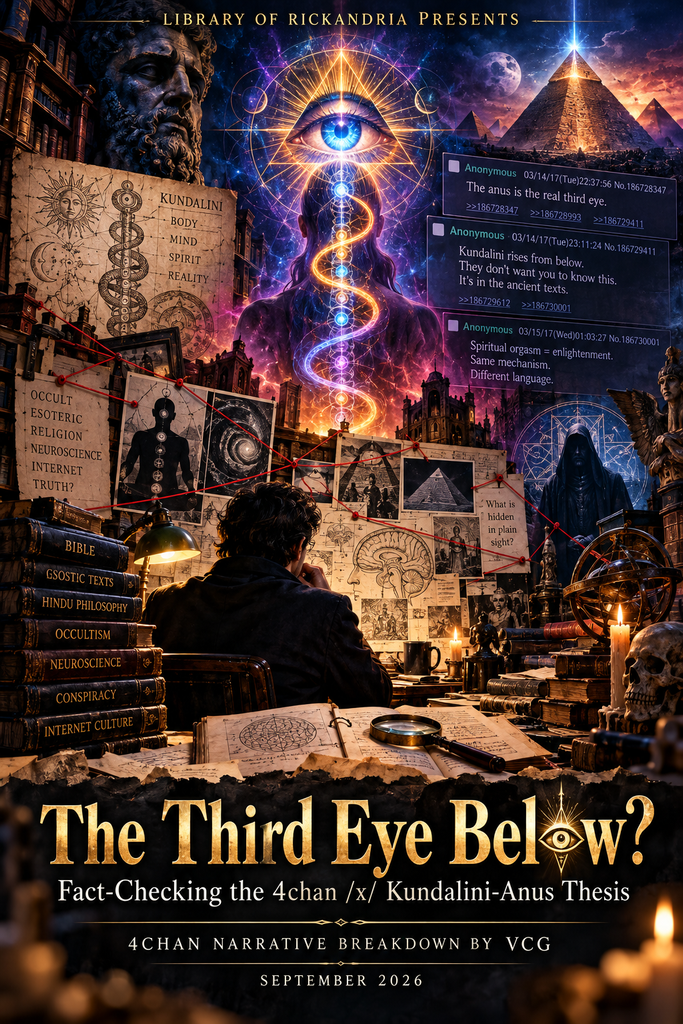
UPDATED BY VCG ON 9/25/2026 @ 01:11 EST
Anyone can do this, but most won’t.
ChatGPT – Library of Rickandria
“He that answereth a matter before he heareth it, it is folly and shame unto him.”
“He that is first in his own cause seemeth just; but his neighbour cometh and searcheth him.”— Proverbs 18:13, 17, KJV
Abstract
On September 23–24, 2026, an anonymous thread on 4chan’s /x/ paranormal board developed an extraordinary theory.
/x/ – 3rd eye Kundalini – Paranormal – 4chan
Its central claim was that the Hindu and Buddhist “third eye,” specifically the ājñā chakra, secretly refers to the anus; that stimulation of the anus can force the awakening of Kundalini; and that this hidden mechanism explains a remarkably wide range of otherwise unrelated phenomena—
including:
- tantric initiation
- ancient Greek sexuality
- Socrates’ daimonion
- Freemasonry’s thirty-three degrees
- the Eye of Providence
- the Washington Monument
- witchcraft
- UFO abduction reports
- Japanese folklore
- the Eye of Horus
- Western ceremonial magic, “Lucifer”
- Jacob’s ladder
and demonic possession.
The thread eventually expanded into claims concerning homosexuality, Christianity, Judaism, medicine, human anatomy, and a supposed historical suppression of this knowledge.
The remarkable thing about the thread is that it is not composed entirely of false information. Quite the opposite. It repeatedly discovers real anatomical facts, genuine pieces of folklore, actual occult traditions, authentic religious texts, real slang expressions, legitimate medical terminology, and documented historical coincidences.
Its central failure occurs in the connections.
Thirty-three vertebrae are real. Thirty-three Scottish Rite degrees are real. The coccygeal glomus is real. Russian очко genuinely can mean the anus. Some forms of Tantra have incorporated sexual ritual. Western occultists did combine Tantra and sexual magic. Tibetan literature really does contain a startling myth in which a wrathful deity enters Rudra through the anus. Japanese kappa folklore really does associate the anus with the mythical shirikodama. Prostate stimulation can produce sexual pleasure. Witches’ flying ointments have a genuine pharmacological and historical basis.
But none of those facts, individually or together, establishes the thread’s larger theory.
This paper therefore proceeds by a simple rule:
A real fact does not validate every story built around it.
The evidentiary burden lies in the connections.
We will examine those connections one by one, distinguishing five questions that the thread repeatedly merges: What does the source actually say? What happened historically? What does anatomy or medicine establish? What psychological mechanisms can make a pattern feel persuasive? And what does Scripture actually teach?
The resulting picture is more interesting than either blind acceptance or casual mockery. The thread contains genuine fragments of religious history and occult tradition. It also contains unsupported historical bridges, false etymologies, category errors, selective pattern matching, modern occult speculation treated as ancient evidence, and—in at least one especially important case—a materially altered quotation.
1. What We Are—and Are Not—Investigating
The original post, No. 43000493, appeared on /x/ at 7:12 p.m. on September 23, 2026. Replies continued through No. 43004878 at 11:25 p.m. on September 24. The thread remained accessible when checked on September 25.
One limitation should be established immediately: 4chan is anonymous. We cannot safely speak of “the author” as though every anonymous reply came from one person. Some posts plainly endorse the theory, some modify it, some challenge it, and others are obvious jokes or trolling. The appropriate object of study is therefore the narrative constructed by the thread as a conversation, not the psychology or intentions of one identifiable individual.
Nor is this paper attempting to answer the metaphysical question “Can anything supernatural ever happen?” by means of anatomy or historiography. Medical science can tell us whether the coccygeal glomus is an occult gland; it cannot adjudicate every theological claim about spirits. Conversely, Scripture may address idolatry, spirits, divination, and deception, but Scripture should not be made to endorse anatomical or historical propositions it never states.
That separation of domains is essential.
A claim about Sanskrit should be tested linguistically.
A claim about eighteenth-century Freemasonry should be tested historically.
A claim about vertebrae should be tested anatomically.
A claim about altered perception should be tested psychologically and physiologically where possible.
A claim about Scripture should be tested from Scripture.
The thread becomes persuasive largely by allowing evidence from one domain to leak into another without demonstrating the bridge.
2. Findings at a Glance
The investigation produced four broad results.
First, the thread contains many legitimate anchor facts. There really is enough strange material here to make the discussion initially compelling.
Second, the theory repeatedly turns resemblance into genealogy. Two things look alike, share a number, involve the same body region, or can be described with similar words; therefore they are treated as manifestations of one hidden tradition.
Third, modern interpretations are repeatedly projected backward into antiquity. A twentieth-century occult or comparative-religion author is quoted, and his interpretation becomes evidence for what ancient initiates supposedly believed.
Fourth, some cited material is not merely interpreted aggressively but materially altered. The Harish Johari quotation is the clearest case.
Claim-Evidence Matrix
| Thread claim | What can actually be verified | Evidentiary problem | Assessment |
|---|---|---|---|
| Ājñā means anus | Traditional sources locate ājñā between the eyebrows and explain its name in terms of command/authority | False etymology | Contradicted |
| Russian “eye” slang can mean anus | Russian очко can indeed have a vulgar anal meaning | Russian slang cannot redefine Sanskrit | Narrow fact verified; inference invalid |
| Doctors describe an “anal wink” | “Anal wink” is a real clinical reflex | Modern English medical metaphor is not evidence for ancient Indian terminology | Verified but irrelevant to etymology |
| Humans have 33 vertebrae | 33 is the standard anatomical count, with fused sacral/coccygeal elements | Number alone gives no historical connection to Masonry | Verified |
| Scottish Rite has 33 degrees | It does | No historical evidence supplied that the number encodes the spine or sexual initiation | Verified fact; proposed explanation unsupported |
| Coccygeal glomus is a Kundalini gland | Coccygeal glomus is a real small vascular/glomus structure | Medicine does not identify it as a Kundalini organ or gland | Contradicted as anatomy |
| Eye-and-pyramid is secret Masonic anal symbolism | Eye/pyramid symbolism exists; Masons use eye symbolism in some contexts | Documented Great Seal history does not support the proposed origin | Unsupported |
| Washington Monument is an occult phallus | It is an Egyptian-style obelisk | Phallic resemblance is interpretation, not documented design intent | Unsupported as history |
| Plato had a “third-eye daemon” | Socrates described a daimonion or divine sign | Socrates ≠ Plato; daimonion ≠ chakra; no anal connection | Conflation |
| Eye of Horus is a brain diagram | Modern authors have noticed neuroanatomical resemblance | Authors themselves call it speculative; no ancient documentation establishes intent | Interesting speculation, unproved historically |
| Tantra contains sexual rites | Some tantric traditions do | Tantra is diverse; sexual ritual does not establish universal anal initiation | Partly true, overgeneralized |
| Crowley mixed Tantra and sexual magic | Historically documented | This demonstrates modern synthesis, not an unbroken ancient chain | Verified |
| Daniélou argued for anal initiation/Kundalini connections | He did advance sweeping comparative theories of Shiva/Dionysus and sexuality | Daniélou’s theory is not independent ancient corroboration | Verified attribution; thesis unproved |
| Flying ointments caused altered states | Tropane-containing ointments have a genuine history | Specific claims of universal rectal broom insertion exceed the evidence | Partly supported |
| Vitruvian Man depicts sexual intercourse | Leonardo drew one man in two superimposed positions | Misreading of the image | Contradicted |
| French Mon œil! refers to the anus | Académie française defines it as ironic disbelief | False lexical claim | Contradicted |
| Prostate stimulation can create intense pleasure | Yes, for some people | Sensation does not establish Kundalini as its metaphysical cause | Physiology verified; metaphysics unproved |
| Japanese kappa folklore involves the anus | Yes; shirikodama lore does | Folkloric similarity does not prove identity with Kundalini | Verified folklore; connection unsupported |
| Hayagrīva enters Rudra through the anus | A Rudra-subjugation tradition contains such imagery | Mythic violence is converted into human guru-student sexual initiation | Source exists; interpretation distorted |
| Johari teaches sexual stimulation ending in ejaculation | Johari describes a water-cleansing practice, vasti | Thread materially changes his wording | Source altered |
| Anal sex destroys “good bacteria” and leaks feces into blood as a normal mechanism | Anal intercourse carries real injury/STI/infectious risks | Proposed mechanism is medically inaccurate as a general explanation | Misleading |
| Kundalini is demonstrably a serpent demon entering through the anus | Neither anatomy nor the cited historical material demonstrates this | Theological/metaphysical assertion added to evidence | Unsupported |
| Every homosexual person possesses this spirit | No empirical or biblical basis is supplied | Universal stigmatizing conclusion | Unsupported |
The pattern is already visible.
The thread’s best facts survive investigation. Its larger synthesis does not.
3. How We Tested the Narrative
3.1 The Source-Provenance Ladder
Not all citations carry the same evidentiary weight.
For this investigation, sources were evaluated roughly in the following order:
| Evidentiary level | Examples | What it can establish |
|---|---|---|
| Primary text / critical edition | Original religious text, Johari’s published wording, historical constitution | What a source actually says |
| Academic historical scholarship | Yale, Oxford, peer-reviewed history of religion | Context, chronology, transmission, interpretation |
| Peer-reviewed empirical research | PubMed/PMC anatomy and psychology | Anatomical, physiological, statistical findings |
| Responsible institutional record | CDC, NPS, official Scottish Rite history | Documented institutional practices and public historical records |
| Modern interpretive author | Alain Daniélou, modern occult writers | What that author believed or proposed |
| Popular/commercial spirituality source | New Age websites, retailers | Contemporary belief or marketing |
| Anonymous internet post | /x/ | Evidence that someone asserted something |
This is not an infallibility scale. An official organization may omit embarrassing history; scholars can disagree; primary texts require interpretation; medical knowledge changes.
But a lower-level source cannot simply be used to override stronger contrary evidence without argument.
Most importantly:
A quotation from an occultist proves that the occultist made the claim.
It does not automatically prove that the claim describes antiquity.
That distinction becomes crucial with Daniélou and Crowley.
3.2 The Historical-Transmission Test
Whenever the thread says that two traditions share one hidden teaching, five questions follow naturally:
Who transmitted the teaching?
When did the transmission occur?
Through which text, teacher, institution, migration, conquest, translation, or ritual lineage?
What is the earliest dated evidence? And do intermediate sources preserve continuity—or do we simply have two things that resemble each other?
Resemblance can suggest a hypothesis.
Resemblance is not the completed proof.
If thirty-three vertebrae are said to explain thirty-three Masonic degrees, we need something more than the number thirty-three appearing twice. We need historical evidence that the people constructing the degree system knew the anatomical symbolism and intended the number accordingly.
If kappa folklore is supposed to preserve Kundalini doctrine, we need historical contact or textual correspondence sufficient to distinguish transmission from independently arising folklore about a conspicuous human body opening.
This standard is not hostile skepticism. It is what turns an interesting association into history.
4. The First Anchor: Does Ājñā Mean Anus?
The entire theory begins with the OP’s compact equation: “anja = anus.” The rest of the narrative depends heavily on it.
It is therefore the right place to begin.
Traditional descriptions do not support the claim.
Sources drawing on the Ṣaṭ-cakra-nirūpaṇa and Arthur Avalon’s The Serpent Power identify ājñā as the “command” center, situated between the eyebrows. The traditional commentary explicitly explains its name through the reception of the guru’s command at that center. A Nath-tradition reference likewise gives ājñā as “order, command, will” and locates the chakra between the eyebrows.
There are legitimate scholarly debates about chakra systems. Not every Indian text uses precisely the same number of centers, iconography, colors, correspondences, or terminology. Modern Western chakra charts also contain elements that are much newer than the Sanskrit systems from which they claim descent.
But none of that rescues the proposed etymology.
The thread’s method instead moves laterally: perhaps other languages call the anus an “eye,” therefore ājñā must secretly encode the same thing.
This brings us to one of the thread’s genuinely interesting facts.
Russian очко (očko) is historically a diminutive related to “eye,” and dictionaries record a vulgar meaning referring to the anus alongside ordinary meanings such as a point, spot, hole, or peephole. Historical Russian slang dictionaries also document the anal sense.
So the Russian example is not invented.
It simply does not do what the theory needs it to do.
A Russian metaphor cannot retroactively determine the meaning of an unrelated Sanskrit term. To establish an etymological relationship, we would need linguistic ancestry, attested semantic development, and a plausible historical pathway—not the observation that speakers of an entirely different language once used similar imagery.
The same distinction applies to the medical expression “anal wink.” The term really exists. Clinical research uses it to describe a reflex contraction of the anal sphincter in response to sacral stimulation.
Again: real fact.
But a modern English visual metaphor for sphincter contraction is not evidence that Sanskrit authors secretly meant “anus” when they wrote ājñā.
This gives us the first recurring formula of the thread:
True observation + semantic resemblance + missing historical bridge = false certainty.
5. Thirty-Three: Vertebrae, Masonry, and the Seduction of a Number
Post 43000534 expands the theory dramatically. It connects thirty-three vertebrae, the base of the spine, a supposed “Kundalini gland,” Scottish Rite Masonry, sexual initiation, the pyramid-and-eye symbol, and the Washington Monument.
Several ingredients are real.
Humans are conventionally described as having 33 vertebrae: seven cervical, twelve thoracic, five lumbar, five sacral, and four coccygeal, with the sacral and coccygeal portions fused in adulthood. Anatomical variation exists, but thirty-three is the standard textbook count.
The Ancient and Accepted Scottish Rite also really does administer a system of 33 degrees. Its own historical account traces the Supreme Council of the 33rd Degree in the United States to Charleston in 1801, emerging from earlier high-degree systems, especially the twenty-five-degree Order of the Royal Secret.
So we have:
33 vertebrae.
33 degrees.
What we do not yet have is:
therefore the degrees were numbered to encode vertebrae.
That final sentence is the historical claim. It requires evidence of intention or transmission.
The Scottish Rite’s own documentary history instead shows a developing sequence of high-degree systems, with thirty-three emerging institutionally around the creation of the Supreme Council. That does not prove no Mason ever made a spinal analogy later. It does mean that the thread has not supplied evidence that spinal anatomy caused the degree count.
The numerical coincidence may be interesting.
It is not yet genealogy.
6. The “Kundalini Gland”: A Real Structure Given a New Identity
A reply identifies the thread’s alleged gland as the glomus coccygeum.
This is another case where research rewards the poster halfway.
The coccygeal glomus is real.
Pathology literature describes it as a small, nonpathological structure around the tip of the coccyx, composed of modified smooth-muscle/glomus cells associated with small vascular channels. One study found these structures measuring at most a few millimeters. They can create diagnostic confusion precisely because pathologists unfamiliar with them may mistake them for tumors.
That is fascinating anatomy.
It is not a Kundalini reservoir.
The literature does not identify the structure as a gland secreting spiritual energy, a sexual enlightenment organ, a chakra, or a physical container for a serpent entity.
Notice the rhetorical transformation:
There is a little-known structure near the coccyx becomes there is a hidden organ near the base of the spine becomes this must be the organ occult traditions describe.
The first proposition is anatomy.
The second is suggestive framing.
The third is interpretation.
The thread presents all three as though they were one fact.
7. The Eye, the Pyramid, and the Washington Obelisk
The theory next identifies the pyramid as an “anal triangle,” the Eye of Providence as the anus, and the Washington Monument as the corresponding phallic symbol.
Symbolism permits creative interpretation. Historical origin requires something stricter.
The Scottish Rite’s own historical explanation states that the eye-in-pyramid combination on the Great Seal of the United States is not an official Masonic emblem. The eye element can be traced to Pierre Du Simitière, who was not a Mason, while the unfinished pyramid developed through other contributors. The surviving contemporary explanation interprets the pyramid in terms of strength and duration and the eye in terms of Providence.
An institutional source should not automatically be treated as impartial proof of every question concerning its own history. But if we are proposing a radically different hidden origin, we still need positive evidence for it.
Visual resemblance alone will not do.
The Washington Monument presents the same problem. National Park Service records show that Robert Mills’ design was an Egyptian-style obelisk honoring George Washington; later revisions retained the obelisk and brought it closer to classical Egyptian proportions. NPS describes the finished form in terms of commemoration, strength, unity, and the timelessness associated with ancient monumental architecture.
One can certainly observe that an obelisk is phallic in shape. Many cultures have made phallic interpretations of upright monuments.
But there is an enormous difference between:
“I can interpret this shape sexually”
and
“The designers intended this as one half of an encoded anal-sex initiation system.”
The latter is a historical proposition. It needs documentary evidence.
8. Socrates’ Daimonion Is Not Plato’s Chakra
Another thread claim invokes “Plato’s” supposed third-eye daemon.
This compresses several distinct things.
It was Socrates, as represented especially in Plato and Xenophon, who described a daimonion—a divine or semi-divine sign or inner voice that sometimes restrained him from particular actions. The Stanford Encyclopedia of Philosophy summarizes the phenomenon as a personal divine sign that Socrates said had accompanied him since childhood.
There are legitimate philosophical questions about what Socrates meant. Was it conscience? Divine communication? A culturally intelligible form of religious experience? Plato’s literary construction? Scholars have debated these questions for centuries.
But none of that yields:
Socrates’ divine sign = ājñā chakra = anus = Kundalini.
The thread first misattributes Socrates’ experience to Plato, then supplies a chakra interpretation not present in the classical material, then incorporates it into the anal thesis.
Three transformations occur before the “parallel” is complete.
9. The Eye of Horus: A Good Example of Responsible Speculation
The thread’s Eye-of-Horus claim is worth keeping because it demonstrates what responsible speculative scholarship looks like.
Modern physicians have indeed observed that portions of the Eye of Horus can be visually superimposed onto a sagittal section of the human brain in suggestive ways. A 2019 medical article explored these correspondences.
Crucially, the authors did not claim to have proven that ancient Egyptians designed the symbol as a neurological diagram. They explicitly described their conclusion as a possible scientific speculation. Their literature search found no original historical evidence establishing a neuroanatomical origin for the symbol. Historically, the Eye of Horus is well established as a protective and restorative symbol within Egyptian mythology.
That is how a resemblance should be handled:
Observe it. Investigate it. State what is intriguing. State what has not been demonstrated.
The /x/ theory instead tends to convert resemblance directly into secret intention.
10. Tantra: Where the Thread Touches Something Real
The discussion becomes more serious when it reaches Tantra, because here there really is substantial historical material involving the body, ritual transgression, subtle-body systems, sexual symbolism, and—in some traditions—actual sexual rites.
A good rebuttal should not deny that.
Modern scholarship emphasizes that “Tantra” describes a large, internally diverse family of Hindu and Buddhist traditions rather than one uniform religion. Tantric traditions include initiatory practices, mantra, visualization, deity identification, subtle-body practices, ritual technologies, and sometimes deliberate transgression of ordinary social norms. Sexual ritual has existed in certain contexts, but Western treatments have repeatedly exaggerated sexuality until it becomes a caricature of Tantra as a whole.
This makes two opposite mistakes possible.
One mistake says:
“Tantra never had anything sexual in it.”
That is historically indefensible.
The opposite mistake says:
“Anything sexual or transgressive found anywhere in Tantra proves the entire Kundalini system was secretly an anal-sex initiation system.”
That is also indefensible.
The thread repeatedly moves from the first legitimate observation to the second conclusion.
11. Crowley: A Real Bridge, but a Modern One
Aleister Crowley is also relevant—but not in the way the thread requires.
Historian of religion Hugh Urban has documented how Crowley’s sexual magic emerged from Western esoteric currents while also incorporating Indian yogic and tantric ideas. Urban describes Crowley’s system as a significant fusion of Western sexual magic with Indian Tantric traditions in the early twentieth century. He also traces broader Western sexual-magic currents through figures such as Paschal Beverly Randolph and Theodor Reuss.
That is a genuine historical connection.
It actually helps us understand how contemporary internet occultism can contain Sanskrit vocabulary, Western ceremonial symbolism, sexuality, chakras, Freemasonry, and Christian inversions all in one package.
But note the chronology.
Crowley shows that modern Western occultism synthesized these things.
He does not establish that a unified anal-Kundalini doctrine existed in ancient India, crossed into Greece, survived in mystery schools, entered Masonry, and finally resurfaced in Crowley.
Ironically, the historical record may explain the similarities without requiring the ancient secret lineage: modern occultists themselves combined previously distinct traditions.
That is a much simpler transmission pathway.
12. Alain Daniélou: Citation Is Not Corroboration
Post 43000818 is one of the thread’s stronger moments because the startling theory it presents is not simply fabricated.
Alain Daniélou’s Gods of Love and Ecstasy genuinely advances an ambitious comparative thesis connecting Shiva and Dionysus, sexuality, initiation, ecstasy, and ancient religious continuity. The publisher’s description itself says that Daniélou reconstructs religious practices extending from the Indus Valley into the Mediterranean world.
This matters.
The proper response is not,
“Nobody has ever proposed anything like this.”
Someone has.
But what does that prove?
It proves:
Daniélou proposed the theory.
It does not, by itself, prove:
the theory is historically established.
To move from Daniélou’s interpretation to a historical conclusion, we need independent evidence: early texts, inscriptions, ritual manuals, migration patterns, intermediary traditions, linguistic borrowing, archaeological evidence, or multiple independent ancient witnesses.
Otherwise one modern author’s reconstruction is being used as both hypothesis and proof.
This is one of the thread’s most common source-provenance errors.
13. Witches, Broomsticks, and Flying Ointments
The witchcraft section is another place where the truth is stranger than a simplistic debunking would suggest.
Historical and toxicological research supports a real tradition of ointments containing tropane-alkaloid plants such as belladonna, henbane, mandrake, and related substances. Atropine and scopolamine can produce profound hallucinations and delirium. Researchers have discussed topical application and the connection between ointments, broom imagery, and reports of flight.
Some historical reconstructions also discuss application to highly vascular or sensitive body regions, including genital or rectal exposure. Modern reviews caution, however, that “flying ointment” history is complex and has repeatedly accumulated folklore, retrospective interpretation, and sensational retelling.
So once again, the corrected answer is not
“nothing happened.”
A more defensible reconstruction is:
psychoactive ointments probably existed; their ingredients can produce hallucinations, delirium, sensations of flight, and intense visionary experiences; broomstick imagery has historical connections to ointment lore.
That does not establish:
witches universally inserted drug-coated broomsticks rectally in order to enter an objectively existing astral realm through Kundalini.
Pharmacology explains why the experience could feel astonishingly real without settling every metaphysical question about what experiencers believed they encountered.
14. Leonardo’s Vitruvian Man
The thread eventually interprets Leonardo’s Vitruvian Man as two men engaged in anal intercourse.
This is not supported by the drawing’s construction or art-historical context.
Leonardo depicts one male figure in two overlapping positions, with doubled limbs allowing the same body to relate simultaneously to a square and a circle. The image derives from Vitruvius’ discussion of ideal human proportion. Smarthistory explicitly describes its three elements as a single male figure, a circle, and a square.
The thread sees doubled limbs and supplies a second sexual actor.
But that actor is not actually in the source image.
This is a particularly clear illustration of pattern completion: once the investigator expects to discover anal symbolism, ambiguous visual forms are completed according to that expectation.
15. Language Games: When a Real Pattern Becomes Uncontrolled
Later in the thread, linguistic evidence is expanded. “Eye” expressions in English, Polish, Russian, and French are presented as cross-cultural confirmation.
There really are languages in which eye imagery becomes slang for the anus. Russian is one verified example.
But one claimed example provides a useful control test.
The thread treats French Mon œil ! as if it were fundamentally an anal euphemism.
The Dictionnaire de l’Académie française defines Mon œil ! as a familiar ironic expression of incredulity—the equivalent of saying that one does not believe what has just been claimed. It does not define the expression as “anus.”
Here we can watch the theory recruit a false positive.
The expression contains “eye.”
The theory expects “eye” to mean anus.
Therefore an ordinary French idiom becomes another apparent confirmation.
This demonstrates why pattern-based theories need negative controls. If every occurrence of an eye, triangle, serpent, ladder, tower, opening, or number thirty-three can be reinterpreted after the fact, the theory becomes capable of explaining almost anything—and therefore loses its ability to discriminate between true and false predictions.
16. Prostate Stimulation: Real Physiology Is Not Yet Metaphysics
Another reply proposes that prostate orgasm may explain the alleged Kundalini experience.
This is one of the more reasonable attempts within the thread to locate a physiological substrate for an intense subjective event.
The prostate is anatomically accessible through the rectal wall, and stimulation can be sexually pleasurable for some people. Cleveland Clinic notes that prostate massage is commonly pursued for sexual stimulation, while warning that claimed medical benefits are poorly supported and that rectal injury, pain, or worsening hemorrhoids are possible risks.
So if someone reports an unusually powerful bodily experience following stimulation in that area, there is no reason to deny that the sensation occurred.
But experience and explanation are different evidentiary layers:
“I felt an intense sensation.”
This may be a perfectly sincere autobiographical report.
“The sensation felt as though it traveled upward.”
Also a report about subjective phenomenology.
“Therefore an objectively existing occult energy traveled through subtle channels.”
Now we have a metaphysical interpretation.
“Therefore the same mechanism explains Freemasonry, Greece, UFOs, and religious history.”
Now we have constructed a global historical theory.
Every step requires new evidence.
The intensity of the first experience does not automatically validate the last conclusion.
17. Japanese Kappa and the Shirikodama
The Japanese folklore claim also contains a real and wonderfully strange core.
Academic work on Japanese yōkai traditions records the shirikodama, a mythical ball or jewel imagined inside the anal cavity. Kappa tales sometimes describe the creature reaching through the anus to remove it. Scholars also note other yōkai traditions in which bodily orifices, including the anus, function as vulnerable points of supernatural intrusion.
That is authentic folklore.
What follows?
We may responsibly conclude that Japanese folklore sometimes imagined the anus as a vulnerable supernatural boundary.
We cannot yet conclude that the shirikodama is the Japanese name for Kundalini or that kappa stories preserve the same hidden initiation system found in Indian yoga.
Human cultures repeatedly generate symbolism around blood, mouths, eyes, genitals, excretion, birth, death, caves, thresholds, serpents, and bodily openings.
Similarity may result from transmission.
It may also result from the fact that human beings inhabit broadly similar bodies.
Historical identity has to be shown, not presumed.
18. Humming Like a Bee and Feeling Vibration Between the Eyebrows
One poster asks about closing the eyes, humming like a bee, and feeling vibration between the eyebrows.
This observation fits naturally with Bhrāmarī prāṇāyāma, a yogic breathing practice characterized by humming. Modern researchers have measured cortical activity during the humming practice; a 2023 EEG study examined changes before, during, and after Bhrāmarī in thirty participants.
Humming physically vibrates the skull, face, nasal passages, and surrounding tissues. Attention directed toward the forehead can make such sensations especially salient.
This does not prove that every meditative forehead sensation is reducible to acoustics.
It does show that feeling vibration in the face while intentionally humming is exactly the sort of phenomenon for which a physiological mechanism is already available.
Again, subjective experience is real evidence for the experience.
It is not self-interpreting evidence for the proposed occult ontology.
19. Source Autopsy I: Rudra and Hayagrīva
This is one of the most important sections of the thread because here the poster has located genuinely shocking material from Tibetan Buddhist mythology.
There is a Tibetan Rudra-subjugation tradition involving wrathful tantric deities, violent transformation, bodily invasion, demon-taming, and conversion. Jacob Dalton’s scholarly The Taming of the Demons devotes substantial attention to Rudra traditions and includes an appendix specifically translating the “Subjugation of Rudra.” Yale describes the book as a study of violence, demon taming, sacrifice, and Tibetan tantric history.
One version summarized in reference literature has Hayagrīva becoming tiny, entering Rudra through the anus, becoming gigantic, destroying or overwhelming him internally, and subjugating him to the Dharma.
That bizarre motif is real.
Now compare what the thread does with it.
What the source tradition gives us
A mythic narrative of wrathful Buddhist deities and the violent subjugation/conversion of Rudra.
What the thread adds
Sexual pulsation, ejaculation, and the conclusion that the passage describes a master having tantric anal intercourse with an apprentice so that the apprentice achieves Kundalini enlightenment.
These are not small interpretive differences.
The genre has changed.
Mythic demon-subjugation becomes human sexual initiation.
The characters’ relationship has changed.
Wrathful opponents become sexual teacher and student.
The action has changed.
Violent supernatural penetration becomes intercourse and orgasm.
The doctrinal purpose has changed.
Demon conversion becomes Kundalini awakening.
One may certainly analyze the sexual symbolism of violent tantric imagery. Scholars do that.
But interpretation should be labelled interpretation.
It cannot be inserted into the source and then cited as though the source itself explicitly taught it.
20. Source Autopsy II: Harish Johari
This is the strongest single falsification in the thread.
Post 43004338 insists that its material comes directly from Harish Johari, a well-known modern writer on chakras and yoga. It then presents what appears to be a quotation describing vasti, a traditional cleansing procedure.
The actual published text is available in scans/transcriptions of Johari’s Chakras: Energy Centers of Transformation.
Johari describes a smooth bamboo tube, lubrication, a squatting posture in navel-deep water, and insertion of the tube. The practitioner is then told to “contract the anus to draw in water” and to “Shake the water internally and then expel it.” The heading identifies vasti as lower-intestinal cleansing.
The thread changes the operative content.
Water disappears.
Sexualized thrusting and whole-body pulsation are added.
The expelled substance is changed from water into semen.
The thread even substitutes “expel cum” for Johari’s instruction.
That is not interpretive emphasis.
It is a materially altered quotation.
Independent descriptions of jala vasti also characterize it as bowel cleansing by drawing water into the lower intestine and expelling it, confirming that Johari’s wording belongs to a known cleansing practice rather than a concealed ejaculation ritual.
Why this matters beyond one quotation
Once a theory alters a primary source so that the source appears to say exactly what the theory predicted, the evidentiary situation changes.
A reader can no longer assume that startling quotations reproduced in the thread are accurate simply because they look specific.
Every quotation must be checked upstream.
This is not an argument that everything else in the thread is automatically false.
It is an argument that source verification is no longer optional.
21. The Harish Johari Case as a Methodological Lesson
The Johari alteration illustrates four stages of information laundering.
First comes an authentic practice: vasti.
Second comes an anatomically provocative detail: it involves the anus and a tube.
Third comes reinterpretation: perhaps this practice is sexual or secretly related to Kundalini.
Fourth comes quotation mutation: the source is rewritten until it appears to state the reinterpretation explicitly.
At that point the reader encounters what looks like a devastating primary-source confirmation.
But the confirmation was manufactured during transmission.
This is precisely why the paper’s methodology cannot merely count citations.
A source has to be traced.
22. Subjective Kundalini Reports
Near the end of the thread, a poster reports having personally experienced a powerful internal surge from the lower body toward the head and identifies it as a Kundalini awakening. The post then links the experience to ancient Greece and Christian sexual prohibition and encourages other readers to seek a similar experience.
A careful response should avoid two symmetrical errors.
The first would be to say:
“You did not experience anything.”
We have no basis for that conclusion. Human beings can experience extraordinarily intense somatic, sexual, meditative, dissociative, neurological, emotional, and religious states.
The second error would be:
“Because the experience was intense and matched a preexisting map, the map has been objectively proven.”
That also does not follow.
Religious experience is interpreted through concepts available to the experiencer. A Christian may describe an experience through categories of the Holy Spirit, conviction, or temptation; a yogic practitioner may describe something as prāṇa or Kundalini; an occultist may speak of astral energy; a clinician may investigate autonomic, neurological, pelvic-floor, or altered-state mechanisms.
The phenomenology may be worth studying.
The interpretation requires separate argument.
23. The 3 A.M. Material and Whitley Strieber
The thread claims that Whitley Strieber and others have anomalous experiences around the “witching hour,” treating this timing as evidence for Kundalini or spirit activity.
Strieber really has described being awakened around 3:00 a.m. and engaging in meditation at that hour. In a 2024 Harvard Center for the Study of World Religions interview, he recounts experiences involving presences waking him and says that 3:00 a.m. became part of his meditation schedule.
That establishes:
Strieber reports anomalous experiences and 3 a.m. meditation.
It does not establish:
Strieber independently verified
“anal Kundalini at 3:33.”
Nor does it demonstrate that 3:00 a.m. is objectively a period when spiritual beings are more active.
The thread repeatedly transforms autobiographical testimony into mechanistic corroboration.
A witness can be sincere without correctly identifying the cause of an experience.
24. Medical Risk: Correcting Without Minimizing
One late post says anal intercourse destroys beneficial bacteria around the colon and opens blood vessels so that feces leaks into the bloodstream.
There are genuine medical risks associated with receptive anal intercourse, and they should not be minimized.
The CDC identifies anal intercourse as the sexual activity with the highest risk of HIV transmission because the rectal lining can permit viral entry. It also notes transmission risks for other infections, including pathogens spread through fecal contamination.
But that is not the same as the thread’s proposed general mechanism.
Medicine does not describe ordinary anal intercourse as automatically “destroying the good bacteria” and opening vascular channels through which feces routinely enters the bloodstream.
A responsible correction therefore says two things at once:
There are real health risks.
The mechanism presented in the thread is inaccurate and exaggerated.
Accuracy does not require minimizing risk, and acknowledging risk does not require validating bad physiology.
25. “What the Thread Gets Right”
A fair investigation should gather the strongest surviving observations in one place.
The thread is right that the human spine is conventionally counted as thirty-three vertebrae.
It is right that the Scottish Rite uses thirty-three degrees.
It is right that the coccygeal glomus exists.
It is right that Russian очко can be vulgar slang for the anus.
It is right that medicine uses the phrase “anal wink.”
It is right that sexual ritual and sexual symbolism have occurred within some tantric contexts.
It is right that Crowley and other modern Western occultists blended Western sexual magic with Indian or tantric material.
It is right that Alain Daniélou advanced unusually expansive theories connecting Shiva, Dionysus, sexuality, initiation, and ancient religious continuity.
It is right that flying ointments containing psychoactive nightshades have a plausible historical and pharmacological basis.
It is right that prostate stimulation can produce sexual pleasure in some people.
It is right that kappa folklore contains an astonishing anal shirikodama motif.
It is right that Tibetan Rudra mythology includes extraordinary bodily imagery involving the anus.
It is right that meditation, breathing, humming, sexuality, expectation, and focused attention can produce powerful subjective experiences. Research on Bhrāmarī alone demonstrates measurable physiological correlates of one such practice.
These concessions do not weaken the rebuttal.
They strengthen it.
The problem is not that the thread noticed nothing real.
The problem is that real fragments are repeatedly connected by conclusions the fragments themselves do not establish.
26. Figure 1 — The Real-Fact / Invented-Bridge Problem
The central argument can be represented like this:
| Node A | Proposed bridge | Node B | Status of bridge |
|---|---|---|---|
| Russian “eye” slang can denote anus | therefore | Sanskrit ājñā denotes anus | No linguistic bridge |
| Ājñā is part of subtle-body teaching | therefore | anal stimulation opens ājñā | Traditional location contradicts premise |
| Humans have 33 vertebrae | therefore | Scottish Rite chose 33 for spinal symbolism | No documentary bridge supplied |
| Scottish Rite has 33 degrees | therefore | high-degree initiation requires sodomy | No evidence supplied |
| Coccygeal glomus is near coccyx | therefore | it is Kundalini’s physical gland | No anatomical evidence |
| Tantra sometimes contains sexual rites | therefore | all advanced Tantra culminates in male anal initiation | Overgeneralization |
| Crowley used sexual magic and Eastern concepts | therefore | he inherited an ancient universal anal mystery | Modern synthesis ≠ ancient continuity |
| Eye of Horus resembles brain anatomy | therefore | Egyptians encoded Kundalini neuroanatomy | Speculative resemblance |
| Kappa attacks involve anus | therefore | kappa folklore describes Kundalini entities | No transmission/identity demonstrated |
| Prostate stimulation can be intense | therefore | orgasm is objectively Kundalini | Phenomenology ≠ cause |
| Rudra myth has anal ingress | therefore | it describes guru–student intercourse | Narrative transformed |
| Johari describes vasti | therefore | Johari taught sexual ejaculation practice | Quotation altered |
| Scripture recognizes devils | therefore | every Kundalini experience is one specific anal-entering demon | Theological bridge absent |
This is the paper in miniature.
The nodes are frequently real.
The arrows carry the theory.
The arrows are where evidence is weakest.
27. Why the Narrative Feels Stronger Than Its Evidence
We should now ask a different question.
If so many links fail, why can the thread nevertheless feel strangely persuasive by the time one reaches the bottom?
The answer does not require diagnosing anyone.
It requires examining how human pattern recognition works.
Apophenia and Illusory Pattern Perception
Humans are remarkably good at finding structure. Usually this is an advantage. The same ability can also produce patterns where the evidence is weak or random.
Experimental research has found associations between conspiracy and supernatural beliefs and the perception of patterns in random coin tosses or chaotic visual material. This does not mean every unusual hypothesis is “apophenia,” nor does it diagnose the posters. It simply establishes that illusory pattern perception is a measurable cognitive phenomenon relevant to theories assembled from coincidences.
Consider the thread’s symbolic field:
Two shapes resembling buttocks.
Triangles.
Eyes.
Serpents.
Spines.
Ladders.
Towers.
Pyramids.
Openings.
Penetration.
The morning star.
Saturn.
Obelisks.
Once these become search targets, examples are not difficult to find.
The important statistical question becomes:
How many possible symbols were available before the matches were selected?
Without that denominator, ten coincidences may look far less extraordinary than they initially appear.
Motivated Search
After the opening theory is proposed, the investigation is no longer searching neutrally.
It is searching specifically for:
- eye/anus metaphors,
- the number 33,
- serpent imagery,
- bodily openings,
- sexual initiation,
- things entering bodies,
- spine symbolism,
- triangles and towers,
- altered states,
- demons,
- occult groups.
That search will inevitably return hits.
The crucial test is whether the theory also predicts what should not be found.
A model that can reinterpret every symbol as confirming evidence is difficult to falsify.
Semantic Association
Words create their own chains.
Eye → opening → anus.
Serpent → Kundalini → Satan.
Morning star → Lucifer → Venus.
Ladder → ascent → spine.
Triangle → pelvis → pyramid.
Thirty-three → vertebrae → Masons.
Each step feels small.
After ten steps, however, the conclusion may be very far from the evidence with which the chain began.
This is one reason long associative arguments can feel stronger than their individual premises.
The reader remembers the density of connections more readily than the evidentiary weakness of each transition.
The Illusory Truth Effect
Repetition matters.
A 2026 meta-analysis covering 182 studies, 366 effect sizes, and more than 31,000 participants found a robust tendency for repeated statements to receive higher truth ratings than statements encountered only once, though effect sizes varied substantially across circumstances.
Separate research has specifically found that repetition can increase perceived truth even for conspiracy statements.
This matters because the proposition that ājñā is the anus appears again and again in different forms throughout the thread.
By the tenth repetition, it can begin to function as established background.
But repetition does not create independent witnesses.
Twenty posts descended from the same premise are not twenty independent sources.
The Suppression Paradox
The thread also contains a classic self-sealing move:
If ordinary historical sources do not teach the doctrine, that absence proves the doctrine was suppressed.
This reverses the normal burden of proof.
Evidence for the theory proves the theory.
Absence of evidence also proves the theory because the secret was hidden.
Contrary evidence can likewise be absorbed: naturally institutions deny the truth because they are guarding it.
Once all possible outcomes confirm the hypothesis, falsification becomes impossible.
A hidden tradition may, of course, genuinely leave little evidence.
But “it was secret” cannot substitute for the evidence needed to demonstrate what the secret actually was.
Shock as a Memory Device
The thread’s sexual and transgressive imagery also makes the theory unusually memorable.
A claim that
“Masonic degree numbering reflects an obscure eighteenth-century organizational history”
is cognitively dull.
A claim that
“thirty-three secretly encodes ritual sodomy through the thirty-three vertebrae”
is almost impossible to forget.
Shock, disgust, comedy, taboo, and mystery increase salience.
Salience is not the same thing as probability.
28. The Strongest Version of the Thesis That Survives
A good investigation should steelman the argument before concluding.
Once the false etymologies, altered quotations, unsupported universal claims, and conspiracy expansions are removed, something interesting remains.
The strongest defensible version might read as follows:
Across several religious and esoteric traditions, the human body—especially the spine, pelvis, sexual organs, bodily openings, breath, and nervous sensations—has served as a symbolic and ritual map for altered states of consciousness. Some South Asian tantric traditions incorporated sexual symbolism or sexual ritual. Kundalini traditions describe an ascending subtle force using serpent imagery. Some Western occultists later fused tantric concepts with sexual magic. Human pelvic anatomy can produce intense sensations capable of being interpreted spiritually. Other cultures independently developed folklore in which bodily openings function as spiritually vulnerable thresholds.
That proposition is historically and psychologically interesting.
It also differs radically from the original /x/ thesis.
It does not require ājñā to mean anus.
It does not require thirty-three Masonic degrees to encode vertebrae.
It does not require the Great Seal to depict an anus.
It does not require Leonardo to hide anal intercourse in Vitruvian Man.
It does not require Japanese kappa to be Kundalini entities.
It does not require a secret unbroken initiation chain from India through Greece to Freemasonry.
It does not require every homosexual person to possess a demon.
And it does not require changing what Harish Johari wrote.
The surviving proposition is therefore much narrower—but also much more defensible.
29. The Biblical Question: What Does Scripture Actually Permit Us to Say?
Up to this point, we have been doing linguistics, history, anatomy, medicine, comparative religion, and psychology.
Now the category changes.
A Christian reader may reasonably say:
“Even if the historical conspiracy fails, could there still be spiritual danger in occult practices?”
That question deserves to be answered biblically rather than dismissed by materialist assumption.
The Bible unquestionably contains categories of spiritual evil.
Paul writes concerning pagan sacrifice:
“the things which the Gentiles sacrifice, they sacrifice to devils, and not to God:
and I would not that ye should have fellowship with devils.”— 1 Corinthians 10:20, KJV
Deuteronomy forbids divination, enchantment, witchcraft, consultation with familiar spirits, wizardry, and necromancy.
So biblical Christianity does not require us to say:
“There can never be a spiritual dimension to occult religion.”
But it equally does not authorize us to invent details Scripture never gives.
That is the key correction.
30. “Try the Spirits” Does Not Mean “Believe Every Spirit Story”
First John says:
“Beloved, believe not every spirit, but try the spirits whether they are of God.”— 1 John 4:1, KJV
The following verses immediately ground that discernment in truth concerning Jesus Christ.
Similarly, Paul warns:
“But though we, or an angel from heaven, preach any other gospel unto you than that which we have preached unto you, let him be accursed.”— Galatians 1:8, KJV
This is an important biblical principle for unusual experiences.
The supernatural appearance of something does not authenticate its doctrine.
An experience may be intense.
A vision may be vivid.
A being may appear luminous.
A sensation may feel like energy.
A person may even sincerely believe that a spirit communicated with him.
From a biblical standpoint, none of those facts makes the message self-validating.
Doctrine and truth remain the test.
31. Scripture Encourages Examination
The Bereans are praised because they:
“searched the scriptures daily, whether those things were so.”— Acts 17:11, KJV
Paul similarly writes:
“Prove all things; hold fast that which is good.”— 1 Thessalonians 5:21, KJV
Neither passage means
“believe only what modern science can measure.”
Neither means
“believe an occult narrative because it contains spiritually charged language.”
Both support examination.
That includes checking quotations.
It includes looking up Sanskrit.
It includes checking whether a Masonic degree system actually developed as claimed.
It includes reading Genesis before calling Jacob’s ladder a spinal chakra diagram.
32. Jacob’s Ladder Is Not Identified as the Spine
The thread explicitly equates the spinal ascent of Kundalini with Jacob’s ladder.
Genesis 28 tells us what Jacob sees:
“a ladder set up on the earth, and the top of it reached to heaven:
and behold the angels of God ascending and descending on it.”— Genesis 28:12, KJV
The LORD then identifies himself as the God of Abraham and Isaac, reiterates the land and seed promises, and promises to keep Jacob and bring him back.
Jacob awakens and recognizes the place as the house of God and gate of heaven.
Notice what is absent.
Jacob does not climb the ladder.
The ladder is not located inside Jacob.
No chakra is named.
No serpent ascends it.
No sexual act activates it.
No anus is mentioned.
No pineal gland is mentioned.
One may create a later allegory in which a spine is like Jacob’s ladder.
Christian writers have allegorized biblical images in countless ways.
But that is an application or analogy.
It is not the grammatical meaning of Genesis 28.
33. The “Morning Star = Satan = Kundalini” Chain
The thread also collapses Lucifer, Venus, the morning star, and Kundalini into one identity.
Whatever interpretive questions one raises elsewhere, Scripture itself prevents “morning star” from functioning as an automatic lexical synonym for Satan.
Jesus says in Revelation:
“I am the root and the offspring of David, and the bright and morning star.”— Revelation 22:16, KJV
Therefore morning-star imagery is context-dependent.
A word or celestial image cannot be treated as possessing one occult referent everywhere it appears.
The same methodological principle applies to serpents, stars, eyes, mountains, fire, water, trees, lions, and countless other biblical symbols.
Context controls interpretation.
34. Kundalini and Demons: What Can Be Said, and What Cannot
A Christian evaluation can reasonably distinguish several propositions.
Scripture teaches that devils exist.
Yes.
Scripture warns against idolatry, sorcery, spirit consultation, and religious practices directed toward other gods or spirits.
Yes.
A Christian therefore has biblical grounds to avoid spiritual practices that involve invoking other deities, pursuing spirit contact, divination, or occult initiation.
That is a reasonable theological inference from those texts.
But then come much more specific propositions:
Kundalini is one identifiable species of serpent demon.
That being physically enters the human body through the anus.
It travels anatomically along the spine.
Anal intercourse automatically opens a spiritual portal.
Every person reporting Kundalini has encountered the same demon by the same mechanism.
Scripture does not say these things.
They may appear in modern testimonies or deliverance literature.
They may be theological theories.
They may be true or false.
But they should not be presented as though the biblical text explicitly teaches them.
This is precisely the difference between biblical doctrine and extra-biblical demonology.
35. Sexual Sin Is Not a Demon-Possession Diagnosis
The thread makes an especially serious leap when it treats homosexual people as automatically possessing a Kundalini demon.
Whatever conclusions a reader reaches from Scripture concerning sexual morality, the Bible does not provide the formula:
particular sexual act → particular named demon enters through particular anatomical opening → every person associated with that act therefore possesses that demon.
Those are additional claims.
Scripture has multiple categories that should not be collapsed:
sin,
temptation,
the flesh,
idolatry,
false doctrine,
demonic influence,
demonic possession,
repentance,
forgiveness,
sanctification.
Calling every sinner in one category demon-possessed actually reduces biblical precision.
It also creates an unfalsifiable stigmatizing claim about a class of people that the text itself never makes.
The correction does not require changing biblical sexual ethics.
It requires refusing to add an occult anatomy to Scripture.
36. Christianity and the Jewish People: The Thread’s Scapegoating Problem
The thread eventually turns its hidden-history narrative toward Jews, blaming an ethnic group for suppressing the alleged knowledge and using Christianity as a tool of bodily repression.
No historical documentation is supplied for this claim.
Methodologically, ethnic conspiracy language is especially poor evidence because it replaces identifiable actors with an ancestry category.
“Person X wrote document Y in year Z for purpose Q”
is testable.
“The Jews hid this”
is not a sufficient historical mechanism.
The New Testament also gives Gentile Christians a warning directly relevant to ethnic religious pride.
In Romans 11, Paul tells Gentile believers:
“Boast not against the branches.”
He continues:
“Be not highminded, but fear.”— Romans 11:18, 20, KJV
Romans 11 raises major theological questions over which Christians have disagreed.
What it plainly does not provide is permission to turn Jewish ancestry into generic evidence of occult conspiracy.
False witness remains false witness regardless of the ancestry of the person being accused.
37. Text Versus Added System
The theological distinction can be summarized clearly.
| Question | What Scripture explicitly says | Reasonable inference | What the thread adds |
|---|---|---|---|
| Are there evil spirits? | Yes | Spiritual discernment matters | Kundalini is one anatomically located anal serpent demon |
| Can pagan religious activity have demonic significance? | 1 Cor. 10:20 says yes in its context | Christians should avoid idolatrous fellowship | Every non-Christian bodily meditation is demon possession |
| Should spiritual claims be tested? | Yes: 1 John 4; Acts 17; 1 Thess. 5 | Experiences are not self-authenticating | Strong sensation proves occult mechanism |
| Is occult practice forbidden? | Divination, familiar spirits, witchcraft, necromancy, etc. are prohibited | Christians should not seek occult spirit contact | One must experimentally reproduce an occult rite to test it |
| Is Jacob’s ladder in Genesis? | Yes | It symbolizes divine access/presence within the narrative | It is literally the human spine |
| Is “morning star” imagery biblical? | Yes | Meaning depends on context | “Morning star” automatically means Satan/Kundalini |
| Does Scripture condemn hatred and pride? | Yes | Ethnic scapegoating should be rejected | A people group secretly controls occult knowledge |
| Does Scripture discuss sexual sin? | Yes | Moral categories matter | Particular sexuality automatically proves possession by a named spirit |
This distinction is not theological weakness.
It is theological discipline.
38. Should a Christian “Try It and See”?
Near the end of the thread, experiential verification becomes part of the argument: perform the practice and discover the reality for yourself.
From a biblical perspective, that is not a necessary epistemic standard.
Deuteronomy 18 does not instruct Israel to practice divination sufficiently to determine whether the spirits contacted are real. It prohibits the practices.
The same principle applies more broadly.
We can study grimoires without performing ceremonial invocation.
We can investigate hallucinogens without consuming them.
We can study séances without attempting necromancy.
We can study a sexual-occult theory without attempting the ritual it recommends.
Historical inquiry and experimental participation are not the same thing.
39. What This Investigation Does Not Prove
Several conclusions should be resisted in the opposite direction.
This paper does not prove that every reported Kundalini experience is fake.
It does not prove that no occultist has ever used anal sexuality ritually.
It does not prove that no Masonic individual or fringe Masonic body has ever assigned sexual symbolism to its degrees.
It does not prove that unrelated cultures can never preserve fragments of common ancient symbolism.
It does not prove that spiritual evil cannot operate through false religion.
It does not prove that every religious experience is reducible to neurology.
Those would themselves exceed the evidence.
What the investigation does show is narrower and firmer:
The specific grand synthesis constructed in this thread has not been demonstrated, and several of its foundational propositions are demonstrably false or materially distorted.
That conclusion is strong enough.
There is no need to overstate it.
40. Claim-by-Claim Thread Index
The following appendix tracks the major substantive posts rather than treating every joke, insult, or reaction image as an independent claim.
Post numbers and chronology come from the live thread retrieved September 25, 2026.
| Post | Main claim | Finding |
|---|---|---|
| 43000493 | ājñā = anus; third eye = anus; Greeks used anal initiation; Plato/daemon; Kundalini raised by penetration | Foundational etymology contradicted; historical chain unsupported |
| 43000534 | 33 vertebrae; Kundalini gland; Masonry 33; pyramid/anus; Washington obelisk | Several anchor facts real; causal connections unsupported |
| 43000548 | alien probing and Kundalini same mechanism | Associative speculation |
| 43000750 | Nolan/Strieber/millions experience anal Kundalini at 3:33 | Strieber 3 a.m. testimony real; specific synthesis unverified |
| 43000758 | Eye of Horus/Ra are brain diagrams | Modern anatomical resemblance theory exists; ancient intent unproved |
| 43000763 | direct objection to OP | Correctly identifies that OP’s central identity is unestablished |
| 43000788 | identifies coccygeal glomus | Anatomical structure verified |
| 43000804 | 3 a.m. spirit activity + Nolan/Strieber | Folkloric/metaphysical assertion; Strieber timing partly verified |
| 43000812 | all high-level Freemasons ritually sodomized | No supporting evidence supplied |
| 43000818 | Daniélou-style anal initiation theory | Modern published theory exists; historical genealogy remains unproved |
| 43000826 | witches used psychoactive broomstick/ointment technique | Flying ointment history partly real; universal/specific mechanism overstated |
| 43000829 | Vitruvian Man encodes anal intercourse | Contradicted by image and art-historical context |
| 43000832 | all homosexuals possess Kundalini spirit | Unsupported empirically and not stated biblically |
| 43000834 | anal sex channels demons into bodies | Metaphysical claim unsupported by cited evidence |
| 43000890 | 90% of animals engage in cloacal Kundalini sex | Evidently comic/trolling exaggeration, not serious zoological evidence |
| 43002118 | sexual climax drives Kundalini toward “Plato’s daemon” | Physiological sensation possible; Plato/Socrates/Kundalini connection unsupported |
| 43002136 | Lucifer/Venus/morning star/Kundalini/Jacob’s ladder are one system | Symbolic association; biblically and historically conflated |
| 43002154–60 | Jewish conspiracy suppresses knowledge | Unsupported ethnic scapegoating |
| 43002186 | multilingual “eye = anus” argument | Some slang genuine; French example false; Sanskrit conclusion invalid |
| 43002192 | anatomical triangle/architecture encode chakras | Visual analogy without historical demonstration |
| 43002199 | prostate orgasm is Kundalini mechanism | Pleasure physiology real; metaphysical interpretation unproved |
| 43002214 | Eastern masters initiate male students sexually; demons feed on it | Overgeneralized and unsourced |
| 43002223 | UFO anal probing is Kundalini | Associative speculation |
| 43002290 | Japanese water spirits attack through anal/genital chakra | Kappa anal folklore real; Kundalini identification unsupported |
| 43003424 | bee humming creates eyebrow vibration | Bhrāmarī/humming phenomenon plausible and physiologically measurable |
| 43004323 | Rudra story describes master/apprentice anal initiation | Underlying myth real; sexualized interpretation materially recodes it |
| 43004338 | Johari directly teaches sexualized vasti procedure | Materially altered quotation |
| 43004531 | serpent awakens by anal contact | Assertion without demonstrated source |
| 43004658 | Kundalini literally an anus-dwelling snake | Caricature/interpretive assertion |
| 43004674 | explicit ritual instructions for “anal realm” | Modern occult prescription; no demonstrated ancient provenance |
| 43004695 | anal kiss activates serpent to pineal gland | Unsupported |
| 43004709 | commercial New Age material proves sacred anal Kundalini | Demonstrates contemporary belief/marketing, not antiquity |
| 43004775 | Uranus = “your anus” | English pun, not historical etymology |
| 43004826 | autobiographical surge proves Kundalini and explains Christian prohibition | Experience may be sincere; historical/theological conclusions do not follow |
| 43004827 | anal sex destroys beneficial bacteria and leaks feces into blood | Real infection/injury risks; proposed mechanism misleading |
| 43004849 | Kundalini spirit enters through anus | Restatement, not new evidence |
| 43004878 | sexual joke | No evidentiary content |
By the end of the thread, the conversation has shifted substantially from inquiry into self-referential humor, trolling, insults, sexual provocation, and repetition. That later material should not be counted as independent corroboration of the opening thesis.
41. Source-Provenance Autopsy in One View
The most revealing chain in the thread is not occult at all.
It is informational:
Ancient or traditional source
↓
Modern translation / scholarship
↓
Modern occult interpretation
↓
Internet paraphrase
↓
Anonymous claim
↓
Repetition as established fact
Every downward step creates an opportunity for meaning to shift.
The Johari case shows the terminal stage clearly: the primary text can be checked, and the internet version no longer says the same thing.
A serious investigation therefore works upward.
When a blog cites Daniélou, read Daniélou.
When Daniélou makes an ancient historical claim, look for the ancient evidence.
When a post quotes Johari, check Johari.
When a thread claims Genesis describes Kundalini, read Genesis.
When a Masonic interpretation is alleged, look for historical Masonic documents.
The closer we get to the source, the less spectacular much of the theory becomes.
42. Final Assessment
The /x/ thread is best understood neither as a hidden revelation nor as meaningless nonsense.
It is a collage.
Its components include genuine Sanskrit religious concepts, Western occultism, twentieth-century comparative religion, sexual physiology, fringe interpretations, Tibetan mythology, Japanese folklore, Masonic history, Christian demonology, UFO narratives, internet jokes, conspiracy rhetoric, anatomical curiosities, altered quotations, and personal testimony.
The collage acquires its power through juxtaposition.
Placed separately, the facts look modest:
There are thirty-three vertebrae.
There are thirty-three Scottish Rite degrees.
A Russian slang word can connect “eye” imagery to the anus.
The coccygeal glomus exists.
Tantric sexual rituals have existed.
Crowley practiced sexual magic.
Japanese kappa lore contains an anal soul-object.
A Tibetan demon-subjugation myth contains anal ingress.
Prostate stimulation can be intensely pleasurable.
Harish Johari described vasti.
Whitley Strieber talks about 3 a.m.
Placed beside one another, however, these facts create the impression that one hidden explanatory system must stand behind them all.
That impression is the thing we have tested.
The necessary historical, linguistic, anatomical, and textual bridges are largely absent.
Worse, several apparent confirmations disappear upon inspection.
Ājñā does not mean anus.
Mon œil ! is not evidence for an anal French idiom.
Leonardo’s doubled limbs are not a second sexual partner.
The coccygeal glomus is not medically recognized as a Kundalini gland.
The thirty-three-degree system is historically documented without the proposed spinal explanation.
The Great Seal’s eye and pyramid have a documentary history inconsistent with the thread’s asserted origin.
Jacob’s ladder is not identified in Genesis as a spinal energy channel.
And Harish Johari’s supposed explicit confirmation was created by changing what his book says.
The strongest pieces of evidence therefore lead somewhere more modest.
Human beings have long used the body to think about transcendence.
Sexuality, breath, pain, pleasure, altered consciousness, ascent, serpents, bodily openings, death, rebirth, and spiritual transformation recur in religious symbolism because they are powerful dimensions of human experience.
Some traditions did intentionally join sexuality and spirituality.
Modern Western occultists deliberately combined traditions that had previously developed in different historical settings.
And powerful physiological experiences can easily become interpreted through the religious frameworks available to the experiencer.
All of that is worth studying.
None of it requires the conclusion that the human anus is secretly the ājñā chakra or that civilization has been organized around suppressing an ancient rectal technology of enlightenment.
For the Christian reader, the conclusion should not be complacency toward occultism.
Scripture takes spiritual deception seriously.
But taking spiritual deception seriously should make us more careful with truth, not less.
The Bible’s response to falsehood is not counter-mythology.
It is discernment.
“Prove all things; hold fast that which is good.”— 1 Thessalonians 5:21
That means refusing two equal temptations:
to dismiss everything strange simply because it is strange,
and to believe everything strange simply because part of it is true.
The thread’s deepest lesson may therefore be methodological rather than occult:
A real fact does not validate every story built around it.
The evidentiary burden lies in the connections.
And when those connections concern history, religion, spirits, Scripture, and human beings themselves, the obligation to search them carefully becomes greater—not smaller.
Selected Sources and Further Reading
Primary thread: 4chan /x/, thread No. 43000493, “3rd eye Kundalini,” September 23–24, 2026. Retrieved September 25, 2026. Because 4chan threads are ephemeral, a preserved local capture should accompany any final archival edition of this paper.
Ājñā and traditional chakra material: modern presentation of Ṣaṭ-cakra-nirūpaṇa material drawing on Arthur Avalon/Woodroffe, locating ājñā between the eyebrows and explaining the term as “command.”
Tantra: Hugh B. Urban, “Tantra in South Asia,” Oxford Research Encyclopedia of Asian History; André Padoux, The Hindu Tantric World, chapter on sex and tantric ritual.
Western sexual magic and Crowley: Hugh B. Urban, Magia Sexualis, especially the chapters tracing the fusion of Western sexual magic with Indian tantric material and Crowley’s role in that synthesis.
Alain Daniélou: Gods of Love and Ecstasy: The Traditions of Shiva and Dionysus, 1992.
Harish Johari: Chakras: Energy Centers of Transformation, section describing vasti as lower-intestinal water cleansing. Two available reproductions preserve the water-based wording absent from the 4chan mutation.
Tibetan Rudra traditions: Jacob P. Dalton, The Taming of the Demons: Violence and Liberation in Tibetan Buddhism, Yale University Press, especially Appendix A, “The Subjugation of Rudra.”
Freemasonry: Scottish Rite official history of the 1801 Supreme Council and thirty-three-degree system; Scottish Rite discussion of the Eye of Providence and Great Seal.
Washington Monument: National Park Service historical material on the monument’s Egyptian-obelisk design, construction, and documented commemorative symbolism.
Vertebral anatomy: StatPearls/PubMed summaries of the conventional thirty-three-vertebra human spine.
Coccygeal glomus: pathology literature describing the glomus coccygeum as a small normal vascular/glomus structure around the coccyx.
Anal-wink reflex: clinical study of reflex sphincter contraction.
Prostate stimulation and health claims: Cleveland Clinic review discussing sexual stimulation, lack of evidence for many medical claims, and potential injury.
Anal-sex infectious risk: U.S. Centers for Disease Control and Prevention guidance concerning HIV and other infection risks.
Flying ointments: historical-toxicological research on nightshade alkaloids and witchcraft ointments, together with modern historical cautions about conflating several different ointment traditions.
Socrates’ divine sign: Stanford Encyclopedia of Philosophy, “Socrates.”
Eye of Horus: modern neuroanatomical comparison explicitly presented as speculative rather than established ancient intent.
Vitruvian Man: Smarthistory analysis identifying one male figure in two superimposed positions within circle and square.
French idiom: Dictionnaire de l’Académie française, entry for œil, defining Mon œil ! as an ironic expression of disbelief.
Russian slang: lexical sources documenting vulgar anal use of очко alongside its other meanings.
Japanese folklore: scholarship discussing kappa, the anal shirikodama, and bodily openings as supernatural points of vulnerability in yōkai narratives.
Bhrāmarī: 2023 EEG research on the humming component of Bhrāmarī prāṇāyāma.
Whitley Strieber: Harvard Center for the Study of World Religions interview documenting Strieber’s own account of 3 a.m. anomalous experiences and meditation.
Pattern perception: Jan-Willem van Prooijen, Karen Douglas, and Clara De Inocencio, experimental work connecting illusory pattern perception with conspiracy and supernatural belief.
Repetition / illusory truth: 2026 systematic review and meta-analysis of 182 studies and 31,184 participants.
Scripture: The Holy Bible, King James Version, Pure Cambridge Edition, the copy used throughout this study.
Archival Note
Thread No. 43000493 should be preserved with the final publication because a live 4chan URL is inherently unstable. At minimum, the research archive should retain: the complete HTML or PDF capture; screenshots of posts 43000493, 43000534, 43000818, 43002136, 43002186, 43004323, 43004338, 43004826, and 43004827; copies or bibliographic records of every source used in the two source autopsies; and a dated bibliography documenting the retrieval date for each online source.
That archive is not decorative.
It is part of the paper’s reproducibility.
VCG NOTES: The Third Eye Below? Fact-Checking the 4chan /x/ Kundalini-Anus Thesis
4CHAN THREAD & POST BREAKDOWNS – Library of Rickandria
VCG PAPER PROJECTS – Library of Rickandria
The Third Eye Below? Fact-Checking the 4chan /x/ Kundalini-Anus Thesis
The Third Eye Below? Fact-Checking the 4chan /x/ Kundalini-Anus Thesis – Library of Rickandria