
Apocalypse, Conspiracy & Scripture: A Fact-Checked Analysis of a 4chan Eschatology Debate
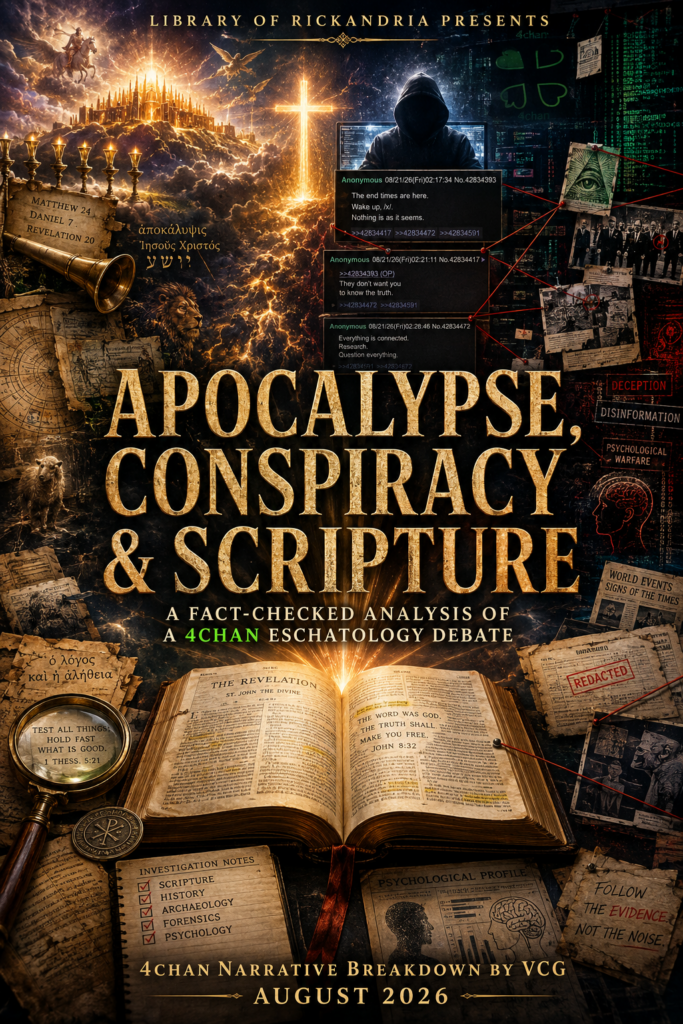
UPDATED BY VCG ON 8/20/2026 @ 00:00 EST
I want to share a heartfelt cause with my audience. Conner Blaisdell-Greene, a brave Airforce Sr. Airman, recently lost his battle with cancer, leaving his family in financial distress. Every donation, no matter how small, can help cover his funeral costs and ease their burden during this difficult time. Please consider clicking the link below to contribute or share Conner’s story with others. Your support truly matters.
Anyone can do this, but most won’t.
ChatGPT – Library of Rickandria
Soli Deo Gloria, brethren.
I’ll treat the thread as a set of discrete claims rather than as a single worldview:
- first recover the full text
- then classify each line (factual, historical, psychological, theological, rhetorical)
- verify each claim against primary/high-quality sources
and finally correct the biblical claims from the KJV text itself.
I’ll keep what the poster says, what the evidence supports, and what Scripture actually says clearly separated.
/x/ – Are you ready for the Millennial Kingdom of Christ – Paranormal – 4chan
I’ve recovered the archived thread itself, including the posts that were omitted from the search snippet.
The central issues are already clear: an imminence/failed-prophecy objection, a
“Jesus was invented”
conspiracy claim, a racialized
“white extermination”
claim, a Christianity-as-docility thesis, a
“you are Christ”
mystical reinterpretation, and several smaller errors about:
- judgment
- clothing
- Satan
- the kingdom
One important point deserves candor before the rebuttal:
the thread’s imminence objection is not frivolous.
New Testament scholarship does recognize a strong expectation of an approaching consummation in early Christianity; the careful rebuttal is therefore not
“they never expected it soon,”
but that expectation, explicit prediction, and the referent of particular “coming” sayings are not the same thing.
Likewise, I won’t use the stock psychological slogan that failed prophecies simply make believers
“double down.”
The famous When Prophecy Fails case has itself been seriously re-examined, so the psychological section needs a more disciplined account of:
- persistence
- reinterpretation
- disconfirmation
- identity
- defection
The fact-check also cuts both ways on the
“Christianity = political anesthesia”
thesis. Christian language has at times been used to sanction hierarchy, so Romans 13 cannot simply be ignored; but historically the blanket claim fails.
Religious mobilization was deeply involved in abolitionist organization and the U.S. civil-rights movement, and experimental work has even found a:
“power of faith”
message increasing willingness to participate politically while decreasing endorsement of violence.
I recovered and audited the archived thread as a sequence of separate claims rather than treating every participant as holding the same position.
The thread moves between:
- Christian eschatology
- skepticism about the delay of the Second Coming
- Gospel of Thomas/Gnostic material, anti-Jewish racial conspiracy claims
- political-psychological arguments about Christianity
and finally an argument from evil. (4chan)
The most important finding at the outset is that both sides make errors.
The strongest skeptical issue in the thread is the New Testament’s genuinely urgent/imminent eschatological language.
The weakest skeptical material is the unsupported claim that Jews fabricated Jesus as part of a racial-control conspiracy.
On the Christian side, claims such as
“the Holy Spirit chose me to warn you”
or connecting unspecified current news to an imminent Second Coming go well beyond what the text establishes.
Forensic audit of /x/ thread 42834393
1. Method
I used five distinct evidentiary layers.
Primary thread evidence.
I treated the archived 4chan posts and embedded images as evidence only for what the posters actually asserted.
An anonymous assertion is not evidence merely because it appears in the thread. (4chan)
Historical evidence.
Claims about:
- Jesus
- early Christianity
- abolitionism
- political action
- Gnosticism
and so forth were checked against academic or primary historical material rather than
“proving history with the Bible.”
Biblical evidence.
For Scripture correction, I used the supplied KJV/Pure Cambridge text as the baseline.
The method is immediate context first, then Scripture with Scripture, then theological interpretations distinguished from the words actually on the page.
Psychology.
I will not diagnose anonymous posters.
Instead, I identify rhetorical and cognitive mechanisms studied in psychology—
- threat perception
- conspiracy cognition
- agency attribution
- identity protection
- black-and-white thinking
- unfalsifiability
- scapegoating
Research commonly groups conspiracy motives around epistemic needs, existential/control needs, and social/identity needs.
Psychological Motives of QAnon Followers (Chapter 3) – The Social Science of QAnon
Verdict vocabulary.
“False” means contradicted by good evidence; “unsupported” means the poster has not supplied evidence sufficient to establish it; “partly supported” means there is a defensible core wrapped in exaggeration; “interpretive” means several readings remain possible; “non-falsifiable” means ordinary historical investigation cannot establish or disprove it.
2. Opening: “Millennial Kingdom … Christ is near”
The OP announces an approaching earthly millennial kingdom. (4chan)
What is biblical?
Revelation 20 unmistakably contains a period described six times in relation to
“a thousand years”
including Satan’s binding and the saints reigning with Christ.
Afterward Satan is released, the final rebellion occurs, the great white throne judgment follows, and only then Revelation 21 introduces the new heaven and new earth.
So
“millennium”
is not invented.
What is interpretation?
Calling it straightforwardly a future earthly political kingdom immediately following Christ’s return is specifically a premillennial reading.
Historic Christian interpreters disagree.
- Premillennial
- amillennial
- postmillennial
schemes organize Revelation 20 differently; an amillennial reading, for example, identifies the millennium symbolically with Christ’s present reign/church age rather than a future literal thousand-year terrestrial administration.
Academic surveys acknowledge this basic interpretive divide.
APPENDIX: A MILLENNIAL PROBLEM (IV) – Revelation
Therefore:
Verdict: Partly biblical, partly interpretive.
“He is near”
There genuinely is urgency in the New Testament.
Revelation closes with
“I come quickly,”
and
“the time is at hand.”
But Scripture simultaneously rejects human possession of the calendar:
“It is not for you to know the times or the seasons, which the Father hath put in his own power.” — Acts 1:7
And:
“But of that day and hour knoweth no man…” — Matthew 24:36
So
“Christ will return”
and
“therefore these unspecified news events prove He is about to return now”
are two different propositions.
Biblical correction:
Watchfulness is commanded.
Date-certainty is not.
3. “Maybe two more millennia”
This sarcastic answer contributes no factual evidence.
It does, however, raise the later thread’s legitimate question: what are we to do with two thousand years of Christian expectation? (4chan)
It becomes a serious argument only when expressed as:
Jesus/apostles predicted something within a specified time;
that specified time expired;
the predicted event did not occur.
That argument requires careful exegesis of the alleged deadline.
We reach it below.
Verdict:
sarcasm here; substantive issue later.
4. “I am ready”
As a personal profession, this is not independently fact-checkable.
Biblically, however, “readiness” is much less about possessing inside information than about faithful conduct.
Matthew 24 says:
“Watch therefore:
for ye know not what hour your Lord doth come.”
It then describes the faithful servant as one found doing his duty when the master arrives.
Matthew 25 continues that theme with the wise and foolish virgins.
Significantly, the chapter explicitly says:
“While the bridegroom tarried…”
That matters:
delay itself is already built into Jesus’ warning parables.
5. “Haven’t you seen the news? The Holy Spirit chose me to warn you.”
This requires especially careful correction.
The post names no particular event, gives no prophecy capable of independent testing, and offers the claim of spiritual selection as its own authentication. (4chan)
That is methodologically circular:
Claim:
God has specially selected me.
Evidence:
I say God has specially selected me.
The New Testament does not instruct Christians to accept such claims automatically.
Paul says:
“Despise not prophesyings.
Prove all things; hold fast that which is good.” — 1 Thessalonians 5:20–21
Jesus likewise warns of false Christs and false prophets and specifically cautions against reports locating his return secretly in a particular place.
Therefore, a Christian need not ridicule the poster, but neither should he elevate an anonymous private impression to divine revelation.
Verdict: Unverified private-authority claim.
Scripture correction:
A claim of inspiration must not exempt itself from testing.
6. “Not my deity”
This is philosophically interesting.
If the statement merely means,
“I do not worship Jesus,”
it is obviously a report of personal allegiance.
If it means,
“Jesus cannot be God because I don’t regard him as God,”
it is a category error.
Whether some being exists or possesses some property is not decided by whether I personally acknowledge it.
A later poster correctly notices this limited logical point:
under monotheism, “my deity/your deity” does not determine objective ontology. (4chan)
But the reply then jumps too quickly to:
“monotheism is true.”
That proposition still requires an argument.
Verdict:
both posts contain one reasonable logical point and one unproven metaphysical assertion.
7. Matthew 16:28 — the thread’s first major challenge
A poster cites Jesus’ statement that some standing there would not die before seeing the Son of man coming in his kingdom. (4chan)
The supplied KJV reads:
“Verily I say unto you, There be some standing here, which shall not taste of death, till they see the Son of man coming in his kingdom.” — Matthew 16:28
This deserves much better treatment than either
“obviously failed”
or
“obviously no problem.”
Immediate context
The very next sentence is:
“And after six days Jesus taketh Peter, James, and John his brother…”
Jesus is transfigured; his face shines; Moses and Elijah appear; the Father’s voice declares him the beloved Son.
Jesus subsequently calls what they saw a “vision.”
That adjacency gives the Transfiguration interpretation considerable contextual strength:
some, not all, of those present—Peter, James, and John—very shortly receive an extraordinary preview of royal glory.
Other major interpretations
Other readers have understood Matthew 16:28 as referring to the resurrection/Pentecost, the destruction of Jerusalem in AD 70 as a judicial “coming,” or the final Parousia.
This last interpretation produces the skeptical objection:
everybody present died, so if Christ meant the final visible Second Coming, the saying apparently failed.
What scholarship says
Scholars do in fact recognize strong imminent expectation in the earliest Christian material.
Paul’s Thessalonian correspondence, for example, addresses communities living in expectation of Christ’s arrival, including the problem created when believers began to die beforehand.
So, it is not responsible to pretend the:
“imminence problem”
was invented yesterday by internet atheists.
But it is equally unwarranted to assume without argument that every use of “coming” language refers to exactly the same event.
Verdict:
Text accurate; interpretation genuinely disputed.
The Christian rebuttal should be contextual, not evasive:
Matthew 17 supplies an immediately following candidate fulfilment, while the wider NT still contains an authentic eschatological tension deserving serious study.
8. The Gospel of Thomas infographic
The image is more sophisticated than most of the thread, but it is also selectively constructed.
The Gospel of Thomas really is a collection of roughly 114 sayings attributed to Jesus, without the canonical Gospels’ continuous passion-resurrection narrative.
The Gospel of Thomas: An Overview – The Bart Ehrman Blog
Several sayings appearing on the infographic are recognizably based on genuine Thomas material.
For example, Thomas 3 places kingdom language “inside” and “outside” and joins it to self-knowledge.
But there are problems.
Thomas 13 has been altered/blended
The graphic presents material implying an internal bubbling spring becoming a flowing fountain.
In the Thomas text itself, Jesus tells Thomas that he has drunk from a bubbling spring which Jesus himself has measured out, after which Jesus takes Thomas aside and says three private words.
The infographic has merged this with Johannine “living water” imagery rather than simply presenting Thomas 13.
Gospel of Thomas: Thomas Lambdin’s Translation
“Thomas closes without apocalypse, just presence”
That is misleading.
Thomas 113 indeed says the kingdom will not arrive by people watching for “here” or “there”; it is spread upon the earth without being perceived.
But Thomas does not end at saying 113.
Its notorious final saying, 114, concerns Peter demanding Mary’s departure and Jesus’ statement about making her “male” so that she may become a living spirit.
Gospel of Thomas: The Scholar’s Translation
So, the infographic’s ending has been curated to produce a cleaner mystical thesis than the manuscript’s actual conclusion.
Canonical dependency is debated
Thomas is historically valuable, but it cannot simply be assumed to preserve a pristine
“inner Christianity”
older than canonical Christianity.
Scholars actively debate its literary relationship to canonical traditions; arguments for dependence on Luke and other canonical material continue to be made.
Luke in the Gospel of Thomas | New Testament Studies | Cambridge Core
Verdict:
Real ancient text, selectively harmonized and partially misrepresented by the infographic.
9. “Christ is in you → you are Christ → that realization is the Second Coming”
This is one of the clearest exegetical non sequiturs in the thread.
Paul certainly says:
“Christ in you, the hope of glory.” — Colossians 1:27
He also says:
“I live; yet not I, but Christ liveth in me…” — Galatians 2:20
But neither verse says
“therefore I am Christ.”
The distinction is grammatical and theological:
Christ in Paul ≠ Paul is Christ.
Indeed, Colossians immediately distinguishes Christ from believers while asserting uniquely of Christ:
“For in him dwelleth all the fulness of the Godhead bodily.” — Colossians 2:9
And the canonical description of the return says:
“this same Jesus… shall so come in like manner as ye have seen him go into heaven.” — Acts 1:11
That is extraordinarily difficult to reduce to:
“individuals eventually realize they themselves are Jesus.”
Verdict:
Biblically contradicted.
There is a real Christian doctrine of union with Christ.
There is not a canonical doctrine that every believer ontologically becomes Jesus of Nazareth.
10. “It already happened”
There are legitimate Christian interpretations in this neighborhood.
Partial preterism understands significant “coming” and judgment language—particularly in the Olivet discourse—as fulfilled in first-century events surrounding Jerusalem.
That is very different from saying everything described as Christ’s:
- return
- resurrection
- judgment
and new creation is already finished.
Acts expects
“this same Jesus”
to return.
First Thessalonians describes the Lord descending, the dead in Christ rising, and living believers being gathered with them.
Revelation 20 proceeds through resurrection, final judgment, and only thereafter into Revelation 21’s new creation.
Verdict:
“Some prophetic-coming texts already fulfilled”
is an interpretive position.
“The entire promised consummation has already happened”
requires much more theological reconstruction.
11. The linked YouTube playlist
The thread contains the link, but the playlist itself could not be reliably retrieved during this audit because the external fetch was throttled.
Consequently, I am not attributing claims to that playlist which I could not inspect.
That distinction matters methodologically:
inability to check something is not evidence either for or against it.
12. “Jews invented Jesus”
This is historically one of the weakest claims in the entire thread.
It is mixed with explicitly racial material about an alleged Jewish project against whites. (4chan)
There are two separate questions:
A. Was Jesus simply fabricated as a person?
The historical evidence strongly cuts against that.
Tacitus, a Roman historian hostile to Christianity, reports that the Christian name derived from Christus, who suffered the extreme penalty under Pontius Pilate during the reign of Tiberius.
Jesus as a Historical Figure (Chapter 6) – From Jesus Christ To Christianity
Josephus’ Antiquities also contains a much less sensational reference to James as the brother of
“Jesus, who was called Christ.”
The authenticity of that brief James passage is accepted by a substantial majority of specialists and has considerably stronger textual standing than the more disputed Testimonium passage.
This does not prove that Jesus was divine or rose bodily from the dead.
It does make the hypothesis that:
“Jesus was simply invented wholesale by Jews as a control device”
historically implausible.
B. Was Christianity a Jewish project designed to control Gentiles?
The earliest sources themselves show disputes between Jewish and Gentile Christians rather than an orderly centralized operation.
Paul records confronting Peter publicly over Gentile table fellowship.
Acts 15 records an actual controversy over whether Gentiles needed circumcision and Mosaic-law observance.
That is a very strange documentary footprint for a smoothly engineered “Judaism for goyim” project.
Scripture correction
The New Testament’s endpoint is not one ethnic group subjugating another:
“a great multitude… of all nations, and kindreds, and people, and tongues” stands before the Lamb.
Peter likewise declares:
“God is no respecter of persons…”
and then receives Gentiles into the community.
Verdict:
Historically unsupported and inconsistent with the earliest Christian conflict evidence.
13. The “white extermination / white genocide” component
This is not merely another theological opinion.
Under the UN Genocide Convention, genocide requires specified acts combined with intent to destroy, wholly or partly, a national, ethnic, racial, or religious group as such.
The special intent requirement is central.
1948 Convention on the Prevention and Punishment of the Crime of Genocide | United Nations
- Population change
- immigration
- intermarriage
- declining birth rates
or loss of demographic majority are not by themselves evidence of genocide.
The thread offers no evidence establishing a coordinated Jewish actor, genocidal acts, or specific intent to physically destroy “white people.”
Moreover, the particular narrative that demographic replacement or interracial reproduction is an intentional Jewish plot to cause “white genocide” is itself documented in scholarship on white-supremacist conspiracy ideology.
This does not mean demographic trends may never be debated.
- Immigration policy
- fertility
- national identity
- integration
are legitimate empirical and political questions.
It means calling them a Jewish genocide requires evidence the thread does not supply.
Verdict:
Unsupported conspiracy claim, not an established fact.
14. “Satan invented Jesus to make Christians docile”
This contains both an empirical theory and a supernatural claim.
The supernatural claim—
“Satan did it”
—cannot be verified by ordinary historiography.
Biblically, however, it directly reverses the New Testament’s own categories.
First John says:
“For this purpose the Son of God was manifested, that he might destroy the works of the devil.”
So, someone is free to reject First John, but they cannot accurately describe
“Satan invented Christ”
as Christian teaching.
It is a counter-Christian theory.
The empirical component—Christianity was invented to cause docility—also needs historical evidence of intentional design.
The thread supplies none.
Verdict:
supernatural component non-falsifiable; intentional-origin claim unsupported.
15. “Henotheism/polytheism are obsolete; monotheism is objective truth”
There is a valid logical insight buried here.
If exactly one ultimate God exists, incompatible claims about multiple ultimate gods cannot all simultaneously be true in the same sense.
But:
“Monotheism is true because polytheism is obsolete”
does not follow.
“Obsolete” describes cultural status, not truth.
Ancient or unpopular propositions can be true; modern or dominant propositions can be false.
Verdict:
Valid exclusivity logic, insufficient proof of the premise.
16. The Monad/Gnostic graphic
The “Monad” or supreme One is a real philosophical/religious idea.
Plotinian Neoplatonism, for example, posits an absolutely simple supreme One from which lower principles proceed.
Plotinus (Stanford Encyclopedia of Philosophy)
Various movements conventionally grouped under “Gnosticism” likewise employ:
- transcendent divine realities
- emanations
- aeons
- a Pleroma
- lesser creator figures
and salvation through revelatory knowledge—but “Gnosticism” itself covers diverse systems rather than one single standardized creed.
Gnosticism | Internet Encyclopedia of Philosophy
Therefore:
“The biblical God and the Monad are identical”
needs argument.
“The Monad is a made-up internet concept”
would also be wrong.
The infographic gives a recognizable family resemblance to historical Gnostic metaphysics but simplifies diverse traditions into one tidy map.
17. “Every Christian generation has said he is coming soon since we made up the story”
Two claims are smuggled together.
Christians repeatedly expecting imminence
Broadly true.
Early Christianity itself contains intense eschatological expectation, and such expectation has recurred repeatedly in Christian history.
Therefore, Christians invented Jesus
That does not follow.
A mistaken interpretation of a timetable would not establish the nonexistence of the person around whom the movement formed.
Tacitus and Josephus independently cut against simple Jesus-myth fabrication.
Jesus as a Historical Figure (Chapter 6) – From Jesus Christ To Christianity
This is a non sequitur:
People repeatedly misjudge X’s return date → therefore X never historically existed.
The conclusion exceeds the premise.
18. “Christian belief is no different from Scientology/Xenu”
As an analogy against circular reasoning, this has value.
If someone’s complete argument is:
My sacred text is true because my sacred text says my sacred text is true,
then merely pointing to the text will not persuade an outsider.
But two belief systems being religious does not make their historical evidence identical.
“Christianity and Scientology both make supernatural claims”
is true at a very general classificatory level.
“Therefore, every historical proposition associated with them has equal evidentiary support”
is false.
That is an invalid analogy unless relevant similarities are demonstrated rather than assumed.
19. “Your special book says one big man in the sky; therefore objective truth”
This is mostly a straw man.
Christian Scripture does not portray God as simply a large biological male organism residing spatially above the clouds.
But the post contains one good methodological warning:
asserting that a text has divine authority is not, by itself, public evidence of that authority.
Interestingly, Scripture itself does not commend indiscriminate credulity:
“Prove all things; hold fast that which is good.” — 1 Thessalonians 5:21
A serious Christian case therefore ought to distinguish:
what Scripture claims,
why one believes Scripture, and
what historical evidence can independently corroborate.
20. “The apostles and Paul promised Jesus would return during their lifetimes and failed”
This is the most serious skeptical claim in the thread.
It should not be answered with mockery.
Evidence supporting the skeptic’s concern
Paul writes:
“Then we which are alive and remain shall be caught up together with them in the clouds…” — 1 Thessalonians 4:17
The natural rhetorical perspective includes Paul and his audience among those potentially alive at the event.
Early Christian scholarship accordingly recognizes a genuine expectation of an approaching Parousia.
First Thessalonians even responds to anxiety over Christians who had already died.
Other texts intensify the impression:
“this generation shall not pass” — Matthew 24:34
“the end of all things is at hand” — 1 Peter 4:7
“the time is at hand” and “I come quickly” — Revelation 22
Any account pretending these verses do not exist is inadequate.
But “expected” is not automatically “promised a lifetime deadline”
In the same eschatological discourse, Jesus says:
“of that day and hour knoweth no man…”
After the resurrection:
“It is not for you to know the times or the seasons…”
Matthew’s parables explicitly envision the master delaying and the bridegroom tarrying.
Paul’s
“we which are alive”
can naturally express inclusion in the believing community and real expectation without necessarily constituting a prophetic statement that Paul himself is guaranteed to survive until the event.
So what is the precise verdict?
The skeptic is justified in saying:
“The earliest Christians exhibit strong expectation that the consummation could be very near.”
The stronger formulation:
“The apostles unambiguously guaranteed that the final Parousia would occur before they died”
requires treating several disputed texts as having only one possible referent and force.
That is more than the evidence establishes.
Verdict: Serious problem; overstated conclusion.
A responsible Christian interpretation must acknowledge the imminence data rather than redefine every “soon” into meaninglessness.
A responsible skeptical interpretation must likewise distinguish:
- expectation
- pastoral rhetoric
- prophetic guarantee
and the multiple kinds of “coming” language found in Scripture.
21. A note on “failed prophecy psychology”
There is a popular story that when prophecy fails, believers automatically
“double down.”
Reality is more complicated.
The famous Festinger study When Prophecy Fails became foundational for cognitive-dissonance theory, but recent archival re-examination argues that the original group’s reaction was substantially messier than the familiar textbook summary—some members abandoned or modified commitments rather than uniformly intensifying them.
Therefore, we should not reason:
believer survives disappointment = cognitive dissonance proved.
People can respond through:
- reinterpretation
- abandonment
- subgroup formation
- theological development
- selective memory
- stronger commitment
or combinations of these.
That methodological caution applies equally to Christians and skeptics.
22. “Good people live forever; bad people burn; lions become house cats…”
This is a compressed internet version of several biblical motifs, not a careful biblical eschatology. (4chan)
Revelation’s actual sequence is more complicated:
Christ’s victory;
millennium;
Satan’s release/final rebellion;
great white throne judgment;
second death;
new heaven and new earth.
Matthew 25 does contain a stark final distinction:
“these shall go away into everlasting punishment:
but the righteous into life eternal.”
But reducing salvation to
“God likes good people and burns bad people”
leaves out:
- repentance
- grace
- reconciliation
- resurrection
judgment according to:
- works
- faith
- Christ’s atoning role
—all themes the New Testament itself discusses.
Verdict:
recognizable biblical imagery, theologically crude.
23. “Judaism for goyim / Jews enslave the world first”
This is caricature, not exegesis.
No New Testament passage says Jews must first enslave Gentile civilization before Jesus may return.
Acts instead records the gospel crossing Jewish/Gentile boundaries and explicitly debates admitting Gentiles without converting them into Jews.
Revelation portrays the redeemed as transnational and multilingual.
Whatever one thinks about:
- modern Jewish politics
- Zionism
- rabbinic Judaism
- Israel
or Christian eschatology, substituting an ethnic conspiracy meme for textual analysis proves nothing.
Verdict:
No scriptural basis supplied; racial polemic substituted for argument.
24. “Already happened” — repeated
Same judgment as above.
Some first-century fulfillment interpretations are legitimate subjects of Christian exegesis.
But a total past fulfillment of:
- bodily resurrection
- universal judgment
- Christ’s visible return
and new creation faces obvious canonical texts describing them as still prospective within the narrative.
Verdict:
too vague to establish anything without identifying what allegedly already happened.
25. “Very soon wickedness will face its Maker”
Two components.
Ultimate judgment:
unquestionably biblical.
Matthew 25 and Revelation 20 are explicit.
“Very soon” in our calendar:
interpretive.
Revelation certainly speaks in urgent terms; nobody needs to hide that.
But biblical urgency does not provide an anonymous 2026 poster with a date.
26. “Jesus isn’t coming to wipe your ass; he’s somebody you aspire to be”
The crude wording conceals a half-truth.
Christian disciples are called to:
- imitation
- self-denial
- love
- holiness
- obedience
and conformity to Christ.
But the New Testament does not reduce Jesus to an inspirational moral archetype.
Acts says:
“this same Jesus”
returns.
Colossians uniquely identifies the fullness of the Godhead with him.
So:
“Follow Christ’s example”
— biblical.
“Jesus is only an archetype you become”
— reduction not supported by canonical Scripture.
27. “Men wear pants in heaven; robes mean the bad place”
This one is simply wrong.
Deuteronomy 22:5 says:
“The woman shall not wear that which pertaineth unto a man, neither shall a man put on a woman’s garment…”
It says nothing about trousers.
In fact, the same immediate chapter prescribes fringes on Israelite garments, reminding us that projecting twenty-first-century Western clothing conventions directly into ancient Israel is methodologically unsound.
Even more decisively, Revelation’s redeemed multitude stands before God:
“clothed with white robes…”
So
“robes = bad place”
is directly contradicted by Revelation.
Verdict:
False.
28. The anti-Jewish insults
At this point parts of the thread cease arguing and shift to slurs and dehumanizing imagery. (4chan)
That matters analytically because an insult cannot carry evidentiary weight.
Calling someone a racial epithet establishes nothing about:
the historicity of Jesus,
the meaning of Matthew 24,
Jewish demographics,
the resurrection,
Zionism,
or Christianity.
Psychologically, hostile outgroup labeling can simplify complex causation into an intentional-agent story: one malign group becomes the explanation for otherwise unrelated social frustrations.
Research on conspiracy thinking specifically notes social/ingroup motives and heightened attribution of hostile agency as relevant mechanisms.
Psychological Motives of QAnon Followers (Chapter 3) – The Social Science of QAnon
That observation does not diagnose the poster.
It describes the argumentative pattern.
29. “Two realities: Satan’s world versus God’s kingdom, exact opposites”
There is a biblical kernel here and then a large metaphysical overreach.
Biblical kernel
Scripture does depict a present moral conflict.
Jesus speaks of Satan.
Paul contrasts this age with life in Christ.
First John says the world passes away and distinguishes God’s children from the devil’s works.
Matthew 4 portrays Satan tempting Jesus with worldly kingdoms.
Overreach:
two equal realities
Canonical Christianity is not classical Gnostic dualism.
Satan is not a second creator-god possessing an equal ontological universe.
Revelation depicts Satan as a creature who is ultimately judged.
The biblical hope is also not escape from materiality into the:
“real spiritual universe.”
Revelation ends with:
- new creation
- resurrection
- city
- nations
and embodied imagery.
“This world is completely hedonistic”
False as a universal empirical proposition.
Human life contains:
- hedonism
- altruism
- cruelty
- sacrifice
- family loyalty
- compassion
- religion
- asceticism
- science
- art
- warfare
- charity
and much else.
“More than 90% of mankind lives in Satan’s reality”
No:
- data source
- measurement instrument
- sampling method
- operational definition
or calculation is provided.
That makes the figure invented precision.
“Jesus will destroy reality”
Scripture speaks of judgment and of the present order passing, but it equally speaks of resurrection and renewal.
Saying Jesus simply despises physical reality moves much closer to some Gnostic systems than to the canonical creation–fall–redemption–new-creation arc.
Verdict:
Biblical moral contrast expanded into unsupported metaphysical dualism.
30. “It’s already been 2026 years”
The rhetorical point about delay is legitimate; the arithmetic is not.
AD 2026 means the calendar year numbered 2026 according to a later Christian chronological system.
It does not mean Jesus was crucified exactly 2,026 years earlier.
Modern discussion normally places the crucifixion somewhere around Passover in approximately AD 29–34, with AD 30 and AD 33 especially common proposals.
Thus, in August 2026 the elapsed period since the crucifixion is roughly 1,992–1,997 years, depending upon chronology—not 2,026.
That correction does not make the underlying theological question disappear.
Verdict:
arithmetic wrong; delay question real.
31. “People wait for God and nothing happens — pure psychological manipulation”
This moves from criticism of eschatology to a functional theory of religion.
The argument is approximately:
Christianity tells victims not to avenge themselves.
Judgment is transferred into an unverifiable future.
Therefore elites can exploit Christians without retaliation.
Therefore, Christianity was engineered for social control.
Steps 1–2 correspond to some real Christian texts.
Paul does say:
“Dearly beloved, avenge not yourselves… Vengeance is mine; I will repay, saith the Lord.” — Romans 12:19
Romans 13 also teaches submission to governing authorities.
That cannot simply be edited out of Christianity.
But steps 3–4 do not follow automatically.
This is partly the genetic fallacy:
even if a belief produces a useful social effect, that does not establish that it originated for the purpose of producing that effect, much less that it is false.
32. Does Christianity necessarily make people politically docile?
Historically, no.
The evidence is mixed enough that a simplistic answer in either direction is untenable.
Christian institutions and texts have sometimes been used to reinforce hierarchy and political obedience.
But Christian institutions have also organized resistance.
Research on the American civil-rights movement describes ministers and Black churches as central organizational infrastructure sustaining the movement.
Historical quantitative work on antebellum America has found revivalist and missionary activity positively associated with the emergence and spread of antislavery societies.
Therefore, the universal hypothesis:
Christianity → political inactivity
is empirically false.
Scripture itself limits political obedience
Acts records the apostles directly disobeying authorities when commanded to stop preaching:
“We ought to obey God rather than men.” — Acts 5:29
Christian submission therefore has never been textually identical to
“obey every command of every ruler.”
33. “Instead of praying, kill corrupt politicians so the next one is afraid”
This is a false dilemma.
The available options are not merely:
A. do nothing and pray, or
B. murder officials.
There are lawful:
- protest
- exposure
- investigative journalism
- voting
- organizing
- civil disobedience
- strikes
- litigation
- whistleblowing
- removal from office
- nonviolent resistance
and institutional reform.
Modern political-science research on the U.S. civil-rights era has found that nonviolent protest could generate favorable civil-rights framing and public-opinion change, whereas protester-initiated violence could activate backlash and “law and order” responses.
That does not establish the universal proposition:
“violence never works.”
History is too complicated for that.
It does refute the thread’s assumption that ruthless political killing is self-evidently the more effective strategy.
Biblical correction
Christian non-retaliation is not merely cowardice disguised as piety:
“Be not overcome of evil, but overcome evil with good.” — Romans 12:21
Whether one accepts that moral teaching is another matter.
But accurately describing Christianity requires acknowledging that refusal of private vengeance is deliberate doctrine, not merely an accidental failure to act.
34. The psychology of the “be ruthless” turn
Notice the rhetorical progression.
It begins with a plausible grievance:
corrupt people sometimes escape justice.
Then:
future judgment cannot presently be observed.
Then:
religion may therefore discourage retaliation.
Then suddenly:
we should kill politicians.
The conclusion has outrun the premises.
Psychologically, this illustrates how perceived injustice and loss of control can make intentional-agent explanations and punitive solutions attractive.
Conspiracy-psychology literature identifies existential control/security motives alongside epistemic and identity motives.
Psychological Motives of QAnon Followers (Chapter 3) – The Social Science of QAnon
But again:
that does not establish a psychiatric condition.
A proper rebuttal addresses the reasoning, not the poster’s mental health.
35. “If God permits Satan’s corruption, God is equally corrupt”
This is much stronger philosophically than the racial conspiracy material.
It is a form of the problem of evil:
If God is perfectly good and powerful, why permit horrendous evil when he could prevent it?
Philosophers do not regard this as a trivial objection.
Free-will and greater-good defenses offer possible answers to versions of the logical problem, while evidential versions—especially concerning apparently gratuitous suffering and natural evil—remain strongly debated.
The Problem of Evil (Stanford Encyclopedia of Philosophy)
Where the thread overreaches
“God permits X”
does not logically entail
“God has precisely the same moral character as the agent performing X.”
That requires an additional proposition:
Any being capable of preventing an evil who permits it is morally identical to its perpetrator.
That premise is not self-evidently true.
Consider ordinary cases:
- a judge
- parent
- doctor
- soldier
or government may permit an undesirable state temporarily for reasons distinct from approving or causing it.
Whether divine permission can ultimately be justified is exactly what must be argued—not assumed.
Scripture’s own position
The biblical text emphatically rejects moral equivalence between God and Satan:
“God cannot be tempted with evil, neither tempteth he any man.” — James 1:13
And:
“the devil sinneth from the beginning.
For this purpose the Son of God was manifested, that he might destroy the works of the devil.”
Revelation eventually depicts the devil judged rather than sharing God’s throne.
That establishes what Scripture teaches.
It does not by itself answer the philosopher’s next question:
Is that biblical account of divine permission internally morally coherent?
That latter question requires philosophy and theology, not merely another verse.
Verdict:
Serious philosophical objection;
“therefore God = Satan”
is an invalidly compressed conclusion.
36. Final poster: “you’re mentally unstable / you’d destroy the world”
This is not a rebuttal.
It is amateur psychological diagnosis plus an extrapolation from violent rhetoric to a person’s entire psychological identity. (4chan)
The preceding poster’s advocacy of killing corrupt politicians is absolutely legitimate grounds for criticizing the argument and proposed action.
It is not evidence sufficient to clinically diagnose an anonymous stranger.
Scripturally, James’ counsel is more disciplined:
“let every man be swift to hear, slow to speak, slow to wrath:
For the wrath of man worketh not the righteousness of God.”
37. The psychological architecture of the whole thread
Several recurring mechanisms explain why the discussion deteriorates without requiring us to pathologize anybody.
1. Apocalyptic pattern detection
Current events are placed inside a pre-existing prophetic template.
Ambiguous events then become confirmatory because the interpretive framework supplies their meaning.
The safeguard is not
“never notice patterns.”
It is to specify beforehand what evidence would count against the interpretation.
2. Unfalsifiable private authority
“The Spirit told me”
cannot normally be independently examined.
Once private revelation is permitted to authenticate itself, disagreement can become evidence that the critic
“doesn’t have the Spirit.”
That destroys ordinary error correction.
3. Hidden-agent explanation
Complex:
- demographic
- political
- moral
- religious
phenomena are compressed into a single intentional hostile agent:
“the Jews,”
“Satan,”
or
“the system.”
Conspiracy research consistently identifies needs for understanding, control/security, and group identity as important explanatory families.
Psychological Motives of QAnon Followers (Chapter 3) – The Social Science of QAnon
4. Identity-protective reasoning
Both camps begin talking as identities rather than investigators:
“christcuck,” ethnic slurs, “mental freak,” etc.
Once the opponent becomes a contemptible category, evidence becomes secondary to protecting the in-group.
5. False dichotomies
Examples include:
“Either pray helplessly or murder corrupt rulers.”
“Either the Second Coming occurred in the first century or Jesus was invented.”
“Either Satan controls this reality or God controls another.”
Those binaries exclude multiple live alternatives.
6. Motive replacing evidence
“Christianity benefits rulers”
becomes
“rulers/Jews must therefore have invented Christianity.”
Even if the first clause were universally true, the second would still require historical evidence.
7. Moral outrage becoming epistemic evidence
A world containing severe injustice understandably produces anger.
But:
“This would be morally terrible if God allowed it”
is different from:
“therefore I know exactly who historically invented Christianity.”
The thread repeatedly crosses that boundary.
38. What the thread gets right
A fair audit should preserve the strongest points rather than merely score victories.
The skeptical side is right that Christian eschatology contains genuine imminence language.
Early Christians really did expect Christ’s return intensely, and 1 Thessalonians cannot responsibly be made to sound like a twenty-first-century systematic theology textbook.
It is right that simply saying
“my book says so”
does not constitute a complete public argument.
It is right that Christianity has texts about obedience to government and non-retaliation; any political theology pretending Romans 12–13 do not exist is selective.
It is also right that the problem of evil remains intellectually serious rather than being answered merely by telling sufferers that God has a reason.
The Problem of Evil (Stanford Encyclopedia of Philosophy)
And the Thomas/Gnostic material is based upon real ancient traditions, even though the infographic manipulates them.
39. What the thread gets most wrong
The leap from eschatological difficulty → Jesus was fabricated by Jews is unsupported.
The leap from demographic concern → Jewish genocide conspiracy lacks the specific evidence necessary to establish genocide and matches a documented racial-conspiracy narrative.
1948 Convention on the Prevention and Punishment of the Crime of Genocide | United Nations
The leap from Christ dwelling in believers → believers literally are Christ contradicts the very Pauline passages being invoked.
The leap from Christian non-vengeance → Christians never resist injustice is falsified by major episodes in abolitionist and civil-rights history.
And
“men wear pants in heaven”
has essentially no biblical case at all; Revelation explicitly clothes the redeemed in robes.
40. The biblical synthesis on the Second Coming
If we strip away 4chan theology and simply allow the relevant passages to stand together, the KJV gives a considerably more balanced picture.
First:
Christ’s return is treated as real and personal:
“this same Jesus”
is to return in correspondence with his departure.
Second:
believers are repeatedly commanded to regard it as potentially imminent and to live accordingly.
Revelation’s “quickly” language cannot simply be erased.
Third:
the disciples are denied access to God’s timetable—Acts 1:7 and Matthew 24:36 are explicit.
Fourth:
delay is contemplated inside Jesus’ own parables.
The evil servant says his lord delays; the bridegroom tarries.
Fifth:
Christian expectation is not supposed to produce passivity.
It produces ethical vigilance:
- sobriety
- prayer
- holiness
- service
- charity
- perseverance
and doing one’s appointed work.
First Thessalonians moves immediately from Parousia teaching to moral exhortation.
That combination is much harder to caricature as either:
“Jesus definitely returns in 2026 because I saw the news”
or
“the New Testament never expected anything soon.”
Neither statement handles all the evidence.
Final assessment
The thread begins with overconfident Christian eschatological speculation, encounters a real and difficult biblical question about imminence, passes through an interesting but selectively edited Thomas/Gnostic reinterpretation, and then deteriorates into racial conspiracy, antisemitic scapegoating, unsupported theories of social engineering, violent political rhetoric, and personal insults. (4chan)
The strongest correction to the Christians in the thread is:
do not turn private impressions or current headlines into divine chronology.
“Prove all things.”
The strongest correction to the skeptics is:
an exegetical difficulty about the timing of the Parousia does not establish a Jewish conspiracy, the nonexistence of Jesus, or a demographic genocide plot.
Historical Jesus evidence and the actual history of Christian political mobilization make those leaps unsustainable.
Jesus as a Historical Figure (Chapter 6) – From Jesus Christ To Christianity
And the strongest correction to both sides is methodological:
a conclusion should never become more certain than the evidence supporting it.
Scripture itself gives an unusually appropriate standard for this thread:
“Prove all things; hold fast that which is good.” — 1 Thessalonians 5:21
That is the standard by which:
- the anonymous prophecy
- the skepticism
- the Gnostic reinterpretation
- the racial claims
and our own rebuttal should all be judged.
4CHAN THREAD & POST BREAKDOWNS – Library of Rickandria
VCG PAPER PROJECTS – Library of Rickandria
Apocalypse, Conspiracy & Scripture: A Fact-Checked Analysis of a 4chan Eschatology Debate