
ARE YOU EVEN CONSCIOUS? The 4chan Thread That Put Philosophical Zombies, Quantum Physics, the Human Soul & the Bible on Trial
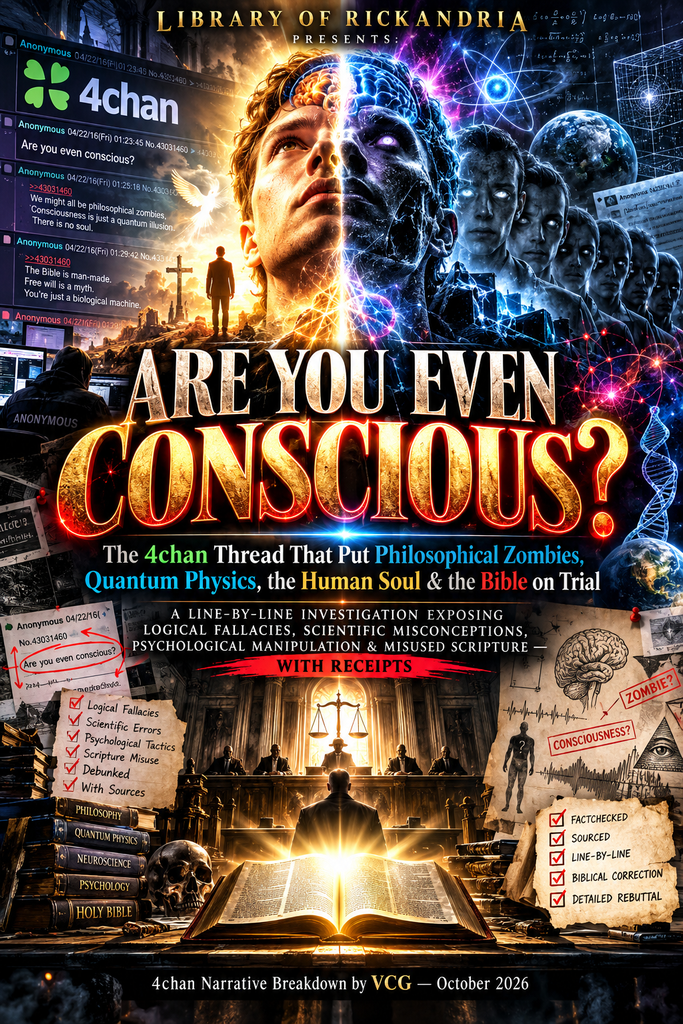
UPDATED BY VCG ON 10/08/2026 @ 11:11 EST
Anyone can do this, but most won’t.
Are You Even Conscious? is a comprehensive, evidence-based investigation into a 4chan discussion that questions whether human beings are truly conscious or merely sophisticated biological machines. Through a meticulous, line-by-line examination of all ten posts, the Library of Rickandria separates philosophical speculation from scientific fact, exposes logical fallacies and unsupported claims, and investigates how cognitive biases, rhetorical persuasion, and misunderstood scientific concepts can create convincing but misleading narratives. Drawing on peer-reviewed neuroscience, quantum physics, philosophy of mind, psychology, historical evidence, and the King James Bible, the paper critically examines philosophical zombies, the problem of other minds, the nature of the soul, and claims that consciousness proves or disproves Christianity. Special attention is given to distinguishing genuine biblical teaching from interpretations imposed upon Scripture, including careful examination of the Hebrew and Greek concepts of soul, spirit, and life. Rather than dismissing difficult questions or manufacturing certainty, the investigation challenges believers and skeptics alike to distinguish evidence from assumption, possibility from proof, and interpretation from revelation. Its central message is simple: truth cannot be established by compelling speculation, scientific-sounding language, or religious conviction alone—it must withstand honest examination, sound reasoning, and careful scrutiny of the evidence. Soli Deo Gloria.
ChatGPT – Library of Rickandria
LIBRARY OF RICKANDRIA PRESENTS
ARE YOU EVEN CONSCIOUS?
The 4chan Thread That Put Philosophical Zombies, Quantum Physics, the Human Soul & the Bible on Trial
A Line-by-Line Investigation of Logical Fallacies, Scientific Misconceptions, Psychological Persuasion, Cognitive Biases & Misused Scripture — With Receipts
4chan Narrative Breakdown by VCG | October 2026
Library of Rickandria — Investigative Research Series
ABSTRACT
Can you prove that another person is conscious?
Can anyone prove that you are?
And if consciousness is so difficult to establish from the outside, how do we know that human beings are not simply sophisticated biological machines behaving as though they have inner experiences?
On October 1, 2026, an anonymous participant on 4chan’s paranormal board, /x/, raised these questions in a short thread about philosophical zombies.
What began as a familiar philosophical puzzle developed into a discussion involving:
- artificial beings
- electrical signals
- quantum physics
- Christianity
- nihilism
and a nine-stage argument concerning the conditions necessary for communication between distinct perspectives.
/x/ – You can’t prove that I’m conscious. I can’t prove – Paranormal – 4chan
This paper examines all ten visible posts in thread No. 43031460,
comparing their claims with established:
- philosophical literature
- peer-reviewed neuroscience
- psychology
- documented popular-culture history
- the King James Bible
The investigation does not assume that the anonymous participants were dishonest, irrational, or deliberately deceptive.
Instead, it distinguishes valid questions from unsupported answers, reasonable philosophical possibilities from established scientific findings, and biblical teaching from interpretations imposed upon Scripture.
Several conclusions emerge.
The problem of other minds is genuine, but the possibility of philosophical zombies is not evidence that such beings actually exist.
Neural activity is inseparable from ordinary human brain function, but that does not demonstrate that elementary electrical processes are themselves conscious.
Quantum theories of consciousness deserve evaluation, yet contemporary science does not establish that consciousness created matter or that physics proves Christianity.
Finally, biblical passages concerning:
- souls
- spirits
- creation
- resurrection
provide a theological account of human existence, but cannot legitimately be reduced to modern scientific vocabulary without further argument.
The thread’s greatest lesson is therefore methodological:
the difference between asking a profound question and successfully answering it is the quality of the evidence and reasoning connecting premise to conclusion.
PART I — THE PRIMARY EVIDENCE
Chapter 1. A Small Thread With Large Questions
The original discussion appeared on 4chan’s /x/ board, a forum devoted to paranormal and related topics.
Primary source: 4chan /x/ — Thread No. 43031460
The thread opened on October 1, 2026, at 18:49:12 according to the displayed timestamp.
Its last visible contribution appeared on October 2 at 08:39:53.
The archived page contains ten posts, including the opening contribution, four attached images, and one external YouTube link.
The original discussion is no longer open for replies.
That matters because our task is to examine a bounded piece of evidence rather than a conversation whose contents continue to evolve.
We can identify what appeared in the record, distinguish the participants’ arguments, and trace how the discussion changed.
We cannot, however, identify the anonymous authors or independently establish their intentions.
Nor should we assume that every post was written seriously.
- Humor
- sarcasm
- memes
- speculation
- deliberate intellectual argument
frequently coexist in anonymous internet discussions.
A statement may be logically mistaken without being a deliberate attempt to deceive.
Likewise, a well-written philosophical argument may still contain hidden assumptions.
For these reasons, the paper examines the arguments rather than attempting to diagnose the people who wrote them.
Chapter 2. Research Methodology
This investigation uses five complementary methods.
First, primary-source verification.
The archived thread is treated as evidence of what the participants posted.
- Post numbers
- timestamps
- reply relationships
- linked media
- substantive claims
are checked against that record.
The thread itself is not independent evidence that the participants’ claims are true.
Second, logical reconstruction.
Arguments are separated into premises and conclusions.
Where possible, their strongest reasonable interpretation is considered before identifying weaknesses.
Third, external fact-checking.
Claims involving:
- neuroscience
- quantum theory
- philosophical terminology
- fictional characters
- historical facts
are compared with relevant academic or authoritative sources.
Fourth, psychological and rhetorical analysis.
Observable persuasive techniques are discussed in light of research on cognitive bias, perception, and reasoning.
No clinical judgments are made about anonymous participants.
Fifth, biblical exegesis.
Scripture is examined within its literary and theological context using the supplied King James Version, cross-references, and selected Hebrew and Greek lexical resources.
These methods are deliberately kept distinct.
A scientific experiment can establish relationships among measurable phenomena.
It cannot, simply by being scientific, settle every metaphysical question.
A philosophical argument may establish that a position is coherent or that a conclusion follows from its assumptions.
That is not identical to empirical confirmation.
Biblical exegesis asks what a passage communicates within its own context.
It should not begin by assuming that ancient biblical authors intended modern neurological or quantum-mechanical theories.
Standards of judgment
The following terms are used throughout the paper:
| Classification | Meaning |
|---|---|
| Supported | Credible evidence or reasoning establishes the relevant point |
| Partly supported | The premise has merit but does not establish the entire conclusion |
| Unsupported | The necessary evidence has not been provided |
| Invalid inference | The conclusion does not logically follow from the premises |
| Contested | Serious competing interpretations remain |
| Unverified | The source or material has not been adequately examined |
| Not applicable | The statement is mainly humor, an image reaction, or an expression rather than a testable claim |
Importantly, unsupported is not synonymous with disproven.
The absence of evidence for one theory does not automatically establish its opposite.
Limitations
The investigation can verify the displayed thread text and its attached-file references, but not the identity, intent, or sincerity of its contributors.
The linked YouTube video could not be independently retrieved for a content-level examination.
Its actual contents therefore remain unverified in this paper.
Similarly, the accompanying cinematic cover is editorial artwork, not a historical screenshot. Any stylized forum posts included in that artwork must not be mistaken for authentic material from thread No. 43031460.
That distinction matters for an investigation promising receipts.
PART II — THE PHILOSOPHICAL PROBLEM
Chapter 3. What Do We Mean by Consciousness?
Before judging the thread, we need to establish what its central word means.
In ordinary conversation, consciousness may refer to being awake, possessing awareness, thinking intelligently, recognizing oneself, or having an experience.
Those meanings overlap, but they are not identical.
A sleeping person may not be awake while still experiencing dreams.
An organism may respond intelligently to its environment without necessarily possessing human-like self-awareness.
A computer may process information while leaving unresolved the question of whether information processing produces subjective experience.
Philosophers distinguish several relevant concepts.
Phenomenal consciousness concerns the subjective character of experience: what pain feels like, what red looks like, or what it is like to hear music.
Access consciousness concerns information that is available for:
- reasoning
- reporting
- planning
- behavioral control
Self-consciousness concerns awareness of oneself as a subject or individual.
Sentience ordinarily concerns the capacity to undergo experiences, especially sensations and feelings.
Intelligence concerns abilities such as:
- learning
- reasoning
- problem-solving
- adaptation
Personal identity asks what makes a person the same individual over time.
These concepts are related, but none can simply be substituted for another without explanation.
The Stanford Encyclopedia of Philosophy’s entry on consciousness distinguishes:
- descriptive
- explanatory
- functional
questions concerning conscious experience.
That distinction exposes the ambiguity running through the 4chan discussion.
When someone says consciousness is electrical activity, are they describing a measurable neural mechanism, explaining the subjective quality of experience, or making a metaphysical claim about the nature of reality?
Those are three different propositions.
The thread’s most ambitious arguments become much less persuasive when they are required to answer that question.
Chapter 4. Philosophical Zombies Are Not Movie Zombies
The central idea behind the thread is a well-known philosophical thought experiment.
A philosophical zombie, often abbreviated p-zombie, is a hypothetical being physically identical to a conscious human but lacking phenomenal experience.
The creature would behave like a person.
It might:
- report pain
- discuss philosophy
- describe colors
and insist that it possesses consciousness.
But on the hypothesis, there would be no subjective experience behind those behaviors.
This is not the same as a fictional undead creature.
Nor is it simply a robot that imitates human behavior.
The philosophical zombie relevant to arguments against physicalism must duplicate the relevant physical properties of a conscious human being.
That detail is essential.
According to the Stanford Encyclopedia of Philosophy’s account of zombies, the idea is primarily used to examine whether physical facts necessarily determine phenomenal facts.
The central debate is not whether someone has discovered a secret population of unconscious humans.
It is whether a universe physically identical to ours but lacking subjective experience is genuinely possible.
The usual argument proceeds in three stages:
- Philosophical zombies are conceivable.
- Whatever is conceivable in the relevant sense is possible.
- Therefore philosophical zombies are possible.
The reasoning has a logically valid form, assuming the terms retain the same meaning throughout.
But its premises are deeply contested.
Something can appear imaginable because we lack relevant information.
Our inability to identify a contradiction in an idea does not automatically demonstrate that no contradiction exists.
Conversely, defenders of the argument contend that certain carefully developed forms of conceivability do reveal metaphysical possibilities.
The dispute remains a serious philosophical question rather than a completed scientific discovery.
The distinction for our investigation is simple: a thought experiment can challenge a theory without proving that its imagined scenario exists in the actual world.
Chapter 5. A Brief History of the Question
The 4chan thread belongs to a much older intellectual conversation.
René Descartes famously argued for a distinction between mind and extended matter.
His reflections on doubt and thought remain influential in discussions of first-person certainty.
John Stuart Mill and other philosophers examined whether the mental lives of others could be inferred from behavior and bodily similarities.
In 1974, Thomas Nagel’s influential essay What Is It Like to Be a Bat? emphasized the subjective character of experience and the difficulty of capturing it through an exclusively objective description.
Later, David Chalmers helped bring philosophical zombies into contemporary debates about physicalism and the explanatory problem of consciousness.
The history includes strong objections to these positions, especially from physicalists who dispute the move from conceivability to possibility.
See:
This history should make us cautious in two directions.
We should not dismiss a philosophical question merely because it sounds strange.
But we should not treat the internet’s most dramatic version of that question as a breakthrough simply because it sounds profound.
PART III — THE TEN POSTS UNDER EXAMINATION
Chapter 6. Post No. 43031460 — The Opening Challenge
October 1, 2026 — 18:49:12
The original poster questions whether anyone can establish another person’s consciousness and then raises the possibility:
What if we’re all philosophical zombies?
The post contains a genuine philosophical insight:
our access to another person’s mind differs from our access to our own present experience.
I can observe another person’s behavior, hear their report of pain, and measure aspects of their nervous system.
I do not literally experience their pain from their first-person perspective.
Philosophers call this the problem of other minds.
But there is a difference between not possessing direct access and possessing no justified knowledge.
We cannot directly observe another person’s subjective experience in precisely the way they undergo it.
Nevertheless, human beings share important:
- biological
- neurological
- behavioral
- communicative
similarities.
Those similarities provide substantial grounds for attributing conscious experience to others.
The Stanford Encyclopedia’s discussion of other minds examines the argument from analogy, inference to the best explanation, and other approaches to interpersonal knowledge.
A second problem concerns the suggestion that perhaps nobody is conscious.
Someone can doubt whether the world they perceive is accurately represented.
They can doubt the causes of their experiences.
They can question their personal identity.
But doubting while undergoing the experience of doubt does not establish an absence of experience.
A dream might misrepresent the world, yet dreaming is still a form of experiencing.
That is why the claim that everyone lacks phenomenal consciousness encounters a special first-person difficulty.
The strongest correction is not that philosophical zombies are obviously impossible.
It is that the opening poster has not established that such beings exist, nor that the inability to provide absolute proof destroys ordinary justification for believing in other minds.
Biblical examination
Genesis 1:26–27 teaches that humanity is created in God’s image.
Genesis 2:7 describes man becoming a living soul through God’s creative act.
These passages provide a theological account of human existence and dignity.
They do not supply an experimental method for identifying consciousness, nor do they specifically answer whether a physically identical nonexperiencing human is metaphysically possible.
Using them in that way would require an additional philosophical argument.
Assessment:
The opening question is legitimate.
The skeptical conclusion remains unestablished.
Chapter 7. Post No. 43031656 — Robots, Souls, and Demons
October 1, 2026 — 19:56:27
The first respondent jokes that mechanical beings lack souls and dismisses the fictional figure as demonic.
The comment uses religious language, but offers neither a biblical citation nor a developed theological argument.
Two different questions must be separated.
Does the Bible explicitly classify modern robots as soulless?
No.
Does the Bible present humanity as a distinct creation of God?
Yes.
These statements are compatible.
A Christian may argue that artificial machines differ fundamentally from human beings, but the conclusion requires philosophical and theological reasoning.
It cannot be presented as a direct quotation from Scripture.
There is also a factual correction concerning the fictional character.
The original image depicts a Dalek from Doctor Who.
Official material identifies Daleks as genetically engineered mutated creatures housed inside mechanical casings.
See the official Doctor Who history of the Daleks and the Dalek Combat Training Manual announcement.
This means the respondent’s implicit classification is questionable even within the fictional universe.
A living organism operating a machine is not simply identical to the machine.
More importantly, being artificial, nonhuman, or strange-looking does not by itself establish demonic nature.
Biblical examination
The relevant passages include:
Genesis concerns the creation of humanity.
James concerns the moral contradiction of praising God while cursing human beings made after God’s likeness.
Neither text establishes the poster’s attempted classification.
Assessment: An unserious or satirical theological assertion, unsupported as a biblical teaching.
Chapter 8. Post No. 43032648 — Daleks, Britain, and Hidden Meanings
October 2, 2026 — 02:57:33
This participant compares Daleks to British governance, proposes a provocative rearrangement of the fictional name, and links to a YouTube video.
The first issue is whether the political comparison is meant literally or satirically.
As satire, the comparison is understandable.
Daleks have long served as fictional representations of:
- coercion
- domination
- intolerance
That does not establish a factual claim about the structure of British government.
To do that, the writer would need to identify particular:
- institutions
- policies
- legal powers
or events and show how the comparison accurately explains them.
The second issue concerns language.
Rearranging the letters of a word until they resemble a desired expression does not establish the word’s history.
Historical etymology requires documentary evidence, chronological development, and plausible pathways of linguistic transmission.
The official Doctor Who history traces the fictional creatures to their first appearance in 1963 and discusses the later narrative involving Davros and the Kaleds.
It does not validate the poster’s proposed hidden political derivation.
The external video
The thread links to:https://www.youtube.com/embed/DsAVx0u9Cw4?feature=oembed
The video’s contents could not be independently retrieved for this examination.
Consequently, we cannot fairly claim that it supports or disproves the author’s thesis.
A link is a reference to possible evidence, not evidence that the linked material establishes the conclusion.
Assessment:
A political analogy and a linguistic association, neither sufficient to establish the suggested factual connection.
Chapter 9. Post No. 43032670 — When Similar Words Become Imagined Connections
October 2, 2026 — 03:06:30
Another participant notices a resemblance between the fictional name Dalek and the word Dalit.
Phonetic resemblance can be an interesting starting point for an inquiry.
But it is not its conclusion.
Words from unrelated languages can resemble one another accidentally.
Even words that appear connected may have separate histories.
A responsible investigation asks whether there is evidence of:
- borrowing
- shared linguistic ancestry
- documented naming practices
or an identifiable historical connection.
None is established by this post.
This illustrates a broader danger of reasoning from resemblance.
A connection can feel significant before its significance has been independently demonstrated.
We will examine the psychology of such interpretations later.
Biblical examination
Proverbs 14:15 teaches:
The simple believeth every word: but the prudent man looketh well to his going.
This provides a general principle of discernment.
It is not a claim that the Bible addresses the etymology of fictional television characters.
Assessment: An unverified observation, not a demonstrated linguistic discovery.
Chapter 10. Post No. 43032676 — When Electrical Signals Become God
October 2, 2026 — 03:11:19
This is the thread’s most consequential scientific-theological argument.
The writer begins with neural electrical processes, moves downward toward fundamental physical signals, attributes consciousness to those underlying processes, and concludes that consciousness is fundamental to matter.
The post then claims that accepting mainstream science entails accepting classical Christian thought.
The proposed chain is roughly:
Neural activity → fundamental physical signals → conscious physical foundations → consciousness prior to matter → Christianity confirmed.
Each transition needs to be independently justified.
The neuroscience premise
The biological nervous system depends upon electrical and chemical processes.
Neurons maintain electrical gradients across their membranes, and action potentials involve changes in ion movement, particularly sodium and potassium.
These processes are well established.
A useful medical reference is the NCBI Bookshelf review of neuronal action potentials.
But a neuron is not simply an electrical wire.
Nervous systems involve:
- complex electrochemical signaling
- cellular regulation
- network organization
and interactions across multiple biological scales.
Even granting that consciousness depends on neural activity does not demonstrate that consciousness is identical to electrical current.
The information problem
The writer’s next move depends on the idea that increasingly fundamental signals carry information.
But information is not synonymous with experience.
A thermostat can carry information about temperature.
A camera sensor can respond to light.
A computer can transform input into output.
Whether any system possesses phenomenal consciousness cannot be established merely by describing it as informational.
The argument needs an additional principle explaining why a physical process that carries information must also experience something.
That principle is not supplied.
The fallacy of division
Another problem arises when consciousness is attributed to the underlying components of a conscious system.
A property belonging to an organized whole does not necessarily belong individually to every constituent.
A musical performance may be harmonious without every component of an instrument independently performing the entire music.
This analogy does not establish that consciousness is emergent.
It merely demonstrates that the attribution of a system-level property to its smallest constituents requires justification.
The quantum leap
Quantum mechanics describes fundamental physical phenomena with extraordinary success.
But it does not follow that every quantum state possesses subjective experience.
Different quantum approaches to consciousness have been seriously proposed, including theories involving:
- brain mechanisms
- quantum-inspired mental models
- dual-aspect accounts of reality
The Stanford Encyclopedia’s review of quantum approaches to consciousness explains their:
- differences
- motivations
- unresolved difficulties
The writer’s argument does not specify which approach is being defended or provide empirical evidence establishing that a particular waveform is a conscious subject.
The theological leap
Even if consciousness were shown to be fundamental, that would not by itself demonstrate Christianity.
The concept of fundamental mentality is compatible with several competing metaphysical positions.
A philosophical argument might support idealism,
a version of panpsychism,
a dual-aspect ontology,
or another account without establishing Christian doctrines concerning
- God
- Jesus Christ
- sin
- resurrection
- redemption
The inference from fundamental mind to the particular God revealed in Scripture therefore requires much more than an appeal to physics.
Biblical examination
Colossians 1:16–17 says:
For by him were all things created, that are in heaven, and that are in earth, visible and invisible…
The passage concerns Christ.
Its wider context identifies the Son, discusses reconciliation through his blood, and presents his supremacy over creation.
Paul does not describe a subatomic electrical mechanism.
To equate Christ with a universal physical waveform would introduce a modern concept not established by the passage.
Likewise, Genesis 1:1 presents God as Creator; it does not say that human consciousness manufactured matter.
Assessment:
A defensible neuroscience starting point followed by unsupported metaphysical and theological conclusions.
Chapter 11. Post No. 43033114 — The Strongest Ordinary Answer
October 2, 2026 — 05:52:50
This participant answers the original skeptic by appealing to first-person experience and the reasonable inference that other people possess similar experiences.
The first part is strong.
When someone is currently experiencing:
- pain
- joy
- fear
or thought, that experience supplies direct grounds for believing that experience occurs.
We might debate how to characterize it, but the presence of experience is not defeated merely by questioning its physical explanation.
The second part is an argument from analogy.
Other human beings:
- possess similar biological structures
- exhibit comparable behavior
- report experiences in circumstances resembling our own
It is therefore reasonable to infer that they too possess subjective experiences.
This is not deductive certainty.
But ordinary knowledge frequently rests on evidence that is powerful without eliminating every logically imaginable alternative.
A well-developed version of this approach is discussed in the Stanford Encyclopedia’s treatment of other minds.
The respondent’s weakness is the somewhat dismissive suggestion that the matter should not be complicated.
Some complexity is unavoidable because the original question is philosophical rather than merely practical.
Still, the central inference is substantial.
Biblical examination
1 Corinthians 2:11 asks:
For what man knoweth the things of a man, save the spirit of man which is in him?
Paul uses an analogy involving inward human knowledge to discuss the Spirit of God.
He does not establish that other minds are unknowable in every sense.
The text is compatible with recognizing a distinction between first-person awareness and knowledge obtained about others.
Assessment:
A reasonable response that does not claim more certainty than its evidence warrants.
Chapter 12. Post No. 43033369 — Does the Hypothesis Actually Change Anything?
October 2, 2026 — 08:28:24
This response refers to the philosophical zombie question and contributes an image reaction rather than an extended written argument.
The useful issue it raises is whether the hypothesis makes any practical or explanatory difference.
A philosophical theory may be important even when its immediate practical implications are unclear.
But asking about its consequences is still valuable.
What does the hypothesis explain?
What evidence would distinguish it from competing explanations?
Would anything observable be different?
For a physically identical philosophical zombie, the stipulated absence of phenomenal experience would not necessarily produce an observable behavioral difference.
That is part of the thought experiment’s philosophical significance.
It is also why treating the hypothesis as an ordinary empirical discovery is problematic.
Assessment:
A potentially useful pragmatic challenge, but not a completed refutation.
Chapter 13. Post No. 43033372 — The Slide Into Nihilism
October 2, 2026 — 08:32:02
This participant suggests that unspecified results converge regardless of changing variables and expresses the conclusion:
none of this matters
No experiment, data table, methodology, or operational definition is supplied.
We therefore cannot independently evaluate the alleged results.
More importantly, the conclusion does not follow from the philosophical problem.
Uncertainty about consciousness is not equivalent to proof that life lacks meaning.
There is a substantial logical distance between not possessing absolute certainty about another person’s mind and concluding that:
- love
- suffering
- justice
- knowledge
or moral responsibility have no value.
Even philosophers who reject religious explanations of meaning need not embrace nihilism.
Biblical examination
Ecclesiastes is particularly relevant because it openly confronts mortality, frustration, and the apparent futility of human labor.
But reading only its language of vanity would misrepresent the book’s wider argument.
Ecclesiastes 12:13 concludes:
Let us hear the conclusion of the whole matter:
Fear God, and keep his commandments:
for this is the whole duty of man.
The following verse relates human deeds to divine judgment.
Within Ecclesiastes’ theological framework, the limits of human understanding do not eliminate accountability.
Assessment:
An unspecified evidential claim followed by a conclusion it does not establish.
Chapter 14. Post No. 43033373 — The Nine-Premise Transcendental Argument
October 2, 2026 — 08:33:33
This is the most developed argument in the thread.
It proposes that communication, disagreement, and shared inquiry require some common relational structure encompassing distinct perspectives.
Unlike the casual remarks preceding it, the post attempts to construct a philosophical proof.
It resembles a transcendental argument: an attempt to identify the necessary conditions for something we already accept.
The Stanford Encyclopedia’s introduction to transcendental arguments is useful background.
The argument deserves careful examination rather than dismissal.
Premise 1 — Apparently distinct perspectives exist in experience
The author begins from our encounter with what appear to be other perspectives.
That is reasonable as a description of ordinary experience.
But it does not yet establish that every apparent perspective belongs to an independently conscious subject.
That distinction is important because the original post questions precisely that assumption.
Correction: Begin with observable evidence of apparently independent agents rather than assuming the full conclusion.
Premise 2 — Those perspectives can respond to one another
The second step concerns communication and correction.
Human beings undeniably compare statements, respond to arguments, and revise their conclusions.
But the existence of such behavior does not independently settle the metaphysics of phenomenal experience.
Correction:
Communication demonstrates functional and relational capacities; the further attribution of consciousness needs its own justification.
Premise 3 — Communication requires relations broader than an isolated viewpoint
This is plausible.
Language and shared inquiry require sufficient commonality for statements to be:
- understood
- compared
- corrected
However, that commonality might consist of:
- causal interaction
- shared reference
- biological capacities
- social conventions
or an environment accessible to multiple participants.
The argument has not yet established a universal mind.
Premise 4 — Intersubjectivity presupposes common structure
Again, this is defensible in a modest sense.
But the phrase common structure needs definition.
A common language does not require the speakers to share one consciousness.
Two scientists may interpret measurements through a common theoretical framework while remaining separate individuals.
Shared intelligibility and numerical identity are different things.
Premise 5 — Entirely private and disconnected systems cannot interact
This is largely true by definition.
If systems have absolutely no relationship or possible interaction, they cannot communicate.
But ruling out total disconnection does not establish the author’s strongest possible metaphysical conclusion.
Many different forms of connection remain available.
Premise 6 — Pairwise relationships supposedly require further unity
Here the argument becomes especially vulnerable.
Imagine three individuals:
- A
- B
- C
A communicates with B.
B communicates with C. A and C cannot communicate directly.
Information can nevertheless travel through the network.
The existence of such a network requires compatible relations, but it does not automatically require a separate overarching conscious entity.
The author must demonstrate why ordinary relational connectedness is insufficient.
That demonstration is missing.
Premise 7 — Local relations require broader coherence
At a structural level, interconnected systems require enough consistency for their interactions to operate.
But there is a danger of making the conclusion true merely through definitions.
If broader coherence means only that connected relationships form a connected network, the conclusion may add little explanatory information.
If it means an ultimate conscious foundation, much more reasoning is needed.
Premise 8 — Unity need not eliminate local differences
This is a valuable clarification.
The author does not require all perspectives to be identical or every participant to connect directly with every other participant.
That avoids an obvious overstatement.
It also makes the resulting thesis easier to accept, since ordinary accounts of shared reality already permit:
- different individuals
- partial connections
- nonuniform structures
Premise 9 — An intelligible relational field makes intersubjectivity possible
The conclusion is plausible if an intelligible relational field simply means an environment or structure within which meaningful interaction can occur.
But the argument has not demonstrated that this field is a universal consciousness, a divine substance, or the God of Scripture.
Indeed, the author does not explicitly identify it with God.
We should not assign the writer a theological position that the text does not state.
Formal assessment
Let C mean that successful communication occurs.
Let R mean that sufficient relational conditions exist for communication.
The argument plausibly supports:
C implies R.
But it does not demonstrate:
R implies one universal conscious subject.
Nor:
R implies Christianity.
Those conclusions would require additional premises.
The nine-stage argument is intellectually interesting precisely because its modest conclusion is defensible while its more ambitious possible implications remain unproved.
Biblical comparison
Romans 12:4–5 describes believers as many members of one body.
1 Corinthians 12 develops a similar account of spiritual and communal unity.
But Paul is discussing the church, its gifts, and its relationships.
He is not declaring that every distinct consciousness in the universe is part of a literal universal mind.
The Christian understanding of unity should not automatically be equated with metaphysical monism.
Assessment: A coherent attempt to identify necessary relational conditions, but not a demonstration of collective consciousness or biblical theology.
Chapter 15. Post No. 43033386 — Skepticism Without a Counterargument
October 2, 2026 — 08:39:53
The final visible respondent reacts to the nine-stage argument using an image.
No substantial written refutation accompanies the image.
A skeptical reaction may be justified, but skepticism alone is not an argument.
To improve the response, we would need to identify a specific questionable premise.
For instance:
Does successful communication logically require an ultimate metaphysical unity, or merely compatible local conditions?
That question challenges the crucial transition in the preceding post.
The difference is that it identifies exactly what must be defended.
Assessment: An expression of doubt rather than a developed philosophical rebuttal.
PART IV — THE SCIENTIFIC INVESTIGATION
Chapter 16. What Neuroscience Can Actually Establish
There is no need to deny neuroscience in order to reject simplistic materialism.
Research provides extensive evidence connecting conscious states with organized brain activity.
Changes in:
- wakefulness
- anesthetic state
- neurological injury
- sleep
- attention
and perceptual awareness correspond with measurable changes in brain function.
The important distinction is between neural correlates, causal mechanisms, and a complete explanation of subjective experience.
A neural correlate is an observed relationship between some neural process and a conscious condition or content.
A mechanism attempts to explain how a particular process operates.
A philosophical theory of consciousness asks what makes those processes conscious, or how subjective experience fits into the natural world.
Those explanatory tasks overlap, but they are not identical.
The 2025 adversarial collaboration
A notable scientific reference is the study:
The research compared predictions from two influential theories using a preregistered experimental program involving 256 participants.
Researchers used techniques including:
- functional magnetic resonance imaging
- magnetoencephalography
- intracranial electroencephalography
The results provided evidence relevant to both theories while challenging important predictions made by each.
This is how careful scientific inquiry works.
The study did not declare that consciousness is an illusion.
Nor did it establish that consciousness is a universal electromagnetic or quantum field.
It compared operational predictions with measurements, helping constrain future theories.
Covert consciousness and the limits of behavior
Another important finding appeared in the New England Journal of Medicine in 2024.
Researchers studied patients with disorders of consciousness, examining whether people who could not visibly follow commands might nevertheless demonstrate command-related brain activity.
Among 241 participants without observable behavioral responses to commands, 60 showed evidence of cognitive motor dissociation through the study’s imaging or electrophysiological methods.
See Cognitive Motor Dissociation in Disorders of Consciousness.
This finding has substantial medical and ethical importance.
It demonstrates that the absence of an ordinary behavioral response does not reliably prove an absence of awareness in every case.
But we should not overinterpret it.
The study does not prove that every unresponsive patient is conscious.
Nor does it validate philosophical zombies.
Instead, it demonstrates the difficulty of inferring another person’s mental condition from behavior alone and the value of carefully designed additional measurements.
That is directly relevant to the original 4chan question.
The problem of other minds is not merely abstract.
It can shape how we understand vulnerability, disability, and the moral importance of cautious diagnosis.
Chapter 17. The Quantum Consciousness Question
Quantum physics is frequently invoked in discussions of spirituality and consciousness.
That interest is not automatically illegitimate.
Quantum mechanics is fundamental to modern physical theory, and researchers have explored whether quantum effects might contribute to aspects of brain function or conscious experience.
But the field contains several importantly different claims.
One proposal is that specific quantum processes contribute to the physical mechanisms of consciousness.
A second is that mathematical structures used in quantum theory might help model mental phenomena.
A third is that consciousness and matter may be aspects of some deeper reality.
These hypotheses should not be collapsed into one theory.
Their evidential status also varies.
The Stanford Encyclopedia’s review explicitly distinguishes technical research proposals from accounts that merely borrow quantum terminology without developing precise models.
Does observing something create it?
A familiar popular argument says that quantum physics proves consciousness creates reality because an observer changes an experiment.
That conclusion is not established by quantum measurement theory.
In physics, measurement involves interactions among physical systems and their environments.
The word observer does not automatically mean a conscious human mind.
Some interpretations and proposals do give consciousness a special role, but that is precisely what needs to be argued rather than assumed.
It would therefore be mistaken to claim that quantum mechanics has universally established either a consciousness-dependent universe or the impossibility of such a universe.
Three distinctions the thread neglects
First:
The mathematical description of a physical state is not automatically a conscious being.
Second:
A system’s capacity to transmit or encode information is not automatically evidence that the system experiences that information.
Third:
The physical dependence of human brains on fundamental particles does not imply that those particles individually possess the complete properties of human consciousness.
This third issue connects with the combination problem raised against some forms of panpsychism.
If elementary constituents possess very basic experiences, how do those experiences combine into the unified experience of a person?
That question requires a substantive answer.
See Stanford Encyclopedia — Panpsychism.
Scientific conclusion:
Quantum consciousness remains a field of philosophical and scientific investigation.
It is not established proof that matter arises from human awareness, nor that Christianity follows from contemporary physics.
PART V — THE STRONGEST COMPETING EXPLANATIONS
Chapter 18. A Fair Hearing for the Philosophical Alternatives
An investigation becomes weaker when it only attacks the least sophisticated form of an opposing position.
For that reason, we should examine several serious alternatives.
Physicalism
Physicalism holds, broadly, that mental phenomena ultimately belong within physical reality.
Some physicalists favor identity theories, others functionalist or nonreductive accounts.
Its appeal is substantial.
It fits naturally with the success of neuroscience in identifying physical conditions associated with mental changes.
But critics ask whether a complete physical description explains what experience is like from the inside.
The philosophical zombie argument is one attempt to sharpen that concern.
A careful physicalist need not claim that every aspect of consciousness has already been explained.
Substance dualism
Substance dualism maintains that mind and body involve fundamentally different kinds of substance.
This preserves a strong distinction between physical processes and conscious subjects.
However, it faces questions concerning mind-body interaction, the dependence of mental function on neurological conditions, and how the relationship can be understood.
Different dualists answer those questions differently.
See Stanford Encyclopedia — Dualism.
Property dualism
Property dualists maintain that conscious properties cannot be completely reduced to ordinary physical properties, while not necessarily positing a separate immaterial substance.
The attraction is that subjective experience is taken seriously without automatically requiring a fully separate soul-substance.
The challenge is explaining how those properties fit into causal accounts of nature.
Idealism
Idealist theories give mind, experience, or the mental a fundamental role in reality.
They are not all equivalent to the claim that an individual’s personal imagination produces the external universe.
Some idealisms are sophisticated systems distinguishing individual experience from a deeper ground of reality.
Their appeal lies partly in taking consciousness as foundational rather than as something ultimately alien to physical reality.
But such accounts must still explain:
- shared experience
- apparent external independence
- the regularities investigated by science
Panpsychism
Panpsychist positions attribute fundamental and widespread mentality or experiential features to nature.
Their attraction is the possibility of avoiding a sudden emergence of experience from entirely nonexperiential constituents.
Their difficulties include the combination problem and the challenge of specifying empirically discriminable consequences.
The existence of serious academic arguments for panpsychism does not establish that the theory is correct.
Christian biblical anthropologies
Christian thinkers have historically offered different interpretations of the relation between body, soul, and spirit.
Some accounts are dualist.
Others emphasize the unity of the human person.
Still others draw on Aristotelian or other philosophical resources.
These positions must be judged by the biblical texts they cite, their interpretive arguments, and their broader theological coherence.
They should not be mislabeled as one experimental hypothesis competing directly with functional brain imaging.
The central lesson:
Recognizing several serious philosophical alternatives is not a failure to reach a conclusion.
It is a refusal to claim a conclusion stronger than the available evidence.
PART VI — THE PSYCHOLOGY OF THE THREAD
Chapter 19. Why Weak Arguments Can Feel Profound
A claim may become persuasive because of its presentation rather than because its premises have been demonstrated.
The 4chan discussion contains several examples worth examining.
The appeal of radical doubt
The opening post invites readers to imagine an unsettling possibility about everyone around them.
Such questions are emotionally powerful because they challenge assumptions normally treated as secure.
That emotional impact can stimulate legitimate philosophical reflection.
But the feeling that a possibility is disturbing does not make it probable.
Pattern recognition and word association
The Dalek-related replies demonstrate how resemblance can invite speculation.
Human cognition is exceptionally capable of finding patterns.
Often this ability is useful.
It helps us:
- recognize faces
- learn language
- understand relationships
- detect regularities
But it can also produce apparent connections where the evidence is insufficient.
Jennifer Whitson and Adam Galinsky investigated illusory pattern perception in their 2008 study, Lacking Control Increases Illusory Pattern Perception.
Their findings concern experimental relationships between perceived control and pattern detection.
They do not demonstrate that these anonymous posters experienced any particular psychological state.
The study is relevant to understanding a possible cognitive mechanism, not to diagnosing individuals.
Scientific language as rhetorical authority
The electrical-signal post gains an appearance of sophistication through references to subatomic processes, information, and waveforms.
Scientific terms are valuable when precisely defined and connected to evidence.
They become rhetorically misleading when their familiarity or prestige substitutes for an argument.
The problem is not the use of difficult vocabulary.
It is the unexplained transition from a scientifically grounded statement to a sweeping philosophical conclusion.
The danger of motivated reasoning
Someone may accept evidence selectively because a preferred conclusion is attractive.
That danger applies to believers and skeptics alike.
A Christian investigator may be tempted to accept an inadequate scientific argument because it appears to support Christianity.
A skeptic may be tempted to reject legitimate philosophical questions because their conclusions sound religious.
Neither response is methodologically justified.
Humor and social signaling
The sarcastic responses and reaction images also serve a social function.
They can communicate:
- agreement
- contempt
- surprise
or amusement without detailed explanation.
Sometimes humor exposes a genuine weakness in an argument.
At other times it substitutes for analysis.
The important question remains whether a criticism identifies a premise that can be examined.
What we cannot infer psychologically
We cannot establish from the thread alone that any contributor was intentionally manipulating readers.
Nor can we establish:
- paranoia
- delusion
- narcissism
or other clinical characteristics.
Such judgments require evidence beyond a few anonymous internet posts.
Accordingly, this paper distinguishes psychological persuasion from deliberate psychological manipulation.
The former can be studied through rhetoric and reasoning.
The latter requires evidence of intent or deceptive conduct that this record does not provide.
PART VII — THE SCRIPTURAL INVESTIGATION
Chapter 20. What Does the Bible Mean by a Living Soul?
The opening theological question concerns whether consciousness and the soul are the same thing.
Scripture does not define the soul using the terminology of contemporary consciousness science.
We must therefore begin with the biblical language itself.
And the LORD God formed man of the dust of the ground, and breathed into his nostrils the breath of life; and man became a living soul.
Three elements appear in this account:
God’s formation of man, the divine breathing of life, and the resulting living person.
The text does not say that God placed electricity into a machine.
Nor does it describe a philosophical zombie suddenly acquiring qualia.
The theological claim is that human life depends upon God’s creative activity.
Nephesh — נֶפֶשׁ
The Hebrew word commonly transliterated nephesh has a wide semantic range.
Depending on context, it may refer to:
- a living being
- life
- a person
- the self,
or aspects of appetite and desire.
The Brown-Driver-Briggs Hebrew lexicon documents these meanings and their biblical occurrences.
The expression associated with a living creature occurs in passages concerning animals as well as the creation of man.
This matters.
A simplistic claim that the English word soul always means a uniquely human immaterial substance cannot account for every biblical usage.
But the opposite conclusion would also be excessive.
The broad lexical range of nephesh does not prove that the Bible denies the possibility of an immaterial aspect of human existence.
Words must be interpreted in their passages, not by selecting whichever dictionary definition supports a predetermined doctrine.
Ruach — רוּחַ
The Hebrew ruach may mean wind, breath, spirit, or other related concepts depending on context.
See Brown-Driver-Briggs — Ruach.
Its range is important when examining Ecclesiastes 3:19–21, which compares human beings and beasts in mortality and breath.
The passage raises difficult questions about what distinguishes their respective destinies.
It should not be reduced to a simplistic declaration that humans are merely animals or that human beings possess no spiritual dimension.
Ecclesiastes is wisdom literature, and its reflections need to be interpreted within its repeated attention to the limitations of human understanding.
Chapter 21. Soul and Spirit in the New Testament
Two important Greek terms are psychē and pneuma.
Psychē — ψυχή
The Greek psychē may refer to life, soul, or the self depending on context.
See Thayer’s Greek Lexicon — Psychē.
In Matthew 10:28, Jesus distinguishes the killing of the body from the destruction of the soul.
That distinction presents a serious interpretive challenge for any account that simply identifies the entire human person with immediately observable bodily processes.
But interpreters disagree over the precise implications.
A traditional dualist sees the passage as evidence for a meaningful distinction between body and soul.
Other Christian interpreters emphasize its warning about divine judgment and argue that it does not independently specify every detail of the soul’s metaphysical composition.
The passage must be considered in its teaching context rather than treated as an isolated definition.
Pneuma — πνεῦμα
The Greek pneuma has uses involving spirit, breath, wind, spiritual beings, and the Spirit of God.
See Thayer’s Greek Lexicon — Pneuma.
Its meaning depends on the grammatical and theological context.
For example, pneuma in a passage about the Holy Spirit cannot automatically be treated as identical to a reference to the human spirit.
1 Thessalonians 5:23
In 1 Thessalonians 5:23, Paul speaks of:
- spirit
- soul
- body
Some Christian traditions interpret this as evidence for three distinguishable components of human nature.
Others argue that Paul’s language emphasizes complete sanctification and need not constitute a technical anatomical classification of three independent substances.
Both positions require exegetical arguments.
The mere appearance of three terms does not, by itself, settle every philosophical question about human composition.
Hebrews 4:12
Hebrews 4:12 uses imagery involving the dividing of soul and spirit.
Some interpreters understand this as evidence of distinction.
Others emphasize the penetrating judgment of God’s word and caution against turning vivid rhetorical language into a complete metaphysical taxonomy.
The context concerns the searching power of divine revelation.
Our conclusion should be appropriately restrained:
the passage is relevant to theological anthropology, but it is not a neurological explanation of consciousness.
Chapter 22. The Image of God Is Not a Consciousness Test
The doctrine of the image of God must not be casually equated with a particular cognitive ability.
Genesis 1:27 says:
So God created man in his own image, in the image of God created he him; male and female created he them.
Christian interpreters have understood the image of God in several ways, including:
- human capacities
- relationships
- moral vocation
- dominion
- representation
There is no single modern consciousness score supplied by the passage.
This matters ethically.
A newborn infant, a sleeping person, or a patient with a severe neurological disorder does not have to demonstrate adult reasoning, articulate self-awareness, or reliable communication before deserving human dignity.
Within a Christian theological framework, human value is not established by successfully passing a philosophical interrogation.
This does not settle the metaphysics of animal consciousness or artificial intelligence.
It does show why Genesis should not be used to reduce human dignity to measurable intellectual performance.
Chapter 23. Resurrection, the Body, and the Limits of Reductionism
The Christian understanding of human nature cannot be studied adequately without discussing resurrection.
1 Corinthians 15 is central.
Paul contrasts corruption with incorruption, weakness with power, and the natural body with the spiritual body.
Verse 44 states:
It is sown a natural body; it is raised a spiritual body.
There is a natural body, and there is a spiritual body.
Paul is addressing resurrection.
He is not describing a migration into an electromagnetic field.
Nor is the phrase spiritual body simply equivalent to a nonexistent or unreal body.
The discussion concerns transformation and the relation of resurrected life to Christ.
Verse 45 contrasts the first Adam as a living soul with the last Adam as a life-giving spirit.
The theological significance is tied to Paul’s comparison of Adam and Christ.
That comparison should not be converted into an unsupported theory that quantum electricity is divine consciousness.
The importance of context
Colossians 1 teaches Christ’s supremacy over creation.
1 Corinthians 15 addresses resurrection.
Genesis 2 describes the creation of humanity.
Ecclesiastes 3 examines mortality.
Each passage contributes to biblical anthropology, but each does so in its own literary and theological setting.
The method of comparing Scripture with Scripture is not permission to ignore those settings.
Instead, comparison should reveal:
- agreements
- differences
- progressive development
and questions that remain open.
An interesting historical note comes from the King James translators’ own prefatory discussion of difficult passages and marginal alternatives.
They acknowledged that some matters remain uncertain and that readers should avoid dogmatic confidence where the text is difficult.
That is not an endorsement of theological relativism.
It is a reminder that responsible interpretation distinguishes the authority of Scripture from the limitations of the interpreter.
PART VIII — CAN CHRISTIANITY BE DERIVED FROM CONSCIOUSNESS?
Chapter 24. The Difference Between a Creator and a Cosmic Mind
The thread’s scientific-theological argument suggests that fundamental consciousness leads naturally to Christianity.
But that transition requires careful scrutiny.
Christian theology traditionally distinguishes Creator and creation.
God is not simply the sum total of material processes.
Nor does the biblical text straightforwardly identify God with human subjective experience.
Acts 17:24–28 presents God as Creator, sustainer, and the one upon whom human life depends.
Paul’s argument does not eliminate the distinction between God and humanity.
Likewise, Colossians 1:16–17 attributes creation and its continued existence to Christ.
To infer that the universe must have a mental foundation is one type of philosophical claim.
To identify that foundation with the God of:
- Abraham
- Isaac
- Jacob
is a further theological claim.
To establish the specific Christian account of Jesus Christ requires still more evidence and argument.
These propositions may be examined together, but they are not interchangeable.
A better apologetic method
A responsible Christian argument should proceed through distinct questions.
Does the relevant evidence support the existence of a transcendent Creator?
Does it support a personal God rather than an impersonal metaphysical foundation?
What reasons are given for identifying God with the God described in biblical revelation?
What historical and theological arguments support the central claims about Jesus Christ?
Each question deserves its own investigation.
None is answered simply by describing electrons or wavefunctions.
This approach does not weaken biblical faith by demanding honest reasoning.
It prevents weak scientific arguments from being mistaken for decisive theological proof.
PART IX — THE EVIDENCE LEDGER
Chapter 25. Every Major Claim Under Review
The following table summarizes the discussion.
The judgments are assessments of the particular arguments supplied in the thread, not final verdicts on every possible philosophical defense of the underlying positions.
| Post | Central issue | Primary problem | Assessment |
|---|---|---|---|
| 43031460 | Other minds and philosophical zombies | Possibility is not evidence of actuality | Partly supported question; unsupported skeptical conclusion |
| 43031656 | Machines, souls, and demons | No biblical proof; questionable Dalek classification | Unsupported |
| 43032648 | Daleks and British governance | Satire and wordplay are not institutional evidence | Unsupported |
| 43032670 | Dalek/Dalit resemblance | Sound resemblance does not establish etymology | Unverified |
| 43032676 | Electrical activity as fundamental consciousness | Missing links from neuroscience to metaphysics and theology | Invalid inference |
| 43033114 | First-person experience and other minds | Reasonable analogy cannot guarantee absolute certainty | Largely defensible |
| 43033369 | Practical consequences | A reaction does not settle metaphysical truth | Inconclusive |
| 43033372 | Universal meaninglessness | No documented results; unjustified generalization | Unsupported |
| 43033373 | Shared structure and intersubjectivity | Stronger metaphysical conclusions are not established | Partly defensible |
| 43033386 | Final skepticism | No explicit counterargument | Inconclusive |
The table reveals an important feature of the discussion.
Not all errors are the same.
One participant may make a factual error about a fictional character.
Another may misuse linguistic resemblance.
Another may move too quickly between scientific and metaphysical claims.
Another may formulate a plausible philosophical premise without establishing a stronger conclusion.
A rigorous investigation should identify the specific problem rather than applying the same accusation to every post.
PART X — VISUAL ARGUMENT MAPS
Figure 1. The Missing Links in the Electrical-Consciousness Argument
| Stage | Claim | What is needed to proceed |
|---|---|---|
| A | Neural activity involves physical electrical processes | Established neuroscience |
| B | Consciousness depends on organized neural processes | Evidence specifying the relevant dependencies |
| C | Fundamental components are themselves conscious | Additional metaphysical theory and supporting reasons |
| D | Consciousness is ontologically prior to matter | Argument distinguishing dependence, explanation, and temporal priority |
| E | Fundamental consciousness is God | Argument establishing a divine rather than impersonal foundation |
| F | That God is the God of Christianity | Distinct historical, biblical, and theological arguments |
The thread supplies the beginning of this sequence but not the necessary intermediate demonstrations.
Figure 2. The Other-Minds Question
| Type of evidence | What it can support | What it cannot supply |
|---|---|---|
| Similar anatomy | Grounds for biological comparison | Direct first-person access to another’s feelings |
| Similar behavior | Evidence of shared capacities and conditions | Infallible proof of inner experience |
| Verbal testimony | Evidence about another person’s reported experience | Complete immunity from error or deception |
| Neural measurement | Evidence about biological processes and conscious-state correlates | A universally accepted metaphysical explanation of consciousness |
| Philosophical reasoning | Clarification of concepts and implications | Automatic empirical confirmation |
| Biblical interpretation | Theological understanding of human nature and responsibility | A laboratory measurement of phenomenal experience |
Figure 3. Scientific and Biblical Questions Are Related but Distinct
Science asks:
What measurable processes accompany or support conscious states?
Philosophy asks:
What is subjective experience, and how does it relate to the physical world?
Biblical theology asks:
What does divine revelation teach about:
- God
- humanity
- life
- death
and resurrection?
Ethics asks:
How should we treat beings whose inner experiences we cannot directly inspect?
These questions can inform one another.
They should not be collapsed into one without explanation.
PART XI — THE FINAL ASSESSMENT
Chapter 26. What the Thread Gets Right
The opening participant is right to recognize a genuine epistemological difficulty.
Another person’s subjective experience is not available to us in the same direct way that our own experience is.
The commenter who appeals to first-person consciousness and analogy offers a reasonable ordinary response.
The nine-premise argument also identifies something significant:
meaningful communication requires relational conditions that permit:
- information
- reference
- correction
And the scientific comment correctly begins from the fact that neural processes have a physical foundation.
These are not trivial observations.
They deserve to be preserved.
A careful investigator does not reject everything in a flawed argument.
Instead, the investigator identifies which parts survive scrutiny.
Chapter 27. What the Thread Fails to Establish
The thread does not provide evidence that humans are actually philosophical zombies.
It does not establish that living Daleks are simply soulless robots, nor does it derive a valid word history from rearranged letters.
It does not demonstrate that fundamental electrical or quantum states possess consciousness.
It does not establish that consciousness is temporally prior to matter.
It does not demonstrate that mainstream physics logically entails Christianity.
It does not show that uncertainty about consciousness eliminates moral meaning.
And its most developed philosophical contribution does not prove that successful communication requires one universal conscious subject.
These limitations matter because several of the arguments contain potentially interesting premises.
A promising premise deserves further inquiry.
It does not deserve an exaggerated conclusion.
Chapter 28. What Remains Open
Serious questions remain.
What precisely distinguishes conscious experience from nonconscious information processing?
Which neural mechanisms are necessary or sufficient for particular forms of consciousness?
Can scientific evidence eventually discriminate among the leading philosophical theories of mind?
Could an artificial system possess phenomenal experience, and how would we reasonably assess that possibility?
What is the most defensible biblical account of the relationship between body, soul, and spirit?
How should theological interpretation interact with philosophical anthropology without confusing the two?
None of these questions is resolved by insulting skeptics or asserting that an answer must already exist.
They require further evidence, conceptual clarity, and disciplined interpretation.
What would change our conclusions?
A serious theory of consciousness would be strengthened by precise definitions, independently testable predictions where applicable, explanatory coherence, and successful comparison with alternatives.
A proposed etymology would be strengthened by credible historical documentation.
A theological interpretation would be strengthened by consistent exegesis of the relevant passages in their contexts.
An accusation of deliberate manipulation would require evidence about deceptive behavior or intent.
These criteria make the investigation open to correction rather than merely defensive.
CONCLUSION — ARE YOU EVEN CONSCIOUS?
The thread begins with a question that seems almost absurd until we examine what it asks.
How can I know that another person possesses an inner life?
Our usual answer is that other people behave like us, possess similar bodies and nervous systems, and communicate experiences that resemble our own.
We generally accept these similarities as strong evidence of other minds.
The philosophical skeptic asks whether that evidence can ever become absolute certainty.
The philosopher of consciousness asks whether physical processes sufficiently explain the existence of experience.
The neuroscientist investigates the biological conditions of awareness.
The theologian asks what human existence means in relation to God.
Each inquiry addresses something important.
But problems arise when one question is used to answer another without the necessary argument.
The presence of neural electrical activity is not by itself a proof of panpsychism.
A coherent relational network is not automatically a universal consciousness.
The conceivability of philosophical zombies is not evidence that our neighbors are empty biological machines.
And the teaching that God created humanity does not authorize us to invent scientific claims and place them into Scripture.
The biblical account presents human life as meaningful and dependent upon God.
It calls human beings to moral responsibility, recognizes the limitations of human understanding, and directs believers toward:
- truth
- wisdom
- discernment
That biblical perspective does not eliminate the need for careful investigation.
It gives Christian investigators good reason to take intellectual honesty seriously.
Prove all things; hold fast that which is good.
And Proverbs 18:13 warns against answering before hearing the matter.
For the Library of Rickandria, those principles should apply not only to claims made by strangers on an anonymous forum, but also to our own preferred explanations.
A weak argument does not become strong because it sounds scientific.
An unsupported interpretation does not become biblical merely because it mentions God.
And uncertainty does not become knowledge simply because it is expressed confidently.
The verdict is not that the mystery of consciousness has been solved.
The verdict is that the thread’s strongest questions deserve better answers than its weakest arguments provide.
The responsible conclusion is to preserve what can be established, remain honest about what cannot, and continue the investigation without confusing conviction with proof.
Soli Deo Gloria.
APPENDIX A — PRIMARY-SOURCE RECORD
Thread: 4chan /x/ No. 43031460
Visible period: October 1–2, 2026
Status: Archived
Visible posts: 10
Attached images: 4
External video link: 1
| Post number | Date | Displayed time | Principal subject |
|---|---|---|---|
| 43031460 | October 1 | 18:49:12 | Consciousness and philosophical zombies |
| 43031656 | October 1 | 19:56:27 | Robots, souls, demons |
| 43032648 | October 2 | 02:57:33 | Dalek political and linguistic associations |
| 43032670 | October 2 | 03:06:30 | Dalek and Dalit comparison |
| 43032676 | October 2 | 03:11:19 | Electrical signals and Christianity |
| 43033114 | October 2 | 05:52:50 | First-person consciousness |
| 43033369 | October 2 | 08:28:24 | Image reaction to the zombie hypothesis |
| 43033372 | October 2 | 08:32:02 | Unspecified results and meaninglessness |
| 43033373 | October 2 | 08:33:33 | Nine-stage transcendental argument |
| 43033386 | October 2 | 08:39:53 | Final image reaction |
The timestamps above reproduce the dates and times displayed by the source and are not converted to a different time zone.
For:
- exact wording
- spelling
- images
- reply references
consult the original archived thread.
The paper uses selective short quotations and analytical paraphrases rather than reproducing the entire discussion.
APPENDIX B — BIBLICAL REFERENCE INDEX
The following links open the King James Version chapters relevant to the investigation.
| Scripture | Principal relevance |
|---|---|
| Genesis 1:26–27 | Humanity and the image of God |
| Genesis 2:7 | Creation and the living soul |
| Genesis 1:20–24 | Living creatures |
| Ecclesiastes 3:19–21 | Human and animal mortality |
| Ecclesiastes 12:13–14 | Duty and judgment |
| Proverbs 14:15 | Prudence and discernment |
| Proverbs 18:13, 17 | Hearing and examining claims |
| Matthew 10:28 | Body and soul |
| Luke 16:19–31 | Death and conscious existence in a debated narrative |
| Acts 17:11 | Examining teaching |
| Acts 17:24–28 | Creation and dependence on God |
| Romans 12:4–5 | Distinct members and spiritual unity |
| 1 Corinthians 2:10–16 | Inward knowledge and God’s Spirit |
| 1 Corinthians 12 | Unity and diversity within the church |
| 1 Corinthians 15 | Resurrection and the spiritual body |
| Colossians 1:15–20 | Christ and creation |
| 1 Thessalonians 5:21–23 | Testing claims; spirit, soul, and body |
| Hebrews 4:12 | God’s word and soul-spirit language |
| James 3:9 | Human dignity and speech |
Textual basis:
The user-supplied Holy Bible, King James Version, Pure Cambridge Edition.
The external KJV links are provided for accessible verification and independent reading.
APPENDIX C — ANNOTATED BIBLIOGRAPHY
Primary evidence and historical context
4chan /x/. (2026). Thread No. 43031460.
Primary source for the original:
- statements
- dates
- ordering
- reply references
- attachments
It establishes what appeared in the discussion, not whether the statements are correct.
Doctor Who. (2019). A Brief History of the Daleks.
Authoritative franchise source describing the characters’ fictional development, mutant nature, and mechanical casings.
Doctor Who. (2020). Know Your Enemy with the Dalek Combat Training Manual.
Additional confirmation that Daleks are biological mutants operating inside engineered machines.
Philosophy of consciousness
Stanford Encyclopedia of Philosophy. Zombies.
Zombies (Stanford Encyclopedia of Philosophy)
Reference for philosophical zombies, physicalism, conceivability, and metaphysical possibility.
Stanford Encyclopedia of Philosophy. Other Minds.
Other Minds (Stanford Encyclopedia of Philosophy)
Examines other-minds skepticism, the argument from analogy, and approaches to justified knowledge of others.
Stanford Encyclopedia of Philosophy. Consciousness.
Consciousness (Stanford Encyclopedia of Philosophy)
Discusses the:
- meanings
- history
- philosophical problems
- scientific theories of consciousness
Stanford Encyclopedia of Philosophy. Transcendental Arguments.
Transcendental Arguments (Stanford Encyclopedia of Philosophy)
Provides a framework for evaluating claims about the necessary conditions of experience and intersubjectivity.
Stanford Encyclopedia of Philosophy. Dualism.
Dualism (Stanford Encyclopedia of Philosophy)
Examines substance dualism, property dualism, and challenges involving mind-body relations.
Stanford Encyclopedia of Philosophy. Panpsychism.
Panpsychism (Stanford Encyclopedia of Philosophy)
Discusses the claim that mentality is fundamental or ubiquitous, including significant philosophical difficulties.
Neuroscience and physics
Cogitate Consortium and collaborators. (2025). Adversarial Testing of Global Neuronal Workspace and Integrated Information Theories of Consciousness. Nature.
Preregistered adversarial collaboration comparing predictions from leading theories of consciousness.
Bodien, Y. G., and collaborators. (2024). Cognitive Motor Dissociation in Disorders of Consciousness. New England Journal of Medicine, 391, 598–608.
Cognitive Motor Dissociation in Disorders of Consciousness – PMC
Multicenter study reporting covert command-following in a subset of patients lacking observable behavioral responses.
Jozsa, F., and Lui, F. (2026). Neuroanatomy, Neuron Action Potential. StatPearls / NCBI Bookshelf.
Neuroanatomy, Neuron Action Potential – StatPearls – NCBI Bookshelf
Medical reference explaining the electrochemical mechanisms of neuronal action potentials.
Stanford Encyclopedia of Philosophy. Quantum Approaches to Consciousness.
Quantum Approaches to Consciousness (Stanford Encyclopedia of Philosophy)
Critical overview distinguishing scientific, philosophical, and quantum-inspired approaches to consciousness.
Psychology
Whitson, J. A., & Galinsky, A. D. (2008). Lacking Control Increases Illusory Pattern Perception. Science, 322(5898), 115–117.
Lacking control increases illusory pattern perception – PubMed
Experimental research relevant to how perceived control can affect the recognition of apparently meaningful patterns.
Biblical languages
Brown, F., Driver, S. R., & Briggs, C. A. Hebrew and English Lexicon — Nephesh.
Strong’s Hebrew: 5315 Brown Driver Briggs
Lexical documentation of the semantic range of nephesh, including:
- living being
- life
- soul
- self
Brown, Driver & Briggs — Ruach.
Strong’s Hebrew: 7307 Brown Driver Briggs
Documents uses associated with:
- wind
- breath
- spirit
- related meanings
Thayer’s Greek Lexicon — Psychē.
Strong’s Greek: 5590. ψυχή (psuché) — Soul, life, self, inner being
Reference for the New Testament Greek term commonly associated with:
- soul
- life
- self
Thayer’s Greek Lexicon — Pneuma.
Strong’s Greek: 4151. πνεῦμα (pneuma) — Spirit, wind, breath
Reference for the different uses of:
- spirit
- breath
- associated concepts
in New Testament Greek.
These dictionaries are lexical aids, not independent authorities for settling theological disputes.
Their definitions must be interpreted in the grammar and literary contexts of the relevant passages.
APPENDIX D — REPRODUCIBILITY AND RESEARCH ETHICS
A future reviewer can repeat the investigation by following this procedure:
- Open the original 4chan thread and verify the ten post identifiers, timestamps, and reply references.
- Distinguish exact participant statements from this paper’s interpretive summaries.
- Verify the linked external media independently before making claims about its contents.
- Check philosophical definitions against the cited academic reference works.
- Compare neuroscientific claims with the cited peer-reviewed studies and their stated limitations.
- Examine the cited KJV passages in their complete chapter contexts.
- Consult the original-language lexical entries while avoiding conclusions derived solely from dictionary definitions.
- Identify the precise premises supporting every proposed conclusion.
- Record unresolved objections, alternative explanations, and evidence that could change the assessment.
- Screenshots
- secondary summaries
- fictional representations
and editorial illustrations should be clearly labeled.
No anonymous participant should be assigned:
a psychological diagnosis, personal motive, or religious affiliation without supporting evidence.
Finally, interpretations favorable to Christianity should receive the same scrutiny as interpretations critical of Christianity.
That final requirement is indispensable to the paper’s purpose.
Truth is not honored by lowering evidential standards for conclusions we already prefer.
LIBRARY OF RICKANDRIA
4chan Narrative Breakdown by VCG
October 2026
Finis — Soli Deo Gloria.
4CHAN THREAD & POST BREAKDOWNS – Library of Rickandria
VCG PAPER PROJECTS – Library of Rickandria