
Backward Reincarnation & the Resurrection: A Biblical, Scientific & Psychological Critique of a Modern Metaphysical Theory
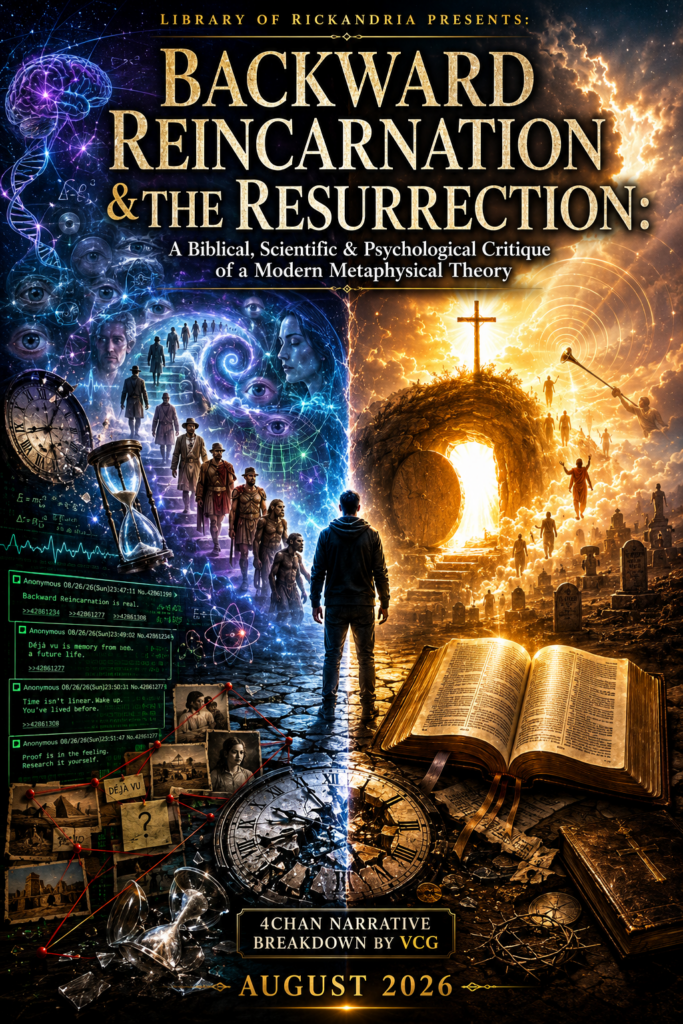
UPDATED BY VCG ON 8/27/2026 @ 17:17 EST
I want to share a heartfelt cause with my audience. Conner Blaisdell-Greene, a brave Airforce Sr. Airman, recently lost his battle with cancer, leaving his family in financial distress. Every donation, no matter how small, can help cover his funeral costs and ease their burden during this difficult time. Please consider clicking the link below to contribute or share Conner’s story with others. Your support truly matters.
Until We Meet Again
Spoken Tribute
Abstract
On August 23, 2026, an anonymous poster on 4chan’s /x/ board proposed an unusual variation on reincarnation: perhaps reincarnation does not carry a person forward into future bodies but instead moves consciousness progressively backward through history. Under this hypothesis, a person dying in 2070 might next be born in 1850, then perhaps in 300 BC, then in prehistoric humanity. Déjà vu, prophetic dreams, and apparent memories of other lives would consequently not be memories of the past at all, but fragmented memories leaking backward from lives that, chronologically speaking, occur in the future. The poster then asks what happens when this process reaches the earliest conscious organism and how the theory could accommodate the fact that the modern human population is much larger than ancient populations.
It is an imaginative idea, and as a science-fiction premise it has genuine conceptual interest. But an interesting hypothesis is not automatically a well-supported hypothesis. Once the thread is examined carefully, several very different questions emerge: What would count as evidence for reincarnation in the first place? Can déjà vu or unusual dreams establish the transfer of memories between lives? Does conservation of energy imply conservation of consciousness or personal identity? Does modern physics really support the claim that time does not exist? What do Tibetan traditions actually teach about rebirth? And, finally, does the Bible describe human existence in terms compatible with reincarnation?
This paper approaches those questions without treating every unusual experience as fraud, pathology, or foolishness. The fact that an experience is difficult to explain does not make it meaningless; neither does it establish the first metaphysical interpretation attached to it. Scientific findings, psychological models, philosophical arguments, religious traditions, and biblical texts therefore must be kept in their proper categories.
The central conclusion is that the thread provides no positive evidence capable of establishing backward reincarnation. Its strongest supporting arguments rely on unexplained experiences, speculative additions, or category errors—particularly the move from conservation of physical energy to survival of personal consciousness. The Bible, meanwhile, presents a substantially different account of human destiny: not an indefinite sequence of mortal embodiments, but death, accountability before God, and resurrection. The biblical alternative to reincarnation is therefore not annihilation. It is resurrection.
1. Beginning With the Thread Rather Than With the Conclusion
The best way to examine an unusual claim is not to begin by mocking it. It is to ask exactly what is being proposed.
The opening post in thread No. 42861199 does not claim to have performed an experiment or received a revelation. It begins as a thought experiment: “What if reincarnation only goes backwards in time?” The poster imagines dying in the future, being reborn in an earlier historical period, and continuing backward until the earliest conscious life. The idea is then used to reinterpret déjà vu, prophetic dreams, and reported memories of previous lives as information arriving from lives that are actually later in chronological history.
That wording matters. The OP begins with what if, and intellectual fairness requires acknowledging that distinction. A speculative model should not be accused of falsely presenting itself as established science when its author initially offers it as a possibility.
The problem develops when a possibility begins doing explanatory work without first acquiring evidence.
A hypothesis can be conceivable without being probable. It can be internally entertaining without being empirically supported. And it can explain an observation after the fact without having successfully predicted it.
Those distinctions will govern the analysis that follows.
2. A Methodological Ground Rule: What Kind of Claim Are We Testing?
The thread moves rapidly among several disciplines. That makes it easy for one kind of evidence to be mistaken for another.
If somebody says that Tibetan lamas teach a particular form of rebirth, that is primarily a historical and religious-studies claim. It should be checked against Tibetan Buddhist sources.
If somebody says déjà vu is caused by information arriving from another incarnation, that becomes a psychological and neurological claim.
If somebody invokes conservation of energy, that is a physics claim followed by a philosophical inference.
If somebody argues that the soul survives death, that is a metaphysical claim.
If somebody says the Bible teaches resurrection rather than reincarnation, that is first an exegetical claim about what Scripture says.
These categories can interact, but they cannot simply be substituted for one another.
Science cannot settle a question merely by citing Scripture, because a laboratory experiment is asking a different kind of question. Conversely, neuroscience cannot determine what the author of Hebrews meant simply by imaging a brain. And a Tibetan religious tradition can accurately tell us what Tibetan Buddhism teaches without thereby establishing that teaching as a scientifically demonstrated mechanism of nature.
A careful analysis therefore asks five questions whenever the thread advances a claim:
- What exactly is being claimed?
- What evidence would support that kind of claim?
- What alternative explanations could produce the same observation?
- What evidence would count against the hypothesis?
- When Scripture is invoked, what does the biblical passage actually say in context?
The fourth question is especially important.
A theory becomes difficult to test when every possible outcome can be absorbed into it. If someone remembers something unusual, backward reincarnation can say, “That is a future-life memory.” If someone remembers nothing, the theory can answer, “Most memories are suppressed.” If a dream resembles a later event, the resemblance becomes evidence. If thousands of dreams resemble nothing, they can simply be forgotten.
Such a framework may remain metaphysically imaginable, but its flexibility comes at a cost: the fewer observations capable of proving it wrong, the less evidential force any single apparent confirmation carries.
3. Reincarnation Is Not One Single Historical Doctrine
Before examining the OP’s particular theory, another correction is necessary. “Reincarnation” is often spoken of as though every tradition means the same thing by it. Historically, that is not so.
Ideas involving repeated lives or transmigration are ancient. Greek traditions associated with Pythagoras included the transmigration of life through different embodied forms, and Platonic eschatological myths also contain cycles involving judgment and subsequent embodiment.
But those ideas should not simply be collapsed into Tibetan Buddhism, modern New Age spirituality, or the 4chan OP’s model.
This becomes particularly important with Buddhism. Scholars often prefer the word rebirth rather than reincarnation because classical Buddhist doctrine does not straightforwardly posit an eternal, unchanging soul—an ātman—moving intact from body to body.
The official Dalai Lama website nevertheless clearly teaches continuity across lives: sentient beings come into the present life from previous lives and, following death, take rebirth again. It also discusses the Tibetan practice of recognizing the rebirths of important teachers.
That lets us evaluate one early reply in the thread fairly. A commenter states that Tibetan lamas who claim memories of previous lives describe rebirth as occurring in the future rather than backward into the past. As a broad description of the traditional chronology, that is substantially correct. The Tibetan model normally concerns a predecessor dying and a later incarnation subsequently being identified.
But two cautions remain.
First, accurately describing a religious tradition is not the same as independently proving its metaphysics.
Second, the OP’s model assumes something closer to a persistent personal subject traveling backward through a timeline. That should not automatically be called “the Tibetan view.” The two systems contain importantly different assumptions about selfhood and continuity.
Historically, then, the 4chan proposal is best understood not as a standard ancient doctrine but as a modern speculative synthesis: traditional reincarnation imagery combined with science-fiction ideas about time travel, modern discussion of consciousness, and internet fascination with anomalous experiences.
4. What the Backward-Reincarnation Model Actually Requires
The opening post sounds simple because several enormous assumptions are compressed into a short story.
For the model to work as described, at least the following would have to be true:
some component constituting personal identity survives bodily death;
this surviving subject can become associated with another organism;
it can become associated with an organism located earlier in physical history;
information can accompany that transition;
ordinary memory of the other incarnation is usually inaccessible;
extraordinary experiences occasionally permit information to cross whatever ordinarily blocks it;
those information leaks can appear as déjà vu, dreams, or apparent past-life memories;
the process can repeat many times;
and personal identity remains meaningful throughout the sequence.
Those are not minor details. Each is a separate bridge in the argument.
Suppose, for the sake of argument, that one could demonstrate survival of consciousness after death. That alone would not demonstrate reincarnation.
Suppose reincarnation were independently established. That would still not demonstrate backward reincarnation.
Suppose backward information transfer were established. That would not necessarily prove that the information was carried by the same personal soul.
This is a recurring methodological lesson throughout the thread:
proving one premise does not automatically prove the remaining premises needed to reach the desired conclusion.
5. Déjà Vu: A Real Experience, but What Does It Mean?
The OP’s use of déjà vu is one of the most intuitively powerful parts of the theory.
Anyone who has experienced strong déjà vu knows why. There can be an almost unnerving sense that the present scene has happened before. The feeling itself is not imaginary in the trivial sense. Something psychologically real is occurring.
The evidential question is different:
Does the experience tell us correctly where that familiarity came from?
Research on déjà vu commonly describes it as a feeling of familiarity accompanied by awareness that the familiarity seems inappropriate or inexplicable. Work on recognition memory has connected the phenomenon with neural systems involved in familiarity, including medial temporal structures. Déjà vu is also documented in neurological contexts such as temporal-lobe epilepsy, while ordinary déjà vu occurs in people without such disorders.
This fits into a broader psychological literature on source monitoring—the processes by which the mind decides where a memory, thought, image, or feeling originated. Source-monitoring errors include misattributed familiarity and cryptomnesia: information can feel known even when its actual source is not consciously recovered correctly.
That gives us a crucial distinction.
The observation is:
This moment feels strangely familiar.
The interpretation is:
Therefore I previously experienced this moment during another incarnation.
The first can be true while the second is false.
Indeed, the ordinary cognitive explanation has an advantage: we already possess independent evidence that familiarity and explicit recollection can come apart. We do not yet possess comparable independent evidence for memories traveling from a later incarnation into an earlier life.
This does not prove that every instance of déjà vu has exactly the same mundane cause. Scientific humility cuts both ways. But it does mean that déjà vu by itself cannot carry the enormous metaphysical burden the thread places upon it.
An unexplained experience is evidence that something requires explanation. It is not automatically evidence for whichever explanation happens to be the most dramatic.
6. Dreams, Precognition, and the Difference Between a Hit and a Prediction
The OP also proposes that “prophetic dreams” might actually be memories from future incarnations.
Here again, the experience and the interpretation need to be separated.
People unquestionably report dreams that later seem to correspond remarkably well with subsequent events. The question is whether controlled evidence establishes that dreams reliably acquire information from the future.
Current summaries of the scientific evidence do not support reliable dream precognition. Coincidence, selective recall, hindsight, and our tendency to notice meaningful matches among many possibilities can all contribute to the impression that a dream predicted a later event.
Consider the methodological problem.
A person may have hundreds or thousands of dreams over a period of years. Most disappear from memory. If one later resembles an emotionally significant event, that match becomes memorable. Unless the dream was recorded before the event with sufficiently precise details, and unless misses are counted alongside hits, the apparent accuracy can become greatly inflated.
Hindsight-bias research is relevant here. Once an outcome is known, people tend to experience it as more predictable than it really was beforehand—the familiar “I knew it all along” effect.
But the biblical discussion needs a separate category.
The Bible does not teach that every unusual dream must have an ordinary psychological explanation. Scripture contains narratives in which God genuinely communicates through dreams—Joseph in Genesis, Nebuchadnezzar and Daniel in Daniel 2, and Joseph the husband of Mary in Matthew 1–2 are obvious examples. Daniel is explicitly described as having understanding in visions and dreams.
Therefore, a biblical critique of the thread should not say:
“Dream revelation is impossible.”
Scripture would contradict that.
The correction is narrower and stronger:
Nothing in the biblical material identifies genuine revelatory dreams as memories leaking from another incarnation.
In the biblical narratives, revelation comes from God. The source is not an individual’s chronologically later earthly life.
So both errors should be avoided. A naturalistic explanation should not be made into an a priori rule that God cannot reveal anything through dreams; but an uncanny dream should not be promoted into proof of reincarnation merely because its significance feels extraordinary.
7. Reported Memories of Previous Lives: Stronger Than a Meme, Weaker Than a Demonstration
This part of the subject deserves particular care because there really is an academic literature on alleged past-life memories.
A published scoping review located 78 studies dealing with claimed memories of previous lives. The literature is heavily observational and includes many studies of children, case reports, interviews, and documentary comparisons. The review itself emphasizes methodological limitations and the need for stronger future research.
The University of Virginia’s Division of Perceptual Studies also maintains a long-running research program examining children who spontaneously report apparent memories of previous lives; the program reports having collected thousands of such cases.
That evidence should neither be exaggerated nor dismissed.
It would be inaccurate to say, “Nobody has ever studied this.”
People have.
It would also be inaccurate to say, “Therefore reincarnation has been scientifically established.”
It has not.
Case reports can establish that a child made certain statements. In some cases researchers may document striking correspondences between statements and deceased individuals. But moving from:
a child supplied apparently unusual information
to
the child’s personal consciousness previously inhabited that deceased person’s body
requires eliminating other possible routes by which information, suggestion, family influence, coincidence, selective reporting, memory reconstruction, fraud, or unknown variables could account for the correspondence.
The stronger the case, the more carefully those alternatives should be investigated. But even if a conventional reincarnation case were someday demonstrated beyond reasonable dispute, the 4chan OP would still face another problem.
Most alleged “past-life” cases are interpreted precisely as the name suggests: the remembered individual lived before the child making the report.
The OP proposes the reverse.
Thus the existing case literature cannot simply be cited as confirmation of backward reincarnation. At most, it could be used to argue that questions of anomalous memory and identity deserve investigation.
That is a much more modest conclusion.
8. The Thread Begins Modifying the Theory
Several replies notice that the OP has simply assumed reincarnation must move backward.
One commenter asks why it would work that way and suggests instead that a person might “jump” to arbitrary points along the timeline. Another prefers a timeless version in which reincarnation can move both forward and backward.
These objections identify a genuine weakness.
Why backward only?
The OP gives no independent mechanism requiring that direction.
Yet the proposed fixes create another methodological difficulty.
A theory that allows rebirth:
forward in time,
backward in time,
anywhere in time,
or outside ordinary time
can accommodate nearly every chronological outcome imaginable.
That makes the theory more flexible but not necessarily more explanatory.
Suppose every observation is compatible with the hypothesis. A memory apparently from the past fits. A dream apparently about the future fits. No memory fits because memories are suppressed. A person born centuries later fits. A person born centuries earlier fits.
What result would not fit?
This is why explanatory flexibility should not be mistaken for evidential strength. A scientific theory normally gains credibility partly by making itself vulnerable: it tells us that if the world were otherwise, the theory would fail.
The thread never specifies such a failure condition.
9. Population Growth and the “Extra Souls” Problem
The OP deserves credit for noticing an internal difficulty in the model.
Modern humanity contains far more people alive simultaneously than lived at many ancient points in history. Historical population reconstructions show that human numbers were dramatically smaller in the distant past, while estimates of the total number of humans ever born run well above one hundred billion, depending on methodology.
So if every currently living person must move backward into a unique earlier human body, a numerical problem appears.
But the exact force of the objection depends upon assumptions the OP has not stated.
The contradiction arises only if the theory requires:
a fixed total stock of souls;
one soul per human body;
no interval between incarnations;
human-only reincarnation;
no merging or splitting of identity;
and no possibility of multiple persons sharing some other metaphysical relation.
A defender could add one of those mechanisms.
But doing so would not count as evidence. It would simply add another assumption.
That distinction is important. The population problem does not experimentally disprove every logically imaginable reincarnation doctrine. It reveals that the OP’s own model is underspecified.
The question about eventually reaching “the first conscious organism” presents the same difficulty. Science does not give us a universally agreed point at which one individual organism can be identified as the first conscious creature in a simple binary sense. Consciousness itself has several contested definitions, and evolutionary change is gradual.
So the theory’s supposed endpoint is not yet well defined.
10. Alien Reincarnation and the Language of Probability
Later in the thread, someone argues that a person would be “much more likely” to reincarnate on an alien planet than on Earth. Another poster immediately responds with the appropriate challenge: prove it.
The challenge is methodologically sound.
Calling something more likely gives the appearance of quantitative reasoning, but a probability comparison requires some basis for estimating the alternatives.
To justify the claim, one would need meaningful information about questions such as:
how many inhabited worlds exist;
how many conscious beings exist on them;
whether reincarnation exists at all;
whether it can cross planetary systems;
and how incarnations are selected.
The thread supplies none of these.
This does not prove extraterrestrial life impossible. It does not prove Earth-exclusive reincarnation either.
The correct conclusion is narrower:
the comparative probability claim has not been demonstrated.
This is an example of what might be called pseudo-quantification: probabilistic language is being used where no actual probability model has been supplied.
11. “There Is No Time”: Measurement Is Not the Same Thing as Reality
One of the more categorical statements in the thread says:
“There is no time.
Time is a concept created by mankind.”
The poster then reasons that because time does not exist, nobody can go backward through it.
There is an important philosophical question hidden inside that statement. Philosophers and physicists genuinely debate what time ultimately is: whether it is fundamental, emergent, relational, whether all moments are equally real, and how temporal direction should be understood.
But “humans created clocks and calendars” is not enough to establish “time does not exist.”
Humans invented the second as a standardized unit. We invented calendars, time zones, clock faces, and conventions for labeling dates.
Yet physical systems do exhibit measurable temporal relations.
Relativity supplies a particularly powerful example. Atomic clocks moving differently or situated at different gravitational potentials do not accumulate elapsed time at identical rates. NIST describes these relativistic effects as necessary considerations in precision timekeeping, including GPS systems, and experimental atomic-clock work has detected gravitational time dilation across extremely small height differences.
So, there is a categorical difference between:
Humans invented ways to measure and label time
and
Humans invented the underlying physical relationships being measured.
We invented metres too. That does not mean distance was created by the metric system.
Nor, however, should relativity be recruited in the opposite direction. The fact that time behaves differently from the intuitions of classical everyday experience does not establish that a human consciousness can leave a body and reincarnate in 300 BC.
Relativity is not a reincarnation mechanism.
The proper conclusion is therefore restrained on both sides: modern physics makes simplistic claims about time hazardous, but it gives the thread no positive evidence for backward soul migration.
12. The Conservation-of-Energy Argument: The Thread’s Most Important Category Error
The final substantial poster asks what may be the best question in the entire thread:
How do we even know rebirth is real?
That question should have appeared at the beginning.
Unfortunately, the poster then introduces an argument often used in popular discussions of immortality: energy is never lost, human beings involve energy, consciousness involves energy, therefore consciousness must eventually occur again.
The first law of thermodynamics is indeed a conservation principle. In an isolated system, total energy remains constant while energy may be transferred or transformed.
The trouble is not the physics.
The trouble is the philosophical leap placed on top of it.
A living brain unquestionably requires energy. Research on cerebral metabolism shows close relationships between energetic activity, neural function, and conscious states; loss of consciousness under anesthesia is associated with major changes and reductions in cerebral energy use.
But the propositions
conscious processes require energy
and
a person’s consciousness is a conserved quantity of energy
are not equivalent.
Nor does the first imply the second.
A simple analogy helps.
A computer running a document-editing program requires electrical energy. If the computer is destroyed, the physical energy involved in the machine does not vanish from the universe. It is transformed and dispersed.
But conservation of energy does not imply that:
the same document,
the same software state,
the same files,
the same passwords,
or the same user’s session
must spontaneously appear in another computer.
The missing thing is organization and information, not merely energy.
Likewise, when asking whether you survive death, the relevant issue is not simply whether joules continue to exist. Personal identity involves questions about memory, continuity, information, embodiment, agency, and subjectivity.
The law of conservation of energy tracks physical quantities.
It does not contain an equation reading:
one person’s death = one person’s consciousness transferred elsewhere.
The thread therefore moves through several unsupported steps:
Energy persists
→ therefore consciousness persists
→ therefore personal identity persists
→ therefore that person inhabits another organism
→ therefore the organism may exist in another historical period.
The conservation law supplies only the first element.
Everything after it requires additional argument.
Even the weaker statement, “consciousness happened once, therefore consciousness will happen again,” would not establish reincarnation. If another conscious organism appears tomorrow, it does not follow that my consciousness has become that organism.
Another flame can be lit after one candle goes out. That does not make it numerically the same flame merely because physical energy remains present in the world.
This is probably the single most important scientific correction in the thread.
13. Personal Identity: The Question the Thread Mostly Avoids
Reincarnation discussions frequently focus on where consciousness goes while neglecting a prior question:
What makes a later consciousness the same person as the earlier one?
Suppose a child somehow possesses ten accurate memories of a deceased stranger.
Would information transfer alone prove numerical personal identity?
Not necessarily.
If I copy every file from one computer to another, the second machine contains the same information but is not physically the same computer.
If two perfect copies were produced, which one would be “the original”?
The analogy is imperfect, because human consciousness is not known to be equivalent to computer files. But it exposes the philosophical difficulty.
The OP’s backward model assumes that a person in 2070 and another person in 1850 are somehow the same subject even though their bodies, brains, families, environments, ordinary memories, and historical locations differ.
What establishes that identity?
The thread never supplies a criterion.
That problem becomes sharper once the model allows memories to be almost completely erased. If there is no shared organism, no ordinary memory continuity, no causal path demonstrated between brains, and no independent marker of identity, then saying “these are the same person” risks becoming an assertion rather than a discovery.
14. The Psychology of Why Such a Theory Can Feel Persuasive
Psychology can help us understand why ideas like this become compelling. But this section requires an important warning.
Explaining why somebody believes something is not the same as proving the belief false.
That mistake is called a genetic-style fallacy: dismissing a proposition merely because one can describe its psychological origin.
If a person believes in an afterlife partly because death is frightening, that fact does not demonstrate that the afterlife is false.
The same fairness must apply to Christianity. A psychological explanation for why resurrection hope comforts believers would not determine whether Christ actually rose.
Psychology can illuminate belief formation. Truth still requires separate investigation.
Source monitoring
The most directly relevant process is source monitoring. A memory can feel authentic while its source is incorrectly identified. Familiarity can occur without accurate recollection of why something feels familiar.
That makes déjà vu psychologically significant without requiring reincarnation.
Confirmation bias
People naturally give greater attention to evidence that supports an existing idea and may scrutinize contrary evidence less strongly. Confirmation bias has been extensively studied across reasoning domains.
In a reincarnation context, that might look like remembering five striking coincidences while forgetting hundreds of nonmatches.
Again, that does not prove the five coincidences meaningless. It tells us why disciplined recordkeeping and prospective testing are necessary.
Hindsight
After an event occurs, earlier memories and expectations can be reconstructed so that the outcome appears more predictable than it actually was.
This is especially relevant to “I dreamed this before it happened” experiences unless the dream was documented beforehand in sufficiently precise language.
Social reinforcement
One poster replies that he has had the same thought many times. That contributes interpersonal validation but no new external evidence.
There is nothing irrational about feeling encouraged when somebody independently shares an idea. But agreement is not verification.
Two people can independently imagine the same possibility because human minds share similar intuitions, cultural material, and concerns.
Narrative vividness
The thread quickly turns an abstract metaphysical hypothesis into vivid stories: ancient Rome, peasants in China, alien worlds, prehistoric bodies.
This makes the idea easier to picture.
But ease of imagination is not probability.
A story can become more psychologically compelling as it becomes more vivid while remaining evidentially unchanged.
Mortality and worldview
Research on mortality salience has examined how reminders of death can influence supernatural and afterlife-related beliefs. Some studies have found increased supernatural belief under mortality-related conditions, and reincarnation beliefs themselves have been investigated in this broader psychological context.
The responsible conclusion is not “reincarnation is false because people fear death.”
The useful conclusion is:
questions about death involve unusually powerful emotional incentives, so both believer and skeptic should be especially careful about motivated reasoning.
Online disinhibition
The thread also wanders abruptly into sexual comments, self-deprecating remarks about appearance, insults, and weight-loss advice. That kind of conversational drift is not unusual in anonymous online environments.
John Suler’s influential treatment of the online disinhibition effect identified anonymity, invisibility, asynchronicity, and weakened authority cues among factors that can encourage unusually candid disclosure and uninhibited behavior online.
This does not tell us anything about whether reincarnation is true.
It helps explain why an anonymous thread can move rapidly from metaphysics to intimate disclosure, jokes, speculative medicine, and personal fantasy without the boundaries expected in a formal philosophical discussion.
15. What the Side Tangents Reveal
The thread’s unrelated body-image discussion is not important to reincarnation itself, but it reveals something about the epistemic environment.
One commenter confidently suggests that extensive weight training can cause substantial excess abdominal skin after major weight loss to “tuck itself” back into the abdomen. Clinical literature on massive weight loss describes genuinely redundant, sometimes inelastic skin and notes that severe excess tissue can require surgical removal; exercise may improve musculature and body contour, but that is not equivalent to making substantial redundant skin disappear.
Another commenter wisely softens his own claim about slow weight loss and skin tightening with essentially,
“I don’t know though.”
That little exchange is instructive.
Anonymous threads often place:
accurate observations,
partially correct advice,
speculation,
jokes,
personal experience,
and false confidence
next to one another in exactly the same visual format.
The platform itself does not tell the reader which sentence belongs to which category.
The reader has to do that work.
And the same principle applies to paranormal claims. A statement does not become scientific because it is written next to the word energy. It does not become historical because Tibet is mentioned. It does not become neurological because déjà vu is mentioned.
The label and the evidence have to match.
16. Now the Biblical Question
Everything so far has asked whether the thread’s claims are historically accurate, scientifically supported, logically valid, or psychologically plausible.
The biblical question is different:
What account of human death and future life does Scripture itself present?
Here the contrast becomes substantial.
The Bible does not describe the ordinary human destiny as:
life → death → another ordinary mortal life → death → another mortal life.
Its recurring pattern is:
earthly life → death → accountability before God → resurrection and judgment.
That distinction appears in both Old and New Testament texts.
Daniel writes:
“And many of them that sleep in the dust of the earth shall awake, some to everlasting life, and some to shame and everlasting contempt.” — Daniel 12:2
Whatever interpretive questions surround the details of Daniel 12, the imagery is unmistakably resurrectional: those in the dust awake. They are not described as cycling into unrelated historical bodies.
Jesus develops the same pattern in John 5:
“the hour is coming, in the which all that are in the graves shall hear his voice, And shall come forth” — John 5:28–29
He names the two outcomes “the resurrection of life” and “the resurrection of damnation.”
Once again, the controlling image is not reincarnation.
It is resurrection.
17. Hebrews 9:27: Important, but It Must Be Read in Context
The verse most frequently used against reincarnation is Hebrews 9:27:
“And as it is appointed unto men once to die, but after this the judgment:”
That verse does strongly conflict with an ordinary doctrine of repeated mortal lives. But it should not be reduced to a detached slogan.
The surrounding argument concerns the uniqueness of Christ’s sacrifice.
Hebrews contrasts repeated priestly sacrifices with Christ, who appears once to put away sin. The next verse parallels human death with Christ’s once-for-all offering:
“So Christ was once offered to bear the sins of many…” — Hebrews 9:28
The passage’s emphasis is therefore broader than merely
“reincarnation is wrong.”
It is about finality:
Christ does not repeatedly sacrifice Himself;
human death leads toward judgment;
Christ will appear again unto salvation for those looking for Him.
Yet once that context is preserved, the sequence remains significant:
once to die → after this the judgment.
The text does not insert:
after death → another mortal birth → another death → another mortal birth.
So Hebrews 9:27 remains a substantial biblical obstacle to serial reincarnation, especially when read alongside the Bible’s positive doctrine of resurrection.
18. First Corinthians 15: The Positive Biblical Alternative
If Hebrews 9 supplies the sequence, 1 Corinthians 15 supplies the positive doctrine.
Paul begins by rehearsing the Gospel he preached:
“Christ died for our sins according to the scriptures; And that he was buried, and that he rose again the third day…” — 1 Corinthians 15:3–4
He then makes resurrection indispensable to Christian proclamation:
“if Christ be not risen, then is our preaching vain, and your faith is also vain.” — 1 Corinthians 15:14
And then:
“But now is Christ risen from the dead, and become the firstfruits of them that slept.” — 1 Corinthians 15:20
This is crucial.
Christian hope is patterned after Christ’s resurrection.
Paul does not say Christ died and was reborn as another infant. The identity of the risen Christ is continuous with Jesus who died, while His condition after resurrection is transformed.
Paul then anticipates the obvious question:
“How are the dead raised up? and with what body do they come?” — 1 Corinthians 15:35
That is almost exactly where one would expect reincarnation to appear if it belonged to Paul’s theology of life after death.
Instead, Paul discusses resurrection.
The difference is not semantic.
Reincarnation
A person enters another ordinary mortal embodiment and lives another earthly life.
Resurrection
God raises the dead, preserving personal identity while transforming embodied existence.
Paul’s hope culminates not in an endless recycling of mortality but in mortality being overcome.
He calls death itself:
“The last enemy that shall be destroyed…” — 1 Corinthians 15:26
The New Testament therefore does not present repeated death as the solution to death.
It presents resurrection as death’s defeat.
19. Second Corinthians 5: The Person Does Not Simply Become Another Earthly Person
Paul’s language in 2 Corinthians 5 adds another piece.
He writes:
“whilst we are at home in the body, we are absent from the Lord”
…
“willing rather to be absent from the body, and to be present with the Lord.”
Christians have debated details of the intermediate state and how this passage relates to other texts. Those debates should be acknowledged rather than concealed.
But one point is plain enough for the present subject.
Paul does not say:
absent from this body and present in another ordinary human body.
His sequence moves toward the Lord and then judgment:
“For we must all appear before the judgment seat of Christ…” — 2 Corinthians 5:10
That framework fits Hebrews 9, John 5, Daniel 12, and 1 Corinthians 15.
It does not resemble a chain of historical reincarnations.
20. Ecclesiastes 12 and the Mistake of Turning “Spirit” Into Physical Energy
The conservation-of-energy argument can also be tested directly against biblical language.
Ecclesiastes describes death:
“Then shall the dust return to the earth as it was:
and the spirit shall return unto God who gave it.” — Ecclesiastes 12:7
The chapter concludes with accountability:
“For God shall bring every work into judgment…” — Ecclesiastes 12:14
A common modern mistake is to take words such as spirit, life, or soul and equate them automatically with the physicist’s term energy.
The Bible does not make that equation.
“Spirit” in Ecclesiastes 12 is theological and anthropological language within the biblical text. “Energy” in thermodynamics is a defined physical quantity.
Replacing one word with the other and then applying the conservation law is equivocation.
Scripture says the spirit returns unto God who gave it.
It does not say personal consciousness is a conserved parcel of physical energy that must be inserted into another organism.
21. Does “Born Again” Mean Reincarnation?
John 3 sometimes enters modern reincarnation discussions because Jesus says:
“Except a man be born again, he cannot see the kingdom of God.” — John 3:3
But the conversation itself interprets the expression.
Nicodemus initially takes Jesus in a second-physical-birth direction:
“can he enter the second time into his mother’s womb, and be born?” — John 3:4
Jesus does not respond,
“Yes—that is reincarnation.”
He contrasts flesh and Spirit:
“That which is born of the flesh is flesh; and that which is born of the Spirit is spirit.” — John 3:6
Whatever theological differences Christians may have concerning the full meaning of “water and of the Spirit,” the immediate distinction is clear enough.
Jesus is teaching spiritual regeneration, not a second ordinary biological lifetime.
Nicodemus’s literal second-birth misunderstanding is precisely what the conversation moves beyond.
22. Was John the Baptist Elijah Reincarnated?
This is probably the strongest superficially biblical argument for reincarnation.
Jesus says of John:
“this is Elias, which was for to come.” — Matthew 11:14
Read alone, someone might conclude that John literally was Elijah in another body.
But Scripture provides its own interpretive controls.
When John is directly asked:
“Art thou Elias?”
he replies:
“I am not.” — John 1:21
Luke explains the relationship even more clearly before John’s birth:
“And he shall go before him in the spirit and power of Elias…” — Luke 1:17
John is therefore Elijah-like in prophetic mission, spirit, and power. He fulfills the expected forerunner role.
The Transfiguration makes literal reincarnation even harder to maintain.
Matthew records Moses and Elijah themselves appearing with Jesus. Shortly afterward, Jesus explains that
“Elias is come already,”
and the disciples understand that He is speaking of John the Baptist.
The narrative can therefore speak simultaneously of:
Elijah as Elijah,
John as John,
and John fulfilling the Elijah role.
That is intelligible as prophetic typology and fulfillment.
It does not require identity through reincarnation.
23. The Biblical Treatment of Strange Experiences Is More Careful Than Either Gullibility or Reductionism
There is another lesson worth drawing from Scripture.
A biblical critique does not require us to say every strange experience is meaningless.
The Bible contains:
dreams,
visions,
prophecy,
angelic appearances,
spiritual deception,
miracles,
and divine revelation.
Daniel receives dreams and visions. Joseph is warned in dreams. Scripture itself therefore leaves no room for the simplistic assertion that an experience must be false merely because it is extraordinary.
At the same time, biblical revelation does not teach people to build doctrine from every uncanny sensation.
The scriptural pattern repeatedly places truth claims under examination. Paul tells the Corinthians:
“Examine yourselves…”
Acts praises reasoning from Scripture, and the Christian theological tradition has long distinguished revelation from mere private impression.
That distinction is especially useful when approaching déjà vu.
A person can sincerely say:
I experienced something extraordinary.
We need not answer:
You imagined everything.
But neither should we automatically answer:
Therefore, your soul remembers another century.
The proper next question is:
What explanation is actually warranted by the evidence?
That question is as valuable in theology as it is in science.
24. The Thread’s Strongest Moment Is Its Skepticism, Not Its Theory
Ironically, the most valuable sentence in the discussion may be the final poster’s question:
How do you even know if rebirth or incarnation is real?
That is the methodological turning point.
Before trying to determine whether reincarnation runs:
backward,
forward,
sideways through a multiverse,
between planets,
or outside time,
one must first establish that reincarnation occurs at all.
Before explaining how memories pass between incarnations, one must establish that the memories actually originate in another incarnation.
Before using energy conservation to explain soul survival, one must establish that personal identity is the kind of thing tracked by a conservation law.
Before deciding that déjà vu is a memory from 2070, one must rule out known features of human familiarity and memory.
The conversation repeatedly answers unanswered questions by adding further speculative machinery.
That is precisely backwards from good methodology.
Explanatory mechanisms should be introduced because evidence requires them—not merely because they make a story capable of surviving another objection.
25. A Claim-by-Claim Assessment
For clarity, the main claims of the thread can be summarized as follows.
| Claim | Assessment |
|---|---|
| People experience déjà vu | Well established |
| Déjà vu can involve abnormal or misattributed familiarity | Supported by memory and neurological research |
| Déjà vu is memory from another incarnation | Not established |
| Some people report memories interpreted as previous lives | Well documented as reports |
| Researchers have investigated such reports | Yes |
| Those reports conclusively demonstrate reincarnation | Not established by the present literature |
| They demonstrate backward reincarnation | No supporting evidence identified |
| Tibetan Buddhism teaches rebirth | Yes, broadly speaking |
| Tibetan rebirth is identical to an immortal soul moving body-to-body | Oversimplification |
| Dreams sometimes appear to predict later events | Frequently reported |
| Controlled science has established reliable prophetic dreaming | Not established |
| Scripture contains genuine revelatory dreams | Yes |
| Scripture identifies those dreams as reincarnation memories | No |
| Ancient populations were smaller than modern populations | Yes |
| That creates an internal problem for a fixed one-soul/one-body backward model | Yes |
| It disproves every conceivable rebirth doctrine | No |
| Alien reincarnation is “much more likely” | Unsupported probability claim |
| Humans invented clocks and temporal units | Yes |
| Therefore, physical time does not exist | Does not follow |
| Relativistic clock effects are measurable | Yes |
| Relativity proves consciousness can travel backward in history | No |
| Energy is conserved under the first law of thermodynamics | Yes, properly formulated |
| Conscious brain activity requires energy | Yes |
| Therefore, personal consciousness is conserved as energy | Does not follow |
| Therefore, the same person must reincarnate | Does not follow |
| Scripture teaches spiritual rebirth/regeneration | Yes |
| “Born again” means serial physical reincarnation | No |
| John fulfills the Elijah expectation | Yes |
| John is literally Elijah reincarnated | Not supported by the relevant texts |
| Scripture teaches resurrection of the dead | Explicitly |
| Scripture presents serial reincarnation as ordinary human destiny | No |
26. What Would Better Evidence for Backward Reincarnation Look Like?
It is worth asking what evidence would move the discussion forward.
A serious research program would need something substantially stronger than retrospective impressions.
For example, researchers would want:
information recorded before verification;
precise rather than vague predictions;
controls against information leakage;
independent investigators;
preregistered criteria for success;
publication of failures as well as apparent successes;
replication;
and predictions distinguishing backward reincarnation from ordinary memory, fraud, coincidence, conventional reincarnation, precognition, or other hypotheses.
Most importantly, the theory would need to risk failure.
Suppose a child claimed to remember a person who will not be born for another hundred years. To test that, the child’s highly specific claims would need to be securely documented now, kept inaccessible from alteration, and later compared against the future person under predetermined criteria.
Even then, if a match occurred, researchers would still have to determine what the match demonstrated.
Precognition?
Information transfer?
Coincidence?
Reincarnation?
Personal identity?
Those are not automatically the same proposition.
This illustrates just how much more evidence is needed than “I felt déjà vu.”
27. Reincarnation and Resurrection Are Not Two Names for the Same Hope
At the deepest level, the biblical issue is not simply whether a soul travels clockwise or counterclockwise through history.
The two worldviews tell different stories about the human problem.
In reincarnation systems, repeated embodiment commonly functions within some larger process of continued existence, moral consequence, purification, development, or release.
In the New Testament, the human problem is framed around sin, death, judgment, and reconciliation to God.
And the solution is not another attempt at ordinary mortal existence.
It is Christ.
Paul’s Gospel is anchored in an event:
Christ died, was buried, and rose again.
Christian hope then follows that pattern:
“he which raised up the Lord Jesus shall raise up us also by Jesus…” — 2 Corinthians 4:14
Peter likewise describes Christian hope as being grounded:
“by the resurrection of Jesus Christ from the dead.” — 1 Peter 1:3
This is why reincarnation cannot simply be inserted into Christianity as another possible mechanism for the afterlife.
It changes the structure of the story.
The New Testament’s emphasis falls on a historical person, a death, a resurrection, a promised future resurrection, and judgment.
The individual does not endlessly return through ordinary history.
The dead are raised.
28. Final Conclusion
The 4chan thread succeeds at one thing remarkably well: it demonstrates how quickly a human mind can build an elaborate metaphysical structure from a handful of mysterious experiences.
Start with déjà vu.
Add prophetic dreams.
Add reports of past lives.
Reverse the direction of reincarnation.
Add timelessness when chronology becomes inconvenient.
Add extraterrestrial worlds when population becomes inconvenient.
Add conservation of energy when a physical mechanism is requested.
Within a short thread, a complete cosmic picture begins to emerge.
But coherence of imagination is not the same thing as confirmation.
When the pieces are examined separately, the evidential situation changes.
Déjà vu is real, but neuroscience and memory research provide reasons why familiarity can occur without accurate source recollection.
Claims of previous-life memories have genuinely been studied, and some cases remain interesting enough to warrant careful investigation, but the literature does not establish backward reincarnation as their cause.
Tibetan traditions genuinely teach rebirth, but that does not turn Tibetan religious claims into an experimental demonstration, nor is Buddhist rebirth simply identical to the OP’s traveling-soul model.
Relativity shows that temporal measurement is physically more complex than ordinary intuition suggests, but it does not provide a mechanism for reincarnating into ancient history.
Conservation of energy is genuine physics, but it does not establish conservation of memory, personality, consciousness, or personal identity.
Psychology can explain why coincidences, familiarity, hindsight, social reinforcement, and mortality-related questions sometimes make extraordinary explanations compelling. Yet psychological explanation should not be abused as a shortcut for declaring every metaphysical claim false.
And Scripture presents a fundamentally different destination.
The body returns to the earth and the spirit returns to God who gave it.
Men are appointed once to die, followed by judgment.
Those in the graves will hear Christ’s voice and come forth.
Paul does not promise another ordinary incarnation.
He proclaims:
“But now is Christ risen from the dead, and become the firstfruits of them that slept.” — 1 Corinthians 15:20
That is the decisive distinction.
The biblical alternative to reincarnation is not the claim that death ends everything.
It is the claim that death does not receive the final word.
Not repetition.
Not cosmic recycling.
Not an endless succession of forgotten selves traveling through history.
Resurrection.
The difference matters because reincarnation and resurrection answer the question of human identity in radically different ways. The thread asks whether the self might survive by becoming someone else, somewhere else, sometime else.
The New Testament’s hope is that God raises the dead themselves.
The question is therefore not merely, Could consciousness occur again?
The biblical question is whether the God who created man can raise the dead, judge truly, and give everlasting life.
According to the Christian Scriptures, that hope rests not upon déjà vu, an unexplained dream, a conservation law, or speculation about time.
It rests upon Jesus Christ:
“Christ died for our sins according to the scriptures;
And that he was buried, and that he rose again the third day according to the scriptures.” — 1 Corinthians 15:3–4
That is not backward reincarnation.
It is the resurrection.
Selected Sources and Research Basis
Primary thread. 4chan /x/, thread No. 42861199, posted beginning August 23, 2026. The analysis above distinguishes the OP’s explicit thought experiment from later commenters’ additions.
Scripture. The Holy Bible, Authorized King James Version, Pure Cambridge Edition, supplied research copy. Biblical quotations in this paper are taken from this edition.
Déjà vu and memory. Research on recognition familiarity, temporal-lobe phenomena, and source monitoring provides empirically grounded alternatives to interpreting déjà vu as transferred memories.
Claimed previous-life memories. Academic scoping review of the observational research literature and the University of Virginia Division of Perceptual Studies research program.
Dream precognition. Current evidence summaries find no established reliable scientific demonstration that ordinary dreams predict future events, while acknowledging common reports of apparent correspondences.
Tibetan rebirth. Official Dalai Lama material on rebirth and recognition, supplemented by scholarly clarification concerning the distinction between Buddhist rebirth and an eternal-soul model of reincarnation.
History of transmigration concepts. Stanford Encyclopedia of Philosophy materials concerning Pythagorean and Platonic traditions.
Population history. Our World in Data and Population Reference Bureau estimates concerning historical population and cumulative humans born.
Physics of time. National Institute of Standards and Technology material concerning relativistic clock effects and experimental gravitational time dilation.
Conservation of energy. OpenStax, University Physics, treatment of the first law of thermodynamics.
Brain energy and consciousness. Research on cerebral metabolism, neural energetics, anesthesia, and conscious state.
Psychology of belief and memory. Research concerning confirmation bias, hindsight bias, source monitoring, mortality salience, and online disinhibition.
Closing Thesis
The thread raises a legitimate philosophical question but does not establish its proposed answer.
Backward reincarnation remains speculative because the experiences offered in its favor do not uniquely predict it, the physical arguments do not entail it, and the model lacks a demonstrated mechanism for continuity of personal identity across bodies or backward through time.
Biblically, the doctrine is displaced by a different and explicit framework:
one earthly life, death, judgment, and the resurrection of the dead through Jesus Christ.
VCG NOTES: Backward Reincarnation & the Resurrection: A Biblical, Scientific & Psychological Critique of a Modern Metaphysical Theory
4CHAN THREAD & POST BREAKDOWNS – Library of Rickandria
VCG PAPER PROJECTS – Library of Rickandria