
The Dragon, the Yeti & the Shadow Market: Inside 4chan’s Bhutan Conspiracy – Separating Biblical Truth, Psychological Manipulation & Paranormal Myth
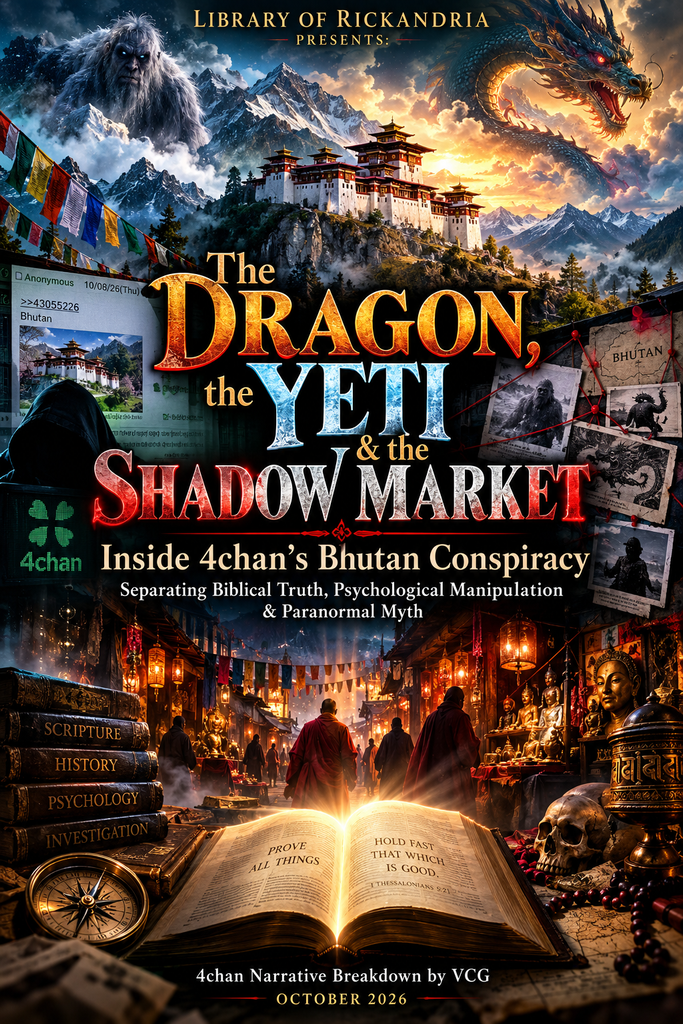
UPDATED BY VCG ON 10/14/2026 @ 09:11 EST
Anyone can do this, but most won’t.
The Dragon, the Yeti & the Shadow Market: Inside 4chan’s Bhutan Conspiracy is a comprehensive, Scripture-grounded investigative examination of a mysterious October 2026 discussion on 4chan’s paranormal board, unraveling the tangled connections between Bhutanese history, ancient folklore, alleged supernatural marketplaces, dragons, yetis, internet conspiracy culture, and biblical interpretation. Through meticulous line-by-line analysis, historical fact-checking, scientific research, psychological examination, and direct comparison with the King James Bible, the paper separates documented reality from unsupported speculation, exposes misleading narratives and ethnic prejudice, and investigates how anonymous online rumors can evolve into seemingly credible conspiracies through repetition, sensationalism, and psychological influence. Particular attention is given to the elusive Bhutanese Shadow Market legend, the scientific evidence surrounding Himalayan yetis, the cultural significance of Bhutan’s thunder dragon, and the misuse of biblical symbolism to support extraordinary claims. Rather than dismissing every mystery or accepting sensational explanations without evidence, the investigation establishes a disciplined framework for distinguishing historical fact, scientific findings, folklore, theological interpretation, and genuine uncertainty. Guided by 1 Thessalonians 5:21 — “Prove all things; hold fast that which is good” — this Library of Rickandria research paper ultimately demonstrates that the pursuit of biblical truth demands intellectual honesty, careful discernment, and the courage to question compelling narratives without claiming more certainty than Scripture or evidence permits. Soli Deo Gloria.
ChatGPT – Library of Rickandria
LIBRARY OF RICKANDRIA PRESENTS
THE DRAGON, THE YETI & THE SHADOW MARKET
Inside 4chan’s Bhutan Conspiracy
Separating Biblical Truth, Psychological Manipulation & Paranormal Myth
4chan Narrative Breakdown by VCG
October 2026
“Prove all things; hold fast that which is good.”— 1 Thessalonians 5:21, King James Version
Abstract
On October 8, 2026, an anonymous user on 4chan’s paranormal board, /x/, opened a discussion about the Kingdom of Bhutan.
/x/ – Bhutan – Paranormal – 4chan
The question was straightforward:
given Bhutan’s reputation for preserving older traditions and resisting some aspects of modernity, what paranormal phenomena might someone investigate there?
The responses were brief but revealing.
One commenter admired Bhutanese architecture.
Another invoked ethnic homogeneity and an antisemitic stereotype.
A third referenced the online paranormal storyteller Wendigoon through an image about the supposed Bhutanese Shadow Market.
The final two suggested yetis and dragons.
At first glance, the thread seems too short to justify serious examination.
Yet it provides an unusually compact example of how:
- real cultural history
- folklore
- internet mythology
- prejudice
and speculative thinking can become entangled.
This investigation examines all six posts individually,
then follows their implications into the documented history of Bhutan,
the origins of the Shadow Market legend,
Himalayan cryptozoology,
the psychology of conspiracy beliefs,
and the interpretation of Scripture.
The biblical analysis uses the King James Version, with particular attention to the danger of presenting speculation as revelation or applying biblical language outside its original context.
The central finding is that the thread contains several references to genuine cultural and historical subjects, but none provides independently verified evidence of a supernatural marketplace, an unknown humanoid creature, or a unique prophetic role for Bhutan.
Equally important, the investigation finds no basis for treating the anonymous participants as a coordinated conspiracy organization.
The more defensible research subject is the larger online narrative environment in which their comments appear.
Keywords:
- Bhutan
- 4chan
- paranormal folklore
- Bhutanese Shadow Market
- Wendigoon
- Migoi
- yeti
- Druk
- conspiracy psychology
- antisemitism
- misinformation
- biblical hermeneutics
- King James Bible
PART I — THE DIGITAL MYSTERY
Chapter 1. A Small Thread That Opens a Larger Question
The primary document is 4chan /x/ Thread No. 43055226, titled “Bhutan”.
The thread was created at 05:00:20 on October 8, 2026.
The preserved record contains the original post and five replies, all appearing on the same date.
This distinction deserves emphasis.
The thread is not a long manifesto, a collection of eyewitness testimonies, or a coordinated attempt to establish a complex conspiracy.
It is a short exchange on a discussion board dedicated to paranormal subjects.
The extraordinary ideas enter through the framing of the opening question, brief responses, and an image referencing an older internet legend.
That means two separate questions must guide the investigation:
- What do these six posts actually say?
- What larger bodies of folklore, history, and online speculation do they reference?
Confusing those questions would risk attributing claims to the thread that its authors never explicitly made.
Figure 1. The original thread’s architectural image
Source:
Original image attached to post No. 43055226.
The photograph shows a large Bhutanese-style complex surrounded by fields and mountains.
Its precise building identity and photographic provenance have not been independently established in this investigation.
The picture is important because it supplies the visual atmosphere for the thread.
The building looks impressive, the surrounding landscape is unfamiliar to many Western readers, and the architecture suggests a place with a distinctive historical tradition.
But none of those features is paranormal evidence.
A photograph of an unusual building proves that someone photographed an unusual building. It does not demonstrate secret supernatural activity inside it.
That elementary distinction becomes one of the paper’s recurring themes.
Chapter 2. Research Methodology: What Counts as Evidence?
A responsible investigation begins by establishing rules before examining conclusions.
Otherwise, researchers can gradually change their standards to accommodate whichever explanation they prefer.
This paper uses six principal categories of evidence.
Primary-source evidence consists of the original 4chan posts, their timestamps, post numbers, attached images, and the original wording of the biblical texts under examination.
Official historical evidence includes Bhutanese government publications, constitutional documents, and statistical material produced by recognized institutions.
Independent historical reporting includes documentation from organizations such as Human Rights Watch, especially where a government’s own presentation may omit controversial aspects of its history.
Scientific evidence includes peer-reviewed research, documented specimens, reproducible methods, and findings that other researchers can examine.
Psychological evidence includes established theories and empirical studies relevant to reasoning, belief formation, and misinformation.
These studies describe possible mechanisms; they do not automatically establish the mental state of an anonymous commenter.
Theological interpretation examines biblical language and context, distinguishing explicit scriptural statements from proposed applications.
A central rule governs all six categories:
Evidence that a story exists is not the same as evidence that the events described in the story occurred.
For example, we can verify that people discuss the Bhutanese Shadow Market without verifying the existence of the market.
We can establish that people tell stories about yetis without establishing that an unknown humanoid species exists.
We can document dragon imagery in Bhutan without proving the existence of living dragons.
The verdict system
The paper assigns claims one of seven descriptive findings.
| Finding | Meaning |
|---|---|
| Supported | Substantial reliable evidence supports the claim |
| Partly supported | Some factual elements are correct, but important qualifications are missing |
| Contradicted | Reliable evidence conflicts with the claim |
| Subjective | A personal judgment not directly testable as stated |
| Interpretation | A proposed meaning rather than an explicit historical fact |
| Unverified | Evidence is presently insufficient to establish the claim |
| Not operationally testable | The claim lacks a clear method of independent verification |
These are qualitative judgments, not mathematical probabilities.
A claim labeled unverified is not thereby proven false. But it also cannot responsibly be reported as true.
The KJV translators on uncertainty
The supplied King James Bible includes the historical prefatory essay The Translators to the Reader.
In discussing difficult passages and uncertain readings, the translators cite a principle attributed to Augustine:
“It is better to make doubt of those things which are secret, than to strive about those things that are uncertain.”
The translators were discussing biblical translation and interpretation, not 4chan or cryptozoology.
Yet their willingness to acknowledge genuine uncertainty offers a useful methodological lesson.
One should not conceal uncertainty simply because a definite answer would sound more impressive.
PART II — THE THREAD, POST BY POST
Chapter 3. Post No. 43055226 — Bhutan and the Idea of a Forgotten World
Posted: October 8, 2026, 05:00:20
Author: Anonymous
Subject: Bhutan’s cultural distinctiveness and possible paranormal phenomena
Primary evidence: Original post
The opening author describes Bhutan as a country that has resisted many familiar features of modern life, then asks:
“What paranormal things should I look for in Bhutan?”
The first half of that premise contains a recognizable historical truth.
Bhutan has maintained a deliberate commitment to cultural preservation.
Its development philosophy, Gross National Happiness, seeks to evaluate national progress through more than economic production alone.
According to the Royal Bhutanese Embassy’s explanation of Gross National Happiness,
the framework emphasizes:
- sustainable development
- culture
- environmental protection
- good governance
But the opening question also illustrates a potential leap in reasoning.
A country can preserve ancient customs without being a center of paranormal activity.
The survival of:
- older institutions
- religious architecture
- customary clothing
and local legends does not itself provide evidence that supernatural creatures or secret occult markets operate there.
Where the framing becomes misleading
The suggestion that Bhutan has resisted modernity can create an exaggerated picture of a country somehow suspended outside contemporary history.
But Bhutan has experienced significant technological, political, and economic change.
The United States Department of State documented Bhutan’s introduction of television broadcasting and internet service in June 1999.
Source:
U.S. State Department, Bhutan Human Rights Report.
The World Bank reports that approximately 91 percent of Bhutan’s population used the internet in 2024.
Source:
World Bank — Internet Usage in Bhutan.
A society may be traditional in some respects and technologically modern in others.
These categories are not mutually exclusive.
Psychological examination
The opening question introduces what psychologists call a framing effect: the wording of a question shapes which types of answers seem relevant.
By asking what paranormal things are found in Bhutan, rather than whether there is evidence of paranormal events there, the author makes supernatural answers more likely to appear.
This does not establish intentional manipulation.
The poster may simply be curious.
But the framing can encourage expectation-driven searching.
Raymond Nickerson’s influential 1998 review, Confirmation Bias: A Ubiquitous Phenomenon in Many Guises, examines how expectations can influence the selection and interpretation of evidence.
Biblical correction
Romans 12:2 teaches Christians not to conform uncritically to the world, but to be transformed through the renewing of the mind.
The passage concerns moral and spiritual transformation, not national modernization policy.
Therefore, the biblical warning against worldliness cannot be used to argue that a country resisting selected modern customs is necessarily more spiritually authentic.
Nor can one conclude that unfamiliar cultural practices are necessarily demonic.
Finding: Bhutan’s commitment to preserving cultural traditions is supported.
The implication that cultural distinctiveness predicts paranormal activity is unsupported.
Chapter 4. Post No. 43055751 — The Appearance of Advanced Architecture
Posted: October 8, 2026, 09:42:05
Author: Anonymous
The next commenter responds to the building photograph:
“Looks advanced somehow”
This may be an entirely ordinary aesthetic impression.
The building has numerous:
- architectural levels
- elaborate roofs
- symmetrical elements
and carefully arranged structures.
There is no reason to dismiss such architecture as unsophisticated merely because it differs from modern Western construction.
However, the comment becomes problematic if readers interpret advanced as evidence of lost technology, an unknown civilization, or supernatural architectural knowledge.
Those conclusions require additional evidence.
What architectural verification would involve
An architectural historian would attempt to identify the building, establish its construction date, examine its structural techniques, and compare it with documented Bhutanese architectural traditions.
The photograph alone cannot supply those answers.
It certainly cannot establish that supernatural beings participated in its construction.
A relevant comparison
Figure 2.
Paro Taktsang, also known as Tiger’s Nest Monastery.
This is a separately identified Bhutanese site, not the building shown in the original 4chan photograph.
Photograph by Nina R; edited by UnpetitproleX, licensed CC BY 2.0.

File:Paro Taktsang, Bhutan (edited).jpg – Wikimedia Commons
Tiger’s Nest demonstrates how extraordinary-looking architecture can emerge through documented religious, artistic, and engineering traditions.
A dramatic setting does not require an extraordinary supernatural explanation.
Biblical correction
Proverbs 18:17 teaches that an initial account may appear convincing before it is examined by another party.
Applied to historical investigation, that principle encourages verification rather than immediate acceptance of an impressive first impression.
Finding: Subjective observation.
No evidence of paranormal engineering or advanced lost technology.
Chapter 5. Post No. 43055761 — Ethnic Homogeneity and Antisemitic Scapegoating
Posted: October 8, 2026, 09:44:11
Author: Anonymous
The third post invokes supposed national “Homogeneity” and uses the antisemitic expression “telejews.”
This is the thread’s most troubling contribution because it introduces ethnic prejudice into an otherwise loosely paranormal conversation.
Two claims need to be separated.
First, the commenter appears to celebrate the idea of a culturally or ethnically uniform Bhutan.
Second, the commenter introduces an insulting stereotype concerning Jewish influence in media or society.
Neither deserves to be treated as an established demographic finding.
Is Bhutan ethnically homogeneous?
No.
Bhutan includes several ethnolinguistic communities, among them Ngalop, Sharchop, and Nepali-speaking Lhotshampa populations.
The U.S. State Department’s historical country profile describes this diversity.
These categories are broad, and demographic estimates have changed over time.
They should not be mistaken for permanent, sharply bounded biological divisions.
But their existence alone refutes the suggestion that Bhutan has been a culturally or ethnically uniform society.
The history missing from the comment
During the late twentieth century, conflict over citizenship and national identity contributed to the displacement of large numbers of Nepali-speaking Bhutanese.
Human Rights Watch documented the arbitrary deprivation of citizenship experienced by many ethnic Nepalis and the flight or expulsion of refugees during the early 1990s.
Its 2007 report describes approximately 106,000 Bhutanese refugees then living in camps in Nepal.
Source:
Human Rights Watch — Last Hope: The Need for Durable Solutions for Bhutanese Refugees in Nepal and India.
This history complicates any romantic claim that Bhutan’s relative cultural cohesion is a simple, universally beneficial condition.
A responsible account must ask whose experiences are included in the national story and whose experiences have been excluded.
The antisemitic element
The derogatory reference to Jews is not merely a questionable demographic opinion.
It invokes a longstanding tradition of antisemitic conspiratorial thinking, particularly the false notion that Jews collectively control media, finance, or cultural institutions.
The United States Holocaust Memorial Museum documents the historical development of these stereotypes.
The museum also explains how the forged Protocols of the Elders of Zion promoted invented claims about Jewish control of global affairs.
Source:
USHMM — An Antisemitic Conspiracy: The Protocols of the Elders of Zion.
One comment does not establish that the author has read the Protocols or consciously follows a particular ideology.
It does, however, reproduce a recognizable form of ethnic scapegoating.
Psychological examination
Scapegoating offers a deceptively simple explanation for complex social conditions.
Instead of examining:
- economics
- technology
- law
- institutions
- historical change
it attributes perceived social decline to a targeted population.
The claim can feel persuasive because it supplies a clear villain.
But emotional clarity is not evidentiary strength.
Biblical correction: Acts 17:26
Paul declares:
“And hath made of one blood all nations of men for to dwell on all the face of the earth…”
Paul’s speech concerns humanity’s relationship to the Creator.
The passage is relevant because it affirms the common human origin of nations.
Biblical correction: James 2:9
“But if ye have respect to persons, ye commit sin, and are convinced of the law as transgressors.”
James is immediately addressing favoritism within the Christian community, particularly discrimination based on wealth.
The broader moral warning against partiality is relevant, although the passage should not be misrepresented as directly discussing modern ethnicity-based nationalism.
Biblical correction: Romans 11:18
“Boast not against the branches.
But if thou boast, thou bearest not the root, but the root thee.”
This passage is especially important because Paul is warning Gentile believers against arrogance concerning Israel.
It cannot reasonably be used to support Christian contempt toward Jewish people.
Finding:
The assertion of simple ethnic homogeneity is historically misleading.
The antisemitic insinuation is unsupported and prejudicial.
Chapter 6. Post No. 43057681 — Wendigoon and the Shadow Market
Posted: October 8, 2026, 19:35:48
Author: Anonymous
The fourth participant responds:
“Idk ask wendigoon”
An attached image provides the important context.
Figure 3. The original Shadow Market meme
Source:

Original image attached to post No. 43057681.
The image combines a speaker at a microphone with a stylized nighttime cityscape and a caption referring to the Bhutanese Shadow Market.
The image does not show an identified market in Bhutan.
It is a meme-like reference to a paranormal internet narrative.
The reference to Wendigoon is significant because he is known for discussing:
- internet mysteries
- horror stories
- cryptids
and conspiracy-theory iceberg compilations.
But a video discussing a legend does not independently corroborate the legend.
A storyteller may accurately explain an online claim while making no claim to have verified its underlying events.
The relevant question is therefore not whether people have heard of the Bhutanese Shadow Market.
It is whether anyone has established that such a market exists.
That question requires a separate investigation.
PART III — THE SHADOW MARKET INVESTIGATION
Chapter 7. What Is the Alleged Bhutanese Shadow Market?
The Bhutanese Shadow Market appears in online conspiracy and paranormal folklore compilations.
Descriptions vary, but the central narrative alleges some form of hidden marketplace associated with Bhutan, Buddhist monastic figures, and forbidden spiritual commodities.
Among the claims reported in these compilations are the exchange of souls, occult objects, and substances supposedly associated with extraordinary longevity.
Some versions describe an entirely metaphysical marketplace that allegedly must be accessed through astral projection.
One surviving compilation is the Bhutanese Shadow Market entry at Utladal’s Conspiracy Iceberg Wiki.
The entry itself categorizes the subject as a hoax or rumor.
This source is valuable for documenting the internet narrative, but it is not a scholarly history of Bhutan or proof of any supernatural transaction.
The necessary distinction
At least four different propositions are sometimes confused:
- There are Buddhist monasteries in Bhutan.
- People have circulated stories about an alleged Bhutanese Shadow Market.
- Real-world illicit markets can exist in many societies.
- A supernatural market involving souls or occult commodities operates in Bhutan.
The first two are supported.
The third is a general possibility and does not establish anything specific about the alleged location.
The fourth remains unverified.
These propositions cannot be combined into a single conclusion merely because they all contain the word market or reference Bhutan.
Chapter 8. Searching for the Legend’s Origin
One important aim of this investigation is to determine where the Bhutanese Shadow Market story began.
The secondary compilation at Utladal identifies an August 2017 4chan discussion as an early source.
However, that statement cannot presently be treated as definitive proof of the story’s first appearance.
There are several possible explanations.
The August 2017 discussion may have originated the story.
It may instead have repeated an earlier anonymous account.
The narrative may have developed from previously circulating supernatural fiction.
Or several similar stories may have become combined into the later Shadow Market mythology.
At present, the available evidence does not conclusively distinguish among these possibilities.
Chronology of documented and proposed connections
| Period | Evidence | What it establishes |
|---|---|---|
| 2007 onward | Cassandra Clare’s Shadowhunters fictional universe develops | A published body of supernatural fiction predates the Bhutan internet legend |
| August 2017 | Date reported by a secondary conspiracy-iceberg compilation | An alleged early /x/ discussion, not independently confirmed here as the first occurrence |
| 2019 | Publication of Ghosts of the Shadow Market in collected form | A clearly documented supernatural fictional market |
| August 2023 | A Wondergressive article uses the Bhutanese Shadow Market premise | Another published online treatment of the legend |
| October 8, 2026 | The archived Bhutan thread references the Shadow Market through an attached meme | Directly verified continuation of the internet reference |
A possible fictional parallel
Cassandra Clare’s fantasy series includes supernatural marketplaces where fictional beings exchange magical objects and make secret bargains.
The official author description of Ghosts of the Shadow Market documents this fictional setting.
The similarities between this fantasy concept and the alleged Bhutanese market are noticeable.
Both involve:
- hidden commerce
- supernatural participants
- unusual commodities
- secret exchanges
Yet similarity alone cannot prove literary borrowing.
To establish a direct influence, an investigator would need earlier dated textual examples, identifiable language shared between sources, or evidence connecting the relevant authors.
The 2019 collection cannot itself explain a story reportedly circulating in 2017.
Earlier fictional appearances of the Shadow Market concept would need to be established individually.
Finding:
The supernatural-market theme has a documented literary counterpart.
A direct relationship to the Bhutanese internet rumor remains a hypothesis.
Chapter 9. When Elaborate Stories Look Like Investigative Reporting
A revealing example appears in the online article The Bhutanese Shadow Market: An Unseen Economy, published on Wondergressive under an August 2023 date.
The article describes purported:
- secret commodities
- transport arrangements
- surveillance anomalies
- special access mechanisms
- concealed transactions
Its language resembles investigative reporting.
That creates a serious verification problem.
An allegation can sound technical without having a documented evidentiary basis.
Consider an assertion involving unexplained shipments or unusual surveillance findings.
A credible investigation would need the underlying:
- customs records
- named data sources
- collection procedures
- dates
- photographs
and an explanation of how the observations were distinguished from ordinary activity.
Without those materials, the technical vocabulary remains part of the story.
It does not independently establish the story’s truth.
The article also presents a chronology issue. Material appearing under a 2023 publication date references purported events in 2024.
This is not automatically proof of deliberate deception; websites can be revised after their initial publication.
But without an accessible revision history, it creates uncertainty about when the relevant assertions were written.
The proper finding is limited but significant:
The article does not provide sufficient independently verifiable evidence to establish the extraordinary Shadow Market claims it presents.
What about real trafficking or criminal activity?
A real smuggling operation, trafficking incident, or unlicensed trade network would be an entirely different investigative subject.
Even if an investigator documented such activity somewhere in Bhutan, it would not validate claims about souls, immortality, astral projection, or supernatural merchants.
A real crime and an invented supernatural story can share a geographical setting without describing the same phenomenon.
Chapter 10. The Evidence That Would Actually Be Needed
A serious investigation of the alleged market should begin with the exact proposition being tested.
If the allegation is that a physical market exists,
researchers would need evidence of:
- a real location
- identifiable transactions
- reliably dated observations
and independently corroborated testimony.
If the allegation is that monks operate it, researchers would need evidence identifying the relevant individuals and their actions.
General suspicion toward Buddhist clergy would not suffice.
If the allegation involves rare commodities, the substances would need to be collected under documented conditions and independently examined.
If the allegation is that a soul can be bought or sold, the claimant must first explain what a soul transaction means in measurable terms and what observation could distinguish an actual exchange from a story, ritual, metaphor, or performance.
If the allegation concerns astral projection, the claim must specify what independent observations are expected and what controlled test could establish that information was obtained without ordinary sensory access.
An investigator should also record negative findings.
If a proposed location is inspected and nothing relevant is found, that does not disprove every conceivable version of a hidden-market story.
But it does count against the particular claim that something observable should have been present there.
This is the difference between an investigation that can learn from evidence and a belief system that explains away every possible result.
The source-laundering problem
An unsupported assertion can acquire apparent credibility through repetition.
The progression may look like this:
Anonymous claim → conspiracy compilation → commentary video → secondary article → social media meme → new discussion thread
This is a plausible account of how stories can circulate, not a proven chain connecting every participant in the Bhutanese Shadow Market narrative.
The essential problem is that six repetitions of the same claim are not six independent confirmations.
If they all originate from one unsupported post, the underlying evidentiary basis has not multiplied.
Research on misinformation helps explain why repetition and familiarity can nevertheless influence belief.
See Ecker et al. (2022), The Psychological Drivers of Misinformation Belief and Its Resistance to Correction.
Biblical examination: 2 Peter 1:16
Peter states:
“For we have not followed cunningly devised fables, when we made known unto you the power and coming of our Lord Jesus Christ, but were eyewitnesses of his majesty.”
The immediate context is Peter’s testimony concerning Christ, including the significance of apostolic eyewitness experience.
Peter is not giving a modern scientific protocol for studying Bhutan.
Nevertheless, the passage provides a meaningful contrast between a claim rooted in testimony and a narrative whose central events remain unsupported.
One must be careful not to turn that contrast into a false promise that every credible historical event must meet the same evidentiary conditions.
The appropriate lesson is narrower:
claims of great significance deserve serious attention to their sources.
Finding:
The alleged supernatural Bhutanese Shadow Market has not been independently established by the materials examined.
PART IV — THE REAL BHUTAN BEHIND THE LEGEND
Chapter 11. History, Buddhism, and National Identity
Before interpreting Bhutan through internet mythology, we should understand how Bhutan describes its own political and religious heritage.
Bhutan’s national identity is closely associated with:
- Vajrayana Buddhist traditions
- monastic institutions
- historical regional cultures
- the monarchy
The country adopted a written constitution in 2008, establishing its contemporary constitutional framework.
Article 3 of that constitution identifies Buddhism as Bhutan’s spiritual heritage while also describing responsibilities concerning religious life and political institutions.
Source:
The Constitution of the Kingdom of Bhutan, 2008.
These facts establish that Buddhism has a central place in the country’s institutional history.
They do not establish that every Bhutanese citizen shares one religion, that all Buddhist traditions are identical, or that every reported religious custom represents official Bhutanese practice.
The distinction matters because some paranormal internet narratives casually treat Buddhism as a single mysterious system.
In reality, Buddhist traditions have:
- extensive histories
- philosophical differences
- institutional structures
- texts
- artistic conventions
- ritual practices
A scholarly investigation cannot substitute an online occult stereotype for that historical complexity.
Chapter 12. Gross National Happiness and the Myth of Anti-Modernity
Bhutan’s Gross National Happiness framework is one reason the country is often portrayed as fundamentally different from modern consumer societies.
The framework emphasizes four major areas:
- Sustainable and equitable socioeconomic development
- Environmental conservation
- Preservation and promotion of culture
- Good governance
Source:
Gross National Happiness Centre — Four Pillars and Nine Domains.
These priorities are not an absolute rejection of economic growth.
The framework includes:
- material well-being
- education
- healthcare
- ecological protection
- governance
A useful distinction is between rejecting modernity and attempting to influence the terms on which modernization occurs.
Bhutan’s policies belong much more clearly to the second category.
The country’s adoption of broadcasting, internet service, constitutional institutions, and contemporary development programs demonstrates ongoing engagement with the modern world.
What the internet numbers actually show
World Bank data report the following approximate percentages of individuals using the internet in Bhutan:
| Year | Internet users |
|---|---|
| 2000 | 0.4% |
| 2010 | 13.6% |
| 2015 | 39.8% |
| 2020 | 76.9% |
| 2024 | 91.3% |
Source:
World Bank data reproduced by the Federal Reserve Bank of St. Louis.
The figures demonstrate a striking transformation in connectivity over roughly a quarter-century.
They do not mean every person enjoys equal connectivity, affordable service, or identical access to digital infrastructure.
But they decisively undermine the idea that Bhutan is simply a technological wilderness untouched by modern communications.
The broader lesson
Internet mystery narratives often benefit from representing a distant country as simultaneously:
- ancient
- isolated
- spiritually powerful
- inaccessible
Such descriptions can make ordinary gaps in an outsider’s knowledge feel like evidence of deliberate secrecy.
Yet lack of familiarity is not evidence of concealment.
PART V — THE YETI FILES
Chapter 13. Post No. 43057722 — The Migoi and Himalayan Folklore
Posted: October 8, 2026, 19:45:51
Author: Anonymous
The next participant suggests looking for yetis.
This reference is understandable because Bhutan is associated with stories of the Migoi, a mysterious wild being within Himalayan folklore.
Accounts vary across regions and storytellers.
Some describe a large, elusive, humanlike creature living in remote mountainous or forested environments.
Other versions give the being extraordinary abilities.
These traditional accounts are important to the cultural study of the region, regardless of whether a corresponding unknown animal exists.
Sakteng Wildlife Sanctuary
Sakteng Wildlife Sanctuary is a genuine protected area in eastern Bhutan.
Its documented conservation concerns include mountain habitats, forests, threatened animal populations, and the livelihoods and traditions of local communities.
The Bhutan Biodiversity Portal lists:
- Himalayan black bears
- red pandas
- snow leopards
and other wildlife associated with the sanctuary.
A separate management assessment published by Bhutan for Life describes its establishment in 2003 and documents ordinary conservation objectives.
Source:
Bhutan for Life — Protected Area Management Effectiveness Report.
Popular retellings sometimes claim the sanctuary was established specifically to protect the Migoi.
That statement should be treated cautiously unless traced to an authoritative founding document.
The independently verified purposes of the sanctuary concern real ecosystems and documented conservation management.
Even an official acknowledgment of a local legend would not constitute scientific confirmation of the creature.
Chapter 14. What Has Science Found?
The most useful scientific comparison comes from a genetic study published in 2017.
Tianying Lan and colleagues examined biological specimens previously associated with reports of yetis in the Himalayan and Tibetan Plateau region.
The research was published in Proceedings of the Royal Society B under the title:
The investigators analyzed biological material using genetic techniques and compared the resulting sequences with known bear lineages.
Their findings strongly supported the identification of the purported yeti materials with existing regional bears.
The Royal Society’s explanation of the study describes how samples including hair, skin, bone, and other material contributed to the investigation.
What the study establishes
The tested specimens did not provide evidence of an unknown humanoid species.
The results also contributed valuable information about the evolutionary history of Himalayan and Tibetan bears.
What the study does not establish
It does not prove that every person who has reported seeing a mysterious creature was lying.
It does not directly examine every traditional Migoi story in Bhutan.
It does not demonstrate that every unidentified observation in the Himalayas has the same explanation.
The scientific conclusion is therefore strong but properly limited.
The evidence from these tested specimens supports known bear species rather than a novel humanoid animal.
Why the distinction matters
A witness might sincerely misidentify an animal under difficult environmental conditions.
A later storyteller might embellish an ambiguous account.
A community might preserve a traditional narrative for reasons that go beyond zoological classification.
These possibilities should not be collapsed into accusations of fraud.
Folklore can have historical and cultural significance without functioning as a verified biological field report.
Biblical correction: 1 Timothy 4:7
Paul writes:
“But refuse profane and old wives’ fables, and exercise thyself rather unto godliness.”
The immediate context concerns religious teaching and practices that Paul regards as spiritually misleading.
The passage does not specifically condemn the academic collection of traditional stories.
It is relevant to the extent that Christians should not confuse speculative tales with authoritative doctrine.
Finding: Migoi and yeti traditions are culturally documented.
A distinct unknown humanoid species has not been scientifically verified.
PART VI — THE DRAGON FILES
Chapter 15. Post No. 43057739 — The Thunder Dragon
Posted: October 8, 2026, 19:48:46
Author: Anonymous
The final reply consists of a single reference to dragons.
This is the easiest paranormal reference to explain historically.
Bhutan is known as Druk Yul, commonly translated as the Land of the Thunder Dragon.
The Druk appears prominently on its national flag and within its broader symbolic traditions.
Figure 4. Bhutan’s national flag
Source:

Wikimedia Commons — Flag of Bhutan.
Public-domain national flag representation.
The flag contains a white dragon across a yellow and orange field.
Bhutan’s official national-symbol explanations associate these elements with the kingdom’s:
- secular authority
- spiritual traditions
- national identity
- prosperity
The jewels held in the dragon’s claws carry symbolic meaning.
Source:
Bhutan Ministry of Foreign Affairs — Window on Bhutan, National Symbols.
This is reliable evidence of a cultural symbol.
It is not reliable evidence that a living animal corresponding to the legendary dragon inhabits Bhutan.
Chapter 16. Dragons in the KJV: The Danger of Treating Every Symbol as Identical
The word dragon occurs in several settings in the King James Bible.
But the passages do not all perform the same literary or theological function.
A careful reader must examine each passage separately.
Psalm 148:7
“Praise the LORD from the earth, ye dragons, and all deeps:”
The psalm calls upon elements of creation to praise the LORD.
Its language is poetic and celebratory.
The appearance of dragons here does not automatically imply the Satanic figure identified in Revelation.
The original Hebrew terminology and translation history require attention before concluding what kind of creature the psalmist intended.
Isaiah 27:1
Isaiah describes the LORD’s judgment upon Leviathan and a dragon associated with the sea.
This is prophetic language using imagery associated with powerful hostile forces.
Interpreters have debated its relationship to historical empires, cosmic evil, and biblical creation imagery.
The presence of dragon language does not, by itself, identify Bhutan or any modern national emblem.
Ezekiel 29:3
Ezekiel explicitly addresses Pharaoh, king of Egypt, using the imagery of a great dragon within the rivers.
In this passage, the dragon imagery is tied to a named historical ruler and a prophetic judgment concerning Egypt.
This provides a useful example of how an image can represent political power within a specific historical context.
Revelation 12:9
John writes:
“And the great dragon was cast out, that old serpent, called the Devil, and Satan, which deceiveth the whole world…”
Here the identification is explicit.
The dragon in John’s vision represents Satan.
Revelation 20:2 repeats that identification.
But that explicit identification in Revelation does not authorize the reader to identify every dragon image in every other cultural tradition as a direct prophetic reference to Satan.
The hermeneutical problem
Suppose one finds a dragon on a modern national flag and another dragon within an apocalyptic biblical vision.
The two images have a superficial resemblance.
But resemblance is not sufficient to demonstrate identity.
A legitimate prophetic identification would require textual, contextual, and historical reasons connecting the two.
The original 4chan thread supplies none.
The KJV does not identify Bhutan’s flag, Bhutanese monarchy, or the Druk as the dragon in Revelation 12.
Finding: Bhutanese dragon symbolism is historically supported.
A literal living dragon or direct prophetic identification with Satan is not established.
PART VII — THE PSYCHOLOGY OF THE NARRATIVE
Chapter 17. Why Extraordinary Stories Can Feel Convincing
One of the most useful developments in modern psychology has been the systematic study of misinformation and conspiracy beliefs.
Researchers have examined why people adopt extraordinary explanations, why certain narratives spread, and why corrections do not always completely eliminate previous impressions.
A valuable scholarly review is:
Douglas and Sutton (2023), What Are Conspiracy Theories? A Definitional Approach to Their Correlates, Consequences, and Communication.
The researchers emphasize the importance of defining conspiracy theories carefully instead of using the label indiscriminately.
This warning is directly relevant to the Bhutan thread.
An anonymous person asking about paranormal folklore has not necessarily advanced a conspiracy theory.
A commenter mentioning dragons has not necessarily alleged a secret plot.
The Bhutanese Shadow Market legend, however, does contain allegations about hidden actors engaged in concealed activity.
It is therefore more appropriate to investigate that larger narrative using the scholarship on conspiratorial claims.
Chapter 18. Confirmation Bias and Selective Evidence
Confirmation bias describes the tendency to seek or interpret information in ways that favor existing beliefs or expectations.
Consider a reader who already suspects Bhutan contains secret supernatural sites.
A monastery photograph may seem suggestive.
A dragon on the flag may feel like a clue.
A story about a hidden market may appear to confirm the suspicion.
Yet those three observations do not logically establish the same conclusion.
The monastery is a physical structure.
The dragon is a national symbol.
The hidden market is an unverified allegation.
The psychological risk is that each item becomes emotionally linked to the original suspicion despite having a different evidentiary status.
Nickerson’s 1998 review examines this broader tendency to interpret evidence selectively.
Source:
Chapter 19. Pattern Recognition and the Allure of Hidden Connections
Human beings recognize relationships among events, images, and ideas.
That ability is essential for learning.
But it can also generate misleading associations when unrelated facts are forced into one explanatory pattern.
For example:
A Buddhist country has dragon imagery.
The Bible also has dragon imagery.
The country has yeti legends.
An internet story describes secret spiritual commerce.
A reader may combine these facts into a single account of hidden spiritual warfare.
But there is no necessary logical connection between them.
Each claim requires its own evidence.
The existence of four interesting observations does not establish a fifth, overarching explanation.
Chapter 20. Repetition, Familiarity, and Source Confusion
A particular rumor may circulate through several different channels.
Someone encounters it in an imageboard.
A creator discusses it in a video.
Another website summarizes the video.
A social media account produces a meme.
Finally, a reader encounters all four appearances and concludes that many independent sources are confirming the story.
But those appearances may all trace back to the same anonymous assertion.
This is why source provenance is central to serious research.
The important question is not simply how many times a claim appears.
It is how many independent, reliable sources provide evidence supporting it.
Ecker and colleagues explain that misinformation can continue to affect reasoning after correction, and that repetition and belief revision involve interacting cognitive and social factors.
Source:
Nature Reviews Psychology, 2022.
Why corrections should supply an alternative explanation
A correction that merely says this is false may leave readers without an understandable explanation for why the story appeared convincing.
A stronger correction explains the source of the confusion.
For the Bhutanese Shadow Market, a reasonable alternative account is that online folklore and supernatural fiction have contributed to a circulating mystery narrative.
This explanation fits the documented existence of online stories and fictional parallels.
But it should remain a hypothesis about narrative formation until the origin chronology is independently established.
Chapter 21. Exoticism and the Idealized Hidden Kingdom
Another pattern worth examining is the tendency to treat unfamiliar societies as mysterious or spiritually exceptional.
This tendency is sometimes called exoticization.
It can involve portraying a real country primarily through the features that outsiders find unusual.
Bhutan is particularly vulnerable to that framing because its landscape, architecture, Buddhist traditions, and development philosophy differ from widely familiar Western examples.
One version romanticizes Bhutan as a harmonious society untouched by modern corruption.
Another depicts it as a secretive country hiding extraordinary supernatural practices.
Both can erase the complexities of ordinary human life.
Bhutan has:
- historical institutions
- political disagreements
- cultural traditions
- technological change
- human-rights controversies
Its people are not simply characters in an outsider’s paranormal story.
An ethically responsible investigation should represent them as participants in their own history.
Chapter 22. What We Cannot Know About the Anonymous Posters
The psychological analysis has strict limits.
We do not know whether the original author genuinely believes in paranormal creatures.
We do not know whether the Wendigoon commenter regards the Shadow Market as real.
We do not know whether the final reply about dragons is sincere, humorous, or simply an obvious reference to Bhutan’s national symbol.
We also cannot diagnose anonymous participants or infer mental illness from a handful of posts.
Psychological research can identify ways a claim might persuade readers.
It cannot establish a stranger’s internal motivations without additional evidence.
Finding:
The thread illustrates several reasoning risks, but the available record does not establish a coordinated psychological manipulation operation.
PART VIII — SCRIPTURAL DISCERNMENT AND CORRECTION
Chapter 23. Can Christianity Acknowledge Spiritual Reality Without Believing Every Spiritual Story?
A Christian reading of the Bhutan thread should begin with an important distinction.
The Bible contains explicit claims about spiritual realities.
That does not mean every modern supernatural story is true.
Ephesians 6:12 addresses spiritual opposition within Paul’s teaching about Christian perseverance and the whole armor of God.
The passage does not identify the Bhutanese Shadow Market, the Migoi, or Bhutanese national symbolism.
It therefore cannot function as direct evidence authenticating any of those claims.
The same principle applies to Deuteronomy 18.
The passage prohibits various divinatory and occult practices within the covenantal context of ancient Israel.
Read Deuteronomy 18:9–22 (KJV).
Its moral and theological meaning deserves serious study.
But the biblical condemnation of certain practices is not proof that particular modern individuals are secretly participating in them.
The existence of a biblical category does not establish the factual guilt of a modern person or institution.
Chapter 24. Testing the Spirits: What 1 John 4 Actually Means
First John begins its fourth chapter with a warning about spiritual discernment.
“Beloved, believe not every spirit, but try the spirits whether they are of God:
because many false prophets are gone out into the world.”
The surrounding verses focus particularly on claims concerning Jesus Christ.
John is addressing a theological issue involving religious teachers and their messages.
It would be careless to remove the passage from that setting and treat it as a universal instruction to search every unfamiliar culture for hidden supernatural dangers.
Nevertheless, the general requirement for discernment is unmistakable.
Religious claims should not be accepted merely because someone speaks with apparent spiritual authority.
The application to the Shadow Market
If someone claims that monks secretly exchange souls or immortality, the Christian reader should distinguish three questions.
Is this a claim about actual historical conduct?
Is this a claim about a supernatural phenomenon?
Is this an accusation against identifiable people?
Each requires separate examination.
Theological disagreement with Buddhism cannot substitute for documentary evidence establishing alleged misconduct.
Chapter 25. Testing All Things: The Proper Context of 1 Thessalonians 5:21
The governing verse of this investigation reads:
“Prove all things; hold fast that which is good.”
Read 1 Thessalonians 5:19–22 (KJV).
The immediate context concerns Christian conduct and the treatment of prophetic utterances.
Paul warns against quenching the Spirit and despising prophesyings, while commanding discernment.
The passage therefore directly concerns responsible judgment within Christian life.
Applying the principle to broader truth claims is reasonable as a secondary moral application.
But it should be acknowledged as an application, rather than presented as though Paul originally wrote the words about investigating internet rumors.
This distinction between original meaning and contemporary application is essential to responsible interpretation.
Chapter 26. Acts 17 and the Treatment of Other Religions
Paul’s address at Athens provides another important comparison.
Paul encounters a society with religious practices different from his own.
He observes its religious environment, addresses his audience, and explains his convictions concerning God and the resurrection.
He does not treat the mere existence of unfamiliar religious objects as evidence for invented crimes.
Christians may conclude that particular Buddhist doctrines conflict with biblical Christianity.
They may compare religious teachings and evaluate them critically.
But disagreement over doctrine does not justify fabricating or accepting unsupported allegations about Buddhist practitioners.
The question of whether a religious claim is biblically true is not identical to the question of whether a historical accusation is factually established.
Chapter 27. Rightly Dividing the Word of Truth
Second Timothy 2:15 reads:
“Study to shew thyself approved unto God, a workman that needeth not to be ashamed, rightly dividing the word of truth.”
The chapter concerns faithful Christian teaching and conduct amid disputes and harmful speech.
It is therefore particularly appropriate to a paper concerned with careful handling of biblical passages.
Sound interpretation requires attention to the text rather than a search for convenient verbal similarities.
The mention of a dragon in Revelation cannot automatically identify the Bhutanese Druk.
The existence of occult prohibitions in Deuteronomy cannot establish that anonymous allegations about a hidden market are true.
And warnings against deception do not permit readers to pronounce unfamiliar people deceivers without evidence.
Five rules for biblical examination
First, identify the original audience and historical setting.
A command given within a particular covenantal or ecclesiastical context should not be transferred carelessly.
Second, recognize literary genre.
- Poetry
- historical narrative
- prophecy
- legal instruction
and apocalyptic vision employ language differently.
Third, examine the immediate context.
The surrounding verses may determine whether an image is literal, figurative, moral, or prophetic.
Fourth, compare relevant Scripture responsibly.
Similar words can have different referents in different passages.
Fifth, distinguish explicit teaching from proposed application.
A conclusion may be reasonable without being directly stated by the biblical writer.
These principles make biblical interpretation more demanding, but they also make it more honest.
PART IX — IMAGE FORENSICS AND DIGITAL EVIDENCE
Chapter 28. What the Photographs Can and Cannot Establish
The original thread contains two attached images.
The first is a photograph of a large architectural complex within a Bhutanese landscape.
The second is a meme referencing the Bhutanese Shadow Market.
They serve different functions.
The architectural photograph
Its apparent subject is a physical building.
A forensic investigation should attempt to establish the original photographer, location, date, prior internet appearances, and whether the image has been significantly altered.
The current investigation verified the image as an attachment to the archived thread.
It did not independently establish the original photographer or identify the exact structure.
Consequently, the photograph should not be captioned with a specific building name unless further verification supports that identification.
The Shadow Market meme
The second image contains a speaker and a nighttime cityscape.
It is not an independently authenticated photograph of a Bhutanese supernatural market.
There is no identified location, transaction, witness, or relevant physical evidence visible in the image.
The image primarily documents the internet circulation of a particular narrative.
Why the distinction matters
A photograph can have strong evidentiary value for one proposition and almost none for another.
For example, an image of a monastery may demonstrate architectural design.
It may also help identify a location.
But without additional evidence, it cannot demonstrate what secret events have occurred inside the building.
Similarly, a meme can establish that a joke or narrative circulated online without verifying the story referenced by the joke.
Preservation protocol
Future researchers should preserve the original thread in a stable archival format and document the images’ original URLs, dimensions, publication context, and available metadata.
They should also distinguish the original files from later screenshots and edited reproductions.
The cinematic cover created for this paper is explicitly an artistic illustration.
Its dragon, yeti, market, and symbolic imagery must never be mistaken for photographic evidence of any event discussed in this investigation.
PART X — THE MASTER EVIDENCE LEDGER
Chapter 29. Claim-by-Claim Findings
The following table consolidates the research conclusions.
| Claim or subject | Finding | Evidentiary basis |
|---|---|---|
| The /x/ thread existed on October 8, 2026 | Supported | Original archived thread |
| Bhutan deliberately preserves cultural traditions | Supported | Bhutanese government and GNH documentation |
| Bhutan is largely disconnected from modern communications | Contradicted | Historical telecommunications records and World Bank data |
| Bhutan is ethnically homogeneous | Contradicted as a simple factual description | Historical demographic reporting and refugee documentation |
| A Jewish population collectively controls modern media | Unsupported antisemitic stereotype | Historical analysis of antisemitic conspiracy claims |
| Bhutanese architecture demonstrates lost or supernatural technology | Unverified | No evidence beyond visual impressions |
| A Bhutanese Shadow Market internet legend exists | Supported | Online compilations and the original meme |
| A physical supernatural Shadow Market operates in Bhutan | Unverified | No independently corroborated physical evidence located |
| Bhutanese monks sell souls or immortality | Unverified | Anonymous allegations without reliable documentation |
| Fictional supernatural Shadow Markets exist in published literature | Supported | Cassandra Clare’s published works |
| The fiction directly inspired the Bhutanese rumor | Unverified hypothesis | Similarity without a demonstrated chain of borrowing |
| Migoi and yeti stories exist in Himalayan folklore | Supported | Documented regional traditions |
| The sampled purported yeti material proves an unknown humanoid | Contradicted by genetic findings for those specimens | Lan et al., 2017 |
| Sakteng Wildlife Sanctuary exists | Supported | Bhutanese biodiversity and conservation documentation |
| Bhutan uses a dragon as a national symbol | Supported | Official government publications |
| Bhutan’s flag proves the existence of living dragons | Unsupported | Symbolism is not zoological confirmation |
| The dragon in Revelation 12 is identified as Satan | Explicit biblical statement | Revelation 12:9 |
| Revelation identifies Bhutan’s national dragon as Satan | Not supported by the biblical text | No stated connection |
| The posters were participating in coordinated psychological manipulation | Unverified | Insufficient evidence of coordination or intent |
An important methodological qualification
A finding of unverified should not be rewritten as definitively disproven.
For example, the scientific evidence does not establish a previously unknown yeti species.
That supports a strong conclusion about the present state of evidence.
It does not require pretending that science has personally inspected every mountain, interviewed every witness, or tested every story.
Likewise, the Shadow Market narrative lacks independent corroboration.
But its unknown origin should not be replaced with a confidently invented origin merely because a literary explanation seems plausible.
Careful research should resist speculation even when speculation might support the investigator’s preferred conclusion.
PART XI — A PRACTICAL DISCERNMENT FRAMEWORK
Chapter 30. How to Investigate the Next Viral Mystery
The Bhutan discussion illustrates a recurring problem in digital research.
Online stories often reach readers without their original context.
An anonymous statement becomes a screenshot.
The screenshot becomes an iceberg entry.
The iceberg entry becomes a video segment.
The video segment becomes a meme.
By the time a reader encounters the story, its earliest source may be difficult to locate.
A careful investigator should therefore adopt a repeatable procedure.
Stage One: Recover the actual claim
Find the original words, date, and surrounding context.
Do not rely on sensationalized summaries.
A question, a joke, an allegation, and an eyewitness account require different responses.
Stage Two: Identify what can be independently observed
Separate physical evidence from interpretation.
A national flag can be inspected.
A building can be photographed.
A biological specimen can be genetically tested.
An alleged spiritual transaction requires an independently meaningful definition before it can be investigated.
Stage Three: Trace the source backward
Locate the earliest recoverable publication.
Record whether each later account provides new evidence or merely repeats an older statement.
Do not mistake repeated citations for independent corroboration.
Stage Four: Research the culture fairly
Consult local institutions, historical scholarship, and reliable reporting.
Do not assume that foreign customs are automatically evidence of hidden danger.
Do not romanticize a society by ignoring its documented political or human-rights problems.
Stage Five: Evaluate the psychological framing
Ask whether the story relies on mystery, urgency, secrecy, scapegoating, or claims of privileged knowledge.
Such features do not automatically disprove a claim.
They do, however, provide reasons to examine its evidence with care.
Stage Six: Examine Scripture in context
Identify what the biblical passage says and what question it originally addresses.
Separate doctrinal teaching from contemporary interpretation.
Do not convert a similar word or symbol into a prophetic identification without textual support.
Stage Seven: State what would change the conclusion
A sound investigation remains open to new evidence.
For the alleged Bhutanese Shadow Market, independently authenticated records, identifiable witnesses, reproducible observations, or physical evidence connected to a clearly defined allegation could alter the assessment.
For an alleged unknown animal, reliably documented biological specimens and independently confirmed genetic or anatomical findings would be relevant.
A conclusion that cannot possibly change in response to evidence is not operating as a normal historical or scientific hypothesis.
PART XII — FINAL CONCLUSIONS
Chapter 31. When Myth Becomes Evidence
The October 8, 2026 Bhutan thread is a small document with a surprisingly wide range of implications.
Its opening question invites paranormal speculation about a culturally distinctive country.
Its first reply reflects an impression of impressive architecture.
Its second reply introduces misleading ethnic idealization and an antisemitic stereotype.
Its third reply invokes an existing online legend through a Wendigoon reference.
Its final replies point toward Himalayan folklore and Bhutanese dragon symbolism.
These elements are not equally reliable and should not be evaluated as though they were.
The country’s commitment to cultural preservation is real.
Its history of technological development is documented.
Its ethnic and linguistic diversity is historically established.
Its national dragon symbolism is genuine.
The Migoi belongs to documented traditions of regional folklore.
The scientific examination of purported yeti specimens has produced findings consistent with known animals.
The Bhutanese Shadow Market exists as an online narrative.
But the extraordinary marketplace itself has not been established through independently verifiable evidence.
The distinction is foundational.
The existence of a belief is evidence of a belief.
It is not necessarily evidence of the event believed in.
This investigation also demonstrates why careless biblical argument can be as misleading as careless historical argument.
It is possible to affirm the biblical teaching that spiritual deception exists without identifying every unfamiliar religious tradition as a deception operation.
It is possible to read Revelation’s dragon imagery seriously without identifying a modern national flag as prophetic fulfillment.
It is possible to reject theological teachings while refusing to invent accusations against their adherents.
And it is possible to acknowledge uncertainty without abandoning the pursuit of truth.
The central danger exposed by the thread is not simply that people tell strange stories.
Human societies have always told stories, preserved folklore, and asked questions about what remains unknown.
The danger arises when stories are stripped of their context, repeated without independent evidence, and eventually treated as established knowledge.
That transformation can occur through careless enthusiasm.
It can also occur through prejudice, misleading presentation, or deliberate invention.
In this particular thread, the evidence does not establish which motives animated every participant.
The researcher’s responsibility is therefore to examine the claims rather than manufacture certainty about the people.
The final standard remains the one announced at the beginning:
“Prove all things; hold fast that which is good.”— 1 Thessalonians 5:21
The same biblical tradition also cautions against answering matters before hearing them and warns against speaking beyond what is known.
The result of applying those principles should be neither automatic skepticism toward all unfamiliar experiences nor automatic acceptance of supernatural explanations.
It should be disciplined discernment.
The dragon of Bhutan is a documented cultural symbol.
The yeti is a documented traditional mystery whose purported biological evidence has not established an unknown humanoid species.
The Shadow Market is a documented internet narrative whose extraordinary factual claims remain unverified.
The distinction among those three conclusions is precisely what careful investigation is meant to preserve.
Soli Deo Gloria.
APPENDIX A — PRIMARY THREAD RECORD
Board: 4chan /x/ — Paranormal
Thread: No. 43055226
Title: Bhutan
Date: October 8, 2026
Total preserved posts: Six
Read the complete archived thread.
| Post number | Time | Subject or contribution |
|---|---|---|
| 43055226 | 05:00:20 | Opening question concerning Bhutan’s traditional culture and paranormal phenomena |
| 43055751 | 09:42:05 | Comment about the appearance of the architecture |
| 43055761 | 09:44:11 | Ethnic homogeneity and antisemitic insinuation |
| 43057681 | 19:35:48 | Wendigoon reference and Shadow Market image |
| 43057722 | 19:45:51 | Yeti suggestion |
| 43057739 | 19:48:46 | Dragon suggestion |
Original attached images
APPENDIX B — BIBLIOGRAPHY AND RESEARCH SOURCES
The bibliography is grouped according to the type of evidence each source supplies.
Internet folklore compilations are listed separately from official records and peer-reviewed scientific literature.
Primary Digital Evidence
4chan. (2026, October 8). Bhutan. /x/ — Paranormal, Thread No. 43055226.
/x/ – Bhutan – Paranormal – 4chan
4chan. Original architectural photograph attached to post No. 43055226.

1791450020178224.jpg (650×450)
4chan. Original Shadow Market meme attached to post No. 43057681.
1791502548120323.jpg (415×739)
Bhutanese Government and Historical Sources
Royal Government of Bhutan. (2008). The Constitution of the Kingdom of Bhutan.
Royal Bhutanese Embassy, New Delhi. Gross National Happiness.
Gross National Happiness – Royal Bhutanese Embassy, New Delhi
Gross National Happiness Centre Bhutan. The Four Pillars and Nine Domains.
Ministry of Foreign Affairs and External Trade, Bhutan. (2022). Window on Bhutan.
National Statistics Bureau, Bhutan. (2019). Statistical Yearbook of Bhutan.
Page not found – National Statistics Bureau
World Bank. Individuals Using the Internet (% of Population): Bhutan.
Individuals using the Internet (% of population) – Bhutan | Data
Federal Reserve Bank of St. Louis. Internet Users for Bhutan, World Bank data series.
Table Data – Internet users for Bhutan | FRED | St. Louis Fed
U.S. Department of State. (2008). Bhutan: Background Note.
Human Rights Watch. (2007). Last Hope: The Need for Durable Solutions for Bhutanese Refugees in Nepal and India.
Last Hope: The Need for Durable Solutions for Bhutanese Refugees in Nepal and India
Wildlife and Scientific Research
Bhutan Biodiversity Portal. Sakteng Wildlife Sanctuary.
Bhutan for Life. Management Effectiveness of Protected Areas: Sakteng Wildlife Sanctuary.
Lan, T., Gill, S., Bellemain, E., Bischof, R., Nawaz, M. A., and Lindqvist, C. (2017). Evolutionary history of enigmatic bears in the Tibetan Plateau–Himalaya region and the identity of the yeti. Proceedings of the Royal Society B, 284, 20171804.
The Royal Society. (2017). Mysteries of the Yeti.
Mysteries of the yeti | Royal Society
Psychology and Misinformation
Nickerson, R. S. (1998). Confirmation bias: A ubiquitous phenomenon in many guises. Review of General Psychology, 2(2), 175–220.
Confirmation Bias: A Ubiquitous Phenomenon in Many Guises – Raymond S. Nickerson, 1998
Ecker, U. K. H., Lewandowsky, S., Cook, J., et al. (2022). The psychological drivers of misinformation belief and its resistance to correction. Nature Reviews Psychology, 1, 13–29.
Douglas, K. M., and Sutton, R. M. (2023). What are conspiracy theories? A definitional approach to their correlates, consequences, and communication. Annual Review of Psychology, 74, 271–298.
Antisemitism and Historical Propaganda
United States Holocaust Memorial Museum. Antisemitism. Holocaust Encyclopedia.
Antisemitism | Holocaust Encyclopedia
United States Holocaust Memorial Museum. An Antisemitic Conspiracy: The Protocols of the Elders of Zion.
An Antisemitic Conspiracy: The Protocols of the Elders of Zion | Holocaust Encyclopedia
Internet Legend Documentation and Fictional Comparisons
Utladal’s Conspiracy Iceberg Wiki. Bhutanese Shadow Market. Secondary folklore compilation; not independent confirmation of the alleged market.
Wondergressive. (2023, August 31, page publication date). The Bhutanese Shadow Market: An Unseen Economy. An example of extraordinary claims requiring independent verification.
The Bhutanese Shadow Market: An Unseen Economy – Wondergressive
Clare, Cassandra, and collaborators. Ghosts of the Shadow Market. Official author bibliography and fictional-world description.
Ghosts of the Shadow Market Archives – Cassandra Clare
Scripture
The Holy Bible, King James Version, Pure Cambridge Edition. User-supplied source text.
Additional online reference for individual KJV passages:
King James Version (KJV) – Version Information – BibleGateway.com
Historical Preface: The Translators to the Reader, included with the supplied Bible.
Image Credits
Original thread photographs and screenshots: 4chan post attachments, authorship and reuse permissions not independently established.
Paro Taktsang photograph: Nina R; derivative editing by UnpetitproleX. Wikimedia Commons, CC BY 2.0.
File:Paro Taktsang, Bhutan (edited).jpg – Wikimedia Commons
Bhutanese national flag: Public-domain representation, Wikimedia Commons.
File:Flag of Bhutan.svg – Wikimedia Commons
Cinematic cover:
AI-generated illustrative artwork commissioned for this Library of Rickandria investigation.
It is not photographic evidence.
END OF RESEARCH PAPER
LIBRARY OF RICKANDRIA
4chan Narrative Breakdown by VCG
October 2026
Soli Deo Gloria.
Original-source verification
The original thread was checked directly, including its six post numbers, timestamps, and the two attached image URLs.
4chan
The report’s core historical and scientific claims are supported by Bhutan’s official materials, the World Bank, Human Rights Watch, and the published genetic research.
Royal Bhutanese Embassy, New Delhi
The biblical text and translators’ historical discussion were checked against the supplied Pure Cambridge Edition, including the passage on uncertainty and 1 Thessalonians 5:21.
Supplementary visual plates
Plate I. Paro Taktsang — a documented historical monastery, not evidence of the alleged Shadow Market. Photographic source
Plate II. The Druk, Bhutan’s thunder-dragon emblem. Official symbolism
Plate III. Mountainous Sakteng landscape, associated with regional wildlife and Migoi folklore. Conservation record
Plate IV. Bear imagery illustrating the biological explanation supported by genetic analysis of purported yeti specimens. Scientific paper
One substantive research limit remains:
the earliest independently authenticated source of the Bhutanese Shadow Market legend has not yet been conclusively established.
The paper preserves that uncertainty rather than presenting an unverified origin story as fact.
THE 4CHAN FILES: Where Anonymous Claims Meet Evidence & Scripture – Library of Rickandria
VCG PAPER PROJECTS – Library of Rickandria