
The Bible’s Hidden Timeline? We Put 4chan’s “Ancestral Memory” Theory on Trial
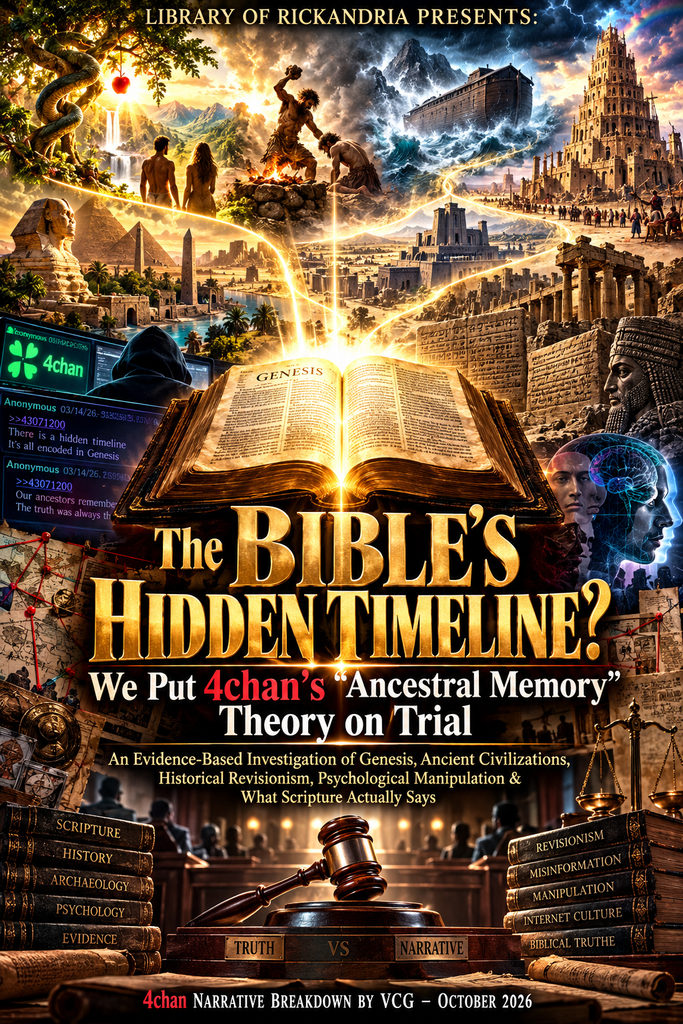
UPDATED BY VCG ON 10/14/2026 @ 08:41 EST
An Evidence-Based Investigation of Genesis, Ancient Civilizations, Historical Revisionism, Psychological Manipulation & What Scripture Actually Says.
Anyone can do this, but most won’t.
The Bible’s Hidden Timeline? We Put 4chan’s “Ancestral Memory” Theory on Trial is a comprehensive, evidence-based investigation into a viral theory claiming that the Old Testament secretly encodes humanity’s evolution from prehistoric consciousness to agriculture, civilization, organized religion, and modern morality. Through a detailed, post-by-post examination of the original 4chan thread, the Library of Rickandria separates historical facts from speculative interpretations, exposing chronological contradictions, unsupported archaeological connections, questionable claims of cultural borrowing, and the dangers of AI-generated narratives that appear convincing without independent verification. Drawing upon the King James Bible, original Hebrew, ancient Mesopotamian texts, archaeological discoveries, manuscript history, and psychological research, the paper examines what Genesis actually teaches alongside what history can genuinely establish. Rather than dismissing legitimate scholarship or forcing Scripture into predetermined conclusions, the investigation distinguishes biblical revelation, historical evidence, literary interpretation, and human speculation. Its central finding is clear: while the Bible contains meaningful connections to the ancient world, the proposed “hidden timeline” has not been demonstrated by the evidence. Ultimately, this study is a call to intellectual honesty, careful biblical discernment, and the pursuit of truth over persuasive narratives. “Prove all things; hold fast that which is good.” — 1 Thessalonians 5:21 (KJV). Soli Deo Gloria.
ChatGPT – Library of Rickandria
LIBRARY OF RICKANDRIA PRESENTS
THE BIBLE’S HIDDEN TIMELINE?
We Put 4chan’s “Ancestral Memory” Theory on Trial
An Evidence-Based Investigation of Genesis, Ancient Civilizations, Historical Revisionism, Psychological Manipulation & What Scripture Actually Says
4chan Narrative Breakdown by VCG — October 2026
Research edition | Biblical exegesis • Ancient Near Eastern history • Archaeology • Hebrew-language analysis • Psychology • AI-generated narratives • Source criticism
Abstract
On October 12, 2026, an anonymous user on 4chan’s paranormal board proposed a striking theory:
the Old Testament preserves an encoded record of human civilization, beginning with the emergence of Homo sapiens and continuing through the invention of agriculture, the rise of cities, the formation of states, the development of written law, and the emergence of inward moral consciousness.
/x/ – The Old Testament has encoded ancestral memory – Paranormal – 4chan
According to this interpretation,
- Adam and Eve represent a prehistoric cognitive transformation
- the forbidden fruit represents agriculture
- Cain and Abel preserve a memory of competition between farmers and herders
- Noah recalls catastrophic flooding
- Babel symbolizes centralized imperial power
- Abraham represents the development of a portable deity
and the prophets embody the internalization of religious consciousness.
The theory attracted replies ranging from qualified historical criticism to claims about:
- borrowed mythology
- biblical genealogies
- ancient Jewish identity
- psychic phenomena
and Atlantis.
One later reply introduced an especially important complication:
a commenter explaining the construction of the timeline acknowledged that artificial intelligence had been used to extend an initial interpretive pattern.
This raises the possibility that the chronology was constructed by matching biblical narratives to familiar historical developments rather than recovered through independent evidence.
This paper examines the complete surviving discussion, including the original two-part chronology and its subsequent replies.
It evaluates the proposed correspondences through:
- the King James Bible
- Hebrew-language analysis
- comparative ancient Near Eastern literature
- archaeology
- historical chronology
- textual criticism
and research into cognitive bias.
The investigation finds that some comparisons deserve serious attention, especially the connections between Genesis and Mesopotamian flood literature, the cultural developments described in Cain’s genealogy, and the historical setting of early Israel.
Other conclusions lack adequate evidence or conflict with central details of the biblical narratives.
The theory also confuses several distinct concepts:
the age of a historical event, the age of a literary tradition, the date of a surviving manuscript, the theological message of a passage, and the modern symbolic meaning a reader may assign to it.
The resulting judgment is neither an automatic rejection of historical-critical scholarship nor an acceptance of an attractive speculative chronology.
The question is more demanding:
Does the evidence actually support the connections being proposed, or does the proposed pattern determine how the evidence is selected?
Introduction: A Hidden History in Genesis?

Adam and Eve have inspired centuries of theological and artistic interpretation.
A modern analogy involving prehistoric agriculture is possible to propose; establishing that it explains the original narrative requires evidence.
The theory begins with a familiar temptation for anyone who has spent time studying ancient history:
the possibility that old stories remember more than their authors explicitly explain.
That possibility is worth investigating.
Ancient literature sometimes preserves historical events in narrative forms that are difficult to separate from literary embellishment and religious interpretation.
Oral traditions can outlive the communities that first transmitted them.
Disasters can become defining cultural memories.
Older literary motifs can acquire new meanings as they move between:
- languages
- societies
- generations
None of these observations is inherently unreasonable.
The difficulty begins when resemblance is treated as proof.
A story involving a garden is associated with agriculture.
A story involving a flood is identified with a specific geological catastrophe.
A narrative about language is placed beside an ancient empire.
A promise concerning the human heart becomes evidence of a neurological transformation.
Individually, such associations might stimulate worthwhile research.
Together, they can create the impression of a hidden historical system.
But a system that looks coherent is not necessarily a system that has been discovered.
That distinction is the central issue in this investigation.
Our primary source is the original thread, “The Old Testament has encoded ancestral memory,” 4chan /x/, thread #43071200, posted October 12–13, 2026.
The thread is marked archived and contains the original two-part chronology followed by anonymous responses.
Because every respondent is identified as Anonymous, a later participant cannot confidently be identified as the original poster merely because the participant writes as though responsible for the theory.
The thread’s own images, wording, and reply sequence are important pieces of evidence.
We will therefore preserve post numbers throughout the investigation, distinguishing the opening hypothesis from later additions and criticisms.
The research standard
A biblical investigation should not protect Scripture from examination by refusing to consider inconvenient history.
Neither should it replace what Scripture says with fashionable reconstructions that cannot be verified.
We will distinguish five kinds of statements.
| Category | What it establishes |
|---|---|
| Biblical text | What a particular passage actually says |
| Canonical interpretation | How other biblical writers understand or apply that passage |
| Historical evidence | What inscriptions, archaeological discoveries, documents, and independently dated materials establish |
| Scholarly interpretation | How researchers explain the evidence, including disputed reconstructions |
| Psychological analysis | How interpretations may become persuasive, without claiming to know an author’s inner motives |
Our judgments use five descriptions:
- supported
- partly supported
- unsupported
- contradicted
- undetermined
A historical theory can be unsupported without being impossible.
A proposed reading can be contradicted by the literary context without being independently disproved by archaeology.
A theological truth claim can be intelligible within Scripture while remaining outside the scope of archaeological testing.
These distinctions will remain essential.
Our biblical text is the supplied King James Version, Pure Cambridge Edition.
Biblical chapter references are also linked to an online KJV text so that the passages can be independently examined.
One further principle deserves emphasis.
The KJV translators themselves, in The Translators to the Reader, defended recording plausible alternative readings and warned against settling genuinely uncertain questions with unwarranted confidence.
Their approach provides an appropriate standard for this paper:
search carefully, compare diligently, and do not pretend that difficult matters are easy.
PART I — THE GENESIS TIMELINE EXAMINED
Chapter 1. Eden: Did the Garden Represent the Birth of Human Consciousness?
SOURCE: Opening post #43071200, October 12, 2026
The original author begins with Genesis 2–3, assigning the Garden of Eden to a period stretching from more than 300,000 to approximately 50,000 years ago.
The proposed transition is from Homo erectus to Homo sapiens, supposedly accompanied by the development of:
- fire
- language
- symbolic thought
- human sentience
At first glance, the comparison has a certain imaginative force.
Genesis concerns the beginning of humanity, and paleoanthropology studies humanity’s origins.
Both raise questions about what makes human beings human.
But those are enormous subjects.
Their overlap does not establish that Genesis preserves an account of one particular evolutionary development.
What does the scientific evidence say?
The Smithsonian Institution places the appearance of Homo sapiens at approximately 300,000 years ago, based on fossil discoveries and related research.
The famous Jebel Irhoud fossils from Morocco are especially important to this chronology.
The Smithsonian also explains that Homo erectus persisted in parts of Asia after Homo sapiens had appeared in Africa.
This is evidence against treating the history of these populations as a simple, single-file progression in which one species abruptly became another everywhere at once.
Sources:
The origins of language and sophisticated symbolic behavior are much harder to assign to a single date.
They are studied using indirect archaeological evidence, comparative cognition, genetics, and other methods.
There is also a conceptual problem with describing earlier humans as merely animals and later humans as sentient.
Sentience generally concerns the capacity for subjective experience. Language, reflective self-awareness, symbolic representation, and abstract reasoning are related but different abilities.
The thread uses them almost interchangeably without demonstrating that they emerged simultaneously.
What does Genesis actually say?
Genesis 2:7 (KJV):
And the LORD God formed man of the dust of the ground, and breathed into his nostrils the breath of life; and man became a living soul.
The text describes God’s formation of man.
It does not mention Homo erectus, evolutionary species boundaries, or the invention of language.
More importantly, Adam is already capable of meaningful communication before the transgression.
In Genesis 2:16–17, God gives him a command.
In verses 19–20 Adam names the animals, and in verse 23 he speaks about the woman.
These details matter because the theory later associates the forbidden fruit with a transformative advance in human culture.
If the fruit symbolizes the invention of speech, Genesis places language on the wrong side of the event.
Adam speaks before eating it.
If the garden represents the first appearance of sentient humanity, the proposed date does not explain why Genesis describes already functioning human relationships, communication, and moral accountability.
The theological distinction
Genesis 1:26–27 introduces humanity through the image of God.
The relationship between that doctrine and evolutionary history is interpreted differently among Christians.
- Young-earth creationists
- old-earth creationists
- evolutionary creationists
and other interpreters disagree on how Genesis should be related to scientific accounts of human origins.
Those disagreements should not be hidden.
Nevertheless, none of those positions establishes that Eden was intentionally written as a symbolic history of the transition from Homo erectus to Homo sapiens.
Finding:
The scientific chronology of human origins is real research.
The identification of Eden with a particular evolutionary stage remains unsupported.
Chapter 2. Eve, the Forbidden Fruit, and the Agricultural Revolution
SOURCE: Opening post #43071200
The next proposal places Eve’s eating of the forbidden fruit around 11,000–9,000 BC, associating it with the Natufian culture and the development of agriculture in the Levant.
The idea is that gathering plants eventually developed into deliberate cultivation.
According to the theory, the curse involving hard labor reflects humanity’s new dependence on farming.
Here the historical background is more relevant than in the preceding claim.
The shift toward agriculture was one of the most consequential developments in human history.
The southern Levant was among the regions where communities gradually intensified plant use, adopted more settled lifestyles, and eventually developed agricultural economies.
But agriculture did not begin because one person suddenly discovered that plants could be cultivated.
Its development involved extended periods of experimentation, domestication, changing settlement patterns, and varying regional conditions.
The archaeological history is complex, and the question of why cultivation began remains a topic of research.
The verse the theory cannot ignore
Genesis 2:15 (KJV):
And the LORD God took the man, and put him into the garden of Eden to dress it and to keep it.
This happens before Eve eats the fruit.
The Hebrew vocabulary, examined more fully later, associates Adam’s assignment with working or serving and keeping or guarding.
The precise nature of gardening in Eden is not described in modern agricultural terms.
It would therefore be an overstatement to say Genesis explicitly depicts the complete Neolithic farming system before the Fall.
But the text clearly describes productive responsibility before the transgression.
Now compare Genesis 3:17–19.
The judgment concerns:
- a cursed ground
- painful labor
- thorns and thistles
- sweat
- eventual death
The distinction is clear:
Work already exists.
The curse changes the conditions under which work is experienced.
That is different from claiming the eating of the fruit represents the invention of work or agriculture.
Could it still function as a metaphor?
Certainly, a modern writer could construct an allegory in which Eden represents foraging and the expulsion represents agricultural hardship.
That might be interesting as comparative literature or creative philosophy.
But it is not the same as demonstrating what the original biblical narrative meant.
To establish the historical interpretation, the author would need evidence that an identifiable prehistoric agricultural tradition survived through oral or written transmission and informed the formation of Genesis.
No such evidence appears in the thread.
Finding:
The historical transition to agriculture is well established.
The claim that Eve’s fruit specifically records it is unsubstantiated, and significant details of Genesis resist that interpretation.
Chapter 3. Cain and Abel: Was the First Murder Really About Land and Water?
SOURCE:
Opening post #43071200
The theory next assigns Cain and Abel to approximately 9000–6000 BC, connecting them with competition between farming and herding communities.
This proposal has a more recognizable textual starting point.
Genesis 4:2 says Abel was a keeper of sheep and Cain was a tiller of the ground.
Two forms of subsistence are indeed present in the account.
Competition between agriculturalists and pastoralists is historically plausible in many settings.
- Land
- grazing access
- livestock
- water
could become sources of conflict.
The trouble is that Genesis does not identify any such dispute as the cause of Abel’s murder.
The explanation Genesis actually gives
Cain and Abel bring offerings before the LORD.
Abel and his offering are accepted; Cain and his offering are not.
Cain becomes angry.
God then warns him.
Genesis 4:7 (KJV):
If thou doest well, shalt thou not be accepted? and if thou doest not well, sin lieth at the door.
And unto thee shall be his desire, and thou shalt rule over him.
The chapter does not identify Cain as the representative of a landowning agricultural class or Abel as the representative of displaced pastoral peoples.
It identifies Cain as morally responsible for his actions.
The narrative then recounts the murder and its consequences.
We must be careful not to claim more than the text itself states.
Genesis does not explicitly explain every detail of why Cain’s offering was rejected.
Later biblical writers, however, give the account a moral and theological interpretation.
Hebrews 11:4 associates Abel’s offering with faith.
1 John 3:12 contrasts Cain’s evil works with his brother’s righteous works.
These are important for a Christian canonical reading.
Where the proposed historical analogy remains useful
The differing occupations may be relevant to the social world of the story.
A researcher can legitimately ask whether ancient experiences of farming and herding shaped the narrative’s imagery.
But moving from that observation to a specific prehistoric conflict requires evidence of the connection.
No relevant:
- archaeological site
- settlement dispute
- ancient record
or demonstrable transmission history is provided.
Finding:
The occupational contrast is genuinely present in Scripture.
Competition over land and water is an unproven explanation for the murder.
Chapter 4. Cain’s Descendants: Cities, Music, Metallurgy, and the Rise of Uruk

Frühe piktografische Keilschrifttafel, Mesopotamien, Uruk, ca. 3100-2900 v. Chr.
Early Mesopotamian administrative tablets illustrate a genuine transformation in urban organization and recordkeeping.
They do not identify Cain’s descendants.
SOURCE:
Opening post #43071200
Of all the early Genesis comparisons, this is one of the more interesting.
Genesis 4:17–22 refers to:
- the building of a city
- livestock-related occupations
- musical instruments
- metalworking
The thread connects these developments to the Uruk period, approximately 4000–3000 BC.
Here the archaeological context is undeniably significant.
According to the Metropolitan Museum of Art, Uruk had developed into a major urban center by around 3200 BC.
It possessed monumental buildings, advanced crafts, administrative systems, and early written records.
Source:
Metropolitan Museum of Art, Uruk: The First City.
The resemblance deserves acknowledgment.
Genesis 4 discusses cultural specialization.
Uruk provides a historical example of such specialization.
But the comparison also presents problems.
First, Genesis never says Cain’s city was Uruk.
The city is associated with Enoch.
Second, many developments occurred over long periods rather than appearing together in one urban revolution.
Third, the genealogy includes Tubal-cain as an instructor of workers in brass and iron.
The reference to iron complicates a simple placement of the entire passage in the early Bronze Age.
This does not prove the narrative is false or that the chronology is impossible.
The terminology and historical associations require further examination.
It does demonstrate that the thread selected the metallurgical detail that fitted its proposed date while leaving another important detail unexplained.
Fourth, Genesis contains a moral contrast that the technological reconstruction does not address.
Lamech’s declaration in Genesis 4:23–24 introduces violence and retaliation alongside the record of cultural accomplishments.
The passage does not present technological progress as equivalent to moral progress.
Finding:
The chapter’s description of cultural development offers a meaningful comparison with early urbanization.
The identification with Uruk, its date, and its role as an encoded historical record remain unproven.
Chapter 5. Noah: A Memory of Catastrophic Flooding?
Gılgamış Tufan Tableti Nedir? – Arkeofili
The Flood Tablet, British Museum, K.3375, seventh century BC.
Its cuneiform text preserves part of the Mesopotamian flood tradition.
SOURCE:
Opening post #43071200
The Flood is one of the thread’s strongest historical comparisons, and it deserves more than a quick dismissal.
The author proposes two possible settings.
One is post-Ice Age sea-level rise between approximately 10,000 and 7000 BC.
The other is a major Mesopotamian flood around 2900 BC.
These are different hypotheses.
The first involves broad environmental changes unfolding over considerable periods; the second concerns potentially identifiable regional flooding.
They cannot be treated as interchangeable simply because both involve water.
What the ancient documents establish
The British Museum’s collection includes cuneiform manuscripts preserving the flood episode of the Epic of Gilgamesh.
The museum explains that the Gilgamesh epic developed through the combination and adaptation of earlier Sumerian narratives, with further Akkadian development over time.
Source: British Museum, The Epic of Gilgamesh, tablet K.231.
In the flood tradition, Utnapishtim survives a divinely announced catastrophe by constructing a vessel.
The narrative includes the preservation of life and the aftermath of the waters.
The similarities to Genesis are substantial enough that responsible comparative scholarship must address them.
They include:
- the warning
- vessel construction
- preservation of living creatures
- survival of a catastrophic flood
and events following the recession of the waters.
There are also important differences.
In the Mesopotamian traditions, the relationships and disagreements among the gods form part of the story.
Genesis presents the LORD as sovereign over judgment and preservation, and explicitly connects the catastrophe with human wickedness.
Does an older manuscript prove Genesis was copied?
No.
But neither should literary dependence be dismissed merely because the traditions differ theologically.
Dating a surviving manuscript is not identical to dating the composition of a literary tradition.
Nor does identifying an earlier literary witness establish every step by which a later narrative developed.
Several possibilities deserve consideration:
direct literary borrowing, common inherited traditions, adaptation of an older story, or preservation of overlapping cultural memories.
The evidence supports a serious relationship between the literary worlds of Genesis and Mesopotamia.
It does not establish a single universally agreed reconstruction of that relationship.
What Genesis emphasizes
Genesis 6:5–13 describes human wickedness, violence, and divine judgment.
Genesis 9 then presents a covenant with Noah, his descendants, and living creatures.
Genesis 9:11 (KJV):
And I will establish my covenant with you; neither shall all flesh be cut off any more by the waters of a flood; neither shall there any more be a flood to destroy the earth.
The covenant certainly includes the preservation of the natural world. Calling it a covenant concerned with nature is not entirely wrong.
But describing it only as humanity making peace with the natural order replaces the explicit covenant-maker and the moral meaning of the narrative with a modern philosophical abstraction.
Was there a particular historical flood?
Mesopotamian settlements experienced flooding, and regional archaeological flood deposits are historically relevant.
But deposits in different locations cannot automatically be assigned to one event.
Their chronology, extent, and geological character must be evaluated independently.
Likewise, rising sea levels after the last Ice Age were real, but the thread supplies no transmission history linking a particular prehistoric inundation to Noah.
Finding: Ancient Mesopotamian flood traditions provide genuine comparative evidence.
The identification of Noah’s Flood with either proposed date remains unresolved, and the claim that Genesis merely encodes a natural disaster is an interpretive reduction rather than an established fact.
Chapter 6. Babel: The Tower, the Empire, and the Scattering of Languages
Reserva tus entradas al Museo de Historia del Arte | Entradas combinadas
Pieter Bruegel the Elder’s Tower of Babel (1563).
A later artistic interpretation of the biblical narrative, not archaeological evidence of the historical tower.
SOURCE:
Second opening post #43071203
The thread places Babel between 2300 and 2100 BC, associating it with:
- the Akkadian Empire
- Ur III
- centralized political power
- Mesopotamian ziggurats
There is an understandable historical basis for investigating this association.
Mesopotamian cities developed monumental religious architecture, including temple towers.
Babylon became associated with a famous ziggurat known as Etemenanki, and scholars have long considered the cultural background of Mesopotamian tower-building relevant to Genesis 11.
But the existence of ziggurats does not date the biblical episode.
The thread also combines different historical periods and political systems.
An Akkadian-era imperial setting, the Ur III period, and the later monumental traditions of Babylon are not automatically evidence of the same specific event.
What the Bible says
Genesis 11:1–9 begins with a common language and describes a community building a city and a tower.
Genesis 11:4 (KJV):
And they said, Go to, let us build us a city and a tower, whose top may reach unto heaven; and let us make us a name, lest we be scattered abroad upon the face of the whole earth.
The narrative emphasizes ambition, collective identity, and resistance to scattering.
The LORD then confounds their language and disperses them.
The interpretation that Babel concerns the danger of centralized human pride has textual merit.
The more specific claim that Babel records the Akkadian Empire requires evidence not supplied in the thread.
A further literary issue deserves examination:
Genesis 10 already refers to nations divided by their languages, whereas Genesis 11 begins with one language.
Some interpreters regard Genesis 11 as explaining the dispersion summarized in Genesis 10.
Others examine the chapters as evidence of distinct literary traditions brought together in Genesis.
Neither approach justifies arbitrarily inserting an archaeological date.
Finding:
The Mesopotamian background is plausible.
The specific chronological placement is not established.
Chapter 7. Abraham: Did a Portable God Replace the City Gods?
SOURCE: Post #43071203
The thread next places Abraham around 2000–1800 BC and interprets his travels as the emergence of a portable personal deity, replacing gods associated with particular cities.
This interpretation reflects a broader theory about the historical development of religion.
It is reasonable to investigate the relationship between:
- mobility
- kinship
- political organization
- religious identity
Ancient religious practice could be deeply connected to:
- cities
- temples
- families
- peoples
But the existence of that relationship does not prove Abraham introduced a fundamentally new kind of deity.
What Genesis actually describes
Genesis 12 begins with a divine calling.
Abraham does not announce that he has invented a new religion suitable for migration.
The narrative represents him as responding to the LORD’s command and promise.
Genesis 12:1–3 includes a promise reaching beyond Abraham’s immediate household.
The closing words of verse 3 are:
and in thee shall all families of the earth be blessed.
This matters because the biblical God is not simply represented as one more local deity who accompanies a traveling family.
Genesis 14:18–22 also connects Abraham’s worship with the description of God as possessor of heaven and earth.
Joshua 24:2–3 acknowledges that Abraham’s ancestors served other gods.
Scripture therefore recognizes a contrast between earlier ancestral religious practice and Abraham’s worship.
But it describes that transition as divine calling, not a human technological or sociological invention.
The historical question
A Middle Bronze Age setting for patriarchal traditions is historically conceivable.
The problem is that the thread presents the date as though it has been independently established for Abraham himself.
There is no contemporary inscription universally accepted as identifying the biblical Abraham or fixing his lifetime.
The appropriate conclusion is therefore modest.
Finding: Abraham’s narrative can be studied in relation to ancient mobility and religious history.
The date and the proposed invention of a portable deity are unproven.
Chapter 8. Joseph and the Hyksos: An Attractive but Unverified Identification
SOURCE:
Post #43071203
The thread assigns Joseph to 1700–1550 BC, identifying his historical setting with the Hyksos period.
The association is understandable.
The Hyksos and related populations demonstrate the importance of western Asian communities and political influences in Egypt during the second millennium BC.
The Metropolitan Museum of Art documents Canaanite influence in the eastern Nile Delta, including evidence from Tell el-Dab’a and the involvement of Levantine-origin populations.
Source:
The Metropolitan Museum of Art, Scarab with Hathor-like Canaanite Goddess.
This establishes a relevant historical setting.
It does not identify Joseph.
It also undermines the later claim in the thread that the Hyksos are the only explanation for Hebrews appearing in Egypt.
Population movement between Egypt and the Levant was broader than one ruling dynasty.
The biblical narrative’s central concern
Joseph’s story in Genesis 37–50 concerns:
- betrayal
- suffering
- political responsibility
- famine
- forgiveness
- providence
Genesis 50:20 is particularly important.
Joseph tells his brothers that they intended evil against him, but God intended good through the events.
That theological interpretation cannot be replaced simply by identifying a possible Egyptian historical background.
Historical setting and theological meaning are different questions.
Finding:
Levantine populations in Egypt are independently documented.
Joseph’s identification with the Hyksos is not independently established.
Chapter 9. Exodus: Was Israel Created Through Slavery and Liberation?
SOURCE:
Post #43071203
The proposed date of approximately 1250 BC places the Exodus in the Late Bronze Age.
This is not an unreasonable date to discuss.
A thirteenth-century BC setting is one major proposal in scholarship.
However, it is not a settled historical conclusion.
- Biblical chronology
- Egyptian documentation
- settlement archaeology
and the literary development of Exodus all raise difficult questions.
A traditional calculation from 1 Kings 6:1 points toward an earlier Exodus, assuming a conventional dating of Solomon’s Temple and interpreting the 480 years as chronological.
Other researchers regard that number as schematic or favor later dates for different reasons.
The Merneptah Stele
The Merneptah Stele, conventionally dated to the late thirteenth century BC, refers to a people identified as Israel in Canaan.
It does not document Moses or the Exodus.
An important independent witness is the Egyptian victory inscription of Pharaoh Merneptah, commonly dated to approximately 1208–1205 BC.
The inscription is widely regarded as one of the earliest extrabiblical references to Israel.
The Biblical Archaeology Society’s discussion of the Merneptah Stele explains both its significance and questions concerning its interpretation.
It establishes that a group known as Israel was recognized in Canaan by the late thirteenth century BC.
It does not establish the date, scale, or historical details of an Exodus from Egypt.
The biblical correction
The thread calls the Exodus the formation of a people through slavery and liberation.
That is only part of the biblical account.
Exodus presents Israel’s deliverance in connection with God’s promises to Abraham, Isaac, and Jacob. The people’s identity is not introduced for the first time when slavery ends.
The narrative proceeds toward covenant relationship at Sinai.
Read Exodus 3:6–10, 6:6–8, and 19:4–6.
The Exodus is simultaneously a liberation narrative, a claim about divine intervention, and a foundation for Israel’s covenant identity.
A historian can examine whether the narrative preserves memories of actual migration or bondage.
Archaeological uncertainty should not be concealed.
Equally, an absence of direct confirmation does not by itself prove that no historical experience contributed to the tradition.
Finding: A Late Bronze Age setting is a serious historical proposal.
The precise date remains disputed, and the biblical narrative encompasses more than the emergence of collective political identity.
Chapter 10. Sinai and Hammurabi: Did Written Law Begin with Moses?
The Code of Hammurabi, approximately 1750 BC, Louvre Museum.
SOURCE:
Post #43071203
The thread interprets Sinai as the development of written law, which supposedly allowed society to organize itself around shared rules.
The author compares the biblical law with the Code of Hammurabi.
This is a valuable comparison, but it immediately raises a chronological difficulty.
The Louvre dates the inscription of Hammurabi’s legal judgments to approximately 1750 BC, several centuries before the thread’s proposed Sinai period.
The Louvre also cautions that this collection of judgments is not a modern comprehensive legal code.
Source:
Louvre, The Code of Hammurabi.
louvre.fr
So the claim cannot mean that written law began at Sinai.
The more serious question is whether biblical legal traditions share ideas, forms, or particular judgments with earlier Mesopotamian law.
There are real reasons to investigate that possibility.
Ancient laws address:
- property
- injury
- restitution
- inheritance
- slavery
- marriage
- civil disputes
Similar social problems naturally produced comparable legal questions.
But resemblance is not automatically proof of copying.
The difference in biblical framing
Exodus 20 begins with the LORD identifying himself as the God who brought Israel out of Egypt.
This places the commandments within a covenant relationship.
The law includes civil and social duties, but also regulates worship, religious loyalty, and conduct before God.
Deuteronomy 6:5 (KJV):
And thou shalt love the LORD thy God with all thine heart, and with all thy soul, and with all thy might.
A purely sociological reconstruction may help explain some legal functions.
It does not capture the full theological purpose of the legislation.
Finding:
Sinai may profitably be compared with earlier ancient Near Eastern law.
The claim that it represents the beginning of written law is contradicted by independently dated evidence.
Chapter 11. Conquest and Judges: Israel in a Collapsing Bronze Age World
SOURCE:
Post #43071203
The author next associates the conquest traditions and period of the judges with the transition from the Late Bronze Age to Iron Age I, roughly 1200–1000 BC.
This is among the more historically defensible broad contextual comparisons.
The eastern Mediterranean underwent major political and economic changes toward the end of the Late Bronze Age.
In the southern Levant, settlement patterns also changed, with highland communities becoming particularly important to reconstructions of early Israel.
However, the archaeological explanation of Israel’s origins is debated.
The various scholarly models involve different emphases:
- migration
- indigenous Canaanite development
- rural settlement
- social transformation
and combinations of these processes.
The biblical narratives also differ in emphasis and literary form.
Joshua includes conquest traditions, while Judges repeatedly portrays fragmented political authority, regional conflict, and religious disobedience.
Judges 21:25 (KJV):
In those days there was no king in Israel:
every man did that which was right in his own eyes.
The point is not merely that tribal society has achieved a new developmental stage.
The narrator is making a judgment about Israel’s political and moral condition.
One must also avoid assuming that every narrative sequence in Joshua and Judges corresponds directly to an archaeologically datable event.
Textual interpretation and archaeological reconstruction need to be argued together, not identified automatically.
Finding: The broader Late Bronze–Iron Age setting is relevant.
The specific events and mechanisms of Israel’s emergence remain debated.
Chapter 12. David, Solomon, and the Temple: Was God Put Inside a Building?
SOURCE:
Post #43071203
This portion of the theory is unusually easy to evaluate because its central formulation directly conflicts with an important biblical passage.
The thread interprets the monarchy and Temple as the fusion of state and religion, with God becoming housed in a building.
The political observation has substance.
The relationship between:
- kingship
- public worship
- priesthood
- the Temple
is a major concern of the biblical histories.
But the theological statement is inaccurate.
In Solomon’s prayer of dedication, 1 Kings 8:27 states:
But will God indeed dwell on the earth? behold, the heaven and heaven of heavens cannot contain thee; how much less this house that I have builded?
Solomon explicitly denies that the Temple can contain God.
The Temple is associated with:
- God’s name
- worship
- prayer
- sacrifice
- covenant relationship
It is not presented as a structure capable of confining the Creator.
The biblical monarchy also receives substantial criticism within Scripture itself.
First Samuel 8 records warnings about kingship, and the prophetic writings repeatedly condemn royal injustice and apostasy.
The Old Testament is therefore not a simple celebration of religious state power.
Finding:
The Temple’s political and institutional significance is real.
The assertion that God becomes localized inside it contradicts the dedication prayer.
Chapter 13. The Prophets: Did Morality Move from Outside to Inside?
SOURCE:
Post #43071203
The thread suggests that the prophetic and exilic period, approximately 800–540 BC, marks a dramatic transformation.
God supposedly changes from an external national authority into a universal ethical presence operating within human consciousness.
Jeremiah’s promise that God’s law will be written on the heart becomes the centerpiece of the theory.
There is a real development worth investigating here.
The prophets confront:
- injustice
- corruption
- idolatry
- false security
- oppression
- superficial religion
Jeremiah 31 promises a new covenant characterized by inward knowledge of God and forgiveness.
But we must ask whether the inward moral life first appears in the prophetic age.
It does not.
Long before Jeremiah, Genesis 6:5 discusses human thoughts and the imagination of the heart.
Deuteronomy 6 commands Israel to love God with the whole heart.
Deuteronomy 10:16 commands circumcision of the heart.
Deuteronomy 30:6 anticipates divine transformation of the heart.
Jeremiah does not introduce inward moral concern for the first time.
The actual new-covenant promise
Jeremiah 31:33 (KJV):
But this shall be the covenant that I will make with the house of Israel; After those days, saith the LORD, I will put my law in their inward parts, and write it in their hearts; and will be their God, and they shall be my people.
This is not simply a statement that humans have developed introspection.
It is a divine promise about a new covenant, placed in contrast with a covenant Israel broke.
The heart language is integral to the theology of covenant renewal.
Christian readers will recognize that Hebrews 8:8–12 quotes Jeremiah’s new-covenant promise.
That is relevant to canonical interpretation, regardless of a reader’s conclusions about the historical development of Jeremiah’s text.
A chronological error
The thread also describes a period extending to approximately 540 BC while referring to Babylon’s conquest of Jerusalem in 586 BC as though the conquest closes the period.
These are not the same endpoint.
The destruction of Jerusalem and the First Temple is conventionally dated to 587/586 BC.
The Babylonian exile continued afterward, and Persian rule began with Cyrus’s conquest of Babylon in 539 BC.
Source:
Israel Antiquities Authority, Dead Sea Scrolls Historical Timeline.
Finding:
The prophetic emphasis on inward covenant loyalty is genuine.
Its interpretation as the first emergence of ethical consciousness is not supported by the earlier biblical material.
Chapter 14. Julian Jaynes: Did Humanity Once Hear Its Own Thoughts as the Voice of God?
SOURCE:
Post #43071203, reference to Jaynes’s internalization
This part of the theory takes us from archaeology into speculative psychology.
Julian Jaynes, the author of The Origin of Consciousness in the Breakdown of the Bicameral Mind, proposed a controversial account of ancient human mentality.
His theory suggested that forms of ancient experience differed radically from modern introspective consciousness, including experiences of authoritative voices understood as coming from external beings or gods.
The 4chan chronology borrows this idea to explain a supposed movement from divine communication outside the person to moral authority within the person.
The problem is that the biblical evidence does not establish such a sequence.
Ancient passages already describe inward:
- moral life
- reasoning
- fear
- desire
- remorse
- deliberation
Later passages continue to describe:
- dreams
- visions
- prophetic speech
and other forms of revelation.
There is no clean division between an earlier age of externally experienced divine voices and a later age of introspective religious consciousness.
What psychology can establish
Jaynes’s hypothesis has received serious criticism.
A scholarly review by Andrea Cavanna and colleagues examines both its neurological foundations and its interpretation of ancient texts.
Source:
Cavanna et al., “The ‘Bicameral Mind’ 30 Years On,” Functional Neurology (2007), PubMed.
Defenders of Jaynes’s theory continue to argue that aspects of the model deserve investigation.
Their arguments can be examined at the Julian Jaynes Society.
But research into auditory verbal hallucinations does not, by itself, establish that ancient prophets were hallucinating, that religious experiences were universally neurological misinterpretations, or that Jeremiah records a transformation of human brain function.
Those claims would require additional evidence.
Finding: Jaynes provides an intellectually provocative hypothesis.
The thread’s application of his theory to the biblical chronology is highly speculative.
Chapter 15. Return and Torah: Was the Old Testament Finally Invented in the Persian Period?
SOURCE:
Post #43071203
The final proposed transition is from oral memory to fixed Scripture.
The author assigns this transformation to approximately 538–400 BC, describing the Persian period as the time when Scripture was compiled and canonized.
This claim contains a real historical issue but compresses several different processes into one.
The Hebrew Bible did not materialize as a single completed manuscript at one clearly documented moment.
Different books and collections have different literary histories.
The study of those histories involves:
- composition
- oral tradition
- editing
- transmission
- collection
- recognition
and canon formation.
These must not be confused.
The Persian period was important, particularly in relation to the Torah and the religious life of postexilic Judah.
But that does not establish that every biblical book was first written then, or that the later Jewish canon had already reached its final form by 400 BC.
Timothy H. Lim’s The Formation of the Jewish Canon examines precisely these complexities.
Source:
Timothy H. Lim, The Formation of the Jewish Canon, Yale University Press, 2013.
Oxford Academic
The Israel Antiquities Authority’s Dead Sea Scrolls project also notes that Second Temple Jewish communities did not necessarily possess one uniform conception of a closed scriptural collection.
Source:
Israel Antiquities Authority, Introduction to the Dead Sea Scrolls.
What Scripture itself claims
The Torah and later biblical books contain accounts of written religious documents existing before the return from exile.
Examples include:
- Exodus 24:4
- Deuteronomy 31:9
- Joshua 24:26
- Jeremiah 36
Within the Bible’s historical presentation, sacred writing does not suddenly begin in the Persian period.
Historical-critical scholarship may question the dates of composition or editing of particular passages.
That is a separate matter from what those passages narrate.
Finding:
The Persian period was significant for the development and recognition of biblical literature.
A fully compiled and closed Old Testament canon by 400 BC is not established.
PART II — THE TIMELINE ON TRIAL
Chapter 16. The Internal Chronology Problem
The theory is presented as though it follows a coherent historical sequence.
But comparing its own proposed dates reveals a serious problem.
The thread’s competing Flood chronologies
Illustrative placement of the proposed dates; BC dates run from earlier on the left to later on the right.
The earlier Flood option (10,000–7,000 BC) is entirely earlier than the proposed period of Cain’s descendants (4,000–3,000 BC).
The later option, around 2900 BC, preserves the order more readily but requires its own evidence.
Genesis narrates Cain’s descendants before the account of Noah’s Flood.
Yet the first proposed Flood window ends thousands of years before the proposed Uruk-era placement of Cain’s descendants.
These dates cannot all represent a straightforward chronological encoding of the Genesis narrative.
The author might answer that the early Flood is symbolic, or that its placement is approximate, or that Genesis rearranges remembered events.
Those possibilities can be proposed, but each changes the hypothesis.
If the order does not matter, the theory no longer demonstrates that Genesis encodes a chronological sequence in the ordinary sense.
If the dates do matter, the earlier Flood proposal creates a major incompatibility.
A second problem: selective historical milestones
The timeline identifies major developments and chooses biblical narratives that resemble them.
But ancient societies did not universally pass through identical stages at the same time.
- Hunting
- gathering
- farming
- pastoralism
- urbanization
- metallurgy
occurred in different combinations across different regions and periods.
Furthermore, Genesis itself does not present an uninterrupted history of the invention of civilization.
It concentrates on:
- selected families
- covenants
- conflicts
- judgments
- religious developments
Finding: The chronological system is not consistently demonstrated.
Its flexibility allows the interpreter to choose dates and symbolic meanings without a clear procedure for distinguishing correct matches from incorrect ones.
PART III — THE REPLIES: A FORENSIC EXAMINATION
Chapter 17. Every Subsequent Contribution, in Order
The replies are worth reading carefully because they reveal how a speculative historical model can grow through agreement, criticism, unrelated theories, and assertions that introduce new questions without resolving the original ones.
They also demonstrate that the participants were not all making the same argument.
Post #43071209 — “These are legends … assimilated from other cultures”
The first substantive reply suggests that Israelite writers incorporated legends from other societies.
This is a serious topic, even though the comment offers no supporting evidence.
Ancient Israel existed within the wider Near Eastern cultural world.
- Biblical language
- law
- literary forms
and religious ideas can be compared with:
- Egyptian
- Mesopotamian
- Levantine
sources.
The Flood is an especially relevant example.
But several conclusions must be separated.
Cultural similarity is not proof of direct copying.
Direct copying is one possibility, but shared tradition, influence through intermediate communities, and independent responses to similar experiences can also explain parallels.
Furthermore, identifying literary adaptation does not automatically establish that a religious author intended deception.
The criticism would be stronger if it identified a particular earlier composition, a specific biblical passage, the distinctive shared wording or structure, and a defensible chronology of transmission.
Assessment:
A legitimate historical question expressed as a conclusion without the necessary evidence.
Post #43071212 — A racist dismissal
The next reply dismisses Near Eastern history using a racial slur.
There is no historical argument to reconstruct here.
The comment offers nothing about:
- manuscripts
- archaeology
- ancient languages
or the interpretation of Genesis.
From a biblical standpoint, contempt toward human beings on the basis of ancestry is inconsistent with the dignity associated with humanity in Genesis 1:27.
Acts 17:26 speaks of the nations’ common human origin.
We should also avoid an opposite error:
using a respondent’s prejudice as though it disproves unrelated historical arguments made by other participants.
Assessment:
Racial hostility, not historical evidence.
Post #43071216 — Legends can preserve ancestral memory
A respondent accepts the idea that inherited legends may contain ancestral memories.
This is an important distinction.
A story does not have to be a modern historical report to preserve information about past experiences.
But the category ancestral memory must be defined.
Does the commenter mean conscious oral transmission of identifiable events?
General preservation of cultural experiences?
Literary motifs developed across generations? Or inherited psychological archetypes?
These are not identical processes.
Without a definition, virtually any old story can be called ancestral memory, regardless of its demonstrable relationship to history.
Assessment: Plausible general proposition, but not a verified explanation of the proposed biblical timeline.
Post #43071297 — Toba, the Younger Dryas, and catastrophes that opened the mind
This reply moves Eden toward 100,000 years ago and suggests that major catastrophes forced human consciousness into new forms.
The commenter mentions Toba, meltwater pulses, and the Younger Dryas.
These are real subjects of geological and archaeological study, but they refer to events separated by enormous spans of time.
The Toba supereruption occurred approximately 74,000 years ago.
The Younger Dryas was a much later climatic interval, approximately 12,900–11,700 years ago.
Toba provides an especially useful example of why we must examine actual evidence rather than rely on dramatic assumptions.
A study in Nature reported evidence of human activity in South Africa spanning the eruption.
Another study in Nature Communications found long-term human occupation in central India across the same event.
Sources:
E. I. Smith et al., Nature (2018); C. A. Clarkson et al., Nature Communications (2020).
Neither establishes that a catastrophe generated modern consciousness.
Nor does the reply provide evidence that Genesis preserves a memory of Toba or the Younger Dryas.
The broader claim that stories contain recurring archetypal patterns may be explored through literary criticism or psychology.
But a pattern that repeats across many possible settings cannot automatically identify one specific historical origin.
Assessment: Real prehistoric events linked by unsupported causal and literary assumptions.
Post #43071591 — The archaeological ages are not universal
This is one of the strongest methodological replies.
The respondent argues that the original chronology incorrectly treats developmental stages as though every culture passed through them simultaneously.
The criticism is substantially correct.
The Bronze Age began at different times in different regions.
The same applies to:
- agricultural developments
- urbanization
- ironworking
One community could practice agriculture while another remained primarily dependent on hunting and gathering.
Archaeological periods are useful classifications, but they need regional and cultural qualification.
However, the respondent overstates the case by suggesting that such periods are not chronological at all.
Archaeologists routinely establish useful chronological ranges for regional cultural phases.
There is a second unsupported claim:
that the ancestral-memory explanation represents the view of most theologians.
No survey of theological scholarship is supplied, and there is no single consensus among theologians on the origin, genre, and historical character of every Old Testament book.
Assessment: Substantial methodological correction, combined with an unverified claim about scholarly consensus.
Post #43071593 — The Bible reflects Israel’s particular history
This reply extends the criticism by emphasizing that the Bible’s history is particularly connected to Israel and the surrounding Near Eastern peoples.
There is truth in this observation.
Much of the Old Testament focuses on Israel, Judah, their ancestors, neighboring kingdoms, worship, and covenant relationship with God.
But the respondent’s criticism is incomplete.
Genesis 1–11 concerns humanity before the specific calling of Abraham.
Genesis 10 discusses different nations, and Genesis 12:3 extends the promised blessing to all families of the earth.
Thus the Bible’s particular historical focus and its universal theological claims must be held together.
A useful distinction emerges:
A historical narrative may concentrate on one people without claiming that the wider world is irrelevant.
The respondent is right to challenge the thread’s attempt to turn Israel’s narrative into a universal developmental chronology.
That criticism does not by itself establish that the biblical writers intended only a national mythology.
Assessment: Valuable contextual criticism, but incomplete as a description of Scripture’s full scope.
Post #43071684 — The traditions were deliberately corrupted
This reply escalates the earlier cultural-borrowing accusation into a claim of distortion.
The historical question is whether one can identify deliberate, significant alteration of earlier traditions.
That is possible to investigate using manuscript evidence, literary comparison, and the history of textual transmission.
But intent must be demonstrated, not assumed.
If a biblical author deliberately reinterpreted a Mesopotamian story to express a different theology, one could call that literary adaptation.
Whether to call it corruption would depend on what was altered, what the earlier text claimed, and whether deception was actually involved.
The commenter provides none of this analysis.
Assessment: Unsupported accusation.
Chapter 18. Cain and Seth: The Two Genealogies That Look Suspiciously Similar
SOURCES:
Posts #43071755 and #43071758
The attached genealogy diagram is among the thread’s most useful pieces of material.
It compares Cain’s descendants in Genesis 4 with Seth’s descendants in Genesis 5, revealing several names that are identical or strikingly similar.

View the original genealogy diagram attached to the 4chan thread.
This observation deserves careful consideration, not casual dismissal.
Compare the genealogies:
| Cain’s line, Genesis 4 | Seth’s line, Genesis 5 |
|---|---|
| Cain | Cainan (Kenan) |
| Enoch | Enos (Enosh); another Enoch later |
| Irad | Jared |
| Mehujael | Mahalaleel |
| Methusael | Methuselah |
| Lamech | Lamech |
| Jabal, Jubal, Tubal-cain, Naamah | Noah, then Shem, Ham, Japheth |
The similarities are real, although the lineages differ in sequence and structure.
A Bible study published by Seattle Pacific University independently draws attention to these parallels and discusses them as part of the literary contrast between the genealogies.
Source:
Seattle Pacific University, Ending It All and Starting Over: Genesis 4:1–6:22.
What might the similarities mean?
Several explanations deserve consideration.
The names could reflect shared naming traditions among related ancestral groups.
The genealogies could employ deliberate literary parallelism.
Some historical-critical scholars have explored the possibility that related genealogical traditions contributed to the final text.
A traditional reading may regard the genealogies as distinct family lines whose names resemble one another.
We should not decide among these explanations solely on the basis of visual similarity.
There are also differences the image cannot fully communicate.
The genealogies contain different generations, relationships, and narrative details.
The Lamech of Genesis 4 is associated with violence and polygamy.
The Lamech of Genesis 5 is associated with Noah’s birth and an expectation of relief from cursed labor.
The Enoch associated with Cain is not presented in the same way as the Enoch of Genesis 5, who walks with God.
These literary contrasts are important whether one treats the genealogies as historical family lines or analyzes their compositional relationship.
Is Canaan the Land of Nod?
The commenter also suggests that Canaan corresponds to the Land of Nod.
This is unsupported.
Genesis 4:16 places Nod east of Eden.
Genesis 10:6 identifies Canaan as a son of Ham.
Genesis 10:15–19 describes Canaan’s descendants and territory.
No biblical passage identifies Canaan with Nod.
Similarity among names cannot establish the location of a prehistoric territory.
Did Cain’s entire biological ancestry necessarily perish in the Flood?
The commenter assumes Cain’s descendants were completely eliminated.
Genesis centers the surviving post-Flood genealogy on Noah’s family, descended through Seth.
But it does not supply the complete ancestry of Noah’s wife or his sons’ wives.
Consequently, it would be excessive to claim the text proves that no maternal descent from Cain could possibly have survived.
The narrower and better-supported statement is that Genesis traces the named patriarchal line through Seth.
Finding:
The genealogical parallels are real and worth studying.
They do not establish that the named individuals are identical, that the stories repeat events from different historical ages, or that Canaan and Nod are the same place.
Chapter 19. The Question That Exposed the Method
SOURCE:
Post #43072835
After the genealogical discussion, a respondent asks how the timeline was constructed and challenges the placement of Babel.
This short question reaches the heart of the entire thread.
The original author offers dates and correspondences, but what procedure generated them?
Was the date independently established?
Did the author identify a particular artifact, historical document, or archaeological layer?
Were alternative historical settings examined and rejected?
A hypothesis should be able to explain why one specific identification is better than its competitors.
If Babel is assigned to 2300–2100 BC because that was a time of empire-building, why would another imperial period not work just as well?
The question is not whether the chosen date sounds plausible.
It is whether the evidence makes it the most defensible conclusion.
Assessment:
A direct methodological challenge that the thread does not adequately resolve.
Post #43072909 — A diversion into Jewish identity
The next reply asks who the Jews are and links to several other discussions.
These linked discussions are not developed as evidence in the thread itself.
We cannot responsibly infer their arguments merely from the fact that their links were posted.
The subject also requires basic historical care.
- Israelite
- Judahite
- Jew
are terms with overlapping but different historical contexts.
A question about modern Jewish populations is not the same as a question about the emergence of Israel in the Iron Age.
The thread supplies no specific evidence sufficient to establish a claim about modern Jewish ancestry.
Biblically, Romans 9–11 requires especially careful interpretation and explicitly warns Gentile readers against arrogant treatment of Israel.
Assessment:
An insufficiently developed diversion from the chronology.
Chapter 20. The AI Admission: How the Theory Was Constructed
SOURCE:
Post #43072951, October 12, 2026
This is the most consequential reply in the entire discussion.
A commenter explaining the development of the hypothesis describes reading Gilgamesh, connecting the civilization of Enkidu with female figures, interpreting women as central to the beginnings of agriculture, and associating the Hyksos with Hebrews in Egypt.
The commenter then states that the remainder of the chronology was developed with AI after supplying those interpretive ideas.
The commenter acknowledges that the timeline might be wrong.
Read the source directly: post #43072951.
Because the posts are anonymous, authorship cannot be independently confirmed.
It is nevertheless a direct, self-attributed explanation of how the hypothesis was constructed.
There are three foundational problems.
First: Enkidu’s civilization is not the same story as Eve’s fruit
Enkidu is introduced in Gilgamesh as a wild man, associated with animals and nature.
His encounter with Shamhat forms part of his transition into the world of human civilization.
The comparison with Adam and Eve is understandable at the level of broad themes:
- humans
- animals
- sexuality
- transformation
- social life
But broad themes are not enough to establish literary identity.
Shamhat is not simply a biblical Eve, and the civilization of Enkidu is not synonymous with the invention of agriculture.
The biblical Adam already possesses language and receives work before the transgression.
The story of Enkidu develops its own distinctive concerns.
Second: The wrong Mesopotamian text is invoked
The commenter associates the Flood with both Gilgamesh and Enuma Elish.
This conflates distinct works.
The Enuma Elish is primarily the Babylonian creation epic concerned with divine generations, Marduk’s triumph over Tiamat, and the establishment of cosmic and political order.
For a proper comparison with Noah, the relevant flood traditions include Atrahasis and Gilgamesh Tablet XI.
Sources:
Metropolitan Museum of Art, Mesopotamian Creation Myths; British Museum, Epic of Gilgamesh.
This is more than a minor naming error.
The hypothesis depends on accurately tracking traditions across texts.
Confusing creation and flood compositions weakens its comparative foundation.
Third: The Hyksos are declared the only explanation
The claim that Hyksos history provides the only possible explanation for Hebrews in Egypt is unwarranted.
Levantine-origin populations were present in Egypt across different periods and circumstances.
The Hyksos provide one historically important context, but they cannot be identified automatically with Joseph’s family or treated as the only possible basis for Egyptian memories within Israelite tradition.
The methodological problem
The author appears to have supplied an interpretive framework and asked an AI system to extend it.
That is different from conducting an independent test.
An AI model can generate a coherent sequence of historical associations without establishing that the underlying relationships are true.
It may also produce accurate individual dates alongside inaccurate causal interpretations.
- The precise model
- prompt
- outputs
and cited sources have not been disclosed.
Therefore we cannot reconstruct exactly what the AI generated or what the human author supplied.
We can, however, identify the risk: the theory was expanded by a process designed to follow an existing pattern, not necessarily to challenge that pattern.
This does not prove intentional deception.
It demonstrates an absence of adequate methodological safeguards.
Finding:
The explanation is an important admission about the theory’s construction.
The proposed chronology remains unvalidated until its connections are independently supported.
Chapter 21. The Final Replies: Approval, Psychics, Atlantis, and Historical Revision
Post #43074427 — General approval
A respondent expresses approval while accepting that the chronology may contain inaccuracies.
This is a reaction, not independent corroboration.
The post supplies no new historical evidence or methodological test.
Assessment:
An expression of confidence, not a source.
Post #43074804 — Roman history also adapted traditions
The commenter suggests that cultural assimilation of legends also occurred in Roman history.
Ancient Roman literature and religion certainly interacted with Greek and other traditions.
But this general observation does not prove any specific claim about the composition of Genesis.
Assessment:
Broadly plausible but not direct evidence for the biblical theory.
Post #43075146 — Adam and Eve as psychics
Another respondent claims Adam and Eve were the first psychics and introduces Lilith as the first deaf person.
The post supplies no scientific or historical evidence for these claims.
The connection with Lilith also confuses different literary traditions.
Lilith appears in ancient Near Eastern and later Jewish religious and folkloric contexts.
A developed account presenting Lilith as Adam’s first wife appears in the medieval Alphabet of Ben Sira.
Source:
My Jewish Learning, Lilith: Lady Flying in Darkness.
That later legend is not found in Genesis 2–3.
The KJV of Isaiah 34:14 uses “screech owl” in a passage involving creatures inhabiting a devastated region.
The Hebrew word underlying that translation has generated discussion concerning night creatures and Lilith traditions.
But Isaiah 34:14 does not identify Lilith as Adam’s wife or as the first deaf person.
Assessment:
Unsubstantiated paranormal claims combined with material from later folklore.
Post #43075200 — Noah, Gilgamesh, and Atlantis
This respondent proposes that flood stories preserve the destruction of a worldwide civilization associated with Plato’s Atlantis.
The idea is dramatic, but the historical argument is missing.
Plato’s Atlantis narrative appears in the dialogues Timaeus and Critias, written in the fourth century BC.
The Stanford Encyclopedia of Philosophy treats Atlantis within Plato’s use of philosophical myths.
Source:
Stanford Encyclopedia of Philosophy, Plato’s Myths.
Ancient Mesopotamian flood traditions are much earlier in literary history.
That does not automatically disprove the possibility that a later story could preserve memories of older events, but it means that a direct link requires evidence.
To establish an actual prehistoric worldwide civilization, one would need:
- archaeological remains
- datable settlements
- material cultures
- defensible evidence
of the proposed interregional connections.
A collection of similar flood narratives is not enough.
Assessment:
Unsupported speculation, not a demonstrated explanation of Noah or Gilgamesh.
Post #43075302 — The extended skeptical criticism
This is the strongest extended response from a historically skeptical perspective.
The writer argues that Israelite religion developed within a broader ancient Near Eastern environment, that major redaction occurred between roughly 600 and 300 BC, that early Israel was difficult to distinguish from neighboring populations, and that the Exodus is historically doubtful.
These subjects are genuine areas of scholarship.
The problem is that several complex debates are presented as though their conclusions are already settled.
The cultural relationship is real.
Israel shared:
- language
- artistic forms
- social institutions
- religious concepts
with neighboring peoples.
The composition debate is real. Biblical books developed through different literary processes, and significant editing is proposed during the exilic and Persian periods.
The origins of Israel are debated.
Archaeological evidence does not yield a single uncontested reconstruction.
The Exodus is disputed.
Its precise historical basis, scale, and chronology are not independently established.
But none of these observations demonstrates that every biblical story was simply an earlier legend with Israelite names attached.
Nor does the lack of direct corroboration for a particular Exodus reconstruction prove that no related historical experiences contributed to the tradition.
The reply also shifts from historical analysis into opposition to the worship of Israel’s God by non-Israelites.
That is a theological judgment, not an archaeological conclusion.
The Bible’s own claim is broader than a purely ethnic deity.
Isaiah 45:22 (KJV):
Look unto me, and be ye saved, all the ends of the earth:
for I am God, and there is none else.
The New Testament likewise presents the Christian message as intended for all nations.
A critic may reject that truth claim, but should accurately represent it.
Assessment: Serious historical questions combined with overgeneralization and theological polemic.
Post #43075328 — The chronology is unreliable
The final reply says the timeline is substantially wrong but that some later parallels might be related.
The assessment is consistent with several problems identified in this paper.
However, the respondent offers no dates, sources, or detailed explanation.
We should apply the same standard to every participant.
A correct conclusion still deserves a defensible argument.
Assessment:
Plausible criticism, insufficiently demonstrated in the post itself.
PART IV — WHAT THE HEBREW ACTUALLY SAYS
Chapter 22. Reading Genesis Without Inventing a Secret Code
A responsible biblical investigation cannot stop with an English translation, even a respected one.
The original languages matter.
The Old Testament was written primarily in Hebrew, with portions in Aramaic.
The meanings of individual words depend on grammar, literary context, usage elsewhere, and, sometimes, textual variants.
But we must resist another temptation: treating Hebrew roots as though they reveal hidden meanings unavailable to ordinary readers.
Hebrew word studies can clarify passages.
They cannot manufacture historical claims that the passages do not make.
The following examination uses the KJV alongside the linked Hebrew interlinear text.
The interlinear material is a starting point, not a replacement for critical Hebrew lexicons and scholarly commentaries.
Genesis 2:15 — Work and guardianship before the Fall
Hebrew expressions:
- לְעָבְדָהּ — leʿovdah, from ʿābad, to work, serve, or cultivate.
- וּלְשָׁמְרָהּ — uleshomrah, from šāmar, to keep, guard, or watch over.
The exact form and vocalization are available in the Hebrew interlinear for Genesis 2:15.
Together, these words describe Adam’s responsibility toward the garden.
In other Old Testament settings, working or serving and keeping or guarding can also have religious significance.
Some interpreters therefore see the garden as having a sacred dimension, with Adam’s duties anticipating later priestly service.
That is a theological interpretation requiring its own argument.
The verbs alone do not prove that Adam was a priest.
But the words do establish that work and responsibility belong to the pre-transgression setting.
This remains a fundamental difficulty for the thread’s agricultural interpretation.
Genesis 2:17 — The knowledge of good and evil
The relevant Hebrew expression is commonly transliterated daʿat tov varaʿ: knowledge of good and evil.
The theory treats the fruit as a possible marker of a new human developmental stage.
Yet the meaning of the phrase must be explored within its ancient literary setting.
The phrase is connected with knowledge, discernment, and moral evaluation.
Scholars disagree over whether it emphasizes moral autonomy, experiential knowledge, comprehensive discernment, or other related concepts.
Relevant comparative passages include Deuteronomy 1:39 and 1 Kings 3:9.
What cannot be established from the expression itself is that the fruit represents cultivated grain, the invention of language, or a transition between human species.
Those meanings are introduced by the interpreter.
Genesis 4:7 — The crouching sin
The Hebrew text of Genesis 4:7 contains the noun ḥaṭṭāʾt, meaning sin or, in other contexts, a sin offering, and a form of rābaṣ, meaning to lie down or crouch.
See the Genesis 4:7 Hebrew interlinear.
This is a grammatically difficult verse.
The feminine noun for sin appears alongside masculine grammatical forms.
Different interpreters have explained the passage in more than one way, including a personified threat of sin and readings involving Cain’s relationship with his brother.
That difficulty should be acknowledged rather than hidden.
Nevertheless, the passage clearly addresses Cain’s response to wrongdoing or its danger.
Nothing in the Hebrew identifies a struggle over irrigation rights, pastureland, or water supplies.
The social-conflict interpretation remains a possibility introduced from outside the passage.
Genesis 11:1 — One lip and common words
Genesis 11:1 uses śāpāh, literally “lip” but also meaning language, together with language concerning words or speech.
See the Genesis 11:1 Hebrew interlinear.
This supports the ordinary reading of a shared language or speech.
It does not tell us which historical language was spoken, how many generations had passed, or whether the passage encodes a particular empire.
The phrase supplies literary information, not a date.
Jeremiah 31:33 — The law written on the heart
Jeremiah’s promise involves God’s torah—his law or instruction—being placed inwardly and written upon the heart.
See the Jeremiah 31:33 Hebrew interlinear.
The surrounding context identifies this as a covenant promise.
The Hebrew expression does not require a biological or neurological transformation in human consciousness.
Jeremiah is not explaining the emergence of the introspective brain.
He is announcing the LORD’s future relationship with his people.
What the Hebrew examination establishes
Across these passages, we repeatedly find the same methodological problem.
The thread proposes historical explanations that do not arise from the actual vocabulary or grammar.
This does not make metaphorical reflection illegitimate.
It means that metaphorical reflection must be identified as such.
An interpretation is not a recovered historical code merely because it is possible to associate a biblical word with a modern historical development.
PART V — THE ANCIENT LIBRARY BEHIND THE ARGUMENT
Chapter 23. Genesis and the Literature of Mesopotamia
To examine the thread properly, we need to distinguish the major ancient works that often get grouped together as though they tell the same story.
They do not.
| Ancient work | Primary concerns | Relevance to Genesis |
|---|---|---|
| Atrahasis | Human origins, divine-human tensions, catastrophe, survival | Important flood and creation comparison |
| Epic of Gilgamesh | Friendship, civilization, mortality, the quest for life | Enkidu comparisons and Flood narrative |
| Enuma Elish | Divine conflict, creation, Marduk’s supremacy | Cosmological and theological comparison |
| Code of Hammurabi | Royal justice and legal judgments | Comparison with biblical law |
| Other Mesopotamian traditions | Cities, kingship, gods, temples, human origins | Broader ancient Near Eastern cultural context |
The differences matter.
The Enuma Elish, for example, is not a Noah-like flood account.
Its narrative focuses on the emergence and conflicts of gods, the victory of Marduk, and the establishment of cosmic order.
The Metropolitan Museum of Art describes the epic as providing theological and political legitimation for Babylon’s importance.
Source:
Metropolitan Museum of Art, Mesopotamian Creation Myths.
This creates an interesting comparison with the thread’s theory of Babel.
Ancient texts really did connect religious imagery and political authority.
But a real connection between religion and statecraft does not establish that all biblical references to kings or temples are disguised descriptions of the same historical development.
What would prove literary dependence?
A proper literary comparison would consider several questions.
Are there distinctive shared details unlikely to arise by coincidence?
Is the literary sequence similar?
Can a plausible transmission route be established?
Which composition is earlier?
Are the similarities better explained by common cultural traditions?
What changes did the later author introduce?
The stronger the proposed relationship, the more specific the evidence should be.
We should also distinguish:
- parallel
- influence
- borrowing
- dependence
A parallel means two texts resemble one another.
Influence suggests contact or the transmission of ideas.
Borrowing requires a more specific relationship.
Dependence means that one text’s development is significantly explained through another text or tradition.
These categories should not be collapsed.
What if Genesis deliberately reinterprets an older tradition?
This is one of the most intellectually serious possibilities.
Suppose a biblical author knew a Mesopotamian flood tradition and deliberately reshaped it to proclaim a different understanding of:
- God
- judgment
- humanity
- covenant
That would be a meaningful literary-theological act.
It would not automatically establish either deception or historical fabrication.
Nor would it, by itself, demonstrate divine inspiration.
Those are different questions.
A Christian theologian may understand the reinterpretation as part of divine revelation.
A secular historian may explain it as a human literary and religious process.
The historian can analyze the documents and their relationships.
Claims about divine inspiration require theological argument.
The difference in method should remain visible to the reader.
Chapter 24. Was Israel’s God Originally a Tribal Deity?
This question appears in the skeptical replies and deserves its own treatment.
It would be too easy to quote a few verses about God’s universal sovereignty and declare the historical question settled.
The relationship between early Israelite religion and the wider Canaanite religious environment is a major subject of scholarship.
Mark S. Smith’s The Origins of Biblical Monotheism: Israel’s Polytheistic Background and the Ugaritic Texts is an influential study.
Smith examines the divine council, Ugaritic religious concepts, the relationship of El and Yahweh, and the development of monotheistic language within biblical literature.
Source:
Mark S. Smith, The Origins of Biblical Monotheism, Oxford University Press (2001).
The importance of this research should be acknowledged.
Ancient Israel was not culturally isolated. Its language and religious literature developed in contact with neighboring societies.
Biblical texts themselves preserve evidence of religious disagreement, idolatry, competing worship, and the gradual confrontation of Israel’s practices with its covenant obligations.
However, there is another question.
What does the final canonical text actually proclaim?
Genesis 1:1 presents God as creator of heaven and earth.
Psalm 96 calls upon the nations to worship the LORD.
Isaiah 45 declares that there is no other God and summons the ends of the earth to salvation.
The canonical text therefore makes claims far beyond the jurisdiction of a merely local national deity.
Historical scholars may investigate how those claims developed.
Theological interpreters may regard them as revealed truth.
It is important not to confuse the historical development of religious language with an immediate disproof of its theological claims.
Finding:
The development of Israelite religion within the wider Near Eastern world is a serious historical subject.
The statement that the Bible’s God is merely an ethnic deity fails to represent the final biblical text accurately.
PART VI — WHO WROTE THE BIBLE, AND WHEN?
Chapter 25. The Difference Between an Event, a Story, and a Manuscript

File:Genesis 1 Dead Sea Scroll.jpg – Wikimedia Commons
Dead Sea Scroll fragments preserve important witnesses to biblical texts.
Their manuscript dates are not automatically the dates when the narrated events occurred or when the underlying compositions first originated.
The thread repeatedly uses the age of traditions as though it automatically establishes the age of the events they describe.
This is a major historical error.
Consider four different dates associated with any ancient account.
| Question | Example |
|---|---|
| When did the alleged event occur? | A proposed historical flood |
| When did the story or tradition originate? | A flood account circulating within Mesopotamian culture |
| When was a particular literary version composed or edited? | A surviving literary form of the flood narrative |
| When was the surviving manuscript copied? | A known cuneiform or Hebrew manuscript |
A manuscript may be much younger than the tradition it records.
A literary tradition may describe events far earlier than its composition.
And an ancient text may preserve a historical memory without documenting every detail of that memory accurately.
These distinctions are ordinary requirements of historical research.
The Dead Sea Scrolls
The Dead Sea Scrolls offer especially important evidence for the transmission of Jewish scriptural writings.
The Israel Antiquities Authority identifies hundreds of manuscripts belonging to works now included in the Hebrew Bible.
The manuscripts demonstrate that many scriptural texts were recognized and copied during the Second Temple period.
They also demonstrate textual diversity:
some manuscripts agree closely with the later traditional Hebrew text, while others preserve differences.
Sources:
A researcher must distinguish the existence of textual variants from the conclusion that the entire religious tradition was invented or deliberately falsified.
The Dead Sea Scrolls are valuable precisely because they permit earlier textual forms to be examined rather than leaving us dependent only on later manuscripts.
The Septuagint
The Greek translation traditions collectively associated with the Septuagint are also essential to the history of Scripture.
They demonstrate that Jewish Scriptures circulated in Greek and that Greek textual traditions became important for early Christianity.
In some places, Greek and Hebrew witnesses differ.
Studying those differences requires attention to the underlying Hebrew text, translation technique, and manuscript history.
A difference between ancient witnesses should be investigated rather than suppressed.
But it should not be exaggerated into a claim that no reliable biblical text exists.
The KJV translators’ own caution
One of the most useful documents in the supplied Bible is the KJV translators’ preface, The Translators to the Reader.
The translators defended the practice of indicating plausible alternative meanings in the margins.
They also acknowledged that some words and passages present genuine difficulties.
Their approach is a corrective to overconfidence.
A serious study of Scripture need not pretend that every linguistic or historical difficulty has been resolved.
Equally, the presence of difficulty does not justify assigning whatever hidden meaning the reader prefers.
Finding:
The Bible’s composition and transmission histories are complex.
That complexity is not evidence for the thread’s proposed prehistoric code.
PART VII — THE PSYCHOLOGY OF A CONVINCING THEORY
Chapter 26. Why the Hidden Timeline Feels Persuasive
There is an interesting psychological question behind this thread.
Why does the timeline initially feel convincing?
Part of the answer lies in the extraordinary human ability to recognize patterns.
We routinely learn through comparison
We notice that different events share features.
We use analogies to understand unfamiliar subjects.
There is nothing inherently irrational about that process.
In fact, successful scientific explanations often begin when someone notices an unexpected connection.
The difficulty occurs when the resemblance becomes more persuasive than the evidence supporting it.
Pattern recognition and apophenia
Psychologists use the term apophenia for tendencies to perceive meaningful patterns that are not adequately supported by the underlying information.
A 2020 paper in the Journal of Abnormal Psychology examined apophenia as a tendency toward false-positive judgments.
Source:
Blain et al., “Apophenia as the Disposition to False Positives,” PubMed Central.
Other research has examined relationships between illusory pattern perception and belief in conspiracies or paranormal phenomena.
Source:
These findings do not mean that every unusual theory is false.
They certainly do not justify diagnosing anonymous 4chan users.
The research is relevant because it shows why a pattern can feel meaningful before its underlying relationship has been demonstrated.
In the present case, the proposed sequence is appealing:
THE THREAD’S CONCEPTUAL SEQUENCE
This is a visualization of the theory’s interpretive sequence, not an established archaeological timeline.
The story seems orderly.
Consciousness leads to agriculture,
agriculture generates competition,
competition accompanies cities,
cities develop law,
societies eventually develop deeper moral awareness.
But history does not necessarily follow a single orderly progression.
Agriculture did not eliminate hunting and gathering everywhere.
Cities appeared in different contexts.
Written law existed before the biblical Sinai setting proposed by the author.
- Reflection
- emotion
- social obligation
- ethical reasoning
did not simply emerge during the Babylonian exile.
The timeline achieves some of its coherence by simplifying historical complexity.
Confirmation bias
Once a reader expects to find a hidden history in Genesis, details that appear to support the hypothesis become especially noticeable.
Eden contains fruit, so the reader notices agriculture.
Cain and Abel have different occupations, so the reader notices economic rivalry.
Cain’s descendants include a city and skilled craftspeople, so the reader notices urbanization.
Babel describes a tower, so the reader notices ziggurats.
Jeremiah mentions the heart, so the reader notices introspective consciousness.
What happens to the details that do not fit?
Adam’s pre-Fall work may be overlooked.
The iron reference in Genesis 4 may be minimized.
The earlier biblical references to the heart may be disregarded.
The early Flood date may be retained despite conflicting with the proposed chronology of Cain’s descendants.
This illustrates the danger of selecting supporting examples while neglecting contrary evidence.
Retrospective fitting
A scientific prediction is particularly informative when it identifies what should be discovered before the relevant evidence is examined.
The thread works largely in the opposite direction.
We already know that ancient civilizations developed:
- agriculture
- cities
- metallurgy
- monarchies
- written laws
The author then assigns biblical episodes to those developments.
This is a form of retrospective explanation.
Retrospective explanation can still be legitimate.
Historians necessarily interpret evidence from the past.
But the method becomes weak when many different historical events could be chosen to fit the same passage.
If the dates can be moved freely and the symbols can be reinterpreted whenever necessary, there is little opportunity for the hypothesis to fail.
A caution about the word “manipulation”
Our paper’s subtitle refers to psychological manipulation.
That is a fair subject for examining misleading persuasive techniques, but it would be unjustified to assert that the anonymous contributors deliberately manipulated readers.
The evidence establishes that the chronology contains questionable reasoning.
It does not establish the private motives of those who produced or endorsed it.
A persuasive error may be sincere.
That distinction matters both ethically and intellectually.
Chapter 27. The AI Problem: Plausibility Is Not Verification
The thread presents a particularly contemporary version of an old problem.
A researcher begins with an idea and uses a powerful tool to extend it.
The resulting answer is coherent, detailed, and perhaps impressively formatted.
That can create an appearance of authority.
But the tool’s ability to generate a plausible synthesis is not evidence that the synthesis accurately describes history.
The United States National Institute of Standards and Technology identifies confabulation as a risk of generative AI:
systems can produce false or erroneous information confidently, sometimes with misleading reasoning or citations.
Source:
NIST, Artificial Intelligence Risk Management Framework: Generative AI Profile, NIST AI 600-1 (2024).
Applied to the present thread, the key issue is not whether the AI necessarily invented particular dates.
We do not possess the original prompt or response, so we cannot establish that.
The issue is whether each generated or suggested connection was independently checked.
The post does not show that such checking occurred.
A better AI-assisted research procedure
Consider the difference between two requests.
One asks an AI system to extend the idea that Genesis records stages of civilization.
The other asks the system to identify every plausible historical connection, list the strongest competing explanations, identify details that contradict the proposed pattern, and cite independently verifiable primary sources.
The second procedure is more likely to expose weaknesses.
It is still insufficient on its own.
Every source and factual assertion must be checked.
A useful safeguard would be to preserve the complete research record:
- prompts
- outputs
- source lists
- corrections
- reasons
for accepting or rejecting particular correspondences.
This is especially important when AI contributes to a historical chronology.
The principle is simple:
AI may assist the search for evidence, but it cannot substitute for the evidence.
PART VIII — TESTING THE BEST VERSION OF THE THEORY
Chapter 28. What if the Theory Is Partly Right?
A good investigation should examine the strongest defensible version of an argument, not merely its weakest presentation.
The most careful version of the ancestral-memory hypothesis would be something like this:
Ancient Israelite literature developed within a wider Near Eastern cultural environment.
Some biblical narratives preserve inherited traditions, motifs, and experiences from that environment.
Those traditions may contain historical memories, and biblical authors may have shaped them to communicate distinctive theological convictions.
That is considerably more defensible than the claim that the Old Testament encodes a precise chronological record of every major stage of human civilization.
The stronger formulation does not require Eden to refer specifically to Homo sapiens emerging 300,000 years ago.
It does not require the forbidden fruit to mean agriculture.
It does not require Cain’s city to be Uruk.
It does not require every flood story to originate in one event.
It does not require Jeremiah to describe a neurological transition.
It simply acknowledges that ancient texts can preserve, transform, and reinterpret inherited material.
This is a legitimate historical hypothesis.
The next question is how much can be established in any particular case.
The strongest case: Flood traditions
The Mesopotamian flood literature offers distinctive similarities to Genesis and clearly belongs to the wider world of ancient Near Eastern storytelling.
A relationship among these traditions deserves serious attention.
A plausible literary case: Cain’s cultural genealogy
Genesis 4 contains an unusual concentration of traditions about human occupations, technological skills, and early settlement.
These motifs could be relevant to the way ancient societies imagined the origins of cultural activities.
That is worth studying without assigning an unproven date.
A plausible contextual case: Early Israel and regional transformations
The emergence of Israel belongs to the wider history of the Levant and the transition into the Iron Age.
Archaeology can illuminate that setting.
But it cannot automatically verify the details of Joshua, Judges, or the Exodus.
The weakest case: The prehistoric master timeline
The proposed master chronology lacks a demonstrated chain of transmission, uses incompatible dates, selects historical milestones retrospectively, and frequently overlooks the actual meaning of the passages.
Its interpretive flexibility makes it difficult to test.
The stronger ancestral-memory hypothesis may deserve scholarly investigation.
The proposed encoded timeline does not follow from it.
Chapter 29. A Reproducible Test of the Hypothesis
If someone wished to defend the timeline seriously, the following research design would provide a far stronger method.
Define the claim before examining the matches
The investigator must first choose whether the theory concerns:
- intentional coding
- inherited historical memory
- literary adaptation
or modern allegory.
The distinctions matter because the proposed evidence differs.
Intentional coding requires evidence that an author meant to communicate the concealed chronology.
Historical memory requires a plausible transmission relationship.
Literary adaptation requires evidence of textual or traditional interaction.
Modern allegory needs interpretive coherence but cannot claim to establish the ancient origin of the story.
Create a complete inventory of passages
Every relevant biblical passage should be included, not merely the ones that fit.
This would mean examining the full text of Genesis 1–11, including details that are inconvenient to the proposed interpretation.
One cannot omit genealogies, speeches, geographical references, and theological explanations whenever they complicate the pattern.
Establish historical dates independently
The relevant archaeological and historical data should be assembled before assigning biblical correlations.
Radiocarbon dating, stratigraphy, inscriptions, ceramic sequences, and other appropriate methods should establish the historical ranges.
The Natufian transition, for example, is a distinct body of archaeological research.
Ofer Bar-Yosef’s work on the Natufian culture and the origins of the Neolithic provides a useful scholarly starting point.
Source:
Ofer Bar-Yosef, The Natufian Culture and the Origin of the Neolithic in the Levant.
Compare rival interpretations
Each proposed historical match should be evaluated against alternatives.
For example, does Babel correspond best to the Akkadian Empire, Ur III, later Babylonian ziggurat traditions, or a general literary critique of human ambition?
The researcher must explain why the chosen interpretation accounts for more evidence than its competitors.
Test the theory against controls
A useful experiment would ask independent readers to match passages to historical developments without seeing the proposed timeline.
Another control would present the same historical milestones alongside ancient literature from other cultures.
If similarly convincing chronological sequences can be constructed from many unrelated stories, the supposed uniqueness of the Genesis code becomes less persuasive.
A further test would compare the original timeline against a shuffled order of biblical episodes.
Does the actual sequence fit independently established historical dates substantially better than random rearrangements?
Without such tests, it is difficult to determine whether the apparent order represents genuine information or the interpreter’s pattern-making.
Publish failures, not just successes
A credible historical hypothesis must openly acknowledge the passages and dates that do not fit.
That includes the early Flood option, the appearance of iron in Cain’s genealogy, and the earlier biblical emphasis on inward morality.
A theory is not strengthened by protecting it from all possible criticism.
It is strengthened when it survives criticism without arbitrary changes.
PART IX — SCRIPTURE INTERPRETING SCRIPTURE
Chapter 30. What the New Testament Does with Genesis
There is one more dimension that must not be lost in historical debate.
For readers approaching the Bible as Christian Scripture, Genesis is not interpreted in isolation.
Later biblical authors repeatedly return to earlier narratives and explain their theological significance.
These interpretations do not settle every archaeological question.
They do, however, establish how the Christian canon presents the meaning of those narratives.
Adam and Christ
Romans 5:12–19 compares Adam and Christ through:
- sin
- condemnation
- righteousness
- life
1 Corinthians 15:21–22 similarly links Adam with death and Christ with resurrection.
Paul is not treating Adam as a symbol of the invention of agriculture.
His argument concerns the theological relationship between human sin and Christ’s redemptive work.
Christians differ over how this Pauline argument relates to questions of early human origins.
But the passage’s primary theological concern cannot reasonably be replaced with the Natufian Revolution.
Abel and faith
Hebrews 11:4 interprets Abel’s offering through faith.
First John 3:12 places Cain’s conduct in the context of evil and righteousness.
The New Testament does not identify the murder as an ancient dispute over irrigation or pastoral rights.
Noah and judgment
Matthew 24:37–39 recalls the days of Noah in connection with judgment and human unpreparedness.
1 Peter 3:20–21 connects Noah’s deliverance with baptism through a typological argument.
Whatever historical relationship may exist between Genesis and Mesopotamian flood traditions, the New Testament’s canonical interpretation is not simply an account of prehistoric sea-level rise.
Abraham and the nations
Galatians 3:6–9 interprets Abraham’s faith and promise in relation to the blessing of the nations.
That fits the universal scope already present in Genesis 12:3.
The Exodus and Christian instruction
1 Corinthians 10:1–11 uses Israel’s wilderness experiences to warn and instruct Christian readers.
The Exodus is more than a sociological origin story within the Christian canon.
The new covenant
Hebrews 8 quotes Jeremiah 31 as a promise concerning the new covenant.
It does not interpret the passage as a description of the emergence of modern human introspection.
What these cross-references prove—and what they do not
They establish how these earlier narratives function within the New Testament.
They do not automatically prove the historicity of every event, answer every compositional question, or invalidate historical-critical research.
But they do provide an important corrective to an interpretation that reduces the entire biblical sequence to cultural and technological evolution.
The New Testament repeatedly describes the significance of these narratives through:
- faith
- covenant
- sin
- judgment
- righteousness
- redemption
That is a materially different account of their meaning.
PART X — THE EVIDENCE LEDGER
Chapter 31. Final Findings, Claim by Claim
A careful investigation should leave the reader with more than a conclusion.
It should show how each conclusion was reached.
The following ledger distinguishes a valid historical observation from the larger explanation built upon it.
| Claim | Historical finding | Scriptural or methodological finding | Assessment |
|---|---|---|---|
| Eden records the emergence of Homo sapiens | Human origins are scientifically studied and dated through independent evidence | No demonstrated connection with Genesis 2–3 | Unsupported |
| Eve’s fruit represents agriculture | The Neolithic transition is historical | Adam already works before the Fall | Unsupported |
| Cain and Abel represent economic competition | Farmer–herder conflict is historically plausible | The text emphasizes Cain’s moral conduct, not land ownership | Unproven |
| Cain’s descendants encode Uruk | Cultural developments resemble themes in Genesis 4 | Specific identification and date are absent | Partly supported |
| Noah records an ancient flood | Ancient flood literature and regional flooding are documented | Precise historical identification remains unresolved | Plausible but unproven |
| Babel represents the Akkadian Empire | Mesopotamian monumental building and imperial power are historical | Specific date unsupported | Unproven |
| Abraham invented a portable God | Religious life interacted with migration and kinship | Genesis portrays divine calling, not invention | Unsupported |
| Joseph was a Hyksos-era figure | Levantine populations in Egypt are documented | Joseph’s identification is unverified | Undetermined |
| Exodus occurred around 1250 BC | A major chronological proposal | Other chronologies and historical questions remain | Disputed |
| Sinai represents the invention of written law | Ancient Near Eastern legal traditions are well documented | Written legal collections precede proposed Sinai date | Contradicted in strong form |
| Judges reflects post-Bronze Age transformation | Regional historical changes are documented | The biblical account also emphasizes covenant and moral judgment | Partly supported |
| God became confined to Solomon’s Temple | Religion and state authority interacted | Explicitly contradicted by 1 Kings 8:27 | Contradicted |
| The prophets invented inward morality | Prophetic ethical teaching is historically and literarily important | Earlier biblical books already emphasize the heart | Contradicted in strong form |
| Jeremiah records Jaynesian consciousness | Jaynes proposed a controversial model | No demonstrated neurological explanation of Jeremiah | Unsupported |
| The Old Testament was canonized by 400 BC | Persian-period textual developments were significant | Canon formation extended across a longer history | Overstated |
| Genesis borrowed traditions from surrounding societies | Important literary parallels exist | Each proposed relationship requires individual proof | Partly supported |
| Cain’s and Seth’s genealogies show parallels | Repeated and similar names are genuinely present | Literary resemblance does not establish identical people | Supported observation |
| Canaan was the Land of Nod | No independent identification is supplied | Genesis gives no such equivalence | Unsupported |
| Noah’s Flood recalls Atlantis | Plato’s literary Atlantis account is documented | No demonstrated historical link | Unsupported |
| AI generated the complete chronology | A self-attributed reply reports AI assistance | Original prompts and outputs unavailable | Partly documented |
| The chronology represents an encoded system | Historical developments have been retrospectively matched to passages | Inconsistent dates and absent transmission evidence | Not demonstrated |
What emerges from the ledger?
Three patterns are particularly clear.
First, the strongest parts of the thread generally begin with real historical material.
Cities existed.
Agriculture developed.
Mesopotamian flood literature survives.
Ancient legal traditions can be dated.
Israel emerged within a recognizable ancient Near Eastern setting.
Second, the weakest claims begin where those facts are converted into assertions about what Genesis secretly means.
Third, the thread does not provide the evidence needed to distinguish deliberate encoding from modern retrospective association.
The result is an imaginative interpretive framework with several useful historical comparisons, not a verified reconstruction of biblical prehistory.
PART XI — THE FINAL VERDICT
Chapter 32. Is the Bible a Hidden Record of Human Civilization?
The investigation began with a striking possibility: perhaps the Old Testament contains a concealed history of humanity’s development, reaching back hundreds of thousands of years before Israel existed as a recognizable people.
That possibility immediately raises questions about the nature of biblical literature.
Could Genesis preserve old memories?
Yes, in principle.
Historical narratives and inherited literary traditions can preserve information about the past.
Could biblical authors have used older cultural materials?
Yes, and the relationship between biblical and ancient Near Eastern literature is a legitimate field of research.
Could a narrative communicate meaning on more than one level?
Certainly.
Scripture itself employs:
- metaphor
- symbolism
- poetry
- typology
- narrative patterns
But none of those observations establishes that Genesis encodes the particular chronology proposed in the thread.
The theory repeatedly moves from a real resemblance to a historical identification without demonstrating the connection.
Eden resembles a world of plants and animals, but that does not make it a documentary account of human evolution.
The forbidden fruit changes humanity’s circumstances, but that does not make it the invention of agriculture.
Cain and Abel have different occupations, but that does not establish a prehistoric dispute over grazing rights.
Cain’s descendants are associated with cultural activities, but that does not identify them with Uruk.
Noah’s story resembles Mesopotamian flood traditions, but the relationship does not determine a single prehistoric date.
Babel raises questions about collective power and language, but no evidence identifies it with the Akkadian Empire.
The prophets emphasize justice and inward covenant loyalty, but they do not describe the first emergence of moral consciousness.
And the historical development of sacred literature cannot be reduced to a single Persian-period event.
The most serious weakness is methodological.
The proposed connections were not demonstrated through a reproducible procedure.
The chronology contains inconsistencies, the literary comparisons are selective, and the interpretation becomes flexible precisely where greater precision is needed.
The AI-assisted construction of the timeline adds another concern: a system capable of generating persuasive historical associations may amplify an initial theory without establishing that the theory is true.
That does not mean artificial intelligence has no place in biblical research.
It means every claim must remain answerable to the sources.
What the theory gets right
It correctly recognizes that Scripture was produced and transmitted within the real world of ancient civilizations.
Its interest in Mesopotamian literature is justified.
Its attention to:
- agriculture
- urban development
- law
- kingship
- exile
raises worthwhile questions about the historical settings of biblical texts.
And the observation that ancient genealogies contain literary patterns deserves further study.
These are genuine subjects for historical and biblical investigation.
Where the theory fails
Its central claim fails to meet the evidential burden it creates.
A chronological code is more than a sequence of interesting analogies.
It requires demonstrable relationships, consistent ordering, independently supported dates, and a method capable of distinguishing genuine correspondences from coincidences.
Those requirements have not been satisfied.
The biblical conclusion
For a Christian reader, another distinction is essential.
The Bible’s central concern is not simply the development of civilization.
Its narrative concerns:
- God
- creation
- human responsibility
- sin
- covenant
- judgment
- redemption
and the purposes of God among the nations.
Its New Testament interpretation returns repeatedly to those subjects.
The proposed prehistoric code frequently replaces those themes instead of explaining them.
A responsible Christian examination must therefore compare each proposed meaning with the biblical text, the wider canonical context, and the available historical evidence.
We should be willing to investigate difficult questions.
We should also be willing to say when an interpretation has gone beyond what can be established.
Final conclusion
The 4chan thread has not demonstrated that the Old Testament contains an encoded chronology of human civilization.
It has assembled a provocative sequence of analogies, several of which draw upon genuine ancient historical developments.
Its strongest observations deserve further research.
Its more ambitious conclusions remain speculative or conflict with important textual details.
The thread is ultimately more revealing as a case study in modern interpretation than as a recovered ancient timeline.
It shows how:
- history
- mythology
- religious language
- psychology
and AI-generated explanation can be arranged into a persuasive story.
But a persuasive story is not the same thing as a demonstrated one.
The responsibility of the careful researcher is to distinguish them.
Appendix A — Primary-source register
All major thread claims were evaluated against the original surviving discussion.
The following links identify the opening chronology and the replies used in this paper.
| Post | Subject | Source |
|---|---|---|
| #43071200 | Eden through Noah | Original opening post |
| #43071203 | Babel through Persian-period Torah | Continuation |
| #43071209 | Cultural assimilation | Reply |
| #43071212 | Racial dismissal | Reply |
| #43071216 | Ancestral memory | Reply |
| #43071297 | Toba, Younger Dryas, catastrophe | Reply |
| #43071591 | Critique of chronological periods | Reply |
| #43071593 | Israelite historical perspective | Reply |
| #43071684 | Accusation of corruption | Reply |
| #43071755 | Cain–Seth genealogy comparison | Reply |
| #43071758 | Genealogy image | Image post |
| #43072835 | Challenge to Babel chronology | Reply |
| #43072909 | Jewish identity question | Reply |
| #43072951 | Explanation involving AI | Reply |
| #43074427 | General endorsement | Reply |
| #43074804 | Roman cultural assimilation | Reply |
| #43075146 | Psychic claims and Lilith | Reply |
| #43075200 | Atlantis hypothesis | Reply |
| #43075302 | Extended historical criticism | Reply |
| #43075328 | Final criticism of chronology | Reply |
These are direct links to the posts, rather than third-party paraphrases.
The thread was available in archived form at the time of this investigation.
Because anonymous-board content may later disappear, publication-quality archiving should preserve the thread’s original wording and attached images.
Appendix B — Research bibliography
This bibliography provides direct external links for independent checking.
It includes both primary historical resources and modern scholarly analysis.
Some books may require institutional access.
Ancient history, archaeology, and early humans
Smithsonian Institution, Human Origins Program. Homo sapiens.
Homo sapiens | The Smithsonian Institution’s Human Origins Program
Smithsonian Institution.
Extinction of Homo erectus.
Extinction of Homo erectus | The Smithsonian Institution’s Human Origins Program
Bar-Yosef, Ofer. The Natufian Culture and the Origin of the Neolithic in the Levant. Scholarly review hosted by Harvard University.
Metropolitan Museum of Art. Uruk: The First City.
Uruk: The First City – The Metropolitan Museum of Art
Metropolitan Museum of Art. Scarab with Hathor-like Canaanite Goddess.
Evidence of Levantine cultural influence in Egypt.
Biblical Archaeology Society.
Does the Merneptah Stele Contain the First Mention of Israel?
Biblical Archaeology Society – Does the Merneptah Stele Contain the First Mention of Israel?
Mesopotamian literature and law
British Museum. The Flood Tablet, K.3375.
British Museum. The Epic of Gilgamesh, manuscript and curatorial discussion, K.231.
Metropolitan Museum of Art. Mesopotamian Creation Myths.
Mesopotamian Creation Myths – The Metropolitan Museum of Art
Musée du Louvre. The Code of Hammurabi.
University of Chicago, Institute for the Study of Ancient Cultures. Scholarly material on Enuma Elish and ancient Near Eastern creation traditions.
The Babylonian Genesis: The Story of Creation | UChicago ISAC
Biblical composition, religion, and manuscripts
Smith, Mark S. The Origins of Biblical Monotheism:
Israel’s Polytheistic Background and the Ugaritic Texts.
Oxford University Press, 2001.
Lim, Timothy H. The Formation of the Jewish Canon. Yale University Press, 2013.
Israel Antiquities Authority. The Dead Sea Scrolls: Introduction.
The Dead Sea Scrolls – Introduction
Israel Antiquities Authority. Featured Scrolls.
The Dead Sea Scrolls – Featured Scrolls
Seattle Pacific University. Ending It All and Starting Over: Genesis 4:1–6:22.
Lectio: Guided Bible Reading » Blog Archive » “Ending It All and Starting Over”: Genesis 4:1–6:22
Psychology and artificial intelligence
Cavanna, Andrea Eugenio, et al. “The ‘Bicameral Mind’ 30 Years On: A Critical Reappraisal of Julian Jaynes’ Hypothesis.” Functional Neurology, 22(1), 2007, pp. 11–15.
The “bicameral mind” 30 years on: a critical reappraisal of Julian Jaynes’ hypothesis – PubMed
Blain, Scott D., et al. “Apophenia as the Disposition to False Positives: A Unifying Framework for Openness and Psychoticism.” Journal of Abnormal Psychology, 129(3), 2020, pp. 279–292.
van Prooijen, Jan-Willem, Karen M. Douglas, and Clara De Inocencio. “Connecting the Dots: Illusory Pattern Perception Predicts Belief in Conspiracies and the Supernatural.” European Journal of Social Psychology, 48(3), 2018, pp. 320–335.
National Institute of Standards and Technology. Artificial Intelligence Risk Management Framework: Generative Artificial Intelligence Profile. NIST AI 600-1, 2024.
https://nvlpubs.nist.gov/nistpubs/ai/NIST.AI.600-1.pdf
Geological history
Smith, Eugene I., et al. “Humans Thrived in South Africa Through the Toba Eruption About 74,000 Years Ago.” Nature, 555, 2018.
Artificial Intelligence Risk Management Framework: Generative Artificial Intelligence Profile
Clarkson, Chris, et al. “Human Occupation of Northern India Spans the Toba Super-Eruption ~74,000 Years Ago.” Nature Communications, 11, 2020.
Religious folklore and classical philosophy
My Jewish Learning. Lilith: Lady Flying in Darkness.
Lilith: Lady Flying in Darkness | My Jewish Learning
Stanford Encyclopedia of Philosophy. Plato’s Myths.
Plato’s Myths (Stanford Encyclopedia of Philosophy)
Biblical text and Hebrew study
King James Version. Online biblical text and passage reference.
King James Version (KJV) – Version Information – BibleGateway.com
The Translators to the Reader. Preface to the 1611 King James Bible.
Preface to the King James Version 1611, Part 1 of 10
Bible Hub. Hebrew interlinear, Genesis 2:15.
Bible Hub. Hebrew interlinear, Genesis 4:7.
Bible Hub. Hebrew interlinear, Genesis 11:1.
Genesis 11:1 Interlinear: And the whole earth was of one language, and of one speech.
Bible Hub. Hebrew interlinear, Jeremiah 31:33.
Appendix C — Image and illustration credits
The images are historical or educational illustrations. An artistic rendering of a biblical scene does not establish that the represented event occurred as depicted.
| Image or illustration | Reference |
|---|---|
| Original thread’s Eden painting | Original attached image |
| Original genealogy comparison | Cain–Seth image |
| Flood Tablet, K.3375 | British Museum |
| Code of Hammurabi | Louvre Museum |
| Uruk and early urban civilization | Metropolitan Museum of Art |
| Early Hebrew manuscripts | Israel Antiquities Authority |
The diagrams showing the proposed chronology and conceptual sequence are explanatory reconstructions for this paper. They are not primary-source artifacts.
Appendix D — Transparency, limitations, and future research
This paper verifies the existence and contents of the primary thread and checks the main historical claims against the linked sources.
It does not claim that every disputed biblical event has been conclusively verified or disproved.
Neither does it claim that archaeology can demonstrate or refute divine inspiration as such.
Several important limitations remain.
The exact AI prompt and response associated with post #43072951 are unavailable.
The identity of anonymous participants is unverified.
Some ancient historical dates are approximate or debated.
Literary relationships between ancient Near Eastern texts are not equally well established.
The supplied KJV text is used for biblical quotation, while the Hebrew analysis is necessarily selective rather than a complete critical commentary.
The psychological discussion concerns identifiable patterns of reasoning.
It is not a clinical assessment of the contributors and does not establish deliberate manipulation.
For an even more formal academic edition, further research could add detailed manuscript comparisons, specialist archaeological commentaries, critical editions of the Akkadian flood texts, complete Hebrew grammatical notes, and a reproducible statistical test of the proposed chronological correspondences.
These limitations do not undo the principal conclusion.
They establish its proper boundaries.
The evidence is sufficient to show that the thread’s encoded chronology has not been demonstrated.
It is not sufficient to settle every question about the historical origins, transmission, or inspiration of Genesis.
Closing Reflection
The Library of Rickandria undertakes this examination with a simple objective:
to distinguish truth from speculation without suppressing serious questions.
The study of Scripture need not be hostile to archaeology.
The study of archaeology need not begin with contempt for Scripture.
Psychology can help us understand why explanations are attractive without reducing every religious conviction to an error.
And artificial intelligence can assist research without being allowed to replace independent verification.
The appropriate principle is found in 1 Thessalonians 5:21 (KJV):
Prove all things; hold fast that which is good.
And Proverbs 18:17 reminds us:
He that is first in his own cause seemeth just; but his neighbour cometh and searcheth him.
That standard applies to the original 4chan thread, to its critics, to scholars, and to the arguments made in this paper.
Truth is not strengthened by overstating what we know.
It is strengthened by examining the evidence, acknowledging uncertainty, correcting error, and remaining willing to learn.
LIBRARY OF RICKANDRIA
The Bible’s Hidden Timeline?
4chan Narrative Breakdown by VCG
October 2026
SOLI DEO GLORIA
RELATED
THE 4CHAN FILES: Where Anonymous Claims Meet Evidence & Scripture – Library of Rickandria
VCG PAPER PROJECTS – Library of Rickandria
The Bible’s Hidden Timeline? We Put 4chan’s “Ancestral Memory” Theory on Trial