
Cursed by Time? A Psychological, Historical & Biblical Analysis of an Anonymous 4chan Occult Thread
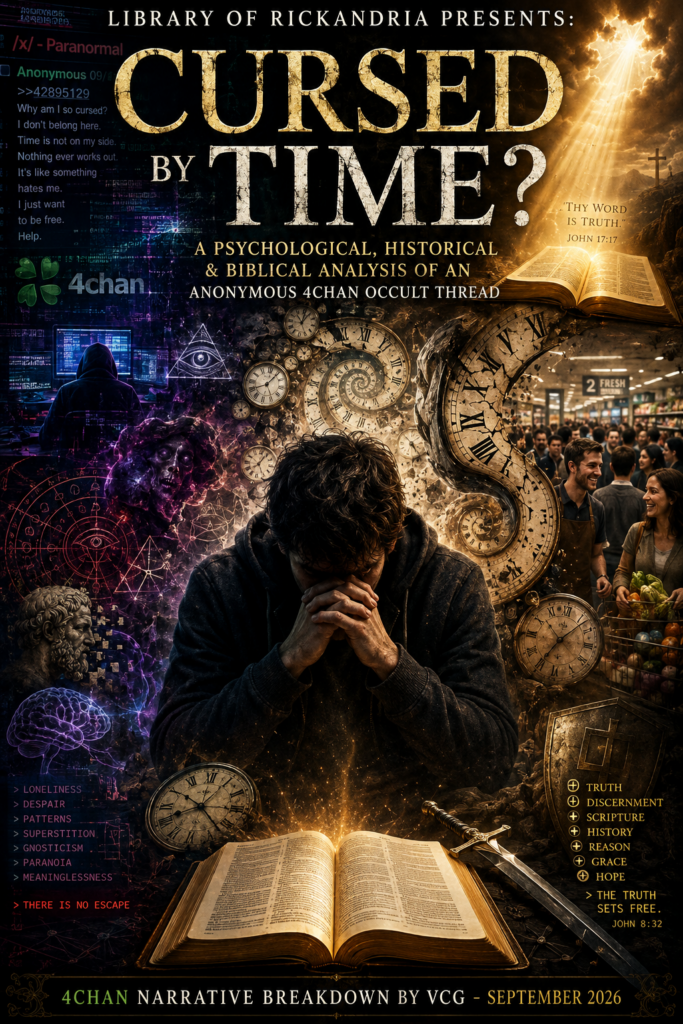
UPDATED BY VCG ON 9/1/2026 @ 17:17 EST
I want to share a heartfelt cause with my audience. Conner Blaisdell-Greene, a brave Airforce Sr. Airman, recently lost his battle with cancer, leaving his family in financial distress. Every donation, no matter how small, can help cover his funeral costs and ease their burden during this difficult time. Please consider clicking the link below to contribute or share Conner’s story with others. Your support truly matters.
Until We Meet Again
Spoken Tribute
Abstract
At first glance, the 4chan thread examined in this paper seems almost too ordinary to merit extended analysis. An anonymous twenty-eight-year-old poster complains that he is chronically late to work, feels socially peripheral among his coworkers, does not know what he wants to do with his life, and increasingly interprets those frustrations through the language of curses, fate, Gnosticism, and existential despair. Within a relatively short thread, however, his questions attract a remarkable range of explanations. He is told, variously, that his circumstances are actually a blessing, that he should be grateful, that he should seek help from a nahual associated with Tezcatlipoca, that his history of broken bones is spiritually diagnostic, that the LORD is personally calling him through these events, that he is autistic, that he is merely bored, that he is a procrastinator seeking supernatural excuses, and that human acquaintances may actually be demons wearing human skin. Some replies attempt comfort; others ridicule him; at least one explicitly encourages suicide.
The importance of the thread lies less in determining which anonymous participant is “right” than in observing a repeated method of reasoning. Again and again, a genuine or possible experience is followed by an interpretation and then converted into certainty without the evidentiary steps that would normally connect those stages. The original poster does this when he moves from repeated lateness to being “cursed with time,” from workplace loneliness to rejection by the “human collective,” and from personal humiliation to the possibility that Gnosticism is metaphysically correct. His respondents often repeat the same mistake while substituting their preferred explanation: autism, occult destiny, boredom, procrastination, demons, or divine signaling.
This paper argues for a more disciplined approach. The poster’s experiences should be taken seriously without automatically accepting his explanations for them. Historical claims should be checked against historical scholarship. Psychological concepts should be used probabilistically rather than diagnostically. Supernatural claims should not be treated as established merely because supernatural categories exist within a religious worldview. And biblical texts should be read in context rather than converted into occult diagnostics or slogans. The governing principle is close to Paul’s instruction in 1 Thessalonians 5:21: “Prove all things; hold fast that which is good.”
Introduction: From a Late Clock-In to a Theory of Reality
The thread begins with the question,
“Why am I so cursed with time?”
The original poster says that it seems as though
“the universe and Fate”
bend events so that he arrives at work late. He then shifts from time to belonging. Although he knows many people and later acknowledges a girlfriend, family members, and friends, he feels peripheral at work. Other coworkers appear louder, happier, and more deeply connected. They visit one another’s homes and seem to belong to a social world into which he is admitted only partially. At twenty-eight he is uncertain what he wants from life. The frustration then broadens into metaphysics: human existence seems to him humiliating and pointless, “which is why the gnostic might be right.”
Finally comes the line that changes the seriousness of the discussion:
“why continue living?”
Several different questions have now been compressed into one story.
There is an empirical question: why is he frequently late?
There is a social question: are his coworkers actually excluding him, and if so, why?
There is a psychological question: how is repeated frustration influencing the way he interprets ambiguous events?
There is a historical-philosophical question: what did movements conventionally called Gnostic actually teach, and does his suffering provide evidence for them?
There is a theological question: what does Scripture permit a Christian to conclude about curses, providence, spiritual evil, occult practices, suffering, and despair?
And there is a safety question: how should a statement about not wanting to continue living be answered?
Those questions overlap, but they are not interchangeable. That distinction will govern the analysis that follows.
The thread itself is also a limited source. Every participant is anonymous. Their identities, sincerity, backgrounds, medical histories, workplaces, and offline relationships are inaccessible. The original poster gives us one perspective on workplace interactions; we do not possess his attendance records, coworkers’ accounts, supervisory evaluations, commute data, developmental history, or clinical records. One respondent may be serious where another is trolling. A claim about “demons wearing human skin” could be literal belief, metaphor, dark humor, exaggeration, or performance appropriate to /x/. The evidence does not allow us to determine which.
That limitation is not a reason to ignore the thread. It is a reason to state carefully what can and cannot be inferred from it.
One principle will therefore recur throughout this paper:
An experience may be genuine even when the explanation attached to that experience is mistaken.
A person may really be lonely without correctly knowing why. He may really be late without time itself being hostile. He may actually be excluded by particular coworkers without being rejected by “the human collective.” A historical religious tradition may genuinely teach something without that teaching thereby becoming true. Scripture may genuinely affirm spiritual realities without authorizing a reader to attach a supernatural explanation to every unexplained event.
That is where careful investigation begins.
I. “Why Am I So Cursed With Time?”
The first sentence already combines observation and interpretation.
The observable claim is comparatively modest:
I repeatedly arrive late to work.
The interpretive claim is considerably larger:
I am cursed with time.
The thread never supplies the missing evidence between those propositions. We are not told how often the poster is late, by how much, how far he travels, how he commutes, when he intends to leave, when he actually leaves, how much time he allows for parking or clocking in, or whether the supposedly extraordinary obstacles occur more frequently than ordinary delays would predict.
A researcher should begin there rather than with metaphysics.
One useful comparison comes from research on the planning fallacy. Roger Buehler, Dale Griffin, and Michael Ross found that people often underestimate how long their own tasks will take. Their participants tended to construct future-oriented scenarios while underusing relevant information from previous experiences. Importantly, in one study the optimistic bias was removed when participants were explicitly directed to connect their predictions with relevant past experience.
This does not demonstrate that the 4chan poster suffers from the planning fallacy. We do not have enough information to establish that. It does, however, give us a testable alternative to “Fate bends time against me.”
Suppose a person says,
“I leave early every day, yet something always happens.”
The useful question is not whether he feels that he leaves early. It is what the numbers show. For thirty shifts he could record the scheduled start time, intended departure, actual departure, ordinary travel time, unexpected delay, time required from arrival to clock-in, and actual clock-in. If historical travel times show that a journey commonly takes thirty-five to forty-five minutes while he habitually budgets thirty-five, then
“I left early”
may mean
“I left early relative to my idealized trip,”
not
“I allowed enough time for the actual distribution of trips.”
The supernatural explanation should not be declared impossible merely because a mundane explanation exists. That would reverse the same mistake. The more careful conclusion is narrower: no supernatural cause has yet been established, while ordinary causes remain unmeasured.
That distinction matters.
Pattern Detection and the Temptation to Build a Story
Human minds are extraordinarily capable of finding patterns. That capacity is indispensable, but it can also generate perceived relationships that are stronger than the evidence warrants.
A well-known 2008 series of experiments by Jennifer Whitson and Adam Galinsky reported that manipulated feelings of reduced control increased several forms of illusory pattern perception, including superstition and perceived conspiracies.
It would be tempting to cite that study and declare the case closed: the original poster feels powerless, so he invents a curse.
That would be poor scholarship.
In 2018, Michiel van Elk and Paul Lodder reported seven experiments attempting to investigate the same general hypothesis. They found no evidence that their experimental manipulations of reduced control increased their measures of magical thinking, conspiracy belief, paranormal belief, or agent detection. Their reanalysis also suggested publication bias and a relatively small effect for control-threat manipulations.
The responsible psychological conclusion is therefore not,
“Science proves that loss of control makes this man hallucinate patterns.”
It is something more modest: human beings can form causal stories from events whose causal relationship has not yet been demonstrated, and feeling unable to control events may sometimes interact with that tendency, but the size and reliability of the particular control-to-pattern effect remain contested.
That qualification is important because this paper should not commit the very error it criticizes. A psychological theory must not become another universal key through which every strange belief is automatically explained.
II. Fate, Providence, and the Difference Between Theology and Divination
The poster does not simply say that accidents happen.
He personifies the pattern:
“the universe and Fate”
seem to arrange events against him.
Later he calls it the:
“engine of time.”
Within a biblical framework, impersonal Fate is not the governing power of reality.
Scripture speaks instead of creation and divine sovereignty.
Paul concludes Romans 11 with the statement:
“For of him, and through him, and to him, are all things: to whom be glory for ever. Amen.”
But biblical providence must not be turned into a Christianized version of fortune-telling.
To affirm that God is sovereign is not to claim knowledge that God specifically caused a traffic delay in order to send a personalized message. Scripture contains events whose providential meaning is explicitly revealed. Joseph, for example, can interpret his history because the biblical narrative gives the reader theological information about God’s purpose. Ordinary believers are not thereby granted infallible access to the hidden purpose behind every missed bus, awkward conversation, illness, lost object, or broken appointment.
There is a difference between:
“God is sovereign over my life.”
and
“I know why God made this particular inconvenience happen.”
The first is a theological confession. The second may amount to speculation unless there is adequate warrant.
Ironically, the thread’s occult and quasi-Christian replies repeatedly erase this distinction. One poster sees Tezcatlipoca and altered fate; another simply announces that “the LORD is calling unto you.” Both take an unexplained pattern and assign it a spiritual speaker.
Prayer and worship are biblically appropriate. Claiming private knowledge of God’s hidden purpose is another matter.
A careful Christian response can therefore reject both impersonal Fate and unauthorized providential decoding.
III. “Why Do I Feel Alone in a Crowd?”
The poster’s next question deserves considerably more sympathy than some respondents give it.
He says that he knows many people yet feels alone. At work, other employees appear socially effortless with one another. They greet each other loudly, joke together, visit one another outside work, and seem to share a depth of connection that he lacks. He later acknowledges that he has a girlfriend, relatives, friends, and people “in my corner,” but says that particular coworkers sometimes ignore him or acknowledge him mainly when they need something.
Several respondents answer by treating the number of relationships as if it settled the matter. Because he has a girlfriend and friends, they reason, he cannot genuinely be lonely.
That is too simple.
The CDC’s definition of social connection explicitly includes not merely the size of a person’s network but the functions and quality of those relationships. Social connectedness concerns the degree to which a person has the number, quality, and variety of relationships desired and feels belonging, care, and support.
A person can therefore have genuine loving relationships while still experiencing an unmet need for belonging in a particular environment. The poster’s statement can be reformulated without exaggeration:
“I have meaningful relationships outside work, but I feel peripheral inside an environment where I spend a large part of my life.”
That proposition is coherent.
Could the Workplace Exclusion Be Real?
Yes.
Workplace ostracism is a recognized research topic rather than an invention of unusually sensitive employees. A 2021 meta-analysis of 95 independent samples involving 26,767 participants found significant associations between workplace ostracism and employee attitudes, well-being, and behaviors. Among the outcomes discussed were belongingness, job satisfaction, emotional exhaustion, organizational behavior, and performance-related variables.
That literature establishes an important general point: people really can be excluded, ignored, or socially marginalized at work, and the experience can matter.
It does not establish another point: that these particular coworkers are intentionally ostracizing this particular poster.
Only one side of the interaction is available. Some coworkers may genuinely be cliquish. Some may have known one another much longer. Some may be reacting to his repeated lateness. Some may interpret his own guardedness as lack of interest. Some may simply prefer certain friends. Some interactions may be ambiguous. Several of those possibilities could also be true simultaneously.
The evidence permits us to say,
“His experience is plausible.”
It does not permit us to say,
“We know why everyone behaves this way.”
IV. Loneliness and Social Interpretation: A Necessary Caution
Psychological research adds another layer, but it must be handled carefully.
A 2017 review by Spithoven, Bijttebier, and Goossens examined social-information-processing patterns associated with loneliness. Across the literature they reviewed, loneliness was associated with greater attention to socially threatening information, more negative or hostile attribution of intent, greater expectation of rejection, and more negative evaluations of oneself and others.
This finding is easy to abuse.
It does not mean that a lonely person who reports exclusion is imagining everything.
Real exclusion can produce loneliness. Loneliness may in turn influence how ambiguous social information is interpreted. A person can therefore face genuine instances of rejection while also becoming increasingly vigilant for further rejection. The two mechanisms need not be mutually exclusive.
That possibility fits the thread better than either simplistic extreme.
The first extreme would say:
“Everyone really does dislike you.”
The second would say:
“None of this is happening; it is all in your head.”
Neither conclusion is justified.
The original poster increasingly organizes people into “normies” and himself. Once that division becomes a central narrative, ordinary social differences can begin to carry more meaning than they otherwise would. A coworker warmly greeting a close friend becomes evidence that “normies” naturally recognize one another. A supervisor’s unusual tone becomes evidence that he is perceived as autistic. A missed invitation becomes evidence of deeper exclusion. The resulting model risks becoming self-sealing: almost every outcome can be interpreted as confirmation.
Yet his later comments also contain evidence against his own broadest claim. He explicitly acknowledges a girlfriend, family members, friends, and supportive people.
Thus the sentence
“the human collective wants to keep me at arm’s length”
cannot be literally true according to his own testimony.
His more limited claim may still be true:
“Some people whose acceptance matters to me appear to keep me at a distance.”
That is the difference between emotional generalization and careful description.
V. Scripture Does Not Require Us to Pretend Loneliness Is Unreal
A biblical correction should not consist of telling a suffering person that he has no right to feel what he feels.
The Psalms contain language considerably darker than many modern religious conversations permit.
Psalm 142 records:
“I looked on my right hand, and beheld, but there was no man that would know me:
refuge failed me; no man cared for my soul.”
Psalm 88 goes further:
“Thou hast put away mine acquaintance far from me…”
“Lover and friend hast thou put far from me, and mine acquaintance into darkness.”
These texts do not treat loneliness as proof that the sufferer lacks gratitude.
They preserve lament.
That is important when evaluating the respondents who tell the poster that because he has a girlfriend and some friends, he should effectively stop complaining. Scripture can acknowledge what is present and grieve what is absent at the same time.
The biblical correction comes elsewhere: lament is permitted, but despairing interpretation is not automatically revelation.
The Psalmist can say,
“no man cared for my soul,”
while still crying to the LORD as refuge. Psalm 142 does not turn loneliness into a doctrine that humanity is metaphysically designed to reject the sufferer.
There is a lesson here for both psychology and theology.
Validate the suffering without canonizing the sufferer’s first explanation of it.
VI. “The Gnostic Might Be Right”
At this point the thread moves from social disappointment to cosmology.
The poster says that
“the human experience is just a humiliating waste of time,”
adding that this is why
“the gnostic might be right.”
Before evaluating that inference, “Gnostic” needs definition.
What Historical Scholarship Can Actually Say
“Gnosticism” is not the name of one ancient denomination with a universally agreed creed. Nicola Denzey Lewis notes that scholars do not even agree completely on the boundaries or usefulness of the category. In a narrower historical sense, the phenomena usually grouped under the term reached particular prominence around the second century CE, but modern scholarship increasingly emphasizes their diversity. The 1945 discovery near Nag Hammadi dramatically enlarged the available primary-source base: the codices contain roughly fifty-two works, although not all of them can simply be categorized as “Gnostic.”
Recent Oxford reference material likewise emphasizes that many Nag Hammadi writings bear relationships to ancient Gnostic traditions involving divine humanity and myths of hostile or defective world-creators, while also warning against treating the collection as a single theological system.
So the poster’s intuition is not historically meaningless. There really were ancient systems in which the visible cosmos was explained in sharply negative terms, sometimes through an inferior or malevolent creator figure and a contrast between the higher divine realm and present embodied existence.
But the inferential step remains invalid.
Personal humiliation cannot demonstrate an ancient cosmology.
If embodied existence feels alienating, that may make an anti-cosmic worldview emotionally resonant. Emotional resonance and evidential confirmation are different things.
The same human facts—
- pain
- death
- injustice
- estrangement
- frustration
—have been interpreted through:
- Christian
- Gnostic
- Stoic
- Epicurean
- Buddhist
- Jewish
- Islamic
- existentialist
- nihilist
- materialist
and other frameworks.
The existence of suffering cannot by itself tell us which metaphysics is true.
VII. The Biblical Answer to Anti-Cosmic Despair
Christian Scripture does not deny the corruption and suffering of the present world. But its explanation is not simply that physical creation was an evil mistake.
Genesis ends the creation account with:
“And God saw every thing that he had made, and, behold, it was very good.”
The New Testament intensifies rather than abandons the affirmation of created existence.
John declares:
“And the Word was made flesh, and dwelt among us…”
Paul likewise says that created things are not intrinsically defiling:
“For every creature of God is good, and nothing to be refused, if it be received with thanksgiving.”
Most decisively, Christian hope is resurrection rather than permanent escape from embodiment. First Corinthians 15 describes the resurrection of the dead and concludes not that embodied labor is meaningless, but:
“Therefore, my beloved brethren, be ye stedfast, unmoveable, always abounding in the work of the Lord, forasmuch as ye know that your labour is not in vain in the Lord.”
This is a profound difference.
A simplified anti-cosmic reading says:
The world hurts; therefore the created order is fundamentally the wrong place and escape is salvation.
Biblical Christianity says something more complicated:
Creation is God’s work. Creation is now characterized by sin, corruption, suffering, and death. God enters created human existence in the incarnation. Redemption culminates not in the final abolition of creaturehood but in resurrection and restoration.
That distinction should not be flattened into the slogan
“Gnostics hated matter and Christians liked it.”
Ancient Gnostic traditions were much more diverse than that. But at the level of the thread’s existential claim—
“human existence is humiliating, therefore perhaps anti-cosmic metaphysics is correct”
—
Genesis, incarnation, and resurrection provide a distinctly different biblical account.
Ecclesiastes is especially useful here because Scripture itself allows the reader to hear something startlingly close to the poster’s despair:
“Therefore I hated life; because the work that is wrought under the sun is grievous unto me…”
The Bible does not hide that voice.
But Ecclesiastes does not make the feeling its final metaphysical conclusion.
The book eventually says:
“Let us hear the conclusion of the whole matter:
Fear God, and keep his commandments:
for this is the whole duty of man.”
The difference is not between a realistic Gnostic and a Bible that refuses to admit suffering.
The difference is between competing interpretations of suffering.
VIII. “Why Continue Living?”
This sentence deserves to interrupt the philosophical discussion.
“Why continue living?”
may be rhetorical, existential, or genuinely suicidal. From an anonymous post we cannot determine the speaker’s intent, plan, means, immediacy, or level of risk. What we can determine is that the statement should not be casually reinforced.
Current CDC guidance emphasizes that suicide is rarely caused by a single event. Risk emerges from interacting factors at individual, relationship, community, and societal levels. The CDC identifies such factors as hopelessness, relationship loss, social isolation, job or financial difficulties, and other stressors, while protective factors include reasons for living, effective coping, support from partners, family, and friends, and feeling connected to others.
That last point matters because the poster’s girlfriend, family, and friends should not be weaponized against him—
“you have people, therefore you are not allowed to hurt”
—but neither should they be ignored. They represent real points of connection in a situation where his thinking is becoming increasingly global and hopeless.
Elijah and the Wish to Die
First Kings 19 provides one of Scripture’s clearest narratives of a servant of God reaching the point of wanting death.
Elijah says:
“It is enough; now, O LORD, take away my life…”
The narrative response is instructive.
Elijah sleeps.
He receives food and water.
He sleeps again.
He eats again because
“the journey is too great”
for him.
He is then engaged by God, whose questioning eventually exposes Elijah’s repeated belief that he alone remains.
This passage should not be reduced to a modern mental-health treatment protocol. Its purpose is theological and narrative, not clinical.
But neither may we miss what the text does not do.
It does not mock him.
It does not romanticize his wish for death.
It does not answer,
“You are right; life is pointless.”
And it does not encourage him to act on the thought.
Acts 16 is even more direct. When the Philippian jailer believes the prisoners have escaped and prepares to kill himself, Paul cries:
“Do thyself no harm: for we are all here.”
That line alone stands in direct opposition to one of the thread’s ugliest replies.
IX. The Reply Thread as a Marketplace of Explanations
What happens next is intellectually revealing.
The original poster offers one grand theory: curse and Fate.
Instead of slowing the discussion down, the replies produce additional grand theories.
The result resembles a marketplace in which explanations compete primarily by confidence and emotional force.
“How Does One Fit in With Normies Spiritually?”
The first question inherits the OP’s distinction between “normies” and himself.
From a Christian perspective,
“fitting in spiritually”
is not the relevant goal.
Romans 12 contains both sides of the needed correction.
Paul says:
“be not conformed to this world:
but be ye transformed by the renewing of your mind”
while the same chapter commands believers to be:
- kindly affectionate
- humble
- hospitable
- empathetic
- peaceable
and unwilling to repay evil for evil.
Christianity therefore gives no warrant for either extreme.
The believer need not reshape his conscience merely to become socially conventional.
But neither may he turn his difference into spiritual pride, as though “normies” were a lower human category.
The biblical category is not “NPC,” “normie,” or “outsider.”
It is neighbor.
X. “Maybe Your Circumstances Are a Blessing”
One respondent offers a more conventional self-help answer:
perhaps the apparent curse is actually a blessing; moderation is important; the poster should change himself first and be grateful for what he has.
This reply is neither wholly wise nor wholly foolish.
“Perhaps some good can emerge from this”
is reasonable.
“Your circumstances are probably a blessing”
is stronger than the evidence permits.
The respondent does not know God’s hidden purpose.
“If you want change, begin with what you can change”
is practical.
“If anything goes wrong, change yourself first”
could become victim-blaming if universalized.
“Be grateful”
can be psychologically and biblically constructive, but gratitude is not an eraser for grief.
A large preregistered meta-analysis published in PNAS synthesized 145 papers, 163 samples, 727 effect sizes, and 24,804 participants across 28 countries. Gratitude interventions produced a statistically significant but small average increase in well-being, Hedges’ g = 0.19, with meaningful variation across contexts and methodologies.
That is almost exactly the level of confidence appropriate here.
Gratitude can help.
Gratitude is not magic.
And gratitude should not be used as a rhetorical weapon against someone in pain.
Scripture itself combines gratitude with lament. First Thessalonians says, “In every thing give thanks,” but only a few verses earlier instructs the church to “comfort the feebleminded, support the weak, be patient toward all men.”
Biblical thanksgiving therefore does not require emotional dishonesty.
XI. “You’re Not Alone; You Have Me”
Another anonymous poster replies simply that the OP is not alone.
It is one of the least sophisticated comments in the discussion.
It may also be one of the better responses.
The commenter does not pretend to know whether the poster is cursed.
He does not diagnose him.
He does not promise occult mastery.
He does not solve Gnosticism.
He offers presence.
This is remarkably close to the pastoral emphasis of 1 Thessalonians 5:
“comfort the feebleminded, support the weak, be patient toward all men.”
There is a methodological lesson here too. Sometimes the wisest first response to distress is not an explanation.
It is contact.
XII. Competitive Suffering: “You Don’t Know What Real Loneliness Is”
Several replies ridicule the OP because he has a girlfriend, family, and friends. One argues that someone with those relationships cannot understand “actual” loneliness and compares his complaint to owning a nice house and car while demanding a mansion and luxury vehicles.
This commits a simple error.
The fact that another person suffers more does not establish that the first person’s suffering does not exist.
Someone who has one broken finger does not cease to have a fracture because someone else has lost an arm.
Likewise, relationships are not interchangeable units. The CDC’s description of social connectedness specifically includes desired quality and variety, not merely headcount.
The poster should indeed notice the relationships he possesses. His sweeping statement that the “human collective” rejects him is contradicted by those relationships.
But the appropriate correction is:
“Your global conclusion is too strong.”
It is not:
“Your pain is fraudulent.”
Romans 12:15 offers a much different social ethic:
“Rejoice with them that do rejoice, and weep with them that weep.”
Christian compassion does not require ranking everybody’s suffering before deciding whether anyone deserves care.
XIII. Tezcatlipoca and the Nahual: Where the Thread Touches Real History
One of the most distinctive replies tells the OP that he can ask one of Tezcatlipoca’s “nahuals” to change his fate and perhaps become a nahual himself.
This claim requires more careful treatment than simply laughing at it.
The terminology is not invented from nothing.
Tezcatlipoca
The British Museum identifies Tezcatlipoca—“Smoking Mirror”—as one of the principal deities of the Aztec pantheon, associated with creation, war, conflict, rulers, and sorcerers.
Nahualli and Nahualism
Roberto Martínez González’s major UNAM study, El nahualismo, demonstrates how complex the category is. His study treats the nahualli in relation to Mesoamerican concepts of personhood, companion entities, transformation, ritual specialists, colonial changes, cultural diversity, modern reinterpretations, and what he calls “neonahualism.” That breadth itself warns against treating “become a nahual” as though it described one simple, timeless occult technique.
There is also a historically relevant connection between Tezcatlipoca’s nanahualtin and destiny. Nemian Navarro’s 2025 study in Estudios de Cultura Náhuatl, drawing particularly on Book V of the Historia general de las cosas de Nueva España, examines Nahua interpretations of frightening nocturnal apparitions associated with Tezcatlipoca. Navarro argues that such apparitions could be understood as tetzahuitl through which Tezcatlipoca revealed beneficial or harmful destiny by means of his nanahualtin.
That historical finding makes the 4chan reply more interesting.
The commenter is not merely combining random exotic words. There is a real historical relationship among Tezcatlipoca, nanahualtin, ominous manifestations, and ideas about destiny.
But historical plausibility stops there.
Navarro’s study concerns historical Nahua understandings of manifestations that revealed or confirmed destiny. It does not demonstrate that an anonymous modern practitioner can be contacted to alter another user’s commute, social life, or metaphysical “fate.” Indeed, the cited historical model concerns destiny already implicated in the person’s tonalli, not an Internet service for rewriting fortune.
The distinction is fundamental:
History can establish that people held a supernatural belief.
History cannot, by itself, establish that the supernatural mechanism described in that belief actually operates.
To say
“the Nahua believed X”
is a historical statement.
To say
“X will therefore work for you”
is an additional metaphysical claim requiring additional evidence.
XIV. The Biblical Evaluation of the Occult Prescription
The biblical question is different from the historical one.
A Christian does not need to prove that every occult claim is fake before deciding whether Scripture permits participation in it.
Deuteronomy 18 tells Israel:
“thou shalt not learn to do after the abominations of those nations.”
It then prohibits:
- divination
- observing times
- enchantment
- witchcraft
- charms
- consultation with familiar spirits
- wizardry
- necromancy
The immediate historical covenantal setting is ancient Israel entering the land. Responsible interpretation should acknowledge that context rather than pretending the passage was originally written about twenty-first-century Internet occultism.
Yet the New Testament does not reverse the underlying theological opposition to pagan divination and idolatrous spiritual participation.
Paul commands Christians in 1 Corinthians 10:
“Wherefore, my dearly beloved, flee from idolatry.”
He then warns against participation in pagan sacrificial communion.
Thus, a Christian evaluation need not say:
“Nahualism is historically fake.”
That would be historically careless.
Nor need it say:
“Every story told within Nahua religion is empirically disproven.”
That claim would exceed what historical method can establish.
It can say something both firmer and narrower:
“Whatever supernatural efficacy one attributes to the practice, seeking occult mediation from a deity or ritual specialist stands outside the worship and obedience Scripture directs toward God.”
That is a theological conclusion, not an anthropological one.
XV. “Don’t You Need to Be Qualified?”
Another poster responds to the nahual suggestion by asking whether one needs to be “qualified.”
Historically, the question is less foolish than it sounds. Martínez González’s study makes clear that nahualli traditions are bound up with complex conceptions of personhood, ritual specialization, transformation, inheritance, regional variation, and historical development. They cannot responsibly be reduced to a five-minute occult exercise found on a message board.
But for Christian theological evaluation, qualification does not solve the issue.
A more historically authentic occult specialist is not therefore a biblically acceptable occult specialist.
Authenticity and permissibility are different questions.
XVI. The Broken-Bone “Diagnostic”
Later a poster abruptly asks:
“Diagnostic question:
have you ever broken a bone?”
The commenter never explains the question, so we cannot know his intention with certainty.
There is, however, a plausible cultural reference.
Beginning in late 2024, a viral online idea usually called the
“Never Broke a Bone Theory”
circulated on social media. The theory claims that people who have never broken a bone are somehow being physically protected because they are destined to endure greater psychological or spiritual suffering. Psalm 34:19–20 is sometimes invoked as supposed biblical support.
Because the anonymous 4chan commenter provides no explanation, this connection should remain a plausible identification, not a certainty.
The OP responds that he has broken a bone because he
“got jumped.”
Medically, that is unremarkable as a causal explanation. MedlinePlus notes that fractures are usually caused by injuries and lists trauma and direct blows among common causes.
A physical assault therefore provides an ordinary mechanism for a fracture. Nothing in the thread requires a spiritual diagnosis.
Psalm 34 in Context
The biblical meme becomes even weaker when the actual passage is read rather than merely cited.
Psalm 34:19–20 says:
“Many are the afflictions of the righteous:
but the LORD delivereth him out of them all.
He keepeth all his bones:not one of them is broken.”
The Internet theory adds a proposition that the Psalm never states:
Those whose bones are not broken receive additional mental or spiritual suffering as compensation.
That doctrine is simply absent.
Indeed, verse 19 explicitly says that the righteous already experience
“many… afflictions.”
The passage is about the LORD’s:
- hearing
- nearness
- preservation
- righteousness
- deliverance
It provides no formula by which fracture history can be used to calculate a person’s hidden spiritual assignment.
The difference is an excellent illustration of eisegesis.
The biblical text says one thing.
A modern story is then placed on top of it.
The presence of a verse citation does not turn the added story into Scripture.
XVII. “The LORD Is Calling Unto You”
Another reply says that
“the LORD is calling”
the poster and tells him to pray and worship.
This requires separating three propositions.
Prayer is biblical.
Worship of the LORD is biblical.
The claim that these specific experiences of lateness and workplace exclusion constitute a personalized supernatural message is not established by the thread.
If
“the LORD is calling you”
means broadly that the gospel calls sinners to repentance and faith, Scripture supplies content for that claim.
If it means,
“I have discerned that God caused these particular workplace problems as a coded sign directed specifically to you,”
the respondent has gone beyond the available evidence.
This is a subtle but important form of spiritual overclaiming.
Christians can affirm providence without pretending to be prophets.
They can say what Scripture reveals while remaining agnostic about hidden causal details Scripture has not revealed.
XVIII. The OP Returns: More Information, and a Better Question
The poster later returns with details that significantly improve the discussion.
He thanks the respondent who simply offered companionship.
He says he appreciates the people
“in my corner.”
He then describes particular coworkers who sometimes ignore him, greet their closer friends much more warmly, or acknowledge him mainly when they need something. He says some supervisors joke freely with others but speak differently with him. He wonders whether they think he is autistic and finally asks a much more concrete question:
“is it because I come late???”
This may be the most productive line in the thread.
Not because lateness is proven to be the explanation.
It is not.
But for the first time the poster identifies a specific behavioral variable that could plausibly influence other people’s responses and that he can change and observe.
A reasonable informal test would be straightforward. For a sustained period, he could arrive reliably before the required time, record the change, and observe whether supervisory interactions or coworker trust change. He could also ask a trusted supervisor a concrete question: whether his punctuality or any other workplace behavior is affecting how others experience working with him.
That approach has an advantage the curse theory lacks.
It can fail.
If punctuality improves and the social environment remains unchanged, then lateness was probably not the entire explanation.
If relationships improve, then punctuality may have been one contributing factor.
A hypothesis that can lose is more informative than one capable of explaining every possible result.
XIX. “They Talk to Me Like I’m Autistic”
The poster interprets the tone and expressions of several supervisors as though they are treating him as autistic. Another commenter then announces that he is, in fact, autistic.
Neither statement constitutes diagnosis.
The NIMH describes autism spectrum disorder as a neurological and developmental condition involving a broader pattern that can include social-communication differences, restricted or repetitive behaviors and interests, and sensory features. Adult diagnosis can be particularly complicated because some features overlap with other conditions. A proper adult evaluation may involve a clinician experienced with ASD and investigation of social communication, sensory issues, restricted interests, repetitive behavior, and early developmental history.
That is substantially more information than:
“My supervisor gave me an odd look.”
A person might reasonably wonder whether longstanding experiences suggest neurodevelopmental differences. If so, assessment is available.
What the thread cannot responsibly do is convert a few workplace interactions into a neurological diagnosis.
The irony is again methodological.
The OP says:
They look at me differently → perhaps they think I am autistic.
The respondent says:
You sound socially different → you are autistic.
Both skip the assessment stage.
XX. “You’re Autistic; Kill Yourself”
The same reply that labels the poster autistic then encourages him to kill himself.
There is little interpretive ambiguity here.
The diagnostic claim is unsupported.
The suicide encouragement is dangerous.
Current CDC guidance explicitly emphasizes connection and supportive relationships as protective factors and stresses that suicide is preventable rather than an inevitable response to suffering.
Biblically, the contrast is severe.
When a man in Acts 16 is seconds away from suicide, Paul’s response is:
“Do thyself no harm.”
And the church is instructed:
“comfort the feebleminded, support the weak, be patient toward all men.”
One does not need a complicated theological system to recognize the incompatibility.
XXI. “It’s Boredom… It Must Consider Suicide”
Another respondent declares that the problem is boredom and adds that if a person’s needs are not met,
“it must consider suicide.”
The statement transforms a possible risk factor into a deterministic law.
Human beings can suffer from:
- loneliness
- boredom
- purposelessness
- unemployment
- rejection
- depression
- trauma
or unmet relational needs without suicide becoming necessary.
The CDC explicitly rejects such monocausal explanations: suicide is rarely attributable to one event or circumstance, and risk factors increase probability rather than mechanically causing an outcome.
The wording “it must” is therefore particularly misleading.
It converts vulnerability into destiny.
That is precisely the kind of fatalism from which the OP needs to be moved away.
XXII. “You’re a Procrastinator Looking for Supernatural Excuses”
A later respondent says the OP is simply a procrastinator seeking supernatural excuses and looking for someone other than himself to blame.
This reply is worth examining because it contains a potentially useful criticism.
The useful part is methodological:
Before assigning supernatural causes to repeated lateness, investigate behavior.
That is sound.
The unsupported part is:
Therefore, you are a procrastinator.
We do not know that.
Repeated lateness could involve:
- unrealistic time estimates
- disorganization
- sleep patterns
- transportation
- workload
- distraction
- habit
- executive-function difficulties
- actual procrastination
or several factors together.
The commenter therefore repeats the OP’s reasoning structure while changing the preferred cause.
The OP says:
I do not know why this keeps happening → curse.
The respondent says:
I do not know why this keeps happening → procrastination.
One explanation is more mundane and therefore easier to test, but it has still been asserted more confidently than the evidence warrants.
Good skepticism should apply to one’s favorite explanation too.
XXIII. “Demons Wearing Human Skin”
The thread ends, in the captured version, with perhaps its most striking claim.
A commenter says that his own former friends:
“turn out to be demons wearing human skin,”
that he is now friendless and agoraphobic, and that people still
“have it out”
for him.
The evidence does not allow us to determine what he means.
He may believe this literally.
He may be speaking metaphorically about betrayal.
He may be exaggerating.
He may be trolling.
It would therefore be irresponsible to diagnose the commenter with psychosis, paranoia, or any other disorder from this one statement.
It would be equally irresponsible to affirm the statement as factual.
A useful response is simply:
The claim has not been demonstrated.
Biblical Spiritual Evil Does Not Authorize Reckless Identification
A Christian analysis must be especially careful here.
Scripture does teach the reality of:
- Satan
- devils
- deception
- idolatrous spiritual evil
- temptation
- spiritual conflict
A Christian cannot reject those categories merely because modern naturalism finds them uncomfortable.
But the existence of demons in Scripture does not grant every believer a supernatural identification system whereby disliked or unsettling humans can be labeled demons on intuition.
The New Testament combines belief in spiritual realities with commands to:
- discernment
- truth
- love
- sober judgment
First Thessalonians says:
“Prove all things; hold fast that which is good.”
First John connects discernment of error with the equally serious command to love one’s brother.
Christian spiritual warfare is therefore not an excuse for dehumanizing people.
XXIV. Why 4chan Produces This Kind of Conversation
The medium itself deserves attention.
Psychologist John Suler’s influential work on the online disinhibition effect argues that people may disclose themselves or behave more intensely online than they would face to face. Among the interacting factors he identified are anonymity, invisibility, asynchronicity, dissociative imagination, and reduced felt authority. Suler also emphasized that disinhibition should not simply be equated with revealing a person’s “true self.”
That framework fits the format of this conversation reasonably well, although it cannot tell us the motives of any individual poster.
The thread combines unusually vulnerable disclosure with unusually cruel responses.
One anonymous participant confesses loneliness and asks why he should keep living.
Another says, essentially,
“you have me.”
Another recommends an occult practice.
Another ridicules him.
Another casually diagnoses autism.
Another encourages his death.
Another speaks of disguised demons.
The anonymity allows radically different registers—
- pastoral
- philosophical
- occult
- hostile
- confessional
- diagnostic
- suicidal
—to occupy the same conversational space with very little institutional friction.
This matters because the thread does not operate like a clinical interview, pastoral counseling session, academic seminar, or historical symposium.
There is no requirement that a respondent define terms.
No requirement that claims be sourced.
No requirement that diagnoses meet criteria.
No requirement that extraordinary claims be distinguished from speculation.
No professional responsibility attaches to most replies.
The result is epistemically flat: a peer-reviewed meta-analysis and a sentence typed by an anonymous stranger can appear visually similar on a screen.
The task of careful analysis is to restore the missing hierarchy of evidence.
XXV. A Better Model: Experience, Observation, Interpretation, Evidence
The central problem in the thread can now be stated more precisely.
Repeatedly, the participants collapse four different levels.
Experience is what a person feels:
“I feel lonely,”
“I feel that things always go wrong,”
“I feel different around these people.”
Observation is what can at least potentially be checked:
“I clocked in nine minutes late,”
“three coworkers greeted one another but not me,”
“I was invited to two of five gatherings.”
Interpretation assigns meaning:
“they dislike me,”
“time is against me,”
“they think I am autistic.”
Explanation proposes cause:
- curse
- Fate
- Gnosticism
- neurodevelopmental condition
- boredom
- procrastination
- occult destiny
- demons
- divine intervention
The farther one moves down that chain, the more evidence is required.
Instead, the thread repeatedly moves directly from experience to explanation.
That is the methodological habit connecting otherwise incompatible beliefs.
Curse.
Gnosticism.
Autism.
Nahualism.
Broken-bone spirituality.
Providential signaling.
Boredom.
Procrastination.
Demons.
They cannot all function as the singular explanation of the same limited evidence, yet they are repeatedly delivered with comparable certainty.
That fact by itself should reduce our confidence in the forum’s explanatory process.
XXVI. What the Psychological Evidence Does—and Does Not—Permit
At this stage we can propose a working model, provided it is clearly labeled interpretation rather than diagnosis.
The poster appears to experience repeated problems with punctuality. He interprets those problems as unusually resistant to his attempts at control.
He also experiences dissatisfaction with workplace relationships. Visible closeness among others may intensify his awareness of his own peripheral status.
Those two experiences—low perceived control and low perceived belonging—then appear to feed a broader narrative in which ordinary difficulties become evidence that reality itself is structured against him.
The narrative expands:
“I am late”
becomes
“time is against me.”
“I do not feel integrated at work”
becomes
“the human collective keeps me away.”
“I feel humiliated”
becomes
“the Gnostic might be right.”
“What is wrong?”
becomes
“why continue living?”
That reconstruction fits the text.
It should not be confused with a clinical formulation.
We do not know whether the poster has:
- depression
- anxiety
- ADHD
- ASD
- a trauma history
- sleep problems
- occupational conflict
or no diagnosable disorder at all.
Research on loneliness suggests that social threat perception and expectation of rejection can become more pronounced in lonely individuals. Research on workplace ostracism shows that exclusion can also be objectively present and psychologically harmful.
The safest synthesis is therefore reciprocal rather than reductionist:
some exclusion may be real; some interpretations may be magnified; each may reinforce the other.
Anything stronger requires evidence we do not possess.
XXVII. Scripture’s Own Epistemic Discipline
One of the most useful features of the biblical material is that it does not require credulity toward every spiritual claim.
Paul tells the Thessalonians:
“Despise not prophesyings.
Prove all things; hold fast that which is good.”
Notice both sides.
“Despise not”
guards against reflexive rejection.
“Prove all things”
guards against reflexive acceptance.
That is strikingly appropriate for an occult discussion board.
The Christian need not respond to every supernatural claim with,
“Impossible; spiritual reality does not exist.”
Nor should he respond:
“Spiritual reality exists; therefore this particular supernatural claim is credible.”
Scriptural discernment occupies the harder middle ground.
The same principle appears ethically.
Romans 12 calls for a
“renewing”
of the mind, warns against being
“wise in your own conceits,”
commands genuine love, and instructs believers to live peaceably where possible.
That is almost the opposite of the thread’s increasingly adversarial worldview.
The OP imagines a human collective.
Some respondents imagine normies.
Another imagines occult specialists.
Another imagines demons hiding inside humans.
Scripture repeatedly returns the reader to:
- sobriety
- truth
- self-examination
- neighbor-love
- patience
- discernment
XXVIII. Is the OP “Cursed”?
The thread does not provide evidence sufficient to establish that conclusion.
That answer should not be confused with the theological claim that Scripture never speaks of curses. It plainly does.
Galatians 3, for example, discusses the curse associated with the law and then says:
“Christ hath redeemed us from the curse of the law, being made a curse for us…”
But the context matters.
Paul is discussing:
- law
- sin
- promise
- justification
- Abraham
and redemption in Christ.
Galatians 3:13 is not a promise that Christians never:
- get sick
- suffer accidents
- lose jobs
- encounter enemies
- arrive late
- experience persecution
or endure confusing providences.
Therefore two abuses should be avoided.
The first says:
“You are late a lot; therefore you are cursed.”
The second says:
“Christ redeemed believers from the curse; therefore any Christian who suffers serious misfortune lacks faith.”
Neither follows from Paul’s argument.
The safest conclusion concerning this poster is simply that the alleged curse has not been demonstrated.
XXIX. What Scripture Does With Affliction
Psalm 34 may be the most fitting passage for the entire thread precisely because the viral broken-bone interpretation obscures its actual message.
It says:
“The LORD is nigh unto them that are of a broken heart…”
“Many are the afflictions of the righteous:
but the LORD delivereth him out of them all.”
The first line prevents contempt toward suffering.
The second prevents the assumption that suffering itself proves divine rejection.
The Psalm never promises a frictionless life.
It expects affliction.
Similarly, Paul can describe:
- weakness
- reproach
- necessities
- persecution
and distress without interpreting them as proof that God has abandoned him.
The biblical category of affliction may therefore be considerably healthier than the thread’s category of curse.
“Affliction”
names suffering without pretending to know every hidden cause.
It leaves room for injustice.
It leaves room for consequences.
It leaves room for human weakness.
It leaves room for providence.
It leaves room for spiritual conflict where Scripture actually warrants the category.
And it leaves room for unanswered questions.
XXX. What a Responsible Response to the Original Poster Would Look Like
If one stripped away the occult speculation, mockery, amateur diagnosis, and fatalism, the poster’s situation could be addressed quite concretely.
First, the lateness should be measured rather than mythologized. For several weeks, he should record when he needs to arrive, when he actually leaves, how long each stage of the trip takes, what interruptions occur, and how much buffer he gives himself. He should then base future departures on his actual historical travel record, not the ideal journey in his head. Planning-fallacy research gives a reasonable empirical basis for this approach without proving in advance that it is his problem.
Second, he should test the workplace hypothesis. For a sustained period, arrive early and behave consistently.
Then seek feedback from someone reasonably trustworthy:
not
“Why does everyone hate me?”
but something concrete such as,
“I’m trying to improve how I show up here.
Has my punctuality or anything else been making things harder for the team?”
Third, he should stop converting ambiguous expressions into diagnoses. If he has a longstanding reason to wonder whether he is autistic, a qualified assessment can investigate that question. An anonymous poster cannot.
Fourth, he should acknowledge the relationships that contradict the claim of universal rejection. A girlfriend, family, friends, and supportive acquaintances do not erase loneliness.
They do, however, show that
“the human collective rejects me”
is too broad.
Fifth, he should not pursue Tezcatlipoca, nahualli practice, divination, or similar occult means as a Christian solution. Historical scholarship can illuminate those traditions without converting them into Christian spiritual practice. Scripture’s direction is elsewhere.
Sixth, he should allow Scripture to correct despair without pretending that Scripture promises social popularity. The Christian goal is not universal acceptance. Romans 12 calls for humility, genuine affection, patience in tribulation, prayer, hospitality, peace where possible, and overcoming evil with good.
Finally, the question
“why continue living?”
should be spoken aloud to a trustworthy person rather than left in an anonymous paranormal thread.
If that question represents active suicidal thinking rather than rhetorical despair, immediate human support matters. In the United States, the 988 Suicide & Crisis Lifeline can be reached by call or text, and immediate danger warrants emergency assistance. CDC guidance specifically identifies supportive connection as protective rather than irrelevant.
None of these steps solves the mystery of providence.
They do something more modest and immediately useful.
They distinguish what can be known from what is being imagined.
XXXI. The Deeper Lesson: Pain Is Not Revelation
The most important error in the thread may be summarized in three steps:
Pain → interpretation → certainty.
The poster suffers, therefore he is cursed.
He feels excluded, therefore humanity rejects him.
Life feels humiliating, therefore Gnosticism may describe reality.
Other posters repeat the same structure.
The OP behaves unusually, therefore autism.
He experiences strange misfortune, therefore Tezcatlipoca.
A bone has or has not broken, therefore spiritual destiny.
Events feel meaningful, therefore the LORD has sent this particular signal.
The poster is late, therefore procrastination.
He feels empty, therefore boredom necessarily produces suicide.
People betray someone, therefore they are demons in human skin.
The better sequence is longer:
Experience → observation → definition → alternative explanations → evidence → testing → interpretation → proportionate confidence.
And where historical or theological claims enter:
What did the tradition actually teach?
What does the biblical text actually say?
What conclusions does that text support?
What conclusions am I adding myself?
That last question may be the most important.
XXXII. A Note on Humility
There is an unexpected resonance between rigorous scholarship and the translators’ own prefatory discussion in the King James Bible used for this study. In discussing difficult passages and marginal alternatives, the translators argued that certainty should not be manufactured where genuine difficulty remains. They explicitly commended modesty in matters that cannot be confidently resolved rather than dogmatizing over uncertainty.
That attitude is badly needed in the thread.
There are things we can say confidently.
The poster said these things.
The respondents said these things.
Workplace ostracism is a studied phenomenon.
Loneliness can coexist with relationships.
Adult autism diagnosis requires much more than an anonymous impression.
Tezcatlipoca and nahualli traditions are historically real subjects of Mesoamerican religion.
Certain Nahua sources connect Tezcatlipoca’s nanahualtin with the revelation of destiny.
That does not establish the supernatural efficacy of the recommended intervention.
Psalm 34 does not teach a trauma-for-unbroken-bones compensation theory.
Scripture prohibits occult divination.
Scripture records severe loneliness and even a wish for death without endorsing suicide.
Those conclusions have evidence.
Other questions remain unresolved.
We do not know precisely why the poster is late.
We do not know precisely what each coworker thinks of him.
We do not know whether he is autistic.
We do not know the sincerity of every respondent.
We do not know whether the demon language is literal.
We do not possess revelation identifying the hidden providential meaning of his workplace difficulties.
A good analysis should be able to say
“we do not know”
without embarrassment.
Conclusion: “Prove All Things”
This 4chan thread begins with what appears to be a small personal complaint and rapidly becomes a miniature study in epistemology.
A man is late.
He is lonely.
He envies the ease with which other people seem to relate.
He is uncertain about his future.
He begins to wonder whether reality itself is hostile.
Within hours, strangers supply nearly every kind of explanation imaginable: moral, psychological, occult, theological, neurological, memetic, and paranormal.
The result does not show that every participant is foolish.
Several touch genuine truths.
Workplace exclusion exists.
Gratitude can be beneficial.
Some problems really do require personal change.
Gnosticism is a genuine historical field rather than a made-up Internet word.
Tezcatlipoca and nahualli traditions are real parts of Mesoamerican religious history.
Scripture really does command prayer and worship.
Autism is real.
Spiritual evil is a biblical category.
The problem is what happens after those truths are mentioned.
A real category is treated as though its existence automatically explains the person in front of us.
That is where discernment fails.
The historical existence of nahualism does not prove a nahual can alter this man’s fate.
The existence of autism does not diagnose him.
The existence of workplace ostracism does not prove the motives of his coworkers.
The existence of cognitive biases does not prove his rejection is imaginary.
The existence of demons in Scripture does not prove that a strange acquaintance is secretly a demon.
The doctrine of providence does not reveal why this morning’s traffic light turned red.
The existence of curses in Scripture does not make recurrent lateness evidence of a curse.
And personal suffering does not prove Gnostic cosmology.
The biblical alternative is neither gullibility nor cynical materialism.
It is discernment.
“Prove all things; hold fast that which is good.”
That command allows the Christian to take spiritual claims seriously enough to test them.
It allows historical evidence to remain historical evidence.
It allows psychological evidence to remain probabilistic rather than diagnostic.
It allows sufferers to lament without granting infallibility to their interpretations.
It allows Scripture to correct us instead of merely decorating conclusions we already wanted to believe.
And it allows unanswered questions to remain unanswered until there is reason to say more.
The poster’s deepest problem, as far as the thread lets us see, is not that he has conclusively demonstrated a curse.
It is that ordinary frustrations, possible social wounds, philosophical despair, and supernatural explanations have fused into one story.
The way forward is to separate them again.
Measure what can be measured.
Ask what can be asked.
Seek competent help where expertise is required.
Receive genuine relationships rather than erasing them through global conclusions.
Refuse occult shortcuts.
Take suicidal despair seriously.
Lament honestly.
And where Scripture speaks, let Scripture establish the boundaries of what can responsibly be said.
The thread repeatedly asks, in one form or another:
“What does all of this mean?”
A careful answer begins one step earlier:
“What do we actually know?”
Only then should interpretation begin.
Selected References
- Primary thread. Anonymous. “Am I cursed, if so why live.” 4chan /x/ — Paranormal, thread No. 42895129, posts dated August 30–September 1, 2026. Thread contents cited as captured September 1, 2026. Because 4chan threads are ephemeral, later availability is not guaranteed.
- The Holy Bible. Authorized King James Version, Pure Cambridge Edition. Biblical quotations and contextual analysis in this paper use the supplied edition.
- Buehler, Roger, Dale Griffin, and Michael Ross. “Exploring the ‘Planning Fallacy’: Why People Underestimate Their Task Completion Times.” Journal of Personality and Social Psychology 67, no. 3 (1994): 366–381.
- Li, Mingze, Xiaofei Xu, and Ho Kwong Kwan. “Consequences of Workplace Ostracism: A Meta-Analytic Review.” Frontiers in Psychology 12 (2021). Meta-analysis of 95 independent samples, N = 26,767.
- Spithoven, Annette W. M., Patricia Bijttebier, and Luc Goossens. “It Is All in Their Mind: A Review on Information Processing Bias in Lonely Individuals.” Clinical Psychology Review 58 (2017): 97–114.
- National Institute of Mental Health. “Autism Spectrum Disorder,” accessed September 2026.
- Centers for Disease Control and Prevention. “Social Connection.” May 15, 2024.
- Centers for Disease Control and Prevention. “Risk and Protective Factors for Suicide.” May 26, 2026.
- Centers for Disease Control and Prevention. “Preventing Suicide.” May 26, 2026.
- Suler, John. “The Online Disinhibition Effect.” CyberPsychology & Behavior 7, no. 3 (2004): 321–326.
- Whitson, Jennifer A., and Adam D. Galinsky. “Lacking Control Increases Illusory Pattern Perception.” Science 322 (2008): 115–117.
- van Elk, Michiel, and Paul Lodder. “Experimental Manipulations of Personal Control Do Not Increase Illusory Pattern Perception.” Collabra: Psychology 4, no. 1 (2018): 19.
- Denzey Lewis, Nicola. “Gnosticism.” Oxford Bibliographies in Biblical Studies. Oxford University Press.
- Burns, Dylan. “Nag Hammadi Library and Related Literature.” Oxford Bibliographies in Biblical Studies. Oxford University Press, 2025.
- British Museum. “Tezcatlipoca.” Collections Online.
- Martínez González, Roberto. El nahualismo. México: Universidad Nacional Autónoma de México, Instituto de Investigaciones Históricas / Instituto de Investigaciones Antropológicas. Digital edition, 2016; original study 2011.
- Navarro, Nemian. “El miedo a las ‘apariciones nocturnas’ de Tezcatlipoca: Cuitlapanton, cintanaton, centlapachton.” Estudios de Cultura Náhuatl 70 (2025): 196–227.
- MedlinePlus. “Fracture” and “Broken Bone.” U.S. National Library of Medicine.
- “A Meta-Analysis of the Effectiveness of Gratitude Interventions on Well-Being Across Cultures.” Proceedings of the National Academy of Sciences, 2025. Preregistered meta-analysis of 145 papers, 24,804 participants across 28 countries.
- “Never Broke a Bone Theory.” Know Your Meme, documenting the late-2024 online folklore and its association with Psalm 34:19–20. Used here as a source for Internet-culture history, not as scientific or theological authority.
4CHAN THREAD & POST BREAKDOWNS – Library of Rickandria
VCG PAPER PROJECTS – Library of Rickandria
Cursed by Time? A Psychological, Historical & Biblical Analysis of an Anonymous 4chan Occult Thread