
God, Evil & the Demiurge: A Biblical, Philosophical, Historical & Psychological Analysis of a 4chan Debate on Suffering
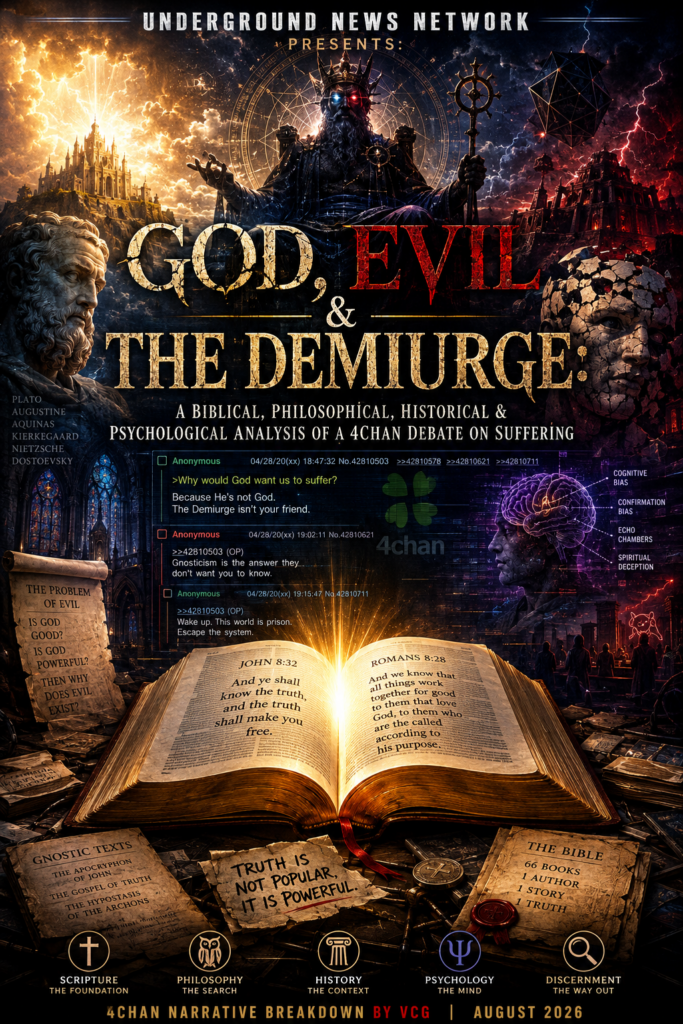
UPDATED BY VCG ON 8/15/2026 @ 13:13 EST
I want to share a heartfelt cause with my audience. Conner Blaisdell-Greene, a brave Airforce Sr. Airman, recently lost his battle with cancer, leaving his family in financial distress. Every donation, no matter how small, can help cover his funeral costs and ease their burden during this difficult time. Please consider clicking the link below to contribute or share Conner’s story with others. Your support truly matters.
Anyone can do this, but they won’t.
ChatGPT – Library of Rickandria
I’ll treat the thread as a set of discrete claims rather than as a single argument: first recover the text, then classify each line (fact claim, inference, rhetoric, theology, psychology), verify it against primary/credible sources, and finally compare its biblical claims against the KJV text you supplied. Where evidence is uncertain, I’ll mark it uncertain rather than force a verdict.
/x/ – Perspective from God – Paranormal – 4chan
The thread is still live and I’ve recovered it. Its core dispute is already clear: it mixes the problem of evil, Gnostic/Demiurge claims, animal suffering, free will, disease, divine foreknowledge, moral responsibility, and several ad-hominem/political digressions. I’m separating those so a rhetorical insult doesn’t get mistaken for an argument, and a philosophical argument doesn’t get mislabeled as a biblical teaching.
A useful correction before the deeper work: both camps in the thread repeatedly overstate their case. The anti-theist/Gnostic side raises some legitimate forms of the evidential problem of evil, but often leaps from “God permits suffering” to “therefore God wants suffering for no reason.” The pro-theist side often answers with a popular free-will defense, but then adds claims Scripture itself does not plainly teach—e.g. that humans must know evil to know good, that every disease exists to “cull” life, or that God “explicitly chose to limit Himself” in exactly the way asserted.
The strongest biblical correction so far is Job itself. One poster says “he doesn’t make us suffer; read Job,” but Job 1–2 actually depicts Satan as the immediate afflicter under permission, while God says Satan moved Him “against [Job], to destroy him without cause”; the book later speaks of “all the evil that the LORD had brought upon him.” That does not make God morally evil, but it does make “all suffering comes from the devil, never from God” too simple for the text.
Another important distinction is emerging from the text itself: the KJV does not teach a crude “bad things happen because the victim deserved them” system. Jesus explicitly rejects that inference regarding the Galilaeans and the eighteen killed at Siloam, and John 9 rejects the assumption that congenital blindness necessarily resulted from the sufferer’s or parents’ sin. So the thread’s “most people deserve their suffering” claim is not a safe biblical generalization.
Soli Deo Gloria. I went through the live thread as an argument rather than merely reacting to its tone. The thread is unusually useful because it contains several different worldviews colliding at once: biblical Christianity, popular free-will apologetics, atheistic/evidential arguments from evil, Gnostic cosmology, prison-planet/“loosh” speculation, syncretic mysticism, and a large amount of anonymous-board rhetoric. (4chan)
The supplied Pure Cambridge KJV will be the Scripture base below.
1. Method: how I fact-checked it
I am treating “line by line” at the substantive-claim level. The thread has roughly 2,400 rendered webpage lines because every username, timestamp, quote-link, image attachment, reply marker, and duplicated quotation receives its own line. Repeating the same insult thirty times would add length without analysis. So I consolidated repeated statements while retaining the post numbers and argumentative sequence. Pure reaction images, racial/religious slurs, “cope/seethe” comments, and naked insults are classified as rhetoric—no evidential value.
For each substantive claim I ask five separate questions: What exactly is being claimed? Is it factually true? Does the conclusion logically follow? What psychological/rhetorical process is visible? What does Scripture actually say? That matters because a historical Gnostic claim can be historically accurate while biblically false; a philosophical objection can be powerful without proving atheism; and a Christian poster can reach a biblical conclusion through a bad argument.
One important philosophical baseline: the problem of evil is not a single argument. Philosophers distinguish the logical problem—claiming God and evil are strictly incompatible—from evidential versions arguing that particular kinds or quantities of suffering make a perfectly good, omniscient, omnipotent God less probable. Contemporary discussion regards concrete cases such as severe animal suffering and childhood cancer as substantially harder than merely saying “some evil exists.” (Stanford Encyclopedia of Philosophy)
That distinction immediately improves the thread.
2. Claim-by-claim audit
- OP, No. 42810503: Why would God want humans to suffer, and toward what end?
Verdict: legitimate question, but the wording embeds an assumption. “God allows suffering” and “God wants suffering as an end in itself” are not equivalent propositions. Permission, judgment, consequence, discipline, creaturely agency, satanic agency, and malicious delight are separate concepts.
Biblically, Scripture never reduces all suffering to one cause. Job contains satanic agency under divine permission; Jesus describes Satan as binding a woman in Luke 13:16; human sin causes immense suffering; God also expressly judges; and some affliction is described as testing or chastening. Therefore the best Christian answer begins: “The Bible does not teach that God simply enjoys making creatures hurt.” But neither should the Christian escape by saying God has nothing whatsoever to do with events He permits.
Job is decisive. Satan is the immediate attacker, yet God says Satan moved Him against Job “to destroy him without cause”; after the ordeal Job’s companions comfort him concerning “all the evil that the LORD had brought upon him.” - No. 42810520: Nature is fundamentally deceptive/evil; predation and the food chain prove the Gnostics were right about a Demiurge.
Verdict: observation partly true; metaphysical conclusion does not follow.
Predation, parasitism, disease, starvation, and violent competition really occur. A sentimental “nature is always peaceful” picture would be false. But “there is predation” → “therefore the material cosmos was created by an evil or ignorant Demiurge” is a non sequitur. Biology describes ecological interactions; it does not identify a supernatural craftsman.
The thread later says essentially every living being must murder another living being to obtain energy. That is biologically false. Food webs normally begin with photosynthetic producers such as plants and phytoplankton. Autotrophs acquire energy without hunting organisms; primary consumers eat producers, and decomposers can utilize dead organic material. (OpenStax)
Historically, however, the poster is not inventing Gnostic cosmology from nothing. Ancient Gnostic systems really did distinguish the highest divine reality from an inferior creator, although “Gnosticism” was never one uniform doctrine. Philosophical sources explicitly distinguish the hostile/defective Gnostic creator from Plato’s benevolent Demiurge. (Stanford Encyclopedia of Philosophy)
Scripture correction: Genesis begins in precisely the opposite direction: creation is repeatedly pronounced “good” before the transgression. The biblical narrative therefore locates corruption within a fundamentally good creation rather than identifying material existence itself as the product of an evil creator. - No. 42810522: If God is omniscient, He sees every cause, effect, past, and future.
Verdict: broadly consistent with classical Christian theism, but it generates a real philosophical question.
Foreknowledge is not automatically causation. Knowing that X occurs and causing X are different propositions. Nevertheless, if God freely creates a world while infallibly knowing its complete history, His relationship to that history is philosophically deeper than that of a spectator who discovers events afterward. The anti-theist is right to press that point; the Christian should not answer as though God were surprised by creation. - No. 42810527: Humans pouring tar on an ant nest illustrates what God does to us.
Verdict: emotionally vivid, logically weak analogy.
The analogy smuggles its conclusion into the comparison. The person pouring tar is assumed to be gratuitously tormenting inferior beings for amusement. But whether divine permission of suffering is analogous to gratuitous torture is precisely what needs proving.
The analogy can still function rhetorically by forcing the believer to confront scale and vulnerability. It cannot independently establish divine sadism. - No. 42810531 and surrounding posts: Omniscience means God cannot move or make choices because everything is already known.
Verdict: not established.
Knowledge of one’s action does not obviously eliminate agency. The issue involves divine temporality, necessity, foreknowledge and freedom—subjects on which serious philosophical positions differ. The thread repeatedly treats difficult metaphysical questions as if one-line deductions settled them. - Nos. 42810579 onward: A benevolent God would never create suffering; if He does, it must be entertainment or selfish desire.
Verdict: false dilemma.
Those are not the only conceptual possibilities. A defender could invoke free agency, stable causal laws, judgment, soul-making, redemptive goods, or unknown justifying reasons. Whether any actually succeeds is another question.
This is where the evidential problem is stronger than the simplistic logical form. Instead of “any suffering proves malevolence,” the stronger challenge asks why particular horrors apparently exceed any necessary good. SEP explicitly notes that concrete animal agony and childhood disease pose more formidable evidential questions. (Stanford Encyclopedia of Philosophy) - “Most humans deserve to suffer.”
Verdict: biblically unsafe generalization.
Scripture teaches universal sin; it does not authorize us to infer from someone’s present suffering that he must have deserved that particular suffering more than others.
Jesus directly attacks that inference:“Suppose ye that these Galilæans were sinners above all the Galilæans, because they suffered such things? I tell you, Nay…” — Luke 13:2–3He says the same of eighteen people killed when the tower of Siloam fell.
Likewise, concerning the man born blind:“Neither hath this man sinned, nor his parents…” — John 9:3.Job is virtually an entire book against simplistic retributive theology. - No. 42810706: Diseases exist to “cull” excessive life and maintain balance.
Verdict: speculative teleology presented as fact.
Disease can affect population dynamics, but “God designed cancer/disease because life needs culling” does not follow from ecology and is not a biblical explanation of disease generally. It is an improvised theodicy.
Scripture is much more complex. Disease can appear as specific judgment in some texts; illness can have ordinary creaturely causes; Satan is associated with affliction; Christ repeatedly heals disease rather than praising disease as ecologically necessary.
Exodus itself even distinguishes the LORD who brings specific plagues in judgment from His identity as healer: “I am the LORD that healeth thee.” - Same poster: We need terrible diseases so we learn that life is precious.
Verdict: possible good arising from suffering ≠ proof suffering was necessary.
Humans can indeed acquire gratitude, patience, courage, compassion, endurance, and perspective through adversity. James 1:2–4 explicitly says trials can work patience.
But “suffering can produce good” is weaker than “this precise suffering was indispensable.” A child can learn fire is dangerous without third-degree burns. The thread’s opponent is therefore right when he later distinguishes beneficial consequence from logical necessity. - “Without evil you cannot know good.”
Verdict: overstated philosophically and contradicted by the Bible if stated absolutely.
One may learn certain goods contrastively through experience of their opposites. Relief is known through pain; forgiveness presupposes wrong; courage presupposes danger. That does not prove all knowledge of goodness requires actual evil.
Genesis describes God’s creation as good before Adam and Eve acquire experiential “knowledge of good and evil.” The serpent’s temptation centers precisely on acquiring that knowledge.
More devastatingly, Revelation describes a final state with no death, sorrow, crying, pain or curse.
If evil were metaphysically necessary for recognizing goodness, the biblical new creation would be unintelligible.
Interesting historical note: a version of “we must know evil to know good” occurs in Lactantius’s response to the ancient problem of evil. So the argument has pedigree, but pedigree is not proof. (New Advent) - No. 42810752: God has no needs, therefore God cannot have any wants; creation itself is irrational.
Verdict: equivocation between “want,” “need,” and “will.”
A being can choose an action without acting from deficiency. “I do not need to give a gift” does not entail “therefore I cannot freely give one.” Classical Christian theology normally understands creation as voluntary rather than as satisfying a lack in God.
The poster has identified a good theological constraint—God cannot be portrayed as creating because He was lonely, incomplete, bored, or needy without compromising divine sufficiency. But “not needy” does not imply “incapable of willing.” - “If God wanted humans good, He should simply have created them unable to do evil.”
Verdict: serious challenge, but its force depends on what sort of freedom is valuable.
The free-will defense argues that morally significant libertarian freedom is a great good and that creatures can misuse it. Academic treatments recognize this as a serious theodicy rather than nonsense. They also stress its costs: God still permits harmful consequences, and free will by itself does not explain hurricanes, genetic diseases, and other natural suffering. (Stanford Encyclopedia of Philosophy)
Thus the Christian poster is justified in invoking freedom against some moral evil. He is not justified in treating “free will” as a universal two-word answer to cancer, animal pain, earthquakes, congenital disorders, and every other form of suffering. - No. 42810788: Imperfection is necessary because perfection would eliminate life, striving and development.
Verdict: plausible soul-making intuition, not demonstrated necessity.
Some goods require development. Courage, perseverance and repentance are temporally formed goods. But love, joy, creativity, fellowship, knowledge and free choices among good alternatives are not obviously impossible in a non-torturous world.
The poster repeatedly slides from:
A. Some valuable goods require difficulty
to:
B. Therefore every type and degree of suffering is required.
B does not follow from A. - Same sequence: Humanity needs punishment as an automatic “mechanic.”
Verdict: confuses consequence, corrective discipline and retributive justice.
Punishment can serve different functions. Some consequences naturally follow conduct; some biblical judgments are retributive; some chastening is corrective. But arbitrary suffering whose reason is unknowable cannot automatically be called “punishment.”
The opposing poster correctly notices this: a punishment cannot straightforwardly teach a lesson if the recipient cannot identify what the punishment is for. - The thread’s history-of-covenants summary: humans repeatedly sacrifice children; God responds through Noah, Abraham, Moses, then Jesus.
Verdict: contains biblical elements but badly compresses biblical history.
Scripture does condemn child sacrifice. Jeremiah emphatically says of burning children to Baal:“which I commanded not, nor spake it, neither came it into my mind.”But the thread’s narrative that human child sacrifice is essentially the single controlling cause behind each covenant is a reconstruction, not the Bible’s own explanation. - No. 42811519: “God doesn’t make us suffer; read Job.”
Verdict: probably the thread’s clearest biblical self-own.
Job does not support that simple formula.
Satan directly strikes Job. But Satan requires permission. God tells Satan:“Behold, he is in thine hand; but save his life.”And God Himself says:“thou movedst me against him, to destroy him without cause.”At the conclusion Job’s relatives comfort him concerning:“all the evil that the LORD had brought upon him.”The biblical distinction is therefore subtler: Satan may be the immediate evil agent while remaining under God’s sovereign limits. - Same Christian poster: God wants us to love Him despite suffering; otherwise forced worship would be analogous to rape/slavery.
Verdict: partially useful intuition, seriously overdrawn analogy.
Genuine love is not naturally conceived as coerced. That supports the importance of agency. But a world without pediatric cancer would not thereby make worship “rape,” nor would eliminating malaria turn humanity into mindless automata.
The argument conflates two propositions:
“God doesn’t irresistibly force love.”
with
“God therefore must permit every currently possible horror.”
The first does not entail the second. - Video-game analogy: a world without evil choices would merely be a game “on rails.”
Verdict: useful illustration, not proof.
Choice does not require that every logically possible evil remain available. Human freedom is already heavily bounded. I cannot freely choose to breathe underwater unaided, teleport to Jupiter, or become 500 metres tall. Yet normal usage still calls many of my actions free.
The anti-theist therefore scores a legitimate point when asking why God could not restrict certain especially destructive options without abolishing agency entirely. - “Only good choices” = a married bachelor or four-sided triangle.
Verdict: much too strong.
Contradictory concepts are one thing; choosing between good alternatives is another. A person can freely choose whether to give £50 to one charity or another without either choice being wicked.
A more defensible free-will argument concerns morally significant freedom, not the claim that “choice logically requires evil.” Philosophical free-will theodicies specifically need a robust form of morally significant libertarian agency; they do not establish that every free act must offer a wicked alternative. (Stanford Encyclopedia of Philosophy) - “God voluntarily limits Himself so human choices have meaning.”
Verdict: theological interpretation, not an explicit biblical quotation.
Scripture certainly portrays God permitting things He disapproves of morally. But the thread’s exact model of God switching off intervention to protect an autonomous free-will zone is philosophical theology.
It should be labeled interpretation, not “the Bible explicitly says this.” - Counterargument: If God has any inability whatsoever, He isn’t omnipotent.
Verdict: depends on what “ability” means.
Traditional accounts of omnipotence do not normally count contradictions such as “a spherical cube” as genuine tasks waiting to be accomplished. The philosophical problem is exactly how maximal power should be formulated. (Stanford Encyclopedia of Philosophy)
Scripture itself attributes certain “cannot” statements to God without treating them as defects: God cannot be tempted with evil (James 1:13), cannot lie in Titus 1:2/Hebrews 6:18, and cannot deny Himself in 2 Timothy 2:13. Moral consistency is not portrayed as weakness.
Thus “Can God make evil become good while evil remains evil in the identical respect?” is not obviously a meaningful test of power. - But the Christian poster later says God can transcend logic altogether.
Verdict: this undermines his previous defense.
This is one of the thread’s largest internal contradictions.
Earlier: God cannot create genuine freedom without evil alternatives because that would be logically contradictory.
Later: God is not constrained by human logic and can transcend logical rules.
The opponent correctly notices that one cannot simultaneously use logical impossibility as the decisive defense and then exempt God from logic whenever the defense becomes inconvenient. (Stanford Encyclopedia of Philosophy)
A stronger classical answer is not “God breaks logic,” but that logical contradictions do not describe possible states of affairs in the first place. - “God is the rules/math/logic, like a programmer writing the simulation.”
Verdict: analogy, not biblical doctrine.
A programmer exists within a broader logical order and manipulates software specifications. God, in classical theology, is not literally a programmer running source code. Analogies can illuminate one relation while distorting another.
Saying “God wrote the code” does not answer why this code permits horrendous suffering; it merely restates divine authorship in modern terminology. - “We can’t understand God; therefore apparent contradictions or evil don’t matter.”
Verdict: legitimate humility can become an epistemic escape hatch.
Scripture certainly teaches human cognitive limitation. Job is a major example. Yet the anti-theist correctly observes a symmetry problem: if humans are too cognitively limited to judge that God has no good reason, they may also be too limited to confidently invent the particular reason—“free will,” “growth,” “cosmic balance”—and declare it certainly God’s reason.
SEP likewise notes that appeals to human cognitive limitation are an important response but do not simply dissolve all evidential arguments from evil. (Stanford Encyclopedia of Philosophy)
Better Christian posture: “Here are reasons Scripture actually gives; beyond these, I do not know.” - “Questioning God is itself wrong/unfaithful.”
Verdict: biblically false if “questioning” means sincere inquiry rather than rebellious accusation.
Job asks. Habakkuk asks. Jeremiah asks. David repeatedly asks “why” in the Psalms. Thomas asks for evidence. The Bereans examine apostolic preaching against Scripture.
Christianity need not be defended by intellectual intimidation. - Exodus 7 allegedly proves the devil can perform miracles identical to God’s.
Verdict: the text says Egyptian magicians imitate some signs; “the devil did the identical thing” adds details.
Exodus 7 says the Egyptian magicians reproduced the serpent sign “with their enchantments,” but Aaron’s rod swallowed theirs.
That supports the narrower biblical proposition that signs alone are not sufficient authentication. It does not demonstrate that Satan possesses equal power to God. - 1 Kings 18 allegedly shows God normally holds His power back to protect free will.
Verdict: the passage doesn’t teach that proposition.
Mount Carmel shows the exact opposite phenomenon in that episode: Elijah publicly calls for decisive supernatural demonstration; Baal does not answer; the LORD answers.
The theological free-will claim is being imported into the passage. - “Synagogue of Satan” is used to characterize rabbis, Catholic authorities, Islam, institutional religion generally, etc.
Verdict: serious contextual abuse of Revelation.
Revelation 2:9 addresses Smyrna and Revelation 3:9 addresses Philadelphia. In both passages the phrase concerns particular opponents identified by the text as claiming to be Jews while lying.
It is not a scriptural blank cheque for labeling whichever modern religion, ethnicity, clergy, or institution a poster dislikes “the synagogue of Satan.” - “Paul invented the religion / the rabbi myth was created by Paul.”
Verdict: contradicted even by Paul’s own earliest autobiographical claims.
Galatians says Paul persecuted “the church of God” before his conversion, refers to “apostles before me,” and identifies James, Cephas/Peter and John as recognized figures independently of him.
One may historically debate Paul’s influence on later Christianity. But “Paul created Christianity from nothing” fails the most elementary chronological test: there was already a movement for Paul to persecute and join. - “Gnosticism solves the problem: the true highest God is perfect; the Demiurge made this defective world.”
Verdict: it relocates much of the problem rather than automatically solving it.
Historically this resembles real Gnostic cosmologies. But philosophically a further question immediately appears: If ultimate reality is perfect, whence comes the defective intermediate being, Sophia’s error, ignorance, matter, or the conditions allowing a Demiurge?
One poster actually catches this problem late in the thread. If a perfect source produces or permits the chain eventually yielding the defective creator, the explanatory burden has moved one level upward.
Plotinus criticized Gnostic depreciation of the cosmos on related grounds and sharply rejected its view of cosmic evil. (Stanford Encyclopedia of Philosophy) - “We are eternal like God / parts of God / consciousness is literally divine.”
Verdict: metaphysical assertion; not biblical anthropology.
Scripture says humans are made in God’s image. Being an image is not being an ontological fragment of the thing imaged.
The Bible’s Creator-creature distinction begins in Genesis 1: “In the beginning God created…”
Pantheistic or panentheistic readings need additional argument; they cannot simply be smuggled into “image of God.” - “Monad = Tao = Brahman = the same supreme reality.”
Verdict: syncretic synthesis, not historical equivalence.
These traditions have genuine analogies—ultimacy, transcendence, unity—but they arise from distinct intellectual and religious systems and carry materially different accounts of personality, being, creation, knowledge and salvation.
Saying different traditions point toward something ultimate may be a philosophical thesis. Saying their technical concepts are simply interchangeable requires evidence absent from the thread. - “Prison planet,” “loosh harvesting,” archons feeding on suffering.
Verdict: unsupported within the thread.
No independently verifiable evidence is supplied. The claims are flexible enough that both suffering and happiness can be absorbed into the system: pain becomes loosh production; pleasure becomes bait; spiritual experience becomes controlled illusion; lack of evidence becomes proof of deception.
That produces a major methodological problem: a theory that can accommodate every possible observation risks becoming unfalsifiable.
The thread’s own late-stage skeptic asks the right question: Where is the hard evidence? (4chan) - A poster replies that years of astral projection revealed no Demiurge/archons and that apparent demons disappeared after psychological integration.
Verdict: interesting personal testimony, not decisive counter-evidence.
It is epistemically superior to asserting “I astral projected, therefore archons objectively exist” insofar as the poster explicitly considers a psychological explanation. But private altered-state experiences cannot by themselves establish universal metaphysics.
Neither “I experienced an archon” nor “I never experienced one” settles whether such beings objectively exist. - Animal suffering: mothers watch offspring eaten; creatures tear one another apart. Why would a good creator use this system?
Verdict: one of the thread’s strongest challenges.
Free will does comparatively little here because animals are not ordinarily alleged to possess human-style morally responsible freedom. Academic treatments identify natural evil precisely as a residual difficulty for simple free-will defenses. (Stanford Encyclopedia of Philosophy)
A biblical answer has to reach beyond “humans make bad choices.” Romans 8’s creation “groaneth and travaileth,” Genesis 3 describes cursed ground, and Scripture anticipates cosmic restoration. But exactly how present animal predation relates chronologically and causally to human sin is interpreted differently among Christians. The text should not be made to answer more than it actually states. - “Good cannot exist without evil.” Anti-poster’s counterexample: mathematical positives don’t require negative numbers.
Verdict: the counterexample successfully exposes ambiguity.
“Good” can mean intrinsic goodness, experienced contrast, moral virtue, pleasure, appreciation, or relief. Some experiential appreciation may be heightened by contrast. Intrinsic goodness does not thereby depend ontologically upon evil.
Most importantly for a Bible-based argument, God Himself is good without having to become morally evil first. The Christian cannot coherently make evil ontologically necessary to goodness while maintaining God’s perfect holiness. - “If God is perfectly good, does God Himself have free will? If so, freedom cannot require evil choices.”
Verdict: one of the thread’s strongest philosophical counters to the simplistic free-will argument.
It does not disprove every free-will defense. A theologian can distinguish divine freedom from finite morally formative freedom. But it destroys the easy syllogism:
“Freedom = ability to sin; God is free; therefore God can sin.”
Classical Christianity denies the conclusion.
This means the Christian poster needed a far more precise account of creaturely moral freedom. - “Do saints lose free will in heaven? Heaven has no evil, so evil plainly isn’t necessary for freedom.”
Verdict: serious internal Christian challenge.
Revelation portrays redeemed existence without pain, death and curse while redeemed persons still worship, serve and reign.
The traditional answer is usually that perfected character can act freely in accordance with the good without possessing a live disposition toward rebellion. Whether that model solves earthly soul-making questions is debatable, but it demonstrates again that “free will logically requires evil forever” is not Christian doctrine. - “One person’s evil free will destroys another person’s freedom—rape and murder override the victim’s choices.”
Verdict: powerful objection to the simplistic formulation.
If freedom is so valuable that God must permit the assailant’s choice, why is the assailant’s liberty privileged over the victim’s bodily agency?
Contemporary free-will theodicy literature explicitly recognizes this problem: God could conceivably allow the wicked intention while interrupting its harmful consequence. Why He does not always do so requires an additional reason beyond merely saying “free will.” (Stanford Encyclopedia of Philosophy) - Lifeguard analogy: watching a child drown when you could trivially save him would make you culpable; therefore God is culpable.
Verdict: philosophically relevant, but not deductively decisive.
It captures the intuition behind a deontological problem of evil: permitting preventable horrific suffering ordinarily carries moral responsibility. Philosophers take that intuition seriously. (Stanford Encyclopedia of Philosophy)
The analogy still assumes that God’s obligations toward creatures are identical to a hired lifeguard’s obligations toward swimmers and that no morally sufficient reason for nonintervention exists. Those premises require defense.
So it is neither “obviously devastating proof” nor “stupid atheism.” It is a legitimate moral analogy whose relevant similarities and differences must be examined. - “God suffers too / creation’s suffering is God’s own suffering.”
Verdict: contains Christian resonances but the poster’s broader formulation moves toward panentheism.
Christianity centrally teaches that Christ truly suffers in the Incarnation. It does not follow that every event is literally a wound occurring within God’s substance.
Biblical Christology offers a much stronger answer than abstract “God suffers because the universe is part of Him”: God does not remain remote from human suffering but enters human history in Christ. - “Suffering builds strength, fortitude, spiritual development.”
Verdict: biblically supported in qualified form; false as universal psychology.
Romans 5, James 1 and related passages teach that tribulation can produce patience and tested character. Yet suffering can also crush, traumatize, embitter, disable or kill.
Scripture never gives Christians permission to tell every suffering person, “God did this because you needed character development.”
The distinction is crucial:
God can bring good from suffering is strongly biblical.
Every sufferer’s trauma was individually administered because they needed it is not established. - PTSD and OCD are invoked as examples of seemingly pointless suffering.
Verdict: legitimate examples of psychological suffering, although the disorders should not be conflated.
OCD is specifically characterized by recurrent uncontrollable obsessions and/or compulsive behavior. (National Institute of Mental Health) PTSD belongs to trauma-related psychopathology; these conditions can coexist but are clinically distinct.
Their existence contributes to the natural/evidential problem of suffering; it does not by itself tell us whether God exists or what ultimate purpose suffering has. - “The Epicurean paradox destroys the Abrahamic God.”
Verdict: historically and philosophically overstated.
First, the catchy modern formulation is commonly associated with Epicurus, but no surviving work of Epicurus contains it. The famous attribution comes through Lactantius, and scholars debate whether it was genuinely Epicurean. Hume later popularized a related form. (Wikipedia)
Second, it frames a genuine problem rather than supplying an automatic proof. Modern philosophy distinguishes logical and evidential versions, with much debate focusing on whether God could have morally sufficient reasons to permit particular evils. (Stanford Encyclopedia of Philosophy)
The better skeptic’s argument is not “Epicurus already mathematically disproved God.” It is: “The apparently gratuitous quantity and distribution of suffering require explanation if God is all-powerful and perfectly good.” - “God got beaten by iron chariots.”
Verdict: misleading reading of Judges 1:19.
The verse says:“And the LORD was with Judah; and he drave out the inhabitants of the mountain; but could not drive out the inhabitants of the valley, because they had chariots of iron.”Grammatically and narratively, Judah is the human military actor in view; the chapter continues describing tribes failing to drive inhabitants out. Joshua had previously told Israel explicitly that they would drive out Canaanites though they had iron chariots.
Judges 4 then gives the LORD victory over Sisera despite nine hundred iron chariots.
Therefore “YHWH’s supernatural power was technologically defeated by iron” does not survive comparison with the surrounding biblical corpus. - “The Moabite god Chemosh defeats Israel’s God in 2 Kings 3.”
Verdict: the passage is difficult, but that paraphrase exceeds what it says.
2 Kings 3 reports Israel initially devastating Moab. Mesha then sacrifices his heir on the wall, after which “there was great indignation against Israel” and Israel withdraws. The text does not say “Chemosh defeated the LORD.”
The identity/source of the “great indignation” has been debated; the terse verse does not explicitly explain it.
Externally, the Mesha Stele gives the Moabite royal version of the conflict and attributes Moabite success to Chemosh. That shows what Mesha’s ideology claimed, not independent empirical proof that Chemosh supernaturally defeated YHWH. (Wikipedia)
Notice the methodological error: treating Moab’s theological propaganda as literal supernatural verification while treating Israel’s theological account as propaganda is a double standard unless an independent criterion is supplied. - “Adonai” secretly means “Adon AI,” revealing an artificial-intelligence god.
Verdict: false etymology.
Adonai is Hebrew terminology for “Lord.” Splitting an ancient Semitic word according to the modern English abbreviation “AI” is pure wordplay. (Hebrew for Christians)
This is a textbook example of false segmentation plus anachronism: taking modern Latin-alphabet characters and projecting their present English meaning backward into unrelated ancient morphology. - The related claim that this “AI god” became the coronavirus spike protein.
Verdict: no evidential basis.
SARS-CoV-2’s spike is a viral glycoprotein encoded by the virus’s genetic material; NCBI catalogs the spike gene/protein as part of coronavirus biology. (NCBI) There is no evidentiary bridge from the Hebrew word Adonai to a coronavirus protein.
This is not theology, textual criticism or virology. It is associative wordplay. - “Infinite punishment for finite sins is intrinsically unjust.”
Verdict: a serious theological question, but the thread oversimplifies both sides.
Christians disagree significantly over the nature and duration of final punishment: eternal conscious punishment, annihilation/conditional immortality, and various minority restorative readings have all been defended.
Revelation does contain extremely strong everlasting judgment language concerning the devil, beast and false prophet, while “second death” terminology is used of the condemned.
Therefore the thread should not casually equate every Christian account of hell with “God tortures people infinitely because they committed a finite number of isolated mistakes.” One first has to establish what Scripture means by death, punishment, wrath, exclusion and everlasting language. - A poster describes hell as self-produced “negative energy,” enlightenment after death, purification without reincarnation, and eventually returning to God.
Verdict: syncretic speculation, not biblical teaching.
Terms such as “anti-God energy” and postmortem karmic purification are supplied by the poster, not the biblical text. They blend Christian vocabulary with New Age/karmic concepts.
This is a recurring thread pattern: personal cosmology is repeatedly narrated with the certainty of revelation despite no source being given. - “What if the creator is limited?”
Verdict: philosophically coherent alternative, but it changes the subject from classical biblical God.
A finite creator could explain why creation contains defects despite benevolent intention. Process theology and related systems explore limited-power concepts of deity.
But that is not a defense of traditional biblical omnipotence; it is a different theology. SEP notes omnipotence as a defining property of traditional Western perfect-being theism. (Stanford Encyclopedia of Philosophy) - “If the creator can be mistaken, why obey him?”
Verdict: logically strong against mere creator-status ethics.
“X made me” does not by itself entail “everything X commands is morally right.” If the being is admittedly fallible or malevolent, additional premises are needed.
Biblical theology answers differently: obedience is grounded not merely in power but in God’s asserted holiness, truth, wisdom and rightful Creatorhood. If those attributes are denied, the ethical argument has indeed changed fundamentally. - “We voluntarily signed up for this life before birth.”
Verdict: unsupported speculation.
The thread supplies no evidence, and biblical Christianity does not normally teach conscious human pre-existence in which souls contractually consent to earthly suffering.
It is particularly important not to use this speculation to blame victims: “you agreed to your abuse before incarnation” is neither established empirically nor taught in Scripture. - “If God didn’t want evil, evil couldn’t exist; therefore every evil must be part of His perfect design.”
Verdict: requires a crucial distinction.
If God’s sovereign permission is universal, then nothing occurs wholly outside His permitted order. But:
God permits X does not equal God morally approves X.
Scripture itself makes this distinction unavoidable. James says God does not tempt people to evil. Yet Scripture also depicts God sovereign over history.
Christian theology traditionally distinguishes God’s moral command from His providential permission/decree in various ways. The thread’s move from “permitted” to “morally desired as evil” equivocates. - Isaiah 45:7: God says He “create[s] evil”; therefore God admits to moral wickedness.
This verse is not quoted centrally in every branch of the thread, but it is essential to correcting the debate.
KJV:“I form the light, and create darkness: I make peace, and create evil: I the LORD do all these things.”Here “evil” stands antithetically against peace and occurs in a prophecy about Cyrus, nations, judgment and historical calamity. It cannot reasonably mean “God manufactures moral wickedness in His own character,” because Scripture simultaneously says:“God cannot be tempted with evil, neither tempteth he any man.” — James 1:13.The KJV word evil has a broader semantic range than modern conversational “moral evil”; calamity/adversity is clearly relevant here. - “The world is obviously a prison because suffering exists.”
Verdict: conclusion exceeds evidence.
Prisons contain suffering, but suffering does not entail imprisonment. Hospitals, training grounds, wildernesses, battlefields and ordinary biological environments also contain suffering. The metaphor requires independent evidence concerning jailers, incarceration, prohibited escape and purpose.
One poster wisely asks why a prison would permit alleged “astral escape”; another says he has encountered no archons. Neither proves the opposite cosmology, but they expose the theory’s underdetermination. (4chan) - “Why can’t we opt out? I didn’t choose Adam’s act.”
Verdict: genuine theological problem, not answered by insulting the questioner.
This raises federal/corporate solidarity, inherited corruption, mortality and personal guilt—issues Christians interpret differently.
Genesis 3 certainly teaches consequences extending beyond Adam and Eve; it does not say every later human consciously chose Eden beforehand.
A serious answer requires Romans 5 and 1 Corinthians 15, not “cope, you’re ungrateful.” - “Why put the serpent and tree in Eden at all?”
Verdict: legitimate question to which Scripture gives only part of an answer.
Genesis tells us the prohibition, temptation, transgression and consequences. It does not contain a paragraph saying, “Here is God’s complete metaphysical reason for designing the test exactly this way.”
Any fuller explanation—freedom, covenant probation, soul-making, manifestation of redemption—is theological inference and should be labeled accordingly. - The serpent promised humans would become “as powerful as God.”
Verdict: textual misquotation.
The KJV reads:“ye shall be as gods, knowing good and evil.”Whatever interpretation one gives as gods, the explicit predicate is knowing good and evil, not becoming omnipotent. - “Christianity teaches blind, unquestioning belief.”
Verdict: caricature.
Christianity certainly requires faith/trust, but biblical faith is repeatedly attached to testimony, witnessed acts, Scripture, reasoning and examination. Even the KJV translators praised searching and studying Scripture and cited Acts 17:11 approvingly in their preface.
Biblical faith and critical examination are not opposites.
3. Psychology of the thread
This section needs special caution: we cannot diagnose anonymous posters from comments. It would be irresponsible to label anyone narcissistic, psychotic, traumatized, delusional, etc. What we can analyze are observable communication patterns.
The first is online disinhibition. John Suler’s classic work identifies anonymity, invisibility and related features as factors that can reduce ordinary restraints in online interaction. (PubMed) That maps extraordinarily well onto the thread’s progression from arguments about omnipotence into racial abuse, sexual insults, religious slurs, “retard,” “seethe,” and fantasies of humiliating ideological opponents. It explains a communication environment; it does not diagnose individual users.
Second is identity-protective reasoning. The posters increasingly cease evaluating propositions independently and start defending identities: Christian versus Gnostic, atheist versus theist, “awake” versus “NPC,” enlightened mystic versus institutional believer. Research on motivated reasoning shows that people can process evidence in ways congenial to prior ideological commitments. (IDEAS/RePEc) This is visible on both sides. The Christian side rationalizes every difficulty after the fact; the anti-Christian side accepts speculative Gnostic claims with a standard of evidence it would never tolerate from Christianity.
Third is pattern completion/apophenic-style reasoning, again without diagnosing anyone. The “ADON-AI → artificial intelligence → spike protein” chain illustrates associative pattern construction without a causal bridge. Experimental research has found an association between illusory pattern perception and stronger supernatural/conspiracy belief, but that research is probabilistic and must never be used to declare an individual mentally ill. (PubMed Central (PMC))
Fourth is moral-emotional reasoning. Images of children with cancer, rape victims, animals being eaten alive and traumatized civilians are not irrelevant—the evidential problem of evil appropriately concerns concrete suffering. But emotional vividness cannot itself determine the metaphysical explanation. Conversely, calling sufferers weak, deserving, ungrateful or spiritually childish is also not an argument.
Fifth is ad-hominem substitution. Once the thread reaches “you are seething,” “you are stupid,” “your religion is a psyop,” etc., neither side is answering propositions. One poster correctly calls out this hypocrisy near the end. (4chan)
4. Where the anti-theist/Gnostic side is strongest
Its strongest arguments are not “Adonai means AI,” prison-planet claims, loosh, Paul-created-everything, or iron-chariot memes.
Its genuinely difficult questions are these:
Why natural suffering? Free will does not straightforwardly explain cancer in infants, congenital disease, earthquakes or millions of years of nonhuman animal suffering. Philosophers explicitly recognize this limitation of the simple free-will theodicy. (Stanford Encyclopedia of Philosophy)
Why permit one person’s freedom to annihilate another’s? Saying “rape must be possible for freedom” requires explaining why the perpetrator’s unimpeded action is more important than the victim’s freedom from violation.
Why this quantity and distribution of suffering? Even if some adversity is necessary for courage, that does not automatically justify every atrocity.
Why can heaven apparently contain free redeemed beings without suffering if freedom presently requires suffering? Revelation’s final state makes simplistic dualistic claims untenable.
If God transcends logic, why invoke logical impossibility as your free-will defense? This catches a genuine contradiction in the Christian poster’s presentation.
Those are questions a serious Christian should answer without contempt.
5. Where the anti-theist/Gnostic side fails
It repeatedly transforms an argument from “this is difficult to reconcile” into “therefore my preferred alternative cosmology is proven.”
That leap is enormous.
The problem of evil can constitute evidence against a certain conception of God without becoming positive evidence specifically for Yaldabaoth, prison planets, loosh farming, archons, reincarnation, pre-birth consent or an AI deity.
Likewise, Gnosticism inherits a problem of evil of its own: why does perfect ultimate reality generate, permit or fail to prevent the lower defective order?
And several purported biblical “gotchas” collapse on inspection:
“God was defeated by iron chariots” ignores Joshua 17 and Judges 4.
“Chemosh defeated Yahweh” puts words into 2 Kings 3 that the narrator never states.
“Paul invented Christianity” contradicts Paul’s acknowledgment of a church and apostles preceding him.
“Adonai = AI” is anachronistic wordplay. (Hebrew for Christians)
“Every creature must murder to eat” is biologically false. (OpenStax)
6. Where the Christian/free-will side is strongest
Its strongest insight is that permission and authorship of evil are not automatically identical, and that meaningful creaturely agency may supply morally relevant reasons for permitting some evil.
Its insistence that human choices have consequences is plainly compatible with Scripture.
Its point that humans do not possess omnipotence merely because they possess freedom is correct. “I cannot become a billionaire rapper by wishing” is not evidence that I have no agency.
Its rejection of prison-planet/loosh assertions for lack of evidence is methodologically stronger than simply replacing Christianity with a speculative cosmology.
And its basic assertion that God can bring spiritual good through hardship has direct scriptural grounding in James 1 and elsewhere.
7. Where the Christian/free-will side most needs correction
This is important because defending Scripture with arguments Scripture does not teach can create needless stumblingblocks.
“All suffering comes from Satan, not God.” Job will not permit that simplification.
“Without evil nobody can know good.” Genesis and Revelation weigh strongly against making that an absolute metaphysical law.
“Every disease is needed to cull life.” Unsupported biological/theological speculation.
“Every suffering event exists to make the sufferer stronger.” Not biblical.
“Most sufferers deserve what happens to them.” Jesus explicitly warns against that inference.
“Only good choices make freedom logically impossible.” Too strong; morally significant libertarian freedom is the relevant philosophical concept. (Stanford Encyclopedia of Philosophy)
“God can violate logic.” This sabotages the logically based free-will defense and goes beyond what Scripture requires.
“God explicitly self-limits His intervention in precisely this manner.” Interpretive theological model, not an explicit verse.
Using “synagogue of Satan” promiscuously. Contextually irresponsible and liable to turn a local apocalyptic expression into ethnic/religious polemic.
8. A more careful biblical doctrine of suffering
The thread repeatedly tries to find one universal cause. Scripture does not.
There is suffering caused by human sin. Murder, oppression, exploitation, war and cruelty belong here.
There is satanic affliction. Job and Luke 13 demonstrate this plainly.
There is divine judgment/calamity. Isaiah 45:7 does not allow a theology in which God is merely an impotent observer of history.
There is discipline/testing that can produce character. James 1 says trials work patience.
There is suffering not attributable to exceptional personal guilt. Jesus says so in Luke 13 and John 9.
There is apparently inexplicable suffering where Scripture does not tell the sufferer the complete causal purpose. Job is the supreme example.
And finally there is promised abolition of suffering, not eternal preservation of suffering as a necessary counterpart to goodness:
“there shall be no more death, neither sorrow, nor crying, neither shall there be any more pain.” — Revelation 21:4.
That verse alone means Christians should be very cautious saying, “Pain must exist or goodness becomes meaningless.”
The biblical endpoint says otherwise.
9. The deepest correction to the entire thread
The argument becomes distorted because almost everyone tries to defend a complete theory of why every evil happens.
The Bible itself does not give us one.
Job never receives a neat list explaining why each servant died, why each child died, why the boils were necessary, or what exact quantum of character development justified them. What Job receives is a confrontation with the limits of his perspective, followed by God’s condemnation of the friends who confidently misrepresented Him:
“ye have not spoken of me the thing that is right, as my servant Job hath.”
That is deeply relevant here.
The anti-theist errs when he says:
“I cannot see a sufficient reason; therefore certainly no sufficient reason exists.”
The careless apologist commits the mirror-image error:
“God must have a reason; therefore I know the reason—free will / disease control / character building / contrast / punishment.”
Both exceed their evidence.
A defensible biblical position is narrower:
God is sovereign. God is not morally evil. Creatures genuinely do evil. Satan genuinely acts. God can judge. God can permit what He morally forbids. Suffering is not reliable evidence that a victim was exceptionally wicked. God can redeem suffering without calling suffering good. Scripture does not reveal the proximate reason for every tragedy. And Scripture’s promised destination is not an eternal balance of good and evil but the defeat of death, sorrow, pain, curse and the devil.
That is much harder to caricature than the apologetics offered in the thread.
Bottom-line scorecard
The best skeptical material in the thread is the evidential problem of natural evil, innocent suffering, freedom-versus-victimhood, heaven/free will, and the internal contradiction between “God cannot violate logic” and “God transcends logic.” Those deserve serious treatment. (Stanford Encyclopedia of Philosophy)
The worst skeptical material is prison-planet certainty, loosh assertions, “Adon-AI,” the spike-protein claim, Paul-invented-Christianity, iron-chariot memes, and assuming Gnosticism automatically solves evil.
The best Christian material is the distinction between creaturely freedom and omnipotence, skepticism toward unfalsifiable prison cosmologies, and recognition that adversity can sometimes bear spiritual fruit.
The worst Christian material is blaming sufferers, claiming all suffering is from Satan, treating free will as a magic universal answer, insisting goodness requires evil, inventing ecological purposes for disease, and turning contextual biblical expressions into attacks on whole modern religious/ethnic groups.
And the most scripturally faithful corrective is probably Job’s warning against speaking too confidently about why God permits a particular sufferer’s pain.
Soli Deo Gloria—and in this case, “prove all things” also means refusing weak apologetics even when they are offered in defense of a conclusion we favor.
4CHAN THREAD & POST BREAKDOWNS – Library of Rickandria
VCG PAPER PROJECTS – Library of Rickandria