
“No One Is Coming to Save Us?”: Doomism, Collapse Narratives, Conspiracy Thinking & the Biblical Doctrine of Hope
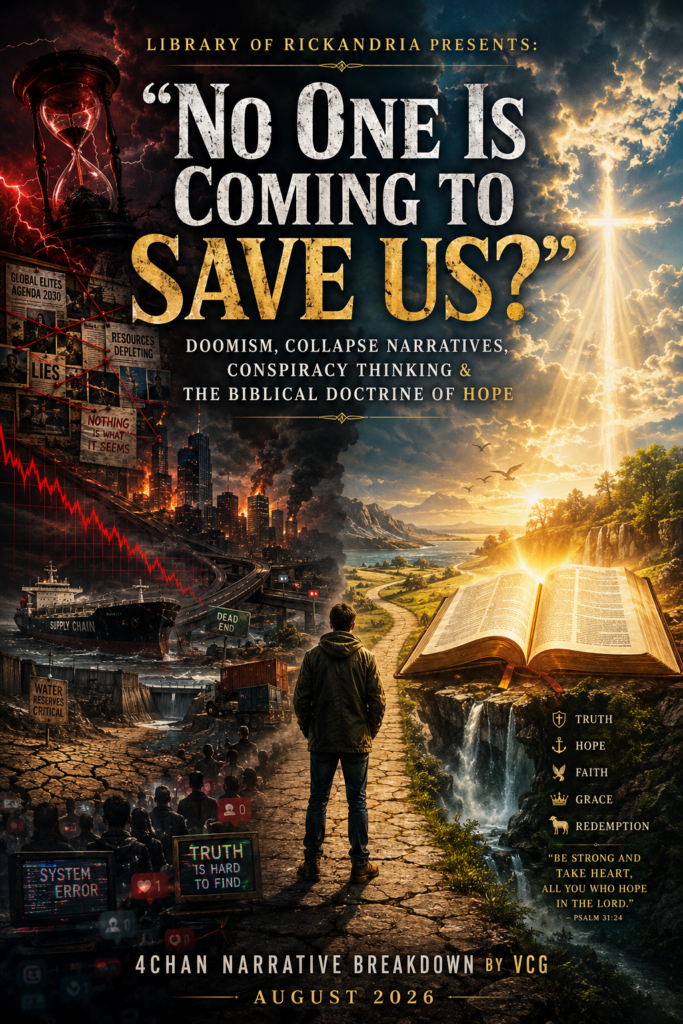
UPDATED BY VCG ON 8/25/2026 @ 15:51 EST
I want to share a heartfelt cause with my audience. Conner Blaisdell-Greene, a brave Airforce Sr. Airman, recently lost his battle with cancer, leaving his family in financial distress. Every donation, no matter how small, can help cover his funeral costs and ease their burden during this difficult time. Please consider clicking the link below to contribute or share Conner’s story with others. Your support truly matters.
Until We Meet Again
Spoken Tribute
Scripture quotations are from the King James Bible.
Introduction: When a Warning Becomes a Worldview
There is something immediately persuasive about a good collapse narrative.
It rarely begins with something ridiculous. It begins with things we can see.
Prices are high. Wars continue. Governments lie. Corporations pursue profit. The Strait of Hormuz has become dangerously unstable. Artificial intelligence is consuming enormous amounts of electricity and capital. Water shortages are real. Climate pressures are real. Food insecurity is real. Political institutions often appear unable to think farther ahead than the next election, quarterly report, or news cycle.
Put enough of those facts beside one another and a picture begins to form.
That is essentially what happened in a thread posted to 4chan’s paranormal board, /x/, on August 23, 2026, under the title The Patronus problem. The anonymous original poster assembled economic anxiety, resource scarcity, war, climate change, artificial intelligence, political dysfunction, and human selfishness into a single conclusion: no outside rescuer is coming, civilization is heading toward breakdown, and humanity has effectively entered into a kind of collective suicide pact. The thread’s central refrain was simple enough to remember: “There is no one coming to save us.”
That sentence is what makes the thread worth examining.
Not because every concern surrounding it is false. Many are not. The deeper problem is what happens between the evidence and the conclusion. A series of legitimate dangers is transformed into an almost total theory of the future. Risks become certainties. Institutional failures become proof that institutions can never succeed. Human selfishness becomes proof that human beings do not meaningfully help one another. Political disappointment becomes contempt for entire classes of people. And eventually, in the replies, despair begins giving way to fantasies of “threat neutralization,” mutual destruction, conspiratorial associations involving CERN and political figures, and spiritual language borrowed from Taoism and Hermeticism.
The purpose of this paper is therefore not to defend the status quo, dismiss legitimate fears, or replace pessimism with shallow optimism. Nor is it to claim that Scripture promises the survival of modern Western civilization, global capitalism, the electrical grid, or any particular political arrangement. The Bible makes no such promise.
The narrower and more important question is this:
Does the thread’s evidence actually support the worldview it constructs from that evidence?
A careful examination suggests that it does not.
The thread sees many real problems. What it repeatedly loses is proportion.
And biblically, that loss of proportion matters because Scripture presents a view of human nature that is darker than secular optimism but a doctrine of hope that is far stronger than secular doom.
I. How This Analysis Was Conducted
Before discussing the claims themselves, some methodological boundaries are necessary.
The 4chan posters are anonymous. We cannot know their ages, histories, intentions, mental health, religious convictions, or whether every statement was sincere. Some comments are obviously humorous or provocative. Others may be intentionally exaggerated. For that reason, this paper does not attempt to diagnose individual posters.
The psychology discussed here concerns patterns of reasoning and rhetoric visible in the text, not psychiatric judgments about the people behind the screen.
Likewise, factual claims need to be separated from predictions.
“The Strait of Hormuz is badly disrupted” can be investigated using shipping and energy data.
“Fiefdoms will emerge as electrical systems fail” is a forecast.
“People only care when others die in front of them” is a claim about human behavior.
“Society is divine” is a philosophical or theological proposition.
“As above, so below” is a statement whose historical origin can be traced.
And “no one is coming to save us” changes meaning depending on whether “save” means political rescue, technological rescue, preservation of civilization, or salvation in the biblical sense.
Those distinctions are essential. Without them, an argument can move almost invisibly from something demonstrably true to something merely imaginable.
My approach throughout is therefore to ask four basic questions:
- What is actually being claimed?
- What evidence supports it?
- How strong is the conclusion compared with the evidence?
- Where a theological claim is made, what does Scripture actually say?
This matters because truth is not served by dismissing everything on 4chan as foolish, nor by accepting something because it sounds prophetic, anti-establishment, pessimistic, or spiritually profound.
“Prove all things; hold fast that which is good.”
— 1 Thessalonians 5:21
II. The Thread Begins With Real Trouble
One reason the opening post works rhetorically is that it does not have to invent the instability surrounding it.
Take the Strait of Hormuz.
As of August 25, 2026, Reuters reported that oil flows through the strait had fallen dramatically from pre-conflict levels. Estimates cited by Reuters placed current movements around five million barrels per day compared with more than twenty million before the conflict, although measurements have varied because of disrupted shipping and incomplete tracking. Maritime traffic was reported roughly 90 percent below previous baselines over one recent period. This is not imaginary instability. It is a serious geopolitical and economic shock affecting one of the world’s most important energy corridors.
The mistake comes when the thread describes this crisis as comparatively minor beside a supposedly “failing global economy.”
The global economy is under substantial pressure. That much is true.
The World Bank’s June 2026 forecast projected global growth of only 2.5 percent for the year, describing it as the weakest rate since the COVID-19 period and noting downgrades across roughly two-thirds of economies. It also warned that many developing economies are making painfully little progress toward closing income gaps with wealthier nations.
That is bad news.
It is not the same as saying that the world economy has failed.
The International Monetary Fund’s July 2026 forecast remained somewhat more optimistic, projecting global growth of 3.0 percent in 2026 and 3.4 percent in 2027. The IMF also projected global headline inflation of 4.7 percent for 2026, acknowledging that the earlier disinflationary trend had stalled.
In other words, there is a legitimate argument that the global economy is fragile, unequal, inflationary, geopolitically exposed, and performing poorly for many households.
There is not yet evidence for the much larger proposition that the economic system is simply in terminal collapse.
That distinction may sound technical, but it is at the heart of the thread.
The pattern is:
something bad is happening → therefore the system is dying.
The first statement may be measurable.
The second requires considerably more evidence.
III. Scarcity Is Real, but Scarcity Is Not a Prophecy
The thread next turns toward food, water, energy, and resource wars.
Here again, reality supplies enough disturbing material without exaggeration.
Climate change has already affected both food and water security. The IPCC reports that roughly half of the world’s population experiences severe water scarcity during at least part of the year, caused by a combination of climatic and non-climatic factors. Climate change has also slowed the growth of agricultural productivity and increased pressures on food systems.
Those facts deserve serious attention.
But saying “water scarcity is a serious global problem” is not identical to saying that humanity is uniformly running out of water and approaching inevitable conflict.
Scarcity is regional. Infrastructure matters. Pollution matters. Governance matters. Agricultural demand matters. Groundwater extraction matters. Rainfall patterns matter. Storage and distribution matter. War matters.
The same is true of food.
The 2026 State of Food Security and Nutrition in the World report estimated that approximately 645 million people experienced hunger in 2025. That is an enormous number and should not be minimized.
Yet that same report found something the doom narrative does not naturally predict: global hunger declined for the third consecutive year, with about fourteen million fewer people facing hunger than in 2024 and roughly forty-three million fewer than at the 2022 peak.
The situation is therefore morally serious and empirically complicated.
Hundreds of millions of people remain hungry.
Healthy diets remain unaffordable for billions.
Climate and war can rapidly reverse improvements.
But the available evidence does not permit the simple story that humanity’s food supply is steadily disappearing in one uninterrupted march toward collapse.
This illustrates one of the central problems with doom narratives: mixed evidence is difficult to fit into them.
If hunger rises, it confirms collapse.
If hunger falls, the improvement can be dismissed as temporary.
If an institution fails, the institution is useless.
If an institution succeeds, the success can be treated as an exception that does not count.
Eventually the worldview becomes difficult to falsify because every possible outcome can be absorbed into it.
That is no longer careful forecasting. It is a narrative defending itself.
IV. The AI Question: A Real Burden Without the Apocalypse
The discussion of artificial intelligence and data centers is another case where a legitimate concern can easily be enlarged into something it does not prove.
According to the International Energy Agency, data centers used approximately 415 terawatt-hours of electricity in 2024, around 1.5 percent of global electricity consumption. In the IEA’s base case, data-center demand could more than double to roughly 945 terawatt-hours by 2030, just under 3 percent of projected worldwide electricity consumption. The local effects can be much larger because data centers are heavily concentrated in certain regions.
This is a major infrastructure issue.
Power generation must expand.
Transmission capacity matters.
Water consumption matters in some cooling systems.
Communities have legitimate questions about who pays for grid upgrades and who receives the economic benefits.
But notice how quantitative information changes the conversation.
“AI data centers require enormous amounts of electricity” is true.
“Therefore AI makes civilizational breakdown inevitable” does not follow.
This is precisely why numbers matter. They restrain rhetoric.
The thread is strongest when it asks whether technological advances will actually be used for the common good.
It is weakest when the question quietly assumes the answer.
V. The Rhetorical Question as Hidden Evidence
Three questions in the opening post carry much of its philosophical weight.
Will corporations sacrifice profit for the public good?
Will governments cooperate rather than compete?
Will ordinary people help another human being when there is no tangible benefit?
The intended answer to all three is obvious:
No.
But a rhetorical question is not evidence.
And once we investigate the claims instead of intuitively answering them, the picture becomes considerably more complicated.
Consider international environmental cooperation.
In 1987, nations adopted the Montreal Protocol to control chemicals destroying the ozone layer. The agreement is not perfect, and environmental diplomacy since then has often been frustrating.
Yet the Montreal Protocol produced measurable results.
The United Nations Environment Programme reports that nearly 99 percent of banned ozone-depleting substances have been phased out, with the ozone layer now on a long-term recovery trajectory.
That single example does not prove that governments always cooperate effectively.
It proves that the statement “governments cannot cooperate effectively” is too strong.
Likewise, the assumption that ordinary people will not help strangers without personal reward is contradicted by real-world observational research.
A cross-national study examined 219 public conflicts captured on surveillance video in the United Kingdom, the Netherlands, and South Africa. In approximately nine out of ten incidents, at least one bystander intervened to help, and often several did.
Human beings are unquestionably capable of selfishness.
Scripture requires no convincing on that point.
But human beings are also capable of courage, sacrifice, mercy, loyalty, and spontaneous assistance.
A worldview becomes distorted when it allows evidence for vice to represent humanity while treating evidence for virtue as sentimental noise.
VI. How a Collapse Narrative Forms in the Mind
The psychology of the thread becomes clearer at this point.
In their classic work on the availability heuristic, Amos Tversky and Daniel Kahneman showed that people often estimate probability partly according to how easily examples come to mind. Events that are vivid, emotionally intense, heavily reported, or memorable can therefore feel more common or more probable than a sober statistical assessment would justify.
Consider the information environment of August 2026.
War footage.
Oil tankers.
Inflation.
Political scandals.
Wildfires.
Floods.
Artificial intelligence anxiety.
Economic charts.
Infrastructure failures.
Propaganda.
Social-media outrage.
Each event may be real. Yet a mind exposed continuously to images of breakdown can begin experiencing availability as inevitability.
The fact that five frightening things are easy to recall does not prove that the most catastrophic imaginable interaction among all five will occur.
The thread repeatedly constructs what might be called a catastrophic chain:
resource pressure leads to conflict;
conflict destroys logistics;
failed logistics produce blackouts;
blackouts produce political fragmentation;
political fragmentation produces fiefdoms;
and whoever eventually restores order will be authoritarian and terrible.
Every link is conceivable.
That is not the same as demonstrating the whole chain.
A story can be coherent without being probable.
This is important because human minds are attracted to coherent narratives. A complicated world containing thousands of independent variables is uncomfortable. A single explanation—civilization is collapsing—creates order out of the noise.
Ironically, conspiracy thinking and doomism can therefore provide a kind of psychological comfort.
The conclusion is frightening.
But the world becomes easier to understand.
Everything fits.
VII. Internet Silos and the Illusion of “Everyone”
The later replies in the thread stumble into another valuable insight almost accidentally.
One poster accuses another of inhabiting a political information silo. The accused poster replies that he spends time primarily in spaces where people ridicule right-wing users. The first poster then points out that this admission effectively confirms the original criticism about selective exposure.
There is something worth preserving here.
People routinely confuse the internet they experience with the world itself.
Large-scale research on Facebook found that politically like-minded sources constitute a substantial share of what users see. Yet an experiment that reduced exposure to such sources by roughly one-third did not measurably change eight major political-attitude outcomes.
That finding cuts against simplistic stories from both sides.
Yes, information environments are ideologically sorted.
No, that does not mean an algorithm alone manufactures a person’s worldview.
People choose communities too.
They follow certain accounts.
They seek certain explanations.
They reward certain kinds of outrage.
The silo is partly imposed and partly inhabited voluntarily.
This creates an important rule for serious investigation:
Never use your own feed as a representative sample of humanity.
If somebody spends most of the day reading examples of foolish Christians, he will eventually believe Christians are uniquely foolish.
If somebody spends most of the day collecting examples of criminal immigrants, corrupt Democrats, corrupt Republicans, abusive police, abusive protesters, atheistic decadence, church scandals, occult symbolism, or collapsing infrastructure, the available examples will begin to feel like the normal state of the whole world.
This does not mean the examples are fake.
It means the sample is distorted.
VIII. When Despair Turns Into Contempt
The most troubling change in the thread occurs after the original argument.
The OP begins with pessimism.
Several replies move toward contempt.
Humanity becomes “shit.” Ordinary people become fools. One poster speaks of “threat neutralization.” Another jokes about mutual extermination and eliminating survivors.
We should not overstate what anonymous internet rhetoric proves. A violent joke is not proof that somebody intends violence.
But the linguistic movement itself matters.
First people are described as stupid.
Then as obstacles.
Then as threats.
Once another person is mentally transformed from a human being who is wrong into a contaminant preventing the future, moral restraints can begin to weaken.
Research on explicit dehumanization has found that it predicts support for intergroup violence even after accounting for simple dislike of the opposing group.
That makes the thread’s progression more than a matter of impolite language.
It reveals one of the dangers of totalizing collapse narratives.
If civilization is truly facing extinction, and if ordinary people are too stupid to recognize it, and if institutions are hopelessly corrupt, then drastic action begins to feel justified.
The argument can slide from:
Something must be done
to:
Someone must take control
to:
Certain people are preventing survival
to:
Perhaps those people need to be removed.
History gives sufficient reason to fear that progression.
Scripture gives another.
“Recompense to no man evil for evil.”
— Romans 12:17
And again:
“Dearly beloved, avenge not yourselves, but rather give place unto wrath.”
— Romans 12:19
The chapter finally gives the Christian answer to the entire logic of retaliatory purification:
“Be not overcome of evil, but overcome evil with good.”
— Romans 12:21
The warning is profound.
One can become so obsessed with defeating evil that evil determines the methods one is willing to use.
IX. Taoism Enters the Thread Unannounced
One of the more intellectually interesting replies presents a passage about trying to seize power and remake society. The poster does not initially identify its origin.
The language comes from chapter 29 of the Tao Te Ching.
A 1919 English translation renders the central thought as a warning against attempting to seize and remake the empire, describing the empire as something “divine” that cannot simply be reconstructed according to human will. Other translations differ in wording, sometimes describing the kingdom as “spirit-like” rather than literally divine.
There is genuine wisdom in the warning against arrogance, political hubris, excess, and the fantasy that an entire human society can be reconstructed perfectly from the top down.
But a Christian reader must distinguish overlap from revelation.
The Bible does not teach that society itself is divine.
“The earth is the LORD’S, and the fulness thereof; the world, and they that dwell therein.”
— Psalm 24:1
The world belongs to God.
The world is not God.
Neither are human political arrangements beyond moral correction. Psalm 82 commands those exercising judgment:
“Defend the poor and fatherless: do justice to the afflicted and needy.”
— Psalm 82:3
The biblical picture therefore does not treat an existing social order as sacred simply because it exists.
Government can be judged.
Rulers can be wicked.
Institutions can require reform.
A Christian can read Lao Tzu and recognize a perceptive observation about human pride. What he should not do is quietly import Taoist metaphysics into Christian doctrine.
The distinction is simple:
Something can contain wisdom without being Scripture.
X. “As Above, So Below” Is Not a Bible Verse
Another reply contributes the phrase “as above, so below.”
Because similar language occasionally appears in Christianized occult material, and because Jesus prayed that God’s will would be done on earth as it is in heaven, some readers may assume the expression is basically biblical.
Historically, it is not.
The phrase is associated with the Emerald Tablet, a short Hermetic and alchemical text. Its better-known formulations describe a correspondence between what is above and what is below—the relationship between higher and lower orders of reality, later connected to macrocosm and microcosm traditions in Western esotericism. The text’s earliest known forms are preserved in medieval Arabic sources and later Latin traditions.
That does not mean every person who repeats the phrase is consciously practicing occultism.
Popular expressions often detach from their origins.
But historical honesty matters.
The biblical prayer is:
“Thy will be done in earth, as it is in heaven.”
— Matthew 6:10
That is not a declaration that earthly events mystically mirror heavenly events.
It is a petition that God’s will be obeyed on earth.
Those are different concepts.
XI. CERN and the Leap From Coincidence to Causation
Near the end of the thread, the conversation moves into a much more recognizably /x/-style form of speculation.
CERN, political figures, disease, death, and subjective time perception become connected into a loose conspiratorial story.
There is one factual anchor underneath part of it: CERN really did begin Long Shutdown 3 in 2026. The Large Hadron Collider ended its current collision run in late June as CERN entered a planned multi-year upgrade period, with operations expected to resume gradually later in the decade.
But a scheduled accelerator shutdown does not establish that physical time slowed afterward.
The reasoning is essentially:
CERN stopped operating.
Time subsequently felt slower.
Therefore CERN had been influencing time.
That is a causal leap.
Humans are extraordinarily good at noticing coincidences once a suspected cause has been supplied. We are much less naturally skilled at asking how many other coincidences occurred that we never noticed because they did not fit a story.
A serious investigation would require measurable physical effects, independent instruments, repeatable observations, a plausible causal mechanism, and evidence distinguishing the hypothesis from ordinary variation in subjective time perception.
Without those, the claim remains speculation.
This principle applies far beyond CERN.
A person died after meeting somebody.
A market crashed after a speech.
A storm followed an astronomical event.
A strange dream preceded bad news.
A machine shut down and the weeks felt different.
The temporal sequence may be real.
Causation is another question entirely.
XII. The Shepherd Problem
One reply mocks people who supposedly expect figures such as Elon Musk or Donald Trump to rescue them and compares political followers to sheep who forget that shepherds eventually exploit or slaughter the flock.
The warning against political messianism is worth hearing.
Scripture says plainly:
“Put not your trust in princes, nor in the son of man, in whom there is no help.”
— Psalm 146:3
That verse should embarrass Christians whenever a politician, monarch, billionaire, military leader, party, or movement begins occupying emotional territory that properly belongs to God.
But the thread’s shepherd analogy also becomes biblically inverted.
Jesus said:
“I am the good shepherd: the good shepherd giveth his life for the sheep.”
— John 10:11
The contrast in John 10 is not between intelligent people who reject shepherds and foolish people who accept them.
It is between the Good Shepherd and false or hireling shepherds.
The Christian answer to false saviors is therefore not to declare that salvation itself is an illusion.
It is to recognize the difference between the false shepherd and the true one.
XIII. “No One Is Coming to Save Us”
We can now return to the sentence around which the thread revolves.
On one level, there is wisdom in it.
No Christian should sit passively waiting for Elon Musk to fix society.
No one should assume a political election will remove human sin.
No serious person should expect an advanced technology to erase greed, pride, envy, violence, lust for power, or the human tendency to misuse good inventions.
Scripture itself demolishes human utopianism.
“Put not your trust in princes.”
That is not secular pessimism.
It is biblical realism.
But the thread continues farther:
“We have to save ourselves.”
Here the word save becomes decisive.
If it means that human beings possess duties and should not use faith as an excuse for laziness, then certainly.
Christians are commanded to work.
Feed.
Give.
Protect.
Teach.
Serve.
Build.
Visit the sick.
Care for strangers.
Correct injustice.
Raise children faithfully.
Tell the truth.
Exercise wisdom.
Prepare for foreseeable hardship.
None of that contradicts trusting God.
But if “we have to save ourselves” means that human beings are their own ultimate redeemer, Scripture answers differently.
“Salvation belongeth unto the LORD.”
— Psalm 3:8
Christianity does not teach that humanity climbs out of sin by becoming sufficiently intelligent, technologically advanced, politically organized, revolutionary, environmentally conscious, or economically efficient.
Nor does it teach that the universe is waiting for humanity to perfect itself.
The doctrine of salvation begins precisely where self-salvation fails.
XIV. Scripture Is Darker About Humanity—and Brighter About Hope
One of the ironies of the thread is that its pessimism about human nature sometimes sounds almost biblical.
People are selfish.
Leaders are corrupt.
Money becomes an idol.
Crowds reward appearances.
Human beings excuse their own behavior.
Power corrupts.
People refuse accountability.
Scripture does not respond to these observations with surprise.
Romans 3 says:
“There is none righteous, no, not one.”
— Romans 3:10
And shortly thereafter:
“For all have sinned, and come short of the glory of God.”
— Romans 3:23
Christianity therefore has no need for a sentimental doctrine of mankind.
But biblical anthropology makes an important move the thread often does not.
The doctrine of universal sin eliminates the fantasy that the enlightened observer stands safely outside the problem.
If humanity is corrupt, I am included.
If pride distorts political judgment, my judgment requires examination too.
If people rationalize their sins, I can rationalize mine.
If propaganda works on human beings, I do not possess a magical exemption because I believe myself “awake.”
If crowds can become cruel, an anti-crowd can become cruel too.
The doctrine of sin is radically leveling.
There are no “normies” on one side and epistemically pure observers on the other.
There are sinners in need of truth.
And there is another difference.
The Bible’s low view of man’s moral self-sufficiency does not produce contempt for mankind.
It produces the doctrine of grace.
XV. The Biblical Answer Is Not Optimism
It would be easy to misunderstand the argument of this paper as:
“Things are not that bad. Cheer up.”
That is not the biblical answer.
Nations do fall.
Economies do collapse.
Wars do destroy societies.
Famine does occur.
Governments become tyrannical.
Christians are persecuted.
Civilizations that once seemed permanent disappear.
Scripture does not promise otherwise.
Jesus Himself spoke of wars, famines, pestilences, persecution, deception, and upheaval.
But His instruction in Matthew 24 is striking:
“ye shall hear of wars and rumours of wars: see that ye be not troubled.”
— Matthew 24:6
And then:
“for all these things must come to pass, but the end is not yet.”
That sentence should place a guardrail around Christian apocalyptic thinking.
A war is not automatically proof that the final hour has arrived.
A famine is not automatically a timestamp.
A strange astronomical event is not automatically a prophetic fulfillment.
An economic crash does not automatically validate the eschatological system of whoever predicted disaster most loudly.
Christ’s disciples were commanded to watch.
They were not commanded to panic.
XVI. Christ’s Return and the Failure of Secular Doom
Acts 1 provides perhaps the clearest correction to both passive escapism and secular doomism.
Before Christ’s ascension, the disciples wanted to know about the restoration of the kingdom.
Jesus answered:
“It is not for you to know the times or the seasons, which the Father hath put in his own power.”
— Acts 1:7
That is a rebuke to prophetic timetable obsession.
But He did not then tell them to stop thinking about the future.
They were commissioned to become witnesses.
And after His ascension the disciples were told:
“this same Jesus, which is taken up from you into heaven, shall so come in like manner as ye have seen him go into heaven.”
— Acts 1:11
There is the Christian tension.
You do not control the timetable.
You do have work to do.
Christ will return.
That is entirely different from both alternatives offered by the thread.
The first false alternative says:
“Someone will rescue civilization, so do nothing.”
The second says:
“No one is coming, so humanity must redeem itself.”
Biblical Christianity says neither.
It says:
Christ is coming; therefore be faithful.
XVII. Hope Is Not Passivity
This distinction matters because biblical hope is sometimes caricatured as psychological anesthesia.
Why fix anything if Jesus will return?
Why help the poor?
Why protect creation?
Why confront corruption?
Why prepare?
Why build?
The New Testament does not reason that way.
Christ’s teaching about His return repeatedly leads into teachings about watchfulness, stewardship, faithfulness, mercy, and service.
Matthew 25 describes feeding the hungry, giving drink to the thirsty, receiving the stranger, clothing the naked, and visiting the sick and imprisoned.
First Thessalonians joins hope about Christ’s coming with an extraordinarily ordinary command:
“study to be quiet, and to do your own business, and to work with your own hands.”
— 1 Thessalonians 4:11
That is almost the opposite of internet apocalypse culture.
No frantic date setting.
No fantasies about being one of the enlightened survivors.
No romantic fixation on collapse.
No excuse for idleness.
Hope produces faithfulness in ordinary duty.
XVIII. The Most Serious Error: Despair Pretending to Be Realism
Doomism often presents itself as courage.
Optimists cannot handle reality, it says.
Ordinary people need comforting lies.
The pessimist alone is strong enough to stare into the darkness.
Sometimes pessimists are correct.
But despair should not be confused with intelligence.
A person can exaggerate negative evidence just as easily as another person can ignore it.
There is a strange pride available in hopelessness: the belief that one is too perceptive to be fooled by hope.
Scripture recognizes a different possibility.
Hope can exist because the danger is real.
Psalm 46 does not begin with a peaceful world.
It imagines the earth being removed, mountains cast into the sea, waters roaring, nations raging, and kingdoms moving.
And still it says:
“God is our refuge and strength, a very present help in trouble.”
— Psalm 46:1
Biblical hope is not confidence that nothing terrible will happen.
It is confidence that God does not cease to be God when terrible things happen.
That is far more durable.
XIX. What the Thread Gets Right
A fair analysis should not finish without acknowledging the truths hidden inside the pessimism.
The thread is right that political figures should not become messiahs.
It is right that technology cannot repair human character.
It is right that prosperity should not be assumed permanent.
It is right that large institutions frequently protect themselves.
It is right that resource pressures can destabilize societies.
It is right that climate, war, energy, food, economics, and logistics interact.
It is right that people frequently ignore slow-moving dangers until they become immediate.
It is right that personal responsibility matters.
It is right that civilization can become morally disordered.
It is right that empty rhetoric cannot substitute for action.
And it is right that when a society waits until everything has broken before seeking order, the person who eventually promises to restore order may demand a terrible price.
Christians should be capable of acknowledging all of that without fear.
Truth does not become false because somebody uses it inside a faulty worldview.
XX. Where the Thread Breaks Down
The argument fails when it turns tendencies into absolutes.
Some corporations behave selfishly; therefore corporations will never sacrifice profit.
Governments frequently fail; therefore government cooperation is meaningless.
People can be selfish; therefore strangers will not help one another.
Food insecurity is severe; therefore food is simply disappearing.
Economic growth is weak; therefore the global economy is dying.
Water scarcity exists; therefore resource war is destiny.
AI creates infrastructure pressure; therefore technological benefit is socially moot.
Political leaders disappoint; therefore leadership itself is predatory.
The internet creates ideological silos; therefore everybody outside one’s own circle is programmed.
CERN shut down; therefore a subjective change in time perception may be connected.
Civilization is unstable; therefore collapse is inevitable.
Human beings are sinners; therefore humanity is worthless.
No political messiah is coming; therefore no Savior is coming.
Those conclusions do not follow.
Conclusion: Between Denial and Doom
The most responsible response to the 4chan thread is neither mockery nor agreement.
The world of August 2026 contains genuine danger.
Hormuz is not imaginary.
Inflation is not imaginary.
Weak economic growth is not imaginary.
Food insecurity is not imaginary.
Water stress is not imaginary.
Climate risk is not imaginary.
War is not imaginary.
Technological disruption is not imaginary.
Political corruption is not imaginary.
Human sin is certainly not imaginary.
But none of those truths gives us permission to invent certainty about everything that comes next.
There is a moral discipline required in refusing both comforting lies and terrifying ones.
The thread’s fundamental mistake is not that it sees darkness.
Scripture sees plenty.
The mistake is allowing darkness to become the whole horizon.
Christianity does not teach confidence in civilization. It teaches confidence in God.
It does not teach confidence in princes.
It does not teach confidence in billionaires.
It does not teach confidence in corporations, revolutions, algorithms, elections, international institutions, or enlightened internet communities.
Every one of those things can fail.
Yet their possible failure does not imply that history has become godless.
And this finally brings us back to the thread’s haunting sentence:
“There is no one coming to save us.”
If the author means there is no earthly political savior who can remove the consequences of human sin, Scripture gives reason to agree.
If the author means no technological messiah can redeem humanity, agree again.
If the author means governments and corporations should not become objects of faith, the Psalms said so thousands of years before 4chan existed.
But if the sentence means what it ultimately appears to mean—that man is alone, history is closing over him, and humanity must somehow become its own salvation—then the biblical answer is no.
Not because Christians possess a secret timetable.
Not because civilization cannot fall.
Not because suffering will disappear.
Not because every crisis will be fixed.
But because salvation never belonged to civilization in the first place.
“Salvation belongeth unto the LORD.”
— Psalm 3:8
The Christian therefore has no reason for naïve optimism.
He also has no permission for nihilism.
He can acknowledge collapse where collapse is occurring, prepare where preparation is wise, expose lies where lies are told, help his neighbor when help is needed, refuse political idolatry, test extraordinary claims, reject occult syncretism, resist dehumanization, work with his hands, care for his household, defend the vulnerable, preach the truth, and remain watchful.
He does not need to pretend that the world is safe.
He needs to remember who God is when it is not.
That is the difference between hope and optimism.
Optimism says things will probably turn out the way we want.
Biblical hope says that even when they do not, the Lord remains faithful.
And perhaps that is the most important correction to the entire collapse narrative.
The Christian’s answer to “No one is coming to save us” is not a date, a political slogan, or an escape fantasy.
It is the testimony given at the Ascension:
“this same Jesus… shall so come in like manner as ye have seen him go into heaven.”
— Acts 1:11
Until then, the command is not panic.
It is faithfulness.
Soli Deo Gloria.
Selected Sources
Primary thread. “The Patronus problem,” 4chan /x/, thread No. 42863178, posted August 23, 2026 and subsequent replies through August 25, 2026.
International Monetary Fund. World Economic Outlook Update, July 2026; projected global growth and inflation.
World Bank. Global Economic Prospects, June 2026; global growth forecast and developing-economy outlook.
Food and Agriculture Organization of the United Nations. The State of Food Security and Nutrition in the World 2026.
International Energy Agency. Energy and AI; global data-center electricity consumption and projected demand.
Intergovernmental Panel on Climate Change. AR6 Synthesis Report and Working Group II findings concerning food and water security.
United Nations Environment Programme. Scientific Assessment Panel findings concerning the Montreal Protocol and ozone-layer recovery.
Philpot et al. “Would I be helped? Cross-national CCTV footage shows that intervention is the norm in public conflicts.” American Psychologist.
Tversky, Amos, and Daniel Kahneman. “Availability: A heuristic for judging frequency and probability.” Cognitive Psychology 5, no. 2 (1973): 207–232.
Nyhan et al. “Like-minded sources on Facebook are prevalent but not polarizing.” Nature (2023).
CERN. “Long Shutdown 3,” including the June 2026 conclusion of the LHC collision run and scheduled upgrade period.
Lao Tzu. Tao Te Ching, chapter 29, comparative historical English translations.
Hermetic tradition. Historical discussion of the Emerald Tablet and the maxim commonly rendered “as above, so below.”
4CHAN THREAD & POST BREAKDOWNS – Library of Rickandria
VCG PAPER PROJECTS – Library of Rickandria