
Where Are the Bodies? A Critical Examination of the Garth Brooks Serial-Killer Conspiracy Theory
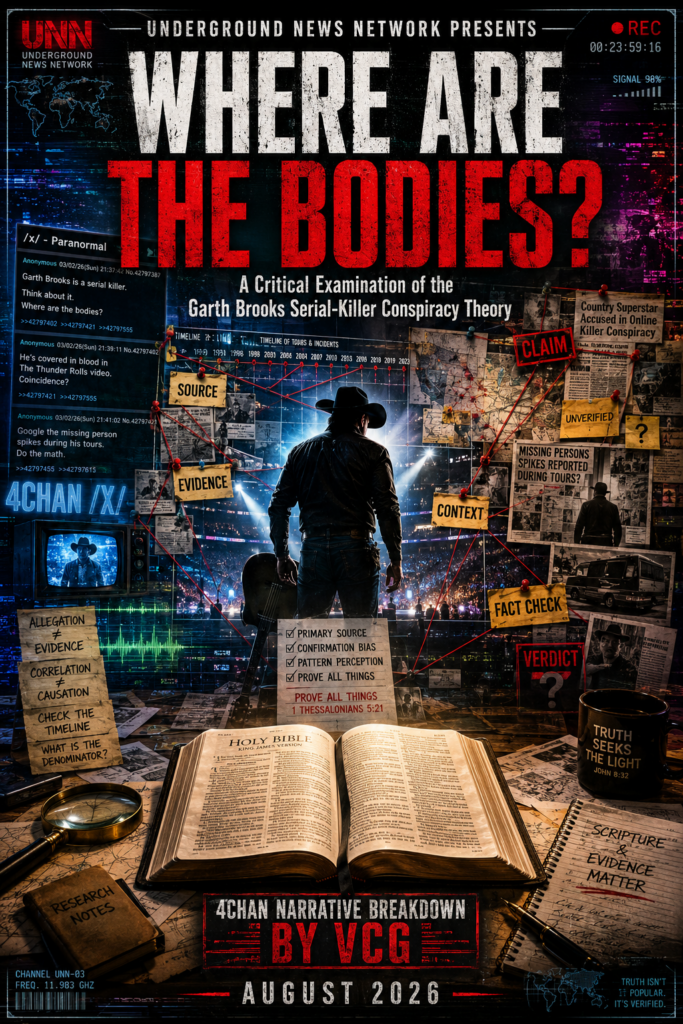
UPDATED BY VCG ON 8/14/2026 @ 10:10 EST
I want to share a heartfelt cause with my audience. Conner Blaisdell-Greene, a brave Airforce Sr. Airman, recently lost his battle with cancer, leaving his family in financial distress. Every donation, no matter how small, can help cover his funeral costs and ease their burden during this difficult time. Please consider clicking the link below to contribute or share Conner’s story with others. Your support truly matters.
Anyone can do this, but they won’t.
ChatGPT – Library of Rickandria
I’ll treat the thread as a primary source, separate its claims from rhetoric, then test each claim against independent evidence and the KJV text. I’ll also flag where the thread is merely speculative, where evidence is mixed, and where Scripture is being quoted or applied out of context.
/x/ – Garth Brooks is a deranged serial killer – Paranormal – 4chan
The first major finding is already important: the thread itself contains a skeptic who correctly identifies the meme’s provenance—comedian Tom Segura’s “where are the bodies?” bit—while other posters convert that joke into a literal murder theory. The evidentiary question is therefore not “are there coincidences?” but “was a suspect hypothesis defined first and then independently tested against complete data?”
A second major finding strengthens the rebuttal: the authors behind Bodies in Low Places describe their own project as a “satirical exposé” and even say they searched cases using “a bit of confirmation bias.” Their synopsis openly asks speculative questions (“Was it Garth himself?”) and later admits no direct evidence in another example. That is not an independent criminal-investigation dataset; it is satire built to imitate one.
Soli Deo Gloria. I went through the archived thread itself, the principal material it relies on, the origin of the “Where are the bodies, Garth?” meme, the Bodies in Low Places material, official venue records, criminal-investigation standards, psychological research on pattern perception, the separate sexual-assault litigation, the Chris Gaines history, and the relevant KJV passages.
Overall verdict
The 4chan thread does not establish that Garth Brooks is a serial killer, participant in ritual murder, “MONARCH” mind control subject, Satanic child abuser, or protected murderer. Those are extraordinary accusations for which the thread supplies no forensic evidence, eyewitness identification, confession, law-enforcement linkage, victim-to-suspect linkage, digital evidence, vehicle evidence, DNA, fingerprints, ballistics, verified communications, or statistically controlled crime pattern.
More importantly, the supposed investigative foundation behind the theory identifies itself as originating in comedy. The authors of Bodies in Low Places say they initially proposed writing a “satirical exposé,” explicitly admit using “a bit of confirmation bias,” acknowledge that there is no direct evidence linking Brooks to the murders they discuss, and finally concede that the “more likely” explanation is that the whole phenomenon is a satirical myth. (Hornpin Media Group)
And one of their opening “coincidences” is demonstrably wrong. Their synopsis says Desirea Ferris disappeared on May 1, 2017, while Brooks was performing at Kansas City’s Sprint Center that night. The venue’s own archived event record says Brooks’s Kansas City engagement ran May 5–13, 2017, beginning four days later. (Hornpin Media Group)
That single error does not automatically disprove every claim in the book. It does, however, expose exactly why this sort of methodology cannot be trusted without independent replication.
There is also a separate, serious sexual-assault allegation against Brooks. A former hair-and-makeup artist filed a civil lawsuit alleging rape and sexual misconduct; Brooks emphatically denies the allegations and alleges attempted extortion. That dispute must be assessed on its own evidence. It neither proves nor provides legitimate evidence for the serial-murder allegations. Court docket search results show litigation activity continuing into June 2026, so I found no basis for treating those disputed allegations as an adjudicated fact. (AP News)
That distinction—allegation, evidence, inference, verdict—is foundational.
I. What the thread actually does
The August 8–9, 2026 thread begins with the conclusion and then looks for material that makes the conclusion feel plausible. The OP literally begins, “I’m actually starting to believe this,” then describes “far too many coincidences,” Brooks seeming creepy, an old acting joke, Chris Gaines, Brooks’s politics, and finally asks whether he is a protected member of “The Cult.” (4chan)
That order matters.
A sound investigation normally proceeds:
observations → defined hypothesis → evidence collection → competing explanations → attempted falsification → conclusion.
The thread largely proceeds:
conclusion → creepy observations → coincidences → reinterpret ordinary facts as sinister → absorb further rumors → conclusion strengthened.
The latter procedure is extraordinarily good at creating convincing stories out of innocent datasets.
The FBI’s own serial-murder guidance emphasizes coordinated case information, timelines, comparison of case elements, consistent forensic work, and disciplined data management. It also warns that serial murder attracts unusually high levels of public mythology and misinformation. (FBI)
Now to the thread itself.
II. OP, line by line
Line 35 — “I’m actually starting to believe this”
This is not evidence; it tells us the poster’s present confidence level.
Methodologically, the danger is hypothesis commitment. Once “Garth is the killer” becomes the working narrative, ambiguous information can unconsciously be sorted into “supports Garth” and “irrelevant.”
That problem is particularly conspicuous here because the authors behind the later murder compilation admit that their project began as satire and that they used “a bit of confirmation bias” while searching hundreds of cases against Brooks’s known locations. (Hornpin Media Group)
Biblically, conviction is not a substitute for examination:
“He that answereth a matter before he heareth it, it is folly and shame unto him.”
— Proverbs 18:13, KJV
And:
“He that is first in his own cause seemeth just; but his neighbour cometh and searcheth him.”
— Proverbs 18:17, KJV
Those verses are particularly apt because Proverbs does not say that the first story is necessarily false. It says it can seem decisive until examined.
The KJV text used here is from the uploaded Pure Cambridge Edition.
Line 36 — Brooks is supposedly “using his tours” for “macabre theater”
Verdict: unsupported hypothesis.
A touring musician certainly travels frequently. A murderer could theoretically travel frequently. But shared mobility establishes neither identity nor homicide.
To convert this into an evidentiary hypothesis, the researcher would need, at minimum, to define which murders constitute the alleged series and show some independent linking characteristic among them: common victimology, forensic linkage, MO/signature, common vehicle evidence, communications, eyewitnesses, DNA, ballistics, or some other feature explaining why these crimes should be treated as one offender’s series.
The FBI’s recommended approach involves precisely that sort of timeline and cross-case analysis—not merely discovering that violent crimes occurred somewhere around a travel itinerary. (FBI)
The Bodies in Low Places synopsis instead repeatedly moves from proximity to imagined narratives: “Could he have…?”, “perhaps…”, “we theorize…”. In one 2025 case, the authors themselves ask whether any direct evidence connects Brooks to the victim and answer essentially: no. (Hornpin Media Group)
Possibility is being substituted for evidence.
Line 37 — “far too many coincidences”
This is the heart of the theory, and it is also its largest statistical defect.
The statement is meaningless until we know the denominator.
Suppose a celebrity spends decades:
- touring major metropolitan areas,
- living near major metropolitan areas,
- attending award ceremonies,
- traveling by plane,
- appearing at hundreds or thousands of events.
Now search decades of:
- murders,
- missing-person cases,
- unidentified remains,
- shootings,
- abductions,
- disappearances,
while allowing flexible windows of “same day,” “same weekend,” “a few days before,” “a few days after,” “nearby,” “along the route,” and “possibly traveling through.”
You will find coincidences.
The scientifically important question is not:
How many matches can I find?
It is:
Are there more prespecified matches than would occur under an appropriate control condition?
The project’s own description admits that researchers searched “hundreds” of websites, articles, and cases linking Brooks’s residences, concerts and other known locations to crimes, while acknowledging their own confirmation bias. (Hornpin Media Group)
Without knowing all the non-matches, “too many coincidences” cannot be evaluated.
III. The first major factual failure: Desirea Ferris
This deserves special attention because Bodies in Low Places opens with it.
The synopsis says that on May 1, 2017, Desirea Ferris disappeared and that “that same night” Brooks was performing at the Sprint Center in Kansas City. (Hornpin Media Group)
But the arena’s official archived page says:
Garth Brooks — May 5–13, 2017. (T-Mobile Center)
So the supposedly ominous same-night overlap disappears immediately.
This is not an obscure interpretive disagreement. May 1 is not May 5.
Worse, later on the same current synopsis, Ferris is described as having lived “just 20 minutes from Gainbridge Fieldhouse.” Gainbridge Fieldhouse is not the Kansas City venue discussed in the opening narrative; the text is plainly internally inconsistent about the geographical framing. (Hornpin Media Group)
That illustrates a critical methodological lesson.
If a researcher begins by asking:
“Which missing people can I fit around Garth Brooks?”
rather than:
“Here is my fixed rule; now let’s process every tour date and every qualifying case without knowing whether it helps the hypothesis,”
errors and selective matches can accumulate rapidly.
And because an actual missing person is involved, there is an ethical dimension: real victims should not become props in entertainment theories without solid evidence.
IV. Line 38 — “He’s odd”; “my skin crawls”
Verdict: subjective impression, zero demonstrated probative value for homicide.
Brooks really did join Facebook in November 2014, and the awkward first Facebook video that subsequently became comedy material is genuine. Contemporary reporting confirms his entry into Facebook/Twitter at that time. (Rolling Stone)
But:
“This man makes me uncomfortable” ≠ “this man kills people.”
Psychologically this is an example of allowing an affective reaction to function as evidence. People can appear stiff, uncanny, overly rehearsed, anxious, theatrical, awkward, intense, socially unusual, or simply irritating without being violent criminals.
And this is where pattern perception becomes important. Experimental research has found an association between illusory pattern perception and conspiracy belief: people can perceive meaningful connections in material where the evidentiary relationship is weak or nonexistent. That is a general human cognitive vulnerability, not a diagnosis of anyone in the thread. (PubMed)
The correct question is therefore not:
“Does the video feel creepy?”
but:
“What fact relevant to a homicide does the video establish?”
The answer is: none.
V. Lines 40–41 — “I guess I can just murder some people”
Here the thread misquotes/paraphrases an authentic dark joke.
In the actual old interview material, Brooks is talking specifically about wanting an acting role as a villain. When told he looks like a good guy, his response reported from the clip is:
“I’d rather kill somebody. That’d be fun.”
That is still an eyebrow-raising sentence when isolated, but its subject is unmistakably acting a bad guy, not describing actual homicide. (Whiskey Riff)
The thread transforms a joking comment made during a discussion of fictional acting into quasi-confessional evidence.
That is a context collapse.
Compare:
“I want to play Macbeth; I’d love to murder the king.”
with:
“I murdered the king.”
The presence of the word “murder” does not make the two propositions equivalent.
This clip can fairly be characterized as dark humor. It cannot responsibly be characterized as evidence of murder.
VI. Lines 42–43 — “They … give a lot of evidence”
This is where the thread’s evidentiary structure becomes circular.
The linked serial-killer discussion derives from the same internet theory that arose out of the Tom Segura joke and was subsequently developed by Matt Cox and collaborators. The authors themselves explain the genealogy: Segura joked about Brooks having bodies buried behind his house; fans transformed it into a conspiracy; Cox then proposed a “satirical exposé.” (Hornpin Media Group)
So we do not have:
independent investigators → independent evidence → convergence on Brooks.
We largely have:
comedy bit → online meme → crime-date searching → book/podcast/video → forum poster cites video as proof.
That is an information loop.
Repeating an allegation through five media formats does not create five independent sources.
VII. The origin of “Where are the bodies, Garth?”
The skeptical poster at lines 81–89 is substantially correct about the origin.
The meme originated with comedian Tom Segura and his Your Mom’s House material mocking Brooks’s unusually earnest/awkward social-media videos. Contemporary retrospectives trace “Where are the bodies, Garth?” back to this comedy bit, not to a law-enforcement investigation or whistleblower. (Saving Country Music)
The Bodies in Low Places synopsis confirms the same genealogy: it dates Segura and Christina Pazsitzky’s joking speculation to November 28, 2018, and says the joke subsequently “morphed” into conspiracy theories. (Hornpin Media Group)
That does not logically prove that Brooks could never have committed an unknown crime.
But it dramatically alters the evidentiary significance of the supposed “theory.”
The suspect was selected before the crime series was assembled.
That is exactly backwards for a strong linkage analysis.
VIII. Line 44 — Chris “Gains,” Australian “EMO rocker,” The Lamb
There are several corrections.
First, the name is Chris Gaines, not Gains.
Second, Chris Gaines was deliberately created as a fictional musician/film character. Brooks intended to portray Gaines in a film called The Lamb. The 1999 record functioned as a pre-soundtrack/introduction to the fictional rock star; the movie was never made. The fictional Gaines biography placed him in Australia. (Wikipedia)
Third, calling him simply an “emo rocker” is misleading. The material was variously pop, rock, alternative rock and R&B-oriented—not straightforwardly what “emo” ordinarily denotes. (Wikipedia)
So:
True: Brooks adopted an elaborate fictional alternate persona.
False inference: therefore Brooks has a homicidal alternate personality.
Actors portray killers. David Bowie created Ziggy Stardust. Musicians construct characters. Fictional personas are not clinical evidence of dissociative pathology, ritual programming or murder.
IX. Line 62 — “Chris Gaines is addicted to sex”; therefore “ritual alter”
There is an especially revealing half-truth here.
The fictional biography of Chris Gaines did indeed include a fictional history of sex addiction. Contemporary retrospectives explicitly describe the tragedies and sex addiction as parts of Gaines’s invented biography. (The Boot)
That means the proposition is:
The fictional character Chris Gaines was written as having sex addiction.
It does not mean:
Garth Brooks has a programmed sex-addicted alter personality.
Those are radically different propositions.
The thread takes information from the diegetic biography of a fictional character and treats it as clinical history about the actor portraying him.
That would be like diagnosing Anthony Hopkins with Hannibal Lecter’s psychopathology because Hopkins played Lecter.
The “ritual alter” conclusion has no evidentiary bridge whatsoever.
X. “One black eye” symbolism
The thread also says the album was “designed to show one black eye.”
Even if someone visually interprets the cover that way, the thread provides no design memorandum, statement from Brooks, photographer, art director or record label establishing that a “black eye” symbol was intentionally encoded as an occult sign.
There are two separate propositions:
Observation: one eye/side of the face looks darker.
Interpretation: therefore it is an intentional occult “one-eye” signal demonstrating ritual affiliation.
Only the first can potentially be read from the image. The second requires independent evidence.
Symbolic interpretation becomes especially unreliable when the method allows nearly any photograph—covered eye, shadowed eye, hair across eye, wink, partial face—to become confirmation.
That makes the theory difficult or impossible to falsify.
XI. Line 46 — “The Liberal Cowboy”
Even if every political characterization in the post were granted, it would have zero evidentiary bearing on murder.
Brooks has long expressed culturally inclusive or socially progressive themes, and the New Yorker famously characterized him in 2014 as country music’s “Square, Liberal Dad.” (The New Yorker)
But the post’s ideological insult operates rhetorically as:
progressive social views → elite affiliation → occult affiliation → homicidal privilege.
No evidence supports those transitions.
This is guilt by association combined with an outgroup stereotype.
A person’s opinions on gay people, race, politics, presidential inaugurations, country music culture, or anything similar cannot substitute for evidence that the person murdered anyone.
Scripture is particularly severe about partial standards:
“Thou shalt not raise a false report: put not thine hand with the wicked to be an unrighteous witness.”
— Exodus 23:1
And immediately:
“Thou shalt not follow a multitude to do evil…”
The biblical standard does not become weaker because the accused belongs to a cultural or political group we distrust.
XII. Line 47 — “made man in The Cult”; allowed to kill with impunity
Verdict: assertion without evidence.
Notice what has happened by this point.
No cult has been identified.
No membership record has been produced.
No witness to initiation has been identified.
No murder has been linked to Brooks.
No evidence of institutional protection has been produced.
Yet the alleged cover-up becomes an explanation for why evidence is missing.
That produces an epistemically closed theory:
No evidence → proof the cult hid it.
Investigation finds nothing → proof investigators are compromised.
Brooks isn’t charged → proof he has immunity.
He appears normal → proof of his sophisticated mask.
He appears strange → proof his mask is slipping.
That system can accommodate every possible observation.
A theory that predicts both X and not-X without risk of falsification has very little explanatory value.
XIII. Lines 81–83 — the skeptic’s rebuttal
The skeptical poster sarcastically summarizes the argument:
liberal + cowboy + acting ambition → serial killer,
and then correctly observes that the promoter of the theory went searching through tour dates for deaths in cities Brooks visited. (4chan)
Strip away the poster’s insults, and this is one of the strongest comments in the entire thread.
The point is methodological, not ideological:
Were the crimes identified independently because they exhibited evidence of a common offender, or were crimes selected because Brooks could be positioned nearby?
Everything I found points overwhelmingly toward the second process. The authors themselves describe starting with the Brooks rumor, searching Brooks’s locations against hundreds of crime sources, and employing some confirmation bias. (Hornpin Media Group)
That makes the skeptical methodological objection substantially justified.
XIV. Line 86 — “Garth is satanic pedo like the rest of famous people”
Verdict: completely unsupported by the evidence presented.
This is no longer argument. It is a universalized accusation about celebrities.
No evidence in the thread establishes Satanism.
No evidence in the thread establishes child sexual abuse by Brooks.
No evidence in the thread establishes that “the rest of famous people” are Satanic child abusers.
This is also a textbook example of how conspiratorial reasoning can expand its prior assumptions:
- All elites are perpetrators.
- Brooks is elite.
- Therefore Brooks is a perpetrator.
- Evidence concerning Brooks is consequently optional.
But premise 1 is precisely what would need proving.
Biblically:
“Be not a witness against thy neighbour without cause; and deceive not with thy lips.”
— Proverbs 24:28, KJV
That prohibition does not contain a celebrity exemption.
XV. Lines 88–89 — “real crimes” / sexual-assault accusations
Here the poster raises something materially different and real enough to require careful treatment.
In October 2024, a former hair-and-makeup artist sued Brooks alleging that he raped and sexually assaulted her in 2019 and engaged in other sexual misconduct. Brooks denied the allegations and characterized them as false and part of an extortion attempt; he had already filed his own action. (Reuters)
The correct labels therefore are:
Fact: a lawsuit and allegations exist.
Fact: Brooks denies them.
Not established merely by filing: that the alleged assault occurred.
Also not established: that the allegations have anything whatsoever to do with murders.
Recent docket search results show activity continuing as late as June 3, 2026, which is why these should not be described as conclusively adjudicated “crimes” based on the materials presently available. (CourtListener)
There are two opposite reasoning errors to avoid:
“The accuser sued him; therefore everything alleged is automatically true.”
and:
“He denies it; therefore the accuser is automatically lying.”
Neither follows.
The allegations deserve their own evidence, witnesses, documents, cross-examination and legal process.
XVI. Line 108 — “MONARCH mind control”
This requires a particularly careful historical distinction.
MKULTRA was real.
Declassified CIA material documents Project MKULTRA and research involving mind-control/interrogation/behavior-modification subjects. That historical fact should not be whitewashed. (CIA)
But:
MKULTRA existed
does not logically entail:
every later internet story about “Project MONARCH” is authentic
and certainly does not entail:
Garth Brooks underwent MONARCH programming.
When I searched the CIA’s own reading room for “Project Monarch,” the relevant CIA hits included FOIA case logs recording that people requested records using that term. A FOIA log saying someone asked the CIA for records is evidence of the request, not confirmation that the requested program existed as alleged. (CIA)
So line 108 supplies exactly zero usable evidence:
“He has been named … by people.”
Who?
What documents?
What first-hand witness?
What date?
What program records?
What corroborating evidence?
Until those questions have answers, it is hearsay.
This distinction is essential because true conspiracies have existed. Historical conspiracies are a reason to investigate carefully, not a license to lower the evidentiary standard for unrelated claims.
XVII. Line 117 — “I don’t remember Chris Gaines”
This commenter simply reports autobiographical memory.
It establishes nothing either way.
Chris Gaines demonstrably existed as a 1999 Brooks project; there are contemporary releases and media records. (Wikipedia)
But failure to remember a pop-cultural event 27 years later is entirely unsurprising.
This is an example of why memory is useful as a lead but often weak as historical verification.
XVIII. Line 126 — Segura “threatened by lawyers” and secretly believes it
I could not substantiate this claim through credible reporting.
More importantly, the observable public record points in a different direction: Segura continued using the Brooks/body joke for years, and in April 2026 he discussed Brooks’s people approaching him about a possible podcast appearance. (Whiskey Riff)
That does not absolutely prove that no lawyer ever contacted him privately.
But it means the 4chan proposition:
“He was threatened by lawyers and privately believes it”
is presently unsupported hearsay, not established fact.
Notice its construction:
“From what I’ve heard…”
That phrase should immediately lower confidence until the source chain is produced.
XIX. Line 127 — “friend from his hometown” who had stories
This is classic multiple-level hearsay.
Anonymous 4chan poster → unnamed friend → unnamed stories → conclusion of serial murder.
None of those intermediate links can presently be checked.
The additional reasoning—
Brooks is strange + Brooks is wealthy + human beings are capable of terrible evil → therefore he might be a murderer—
only establishes abstract possibility.
It is indeed true that wealthy, outwardly respectable or socially successful people can commit serious crimes. The FBI specifically warns against the myth that serial killers must be obvious dysfunctional loners; some offenders have families, careers and community lives. (FBI)
But that general fact cannot be reversed:
Some murderers are wealthy/respectable
Brooks is wealthy/respectable
therefore Brooks may be one of those murderers.
That is the same invalid form as:
Some bank robbers drive Toyotas.
Richard drives a Toyota.
therefore investigate Richard for bank robbery.
A general offender trait has poor suspect-specific value unless it discriminates the suspect from innocent people.
XX. Line 128 — “It’s definitely possible”
This is perhaps the most important logical correction in the thread.
Possible does not mean probable.
And neither possible nor probable means demonstrated.
Thousands of logically possible scenarios have vanishingly little evidentiary support.
It is “possible” that an unsolved homicide was committed by:
- a stranger,
- an acquaintance,
- a serial offender,
- someone never publicly suspected,
- someone passing through,
- someone living nearby.
Listing possibilities is the beginning of investigation, not its conclusion.
A responsible investigation asks which hypothesis best predicts the actual evidence.
XXI. Line 129 — elites “rape, torture, kill and eat kids”
Again, the statement is simply asserted.
No source.
No identified population.
No denominator.
No evidence showing that the class described as “they” universally or characteristically performs these acts.
There unquestionably have been wealthy and powerful perpetrators of sexual abuse, trafficking and homicide. That historical reality does not justify attributing those crimes indiscriminately to an entire social category.
The danger is morally significant: genuine victims and genuine crimes can become buried under indiscriminate accusations.
XXII. Line 138 — George Strait is the real king of country
Finally, a claim for which statistical methodology may never save us.
This is a music-ranking opinion, not evidence. (4chan)
It has no bearing on homicide.
XXIII. Line 151 — “Hat Man”
This is a joke mixing Brooks with lyrics from “The Thunder Rolls” and paranormal imagery. It supplies no factual claim requiring serious rebuttal. (4chan)
XXIV. Lines 160–163 — “we value evidence in accusing people of murder”
Ignoring the insults surrounding it, the core principle is sound.
Murder accusations demand evidence. (4chan)
The poster then calls the serial-killer story a distraction from the sexual allegations. “Distraction” would itself require proof of intent: we do not know that anyone deliberately created the theory to hide the lawsuit. The timeline actually undermines that proposition because the bodies joke dates to 2018, years before the 2024 lawsuit became public. (Hornpin Media Group)
So the best correction is:
The serial-murder accusation is evidentially weak.
The sexual-assault litigation is real but disputed.
There is no demonstrated reason to merge either into the other.
XXV. The fatal methodological problem with Bodies in Low Places
The book/synopsis deserves scrutiny because the thread presents its derivative material as “a lot of evidence.”
Yet the authors essentially tell us their method.
They heard a joke.
They proposed a satirical exposé.
They searched hundreds of sources for crimes around Brooks’s known locations.
They acknowledge “a bit of confirmation bias.”
They repeatedly construct hypothetical narratives around proximity.
They admit lack of direct evidence.
They ultimately call the satirical-myth explanation more likely. (Hornpin Media Group)
That is fascinating as satire/social folklore.
It is extremely weak as an accusation of mass murder.
There is another revealing sentence in the synopsis:
“While there is no direct evidence linking Garth to the murders…”
That concession should govern the entire analysis. (Hornpin Media Group)
The next move cannot legitimately be, “but his image resembles the personality traits we associate with serial killers.”
Why?
Because the traits being invoked—ambition, image management, marriage, career success, social awkwardness, interest in acting, mobility, wealth, wanting admiration—occur in enormous numbers of non-murderers.
This is the inverse fallacy of profiling.
Profiles can sometimes assist investigators who already have a crime series.
They cannot turn generic personality features into proof that someone committed the crimes.
The FBI itself warns there is no single serial-killer profile or universal cause/motive. (FBI)
XXVI. What a legitimate statistical investigation would have to do
If someone sincerely wanted to test the Brooks hypothesis rather than promote or ridicule it, I would require something like the following protocol:
- Freeze the hypothesis first. Define exactly which years, tour, geographic radius, and crime types will count before inspecting results.
- Create the complete exposure dataset. Every Brooks concert, residence period and documented travel location—not merely locations where a crime happens to match.
- Define the time window in advance. Same calendar day? ±24 hours? ±72? Seven days? You cannot change it case-by-case.
- Define geographical proximity. Five miles? Twenty? Fifty? Same metropolitan statistical area? Again, fixed beforehand.
- Retrieve qualifying crimes independently. Police databases, NamUs, state missing-person repositories and case files should drive the victim dataset—not Google searching “unsolved murder + Garth Brooks city.”
- Count negative observations. If Brooks played 1,000 dates and 970 show no qualifying event, those 970 matter just as much as the selected 30.
- Construct controls. Run exactly the same procedure on matched artists with similar decades-long touring careers, random dates, and comparable metropolitan exposure.
- Adjust for population and background homicide rates. Playing New York, Los Angeles, Chicago, Nashville or Las Vegas is fundamentally different from being present in a rural town of 800 people.
- Correct for multiple comparisons. Searching dozens of years × hundreds of cities × multiple crime categories × flexible time periods enormously increases accidental matches.
- Perform actual linkage analysis. Ask whether supposedly connected crimes share victimology, MO, signature, forensic markers, communications or other offender-specific evidence.
- Blind the coding where practical. A researcher deciding whether an ambiguous crime “counts” should ideally not know whether it helps Brooks’s timeline.
- Attempt to disprove the hypothesis. Search deliberately for impossible overlaps: Brooks verifiably elsewhere, suspect descriptions that exclude him, solved cases, DNA excluding him, arrests of other perpetrators.
- Publish all cases and all exclusion rules. Other analysts must be capable of reproducing the result.
- Independent replication. A second team not invested in the theory should obtain substantially the same anomaly.
- Only then generate suspect-specific investigative leads. Even a statistically unusual association would justify investigation—not a declaration of guilt.
That approach resembles real investigative discipline far more closely than searching for murders around the itinerary of a celebrity already chosen as the villain. The FBI emphasizes timelines, cross-jurisdiction information, systematic case management and consistent forensic analysis for precisely this reason. (FBI)
XXVII. Psychology of why the theory feels stronger than it is
None of this requires assuming the posters are stupid or mentally ill. These are ordinary cognitive tendencies that can affect intelligent people.
Pattern perception
Human cognition is exceptionally good at finding structure.
Sometimes that saves lives.
Sometimes it creates patterns from coincidental data.
Research by van Prooijen and colleagues found that illusory pattern perception predicts conspiracy and supernatural beliefs. That does not mean “conspiracy believers hallucinate” or that every suspected conspiracy is false. It means perceived patterns themselves can increase conviction even when causal linkage has not been established. (PubMed)
The Brooks theory is almost a laboratory-quality example:
tour date + nearby death + creepy video + dark joke + alternate persona + social politics + one-eye interpretation = unified murderer narrative.
The psychological appeal comes from coherence, not necessarily evidentiary strength.
Confirmation/positive testing
Once the hypothesis becomes “Brooks kills around his concerts,” the natural search becomes:
“Can I find a murder around a Brooks concert?”
That can readily return yes.
But the stronger question is:
“Does Brooks’s schedule predict such crimes better than comparable tour schedules or random dates?”
The book’s own admission of confirmation bias is especially significant here. (Hornpin Media Group)
Flexible matching
A crime can count if it happens:
before the show,
after the show,
during the show,
near his house,
near a venue,
along a route,
around a residency,
or somewhere accessible by private plane.
As the number of allowable connections expands, finding “coincidences” becomes almost inevitable.
Emotional priming
Once viewers are told “this man may be a serial killer,” an awkward smile ceases to be merely awkward.
It becomes “the mask.”
A dark joke becomes “a slip.”
A fictional character becomes “an alter.”
A concert tour becomes “hunting territory.”
A private jet becomes “body transport.”
The same facts acquire different emotional meaning because the conclusion was supplied first.
Absence becomes evidence
This is the most dangerous stage.
Why no DNA?
The cult removed it.
Why no arrest?
Celebrity protection.
Why no eyewitness?
Professional killer.
Why no bodies?
He hides them well.
Why no law-enforcement connection?
The authorities are compromised.
At that point, contrary evidence no longer lowers belief.
That is not investigation; it is an unfalsifiable narrative.
XXVIII. A word about base rates
We should also be precise and not caricature cognitive psychology.
Researchers have debated how often people actually “ignore base rates”; human use of background-rate information depends strongly on how a problem is represented and how reliable the information seems. (Cambridge University Press)
So I would not simply diagnose the thread with “base-rate neglect.”
The narrower methodological criticism is indisputable:
the thread never supplies the required baseline.
It never tells us:
“How many comparable crimes normally happen in all these cities during all these years?”
“How many happen around Willie Nelson, Metallica, Billy Joel, George Strait or another long-term touring artist?”
“How many Brooks stops produce no crime match?”
Without those comparisons, nobody can legitimately say “far too many.”
XXIX. Scripture: what biblical discernment actually requires
This is where I think the thread needs its strongest correction.
A biblical worldview absolutely does not require pretending secret wickedness never exists.
Scripture contains:
plots,
false witnesses,
political conspiracies,
secret murder,
corrupt rulers,
treachery,
hidden sin,
and powerful people abusing the weak.
So “Christians believe conspiracies never happen” would itself be unbiblical.
But Scripture simultaneously erects safeguards against false accusation.
Exodus 23:1
“Thou shalt not raise a false report: put not thine hand with the wicked to be an unrighteous witness.”
That addresses transmission as well as invention. One need not originate a false report to participate in spreading it.
Exodus 23:2
“Thou shalt not follow a multitude to do evil…”
Popularity is not verification.
Ten thousand comments saying “Where are the bodies?” do not become ten thousand witnesses.
Exodus 23:7
“Keep thee far from a false matter…”
That is a remarkably strong formulation.
Not merely “do not knowingly lie.”
Keep far from a false matter.
Where a charge is uncertain and potentially ruinous, caution is biblically appropriate.
Deuteronomy 19:15
“One witness shall not rise up against a man for any iniquity, or for any sin… at the mouth of two witnesses, or at the mouth of three witnesses, shall the matter be established.”
This is an Israelite judicial statute, so it would be careless to mechanically turn it into “every modern crime requires exactly two eyewitnesses.” Modern forensic evidence can establish things no ancient eyewitness could.
But the enduring principle is unmistakable:
grave accusations require corroboration.
Proverbs 18:13
“He that answereth a matter before he heareth it, it is folly and shame unto him.”
Hear first.
Investigate first.
Then answer.
Proverbs 18:17
“He that is first in his own cause seemeth just; but his neighbour cometh and searcheth him.”
That is almost an ancient description of adversarial fact-checking.
The first narrative can sound airtight.
Then somebody checks the concert date.
Suddenly May 1 becomes May 5.
1 Thessalonians 5:21
“Prove all things; hold fast that which is good.”
This verse is often recruited to justify investigating every conspiracy imaginable.
But notice what the verse does not say:
“Suspect all things.”
“Believe all accusations.”
“Hold fast that which is frightening.”
It says prove—test—and then retain what survives. In its immediate context Paul is speaking especially about not despising prophesyings while testing what is presented.
James 3:17
The wisdom from above is described, among other things, as:
“…without partiality, and without hypocrisy.”
That speaks directly to ideological double standards.
If we demand rigorous evidence before accusing someone we admire, we must demand it before accusing someone whose politics or personality we dislike.
XXX. The biblical correction in one sentence
Biblical discernment is neither gullibility toward official narratives nor gullibility toward alternative narratives.
It seeks truth.
That requires being willing to discover:
the government lied,
the celebrity lied,
the accuser lied,
the skeptic lied,
the conspiracy researcher made an honest mistake,
or our own preferred interpretation was wrong.
“Buy the truth, and sell it not” cuts both directions.
XXXI. Evidence ledger
Here is where I would leave each significant proposition after this review:
| Claim | Finding |
|---|---|
| Tom Segura joked that Brooks was a killer | Verified; origin of the meme. (Saving Country Music) |
| Brooks’s first Facebook material was awkward/unusual | Video/event genuine; “creepy” is subjective. (Rolling Stone) |
| Brooks joked about killing somebody | Genuine dark joke in an acting/villain context; thread paraphrases it. (Whiskey Riff) |
| Chris Gaines existed | Verified fictional persona. (Wikipedia) |
| Gaines was Australian in his backstory | Verified—fictional biography. (Wikipedia) |
| Gaines had “sex addiction” | Part of fictional backstory—not Brooks’s clinical history. (The Boot) |
| The Lamb existed as a planned project | Verified planned film; never made. (Wikipedia) |
| Album proves a “ritual alter” | Unsupported |
| Black-eye imagery proves occult allegiance | Unsupported interpretation |
| Brooks is politically/socially liberal in some respects | Broadly supported as a cultural characterization; irrelevant to homicide. (The New Yorker) |
| Brooks killed people around his tours | Not established |
| There are crime/tour “coincidences” | Selected correlations exist; no valid baseline/control analysis shown. (Hornpin Media Group) |
| Desirea Ferris vanished the same night Brooks performed in KC | False: cited May 1 disappearance versus May 5 start of KC shows. (Hornpin Media Group) |
| Bodies in Low Places began as serious law-enforcement analysis | False/misleading: authors describe conception as a satirical exposé. (Hornpin Media Group) |
| Its authors used confirmation-biased searching | Explicitly acknowledged by the authors themselves. (Hornpin Media Group) |
| Direct evidence connects Brooks to the murders | Even the project’s synopsis says no direct evidence. (Hornpin Media Group) |
| Brooks faces sexual-assault allegations | Verified civil allegations; strongly denied and disputed. (AP News) |
| Those allegations prove serial murder | No |
| MKULTRA existed | Verified historical CIA program. (CIA) |
| Therefore “MONARCH” claims about Brooks are true | Does not follow; no substantiation found |
| Segura was silenced by Brooks’s lawyers and secretly believes the murder theory | Unsupported; public evidence shows continued joking. (Whiskey Riff) |
| Brooks is a Satanic pedophile | No evidence supplied or found supporting that accusation |
| Brooks belongs to a murder-protecting cult | No evidence supplied or found supporting that accusation |
Final assessment
The thread contains real facts wrapped in unsupported causal interpretation.
Garth Brooks really created Chris Gaines.
He really made an awkward Facebook introduction.
He really made a dark joking comment about killing while talking about acting.
Tom Segura really turned Brooks’s persona into a serial-killer comedy bit.
Real people really have disappeared or been murdered in cities where Brooks has lived, toured or traveled.
Brooks really has been accused in a civil lawsuit of serious sexual misconduct, which he denies.
MKULTRA really existed.
None of those propositions establishes the next proposition: therefore Garth Brooks is a serial killer.
And the strongest supposed bridge—the crime-location compilation—is methodologically compromised by post-hoc searching, acknowledged confirmation bias, lack of direct evidence, flexible storytelling, absence of controls, and at least one very clear chronological error involving the opening Desirea Ferris example. (Hornpin Media Group)
So my evidence classification as of August 14, 2026 is:
Garth Brooks serial-killer allegation: NOT ESTABLISHED / unsupported by credible public evidence reviewed.
Ritual alter / MONARCH / Satanic-cult allegations: unsupported.
Sexual-assault allegations: genuine allegations in active/disputed civil litigation; neither to be dismissed nor pronounced proven without adjudication/evidence. (AP News)
And the Scripture correction is not, “Never investigate powerful people.”
It is:
Investigate them without partiality. Test the witnesses. Search the matter. Refuse false reports. Require evidence. Correct yourself when the dates do not fit.
That standard protects the accused and the victims—and, most importantly for a truth-seeking inquiry, protects the investigation from becoming merely a story we already wanted to believe.
4CHAN THREAD & POST BREAKDOWNS – Library of Rickandria
VCG PAPER PROJECTS – Library of Rickandria
Where Are the Bodies? A Critical Examination of the Garth Brooks Serial-Killer Conspiracy Theory