
Giants, Nephilim & the Internet: A Critical Examination of 4chan Claims Through History, Archaeology, Psychology & Scripture
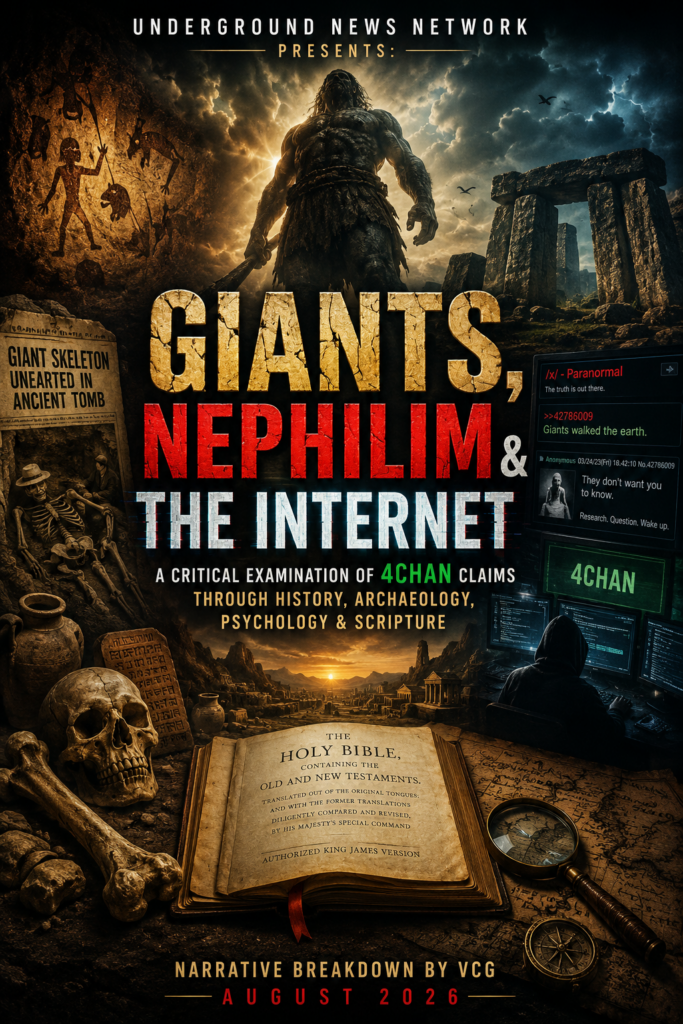
BY VCG ON 8/7/2026
I want to share a heartfelt cause with my audience. Conner Blaisdell-Greene, a brave Airforce Sr. Airman, recently lost his battle with cancer, leaving his family in financial distress. Every donation, no matter how small, can help cover his funeral costs and ease their burden during this difficult time. Please consider clicking the link below to contribute or share Conner’s story with others. Your support truly matters.
ANYONE CAN DO THIS, BUT THEY WON’T.
ChatGPT – Library of Rickandria
Yes—paste the replies or upload screenshots.
That will let me preserve the:
- exact wording
- post order
- images
- quotes
and context instead of reconstructing a volatile 4chan thread from fragments.
I’ll treat every claim separately as:
- textual claim
- factual claim
- inference
- rhetorical move
- psychological mechanism
or theological claim, then test it against:
- primary sources
- scholarship
- Scripture
I can already access the live thread, and it contains enough concrete claims to start:
- “petrified” giant anatomy
- Jörmungandr/Julunggul comparisons
- Andrew Dawson
- Alaskan giants
- Tassili art
- Blavatsky/root races
- the Giant of Castelnau/Smithsonian suppression claim
and a Ymir/giants-as-demons cosmology.
The screenshots will still matter because several posts are image-only, and those images themselves are part of the argument.
In fact, screenshots are especially valuable, because I can already access the textual portion of the live /x/ thread, but several important posts are image-only or depend heavily on an image being interpreted as evidence.
The thread is presently accessible and begins with the claim that:
“Giants, Titans, Nephilim, etc.”
are among the modern world’s most “taboo” subjects. (4chan)
I would preserve the screenshots anyway because 4chan threads are ephemeral.
For the Bible side, I’ll use the uploaded KJV Pure Cambridge Edition as our primary English text.
The standard I think we should use
For every substantive post, I’ll separate these questions rather than lumping them together:
- Exact statement — verbatim claim, with post number and what it is replying to.
- What is actually being asserted — including hidden assumptions.
- Claim classification — historical, archaeological, biological, geological, linguistic, mythological, conspiratorial, theological, or rhetorical.
- Source genealogy — where the story/image appears to come from and whether the 4chan poster is accurately representing it.
- Primary-source check — original archaeological reports, historical texts, museum records, Eddas, anthropological literature, etc., where obtainable.
- Scientific/evidentiary check — what could actually establish the claim: provenance, measurements, anatomy, stratigraphy, dating, chain of custody, peer examination, and so forth.
- Logic check — non sequitur, false equivalence, argument from absence, moving the burden of proof, etymological fallacy, cherry-picking, unfalsifiability, etc.
- Psychology/rhetoric — carefully described as mechanisms in the argument, not amateur diagnoses of anonymous posters: apophenia/illusory pattern perception, confirmation bias, motivated reasoning, anomaly hunting, conspiratorial inference, agency attribution, narrative compression, prestige of forbidden knowledge, and so forth.
- Best case for the claim — so we do not straw-man it.
- What remains genuinely unresolved — an old report with missing specimens is not automatically a hoax, but neither is it positive evidence for a giant race.
- KJV Scripture analysis — text first, then cross-references.
- Hebrew/Greek where relevant — especially nephilim, rephaim, anakim, gibborim, and the different uses rendered “giants” in English.
- Biblical correction — what Scripture actually supports versus what has been imported into Scripture.
- Verdict — supported / partly supported / unsupported / contradicted / presently unverifiable.
- Confidence level and sources.
That distinction is going to matter tremendously in this thread.
One foundational correction before we even begin
We should not approach this as:
“science says giants never existed, therefore debunk everything.”
That would itself mishandle the evidence and Scripture.
The KJV explicitly contains peoples described as giants or exceptionally tall.
Numbers 13:32–33 reports the spies describing
“men of a great stature”
and saying:
“And there we saw the giants, the sons of Anak, which come of the giants…”
Importantly, that statement occurs within what Numbers calls an “evil report”, so its grasshopper comparison needs contextual care.
But the existence and great stature of the Anakim are not dependent on Numbers 13:33 alone.
Deuteronomy describes the Emims as:
“a people great, and many, and tall, as the Anakims”
and says they:
“were accounted giants”
the Zamzummims likewise were:
“great, and many, and tall.”
Deuteronomy 3 then says:
“For only Og king of Bashan remained of the remnant of giants…”
and records his iron bedstead as nine cubits by four cubits.
Deuteronomy 9 independently describes the Anakim as:
“A people great and tall…”
Joshua 11 says Anakim remained particularly in Gaza, Gath, and Ashdod, while 1 Samuel later introduces Goliath specifically as “Goliath, of Gath,” giving his height in the KJV as “six cubits and a span.”
So our correction will be precise:
Biblical giants ≠ proof of every internet giant claim.
And equally:
Bad internet giant claims ≠ proof that the Bible contains no giants.
Those are two completely different propositions.
I can already see several major problems in the thread
For example, post 42786096 claims that an apparent enormous serpent-shaped feature is the fossilized Jörmungandr and then links Jörmungandr with the Aboriginal Australian Julunggul because the traditions sound similar and the names allegedly resemble each other. (4chan)
There is a real underlying fact:
Jörmungandr genuinely is the Midgard/World Serpent of Norse tradition. (World History Encyclopedia)
Aboriginal Australian traditions likewise contain numerous Rainbow Serpent traditions, with names including Julunggul and Yurlunggur; importantly, scholars emphasize that these are diverse traditions from different peoples rather than simply one standardized pan-Australian mythology. (Encyclopedia)
But notice the evidentiary jump:
Norse culture has a cosmic serpent tradition
- Australian cultures have serpent traditions
- two transliterated names superficially resemble one another
→ therefore both remembered the same literal petrified planetary animal
→ therefore its body can presently be identified in terrain imagery
→ therefore history has been deliberately hidden.
None of those arrows follows automatically.
Before any common-origin claim works, we need:
- linguistic history
- chronology
- transmission routes
- comparative mythology conducted under controls
and—most critically for a claimed fossil—the geological evidence that the formation is biological tissue rather than ordinary geology.
And the name comparison itself cannot simply be done by comparing modern English spellings.
Jörmungandr belongs to Old Norse linguistic history; Julunggul/Yurlunggur comes from a completely different Australian linguistic setting.
Similar-looking transliterations alone establish essentially nothing.
That is a textbook example of why we need to separate interesting cross-cultural parallels from evidence of historical identity.
Psychologically, we can analyze that reasoning without insulting the poster.
Experimental work has found an association between illusory pattern perception and both supernatural and conspiracy beliefs; a broader literature also examines proportionality bias, agency detection and other biases in conspiratorial inference.
That does not mean
“people who believe unusual things are stupid,”
nor does it prove a particular claim false.
It means pattern detection itself cannot substitute for independent verification. (Wiley Online Library)
The Castelnau portion is going to be particularly interesting
Post 42788156 claims that the “Giant of Castelnau” was accepted as giant human remains until “a teenage girl” supposedly overturned the professional researchers by calling the fragments cave-bear remains; it then folds this into a broader Smithsonian-suppression narrative.
The next poster says the English Wikipedia article they remember was deleted. (4chan)
There is a real historical nucleus here:
Georges Vacher de Lapouge did publish extraordinary bone fragments from Castelnau in 1890 and interpreted them as human, with gigantic estimated dimensions.
So dismissing the entire story as something invented recently would be inaccurate.
However, the surviving evidentiary situation is very different from having a complete, securely proven 3.5-metre human skeleton.
Modern discussion revolves around photographs/descriptions of fragmentary material, disputed anatomical identification, and apparently no modern peer-reviewed reexamination of an available specimen establishing a gigantic human. (Cryptidz Wiki)
We will need to chase the original 1890 publication, the later cave-bear identification claim, who actually made it and in what academic context, the disposition of the physical fragments, and then separately investigate every Smithsonian assertion rather than allowing one disputed artifact to become evidence for an institution-wide destruction program.
These external reference images illustrate two subjects raised in the thread; they should not yet be assumed identical to the exact uploads by the 4chan posters:

The second is useful because the Tassili claim also has a legitimate core:
Tassili n’Ajjer really contains extraordinary prehistoric Saharan rock art, including the so-called Round Head tradition.

That is archaeology.
Interpreting stylized figures as literal:
- giants
- extraterrestrials
- Nephilim
- helmets
or remnants of an earlier human race is a separate inferential step requiring evidence.
And there is a major Scripture problem later in the thread
Post 42788894 proposes that giants are offspring/remnants of an evil primordial supreme being identified with Ymir, that Odin/Thor or analogous “good gods” made our universe from his corpse, and that giants are essentially the beings Christianity calls demons.
It further proposes half-human giant descendants. (4chan)
That is not biblical cosmology.
Whatever historical parallels one may explore between Norse myths and other mythologies, Genesis begins:
“In the beginning God created the heaven and the earth.”
The biblical Creator does not manufacture creation from the corpse of an older evil supreme deity.
Nor does Scripture identify Ymir as an historical name for such a being, equate the Rephaim with Norse jötnar, or simply define biblical demons as “giants.”
That section will require especially careful correction because it mixes fragments of Norse cosmogony, modern esoteric synthesis, and biblical vocabulary until they appear to describe one system.
They do not.
Operation
Upload the screenshots/images in their original order, especially the image-only posts:
- the opening “petrified head,” the enormous serpent imagery, the Mali image
- the Aboriginal image, the Alaska “rock head,”
- Tassili material
- Castelnau material
and the final image-only post.
Once the images are here, I can do this as a genuine post-by-post research dossier, not a quick “debunk thread”:
original claim → strongest evidence → strongest counterevidence → methodology → psychology → logic → historical context → KJV Scripture → Hebrew/Greek → fair alternative readings → verdict.
The goal should be neither:
“believe 4chan because it is forbidden knowledge”
nor
“dismiss it because it came from 4chan.”
The question for every line is simply:
What can actually be demonstrated, what does Scripture actually say, and where have we crossed from evidence into speculation?
IMAGE BREAKDOWNS


Yes—this gives us Exhibit 1 / OP, No. 42786009.
I can confirm that the live thread identifies the OP image as a 960×936 JPEG whose filename begins “Giant Petrified Head with…”, and the accompanying OP text reads:
“Let’s talk about Giants, Titans, Nephilim, etc.
This is one of the most taboo topics in the modern world.” (4chan)
CASE FILE 01 — THE “GIANT PETRIFIED HEAD”
4chan /x/, No. 42786009 — August 5, 2026
1. What the image actually establishes
Visually, we have a large weathered rock or outcrop with a human figure beside it for scale.
From this particular viewing angle, several irregularities line up in a way that can be perceived as a right-facing human head:
brow/eye region, nose, lips or mouth, chin, cheek and something resembling an ear.
That observation is legitimate:
The rock strongly resembles a human head.
But that is considerably different from:
The rock is the mineralized head of a once-living gigantic human or humanoid.
The photograph by itself supplies no:
- geological location
- excavation record
- stratigraphic information
- material analysis
- anatomical examination
- dating
- provenance
or documented chain of discovery.
At this stage I have also not located a reliable original photographer/location for this particular image, so we should mark provenance as unresolved rather than manufacture one.
Image-level verdict: visually striking, evidentially unproven.
2. The filename quietly makes the first argument
This is important.
The OP does not actually write underneath the photograph:
“This has scientifically been demonstrated to be a fossilized giant.”
Instead the filename calls it a
“Giant Petrified Head.”
That means the proposition is introduced before the viewer evaluates the object.
You are first told HEAD, then shown an ambiguous rock.
That is rhetorically powerful because human vision is unusually sensitive to faces.
The phenomenon is called face pareidolia:
perceiving face structure in inanimate objects.
Experimental neuroscience shows that face-like objects can initially be processed more similarly to genuine faces than ordinary objects are; the brain’s early face-detection machinery favors sensitivity and therefore produces false positives. (PubMed Central (PMC))
So:
seeing a face is real perception; it is not evidence that the object was biologically a face.
That distinction is essential.
Saying “pareidolia” does not mean
“you are imagining things”
in a dismissive sense.
The resemblance really is there.
The mistake would occur only if the resemblance itself were treated as sufficient evidence of biological origin.
Psychological mechanism
The sequence is approximately:
label → expectation → facial template → feature matching → coherent head perception
Once someone has identified the “eye,” “nose,” and “mouth,” it becomes surprisingly difficult to return to seeing only irregular geology.
This image is therefore almost an ideal example of why ambiguous visual evidence requires independent physical testing.
3. What would “petrified head” actually mean scientifically?
This is where the claim becomes testable.
“Petrification” is not simply
“something biological became a big rock.”
Paleontologists generally speak more precisely of permineralization and replacement.
Permineralization occurs when minerals fill microscopic pores in biological material; replacement occurs when original biological material is substituted by minerals.
These processes are particularly associated with wood, bone and shells. (National Park Service)
The National Park Service also makes an especially important methodological point:
to classify something as a fossil, there must be evidence of biological origin within a geological context.
An inorganic structure that merely resembles an organism is not thereby a fossil. (National Park Service)
For this object genuinely to qualify as a fossilized gigantic head, investigators would therefore need evidence such as:
documented location and geological formation;
evidence that the mass is genuinely in situ rather than sculpted or altered;
recognizable skeletal architecture beneath the exterior;
cranial bone organization, sutures, jaw structure, tooth sockets or teeth;
microscopic bone histology or other biological microstructure;
mineralogical evidence consistent with fossilization;
CT/geophysical imaging showing internal structures corresponding to a skull;
a plausible taphonomic history explaining burial and preservation;
preferably independent examination by multiple specialists.
None of those data accompanies No. 42786009.
That is the central rebuttal.
It is not necessary to prove that the rock cannot possibly be biological.
The claimant first has to produce positive evidence that it is.
4. There is actually an additional problem with the “face”
A real gigantic skull should scale anatomically.
If the recognizable exterior were genuinely preserved facial anatomy, we would expect the rest of the structure to exhibit corresponding relationships:
- orbit placement
- nasal aperture
- maxilla
- mandible
- cranial vault
- occipital region
- dental architecture
- bilateral organization
Instead, the photograph gives us something much more characteristic of geological pareidolia:
just enough surface relief from one angle to trigger a face percept.
That suggests a simple experiment for this paper:
The rotation test
A genuine anatomical head remains anatomically coherent from different angles.
Pareidolic formations frequently collapse when photographed from the opposite side, above, behind, or under different lighting.
So before discussing exotic fossilization, we should request:
360° photographs or video.
That is a very inexpensive discriminating test.
If the “anatomy” vanishes with viewpoint, the petrified-head hypothesis becomes substantially weaker.
5. Could soft facial features fossilize?
In extraordinary circumstances, soft tissue can be preserved.
So, we should not write something sloppy like
“soft tissue can never fossilize.”
It can.
But preservation of unaltered soft tissues is rare and usually requires unusual conditions; normal postmortem processes destroy soft tissues rapidly, which is why taphonomy matters so much. (National Park Service)
This produces another serious question for the image.
What appears to convince the viewer is not principally recognizable skull anatomy—it is something resembling a fleshed human face:
- nose
- lips
- eyelid/brow
- cheek
If that is the proposed interpretation, the evidentiary burden becomes greater, not smaller.
We would need an extraordinary preservation mechanism capable of maintaining the external morphology at enormous scale while also demonstrating internal biological continuity.
The photograph provides none.
6. Now the OP’s first sentence
The poster groups together:
“Giants, Titans, Nephilim, etc.”
That grouping is already methodologically dangerous because these terms originate in different textual and cultural systems.
Giants ≠ automatically Nephilim ≠ automatically Titans
The KJV does indeed say:
“There were giants in the earth in those days; and also after that…”
—Genesis 6:4.
The underlying Hebrew is נְפִלִים — nephilim.
Modern lexical notes commonly retain the Hebrew term because its precise meaning/etymology is disputed; Genesis 6:4 also calls the figures gibborim, “mighty men” or heroes/warriors. (STEP Bible)
Then Numbers 13:33 says:
“And there we saw the giants, the sons of Anak, which come of the giants…”
But Scripture uses other categories as well.
Deuteronomy describes the Emims as:
“a people great, and many, and tall, as the Anakims”
and says they
“were accounted giants.”
Here the underlying category is associated with the Rephaim, not simply another occurrence of Nephilim.
Modern textual resources accordingly distinguish the Rephaim, Anakim and Emim even where older English translations employ the umbrella word “giants.” (STEP Bible)
That matters enormously for our paper.
The English word giant can conceal several distinct biblical terms and peoples.
7. “Titans” is a still larger category jump
The Titans belong to Greek mythology.
In the classical tradition they are the divine children of Uranus and Gaia—
- Cronus
- Oceanus
- Hyperion
- Iapetus
and others—and participate in the succession myth culminating in Zeus and the Olympians. (Wikisource)
Genesis never calls the Nephilim “Titans.”
Numbers never calls the Anakim “Titans.”
Deuteronomy never calls the Rephaim “Titans.”
That does not prohibit comparative mythology.
We may legitimately ask whether ancient giant traditions exhibit parallels.
But the proper formulation is:
“Are there meaningful parallels between biblical giant traditions and Greek Titan traditions?”
not:
“Titans are Nephilim.”
The first is a research question.
The second requires evidence that has not yet been supplied.
8. Scripture correction: the Bible neither supports nor requires this photograph
This is probably the most important theological correction for the opening post.
A Christian does not have to deny every biblical reference to unusual stature in order to reject this particular image as evidence.
The KJV explicitly preserves giant traditions.
Genesis 6:4 speaks of giants; Numbers identifies the sons of Anak with giants; and Deuteronomy independently describes the Anakim as
“a people great and tall.”
So, the sound position is not:
“Giants are impossible because modern people say so.”
But neither is it:
“The Bible mentions giants; therefore every face-shaped mountain is a petrified Nephilim.”
That second argument is a theological non sequitur.
Genesis 6:4 supplies no doctrine of enormous human beings turning into landscape-sized stone heads.
That proposition has been imported into the text.
9. “One of the most taboo topics in the modern world”
This is the OP’s other explicit factual/social claim.
The word taboo normally means something socially prohibited, unacceptable to mention, or banned by custom. (Merriam-Webster)
The OP offers no evidence for that proposition.
What can be demonstrated is that claims of prehistoric superhuman giants are fringe or controversial in contemporary archaeology and biology.
That is not equivalent to being taboo.
There is no general prohibition against studying:
exceptionally tall ancient humans;
pathological gigantism;
biblical Nephilim traditions;
the Anakim/Rephaim texts;
Greek Titans;
giant folklore;
fossil hominins;
claims of anomalous skeletal remains.
Indeed, they are openly discussed in:
- biblical scholarship
- classics
- archaeology
- anthropology
- popular books
- documentaries
and—as the thread itself demonstrates—public internet forums.
So, the more defensible wording would be:
“Claims of a suppressed prehistoric race of enormous giants are outside mainstream archaeological consensus and often treated skeptically.”
That can be investigated.
Calling the subject “taboo” already suggests suppression before suppression has been demonstrated.
10. The rhetorical architecture of the OP
This tiny opening post actually does a surprising amount of psychological work.
First: an extraordinary image is presented before evidence.
Second: the filename supplies the interpretation—
“Giant Petrified Head.”
Third: several separate categories are collapsed: giant → Titan → Nephilim.
Fourth: skepticism is pre-framed as evidence of taboo.
That last move is particularly important because it can create a self-sealing argument:
People accept it → evidence for giants.
People reject it → evidence that giants are taboo.
Once an argument is constructed so that both acceptance and rejection confirm it, falsification becomes very difficult.
For our paper, we should explicitly resist that structure.
Skepticism is not evidence of suppression.
Suppression must itself be independently demonstrated.
Preliminary verdict for No. 42786009
| Claim | Finding |
|---|---|
| Photograph depicts a very large face-like rock | Supported |
| Formation visually resembles a human head | Supported |
| Object is actually a fossilized/petrified biological head | Unsupported by the image |
| Object belonged to a giant | Unsupported |
| Object belonged to a Nephilim | Unsupported |
| Titans and Nephilim are equivalent categories | Not established; textually distinct traditions |
| Bible speaks of giants / exceptionally tall peoples | Supported |
| Bible identifies formations like this as petrified giants | No |
| Giants are “one of the most taboo topics” today | Assertion not demonstrated |
| Pareidolia is a plausible explanation for the visual effect | Strongly supported as a perceptual mechanism |
Overall assessment: ⚠️ CLAIM NOT ESTABLISHED
The OP begins with a genuine visual anomaly but skips every step required to transform
“rock resembling a head”
into
“petrified giant.”
Scripture gives us no reason to make that leap, while geology and cognitive science give us straightforward methods for testing it.
And I would preserve one sentence in bold in the final paper because it captures our methodology:
Biblical openness to giants is not scientific evidence for a particular giant claim, and scientific rejection of a particular giant claim is not a refutation of Scripture.
Send No. 42786014 / the Sandwich Islands serpent image next, and we can keep building these as numbered forensic case files until the entire thread is dismantled line-by-line.


Yes—Case File 02.
This one is especially useful because, unlike the OP, the poster supplies no written argument at all.
The entire claim is constructed visually through the filename and side-by-side comparison.
CASE FILE 02 — “SANDWICH ISLANDS SNAKE”
4chan /x/ — No. 42786014 — August 5, 2026, 21:05:45
Uploaded filename: Sandwich_Islands_Snake_1.png
Format: image-only post
The left panel is a shaded-relief/bathymetric view of the ocean between southern South America and Antarctica.
The right panel is a photograph of an actual snake’s head.
By putting them beside one another, the author implicitly asks the viewer to see the curved submarine geography as the head/body of an enormous serpent.
That resemblance is certainly visible.
But resemblance is the beginning of a hypothesis, not the completion of one.
WHAT THE POST ACTUALLY CLAIMS — AND WHAT IT DOES NOT
Because No. 42786014 contains no prose, we should be very disciplined here.
The post does not explicitly say:
“Scientists discovered a fossilized serpent.”
It does not explicitly say:
“This is Leviathan.”
Nor does this particular post explicitly mention:
- Jörmungandr
- Nephilim
- Satan
- dragons
or petrification.
Those associations may appear in the replies, but we should not retroactively put them into No. 42786014.
What the image itself communicates is approximately:
“Look at this ocean-floor formation near the South Sandwich/Scotia region.
Its shape resembles a snake’s head.”
The filename pushes the interpretation further by naming it
“Sandwich Islands Snake.”
That’s our claim to test first.
THE FIRST FACT-CHECK: WHAT IS THE “SNAKE” ON THE MAP?
The geological feature is real.
It lies within the Scotia Arc / Scotia Sea tectonic system between southern South America and the Antarctic Peninsula.
The British Antarctic Survey describes the Scotia Arc as extending from the Drake Passage and Shackleton Fracture Zone in the west to the active South Sandwich volcanic arc in the east.
Its major components include the:
- North Scotia Ridge
- South Scotia Ridge
- Scotia Plate
- Sandwich Plate
So, the curved shape is not some unexplained object that geology has failed to recognize.
It is a heavily studied tectonic region.
The South Sandwich Islands and associated seamounts form the volcanic arc of an active subduction system.
Immediately behind that arc is the East Scotia Ridge, an active back-arc spreading center.
The islands themselves are volcanic, and many have shown historic volcanic or fumarolic activity. (British Antarctic Survey)
A 2024 tectonic review describes the system in remarkably specific terms:
the North Scotia Ridge is a strike-slip boundary; the East Scotia Ridge is an active spreading center; the South Scotia Ridge and Shackleton Fracture Zone form another strike-slip system; and at the South Sandwich Trench the South American Plate subducts beneath the South Sandwich Plate.
The modern bathymetry consists of tectonically generated basins and elevated crustal fragments. (AGU Publications)
That is an independently testable causal explanation for precisely the ridges, trenches and curvature seen on the left side of the 4chan image.
THE MOST IMPORTANT DISTINCTION
There are therefore two propositions:
A. “The Scotia Arc resembles a serpent when viewed from above.”
That is a perfectly reasonable visual observation.
B. “The Scotia Arc is the remains/body/head of a literal gigantic serpent.”
That is a biological and geological claim.
The photograph supports A.
It does not establish B.
And the enormous evidentiary gap between A and B is the heart of this post.
WHY THE GEOLOGICAL EXPLANATION IS SO MUCH STRONGER
Suppose, for the sake of investigation, that we take the serpent interpretation seriously.
A literal organism hypothesis should predict things that plate tectonics does not.
We ought to find repeatable biological organization:
something corresponding to:
- cranial architecture
- vertebrae
- ribs
- jaws
or other skeletal structures; bilateral anatomical relationships; mineralized tissue or histology; biological boundaries distinguishable from surrounding crust; a plausible burial/fossilization mechanism; and geological continuity inconsistent with ordinary crustal generation.
Instead, we find the opposite.
The apparent “serpent” decomposes into structures already independently identified as:
- fault systems
- oceanic basins
- spreading centers
- trenches
- volcanic arcs
- microcontinental fragments and tectonic plates
Their arrangement makes sense dynamically:
plates move, one plate subducts beneath another, crust stretches, new ocean floor forms, volcanic magma rises, faults accommodate lateral motion, and erosion/deposition modify the relief. (British Antarctic Survey)
Even better, these processes are active today.
Researchers can record:
- earthquakes
- measure plate motion
- map volcanic structures
- sample rocks
- determine magnetic seafloor patterns and image crustal structure
The serpent hypothesis would therefore have to explain why the supposed anatomy of a dead creature just happens to coincide with independently measured active tectonic boundaries.
That is a formidable problem for the claim.
THE SCALE PROBLEM IS ENORMOUS
This isn’t a large python.
It isn’t even a blue-whale-scale animal.
The South Sandwich volcanic arc alone has been mapped over roughly 540 km, including major volcanoes and numerous seamounts. (British Antarctic Survey)
The wider Scotia Arc stretches from South America toward Antarctica through an oceanic tectonic system measured on the scale of hundreds to thousands of kilometers. (British Antarctic Survey)
So, if the viewer interprets the whole structure as one creature, we are discussing an organism whose relevant anatomy is continental/plate-scale.
That does not make it logically impossible merely because it sounds extraordinary.
But it changes the burden of evidence drastically.
For a normal fossil claim, one might examine bones.
For an animal hundreds or thousands of kilometers long, the hypothesis would collide with enormous amounts of:
- seismological
- geochemical
- gravitational
- magnetic
and tectonic data.
A creature that large should leave biological signatures on an equally gigantic scale.
No such evidence is supplied in No. 42786014.
ANOTHER IMPORTANT ISSUE: THIS IS A MAP VISUALIZATION
The left panel should not be treated as though someone flew over the ocean and photographed a gigantic snake lying on the seabed.
Bathymetric maps are constructed scientific visualizations.
Modern bathymetric compilations combine multiple kinds of measurements and then represent elevation/depth using color, shading and digital terrain models.
Even specialist South Sandwich mapping has been assembled from multiple data sources into gridded elevation products. (British Antarctic Survey)
That matters because hill-shading accentuates ridges and depressions.
Change the:
- illumination direction
- vertical exaggeration
- color ramp
- map projection
or zoom and the perceived “creature” can become considerably more or less obvious.
This does not mean the tectonic features are fake.
It means the rendered appearance is not equivalent to a photograph of physical anatomy.
A much stronger test would compare the supposed serpent across:
- raw bathymetric profiles
- independent sonar surveys
- gravity maps
- seismic sections
and several different visualization schemes.
If it is biological anatomy, the anatomy should persist.
If it is mostly perceptual grouping of tectonic features, the compelling “snake” should depend much more strongly on presentation.
THE PSYCHOLOGY OF THIS PARTICULAR POST IS VERY CLEVER
This one differs from our petrified-head image.
With the first post, the object itself already looked facial.
Here, the poster teaches the viewer what to see.
Left:
ambiguous curved geography
Right:
unambiguous snake
Your visual system immediately begins comparing the two.
The broader phenomenon is pareidolia—not merely faces, but perceiving meaningful objects or entities in ambiguous visual patterns.
Recent experimental work specifically describes pareidolia as perceiving illusory faces or objects in ambiguous stimuli and finds that both bottom-up visual organization and top-down conceptual expectations contribute to what people perceive. (PubMed Central (PMC))
So, the side-by-side construction is psychologically important:
ambiguous stimulus → supplied category (“snake”) → visual matching → increased salience of corresponding contours
Again, this is not an insult to the observer.
You really can see a snake.
I can see it too.
The scientific question isn’t:
“Can you see the resemblance?”
It is:
“Does the resemblance track biological structure better than the established geological explanation tracks the measured data?”
And presently the answer is no.
INTERESTING SOURCE-GENEALOGY CLUE
There’s an especially useful piece of context for the paper.
On July 18, 2026—several weeks before this August 5 4chan post—a highly visible Reddit geography discussion was already circulating this exact general Scotia-region visual phenomenon.
Commenters independently joked or remarked that the formation looked like a “dragon,” a “snake head,” a “dormant dragon,” and even invoked the world-serpent idea, while other commenters identified the Scotia Plate/Scotia Arc and plate tectonics. (Reddit)
That does not prove the 4chan poster copied Reddit.
We do not yet have enough provenance to establish transmission.
But it proves something useful:
the serpent interpretation was already circulating publicly before this /x/ thread.
So, we should not present No. 42786014 as the discovery of the alleged anomaly.
This is already part of an emerging internet visual meme/narrative.
That’s precisely the kind of source genealogy your paper should track.
SCRIPTURE CORRECTION: THE BIBLE REALLY DOES SPEAK OF LEVIATHAN
This is where we must avoid the opposite mistake.
A poor rebuttal would say:
“The Bible has no giant sea-serpent imagery.”
It plainly does.
Job 41 begins:
“Canst thou draw out leviathan with an hook? or his tongue with a cord which thou lettest down?”
The chapter proceeds to describe teeth, scales, tremendous strength and an imposing creature.
Psalm 104 is even more important for this discussion:
“So is this great and wide sea, wherein are things creeping innumerable, both small and great beasts.
There go the ships:there is that leviathan, whom thou hast made to play therein.”
Notice what that text actually says.
Leviathan is God’s creature.
The sea belongs to God’s ordered creation.
And in Psalm 104 Leviathan is portrayed as something God
“made to play therein.”
Nothing there identifies a geological ridge near Antarctica as its corpse.
ISAIAH 27 IS EVEN CLOSER TO THE SERPENT LANGUAGE
The KJV reads:
“In that day the LORD with his sore and great and strong sword shall punish leviathan the piercing serpent, even leviathan that crooked serpent; and he shall slay the dragon that is in the sea.”
—Isaiah 27:1.
That is absolutely relevant to a study of biblical serpent imagery.
But relevance is not identification.
Isaiah does not say:
“Leviathan will become the Scotia Arc.”
It provides no Antarctic coordinates.
It does not describe a fossilized body visible in ocean-floor relief.
And Isaiah 27 occurs in prophetic/poetic discourse, so interpreters have long debated the relationship between literal creature imagery, cosmic-chaos imagery and representation of hostile powers or kingdoms.
We should acknowledge those interpretive possibilities rather than pretend the verse settles a modern cartographic claim.
PSALM 74 MAKES THE HERMENEUTICAL PROBLEM EVEN CLEARER
Psalm 74 says:
“Thou didst divide the sea by thy strength:
thou brakest the heads of the dragons in the waters.
Thou brakest the heads of leviathan in pieces…”
Notice “heads”—plural imagery.
If someone attempts to map every detail literally onto one giant geological corpse, problems appear quickly.
Biblical poetry regularly uses vivid imagery of God’s victory over sea, monsters, enemies and chaos.
The responsible approach is to first ask what the passage is doing in its own literary context before mapping its imagery onto satellite photographs.
So, our Scripture correction is not:
“Leviathan is fake.”
It is:
“The existence of Leviathan in Scripture does not identify this particular formation as Leviathan.”
That distinction is crucial.
AND WE SHOULD NOT YET CALL THIS JÖRMUNGANDR
This is another methodological safeguard.
Later posts may explicitly invoke Jörmungandr, the Norse world serpent.

But No. 42786014 itself does not.
Therefore, this case file should stop short of saying:
“The poster claims this is Jörmungandr.”
When we receive No. 42786047 and 42786058, which this post shows as replies, we can determine exactly when the thread moves from:
“looks like snake”
to:
“this is the mythological World Serpent.”
That transition is itself worth documenting, because it shows how an internet narrative acquires layers.
EVIDENTIARY VERDICT — No. 42786014
| Proposition | Assessment |
|---|---|
| The left image depicts a real major seafloor structure | Supported |
| It is associated with the Scotia/South Sandwich tectonic region | Strongly supported |
| Its outline can resemble a snake from this perspective | Yes — genuine visual resemblance |
| South Sandwich geology is poorly understood/unexplained | False |
| The region includes active subduction, spreading, faulting and volcanism | Strongly supported |
| The map is equivalent to a direct photograph of an object lying on the seabed | No |
| The apparent structure demonstrates biological anatomy | Unsupported |
| The structure is the corpse/fossil of a planet-scale serpent | Unsupported; conflicts with extensive tectonic evidence |
| The image proves the biblical Leviathan | No |
| Scripture contains Leviathan/sea-serpent imagery | Yes |
| Scripture identifies Leviathan with the Scotia Arc | No |
| Side-by-side comparison can prime object recognition | Psychologically plausible and experimentally grounded |
| Similar “giant snake/dragon” interpretations circulated before this 4chan thread | Supported |
Overall verdict: REAL GEOLOGY + REAL RESEMBLANCE → UNSUPPORTED BIOLOGICAL INFERENCE
And this gives us another excellent methodological sentence for the paper:
A resemblance may generate a hypothesis; only independent anatomy, geology, provenance, and predictive evidence can establish the hypothesis.
The most interesting thing about No. 42786014 is therefore not that the poster fabricated the shape.
They didn’t.
The Scotia Arc really is spectacularly curved.
The error comes from confusing morphological analogy with causal identity.
And biblically, we can be equally precise:
Scripture gives us genuine Leviathan traditions; it does not give us permission to baptize every serpent-shaped geological formation as Leviathan.
Send 42786047 next if you have it.
That should let us trace the exact point where the thread begins turning the visual resemblance into a mythological/historical claim.


Absolutely—this is Case File 03, and this one is valuable because the anatomical overlay makes the inferential method unusually easy to dissect.
CASE FILE 03 — “OURO NGUEROU, MALI”
4chan /x/ — No. 42786017 — August 5, 2026, 21:06:47
File: Ouro Nguerou, Mali.png — 2.28 MB, 715×2044
Post content: image only. The live thread confirms that No. 42786017 contains no accompanying prose beyond the uploaded image. (4chan)
The composite contains two stages.
First is an overhead/satellite-style image of a large rocky formation near Ouro Nguérou, Mali.
Beneath it, the same formation is rotated and overlaid with a colored anatomical illustration of a bent human leg/hip musculature.
So, we need to distinguish carefully between what the poster shows and what the poster proves.
1. What No. 42786017 literally claims
Strictly speaking, almost nothing verbally.
There is no sentence saying:
“This is a fossilized giant.”
There is no measurement.
There is no geological report.
There is no anatomical report.
There is no excavation history.
The argument is entirely visual:
rock formation → rotate image → superimpose human musculature → invite identification as gigantic anatomical remains.
Given the surrounding “GIANTS” thread, the intended inference is obvious, but for scholarly fairness our paper should phrase it as:
The image implicitly proposes that the Ouro Nguérou landform resembles—and perhaps represents—the mineralized remains of an enormous human or humanoid limb.
That is stronger methodology than putting words into an anonymous poster’s mouth.
2. First fact-check: Ouro Nguérou is a real place
This part checks out.
Ouro Nguérou is a small settlement/hamlet in the Mopti region of Mali, at approximately 15.1078° N, 2.1609° W, near Piringa and Loro. (Mapcarta)
So, we are not dealing with an invented place name.
But there is already an interesting source-quality warning.
An Academia.edu upload associated with this image is titled:
“Ouro Nguerou : Nigerian Settlement In The Shadow Of A Giant.”
Yet its own abstract immediately locates Ouro Nguerou in Mopti, Mali.
The Academia page describes it as only one page. (Academia)
Nigeria and Mali are separate countries.
That may merely be a careless geographical typo, but in a document making an extraordinary geological/anatomical claim, elementary provenance errors matter.
3. This image did not originate with the August thread
This is an important piece of our source genealogy.
The identical filename and dimensions—
Ouro Nguerou, Mali.png — 2.28 MB, 715×2044
—appeared in an earlier /x/ giant thread on April 15, 2026. (4chan)
Another indexed /x/ thread shows the same file being posted on February 9, 2026. (4chan)
So, No. 42786017 is not a newly documented discovery made on August 5.
It is circulating material.
And the lineage goes farther.
The Academia.edu item by David Vanderper already presents Ouro Nguerou under the title “In The Shadow Of A Giant.” (Academia)
A later “Mudfossil University” discussion explicitly links to that Academia document and says of the satellite feature:
“This is clearly an enormous body part.”
The commenter then says they think it is a leg and infers lack of scientific attention may reflect deliberate suppression. (Mudfossil University)
I have not yet established the first-ever appearance of the composite, so we should not claim Vanderper created it unless we prove that.
But we can already establish:
the giant-body interpretation predates this particular 4chan thread.
4. The underlying source deserves scrutiny
The accessible Academia listing identifies David Vanderper as the uploader.
His Academia profile presents interests in architecture and geology. (Academia.edu)
More importantly, his publicly accessible CV describes his broader interpretive approach as heavily based on finding similarities in appearance, historical associations and etymology.
It also states:
“All prehistoric life is petrified.”
That statement presents a methodological problem.
If one begins with:
“all prehistoric life is petrified”
and subsequently searches landscapes for shapes resembling anatomy, then apparent anatomical landscapes will repeatedly be interpreted as confirmation.
That reverses the ordinary scientific procedure.
The proper sequence would be:
observe feature → formulate competing hypotheses → derive distinguishing predictions → test them → accept whichever explanation survives.
Not:
assume petrified macro-life → search for shapes → interpret resemblance as petrified macro-life.
That distinction belongs prominently in our paper.
5. What geology says about the region
Here we need to be cautious.
I have not found a geological analysis of this exact individual outcrop demonstrating its precise lithology, so I will not pretend we possess one.
But the regional geology gives us a strong baseline.
The official Mopti regional development agency describes the area’s exposed terrain as containing abundant rocky formations and specifically describes the broader Bandiagara–Hombori/Gandamia/Hombori landscape in terms of sandstone reliefs and plateaus, with prominent mesas, cliffs and rocky masses. (Mopti Regional Development Agency)
A geological/hydrogeological study discussing the wider Hombori threshold–Douentza system likewise describes Infracambrian sandstone units and says fine- through coarse-grained sandstones are major formations, together with localized dolerite, conglomerate, quartzite and related rocks. (WASCAL-UAC)
This does not prove this exact formation is sandstone.
But it means there is nothing inherently mysterious about encountering enormous, bizarrely shaped erosional rock masses in this part of Mali.
In fact, nearby regional geography is famous for anthropomorphic forms.
The Hand of Fatima near Hombori consists of sandstone towers whose appearance resembles fingers—hence its name. (Wikipedia)
Nobody needs to propose an actual fossilized hand to explain why sandstone towers can look like one.
That analogy is extremely useful.
6. The anatomical overlay is not independent evidence
This is probably the single biggest methodological flaw.
Look at what has happened.
The person creating the composite has:
selected one landform out of an enormous number of landforms;
chosen a particular viewing angle;
rotated the image;
selected a particular human anatomical illustration;
resized that illustration;
positioned it over the formation;
aligned its major contours with the rock;
displayed the result as an apparent match.
Then the match itself is offered as evidence.
That is post-hoc fitting.
The anatomy did not independently predict the formation.
The anatomy was fitted after seeing the formation.
That distinction is enormous.
7. Think about the number of adjustable variables
The creator can change:
- rotation
- scale
- translation
- crop
- human pose
- which leg
- viewing angle
- muscle illustration
- opacity
- where the “hip” begins
- where the “knee” begins
- what counts as the “foot”
Those are degrees of freedom.
With enough adjustable parameters, a surprising visual match can be produced from completely unrelated structures.
An especially powerful control experiment would be:
Random-landform test
Collect 100 irregular mountains and rock formations without telling the analyst their locations.
Allow the same amount of rotating, scaling and repositioning.
Then ask whether recognizable:
- legs
- faces
- skulls
- animals
- hands
- hearts
- dragons
can also be fitted onto them.
If similar “anatomical matches” appear routinely, then the Ouro Nguérou fit has low evidentiary value.
That is basically the visual equivalent of correcting for multiple comparisons.
8. There is no scale bar
This omission is surprisingly serious.
The composite is supposed to make us think:
HUMAN ANATOMY — BUT ENORMOUS.
Yet the graphic itself gives us no usable scale.
No kilometer bar.
No GIS coordinates bounding the feature.
No length.
No width.
No elevation.
No estimate of volume.
Before proposing a biological organism, the first questions ought to be:
How long is the alleged leg?
How tall would the corresponding organism have been?
What mass would it have had?
Without those numbers, the claim has not even reached quantitative anatomy.
9. If this were really a leg, anatomy makes predictions
This is where the hypothesis becomes falsifiable.
The colored overlay emphasizes muscle morphology.
But real vertebrate legs are constructed around a skeleton.
Depending on exactly what portion of human anatomy is being claimed, a genuine gigantic human leg should contain corresponding structures such as:
pelvis / acetabulum → femoral head → femur → knee joint → patella → tibia and fibula → ankle → tarsals/metatarsals
These should possess fixed geometric relationships.
You shouldn’t merely be able to say:
“That ridge looks like a muscle.”
You should be able to predict:
“The femur must occur here, at this orientation and proportion.”
Then investigate the geology before moving the prediction.
That is a much stronger test.
10. What would happen if we sliced through it?
This question destroys much ambiguity.
If it is an ordinary erosional rock formation, cross-sections should reveal geological structures:
sedimentary bedding;
fractures and joints;
weathering surfaces;
veins;
lithological contacts;
erosion patterns.
If it is mineralized vertebrate anatomy, cross-sections should reveal structures corresponding to biological tissue.
For bone, that would eventually mean microscopic organization consistent with bone rather than sandstone.
The National Park Service defines fossils fundamentally as evidence of past life preserved in geological context.
It explains that permineralization fills original biological pores with minerals and can preserve three-dimensional and sometimes microscopic structures.
Replacement likewise substitutes minerals for biological material. (National Park Service)
So “it became stone” does not erase all biological evidence.
Quite the opposite.
A properly fossilized biological object should contain evidence demonstrating that biological origin.
11. Soft tissue fossilization is possible—but that does not rescue the claim
We should be fair here.
One bad rebuttal would say:
“Muscles can’t fossilize.”
That’s too absolute.
Rare soft-tissue preservation does occur, and the NPS notes that permineralization may sometimes affect soft tissues as well as hard structures. (National Park Service)
But that makes the evidentiary requirements higher, not lower.
The proposition here appears to require a colossal limb whose exterior retains recognizable muscular morphology, potentially on landscape scale.
Then we should expect an extraordinary preservation history.
Where is the:
- enclosing sediment?
- rapid burial mechanism?
- mineral chemistry?
- preserved skeletal core?
- tissue microstructure?
- geological age?
- stratigraphic layer?
- taphonomic explanation?
The composite provides none.
12. And the rock’s grooves are not automatically “muscle fibers”
This is a recurring error in “mud fossil” material.
A long ridge resembles a tendon.
Parallel grooves resemble fibers.
Rounded masses resemble muscle bellies.
But geology naturally produces directional structures.
- Sedimentary bedding
- fracture sets
- preferential erosion
- drainage
- differential weathering
- mineral bands
and joint-controlled erosion can all create repeated linear patterns.
Therefore:
“It looks fibrous”
is a morphological observation.
It is not a histological identification.
You need microscopy and mineralogy.
13. Psychology: this image is stronger than ordinary pareidolia because it supplies the answer
Pareidolia means perceiving meaningful figures or objects in ambiguous stimuli.
A recent experimental study defines it precisely in terms of perceiving illusory faces or objects in ambiguous imagery and found that both bottom-up visual structure and top-down conceptual knowledge influence what observers perceive. (PubMed Central (PMC))
The Ouro Nguérou composite takes top-down influence a step further.
It doesn’t merely say:
“Can you see a leg?”
It literally draws the leg onto the rock.
So the perceptual sequence becomes:
ambiguous geological form
↓
anatomical template supplied
↓
corresponding ridges become “muscles”
↓
nonmatching features fade from attention
↓
the visual match feels increasingly obvious
Once you have seen the colored overlay, it becomes difficult to “unsee” the limb.
That psychological effect is real.
But its vividness tells us something about human perception, not necessarily about the geological object’s origin.
14. This is not calling the viewer stupid
This deserves explicit treatment in the psychology section of the paper.
Pareidolia is not stupidity.
It is a normal consequence of an extraordinarily powerful pattern-recognition system.
Humans survive partly because our brains rapidly identify meaningful shapes from incomplete information.
That system sometimes produces false positives.
Seeing the limb is therefore unsurprising.
The mistake occurs only when:
“I clearly perceive the resemblance”
becomes
“therefore the structure has the biological origin it resembles.”
Those are different propositions.
15. A beautiful example of confirmation bias follows from the source genealogy
Remember the Mudfossil discussion.
The commenter essentially reasons:
- This looks like a gigantic body part.
- Scientists don’t discuss it.
- That is strange.
- Perhaps scientists avoid it because it reveals giants.
But notice how this becomes self-protecting.
If scientists agree:
giants confirmed.
If scientists reject it:
they’re suppressing giants.
If scientists ignore it:
their silence proves suppression.
The hypothesis becomes difficult to disconfirm because every possible institutional reaction can be interpreted as confirmation.
That is not a reliable test.
A genuine suppression hypothesis needs its own positive evidence:
- documents
- directives
- confiscation records
- correspondence
- named institutions
- identifiable artifacts
- chain of custody
Silence alone won’t do it.
16. The Academia source itself is remarkably thin
This deserves emphasis.
The available Academia page identifies the document as one page.
Its displayed abstract merely describes Ouro Nguerou’s location and surrounding settlements.
It does not present visible:
excavation data;
petrography;
microscopy;
radiometric dating;
anatomical measurements;
geological section;
stratigraphy;
laboratory methods;
statistical analysis.
(Academia)
The listing also does not identify a scientific journal or DOI for this item.
That doesn’t automatically make its hypothesis false.
But calling something a “paper” or hosting it on Academia.edu does not itself supply scientific validation.
The evidence has to be inside the work.
17. A particularly revealing factual mistake
The title says:
“Nigerian Settlement…”
Yet the abstract says Mopti, Mali, and geographic databases independently place Ouro Nguérou in Mali. (Academia)
That’s not merely pedantry.
A geological claim depends fundamentally on knowing:
where the object is;
which geological formation it belongs to;
regional stratigraphy;
surrounding landforms.
Getting the country wrong in the title is precisely the kind of provenance sloppiness we need to flag.
Verdict on that point: factual error.
18. What the strongest version of the giant hypothesis would say
We should steel-man rather than caricature it.
The best argument would be:
The landform’s overall morphology, particularly when rotated, resembles the muscular structure of a flexed human limb to an unusual degree.
Its proportions and internal ridges may indicate preserved biological morphology rather than random erosion.
Therefore the formation deserves direct geological examination before biological origin is dismissed.
That is much better than:
“Obviously a giant.”
And there is nothing wrong with requesting examination of an unusual formation.
The problem is jumping from:
“deserves examination”
to
“is a petrified giant.”
Those are not the same conclusion.
19. What would actually convince us?
Here is the VCG forensic test protocol I would put directly into the paper.
Test A — exact geolocation
Obtain the precise polygon/coordinates of the supposed limb.
Not merely “near Ouro Nguerou.”
Test B — quantitative dimensions
Measure length, width, height and volume using GIS/DEM data.
Then reconstruct the implied entire body.
Test C — independent imagery
Examine it from:
multiple satellite providers;
multiple seasons;
different sun angles;
elevation models;
ground photography if available.
A genuine anatomical object should not depend on one screenshot.
Test D — anatomy predicted beforehand
Before additional geological data are viewed, mark predicted locations of:
- femur
- hip socket
- knee
- tibia/fibula
- ankle/foot
Lock those predictions.
Test E — geological mapping
Determine rock type, bedding, fractures and contacts.
Test F — petrographic/histological sampling
Under microscopy, ask:
geological grains or biological microstructure?
Test G — mineral chemistry
XRD, XRF, thin sections, SEM where warranted.
Test H — stratigraphy
Determine how the alleged body relates to surrounding strata.
Was it buried?
Does bedding pass continuously through it?
Test I — controls
Give the same procedure to analysts using unrelated rock formations.
If anatomical overlays fit equally well elsewhere, the visual correlation loses force.
Test J — independent teams
Geologist, vertebrate anatomist and paleontologist analyze samples blind to the giant claim.
That would turn internet pattern-matching into a genuine testable investigation.
20. SCRIPTURE CHECK — Genesis does contain giants
Now the crucial biblical distinction.
The KJV says:
“There were giants in the earth in those days; and also after that…”
—Genesis 6:4.
We should absolutely preserve that text rather than explaining it away.
But continue reading the verse.
It calls them:
“mighty men which were of old, men of renown.”
They are described as persons.
The chapter speaks about:
- offspring
- men
- daughters
- flesh
- life
and death.
It does not describe geological formations.
21. “Giants in the earth” does NOT mean buried inside geological strata
This is worth preemptively correcting because the English wording can be exploited.
Genesis 6:4’s Hebrew construction is normally rendered in modern translations as:
“The Nephilim were on the earth…”
Both NET and STEP render the geographical expression that way. (NET Bible)
The KJV’s:
“giants in the earth”
means present upon/in the world or land, not:
“gigantic bodies embedded geologically inside planet Earth.”
The context proves this anyway:
these beings interact, reproduce and become
“men of renown.”
So, Genesis 6:4 cannot legitimately be used as a proof-text for giant-shaped mountains.
22. Deuteronomy gives us an even clearer description
The KJV says of the Emims:
“a people great, and many, and tall, as the Anakims;
Which also were accounted giants…”
—Deuteronomy 2:10–11.
And of the Zamzummims:
“A people great, and many, and tall, as the Anakims…”
That is extremely important.
Whatever precise dimensions we ultimately assign these ancient peoples, Scripture’s own descriptive categories are:
- people
- many
- tall
- dwelling in lands
- being defeated
- being succeeded by other peoples
Not:
continental-scale petrified body parts.
23. Og gives another reality check
Deuteronomy 3 describes Og king of Bashan as remaining
“of the remnant of giants”
and then gives the dimensions of his iron bedstead:
“nine cubits was the length thereof, and four cubits the breadth of it…”
Again, he is a:
- king
- living in a kingdom
- associated with cities
- using a bedstead
- fought in warfare
Whatever view we take of his exact physical height, the biblical frame is recognizably human-scale social existence, albeit extraordinary stature.
Nothing in that passage suggests beings whose legs become mountains several kilometers long.
24. Does the Flood supply the missing fossilization mechanism?
Not from the text alone.
Genesis 7 says:
“all flesh died that moved upon the earth…”
and describes the destruction of living creatures outside the ark.
But:
death ≠ fossilization.
And:
fossilization ≠ kilometer-scale preservation of fleshed external anatomy.
Those are scientific/taphonomic propositions that must still be demonstrated.
Scripture does not say:
“the Nephilim became stone mountains after the Flood.”
We cannot add that doctrine merely because a rock looks anatomical.
25. The biblical methodological correction may be the strongest part
Paul writes:
“Prove all things; hold fast that which is good.”
—1 Thessalonians 5:21.
And Acts praises the Bereans because they:
“searched the scriptures daily, whether those things were so.”
That posture works beautifully here.
We do not need to ridicule unusual claims.
We test them.
And we do not need to force Scripture into them.
We test the interpretation against Scripture too.
26. Claim-by-claim verdict
| Claim / implication | Assessment |
|---|---|
| Ouro Nguérou is a real locality in Mali | Confirmed |
| The pictured landform is real | Very likely; satellite geography is independently accessible |
| The landform resembles a bent limb | Yes, visually |
| Rotating it increases that resemblance | Yes |
| A human muscle overlay can be fitted over it | Yes |
| That overlay constitutes anatomical evidence | No |
| Exact rock type of this individual formation has been established here | Not yet |
| Regional terrain includes extensive rocky/sandstone relief | Confirmed |
| Biological tissue has been demonstrated in the formation | No evidence found |
| Bones corresponding to the proposed anatomy have been demonstrated | No |
| Fossil microstructure has been demonstrated | No |
| Age/taphonomy has been established | No |
| It has been scientifically identified as a giant leg | No evidence found |
| Scientific silence proves suppression | No |
| The KJV describes giants | Yes |
| Scripture describes them as peoples/persons of great stature | Yes |
| Scripture teaches that giants became gigantic geological landforms | No |
Overall finding
REAL LANDFORM + IMPRESSIVE ANATOMICAL RESEMBLANCE + POST-HOC OVERLAY = INTERESTING HYPOTHESIS, NOT DEMONSTRATED FOSSIL
And this case gives us one of the strongest lines yet for the finished paper:
An anatomical overlay demonstrates that a geological form can be made to resemble anatomy; it does not demonstrate that anatomy caused the geological form.
The other sentence I’d preserve is the biblical one:
Scripture’s testimony concerning giants should be believed on its own terms; it should not be expanded into a doctrine of petrified landscape anatomy without textual or physical evidence.
There is actually a second paper-worthy story hidden here:
this exact graphic was circulating through giant/mud-fossil communities before the present thread, and the apparent source ecosystem contains circular reinforcement—Academia upload → alternative-giant discussion → /x/ reposts → “suppressed evidence” narrative.
Tracking that chain separately will be extremely useful when we reach the methodology/psychology chapter.


Yes—this is Case File 04, and this one needs a slightly different treatment because the biggest unresolved issue is provenance.
We can fact-check the post history and the geological reasoning, but I cannot yet honestly identify the exact locality, rock unit, or original DIY Network program from this single frame.
CASE FILE 04 — THE DIY NETWORK “GIANT ANATOMY” BOULDERS
4chan /x/ — No. 42786032 — August 5, 2026, 21:10:27
File: b3e5b2d7bbd800db44ffb66c8(...).png
Size: 2.69 MB — 2001×1125
Post content: image only.
The live thread confirms that No. 42786032 contains no accompanying text whatsoever.
It follows the Ouro Nguérou image in a thread explicitly about giants, but this individual poster never says whether the formation is supposed to be fingers, toes, a hand, musculature, or some other body part. (4chan)
That matters.
We should not invent a claim stronger than the poster actually made.
1. What is actually visible?
The frame shows several very large, elongated, rounded masses of exposed rock separated by deep, roughly parallel fissures.
At least two people are visible inside one of the gaps, providing a dramatic scale reference.
There is also a DIY Network watermark.
The obvious visual suggestion in a giant-themed thread is something like:
“These enormous parallel rounded forms resemble part of gigantic anatomy.”
The most natural readings are fingers, toes, or perhaps bundled anatomical structures.
But the photograph itself establishes only:
the rock masses are large relative to the people;
the masses have elongated, rounded forms;
fissures divide them;
from this angle, they can be read anthropomorphically.
It does not establish that they were once biological structures.
2. Important discovery: this image predates this August thread
We can already strengthen the source genealogy substantially.
The same truncated hash filename, same 2.69 MB size, and same 2001×1125 dimensions appear in an earlier /x/ thread titled “Giants/Titans” on April 13, 2026, under post No. 42248118.
That earlier post is likewise image-only. (4chan)
So:
This was not a new discovery posted on August 5.
It was already circulating in essentially the same giant/Titan image ecosystem at least several months earlier.
That is important for the paper because these threads are functioning partly as reposting archives of visually suggestive material.
Each repost can make the object feel like an established item in a growing
“body of evidence,”
even when its original provenance has not been established.
At present, our chain looks like:
unknown original DIY Network footage → screenshot → giant/Titan circulation by at least April 2026 → repost into August 2026 thread
The earlier origin remains unresolved.
That should be marked OPEN, not filled with speculation.
3. The DIY Network watermark is not scientific provenance
This is worth making explicit.
A mainstream television watermark can produce a subtle credibility transfer:
“This came from television, therefore the underlying interpretation must be legitimate.”
But the logo tells us nothing of the kind.
It may establish that the frame came from, or was rebroadcast in, DIY Network-branded material.
It does not establish that:
DIY Network called it a giant;
geologists called it a fossil;
the show was investigating ancient giants;
the people pictured believed it was anatomical;
the network authenticated anything.
Until we recover the:
- program
- episode
- date
- location
and surrounding narration, the original context is unknown.
In fact, the original broadcast may have had nothing whatsoever to do with giants.
That missing context is one of the first things our final paper should flag.
Provenance verdict:
TV source visible — original TV context unidentified.
4. The people make the image psychologically powerful
This image has something the Ouro Nguérou satellite image did not:
human beings standing inside the alleged structure.
That gives the eye an immediate scale reference.
Instead of merely thinking:
“Those are oddly shaped rocks,”
the viewer thinks:
“Those things are enormous.”
And inside a thread already entitled GIANTS,
“enormous + vaguely anatomical”
makes the next mental step exceptionally tempting.
The psychological sequence becomes something like:
GIANTS thread
→ huge geological feature
→ human scale reference
→ parallel rounded shapes
→ stored template of fingers/toes/anatomy
→ “this looks like part of a giant”
That perceptual experience is genuine.
But again:
perceived anatomy ≠ demonstrated anatomy.
Research on pareidolia defines the phenomenon broadly as perceiving recognizable faces or objects in ambiguous stimuli.
Recent experimental work finds that both features actually present in the stimulus and top-down conceptual knowledge can contribute to how ambiguous natural images are interpreted. (PubMed Central (PMC))
The fact that this frame appears inside a giant thread supplies a very strong conceptual prior.
Had the identical photograph appeared in a geology textbook under:
“Joint-controlled weathering of an outcrop”
many viewers would likely organize the same shapes differently.
That is why context cannot substitute for material analysis.
5. The fissures are actually a major geological clue
This may be the most important physical observation in the photograph.
The rounded masses are separated by large cracks.
Those cracks immediately suggest something geologists investigate constantly:
joints.
A joint is a fracture through rock where the rock has broken without the kind of major displacement characteristic of a fault.
The National Park Service explains that joints can directly control the shape and distribution of rock pinnacles and that the fractures allow water to penetrate the rock, making it more vulnerable to weathering. (National Park Service)
That combination:
fracturing + preferential weathering along fractures
can produce separated rock masses that look remarkably organized.
6. Rounded, elongated “digits” do not require biological anatomy
The U.S. Geological Survey gives us a particularly relevant comparison from Joshua Tree.
USGS describes how jointed granite undergoes spheroidal weathering.
Water enters fractures, chemical alteration preferentially attacks the edges and corners of blocks, and erosion progressively rounds them.
The result can be large, strangely rounded masses. (USGS)
Most relevant of all, USGS explicitly notes that joint-controlled weathering can leave:
“tall, elongated boulders”
after the surrounding weathered material is removed. (USGS)
Look again at the photograph:
elongated rock masses + deep dividing cracks + rounded surfaces.
Those are not features requiring a fossil-body explanation.
They are entirely compatible, in principle, with known geological processes involving fractures and differential weathering.
Important qualification
I am not saying this exact site is Joshua Tree granite.
We do not know its location yet.
I am saying something narrower and stronger:
Known geology is demonstrably capable of producing the same general class of morphology visible in the photograph.
Therefore morphology alone cannot establish biological origin.
7. This gives us competing hypotheses
For the paper, I would formalize them.
H1 — Geological hypothesis
The formation consists of ordinary bedrock whose shape reflects some combination of:
pre-existing joints/fractures;
mineralogical variation;
chemical weathering;
physical weathering;
erosion;
possibly exfoliation or spheroidal rounding, depending upon rock type.
H2 — Giant-anatomy hypothesis
The masses are mineralized remains of a formerly living, extraordinarily large humanoid anatomical structure.
The scientific question is not:
“Which one looks cooler?”
It is:
Which hypothesis explains more independent observations and makes predictions that can be tested?
8. The giant hypothesis should predict anatomy beneath the surface
Suppose these are supposed to be fingers.
Then the theory should predict far more than parallel external lumps.
A human finger contains:
proximal, middle and distal phalanges;
articulating joints;
cortical bone;
cancellous interior bone;
tendons;
ligaments;
vascular structures;
predictable proportional relationships.
If these are toes, the predicted anatomy changes.
If these are muscles, it changes again.
This is why the poster needs to say what the structure supposedly is.
Once the anatomical identity is declared, we can make risky predictions.
For example:
If “fingers”:
Where are the joints?
Where are the phalanges?
Do neighboring “digits” have corresponding joint positions?
Where is the palm/metacarpal region?
Is there a thumb?
Does the number of proposed digits match?
Does internal imaging reveal corresponding skeletal structures?
Those are actual tests.
9. Compare that with the geological hypothesis
The geological hypothesis also predicts internal structure.
If joints/weathering made this formation, we might expect:
fractures continuing into the rock;
mineral grains continuous across adjacent masses;
joint planes with recognizable orientations;
weathering concentrated along cracks;
ordinary igneous, sedimentary, or metamorphic texture;
no organized biological histology;
no articulating bones.
That can be examined directly.
Thin sections.
Rock chemistry.
Ground-penetrating methods where appropriate.
Detailed geological mapping.
Sampling.
The hypotheses do not have to remain philosophical opinions.
They can be tested against the object.
10. A single television frame is especially weak evidence
Notice how much information has been discarded.
We have:
- one camera position
- one crop
- one lighting condition
- one moment
- no scale bar
- no compass orientation
- no elevation
- no location
- no rock type
- no 360° view
- no geological context
This creates an obvious selection problem.
Perhaps this frame was chosen precisely because it creates the strongest anatomical impression.
What is immediately behind the camera?
What happens if we move 20 meters left?
Does the “finger” pattern continue?
Do the supposed digits merge into ordinary bedrock?
Does the anatomical resemblance vanish from above?
These questions are more important than staring harder at the one compelling frame.
11. The 360-degree test returns
Just as with the OP’s “petrified head,” this deserves a rotation test.
Real anatomy remains anatomically organized regardless of camera position.
A geological resemblance may be highly angle-dependent.
So we should obtain:
- front
- back
- left
- right
- above
- drone/DEM
- close-up fracture surfaces
If something is genuinely a gigantic hand, changing camera position should reveal more hand anatomy, not progressively dissolve the resemblance.
That is a powerful test requiring no ideological assumptions.
12. The “five fingers” problem
This is exactly where we must guard against counting after the fact.
Humans are superb at dividing irregular terrain into meaningful units.
One observer may see:
five fingers.
Another may see:
four toes.
Another:
three enormous muscle bundles.
Another:
nothing but weathered boulders.
Until objective boundaries are defined, the proposed anatomy is flexible.
That flexibility weakens the hypothesis because the interpretation can be changed to accommodate whatever the geology happens to look like.
A strong hypothesis should state before investigation:
“These five specific ridges are digits 1–5, and therefore anatomical feature X must exist at coordinate Y.”
Then go look.
13. A blind-test experiment would be excellent for the psychology section
We could make this paper unusually rigorous by proposing a simple study.
Show participants this image without mentioning giants.
One group receives:
“What geological structures can you identify?”
Another receives:
“Some people believe this may be part of a petrified giant.
What body part do you see?”
Then compare how many people independently report:
fingers;
toes;
a hand;
a foot;
muscles;
ordinary rocks.
If anatomical responses rise dramatically after the suggestion, that would illustrate top-down category priming.
This would not prove the geological explanation by itself.
But it would demonstrate why:
“Everybody can see it”
is not reliable physical evidence once everybody has already been told what to look for.
Experimental work on ambiguous visual perception supports precisely the broader point that prior knowledge and expectations influence how ambiguous stimuli are resolved. (PubMed Central (PMC))
14. Source recycling creates another psychological effect
This image appears in:
April giant thread
and then:
August giant thread.
Suppose it appears again in October, then on Reddit, then in a compilation video, then on a blog.
Soon someone may write:
“There are countless photographs of giant petrified remains all over the world.”
But if those
“countless photographs”
are repeatedly recycled from a small pool of unattributed images, we have an illusion of evidentiary accumulation.
Ten reposts are not ten discoveries.
One image appearing in ten places remains one image.
This paper should count independent objects and independent investigations, not internet appearances.
That’s a major methodological point.
15. What we absolutely should NOT claim yet
This case is a good place to model intellectual discipline.
We should not currently say:
“This rock is definitely natural granite.”
Unknown.
We should not say:
“This photograph is fake.”
There is no reason from the frame alone to say that.
We should not say:
“The humans were digitally inserted.”
No evidence.
We should not say:
“DIY Network investigated giants.”
No evidence.
We should not even definitively say:
“The poster says these are fingers.”
The post contains no words.
What we can say is:
The image is being presented in a giant-themed evidentiary sequence and visually encourages an anatomical interpretation, but the exact intended anatomy and original location remain unidentified.
That is defensible.
16. What would turn this into serious evidence?
Our forensic checklist:
1. Identify the original DIY Network episode.
Recover the unedited video and narration.
2. Establish the location.
GPS coordinates, named formation, landowner/park.
3. Identify the geology.
Lithology, regional geologic map, age, structural context.
4. Recover additional views.
Preferably continuous video or drone imagery rather than selected stills.
5. Measure the formation.
Lengths, widths, orientation and spacing.
6. State the anatomical hypothesis in advance.
Finger? Toe? Hand? Foot? Muscle?
7. Generate anatomical predictions.
Where must bones and joints occur?
8. Examine exposed surfaces.
Does fracture texture show ordinary rock?
9. Petrography/mineralogy.
What is it actually made of?
10. Histology.
Is there any microscopic biological organization whatsoever?
11. Independent examination.
Geologist + paleontologist + anatomist, preferably blinded initially to the internet claim.
That is how we move from:
“Whoa, look at that”
to:
“What is it?”
17. SCRIPTURE CHECK — the biblical giants are not merely metaphors for rocks
We should keep both sides straight.
Genesis 6:4 in the uploaded KJV says:
“There were giants in the earth in those days; and also after that…”
and continues that children were born and that they became:
“mighty men which were of old, men of renown.”
So we should not respond to this thread by claiming:
“The Bible never speaks of giants.”
It plainly does in the KJV.
But Genesis describes living actors involved with:
- sons
- daughters
- children
- men
- renown
not geological lobes sticking out of a mountainside.
18. Numbers is even more explicit about stature
Numbers 13 reports:
“all the people that we saw in it are men of a great stature.”
Then:
“there we saw the giants, the sons of Anak…”
Whatever interpretive questions attend the spies’ report—and the chapter calls their report evil—the text unmistakably concerns people encountered in a land.
They live in cities.
They belong to peoples.
Israel discusses whether it can fight them.
That’s very different from landscape-sized corpses.
19. Deuteronomy independently clarifies the category
Deuteronomy speaks of the Emims:
“a people great, and many, and tall, as the Anakims”
and says they:
“were accounted giants.”
It gives the same description to the Zamzummims:
“A people great, and many, and tall…”
This is valuable because the text supplies its own interpretive vocabulary:
- great
- many
- tall
- people
Again, not mountain-sized petrified anatomy.
20. Og is an especially useful control
Deuteronomy 3 calls Og:
“the remnant of giants”
and gives his iron bedstead as:
“nine cubits…in length… and four cubits the breadth of it, after the cubit of a man.”
We should be cautious about using bed dimensions as an exact body-height measurement.
A bed can exceed its occupant’s height.
But the passage still anchors Og in recognizable embodied society:
king;
cities;
bedstead;
warfare;
kingdom;
people.
Whatever his stature, Scripture does not present him as a creature whose fingertips are geological hills.
21. The phrase “giants in the earth” cannot legitimately be converted into “giants became the earth”
This is a subtle but important Scripture correction.
Genesis 6:4:
“There were giants in the earth…”
does not say:
“The bodies of giants became geological features of the earth.”
The surrounding grammar and narrative concern creatures living on/in the inhabited earth.
They reproduce.
They become men of renown.
The Flood account then speaks of living flesh dying.
A doctrine of kilometer-scale petrified human anatomy must therefore come from outside the text.
If physical evidence eventually established some remarkable fossil, Scripture could be reconsidered alongside that evidence.
But we may not smuggle the fossil claim into Genesis and then use Genesis to prove the fossil claim.
That’s circular.
22. The theological correction
There are two opposite errors:
Error A
“Modern geology rejects this picture as a giant, therefore Scripture’s giants were not real.”
That does not follow.
Error B
“Scripture speaks of giants, therefore this picture is a petrified giant.”
That does not follow either.
Rejecting this evidence is not rejecting Genesis 6:4.
And accepting Genesis 6:4 does not obligate someone to accept every giant-looking boulder.
Those propositions must remain separate.
23. Claim matrix
| Claim / inference | Verdict |
|---|---|
| No. 42786032 really appears in the August GIANTS thread | Confirmed |
| It is an image-only post | Confirmed |
| Same file was circulating in an April 2026 Giants/Titans thread | Confirmed |
| The visible rock formations are enormous relative to the people | Supported visually |
| The shapes can resemble anatomical structures | Supported as resemblance |
| Poster explicitly identifies the anatomy | No — no text |
| Exact location is presently established | No |
| Original DIY Network episode/context is presently established | No |
| DIY Network authenticated a petrified giant | Unsupported |
| Parallel fissures can occur naturally as rock joints | Well established geology |
| Jointing and weathering can generate large rounded/elongated boulders | Well established geology |
| Biological tissue/bone is demonstrated in this formation | No evidence supplied |
| The formation has been scientifically established as giant anatomy | No evidence found |
| KJV Scripture speaks of giants/tall peoples | Yes |
| Scripture teaches those giants became stone landforms | No |
Preliminary overall verdict
AUTHENTIC-LOOKING ROCK FOOTAGE + POWERFUL SCALE CUE + ANATOMICAL RESEMBLANCE — BUT NO DEMONSTRATED BIOLOGICAL ORIGIN
This one should remain slightly more open than Ouro Nguérou because we still lack the object’s basic identity.
So I would label it:
⚠️ UNVERIFIED PROVENANCE / BIOLOGICAL CLAIM UNSUPPORTED
rather than pretending we have already identified exactly what geological formation we’re looking at.
And I think this case gives the paper two excellent methodological lines:
A human figure can establish the size of a rock; it cannot establish the biological origin of the rock.
and:
When an image has lost its location, geological context, and original narration, recovering provenance must come before interpreting anatomy.
That second point may become important repeatedly—the thread is increasingly revealing not merely a “giants” argument, but an internet evidence pipeline in which decontextualized images accumulate interpretive meaning as they are reposted.

Yes—this is the exact transition we were waiting for. No. 42786047 replies directly to the “Sandwich Islands Snake” image, No. 42786014, with one word:
“tiamat!”
That tiny post does major narrative work.
CASE FILE 05 — “TIAMAT!”
4chan /x/ — No. 42786047 — August 5, 2026, 21:14:47
Replying to: No. 42786014, the Scotia/South Sandwich “snake” image
Entire text: tiamat!
1. First methodological caution: one word is ambiguous
We should not overstate what Anonymous actually said.
“tiamat!” could mean:
“That looks like Tiamat.”
“Could this be Tiamat?”
“This reminds me of Tiamat.”
“That literally is Tiamat.”
or simply a joking mythological reference.
The post contains no explanation.
So, the defensible paper wording is:
No. 42786047 introduces Tiamat as the first explicit mythological identification or association attached to the serpent-like Scotia Arc image.
Whether the poster intended literal identity or merely comparison cannot be determined from the one-word reply.
That distinction matters.
But narratively, something important has happened:
geological resemblance → named mythological entity.
2. Tiamat is real ancient source material
Here the poster is invoking an authentic figure from ancient Mesopotamian religion—not a modern internet invention.
The University of Pennsylvania’s ORACC project describes Tiamat as the personification/deification of the primordial sea and the principal adversary of Marduk in the Babylonian Enūma Eliš.
Tiamat and Apsu represent the primeval waters from which the first generations of gods arise. (Oracc)
Later in the epic, Tiamat raises an army, Marduk fights her, kills her, and divides her body.
Her remains are then incorporated into the structure of the cosmos; the tradition even derives geographical features such as the Tigris and Euphrates and mountains from parts of her body. (Oracc)
So there is a genuine ancient motif here:
primordial sea-being → slain → body becomes cosmic/geographical structure.
That is probably why Tiamat is such an attractive association for someone looking at an enormous serpent-shaped geological formation.
This is the strongest point in favor of the poster’s association.
3. But “Tiamat was a giant snake” is already too simple
Popular modern fantasy art often portrays Tiamat as a gigantic dragon.
Ancient evidence is considerably messier.
ORACC notes that in Enūma Eliš she is described in several ways: as the sea itself, as an anthropomorphic figure, and as possessing a tail.
More importantly, no surviving Mesopotamian image has been securely identified by scholars as a representation of Tiamat.
Earlier proposed identifications have been challenged. (Oracc)
That is a significant correction.
We cannot reason:
Tiamat = definitely a snake
map looks like snake
therefore map = Tiamat.
Even the first premise is oversimplified.
4. Tiamat actually creates serpentine monsters
There is an additional distinction that internet summaries often blur.
In Enūma Eliš, Tiamat produces an army of monstrous beings.
An extant Akkadian text preserved in ORACC describes “Mother Hubur” bringing forth terrifying creatures and explicitly refers to the birth of a mighty serpent. (Oracc)
That means:
Tiamat’s army contains serpentine monsters.
It does not automatically follow that:
Tiamat herself was simply one enormous ordinary snake.
Ancient mythological beings frequently combine categories that modern illustrators simplify into one recognizable creature.
5. The “body becomes landscape” parallel is real—but it cuts both ways
Here is where the thread becomes intellectually interesting.
According to the Babylonian epic, after defeating Tiamat, Marduk uses her corpse in constructing the ordered world.
One ancient translation famously describes him dividing the body and establishing one portion as heaven.
Modern Assyriological summaries likewise explain that her body becomes cosmic and geographical features. (Oracc)
So someone committed to “petrified macro-life” can easily reason:
Ancient people said enormous beings became geography.
↓
Modern geography resembles enormous beings.
↓
Therefore ancient myths preserve eyewitness memories of literal gigantic corpses.
That is a fascinating hypothesis.
But the final arrow does not follow merely from the first two statements.
The ancient story itself still has to be classified historically and literarily, and the modern geological object still requires physical examination.
A myth describing body-to-landscape transformation does not authenticate every body-shaped landscape.
6. More importantly, the Enūma Eliš does not place Tiamat near Antarctica
Nothing in the Babylonian text identifies:
South America;
the Scotia Sea;
Antarctica;
the South Sandwich Islands;
the Scotia Plate;
a fossilized snake lying on the modern seabed.
The location has been supplied entirely by the modern image.
Therefore the claimed identification requires a completely independent bridge between:
ancient Babylonian cosmology
and
modern South Atlantic bathymetry.
No such bridge is provided in No. 42786047.
7. This is a textbook example of “mythological anchoring”
I would use that phrase descriptively in the psychology chapter—not as a psychiatric label.
The first image supplies an ambiguous but striking pattern:
curved seafloor = serpent-like
Then the reply supplies a culturally meaningful identity:
TIAMAT
Now the feature is no longer merely
“a snake-looking ridge.”
It has acquired:
a name;
a mythology;
a creation story;
intentionality;
antiquity;
cosmic significance.
That transformation can happen almost instantaneously.
The evidentiary content of the photograph has not changed.
But the narrative richness surrounding it has increased enormously.
That distinction between information gain and story gain deserves a prominent place in the paper.
8. Watch the epistemic escalation
We can now trace the thread’s development precisely.
Stage 1 — No. 42786014
A geological formation is visually compared with a snake.
Evidence offered: shape resemblance.
Stage 2 — No. 42786047
Someone replies:
“tiamat!”
New element offered: mythological label.
But there is still:
no specimen;
no tissue;
no geological anomaly;
no dating;
no ancient map;
no Babylonian geographic description connecting it to Antarctica;
no independent archaeological evidence.
So the certainty can increase socially while the physical evidence remains unchanged.
That is an important internet epistemology phenomenon.
9. This is also how source traditions can become fused
The thread’s opening already grouped:
Giants + Titans + Nephilim
Now another mythology enters:
Tiamat.
If this process continues unchecked, very different traditions can gradually collapse into one “ancient hidden history”:
Nephilim = Titans = giants = dragons = Tiamat = Leviathan = Jörmungandr = demons
But each equality needs to be demonstrated separately.
Sharing one motif does not establish identity.
A whale and a submarine both travel underwater.
That does not make a submarine a whale.
Likewise, two traditions containing colossal sea monsters can legitimately be compared without being declared accounts of the same historical organism.
10. Tiamat is not a Nephilim
This one is straightforward.
The Nephilim occur in Hebrew biblical tradition.
Tiamat occurs in Mesopotamian/Akkadian mythology.
The Bible never says:
“Tiamat was one of the Nephilim.”
Nor:
“The Nephilim were Tiamat’s children.”
Nor:
“Tiamat was a Titan.”
Nor:
“Tiamat became the Scotia Arc.”
Those equations are external interpretive constructions.
That does not make comparative research illegitimate.
It means we must label it:
Comparative mythology — not biblical statement.
11. Now we hit a genuinely fascinating Genesis comparison
Genesis 1:2 in the uploaded KJV says:
“And the earth was without form, and void; and darkness was upon the face of the deep. And the Spirit of God moved upon the face of the waters.”
The Hebrew word translated “deep” is tehôm.
For more than a century, scholars have compared Hebrew tehôm with Akkadian Tiamat.
But this is an area where we need much more nuance than internet apologetics or internet skepticism sometimes gives it.
12. Is tehôm literally Tiamat?
Scholarly answer:
there is a relationship worth discussing, but direct identity/borrowing is disputed.
Some scholars understand Genesis 1 as deliberately interacting with or demythologizing ancient Near Eastern creation traditions.
In that reading, the biblical “deep” may echo the conceptual world represented by Tiamat while stripping the waters of divinity:
there is no sea-goddess fighting God. (TheTorah.com)
Other scholars caution that the linguistic relationship need not mean Genesis directly borrowed Tiamat from Enūma Eliš.
The Hebrew and Akkadian terms may derive indirectly from a broader Semitic vocabulary for the deep/sea.
One scholarly discussion explicitly notes that, unlike Tiamat, Genesis’s tehôm is not God’s adversary. (TheTorah.com)
That is an excellent example of how our paper should report disagreement.
We do not have to say either:
“There is absolutely no connection whatsoever.”
or:
“Genesis secretly says Tiamat.”
Both are too crude.
13. Genesis is actually radically different from Enūma Eliš at this point
Compare the narratives.
Enūma Eliš
Tiamat is divine/personified.
There are generations of gods.
Marduk must fight her.
He kills her.
Her corpse becomes material for cosmic organization. (Oracc)
Genesis 1
“In the beginning God created the heaven and the earth.”
Then:
“darkness was upon the face of the deep.”
Then God’s Spirit moves upon the waters.
Then:
“And God said…”
There is no battle.
The deep does not threaten God.
It does not speak.
It is not worshipped.
It does not create God.
God does not require another deity’s corpse in order to create.
That theological contrast is enormous.
14. So the Bible does not teach the Tiamat story
This should be stated plainly.
Even if Genesis intentionally engages with ancient Near Eastern watery-chaos imagery, its theology is fundamentally different.
In Genesis:
God is Creator.
The waters are not a rival creator-goddess.
The text therefore cannot simply be rewritten:
“Genesis 1:2 is describing Tiamat.”
That goes beyond what Genesis says.
15. But Scripture really does contain serpent/dragon combat imagery
Now we need the other side of the correction, because there are striking biblical parallels.
Psalm 74 says:
“Thou didst divide the sea by thy strength: thou brakest the heads of the dragons in the waters.
Thou brakest the heads of leviathan in pieces…”
And Isaiah 27:1 says:
“In that day the LORD with his sore and great and strong sword shall punish leviathan the piercing serpent, even leviathan that crooked serpent; and he shall slay the dragon that is in the sea.”
Those are genuine biblical texts.
The parallels with wider ancient Near Eastern divine-warrior versus sea/serpent/chaos-monster imagery are worthy of serious comparative study.
16. But parallel ≠ identity
This is our recurring rule.
Psalm 74 mentioning dragons and Leviathan does not tell us:
Leviathan = Tiamat.
Isaiah calling Leviathan a serpent does not tell us:
Leviathan = the Scotia Arc.
And Babylonian literature describing Tiamat does not tell us:
Tiamat = Leviathan = a literal fossil visible in satellite bathymetry.
Those equations require additional evidence.
We should distinguish:
shared motif
from
same entity
from
same historical event
from
same surviving physical specimen.
Those are four increasingly strong propositions.
17. There may actually be a better ancient Near Eastern comparison than Tiamat
Tiamat is not the only ancient sea-conflict figure.
Ancient Near Eastern cultures had multiple traditions involving a divine warrior combating the sea or a serpentine monster.
ORACC itself notes that scholars see influences on Tiamat’s literary characterization from traditions involving the hostile Sea and other monsters. (Oracc)
This means the poster’s one-word identification selects one member of a much larger comparative-mythological family.
The existence of that family weakens the idea that a serpent-like image uniquely identifies Tiamat.
If several mythologies contain sea serpents, then:
“Looks serpent-like”
cannot discriminate between them.
18. A useful falsification question
Ask:
Why Tiamat specifically?
What feature visible in the Scotia image distinguishes Tiamat from:
Leviathan;
Jörmungandr;
a generic dragon;
a generic serpent;
any other world-serpent tradition?
The answer from the image itself is:
nothing identifiable so far.
There is no distinctive Tiamat marker.
That means “Tiamat!” is currently an association, not an identification.
19. The best possible version of the poster’s argument
We should steel-man it.
A strong version might read:
Ancient Mesopotamian tradition preserved a memory of an enormous primordial sea-being whose body became geographic/cosmic structures.
The Scotia Arc displays an extraordinary serpentine morphology on a continental scale.
Therefore it is worth asking whether such myths preserve distorted cultural memories of unusual ancient natural phenomena.
That is a legitimate comparative research question.
But notice how carefully it must be phrased:
“worth asking”
not:
“therefore this is Tiamat.”
To move farther would require evidence.
20. What evidence would we need?
For a literal historical-Tiamat hypothesis, at minimum:
- Physical evidence that the Scotia formation is biological rather than tectonic.
- Anatomical evidence corresponding to the proposed organism.
- Dating placing the alleged organism in a relevant period.
- Ancient textual geography independently pointing toward the South Atlantic.
- Transmission evidence explaining how Mesopotamians knew of this location.
- Specific identifying characteristics distinguishing Tiamat from generic serpent imagery.
- A mechanism explaining preservation on tectonic/continental scale.
- Reconciliation with measured plate tectonics, volcanism, seismicity and crustal structure.
No. 42786047 supplies none of these.
It supplies one word.
21. Psychology: narrative compression
This post is a beautiful example of narrative compression.
Hundreds of pages of ancient mythology are reduced to:
“tiamat!”
That single word instantly imports an enormous conceptual package:
- primordial ocean
- monster
- dragon
- cosmic war
- dead body
- creation
- ancient secret knowledge
The human mind then does much of the connective work.
This is extraordinarily efficient storytelling.
It is not necessarily dishonest—the poster may simply be excited by the resemblance—but it becomes methodologically dangerous when the associations imported by the name are mistaken for evidence contained in the photograph.
22. Evidence versus interpretation
For the paper, I would lay the chain out explicitly:
OBSERVATION:
The Scotia Arc is curved and serpent-like from this map view.
↓
INTERPRETATION:
It resembles an enormous serpent.
↓
MYTHOLOGICAL ASSOCIATION:
“Tiamat!”
↓
HISTORICAL HYPOTHESIS:
Ancient Tiamat stories remembered this object.
↓
PHYSICAL CLAIM:
The geological formation actually is Tiamat’s corpse.
Only the first two are supported by the image itself.
Each later stage requires new evidence.
That ladder may become one of the best recurring graphics/boxes in the final paper.
23. Scripture correction
The clean biblical position is:
Yes, Scripture contains the deep, dragons, Leviathan, serpents, and divine victory over hostile powers.
Genesis 1:2 mentions “the deep”; Psalm 74 speaks of dragons and Leviathan; Isaiah 27 explicitly calls Leviathan a “piercing serpent” and a “crooked serpent.”
But:
No, Scripture never calls Tiamat a real goddess.
No, Scripture never identifies Tiamat with Leviathan.
No, Scripture never identifies either with the Scotia Arc.
No, Scripture never teaches that a pagan creation deity’s corpse was used by God to construct heaven and earth.
Genesis begins instead:
“In the beginning God created the heaven and the earth.”
That is the controlling biblical distinction.
VERDICT — No. 42786047
| Proposition | Assessment |
|---|---|
| Tiamat is an authentic ancient Mesopotamian figure | Confirmed |
| Tiamat is associated with the primordial sea | Confirmed |
| Tiamat is Marduk’s principal opponent in Enūma Eliš | Confirmed |
| Her body is used in the myth to construct cosmic/geographical features | Confirmed |
| Tiamat is securely known to have been depicted as a giant snake | Oversimplified / uncertain |
| Secure ancient Mesopotamian image of Tiamat exists | No securely identified example according to ORACC |
| The Scotia formation resembles a serpent | Yes, visually |
| The Scotia formation has been shown to be Tiamat | No |
| Tiamat = Leviathan | Comparative parallel possible; identity unestablished |
| Hebrew tehôm and Tiamat have a scholarly discussed linguistic/conceptual relationship | Yes |
| Genesis 1:2 literally names the goddess Tiamat | No |
| Genesis depicts God fighting the “deep” as Marduk fights Tiamat | No |
| No. 42786047 proves anything geological | No |
Overall rating
🟡 HISTORICALLY REAL MYTHOLOGICAL REFERENCE — PHYSICAL IDENTIFICATION UNSUPPORTED
And we can now document the thread’s first major narrative escalation:
No. 42786014 supplied the shape; No. 42786047 supplied the mythology.
No new physical evidence entered between them.
That is a very important sentence for the final psychology/methodology chapter.


Yes—these two posts are the critical bridge in the thread. No. 42786058 merely asks whether the serpent-shaped Scotia image might suggest Jörmungandr; No. 42786096 then upgrades that question into a sweeping historical claim involving Norse tradition, Aboriginal Australian religion, alleged linguistic correspondence, fossilization, and concealed history.
CASE FILE 06 — JÖRMUNGANDR → JULUNGGUL → “OUR TRUE HISTORY IS HIDDEN”
4chan /x/ — No. 42786058 — August 5, 2026, 21:17:46
Replying directly to the “Sandwich Islands Snake” image:
“Jormungandr?”
Then No. 42786096 — 21:33:28 replies:
“Yes, not only did the ancient Norse refer to this now fossilized Titan as Jormungandr, but the Aborigenes of Australia also revere a ‘World Serpent’ they call Julunggul which is suspiciously similar to the Norse name, despite their geographical distance.
I suspect that our true history is hidden.”
This is probably our best example yet of how the thread moves from observation → association → assertion → cross-cultural synthesis → conspiracy hypothesis without a corresponding increase in physical evidence.
1. No. 42786058: “Jormungandr?”
Taken by itself, this is actually unobjectionable.
The poster asks a question.
The Scotia Arc image looks serpentine, and Jörmungandr really is the immense Midgard Serpent of Norse mythology.
In Gylfaginning, Odin casts Jörmungandr into the deep sea; it grows until it encompasses the inhabited world and holds its own tail in its mouth. (Northern Tales)
So:
“This reminds me of Jörmungandr.”
is perfectly reasonable comparative mythology.
What would not follow is:
“Therefore it is Jörmungandr.”
No. 42786058 itself wisely hasn’t crossed that line yet.
Verdict on 42786058
🟢 Legitimate mythological comparison/question.
The evidentiary problem begins with the answer.
2. The first word of No. 42786096: “Yes”
This tiny word deserves attention.
The prior poster asked:
“Jormungandr?”
The reply does not say:
“Interesting resemblance.”
It says:
“Yes…”
The uncertainty immediately becomes affirmation.
But nothing new has been supplied between the question and the answer.
No fossil sample.
No Norse manuscript mentioning Antarctica.
No ancient map.
No geology.
No linguistic analysis.
The level of confidence has increased while the evidentiary base has remained exactly the same.
That is a recurring feature of the thread.
3. “The ancient Norse refer to this … as Jormungandr”
This is the first objectively testable historical claim.
Verdict: unsupported, and as phrased, false to the surviving sources.
The Norse sources certainly know Jörmungandr.
But they do not identify the South Atlantic/Scotia Arc geological formation with him.
The important surviving account in Snorri Sturluson’s Prose Edda, compiled in Iceland around 1220, describes Jörmungandr as the Midgard Serpent dwelling in the encircling sea.
The Eddic material preserves older traditions, but our surviving textual witnesses are medieval—not geological surveys produced by ancient Norse voyagers. (World History Encyclopedia)
The text says the serpent:
is connected with Loki;
is cast into the deep sea by Odin;
grows tremendously;
encompasses Midgard;
holds its tail in its mouth;
encounters Thor;
finally dies in the events of Ragnarök. (Northern Tales)
It says nothing about:
- South America
- Antarctica
- South Sandwich Islands
- Scotia Plate
- Scotia Arc
- bathymetric ridges
- fossilization
Therefore the word “this” is doing work that the historical source does not.
A defensible statement would be:
“The Scotia image reminded a modern viewer of the Norse World Serpent Jörmungandr.”
Not:
“The ancient Norse referred to this formation as Jörmungandr.”
Those are completely different propositions.
4. “this now fossilized…”
This claim is even more problematic.
Nothing in the Norse source says Jörmungandr fossilized.
In fact, the traditional chronology creates a direct difficulty for that claim.
Gylfaginning portrays Jörmungandr as alive in the sea until Ragnarök.
At Ragnarök Thor kills the Midgard Serpent, walks nine paces, and himself dies from the serpent’s venom. (Sacred Texts)
So, the text’s narrative sequence is:
living World Serpent → final battle → Thor kills serpent → Thor dies
not:
serpent dies in remote antiquity → fossilizes into Scotia Arc → ancient Norse observe its fossil
To make the 4chan theory work, an additional chronology must be invented:
Ragnarök already occurred;
Jörmungandr died;
its remains fossilized;
those remains became/are the Scotia Arc;
Norse people somehow retained knowledge of that exact physical location.
None of those five steps comes from the cited Norse tradition.
Verdict: ❌ “now fossilized” is an unsupported modern addition.
5. And “Titan” is the wrong cultural category
The post calls Jörmungandr a:
“fossilized Titan”
That is another cross-cultural collapse.
Titans belong to Greek mythology.
Jörmungandr belongs to Norse mythology.
Jörmungandr’s mother Angrboða is a jötunn, and Norse traditions certainly contain jötnar/giants, but jötunn and Greek Titan are not synonymous historical terms.
Comparing them is legitimate.
Equating them requires argument.
So:
Jörmungandr = giant serpent in Norse myth: yes.
Jörmungandr = Greek Titan: no textual basis supplied.
This is exactly the same methodological problem we saw in the OP:
giant → Titan → Nephilim
becomes an umbrella category where culturally distinct beings are treated as though ancient writers themselves regarded them as one biological species.
They did not establish that for us.
6. An important nuance: “World Serpent” really does fit Jörmungandr
We should give the claim its strongest point.
The phrase is not fabricated.
The Old Norse Jǫrmungandr is the name associated with the Miðgarðsormr, Midgard Serpent, and the textual tradition explicitly depicts it as encompassing the earth/world. (Northern Tales)
The name’s etymology is somewhat difficult—the second element gandr has a complex semantic history—but traditional analyses connect the first component with something vast/world-related.
Modern dictionary summaries accordingly render Jörmungandr as a poetic name for the World Serpent. (Wiktionary)
So “Norse World Serpent” is fair.
The problem is identifying that World Serpent with a modern tectonic formation.
7. Now the Australian claim
The poster writes:
“the Aborigenes of Australia also revere a ‘World Serpent’ they call Julunggul…”
There is a real cross-cultural parallel underneath this sentence.
Aboriginal Australian traditions absolutely include powerful ancestral serpent beings, conventionally grouped in English under Rainbow Serpent traditions.
The Australian Museum explains that the Rainbow Serpent is represented as a large snake-like ancestral creature associated strongly with watercourses and landscape formation.
It also emphasizes something the 4chan post suppresses:
Dreaming stories vary across Australia, including different versions of similar themes. (Australian Museum)
An Aboriginal Museum source makes the plurality even clearer:
Barkandji elder Badger Bates describes Ngatyi and notes that serpent traditions occur around Australia, while speaking specifically from his own cultural tradition. (Australian Museum)
So the accurate formulation is:
Numerous Aboriginal Australian peoples have important ancestral-serpent traditions, often grouped by outsiders under the English term “Rainbow Serpent,” with different local names, stories, roles, genders, and cultural contexts.
Not:
“The Aborigines have one World Serpent called Julunggul.”
That flattens hundreds of culturally distinct traditions into one religion.
8. Julunggul/Yurlunggur is not invented
This part does have a genuine basis.
Forms such as:
- Yurlunggur
- Yurlungur
- Yulunggur
- Jurlungur
- Julunggur
- Julunggul
occur in literature describing an Arnhem Land ancestral serpent tradition.
A useful independent clue comes from zoological taxonomy:
when palaeontologists named the extinct Australian fossil snake genus Yurlunggur, the name was explicitly taken from a mythic Rainbow Serpent name used in northeastern Arnhem Land. (Australian National University)
So we should not write:
“Julunggul is fake.”
It isn’t.
But the geographic/cultural precision matters.
This is an Arnhem Land-associated name, not
“the Australian Aboriginal name for the World Serpent.”
9. There is a wonderfully ironic fossil fact here
There really is an Australian fossil snake called Yurlunggur.
Palaeontologists studied Yurlunggur as one of Australia’s extinct madtsoiid snakes.
One specimen lineage goes back tens of millions of years, and researchers have CT-scanned cranial structures to reconstruct its ecology. (Research @ Flinders)
But notice the direction of naming:
Aboriginal mythological serpent name → scientists name a fossil snake after it
not:
scientists discover that the mythological serpent itself fossilized.
That distinction is easy to lose on fringe websites.
A taxon being named Yurlunggur does not establish that the ancestral being Yurlunggur was literally that extinct species.
Still, it’s fascinating—and definitely worth mentioning because it demonstrates how real archaeology/palaeontology can get absorbed into a much larger speculative narrative.
10. “World Serpent” is already doing comparative work
The standard Australian-English scholarly/popular label is ordinarily Rainbow Serpent, not “World Serpent.”
Why does the post choose:
“World Serpent”
for Julunggul?
Probably because it puts the Australian being into the same verbal category as Jörmungandr.
Compare:
Jörmungandr — World Serpent
Julunggul — “World Serpent”
Suddenly they sound almost identical conceptually.
But that equivalence has partly been produced by the translator/interpreter.
The Australian Museum describes Rainbow Serpent beings primarily in relation to land, water, creation, ancestral tracks and local country, not simply as an oceanic serpent encircling the entire terrestrial globe while biting its tail. (Australian Museum)
That is a major difference.
Jörmungandr
Encircles Midgard/world in the sea.
Rainbow Serpent traditions
Often travel through and form landscapes, waterways and sacred places; details differ markedly among communities.
These traditions share a large-serpent/cosmological-landscape motif.
That is genuinely interesting.
But shared motif ≠ identical narrative.
11. Now we reach the linguistic argument
The poster says Julunggul is:
“suspiciously similar to the Norse name”
This sounds impressive until we actually compare them.
Old Norse
Jǫrmungandr / Jörmungandr
One English transliteration of the Australian name
Julunggul
At a glance they share things like:
J—u—…—ng—…
But historical linguistics does not establish language relationships by saying:
“These two isolated words look sort of alike when written with Latin letters.”
The comparative method requires recurring, regular sound correspondences across sets of cognate words.
Cambridge’s treatment of historical reconstruction explicitly describes the method as exploiting the regularity of sound change across divergent language lineages. (Cambridge University Press)
A Berkeley linguistics discussion makes the point especially plainly:
lexical resemblance by itself cannot adequately guard against chance similarity, borrowing or sound symbolism; regular correspondences across paradigmatic sets are required. (Linguistics)
So, one pair of visually similar names proves almost nothing.
12. And the spelling choice exaggerates the resemblance
This is especially important.
The Australian name appears in several romanizations:
Yurlunggur
Yurlungur
Yulunggur
Jurlungur
Julunggur
Julunggul
If you select:
JULUNGGUL
and compare it to:
JORMUNGANDR
the resemblance feels stronger.
But compare another attested representation:
YURLUNGGUR
with:
JǪRMUNGANDR
and the claimed visual identity becomes much less impressive.
This is because neither tradition originally wrote these names using modern English orthography.
We are comparing romanized representations produced through different modern scholarly spelling conventions.
Similarity between transliterations can be accidental.
It cannot establish common ancestry without sound-law evidence.
13. Let’s actually align them
Roughly:
JÖR-MUN-GANDR
YUR-LUNG-GUR
The apparent resemblance rests heavily on:
initial palatal/glide-like sound represented J/Y;
an u;
an ng/g region;
some rhotic/liquid sounds.
But there is no demonstrated morpheme-by-morpheme equivalence.
No regular Norse ↔ Yolŋu/Arnhem Land sound correspondence has been shown.
No cognate vocabulary set has been supplied.
No proto-form has been reconstructed.
No borrowing route has been demonstrated.
No documentary sequence connects the names.
This is not historical linguistics.
It is phonetic/orthographic resemblance spotting.
14. “But they’re so far apart—that makes it MORE suspicious!”
No.
Geographical distance does not transform a weak linguistic match into a strong one.
It does exactly the opposite if the proposed mechanism is borrowing.
If Scandinavia and northeastern Australia independently possess allegedly related words, one must explain:
Who transmitted the term?
When?
By what route?
Through which intermediate populations?
What other loanwords came with it?
What sound changes occurred?
Where is the archaeological evidence for contact?
A vast distance increases the number of missing steps.
It does not remove them.
15. This is where chance resemblance becomes crucial
Human languages contain finite inventories of pronounceable sounds.
Across thousands of languages and enormous vocabularies, superficially similar words will inevitably occur by chance.
That is precisely why historical linguists insist on systematic correspondence rather than isolated “look-alike” words.
Research on long-distance language comparison has repeatedly stressed the need to distinguish true relationships from similarities produced by coincidence, borrowing and other mechanisms. (Linguistics)
So:
Jörmungandr ~ Julunggul
is a legitimate observation.
It is not yet evidence of linguistic relationship.
16. What would turn it into linguistic evidence?
This is another useful methodology box for the paper.
Suppose someone genuinely believes Norse and this Arnhem Land language preserve contact or common linguistic inheritance.
Then produce:
fifty or more basic vocabulary comparisons;
recurring sound correspondences;
morphological correspondences;
grammatical evidence;
chronology compatible with contact/descent;
historical or archaeological transmission evidence;
statistical comparison against chance matches;
predictions of unattested forms that are subsequently confirmed.
If we find:
Norse X regularly corresponds to Arnhem Y
Norse A regularly corresponds to Arnhem B
across many independent words, now we have something interesting.
One mythological proper noun isn’t enough.
17. Now the uploaded Aboriginal image itself
This may be one of the biggest problems in No. 42786096.
The filename says:
aboriginal_petroglyph...jpg
Yet the image supplied appears to show pigment applied to a rock surface, not an image pecked or engraved into stone.
Technically, that distinction matters.
The U.S. National Park Service defines petroglyphs as images etched or pecked into stone; painted rock images are ordinarily termed pictographs or rock paintings. (National Park Service)
So, unless inspection of the original site reveals engraving beneath the pigment:
the filename itself is probably misclassifying the object.
Minor mistake?
Yes.
But provenance begins with getting the artifact type right.
18. More importantly: where is Julunggul in this picture?
Look at the image itself.
We see two approximately anthropomorphic ancestral figures.
We do not see an obvious enormous serpent encircling the world.
So, the image does not straightforwardly illustrate the sentence:
“they revere a World Serpent they call Julunggul.”
The photograph functions emotionally as:
ancient Indigenous image → ancient testimony → mysterious beings
but it doesn’t visibly show the claimed serpent.
That is a form of illustrative authority.
An evocative image is attached to a claim even when the image itself does not document the claim being made.
19. The figures look much more like Wanjina/Wandjina iconography
Here’s where the provenance issue gets potentially serious.
I do not want to definitively identify the exact panel from this screenshot without establishing its original location.
But the imagery strongly resembles Wanjina/Wandjina representations from the Kimberley region of Western Australia:
large frontal ancestral figures, rounded faces, and especially radiating halo/headdress forms surrounding the head.
The Metropolitan Museum of Art describes Wandjina as a distinctive ancestral-image tradition of the central and northern Kimberley, characterized among other things by nearly circular heads surrounded by a halo/headdress associated with clouds, hair and lightning. (The Metropolitan Museum of Art)
Compare those documented characteristics to your image.
The resemblance is substantial.
“The uploaded illustration appears Wandjina-like, but its exact site/provenance remains to be independently established.”
20. If it IS Wandjina imagery, the post has a major geographic mismatch
This is potentially devastating to the illustration’s evidentiary use.
Wandjina:
Kimberley, northwestern Western Australia. (The Metropolitan Museum of Art)
Yurlunggur/Julunggul tradition:
associated in published sources with northeastern Arnhem Land in the Northern Territory. (Australian National University)
Those are not the same local cultural tradition.
Australia is enormous.
Using imagery from one Aboriginal culture to visually “prove” a specific being from another would be analogous to writing about:
Thor
and illustrating the paragraph with:
a Greek painting of Apollo
because both are
“European mythology.”
It creates an appearance of cultural corroboration while blurring distinct peoples, regions and traditions.
Until we recover the exact image source, mark this:
⚠️ Possible image/tradition mismatch — high priority for provenance verification.
21. This also shows why “Aboriginal mythology” cannot be treated as one database
The Australian Museum explicitly states that Dreaming stories vary throughout Australia and that different versions occur around common themes. (Australian Museum)
That matters enormously.
There is not one ancient book called:
The Aboriginal Mythology
containing a standardized pantheon applicable across the whole continent.
There are many peoples, languages, countries, ritual systems and inherited traditions.
So a proper comparative study must ask:
Which people?
Which language?
Which country?
Which storyteller/source?
Which recorded version?
When recorded?
Who had authority to tell it?
That is not pedantry.
It is the difference between comparative religion and internet collage.
22. A further caution: some traditional knowledge is legitimately restricted
The Australian Museum notes that some aspects of Rainbow Serpent traditions are restricted to initiated persons. (Australian Museum)
That is interesting given the poster’s:
“our true history is hidden.”
But these concepts must not be confused.
Culturally restricted knowledge
A community limits access to sacred knowledge according to its own traditions.
Conspiracy suppression
Powerful institutions deliberately erase evidence of global historical events.
Those are radically different claims.
The existence of restricted Indigenous knowledge does not establish a Smithsonian/NASA/government conspiracy concerning fossilized world serpents.
23. “I suspect that our true history is hidden.”
Notice the grammatical restraint:
“I suspect…”
The poster does not actually claim to have proven suppression.
That’s worth acknowledging.
As an expression of suspicion, it is unfalsified personal speculation.
But as an argument, it is unsupported here.
No:
censored excavation report;
confiscation order;
destroyed specimen;
archival memorandum;
falsified geological survey;
named suppressing institution;
whistleblower documentation;
has entered the discussion.
What precedes the suspicion is merely:
snake-shaped geology;
Norse serpent tradition;
Australian serpent tradition;
superficially similar names.
That may generate a research question.
It cannot establish hidden history.
24. This is where the psychology becomes especially important
We need to handle this carefully.
We are not diagnosing the anonymous poster.
Instead we’re analyzing the architecture of the argument.
Peer-reviewed experiments by van Prooijen, Douglas and De Inocencio found that greater perception of illusory patterns in random or chaotic stimuli was associated with stronger conspiracy and supernatural beliefs.
Their experiments included random coin-toss sequences and chaotic paintings. (Wiley Online Library)
That does not prove:
“This poster believes it because of a cognitive defect.”
It shows something much more modest:
Humans can perceive meaningful connections in ambiguous or unrelated material, and such pattern perception is relevant to how conspiracy narratives can develop.
This thread supplies an unusually clear case study.
25. Watch the connection-building happen in real time
Start with:
FACT A
The Scotia Arc has a serpentine shape from a certain map representation.
Then:
FACT B
Norse tradition contains an enormous serpent.
Then:
FACT C
Aboriginal Australian traditions contain enormous ancestral serpents.
Then:
OBSERVATION D
Two names can be made to look somewhat alike in romanized spelling.
And from there:
CONCLUSION E
“Our true history is hidden.”
But A+B+C+D do not logically entail E.
An additional hypothesis has been created:
all these independently observed things are pieces of one suppressed historical event.
That is the classic “connecting the dots” move.
The problem isn’t connecting dots.
Science connects dots constantly.
The requirement is that the connecting line must itself be tested.
26. There are several competing explanations that fit the evidence
The thread effectively considers only one:
H1 — Common literal creature
Norse and Aboriginal peoples remembered the same physical planet-scale serpent, now fossilized in the South Atlantic.
But at minimum we need compare:
H2 — Independent serpent traditions
Different cultures independently developed powerful serpent cosmologies.
H3 — Broad motif convergence
Snakes’ striking movement, shedding, subterranean appearance, danger and relationship with watery environments make them naturally potent mythic symbols in many societies.
H4 — Loose modern categorization
Modern writers group quite different traditions under terms such as “World Serpent” and thereby make them appear more uniform than their primary traditions are.
H5 — Chance linguistic resemblance
One romanized proper noun happens to share some sounds/letters with another.
H6 — Some historical diffusion, but not a planet-sized fossil
Symbols or motifs could potentially travel between populations without every narrative referring to one literal organism.
The 4chan post does not compare these hypotheses.
It immediately privileges H1 plus concealment.
That’s confirmation-oriented methodology, not hypothesis testing.
27. The claim has an internal problem with Jörmungandr’s geography
This point deserves emphasis.
The Norse source says Jörmungandr:
surrounds all Midgard.
The uploaded bathymetric “snake” does not.
The Scotia Arc curves between the southern tip of South America and the Antarctic region.
Even granting the shape for argument’s sake, it is not a serpent visibly encircling the inhabited world and biting its own tail.
So, the physical object does not even match one of the best-known defining characteristics of the mythological entity.
A resemblance to a serpent’s head/body segment is weaker than a match to Jörmungandr specifically.
Ask the discriminating question:
What feature makes this Jörmungandr rather than merely “something snake-shaped”?
There currently isn’t one.
28. And it doesn’t uniquely identify Julunggul either
Likewise, what feature of the Scotia Arc uniquely corresponds to Julunggul/Yurlunggur?
Nothing supplied.
No Arnhem Land geographic tradition points to Antarctica.
No distinctive mythic event is mapped.
No ancient route.
No identifying anatomy.
The formation is essentially being assigned multiple identities because each identity happens to belong to a serpent tradition.
That produces a key logical problem:
Non-unique matching
If the same ambiguous object can equally be:
- Tiamat
- Jörmungandr
- Julunggul
- Leviathan
- generic dragon
then resemblance is not discriminating evidence for any one of them.
A good identification method should exclude alternatives.
This one multiplies them.
29. SCRIPTURE — here is where the comparison becomes genuinely interesting
We should not respond by pretending the Bible lacks enormous serpent imagery.
It absolutely has it.
Isaiah 27:1 in the KJV says:
“In that day the LORD with his sore and great and strong sword shall punish leviathan the piercing serpent, even leviathan that crooked serpent; and he shall slay the dragon that is in the sea.”
That is remarkably relevant comparative material.
We have:
- serpent
- dragon
- sea
- divine defeat
So comparing biblical Leviathan imagery with other ancient serpent traditions is entirely legitimate.
30. Psalm 74 adds another ancient serpent-combat text
The KJV reads:
“Thou didst divide the sea by thy strength:
thou brakest the heads of the dragons in the waters.
Thou brakest the heads of leviathan in pieces…”
Again:
- sea
- dragons
- Leviathan
- divine victory
This is genuine Scripture.
We don’t need to erase it to conduct a skeptical investigation.
31. Job 41 presents Leviathan differently again
Job 41 begins:
“Canst thou draw out leviathan with an hook?”
and later describes formidable teeth, scales, strength, breath/fire imagery, and a creature that:
“maketh the deep to boil like a pot…”
That’s extraordinarily vivid creature imagery.
So, the biblical record gives us plenty of material for serious comparative mythology.
32. But Scripture never writes this equation
The thread’s growing synthesis could eventually become:
Leviathan = Jörmungandr = Julunggul = Tiamat = Scotia Arc
The Bible does not say that.
Isaiah says Leviathan.
Job says Leviathan.
Psalm 74 says Leviathan.
None says:
“whom the Norse shall call Jörmungandr.”
None says:
“whom Australians shall call Julunggul.”
None supplies South Atlantic geography.
So, the correct hermeneutical categories are:
Biblical statement
Leviathan/dragon/serpent imagery really occurs.
Comparative interpretation
There are striking serpent-monster parallels across cultures.
Historical hypothesis
These traditions may or may not share diffusion, common cultural ancestry, independent convergence or other relationships.
Fringe physical hypothesis
They all describe one fossilized Scotia Arc organism.
Only the first is established by Scripture.
The others require independent argument.
33. Revelation gives us a warning against flattening every serpent into one creature
There is an especially useful biblical control.
Revelation 12 explicitly identifies one dragon:
“the great dragon… that old serpent, called the Devil, and Satan…”
Notice what Scripture does when it intends an identification:
it actually makes the identification.
That does not mean every biblical serpent is automatically Satan.
The brass serpent of Numbers 21 plainly isn’t Satan.
Likewise, the existence of serpent imagery in multiple traditions does not authorize us to equate them automatically.
Context governs identity.
That’s an extremely valuable hermeneutical principle for this entire paper.
34. A Christian comparative approach doesn’t need to fear parallels
This is worth stating because comparative mythology sometimes produces unnecessary anxiety.
Finding similar motifs in:
Hebrew Scripture;
Norse tradition;
Mesopotamian texts;
Aboriginal Australian traditions;
does not itself disprove Scripture.
Nor does it prove all traditions describe precisely the same event.
Parallels can arise through:
common human experience, cultural contact, inherited motifs, independent development, shared ancient memory, or combinations of these.
Which explanation is correct has to be investigated case by case.
We should neither:
erase similarities
nor:
inflate similarities into identities.
35. The posted image may actually undermine the argument
This is one of my favorite findings in this case.
The post says:
Australian peoples remember Julunggul.
Then adds an impressive Indigenous image.
But the supplied image:
- apparently isn’t a petroglyph in the technical sense;
- doesn’t visibly depict a serpent;
- looks more like Wandjina-type anthropomorphic imagery;
- may therefore come from a culturally/geographically different tradition than the cited Arnhem Land serpent.
So instead of being evidence for the argument, the illustration potentially demonstrates the very methodological problem we’re documenting:
culturally evocative items are being assembled by resemblance and theme rather than by provenance.
That is significant.
36. The claim ladder
For the final paper, I would preserve this almost exactly:
| Stage | Claim | Evidence required |
|---|---|---|
| 1 | Scotia Arc looks serpent-like | Visual observation |
| 2 | It resembles Jörmungandr | Comparative interpretation |
| 3 | Ancient Norse referred to this formation as Jörmungandr | Ancient geographical/textual evidence |
| 4 | Formation is a fossil organism | Geological/anatomical evidence |
| 5 | Jörmungandr was a “Titan” | Cross-cultural textual argument |
| 6 | Australian Julunggul tradition refers to same organism | Historical/transmission evidence |
| 7 | Names are cognate/related | Comparative linguistic evidence |
| 8 | Geographic distance proves shared history | Archaeological/contact evidence |
| 9 | This common history is deliberately hidden | Suppression documentation |
The post provides meaningful support for stages 1–2.
It jumps directly to stages 3–9.
That’s the anatomy of the argument.
37. Claim-by-claim fact-check
| No. 42786096 statement | Finding |
|---|---|
| Jörmungandr is an authentic Norse serpent tradition | Confirmed |
| Jörmungandr is enormous and associated with encircling Midgard | Confirmed |
| Ancient Norse identified the Scotia Arc as Jörmungandr | No evidence |
| Jörmungandr is now fossilized | Not in Norse sources; unsupported |
| Jörmungandr is a “Titan” | Category conflation; Greek term |
| Aboriginal Australian traditions include major serpent beings | Confirmed |
| Julunggul/Yurlunggur is a genuine serpent-tradition name | Yes, regionally |
| All Aboriginal Australians call the serpent Julunggul | False/overgeneralized |
| “World Serpent” precisely captures all Australian traditions | Overgeneralized |
| Jörmungandr and Julunggul look somewhat similar in selected romanizations | Yes |
| Their names are linguistically related | Not demonstrated |
| One similar proper noun establishes contact/common origin | No |
| Geographic separation strengthens the linguistic proof | No |
| Uploaded image depicts Julunggul | Not demonstrated |
| Uploaded image appears to be a petroglyph | Probably not; appears painted |
| Uploaded figures resemble Wandjina iconography | Yes, provisionally; exact provenance unresolved |
| Cross-cultural serpent parallels are real | Yes |
| Those parallels establish one literal fossilized serpent | No |
| “Our true history is hidden” | Speculation; no suppression evidence supplied |
Overall verdict
🟠 REAL MYTHOLOGY + REAL CROSS-CULTURAL PARALLEL + WEAK LINGUISTIC RESEMBLANCE → UNSUPPORTED LITERAL IDENTIFICATION AND SUPPRESSION INFERENCE
This is considerably more sophisticated than a completely fabricated claim because the poster has collected real pieces:
real Jörmungandr tradition;
real Aboriginal serpent traditions;
a genuine Yurlunggur/Julunggul name;
a real serpent-like geological formation;
a genuine surface similarity among some themes.
The failure occurs in the connective tissue.
The evidence does not currently establish that these pieces belong to one historical organism.
A shared mythological motif establishes comparability, not identity.
Names that resemble one another in modern transliteration are not cognates until regular historical sound correspondences demonstrate a relationship.
And most importantly:
No. 42786014 supplied a shape; No. 42786058 supplied a Norse hypothesis; No. 42786096 transformed that hypothesis into fossilization, cross-cultural identity, linguistic relationship, and hidden history—without adding a single piece of physical evidence about the Scotia formation.
That is the thread’s narrative mechanism exposed almost frame by frame.

Absolutely. Here is a cleaner, paper-ready rewrite of that entire section.
CASE FILE 07 — “HOW BOUT THEM JETS?”
4chan /x/ — No. 42786172 — August 5, 2026, 22:01:09
“How bout them Jets?”
This post contains no argument about:
- giants
- Nephilim
- archaeology
- geology
- mythology
or Scripture.
It is simply a brief standalone interjection appearing after the preceding discussion had escalated from a serpent-shaped geological formation to Jörmungandr, Julunggul, alleged linguistic similarities, and the suspicion that humanity’s “true history” has been hidden.
What can actually be concluded
The post contributes no evidence either for or against the giant hypothesis.
It contains no factual claim relevant to the subject under investigation and therefore requires no:
- archaeological
- geological
- linguistic
or biblical rebuttal.
Its significance is instead rhetorical and social.
The phrase
“How bout them Jets?”
abruptly shifts the conversation from extraordinary claims about ancient world-serpents and concealed history to ordinary sports-style banter.
That sudden change of register may have been intended as:
- humor
- mockery
- derailment
- comic relief
or simply random thread chatter.
However, the poster gives no explanation, so the precise intention cannot be established.
We should therefore avoid claiming that the poster was definitely ridiculing the preceding argument.
That is possible, but it remains interpretation rather than fact.
Why this matters for analyzing the thread
Posts like this help distinguish between two different kinds of material present in anonymous message-board discussions.
There are evidentiary posts, which present:
- images
- historical claims
- quotations
or arguments that can be tested.
And there are social posts, which function as:
- jokes
- reactions
- insults
- diversions
or casual conversation.
No. 42786172 belongs to the second category.
Including it as though it were part of the evidence for giants would artificially inflate the apparent substance of the thread.
A rigorous analysis should therefore classify it separately rather than attempting to “debunk” something that makes no relevant claim.
Psychological and rhetorical observation
If the line was intended humorously, its effect comes from incongruity.
The preceding discussion concerns enormous primordial beings, ancient mythology, lost history, and alleged suppression.
Then the thread suddenly receives:
“How bout them Jets?”
The mundane comment punctures the dramatic tone of the preceding material.
In conversational terms, it can function as a kind of deflation—bringing an increasingly grand narrative suddenly back to trivial everyday talk.
That tells us something about the social environment of the thread, but it tells us nothing about whether giants existed.
Scripture correction
None is necessary.
This post contains no theological statement and makes no claim about the Bible.
Scripture should be brought to bear where a biblical claim is actually being made, not mechanically attached to every comment in the thread.
Verdict
| Question | Assessment |
|---|---|
| Does the post make a claim about giants? | No |
| Does it provide historical or archaeological evidence? | No |
| Does it rebut the preceding claims? | Not explicitly |
| Could it be humor, mockery, or derailment? | Possibly |
| Can the poster’s intent be known with confidence? | No |
| Does it require a Scripture rebuttal? | No |
| Evidentiary value | None |
Classification: THREAD BANTER / RHETORICAL INTERRUPTION
No. 42786172 contributes no evidence to the giant discussion.
Its abrupt “How bout them Jets?” instead illustrates the informal social character of the thread: after an escalating discussion of fossilized world-serpents and hidden history, an anonymous participant abruptly introduces mundane sports-style banter.
Whether intended as mockery, humor, derailment, or ordinary chatter cannot be determined from the post alone, and it should therefore be classified as a rhetorical interruption rather than part of the evidentiary case.

Yes—this one deserves a full case file, because unlike several earlier image-only posts, it refers to a real identifiable person, a recoverable social-media timeline, and a death that can be independently documented.
The critical task is to keep three things separate:
- what Dawson actually posted
- what later viewers inferred from those posts
- what can independently be verified
CASE FILE 08 — ANDREW DAWSON: THE “GIANT,” THE ALLEGED AGENTS, AND HIS DEATH
4chan /x/ — No. 42786623 — August 6, 2026, 00:36:20
Replying directly to the OP, No. 42786009
The post asks about:
“the tiktok guy who thought he saw a giant on a mountain side…”
and then characterizes the story as ending with him:
“dying in a mysterious way”
followed by:
“aka the glowies got him. andrew dawson.”
The tiny shorthand in the middle of the screenshot is difficult to read with certainty, so I would not build an argument around that word.
The substantive claims are clear enough:
Andrew Dawson filmed what he believed was a giant, experienced supposedly suspicious events afterward, subsequently died, and the poster insinuates intelligence-service involvement.
That can be investigated.
1. Andrew Dawson and the viral “giant” video were real
This is not an invented 4chan character.
Andrew Dawson used the TikTok account @andykapt.
On April 9, 2022, he uploaded a distant video of a figure or structure on a Canadian mountaintop under the caption “ITS A GIANT.”
His friend questions what they are looking at; Dawson identifies it as a person and asks to stop the vehicle.
The clip went viral. (Know Your Meme)
Over roughly the next five weeks Dawson turned the sighting into an extended series.
Contemporary archival summaries preserve the sequence:
he returned to view the mountain, claimed somebody he called a “CIA agent” had prevented access, filmed lights, helicopters, another man blocking a road, and a vehicle outside his residence; on May 6 he said the entire story had been fake, then on May 16 reversed himself and said the videos were real, followed by a final mountain video on May 17. (Know Your Meme)
So, the 4chan poster is correct about an important core fact:
Dawson really did publicly claim that he had seen a giant.
That is different from proving that he actually filmed one.
2. The chronology should be reconstructed before interpreting it
The basic sequence supported by the surviving record is:
April 9, 2022 — original “giant” TikTok.
April 11–17 — return trips and escalating claims involving lights, helicopters, a road encounter and surveillance.
May 6 — Dawson says the videos were fake.
May 16 — he reverses course and says they were not fake, saying viewers might never see him again.
May 17 — final giant-related TikTok. (Know Your Meme)
July 1, 2022 — documented date of death. (Dignity Memorial)
That means his death occurred approximately 83 days after the original video and 45 days after the final post.
The temporal proximity is real.
But:
Event B occurring after Event A does not establish that A caused B.
That causal bridge is exactly what the phrase
“the glowies got him”
assumes without demonstrating.
3. Was Dawson actually dead?
Yes—the death itself is well supported.
This is an important correction to some older internet summaries that treated even his death as an unconfirmed rumor.
A memorial page maintained through Sutton’s Campbell River Funeral Home records:
Andrew Ryan Watchorn
born November 4, 1987
died July 1, 2022, aged 34, in Campbell River, British Columbia. (Dignity Memorial)
The local Campbell River Mirror also carries an obituary under the fuller name:
Andrew Ryan Watchorn Dawson
with the same birth and death dates and numerous family members listed. (Campbell River Mirror)
Those two records substantially strengthen the conclusion that the TikTok personality really died.
So our paper should not repeat the claim that his death itself is merely an internet hoax.
Death: confirmed to a reasonable historical standard.
4. But “he died” and “he died mysteriously” are different propositions
This is where the 4chan post begins to outrun the evidence.
The funeral-home notice records his death but does not state a cause of death. (Dignity Memorial)
The Campbell River Mirror obituary likewise commemorates him but does not publicly identify a cause. (Campbell River Mirror)
That gives us:
cause not publicly stated in those notices
not:
cause inexplicable
and certainly not:
government assassination.
Obituaries routinely omit causes of death for reasons ranging from privacy to family preference.
Absence of a published cause is not positive evidence of foul play.
I also found many later social-media comments claiming particular causes of death.
Those claims conflict with one another and do not presently trace to a reliable public coroner, police, medical, or clearly authenticated family statement.
They therefore should not be presented as established facts in the paper.
That means our academically responsible conclusion is:
Dawson’s death is documented; the publicly accessible memorial sources examined here do not establish the cause; no reliable evidence located in this review connects his death to intelligence agencies or to the alleged giant.
That is much more precise than either extreme.
5. There is a genuinely strange obituary metadata issue—but it must not be exaggerated
This will probably come up in conspiracy discussions, so we should address it ourselves.
The current Campbell River Mirror page displays:
“Published June 1, 2022”
while simultaneously listing Dawson’s death as:
July 1, 2022.
On its face, that metadata is chronologically impossible.
That is a real anomaly in the webpage metadata, and we should not hide it.
But notice what it does not prove.
It does not demonstrate that somebody knew Dawson would die a month later.
It does not demonstrate a CIA operation.
It does not nullify the independent Sutton’s funeral-home record. (Dignity Memorial)
Web publishing systems, migrated obituary databases and URL/date metadata can produce erroneous publication dates.
Without access to the publisher’s CMS history, we cannot establish exactly why this page displays June 1.
Therefore classify it:
Metadata inconsistency requiring explanation—not evidence of premeditated death.
That is how a fact-check should handle anomalies: preserve them, investigate them, but do not inflate them.
6. Did Dawson really see a “giant”?
The original recording does not give us enough visual information to establish that.
The object is extremely distant and heavily magnified.
It appears upright and humanoid-like at the resolution available, which understandably generated the interpretation.
But several possibilities immediately compete:
- human/person
- tower or telecommunications structure
- other mountaintop infrastructure
- visual distortion
- deliberately staged content
- something presently unidentified
The important fact is that the video itself does not contain enough resolved anatomical information to discriminate among those possibilities.
You cannot establish:
legs,
arms,
gait,
facial anatomy,
biological tissue,
height,
from the footage with the certainty required for a giant claim.
So the correct classification is:
Distant unidentified feature—not demonstrated giant.
7. The telecommunications-tower explanation has independent evidence behind it
This is where the skeptical explanation becomes much stronger than merely saying:
“Looks like a tower to me.”
Secondary sources disagree about exactly which mountain Dawson filmed, often calling it Whistlers Peak while other investigations identify Canoe Mountain near Valemount, British Columbia.
Know Your Meme itself notes this location disagreement. (Know Your Meme)
The British Columbia Geographical Names Office confirms that Canoe Mountain is a real mountain immediately south of Valemount. (Government of British Columbia)
More importantly, the Columbia Basin Institute’s historical photographic archive contains an entry explicitly titled:
“Canoe Mountain CBC Tower”
describing workers shaking ice from a CBC TV tower on top of Canoe Mountain. (Columbia Basin History Institute)
That is significant.
It means that if the Canoe Mountain geolocation of Dawson’s video is correct, there was already independently documented tall communications infrastructure on the mountain.
That does not by itself prove that the exact pixels in Dawson’s video are the tower.
A rigorous identification would align camera position, summit features and the structure photogrammetrically.
But compare evidentiary strength:
Tower hypothesis
We independently know a large tower existed on the suspected mountain.
Giant hypothesis
No:
- biological specimen
- second close-range recording
- trackway
- body
- tissue
- independent observer
or other physical evidence has been produced.
The mundane explanation therefore currently has substantially greater independent support.
8. Dawson’s later “CIA” claims are claims—not authentication
On April 12 Dawson said that:
“some CIA agent”
had prevented him from entering the area because of an environmental problem.
Later he filmed another man telling him to turn around and identified him with the alleged prior encounter. (Know Your Meme)
But where does the CIA identification come from?
From Dawson.
There is no independently presented:
credential;
agency vehicle identification;
badge;
name;
official order;
government document;
agency confirmation.
So the factual statement is:
Dawson claimed the person was associated with the CIA.
Not:
A CIA officer confronted Dawson.
That distinction repeatedly disappears in retellings.
9. We should also avoid the weak rebuttal “CIA couldn’t be in Canada”
That would be incorrect methodology.
The CIA is a foreign-intelligence service and American intelligence activities abroad are hardly conceptually impossible.
So:
“This happened in Canada, therefore it could not possibly involve the CIA”
is not a sound rebuttal.
The proper rebuttal is much simpler:
No evidence supplied identifies this particular man as a CIA officer.
We do not need an absolute claim about what intelligence agencies can or cannot do.
The burden remains on the identification.
10. Helicopters are not automatically evidence of extraction
Dawson filmed helicopters near the area and interpreted them as:
“extracting” something.
But a helicopter’s presence establishes only:
helicopter present.
It does not establish:
giant-removal operation.
Mountain regions routinely involve:
- forestry
- survey
- construction
- communications servicing
- search and rescue
- tourism
- transport
and other helicopter operations.
To turn the helicopter footage into evidence for a giant extraction, we would need something tying the aircraft to:
the alleged object;
the exact summit;
cargo corresponding to the object;
an identifiable operation;
preferably aircraft-registration or flight data.
None appears in the 4chan claim.
This is another example of narrative interpretation being substituted for identification.
11. The “car outside his house” follows the same evidentiary problem
Dawson later filmed a vehicle outside his residence that drove away when he approached and suggested he was being watched. (Know Your Meme)
That certainly can feel unsettling.
But:
vehicle outside house + drives away
does not independently establish:
intelligence surveillance.
To establish surveillance we would want:
- repeated documentation
- vehicle identification
- occupants
- records
- corroborating witnesses
or other evidence connecting the vehicle to an agency.
Otherwise we have an ambiguous event whose interpretation depends primarily upon the story already being told.
12. The May 6 “confession” is psychologically powerful—but not forensic proof of coercion
Dawson appeared on camera saying the videos were fake.
Viewers noticed that he repeatedly looked off-camera, and many interpreted his appearance as indicating that someone was forcing him to speak.
Contemporary summaries explicitly note this behavior. (Know Your Meme)
But body-language interpretation is extremely unreliable when used this way.
A person looking off-camera could indicate:
another person in the room;
notes;
nervousness;
awkward acting;
distraction;
deliberate performance;
fear;
countless other possibilities.
The footage does not let us determine which.
Therefore:
“He looked coerced”
= interpretation.
“He was coerced by intelligence officers”
= unproven factual claim.
That distinction is critical.
13. And then Dawson reverses himself
Ten days later, Dawson said viewers might never see him again and claimed the videos were not fake. (Know Your Meme)
That reversal is exactly what makes the case so narratively compelling.
We now have:
Dawson: it is real
↓
Dawson: it is fake
↓
Dawson: it is real and I may disappear
↓
Dawson stops posting
↓
Dawson dies six weeks later
For an audience already expecting suppression, this resembles a perfectly structured thriller.
But the dramatic coherence of a sequence does not establish the causal explanation assigned to it.
14. This case illustrates the “narrative causality” problem extremely well
Human beings naturally turn sequences into stories.
Consider:
A: man uploads giant video.
B: man claims government interest.
C: man appears uneasy.
D: man stops posting.
E: man dies.
The conspiracy interpretation supplies an invisible causal chain:
A caused B, B caused C, C caused D, and government actors caused E.
But the public evidence establishes primarily the sequence, not the causal arrows.
This distinction is central to historical reasoning.
Chronology is not causality.
The question is not:
“Does the story feel connected?”
It plainly does.
The question is:
“What independent evidence demonstrates the connections?”
15. “Dying in a mysterious way” is a framing device
Notice the difference between these two sentences:
Andrew Dawson died on July 1, 2022; the public obituary does not state a cause.
and:
Andrew Dawson died mysteriously after exposing a giant.
The first reports what we can establish.
The second already contains an interpretation:
“mysteriously” suggests unusual circumstances;
“after exposing” implies discovery;
placement beside the giant claim implies causation.
The rhetorical transformation happens almost invisibly.
This is why emotionally loaded adjectives need evidentiary justification.
16. “The glowies got him” goes much farther still
The 4chan poster’s punchline is essentially an assassination hypothesis.
To support that responsibly we would need evidence of at least some of the following:
official homicide finding;
suspicious injuries;
credible eyewitness testimony;
law-enforcement investigation;
coroner evidence;
intelligence documentation;
communication threatening Dawson;
authenticated surveillance records;
identifiable agents;
motive tied to the giant material.
None of that is supplied in No. 42786623.
And I did not locate a reliable public police/coroner source in this review establishing that an intelligence agency caused Dawson’s death.
That does not prove no intelligence activity could ever have existed.
It means the assassination claim is presently without evidentiary foundation.
17. The absence of information creates an “ambiguity vacuum”
This is one of the psychological mechanisms worth naming.
When a public figure dies and the cause is not publicly detailed, the missing information creates a blank space.
Humans dislike explanatory blanks.
The surrounding narrative then supplies one:
“He filmed something forbidden, therefore that must explain his death.”
The less official information available, the easier it becomes to populate that blank with the existing story.
This does not require stupidity or dishonesty.
It is ordinary human causal reasoning operating under uncertainty.
But the correct investigative response to missing information is:
“unknown”
not:
“therefore the most dramatic available explanation is true.”
18. The case can become self-sealing
Watch what happens once government suppression is assumed.
If Dawson says:
“the giant is real”
that confirms the conspiracy.
If he says:
“the videos were fake”
that can be interpreted as coercion, which also confirms the conspiracy.
If he stops posting:
silenced.
If he dies:
eliminated.
If no public cause of death appears:
cover-up.
If officials deny involvement:
exactly what they would say.
At that point nearly every possible observation becomes compatible with the theory.
That is a warning sign because a hypothesis that explains every imaginable outcome risks explaining nothing discriminatively.
A strong hypothesis must identify evidence that could prove it wrong.
19. The strongest version of the Dawson mystery
We should steel-man it.
The strongest cautious argument would be:
Dawson captured an unresolved distant object that he sincerely believed was an enormous human-like figure.
He subsequently posted a series of unusual videos alleging access restrictions and surveillance, publicly contradicted himself about whether the story was staged, stopped posting shortly afterward, and genuinely died several weeks later.
Because the publicly available obituary does not state his cause of death, questions about the circumstances remain open.
That is fair.
What cannot be appended without new evidence is:
“…therefore intelligence agencies murdered him because the giant was real.”
That conclusion is not contained in the established facts.
20. What would settle the case much more effectively?
A rigorous investigation would prioritize the original uncompressed video files and metadata; exact camera coordinates; azimuth to the mountain; comparison with historical photographs and GIS imagery; the precise location and dimensions of the CBC tower or other summit structures; aircraft registration/flight records for the helicopters; identification of the road and the man who stopped Dawson; contemporaneous witnesses; and, separately, reliable official documentation concerning the circumstances of Dawson’s death.
Those are independent evidence streams.
Notice that none depends upon interpreting facial expressions or saying that a coincidence
“feels too weird.”
That is how the case should be investigated.
21. SCRIPTURE CORRECTION — Scripture does not tell us what Dawson filmed
There is no biblical text that identifies Andrew Dawson’s mountain object.
The fact that Scripture speaks of giants elsewhere does not convert a blurry TikTok object into a Nephilim.
Likewise, proving that Dawson’s particular video was a tower would not disprove biblical giants.
We have to maintain the distinction we established at the beginning of the paper:
Biblical giants and the evidentiary quality of a modern giant claim are separate questions.
But Scripture does provide very strong principles for investigating testimony.
Deuteronomy 19:15 says:
“One witness shall not rise up against a man… at the mouth of two witnesses, or at the mouth of three witnesses, shall the matter be established.”
In context this concerns judicial testimony, so we should not mechanically turn it into a universal scientific formula.
But the underlying biblical concern with corroboration before serious accusation is directly relevant when accusing unnamed government agents of murder.
22. Proverbs gives almost the perfect methodological warning
The KJV says:
“He that is first in his own cause seemeth just; but his neighbour cometh and searcheth him.”
—Proverbs 18:17.
That is almost a summary of good fact-checking.
The first presentation may sound compelling.
Then comes examination.
Cross-questioning.
Comparison.
Independent evidence.
Alternative explanations.
The verse does not say the first witness is necessarily lying.
It says the first account should not end the inquiry.
That is precisely our posture toward Dawson.
23. And Paul gives the governing principle
“Prove all things; hold fast that which is good.”
—1 Thessalonians 5:21.
Notice both halves.
Prove all things — don’t accept the giant because it is exciting.
Hold fast that which is good — don’t discard a genuine fact merely because it arose in a fringe context.
Applied here:
Dawson existed.
The viral video existed.
The strange follow-up series existed.
His death was real.
A CBC tower on the suspected mountain is independently documented.
The intelligence-assassination conclusion is not established.
We retain what survives examination and discard what does not.
CLAIM-BY-CLAIM VERDICT
| Claim in / implied by No. 42786623 | Finding |
|---|---|
| Andrew Dawson was a real TikTok creator | Confirmed |
| He uploaded a video claiming to show a giant | Confirmed |
| The original object is visibly unusual at distance | Yes |
| Video resolves enough anatomy to establish a giant | No |
| Dawson later claimed he encountered government/intelligence personnel | Confirmed as his claim |
| Those people were independently authenticated as CIA | No |
| He filmed helicopters near the area | Confirmed in his posted sequence |
| Helicopters were proven to be removing a giant | No |
| He said the story was fake | Yes |
| He later reversed that statement | Yes |
| He stopped posting after May 17 | Yes |
| He subsequently died | Confirmed |
| Death date July 1, 2022 | Confirmed by funeral-home/local memorial records |
| Cause of death disclosed in the examined obituary sources | No |
| Therefore his death was “mysterious” | Not established merely from missing public cause |
| Intelligence agents killed him | No supporting evidence found |
| Canoe Mountain had pre-existing communications infrastructure | Confirmed |
| The distant object has been conclusively identified here as that tower | Strong candidate, but not proven by a formal photogrammetric analysis in our sources |
| Dawson case proves modern giants | No |
OVERALL VERDICT
🟡 REAL PERSON + REAL VIRAL ANOMALY + REAL DEATH — BUT THE GIANT AND ASSASSINATION CLAIMS REMAIN UNPROVEN
This case is stronger than the petrified-rock posts in one important sense:
there is an actual human timeline and several independent historical records to examine.
But that also makes precision more important.
We should neither say:
“Nothing happened; the whole man was fake.”
because Dawson and his death were real,
nor:
“He exposed giants and the government killed him.”
because the surviving evidence does not establish either proposition.
Andrew Dawson’s death is a documented fact; its transformation into evidence for giants depends upon an unproven causal chain connecting a low-resolution mountain anomaly, Dawson’s own intelligence-agency claims, his later social-media silence, and a death whose publicly accessible memorial notices do not state a cause.
And another:
A coincidence becomes evidence only when an independent causal link can be demonstrated; chronology alone cannot supply that link.


Yes—this one is worth separating into two different claims, because the poster attaches a genuinely well-supported migration concept to an unsupported giant-population claim.
CASE FILE 09 — “GIANTS IN ALASKA” & THE BERING LAND BRIDGE
4chan /x/ — No. 42787090 — August 6, 2026, 02:59:59
File: rockhead.jpg — 1.99 MB, 2048×1253
The complete post reads:
“We had giants in Alaska.
They came over on the Bering land bridge.”
The uploaded photograph shows a coastal rock pillar whose outline, from this particular viewpoint, strongly resembles a human head in profile.
The 4chan page confirms both the filename and wording. (4chan)
The important point is that this post contains three different propositions that should not be allowed to merge:
Alaska had humans → humans reached Alaska through Beringia → those migrants were giants → this head-shaped rock somehow corroborates them.
Only the middle proposition has substantial independent scientific support.
1. First claim: “We had giants in Alaska.”
As written, this is much stronger than saying:
“Alaska has stories about giants.”
or:
“Some unusually tall people may have lived in ancient Alaska.”
It asserts an actual historical giant population.
For that claim, the photograph does essentially nothing.
The image contains no skeleton, no excavated human remains, no stature measurement, no ancient DNA, no archaeological context, and no artifact demonstrably associated with an extraordinarily large human population.
Instead, we have a rock formation resembling a human profile.
That is a visual observation, not osteological evidence.
What can safely be said about the image
The formation really does look remarkably head-like from this angle.
There appears to be something readily interpreted as:
forehead → brow → nose → lips/mouth → chin → back of head
Vegetation at the top can even suggest “hair.”
So we shouldn’t insult the observer by pretending the resemblance isn’t there.
It plainly is.
But the evidentiary question is:
Was this shape produced by biological anatomy or by geological erosion?
And a profile photograph alone cannot answer that.
2. Provenance problem: we still do not have the exact rock securely identified
This is important enough to preserve as an OPEN ITEM.
The post tells us only:
Alaska.
I have not yet found a reliable source tying this exact rockhead.jpg photograph to a named formation, GPS coordinates, photographer, geological unit, or date.
However, the landscape is visually consistent with the heavily glaciated coastal environments of south-central Alaska, and there is an interesting independent parallel from Prince William Sound.
A 2016 travel account of a Stan Stephens glacier cruise near Valdez and Columbia Glacier explicitly captioned another photograph:
“Human profile on rock formation.”
Crucially, that is not the same rock, as far as I can establish.
It does show that tourists in this general Alaskan glacial/coastal environment independently notice natural rock formations resembling human profiles.
So, our provenance verdict should presently read:
Exact site unidentified; anthropomorphic coastal rocks are independently documented in Alaska.
That is more honest than either inventing a location or declaring the image fraudulent.
3. What does Alaskan coastal geology predict?
If this photograph is from the Prince William Sound/Chugach-type coastal region suggested by the scenery, ordinary geology has no trouble producing dramatic isolated formations like this.
The U.S. Geological Survey describes the Prince William Sound and Kenai Peninsula region as part of an enormous subduction-related accretionary complex, with Cretaceous and Tertiary rocks, major fault systems, heavily glaciated mountains, and extensive glacial deposits. (USGS)
Modern USGS fieldwork in Prince William Sound specifically studies coastal bedrock containing discontinuities such as:
bedding, fractures, and cleavage, with many sites occurring in areas recently scoured and plucked by glaciers. (USGS)
And work on Prince William Sound’s deglaciation documents enormous ice masses retreating through the region during the Late Pleistocene, leaving glacially scoured bedrock behind. (USGS)
That gives us a perfectly ordinary mechanism for bizarre coastal morphology:
tectonic formation and uplift → fractures/structural weaknesses → glacial scouring and plucking → marine/weathering erosion → isolated resistant rock mass
None of those processes needs to “know” what a human head looks like.
Given enough irregular rock surfaces, some will resemble familiar objects.
4. If it were actually a petrified giant head, geology gives us a straightforward test
The giant-head hypothesis should not remain at the level of:
“Just look at it.”
It makes physical predictions.
A once-living head should contain internal anatomy.
If the exterior “nose,” “mouth,” “chin,” and cranium are biological, then beneath that exterior we should expect corresponding structures in the appropriate relative positions:
- cranial vault
- jaw
- orbital cavities
- nasal structures
- teeth or dental sockets
and some preserved evidence of bone organization.
Conversely, an ordinary rock pillar should reveal:
continuous geological fabric, bedding/foliation, fractures, mineral grains and weathering structures without organized skeletal anatomy.
That could be tested by geological mapping, close-range photography, sampling where legally possible, microscopy, tomography/geophysics where appropriate, and views from multiple directions.
The crucial point
A genuine fossil skull should become more anatomically convincing when examined closely.
A pareidolic rock frequently becomes less anatomically convincing as viewpoint and resolution increase.
At present, the post gives us only the favorable profile.
5. The second sentence contains a real historical-scientific core
Now consider:
“They came over on the Bering land bridge.”
Strip away the word “they,” meaning giants, and something important remains:
Humans really did move through Beringia.
During the Last Glacial Maximum, sea levels were substantially lower and a broad landmass connected northeastern Asia with northwestern North America.
Archaeologists call this greater region Beringia.
The National Park Service summarizes a broad scientific consensus that human populations entered Beringia and later dispersed into the Americas, although the precise timing and routes southward remain debated. (National Park Service)
So this part isn’t nonsense.
Indeed, ancient DNA provides particularly powerful evidence.
A 2018 Nature study sequenced remains from Upward Sun River, Alaska, approximately 11,500 years old, and identified a previously recognized deep Native American lineage termed Ancient Beringian.
The authors describe broad agreement that the initial peopling of the Americas involved Beringia while emphasizing unresolved questions regarding timing and dispersal. (Nature)
That’s serious evidence:
- human remains
- radiocarbon chronology
- genomic sequencing
- population relationships
- archaeological context
Compare that with the giant component:
rock that looks like a head.
They are not evidentially equivalent.
6. “Bering land bridge” should not be pictured as a narrow highway
The familiar phrase can itself be misleading.
Beringia was not merely a narrow strip that people quickly marched across single-file from Siberia to Alaska.
During lower sea levels it was a vast region linking northeastern Asia and Alaska.
NPS emphasizes that some populations remained in Alaska, while questions remain about the timing, environment, and routes by which others eventually moved farther into the Americas—including discussions of inland and coastal dispersal routes. (National Park Service)
So a more accurate formulation is:
Populations from northeast Asia entered and occupied the broader Beringian region, from which populations ultimately contributed to the settlement of the Americas.
That is considerably better than the older cartoon of a single migrating column crossing a narrow bridge.
7. The crucial substitution is the pronoun “they”
Read the 4chan sentence again:
“They came over on the Bering land bridge.”
Who is they?
The preceding sentence tells us:
giants.
This creates an ingenious little argument:
Scientific fact: people crossed/occupied Beringia.
↓
Unsupported substitution: those people included a distinct race/population of giants.
↓
Visual reinforcement: here’s a rock shaped like a gigantic head.
The scientifically supported migration route therefore lends credibility to an identity claim that the migration research itself does not establish.
I would call this credibility grafting:
an uncertain proposition is attached to a well-established proposition so that some of the latter’s authority transfers to the former.
That does not require deliberate deception.
It can happen naturally in reasoning.
8. What does Ancient Beringian DNA actually show?
This is exceptionally important because ancient DNA is exactly what we would want for the 4chan hypothesis.
The Upward Sun River genome was most closely related to Native American populations and represented a lineage basal to other sampled ancient and contemporary Native Americans.
The study reconstructs population divergences connected with the founding populations of the Americas. (Nature)
It does not report:
an anomalous giant species;
a human–nonhuman hybrid lineage;
Nephilim ancestry;
a separate race identifiable by enormous stature;
genetic evidence of a Titan population.
So one of our strongest available evidence streams concerning ancient Alaska currently supports ordinary human population history, not a giant race.
That doesn’t mathematically prove that no unusually tall individual ever lived in Alaska.
It does mean the claim:
“The Beringian migrants were giants”
has not been demonstrated by the ancient-genomic evidence being cited for Beringian migration itself.
9. What evidence would “Alaskan giants crossed Beringia” actually require?
This hypothesis is testable.
The strongest case would require multiple securely excavated ancient individuals demonstrating extraordinary stature, reliable osteological reconstruction, dates appropriate to the proposed migration, archaeological context showing they formed an actual population rather than representing one pathological individual, and—ideally—ancient DNA relating those individuals to populations on both sides of Beringia.
Then the argument could become:
very tall population in Siberia → matching ancient population in Alaska → genomic continuity → chronological/geographical route through Beringia.
That would be genuinely interesting.
No. 42787090 supplies none of those links.
What it supplies is:
a true migration concept + an unsupported population identity + an evocative rock photograph.
10. “But maybe archaeology simply hasn’t found their bones?”
Logically possible does not equal evidentially supported.
There are countless possible historical populations for which one could imagine missing evidence.
The question is not:
“Can I conceive of giants having crossed Beringia?”
Of course.
The question is:
“What evidence distinguishes that scenario from ordinary human migration?”
Until such evidence appears, ordinary migration remains the explanation actually supported by archaeology and genetics.
This distinction is especially important in conspiracy-oriented reasoning because missing evidence can otherwise be transformed into positive evidence:
“We don’t have the skeletons because they were hidden.”
But now the hypothesis has acquired a second unsupported hypothesis—suppression—to explain the absence of evidence for the first.
That does not strengthen it.
11. Psychological function of the rock photograph
This photograph is doing considerably more rhetorical work than the text admits.
Imagine exactly the same sentence without the picture:
“We had giants in Alaska.
They came over on the Bering land bridge.”
The natural response would be:
“What archaeological evidence?”
Add the enormous head-shaped formation and the proposition suddenly feels illustrated.
But the image does not depict migrating people.
It doesn’t depict a skeleton.
It doesn’t depict archaeology.
It depicts geology.
So the picture functions as an associative bridge:
giants → gigantic head → Alaska → ancient Alaskans → Beringia
The viewer’s mind creates continuity among these categories even though the physical image does not independently connect them.
That’s why source classification matters so much:
Archaeological evidence is not the same thing as evocative landscape imagery.
12. SCRIPTURE CHECK — the Bible actually makes this claim more interesting, not less
We should not make the mistake of saying:
“There couldn’t have been giants migrating because Scripture doesn’t contain giants.”
The uploaded KJV plainly does.
Genesis 6:4 says:
“There were giants in the earth in those days; and also after that…”
and describes them as
“mighty men which were of old, men of renown.”
And Deuteronomy gives even clearer descriptions of later giant-associated peoples.
Of the Emims:
“a people great, and many, and tall, as the Anakims”
who:
“were accounted giants.”
The Zamzummims are likewise called:
“A people great, and many, and tall, as the Anakims.”
So biblically:
Giant/tall peoples are not a category we need to deny.
The problem is identifying Alaskans with those peoples without evidence.
13. Does Scripture allow post-Flood human dispersion into distant lands?
Yes—in a broad sense.
Genesis 10 concludes:
“These are the families of the sons of Noah, after their generations, in their nations: and by these were the nations divided in the earth after the flood.”
Genesis 11 then says after Babel:
“So the LORD scattered them abroad from thence upon the face of all the earth…”
From a biblical interpretive framework, therefore, there is nothing strange about human populations eventually reaching very distant regions.
But notice what Scripture does not tell us:
It does not name Alaska.
It does not name Beringia.
It does not say that the Anakim crossed Siberia.
It does not say that the Rephaim settled North America.
It does not identify Native Alaskan peoples as descendants of Nephilim.
It does not call a head-shaped rock a petrified giant.
Those would all be interpretations added to Scripture, not Scripture itself.
14. Could someone harmonize Beringian migration with Genesis 10–11?
They could propose a model.
For example:
Biblical post-Babel dispersion eventually included populations moving through northern Eurasia and Beringia into the Americas.
That is a theological-historical harmonization.
It is not an explicit Bible verse.
And depending upon one’s chronology of Genesis, archaeology, and earth history, substantial chronological questions would still have to be addressed.
This paper does not need to settle every creation/flood chronology debate in order to make the simpler point:
Genesis permits global population dispersal; it does not identify the archaeological mechanism or every migrating population.
That keeps biblical text and scientific reconstruction in their proper categories.
15. There’s another biblical geographical problem for the post
The named post-Flood giant-associated peoples in the historical books are not geographically vague.
The Emims are discussed in connection with Moab.
The Zamzummims are associated with the territory of Ammon.
The Anakim occur in Canaan.
Og is king of Bashan.
Deuteronomy 2 explicitly places these peoples within a Near Eastern geographical narrative.
Could descendants theoretically migrate elsewhere?
Naturally, human migration is possible.
But Scripture never tells us that these groups migrated to Alaska.
Therefore:
“There were biblical giants”
cannot be converted into:
“therefore Alaska’s prehistoric migrants were biblical giants.”
There is a missing historical argument between those propositions.
16. Notice the difference between three increasingly strong claims
Claim A: Human beings reached Alaska via/through Beringia.
Very strongly supported. (Nature)
Claim B: Some ancient Alaskan individual might have been unusually tall.
Entirely biologically possible, but this post supplies no individual.
Claim C: A distinct giant population migrated from Asia into Alaska through Beringia and is represented by this enormous head-shaped rock.
Unsupported.
The problem with No. 42787090 is that it presents C with the confidence deserved by A.
That is the heart of the fact-check.
17. A particularly useful control: if the “head” weren’t in the post
Suppose archaeologists tomorrow demonstrated conclusively that rockhead.jpg is an ordinary weathered coastal outcrop.
Would that disprove Beringia?
No.
Would it disprove Genesis 6:4?
No.
Would it disprove the Anakim?
No.
Would it prove no unusually tall ancient Alaskan ever existed?
No.
It would establish only:
this particular rock wasn’t a giant head.
Likewise, proving that people migrated through Beringia would not establish:
the rock was once one of those people’s heads.
This separation of propositions is one of the most important methodological disciplines in the entire project.
CLAIM-BY-CLAIM VERDICT
| Claim | Finding |
|---|---|
| The photograph shows a striking human-profile-shaped rock | Yes |
| Exact provenance of this specific photograph is presently established | No — open question |
| Alaska contains naturally anthropomorphic rock formations | Yes; independently documented examples exist |
| Coastal/glacial Alaskan geology can generate dramatic isolated rock forms | Strongly supported |
| The pictured rock has been demonstrated to contain biological skull anatomy | No |
| The rock establishes a giant population | No |
| Beringia existed during lowered Pleistocene sea levels | Strongly supported |
| Humans occupied/moved through Beringia | Strongly supported |
| Ancient Beringian ancestry has been demonstrated genetically | Yes |
| Those Beringian people have been demonstrated to be a distinct race of giants | No |
| Scripture describes giants/tall peoples | Yes |
| Scripture describes post-Flood dispersal of nations | Yes |
| Scripture identifies Alaska or Beringia as a giant migration route | No |
| Scripture identifies Alaskan peoples as Nephilim, Anakim, or Rephaim | No |
| This photograph independently corroborates Genesis 6:4 | No |
OVERALL VERDICT
🟠 REAL BERINGIA + REAL HUMAN MIGRATION + REAL HEAD-LIKE ROCK → UNSUPPORTED GIANT-POPULATION INFERENCE
This is actually a more interesting post than it initially appears because one half of it is attached to excellent evidence.
Beringia is real.
Ancient human movement through the region is real.
Ancient Beringian ancestry is real.
What has not been demonstrated is the crucial word:
“giants.”
No. 42787090 grafts an unsupported population identity onto a well-supported migration route: humans did inhabit and disperse through Beringia, but neither the archaeological nor genomic evidence cited for that migration establishes that those populations were a separate race of giants.
The accompanying photograph adds visual force rather than archaeological evidence; it depicts an anthropomorphic rock formation whose biological origin has not been demonstrated.
The Bible independently testifies to giants and to the dispersion of nations, but it does not join those statements by saying that giant peoples crossed Beringia into Alaska.
That connection must be demonstrated historically rather than inserted between biblical verses.
That distinction lets us affirm everything Scripture actually says while refusing to make Scripture carry claims it never makes.

This post is actually useful because it introduces a skeptical counterargument rather than another giant claim—and part of that counterargument is scientifically correct.
The mistake would be to swing too far in either direction.
CASE FILE 10 — “FREAKISHLY TALL PEOPLE EXIST IRL”
4chan /x/ — No. 42787148 — August 6, 2026, 03:17:42
“It’s crazy how much time people waste talking about giants when freakishly tall people exist irl”
This contains two very different propositions:
1. Extremely tall human beings really exist.
2. Therefore extended discussion of historical/biblical “giants” is basically a waste of time.
The first is demonstrably true.
The second is an opinion—and, if intended as an explanation of all giant traditions, it does not logically follow.
1. The central factual claim is correct: human gigantism is real
Modern medicine recognizes pituitary gigantism.
When excessive growth hormone is produced before the growth plates close, children and adolescents can undergo extraordinary linear growth.
The NIH’s NIDDK distinguishes this from acromegaly: excess growth hormone beginning after growth-plate closure enlarges bones and soft tissues—especially hands, feet, facial structures, and organs—but does not produce the same dramatic increase in adult height. (NIDDK)
MedlinePlus similarly describes childhood gigantism as abnormal excessive growth resulting from growth-hormone excess, often connected with a pituitary tumor. (MedlinePlus)
So the poster is on firm ground insofar as the point is simply:
Human biology is capable of producing extraordinarily tall individuals.
That is not speculation.
2. We have an extraordinary documented example: Robert Wadlow
The strongest modern control case is Robert Pershing Wadlow.
Guinness records Wadlow as the tallest medically documented man for whom there is irrefutable evidence:
2.72 m — 8 ft 11.1 in
measured in June 1940. (Guinness World Records)
His extraordinary growth was real, photographed, repeatedly measured, and medically documented. Guinness notes that he was already about six feet tall at eight years old and continued growing throughout his short life. (Guinness World Records)
That gives our paper an invaluable empirical anchor.
Instead of discussing “giants” only in the abstract, we know that an approximately nine-foot human being is physiologically possible.
That matters when assessing ancient reports of exceptionally tall people.
3. But one documented nine-foot man does not prove a lost race of twelve-, twenty-, or hundred-foot giants
This is where both sides need discipline.
Wadlow proves:
extreme human stature is biologically possible.
He does not prove:
a prehistoric race of 15-foot humans existed;
or:
giant-shaped mountains are petrified humans;
or:
Nephilim were growth-hormone patients;
or:
every ancient giant tradition describes ordinary pituitary disease.
The evidentiary burden increases with the claim.
A securely documented 8’11” individual is evidence for an 8’11” individual.
It cannot simply be extrapolated indefinitely:
9 ft exists → therefore 15 ft → therefore 30 ft → therefore mountain-sized beings.
The existence of one extreme does not abolish biological scaling constraints.
4. The word “freakishly” is rhetorical, not scientific
For the paper I would quote the poster exactly, but outside the quotation use:
extremely tall
or:
individuals with gigantism
rather than “freakishly tall.”
The poster’s wording performs a rhetorical function:
it frames extraordinary height as a known human abnormality rather than a mysterious category requiring supernatural explanation.
That framing is partly useful.
But it can also smuggle in the conclusion:
“All giant reports are merely very tall ordinary humans.”
That conclusion would still require evidence.
5. There are actually several different phenomena being conflated by the word “giant”
This is one of the most important corrections.
In everyday English, giant can mean:
A. An unusually tall normal human
For example, someone 6’10” or 7’2″ because of ordinary polygenic height variation.
B. A person with pathological gigantism
Such as Robert Wadlow.
C. An ancient people remembered as exceptionally tall
Such as biblical descriptions of Anakim, Emim, and related groups.
D. A legendary/mythological superhuman being
Titans, jötnar, enormous folklore giants, etc.
E. Internet claims of impossible or enormous scale
Twenty-foot skeletons, mountain-sized corpses, petrified heads, and so forth.
Those five categories are not interchangeable.
No. 42787148 has a reasonable explanation for A and B.
It does not automatically resolve C, D, or E.
6. In fact, modern gigantism gives us a useful test for ancient giant claims
Suppose archaeologists recover an unusually tall skeleton.
We should not immediately choose between:
“Nephilim!”
and:
“fake!”
We could ask ordinary biological questions first.
Does the skeleton show features compatible with pituitary gigantism?
Medical gigantism often accompanies characteristics such as accelerated linear growth, enlargement of hands and feet, prognathism, coarse facial features, and other skeletal changes.
Endotext summarizes these clinical features from documented patients. (NCBI)
An ancient skeleton could therefore potentially be studied for:
estimated stature;
proportionality;
craniofacial morphology;
long-bone dimensions;
pathological skeletal changes;
age and sex;
population context;
ancient DNA where preserved.
That would allow us to distinguish between:
one pathologically tall individual
and
a population consistently characterized by unusual stature.
That distinction is essential.
7. A “race of giants” is a different hypothesis from an individual with gigantism
This deserves special emphasis.
Pituitary gigantism is described by Endotext as an extraordinarily rare condition. (NCBI)
Therefore, discovering one exceptionally tall skeleton would not establish a reproductively stable giant population.
For a population claim we would want:
- multiple individuals
- both sexes
- different ages
- repeated extraordinary stature
- shared archaeological context
- possibly heritable genetic evidence
If dozens of unrelated adults from one securely dated cemetery consistently measured seven-and-a-half to nine feet without the usual signs of pathological gigantism, that would be extraordinarily important.
That evidence would be much stronger than one huge person.
This is why “tall people exist” cannot by itself explain every tradition describing an entire people as unusually tall.
8. And that brings us directly to Scripture
The poster’s observation actually fits part of the biblical evidence surprisingly well.
The KJV does not merely describe disembodied monsters.
Deuteronomy describes the Anakim as:
“A people great and tall…”
Deuteronomy 2 describes the Emims:
“a people great, and many, and tall, as the Anakims”
and then says:
“Which also were accounted giants, as the Anakims…”
It similarly describes the Zamzummims as:
“A people great, and many, and tall, as the Anakims.”
That wording deserves attention.
The biblical description is:
- people
- great
- many
- tall
That is much closer to a claim about unusually large human populations than to the internet concept of continent-sized stone beings.
9. Scripture therefore gives some support to the poster’s basic intuition
The poster seems to be saying:
Maybe “giants” don’t require impossibly huge fantasy creatures.
Humans can simply be extremely tall.
There is actually something worth retaining from that.
Biblical English “giants” does not require us automatically to imagine fifty-foot beings.
Deuteronomy itself repeatedly emphasizes tall stature.
This is precisely why our paper should avoid illustrated fantasy assumptions and ask:
How tall does the biblical text actually require these people to have been?
In several passages, Scripture gives us description without numerical height.
That should produce restraint.
10. But then Goliath gives us an explicit measurement in the KJV
1 Samuel 17:4 says:
“And there went out a champion out of the camp of the Philistines, named Goliath, of Gath, whose height was six cubits and a span.”
This is exceptionally important.
The biblical writer portrays Goliath not as an abstract mythic giant but as:
a named man;
from Gath;
a military champion;
wearing armor;
carrying weapons;
speaking;
fighting David;
possessing a stated height.
So Scripture itself treats extraordinary stature within the framework of embodied human warfare.
11. How tall is “six cubits and a span”?
Here we need methodological caution.
A cubit was not one globally fixed modern unit. Ancient cubit standards varied.
If one uses the familiar rough conversion of a cubit at about 18 inches, then:
6 cubits = 9 feet
plus roughly a 9-inch span
produces approximately:
9 ft 9 in / about 2.97 m
That is taller than Robert Wadlow by roughly ten inches.
“approximately,” dependent upon the cubit standard assumed.
We should not pretend Scripture provided meters.
12. There is also a real textual-criticism issue around Goliath’s height
For a genuinely scholarly paper, this belongs in a footnote or textual sidebar.
The KJV’s underlying Hebrew textual tradition reads six cubits and a span.
However, some ancient witnesses—including the reading represented by the major Septuagint tradition and a Samuel manuscript from the Dead Sea Scrolls—have four cubits and a span, which would place Goliath much closer to roughly 6’9″ depending on the cubit used.
This is a genuine textual variant and should not be hidden.
KJV/Pure Cambridge text:
six cubits and a span.
Important ancient textual variant:
four cubits and a span.
That disagreement affects proposed height substantially.
It does not erase the narrative’s portrayal of Goliath as an exceptionally formidable man; it does mean we should distinguish what the KJV says from what textual criticism debates.
13. This is where Robert Wadlow becomes an unusually useful comparison
Consider the two broad possibilities.
KJV six-cubit reading
Goliath would be in a range beyond the tallest securely measured modern man, but not orders of magnitude beyond him.
Four-cubit textual variant
Goliath would still be extremely tall for an ancient population, but comfortably within modern observed human variation.
Either way, the Bible is not describing a 100-foot humanoid in 1 Samuel 17.
That is important for correcting some modern “giant” imagery.
14. Og is another case where caution beats sensationalism
Deuteronomy says:
“For only Og king of Bashan remained of the remnant of giants…”
and then describes his iron bedstead as:
“nine cubits was the length thereof, and four cubits the breadth of it, after the cubit of a man.”
Internet discussions frequently convert:
nine-cubit bed
into:
Og was exactly nine cubits tall.
But Scripture does not say that.
It gives the dimensions of his bedstead.
Beds are normally longer than their occupants.
So the responsible conclusion is:
Og is explicitly associated with the remnant of giants, and his unusually large bedstead emphasizes exceptional size or status; the verse does not provide an exact measurement of Og’s height.
15. So could biblical “giants” simply have had gigantism?
Possible for an individual?
Yes, biologically.
Demonstrated by Scripture?
No.
The biblical text never says:
“Goliath had a pituitary tumor.”
Nor does it describe endocrine laboratory values or pathology.
Furthermore, Deuteronomy repeatedly speaks of entire peoples characterized as “great and tall,” which is harder to reduce automatically to a rare individual growth-hormone disorder.
There could be other possibilities:
unusually tall population averages;
elite warrior selection;
familial genetic stature;
individual gigantism within a tall population;
rhetorical emphasis;
some combination.
The text does not resolve the medical mechanism.
So:
“Biblical giants = pituitary disease”
is an interpretation, not Scripture.
16. The skeptical poster may actually be making a category error in the opposite direction
Earlier posters made this error:
“The Bible mentions giants; therefore this giant-shaped mountain is a fossilized giant.”
No. 42787148 risks the reverse:
“Extremely tall humans exist; therefore there is no reason to investigate giant traditions.”
Neither inference is valid.
The existence of modern gigantism is relevant evidence because it establishes a biological range.
But it does not tell us, without archaeological evidence:
whether particular ancient giant traditions were historical;
whether a population was unusually tall;
whether specific skeletal reports are authentic;
whether mythological giants arose from human encounters with unusual stature.
Those remain separate questions.
17. “People waste time talking about giants” is not fact-checkable
This portion is rhetorical judgment.
Whether investigating giants is a “waste” depends entirely on what is being investigated.
Probably poor use of time:
Staring at every face-shaped mountain and declaring it a fossil without testing it.
Entirely legitimate:
Studying:
Genesis 6 and the Nephilim;
Rephaim terminology;
Anakim;
Goliath;
ancient Near Eastern giant traditions;
human stature in archaeology;
pathological gigantism;
folklore development;
fraudulent giant-skeleton photographs;
historical newspaper reports;
the psychology of extraordinary claims.
Those are legitimate subjects in:
- biblical studies
- medicine
- archaeology
- history
- folklore
- linguistics
- psychology
Calling the whole subject a “waste” does not settle any of them.
18. Psychology: skeptical compression
Earlier we saw conspiratorial compression:
strange rock + mythology + similarity = hidden history.
This post gives us the skeptical equivalent:
tall people exist + gigantism exists = giant discussion unnecessary.
Both simplify a complicated evidence landscape into one preferred explanation.
We might call this premature explanatory closure:
Once a plausible familiar explanation is available, inquiry stops before determining whether it actually explains the specific case.
Gigantism is an excellent hypothesis for a particular extremely tall individual.
It is not automatically an explanation for:
an entire ancient population;
every giant mythology;
every alleged skeleton;
every use of Hebrew Nephilim or Rephaim.
A plausible mechanism is not yet a demonstrated case-specific explanation.
19. This post actually helps us establish an empirical scale
We can build a useful scale for the finished paper:
| Height claim | Evidentiary status |
|---|---|
| 7-foot humans | Commonly documented |
| 8-foot humans | Documented |
| ~8’11” | Medically verified: Robert Wadlow (Guinness World Records) |
| ~9’9″ | Approximate traditional calculation from KJV Goliath reading; not a modern medical specimen |
| 10–12 feet | Requires strong case-specific evidence |
| 15–20 feet | No accepted human population evidence supplied in this thread so far |
| Hundreds of feet / mountain scale | Completely different biological/geological claim requiring extraordinary physical evidence |
This helps prevent the word “giant” from doing too much work.
A nine-foot human and a nine-hundred-foot human are not merely different examples of the same evidentiary problem.
They are radically different biological propositions.
20. Scripture correction: don’t make the Bible more fantastic than it is
One of the strongest corrections in this whole project may be:
Let Scripture describe its giants before modern imagination illustrates them.
The KJV says of the Anakim:
“A people great and tall…”
Of the Emim:
“a people great, and many, and tall…”
Of Goliath:
“six cubits and a span.”
Of Og:
“his bedstead was a bedstead of iron” measuring nine by four cubits.
Those texts deserve careful study.
None requires us to turn every biblical giant into a mountain-sized fantasy being.
But neither does modern endocrinology give us grounds to rewrite every biblical giant as merely a person with a pituitary disorder.
CLAIM-BY-CLAIM VERDICT
| Statement / implication | Finding |
|---|---|
| Extremely tall people exist in real life | True |
| Medical gigantism is real | True |
| Childhood GH excess can cause exceptional height | True (NIDDK) |
| Tallest securely documented man reached 8’11.1″ | True — Robert Wadlow (Guinness World Records) |
| Therefore all ancient giant traditions are explained by modern gigantism | Not established |
| A single giant individual proves a giant population | No |
| An entire unusually tall population would require population-level evidence | Yes |
| KJV describes ancient peoples as “great and tall” | Yes |
| KJV gives Goliath a numerical height | Yes — six cubits and a span |
| Og’s nine-cubit bed means Og was exactly nine cubits tall | No — the text measures the bed, not the man |
| Biblical giants are proven cases of pituitary gigantism | No |
| Talking about giants is inherently a “waste of time” | Opinion, not a factual conclusion |
OVERALL VERDICT
🟢 CORRECT CORE OBSERVATION — BUT INSUFFICIENT AS A UNIVERSAL EXPLANATION
No. 42787148 is one of the more sensible interventions in the thread because it reminds us of an important empirical fact:
Very large human beings really exist without requiring lost races, petrified Titans, or supernatural biology.
That should materially affect how we evaluate ancient giant reports.
But the careful conclusion is not:
“Gigantism exists, therefore giants are solved.”
It is:
“Gigantism establishes that extraordinary human stature is biologically real; each historical claim must then be tested to determine whether it concerns an unusually tall normal population, a pathological individual, literary exaggeration, mythology, fraud, or something else.”
And biblically, the post gives us a useful corrective from the opposite direction:
the KJV’s “giants” should neither be automatically enlarged into impossible fantasy monsters nor automatically reduced to diagnosed endocrine patients.
The text repeatedly calls them people and emphasizes great stature; the mechanism and exact dimensions must be established passage by passage rather than assumed.

Yes. This post is important because it contains one genuinely strong insight about Indigenous knowledge, but then wraps it in several claims that are either undefined, historically false, or much stronger than the evidence allows.
CASE FILE 11 — “THE LEAST AFFECTED BY THE RESETS”
4chan /x/ — No. 42787729 — August 6, 2026, 07:55:37
Replying to: No. 42786096, the Jörmungandr/Julunggul discussion.
The post reads:
“Aboriginal Australians are probably the only people group that know a decent amount about the old world, since they seem the least affected by the resets and following brainwashing as well.
Native Americans a bit too, but they’re almost extinct now sadly.
The thing is, Australia had very little actually happen to it, so even through this lens we learn only so much…..”
This should be broken into at least six separate claims.
Some contain a legitimate historical intuition; others do not survive fact-checking.
1. “Aboriginal Australians are probably the only people group…”
The first problem is the phrase
“the only people group.”
Aboriginal Australia is not one culturally uniform people.
AIATSIS emphasizes the extraordinary diversity of First Nations Australia and notes that there are more than 250 Indigenous languages, including roughly 800 dialects, associated with particular peoples and places. (AIATSIS)
So even before considering the “old world” claim, the category needs correction.
A better formulation would be:
“Some Aboriginal Australian communities preserve exceptionally deep and culturally important oral traditions.”
That is defensible.
Saying:
“Aboriginal Australians collectively possess one body of ancient secret historical knowledge”
is not.
Different communities possess different histories, languages, Country, ceremonial traditions, and knowledge systems.
2. There actually is something remarkable here: extremely deep cultural continuity
This is where we should give the poster substantial credit.
Mainstream archaeology places human occupation of northern Australia extremely deep in prehistory.
Excavations at Madjedbebe produced evidence interpreted by the excavators as human occupation beginning about 65,000 years ago, including stone tools, ochre, grinding stones, and ground-edge implements. (Nature)
Whatever debates one has about particular archaeological chronologies, the scholarly evidence unquestionably supports very ancient human occupation and cultural continuity in Australia.
And oral tradition is not simply dismissed by serious scholars as meaningless folklore.
Archaeologists increasingly study Indigenous oral traditions as records transmitted through
- memory
- ritual
- performance
- ecological knowledge
and other structured practices. (OUP Academic)
So there is a real fact beneath the post:
Aboriginal Australian knowledge traditions can preserve historically valuable information over extraordinary spans of time.
That deserves respect rather than either ridicule or sensationalization.
3. Some traditions may preserve memories thousands of years old
This is probably the strongest evidence available for the poster’s underlying intuition.
Patrick Nunn and Nicholas Reid examined stories from 21 Australian coastal locations describing places that were once dry, accessible on foot, or differently shaped before rising seas inundated them.
They concluded that in many instances it is plausible that these traditions preserve memories of post-glacial sea-level rise dating back more than 7,000 years, possibly considerably farther in some cases. (Rune)
That is extraordinary.
But notice exactly what makes those cases academically interesting:
specific oral tradition
→ specific place
→ specific environmental description
→ independent geological reconstruction
→ comparison between them
That is worlds apart from:
“An Australian serpent name resembles a Norse serpent name, therefore both remembered the same fossilized world-serpent.”
The former has an independent external check.
The latter presently has pattern resemblance.
That distinction is fundamental.
4. “Know a decent amount about the old world”
What does “old world” mean?
This phrase is undefined.
Conventionally, “Old World” means Europe, Asia, and Africa as opposed to the Americas.
But that probably is not what the poster means.
From the surrounding thread, “old world” seems more likely to mean something such as:
civilization before one or more alleged historical “resets.”
If so, we immediately encounter a methodological problem:
Which world?
Which reset?
What date?
What caused it?
What civilizations existed beforehand?
What evidence would distinguish pre-reset information from ordinary oral tradition?
Unless those variables are defined, the claim cannot actually be tested.
“Old world knowledge”
becomes an expandable category into which almost any ancient tradition can be inserted.
5. There is no evidence Aboriginal Australians uniquely preserve a lost global civilization
This is where the post moves beyond what the evidence supports.
The sea-level traditions are remarkable because they preserve information concerning specific Australian landscapes.
That does not establish knowledge of:
Atlantis;
a global Titan civilization;
Nephilim societies;
Jörmungandr in Antarctica;
Tiamat as a geological organism;
a forgotten technologically advanced world civilization;
historical “resets.”
Those propositions need their own evidence.
A useful principle here is:
Great antiquity of a tradition does not make every modern interpretation of that tradition ancient.
A story may be extremely old while someone’s 2026 interpretation of what it means may be completely new.
That distinction is essential when alternative-history communities use Indigenous traditions.
6. “Least affected by the resets”
This statement cannot presently be fact-checked because “resets” has not been defined.
This is one of the biggest methodological problems in the thread.
If “reset” means:
war,
flood,
climatic catastrophe,
civilizational collapse,
colonialism,
worldwide mud flood,
Tartarian reset,
memory erasure,
supernatural catastrophe,
those are entirely different hypotheses.
A historical claim needs a proposed event with:
- date
- location
- mechanism
- physical evidence
- predicted consequences
Without those, “reset” functions more like a narrative placeholder than a historical category.
Current verdict:
⚪ UNDEFINED / NOT TESTABLE AS STATED
7. The word “reset” can also make the theory difficult to falsify
Suppose we ask:
“Why isn’t there archaeological evidence for the old civilization?”
Answer:
“The reset destroyed it.”
Then:
“Why don’t most traditions remember it?”
Answer:
“They were brainwashed afterward.”
Then:
“Why does this particular tradition resemble the theory?”
Answer:
“Because these people escaped the brainwashing.”
Now every outcome supports the theory:
evidence survives → confirmation
evidence does not survive → reset destroyed it
people remember → confirmation
people do not remember → brainwashing erased it
That structure is self-sealing.
A useful historical hypothesis must tell us what observation would count against it.
Search Results for “My Lunch Break” – Library of Rickandria
8. “Following brainwashing”
There is an uncomfortable historical irony here.
There is no evidence supplied for a worldwide post-reset brainwashing program.
But Aboriginal Australians were absolutely subjected to documented policies intended to suppress or replace Indigenous languages, traditions, family structures, and cultural identity.
AIATSIS describes missions, reserves, and stations where people could be separated from Country and family and prevented from speaking their languages or maintaining cultural practices. (AIATSIS)
AIATSIS also documents educational and governmental assimilation policies that discouraged or prohibited Indigenous languages and cultural practices. (AIATSIS)
And generations of Aboriginal and Torres Strait Islander children were forcibly removed from families under policies now associated with the Stolen Generations. (AIATSIS)
Therefore the claim that Aboriginal Australians were somehow “least affected” by imposed cultural manipulation is historically very difficult to sustain.
If anything, enormous effort was directed toward disrupting cultural transmission.
The remarkable fact is that so much knowledge survived despite those pressures.
That is a very different claim.
9. “Australia had very little actually happen to it”
Historically, this is false.
After British colonization began in 1788, Aboriginal societies experienced:
land dispossession;
epidemic disease;
frontier violence;
missions and reserves;
forced relocations;
child removal;
suppression of languages;
assimilation programs;
profound economic and ecological disruption.
The National Museum of Australia explicitly describes colonization as dispossession and records extensive frontier conflict. (National Museum of Australia)
The first major recorded smallpox outbreak after British settlement was devastating to Indigenous communities around Sydney; the National Museum notes that in some affected areas entire generations contracted the disease and that mortality among nearby Indigenous families was catastrophic. (National Museum of Australia)
So:
“very little actually happened to Australia”
cannot survive even a basic examination of the last 250 years.
10. It is also questionable environmentally
Even before European colonization, Australia was not frozen in time.
The very oral traditions we just discussed appear to preserve dramatic coastal inundation caused by post-glacial sea-level rise. (Rune)
Australia also experienced:
major climatic transitions;
sea-level changes;
changing coastlines;
ecological transformations;
fires;
human landscape management;
local geological events.
So the idea of Australia as an untouched historical capsule is misleading.
Cultural continuity does not mean environmental stasis.
A society can maintain long-lived traditions while living through enormous change.
11. This is a form of romanticization
We should handle the psychology carefully and respectfully.
The post appears to cast Aboriginal Australians as:
people outside corrupted modern history who preserved primordial truth because civilization did not reach them strongly enough to erase it.
That is superficially complimentary.
But it can become another form of exoticization.
Indigenous peoples are not archaeological fossils or frozen survivors from humanity’s childhood.
They are living communities whose cultures:
preserve old knowledge;
generate new knowledge;
change;
adapt;
debate;
interact;
survive colonization.
Scholars studying “deep-time” Indigenous traditions explicitly caution against appropriating them merely as raw material for non-Indigenous theories and emphasize careful work with the actual owners of the knowledge. (The Australian National University)
That warning is directly relevant to this thread.
12. The correct way to use an Indigenous tradition
Suppose someone claims a particular Arnhem Land serpent tradition records a geological event.
A responsible method would be:
1. Identify the specific community.
Not “the Aborigines.”
2. Use an authorized, accurately recorded version of the tradition.
3. Establish when the account was first documented.
4. Preserve local names and meanings.
5. Avoid merging it with unrelated traditions from elsewhere in Australia.
6. Identify the exact geographic locations named.
7. Form a hypothesis from the story.
8. Compare it against independently gathered geological or archaeological evidence.
9. Ask whether alternative explanations fit equally well.
10. Work respectfully with community knowledge holders where appropriate.
That is how deep oral history becomes useful evidence.
It is almost the opposite of:
image + serpent + similar-sounding name = global hidden history.
13. “Native Americans a bit too…”
There is again a legitimate underlying observation.
Many Indigenous peoples of North America preserve extensive:
- oral histories
- sacred narratives
- ecological knowledge
- migration traditions
and place-based memories.
And Indigenous oral traditions are increasingly studied alongside archaeology in North America as well as Australia. (OUP Academic)
So:
Indigenous North American traditions can contain historically important information
is entirely defensible.
But “Native Americans” encompasses an enormous number of distinct peoples and nations.
There is no single Native American historical tradition.
The same warning applies:
specific nation → specific tradition → specific evidence.
14. “…but they’re almost extinct now sadly.”
This is simply false.
Even restricting ourselves to the United States, the 2020 Census counted about:
3.7 million people identifying as American Indian and Alaska Native alone;
approximately 9.7 million identifying as American Indian and Alaska Native alone or in combination with another race category. (Census.gov)
Those Census categories are not identical to tribal citizenship or cultural participation, but they are more than sufficient to refute:
“they’re almost extinct.”
Millions of Native people are alive today.
There are:
- living sovereign tribal nations
- languages
- governments
- communities
- ceremonies
- writers
- scholars
- elders
- activists
- cultural institutions
Verdict:
❌ FALSE
15. But the statement probably grows out of a real historical tragedy
We should not swing so far toward correction that we erase what actually happened.
Indigenous peoples of the Americas suffered catastrophic:
epidemic mortality;
warfare;
forced relocation;
land seizure;
cultural destruction;
family separation;
forced assimilation.
The U.S. Department of the Interior’s Federal Indian Boarding School Initiative identified 408 federal Indian boarding schools operating from 1819 to 1969 and describes policies designed around forced assimilation and territorial dispossession, including suppression of Native languages, religions, names, and cultural practices. (U.S. Department of the Interior)
So a fair rewrite would be:
“Many Native American peoples suffered devastating demographic losses and deliberate cultural-assimilation policies, although millions of Indigenous people and numerous nations remain very much alive today.”
That preserves the tragedy without falsely declaring living peoples nearly extinct.
16. Notice another contradiction inside the post
The argument says:
Aboriginal Australians preserve old knowledge because they were least affected by brainwashing.
Then:
Native Americans preserve some too, despite supposedly being nearly destroyed.
But both populations were subjected to historically documented programs of assimilation and cultural suppression.
So the model:
less external disruption = more ancient truth
doesn’t straightforwardly explain why deeply transmitted traditions survived.
A better historical explanation is that communities developed powerful systems of cultural transmission and preservation, sometimes maintaining them under extreme pressure.
That is much more impressive than imagining they simply escaped history.
17. “Even through this lens we learn only so much”
This is actually the most careful sentence in the post.
The poster acknowledges that the proposed evidence has limits.
That instinct is correct.
Even genuine ancient oral traditions do not provide an unlimited archive of world history.
Oral traditions are:
culturally situated;
transmitted through particular languages;
connected to particular lands;
sometimes restricted;
dynamic;
interpreted differently over time.
The scholarly literature explicitly discusses uncertainties involved in connecting oral traditions, written history, and archaeological reconstruction. (Research @ Flinders)
So this sentence could be retained after removing the “reset” framework:
Indigenous oral traditions may preserve exceptionally valuable information about deep history, but they must be interpreted within their own cultural and geographic contexts and cannot answer every question about the ancient world.
That is strong methodology.
18. Psychology — the “purity of memory” assumption
The argument appears to depend upon a hidden premise:
The less contact a culture has had with modern civilization, the purer and more ancient its memories must be.
That is not necessarily true.
Cultural transmission is not like a computer file remaining unchanged until corrupted by outsiders.
Traditions can:
remain stable in some details;
transform in others;
absorb new events;
acquire new meanings;
split into versions;
merge motifs;
be intentionally restricted;
be forgotten and revived.
This is why an oral tradition should neither be dismissed automatically nor treated as a perfectly lossless recording.
The correct question is:
Which details can be independently corroborated?
The Australian coastal-inundation work is powerful precisely because it tries to do that.
19. Confirmation bias can enter through selective treatment of traditions
Imagine two Indigenous stories.
Story A
Resembles a world-serpent theory.
The alternative-history researcher says:
Ancient eyewitness memory.
Story B
Contradicts the theory.
The researcher says:
Later corruption / brainwashing / symbolic distortion.
Now the interpretive rule has become asymmetric.
Material supporting the theory is treated as pristine.
Material opposing it is treated as corrupted.
That makes the hypothesis difficult to challenge.
A sound method must apply the same standard of authenticity to evidence both for and against the theory.
20. There is another category mistake: longevity ≠ global knowledge
Suppose a community maintains cultural continuity in one location for 10,000 years.
That may give it extraordinarily rich knowledge of:
local coastlines;
stars;
animals;
water;
seasons;
fires;
landscape;
ancestral events.
But it does not automatically confer eyewitness knowledge of events occurring:
in Scandinavia;
Mesopotamia;
Antarctica;
North America.
The knowledge claim must remain geographically tethered unless evidence of transmission or contact is shown.
This directly affects the Jörmungandr/Julunggul theory.
An Arnhem Land serpent tradition is first evidence about Arnhem Land culture.
It becomes evidence about the Scotia Arc only if a connection is independently established.
21. SCRIPTURE — the Bible actually values intergenerational memory
We should not present Scripture as hostile to oral tradition.
Moses says:
“Remember the days of old, consider the years of many generations: ask thy father, and he will shew thee; thy elders, and they will tell thee.”
—Deuteronomy 32:7.
That is striking.
Scripture recognizes the value of:
- memory
- elders
- generational transmission
- historical remembrance
So the instinct:
“Older communities may preserve meaningful ancestral memories”
is not inherently unbiblical.
Quite the opposite.
But Scripture never says all inherited traditions are infallible.
They still must be tested against truth.
22. Scripture does not grant one ethnicity a monopoly on hidden ancient truth
Acts 17:26 says God:
“hath made of one blood all nations of men for to dwell on all the face of the earth…”
The biblical picture is a shared human family distributed among nations.
It does not identify:
Aboriginal Australians,
Scandinavians,
Native Americans,
Mesopotamians,
as uniquely immune from deception or uniquely entrusted with a secret alternate world history.
This isn’t a criticism of any people.
It is simply what Scripture does and does not claim.
23. If “reset” means the biblical Flood, this post creates a major biblical problem
Genesis 10:32 says:
“These are the families of the sons of Noah, after their generations, in their nations: and by these were the nations divided in the earth after the flood.”
Genesis 11 then says:
“So the LORD scattered them abroad from thence upon the face of all the earth…”
Within the biblical narrative, present human nations arise after the Flood and the subsequent dispersion.
Therefore, if the poster’s “reset” is supposed to mean Noah’s Flood, Scripture does not allow us to treat a modern people as an untouched population surviving independently from before it.
All post-Flood nations belong to the post-Flood human dispersion in that biblical framework.
That is a significant theological correction.
24. If “reset” means Babel, the same issue remains
Genesis does describe something resembling a dramatic civilizational discontinuity:
one language → divine confusion of language → dispersion across the earth.
But Scripture never says:
“Australia escaped Babel.”
Nor:
“one people preserved an uncorrupted pre-Babel database.”
If someone wants to propose that some cultural traditions preserve distant memories from humanity’s common past, that can be explored.
But it must be called:
a hypothesis
rather than:
biblical teaching.
25. Scripture’s epistemic standard is still testing
Paul writes:
“Prove all things; hold fast that which is good.”
—1 Thessalonians 5:21.
That provides an excellent framework for Indigenous traditions too.
We do not dismiss them because they are oral.
We do not accept every modern interpretation because the tradition is ancient.
We investigate.
If an ancient coastal tradition matches independently reconstructed drowned landscapes, hold fast to that evidence.
If someone adds:
“therefore Jörmungandr is fossilized beside Antarctica,”
that new claim must be proved separately.
26. The strongest possible version of the poster’s argument
We should steel-man it before judging it:
Aboriginal Australian cultures possess some of humanity’s deepest known continuous traditions, and research indicates that certain orally transmitted accounts may preserve memories of environmental events thousands of years old.
Indigenous peoples elsewhere also preserve valuable ancient knowledge.
Such traditions may therefore deserve more serious consideration when reconstructing deep human history.
That argument is strong.
I would support it.
But notice everything we had to remove:
“only people group”;
undefined resets;
worldwide brainwashing;
“Native Americans almost extinct”;
claim that little happened to Australia;
assumption that ancient traditions confirm the thread’s giant/world-serpent narrative.
Those additions are where the argument breaks down.
CLAIM-BY-CLAIM VERDICT
| No. 42787729 claim | Assessment |
|---|---|
| Aboriginal Australian cultures possess very deep historical continuity | Strongly supported |
| Human occupation of Australia extends tens of thousands of years | Strongly supported archaeologically (Nature) |
| Some Aboriginal oral traditions may preserve memories thousands of years old | Supported in specific investigated cases (Rune) |
| Aboriginal Australians are one single “people group” | Overgeneralization |
| They uniquely know the ancient global “old world” | Unsupported |
| “Old world” is clearly defined here | No |
| Historical “resets” are demonstrated | No; undefined |
| Aboriginal Australians were least affected by cultural suppression | Contradicted by extensive colonial history |
| Forced assimilation and language/culture suppression occurred in Australia | Confirmed (AIATSIS) |
| Native American traditions can preserve important historical knowledge | Yes, in specific communities and cases |
| Native Americans are “almost extinct” | False |
| Millions of American Indian/Alaska Native people live in the United States | Confirmed (Census.gov) |
| Native peoples experienced deliberate assimilation policies | Confirmed (U.S. Department of the Interior) |
| “Australia had very little actually happen to it” | Historically false / environmentally misleading |
| Ancient oral traditions deserve serious study | Yes |
| Those traditions prove the thread’s giant/world-serpent synthesis | No |
| Bible supports learning history from previous generations | Yes — Deut. 32:7 |
| Bible says one modern ethnicity escaped the Flood/Babel and uniquely preserves hidden history | No |
OVERALL VERDICT
🟡 IMPORTANT TRUTH ABOUT DEEP INDIGENOUS KNOWLEDGE — EMBEDDED IN UNSUPPORTED “RESET” THEORY AND SEVERAL HISTORICAL ERRORS
This post is worth treating more carefully than a simple debunk because its best insight is genuinely valuable:
Ancient oral knowledge deserves to be taken seriously and tested rather than automatically dismissed.
But taking it seriously means respecting its actual provenance, not turning living Indigenous cultures into props for someone else’s global conspiracy model.
No. 42787729 correctly recognizes that some Aboriginal Australian knowledge traditions possess exceptional temporal depth and that certain oral accounts have been plausibly correlated with environmental events thousands of years old.
It nevertheless overgeneralizes hundreds of distinct Indigenous societies, introduces undefined “resets” and “brainwashing” without evidence, incorrectly describes Native Americans as nearly extinct, and minimizes the enormous historical disruption Australia experienced through disease, dispossession, forced assimilation, child removal, and frontier conflict.
Deep cultural continuity is real; immunity from history is not.
The respectful way to take Indigenous traditions seriously is neither to dismiss them as myth nor to conscript them automatically into a modern hidden-history theory, but to preserve their specific cultural context and test concrete historical claims against independent evidence.


This one is much stronger factually than many of the previous posts.
The Tassili identification is real, the artwork is real, and the “Green Sahara” is real.
The unsupported leap would come only if the painting is treated as a literal portrait proving that three-meter humanoids actually stood there.
CASE FILE 12 — TASSILI N’AJJER, THE “GREAT GOD OF SEFAR,” AND THE GREEN SAHARA
4chan /x/ — No. 42787936 — August 6, 2026, 09:29:48
Replying to: No. 42786096, the Jörmungandr/Julunggul discussion.
The post says:
“It looks like the strange paintings in Tassili in modern day Algeria.
They were produced at the time when the Sahara was covered in lush greenery.”
The accompanying photograph is not merely something vaguely resembling Tassili art.
It shows the famous prehistoric figure conventionally called the “Great God of Sefar,” at Séfar in the Tassili n’Ajjer plateau of southeastern Algeria.
The French National Museum of Natural History describes the central figure as about three metres high, horned or hybrid-looking, and approximately 10,000 years old; importantly, it also says the meaning of the composition remains uncertain. (Museum National d’Histoire Naturelle)
So the basic archaeological identification checks out.
1. “The strange paintings in Tassili in modern day Algeria”
Essentially correct.
Tassili n’Ajjer is in southeastern Algeria and contains one of the most important concentrations of prehistoric rock art anywhere in the world.
UNESCO reports more than 15,000 paintings and engravings, spanning many millennia and recording changes in wildlife, climate, and human activity. (UNESCO World Heritage Centre)
The word “strange” is obviously subjective, but it is understandable in reference to the so-called Round Head tradition, which includes unusual anthropomorphic figures with:
large or featureless heads;
masks or headdresses;
horn-like projections;
body ornamentation;
unusual postures;
fantastic or ritual-looking compositions.
The British Museum notes that Round Head imagery is concentrated in particular locations and may have been connected with ritual or ceremonial activity. (African Rock Art)
So far, the 4chan poster is on legitimate archaeological ground.
2. But “Great God” is a modern name, not an ancient inscription
This distinction matters.
The prehistoric artists did not leave us a readable caption saying:
“THIS IS OUR GREAT GOD.”
The name “Grand Dieu” / “Great God” derives from the modern documentation and interpretation of the paintings, particularly the work associated with Henri Lhote.
The French museum explicitly says that Lhote gave figures of this sort the name “Grands Dieux.” (Museum National d’Histoire Naturelle)
Therefore:
Established fact
A huge anthropomorphic figure was painted at Séfar.
Modern scholarly nickname
“Great God of Sefar.”
Unknown
What the original painters actually called the figure.
Also unknown
Precisely what it represented.
That is exactly the sort of distinction our paper needs throughout.
3. The figure really is huge — but the painting is huge
This is where the giant-thread context becomes important.
The central figure is approximately three metres tall according to the French museum. (Museum National d’Histoire Naturelle)
And the modern man seated below it in the photograph provides a powerful visual scale.
It is easy to make the subconscious inference:
three-meter painting of humanoid → painters saw three-meter humanoid
But that does not follow.
A 20-foot statue of Abraham Lincoln does not prove Abraham Lincoln was 20 feet tall.
A giant Christ mosaic does not mean Jesus was physically larger than surrounding people.
An enormous painted king does not establish an enormous biological king.
The physical size of an artwork is not automatically the biological size of its subject.
That is probably the single most important correction for this post.
4. Large figures are normal within the Round Head artistic system
This figure is not uniquely gigantic in an otherwise photographically proportional art tradition.
Catalogues of Round Head art report figures ranging from only a few centimetres to several metres high.
The tradition is heavily symbolic, with:
- masks
- body decoration
- fantastic beings
- dancing/processional scenes
and other non-naturalistic elements. (ROUND HEAD CATALOGUE)
Smarthistory likewise notes that some Tassili Round Head images are among the largest ancient paintings in Africa, reaching roughly 13 feet in height. (Smart History)
That context significantly changes the inference.
If an art tradition routinely changes:
- figure size
- bodily shape
- head shape
- attributes
and proportion, then we cannot assume:
painted scale = literal physical scale.
The artwork first has to be understood as art.
5. This is not a dismissal of the mystery
There really is an unresolved question:
What did these figures mean to the people who painted them?
The answer is not known with certainty.
The French museum notes that some specialists see the Séfar composition as connected with fertility, partly because of the surrounding figures and imagery, while explicitly acknowledging that its meaning remains enigmatic. (Museum National d’Histoire Naturelle)
UNESCO more cautiously describes Round Head images as evocative of possible magico-religious practices. (UNESCO World Heritage Centre)
Those are interpretations, not translations of an inscription.
So several hypotheses can remain open:
deity;
spirit;
ritual specialist;
masked human;
supernatural being;
mythological figure;
symbolic ancestor;
ceremonial representation;
something we have not reconstructed correctly.
What the present evidence does not justify is skipping every one of those possibilities and declaring:
“This is a life-sized portrait of an actual giant.”
6. “They were produced at the time when the Sahara was covered in lush greenery”
This is the strongest sentence in the post.
Broadly correct.
There really was a major African Humid Period, popularly called the Green Sahara.
Recent palaeoclimate research places the broad humid interval beginning around 14,800 years ago and ending around 5,500 years ago, with particularly humid conditions around 9,000–6,000 years ago. (Nature)
Nature’s educational review summarizes the early-to-middle Holocene Sahara as a dramatically wetter landscape with:
vegetation;
lakes;
grasslands;
woodlands;
abundant wildlife;
human hunter-gatherers and pastoralists.
(Nature)
A 2025 Nature report similarly describes the Sahara of roughly 11,000–5,000 years ago as containing extensive lakes, rivers, savannahs and wildlife. (Nature)
So this is not fringe history.
The modern Sahara really did look radically different.
7. “Lush greenery” needs one correction
We should not picture the entire Sahara as one continuous tropical rainforest.
“Green Sahara” is convenient shorthand.
Actual palaeoenvironmental reconstruction points to a heterogeneous landscape:
savannah;
grasslands;
Sahelian vegetation;
woodland;
wetlands;
rivers;
lakes;
regionally variable rainfall.
Nature Communications reports that during the African Humid Period, Sahelian grasslands and Sudanian woodland extended remarkably far north, while aquatic and large-animal populations occupied areas that are now desert. (Nature)
So I would rewrite the 4chan line as:
“The figure was produced during the African Humid Period, when much of what is now the Sahara supported substantially wetter savannah, grassland, woodland, lakes and waterways.”
That’s more precise than “lush greenery,” while preserving the poster’s main point.
8. The rock art itself is evidence of that climatic transformation
This is an unusually good case where art and physical science support one another.
Tassili imagery includes animals requiring ecological conditions radically unlike the present desert.
UNESCO specifically notes depictions of water-dependent species such as hippopotamus, along with animals that disappeared from the region as the climate changed. (UNESCO World Heritage Centre)
But scientists do not know the Sahara was green merely because prehistoric people drew hippos.
Independent evidence includes:
fossil pollen;
ancient lake sediments;
hydrological records;
marine dust cores;
stable isotopes;
palaeobotanical reconstruction.
For example, Nature reported ancient lake deposits and pollen indicating tropical savanna woodland in areas now hyperarid. (Nature)
That’s excellent methodology:
artistic evidence + geological evidence + palaeoclimate evidence converge independently.
We should contrast that with the giant hypothesis, where the independent evidence has not yet converged.
9. Dating the paintings is more complicated than internet captions suggest
This deserves special attention.
You’ll routinely encounter captions saying:
“Painted exactly 10,000 years ago.”
The reality is less tidy.
Scientists have attempted direct analytical work on Tassili pigments, including microscopy and chemical characterization, but samples from Round Head paintings did not contain suitable organic residues for direct radiocarbon dating in the work reported.
Researchers therefore investigated associated sediments and employed OSL dating, stratigraphy, superimposition and other contextual approaches. (ScienceDirect)
So:
“about 10,000 years old”
is a defensible approximate archaeological attribution.
“painted in precisely 8000 BC”
would imply more chronological precision than we possess.
The French museum itself uses approximately 10,000 years for the original. (Museum National d’Histoire Naturelle)
This matters because alternative-history arguments sometimes treat approximate stylistic chronologies as exact eyewitness timestamps.
10. The image cannot establish that a 10-foot being stood in front of the artist
Suppose we want to test the literal-giant interpretation fairly.
It makes predictions.
If the painters lived among humans routinely around three metres tall, we should expect at least some independent evidence such as:
human burials with corresponding stature;
long bones consistent with that stature;
large footprints or trackways in proper archaeological context;
domestic structures proportioned accordingly;
tools regularly scaled for enormous hands;
repeated realistic scenes in which body scale is internally consistent;
population-level osteological evidence.
At present, the size of this painted figure itself is not that evidence.
The inference would be circular:
“It was a giant because it is painted giant-sized.”
That proves only the size of the pigment on the wall.
11. The modern human in the foreground is rhetorically powerful
The photograph is excellent documentary photography.
But in an internet giants thread, it performs another psychological function.
The seated man creates an immediate visual comparison:
modern man = small
ancient figure = huge
The mind naturally converts that into:
ancient people saw huge beings.
But the man is standing beside the artwork, not beside its ancient subject.
This is a subtle but important form of scale substitution:
physical scale of representation → inferred scale of represented being.
Once we name that mechanism, the image becomes much easier to evaluate calmly.
12. This is different from ordinary pareidolia
Our earlier petrified-head cases were mainly about seeing biological forms in geology.
This case is different.
Nobody disputes that the artist deliberately painted a humanoid.
The perceptual issue is not:
“Is there a person-like figure?”
Clearly yes.
The issue is:
“How literally should we interpret its proportions and attributes?”
That’s a problem of iconographic interpretation, not geological pareidolia.
We need to ask whether:
horns are literal anatomy;
elbow projections are literal;
unusual genital imagery is literal;
proportions are literal;
scale is literal;
surrounding ritual scene is literal.
If we interpret only the height literally but treat every other unusual feature symbolically, we are applying an inconsistent rule.
13. That’s an important methodological test
Consider the central figure.
It has:
unusual head projections;
exaggerated arms;
strange elbow structures;
unusual body proportions;
an enormous overall scale.
If someone says:
“The height proves giants.”
ask:
Are the head projections literal anatomical horns?
If no:
Why is height literal while horns are symbolic?
Are the elbow projections literal anatomy?
If no:
Why is one distortion evidence and another artistic convention?
Is every bodily proportion photographically accurate?
If no:
Why assume the total height is?
This doesn’t prove the figure is symbolic.
It shows that literal interpretation requires a consistent criterion.
14. There is also no inscription connecting it to Nephilim
This is where the broader thread matters.
The painting does not say:
Nephilim.
It does not say:
Anakim.
It does not say:
Titan.
It does not say:
Jörmungandr.
It does not say:
Julunggul.
It does not say:
Watchers.
It contains no known textual identification at all.
So, connecting the figure to any of those traditions is a modern comparative hypothesis.
That hypothesis can be explored.
It cannot be presented as something the archaeological artifact itself tells us.
15. SCRIPTURE: Genesis really does say “giants”
The KJV text must not be erased merely because Tassili does not prove it.
Genesis 6:4 reads:
“There were giants in the earth in those days; and also after that…”
and continues that they became:
“mighty men which were of old, men of renown.”
Likewise, Numbers 13 describes:
“men of a great stature”
and then says:
“there we saw the giants, the sons of Anak…”
So biblical giant traditions are genuinely in the text.
But neither passage mentions:
Algeria;
Tassili;
Séfar;
Saharan rock art;
this particular figure.
That connection cannot simply be assumed.
16. The chronology creates another reason for caution
Mainstream archaeological dating places this art thousands of years before many historically situated biblical giant narratives.
How one relates that chronology to Genesis depends partly upon one’s broader chronology of:
creation;
the Flood;
Babel;
prehistoric archaeology.
Those are substantial debates in their own right.
The painting does not resolve them.
We should therefore avoid statements like:
“This definitely depicts the Genesis 6 Nephilim.”
or:
“Its date disproves Genesis.”
Both conclusions go beyond the evidence.
The proper category is:
potential comparative material—not an identification.
17. Could it preserve a genuine memory of unusually large people?
As a hypothesis?
Certainly worth asking.
Ancient art sometimes records:
- genuine animals
- clothing
- hunting
- social practices
and environmental conditions.
The Tassili corpus itself proves this.
Therefore, we should not declare:
“Prehistoric art never represents physical reality.”
That would be absurd.
The correct question is:
Which features can be independently corroborated?
The cattle can be corroborated archaeologically.
The wetter Sahara can be corroborated palaeoclimatically.
Some animal species can be corroborated zoologically.
Can a population of three-meter humans be corroborated osteologically?
That is the missing test.
Until then, the oversized humanoid remains interesting iconography, not confirmed giant anthropology.
18. This case actually teaches us what good corroboration looks like
Compare two claims derived from the same site.
Claim A
“The Sahara was once much wetter.”
Rock art: supports it.
Pollen: supports it.
Lake sediments: support it.
Animal distributions: support it.
Climate modelling: supports it.
Claim B
“The artists encountered literal ten-foot humanoids.”
Rock art: potentially compatible.
Skeletons: not supplied.
DNA: not supplied.
Population burials: not supplied.
independent text: not supplied.
That difference is enormous.
The first hypothesis has convergent evidence.
The second currently has one ambiguous evidentiary channel.
That may be the best methodological lesson in this entire Tassili post.
19. The strongest version of the 4chan argument
A fair steel-man would read:
Tassili n’Ajjer preserves genuinely ancient anthropomorphic imagery from a period when the Sahara had a dramatically different environment.
Some figures are monumental in scale and contain unusual bodily features whose original meaning is uncertain.
Because prehistoric art sometimes records genuine aspects of the artists’ environment, it is reasonable to ask whether some unusual figures could preserve memories of unusual humans or ritual beings.
That is a respectable research question.
Where the argument would become unsound is:
“Therefore the Great God of Sefar proves literal giants.”
No.
The evidence has not crossed that bridge.
20. Claim-by-claim verdict
| Claim | Assessment |
|---|---|
| Tassili n’Ajjer is in modern Algeria | Confirmed |
| It contains extraordinary prehistoric rock art | Confirmed |
| The supplied figure is the famous “Great God of Sefar” | Strongly supported / identifiable |
| “Great God” was the ancient figure’s known original name | No — modern label |
| Figure is approximately 3 m high as an artwork | Supported by French museum documentation (Museum National d’Histoire Naturelle) |
| The figure therefore depicts a 3 m living being | Not established |
| Meaning of the figure is known with certainty | No |
| Ritual/religious interpretation is plausible | Yes |
| Tassili art dates across many millennia | Confirmed |
| This figure belongs broadly to the Green Sahara era | Yes, according to accepted chronology |
| Sahara was substantially wetter and greener then | Strongly confirmed independently |
| Entire Sahara was a uniform tropical jungle | No |
| Green Sahara is a suppressed fringe idea | No — mainstream palaeoclimate science |
| Tassili artwork proves giants/Nephilim | No |
| KJV Scripture really contains giants | Yes |
| Scripture identifies the Séfar figure as Nephilim | No |
OVERALL VERDICT
🟢 ARCHAEOLOGY AND GREEN-SAHARA CLAIMS SUBSTANTIALLY CORRECT — GIANT IDENTIFICATION NOT ESTABLISHED
This is one of those posts where we should explicitly not over-debunk.
The poster has pointed to something genuinely remarkable:
A ten-thousand-year-old monumental humanoid figure really does survive in Algeria, and its artists lived during a period when today’s Sahara was radically greener and wetter.
Those are extraordinary facts without embellishment.
What remains unproven is the conclusion that the monumental size of the representation records the actual biological stature of its subject.
No. 42787936 correctly identifies Tassili n’Ajjer as the setting of extraordinary prehistoric anthropomorphic paintings and correctly places much of this artistic tradition within the African Humid Period, when the Sahara supported extensive savannahs, lakes and other wetter ecosystems.
The image’s three-meter central figure, however, establishes the monumental scale of prehistoric art—not the biological height of the being represented.
Without corroborating human remains or other anatomical evidence, interpreting the “Great God of Sefar” as a literal giant remains possible speculation rather than archaeological fact.
Tassili demonstrates the difference between genuine anomaly and unjustified conclusion:
the art is genuinely strange, genuinely ancient, and genuinely monumental; precisely because those facts are real, we do not need to add claims the evidence has not yet earned.

This post changes direction again.
Instead of arguing that ancient giants existed, the poster proposes manufacturing giant humans with modern biotechnology.
The attached graphic then gives that idea a visual form.
CASE FILE 13 — “WE SHOULD REMAKE THEM THROUGH MODERN SCIENCE”
4chan /x/ — No. 42787978 — August 6, 2026, 09:49:04
“We should remake them through modern science”
The accompanying graphic labels its hypothetical comparison as:
“Ariana Grande with the size of Hafthor Bjornsson”
and depicts a celebrity-sized female body imaginatively enlarged to strongman-scale proportions.

There are really four questions here:
Could humans reach approximately Hafþór-sized dimensions naturally?
Yes.
Can medicine make children grow abnormally tall?
Yes, but that is a disease state, not a safe “giant program.”
Could present biotechnology deliberately engineer a healthy race of much larger humans?
No established capability exists.
Does Scripture encourage recreating the biblical giants?
No.
1. First: the graphic is not scientific evidence
I have not located a reliable original source explaining how this specific image was produced.
What we can tell from the graphic itself is that it is a hypothetical visual comparison, not documentation of an actual enlarged person.
Whether the creator used conventional photo compositing, generative AI, or a mixture of methods is not established.
Its table also says the figures are an:
“APPROXIMATE COMPARISON.”
That is important.
The image should therefore be classified as:
concept art / visual thought experiment
not:
biomechanical simulation
and certainly not:
evidence that such genetic engineering has been accomplished.
2. The strongman reference is nevertheless grounded in reality
This is where the meme becomes interesting.
Independent strongman records list Hafþór Júlíus Björnsson at approximately:
6 ft 9 in / 2.06 m
and around:
200–205 kg / 441–452 lb, depending upon competition period. (Strongman Archives)
So the graphic is not imagining a physically impossible height.
A living human can plainly be 6’9″ and enormously muscular.
Indeed, this reinforces what we established in the previous case:
“giant” and “biologically impossible” are not synonymous.
Humans exist at remarkable extremes.
But there is a major difference between:
a naturally very tall elite strongman
and:
deliberately engineering an entire human population to be giant-sized.
3. The meme quietly mixes height with body mass
This is scientifically important.
The graphic effectively proposes scaling a roughly 5-foot person to 6’9″.
That is a linear scaling factor of approximately:
81 ÷ 60 = 1.35
If you enlarged an identical three-dimensional body geometrically, volume—and approximately mass—would scale by the cube:
1.35³ ≈ 2.46
Therefore a hypothetical 100-pound person enlarged proportionally to 6’9″ would weigh approximately:
246 pounds
—not 440 pounds.
The meme’s 440-pound result therefore isn’t simply:
“same human, made taller.”
It also imports the:
- enormous muscularity
- skeletal dimensions
- torso depth
and body mass of an elite heavyweight strongman.
That is why the generated body looks dramatically wider and thicker.
Important correction
Height scaling and strongman body composition are two separate biological modifications.
4. This illustrates the square-cube problem
This becomes far more serious if the proposed “remade giants” are supposed to exceed ordinary human extremes.
If an organism is scaled proportionally:
length increases with the scaling factor;
supporting cross-sectional area grows roughly with the square;
volume and mass grow roughly with the cube.
So doubling a geometrically similar person’s height gives approximately:
4× supporting cross-sectional area
but:
8× body mass.
The larger creature therefore becomes progressively weaker relative to its own weight unless its proportions change.
This doesn’t mean “large humans cannot exist.”
Hafþór clearly does.
It means a 20-foot human could not simply be a perfectly proportioned six-foot human enlarged like a photograph.
Its:
- bones
- joints
- feet
- pelvis
- muscles
- heart
- circulation
- lungs
would require substantial redesign.
That is why enormous terrestrial animals do not simply look like scaled-up mice.
5. Could growth hormone make a “giant”?
In one limited sense: yes.
Medicine already knows what happens when the human growth system becomes excessive.
The NIH’s NIDDK explains that excessive growth hormone (GH) before growth plates close causes gigantism.
After growth plates have closed, excess GH instead produces acromegaly, enlarging bones and soft tissues without the same increase in height. (NIDDK)
GH stimulates production of IGF-1, which drives growth in bone and other tissues. (NIDDK)
So if by:
“modern science could make people grow much larger”
the poster means:
the human growth pathway can medically be manipulated,
there is biological truth underneath the idea.
But that does not mean doing so would produce a healthy superhuman.
6. Pathological gigantism is a disease, not an enhancement package
Uncontrolled GH/IGF-1 excess can produce substantial medical problems.
Known complications include:
hypertension;
cardiomyopathy and other heart disease;
sleep apnea;
diabetes/insulin resistance;
arthritis and skeletal problems;
nerve compression;
respiratory complications.
NIDDK notes that untreated GH excess can cause severe health consequences and premature death. (NIDDK)
Endotext likewise describes major cardiovascular morbidity associated with chronic GH excess. (NCBI)
So:
“Give children huge quantities of growth hormone and make giants”
would not be a scientifically responsible route to healthy enhanced humans.
You would be deliberately inducing a serious endocrine disorder.
7. Could CRISPR do it more cleanly?
This sounds much more plausible in science-fiction than it currently is in biology.
Human height is extremely polygenic.
A huge 2022 genome-wide association study involving approximately 5.4 million people identified:
12,111 independent common genetic variants associated with height.
(Nature)
That alone tells us why there isn’t a simple:
“make giant” gene.
Height emerges from thousands of variants interacting with:
developmental pathways;
growth plates;
hormones;
skeletal formation;
nutrition;
disease;
other environmental factors.
8. And the genetics became even more interesting in 2026
A very recent June 2026 preprint analyzing more than 1.4 million exomes found hundreds of genes associated with adult height and rare variants with much larger effects than ordinary common variants.
Some rare loss-of-function variants were associated with differences ranging roughly from:
−17 cm to +11 cm per allele.
(MedRxiv)
That’s fascinating—but we need to label the source correctly:
It is a 2026 medRxiv preprint and has not yet undergone completed peer review.
And even if every result holds up, it still does not provide a genetic recipe for:
a healthy 12-foot human.
Large-effect growth genes often participate in complex developmental systems.
Altering one trait can produce unintended changes elsewhere.
Biology is not a character-creation slider.
9. So could we edit 12,000 genes?
That framing itself is misleading.
Not all 12,111 associated variants are independently causal “height switches,” nor would simply selecting the height-increasing allele at every locus safely maximize height.
Genes and regulatory regions have:
pleiotropic effects;
developmental interactions;
population-specific effects;
nonlinear relationships;
unknown combinations.
Even predicting ordinary height from genomes contains uncertainty.
Engineering an unprecedented phenotype would require going far beyond association studies into a level of developmental control we simply do not possess.
Present reality:
We increasingly understand the genetics of height.
Not present reality:
We can safely design giant humans.
10. What about germline editing?
CRISPR and related systems can alter human DNA.
That part is real.
The World Health Organization distinguishes:
somatic editing;
germline editing;
heritable editing.
Somatic genome editing is already being used for some diseases, whereas heritable human genome editing raises substantially greater safety, ethical, and societal concerns and requires strict governance. (World Health Organization)
There is presently no medically accepted procedure whose purpose is:
genetically engineering children into exceptionally tall “giants.”
That would be human enhancement, not treatment of disease.
It would raise profound ethical questions about experimentation on future persons who cannot consent, heritable effects, unpredictable developmental harms, and potential eugenic uses.
11. “Remake” also assumes we possess the original blueprint
This is an overlooked logical problem.
Suppose, purely for argument’s sake, that the ancient giants of Genesis were biologically distinctive.
How would we “remake” them?
We would need to know what made them different.
That might require:
authenticated giant skeletal remains;
preserved DNA;
genome sequencing;
demonstrated biological differences;
understanding of developmental pathways;
functional testing.
The 4chan thread has supplied none of that.
Without an ancient giant genome, “remake them” doesn’t actually mean reconstructing an extinct population.
It means:
invent a new unusually large human phenotype and call it a giant.
Those are different projects.
12. The graphic uses a clever rhetorical bridge
The image works because it combines:
familiar small human
with
familiar enormous human
and then says:
See?
Just transfer the dimensions.
This creates a kind of technological concreteness illusion.
Once the viewer sees the giant-bodied composite, the proposed technology feels much closer than it really is.
But a visual mock-up answers:
“What might it look like?”
It does not answer:
“How would embryology produce it safely?”
or:
“Would its cardiovascular system function?”
or:
“Which genetic variants would be changed?”
or:
“What long-term health consequences would follow?”
The picture solves the easy part—appearance.
Biology has to solve everything else.
13. There is also some credibility borrowing from a real strongman
The image attaches speculative bioengineering to someone whose dimensions are genuinely extraordinary.
The subconscious argument becomes:
Hafþór exists
therefore
Hafþór-sized female exists in principle
therefore
science could manufacture people like this
therefore perhaps
science could recreate biblical giants.
Only the first proposition is independently established.
The later ones become progressively more speculative.
Again, the problem is in the connecting arrows.
14. How plausible is 6’9″ specifically?
Interestingly:
Quite plausible.
A healthy woman at 6’9″ would be extraordinarily unusual, but a 6’9″ human is not remotely beyond the demonstrated human height envelope.
Robert Wadlow reached 8’11.1″. Hafþór stands around 6’9″. (Giants Live)
So if this meme means only:
“Could biology produce a female human around 6’9″?”
the answer is plainly yes.
Nature already produces women well above six feet.
What is much more speculative is:
Could we engineer someone to have the height, mass, musculature, robustness and proportionality shown in this particular graphic while remaining healthy?
Present science cannot promise that.
15. And this does not solve the ancient giant question
This is logically crucial.
Suppose tomorrow scientists engineered a healthy nine-foot human.
Would that prove:
Nephilim existed?
No.
Would it prove:
the Castelnau fragments were giant human remains?
No.
Would it prove:
Tassili depicts literal giants?
No.
Would it prove:
the head-shaped rocks are petrified humans?
No.
It would establish:
Modern biotechnology can generate an unusually large human phenotype.
Ancient historical claims would still require ancient historical evidence.
The arrow cannot be run backward.
16. SCRIPTURE — Genesis doesn’t present the giants as a lost improvement project
This is where the 4chan idea collides with the actual literary context.
Genesis 6:4 says:
“There were giants in the earth in those days; and also after that…”
But the very next verse says:
“And GOD saw that the wickedness of man was great in the earth…”
and the passage proceeds toward divine judgment.
Whatever precise interpretation one adopts concerning:
“sons of God,”
“daughters of men,”
Nephilim,
“mighty men,”
Genesis does not frame the episode as:
humanity once possessed an admirable biological upgrade that we ought to restore.
The narrative moves toward corruption, violence and judgment.
That doesn’t mean extraordinary height itself is sinful.
It means Genesis 6 cannot legitimately be recruited as a biblical endorsement of a giant-reconstruction program.
17. Goliath gives an even clearer theological correction
Goliath’s enormous physical presence dominates 1 Samuel 17.
The KJV gives him:
“six cubits and a span”
and describes formidable armor and weaponry.
Yet the theological climax deliberately undermines confidence in physical superiority.
David says:
“the LORD saveth not with sword and spear:
for the battle is the LORD’s”
—1 Samuel 17:47.
That’s striking in relation to this post.
The biblical story does not conclude:
“We need bigger Israelites.”
It concludes that enormous physical advantage does not determine God’s purposes.
So the modern fascination:
“Imagine if we could rebuild Goliath-sized humans!”
is almost the opposite emphasis from the narrative itself.
18. Scripture records giants; it does not command their restoration
This distinction should be explicit.
Scripture says:
There were giants.
Scripture says:
Goliath was extraordinarily formidable.
Scripture says:
Other men of great stature existed.
Scripture does not say:
Preserve their genome.
Scripture does not say:
Recreate them.
Scripture does not say:
Their stature represented a superior human ideal.
Those latter propositions are modern additions.
19. The psychological move: from archaeology to transhumanism
This post marks another narrative transition in the thread.
Earlier:
Did giants exist?
Then:
Were they hidden?
Now:
Should we manufacture them?
That’s a shift from historical investigation into technological aspiration.
The underlying appeal is easy to understand:
lost power + modern technology = restoration
It resembles a recurring transhumanist fantasy:
if ancient humans possessed extraordinary traits, biotechnology might allow us to recover or surpass them.
But technological possibility needs the same evidentiary discipline as historical claims.
“Science is advanced” does not mean:
anything biologically imaginable is currently engineerable.
20. A scientifically stronger version of the post
The most defensible formulation would be:
Modern endocrinology and genetics show that human stature can vary enormously and that biological pathways controlling growth can be manipulated.
Advances in genome editing may eventually permit forms of human physical enhancement, but deliberately producing exceptionally large humans would require overcoming complex polygenic genetics, developmental constraints, biomechanics, health risks and major ethical problems.
Present science cannot safely reconstruct a hypothetical ancient giant population whose biology is itself unknown.
That statement retains the interesting idea without turning biotechnology into magic.
CLAIM-BY-CLAIM VERDICT
| Claim / implication | Assessment |
|---|---|
| Humans around 6’9″ exist naturally | Yes |
| Humans around 440 lb can exist | Yes, especially elite heavyweight strongmen |
| Graphic is a scientific simulation | No evidence; appears illustrative/hypothetical |
| Hafþór reference height ~6’9″ | Supported (Strongman Archives) |
| Simply scaling a 100-lb 5′ person to 6’9″ yields 440 lb | No — proportional scaling gives roughly 246 lb |
| Human height has a genetic basis | Strongly supported |
| One “giant gene” controls height | No |
| Thousands of common variants influence height | Yes — 12,111 major associations identified (Nature) |
| Rare variants can have relatively large effects on height | Yes; recent 2026 preprint suggests this (MedRxiv) |
| Growth hormone can produce exceptional height before growth plates close | Yes (NIDDK) |
| Deliberately inducing gigantism would be safe enhancement | No |
| CRISPR can currently engineer healthy giant humans | No established capability |
| Heritable genome editing is scientifically/ethically uncomplicated | No (World Health Organization) |
| Ancient giant biology has been sequenced so we could “remake” it | No evidence |
| Bible tells humans to recreate giants | No |
| Genesis places its giant episode beside corruption and judgment | Yes |
| Biblical theology treats physical gigantism as the source of victory/superiority | No — 1 Sam. 17 explicitly emphasizes the opposite |
OVERALL VERDICT
🟡 BIOLOGICALLY INTERESTING SPECULATION — REAL SCIENCE UNDERNEATH IT, BUT “REMAKE THE GIANTS” IS FAR BEYOND PRESENT CAPABILITY
Unlike the petrified-rock claims, this post starts from something undeniably real:
human growth is biologically programmable to some extent, and modern genetics increasingly understands the machinery involved.
But there is an enormous difference between understanding growth and possessing a safe “giant builder.”
No. 42787978 shifts the discussion from recovering ancient giants to recreating them through biotechnology.
Modern endocrinology demonstrates that extreme human growth can occur, and contemporary genomics has identified thousands of variants influencing stature; however, pathological gigantism carries substantial health risks, human height is profoundly polygenic, and no accepted genome-editing technology can presently design a healthy giant phenotype.
The accompanying image is an illustrative composite rather than a biological model.
Moreover, Scripture records giants but nowhere presents their restoration as a human objective; in Genesis 6 the giant tradition stands within a narrative of corruption and judgment, while the David-and-Goliath account explicitly subordinates physical size and weaponry to the sovereignty of God.
Modern science may help explain how unusually large humans can exist; it does not give us an ancient giant genome to resurrect, nor does the ability to imagine an engineered giant establish that the giants claimed elsewhere in the thread were historical.

This one is very important, because the poster accidentally lands on a genuine intersection between Greek mythology, Blavatsky’s occult anthropology, real sleep psychology, and real evolutionary biology.
But those genuine pieces do not validate the final theory.
CASE FILE 14 — THE CYCLOPS, THE “THIRD EYE,” BLAVATSKY & THE PINEAL GLAND
4chan /x/ — No. 42787989 — August 6, 2026, 09:55:01
The poster says, in substance:
while drifting toward sleep, he sometimes receives sudden “insights”; after watching The Odyssey, he wondered whether the Cyclops represented an earlier race of giant humans whose opened third eye was later “shut down” by external forces, symbolized by Odysseus blinding Polyphemus; he then remembered Blavatsky’s teaching about an earlier “Root Race” with an eye in the back of the head, associated with the pineal gland.
There are several layers here, and remarkably, Blavatsky herself explicitly connected Cyclopes, giant races, three eyes, and the pineal gland.
The poster remembers her doctrine imperfectly, but the resemblance is not imaginary.
1. First, the attached sculpture is genuine ancient imagery
The file is Head_of_a_Cyclops_Colosseum.jpg.
Wikimedia Commons identifies the object as a first-century CE sculpted head of a Cyclops associated with the Roman Colosseum.
The underlying file is identified specifically with Polyphemus. (Wikimedia Commons)

So this is not AI art or a modern occult illustration.
What it proves
Romans represented Cyclopes artistically.
What it does not prove
That a three-eyed human race actually existed.
And chronology matters:
a first-century Roman sculpture is many centuries later than the early Greek poetic traditions in Hesiod and Homer.
It is evidence for ancient reception of the myth, not biological evidence for its subject.
2. “When I’m eyes closed about to fall asleep…I get insights out of nowhere”
This part has a genuine scientific basis.
The transition from wakefulness into sleep is called hypnagogia, corresponding roughly to the earliest N1 stage of sleep.
People commonly experience spontaneous imagery, thoughts, associations, and sudden ideas during this period.
A large 2023 study found self-reported hypnagogic experiences in about 80% of more than 4,000 respondents. (PubMed)
Even more interestingly, controlled experiments suggest sleep onset can facilitate creative insight.
In one Science Advances experiment, briefly entering N1 sleep substantially increased participants’ likelihood of discovering a hidden solution rule compared with remaining fully awake. (PubMed)
So:
“Ideas suddenly occur to me while almost asleep”
— completely plausible.
But there is a crucial epistemic distinction:
Hypnagogia can generate novel associations; it does not certify those associations as historically true.
Creative insight is a hypothesis generator.
It is not a fact-checking instrument.
3. This explains why the idea may have felt unusually compelling
At sleep onset, ordinary executive constraints loosen somewhat while distant associations become easier to combine.
The poster had recently consumed:
The Odyssey
- giant traditions
- previous knowledge of Blavatsky
- third-eye imagery
- pineal-gland concepts
A hypnagogic state is exactly the sort of mental environment in which those previously separate concepts can suddenly snap together:
Cyclops → giant → central eye → spiritual third eye → suppressed faculty → Blavatsky
That can produce the powerful subjective experience:
“Wait—I just realized something.”
Psychologically, the feeling of insight is genuine.
But the feeling of discovery must still be distinguished from discovery itself.
That is an excellent example for the psychology chapter.
4. “The Cyclops was an allegory of the previous ‘race’ of humans which were giants”
This is not what Homer or Hesiod say.
Hesiod’s Theogony describes the primordial Cyclopes Brontes, Steropes and Arges as children of Earth and Heaven, comparable to gods except that:
one eye was set in the middle of the forehead.
(Theoi)
They are mythological divine beings, not described by Hesiod as an extinct evolutionary human race.
Homer’s Polyphemus belongs to a somewhat different Cyclops tradition.
He is a giant shepherd and a son of Poseidon.
Modern classical scholarship treats the episode as Homer’s adaptation of a widespread folktale involving a hero trapped by a one-eyed giant shepherd, reshaped around themes central to the Odyssey: intelligence, hospitality, civilization, savagery, identity, and Odysseus’ dangerous pride. (OUP Academic)
There is no surviving Homeric statement:
“The Cyclopes represent an earlier human root race.”
That interpretation comes from much later esotericism.
5. An even bigger problem: Polyphemus’ blinding does not cause the Cyclopes to die out
The poster proposes:
Odysseus and his men shut down the giant’s eye, symbolically representing external forces shutting down the faculty and causing the race to disappear.
But Homer’s narrative directly works against that reading as a literal historical memory.
After Polyphemus is blinded, he screams.
What happens?
The other Cyclopes come to him.
Homer explicitly says that neighboring Cyclopes hear him and gather outside the cave to ask what is wrong. (Perseus Digital Library)
So within the story itself:
Polyphemus is blinded
but:
the Cyclops population is still alive around him.
Odysseus has not biologically extinguished a race.
This is one of the strongest line-by-line rebuttals available because it comes straight from the primary text.
6. And it is one Cyclops’ eye—not humanity’s psychic organ
The Homeric episode is very concrete.
Odysseus and several men heat and drive an olive-wood stake into Polyphemus’ eye.
Homer vividly describes the burning eyeball, eyelids, brow and blood. (Perseus Digital Library)
Nothing in Book 9 says:
psychic vision was being suppressed;
humanity once possessed clairvoyance;
the pineal gland was being disabled;
external rulers destroyed human consciousness;
the event represented biological evolution.
Those are symbolic meanings supplied by the modern reader.
Symbolic interpretation is not automatically illegitimate—literature invites interpretation—but it must be labeled interpretation.
7. “Their third eye, in the middle of the forehead”
Here the theory mixes two distinct ideas.
The standard Greek Cyclops is characterized by one eye, not by two ordinary functioning eyes plus an additional mystical third eye.
Hesiod is explicit:
one eye only was in the middle of their foreheads.
(Theoi)
Ancient and later artistic representations were not perfectly uniform; some Cyclops images show vestigial or closed-looking ordinary eye positions as well as the central eye.
That appears to be the style represented in the Roman head attached to the post. (Mythopedia)
But an artistic representation with multiple eye-like structures is still not evidence that living three-eyed humans existed.
8. There really is a human condition called cyclopia—but it does not help the giant-race theory
Medicine recognizes cyclopia, a very rare congenital condition in which an individual develops a single centrally placed eye or partially fused eye structure.
It results from severe holoprosencephaly, where the developing forebrain fails to divide normally into two hemispheres. (NCBI)
This is a profound developmental abnormality associated with extremely poor survival.
It does not produce:
healthy giant adults;
psychic vision;
an ancestral civilization;
a stable reproductive race of Cyclopes.
So biological cyclopia demonstrates that one central eye is developmentally possible under pathological circumstances, not that Greek Cyclopes were historical humans.
9. Now comes the surprising part:
Blavatsky really did make almost this exact argument
This is where the post becomes genuinely interesting.
The poster remembers:
Blavatsky talked about a “Third root race” with an eye in the back of the head.
That is substantially based on her actual writings, although the details are mixed together.
In The Secret Doctrine, Blavatsky explicitly states that:
ancient Titans and Cyclopes were memories of real beings;
the Cyclopes were connected with the Fourth, Atlantean Root Race;
they were supposedly three-eyed mortals;
an earlier “third eye” later deteriorated;
that eye was situated toward the back of the head;
its present remnant is supposedly the pineal gland.
This is not me reconstructing her argument from secondary occult websites.
Those claims occur in The Secret Doctrine itself.
10. Blavatsky explicitly says Cyclopes were real giants
Her words are striking.
She says the stories of Titans and Cyclopes preserve:
“hazy reminiscences”
of real Titans and actual Cyclopes whom she describes as three-eyed mortals. (Theosophy Society)
She then labels a later section:
“THE CYCLOPS, NO MYTH.”
So the 4chan poster has unknowingly—or perhaps partially from remembered reading—arrived very close to an established Theosophical interpretation.
But that creates a source-genealogy issue:
What feels like a fresh insight may actually consist partly of concepts already circulating in occult culture for more than a century.
11. However, the poster remembers Blavatsky’s “race” incorrectly
He says:
Third Root Race
and associates that directly with the Cyclops.
Blavatsky’s system is more complicated.
She describes the Third Root Race as possessing an earlier odd or “third” eye and claims that during the Third Race the ordinary front eyes developed. (Theosophy Society)
But when she specifically discusses the Titans and Cyclopes, she says:
they belonged to the Fourth (Atlantean) Race.
She then proposes that the early Fourth Race may have been three-eyed and says the third eye declined during the Fourth Race. (Theosophy Society)
So her scheme is roughly:
Third Race — third-eye faculty prominent
→
transition into Fourth Race
→
three-eyed giant/Cyclopean forms
→
third eye progressively atrophies
→
modern humanity retains only pineal gland
That is different from the simplified 4chan version.
12. Even more importantly: Blavatsky says the third eye was NOT originally on the forehead
This is one of the strongest corrections.
Her text says:
“the third eye was at the back of the head.”
She then explicitly says that transferring it to the forehead in mystical imagery is an “exoteric licence.” (Theosophy Society)
So the theory:
Cyclops central forehead eye = Blavatsky’s original literal human third eye
does not even precisely fit Blavatsky herself.
Her claimed anatomical location is:
back/top-rear region of the head,
not:
central forehead.
The forehead eye was, in her own system, symbolicized or relocated in later religious iconography.
13. Blavatsky also does NOT say Odysseus shut it down
This is another major divergence.
The 4chan poster proposes:
external forces shut down the third eye, represented by Odysseus.
Blavatsky instead says the eye gradually lost its function as humanity became increasingly material and the physical senses developed.
Her narrative is one of:
spiritual decline + physical/material evolution → atrophy of inner sight.
So the poster has fused:
Homer’s physical blinding
with
Blavatsky’s spiritual-evolutionary atrophy.
That fusion is modern.
Neither source contains the completed combined theory.
14. Blavatsky really does identify the pineal gland with the lost eye
Here the poster is correct—indeed he understates her.
It is not merely something “sometimes understood” that way by later followers.
Blavatsky explicitly writes that the lost third eye left a physical witness:
the pineal gland.
She also associated pineal calcification or mineral deposits with the supposed “petrification” of that former organ.
This is a historical fact about Blavatsky’s doctrine.
It is not thereby a fact about human evolution.
15. And here modern science becomes unexpectedly interesting
The pineal gland is absolutely real.
In humans it is a small neuroendocrine organ located near the third ventricle.
Its best-established role is production of melatonin, conveying information about the environmental light-dark cycle and helping regulate circadian timing. (NCBI)
Human pineal glands also commonly become calcified with age. (NCBI)
Those two facts helped “third eye” teachings sound scientifically suggestive.
But the modern physiological interpretation is very different from Blavatsky’s.
In humans, the pineal gland does not function as a hidden camera eye producing clairvoyant vision.
Light information reaches it indirectly through retinal and neural circadian pathways. (NCBI)
16. But there really is a deep evolutionary connection between eyes and the pineal system
This is the scientific nugget we should not dismiss.
Some non-mammalian vertebrates possess a pineal/parietal photoreceptive system, popularly called a “third eye.”
And very recent research has made the evolutionary story even more fascinating.
A 2026 Nature paper studying approximately 518-million-year-old early vertebrates reported evidence that their pineal/parapineal organs possessed pigment structures and even lens-like anatomy consistent with genuine image-forming median eyes. (Nature)
A 2026 Current Biology review likewise argues that vertebrate lateral retinas and the pineal complex share deep evolutionary ancestry and may derive from an ancestral median photoreceptive system. (PubMed)
So the phrase:
“pineal third eye”
is not purely arbitrary occult vocabulary.
There is genuine evolutionary-developmental biology behind the analogy.
17. But the time scale destroys the Blavatsky interpretation
Here is the decisive distinction.
Modern biology points toward very ancient vertebrate ancestry—hundreds of millions of years before Homo sapiens.
Blavatsky claimed:
previous human Root Races possessed functioning third eyes.
These are completely different propositions.
Modern evidence supports something roughly like:
ancient vertebrate median photoreceptive organs → evolutionary modification of pineal/visual systems
It does not support:
giant three-eyed humans → Atlantis → eye withdrew into skull → today’s pineal gland.
A real evolutionary homology has been retrofitted into an unsupported occult anthropology.
18. This is a classic example of “half-right science”
The argument contains a genuinely intriguing scientific fact:
pineal and visual systems have deep evolutionary connections.
Then adds:
therefore ancient human beings literally possessed a psychic third eye.
The first statement does not establish the second.
This is a common mechanism in fringe systems:
genuine scientific observation
speculative narrative
=
entire narrative feels scientifically confirmed.
But only the first component has actually been demonstrated.
19. Pineal calcification does not mean a spiritual organ was forcibly “shut down”
The pineal gland often accumulates calcified material as humans age. (NCBI)
Blavatsky interpreted mineralization within an occult evolutionary narrative.
Modern medicine does not treat ordinary pineal calcification as evidence of:
lost clairvoyance;
an eye physically retracting into the brain;
suppression by outside beings;
a civilization-wide spiritual attack.
The same physical observation can therefore support radically different stories depending upon the interpretive framework applied to it.
That is a useful lesson in underdetermination:
Evidence does not interpret itself.
20. The Theosophical “Root Races” are not scientific human populations
This deserves explicit classification.
“Root Race” is a specialized doctrine of modern Theosophy, developed by Blavatsky in the nineteenth century as a scheme of cyclical physical and spiritual human evolution.
Modern Theosophical organizations themselves explain that the term does not mean simply what contemporary anthropology means by biological ethnicity. (The Theosophical Society)
Historical scholarship nevertheless notes that Blavatsky’s root-race scheme incorporated elements of nineteenth-century racial hierarchy, even though later Theosophists have interpreted it in more universalized or spiritual terms. (Brill)
Nothing in modern genetics or paleoanthropology recognizes:
Lemurian Root Race;
Atlantean Root Race;
three-eyed Fourth Race;
seven occult human racial epochs
as established biological populations.
So:
historically real doctrine
does not equal:
scientifically validated anthropology.
21. Psychology — this post may be the clearest example yet of associative synthesis
Look at the mental construction:
recently watched Odyssey
↓
sleep-onset associative state
↓
Cyclops = giant
↓
one central eye = third eye
↓
blinding = suppression
↓
suppression = extinction
↓
memory of Blavatsky
↓
Blavatsky = giant races + third eye + pineal
The intriguing part is that the final pieces really do overlap.
That makes the pattern feel stronger than an entirely random association.
But overlapping motifs still do not establish a historical causal chain.
The correct response is not:
“That’s stupid.”
It is:
“Interesting association.
Now separate which connections are in the ancient sources, which are in Blavatsky, which come from modern biology, and which were created by the poster.”
Once we do that, the architecture becomes very clear.
22. The source genealogy is particularly revealing
There are really four layers:
Layer 1 — Ancient Greek mythology
Cyclopes; Polyphemus; single eye; giant shepherd; blinding.
Layer 2 — Roman visual tradition
Cyclops sculpture such as the attached first-century head. (Wikimedia Commons)
Layer 3 — Nineteenth-century Theosophy
Blavatsky converts Cyclopes and Titans into memories of ancient giant Root Races and links their lost eye to the pineal gland. (Theosophy Society)
Layer 4 — Modern internet synthesis
The poster merges Homer’s blinding with occult suppression and extinction.
That fourth layer is not ancient knowledge merely because it uses ancient ingredients.
It is a new interpretation assembled from multiple historical traditions.
23. SCRIPTURE — the Bible gives us giants, but no “third-eye race”
Genesis 6:4 in the uploaded KJV says:
“There were giants in the earth in those days; and also after that…”
and calls them:
“mighty men which were of old, men of renown.”
That is actual Scripture.
But Genesis says nothing about:
one eye;
three eyes;
pineal glands;
clairvoyant organs;
Lemuria;
Atlantis;
Third or Fourth Root Races;
Cyclopes;
Odysseus suppressing human consciousness.
Those concepts must not be inserted into Genesis merely because Blavatsky connected her own esoteric system with biblical giants.
24. Scripture does speak of “spiritual sight”—but not anatomically
Ephesians 1:18 says:
“The eyes of your understanding being enlightened…”
That is spiritual/intellectual language.
Paul does not say:
“activate the pineal gland.”
The verse itself explains the enlightenment in terms of knowing God’s calling and inheritance in Christ.
Likewise, phrases such as:
enlightenment;
blindness of heart;
eyes of understanding;
are biblical metaphors for spiritual perception.
They should not automatically be converted into secret neuroanatomy.
25. Matthew 6:22 is also frequently misused in “third-eye” teaching
Jesus says:
“The light of the body is the eye:
if therefore thine eye be single, thy whole body shall be full of light.”
Some modern esoteric interpretations claim “single eye” refers to the pineal gland.
But the immediate context is about:
treasure, loyalty, covetousness, and serving God rather than mammon.
The contrast is:
“eye…single”
versus:
“eye…evil,”
followed immediately by:
“Ye cannot serve God and mammon.”
Nothing in the passage mentions an anatomical eye in the forehead or brain.
Turning Matthew 6 into pineal anatomy imports a framework the text itself does not supply.
26. Colossians gives an especially relevant warning for Blavatsky-style synthesis
Paul writes:
“Beware lest any man spoil you through philosophy and vain deceit, after the tradition of men, after the rudiments of the world, and not after Christ.”
This should not be used to condemn philosophy, science, or comparative mythology in themselves.
The contextual warning concerns teachings that entice believers away from sufficiency in Christ.
That is relevant to systems which take:
Greek mythology + Hindu concepts + occult evolution + biblical language
and synthesize them into a supposedly deeper revelation than Scripture itself provides.
That is precisely where theological categories need to remain clear.
27. And the biblical research rule remains excellent
“Prove all things; hold fast that which is good.”
—1 Thessalonians 5:21.
Applied here:
Hold fast:
Hypnagogic creativity is real.
Hold fast:
Cyclops traditions are ancient.
Hold fast:
Blavatsky really taught giant Root Races and a third-eye/pineal doctrine.
Hold fast:
The pineal system genuinely shares deep evolutionary history with photoreceptive organs.
But reject the unsupported connecting claims:
Cyclopes were an extinct human race.
Odysseus represents external forces suppressing humanity’s third eye.
The pineal gland proves humans once possessed a clairvoyant rear eye.
Blavatsky’s occult anthropology is confirmed by modern neuroscience.
Those claims have not been demonstrated.
CLAIM-BY-CLAIM VERDICT
| Claim | Assessment |
|---|---|
| People can experience sudden ideas while almost asleep | Yes — hypnagogia is well documented |
| Sleep onset can facilitate creative insight | Supported experimentally (PubMed) |
| A hypnagogic insight is inherently true | No |
| Cyclopes are authentic ancient Greek mythological beings | Yes |
| Hesiod describes a single central eye | Yes (Theoi) |
| Polyphemus is blinded with a wooden stake | Yes (Perseus Digital Library) |
| Polyphemus’ blinding causes the Cyclops race to die out | No — other Cyclopes are alive immediately afterward |
| Greek sources identify Cyclopes as an earlier human evolutionary race | No |
| Blavatsky linked Cyclopes/Titans to ancient giant Root Races | Yes (Theosophy Society) |
| Blavatsky specifically calls Cyclopes three-eyed mortals | Yes |
| Blavatsky places Cyclopes chiefly in the Third Root Race | Not exactly — she associates them explicitly with the Fourth/Atlantean Race |
| Blavatsky says the third eye was originally in the forehead | No — she places it at the back of the head |
| Blavatsky equates its remnant with the pineal gland | Yes |
| Human pineal gland produces melatonin and helps regulate circadian rhythms | Yes (NCBI) |
| Pineal/visual organs share deep evolutionary ancestry | Yes, strongly supported (Nature) |
| That evolution occurred in a previous giant human race | No — evidence concerns ancient vertebrate evolution |
| Human cyclopia exists | Yes, as a severe congenital disorder (NCBI) |
| Human cyclopia proves historical Cyclopes | No |
| Scripture contains giants | Yes |
| Scripture contains a pineal “third eye” doctrine | No |
| Scripture teaches Lemurian/Atlantean Root Races | No |
OVERALL VERDICT
🟡 FASCINATING CONVERGENCE OF REAL MYTH, REAL OCCULT HISTORY, REAL SLEEP PSYCHOLOGY & REAL EVOLUTIONARY BIOLOGY — BUT THE COMBINED HISTORICAL THEORY IS UNSUPPORTED
This post is actually one of the most intellectually interesting in the thread because it is not made entirely out of false pieces.
The striking discovery is this:
Blavatsky really did explicitly interpret Cyclopes as remnants of an ancient giant race and really did identify a lost third eye with the pineal gland.
Modern biology really does recognize a deep evolutionary relationship between pineal organs and ancient photoreceptive systems.
But those facts still do not vindicate Blavatsky.
Her claim was about three-eyed human Root Races.
Modern science is talking about vertebrate sensory evolution hundreds of millions of years before humanity.
And Homer’s story gives us no external-force suppression allegory:
Odysseus blinds one living Cyclops, after which other living Cyclopes immediately answer his cries.
No. 42787989 illustrates how a compelling hidden-history theory can emerge from several genuine but historically separate observations.
Hypnagogic states can facilitate novel associations; ancient Greek tradition genuinely contains one-eyed giants; Blavatsky genuinely transformed the Cyclopes into memories of three-eyed Atlantean humanity; and modern evolutionary biology genuinely links the pineal complex with ancient photoreceptive organs.
Yet none of those facts establishes the proposed chain in which Odysseus symbolizes external forces that disabled a psychic organ and exterminated a prior giant human race.
The connection exists in modern interpretation, not in Homer, human paleontology, neuroscience, or Scripture.
A theory becomes especially persuasive when several of its component facts are true; the crucial question is whether the connections between those facts are also true.


This one is a major methodological case, because the attached bee image is basically correct biology, and the linked archive thread contains several fascinating pieces of real zoology.
The problem is that the archive then connects those facts by anatomical homology claims that modern comparative anatomy and phylogeny do not support.
CASE FILE 15 — THE PROBOSCIS, VAGUS NERVE, PINEAL “THIRD EYE” & NEMERTEAN THEORY
4chan /x/ — No. 42788023 — August 6, 2026, 10:12:09
Replying to: No. 42787989, the Cyclops / Blavatsky / pineal-third-eye post.
The post itself contains almost no argument.
It attaches an image labelled around a proboscis and provides this archive link:
archive.4plebs.org/x/thread/41991736/
That distinction is important:
No. 42788023 itself does not explicitly endorse every proposition in the archived thread.
It appears to be offering the older thread as relevant material for the preceding discussion.
We therefore need to analyze the linked thread’s claims separately rather than attribute all of them automatically to this poster.
And fortunately, the archived OP is recoverable.
1. What the linked thread actually claims
The older /x/ thread began on February 18, 2026, No. 41991736.
Its OP proposed, in substance, that:
the human vagus nerve descended from an ancestral predatory organ;
that ancestral organ projected from the forehead;
it supposedly stabbed prey and delivered paralytic toxin;
its old stylet now corresponds to the pineal gland;
the system was supposedly homologous to the eversible proboscis of nemertean ribbon worms;
the human vagus nerve can allegedly still be used by some people to transfer or “inject” consciousness into other organisms;
the pineal/“third eye” confirms this forgotten ancestral anatomy;
some reptiles/amphibians supposedly retain the original third-eye system.
Those really are the claims in the linked OP; this is not a straw man reconstructed from the present screenshot. (4chan)
And this is a terrific example of why our paper needs to distinguish:
true zoological facts
from
true evolutionary relationships
from
speculative reconstructions.
2. First: the attached bee image is basically legitimate anatomy
The left diagram shows a bee head labelled with:
compound eyes;
ocelli;
antennae;
mandibles;
maxillae;
labial palps;
glossa;
proboscis.
That terminology is real.
In honey bees, the maxillae and labium combine into an extendable feeding apparatus, with the galeae and labial palps forming part of the proboscis tube while the glossa functions as the hairy tongue used in nectar feeding.
North Carolina State’s entomology material and experimental studies of honey-bee feeding describe this anatomy directly. (GenEnt)
So:
Bee proboscis = real.
But this is where the first category error appears.
The bee’s proboscis is not a nerve.
It is a system of modified insect mouthparts.
It has no demonstrated evolutionary homology with the human vagus nerve.
3. The word “proboscis” is misleading here
“Proboscis” is not the name of one ancestral organ inherited unchanged across animals.
It is a descriptive anatomical term applied to very different projecting structures.
For example:
Honey bee proboscis
Modified mouthparts used for feeding.
Nemertean proboscis
A muscular eversible prey-capture organ housed inside a fluid-filled cavity called the rhynchocoel.
Butterfly proboscis
Primarily modified galeae used for liquid feeding.
Elephant proboscis
The trunk—modified nose and upper lip.
These structures are not all homologous merely because zoologists use the same convenient English/Latin-derived noun.
This is the equivalent of reasoning:
Birds have wings.
Bats have wings.
Insects have wings.
Therefore all three wings are the same inherited anatomical structure.
They are not.
Same function or same label does not establish same evolutionary origin.
4. Nemertean ribbon worms really do possess an extraordinary predatory proboscis
Here the linked OP has found something genuinely bizarre and real.
Nemerteans—ribbon worms—possess an eversible proboscis that lies inside the rhynchocoel and can be rapidly projected during prey capture.
Some groups, particularly hoplonemerteans, possess a sharp stylet at the tip.
Secretions associated with the proboscis can contain potent toxins, and the armed proboscis can puncture and rapidly immobilize prey. (PubMed Central (PMC))
So the archived poster’s basic zoological description is not fantasy.
Real:
Ribbon worm shoots/everses proboscis.
Real:
Some carry stylets.
Real:
Some use toxins to immobilize prey.
Real:
The proboscis can look spectacularly alien.
That part should remain in the paper.
5. And the stylets really contain calcium phosphate
This is another surprisingly accurate detail.
Electron-microscopy work on nemertean stylet formation found that the stylets are calcified structures containing calcium phosphate, formed intracellularly in specialized stylet-producing cells. (PubMed)
So when the archive discusses a mineralized/calcareous stylet, there is a genuine biological phenomenon underneath it.
But:
nemertean has a calcium-phosphate stylet
does not imply:
human pineal gland is the evolutionary remnant of that stylet.
That second proposition requires anatomical/developmental/phylogenetic evidence which is absent.
6. Nemerteans also genuinely regenerate remarkably well
Another legitimate piece.
Ribbon worms are famous experimental models of regeneration.
Lineus sanguineus, for example, can reconstruct extraordinarily extensive portions of its body after amputation, including a new brain, mouth, rhynchocoel and new proboscis. (NCBI)
Zoological descriptions have also long reported that nemerteans may lose or autotomize the proboscis and later regenerate it. (Biocyclopedia)
So again:
Regenerating nemertean proboscis — real.
What I have not found in strong zoological literature is support for the archived thread’s stronger image of a completely detached proboscis continuing autonomously to “subsume” prey as though it remains an independent predatory/consciousness-transfer organism.
That should be classified:
Detachment/regeneration: supported in broad zoological terms.
Detached organ continuing independent mind-transfer/predation: unsupported.
7. Now the central claim: “the vagus nerve descended from this”
No modern evidence supports that.
The human vagus nerve is cranial nerve X.
It is a mixed sensory, motor and parasympathetic nerve associated with nuclei in the medulla oblongata, including:
dorsal motor nucleus;
nucleus ambiguus;
nucleus tractus solitarius;
associated sensory pathways.
It regulates or participates in functions involving the:
- heart
- lungs
- pharynx
- larynx
and gastrointestinal tract. (NCBI)
During vertebrate embryonic development, different components of the vagal system arise from known developmental sources.
For example, vagal sensory ganglia derive from epibranchial placodes and neural crest, while motor elements arise from the developing hindbrain/brainstem. (PubMed Central (PMC))
Nothing in this developmental sequence produces:
forehead spear → retracts inward → becomes vagus nerve.
That mechanism is not present.
8. The anatomy alone strongly falsifies the proposed transformation
The archive attempts to join:
pineal gland
with
vagus nerve.
But anatomically they originate in entirely different regions.
The vagus is fundamentally associated with the hindbrain / medulla. (NCBI)
The pineal complex develops from the diencephalon, much farther forward in the brain.
Pineal/parapineal structures arise as dorsal evaginations of this forebrain region. (NCBI)
So the proposed relationship:
ancestral proboscis stylet → modern pineal gland → attached vagus nerve
does not match vertebrate developmental anatomy.
The structures don’t emerge from the same embryonic system.
They aren’t even in the same basic brain division.
9. But there is a fascinating historical twist
This deserves a sidebar.
Scientists once really did propose nemertean-like ancestors for vertebrates.
In the nineteenth century, zoologist Ambrosius Hubrecht developed a hypothesis linking nemertean anatomy with chordate origins.
So somebody encountering old comparative-anatomy literature could genuinely find claims that sound surprisingly similar to the modern 4chan idea.
But the historical theory was not:
“the ribbon-worm proboscis became our vagus nerve.”
One version instead tried to transform parts of the nemertean proboscis/rhynchocoel system into structures related to the notochord and hypophysis, while lateral nerve cords were imagined as precursors of the dorsal nervous system.
And modern molecular phylogenetics has rendered these nemertean-to-chordate scenarios highly improbable, because nemerteans belong to the spiralian/protostome branch of animal evolution and are phylogenetically far removed from chordates. (PubMed Central (PMC))
That is a beautiful finding for the paper:
There actually was an old scientific “nemertean ancestor” hypothesis—but it did not establish the vagus-proboscis theory, and modern phylogenomics undermined the proposed close relationship.
10. Nemerteans and humans sit on very distant branches
Modern animal phylogeny places Nemertea among the Spiralia/Lophotrochozoa, within the protostome side of bilaterian animals. (PubMed Central (PMC))
Humans are chordates within Deuterostomia.
Their common ancestry therefore lies extremely deep in bilaterian evolution.
This doesn’t mean no ancestral neural mechanisms could ever be shared at the molecular level—very ancient developmental genes are shared across animal life.
But claiming one complex organ is homologous to another requires evidence such as:
corresponding developmental origin;
comparable gene-expression programs;
intermediate anatomy;
phylogenetic continuity;
structural correspondence.
The archived thread provides none.
It relies primarily on:
both are long projecting systems associated somehow with a head.
That is analogy, not demonstrated homology.
11. The bee image makes the category problem even clearer
No. 42788023 posts a bee proboscis.
But the archive discusses a nemertean proboscis.
These are themselves fundamentally different structures.
A bee belongs to Arthropoda/Ecdysozoa.
A nemertean belongs to Spiralia/Lophotrochozoa.
A human is a deuterostome chordate.
So the implied visual chain is now roughly:
bee mouthparts
↓
ribbon-worm prey organ
↓
human cranial nerve
↓
human pineal gland
↓
psychic third eye
All five are real terms or structures.
That does not make the connecting arrows real.
This may be the best example yet of the principle we identified in Case File 14.
12. The third-eye portion contains a major true fact
Now we reach the part where the archived OP sounds bizarre but has found legitimate evolutionary biology.
Some living vertebrates really possess a structure commonly called a:
parietal eye / “third eye.”
Many lizards and the tuatara possess a parietal eye associated with the pineal complex.
It contains a simplified retina and photoreceptors and is developmentally linked to the pineal/parapineal system. (PubMed Central (PMC))
Some amphibians also possess related frontal/parietal photoreceptive organs. (PubMed Central (PMC))
This directly supports one narrow claim:
A biological “third-eye” system genuinely exists in vertebrate evolution.
That is fascinating enough without embellishment.
13. But the archive gets the snakes wrong
The archived OP says that:
some frogs and snakes still possess the third-eye system.
The frog/amphibian part has a basis.
The snake part does not fit current comparative evidence.
A 2025 evolutionary analysis specifically reports that snakes lack parietal eyes and have lost several of the pineal nonvisual opsins associated with them. (PubMed Central (PMC))
Some lizards possess them.
The tuatara possesses one.
But snakes are not a good modern example.
Verdict:
“some reptiles” — correct.
“some snakes” — apparently incorrect for living snakes.
14. Did “our ancestors” possess a third eye?
In an extremely deep evolutionary sense: probably yes.
This requires careful wording.
Parietal/pineal photoreceptive systems are ancient features in vertebrate history. Fossils of very early bony fishes and early tetrapod relatives contain parietal foramina, indicating the presence of dorsal light-sensitive organs. (PubMed Central (PMC))
Thus, if “our ancestors” means:
remote vertebrate ancestors hundreds of millions of years before mammals
then there is a legitimate evolutionary statement here.
But that is radically different from:
an earlier race of giant humans had a third eye in its forehead.
Modern evidence supports the first.
It does not support the second.
The mammalian lineage lost the external parietal-eye condition long before modern humans appeared.
15. And the location is wrong if pictured as a forehead Cyclops eye
The vertebrate parietal eye is associated with the dorsal/top of the skull.
It is not simply an ordinary third eyeball positioned between the eyebrows like a Cyclops or mystical forehead chakra.
The 2025 study describes the parietal eye as occupying a dorsal skull opening—the parietal foramen—and connecting with the brain through a specialized parietal nerve. (PubMed Central (PMC))
This reinforces what we found with Blavatsky:
genuine pineal/parietal photoreception
does not validate:
three-eyed giant human race with central forehead eyeballs.
16. “The stylet tip is now where your pineal gland is”
This claim has no anatomical support.
Compare the structures.
Nemertean stylet
A calcium-phosphate piercing structure attached to an eversible muscular prey-capture organ. (PubMed)
Human pineal gland
A small neuroendocrine organ derived from the dorsal diencephalon and principally involved in melatonin/circadian physiology.
There is no known developmental sequence:
stylet → pineal gland.
Nor does similarity in location from a stylized diagram establish homology.
Verdict: ❌ Unsupported / anatomically incompatible with known development.
17. “The vagus nerve used to shoot out of your forehead”
Again, no evidence.
Human vagal fibers emerge from the medulla, leave through the jugular foramen, and descend through the neck into thoracic and abdominal structures. (NCBI)
Embryology likewise provides no stage in which a vagus nerve:
protrudes through the forehead;
functions as an eversible muscular tube;
carries a stylet;
attacks prey.
Neural tissue and muscular prey-capture organs are not interchangeable merely because both can be elongated.
Verdict: ❌ Contradicted by comparative anatomy and development.
18. “It stabbed fish and injected paralytic toxin”
This is a beautiful case of property transfer.
The description accurately resembles what some nemerteans do.
An armed hoplonemertean can puncture prey using a stylet and employ toxins that rapidly immobilize it. (PubMed Central (PMC))
Then that true property is simply transferred onto a hypothetical human ancestor:
nemertean does it
↓
our hypothetical ancestor had nemertean-like organ
↓
therefore our ancestor did it.
But step two has never been established.
This is logically equivalent to:
Electric eels generate high-voltage discharges.
Humans have nerves.
Therefore our ancestral nerves were electric-eel weapons.
The first observation cannot carry the unsupported middle premise.
19. “Now the vagus nerve injects consciousness into other organisms”
This is where the theory leaves comparative biology entirely.
No recognized neurophysiological evidence shows that the vagus nerve can:
project consciousness out of the body;
inject consciousness into another organism;
overwrite another organism’s mind;
“subsume” the weak-willed.
The vagus carries sensory, motor and autonomic signals between the brainstem and visceral organs. Medical vagus-nerve stimulation can alter neural activity and is used clinically in conditions such as epilepsy and depression. (NCBI)
That is neuromodulation.
It is not mind transfer.
Verdict: ❌ No evidence.
20. “Some of us still have this power”
This is testable in principle.
If someone can use a vagal structure to transfer consciousness, we should be able to design controlled experiments.
The claimant could demonstrate:
reproducible transfer of information unavailable through ordinary senses;
altered behavior of a blinded/isolated recipient above chance;
measurable physiological pathway;
neural signatures corresponding to transfer;
independent replication.
Until then:
“Some of us can do this”
is an assertion, not evidence.
Current verdict: UNSUPPORTED.
21. This creates one of the clearest “motte-and-bailey” structures in the thread
The strong claim is extraordinary:
humans once possessed venomous forehead proboscides linked to the vagus nerve and some people still transfer consciousness through them.
When challenged, the argument can retreat toward a set of much stronger true facts:
But ribbon worms really have eversible toxic proboscides!
But pineal organs really evolved from photoreceptive systems!
But some reptiles really have third eyes!
All of those statements are correct.
Then the discussion slides back to:
therefore the whole forehead-vagus-consciousness theory was right.
But it wasn’t.
The true facts support only themselves.
They do not automatically support the speculative structure built around them.
22. A fact-by-fact reconstruction makes the problem obvious
FACT 1
Bees possess proboscides.
True. (GenEnt)
FACT 2
Nemerteans possess eversible proboscides.
True. (PubMed Central (PMC))
FACT 3
Some nemerteans have calcium-phosphate stylets.
True. (PubMed)
FACT 4
Some produce powerful toxins.
True. (PubMed Central (PMC))
FACT 5
Nemerteans can regenerate remarkably well.
True. (PubMed Central (PMC))
FACT 6
The vagus nerve is a real ancient vertebrate cranial nerve.
True. (NCBI)
FACT 7
Some vertebrates have pineal-associated third eyes.
True. (PubMed Central (PMC))
FACT 8
Remote vertebrate ancestors possessed dorsal photoreceptive systems.
Strongly supported. (PubMed Central (PMC))
Then appear the unsupported arrows:
nemertean proboscis → human vagus
❌
stylet → pineal gland
❌
pineal gland → retractable forehead weapon
❌
vagus nerve → consciousness injector
❌
ancient parietal eye → giant human Cyclops
❌
That is the entire theory anatomized.
23. The bee image therefore provides a perfect example of “semantic chaining”
The word:
PROBOSCIS
appears in zoology across multiple unrelated structures.
Once that label becomes psychologically salient, structures belonging to different animal phyla begin to feel connected.
But biological homology is not established through vocabulary.
We need:
- development
- genetics
- anatomy
- phylogeny
not merely:
similar word + similar shape + similar function.
24. This also revises our previous Cyclops case in an interesting way
No. 42787989 had already connected:
Cyclops → third eye → pineal gland → Blavatsky.
No. 42788023 then effectively adds:
proboscis → ribbon worm → vagus nerve → pineal gland.
So the internet synthesis becomes:
Cyclops
→ third eye
→ pineal
← stylet
← nemertean proboscis
→ vagus
→ consciousness transfer
That feels increasingly interconnected because the pineal gland becomes the central hub.
But every incoming arrow needs independent evidence.
Currently, the hub is mostly narrative rather than anatomical.
25. SCRIPTURE — Scripture contains no vagus/pineal secret anatomy doctrine
This should be stated simply.
The Bible never identifies:
the vagus nerve as a spiritual conduit;
the pineal gland as the seat of spiritual sight;
a literal third eye in ancient humanity;
a forehead proboscis;
venom-injecting human ancestors;
consciousness transfer through cranial nerves.
Those ideas come from modern speculation, comparative zoology, occult interpretation, and internet synthesis—not from the biblical text.
We should not baptize them as biblical merely because words such as spirit, serpent, eye, or mystery also occur in Scripture.
26. Scripture speaks of man’s spirit without locating it in the vagus nerve
Paul writes:
“For what man knoweth the things of a man, save the spirit of man which is in him?”
—1 Corinthians 2:11.
Paul’s subject is knowledge and the Spirit of God.
He does not identify:
spirit = vagus nerve.
Nor:
consciousness = pineal gland.
Nor:
spiritual transmission = cranial nerve stimulation.
Using a neurological structure as though Scripture secretly meant it would add anatomy the verse never provides.
27. “Prove all things” remains the right biblical research posture
1 Thessalonians 5:21 says:
“Prove all things; hold fast that which is good.”
That works particularly well here because there is a great deal worth holding fast:
nemertean predation is real;
their toxins are real;
their stylets are real;
their regenerative ability is real;
pineal photoreception is real;
parietal “third eyes” are real in some vertebrates.
We don’t have to deny any of it.
We simply refuse to add:
therefore humans had venomous psychic forehead weapons.
The biblical principle encourages testing, not either reflexive credulity or reflexive dismissal.
28. Colossians is relevant—but it must not be abused as “science bad”
Paul says:
“Beware lest any man spoil you through philosophy and vain deceit, after the tradition of men… and not after Christ.”
—Colossians 2:8.
This does not mean biology, zoology, medicine or philosophy are inherently evil.
The context concerns systems that beguile believers and draw them away from Christ.
That becomes relevant when legitimate scientific terminology is woven into a spiritual system that Scripture itself never teaches:
- pineal powers
- hidden third-eye humanity
- mind transfer
- secret superior beings
At that point Christians should distinguish:
the scientific observation
from
the spiritual doctrine attached to it.
CLAIM-BY-CLAIM VERDICT
| Claim | Finding |
|---|---|
| Attached image depicts real bee proboscis anatomy | Yes |
| Bee proboscis consists of modified mouthparts | Yes |
| Bee proboscis is homologous to human vagus nerve | No evidence |
| Nemertean worms possess eversible proboscides | Confirmed |
| Some nemerteans use stylets to puncture prey | Confirmed |
| Some nemerteans use toxins to immobilize prey | Confirmed |
| Nemertean stylets contain calcium phosphate | Confirmed |
| Nemerteans can regenerate a proboscis | Confirmed |
| A detached proboscis independently transfers consciousness | No evidence |
| Human vagus nerve derives from a nemertean hunting proboscis | Contradicted by modern phylogeny/developmental anatomy |
| Historical scientists once proposed nemertean-like chordate ancestors | Yes — important historical nuance |
| Those old hypotheses established the vagus-proboscis theory | No |
| Vagus nerve originates from medullary/vertebrate cranial systems | Confirmed |
| Pineal complex develops from the diencephalon | Confirmed |
| Nemertean stylet became human pineal gland | No evidence |
| Some living vertebrates possess parietal “third eyes” | Confirmed |
| Some amphibians possess related photoreceptive organs | Yes |
| Modern snakes retain a parietal third eye | Apparently no |
| Remote vertebrate ancestors possessed dorsal photoreceptive organs | Strongly supported |
| Earlier giant humans possessed a forehead third eye | Unsupported |
| Vagus nerve can transfer consciousness between organisms | Unsupported |
| Scripture teaches a vagus/pineal third-eye system | No |
OVERALL VERDICT
🟡 REMARKABLE REAL ZOOLOGY + REAL THIRD-EYE EVOLUTION — JOINED BY AN UNSUPPORTED ANATOMICAL AND PSYCHIC THEORY
This is one of the strongest examples so far of a fringe argument built from many individually true facts.
The bee really has a proboscis.
The ribbon worm really has an astonishing eversible weapon.
Some ribbon worms really carry calcium-phosphate stylets and paralytic toxins.
They really regenerate.
Some vertebrates really possess a biological “third eye.”
The pineal system really has deep evolutionary relationships with ancient photoreceptive organs.
But none of those facts demonstrates that the human vagus nerve was once a venomous forehead proboscis or that it now transfers consciousness.
No. 42788023 links the Cyclops/pineal discussion to an earlier 4chan theory claiming that the human vagus nerve evolved from a venomous eversible hunting proboscis comparable to that of nemertean worms. The theory incorporates several genuine biological facts: nemerteans possess eversible predatory proboscides, some bear calcium-phosphate stylets and toxins, many show extraordinary regenerative capacity, and the vertebrate pineal complex genuinely has an ancient photoreceptive history that survives as a parietal “third eye” in some living species. Modern comparative anatomy, embryology, and phylogeny, however, do not connect the nemertean proboscis to the vertebrate vagus nerve, do not derive the pineal gland from a proboscis stylet, and provide no evidence that vagal nerves once emerged from the forehead or can transfer consciousness between organisms.
A surprising fact can make a surrounding theory feel true without actually supporting the theory; the relevant question is not whether each ingredient exists, but whether the proposed evolutionary connections between the ingredients can be demonstrated.
CASE FILE 16 — THE GIANT OF CASTELNAU, THE CAVE-BEAR REINTERPRETATION, THE SMITHSONIAN & THE “DELETED” WIKIPEDIA PAGE


This cluster deserves to be treated as one connected case file, because it contains four separate issues:
the actual 1890 Castelnau bones
the 2022 cave-bear reinterpretation
the Smithsonian suppression claim
and the Wikipedia-page claim.
And there are some real surprises here.
4chan /x/ — Nos. 42788156, 42788169, 42788231, 42788323 — August 6, 2026
No. 42788156 claims that the Castelnau remains were considered giant human bones until, according to the “official story,” a “teenage girl” proved them to be cave-bear remains. It then broadens the argument to alleged giant bones supposedly dismissed by the Smithsonian and subsequently unavailable for verification.
No. 42788169 says the Giant of Castelnau formerly had its own English Wikipedia page but that it was deleted.
No. 42788231 answers that it is
“still active in other languages.”
And No. 42788323 asks:
“which ones?”
There is considerably more truth in this cluster than either a dismissive skeptic or an unquestioning giant-believer might initially assume.
1. First major finding: the Giant of Castelnau is not an internet invention
This is a genuine nineteenth-century scientific report.
On June 7, 1890, Georges Vacher de Lapouge published “Le géant fossile de Castelnau” in the French scientific periodical La Nature, No. 888. The Conservatoire national des arts et métiers preserves the original issue digitally. (CNUM)
That immediately separates Castelnau from many modern Photoshop “giant skeleton” memes.
We have:
- named investigator
- named excavation site
- contemporary publication
- measurements
- illustration
- discussion by other academics
That does not prove Lapouge was correct.
But it means the historical nucleus is absolutely real.
2. Lapouge really did call the bones human
The 4chan poster is correct about something important.
Lapouge wrote that the enormous long-bone fragments were:
“incontestablement humains malgré leur grosseur énorme”
—in other words, in his judgment, undeniably human despite their enormous size. He described one as the middle portion of a femoral shaft and another as part of a tibial shaft. (CNUM)
He further wrote that two of the specimens had more than twice the volume of their normal counterparts and estimated the individual’s probable height at:
3.50 metres — roughly 11 ft 6 in
(CNUM)
So anyone saying:
“Nobody ever scientifically examined Castelnau; it was just a newspaper hoax”
would be wrong.
The original discoverer explicitly regarded at least two of the pieces as gigantic human bones.
3. But the 4chan phrase “best identified as giant human bone” overstates the historical certainty
This is where the primary source becomes invaluable.
Lapouge himself says near the beginning that the discovery did not resolve the question of ancient giants; rather, it reopened it. (CNUM)
More significantly, the third fragment was disputed even among the anatomists who saw it.
Lapouge writes that some competent anatomists identified it as part of a humerus, others as part of a femur, while he noted that it looked imperfectly like either. He ultimately favored a teratological/pathological femur and wrote that, if interpreted as a femur, it was of normal size; the “gigantic impression” created by placing it next to a normal humerus was, in his own opinion, not justified. (CNUM)
That is a remarkable detail because it shows the actual 1890 discussion was much more cautious than the modern meme.
The discoverer himself was saying:
one of these three pieces may only look gigantic because its anatomical identification is uncertain.
That is not what you would expect from a simple story of
“scientists unanimously proved an 11-foot human.”
4. Even the remaining two bones were not regarded as a solved case
Lapouge called the Castelnau individual a “probable giant”, then explicitly asked whether the specimen implied an entire giant population.
He said the state of preservation did not permit them to determine whether they were seeing:
general skeletal hypertrophy/gigantism
or
an individual from a genuinely gigantic population.
Two Montpellier academics disagreed on the pathology. Delage interpreted the condition principally as postmortem alteration; Sabatier considered a pathological state certain. Lapouge then says the problem was sufficiently difficult that even histological examination had not resolved it. (CNUM)
That is extremely important.
The actual 1890 conclusion was effectively:
“Something very unusual is here, but important anatomical/pathological questions remain unresolved.”
Not:
“We have conclusively discovered a prehistoric race of 11-foot humans.”
5. The 1892 follow-up did not settle it either
A report circulated in 1892 describing pathological anatomist Paul Louis André Kiener as accepting that the bones represented a “very tall race,” while nevertheless regarding their proportions as abnormal and apparently involving “morbid growth.”
And crucially, the contemporary report concluded that the material reopened the ancient-giant question but:
did not furnish sufficient evidence to decide it.
That wording is preserved in contemporary newspaper transmission of the report. (chronologiesbookofgiants)
So by the standards of the period itself, Castelnau remained an anomaly, not a settled giant-race discovery.
6. Now the “teenage girl proved it was a cave bear” claim
This is where No. 42788156 becomes seriously misleading.
The modern source being referenced is Katherine Hacanyan, author of:
“Anthropology, Historic Preservation And The Bones Of Giants”
published in Eastern Michigan University’s Post & Lintel in Fall 2022.
Wikipedia’s own citation identifies it explicitly as an undergraduate student paper, pages 27–28. (Wikipedia)
But I found no reliable evidence that establishes she was a teenager.
“Undergraduate student” does not equal “teenage girl.”
She might have been 18 or 19.
She might have been older.
Unless her age can be independently sourced, “teenage girl” should be removed from the factual account.
Its rhetorical purpose is obvious: contrast
“actual researchers”
with
“teenage girl.”
That encourages the reader to decide the anatomical question by social status before examining the method.
7. And “successfully proved” is much too strong
This may be the single most important correction.
Hacanyan did not perform a modern physical examination of the Castelnau specimens.
The source description explicitly states that her cave-bear conclusion was based on examination of photographs of the bones. Her conclusion was that the remains were most likely from a cave bear rather than a human. (Wikipedia)
Those phrases matter:
“most likely”
is not:
“proved conclusively.”
And:
“examining photographs”
is not:
“CT scanning, DNA testing, proteomics, histology, and metric examination of the original specimen.”
So the accurate formulation is:
In 2022 an undergraduate researcher proposed, on the basis of surviving images, that the Castelnau fragments were more likely cave-bear remains than human bones.
That is a legitimate anatomical hypothesis.
It is not definitive physical proof.
8. This means the 4chan poster has identified a genuine methodological weakness—but expressed it badly
The strongest criticism is not:
“She’s a young girl, therefore she cannot correct nineteenth-century professors.”
That would be poor reasoning.
Students can discover errors.
Experts can misidentify bones.
Science does not assign truth according to seniority.
The proper criticism is:
The nineteenth-century investigators handled the specimens directly, whereas the 2022 reassessment appears to have been based on photographs because the original material was not available for direct modern testing.
That is a legitimate evidentiary distinction.
The photograph-based interpretation may still be correct.
But its confidence should be proportional to its method.
Age is irrelevant.
Access to the specimen is highly relevant.
9. So what is the correct Castelnau verdict today?
This is where I would resist both camps.
It would be too strong to say:
“Castelnau is a proven 11-foot human.”
The anatomical identification was debated even in 1890, the inferred height was reconstructed from fragmentary remains, pathology was unresolved, and the complete skeleton did not exist.
But it would also be too strong to say:
“Modern science proved Castelnau was definitely a cave bear.”
The modern cave-bear interpretation apparently rests upon photographs rather than direct examination of the original material. (CNUM)
The proper current classification is:
⚠️ HISTORICALLY REAL ANOMALOUS SPECIMENS — ORIGINAL HUMAN IDENTIFICATION DISPUTED — MODERN CAVE-BEAR HYPOTHESIS PLAUSIBLE BUT NOT DIRECTLY VERIFIED ON THE ORIGINAL BONES
That is much more intellectually honest.
10. The missing specimen problem cuts both directions
This is one of the most important methodological lessons in the entire paper.
If the original Castelnau fragments cannot presently be located for testing, giant advocates often reason:
“You cannot prove they’re bear bones because the bones disappeared.”
True enough.
But skeptics can equally say:
“You cannot prove they’re giant human bones because the bones disappeared.”
Also true.
A missing specimen produces epistemic loss.
It does not automatically award victory to either interpretation.
That means:
absence of specimen ≠ evidence of suppression
just as:
absence of specimen ≠ proof of hoax.
It means the strongest test is no longer available.
11. What would settle Castelnau today?
If those fragments were relocated tomorrow, this could be tested far more decisively than either the 1890 debate or the 2022 photograph analysis.
A proper modern protocol would be: establish chain of custody and provenance; conduct high-resolution metric and CT analysis; compare morphology against Homo sapiens, cave bear and other plausible large mammals; examine thin-section histology; use collagen peptide mass fingerprinting such as ZooMS if preservation permits; attempt ancient DNA where feasible; radiocarbon-date appropriate material; and have independent osteologists examine the fragments without being told which conclusion they are expected to reach.
If the material is human, those methods should show human skeletal organization.
If it is Ursus spelaeus or a related bear, molecular and anatomical evidence should expose that too.
That is the investigation we actually need.
12. The Smithsonian claim now needs to be separated from Castelnau
No. 42788156 says:
“There are also countless giant bones found in the 20th century which the Smithsonian called ‘hoaxes’, but the bones are no longer available for anyone to verify that claim.”
This compresses several different historical phenomena into one sentence.
There really were large numbers of American newspaper stories reporting supposed giant skeletons in the nineteenth and early twentieth centuries.
And the Smithsonian’s Bureau of Ethnology really did investigate Native American earthworks and collect human skeletal remains.
Cyrus Thomas’s enormous official 1894 Report on the Mound Explorations of the Bureau of Ethnology still exists in the Smithsonian’s repository. (Smithsonian Research Online)
So the Smithsonian connection is not invented wholesale.
13. Interestingly, the Smithsonian’s own historical material does contain unusually tall skeleton reports
A modern synthesis of the Bureau’s report notes that Thomas’s massive work contains two references to skeletons believed to exceed seven feet, on pages 362 and 425–426.
The same historical record also shows that the Bureau encouraged excavators to send Native American skeletal remains to its Mound Exploration Division. (Wikipedia)
That means a simplistic statement such as:
“The Smithsonian never had anything to do with unusual giant-skeleton reports”
would itself be inaccurate.
There were real reports.
There were real collections.
There were real Smithsonian investigations.
What does not follow automatically is:
therefore Smithsonian officials destroyed authenticated giant-human skeletons.
That requires a separate chain of evidence.
14. “Countless bones which the Smithsonian called hoaxes” is too broad
By the 1930s, Smithsonian anthropologist Aleš Hrdlička was indeed publicly rejecting claims of a prehistoric giant race and arguing that many supposed discoveries resulted from anatomical mistakes and a human “will to believe.” Historical reports of giants continued nevertheless. (Wikipedia)
Some old giant cases have subsequently had very ordinary explanations.
For example, one spectacular Tennessee “giant” exhibited in the nineteenth century turned out, upon examination, to be the reconstructed remains of a young mastodon rather than an enormous human. (Wikipedia)
Other reported giants have involved:
bad stature reconstruction, animal bones, journalistic exaggeration, outright fabrication, genuine unusually tall humans, and cases that cannot now be checked because the material is gone.
Those categories cannot responsibly be collapsed into:
“They were all real and Smithsonian called them hoaxes.”
Nor should they be collapsed into:
“Every nineteenth-century giant story was fake.”
Each case deserves its own chain of custody.
15. The famous “Smithsonian destroyed thousands of giant skeletons” story has a different origin
This is important because it is frequently mixed into the older historical reports.
In 2014, a website called World News Daily Report published a story claiming that the Smithsonian had been forced by a U.S. Supreme Court case to admit destroying thousands of giant skeletons.
That particular story was fiction.
The supposed American Institution of Alternative Archaeology involved in the story did not exist, and there was no such Supreme Court case. The originating site described its output as satire/fiction. (Smithsonian Magazine)
So, we must distinguish:
Historical giant reports
Real historical documents exist.
Historical Smithsonian collecting
Real.
Every reported specimen properly accounted for today
No.
2014
“Smithsonian admits destroying thousands of giant skeletons after Supreme Court case”
Fabricated satire. (Smithsonian Magazine)
Proven systematic Smithsonian destruction program
Not established by the evidence reviewed.
Those are five different claims.
16. The correct way to investigate Smithsonian disappearance claims
This is where the paper can become much stronger than either a fact-check article or conspiracy video.
For every historical skeleton allegedly “sent to the Smithsonian,” we should demand an evidentiary chain:
original excavation report → names of excavators → newspaper report → actual shipment documentation → Smithsonian correspondence → accession/catalogue number → storage location → reclassification/repatriation/disposal record → present specimen status.
If that chain terminates at:
“newspaper says it was sent to Washington,”
then we do not yet know the Smithsonian received it.
If we find an accession number and the object later disappears from the catalogue, then we have a much stronger archival question.
That difference is enormous.
17. Now the Wikipedia claim—and here the 4chan poster remembered something real
No. 42788169 says:
“I’m certain that the Giant of Castelnau used to have its own Wikipedia page…”
That is correct.
The revision history proves that Giant of Castelnau existed as its own standalone English-language article.
On July 5, 2023, its content was merged into the broader article “Giant human skeletons,” and the old page was converted into a redirect.
Wikipedia’s revision history states explicitly:
“Merged content to Giant human skeletons#Giant of Castelnau”
So the poster’s memory of reading a dedicated article is vindicated.
That is worth saying clearly.
18. But “the whole page has now been deleted” is technically false
It was merged, not deleted.
The old Giant_of_Castelnau URL still exists and redirects to the Castelnau section of the broader “Giant human skeletons” article.
Wikipedia explicitly labels it:
“From a merge”
and says the redirect was retained to preserve the page’s edit history. (Wikipedia)
That distinction matters.
Deleted page
Ordinary users no longer see the content/history in the same manner.
Merged page
The material is moved into another article and the old title remains as a redirect with history preserved.
So:
“It used to have its own page.” — true.
“Its standalone article disappeared.” — substantially true in ordinary-user terms.
“Wikipedia deleted all trace of it.” — false.
The history remains publicly visible.
19. But the timing is genuinely interesting
Here’s an anomaly I would not sweep under the rug.
On July 2, 2023, an editor added the 2022 Hacanyan cave-bear reinterpretation, with an edit summary saying:
the bones were “more than likely” cave bear rather than giant human.
Then on July 5, 2023—three days later—the same standalone article was merged into “Giant human skeletons” and turned into a redirect. (Wikipedia)
That chronology is real.
And I understand immediately why someone looking at it suspiciously would say:
“Wait a second.”
But chronology alone cannot tell us motive.
It could reflect:
editorial consolidation;
concerns about notability;
an attempt to reorganize related material;
dissatisfaction with the article;
or something else.
Without the relevant talk-page/merge discussion or editor explanation establishing motive, we cannot turn:
cave-bear edit → three days → merge
into:
cave-bear edit caused deliberate censorship.
Still, the timing is a legitimate fact worth recording.
20. No. 42788231: “It’s still active in other languages”
Correct.
And we can now answer No. 42788323’s:
“which ones?”
The current English redirect page lists six other-language versions:
| Language | Current listed edition |
|---|---|
| Estonian | Eesti |
| French | Français |
| Italian | Italiano |
| Dutch | Nederlands |
| Russian | Русский |
| Serbian | Српски / srpski |
Wikipedia itself currently displays those six language links on the old Castelnau redirect page. (Wikipedia)
So No. 42788231 was factually right.
21. This creates an important censorship test
If the theory is:
“Wikipedia eliminated the Castelnau case because it is forbidden information,”
we immediately have a problem.
The English article was merged, but:
the redirect remains;
the old history remains;
the case remains discussed in the target English article;
six other-language pages remain linked.
That does not look like highly effective erasure.
It may be perfectly reasonable to criticize Wikipedia’s framing, article-title choices, source weighting, or editorial decisions.
Those are fair subjects.
But:
“merged into a broader skeptical article”
and
“deleted so nobody can find it”
are not synonymous.
22. Psychology: this cluster demonstrates “suppression inference” beautifully
The sequence can become:
old bones reported
↓
specimens unavailable today
↓
modern researcher rejects giant interpretation
↓
Wikipedia standalone page disappears
↓
Smithsonian has history of rejecting giant reports
↓
therefore evidence is being systematically erased
Notice what has happened.
Every individual fact has some reality behind it.
But the central conclusion requires causal connections between them.
Those connections have not been established merely by placing the facts beside one another.
This is exactly the principle we have been seeing throughout the thread:
A theory becomes especially persuasive when several of its component facts are true; the crucial question is whether the connections between those facts are also true.
23. The “teenage girl versus actual researchers” framing is psychologically revealing
This rhetoric creates an intuitive status contest:
Side A
multiple nineteenth-century professors who physically handled the bones.
Side B
“teenage girl” looking at photographs.
Therefore:
Side A must win.
But scientific reasoning does not work by counting prestige.
The nineteenth-century researchers lacked:
ancient DNA;
modern comparative databases;
CT;
proteomics;
modern palaeopathological methods.
A modern student could potentially notice something they missed.
Conversely, a photograph-only identification really is evidentially weaker in some respects than direct physical examination.
Both statements can be true simultaneously.
The right question is:
What method best discriminates human bone from cave-bear bone?
Not:
Who has the more impressive social title?
24. Missing evidence can produce a self-sealing conspiracy structure
This deserves a warning box in the paper.
Suppose the bones survive and modern tests show they are bear:
skeptic wins.
Suppose the bones survive and tests show they are enormous human:
giant hypothesis gains extraordinary support.
Good—both outcomes are testable.
But suppose the bones are missing.
If the response is automatically:
“The fact they’re missing proves the cover-up,”
then the hypothesis has been protected from falsification.
The absence of the very evidence needed to test the claim becomes evidence for the claim.
That is methodologically dangerous.
The intellectually honest result is:
unresolved because the specimen cannot currently be directly tested.
25. SCRIPTURE — this case must not be allowed to carry more theological weight than it can
The KJV does independently testify that giant-associated peoples existed.
Deuteronomy describes the Emims as:
“a people great, and many, and tall, as the Anakims; Which also were accounted giants…”
and the Zamzummims as:
“A people great, and many, and tall, as the Anakims.”
Likewise, Deuteronomy 9 calls the children of Anak:
“A people great and tall…”
So rejecting Castelnau as evidence would not erase the Bible’s testimony.
The Bible’s claim does not stand or fall with three French bone fragments discovered in 1890.
26. But Scripture never identifies Castelnau
This distinction has to remain firm.
Scripture does not say:
the Anakim migrated to southern France.
It does not say:
the Rephaim lived at Castelnau-le-Lez.
It does not say:
a French prehistoric giant skeleton will be excavated in 1890.
So if Castelnau eventually proved human, it would be a fascinating archaeological discovery.
It would still require a separate argument to identify that person as:
Nephilim
Anakim
Rephaim
or another biblical giant-associated group.
Biblical reality and archaeological identification are separate questions.
27. Proverbs gives us almost the perfect methodology for this dispute
The uploaded KJV says:
“He that is first in his own cause seemeth just; but his neighbour cometh and searcheth him.”
—Proverbs 18:17.
That is precisely what happened here.
Lapouge:
human giant.
Later investigators:
pathology uncertain.
Hacanyan:
probably cave bear.
Now each claim must itself be searched—examined, challenged, compared with the evidence.
The verse does not tell us that the first investigator is wrong.
It tells us not to stop the inquiry after hearing the first case.
28. And Deuteronomy emphasizes corroboration
In its judicial context Deuteronomy 19:15 says:
“at the mouth of two witnesses, or at the mouth of three witnesses, shall the matter be established.”
We should not turn an ancient legal rule mechanically into a laboratory protocol.
But the underlying principle is profoundly relevant:
Serious claims require corroboration.
A nineteenth-century paper deserves investigation.
A student reassessment deserves investigation.
A Wikipedia entry deserves investigation.
A newspaper report saying bones went to the Smithsonian deserves investigation.
None becomes infallible merely because it agrees with our preferred conclusion.
29. CLAIM-BY-CLAIM VERDICT
| 4chan claim | Finding |
|---|---|
| Castelnau was a genuine 1890 discovery | Confirmed |
| Lapouge identified major fragments as human | Confirmed |
| Lapouge estimated roughly 3.5 m stature | Confirmed |
| All three fragments were unambiguously identified as giant-human anatomy | False / oversimplified |
| Contemporary academics physically examined them | Yes |
| Their pathological/anatomical meaning was settled in 1890 | No |
| Histology resolved the dispute | No — Lapouge explicitly said it had not |
| Later researchers considered the possibility of pathological growth | Yes |
| A “teenage girl” overturned the case | Age not established; misleading framing |
| Hacanyan was an undergraduate researcher | Confirmed |
| She physically examined the original Castelnau bones | No evidence; the work is described as photo-based |
| She argued they were most likely cave-bear remains | Yes |
| She conclusively proved cave bear with modern physical testing | No |
| Original bones are currently available for independent testing | I have not located a current repository/accession permitting this |
| Therefore the bones were deliberately hidden | Not established |
| Numerous historical American giant reports exist | Confirmed |
| Smithsonian/Bureau of Ethnology collected Native skeletal remains | Confirmed |
| Smithsonian historical reports include a few >7-foot estimates | Yes |
| Every reported giant sent to Smithsonian has been shown to be a hoax | No basis for that blanket claim |
| Smithsonian systematically destroyed authenticated giants | Not demonstrated |
| Famous “Smithsonian admits destroying thousands” story is real | No — 2014 satire |
| Castelnau once had a standalone English Wikipedia article | Confirmed |
| Wikipedia completely deleted it | No — it was merged and redirected |
| Merge occurred July 5, 2023 | Confirmed |
| Cave-bear correction was added July 2, 2023 | Confirmed |
| The three-day timing proves censorship | No; interesting chronology, motive unestablished |
| Castelnau remains active in other-language Wikipedias | Yes — six are currently linked |
OVERALL VERDICT
🟡 REAL HISTORICAL ANOMALY + REAL MODERN REINTERPRETATION + REAL WIKIPEDIA MERGE — BUT “PROVED CAVE BEAR” AND “PROVED SUPPRESSION” BOTH EXCEED THE EVIDENCE
This may actually be the strongest historical giant case encountered in the thread so far, not because it proves an 11-foot human, but because it has a genuine primary scientific report and contemporaneous expert examination.
The correct conclusion is unusually balanced:
The Giant of Castelnau cannot responsibly be dismissed as a fabricated internet legend: Georges Vacher de Lapouge genuinely excavated unusual bone fragments in 1890, explicitly identified major specimens as human, and estimated an extraordinary stature of approximately 3.5 metres. Yet his own report records anatomical disagreement, possible pathology, uncertainty over one specimen, and a failure of contemporary histology to resolve the question. The 2022 cave-bear interpretation is therefore relevant but should likewise not be exaggerated: it was an undergraduate photograph-based reassessment, not a direct modern laboratory examination of the original remains. Without the specimens, the case is presently difficult to resolve decisively in either direction. (CNUM)
And the Wikipedia sub-case is equally clear:
The anonymous poster’s memory was substantially correct—the Giant of Castelnau really did have its own English Wikipedia article. What happened in July 2023 was not deletion but merger: three days after the cave-bear reassessment was incorporated, the standalone article was merged into “Giant human skeletons,” while its redirect and complete revision history were preserved. That chronology is worth documenting, but it does not by itself establish an intent to suppress the case. (Wikipedia)
When the physical specimen is missing, confidence should go down on both sides: inability to verify a skeptical explanation is not proof of the extraordinary explanation, and inability to reproduce the original extraordinary claim is not proof that the original observers fabricated it.
CASE FILE 17 — “100× MORE NATIVE AMERICANS ALIVE TODAY”
4chan /x/ — No. 42788614 — August 6, 2026, 12:55:34
Replying to: No. 42787729

This reply is useful because it corrects one false statement from No. 42787729, but replaces it with another false numerical claim. It is a good example of why a rebuttal can point in the right direction yet still fail fact-checking.
The post quotes:
“but they’re almost extinct now sadly.”
and replies:
“There’s 100x more reds alive today than 500 years ago.”
For the paper, I would reproduce the wording once for documentary accuracy, then refer to Native Americans / Indigenous peoples afterward. The racial shorthand used in the reply is derogatory and adds nothing to the demographic argument.
There are two separate propositions:
- Native Americans are not “almost extinct.”
- There are 100 times as many Indigenous people today as there were 500 years ago.
The first is correct.
The second is not.
1. The reply is right to reject “almost extinct”
Our previous poster’s statement that Native Americans are “almost extinct” is plainly false.
The 2020 U.S. Census counted approximately:
- 3.7 million people identifying as American Indian and Alaska Native alone;
- about 9.7 million identifying as American Indian and Alaska Native alone or in combination with another race. (Census Test)
Canada’s 2021 Census counted 1,807,250 Indigenous people, including more than one million First Nations people, 624,220 Métis, and about 70,545 Inuit. (Statistics Canada)
And the numbers become much larger once Latin America is included. The UN Economic Commission for Latin America and the Caribbean estimated approximately 58.5 million Indigenous people in Latin America in 2022, around 10.4% of the regional population. (CEPAL Repository)
Mexico alone estimated 23.2 million people aged three or older who self-identified as Indigenous in 2020. (Cuéntame de México)
So the original “almost extinct” statement deserves a clear verdict:
❌ FALSE
Indigenous peoples of the Americas number in the tens of millions today.
2. But “100× more today” is also false
This is where the response overcorrects.
To evaluate “100×,” we need some sense of the Indigenous population of the Americas around European contact.
That number is genuinely debated because there was no hemisphere-wide census in 1492.
Published historical estimates have ranged enormously.
William Denevan’s major scholarly collection The Native Population of the Americas in 1492 discusses estimates ranging from about 8 million to 112 million and gives Denevan’s revised hemispheric estimate at approximately 54 million. (University of Wisconsin Press)
A much later quantitative review by Alexander Koch and colleagues combined 119 published regional estimates and calculated approximately:
60.5 million Indigenous inhabitants in 1492
with an interquartile range of about:
44.8–78.2 million.
Those numbers are uncertain.
But they are nowhere remotely close to the number needed for the 4chan statement to work.
3. What would “100× more” actually require?
Using broad present-day official identification figures, we have roughly:
- Latin America: 58.5 million
- United States: up to 9.7 million AIAN alone or in combination
- Canada: 1.8 million
That puts the rough modern total above 70 million, although these statistics use different definitions and therefore should not be treated as one perfectly standardized census category. (CEPAL Repository)
For 70 million today to equal 100 times the population of 500 years ago, the Indigenous population around 1526 would have needed to be approximately:
700,000 people.
That is wildly inconsistent with serious demographic reconstruction.
Even the lowest hemispheric estimate mentioned in Denevan’s survey—about 8 million around contact—is more than ten times that hypothetical baseline. (University of Wisconsin Press)
And mainstream modern estimates are closer to 50–60 million before the catastrophic post-contact population decline.
So:
❌ “100× more today” is not defensible.
4. In fact, the real demographic story is almost the reverse
The most dramatic feature of Indigenous American demography after European arrival was not tiny pre-contact populations followed by explosive growth.
It was an enormous population collapse.
Koch and colleagues estimate that approximately 90% of the Indigenous population of the Americas was lost during the century following 1492, with their model falling from roughly 60.5 million pre-contact inhabitants to around six million after the great post-contact mortality. (ScienceDirect)
Denevan’s survey similarly says that despite enormous disagreement about the starting number, Native population across the hemisphere had fallen to under six million by about 1650. (University of Wisconsin Press)
That is the historically extraordinary fact.
The modern population represents a major demographic recovery from a catastrophic low, not a 100-fold increase over pre-contact population.
5. Why did the population collapse?
The simplest internet narrative says:
“Europeans arrived and disease killed everybody.”
Disease was enormously important, especially epidemics introduced into populations without previous exposure.
But reducing the entire process to pathogens alone is too simple.
The demographic catastrophe interacted with:
epidemics;
warfare;
enslavement and forced labor;
displacement;
food-system disruption;
famine and malnutrition;
colonial violence;
destruction of communities and political structures.
Denevan’s scholarly collection specifically identifies disease alongside slavery, military action, and disruption of Indigenous social systems as major topics in explaining the collapse. (University of Wisconsin Press)
So we should avoid both ideological extremes:
“Nothing happened except accidental germs.”
and:
“Every Indigenous death was direct deliberate killing.”
The historical record is more complex, varying substantially by region and period.
6. The exact percentage of collapse is debated
This is worth emphasizing because the 90% figure is sometimes repeated as though every village from Alaska to Tierra del Fuego declined by precisely the same proportion.
That is not what the scholarship means.
Koch et al.’s 90% is a hemisphere-level reconstruction with an estimated range of roughly 87–92%. Individual populations experienced very different timing, diseases, colonial encounters, migrations, and survival rates. (ScienceDirect)
Likewise, pre-contact population totals themselves remain debated.
Therefore a rigorous paper should say:
Scholars strongly agree that post-contact Indigenous depopulation was catastrophic; the exact pre-contact total and percentage lost remain subjects of demographic reconstruction and debate.
That’s stronger than pretending the historical numbers are perfectly known.
7. The phrase “500 years ago” deserves precision
The post was written in 2026, so “500 years ago” means approximately 1526.
That is 34 years after Columbus reached the Caribbean.
By 1526, devastating demographic changes had already begun in some regions—especially the Caribbean and portions of Mesoamerica—while other regions had not yet experienced sustained European colonization.
Therefore neither:
1492 population
nor:
1600 population
is exactly the population of 1526.
We should say that openly.
But that uncertainty cannot rescue the “100×” claim.
The scholarly benchmarks surrounding the period are:
1492: tens of millions, plausibly around 50–60 million.
1600–1650: several million after catastrophic decline.
There is no serious demographic reconstruction in which the entire Indigenous population of the Americas was only ~700,000 in 1526 and then grew one hundredfold.
8. Current population statistics are not directly comparable with 1492 estimates
This is another subtle methodological problem.
Modern numbers depend upon how a census defines Indigenous identity.
For example, the U.S. Census distinguishes:
American Indian and Alaska Native alone
from:
American Indian and Alaska Native alone or in combination with another race.
That difference produces totals of approximately 3.7 million versus 9.7 million in 2020. (Census Test)
Mexico uses cultural self-identification and separately measures Indigenous-language speakers. INEGI explicitly asks whether the person considers themselves Indigenous according to their culture. (INEGI)
Canada has still another definition incorporating First Nations, Métis, Inuit identity, registered/treaty status, and band membership. (Statistics Canada)
Historical population reconstructions obviously cannot ask people who died five centuries ago how they would answer a modern census questionnaire.
Therefore:
modern self-identification counts and reconstructed pre-contact population estimates are informative comparisons, but not perfectly equivalent measurements.
Still, the orders of magnitude are sufficient to refute “100×.”
9. This also explains part of the apparent modern “population explosion”
Some modern censuses show very rapid growth in Indigenous identification.
That does not necessarily mean births alone produced the increase.
ECLAC explicitly notes that the rise from an estimated 44.8 million Indigenous people in Latin America in 2010 to 58.5 million in 2022 reflects not only demographic change but also increased self-identification and improved census measurement. (CEPAL Repository)
Similarly, U.S. “alone or in combination” identification rose markedly between 2010 and 2020. (Census Test)
So historical comparisons must account for:
births/deaths
changing census categories
mixed ancestry
self-identification
legal identity
improved enumeration.
A rising census number is not identical to a biological reproduction rate.
10. The reply does contain one good intuition
The poster is reacting against a common misconception:
Indigenous peoples belong only to the past.
That misconception absolutely should be corrected.
Native nations and Indigenous communities are living peoples, not extinct archaeological civilizations.
There are:
millions of living Indigenous people;
hundreds of nations and communities;
living languages;
governments;
churches;
schools;
scholars;
artists;
elders;
young families.
So the correction:
“They are not almost extinct.”
is sound.
The invented multiplier simply weakens an otherwise valid point.
11. Psychology: counter-myth formation
This is a very useful phenomenon for the paper.
Post A makes an exaggerated statement:
“They’re almost extinct.”
Post B recognizes that exaggeration and produces a dramatic opposing statistic:
“Actually there are 100× more now.”
This is a form of counter-myth formation.
Instead of replacing an error with a careful correction, people sometimes produce an equally memorable claim pointing in the opposite direction.
Psychologically, the second claim feels plausible because it serves a corrective purpose:
“You think they disappeared?
Quite the opposite!”
But rhetorical usefulness is not statistical evidence.
Both statements can simultaneously be false.
That is worth emphasizing:
Two opposing claims do not have to divide truth between them.
“Nearly extinct” is wrong.
“100 times more populous than 500 years ago” is also wrong.
12. This is also a warning about impressive round numbers
Why 100×?
The post provides:
no population baseline;
no geographic definition;
no source;
no census;
no calculation;
no date beyond “500 years.”
Yet “100×” sounds highly quantitative.
Numbers create an impression of precision even when their derivation is absent.
This is false precision.
Whenever an internet post supplies a striking multiplier, ask:
Numerator?
How many today?
Denominator?
How many then?
Geographic area?
United States? North America? Entire Americas?
Category?
Tribal citizenship? Indigenous ancestry? Self-identification? Language?
Source?
Census? Archaeological reconstruction? Guess?
Here, none of those are supplied.
13. The derogatory wording also matters rhetorically
The term the poster uses reduces many distinct peoples to a crude racial color category.
That is especially ironic in a discussion whose preceding participants claimed to value Indigenous historical knowledge.
The Americas contain enormous cultural diversity:
First Nations;
Inuit;
Métis;
Diné;
Cherokee;
Lakota;
Maya;
Nahua;
Quechua;
Aymara;
Mapuche;
Guaraní;
and thousands of other historical and living communities.
A single racial label erases precisely the specificity that serious historical investigation requires.
This is not merely etiquette.
It is methodology.
If we treat all Indigenous peoples as one racial bloc, we are more likely to do exactly what earlier posts did with Aboriginal Australia:
combine unrelated traditions, locations, populations and histories into one giant comparative bucket.
14. Scripture correction — mankind is not divided into spiritually superior or inferior “colors”
Acts 17:26 is directly relevant.
Paul says God:
“hath made of one blood all nations of men for to dwell on all the face of the earth…”
That does not erase nations, languages, families or histories.
Scripture plainly recognizes those distinctions.
But it places them inside a shared human origin under one Creator.
So, a biblical discussion should not reduce a people merely to a contemptuous racial category.
15. Genesis likewise describes nations as branches of one post-Flood human family
Genesis 10 concludes:
“These are the families of the sons of Noah, after their generations, in their nations: and by these were the nations divided in the earth after the flood.”
Whatever model one adopts for relating Genesis 10–11 to later population history, the biblical text presents nations as related human families, not separately created biological castes.
That is relevant both to racial contempt and to some of the earlier thread’s tendency to imagine separate “races” of fundamentally different beings without textual warrant.
16. James adds an ethical principle
James warns believers:
“have not the faith of our Lord Jesus Christ, the Lord of glory, with respect of persons.”
The immediate context concerns favoritism based on wealth rather than modern racial categories, so we should not pretend James 2:1 is directly discussing Native American demographics.
But the broader Christian principle is clear: human status and outward category are not grounds for contemptuous partiality.
That makes precision and dignity especially appropriate when discussing peoples who endured severe historical loss.
17. Scripture also prevents us from turning demographic tragedy into proof of a hidden-history theory
Nothing in Scripture says:
the demographic collapse of Indigenous Americans proves a giant conspiracy.
Nothing says:
their survival uniquely proves preservation of pre-Flood knowledge.
Nothing identifies Indigenous Americans as Anakim, Nephilim, Rephaim, or a surviving “root race.”
Those connections would require historical evidence.
The biblical text gives us a shared human family dispersed among nations.
Anything more specific must be demonstrated, not presumed.
CLAIM-BY-CLAIM VERDICT
| Claim | Assessment |
|---|---|
| Native Americans are “almost extinct” | False |
| Millions of Indigenous people live in the U.S. | Confirmed |
| U.S. 2020 AIAN alone-or-in-combination population was ~9.7 million | Confirmed (Census Test) |
| Canada counted ~1.8 million Indigenous people in 2021 | Confirmed (Statistics Canada) |
| Latin America has ~58.5 million Indigenous people | Supported by 2022 UN/ECLAC estimate (CEPAL Repository) |
| Indigenous population of the Americas around 1492 was only hundreds of thousands | Contradicted by scholarship |
| A major modern estimate places 1492 population near 60.5 million | Yes (ScienceDirect) |
| Historical estimates vary considerably | Yes |
| Post-contact Indigenous population collapse was catastrophic | Strongly supported |
| Roughly 90% hemisphere-wide decline is one influential reconstruction | Yes, with stated uncertainty (ScienceDirect) |
| There are 100× more Indigenous people today than 500 years ago | False / unsupported by orders of magnitude |
| Present Indigenous populations have recovered substantially from colonial-era nadirs | Yes |
| Rising modern census counts represent births alone | No; self-identification and measurement changes also matter |
| Scripture teaches a common human origin | Yes — Acts 17:26 |
OVERALL VERDICT
🟡 CORRECT REBUTTAL TO “ALMOST EXTINCT” — FALSE 100× STATISTIC
No. 42787729 was wrong to describe Native Americans as nearly extinct: Indigenous peoples remain living populations numbering in the tens of millions across the Americas. No. 42788614 correctly challenges that misconception, but its claim that there are “100×” more Indigenous people today than 500 years ago is contradicted by demographic scholarship. Major reconstructions estimate tens of millions of Indigenous inhabitants at European contact, followed by a catastrophic post-contact collapse to only several million and then centuries of demographic recovery. Modern Indigenous population counts may now be comparable to or exceed some pre-contact estimates, depending on definitions, but they are not one hundred times larger. (ScienceDirect)
A false claim is not corrected by choosing an equally dramatic number in the opposite direction; demographic history requires defined populations, dates, geographic boundaries, and comparable counting methods.
CASE FILE 18 — “THAT’S NOT WHAT TABOO MEANS”

This reply is mostly right in spirit, but too categorical in wording. The OP’s use of taboo is rhetorically inflated; however, taboo can legitimately mean a subject that people socially avoid, not only something formally forbidden.
4chan /x/ — No. 42788709 — August 6, 2026, 13:21:10
Replying to the OP’s statement:
“This is one of the most taboo topics in the modern world.”
The reply says:
“that’s not what taboo means”
This is a semantic correction, not a substantive argument about whether giants existed.
1. What taboo actually means
Merriam-Webster defines taboo as something banned or prohibited by social custom, or something considered unacceptable to say, mention, or do. (Merriam-Webster)
Cambridge gives a slightly broader everyday definition:
a taboo can be a subject, word, or action avoided for religious or social reasons. (Cambridge Dictionary)
So the reply:
“that’s not what taboo means”
is too absolute.
The word does not require a law, censorship order, or literal ban.
A topic can legitimately be called taboo if people generally feel strong social pressure not to discuss it openly.
2. But the OP still has an evidentiary problem
The OP did not merely say:
“Some people ridicule giant claims.”
He called giants:
“one of the most taboo topics in the modern world.”
That is an extremely broad sociological claim.
To establish it, we would need evidence showing unusually strong social avoidance or prohibition relative to other subjects.
No such evidence is supplied.
In fact, giants and Nephilim are discussed openly in:
books;
churches;
biblical scholarship;
archaeology and folklore discussions;
documentaries;
YouTube;
podcasts;
social media;
4chan itself.
The mere fact that a claim is considered fringe, implausible, mocked, or rejected by specialists does not automatically make it taboo.
Those categories need to be distinguished.
3. “Taboo,” “fringe,” “stigmatized,” and “discredited” are not synonyms
This is probably the most useful correction for the paper.
Taboo
Social norms discourage even discussing or engaging with the subject.
Stigmatized
Association with the subject may attract social disapproval.
Fringe
The idea lies outside the dominant scholarly or cultural consensus.
Discredited
Evidence has substantially undermined the proposition.
Controversial
Reasonable disagreement or strong dispute surrounds it.
Suppressed
Someone actively prevents evidence or discussion from becoming available.
These conditions can overlap.
But they are not identical.
A fringe idea may be discussed constantly.
A taboo subject may be widely believed but seldom discussed.
A suppressed claim requires evidence of actual suppression.
That vocabulary matters because the thread repeatedly moves from:
“people dismiss this”
to:
“people are forbidden from discussing this”
to:
“therefore authorities are hiding it.”
Those are three different propositions.
4. The OP probably means “stigmatized” more than “taboo”
If we steel-man the OP, the intended claim may be:
“Claims about literal ancient giants are treated as so fringe that people who take them seriously risk ridicule or dismissal.”
That is much more defensible.
A person publicly claiming that mountains are petrified giant bodies may indeed encounter substantial skepticism or ridicule.
But that is not the same as saying society generally prohibits discussion of giants.
A stronger academic rewrite would therefore be:
“Claims concerning historical races of enormous giants occupy a highly stigmatized and fringe position in modern archaeology and popular historical discourse.”
That is testable.
“Most taboo topic in the modern world”
is mainly rhetorical intensification.
5. This distinction matters because “taboo” can become evidence in a conspiracy argument
The OP’s wording does more than describe social reception.
It can prepare a later inference:
giant claims are rejected
↓
therefore giants are taboo
↓
taboo implies people do not want them discussed
↓
therefore important institutions may be hiding something
That chain is not logically necessary.
There are many reasons an academic field may reject an idea:
insufficient evidence;
contrary evidence;
methodological weakness;
repeated hoaxes;
poor provenance;
non-falsifiability.
None requires organized suppression.
So the word taboo can subtly transform an ordinary evidentiary disagreement into a social-control narrative.
6. The reply is therefore directionally useful
The anonymous critic is essentially saying:
“You are using an emotionally loaded word inaccurately.”
That criticism has merit.
But the best correction is not:
“Taboo can never mean this.”
It is:
“You have not shown that giant claims meet the social standard required for calling them taboo.”
That is more precise.
7. Psychology: lexical framing
This is a good example of how one word can frame an entire investigation.
Compare:
“Giants are a fringe subject.”
with:
“Giants are a taboo subject.”
and:
“Giants are a suppressed subject.”
Each phrase progressively implies more social agency.
Fringe primarily describes consensus position.
Taboo implies social avoidance.
Suppressed implies actors intentionally restricting access.
Yet a reader may slide among all three without noticing that the evidentiary burden has changed.
That is a classic framing effect: the vocabulary selected before evidence is examined can influence how later disagreement is interpreted.
8. The existence of the thread itself does not disprove taboo status
One caution, though.
We should not make the weak argument:
“People are discussing it on 4chan, therefore it cannot be taboo.”
That would also misuse the term.
Genuinely taboo subjects can still be discussed—often anonymously or in marginal spaces. A 2023 study of Wikipedia, for example, explicitly treats subjects involving sexuality, health, and violence as taboo even though extensive articles about them exist. (arXiv)
So open discussion somewhere does not logically prove absence of taboo.
The stronger point is simply that the OP supplies no comparative evidence showing giant claims rank among the modern world’s most socially prohibited topics.
9. Scripture correction
There is no direct biblical error in the reply itself.
The argument is about English usage.
Still, the larger methodological principle is compatible with Scripture’s concern for accurate speech.
Proverbs repeatedly distinguishes truthful testimony from careless or misleading words, but I would not force a verse into this subsection. The appropriate correction here is linguistic and evidentiary, not theological.
That restraint is important for the final paper.
CLAIM-BY-CLAIM VERDICT
| Claim | Assessment |
|---|---|
| Taboo means only something formally banned | False |
| Taboo can mean socially avoided or unacceptable to discuss | Yes (Merriam-Webster) |
| Therefore the reply “that’s not what taboo means” is completely correct | Too categorical |
| OP demonstrated that giant claims are socially taboo | No |
| Giant claims are outside mainstream archaeological consensus | Yes, broadly |
| Fringe or ridiculed automatically means taboo | No |
| Taboo automatically means deliberate institutional suppression | No |
| “One of the most taboo topics in the modern world” is established | No; rhetorical overstatement |
| Scripture correction required | No direct one |
OVERALL VERDICT
🟢 VALID CORE CORRECTION — BUT THE REPLY OVERSTATES THE DICTIONARY POINT
No. 42788709 correctly challenges the OP’s rhetorical use of “taboo,” although the reply is too categorical about the word’s meaning. In ordinary English, a taboo can be a subject socially avoided or regarded as unacceptable to discuss, not merely something formally prohibited. The real problem is evidentiary: the OP offers no basis for ranking giants among “the most taboo topics in the modern world.” Claims about enormous ancient giants are better described as fringe, stigmatized, or widely rejected within mainstream archaeology unless evidence of actual social prohibition or deliberate suppression is independently demonstrated. (Merriam-Webster)
Calling a claim “taboo” describes how people react to it; it does not tell us whether the claim itself is true.
CASE FILE 19 — YMIR, “DEAD FLESH” GIANTS, DEMONS & ALLEGED HUMAN HYBRIDS


This is one of the most important theological corrections in the thread because No. 42788894 takes a genuine Norse cosmogonic tradition and then builds an entirely new universal theology on top of it. The reply in 42789922 catches the disturbing implication very well: if the OP’s theory were true, it would create a category of living people who are allegedly biologically “evil.” Neither the Norse sources nor the KJV establishes that.
4chan /x/ — No. 42788894 — August 6, 2026, 14:10:17
Follow-up challenge — No. 42789922 — 19:06:44
No. 42788894 proposes, in sequence, that there was an original evil supreme being; that Norse tradition remembers him most clearly as Ymir; that Odin and perhaps Thor were his “good children” who killed him and fashioned the universe from his corpse; that giants arose from portions of Ymir’s dead flesh not properly incorporated into creation; that these giants are responsible for all evil, are equivalent to demons, can reproduce with human men and women, and that many beings popularly called “giants” are actually half-human offspring.
No. 42789922 then asks the obvious consequence:
“So there’s ‘people’ among us who are actually half-human half giant hybrid?
And who are evil by nature?”
That is exactly the implication that needs testing.
The Ymir material has a genuine ancient core
The claim is not invented from nothing. Old Norse sources really do preserve a cosmogony in which the world is fashioned from Ymir’s body.
Vafþrúðnismál 21 says the earth was shaped from Ymir’s flesh, mountains from his bones, heaven from his skull, and the sea from his blood. (Wikisource) Grímnismál preserves essentially the same body-to-cosmos imagery, while Snorri’s Gylfaginning gives the most elaborate surviving prose version. (Northern Tales)
So this portion:
Ymir slain → body used in construction of the world
is authentic Norse myth.
That should not be “debunked” away.
The problems begin with what the poster adds to it.
“The original supreme being who was evil”
This is half right and half wrong.
Snorri’s Gylfaginning really does contain the startling statement that Ymir was evil. When Gangleri asks whether Ymir was a god, the answer is explicitly no; he is described instead as evil, together with his kin, the frost-giants. (Obelisk Art History)
So we should correct our earlier generalization carefully:
“Ymir was called evil in a Norse source”
Yes — specifically in Snorri’s medieval Prose Edda.
But:
“Ymir was the original supreme being”
No.
Snorri explicitly denies that Ymir is a god at all. He is a primordial giant/progenitor, not a supreme creator deity. (Obelisk Art History)
Moreover, the cosmogony includes other primordial beings and powers. Ymir emerges from melting rime where heat and cold meet; Auðhumla appears and nourishes him; she subsequently licks Búri, ancestor of the gods, from the ice. (Northern Tales)
So the hierarchy:
evil supreme God Ymir → younger good gods
is already a modern restructuring of the surviving Norse narrative.
A more accurate description is:
Ymir is a primordial giant and ancestral figure whose corpse becomes cosmic material.
Was Ymir unequivocally “evil” in pre-Christian Norse belief?
Here we need more nuance than either side usually gives.
Snorri absolutely does call him evil.
But Snorri was writing in thirteenth-century Christian Iceland, long after conversion, and scholars debate the degree to which his systematic moral framing reflects Christian categories imposed upon older poetic material.
John McKinnell notes that Snorri’s explicit formulation resembles a medieval Christian good-versus-evil framework, whereas the older Eddic material presents the killing of Ymir and relations between gods and giants less dogmatically. (ResearchGate)
That does not mean the older poems portray giants as cuddly innocents. Vafþrúðnismál associates their origin with venomous drops and characterizes their family as fierce or baleful. (Wikisource)
So the historically fair conclusion is:
Old Norse tradition often casts jötnar as dangerous opponents of the gods, but a universal doctrine in which Ymir is the metaphysical source of all evil is not established.
That distinction becomes crucial later.
“Some good children of his possibly Odin and Thor killed him”
This is substantially wrong.
The surviving prose tradition names Ymir’s killers very clearly:
Odin, Vili, and Vé
—not Odin and Thor. (Northern Tales)
Thor is a later-generation god and is Odin’s son. He does not participate in Ymir’s killing.
Even more damaging to the poster’s biological good-versus-evil model is the genealogy immediately preceding Ymir’s death.
Borr marries Bestla, daughter of the jötunn Bölthorn, and their sons are:
Odin, Vili, and Vé. (Northern Tales)
That means the gods who kill Ymir themselves have giant ancestry on their mother’s side according to Snorri.
This creates a serious internal contradiction for No. 42788894.
If:
giant ancestry = intrinsically evil biology
then Odin himself becomes part of the allegedly evil lineage.
Yet the poster simultaneously wants Odin to represent the “good” side.
The Norse genealogy simply does not support such a rigid biological division.
Odin is not Ymir’s direct “son”
The poster calls Odin and the others Ymir’s “good children.”
That is also inaccurate.
The genealogy in Gylfaginning is:
Búri → Borr + Bestla → Odin, Vili, Vé.
Bestla is daughter of the giant Bölthorn. (Northern Tales)
Ymir is the primal ancestor associated with the frost-giant line, but Odin is not presented as Ymir’s literal son.
So, the 4chan wording collapses:
remote mythic ancestry
into:
direct parent-child relationship.
Not the same thing.
“They made our current universe from Ymir’s remains”
This is broadly faithful to Norse mythology.
This is one of the strongest elements of the post.
Snorri says Odin, Vili and Vé use:
blood → sea and waters
flesh → earth
bones → mountains
teeth/jaws → stones
skull → heaven
and the poetic sources independently attest the core body-to-cosmos tradition. (Northern Tales)
But calling this “our current universe” can subtly turn mythic cosmology into modern astrophysics.
The texts describe the ordered Norse cosmos/Midgard-world structure.
They do not provide geological evidence that modern Earth is literally Ymir’s fossil corpse.
That latter proposition would require physical evidence outside the poem.
“While our world was made by a good God, it was made from an evil Primordial being”
This is where the thread shifts from Norse mythology to an attempted Christian-Norse synthesis.
Biblically, that synthesis fails immediately.
Genesis begins:
“In the beginning God created the heaven and the earth.”
The biblical account does not introduce an older evil being whose carcass supplies God’s raw material.
Genesis repeatedly says that what God makes is good.
The New Testament makes the Creator claim even more comprehensive. Colossians 1 says concerning Christ:
“For by him were all things created, that are in heaven, and that are in earth, visible and invisible…”
So the poster’s theology is not a hidden teaching extracted from Genesis.
It is a syncretic reconstruction:
Norse Ymir mythology + Christian Creator terminology = new cosmology.
Scripture itself does not teach it.
This is actually a major theological incompatibility
Compare the two systems directly.
In the Ymir cosmogony, pre-existing primordial material and Ymir’s slain body become the ordered world. (Northern Tales)
In Genesis:
God creates.
There is no divine battle with an older evil supreme being.
There is no corpse used as the raw material of heaven and earth.
There is no deity older than or ontologically independent of the biblical God.
So calling Ymir:
“the original supreme being”
creates something much closer to dualism—two primordial metaphysical powers, good and evil—than biblical creation theology.
That is not Genesis.
“Giants emerged from various bits of dead flesh not hammered into place by the new gods”
This is directly contradicted by the Norse narrative.
This is one of the easiest claims in the entire post to test.
The giants already exist before Ymir dies.
Snorri says that while Ymir slept, beings emerged from him, producing the frost-giant lineage. (Obelisk Art History)
Then Odin, Vili and Vé kill Ymir.
His blood kills almost all the frost-giants, but Bergelmir and his household survive, and later frost-giant families descend from them in Snorri’s account. (Wikisource)
The older Vafþrúðnismál likewise places Bergelmir before the earth was formed. (Wikisource)
Therefore:
giants = leftover chunks of Ymir’s corpse that the gods forgot to build into the world
is not the Norse tradition.
The actual narrative order is:
Ymir exists → giant lineage exists → Odin/Vili/Vé kill Ymir → world made from Ymir → some giant lineage continues.
No “unhammered flesh pieces” are required.
That part appears to be a modern invention.
This also matters for the petrified-landscape theory
Notice what the poster has quietly created.
Earlier thread images showed mountains and coastlines interpreted as giant body parts.
Now a cosmology is supplied explaining why:
giant body parts might literally be embedded in geography.
But the Norse source says something importantly different.
It says the geography itself is Ymir’s transformed body.
It does not say free-standing human-shaped rocks are unfinished living descendants of his flesh.
The internet theory therefore borrows ancient body-landscape imagery but changes its mechanics to fit the photographs already circulating in the thread.
That is a form of retrofitting:
visual theory exists first → mythology is modified to explain it afterward.
“They are responsible for all the evil in the world”
Unsupported.
Norse texts certainly present many giants as enemies, threats, or forces of chaos.
But there is no systematic Eddic doctrine:
every evil event in existence originates from jötnar.
The mythology is much messier.
Gods marry or sleep with giantesses.
Odin himself has giant ancestry through Bestla. (Northern Tales)
Scholarly treatments discuss repeated unions between gods and giantesses; Njörðr marries Skaði, Odin has sexual relationships with giant women in several traditions, and the boundary between divine and giant kin is continually crossed. (Cambridge University Press)
Some giantesses even help gods rather than harm them.
For example, Gríðr warns Thor of danger and supplies him with protective magical equipment. (Northern Tales)
So “giant = ontologically evil substance” is much too crude for the surviving Norse material.
The gods themselves are biologically entangled with giants
This is probably the single biggest internal rebuttal to the entire post.
The theory wants:
good gods
versus:
evil giants
as though these were two genetically isolated species.
But according to Gylfaginning:
Odin’s mother is a giant’s daughter. (Northern Tales)
In later mythic genealogies, relationships across the god/giant boundary continue repeatedly. Cambridge scholarship on Norse myth explicitly treats god–giantess unions as recurring mythological patterns. (Cambridge University Press)
Therefore the Norse system itself resists the poster’s biological moral essentialism.
If one insists:
having giant ancestry makes someone inherently evil,
then the theory condemns several of its own “good” divine figures.
“They are the same beings as demons”
Here the answer becomes particularly interesting.
In Norse mythology?
No.
Jötnar are jötnar.
Christian demons belong to a different religious vocabulary and theological system.
The categories can become blurred in later Christianized folklore, but the surviving pagan mythic categories are not simply:
jötnunn = Christian demon.
That equation is a later interpretive move.
But there really is an ancient tradition linking dead giants and demons
And this needs to be acknowledged, because otherwise we would miss an important source genealogy.
1 Enoch 15 teaches that the giants produced by the union of heavenly Watchers and human women become, after bodily death, evil spirits upon the earth. The text explicitly says evil spirits proceed from the giants’ bodies and afflict humanity. (Christian Classics Ethereal Library)
Modern scholarship recognizes this as an important Second Temple Jewish explanation for the origin of evil spirits. (Cambridge University Press)
So:
dead giants → evil spirits/demons
is not merely a twentieth-century conspiracy idea.
It has a genuine ancient pedigree.
But the pedigree is Enochic Jewish literature, not Norse mythology.
That distinction is critical.
And 1 Enoch is not part of the uploaded KJV canon
For this paper we need to distinguish canonical status carefully.
1 Enoch is highly important for understanding Second Temple Jewish thought and early Christian intellectual background. It is canonical within Ethiopian Orthodox tradition, but not within the Protestant canon represented by the uploaded KJV. (Sage Journals)
Therefore:
Historical evidence
Some ancient Jews really did believe dead giant spirits became evil spirits.
KJV biblical statement
The KJV itself does not explicitly teach that demons are the disembodied spirits of dead Nephilim.
Those are two different claims.
This is exactly the kind of distinction the paper should preserve.
What does the KJV actually say about devils/unclean spirits?
The New Testament treats them as spirits capable of inhabiting and leaving human beings.
Mark 5 describes a man with an “unclean spirit.” Jesus commands the spirit to leave him; the spirits identify themselves collectively as “Legion” and then enter swine.
Matthew likewise describes Jesus casting out spirits from possessed people.
That textual pattern is important.
The demon and the human host are treated as distinct agents.
The man is not genetically half-demon.
A spirit inhabits him and subsequently leaves him.
So, the canonical New Testament model does not support:
demons are a hidden biological population of half-human giant people walking around society.
Deuteronomy also distinguishes devils from human peoples
Deuteronomy 32 says Israel:
“sacrificed unto devils, not to God”
and associates those devils with false gods receiving sacrifice.
Again, the text does not identify them as:
Anakim
or:
Rephaim
or:
human giant descendants.
Likewise Paul says pagan sacrifices are offered to “devils, and not to God.”
The canonical textual category is therefore religious/spiritual.
It is not a hidden giant ethnicity.
“They can have children with humans (both men and women)”
This needs several distinctions.
Norse mythology contains plenty of sexual and marital relationships crossing the god/jötunn boundary. (Cambridge University Press)
That establishes:
mythological intermarriage occurs.
It does not establish:
Christian demons biologically reproduce with present-day humans.
And it certainly does not establish:
both male and female demons regularly create hidden modern bloodlines.
There is no evidence supplied for that.
Genesis 6 is the relevant biblical passage—but it does not say everything the poster needs
The KJV reads:
“the sons of God saw the daughters of men that they were fair; and they took them wives…”
and then:
“There were giants in the earth in those days; and also after that…”
with children being born from the unions described.
That passage is obviously relevant.
But several questions remain interpretive.
The identity of the “sons of God” has historically been understood in different ways, including an angelic interpretation, a Sethite interpretation, and royal/tyrannical-human interpretations.
Even under the angelic reading, Genesis itself does not say:
“these beings are demons.”
It does not say:
“their dead children became demons.”
It does not say:
“female giants later bred with human men.”
It does not say:
“such hybrids secretly live among us today.”
Those details come from later interpretive systems—especially Enochic traditions—not directly from Genesis 6.
“Most of what we think of as examples of ‘giants’ likely are not actually true giants but rather their half-human offspring”
Again, unsupported.
The first problem is definitional.
What is a “true giant”?
The poster has not defined:
species;
anatomy;
parentage;
genetic criteria;
height threshold;
supernatural status.
The phrase therefore creates an invisible taxonomy that cannot be tested.
The Bible itself uses multiple terms and peoples rendered “giants” in the KJV, as we have already seen with Nephilim, Rephaim and Anakim.
Nothing in Scripture provides the poster’s classification:
pure Ymir giant
versus:
half-human giant offspring.
That system belongs to the poster.
Now No. 42789922 asks the right question
The reply paraphrases the practical consequence:
Are there people among us who are half-human/half-giant and “evil by nature”?
The answer from the evidence examined is:
No such present-day population has been demonstrated.
And the “evil by nature because of ancestry” portion is especially unsupported.
Norse mythology undermines it because Odin himself has giant ancestry through Bestla. (Northern Tales)
The Bible undermines the biological moral theory in a different way.
Genesis 6:5 says:
“GOD saw that the wickedness of man was great in the earth…”
Notice that the text says:
wickedness of man
—not:
wickedness existed because giant DNA contaminated humanity.
The chapter’s moral problem is human corruption and violence.
Genesis 6 later says:
“all flesh had corrupted his way upon the earth.”
The text does not give us permission to identify some hidden living ancestry group as genetically demonic.
Mark 5 gives an especially strong correction to “evil hybrid people”
The possessed man is not treated as an evil species.
He is a man afflicted by unclean spirits.
When Christ drives them out, the same man is later seen:
“sitting, and clothed, and in his right mind.”
That distinction is profound.
Biblical pattern:
person + possessing spirit → spirit expelled → person restored
4chan theory:
person’s biological ancestry itself makes him partly demonic and evil
Those are not the same anthropology.
There is also a serious ethical danger in the theory
Once someone accepts:
some apparently human people are secretly nonhuman hybrids and evil by heredity,
ordinary evidence can cease to matter.
Disliked people can be reclassified as:
- hybrid
- giant-blooded
- demonic
- nonhuman
without any objective test.
That is not merely bad historiography.
It is an intrinsically dangerous form of dehumanizing essentialism because moral guilt becomes attached to supposed bloodline rather than demonstrated conduct.
Nothing in the posts provides a genetic test, archaeological marker, genealogical record, or biblical criterion by which such people could be identified.
So the responsible conclusion is not:
“Maybe that difficult person is a giant hybrid.”
It is:
there is no evidentiary basis for classifying living people this way.
The psychological architecture of No. 42788894 is unusually revealing
The post takes several authentic motifs:
Ymir’s body becomes the world.
True Norse motif. (Northern Tales)
Ymir is called evil by Snorri.
True. (Obelisk Art History)
Giants can have cross-boundary relationships in mythology.
True. (Cambridge University Press)
An ancient Jewish tradition links dead giants with evil spirits.
True in 1 Enoch. (Christian Classics Ethereal Library)
Then it joins them:
Ymir = primordial evil supreme being → giant corpse fragments = demons → demons = giants → giant-human offspring = hidden modern people → those people are evil.
The individual ingredients have historical analogues.
The connecting arrows do not.
That is the same mechanism we have repeatedly found in this thread.
This is syncretism rather than recovered ancient doctrine
No single ancient source we have examined teaches the whole system.
Norse Eddas give us:
Ymir, jötnar, Odin/Vili/Vé, corpse-cosmology.
Genesis gives us:
sons of God, daughters of men, giants/Nephilim, human wickedness.
1 Enoch gives us:
Watchers, giant offspring, and dead giants becoming evil spirits.
The New Testament gives us:
devils/unclean spirits possessing people and being cast out.
No. 42788894 then combines all four traditions into one ontology.
That may be imaginative comparative mythology.
It is not evidence that the ancient authors themselves were teaching one unified system.
SCRIPTURE VERDICT
The strongest biblical corrections are straightforward.
Genesis says:
“In the beginning God created the heaven and the earth.”
not:
God reconstructed creation from the corpse of an older evil supreme being.
Genesis 6 genuinely says:
“There were giants in the earth…”
but does not call those giants Ymir’s flesh, Norse jötnar, or demons.
The Gospels describe devils as spirits that enter and leave people.
They do not describe a hidden biological caste of part-demon humans.
And while 1 Enoch genuinely contains a dead giants → evil spirits doctrine, that doctrine belongs to Enochic literature rather than the Protestant/KJV canon used as our primary Scripture text. (Christian Classics Ethereal Library)
Claim matrix
| Claim in No. 42788894 | Finding |
|---|---|
| Ymir is a genuine Norse primordial figure | Confirmed |
| Snorri calls Ymir evil | Confirmed |
| Ymir is called the original supreme God | No — Snorri explicitly denies he is a god |
| Odin helped kill Ymir | Yes |
| Thor helped kill Ymir | No |
| Ymir was killed by Odin, Vili and Vé | Yes |
| Odin is Ymir’s direct son | No |
| Odin has giant ancestry through Bestla | Yes |
| World is made from Ymir’s corpse in Norse tradition | Yes |
| Giants arose as leftover scraps of Ymir’s dead flesh after creation | No — giants already existed before his death |
| All evil in existence originates from giants | Not established |
| Norse jötnar are simply Christian demons | No |
| 1 Enoch links dead giants to evil spirits | Yes |
| KJV explicitly teaches demons are spirits of dead Nephilim | No |
| Genesis 6 records unions producing children | Yes |
| Genesis explicitly calls the “sons of God” demons | No |
| Bible teaches present-day half-giant/demon bloodlines | No |
| People with alleged giant ancestry are evil by nature | No biblical or historical evidence |
| Norse genealogy supports biological “good gods vs evil giants” | No — the groups are genealogically intertwined |
OVERALL VERDICT
🔴 AUTHENTIC NORSE COSMOGONIC ELEMENTS + AUTHENTIC ENOCHIC DEMONOLOGY → MODERN SYNTHESIS THAT NEITHER SOURCE ACTUALLY TEACHES
The most interesting discovery is that No. 42788894 is not random fantasy all the way down. Snorri really does call Ymir evil. Norse poetry really does say the world was fashioned from Ymir’s body. And 1 Enoch really does claim that the spirits of dead giants become evil spirits.
But the poster merges those separate traditions into a new universal cosmology and then adds propositions found in none of them: Thor killing Ymir, giants being unfinished corpse-fragments, all evil deriving from giant biology, and living human/giant hybrids being inherently evil.
No. 42788894 demonstrates the danger of treating comparative similarities as interchangeable identities. The Norse sources genuinely describe Ymir as a primordial giant whose slain body becomes the world, and Snorri even characterizes him and his kin negatively; however, Ymir is explicitly not a supreme god, he is slain by Odin, Vili and Vé rather than Thor, and the giants exist before his death rather than emerging afterward as unused pieces of his corpse. A separate Jewish tradition in 1 Enoch does identify the spirits of dead giants as evil spirits, but the canonical KJV does not explicitly make that identification. Combining Ymir, jötnar, Nephilim and demons into a single biological lineage—then extending that lineage into alleged present-day humans who are evil by ancestry—is therefore a modern synthesis, not a doctrine established by Norse texts or Scripture.
When a theory ends by declaring apparently ordinary human beings secretly nonhuman and evil by bloodline, the evidentiary standard must become higher, not lower; neither mythological resemblance nor inherited ancestry is a substitute for proof of individual moral guilt.
POSTS LEFT TO BREAK DOWN (REFRESH THIS PAGE AS IT IS UPDATED) IT WILL ALL EVENTUALLY BE ON THE LOR PAGE


ALTERNATE TITLES
Giants in Scripture and Cyberspace: A Line-by-Line Investigation of Archaeological, Mythological, and Theological Claims
Giants, Nephilim, and Forbidden History: Fact-Checking a 4chan Thread Through Evidence and Scripture
The Giant Question: Archaeology, Myth, Conspiracy Psychology, and Biblical Interpretation in a 4chan Thread
Nephilim, Giants, and Hidden History: Testing Internet Claims Against Archaeology, Psychology, and the Bible
From Anakim to 4chan: A Critical Study of Giants, Myth, Evidence, and Biblical Interpretation
Giants Between Myth and Scripture: A Forensic Analysis of 4chan’s Claims About the Nephilim
“There Were Giants in the Earth”: A Critical Investigation of 4chan, Archaeology, Conspiracy Claims, and the Biblical Record
4CHAN THREAD & POST BREAKDOWNS – Library of Rickandria
I would love to share information with you on this subject. I have some sources you may be interested in. Just e-mail me if you’re interested.
Appreciate the offer. Whatever you reply here I can run through AI as I did with this initial paper & add onto this paper on Giants. Honestly, I make multiple papers a day with different subjects or topics. I wasn’t even fully done with this one but wanted to supply the link in the 4Chan thread so it would be there before the thread closes, which hasn’t happened yet.