UPDATED BY VCG ON 11/19/2026 @ 20:20 EST
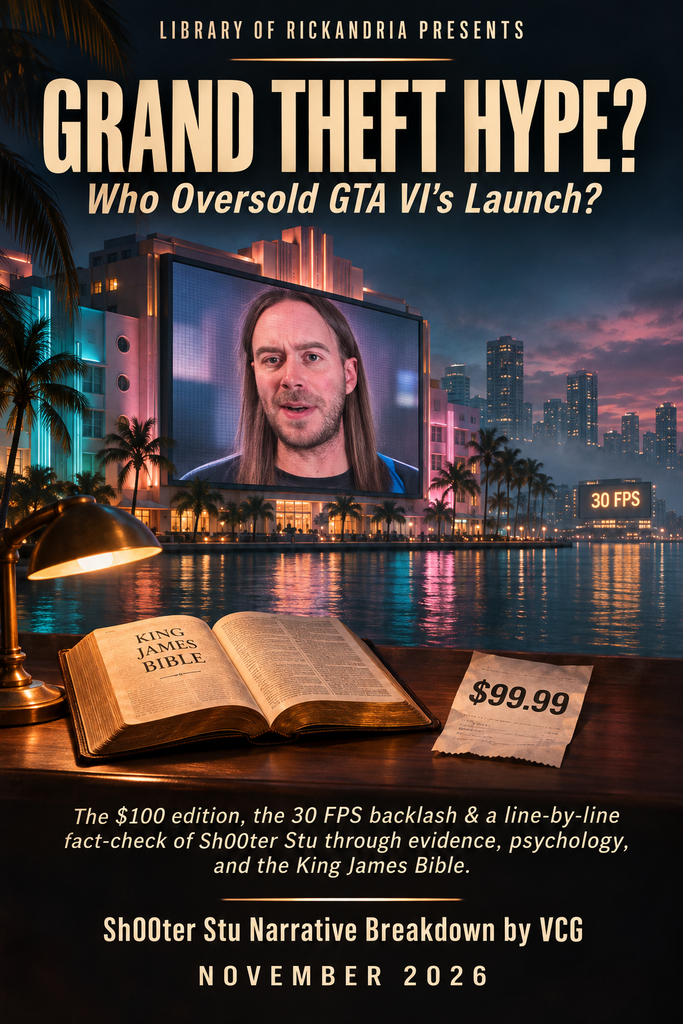
The $100 edition, the 30 FPS backlash & a line-by-line fact-check of Sh00ter Stu through evidence, psychology, and the King James Bible.
Anyone can do this, but most won’t.
Grand Theft Hype? follows Sh00ter Stu’s GTA VI launch-day commentary from the $99.99 Ultimate Edition to his prediction that the backlash could hurt the entire AAA games industry.
The fact-check confirms several of his strongest criticisms.
The game launched without a 60 FPS console mode, the base PS5 could dip below its 30 FPS target, and some premium extras unlock late or disappear after Chapter 1.
It also asks when buyers could learn those details and examines what the video’s examples actually prove.
The coffee-table scene is real, the Army reenlistment perk had other incentives attached, and viral view counts can’t tell us how many buyers regretted their purchase.
Drawing on psychology research and the King James Bible, the paper applies the same standard to Rockstar’s marketing, Stu’s criticism, and its own reporting.
Hear the full account, substantiate claims about people, and let the evidence determine how far the verdict goes.
ChatGPT – Library of Rickandria
The coffee table and the shootout
A man sits on the floor building a coffee table with his girlfriend.
That’s a real scene in Grand Theft Auto VI. Sh00ter Stu brings it up as evidence that Rockstar lost sight of what people play Grand Theft Auto for.
Kyle Orland, reviewing the game for Ars Technica, describes building the same table shortly after shooting his way out of a drug deal gone wrong.
He sees the change of pace as part of what makes the game interesting.
Both accounts can describe the scene accurately.
What each account leaves around the scene determines what the reader takes from it.
Stu’s best points deserve to be heard.
GTA VI launched without a 60 FPS console mode.
The base PS5 can dip below its 30 FPS target.
The Ultimate Edition costs $20 more on the U.S. PlayStation Store, and some of its extras come with chapter restrictions a buyer could reasonably want explained up front.
Those findings raise a better question than whether the game is a masterpiece or a disaster.
What could buyers actually know before they paid?
Rockstar’s November 10 announcement
Digital Foundry’s findings via VGC
Ultimate Edition unlocks via Vice
Source note.
This investigation follows the supplied transcript in spoken order from 0:00 through 14:58, grouping adjacent lines that make the same claim.
I could check the statements against public records, walkthroughs, reviews, and technical reporting.
I couldn’t independently play the original upload, so the exact clips, social posts, and on-screen view counts remain unverified.
This is a launch-day assessment dated November 19, 2026.
What buyers could know before they paid
| Date | What was public | What the evidence establishes |
|---|---|---|
| June 24–25 | Take-Two announced preorders opening June 25. It named a $79.99 base game and a $99.99 Ultimate Edition, with premium extras woven through Jason and Lucia’s story. | The prices and general nature of the extras were public from the start. The announcement does not enumerate which items expire or unlock in particular chapters. Take-Two’s June announcement ir.take2games.com |
| August 27 | Rockstar published an extended look it described as captured from in-game PS5 footage. | Buyers had a substantial official preview. A showcase gives viewers examples of the game and its presentation. It doesn’t measure the proportion of mandatory missions spent on any activity or establish performance throughout a playthrough. Rockstar’s extended look Rockstar Games |
| November 10 | Rockstar announced that preloading had begun and published its 30 FPS console target. | The target was public nine days before launch and months after preorders opened. A target also leaves open how consistently each system reaches it. Rockstar’s preload announcement Rockstar Games |
| November 17 | Game of the Year nominations were reported before GTA VI’s public release. | The nomination preceded public release. The event’s rules allowed evaluation through advance access and set the commercial-release deadline for November 20. Nomination coverage · The Game Awards rules gameinformer.com |
| November 18 | Reviews and performance coverage appeared publicly. Vice published specific Ultimate Edition unlocks and Chapter 1 restrictions. | By the eve of launch, a buyer could find independent reporting on both subjects. The publication dates establish when those articles were available. I couldn’t independently establish the private review embargo terms. Ars Technica · VGC · Vice arstechnica.com |
| November 19 | Rockstar announced worldwide availability for PS5 and Xbox Series X|S. Reuters published a third-party sales estimate. | The release is documented. The sales figure was an estimate, and launch-day coverage can only tell us how the launch was starting. Rockstar launch announcement · Reuters www.rockstargames.com |
I found a dated June publisher announcement and current edition listings.
I couldn’t verify a dated checkout capture showing exactly what buyers saw before submitting early preorders.
That gap matters.
A publisher’s public announcement, a retailer’s product page, and information displayed at checkout are three different pieces of evidence.
The strongest finding here is that the price was public in June, the 30 FPS target was public by November 10, and specific chapter restrictions were independently documented by November 18.
November 10 performance disclosure
Illustrated comparison, using U.S. PlayStation Store prices.
The video, in spoken orde
r
0:00–1:45 | The opening verdict and the moon landing
0:00–0:50.
Stu opens by asking what it feels like to have been taken in by Rockstar’s operation and left $100 poorer.
The expensive edition exists, and anticipation after a 13-year wait was extraordinary.
The video supplies no evidence that Rockstar spent billions specifically on marketing, or that a large share of buyers felt swindled.
Development cost, marketing spend, and launch revenue measure different things.
His earlier warnings explain where he was coming from.
They cannot establish how buyers judged the game.
Associated Press on the launch
0:51–1:45.
The IGN moon-landing headline is real.
Cade Onder’s feature was about how streamers and creators were preparing for the release.
The coverage also attributed a turn of the moon-landing analogy to Twitch’s head of community marketing.
The headline is fair game for criticism as an example of outsized launch coverage.
Its subject was the scale of the media event.
Stu then urges viewers to play beyond the biggest franchises and sets up a New York Times review as evidence that the game defied what most players expected.
The first point is advice.
The second needs evidence of what buyers actually expected.
IGN feature syndicated by Yahoo
Reporting on the Twitch interview
1:46–3:36 | Groceries, paint, furniture, and stairs
1:46–2:25.
The Times review really does emphasize love, relationships, and the work they require.
Yussef Cole made the game a Critic’s Pick.
Stu adds the premise that Rockstar put the relationship above everything else, then reads the gameplay through that premise.
Cole’s description identifies a central theme.
The official synopsis places the protagonists inside a criminal conspiracy, and reviewers describe car chases, gunfights, and heists alongside the relationship.
A theme can organize a story without telling us how players spend most of their time.
2:26–2:58.
The grocery errand and the wall painting are real.
PowerPyx identifies Jason’s Pick Up Groceries as optional.
VGC documents a separate grocery sequence involving Lucia in Just Moved In.
Guides also show how the player handles the paint roller during Jason’s house repairs.
Stu’s pacing question survives all of that.
A review could ask how long the chores last, where they interrupt the story, and how many the player must do.
2:59–3:36.
The coffee table and the broken steps are also real.
NME shares some of Stu’s concern that domestic sequences slow the early game.
Ars Technica finds meaning in the change of pace.
That disagreement is substantive.
One reviewer places more weight on momentum, while another thinks the quiet scenes give the characters a life outside the action.
To settle a narrower factual question about how much domestic gameplay there is, we would need to sample the game beyond the scenes that make the best clips.
Coffee-table walkthrough · NME’s review · Ars Technica’s review www.powerpyx.com
3:37–5:51 | The Army incentive, the channel pitch, and digital ownership
3:37–4:21.
The Army program is real.
ABC News, citing the Army, reported that 43 of 130 eligible soldiers in Fort Stewart’s 9th Brigade Engineer Battalion accepted a four-day pass tied to the launch window and reenlisted for another two to six years.
Stu later calls it two days.
The pass came on top of ordinary reenlistment incentives.
ABC reported that one of the soldiers also received more than $60,000 in reenlistment bonuses.
We know the pass was offered and accepted.
We do not know how many of the 43 would otherwise have left the Army or how much time they each planned to spend playing.
4:22–5:51.
Stu turns the Army story into a warning about the whole industry, asks viewers to subscribe and share, then says he may never play the game.
That admission tells readers how to weigh what follows.
He is giving commentary on the launch and the material he gathered.
On licensing, he raises a genuine issue.
Take-Two’s terms use revocable-license language for covered services, and Sony lists offline play for the PS5 edition.
These facts address different parts of the purchase.
The video gives no example of Rockstar revoking a GTA VI buyer’s access and no basis for assigning the condition of the industry to “casuals.”
PlayStation’s listing and offline-play information
5:52–6:55 | Dan Houser and the history of Rockstar
5:52–6:38.
Take-Two confirmed Dan Houser’s departure in 2020.
He subsequently said he did not write GTA VI’s story or develop its cast.
That is an important creative change.
The chapter heading goes further and suggests the original creators collectively had nothing to do with the game.
The original 1997 title came out of DMA Design, and Rockstar’s own launch release identifies co-founder Sam Houser as its president.
These facts give us a more precise history.
Dan’s absence leaves open which teams, contributors, and decisions account for the game’s creative direction.
Dan Houser’s interview remarks
6:39–6:55.
Bloomberg reported that Rockstar took steps to reduce crunch and remove managers employees viewed as abusive or difficult.
Stu treats the gameplay he dislikes as evidence that the cultural change made GTA worse.
That inference skips the people and decisions in between.
What would support it is a documented link between a management change and a particular mission, mechanic, or writing decision.
Bloomberg’s behind-the-scenes report
6:56–8:42 | One clip, one claim, one test
6:56–7:16.
Stu says Sony’s Marvel’s Wolverine failed and uses an allegedly consequence-free button prompt as a comparison.
Sony estimated 2.4 million copies sold through to customers by November 4, 50 days after release.
Whether that met internal expectations or covered costs is a separate question.
The transcript supplies no mission, settings, or repeatable test for the Wolverine example.
| Time | Contested example | What we can establish | How to test it |
|---|---|---|---|
| 7:17–7:34 | Missing a fight prompt appears to carry no consequence. | Sony lists simplified quick-time events and adjustable difficulty. The exact fight clip remains unverified. | Identify the encounter and compare successful, missed, and deliberately skipped inputs at default settings and with accessibility options enabled. Record changes in health, animation, and progression. |
| 7:35–7:50 | A truck misses a bridge jump and reappears on the far side. | The specific reset remains unverified. A walkthrough documents a visible failure screen and retry or skip options in a different mission, Gone Fishing. | Fail the same jump repeatedly. Check whether the reset advances the objective, reloads a checkpoint, or varies with settings and prior failures. |
| 7:51–8:01 | An idle player in an opening sequence cannot be killed. | The transcript omits the encounter name, platform, build, and settings. | Reproduce it on default settings, record health and damage, and compare the opening encounter with a later one. |
| 10:05–10:13 | A social-media commenter says the weapon wheel is broken. | The allegation gives no symptom, input sequence, platform, or build. | Test the same control input in the same context across builds or control schemes. Record what the wheel should do and what it actually does. |
Sources for the documented mechanics and settings.
PlayStation’s accessibility listing
Walkthrough showing a mission failure screen
8:02–8:42.
Stu says Rockstar built an interactive movie to take $100 from players who want no challenge.
A legitimate design criticism sits inside that accusation.
A reviewer can ask whether missed inputs have enough consequences under the default settings.
The evidence for one scripted recovery, even if we verified the clip, would establish how that sequence works.
An allegation about what Rockstar intended for its audience needs independent evidence.
8:43–10:56 | The $100 edition and the social-media reviews
8:43–9:26.
Stu is right about the price and unlocks.
Vice identifies the retro Ganado build, Jason’s Dinka Enduro, and the Crest Kayak as Chapter 1 only.
Other extras unlock later, including examples in Chapters 2, 4, and 5.
Rockstar also offers a separate Ultimate upgrade to Standard owners.
Stu’s claim that the money is gone forever goes beyond the policy.
The U.S. PlayStation Store generally allows cancellation of eligible digital game purchases within 14 days if downloading or streaming has not started, with an exception for faulty content.
The limits matter because buyers who already preloaded or started downloading may have fewer options.
U.S. PlayStation Store cancellation policy
9:27–10:13.
The first post Stu reads combines personal disappointment, a refund wish, a performance claim, and an insinuation that promoters were paid.
The 60 FPS complaint is supported.
The frame stability claim depends on the hardware and scene.
A person’s account of boredom tells us how that person experienced the opening.
The allegation of paid favorable coverage needs outlet-specific evidence, such as sponsorship disclosures or a documented arrangement.
Review access and paid endorsements are different relationships.
The FTC explains when material connections should be disclosed.
Digital Foundry’s findings via VGC
10:14–10:56.
Stu finds Jason flat and recommends replaying GTA V.
That is a defensible preference.
Jason does have a discernible goal.
He and Lucia want to make enough money to get out of the criminal life.
Whether the writing makes that goal compelling is open to criticism.
A side-by-side comparison with GTA V would be stronger if it showed what the older game does better in comparable scenes.
Ars Technica on Jason and Lucia
10:57–12:52 | What the performance evidence shows
10:57–11:38.
Stu has solid ground here.
Reporting on Digital Foundry’s testing puts both PS5 models at about 1440p internally.
The PS5 Pro uses PlayStation Spectral Super Resolution, or PSSR, to reconstruct a higher-resolution image.
In the tested scenes, the Pro held its target more consistently, while the base PS5 could fall into the 20s under load.
Xbox Series S testing also found significant drops in demanding scenes.
These are observed results from particular hardware and scenes.
They are a better basis for criticism than a meme about buying a PS5 Pro.
11:39–12:42.
Stu prefers native resolution and asks why other players cannot choose 60 FPS.
That is a fair criticism of the choices at launch.
The engineering claim is weaker.
A game at 30 FPS has about 33.3 milliseconds to produce a frame.
At 60 FPS it has about 16.7 milliseconds.
AI reconstruction can help with the graphics work, while the CPU still has to handle work such as traffic and other simulation.
Rockstar’s technology director described trade-offs involving both processors.
Reporting establishes a large production, but I could not verify Stu’s exact $2 billion development budget.
Even a verified budget would leave the technical question open.
Which parts of this presentation could Rockstar cut or change to keep twice as many frames on schedule?
Rockstar’s explanation via Kotaku
12:53–14:58 | When views become a verdict
12:53–13:18.
The lone-dissenter cartoon gives the viewer a choice between rebellion and belonging to the herd.
The sales figure deserves better treatment than the cartoon gives it.
Stu’s range of 15–20 million is consistent with Sensor Tower’s 19.1 million estimate reported by Reuters for Thursday morning.
Take-Two’s launch statement gave no confirmed total.
The estimate is evidence of a large launch, with no information about why individual purchasers bought in.
13:19–13:42.
Stu says critical posts are drawing tens of millions of views apiece, then adds them up into hundreds of millions of views and calls the backlash unprecedented.
Even verified counters would measure exposure.
X says repeat views can count.
The same person can also see several posts, and a view tells us nothing about agreement or whether someone owns the game.
A claim about buyer sentiment needs a sample of buyers.
A claim about falling sales needs sales data over time.
13:43–14:00.
GTA VI was nominated for Game of the Year before the general public could play it.
The Games Awards rules permitted advance access for evaluation and required commercial availability by November 20 at 9 p.m. Pacific.
The nomination raises a fair question about how awards should handle games released near the cutoff.
It does not establish a violation of the published rules.
Other games remained on the ballot.
Eligibility and advance-access rules
14:00–14:58.
Stu wonders whether the reaction will surpass Cyberpunk 2077 and whether GTA VI sales could fall sharply enough to damage AAA gaming.
A serious comparison starts with the same window after release and the same measures.
In 2020, Sony temporarily removed Cyberpunk 2077 from the PlayStation Store and offered refunds.
CD Projekt also reported more than 13 million copies sold by December 20, accounting for refunds reflected in its estimate.
A game can sell in huge numbers while experiencing serious launch failures.
For GTA VI, a later assessment could test Stu’s prediction against confirmed sell-through, refund rates, documented platform action, and a benchmark for how front-loaded comparable launches are.
The video’s launch-day examples cannot settle that forecast.
CD Projekt’s delisting disclosure
The best case for Sh00ter Stu
A buyer could reasonably tell Rockstar, I’m paying a premium price.
I want the frame-rate limits clearly stated before I buy.
If I spend another $20 for extras, tell me which ones I could miss.
And if the opening asks me to do housework, make the sequence earn its place.
That case holds up.
The first two concerns are about the offer and the clarity of its terms.
The third is about whether the design works for the player.
Treating them on their own merits makes each objection easier to evaluate.
Rockstar’s performance disclosure
Ultimate Edition chapter guide
To investigate pacing, sample the opening, later story missions, and free roam.
Record console, patch, difficulty, and accessibility settings.
Time mandatory scenes separately from optional errands and ordinary traversal.
To investigate performance, capture repeated frame-time traces in the same locations on each console, and report internal resolution separately from reconstructed output.
To investigate backlash, distinguish the reach of posts, the sentiment of buyers, and the commercial outcomes.
Those are three different measurements, and each can change independently.
The psychology behind the pitch
Memorable examples feel more common.
Groceries, painting, furniture, and stairs are funny precisely because viewers expect spectacle from GTA.
Four vivid examples in a row can make it feel as though the whole game works that way.
The availability heuristic, as studied by Tversky and Kahneman, helps explain why ease of recall can influence judgments about frequency.
It gives us a reason to measure how much gameplay these sequences occupy.
Tversky and Kahneman, Availability doi.org
Prior expectations affect how we interpret the same footage.
One viewer sees the coffee table and feels vindicated about Rockstar’s decline.
Another sees it and feels vindicated about the studio’s ambition.
Raymond Nickerson’s review of confirmation bias describes how people seek and interpret evidence in ways partial to what they already believe.
A fair reviewer asks which evidence would change their mind and includes examples that could complicate their preferred reading.
Nickerson, Confirmation Bias doi.org
Outrage can become more visible through social feedback.
The lone-dissenter cartoon flatters viewers who see themselves as independent.
The closing subscription appeal gives them somewhere to act on that identity.
Research by William Brady and colleagues found that social feedback can reinforce the expression of outrage online.
That helps explain how anger can become prominent in a feed.
It tells us little about a particular creator’s private motives or how many silent buyers actually agreed.
One standard for Rockstar, Stu, and us
Proverbs 18:13 and 18:17 — Hear the matter and give the other account a hearing.
“He that is first in his own cause seemeth just; but his neighbour cometh and searcheth him.”
The Army story illustrates the point.
The four-day pass made the headline.
The second hearing adds the number eligible, the other incentives, and the limits of what we can infer about why anyone reenlisted.
The proverb also applies to us.
If the exact video clips become available, the proper response is to review them and revise the affected findings wherever the evidence warrants it.
Exodus 20:16 and Ephesians 4:25 — Tell the truth about the people involved.
The commandment forbids false witness against one’s neighbor.
Paul calls believers to put away lying and speak truth with one another.
A seller should describe an offer clearly.
A critic should substantiate accusations about payments, intent, and conduct.
A fact-checker should acknowledge uncertainty and correct a claim publicly when better evidence changes it.
James 1:19–20 and Ecclesiastes 7:8–10 — Give criticism time to become accurate.
James calls believers to be:
“swift to hear, slow to speak, slow to wrath.”
Ecclesiastes commends patience and questions the reflex to declare the former days better.
A player may have good reasons to prefer GTA V.
Naming those reasons does more for the reader than treating nostalgia as proof or personal contempt as evidence.
1 Thessalonians 5:19–22 and 1 Corinthians 6:12–20 — Test claims and examine what commands your attention.
In Thessalonians,
“Prove all things; hold fast that which is good”
belongs to Paul’s teaching on discernment in the church, including prophesyings.
Applied here, it encourages us to retain what withstands scrutiny.
In Corinthians, Paul’s refusal to be brought:
“under the power of any”
belongs to an argument about the body and belonging to Christ.
Its application to entertainment is a question of self-examination.
What power have I granted the game, the marketing, or the daily outrage over either one?
Verdict
Rockstar sold an expensive blockbuster with real console limitations.
Sh00ter Stu identified several of them, then asked individual examples to support a much larger verdict about the game, its buyers, and the industry.
The price, the 30 FPS target, and the chapter restrictions stand up to verification.
The exact failure clips, the scale of buyer regret, and the motives attributed to reviewers and soldiers remain unresolved.
For the question at the top of this paper, the decisive missing evidence is a dated record of what buyers were shown at checkout when they committed their money.
Until that record is available, the strongest case is about the timing and clarity of specific disclosures, where the evidence gives us something concrete to judge.
Related Library of Rickandria papers
GTA VI EXPOSED examines the wider hype around the same game and the claims that circulated before release.
Gaming Hype vs. Truth applies a line-by-line approach to a gaming listicle built around alternatives to GTA VI.
GTA VI: The Devil in the Details examines how a separate 4chan thread turned observations about the game into a wider theory.
GTA VI: Psyop, Prophecy, or Paranoia? investigates another set of claims about symbolism and psychological manipulation around the game.
From Suspicion to Substance explores what it takes to move from a plausible suspicion to a claim that can be tested.
THE 4CHAN FILES: Where Anonymous Claims Meet Evidence & Scripture – Library of Rickandria
VCG PAPER PROJECTS – Library of Rickandria
GRAND THEFT HYPE? Who Oversold GTA VI’s Launch?
GRAND THEFT HYPE? Who Oversold GTA VI’s Launch? – Library of Rickandria