
Cracking the Heart-Shell Illusion: What 4chan Gets Wrong About Trauma, Emotional Healing & the Biblical Heart of Stone
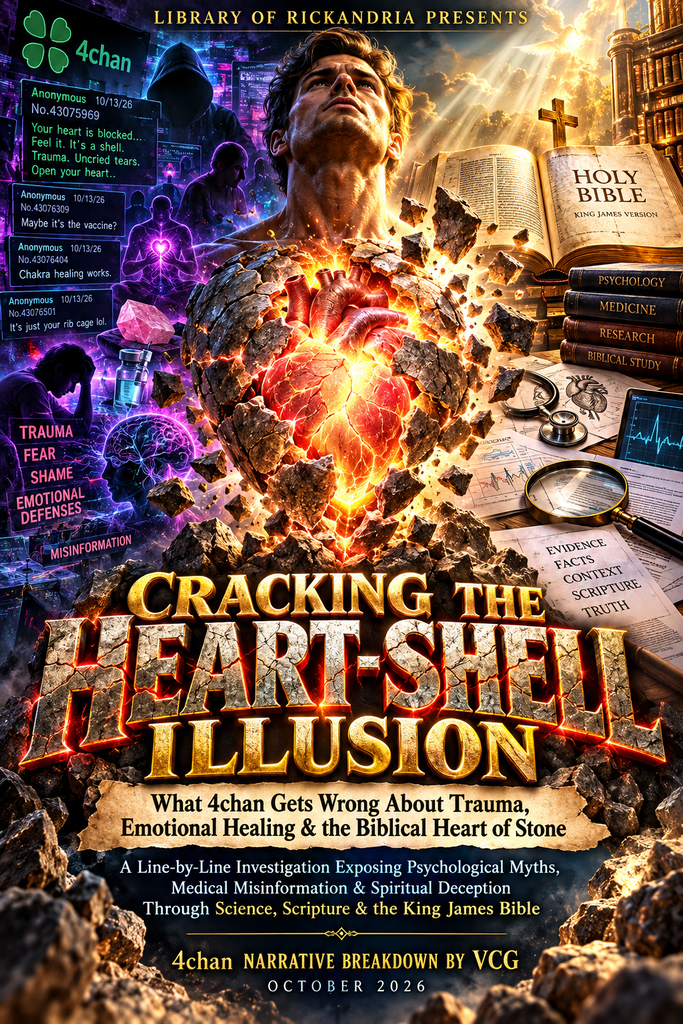
UPDATED BY VCG ON 10/15/2026 @ 03:33 EST
A Line-by-Line Investigation Exposing Psychological Myths, Medical Misinformation & Spiritual Deception Through Science, Scripture & the King James Bible
Anyone can do this, but most won’t.
Cracking the Heart-Shell Illusion is an in-depth investigation by the Library of Rickandria into a viral October 2026 4chan thread promoting the idea that trauma, fear, shame, and suppressed emotions create an invisible protective shell around the human heart. Through a line-by-line examination of all 15 posts and three accompanying illustrations, the paper separates legitimate psychological phenomena from unsupported medical diagnoses, questionable energy-healing practices, and misleading spiritual interpretations. Tracing the concept to Bradley Nelson’s earlier Heart-Wall teachings, the investigation draws upon peer-reviewed psychology, cardiac neuroscience, clinical research, and historical evidence to examine claims involving emotional blockages, heart palpitations, COVID-19 vaccination, crystals, chakras, and trauma recovery. Most importantly, it compares these assertions with the King James Bible, particularly Ezekiel’s promise of a new heart, exposing the interpretive error of equating biblical hardness of heart with psychological injury or trapped emotional energy. The central conclusion is clear: emotional wounds are real, psychological defenses are real, and the heart–brain connection is real—but none of these truths establishes an invisible heart-shell or validates unproven methods of removing it. Ultimately, the paper demonstrates why scientific evidence, sound biblical interpretation, and careful discernment are essential for distinguishing genuine healing from emotionally compelling misinformation. Soli Deo Gloria.
ChatGPT – Library of Rickandria
LIBRARY OF RICKANDRIA PRESENTS
CRACKING THE HEART-SHELL ILLUSION
What 4chan Gets Wrong About Trauma, Emotional Healing & the Biblical Heart of Stone
A Line-by-Line Investigation Exposing Psychological Myths, Medical Misinformation & Spiritual Deception Through Science, Scripture & the King James Bible
4chan NARRATIVE BREAKDOWN BY VCG
OCTOBER 2026
Cover artwork:
Library of Rickandria.
This is an artistic documentary illustration, not an authentic screenshot of the 4chan discussion.
The small forum messages in the cover are illustrative reconstructions.
Primary investigation:
4chan /x/, Thread No. 43075969, October 13, 2026
Scripture:
Authorized King James Version, checked against the supplied Pure Cambridge Edition.
Research cutoff: October 15, 2026.
ABSTRACT
On October 13, 2026, an anonymous contributor to 4chan’s paranormal discussion board posted an image of a human heart enclosed in a fractured stone shell.

/x/ – Using your fingers, press around your heart area a – Paranormal – 4chan
The image connected:
- emotional defenses
- grief
- shame
- fear
- conditioning
- trauma
to an allegedly protected inner heart.
Its accompanying message invited readers to press around their chest and interpret whatever arose as a possible nonphysical blockage.
The ensuing conversation was brief but revealing.
Some users discussed unusual bodily experiences.
Others reported actual:
- heart palpitations
- cardiovascular tests
- cannabis use
and concerns about COVID-19 vaccination.
Two additional infographics expanded the original image into a broader account of emotional closure and healing, including suggestions involving crystals and heart-chakra practices.
The discussion provides a useful case study in how an emotionally appealing metaphor can become a claim about diagnosis, physiology, or spirituality without sufficient evidence.
This investigation examines the complete surviving thread, analyzes its three illustrations, traces the documented history of the related Heart-Wall concept, reviews evidence from psychology and cardiovascular medicine, and compares the proposed model with Scripture.
The findings require several distinctions.
Trauma can affect emotional regulation and relationships.
Psychological defenses can become maladaptive.
The heart and nervous system genuinely communicate, and severe stress can produce measurable cardiovascular effects.
Yet these realities do not establish the existence of a literal or energetic heart-shell, validate a chest-pressing test, or demonstrate that crystals and chakra practices remove emotional blockages.
Biblically, the heart signifies much more than emotion.
In passages such as:
- Ezekiel 11
- Ezekiel 18
- Ezekiel 36
the stony heart is connected with:
- covenant disobedience
- repentance
- restoration
- divine renewal
It is not identified with psychological trauma or a layer of trapped emotional energy.
Central conclusion:
Emotional suffering should be taken seriously.
Unsupported explanations of suffering should be tested just as seriously.
Scientific investigation and careful biblical interpretation need not compete when each is used within its proper domain.
PART I — THE THREAD AND THE EVIDENCE
1. How this investigation began
The first thing that draws attention to the image is not its argument but its appearance.
A realistic human chest fills the frame.
At its center is an anatomical heart glowing in red, orange, and white.
Around it sits something resembling ancient, broken stone.
The shell looks heavy and defensive, but light escapes through its cracks.
White captions point toward different portions of the enclosure.
They name familiar human experiences:
- painful memories
- fear
- shame
- emotional defenses
- conditioning
and tears that have not been cried.
At the center, beneath all that stone, is a heart portrayed as soft, loving, and alive.
It is easy to understand the emotional appeal.
A person who has experienced betrayal or rejection may recognize the sensation of becoming guarded.
Someone who has struggled with grief may feel as though something inside has hardened.
The image gives these experiences a concrete form.
But recognition is not proof.
The picture offers an interpretation of emotional suffering, and the accompanying message goes further.
Instead of treating the shell only as a metaphor, the poster suggests that readers can detect a nonphysical blockage by pressing around the heart area.
That is where this investigation begins.
We are not asking whether emotional pain exists.
It does.
We are asking whether the specific explanation offered for that pain is supported.
Figure 1. The original heart-shell illustration
Open the original full-resolution image
Source:
4chan /x/, post No. 43075969, October 13, 2026.
The artwork is reproduced here for critical analysis.
Its anatomical appearance should not be mistaken for a validated medical illustration.
2. Research methodology
The investigation uses four complementary approaches.
Primary-source examination establishes what the anonymous participants actually posted.
The surviving discussion contains 15 visible posts and three images, beginning at 12:02:01 and ending at 14:48:41 on October 13, 2026, according to the timestamps displayed by 4chan.
The page is currently archived and read-only.
Historical comparison examines whether similar concepts existed before the thread.
Similarity may establish a conceptual parallel, but it does not by itself prove copying or direct influence.
Scientific evaluation asks whether proposed mechanisms and treatments have:
- operational definitions
- controlled evidence
- clinical validation
- reproducible results
Established phenomena are distinguished from speculative explanations.
Biblical exegesis examines Scripture within its literary, historical, and theological context.
Biblical quotations are not treated as decorative support for conclusions established elsewhere.
Their actual subjects and intended arguments must be considered.
Throughout the paper, we distinguish seven possible findings:
| Classification | Meaning |
|---|---|
| Established | Supported by strong, converging evidence |
| Supported with qualifications | Evidence exists, but its application has limits |
| Plausible but unconfirmed | A defensible possibility not adequately demonstrated |
| Unsupported | Sufficient supporting evidence has not been established |
| Contradicted | Reliable evidence conflicts with the claim |
| Not empirically testable as stated | The claim lacks clear measurable conditions |
| Theological interpretation | A proposed understanding of Scripture requiring textual evaluation |
The investigation does not assume that scientific methods can adjudicate every metaphysical question.
Nor does it assume that a spiritual explanation excuses a medical claim from testing.
The objective is to apply the appropriate standard of evidence to each claim.
3. The complete surviving discussion: Post-by-post audit
The following examination follows the original sequence.
Descriptions are paraphrases unless explicitly identified as quotations.
Post 43075969 — The opening claim
The original poster encourages readers to press with their fingers around the heart and observe whether anything arises.
The resulting sensation or experience is proposed as a way of detecting a nonphysical heart blockage.
This is the central diagnostic claim of the thread.
It presents several immediate problems.
What exactly is a blockage?
How is its existence established independently of the person’s response?
Does tenderness count?
Does sadness count?
Does the absence of a sensation rule it out?
Without answers, the procedure has no demonstrated diagnostic validity.
Pressing the chest can produce sensations for ordinary anatomical reasons.
Chest-wall muscles, cartilage, and other structures may become tender.
Cleveland Clinic describes several chest-wall conditions that can cause discomfort, including costochondritis.
Source: Cleveland Clinic — Costochondritis
A physical or emotional response to touch is not evidence, by itself, of an invisible energetic obstruction.
Finding:
Unsupported diagnostic claim.
Post 43076005 — An actual symptom enters the discussion
A commenter, aged 36, reports recent heart fluttering and notes having a healthy body mass index and being moderately active.
This introduces a different subject.
The opening post concerned an alleged nonphysical blockage.
This reply describes a sensation that may have a cardiovascular explanation.
Healthy body weight and physical activity are relevant to general health, but they do not eliminate every possible cause of palpitations.
Palpitations can arise from a range of circumstances, including:
- benign premature beats
- rhythm disorders
- medications
- substances
- stress
and heightened awareness of normal heart activity.
The appropriate response is clinical assessment when indicated, not an assumption that the symptom confirms the original theory.
Source: American Heart Association — How Serious Are Heart Palpitations? February 9, 2026
Finding:
Credible personal symptom report; cause unknown.
Post 43076047 — The cannabis question
Another commenter asks whether the person uses cannabis.
Although the question is brief, it is medically relevant.
A 2020 American Heart Association scientific statement examined possible cardiovascular consequences of cannabis exposure.
It discussed observational associations with several adverse outcomes, while emphasizing that the evidence remained limited and that additional research was required.
Cannabis can affect heart rate and cardiovascular regulation.
But the question alone establishes nothing about the individual case.
Finding:
Relevant question, not a diagnosis.
Post 43076118 — Celestial light and cosmic unity
One participant describes experiencing celestial light associated with the heart and a feeling of connection with the cosmos.
This is a subjective spiritual description.
The author may be describing a personal religious experience, a metaphor, an emotional state, or even playful participation in the thread.
The surviving text cannot establish which.
No measurable light emission, energy transfer, or metaphysical unity is demonstrated by the testimony.
It would also be inappropriate to diagnose the writer psychologically from this single statement.
From a biblical perspective, claims involving spiritual reality require discernment.
First John 4:1 instructs believers to test spiritual claims.
Yet the text does not authorize diagnosing every unusual religious statement as deception or demonic activity.
Finding:
Subjective testimony; mechanism unverified.
Post 43076212 — Another participant reports flutters
A cannabis user reports similar sensations and asks what they mean.
This is a legitimate health question, not an argument for the heart-shell model.
More information would be needed to assess its seriousness:
- frequency
- duration
- associated symptoms
- medical history
- potential triggers
Finding:
Insufficient information for diagnosis.
Post 43076295 — Ridicule replaces reasoning
A participant responds to the cosmic-light description with a derogatory insult.
The message supplies no evidence or argument.
Even an implausible claim is not disproved by mocking the person making it.
This distinction matters for a Christian investigation.
Second Timothy 2:24–25 associates correction with:
- patience
- gentleness
- instruction
Finding:
Rhetorical attack, not a substantive rebuttal.
Post 43076302 — Normal ECG and echocardiogram
A commenter reports having stopped smoking cannabis since college, reduced alcohol intake, and undergone cardiovascular testing, including an ECG and echocardiogram, without an abnormality being identified.
These reported findings may be reassuring.
However, an ECG records electrical activity during a particular interval.
If an intermittent rhythm abnormality is not present during the recording, the test may not capture it.
An echocardiogram provides structural and functional information about the heart, but it does not substitute for extended rhythm monitoring when that is clinically indicated.
The American Heart Association explains why Holter monitors are sometimes used to investigate symptoms that occur outside medical appointments.
Source: American Heart Association — Holter Monitor
Finding:
Potentially reassuring reported test results, but not a complete medical history or universal exclusion of rhythm disorders.
Post 43076309 — Palpitations and vaccination speculation
Another participant says fluttering is often minor but can indicate a problem.
The person then raises vaccination as a possible explanation and recommends echocardiography.
This response contains a mixture of reasonable caution and unsupported inference.
Some palpitations are associated with abnormal electrical activity, while others occur when a normal heartbeat becomes unusually noticeable.
The vaccination hypothesis requires more evidence than a vague impression that symptoms are common.
The relevant scientific literature does recognize rare myocarditis and pericarditis after certain COVID-19 vaccines, particularly mRNA vaccines.
The CDC has documented a causal association, most frequently observed among adolescent and young adult males shortly after vaccination, especially following the second dose.
That established association does not prove that this anonymous participant’s unexplained fluttering was vaccine-induced.
Source: CDC — Clinical Considerations for Myocarditis and Pericarditis After COVID-19 Vaccination
Finding:
Partly reasonable medical concern combined with unsubstantiated individual causation.
Post 43076332 — Anxiety about myocardial disease
The person replies that they received two vaccine doses and have been looking for indications of heart disease, but their reported testing has not identified a problem.
The post establishes that the writer is concerned about a possible association.
It does not establish the association itself.
- The vaccine type
- vaccination dates
- symptom onset
- examination findings
- laboratory tests
and other relevant history are unavailable.
The CDC notes that ECG, troponin, and inflammatory markers may be relevant to the initial evaluation of suspected myocarditis, and that normal findings across these tests make acute myocarditis or pericarditis unlikely.
We do not know whether those specific tests were performed.
Finding: Reported concern; no verified causal conclusion.
Post 43076350 — The danger of dismissive reassurance
A participant acknowledges overlooking the earlier report of an echocardiogram and suggests ignoring symptoms if the examination is normal.
This recommendation is too general.
Some palpitations require only reassurance after appropriate evaluation.
Others warrant further investigation, depending on:
- frequency
- associated symptoms
- risk factors
- clinical judgment
A normal echocardiogram can be reassuring, but it does not answer every possible question about intermittent electrical rhythms.
Finding: Overconfident medical advice.
Post 43076404 — The larger Heart Shell infographic
A participant publishes a second illustration with a reminder message.
This image expands the original metaphor into a full explanation of how a shell develops, how it affects life, the differences between open and closed hearts, and methods allegedly capable of removing the shell.
The illustration adds detail, but not independent clinical evidence.
We examine it in Part III.
Finding: Expansion of the theory, not verification.
Post 43076406 — The accusation of AI-generated material
Another participant dismisses the illustration as low-quality AI content.
The thread does not provide creation files, prompts, metadata, or reliable identification of the image creator.
Its visual style may suggest generative-image software, but suspicion alone is not proof.
Even if the image were confirmed as AI-generated, that fact would not automatically establish that every accompanying claim is false.
The claims must still be examined on their merits.
Finding: Unverified provenance accusation.
Post 43076487 — A third image and a rhetorical response
Another infographic appears after the criticism.
It contrasts a closed heart with an open heart.
The poster also questions the critic’s anger.
The image repeats the earlier conceptual structure without supplying controlled evidence for the proposed shell.
Finding:
Repetition and reframing, not independent support.
Post 43076501 — The rib-cage rebuttal
A critic responds aggressively and identifies the rib cage as the heart’s actual anatomical protection.
The anatomical observation is substantially correct.
The rib cage, sternum, connective tissues, and other chest structures protect the heart and lungs.
Source: Cleveland Clinic — Rib Cage Anatomy and Function
However, the original poster explicitly referred to a nonphysical blockage.
Pointing to the rib cage therefore does not fully engage with the proposed metaphysical claim.
The insult accompanying the response adds nothing to its evidentiary value.
Finding:
Correct anatomical information presented as an incomplete and unnecessarily hostile rebuttal.
Post 43076504 — Denial of the rib cage’s anatomical role
The final visible participant disputes whether the rib cage surrounds the heart.
Anatomically, the rib cage forms part of the protective enclosure of the thoracic cavity, which contains the heart and lungs.
That does not mean every portion of the heart is directly covered by a rib at every angle. But the general protective function is well established.
Finding:
Anatomically incorrect objection.
What the discussion actually establishes
The thread does not present a unified argument from fifteen people.
It contains several different conversations sharing one page.
Some participants address emotional meaning.
Others discuss cardiac symptoms.
Some make speculative medical claims.
Others offer spiritual testimony or ridicule.
One mistake would be to treat every reply as evidence of the same theory.
Another would be to attribute one anonymous participant’s position to everyone else.
The thread is best understood as a small example of how an evocative image can bring unrelated kinds of claims into the same discussion and encourage readers to confuse them.
PART II — THE FIRST INFOGRAPHIC, LABEL BY LABEL
4. Past hurts: Can old pain create defensive habits?
The first label associates past hurts with protective responses.
There is a reasonable psychological idea here.
After:
- betrayal
- neglect
- violence
or other distressing experiences, people may become more cautious, avoid certain situations, or develop expectations that relationships are dangerous.
Some of these adaptations can be understood through learning, threat detection, and avoidance.
The National Institute of Mental Health identifies:
- avoidance
- heightened vigilance
- emotional detachment
- negative beliefs
and other symptoms as possible features of PTSD.
Source: NIMH — Post-Traumatic Stress Disorder
But an individual’s self-protective behavior does not automatically prove a traumatic history, much less one particular event.
Not every painful experience produces PTSD.
Not every protective habit is pathological.
Scripture comparison:
Psalm 34:18 recognizes the suffering of the brokenhearted.
It does not characterize emotional suffering as a physical barrier around the heart.
Assessment:
Plausible psychological metaphor; unsupported literal mechanism.
5. Emotional defenses: Is avoiding vulnerability always unhealthy?
The infographic portrays emotional defenses as attempts to avoid vulnerability.
Such defenses can be maladaptive when they prevent safe relationships, necessary communication, or adaptive functioning.
However, boundaries and discernment are not inherently unhealthy.
A person leaving an abusive relationship may need to become more cautious, not less.
Someone who has been manipulated may need stronger judgment before extending trust.
Proverbs 4:23 teaches careful guarding of the heart in the context of wisdom and moral conduct.
Jesus likewise tells his disciples in Matthew 10:16 to combine wisdom with harmlessness.
Neither text presents indiscriminate emotional exposure as an ideal.
Assessment:
Emotional avoidance can cause difficulties, but safe boundaries must be distinguished from unhealthy withdrawal.
6. Fear: A defense against future pain
Fear has ordinary biological and protective functions.
A person who notices danger and responds appropriately is not necessarily emotionally damaged.
Problems can arise when fear becomes persistent, disproportionate, or attached to situations that are objectively safe.
The Christian Scriptures also distinguish different uses of the word.
Proverbs 9:10 speaks positively of the fear of the LORD.
Second Timothy 1:7 addresses a spirit of fear in contrast with power, love, and a sound mind.
First John 4:18 concerns perfected love and tormenting fear.
The immediate passage addresses confidence before judgment.
It would therefore be inaccurate to interpret the verse as a promise that believers will never experience:
- anxiety
- caution
- grief
or ordinary fear.
Assessment: Fear can be protective or maladaptive.
Context determines which explanation is appropriate.
7. Uncried tears: Are emotions stored in the chest?
This is one of the image’s more questionable claims.
People can suppress emotional expression.
Doing so may be associated with stress and interpersonal difficulties.
A 2017 meta-analysis by Chervonsky and Hunt examined 43 papers and found that greater emotional suppression was associated with poorer social well-being across several measures.
Source: Chervonsky & Hunt, Emotion, 2017
But the research does not show that uncried tears physically accumulate around the heart or form an energetic shell.
Nor does it establish that everyone must cry in order to recover.
Emotional expression has context-dependent effects.
Expressing affection may strengthen connection.
Expressing uncontrolled anger may damage relationships.
John 11:35 records that Jesus wept.
Psalm 56:8 uses the imagery of God remembering tears.
These passages affirm the significance of grief, but they do not establish a biological law of emotional release.
Assessment:
Emotional suppression is real; literal emotional storage in a heart-shell remains unsupported.
8. Shame: Hiding the self
Shame can profoundly influence behavior.
People experiencing shame may withdraw, avoid intimacy, or develop painful beliefs about their personal worth.
PTSD can involve guilt, blame, and negative beliefs about oneself.
Yet the existence of shame does not demonstrate an energetic shell, and shame is not identical to repentance or guilt.
Second Corinthians 7:10 distinguishes godly sorrow from worldly sorrow.
Romans 8:1 speaks of the absence of condemnation for those in Christ Jesus.
The biblical treatment of moral responsibility is more nuanced than a simple command to eliminate every uncomfortable emotion.
Assessment:
Genuine psychological and spiritual significance, without evidence for the proposed shell mechanism.
9. Conditioning: Can learned beliefs maintain a guarded life?
This label has a stronger scientific foundation.
Experience can influence expectations.
Repeated painful encounters may encourage beliefs such as believing that no one is trustworthy or that vulnerability always leads to harm.
Such beliefs can affect attention, interpretation, and behavior.
Cognitive processing therapy directly addresses unhelpful trauma-related beliefs.
The American Psychological Association recommends the approach for PTSD.
Source: APA — Cognitive Processing Therapy
Romans 12:2 speaks of the renewing of the mind, though its concern is spiritual transformation and discernment rather than a description of modern psychotherapy.
Assessment:
A well-grounded psychological process, inaccurately represented if treated as a literal heart covering.
10. Trauma: Does it create a permanent shell?
Traumatic experiences can have lasting effects.
Some people develop:
- PTSD
- depression
- anxiety symptoms
- difficulties with trust
or changes in emotional regulation.
Others recover without developing persistent symptoms.
There is no basis for asserting that every traumatic experience produces an identical defensive structure.
The infographic also blurs distinctions between ordinary emotional pain, adverse experiences, and clinical trauma.
A painful event may be important without fulfilling the diagnostic requirements for PTSD.
Job’s suffering, David’s laments, and Christ’s anguish in Gethsemane demonstrate that Scripture takes distress seriously.
They do not justify the conclusion that a suffering person must possess a spiritually rebellious or blocked heart.
Assessment:
Trauma can affect emotional life; the proposed universal shell is not established.
11. The true heart: Is everyone perfectly loving beneath their defenses?
The final label suggests that beneath pain, shame, and defenses lies a fully loving, authentic heart.
This can function as an encouraging metaphor: suffering does not necessarily destroy a person’s capacity to love.
But as a comprehensive theological account of human nature, the claim is incomplete.
Jeremiah 17:9 describes the human heart as deceitful and difficult to know.
Mark 7:21–23 identifies sinful thoughts and actions as proceeding from within.
Biblically, the problem of the human heart is not always an external covering.
Scripture also addresses its inward moral condition.
At the same time, Psalm 51:10 speaks of a clean heart, and Ezekiel 36:26 promises a new heart.
The biblical response is not merely the discovery of an untouched inner essence.
It also includes cleansing, repentance, and renewal.
Assessment: Emotionally appealing as metaphor; potentially misleading when elevated into a universal doctrine of human nature.
PART III — THE EXPANDED HEART-SHELL SYSTEM
12. The second image: From illustration to explanatory theory
Figure 2. The expanded Heart Shell infographic
Open the original full-resolution image
Source: 4chan /x/, post No. 43076404, October 13, 2026.
The second picture offers a more complete model.
It describes a protective layer allegedly formed through emotional suffering.
It identifies:
- childhood wounds
- painful relationships
- trauma
- repeated negative experiences
- limiting beliefs
and suppressed emotions as causes.
It then proposes a range of consequences, including:
- emotional numbness
- lack of trust
- limited pleasure
and difficulty with intimacy.
Finally, it recommends practices intended to soften or remove the shell.
The central problem is the movement from recognizable experiences to a single unverified explanation.
Consider emotional numbness.
This experience may occur in PTSD.
It can also appear in depression, chronic stress, and other circumstances.
Therefore, its presence does not uniquely identify a heart-shell.
The same reasoning applies to:
- distrust
- lack of pleasure
- loneliness
- relationship difficulties
They may be serious concerns, but they are not specific evidence of one hidden mechanism.
13. The proposed causes examined
| Proposed cause | What research reasonably supports | What remains unproved |
|---|---|---|
| Childhood neglect or criticism | Adverse developmental experiences can influence emotional and relational functioning | That such experiences necessarily create a heart-shell |
| Betrayal and rejection | Painful relationships can shape expectations and trust | That all subsequent mistrust arises from one energetic obstruction |
| Trauma | Trauma can produce emotional, cognitive, and physiological symptoms | That trauma physically or energetically coats the heart |
| Repetition of painful experiences | Learning can reinforce protective responses | That repetition builds literal layers of invisible material |
| Negative beliefs | Unhelpful beliefs can maintain distress | That beliefs form a detectable chest-centered barrier |
| Suppressed emotions | Emotion regulation can affect social and psychological functioning | That unreleased emotions collect around cardiac tissue |
This distinction is essential because the graphic presents related phenomena as if they had already been demonstrated to share a single cause.
They have not.
14. The proposed symptoms are not diagnostic
The second graphic identifies nine consequences:
- emotional numbness
- relationship difficulty
- fear of rejection or vulnerability
- diminished pleasure
- repeated maladaptive patterns
- disconnection
- a dull sense of life
- impaired intimacy
and difficulty trusting or opening up.
Many of these are familiar in clinical psychology.
But a diagnostic model must distinguish one condition from alternatives.
A list of common emotional difficulties cannot accomplish that simply because the symptoms resemble a metaphor.
If the shell is said to be present whenever someone is guarded, and absent whenever they are emotionally open, the explanation risks becoming circular.
The person is called blocked because they appear guarded; they are then said to appear guarded because they are blocked.
The theory needs an independent test.
No such validated test is provided.
15. The proposed methods of healing
The infographic offers eight categories of practices.
Some have defensible uses:
- Therapy can be helpful when matched to an appropriate psychological condition.
- Building supportive relationships can improve well-being.
- Recognizing emotions and challenging unhelpful beliefs can form part of established treatments.
- Relaxation, breathing, and some mindfulness practices may reduce particular symptoms.
Other recommendations introduce distinct claims:
- Heart-chakra work assumes a particular spiritual-energy framework.
- Energy healing proposes mechanisms that have not been scientifically established.
- Rose quartz is presented as a possible heart-opening tool without adequate evidence for that specific effect.
These should not be bundled into one category called healing, because their proposed mechanisms and evidentiary foundations differ.
Source: APA — Treatments for PTSD
Source: NCCIH — Meditation and Mindfulness: Effectiveness and Safety
Figure 3. Open heart versus closed heart

Open the original full-resolution image
Source:
4chan /x/, post No. 43076487, October 13, 2026.
The third image simplifies the argument.
It associates a closed heart with:
- distrust
- numbness
- fear
- diminished joy
and difficulty with intimacy.
It associates an open heart with:
- connection
- emotional freedom
- trust
and fuller engagement with life.
As an aspirational illustration, the contrast is understandable.
But the division is too absolute.
People may experience love while grieving.
They may be emotionally healthy while choosing caution.
They may have appropriate boundaries after abuse.
Likewise, feeling joyful does not prove that someone has recovered from every underlying difficulty.
An emotionally open person is not necessarily wise, and an emotionally guarded person is not necessarily ill.
This is why a more responsible approach evaluates specific experiences instead of sorting people into two broad spiritual categories.
PART IV — THE HISTORICAL ROOTS OF THE HEART-WALL IDEA
16. The concept existed long before this 4chan thread
One of the most significant findings of this investigation concerns the older Heart-Wall concept promoted by Bradley Nelson, author of The Emotion Code.
Nelson states in the introduction to a later edition of his book that The Emotion Code was first published in 2007.
Source: Macmillan — The Emotion Code, publisher’s book page and excerpt
On August 20, 2008, Nelson published an article titled How Important IS the Heart-Wall?
There, he described what he believed to be an emotional-energy barrier formed around the heart.
His account attributed the barrier to trapped emotional energies, associated it with reduced ability to give or receive love, and claimed that removing it could produce improvements in emotional and physical life.
Primary historical source: Bradley Nelson — How Important IS the Heart-Wall?, August 20, 2008
A second article, dated October 4, 2008, contains a personal testimonial involving a supposed Heart-Wall symbolized by childhood blankets.
The writer applies Matthew 5:15 metaphorically to that experience.
This material is important for three reasons.
First, it establishes that an emotionally constructed, invisible protective wall around the heart was being discussed years before the 2026 thread.
Second, it shows the blending of psychological language, energy-healing concepts, personal testimony, and biblical imagery.
Third, it gives researchers a historically documented parallel against which the newer infographic can be compared.
A documentary timeline
| Date | Documented development |
|---|---|
| 2007 | First publication of Nelson’s The Emotion Code |
| August 20, 2008 | Public explanation of the Heart-Wall as a supposed energetic structure |
| October 4, 2008 | Testimonial linking Heart-Wall imagery with Matthew 5:15 |
| October 13, 2026 | 4chan thread circulates heart-shell imagery and recommends chest pressing |
This does not prove that the anonymous 4chan poster read Nelson’s work or copied it.
The records contain no direct attribution connecting the poster to Nelson.
The similarities establish a conceptual parallel and justify further historical research.
They do not establish direct intellectual descent.
17. Does the history strengthen the scientific theory?
Not by itself.
A theory can be old and still lack adequate evidence.
The historical evidence establishes that Nelson publicly advanced the Heart-Wall concept.
It does not establish that a Heart-Wall exists.
Likewise, testimonials about relief after a particular intervention may be sincere without validating the proposed mechanism.
People can experience improvement for many reasons:
- changes in expectation
- supportive attention
- natural symptom variation
- ordinary psychological processes
- concurrent treatment
or effects not isolated by the testimonial.
A proper study must compare outcomes with suitable control conditions.
The importance of this distinction becomes especially clear when we examine crystals.
PART V — CRYSTALS, ENERGY HEALING, AND THE PLACEBO QUESTION
18. Does rose quartz have a specific healing effect?
The 4chan infographic includes rose quartz among tools associated with opening the heart.
This claim can be examined experimentally.
A randomized controlled study by Álex Escolà-Gascón and colleagues, published online in CNS Spectrums on August 26, 2025, examined anxiety outcomes in 138 adults.
Participants were classified according to whether they believed crystals had therapeutic effects.
They were then assigned either genuine rose quartz or a visually matched placebo and followed a standardized 14-day procedure.
The study found that reductions in anxiety were associated with belief-related factors rather than a demonstrated specific advantage for genuine rose quartz.
Research article: Escolà-Gascón et al., Placebo Effects in Alternative Medical Treatments for Anxiety: False Hope or Healing Potential?
This is not evidence that every possible application of a crystal has been tested.
Nor was the study designed to investigate the 4chan heart-shell.
But it is relevant because it directly examines whether genuine rose quartz produces a specific anxiety-related benefit beyond an inert comparison object.
The study did not establish such a benefit.
19. Placebo effects do not mean that a person imagined everything
The placebo effect is often misunderstood.
A person may experience meaningful symptom improvement because of expectations and the therapeutic setting, even when the treatment’s proposed mechanism is not operating.
The National Center for Complementary and Integrative Health defines placebo responses in relation to a person’s anticipation of benefit.
Source: NCCIH — Placebo Effect
Thus, the statement that someone felt better after using a crystal does not have to be dismissed as dishonesty.
The reported improvement may be real.
The narrower question is whether the crystal’s alleged energy caused it.
That requires controlled evidence.
The distinction protects two truths simultaneously:
personal testimony deserves a fair hearing, and personal testimony alone does not validate a proposed mechanism.
20. What about Reiki and invisible healing energies?
The National Institutes of Health’s NCCIH describes Reiki as an approach in which practitioners place their hands lightly on or near a person with the intention of facilitating healing through an alleged energy.
Its assessment is cautious but clear.
Reiki has not been clearly demonstrated to be effective for any health-related purpose, and there is no scientific evidence establishing the proposed energy field.
That assessment concerns Reiki specifically.
It should not be treated as a controlled study of every tradition that uses the word energy.
Nevertheless, the broader methodological question remains:
if a healing method proposes an energy field that produces clinical effects, what independent evidence demonstrates the field and its effects?
The 4chan graphics supply no answer.
PART VI — WHAT SCIENCE REALLY KNOWS ABOUT THE HEART
21. The heart is more than a simple mechanical pump
A weak rebuttal would insist that emotions and the heart have no meaningful physiological relationship.
That would be inaccurate.
The heart is regulated through complex interactions involving its own electrical system, the autonomic nervous system, hormones, and other physiological processes.
The heart also contains an intrinsic cardiac nervous system.
A particularly relevant study by Qian J. Xu and colleagues was published online in Cell in July 2026 and appeared in the September 2026 issue.
The researchers used genetic and imaging approaches in mice to distinguish two populations of intrinsic cardiac neurons.
The study identified different roles in heart-rate regulation, cardiac performance, and stability during stress.
Research article: Xu et al., The Intrinsic Cardiac Nervous System Is Essential for Cardiac Function and Survival, Cell, 2026
This is genuine and important cardiovascular neuroscience.
However, the study was conducted in mice.
Its results should not automatically be generalized to every feature of human emotion or consciousness.
More importantly, it does not show that cardiac neurons store personal memories as trapped emotions or construct invisible barriers around the heart.
The heart has a nervous system.
That does not make every theory about emotional energy scientifically correct.
22. The actual heart–brain relationship
The autonomic nervous system helps regulate cardiovascular activity.
Emotions and stress can influence:
- heart rate
- blood pressure
- breathing
- bodily awareness
Conversely, bodily signals can influence emotional experience.
This relationship is studied partly through interoception.
A major review by Khalsa and colleagues, published in 2018, describes interoception as the nervous system’s processing of signals arising inside the body.
The review discusses its role in emotion and mental health while acknowledging significant conceptual and methodological difficulties.
Research review: Khalsa et al., Interoception and Mental Health: A Roadmap, 2018
Interoception helps explain why emotional states may be felt physically.
An anxious person might notice a pounding heart.
A grieving person may experience chest tightness.
Someone paying intense attention to the chest may become more aware of ordinary sensations.
But the existence of such experiences does not determine their cause in an individual case.
Nor does bodily awareness validate a supernatural diagnostic interpretation.
23. Can emotional pain literally affect the heart?
Yes, under particular circumstances.
Takotsubo cardiomyopathy, often called broken heart syndrome, is a recognized condition involving temporary dysfunction of the heart muscle.
It can follow intense emotional or physical stress.
The American Heart Association explains that it may resemble a heart attack and can sometimes cause serious complications.
Source: American Heart Association — Is Broken Heart Syndrome Real?
A 2025 American Heart Association report also discusses substantial complications observed among hospitalized patients with this condition.
Source: American Heart Association — Broken Heart Syndrome Complications, May 2025
Here we have an important contrast.
Severe stress can affect the heart through measurable physiological mechanisms.
Takotsubo cardiomyopathy can be investigated through clinical tests, imaging, and diagnostic evaluation.
An invisible heart-shell has not been established through comparable methods.
The existence of the first does not prove the second.
PART VII — THE PSYCHOLOGY OF AN INVISIBLE DIAGNOSIS
24. How a metaphor becomes a mechanism
The intellectual movement behind the heart-shell model can be reconstructed as follows:
Stage 1 — Human experience:
A person feels emotionally guarded after suffering.
Stage 2 — Metaphor:
The person describes feeling as though a wall surrounds their heart.
Stage 3 — Proposed mechanism:
The wall is reinterpreted as an invisible energetic structure produced by stored emotions.
Stage 4 — Proposed diagnosis:
A chest-pressing exercise is offered as a way to detect it.
Stage 5 — Proposed treatment:
Energy work, crystals, emotional release, or other practices are said to soften or remove it.
Each stage introduces additional assertions.
The initial human experience may be genuine.
The metaphor may be useful.
But neither establishes the mechanism, diagnostic test, or treatment.
The transition requires evidence that the thread does not provide.
25. The role of expectation and suggestion
A person instructed to search for emotional blockages may begin attending closely to sensations that would otherwise have gone unnoticed.
Once those sensations are interpreted through the heart-shell theory, they may reinforce the belief.
This is not proof that the person is deliberately deceiving themselves.
It illustrates why expectation and interpretation must be controlled in diagnostic research.
For a chest-based test to become credible, researchers would need to demonstrate that it reliably identifies a clearly defined condition independently of the person’s expectations.
The 4chan procedure provides no standardized conditions, sensitivity, specificity, or independent reference standard.
It does not describe what a negative result means.
A purported test that can interpret nearly every possible experience as confirmation cannot effectively distinguish between competing explanations.
26. The danger of attributing every problem to hidden trauma
There is a more serious concern.
If emotional numbness, distrust, or chest sensations are treated as proof of trapped trauma, a person may be encouraged to search for an unknown historical event to explain their current feelings.
That inference is not justified.
The American Psychological Association cautions that no single constellation of symptoms automatically proves childhood abuse.
Its guidance also warns against approaches that presume either that an abuse event occurred or that it did not occur before the evidence has been evaluated.
Source: APA — Questions and Answers About Memories of Childhood Abuse
This distinction does not deny that genuine abuse memories may be recovered or discussed in therapy.
It means a current symptom is not independent proof of a particular past event.
A responsible investigator should not manufacture certainty about someone’s personal history from a vague emotional response.
27. Does suppressing emotion cause harm?
Sometimes, depending on the form of suppression and circumstances.
The previously noted Chervonsky and Hunt meta-analysis associated greater emotional suppression with several poorer interpersonal outcomes.
Another study by Cameron and Overall examined suppression and expression in close relationships, finding that they operated as distinguishable processes with different associations.
Source: Cameron & Overall, Suppression and Expression as Distinct Emotion-Regulation Processes, 2018
The evidence supports attention to emotion regulation and healthy communication.
It does not establish a universal rule that every emotion must be expressed immediately or intensely.
28. Why forced emotional release is not automatically therapeutic
The heart-shell model can suggest that recovery requires releasing every suppressed emotion.
The evidence is more complicated.
A Cochrane review examined single-session psychological debriefing after traumatic events.
The researchers found no convincing evidence that routine single-session debriefing prevented PTSD.
Certain findings raised concerns about possible adverse outcomes.
Source: Cochrane — Psychological Debriefing for Preventing PTSD
This does not mean crying, talking, or carefully guided trauma therapy are harmful.
It means emotional processing must be understood in the context of an intervention, the individual, the timing, and the available evidence.
The United Kingdom’s NICE guidance advises against psychologically focused debriefing for preventing or treating PTSD while recommending structured trauma-focused treatments.
Source: NICE Guideline NG116 — Post-Traumatic Stress Disorder
A person’s recovery cannot be reduced to the simple equation:
more emotional discharge equals more healing.
PART VIII — THE MEDICAL RISKS OF THE THREAD
29. When a spiritual discussion becomes a cardiovascular discussion
The most consequential shift in the thread occurs when participants begin discussing palpitations.
A conversation about an invisible blockage becomes a discussion about actual cardiac symptoms.
These are separate subjects.
A person’s fluttering heart may have no connection with the metaphysical claim that prompted the discussion.
Similarly, a stressful life event may affect bodily sensations without determining whether a person has a cardiac condition.
A medically responsible approach begins by evaluating the symptom rather than selecting a preferred explanation.
30. The tests discussed in the thread
| Test | What it helps assess | Important limitation |
|---|---|---|
| ECG or EKG | Heart electrical activity during the recording | Intermittent abnormalities may not occur during the test |
| Echocardiogram | Heart structure and pumping function | Does not provide continuous extended rhythm monitoring |
| Holter monitor | Electrical rhythm over a longer monitoring period | Diagnostic value depends partly on whether relevant episodes occur during monitoring |
| Troponin | Evidence relevant to myocardial injury | Must be interpreted in clinical context |
| Inflammatory markers | Possible evidence relevant to inflammatory conditions | Nonspecific and not definitive in isolation |
No single test answers every possible cardiovascular question.
The appropriate investigation depends on:
- symptoms
- medical history
- risk
- clinical findings
31. The vaccination discussion requires proportionate evidence
The anonymous participants raise concerns about COVID-19 vaccination and myocardial disease.
Rare vaccine-associated myocarditis and pericarditis are recognized adverse events.
The CDC’s clinical guidance acknowledges their association with mRNA vaccination.
But the following claims must remain separate:
- Rare cases of myocarditis have occurred after certain vaccines.
- An anonymous person received vaccinations.
- The same person later experienced palpitations.
- Vaccination caused those particular palpitations.
The first is supported by surveillance evidence.
The second and third are reported by the participant.
The fourth requires additional clinical and temporal evidence that the thread does not supply.
The general possibility of an adverse event cannot substitute for an individual diagnosis.
32. The cannabis question also requires restraint
Cannabis exposure can influence cardiovascular function, and research has raised concerns about possible links with arrhythmias and other cardiovascular outcomes.
However, observational associations do not establish the cause of every individual symptom.
The participant who reported having stopped cannabis use years earlier cannot reasonably be diagnosed from the thread.
Nor can the other cannabis user.
A careful researcher recognizes the question as medically relevant while declining to manufacture a conclusion.
33. A necessary clinical safety note
Recurrent or worsening palpitations deserve appropriate medical review.
Palpitations accompanied by chest pain,
significant shortness of breath,
fainting,
or other potentially serious symptoms can require emergency care.
The American Heart Association explicitly advises seeking emergency assistance for symptoms suggestive of a heart attack.
This paper provides evidence analysis, not a diagnosis of anonymous forum participants.
Source: American Heart Association — Palpitations and When to Seek Care
PART IX — BIBLICAL EXEGESIS: WHAT IS THE HEART?
34. The importance of language and context
The Bible uses the word heart in ways that extend beyond the modern anatomical meaning.
In Hebrew, lev and levav can refer to the inward person, including:
- thought
- desire
- judgment
- intention
- moral disposition
The Greek kardia similarly has literal and figurative uses.
These observations can be checked in standard Hebrew and Greek lexical resources.
Hebrew lexical reference: Brown–Driver–Briggs, lev
Greek lexical reference: kardia, Strong’s G2588
This matters because the infographic quietly moves between different meanings of heart.
Sometimes it means the anatomical organ.
Sometimes it means emotional experience.
Sometimes it means personality or identity.
And sometimes it means a proposed spiritual-energy center.
These meanings are not interchangeable.
The biblical use of a term cannot automatically establish the medical or metaphysical reality of a concept with a similar name.
35. Ezekiel 11:19–20 — The promise of a changed heart
Ezekiel 11 addresses:
- judgment
- exile
- restoration
- the future of God’s people
In verse 19, the LORD promises to replace the stony heart with a heart of flesh and to give a new spirit.
Verse 20 states the intended outcome:
that the people may walk in God’s statutes, keep his ordinances, and belong to him in covenant relationship.
The context is moral and covenantal.
The stony heart represents an inward condition that must change in order for faithful obedience to follow.
The passage does not mention:
- traumatic memories
- crystals
- trapped feelings
or chest-based tests.
Interpretive conclusion:
The heart of stone in Ezekiel 11 is connected with Israel’s covenant condition, not a clinical diagnosis of emotional defensiveness.
36. Ezekiel 18:30–32 — Repentance and responsibility
Ezekiel 18 introduces another dimension.
The chapter addresses moral responsibility and calls Israel to turn away from wrongdoing.
Ezekiel 18:31 (KJV):
“Cast away from you all your transgressions, whereby ye have transgressed; and make you a new heart and a new spirit:
for why will ye die, O house of Israel?”
Here, the command to make a new heart and spirit appears in a call to repentance.
The passage does not present grief, ordinary fear, or emotional injury as the reason for the heart’s need of renewal.
It identifies transgression.
That distinction is especially important when discussing traumatized people.
Suffering and sin are not identical categories.
A person who has experienced abuse or betrayal should not automatically be told that their suffering proves the rebellion addressed in Ezekiel 18.
37. Ezekiel 36:22–27 — The heart of stone in its fullest context
This is the central biblical passage for the paper.
Ezekiel 36:26–27 (KJV):
“A new heart also will I give you, and a new spirit will I put within you:
and I will take away the stony heart out of your flesh, and I will give you an heart of flesh.
And I will put my spirit within you, and cause you to walk in my statutes, and ye shall keep my judgments, and do them.”
Read in isolation, the image of stone being removed may resemble the infographic.
But the surrounding passage explains its subject.
Ezekiel 36:17–21 concerns Israel’s:
- conduct
- defilement
- judgment
and the profaning of God’s holy name among the nations.
Verses 22–24 describe God’s action for his name and the gathering of his people.
Verse 25 promises cleansing.
Verses 26–27 promise a new heart, a new spirit, and obedience made possible through God’s Spirit.
The narrative is not an account of a perfectly pure heart imprisoned beneath emotional defenses.
The stated purpose involves cleansing and renewed covenant faithfulness.
An important distinction also appears in the agency of the passage.
The repeated speaker is God, who declares what he will do.
The verse is therefore not an instruction for manipulating an energetic center through an invented diagnostic method.
Theological conclusion: Ezekiel’s new heart is a divine promise within Israel’s restoration prophecy.
Christians may discuss its relationship to regeneration and the new covenant, but it cannot reasonably be used as proof of the heart-shell theory.
Christian theological traditions differ regarding the prophecy’s fulfillment in Israel, its relationship to the church, and the precise relationship between repentance and divine regeneration.
Those differences deserve fair treatment.
None requires identifying the stony heart with accumulated emotional energy.
Independent KJV text: Ezekiel 36:26
38. Jeremiah 17:9 — The limits of the supposedly pure inner self
Jeremiah 17:9 (KJV):
“The heart is deceitful above all things, and desperately wicked:
who can know it?”
The surrounding passage contrasts trust in human strength with trust in the LORD.
It also emphasizes God’s knowledge and judgment of the heart.
This presents a different account from the image’s suggestion that the deepest self is necessarily untouched by moral corruption.
Biblically, the heart is capable of love and good intentions, but it may also be deceptive.
The appropriate conclusion is not that every wounded person is wicked.
Rather, Scripture cautions against treating subjective inward experience as automatically trustworthy or morally authoritative.
39. Mark 7:20–23 — The inward source of moral wrongdoing
Jesus identifies sinful thoughts and actions as proceeding from within the human person.
This directly challenges a model in which everything undesirable is caused by an external shell covering an otherwise morally complete inner self.
In Scripture, transformation must address inward desires and intentions, not simply remove an outer protective layer.
This is a theological argument about moral condition, not a claim that mental-health symptoms prove sin.
40. Psalm 34:18 — The brokenhearted are not abandoned
Psalm 34:18 (KJV):
“The LORD is nigh unto them that are of a broken heart; and saveth such as be of a contrite spirit.”
The passage recognizes brokenheartedness and speaks of God’s nearness.
It does not describe grief as evidence that the sufferer has failed to achieve spiritual openness.
Similarly, Matthew 5:4 pronounces blessing upon those who mourn.
The Bible does not teach that faithful people must always feel emotionally complete.
41. Christ’s anguish in Gethsemane
In Matthew 26:38, Jesus describes profound sorrow in Gethsemane.
The account of his anguish is a decisive warning against treating distress as automatic evidence of moral or spiritual disorder.
Jesus’s sorrow cannot reasonably be presented as an example of an unhealthy energetic shell.
Scripture allows us to distinguish suffering from sin.
That distinction should be maintained throughout any Christian discussion of trauma.
42. Psalm 51:10 — The prayer for inward renewal
Psalm 51:10 (KJV):
“Create in me a clean heart, O God; and renew a right spirit within me.”
This prayer appears in a psalm of confession and repentance.
Its emphasis is cleansing and restoration before God.
It is not a description of removing uncried tears from the chest.
The language directs the reader toward God as the one addressed in prayer, not toward an alternative spiritual technology.
43. Romans 12:2 — The renewing of the mind
Romans 12:2 concerns transformation rather than conformity to the world.
Its language of renewal may offer a point of contact with psychological discussions of habitual thinking.
But it should not be flattened into cognitive therapy or transformed into a scientific claim.
Paul is discussing spiritual worship, discernment, and the will of God.
The similarity between biblical renewal and psychological change does not make the two identical.
44. First John 4:18 — Fear and love
First John 4:18 is often invoked to suggest that perfect love eliminates fear.
The immediate context, however, concerns confidence in relation to judgment.
Other biblical texts speak positively of reverence and caution.
A faithful interpretation must recognize those distinctions.
The passage does not establish that every experience of fear indicates a closed heart.
PART X — CHAKRAS, SPIRITUAL CLAIMS, AND BIBLICAL DISCERNMENT
45. Where chakra concepts belong historically
The chakra systems found in South Asian religious and meditative traditions belong to historical contexts different from those of biblical Hebrew and early Christianity.
Hindu and Buddhist tantric traditions contain diverse systems and practices, and modern Western wellness presentations often simplify or reinterpret them.
A scholarly overview from the Oxford Research Encyclopedia of Religion explains the diversity and historical development of these traditions.
Source: Oxford Research Encyclopedia — Tantra and the Tantric Traditions of Hinduism and Buddhism
It would be historically inaccurate to suggest that every modern chakra practice is identical to every traditional Hindu or Buddhist system.
It would likewise be inaccurate to present the chakra system as a doctrine derived from Ezekiel.
The two frameworks arise in different theological settings.
46. Three distinct questions about spiritual practices
A careful Christian investigation should distinguish the following questions.
First: Is a practice scientifically effective for a claimed health outcome?
That requires appropriate empirical evidence.
Second: Does a practice assume or teach a particular metaphysical system?
That requires examining its stated beliefs, purposes, and methods.
Third: Is its religious meaning compatible with a particular Christian understanding of Scripture?
That requires theological interpretation.
A breathing exercise, a medical relaxation method, a religious meditation practice, and an attempt to manipulate a supernatural energy field should not automatically be treated as identical.
The same caution applies in the opposite direction.
The fact that a practice feels calming does not establish its underlying metaphysical doctrine.
47. What Scripture does and does not establish
Deuteronomy 18:9–14 prohibits specific forms of divination and related religious practices.
Christians may consider this passage when evaluating activities involving supernatural guidance or manipulation.
But it should not be indiscriminately applied to ordinary objects, medical relaxation, or every unfamiliar cultural practice.
First John 4:1 instructs believers to test spiritual claims.
That instruction supports careful discernment.
It does not confer on an investigator the ability to identify another person’s secret spiritual condition.
Nor does the Bible identify rose quartz, chakras, or energy-healing systems as means of regeneration.
The most defensible biblical conclusion is therefore narrow and clear:
These particular spiritual mechanisms are not established by the cited Scriptures, and claims that they are biblical require textual support that has not been supplied.
PART XI — WHAT A VALID SCIENTIFIC TEST WOULD REQUIRE
48. Designing a proper investigation of the alleged heart-shell
Suppose a researcher wanted to investigate whether the 4chan procedure detects a genuine condition.
The first challenge would be to define the condition independently of the proposed test.
A scientific study would need to address several questions:
| Requirement | Research question |
|---|---|
| Operational definition | What exactly constitutes a heart-shell? |
| Independent reference standard | How is its existence verified without using the chest-pressing method itself? |
| Test reliability | Do repeated applications produce consistent results? |
| Agreement between examiners | Do independent practitioners reach the same conclusions? |
| Diagnostic specificity | Can it distinguish the proposed condition from ordinary emotional or physical responses? |
| Predictive validity | Does the result predict measurable outcomes? |
| Treatment specificity | Does a proposed removal method outperform credible control conditions? |
| Replication | Can independent investigators reproduce the findings? |
Without these elements, an attractive explanation cannot become a validated diagnosis.
There is an additional philosophical issue.
If proponents define the shell as something that cannot be measured by any possible independent procedure, its existence may become impossible to falsify as stated.
In that form, the claim is not a scientifically testable diagnosis.
That does not automatically decide every metaphysical question.
It does mean the claim should not be marketed or treated as though it had demonstrated diagnostic accuracy.
49. What would count as meaningful evidence for treatment?
A testimonial is a starting point, not a conclusion.
Suppose someone reports feeling freer after a heart-opening session.
Investigators should ask what changed, how the improvement was measured, whether it persisted, and how the result compares with other interventions.
Random assignment, blinded assessment when practical, appropriate control conditions, and replication help distinguish specific treatment effects from other explanations.
The 2025 rose-quartz trial illustrates why such designs matter.
Without a comparison group, ordinary improvement can easily be attributed to the treatment under investigation.
Scientific rigor is not hostility toward the person reporting relief.
It is a way of asking which explanation best accounts for what happened.
PART XII — THE STRONGEST DEFENSE OF THE HEART-SHELL IDEA
50. What if the creators intended only a metaphor?
This is the strongest reasonable defense of the imagery.
Perhaps the heart-shell is simply a creative illustration of emotional protection.
If so, much of the scientific criticism of a literal shell becomes unnecessary.
The illustration could be considered a metaphor for the way fear and painful experiences sometimes shape behavior.
Under that interpretation, the image may have practical value as a conversation starter.
The difficulty arises because the opening message proposes a method of detection, while the second infographic introduces methods allegedly capable of removing the shell.
Those additions make claims beyond metaphor.
The paper therefore distinguishes the defensible figurative reading from the unsupported diagnostic and energetic readings.
51. What if someone experiences relief from the suggested practices?
That experience deserves to be taken seriously.
But the cause remains a separate question.
A breathing exercise may help someone relax.
A supportive conversation may reduce distress.
A person may find meaning in a ritual or symbolic object.
None of these experiences demonstrates that an invisible heart-shell has been removed.
Conversely, discovering that a proposed mechanism is unsupported does not require denying a person’s subjective improvement.
This distinction should govern any fair assessment of alternative-healing testimony.
52. What if science does not yet understand everything about emotion?
That is true.
Psychology and neuroscience contain unresolved questions.
Our understanding of consciousness, interoception, trauma, and bodily regulation continues to develop.
But uncertainty about one subject does not establish the truth of a particular alternative theory.
A gap in scientific explanation is not independent evidence for an energetic heart-shell.
The appropriate response is to investigate unresolved questions without confusing possibility with demonstration.
53. What if spiritual truth cannot be tested in a laboratory?
Not all theological claims are reducible to laboratory measurements.
Biblical interpretation involves:
- textual
- historical
- linguistic
- theological
reasoning.
But the heart-shell theory includes claims about:
- bodily sensations
- diagnosis
- health outcomes
Those claims produce potentially measurable consequences.
A spiritual vocabulary does not automatically exempt a clinical assertion from evaluation.
We must ask what kind of claim is being made before deciding what evidence is appropriate.
PART XIII — EVIDENCE MATRIX AND FINAL FINDINGS
54. Master claim-versus-evidence assessment
| Claim | Assessment | Primary basis |
|---|---|---|
| Past suffering can influence emotional defenses | Supported with qualifications | Clinical trauma research |
| Emotional avoidance can become maladaptive | Supported | PTSD and psychological treatment literature |
| Emotional suppression can affect relationships | Supported with qualifications | Emotion-regulation meta-analyses |
| Fear may protect against further harm | Supported with qualifications | Psychology and ordinary threat-response research |
| Uncried tears accumulate as an energetic substance | Unsupported | No validated storage mechanism demonstrated |
| Trauma creates a universal heart-shell | Unsupported | No established diagnostic construct or measurement |
| Chest pressure detects nonphysical emotional blockages | Not validated | No reference standard or reproducibility evidence supplied |
| The deepest human self is necessarily morally pure | Theologically disputed and biblically incomplete | Jeremiah 17; Mark 7 |
| The heart contains neural circuitry | Established | Cardiac neuroscience |
| Emotional stress can affect cardiovascular function | Established | Cardiology and stress physiology |
| Takotsubo cardiomyopathy demonstrates a literal emotional shell | Contradicted as an inference | Different established physiological mechanism |
| Genuine rose quartz has special anti-anxiety properties | Not supported by the cited controlled trial | 2025 randomized study |
| Reiki’s proposed energy field is scientifically demonstrated | Unsupported | NCCIH assessment |
| Recurring palpitations are always harmless | Incorrect | Cardiovascular guidance |
| Rare myocarditis can follow mRNA vaccination | Established | CDC surveillance |
| Vaccination caused the anonymous person’s symptoms | Unconfirmed | Insufficient individual evidence |
| The rib cage protects the heart | Established | Human anatomy |
| Ezekiel speaks of a heart of stone | Explicit biblical text | Ezekiel 11 and 36 |
| Ezekiel identifies trauma with that stone | Not supported by context | Covenant-restoration setting |
| Scripture teaches that God renews the heart | Explicit biblical text | Ezekiel 36; Psalm 51 |
| A person’s distress proves spiritual rebellion | Not supported as a general rule | Psalms; Job; Gethsemane |
PART XIV — CONCLUSION
55. What the thread gets right, and what it gets wrong
The strongest part of the 4chan imagery is its recognition that human beings can become guarded after suffering.
That observation is neither absurd nor trivial.
Psychological research supports the reality of emotional avoidance, learned defensive responses, difficulties with trust, and changes in emotional regulation following distressing experiences.
People sometimes find it difficult to express grief.
Some become detached from relationships.
Others develop persistent fear or negative beliefs.
These experiences deserve serious and compassionate attention.
The weakness of the heart-shell model lies in what is added to those observations.
The image converts an emotional metaphor into a proposed hidden structure.
The opening poster then proposes an unvalidated method for detecting it.
The additional illustrations introduce possible treatments without adequately establishing the mechanism or demonstrating their specific effectiveness.
A metaphor may explain how something feels without explaining what physically or spiritually exists.
That distinction lies at the center of responsible research.
The medical replies reinforce the importance of separating categories.
Heart palpitations are not evidence of a supernatural blockage.
They are symptoms or sensations requiring interpretation in their own clinical context.
A normal test can provide reassurance without answering every question.
A recognized adverse event associated with vaccination does not automatically establish causation in an individual case.
The historical evidence also adds perspective.
The general concept of a protective emotional Heart-Wall predates this thread by many years.
Bradley Nelson publicly described a related energetic theory in 2008.
That history is worth examining, especially because some advocates mix emotional explanations, spiritual language, and personal testimony.
But historical continuity is not scientific confirmation.
Finally, Scripture introduces its own distinct account of the heart.
The biblical heart is not limited to the physical organ or the emotional self.
It is closely connected with:
- thought
- intention
- desire
- conduct
- moral disposition
Ezekiel’s heart of stone appears in the context of:
- Israel’s covenant condition
- God’s holy name
- repentance
- cleansing
- restoration
- obedience
It is not identified as an accumulation of unexpressed grief.
The promise of a new heart is therefore more substantial, and more specifically theological, than the removal of a psychological shell.
The final distinction
We should be capable of affirming all of the following without contradiction:
Emotional suffering is real.
Trauma can influence thoughts, relationships, and bodily experience.
Evidence-based treatment can help people experiencing certain psychological conditions.
The heart and nervous system genuinely interact.
Spiritual beliefs can be deeply meaningful to individuals.
Scripture contains profound teaching about the human heart.
And none of those facts, taken alone or together, establishes the existence of an invisible heart-shell.
A person’s pain can be real even when the explanation offered for it is mistaken.
That is not an argument against compassion.
It is an argument for truthfulness.
In the words of 1 Thessalonians 5:21 (KJV):
“Prove all things; hold fast that which is good.”
Soli Deo Gloria.
APPENDIX A — PRIMARY SOURCE REGISTER
The original discussion is available at:
4chan /x/ — Thread No. 43075969
The surviving thread includes the following posts:
| Post number | Principal subject |
|---|---|
| 43075969 | Original claim and first illustration |
| 43076005 | Heart fluttering reported by a 36-year-old |
| 43076047 | Cannabis inquiry |
| 43076118 | Celestial-light spiritual description |
| 43076212 | Cannabis use and palpitations |
| 43076295 | Derogatory dismissal |
| 43076302 | ECG and echocardiogram results |
| 43076309 | General palpitation advice and vaccination speculation |
| 43076332 | Vaccination history and myocardial concerns |
| 43076350 | Reassurance based on echocardiography |
| 43076404 | Expanded infographic |
| 43076406 | Accusation of AI-generated content |
| 43076487 | Open-versus-closed-heart infographic |
| 43076501 | Rib-cage objection |
| 43076504 | Anatomical disagreement |
This register records the thread as it appeared during the investigation.
It does not establish the participants’ real-world identities or the accuracy of their reported experiences.
APPENDIX B — ORIGINAL IMAGE REGISTER
Figure 1: Original heart-shell illustration
1791907321446886.png (1254×1254)
Figure 2: Expanded Heart Shell infographic
1791914970396939.png (1254×1254)
Figure 3: Open versus closed heart
1791916884969727.png (1254×1254)
The images remain the work of their respective creators.
Their inclusion here serves the purpose of critical examination and documentation.
Their long-term availability on the original image host is not guaranteed.
APPENDIX C — EXTERNAL BIBLIOGRAPHY
Historical and primary sources
- 4chan /x/. Thread No. 43075969, October 13, 2026.
/x/ – Using your fingers, press around your heart area a – Paranormal – 4chan - Nelson, Bradley. The Emotion Code. Publisher’s book information and historical publication statement. Macmillan.
The Emotion Code - Nelson, Bradley. “How Important IS the Heart-Wall?” August 20, 2008.
How Important IS the Heart-Wall? | Dr. Bradley Nelson - Nelson, Bradley. “Some Beautiful Thoughts on the Heart-Wall.” October 4, 2008.
Some Beautiful Thoughts on the Heart-Wall | Dr. Bradley Nelson
Psychology, trauma, and emotion
- National Institute of Mental Health. Post-Traumatic Stress Disorder.
Post-Traumatic Stress Disorder – National Institute of Mental Health (NIMH) - American Psychological Association. Cognitive Processing Therapy.
Cognitive Processing Therapy (CPT) - American Psychological Association. PTSD Treatments.
Treatments for PTSD - National Institute for Health and Care Excellence. Post-Traumatic Stress Disorder: Guideline NG116.
Recommendations | Post-traumatic stress disorder | Guidance | NICE - Khalsa, Sahib S., et al. “Interoception and Mental Health: A Roadmap.” Biological Psychiatry: Cognitive Neuroscience and Neuroimaging, 2018.
Interoception and Mental Health: A Roadmap – PMC - Chervonsky, Elizabeth, and Caroline Hunt. “Suppression and Expression of Emotion in Social and Interpersonal Outcomes: A Meta-analysis.” Emotion, 2017.
Suppression and expression of emotion in social and interpersonal outcomes: A meta-analysis – PubMed - Cameron, Linda D., and Nickola C. Overall. “Suppression and Expression as Distinct Emotion-Regulation Processes in Daily Interactions.” Emotion, 2018.
Suppression and expression as distinct emotion-regulation processes in daily interactions: Longitudinal and meta-analyses – PubMed - Rose, S. C., et al. “Psychological Debriefing for Preventing Post Traumatic Stress Disorder.” Cochrane Database of Systematic Reviews, 2002.
Psychological debriefing for preventing post traumatic stress disorder (PTSD) | Cochrane - American Psychological Association. “Questions and Answers About Memories of Childhood Abuse.”
Questions and answers about memories of childhood abuse
Cardiology and neuroscience
- American Heart Association. “How Serious Are Heart Palpitations? Causes, Symptoms and When to Worry.” February 9, 2026.
How serious are heart palpitations? Causes, symptoms and when to worry | American Heart Association - American Heart Association. Holter Monitor.
Holter Monitor | American Heart Association - American Heart Association. Medical Marijuana, Recreational Cannabis, and Cardiovascular Health. 2020 scientific statement.
Medical Marijuana, Recreational Cannabis, and Cardiovascular Health – Professional Heart Daily | American Heart Association - Centers for Disease Control and Prevention. Clinical Considerations: Myocarditis and Pericarditis After Receipt of COVID-19 Vaccines.
Clinical Considerations: Myocarditis and Pericarditis after Receipt of COVID-19 Vaccines Among Adolescents and Young Adults | CDC Archive - Xu, Qian J., et al. “The Intrinsic Cardiac Nervous System Is Essential for Cardiac Function and Survival.” Cell, 2026. DOI: 10.1016/j.cell.2026.06.040.
The Intrinsic Cardiac Nervous System is Essential for Cardiac Function and Survival – PMC - American Heart Association. Is Broken Heart Syndrome Real?
Is Broken Heart Syndrome Real? | American Heart Association - Cleveland Clinic. Rib Cage: Anatomy and Function.
Rib Cage (Thoracic Cage): What It Is, Anatomy & Function - Cleveland Clinic. Costochondritis.
Costochondritis: What It Is, Causes, FAQs & Treatment
Alternative healing and treatment evidence
- Escolà-Gascón, Álex, et al. “Placebo Effects in Alternative Medical Treatments for Anxiety: False Hope or Healing Potential?” CNS Spectrums, 2025. DOI: 10.1017/S1092852925100515.
Placebo effects in alternative medical treatments for anxiety: false hope or healing potential? | CNS Spectrums | Cambridge Core - National Center for Complementary and Integrative Health. Placebo Effect.
Placebo Effect | NCCIH - National Center for Complementary and Integrative Health. Reiki.
Reiki | NCCIH - National Center for Complementary and Integrative Health. Meditation and Mindfulness: Effectiveness and Safety.
Meditation and Mindfulness: Effectiveness and Safety | NCCIH
Religious history, languages, and Scripture
- Oxford Research Encyclopedia of Religion. Tantra and the Tantric Traditions of Hinduism and Buddhism.
Tantra and the Tantric Traditions of Hinduism and Buddhism | Oxford Research Encyclopedia of Religion | Oxford Academic - Brown–Driver–Briggs Hebrew Lexicon. Entry for lev, Hebrew word for heart.
לֵב (H3820a) — Brown-Driver-Briggs (BDB) · HiperBiblia - Greek Lexicon. Entry for kardia, Strong’s G2588.
Strongs’s #2588: kardia – Greek/Hebrew Definitions – Bible Tools - King James Bible. Ezekiel 36:26 and surrounding passages.
Ezekiel36:26 KJV – A new heart also will I give you, and a – Bible Gateway - King James Bible. Psalm 34:18.
Psalm 34:18 KJV – The LORD is nigh unto them that are of – Bible Gateway
APPENDIX D — LIMITATIONS AND CORRECTION POLICY
This paper analyzes the publicly visible surviving thread.
It does not establish the identity, medical history, psychological condition, or religious commitments of any anonymous participant.
The absence of evidence for the proposed heart-shell mechanism is not presented as proof that every conceivable spiritual experience is impossible.
Likewise, the existence of genuine psychological and cardiovascular phenomena is not treated as evidence that the heart-shell theory is true.
No clinical experiment specific to the original chest-pressing procedure was supplied in the thread or identified in the reviewed sources.
The procedure is therefore classified as unvalidated rather than assigned a fabricated sensitivity or specificity.
The historical similarities between the Heart-Wall concept and the 4chan graphics do not establish direct copying, common authorship, or a documented transmission chain.
The interpretation of Scripture is presented as textual and theological analysis.
Where a passage admits meaningful differences among Christian traditions, those distinctions are acknowledged.
Medical findings describe general evidence, not diagnoses of forum users.
The research should be corrected if authenticated primary evidence, more reliable clinical research, or a demonstrated textual error materially changes a conclusion.
The governing principle is that a conclusion should be no stronger than the evidence supporting it.
LIBRARY OF RICKANDRIA
4chan NARRATIVE BREAKDOWN BY VCG
OCTOBER 2026
Soli Deo Gloria.
THE 4CHAN FILES: Where Anonymous Claims Meet Evidence & Scripture – Library of Rickandria
VCG PAPER PROJECTS – Library of Rickandria