
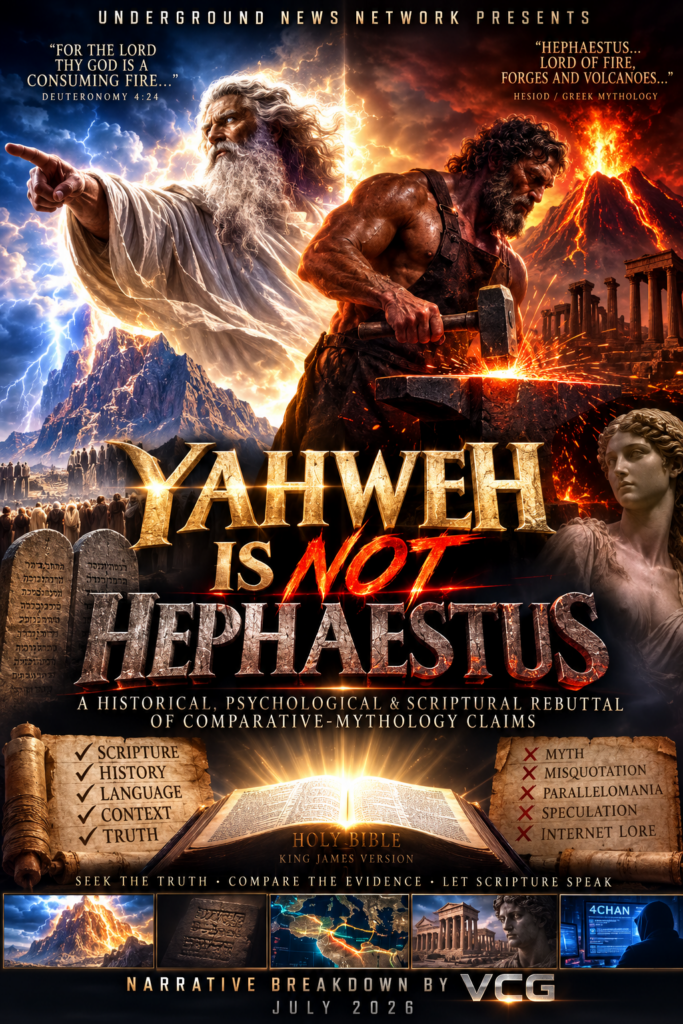
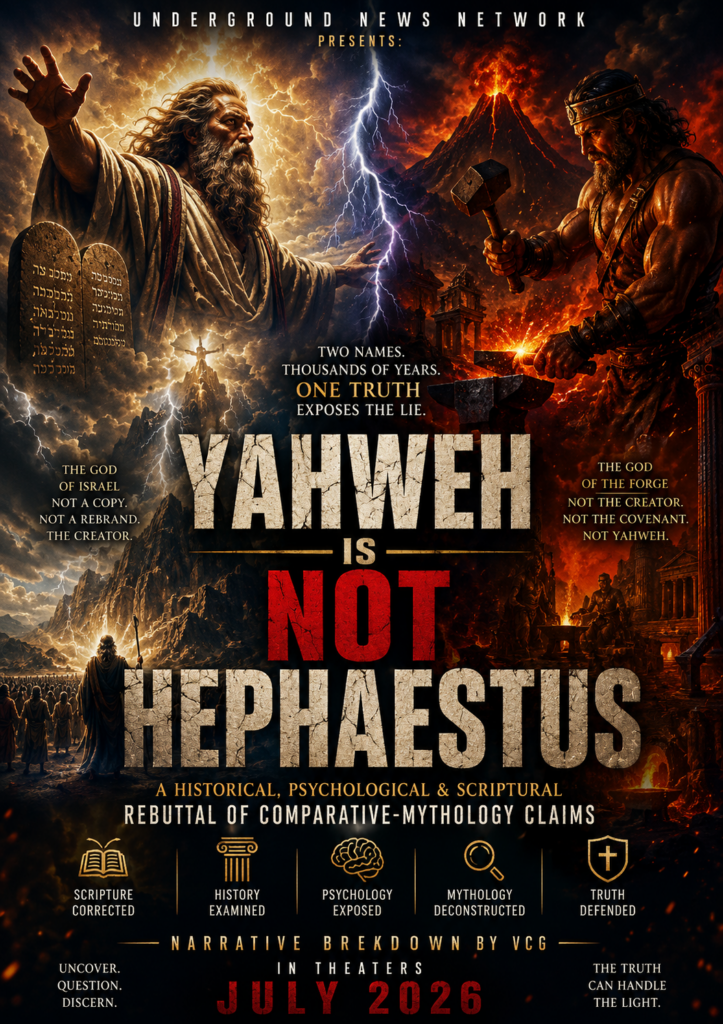
Yahweh Is Not Hephaestus: A Historical, Psychological & Scriptural Rebuttal of Comparative-Mythology Claims
BY VCG ON 7/27/2026
I want to share a heartfelt cause with my audience. Conner Blaisdell-Greene, a brave Airforce Sr. Airman, recently lost his battle with cancer, leaving his family in financial distress. Every donation, no matter how small, can help cover his funeral costs and ease their burden during this difficult time. Please consider clicking the link below to contribute or share Conner’s story with others. Your support truly matters.
ANYONE CAN DO THIS, MOST WON’T.
ChatGPT – Library of Rickandria
Soli Deo Gloria.
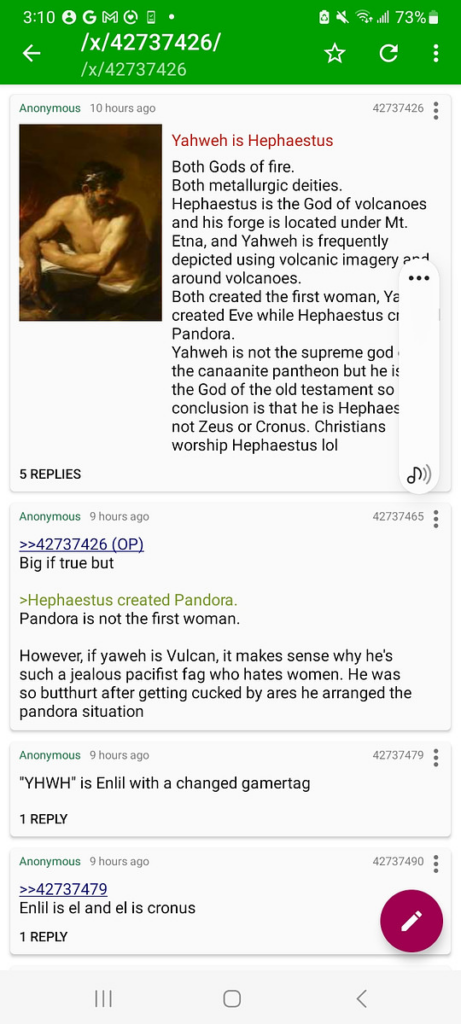
The post mixes a few genuine similarities with several category errors, unsupported identifications, and internet folklore.
Its central inference—
“Yahweh shares fire imagery with Hephaestus, therefore Yahweh is Hephaestus”
—does not follow historically, linguistically, textually, or logically.
Method used
I will separate four kinds of evidence:
- What the biblical text actually says
- What Greek and Mesopotamian sources actually say
- What historians may cautiously reconstruct
- What the anonymous posters merely assert
A proposed identification between two ancient deities requires much more than a shared attribute.
At minimum, we would look for:
a plausible historical route of transmission;
chronological and geographical continuity;
linguistic or name correspondence;
matching mythology, genealogy, cult, symbols, temples and rituals;
explicit ancient identification;
and explanatory power beyond superficial resemblance.
The post supplies none of these.
I. “Yahweh is Hephaestus”
Verdict: unsupported and methodologically invalid
This is a bare assertion, not an argument.
Hephaestus belongs to the Greek religious world.
He is an Olympian craftsman and smith, associated with:
- fire
- metalworking
- tools
- divine artifacts
and, in later geographical traditions, volcanic workshops.
His characteristic symbols include the hammer, anvil and tongs. (Theoi)
YHWH, by contrast, is the covenant God of Israel in the Hebrew Bible:
- creator
- judge
- lawgiver
- deliverer
- king
and object of exclusive worship.
The Bible does not portray him as an Olympian smith, as Hera’s son, as Aphrodite’s husband, as physically lame, as manufacturing weapons for a divine pantheon, or as occupying a forge beneath Etna.
The two figures differ in almost every structurally important category:
| Category | YHWH in Scripture | Hephaestus in Greek myth |
|---|---|---|
| Ontology | Creator of heaven and earth | One god born within a divine family |
| Genealogy | Uncreated; no parents | Son of Hera, or Hera and Zeus |
| Divine society | Other gods denied worship and subordinated | Member of the Olympian pantheon |
| Primary role | Covenant Lord, king, judge, saviour | Smith, craftsman and maker of divine objects |
| Moral authority | Gives universal moral commandments | Not the supreme moral legislator |
| Cult centre | Israel/Judah; tabernacle and temple traditions | Greek cult centres, especially craft-related contexts |
| Characteristic tools | None | Hammer, tongs, anvil |
| Mythic biography | Exodus, covenant, judgment, redemption | Expulsion from Olympus, return, divine craftsmanship |
| Spouse | None in the biblical text | Aphrodite or Charis/Aglaia in varying traditions |
Calling them the same deity requires ignoring the overwhelming dissimilarities while selecting one broad common motif:
fire.
That is not historical identification.
It is attribute matching.
II. “Both gods of fire”
Verdict: partly true for Hephaestus, misleading for YHWH
Hephaestus is indeed associated with fire, especially the controlled fire of the forge and metalworking. (Theoi)
But Scripture does not classify YHWH as “the god of fire.”
Fire is one among many manifestations of his presence, power, holiness or judgment.
Examples include:
“And the angel of the LORD appeared unto him in a flame of fire out of the midst of a bush.”—Exodus 3:2
“And mount Sinai was altogether on a smoke, because the LORD descended upon it in fire.”—Exodus 19:18
“For the LORD thy God is a consuming fire, even a jealous God.”—Deuteronomy 4:24
These passages do not say that fire constitutes God’s occupational domain, as smithcraft does for Hephaestus.
Biblical fire can signify:
divine presence;
holiness;
judgment;
purification;
protection;
sacrificial acceptance;
or theophany.
YHWH is also revealed through cloud, darkness, wind, thunder, water, earthquake, glory and a
“still small voice.”
Fire is not his exclusive element.
A simple analogy shows the error:
because both a judge and a blacksmith may use a hammer, it does not follow that the judge is secretly the blacksmith.
The uploaded KJV edition consistently presents the LORD as creator and ruler over the elements, not as merely one elemental deity within nature.
III. “Both metallurgic deities”
Verdict: true of Hephaestus; disputed reconstruction concerning early Yahwism; not a biblical identification
Hephaestus is explicitly a metalworker and divine smith.
For YHWH, matters are different.
Scripture sometimes uses metallurgical imagery:
“The fining pot is for silver, and the furnace for gold:
but the LORD trieth the hearts.”—Proverbs 17:3
“Behold, I have refined thee, but not with silver; I have chosen thee in the furnace of affliction.”—Isaiah 48:10
“Is not my word like as a fire? saith the LORD; and like a hammer that breaketh the rock in pieces?”—Jeremiah 23:29
But these are metaphors.
YHWH is the one who tests, judges and purifies; he is not described as a professional smith-god with a cult centred on metalworkers.
A modern scholar, Nissim Amzallag, has proposed that early Yahwism possessed a metallurgical background and may have been connected with ancient copper-working groups.
His work is real scholarship, not something invented by the poster. (Sage Journals)
Yet three qualifications are essential:
- It is a historical hypothesis, not an established textual fact.
- Even if some early Yahwistic communities were associated with metallurgists, that would not make YHWH identical with Hephaestus.
- Similar occupational symbolism can arise independently in different cultures.
Amzallag himself develops a particular reconstruction of YHWH and El within the southern Levant; that is not evidence for a Greek Hephaestus identity. (Cambridge University Press)
The 4Chan argument therefore takes a debated hypothesis and exaggerates it into an absolute identity claim.
IV. “Hephaestus is the god of volcanoes and his forge is under Mt. Etna”
Verdict: broadly reflects later Greco-Roman tradition, but is oversimplified
Hephaestus became associated with volcanic locations, and later traditions situated his workshop beneath volcanic mountains, including Etna.
But mythology was not uniform.
His workshop is also placed on Olympus, Lemnos and elsewhere in different sources and periods.
The Roman Vulcan became especially associated with destructive and volcanic fire; Greek Hephaestus and Roman Vulcan were later equated, but they were not originally identical in every respect.
The Roman figure’s association with volcanic fire is especially prominent. (Wikipedia)
Thus even this line compresses several periods and traditions into one standardized mythology.
More importantly,
“a deity is associated with a volcano”
does not establish identity with every deity depicted amid smoke, fire or mountains.
V. “Yahweh is frequently depicted using volcanic imagery and around volcanoes”
Verdict: exaggerated and probably based on a disputed “volcano god” theory
Certain biblical theophanies employ phenomena that can resemble volcanic activity:
“And mount Sinai was altogether on a smoke, because the LORD descended upon it in fire:
and the smoke thereof ascended as the smoke of a furnace, and the whole mount quaked greatly.”—Exodus 19:18
This includes smoke, fire, trembling and a mountain.
But the text does not call Sinai a volcano.
It describes a supernatural theophany.
Other details include trumpet sound, speech, cloud and covenantal revelation, none of which requires a volcanic explanation.
Other biblical texts use similar cosmic imagery:
“The mountains melted from before the LORD, even that Sinai from before the LORD God of Israel.”—Judges 5:5
“He bowed the heavens also, and came down:
and darkness was under his feet.”—Psalm 18:9
“The sea saw it, and fled:
Jordan was driven back.”—Psalm 114:3
This is poetic creation imagery.
Mountains quake, waters flee, clouds descend and the earth trembles because creation responds to its creator.
The volcano interpretation has several weaknesses:
- It reduces literary and theological imagery to a single natural phenomenon.
- It assumes that vivid language must preserve primitive nature worship.
- It often treats different mountains as though all were active volcanoes.
- It overlooks the Bible’s use of the same imagery far from volcanic settings.
- It confuses “described through fire and smoke” with “is a volcano god.”
A volcanic event might conceivably have contributed to some ancient imagery, but the text itself does not establish that, and it certainly does not identify YHWH with Hephaestus.
VI. “Both created the first woman”
Verdict: superficially similar, substantially different
This is the post’s strongest apparent parallel, but it collapses under examination.
The Greek account
In Hesiod, Zeus orders Hephaestus to shape a woman from earth as part of Zeus’s retaliation after Prometheus’s theft of fire.
Other gods then adorn or endow her.
Pandora is therefore a collective divine project, ordered by Zeus and executed in part by Hephaestus.
In Works and Days, she is expressly connected with a punitive gift to mankind. (Theoi)
Hephaestus is the artisan, not the sovereign originator of the plan.
The biblical account
Genesis says:
“And the rib, which the LORD God had taken from man, made he a woman, and brought her unto the man.”—Genesis 2:22
The woman is not made as a divine trap or punishment.
Before her creation, God says:
“It is not good that the man should be alone; I will make him an help meet for him.”—Genesis 2:18
She is created as a corresponding human partner.
The fall occurs afterward through disobedience involving both the serpent’s deception and human choice.
Paul explicitly places final covenantal responsibility upon Adam:
“Wherefore, as by one man sin entered into the world, and death by sin…”—Romans 5:12
The structures are therefore markedly different:
| Genesis | Hesiodic Pandora tradition |
|---|---|
| One sovereign Creator | Multiple gods with divided roles |
| Woman made as a fitting human companion | Woman fashioned as Zeus’s retaliatory device |
| From Adam’s side | From earth/clay |
| Marriage precedes transgression | Pandora is sent in connection with punishment |
| Moral fall through disobedience | Evils released from the jar |
| Adam bears representative responsibility in Romans 5 | Zeus intentionally engineers the punishment |
Both stories contain a first woman and earthly material, but those motifs are too general to prove dependence or identity.
Ancient cultures repeatedly describe humans as formed from earth because human mortality, farming and burial make soil a natural symbol of human origin.
Parallel imagery does not by itself establish common authorship or divine identity.
VII. “Yahweh created Eve while Hephaestus created Pandora”
Verdict: imprecise in both halves
The Genesis half is substantially correct:
the LORD God makes the woman.
The Hephaestus half omits Zeus’s commanding role and the contributions of Athena, Aphrodite, Hermes and other gods.
Hesiod’s narrative does not depict Hephaestus independently deciding to create the first woman. (Theoi)
The poster makes the accounts appear more alike by removing inconvenient details.
This is a common polemical technique: parallel compression.
Two narratives are stripped down until both can be stated in the same sentence, while their motives, theology, sequence and literary function disappear.
VIII. “Yahweh is not the supreme god of the Canaanite pantheon”
Verdict: potentially true but rhetorically confused
In Ugaritic/Canaanite religion, El is typically the senior or fatherly head of the pantheon, while Baal is a powerful storm and warrior deity.
The post is therefore broadly correct that a deity called YHWH is not simply attested as the publicly recognized head of the standard Ugaritic pantheon. (Wikipedia)
But that fact does not support
“Yahweh is Hephaestus.”
It only shows that YHWH cannot casually be inserted into a reconstructed Canaanite divine hierarchy as though all ancient West Semitic religions had one stable, universally shared list.
The historical origin of YHWH remains debated.
Several scholars locate early Yahwistic traditions south or southeast of Israel, partly because texts such as Deuteronomy 33:2, Judges 5:4 and Habakkuk 3:3 picture YHWH coming from Seir, Edom, Paran or Teman.
Scholarship also discusses Egyptian references to “Shasu of yhw,” though interpretation remains contested.
Oxford’s treatment of YHWH’s origins presents the question as a historical problem requiring evaluation, not as a settled equivalence with a known pagan god. (OUP Academic)
Scripturally, however, the Bible does not present YHWH as one subordinate member of a legitimate Canaanite family.
It presents Israel’s worship of other gods as covenantal apostasy:
“Thou shalt have no other gods before me.”—Exodus 20:3
“Hear, O Israel: The LORD our God is one LORD.”—Deuteronomy 6:4
“I am the LORD, and there is none else, there is no God beside me.”—Isaiah 45:5
Historical reconstruction of how Israelite religion developed and the final canonical claims of Scripture are related questions, but they are not identical questions.
Honesty requires distinguishing them.
IX. “But he is the God of the Old Testament, so he must be Hephaestus”
Verdict: non sequitur
This conclusion has no logical bridge.
The implied argument seems to be:
- YHWH is not the original supreme god of one reconstructed Canaanite pantheon.
- YHWH nevertheless becomes Israel’s God.
- Hephaestus is not Zeus, the supreme Greek god.
- Therefore YHWH is Hephaestus.
That is invalid.
Thousands of non-supreme gods existed in ancient religions.
Being
“not the head of a pantheon”
does not identify any one of them with any other.
It is equivalent to arguing:
Mercury is not Jupiter.
Anubis is not Ra.
Therefore Mercury is Anubis.
The shared negative property proves nothing.
X. “Hephaestus, not Zeus or Cronus”
Verdict: false dilemma
The poster assumes there are only three candidates:
Zeus, Cronus or Hephaestus.
There is no reason to accept that menu.
Ancient interpreters sometimes equated foreign gods through interpretatio graeca or interpretatio romana, matching deities by perceived functions.
Such identifications varied according to which attribute an interpreter emphasized.
A deity might be compared with Zeus in sovereignty, with a storm god in weather imagery, or with another figure in warfare.
But an interpretive comparison is not literal historical identity.
YHWH has no exact Greek equivalent because the biblical conception combines roles divided among many Greek gods:
creator;
king;
judge;
warrior;
giver of law;
sender of rain;
master of sea and death;
protector;
healer;
and redeemer.
This is precisely why one-to-one comparative mythology so often misleads.
XI. Reply: “Pandora is not the first woman”
Verdict: too categorical
In Hesiod’s account, the unnamed woman in the Theogony is the ancestor or origin of the race of mortal women, and Works and Days names Pandora in the fuller version.
She is normally understood as the first mortal woman in the Hesiodic myth. (Wikipedia)
There are complexities:
Greek mythology has no single canon comparable to one closed biblical book.
Later genealogies and local traditions may not harmonize neatly.
Hesiod’s two presentations contain differences.
The Theogony passage does not actually name her Pandora.
So the careful statement is:
In the standard Hesiodic tradition, Pandora functions as the first mortal woman or progenitor of mortal women, though Greek mythology as a whole contains variant traditions.
The reply’s flat denial is less defensible than the original statement, though it incidentally points to the genuine diversity of Greek mythology.
XII. “If Yahweh is Vulcan…”
Verdict: already changes the claim
The original post said Hephaestus; the reply switches to Vulcan.
Greek Hephaestus and Roman Vulcan were equated in later classical religion, but they were not simply interchangeable from their earliest histories.
Vulcan’s Roman cult and festival, including the Vulcanalia, had its own setting and emphasis, especially destructive fire. (Wikipedia)
This switch illustrates how loosely the discussion handles historical identity:
YHWH becomes Hephaestus;
Hephaestus becomes Vulcan;
analogy becomes identity;
and no chronology is supplied.
That is not careful comparative religion.
XIII. “It makes sense why he’s such a jealous pacifist god who hates women”
Verdict: internally contradictory, textually false and psychologically revealing
“Jealous”
Biblical “jealousy” is covenantal language:
“For thou shalt worship no other god:
for the LORD, whose name is Jealous, is a jealous God.”—Exodus 34:14
The point is not petty insecurity between equals.
Within the biblical covenant, Israel belongs to YHWH and must not commit spiritual adultery through idolatry.
This does not automatically prove the theology true, but it explains what the word means in context.
“Pacifist”
The biblical God is not a pacifist in the ordinary meaning of the word.
He judges nations, commands warfare in some texts and is called “a man of war” in Exodus 15:3.
Thus “jealous pacifist” appears to be careless insult rather than coherent description.
“Hates women”
The claim is contradicted by major biblical themes:
Woman is made in God’s image together with man: Genesis 1:27.
The creation of woman answers what God calls “not good”: Genesis 2:18.
The law repeatedly protects widows.
Women such as Sarah, Miriam, Deborah, Ruth, Hannah, Abigail, Huldah, Esther, Elizabeth, Mary and Priscilla receive honoured roles.
Jesus speaks with, teaches, heals and receives ministry from women.
Women are the first witnesses of the empty tomb in the Gospel accounts.
Husbands are commanded to love their wives sacrificially: Ephesians 5:25.
Men and women share equal standing “in Christ Jesus”: Galatians 3:28.
This does not mean every biblical law or narrative will satisfy modern egalitarian expectations.
There are real interpretive debates concerning:
- patriarchy
- household order
- ministry
- ancient social structures
But
“God hates women”
is not a serious summary of the biblical corpus.
Psychologically, the sentence combines inflammatory labels whose emotional force substitutes for evidence. “Jealous,” “pacifist” and “hates women” are stacked together even though one of them contradicts the martial biblical portrait.
The objective is ridicule, not consistency.
XIV. “After getting cuckolded by Ares he arranged the Pandora situation”
Verdict: invented synthesis
In Greek myth, Hephaestus’s troubled relationship with Aphrodite and her adultery with Ares appears notably in Homer’s Odyssey.
But Hesiod’s Pandora episode is not presented as Hephaestus’s revenge for being cuckolded.
The revenge belongs to Zeus’s conflict with Prometheus.
Hephaestus performs Zeus’s commission.
The reply merges two unrelated mythic cycles:
Aphrodite, Ares and Hephaestus;
Zeus, Prometheus and Pandora.
No cited ancient text links the Pandora project to Hephaestus’s marital humiliation.
This is fan-fiction causation:
familiar characters and events are rearranged into a new psychological motive not supplied by the sources.
XV. “‘YHWH’ is Enlil with a changed gamertag”
Verdict: unsupported; linguistically and historically unserious
Enlil is a major Mesopotamian deity, especially associated with authority, kingship, decreeing destinies and the cult centre of Nippur.
His temple was the E-kur, the “Mountain House.” (Oracc)
But the names YHWH and Enlil/Ellil are not linguistic variants.
They differ in:
language family and formation;
consonants;
historical attestation;
cult centre;
mythology;
genealogy;
temples;
and textual tradition.
Enlil is a son within Mesopotamian divine genealogies and belongs to a pantheon alongside Anu, Enki/Ea, Ninlil and others.
YHWH in biblical theology is not born from Anshar, Ki, An or any Mesopotamian divine ancestor.
There are thematic comparisons scholars can make between YHWH and high gods such as Enlil:
kingship;
divine decrees;
storm or wind imagery;
judgment;
temples conceived as cosmic mountains.
But comparable roles do not make two deities the same.
The phrase “changed gamertag” works rhetorically because it trivializes historical development.
It invites the audience to feel that all religious distinctions are merely rebranding, without doing the philological work needed to prove borrowing or identity.
XVI. “Enlil is el and el is Cronus”
Verdict: three different claims are being collapsed
1. Enlil is not etymologically “El”
The Akkadian/Sumerian divine name Enlil or Ellil is not simply the Northwest Semitic word ʾEl.
The visual similarity of the letters “El” in English transliteration is accidental and does not establish identity.
This is an English-transliteration fallacy:
two ancient names look vaguely similar after being written in modern Latin letters, so they are assumed to be the same.
2. El and Cronus were sometimes compared
There is a genuine historical basis for connecting the Phoenician/Canaanite El with Greek Cronus in some later interpretive traditions.
Greek and Roman writers sometimes translated or equated foreign gods with members of their own pantheons.
But
“was equated with”
is not the same as
“is literally identical in origin, name and cult.”
Such equations are often approximate:
senior father deity;
old ruler;
displaced or less active patriarch;
divine generation.
3. Even if El were compared with Cronus, this would not prove Enlil = El
The poster’s chain is:
Enlil ≈ El
El ≈ Cronus
therefore Enlil = Cronus
and somehow YHWH = Enlil
Each “≈” is silently converted into “=.”
That is associative reasoning, not historical demonstration.
The deeper methodological failures
1. Parallelomania
“Parallelomania” is the excessive discovery of parallels while neglecting differences, context and probability.
The post observes:
fire;
metal;
mountains;
first woman.
It then treats those shared motifs as fingerprints of identity.
But these are widespread religious and cultural themes.
- Fire
- storms
- sacred mountains
- smiths
- creation from earth
occur across many societies because human beings everywhere encounter the same natural and social realities.
A useful parallel must be distinctive, complex and historically connectable—not merely common.
2. Motif atomization
Each tradition is broken into isolated fragments:
YHWH → fire
Hephaestus → fire
YHWH → woman
Hephaestus → woman
The fragments are then compared after their narrative frameworks have been discarded.
Once context is restored, the resemblance weakens:
YHWH creates woman as a partner.
Zeus commissions Pandora as punishment.
Hephaestus is the craftsman carrying out the order.
Fire at Sinai concerns revelation and covenant.
Forge fire concerns divine craftsmanship.
3. Equivocation between resemblance, borrowing and identity
These are three different propositions:
- Two traditions resemble one another.
- One tradition borrowed something from the other.
- Two divine names refer to the same original deity.
A resemblance does not by itself prove borrowing.
Borrowing does not prove complete identity.
The post moves through all three without argument.
4. Chronological flattening
The post treats:
Bronze Age Canaan;
Iron Age Israel;
archaic Greek poetry;
classical Greek mythology;
Roman Vulcan;
Mesopotamian Enlil;
and modern reconstructions
as though they all existed simultaneously in a single online character database.
Historical religion developed over centuries.
Names, functions and associations changed.
5. Genealogy by sound
“Enlil,” “El,” and related-looking English spellings are treated as though visual resemblance proved etymology.
Real etymology requires:
original scripts;
phonological correspondences;
attested historical forms;
language-family rules;
semantic continuity;
and chronological plausibility.
None is provided.
6. Meme epistemology
The language—“gamertag,” “cucked,” “butthurt,” “lol”—signals that the social function is not careful inquiry.
It performs transgression, group bonding and status through irreverence.
That does not make every claim false.
Vulgar people can state true facts.
But the style encourages several cognitive shortcuts:
confidence without documentation;
instant pattern recognition;
contempt for nuance;
rewarding cleverness over accuracy;
and treating correction as loss of status.
7. Motivated reductionism
The underlying assumption appears to be:
Biblical religion must be reducible to recycled pagan mythology.
That conclusion may feel explanatory because it turns complex history into a single debunking formula.
But it can become as dogmatic as the religious certainty it seeks to mock.
Historical influence is real.
Israel existed within the ancient Near East, used related languages, shared literary forms and interacted with neighbouring cultures.
Yet cultural relationship does not entail that every biblical claim is a disguised version of one pagan deity.
Scripture correction
The biblical presentation should be stated on its own terms before historical theories are imposed upon it.
God is creator, not a craftsman within creation
“In the beginning God created the heaven and the earth.”—Genesis 1:1
“I am the LORD that maketh all things; that stretcheth forth the heavens alone; that spreadeth abroad the earth by myself.”—Isaiah 44:24
Hephaestus fashions items from pre-existing materials within Zeus’s cosmos.
The biblical God creates the cosmos itself.
Fire is his servant and manifestation
“For our God is a consuming fire.”—Hebrews 12:29
This describes holiness and judgment in context; it does not place God in a pagan occupational category.
God is not represented by a created form
“Take ye therefore good heed unto yourselves; for ye saw no manner of similitude on the day that the LORD spake unto you in Horeb out of the midst of the fire.”—Deuteronomy 4:15
This is particularly damaging to the Hephaestus equation.
The Sinai fire accompanies a warning not to reduce YHWH to a visible creature or cult image.
The woman is created as image-bearer and companion
“Male and female created he them.”—Genesis 1:27
“I will make him an help meet for him.”—Genesis 2:18
Pandora’s punitive function in Hesiod and Eve’s creational purpose in Genesis are not equivalent.
Scripture itself condemns conflating the Creator with created gods
“For all the gods of the nations are idols: but the LORD made the heavens.”—Psalm 96:5
The textual claim is not that YHWH is the local Hebrew name for one artisan god among many, but that the supposed gods belong to creation and cannot be equated with its maker.
Historically cautious conclusion
A fair conclusion must avoid two opposite errors.
It would be overconfident to claim that Israelite religion developed in complete isolation.
It plainly emerged in the ancient Near Eastern world and shares language, imagery and literary conventions with neighbouring cultures.
It is equally overconfident to say that YHWH “is” Hephaestus, Enlil, El, Cronus or Vulcan on the basis of a few common motifs.
The evidence supports the following:
Hephaestus is genuinely associated with fire and metallurgy.
Hesiod depicts him helping fashion the first woman at Zeus’s command.
Biblical theophanies genuinely use fire, smoke, mountain and furnace imagery.
Some modern scholars have proposed a metallurgical background for early Yahwism.
Ancient peoples sometimes equated foreign gods through functional comparison.
Israelite religion developed within a culturally interconnected world.
The evidence does not establish:
that Sinai was a volcano;
that YHWH was a Greek smith-god;
that Pandora’s creation was Hephaestus’s revenge over Aphrodite and Ares;
that YHWH is linguistically Enlil;
that Enlil is linguistically El;
or that superficial shared attributes prove divine identity.
The post’s conclusion is therefore not a suppressed historical truth.
It is a collage of real mythological fragments joined by false equivalences, anachronism and ridicule.
4CHAN THREAD & POST BREAKDOWNS – Library of Rickandria