
Proof That Life Is Infinite? A Line-by-Line Examination of a 4chan Argument on Death, Consciousness, Identity & Resurrection
UPDATED BY VCG ON 8/19/2026 @ 15:15 EST
I want to share a heartfelt cause with my audience. Conner Blaisdell-Greene, a brave Airforce Sr. Airman, recently lost his battle with cancer, leaving his family in financial distress. Every donation, no matter how small, can help cover his funeral costs and ease their burden during this difficult time. Please consider clicking the link below to contribute or share Conner’s story with others. Your support truly matters.
Anyone can do this, but most won’t.
ChatGPT – Library of Rickandria
Soli Deo Gloria, brethren.
I’ll treat the thread as a set of claims to audit, not as a single argument.
I’ll separate:
- what the poster actually says
- factual verification
- reasoning/psychology
- Scripture correction
and I’ll distinguish the biblical text from my interpretation throughout.
/x/ – Proof that life is infinite – Paranormal – 4chan
The thread’s core dispute is already clear:
it repeatedly slides between:
“I cannot experience non-experience,”
“matter persists,”
“consciousness might recur,”
“therefore I recur.”
Those are not equivalent propositions.
I’m also checking the thread’s specific appeals to:
- anesthesia
- Noether/quantum immortality
- personal identity
- observer-selection arguments
- NDEs
- reincarnation claims
rather than treating them as one bundle.
Two corrections are especially important before the full audit.
Anesthesia does not prove a timeless “death-state”:
dreaming and even connected consciousness can occur under general anesthesia, so
“it felt instantaneous afterward”
is a memory/phenomenology observation, not evidence that death necessarily leads to another conscious episode.
And personal identity is not a solved scientific variable; the thread alternates among:
- bodily continuity
- memory
- pattern identity
and
“awareness itself,”
which is exactly where its conclusion changes meaning.
I went through the live thread,
- the OP image itself
- the major reply chains
- the scientific claims
- the personal-identity argument
- the anthropic argument
- the anesthesia/NDE material
- the racial-history aside
and the biblical claims.
The thread is philosophically interesting, but the OP image does not prove:
- infinite life
- reincarnation
- quantum immortality
or continuity of personal consciousness.
Its central argument fails before we even reach theology.
The strongest objections inside the thread are actually the ones asking, in effect,
“what exactly is the ‘you’ that supposedly comes back, and where was it proved that death returns you to your pre-birth condition?”
(4chan)
For Scripture below, I am using the uploaded Pure Cambridge Edition KJV as our primary English text.
I. Methodology
I would audit a thread like this on five separate levels rather than beginning with
“Christianity says no.”
First, textual fidelity:
establish what the poster actually claims rather than refuting a stronger or weaker version.
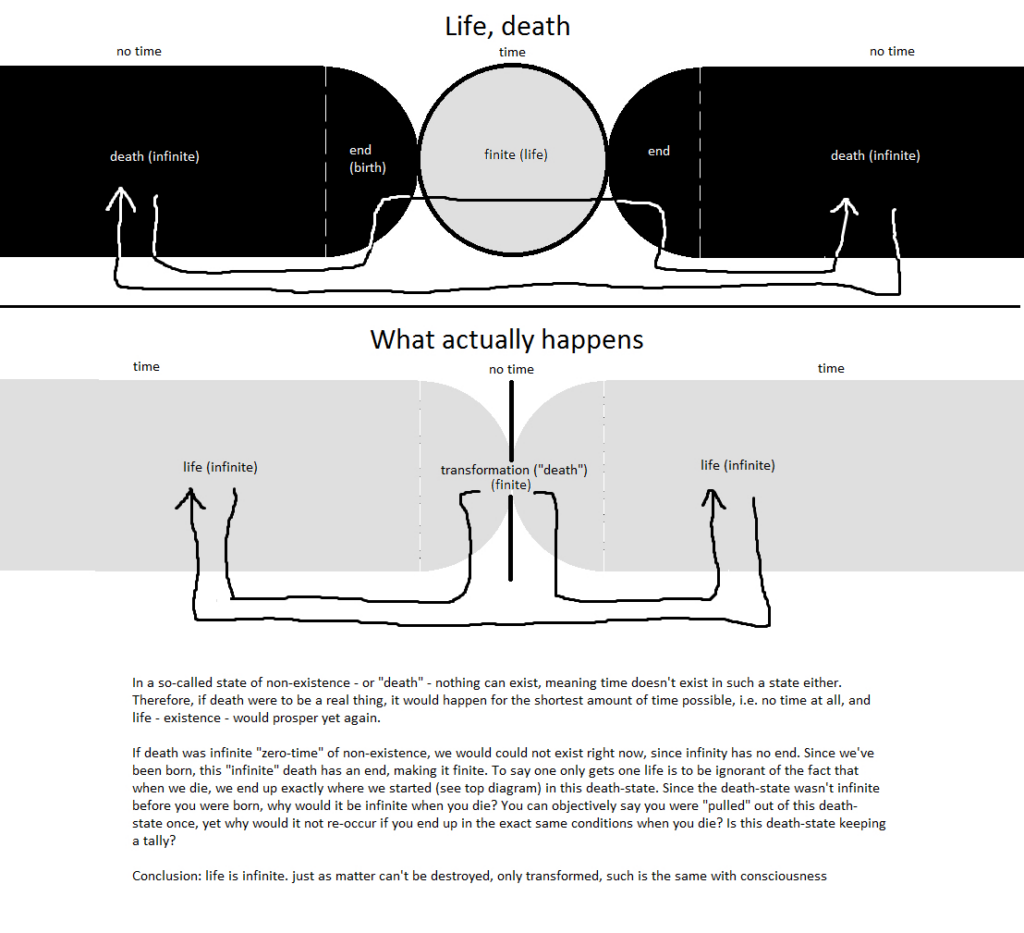
The OP’s diagram contrasts an allegedly infinite pre/post-life “death” with its proposed alternative: infinite life separated by finite transformations called death.
Second, logical validity:
ask whether the conclusion follows even if we temporarily grant the premises.
Third, factual/scientific accuracy:
distinguish experimentally established claims from metaphysics.
- Anesthesia
- Noether’s theorem
- matter conservation
- NDEs
- cell counts
are empirical subjects;
“the same subject of consciousness reappears”
is not presently an empirical result.
Fourth, psychology:
analyze rhetorical and cognitive patterns without diagnosing anonymous posters.
A belief’s psychological attractiveness neither proves nor disproves it.
Fifth, Scripture:
only after understanding the secular argument do we ask what Scripture actually teaches.
Scripture must not be turned into a convenient quotation generator for conclusions reached elsewhere.
My verdict labels below mean:
- True/mostly true — supportable as stated.
- Possible/speculative — conceivable, but not established.
- Unsupported — asserted without adequate evidence.
- Invalid inference — premises do not entail conclusion.
- Biblically contrary — conflicts with the normal reading of the cited biblical teaching.
II. The OP image, sentence by sentence
The thread begins under the title
“Proof that life is infinite”
with the declaration that it cannot be refuted. (4chan)
That confidence is not justified.
1. Equating “non-existence” with “death”
The diagram begins by treating pre-birth nonexistence and postmortem death as the same state.
That is the first unproved premise.
Suppose a materialist says:
- Before conception, person P did not exist.
- P now exists.
- At irreversible death, P permanently ceases to exist.
Even on that materialist account, it does not follow that P occupied some metaphysical state called “nonexistence” before birth and later returns to that same state.
“P does not exist”
is not normally a location or condition occupied by P.
There was no you sitting inside nonexistence waiting to emerge.
Saying
“before I existed, I was in nonexistence”
subtly turns an absence of a subject into an experience or location possessed by that subject.
That grammatical transformation drives much of the meme.
Biblically, the premise is even less acceptable because Scripture does not describe death as returning a person to the same ontological condition as before his birth.
Hebrews gives a forward sequence:
“And as it is appointed unto men once to die, but after this the judgment:” — Hebrews 9:27 KJV
Whatever theological questions remain about the intermediate state, death → judgment is very different from death → prenatal nothingness → another birth.
The First Gate & the Fourth Rider – Library of Rickandria
2. “If nothing exists, time doesn’t exist there”
There is an important ambiguity.
If the proposition merely means:
A nonexistent person does not experience elapsed time,
that is almost trivially true.
There is no subject there to have an experience.
But the diagram turns that into:
Therefore, time itself does not exist.
That does not follow.
If I am under dreamless anesthesia and have no awareness of the operating-room clock, the clock does not therefore cease running.
Likewise, if someone were genuinely nonexistent, lack of experienced duration would tell us nothing by itself about the existence or passage of physical time.
This is the thread’s first repeated category error:
no subjective measurement of time ≠ no objective temporal interval.
3. “Therefore death would last no time, and life would arise again”
This is the decisive non sequitur.
Even granting:
There is no experience during nonexistence.
we get only:
No interval is experienced by the nonexistent subject.
We do not get:
A later experiencing subject must therefore appear.
Compare:
A television is destroyed.
During the next billion years, that television experiences precisely zero waiting time.
Nothing about that fact causes the television to reassemble.
Absence of perceived waiting time is not a causal engine.
The thread repeatedly mistakes:
“I cannot experience my absence”
for
“therefore I can never remain absent.”
Those propositions are completely different.
4. “Infinite nonexistence before birth could never have ended”
This is mathematically wrong.
Infinity does not behave like an enormously long finite queue that must be traversed from a starting point.
Consider the integers:
-5,-4,-3,-2,-1,0,1,2…
There are infinitely many negative integers before zero.
Yet zero exists.
There is no
“first negative integer”
from which an infinite countdown had to begin.
Or consider the real-number line.
It extends indefinitely while easily containing the finite interval:
[0,1]
There is no contradiction whatsoever in a finite interval existing within, beside, or between infinite mathematical regions.
So even if one described time before one’s birth as an infinite past—which contemporary cosmology does not simply establish—the claim
“infinity has no end, therefore I could never have been born”
would still rest on a misunderstanding of infinity.
The related thought experiment later in the thread—one second of life surrounded by two eternities of nonexistence—has the same defect. (4chan)
5. “Because you were born, the previous infinite death must have been finite”
No.
Birth shows that a living organism began existing.
It does not show that an already existing personal consciousness had previously spent a finite interval dead.
Calling prenatal absence “death” imports the desired conclusion into the premise.
A man born in 1990 was not
“dead in 1850”
in the same ordinary sense that a man who dies in 2050 is dead in 2051.
The former had not yet lived.
The latter has lived and died.
Those are not automatically equivalent states.
6. “When we die, we end up exactly where we started”
One reply correctly asks where this premise was ever established. (4chan)
That is probably the cleanest single objection in the entire thread.
The OP has to prove:
Postmortem condition = Prenatal condition
But it simply asserts it.
Different worldviews give radically different answers:
reductive physicalism: the organism permanently ceases functioning;
substance dualism: the person or soul survives bodily death;
Christian resurrection theology: death is followed by judgment and ultimately resurrection;
Buddhist traditions: generally deny an eternal individual ātman while giving varying accounts of rebirth;
Hindu traditions: commonly affirm forms of rebirth with differing metaphysics;
open individualism: personal identity is radically reconceived;
idealism: mind may be metaphysically basic.
The diagram silently chooses one metaphysical model and then calls the choice objective.
That is begging the question.
7. “It happened once; why wouldn’t it happen again?”
This reverses the burden of proof.
From
X occurred once
we cannot infer
X will occur again.
A supernova occurred.
That particular supernova need never occur again.
A particular shuffled deck arrangement occurred.
Its occurrence does not entail recurrence.
A person’s conception occurred.
Nothing about the bare proposition “it occurred” proves a second numerically identical person will arise.
The correct question is not:
Why couldn’t it happen?
It is:
What evidence or argument makes its recurrence necessary or probable?
Possibility is not proof.
8. The phrase that we were “pulled” out of death
This language does enormous hidden work.
To be “pulled out” implies there was already:
- a persisting object,
- located in a condition,
- which underwent a transition,
- while retaining identity through the transition.
But those are precisely the things under dispute.
If before conception I did not exist, then I was not an object waiting somewhere to be extracted.
The meme’s metaphor smuggles continuity into an argument supposedly intended to prove continuity.
9. “Is the death-state keeping a tally?”
This is a false dilemma.
The alternatives are not:
consciousness must recur, or
some cosmic mechanism actively prevents it from recurring.
A process can simply terminate.
A candle flame does not require a cosmic blacklist preventing the numerically identical flame from returning.
Likewise, under a physicalist theory, the cessation of the neural system that realizes person P need not involve any additional mechanism whose job is to prohibit P’s resurrection.
10. “Matter can’t be destroyed, only transformed; therefore the same applies to consciousness”
This final move is both scientifically imprecise and logically invalid.
Modern physics does not preserve the old schoolbook formulation of indestructible matter as a separate substance.
Relativity relates mass and energy, and nuclear reactions convert rest mass into other forms of energy.
DOE Explains…Relativity | Department of Energy
More importantly:
Physical conservation law
does not imply
Conservation of personal consciousness.
Noether-type conservation principles concern mathematical symmetries of physical theories and corresponding conserved quantities.
They do not contain a theorem saying
“first-person identity must persist.”
Even if every physical constituent of a dead brain survived somewhere, it would not follow that the person survived.
A burned book’s atoms persist.
The novel’s intact textual organization does not.
A dismantled computer’s particles persist.
Its currently running process does not thereby continue.
Persistence of constituents is not persistence of:
- organization
- computation
- memory
- organism
or personal identity.
That alone defeats the meme’s final analogy.
III. The fatal identity problem
This becomes the central issue in the replies.
Post 42830914 proposes a useful fission thought experiment:
suppose someone dies, somehow reincarnates, and later their original body is restored.
Which conscious individual is the original person?
The point is not that such technology presently exists.
The point is to expose what the theory means by identity. (4chan)
That is legitimate philosophical reasoning.
The Stanford Encyclopedia’s overview of personal identity identifies precisely this problem:
what makes an earlier and later being numerically the same person, rather than merely psychologically or physically similar?
Competing theories use psychological continuity, biological continuity, bodily continuity, or other criteria; the issue is not settled by casually using the word “I.”
Personal Identity (Stanford Encyclopedia of Philosophy)
This matters because the thread shifts among at least six meanings of “you”:
the same biological organism;
the same brain;
the same memories/personality;
an exact informational duplicate;
a generic locus of subjective experience;
consciousness-as-such.
Those yield different conclusions.
If after my death an unrelated baby becomes conscious, then:
consciousness exists again.
But that does not establish:
I exist again.
The OP can make the argument easier to defend by weakening
“I live again”
into
“some consciousness exists later.”
But then the grand conclusion disappears.
Humanity already knows other consciousnesses exist.
That is why post 42834078 lands such an important blow: once the proponent says his identity one second ago is not really identical to his present identity, the original claim that you were previously pulled from nonexistence loses its subject. (4chan)
IV. Chronological audit of the thread replies
Here is the substantive thread, reply by reply.
I am grouping only posts that are essentially:
- jokes
- insults
- reaction images
or repetitions; substantive claims get their own treatment.
1. 42830867 — looping joke
No argument.
It plays on eternal recurrence.
Epistemically neutral. (4chan)
2. 42830879 — accuses OP of assuming many axioms
Crude wording, but fundamentally correct.
The OP assumes its crucial ontology rather than deriving it.
The relevant hidden premises include:
death equals nonexistence;
prenatal nonexistence equals postmortem nonexistence;
absence of subjective time entails recurrence;
later consciousness counts as the same consciousness;
recurrence is inevitable;
physical conservation entails consciousness conservation.
The critic does not itself demonstrate these errors, however.
So, it is directionally right but under-argued. (4chan)
3. 42830904 — finite lives, finite death-states, infinitely many cycles
The poster is more cautious than OP and openly admits uncertainty over identity and cosmology.
That epistemic humility is good.
But the central claim still fails:
that a
“death-state clearly gives rise”
to life is not established.
A person’s prenatal absence did not causally generate his conception.
- Parents
- gametes
- embryological development
and prior physical conditions did.
The poster’s admission that no correlation can be shown between allegedly previous lives and the present one actually undercuts the stronger claim of personal recurrence. (4chan)
4. 42830914 — revival/fission thought experiment
One of the strongest posts.
It correctly identifies that reincarnation requires an account of what relates person A to later person B.
Its weakest sentence is the categorical claim that there is no
“soul transfer mechanic.”
Science has not demonstrated an immaterial soul transfer, but neither can empirical science simply disprove every possible substance-dualist ontology.
The narrower conclusion is sound:
The OP has supplied no identity-preserving mechanism.
5. 42830936 — brain as receiver of a sea of consciousness
Possible metaphysics; unsupported science.
A receiver/filter theory of brain and consciousness is conceivable.
But saying it is conceivable does not supply evidence that it is true.
The same poster then says we know life arises from a death-state.
We don’t.
That restates the disputed premise. (4chan)
Neuroscience strongly connects conscious states with brain states, while philosophical theories disagree about what that correlation ultimately means.
Quantum and other consciousness models remain contested rather than established evidence for a universal “consciousness field.”
Consciousness (Stanford Encyclopedia of Philosophy)
6. 42830967 / 42830993 — “where was that premise proved?” / prenatal and postmortem nonexistence
The first is correct: the premise is unproved.
The second merely repeats it.
To say both conditions can be described with the English words
“I don’t exist”
does not prove they constitute one persisting metaphysical state.
7. 42831069 — life illusion, ancient India, racial claim
There are two separate claims.
“Life is illusion”
resembles ideas found in some Indian philosophical traditions, but those traditions are far more diverse than the post acknowledges.
The racial remark about ancient India being a “white country” is historically and genetically unserious.
Ancient South Asian populations were complex.
Ancient DNA research finds multiple ancestral streams across South and Central Asia, and the sequenced Rakhigarhi Indus individual specifically lacked detectable Steppe pastoralist ancestry.
Calling ancient India simply “white” imposes a modern racial category on populations that do not fit it.
The formation of human populations in South and Central Asia | Science
And none of this would prove reincarnation anyway.
8. 42831110 — philosophy/thought experiments supposedly have no weight
Self-defeating.
The claim
“our concepts don’t reflect reality”
is itself a philosophical claim.
Thought experiments do not create empirical facts, but they are useful for testing whether concepts and propositions are mutually consistent.
Rejecting all philosophy merely hides one’s philosophy.
9. 42831152 — infinite suffering / Buddhism
Emotion, not evidence.
Buddhist traditions themselves vary, but generally the entire point of liberation/nirvāṇa is not
“inescapable infinite individual reincarnation.”
So the comment caricatures Buddhism.
10. 42831153–42831350 — fire analogy
This exchange exposes another equivocation.
A flame is a physical process.
Whether a flame also has phenomenal consciousness is not established by ordinary physics.
Panpsychism is a genuine philosophical position according to which mentality is fundamental and ubiquitous.
But it is a philosophical thesis, not a theorem of combustion or quantum mechanics.
Panpsychism (Stanford Encyclopedia of Philosophy)
Therefore:
“Physics says fire has an inner subjective state”
is unsupported.
Likewise, the contrary assertion:
“I know with certainty fire has exactly zero phenomenology”
goes beyond what can presently be directly measured.
The appropriate answer is epistemically modest:
we have no good empirical evidence that ordinary flames possess experiences comparable to animal consciousness.
11. 42831167 — Noether implies quantum immortality
False.
This is one of the clearest factual errors in the thread.
Noether’s theorem concerns relationships between continuous symmetries and conservation laws in suitable physical systems.
Quantum immortality is a speculative argument associated with Everettian/many-worlds reasoning and “quantum suicide.”
It requires additional assumptions about:
- branching
- probability
- observers
- identity
- anthropic conditioning
Indeed, an explicit analysis titled Many-Worlds Interpretations Can Not Imply ‘Quantum Immortality’ argues that MWI does not by itself yield that conclusion. (arXiv)
[0902.0187] Many-Worlds Interpretations Can Not Imply ‘Quantum Immortality’
Therefore, Noether’s theorem does not imply quantum immortality; no such conclusion follows from the theorem in physics.
12. 42831185–42831813 — subjectivity and flames
These posts mix a genuine philosophical difficulty with unjustified conclusions.
The genuine difficulty is the other-minds problem:
subjective experience is directly available to each subject in a way another subject’s experience is not.
But:
“You cannot directly inspect the flame’s phenomenal state”
does not entail:
“Therefore the flame definitely has one.”
That is an argument from ignorance.
13. 42833093 — “I know I have an inner state”
This is stronger than the flame claim.
First-person consciousness is unusually difficult to doubt:
the very act of doubting seems itself experiential.
But knowing I am conscious now does not establish:
what metaphysically causes consciousness;
whether consciousness is universal;
whether I existed before conception;
whether my consciousness survives death.
The thread repeatedly jumps from first-person certainty to universal metaphysics.
14. 42833097 — inability to remember infinity
Memory is not decisive either way.
One could theoretically have existed without preserving episodic memory, but the absence of memory also gives no positive evidence that one did.
So this reply neither proves nor disproves reincarnation.
15. 42833226–42833696 — interruptions, transformations, and “not-me gives rise to me”
This is where the debate becomes much sharper.
One critic correctly points out that matter reorganizing into a new conscious organism does not thereby establish the continued existence of the original person. (4chan)
The response says essentially:
I did not exist before birth; nevertheless I exist now; therefore “not-me” can generate me.
True in a weak sense.
The fact that conditions in which I did not yet exist eventually produced me once does not entail that similar or later conditions will reproduce the numerically identical person.
In short, occurrence does not imply guaranteed recurrence.
16. 42833710 — identity is an illusion
Possible philosophical thesis, not established fact.
If personal identity is entirely illusory, that does not rescue the OP.
It actually threatens it.
The original image talks about you dying, you having previously emerged, and you returning.
If there is no persisting “you,” then the original conclusion needs to be rewritten from:
You live infinitely.
to something like:
Episodes of consciousness may occur indefinitely.
Those are worlds apart.
17. 42833725 — replayed-video analogy
An exact replay can be qualitatively identical while still being a numerically distinct occurrence.
Two printings of the identical digital file contain the same information but are two physical tokens.
Whether an exact duplicate consciousness would literally be the same subject is precisely the personal-identity problem—not something the video analogy settles.
Personal Identity (Stanford Encyclopedia of Philosophy)
18. 42833756 — what makes consciousness “yours”?
Excellent question.
The OP needs an answer.
Without an individuation criterion, the sentence
“your consciousness returns”
is undefined.
19. 42833773 — personal will eternally manifests the self; self is one’s own god
This is not an argument derived from anything preceding it.
It is a metaphysical proclamation. (4chan)
There is no empirical evidence offered that wanting to exist has the causal power to keep a person eternally instantiated.
Biblically, the claim reverses creature and Creator.
John says:
“And this is the record, that God hath given to us eternal life, and this life is in his Son.”
“He that hath the Son hath life; and he that hath not the Son of God hath not life.” — 1 John 5:11–12 KJV
The biblical ground of eternal life is not autonomous human will.
It is God and His Son.
20. 42833795–42833812 — brain stops; later experience feels immediate
The critic’s biological point is reasonable but its probability claim is too strong.
We cannot responsibly assign a simple numerical probability to recurrence of an identical brain across all possible cosmologies.
The proponent’s response contains the deeper fallacy:
I won’t experience my period of nonconsciousness; therefore when another experience occurs it is effectively my continuation.
No.
That conclusion requires identity across the gap.
Otherwise Alice’s death followed a trillion years later by Bob’s birth could be called
“instantaneous continuation”
merely because Alice did not experience the intervening time.
But Bob is still Bob unless an additional theory proves otherwise.
21. 42833835–42833877 — “authority,” identity every second, and terminology
The admission that identity is not the same from one second to another fundamentally weakens OP. (4chan)
If “I” changes every instant, then ordinary bodily death isn’t uniquely responsible for destroying identity.
If instead there is some enduring experiential subject through those seconds, the poster has silently reintroduced precisely the continuing subject he said was illusory.
This is an unresolved internal tension.
22. 42833886 — antisemitic dismissal
No evidential value.
A racial/religious insult does not answer an argument.
Biblically, ethnic contempt is doubly inappropriate.
James condemns partiality and commands love of neighbor:
“If ye fulfil the royal law according to the scripture, Thou shalt love thy neighbour as thyself, ye do well:” — James 2:8 KJV
Argument should answer argument, not ancestry.
23. 42833887 — if identity vanishes each second, the position is opposite OP
Correct and important.
The thread’s defenders increasingly retreat from personal immortality to impersonal continuity of experience.
That is not a clarification of the original argument; it is a substantially different thesis. (4chan)
24. 42833890 — vague “Zen guy” and fifty selves per finger snap
Unverifiable as stated.
No:
- teacher
- text
- school
- quotation
- language
or source is supplied.
Therefore it should carry no evidential weight.
Even if a Buddhist text taught momentariness of mind, the historical existence of a doctrine would not prove the doctrine true.
25. 42833937 — closed, empty, open individualism
This is useful because the poster finally recognizes that the conclusion depends on one’s theory of personal identity. (4chan)
Exactly.
But that concession destroys the boast that the original image is a universally compelling proof.
If the argument succeeds only after adopting a disputed metaphysical theory, then it is not a metaphysically neutral proof.
Personal identity remains an extensively disputed philosophical subject.
Personal Identity (Stanford Encyclopedia of Philosophy)
26. 42833966–42834258 — “death” versus “interrupted experience”
This chain is the intellectual center of the thread.
The proponent eventually says identity is not really the issue; it is “experience” that resumes, and even concedes uncertainty over whether identity is emergent from brains or brains receive a broader consciousness. (4chan)
But this leaves the theory radically underdetermined.
If:
experience X ends,
and later:
experience Y begins,
what makes Y a resumption of X rather than simply another experience?
Calling both “experience” does not establish numerical continuity any more than calling two separate flames “fire” makes them one flame.
27. 42834220 — all your matter has existed since the universe began
Partly false and largely irrelevant.
The elements comprising bodies have complicated histories.
Hydrogen and helium largely trace to early cosmology, while many heavier elements were synthesized later in stars and stellar explosions.
So, the literal claim that every bit of
“your matter”
has existed in its present sense since the universe’s inception is too crude.
More importantly, even perfect material conservation would not prove personal conservation.
The atoms in Julius Caesar are not Julius Caesar.
28. 42834263 — infinity minus an infinitesimal life
Mathematically muddled.
A finite lifetime is not an “infinitesimal portion” that turns infinity into “almost infinity.”
For example:
A finite lifetime is not an
“infinitesimal portion”
that turns infinity into
“almost infinity.”
More precisely, removing any finite number of elements from an infinite set leaves an infinite set.
Thus, subtracting a finite interval from an infinite span does not by itself resolve the argument’s problem with infinity.
The problem is not that infinity needs a tiny hole cut from it for life.
The whole model of choosing a random temporal point uniformly from an infinite timeline is itself mathematically problematic.
There is no normalized uniform probability distribution over all real time that assigns equal probability to equal-length translated intervals.
29. 42834317–42834516 — time ceases “for you,” therefore later life feels immediate
The first half can be framed sensibly:
If a subject permanently ceases experiencing, there is no subsequent felt waiting period.
But
“everything therefore happens in an instant to that person”
is misleading.
A nonexistent subject has no infinitely compressed perception of history.
It has no perception.
The proponent then again converts:
I cannot experience nonexperience
into:
my experience must eventually restart.
That inference remains invalid. (4chan)
30. 42834484 — exact material recurrence is “nil”
The objection identifies the identity problem correctly, but saying the probability is literally zero is stronger than available evidence permits.
Probability depends upon the:
- cosmological model
- state space
- measure
- recurrence conditions
What can safely be said is:
No demonstrated law of physics guarantees reconstruction of this exact person.
31. 42835955 — Vertiginous Question and SSSA
This introduces serious philosophical material, but overstates what follows.
Self-sampling/observer-selection reasoning requires selecting a reference class and a probability measure.
Philosophers of cosmology explicitly note difficulties surrounding reference classes, typicality, and indifference assumptions.
Philosophy of Cosmology > Notes (Stanford Encyclopedia of Philosophy/Winter 2025 Edition)
So:
“Animals outnumber humans; therefore, if animals were conscious, I should probably have been an animal”
is not straightforward statistics.
Before that probability can even be calculated, we must specify:
- What is randomly sampled?
- Organisms?
- Conscious moments?
- Units of consciousness?
- All actual beings?
- All possible beings?
- Why should “I” be treated as randomly sampled at all?
The inference that finding oneself human is evidence most animals are unconscious therefore does not follow without enormous additional assumptions.
32. 42836340 / 42837439 — “what are the chances you’re alive now?” / “100%”
Conditional on the fact that I am presently asking the question, the probability that I am conscious is 1:
P (I am conscious | I am now asking the question) =1.
But this is merely a selection effect:
only a conscious observer can ask the question.
It provides no evidence that consciousness must recur after death.
It tells us that observers observe themselves while observing.
It does not tell us that every deceased observer will observe again.
33. 42837490 — becoming one with the stars
Poetic, not a demonstrated theory of personal survival.
The atoms of a body ultimately participate in broader physical processes.
That does not establish preservation of consciousness.
34. 42837579 — anesthesia “proves” timeless death
This deserves a particularly firm correction.
General anesthesia is a reversible pharmacological alteration of a living brain, not biological death.
Moreover, anesthesia is not synonymous with guaranteed absence of every conscious experience.
A review found recalled dreaming is commonly reported after anesthesia, with rates depending strongly on when patients are interviewed.
Dreaming during anaesthesia in adult patients – PubMed
A modern prospective study also detected
“connected consciousness”
after intubation in about 11% of the studied young adults despite general anesthesia.
Thus, anesthesia supports only the modest observation:
After some periods with little or no accessible memory, subjective awakening may seem immediate.
It does not prove:
death is unconsciousness;
and certainly not:
after death the same subject must awaken again.
Three entirely different propositions have been collapsed together.
35. 42837584 — blackout = experience without consciousness
The terminology is confused.
If “experience” is being used phenomenally, having an experience normally entails some consciousness in the relevant sense.
A person may behave during intoxication or another blackout and later have no episodic memory.
That establishes a distinction between memory and consciousness, not
“experience with literally no consciousness.”
36. 42837595 — “respawn is the main idea”
Exactly—and that’s the missing premise.
The previous arguments never prove respawning.
Once “you respawn” is assumed, infinite-life conclusions become easier.
If the argument assumes that consciousness “respawns,” then concludes that consciousness recurs, it has merely assumed what it is trying to prove:
Assume recurrence ⇒ recurrence
That is circular reasoning, not an independent demonstration of recurrence.
37. 42837606 / 42837671 / WEBM
Mostly insult/social commentary.
No bearing on the truth of the metaphysical thesis. (4chan)
38. 42838015 — flame definitely has inner life “due to physics”
Unsupported.
Physics provides descriptions of:
- physical states
- energy transfer
- fields
- thermodynamics
etc.
A physical state is not automatically a phenomenal state.
Declaring phenomenal experience ubiquitous moves toward panpsychism, which is a serious philosophical view but remains a disputed metaphysical position.
Panpsychism (Stanford Encyclopedia of Philosophy)
39. 42838168 — “truth lies in death”
Rhetorical aphorism, not evidence.
40. 42839542 — “you will never be a woman”
This is not a useful refutation of the resurrection/identity thought experiment.
At most it gestures toward modal constraints on which future individuals count as oneself.
It doesn’t establish those constraints.
41. 42839551 — eternal life exists only in Jesus
Of all the theological statements in the thread, this one comes closest to the explicit New Testament claim. (4chan)
Jesus says:
“I am the resurrection, and the life:
he that believeth in me, though he were dead, yet shall he live:” — John 11:25 KJV
And John writes:
“God hath given to us eternal life, and this life is in his Son.” — 1 John 5:11 KJV
But we should add an important biblical qualification.
“Eternal life is in Christ”
does not mean Scripture teaches that unbelievers simply never rise.
Jesus says:
“all that are in the graves shall hear his voice,
And shall come forth; they that have done good, unto the resurrection of life; and they that have done evil, unto the resurrection of damnation.” — John 5:28–29 KJV
So biblical doctrine distinguishes saving eternal life from the broader fact of resurrection and judgment.
42. 42839578 — infinite happiness and suffering
That cannot be derived from OP’s recurrence argument.
Even if infinite recurrence were true, its experiential distribution would require additional premises.
Biblically, eternal destinies concern judgment and resurrection, not random endless reincarnation.
Daniel already distinguishes awakening
“to everlasting life”
from awakening
“to shame and everlasting contempt.”
43. 42839804 — 36 trillion cells yet one person
Interestingly, the number is approximately defensible for an average adult male:
a 2023 analysis estimated about 36 trillion human cells in an adult male, approximately 28 trillion in an adult female, and 17 trillion in a child.
The human cell count and size distribution – PubMed
So, fact-check:
broadly correct.
But the inference does not work.
Thirty-six trillion cellular components forming one integrated organism does not show that:
every cell has its own phenomenal consciousness;
human minds can split and recombine;
consciousness survives organismal death;
reincarnation follows.
The numerical fact is irrelevant to the identity conclusion.
44. 42840474 — science cannot presently settle the afterlife
This is among the more responsible comments.
Science can study:
- dying brains
- cardiac arrest
- resuscitation
- reports of NDEs
- EEG activity
- anesthetic states
- memory
- consciousness
But empirical science has not established a complete metaphysical account of what, if anything, survives irreversible death.
The post goes too far when it subsequently hypothesizes that reality must be structured as a hidden “game/test.”
That’s an interesting speculation, but no evidence in the post entails it. (4chan)
45. NDE appeal
Near-death experiences deserve neither dismissal nor exaggeration.
AWARE-II studied 567 in-hospital cardiac arrests; 53 survived, 28 completed interviews, and 11 of those interviewees reported memories or perceptions suggestive of consciousness associated with cardiac arrest/resuscitation.
That is genuinely interesting research.
But cardiac arrest under active resuscitation is not identical to demonstrated irreversible death followed by continued disembodied consciousness.
The study therefore provides data about consciousness around severe physiological crisis and CPR.
It does not experimentally prove reincarnation, heaven, a detachable soul, or OP’s recurrence model.
One should not explain the evidence away beforehand—but neither should one make it say more than it says.
46. 42840757 — rainbow soul-fields, three days, forty days, children’s perception
These are extraordinary factual assertions with no supporting evidence supplied in the thread. (4chan)
The poster gives:
no controlled observations;
no measurement protocol;
no independently verified imagery;
no longitudinal child-perception study;
no validated test of a three-day detachment;
no evidence establishing a forty-day transit;
no mechanism establishing reincarnation.
Consequently, the correct classification is unsupported testimony/speculation, not established fact.
We should not call it false merely because it sounds strange.
But neither may it be called known.
The burden remains on the claimant.
V. The anesthesia argument in formal form
The thread’s argument can be formalized:
P1: Unconscious intervals are not remembered as experienced time.
P2: Death is an unconscious interval.
P3: After that interval, I become conscious again.
Therefore:
C: Death will seem instantaneous, and I will awaken again.
Notice what happened.
P3 already contains the disputed conclusion.
Anesthesia establishes, at most, something resembling P1.
It cannot establish P2, because anesthesia is not death.
It certainly cannot establish P3.
Remove P3, and the argument is reduced to:
No subjective waiting⇒future awakening
In plain English:
The absence of experienced waiting does not imply that consciousness will later resume.
So once the hidden recurrence premise is removed, the conclusion disappears.
This is one of the clearest ways to expose the flaw in that branch of the thread.
VI. The infinity/probability error
Another branch asks why we happen to occupy the tiny conscious portion of an infinite timeline.
The hidden assumption is that one can treat every moment on an infinite timeline as equally likely, as though there were a uniform random lottery over all times:
P(t)=constant over (−∞,∞).
But no ordinary normalized uniform probability distribution exists over the entire real line.
Therefore, the question
“What are the odds that I happen to be conscious now rather than during an infinite span of nonexistence?”
is not mathematically well-defined until a probability measure and sampling procedure are specified.
But an ordinary normalized uniform probability distribution over the entire real line does not exist.
Suppose every interval of one second had equal probability (p).
The real line can be partitioned into countably many unit intervals.
If (p>0), their probabilities sum without bound.
If (p=0), their sum cannot produce total probability 1.
So, the question:
“What is the probability I landed in these 100 conscious years rather than infinite nonexistence?”
does not even have a well-defined answer until a probability model and sampling procedure are specified.
That is why anthropic reasoning becomes delicate, and why philosophical treatments emphasize reference-class and typicality problems.
Philosophy of Cosmology > Notes (Stanford Encyclopedia of Philosophy/Winter 2025 Edition)
VII. Noether and quantum immortality
We can reduce the claim to one line:
Noether’s theorem does not imply personal survival.
Noether’s theorem establishes a relationship between certain continuous symmetries of a physical system and corresponding conservation laws.
It does not identify personal consciousness, subjective identity, or survival after death as a conserved physical quantity.
Nothing in that theorem identifies:
consciousness as a conserved charge;
personal identity as a conserved quantity;
observers as necessarily occupying surviving Everett branches;
subjective probability with guaranteed survival.
Those would all require separate premises.
Therefore, saying one is “forced” into quantum immortality by Noether is not merely philosophically controversial.
It misstates what Noether’s theorem says.
VIII. The psychology of the thread
Here we need particular care.
We cannot know the psychological motives of anonymous posters from a thread.
We can identify observable rhetorical patterns.
Mortality salience
Death is unusually potent psychologically.
Terror-management theory specifically studies how reminders of mortality can affect commitment to worldviews and self-evaluative structures.
A major meta-analysis surveyed 164 articles containing 277 experiments and found an overall mortality-salience effect.
Two decades of terror management theory: a meta-analysis of mortality salience research – PubMed
That makes death-related conversations fertile ground for worldview defense.
But this must not be abused.
It would be a genetic fallacy to say:
“You believe in eternal life because you’re afraid of dying, therefore eternal life is false.”
Likewise:
“You believe in annihilation because you want to escape judgment, therefore annihilation is false.”
Psychological explanation does not determine truth.
Need for cognitive closure
The opening posture—absolute certainty that the image cannot be refuted—discourages hypothesis testing before the discussion begins. (4chan)
Later, when objections strike
“same personal consciousness,”
the claim repeatedly retreats toward:
some experience will exist.
Then it expands again into:
therefore my experience continues.
That is not necessarily intentional deception.
But methodologically it is a moving target.
First-person exceptionalism
“I cannot experience my nonexistence”
feels profound because it is impossible to imagine one’s own total absence from the first-person standpoint.
But that is a limitation of representation.
Every imagined scene already contains an imagining subject.
The inability to phenomenologically model one’s own nonexistence does not establish one’s metaphysical impossibility of ceasing to exist.
Reification through language
Terms such as:
death-state;
nothingness;
being pulled out;
returning;
respawning;
make “nonexistence” sound like a place.
Once the metaphor is accepted, recurrence begins to feel intuitive.
But the intuition was generated by the vocabulary.
Identity-protective ambiguity
The word “I” is emotionally powerful and philosophically underspecified.
Once challenged on personal identity, some posters shift from “I” to
“awareness itself.”
That move preserves an intuitive sense of continuity or immortality, but it gives up the ordinary claim that the same individual person survives.
This is why defining terms first is essential.
IX. The biblical model is not reincarnation or eternal recurrence
Now the Scripture correction.
The Bible’s central eschatological pattern is not cyclical reincarnation:
birth→death→birth→death→⋯
Rather, it is broadly linear:
earthly life→death→judgment and resurrection→final destiny
Hebrews:
“And as it is appointed unto men once to die, but after this the judgment:” — Hebrews 9:27 KJV
Daniel:
“And many of them that sleep in the dust of the earth shall awake, some to everlasting life, and some to shame and everlasting contempt.” — Daniel 12:2 KJV
Jesus:
“the hour is coming, in the which all that are in the graves shall hear his voice,
And shall come forth…” — John 5:28–29 KJV
Paul does not teach that a new unrelated consciousness replaces the old one.
He teaches resurrection:
“So also is the resurrection of the dead.
It is sown in corruption; it is raised in incorruption:” — 1 Corinthians 15:42 KJV
And:
“For this corruptible must put on incorruption, and this mortal must put on immortality.” — 1 Corinthians 15:53 KJV
Notice the continuity and transformation together:
“this corruptible”
→
“incorruption.”
The biblical hope is neither simple preservation of one’s current atoms nor creation of an unrelated replacement person.
It is resurrection effected by God.
Paul roots that resurrection in Christ:
“But now is Christ risen from the dead, and become the firstfruits of them that slept.” — 1 Corinthians 15:20 KJV
That is radically different from OP’s naturalistic inevitability.
X. Does Scripture teach a conscious intermediate state?
Here Christians have historically disagreed about details, so we should distinguish text from interpretation.
Paul says:
“willing rather to be absent from the body, and to be present with the Lord.” — 2 Corinthians 5:8 KJV
And Jesus’ account of the rich man and Lazarus depicts both men retaining:
- identity
- memory
- distinct destinies after death
Many Christians therefore infer conscious personal existence between bodily death and resurrection.
Other Christian interpreters emphasize biblical “sleep” language and argue for versions of soul sleep or unconscious waiting.
That debate affects the intermediate state.
It does not turn Scripture into reincarnation.
Both positions still distinguish themselves from the 4chan thesis because Scripture ultimately locates hope in God’s resurrection of the dead, not spontaneous recurrence of consciousness.
XI. The thread’s “I’m my own god” versus Scripture
This deserves its own theological correction because it reveals the metaphysical direction behind one branch of the discussion.
The poster claims his own will keeps him eternally manifested. (4chan)
Biblically, eternal life is precisely not self-originated.
Jesus says:
“For as the Father hath life in himself; so hath he given to the Son to have life in himself;” — John 5:26 KJV
John says:
“He that believeth on the Son hath everlasting life…” — John 3:36 KJV
And:
“He that hath the Son hath life; and he that hath not the Son of God hath not life.” — 1 John 5:12 KJV
So, the biblical correction is not merely:
“Actually everybody only lives once.”
It is deeper:
Life is dependent, creaturely, and received from God. Eternal life is given in the Son. Resurrection is God’s act, not an automatic property of consciousness.
XII. What the thread gets right
A fair audit should preserve what is worthwhile.
Several posters correctly recognize that personal identity is the real problem. (4chan)
Several correctly recognize that the OP’s conclusion requires more assumptions than its diagram admits. (4chan)
The agnostic poster is right to distinguish what empirical science can presently investigate from a complete metaphysical doctrine of the afterlife. (4chan)
The cell-count claim is surprisingly close to contemporary estimates even though its philosophical inference fails.
The human cell count and size distribution – PubMed
NDE research is a legitimate scientific topic and should neither be mocked nor converted prematurely into proof of a particular afterlife theology.
And the brief statement locating eternal life in Jesus is much closer to explicit New Testament language than the OP’s self-generating immortality thesis.
XIII. Final verdict
The OP starts with one genuinely interesting truth:
You cannot consciously experience the absence of consciousness.
It then silently converts that into:
Therefore consciousness must resume.
Then:
Therefore some later consciousness is mine.
Then:
Therefore my life is infinite.
None of those three transitions has been established.
The first statement concerns the limits of subjective experience.
The next three are metaphysical conclusions, and none follows from the first without additional premises that the argument never proves.
The argument commits, at minimum, equivocation over “you,” reification of nonexistence, confusion between subjective and objective time, misuse of infinity, reversal of the burden of proof, an argument from ignorance, and a non sequitur from physical conservation to conservation of consciousness.
The later appeals to anesthesia do not repair it.
The appeal to Noether does not repair it.
[0902.0187] Many-Worlds Interpretations Can Not Imply ‘Quantum Immortality’
Open/empty individualism does not repair it without first assuming a controversial theory of identity.
Personal Identity (Stanford Encyclopedia of Philosophy)
Anthropic/SSSA reasoning does not repair it without defining a reference class and measure.
Philosophy of Cosmology > Notes (Stanford Encyclopedia of Philosophy/Winter 2025 Edition)
NDE evidence does not establish reincarnation or infinite recurrence.
And from the biblical standpoint, the entire cyclical framework is displaced by a different proclamation:
death, judgment, resurrection—and eternal life in Jesus Christ.
“Jesus said unto her, I am the resurrection, and the life:
he that believeth in me, though he were dead, yet shall he live:” — John 11:25 KJV
That is not
“consciousness is indestructible because matter is indestructible.”
It is a claim about God raising the dead through Christ.
And that distinction is the theological heart of the matter.
4CHAN THREAD & POST BREAKDOWNS – Library of Rickandria
VCG PAPER PROJECTS – Library of Rickandria