
4chan /x/ Asked If Life Is Meaningless. We Put Every Answer on Trial.
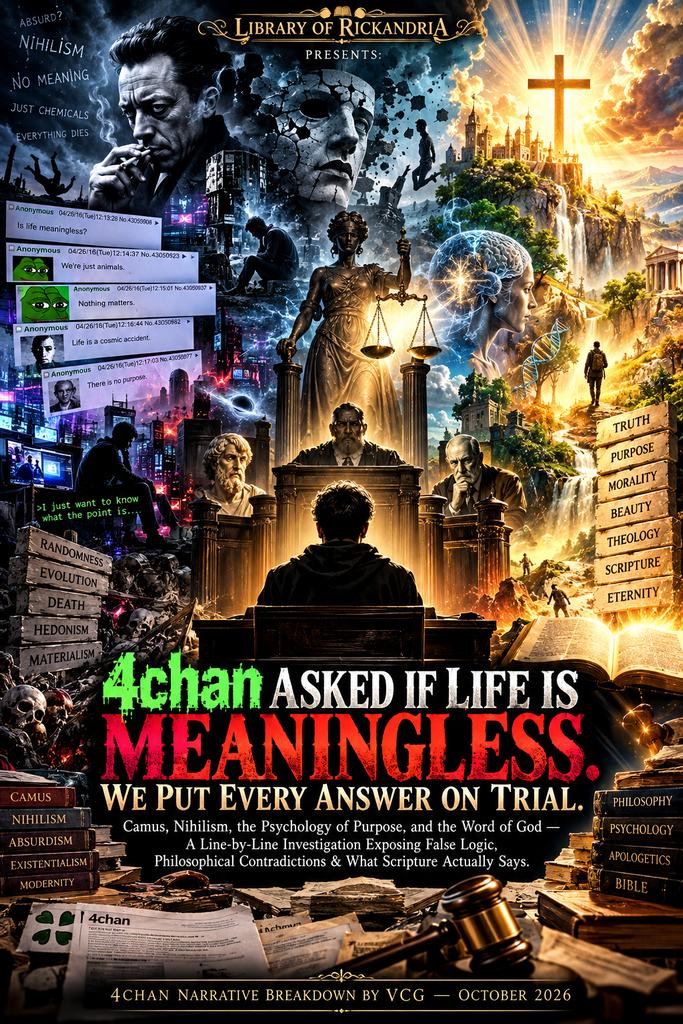
UPDATED BY VCG ON 10/15/2026 @ 12:12 EST
Camus, Nihilism, the Psychology of Purpose, and the Word of God — A Line-by-Line Investigation Exposing False Logic, Philosophical Contradictions & What Scripture Actually Says.
Anyone can do this, but most won’t.
“4chan Asked If Life Is Meaningless. We Put Every Answer on Trial.” is a comprehensive Christian apologetics investigation that dissects a 26-post 4chan discussion questioning whether life has any ultimate meaning. Through meticulous line-by-line fact-checking, historical research, philosophical analysis, psychological studies, and King James Bible Scripture comparisons, the paper examines Albert Camus’s absurdism, nihilism, the pursuit of happiness, human purpose, morality, freedom, social control, and the problem of suffering. It exposes logical fallacies, unsupported claims, misrepresentations of philosophy, and the psychological dynamics of anonymous internet discourse while exploring Buddhist teachings, ancient Egyptian symbolism, and competing explanations of existence. At its heart, the investigation places Camus’s Sisyphus alongside the biblical wisdom of Ecclesiastes, contrasting humanity’s struggle against apparent futility with Scripture’s account of divine purpose, moral responsibility, and redemption. Culminating in a historical and theological examination of Christ’s resurrection, the paper argues that Christianity offers an answer to mortality and meaninglessness grounded not merely in human determination, but in the hope proclaimed in 1 Corinthians 15. Above all, it challenges readers to examine every claim honestly, distinguish evidence from speculation, and pursue truth with intellectual integrity and biblical discernment. “Prove all things; hold fast that which is good.” — 1 Thessalonians 5:21 (KJV). Soli Deo Gloria.
ChatGPT – Library of Rickandria
4chan Asked If Life Is Meaningless. We Put Every Answer on Trial.
LIBRARY OF RICKANDRIA PRESENTS
Camus, Nihilism, the Psychology of Purpose, and the Word of God — A Line-by-Line Investigation Exposing False Logic, Philosophical Contradictions & What Scripture Actually Says.
4chan Narrative Breakdown by VCG — October 2026
An independent documentary, philosophical, psychological, and biblical examination of 4chan /x/ Thread No. 43050908.
Abstract
On October 6, 2026, an anonymous user on 4chan’s paranormal board, /x/, opened a discussion with a provocative summary of Albert Camus.
/x/ – Albert Camus said life was meaningless and you’ll – Paranormal – 4chan
The poster suggested that life was meaningless,
that people would never obtain what they wanted,
and that their only intelligent response was to revolt against life’s absurdity by living as fully as possible.
The ensuing conversation raised a familiar problem with unusual directness:
if our lives end,
our desires go unfulfilled,
and our accomplishments eventually disappear,
why should we continue struggling?
Over 26 posts, participants argued about:
- happiness
- meaning
- work
- artistic creation
- freedom
- authority
- social responsibility
Others responded with:
- mockery
- memes
- religious quotations
and suggestions of hidden manipulation.
This paper examines every visible post against the original archived discussion.
It then places the principal arguments alongside Camus’s published philosophy, contemporary psychological research, historical evidence, and the King James Bible.
Three findings emerge.
First, the thread’s representation of Camus is incomplete.
His philosophy of the absurd is not simply nihilism, hedonism, or encouragement to live out of spite.
His writings develop a more elaborate account of:
- conscious resistance
- freedom
- human dignity
- solidarity
Second, several participants confuse happiness with meaning, employment with moral worth, and resistance to authority with freedom.
These distinctions matter because the arguments often fail before their theological implications are even considered.
Third, Scripture offers an account of human existence that differs fundamentally from Camus’s.
Ecclesiastes recognizes life’s transience and frustrations without concluding that nothing matters, while the New Testament grounds Christian hope in God, Christ, and the resurrection.
JESUS CHRIST REVEALED: THE TRUTH THEY HID – Library of Rickandria
The objective is not to ridicule anonymous contributors or manufacture certainty.
It is to investigate what the evidence supports, distinguish explanation from interpretation, and consider what can responsibly be concluded.
Primary source:
4chan /x/ — Thread No. 43050908
Biblical text:
Authorized King James Version, using the supplied Pure Cambridge Edition as the principal reference.
Part I — Before the Arguments Begin
1. The question beneath every question
There is something revealing about the way the discussion begins.
The original poster asks, in effect, whether people will surrender to the absurdity of existence or respond by living more intensely.
At first glance, that sounds like a simple choice between resignation and courage.
But several different questions are hiding inside it.
Does the universe have an ultimate purpose?
Is a human life meaningful only if it has such a purpose?
Is pleasure necessary for life to be worth living?
Can something matter even if it eventually ends?
And if people disagree about life’s purpose, how should they determine what constitutes a good life?
These questions are related, but they are not interchangeable.
A physician who spends decades treating sick children may contribute something profoundly valuable even if the physician’s name is forgotten.
The eventual disappearance of that memory would not, by itself, demonstrate that the children received no benefit.
Likewise, a person’s inability to find a cosmic explanation does not logically establish that every relationship or moral action is worthless.
This distinction between meaning in life and the meaning of life is recognized in contemporary philosophy.
The Stanford Encyclopedia of Philosophy’s examination of the meaning of life describes several competing theories, including religious accounts, naturalistic accounts, and positions combining personal commitment with objective value.
The existence of this debate matters because the conclusion that life has no objective meaning is not a scientific observation.
It is a philosophical proposition that must be argued for.
Similarly, the Christian claim that human life possesses God-given purpose is a theological position requiring explanation and, for those who question Christianity, consideration of its supporting arguments.
We should not confuse confidently asserting either position with demonstrating it.
2. Our investigative rules
The source material is a single archived 4chan discussion.
It contains the opening post and 25 replies, dated October 6–8, 2026.
The archive is the primary evidence for what its participants wrote.
It is not evidence that their factual statements are correct.
The analysis applies five standards.
Documentary accuracy.
We identify the post, its claims, relevant replies, and the evidence the author actually supplies.
Historical accuracy.
Claims about:
- philosophers
- religious traditions
- ancient history
- political ideas
are checked against relevant original works where available and credible scholarship.
Logical analysis.
We distinguish an argument’s premises from its conclusions and ask whether the latter actually follow.
Psychological evidence.
Claims about:
- happiness
- despair
- meaning
- identity
- online behavior
are compared with published research.
Psychological mechanisms are discussed as possibilities, not diagnoses of anonymous users.
Scriptural interpretation.
The King James Bible is examined in context, distinguishing its explicit statements from subsequent theological applications.
Our verdicts use the following classifications:
| Classification | Meaning |
|---|---|
| Supported | Credible evidence supports the specific claim |
| Partly supported | Contains a valid observation but exceeds its evidence |
| Misrepresentation | Inaccurately presents a source or another person’s position |
| Unsupported | The necessary evidence has not been supplied or established |
| Philosophically disputed | Involves competing arguments that cannot be resolved through a simple factual lookup |
| Rhetoric or satire | Does not present a sufficiently clear factual claim to verify |
There are also limits to what this investigation can establish.
The identities of the anonymous participants are unknown.
The thread’s timestamps and post numbers establish the documented sequence, not the number of unique human authors.
The opening post includes a YouTube link, but the video’s actual contents have not been independently verified here.
Quoted material inside a forum reply must not automatically be attributed to the person replying.
Some lines are quotations, caricatures, or deliberately provocative restatements of another person’s argument.
The attached images provide cultural context, but images alone cannot establish the beliefs or affiliations of their subjects.
Finally, the thread is a convenience sample of one internet conversation.
It cannot be treated as representative of all:
- 4chan users
- atheists
- Christians
or people interested in Camus.
These restrictions protect the investigation from reaching conclusions larger than its evidence.
Part II — Albert Camus on Trial
3. What Camus actually believed
Albert Camus was born in French Algeria in 1913 and died in 1960.
He was:
- a novelist
- essayist
- journalist
- political thinker
who received the Nobel Prize in Literature in 1957.
Although frequently grouped with existentialists, he resisted that classification.
His central philosophical concern was the absurd:
the confrontation between humanity’s demand for intelligible meaning and a world that does not provide the ultimate explanation being sought.
That is subtler than simply announcing that nothing matters.
In The Myth of Sisyphus, published in 1942, Camus begins by confronting the question of suicide.
He asks whether recognizing the absurd justifies abandoning life.
His answer is no.
He argues that consciousness of the absurd should be maintained rather than escaped through suicide or through what he regards as an unwarranted leap to transcendent certainty.
What remains is conscious living, revolt against resignation, and passionate engagement with existence.
The Stanford Encyclopedia of Philosophy explains that Camus’s position develops through several stages, culminating in his later concern for solidarity and moral limits.
Source:
Stanford Encyclopedia of Philosophy — Albert Camus
The difference between absurdism and nihilism
Nihilism is not a single uniform doctrine.
Different forms deny or question different kinds of meaning, knowledge, value, or moral reality.
Camus, however, does not simply infer from the absence of an ultimate cosmic explanation that nothing should be valued.
His philosophy attempts to affirm life and human solidarity while rejecting the idea that humanity possesses a final, divinely provided explanation for existence.
Whether he successfully justifies that move is another question.
But a criticism must first represent the position correctly.
Is Camus a hedonist?
The thread often assumes that living fully must mean maximizing physical pleasure.
This is not an adequate account of Camus.
He discusses desire, sensual experience, freedom, artistic creation, and intense awareness of life.
But he also examines injustice, oppression, solidarity, and the dangers of justifying violence.
His later work The Rebel (1951) is especially relevant.
Camus argues that revolt can express recognition of a boundary beyond which a human being should not be oppressed.
Rebellion, in this understanding, becomes connected to human dignity.
This raises a serious philosophical problem:
how does an individual’s revolt against absurdity establish moral obligations toward other people?
It is a better criticism than claiming that Camus merely instructed everyone to pursue drugs, sex, or constant entertainment.
4. Sisyphus and the problem of endless labor
In Greek mythology, Sisyphus is punished by being required to move an immense stone uphill, only for the task to be endlessly repeated.
Camus uses this image as a representation of the human condition.
Much of life involves repetition, labor, frustration, and circumstances we do not control.
The ordinary human struggle becomes an analogue of Sisyphus’s task.
But Camus does not conclude that Sisyphus should simply collapse in despair.
Instead, he imagines a form of conscious resistance in which recognizing one’s condition changes one’s relationship to it.
The philosophical move is significant.
Camus places emphasis on awareness and the individual’s response to circumstances that cannot be permanently conquered.
Here lies a major challenge to his position.
If consciously accepting an unalterable struggle changes how that struggle is experienced, does this establish that the struggle itself possesses objective value?
Not necessarily.
Camus might respond that demanding an additional cosmic justification repeats the very problem his philosophy has already rejected.
His critic might answer that this still leaves unexplained why conscious revolt should be preferred to quiet resignation.
There is no need to invent a simple victory here.
Camus has offered a response to the absurd.
The remaining dispute concerns whether that response is adequately justified and whether alternative accounts, including Christianity, explain more of the human condition.
5. The most serious philosophical objection
The thread contains a particularly thoughtful contribution in post No. 43053872.
The poster questions why recognizing the futility of life should lead to universal enthusiasm for participation.
He suggests that people ought to choose carefully which activities deserve their limited time.
This objection deserves serious consideration.
Conscious revolt may be preferable to resignation in some circumstances.
But it does not follow that every available activity should be pursued, that every social demand deserves obedience, or that constant exertion is virtuous.
Indeed, Camus’s own philosophical concern with freedom and limitation would not require such indiscriminate participation.
The stronger question is whether the absurdist framework offers sufficient grounds for distinguishing worthwhile commitments from destructive or empty ones.
A Camusian might appeal to solidarity, human dignity, creativity, and resistance to oppression.
A critic would then ask how those goods are justified.
That is the genuine debate.
Part III — Solomon Versus Sisyphus
6. Two accounts of human frustration
Long before Camus wrote about Sisyphus, the biblical book of Ecclesiastes examined the frustrations of human existence.
Its speaker, traditionally associated with King Solomon, describes an exhausting cycle of labor, desire, accumulation, pleasure, wisdom, aging, and mortality.
Ecclesiastes 1:2 states:
Vanity of vanities, saith the Preacher, vanity of vanities; all is vanity.
The similarity to Camus is striking at the level of human experience.
Both recognize repetition and frustration.
Both challenge easy optimism.
Both confront mortality and the limitations of human achievement.
But their explanations differ.
Camus begins with humanity’s demand for ultimate meaning and the world’s failure to supply an adequate answer.
Ecclesiastes examines life in relation to God, human limitation, wisdom, enjoyment, and judgment.
The tension is not simply between pessimism and optimism.
It concerns the ultimate context in which human life is interpreted.
7. The Hebrew word hebel
The KJV translates the central word of Ecclesiastes as vanity.
The Hebrew noun is הֶבֶל (hebel, also written hevel).
Its literal associations include breath and vapor.
Within biblical literature, its figurative uses include transience, futility, insubstantiality, and the elusive character of human experience.
That does not mean the word has exactly the same sense everywhere.
Biblical scholarship has long debated how it should be understood in Ecclesiastes.
Russell L. Meek’s scholarly review, “Twentieth- and Twenty-first-century Readings of Hebel in Ecclesiastes,” surveys the variety of interpretations and notes the absence of a universally accepted single rendering.
Sources:
- Meek — Readings of Hebel in Ecclesiastes, Currents in Biblical Research (2016)
- Bible Gateway — NET Bible translation notes on Ecclesiastes 1:2
- Oxford Research Encyclopedia — The Book of Ecclesiastes
The distinction matters.
If hebel communicates something like vapor, then it can describe things that are real and beautiful but impossible to possess permanently.
A sunset passes.
A harvest is consumed.
A person’s strength diminishes.
Generations disappear.
None of those observations requires the conclusion that beauty, nourishment, strength, or human relationships never mattered.
Ecclesiastes confronts the limits of those goods as sources of ultimate security.
What about Solomon’s authorship?
The book identifies its speaker as the son of David and king in Jerusalem.
Traditional Jewish and Christian interpretation associates this figure with Solomon.
Modern historical-critical scholarship often understands the speaker as a literary persona and dates the composition substantially later than Solomon’s lifetime, partly on linguistic grounds.
Other interpreters continue to defend Solomonic authorship.
The evidence and competing positions should be distinguished rather than one view being silently presented as indisputable.
Sources:
For this paper, “the Preacher” will generally identify the speaker within the biblical text without prejudging the historical authorship dispute.
8. Does Ecclesiastes teach that nothing matters?
The answer requires examining the entire book.
Ecclesiastes describes the difficulty of obtaining lasting profit from human labor.
It discusses the inability of wisdom to prevent death, the instability of wealth, injustice, and the frustration of not knowing what the future holds.
Yet the same book also treats ordinary enjoyment as legitimate.
Ecclesiastes 3:13 (KJV):
And also that every man should eat and drink, and enjoy the good of all his labour, it is the gift of God.
The verse does not depict food, work, and pleasure as intrinsically worthless.
It presents their enjoyment as a gift.
Ecclesiastes 11:9 encourages rejoicing in youth while also reminding the reader of accountability before God.
And Ecclesiastes 12:13 concludes:
Let us hear the conclusion of the whole matter:
Fear God, and keep his commandments:
for this is the whole duty of man.
This is a crucial difference from Camus.
Ecclesiastes does not present humanity as capable of solving every mystery of existence.
But neither does it conclude that the absence of complete human knowledge proves the absence of divine purpose.
The text’s own movement is from recognizing life’s limitations toward reverence, enjoyment within those limits, and moral accountability.
There is scholarly disagreement over how the book’s framing voice relates to the Preacher’s sometimes unsettling observations.
A responsible reading should acknowledge that literary complexity.
Nevertheless, the final canonical form of Ecclesiastes does not leave its readers with the simple command to enjoy themselves because nothing matters.
9. Two conclusions compared
| Question | Camus | Ecclesiastes |
|---|---|---|
| Why does life frustrate us? | Human desire for ultimate intelligibility confronts an unanswering universe | Humanity is limited, mortal, and unable to control life’s outcomes |
| Is suffering real? | Yes | Yes |
| Is endless accumulation sufficient? | No ultimate solution is found there | No |
| Is ordinary enjoyment legitimate? | Yes, within conscious engagement with life | Yes, received as a gift from God |
| Is human understanding complete? | No | No |
| What is the final response? | Conscious revolt, freedom, and engagement | Reverence for God, faithful conduct, and acceptance of human limits |
| What grounds enduring hope? | No transcendent resolution is established | God’s authority and, in the wider Christian canon, resurrection |
The table simplifies two complex bodies of thought, but it identifies their fundamental difference.
Camus asks how one should live when transcendent resolution is not accepted.
Ecclesiastes asks how one should live when human understanding and worldly accomplishments are insufficient, yet God remains the ultimate reference point.
The two works may describe similar frustrations without reaching the same metaphysical conclusion.
Part IV — The Complete 26-Post Forensic Breakdown
The original discussion is preserved at 4chan /x/, Thread No. 43050908.
The following entries follow its documented chronological order.
A distinction will be maintained between a participant’s substantive argument, unsupported factual claims, and purely rhetorical material.
Some posts use offensive language.
Where that language is not necessary to evaluate the argument, it is summarized rather than gratuitously reproduced.
Post 1 — No. 43050908
The opening challenge: revolt against meaninglessness
October 6, 2026 — 10:54:14 PM, as displayed in the archive
The opening poster attributes three ideas to Camus: life has no ultimate meaning, human beings cannot obtain what they really want, and revolt through intense living is the only intelligent response.
The argument is appealing because it turns existential despair into a call for action.
But we need to separate its components.
Claim A: Camus said life was meaningless.
This is an oversimplified but recognizable interpretation.
Camus rejects the idea that the universe supplies humanity with an adequate transcendent answer to the search for ultimate meaning.
However, he does not conclude that compassion, beauty, friendship, or human dignity should be disregarded.
Claim B: Human beings will never obtain what they want.
This is not a faithful summary of his central philosophy.
Human beings plainly achieve some desires and fail to achieve others.
Camus’s concern is not that no individual goal can succeed.
It is that success cannot permanently resolve the confrontation between our demand for ultimate intelligibility and the limits of existence.
Claim C: Revolt is the only intelligent response.
Camus develops a philosophical defense of revolt, but describing it as the only intelligent response assumes the truth of the conclusion being debated.
Christianity, various Buddhist traditions, Stoicism, and secular approaches to meaning offer different interpretations of suffering and mortality.
Their differences must be investigated rather than dismissed in advance.
Psychological assessment:
Some people find conscious resistance empowering.
Others find enduring purpose through service, attachment, faith, creativity, or relationships.
Available research does not establish that one existential philosophy provides the universally optimal psychological response.
Scriptural examination:
Ecclesiastes 3:13 acknowledges the goodness of ordinary enjoyment, while Ecclesiastes 12:13–14 places life within the framework of God and moral responsibility.
The New Testament adds another dimension:
Christian hope rests ultimately on resurrection, not simply the will to endure.
Verdict:
A compelling opening question based on an incomplete representation of Camus.
Original attachment:
Figure 1. Original meme attached to the opening post.
Its caption concerns the pictured person’s apparent interest in a sandwich.
The photograph is not evidence of the person’s philosophical beliefs, forum membership, or relationship to the discussion.
Post 2 — No. 43051019
Buddhist enlightenment and Egyptian religious imagery
The next contributor introduces an unexpected religious element.
Instead of discussing Camus directly, the poster quotes a passage describing the extraordinary zeal of a bodhisattva pursuing supreme enlightenment.
An accompanying illustration depicts Wepwawet, an ancient Egyptian canine deity.
This is where the investigation moves from philosophy into comparative religion.
Source verification:
The Buddhist passage is not simply an unattributed internet saying.
It appears in The Flower Adornment Sutra (Avataṃsaka Sūtra), Chapter 38, “Transcending the World,” printed page 1433, in Bhikshu Dharmamitra’s translation published by Kalavinka Press in 2022.
The passage concerns the sixth of ten seals of a bodhisattva and describes unwavering zeal toward anuttara-samyak-saṃbodhi, generally understood as unsurpassed complete enlightenment.
The wording and structure match the source closely.
Primary evidence:
The Flower Adornment Sutra — Chapter 38, page 1433
This gives the post a stronger documentary foundation than many subsequent replies.
Yet verifying a quotation does not establish every implication one might draw from it.
The accompanying Egyptian illustration requires separate analysis.
The Metropolitan Museum of Art identifies Wepwawet as an Egyptian deity associated with processions and the cult of Osiris.
His name is conventionally translated as:
“Opener of the Ways.”
Historical source:
The Metropolitan Museum of Art — Wepwawet, object 30.8.108
The post demonstrates a juxtaposition between two religious traditions.
It does not demonstrate that Buddhist enlightenment and ancient Egyptian theology originated from the same doctrine.
Nor does it show that either tradition teaches Camus’s absurdism.
Scriptural examination:
Romans 10:2 describes religious zeal that lacks knowledge.
In context, Paul is speaking about Israel’s relationship to God’s righteousness, so applying the verse to every non-Christian tradition is a theological extension rather than the passage’s immediate subject.
Philippians 3:14 describes Paul’s earnest pursuit of God’s calling in Christ.
Both biblical and Buddhist texts can speak of perseverance, but the goals and underlying doctrines differ.
Verdict: Authentic religious quotation and historically recognizable Egyptian imagery; no demonstrated theological equivalence between them.
Original attachment:
Figure 2. Original Egyptian-themed illustration.
Its source tradition must be distinguished from the Buddhist passage accompanying it.
Post 3 — No. 43051361
A joke about the sandwich
This participant comments on the sandwich in the opening image.
There is no substantive claim about the meaning of life.
That may sound trivial, but it illustrates a methodological point:
not every message in a discussion is part of its central argument.
Humor can defuse tension, establish social rapport, or redirect attention.
In this case, the available evidence does not permit us to determine the author’s specific motive.
Scriptural comparison:
Ecclesiastes 3:13 acknowledges enjoyment of food as a gift of God.
Verdict:
Humor; no philosophical rebuttal required.
Post 4 — No. 43052205
Camus is blamed for angry internet behavior
The participant suggests that Camus’s philosophy would require an angry person repeatedly reacting to internet memes to be considered happy.
The poster then dismisses Camus personally.
This is a straw-man argument.
Camus’s imagined Sisyphus is not a general theory claiming that every angry person is psychologically fulfilled.
His treatment of happiness is connected to consciousness, defiance, and acceptance of one’s condition.
It does not follow that hostility proves contentment.
Logical correction:
Even if a philosopher argues that happiness is possible amid suffering, it does not follow that every person experiencing suffering is happy.
Scriptural correction:
Proverbs 18:13 cautions against reaching conclusions before hearing a matter.
Verdict:
Misrepresentation of Camus accompanied by personal disparagement.
Post 5 — No. 43052399
The challenge that matters most: Why live without happiness?
This is arguably the discussion’s most important human moment.
The poster challenges the opening proposition that one should live fully even if fundamental desires cannot be satisfied.
The respondent says, in substance, that if happiness is unavailable, continued living appears to lack sufficient justification.
The person also rejects spite as a satisfactory reason to continue.
There are two issues here.
The first is philosophical.
What makes life worth living when a person’s desired form of happiness is absent?
This is a legitimate challenge.
It would be inadequate to respond that revolt is worthwhile simply because revolt is worthwhile.
Camus attempts to defend conscious existence and the refusal to surrender to absurdity.
The respondent remains free to question whether that defense is persuasive.
The second issue is psychological and pastoral.
The language resembles statements of hopelessness that can sometimes indicate suicide risk.
The National Institute of Mental Health identifies hopelessness and perceived absence of reasons for living as possible warning signs.
We cannot determine from this anonymous post whether the writer was seriously distressed, exaggerating, or participating in provocative internet rhetoric.
Nevertheless, the appropriate response is careful attention rather than humiliation.
Scriptural correction:
Psalm 34:18 describes God’s nearness to the brokenhearted.
Philippians 4:11–13 speaks of learned contentment in changing circumstances.
Romans 8:18–25 describes Christian hope as directed toward an anticipated redemption that has not yet been fully seen.
None of these passages teaches that genuine believers experience uninterrupted happiness.
Verdict:
A serious philosophical challenge containing language that should be treated compassionately.
Post 6 — No. 43052641
Personal meaning, appreciation of beauty, and social contribution
This contributor argues that people assign meaning to their lives and should enjoy beauty, contribute positively to the world, and engage in productive work or service.
The poster offers wage employment, research, and environmental volunteering as examples, linking social contribution to the idea of a social contract.
Several claims deserve separation.
Personal meaning:
Individuals can experience meaning through different activities.
That is psychologically plausible.
But the fact that people experience meaning differently does not prove that all meaning is entirely self-created.
An individual might find satisfaction in an activity that harms others.
Personal satisfaction alone would not establish its moral worth.
Service:
The encouragement to help others is broadly defensible.
Employment:
The suggestion that everybody must follow a particular economic model is not established.
Social contract:
In political philosophy, social contract theories concern the justification of political and social institutions, obligations, and principles.
They do not universally require conventional wage employment.
Source:
Stanford Encyclopedia of Philosophy — Contemporary Approaches to the Social Contract
Scriptural correction:
Ephesians 2:8–10 places good works within the context of salvation by grace.
Genesis 2:15 presents stewardship and cultivation as meaningful responsibilities.
Matthew 22:37–40 identifies love toward God and neighbor as central to the moral life.
Christianity can affirm beauty, work, and service without treating individual preference as the final source of moral truth.
Verdict: Valuable ethical observations combined with an unproven theory of ultimate meaning and an overextended appeal to the social contract.
Original attachment:
Figure 3.
The meme compares an ordinary cat with the Sphinx and uses the language of role-playing or pretension.
It is a rhetorical comparison, not evidence about ancient Egypt.
Post 7 — No. 43052650
Mockery directed at someone expressing hopelessness
The author responds to post No. 43052399 by insulting the contributor and introducing a reference to the person’s mother.
There is no developed philosophical argument.
The response does not establish why happiness should or should not be necessary for a meaningful life.
Nor does it provide psychological evidence that the earlier participant’s statement was insincere.
A further documentary detail matters: the respondent presents a quoted characterization of the earlier comment before attacking it.
That should not be mistaken for a fresh statement of personal intent.
Scriptural correction:
Romans 12:15 calls for sympathy with those who suffer.
James 3:9–10 challenges the inconsistency of using speech to bless God while cursing human beings.
Verdict:
Ad hominem reasoning and an inappropriate response to possible distress.
Post 8 — No. 43052652
Freelancers and the distinction between employment and dependence
This respondent objects to treating all productive activity as ordinary wage employment.
The author points out that programmers, carpenters, and others can sell services independently.
The underlying distinction is valid.
The U.S. Bureau of Labor Statistics recognizes self-employed people who earn profit or fees through their own businesses, professions, trades, or farms.
Certain incorporated self-employed workers are classified differently for specific statistical purposes, illustrating that legal and statistical categories require precision.
Source:
Bureau of Labor Statistics — Concepts and Definitions
However, the argument is weakened by derogatory language directed at employees.
Independent work is not inherently superior in moral worth to salaried employment.
Scriptural correction:
Colossians 3:23–24 values conscientious labor performed in service to God.
James 5:4 condemns the unjust withholding of wages.
Scripture dignifies work while criticizing exploitation.
Verdict:
Correct economic distinction accompanied by unjustified contempt.
Post 9 — No. 43052667
The shifting definition of a worker
The next participant expands the derogatory category to include freelancers and independent tradespeople.
This produces a definitional problem.
If the disputed label initially referred to people dependent upon conventional employers, expanding it to include everyone who performs compensated labor changes its meaning.
An argument cannot be fairly evaluated if the principal category changes whenever a counterexample appears.
Logical correction:
Define the term before determining which people fall within it.
Scriptural comparison:
First Corinthians 12:14–26 describes different functions contributing to the life of the church.
The passage is ecclesiological, not an economic classification system.
Nevertheless, its rejection of contempt between members offers an ethical challenge to the assumption that some ordinary forms of contribution render people inferior.
Verdict:
Equivocation and unsupported moral condemnation.
Post 10 — No. 43053240
Hedonism, happiness, and the mask of career identity
This reply combines three claims.
First, it presents a pleasure-centered caricature of the opening absurdist position.
Second, it argues that an exclusive pursuit of happiness is incompatible with personal wholeness.
Third, it warns against confusing a social or career role with one’s complete identity.
The first claim is a misrepresentation of Camus.
The second deserves more attention.
Psychological studies have found that prioritizing happiness too intensely can sometimes produce disappointment.
Iris Mauss and colleagues reported this effect in a 2011 study involving two investigations of valuing happiness.
The findings were conditional, not evidence that happiness is inherently undesirable.
Source:
Mauss et al., “Can Seeking Happiness Make People Unhappy?” Emotion (2011)
The third claim is a sensible caution.
Work can contribute to a person’s identity without exhausting it.
Scriptural correction:
Galatians 5:22–23 includes joy and self-control among the fruit of the Spirit.
Christian ethics do not require choosing between perpetual pleasure-seeking and the complete rejection of joy.
Verdict:
Distorted representation of Camus combined with reasonable insights into happiness and identity.
Post 11 — No. 43053257
Order, manipulation, and racial hostility
The poster argues for genuinely impartial order and claims that outside actors manipulate people’s emotions.
The post also employs a racist slur while criticizing the present political arrangement.
The desire for impartial justice can be defended.
The claim of coordinated manipulation, however, is not supported by identified actors, documented actions, or independently verifiable evidence.
Nor does the racial insult contribute anything to the argument.
Psychological explanation:
People may resist perceived restrictions on their freedom.
Psychological reactance is one framework for understanding that response.
But knowing that reactance exists does not establish that a particular hidden organization is directing the discussion.
Scriptural correction:
Isaiah 10:1–2 condemns unjust laws.
Romans 13:1–7 concerns governing authority.
Acts 5:29 provides an important qualification: obedience to God takes priority when authorities demand what conflicts with God’s commands.
Genesis 1:26–27 grounds human dignity in creation in God’s image rather than ethnicity.
Verdict:
Legitimate concern for impartial justice mixed with unsupported manipulation claims and morally objectionable racial hostility.
Original attachment:
Figure 4. Original image attached to post No. 43053257.
It portrays a person rejecting a game while continuing to play it.
The computer screen displays a Buddhist Wheel of Existence, a traditional representation of cyclic existence and rebirth.

Rubin Museum of Himalayan Art.
Post 12 — No. 43053286
Opposition to authority through insult
This contributor responds by depicting the prior appeal to order as submission to authority.
The central problem is the assumption that advocating order necessarily means advocating oppression.
A just legal system and an unjust authoritarian system are not interchangeable concepts.
The participant may legitimately reject coercion or abuse, but the reply does not establish that those are the inevitable consequences of every attempt to establish order.
Scriptural correction:
Proverbs 15:1 recommends a gentle response rather than inflammatory speech.
Romans 12:18 encourages peace where reasonably possible.
These principles do not demand submission to injustice.
Verdict:
Emotionally emphatic rejection of authority without a developed argument.
Post 13 — No. 43053406
A dispute about the meaning of compensated work
The author attacks the previous attempt to classify independent builders and creators as ordinary wage workers.
Beneath the insults is a legitimate disagreement about terminology.
A self-employed craftsperson may be economically dependent on customers without being an employee of those customers.
Likewise, a salaried professional may exercise substantial discretion and responsibility.
The relationship between compensation, independence, and personal freedom is more complex than the participants acknowledge.
Scriptural correction:
Ephesians 4:29 encourages speech that benefits its hearers.
A correct definition is stronger when defended with evidence rather than abuse.
Verdict:
A valid terminological concern expressed through personal hostility.
Post 14 — No. 43053450
The frog hat as supposed evidence of liberation
This poster interprets the person depicted in the opening photograph as a member of the forum’s community and suggests that the person has escaped unnamed controllers.
The factual leap is substantial.
A photograph of someone wearing a frog-themed hat does not establish the person’s online habits, political beliefs, or relationship with an alleged controlling organization.
The explanation is consistent with group-identity projection:
interpreting ambiguous information in a manner favorable to a preferred narrative.
That interpretation concerns the structure of the argument, not the mental condition of its author.
Scriptural correction:
Exodus 23:1 warns against false reports.
Proverbs 18:13 requires careful hearing before judgment.
Verdict:
Unsupported speculation based on ambiguous visual evidence.
Post 15 — No. 43053462
Did Camus conclude that art is the meaning of life?
The participant argues that the original account of Camus was incomplete because Camus ultimately identified creative activity as life’s meaning.
This contains a partial truth.
Artistic creation occupies an important place in The Myth of Sisyphus.
Camus treats creation as a way of engaging with the absurd without claiming to have resolved it through a transcendent explanation.
But saying that artistic creation is important to Camus is not equivalent to saying that he established art as humanity’s ultimate metaphysical purpose.
The distinction is essential.
Source:
Stanford Encyclopedia of Philosophy — Camus, artistic creation, and the absurd
Scriptural comparison: Exodus 31:2–5 describes artistic and technical craftsmanship in the construction of the tabernacle.
Human creativity has a positive place within the biblical account, but Scripture does not identify artistic achievement as the final purpose of existence.
Verdict: Partly accurate observation expanded into a misleading summary.
Post 16 — No. 43053479
Economic exploitation and the powerful
This participant argues that the social contract has been severely damaged and that those who exploit others are not confined to the economically disadvantaged.
The second proposition is defensible.
Powerful individuals and institutions can engage in exploitation.
The first proposition needs definition and evidence.
Has a particular institution lost public legitimacy?
Have protections for workers weakened? Have legal obligations ceased to function?
These would be meaningful questions.
Claiming that the entire social contract has been destroyed without identifying measurable conditions is a sweeping conclusion.
Scriptural correction:
James 5:1–6 condemns wealthy oppressors and the mistreatment of laborers.
James 2:1–9 warns against favoritism toward the rich.
These teachings undermine the assumption that material status determines moral superiority.
Verdict:
Reasonable criticism of class prejudice alongside an unsupported general claim of institutional collapse.
Post 17 — No. 43053524
De-escalation and stereotyping tradespeople
The contributor responds to an angry exchange by urging calm, then generalizes that tradespeople are unusually irritable.
The first part attempts de-escalation.
The second lacks evidence.
No psychological or occupational data are provided to demonstrate that tradespeople generally display the behavior attributed to them.
Scriptural correction:
James 1:19 recommends attentive listening, restraint in speech, and slowness to anger.
Verdict:
Constructive instinct mixed with an unsupported stereotype.
Post 18 — No. 43053525
The dark sandwich joke
This reply extends the earlier sandwich discussion with a grotesque joke concerning its ingredients.
There is no indication that the statement supplies factual evidence about the sandwich.
Treating obvious internet humor as a verified report would be a methodological error.
Scriptural comparison:
Proverbs 12:10 speaks of righteous treatment of animals, but the post does not establish an actual case of mistreatment.
Verdict:
Dark humor; no verified factual claim.
Post 19 — No. 43053618
An invitation to explain the art argument
This participant asks the person who discussed Camus and artistic creation to elaborate.
Although brief, it is one of the more constructive contributions.
The request does not assume that the artistic interpretation is true.
It asks for an explanation.
That is a useful intellectual habit, particularly when the preceding claim concerns a philosopher’s supposed conclusion.
Scriptural comparison:
Proverbs 18:15 commends the pursuit of knowledge.
Verdict:
Reasonable request for clarification.
Post 20 — No. 43053749
Caffeine, sleep, and speculation about personality
The poster suggests that a previous participant’s irritability may reflect too much caffeine and insufficient sleep.
Sleep and stimulant use can affect mood.
But nothing in the thread establishes the individual’s sleep duration or caffeine consumption.
The reply is best interpreted as speculation or humor rather than a reliable psychological explanation.
Scriptural correction:
Proverbs 18:13 again applies to premature conclusions.
Verdict:
Unsubstantiated explanation of an anonymous person’s behavior.
Post 21 — No. 43053817
Treating a hostile reply as proof of identity
This participant suggests that another user has unintentionally revealed their true identity or allegiance.
Hostile language can provide evidence of attitude in a particular conversation.
It cannot establish an entire hidden affiliation without corroboration.
Research on online disinhibition provides a framework for understanding why people may express themselves differently in anonymous digital settings.
But an anonymous post is not a psychological assessment.
Source:
John Suler, “The Online Disinhibition Effect” (2004)
Scriptural correction:
First Peter 3:15 encourages believers to provide reasoned answers with meekness and reverence.
Verdict:
Unsupported inference from hostile speech to hidden identity.
Post 22 — No. 43053820
The assertion that corruption is destroying society
This participant rejects the call for order and claims that the existing system is collapsing because of corruption.
Institutional corruption can certainly undermine legitimacy, public trust, and effective governance.
But the specific assertion requires evidence about identifiable institutions and conditions.
Without specifying the political system, period, indicators of decline, and causal relationships, there is no adequate basis for declaring collapse.
Scriptural correction:
Isaiah 1:17 directs attention toward justice and protection of the oppressed.
Biblical criticism of corrupt authority is not identical to indiscriminate opposition to every form of government.
Verdict: Plausible general concern expressed as an unsupported comprehensive diagnosis.
Post 23 — No. 43053872
The strongest objection: Must we participate in futile activity?
This contributor questions whether Camus’s emphasis on revolt justifies unrestricted commitment to life’s activities.
The poster introduces the image of a puppeteer encouraging puppets to perform enthusiastically and recommends carefully selecting which struggles deserve attention.
The argument contains two distinct elements.
The first is persuasive: people have limited time and should make considered judgments about their commitments.
The second is speculative: the puppeteer metaphor does not establish that an actual controlling intelligence directs human existence.
As philosophy, the post raises an important question.
What makes participation rational when an activity cannot produce the final outcome we desire?
Camus might answer that the value lies partly in conscious action and the refusal to surrender human dignity.
A Christian argument would instead examine the relationship between labor, faithfulness, moral obligation, and resurrection.
Scriptural correction:
Ephesians 5:15–17 encourages wise conduct.
First Corinthians 15:58 teaches that labor in the Lord is not in vain, in the context of Paul’s extended argument concerning resurrection.
The passage does not claim that every activity is worthwhile or that indiscriminate exertion is virtuous.
Verdict:
A substantial philosophical objection with a reasonable emphasis on selectivity, but no evidence for literal external manipulation.
Post 24 — No. 43053923
Asking another participant to reread the argument
The author asks someone to reconsider an earlier post, while using derogatory language.
Requesting reconsideration is legitimate if a claim has been misunderstood.
But insults do not show where the misunderstanding occurred.
A productive response would identify the disputed premise and explain how the reply failed to address it.
Scriptural comparison:
Proverbs 18:17 recognizes the importance of examining an initial account rather than accepting it uncritically.
Verdict:
Reasonable request presented unconstructively.
Post 25 — No. 43054167
Has genuine social order ever existed?
The participant rejects another person’s aspiration toward order and suggests that genuine order has never existed.
Everything depends on the definition.
If order means a perfect society without corruption, the statement expresses skepticism about an ideal.
If order means functioning institutions, recognized rules, or relatively stable social relationships, the historical claim is unsustainable.
The existence of injustice does not prove the nonexistence of all social order.
Scriptural correction:
Proverbs 29:2 contrasts righteous and wicked rule in relation to public well-being.
The passage does not guarantee perfect government.
It recognizes meaningful moral distinctions in how people exercise authority.
Verdict: Overgeneralization arising from an undefined ideal.
Post 26 — No. 43054663
The final cultural joke
October 8, 2026 — 12:18:39 AM, as displayed in the archive
The final visible response is a very short remark apparently referring to French identity.
Camus was a French-language writer born in colonial Algeria.
Whether the remark is an expression of skepticism, humor, or mild provocation cannot be established confidently from its brief wording.
It supplies no independent rebuttal.
Source:
Stanford Encyclopedia of Philosophy — Biographical introduction to Camus
Verdict:
Cultural humor; no substantive argument.
10. What the complete thread actually demonstrates
Once the 26 posts are examined separately, the discussion becomes easier to understand.
The central debate begins with Camus and the value of conscious living.
One participant asks whether happiness is indispensable.
Another argues for personally constructed meaning and social contribution.
That turns into a dispute about work, dependency, and identity.
A parallel discussion develops around social order and authority.
Meanwhile, art, Buddhism, Egyptian symbolism, and memes enter the conversation.
By the conclusion, the thread no longer contains one unified philosophical argument.
It contains several smaller disagreements, often connected by mood rather than reasoning.
The thread’s most important substantive contributions concern whether happiness is necessary for continued life, whether meaning can be personally constructed, and whether revolt offers a sufficient reason for action.
Its weakest contributions treat insult, group affiliation, and speculation as substitutes for proof.
This matters because the thread should not be described as one coherent 4chan doctrine.
It is an anonymous conversation containing conflicting positions, with no evidence that every contributor shares the same assumptions.
Part V — The Psychology of Meaning, Happiness, and Despair
11. Are happiness and meaning the same thing?
One of the thread’s recurring problems is the assumption that happiness and meaning describe the same human experience.
They do not.
Psychologists commonly distinguish pleasurable emotional states, satisfaction with life, and the sense that one’s existence is significant or purposeful.
These dimensions can overlap without becoming identical.
A person may feel content while doing something trivial.
Another may experience significant hardship while caring for a seriously ill family member and still regard that commitment as deeply meaningful.
Neither experience proves that pleasure is bad or suffering is good.
The distinction is simply that how pleasant an experience feels does not exhaust its significance.
In 2013, Roy Baumeister, Kathleen Vohs, Jennifer Aaker, and Emily Garbinsky published research examining differences between happiness and meaning.
Their findings associated happiness more strongly with the satisfaction of needs and desires, whereas meaning showed different associations with personal identity, generosity, stress, and an integrated view of past, present, and future.
The study was survey-based. Its associations should not be interpreted as universal causal laws.
Source:
Baumeister et al., “Some Key Differences Between a Happy Life and a Meaningful Life,” The Journal of Positive Psychology (2013)
A conceptual comparison
| Concept | Central question | Important qualification |
|---|---|---|
| Pleasure | Does this experience feel good? | Pleasant experience does not automatically establish moral value |
| Happiness | Am I experiencing positive emotion or satisfaction? | Researchers use several distinct measures |
| Meaning | Does my life feel coherent, significant, or worthwhile? | Perceived meaning does not automatically prove metaphysical meaning |
| Purpose | What enduring direction organizes my goals? | Purpose can be directed toward good or harmful ends |
| Christian joy | What is the relationship between joy, God, and the life of faith? | A theological category, not interchangeable with a clinical measurement |
This framework helps explain why the thread’s participants repeatedly talk past one another.
The person demanding happiness may be discussing relief from distress.
The participant encouraging social contribution may be discussing meaning.
Camus is investigating how consciousness and engagement can persist in the face of absurdity.
The biblical writers discuss joy, duty, suffering, hope, faithfulness, and redemption within a theological framework.
Those are related discussions, but they are not identical.
12. Can pursuing happiness make someone less happy?
There is a reasonable concern behind the argument that happiness should not become one’s exclusive goal.
Iris Mauss and colleagues investigated whether placing unusually high importance on happiness could sometimes reduce it.
Their 2011 research found evidence of a paradoxical effect in particular circumstances.
In one study, women who strongly valued happiness reported lower happiness under relatively low-stress conditions.
In another experiment, participants induced to place greater value on happiness responded less positively to a happy emotional stimulus than a control group.
The researchers proposed that expecting oneself to feel especially happy can produce disappointment when one’s actual emotions fall short.
Source:
This does not establish that happiness is a false goal in every sense.
Nor does it mean people should avoid activities that make them happy.
The defensible conclusion is narrower:
rigid expectations about how happy we ought to feel can sometimes undermine our enjoyment.
This is relevant to post No. 43053240, but it does not fully vindicate the poster’s sweeping dismissal of happiness.
13. Does purpose protect against depression?
A major individual-participant meta-analysis published online in December 2025 examined associations between purpose in life and depressive symptoms.
It included 72 samples totaling 531,038 participants across six world regions.
A negative association between purpose and depressive symptoms appeared in 71 of the 72 samples.
The pooled standardized estimate was approximately −0.32, with a 95% confidence interval of −0.35 to −0.30.
Source:
This is substantial evidence that purpose and psychological well-being are related.
But three cautions are necessary.
First, correlation does not by itself establish causation.
Purpose could influence depressive symptoms, depression could influence perceived purpose, or both could be affected by other factors.
Second, the research does not determine which philosophical or religious account of purpose is correct.
Third, a statistical association cannot establish that a person who feels purposeless has a particular mental health condition.
This study supports a psychologically meaningful distinction between purpose and depressive symptoms.
It does not settle whether God exists, whether absurdism is true, or which faith should be adopted.
That distinction between empirical evidence and metaphysical interpretation is essential.
14. Why anonymous discussions become hostile
The thread contains repeated personal attacks that contribute little to the stated subject.
John Suler’s 2004 paper, “The Online Disinhibition Effect,” describes several factors that may contribute to people speaking or acting differently online.
These include anonymity, invisibility, delayed communication, and diminished perceptions of authority.
Source:
Suler, “The Online Disinhibition Effect,” CyberPsychology & Behavior (2004)
One important qualification is that disinhibited behavior should not automatically be interpreted as revealing someone’s hidden, authentic personality.
Suler explicitly treats online disinhibition as a complex interaction of psychological and situational factors.
In our thread, anonymity may help explain the willingness to insult strangers, but we cannot establish the private motives of individual contributors.
Nor should we attribute the entire deterioration of the conversation to anonymity alone.
Some participants are plainly engaging in jokes, provocations, ideological signaling, and disputes over ambiguous language.
The result is a discussion in which emotional intensity repeatedly exceeds the supporting evidence.
A useful distinction: emotional conviction versus proof
Someone may sincerely believe that society is corrupt.
That conviction is not proof that every institution is collapsing.
Someone may feel controlled or manipulated.
That feeling is not evidence of a specific hidden organization.
Someone may experience life as meaningless.
That experience is not, by itself, a metaphysical demonstration that meaning cannot exist.
Likewise, a believer may experience profound certainty about God.
The experience is significant to the believer, but philosophical and historical arguments for the existence and actions of God must still be examined on their own merits.
A careful researcher allows human experiences to be taken seriously without treating every interpretation of those experiences as established fact.
Part VI — Buddhism, Egyptian Symbolism, and Competing Spiritual Explanations
15. What the Buddhist passage actually teaches
Post No. 43051019 introduces a genuine passage from the Avataṃsaka Sūtra, known in English as The Flower Adornment Sutra.
We verified its source in Chapter 38, “Transcending the World,” printed page 1433.
The passage describes a bodhisattva’s extraordinary determination to attain complete enlightenment.
The context concerns spiritual development, wisdom, perseverance, and an irreversible commitment to the Buddhist path.
Primary source:
Bhikshu Dharmamitra’s translation, Kalavinka Press (2022), Chapter 38
The bodhisattva ideal is especially important in Mahayana Buddhism.
A bodhisattva seeks awakening while also acting for the benefit of sentient beings.
It would be inaccurate to describe this ideal simply as individual pleasure-seeking or a refusal to care about others.
The similarity to Camus lies primarily in language of determination and engagement.
Their philosophical foundations differ.
Camus concerns himself with existence without an accepted transcendent resolution.
The Buddhist text describes a structured path toward enlightenment within a developed religious and philosophical tradition.
Christianity grounds salvation and ultimate hope in the relationship between humanity and God, centrally through Jesus Christ.
Those are not equivalent doctrines.
16. The Buddhist Wheel of Existence
The meme attached to post No. 43053257 includes a representation of the Buddhist Wheel of Existence, also called the Wheel of Life.
The wheel traditionally illustrates samsara:
cyclic existence, death, rebirth, and the processes that bind sentient beings to suffering.
The Rubin Museum of Himalayan Art explains that the wheel’s central imagery concerns ignorance, anger, and desire, while its surrounding imagery represents other aspects of dependent existence.
A traditional interpretation includes the possibility of liberation from the cycle.
Within the forum meme, the wheel appears on a computer screen, accompanied by a joke about rejecting a game while continuing to participate in it.
The analogy is clear enough at a general level.
People sometimes complain about the conditions of existence while continuing to act within them.
But the image does not demonstrate that the poster believes in reincarnation.
It also does not demonstrate that Camus accepted Buddhist metaphysics.
Internet memes frequently detach symbols from their original religious context.
The deeper comparison
Camus, Buddhism, and Christianity all offer accounts of the human condition involving dissatisfaction, suffering, and limitations.
But they disagree about the nature of the problem and the means of responding to it.
| Tradition | Principal concern in this comparison | Proposed response |
|---|---|---|
| Camusian absurdism | Conflict between the search for ultimate meaning and an unanswering universe | Conscious revolt, freedom, and engagement |
| Mahayana Buddhism | Suffering, ignorance, attachment, and cyclic existence | Wisdom, compassion, the bodhisattva path, and awakening |
| Christianity | Sin, mortality, alienation from God, and the need for redemption | Reconciliation through Christ, transformation, resurrection, and eternal life |
These are broad summaries, not complete descriptions of internally diverse traditions.
A responsible comparison should avoid the claim that all three secretly teach the same doctrine.
Shared vocabulary about suffering or perseverance does not establish agreement about God, salvation, rebirth, or ultimate reality.
17. Why Wepwawet matters—and what he does not prove
The Egyptian illustration adds another religious tradition to the discussion.
Wepwawet is an attested ancient Egyptian canine deity associated with the opening of ways, religious processions, and the cult of Osiris.
The Metropolitan Museum of Art preserves artifacts identifying the deity and discussing his historical functions.
That establishes the historical existence of Wepwawet as a religious figure.
It does not establish a direct connection to Camus, Mahayana Buddhist enlightenment, or Christian resurrection.
A genuine argument for religious influence would require evidence of transmission.
For example, it would need identifiable texts, material artifacts, chronological compatibility, geographical contact, or documented borrowing.
Visual resemblance and symbolic juxtaposition are insufficient.
The broader lesson is that a religious symbol should be interpreted in its documented historical tradition before becoming part of a comparative theological argument.
Part VII — Morality, Freedom, Work, and Social Order
18. Can morality exist without belief in God?
One of the most important questions implicit in the thread is whether people can possess meaningful moral obligations in a world without divine authority.
The simplest popular responses are often inadequate.
It would be wrong to claim that people who do not believe in God cannot behave morally.
Nonbelievers can show compassion, act justly, make sacrifices, and develop sophisticated moral arguments.
The serious philosophical question concerns what makes moral propositions true and binding.
Some Christian philosophers argue that objective moral value is ultimately grounded in God.
Some secular philosophers defend objective moral truths independently of God.
Others adopt antirealist approaches that question whether moral statements describe objective facts in the first place.
The Stanford Encyclopedia of Philosophy’s discussion of moral realism examines major positions in this debate.
The Christian argument
A Christian account begins with God’s character, the creation of humanity in God’s image, and the moral obligations disclosed through Scripture.
Genesis 1:26–27 associates human beings with God’s image.
Matthew 22:37–40 presents love for God and neighbor as central commandments.
Micah 6:8 emphasizes justice, mercy, and humble conduct before God.
In this framework, morality is not reducible to social approval or individual preference.
The Christian question becomes whether the nature and commands of God provide a coherent foundation for moral obligation.
The secular objection
A secular moral realist may respond that certain facts about human flourishing, suffering, rational agency, or objective value could provide moral grounds without requiring a deity.
Such arguments should not be dismissed simply because their proponents reject theism.
The philosopher Susan Wolf, for example, has defended an influential account in which meaning arises through personal engagement with genuinely worthwhile activities.
This offers a serious alternative to both pure subjectivism and the claim that all meaningfulness requires supernatural belief.
Source:
Stanford Encyclopedia of Philosophy — The Meaning of Life
The Euthyphro dilemma
A further objection asks whether something is good merely because God commands it, or whether God commands it because it is good.
Christian philosophers have responded in different ways, including arguments that goodness is grounded in God’s nature rather than an arbitrary divine decision.
Critics question whether such responses fully resolve the original difficulty.
Our paper should not pretend that mentioning God’s character ends the debate.
It identifies a proposed foundation for morality that requires philosophical examination.
Provisional conclusion:
Objective morality without God remains a serious area of philosophical disagreement.
The biblical account makes definite claims about goodness and God, but the existence and grounding of objective moral values are not established merely by asserting that unbelievers lack morality.
19. Is freedom the absence of all authority?
Several thread participants equate freedom with resistance to authority.
Others equate social order with moral responsibility.
Both approaches risk oversimplification.
A person may be legally free while experiencing economic coercion.
An institution may establish order while protecting people’s rights.
Another institution may enforce rules unjustly.
Freedom and order are not automatically opposites.
The relevant questions concern the legitimacy, justice, scope, and accountability of authority.
Romans 13 and Acts 5
Romans 13:1–7 teaches respect for governing authorities.
However, Acts 5:29 records the apostles’ response when ordered to cease their testimony:
We ought to obey God rather than men.
These passages should be read together.
A Christian interpretation must account both for the importance of government and for the possibility that governing officials command what conflicts with obedience to God.
Isaiah 10:1–2 condemns unjust decrees.
Proverbs 29:2 recognizes the difference between righteous and wicked rule.
The Bible therefore cannot responsibly be reduced either to unconditional submission to every authority or to unrestricted rebellion against all authority.
20. Is working for wages a form of slavery?
The discussion about employment illustrates how ideological language can obscure practical distinctions.
A wage employee receives compensation from an employer.
A self-employed worker obtains income through an independently operated trade, profession, farm, or business.
These categories can involve different forms of autonomy, financial risk, and control.
But neither category determines a person’s moral worth.
The Bureau of Labor Statistics distinguishes these forms of work for statistical purposes.
Those definitions undermine the participants’ tendency to treat an internet insult as though it were a coherent economic classification.
Work before and after the Fall
Genesis 2:15 describes Adam’s responsibility to dress and keep the garden.
Within the biblical narrative, purposeful work exists before the Fall.
Genesis 3:17–19 then connects human labor with hardship, sweat, and the difficulty of obtaining sustenance.
This distinction is important.
The Bible does not portray all productive activity as a consequence of sin.
It portrays labor as capable of meaningful stewardship while recognizing toil and suffering in the fallen human condition.
James 5:4 further condemns the withholding of wages.
A Christian account should therefore neither despise ordinary employment nor romanticize exploitation.
Work can be dignified.
Economic relationships can also be unjust.
Does a career define a person?
The contributor in post No. 43053240 offers a useful warning about confusing a professional role with one’s entire identity.
There is a biblical basis for recognizing the limitations of career identity.
Colossians 3:23–24 directs attention toward faithful service to God.
First Corinthians 12 uses the body as an image of diverse responsibilities and interdependence within the church.
In the Christian theological framework, a person’s dignity is not finally grounded in professional achievement, social position, or economic productivity.
That conclusion follows more naturally from the broader biblical account of creation and redemption than from any single verse about employment.
Part VIII — When Scripture Confronts Despair
21. The Bible does not pretend suffering is unreal
A weakness in some popular Christian responses to existential despair is the assumption that every sincere believer must always appear emotionally victorious.
Scripture does not support that simplification.
Job experiences devastating loss.
The psalmists describe abandonment, anguish, and grief.
Jeremiah laments suffering.
Elijah reaches a point of severe distress.
Paul writes openly about affliction and pressure.
These passages do not present suffering as imaginary.
They also do not authorize the conclusion that a person experiencing psychological distress has necessarily failed spiritually.
22. Job: When suffering does not fit easy explanations
Job provides one of Scripture’s strongest challenges to simplistic claims about suffering.
The book’s opening chapters describe a righteous man who suffers profound loss.
His friends repeatedly attempt to connect suffering to wrongdoing or to explanations that satisfy their existing theological expectations.
The narrative does not vindicate their confident assumptions.
Job 3 contains some of the Bible’s most disturbing expressions of anguish.
Yet Job’s words form part of a larger dialogue about suffering, justice, human limitations, and the mystery of God’s governance.
The significance is not that Job knows why everything happens.
It is that the text refuses to treat every instance of suffering as transparently deserved.
That is an important correction to the idea that unhappy people merely need to adopt a stronger attitude.
23. Psalm 42: Faith and emotional conflict
Psalm 42 presents an especially relevant example of inner struggle.
Psalm 42:5 (KJV):
Why art thou cast down, O my soul? and why art thou disquieted in me? hope thou in God: for I shall yet praise him for the help of his countenance.
The speaker acknowledges distress while directing himself toward hope.
The passage does not deny the existence of sorrow.
Nor does it provide a clinical explanation of depression.
It is poetry expressing spiritual struggle and anticipated hope.
That distinction helps prevent inappropriate use of Scripture as a substitute for mental health assessment.
24. Elijah: A person can be faithful and deeply distressed
First Kings 19 describes Elijah after a period of intense conflict.
He flees, expresses severe distress, and wishes for his life to end.
The narrative then describes rest, food, further movement, divine communication, and renewed direction.
The sequence is pastorally significant.
Elijah is not merely insulted for being weak.
His distress becomes part of a narrative in which physical needs, spiritual experience, and renewed purpose all matter.
We should not turn that observation into a universal medical treatment model.
But it demonstrates that severe emotional distress is not excluded from the biblical portrayal of those who serve God.
25. Psalm 88: Not every lament ends in immediate relief
Psalm 88 is particularly striking because it does not conclude with the same obvious emotional resolution found in many other psalms.
Its sustained darkness challenges the expectation that faithful religious expression must always end in visible happiness.
The psalm’s existence within Scripture shows that profound lament has a place in the biblical tradition.
This is relevant to the thread because a person questioning the value of continued life needs more than an argument about whether happiness is philosophically necessary.
Such a person may need to be heard, supported, and helped through genuine suffering.
Psychological and pastoral boundaries
The National Institute of Mental Health identifies statements about hopelessness or lacking reasons to live as possible warning signs.
Those signs should be taken seriously, but no diagnosis can be made from an isolated anonymous post.
A compassionate response can include direct questions about safety, connection with trustworthy people, and appropriate professional support.
In the United States, immediate crisis support is available through 988.
The biblical and psychological conclusion is not that despair proves life has no value, nor that quoting a verse automatically resolves despair.
It is that a person’s suffering deserves careful attention, and the biblical texts offer resources for hope without denying the reality of pain.
Part IX — The Resurrection and the Problem of Futility
26. Why Christianity’s answer is different
Our investigation would remain incomplete if it simply replaced Camus’s argument with a collection of biblical moral instructions.
Christianity makes a historical and theological claim that changes the nature of the discussion.
It teaches that Jesus Christ died and rose from the dead.
The New Testament makes this claim foundational to the Christian understanding of salvation, mortality, and ultimate hope.
This matters because Camus and the apostle Paul do not merely disagree about how to endure suffering.
They disagree about whether death is humanity’s final condition.
27. What Paul actually argues in 1 Corinthians 15
First Corinthians 15 contains an extended argument about resurrection.
Paul begins by recounting the message he says he received and transmitted.
In verses 3–8, he describes Christ’s death, burial, resurrection, and reported appearances.
The KJV reads in verses 3–4:
For I delivered unto you first of all that which I also received, how that Christ died for our sins according to the scriptures;
And that he was buried, and that he rose again the third day according to the scriptures:
Paul then refers to reported appearances to Cephas, the Twelve, a larger group of believers, James, other apostles, and himself.
Primary text:
1 Corinthians 15, King James Version
It is essential to distinguish three propositions.
First, Paul wrote that these events occurred.
Second, Paul claimed to have received and transmitted a tradition concerning them.
Third, the events happened exactly as Paul reported.
Historical investigation can establish the existence and content of Paul’s testimony and examine its context.
Whether the supernatural event actually occurred requires further evaluation of the evidence and competing explanations.
28. How early is the resurrection tradition?
First Corinthians is widely understood as an authentic Pauline letter written in the middle of the first century.
Its resurrection testimony is therefore earlier than the completed canonical Gospel narratives.
Paul’s language about receiving and delivering a tradition is particularly important.
Scholars have long investigated whether 1 Corinthians 15:3–5 preserves an earlier Christian formulation.
Jerome Murphy-O’Connor’s analysis treats the passage as involving an earlier traditional formula that Paul incorporated and developed.
James Ware examines competing interpretations of resurrection language within that early tradition.
Scholarly sources:
- Jerome Murphy-O’Connor, “Tradition and Redaction in 1 Corinthians 15:3–7,” Oxford University Press (2009)
- James Ware, “The Resurrection of Jesus in the Pre-Pauline Formula of 1 Cor 15.3–5,” New Testament Studies (2014)
The existence of early resurrection proclamation is historically significant.
It demonstrates that resurrection belief was not simply a doctrine first created centuries after the time of Jesus.
But early belief is not automatically proof of the event believed.
A historian must distinguish the date and sincerity of testimony from the truth of every assertion contained in it.
29. How should the resurrection evidence be evaluated?
A serious investigation should consider several questions.
What are the earliest available sources?
How close are they to the events they describe?
Which traditions may depend upon earlier sources?
What do the sources actually claim?
How should apparent differences between accounts be interpreted?
And what explanatory standards should be used when assessing claims of supernatural events?
Christopher Bryan’s The Resurrection of the Messiah offers a scholarly investigation combining literary, historical, and theological approaches, including analysis of the principal New Testament sources and competing interpretations.
Source:
Christopher Bryan, The Resurrection of the Messiah, Oxford University Press (2011)
There is also disagreement about the precise nature of resurrection in Paul’s argument.
Some scholars emphasize bodily continuity and transformation.
Others examine how the language of a spiritual body relates to ancient understandings of matter, spirit, and postmortem existence.
Jennifer Strawbridge’s research traces how early Christian writers interpreted Paul’s discussion of flesh, spirit, and resurrection.
Source:
Jennifer Strawbridge, “How the Body of Lazarus Helps to Solve a Pauline Problem,” New Testament Studies (2017)
These disagreements do not eliminate the significance of Paul’s claims.
They show why careful historical and textual interpretation is necessary.
What can the evidence establish?
Historically supportable:
Paul and the early Christian communities proclaimed Christ’s resurrection.
The surviving texts permit scholarly investigation of the content and development of that proclamation.
Historically debated:
The relationship among the appearances, the early traditions, the Gospel narratives, and proposed alternative explanations.
Theological claim:
God raised Jesus Christ from the dead as an act of redemption and vindication.
That final claim cannot be established simply by counting how many people report a belief.
It requires examining the evidence and the philosophical assumptions involved in interpreting it.
30. Paul’s argument about futility
This is where 1 Corinthians 15 becomes particularly important to our paper.
Paul does not merely claim that resurrection provides comforting symbolism.
He argues that the truth or falsity of Christ’s resurrection directly affects the validity of Christian faith.
First Corinthians 15:14 (KJV):
And if Christ be not risen, then is our preaching vain, and your faith is also vain.
Verse 17 continues:
And if Christ be not raised, your faith is vain; ye are yet in your sins.
This is an unusually strong conditional argument.
Paul acknowledges that if the resurrection did not occur, the Christian proclamation would fail at a foundational point.
That willingness to make the truth of a historical claim central to the theological conclusion deserves attention.
In verse 32, Paul invokes the logic of eating and drinking because death is approaching, as part of his argument about the consequences of denying resurrection.
The chapter eventually culminates in verse 58:
Therefore, my beloved brethren, be ye stedfast, unmoveable, always abounding in the work of the Lord, forasmuch as ye know that your labour is not in vain in the Lord.
The concluding instruction depends upon the preceding resurrection argument.
It should not be detached from that context and used as a universal promise that every human project will succeed.
Paul’s stated ground for confidence is the resurrection of Christ and the expected resurrection of believers.
31. Sisyphus versus the resurrection
We can now identify the deepest philosophical contrast.
For Camus, Sisyphus represents conscious endurance within an existence that offers no accepted transcendent resolution.
For Paul, the resurrection of Christ establishes that death is not ultimate and that Christian labor possesses enduring significance within God’s redemptive purpose.
The difference is substantial.
Camus asks how one can live without a final explanation.
Paul argues that God’s action in Christ supplies a reason for hope beyond mortality.
But our conclusion must remain conditional upon the historical and theological question at issue.
If the Christian resurrection claim is true, it changes the evaluation of human mortality and ultimate hope.
If it is false, Paul’s own argument recognizes severe consequences for the Christian proclamation.
A serious apologetic investigation should therefore engage the resurrection evidence rather than assume the conclusion before examining it.
Part X — The Strongest Objections to Our Own Argument
32. Objection: Life can have meaning without God
This is a strong objection to any claim that belief in God is psychologically or logically necessary for a meaningful life.
People without religious belief can devote themselves to knowledge, family, friendship, justice, music, medicine, and the care of others.
Some philosophers argue that meaningfulness consists partly in engaging with genuinely worthwhile activities.
These positions deserve serious treatment.
Response: Christianity does not need to deny that nonbelievers can lead meaningful lives.
The stronger theological claim is that human existence ultimately has its source and purpose in God, whether or not individuals recognize that source.
The remaining philosophical disagreement concerns whether objective value, ultimate purpose, or enduring significance requires a transcendent foundation.
Relevant source:
Stanford Encyclopedia of Philosophy — The Meaning of Life
Status: Philosophically disputed; not resolved through assertion alone.
33. Objection: If God assigns our purpose, are we really free?
A critic may argue that externally imposed purpose threatens individual autonomy.
If human beings exist to fulfill a divine objective, does that make them instruments rather than genuinely free persons?
This objection is serious.
A Christian response may distinguish coercion from a meaningful relationship with a good creator.
Under this interpretation, fulfilling one’s intended purpose need not negate freedom.
Yet the argument requires an account of divine goodness, human agency, and the nature of moral obligation.
Invoking the authority of God alone does not automatically answer the concern of someone who questions whether externally assigned purpose is desirable.
Scriptural texts:
Genesis 1–2; Deuteronomy 30:19–20; John 8:31–36; Galatians 5:13.
Status:
A substantive philosophical and theological disagreement.
34. Objection: Doesn’t Ecclesiastes sound like nihilism?
A critic can reasonably point to the repeated statements about vanity, frustration, injustice, and mortality.
Those passages are genuinely unsettling.
The response must not pretend otherwise.
However, the book also encourages enjoyment of life’s gifts, recognizes the reality of God, and concludes with moral accountability.
Furthermore, the Hebrew word hebel does not require the same modern philosophical meaning every time it occurs.
Response:
Ecclesiastes is not adequately summarized as the proposition that nothing matters.
It is better read as a sustained examination of what human life can and cannot secure under conditions of mortality and limited knowledge.
Scholars disagree on important details of that interpretation, especially the relationship between the Preacher and the framing voice.
Status:
A legitimate interpretive question, with substantial evidence against reducing the book to simple nihilism.
35. Objection: Does resurrection hope devalue earthly life?
A critic may worry that belief in eternal life makes ordinary suffering, justice, and human achievement less important.
Historically, religious hopes have sometimes been invoked in ways that excuse present injustices.
That concern should not be dismissed.
However, the New Testament also commands love, generosity, justice, care for the vulnerable, and faithful conduct within the present world.
James 2:14–17 connects professed faith with practical responsibility toward people lacking basic necessities.
Matthew 25:31–46 portrays treatment of vulnerable people as morally significant.
The biblical argument is therefore not adequately described as indifference to earthly life.
Response:
Resurrection hope can be interpreted as strengthening responsibility within the present world, not abolishing it.
But particular religious uses of that hope must still be examined critically.
Status:
A legitimate ethical objection that requires both textual and historical evaluation.
36. Objection: If Christianity is true, why is suffering so widespread?
This is perhaps the most difficult challenge.
The existence of suffering presents serious questions for belief in an all-powerful and perfectly good God.
Biblical texts themselves contain protests, unanswered questions, and accounts of apparently undeserved suffering.
A responsible Christian response should not suggest that every tragedy can be traced to an identifiable personal sin or easily explained divine intention.
Christian theological responses include appeals to human freedom, the fallen condition of creation, divine providence, redemption, and anticipated restoration.
Critics continue to dispute whether these responses adequately account for particular instances or the overall distribution of suffering.
Our paper cannot settle the entire problem of evil within one chapter.
What it can establish is that Scripture does not ignore suffering and that Christian hope is not identical to claiming every present event is visibly good.
Relevant texts:
Job 1–42; Psalm 88; Romans 8:18–25; Revelation 21:1–5.
Status:
An enduring philosophical and theological challenge.
Part XI — Final Findings
37. What survived cross-examination?
After examining all 26 posts and the surrounding evidence, several observations remain defensible.
Life can contain suffering without every worthwhile action becoming meaningless.
This is supported by ordinary distinctions between temporary outcomes and value, and by competing philosophical accounts of meaningfulness.
Happiness and meaning overlap but are not identical.
This is supported by psychological research, although the relationship should not be reduced to a universal formula.
The absence of ultimate cosmic meaning is not a scientifically established fact.
It is a philosophical claim debated among secular and religious thinkers.
Camus is not adequately represented as a simple hedonist or advocate of spite.
His philosophy includes conscious revolt, artistic creation, freedom, dignity, and solidarity.
The Bible recognizes suffering, mortality, injustice, and frustrated human ambition.
Ecclesiastes, Job, the Psalms, and the New Testament provide substantial evidence for that conclusion.
Christianity’s response to futility is inseparable from its theological and historical claims concerning Jesus Christ.
First Corinthians 15 makes this especially clear.
The resurrection claim is central to Christian hope, but its historical truth must be argued rather than assumed in a conversation with skeptics.
That distinction strengthens, rather than weakens, the integrity of the investigation.
38. What failed cross-examination?
Several recurring arguments did not survive scrutiny.
The opening poster’s claim that Camus taught human beings would never obtain anything they desired lacks adequate support.
The suggestion that Camus’s philosophy makes every angry person happy is a caricature.
The claim that hedonistic indulgence is the necessary consequence of absurdism is unwarranted.
The assertion that the social contract requires conventional wage employment misrepresents political philosophy.
The attempt to infer someone’s hidden affiliations from a frog hat lacks independent evidence.
The suggestion that social order has never existed relies on ambiguous terminology and sweeping generalization.
The belief that artistic creation was Camus’s final solution to ultimate meaning overstates his position.
And the repeated use of personal insults does not establish the truth of any philosophical, political, or religious claim.
39. The strongest argument in the thread
Post No. 43053872 deserves particular recognition for raising a genuine question about participation in seemingly futile activity.
If human beings possess finite time, they should examine what deserves their attention and effort.
That conclusion is reasonable even without accepting every element of the post’s rhetoric.
A Christian response can agree that commitments require discernment.
The New Testament does not command indiscriminate participation in every available activity.
Its account of worthwhile labor is connected to faithfulness, moral responsibility, love, and God’s redemptive purpose.
This provides a productive point of conversation between the philosophical skeptic and the biblical interpreter.
40. The most important moral lesson
The thread’s most troubling exchange concerns the participant who questions having a reason to live without happiness.
Rather than receiving a thoughtful answer, the person is mocked.
That response represents a failure of charity regardless of which philosophical position is correct.
A person’s suffering does not become unimportant because the person expresses it through an anonymous forum.
And the fact that a statement might be rhetorical does not justify assuming that it must be harmless.
The Christian ethical response should begin by taking the person seriously.
James 1:19 teaches attentiveness and restraint.
Romans 12:15 encourages sympathy.
First Peter 3:15 calls for reasoned defense of Christian hope, accompanied by meekness and reverence.
These passages offer a standard that should also govern Christian apologetics.
A correct argument delivered with contempt can still constitute a failure of Christian conduct.
Part XII — Conclusion
41. What does it mean to live a life that matters?
At the beginning of this investigation, an anonymous poster offered a choice.
Either surrender to the absurdity of life or revolt by living fully.
By the end of the thread, the participants had offered several competing responses.
One treated happiness as indispensable.
Another preferred personal meaning through contribution.
Others emphasized economic independence, artistic creation, resistance to authority, or suspicion toward social institutions.
None supplied a universally accepted resolution.
That outcome is not surprising.
The problem concerns fundamental disagreements about reality, knowledge, value, and what human beings are.
Camus offers a particularly influential attempt to confront existence without accepting a final transcendent explanation.
His argument deserves better than caricature.
The biblical writers also confront mortality and suffering.
But the Christian canon ultimately situates human life within the purposes of God and places its final hope in Jesus Christ.
Ecclesiastes exposes the fragility of treating earthly achievements as ultimate.
The Gospels call people into love toward God and neighbor.
Paul’s argument in 1 Corinthians 15 connects Christian hope and faithful labor to resurrection.
These claims do not automatically become historically demonstrated simply because Scripture states them.
But they constitute a coherent theological alternative that must be evaluated on its own terms.
The central disagreement is therefore not whether pleasure is acceptable, whether people should work, or whether life’s difficulties are real.
It is whether human existence has an ultimate foundation beyond human preference and mortality.
And for Christianity, that question becomes inseparable from the identity and resurrection of Jesus Christ.
The final biblical witness
First Corinthians 15:58 (KJV):
Therefore, my beloved brethren, be ye stedfast, unmoveable, always abounding in the work of the Lord, forasmuch as ye know that your labour is not in vain in the Lord.
Paul’s conclusion rests on the argument he has developed throughout the chapter.
The Christian claim is not simply that believing something strongly makes it true.
It is that if God raised Christ from the dead, then mortality does not have the last word concerning God’s redemptive purpose.
Whether one accepts or rejects that claim, it deserves to be investigated more carefully than the arguments that dominated much of the thread.
Our own closing methodological standard comes from 1 Thessalonians 5:21:
Prove all things; hold fast that which is good.
That is a fitting conclusion for an investigation seeking to be faithful both to Scripture and to the demands of careful research.
Soli Deo Gloria.
Appendix A — Documentary Evidence Register
The original thread remains the authoritative reference for the participants’ statements.
Primary archive:
| Post number | Primary issue | Assessment |
|---|---|---|
| 43050908 | Camus and revolt | Philosophical misrepresentation |
| 43051019 | Buddhist zeal and Wepwawet | Source verified; theological connection unproved |
| 43051361 | Sandwich joke | Rhetoric |
| 43052205 | Anger and happiness | Straw man |
| 43052399 | Happiness and reasons for living | Legitimate philosophical challenge |
| 43052641 | Personal meaning and social duty | Mixed, partly supported |
| 43052650 | Hostile response to hopelessness | Ad hominem |
| 43052652 | Freelancing and employment | Factual distinction supported |
| 43052667 | Redefining wage labor | Equivocation |
| 43053240 | Hedonism, happiness, identity | Mixed |
| 43053257 | Order and hidden manipulation | Partly defensible concern; unsupported allegations |
| 43053286 | Rejection of authority | Underdeveloped |
| 43053406 | Definition of employment | Terminological dispute |
| 43053450 | Frog hat and controllers | Unsupported speculation |
| 43053462 | Art as ultimate meaning | Overstatement of Camus |
| 43053479 | Exploitation and social contract | Partly supported |
| 43053524 | Calming an argument | De-escalation with stereotyping |
| 43053525 | Dark humor | Satire |
| 43053618 | Request for elaboration | Constructive inquiry |
| 43053749 | Caffeine and sleep | Unsupported speculation |
| 43053817 | Identity inferred from insults | Unsupported inference |
| 43053820 | Institutional collapse | Insufficient evidence |
| 43053872 | Selective revolt and finite time | Serious philosophical objection |
| 43053923 | Request for reconsideration | Reasonable request, hostile delivery |
| 43054167 | Rejection of all social order | Overgeneralization |
| 43054663 | Reference to French identity | Cultural humor |
The register identifies the principal issue in each post. These assessments do not imply certainty about the poster’s motives or mental state.
Appendix B — Scripture Reference Index
The following passages form the principal biblical foundation of this investigation.
Creation, dignity, and responsibility: Genesis 1:26–28; Genesis 2:15; Genesis 3:17–19.
Meaning, mortality, enjoyment, and limitation: Ecclesiastes 1–3; Ecclesiastes 11–12.
Suffering and lament: Job 3; Job 38–42; Psalm 34; Psalm 42; Psalm 88; 1 Kings 19; Lamentations 3.
Wisdom, communication, and discernment: Proverbs 12:10; 15:1; 18:13–17; 29:2; James 1:19; James 3:9–10.
Justice and social responsibility: Isaiah 1:17; Isaiah 10:1–2; Micah 6:8; James 2:1–17; James 5:1–6.
Freedom, authority, and obedience: John 8:31–36; Acts 5:29; Romans 13:1–7; Galatians 5:13.
Joy, hope, and endurance: Psalm 16:11; Philippians 1:21–26; Philippians 4:11–13; Romans 8:18–25.
Purpose and Christian conduct: Matthew 22:37–40; Ephesians 2:8–10; Ephesians 5:15–17; Colossians 3:23–24; 1 Corinthians 10:31.
Resurrection and the value of Christian labor: 1 Corinthians 15.
Christian apologetic conduct: 1 Peter 3:15; 1 Thessalonians 5:21.
Biblical translation used: Authorized King James Version, with the supplied Pure Cambridge Edition as the principal text.
External reading copy: King James Version — Bible Gateway
Appendix C — Annotated Bibliography
Primary documentary evidence
1. 4chan, /x/, Thread No. 43050908 (October 6–8, 2026).
The principal source for all post numbers, displayed timestamps, quotations, reply relationships, and associated images.
Anonymous statements are treated as evidence of what was posted, not proof of their factual assertions.
2. The Holy Bible, Authorized King James Version, Pure Cambridge Edition.
Supplied reference edition, including the Old and New Testaments and introductory material concerning the translation.
Principal source for scriptural quotations and biblical textual comparisons.
Philosophy and intellectual history
3. Stanford Encyclopedia of Philosophy. “Albert Camus.”
Scholarly overview of Camus’s philosophy, including absurdity, revolt, suicide, artistic creation, freedom, and solidarity.
4. Stanford Encyclopedia of Philosophy. “The Meaning of Life.”
Analyzes contemporary philosophical accounts of meaning, including theistic and naturalistic approaches.
5. Stanford Encyclopedia of Philosophy. “Moral Realism.”
Examines major approaches to objective moral truth, moral anti-realism, and related philosophical problems.
6. Stanford Encyclopedia of Philosophy. “Contemporary Approaches to the Social Contract.”
Used to distinguish actual social-contract theories from internet assertions concerning mandatory employment.
Psychological research
7. Baumeister, Roy F., Kathleen D. Vohs, Jennifer L. Aaker, and Emily N. Garbinsky. “Some Key Differences Between a Happy Life and a Meaningful Life.” The Journal of Positive Psychology 8, no. 6 (2013): 505–516.
Survey research concerning psychological distinctions between happiness and perceived meaningfulness.
8. Mauss, Iris B., Maya Tamir, Craig L. Anderson, and Nicole S. Savino. “Can Seeking Happiness Make People Unhappy? Paradoxical Effects of Valuing Happiness.” Emotion 11, no. 4 (2011): 807–815.
Read abstract and publication details
Research examining circumstances in which strongly valuing happiness may become counterproductive.
9. “Purpose in Life and Depressive Symptoms: An Individual-Participant Meta-Analysis of More Than 500,000 Participants Across Six World Regions.”
Read abstract and publication details
Large meta-analysis examining associations between purpose in life and depressive symptoms. The findings do not independently establish causality.
10. Suler, John. “The Online Disinhibition Effect.” CyberPsychology & Behavior 7, no. 3 (2004): 321–326.
A framework for understanding online disinhibition and anonymous communication without diagnosing particular participants.
11. National Institute of Mental Health. “Warning Signs of Suicide.”
Used to establish why expressions of hopelessness or lack of reasons for living warrant sensitive attention.
Biblical language and historical interpretation
12. Meek, Russell L. “Twentieth- and Twenty-first-century Readings of Hebel in Ecclesiastes.” Currents in Biblical Research (2016).
Surveys competing lexical and interpretive approaches to the central Hebrew term hebel.
13. Oxford Research Encyclopedia of Religion. “The Book of Ecclesiastes (Qohelet).”
Provides literary and historical context for Ecclesiastes and acknowledges complexities in its composition and interpretation.
14. Pinker, Aron. “Ecclesiastes: Part 1: Authorship.” Jewish Bible Quarterly 41, no. 2 (2013).
Examines the tradition of Solomonic authorship and competing historical-critical arguments.
15. Murphy-O’Connor, Jerome. “Tradition and Redaction in 1 Corinthians 15:3–7.” In Keys to First Corinthians: Revisiting the Major Issues (2009).
Investigates Paul’s use of earlier traditions concerning Christ’s resurrection.
16. Ware, James. “The Resurrection of Jesus in the Pre-Pauline Formula of 1 Cor 15.3–5.” New Testament Studies (2014).
Examines the interpretation of resurrection language within the early Christian tradition.
17. Bryan, Christopher. The Resurrection of the Messiah. Oxford University Press (2011).
A historical, literary, and theological examination of the resurrection accounts and competing explanations.
18. Strawbridge, Jennifer R. “How the Body of Lazarus Helps to Solve a Pauline Problem.” New Testament Studies 63, no. 4 (2017): 588–603.
Read research article information
Investigates interpretations of bodily resurrection and the reception of Paul’s argument.
Comparative religion and iconography
19. Bhikshu Dharmamitra, translator. The Flower Adornment Sutra, Chapter 38, “Transcending the World.” Kalavinka Press (2022).
Read primary translated passage, page 1433
Primary source confirming the Buddhist quotation used in post No. 43051019.
20. Metropolitan Museum of Art. “Jackal,” object 30.8.108.
Historical and material evidence concerning Wepwawet and his association with ancient Egyptian ritual practice.
21. Rubin Museum of Himalayan Art. “The Wheel of Life.”
Provides historical and religious context for the Buddhist imagery appearing within the thread.
Economics and labor definitions
22. U.S. Bureau of Labor Statistics. “Concepts and Definitions.”
Source for distinguishing wage employees, incorporated self-employment, and other forms of independent work.
Appendix D — Image Source Register
The following illustrations were associated with the discussion or are useful for its interpretation.
Opening photograph and sandwich meme
The photograph provides visual and cultural context for the opening post, not independent evidence of the depicted person’s beliefs.
Wepwawet illustration
Historical context is established through Egyptian material culture, not through the forum poster’s unspecified intent.
Cat-and-Sphinx meme
Functions as visual rhetoric concerning pretension or comparison. It does not constitute historical evidence about the Sphinx.
Wheel of Existence meme
Uses Buddhist imagery as part of a joke about participation and rejection. Traditional religious meaning should be distinguished from its use in internet satire.
Cinematic cover art
Original illustrative artwork prepared for the Library of Rickandria edition.
The cover’s courtroom, philosopher figures, illuminated Bible, and forum-like panels are symbolic compositions, not authentic documentary photographs or verified screenshots of the discussion.
Copyright and source note:
The original thread images are linked for identification and research.
Their availability on 4chan does not by itself establish permission to reproduce them in a separately distributed publication.
Image rights and attribution should be reviewed before commercial or public republication.
Appendix E — What Remains Unverified
A responsible investigation ends by recording its limitations.
The video linked in the opening post:
Its contents were not independently inspected.
We therefore do not attribute arguments to it.
Anonymous participants’ identities:
Unknown.
No reliable inference can establish that each post came from a separate person.
Participants’ true intentions:
Uncertain.
Claims of irony, sincere commitment, deception, mental illness, or deliberate trolling require evidence beyond the displayed text.
The photographed person’s beliefs or affiliations:
Not established by the opening image.
Any alleged hidden controllers:
The thread provides no independently verified evidence identifying such persons or organizations.
Camus’s supposed declaration that artistic creation is humanity’s final meaning:
Not substantiated in the form asserted by the thread.
Ultimate metaphysical conclusions:
No psychological study can independently prove or disprove God’s existence, objective cosmic purpose, or the truth of a particular religion.
Christian resurrection claims:
Early testimony and the historical existence of resurrection proclamation can be investigated.
The supernatural event itself remains a matter requiring historical, philosophical, and theological evaluation.
These limitations are not embarrassments to conceal.
They are necessary boundaries between evidence and speculation.
Final Editorial Statement
This investigation has tried to follow a principle that is often missing from both internet arguments and religious polemics.
Represent people accurately before disagreeing with them.
Distinguish evidence from rhetoric.
Preserve the difference between psychological experience and metaphysical truth.
Read historical sources in context.
And when citing Scripture, establish what the passage actually says before declaring what it proves.
The 4chan thread began with a question about meaninglessness.
Its greatest value may be that it reveals how easily people confuse the struggle to find meaning with the failure to define what meaning is.
The Christian answer deserves serious attention—not because its claims should be exempt from examination, but because its central teachings concern creation, morality, suffering, redemption, and resurrection in ways that directly address the questions raised.
This is where a careful investigation should leave the reader:
Not with a fabricated certainty.
Not with a contemptuous dismissal of those who disagree.
But with clearer questions, better evidence, and a more accurate understanding of the alternatives.
“Prove all things; hold fast that which is good.” — 1 Thessalonians 5:21, KJV
SOLI DEO GLORIA
Library of Rickandria — 4chan Narrative Breakdown by VCG — October 2026
THE 4CHAN FILES: Where Anonymous Claims Meet Evidence & Scripture – Library of Rickandria
VCG PAPER PROJECTS – Library of Rickandria
4chan Asked If Life Is Meaningless. We Put Every Answer on Trial.
4chan /x/ Asked If Life Is Meaningless. We Put Every Answer on Trial. – Library of Rickandria