UPDATED BY VCG ON 11/21/2026 @ 17:17 EST
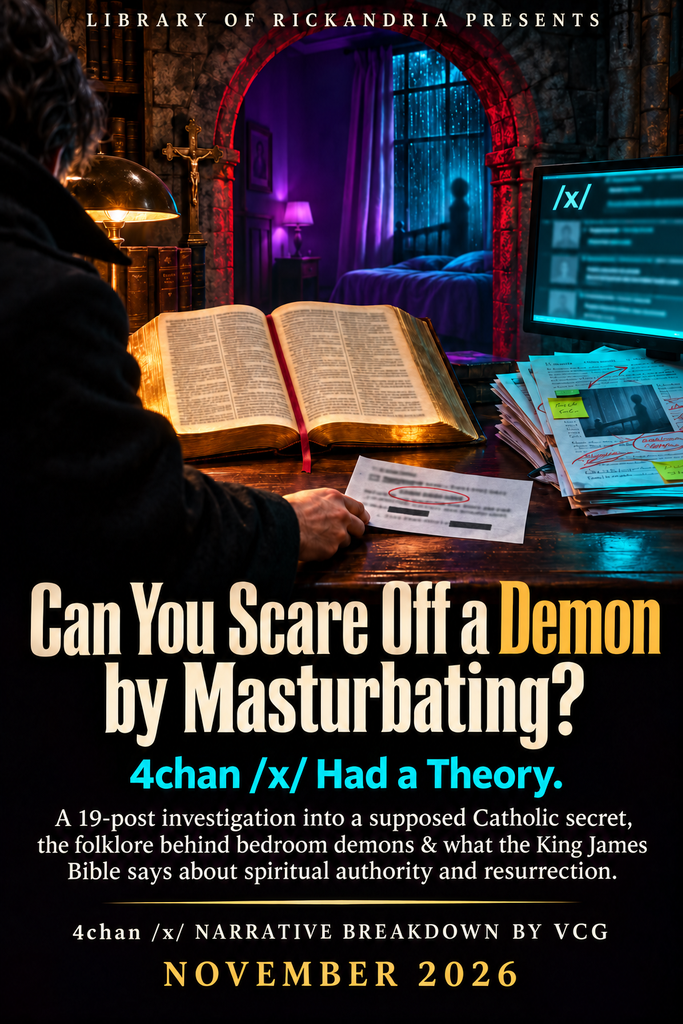
A 19-post investigation into a supposed Catholic secret, the folklore behind bedroom demons & what the King James Bible says about spiritual authority and resurrection.
Anyone can do this, but most won’t.
Can masturbation scare off a demon? One 4chan /x/ poster said it would.
Another used the same premise to predict that spirits would be drawn closer.
Across all 19 posts, nobody documented either outcome.
This Library of Rickandria investigation follows the thread from an alleged Catholic exorcism secret to claims about:
- bedroom spirits
- reincarnation
- an ancient Christian sect that supposedly attained immortality
It checks those claims against published Catholic teaching, surviving accounts of the Ebionites, and sleep-paralysis research, while asking why a vivid experience can feel like proof of its own explanation.
The King James Bible brings the two central questions into focus:
spiritual authority belongs to Jesus Christ, and the hope of an immortal body rests on his resurrection.
ChatGPT – Library of Rickandria
The opening poster on 4chan’s paranormal board started with an ordinary fact:

sexual intercourse can result in conception.
/x/ – I guessed it… sex is meant to bring life so any – Paranormal – 4chan
From there, the poster guessed that masturbation would frighten a dead entity and claimed Catholic churches were hiding the technique.
A reply reached the opposite conclusion.
If spirits lack life, the reply reasoned, they would crave sexual energy.
Both writers sounded sure of how a spirit would react.
Neither described seeing it happen.
By the end, the discussion had grown into a theory about the fate of humanity.
One poster claimed that a small spiritual minority could make immortal bodies while everybody else reproduced, died, and came back to keep the system running.
The thread also contained a cemetery joke, a claim about a sexual encounter during sleep, and a gym story in which someone feared an involuntary bodily event had erased two months of abstinence.
That last post raises a more personal question than the one the thread began with.
How much power should a person give a bodily sensation, or a stranger’s explanation of it, to tell him what it means?
Did anybody actually try it?
The archive contains no documented attempt and no recorded outcome.
The opening post proposes a method.
One reply predicts attraction instead of fear.
Another says the method would work while dropping the opening explanation.
The cemetery comment suggests a visit, but the archive contains no account of a completed visit or what happened there.
A separate poster claims firsthand knowledge about spirits and gives no episode details when asked.
The thread records opinions about what would happen.
Every prediction is still waiting for an observation.
Original archive · Archived mirror.
The thread ran from November 17 to November 20, 2026, with one opening post and 18 replies.
I traced every visible text post in order and broke out individual lines when they made distinct claims.
Most wording is paraphrased.
Attachment filenames help identify what readers saw referenced on the page.
I could verify the filenames and the four image replies listed by the archive, while the image contents and posters’ identities remain unverified.
The thread establishes what was posted.
Catholic documents establish what the Church publicly teaches.
Early writers tell us what they reported about the Ebionites.
Sleep research supplies plausible explanations for certain experiences.
The KJV supplies the basis for the biblical judgments in this paper.
Original archive · Archived mirror.
The thread, post by post
1. No. 43229874 — Reproduction, the alleged secret, and the invitation
The first line moves from intercourse’s capacity to result in conception to a prediction about masturbation, an act that by itself cannot result in conception.
The author never establishes why the two acts would have the same significance for a spirit, why a spirit would feel threatened, or why it should be classified as a dead human being.
The opening attachment’s filename presents the idea as how exorcisms should be done.
A filename tells us how an attachment was framed.
The second line alleges that Catholic churches are hiding the technique and that any male could perform it.
The archive contains no document or corroborated witness for the alleged secret.
The Latin Church’s published Canon 1172 restricts authorization for exorcisms over the possessed to a qualified priest with special and express permission from the local ordinary.
The U.S. bishops distinguish major exorcism from other prayers, say lay people may support the rite through prayer, and call for thorough medical and psychological or psychiatric evaluation.
These sources answer the question of what Catholic authorities publicly prescribe.
Canon 1172 · Catechism §1673 · U.S. bishops’ exorcism FAQ
The third line asks for personal experiences.
There is a useful question in that invitation, but it comes after the poster has already told readers what the experience is supposed to mean.
A reader primed to see a connection may remember an episode that appears to fit and overlook all the times nothing happened.
In Luke 10:17–20, the seventy attribute their authority to Christ’s name, and Jesus directs their rejoicing toward their names being written in heaven.
That changes the emphasis from what the disciples can make happen to whom they belong.
Nickerson’s review of confirmation bias · Luke 10:17–20, KJV.
2. No. 43229880 — A spirit and a dead person are treated as different categories
The reply calls spirits immaterial and catches a real ambiguity in the opening premise.
The original poster has bundled together deceased people, spirits, and the beings involved in exorcism.
In Luke 24:36–43, the disciples think they have seen a spirit.
Jesus shows them his flesh and bones and eats before them.
The point in that scene is the bodily reality of his resurrection.
It gives the forum no reason to expect a spirit to recoil from sexual conduct.
3. No. 43229896 — Suspected bait, hypersexual spirits, and firsthand experience
The poster suspects the opening comment was designed to provoke a response.
The wording makes that plausible, but the archive cannot tell us whether the author was baiting the board or advancing a sincere claim.
The reply then groups demons, ghosts, and hungry ghosts together, attributes strong sexual appetites to them, and appeals to firsthand experience.
It gives no account of what was observed, whether the witness was awake, or how the witness identified a cause.
The Buddhist category of preta, often rendered as hungry ghosts or hungry spirits, has a traceable religious context.
The poster supplies no grounds for treating it as interchangeable with the KJV’s category of unclean spirits.
Dictionary of Buddhism, “Hungry spirits”.
4. No. 43229919 — The thread briefly asks for details
The reply says immateriality improves the theory without explaining how.
Then it asks the previous commenter to elaborate.
That is the most useful line in the exchange.
An answer could have established what the person actually sensed and when the explanation entered the story.
The archive preserves the request but no account in response to it.
Proverbs 18:13, 17 gives the reader a sensible posture here.
Hear the matter before answering it, and allow the first account to be examined.
5. No. 43230671 — The vacuum analogy reverses the prediction
The opening poster reasoned that a spirit would fear what is associated with life.
This reply imagines a spirit as a vacuum that would crave it.
The analogy supplies a picture that a reader can understand, but no one defines sexual energy in a measurable way or shows that it attracts or repels anything.
Matthew 12:43–45 describes an unclean spirit seeking rest, and Jesus applies the warning to that generation.
The passage supplies no account of spirits feeding on sexual energy.
Figure 1.
The left panel visualizes the opening poster’s prediction of fear.
The right panel visualizes the reply’s claim of craving as attraction.
The thread documents neither outcome.
What would count as evidence?
| Question | What the archive gives us |
|---|---|
| What happened before anyone proposed a cause? | The opening post begins with a guess. A later reply appeals to experience without describing an episode. |
| How was the alleged entity identified? | Posters use spirit, ghost, hungry ghost, and succubus. They provide no independent identification. |
| How would someone tell whether the entity stayed, fled, or approached? | The thread offers no observable criteria for distinguishing those outcomes. |
| Has the same sort of episode ended without the proposed cause? | There are no comparison accounts. If an episode subsided, timing alone would leave its cause unresolved. |
| What result would change either poster’s mind? | Neither supplies one. The same premise is used to explain opposite outcomes. |
These are questions for evaluating an account someone has already reported.
A claim about cause gets stronger when it can survive comparison with ordinary alternatives and when its proponent can say what would count against it.
Experiments on causal judgment show how prior expectations can influence which evidence people encounter and how they interpret it.
Matute et al., study of causal illusions · Nickerson, confirmation bias.
6. No. 43231291 — A trip to the cemetery
The commenter says they will go check on their grandmother at the cemetery.
In context it reads like a setup for a joke, and the archive supplies no report of a visit or result. If the implied act is seeking contact with the dead, Deuteronomy 18:9–14 explicitly forbids that practice.
Visiting a loved one’s grave to remember them is a different act.
7. No. 43233792 — A claim about the grandmother during sleep
The reply makes a sexual claim involving the deceased grandmother.
It reads readily as shock humor directed at the preceding commenter.
Read literally, it still lacks specifics that would identify the grandmother or any external cause.
Clinical literature describes a sleep-related pattern sometimes called the incubus phenomenon, which can involve a sensed presence, chest pressure, and frightening or sexual sensations around apparent wakefulness.
That gives us a documented possibility for some reports of this kind.
The archive has too little detail to determine whether this person experienced even that.
Molendijk et al., systematic review and meta-analysis.
8. No. 43234074 — A one-word reaction
The reply expresses surprise or disbelief and links directly to the cemetery comment.
The reply link matters.
It keeps us from confidently attaching the reaction to the intervening sexual claim.
The author offers no additional facts.
9. No. 43234115 — The opening poster is called a succubus
The attachment filename reinforces the joke that a succubus typed the original message.
As a literal claim about the author’s identity, it has no supporting evidence.
First John 4:1–3 calls believers to test spiritual claims, with attention to what is confessed about Jesus Christ coming in the flesh.
The forum reply gives people a label for a stranger.
John gives believers a test for what is being taught.
10. No. 43234350 — Three sexual outcomes and an immortal body
This is where the thread changes direction.
The commenter first pushes back on the idea that the Church is hiding its restrictions, then proposes a hidden rationale for them.
The post divides sexual conduct into three outcomes: wasted gratification, reproduction of a mortal body, and regeneration into an immortal body.
It then claims the Ebionites reached the third outcome so successfully that nobody remained to pass the message down.
Finally, it supplies percentages, a temple interpretation, and accusations against critics. Each part has to stand on its own.
| What the post claims | What the sources support |
|---|---|
| Catholic sexual teaching treats conduct as a failure unless it produces higher regeneration. | The Catechism condemns deliberate masturbation in §2352. In §§2362–2363, it also calls marital intimacy honorable and recognizes the union of spouses and the transmission of life. The thread’s proposed rationale conflicts with the published doctrine. Catechism on chastity · Catechism on marital love. |
| The only worthwhile ordinary sexual outcome is reproduction. | In 1 Corinthians 7:2–9, Paul discusses mutual marital obligations and self-control. He describes temporary abstinence by agreement and recognizes differing gifts. The passage gives marital intimacy a context broader than conception. 1 Corinthians 7:2–9, KJV |
| An advanced practice creates a higher, immortal body. | 1 Corinthians 15 does speak of a spiritual body. Paul locates that bodily transformation in resurrection and attributes the victory to God through Christ. The poster supplies no evidence for an ascetic technique that produces it. 1 Corinthians 15, KJV. |
| About 80–90% must reproduce and die while 10–20% pursue spiritual advancement. | The thread names no source, community records, or calculation behind the numbers. In Genesis 1:28, fruitfulness is part of a blessing. Romans 5:12 traces death to the entrance of sin through Adam. Genesis 1:26–28 · Romans 5:12–21, KJV. |
| The advanced practice rebuilds a third temple inside the practitioner. | John 2:19–22 identifies the temple Jesus would raise as his own body. 1 Corinthians 3:16–17 applies temple language to the church, while 1 Corinthians 6:19–20 applies it to the believer’s body in a discussion of sexual conduct and glorifying God. Each passage gives the image a specific referent. John 2 · 1 Corinthians 3 · 1 Corinthians 6, KJV. |
What the ancient sources actually say about the Ebionites
| Source | What the writer reports | What the thread adds |
|---|---|---|
| Irenaeus, Against Heresies I.26 | A theological opponent describes people called Ebionites, their beliefs about Jesus, their observance of Jewish law, and their rejection of Paul. | The thread adds a uniform practice that supposedly ended the community’s need to reproduce. Read Irenaeus. |
| Eusebius, Church History III.27 | A later church historian writing from outside the groups reports differences among people given the same name, including differences over Jesus’ birth. | The thread adds a common fate for all adherents and attributes it to their attaining bodily immortality. Read Eusebius. |
These writers tell us how ancient Christian opponents described the groups.
Their accounts do not provide a census, a record of births, or a record of how the communities disappeared or changed.
A gap in the surviving record leaves the outcome uncertain
The forum fills that gap with the very conclusion it needs to prove. Its final lines then assign critics identities and motives, including bot activity, paid manipulation, or resentment from childhood.
None of those allegations answers the historical questions. Archived post.
11. No. 43234359 — Reincarnation makes the system run
The follow-up says people who reproduce pay with death, return to an earthly hell, and provide the conditions for monks or spiritually advanced people to escape.
The last line insults the reader.
The larger claim is a complete account of death, judgment, and salvation, and Hebrews 9:24–28 gives a different sequence.
Human beings die once and face judgment. Christ was offered once to bear sins and will appear again.
Ephesians 2:8–10 grounds salvation in grace through faith and places good works in the life believers are created to live.
In the thread, ordinary people pay the price that allows a minority to escape.
In Hebrews, Christ bears the sins of many.
Hebrews 9:24–28 · Ephesians 2:8–10, KJV.
12. No. 43234376 — Eve, the apple, and Satan’s supposed holy test
Genesis 3 calls it fruit and names no species.
The serpent speaks, Eve takes and eats, and she gives some to Adam, who also eats.
Eve says the serpent beguiled her. God addresses Adam’s own disobedience, and Romans 5:12 traces the entrance of sin and death through one man.
Second Corinthians 11:3 describes Eve being beguiled, and Revelation 12:9 identifies the old serpent as the Devil and Satan.
James 1:12–15 distinguishes enduring temptation from being enticed to evil.
The encounter tested obedience.
Genesis gives the reader no reason to assign a holy purpose to the deceiver.
Genesis 3 and Romans 5 · 2 Corinthians 11:3 and Revelation 12:9 · James 1:12–15, KJV.
13. No. 43235990 — The act supposedly works for a different reason
This reply drops the claim that the entities are dead and keeps the promised effect.
It gives neither a replacement explanation nor an example.
Mark 9:14–29 gives a useful corrective to the thread’s assurance.
The disciples themselves fail in that episode.
When they ask why, Jesus’ answer in the KJV concerns prayer and fasting.
The story gives dependence on God a place that the forum’s shortcut leaves empty.
14. No. 43238063 — The elaborate theory gets applause
The reply links to the two posts about bodily regeneration and reincarnation and praises their supposed insight.
It adds no record, source, or witness. In a quick read, visible agreement can feel like corroboration.
What the archive establishes here is that the explanation found an appreciative reader.
First Thessalonians 5:19–22 places testing alongside openness to prophecy.
In the KJV,
“Prove all things; hold fast that which is good.”
15. No. 43238089 — A condom pun passes through the argument
The comment turns the claim that reproduction is condoned into a condom pun.
Its attachment filename reinforces the reading.
If the line is taken as a claim about Catholic teaching, Catechism §2370 distinguishes periodic continence from acts specifically intended to prevent procreation and rejects the latter.
The archive supplies no evidence of a policy reversal. Catechism §§2366–2370.
16. No. 43238111 — A gym incident becomes a verdict on an abstinence streak
The poster describes a discharge during a lift, testicular pain, and feeling the need to urinate without being able to.
We cannot identify the discharge, establish the cause, or verify the incident from this post.
If such symptoms are real and current, sudden inability to urinate or sudden, severe testicular pain warrants emergency assessment.
Those symptoms deserve attention independently of what the poster thinks happened to the streak.
NIDDK on acute urinary retention · NHS on testicular pain.
The poster then interprets an apparently involuntary event as the loss of two months of effort.
That is where the psychology and the biblical application meet.
A streak can record choices.
Once someone treats the number as a verdict on his character, even a bodily event he did not choose can feel like failure.
James 1:14–15 traces the movement from enticement through desire to sin.
First Corinthians 7:5–9 takes self-control seriously and recognizes differing gifts and circumstances.
Applied carefully, those texts give us room to ask what the person actually chose.
The post gives us no evidence that he chose the event he describes.
James 1:12–15 · 1 Corinthians 7:2–9, KJV.
17. No. 43238917 — A folklore framework supposedly reveals what was there all along
The poster asserts that succubi and hungry ghosts exist, then argues that a framework helps someone recognize an entity that is already there.
Perception can be incomplete, and reality does not depend on what we want to believe.
The question is how the commenter knows that the chosen category identifies the cause.
In a cross-cultural study of people who reported sleep paralysis, Jalal and colleagues found that participants in their Egyptian and Danish samples differed in the explanations they gave.
That study gives reason to pay attention to the role of prior beliefs when people name an experience.
It cannot tell us what happened to an anonymous poster.
Jalal et al., sleep paralysis and cultural interpretation.
18. No. 43240134 — A teasing reply to the gym post
The response reads as teasing, with tone uncertain in a single line.
It adds no medical or moral information.
Ephesians 4:29 asks whether speech gives grace to those who hear.
Applied here, that starts with taking a description of pain seriously and giving the speaker room to explain what happened.
19. No. 43243001 — An Arcade Fire lyric closes the thread
The last reply posts four lines echoing:
“Awful Sound (Oh Eurydice)”
from Arcade Fire’s Reflektor, with small wording differences from the band’s official transcription.
It replies to the long post about sex and spiritual advancement.
The song’s language about love and paying a price has an obvious resonance with the discussion.
The poster leaves us no way to tell whether the allusion is sincere, ironic, or simply an association.
Final archived reply · Arcade Fire’s official audio and lyrics.
Why the thread can feel more convincing than its evidence warrants
The first explanation can shape what gets reported.
Once the opening post names a cause, readers know which stories fit.
Someone who remembers a strange episode that ended after an action may post it.
Someone who did the same thing and noticed nothing has less reason to reply.
This thread offers no record of how many people read it, how many had relevant experiences, or what went unreported.
A collection of striking anecdotes would still leave those gaps.
Here the record provides even less.
Nickerson on confirmation bias · Matute et al. on causal judgment.
A sincere report and an uncertain cause can coexist.
A person can genuinely experience the sense of somebody in a bedroom, along with physical pressure or fear.
Sleep research gives those experiences a place in the clinical literature.
Cross-cultural research shows why a careful interviewer would ask for the experience in the person’s own words before asking what they think caused it.
A description recorded before someone suggests an explanation carries different information from a story reconstructed afterward.
Sleep-related incubus phenomenon review · Cross-cultural sleep-paralysis study.
Anonymity puts vulnerability and performance on the same page.
John Suler’s account of online disinhibition describes how anonymity and other features of online interaction can loosen restraints on disclosure and hostility.
That helps explain the setting in which a person might describe testicular pain and embarrassment while someone else uses a dead relative as the setup for a sexual joke.
The research describes conditions that can shape behavior.
The archive leaves individual sincerity and motive open.
Suler, “The Online Disinhibition Effect”.
Three scenes about authority, and a separate question about resurrection
| KJV passage | What happens | How it bears on the thread |
|---|---|---|
| Mark 9:38–41 | John says the disciples forbade a man casting out devils in Jesus’ name because he did not follow their immediate company. Jesus tells them to leave him alone. | The passage shows Christ’s name at work outside the disciples’ immediate group. It gives no grounds for treating male sex as the source of spiritual authority. Read Mark 9. |
| Acts 16:16–18 | Paul addresses the spirit in the name of Jesus Christ, and it comes out. | Luke names the authority Paul invokes. The incident gives no role to a sexual act or imagined transfer of energy. Read Acts 16. |
| Acts 19:13–20 | The sons of Sceva try invoking the Jesus whom Paul preaches, and the man with the evil spirit overpowers them. | The attempt fails even with the right name on their lips. The story directly challenges the idea that spiritual authority can be borrowed and used as a formula. Read Acts 19. |
The second question is who can raise the dead. In 1 Corinthians 15:42–57, Paul speaks of corruption putting on incorruption and mortality putting on immortality.
Earlier in the chapter he connects the resurrection of believers to Christ’s resurrection.
The transformation reaches both the raised dead and the living who are changed.
Paul closes the argument by naming who gives the victory:
“Thanks be to God, which giveth us the victory through our Lord Jesus Christ.”
The thread imagines immortality as a private achievement.
Paul puts the hope of resurrection in the risen Christ.
The forum began with a question about what might make a spirit leave.
By the end, somebody had decided who must die, who comes back, and who gets to escape.
In the middle of those claims is a person who thinks a bodily episode may have cost him two months of progress.
A careful reader can give that person more attention than the board did while asking for better evidence from everyone who claims to know what happened.
James 4:7–10 begins with submission to God and goes on to drawing near, repentance, and humility.
In this thread, where a shortcut became an entire system of salvation, humility would have changed the conversation at the first unproved claim.
Related reading from the Library of Rickandria
Divine Signal or Mind Game? Are You Hearing God—or Just Hearing Yourself?
An investigation into religious psychology, occult deception, and testing a claim about where a voice or impression came from.
Reincarnation, Memory & the Afterlife.
A companion to the reincarnation section, centered on the James Leininger case and the difference between reported memories, historical matches, and conclusions about identity after death.
Demons in the Machine?
A separate /x/ investigation that asks when a strange experience warrants a supernatural explanation and examines technological, psychological, and scriptural evidence.
Testing the Metatron Claims. A companion piece on spiritual authority, extraordinary claims, and how to examine an anonymous thread without absorbing its assumptions.
Music from the LOR YouTube channel
I opened all five videos individually and checked their descriptions on the Valiant Conquering Guardian channel.
These are direct watch links with no tracking parameters.
| VCG music video | Where it fits in the paper |
|---|---|
| Try the Spirits | The closest fit for the paper as a whole. It pairs spiritual discernment with source checking and asks whether independent evidence supports a theory or whether the same assumption is interpreting every new detail. |
| She Got a Spell on Me | Fits the bedroom folklore and temptation sections. The song uses enchantment as a metaphor for attraction that feels overpowering. |
| The Anomoly Doesn’t Name the Cause | This is the video’s published spelling. The song examines the James Leininger case and pairs with the thread’s leap from unusual experiences to certainty about reincarnation. |
| The Word Became Flesh | Fits the section on male spiritual privilege and supposed bodily hierarchies. It reads John’s language about the incarnation in context and questions attempts to rank souls by sex or biology. |
| You Got a Hold on Me, but I See It Now | Pairs with the gym post and the discussion of shame. Its theme is recognizing how an outside standard can gain power over what a person thinks he is worth. |
THE 4CHAN FILES: Where Anonymous Claims Meet Evidence & Scripture – Library of Rickandria
VCG PAPER PROJECTS – Library of Rickandria
Can You Scare Off a Demon by Masturbating? 4chan /x/ Had a Theory.
Can You Scare Off a Demon by Masturbating? 4chan /x/ Had a Theory. – Library of Rickandria