
THE MEMORY THAT SHOULDN’T EXIST: 4chan’s Simulation Theory, Secret Bloodlines & the Biblical Truth
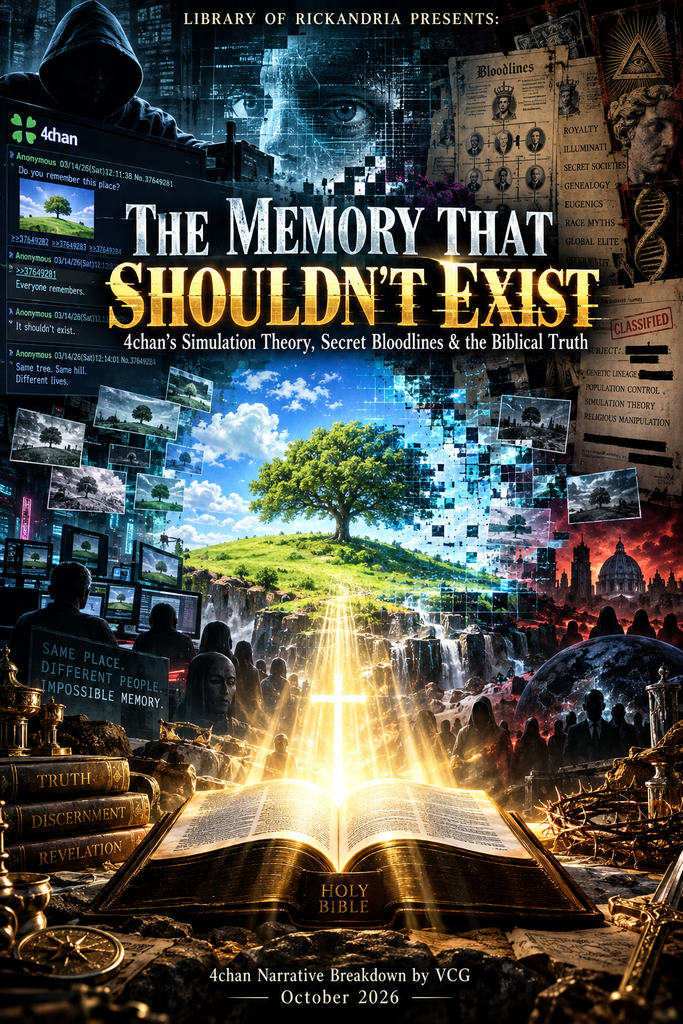
UPDATED BY VCG ON 10/14/2026 @ 09:11 EST
Anyone can do this, but most won’t.
This Library of Rickandria investigation takes readers deep into a mysterious October 2026 4chan thread claiming that humanity possesses artificial memories implanted within a simulated reality, beginning with the strangely familiar image of a lone tree on a green hillside. Through a meticulous post-by-post examination, the paper exposes how a simple question about memory evolved into elaborate theories involving secret bloodlines, Adamite ancestry, gifted education programs, pre-birth experiences, paranormal phenomena, and human cloning. Drawing upon peer-reviewed neuroscience, psychological research, AI-induced false-memory experiments, historical records, philosophical arguments, and the King James Bible, the investigation separates documented facts from speculation, examines how collective suggestion and cognitive biases can transform personal experiences into seemingly convincing conspiracies, and challenges racial pseudoscience and unsupported spiritual claims. Ultimately, the study reveals that while human memory is remarkably complex—and genuine mysteries concerning consciousness remain—extraordinary experiences do not automatically establish extraordinary explanations. Above all, it demonstrates the importance of rigorous research, biblical discernment, intellectual humility, and the scriptural command to “Prove all things; hold fast that which is good” (1 Thessalonians 5:21, KJV). Soli Deo Gloria.
ChatGPT – Library of Rickandria
LIBRARY OF RICKANDRIA PRESENTS
THE MEMORY THAT SHOULDN’T EXIST
4chan’s Simulation Theory, Secret Bloodlines & the Biblical Truth
A Forensic Investigation of Artificial Memories, Shared Nostalgia, Human Consciousness, Racial Mythology, Gifted Education, and Scriptural Discernment
4chan Narrative Breakdown by VCG — October 2026
Research edition · Primary-source examination · Historical and scientific fact-checking · King James Bible (Pure Cambridge Edition)
Abstract
What if you remembered a place you had never visited?
Not simply a vague landscape, but something unexpectedly familiar:
a solitary tree on a brilliant green hillside beneath a blue sky.
You cannot remember when you first saw it.
You cannot identify its location.
Yet looking at the image creates the strange impression that it has always been somewhere in your mind.
On October 12, 2026, an anonymous contributor to 4chan’s paranormal board, /x/, proposed an explanation.
/x/ – Artifical memories as proof of simulated reality – Paranormal – 4chan
Perhaps such images are not ordinary memories at all.
Perhaps human consciousness exists inside a simulated reality, and certain recollections are installed in the mind before ordinary life begins.
The conversation developed in unexpected directions.
Participants introduced:
- racial classification
- an alleged ancestry examination
- gifted-child programs
- unusual physical characteristics
- dreams resembling another existence
- possible memories from before birth
and speculation about human cloning.
This investigation examines the discussion as a historical internet artifact, not as a collection of established facts.
Its purpose is to answer five questions.
- What did the participants actually claim, and what evidence did they provide?
- What does scientific research establish about memory, familiarity, suggestion, dreams, and unusual bodily experiences?
- Where did the discussion’s ideas about simulation, Adamites, gifted education, and secret bloodlines originate?
- Which arguments can be investigated, and which lack testable predictions?
- What does the King James Bible teach about creation, human identity, dreams, divine foreknowledge, and the testing of spiritual claims?
The investigation incorporates:
- primary documents
- peer-reviewed research
- historical records
- visual evidence
- contextual biblical interpretation
It distinguishes reported experience from documented fact, philosophical possibility from empirical evidence, and biblical text from theological inference.
Its central finding is straightforward: the thread raises legitimate questions about the nature of memory but provides no independently verified evidence that memories are artificially installed, that reality is simulated, or that particular ancestral groups possess privileged access to hidden spiritual knowledge.
That conclusion does not require dismissing unusual experiences.
It requires examining them carefully.
PART I — THE THREAD AND THE RULES OF THE INVESTIGATION
1. A photograph, a memory, and an extraordinary explanation
The original thread bears the title
“Artifical memories as proof of simulated reality”
—with the spelling preserved as it appears in the source.
It was opened on October 12, 2026, at 20:34:05 according to the site’s displayed timestamp.
The final visible reply followed on October 13 at 06:18:37.
The surviving page contains eleven posts, including the original submission, and five image attachments.
The thread is archived.
Primary document:
4chan /x/ — Thread No. 43073747, complete surviving discussion.
Figure 1. The photograph at the center of the discussion

Clean environment — Stock Photo © WDGPhoto #18169225
Contextual image lookup.
For the actual evidence, examine the original photograph attached to post #43073747.

The original is visibly watermarked Vecteezy.
The attached photograph shows a green deciduous tree on a gently sloping hill, with an intense blue sky, white clouds, and distant mountainous terrain.
Its visual simplicity matters. It is recognizable without containing many distinctive landmarks.
The opening author likens consciousness to a newly initialized computer system and imagines that certain memories are included at installation.
The analogy has intuitive appeal.
Modern computers really do arrive with preconfigured files.
Human beings really do possess memories whose origins they cannot always identify.
Combining those ideas produces an intriguing question.
But an analogy is not yet an explanation.
We can demonstrate the existence of computer files, inspect their storage, and establish the processes by which they were installed.
The thread provides no comparable evidence for the alleged installation of human memories.
It also makes a further leap:
even if artificial memories existed, their existence alone would not establish that the entire physical universe was simulated.
Artificial memory and simulated reality are separate propositions.
That distinction will guide the investigation.
2. Our evidentiary standard
The paper uses five categories of information.
| Category | Meaning |
|---|---|
| Primary evidence | What the original posts, images, and documents actually contain |
| Historical evidence | Records showing when ideas, events, institutions, and publications appeared |
| Scientific evidence | Research testing measurable phenomena under defined conditions |
| Philosophical interpretation | Arguments about what may be possible, probable, or logically implied |
| Biblical interpretation | The meaning of Scripture examined through language, context, and comparison with other passages |
These categories interact, but they are not interchangeable.
A memory researcher can study how recollections change without settling every metaphysical question about consciousness.
A historian can trace the origins of an Adamite theory without proving the theory.
A philosopher can establish that a simulation is conceptually possible without demonstrating that we inhabit one.
Similarly, Scripture can be read faithfully without pretending that every modern technological concept appears somewhere in Genesis.
We will distinguish four outcomes:
- established
- plausible but unconfirmed
- unsupported
- contradicted by available evidence
Some philosophical claims will be classified separately as insufficiently specified for testing.
These judgments apply to propositions rather than people.
An anonymous writer can describe a sincere experience and still draw an unsupported conclusion.
Our biblical standard includes 1 Thessalonians 5:21 (KJV):
“Prove all things; hold fast that which is good.”
The investigation also follows Proverbs 18:17:
“He that is first in his own cause seemeth just; but his neighbour cometh and searcheth him.”
Both verses encourage examination rather than the uncritical acceptance of persuasive testimony.
3. Important limits of the source
Although the surviving thread is accessible, several limitations should be stated before analyzing it.
The comments are anonymous or pseudonymous.
Eleven posts do not necessarily represent eleven different people.
The page does not provide independent information establishing the participants’:
- ages
- ancestry
- educational histories
- medical characteristics
- motives
or sincerity.
Nor does a collection of voluntary replies constitute a representative population survey.
The presence of similar ideas in multiple comments demonstrates that those ideas appeared in the conversation.
It does not establish how many people elsewhere share them.
The images are also evidence of what participants uploaded, not necessarily evidence that the captions or interpretations attached to them are accurate.
Finally, the cinematic cover created for this project is artistic illustration, not a screenshot of the historical thread.
Some decorative forum text in that artwork does not reproduce the real dates or post IDs.
The documentary record takes precedence over visual dramatization.
PART II — THE COMPLETE 4CHAN NARRATIVE, POST BY POST
4. A chronological examination of all eleven posts
A useful feature of this particular thread is its brevity.
There are few enough contributions to examine every one, yet sufficient changes in subject to reveal how an initially narrow question grows into a much larger speculative narrative.
The following reconstruction preserves the order of the surviving page.
| Post ID | Displayed date and time | Principal subject |
|---|---|---|
| 43073747 | Oct. 12, 8:34 PM | Original artificial-memory hypothesis |
| 43073851 | Oct. 12, 9:06 PM | Racially framed challenge |
| 43073907 | Oct. 12, 9:22 PM | Supposed Aryan examination |
| 43073958 | Oct. 12, 9:40 PM | Windows XP alternative explanation |
| 43074003 | Oct. 12, 9:59 PM | Adamite features and GATE |
| 43074022 | Oct. 12, 10:10 PM | Personal traits, experiences, and a Siddell image |
| 43074045 | Oct. 12, 10:20 PM | Claim that truth will remain inaccessible |
| 43074170 | Oct. 12, 11:12 PM | Personal harassment and conspiracy insinuation |
| 43074492 | Oct. 13, 12:41 AM | Dream imagery, afterlife speculation, the Sun |
| 43074812 | Oct. 13, 2:31 AM | Apparent memories from before birth |
| 43075194 | Oct. 13, 6:18 AM | Alleged cloning of blond people |
Times are transcribed from the site as displayed; no independent timezone conversion has been assumed.
Post #43073747 — Human consciousness as a computer installation
The opening author imagines new human consciousness appearing inside a simulation with existing memories already stored in it.
The familiar tree is presented as one candidate.
There are three different claims here, and they should be kept separate.
The first is that human consciousness might be computational.
That is a subject of serious philosophical debate, although theories of computational cognition differ considerably from the idea that a person is literally a software program.
The second is that certain human memories might be artificial.
Memory alteration is a real field of psychological investigation, as we will examine later.
The third is that artificial memories would demonstrate a simulated universe.
This does not follow automatically from either of the first two propositions.
The author further restricts the alleged memory to white or Aryan men, while conceding that this is the population they claim to know about.
But the post supplies no comparative data establishing that the experience is distributed by ancestry or sex.
A sample selected from those who already feel an affinity with the picture would also be subject to severe selection bias.
It could tell us about the experiences of interested respondents, but not how common the experience is.
Assessment:
The opening post is philosophically suggestive but empirically unsupported.
Its racial framing adds an unsupported demographic assumption.
Scripture: Genesis 2:7 describes God forming man and giving him life.
It does not present the creation of consciousness as software installation.
The theological claim concerns the Creator and the life of his creature, not the technical implementation of a computer environment.
Post #43073851 — A challenge to the author’s racial identity
The next participant demands evidence of the opening author’s appearance and does so abusively.
Even if the author produced a verifiable photograph, the original proposition would remain unproven.
A person’s appearance does not establish the source of a remembered image.
This is an example of an argument becoming diverted from a proposition to the identity of the person proposing it.
There is a legitimate scientific question concerning whether ancestry influences particular characteristics.
But investigating that question would require defined populations, representative sampling, valid measurements, and an explanation of the proposed mechanism.
An insult and a demand for a picture provide none of these.
Assessment: No evidence for or against artificial memories.
Scripture: James 2:1 warns against partiality among those who profess faith in Christ.
The immediate context concerns social favoritism, but the broader principle of judging without improper respect of persons is relevant.
Post #43073907 — The alleged official ancestry examination
The original side of the discussion answers with a numerical claim and an image purporting to classify Aryan characteristics.
Figure 2. The racial scoring chart introduced into the discussion
Primary attachment:

View the original Aryan Exam 2.0 image.
The chart assigns numerical values to pigmentation, stature, and facial characteristics.
It is examined here as evidence of pseudoscientific classification, not as a valid biological instrument.
The distinction between numerical precision and scientific validity is important.
A chart may assign a score to almost anything.
To become a meaningful scientific measurement, however, it needs a well-defined construct, a valid method, reliability, and evidence that the resulting numbers measure what they claim to measure.
This chart has none of those demonstrated properties.
The underlying racial category is also historically compromised.
The United States Holocaust Memorial Museum explains that Aryan was associated with historical and linguistic classifications before being transformed into a mythical racial category.
The supposed superior Aryan race has no valid scientific foundation.
See the museum’s historical explanation of the term Aryan.
The modern genetics distinction is equally important: ancestry describes inherited relationships among populations, while socially constructed racial categories cannot be reduced to a few superficial traits.
The National Human Genome Research Institute discusses these differences in Use of Population Descriptors in Genomics.
Assessment:
An appearance-based racial meme, not a validated ancestry examination.
Its claimed connection to extraordinary memory is unsupported.
Scripture:
Acts 17:26 describes humanity’s common origin under God.
Neither that passage nor the surrounding argument provides a basis for a superior spiritual class determined by eye color or hair color.
Post #43073958 — The first substantial skeptical explanation
The fourth post introduces a useful alternative.
Perhaps the familiar hillside comes from early exposure to the famous Windows XP desktop image, combined with a remembered or imagined tree.
Figure 3. The Windows XP landscape comparison
Charles O’Rear’s Bliss photograph became closely associated with Windows XP.
Unlike the 4chan photograph, the original has no solitary tree.
The comparison is relevant to familiarity, not proof that one image caused the other.
Source background:
History of the Bliss photograph.
The skeptical commenter has identified a legitimate possibility.
There is a strong resemblance in the broad composition:
- green hillside
- intense blue sky
- bright daylight
and an uncluttered landscape.
That does not mean the two photographs are identical, nor that every person recalling the tree must have encountered Bliss.
More importantly, the commenter adds an explanation of how the brain might repair an apparently unusual image.
This is where the skeptical argument becomes less reliable.
Memory reconstruction is documented.
But the specific story that the viewer’s brain inserted a tree to preserve psychological stability has not been demonstrated for the author.
It is a plausible-sounding explanation, not a finding.
The best scientific position is therefore narrower:
the Windows XP photograph is one candidate cultural source, and established memory processes make image blending possible.
Further evidence would be needed to show that either actually occurred.
Relevant research includes Garry and colleagues’ 1996 study of imagination inflation, which found that imagining childhood events could increase confidence in their occurrence.
Assessment:
A worthwhile naturalistic alternative, although its proposed explanation of the particular recollection remains unconfirmed.
Scripture:
Proverbs 14:15 counsels prudence.
We should not confuse a naturalistic guess with demonstrated evidence any more than we should accept a supernatural assertion without examination.
Post #43074003 — The arrival of Adamite characteristics and GATE
The fifth post introduces the phrase Adamite features and attaches an older discussion about gifted education.
Figure 4. The GATE screenshot
Primary attachment:

Examine GATE.png from the original thread.
This is an anonymous internet discussion, not a government document, school record, or peer-reviewed study.
The screenshot is revealing because it mixes a real educational designation with allegations that go far beyond educational practice.
Gifted and Talented Education programs have existed for decades.
They identify students who may benefit from advanced instruction or differentiated learning opportunities.
The National Association for Gifted Children describes the use of multiple identification methods and the variation among school systems.
The screenshot, by contrast, presents an extraordinary narrative involving supposedly unusual students, peculiar personal characteristics, and covert purposes behind their selection.
Its list includes characteristics that can be found in otherwise ordinary populations.
That creates a methodological problem.
When a list contains many traits, an individual is more likely to recognize one or several of them.
Unless the traits are measured in a representative sample and compared with controls, matching the list establishes little.
The screenshot also carries an older 2017 posting date.
This means that the story predates the present conversation.
It does not mean that the story’s allegations have been independently substantiated.
Assessment:
Gifted education is real; the alleged covert paranormal purpose remains unsupported.
Scripture:
First Timothy 1:4 warns against fixation on speculative genealogies.
Whatever precise historical controversies Paul was addressing, his warning should discourage elevating unverified bloodline speculation into Christian doctrine.
Post #43074022 — When personal biography becomes apparent evidence
The sixth post is one of the thread’s most revealing contributions.
A respondent identifies several characteristics they believe may match the GATE list and describes unusual experiences from childhood and sleep.
The post also returns to a strongly familiar landscape and supplies an image associated with painter Peter Siddell.
The difficulty is not that these experiences are necessarily false.
Many of the individual descriptions are ordinary or medically recognizable.
The difficulty is the proposed connection between them.
Blood type
The participant mentions an Rh-negative mother and a personally reported O-positive blood type.
There is nothing biologically impossible about an Rh-negative mother giving birth to an Rh-positive child.
It is a known inheritance combination, although in some pregnancies it can create a medical issue requiring monitoring or preventive treatment.
The National Library of Medicine explains the condition in its Rh incompatibility overview.
These blood types offer no evidence of a separate species, supernatural ancestry, or implanted memory.
Physical appearance
Hair and eye color are ordinary inherited traits influenced by genetic variation.
A localized cranial feature likewise cannot serve as a scientifically valid marker of spiritual or metaphysical origin.
If an unusual skull shape raises an actual medical concern, it belongs in an anatomical or clinical assessment—not a paranormal classification chart.
Experiences during sleep
Out-of-body sensations can be extremely convincing.
In a 2002 Nature report, Olaf Blanke and colleagues described inducing an experience resembling separation from the body through focal electrical stimulation near the right angular gyrus of a patient being evaluated for epilepsy treatment.
The researchers associated the phenomena with the integration of sensory information concerning bodily position.
Their work does not explain every reported out-of-body experience.
But it demonstrates that an experience of leaving the body does not necessarily establish that consciousness has actually departed from it.
Read the original Nature paper, Stimulating Illusory Own-Body Perceptions.
Childhood accent and education
The childhood speech account lacks a contemporaneous recording or linguistic assessment.
Its source is a family recollection reported many years later.
The advanced schoolwork described by the participant is consistent with the ordinary purpose of gifted or accelerated instruction.
Neither proves a secret selection program.
The racial accusations
The commenter also suggests that certain ethnic groups are interfering with the discussion.
No evidence of coordinated disruption is provided.
Rather than strengthen the theory, such accusations weaken the argument by encouraging participants to explain disagreement through the presumed identity or motive of critics.
The attachment
The associated artwork is particularly important, and we will examine it separately in Part IV.
Assessment:
Several plausible personal experiences are being assembled into one extraordinary explanation without evidence that they share a common cause.
Scripture:
Romans 12:3 encourages sober self-assessment.
It does not forbid investigation of unusual experiences; it cautions against unwarranted confidence about one’s own status or significance.
Post #43074045 — Truth presented as permanently inaccessible
The seventh participant offers a short declaration that the truth will never be reached.
There is an accompanying image, but the full-size attachment could not be retrieved reliably during this examination.
Its content is therefore not used as evidence.
The text supplies no explanation, corroboration, or testable prediction.
It may be provocation, performance, genuine pessimism, or an attempt to imply possession of hidden knowledge.
The evidence does not allow us to determine the author’s motive.
In mystery-oriented discussions, the suggestion that essential knowledge exists beyond verification can become a powerful rhetorical device.
It permits a claim to remain important even when no information can establish it.
But a statement that truth is inaccessible is not itself evidence about what the truth is.
Assessment: An unsupported rhetorical assertion.
Scripture:
Deuteronomy 29:29 distinguishes what is secret from what has been revealed.
That distinction encourages humility rather than claims of unauthorized spiritual knowledge.
Post #43074170 — Harassment disguised as rebuttal
The eighth post responds with a personal insult directed at gender identity and invokes an anti-Jewish conspiracy insinuation.
The accusation is unsupported.
It provides no evidence about the original image, consciousness, memory, or simulated reality.
This response also illustrates an important distinction between criticism and explanation.
If someone rejects an unusual hypothesis, their rejection may be:
- valid
- invalid
- sincere
- dishonest
- informed
or uninformed.
None of those possibilities can be established merely by attributing a social identity or alleged hidden affiliation to them.
It is improper to treat disagreement as proof that an organized adversary is suppressing the truth.
Assessment:
Harassment and unsupported accusation; no meaningful evidentiary contribution.
Scripture:
James 1:19 urges restraint in speech, while Ephesians 4:25 instructs believers to speak truthfully.
Post #43074492 — A peaceful house, a dreamworld, and the remembered Sun
The ninth contribution returns to personal experience.
A participant describes a dream involving a house, apparently familiar furnishings, a doorway opening toward an outdoor environment, and an unusually peaceful atmosphere.
The dream is tentatively interpreted as an afterlife-like place.
The poster also recalls the Sun as more yellow in the 1990s and suggests that its appearance has since changed.
There are several distinctions to make.
The remembered house
A dream can incorporate familiar architectural elements, objects, textures, and emotional associations without representing an objectively existing location.
The poster expresses uncertainty about specific details.
That uncertainty should be preserved rather than edited into greater confidence.
We have no independent record verifying the supposed location, its relationship to the afterlife, or any information that could not have originated through ordinary experience.
The feeling of peace
Feelings of peace, wonder, dread, or profound significance are important components of human experience.
But a feeling is not a direct measurement of the ontological status of the environment in which it occurs.
The experience may matter personally without constituting evidence of another realm.
The Sun’s color
The physical Sun did not demonstrably undergo the claimed transformation from yellow in the 1990s to white today.
Sunlight contains the visible wavelengths that together can appear white.
Atmospheric scattering, viewing angle, airborne particles, and visual conditions influence the colors perceived from Earth.
For the underlying optics, see Stanford Solar Center’s educational explanation of solar color, together with NASA’s discussion of visible light.
The distinction between the Sun’s physical emission and a person’s memories of how sunlight looked decades earlier is crucial.
The ancestry problem returns
Interestingly, this poster does not identify as exclusively white, even though the original author initially associated the image with a particular ancestry and sex.
That does not establish a universal shared memory.
But it demonstrates that the conversation itself does not consistently sustain the original demographic restriction.
Assessment:
A potentially meaningful subjective dream, with no independent evidence of an afterlife location or historical change in the Sun’s color.
Scripture:
Revelation 21:4 describes the removal of death and suffering in the consummation of God’s purposes.
It does not identify a particular remembered house, atmospheric appearance, or dream scene as heaven.
Post #43074812 — A possible memory from before birth
This contribution, attributed to the pseudonym Purple345, presents the thread’s most interesting claim about temporal memory.
The writer describes a dark environment and images of relatives or other people, some apparently encountered later in life.
The crucial question is when the alleged memory was first documented.
Human autobiographical memory is not uniformly absent in early childhood.
Children can remember significant events from very young ages, although adults tend to retain relatively few accessible autobiographical memories from approximately the first three to four years of life.
Patricia Bauer’s 2015 review examines the development of this phenomenon in detail:
A Complementary Processes Account of the Development of Childhood Amnesia and a Personal Past.
Nevertheless, a vivid memory-like experience later attributed to the period before birth does not establish that the experience actually occurred then.
Several questions are unanswered.
Did the person describe the images before encountering the photographs?
Were the descriptions recorded?
Were there genuinely distinctive details?
Could the person have seen the information indirectly?
Are unsuccessful recollections being counted alongside apparent matches?
A retrospective account cannot answer those questions.
That does not require accusing the writer of fabrication.
The person may sincerely remember the experience as described while being mistaken about its source or timing.
Assessment:
Unverified autobiographical testimony, not proof of prenatal consciousness or precognition.
Scripture:
Jeremiah 1:5 records God’s knowledge and appointment of Jeremiah before his birth.
It does not state that Jeremiah consciously remembered events before entering the womb.
Post #43075194 — The cloning hypothesis
The last visible response advances a biological conspiracy concerning blond, blue-eyed people.
The thread offers no genetic analysis, demonstrated cloning mechanism, population statistics, or documentary evidence supporting the allegation.
Cloning has a specific biological meaning.
Similar pigmentation and general appearance do not demonstrate that two people are clones.
The final claim also introduces a demographic assumption without establishing an expected population distribution against which the present population could be compared.
This is important methodologically:
a claim that there are unexpectedly many people with a trait requires a defensible prediction of how many there should be.
No such prediction appears.
Assessment:
Unsupported biological speculation that does not resolve the original question about memory.
Scripture:
Genesis 1:27 assigns human dignity to humanity as created in God’s image.
The Bible provides no basis for treating people with particular pigmentation as biologically inauthentic or spiritually inferior.
PART III — HOW A MEMORY QUESTION BECAME AN INTERNET CONSPIRACY
5. The stages of narrative expansion
Reading the posts individually is useful.
Reading them together reveals something else:
the subject changes repeatedly, while the atmosphere of mystery remains constant.
The thread begins with a picture and a proposed memory phenomenon.
It then travels through:
- racial classification
- gifted education
- unusual experiences
- religious ancestry
- cloning
The transitions are not established through new measurements or discovered records.
They generally occur because one participant introduces another association.
- An image feels strangely familiar
- The original observation
- Perhaps the memory was installed
- A proposed mechanism without direct evidence
- Perhaps certain people share a hidden identity
- Racial and genealogical speculation
- Perhaps real institutions are part of the secret
- GATE and covert-selection allegations
- Other unexplained experiences are added
- Dreams, blood type, childhood memories, bodily sensations
- A larger hidden-world narrative emerges
- The conversation feels more elaborate without establishing its first claim
Figure 5.
Analytical reconstruction of the discussion’s narrative development, not a proven account of the participants’ mental processes.
There is a tendency in such discussions for one speculative idea to supply the atmosphere of credibility for another.
The GATE program’s real existence makes a story about covert educational selection sound superficially more concrete.
Real genetics makes invented bloodline categories sound scientific.
Real memory research makes the phrase artificial memories sound technical.
Yet the validity of those real subjects does not transfer to the unsupported conclusions attached to them.
This is the central problem of evidence laundering:
true background information is presented alongside speculative assertions until the distinction between them becomes difficult to see.
6. Why disagreement is important
A particularly concerning moment occurs when criticism is attributed to hostile ethnic groups or supposedly coordinated interference.
Once critics are treated as proof of a hidden adversary, almost any response can be incorporated into the theory.
Agreement appears to confirm the theory.
Disagreement appears to confirm that the truth is being suppressed.
A scientific hypothesis must permit evidence to count against it.
For the original thread, a useful question would be:
What observation would make its author conclude that the lone-tree image is not an installed memory?
Without a meaningful answer, the proposed explanation cannot be properly evaluated.
This does not mean that all conspiracies are impossible.
Real conspiracies have occurred and have been established through evidence.
It means that the existence of genuine conspiracies cannot serve as evidence for every new conspiracy allegation.
7. Psychological mechanisms without psychological diagnoses
The thread is also an opportunity to examine several well-studied features of ordinary human cognition.
Researchers Jan-Willem van Prooijen, Karen Douglas, and Clara De Inocencio reported associations between illusory pattern perception and certain conspiracy or supernatural beliefs.
Their research included five studies using ambiguous or random stimuli, among other methods.
These findings are relevant to the way unrelated traits become linked within an elaborate story.
But the study cannot establish what an individual 4chan commenter was thinking, why they posted, or whether they have any psychological disorder.
The distinction is essential. Cognitive biases are not confined to a class of irrational or mentally unwell people.
They arise from ordinary processes involved in:
- perception
- remembering
- learning
- explanation
The investigator is subject to them as well.
PART IV — THE SCIENCE OF MEMORIES THAT FEEL REAL
8. Memory is not a perfect recording
The first major scientific correction is that remembering is not the same as replaying a permanently preserved film.
Human memory involves:
- encoding
- storage
- retrieval
- reconstruction
- interpretation
Details can change, associations can become incorporated into recollections, and the apparent origin of information can be misidentified.
This does not mean that memory is generally useless or that every recollection is false.
Memory is indispensable to ordinary life and can be highly accurate.
The point is more specific:
a memory’s vividness, familiarity, or emotional intensity does not independently establish the accuracy of its contents.
A classic 1995 study by Henry Roediger and Kathleen McDermott illustrates the problem.
Participants studied lists of semantically associated words.
They sometimes recalled a strongly related word that had never actually appeared.
The researchers found substantial rates of false recall across the experiments.
| Experimental condition | False recall of the critical nonpresented word |
|---|---|
| Experiment 1 | 40% |
| Experiment 2 | 55% |
These percentages refer to the specific experimental tasks, not the likelihood that an arbitrary childhood memory, dream, or unusual experience is false.
The importance of the finding is conceptual: people can experience compelling recollections that exceed the information they actually received.
Primary study:
Roediger & McDermott (1995), Creating False Memories: Remembering Words Not Presented in Lists.
9. Source monitoring: Remembering something without knowing where it came from
A more direct explanation for the tree phenomenon involves source monitoring.
Suppose a child encounters a particular landscape in a film, on television, in a game, or as a wallpaper.
Years pass.
The person retains a strong sense of familiarity with the composition but can no longer remember the original encounter.
The remembered image may feel independent of any external source.
That does not mean the image was preloaded into consciousness.
It may mean that the contents of a memory survived while the information identifying its source became inaccessible or was incorrectly attributed.
Marcia Johnson, Shahin Hashtroudi, and D. Stephen Lindsay developed an influential framework for understanding these judgments in their 1993 review Source Monitoring.
We should not assume that source confusion explains the original author’s experience.
There is insufficient information to make that determination.
It is nevertheless a documented phenomenon that any responsible investigation must consider before reaching for an extraordinary explanation.
10. Imagination inflation: When imagining the past makes it feel more certain
One of the more revealing findings in memory research is that deliberately imagining an event can sometimes increase a person’s confidence that it actually happened.
Maryanne Garry, Charles Manning, Elizabeth Loftus, and Steven Sherman examined this effect in 1996.
Participants first indicated their confidence about certain childhood events.
Some were then asked to imagine particular events before later confidence assessments.
Imagining an event could increase the reported confidence that it had occurred.
The phenomenon is called imagination inflation.
Read the original study.
This raises an important possibility for the 4chan discussion.
After encountering the lone-tree photograph, a reader might begin imagining a remembered place.
The reader might then revisit the image, discuss it with others, and search for similar landscapes.
That process could intensify the subjective impression of familiarity.
Whether it actually happened to any specific participant is unknown.
But the phenomenon is well enough established to merit consideration.
11. Social memory: When conversations influence recollection
The opening author did not collect recollections under controlled conditions.
Instead, the image and the proposed explanation were displayed together, with later contributors able to read both.
This makes independent testimony difficult to establish.
In 2003, Fiona Gabbert, Amina Memon, and Kevin Allan examined how discussion between eyewitnesses could affect later memory reports.
Participants viewed related but differently detailed versions of an event.
Some were then allowed to discuss what they had seen.
Among witnesses who discussed the event, a substantial proportion later reported information they had obtained from the other witness rather than directly observed.
The paper reports a figure of 71% for witnesses in its discussion condition who mistakenly recalled information acquired through that discussion.
See Memory Conformity: Can Eyewitnesses Influence Each Other’s Memories for an Event?.
Again, this is not a numerical estimate for the 4chan thread.
It demonstrates a mechanism by which apparently corroborating memories can lose their independence.
Imagine two people who have never met.
Person A sees a photograph and tells Person B that it resembles a place from childhood. Person B, already exposed to the picture and the description, begins to feel a similar familiarity.
Their eventual agreement may be entirely sincere.
But it cannot be treated as though both independently described an unknown scene before receiving any information about it.
That distinction is central to the entire investigation.
12. Artificial memories really can be influenced by artificial intelligence
Here we encounter one of the most remarkable findings relevant to the paper.
Research spotlight — MIT, 2025
Synthetic Human Memories
AI-edited images, generated videos, and false recollection
In April 2025, researchers associated with MIT published a study examining whether AI-altered visual material could influence what people remembered.
The research involved 200 participants divided into four groups of 50.
Participants first encountered original images, then received one of several forms of subsequent visual material:
- unaltered images
- AI-edited images
- AI-generated videos
or videos generated from AI-edited images.
The strongest condition produced approximately 2.05 times the false recollections of the control condition, with greater confidence in those erroneous recollections.
The authors were Pat Pataranutaporn, Chayapatr Archiwaranguprok, Samantha Chan, Elizabeth Loftus, and Pattie Maes.
Primary publication:
Synthetic Human Memories: AI-Edited Images and Videos Can Implant False Memories and Distort Recollection, published in the 2025 CHI Conference proceedings.
Full research record:
This study establishes something genuinely significant:
artificial digital media can influence human recollection.
It does not establish that consciousness contains preloaded memories from a cosmic simulator.
There is an important difference between altering what a person remembers through an identifiable external stimulus and claiming that all of reality is a constructed digital environment.
The first is experimentally investigated.
The second is a far broader philosophical and empirical claim.
The researchers have also examined false recollections in connection with misleading conversational AI interactions.
Related publication:
MIT Media Lab — AI-Implanted False Memories research project.
The irony is striking.
A thread proposing that certain memories are artificially generated appears at a time when genuine research demonstrates that synthetic media can alter recollection.
But instead of confirming the thread’s metaphysics, the research illustrates why a person should be especially cautious when interpreting memories encountered or discussed in a digital environment.
13. Archetypes and the idea of inherited symbolic imagery
The word archetypal appears within the conversation.
This invites comparison with the psychological theories of Carl Gustav Jung, particularly the concept of archetypes and the collective unconscious.
The idea that recurring symbolic patterns appear across human cultures is worthy of scholarly consideration.
Similar:
- stories
- landscapes
- heroes
- dangers
- images
can emerge in different communities.
However, three claims must be distinguished.
One claim is that people develop similar ideas because they share aspects of human psychology.
Another is that cultures transmit recognizable symbolic patterns through stories, art, religion, and education.
A much stronger claim is that people inherit specific, detailed symbolic images as biological memories.
That last proposition is not established merely by pointing to recurring motifs.
Christian Roesler’s 2012 review, Are Archetypes Transmitted More by Culture Than Biology?, critically examined the notion that complex symbolic patterns are biologically accessible across humanity.
The paper concluded that a firm scientific foundation for that strong universal-transmission claim was lacking.
This does not settle every philosophical or therapeutic use of archetypal theory.
It does mean that describing the tree as an archetypal memory cannot substitute for demonstrating that a specific visual memory is inherited or artificially installed.
PART V — THE TREE, THE WALLPAPER, AND THE ART OF REMEMBERING PLACES THAT NEVER EXISTED
14. The first visual question: Where did the photograph come from?
The original image has an obvious clue: a stock-media watermark.
Its dimensions on the thread are listed as 3920 × 1960 pixels, and its filename begins with a description of a green tree on a grassy hill.
The visible Vecteezy branding establishes an association with a stock-media source.
But there are important unanswered provenance questions.
Who created the photograph?
When was it first published?
What was the original listing?
Was it edited or cropped?
Where did it circulate before October 2026?
A full forensic image-provenance study would need to establish those facts through:
- the original listing
- reverse-image matches
- dated archives
- creator attribution
and preserved metadata where available.
At present, the precise creator and first publication date have not been independently established in this investigation.
That uncertainty should not be concealed.
It is also not evidence of a mysterious origin.
The visible stock-media attribution provides an obvious ordinary lead for further investigation.
The proper method is to trace that lead before proposing that the image reflects an implanted collective memory.
15. Windows XP and the manufacture of visual familiarity
The Bliss wallpaper became associated with one of the most widely used desktop operating systems of the early 2000s.
Photographer Charles O’Rear captured the scene in California in 1996.
The picture subsequently became the default desktop background for Windows XP, released in 2001.
The image contains a hillside and sky but not the solitary tree of the 4chan photograph.
For historical background, see Microsoft — Bliss: The Famous Pictures Collection.
The relevance of this image is not that every person remembers Bliss.
It is that widely circulated visual compositions can become culturally familiar even when their source is forgotten.
A person who grew up surrounded by:
- computer screens
- cartoons
- landscape illustrations
- advertisements
may have encountered many pictures with similar visual structures.
The tree photograph could evoke that general visual category.
It could also resemble an actual remembered place, or a composite of several places.
The evidence does not allow us to select one explanation with certainty.
16. Peter Siddell: The artist who deliberately painted remembered places
The inclusion of artwork associated with Peter Siddell opens one of the most interesting avenues in the entire investigation.
Figure 6. Peter Siddell and the constructed landscape

Peter Siddell artwork reproduced through the Te Uru exhibition publication.

Compare it with the painting attached to the 4chan post.
Reproduction details and the precise title of the thread’s attachment should be verified before formal publication.
Siddell was a New Zealand painter whose work often depicted buildings, suburban environments, doorways, and familiar-looking landscapes.
His paintings are particularly relevant because they can appear to depict identifiable locations while combining observation, memory, and imagination.
An exceptionally useful primary source is the 1986 exhibition material published by Christchurch Art Gallery.
The exhibition explained that his apparently recognizable suburban scenes were assembled through artistic practice rather than faithfully reproducing specific places.
The catalogue discusses the way his realism creates an imaginative world that viewers readily accept as plausible.
Historical source:
Urban Memory: Paintings by Peter Siddell, Robert McDougall Art Gallery, 1986.
The gallery’s exhibition page confirms that the scenes were constructed in the studio from sketches, recollections, and imagination.
See Christchurch Art Gallery — Peter Siddell: Paintings.
This is fascinating in the context of the original 4chan claim.
An artist can create a scene that never existed precisely as depicted, yet the resulting picture may feel intensely familiar to viewers.
The familiarity arises not necessarily because the viewer remembers the exact place, but because the artist has organized recognizable elements into a convincing visual world.
A particularly relevant earlier document survives from 1976.
An Auckland Art Gallery catalogue records Siddell explaining that a particular composition was not drawn from one real location.
It combined sketches, memories, and imagination.
See Auckland Art Gallery — New Zealand Drawing catalogue, 1976.
There is no scientific demonstration here that the Siddell image caused any particular dream or childhood recollection.
But there is a documented artistic process that directly challenges a common assumption within the thread:
An image can feel like a remembered place without corresponding to one exact place that ever existed.
That is a valuable insight for the paper, because it preserves the significance of the subjective experience while questioning the conclusion drawn from it.
17. Why an empty landscape can feel personally important
A solitary tree, a quiet hill, or an open doorway contains enough detail to suggest a place while leaving much of the story unresolved.
There are few people, dates, signs, or events identifying precisely what the viewer is seeing.
That leaves considerable room for personal association.
The viewer may supply:
- a remembered childhood atmosphere
- a dream
- a sense of longing
or a connection to familiar artwork.
Research on place memory and environmental familiarity provides a useful framework for understanding why recollections of locations are influenced by both prior exposure and the organization of spatial information.
See Effects of Familiarity in Recalling Interiors and External Places, published in the Journal of Environmental Psychology in 1990.
The careful conclusion is not that all familiar landscapes are imagined.
It is that familiarity is a psychological property requiring interpretation—not a certificate of historical origin.
PART VI — THE SIMULATION HYPOTHESIS: PHILOSOPHY VERSUS PROOF
18. An ancient problem in modern technological language
The question of whether perceived reality corresponds to ultimate reality is older than computers.
In Plato’s allegory of the cave, people mistake shadows for the fullness of reality because their experiences are limited.
René Descartes later considered radical skeptical scenarios in which ordinary perceptions could be systematically misleading.
Modern simulation arguments extend this family of questions into computational language.
A computer simulation, if sufficiently elaborate, might conceivably present experiences indistinguishable from those of an ordinary physical environment.
But that possibility is not equivalent to demonstrating that our universe is such a simulation.
The distinction between:
- conceivability
- logical consistency
- probability
- evidence
is essential.
A scenario may be coherent without being true.
19. Nick Bostrom’s actual argument
In 2003, philosopher Nick Bostrom published Are You Living in a Computer Simulation? in The Philosophical Quarterly.
His argument is commonly presented as a trilemma.
In simplified terms, it suggests that at least one of the following is true:
- Civilizations like ours are very unlikely to reach the technological stage required to create vast ancestor simulations.
- Civilizations reaching that stage are very unlikely to run many such simulations.
- A very large proportion of observers with experiences resembling ours could be simulated, with implications for the probability that we ourselves are among them.
Primary source:
Nick Bostrom, Are You Living in a Computer Simulation?, Philosophical Quarterly 53, no. 211 (2003), 243–255.
The conclusion depends on philosophical assumptions and uncertain facts about technological possibility, future civilization, consciousness, and how probabilities should be assigned among observers.
It is not a laboratory demonstration that reality is simulated.
More importantly for our case, Bostrom does not establish that memories of trees, doorways, or childhood landscapes are evidence of simulation.
The 4chan argument lacks a bridge between its visual experience and the much larger proposition.
20. The best possible case for the thread
A fair investigator should imagine the strongest evidence the original author might eventually produce.
Suppose hundreds of participants independently described an identical and unusually detailed landscape before seeing the photograph.
Suppose their descriptions contained specific, uncommon features.
Suppose the participants had no identifiable shared cultural exposure and the observations replicated across independent samples.
That would be an interesting result.
It would make the hypothesis of ordinary coincidence less satisfactory, depending on the exact data.
But what would it prove?
Perhaps a shared source of cultural transmission had been overlooked.
Perhaps certain visual arrangements are especially likely to occur in dreams or imagination.
Perhaps the study had an unnoticed methodological defect.
Perhaps there was a genuinely unexpected psychological phenomenon.
An artificial-memory explanation might become one hypothesis among others.
But proving simulation would still require an additional argument showing why a simulator was the best-supported cause.
The extraordinary nature of a finding does not automatically identify the extraordinary mechanism behind it.
21. What happens when a theory explains everything?
There is a further difficulty.
Suppose every possible observation can be explained by the simulator.
If memories match, the simulator installed them.
If memories do not match, the simulator installed different ones.
If evidence is missing, the simulator erased it.
If the theory is disproved, perhaps the simulator fabricated the disproof.
At that point, the hypothesis has lost the ability to generate distinctive empirical predictions.
This does not demonstrate that such a scenario is logically impossible.
It means that the proposed explanation cannot be distinguished experimentally from competing scenarios using the claims as presently defined.
That is an important limit on what science can establish, and equally an important limit on what the thread is entitled to assert.
PART VII — ADAMITES, RACE, AND THE HISTORICAL MANUFACTURE OF SECRET BLOODLINES
22. The word Adamite has several histories
The term Adamite is not a reliable description of a biologically identifiable human population.
Historically, related words have appeared in different religious and philosophical settings.
Some earlier religious movements were labeled Adamites because they invoked Adam’s original innocence, often in controversial interpretations of life before the Fall.
Historical accounts of such movements should be approached carefully, since many surviving descriptions were written by their opponents.
A different tradition concerns pre-Adamites:
the proposition that human beings existed before the biblical Adam.
These traditions are not identical.
Neither provides support for identifying a distinct spiritual class through blond hair, blue eyes, cranial morphology, or schooling.
23. Isaac La Peyrère and pre-Adamic humanity
An important development occurred in the seventeenth century.
Isaac La Peyrère advanced a theory that human beings existed before Adam, publishing Praeadamitae in 1655.
His ideas provoked considerable controversy over biblical interpretation, human origins, and the history of peoples.
Historian Alain Schnapp examines the controversy in The Pre-adamites: An Abortive Attempt to Invent Pre-history in the Seventeenth Century?.
The intellectual history is more complicated than a direct line from La Peyrère to modern racial extremism.
Some early pre-Adamic interpretations were tied to cosmopolitan or universalizing conceptions of humanity.
Later versions were adapted to theories of separate human origins and racial hierarchy.
A 2024 scholarly chapter, The “Common and Impure Earth”: La Peyrère, Preadamite Cosmopolitanism, and Polygenetic Racism, examines that transformation.
The lesson is historically important.
A religious or philosophical concept can be repurposed over time, including for ends quite different from those of its earliest advocates.
The 4chan term cannot be assigned confidently to one tradition without additional evidence about the author’s intended meaning.
24. From ancestry research to racial mythology
Scientific investigation of human population history is legitimate.
Genetic ancestry studies examine patterns of inherited DNA variation.
Historical genealogy can trace documentary family relationships.
Anthropology studies human development and cultural variation.
But none of these disciplines supports a spiritual hierarchy established by simplistic skin, hair, eye, and skull measurements.
The Nazi use of an imagined Aryan racial hierarchy offers a particularly well-documented historical warning.
The United States Holocaust Memorial Museum explains how racial ideology transformed supposed inherited differences into claims about human worth and political rights.
The associated myth portrayed particular physical characteristics as signs of membership in a superior race, even though the racial category itself lacked a valid biological foundation.
See USHMM — Nazi Racism.
This history should not be used carelessly to assert that every anonymous commenter shares the ideology or intentions of historical Nazis.
What can responsibly be said is that the scoring chart reproduces the method of ranking human beings through racialized physical characteristics.
That method is scientifically invalid.
25. The biblical problem with superior bloodline theology
The Bible contains genealogies, discussions of nations, accounts of covenant descent, and promises concerning the offspring of Abraham and David.
Those subjects are not interchangeable with modern racial biology.
In Genesis, human dignity is grounded in God’s creative act.
In Acts 17:26, Paul emphasizes humanity’s common origin.
In Galatians 3:26–29, the relationship between faith in Christ and belonging to Abraham’s promised inheritance is central.
The New Testament does not identify membership in Christ through blond hair, blue eyes, an Rh factor, or a hypothetical racial examination.
Galatians 3:28 (KJV) states:
“There is neither Jew nor Greek, there is neither bond nor free, there is neither male nor female:
for ye are all one in Christ Jesus.”
Paul is addressing the status of believers in Christ, not denying every existing ethnic or social distinction.
Nevertheless, that teaching cannot responsibly be turned into a doctrine of inherited spiritual superiority based on European physical traits.
PART VIII — DREAMS, PRE-BIRTH MEMORIES, AND THE QUESTION OF CONSCIOUSNESS
26. An experience can be sincere without its interpretation being correct
Some of the thread’s most interesting material consists of personal experiences rather than explicit theories.
Participants describe dreams, unusual sensations during sleep, childhood recollections, and an impression that certain images were known long before they should have been.
We should treat these reports carefully.
There is no good reason to conclude that all the participants deliberately invented their experiences.
Equally, there is no justification for treating the experiences as verified descriptions of independent supernatural events.
The distinction is between four different propositions:
| Proposition | What it means |
|---|---|
| Someone reports an experience | The testimony exists |
| Someone sincerely remembers an experience | The recollection is meaningful to the individual |
| The experience occurred as remembered | The remembered event corresponds to what actually happened |
| The proposed supernatural explanation is correct | A specific metaphysical cause has been established |
These propositions require different levels of evidence.
The first can be established by reading the thread.
The second cannot ordinarily be verified from anonymous text alone.
The third requires corroboration.
The fourth demands an argument connecting reliable observations to a defensible explanation.
Many mysteries become confused because these four levels are treated as identical.
27. Dreams and the apparent discovery of another world
Dreams can contain coherent spaces and strong emotional atmospheres.
A dreamed house may have:
- rooms
- furnishings
- passageways
- doors
and a surrounding landscape.
It may feel more peaceful, threatening, or significant than familiar waking environments.
Dream recollection can also involve uncertainty concerning the order of events, particular objects, or the source of apparently familiar details.
The report in post #43074492 illustrates these difficulties.
The participant recalls a house resembling an earlier era, an opening toward an outdoor space, and a feeling of unusual peace.
But the description is retrospective, and several details are explicitly uncertain.
It does not follow that the dream must correspond to a physical or spiritual location.
Nor does a possible psychological explanation prove that the person could not have had a spiritually meaningful experience.
The available information simply cannot decide that question.
This is where biblical interpretation must be conducted separately from psychological explanation.
28. Before-birth memories: What evidence would matter?
The alleged pre-birth recollection in post #43074812 is more specific than a general feeling of familiarity.
It concerns images of people supposedly encountered later.
If accurate, and if the information was unavailable by ordinary means at the time of the original recollection, the account would merit investigation.
However, the thread does not establish either condition.
The most valuable evidence would be a dated record created before subsequent encounters, containing sufficiently specific information to exclude easy guessing or retrospective reinterpretation.
For instance, a vague impression of having seen an unknown person’s face would be weak evidence.
A contemporaneously recorded description containing multiple unexpected, distinctive, independently verified details would be considerably more informative.
Even then, investigators would need to assess ordinary opportunities for obtaining the information, documentation integrity, mistaken identity, and the total number of unsuccessful predictions.
We should also distinguish a child’s capacity to form memories from an adult’s capacity to retrieve them decades later.
Research on childhood amnesia shows that children can retain memories from early life while many of those memories later become inaccessible.
Bauer and Larkina’s prospective research followed children’s recollections of events originally discussed at age three, observing substantial changes in later accessibility.
See The Onset of Childhood Amnesia in Childhood.
The science does not establish pre-birth episodic recollection.
The 4chan testimony does not establish it either.
29. The identity appeal of unusual memories
There is another layer to the thread worth considering.
Some people spend years trying to understand experiences that seem to distinguish them from others.
A childhood memory that does not fit the known chronology, an unusually vivid dream, or a sensation of separation from the body may produce a desire for explanation.
One possible appeal of the thread’s narrative is that it offers an answer greater than ordinary biography.
Instead of merely having an unusual experience, a person might be told that the experience identifies them as a member of a hidden spiritual or biological category.
Such an explanation could provide a sense of meaning or special identity.
But this is only a possible psychological interpretation of the narrative.
We cannot infer the internal motives of anonymous individuals from their posts.
The methodological danger is that personal significance can become mistaken for evidentiary strength.
An experience can matter greatly to the person who had it while remaining insufficient to establish a theory about the universe.
PART IX — SCRIPTURE EXAMINED IN CONTEXT
30. The proper relationship between Scripture and unusual experience
The purpose of biblical examination is not to attach a verse to every modern phenomenon.
Scripture has its own:
- historical setting
- literary structures
- vocabulary
- arguments
- theological concerns
A responsible reader first asks what the passage says in its original context.
Only then should the reader consider whether the text bears upon a contemporary question.
This is particularly important when discussing:
- simulated reality
- artificial memories
- secret ancestry
- purported revelations
A modern theory should not be imported into a biblical passage simply because a phrase or image sounds familiar.
The following examination uses the King James Version, with the supplied Pure Cambridge Edition as the primary textual reference.
External KJV chapter links are provided where useful for independent verification.
31. Genesis 2:7 — The creation of man
Genesis 2:7 (KJV):
“And the LORD God formed man of the dust of the ground, and breathed into his nostrils the breath of life; and man became a living soul.”
What the passage says
The narrative describes God forming the man and giving him life.
The man becomes a living soul through God’s creative action.
The passage does not describe a previously conscious human individual being inserted into a manufactured virtual body.
What some interpreters infer
Christian traditions have offered different explanations concerning the relationship between body and soul and the origin of individual human souls.
Those debates extend beyond what Genesis 2:7 explicitly defines.
What cannot be established from the passage
The text provides no basis for identifying humanity as software or memories as preloaded data files.
One could propose a simulation theory independently as a philosophical hypothesis.
But one could not claim that Genesis 2:7 teaches it without importing concepts absent from the passage.
The comparison may function as a metaphor.
It is not an interpretation demanded by the biblical text.
32. Genesis 1:26–27 — Humanity and the image of God
Genesis 1:27 (KJV):
“So God created man in his own image, in the image of God created he him; male and female created he them.”
This passage places the creation of humanity within the broader biblical account of God’s work.
The image of God has received different theological interpretations, including explanations emphasizing humanity’s relationship with:
- God
- moral capacities
- vocation
and representative role within creation.
But the passage does not restrict the image of God to a particular ethnicity or phenotype.
That directly challenges attempts to assign a superior spiritual status through a supposed Aryan examination.
Even if such a scoring chart could establish a meaningful biological classification—which it cannot—the biblical text would not thereby establish the alleged spiritual hierarchy.
33. Genesis 2:9 and Revelation 22 — Is the remembered tree the Tree of Life?
The lone tree occupies the center of the original thread.
It is therefore tempting to connect the image with biblical trees, especially the Tree of Life.
Genesis 2:9 describes the Tree of Life and the Tree of the Knowledge of Good and Evil in Eden.
Revelation 22:1–2 places the Tree of Life within John’s vision of the holy city and the river of the water of life.
Read Genesis 2 and Revelation 22.
The tree in the internet photograph, however, is an ordinary-looking landscape tree.
Neither biblical passage describes that photograph’s distinctive composition.
It would be entirely reasonable for an artist to use the picture symbolically to evoke Eden, life, peace, or restoration.
But symbolic use must not be confused with historical identification.
There is no biblical statement that a remembered tree on a hillside is a recollection of Eden.
Interpretive conclusion:
The image may function as a biblical symbol, but it cannot responsibly be presented as a documented memory of the Garden of Eden.
34. Jeremiah 1:5 — Did Jeremiah exist consciously before his birth?
This passage deserves special attention because it is frequently introduced into discussions concerning pre-existence.
Jeremiah 1:5 (KJV):
“Before I formed thee in the belly I knew thee; and before thou camest forth out of the womb I sanctified thee, and I ordained thee a prophet unto the nations.”
The context identifies Jeremiah’s prophetic calling.
God speaks of his knowledge of Jeremiah and his appointment to prophetic service before Jeremiah’s birth.
What the passage does not state is equally important.
It does not report Jeremiah remembering experiences in another realm.
It does not describe an earlier conscious existence.
It does not explain that individual souls carry stored visual information into earthly life.
There is a substantial difference between God knowing someone before birth and someone possessing conscious knowledge before birth.
The first is explicit in this passage.
The second is not.
Other biblical material, including Psalm 139:13–16, speaks of God’s knowledge and creative care in relation to development in the womb.
These texts may contribute to theological discussions concerning human life and divine providence, but they do not establish the pre-birth memory hypothesis advanced in the 4chan thread.
Interpretive conclusion:
Jeremiah 1:5 supports God’s prior knowledge and purpose concerning Jeremiah.
It does not prove prenatal autobiographical memory.
35. First Corinthians 15 — Adam, Christ, and the meaning of humanity
First Corinthians 15:22 (KJV):
“For as in Adam all die, even so in Christ shall all be made alive.”
Read 1 Corinthians 15 in context.
The chapter concerns the resurrection of Christ and the resurrection of the dead.
Paul contrasts Adam and Christ within his argument about death, resurrection, and redemption.
The passage does not distinguish a special race of Adamites through physical characteristics.
Nor does it identify blue eyes, blond hair, or a particular cranial form as signs of authentic Adamic descent.
The theological significance of Adam is being discussed in relation to sin, mortality, Christ, and resurrection—not racial scoring.
36. Acts 17:26 — Humanity’s common origin
Acts 17:26 (KJV):
“And hath made of one blood all nations of men for to dwell on all the face of the earth…”
Paul’s address at Athens concerns the:
- living God
- creation
- divine providence
- human ignorance
- repentance
- judgment
His reference to humanity’s common origin must be understood within that larger argument.
It does not deny the existence of geographical ancestry or inherited variation.
But it provides no basis for a spiritual hierarchy constructed from modern racial appearance categories.
When compared with Genesis 1, Galatians 3, and Romans 3, the biblical picture is fundamentally at odds with claims of superior spiritual access based on the physical ranking of ethnic groups.
37. Can dreams carry genuine messages from God?
Here a simplistic answer would be misleading.
The Bible does record dreams that are treated as significant revelations.
Genesis 28:10–22 describes Jacob’s dream at Bethel.
Daniel 2 concerns Nebuchadnezzar’s dream and Daniel’s interpretation.
Matthew 2:12–13 includes warnings received in dreams.
A reader committed to the authority of Scripture cannot dismiss those accounts without dismissing part of the biblical narrative itself.
But the presence of divinely significant dreams in Scripture does not establish that every contemporary dream has a divine origin.
Jeremiah 23:25–32 provides a serious counterbalance.
The passage warns about those who claim spiritual authority through dreams while speaking falsely.
Ecclesiastes 5:3 also connects dreaming with ordinary human preoccupation.
And 1 John 4:1 instructs readers to test spiritual claims rather than believe them indiscriminately.
These passages should be compared rather than selecting only whichever account supports one’s preferred conclusion.
| Scripture | Contextual teaching | Caution for this investigation |
|---|---|---|
| Genesis 28 | A dream within Jacob’s covenant narrative | Do not equate every unusual landscape dream with Jacob’s revelation |
| Daniel 2 | God’s disclosure in a royal and prophetic setting | Do not claim prophetic interpretation without warrant |
| Jeremiah 23 | Condemnation of false claims made through dreams | Spiritual-sounding testimony requires testing |
| Ecclesiastes 5:3 | Dreams considered alongside human activity | Ordinary causes should not be ignored |
| Matthew 2 | Divine guidance in the infancy narrative | A biblical example does not authenticate every later claim |
| 1 John 4:1 | Testing spiritual claims and teachers | Discernment must precede acceptance |
A Christian researcher can therefore acknowledge that the Bible includes revelatory dreams while refusing to pronounce an anonymous person’s experience divine merely because it felt spiritually significant.
It would also exceed the evidence to claim that an unusual dream must have been caused by a demon.
Neither declaration is warranted by the thread.
38. Revelation 21–22 — What the Bible says about the world to come
Revelation 21:4 (KJV):
“And God shall wipe away all tears from their eyes; and there shall be no more death, neither sorrow, nor crying, neither shall there be any more pain:
for the former things are passed away.”
The passage presents a vision of the new creation, God’s dwelling with his people, and the final removal of death and suffering.
It is not a general catalog of dream symbolism.
The original thread’s recollection of a tranquil house may share the broad human longing for peace and freedom from evil.
That resemblance may have spiritual or artistic meaning to the participant.
But Revelation does not identify a particular architectural style or remembered childhood atmosphere as proof of entry into the afterlife.
The distinctions between heaven, the intermediate state, resurrection, and the final new creation are interpreted differently among Christian traditions.
We should not settle those debates by treating the imagery of one anonymous dream as an additional biblical text.
39. First Timothy 1:4 — The danger of speculative genealogies
First Timothy 1:4 warns against preoccupation with fables and endless genealogies.
The passage belongs to Paul’s instruction concerning false teaching and the proper focus of Christian doctrine.
It should not be treated as a prediction about 4chan or modern genetics.
Nevertheless, it offers a relevant theological principle: genealogical speculation can become a distraction from sound teaching when it produces controversy without genuine understanding.
The thread’s attempt to associate exceptional spiritual status with supposed ancestry markers provides a modern occasion to consider that warning.
40. Second Timothy 2:15 — The discipline of rightly handling Scripture
Second Timothy 2:15 (KJV):
“Study to shew thyself approved unto God, a workman that needeth not to be ashamed, rightly dividing the word of truth.”
The passage calls for faithful handling of the word of truth.
Its application to this investigation is methodological.
We should not use the Bible to manufacture answers to questions it does not address.
Nor should we omit passages that complicate our preferred interpretation.
A biblical claim must be tested through context, grammar, historical setting, and comparison with relevant passages.
The proper question is not merely whether a modern claim reminds us of a Bible verse, but whether the meaning of that verse actually supports the claim.
PART X — THE EXPERIMENT 4CHAN NEVER CONDUCTED
41. Turning an internet claim into a research question
The original thread would become considerably more informative if its central hypothesis were expressed in a form that permitted meaningful testing.
Instead of asking whether readers find the tree familiar, we could ask:
Do people who have not been shown the photograph independently describe a distinctive landscape closely matching it at rates greater than those predicted by ordinary image familiarity, cultural exposure, and chance?
That is a narrower question.
It does not presuppose simulation.
It also allows competing explanations to be evaluated.
42. A proposed preregistered study
The research would begin by defining the target phenomenon precisely.
Participants would be recruited without exposing them to the thread’s distinctive imagery or extraordinary interpretation.
Before any pictures were displayed, participants would describe any childhood mental landscapes, places, or recurring visual scenes they considered unusually familiar.
Researchers would separately record the person’s confidence, approximate age of earliest recollection, and whether the remembered scene was believed to be a dream, an actual place, or an image from media.
The descriptions would be documented before participants were shown the target photograph.
That requirement is essential.
Once an image has been presented, subsequent descriptions cannot be treated as wholly independent of it.
43. Controls and alternative explanations
A sound study would use several control conditions.
Participants could later be shown the lone-tree photograph, the Windows XP wallpaper, and other pastoral landscapes selected according to predefined similarity criteria.
The study should also collect information about prior exposure to:
- relevant media
- paintings
- computer operating systems
- landscape photography
- related imagery
The original author’s demographic claim could be examined, but without adopting the scientifically invalid concept of a superior Aryan racial category.
Researchers would use clearly defined variables and appropriate measures of ancestry or cultural background, only where ethically and scientifically justified.
Independent raters, unaware of which image was the target, would score descriptions for objective similarities.
The investigators would also need to decide beforehand which details counted as distinctive.
A description such as green hill with a tree is relatively broad.
A description including a very unusual combination of specific features would be stronger evidence of an unexpectedly precise match.
Those criteria must be defined before seeing the results.
44. How the findings should be analyzed
The study should distinguish four possible outcomes.
| Possible finding | What it might suggest | What it would not establish |
|---|---|---|
| Familiarity is common for many landscapes | Broad recognition or image familiarity | Artificial memory installation |
| Strong association with previous media exposure | Cultural influence | That every recollection has the same source |
| Unusual pre-exposure agreement on distinctive features | A phenomenon warranting further study | A specific metaphysical cause |
| Failure to replicate under controlled conditions | Earlier apparent pattern may depend on sampling or suggestion | The impossibility of all unexplained experiences |
Researchers must also guard against multiple comparisons.
If dozens of images and hundreds of descriptive features are examined, some impressive matches may arise by chance.
A defensible analysis plan would account for those comparisons and report negative as well as positive outcomes.
The required sample size should be determined through an appropriate power analysis rather than chosen to make the results appear persuasive.
The project should be preregistered before data collection, ideally through an established platform such as the Open Science Framework.
See OSF’s guide to preregistration.
The purpose of preregistration is to make it clear which questions and statistical methods were specified beforehand and which interpretations emerged after examining the results.
45. What would establish the strongest case?
Suppose participants independently described an unusually detailed, matching scene before encountering the image, and this result replicated.
The next question would still be why the agreement occurred.
Ordinary explanations would need to be evaluated, not automatically presumed sufficient.
But the artificial-memory theory would also need to provide an identifiable mechanism and predictions that distinguished it from alternative hypotheses.
For example, why should a simulator install this particular landscape?
Why would the alleged memory appear in some individuals and not others?
What independent observations would be expected if the proposed installation process were real?
What results would be improbable if the theory were true?
Without those distinctions, even a genuine unexplained pattern would remain unexplained.
An anomaly is evidence that something requires explanation.
It is not automatically evidence for whichever explanation is most dramatic.
PART XI — A FORMAL AUDIT OF THE CENTRAL ARGUMENT
46. Where the reasoning breaks down
The opening claim can be reconstructed as a series of propositions.
Premise one:
People remember a particular landscape.
This has not been demonstrated at a population level.
The thread contains personal remarks but no controlled survey.
Premise two:
The recollections occur independently.
Not established.
Participants have already seen the picture and earlier comments.
Premise three:
The recollections cannot be explained by ordinary experience.
Not established.
Shared:
- imagery
- cultural exposure
- dream construction
and source-monitoring errors have not been excluded.
Premise four:
Therefore the memories were artificially installed.
The inference does not follow without additional evidence identifying an installation mechanism.
Premise five:
Therefore the universe is simulated.
Even proving artificial memory would not logically demonstrate that all of physical reality is a simulation.
This can be summarized in a simple evidence matrix.
| Inference | Evidence supplied | Status |
|---|---|---|
| Landscape familiarity exists among some participants | Self-reported testimony | Reported, not independently verified |
| Familiarity is widespread or demographically unique | None adequate | Unsupported |
| The underlying memories are independent | None adequate | Unsupported |
| Ordinary sources are excluded | None adequate | Unsupported |
| The memories were artificially implanted | No direct mechanism or test | Unsupported |
| Artificial memories demonstrate cosmic simulation | No established logical bridge | Unsupported |
47. A Bayesian way to understand the problem
Bayesian reasoning asks not only whether an observation is compatible with a hypothesis, but how strongly the observation favors that hypothesis over its alternatives.
In simplified terms:
Understanding Bayesian Reasoning
Bayesian reasoning provides a way to evaluate competing explanations by asking how strongly the available evidence supports one theory over another.
The basic principle is:
Updated odds = Initial odds × Strength of the new evidence
More precisely, the strength of the evidence is determined by comparing how likely we would be to observe it under two competing hypotheses.
In this investigation, H₁ represents the theory that certain human memories were artificially implanted, while H₀ represents a clearly defined alternative, such as familiarity arising from previous exposure to similar images.
If the same memory experience is equally likely under both explanations, it provides little reason to favor the artificial-memory theory.
To strengthen that theory, investigators would need evidence that is substantially more likely to occur if memories were artificially implanted than if they arose through ordinary psychological processes.
The ratio is important.
If an ordinary memory process and an artificial-memory process both predict that people will recognize simple pastoral landscapes, then recognition alone may do little to distinguish them.
The 4chan thread does not specify the necessary probabilities or empirical predictions.
Consequently, it provides no demonstrated likelihood advantage for its simulation explanation.
This is not merely a demand for more evidence.
It is a demand for evidence that actually distinguishes the competing explanations.
PART XII — FINAL FINDINGS AND UNRESOLVED QUESTIONS
48. Consolidated fact-check
| Allegation or observation | Final assessment |
|---|---|
| People can experience striking familiarity with landscape images | Established as a general human experience |
| The particular tree is universally remembered | Not established |
| The tree reflects a memory installed before ordinary life | Unsupported |
| Human consciousness exists within a computer simulation | Philosophical hypothesis, not demonstrated here |
| The Windows XP wallpaper could influence landscape familiarity | Plausible, unconfirmed in this case |
| Memory can be distorted by suggestion and imagination | Established |
| AI-generated material can influence false recollection | Established in controlled research |
| A detailed symbolic memory is biologically inherited across humanity | Not established |
| The Aryan scoring chart is a scientific ancestry test | Invalid |
| Gifted and Talented Education is a real educational practice | Established |
| GATE secretly identifies paranormal individuals | Unsupported |
| An Rh-negative mother can have an Rh-positive child | Established |
| Blue eyes, blond hair, and head shape identify a spiritual class | Unsupported |
| Out-of-body experiences can occur as subjective experiences | Established |
| Such sensations prove literal separation of consciousness | Unsupported |
| A dream can feel like a coherent otherworldly location | Established as subjective experience |
| The participant’s dream was a verified afterlife location | Unverified |
| The Sun physically changed from yellow to white after the 1990s | Unsupported |
| Childhood memory research proves conscious pre-birth recollection | No |
| An anonymous retrospective account proves precognition | Unverified |
| Blond populations are largely clones | Unsupported |
| Scripture teaches privileged racial access to divine truth | Not supported by the passages examined |
| Jeremiah 1:5 establishes God’s prior knowledge and calling of Jeremiah | Supported by the text |
| Jeremiah 1:5 proves Jeremiah’s conscious pre-existence | Not supported by the text |
49. What remains genuinely interesting?
Despite the failure of the extraordinary claims to achieve verification, several questions remain legitimate subjects for research.
How do people acquire strong feelings of familiarity with places they cannot identify?
Why do some images produce unusually intense nostalgia or apparent recognition?
How do cultural images enter personal memory?
Can certain visual compositions consistently evoke similar associations in different people?
How does exposure to suggestive information influence subsequent recollection?
What are the relationships between dream imagery, autobiographical memory, and one’s sense of identity?
These are meaningful questions.
They do not become less meaningful because a proposed paranormal explanation fails to establish itself.
In fact, removing unwarranted assumptions makes the questions easier to investigate.
50. What this investigation cannot establish
A careful research paper must state its limitations.
The present investigation cannot independently establish the identity of the anonymous contributors, determine whether their memories are accurate, or infer their actual motivations.
It cannot demonstrate exactly which childhood images influenced any particular participant.
It cannot establish the original publication history of the Vecteezy photograph without additional provenance research.
It cannot determine whether a particular dream had a supernatural cause.
Nor can it scientifically eliminate every logically imaginable version of the simulation hypothesis.
The inability to resolve those questions must not be mistaken for evidence supporting the thread’s preferred explanations.
There is a difference between something being unknown and a particular explanation being true.
51. Corrections and documentary safeguards
For the sake of transparency, several issues should be preserved in the final publication record.
The original thread contains five attachments.
Four were successfully inspected as image evidence.
The fifth full-size image was not reliably retrieved and remains undescribed.
The GATE attachment represents older anonymous discussion, not an authenticated institutional record.
The Peter Siddell connection is supported by genuine art-historical documentation, but the exact title and provenance of the painting attached to the thread should be verified separately.
The generated cinematic cover should be explicitly identified as artistic interpretation.
Its decorative internet screenshots are not documentary reproductions of the actual October 2026 posts.
The paper also relies on established psychological mechanisms to explain what could have happened, not to claim knowledge of the precise mental processes experienced by anonymous individuals.
These distinctions are necessary if the investigation is to meet the standards of evidence it asks others to follow.
PART XIII — DOCUMENTARY APPENDIX AND RESEARCH SOURCES
Appendix A — Original 4chan evidence
Original thread
/x/ – Artifical memories as proof of simulated reality – Paranormal – 4chan
Original attachments
Image 1 — Lone tree on a green hillside
Image 4 — Peter Siddell-associated artwork
Image 5 — Unverified full-size attachment
The links provide access to the primary material while it remains available.
These images should be preserved separately for publication, with their file integrity documented through cryptographic hashes after acquisition.
A SHA-256 checksum of each downloaded original would permit subsequent researchers to check whether their copy matches the preserved version.
No such hashes are claimed here because the complete set has not been independently acquired and authenticated.
Appendix B — Psychology, memory, and neuroscience
| Author / Year | Research | External source |
|---|---|---|
| Johnson, Hashtroudi & Lindsay, 1993 | Source monitoring | PubMed |
| Roediger & McDermott, 1995 | False recall and recognition | Original study |
| Garry et al., 1996 | Imagination inflation | Original study |
| Gabbert, Memon & Allan, 2003 | Memory conformity | Original study |
| Blanke et al., 2002 | Induced own-body illusions | Nature |
| Bauer, 2015 | Development of childhood amnesia | PubMed |
| Bauer & Larkina, 2014 | Early autobiographical memory | PubMed |
| van Prooijen et al., 2018 | Illusory patterns and conspiracy beliefs | Open-access study |
| Roesler, 2012 | Archetypes, culture, and biological transmission | PubMed |
| Pataranutaporn et al., 2025 | AI-edited images and false memories | MIT / ACM |
Appendix C — Historical, philosophical, and scientific reference works
| Subject | Source |
|---|---|
| Bostrom’s simulation argument | Original 2003 paper |
| History of the term Aryan | United States Holocaust Memorial Museum |
| Nazi racial ideology | United States Holocaust Memorial Museum |
| Genetic ancestry and race | National Human Genome Research Institute |
| Gifted education identification | National Association for Gifted Children |
| Rh incompatibility | National Library of Medicine |
| Peter Siddell’s constructed landscapes | Christchurch Art Gallery |
| Peter Siddell’s 1986 retrospective catalogue | Urban Memory PDF |
| Peter Siddell’s 1976 artist statement | Auckland Art Gallery catalogue |
| Isaac La Peyrère and the pre-Adamites | Oxford Academic |
| Pre-Adamite theory and later racial interpretations | Cornell Scholarship / Oxford Academic |
| Windows XP Bliss photograph | Historical photographic overview |
| Sunlight and color | Stanford Solar Center |
| Research preregistration | Open Science Framework |
Appendix D — King James Bible study passages
The main biblical passages examined in this investigation are:
- Genesis 1–3
- Genesis 28
- Psalm 139
- Proverbs 14 and 18
- Ecclesiastes 5
- Jeremiah 1 and 23
- Daniel 2
- Matthew 2
- Acts 17
- Romans 3 and 12
- 1 Corinthians 12 and 15
- Galatians 3
- 1 Timothy 1
- 2 Timothy 2
- 1 Thessalonians 5
- 1 John 4
- Revelation 21–22
They should be studied in context rather than isolated into proof texts.
The supplied Pure Cambridge Edition is the primary Bible edition used in this investigation. External KJV readings can be independently accessed through Bible Gateway’s King James Version.
CONCLUSION — THE MEMORY AND THE MEANING
The thread began with an image.
A green tree stood on a hillside against a striking blue sky.
The scene was simple enough to be recognized immediately and evocative enough to inspire speculation about memories, childhood, and the nature of reality.
The opening author proposed that human beings enter a simulated world with artificial memories already in place.
Within hours, the conversation had moved far beyond that suggestion.
A racial examination appeared.
An older GATE conspiracy was introduced.
Personal characteristics were assembled into an alleged hidden identity.
A painter’s evocative landscape reinforced the sense of forgotten familiarity.
Dreams and recollections from early life became possible clues to another realm.
The discussion ended with a claim about cloning.
It was an extraordinary journey for a thread that never established its opening premise.
And yet, there is something worth preserving from the original question.
Human memory is more complicated than a recording device.
We remember places imperfectly.
We can feel certain about events that never occurred.
We can recognize imagery without remembering where we first encountered it.
We can experience dreams whose emotional power exceeds that of many ordinary waking moments.
The scientific literature does not require us to deny these experiences.
It gives us ways to investigate them.
The art-historical material deepens the inquiry.
Peter Siddell’s work shows how a convincing remembered world can be assembled from imagination, sketches, and fragments of experience.
Such a place may never have existed exactly as depicted, and still it may feel familiar.
The MIT research adds a distinctly modern warning:
artificial images and videos can affect human recollection.
But the existence of these phenomena does not demonstrate that consciousness is digitally installed, that the universe is a simulation, or that a person’s ancestry provides special access to hidden memories.
Those additional claims require evidence of their own.
The biblical examination reaches a similarly disciplined conclusion.
Scripture teaches that God is Creator, that human life and dignity are rooted in his creative purposes, and that spiritual claims should be tested.
It contains accounts of dreams and divine revelation.
It also warns against deception, false claims, and speculative genealogies.
It speaks of Adam, creation, the Tree of Life, divine foreknowledge, and the promised renewal of all things.
But it does not teach that a contemporary stock photograph reveals a forgotten memory of Eden, that blue eyes identify superior descendants of Adam, or that Jeremiah’s calling proves humans consciously remember existence before birth.
The distinction between what Scripture says and what a modern interpreter wishes it to say is indispensable.
The translators of the King James Bible themselves recognized the value of intellectual modesty.
In The Translators to the Reader, they wrote:
“It is better to make doubt of those things which are secret, than to strive about those things that are uncertain.”
This appears in the historical translators’ preface and should not be mistaken for a Bible verse.
Its principle is nevertheless appropriate.
A good investigator need not claim certainty about every unexplained human experience.
Nor must an investigator accept every proposed explanation simply because it is compelling, imaginative, or spiritually suggestive.
The purpose of research is not to eliminate wonder.
It is to prevent wonder from being mistaken for proof.
The original thread leaves us with a valuable question about memory, but not with the answer its author proposed.
The memory may feel as though it should not exist.
The evidence has not established that it was ever impossible.
And when the available evidence ends, honest interpretation must acknowledge that boundary.
There is no need to manufacture certainty.
There is every reason to continue examining what is true.
Soli Deo Gloria.
Library of Rickandria · Research Paper · October 2026
View the cinematic cover artwork · Return to the original 4chan thread
THE 4CHAN FILES: Where Anonymous Claims Meet Evidence & Scripture – Library of Rickandria
VCG PAPER PROJECTS – Library of Rickandria
THE MEMORY THAT SHOULDN’T EXIST: 4chan’s Simulation Theory, Secret Bloodlines & the Biblical Truth