
Mysticism, Self-Deification & the Holy Spirit: A Biblical, Psychological & Evidential Critique of a 4chan Spiritual Experience
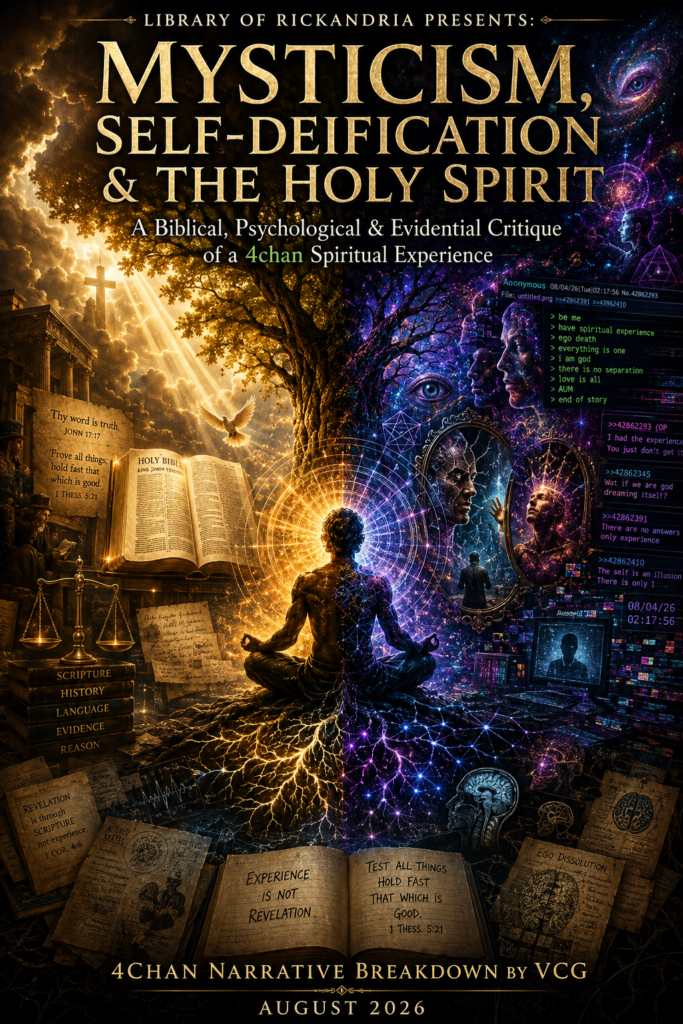
UPDATED BY VCG ON 8/23/2026 @ 22:22 EST
I want to share a heartfelt cause with my audience. Conner Blaisdell-Greene, a brave Airforce Sr. Airman, recently lost his battle with cancer, leaving his family in financial distress. Every donation, no matter how small, can help cover his funeral costs and ease their burden during this difficult time. Please consider clicking the link below to contribute or share Conner’s story with others. Your support truly matters.
Until We Meet Again
Spoken Tribute
Anyone can do this, but most won’t.
ChatGPT – Library of Rickandria
Soli Deo Gloria, brethren.
I’ll treat the thread as a set of claims to audit, not as a worldview to assume.
I’ll separate what the poster actually says, empirical/historical claims, psychological/rhetorical mechanisms, and biblical claims, then rebut each with primary or high-quality sources and KJV Scripture from the uploaded Bible.
/x/ – Using the holy spirit – Paranormal – 4chan
I’ve verified the live thread.
It is short—one original post and one substantive reply—so
“line by line”
is actually feasible without collapsing anything.
A key distinction is already emerging:
some experiences described are recognizable in the psychology of self-transcendence/ego-boundary change, but the leap from
“I experienced oneness”
to
“therefore I am God / can use the Holy Spirit”
is neither scientifically established nor biblically warranted.
I audited the live thread as retrieved on August 23, 2026.
At that point, the visible discussion consisted of the:
- original poster
- one substantive anonymous response
- the OP’s follow-up
Because 4chan threads are ephemeral and can change, everything below refers to that captured state. (4chan)
The central conclusion is important:
the poster may be describing a genuine subjective altered state—possibly involving absorption, self-transcendence, or weakened self/world boundaries—but neither psychology nor neuroscience licenses the conclusion that the experience proves
“I am God.”
Biblically, that conclusion is considerably more serious:
Scripture consistently distinguishes God the Creator from the human creature, while the Holy Ghost is presented as a personal divine agent who:
- leads
- gives
- speaks
- glorifies Christ
and distributes gifts according to his will—not as a spiritual technology human beings learn to operate.
Scripture quotations below are from your uploaded King James Bible, Pure Cambridge Edition.
Methodology
For every claim I am using five separate tests so that theology does not get confused with psychology, and subjective experience does not get confused with empirical evidence.
| Test | Question being asked |
|---|---|
| Textual | What did the 4chan poster actually claim? |
| Empirical | Is there scientific, medical, historical, or psychological evidence supporting it? |
| Logical | Does the conclusion actually follow from the experience offered as evidence? |
| Biblical | What does Scripture say in context, comparing Scripture with Scripture? |
| Epistemological | How could the claim be tested, falsified, independently corroborated, or corrected? |
I am also deliberately not diagnosing the OP.
A few internet posts are nowhere near enough to diagnose:
- mania
- psychosis
- dissociation
or any other condition.
Religious and mystical experiences are not automatically pathological.
But psychology can tell us what kinds of experiences and reasoning processes may be relevant, and it can tell us what warning signs would warrant professional evaluation.
I. The original post, line by line
The poster says he arrived at the idea that he could personally “use” the Holy Spirit after meditating beneath a tree. (4chan)
What is actually established?
Only that meditation preceded an interpretation.
Temporal sequence does not establish causation, divine origin, or supernatural authorization.
Meditation can alter:
- attention
- self-perception
- sensory salience
- body awareness
and perceived boundaries between self and environment.
Researchers use terms such as self-transcendent experience, unity experience, ego dissolution, and self-boundary dissolution for overlapping but importantly different phenomena.
These experiences can occur through:
- meditation
- awe
- music
- psychedelics
- religious practice
and other conditions. (Positive Psychology Center)
That means the experience need not be mocked or dismissed as imaginary.
The crucial methodological error is further downstream:
“An unusual experience occurred”
does not entail
“my theological explanation of that experience is objectively true.”
Scripture correction
Biblical meditation is certainly real, but Scripture normally gives it an object:
God’s:
- word
- works
- commandments
- ways
Psalm 1:2:
“But his delight is in the law of the LORD; and in his law doth he meditate day and night.”
Psalm 119:15:
“I will meditate in thy precepts, and have respect unto thy ways.”
Sitting quietly under a tree is morally neutral.
The problem begins when an internally generated inference is treated as though it were revelation from God without biblical testing.
And the biblical vocabulary surrounding the Holy Ghost is conspicuously different from
using him.
Believers are told to
walk in the Spirit
(Galatians 5:16), be
led of the Spirit
(5:18), and
live in the Spirit
(5:25).
The grammatical and theological direction is the reverse:
man does not master the Spirit as an instrument.
The OP’s premise is:
“Since god is everything…”
(4chan)
This is not a minor assumption.
It contains almost the entire later conclusion.
Philosophically, identifying God with everything that exists is ordinarily classified as a form of pantheism:
God and the totality of reality are identified rather than Creator and creation remaining ontologically distinct.
Pantheistic systems vary considerably, so the label alone is not a rebuttal—but it tells us what proposition is being assumed.
Pantheism (Stanford Encyclopedia of Philosophy/Fall 2022 Edition)
Notice the circularity:
Premise: God is everything.
Observation: I am something within everything.
Conclusion: Therefore I am God.
The conclusion largely exists because it was embedded in the premise.
Scripture correction
The Bible begins not with God
being
the universe but with God creating it:
Genesis 1:1:
“In the beginning God created the heaven and the earth.”
Creator and creation are related, but they are not thereby identical.
Isaiah 45:5, 12:
“I am the LORD, and there is none else, there is no God beside me…”
“I have made the earth, and created man upon it…”
The sequence is explicit:
God → creates earth → creates man.
Paul preserves precisely that distinction in Romans 1:25, warning of those who:
“worshipped and served the creature more than the Creator, who is blessed for ever.
Amen.”
Thus biblical omnipresence does not imply pantheism.
Biblical indwelling does not imply identity either.
A believer may belong to God, be indwelt by God’s Spirit, be united to Christ, and even be called a
“partaker of the divine nature”
in 2 Peter 1:4 without becoming numerically identical with God.
The poster says he mentally made things “smaller,” perceived everything through the tree, and drew inferences from what he saw. (4chan)
This description is psychologically interesting.
Focused attention can increase the perceived significance of details and relationships.
Human cognition is extraordinarily good at extracting:
- patterns
- analogy
- symbolism
- meaning
But there are at least three distinct levels here:
Perception:
“The tree seemed interconnected with everything.”
Interpretation:
“This symbolizes or reveals universal interconnectedness.”
Metaphysical assertion:
“Therefore, God is everything and I have discovered a divine mechanism.”
Only the first is directly reported experience.
The latter two require independent argument.
There is nothing irrational about learning analogically from a tree.
Scripture itself does this constantly:
- trees
- seed
- vines
- branches
- fields
- sheep
- stars
- water
- bread
What Scripture does not authorize is the principle:
“Whatever meaning becomes apparent to me during altered contemplation is revelation.”
That method has no built-in error correction.
If two meditators perform the same exercise and one concludes
“all is Brahman,”
another
“all is Buddha-nature,”
another
“the universe is conscious,”
another
“there is no self,”
and another
“the Trinity revealed this,”
the existence of intense subjective certainty cannot decide among mutually incompatible interpretations.
The OP reports discovering a “method” of operating through the Spirit and says that feeling it convinced him the method worked. (4chan)
This is one of the thread’s biggest methodological problems.
The reasoning is essentially:
I felt something strongly → therefore my explanation of the feeling is correct.
Psychology often calls this kind of inferential move emotional reasoning when emotional conviction is treated as evidence of objective truth.
More broadly, it is an inadequate validation procedure because sensations are compatible with many explanations.
An intense feeling might correspond to a true religious experience.
It might also correspond to:
- absorption
- expectation
- autonomic arousal
- meditation effects
- music
- suggestion
- fatigue
- anxiety
- euphoria
or some combination.
Phenomenology alone does not distinguish them.
Scripture correction:
the Holy Ghost is not a technique
Jesus describes the Spirit personally:
John 16:13–14:
“Howbeit when he, the Spirit of truth, is come, he will guide you into all truth…”
“He shall glorify me…”
Likewise 1 Corinthians 12:11 says concerning spiritual gifts:
“…dividing to every man severally as he will.”
As he will, not as the practitioner discovers a technique for activating him.
Acts 5:3–4 is even more striking:
Peter’s parallel statements concerning lying to the Holy Ghost and lying unto God are among the New Testament texts historically used in Christian theology concerning the Spirit’s deity and personality.
Therefore, a more biblically precise formulation would be:
Not:
“I learned how to use the Holy Spirit.”
But:
“If this is of God, am I being led by the Holy Spirit, and can that claim survive scriptural testing?”
The OP says healing has not yet been demonstrated.
This admission is actually significant because it identifies a testable claim.
At that point, the correct response is not to elaborate the theory.
It is to say:
The healing claim is presently unverified.
Scripture affirms divine healing.
It does not therefore validate every person who reports possessing a healing method.
Peter makes this distinction extraordinarily clear after the lame man is healed.
Acts 3:12:
“…why look ye so earnestly on us, as though by our own power or holiness we had made this man to walk?”
The apostolic claim was specifically not that Peter had acquired a personal healing technique.
And in 1 Corinthians 12:29–30, Paul asks rhetorically:
“Are all apostles? are all prophets? are all teachers? are all workers of miracles? Have all the gifts of healing?”
The expected answer is:
no.
James 5 likewise directs the sick toward prayer and the elders, concluding:
“…the Lord shall raise him up…”
The agency remains God’s.
If someone today claims a repeatable healing ability, the empirical test should be unusually strict:
- predetermined outcomes
- medically documented baseline conditions
- independent clinicians
- appropriate controls where possible
- complete reporting of successes and failures
and no retrospective selection of impressive cases.
“I felt power”
is not medical evidence.
The poster later says
“my entire vision was god.”
(4chan)
As a description of consciousness, this resembles what researchers call unity or self-transcendent phenomenology.
Yaden and colleagues describe self-transcendent experiences as temporary states involving reduced self-salience together with increased feelings of connectedness.
More recent work emphasizes that:
- unity
- ego dissolution
- boundary loss
- absorption
- related experiences
must not simply be treated as one identical phenomenon. (Positive Psychology Center)
That provides a psychologically plausible vocabulary for the experience without adjudicating theology.
The critical distinction is:
Phenomenological claim:
“Everything appeared to me as one divine whole.”
Ontological claim:
“Everything literally is God.”
Psychology can study the first. It has not scientifically demonstrated the second.
This distinction matters because mystical experiences are often accompanied by what psychologists call a noetic quality—a powerful sense that one has not merely felt something but learned something profoundly true.
Yet subjective certitude is still not equivalent to public verification.
The decisive statement is
“I recognized that I was god.”
(4chan)
This is the thread’s clearest collision with biblical teaching.
Scripture certainly teaches extraordinary things about redeemed human beings:
- adoption
- union with Christ
- indwelling by the Spirit
- conformity to Christ
- glorification
- participation in divine promises
None of those expressions erases the Creator-creature distinction.
John 3:27:
“A man can receive nothing, except it be given him from heaven.”
John immediately follows with:
“He must increase, but I must decrease.”—John 3:30
That is nearly the inverse spiritual trajectory of self-deification.
Isaiah 45:18:
“For thus saith the LORD that created the heavens; God himself that formed the earth and made it… I am the LORD; and there is none else.”
2 Peter 1:4
sometimes enters mystical discussions because believers are called:
“partakers of the divine nature”
But
partaker
is not
identity.
The very verse speaks of promises given by God to recipients and of escaping corruption.
The giver and recipients remain distinguishable.
Likewise, Paul’s
“that God may be all in all”
in 1 Corinthians 15:28 cannot mean that every creature becomes God, because the immediate context distinguishes:
- God
- Christ
- enemies
- resurrection
- those belonging to Christ
and the kingdom.
Biblical verdict:
communion with God—yes.
Indwelling—yes.
Union with Christ—yes.
Transformation into Christlikeness—yes.
“I am God”
as identity—no.
The OP describes a “higher form” of God wanting him to act a certain way.
Logically, this introduces another difficulty. If the OP literally is God, what exactly is a “higher form of God” communicating with the lower form?
Either there are distinguishable agents or levels, in which case simplistic
“everything is literally identical with God”
language is no longer doing enough work, or the OP is describing one part of his own consciousness as though it were a superior external authority.
Neither possibility proves Christianity.
Scripture correction
Biblical revelation does distinguish Father, Son, and Holy Ghost, but not as higher and lower manifestations of one human consciousness.
Matthew 28:19 names:
“the Father, and of the Son, and of the Holy Ghost”
And the Holy Ghost’s Christological direction in John 16 is decisive:
“He shall glorify me…”
A claimed spiritual revelation whose practical center becomes the elevation of the experiencer into deity should therefore be tested especially carefully against Scripture.
Paul’s response to extraordinary revelation is instructive.
In 2 Corinthians 12 he describes being caught up into paradise, yet repeatedly stresses that the experience must not cause him to be
“exalted above measure.”
His theological takeaway is not
“I discovered that I am God”
but dependence upon Christ:
“My grace is sufficient for thee:
for my strength is made perfect in weakness.”
The poster says music and dancing seemed to become a way of receiving answers from God.
There is nothing intrinsically unbiblical about music or dancing.
Scripture contains both.
The Psalms explicitly associate musical instruments and dance with praise.
Nor should every spontaneous religious impression automatically be labeled occult.
But Scripture nowhere gives believers a general technique of dancing until hidden answers are decoded from God.
This creates an important boundary.
Music as worship: biblically attested.
Dance as rejoicing/praise: biblically attested.
Music altering attention/emotion: psychologically ordinary.
Treating patterns, movements, or impressions as a private oracle: requires testing and can drift toward divinatory thinking.
Deuteronomy 18:10–11 explicitly prohibits:
- divination
- enchantment
- familiar-spirit consultation
- wizardry
and related practices.
That does not mean the OP has necessarily committed those acts.
It means Christian discernment should resist turning ambiguous internal signals into an unauthorized oracle.
The anonymous responder labels what is happening
“practicing mysticism now.”
(4chan)
As a broad descriptive label, this is reasonably plausible.
“Mysticism” is a large umbrella covering traditions and practices concerned with unusually direct experience of:
- God
- ultimate reality
- union
- presence
- contemplation
or transcendence.
The OP’s language of unity and divine identification fits several things routinely called mystical.
But this label proves almost nothing.
Classification is not validation.
Calling an experience mystical does not establish that its interpretation is true, Christian, safe, or produced by God.
There is also no single doctrine called “mysticism.”
- Christian mysticism
- Jewish mysticism
- Islamic Sufism
- Hindu nondual traditions
- Buddhist contemplative traditions
- Neoplatonism
- occult mysticism
and modern perennialism can make dramatically different and sometimes mutually exclusive claims.
So, the proper question is not:
“Is this mystical?”
It is:
“What exactly is being claimed, and how should that claim be tested?”
The anonymous reply then claims mysticism necessarily puts someone at odds with institutional religion and says
“you can’t talk about it.”
(4chan)
Historically, this is an overgeneralization.
Yes, some mystics and mystical movements came into conflict with ecclesiastical authorities.
Some were censured; some were suspected of heterodoxy; some deliberately existed outside institutions.
But enormous portions of Christian mystical history occurred inside highly institutional settings—especially:
- monasteries
- convents
- clerical orders
- liturgical communities
- theological schools
Scholarship on medieval Christian mysticism repeatedly emphasizes its:
- monastic
- scriptural
- liturgical
- communal contexts
Bernard McGinn’s scholarship, for example, situates much Christian mysticism squarely within the institutional monastic world rather than outside it.
The Changing Shape of Late Medieval Mysticism | Church History | Cambridge Core
Biblically,
“you cannot talk about it”
is also a poor universal principle.
Paul says concerning congregational prophetic claims:
1 Corinthians 14:29:
“Let the prophets speak two or three, and let the other judge.”
And:
1 Thessalonians 5:21:
“Prove all things; hold fast that which is good.”
The Bereans are praised because they:
“searched the scriptures daily, whether those things were so.”—Acts 17:11
The New Testament pattern is therefore not private immunity from evaluation, but testing.
There are certainly experiences for which words are inadequate—
Paul himself refers to
“unspeakable words”
in 2 Corinthians 12.
But ineffability is different from untestability.
The responder suggests that fairly elementary hypnosis can help “exorcise” mental, emotional, spiritual, and even physical afflictions.
This bundles together several very different categories and substantially outruns the evidence.
Modern clinical hypnosis is real and has legitimate evidence behind it in certain contexts.
Meta-analyses and systematic reviews find benefits particularly around:
- pain
- anxiety
- distress
- medication requirements
and some perioperative outcomes.
But the strength and consistency of evidence varies substantially by:
- outcome
- study design
- clinical context
Adjunctive use of hypnosis for clinical pain: a systematic review and meta-analysis – PubMed
That is very different from saying:
“Basic hypnotism can exorcise mental, emotional and spiritual afflictions.”
No established clinical evidence turns hypnosis into a general-purpose exorcism method.
Claims concerning direct physical tissue healing are especially easy to exaggerate.
There have been suggestive small studies—for example, a preliminary wound-healing experiment involving only 18 women—but such work does not establish that casual hypnotic skill produces supernatural physical healing.
Broader reviews describe heterogeneous evidence requiring considerable caution.
Can medical hypnosis accelerate post-surgical wound healing? Results of a clinical trial – PubMed
A particularly useful finding from a surgical hypnosis meta-analysis is that subjective/behavioral outcomes such as distress or pain may improve while physiological parameters do not necessarily show equivalent effects.
Efficacy of Hypnosis in Adults Undergoing Surgical Procedures: A meta-analytic update – PubMed
“Exorcising mental illness” is a serious category problem
Religious traditions may have theological categories involving spiritual oppression.
Medicine has diagnostic categories involving:
- schizophrenia-spectrum disorders
- bipolar disorders
- trauma
- epilepsy
- sleep disorders
- substance effects
- dissociation
and many others.
These should not be casually collapsed into one another.
Small clinical case studies have documented situations in which interpreting psychotic symptoms exclusively as demonic possession led people toward repeated exorcisms and delayed psychiatric assessment or treatment.
Those studies do not prove that every religious interpretation is false.
They demonstrate the danger of using a spiritual explanation as a substitute for clinical differential diagnosis.
Interestingly, Scripture itself does not simply merge every illness into demon possession.
Mark 1:32–34 distinguishes those who were diseased from those possessed with devils, even while Jesus ministers to both.
The OP immediately responds that this is exactly what he needed to hear and then interprets his history through the new framework.
This is an especially important psychological moment.
It does not prove the OP is wrong.
But it is exactly the sort of interaction in which confirmation bias can operate:
evidence or interpretations consistent with an emerging belief receive rapid acceptance while possible falsifiers are never demanded.
Confirmation bias is the well-established tendency to preferentially seek, interpret, or remember information that supports an existing belief or hypothesis. (APA Dictionary)
The sequence visible in the thread is epistemically weak:
unusual experience → ambitious interpretation → ask strangers for explanation → receive validating label → immediate relief/acceptance → expand autobiography to fit framework.
A stronger procedure would deliberately ask:
What evidence would show that my interpretation is mistaken?
If the answer is
“nothing could,”
the claim has become insulated from correction.
The OP finally suggests he may have unknowingly practiced hypnosis for more than ten years and that God appears to send him people who need help.
Neither assertion can be verified from the thread.
“I have unknowingly hypnotized people for ten years”
needs an operational definition of hypnosis and actual evidence of what happened.
Likewise, providence is a legitimate biblical category.
But moving from:
“People needing help frequently enter my life”
to:
“God specifically sends them to me because of this special ability”
adds an interpretation that requires humility.
Romans 12:3 gives an excellent corrective principle:
“…not to think of himself more highly than he ought to think; but to think soberly…”
Galatians 6:3 is even more direct:
“For if a man think himself to be something, when he is nothing, he deceiveth himself.”
Those texts should not be used as insults.
Their point is methodological and spiritual: claims of unusual spiritual status require more sobriety, not less.
II. What psychology can—and cannot—say about the OP
The strongest psychological interpretation is not
“he is lying,”
and it is not
“he is definitely psychotic.”
Both would go beyond the evidence.
The experiences are compatible with phenomena researchers recognize:
- absorption
- self-transcendence
- felt unity
- altered salience
and changes in self/world boundaries.
Meditation can sometimes generate profound perceptual and cognitive changes, including experiences practitioners interpret religiously. (Positive Psychology Center)
Meditation is also not universally benign.
A 2020 systematic review covering 83 studies and 6,703 participants estimated meditation-related adverse events at about 8.3% overall, although rates varied considerably according to study design and definitions; anxiety, depression, and cognitive anomalies were among the commonly reported difficulties.
NCCIH appropriately stresses that the safety literature remains less developed than the benefit literature.
Adverse events in meditation practices and meditation-based therapies: a systematic review – PubMed
None of that demonstrates that meditation caused the OP’s beliefs.
It shows why
“meditation produced this, therefore God objectively revealed it”
is too fast.
There is also an appropriate clinical caution surrounding grandiose religious ideas.
NIMH materials on bipolar disorder note that manic episodes can involve feeling unusually
important, talented, or powerful, while psychosis can involve:
delusions,
hallucinations
disorganized thinking
and difficulty distinguishing internal experience from external reality.
Bipolar Disorder – National Institute of Mental Health (NIMH)
But one internet statement—however grandiose—is not enough for diagnosis.
The concern would increase if claims such as
“I am God”
occurred alongside things such as very little need for sleep, rapidly escalating energy, pressured or racing thought, reckless behavior, command voices, marked paranoia, inability to function, inability to entertain correction, or danger to self or others.
In such a case, ordinary medical/mental-health evaluation should occur alongside whatever pastoral care someone seeks.
That is not spiritual reductionism; it is responsible differential assessment
Bipolar Disorder – National Institute of Mental Health (NIMH)
III. The deeper logical problem: experience versus ontology
The thread repeatedly commits what we might call an epistemic category jump.
Consider this progression:
| Level | Claim | Status |
|---|---|---|
| Experience | “I felt unusually unified with everything.” | Could be perfectly sincere. |
| Phenomenology | “My normal sense of self/world boundaries changed.” | Psychologically plausible. |
| Interpretation | “This was the Holy Ghost.” | Requires theological evidence. |
| Metaphysics | “God is literally everything.” | Philosophical proposition, not established by sensation. |
| Identity | “Therefore I am God.” | Does not follow without pantheistic premises. |
| Authority | “Therefore I discovered how to operate divine power.” | Requires still more evidence. |
| Application | “Perhaps I can heal others.” | Empirically testable, presently unsupported in thread. |
Each level requires new evidence.
But the thread treats the subjective force of Level 1 as though it carries the entire ladder.
That is the single greatest methodological failure.
IV. Why “I felt it, therefore it was God” is not the biblical test
Scripture repeatedly assumes spiritual claims must be discriminated.
1 John 4:1:
“Beloved, believe not every spirit, but try the spirits whether they are of God…”
Notice what that verse presupposes:
a spiritual-seeming experience is not self-authenticating.
Likewise:
1 Thessalonians 5:19–21:
“Quench not the Spirit.
Despise not prophesyings.
Prove all things; hold fast that which is good.”
Those verses are beautifully balanced.
The biblical answer is neither:
“Every unusual spiritual experience is false.”
nor:
“Every intense spiritual experience is true.”
It is:
Do not despise; do not gullibly accept; test.
And John 16 supplies an important Christological criterion:
“He shall glorify me…”
The Spirit’s ministry points toward Christ, not toward autonomous self-apotheosis.
V. Is the Holy Ghost something Christians can “use”?
Biblically, no—not in the sense implied by the thread.
That language risks turning the Holy Ghost into something resembling an:
- impersonal occult force
- energy field
- psychic faculty
or technology.
The New Testament’s directional verbs are revealing.
The Spirit:
speaks — Acts 13:2
teaches — John 14:26
guides — John 16:13
wills — 1 Corinthians 12:11
intercedes — Romans 8:26
can be grieved — Ephesians 4:30
glorifies Christ — John 16:14
Believers:
receive the Spirit
are filled with the Spirit
walk in the Spirit
are led by the Spirit
pray in the Spirit
must not grieve or quench the Spirit.
That is relational and personal language, not technological language.
The difference is profound:
Magic/technique paradigm:
“I discovered the correct procedure and can thereby generate spiritual results.”
Biblical dependence paradigm:
“God gives; God wills; God acts; I ask, obey, discern, and remain dependent.”
Acts 19:13–20 supplies a particularly relevant warning.
The sons of Sceva attempt to deploy the name of Jesus as though spiritual authority were a transferable formula.
The narrative’s entire point is that sacred names are not controllable technologies.
That does not mean the OP is intentionally practicing magic.
It shows why
“I found the method for using divine power”
is alien to the apostolic pattern.
VI. Healing: biblical possibility versus personal power claims
A Christian rebuttal should avoid two opposite errors.
It would be wrong to say:
“God cannot heal.”
Scripture plainly contains healing.
But it would also be wrong to reason:
“God heals → therefore anyone reporting an inner power may possess a healing gift.”
The apostles themselves redirect glory away from themselves.
Again, Peter:
“…why look ye so earnestly on us, as though by our own power or holiness we had made this man to walk?”—Acts 3:12
And the fruit of the Spirit in Galatians 5 is not grandiosity or occult mastery:
“love, joy, peace, longsuffering, gentleness, goodness, faith, Meekness, temperance…”
That meekness matters.
A claimed spiritual gift should produce greater dependence upon
- God
- truthfulness
- charity
- self-control
- accountability
and willingness to be tested—not greater conviction that the individual has become divine.
VII. The historical problem with the anonymous responder’s view of “mysticism”
The responder effectively presents a modern esoteric narrative:
real mystical knowledge is private → institutions cannot tolerate it → outsiders will not understand → therefore criticism is expected.
This structure can become self-sealing.
Historically, Christian mysticism is much messier.
Some mystics were controversial, but others were:
- monks
- nuns
- abbots
- priests
- theologians
- spiritual directors
and recognized teachers situated deeply inside ecclesial structures.
Medieval contemplation was frequently inseparable from:
- biblical exegesis
- liturgy
- monastic discipline
- confession
- communal worship
- spiritual supervision
So the responder’s
“institutional religion versus mysticism”
dichotomy is historically poor.
Even more importantly, Christian mystical language is not automatically pantheistic.
Classical Christian writers often spoke very boldly of union with God while simultaneously maintaining the distinction between Creator and creature.
That distinction is exactly what gets lost in the 4chan post.
VIII. The hypnosis claim needs major correction
The anonymous answer contains a small kernel of truth buried inside a sweeping claim.
Clinical hypnosis has evidence as an adjunctive therapeutic intervention, especially for areas such as procedural:
anxiety
pain
distress
and some perioperative outcomes.
A large clinical-pain meta-analysis found additional analgesic effects but also emphasized limitations in certainty; surgical meta-analysis has reported improvements in several subjective and medication-related outcomes alongside substantial heterogeneity.
Recent systematic review evidence likewise supports some perioperative benefits while leaving some outcomes, including pain effects, less certain.
Adjunctive use of hypnosis for clinical pain: a systematic review and meta-analysis – PubMed
What the evidence does not establish is:
basic hypnotism = exorcism
or:
basic hypnotism = generalized physical healing
or:
someone who has informally influenced others for years possesses a clinical healing modality.
Those are separate claims and need separate evidence.
This matters ethically because telling someone with a severe psychiatric or neurological problem that they need
“exorcism through hypnotism”
could delay appropriate care.
IX. The thread’s reinforcement loop
Psychologically, the most concerning element may not be the initial meditation experience itself.
It is the epistemic environment afterward.
The OP arrives with a dramatic interpretation.
Instead of asking questions such as:
How do you know the feeling came from the Holy Ghost?
What would falsify your interpretation?
Have you tested healing claims objectively?
Have you slept normally?
Do these experiences occur only in meditation?
Are you hearing external voices?
Does your conclusion agree with the biblical Creator-creature distinction?
the anonymous respondent gives the experience an identity-validating label and expands it into hypnosis, exorcism, and healing.
The OP then immediately reports that this is what he needed to hear.
That is almost the opposite of Acts 17:11.
The Bereans did not say:
“This confirms what I wanted to hear.”
They:
“searched the scriptures daily, whether those things were so.”
That should be the governing posture.
X. A biblical test battery for the entire experience
Applied to the thread, I would use this sequence:
| Test | Biblical principle | Application |
|---|---|---|
| Creator test | Genesis 1:1; Isaiah 45 | Does the teaching preserve God/creation distinction? “I am God” fails. |
| Christ test | John 16:13–14 | Does the claimed Spirit glorify Christ or exalt the experiencer? |
| Doctrine test | Acts 17:11 | Does it survive Scripture in context? |
| Spirit test | 1 John 4:1 | Spiritual impressions are to be tried, not automatically believed. |
| Fruit test | Galatians 5:22–23 | Does it yield love, meekness, temperance, etc.? |
| Humility test | John 3:30; 2 Cor. 12 | Does revelation decrease self-exaltation? |
| Community test | 1 Cor. 14:29 | Can mature believers evaluate it, or is criticism forbidden? |
| Gift test | 1 Cor. 12:11 | Is God sovereign over gifts, or has the person supposedly mastered a technique? |
| Healing test | Acts 3:12; James 5 | Is healing attributed to God’s action rather than personal spiritual mastery? |
| Evidence test | “Prove all things” | Are objective claims independently verified? |
On those criteria, the thread’s theological framework performs poorly.
XI. What the OP may have gotten partly right
A fair analysis should identify genuine points rather than treating every sentence as equally false.
The OP may genuinely have discovered that sustained contemplative attention can profoundly alter perception.
Science agrees that it can.
The sense that ordinary ego-consciousness is not the whole story of human experience is not a ridiculous observation.
Psychology has substantial literature on:
- absorption
- awe
- flow
- self-transcendence
- mystical-type experience
- altered self-boundaries
The desire to help suffering people is not itself wrong.
- Music
- contemplation
- embodied worship
- prayer
and even profound religious experiences all have places within Christian history.
And the anonymous responder is correct in the limited sense that hypnosis has legitimate clinical applications.
The errors occur when those modest truths are inflated into claims the evidence does not carry:
altered consciousness → divine revelation
felt unity → pantheism
pantheism → personal godhood
personal godhood → command from higher God
strong sensation → proof of Holy Spirit
hypnosis → exorcism
clinical hypnotic effects → physical healing power
mysticism → immunity from institutional/community scrutiny
That chain is not established.
XII. The most important Scripture correction
If I had to answer the OP in only a few biblical passages, I would put these together.
Genesis 1:1
“In the beginning God created the heaven and the earth.”
God is Creator.
Isaiah 45:5
“I am the LORD, and there is none else, there is no God beside me…”
Man is not another manifestation of deity.
John 16:13–14
“…the Spirit of truth… will guide you into all truth… He shall glorify me…”
The Holy Ghost leads and glorifies Christ.
1 Corinthians 12:11
“…dividing to every man severally as he will.”
The Spirit sovereignly distributes; he is not operated.
1 John 4:1
“Beloved, believe not every spirit, but try the spirits whether they are of God…”
Spiritual impressions require testing.
1 Thessalonians 5:21
“Prove all things; hold fast that which is good.”
Experience is not exempt from examination.
Acts 3:12
“…as though by our own power or holiness we had made this man to walk?”
Even apostolic healing is not self-generated spiritual power.
John 3:30
“He must increase, but I must decrease.”
That is the biblical directional check on mystical grandiosity.
Final verdict
The thread begins with a potentially genuine altered or contemplative experience, moves into a pantheistic interpretation, then crosses into self-deification, and finally receives an anonymous reply that reinforces the experience with a mixture of partially correct terminology, historically exaggerated claims about mysticism, and medically overstated claims about hypnosis.
The psychology does not show that the OP’s experience was meaningless.
It shows why its meaning cannot simply be inferred from its intensity.
The science does not prove that God was absent.
Science is not equipped to settle that metaphysical question from an internet report.
It does show that meditation can produce powerful states of:
- unity
- boundary alteration
- significance
and certainty without thereby verifying the theological interpretation. (Positive Psychology Center)
The historical record does not support the claim that authentic mysticism necessarily exists outside institutional Christianity.
Much Christian mysticism was profoundly:
- institutional
- monastic
- biblical
- communal
The Changing Shape of Late Medieval Mysticism | Church History | Cambridge Core
The medical literature does not support “basic hypnosis” as a generic means of exorcising mental illness or conferring physical healing power.
It supports more limited, clinically supervised uses, particularly involving pain, distress, anxiety, and certain procedural outcomes.
Adjunctive use of hypnosis for clinical pain: a systematic review and meta-analysis – PubMed
And most decisively, the biblical text does not support the thread’s central sequence of
“God is everything → I am God → I discovered how to use the Holy Spirit.”
Scripture instead presents the LORD as Creator distinct from creation, the human being as creature and image-bearer, Christ as Lord, and the Holy Ghost as sovereign personal divine agent whose ministry glorifies Christ.
The scriptural response is therefore neither credulous fascination nor contempt for the experiencer:
test the experience, reject the self-deification, refuse to turn the Holy Ghost into a technique, preserve the Creator-creature distinction, examine supposed gifts by their doctrine and fruit, and submit objective healing claims to objective evidence.
That is far closer to
“Prove all things; hold fast that which is good”
than either dismissing every unusual experience or believing it because it felt transcendent.
4CHAN THREAD & POST BREAKDOWNS – Library of Rickandria
VCG PAPER PROJECTS – Library of Rickandria