
Neuralink, Telepathy & the Mark of the Beast: A Fact-Checked Analysis of Neurotechnology, Conspiracy Psychology & Biblical Interpretation
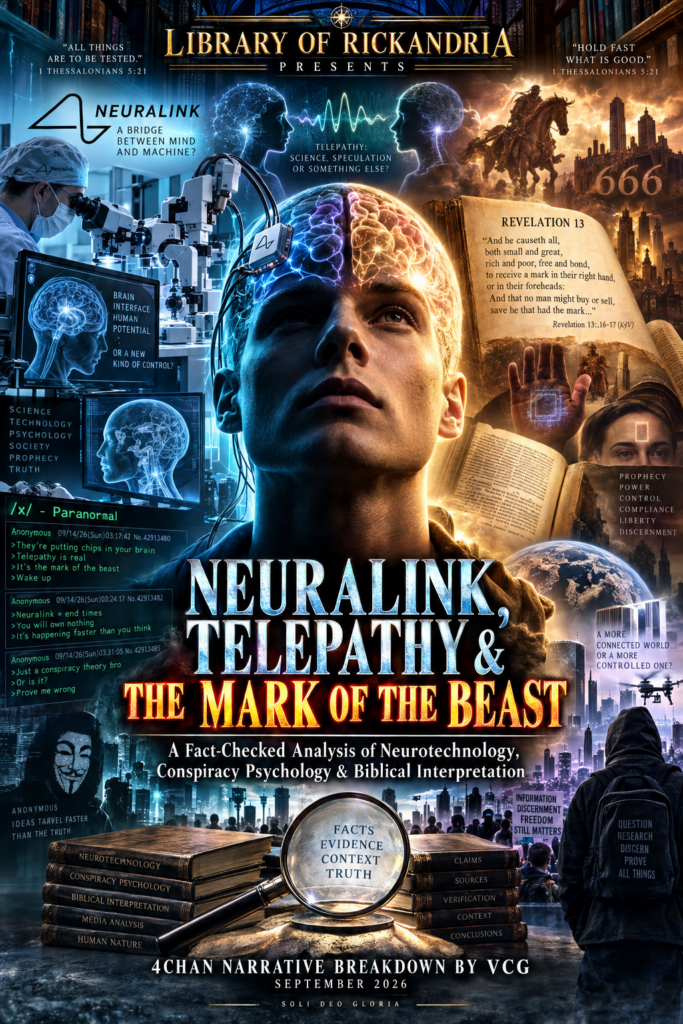
UPDATED BY VCG ON 9/6/2026 @ 19:19 EST
I want to share a heartfelt cause with my audience. Conner Blaisdell-Greene, a brave Airforce Sr. Airman, recently lost his battle with cancer, leaving his family in financial distress. Every donation, no matter how small, can help cover his funeral costs and ease their burden during this difficult time. Please consider clicking the link below to contribute or share Conner’s story with others. Your support truly matters.
Until We Meet Again
Spoken Tribute
Abstract
A short thread posted to 4chan’s /x/ - Paranormal board in September 2026 begins with a joke about receiving a free Neuralink implant with a two-year subscription.
Within a few replies, however, the discussion moves through:
- natural telepathy
- alleged hidden knowledge
- DARPA-sponsored neural interfaces
- compulsory implantation
- loss of voting and property rights
- surveillance capitalism
- predictive advertising
- electromagnetic explanations for psychic phenomena
- Akashic records
- psychiatric mockery
and eventually fears of a society in which the “unchipped” are excluded from ordinary life.
The thread is therefore useful not because it presents one coherent argument, but because it shows how:
- facts
- jokes
- genuine technological developments
- personal claims
- predictions
- conspiracy reasoning
- biblical imagery
can become woven into a single narrative.
The captured thread begins with post No. 42913480 on September 3 and, at the time examined for this paper, ends with No. 42925049 on September 6, 2026. (4chan)
This paper does not begin from the assumption that everything on an anonymous paranormal board is false.
Neither does it begin by assuming that an alarming possibility becomes true merely because governments and corporations possess real technologies capable of abuse.
Instead, it follows the VCG research standard already established in the project’s research manual:
Scripture first, evidence before opinion, context before commentary, and a deliberate separation between fact, interpretation, speculation and rhetoric.
That approach produces a more complicated conclusion than either blanket belief or blanket dismissal.
Neuralink is real.
Implantable brain-computer interfaces are real.
Neural decoding of intended movement and attempted speech is real.
DARPA has sponsored invasive and non-invasive neurotechnology.
Government remote-viewing research was real.
Mobile-location surveillance is capable of exposing highly sensitive behavior.
Neural-data privacy is sufficiently serious that governments and international organizations have already begun developing dedicated protections.
Published parapsychology research also contains results its authors interpret as evidence for anomalous perception.
At the same time, those facts do not establish:
- unrestricted natural telepathy
- a hidden 700-person psychic group chat
- literal thought-reading by ordinary phones
- compulsory neural implants for voting or property ownership
- removal of children from unimplanted parents
or Neuralink as the biblical mark of the beast.
The recurring problem is therefore not simply false information.
It is true information joined by unsupported arrows.
I. Why This Thread Is Worth Taking Seriously
It would be easy to make this project much simpler than it deserves to be.
One could take the thread’s stranger claims, laugh at them, identify every poster with a psychiatric insult, and declare the discussion finished.
The thread itself contains exactly that response when one participant describes another as:
“schizomaxxing.”
(4chan)
That would be bad methodology.
A second approach would be equally poor:
observe that DARPA has genuinely worked on brain interfaces, that Neuralink genuinely places electrodes in the brain, that advertisers genuinely perform invasive behavioral profiling, and therefore accept the thread’s larger predictions as vindicated.
That would confuse evidence for one proposition with evidence for another.
The better approach is the one Proverbs describes:
“He that answereth a matter before he heareth it, it is folly and shame unto him.”— Proverbs 18:13
The next verses provide the complementary principle:
“He that is first in his own cause seemeth just; but his neighbour cometh and searcheth him.”— Proverbs 18:17
Acts gives essentially the same pattern in narrative form.
The Bereans neither rejected Paul’s message on first contact nor accepted it merely because Paul spoke confidently:
“they received the word with all readiness of mind, and searched the scriptures daily, whether those things were so.”— Acts 17:11
And Paul later writes:
“Prove all things; hold fast that which is good.”— 1 Thessalonians 5:21
Those passages provide an unusually appropriate investigative ethic for this subject.
Receive the claim.
Hear it accurately.
Search.
Test.
Retain what survives examination.
That is the method followed here.
II. What We Are Actually Examining
The original post asks readers to imagine Neuralink being bundled like a mobile-phone contract and asks whether “telepathy” would be worth the technical trouble.
The accompanying image presents a dystopian Neuralink-branded laboratory scene and a supposed human-trial objective involving “compliance” and reduction of negative thought.
Subsequent posts move rapidly from humor into claims of natural telepathy, predictions of compulsory implantation and discussion of surveillance, paranormal phenomena and societal control. (4chan)
Before examining anything else, the opening image requires an important correction.
The displayed:
“HUMAN TRIALS PHASE B”
language does not match the official registration of Neuralink’s PRIME trial.
ClinicalTrials.gov identifies PRIME as an early feasibility study, lists its formal purpose as control of external devices, and records its regulatory phase as
“Not Applicable”
because this is a device study rather than the type of phased drug trial implied by the meme.
The registered primary outcomes concern device- and procedure-related adverse events.
Neuralink’s own documentation likewise describes the N1 system as recording brain activity and decoding movement intention so that participants with paralysis can control computers and other external devices. (Neuralink)
The safest conclusion is therefore not that we have proved exactly who created the 4chan image or how.
Its provenance has not been established.
What can be said is narrower and stronger:
the trial language displayed in the image does not correspond to the documented objectives or terminology of Neuralink’s registered PRIME study.
That is the first example of the distinction this paper will maintain throughout:
image claim ≠ documented program.
III. Claim-by-Claim Audit of the Thread
The following table follows the thread in posting order.
“Unsupported”
does not mean metaphysically impossible.
It means that the thread has not supplied adequate evidence and reliable independent evidence has not presently established the claim.
| Post | What the poster contributes | Assessment | What careful examination shows |
|---|---|---|---|
| 42913480 | Imagines “free” Neuralink under a subscription and calls its benefit telepathy | Hypothetical + terminology confusion | Neuralink itself uses “Telepathy” as a product-style name, but its demonstrated meaning is BCI control of devices through decoded neural activity, not paranormal ESP. (Neuralink) |
| 42914080 | Claims telepathy already exists naturally and describes a huge psychic group chat | Unsupported personal claim | There is genuine psi research, but no established evidence for unrestricted conversational human telepathy of this sort. |
| 42915467 | Agrees | No additional evidence | Agreement is socially relevant but evidentially redundant. |
| 42915663 | Uses psychiatric mockery | Not a diagnosis | NIMH explicitly notes that psychosis has multiple possible causes and diagnosis requires qualified assessment; an anonymous post is inadequate for diagnosing schizophrenia. (National Institute of Mental Health) |
| 42915848 | Challenges the critic to prove the accounts are not the same person | Burden reversal | An inability to disprove an imagined possibility is not positive evidence for that possibility. |
| 42916139 | Predicts early-adopter failures followed by implantation requirements for voting/property | Mixed | Early technical complications are plausible and have occurred; the political-rights prediction remains unsupported. Neuralink itself reported thread retraction in its first participant. (Neuralink) |
| 42916207 | Asks about Akashic records versus Internet | Esoteric claim | “Akashic records” have a traceable history in nineteenth-century Theosophical clairvoyance; documenting the belief does not establish the alleged archive’s existence. (OUP Academic) |
| 42916240 | Says the coercive scenario will never occur | Overconfident counterclaim | Present lack of evidence does not justify certainty about every future government policy. |
| 42916254 | Invokes DARPA brain-chip research | Narrow factual core is true | DARPA genuinely developed implantable neural-interface research, but this does not prove compulsory civilian implantation. (darpa.mil) |
| 42916315 | Predicts child removal from “non chippeds” | Unsupported prediction | No law, policy or authenticated plan is offered. |
| 42916560 | Declines the hypothetical implant | Personal preference | No fact claim requiring rebuttal. |
| 42916824 | Argues people will resist thought exposure and predicts BCIs will stay medical | First concern legitimate; forecast uncertain | Neuroprivacy is a recognized ethical problem; permanent limitation to medical use cannot presently be known. (UNESCO) |
| 42916842 | Expresses contempt for humanity and the planet | Emotional/moral judgment | It contributes mood, not evidence. |
| 42917394 | Says phones and algorithms already “know” thoughts | Metaphorically suggestive, literally overstated | Behavioral systems can infer intimate facts, but inference is not unrestricted direct reading of internal thought. (Federal Trade Commission) |
| 42917514 | Hopes implants malfunction | Wish, not argument | Adds no evidence. |
| 42917526 | Cites years of irrelevant advertising against claims of sophisticated data collection | Weak inference | Poor ad relevance does not demonstrate absence of sensitive data collection. FTC enforcement establishes that highly revealing location datasets have existed. (Federal Trade Commission) |
| 42917536 | Says privacy invasion has gone too far | Broad concern supported | Modern data brokerage gives this concern a factual basis even though the accompanying insult adds nothing. |
| 42917618 | Interprets the pictured dangerous ecstasy as fentanyl-contaminated MDMA | Incorrect | Contemporary reporting on the pictured warning identified PMMA, not fentanyl, as the dangerous contaminant. (AP News) |
| 42917740 | Says companies can identify pregnancy before the woman knows | Exaggerates a real analytics story | Target developed pregnancy-prediction scoring; the famous case involved a father learning of his daughter’s pregnancy after targeted advertising, not proof the system knew before the woman herself. (Forbes) |
| 42918015 | Jokes about inability to become pregnant | Banter | No substantive claim. |
| 42918905 | Asks whether electromagnetic radiation has been measured during telepathy/precognition/OBEs | Good scientific question | EEG/MEG and psi-neuroimaging studies exist, but there is no established electromagnetic carrier for paranormal thought transmission. (National Institute of Mental Health) |
| 42920736–42921979 | Encouragement, jokes and “telepafee” wordplay | Social/rhetorical content | Helps establish the thread’s tone, not its truth. |
| 42922246–42922390 | Imagines advertisements inserted into thought or sleep | Speculative satire | Not a present Neuralink capability, though cognitive manipulation and commercial neurodata are legitimate future ethics questions. (UNESCO) |
| 42922849 | Uses diagnosis/chipping as a joke | Medically invalid as diagnosis | Anonymous joking cannot establish mental illness. (National Institute of Mental Health) |
| 42922894 | “unchipped, unvaccinated and uncircumcised” identity statement | Rhetorical identity marker | Biblically, uncircumcision is not a spiritual status badge; Galatians 6:15 explicitly relativizes both circumcision and uncircumcision in Christ. |
| 42925049 | Predicts one of those bodily conditions will eventually be required for air travel | Unsupported prediction | Current TSA rules rely on conventional identity documents and verification processes, not neural implantation. (Transportation Security Administration) |
The thread itself supports the description of this conversational progression; the assessments above come from independent evidence rather than from treating 4chan as an authority. (4chan)
IV. Neuralink: What “Telepathy” Actually Means
The word telepathy causes a great deal of confusion in this discussion because Neuralink itself has chosen to use it.
In Neuralink’s language, “Telepathy” refers to controlling digital devices from decoded brain activity.
Neuralink describes its current implant as a wireless intracortical BCI using 1,024 electrodes distributed across 64 threads.
The company’s first clinical objective was to allow people with severe paralysis to control external devices using signals associated with movement intention.
PRIME Study Progress Update | Updates | Neuralink
The company later described three participants using “Telepathy” in early 2025, and by January 2026 its updates page announced 21 Neuralink participants across its programs.
Neuralink’s current trials page distinguishes programs for device control, communication through decoded words, and a future vision-restoration program.
A Year of Telepathy | Updates | Neuralink
This is extraordinary technology.
It is also important not to describe it as more mysterious than it is.
The system does not need to assume an invisible psychic medium.
Electrodes record patterns of neuronal activity.
Software learns associations between those signals and an intended task.
The decoder converts selected activity into computer commands.
The distinction becomes clearer when compared with independent BCI research.
In 2023, one Nature study reported large-vocabulary attempted-speech decoding at an average pace of about 62 words per minute, with a 23.8 percent word error rate for a 125,000-word vocabulary.
A high-performance speech neuroprosthesis | Nature
Another Nature study used high-density cortical recordings to produce text at a median 78 words per minute, with a median 25 percent word-error rate, while also generating synthetic speech and facial-avatar animation.
A high-performance neuroprosthesis for speech decoding and avatar control | Nature
Those are remarkable achievements.
But notice what the experiments actually involve.
The participant is cooperating.
The participant is attempting speech.
Electrodes are positioned to record relevant neural activity.
The decoder is trained.
The output space is constrained.
Performance is measured statistically.
That is very different from secretly opening someone’s entire stream of consciousness and extracting arbitrary memories, beliefs, fantasies and unspoken propositions.
Calling both things simply mind-reading conceals the difference between them.
V. Brain-to-Brain Communication Is Real — but That Does Not Mean Paranormal Telepathy
This is one of the places where careless skepticism can become counterproductive.
A reader who is told:
“scientists have never transmitted information directly between brains”
can easily discover that scientists have published papers using precisely the phrase brain-to-brain interface.
For example, a 2014 PLOS ONE experiment used EEG to detect a sender’s motor imagery, transmitted the decoded information through the Internet, and then used transcranial magnetic stimulation to produce a response in a receiver.
Six subjects participated in the reported study.
A Direct Brain-to-Brain Interface in Humans | PLOS One
So brain-to-brain communication has indeed been demonstrated in a limited technological sense.
But write the chain explicitly:
sender’s brain → EEG → computer decoding → Internet → computer → TMS → receiver’s brain
Every step matters.
The experiment is evidence that machines can mediate communication between nervous systems.
It is not evidence that unaided human beings possess a naturally available semantic communications channel capable of functioning without the apparatus.
A telephone allows two people separated by thousands of miles to communicate.
Its existence does not demonstrate that unaided human voices naturally travel thousands of miles.
The same logical distinction applies here.
VI. How Strong Is the Scientific Case for Natural Telepathy?
Here the answer must be more careful than either side of Internet argument usually allows.
It would be inaccurate to say that scientists have never obtained statistically positive results in telepathy or anomalous-perception experiments.
A 2024 published registered-report meta-analysis examined Ganzfeld studies conducted from 1974 through 2020.
The authors reported a small overall effect size of approximately 0.08, with a 95 percent interval of roughly .04 to .12, and argued that several publication-bias tests did not explain away the aggregate effect.
They concluded that the Ganzfeld literature contained evidence for anomalous perception.
That finding belongs in the paper.
A genuine fact-check should not hide evidence because it inconveniences one conclusion.
But neither should that meta-analysis be transformed into something it did not demonstrate.
A 2026 systematic and critical review in NeuroImage examined more than seven decades of neuroimaging research on putative ESP.
The authors specifically identified recurring issues involving sample sizes, preprocessing choices and statistical control and emphasized where the available data did and did not permit neural inference.
Neuroimaging studies of extra-sensory perception: A systematic and critical review – ScienceDirect
The proper summary is therefore:
There is a real experimental psi literature.
Some meta-analyses report small anomalous effects.
The literature remains methodologically contested.
No robust scientific consensus has established ordinary unrestricted telepathic conversation as a normal human communication faculty.
That last point matters when we return to the 4chan poster claiming hundreds of simultaneous psychic contacts.
Even if one grants the strongest positive interpretation of the Ganzfeld literature, a small statistical anomaly under specialized experimental conditions is very far from evidence for a 700-person telepathic chat room.
The evidentiary distance between those propositions is enormous.
VII. What Would Actually Demonstrate Telepathy?
It is useful to move beyond arguing over labels and ask what a convincing experiment would look like.
Imagine a sender and receiver placed in independently controlled locations.
The target information is generated randomly only after sensory isolation has been established.
Neither the person administering the receiver’s session nor the receiver knows the target.
The possible targets are sufficiently numerous that chance guessing is difficult.
The exact scoring method, number of trials, exclusion criteria and stopping rules are registered before data collection.
Communication devices and ordinary sensory leakage are controlled.
Raw data and code are made available.
The experiment is repeated on a sufficiently large sample.
Then independent laboratories reproduce the result.
If participants repeatedly transmit previously unknown, high-information content at rates dramatically beyond chance under those conditions, the evidence would deserve serious reconsideration of present models.
The important point is that such a protocol is not hostile to telepathy.
It is what taking the claim seriously looks like.
A hypothesis that is true should benefit from controls that eliminate false positives.
This is why the scientific and biblical investigative principles converge more than Internet debate usually suggests.
“Prove all things”
is not an instruction to disbelieve all things.
VIII. Electromagnetic Brain Activity: Real Signal, Unsupported Leap
One of the best questions in the thread asks whether electromagnetic radiation has been measured during claimed telepathy, precognition or astral projection.
The brain unquestionably produces measurable electrical and magnetic activity.
Magnetoencephalography, or MEG, records the extraordinarily weak magnetic fields generated by neuronal currents.
NIMH describes modern MEG systems using SQUID sensors to detect fields around 10⁻¹⁴ tesla outside the head.
Magnetoencephalography (MEG) Core Facility – National Institute of Mental Health (NIMH)
That fact makes electromagnetic hypotheses sound initially attractive.
But it also exposes the problem.
The signals are extraordinarily weak. Technical reviews note that brain magnetic fields are typically in the femtotesla-to-picotesla range and must be distinguished from environmental magnetic noise vastly stronger than the neural signal.
To turn
“brains produce electromagnetic fields”
into
“people transmit thoughts to other brains by those fields,”
several additional things must be demonstrated.
There would need to be an identifiable signal carrying semantic information, a plausible propagation path, sufficient signal strength at the receiver, a biological mechanism capable of detecting it, a decoding mechanism, and reproducible behavioral evidence that information actually passed between the participants.
MEG proves that the brain produces magnetic fields.
It does not prove that those fields constitute a naturally functioning person-to-person radio system.
Again, the unsupported claim lies in the arrow.
IX. Astral Projection, Out-of-Body Experiences and the Problem of Interpretation
Reports of out-of-body experiences should be handled in the same disciplined way.
A person may sincerely report experiencing himself as located outside his body.
That is evidence for the experience.
It is not automatically evidence for the person’s proposed mechanism.
A classic 2002 Nature report described repeated induction of an OBE-like experience by focal electrical stimulation near the right angular gyrus in a patient undergoing evaluation for epilepsy.
The stimulation also produced altered bodily perceptions, leading the researchers to connect the experience with disturbed integration of somatosensory and vestibular information.
Stimulating illusory own-body perceptions | Nature
That study does not prove philosophical materialism.
It does not prove that no immaterial soul exists.
It does show that at least some experiences interpreted as leaving the body can be produced by manipulating brain systems involved in bodily self-location.
Scripture offers an unexpectedly useful example of epistemic restraint.
Paul describes an extraordinary experience involving a man:
“caught up to the third heaven,”
but says:
“whether in the body, I cannot tell; or whether out of the body, I cannot tell: God knoweth.”
The theological significance is striking.
Paul does not claim certainty about the mechanism of his own extraordinary experience.
He does not describe an occult technique.
He does not tell Christians how to reproduce it.
He distinguishes what happened from what he cannot determine.
That is precisely the kind of distinction this investigation needs.
X. The Akashic Records: History of a Belief Is Not Proof of the Belief
When the thread asks whether telepathic communication accesses the “Akashic records” or the Internet, two entirely different kinds of object have been placed side by side.
The Internet is a materially observable network.
The Akashic records are part of an esoteric religious history.
Modern scholarship traces the familiar idea particularly through nineteenth-century Theosophical clairvoyance.
By the 1880s and 1890s, Theosophical writers were describing “akashic records” as an omnipresent ethereal archive containing past events that specially developed clairvoyants could access.
That historical statement is verifiable.
It establishes that people developed and taught the concept.
It does not establish that such a cosmic archive exists.
This distinction becomes important for biblical analysis as well.
Scripture certainly contains supernatural revelation, visions, dreams and divine disclosure.
But biblical revelation is not presented as man’s discovery of a neutral metaphysical database available to sufficiently advanced psychic technique.
And Scripture repeatedly condemns deliberate recourse to divination, familiar spirits, wizardry and necromancy as means of obtaining supernatural knowledge.
That does not justify a simplistic rule that every unexplained experience is demonic.
Nor does it justify classifying neuroscience itself as occult practice.
It means that the biblical categories of God-given revelation, ordinary investigation, and forbidden occult inquiry should not be collapsed into one another.
XI. DARPA Really Did Sponsor Brain-Interface Research
Here the thread touches something unquestionably real.
DARPA’s Restoring Active Memory program explicitly states that its end goal was the development and testing of a wireless, fully implantable neural interface for human clinical use, aimed at mitigating memory deficits associated with traumatic brain injury.
DARPA also pursued the Next-Generation Nonsurgical Neurotechnology, or N³, program.
Its stated goal was high-performance bidirectional brain-machine interfaces for able-bodied service members, potentially useful for tasks such as controlling unmanned systems or interacting with computer systems during complex missions.
Importantly, that program specifically sought approaches that would not require surgical implantation.
N3: Next-Generation Nonsurgical Neurotechnology | DARPA
This is precisely why a fact-check must not respond to the 4chan exchange by saying,
“DARPA brain interfaces aren’t real.”
They are real.
But look carefully at the argument being made in the thread.
The original alarming claim is:
eventually only chipped people will be allowed to vote and own property.
When challenged, another poster responds by invoking DARPA-sponsored brain chips.
That move substitutes a much easier proposition for the disputed one.
Proposition A: DARPA has sponsored neural-interface research.
Verified.
Proposition B: The government intends to condition voting and property ownership on neural implantation.
Not established.
Proving A does not prove B.
XII. The Motte-and-Bailey Structure
This exchange is a useful example of what philosophers of argument sometimes call a motte-and-bailey pattern.
The “bailey” is the expansive, difficult-to-defend position:
Neural implants will become compulsory for full participation in society.
When pressure arrives, the argument retreats to the much more defensible “motte”:
Government military research into neural interfaces is real.
Once the second statement has been successfully defended, the conversation behaves as though the first statement has also been vindicated.
It has not.
The complete reasoning would require evidence for every intermediate step:
government research → mass civilian adoption → governmental identity integration → legal mandate → civil-rights restrictions for refusal.
The thread has evidence for the first item.
It does not provide evidence for the later ones.
This is one of the paper’s most important methodological lessons:
Do not inspect only the factual boxes in an argument.
Inspect the arrows connecting them.
XIII. Early-Adopter Failure: The Thread Gets One Prediction Partly Right
The warning that early users may encounter technical problems should not be dismissed.
Neuralink itself reported that its first participant experienced thread retraction, which temporarily reduced BCI performance.
For its second participant, the company altered surgical procedures to reduce the probability of the same problem and reported that it had not observed comparable retraction in that participant.
PRIME Study Progress Update — Second Participant | Updates | Neuralink
This is exactly the sort of genuine concern that can give a broader speculative narrative persuasive force.
One part is demonstrably true:
implantable technology can fail.
The error comes when a true technological-risk observation is treated as evidence for the unrelated political prediction that follows it.
A careful paper therefore does not say:
“Everything the poster said was nonsense.”
It says:
“The poster identified a legitimate category of risk and then attached a separate unsupported forecast to it.”
That is both fairer and more precise.
XIV. Neuroprivacy: The Thread’s Strongest Concern
One poster objects that people would not willingly tolerate others knowing their thoughts.
That concern deserves far more serious treatment than Internet ridicule.
UNESCO now treats neurotechnology as presenting specific challenges involving:
- mental privacy
- freedom of thought
- cognitive liberty
- autonomy
- personal identity
- human dignity
- confidentiality of brain data
In November 2025, UNESCO’s General Conference adopted its Recommendation on the Ethics of Neurotechnology, creating an international normative framework around those issues.
Ethics of neurotechnology | UNESCO
American law has begun moving in the same direction.
Colorado enacted legislation in 2024 defining protected biological information to include neural data generated by measurement of central or peripheral nervous-system activity that can be processed with the aid of a device.
HB24-1058 Protect Privacy of Biological Data | Colorado General Assembly
Montana law similarly imposes requirements concerning:
- notice
- consent
- access
- deletion
- destruction
of consumer genetic and neurotechnology data.
These laws are significant because they show that neural privacy is not merely a subject for science-fiction writers.
The ethical question arrives before the most extreme technology does.
Who owns the recordings?
Who can analyze them?
Can they be sold?
Can they train algorithms?
What can employers request?
What can insurers infer?
Can law enforcement subpoena neural data?
What happens if a manufacturer disappears?
What if a software update changes the meaning of the consent originally given?
None of those questions requires us to believe in paranormal telepathy.
They arise from ordinary data governance.
XV. Your Phone Does Not Literally Read Your Thoughts — but the Privacy Concern Is Not Imaginary
The thread’s claim that phones and algorithms already:
“know our thoughts”
contains a crucial ambiguity.
Taken literally, it is unsupported.
A conventional smartphone is not silently decoding arbitrary internal verbal thought directly from cortical activity.
But understood as behavioral inference, the statement points toward something real.
In 2024, the Federal Trade Commission finalized an order involving X-Mode and Outlogic after alleging that precise mobile-location data could be used to track visits to extremely sensitive places, including medical and reproductive-health clinics and houses of worship.
The distinction is:
Direct mental access:
“The machine detected the sentence in my consciousness.”
versus
Inference:
“The system observed enough of my location, browsing, purchases and behavior to predict something private about me.”
Those are not the same technology.
But from the perspective of lived privacy, the second can still be disturbing.
XVI. The Target Pregnancy Story: A Perfect Example of How Internet Claims Grow
The pregnancy exchange in the thread illustrates how a true story can become stronger as it is retold.
Target famously developed a pregnancy-prediction model based on shopping behavior.
Reporting on the system described a model built from patterns across roughly two dozen product categories and the use of a “pregnancy prediction” score.
How Target Figured Out A Teen Girl Was Pregnant Before Her Father Did
The famous anecdote involved a father becoming angry after his teenage daughter received pregnancy-related marketing.
He later discovered that she was in fact pregnant.
The notable point was that the retailer’s marketing exposed the pregnancy to the father before he knew.
The 4chan formulation becomes:
they can know a woman is pregnant before the woman does.
That is a stronger claim.
The famous Target story does not establish it.
This is a small example, but it reveals an important narrative mechanism:
accurate fact → compressed retelling → stronger implication → new “fact.”
By the time the claim reaches an online discussion, the distinction between the original event and its embellished version may disappear.
XVII. When Irrelevant Ads Become an Argument Against Surveillance
Another poster replies that decades of irrelevant advertisements make sophisticated surveillance doubtful.
That sounds intuitive:
“If they know so much, why are the ads so bad?”
But it does not follow.
The existence of a dataset and the quality of an advertising recommendation are separate questions.
A company can know where a device has travelled, which shops it visits, what websites it accesses and what demographic profile is associated with it while still showing ineffective advertisements.
Bad recommendation performance therefore cannot disprove sensitive-data collection.
FTC enforcement provides direct evidence that sensitive location data have in fact been collected and distributed irrespective of whether an individual consumer finds advertising accurate.
This section matters because skeptical reasoning can fail in exactly the same way conspiratorial reasoning does.
A bad argument remains bad even when its conclusion happens to be comforting.
XVIII. The Drug Image: A Small but Useful Fact-Checking Test
The thread includes an image warning of dangerous ecstasy tablets fashioned as a political caricature.
A reply interprets the danger as fentanyl mixed into MDMA.
That is not what the contemporaneous warning reported.
The Dutch Trimbos Institute’s alert concerned pills testing with high concentrations of PMMA, a substance chemically related to MDMA. PMMA’s slower onset increases the danger that users may redose before the first dose takes effect, increasing the risk of overheating and overdose.
Dutch institute warns of Trump-shaped ecstasy pills | AP News
Why include this apparently peripheral detail?
Because it demonstrates the difference between recognizing an image and knowing the chemistry behind it.
The poster sees:
“dangerous ecstasy”
and supplies a familiar explanation: fentanyl contamination.
The actual testing identified something else.
This is a miniature version of the paper’s entire methodological problem.
A narrative can feel right because its pieces are familiar.
Evidence still has to decide.
XIX. Project STARGATE: The Government Really Investigated Remote Viewing
No paper about telepathy and government secrecy should avoid Project STARGATE.
Declassified CIA material genuinely contains remote-viewing session reports.
One such document in the STARGATE collection describes an applied remote-viewing protocol and comments on correlations between the viewer’s impressions and the target geography.
Other records include sessions with poor correlation.
SUMMARY REMOTE VIEWING SESSION XCI | CIA FOIA (foia.cia.gov)
Therefore:
“The U.S. government investigated remote viewing”
is true.
The question is what follows.
The American Institutes for Research conducted an evaluation in 1995 as the intelligence community reconsidered the program.
The review acknowledged disputes over statistically significant laboratory findings but did not conclude that remote viewing had demonstrated dependable operational intelligence value.
An Evaluation of Remote Viewing: Research and Applications — every released leaf, free to read
This produces another important distinction:
government interest ≠ government validation.
Governments research:
- threats
- possibilities
- speculative technologies
- adversary claims
and phenomena whose utility later proves poor.
A classified stamp proves that the government possessed or discussed a document.
It does not make every proposition in the document true.
The same rule applies to declassified files, patents and military research programs.
XX. Conspiracy Psychology Without Diagnosing People
The word psychology in this paper does not mean diagnosing anonymous posters.
That would be irresponsible.
NIMH explains that psychosis may occur in several psychiatric or medical contexts and that accurate diagnosis requires assessment by qualified professionals.
A few anonymous sentences on 4chan cannot establish schizophrenia or any other disorder.
Understanding Psychosis – National Institute of Mental Health (NIMH)
What psychology can study are tendencies found across populations.
A 2025 Psychological Bulletin systematic review and meta-analysis examined 971 effect sizes from 279 independent studies involving 137,406 participants.
It found small but significant relationships between conspiracy belief and three broad classes of motive: epistemic, existential and social.
The authors also emphasized substantial heterogeneity.
A separate meta-analysis of 145 samples found a negative association between reflective thinking and conspiracy belief, approximately r = −.189.
Research has also associated conspiracy and supernatural beliefs with increased perception of meaningful patterns in random or chaotic material.
None of that proves that a particular alleged conspiracy is false.
A person vulnerable to confirmation bias may accidentally believe something true.
A highly analytical person may confidently believe something false.
Psychology can explain why some forms of narrative are attractive.
It cannot replace factual investigation.
XXI. Pattern Completion in the 4chan Thread
The most useful psychological concept for this particular conversation is not “mental illness.”
It is pattern completion.
Observe the pieces available to the posters:
Neuralink genuinely implants electrodes.
DARPA genuinely conducts neurotechnology research.
Advertisers genuinely possess invasive behavioral data.
Governments have genuinely conducted secret programs.
Government agencies genuinely investigated remote viewing.
Revelation genuinely describes an economic restriction associated with a mark.
Every one of those statements can be discussed with evidence.
Now watch what happens when they are assembled:
Neuralink → DARPA → surveillance → telepathy → compulsory implantation → civil exclusion → Revelation 13.
The resulting story feels coherent because each new fact is compatible with the emotional direction of the preceding one.
But compatibility is not causality.
One fact’s truth cannot be borrowed to pay another claim’s evidentiary debt.
That is the central psychological and logical mechanism of the thread.
XXII. The Psychology of the Debunker
A balanced paper also has to turn the lens around.
Skeptics are capable of confirmation bias.
Institutions can fail.
Corporations can conceal information.
Governments can conduct abusive or secret programs.
Scientific consensus can change.
A person can reject a claim because it threatens his worldview just as easily as another person can accept it because it confirms his worldview.
Several failure modes appear on the skeptical side.
Ridicule substitutes for evidence.
Institutional authority substitutes for examination.
Lack of a currently accepted mechanism is treated as proof of impossibility.
Genuine anomalies are ignored because undesirable people discuss them.
Or a weak version of a claim is disproved while a stronger legitimate concern is treated as though it disappeared with it.
Consider STARGATE again.
“Psychic espionage sounds absurd, therefore the CIA never investigated it”
would be false. CIA documents settle that historical question.
SUMMARY REMOTE VIEWING SESSION XCI | CIA FOIA (foia.cia.gov)
The proper skeptical statement is more precise:
“The government investigated it; that fact does not by itself demonstrate that the claimed phenomenon worked reliably.”
That distinction is exactly what good debunking should preserve.
XXIII. Historical “Mark of the Beast” Technology Identifications
Neuralink is not the first modern technology to produce Revelation 13 comparisons.
Court records from the 1970s and 1980s preserve sincere religious objections to Social Security numbers on the ground that they might function as the mark of the beast.
In Stevens v. Berger, for example, plaintiffs explicitly connected Social Security numbering with Revelation’s commercial restrictions.
Similar claims appear in later litigation.
Stevens v. Berger, 428 F. Supp. 896 (E.D.N.Y. 1977) :: Justia
Later technological concern shifted toward barcodes, electronic financial systems and implanted RFID devices.
Academic medical-informatics correspondence from the 2000s documents controversy over whether VeriChip-type implants resembled Revelation 13, including debates among privacy advocates about precisely how far the comparison should be taken.
This historical pattern does not prove that every future technological interpretation will be false.
That conclusion would be another overreach.
What the history demonstrates is that novel technologies repeatedly attract prophetic identification, especially when they involve:
- identification
- commerce
- centralized systems
- numbers
or bodily marking.
That should make interpreters more careful, not less watchful.
The relevant question is not:
“Has someone previously been wrong?”
It is:
“Does the present candidate satisfy the biblical text when the whole passage is examined?”
XXIV. Before Neuralink: What Does Revelation 13 Actually Say?
This is where the paper must slow down.
Technology should not be placed into Revelation before Revelation has first been allowed to define its own categories.
The KJV text describes the second beast as exercising the first beast’s authority, causing earth-dwellers to worship the first beast, performing great wonders, deceiving people, directing them to make an image to the beast, and causing those who refuse to worship that image to be killed.
Only then does the mark appear:
“And he causeth all, both small and great, rich and poor, free and bond, to receive a mark in their right hand, or in their foreheads:”
“And that no man might buy or sell, save he that had the mark…”— Revelation 13:16–17
Verse 18 then joins the mark to the beast’s name and number,
“Six hundred threescore and six.”
The text therefore unquestionably contains economic coercion.
That should not be softened.
But the economic element is embedded within a much larger sequence involving:
beastly authority → worship → deception → image → persecution → mark/name/number → buying and selling.
Any interpretation that extracts commerce from the passage while ignoring allegiance and worship has removed the mark from its narrative environment.
XXV. Revelation 14 Makes the Worship Connection Even Harder to Miss
Immediately after Revelation 13, John sees the Lamb standing on mount Sion with the 144,000 having the Father’s name written in their foreheads.
The contrast is striking.
Revelation does not simply present:
marked people versus unmarked people.
It presents competing signs of belonging.
The beast has a mark/name.
The Lamb’s people bear the Father’s name.
Later chapters repeatedly link the beast’s mark with those who worship the beast or its image.
Revelation 16, for example, describes judgment upon those having the beast’s mark and worshipping his image.
This is why reducing the mark to the mere presence of hardware in a hand or skull is inadequate.
Whatever physical mechanism a futurist interpretation may eventually propose, allegiance is built into John’s portrayal.
XXVI. Hand and Forehead Did Not Begin in Revelation 13
The hand/forehead imagery also has an Old Testament background.
After the Exodus, Israel is told that remembrance of God’s deliverance is to be:
“a sign unto thee upon thine hand, and for a memorial between thine eyes”
and later:
“a token upon thine hand, and for frontlets between thine eyes.”— Exodus 13:9, 16
Revelation itself supplies additional parallels.
Before judgments proceed in Revelation 7, God’s servants are sealed in their foreheads.
Revelation 14 presents the Lamb’s followers with the Father’s name in their foreheads.
And Revelation 22 concludes with God’s servants seeing his face while:
“his name shall be in their foreheads.”
The literary pattern is therefore larger than anatomical placement.
God’s name/seal and the beast’s name/mark function as rival signs of identification and belonging.
This does not, by itself, settle whether Revelation 13 ultimately involves a literal physical mark, a symbolic mark, or a symbol embodied through some concrete historical mechanism.
It does show that reading “forehead” merely as a clue for brain-chip installation location is far too narrow.
XXVII. Daniel Matters More to Revelation 13 Than Neuralink Does
Revelation’s beasts also stand within a biblical symbolic tradition.
Daniel 7 presents successive:
- beasts
- kingdoms
- horns
- great words
- persecution of the saints
Revelation 13 deliberately reuses that imagery.
Daniel 3 provides another striking background: an imperial ruler establishes an image, commands subjects to worship it, and threatens death for refusal.
Revelation 13 likewise combines image, worship and death for refusal.
That background is interpretively important because it shows what kind of problem Revelation is depicting.
The central danger is not machinery.
It is coercive power demanding allegiance that belongs to God.
A technological system might conceivably become one instrument of such power.
But technology and beast-worship are not synonyms.
XXVIII. What Scripture Does Not Say
At this point a careful distinction can be made without minimizing prophecy.
Revelation does not use the terms:
- microchip
- RFID
- artificial intelligence
- neural implant
- Neuralink
- vaccination
- barcode
- QR code
- biometric passport
- smartphone
or digital currency.
Those are proposed applications or fulfillments supplied by interpreters.
Revelation does speak of:
- the beast
- worship
- deception
- an image
- persecution
- a mark
- the beast’s name or number
and restrictions on buying and selling.
Therefore these are two very different statements:
“A future technological system could conceivably help enforce Revelation 13’s economic restrictions.”
and
“The Bible identifies Neuralink as the mark of the beast.”
The first is an interpretive possibility.
The second attributes words to Scripture that Scripture does not contain.
XXIX. Four Major Ways Christians Have Read Revelation
A fair paper should also acknowledge that Christians have not interpreted Revelation through one universally agreed prophetic timetable.
Scholarly discussions commonly group major approaches under four broad headings:
- preterist
- historicist
- futurist
- idealist
with many modern interpreters using some form of eclectic combination.
Temporal Dimensions of the Apocalypse
The preterist approach emphasizes fulfillment in the world of Revelation’s original audiences, commonly relating beastly imagery to Roman imperial power or other first-century circumstances.
The historicist approach interprets the visions as unfolding across large stretches of church and world history.
The futurist approach understands substantial portions of Revelation as describing a climactic period still future to us.
The idealist approach emphasizes recurring spiritual and political patterns—the conflict between God’s kingdom and idolatrous worldly power—rather than restricting the symbols to one historical episode.
These approaches have internal varieties, and Christians within them disagree extensively.
For this paper’s purposes, one methodological conclusion is enough:
“My eschatological system interprets this passage as…”
and
“the biblical text explicitly says…”
must not be treated as interchangeable sentences.
XXX. A Historical Interpretation Is Not Necessarily a Denial of Future Application
Modern academic work on Revelation 13 often pays close attention to the Roman imperial environment, including commerce, imperial identity and mechanisms by which political authority was expressed.
One scholarly proposal, for example, relates the mark imagery to the numismatic environment and countermarked Roman coinage.
The Empire Strikes Back: The Mark of the Beast in Revelation – David M. May, 2009
Other scholarship continues to debate the meaning of 666 itself.
A common modern proposal links the number with Nero, while recent scholarship continues to offer alternative ancient identifications.
The continued scholarly disagreement should itself caution against claims that the number has transparently been decoded into one modern technology.
Acknowledging first-century context does not require denying every future application.
Likewise, believing in future fulfillment does not require ignoring what the imagery meant to John’s original readers.
The responsible approach is to distinguish:
historical referent, symbolic meaning, theological principle and proposed future fulfillment.
They may relate.
They are not identical categories.
XXXI. Could Neurotechnology Ever Become Part of a Coercive Beast-Like System?
Yes—as a technological possibility, one can imagine it.
A BCI could theoretically become integrated with identity verification.
Identity could theoretically become integrated with payments.
Governments or corporations could theoretically discriminate against people who refuse certain forms of technological participation.
The history of surveillance and coercive political systems makes vigilance reasonable.
But none of those possibilities establishes that Neuralink will actually develop into that system.
Nor does the possibility establish that such a system, if developed, would thereby satisfy Revelation 13.
The biblical question would still concern the entire complex:
Who commands it?
What allegiance does it require?
What is being worshipped?
What relationship does it bear to the beast’s name and number?
What happens to those who refuse that allegiance?
A device can participate in an evil system without being, in itself, the mark.
A printing press can publish blasphemy or Scripture.
A database can distribute aid or facilitate persecution.
A neural interface can restore communication to a person with paralysis or become a vehicle for abusive surveillance.
The moral classification depends on more than the sophistication of the tool.
XXXII. “Unchipped, Unvaccinated and Uncircumcised”
One of the thread’s final slogans deserves a specifically scriptural response because it turns bodily conditions into an identity statement.
Paul writes:
“For in Christ Jesus neither circumcision availeth any thing, nor uncircumcision, but a new creature.”— Galatians 6:15
The point is not that medical decisions are irrelevant.
Christians can disagree about the wisdom, morality or risks of particular medical interventions.
But uncircumcision itself is not a badge of superior Christian standing.
Likewise Scripture does not identify vaccination status or neural-implant refusal as tests of the gospel.
A Christian may oppose a particular mandate.
That is different from making refusal itself an alternative confessional mark.
XXXIII. The Airplane Prediction
The thread closes by predicting that a person will eventually have to accept one of the listed bodily interventions or be prohibited from airplanes. (4chan)
Again, the proper response is not:
“That could never happen.”
Future government policies cannot be disproved in advance.
The proper response is:
That is not present policy, and no evidence supplied in the thread establishes that it will become policy.
Current TSA rules list standard forms of identification including REAL-ID-compliant licenses, passports, permanent-resident cards, military identification and other approved credentials.
TSA also describes an identity-verification process for some travelers without acceptable identification.
Neural implantation is not part of the listed requirement.
Acceptable Identification at the TSA Checkpoint | Transportation Security Administration
Likewise, Vote.gov explains that voter-ID rules are determined by states and territories.
It does not identify neural implants as a condition of suffrage.
How to vote in the United States | Vote.gov
A future prediction is not false merely because it has not happened.
But neither is it evidence.
It remains a prediction.
XXXIV. A Risk Matrix Is Better Than a Fear Matrix
One reason discussions like this become confused is that probability and severity are psychologically easy to merge.
A scenario can be horrifying if true and still poorly evidenced.
A neural-data breach is already a foreseeable cybersecurity problem.
Commercial exploitation of neurodata is sufficiently plausible that regulators are addressing it.
Military neurotechnology research is documented.
Medical complications from implanted devices are documented.
Employer discrimination based on future neurotechnology is not established as widespread present practice but is plausible enough to warrant prospective safeguards.
Mandatory BCI implantation for voting is presently unsupported.
A universal secret telepathic network is presently unsupported.
A Neuralink implant being the mark of the beast is a theological identification not established by the biblical text.
A useful research project should therefore think in three dimensions:
How much evidence is there?
How plausible is the mechanism?
How serious would the consequence be if it happened?
High consequence does not automatically mean high probability.
XXXV. What Should We Actually Watch?
If the goal is vigilance rather than panic, future developments can be monitored without declaring prophecy fulfilled ahead of the evidence.
Relevant indicators would include the movement of BCIs from disability-focused clinical use into elective enhancement; integration of neural interfaces with financial identity; government or employer requirements for neural monitoring; insurer incentives or penalties tied to neurotechnology; commercial sale of decoded neural information; attempts to compel neurodata through courts; major cybersecurity incidents involving implanted systems; consumer devices capable of significantly more generalized neural decoding; and any actual governmental policy conditioning civil participation on adoption.
For Revelation-specific analysis, a technological development should not be examined only for buying and selling.
The paper would also have to ask whether the broader features of Revelation 13 are present:
- beastly authority
- worship
- deceptive power
- the image
- persecution
- the name/number
and coerced allegiance.
That watchlist turns vague fear into observable questions.
XXXVI. What Would Change the Conclusions of This Paper?
Good research should identify its own possible failure conditions.
If independently replicated experiments demonstrate high-information natural telepathy under rigorous controls, the scientific conclusion on telepathy should change.
If BCIs begin reliably decoding arbitrary private thought without intentional cooperation or task-specific training, the distinction drawn here between present neural decoding and unrestricted mind-reading should be revised.
If authenticated legislation or policy conditions voting, property ownership, parental rights or air travel upon neural implantation, this paper’s assessment of those predictions would need to be updated.
If a future technological system appears that fits the economic dimension of Revelation 13, that would warrant theological examination—but commerce alone would still need to be considered alongside the rest of the chapter.
And if stronger textual or historical evidence changes our understanding of Revelation itself, interpretation should be corrected accordingly.
A conclusion that cannot in principle be revised by evidence has ceased to function as an investigation.
XXXVII. Source Hierarchy
Not all sources in this investigation carry equal evidentiary weight.
For the biblical claims, the primary text used here is the uploaded King James Bible, Pure Cambridge Edition.
For Neuralink’s current programs, the strongest sources are the company’s clinical documents and the federally maintained ClinicalTrials.gov registration, checked against independent peer-reviewed BCI research.
For DARPA claims, DARPA’s own program descriptions establish what the agency publicly says it funded.
N3: Next-Generation Nonsurgical Neurotechnology | DARPA
For neuroprivacy, enacted laws, FTC actions and UNESCO’s adopted recommendation establish the documented policy landscape.
HB24-1058 Protect Privacy of Biological Data | Colorado General Assembly
For psi research, the strongest approach is not to cite either skeptical blogs or paranormal advocacy pages but to compare published positive meta-analysis with systematic critical review.
For conspiracy psychology, systematic reviews and meta-analyses outrank anecdotes about supposedly gullible people.
And the 4chan thread itself serves primarily as the object being analyzed.
A forum post can prove that somebody posted a statement.
It cannot, by itself, verify the statement.
XXXVIII. Methodological Limitations
There are several limits that should remain visible in the finished PDF.
First, anonymous intent cannot always be determined.
A poster may be:
- joking
- trolling
- role-playing
- sincerely testifying
or blending all of these modes.
We should therefore avoid pretending to know the psychology of a particular anonymous individual.
Second, future claims cannot normally be falsified in the same manner as present factual claims.
“There is presently no evidence for this mandate”
is stronger methodology than
“this mandate can never occur.”
Third, secret programs create a genuine evidentiary difficulty.
Lack of public documentation does not logically prove nonexistence.
But secrecy itself also cannot become positive evidence.
Otherwise every unsupported claim could protect itself from examination by becoming more convincing whenever evidence is absent.
Fourth, technology moves quickly.
Statements about BCI capability should therefore be dated.
What is impossible or experimental in September 2026 may not remain so indefinitely.
Fifth, parapsychology remains contested.
It would be misleading either to declare the subject scientifically settled in favor of telepathy or to pretend the positive experimental literature does not exist.
Finally, biblical interpretation must remain distinguishable from Scripture itself.
The text can be quoted with confidence.
The identification of modern fulfillments requires a separate argument.
XXXIX. The Thread’s Strongest Possible Case
A fair rebuttal should eventually ask:
What is the strongest argument the thread could have made?
It would sound something like this:
Neurotechnology is rapidly increasing the degree to which machines can decode and stimulate human neural activity.
Military agencies have genuinely sponsored brain-interface research.
Corporations and data brokers have already shown a willingness to collect intimate behavioral information at enormous scale.
Governments have historically employed identification systems, surveillance and economic coercion.
Revelation 13 describes a system in which a mark associated with the beast determines the ability to buy and sell.
Christians should therefore monitor whether increasingly invasive neurotechnology could one day become integrated into coercive identity or economic infrastructure.
That is a serious argument.
It does not require natural telepathy.
It does not require a fabricated “Phase B” trial.
It does not require pretending DARPA proves a secret universal mandate.
It does not require calling every critic mentally ill.
And its conclusion is proportionate:
watch carefully.
That is considerably more defensible than:
Neuralink exists, therefore the mark has arrived.
XL. Where Even the Strongest Case Must Stop
The steelmanned argument still does not establish several things.
It does not establish that Neuralink will become compulsory.
It does not establish that implants will determine voting rights.
It does not establish that parents refusing implants will lose custody.
It does not establish unrestricted natural telepathy.
It does not establish that phones literally decode arbitrary internal thought.
It does not establish that the Akashic records objectively exist.
It does not establish that brain electromagnetic fields carry semantic information between unaided people.
And it does not establish that Neuralink is the mark of Revelation 13.
The difference between warning and prophecy identification should therefore remain clear.
A legitimate concern is not the same thing as a demonstrated fulfillment.
XLI. The Larger Biblical Lesson: Watchfulness Without Addition
Revelation is not a command to become technologically naïve.
Its world is full of:
- political power
- deception
- commerce
- persecution
- demanded allegiance
Christians who take it seriously have good reason to care about coercion.
But seriousness about prophecy should produce greater restraint in adding details, not less.
The text of Revelation 13 gives enough material of its own.
We do not improve it by supplying brand names prematurely.
The stronger biblical posture is therefore:
Watch.
Discern.
Refuse idolatry.
Do not surrender truth for access to economic life.
But do not call a thing the mark merely because it is technologically frightening.
Revelation’s conflict ultimately concerns whom men worship and to whom they belong.
That is larger than a chip.
XLII. Conclusion
The 4chan thread succeeds unintentionally as a case study in modern information culture.
Within a few dozen short anonymous posts we find almost every category a careful researcher must learn to keep separate:
- verified technology
- legitimate ethical concern
- government research
- personal paranormal testimony
- scientific anomaly
- satire
- prediction
- insult
- historical esotericism
- conspiracy reasoning
- biblical interpretation
The error would be to flatten all of those into one category.
Neuralink is not imaginary.
Its implanted BCI program is real, international and advancing.
Neuralink’s current clinical work involves controlling external devices, assistive robotics and communication through neural decoding.
DARPA did not merely fantasize about neural interfaces.
It publicly sponsored implantable and non-invasive brain-machine research.
N3: Next-Generation Nonsurgical Neurotechnology | DARPA
Brain-to-brain communication has actually been experimentally demonstrated when machines mediate the transmission.
A Direct Brain-to-Brain Interface in Humans | PLOS One
Parapsychology contains published anomalous-perception results that deserve accurate description rather than suppression, but critical review continues to find methodological and replication limitations sufficient to prevent the ordinary unrestricted telepathy claimed in the thread from being treated as an established scientific fact.
Government remote-viewing programs genuinely existed, but historical existence of a program is not equivalent to proof of reliable psychic espionage.
SUMMARY REMOTE VIEWING SESSION XCI | CIA FOIA (foia.cia.gov)
Surveillance capitalism genuinely creates privacy problems.
The FTC’s cases demonstrate how intimate behavior can be reconstructed without access to a person’s literal thoughts, while emerging neuroprivacy laws show that brain data deserves even stronger safeguards.
And Revelation 13 genuinely describes economic coercion.
It also describes much more than economic coercion.
Its mark stands inside a system of:
- beastly authority
- worship
- deception
- image-worship
- persecution
- name & number
The hand-and-forehead imagery also belongs to a much larger biblical pattern of signs, seals, names and allegiance.
Exodus places God’s sign at the hand and between the eyes; Revelation seals God’s servants in their foreheads; Revelation 14 places the Father’s name there; Revelation 22 ends with God’s name in the foreheads of his servants.
Therefore the final conclusion of this investigation is not that technology is harmless.
Nor is it that every suspicion of institutional power is irrational.
It is something more demanding:
Do not deny what is documented.
Do not promote what is merely possible into what is proven.
Do not diagnose people instead of examining their arguments.
Do not confuse government interest with government success.
Do not confuse behavioral inference with literal mind-reading.
Do not confuse technological mediation with paranormal telepathy.
Do not confuse a similarity to prophecy with an identified fulfillment.
And do not call an interpretation the Word of God when the text itself has not made the identification.
The VCG method says to separate fact, interpretation, speculation and rhetoric.
Scripture expresses the same investigative instinct more simply:
“Prove all things; hold fast that which is good.”— 1 Thessalonians 5:21
And the Bereans show what that looks like in practice:
“they received the word with all readiness of mind, and searched the scriptures daily, whether those things were so.”— Acts 17:11
That standard leaves room to discover uncomfortable facts.
It leaves room to correct skeptics.
It leaves room to correct conspiracy narratives.
It leaves room to say we do not yet know.
And it allows Revelation to remain Revelation rather than turning every new technology into a word John never wrote.
VCG Final Finding — September 2026
Neuralink: documented and rapidly developing neurotechnology.
Implantable BCI control: demonstrated.
Attempted-speech neural decoding: demonstrated.
Technologically mediated brain-to-brain communication: demonstrated in limited experimental forms.
DARPA neural-interface research: documented.
Neural privacy danger: genuine and already receiving legislative and international attention.
Government remote-viewing research: documented historically.
Reliable operational psychic intelligence: not established by the historical evaluation examined here.
Natural unrestricted telepathy: scientifically contested and not established as ordinary human communication.
700-person telepathic group chat: unsupported.
Phones literally reading arbitrary thoughts: unsupported; behavioral inference is real.
Compulsory Neuralink for voting, property, parenthood or air travel: unsupported future prediction as of September 2026.
Neuralink as the Mark of the Beast: not stated or presently established by Scripture.
Revelation 13: explicitly concerns worship, allegiance, deception, persecution and economic coercion—not merely advanced technology.
The research rule remains:
Facts before fear.
Context before conclusions.
Scripture before speculation.
Truth before tribe.
Soli Deo Gloria.
4CHAN THREAD & POST BREAKDOWNS – Library of Rickandria
VCG PAPER PROJECTS – Library of Rickandria