
Pattern, Proof & Prophecy: A Forensic Examination of Gematria, Gnosticism, Psychology & Scripture in a 4chan Esoteric Thread
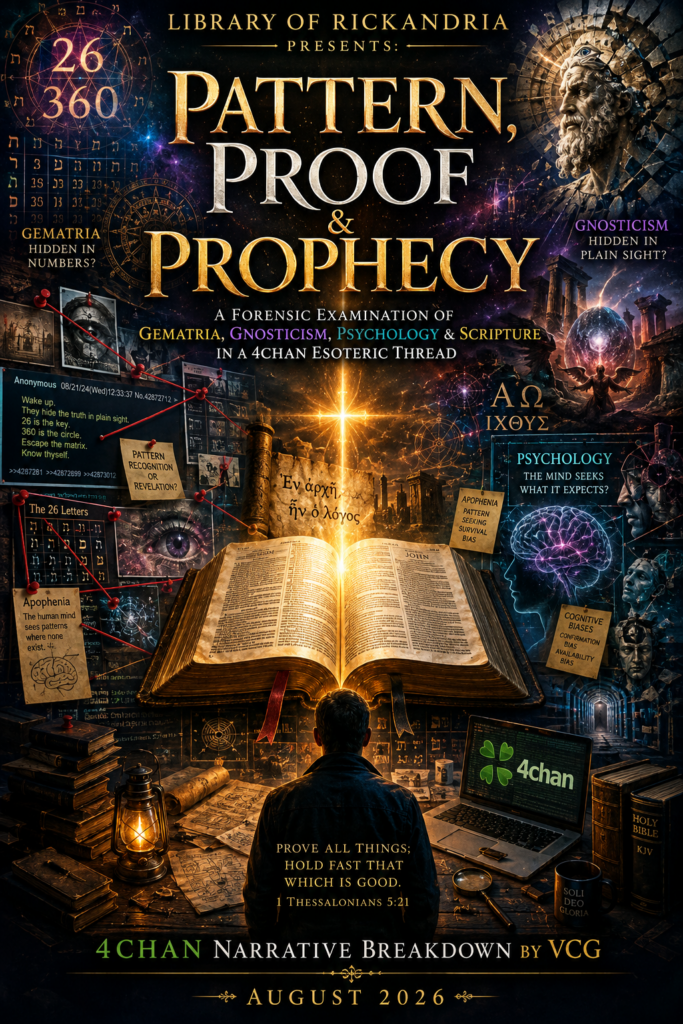
UPDATED BY VCG ON 8/26/2026 @ 18:18 EST
I want to share a heartfelt cause with my audience. Conner Blaisdell-Greene, a brave Airforce Sr. Airman, recently lost his battle with cancer, leaving his family in financial distress. Every donation, no matter how small, can help cover his funeral costs and ease their burden during this difficult time. Please consider clicking the link below to contribute or share Conner’s story with others. Your support truly matters.
Until We Meet Again
Spoken Tribute
Soli Deo Gloria, brethren.
“Prove all things; hold fast that which is good.” — 1 Thessalonians 5:21, KJV
Abstract
On August 25–26, 2026, an anonymous discussion on 4chan’s /x/ board developed from a set of numerical observations into a much broader theory involving gematria, Sirius, axial precession, Gnosticism, bioelectricity, diet, reincarnation, a hidden divine Mother, semen retention, manifestation, parasites, the Holy Spirit, and biblical symbolism. The thread is worth examining precisely because not everything in it is false. Several of its starting observations are real: the traditional Hebrew numerical value of YHWH is 26; Earth’s axial precession is roughly 26,000 years; neurons are bioelectric; ancient Gnostic movements could be strongly anti-cosmic; and cosmic-egg and maternal sky imagery occur in ancient religion.
The problem arises in the transitions between those facts. Again and again, an authentic observation becomes a resemblance, the resemblance becomes a symbolic association, and the association is then treated as evidence for an unseen causal system. Numerical coincidence becomes intentional coding; biological electricity becomes metaphysical electricity; mythological womb imagery becomes a literal reincarnation mechanism; dietary experience becomes a universal spiritual law; and biblical metaphor becomes evidence of a concealed esoteric theology.
This paper works through the thread in sequence. It keeps five questions separate: What did the poster actually claim? What is historically or scientifically established? What reasoning method connects the premise to the conclusion? What psychological processes may help explain the appeal of the pattern? And what does the biblical text itself actually teach? The purpose is not to ridicule anonymous posters or to dismiss unusual claims merely because they are unusual. It is to distinguish pattern from proof.
The central conclusion is simple:
A pattern may be real without being intentional. An association may be meaningful without being causal. A symbol may be ancient without describing physical reality. And a biblical phrase may resemble an esoteric idea without teaching that idea.
Introduction: Reading the Thread as an Investigation
The thread begins innocently enough. The original poster reports using an AI system to search for combinations of letters whose numerical values equal 26 and 360. From there, words such as GOD, EAT, LIE, DIM, BIO, RAG, and GEN become part of a growing pattern. Soon Sirius, the 26,000-year precessional cycle, Gnosticism, electricity, diet, reincarnation, ancient goddesses, language, semen retention, manifestation, and Scripture are drawn into the same explanatory web. By the end of the captured discussion, the proposed system has become a general theory of consciousness, health, morality, religion, and reality itself.
There are two bad ways to approach material like this.
The first is to believe it because it feels interconnected. The second is to reject it because it looks strange.
Neither approach is adequate.
A claim should survive or fail according to its evidence, not according to whether it sounds conventional. In fact, one of the reasons this thread is instructive is that it frequently starts from something genuinely interesting. If every premise were obviously false, there would be little to analyze. The persuasive force comes from the mixture: real facts, real ancient symbols, real biological processes, real biblical language, and real subjective experiences are woven together with conclusions that often go far beyond what those facts establish.
The research standard used here follows the same general philosophy preserved in the VCG research framework: evidence before opinion, context before commentary, Scripture interpreted in context, uncertainty stated honestly, and opposing claims represented fairly.
There is also a specifically biblical reason not to fear careful examination. First Thessalonians does not say to accept every spiritual claim, nor does it say to mock everything unfamiliar. It says,
“Prove all things; hold fast that which is good.”
That is the spirit of this paper.
1. The Opening Puzzle: Why Do GOD, 26, and 360 Appear Together?
The first post is built around numerical correspondence. Under the familiar English A1Z26 system—A=1, B=2, C=3, and so on—GOD totals 26:
G = 7, O = 15, D = 4; therefore 7 + 15 + 4 = 26.
That calculation is correct.
Several of the other words highlighted in the thread also genuinely total 26:
EAT = 5 + 1 + 20 = 26.
LIE = 12 + 9 + 5 = 26.
DIM = 4 + 9 + 13 = 26.
BIO = 2 + 9 + 15 = 26.
RAG = 18 + 1 + 7 = 26.
GEN = 7 + 5 + 14 = 26.
The poster therefore has not invented the arithmetic. The question is what the arithmetic means.
There is also a legitimate historical reason that 26 attracts attention in Jewish numerical interpretation. In conventional Hebrew numerical values, the four letters of the Tetragrammaton—YHWH—sum to 26: yod = 10, he = 5, waw/vav = 6, he = 5. Scholarly treatments of Jewish and Christian numerical traditions recognize this association.
So far, there is a genuine numerical fact.
The decisive problem appears when the thread treats the English total of 360 as though it were a second, independent confirmation.
It is not.
The English circle displayed in the thread assigns each letter its normal alphabet position multiplied by 360/26. Thus A is approximately 13.846, B about 27.692, and so forth, with Z = 360. In mathematical form:

The same thing necessarily happens to every other English word that totals 26 under A1Z26.
If EAT equals 26 in the first system, it must equal 360 in the second.
If LIE equals 26, it must equal 360.
If BIO equals 26, it must equal 360.
The second result has been mathematically generated from the first.
This does not make the arithmetic fraudulent. It means the two numbers are not independent evidence. The system is effectively saying the same thing twice in different units.
That distinction matters because two independent observations can strengthen an argument. A transformed copy of the original observation does not.
The Arabic side offers another useful control. In standard Arabic abjad numeration, Allah is ordinarily calculated as 66—alif 1, lam 30, lam 30, ha 5—not 360. The 360 presentation therefore depends on a specially chosen scaling rather than the standard historical numerical value.
This gives us our first major methodological lesson. Before asking what a number means, we must ask how the number was produced.
That question is more important than the apparent coincidence.
The Search-Space Problem
There is a second issue beneath the opening numerology: the number of opportunities available for finding a hit.
Consider only three-letter combinations under A1Z26. There are 26³, or 17,576, possible ordered triples of letters. There are 300 positive ordered triples whose numerical positions sum to exactly 26. That is already about 1.7 percent of all possible three-letter combinations, before we ask whether any of them resemble words.
Now expand the search.
Allow three-, four-, five-, six-, and seven-letter words. Allow proper names. Allow abbreviations. Allow slang. Allow Hebrew, English, Arabic, Greek, transliteration variants, reverse values, reductions, multiplication, 26, 52, 72, 216, 360, and other culturally significant numbers.
The number of chances to discover something interesting becomes enormous.
This is why a numerical hit cannot be evaluated apart from its search universe. A result discovered after one predetermined test is evidentially different from a result discovered after thousands of unreported experiments.
Suppose someone predicts in advance that one particular word, under one historically established cipher, will equal one specified number. If it does, that is interesting.
Suppose instead someone asks an AI to search through thousands of words and numerical arrangements until something meaningful-looking appears. A match is then expected even when no hidden code exists.
This is the logic behind what statisticians call a multiple-comparisons or multiple-testing problem.
The thread never establishes its null model: How many equally impressive coincidences should we expect if there is no intentional code?
Without that comparison, significance cannot be measured.
AI as Pattern Finder
The use of Grok in the opening post is also worth separating from the underlying mathematical claim.
An AI can be extremely useful for generating candidate relationships. It can search quickly, calculate, compare spellings, and surface historical references. But the fact that an AI produces a connection does not make the connection independent evidence.
NIST’s work on generative AI explicitly warns that language models can produce confident confabulations and that users can become over-reliant on fluent output. A model is particularly good at satisfying a request like “find connections involving this number,” because that is exactly the task it has been given.
The appropriate use of the AI is therefore:
“Here is an interesting candidate.
Now let us test it.”
The dangerous use is:
“The AI found it, therefore the pattern has been externally verified.”
Those are not the same thing.
2. Sirius, “Serious,” the Great Year, and Gnosticism
The next stage of the discussion connects Sirius with the English word serious, links the number 26 to the roughly 26,000-year precession of Earth’s axis, and begins to interpret the physical world through a Gnostic lens.
Here again, there is a mixture of real data and weak inference.
Sirius really is the brightest star in the night sky. And Earth’s axis really does undergo a slow precessional cycle of approximately 26,000 years, primarily because gravitational forces from the Moon and Sun act on Earth’s equatorial bulge. NASA describes this cycle in approximately those terms.
The number resemblance is therefore real.
But the argument still has to answer a harder question:
Why should the resemblance be treated as intentional encoding?
“26” in Hebrew gematria is an exact sum of four assigned letter values. “26,000 years” is a rounded description of an astronomical cycle measured in a particular human unit—years. Express the same cycle in days, seconds, millennia, radians per century, or another unit, and the numerical appearance changes.
A number can be striking without functioning as a message.
The Sirius–serious connection is weaker still. The two words sound alike in modern English, but their histories are different. Sirius comes through Greek Seirios, associated with scorching or burning, whereas serious comes through Latin serius, meaning grave or weighty. Modern phonetic resemblance is not evidence of common ancient origin.
This is an important recurring pattern in esoteric language analysis: words are compared as they sound now, rather than through their historical development.
That does not make wordplay worthless. Puns can be artistically or philosophically meaningful. But a meaningful pun is different from an etymology.
Where the Gnostic Connection Is Real
The Gnostic comparison deserves more care because there really is historical overlap with some of the thread’s instincts.
Certain movements conventionally grouped under “Gnosticism” viewed embodied existence and the material cosmos with profound suspicion. Some described the soul as trapped, ignorant of its true origin, and subject to lower cosmic rulers. Plotinus criticized precisely this kind of anti-cosmic teaching.
So, when the thread imagines the lower world as a prison, school, factory, or containment system, it is not inventing the entire conceptual atmosphere out of nothing.
But “Gnosticism” was not one church with one creed. Ancient Gnostic texts and movements differed substantially from one another. And the historical existence of an anti-cosmic religious worldview cannot establish that the worldview accurately describes the physical universe.
History can tell us:
People really believed something like this.
History cannot, by itself, tell us:
Therefore the cosmology is literally true.
That second question requires another kind of evidence.
Scripture: Creation as Good, Yet Fallen
This is also the first point where the thread’s emerging cosmology comes into direct tension with the Bible it later seeks to reinterpret.
Genesis does not begin with matter as an evil prison created by a hostile lower power. It repeatedly calls the created order good and culminates:
“And God saw every thing that he had made, and, behold, it was very good.” — Genesis 1:31
This does not mean the Bible teaches that the present world is untouched by corruption. Scripture later speaks plainly about sin, death, bondage, and creation groaning under corruption. Romans 8, for example, describes creation as awaiting deliverance from “the bondage of corruption.”
But that is significantly different from classical anti-cosmic dualism.
The biblical movement is:
good creation → corruption through sin → redemption.
The more radical Gnostic movement is often closer to:
material cosmos itself → prison/error → escape through awakening or knowledge.
Those frameworks should not be blended without acknowledging the difference.
3. “The Body Is Electric”: From Neuroscience to Ether
The thread then shifts into physiology.
The body is described as electric, which becomes part of an argument for:
- ether
- frequencies
- encoded language
- consciousness
and a hidden electrical nature of reality.
The first proposition is correct in an ordinary scientific sense.
Neurons are electrically excitable cells. Their resting membrane potentials and action potentials depend on ion gradients, especially sodium and potassium, maintained across cell membranes. Muscle cells and cardiac tissue likewise depend on electrochemical signaling.
So “the body is electric” can be a perfectly legitimate shorthand.
The problem begins when electric changes meaning midway through the argument.
In neuroscience, electrical activity means measurable differences in charge, ion transport, membrane voltage, and current.
In the thread, electric gradually becomes a bridge to:
- a hidden ether,
- spiritual vibration,
- language as dimensional technology,
- thought projection,
- soul transmission,
- consciousness fields.
Those are new propositions.
They do not follow from the existence of membrane potentials.
This is a textbook example of equivocation: a word retains the emotional force of its scientific meaning while quietly taking on a different metaphysical meaning.
A similar problem appears with energy. Physics gives energy a measurable meaning. Everyday speech uses energy metaphorically—“good energy,” “bad energy,” “social energy.” Spiritual systems may use it in still another sense.
There is nothing inherently wrong with metaphor.
The problem appears when evidence for one meaning is presented as evidence for another.
What About the Ether?
The thread’s “true ether” is not defined precisely enough to test.
Historically, the luminiferous ether was proposed as the medium through which light waves propagated. Nineteenth-century experiments, most famously Michelson–Morley, failed to detect the expected ether drift, and the classical ether model was eventually displaced by relativity.
Modern physics does speak about fields, spacetime, quantum vacuum states, and other entities that are far stranger than nineteenth-century mechanics imagined.
But calling those things ether would not validate a spiritual ether unless the proposed system gives us a defined mechanism and testable predictions.
A scientific-sounding word cannot substitute for a model.
4. El, Baal, Zeus, and the Danger of Compressing Ancient Religion
The thread also asks whether “El” is essentially a storm god comparable to Zeus.
There is a historical reason the comparison feels plausible: ancient Near Eastern religion contains abundant storm, thunder, warrior, fertility, and high-god imagery.
But the specific identification is too compressed.
In Ugaritic/Canaanite religion, El is generally the senior creator/father figure, while Baal is the major storm and warrior deity. The Metropolitan Museum’s historical material distinguishes the two.
That distinction matters.
A syncretic theory becomes easier to construct if all ancient divine titles are flattened into one archetype:
El = Baal = Zeus = electricity = sky = thunder = biblical God.
But history rarely cooperates with such clean equivalences. Deities could share attributes, absorb features from one another, or be identified across cultures, while still remaining distinct within particular textual traditions.
Historical comparison is strongest when similarities and differences are preserved.
5. Were Human Beings Originally Frugivores?
The same post argues that humans are naturally fruit-eating creatures and suggests that meat consumption represents a degeneration or artificial evolutionary turn.
This claim should be separated into several smaller questions.
Humans certainly can thrive on diets rich in plant foods. Fruit is nutritionally valuable. Early hominin diets contained substantial plant material.
But the stronger claim—that humans are biologically specialized frugivores whose proper natural diet is fruit alone—is not well supported by paleoanthropology.
Smithsonian material describes early hominin species such as Ardipithecus ramidus as likely omnivorous rather than specialized fruit eaters, and the evidence for later human diets points toward considerable dietary flexibility.
At the same time, the opposite popular slogan—
“meat made us human”
—should not be accepted uncritically either. Archaeologists continue to debate the degree to which increased meat consumption drove particular stages of human evolution. Recent work has challenged overly simple versions of that narrative.
The safest conclusion is less dramatic than either extreme:
Humans evolved as flexible omnivorous primates able to use a broad range of plant and animal foods.
That is not an argument for what any particular person ought to eat today. It is simply a distinction between evolutionary history and dietary ideology.
6. Cain and Abel: Diet or Faith?
Once diet enters the thread, Genesis becomes part of the pattern. Cain offers fruit of the ground; Abel offers from his flock. That difference can easily be drawn into a theory about plant food, flesh, sacrifice, spiritual frequency, or concealed dietary symbolism.
But Scripture itself supplies an interpretive anchor.
Hebrews says:
“By faith Abel offered unto God a more excellent sacrifice than Cain…” — Hebrews 11:4
This does not settle every theological question surrounding Cain and Abel. Readers have long discussed the quality of their offerings, the place of blood sacrifice, the condition of their hearts, and the wording of Genesis itself.
What it does tell us is that the New Testament explicitly emphasizes faith.
The text does not say Abel was spiritually superior because animal tissue carries a higher vibration, nor that Cain’s plant offering represents frugivory, nor that the story encodes a nutritional technology.
Those interpretations may be proposed, but they are additions to the text and should be labeled as such.
7. Death as Portal: Wombs, Cosmic Eggs, and the Recycling of Souls
The next portion of the thread is one of the most imaginative. Death is described in reproductive terms; souls are imagined as passing through womb-like portals; microorganisms are said to participate in tearing down the body and perhaps the soul; Orphic and Egyptian motifs are connected to a larger theory of reincarnational recycling.
Two ancient motifs invoked here are genuine.
First, Orphic cosmic-egg imagery is real. In Orphic theogonic traditions, a primordial figure such as Phanes emerges from a cosmic egg associated with Chronos and Aither.
Second, Egyptian religion really does use cosmic maternal imagery. The sky goddess Nut is associated with swallowing the sun at evening and its renewed birth, and with celestial maternity more broadly.
That historical material is fascinating.
But the thread moves from:
ancient people symbolized the cosmos through eggs, wombs, swallowing, death, and rebirth
to:
the cosmos literally operates as a reproductive recycling machine for souls.
That second proposition is not contained in the first.
Eggs and wombs are among the most obvious natural symbols human beings possess for emergence, life, containment, birth, transformation, and renewal. Their appearance in cosmology is therefore unsurprising even if no literal cosmic reproductive apparatus exists.
An additional correction is important regarding Nut. The Egyptian material is not simply about entrapment. Nut also carries strongly protective funerary meanings. The thread selects the imagery that fits its prison-womb model while leaving out features that do not.
That is a small but important example of selective comparison.
Microorganisms and the Soul
The thread then crosses another category boundary.
Microorganisms unquestionably participate in decomposition.
- Bacteria
- fungi
- insects
and other organisms help break down organic tissue after death.
But no evidence in the thread establishes that microorganisms:
attack an immaterial soul,
erase personal memory from it,
transmit it elsewhere,
prepare it for reincarnation,
or convert consciousness into another body.
The observable premise is biological decomposition.
The conclusion is metaphysical soul mechanics.
Between them lies an unmeasured mechanism.
That does not mean metaphysical questions about the soul are meaningless. It means microbiology alone cannot supply the missing steps.
Scripture: Death, Judgment, and Reincarnation
The biblical comparison is unusually direct here.
Hebrews states:
“And as it is appointed unto men once to die, but after this the judgment…” — Hebrews 9:27
Within the canonical Christian framework, the expected sequence is therefore not repeated involuntary reincarnation through wombs.
The surrounding context also compares the once-for-all character of human death with Christ being offered once.
This should be described carefully. Hebrews 9:27 is not a laboratory experiment proving that no reincarnation mechanism could exist. It is a textual and theological contradiction between the thread’s reincarnational scheme and the canonical teaching of Hebrews.
That distinction—science on one side, biblical theology on the other—is essential throughout this study.
8. Language, Slang, “Low Vibration,” and the Subconscious
Another branch of the thread concerns speech. Certain forms of slang, including African American English, are characterized as low-vibrational, and expressions such as exaggerated death-language are interpreted as potentially programming the subconscious. The poster further suggests that the subconscious does not understand jokes or sarcasm.
There is a reasonable insight buried inside this argument:
language matters.
Repeated speech can influence attention, expectations, self-concept, social identity, and emotional framing. The words people habitually use can both express and reinforce patterns of thought.
But this does not establish a literal hierarchy of spiritual vibration among dialects.
African American English is not random corruption of Standard English. Linguistic organizations describe it as a systematic, rule-governed variety with its own regular grammatical, phonological, semantic, and pragmatic features.
Calling a dialect “low vibrational” therefore tells us more about the metaphysical framework of the speaker than about linguistics.
The sarcasm claim is also overstated. Human sarcasm comprehension depends on context, prosody, social inference, and the ability to distinguish literal wording from intended meaning. Neuropsychological studies show that people recruit mentalizing and frontal networks precisely to interpret nonliteral speech.
A person may certainly react automatically to emotionally loaded words before consciously analyzing them. But that is not the same as saying some hidden subconscious system literally cannot recognize humor or sarcasm.
Scripture and Speech
The biblical concern with language is real, but its framework is moral and relational rather than vibrational physics.
Scripture repeatedly treats speech as connected with truthfulness, charity, anger, wisdom, deceit, blessing, and what proceeds from the heart.
Nothing in that moral seriousness requires the claim that slang phrases emit a measurable spiritual frequency.
That distinction allows us to preserve the thread’s useful intuition—speech matters—without importing an unsupported mechanism.
9. The Hidden Mother and Semen Retention
The discussion then proposes that a feminine divine principle—a Mother—has been hidden beneath Scripture. Semen retention is drawn into this model as a discipline that allegedly changes one’s relationship to reality, with favorable events interpreted as evidence that the Mother rewards or protects the practitioner.
Here it helps to divide the question into physiology, religious history, and theology.
There is medical research on periods of ejaculatory abstinence. In fertility studies, longer abstinence tends to increase semen volume and sperm concentration, while findings concerning motility, morphology, DNA fragmentation, and reproductive outcomes are more complicated. Systematic reviews do not yield a simple rule that “the longer the retention, the healthier or more powerful the person becomes.”
More importantly, these studies measure semen parameters.
They do not measure:
cosmic favor,
synchronicity,
divine maternal protection,
spiritual voltage,
manifestation ability.
The physiological evidence therefore cannot be used as proof of the metaphysical claim.
Someone may sincerely report that life changed during a period of abstinence. But many variables can change simultaneously: attention, motivation, habits, sleep, social behavior, pornography use, discipline, expectation, confidence, religious practice, and the interpretation of ordinary events.
A personal experience may be meaningful without establishing the mechanism attributed to it.
Is the Holy Spirit a Hidden Mother Earth?
Historically, religions do contain feminine divine figures, maternal cosmic symbols, personified Wisdom traditions, and female imagery for divine care.
Christian writers have also sometimes used maternal metaphors in theological discourse.
But the specific equation:
Holy Spirit = hidden Mother Earth
requires textual evidence.
Matthew’s baptismal formula reads:
“…in the name of the Father, and of the Son, and of the Holy Ghost…” — Matthew 28:19
Genesis, meanwhile, begins by placing the earth among the things God creates:
“In the beginning God created the heaven and the earth.” — Genesis 1:1
The biblical text therefore distinguishes God from the earth as Creator from creation.
One may construct an external theological system in which the Earth symbolizes maternity and the Spirit is interpreted through that symbol. But the responsible wording would be:
“This is an interpretive synthesis.”
It would not be:
“This is what the Bible secretly says.”
The latter requires evidence from the text itself.
10. “Nothing Is Coincidence”: When a Theory Becomes Impossible to Falsify
By the middle of the thread, a decisive epistemological statement appears:
essentially, nothing is coincidence.
Gematria in:
- sports
- celebrity deaths
- elites,
- nonhuman intelligence
- karma
- manifestation
and hidden planning are gathered under a common assumption that meaningful correspondences are intentional.
This is where the methodology becomes self-sealing.
If every meaningful pattern is intentional by definition, then chance has been eliminated before the evidence is examined.
Consider what happens next.
A numerical match is evidence.
A non-match can be explained by another cipher.
A date miss can be explained by another date format.
A spelling failure can be repaired with a nickname, full name, abbreviation, transliteration, or alternate language.
A skeptical person can be interpreted as spiritually blinded.
A failed prediction can be treated as hidden manipulation.
Eventually, no possible observation is allowed to count against the theory.
That is a major problem.
A good hypothesis needs to tell us not only what would support it, but also what would make us reduce confidence in it.
Otherwise, the theory is protected from reality rather than tested against it.
How Sports or Celebrity Gematria Could Actually Be Tested
There is a straightforward way to investigate such claims rigorously.
Before the event occurs, the researcher would have to freeze the cipher, spelling rules, target number, event being predicted, date window, success criteria, and allowable transformations. Every prediction would have to be recorded, including the failures. After a large number of trials, the success rate could be compared with chance and with control methods.
If the system consistently predicts future events under fixed rules, it becomes much more interesting.
If impressive hits appear only after events occur and after flexible searching across many systems, the result is much less impressive.
The difference is prospective prediction versus retrospective fitting.
The thread mostly offers the latter.
11. “You Reap What You Sow”: Biblical Teaching or Karma?
The thread correctly recognizes that the Bible contains sowing-and-reaping language.
Paul writes:
“Be not deceived; God is not mocked:
for whatsoever a man soweth, that shall he also reap.” — Galatians 6:7
On the surface, this can sound similar to karma or manifestation.
But context matters.
The next verse tells us what Paul means:
“For he that soweth to his flesh shall of the flesh reap corruption; but he that soweth to the Spirit shall of the Spirit reap life everlasting.” — Galatians 6:8
Paul’s argument is moral and eschatological. It concerns conduct, flesh, Spirit, perseverance in well doing, and everlasting life.
That is not identical to the claim that every thought emits a frequency which mechanically attracts corresponding events.
There is a broad similarity:
actions have consequences.
But broad similarity does not erase theological difference.
The biblical text presents a personal God, moral accountability, grace, judgment, and the distinction between flesh and Spirit.
A generic cosmic law of attraction is a different model.
12. “Are You God?” Image, Likeness, and Identity
The thread also moves toward a familiar esoteric proposition: if human beings participate in divinity or consciousness, perhaps each person is in some sense God.
Genesis certainly grants human beings an extraordinary dignity:
“So God created man in his own image, in the image of God created he him…” — Genesis 1:27
But an image is not identical to what it images.
A portrait of a king bears the king’s likeness but is not the king.
Biblical theology can speak of participation, adoption, indwelling, transformation, union with Christ, and becoming partakers of divine benefits without erasing the Creator-creature distinction.
The thread’s question is philosophically interesting.
The biblical text does not answer it by saying that the human self simply is God.
13. Can Contradictions Both Be True?
The thread also appeals to paradox and suggests that contradictory propositions can sometimes both be true.
There is an important distinction here.
Many apparent contradictions disappear once we notice that words are being used differently.
A person can be:
poor financially and rich relationally;
weak physically and strong morally;
one person and simultaneously a father, son, and brother.
Those are not formal contradictions.
Two perspectives can also describe the same event at different levels.
But if two propositions truly assert A and not-A in the same respect, at the same time, and with the same definitions, declaring the conflict a paradox does not resolve it.
Mystery is not the same as contradiction.
That distinction matters because “reality is paradoxical” can otherwise become another device by which mutually incompatible claims are protected from examination.
14. Does Reality Listen to Thought?
The next stage of the thread proposes that reality itself is alive or responsive and that thoughts, prayer, intention, and belief participate in shaping external events. The poster suggests that different religious names—God, Spirit, Source, Universe—may all refer to essentially the same responsive reality.
Here again, a weaker version of the claim is unquestionably true.
Thoughts affect behavior.
Beliefs affect attention.
Expectations affect persistence.
Fear can cause avoidance.
Confidence can change social interaction.
Hope can sustain effort.
People frequently help create some of the conditions that later appear to confirm their expectations.
Psychologists call some of these processes self-fulfilling prophecies.
None of that is trivial.
But the stronger proposition is different:
thought itself directly causes external physical events by way of a hidden universal field.
The thread does not provide an experiment capable of separating that claim from ordinary psychological and behavioral pathways.
If someone expects rejection, behaves defensively, and is subsequently rejected, the outcome is real.
It does not require reality itself to have read the thought.
The stronger metaphysical theory would need evidence showing effects that remain after behavioral, social, expectancy, reporting, and coincidence explanations have been controlled.
Prayer and “Whichever God”
Personal prayer testimony must also be treated carefully.
A person can sincerely believe that a prayer was answered. Such testimony can be religiously important to that person.
But a testimony is not automatically a controlled demonstration that consciousness manipulates reality through an impersonal law.
Likewise, the thread’s claim that prayer works regardless of whether one calls the recipient God, Source, Universe, or another name is a form of religious perennialism. It may be defended philosophically, but it should not be presented as the teaching of the New Testament.
Acts states:
“Neither is there salvation in any other:
for there is none other name under heaven given among men, whereby we must be saved.” — Acts 4:12
Whatever one thinks of that claim, it is explicitly Christological.
The New Testament does not present Jesus, the Universe, every deity, and an impersonal Source as interchangeable labels for the same salvific mechanism.
That idea comes from a different religious framework.
15. The Brain as Receiver and the Heart as Transmitter
The thread next speaks of the brain as a receiver or transmitter and the heart as producing a signal that interacts with reality.
At one level, both statements can be made scientifically.
The brain receives signals from sensory systems and transmits signals through neural networks.
The heart produces measurable electrical activity that can be recorded by electrocardiography.
But scientific words must be held to their scientific meanings.
To argue that the brain receives nonlocal consciousness, one would need to identify or infer a carrier, a coupling mechanism, and testable predictions.
To argue that cardiac fields communicate intention to external reality, one would need to show that information encoded in those fields produces external effects beyond ordinary physiological and interpersonal pathways.
The thread gives us metaphorical extension, not that experimental bridge.
Again, the premise is real.
The conclusion is larger than the premise.
16. Diet, Parasites, Fungus, and Blood pH
The dietary section becomes increasingly concrete. Meat and grains are accused of promoting fungus, parasites, mucus, loss of alkalinity, depletion of the body’s mineral reserves, rapid aging, cognitive dullness, and lower spiritual functioning. Fruit is described as restoring the body to its true state.
Because these claims concern measurable physiology, they can be tested more directly than the metaphysical claims.
Parasites transmitted through food are real. Some are associated with undercooked meat and fish.
But the CDC also documents transmission through contaminated water, soil, raw vegetables, and aquatic plants. Produce is therefore not metaphysically exempt from parasite risk. Transmission depends on the organism, sanitation, preparation, geography, cooking, contamination, and exposure.
The blood-pH claim also needs qualification.
Human blood pH is tightly regulated. The lungs, kidneys, bicarbonate system, proteins, phosphate buffers, and other physiological mechanisms work continuously to keep blood within a narrow range. Diet can influence renal acid load and urine chemistry, but ordinary dietary choices do not simply make the bloodstream progressively “acidic” or “alkaline” in the loose way popular wellness language sometimes suggests.
This is another example of a true physiological concept being expanded into a much larger explanatory story.
The body really does regulate acid-base balance.
That does not establish that ordinary meat and grain consumption continually forces bones and marrow to sacrifice themselves in the way described by the thread.
Fruit as a Complete Human Diet
Fruit is nutrient-dense and can be an important part of a healthy diet.
But a highly restrictive fruit-only diet raises obvious nutritional questions involving protein, essential fats, vitamin B12, minerals, and other nutrients. Clinical guidance warns about deficiency and malnutrition risks in strict fruitarian eating patterns.
Someone can genuinely feel better after increasing fruit consumption.
But that experience does not tell us which variable caused the change.
Perhaps the person simultaneously reduced ultra-processed foods.
Perhaps total calories changed.
Perhaps hydration improved.
Perhaps body weight fell.
Perhaps sleep improved.
Perhaps digestive symptoms changed.
Perhaps expectation played a role.
Perhaps the particular individual simply functions well on the new diet.
To move from
“I felt better”
to
“fruit restores the electrical human template and eliminates spiritual control”
requires substantially more evidence.
17. The Most Revealing Sentence: “I Don’t Need Research”
One of the most important moments in the thread occurs when the poster says, in substance, that research is not necessary to establish the claim.
That sentence matters more than almost any individual nutritional claim.
If we are talking about private meaning—what an experience felt like, what symbolism resonates personally, how a religious practice affected one’s inner life—personal testimony has an appropriate place.
But if we are making public claims about:
blood chemistry,
parasites,
human evolution,
nerve function,
aging,
hormones,
fertility,
microbiology,
then research is exactly how we determine whether personal impressions generalize.
Experience is not worthless.
Experience is the beginning of many good hypotheses.
But the disciplined next step is:
Can the effect be independently measured?
The rejection of that question is where investigation turns into closed conviction.
18. Scripture and Food: What the Bible Actually Says
The thread is correct that Genesis begins with plant food.
God tells the first human pair:
“Behold, I have given you every herb bearing seed… and every tree, in the which is the fruit of a tree yielding seed…” — Genesis 1:29
That passage should not be ignored simply because it is inconvenient to an omnivorous diet.
At the same time, the New Testament does not treat vegetarianism or carnivory as the essence of spiritual standing.
Romans 14 explicitly describes believers with different dietary practices and tells them not to despise or condemn one another. It culminates:
“For the kingdom of God is not meat and drink; but righteousness, and peace, and joy in the Holy Ghost.” — Romans 14:17
Paul can even say:
“All things indeed are pure…” — Romans 14:20
while simultaneously urging believers not to use food in a way that harms another person’s conscience.
That is a more complex ethical framework than either:
“diet does not matter at all”
or:
“diet determines your spiritual frequency.”
Scripture can support:
- fasting
- restraint
- conscience
- hospitality
- care for health
and even voluntary abstinence from meat.
It does not make fruitarianism a hidden mechanism of salvation or spiritual liberation.
19. “So the Holy Spirit?” — The Thread’s Hermeneutical Turning Point
When another poster asks whether the proposed Mother principle is the Holy Spirit, the answer is effectively yes. The thread then argues that Scripture contains codes, parables, and hidden meanings beneath the surface and suggests that original authorial intent may not be decisive.
This is perhaps the most important interpretive issue in the entire discussion.
The Bible unquestionably contains depth.
It contains parable, prophecy, typology, poetry, symbolic visions, repeated motifs, intertextual echoes, number symbolism, and patterns that are not exhausted by a superficial reading.
The existence of symbolic meaning is therefore not in dispute.
The question is:
What constrains symbolic interpretation?
If no constraint remains—if grammar, history, original language, literary context, authorial intention, and canonical context can all be ignored—then interpretation becomes unlimited.
And once interpretation is unlimited, it ceases to distinguish discovery from invention.
A Surprisingly Relevant Warning from the KJV Translators
The translators of the King James Bible themselves provide a useful methodological principle.
In The Translators to the Reader, they explicitly identify the Hebrew text of the Old Testament and the Greek of the New Testament as the “fountains” by which the translation is to be tested.
That matters enormously for modern-English gematria.
If a hidden biblical doctrine depends on:
EAT = 26
LIE = 26
Sirius ≈ serious
evolution ≈ evil
then the first question should be:
Does the proposed relationship exist in the Hebrew or Greek source from which the English was translated?
If it exists only because of modern English spelling, it cannot easily be presented as an ancient linguistic code deliberately embedded by the biblical writer.
The KJV translators make another relevant point. They deliberately did not force one identical English word to correspond to one source-language word in every passage. They considered such excessive verbal rigidity a kind of unnecessary curiosity.
That creates a serious problem for translation-level numerology.
If an English gematria result depends on one particular translated synonym, but the translators could legitimately have chosen another English synonym, then the numerical pattern may belong to the translation history rather than the inspired source text.
The Translators on Uncertainty
The KJV preface is also strikingly modest about difficult passages.
The translators explicitly acknowledge uncertainty in some words and senses and defend marginal alternatives where more than one interpretation has substantial probability. They warn against dogmatizing in matters where the evidence is genuinely uncertain.
That is a valuable model for evaluating esoteric claims.
Reverence for Scripture does not require pretending every difficult question has an obvious answer.
Sometimes the most faithful conclusion is:
“The evidence does not permit certainty.”
20. Does Authorial Intent Matter?
The thread’s suggestion that authorial intent does not matter can be understood sympathetically.
Texts sometimes acquire meanings beyond what an author consciously anticipated. Later communities interpret earlier writings in new contexts. Biblical authors themselves sometimes read earlier Scripture typologically.
So, interpretation cannot always be reduced to guessing what was consciously in one human writer’s mind.
But eliminating authorial and historical constraint altogether causes a deeper problem.
If the author’s:
- language
- genre
- historical setting
- grammar
- communicative purpose
do not constrain interpretation, then the Bible can equally be made to teach:
a hidden Mother Earth,
aliens,
simulation theory,
modern political events,
quantum consciousness,
fruitarian physiology,
astrology,
or almost anything else.
At that point, the interpretation becomes impossible to distinguish from projection.
The best approach is not a simplistic either/or.
A text can possess rich theological implications beyond the immediate conscious horizon of its human writer while still being constrained by what the text actually says.
21. Meat, Trauma, Hormonal “Hypnosis,” and Karma
The thread later argues that meat and grain produce lower forms of thought, that the trauma of animals can be transferred to consumers, and that these dietary choices participate in a broader karmic system.
There are real biological questions worth asking here.
Animals under stress experience physiological changes. Hormones, metabolites, tissue chemistry, food safety, farming practices, and preparation methods can all be studied.
But “the animal was stressed” does not automatically establish:
“the consumer absorbs the animal’s psychological trauma as mental programming.”
A causal claim requires a pathway.
Which molecule carries the emotional state?
At what concentration?
Does it survive processing and digestion?
What measurable cognitive effect follows?
How is that effect distinguished from nutrients, expectation, ideology, or other variables?
Without those intermediate steps, evocative language has replaced mechanism.
The phrase “hormonal hypnosis” has a particularly scientific sound while remaining undefined.
Scientific vocabulary does not create scientific evidence.
22. The Hostile Critic: When a Rebuttal Is Right for the Wrong Reasons
Near the end of the thread, another participant attacks the dietary theory aggressively and points out that meat and grain are entirely different nutritional categories. The critic then adds sweeping dietary claims of his own.
This exchange illustrates an important principle of reasoning:
Tone and truth are separate questions.
A rude person can make a valid argument.
A polite person can make an invalid one.
The critic is correct that grouping meat and grain together as though they were one biochemical substance is scientifically incoherent. They differ dramatically in macronutrients, micronutrients, fiber, protein, fat composition, digestion, metabolic effects, and food-safety profiles.
But the critic’s contempt does not strengthen that argument, and his own broad dietary claims also require evidence.
Ad hominem reasoning works in both directions.
The right response is not:
“He is rude, therefore he is wrong.”
Nor:
“He sounds confident, therefore he is right.”
The claims still have to be tested.
23. “The Serpent Doesn’t Want to Eat the Lie”
A later post returns to the numerical wordplay: because EAT and LIE both total 26 in A1Z26, the Genesis serpent story is reimagined through the phrase “eat the lie.”
As literary wordplay, this is clever.
As evidence that Genesis contains the code, it fails an important source-language test.
Genesis was not composed in modern English.
The English words eat and lie are products of a language history vastly later than the Hebrew text.
Therefore, before calling this an encoded biblical message, we would need a reason to believe the code was intended to emerge specifically through a later English translation.
Otherwise, the connection exists in the reader’s language, not demonstrably in the source.
This is exactly why the KJV translators’ own emphasis on the Hebrew and Greek “fountains” is so relevant.
There can be spiritually or artistically meaningful coincidences in translation.
But they should not be confused with evidence of original textual encoding.
24. “Why Do Demons Serve the Mother?” — A Loaded Question
Another participant asks why demons serve the proposed Mother.
That question sounds like a request for explanation, but it quietly assumes several disputed premises:
the Mother exists in the proposed sense;
the Holy Spirit is that Mother;
demons serve her;
the cosmic system described earlier is real.
The question therefore skips the evidentiary stage.
This is known as a loaded question.
Before asking why X does Y, we must establish that X exists in the proposed form and actually does Y.
Biblical demonology contains no requirement that demonic beings serve a hidden Mother Earth.
That hierarchy belongs to the thread’s developing synthesis, not to an explicit biblical text.
25. The Final Reply: When Disagreement Becomes Evidence
The final captured reply responds to criticism by attributing the critic’s behavior to bad energy or distorted psychology and restates the ideas of “like attracts like,” fruit-powered nervous function, parasites, fungus, and human bioelectric potential.
This marks another methodological shift.
If agreement with the theory demonstrates insight, while disagreement demonstrates low vibration, programming, dietary contamination, or psychological dysfunction, then criticism can no longer reach the theory.
Every objection becomes another confirmation.
That is a classic self-sealing structure.
None of this means we should clinically diagnose the anonymous poster.
There is nowhere near enough information to do that responsibly.
The issue is not the mental health of the person.
The issue is the structure of the argument.
26. “Like Attracts Like”: What Psychology Can Explain Without Cosmic Frequencies
The law-of-attraction idea feels compelling partly because everyday life supplies many examples that resemble it.
People who expect hostility may behave defensively and provoke hostile responses.
People who believe improvement is possible may persist longer.
People focused on one kind of opportunity notice more instances of it.
People entering a room with warmth and openness may receive different social feedback from people entering the same room suspiciously.
Those are real effects.
But they occur through identifiable pathways:
attention → expectation → behavior → social response → outcome.
The metaphysical claim is stronger:
internal frequency → external universe rearranges itself accordingly.
The thread does not separate those two models experimentally.
That distinction is crucial because the ordinary psychological model can explain a surprising amount of what people describe as manifestation without implying that their experiences are imaginary.
Their experiences may be completely real.
The proposed mechanism may simply be wrong.
27. Psychology of the Thread: Why the Patterns Feel So Powerful
It would be easy—and irresponsible—to reduce the thread to a mental-health diagnosis.
Pattern-seeking is normal human cognition.
Indeed, the ability to detect meaningful structure is one of the things that makes reasoning possible.
The challenge is that a system designed to detect patterns must sometimes produce false positives.
Psychologists use terms such as illusory pattern perception for cases in which meaningful relationships are perceived in random or unrelated material. Experimental work has found associations between some forms of supernatural or conspiratorial belief and a tendency to perceive patterns in ambiguous or random stimuli. More recent signal-detection research adds important nuance: associations can differ depending on the kind of belief being measured, and conspiracy belief should not be simplistically equated with indiscriminate pattern detection.
That nuance matters.
Real conspiracies exist.
Real symbolism exists.
Real numerical design exists.
Real religious experiences exist.
The psychological question is not whether patterns are ever real.
It is how we distinguish a real signal from a convincing false positive.
Several cognitive tendencies appear relevant to the reasoning in this thread.
Confirmation bias makes supporting examples more memorable than failures. Once 26 becomes meaningful, every new 26 feels like confirmation while countless words that do not total 26 disappear from attention.
Selection effects occur when a researcher searches many possible words, dates, names, and ciphers but reports only striking hits.
Phonetic association makes similar-sounding words feel historically related even when etymology shows otherwise.
Equivocation allows words such as electric, energy, frequency, and vibration to move between technical and spiritual meanings.
Anecdotal inference turns “this happened after I changed my behavior” into “this behavior caused the event through the mechanism I believe.”
Motte-and-bailey reasoning allows a strong metaphysical claim to retreat temporarily into a weaker obvious truth. “Thoughts control reality” can retreat into “attitude affects your life”; “the body is a cosmic electrical receiver” can retreat into “neurons use electricity.” The weaker statement is true, but it does not prove the stronger one.
Self-sealing interpretation treats skepticism itself as evidence that the skeptic is blinded, programmed, impure, or operating at a low frequency.
These patterns do not tell us what kind of person the poster is.
They tell us what kinds of controls the argument needs.
28. Syncretism: The Thread’s Real Intellectual Character
The thread is best understood not as one inherited ancient doctrine but as a modern syncretic construction.
It draws elements from:
Hebrew gematria,
modern English numerology,
Gnostic anti-cosmism,
Egyptian maternal cosmology,
Orphic creation imagery,
New Age manifestation,
bioelectric vocabulary,
dietary purity systems,
semen-retention subcultures,
conspiracy interpretation,
Christian language,
and comparative mythology.
Syncretism is not automatically false.
Religious ideas have interacted and blended throughout human history.
But discovering parallels among traditions is different from demonstrating that they all descend from one hidden original doctrine.
That historical claim requires evidence of transmission.
Who transmitted the teaching?
When?
Through what texts or communities?
Are the similarities specific enough to require common origin, or are they broad human themes such as birth, death, light, darkness, mother, sky, blood, seed, and rebirth?
Without those historical bridges, resemblance remains resemblance.
29. A Better Protocol for Testing Gematria
If the numerical claims in the thread are to be taken seriously, they should be investigated under rules capable of producing a negative result.
A rigorous protocol would look something like this:
- Freeze the source text before calculating. Decide whether the relevant language is Hebrew, Greek, Arabic, English, or another language, and specify the manuscript, edition, and spelling.
- Use a historically justified numerical system. Do not create a new multiplier after seeing the desired result.
- Pre-register the target. State the word, number, and predicted relationship before searching.
- Define what counts. Decide beforehand whether nicknames, transliterations, abbreviations, reversed spellings, reductions, and alternate forms are allowed.
- Define the search universe. Without knowing how many possible comparisons were attempted, probability cannot be meaningfully assessed.
- Record failures as carefully as successes.
- Correct for multiple comparisons.
- Use control texts and random data. A method that finds equally impressive patterns in unrelated material has little discriminating power.
- Test on new, held-out examples after developing the theory.
- Make prospective predictions. A genuinely predictive system should perform before events occur, not only after the facts are known.
The opening 26/360 relationship fails unusually early in this process because the English 360 scale is constructed directly from the 26 scale.
That finding does not destroy every possible form of gematria.
It does show that the headline “double confirmation” is not actually double.
30. The Biblical Framework: Where the Thread Agrees, Where It Departs
By this point, we can compare the thread’s larger worldview with the biblical text without pretending that every difference is settled by a single proof-text.
Creation
The thread increasingly treats embodied reality as a prison or recycling apparatus.
Genesis says creation was made by God and declared “very good.”
The Bible later teaches corruption and bondage, but corruption is not the same thing as an intrinsically evil creation.
Humanity
The thread sometimes moves toward identifying human consciousness with God.
Genesis says humans are made in the image of God.
That grants extraordinary dignity without making the image identical to its Creator.
Death
The thread proposes repeated reproductive recycling.
Hebrews says:
“…once to die, but after this the judgment.”
Within the canonical framework, that conflicts with automatic reincarnation.
The Holy Spirit
The thread identifies the Holy Spirit with a hidden Mother/Earth principle.
Matthew distinguishes “the Father… the Son… and the Holy Ghost.”
Genesis distinguishes God from the earth He creates.
The Mother-Earth identification therefore has to come from an external interpretive synthesis.
Food
The thread makes food a central determinant of spiritual condition.
Romans says:
“For the kingdom of God is not meat and drink…”
That does not make nutrition irrelevant. It prevents nutrition from becoming the essence of the kingdom.
Sowing and Reaping
The thread assimilates biblical reaping language to karma or manifestation.
Galatians defines its own context:
“he that soweth to his flesh shall of the flesh reap corruption; but he that soweth to the Spirit shall of the Spirit reap life everlasting.”
The resemblance to “actions have consequences” is real. The theological system is not identical.
Cain and Abel
The thread invites dietary interpretation.
Hebrews emphasizes:
“By faith Abel offered…”
Faith is the canonical emphasis.
Religious Pluralism
The thread suggests that prayer may work regardless of which deity or label is used.
Acts says:
“Neither is there salvation in any other…”
The New Testament’s own claim is therefore particular rather than perennialist.
Discernment
Perhaps most importantly, the biblical text explicitly leaves room for investigation:
“Prove all things; hold fast that which is good.”
That is not a command to fear difficult questions.
It is a command to test them.
31. What the Thread Gets Right
A fair investigation should not end by listing only failures.
The thread gets several important things right, or at least points toward questions worth asking.
It is right that numbers can carry symbolic meaning.
It is right that ancient religions contain recurring cosmological imagery.
It is right that human beings are bioelectric organisms.
It is right that diet affects physiology and can affect cognition.
It is right that speech matters psychologically and morally.
It is right that expectations can shape experience.
It is right that religious texts contain more than one literary level.
It is right that Gnostic systems sometimes describe embodied existence as captivity.
It is right that the Hebrew divine name has a traditional numerical value of 26.
It is right that Earth’s precessional cycle is approximately 26,000 years.
The thread’s strongest moments are often the moments immediately before it overreaches.
That is precisely why careful analysis is more useful than ridicule.
32. Where the Argument Repeatedly Breaks
The repeated inferential pattern can be written almost as a formula:
true datum → interesting resemblance → symbolic connection → hidden mechanism → universal conclusion
For example:
YHWH = 26
becomes
precession ≈ 26,000
becomes
26 is a cosmic divine cycle
becomes
language encodes reality.
Or:
neurons are electrical
becomes
the body is an electrical receiver
becomes
consciousness exists in an ether
becomes
thought alters external reality.
Or:
ancient religions use womb and egg imagery
becomes
the cosmos is literally reproductive
becomes
death sends souls through a recycling womb.
Or:
diet affects health
becomes
fruit raises spiritual electricity
becomes
meat and grain cause parasites that control thought
becomes
diet determines participation in a cosmic karmic system.
At each transition, a new proposition is introduced.
The error is not necessarily in the starting observation.
It is in treating the connecting arrows as though they require no evidence.
33. Pattern Is Not Proof
The opening numerical example gives us a remarkably clear miniature of the thread as a whole.
We begin with a real and interesting fact:
GOD = 26 under A1Z26.
Then we encounter an apparently dramatic second fact:
GOD = 360 in another circle.
But when the second system is examined, it turns out to be the first system rescaled by 360/26.
The appearance of independent convergence dissolves.
Nothing was falsified about the original arithmetic.
What changed was our understanding of the relationship between the observations.
That is the central lesson of this investigation.
The correct distinction is:
PATTERN ≠ INTENT ≠ CAUSATION ≠ REVELATION
A pattern can exist by chance.
An intentional symbol can exist without causing anything.
A causal mechanism can exist without carrying spiritual revelation.
And genuine revelation, if claimed, requires more than a suggestive coincidence.
Conclusion
This 4chan thread is valuable as a case study because it shows how an elaborate worldview can grow from a collection of observations that are not entirely false.
The Hebrew value 26 is real.
The precessional cycle is real.
Bioelectricity is real.
Gnostic anti-cosmism is historically real.
The Orphic egg is real.
Nut’s celestial maternity is real.
Dietary effects are real.
Language can affect thought.
Expectations can affect behavior.
Scripture contains symbolism.
None of those facts needs to be denied.
The decisive issue is whether they prove the larger system assembled from them.
At present, they do not.
The numerological case relies heavily on post-selection and, in its flagship 26/360 example, on a mathematical rescaling that creates the appearance of independent confirmation. The linguistic case repeatedly confuses modern sound resemblance with etymological relationship. The historical case brings together genuine motifs without demonstrating transmission into one hidden doctrine. The scientific case repeatedly moves from measurable physiology into undefined metaphysical mechanisms. The psychological case is strongest when ordinary mechanisms—expectation, attention, pattern perception, identity, behavioral feedback—are acknowledged, but those mechanisms do not by themselves establish a law of cosmic manifestation. And the biblical case often depends on reading external esoteric ideas back into passages whose immediate and canonical contexts point elsewhere.
The proper answer is therefore not:
“There are no patterns.”
Nor is it:
“The patterns prove the system.”
It is:
Keep the observations that survive testing.
Separate the symbol from the mechanism.
Return biblical claims to their context.
Test language against its historical source.
Record failed predictions as carefully as successful ones.
And refuse certainty where the evidence does not justify it.
There is something fitting about ending where the investigation began: not with fear of strange ideas, but with examination.
The King James text says:
“Prove all things; hold fast that which is good.” — 1 Thessalonians 5:21
The operative word is prove.
Not merely notice.
Not merely associate.
Not merely feel.
Test.
And after the testing, hold fast to what remains.
4CHAN THREAD & POST BREAKDOWNS – Library of Rickandria
VCG PAPER PROJECTS – Library of Rickandria