
Pharaohs, Freemasons & the Phantom Empire: 75 Images. Thousands of Years. One Alleged Secret History—Does Any of It Survive the Evidence?
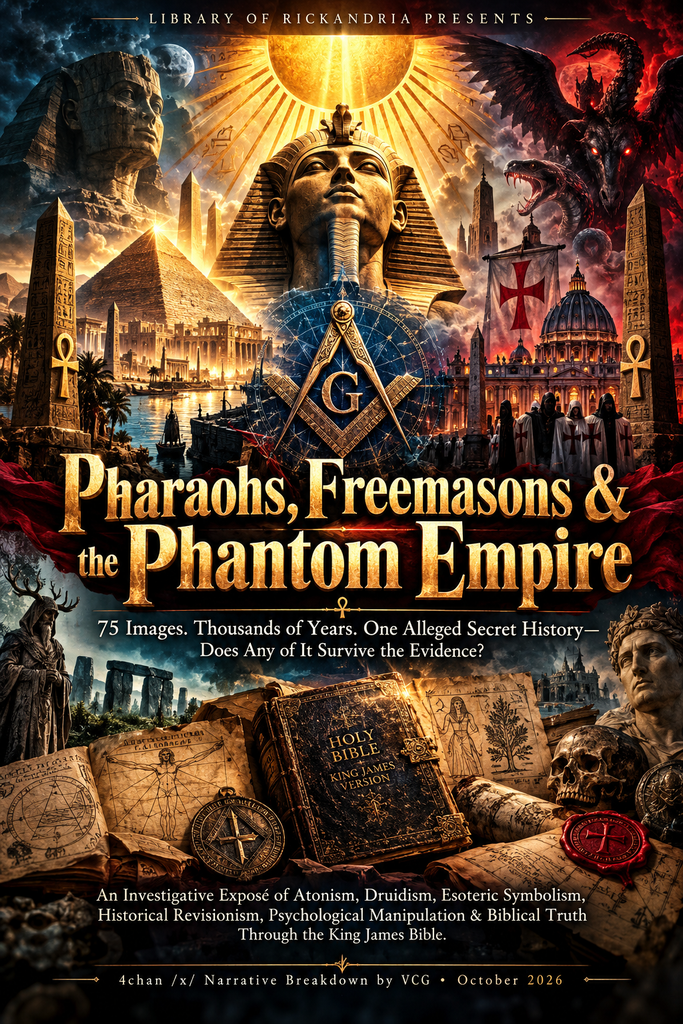
UPDATED BY VCG ON 10/26/2026 @ 21:21 EST
An Investigative Exposé of Atonism, Druidism, Esoteric Symbolism, Historical Revisionism, Psychological Manipulation & Biblical Truth Through the King James Bible.
Anyone can do this, but most won’t.
Pharaohs, Freemasons & the Phantom Empire
is an extensive investigative exposé examining a 75-image 4chan /x/ narrative alleging that an ancient Egyptian priesthood rooted in Akhenaten’s worship of Aten survived through:
- Druidism
- Judaism
- Christianity
- the Knights Templar
- Freemasonry
- European aristocracy
and modern political institutions to form a concealed global power structure.
Presented by the Library of Rickandria, this research traces the claims to their original sources and systematically examines them through:
- archaeology
- historical chronology
- comparative religion
- ancient linguistics
- institutional records
- symbolic iconography
- psychological research
- the King James Bible
The investigation distinguishes authentic historical connections and documented cultural borrowing from:
- speculative genealogies
- misleading etymologies
- selective quotations
- visual coincidences
and unsupported allegations of secret coordination.
It also explores how:
- confirmation bias
- pattern recognition
- repetition
- psychological manipulation
can transform isolated facts into seemingly convincing conspiracy narratives.
Through an illustrated symbol atlas, a chronological examination of alleged hidden lineages, Scripture-by-Scripture corrections, and a forensic inventory of all 75 submitted images, the paper asks whether the extraordinary claims survive independent scrutiny.
Its central finding is that while:
- ancient religious influence
- political intrigue
- institutional secrecy
- symbolic transmission
are genuine historical phenomena, the alleged uninterrupted Atonist empire remains unsubstantiated.
Ultimately, the study calls readers to pursue truth without fear or favoritism, allowing documentary evidence, historical context, sound reasoning, and careful biblical interpretation to determine what can—and cannot—be established.
“Prove all things; hold fast that which is good.” — 1 Thessalonians 5:21 (KJV)
ChatGPT – Library of Rickandria
LIBRARY OF RICKANDRIA PRESENTS
PHARAOHS, FREEMASONS & THE PHANTOM EMPIRE
75 Images. Thousands of Years. One Alleged Secret History—Does Any of It Survive the Evidence?
An Investigative Exposé of Atonism, Druidism, Esoteric Symbolism, Historical Revisionism, Psychological Manipulation & Biblical Truth Through the King James Bible.
4chan /x/ Narrative Breakdown by VCG — October 2026
Abstract
An anonymous internet discussion proposes an extraordinary interpretation of Western history. According to the theory,
a concealed priestly tradition originating in ancient Egypt survived the downfall of Pharaoh Akhenaten,
transmitted its doctrines through Judaism and Christianity,
influenced Celtic Druidism and medieval military orders,
and eventually emerged in Freemasonry, European aristocratic networks, religious institutions, and contemporary political organizations.
The evidence offered is visually striking.
Ancient Egyptian monuments appear beside Masonic emblems.
Religious artwork is compared with:
- solar disks
- serpents
- lions
- eagles
Fictional characters are placed alongside historical religious leaders and aristocrats.
Long passages from alternative-history literature promise to recover a civilization supposedly erased from official history.
But do these materials establish what their authors claim?
This investigation examines 75 supplied images, the original October 2026 4chan discussion, its earlier companion thread, the historical literature upon which the claims depend, relevant archaeological and linguistic evidence, documented institutional histories, peer-reviewed psychological research, and the King James Bible.
The central finding is that the material combines numerous authentic historical details with speculative connections that are repeatedly presented as established fact.
- Cultural borrowing
- religious syncretism
- institutional secrecy
- historical misrepresentation
are legitimate subjects of investigation.
Yet the alleged uninterrupted Atonist ruling organization has not been demonstrated by the evidence examined.
The purpose of this paper is not to defend any institution from legitimate scrutiny.
It is to determine which claims survive scrutiny, which require qualification, and which collapse when the underlying evidence is examined.
Keywords:
- Atonism
- Akhenaten
- Hyksos
- ancient Israel
- Druidism
- Freemasonry
- comparative religion
- historical linguistics
- Knights Templar
- Knights of Malta
- symbolism
- conspiracy narratives
- biblical hermeneutics
- King James Version
A note on the scope of this edition
All 75 uploaded images have been indexed.
The principal claims and major source traditions have been researched, and the images are individually identified in Appendix A.
Because several screenshots contain thousands of words and multiple embedded quotations, that index must not be mistaken for a completed authentication of every sentence or every attributed quotation.
Where an original quotation, image provenance, or detailed historical allegation remains unverified, this edition identifies the limitation rather than silently claiming certainty.
PART I — ENTERING THE THREAD
1. The Strange Beginning: Hollywood, Aristocrats, and Hidden Messages
The investigation begins with the archived 4chan /x/ discussion:
Druidic Symbolism in Masonry & Judeo-Christianity — Thread 2, No. 43094396
The thread began on October 17, 2026, as a continuation of an earlier discussion that opened on October 3:
Original discussion, No. 43040229
The opening posts do not begin with an Egyptian inscription or archaeological discovery. Instead, they begin with faces.
A fictional horror writer from In the Mouth of Madness is compared with photographs attributed to members of a European aristocratic family.
Another image compares a character from Game of Thrones with a real-world figure.
A third places a fictional Imperial officer from Star Wars beside a Jesuit religious leader.
The poster suggests that resemblance may reveal a concealed relationship between:
- entertainment
- aristocracy
- religious authority
- hidden political power
This opening is significant because it establishes the thread’s preferred method before the ancient-history material appears.
The initial premise is not that a document proves the relationship.
It is that two things look connected.
There is nothing unreasonable about observing visual similarities.
Creative artists frequently draw upon:
- real people
- historical costumes
- architecture
- mythology
and familiar visual conventions.
But identifying a possible resemblance and identifying its actual cause are different tasks.
Consider the opening comparison between a fictional character and a historical person.
At least four explanations are possible:
- The fictional character was intentionally modeled on that person.
- Both individuals happen to share features associated with a familiar visual stereotype.
- The selected photographs exaggerate a resemblance that would be less convincing with different angles or lighting.
- The resemblance is coincidental.
To establish the first explanation, the researcher would need:
- production records
- concept art
- correspondence
- interviews
or comparable evidence of artistic intent.
Simply placing two faces beside one another cannot resolve the question.
The same standard applies to suggestions that the Matrix Architect was intentionally modeled upon the Jesuit Superior General Peter-Hans Kolvenbach.
Kolvenbach’s position and dates are historical matters.
The actor’s appearance is an observable feature of a movie.
But a relationship between those facts still requires evidence.
The theory supplies resemblance.
It does not supply the missing production history.
The first revealing exchange
Interestingly, the thread contains its own critics.
In post 43098273, an anonymous participant challenges the tendency to recycle loosely connected material as entertainment disguised as investigation.
Another participant subsequently suggests that criticism may originate from provocateurs.
This exchange matters more than it initially appears.
A healthy investigation treats informed disagreement as a way to expose weaknesses.
A self-sealing theory can instead treat disagreement as evidence that someone is protecting the secret.
That difference will recur throughout the material.
Initial finding:
The opening comparisons are hypotheses based on visual resemblance, not verified evidence of deliberate casting, hidden identity, coordinated political activity, or criminal wrongdoing.
2. What Counts as Evidence?
Before examining ancient Egypt, we need to establish the difference between a fact and an argument constructed around that fact.
Suppose we discover that an Egyptian temple contains a winged emblem.
A modern organization also uses a winged emblem.
Both observations may be entirely accurate.
But consider the sequence of conclusions that might follow.
Observation:
Two emblems look similar.
Historical hypothesis:
One emblem influenced the other.
Institutional hypothesis:
The organizations that used them share a continuous tradition.
Political allegation:
Their modern members secretly coordinate world events.
These are four distinct claims.
The first can be established through visual comparison.
The second requires historical evidence of transmission.
The third requires evidence of organizational succession or a traceable cultural tradition.
The fourth requires evidence of actual conduct, communication, authority, or coordination.
The existence of the first fact does not automatically establish the remaining three.
The five evidentiary classifications
Throughout this paper, claims receive one of five assessments.
| Classification | Meaning |
|---|---|
| Verified | Supported by reliable evidence appropriate to the claim |
| Partly supported | Contains a factual basis but goes beyond what the evidence establishes |
| Unsubstantiated | Sufficient evidence has not been presented or located |
| Contradicted | Conflicts with established documentation or contains a demonstrable factual error |
| Unresolved | Available evidence is inadequate to settle the question |
A separate designation, interpretation, applies to theological, artistic, or philosophical readings that are not themselves direct historical observations.
One methodological principle is especially important: absence of evidence does not always prove that an event never occurred.
However, when someone claims an organization maintained centralized power across several thousand years, a substantial burden of historical demonstration follows.
We should reasonably expect some combination of inscriptions, preserved documents, administrative records, identifiable succession, transmitted rituals, archaeological continuity, or contemporary testimony.
A theory cannot indefinitely avoid that burden by declaring that every missing record was deliberately destroyed.
PART II — THE GENEALOGY OF A SECRET HISTORY
3. Where Did the Claims Come From?
As the discussion proceeds, it becomes clear that much of the material is not independent research conducted by the anonymous posters.
A major portion reproduces an online series titled Cult of Aton, published by Elite’s Esoteric Symbols in 2017.
Original article: Cult of Aton, Part 1 — Akhenaton and the Hyksos Kings
The article cites or follows the work of:
- Sigmund Freud
- Michael Tsarion
- Ralph Ellis
- Moustafa Gadalla
- Ahmed Osman
and other alternative-history writers.
The thread also reproduces substantial portions of material associated with Michael Tsarion’s The Irish Origins of Civilization.
This source history is critical.
A claim may appear in five different screenshots, on three websites, and in several anonymous posts.
Yet all of them may be repeating one author’s original conjecture.
That does not establish five independent sources.
It establishes five instances of transmission.
The source genealogy
The chain broadly proceeds as follows:
Ancient artifact or historical account
↓
Nineteenth- or twentieth-century speculative interpretation
↓
Modern alternative-history book
↓
2017 illustrated blog series
↓
2026 anonymous message-board reproduction
↓
Readers encounter the claim as an apparently established historical discovery
This does not mean every author is deliberately deceiving the audience.
Some may sincerely believe the interpretation.
But sincerity does not establish historical accuracy.
A useful test is to trace every consequential claim backward until we find the earliest actual evidence—not merely the earliest writer who repeated it.
Freud and the Egyptian Moses
One especially revealing example concerns Sigmund Freud.
Freud’s 1939 book Moses and Monotheism proposed a speculative reconstruction in which Moses was Egyptian and connected to Akhenaten’s religious movement.
The Freud Museum’s discussion of the book explains that Freud regarded Moses as an Egyptian nobleman and follower of Akhenaten.
That is not the same as demonstrating that Moses was Akhenaten.
Yet the later material frequently moves toward precisely that identification.
Here, the original speculative thesis has been enlarged into a stronger allegation without obtaining correspondingly stronger evidence.
Freud’s standing as an influential psychoanalyst cannot substitute for Egyptian inscriptions, a reliable ancient biography, or corroborated archaeological evidence.
An investigator must distinguish what Freud proposed, what his successors inferred, and what surviving ancient evidence establishes.
PART III — THE MISSING MILLENNIA
4. The Historical Timeline
The proposed secret history depends upon continuity.
Its central institutions supposedly survived the collapse of dynasties,
migrations across continents,
changes of language,
the emergence of Christianity,
the rise of medieval military orders,
and the formation of modern nation-states.
Chronology is therefore not a minor detail.
It is one of the theory’s greatest tests.
| Period | Historical development | Relevance |
|---|---|---|
| c. 1650–1550 BC | Hyksos rule in northern Egypt | Alleged ancestral foundation |
| c. 1550 BC | End of Hyksos rule | Claimed dispersal of a ruling tradition |
| c. 1353–1336 BC | Akhenaten’s reign | Aten-centered religious reform |
| c. 1208 BC | Merneptah Stela mentions Israel | Independent evidence for an ancient Israelite population |
| First millennium BC | Documented Celtic cultures and later classical references to Druids | Proposed Western priestly counterpart |
| First century AD | Emergence of Christianity in Roman Judaea | Alleged religious transformation |
| 1113 AD | Papal recognition of the Hospitallers | Medieval military-religious institution |
| c. 1119–1312 AD | Historical Templar order | Alleged transmission of secret traditions |
| 1646 AD | Recorded initiation of Elias Ashmole as a Freemason | Early evidence of speculative Masonry |
| 1717 AD | Traditional foundation of the first London Grand Lodge | Development of modern organized Freemasonry |
| 1956 AD | Registered Priory of Sion association | Important modern secret-society genealogy claim |
| 2017 AD | Cult of Aton blog series | Major source for the thread |
| October 2026 | 4chan threads | Contemporary distribution |
Sources:
- Egyptian Ministry of Tourism and Antiquities
- Metropolitan Museum of Art
- Merneptah Stela
- British Museum
- Order of Malta
- United Grand Lodge of England
The existence of these societies and events is not the problem.
The problem is the alleged succession between them.
A possible historical influence across centuries must be supported by evidence of how something moved from one place to another.
An alleged secret command structure surviving thousands of years requires substantially more.
We do not presently possess the authenticated documentary chain necessary to establish the proposed uninterrupted Atonist organization.
Chronological verdict:
the component histories are real; the claimed continuous secret institution is unsubstantiated.
5. The Hyksos: Real Rulers, Extraordinary Claims
The Hyksos were real.
According to Egypt’s Ministry of Tourism and Antiquities, the Hyksos Fifteenth Dynasty ruled much of northern Egypt during the Second Intermediate Period, with its center at Avaris in the eastern Nile Delta.
Primary historical overview: Second Intermediate Period
The term Hyksos derives from an Egyptian expression commonly understood as rulers of foreign lands.
The archaeological evidence indicates substantial connections between Egypt and the Levant.
These facts establish a genuinely interesting history of migration, political change, and cultural interaction.
But the thread makes considerably larger claims.
It suggests that Hyksos kings were the original Israelites, that they were connected to ancient Western European priesthoods, and that their supposed descendants eventually controlled later religions and secret societies.
Those conclusions do not follow from the fact that the Hyksos had connections with the Levant.
There is no established historical equation:
Hyksos = biblical patriarchs = Scythian Druids = secret modern aristocracy.
Each proposed identity requires its own linguistic, chronological, archaeological, and genealogical evidence.
The existence of migration is not proof of a particular secret ancestry.
6. Akhenaten and the Aten Revolution
Akhenaten’s reign provides one of the most compelling genuine historical subjects in the entire thread.
Born Amenhotep IV, he was a pharaoh of Egypt’s Eighteenth Dynasty and the son of Amenhotep III and Queen Tiye.
During his reign, he dramatically elevated the Aten and developed an unusual religious and artistic program associated with the solar disk.
The surviving reliefs frequently show the Aten as a radiating disk whose rays terminate in hands, sometimes presenting the ankh, a symbol of life.
These images are authentic Egyptian religious art.
Marsha Hill, Metropolitan Museum of Art: Akhenaten and the City
But three claims must be separated.
First:
Akhenaten promoted a distinctive Aten-centered religious system.
This is verified.
Second:
Akhenaten’s theological ideas influenced later religious developments.
This is a legitimate question for comparative historical research, but influence must be demonstrated rather than presumed.
Third:
Akhenaten founded a secret priesthood that survived into modern institutions and controls contemporary religious and political life.
This is the thread’s larger claim.
The documentary evidence presented does not establish it.
Was Akhenaten expelled from Egypt?
The thread repeatedly describes an expulsion of Akhenaten and his religious associates.
Yet the known historical account places Akhenaten’s reign, religious program, capital, and royal family within Egypt.
The subsequent rejection of many aspects of his reform is historically significant, but it does not establish that Akhenaten escaped or was expelled and became Moses.
That identification requires a historical reconstruction that is not supported by the cited primary evidence.
Was Akhenaten’s religion monotheistic?
Scholars have described Atenism in different ways, including discussions of exclusive worship, monolatry, and monotheism.
The terminology matters because it can obscure differences between exclusive devotion to one deity, denial of other deities’ existence, and the distinctive political role of a divine king.
We should not assume that Atenism possessed precisely the same theology as later Judaism, Christianity, or Islam merely because all involve language about one supreme deity.
Similarity in religious vocabulary is not identity of doctrine.
7. Tutankhamun, DNA, and Racialized History
The supplied screenshots use images of Tutankhamun and claims about ancient DNA to support a story of Nordic or Western-European origins.
This argument requires special caution.
Ancient population history involves migration, intermarriage, regional variation, genetic ancestry, and changing cultural identities.
It cannot be responsibly reduced to skin color, hair color, or the resemblance between an ancient portrait and a modern population.
The 2010 JAMA study concerning Tutankhamun’s family examined genetic kinship and medical questions among royal mummies.
Hawass and colleagues: Ancestry and Pathology in King Tutankhamun’s Family
The study does not establish the broad Nordic-civilizational narrative advanced in the images.
Furthermore, some researchers questioned the reliability of the original genetic findings because of ancient-DNA degradation and contamination risks.
Lorenzen and Willerslev, JAMA, 2010
More recent genomic research continues to reveal ancient Egypt’s connections with neighboring regions, but samples must be interpreted within their dates, geographical settings, and population contexts.
A DNA result from one ancient individual cannot establish the identity of an entire civilization, much less the religious allegiance of institutions thousands of years later.
Verdict:
Authentic archaeological and genetic questions are being used to support conclusions the available studies do not justify.
PART IV — DRUIDS, IRELAND, AND THE ATLANTIS PROBLEM
8. Who Were the Druids?
The thread frequently describes ancient Druids as members of a worldwide primordial priesthood.
In some passages, they are said to predate familiar ancient civilizations, to have originated in Ireland or a vanished Atlantic civilization, and to have transmitted foundational knowledge to Egypt and the Middle East.
These are far stronger claims than the surviving evidence supports.
The British Museum’s historical overview of Druids notes that classical authors, including Julius Caesar, described Druids as religious leaders in Iron Age Gaul and Britain.
Ancient sources associate them with teaching, philosophy, ritual, judgment, and religious practice.
Later Irish and Welsh literary traditions also preserve accounts involving Druids.
However, later literary accounts cannot automatically be treated as records of prehistoric events thousands of years earlier.
The British Museum further notes that many familiar visual portrayals of Druids come from the much later Druid revival rather than securely identifiable ancient representations.
This is particularly relevant to claims involving modern photographs of robed or antlered ceremonial figures.
An eighteenth-century revivalist image does not prove what an ancient Druid wore.
The supposed Atlantic origin of civilization
Several of the supplied screenshots draw upon older writings promoting Atlantis as the source of later civilizations.
One author repeatedly invoked is Ignatius Donnelly, whose Atlantis: The Antediluvian World appeared in 1882.
Donnelly’s historical importance lies partly in his influence upon later alternative-history literature.
His speculation is not, by itself, archaeological evidence that Atlantis existed as a civilization or that Celtic languages spread from it.
The comparative history of Indo-European languages is investigated through systematic linguistic relationships, not merely through resemblances among place names or reconstructed mythological traditions.
A hypothesis about ancient migrations can be examined.
It must still be supported by actual archaeological, genetic, and linguistic data.
Finding:
The Druids were real religious specialists in historically attested Celtic societies.
Their existence does not establish an ancient worldwide Druid empire.
PART V — THE ETYMOLOGY CRIME SCENE
9. When Words Become Evidence They Cannot Bear
A striking feature of the thread is the sheer number of proposed hidden etymologies.
Words from Egyptian, Hebrew, Greek, Latin, Irish, English, and other languages are rearranged into supposed ancient codes.
At first glance these comparisons may seem impressive.
But historical linguistics has methods designed precisely to distinguish genuine linguistic relationships from accidental resemblance.
Researchers examine attested earlier forms, grammatical structure, known sound changes, chronology, borrowing routes, and regular relationships between languages.
Merely dividing a modern word into suggestive syllables cannot establish its ancient origin.
Israel: Isis + Ra + El?
The material proposes that Israel secretly preserves the names of Egyptian deities.
The difficulty is that Israel is a historically attested Semitic name.
Genesis 32:28 explains its association with Jacob’s encounter with God:
And he said, Thy name shall be called no more Jacob, but Israel:
for as a prince hast thou power with God and with men, and hast prevailed.
Genesis 32:28, KJV
The ancient linguistic analysis is not entirely without scholarly questions.
Researchers debate aspects of the name’s exact morphology and interpretation.
But its attested Semitic formation does not support the proposed breakdown into Isis, Ra, and El.
The Merneptah Stela independently attests Israel around 1208 BC.
Merneptah Stela — original inscription and historical commentary
That inscription is crucial because it places Israel within the ancient Near Eastern historical record rather than leaving the identity dependent upon much later European speculation.
It does not prove every detail of the biblical patriarchal narratives.
It does, however, establish that Israel was not merely a modern fabrication.
Jesus: Horus, Esus, or Yeshua?
The theory proposes connections among Jesus, the Celtic deity Esus, and Egyptian Horus.
But the documented history of the name Jesus runs through Semitic and Greek forms.
Hebrew Yehoshua and the shorter Yeshua are related to the Greek Iēsous, which passed into Latin as Iesus and eventually into English as Jesus.
The New Testament itself supplies a theological explanation:
And she shall bring forth a son, and thou shalt call his name JESUS:
for he shall save his people from their sins.
Matthew 1:21, KJV
The meaning concerns salvation.
An alleged derivation from Horus or Esus would need to account for the documented Semitic and Greek history of the name.
The screenshots do not provide that demonstration.
Adonai and Aten
The Hebrew title Adonai belongs to the Semitic word family associated with lordship.
Its phonetic resemblance to Aten in modern English transcription does not establish derivation from the Egyptian divine name.
It is especially hazardous to compare modern Latin-letter spellings without examining the original scripts and historical pronunciations.
Freemason and the alleged Egyptian phrase
The thread presents a phrase resembling Phre Massen, supposedly meaning children of the sun, as the secret origin of Freemason.
But medieval European building terminology supplies the documented historical context for mason.
The proposed Egyptian expression does not establish the required linguistic sequence.
Notably, post 43118558 challenges this claim from within the thread itself, examining the alleged Egyptian word forms.
That criticism deserves attention because it addresses the actual linguistic mechanism rather than merely expressing skepticism.
The Masonic G and the Gaonim
The Geonim were real Jewish scholarly authorities connected with Babylonian academies during the early medieval period.
But the claim that the Masonic letter G means Gaonim is unsupported.
The Museum of Freemasonry identifies Geometry as a historically important meaning of the letter.
Museum of Freemasonry: What Does the G Stand For?
The fact that the English transcription Gaonim begins with G is not sufficient evidence of a secret historical relationship.
The linguistic verdict
| Proposed equation | Evidence-based assessment |
|---|---|
| Israel = Isis + Ra + El | Unsupported decomposition of an ancient Semitic name |
| Jesus = Horus | Contradicted by the attested transmission of the name |
| Jesus = Esus | Unsupported etymological identity |
| Adonai = Aten | Unsupported derivation |
| Freemason = Phre Massen | Unsupported Egyptian derivation |
| Masonic G = Gaonim | Unsupported backronym |
| NATO = ATON | Anagram, not etymology |
| Celtic names prove universal Druid ancestry | Requires independent comparative linguistic evidence |
The recurring methodological problem is clear:
the theory assumes a desired historical relationship and then searches for syllables that seem to support it.
Historical linguistics must work in the opposite direction.
PART VI — THE SYMBOL TRAP
10. Why So Many Symbols Look Alike
This is arguably the most visually compelling portion of the thread.
It presents a seemingly endless sequence of lions, eagles, serpents, owls, crosses, triangles, pyramids, sunbursts, stars, and eyes.
The reader is invited to conclude that so many similarities cannot be accidental.
But the argument contains a hidden assumption:
that every similar symbol must have the same historical origin and communicate the same meaning.
Symbols do not work that way.
A single visual form may be independently invented, borrowed from another culture, reinterpreted within a new religion, adopted for political purposes, or used for ordinary aesthetic reasons.
The historian must determine which explanation applies in each case.
11. The Comparative Symbol Atlas
| Symbol | Established or historically attested meanings | What the thread additionally alleges |
|---|---|---|
| Lion | Royal authority, courage, strength, vigilance, biblical imagery | Evidence of one ancient ruling bloodline |
| Eagle | Imperial sovereignty, heraldry, victory, divine or national authority | Membership in a concealed Egyptian cult |
| Owl | Athena/Minerva, wisdom, night, learning | Universal sign of covert occult leadership |
| Serpent | Protection, danger, healing, renewal, fertility, wisdom, temptation | Evidence of an uninterrupted serpent priesthood |
| Ankh | Egyptian life symbol; later Coptic adaptation | Proof that Christianity is disguised Atenism |
| Eye | Divine observation, protection, providence, knowledge | Always the same secret Egyptian deity |
| Pyramid | Tomb, monument, durability, hierarchy, architectural symbolism | Direct lineage from pharaonic priests |
| Sunburst | Light, glory, divinity, kingship, illumination | Literal solar worship in every context |
| Olive branch | Peace, reconciliation, victory, religious symbolism | Secret mark of the Cult of Aten |
| Double-headed eagle | Imperial and dynastic authority; fraternal use | Proof of unified occult political command |
| Cross | Multiple religious, heraldic, and civic forms | One hidden pre-Christian religious meaning |
| Black cube | Geometric, religious, artistic, and other context-specific uses | Universal Saturnian secret worship |
The rightmost column records the thread’s interpretive leap.
It does not describe a verified institutional relationship.
The lion
Lions are common in heraldry partly because they communicate power, courage, and sovereignty.
The biblical tradition also uses lion imagery.
Genesis 49:9 describes Judah as a lion’s whelp.
Revelation 5:5 refers to the Lion of the tribe of Judah.
The fact that a royal coat of arms, a sports organization, and a religious passage all use a lion does not establish that their creators belong to one priesthood.
A lion is a highly recognizable symbol with multiple independent histories.
The eagle
The eagle appears in numerous national and imperial traditions.
But the eagle on the Great Seal of the United States has an officially documented context.
The Bureau of Engraving and Printing explains that its olive branch and arrows represent peace and war, while the shield refers to the union of the original states.
U.S. Bureau of Engraving and Printing: Great Seal Explanation
The thread would need evidence showing that this documented interpretation deliberately concealed a specific religious allegiance.
Without such evidence, the secret interpretation remains conjectural.
The owl
An owl associated with Athena or Minerva is a genuine element of classical iconography.
An owl appearing in a modern institutional emblem may reflect wisdom, education, nighttime activity, local identity, or a variety of design choices.
It cannot reasonably serve as sufficient proof of occult membership.
The serpent
The serpent is a more complicated case because its symbolism varies dramatically.
In Genesis 3, the serpent is associated with temptation.
In Numbers 21:8–9, the bronze serpent serves a different narrative function.
In 2 Kings 18:4, the destruction of the bronze serpent Nehushtan illustrates that even an object associated with earlier biblical history could become an object of improper religious devotion.
These passages demonstrate that Scripture does not assign one unchanging moral significance to every serpent image.
A serpent carved on an ancient monument, used in a medical emblem, or depicted in a religious text cannot be interpreted responsibly without its original context.
12. The Ankh and the Christian Cross: A Real Connection
Here we encounter something that should not be dismissed.
The ancient Egyptian ankh was a symbol of life.
The Global Egyptian Museum explains its use in Egyptian art, including depictions in which divine figures offer life to rulers.
It also discusses its relationship to Coptic Christian cross imagery.
This is a legitimate example of cultural adaptation.
However, cultural adaptation does not establish religious identity.
Egyptian Christians could adopt an existing visual form and assign it a Christian meaning without secretly continuing the worship of Aten.
This distinction is crucial.
A good investigation must be willing to acknowledge real borrowing while refusing to exaggerate what that borrowing proves.
Verdict:
Historical symbolic adaptation is supported in particular cases; the claim that it proves a hidden universal Atonist religion is not.
13. The Eye of Providence and the American Dollar
The thread claims that the eye above the unfinished pyramid on the American dollar is secretly the Eye of Aten.
The Great Seal was adopted in 1782 after several years of design work.
Its official historical explanation identifies the pyramid with strength and duration and associates the eye and motto with divine Providence favoring the American undertaking.
Official U.S. Treasury explanation
The symbol certainly belongs to a larger history of European religious and artistic imagery.
That wider history can be investigated.
But the claim that the designers intentionally encoded membership in a secret Aten cult requires more than the existence of an eye and a triangle.
It requires evidence of their intended meaning.
Here the distinction between symbolic comparison and historical proof becomes decisive.
The official interpretation is a documented part of the seal’s history.
The alleged Atonist interpretation remains unsubstantiated.
14. Baphomet, Cernunnos, and the Horned-God Genealogy
The thread compares the goat-headed Baphomet image with horned figures from Celtic and other religious traditions.
It then presents those similarities as evidence of an ancient continuous religious system.
The difficulty is chronology.
The familiar image of Baphomet was created in the nineteenth century by Éliphas Lévi.
Julian Strube’s scholarly study examines the image’s emergence within Lévi’s philosophical, magical, religious, and political context.
Julian Strube, The Baphomet of Eliphas Lévi: Its Meaning and Historical Context
The famous drawing is not a surviving medieval portrait of a Templar deity.
The Gundestrup Cauldron, by contrast, is an actual Iron Age artifact featuring imagery that has been associated with Celtic religious traditions, including a horned figure.
The Gundestrup Cauldron — museum-linked collection presentation
A comparative analysis of horned religious figures is legitimate.
But the historical sequence must be reconstructed with dated evidence.
An Iron Age antlered figure and a nineteenth-century goat-headed illustration do not establish a continuous secret priesthood merely because both possess animal features.
15. Tarot, the Fool, and Alleged Egyptian Codes
Several screenshots interpret tarot imagery as encrypted references to ancient Egyptian gods and religious systems.
Yet the documented history of tarot does not support the assumption that the familiar card system originated in pharaonic Egypt.
The Metropolitan Museum of Art dates the earliest references to tarot cards to fifteenth-century northern Italy.
The Metropolitan Museum: Before Fortune-Telling — The History of Tarot
Later occult interpretations are historically important, but they cannot simply be projected backward into ancient Egypt.
One must distinguish the history of the cards from the much later history of esoteric interpretations of them.
PART VII — SECRET SOCIETIES AND MODERN INSTITUTIONS
16. Freemasonry: An Ancient Order or an Early Modern Fraternity?
Freemasonry is unquestionably rich in symbolic traditions.
Its rituals and institutional culture make frequent use of architecture, geometry, Solomon’s Temple, working tools, and moral allegory.
These are legitimate historical subjects.
However, the claim that Freemasonry is a continuous organization founded at Akhenaten’s court has not been established.
The United Grand Lodge of England traces its documented development through medieval stonemason traditions and the emergence of speculative Freemasonry.
It records Elias Ashmole’s initiation in 1646 and identifies 1717 as the traditional founding of the first London Grand Lodge.
United Grand Lodge of England: History of Freemasonry
The earliest origins of Freemasonry remain a legitimate subject of scholarly debate.
That uncertainty should not be concealed.
But uncertainty about an institution’s earliest development does not authenticate every proposed ancient genealogy.
A modern fraternity may adopt ancient Egyptian symbolism without being an uninterrupted descendant of an Egyptian priesthood.
The distinction between symbolic ancestry and actual institutional ancestry is essential.
17. The Templars, the Hospitallers, and the Knights of Malta
These organizations are frequently merged into a single narrative.
Historically, however, they must be distinguished.
The Knights Templar emerged in the Crusader period and became an influential military-religious order.
Their suppression began under Philip IV of France in 1307, followed by the order’s formal dissolution in 1312.
The Knights Hospitaller followed a different institutional history.
The Hospitaller community was recognized by Pope Paschal II in 1113 and continued through later establishments in Rhodes and Malta.
Official Sovereign Military Order of Malta: History
The genuine continuity of the Hospitaller institution is historically significant.
But it does not prove that the organization served as the administrative successor to Akhenaten’s priests.
Nor does it establish that every later organization adopting a Templar or Maltese cross belongs to the same governing body.
The important distinction
A religious order, a hereditary dynasty, a charitable association, a state military alliance, and a symbolic revival movement may share imagery while retaining very different legal identities.
The thread repeatedly treats symbolic resemblance as if it were organizational membership.
That shortcut is insufficient.
18. The Grand Priory of NATO: A Real Organization, but What Does It Prove?
One of the uploaded images depicts a website headed Sovereign Military Order Temple of Jerusalem — Grand Priory of NATO.
The website is genuine.
Grand Priory of NATO — Official Website
Its published description identifies the Grand Priory as an autonomous member of OSMTH, a modern Templar-inspired organization.
The website reports that its membership includes military officers and defense officials associated with NATO member countries and partner states.
Its history page describes organizational developments in 1983 and 1990.
Grand Priory of NATO — History
These are specific claims that can be investigated through institutional records.
But there is a crucial distinction between a private organization whose membership includes people associated with military institutions and an organization formally constituting those military institutions.
The website identifies its institutional affiliation with OSMTH.
It does not establish that NATO itself is governed by an ancient religious order.
The supposed connection between NATO and ATON is also merely an anagram unless independent evidence establishes deliberate historical significance.
Verdict:
The association and its published history are real.
The claim that the NATO alliance is a continuation of a secret Aten priesthood remains unsubstantiated.
19. The Priory of Sion: An Important Documentary Test
The Priory of Sion material is especially revealing because it illustrates how fabricated historical documentation can acquire an appearance of authority.
The modern organization associated with Pierre Plantard was registered in France in 1956.
Later accounts supplied the organization with an elaborate medieval genealogy.
Historical investigation revealed serious problems with those claims.
A 2006 CBS investigation examined the documented twentieth-century origins and the construction of the supposed ancient history.
This case is particularly relevant because the thread treats exposure of the organization’s invented history as potential evidence of a concealed truth.
But that reasoning reverses the proper evidentiary standard.
When a proposed historical document is found to be fabricated, the researcher must reassess the claims dependent upon it.
One cannot preserve the original conclusion simply by declaring that the revelation of forgery proves a deeper cover-up.
PART VIII — HOLLYWOOD, ARISTOCRACY, AND THE IMAGE AUTHENTICATION PROBLEM
20. Can a Movie Reveal a Hidden Historical Organization?
The thread repeatedly interprets fictional characters as disguised portraits of real political and religious figures.
There is nothing inherently impossible about artists incorporating historical influences into fictional stories.
But the required evidence remains straightforward.
If a character is supposedly modeled on a particular Jesuit leader, aristocrat, or political figure, the investigation must establish an actual connection between the creative process and that person.
Relevant evidence might include concept sketches, casting documentation, contemporaneous interviews, screenplay notes, or correspondence.
A photograph placed beside a film still does not establish the relationship.
This is especially important where the implied allegation involves child abuse, criminal conspiracy, or concealed political command.
Such accusations should not be presented as fact without substantial evidence.
The Sandy Hook reference in The Dark Knight Rises
The image collection includes a map from materials connected with The Dark Knight Rises, on which the name Sandy Hook appears.
This is a genuine detail worth examining.
A December 18, 2012 Gothamist report discusses the appearance of Sandy Hook in a Gotham map associated with the film.
Gothamist: Sandy Hook Labeled “Strike Zone” in Dark Knight Rises
But confirming the appearance of a name does not establish advance knowledge of the December 14, 2012 school shooting.
To demonstrate foreknowledge or coordination, one would need direct evidence connecting the people responsible for the map’s production to the attack.
The resemblance of a fictional place name to a real location is not sufficient.
This is an important example of why a genuine observation can support a false or unsupported conclusion.
PART IX — THE PSYCHOLOGY OF THE PHANTOM EMPIRE
21. Why the Narrative Feels So Convincing
The visual material is not random.
It frequently presents many individually striking observations in rapid succession.
A lion resembles another lion.
A sunburst appears in several religious settings.
Two names sound alike.
An eye appears inside a triangle.
A building’s outline resembles an occult figure.
After enough examples, the reader may begin to feel that the sheer volume of similarities must establish a hidden system.
But psychological research suggests caution.
Apophenia and illusory pattern perception
Apophenia involves perceiving meaningful patterns or connections in information that may not actually possess the inferred relationship.
A 2018 study by van Prooijen, Douglas, and De Inocencio found associations between illusory pattern perception and belief in conspiracy theories and supernatural phenomena.
This does not mean that every pattern is imaginary.
Many genuine discoveries begin with noticing a pattern.
The question is whether the apparent pattern survives independent testing.
Confirmation bias
Once the reader adopts the premise that a secret Aten cult controls the world, the search for evidence becomes easier.
Lions, eagles, crosses, and sunbursts become confirmations.
Institutions without those symbols may simply be omitted.
This creates a sampling problem.
A valid test would ask how frequently those symbols appear across all institutions, including organizations with no proposed connection to the alleged cult.
Without a comparison group, the pattern may be less extraordinary than it appears.
The illusory truth effect
Repeated exposure to a claim can increase its perceived credibility.
This is particularly relevant to screenshots that repeat arguments originating from the same small group of writers.
A 2024 review by Udry and Barber examined how repetition contributes to belief in misinformation.
The Illusory Truth Effect: A Review
A 2026 meta-analysis in Nature Communications also confirmed a modest but robust overall effect of repetition on perceived truth across a large body of research.
Systematic Review and Meta-analysis of the Illusory Truth Effect
These studies do not establish that every participant in the thread was influenced in exactly the same manner.
They identify mechanisms that should be considered when evaluating highly repetitive claims.
Uncertainty, control, and identity
Belief in conspiracy theories can also be associated with attempts to understand complicated events, regain a sense of control, or locate oneself within a meaningful social explanation.
A 2025 systematic review by Biddlestone and colleagues examined 279 independent studies involving more than 137,000 participants.
The authors found associations involving epistemic, existential, and social motivations, while emphasizing substantial variation across studies.
Biddlestone et al., Psychological Bulletin, 2025
The appropriate lesson is not to ridicule people who investigate unusual claims.
It is to recognize that intellectual curiosity, emotional investment, and social identity can interact with the way evidence is evaluated.
22. The Self-Sealing Theory
A recurring problem appears when the theory explains every possible observation in its own favor.
If a historical artifact resembles an Egyptian symbol, the resemblance is called proof.
If an institution denies the proposed relationship, the denial becomes proof of secrecy.
If historical records are missing, their absence becomes proof of suppression.
If a critic challenges the evidence, the critic may be accused of participating in the conspiracy.
At this point the theory becomes difficult to falsify.
A serious historical claim must identify what evidence would count against it.
For example, what records would disprove a proposed genealogy?
What historical date would make a claimed transmission impossible?
What linguistic evidence would invalidate a proposed word origin?
If no possible answer is permitted, the claim has become an interpretive system protected against testing.
PART X — THE STRONGEST CASE FOR THE OPPOSITION
23. What If the Thread Is Partly Right?
It would be a mistake to assume that because the central secret-history theory is unsupported, every observation made by its contributors is false.
Several broad premises deserve acknowledgment.
Ancient religious practices influenced later cultures
This is historically plausible and sometimes demonstrable.
Religions, artistic forms, and philosophical traditions frequently developed through contact with neighboring societies.
Egyptian influence upon Mediterranean cultures is an important historical subject.
The burden is to demonstrate particular pathways and avoid treating all later developments as products of one original source.
Religious institutions have participated in politics
Certainly.
Religious authority and political power have intersected throughout recorded history.
The involvement of particular religious institutions in political affairs can be established through records, correspondence, financial relationships, and public decisions.
But the existence of religious political influence does not establish a single ancient organization controlling all major religions.
Fraternal organizations use secrecy
Some certainly do.
Secrecy can involve initiation rites, private correspondence, restricted membership, ceremonial language, or confidential institutional matters.
These practices are worthy of study.
Yet secrecy alone does not establish criminal conduct or centralized world government.
Historical accounts can be distorted
Yes.
Historical narratives can be influenced by political ideology, religious commitments, nationalism, colonialism, selective preservation, and institutional incentives.
Serious historians investigate those problems.
But proving that historical writing can be biased does not demonstrate that a particular alternative account is accurate.
Symbols can be deliberately borrowed
They can.
This is one of the strongest legitimate observations in the material.
The adaptation of the Egyptian ankh in Coptic Christian contexts is a useful example.
Later Masonic and occult writers also deliberately interpreted and adopted ancient imagery.
But borrowing a visual symbol is not the same as inheriting a continuous institution or secretly sharing every belief associated with that symbol’s earliest use.
The strongest defensible position is therefore narrower than the thread’s conclusion:
religious and political traditions have influenced one another, and some institutions have used ancient symbols intentionally.
The much larger claim of an uninterrupted clandestine Atonist empire remains unproven.
PART XI — SCRIPTURE COMPARED WITH SCRIPTURE
24. Can Biblical Religion Be Reduced to Sun Worship?
The thread’s most consequential theological allegation is that Judaism and Christianity are essentially disguised forms of ancient Egyptian solar religion.
To investigate this claim, we must distinguish the actual biblical text from later interpretation.
The King James Bible does contain numerous references to the sun, moon, stars, light, darkness, serpents, trees, and heavenly signs.
But the existence of religious imagery does not establish the theological identity of every tradition employing it.
The biblical texts explicitly distinguish worship of the Creator from worship of heavenly bodies.
Deuteronomy 4:19 — The warning against worshipping the heavenly bodies
And lest thou lift up thine eyes unto heaven, and when thou seest the sun, and the moon, and the stars, even all the host of heaven, shouldest be driven to worship them, and serve them, which the LORD thy God hath divided unto all nations under the whole heaven.
Deuteronomy 4:19, KJV
The warning is direct.
The passage recognizes the heavenly bodies as objects that people might worship, while prohibiting their worship within Israel’s covenantal religion.
The surrounding verses also warn against making divine images.
Whatever forms of syncretism occurred among historical Israelites, this text does not authorize solar worship.
Ezekiel 8:16 — Sun worship condemned at the Temple
And he brought me into the inner court of the LORD’s house, and, behold, at the door of the temple of the LORD, between the porch and the altar, were about five and twenty men, with their backs toward the temple of the LORD, and their faces toward the east; and they worshipped the sun toward the east.
Ezekiel 8:16, KJV
This passage is especially important because it depicts individuals associated with Jerusalem engaging in solar worship.
One might be tempted to use the passage as proof that Israelite religion was secretly solar worship.
But that would reverse the text’s own argument.
Ezekiel presents the behavior as a religious abomination.
The passage establishes that sun worship could occur within the society being condemned; it does not make that worship the legitimate theology of the biblical authors.
2 Kings 23:11 — The removal of solar objects
During Josiah’s reforms, the narrative describes the removal of objects associated with the sun.
This is further evidence that the biblical tradition knew of solar cultic practices.
It is also evidence that the narrative condemns those practices rather than presenting them as the secret foundation of proper worship.
25. What About the “Sun of Righteousness”?
The discussion frequently uses Malachi 4:2 as evidence that biblical religion preserves disguised sun worship.
The verse states:
But unto you that fear my name shall the Sun of righteousness arise with healing in his wings; and ye shall go forth, and grow up as calves of the stall.
Malachi 4:2, KJV
This is prophetic imagery.
Within the literary context, the rising sun signifies the coming of righteousness, deliverance, and healing.
Christians have often interpreted this language messianically.
But neither the immediate prophetic metaphor nor its later messianic application requires identification of the LORD with the astronomical sun as an object of worship.
The same distinction appears in Psalm 84:11:
For the LORD God is a sun and shield:
the LORD will give grace and glory:
no good thing will he withhold from them that walk uprightly.
Psalm 84:11, KJV
If the statement:
“God is a sun”
proves that the divine identity is a literal solar disk, consistency would require us to treat
“God is a shield”
as literal identification with a manufactured defensive object.
The verse uses metaphors.
Literary interpretation must recognize metaphors rather than turning every figure of speech into a claim of physical identity.
26. Jesus, the Carpenter, and the Alleged Solar Myth
The thread associates Jesus with earlier figures through similarities involving names, symbols, crafts, ages, death, and resurrection.
One example is the claim that Jesus’ association with carpentry reveals an earlier Druidic woodworking deity.
Mark 6:3 does indeed refer to Jesus as a carpenter.
But the occupational description does not establish derivation from another deity.
The same reasoning applies to claims about Jesus’ alleged age of 33.
The New Testament does not explicitly state that he died at exactly 33 years of age.
Luke 3:23 describes Jesus as being about thirty years old when he began his ministry.
A ministry of several years may be inferred from Gospel chronology, but the exact age at death should not be treated as an explicit verse.
The presence of the number 33 in later Masonic traditions cannot prove that the Gospel chronology was constructed to encode it.
The resurrection narratives
The New Testament presents Jesus’ death and resurrection as events involving an identifiable person.
In 1 Corinthians 15:3–8, Paul refers to Jesus’ death, burial, resurrection, and appearances.
That is evidence concerning the claims made by an early Christian author.
Whether the supernatural event occurred is a separate historical and theological question.
However, the texts are not written merely as statements about an annual solar cycle.
To argue that their historical language conceals an astronomical allegory, one would need to demonstrate that interpretation from the texts and their historical setting.
Visual resemblance to earlier religious stories is insufficient.
27. Biblical Symbolism Is Not One-Dimensional
An important difficulty with the thread’s method is that it treats recurring symbols as if they possess only one meaning.
Scripture itself frequently uses the same symbol in different ways.
The serpent provides a particularly clear example.
Genesis 3 associates the serpent with temptation.
Numbers 21 describes the bronze serpent in connection with healing.
Second Kings 18 records the destruction of the bronze serpent after it had become an object of improper worship.
Likewise, the lion appears in several contexts.
It can signify royalty, strength, danger, or other characteristics depending on the passage.
The appropriate meaning must be determined by literary context, not by assuming an occult dictionary applies uniformly to every biblical reference.
28. The KJV Translators and the Discipline of Humility
A particularly suitable methodological resource appears in the material accompanying the King James Bible.
The translators’ preface, The Translators to the Reader, acknowledges difficulties in translation and defends the inclusion of marginal alternatives where the original sense is uncertain.
The translators warned against excessive confidence in matters that remain doubtful.
They invoked Augustine’s principle that it is better to admit uncertainty about hidden matters than argue dogmatically over what has not been established.
This is a historical statement about the translators’ method, not a quotation from canonical Scripture.
Nevertheless, it provides an important lesson for our present investigation.
Careful biblical study does not require claiming certainty about every unresolved historical question.
Faithful interpretation must not depend upon inventing evidence.
Acts 17:11 — The Berean example
These were more noble than those in Thessalonica, in that they received the word with all readiness of mind, and searched the scriptures daily, whether those things were so.
Acts 17:11, KJV
The passage commends the examination of claims.
The Bereans did not accept assertions merely because they sounded authoritative.
Nor did they reject the message without examining it.
This example offers a sound interpretive analogy for historical investigation:
give claims a hearing, examine their foundations, and distinguish reliable testimony from assumption.
PART XII — CONTRADICTIONS WITHIN THE PHANTOM-EMPIRE THEORY
29. When the Theory Explains Opposite Outcomes
Several recurring claims produce internal tensions.
| Claim A | Competing explanation used elsewhere | Problem |
|---|---|---|
| Modern institutions consciously preserve ancient secrets | Many members supposedly do not know the secrets | The theory does not clearly establish who actually possesses the alleged knowledge |
| Ancient symbols prove direct descent | Symbols are also said to be deliberately stolen or appropriated | Borrowing and institutional descent are different historical processes |
| The hidden order leaves signs everywhere | Its survival supposedly depends on concealing its existence | The purpose and evidentiary meaning of the signs remain unclear |
| The group is a continuous institution | It repeatedly changes names, identities, and structures without documented succession | Organizational continuity is asserted rather than established |
| Archaeological evidence proves the history | Missing archaeology is explained as deliberate suppression | The theory does not specify what evidence could disprove it |
| Mainstream sources are unreliable | Mainstream museum collections are used to authenticate selected artifacts | Standards of source reliability shift according to whether a claim is convenient |
These tensions do not necessarily mean that every underlying observation is false.
They mean the proposed explanation needs greater precision.
An authentic history should explain what happened, when it happened, who participated, and how the researcher knows.
A theory that changes its definition whenever an objection arises cannot be meaningfully tested.
PART XIII — THE 75-IMAGE FORENSIC EVIDENCE LEDGER
30. Evidence Inventory and Findings
The following inventory follows the order in which the 75 images were supplied.
The labels refer to uploaded screenshots and image files, not necessarily to 75 unique historical photographs or 75 separate original 4chan posts.
A screenshot containing an entire webpage may include dozens of separate claims.
Its entry therefore identifies its principal evidentiary role; it should not be understood as independently verifying every embedded quotation.
Assessment key: V = verified factual element; P = partly supported; U = unsubstantiated connection; C = contradicted claim; O = unresolved or awaiting more specific authentication.
Archive A — Opening Comparisons and the Irish Origins Material
| ID | Contents | Principal assessment |
|---|---|---|
| IMG-001 | In the Mouth of Madness comparison with aristocratic photographs | U — Resemblance does not establish intended portrayal or misconduct |
| IMG-002 | Game of Thrones character and aristocratic comparison | U — No documented creative connection established |
| IMG-003 | Star Wars officer and Jesuit comparison | U — Genuine fictional character; alleged inspiration unproven |
| IMG-004 | Matrix Architect and Peter-Hans Kolvenbach | U — Dates of religious office verifiable; visual hypothesis unproven |
| IMG-005 | Lord Byron quotation | V/O — Literary quotation relevant to rhetoric; not evidence for thread’s historical conclusions |
| IMG-006 | Cujo poster | U — Fictional narrative symbolism does not establish a concealed historical ritual |
| IMG-007 | The Sumerian Swindle cover | V/U — Book exists; its accusations require independent evidence |
| IMG-008 | Sandy Hook / Gotham map comparison | P — Map reference genuine; advance-knowledge claim unsupported |
| IMG-009 | Irish Origins of Civilization appendix introduction | U — Universal Western-origin thesis not established |
| IMG-010 | Appendix continuation: Druids and ancient religious genealogy | U — Undocumented institutional ancestry |
| IMG-011 | Appendix continuation: Druidism, Atonism, and religion | U — Claims require original historical evidence |
| IMG-012 | Appendix continuation: alleged secret lineages | U — Succession narrative unverified |
| IMG-013 | Appendix continuation: symbolic and religious comparisons | P/U — Images may be genuine; alleged common command unproven |
| IMG-014 | Appendix continuation: ancient migration and power narratives | U — Broad historical genealogy unsupported |
| IMG-015 | Appendix continuation: claimed ancient religious relationships | U — Selective citations do not establish continuity |
The most important distinction in this section is between real archaeological objects and the unverified account that supposedly connects them.
Archive B — Dynasties, Ancient Religions, and Language
| ID | Contents | Principal assessment |
|---|---|---|
| IMG-016 | Royal/aristocratic photograph with a control allegation | U — A photograph of a meeting does not establish subordination or secret command |
| IMG-017 | Appendix continuation: Druidic and Egyptian relationships | U — Historical transmission remains unproven |
| IMG-018 | Appendix continuation: religious imagery and ancient migrations | P/U — Cultural contacts possible; universal origin claim unsupported |
| IMG-019 | Appendix continuation: Egypt, Scythians, and Israel | U — Identities are not established by proposed name parallels |
| IMG-020 | Appendix continuation: Eurasian origins and mythology | U — Requires independently dated population evidence |
| IMG-021 | Osiris imagery and Egyptian place-name comparisons | P/U — Genuine motifs; proposed etymologies unsubstantiated |
| IMG-022 | Tutankhamun, racial ancestry, and ancient Persia | U — Modern racial conclusions not demonstrated by cited evidence |
| IMG-023 | Horned imagery, Scythians, and ancient peoples | P/U — Symbolic similarities real in places; genealogical conclusion unproven |
| IMG-024 | Ancient-language comparisons | U — Requires regular historical linguistic correspondences |
| IMG-025 | Abaris, Druids, Scythians, and Egyptian links | U — Proposed identity chain undocumented |
| IMG-026 | Templars, Scythians, and modern Masonry | U — Historical continuity not demonstrated |
| IMG-027 | Ancient religious motifs and alleged institutional connections | U — Citations require contextual verification |
| IMG-028 | Israel, Esus, Horus, and biblical name theory | C/U — Proposed Jesus etymology conflicts with documented name history |
| IMG-029 | Druid–Israelite connection and Christian symbolism | U — Similarity does not establish original institutional identity |
| IMG-030 | Final appendix and recommended links | O — Bibliographic leads, not independently verified historical conclusions |
A recurring difficulty with these screenshots is that older quotations are embedded without enough bibliographic detail to determine whether they have been reproduced completely or interpreted in their original context.
Archive C — Elite’s Esoteric Symbols, Parts 1–6
| ID | Contents | Principal assessment |
|---|---|---|
| IMG-031 | Cult of Aton, Part 1: Akhenaten and Hyksos kings | V/U — Historical rulers real; proposed continuous ruling network unsupported |
| IMG-032 | Part 1 continuation | U — Historical interpretation exceeds demonstrated evidence |
| IMG-033 | Part 2: Horned Moses | P — Horned Moses iconography real; occult identity conclusion unsupported |
| IMG-034 | Horned Moses continuation | P/U — Iconographic comparisons require historical context |
| IMG-035 | Part 3: The Lion | V/U — Heraldic lion usage real; single-cult genealogy unproven |
| IMG-036 | Lion comparisons continued | U — Logo collections do not demonstrate organizational membership |
| IMG-037 | Part 4: Olive Branch | V/U — Historical olive symbolism real; secret Atenist control unsupported |
| IMG-038 | Part 5: Israel | C/U — Egyptian syllable derivation unsupported |
| IMG-039 | Israel-name comparisons continued | U — Names require original-language analysis |
| IMG-040 | Part 6: The Eagle | V/U — Eagle heraldry real; single secret-origin claim unsupported |
| IMG-041 | Eagle imagery continued | U — Modern logo resemblance is not proof of common allegiance |
| IMG-042 | Eagle symbols in politics and religion | P/U — Some documented borrowing; proposed hidden organization unproven |
| IMG-043 | Part 7: The Owl | V/U — Owl imagery historically widespread; covert membership unproven |
| IMG-044 | Owl imagery in media and institutions | U — Cultural references are insufficient evidence |
| IMG-045 | Part 8: The Serpent | P/U — Serpent symbolism is genuine and varied; claimed secret succession unsupported |
The lion, eagle, owl, and serpent sections display the central weakness of the argument especially clearly:
the symbols are real, but their presence is repeatedly used to establish more than their documented histories permit.
Archive D — Colors, Esoteric Orders, and Modern Iconography
| ID | Contents | Principal assessment |
|---|---|---|
| IMG-046 | Part 9: Red and Blue | U — Color recurrence does not establish shared command |
| IMG-047 | Red and blue in politics, flags, and corporations | U — Baseline frequency and historical context absent |
| IMG-048 | Part 10: Eye of Aton | P/U — Eye symbols real; American Seal identification unsupported |
| IMG-049 | Eye symbols in commercial and entertainment imagery | U — Visual resemblance does not establish intentional occult messaging |
| IMG-050 | Eye imagery continued | U — Selection bias and alternative meanings require testing |
| IMG-051 | Part 11: The Masonic G | C/U — Gaonim derivation unsupported; Geometry historically attested |
| IMG-052 | Double-headed eagle, Janus, and esoteric comparisons | P/U — Genuine iconography; proposed equivalence unproven |
| IMG-053 | Part 12: The Milesians | U — Claimed Atonist migration not historically established |
| IMG-054 | Part 13: Queen Elizabeth and Templar genealogy | U — Proposed hidden institutional ancestry undocumented |
| IMG-055 | Part 14: The Priory of Sion | C — Claimed ancient institutional genealogy conflicts with documented modern construction |
| IMG-056 | Part 15: Baphomet and Cernunnos | C/U — Familiar Baphomet illustration is modern; direct ancient continuity unproven |
| IMG-057 | Baphomet comparisons with political figures | U — Gestures and visual resemblance do not prove occult membership |
| IMG-058 | Horned woodland figure sculpture | O — Specific artistic provenance requires checking before historical interpretation |
| IMG-059 | Part 16: Knights of Malta | V/U — Institution real; secret religious genealogy not established |
| IMG-060 | Knights of Malta, cross symbols, and political comparisons | P/U — Symbols genuine in some contexts; proposed common command unsupported |
Archive E — Additional Illustrations and Contemporary Interpretations
| ID | Contents | Principal assessment |
|---|---|---|
| IMG-061 | Sovereign Military Order of Malta diplomatic passport cover | V/O — Documentary object requires authentication of specific edition and context |
| IMG-062 | Grand Priory of NATO website | V/U — Modern association real; identity with NATO command or Atenism unproven |
| IMG-063 | Rick and Morty scene | V/U — Fictional satire, not independent historical documentation |
| IMG-064 | Modern motivational quotation meme | O — Attribution and relevance should be assessed separately |
| IMG-065 | Death Ray Wish article: alleged hidden solar system | U — Composite speculative narrative |
| IMG-066 | Article continuation | U — Symbol comparisons require documented transmission |
| IMG-067 | Article continuation | U — Broad claims concerning religion and aristocracy remain unsubstantiated |
| IMG-068 | Article conclusion and ideological claims | U — Unsupported historical and institutional generalizations |
| IMG-069 | TIME magazine televangelism cover | V/U — Genuine media subject; unrelated historical conspiracy not established |
| IMG-070 | Egyptian ankh and Rosicrucian-style crosses | P — Real symbolic forms; direct organizational genealogy unproven |
| IMG-071 | Building photograph interpreted through symbolic geometry | U — Architectural intent has not been established |
| IMG-072 | Cigarette-package heraldic imagery | P/U — Commercial heraldry real; secret allegiance not established |
| IMG-073 | Fantasy-game ram-headed serpent | V/U — Fictional game lore cannot authenticate ancient history |
| IMG-074 | Meme using a Star of David | O — Rhetorical or satirical image, not evidentiary testimony |
| IMG-075 | Aten-like rays ending in ankhs | P/U — Accurate general motif, but Christian equivalence requires additional historical evidence |
What the ledger establishes
All 75 supplied files can now be located by number, and their principal subjects are identified.
The next level of audit—necessary before calling this a final critical edition—would attach claim-level identifiers to every substantive sentence within the long screenshots and verify each attributed quotation against its earliest recoverable edition and page number.
That distinction protects the integrity of the project.
An image can be catalogued without every assertion inside it having been authenticated.
PART XIV — FINAL FINDINGS
31. What Survives the Evidence?
After examining the historical records, comparative symbolism, linguistic claims, source genealogy, institutional documentation, and biblical passages, the principal conclusions are as follows.
Finding One:
The historical subjects are real
- The Hyksos
- Akhenaten
- ancient Israel
- Celtic Druids
- medieval military orders
- modern Freemasonry
are not inventions.
Their historical existence is independently supported.
Finding Two:
Cultural borrowing is real
Symbols, stories, rituals, and artistic forms have moved between civilizations.
Egyptian influence upon later cultures is a legitimate scholarly subject.
A responsible rebuttal must acknowledge such borrowing where evidence supports it.
Finding Three:
The proposed master genealogy is not established
The thread does not demonstrate an uninterrupted organizational succession from Akhenaten’s court through Judaism, Christianity, medieval orders, and modern political institutions.
It substitutes resemblance, selective quotation, and speculative etymology for many of the links such a genealogy would require.
Finding Four:
Several linguistic claims fail basic historical tests
The derivations proposed for Israel, Jesus, Freemason, and the Masonic G do not follow the documented historical development of those words and symbols.
Finding Five:
Authentic images are frequently used to support unsupported conclusions
A real building, religious emblem, historical portrait, or movie prop can become part of a misleading argument when its context is omitted.
The authenticity of an image must never be confused with the truth of its caption.
Finding Six:
Biblical imagery does not establish biblical sun worship
The KJV contains solar imagery, but it also explicitly condemns worship of the heavenly bodies.
The claim that biblical religion is simply concealed Atenism does not adequately account for these textual distinctions.
Finding Seven:
Psychological mechanisms help explain the narrative’s appeal
Pattern perception, repetition, selective sampling, and self-sealing explanations can make a large network of loosely connected details appear more coherent than the evidence warrants.
This is not a diagnosis of the people who participate in such discussions.
It is a methodological warning relevant to investigators on every side of a controversial issue.
Finding Eight:
The genuinely unanswered questions should remain open
Historians can continue investigating ancient religious influence, obscure institutional origins, cultural diffusion, political patronage, artistic borrowing, and textual interpretation.
Rejecting an unsupported conclusion does not require pretending that every historical question has been solved.
32. The Final Verdict
The central narrative begins with real objects and real history.
It includes ancient Egyptian monuments, Hebrew names, Celtic traditions, religious artwork, medieval institutions, political heraldry, and modern organizations.
Those materials are not worthless.
Indeed, they provide many opportunities for legitimate historical investigation.
But the theory repeatedly asks the evidence to perform a task it cannot perform.
A lion becomes a bloodline.
A sunburst becomes a priesthood.
A resemblance becomes a genealogy.
An anagram becomes an institutional confession.
A missing record becomes proof of deliberate suppression.
A critic becomes evidence of infiltration.
At the end of the chain, the reader is offered a grand historical explanation whose central connections remain unverified.
The most responsible conclusion is therefore neither that all institutions are innocent of wrongdoing nor that all historical narratives supplied by authorities are beyond criticism.
It is that each allegation must be established by evidence appropriate to that allegation.
Historical inquiry loses its integrity when it begins with the conclusion and then reorganizes the world to confirm it.
Scriptural inquiry loses its integrity when isolated phrases replace attention to context.
And genuine wrongdoing becomes harder to investigate when unsupported accusations obscure the distinction between evidence and speculation.
The thread should therefore be remembered not as proof of a phantom empire, but as an unusually revealing case study in the construction of a hidden-history narrative:
one that mixes authentic information, uncertain traditions, historical misconceptions, religious polemic, and visually persuasive coincidences.
The challenge for the reader is not to reject every unusual possibility.
It is to demand that extraordinary historical conclusions be supported by the evidence required to establish them.
EPILOGUE — PROVE ALL THINGS
1 Thessalonians 5:21 (KJV)
Prove all things; hold fast that which is good.
The instruction is brief, but its implications are considerable.
We should not accept claims because they come from prestigious institutions.
Neither should we accept them merely because they oppose prestigious institutions.
We should not confuse mystery with truth, repetition with corroboration, visual resemblance with historical ancestry, or confident language with reliable evidence.
The intellectual obligation is to examine, compare, corroborate, and remain willing to correct our conclusions.
Proverbs 18:17 (KJV)
He that is first in his own cause seemeth just; but his neighbour cometh and searcheth him.
This passage belongs to the biblical wisdom tradition and addresses the need to hear competing testimony.
Its principle is particularly suitable here.
Every historical theory deserves serious scrutiny, including the theories with which we agree.
The evidence must lead the conclusion.
The conclusion must not command the evidence.
Soli Deo Gloria.
REFERENCES AND VERIFICATION LINKS
The following sources are provided as direct hyperlinks for readers who wish to examine the underlying material independently.
They include:
- primary historical records
- institutional documentation
- museum resources
- scholarly research
and the original claims under investigation.
A. Original Material Under Examination
1. 4chan /x/. Druidic Symbolism in Masonry & Judeo-Christianity — Thread 2. October 17, 2026.
/x/ – Druidic Symbolism in Masonry & Judeo-Christianity Thread 2 – Paranormal – 4chan
2. 4chan /x/. Druidic Symbolism in Masonry & Judeo-Christianity. October 3, 2026.
/x/ – Druidic Symbolism in Masonry & Judeo-Christianity – Paranormal – 4chan
3. Elite’s Esoteric Symbols. “Cult of Aton — Part 1: Akhenaton and the Hyksos Kings.” February 16, 2017.
Elite’s Esoteric Symbols: Cult of Aton – part 1: Akhenaton and the Hyksos kings
4. Freud Museum. Moses and Monotheism: Freud and Egypt.
Between Oedipus and the Sphinx: Freud and Egypt | Freud Museum
B. Ancient Egyptian and Near Eastern History
5. Egyptian Ministry of Tourism and Antiquities. Second Intermediate Period.
Second Intermediate Period – Discover Egypt’s Monuments – Ministry of Tourism and Antiquities
6. Hill, Marsha. “Art, Architecture, and the City in the Reign of Amenhotep IV / Akhenaten.” Metropolitan Museum of Art, 2014.
7. Posen Library. Stela of Merneptah, circa 1208 BC.
Stela of Merneptah | Posen Library
8. Hawass, Zahi, et al. “Ancestry and Pathology in King Tutankhamun’s Family.” JAMA, 2010.
Ancestry and Pathology in King Tutankhamun’s Family | Congenital Defects | JAMA | JAMA Network
9. Lorenzen, E. D., and E. Willerslev. “King Tutankhamun’s Family and Demise.” JAMA, 2010.
King Tutankhamun’s Family and Demise | JAMA | JAMA Network
C. Celtic History, Symbols, and Art
10. British Museum. Druid/Druidess: Collection Terminology and Historical Context.
druid/druidess | British Museum
11. Global Egyptian Museum. Ankh.
The Global Egyptian Museum | Ankh
12. The Gundestrup Cauldron. Museum-linked cultural heritage presentation.
The Gundestrup Cauldron – Unknown — Google Arts & Culture
13. Husband, Tim. “Before Fortune-Telling: The History and Structure of Tarot Cards.” Metropolitan Museum of Art, 2016.
Before Fortune-Telling: The History and Structure of Tarot Cards – The Metropolitan Museum of Art
14. Strube, Julian. “The Baphomet of Eliphas Lévi: Its Meaning and Historical Context.” Correspondences, volume 4, 2016.
UvA DARE | The ‘Baphomet’ of Eliphas Lévi
D. Freemasonry and Religious Orders
15. United Grand Lodge of England. History of Freemasonry.
History of Freemasonry | United Grand Lodge of England
16. Museum of Freemasonry. What Does the G Stand For?
Learn about freemasonry: What does the G stand for? | Museum of Freemasonry
17. Sovereign Military Order of Malta. History.
History – Sovereign Military Order of Malta
18. Sovereign Military Order of Malta. 1113 Papal Recognition.
1113 Papal Recognition – Sovereign Military Order of Malta
19. Grand Priory of NATO, OSMTH. Official Institutional Website.
20. Grand Priory of NATO, OSMTH. History.
21. CBS News. The Priory of Sion. 2006.
E. Symbolism and Linguistics
22. U.S. Bureau of Engraving and Printing. Currency FAQs: The Great Seal of the United States.
23. Online Etymology Dictionary. Jesus: Origin and Historical Development.
Jesus – Etymology, Origin & Meaning of the Name
24. Posen Library. Merneptah Stela and the Earliest Extra-Biblical Attestation of Israel.
Stela of Merneptah | Posen Library
F. Media Claims
25. Carlson, Jen. “Sandy Hook Labeled ‘Strike Zone’ in Dark Knight Rises.” Gothamist, December 18, 2012.
Sandy Hook Labeled “Strike Zone” In Dark Knight Rises
G. Psychology and Methodology
26. van Prooijen, Jan-Willem, Karen M. Douglas, and Clara De Inocencio. “Connecting the Dots: Illusory Pattern Perception Predicts Belief in Conspiracies and the Supernatural.” European Journal of Social Psychology, 2018.
27. Biddlestone, Mikey, et al. “Reasons to Believe: A Systematic Review and Meta-Analytic Synthesis of the Motives Associated with Conspiracy Beliefs.” Psychological Bulletin, 2025.
28. Udry, Jessica, and Sarah J. Barber. “The Illusory Truth Effect: A Review of How Repetition Increases Belief in Misinformation.” Current Opinion in Psychology, 2024.
The illusory truth effect: A review of how repetition increases belief in misinformation – PubMed
29. Ye, Steeven, et al. “Systematic Review and Meta-analysis of the Evidence for an Illusory Truth Effect and Its Determinants.” Nature Communications, 2026.
H. Biblical Primary Source
30. The Holy Bible: King James Version, Pure Cambridge Edition. User-supplied reference edition.
The biblical passages examined include
- Genesis 3
- Genesis 32:28
- Genesis 49:9
- Exodus 20
- Numbers 21
- Deuteronomy 4:19
- 2 Kings 18:4
- 2 Kings 23:11
- Psalm 84:11
- Ezekiel 8:16
- Malachi 4:2
- Matthew 1:21
- Mark 6:3
- Luke 3:23
- Acts 17:11
- 1 Corinthians 15:3–8
- 1 Thessalonians 5:21
LIBRARY OF RICKANDRIA
An investigation of historical claims, symbolic interpretation, the psychology of belief, and the written testimony of Scripture.
4chan /x/ Narrative Breakdown by VCG
October 2026 — Soli Deo Gloria
THE 4CHAN FILES: Where Anonymous Claims Meet Evidence & Scripture – Library of Rickandria
VCG PAPER PROJECTS – Library of Rickandria