UPDATED BY VCG ON 11/12/2026 @ 22:22 EST
A Forensic Investigation into Ancient Photochemistry, Historical Anomalies, Psychological Bias & Biblical Truth
Anyone can do this, but most won’t.
The Photographs That History Forgot is a comprehensive forensic investigation into the possibility that photography existed centuries before its officially documented development, inspired by a November 2026 discussion on 4chan’s /x/ board.
Through a line-by-line examination of the thread, the paper explores:
- medieval alchemy
- ancient optical science
- silver-nitrate photochemistry
- lost technologies
and whether early photographs could have vanished through chemical deterioration—leaving traces that modern forensic instruments might recover.
The investigation also examines:
the controversial Shroud of Turin,
evaluating its historical origins,
radiocarbon dating,
DNA contamination,
competing image-formation theories,
and recent scientific studies through 2026.
Beyond the historical and scientific evidence, the paper investigates:
- confirmation bias
- psychological pattern recognition
- the attraction of hidden knowledge
and the dangers of turning intriguing possibilities into unsupported conclusions.
Finally, using the King James Bible, it distinguishes biblical testimony concerning Christ’s burial and resurrection from speculative claims about religious artifacts.
Drawing upon:
- historical documents
- peer-reviewed research
- scientific methodology
- Scripture
the investigation separates established facts from:
- plausible hypotheses
- misinformation
- theological interpretation
Its central conclusion is that forgotten photographic experimentation remains historically conceivable but unproven—and that genuine truth-seeking requires curiosity without credulity, skepticism without prejudice, and evidence without exaggeration.
Soli Deo Gloria.
ChatGPT – Library of Rickandria
Historical image plates
These are documentary illustrations, not evidence of surviving medieval photographs.
Their source links also appear in the paper so they remain available when you copy the manuscript.

Historical portrait of the scholar whose silver-salt experiments helped establish the foundations of photochemistry.

Arabic-language optical manuscript imagery, illustrating the intellectual tradition associated with Ibn al-Haytham.

A genuine nineteenth-century photogenic drawing, showing the remarkable detail possible with early light-sensitive paper.

Historic Shroud photography and the problem of interpreting what a photographic negative reveals.
Photographic history and analysis
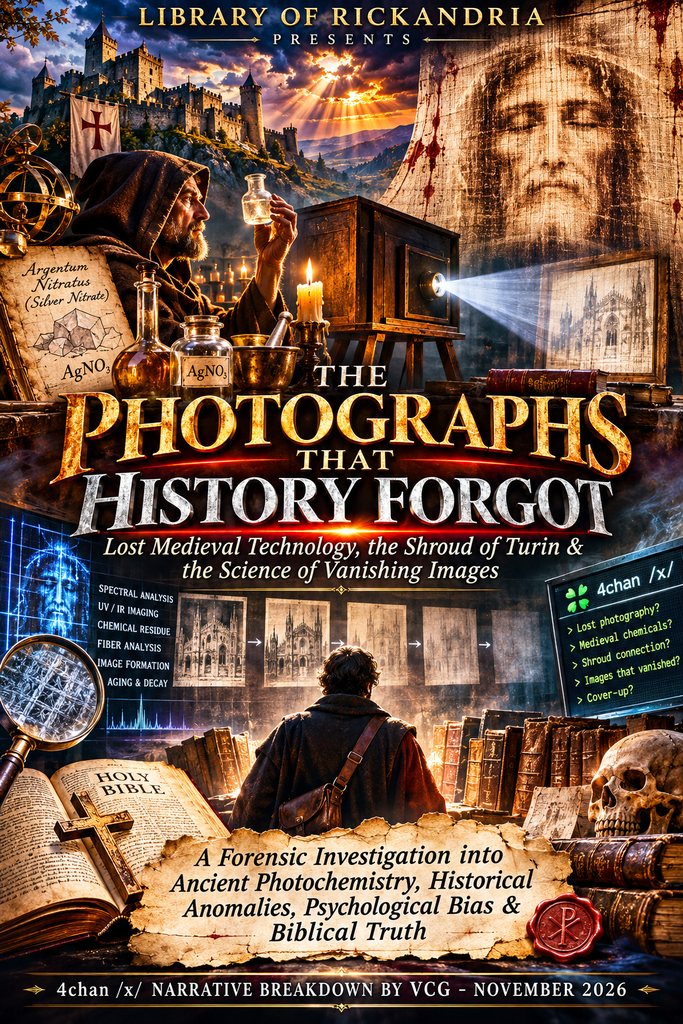
LIBRARY OF RICKANDRIA PRESENTS
THE PHOTOGRAPHS THAT HISTORY FORGOT
Lost Medieval Technology, the Shroud of Turin & the Science of Vanishing Images
A Forensic Investigation into Ancient Photochemistry, Historical Anomalies, Psychological Bias & Biblical Truth
4chan /x/ Narrative Breakdown by VCG — November 2026
Research edition: November 12, 2026
Primary discussion: 4chan /x/, Thread No. 43196452
Scriptural text: Authorized King James Version, Pure Cambridge Edition
Research framework: History · Science · Source criticism · Psychology · Biblical interpretation
Soli Deo Gloria.
ABSTRACT
Could photography have been discovered centuries before its conventional nineteenth-century development, only to disappear because its earliest images could not survive exposure to light?
That is the central question posed in a short November 2026 discussion on 4chan’s paranormal board, /x/.
/x/ – Medieval lost media – Paranormal – 4chan
The thread begins with a historically grounded observation:
light-sensitive silver compounds were known well before practical photography.
It then asks whether forgotten experimenters might have produced transient photographic images centuries earlier than the surviving record suggests.
The discussion subsequently expands into:
- medieval alchemy
- Arabic scientific traditions
- historical paper production
- lost technological knowledge
- a cinematic portrayal of medieval photography
- psychological pattern recognition
and the possibility that the Shroud of Turin was manufactured through an early photographic process.
This paper reconstructs the eight-post discussion, examines its individual claims, and compares them against:
- historical scholarship
- photographic chemistry
- scientific conservation research
- psychological literature
- the King James Bible
It also incorporates scientific work published through November 12, 2026, including new research on the Shroud’s radiocarbon sampling material, biological contamination, linen treatment, and image formation.
The central finding is neither that medieval photography existed nor that it was impossible.
Earlier photographic experimentation was possible in principle.
But the existence of the necessary ingredients does not demonstrate that anyone successfully combined them into a working photographic process.
A recoverable medieval photograph would constitute a major historical discovery.
At present, the thread provides no verified specimen or contemporary documentation establishing that such an image existed.
The Shroud of Turin presents a related but independent research question.
Its medieval documentary history and radiocarbon measurements remain important evidence, while disagreement continues over sampling, image chemistry, and proposed methods of manufacture.
None of those disputes establishes that the Shroud was created photographically, and none provides a direct scientific test of the Christian resurrection claim.
This investigation therefore separates five different kinds of statement throughout:
- what the anonymous posters wrote
- what surviving historical records establish
- what physical science permits,
- what psychological research suggests
- what Scripture actually says
The purpose is not to eliminate mystery from history.
It is to investigate mystery without replacing evidence with speculation.
A NOTE TO THE READER
A strange thing can happen when researching forgotten technology.
You begin with a real discovery.
Perhaps a medieval manuscript describes an unfamiliar chemical preparation.
Perhaps an early experimenter observes that sunlight changes the color of a substance.
Perhaps a scientific instrument reveals something that earlier generations could not detect.
Then a possibility emerges.
If these people possessed one part of a later invention, could they have possessed the rest?
The question is reasonable.
The difficulty begins when the possibility becomes a conclusion before the evidence has been found.
This paper approaches the 4chan thread with that concern in mind.
We will not assume that conventional histories contain every invention ever attempted.
They plainly do not. Countless private experiments, unsuccessful prototypes, discarded writings, and ordinary objects have disappeared.
But neither will we assume that missing records are evidence of a suppressed technological civilization.
The historical record is incomplete.
It is not therefore meaningless.
Our task is to determine how much can reasonably be recovered from it.
The paper also maintains a distinction important to the Library of Rickandria’s wider research program.
Christian Scripture is examined carefully and respectfully, but biblical passages will not be forced to answer scientific questions they do not address.
Likewise, scientific measurements will not be presented as though they automatically resolve theological questions.
For related Library of Rickandria investigations exploring these same research principles, see:
- The Library & the Lamp — Volume I: Belief, Evidence, Scripture & the People Behind the Claims
- Deconstructing “Who’s Doing This?” — Tartarian Claims, Historical Methodology, Psychology & Biblical Discernment
- Fake Cities, Real Conspiracies & False Connections
- Anonymous Against God: Theology, Psychology & Epistemology on 4chan /x/
- Demons in the Machine? Fact-Checking AI Haunting Claims Through Technology, Psychology & Scripture
- VCG Projects — Library of Rickandria Research Methodology
These are related investigations, not independent scientific proof of the present paper’s conclusions.
PART I — THE THREAD AND ITS CLAIMS
CHAPTER 1. A QUESTION ABOUT LOST MEDIA
On November 10, 2026, an anonymous user opened a thread titled Medieval lost media on 4chan’s /x/ board.
The post appeared at 14:12:23, under No. 43196452.
It contained three historical premises.
First, it claimed that experiments using silver nitrate to produce proto-photographic images were documented around 1800–1801.
Second, it referred to a German scholar who produced light-sensitive stencil images during the 1710s.
Third, it claimed that silver nitrate had been known and used as early as the ninth century.
From those premises came the central question: might people have independently produced photographs much earlier, only for those images to disappear because they were chemically unstable?
The poster also wondered whether modern technology might detect surviving traces and reconstruct an image no longer visible to the naked eye.
The thread eventually accumulated seven replies, bringing the preserved discussion to eight posts.
Its final contribution appeared on November 12, 2026, asking whether the same technology might explain the Shroud of Turin.
The original source remains available:
/x/ – Medieval lost media – Paranormal – 4chan
The thread should be treated as evidence of what its participants argued—not as evidence that their historical claims are true.
Three different propositions
Before proceeding, we should separate three ideas that are easily confused.
Proposition A: Medieval people possessed substances that could react to light.
This is a question about historical chemistry.
Proposition B: Medieval people intentionally used those substances to create recognizable images.
This is a question about historical experimentation.
Proposition C: Medieval people possessed a sophisticated and subsequently forgotten photographic technology.
This is a substantially larger claim about technological development.
Evidence supporting A does not automatically establish B.
Even if B were demonstrated, it would not automatically establish C.
A laboratory producing a temporary silhouette is not equivalent to a society possessing:
- cameras
- photographic studios
- reproducible processes
and a mature image-making industry.
Our analysis will return to this distinction repeatedly.
CHAPTER 2. THE FIRST POST: THE CHEMISTRY OF A POSSIBLE DISCOVERY
Claim 1: Photography began around 1800–1801
The original poster’s first historical reference is substantially grounded in real experiments, but the chronology needs correction.
The relevant figures are Thomas Wedgwood and Humphry Davy.
Wedgwood experimented with light-sensitive substances applied to materials such as paper and leather.
By placing objects or designs in contact with treated surfaces and exposing them to light, he could produce temporary copies or silhouettes.
Davy described the work in a report published in 1802.
That report is an important early landmark in the history of photography.
The experiments demonstrated that light could produce an image through chemistry rather than by the application of ink, paint, or another conventional artistic material.
However, the images could not be successfully fixed.
The unexposed areas of the sensitive surface remained vulnerable to further illumination.
Ordinary light could therefore continue changing the image, gradually reducing the contrast that made it recognizable.
Wedgwood and Davy had demonstrated an essential principle of photography but had not produced the durable photographic process that would become familiar in the nineteenth century.
The Science History Institute explains this history in:
An important correction is necessary: these were not the first documented experiments showing that light could produce patterns with silver chemistry.
That achievement belongs to an earlier chapter of the story.
Claim 2: A German polymath made images during the 1710s
The German scholar was Johann Heinrich Schulze.
In 1717, Schulze investigated the sensitivity of silver compounds to light.
His results appeared in print in 1719 and were later reprinted in 1727.
The experiments are sometimes dated differently in secondary accounts because these events are not always distinguished.
Schulze used preparations containing silver compounds and chalk in glass vessels.
He placed stencils around the glass so that sunlight reached selected areas.
The resulting chemical darkening reproduced letters and patterns.
This was a genuine light-produced image.
But several points require care.
Schulze was not producing photographs on sensitized paper in the modern sense.
He was demonstrating light-induced patterns in a chemical mixture.
Nor did he establish a practical method of preserving such images permanently.
The achievement was therefore photochemical image-making, not the invention of ordinary camera photography.
A detailed account is available in the German national biographical reference:
Johann Heinrich Schulze — Deutsche Biographie
Schulze’s significance is not diminished by these distinctions.
He showed that light could selectively alter a chemical substance in a way that reproduced controlled patterns.
That is an essential photographic principle.
Claim 3: Silver nitrate had been known since the ninth century
This is the most historically uncertain premise in the opening post.
The problem is not simply whether early alchemists knew how to prepare particular silver compounds.
It is whether a specific recipe can be securely dated and attributed.
The history of early mineral-acid preparation is unusually complicated because many alchemical writings circulated under authoritative names that did not necessarily identify their actual authors.
One of those names was Geber, the Latinized form associated with Jabir ibn Hayyan.
The historical Jabirian tradition is important to the history of chemistry.
But several influential Latin texts attributed to Geber were composed or transmitted centuries after the period traditionally associated with Jabir.
The distinction is fundamental.
A medieval European text bearing the name Geber does not automatically prove that the historical Jabir wrote its chemical instructions in the eighth or ninth century.
Vladimír Karpenko’s research on the early history of nitric acid identifies clear Latin evidence from around 1300 while discussing the possibility of earlier developments in Arabic-speaking regions and India.
See:
Karpenko — Some Notes on the Early History of Nitric Acid: 1300–1700
An earlier historical analysis by Maria Helena Roxo Beltran also examines the problems surrounding the Geberian corpus and the dating of mineral-acid recipes:
Some Remarks Concerning the Origins of the Preparation of Nitric Acid
What should we conclude?
It is reasonable to investigate possible earlier Arabic or other Eurasian traditions.
It is not reasonable to assign a definite ninth-century discovery date merely because a much later manuscript attributes a recipe to an earlier scholar.
We would need a securely identified manuscript, a defensible date, and an accurate interpretation of the chemistry described.
Verdict: Medieval knowledge of relevant chemical preparations is historically credible.
The specific ninth-century silver-nitrate claim is not securely demonstrated by the thread.
Claim 4: Earlier photographs might have faded immediately
The thread’s central hypothesis deserves serious consideration.
Light-sensitive materials can indeed continue changing after an image has been formed.
If the original image depends on a difference between exposed and unexposed regions, continuing photochemical reactions may eventually destroy that distinction.
But the word fade is not always technically accurate.
Sometimes the visible image becomes lighter.
In early silver-based experiments, the more important problem was often that the originally unexposed areas darkened as well.
The result was a gradual loss of contrast.
Imagine producing a clear silhouette against a pale background.
If the pale background continues darkening until it resembles the silhouette, the picture effectively disappears.
The process requires no supernatural explanation.
It is ordinary chemistry.
However, the existence of this mechanism does not establish that medieval experimenters actually used it.
A credible historical claim requires more than a mechanism that could have produced the proposed event.
It requires evidence that the event occurred.
Claim 5: Could modern science recover the vanished images?
Potentially—but only under particular conditions.
A chemical image may become visually unreadable while retaining measurable differences in composition.
Modern instruments can sometimes detect such differences.
For example, a surface may contain spatial variations in the concentration, particle size, or chemical state of silver compounds.
If those variations preserve information corresponding to an earlier image, imaging and spectroscopy might reveal something that ordinary viewing cannot.
But there is an important limit.
If the spatial information has been physically destroyed, no amount of computational enhancement can reliably reconstruct the original picture.
A computer cannot recover a specific image merely because a surface once contained one.
The problem is similar to attempting to recover writing from a document whose ink has been chemically redistributed beyond recognition.
Scientific instruments can detect remaining information.
They cannot manufacture missing historical information and then certify it as recovered evidence.
This possibility will receive a detailed experimental examination later in the paper.
Assessment of the opening post:
Historically informed, scientifically interesting, and worth investigating—but its central historical conclusion remains unproved.
CHAPTER 3. THE SEVEN REPLIES: HOW THE NARRATIVE CHANGED
Reply 1 — No. 43196568: Albertus Magnus and the missing centuries
The first reply appeared approximately twenty-three minutes after the opening post.
It attributed the discovery of silver nitrate to Albertus Magnus, suggested that later alchemists used it, and argued that researchers did not recognize its light sensitivity until around 1720.
The reply also suggested that another century of experimentation was required before photography became practical.
Several aspects are reasonable.
Albertus Magnus was a major thirteenth-century scholar whose intellectual world included the study of natural substances.
Medieval and early modern alchemy did contribute important methods and materials to later chemistry.
And the period between early photochemical observations and practical photography was indeed substantial.
But the reply’s dates are too confidently stated.
Silver-nitrate discovery cannot be securely attributed to Albertus as an uncontested historical first.
Nor was the relationship between sunlight and silver compounds entirely unknown until Schulze.
In 1614, Angelo Sala had already described sunlight-associated darkening of silver nitrate.
Florida State University’s historical optics resource records this contribution:
Angelo Sala — Historical Optics Timeline
Schulze’s experiments contributed a clearer demonstration of the specific role of light.
The progression from chemical observation to durable photography was therefore not a single discovery followed by a century of inactivity.
It was a sequence of discoveries involving different substances, techniques, and investigators.
The reply is also correct that photography expanded rapidly once practical techniques became available in 1839.
Yet that expansion depended on:
- reproducibility
- technical improvements
- commercial organization
- public knowledge
The speed of nineteenth-century adoption does not prove that isolated earlier experiments could never have occurred.
Verdict:
Several genuine historical developments, but an overconfident and oversimplified chronology.
Reply 2 — No. 43197278: The Arabic alchemical tradition
A later participant challenged the thirteenth-century attribution by suggesting that Arabic experimenters had worked with the relevant chemistry approximately four hundred years earlier.
This reply identifies a legitimate problem in histories that begin every scientific development with its later European documentation.
Knowledge moved through numerous cultural, linguistic, and commercial networks.
Arabic-language scholarship was particularly important in the history of mathematics, medicine, astronomy, optics, and alchemy.
Nevertheless, a statement about cultural transmission must not be substituted for evidence concerning a particular recipe.
Three questions remain unanswered.
Which specific Arabic manuscript contains the experiment?
When was that manuscript composed?
Does its description unambiguously identify the chemical substance under discussion?
Until those questions are answered, the claim remains historically possible but insufficiently documented.
There is also a difference between the historical author Jabir ibn Hayyan, the larger Jabirian textual tradition, and the European Pseudo-Geber corpus.
Treating all three as one person writing in one century obscures precisely the history we are trying to reconstruct.
Verdict:
A worthwhile historical challenge, but not proof of ninth-century photographic chemistry.
Reply 3 — No. 43197460: Did the past possess everything we have?
The third reply makes a much more expansive claim.
It proposes that earlier people may have possessed capabilities comparable to modern ones, but those technologies disappeared because they were not permanent, useful, or mass-produced.
This is where the discussion moves beyond its strongest evidence.
The original proposition concerns a particular chemical possibility.
The new proposition concerns the technological capabilities of entire historical societies.
Those are radically different claims.
A medieval experimenter might have produced a light-sensitive mark without knowing how to make an accurate camera, preserve the resulting image, manufacture optical equipment at scale, or distribute the technique.
Likewise, the possible existence of an undocumented photographic experiment provides no evidence for modern electronics, electrical infrastructure, advanced medicine, or industrial manufacturing.
History certainly contains forgotten inventions.
Technological progress is not perfectly linear.
Ideas may be abandoned because of cost, limited demand, political disruption, scarcity of materials, or the loss of specialized knowledge.
But demonstrating historical discontinuity requires identifiable technologies and supporting records.
The possibility that some inventions disappeared cannot establish that all modern inventions once existed.
Verdict: An unsupported expansion from a narrow chemical hypothesis into a general lost-civilization narrative.
Reply 4 — No. 43197475: Was paper too expensive?
The next participant agrees that lost experiments are conceivable and notes that medieval people did not possess cheap disposable paper in the modern sense.
This is a more useful objection.
Scientific experimentation requires materials.
A society might understand a chemical reaction but never develop a practical application because the necessary surfaces, equipment, or repeated trials are too costly.
Nevertheless, paper was not absent from medieval Europe.
Historian Orietta Da Rold’s research traces paper’s expanding role in medieval England, including its relationship to:
- trade
- administration
- books
- literary culture
The University of Cambridge explains that paper became increasingly important during the later medieval period, even though its economic and social circumstances differed from those of modern mass-produced paper.
Sources:
Paper in Medieval England — Cambridge University Press
From Pulp to Fiction — University of Cambridge
Furthermore, photochemical experiments would not necessarily require paper.
Depending on the chemistry, possible supports might include linen, leather, parchment, wood, or other materials.
Their suitability would have to be established experimentally.
The better historical argument is therefore not that medieval people lacked paper.
It is that the availability, price, preparation, and reliability of experimental materials may have affected whether an early photographic process could become useful.
Verdict: A legitimate economic consideration, but not evidence of an absolute material impossibility.
Reply 5 — No. 43197550: Photography in The Green Knight
Another participant introduces the 2021 film The Green Knight.
The scene in question depicts Gawain having a portrait made through a seemingly photographic technique.
The poster treats this as a suggestive example of medieval photographic experimentation.
However, the film is not a historical source demonstrating that the technology existed in Arthurian times.
The relevant character is the Lady of the castle, portrayed by Alicia Vikander, rather than a queen.
More importantly, the production team explicitly discussed the camera as a deliberate anachronistic element within a magical setting.
In an interview published by Rotten Tomatoes, the filmmakers described their decision to include the apparatus without requiring it to conform to every scientific limitation.
Source:
Castles, Chapels, and Camelot: The Story Behind The Green Knight
The film’s production design is historically evocative.
But evocative historical imagery is not documentary evidence.
The scene demonstrates what modern filmmakers imagined, not what medieval alchemists accomplished.
This is a valuable lesson in the interpretation of artistic sources.
A convincing representation can make an unusual historical proposition feel plausible even when its presence was chosen for symbolic or narrative reasons.
Verdict: An authentic cinematic scene, intentionally fictional as historical evidence.
Reply 6 — No. 43200313: Pattern recognition and the internet meme
On November 11, a participant posted a short comment about recognizing a pattern and attached a humorous image.
The attachment references psychiatric terminology in a joking manner.
It does not provide historical documentation.
However, it raises a relevant question about how people evaluate unusual connections.
Human beings are remarkably skilled at pattern recognition.
That ability allows scientists to identify regularities, historians to recognize relationships between documents, and ordinary people to learn from experience.
But the same capacity can produce apparent connections between unrelated events.
Psychologists use the term illusory pattern perception for certain cases in which people perceive order in random or insufficiently structured information.
A 2018 study by Jan-Willem van Prooijen, Karen Douglas, and Clara De Inocencio examined associations between illusory pattern perception and belief in conspiracy or supernatural explanations.
Source:
This research should not be used to diagnose an anonymous forum participant.
Nor does the presence of an unusual belief establish mental illness.
The appropriate lesson is methodological.
A perceived connection becomes stronger evidence when it survives independent verification, control comparisons, and attempts to disprove it.
Verdict:
A rhetorical or humorous reply, not a contribution of historical evidence.
Reply 7 — No. 43203724: The Shroud of Turin
The final reply appeared on November 12, 2026.
It asked:
Could it have been used to fake the Turin Shroud?
This question substantially changes the investigation.
Until this point, the thread concerned possible lost photographs.
Now it proposes an explanation for an existing and religiously significant artifact.
The Shroud of Turin is not a hypothetical object.
Its textile, visible imagery, documentary history, and scientific investigations provide substantial material for research.
The question of whether it was produced photographically has also been raised before.
Nicholas Allen proposed a medieval photographic explanation involving optical projection and historically plausible chemical materials.
The hypothesis is therefore more developed than the brief 4chan reply suggests.
But the evidence must be judged independently.
Could a medieval photographic technique produce some aspects of the Shroud’s appearance?
That question can be examined experimentally.
Did someone actually use such a process to manufacture the Shroud?
That is a historical proposition requiring separate proof.
The distinction will be central to Part III.
Verdict: A genuine research hypothesis, but not an established explanation of the artifact.
PART II — THE LOST SCIENCE
CHAPTER 4. THE CAMERA BEFORE PHOTOGRAPHY
To understand what early photographic experimentation might have involved, we must begin with optics rather than chemistry.
A camera does not necessarily require film, sensors, electricity, or even a lens.
At its most basic, a camera obscura is a dark chamber with an opening that permits light from an outside scene to form a projected image inside.
The underlying principle is that light travels along predictable paths.
This phenomenon was known and investigated long before practical photography.
One especially important figure was Ibn al-Haytham, also known in Latin Europe as Alhazen.
Born around 965 CE, Ibn al-Haytham developed influential studies of light, vision, and optical geometry.
His Book of Optics drew upon earlier traditions while advancing experimental methods.
In his investigations, light passing through openings into dark spaces became a means of studying its behavior.
The resulting optical tradition influenced later scholars in both the Islamic world and Europe.
For a detailed discussion of the historical experiments, see:
Ibn al-Haytham’s Dark Room — History of the Camera Obscura
Later European scholars, including Roger Bacon and Witelo, worked within intellectual traditions deeply influenced by earlier optical scholarship.
However, a crucial historical boundary must be maintained.
The ability to project an image does not mean that the image can be chemically recorded.
A camera obscura can produce an observable image that disappears as soon as its source of light is removed.
Photography requires an additional process: the conversion of the projected optical information into a persistent physical record.
The original 4chan hypothesis becomes plausible only if these two technologies—optical projection and photosensitive chemistry—can be shown to have been combined.
Could medieval people have constructed the necessary apparatus?
In principle, relatively simple camera obscura devices did not require industrial-era technology.
A dark enclosure, controlled aperture, and suitable projection surface could be assembled with premodern materials.
But a functioning photographic camera would require additional conditions.
The projected image would need sufficient brightness to produce a chemical change.
The sensitive surface would need adequate resolution.
Exposure duration would have to be compatible with the subject.
The equipment would have to remain stable during exposure.
Finally, the resulting image would need some method of preservation.
A device that could reproduce a stencil or a bright stationary object might still be unable to make a recognizable human portrait.
The historical question is not merely whether a camera could be constructed.
It is whether a complete and effective photographic system could be made.
CHAPTER 5. THE ALCHEMIST’S MISSING FORMULA
Silver nitrate is an important substance in the history of photography, but its presence alone is insufficient.
Many silver-based photographic processes rely on particular chemical reactions involving silver salts.
The chemistry of silver chloride, silver bromide, and other compounds is not identical to that of a simple silver-nitrate solution.
Different materials have different:
- sensitivities
- reaction products
- preparation requirements
- methods of preservation
This distinction matters because popular accounts often collapse the entire history of photography into the existence of one chemical.
The development of photography was actually a convergence of several kinds of knowledge.
One was the production and purification of reactive substances.
Another was the discovery that light could produce selective changes in those substances.
A third was the development of appropriate image-bearing surfaces.
A fourth was the recognition that chemical reactions could be controlled to preserve the information.
The problem of medieval recipes
A historical recipe may be difficult to interpret even when its text survives.
An alchemist might describe a substance through its:
- appearance
- preparation
- medicinal use
or symbolic properties rather than a modern chemical formula.
The same historical name might refer to different preparations.
Conversely, chemically similar preparations might appear under different names.
A responsible reconstruction must therefore examine the actual procedure.
It is not sufficient to identify a familiar substance name in a modern translation.
Researchers would need to determine whether the described ingredients and procedures could plausibly produce the substance claimed.
Where possible, that interpretation should be supported by chemical analysis, experimental reconstruction, or comparison with other contemporary recipes.
A particularly important historical problem
The Latin Pseudo-Geber tradition illustrates how difficult this work can become.
Texts associated with Geber circulated in medieval Europe, but authorship and chronology remain disputed.
Some relevant mineral-acid recipes are securely associated with the late thirteenth and early fourteenth centuries, rather than the eighth-century period sometimes inferred from the historical Jabir’s name.
Scholarly work also leaves open questions concerning the independent or earlier development of related chemistry outside Latin Europe.
The defensible conclusion is neither that Arabic alchemists definitely lacked the relevant knowledge nor that a particular ninth-century recipe has been demonstrated.
The evidence is more complicated.
This complexity is not an obstacle to serious investigation.
It is the reason serious investigation is necessary.
CHAPTER 6. A CHRONOLOGY OF EARLY PHOTOGRAPHY
The following timeline distinguishes chemical knowledge, light-produced patterns, and practical photographic systems.
| Period | Historical development | What it establishes |
|---|---|---|
| Medieval period | Alchemical preparations involving metals, salts, and mineral acids | Relevant chemical knowledge |
| c. 1300 | Clear Latin evidence concerning nitric-acid preparation | An important prerequisite for silver chemistry |
| 1614 | Angelo Sala described sunlight-related darkening of silver nitrate | Observation of photochemical sensitivity |
| 1717 | Johann Heinrich Schulze conducted controlled experiments | Light-produced chemical patterns |
| 1719 | Schulze published his results | A securely documented scientific account |
| 1770s | Carl Wilhelm Scheele investigated silver chloride | Further understanding of photochemistry |
| 1802 | Humphry Davy published Wedgwood’s experiments | Temporary contact images and unsuccessful attempts at permanence |
| 1820s | Nicéphore Niépce developed heliographic processes | Persistent images formed by light |
| 1826–1827 | Niépce’s surviving camera heliograph | The earliest widely recognized surviving camera photograph |
| 1830s | Talbot and Daguerre developed practical processes | Increasingly reproducible photography |
| 1839 | Herschel established an effective silver-image fixing method | A major advance in image permanence |
| 1839 | Public introduction of practical photographic processes | Rapid technological and commercial expansion |
The chronology should not be mistaken for a claim that no experimentation occurred between these dates.
It is a chronology of identified developments supported by surviving documentation.
For the Niépce heliograph, see the Harry Ransom Center at the University of Texas:
The Ransom Center dates the surviving object to 1827, although some scholarly and institutional descriptions use approximately 1826–1827.
Its material is also important.
Niépce used a light-sensitive bitumen process on a metal plate.
That process differed from later conventional silver-based photography.
Scientific examination by the Getty Conservation Institute identified the characteristics of the bitumen-based image layer.
Source:
Getty Conservation Institute — Applied Research of Photographic Processes
This illustrates the broader history of photographic experimentation.
There was more than one route from light to a lasting image.
CHAPTER 7. THE CHEMISTRY OF OBLIVION
The original thread’s most compelling question concerns image survival.
Suppose someone successfully creates a light-produced image using a photosensitive surface.
What prevents that image from disappearing?
The answer depends on the photographic process.
For many silver-based methods, a major problem is the presence of remaining photosensitive material.
If this material continues reacting under illumination, the originally intended contrast may deteriorate.
Early researchers found that copying an object’s silhouette could be easier than preserving it.
A permanent photograph therefore required more than sensitivity to light.
It required some means of stabilizing the result.
Herschel’s breakthrough
In 1839, John Herschel demonstrated the use of sodium thiosulfate as an effective fixing agent for relevant silver-based photographs.
The compound could remove certain remaining silver salts from a photographic surface.
This greatly improved the stability of such images.
The Science History Institute records Herschel’s experiments and their importance:
A detailed technical historical account is also available through Yale’s The Printed Picture:
Earlier attempts at preservation existed.
The significance of Herschel’s method was its effectiveness and its contribution to practical photographic chemistry.
Why a vanished photograph might still leave evidence
A visually lost image need not always be chemically erased.
Under some circumstances, spatial differences in remaining material could survive after ordinary contrast has deteriorated.
These differences might concern the distribution of silver, chemical reaction products, surface alteration, or other detectable features.
Modern instruments could potentially identify such patterns.
But there are several possible outcomes.
The original image might remain faintly visible under specialized illumination.
A chemical map might reveal a pattern no longer visible to the eye.
The surface might preserve evidence that photographic chemistry occurred without preserving the image itself.
Or the original distribution of image-bearing material might have been completely destroyed.
The last possibility is an absolute limitation on reconstruction.
Scientific instruments cannot recover specific information that no longer exists in any surviving physical form.
CHAPTER 8. HOW WOULD WE SEARCH FOR A LOST MEDIEVAL PHOTOGRAPH?
A responsible research program would begin with historical objects, not with speculative image enhancement.
The first requirement would be to identify candidate materials with reliable dates.
Possible candidates might include:
- alchemical manuscripts
- laboratory papers
- treated textiles
- experimental notebooks
or unusual surfaces associated with optical research.
A candidate should be selected because its history and material characteristics justify examination—not simply because investigators hope to find a hidden image.
Stage 1: Establish provenance
Researchers would document the object’s known history.
When was it made?
Where was it found?
Who handled it?
Has it undergone restoration?
Could any silver-containing residue have been added centuries later?
Without reliable provenance, a chemically interesting image cannot be confidently assigned to the Middle Ages.
Stage 2: Conduct nondestructive examination
The initial investigation should employ techniques appropriate to the object.
Visible-light examination, controlled spectral imaging, microscopy, and other noninvasive approaches may reveal details without damaging the artifact.
The objective is to determine whether any organized pattern exists before proposing its origin.
Stage 3: Examine elemental and chemical distributions
X-ray fluorescence spectroscopy could help identify certain elements and map their spatial distribution.
- Raman spectroscopy
- infrared spectroscopy
- microscopy
and related techniques could provide complementary information where suitable.
Such methods are widely used in cultural-heritage and photographic-material research.
The Getty Conservation Institute’s research provides important examples:
Getty — Photographic Processes Research
However, finding silver is not equivalent to finding a photograph.
Silver-containing materials can be present for many reasons unrelated to imaging.
A significant result would require a patterned distribution connected to a plausible photographic mechanism.
Stage 4: Use controls
This step is essential.
Researchers should compare the candidate with ordinary historical materials that have not been exposed photographically.
Controls might include:
- untreated linen
- chemically stained papers
- silver-containing decorative materials
- known photographic samples
- artificially aged experimental specimens.
The purpose would be to determine whether the suspected image has properties that genuinely distinguish it from ordinary contamination or chemical aging.
Stage 5: Test competing explanations
An apparent image might result from:
- ordinary ink or pigment
- water damage
- localized chemical contamination
- contact with another object
- uneven oxidation
- a later restoration
- intentional artistic treatment
- actual photochemical exposure
The existence of a visible pattern does not establish which mechanism created it.
Each explanation should generate testable predictions.
Stage 6: Independent replication
An especially important safeguard would be blind or partially blinded analysis.
Where feasible, researchers interpreting the measurements should not know which specimens are expected to contain hidden photographs.
This reduces the risk that expectations influence the interpretation of ambiguous data.
Independent laboratories should also be able to reproduce key findings.
Stage 7: Publish negative results
Unsuccessful experiments matter.
A study showing that a proposed medieval process cannot reproduce a particular image would be useful.
So would a study demonstrating that a suspected hidden photograph was actually a chemical stain.
A good investigation must produce knowledge even when its most exciting hypothesis fails.
The proposed experiment
A practical research project could compare historically plausible photochemical image-bearing surfaces under controlled conditions.
Some would be exposed to patterned light.
Others would remain unexposed.
Additional samples would undergo controlled aging designed to simulate selected environmental stresses.
Researchers would then examine whether the original image could still be detected through spectral or chemical methods.
Such experiments should be conducted under laboratory safety and conservation protocols, rather than through uncontrolled handling of silver compounds, corrosive acids, or valuable artifacts.
Results would help answer a scientific question:
Under what conditions can a visually lost photochemical image leave recoverable physical information?
That finding would be valuable even if no medieval photograph were ever discovered.
CHAPTER 9. POSSIBLE DOES NOT MEAN PROBABLE
The original poster asks about likelihood.
A careful answer must distinguish physical possibility from historical probability.
Consider the following sequence.
Someone must possess suitable materials.
That person must encounter or discover their light-sensitive properties.
The experimenter must find a way to expose a surface selectively.
The resulting pattern must be sufficiently recognizable to count as an image.
The process must be repeated or documented.
Some physical or documentary evidence must survive.
Modern researchers must discover and correctly identify it.
Each stage introduces additional uncertainty.
We cannot responsibly assign precise percentages to those stages without suitable evidence.
Nevertheless, the logic can be expressed through Bayesian reasoning.
Let H represent the hypothesis that medieval people intentionally created photographic images.
Let E represent surviving documentary or material evidence.
Then:
P(H | E) ∝ P(E | H) × P(H)
In ordinary language, the credibility of the hypothesis depends both on its prior plausibility and on how strongly the discovered evidence favors it over competing explanations.
A silver compound in a medieval laboratory might slightly support the possibility that relevant chemistry was available.
A securely dated medieval object containing an unmistakable light-generated image would support the hypothesis much more strongly.
A medieval manuscript describing a controlled method of producing and stabilizing such images would be especially significant.
On the other hand, the absence of surviving photographs is not automatically decisive.
The historical record is incomplete.
But absence must not be treated as positive evidence merely because a hypothesis can explain why something might have disappeared.
The central principle is straightforward:
The ability to explain missing evidence is not equivalent to possessing evidence.
PART III — THE SHROUD OF TURIN AND THE HUMAN MIND
CHAPTER 10. THE LINEN THAT BECAME A HISTORICAL MYSTERY
The final 4chan reply introduces the Shroud of Turin.
The Shroud is a large linen textile bearing frontal and dorsal images of a human figure.
Many Christians have regarded it as the burial cloth of Jesus Christ.
Others understand it as a medieval devotional artifact, a work of art, or an object whose image formation remains disputed.
These interpretations cannot be resolved merely by examining the strength of someone’s religious conviction.
The artifact must be considered historically and scientifically.
The documented medieval appearance
The Shroud’s securely documented history places it in medieval France, associated with Lirey in Champagne during the fourteenth century.
Historical debates have focused on its display, claims of authenticity, and the responses of church authorities.
In August 2025, historian Nicolas Sarzeaud published an important study identifying an earlier reference to the Shroud in a text by Nicole Oresme.
The relevant text was composed between approximately 1355 and 1382.
Oresme treated the purported relic as an example of deception, demonstrating that skepticism about the cloth existed within the medieval intellectual world itself.
Source:
Sarzeaud — A New Document on the Appearance of the Shroud of Turin
This finding strengthens the historical connection between the Shroud and fourteenth-century debates over relics.
It does not independently determine the precise technique used to create its image.
Nor does Oresme’s opinion constitute a laboratory test.
Historical testimony and material science answer different questions.
Why the earliest secure documentation matters
An artifact’s earliest reliable appearance establishes a point by which it existed.
It does not necessarily establish the precise date of manufacture.
A textile documented in 1355 could theoretically have been made earlier.
The question is how much earlier, and what evidence supports that possibility.
This is why the Shroud’s radiocarbon results remain so important.
CHAPTER 11. THE RADIOCARBON CONTROVERSY
In 1988, samples from the Shroud underwent accelerator mass spectrometry radiocarbon dating.
The participating laboratories were located in Arizona, Oxford, and Zurich.
Their findings were published in Nature on February 16, 1989.
The reported calibrated range was 1260–1390 CE, at the stated confidence level of the original analysis.
Source:
Damon and colleagues — Radiocarbon Dating of the Shroud of Turin
The result strongly favored a medieval date for the sampled material.
But scientific scrutiny did not end in 1989.
Raymond Rogers’s 2005 critique
In 2005, chemist Raymond Rogers published research arguing that material from the radiocarbon sampling region differed chemically from the main body of the cloth.
He proposed that the sampled area might contain repair-related or otherwise anomalous material.
Source:
Rogers — Studies on the Radiocarbon Sample from the Shroud of Turin
The argument is significant because radiocarbon dating depends on the relationship between the dated specimen and the artifact whose age is being inferred.
If a sample contains later repair material, its measured age may not represent the original textile.
However, demonstrating differences in chemical composition is not automatically the same as demonstrating that the dated sample was replaced by a medieval or early modern repair.
That further proposition requires evidence.
The 2019 raw-data reanalysis
In 2019, Tristan Casabianca and colleagues published a statistical reanalysis of data associated with the 1988 measurements.
They argued that the available measurements showed heterogeneity that warranted reconsideration of the original procedure.
Source:
Casabianca and colleagues — Radiocarbon Dating of the Turin Shroud: New Evidence from Raw Data
This contribution raises questions about statistical treatment and sample consistency.
It does not itself produce an alternative first-century date.
A criticism of the original analysis and a demonstration of an ancient origin are separate things.
The 2026 Arizona textile analysis
On April 18, 2026, Rachel Freer-Waters and A. J. Timothy Jull published an examination of preserved textile fragments associated with the University of Arizona’s original radiocarbon sampling.
Their analysis found that the examined fragments were consistent with the main Shroud material and showed no evidence of the contamination or repair mechanisms proposed for those fragments.
Source:
Freer-Waters and Jull — Analysis of Textile Fragments from the 1988 Radiocarbon Samples
The result is important because it addresses actual preserved sampling material rather than relying entirely on secondary descriptions.
It weakens the argument that the examined fragments were obviously anomalous repair textiles.
Nevertheless, the study examined small fragments.
It did not perform a fresh radiocarbon dating of the complete cloth.
It also cannot establish that every portion of the 1988 sample was identical in composition.
Where does the evidence stand?
The original medieval radiocarbon result remains substantial scientific evidence.
The 2005 and 2019 critiques deserve examination rather than dismissal.
The 2026 textile findings provide additional evidence against some proposed explanations for an erroneous medieval date.
But these papers do not collectively establish a photographically manufactured Shroud.
Dating a textile and identifying its image-formation mechanism are different scientific tasks.
One must not be substituted for the other.
CHAPTER 12. THE 2026 DNA STUDY: WHAT THE SHROUD HAS COLLECTED
On July 9, 2026, researchers published a study in Scientific Reports examining DNA signatures recovered from official samples collected from the Shroud in 1978.
Source:
Barcaccia and colleagues — DNA Signatures Preserved in the Official 1978 Sample Collection
The study identified genetic material associated with numerous biological sources.
Human mitochondrial DNA from different lineages was present, along with genetic material from plants, animals, and microorganisms.
One especially important finding was that the predominant identified human mitochondrial lineage matched the genetic profile of a person involved in collecting the material in 1978.
This demonstrates the importance of later handling.
A textile:
- examined
- displayed
- transported
- touched
- repaired
or stored across centuries may accumulate material that tells us more about its history of contact than its original manufacture.
The contamination problem
Suppose researchers identify DNA associated with a population historically present in the Middle East.
That observation does not necessarily prove that the original object was manufactured in the Middle East.
The DNA could have arrived through later contact.
The same problem applies to European genetic signatures.
An artifact’s biological traces must be interpreted through their:
- distribution
- condition
- age
and likely contamination pathways.
The researchers found evidence of extensive modern contamination and cautioned against confidently identifying an original human genetic contributor.
This is especially important when studying religious relics.
A DNA result does not identify Jesus Christ.
There is no independently authenticated reference DNA sample from Jesus with which to make such a comparison.
Additional radiocarbon observations
The study also reported dating of two threads associated with the reliquary, consistent with periods of historical repair.
These are not equivalent to a new radiocarbon dating of the main Shroud textile.
We should not confuse evidence that repair-related materials exist with evidence that the entire radiocarbon sample consisted of later repairs.
Nor should we infer that a repair thread reveals the age of the original linen.
The larger lesson
The DNA investigation illustrates how easily real scientific findings can become misleading when their relationship to the historical question is not carefully explained.
Finding biological material is not the same as identifying its original source.
Finding contamination is not the same as proving that every other scientific measurement is invalid.
And finding ancient-looking genetic variation is not proof of biblical authenticity.
The 2026 DNA study is most useful for understanding how complex the Shroud’s contamination history has become.
CHAPTER 13. HOW WAS THE IMAGE MADE?
The Shroud’s image presents a separate problem from its dating.
What physical mechanism produced the observed discoloration?
Researchers have proposed various explanations, including:
- artistic application
- contact processes
- chemical reactions
- light-based image formation
and other mechanisms.
Several have been investigated experimentally.
But a proposed explanation must account for the actual characteristics of the image rather than merely producing something that resembles it from a distance.
The 1978 Shroud investigations
A major investigation occurred in 1978 through the Shroud of Turin Research Project, commonly known as STURP.
Researchers conducted scientific examinations involving different optical and chemical techniques.
A report by L. A. Schwalbe and Raymond Rogers, published in 1982, concluded that the body image appeared consistent with chemical alteration of the linen’s cellulose, particularly oxidation and dehydration, rather than ordinary applied pigment.
The authors also stated that they had not identified a mechanism explaining all their observations.
Source:
Schwalbe and Rogers — Physics and Chemistry of the Shroud of Turin
That uncertainty should be preserved.
The investigators’ inability to identify a complete mechanism does not prove that no natural mechanism exists.
It also does not demonstrate that the image is supernatural.
Walter McCrone’s artistic interpretation
Microscopist Walter McCrone reached a different conclusion.
He argued that image-bearing material included pigment particles consistent with a medieval painting.
His interpretation involved substances such as red ochre, vermilion, and a painting medium.
The McCrone Research Institute describes this position:
McCrone Research Institute — Shroud of Turin Research
This disagreement matters.
It demonstrates that even scientists examining material associated with the same artifact may interpret the evidence differently.
A serious paper must report the competing findings rather than presenting only those that support a preferred conclusion.
The medieval photographic hypothesis
Nicholas Allen argued that a medieval investigator might have used optical projection and light-sensitive chemistry to create an image resembling the Shroud.
His proposals explore materials, exposure arrangements, and possible camera obscura techniques.
This is relevant to the 4chan thread because it directly tests the possibility of photographic image-making before the nineteenth century.
However, the proposal faces demanding questions.
How would the image have been projected?
What chemical treatment would produce the required coloration?
Would the exposure time be practical?
Could the image remain sufficiently stable?
How would the front and back images be produced?
Would the resulting image have the Shroud’s microscopic characteristics?
And can the necessary historical steps be demonstrated rather than merely reconstructed?
Producing a visually similar experimental image would establish that one mechanism is possible.
It would not necessarily establish that it was the mechanism used historically.
The 2025 digital low-relief experiment
In July 2025, researcher Cicero Moraes published a study using three-dimensional computer models to investigate how a cloth would interact with a human body compared with a low-relief representation.
The simulation found that the low-relief model produced an image pattern closer to the Shroud’s apparent contours than direct contact with a fully three-dimensional human figure.
Source:
Moraes — Image Formation on the Holy Shroud: A Digital 3D Approach
This supports the investigation of artistic image-formation mechanisms.
But it is not definitive proof that a medieval artist used a low-relief object.
The simulation tests a particular geometric model.
It does not independently establish the textile’s age, identify the actual maker, or explain every chemical characteristic.
A published 2026 commentary challenged the simulation’s assumptions and argued that important features of the artifact had been insufficiently represented.
Source:
Commentary on Moraes’s Digital 3D Approach
The disagreement illustrates an ordinary part of scientific research.
A published model may be informative without being the final explanation.
The September 2026 linen-bleaching study
On September 24, 2026, César Barta and Elisa María Ruiz-Navas published research on methods of detecting historical linen bleaching through infrared spectroscopy.
Their study examined differences associated with several treatments and compared the findings with the Shroud’s textile characteristics.
Source:
Barta and Ruiz-Navas — Bleaching of Historical Old Linen Fabrics
This work contributes to the broader study of historical textile treatment.
But it does not independently establish that the Shroud was manufactured in a particular century.
Nor does identifying a potentially ancient treatment method prove that a specific surviving artifact is ancient.
Technological traditions can persist across long periods.
A comparison of the competing explanations
| Hypothesis | What it attempts to explain | Principal evidentiary difficulty |
|---|---|---|
| Medieval painting | Image produced through artistic materials and techniques | Whether proposed pigments and methods match all observed image properties |
| Low-relief image formation | Geometry and apparent body-image distortion | Whether the simulation adequately models the artifact’s material and visual characteristics |
| Medieval photography | Light-dependent formation of a body image | Whether the historical apparatus, chemistry, and image properties can be demonstrated |
| Contact or chemical reaction | Image formation through interaction with a body or other surface | Whether a reproducible mechanism accounts for the image’s distribution and detail |
| Supernatural origin | Image attributed to an extraordinary event | Whether the proposition yields independently testable physical predictions |
The final row must be handled differently from the others.
A supernatural explanation may belong to theological interpretation, but it cannot be established merely because current scientific explanations are incomplete.
Likewise, laboratory science does not automatically determine whether the Christian resurrection occurred.
These are related subjects only when the argument connecting them is carefully specified.
CHAPTER 14. PHOTOGRAPHIC NEGATIVES AND THE DANGER OF VISUAL IMPRESSIONS
The Shroud’s photographic appearance became especially influential after Secondo Pia photographed it in 1898.
The reversal of light and dark in the photographic negative produced a more recognizable human face than many observers perceived in ordinary viewing.
That transformation contributed to the widespread idea that the Shroud possessed photographic characteristics.
But what does the negative actually prove?
A photographic negative reverses tonal relationships.
An image originally composed of light and dark regions may become easier to interpret after reversal.
That does not establish how the original image was produced.
A painting, drawing, stain, or other image can also display striking visual properties when photographed or digitally inverted.
The image’s appearance is therefore evidence about its tonal structure.
It is not, by itself, evidence that the original was created through photography.
Historian Peter Geimer examined how early photography shaped interpretations of the Shroud and the apparent authority of technically generated images.
Source:
A Self-Portrait of Christ or the White Noise of Photography?
This is particularly relevant to the psychological portion of our investigation.
Sometimes a technological representation makes an object look more authoritative precisely because viewers believe the technology is revealing something hidden.
That belief may be justified.
But it still requires examination.
An enhanced image is not a neutral window into the past.
It is a representation produced through specific methods, assumptions, and transformations.
CHAPTER 15. THE PSYCHOLOGY OF LOST KNOWLEDGE
The 4chan discussion begins with a legitimate historical question.
It does not initially allege a hidden organization suppressing photographic technology.
For this reason, it would be inaccurate to classify the entire thread as a conventional conspiracy theory.
Some replies, however, gradually expand the argument into increasingly broad claims about forgotten civilization and lost capabilities.
This pattern deserves psychological examination.
1. Confirmation bias
Confirmation bias concerns the tendency to seek, interpret, or remember information in ways favorable to an existing belief.
A person convinced that ancient societies possessed extraordinary technological capabilities may interpret every unusual manuscript as supporting that expectation.
Conversely, someone firmly convinced that premodern people could not make photographs may dismiss genuine early photochemical evidence without examining it.
The same reasoning problem can operate on both sides.
Raymond Nickerson’s influential review documents the phenomenon:
Confirmation Bias: A Ubiquitous Phenomenon in Many Guises
The appropriate corrective is not to eliminate prior beliefs.
It is to test how those beliefs influence the selection and interpretation of evidence.
2. Illusory pattern perception
The thread connects silver-nitrate chemistry, medieval alchemy, historical films, forgotten technology, and the Shroud.
Some connections are legitimate.
Others remain speculative.
The critical question is whether the relationship exists independently of the observer’s expectation.
Research on illusory pattern perception suggests that people sometimes perceive meaningful structure in information that does not support the pattern inferred.
But recognizing patterns is also essential to scientific discovery.
The distinction is not between people who see patterns and people who do not.
It is between patterns that survive testing and patterns that disappear when alternative explanations are considered.
3. The appeal of hidden knowledge
A theory about forgotten history offers something psychologically attractive.
It suggests that the familiar account is incomplete.
It presents the investigator with an opportunity to discover something overlooked by institutions, textbooks, or previous generations.
That appeal is not inherently irrational.
Many legitimate discoveries begin with dissatisfaction over an accepted explanation.
The problem occurs when the emotional satisfaction of discovering a hidden connection replaces the work needed to verify it.
4. Scope inflation
One of the thread’s replies moves from temporary photochemical experiments to the suggestion that earlier societies possessed technology comparable to the modern world.
This is a recognizable argumentative shift.
A small factual foundation is used to support a much broader proposition.
The reasoning may appear persuasive because the opening fact is genuine.
Yet the conclusion requires additional premises that have not been demonstrated.
A reliable investigation must identify each new premise as it appears.
5. Argument from absence
A particularly difficult problem arises when missing evidence is treated as support for a claim.
Suppose no medieval photograph survives.
The hypothesis may explain that absence by proposing that every image faded or was discarded.
That explanation is possible.
But the lack of evidence cannot simultaneously function as proof that the events occurred.
Otherwise the theory becomes resistant to correction.
Every missing photograph becomes a disappeared photograph.
Every missing manual becomes a lost manual.
Every undocumented technique becomes a forgotten technique.
This is not how historical probability should be established.
6. Online discussion dynamics
Anonymous forums can encourage rapid changes in a discussion’s scope.
One participant offers a historical suggestion.
Another introduces an unrelated but emotionally compelling example.
A third adds a joke.
A fourth connects the original question to an object of religious importance.
The resulting discussion can feel like an accumulating body of evidence, even though individual contributions may concern substantially different claims.
A serious analysis therefore reconstructs who introduced which proposition, what evidence accompanied it, and whether subsequent replies actually strengthened the original hypothesis.
For related Library of Rickandria examples, see:
Fake Cities, Real Conspiracies & False Connections
These investigations likewise distinguish primary claims from rhetorical escalation, psychological mechanisms, and biblical interpretation.
An important ethical boundary
Psychological concepts should not be used as substitutes for argument.
A person can hold an incorrect historical belief without having a psychiatric condition.
Someone can propose a speculative explanation without being dishonest.
And an unusual idea can turn out to be correct.
The task is to evaluate the proposition—not to speculate about the character or mental health of an anonymous author.
PART IV — SCRIPTURE AND BIBLICAL DISCERNMENT
CHAPTER 16. WHAT THE BIBLE SAYS ABOUT TESTING CLAIMS
The King James Bible does not describe the medieval invention of photography.
It does not discuss silver nitrate.
And it does not identify the modern Shroud of Turin as an authentic relic.
Nevertheless, Scripture contains passages relevant to truthfulness, judgment, testimony, and the limits of knowledge.
These passages must be read in their contexts.
First Thessalonians 5:21
Prove all things; hold fast that which is good.
This verse appears in a passage concerned with Christian conduct and the proper response to prophecy and spiritual matters.
Its immediate context is not scientific experimentation.
However, the principle of careful examination can reasonably be applied by analogy to historical investigation.
The investigator should distinguish what survives testing from what does not.
The fact that a claim is unusual does not automatically make it false.
The fact that it is spiritually attractive does not automatically make it true.
Proverbs 18:13
He that answereth a matter before he heareth it, it is folly and shame unto him.
This proverb directly encourages caution before judgment.
The warning applies both to those who immediately dismiss an unfamiliar theory and to those who accept it before hearing the evidence.
A genuine rebuttal requires understanding the original argument.
The goal should be to respond to what someone actually claimed, rather than to an exaggerated version that is easier to defeat.
Proverbs 18:17
He that is first in his own cause seemeth just; but his neighbour cometh and searcheth him.
The proverb recognizes that a claim may appear persuasive until it is examined from another perspective.
This is especially relevant to historical reconstruction.
An apparently convincing account should be tested against:
- documentary records
- alternative explanations
- independent measurements
and the strongest reasonable objections.
An explanation does not become weaker merely because it is questioned.
If sound, it may become stronger through examination.
Deuteronomy 29:29
The secret things belong unto the LORD our God:
but those things which are revealed belong unto us and to our children for ever, that we may do all the words of this law.
The immediate context concerns God’s covenant relationship with Israel.
The passage is not a prohibition against scientific discovery.
It does, however, distinguish revealed knowledge from things outside the knowledge given to human beings.
Applied carefully, it offers a warning against pretending to possess certainty that has not been established.
A mystery may remain a mystery without becoming an excuse for invented answers.
CHAPTER 17. THE BURIAL LINENS OF JESUS CHRIST
The Gospels contain multiple descriptions of Jesus’ burial.
Those descriptions matter to the Shroud discussion, but they must be examined without assuming that they identify a surviving medieval or modern artifact.
Mark 15:46
Mark describes Joseph of Arimathaea purchasing fine linen, taking Jesus’ body down, wrapping it, and placing it in a tomb.
This establishes that the Gospel narrative includes burial linen.
It does not provide the modern provenance of that linen.
John 19:40
John states:
Then took they the body of Jesus, and wound it in linen clothes with the spices, as the manner of the Jews is to bury.
The account describes burial preparation involving linen and spices.
Its wording has generated discussion concerning the arrangement and number of burial cloths.
The text does not describe the cloth’s weave, dimensions, image chemistry, or eventual movement to Europe.
John 20:6–7
John reports Peter entering the empty tomb and seeing the linen clothes.
Verse 7 states:
And the napkin, that was about his head, not lying with the linen clothes, but wrapped together in a place by itself.
This is important because the passage distinguishes the head covering from the other linen clothes.
Different interpreters understand the relationship between these objects in different ways.
But it would exceed the text to claim that it supplies a complete diagram of the burial arrangement.
Similarly, it would exceed the text to assert that the passage independently identifies or disproves the Shroud of Turin.
Luke 24:12
Luke likewise records Peter observing the linen clothes.
The account contributes to the Gospel testimony concerning the empty tomb.
It does not establish that any particular textile preserved today is the same material.
What Scripture establishes
The Gospel accounts describe Jesus’ burial and the presence of linen garments or cloths.
They do not provide a continuous chain of custody linking those objects to the textile now preserved in Turin.
That connection must therefore be argued historically rather than treated as an explicit biblical statement.
A believer may regard the Shroud as authentic.
Another believer may remain unconvinced.
The biblical text does not make identification of this particular artifact a condition of Christian faith.
CHAPTER 18. THE RESURRECTION AND THE STATUS OF A RELIC
One of the most important passages for distinguishing biblical testimony from relic identification is 1 Corinthians 15.
In verses 3–4, Paul writes:
For I delivered unto you first of all that which I also received, how that Christ died for our sins according to the scriptures;
And that he was buried, and that he rose again the third day according to the scriptures:
Paul proceeds to describe appearances of the risen Christ.
The argument concerns Christ’s death, burial, resurrection, and the testimony associated with those events.
Paul does not appeal to a surviving burial cloth as the necessary foundation of his case.
This creates an important distinction.
The historical authenticity of the Shroud and the Christian proclamation of the resurrection are not identical propositions.
If the Shroud were conclusively demonstrated to have originated in medieval Europe, that would not logically establish that Jesus did not rise from the dead.
If the Shroud were conclusively demonstrated to date from the first century, that would not automatically prove it belonged to Jesus.
Even an authentic burial cloth associated with Jesus would not, by its existence alone, establish the supernatural event described in the Gospels.
Historical identification, image formation, and resurrection theology involve different forms of argument.
They should not be collapsed into a single claim.
Second Timothy 2:23
But foolish and unlearned questions avoid, knowing that they do gender strifes.
The context concerns unprofitable disputes within the Christian community.
This should not be used to prohibit serious investigation into historical questions.
But it does warn against disputes that generate conflict without improving understanding.
A debate about the Shroud becomes spiritually unhelpful when uncertain conclusions are treated as tests of another person’s faithfulness.
The Christian reader can investigate the artifact while acknowledging the limits of the evidence.
CHAPTER 19. THE KJV TRANSLATORS AND THE COURAGE TO ACKNOWLEDGE UNCERTAINTY
The supplied Cambridge edition of the King James Bible includes the translators’ historical preface, The Translators to the Reader.
That preface contains an especially useful methodological observation.
When discussing uncertain words and alternative readings, the translators explained that it was sometimes better to acknowledge uncertainty than to argue with excessive confidence.
They wrote:
It is better to make doubt of those things which are secret, than to strive about those things that are uncertain.
The statement occurs in their defense of placing alternative readings or interpretations in the margins where uncertainty justified them.
The translators were not suggesting that Scripture was unreliable.
They were arguing that translators should be honest about difficulties rather than conceal them.
This distinction applies meaningfully to historical research.
An investigator can be confident in a clearly documented fact while remaining cautious about a disputed attribution.
A chemist can demonstrate that a substance reacts to light while remaining uncertain whether medieval experimenters used it photographically.
A historian can establish the Shroud’s presence in fourteenth-century Europe without claiming to know every detail of its manufacture.
A theologian can explain what Scripture says about Jesus’ burial without pretending that the biblical text authenticates a particular modern relic.
The pursuit of truth does not require identical levels of confidence about every proposition.
It requires confidence proportionate to the evidence.
PART V — THE EVIDENCE LEDGER
CHAPTER 20. WHAT CAN ACTUALLY BE ESTABLISHED?
The following table summarizes the investigation’s central findings.
| Proposition | Assessment |
|---|---|
| Medieval scholars possessed relevant optical knowledge | Established |
| Medieval alchemists worked with metals, salts, and mineral acids | Established |
| Silver nitrate was definitely first discovered in the ninth century | Not securely established |
| Albertus Magnus indisputably discovered silver nitrate | Not securely established |
| Angelo Sala described sunlight-related silver-nitrate darkening in 1614 | Supported |
| Schulze produced light-sensitive stencil patterns in the 1710s | Established |
| Wedgwood and Davy produced temporary photographic images | Established |
| Their experiments demonstrated successful permanent fixation | False |
| Medieval people could theoretically have produced temporary photochemical images | Plausible |
| Verified medieval photographs have been identified in this investigation | No |
| Lost image information might remain chemically detectable | Scientifically plausible under suitable conditions |
| All vanished photographic information can be reconstructed | False |
| Medieval people possessed modern photographic technology | Unsupported |
| Medieval Europe lacked paper entirely | False |
| The Green Knight provides historical evidence of medieval photography | False |
| The Shroud existed in medieval Europe | Established |
| Radiocarbon dating produced a medieval result | Established |
| The radiocarbon analysis has faced later scientific criticism | Established |
| The 2026 Arizona textile examination found evidence of repair in its tested fragments | No |
| The 2026 DNA study established Jesus’ genetic identity | No |
| The 2025 low-relief simulation demonstrated the actual medieval manufacture of the Shroud | No |
| A medieval photographic origin of the Shroud has been proposed | Established |
| That hypothesis has been demonstrated as historical fact | No |
| Scripture identifies the Turin textile as Jesus’ burial cloth | No |
| Scripture describes Jesus’ burial in linen | Yes |
| The resurrection depends on authenticating the Shroud | Not a biblical requirement |
The pattern is important.
Several of the thread’s historical premises are substantially correct.
Other claims are plausible but unverified.
Still others expand far beyond the available evidence.
A rigorous investigation need not treat all these categories alike.
CHAPTER 21. WHAT WOULD PROVE MEDIEVAL PHOTOGRAPHY?
The strongest possible evidence would be a securely dated medieval artifact bearing an image demonstrated to have been formed by controlled exposure to light.
Ideally, the discovery would also include contemporary documentation describing the procedure.
That documentation should identify materials, optical arrangements, or exposure methods sufficiently clearly to distinguish the process from conventional drawing or painting.
The artifact should then survive independent analysis.
Researchers would need to demonstrate that the image was original to the dated surface.
They would need to rule out later contamination and restoration.
They would need to distinguish chemical imaging from other causes of discoloration.
And they should establish whether the proposed process is experimentally reproducible.
A manuscript describing an early photographic technique would be significant even without a surviving image.
A surviving image would be significant even without a manuscript.
Together, they would be extraordinary.
What would count against the hypothesis?
An explanation becomes more useful when it makes predictions that might fail.
For example, suppose a proposed medieval photographic process requires a chemical coating that should leave detectable residues.
If representative, well-preserved test samples consistently fail to show those residues, confidence in that particular process should decrease.
Suppose an alleged medieval photograph is found to contain materials manufactured centuries later.
Its identification as an original medieval photograph would need reconsideration.
Suppose a supposed photographic pattern is experimentally reproduced through an ordinary nonphotographic process.
The photographic interpretation would no longer be the only plausible explanation.
These are legitimate ways of testing the hypothesis.
The absence of immediate certainty is not a weakness in the investigation.
It is what makes the investigation capable of correction.
CONCLUSION — THE PHOTOGRAPHS THAT HISTORY FORGOT
The most interesting thing about the November 2026 4chan thread is not its speculation about lost civilizations or the Shroud of Turin.
It is the simple question beneath those subjects.
What happens to discoveries that cannot survive?
Human history contains far more experiments than surviving artifacts.
Some processes were never perfected.
Some discoveries remained local.
Some techniques were abandoned because they were expensive, impractical, or poorly understood.
Others disappeared because the people who knew them died without transmitting the knowledge.
These possibilities are entirely compatible with ordinary historical inquiry.
Photography itself emerged from centuries of work involving:
- optics
- chemistry
- materials
- experiments with light
The camera obscura existed before practical photography.
Relevant chemical reactions were observed before modern photographic fixing.
And temporary light-produced images preceded durable camera photographs.
The original poster was therefore right to recognize that the history of photography did not begin suddenly in 1839.
But that recognition does not establish that medieval photography existed.
The evidence supports the availability of some prerequisites.
It does not yet demonstrate their successful historical combination into a photographic process.
Nor does it establish that medieval society possessed capabilities comparable to modern photographic technology.
The Shroud of Turin remains a separate historical and scientific controversy.
Its medieval documentary history is substantial.
Its original radiocarbon measurements support a medieval date, although subsequent researchers have questioned aspects of the sample and statistical interpretation.
Recent studies of preserved textile fragments have challenged some contamination and repair explanations.
DNA research has revealed extensive biological contamination.
Digital modeling and chemical studies continue to examine possible image-formation mechanisms.
But no finding reviewed here proves that the Shroud was manufactured photographically.
Likewise, the absence of an agreed image-formation mechanism does not establish a supernatural origin.
There is a difference between an unanswered scientific question and a demonstrated miracle.
The psychological lesson is equally important.
An unusual historical connection may be worth investigating.
But the excitement of a possibility should not become a substitute for evidence.
And a growing collection of related ideas should not be mistaken for an accumulating body of proof.
Finally, the biblical dimension calls for proportionate judgment.
Scripture describes Jesus Christ’s burial, the presence of linen clothes, and the resurrection testimony.
It does not identify the Shroud of Turin.
The Christian proclamation of the resurrection is not made dependent upon authentication of a surviving relic.
The investigator should therefore resist two opposite mistakes.
One is to dismiss genuine historical mysteries because they challenge familiar expectations.
The other is to claim certainty because a mystery feels spiritually or intellectually important.
The Library of Rickandria’s strongest contribution is not to insist that every unusual hypothesis is true.
It is to examine unusual hypotheses carefully enough that genuine discoveries can be distinguished from imagination.
A vanished photograph might once have existed.
A lost experiment might someday be recovered.
A medieval manuscript might contain a chemical technique modern historians have overlooked.
Those possibilities remain open to investigation.
But until the evidence is discovered, they remain possibilities.
History deserves curiosity.
Science deserves reproducibility. Human testimony deserves examination.
Scripture deserves faithful interpretation.
And truth deserves a standard higher than our desire for a remarkable conclusion.
Soli Deo Gloria.
APPENDIX A — PRIMARY SOURCE ARCHIVE
Original 4chan discussion
Title: Medieval lost media
Board: /x/ — Paranormal
Opening post: No. 43196452
Opening date: November 10, 2026
Last post examined: No. 43203724
Last post date: November 12, 2026
Permanent thread URL while accessible:
/x/ – Medieval lost media – Paranormal – 4chan
Posts examined:
- No. 43196452 — Early photographic chemistry and lost images.
- No. 43196568 — Albertus Magnus and the historical development of silver nitrate.
- No. 43197278 — Earlier Arabic chemical experimentation.
- No. 43197460 — Generalized theory of forgotten technology.
- No. 43197475 — Medieval paper and experimental material costs.
- No. 43197550 — Photography in The Green Knight.
- No. 43200313 — Pattern-recognition commentary and attached meme.
- No. 43203724 — The Shroud of Turin as a possible photographic fabrication.
This archive description preserves the sequence and central propositions without presenting a full reproduction of the posts.
Researchers conducting further work should preserve an original copy of the thread and its media alongside the date of capture.
APPENDIX B — SOURCE LIBRARY
All URLs below are direct links without UTM tracking parameters.
Historical photography and optical science
1. Science History Institute. Silver and Sunlight.
Silver and Sunlight | Science History Institute
An accessible historical overview of:
- silver chemistry
- Schulze
- Wedgwood
- Davy
- Niépce
- Herschel
and the emergence of practical photography.
2. Deutsche Biographie. Johann Heinrich Schulze.
Deutsche Biographie – Schulze, Johann Heinrich
Historical biographical information, including the chronology of Schulze’s light-sensitive experiments.
3. Florida State University. Angelo Sala.
Molecular Expressions: Science, Optics and You – Timeline – Angelo Sala
Historical account of Sala’s contribution to the study of silver-salt discoloration.
4. Harry Ransom Center, University of Texas. The Niépce Heliograph.
Institutional documentation of the earliest widely recognized surviving camera photograph.
5. Getty Conservation Institute. Applied Research of Photographic Processes.
Applied Research of Photographic Processes | Getty Projects
Scientific examination of early photographic materials, including Niépce’s heliograph.
6. Yale University Art Gallery. Early Photography in Silver.
Early Photography in Silver | The Printed Picture
Historical explanation of photographic silver processes and the development of image fixing.
7. The Metropolitan Museum of Art. William Henry Fox Talbot, Leaf.
William Henry Fox Talbot – [Leaf] – The Metropolitan Museum of Art
A documented example of early photographic contact printing.
8. History of the Camera Obscura. Ibn al-Haytham’s Dark Room.
Ibn al-Haytham’s dark room (the camera obscura experiments) · Islam Museum
Historical discussion of Ibn al-Haytham’s optical experiments and their relationship to later camera development.
9. Historic England. Historic Photographic Processes.
Photographic Processes Illustrated in the Historic England Archive | Historic England
Descriptions of historical photographic technologies and processes.
Medieval chemistry, manuscripts, and materials
10. Karpenko, Vladimír. Some Notes on the Early History of Nitric Acid: 1300–1700.
Research concerning nitric acid, early chemical preparation, and the complicated history of the Geberian corpus.
11. Beltran, Maria Helena Roxo. Some Remarks Concerning the Origins of the Preparation of Nitric Acid.
Historical analysis of early mineral-acid recipes and textual attribution.
12. Da Rold, Orietta. Paper in Medieval England: From Pulp to Fictions.
Scholarly study of the economic and cultural role of paper in medieval England.
13. University of Cambridge. From Pulp to Fiction: Our Love Affair with Paper.
From Pulp to Fiction: our love affair with paper | University of Cambridge
Overview of the arrival and increasing importance of medieval paper.
The Shroud of Turin: Historical and scientific sources
14. Sarzeaud, Nicolas. A New Document on the Appearance of the Shroud of Turin from Nicole Oresme.
Important 2025 historical research concerning medieval references to the Shroud.
15. Damon, P. E., and colleagues. Radiocarbon Dating of the Shroud of Turin. Nature, 1989.
Radiocarbon dating of the Shroud of Turin | Nature
The original published radiocarbon dating study.
16. Rogers, Raymond N. Studies on the Radiocarbon Sample from the Shroud of Turin. Thermochimica Acta, 2005.
Studies on the radiocarbon sample from the shroud of turin – ScienceDirect
A significant challenge concerning the composition of the radiocarbon sampling region.
17. Casabianca, Tristan, and colleagues. Radiocarbon Dating of the Turin Shroud: New Evidence from Raw Data. Archaeometry, 2019.
Statistical reanalysis raising questions concerning sample homogeneity.
18. Freer-Waters, Rachel, and A. J. Timothy Jull. Analysis of Textile Fragments from the 1988 Radiocarbon Samples of the Turin Shroud. 2026.
Examination of preserved Arizona sample fragments and their consistency with the Shroud textile.
19. Barcaccia, G., and colleagues. DNA Signatures Preserved in the Official 1978 Sample Collection of the Shroud of Turin. Scientific Reports, 2026.
Genetic and metagenomic examination demonstrating multiple biological sources and significant contamination.
20. Schwalbe, L. A., and Raymond N. Rogers. Physics and Chemistry of the Shroud of Turin: A Summary of the 1978 Investigation. Analytica Chimica Acta, 1982.
Physics and chemistry of the shroud of turin: A summary of the 1978 investigation – ScienceDirect
A key scientific report concerning the Shroud’s image characteristics.
21. McCrone Research Institute. Shroud of Turin Research.
Shroud of Turin Research | McCrone Research Institute, Inc.
Documentation of Walter McCrone’s pigment-based interpretation.
22. Moraes, Cicero. Image Formation on the Holy Shroud: A Digital 3D Approach. Archaeometry, published online 2025.
A digital simulation comparing low-relief and three-dimensional body-contact image formation.
23. Commentary on Moraes’s Digital 3D Approach. Archaeometry, 2026.
A published methodological critique of the low-relief simulation.
24. Barta, César, and Elisa María Ruiz-Navas. Bleaching of Historical Old Linen Fabrics: The Case of the Shroud of Turin. 2026.
Bleaching of historical old linen fabrics: the case of the Shroud of Turin | npj Heritage Science
Research on infrared spectroscopy and the identification of historical linen treatments.
25. Geimer, Peter. A Self-Portrait of Christ or the White Noise of Photography?
Historical study of photography’s role in shaping interpretations of the Shroud.
Psychology and epistemology
26. Nickerson, Raymond S. Confirmation Bias: A Ubiquitous Phenomenon in Many Guises. Review of General Psychology, 1998.
Confirmation Bias: A Ubiquitous Phenomenon in Many Guises – Raymond S. Nickerson, 1998
A foundational review of confirmation bias in human reasoning.
27. Van Prooijen, Jan-Willem, Karen M. Douglas, and Clara De Inocencio. Connecting the Dots: Illusory Pattern Perception Predicts Belief in Conspiracies and the Supernatural.
Empirical research on illusory pattern perception.
28. Van Prooijen, Jan-Willem, and Karen M. Douglas. Belief in Conspiracy Theories: Basic Principles of an Emerging Research Domain.
Belief in conspiracy theories: Basic principles of an emerging research domain – PMC
Overview of psychological research concerning conspiracy beliefs.
Film and historical representation
29. Rotten Tomatoes Editorial. Castles, Chapels, and Camelot: The Story Behind The Green Knight’s Incredible Look.
Castles, Chapels, and Camelot: The Story Behind The Green Knight‘s Incredible Look | Rotten Tomatoes
Production-design discussion confirming the intentionally imaginative nature of the film’s camera sequence.
Library of Rickandria — Related Investigations
30. Library of Rickandria. The Library & the Lamp — Volume I.
Library of Rickandria – OUR GREATEST FEARS MANIFEST DUE TO OUR LACK OF KNOWLEDGE.
31. Library of Rickandria. Deconstructing “Who’s Doing This?”
32. Library of Rickandria. Fake Cities, Real Conspiracies & False Connections.
33. Library of Rickandria. Anonymous Against God.
Anonymous Against God: Theology, Psychology & Epistemology on 4Chan /x/ – Library of Rickandria
34. Library of Rickandria. Demons in the Machine?
35. Library of Rickandria. VCG Projects.
VCG PROJECTS – Library of Rickandria
APPENDIX C — ILLUSTRATION AND IMAGE SOURCES
Plate I — Johann Heinrich Schulze
Historical portrait and University of Halle article:
Akribie und Abenteuer: Sechs Entdeckungen aus drei Jahrhunderten
Plate II — Medieval Optics
Ibn al-Haytham and the camera obscura:
Ibn al-Haytham’s dark room (the camera obscura experiments) · Islam Museum
Plate III — Early Photographic Leaf
Metropolitan Museum of Art:
William Henry Fox Talbot – [Leaf] – The Metropolitan Museum of Art
Plate IV — The Shroud and Photographic Reversal
Grey Room:
These plates should remain clearly captioned when the paper is republished.
They are historical illustrations and source materials, not proof that medieval photographs survived.
FINAL RESEARCH STATEMENT
This paper is a source-based historical and scientific assessment, not a report of original laboratory experimentation.
No new artifact has been independently authenticated during this investigation.
No new photochemical experiment has been performed for this paper.
No new radiocarbon measurements have been conducted.
The scientific conclusions are assessments of published work, and the proposed experimental program remains a recommendation.
The biblical quotations are drawn from the Authorized King James Version, Pure Cambridge Edition supplied for the project.
- Historical claims
- scientific observations
- psychological interpretation
- theological conclusions
- unresolved possibilities
have been distinguished throughout.
The research remains open to revision should new:
- primary documents
- authenticated artifacts
- reproducible experiments
or more reliable scientific measurements become available.
The standard is not whether a conclusion is exciting, familiar, uncomfortable, or popular. The standard is whether the evidence justifies it.
Soli Deo Gloria.
END OF RESEARCH EDITION — NOVEMBER 2026
The paper includes the original eight-post analysis and the new scientific directions, but the proposed experiment is correctly presented as a research design rather than as completed laboratory work.
The sources for the most consequential findings have been checked against the original publications, including the 1989 radiocarbon study, the 2025 historical and digital-modeling papers, and the 2026 textile and DNA investigations.
The KJV passages and the translators’ statement about uncertainty were checked against the Bible edition in the Library.
ALTERNATIVE TITLES
Before the Camera: Did Medieval Alchemists Discover Photography—and Lose It?
The Lost Images of the Middle Ages: Photography Before Photography?
Silver, Sunlight & Secrets: The Medieval Photography Mystery
The Shroud, the Silver & the Secret: Did Photography Exist 500 Years Too Early?
The Photographs That Never Survived: Uncovering History’s Missing Images
The Medieval Camera Conspiracy: Lost Science or Modern Myth?
Captured by Light, Erased by Time: The Mystery of Photography Before 1800
THE 4CHAN FILES: Where Anonymous Claims Meet Evidence & Scripture – Library of Rickandria
VCG PAPER PROJECTS – Library of Rickandria