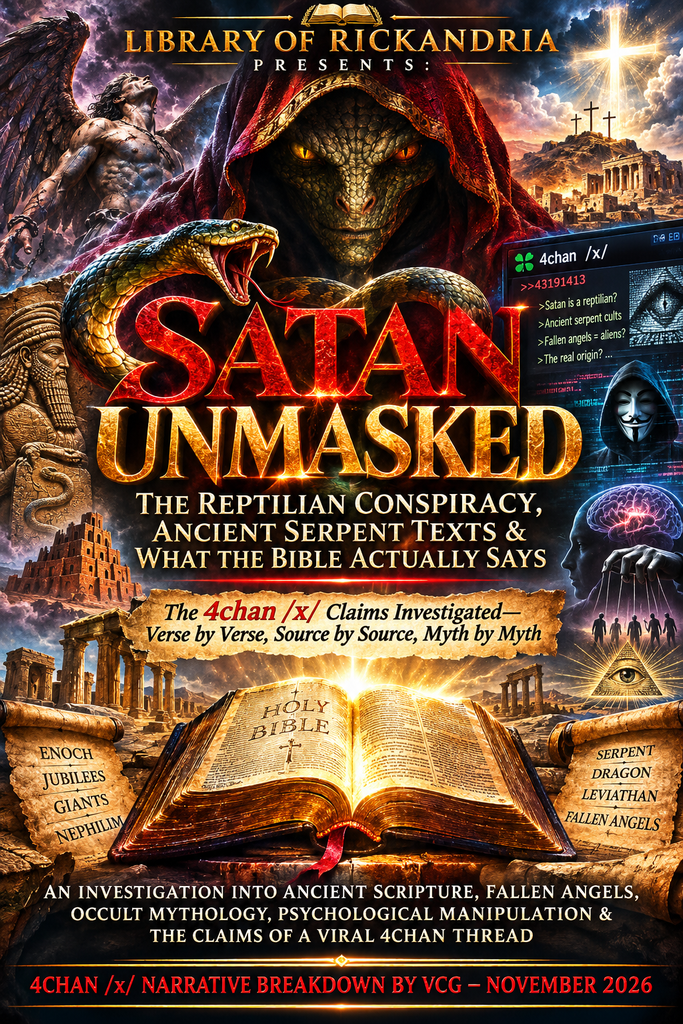
UPDATED BY VCG ON 11/11/2026 @ 11:11 EST
An Investigation into Ancient Scripture, Fallen Angels, Occult Mythology, Psychological Manipulation & the Claims of a Viral 4chan Thread
Anyone can do this, but most won’t.
SATAN UNMASKED: The Reptilian Conspiracy, Ancient Serpent Texts & What the Bible Actually Says
is an extensive:
- biblical
- historical
- psychological
- investigative
examination of a November 2026 4chan /x/ thread questioning whether Satan is literally a reptilian humanoid.
The Library of Rickandria investigates all 15 posts, systematically fact-checking claims involving:
- reptilian entities
- fallen angels
- Azazel, the God of Israel (YHWH)
- extraterrestrial beings
- spiritual energy harvesting known as “loosh”
and alleged connections between ancient serpent mythology and modern conspiracy theories.
Drawing upon:
- the King James Bible
- original Hebrew and Greek terminology
- the Apocalypse of Abraham
- 1 Enoch, ancient Near Eastern mythology
- scholarly historical research
- neuroscience
- peer-reviewed studies of conspiracy psychology
the paper carefully separates authentic ancient religious traditions from unsupported modern speculation.
Special attention is given to:
- the winged serpent Azazel
- the biblical identification of Satan as the great dragon in Revelation 12:9
- the historical development of Satan’s imagery
- the psychological mechanisms that make extraordinary claims persuasive
The investigation also examines:
- out-of-body experiences
- internet misinformation
- religious symbolism
- the dangers of turning speculative supernatural narratives into accusations against real human populations
Supported by:
- primary sources
- external research
- biblical cross-references
and related Library of Rickandria investigations, the paper concludes that while Scripture genuinely associates Satan with serpents and dragons, neither biblical exegesis nor the available historical and scientific evidence establishes that Satan is a literal reptilian extraterrestrial.
Ultimately, Satan Unmasked demonstrates why distinguishing:
- what Scripture actually says
- what history genuinely records
- what psychology can explain
- what speculation cannot prove
is essential to pursuing truth with intellectual honesty and biblical discernment.
Soli Deo Gloria.
ChatGPT – Library of Rickandria
LIBRARY OF RICKANDRIA PRESENTS
SATAN UNMASKED
The Reptilian Conspiracy, Ancient Serpent Texts & What the Bible Actually Says
The 4chan /x/ Claims Investigated — Verse by Verse, Source by Source, Myth by Myth
An Investigation into Ancient Scripture, Fallen Angels, Occult Mythology, Psychological Manipulation & the Claims of a November 2026 4chan Thread
4chan /x/ Narrative Breakdown by VCG
November 2026 | Library of Rickandria
Biblical Exegesis • Historical Research • Source Criticism • Psychology • Scientific Evidence • Digital Forensics
SOLI DEO GLORIA
Cover artwork:
A cinematic, imaginative representation of the subjects under investigation.
Its reptilian figures, supernatural elements, and occult imagery are artistic illustrations, not evidence of the existence of the beings depicted.
For republication outside ChatGPT, the artwork should be hosted on the Library of Rickandria website.
“Prove all things; hold fast that which is good.”— 1 Thessalonians 5:21, King James Version
ABSTRACT
On November 9, 2026, an anonymous participant on 4chan’s paranormal board, /x/, opened a discussion with a deceptively simple question:
whether Satan might actually be a reptilian humanoid.
/x/ – Is Satan just a reptilian dude? – Paranormal – 4chan
The accompanying image showed a figure resembling Jesus standing opposite a towering reptilian being in a rocky desert landscape.
The question was short, but the discussion quickly developed into something considerably more complicated.
Participants proposed that Satan harvests human spiritual energy, that the God of Israel may have been understood as a fiery dragon, that out-of-body experiences provide evidence of reptilian entities, and that an ancient Jewish apocalypse contains a description of a humanoid serpent.
Others introduced:
- mythology
- science fiction
- elemental symbolism
- extraterrestrial speculation
or skepticism about Satan’s existence.
One commenter cited the Apocalypse of Abraham, describing a winged, serpent-like figure identified as Azazel.
Unlike many other claims in the discussion, this reference points to an identifiable ancient religious text.
That makes the thread worth examining carefully.
The existence of genuine serpent imagery in biblical and ancient Jewish literature is not in dispute.
Genesis contains a speaking serpent.
The Hebrew Bible describes Leviathan and other great creatures.
Later Jewish literature developed complex traditions concerning fallen angels and supernatural adversaries.
Revelation explicitly identifies the great dragon with the Devil and Satan.
But a fundamental question remains:
Does the existence of these texts establish that Satan is literally a reptilian humanoid—or does that conclusion arise from combining ancient religious imagery with much more recent speculative beliefs?
This investigation:
- examines every visible contribution to the thread
- traces the relevant terminology through Hebrew and Greek
- compares biblical passages with ancient Jewish and Near Eastern literature
- investigates the modern origins of the loosh-harvesting theory
- considers scientific research concerning extraordinary experiences and conspiracy beliefs
It also examines the dangers of misinterpreting religious imagery, conflating distinct traditions, treating personal testimony as external verification, and associating supposed supernatural enemies with identifiable human populations.
The paper does not assume that supernatural realities are impossible.
Nor does it assume that every ancient religious tradition is historically accurate, or that every extraordinary experience must have a supernatural explanation.
Instead, it distinguishes five questions that are frequently confused:
- What did the original source actually say?
- What can historical evidence establish?
- What does the evidence justify us in concluding?
- What psychological processes may influence how the claim is experienced or interpreted?
- What does Scripture actually teach when examined in context?
The central finding is that the Bible explicitly identifies Satan with dragon and serpent imagery, but neither the canonical biblical text nor the external evidence examined here establishes that Satan belongs to a biological reptilian species or extraterrestrial civilization.
The distinction between what a text depicts and what actually exists is central to the entire investigation.
PART I — THE THREAD UNDER EXAMINATION
1. Entering the Thread
The primary source is:
Original 4chan discussion:
Is Satan just a reptilian dude? — /x/, Thread No. 43191413
The archived page identifies the opening post as No. 43191413, dated November 9, 2026.
The final visible reply appeared on November 10.
At the time of this investigation, the archived page contains the original post and fourteen replies.
The thread itself is important evidence because it preserves the participants’ actual claims rather than someone else’s reconstruction of them.
Figure 1. Original opening image attached to 4chan post No. 43191413.
The image establishes the visual premise of the discussion.
It does not independently authenticate a historical encounter.
The illustration is doing considerable rhetorical work.
The human figure resembles popular depictions of Jesus.
The reptilian figure is much taller, dressed in dark robes, and faces him in an apparently confrontational encounter.
Before anyone reads a biblical passage, the image has already suggested a particular interpretation:
Christ confronting a reptilian adversary.
That matters because visual presentation can shape how people understand later information.
Once the viewer has imagined Satan as a reptilian figure, subsequent references to serpents, dragons, and fallen angels may feel like confirmation of something that the image originally supplied.
Yet the image is not itself a biblical quotation, archaeological artifact, historical photograph, or scientific observation.
It is a representation of a proposed idea.
That distinction must remain visible throughout the paper.
What is actually known about the thread?
| Detail | Verified information |
|---|---|
| Board | 4chan /x/ — Paranormal |
| Thread number | 43191413 |
| Opening date | November 9, 2026 |
| Last visible reply | November 10, 2026 |
| Visible contributions | 15, including the opening post |
| Opening question | Whether Satan is a reptilian being |
| Primary evidence | Archived posts, attachments, and one external video link |
| Poster identities | Anonymous; not independently established |
| Status at examination | Archived |
Source: Original 4chan thread.
There is no need to describe the thread as viral without independent evidence of its circulation.
A provocative discussion and a widely circulated discussion are not necessarily the same thing.
Likewise, anonymity means that we cannot confidently determine whether every reply was sincere.
4chan frequently mixes speculative discussion with:
- irony
- provocation
- roleplay
- humor
The task is therefore to investigate the claims themselves rather than invent motives for the people who posted them.
2. What the Thread Is Really Arguing
The discussion does not present one coherent theory.
It presents several partially overlapping explanations of Satan and the supernatural world.
The first is a literal-reptilian interpretation:
Satan is physically a reptilian humanoid.
The second is an esoteric harvesting interpretation:
Satan or other entities extract energy from human suffering, potentially explaining why they oppose salvation.
The third is an ancient-religious interpretation:
biblical serpents, dragons, and supernatural beings are evidence that earlier civilizations knew about such entities.
The fourth is an experiential interpretation:
people who report encounters with reptilian beings may have seen the reality underlying ancient religious traditions.
The fifth is a skeptical or psychological interpretation:
Satan is an invented or symbolic idea rather than a literal being.
These interpretations are not interchangeable.
Even if someone established that ancient people believed in supernatural serpents, it would not follow that a particular childhood experience involved the same being.
Even if an out-of-body experience were shown to have occurred, that would not automatically establish the identity of the perceived figure.
And even if someone accepted the biblical existence of Satan, that would not establish the modern loosh-harvesting theory.
Each additional proposition needs its own evidence.
PART II — METHODOLOGY: HOW WE WILL TEST THE CLAIMS
3. The Five-Layer Evidence Standard
A study involving:
- religion
- history
- paranormal experiences
- online speculation
requires more than one type of evaluation.
A historical question cannot be resolved solely by quoting Scripture.
A theological question cannot be resolved solely by a neuroscience experiment.
And a personal experience cannot establish an entire supernatural cosmology simply because it resembles a religious story.
For each major claim, this investigation applies five levels of examination.
Layer One: Primary-source authentication
What did the original person or document actually say?
This requires distinguishing a direct statement from a paraphrase, a paraphrase from an interpretation, and an interpretation from an entirely new claim.
For ancient writings, it also requires attention to:
- translations
- manuscript preservation
- dating
- authorship
Layer Two: Historical verification
Does the idea have a traceable history?
Can it be located in:
- a manuscript
- identifiable publication
- dated artwork
- recorded teaching
or documented cultural tradition?
Historical verification establishes that a claim or belief existed.
It does not automatically establish that the belief was true.
Layer Three: Logic and evidentiary sufficiency
Does the conclusion follow from the evidence?
Does an image demonstrate the existence of a being?
Does similarity prove identity?
Does an experience establish a supernatural cause?
Where a claim concerns the physical world, we ask what observations could test it and what evidence could potentially falsify it.
Layer Four: Psychological interpretation
What known psychological processes might contribute to the experience or the appeal of the explanation?
This includes:
- perception
- memory
- pattern recognition
- threat interpretation
- social influence
- narrative coherence
These mechanisms are examined without diagnosing anonymous contributors.
Layer Five: Biblical examination
What does the King James Bible say?
What is the immediate context?
What genre is the passage?
Is the description literal, metaphorical, visionary, or disputed?
How does the passage relate to other Scriptures?
And critically, are we allowing Scripture to define our understanding—or importing an outside theory into Scripture?
4. Evidence Categories
The following terms are used throughout the investigation.
| Finding | Meaning |
|---|---|
| Supported | The relevant evidence establishes the specific claim being assessed. |
| Partly supported | Some elements are correct, but the wider interpretation exceeds the evidence. |
| Unsupported | Adequate evidence has not been supplied or identified. |
| Contradicted | Reliable evidence or the cited text conflicts with the claim. |
| Subjective testimony | A person reports an experience, but its proposed cause or identity remains unverified. |
| Interpretive | A conclusion depends on an arguable theological, literary, or philosophical reading. |
| Satire or non-evidentiary | The contribution appears humorous, rhetorical, or fictional rather than an independently supported argument. |
These categories do not imply that every unsupported proposition is logically impossible.
They mean that a claim should not be promoted to established fact without adequate justification.
5. Why the King James Translators’ Method Matters
The supplied Pure Cambridge Edition of the King James Bible includes the historical preface known as The Translators to the Reader.
The translators explicitly recognized that certain biblical expressions are difficult to interpret, that translators must consult earlier scholarship, and that some uncertain matters require humility.
Their warning is particularly appropriate here:
“It is better to make doubt of those things which are secret, than to strive about those things that are uncertain.”
This appears in their discussion of difficult passages and alternative readings.
The translators were arguing for careful interpretation rather than unwarranted dogmatism.
Their historical preface is not inspired Scripture.
Nevertheless, it records a method of biblical scholarship worth taking seriously.
The same preface emphasizes the value of consulting Hebrew and Greek and examining earlier translations.
That principle governs this paper.
When the KJV uses the English word dragon, we must investigate the underlying terminology and literary context before assuming that a modern reptilian humanoid is intended.
When Revelation identifies Satan with the ancient serpent, we should acknowledge that identification without insisting that it supplies information about ordinary biological anatomy.
The objective is not to weaken Scripture.
It is to avoid making Scripture say more than it actually says.
PART III — THE COMPLETE POST-BY-POST INVESTIGATION
6. Post No. 43191413 — Is Satan Literally a Reptilian?
Assessment:
The biblical serpent-dragon association is genuine; the proposed biological identity is unestablished.
The original question appears simple, but it depends on an important assumption:
that biblical descriptions of Satan as a serpent or dragon might describe his physical form.
There is a legitimate biblical starting point.
Revelation 12:9 (KJV) states:
“And the great dragon was cast out, that old serpent, called the Devil, and Satan, which deceiveth the whole world:
he was cast out into the earth, and his angels were cast out with him.”
Here, the identification is explicit.
The dragon is called the Devil and Satan.
That should not be minimized.
However, the question is not simply whether Satan is represented as a dragon.
The question is whether the dragon represents his normal, literal biological appearance.
For that, we must read the surrounding passage.
Revelation 12:3 describes the dragon as red, having seven heads, ten horns, and seven crowns.
Earlier, Revelation 12:1 describes a woman clothed with the sun, with the moon beneath her feet and a crown of twelve stars.
These are features of apocalyptic visionary literature.
If someone interprets the dragon’s reptilian appearance as literal anatomy, the same interpretive method must explain why its seven heads, ten horns, and crowns should or should not also be literal anatomy.
Selective literalism is insufficient.
Nor is Revelation the only biblical passage employing animal imagery for Satan.
First Peter 5:8 (KJV):
“Be sober, be vigilant; because your adversary the devil, as a roaring lion, walketh about, seeking whom he may devour:”
Notice the comparison: as a roaring lion.
The passage communicates danger and predatory behavior without necessarily identifying Satan as a literal lion.
Likewise, 2 Corinthians 11:14 says:
“And no marvel; for Satan himself is transformed into an angel of light.”
These passages can be read coherently when we distinguish identity, appearance, and metaphor.
Scriptural conclusion:
Satan is explicitly identified with the great dragon in Revelation.
Scripture does not explicitly identify him as an extraterrestrial reptilian species.
Methodological conclusion:
The original question is a legitimate subject for examination, but the accompanying image is not evidence that the proposed physical identity is correct.
7. Post No. 43191590 — Satan as a Spiritual-Energy Harvester
Assessment:
Unsupported synthesis of modern esotericism and Christian redemption.
This commenter speculates that the Devil is a reptilian entity harvesting loosh, and that Jesus threatens this arrangement by helping people obtain forgiveness.
There are several separate claims hidden inside that suggestion.
The first is that human emotional or spiritual experiences generate an extractable resource.
The second is that supernatural entities consume that resource.
The third is that Satan is one such entity.
The fourth is that forgiveness of sins interrupts the extraction process.
None is demonstrated by the post.
Where the loosh theory originates
The modern concept is most closely associated with Robert A. Monroe’s 1985 book Far Journeys.
Monroe described experiences he interpreted as exploration of nonphysical realities.
In Chapter 12, Hearsay Evidence, he recounts a disturbing cosmological narrative involving the production of a substance called loosh.
Chapter 13, Shock Treatment, develops his response to that narrative.
The story eventually broadens the significance of loosh to include love.
Reducing Monroe’s entire account to an assertion that demons feed exclusively on human suffering omits part of the source’s own development.
Primary bibliographic source:
Robert A. Monroe, Far Journeys (1985), Google Books.
A particularly useful companion investigation is the Library’s The Loosh Farm Thesis, which examines Monroe’s work, the prison-planet interpretation, and the evidence often attached to it.
The important distinction is that Monroe’s account is a report of an interpreted extraordinary experience.
Its publication establishes the history of the loosh concept; it does not establish loosh as a scientifically measured substance.
There is no demonstrated instrument, standardized unit, reproducible detection method, or independently confirmed biological mechanism for this proposed spiritual energy.
Does Scripture teach spiritual harvesting?
The Bible certainly depicts spiritual conflict.
Ephesians 6:12 describes conflict against spiritual wickedness.
John 8:44 describes the Devil’s relationship to falsehood.
Hebrews 2:14 speaks of Christ’s victory in relation to the Devil and death.
But those passages do not describe an economy in which supernatural beings extract a measurable spiritual fuel from human suffering.
Ephesians 1:7 (KJV) states:
“In whom we have redemption through his blood, the forgiveness of sins, according to the riches of his grace;”
The passage describes redemption and forgiveness through Christ.
The 4chan hypothesis adds an unmentioned mechanism:
forgiveness allegedly stops the production of energy consumed by Satan.
That mechanism cannot be derived from the verse.
It must come from somewhere else.
The reasoning problem
The theory moves through a chain:
Human suffering exists → suffering produces loosh → entities harvest loosh → Satan is a harvester → Christ’s forgiveness interrupts the process.
Each arrow requires independent justification.
The existence of suffering establishes the first proposition.
It does not establish the others.
Psychological interpretation:
This is a powerful example of narrative fusion.
A Christian salvation framework and a modern esoteric captivity framework share concepts such as:
- bondage
- liberation
- hostile powers
- deliverance
Their similarities make it easy to combine them into one story.
But shared themes do not prove a shared mechanism.
Further LOR research:
The Loosh Trap: Are Demons Feeding on Your Fear? examines a separate October 2026 thread specifically concerned with avoiding alleged loosh harvesting.
8. Post No. 43191635 — The Conspiracy Meme
Read the post and view its attachment
Assessment:
No independent evidentiary contribution.
The post contains a cartoon frog wearing conspiracy-themed headgear and supplies no substantive written argument.
It is tempting to dismiss this as irrelevant.
But internet imagery can influence how a discussion develops.
A meme can signal shared identity, ridicule an idea, express ironic agreement, or make a speculative claim seem culturally familiar.
Without additional context, we cannot determine which interpretation the anonymous poster intended.
Nor can an image of this kind substantiate the existence of a reptilian Satan.
This contribution should be classified as a reaction rather than evidence.
The distinction matters because a discussion with many replies can appear well-supported even when much of the activity consists of jokes, reactions, repetition, or visual references.
An investigator should count independent lines of evidence, not merely comments.
9. Post No. 43191689 — The Childhood Reptilian Encounter and the Dragon-God Claim
Assessment:
Personal experience unverified; the inference concerning YHWH is unsupported.
The commenter reports a frightening out-of-body experience at approximately seven years old.
According to the account, the individual perceived a vast dark environment and an enormous muscular reptilian being that claimed to be God.
The commenter then mentions theories that the God of ancient Israel was a fiery dragon.
This is one of the more emotionally charged contributions because it combines firsthand testimony with a religious reinterpretation.
It deserves a careful response.
A reported encounter is not automatically a fabricated encounter
We cannot establish from the post whether the person experienced a dream, sleep-related hallucination, altered bodily perception, imaginative episode, or something else.
We also cannot establish whether the story is sincere.
The responsible position is to acknowledge the report while withholding certainty about its cause.
An experience may be genuinely remembered and deeply frightening without its perceived explanation being correct.
What neuroscience can tell us
A landmark 2002 study by Olaf Blanke and colleagues, published in Nature, reported the induction of out-of-body-like perceptions through electrical stimulation of the right angular gyrus in a patient undergoing neurological evaluation.
Source:
Blanke et al., “Stimulating Illusory Own-Body Perceptions,” Nature 419 (2002), 269–270.
The study demonstrates that unusual perceptions of bodily location and self-position can arise through identifiable neurological processes.
This does not prove that every reported out-of-body experience has the same cause.
It certainly does not tell us exactly what happened to an anonymous forum participant at age seven.
It does, however, establish that an apparently external experience does not, by itself, require an externally existing supernatural being.
The brain’s representation of the body’s location can become disturbed.
That finding is relevant whenever someone interprets an out-of-body experience as proof of encountering another realm.
What if the being claimed to be God?
Even within a biblical worldview, a claimed identity must be tested.
First John 4:1 instructs believers not to accept every claimed spiritual authority.
The statement of an apparent being is not self-authenticating.
If an experience involves a figure claiming divine identity, the claim still requires evaluation.
A person could accurately remember hearing or perceiving such a claim without having established that the claimant was God.
Was YHWH a fiery dragon?
This assertion is especially important and receives a separate historical examination later in the paper.
For now, Isaiah 27:1 provides a decisive textual distinction:
“In that day the LORD with his sore and great and strong sword shall punish leviathan the piercing serpent, even leviathan that crooked serpent; and he shall slay the dragon that is in the sea.”
The LORD is the one punishing the dragon.
The text does not identify the LORD as that dragon.
This distinction is supported by scholarly analysis of ancient Near Eastern chaos-monster imagery.
Historical context:
Oxford Academic, Israel Among the Nations: Biblical Culture in the Ancient Near East.
The attached caricature
The post also includes an image depicting a reptilian figure with recognizably Jewish-associated religious symbols.
The image is relevant because it shows how the argument can move from speculation about supernatural beings into imagery associated with a real human community.
The American Jewish Committee documents historical and contemporary antisemitic caricatures that portray Jewish people as reptiles, vermin, or monstrous creatures.
Source:
AJC, Translate Hate: Creatures.
The original attachment is preserved in the linked 4chan post, but reproducing the caricature here would add little evidentiary value while unnecessarily amplifying dehumanizing imagery.
It is important to distinguish legitimate criticism of religious beliefs and ancient theological claims from portraying Jewish people as secretly nonhuman.
The latter is not supported by Scripture or historical evidence.
Biblical correction: Genesis 1:27 grounds human dignity in creation in God’s image.
James 3:9 likewise warns against cursing human beings made after God’s likeness.
The spiritual-adversary language of Ephesians 6:12 is not authorization to identify an ethnic population with demons or reptiles.
Final assessment:
The experience cannot be independently verified, and the attached theological and ethnic associations do not follow from it.
10. Post No. 43194413 — A Classical Sculpture and an Unexpected Music Video
Assessment:
Genuine mythological imagery, but no demonstrated connection to Satan.
This reply expresses brief agreement, attaches an image of a classical-style sculpture, and includes a YouTube link.
The image depicts a youthful figure offering a vessel to an eagle.
Figure 2. The image attached to post No. 43194413.
Its subject corresponds to the classical Ganymede-and-eagle tradition associated with sculptor Bertel Thorvaldsen.
The exact production history of the object pictured has not been independently established.
The mythological subject is recognizable.
In Greek and Roman traditions, Zeus or Jupiter appears in the form of an eagle in stories involving Ganymede, who becomes cupbearer to the gods.
The Thorvaldsens Museum documents Bertel Thorvaldsen’s sculpture Ganymede with Jupiter’s Eagle, first modeled in 1817.
Museum source:
Thorvaldsens Museum, Ganymede with Jupiter’s Eagle, catalogue A44.
The difference between mythological representation and historical demonstration is essential.
The sculpture establishes that an artist represented an ancient story involving Zeus and an eagle.
It does not establish that Zeus literally transformed into an eagle.
It also does not establish that Zeus and Satan are the same being.
What about the video?
The thread links to:
The video’s identifiable title indicates a musical reference, not a documentary presentation about reptilian theology.
Without an explanation from the commenter, we cannot reliably determine whether the song was intended as humor, atmosphere, an obscure thematic association, or something else.
It would be inappropriate to invent a hidden meaning.
Psychological observation:
Historical art can provide an impression of antiquity and authority.
But the age or cultural prestige of an object does not establish that the speculative interpretation attached to it is correct.
11. Post No. 43194703 — Captain Kirk and the Gorn
Assessment: Fictional representation; no real-world corroboration.
This reply uses an image of Captain Kirk confronting a Gorn from Star Trek.
The Gorn is a fictional reptilian extraterrestrial species.
The well-known confrontation appears in the episode Arena, first broadcast in 1967.
Its relevance to the 4chan discussion is visual and cultural.
Science fiction has helped make reptilian humanoids recognizable.
Once a familiar fictional image becomes part of popular culture, it is easier to use that image to illustrate speculation about supernatural beings or aliens.
This is not inherently misleading when acknowledged as fiction.
It becomes problematic only if someone treats the fictional representation as evidence that a corresponding entity exists.
The post provides no such evidence.
The most cautious interpretation is that the participant is making a humorous comparison.
12. Post No. 43195172 — The Red Devil With Horns
Assessment: Familiar Christian iconography, not a canonical anatomical description.
This commenter counters the reptilian idea with the conventional image of a red-skinned, horned Devil.
But where does this familiar appearance come from?
The answer lies substantially in the history of art, religious literature, and cultural imagination.
Alexander Kulik’s scholarly article, How the Devil Got His Hooves and Horns, explores the complex development of horned and hoofed devil imagery through Greco-Roman mythology, Jewish traditions, and early Christian literature.
Source:
Alexander Kulik, “How the Devil Got His Hooves and Horns,” Numen (2013).
The familiar appearance did not emerge from one simple biblical description.
Medieval artists developed visual conventions for representing evil, danger, temptation, and spiritual rebellion.
Those conventions became increasingly recognizable and influential.
The important distinction is that Christian artistic tradition and canonical biblical description are not identical categories.
Scripture describes Satan as the tempter, adversary, deceiver, accuser, and dragon.
It does not provide a consistent visual portrait of a red humanoid with horns and a tail.
A red Devil and a reptilian Devil therefore face the same difficulty when presented as literal anatomy:
both go beyond what the biblical passages explicitly establish.
13. Post No. 43195560 — Satan as a Fear-Manipulation Invention
Assessment:
Reasonable skepticism toward the reptilian claim; unsupported universal explanation of Satan’s origins.
The commenter rejects the entire reptilian premise and suggests that Satan is an invention intended to manipulate human fear.
This is a useful reminder that a skeptical response can contain its own unexamined assumptions.
The thread has not demonstrated the existence of a reptilian Satan.
But that does not establish that every belief about Satan was deliberately fabricated for psychological control.
The historical development of Satan traditions is considerably more complex.
P. L. Day’s scholarly study An Adversary in Heaven examines the Hebrew term satan in Numbers 22, Zechariah 3, Job 1–2, and 1 Chronicles 21.
Source:
Those texts show different uses and settings for the adversarial figure.
Later Jewish and Christian literature developed further descriptions of:
- demonic opposition
- temptation
- judgment
- cosmic conflict
These developments can be studied historically without assuming that every author participated in a coordinated deception.
Can fear be used to manipulate religious people?
Certainly.
- Fear-based preaching
- exaggerated spiritual threats
- abusive authority
and claims of exclusive access to hidden information can influence behavior.
But the existence of manipulative uses of an idea does not automatically settle the truth or falsehood of that idea.
The New Testament itself contains warnings against deception and coercive misuse of religious teaching.
Second Timothy 1:7 (KJV) states:
“For God hath not given us the spirit of fear; but of power, and of love, and of a sound mind.”
This passage should not be misused to suggest that fear is never an ordinary human emotion.
Rather, it opposes a spirit of cowardice or intimidation in the setting of Christian witness.
Final assessment:
The commenter rightly demands evidence for the reptilian hypothesis but does not supply sufficient historical evidence for the claim that Satan was invented solely to control people.
14. Post No. 43196399 — Must an Ancient God Be a Dragon?
Assessment:
Unsupported generalization.
The commenter responds to the earlier claim about YHWH by suggesting that an ancient god would naturally be a dragon.
The problem is the implied universality.
Ancient deities were represented through:
- human forms
- animal forms
- combinations of human and animal characteristics
- celestial associations
- symbols
and sometimes restrictions on images.
The diversity of ancient religious representation cannot be reduced to one dragon identity.
Biblical theology also makes a sharp distinction between the Creator and created forms.
Isaiah 40:18 (KJV):
“To whom then will ye liken God? or what likeness will ye compare unto him?”
The chapter challenges the adequacy of images as representations of God.
The principle is not that every reference to divine fire, clouds, or other visible phenomena must be discarded.
It is that a description of divine action or manifestation cannot automatically be converted into a claim about God’s biological nature.
The commenter provides no independent historical evidence that every ancient deity was originally understood as a dragon.
15. Post No. 43196409 — Dragons as Masters of the Four Elements
Assessment:
Symbolic theory presented without adequate historical justification.
The commenter proposes an elemental classification of dragons and serpents.
Flight is associated with air. Fire-breathing is associated with fire.
A serpent’s body is associated with earth and water.
The conclusion is that dragons represent mastery of all four elements, while ordinary serpents represent two.
There is a genuine ancient intellectual background to four-element cosmology.
The Greek philosopher Empedocles, writing in the fifth century BCE, developed a theory of four fundamental roots commonly identified as earth, air, fire, and water.
Source:
Stanford Encyclopedia of Philosophy, Empedocles.
However, the existence of four-element philosophy does not establish that every biblical dragon was composed as a symbolic representation of those four elements.
Nor does the post identify an ancient source establishing that every snake universally represents earth and water.
Scripture uses serpents in different ways
Genesis 3 employs the serpent in a temptation narrative.
Numbers 21 describes fiery serpents and the subsequent making of a bronze serpent.
John 3:14–15 compares the lifting up of the bronze serpent with the lifting up of the Son of man.
Matthew 10:16 uses serpents as a comparison involving wisdom.
Revelation 12 identifies the ancient serpent with Satan.
The meaning depends upon the passage.
If the same animal image appears in different literary settings, one cannot responsibly impose a single interpretation upon every occurrence.
This is a recurring problem in esoteric interpretation:
an elegant symbolic system is assumed to explain every text, even when the individual texts are doing different things.
Final assessment:
The elemental classification may serve as a modern symbolic interpretation.
The post does not establish it as the intended meaning of biblical serpent imagery.
16. Post No. 43196493 — Satan, Santa, and December
Assessment:
Apparent wordplay, not a historical argument.
This commenter jokes that the figure under discussion is the person who brings presents in December.
The joke depends upon the similar appearance of the English names Satan and Santa.
But their historical derivations are different.
Satan derives from Hebrew language involving opposition or accusation.
Santa Claus developed through the Dutch Sinterklaas, associated with Saint Nicholas.
A resemblance between two modern spellings does not establish common historical origin.
The comment is best treated as humor unless additional evidence indicates that a serious etymological claim was intended.
17. Post No. 43196596 — The Apocalypse of Abraham and the Winged Serpent Azazel
Assessment:
Historically meaningful citation; conclusion about Satan’s biological form unsupported.
This is the most substantial historical contribution to the entire discussion.
The commenter identifies a noncanonical ancient religious text, the Apocalypse of Abraham, and presents a passage in which Abraham observes Adam, Eve, and a strange serpent-like figure in Eden.
The being has features associated with both a serpent and a human, as well as twelve wings.
The narrative identifies this figure as Azazel.
Unlike the modern loosh proposal, this is not merely an invented collection of paranormal terms.
It is a real literary tradition.
But identifying the tradition correctly is only the first step.
Is the ancient text genuine?
Yes, as a preserved literary work.
The Apocalypse of Abraham is a Jewish pseudepigraphal apocalypse preserved through Old Church Slavonic manuscripts.
Its precise dating and transmission history are subjects of specialist research.
Amy Paulsen-Reed’s Harvard dissertation argues for an early Jewish composition in the decades following the destruction of the Second Temple in 70 CE, while emphasizing the complications introduced by its later Slavonic preservation and potential Christian editorial influence.
Scholarly source:
Amy Paulsen-Reed, The Origins of the Apocalypse of Abraham (2016), Harvard University.
This tells us that the passage is worthy of historical study.
It does not establish that the visionary figure corresponded to an externally existing reptilian organism.
What does the text actually describe?
The 4chan quotation uses a verse-numbering arrangement beginning its extract at 23:4.
Other English presentations divide the same material differently.
For comparison, see Apocalypse of Abraham, Chapter 23.
The narrative includes the following elements:
| Narrative element | What is described | What is not established |
|---|---|---|
| Abraham’s vision | A scene involving Adam, Eve, and a third figure | An ordinary historical eyewitness observation |
| The tree | Fruit resembling grapes | That Genesis itself names grapes as the forbidden fruit |
| The third figure | A serpent-like being with humanlike limbs | A biological reptilian species |
| The wings | Six on each side | A plausible natural anatomical structure |
| The action | The figure participates in the temptation scene | An independently verified historical event |
| The identity | The figure is named Azazel | That Azazel is an extraterrestrial humanoid |
| The interpretation | The being is associated with ungodliness and destruction | That all ancient serpent figures are the same entity |
These details closely correspond to the literary tradition that the commenter cites.
The account should not be dismissed simply because it is noncanonical.
Noncanonical literature can be exceptionally useful for studying religious history.
But it must be placed in the correct evidentiary category.
The text is evidence for an ancient religious portrayal.
Whether the portrayed being exists is a separate question.
Why does Azazel have twelve wings?
This feature deserves particular attention.
Scholar Andrei Orlov examines the twelve-wing depiction in relation to the six-winged heavenly beings described elsewhere in the apocalypse.
He argues that Azazel’s form may imitate or distort features associated with the divine presence.
Source:
Andrei Orlov, “The Likeness of Heaven”: Kavod of Azazel in the Apocalypse of Abraham.
This is a meaningful literary explanation.
The twelve wings are not necessarily intended as anatomical data.
They may be part of the text’s contrast between heavenly reality and an adversarial imitation of that reality.
The exact symbolism remains interpretive, but Orlov’s study demonstrates that the passage belongs to a complex theological composition rather than a simple ancient zoological report.
Does Azazel equal Satan?
The question is complicated.
Azazel appears in different ways across Jewish traditions.
Leviticus 16 contains the Hebrew term Azazel, although the KJV presents the relevant ritual in terms of the scapegoat.
Later traditions, including portions of 1 Enoch, associate Azazel with angelic wrongdoing and the corruption of humanity.
The Apocalypse of Abraham develops its own portrayal of Azazel as a supernatural adversarial figure.
These traditions have relationships worth investigating, but their relationships must be argued rather than assumed.
The 4chan commenter identifies the figure as Ha-Satan even though the cited scene specifically names Azazel.
That additional identification is interpretive.
It is not the same thing as the text expressly declaring that Azazel is the New Testament Devil.
What about the grapes?
Genesis 3 does not identify the forbidden fruit as an apple, grape, fig, or any other particular species.
Later traditions proposed different possibilities.
Therefore, the grape imagery of the Apocalypse of Abraham can be studied as a later interpretation of Eden.
It should not be presented as something Genesis explicitly teaches.
Why this post is important
The commenter has identified an authentic historical source that contains a striking serpent-human hybrid image.
That observation is substantially more defensible than dismissing the entire passage as fictional internet folklore.
Yet the crucial inferential jump remains unsupported:
Ancient literature depicts a winged serpent with humanlike limbs.
That does not establish that Satan is a reptilian extraterrestrial.
The correct historical conclusion is narrower and stronger:
Some ancient Jewish apocalyptic traditions represented supernatural adversaries through hybrid serpent and heavenly-being imagery.
That conclusion is worth preserving.
It belongs in a serious study of how the figure of Satan and related adversaries developed across biblical and postbiblical religious literature.
18. Post No. 43196656 — Jesus as an Evil Reptilian and God as a Saturnian Alien
Assessment:
Unsupported extraterrestrial claim and direct conflict with the canonical New Testament portrayal of Christ.
The commenter reverses the familiar Christian framework.
Jesus is described as evil and reptilian, while the true deity is said to be a humanoid extraterrestrial originating from one of Saturn’s moons.
This is an unusually sweeping assertion.
It combines theology, extraterrestrial speculation, and a reversal of the traditional identification of good and evil.
The scientific question
Saturn’s moons include environments of genuine astrobiological interest.
Enceladus has a subsurface ocean and active plumes.
Titan has a complex environment with organic chemistry.
Such discoveries justify scientific investigation into the possibility of extraterrestrial life.
They do not establish that intelligent humanoid beings inhabit these worlds.
Nor do they establish that such beings are gods.
NASA’s publicly stated position is that it has not found credible evidence of extraterrestrial life.
Source:
NASA, Unidentified Anomalous Phenomena: Frequently Asked Questions.
The existence of environments worth investigating should not be confused with the discovery of their supposed inhabitants.
The biblical question
The canonical New Testament consistently portrays Christ as the revelation of God and the agent of divine redemption.
John 1:1–3 attributes creation to the Word.
John 1:14 identifies the Word becoming flesh.
Colossians 1:16–17 presents Christ in relation to the creation and sustaining of all things.
First Peter 2:22 describes Christ as sinless.
These are theological statements within the Christian canon.
They do not constitute laboratory demonstrations of divine identity.
But they directly contradict the forum’s description of Christ as secretly evil.
A claim that Christianity’s central figure is actually a deceptive reptilian being would require substantial independent historical or empirical evidence.
The post supplies none.
Related LOR investigation:
Saturn, YHWH & the Architecture of Conspiracy examines the broader Saturnian-demiurge thesis and compares its claims with biblical cosmology.
19. Post No. 43196683 — Satan as an Ideology
Assessment:
An interesting psychological interpretation, but not a demonstrated exclusive explanation.
The commenter proposes that Satan is the belief system that persuades people to believe in Satan.
Unlike the reptilian thesis, this is primarily a conceptual explanation.
It may be understood as a claim about how ideas influence thought.
For example, beliefs about malevolent supernatural agents may shape how people interpret misfortune, temptation, dreams, and unusual experiences.
That possibility is a legitimate subject for psychological research.
But a distinction remains between studying the effects of a belief and proving that the object of the belief does not exist.
A belief can influence human behavior whether or not its object exists independently.
The New Testament generally portrays Satan as an agent capable of:
- tempting
- accusing
- deceiving
- opposing
Matthew 4 presents the Devil as a participant in the temptation of Jesus.
James 4:7 (KJV) states:
“Submit yourselves therefore to God.
Resist the devil, and he will flee from you.”
Within traditional Christian interpretation, these passages support a personal-adversary understanding.
A purely symbolic interpretation must explain why such language should be read entirely metaphorically.
That symbolic position may be philosophically defensible within certain frameworks, but it is not established merely by asserting that Satan is an ideology.
20. Post No. 43197559 — Agreement Without New Evidence
Assessment:
No independent corroboration.
The final visible reply agrees with the earlier loosh-harvesting speculation.
No additional source, observation, experiment, or scriptural argument is supplied.
This highlights a simple but important investigative principle.
Agreement is not independent confirmation.
A claim repeated by many people may become familiar.
It may even become socially accepted within a particular community.
But familiarity and acceptance are not substitutes for evidence.
If multiple people derive a belief from the same unsupported premise, the apparent number of confirmations is misleading.
The final reply adds social reinforcement, not a new evidentiary foundation.
PART IV — THE GREAT SERPENT IDENTITY INVESTIGATION
21. How Many Different Figures Are Being Combined?
One of the greatest difficulties in interpreting this thread is that several biblical and nonbiblical figures are treated as interchangeable.
The names and images include:
- the serpent of Eden
- Satan
- the Devil
- Lucifer
- Leviathan
- Azazel
- Belial
- Beelzebub
- the dragon
and later Gnostic rulers known as archons.
The existence of relationships among these figures does not mean that they originally referred to one identical being.
The historical development is more complicated.
| Name or image | Principal source | Main identification or function | Important qualification |
|---|---|---|---|
| Serpent of Eden | Genesis 3 | Cunning tempter | Genesis does not explicitly name it Satan |
| Ha-satan | Job 1–2; Zechariah 3 | Adversary or accuser | Hebrew terminology requires contextual interpretation |
| Satan | 1 Chronicles 21; New Testament | Adversarial figure | Usage develops across biblical literature |
| Devil | Gospels and epistles | Tempter, slanderer, adversary | Greek diabolos conveys accusation or slander |
| Lucifer | Isaiah 14:12, KJV | Rendering within a taunt against Babylon’s king | Identification with Satan is a later theological interpretation |
| Leviathan | Job 41; Psalm 74; Isaiah 27 | Extraordinary creature or chaos-monster imagery | Not explicitly equated with Satan in those passages |
| Azazel | Leviticus 16; later Jewish writings | Disputed ritual term; later adversarial figure | Different traditions develop the name differently |
| Belial | Hebrew Bible and later Jewish literature | Worthlessness or wickedness; later personalized evil | Meaning varies by context |
| Beelzebub | Gospel traditions | Ruler associated with devils | Relationship to Satan is developed within the New Testament |
| Great red dragon | Revelation 12 | Explicitly identified as the Devil and Satan | Appears in apocalyptic vision |
| Yaldabaoth | Certain Gnostic writings | A creator-ruler figure in those systems | Not an identity supplied by the canonical Bible |
This comparison reveals two distinct questions.
The first concerns historical development:
how different cultures and authors described evil, supernatural opposition, and cosmic conflict.
The second concerns Christian theological synthesis:
how later biblical texts and subsequent Christian interpretation relate earlier figures to Satan.
Both are legitimate subjects.
But neither automatically establishes a reptilian biological identity.
22. From the Hebrew Bible to Revelation: A Historical Timeline
- Ancient Israelite religious literature
Distinct serpent, sea-monster, adversary, and accuser traditions appear in Hebrew biblical texts. Not every occurrence refers to a single personal Devil. - Second Temple Jewish literature
Jewish writings increasingly explore fallen angels, heavenly adversaries, supernatural judgment, and the origins of evil. Their compositions are diverse rather than doctrinally uniform. - The New Testament
The Devil and Satan are presented as major opponents of Christ. Revelation explicitly identifies the dragon with Satan and the ancient serpent. - Late antique and medieval interpretation
Commentators and artists elaborate the Devil’s attributes, appearance, fall, and relationship to earlier biblical figures. - Modern esoteric and science-fiction culture
Reptilian extraterrestrials, psychic energy harvesting, prison-planet cosmologies, and ancient-alien interpretations become available as new frameworks for reading older religious material. - Internet conspiracy culture
These different sources can be combined rapidly into a unified narrative, even when their original histories and meanings are incompatible.
This is a history of developing representations and interpretations—not a claim that every stage is a direct descendant of the previous one.
For further historical work, see P. L. Day’s study of satan in the Hebrew Bible and the American Bible Society’s overview of Satan across biblical literature.
23. The Language Files: Hebrew and Greek
The English word dragon can easily suggest a modern fantasy creature.
But biblical translators worked with older languages whose terms had different ranges of meaning.
We must therefore return to those languages.
Nāḥāš — נָחָשׁ
This is the Hebrew word ordinarily translated serpent or snake in Genesis 3.
Genesis introduces the creature as cunning.
The Hebrew word itself does not mean extraterrestrial humanoid.
Its meaning in Genesis must be determined by the narrative, not by later speculation about reptilian races.
Śāṭān — שָׂטָן
This Hebrew term means an adversary or opponent and can function in legal or accusatory contexts.
The definite form ha-satan is significant in Job and Zechariah.
A term meaning adversary does not always function as a personal name.
P. L. Day’s An Adversary in Heaven is especially valuable for this distinction.
Tannîn — תַּנִּין
This Hebrew term can describe a large serpent-like or aquatic creature and is rendered differently according to context.
The KJV uses expressions such as dragon, sea monster, and serpent-related terminology across relevant passages.
The precise meaning depends on the text and its historical setting.
A modern English reader should not assume that every occurrence designates a medieval-style winged dragon.
Leviathan — לִוְיָתָן
Leviathan appears in Job, Psalms, and Isaiah.
Its representation varies between extended creature imagery and language associated with great hostile or chaotic powers.
The name is historically connected to wider ancient Near Eastern traditions.
That connection does not prove that Leviathan was Satan in every passage.
Diabolos — διάβολος
The Greek term translated devil is connected with slander, accusation, and hostile opposition.
Its significance is primarily moral and relational, not anatomical.
Drakōn — δράκων
This Greek word refers to a dragon or great serpent.
It appears in Revelation’s depiction of the great adversary.
The word establishes the imagery chosen by the author.
It does not independently establish that Satan is a member of a biological reptilian species.
The interpretive lesson
Original-language analysis can clarify meaning, but language study is not a license for imaginative word association.
A dictionary provides possible meanings.
- Grammar
- literary context
- historical usage
and the surrounding argument determine which meaning is justified.
No Hebrew or Greek term examined here supplies the missing proof that Satan is an extraterrestrial reptilian humanoid.
PART V — ANCIENT TEXTS, FALLEN ANGELS & DRAGON MYTHOLOGY
24. The Azazel Dossier: Looking Beyond the Forum Quotation
The Apocalypse of Abraham should be examined alongside several other important ancient sources.
These writings help us understand the development of religious imagery, but they should not be merged into one anonymous body of supposedly suppressed Scripture.
Leviticus 16 and Azazel
Leviticus 16 describes the Day of Atonement ritual involving two goats.
The Hebrew text includes the disputed term Azazel.
The KJV describes the goat sent away as the scapegoat.
Some interpretations understand Azazel as a being associated with the wilderness; others understand the term or its function differently.
The immediate passage concerns ritual purification and the removal of Israel’s sins.
It does not describe a winged reptilian being.
1 Enoch and the Watchers
The Book of Enoch preserves traditions concerning:
- rebellious heavenly beings
- forbidden instruction
- human corruption
- divine judgment
Azazel appears in this broader literary setting.
These traditions influenced later Jewish religious imagination and provide valuable context for studying fallen angels.
However, 1 Enoch and the Apocalypse of Abraham are separate works with distinct literary histories.
Their differences should be examined rather than erased.
The Book of Enoch is not included in the Protestant biblical canon, though it holds a different canonical status in the Ethiopian Orthodox tradition.
That distinction matters when evaluating how a text may be used as religious authority.
Jude and 2 Peter
Jude 6 describes angels who abandoned their proper habitation and are reserved for judgment.
Second Peter 2:4 also refers to angels who sinned and were delivered into judgment.
These passages show that the New Testament contains traditions of angelic rebellion.
But neither passage states that fallen angels are extraterrestrial reptiles.
Nor does either passage explain their supposed physiology.
The key distinction
A text describing supernatural rebellion is not the same thing as a text describing the biological anatomy of the rebels.
The presence of angelic beings in biblical literature does not justify importing every later ancient-alien interpretation into the canon.
25. Revelation’s Dragon in Medieval Christian Art
One of the clearest ways to understand the difference between biblical imagery and historical representation is to examine how artists illustrated Revelation.

Medieval Apocalypse manuscript showing an angel binding the dragon, with Satan below
Figure 3.
A medieval manuscript illustration of Revelation 20:1–3, probably produced in Spain around 1220. Morgan Library & Museum, MS M.429, folio 135r.
The Morgan Library identifies the upper serpent-like figure with the dragon bound by an angel and the lower figure with Satan in the abyss.
This is particularly interesting.
The artist has visually represented aspects of one biblical narrative through more than one form.
The illustration demonstrates how medieval Christians interpreted and depicted the Devil.
It does not demonstrate that the artist had personally observed Satan or that the artwork preserves his biological appearance.
We should also notice the historical distance.
A thirteenth-century illustration is separated by many centuries from the original composition of Revelation.
It is valuable evidence for medieval Christian visual tradition—not a photograph of the first-century author’s vision.
The same caution applies to modern reptilian illustrations, even when they incorporate authentic biblical references.
26. Ancient Dragon Gods: What the Historical Evidence Actually Shows
The 4chan thread assumes that ancient dragon symbolism may preserve knowledge of real reptilian beings.
To examine that idea, we must look at the ancient Near East.
One of the most important comparisons involves Leviathan and the Ugaritic figure Lotan.
Lotan and Leviathan
Ancient Ugaritic texts describe a serpent or dragon-like adversary associated with the god Baal’s struggle against chaotic powers.
Biblical passages contain related imagery.
Isaiah 27:1 depicts the LORD defeating Leviathan.
Psalm 74:13–14 refers to God’s victory over sea creatures and Leviathan.
Scholars have identified significant linguistic and literary connections between these traditions.
The notes to Isaiah 27:1 in the NET Bible explicitly compare Hebrew Leviathan language with Ugaritic dragon imagery.
Source:
NET Bible, scholarly notes on Isaiah 27:1.
Oxford’s Israel Among the Nations similarly examines how biblical Israel inherited and transformed themes shared with neighboring cultures.
Source:
Oxford Academic, Israel Among the Nations.
These parallels matter because they offer an evidence-based explanation for some of the imagery.
The biblical authors operated within an ancient cultural world in which serpent and sea-monster stories were already meaningful.
They could employ those familiar images in accounts of divine victory, judgment, and kingship.
That is different from saying all the texts independently document one zoological species.
Tiamat and Mesopotamian mythology
Mesopotamian literature also contains accounts of divine conflict involving primordial waters and extraordinary beings.
Tiamat is a major figure in the Babylonian creation epic Enūma Eliš.
Popular retellings often portray Tiamat simply as a dragon, though the surviving ancient text and later artistic interpretations require more careful distinction.
Even where ancient cultures share themes of cosmic struggle, this does not prove that their gods are interchangeable.
Nor does it prove that the figures were observed biological organisms.
Why the parallels are still important
A cautious historical researcher should neither ignore nor sensationalize these correspondences.
They show that biblical literature did not arise in cultural isolation.
They also show why later readers might recognize recurring patterns across civilizations.
But recurring symbolism can result from shared cultural inheritance, literary adaptation, theological debate, and the transmission of stories.
An extraterrestrial explanation would require additional independent evidence.
The literary similarities alone do not supply it.
27. The YHWH-Is-a-Dragon Thesis
The thread’s claim about Israel’s God deserves particular attention because it challenges the distinction between Creator and created adversary.
A strong evaluation should begin with the biblical passages most often used in discussions of divine fire, dragons, and cosmic conflict.
Exodus 3: The burning bush
Moses encounters divine revelation through a bush that burns without being consumed.
The passage depicts a divine manifestation through fire.
It does not describe God as a dragon or reptilian creature.
Deuteronomy 4: The prohibition on images
Deuteronomy 4:15–19 emphasizes that Israel saw no divine form at Horeb and warns against creating representations of God from human, animal, or celestial forms.
This is directly relevant.
An attempt to assign a permanent animal body to YHWH must explain how that assertion relates to the text’s warning about divine representation.
Psalm 74: The defeat of Leviathan
The psalm celebrates God’s power over the sea and Leviathan.
The monster is the defeated figure.
God is the agent of victory.
Isaiah 27: The LORD punishes the dragon
This passage is particularly clear.
As quoted earlier, the LORD slays Leviathan.
The grammatical roles are distinct.
Ezekiel 29: Pharaoh as dragon
Ezekiel 29:3 depicts Pharaoh using dragon imagery associated with the Nile.
The image functions in a prophetic judgment against Egypt.
It would be an obvious interpretive mistake to infer that Pharaoh was literally an enormous reptilian creature merely because the text uses this representation.
The same caution should be applied consistently elsewhere.
Isaiah 40: The Creator is not reducible to a created form
Isaiah 40 challenges the use of images to represent God and emphasizes divine supremacy over creation.
The chapter provides a conceptual framework for distinguishing God from the created order.
Conclusion on the claim
The biblical texts certainly contain fiery manifestations, monstrous imagery, and descriptions of divine judgment.
But the proposition that YHWH was literally a fiery dragon is not established by them.
There may be scholarly debates about the historical development of Israelite theology, divine-warrior traditions, and neighboring religious influences.
Those debates are legitimate.
They should not be confused with evidence that the LORD was an extraterrestrial reptilian organism.
28. Lucifer, Isaiah 14, and the Problem of Reading Tradition Back Into Scripture
Many arguments about Satan begin with Isaiah 14:12.
The KJV uses the word Lucifer.
But Isaiah 14:4 introduces the surrounding material as a taunt directed against the king of Babylon.
The Hebrew expression often transliterated hêlēl ben šaḥar has associations with a shining one or morning-star imagery.
Christian theologians have historically understood portions of Isaiah 14 as also illustrating Satan’s pride or fall.
That is a theological reading with a substantial history.
It is not identical to the immediate historical setting identified in the chapter.
The same concern arises in Ezekiel 28.
The passage refers to the king of Tyrus and incorporates extraordinary imagery involving Eden and a cherub.
Many Christian interpreters have treated the imagery as reaching beyond the earthly king toward Satan.
Other interpreters emphasize the text’s immediate political and literary context.
A disciplined study distinguishes these levels.
Immediate referent: the earthly ruler addressed by the passage.
Literary imagery: the extraordinary language used to describe pride, status, and judgment.
Theological application: the later interpretation relating the passage to Satan.
Neither Isaiah 14 nor Ezekiel 28 directly provides a reptilian anatomical description.
Read Isaiah 14 and Ezekiel 28.
29. Gnosticism, Yaldabaoth, and the Serpent-Creator Narrative
A further source of modern confusion comes from the combination of biblical theology with Gnostic religious literature.
Certain Gnostic texts portray a lower creator-ruler whose understanding of divine reality is incomplete or distorted.
The Apocryphon of John includes an extraordinary description of Yaldabaoth, a ruler portrayed through lion-serpent imagery.
This is a historically meaningful source for studying ancient religious imagination.
Text:
The Apocryphon of John, translated by Frederik Wisse, Nag Hammadi Library.
However, its relationship to the canonical Bible is contested.
It represents a different theological system, not a missing passage from Genesis.
The key methodological problem occurs when someone merges the creator-ruler of a Gnostic text with YHWH in the Hebrew Bible, Satan in Revelation, and a modern extraterrestrial reptile.
That is not one identification.
It is a chain of several identifications.
Each requires its own historical and textual defense.
Ancient Gnostic literature can help explain how modern demiurge and prison-planet theories acquired some of their vocabulary.
It does not independently confirm the modern theories.
Related LOR investigations:
From Birthday Post to Gnostic Hideout and And You Know This How? examine how
- archons
- reincarnation
- heavenly realms
- modern paranormal speculation
are combined in contemporary discussions.
PART VI — THE PSYCHOLOGY OF THE NARRATIVE
30. Why These Stories Can Seem Convincing
By this point, we have seen that the thread combines several kinds of information:
- personal experiences
- ancient writings
- modern esoteric theories
- religious interpretation
- artistic depictions
- speculation about extraterrestrial life
The next question is psychological.
Why might such a collection feel convincing even when the individual claims have not been independently established?
The answer is not that everyone who considers these theories is irrational, dishonest, or mentally unwell.
Human beings normally search for explanations, especially when confronting uncertainty, suffering, danger, and experiences that seem difficult to understand.
Those tendencies are useful in ordinary life.
But they can also contribute to mistaken conclusions when patterns are accepted too quickly or when a compelling explanation becomes difficult to question.
What research tells us
In 2017, Karen Douglas, Robbie Sutton, and Aleksandra Cichocka published a review titled The Psychology of Conspiracy Theories.
They identified three broad classes of motivations that may contribute to conspiracy beliefs:
- Epistemic motivations: the desire to understand events and reduce uncertainty.
- Existential motivations: the desire for safety, security, and control.
- Social motivations: the desire for belonging, identity, and a positive understanding of oneself or one’s group.
Source:
These categories are useful because the reptilian-Satan narrative can appear to answer all three needs.
It offers an explanation for evil.
It identifies an alleged hidden enemy.
It gives believers a framework through which unfamiliar experiences can be interpreted.
And it may create a sense of possessing information that other people have overlooked.
None of that proves the narrative false.
But it helps explain why a narrative might become persuasive before its evidentiary foundation has been established.
31. What the Larger 2025 Research Synthesis Found
A more recent investigation adds important quantitative context.
Mikey Biddlestone and colleagues published a systematic review and meta-analysis in Psychological Bulletin in 2025.
The researchers analyzed:
279
Independent studies
137,406
Participants
971
Effect sizes
The study found significant but generally modest associations between conspiracy beliefs and motivations involving understanding, security, and social identity.
The correlations were approximately 0.14 for epistemic motivations and 0.16 for existential and social motivations, with considerable variation across studies.
Experimental studies tended to show weaker associations than correlational studies.
These findings matter because they caution against simple explanations.
Conspiracy belief is not adequately explained by one personality trait, one social condition, or one psychological need.
Nor do these statistical associations justify conclusions about any individual anonymous commenter.
Source:
32. Pattern Recognition and the Illusion of Independent Confirmation
Consider what happens when someone encounters the following observations:
Genesis contains a serpent.
Revelation describes Satan as a dragon.
The Apocalypse of Abraham contains a winged serpent-like Azazel.
Ancient Near Eastern mythology contains dragon or sea-monster figures.
Modern people report encounters with reptilian beings.
Science fiction depicts reptilian extraterrestrials.
At first glance, the similarities may appear extraordinary.
The reader may conclude that all the sources are describing the same underlying reality.
But that conclusion depends on something the observations have not established: that similar imagery necessarily has the same external cause.
There are other possibilities.
Religious authors may inherit imagery from earlier traditions.
Later writers may adapt older symbols.
Artists may illustrate theological ideas rather than record observations.
Modern witnesses may interpret unfamiliar experiences through imagery already available in their culture.
And fiction may influence the way people imagine supernatural beings.
These possibilities are not mutually exclusive.
The important question is whether the apparent confirmations are genuinely independent.
If a modern experience has been interpreted through popular reptilian imagery, then its similarity to that imagery cannot automatically be counted as independent corroboration.
Otherwise, the argument risks becoming circular.
A practical test
Ask what evidence would distinguish the reptilian hypothesis from the competing explanations.
If every:
- serpent story
- visual resemblance
- dream
- ancient artifact
and unusual encounter is treated as confirmation, what could ever count against the theory?
A hypothesis that explains every possible outcome without independent testing has limited evidentiary value.
33. Source Laundering: When Repetition Makes a Claim Look Established
An especially important problem occurs when a claim travels through multiple publications.
Suppose an anonymous commenter asserts that an ancient text identifies Satan as a reptilian humanoid.
A blog repeats that assertion.
A video quotes the blog.
Another website quotes the video.
Eventually, a researcher encounters four apparent sources for the claim.
Yet all four may descend from the same original assertion.
The number of websites has increased.
The amount of independent evidence has not.
This is why historical research must trace claims upstream.
When investigating the Apocalypse of Abraham, the appropriate path is not to count how many websites repeat a description.
It is to locate a reliable translation, investigate the manuscript history, and consult scholarship addressing its language, context, and interpretation.
The same principle applies to Monroe’s loosh theory.
A modern illustration summarizing Monroe is not automatically an accurate representation of Far Journeys.
The original book must be consulted.
In both cases, primary-source comparison changes what can responsibly be concluded.
34. Out-of-Body Experiences and the Problem of Perceived Reality
The childhood account in post No. 43191689 deserves another consideration.
Extraordinary experiences can be intensely realistic.
During certain sleep-related phenomena, individuals may perceive a presence, unusual movement, bodily separation, or threatening figures.
Scientific research documents how perception depends upon the integration of sensory information, bodily position, and awareness.
Blanke’s 2002 study provides one experimental example of disturbances in bodily self-perception.
Read the original study in Nature.
These findings do not establish that all paranormal reports are hallucinations.
They do establish that the mere feeling of being outside one’s body does not necessarily prove that consciousness physically or spiritually departed from the body.
A further distinction is necessary between an experience and the identity assigned to its perceived contents.
Someone might genuinely perceive a figure that looks reptilian.
Even if the memory is accurate, that does not identify the figure as Satan, YHWH, Azazel, an extraterrestrial, or a biological organism.
Those are explanations added to the experience.
They require evidence beyond the experience itself.
A careful researcher should treat witnesses respectfully without surrendering the distinction between testimony and verification.
35. Threat Narratives and the Problem of Fear
The loosh theory introduces a particularly disturbing picture of existence.
If suffering is deliberately produced because hidden beings consume it, then ordinary life becomes part of a universal system of exploitation.
Under such a framework, many otherwise unrelated experiences may take on threatening significance.
A difficult relationship may be interpreted as deliberately arranged energy extraction.
A frightening dream may become evidence of predatory entities.
Social conflict may be viewed as an engineered feeding operation.
The danger is that the theory can expand indefinitely.
The more suffering someone notices, the more evidence they may believe they have found.
But the existence of suffering does not identify its ultimate cause.
The Bible provides accounts of:
- human sin
- social injustice
- illness
- persecution
- natural hardship
- spiritual opposition
- divine judgment
It does not reduce every form of suffering to one mechanism of supernatural energy production.
A more careful interpretation preserves the diversity of causes rather than explaining every event through a single invisible system.
36. The Hidden-Knowledge Appeal
One of the strongest rhetorical features of conspiracy narratives is the promise that apparent contradictions can be resolved through secret knowledge.
What seems good may actually be evil.
What seems trustworthy may actually be deceptive.
What seems ordinary may conceal an extraordinary system.
This structure can become difficult to test because evidence against the theory may be interpreted as proof of the alleged deception.
For example, if a person argues that no one can verify reptilian beings because they perfectly conceal all evidence of their existence, the absence of evidence becomes part of the explanation.
That may make the theory internally resistant to criticism, but it does not provide positive evidence.
The important issue is not whether secrecy can occur.
Secrecy certainly exists in ordinary human affairs.
The issue is whether a specific secret arrangement has been demonstrated.
A claim of concealment cannot replace evidence for what is allegedly concealed.
37. When Spiritual Conspiracies Become Human Scapegoating
The thread’s Jewish-associated reptilian caricature illustrates a serious boundary.
Speculation about supernatural beings can become harmful when it is projected onto identifiable people.
Historical antisemitic imagery has repeatedly portrayed Jewish people as monstrous, parasitic, or secretly controlling society.
These representations have often accompanied allegations of hidden power and collective wrongdoing.
The American Jewish Committee’s Translate Hate resource documents this history.
It is important to recognize that not every discussion of reptiles or supernatural entities is antisemitic.
The problem arises when those images are used to portray Jewish people as nonhuman or inherently malevolent.
Such claims should be rejected on evidentiary and moral grounds.
Biblically, Genesis 1:27 affirms the creation of humanity in God’s image.
James 3:9 condemns the contradiction of blessing God while cursing human beings made after his likeness.
And Ephesians 6:12 identifies the Christian struggle as one not fundamentally directed against flesh and blood.
There is no sound biblical foundation for turning an ethnic or religious population into a supposedly reptilian enemy.
The same standard must apply to every human community.
PART VII — THE DIGITAL FORENSIC AUDIT
38. What the Attachments Establish
The thread includes images and a video link, but not all attachments serve the same purpose.
Some illustrate the opening hypothesis.
Some provide humor.
One is a religiously charged caricature.
Another references classical mythology.
A rigorous investigation must distinguish those functions.
| Post | Attachment or external reference | Evidentiary significance |
|---|---|---|
| 43191413 | Jesus-like figure confronting reptilian humanoid | Establishes the thread’s visual premise, not a historical event |
| 43191635 | Conspiracy-themed cartoon frog | Internet reaction imagery; no factual corroboration |
| 43191689 | Jewish-associated reptilian caricature | Relevant to analysis of dehumanizing stereotypes; not evidence of a reptilian population |
| 43194413 | Ganymede-and-eagle sculpture image | Historical mythological subject; does not substantiate the Satan claim |
| 43194413 | Frankie Valli and the Four Seasons music link | Identifiable musical reference, not documentary corroboration |
| 43194703 | Captain Kirk and the Gorn | Fictional science-fiction imagery |
Primary source:
Archived 4chan discussion and attachments.
What has been verified?
The original image attachments and their association with specific posts can be inspected through the archived thread.
The subject of the Ganymede sculpture corresponds to a documented classical artistic tradition.
The video link resolves to a music video.
The Gorn belongs to a fictional television narrative.
What remains uncertain?
The original creators of the thread’s opening illustration and several reaction images have not been independently established.
The precise manufacturing history of the Ganymede reproduction pictured in the attachment has not been confirmed.
The intentions of the anonymous posters cannot be established from their images alone.
These limitations should be preserved rather than concealed.
Image-authentication principles
Image analysis should distinguish between what an image depicts and what its origin can establish.
A generated or edited image may accurately illustrate a concept while providing no evidence that the depicted event occurred.
A photograph of an ancient artifact may accurately document the artifact while leaving the artifact’s original meaning uncertain.
A museum catalogue can establish the provenance of an object without proving the reality of a mythological scene portrayed on it.
These are different evidentiary levels.
They should not be collapsed.
PART VIII — THE COUNTERARGUMENT LABORATORY
39. Testing the Strongest Competing Interpretations
An investigation should not simply announce its favored interpretation.
It should ask whether competing explanations can account for the same evidence.
For this study, four broad interpretations deserve comparison.
Interpretation A: The traditional Christian personal-adversary view
In this framework, Satan is a real spiritual adversary.
The serpent and dragon imagery expresses his identity, role, and opposition to God.
His descriptions are not necessarily intended as literal anatomical portraits.
Strengths: This interpretation accounts for the explicit identification in Revelation 12:9, the personal language of the Gospels, and the symbolic nature of apocalyptic imagery.
Limitations: It does not independently establish the metaphysical existence of Satan to someone who rejects biblical revelation as an authority.
Its theological coherence and empirical verification are different questions.
Interpretation B: The historical-literary development view
This approach examines Satan as a figure whose literary representation developed across:
- Hebrew biblical
- Second Temple Jewish
- New Testament
and later Christian writings.
Strengths:
It explains why different texts employ different terminology, roles, and imagery.
It is supported by manuscript studies, textual comparison, and the documented history of interpretation.
Limitations:
Historical analysis of how an idea developed does not automatically determine whether the metaphysical reality associated with that idea exists.
It can establish literary history more readily than supernatural ontology.
Interpretation C: The symbolic or psychological interpretation
This approach treats Satan primarily as a representation of:
- temptation
- accusation
- destructive impulses
- evil
or fear.
Strengths:
It can explain why adversarial imagery has continuing moral and psychological significance.
It also allows connections between religious symbolism and human behavior.
Limitations:
A fully symbolic interpretation must explain why biblical texts frequently present Satan using the language of an acting personal agent.
The symbolic significance of a figure does not, by itself, demonstrate that the figure is exclusively symbolic.
Interpretation D: The literal-reptilian hypothesis
This interpretation proposes that Satan is an actual reptilian humanoid, possibly extraterrestrial or interdimensional.
Strengths:
It attempts to account for the recurring appearance of reptilian forms in religious imagery, modern paranormal testimony, and certain esoteric narratives.
It is understandable why such similarities might attract investigation.
Limitations:
The theory does not establish that its proposed sources are independent, that the ancient texts describe biological organisms, or that the claimed entities have been externally verified.
It also does not explain why literalizing the serpent feature is justified while other visionary details may be treated symbolically.
Comparative assessment
| Test | Traditional Christian | Historical-literary | Symbolic/psychological | Literal reptilian |
|---|---|---|---|---|
| Explains Revelation’s Satan-dragon identification | Yes | Yes, as literary identification | Yes, symbolically | Yes, if additional assumptions are accepted |
| Accounts for biblical genre | Generally, depending on interpreter | Strong emphasis | Strong emphasis | Frequently requires selective literalism |
| Explains historical development | Through theological interpretation | Central focus | Partly | Often merges different traditions |
| Requires externally verified reptilian beings | No | No | No | Yes |
| Can be studied using textual evidence | Yes | Yes | Yes | Its textual associations can be studied |
| Biological conclusion independently established | Not claimed | Not claimed | Not claimed | No |
The historical-literary approach is particularly useful for establishing what the ancient documents meant in their own contexts.
The traditional Christian interpretation offers a theological synthesis of the canon.
The symbolic approach explores the continuing meaning of those images.
The reptilian hypothesis introduces an additional claim about external biological reality that the evidence presented in the thread does not establish.
This does not require a declaration that every conceivable supernatural interpretation is impossible.
It means the proposed literal biological conclusion has not met its evidentiary burden.
PART IX — THE BIBLICAL EXAMINATION
40. What Does the Bible Actually Say About Satan?
The most reliable way to correct speculative interpretations is to return to the texts themselves.
A connected reading shows that biblical descriptions of Satan emphasize:
- identity
- actions
- opposition
- temptation
- accusation
- deception
- judgment
They do not offer an ordinary biological description.
Genesis 3: The serpent
Genesis introduces a cunning serpent involved in the disobedience of Adam and Eve.
The immediate narrative does not expressly use the name Satan.
Later Christian readers frequently identify the serpent with Satan, especially in light of Revelation.
That identification belongs to a canonical reading involving multiple books rather than an explicit statement within Genesis 3 alone.
Job 1–2: The accuser
The adversarial figure appears within a heavenly-court setting.
The narrative concerns the testing of Job’s integrity and the question of whether his righteousness depends upon divine blessings.
It provides no reptilian description.
Zechariah 3: Opposition and rebuke
The adversary stands to oppose Joshua the high priest.
The LORD rebukes the accuser.
The scene is concerned with accusation, priestly cleansing, and divine restoration.
It does not portray a reptilian species.
Matthew 4: The temptation of Jesus
The Devil tempts Christ through appeals involving hunger, power, and the misuse of Scripture.
The passage emphasizes the content of the temptation and Christ’s scriptural response.
It does not describe the tempter as a humanoid reptile.
2 Corinthians 11:14: An angel of light
Paul warns that deceptive appearances can conceal falsehood.
The verse’s significance concerns the possibility of spiritual deception.
It does not establish a fixed visible body for Satan.
1 Peter 5:8: A roaring lion
Peter compares the Devil to a predatory lion.
The comparison communicates danger and vigilance.
It is not evidence that the Devil belongs to the feline family.
Revelation 12: The great red dragon
Revelation makes the explicit identification of the dragon with the Devil and Satan.
The surrounding imagery is visionary, cosmic, and symbolic.
The chapter is therefore central to the theological identification but insufficient to establish biological anatomy.
Revelation 20: Final judgment
Revelation 20 continues the identification of Satan with the dragon and ancient serpent.
It also describes his eventual judgment.
The theological emphasis is the defeat of the adversary.
The text does not disclose an extraterrestrial origin or reptilian physiology.
41. The Crucial Difference Between Resemblance and Identity
Consider the descriptions together.
Scripture portrays Satan as a dragon, ancient serpent, roaring lion, and one capable of appearing as an angel of light.
Should we conclude that Satan is simultaneously a reptile, lion, and luminous humanlike being?
That conclusion confuses literary description with physical classification.
The passages are more coherently interpreted according to their context and purpose.
The dragon imagery emphasizes cosmic hostility and deception.
The lion comparison emphasizes danger.
The angel-of-light description emphasizes deceptive appearance.
The temptation narratives emphasize opposition to obedience and truth.
These meanings are consistent without requiring a single physical animal form.
That conclusion is an interpretation of the combined evidence, not a claim that we possess complete knowledge of the nature of spiritual beings.
The Bible does not answer every question about Satan’s existence or appearance.
Where it remains silent, researchers should acknowledge that silence.
42. What About Angels and Fallen Angels?
The Bible describes angels as spiritual or heavenly beings whose appearances and functions vary across narratives.
Hebrews 1:14 refers to angels as ministering spirits.
Some biblical accounts portray angels in humanlike appearances.
Others contain extraordinary visionary forms associated with heavenly creatures.
Those descriptions do not automatically establish ordinary biology comparable to human or animal species.
The same distinction applies to fallen angels.
Jude and 2 Peter discuss angelic rebellion and judgment.
Revelation describes Satan and his angels.
But the canonical text does not provide a biological taxonomy of angelic or demonic beings.
The claim that fallen angels constitute a reptilian extraterrestrial civilization is therefore an additional theory, not a directly stated biblical doctrine.
43. Does Christianity Teach a Prison-Planet Cosmology?
The loosh theory frequently merges with the idea that Earth is a spiritual prison or farm operated by hostile entities.
Biblical Christianity describes:
- creation
- sin
- suffering
- spiritual opposition
- redemption
- future restoration
It does not describe the created world as the private energy farm of an equally powerful evil deity.
Genesis 1:31 says God saw everything that he had made and that it was very good.
Romans 8 describes creation as subject to vanity and corruption while anticipating deliverance.
Revelation 21 presents a new heaven and new earth.
The broad canonical movement is:
- creation
- fall
- redemption
- judgment
- restoration
That differs substantially from a worldview in which the material universe exists chiefly to generate nourishment for predatory supernatural beings.
A Christian may affirm spiritual evil without accepting the prison-planet interpretation.
Companion research:
Prison Planet, Loosh & the Problem of Suffering.
44. Spiritual Discernment Is Not Permission to Believe Every Spiritual Claim
First John 4:1 (KJV) begins:
“Beloved, believe not every spirit, but try the spirits whether they are of God:”
The surrounding passage gives a specifically Christological test in its immediate context.
Its application should not be expanded carelessly into the assertion that every unusual experience is demonic or that every disagreement proves spiritual corruption.
Nevertheless, the passage establishes that spiritual claims are not to be accepted uncritically.
Likewise, Acts 17:11 commends the Bereans for searching the Scriptures to evaluate what they heard.
Neither passage encourages treating anonymous testimony as unquestionable revelation.
Nor does either instruct believers to replace biblical interpretation with internet folklore.
A disciplined Christian investigation should resist both credulity and unjustified certainty.
PART X — MASTER CLAIM-TO-EVIDENCE MATRIX
45. Consolidated Findings
The following matrix summarizes the investigation.
| Claim | What is established | Final assessment |
|---|---|---|
| Satan is depicted as a dragon in Revelation | Revelation 12:9 explicitly identifies the dragon with Satan | Biblically supported |
| Satan is literally a reptilian humanoid | No verified biological evidence or explicit biblical anatomical description | Unsupported |
| Satan harvests loosh | Modern esoteric literature describes loosh; no independently demonstrated harvesting mechanism | Unsupported |
| Loosh originated in ancient Mesopotamian Scripture | The modern term is traceable to Robert Monroe’s writing | Contradicted as a provenance claim |
| Forgiveness interrupts supernatural energy harvesting | Biblical texts teach forgiveness; the alleged energy mechanism is not stated | Unsupported theological addition |
| A childhood out-of-body experience involved a reptilian God | An anonymous person reports the experience | Subjective testimony; cause unverified |
| YHWH was a dragon | Principal biblical dragon-conflict passages distinguish God from the dragon | Unsupported by cited Scripture |
| Ancient dragon and serpent traditions share historical parallels | Significant literary and linguistic parallels exist | Historically supported |
| All ancient gods were dragons | Ancient religious representations are diverse | Contradicted as a universal claim |
| Dragons universally represent mastery of four elements | Four-element philosophy is historical; the universal dragon interpretation is not demonstrated | Unsupported generalization |
| Satan is a red man with horns | This is a familiar artistic tradition | Not established as biblical anatomy |
| Satan was invented solely to manipulate fear | Religious fear can be manipulated; a universal origin motive is not demonstrated | Unsupported historical assertion |
| The Apocalypse of Abraham depicts a winged, humanlike serpent | The text contains this literary description | Historically supported |
| That serpent is identified as Azazel | The passage expressly names Azazel | Textually supported |
| The passage proves Satan is an extraterrestrial reptile | No biological or extraterrestrial evidence follows | Unsupported inference |
| Genesis names grapes as Eden’s forbidden fruit | Genesis does not specify the species | Incorrect attribution to Genesis |
| Jesus is an evil Saturnian reptile | No supporting evidence; contrary to canonical New Testament Christology | Unsupported and biblically contradictory |
| Intelligent aliens from Saturn’s moons are established | No such beings have been scientifically demonstrated | Unsupported |
| Satan is exclusively a human ideology | A possible philosophical or psychological interpretation | Not established as an exclusive explanation |
| Repeated agreement confirms the loosh theory | Agreement adds no independent verification | Invalid evidentiary reasoning |
The pattern is now clear.
The thread contains several legitimate observations about the existence of ancient serpent imagery.
Its larger speculative conclusions arise when those observations are treated as proving additional claims that the evidence does not establish.
PART XI — THE LIBRARY OF RICKANDRIA RESEARCH CONNECTIONS
46. How This Investigation Fits Into Our Existing Research
This paper is not an isolated examination.
The Library of Rickandria has already published several investigations addressing related themes.
These studies should be treated as companion research and cross-references, not as independent evidence merely because they appear on the same website.
Each paper has its own primary-source thread, scope, and conclusions.

1. Serpents, Archons & “Reptilians”
A related analysis of:
- reptilian conspiracy cosmology
- ancient artifacts
- Gnostic terminology
- loosh
- alleged hidden controllers
Note:
The /archons/ page has returned inconsistent page content across retrievals.
Confirm the correct article permalink before using it as a formal publication citation.

2. The Loosh Farm Thesis
An investigation of Robert Monroe, the historical origin of loosh, prison-planet cosmology, and claims concerning human energy harvesting.

3. The Loosh Trap
A separate line-by-line investigation of a 4chan discussion concerning demons, fear, and the claim that human beings can become resistant to loosh harvesting.

4. Saturn, YHWH & the Architecture of Conspiracy
A historical, psychological, and biblical examination of the Saturnian-demiurge thesis.
Particularly relevant to post No. 43196656.

5. Behind the Mask
A forensic investigation into occult-infiltration claims, psychological manipulation, and unverifiable anonymous testimony.

6. Testing the Spirits: Reptilians, 5G, Dreams, AI & Occult Syncretism
A related examination of:
- reptilian claims
- anomalous experiences
- modern technology
- biblical discernment

7. From Birthday Post to Gnostic Hideout
Examines the merging of:
- Gnostic archons
- prison-planet thinking
- loosh
- spiritual warfare
in another anonymous discussion.

8. And You Know This How?
A critique of conflicting claims about:
- heaven
- reincarnation
- archons
- the afterlife

9. The 4chan Files
The Library’s broader research index for examinations of anonymous internet claims through:
- evidence
- psychology
- history
- Scripture
The recurring methodological value of these papers is that they investigate the same general problem from different starting points.
Modern paranormal discussions often borrow language from:
- ancient Scripture
- esoteric literature
- science fiction
- contemporary psychology
- real scientific research
The mixture can sound comprehensive.
But each component must be assessed within its proper domain.
Cross-referencing our earlier investigations can help identify recurring claims and avoid unnecessarily repeating source work.
It should not be used to inflate the appearance of independent confirmation.
PART XII — FINAL VERDICT
47. What the Thread Gets Right
A fair investigation should acknowledge the legitimate observations.
The Bible really does identify Satan with the great dragon and ancient serpent in Revelation.
Ancient Near Eastern literature really does contain extraordinary dragon and sea-monster imagery.
Jewish apocalyptic literature really does develop complex traditions about rebellious heavenly beings and supernatural adversaries.
The Apocalypse of Abraham really does describe a winged, humanlike serpent figure identified as Azazel.
The history of Satan’s visual representation is genuinely complicated.
And extraordinary experiences involving unusual bodily perception are real subjects of scientific investigation.
These observations are not trivial.
They provide meaningful material for biblical, historical, and psychological research.
48. Where the Thread Goes Beyond the Evidence
The central problem is not that the thread discusses unusual ideas.
It is that several different kinds of evidence are treated as if they establish the same conclusion.
A visionary description becomes an anatomical report.
A literary parallel becomes evidence of one biological species.
A subjective experience becomes proof of a supernatural identity.
A modern esoteric account becomes an explanation of Christian redemption.
An ancient religious figure becomes an extraterrestrial being.
Each transition introduces a new assertion.
And each requires independent evidence.
The claims that Satan is a reptilian humanoid, that YHWH was a literal dragon, that human suffering is harvested as loosh, or that Jesus is an extraterrestrial from Saturn’s moons are not established by the materials presented in the thread.
That is the evidentiary conclusion.
49. What Scripture Establishes—and What It Leaves Unsaid
From the canonical Christian perspective, Satan is presented as a personal adversary associated with:
- temptation
- deception
- accusation
- spiritual opposition
- eventual judgment
Revelation expressly identifies him with the ancient serpent and the great dragon.
But the Bible does not disclose a biological species, extraterrestrial ancestry, planetary origin, or physical evolutionary history for Satan.
No passage examined supplies that information.
A reader may speculate about what supernatural beings are capable of appearing as.
But speculation should remain speculation unless it is supported by evidence.
Theological confidence should not exceed what the text justifies.
50. The Serpent Unmasked: What Scripture Reveals, What History Records, and What Speculation Cannot Prove
The most interesting feature of this investigation is that the thread’s strongest historical reference does not establish the thread’s larger conclusion.
The Apocalypse of Abraham preserves a striking portrayal of Azazel.
That is worth studying.
But the text belongs to a literary and theological tradition.
Its description of a hybrid serpent-like figure cannot simply be transferred into modern extraterrestrial biology.
Likewise, Revelation’s dragon imagery should be taken seriously within the book’s apocalyptic setting.
A reader who believes Scripture is divinely inspired does not need to deny its figurative or visionary language.
Recognizing genre is part of understanding the text.
Nor does taking spiritual evil seriously require accepting every paranormal theory associated with it.
The Christian scriptures warn about deception, but they also warn against false teaching, careless judgment, and unwarranted certainty.
The task of discernment is therefore more demanding than simply choosing between total belief and total disbelief.
It requires patience.
It requires examining primary sources.
It requires understanding how language and imagery function.
It requires distinguishing psychological explanations from personal accusations.
And it requires acknowledging uncertainty rather than filling every gap with a dramatic conclusion.
The most defensible conclusion of this paper is that ancient serpent and dragon imagery is historically real, biblical identification of Satan with the dragon is textually explicit, and the modern theory of a literal reptilian Satan remains unverified.
That conclusion preserves the evidence without requiring either ridicule or credulity.
The anonymous thread began with a simple question.
The answer demands a more careful distinction than the question initially suggested.
Scripture gives us a description of the adversary’s role and ultimate judgment.
History shows us how religious communities represented supernatural conflict.
Psychology helps explain how unusual experiences and compelling narratives can influence belief.
But none of these disciplines, individually or combined, supplies the missing biological proof demanded by the literal-reptilian hypothesis.
The limits of evidence are not failures of investigation.
They are part of its integrity.
And for the Christian reader, the proper closing principle remains the instruction of 1 Thessalonians 5:21:
“Prove all things; hold fast that which is good.”
Soli Deo Gloria.
APPENDIX A — PRIMARY THREAD INDEX
All post links below lead to the original 4chan archive, using individual post anchors.
| Post No. | Subject | Primary source |
|---|---|---|
| 43191413 | Opening reptilian-Satan question | Original post |
| 43191590 | Satan and loosh harvesting | Original post |
| 43191635 | Conspiracy meme | Original post |
| 43191689 | Out-of-body experience and YHWH | Original post |
| 43194413 | Classical sculpture and music link | Original post |
| 43194703 | Captain Kirk and the Gorn | Original post |
| 43195172 | Red horned Devil | Original post |
| 43195560 | Satan as a fear-manipulation invention | Original post |
| 43196399 | Ancient gods as dragons | Original post |
| 43196409 | Dragons and four-element symbolism | Original post |
| 43196493 | Santa Claus joke | Original post |
| 43196596 | Apocalypse of Abraham and Azazel | Original post |
| 43196656 | Jesus and Saturnian extraterrestrial claim | Original post |
| 43196683 | Satan as ideology | Original post |
| 43197559 | Agreement with loosh theory | Original post |
APPENDIX B — SCRIPTURE INDEX
All Scripture links use the King James Version.
| Passage | Principal subject |
|---|---|
| Genesis 1:26–31 | Human beings made in God’s image |
| Genesis 3 | Eden, temptation, and the serpent |
| Leviticus 16 | Day of Atonement and the scapegoat |
| Numbers 21:4–9 | Fiery serpents and the bronze serpent |
| Deuteronomy 4:15–24 | Prohibition of divine images |
| Job 1–2 | The accuser and Job |
| Psalm 74:13–14 | God’s victory over sea creatures and Leviathan |
| Isaiah 14 | King of Babylon and Lucifer terminology |
| Isaiah 27:1 | The LORD defeats Leviathan |
| Isaiah 40 | God’s supremacy over created representations |
| Ezekiel 28 | King of Tyrus and cherub imagery |
| Ezekiel 29:3 | Pharaoh depicted through dragon imagery |
| Zechariah 3 | The adversary and Joshua the high priest |
| Matthew 4:1–11 | The temptation of Jesus |
| John 1:1–14 | The Word and the incarnation |
| John 3:14–15 | Christ and the bronze-serpent comparison |
| Romans 8:18–25 | Creation, corruption, and future deliverance |
| 2 Corinthians 11:14 | Satan transformed into an angel of light |
| Ephesians 6:10–18 | Spiritual warfare |
| Colossians 1:16–17 | Christ and creation |
| 1 Thessalonians 5:21 | Testing claims |
| 1 Peter 5:8 | The Devil compared to a lion |
| 1 John 4:1–3 | Testing spiritual claims |
| Jude 6 | Angels reserved for judgment |
| Revelation 12 | The great red dragon and Satan |
| Revelation 20 | Satan’s judgment |
| Revelation 21 | New heaven and new earth |
APPENDIX C — EXTERNAL SOURCES & BIBLIOGRAPHY
These are the principal external research sources supporting the investigation.
The links are direct, without UTM tracking parameters.
Ancient texts and biblical scholarship
Paulsen-Reed, Amy Elizabeth. The Origins of the Apocalypse of Abraham. Harvard Divinity School doctoral dissertation, 2016.
Orlov, Andrei. “The Likeness of Heaven”: Kavod of Azazel in the Apocalypse of Abraham.
Marquette University scholarly text
The Apocalypse of Abraham. Chapter 23, English translation presented by Unrolled Scrolls.
Day, P. L. An Adversary in Heaven: “satan” in the Hebrew Bible. 1988.
Harvard Museum of the Ancient Near East
American Bible Society. “Satan.” Biblical overview, 2010.
Oxford Academic. Israel Among the Nations: Biblical Culture in the Ancient Near East.
NET Bible. Isaiah 27:1, translation notes and ancient Near Eastern parallels.
Wisse, Frederik, translator. The Apocryphon of John. Nag Hammadi Library.
Kulik, Alexander. “How the Devil Got His Hooves and Horns: The Origin of the Motif and the Implied Demonology of 3 Baruch.” Numen, 2013.
Hebrew University research record
Psychology and neuroscience
Blanke, Olaf, Stéphanie Ortigue, Theodor Landis, and Margitta Seeck. “Stimulating Illusory Own-Body Perceptions.” Nature 419 (2002): 269–270.
Douglas, Karen M., Robbie M. Sutton, and Aleksandra Cichocka. “The Psychology of Conspiracy Theories.” Current Directions in Psychological Science 26, no. 6 (2017): 538–542.
Biddlestone, Mikey, et al. “Reasons to Believe: A Systematic Review and Meta-Analytic Synthesis of the Motives Associated With Conspiracy Beliefs.” Psychological Bulletin 151, no. 1 (2025): 48–87.
Esoteric literature and historical context
Monroe, Robert A. Far Journeys. Doubleday, 1985.
Google Books bibliographic record
Stanford Encyclopedia of Philosophy. “Empedocles.” Revised 2024.
Thorvaldsens Museum. “Ganymede with Jupiter’s Eagle,” catalogue A44, sculpture modeled 1817.
Morgan Library & Museum. Apocalypse commentary, MS M.429, folio 135r, Spain, perhaps Toledo, c. 1220.
View the manuscript illustration
Scientific and ethical contextual sources
NASA. “Unidentified Anomalous Phenomena: Frequently Asked Questions.”
Read NASA’s position on extraterrestrial evidence
American Jewish Committee. “Creatures,” Translate Hate.
Read the research on dehumanizing imagery
FINAL RESEARCH NOTE
This paper was prepared using the archived 4chan discussion, the supplied King James Bible Pure Cambridge Edition, identified ancient texts, relevant historical scholarship, peer-reviewed research, and publicly accessible institutional sources.
Several important limitations remain: the anonymous commenters cannot be independently authenticated, the opening illustration’s original creator has not been established, the precise translation edition underlying the Apocalypse of Abraham quotation should be documented before scholarly republication, and the full history of every forum attachment has not been reconstructed.
The primary external links were checked during this investigation.
Their future availability is not guaranteed, particularly because 4chan attachments and archived discussions may eventually disappear.
A permanent Library edition should preserve a dated source archive, subject to applicable copyright and publication requirements.
The paper’s central distinction remains unchanged:
Historical evidence can establish that a religious image or belief existed.
Scripture can establish what a biblical author wrote.
Scientific research can examine observable phenomena.
None of those automatically proves every supernatural or biological interpretation later attached to them.
Library of Rickandria — 4chan /x/ Narrative Breakdown by VCG — November 2026.
SOLI DEO GLORIA.
ALTERNATIVE TITLES
Satan, Serpents & the Reptilian Deception: What 4chan Gets Wrong About the Devil
The Devil in Reptilian Skin: Exposing 4chan’s Satan Conspiracy Through Scripture and Science
Serpent, Satan, or Space Alien? The Biblical Truth Behind 4chan’s Reptilian Devil Theory
The Serpent Files: Ancient Demons, Reptilian Gods & the Truth Hidden in Plain Sight
Was Satan Really a Reptilian? The Ancient Texts, Modern Myths & Biblical Evidence
The Dragon, the Devil & the Deception: Fact-Checking 4chan’s Wildest Satan Theory
Reptilian Gods and the Great Deceiver: Where Ancient Scripture Ends and Conspiracy Begins
Satan Unmasked: The Reptilian Theory That Collapses Under Biblical Examination
THE 4CHAN FILES: Where Anonymous Claims Meet Evidence & Scripture – Library of Rickandria
VCG PAPER PROJECTS – Library of Rickandria