
“ARE YOU 100% SURE YOU’RE SAVED?” — OR 100% SURE YOU’VE BEEN TAUGHT THE TRUTH? A Biblical Fact-Check of Dr. Gene Kim & REAL Bible Believers
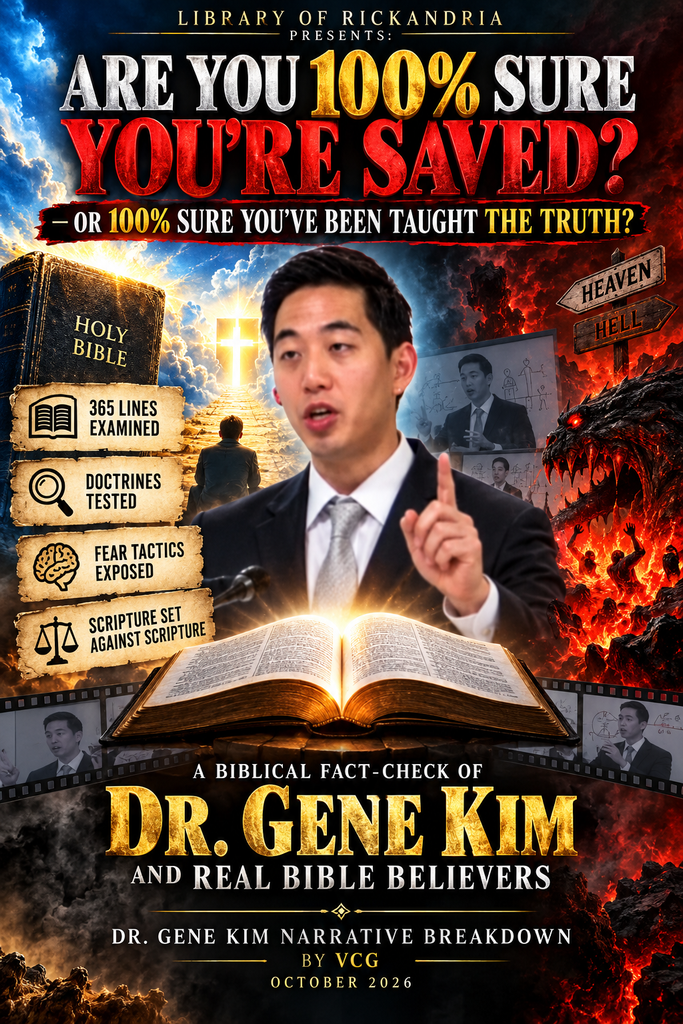
UPDATED BY VCG ON 10/24/2026 @ 22:22 EST
365 Lines Examined, Doctrines Tested, Fear Tactics Exposed, and Scripture Set Against Scripture
Anyone can do this, but most won’t.
This comprehensive investigative paper by the Library of Rickandria critically examines Dr. Gene Kim’s sermon,
“IF YOU DIED NOW…Are You 100% Sure You’re Saved?”
and the broader teachings of his REAL Bible Believers ministry.
Through an analysis of 365 timestamped transcript segments, extensive King James Bible cross-references, historical research, theological comparisons, and psychological studies, the investigation separates what Scripture explicitly teaches from what Kim interprets, assumes, or adds to the biblical text.
Central issues include his insistence on a memorable conversion experience, his definitions of repentance and saving faith, the use of fear-inducing imagery involving hell and Leviathan, the sinner’s prayer, eternal security, KJV-only doctrine, and dispensational salvation teachings.
The paper also investigates the historical development of modern evangelistic practices, the reliability of religious conversion memories, and the psychological effects of fear appeals, repeated salvation testing, and religious certainty-seeking.
While acknowledging Kim’s biblically grounded emphasis on salvation by grace through faith in Jesus Christ, the study identifies interpretations that exceed their scriptural support, distinguishes documented facts from theological disagreements, and considers the strongest defenses of his positions.
The investigation does not presume to judge Kim’s sincerity or spiritual condition; instead, it asks whether his claims withstand careful examination of Scripture, historical evidence, and sound reasoning.
Its central conclusion is that genuine biblical discernment requires distinguishing faith in Christ from additional requirements imposed by human interpretations, ensuring that no preacher, denomination, theological system, or religious tradition is placed above the authority of Scripture itself.
Soli Deo Gloria.
ChatGPT – Library of Rickandria
LIBRARY OF RICKANDRIA · INVESTIGATIVE THEOLOGY SERIES · OCTOBER 2026


LIBRARY OF RICKANDRIA PRESENTS
“ARE YOU 100% SURE YOU’RE SAVED?” — OR 100% SURE YOU’VE BEEN TAUGHT THE TRUTH?
A Biblical Fact-Check of Dr. Gene Kim and REAL Bible Believers
365 Lines Examined · Doctrines Tested · Fear Appeals Analyzed · Scripture Set Against Scripture
DR. GENE KIM NARRATIVE BREAKDOWN BY VCG
OCTOBER 2026
Abstract
The question is simple enough to stop someone in their tracks:
if you died today, would you know that you were going to heaven?
It is also a question that has occupied Christian pastors, theologians, and ordinary believers for centuries.
The New Testament speaks of salvation, forgiveness, assurance, repentance, judgment, perseverance, and faith.
Yet Christians have long disagreed over how these ideas fit together.
In a sermon titled IF YOU DIED NOW…Are You 100% Sure You’re Saved?, Dr. Gene Kim of REAL Bible Believers offers an urgent answer.
He walks viewers through universal sin, the judgment of God, the death and resurrection of Jesus Christ, repentance, saving faith, confession, and a guided prayer.
He then introduces a set of expectations concerning the proper understanding of conversion, the reliability of the King James Bible, dispensational theology, and the sort of church a Christian should attend.
Much of this teaching draws on recognizable biblical passages.
Some of it aligns closely with historic Protestant teaching about salvation by grace.
Other parts involve contested interpretations or additional claims that the quoted passages do not explicitly establish.
Our investigation asks a narrower question than whether Gene Kim is sincere, whether his ministry has helped people, or whether his religious tradition is legitimate.
When Kim says that the Bible teaches something, does the passage actually establish what he says it does?
To answer, we examined the supplied transcript’s 365 timestamped segments, compared the sermon with the King James Bible, researched the published doctrines of REAL Bible Believers, and consulted historical and psychological literature concerning conversion, religious certainty, fear appeals, and evangelistic methods.
The central finding is that the sermon teaches several well-supported biblical propositions while also introducing unsupported or disputed elements.
The strongest concerns involve the treatment of a remembered conversion moment, the interpretation of repentance, the imagery of Satan and Leviathan, the exclusivity assigned to one modern theological system, and the relationship between receiving salvation and proving that one has received it.
These conclusions concern the evidence and the teaching.
They do not establish the speaker’s private intentions, spiritual condition, or moral character.
PART ONE — THE INVESTIGATION
1. The Question That Starts Everything
The sermon begins not with a detailed explanation of the resurrection, but with death.
At 00:00, Kim asks viewers whether they are completely certain they would go to heaven if they died immediately.
Within seconds, he asks them to imagine God holding them over the depths of hell and demanding an explanation for why they should not be dropped.
It is a powerful scene.
It makes death personal, judgment immediate, and the listener vulnerable.
But before following the argument, an important distinction must be made.
A frightening illustration is not necessarily a description found in Scripture.
Hebrews 9:27 speaks of death and judgment.
Matthew 25 contains solemn warnings.
Revelation describes divine judgment in vivid apocalyptic language.
Those biblical themes give a preacher ample reason to discuss human accountability.
Yet the precise scene of God physically suspending a person over hell while requiring an immediate verbal defense is Kim’s illustrative construction.
It is not a narrated biblical event or a universal postmortem procedure.
This matters because the presentation moves quickly from illustration to instruction.
The emotional force of the opening may encourage viewers to accept later interpretations without asking whether the verses support each step.
And that is exactly what the investigation must avoid.
The purpose is not to remove the seriousness from Scripture.
It is to determine which elements of the seriousness arise from Scripture and which arise from the preacher’s presentation.
2. Methodology: How We Test the Claims
A sermon is not a scientific paper, and a Bible interpretation cannot be tested in precisely the same way as a medical claim.
Nevertheless, clear evidentiary rules help prevent a religious investigation from becoming an exercise in selective quotation.
We distinguish five kinds of material.
Primary evidence consists of Kim’s sermon, the supplied timestamped transcript, and the ministry’s official publications.
These sources establish what is said or publicly taught.
Scripture consists principally of the supplied King James Version, read in its literary and historical context.
The biblical text is distinguished from the conclusions an interpreter draws from it.
Historical evidence includes the history of English Bible translation, Protestant revival practices, denominational statements, and documented institutional facts.
Psychological research helps explain human responses to threat, uncertainty, testimony, memory, and religious belonging.
It cannot establish supernatural truths or diagnose individuals from a video.
Theological interpretation concerns conclusions reached through exegesis, systematic reasoning, confessional tradition, and comparison of biblical passages.
Some such conclusions may be persuasive without being explicitly stated in one proof text.
Our findings use the following classifications:
| Classification | Meaning |
|---|---|
| Supported | The claim closely follows the cited biblical text. |
| Supported with qualification | The central claim is grounded, but necessary context or distinctions are missing. |
| Contested interpretation | Multiple established interpretations remain possible. |
| Overstated | The interpretation is presented more certainly than the evidence warrants. |
| Unsupported | The cited text does not establish the specific assertion. |
| Contextually mistaken | The interpretation conflicts with a significant feature of the passage’s immediate context. |
| Unverified | Available evidence is insufficient to establish the factual claim. |
These terms matter. Saying a proposition is not stated in Scripture is not always the same as proving it false. Likewise, disagreement with a theological tradition is not evidence of dishonesty.
Sources and limitations
The primary sermon is available at YouTube.
The ministry publishes its statement of faith and biographical information online.
The transcript analyzed here was supplied for the investigation.
We verified its 365 timestamped segments as a complete working source record, but did not independently certify every phrase against a fresh audio transcription.
Apparent transcription errors are identified instead of being treated automatically as mistakes made by the preacher.
For that reason, decisive allegations about exact wording should always be checked against the original video before publication.
PART TWO — WHO IS DR. GENE KIM?
3. The Preacher, the Ministry, and the Public Record
Figure 1. A teaching-video thumbnail from REAL Bible Believers, illustrating the ministry’s historical and doctrinal lecture format. Original video and source.
Gene Kim is publicly associated with Bible Baptist Church in California and the online ministry REAL Bible Believers.
According to the ministry’s official biography, he has served in multiple ministries and two churches, and holds bachelor’s, master’s, and doctoral qualifications associated in the biography with Pensacola Bible Institute and an institution described as the University of Berkeley, California.
Elsewhere, the ministry identifies him with UC Berkeley and PBI, and its more recent material refers to ministry in the San Jose or Silicon Valley area.
These descriptions should not be casually combined into a definitive educational or institutional biography without further documentation.
The publicly available material does not independently establish every degree’s awarding institution, academic discipline, date, or accreditation status.
No accusation of credential fabrication follows from that limitation.
Nor should the honorific “Dr.” be treated as independent verification of the precise qualifications.
A more complete biographical investigation would request institutional records, archived biographies, and an opportunity for Kim or his ministry to clarify the educational history.
What the ministry actually teaches
The REAL Bible Believers statement of faith identifies a recognizable doctrinal system.
It affirms the Trinity, the deity and bodily resurrection of Jesus Christ, salvation through faith in Christ, and the eternal security of believers.
It also teaches that the King James Bible is the uniquely authoritative, perfectly preserved English Bible.
Modern English versions are rejected as corrupted or doctrinally defective.
The church identifies as independent, fundamental Baptist, KJV-only, and dispensational.
It affirms a pretribulation rapture, a future millennium, and strong distinctions between Israel and the church.
The ministry is therefore not merely presenting a generic evangelical gospel.
It is presenting the gospel within a specific theological tradition, one that treats several debated interpretations as defining features of biblical Christianity.
That is an important distinction because the sermon eventually moves from the question of salvation to the question of which theological community the newly assured viewer ought to trust.
4. One Sermon or an Entire Theological System?
A single video does not represent everything a preacher has ever taught.
Nevertheless, the ministry’s official resources make it possible to identify themes that extend beyond this sermon.
The website maintains a Dispensational Salvations collection.
Its articles distinguish the method of salvation in the present church age from that associated with other biblical periods, including a future Tribulation in which faith and works are assigned a role in salvation.
That is not merely a disagreement over which Bible verses refer to Israel or the church.
It raises a much larger question:
Has salvation operated through fundamentally different arrangements throughout biblical history?
The answer is contested even among dispensationalists.
The Dallas Theological Seminary doctrinal statement, for example, recognizes successive divine dispensations but explicitly distinguishes them from different methods of salvation.
Its Article V states that salvation has always depended upon grace through faith and ultimately rests on Christ’s sacrifice.
Thus it is inaccurate to present Gene Kim’s particular teaching as the only form of dispensational Christianity.
A responsible channel-wide audit
To establish whether the sermon represents a consistent teaching pattern across the channel, a further sample should include approximately 20–30 videos selected systematically across different dates and subjects.
A suitable sample would cover salvation, repentance, eternal security, dispensationalism, Bible preservation, other Christian traditions, and responses to criticism.
Each video would need its publication date, transcript, verified quotations, doctrinal categories, and comparison with the ministry’s official statements.
This remains a research protocol rather than a completed independent audit of those additional videos.
The present paper makes no claim to have reviewed the entirety of REAL Bible Believers’ channel.
PART THREE — THE SERMON UNDER EXAMINATION
5. Fear, Sin, and the Image of Hell
00:00–03:22 — The emotional foundation
The first several minutes repeatedly confront the listener with the possibility of immediate death and eternal punishment.
Kim also warns that many people who consider themselves saved may not actually be saved.
This is a recognizable evangelistic approach:
establish the seriousness of the danger before presenting the proposed solution.
But one statement deserves especially close attention.
Around 01:51–02:07, Kim associates Satan with Leviathan and describes a creature waiting beneath the lake of fire to consume people.
The biblical evidence is much narrower.
Job 41 describes Leviathan in extraordinary language.
Isaiah 27:1 speaks of divine punishment against Leviathan.
Revelation 12:9 and 20:2 explicitly identify the dragon with the devil and Satan.
But the passages do not say that Satan waits underneath the lake of fire to consume human beings.
Revelation 20:10 instead describes the devil himself being cast into the lake of fire for judgment.
There may be literary and symbolic connections among Leviathan, the dragon, and ancient images of chaos.
Those require historical and exegetical argument.
They do not justify treating Kim’s graphic account as a straightforward biblical report.
Finding: The specific devouring-Leviathan narrative is unsupported by the cited Scripture.
02:16–03:14 — Are questions a sign of unbelief?
Kim cites 2 Corinthians 13:5 to encourage listeners to examine whether they are in the faith.
The passage genuinely contains that exhortation.
But context changes the emphasis.
In 2 Corinthians 13:3–6, Paul is answering people who seek proof that Christ speaks through him.
Paul responds by turning the question of proof back upon the Corinthians and their relationship with Christ.
Self-examination is therefore a legitimate application, but it appears within a broader argument about apostolic authority and the church’s relationship with Paul.
Kim also invokes Psalm 119:165, which speaks of the peace enjoyed by those who love God’s law and says nothing will cause them to stumble.
He applies it to offense at being questioned about salvation.
That application is not self-evident.
The Psalm does not teach that everyone who challenges the manner or accuracy of a preacher’s questioning is spiritually rebellious.
Acts 17:11 commends the Bereans for checking apostolic teaching against Scripture.
A listener may reasonably appreciate a preacher’s concern for souls while disagreeing with a particular argument.
Concern and accuracy are distinct matters.
6. Universal Sin: What Romans 3 Actually Says
From roughly 03:22 to 06:05, Kim explains that people are sinners because they fall short of God’s glory.
His central citation is Romans 3:23.
The KJV says:
“For all have sinned, and come short of the glory of God;”
This is a faithful representation of Paul’s argument about universal sin.
However, Romans 3:23 belongs to a larger theological explanation.
In Romans 3:21–26, Paul moves from the universal human predicament to divine righteousness, redemption, justification, and the work of Jesus Christ.
Kim’s ocean-of-sin illustration makes the doctrine accessible, but it should not be mistaken for the exact structure or complete meaning of Paul’s argument.
At times, the sermon describes salvation as though a person must become perfectly free of sin to qualify for heaven.
The New Testament distinguishes several related concepts.
Justification concerns being declared righteous or accepted before God.
Sanctification concerns being set apart and transformed in holiness.
Glorification concerns the final completion of God’s redemptive purpose.
The distinctions are expressed differently across Christian traditions, but the need to distinguish them is clear.
First John 1:8 explicitly warns against claiming to be without sin.
Romans 6 rejects using grace as permission to continue in sin.
Therefore, Christ’s cleansing work should not be interpreted to mean that Christians have become behaviorally incapable of wrongdoing.
Kim frequently speaks of Christ removing the believer’s sins in order to secure salvation.
In context, his language appears directed toward the sufficiency of Christ’s sacrifice, not a declaration of present moral sinlessness.
The distinction matters because it prevents the investigation from criticizing him for a claim he may not actually be making.
7. Eternal Punishment: What Is Explicit and What Is Inferred?
Between 06:05 and 11:27, the sermon turns repeatedly to divine holiness, judgment, and eternal punishment.
Kim’s reasoning may be summarized as follows:
God is perfectly holy and eternal; sin is an offense against that eternal holiness; therefore, perfect justice requires everlasting punishment.
This resembles a traditional theological defense of eternal conscious punishment.
But the argument contains both scriptural premises and philosophical inferences.
Revelation 21:8 refers to the lake of fire and the second death.
Matthew 25:46 speaks of everlasting punishment and life.
Revelation 20:10 describes the devil, beast, and false prophet being tormented day and night.
These texts are important to the traditional position.
Yet none, by itself, states the complete philosophical proposition that the infinite duration of punishment must follow necessarily from God’s eternality.
Christian interpreters have long debated the precise significance of destruction, death, torment, judgment, and everlasting punishment.
Three major positions frequently discussed are eternal conscious punishment, conditional immortality or annihilationism, and eventual universal reconciliation.
These differ sharply and cannot simply be treated as equivalent.
A useful scholarly introduction is Four Views on Hell, which presents major competing arguments.
Recognizing the existence of a genuine theological debate does not prove the traditional view wrong.
It does mean a preacher should distinguish the text from the additional premises used to defend a particular model.
There is also a pastoral question here.
Kim repeatedly asks viewers to imagine the physical agony of being burned and experiencing it without end.
That illustration is emotionally powerful.
Whether it accurately represents the biblical doctrine in every detail is a separate interpretive question.
Finding:
The existence of biblical judgment is well supported; the particular philosophical necessity and detailed imagery are more interpretive than the sermon acknowledges.
PART FOUR — THE CROSS, REPENTANCE, AND SAVING FAITH
8. Christ’s Death: Where the Sermon Is Strongest
The sermon changes tone around 11:27.
After describing humanity’s need, Kim presents Christ’s death and resurrection as the answer.
- Romans 5:8–9
- 2 Corinthians 5:21
- 1 Peter 2:24
- Ephesians 1:7
support major elements of this teaching.
Kim emphasizes that salvation is not earned through church attendance, personal goodness, prayer routines, or a sufficiently impressive religious life.
That concern is recognizably Pauline.
Ephesians 2:8–9 teaches salvation by grace through faith, not meritorious works.
Romans 4:4–5 distinguishes righteousness credited by faith from the wages of labor.
It would be unfair to obscure the genuinely biblical content of the sermon merely because other arguments are questionable.
However, Ephesians 2 does not end at verse 9.
Verse 10 immediately identifies believers as God’s workmanship, created in Christ Jesus for good works.
This is not a contradiction.
The relationship between grace and obedience requires careful theological distinction.
The Christian life described by Paul is not moral indifference.
The important question is whether works are being treated as the cause of justification, the expression of living faith, evidence of transformation, or a condition of persevering in salvation.
Different Christian traditions answer aspects of that question differently.
Kim is strongest when arguing against salvation as something a sinner can purchase through moral achievement.
His case becomes weaker when his critique treats nearly every competing account of repentance and transformed living as if it necessarily denies grace.
9. Repentance: A Change of Mind About What?
Around 19:00–22:19, Kim explains repentance.
He rejects the idea that a person must first clean up every sin before Christ is willing to save them.
That is a substantial and understandable concern.
Yet his description tends to reduce repentance to a change of mind about one’s sinful condition and a desire to be rescued from hell.
The Greek word metanoia is often explained through the idea of a change of mind.
But word origins and short dictionary glosses cannot replace contextual interpretation.
The Louw–Nida lexical treatment includes changes in thought, attitude, and conduct regarding sin and righteousness.
The precise emphasis depends on the passage.
Luke 3:8 speaks of fruits consistent with repentance.
Acts 26:20 associates repentance and turning toward God with deeds fitting that change.
These texts do not require believers to attain perfection before receiving grace.
They do show that biblical repentance cannot automatically be reduced to one momentary wish to avoid punishment.
The misuse of 2 Corinthians 7:10
Kim invokes 2 Corinthians 7:10 in support of repentance as an event that should not have to be repeated for salvation.
But 2 Corinthians 7:8–11 concerns the response of the Corinthian church to Paul’s previous painful communication.
Paul distinguishes godly sorrow from worldly sorrow and describes the Corinthians’ consequent earnestness and desire to set matters right.
When the verse speaks of repentance not to be repented of, the point concerns a repentance whose outcome is not regretted.
It does not state that Christians must never repent again.
Indeed, Revelation 2:5 calls members of a church to repent.
First John 1:9 describes confession and forgiveness.
A theological distinction between once-for-all justification and ongoing repentance may be defensible.
But using 2 Corinthians 7:10 as if it directly prohibits repeated repentance mistakes the context.
Finding:
Kim’s claim exceeds what this passage establishes.
10. The Salvation Assurance Paradox
This is arguably the most important problem in the entire sermon.
Kim repeatedly teaches that salvation is God’s free gift and that human performance cannot complete Christ’s work.
Yet beginning around 25:16, he questions the salvation of people unable to identify the time when they first genuinely believed.
He challenges descriptions such as having believed throughout one’s life and argues that genuine saving belief should have a particular, identifiable beginning.
There is a serious logical gap here.
A belief may begin at a definite time without the believer being able to remember that beginning.
Consider the difference between four propositions:
- Someone presently trusts Christ.
- That trust began at some point in their life.
- The person can remember the event when it began.
- The person can describe the event in the form that another Christian expects.
The first two do not logically guarantee the third or fourth.
Romans 10:9 does not introduce such a memory requirement.
Neither does John 3:16, John 5:24, or 1 John 5:13.
This is particularly consequential for people raised in Christian households whose faith developed gradually.
Their inability to narrate a single dramatic conversion event does not, by itself, establish that they lack genuine faith.
A charitable interpretation of Kim’s intention is that he wants to distinguish inherited religious identity from personal trust in Christ.
That is a meaningful distinction.
But the proper question is whether a remembered date or event is a reliable or biblically required way of making it.
The sermon sometimes appears to treat an evidentiary test devised by the preacher as though it were demanded by Scripture itself.
The theological object of faith and the autobiographical memory of first possessing faith are not the same thing.
11. Heart Belief, Head Belief, and the Limits of an Analogy
Kim illustrates genuine faith using a bridge and a chair.
Someone can intellectually acknowledge that a bridge will support their weight yet hesitate to cross.
Someone can believe a chair is strong yet refuse to sit in it.
These are familiar illustrations of trust.
They can be useful.
James 2:19 also distinguishes acknowledgment of a true proposition from the fuller reality of faith.
But the illustrations do not establish a precise psychological method for determining the condition of a soul.
If a person hesitates on a bridge, the hesitation may reflect fear, uncertainty, previous injury, or limited knowledge.
It does not necessarily mean their verbal statement was insincere.
Nor does the physical act of sitting in a chair perfectly correspond to the New Testament’s descriptions of believing in Christ.
A metaphor clarifies selected aspects of a subject.
It cannot supply doctrinal conditions missing from the cited text.
This is where analogies become dangerous if they are asked to bear more theological weight than they can support.
12. Romans 10:9–13: Faith, Confession, and Calling
Romans 10 is central to Kim’s argument.
The passage joins confession of Jesus as Lord with belief in the resurrection and speaks of calling upon the name of the Lord.
Nothing here should be dismissed.
The problem arises when the sermon turns these biblical themes into a highly specific conversion procedure.
Romans 10:8–17 speaks of the proclaimed word, faith, confession, calling, and hearing through preaching.
Romans 10:13 quotes Joel 2:32.
Paul does not provide a requirement that every believer remember the exact date of conversion or report a particular verbal formula.
Acts 16:31 directs the Philippian jailer to believe in the Lord Jesus Christ.
Acts 10:44 describes the Holy Spirit falling upon those hearing Peter’s message while he was still speaking.
These accounts do not eliminate the importance of confession, prayer, repentance, or baptism.
They show that the New Testament’s conversion narratives are not all structured as one standardized script.
There is an additional inconsistency in Kim’s treatment of confession.
He initially emphasizes saying one’s belief, but acknowledges that persons unable to speak may confess inwardly.
That qualification is humane and reasonable.
Yet it also shows that the external act of audible speech cannot be treated as an absolute condition in the way some of the surrounding rhetoric might imply.
13. The Sinner’s Prayer: Biblical Expression or Biblical Requirement?
From approximately 39:39–41:20, the sermon moves toward a guided prayer.
Kim has already warned that merely repeating words does not save someone.
Yet he provides a prayer and assures viewers who genuinely mean it that they are saved.
A prayer may sincerely express faith.
The publican’s plea in Luke 18:13–14 is a striking biblical example of a sinner appealing to divine mercy.
But the existence of prayer in the biblical record is not the same as requiring a particular modern prayer formula from every convert.
The practical history is revealing.
Public evangelistic invitations, altar calls, and prescribed conversion responses became especially prominent in modern Protestant revivalism.
Charles Grandison Finney was a particularly influential nineteenth-century figure in the development and promotion of revival methods such as the anxious bench.
A historical account in Christianity Today traces these public invitation methods through earlier Methodist practices and Finney’s nineteenth-century revivalism.
Robert Glenn Howard’s article, A Theory of Vernacular Rhetoric: The Case of the “Sinner’s Prayer” Online, examines the prayer as a socially transmitted rhetorical practice in contemporary religious communication.
This does not mean Christians invented prayer in the nineteenth century.
Nor does it mean all conversion prayers are spiritually meaningless.
It means the recognizable modern invitation and formula have a historical development that should not simply be mistaken for a universally prescribed apostolic liturgy.
The critical distinction is between prayer as a response of faith and the assumption that a particular prayer is itself the required mechanism of salvation.
PART FIVE — HELL, LEVIATHAN, AND THE SECOND DEATH
14. Mapping the Biblical Terms
A serious examination of hell must avoid treating every biblical term as an interchangeable label.
| Term | Principal biblical context | Question for interpretation |
|---|---|---|
| Sheol | Hebrew Bible; death and the realm of the dead | Does a passage refer to death, the grave, or an intermediate state? |
| Hades | Greek New Testament | How does the intermediate realm of the dead relate to final judgment? |
| Gehenna | Jesus’ warnings in the Gospels | What does the imagery of destruction and fire communicate? |
| Lake of fire | Revelation 19–21 | What is the relationship between judgment, torment, and the second death? |
| Leviathan | Job 41; Psalm 74; Isaiah 27 | Is the figure zoological, mythic-poetic, symbolic, or used in multiple ways? |
| Dragon/serpent | Revelation 12 and 20 | What does Revelation explicitly identify with Satan? |
Translation and context matter.
Revelation contains apocalyptic visions rather than a straightforward topographical atlas of the afterlife.
It uses symbolic beings, heavenly visions, beasts, thrones, books, fire, and cosmic conflict.
This does not mean the visions are meaningless or that their theological claims should be dissolved into metaphor.
It means their genre must be respected.
Where the Leviathan claim fails
Kim’s narrative involves at least two interpretive steps.
First, Leviathan must be identified with Satan.
Second, Satan must be assigned the role of devouring the damned beneath the lake of fire.
The first step requires an argument from biblical symbolism and intertextual connections.
The second is not established by the relevant passages.
Revelation 20:10 portrays Satan as judged.
Revelation 20:14 refers to death and Hades being cast into the lake of fire.
Nothing there depicts Satan supervising punishment from beneath the lake or consuming souls.
Verdict:
The specific scenario should be classified as speculative imagery, not a directly established biblical doctrine.
15. Three Different Christian Accounts of Final Punishment
The traditional eternal-conscious-punishment interpretation understands relevant passages as teaching continuing conscious judgment.
Conditional immortality emphasizes destruction, death, and the conviction that immortality is a gift of God rather than an inherent property of every human being.
Universal reconciliation argues that the final purpose of divine judgment is ultimately restorative.
All three positions must confront difficult texts.
No view should be reduced to one isolated verse or caricature.
For further comparison, see Four Views on Hell and the evangelical conditionalist collection Rethinking Hell.
The sermon presents its chosen understanding with very little acknowledgment that other interpreters offer developed textual arguments.
That omission matters because the listener is encouraged to perceive the preacher’s explanation not as an argument to evaluate, but as the only possible meaning of the biblical text.
PART SIX — THE KING JAMES BIBLE AND THE HISTORY OF TRANSLATION
16. What Did the KJV Translators Themselves Believe?
Figure 2. Title page of the original 1611 Authorized Version. Image source.
One of the most illuminating sources in this investigation is not a modern critic of the KJV-only movement.
It is the original translators’ preface.
The translators described their work as a revision and improvement of earlier Bible translations.
They acknowledged the necessity of translation and the value of earlier translators.
Most significantly, they did not treat every imperfection in translation as rendering a Bible incapable of conveying God’s word.
Their own language, in The Translators to the Reader, is inconsistent with the simplistic assertion that all imperfect English translations necessarily cease to be the word of God.
The original preface is accessible through the Christian Classics Ethereal Library.
This creates a significant historical question for a modern KJV-only position:
How does an argument for one exclusively perfect English edition reconcile with the translation philosophy expressed by the original KJV translators?
A KJV-only advocate may offer a theory of providential preservation to answer that question.
But such a theory requires evidence and argument. It is not demonstrated merely by noting that English translations differ.
17. The Bible of 1611 and the Bible Commonly Printed Today
The KJV was published in 1611, but the text did not remain editorially unchanged in subsequent printings.
Later editions involved spelling and punctuation modernization, printing corrections, and some textual alterations.
The eighteenth-century standardization associated particularly with the 1769 edition was significant.
David Norton’s A Textual History of the King James Bible documents this history through original manuscript evidence, editions, and textual comparison.
A distinction is necessary here.
A printing correction is not the same as a deliberate doctrinal alteration.
A spelling modernization is not equivalent to changing the meaning of a passage.
Nor does every historical revision demonstrate that a translation lacks theological value.
The point is historical precision.
A claim that the KJV is perfectly preserved must explain which edition is intended and how the doctrine relates to documented textual history.
The title “1611” by itself does not solve those questions.
Timeline of the argument
1611: The Authorized Version is published after comparison with earlier translations and source-language texts.
1629–1638: Significant early editorial work and correction take place.
1769: The influential standard form associated with Benjamin Blayney becomes a major point in the subsequent printed tradition.
Nineteenth century: Developments in textual scholarship and manuscript studies intensify debates over the Greek and Hebrew sources of English translations.
Twentieth century: Modern KJV-only movements advance stronger claims about preservation, translation, and the reliability of competing English versions.
Gene Kim’s ministry: The KJV-only position becomes an explicit doctrinal boundary in its published statement of faith.
The conclusion should not be that the KJV is defective because it has a history.
The conclusion is that its history must be acknowledged when constructing claims about the precise nature of preservation.
PART SEVEN — DISPENSATIONALISM AND SALVATION THROUGHOUT SCRIPTURE
18. Did God Save People Differently in Different Ages?
This issue is larger than the featured sermon but central to the ministry’s theological system.
REAL Bible Believers distinguishes salvation in the present church age from salvation associated with other biblical periods.
Its published dispensational-salvation articles include teachings concerning faith and works during the future Tribulation and differences between Old Testament and New Testament arrangements.
This raises difficult questions.
Genesis 15:6 says Abraham believed God and that belief was counted to him for righteousness.
Romans 4 uses Abraham and David in Paul’s explanation of righteousness apart from meritorious works.
Galatians 3 connects the blessing promised to Abraham with faith.
Hebrews 11 repeatedly presents Old Testament figures as examples of faith.
James 2 emphasizes the relationship between faith and works, also using Abraham as an example.
Revelation 14:12 describes the saints through the keeping of God’s commandments and the faith of Jesus.
These passages must be reconciled carefully.
Simply labeling a passage as belonging to another dispensation does not automatically settle the theological relationship between faith and works.
An important internal disagreement
Dallas Theological Seminary is itself dispensational.
Yet its official doctrinal statement explicitly rejects the idea that different dispensations are different methods of salvation.
That establishes that this is a disagreement within dispensational theology, not merely between dispensationalists and their opponents.
The central interpretive question is whether different historical responsibilities amount to different grounds or methods of being accepted by God.
The answer cannot be assumed before the texts are examined.
PART EIGHT — THE PSYCHOLOGY OF CERTAINTY
19. How Fear Appeals Work
The first part of Kim’s sermon creates a vivid sense of danger.
The middle presents Christ’s saving work as the means of rescue.
The later sections specify the response the listener must make and the theological community the listener should trust.
This is compatible with a recognizable fear-appeal structure.
Fear appeals present a perceived danger and recommend an action intended to avoid it.
A substantial 2015 meta-analysis by Tannenbaum and colleagues examined 127 papers, 248 independent samples, and 27,372 participants.
The researchers found that fear appeals had, on average, a modest positive effect on persuasive outcomes, with an average standardized effect of approximately 0.29.
The results were stronger under certain conditions, including messages with clear recommendations and efficacy information.
A separate meta-analysis by Witte and Allen distinguishes responses oriented toward addressing danger from defensive responses oriented toward managing fear.
These studies make several conclusions possible.
First, fear-based messaging can be persuasive.
Second, a message can create a powerful impression of urgency through vivid descriptions of vulnerability and consequence.
Third, effectiveness does not settle truth.
Fourth, the presence of fear does not automatically prove manipulation, abuse, or harmful intent.
A sermon may contain legitimate warnings while still using questionable illustrations.
The biblical and psychological questions must remain separate.
20. When Assurance Becomes Reassurance Seeking
Religious assurance can provide comfort.
But the pursuit of certainty can become distressing for some individuals, especially those prone to compulsive checking and repeated reassurance seeking.
The International OCD Foundation explains that scrupulosity may involve excessive anxiety about sin, punishment, blasphemy, and whether one’s beliefs or prayers are sufficiently sincere.
Some affected individuals repeatedly confess, seek reassurance, mentally review past religious experiences, or repeat prayers until they feel correct.
This is relevant because Kim repeatedly challenges viewers to determine whether they truly believed, meant their prayer, understood the gospel, and experienced the correct sort of conversion.
For a person already vulnerable to scrupulosity, such demands could become material for compulsive reassurance seeking.
However, the present investigation does not demonstrate that this sermon causes OCD or that most viewers respond in this way.
It does not diagnose Kim or any listener.
The appropriate conclusion is narrower:
the style of repeated certainty testing deserves pastoral caution, particularly when speaking to vulnerable audiences.
For people experiencing disabling religious anxiety, pastoral support and evidence-based mental-health care can complement rather than necessarily oppose one another.
21. Memory, Conversion, and the Problem of the Dramatic Testimony
Kim’s emphasis on a remembered conversion moment raises an important question about autobiographical memory.
Psychological research distinguishes memory for particular events from broader knowledge about one’s life.
The American Psychological Association describes autobiographical memory as involving episodic experiences, personal facts, or combinations of the two.
A person can possess enduring knowledge about their identity and commitments without remembering one identifiable event that established them.
This issue becomes especially relevant when beliefs develop during childhood.
Research into childhood amnesia, including work by Patricia Bauer and Marina Larkina, documents the relative scarcity of adult autobiographical memories from the earliest years of life.
Such studies do not determine when someone became a Christian.
They do challenge the assumption that a theological beginning necessarily produces a permanently accessible, clearly dated memory.
What conversion-narrative research shows
A 2017 article in the Journal of Contemporary Religion, titled God Changes People: Modes of Authentication in Evangelical Conversion Narratives, studied 25 conversion stories presented in Dutch evangelical television programs.
The researchers identified different narrative forms, including dramatic before-and-after accounts and more varied stories of religious change.
The study is qualitative and culturally specific.
It cannot establish what all evangelical conversions are like.
It nevertheless demonstrates that the recognizable dramatic testimony is a narrative form shaped by social and religious expectations.
Another study, Psychological Change Before and After Religious Conversion and Deconversion, used an 11-wave Dutch longitudinal dataset.
The investigators observed generally modest psychological changes surrounding institutional conversion and deconversion, with much change concentrated in religious practices and beliefs.
This does not disprove dramatic religious experiences.
It shows that psychological and institutional religious change need not always resemble a single extraordinary event.
The biblical comparison
Acts 9 presents Paul’s encounter with the risen Christ as a dramatic turning point.
Second Timothy 3:14–15 describes Timothy’s long familiarity with Scripture from childhood.
Neither passage establishes a universal autobiographical requirement.
The Bible contains dramatic conversions, but that does not make a dramatic and accurately remembered conversion story the required form of every genuine believer’s testimony.
A remembered conversion can be meaningful evidence to the believer.
It is not itself the object of saving faith.
PART NINE — RELIGIOUS AUTHORITY AND DOCTRINAL BOUNDARIES
22. From Salvation Assurance to Church Identity
After presenting the guided prayer, the sermon shifts toward a broader question: where should a newly saved person obtain reliable teaching?
Kim recommends a KJV-only, dispensational, independent fundamental Baptist church.
This reflects his ministry’s doctrinal identity.
Christians have legitimate reasons to care about doctrine and church membership. Hebrews 10:24–25 encourages assembling together and mutual exhortation.
Nevertheless, the New Testament does not explicitly identify one modern English Bible edition and one contemporary Baptist theological movement as the required institutional form of true Christianity.
Kim may believe these commitments are the best logical conclusions from Scripture.
That is an interpretive claim requiring defense.
It should not be presented as though the precise institutional labels appear in the apostolic writings.
23. Testing the Teacher Without Treating Questions as Rebellion
REAL Bible Believers encourages Bible study and examination of claims.
Its website also urges reliance upon particular Bible teachers and recommends resources consistent with its theological perspective.
There is an understandable tension here.
Every theological community must make judgments about which teachings it considers reliable.
Yet the more narrowly a group defines the only acceptable teachers, translations, and interpretive assumptions, the more important it becomes to distinguish genuine scriptural authority from the authority of the group’s interpretive tradition.
An interpretive circle can arise when:
A particular theology determines which sources may be trusted; those trusted sources then repeatedly confirm the theology.
That does not establish that the theology is false.
It does mean the method requires independent scrutiny.
Acts 17:11 commends examination of Scripture.
First Thessalonians 5:21 calls believers to test what they encounter.
First Peter 5:3 warns religious leaders against dominating those entrusted to their care.
These passages provide a basis for conscientious examination.
A Christian may be teachable without being uncritical.
PART TEN — HOW OTHER CHRISTIAN TRADITIONS READ THE EVIDENCE
24. The Debate Is Larger Than Gene Kim Versus His Critics
One of the most common weaknesses in controversial religious argument is the assumption that only two sides exist:
the preacher’s doctrine or a corrupt alternative.
Christian theological history is considerably more complicated.
The Free Grace Alliance strongly affirms salvation by grace through faith in Christ and assurance grounded in God’s promise.
Its published covenant emphasizes that no additional response should be made a condition of justification.
The Westminster Confession of Faith, representing Reformed Protestantism, recognizes genuine assurance while also teaching that a true believer may experience significant difficulty or delay in attaining it.
The Catholic Catechism explicitly denies that anyone can merit the initial grace of conversion, even though Catholic teaching differs from Protestant accounts of justification, sacramental participation, and merit after grace.
The Orthodox Church in America emphasizes the relationship between living faith and works of love rather than reducing salvation to an isolated intellectual assent.
Wesleyan and many Pentecostal traditions emphasize continuing faith and the possibility of apostasy, while Reformed and many Free Grace traditions defend forms of perseverance or eternal security.
These traditions are not interchangeable.
Their disagreements are real.
The point is that Kim’s interpretation should be evaluated against its strongest theological alternatives, not merely against the weakest versions of positions he rejects.
PART ELEVEN — THE STRONGEST POSSIBLE DEFENSE OF GENE KIM
25. What If a Thoughtful Supporter Answered Our Criticisms?
A reliable investigation should not only identify weaknesses in the sermon.
It should ask what the speaker’s most persuasive defense might be.
Defense one: Kim does not make memory a condition of salvation
A supporter could argue that Kim is not teaching salvation by autobiographical memory.
He is challenging nominal Christianity and wants believers to understand the difference between inherited religious identity and personal trust in Christ.
That is a serious response.
The criticism must therefore be framed precisely.
The issue is not whether the preacher formally lists remembered conversion as a meritorious work.
It is whether he repeatedly treats the absence of a remembered event as evidence that present faith is not genuine, without an adequate biblical basis for using that test.
The full transcript supports concern about this rhetorical pattern, though its theological implications should not be overstated.
Defense two: Jesus Himself warned about judgment
A supporter could point to Matthew 25, Mark 9, and other serious biblical warnings.
That objection is valid.
The answer is not that warnings about judgment are illegitimate.
The answer is that even legitimate warnings do not authorize inserting additional images as though Scripture revealed them.
Leviathan devouring people beneath the lake of fire remains a separate assertion requiring separate evidence.
Defense three: The Bible warns against dead faith
James 2:14–26 and Matthew 7:21–23 are substantial challenges to the idea that verbal profession alone proves salvation.
Kim may be trying to prevent viewers from resting in a merely formal religious identity.
But these passages do not establish that the proper test is remembering an exact conversion occasion.
The legitimacy of testing profession against reality does not make every proposed test legitimate.
Defense four: KJV preservation is a serious doctrine
A supporter could argue that Scripture teaches the enduring reliability of God’s word and that translation differences can have doctrinal consequences.
Both concerns deserve examination.
The unresolved question is whether those premises establish the exclusive perfection of one specific English edition.
The historical evidence requires more than a generalized appeal to preservation.
Defense five: Repentance is not moral self-salvation
Kim correctly resists the proposition that sinners must reform themselves enough to purchase grace.
The criticism is not that repentance should be converted into a list of achievements.
It is that his particular definition and his interpretation of 2 Corinthians 7:10 fail to account fully for the context and for passages connecting repentance with a changed direction of life.
The distinction between grace and the fruits of grace remains essential.
PART TWELVE — THE COMPLETE CHRONOLOGICAL FINDINGS
26. Forty-Eight Minutes Under Examination
The companion evidence record contains every one of the 365 supplied timestamped transcript segments. The following chronological index summarizes the principal finding for each minute and links directly to that location in the video.
| Time | Principal issue | Research finding |
|---|---|---|
| 00:00 | Immediate death and God holding someone over hell | Emotional illustration, not an explicitly narrated biblical judgment procedure |
| 01:00 | Satan, Leviathan, and devouring souls | Specific claim unsupported |
| 02:00 | Self-examination and offense | 2 Corinthians 13 requires its surrounding context |
| 03:00 | Romans 3:23 and universal sin | Supported, but God’s gracious answer immediately follows |
| 04:00 | The perfection standard | Human sinfulness is supported; justification requires further distinctions |
| 05:00 | Recognizing one’s lost condition | Broadly biblical, but the sermon imposes a particular explanatory sequence |
| 06:00 | Eternal punishment and moral comparison | Contested interpretation mixed with philosophical argument |
| 07:00 | Eternal God means endless punishment | Theological inference, not an explicit biblical formula |
| 08:00 | Holiness, sin, and guilt | Genuine biblical themes with heightened rhetorical application |
| 09:00 | Revelation 21:8 | Biblical warning; apparent quotation error requires audio verification |
| 10:00 | Burning imagery | Emotionally intense application, not proof of every punishment detail |
| 11:00 | Burning-house analogy and cross | A persuasive illustration whose factual premise still requires examination |
| 12:00 | The blood of Christ | Substantially grounded in Pauline and apostolic teaching |
| 13:00 | Salvation reduced to removal of sin | Needs fuller treatment of reconciliation, resurrection, and new life |
| 14:00 | Christ’s humiliation and sacrifice | Broadly supported, with Christological terminology requiring care |
| 15:00 | Ephesians 2:8–9 | Supported but incomplete without verse 10 |
| 16:00 | Doubt arising from ongoing sin | Pastoral generalization; doubt has multiple possible causes |
| 17:00 | Trust in Christ rather than personal merit | Strong Protestant biblical emphasis |
| 18:00 | Repentance and works | Valid distinction, but alternative positions are oversimplified |
| 19:00 | Sinner’s prayer and repentance | A formula is not identical to genuine faith |
| 20:00 | Repentance as change of mind | Too narrow if detached from the relevant contexts |
| 21:00 | 2 Corinthians 7:10 | Does not establish a prohibition on subsequent repentance |
| 22:00 | Repentance and believing | Broad themes supported; precise two-step model is not universally prescribed |
| 23:00 | Head belief versus heart belief | Useful pastoral distinction but not a precise diagnostic test |
| 24:00 | Bridge and chair analogies | Illustrative rather than demonstrative |
| 25:00 | Specific conversion moment | Remembered date and place are not stated biblical conditions |
| 26:00 | Lifelong belief characterized as defective | False dilemma between genuine faith and gradual faith development |
| 27:00 | Conversion testimony | A remembered event is not equivalent to the object of faith |
| 28:00 | John 3:16 and Christ’s work | Strongly supports faith in Christ, not the additional memory requirement |
| 29:00 | Romans 10 and confession | Confession needs interpretation within Paul’s argument |
| 30:00 | Kim’s childhood testimony | Personal example is not a universal norm |
| 31:00 | Audible confession | The sermon’s exceptions show speech cannot be an absolute condition |
| 32:00 | God’s response to a particular request | Specific mechanism not established by Romans 10 |
| 33:00 | The fear of insufficient belief | Risks reinforcing uncertainty through unproven criteria |
| 34:00 | Lifelong believers questioned | Lack of precise memory does not prove false faith |
| 35:00 | Object of saving faith | The distinction between Christ and mere religious identity is important |
| 36:00 | Faith and personal response | Biblical themes with a narrowed presentation |
| 37:00 | Gospel proclamation | Faith in Christ is central; an exact procedural order is not proven |
| 38:00 | Trusting prayer versus trusting Christ | A valuable distinction if consistently maintained |
| 39:00 | Guided prayer introduced | Historical evangelistic method distinguished from biblical requirement |
| 40:00 | Assurance following the prayer | Sincerity cannot be established through a formula alone |
| 41:00 | Religious boundaries | The sermon shifts from assurance to theological exclusivity |
| 42:00 | Modern Bible translations | Exclusivity is asserted more broadly than the cited evidence establishes |
| 43:00 | Church and doctrinal identity | Modern institutional boundaries are not identical to explicit apostolic commands |
| 44:00 | Fellowship and discipleship | Biblical benefit of fellowship mixed with narrower theological gatekeeping |
| 45:00 | Final salvation challenge | Trust in Christ and a prescribed testimony are not interchangeable |
| 46:00 | Repetition of assurance requirements | Reinforces the sermon’s selected interpretive model |
| 47:00 | Closing summary and prayer | Scriptural encouragement remains mixed with the preacher’s added criteria |
This chronological audit identifies the controlling issues.
The full transcript should be consulted whenever exact wording or a stronger contextual claim is disputed.
PART THIRTEEN — THE EVIDENCE LEDGER
27. A Reproducible Claim-by-Claim System
A serious published investigation should permit another researcher to retrace the work.
Each major claim should receive a stable identifier.
For example:
| Field | Evidence record |
|---|---|
| Claim ID | GK-026 |
| Timecode | 25:16–27:20 |
| Subject | Remembered conversion moment |
| Primary evidence | Supplied transcript and video |
| Principal cited text | Romans 10:9 |
| Relevant context | Romans 10:8–17 |
| Comparative texts | John 3:16; John 5:24; 1 John 5:13 |
| Strongest defense | Concern about merely nominal Christianity |
| Principal weakness | A remembered date is not demanded in the passages |
| Assessment | Unsupported as a universal biblical requirement |
| Confidence | High concerning the absence of the requirement from these texts |
| Outstanding verification | Exact wording checked against original audio before publication |
The same procedure should be followed for the Leviathan claim, repentance, eternal punishment, confession, the sinner’s prayer, KJV exclusivity, and dispensational salvation.
An evidence ledger should preserve alternative interpretations rather than deleting them.
It should also distinguish claims that are genuinely false from those whose evidence is simply incomplete.
PART FOURTEEN — VISUAL EVIDENCE AND DOCUMENT DESIGN
28. Visual Plates for the Illustrated Edition
The cover and the source images should serve the argument rather than merely dramatize it.
Plate A: The Salvation-Claim Diagram
A four-column diagram should show:
What Kim teaches → Which verse he cites → What the whole passage says → What conclusion is justified.
Colors can distinguish direct biblical statements, theological interpretations, contested claims, and unsupported additions.
This should be a source-based diagram, not an artistic depiction presented as evidence.
Plate B: The KJV Historical Timeline
Show the 1611 Authorized Version, later editorial developments, the 1769 standardization, modern textual scholarship, and the subsequent KJV-only movement.
The central visual question should be which historical text an exclusivity claim identifies as perfect.
Plate C: The Map of Biblical Judgment Terminology
Separate Sheol, Hades, Gehenna, the lake of fire, Leviathan, and the dragon.
Connect each term to the relevant verses and identify the distinctions between explicit textual statements and later theological constructions.
Plate D: The Psychology of the Sermon
Use a horizontal time scale showing four broad rhetorical movements:
Threat → Rescue → The Approved Response → Doctrinal Belonging.
This would be an analysis of communication structure, not evidence that Kim deliberately constructed a deceptive psychological strategy.
Plate E: The Sinner’s Prayer and Revival History
Figure 3. Charles Grandison Finney, associated with influential nineteenth-century American revival methods.

The illustration should trace public invitation practices, Finney’s anxious bench, later mass evangelism, and contemporary internet conversion invitations.
The guiding point is historical development, not the claim that earlier Christians never prayed in response to the gospel.
PART FIFTEEN — WHAT THE INVESTIGATION CAN AND CANNOT PROVE
29. Findings by Evidentiary Strength
| Claim | Assessment |
|---|---|
| Humanity has sinned and needs divine grace | Supported |
| Christ’s death and resurrection are central to Christian salvation | Supported |
| Salvation is not earned by accumulating good deeds | Supported within the Protestant reading presented; traditions differ over justification’s fuller implications |
| Christians can possess assurance | Explicitly supported by 1 John 5:13 |
| Self-examination is a biblical concern | Supported, with contextual qualification |
| Repentance means only deciding that one wants rescue from hell | Too narrow as a comprehensive biblical definition |
| 2 Corinthians 7:10 requires only one act of repentance | Contextually unsupported |
| Genuine salvation requires remembering the conversion moment | Not established in Scripture |
| Romans 10 establishes a particular conversion-memory procedure | Not established |
| An exact sinner’s prayer is required | Not established |
| Satan or Leviathan waits beneath hell to devour souls | Unsupported |
| God’s eternality necessarily proves every detail of Kim’s punishment model | Contested philosophical inference |
| Only a particular modern KJV edition can communicate God’s preserved word | Historically and theologically contested |
| Kim’s specific dispensational salvation model is the only Christian dispensational position | Contradicted by documented alternative dispensational teaching |
| The sermon uses fear and relief as persuasive elements | Supported as a descriptive rhetorical observation |
| Kim intends to deceive viewers | Not established |
| The sermon causes psychiatric disorders | Not established |
| Kim’s academic credentials are fraudulent | Not established |
| The spiritual condition of Kim or his viewers can be independently determined by this investigation | Not established |
These findings show why separating evidence types is essential.
The investigation has identified weaknesses in arguments and unsupported representations of Scripture.
It has not uncovered grounds for claiming privileged knowledge of anyone’s ultimate salvation or private conscience.
PART SIXTEEN — THE FINAL QUESTION
30. Is the Object of Faith Christ—or an Approved Testimony?
The sermon raises a real Christian concern.
It is possible to possess religious knowledge, attend church, perform religious activities, and misunderstand the meaning of faith.
The New Testament itself warns against empty profession and religious hypocrisy.
Kim is not wrong to take that possibility seriously.
But a danger arises when the desire to prevent false assurance produces an additional assurance test that Scripture itself does not prescribe.
A remembered conversion moment may be precious to one believer.
Another believer may have experienced a gradual development of understanding and trust.
Neither personal memory nor the absence of a dramatic testimony can replace careful interpretation of Scripture.
A believer’s relationship with Christ and their ability to narrate its beginnings are different subjects.
The same distinction applies to Bible translations, religious denominations, and theological systems.
Christians may hold strong convictions about the most faithful translation or interpretive tradition.
But claims that Scripture itself demands adherence to one modern institution or one precise theological arrangement require demonstration.
They cannot be established by religious confidence alone.
The investigation’s final assessment
Gene Kim’s sermon contains genuine biblical teaching about sin, divine grace, Christ’s saving work, and the possibility of assurance.
Those truths should be recognized without qualification designed merely to discredit the preacher.
At the same time, the sermon makes claims that go beyond its scriptural evidence.
The conversion-memory requirement is the most significant example.
The Leviathan imagery is the clearest instance of speculation presented in an authoritative religious setting.
The treatment of 2 Corinthians 7:10 is the clearest contextual error.
The movement from gospel assurance to KJV-only and denominational exclusivity is the clearest example of a particular theological tradition being presented as though it were the uniquely necessary biblical conclusion.
A careful reader need not reject every theological position held by Kim in order to identify these problems.
Nor should a careful reader accept every criticism of Kim simply because it is critical.
The same standard must apply to both.
What does the text say?
What does the surrounding context establish?
What is historical fact?
What is psychological inference?
And where has the interpreter introduced an additional assumption?
Those are the questions that protect the integrity of biblical study.
The New Testament’s assurances and warnings should both be taken seriously.
Neither should be selectively employed to construct tests or doctrines that the relevant passages do not establish.
Ultimately, the question is not whether a listener can reproduce the preacher’s preferred salvation narrative.
It is whether the preacher’s narrative faithfully reflects what Scripture teaches.
CONCLUSION — SOLI DEO GLORIA
The Library of Rickandria approaches this subject with a simple commitment:
theological arguments should be examined rather than accepted or dismissed merely because of who presents them.
A preacher may speak sincerely and still interpret a passage incorrectly.
A critic may identify a legitimate mistake and still exaggerate its consequences.
A theological system may contain important truths without possessing a monopoly on every biblical interpretation.
The proper response is not contempt for religious conviction.
It is disciplined examination.
In Acts 17:11, the Bereans are commended because they received the message with readiness and searched the Scriptures to determine whether what they heard was so.
That standard does not exempt popular teachers, historic denominations, academic theologians, or the authors of this investigation.
The Bible is not strengthened when human interpretations are presented as though they cannot be questioned.
It is honored when its words are studied carefully, its context is respected, and the distinction between revelation and interpretation remains clear.
Soli Deo Gloria.
APPENDIX A — PRIMARY SOURCES AND OFFICIAL STATEMENTS
- Dr. Gene Kim, primary sermon: IF YOU DIED NOW…Are You 100% Sure You’re Saved?
- REAL Bible Believers: Official YouTube channel
- REAL Bible Believers: Pastor Gene Kim biography
- REAL Bible Believers: Statement of Faith
- REAL Bible Believers: Dispensational Salvations articles
- REAL Bible Believers: Bible Baptist Church ministry description
- Dallas Theological Seminary: Official Doctrinal Statement
- Free Grace Alliance: United by the Gospel of Grace
- Westminster Theological Seminary: Westminster Confession of Faith
- United States Conference of Catholic Bishops: Catechism of the Catholic Church, grace and merit
- Orthodox Church in America: Faith and Works
APPENDIX B — HISTORY, TEXTUAL SCHOLARSHIP, AND CONVERSION
- The KJV Translators: The Translators to the Reader, original preface
- David Norton: A Textual History of the King James Bible, Cambridge University Press, 2005.
- Christianity Today: When and Why Did the Custom of Conducting Altar Calls Begin?
- Robert Glenn Howard: A Theory of Vernacular Rhetoric: The Case of the “Sinner’s Prayer” Online, Folklore, 2005.
- Miranda Klaver and colleagues: God Changes People: Modes of Authentication in Evangelical Conversion Narratives, Journal of Contemporary Religion, 2017.
- Wiebke Bleidorn and colleagues: Psychological Change Before and After Religious Conversion and Deconversion, Journal of Personality, 2024.
- Patricia J. Bauer and Marina Larkina: Childhood Amnesia in the Making, Journal of Experimental Psychology: General, 2014.
- American Psychological Association: Dictionary of Psychology: Autobiographical Memory
APPENDIX C — PSYCHOLOGY AND COMMUNICATION
- Melanie B. Tannenbaum and colleagues: Appealing to Fear: A Meta-Analysis of Fear Appeal Effectiveness and Theories, Psychological Bulletin, 2015.
- Kim Witte and Mike Allen: A Meta-Analysis of Fear Appeals: Implications for Effective Public Health Campaigns, Health Education & Behavior, 2000.
- International OCD Foundation: What Is OCD and Scrupulosity?
- International OCD Foundation: Scrupulosity Fact Sheet
APPENDIX D — THEOLOGY AND BIBLICAL INTERPRETATION
- Louw–Nida lexical material: Metanoia, Greek G3341
- Zondervan Academic: Four Views on Hell, second edition, 2016.
- Christopher M. Date, Gregory G. Stump, and Joshua W. Anderson: Rethinking Hell: Readings in Evangelical Conditionalism, 2014.
- Christian Classics Ethereal Library: 1611 KJV Translators’ Preface
APPENDIX E — SCRIPTURE REFERENCE INDEX
All principal passages may be read together in the King James Version on Bible Gateway.
Sin, righteousness, and grace:
- Romans 3:21–31;
- Romans 4:1–8
- Romans 5:1–11;
- Ephesians 2:1–10
- Titus 3:3–7
Christ’s saving work:
- 1 Corinthians 15:1–8
- 2 Corinthians 5:17–21
- Hebrews 9–10
- 1 Peter 2:24
Faith and confession:
- John 3:1–21
- John 5:24
- Romans 10:8–17
- Acts 10:34–48
- Acts 16:25–34
Repentance:
- Luke 3:7–14
- Luke 18:9–14
- Acts 2:37–41
- Acts 17:30–31
- Acts 26:19–20
- 2 Corinthians 7:8–11
- Revelation 2:5
Assurance and perseverance:
- John 10:27–30
- Romans 8:28–39
- 2 Corinthians 13:3–10
- Hebrews 3:12–14
- 1 John 1:8–2:2
- 1 John 5:11–13
Faith and works:
- Genesis 15:6
- Romans 4
- Galatians 3
- Ephesians 2:8–10
- James 2:14–26
Judgment and apocalyptic imagery:
- Job 41; Isaiah 27:1
- Matthew 10:28
- Matthew 25:31–46
- Mark 9:43–48
- Revelation 12
- Revelation 20–21
EDITORIAL AND RESEARCH DISCLOSURE
This publication is an independent examination of religious teaching and publicly available ministry statements.
It does not represent an official statement by Dr. Gene Kim or REAL Bible Believers.
The underlying sermon transcript was supplied for analysis.
Exact high-stakes quotations should be independently checked against the original recording before final publication.
The paper distinguishes direct biblical statements from interpretive arguments and recognizes that Christians disagree over significant doctrines.
Historical observations do not determine theological truth.
Psychological research does not establish individual motives or diagnose a preacher or audience.
Unverified biographical and institutional details are not treated as proven wrongdoing.
Corrections should be made when original audio, primary institutional records, or stronger textual evidence establish that a claim in this investigation is inaccurate.
Publication date: October 2026
Library of Rickandria Presents
Dr. Gene Kim Narrative Breakdown by VCG
SOLI DEO GLORIA
THE 4CHAN FILES: Where Anonymous Claims Meet Evidence & Scripture – Library of Rickandria
VCG PAPER PROJECTS – Library of Rickandria