
Sex, Spirits & the Afterlife: We Fact-Checked 4chan’s Wildest Theories
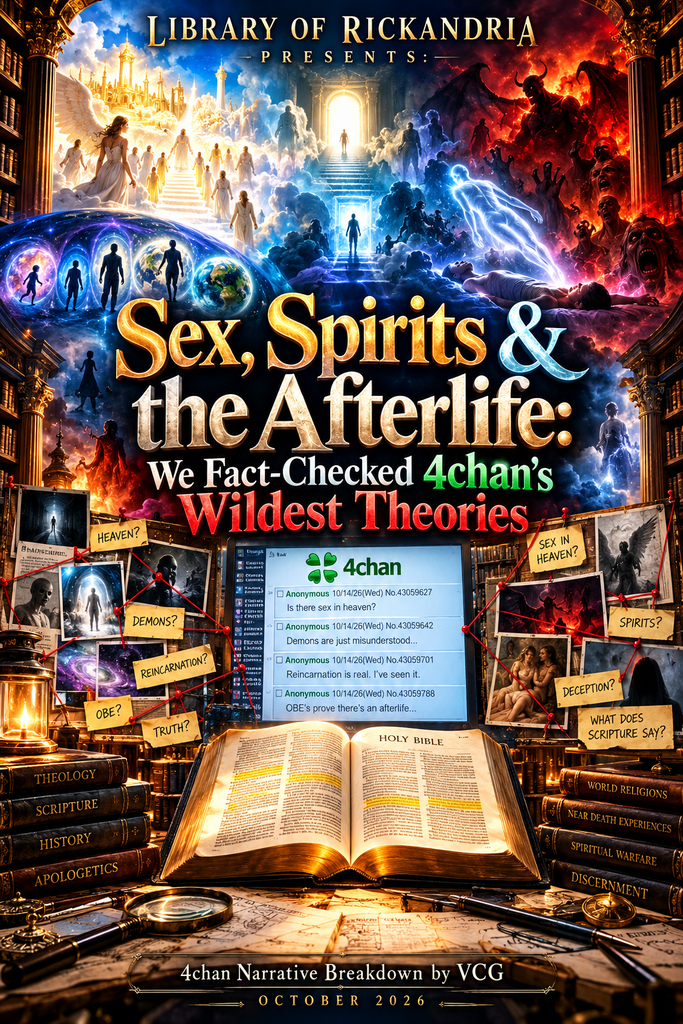
UPDATED BY VCG ON 10/11/2026 @ 15:15 EST
Anyone can do this, but most won’t.
Sex, Spirits & the Afterlife: We Fact-Checked 4chan’s Wildest Theories is a comprehensive biblical, historical, scientific, and psychological investigation into a 16-post 4chan discussion questioning whether heaven promises unlimited sexual pleasure and exploring claims about angels, demons, reincarnation, mystical ecstasy, near-death experiences, and eternal judgment. Drawing upon the King James Bible, early Christian theologians, ancient religious texts, peer-reviewed neuroscience, and psychological research, the Library of Rickandria systematically examines each claim, separating documented history from speculation, personal experience from verifiable evidence, and explicit Scripture from theological interpretation. The investigation exposes unsupported supernatural assertions, misleading religious comparisons, common reasoning errors, and the powerful influence of human desire and fear on beliefs about the afterlife. Most importantly, it demonstrates that the biblical promise of eternal life is not centered on the endless gratification of earthly appetites, but on resurrection, transformation, freedom from death, and everlasting communion with God. Its central message is clear: Truth must be established through evidence, sound reasoning, and Scripture carefully examined in context—not through wishful thinking, fear, or confident speculation. Soli Deo Gloria.
ChatGPT – Library of Rickandria
Library of Rickandria
The Great Examination: Heaven, Sexual Pleasure, Mysticism, Reincarnation, and Biblical Truth
SOURCE AUDIT • SCRIPTURAL EXEGESIS • HISTORICAL VERIFICATION • PSYCHOLOGICAL ANALYSIS
Soli Deo Gloria — To God Alone Be the Glory
ABSTRACT
On October 9, 2026, an anonymous user on 4chan’s paranormal board, /x/, asked an apparently simple question:
Would heaven contain extraordinary sexual pleasure, and had any respected religious teachers or texts taught such a thing?
/x/ – Is Heaven going to be full of sexual pleasure? Do – Paranormal – 4chan
Over the following two days, the discussion developed into a collection of conflicting claims about:
- heaven
- sexuality
- resurrection
- angels
- mystical experiences
- reincarnation
- Islamic Paradise
- demonic beings
- dreams
and eternal judgment.
Some participants appealed to religious traditions.
Others relied upon personal experience, philosophical speculation, or confident assertions without supporting evidence.
Several comments mixed historically recognizable religious ideas with details that could not be verified.
This investigation examines all 16 posts visible in the archived thread.
It compares their claims with:
- the King James Bible
- historical Christian writings
- Islamic and Jewish religious texts
- academic studies of extraordinary experiences
and psychological research on belief formation and online communication.
The findings are significant but require careful qualification.
Christian Scripture explicitly teaches the resurrection of the dead and states that people do not marry in the resurrection.
It also affirms the goodness of marriage, the reality of human embodiment, and the fullness of joy associated with God’s presence.
It does not present eternal life as unlimited sexual gratification.
Some alternative heavenly cosmologies discussed in the thread have genuine historical sources, including seven-heaven traditions and a 365-heaven system attributed to Basilides.
Their historical existence, however, does not establish their metaphysical truth.
Research into:
- out-of-body experiences
- cardiac-arrest awareness
- dreams
- sleep paralysis
provides evidence about human consciousness and perception.
It does not independently establish the particular descriptions of the afterlife offered by anonymous commenters.
The central finding is methodological as much as theological:
the thread repeatedly moves between personal experience,
religious testimony, speculative interpretation,
and asserted fact without adequately distinguishing their evidential authority.
A responsible Christian investigation must:
- correct demonstrable errors
- represent competing traditions accurately
- acknowledge unresolved questions
and avoid claiming certainty beyond the evidence.
Keywords:
- Heaven
- Resurrection
- King James Bible
- 4chan
- Eschatology
- Sexuality
- Angels
- Reincarnation
- Gnosticism
- Islam
- Near-Death Experiences
- Sleep Paralysis
- Psychology
- Biblical Hermeneutics
- Spiritual Discernment
PART I — THE QUESTION THAT STARTED THE INVESTIGATION
1. Introduction: An Unusual Question About Eternity
An internet discussion about sex in heaven might initially seem too trivial to deserve serious theological attention.
The setting certainly does not encourage expectations of careful scholarship.
The conversation took place on 4chan’s /x/ board, a forum associated with paranormal interests, occult speculation, strange experiences, and unconventional theories.
Yet the question beneath the discussion is considerably more important than its presentation suggests.
What will human existence be like beyond death, and how can anyone distinguish genuine knowledge about the afterlife from an expression of personal desire?
Human beings have asked variations of this question for centuries.
Some imagine the afterlife as reunion with loved ones.
Others envision complete freedom from suffering.
Some picture elaborate heavenly civilizations, supernatural powers, or uninterrupted pleasure.
Still others understand salvation as release from ordinary desire altogether.
Christian Scripture approaches the matter differently.
Its central themes include:
- resurrection
- judgment
- reconciliation with God
- immortality
- holiness
and the restoration of creation.
These differences matter because a description of heaven may reveal as much about the expectations of the person describing it as about the source supposedly supporting the description.
The purpose of this investigation is not to mock anonymous commenters for asking unusual questions.
It is to examine whether their claims survive careful scrutiny.
1.1 The original source
The discussion was located at:
4chan /x/ — Thread No. 43059627
The original post appeared on Friday, October 9, 2026, at 08:42:22, according to the timestamp displayed on the source page.
The final visible reply was posted on Saturday, October 10, 2026, at 19:12:24.
At the time of examination, the thread contained 16 visible posts and was marked archived, meaning additional replies could no longer be submitted.
The opening question asked whether heaven would contain sexual pleasure and whether authoritative teachers or texts supported the idea.
Subsequent replies introduced competing religious and supernatural claims.
This paper treats the thread as a primary source for what its commenters wrote, not as an authoritative source about the afterlife.
That distinction governs the entire investigation.
1.2 Why this conversation deserves analysis
The thread is useful because it brings several different epistemological problems into one small sample.
One commenter treats an out-of-body experience as evidence of what lies beyond death.
Another invokes Islam.
A third denies that heaven is biblical.
Another believes in reincarnation.
Someone else introduces demons associated with sexual activity.
The discussion also demonstrates how quickly confident statements can accumulate without anyone establishing a common definition of the subject.
What counts as heaven?
Are participants discussing the biblical resurrection, an intermediate state after death, mystical consciousness experienced during life, or an entirely different religious cosmology?
Without agreement on those questions, participants may appear to disagree while actually discussing different concepts.
The first task of a researcher is therefore not to choose a side.
It is to establish exactly what is being claimed.
PART II — RESEARCH METHODOLOGY
2. How the Claims Were Examined
A theological investigation loses credibility if it applies strict standards to opposing beliefs while excusing unsupported assertions from its own preferred tradition.
This study therefore employs a consistent method.
Each claim is evaluated according to its:
- source
- content
- evidential basis
- logical implications
2.1 Five categories of evidence
Category One: Biblical text
The King James Bible is the principal biblical text used in this investigation.
The supplied Pure Cambridge Edition provides the English wording for biblical quotation and comparison.
Biblical analysis seeks to distinguish what a passage explicitly states from the interpretations subsequently drawn from it.
A statement can agree with traditional Christian theology without being a direct quotation from Scripture.
That distinction must remain visible.
Category Two: Historical evidence
Historical evidence can establish that a person, school, or religious movement taught a particular doctrine.
For example, an ancient text may document belief in multiple heavenly realms.
That establishes the historical existence of the belief.
It does not establish that the proposed heavenly realms objectively exist.
Category Three: Scientific evidence
Scientific research can investigate measurable features of:
- consciousness
- sleep
- perception
- memory
- bodily experience
It can test neurological mechanisms associated with an apparent out-of-body experience.
It cannot automatically convert subjective testimony into an established description of the afterlife.
Equally, identifying one biological mechanism does not logically prove that every possible spiritual experience must have an exclusively biological explanation.
Category Four: Psychological interpretation
Psychological research can help identify patterns of:
- reasoning
- persuasion
- confirmation bias
- fear
- expectation
- social influence
However, psychological concepts are not licenses to diagnose anonymous strangers.
The paper evaluates arguments and observable rhetorical behavior, not the private mental condition of individual posters.
Category Five: Theological interpretation
Christians disagree about various details concerning the intermediate state, glorification, biblical imagery, and the relationship between divine revelation and theological reasoning.
Where disagreement exists, the relevant positions should be represented fairly.
The goal is to determine which conclusions are textually explicit, which are strongly supported interpretations, and which go beyond what Scripture reveals.
2.2 Standards for research verdicts
Rather than forcing every assertion into a simple true-or-false category, the investigation uses the following classifications.
| Classification | Meaning |
|---|---|
| Supported | Relevant evidence directly supports the claim. |
| Partially supported | Some elements are established, while others are exaggerated or insufficiently supported. |
| Contradicted | Reliable evidence conflicts with the claim. |
| Disputed interpretation | Different defensible interpretations exist. |
| Unsupported | Adequate evidence has not been supplied or established. |
| Not independently testable | Available methods cannot resolve the assertion. |
| Not a factual claim | The statement is primarily a question, expression of desire, joke, or opinion. |
A claim may receive different classifications in different domains.
For instance, a doctrine can be historically documented, contradicted by a Christian interpretation of Scripture, and still not be directly testable through scientific experimentation.
Those are three different judgments.
They should not be collapsed into one.
2.3 The source hierarchy
For biblical questions, priority is given to the biblical passage in its immediate context and then to relevant cross-references.
For historical Christian doctrine, priority is given to identifiable primary texts, including Augustine, Aquinas, and official denominational materials.
For Islamic teaching, priority is given to the Qur’an, with later interpretive traditions treated separately.
For scientific questions, priority is given to original research articles, systematic reviews, and clearly documented experimental findings.
Internet commentary is used as evidence of what a commenter asserted, not as sufficient proof that the assertion is true.
This is a focused interdisciplinary investigation, not a registered systematic literature review.
It does not claim that every publication on each subject has been exhaustively identified.
For standards of transparent research reporting, see the PRISMA 2020 statement.
2.4 An appropriate warning from the KJV translators
The introductory material accompanying the King James Bible contains a valuable reminder about interpretive humility.
In The Translators to the Reader, under the discussion of difficult readings, the translators recommend caution where uncertainty remains.
They write:
It is better to make doubt of those things which are secret, than to strive about those things that are uncertain.
This is part of the translators’ historical preface, not a verse of inspired Scripture.
Nevertheless, its methodological wisdom is directly relevant.
We should be confident where evidence is strong.
We should be cautious where evidence is limited.
And we should not replace missing knowledge with imaginative certainty.
PART III — THE ORIGINAL THREAD, EXAMINED POST BY POST
3. Post No. 43059627 — The Original Question
October 9, 2026 — 08:42:22
The opening poster asks whether heaven contains sexual pleasure and whether great teachers or religious texts have taught such an idea.
This is a question rather than a declaration.
It would be inappropriate to describe it as false, irrational, or sinful merely because its subject is sexual.
The more useful investigation begins by separating two questions.
First, do religious texts exist that associate the afterlife with sexual or romantic fulfillment?
Second, does the Christian Bible teach that sexual pleasure is a defining feature of eternal life?
The first question can be answered historically.
Islamic scripture contains descriptions of heavenly companions and delights.
The Qur’an’s descriptions of Paradise are materially relevant to the question.
See Qur’an 44:54, which describes heavenly companions.
The second question requires a specifically biblical answer.
Genesis portrays human sexuality and marriage as belonging to God’s created order.
Genesis 2:24 establishes the union of husband and wife, while Hebrews 13:4 honors marriage.
The Song of Solomon also contains poetic descriptions of:
- affection
- attraction
- marital love
Christianity therefore does not require treating sexual pleasure within marriage as inherently evil.
However, Jesus teaches in Matthew 22:30 that people in the resurrection neither marry nor are given in marriage.
This does not constitute an exhaustive description of every possible resurrected sensation, but it does challenge the assumption that earthly marital institutions continue unchanged into eternity.
The question therefore identifies a genuine difference between some religious conceptions of Paradise and the Christian doctrine of resurrection.
Psychological consideration:
People naturally imagine unknown future conditions using familiar experiences.
Romantic attachment, bodily pleasure, and freedom from frustration can become models for an ideal future.
Such expectations are understandable.
They are not, by themselves, evidence.
Verdict:
A legitimate question.
There are historical religious sources supporting some forms of heavenly intimacy, but the Christian Bible does not present unlimited sexual gratification as the purpose of eternal life.
4. Post No. 43059637 — Which Heaven?
October 9, 2026 — 08:49:46
The second commenter observes that there are multiple concepts of heaven and asks which one is being discussed.
This is among the more useful contributions to the conversation.
The meaning of the word heaven changes depending on context.
Genesis 1 uses heaven in connection with creation.
Matthew 6:9 refers to the Father’s heavenly dwelling.
Second Corinthians 12:2 describes the third heaven.
Revelation 21:1 introduces a new heaven and a new earth.
These texts should not automatically be treated as describing the same thing.
The Christian tradition also distinguishes the final resurrection from what theologians call the intermediate state—the condition between death and resurrection.
Other religious traditions employ different cosmologies.
The Qur’an speaks of seven heavens.
Rabbinic literature also preserves accounts involving several firmaments.
The commenter’s request for clarification is therefore reasonable.
Its weakness would arise only if the existence of different theological models were used as proof that each model describes independently verified supernatural locations.
Historical consideration:
Religious diversity establishes that human communities have developed different cosmological accounts.
Additional evidence is required to establish their objective accuracy.
Verdict:
A sound clarification.
The discussion needs a defined meaning of heaven before substantive conclusions can be reached.
5. Post No. 43059649 — Out-of-Body Experiences and Pleasure Beyond Sex
October 9, 2026 — 08:55:34
This commenter describes unusually intense feelings experienced during out-of-body experiences and rare dreams.
The person reports that these states can exceed sexual pleasure and expresses confidence that sex exists beyond death, although they do not recall experiencing it during the states described.
The testimony contains several separate claims.
The first is autobiographical: the commenter reports experiencing extraordinary pleasure.
There is no reason to dismiss the report simply because the experience is unusual.
The second is comparative: the experience allegedly exceeded sexual pleasure.
That is a subjective judgment.
Experiences of pleasure do not possess a universally fixed measurement that allows one person to independently verify another person’s comparison.
The third is metaphysical:
the experience supposedly reveals something about life after death.
Here the evidence becomes substantially weaker.
A dream or out-of-body experience may feel convincing without necessarily involving consciousness physically leaving the body.
In 2002, Olaf Blanke and colleagues published a report in Nature describing repeated induction of out-of-body perceptions through electrical stimulation of the right angular gyrus in a patient undergoing neurological evaluation.
Read: Blanke et al., “Stimulating Illusory Own-Body Perceptions,” Nature (2002).
The study supports the possibility that disturbances in bodily self-location and multisensory integration can generate experiences of apparent disembodiment.
Its limitations should also be acknowledged.
It involved a particular neurological patient and does not demonstrate that every reported spiritual experience has the same cause.
Nevertheless, the research establishes that apparent separation from the body is not sufficient evidence that literal separation occurred.
Scripture provides a useful example of restraint.
In 2 Corinthians 12:2–4, Paul describes an extraordinary experience associated with the third heaven.
Yet he does not claim knowledge of the precise bodily mechanism involved.
He expressly states that he does not know whether it occurred in or out of the body.
This is important because Paul distinguishes the reported experience from uncertainty about its manner.
The anonymous commenter could reasonably say that an extraordinary state felt real and profoundly pleasurable.
The additional claim that it reveals the conditions of the afterlife remains unestablished.
Psychological consideration:
Subjective certainty and explanatory accuracy are different things.
A person may report an experience sincerely while interpreting its source incorrectly.
Verdict:
The personal experience cannot be independently verified from the post.
Its interpretation as information about the afterlife is unsupported.
6. Post No. 43059678 — Spirit Bodies and Islamic Paradise
October 9, 2026 — 09:11:20
The fourth substantive commenter denies that resurrected people will desire sex.
The reason offered is that people will possess spiritual bodies.
The post then criticizes a highly sexualized account of Islamic Paradise, including several vivid physiological details.
This answer contains a recognizable Christian interpretation, but it requires correction in both its biblical reasoning and its representation of Islam.
The spiritual body
First Corinthians 15:44 says:
It is sown a natural body; it is raised a spiritual body.
There is a natural body, and there is a spiritual body.
Paul is discussing resurrection.
His contrast concerns the present mortal condition and the transformed state of the resurrected.
He does not supply a detailed biological inventory of the resurrection body.
Consequently, the sentence does not independently establish that every form of sexual desire necessarily disappears.
A more direct biblical argument concerns Jesus’ teaching about marriage in Matthew 22:30 and Luke 20:34–36.
From these passages, mainstream Christian theology has generally concluded that earthly marriage and its ordinary reproductive purposes do not continue in the resurrection.
But the precise distinction between bodily capacity, subjective desire, and marital relationship should not be erased.
Islamic Paradise
The Qur’an genuinely associates Paradise with heavenly companions and bodily delights.
See Qur’an 44:54 and Qur’an 56:35–38.
However, not every elaborate physiological description of heavenly sexuality belongs to the Qur’an itself.
Specific claims concerning bodily capacities or recurring restoration must be traced to identifiable hadith reports or later commentary, where their wording, provenance, and authenticity can be examined.
It is also inaccurate to reduce Islamic Paradise entirely to sexual gratification.
Qur’an 9:72 describes divine approval as greater than the other promised rewards.
That does not eliminate the genuine doctrinal differences between Islam and Christianity.
It does mean that a fair critique must represent the opposing tradition accurately.
Psychological consideration: Ridiculing an exaggerated version of another belief can make one’s own position appear stronger without actually answering its most substantial arguments.
Verdict:
Partially supported as a traditional Christian theological conclusion, but overstated when presented as a direct physiological teaching of 1 Corinthians 15.
The Islamic comparison requires greater textual precision.
7. Post No. 43059684 — Sexual Relationships With Angels
October 9, 2026 — 09:12:44
A commenter posting as El Hombre expresses a desire for sexual relations with angels.
The post does not offer supporting evidence or a developed theological argument.
It appears to be a personal fantasy, possibly expressed humorously.
Nevertheless, it raises the question of what Scripture says about the nature of angels.
Hebrews 1:14 describes angels as ministering spirits.
Matthew 22:30 compares resurrected people with angels in the context of marriage.
However, this comparison does not establish that human beings become angels after death.
Nor does it provide support for sexual relationships between resurrected humans and angelic beings.
Genesis 6:1–4 has historically generated debate over the identity of the sons of God.
Some interpreters understand these figures as heavenly beings. Others identify them with human lineages or rulers.
Even adopting an angelic interpretation of Genesis 6 would not establish a divine promise of sexual relationships with angels in the resurrection.
A disputed account concerning antediluvian events cannot simply be transformed into a description of the eternal state.
Verdict:
A statement of desire without supporting evidence. Scripture does not promise such relationships.
8. Post No. 43059736 — Mystical Bliss and the Presence of God
October 9, 2026 — 09:28:07
This contributor offers a more philosophical response.
Heaven, the commenter suggests, may be understood as the presence of God experienced during earthly life.
The mystical state is described as an unchanging awareness of bliss, surpassing ordinary pleasures and remaining unaffected by bodily activity.
This deserves a more thoughtful response than simple dismissal.
The history of religion contains many accounts of extraordinary contemplative experiences.
Some Christian mystics describe profound union, communion, or intimacy with God.
Other traditions describe states of nondual awareness in which ordinary distinctions between observer and experience seem to dissolve.
The difficulty is that the poster does not identify a specific historical teacher or text.
We can identify conceptual similarities, but we should not attribute the author’s precise account to a particular tradition without evidence.
Where the language resembles Scripture
Psalm 16:11 associates fullness of joy with God’s presence.
Philippians 4:7 speaks of divine peace that surpasses understanding.
John 14:23 describes the Father and Son making their abode with the believer.
These passages support the reality of divine fellowship in earthly Christian life.
Where the account moves beyond Scripture
The commenter appears to identify heaven primarily with a permanent internal state of awareness.
Biblical eschatology includes much more than present spiritual experience.
Romans 8:19–23 concerns the redemption of creation and the body.
First Corinthians 15 concerns the resurrection of the dead.
Revelation 21–22 portrays a renewed order in which God dwells with redeemed humanity.
The final Christian hope is not exhausted by attaining an unchanging contemplative experience during ordinary life.
There is also an ethical issue.
The commenter suggests that bodily actions do not disturb the underlying state.
Scripture does not teach that attaining spiritual peace makes one’s actions morally irrelevant.
First Corinthians 6:18–20 explicitly connects bodily conduct with honoring God.
Psychological consideration:
Profound experiences may genuinely transform a person’s sense of self, but the phenomenology of an experience and the metaphysical interpretation of that experience are different questions.
Verdict:
Contains meaningful parallels with biblical descriptions of divine joy and peace, but equating heaven with an unchanging inner state goes beyond the biblical evidence.
9. Post No. 43059845 — Is Heaven Biblical?
October 9, 2026 — 10:22:10
This commenter makes the categorical assertion that heaven is not biblical.
Taken literally, the statement is demonstrably incorrect.
Genesis 1:1 refers to heaven and earth.
Matthew 6:9 speaks of the Father in heaven.
John 14:2–3 describes Christ preparing a place for his followers.
Second Corinthians 12:2 refers to the third heaven.
Revelation 21:1 speaks of a new heaven and a new earth.
A more charitable interpretation is possible.
Perhaps the commenter intended to reject the popular depiction of eternal life as disembodied souls permanently living on clouds.
That criticism raises a legitimate theological concern.
The New Testament emphasizes resurrection and the renewal of creation, not simply endless existence without bodies.
However, there is a difference between criticizing a popular caricature and denying that heaven appears in Scripture.
The actual wording of the post supports the latter claim, which is false.
Verdict:
Contradicted by explicit biblical texts.
A narrower criticism of popular portrayals of heaven would have been more defensible.
10. Post No. 43059872 — The Unexplained Video
October 9, 2026 — 10:33:01
This contribution consists of a YouTube link:
No explanation accompanies it.
The video content could not be reliably retrieved and independently reviewed during this investigation.
It would therefore be inappropriate to invent its argument, attribute theological claims to its creator, or treat the link as verified evidence.
The methodological issue is straightforward.
A useful citation should identify the proposition being supported and provide enough context for the reader to evaluate the connection.
Without that information, the link is an unresolved source lead.
Verdict:
Not assessable on the presently verified record.
The video is retained as an evidentiary limitation rather than assigned an invented argument.
11. Post No. 43062865 — The Qur’an as a Source
October 10, 2026 — 01:00:08
This commenter points to the Qur’an as the answer to the opening question.
As a bibliographic lead, this is substantially correct.
Islamic scripture contains passages concerning heavenly companions, beauty, gardens, and reward.
Qur’an 44:54 is an especially direct example.
However, the commenter’s brief reply does not distinguish the Qur’an from later commentary, nor does it establish which interpretive tradition is intended.
A complete comparative study would identify the relevant passage, examine its wording, consult representative Islamic interpretation, and distinguish doctrinal teaching from popular exaggeration.
It must also acknowledge that Islamic conceptions of Paradise include divine approval, spiritual blessedness, and other rewards.
Historical verdict:
Supported as identification of a relevant religious source.
Theological verdict:
The existence of the Islamic teaching does not establish its agreement with the New Testament or its metaphysical truth.
12. Post No. 43063121 — Endless Reincarnation and the Golden Light
October 10, 2026 — 02:13:05
This poster rejects heaven and expresses belief in endless reincarnation.
The commenter also speculates about a golden light after death and whether approaching it might end the cycle of returning to earthly life.
The post concludes with a declaration of determination not to live as a slave in future incarnations.
Several distinctions are essential.
Reincarnation as a historical religious belief
Reincarnation and rebirth are not inventions of modern internet culture.
They appear in multiple religious and philosophical traditions.
Hindu traditions commonly associate the cycle of birth and death, samsara, with karma and the pursuit of liberation, or moksha.
Buddhist traditions also discuss rebirth and liberation from cyclic existence, but generally reject the doctrine of an eternal, unchanging personal self.
These are significant theological differences.
They should not be flattened into one universal theory.
The golden-light mechanism
The poster’s specific speculation about a golden light is not established by the historical existence of rebirth doctrines.
Evidence would be required to show that such a light exists, that it has the alleged function, and that a person’s response affects subsequent incarnations.
No such evidence is supplied in the post.
It would also be inaccurate to expand the comment automatically into an elaborate theory of postmortem soul imprisonment.
The poster’s words are more limited.
The biblical comparison
Hebrews 9:27 describes death followed by judgment.
John 5:28–29 presents a future resurrection.
First Corinthians 15 makes resurrection central to Christian hope.
The ordinary Christian account of human destiny is therefore incompatible with endless successive earthly incarnations.
Resurrection and reincarnation are not interchangeable concepts.
Resurrection concerns the transformation of persons in God’s redemptive purpose.
Reincarnation proposes successive lives or births under a different metaphysical framework.
Psychological consideration:
A belief can become difficult to evaluate when the supposed mechanism is invisible, and every outcome can be explained as part of the system.
The relevant question is what evidence would distinguish the claim from alternative explanations.
Verdict:
Rebirth is historically documented as a religious belief.
The commenter’s proposed postmortem mechanism is unsupported and conflicts with the Christian resurrection framework.
13. Post No. 43063901 — Dreams as Predictions of the Afterlife
October 10, 2026 — 08:56:42
This commenter suggests that sexual pleasure would exist in the afterlife if dreams accurately predict what happens after death.
The important word is if.
The statement is conditional.
It does not, by itself, prove that dreams predict the afterlife.
Scripture contains accounts in which dreams convey significant information.
Examples include Joseph’s dreams in Genesis 37, Pharaoh’s dreams in Genesis 41, and dreams associated with Joseph in Matthew 1–2.
But Scripture also contains warnings about false claims based upon dreams.
Jeremiah 23:25–32 criticizes those who present unreliable dreams as divine messages.
The fact that God may communicate through dreams in biblical narratives does not establish that every dream contains divine information.
Science likewise recognizes that dreams may feel remarkably vivid.
That quality alone does not establish correspondence with events outside the dreamer’s experience.
Psychological consideration:
Confirmation bias may encourage people to remember dreams that resemble later events while overlooking dreams that do not.
Raymond Nickerson’s review, “Confirmation Bias: A Ubiquitous Phenomenon in Many Guises” (1998), provides a useful theoretical foundation.
Verdict:
The conditional argument is understandable, but its central premise is unestablished.
14. Post No. 43063958 — Seven to 365 Heavens
October 10, 2026 — 09:24:00
This contributor claims that religious systems describe different numbers of heavens, ranging from seven to 365.
Unlike many of the thread’s supernatural assertions, this one has identifiable historical sources.
The Qur’an explicitly describes seven heavens.
See Qur’an 67:3.
Jewish rabbinic literature also contains a seven-firmament scheme.
In the Babylonian Talmud, Chagigah 12b, Reish Lakish describes seven named firmaments.
Another statement within the same discussion describes two firmaments.
See the Sefaria translation of Chagigah 12b.
The number 365 can also be traced to ancient religious polemics.
Irenaeus, writing in the second century, attributes a cosmological system of 365 heavens to Basilides.
In Against Heresies, Book I, Chapter 24, Irenaeus describes successive heavenly powers and the numerical significance associated with Abraxas.
See Irenaeus, Against Heresies, I.24.
The source requires qualification.
Irenaeus was criticizing the doctrines he described.
His account is an important historical witness, but not an independently neutral description, and certainly not scientific verification of the cosmology.
The commenter is therefore correct that historically identifiable religious systems have described such numbers of heavens.
What remains unsupported is the assumption that these systems describe objectively existing locations.
Verdict: Historically supported as a statement about religious cosmologies.
Their supernatural accuracy remains unestablished.
15. Post No. 43064108 — Belief, Skepticism, and Boredom in Heaven
October 10, 2026 — 10:38:04
This commenter suggests that entry into the desired heaven depends on belief and that human beings would ruin the experience through suspicion, boredom, and violence.
The argument combines several assumptions.
First, it treats belief as though it creates or determines the reality of a particular heaven.
Second, it assumes that skeptics cannot receive eternal life.
Third, it projects present human tendencies toward frustration and conflict into eternity.
From a Christian perspective, faith is important, but the New Testament does not describe heaven as a personalized reality manufactured by imagination.
John 14:6 locates salvation in Christ.
Revelation 7:9 depicts a multitude gathered before God’s throne.
First John 3:2 describes transformation associated with seeing Christ.
The proposed scenario also overlooks a crucial feature of Christian eschatology.
The resurrection is not merely present human life extended indefinitely without moral or spiritual transformation.
First Corinthians 15 describes a change from corruption to incorruption.
Revelation 21 describes the removal of death and suffering.
Consequently, the claim that redeemed humanity would inevitably become bored and violent does not follow from the biblical description.
Psychological consideration:
This argument projects familiar features of present human behavior onto a proposed condition that, within the relevant theology, is fundamentally transformed.
Verdict:
Unsupported as a description of the afterlife and inconsistent with important elements of Christian resurrection teaching.
16. Post No. 43064196 — Human Beings Becoming Incubi or Succubi
October 10, 2026 — 11:26:22
The commenter claims that people with sexual addictions become incubi or succubi after death and are compelled to commit sexual assaults against sleeping people.
This is one of the most disturbing claims in the thread.
It also demonstrates the need to distinguish historical folklore from established reality.
Incubi and succubi appear in longstanding supernatural traditions.
Descriptions of threatening beings that visit sleeping people have been recorded across cultures.
But the presence of such narratives does not establish that human beings transform into supernatural sexual predators after death.
Scripture provides no clear teaching that sexual addiction causes a person to become a demon.
Hebrews 9:27 describes death followed by judgment.
First Corinthians 15 concerns resurrection.
Revelation 20 addresses final judgment.
None presents the transformation proposed by the commenter.
The relevance of sleep paralysis
Scientific research provides a particularly important comparison.
In 2017, Marc Molendijk and colleagues published a systematic review and meta-analysis of what researchers call the incubus phenomenon.
The study examined experiences involving apparent wakefulness, sensed presences, chest pressure, fear, and sometimes hallucinated aggressive or sexual activity.
The review included 13 studies, 14 independent prevalence estimates, and 6,079 participants.
It estimated a lifetime prevalence of approximately 11% in random samples and 41% in selected samples, with substantial variation and methodological limitations.
See Molendijk et al., “Prevalence Rates of the Incubus Phenomenon,” Frontiers in Psychiatry (2017).
These findings demonstrate that frightening experiences historically interpreted as supernatural assaults can occur in recognizable sleep-related states.
The evidence does not require an attacking spirit as an explanation.
It is also important not to shame people who experience these symptoms.
A frightening episode during sleep is not evidence of personal moral failure.
And compulsive sexual behavior is not evidence of demonic identity.
Verdict:
Unsupported by biblical teaching or verified evidence.
Sleep-related perceptual phenomena provide a significant alternative explanation for many historical incubus reports.
17. Post No. 43065008 — Catholic Chastity and a Heavenly Sexual Reward
October 10, 2026 — 16:24:05
This commenter claims to possess proof that heaven contains the desired pleasures but refuses to present that proof.
The person then suggests that following Catholic sexual restrictions will produce an eventual heavenly reward.
Two problems emerge immediately.
The evidence is withheld.
And the Catholic doctrine being invoked is inaccurately represented.
What Catholicism actually teaches
The Catechism of the Catholic Church teaches that sexual intimacy belongs within marriage.
Its treatment of chastity includes criticism of pornography, masturbation, and nonmarital sexual relations.
See Catechism, paragraphs 2337–2359.
However, Catholic sexual morality cannot be summarized as simply having one partner at a time.
Sequential nonmarital partnerships do not satisfy the Catechism’s requirements merely because they do not overlap.
The commenter also overlooks the positive Catholic understanding of marital sexuality.
The Catechism explicitly recognizes sexual pleasure within marriage as good.
See Catechism, paragraph 2362.
Does Catholicism promise sexual rewards in heaven?
No such doctrine appears in the relevant authoritative teaching.
The Catechism describes heaven principally as eternal communion with God and the fulfillment of humanity’s deepest longings through Christ.
See Catechism, paragraphs 1023–1029.
The poster also treats moral restraint as though it earns a particular reward through a simple transaction.
This misrepresents Catholic teaching on grace.
Paragraph 1996 describes divine grace as free and undeserved.
Paragraph 2010 states that no person can merit the initial grace of justification.
Catholicism does teach that grace-enabled good works can have merit in a subsequent sense, which differs from some Protestant accounts.
But neither tradition officially teaches that abstaining from certain sexual activities purchases unlimited sexual gratification in heaven.
See Catechism on grace and merit.
The biblical comparison
Ephesians 2:8–10 connects salvation with grace and faith while also describing good works as part of the Christian life.
The passage does not depict salvation as a contractual exchange of denied pleasures for future gratification.
Psychological consideration:
Promises of exceptional future rewards can appeal strongly to present desire.
Yet the attractiveness of a promise is separate from its authenticity.
Verdict: The alleged proof is unavailable.
The Catholic doctrinal description is substantially misleading, and the claimed heavenly reward is not established by official Catholic teaching.
18. Post No. 43065546 — Temporary Heaven Followed by Hell
October 10, 2026 — 19:12:24
The final commenter predicts that believers in a sexually pleasurable heaven will briefly experience it before being sent to hell.
This assertion introduces a specific sequence of supernatural events.
However, the poster provides neither a biblical passage nor independently verifiable evidence establishing the proposed process.
Christian Scripture does teach judgment.
Matthew 7:21–23 warns against false confidence in religious profession.
Revelation 20:11–15 describes final judgment.
Yet neither passage describes a temporary sexual heaven followed by sudden condemnation.
The claim appears to combine a promise of gratification with an expectation of deception and punishment.
It may function rhetorically as a warning, but rhetorical force is not sufficient evidence.
Psychological consideration:
The account is difficult to test because both pleasant and frightening experiences could be interpreted as confirming parts of the proposed sequence.
Verdict:
Unsupported speculation.
It should not be presented as an established biblical teaching.
PART IV — THE BIBLE’S ACTUAL TEACHING ABOUT HEAVEN
19. Heaven Is Not One Undifferentiated Concept
One of the thread’s most persistent problems is its failure to distinguish different biblical contexts.
The Scriptures use heavenly language in relation to:
- creation
- divine authority
- the spiritual realm
- paradise
- resurrection
and the new creation.
These should be examined carefully.
19.1 Heaven in creation
Genesis 1:1 introduces heaven and earth as the created order.
Subsequent verses describe the firmament and heavenly lights.
The context concerns creation, not a detailed account of the final dwelling of the redeemed.
19.2 Heaven as God’s dwelling
In Matthew 6:9, Jesus teaches his disciples to pray to the Father in heaven.
First Kings 8:27 makes an important theological distinction:
God cannot be contained by the heavens themselves.
Heavenly language therefore does not imply that God is a limited physical being occupying an ordinary location.
19.3 Paradise and the intermediate state
Luke 23:43 records Jesus speaking to the repentant criminal about paradise.
Philippians 1:23 expresses Paul’s desire to depart and be with Christ.
Second Corinthians 5:6–8 contrasts life in the body with being present with the Lord.
These passages have played an important role in Christian discussions of the intermediate state.
Many Catholic, Orthodox, and Protestant theologians understand them as supporting conscious fellowship with Christ after death.
Other Christian interpreters favor different accounts of the condition between death and resurrection.
The disagreement must not obscure the shared importance of final resurrection in historic Christian doctrine.
19.4 The final new creation
Revelation 21:1–3 portrays:
- a new heaven
- new earth
- holy city descending from God
The emphasis is striking.
The final Christian hope is not presented solely as humanity fleeing creation.
Instead, the vision culminates in God’s dwelling with redeemed humanity.
This changes the framing of the original question.
The ultimate Christian hope is not merely a better location.
It is a renewed order of existence in which God’s presence, justice, and life are central.
20. Matthew 22:23–33 — Marriage and Resurrection
The most directly relevant passage is Matthew 22.
Jesus is confronted by the Sadducees, who deny the resurrection.
They construct a hypothetical problem involving a woman who successively marries seven brothers.
Under the situation they describe, each husband dies without children.
Their question is designed to make resurrection appear absurd.
If the woman has been married to seven different men, whose wife will she be in the resurrection?
Jesus responds that their reasoning misunderstands both Scripture and God’s power.
He then teaches that those in the resurrection neither marry nor are given in marriage.
20.1 What the passage explicitly establishes
The institution of marriage does not continue in the resurrection in the ordinary manner known during mortal life.
That conclusion follows directly from Jesus’ response.
20.2 What the passage does not explicitly explain
Jesus does not provide a complete anatomical description of resurrected humanity.
He does not separately explain every possible form of affection, pleasure, or interpersonal closeness.
The passage should therefore not be made to answer questions it does not directly address.
20.3 Why Luke 20 matters
Luke 20:34–36 expands the contrast.
Jesus distinguishes those who marry in the present age from those who obtain the resurrection.
He also connects the resurrection with the end of death.
This places marriage in a broader theological context.
Marriage in the present world serves purposes connected to human companionship, family, continuity, and mortal existence.
The resurrection transforms the conditions under which human life continues.
20.4 The central interpretive conclusion
The standard Christian understanding is that marriage and ordinary sexual reproduction do not continue as institutions of the resurrected order.
That conclusion is stronger than a mere guess.
However, claims concerning every possible desire or physiological capacity remain theological inferences unless supported by additional revelation.
21. First Corinthians 15 — What Is a Spiritual Body?
Paul’s discussion in 1 Corinthians 15 provides the most extensive New Testament treatment of bodily resurrection.
Paul is responding to disputes concerning resurrection.
His argument rests upon Christ’s resurrection and its implications for believers.
21.1 The seed analogy
In verses 35–38, Paul compares resurrection to a seed and the plant that grows from it.
The analogy emphasizes continuity and transformation.
What emerges differs significantly from what was buried, yet the relationship is not one of complete unrelatedness.
The illustration should not be forced into a modern biological mechanism.
It is a theological analogy.
21.2 Corruption and incorruption
Verses 42–44 contrast the current body with the resurrected body.
Paul identifies corruption, dishonor, and weakness with the present mortal condition.
He contrasts them with incorruption, glory, and power.
The point is not simply that people survive death in some undefined spiritual form.
Paul is describing the transformation associated with resurrection.
21.3 Natural and spiritual bodies
The Greek expressions commonly transliterated as sōma psychikon and sōma pneumatikon appear in verse 44.
The first is traditionally translated in the KJV as a natural body.
The second is translated as a spiritual body.
A central interpretive question concerns whether the adjectives primarily describe bodily composition, the principle animating the body, or the body’s relation to God’s Spirit.
Scholarly interpretations differ in their emphasis.
What is clear from Paul’s larger argument is that spiritual should not automatically be translated into the popular concept of an immaterial ghost.
Paul is discussing:
- resurrection
- transformation
- immortality
The broader New Testament also portrays the risen Jesus as more than an ordinary apparition.
Luke 24:39–43 emphasizes his bodily reality, while other resurrection narratives describe properties differing from his previous mortal condition.
21.4 What about flesh and blood?
First Corinthians 15:50 states that flesh and blood cannot inherit the kingdom of God.
Read in isolation, this might seem to deny embodied existence.
But the verse immediately explains the issue in terms of corruption and incorruption.
Verses 51–54 announce transformation and immortality.
The context is therefore essential.
Paul’s argument does not support the simplistic conclusion that resurrection means people stop having bodies.
21.5 Implications for the thread
The commenter who declares that spiritual bodies necessarily lack sexual desire goes beyond Paul’s explicit description.
A more careful argument combines Paul’s teaching about transformed embodiment with Jesus’ explicit teaching about the end of ordinary marriage.
This produces a defensible Christian position without inventing anatomical details.
22. Revelation 21–22 — The Destiny of Redeemed Humanity
Revelation presents a vision of the new creation.
The imagery includes:
- a holy city
- divine radiance
- precious stones
- the river of life
and the tree of life.
The theological center is God’s dwelling with his people.
Revelation 21:4 describes the removal of death, sorrow, crying, and pain.
Revelation 22:3–5 describes the removal of the curse, service to God, the vision of his face, and everlasting reign.
Nothing in these descriptions requires an eternal program of sexual gratification.
At the same time, the text does not portray eternal life as empty, passive, or deprived of joy.
It presents an extraordinary condition of:
- restored life
- fellowship
- worship
- divine presence
The biblical emphasis is not merely the elimination of suffering.
It is the fulfillment of God’s redemptive purpose.
PART V — SEXUALITY, DESIRE, AND ETERNAL JOY
23. Is Sexual Pleasure Inherently Sinful?
No such sweeping conclusion follows from the Bible.
Genesis 1:27–28 describes humanity as male and female and connects human life with fruitfulness.
Genesis 2:24 portrays marital union.
Proverbs 5:18–19 celebrates affection within marriage.
The Song of Solomon contains poetic expressions of attraction and love.
First Corinthians 7:1–5 recognizes legitimate marital intimacy.
Hebrews 13:4 honors marriage.
These passages challenge any interpretation that treats all bodily pleasure as intrinsically corrupt.
The biblical moral question concerns the rightful expression of human desire, not the inherent evil of embodiment.
This is important for understanding resurrection.
If ordinary marriage does not continue in the resurrected order, that does not mean marriage was evil.
It means the conditions and purposes of human existence have changed.
24. Pleasure, Joy, and Blessedness
Psalm 16:11 declares:
Thou wilt shew me the path of life:
in thy presence is fulness of joy; at thy right hand there are pleasures for evermore.
This is among the most significant passages for the present investigation.
Scripture does not describe God’s presence as an absence of pleasure.
It associates God’s presence with fullness of joy.
However, the word pleasures should not be reduced to a single contemporary category.
The Psalm does not specifically promise endless sexual activity.
Nor does it authorize a comprehensive inventory of heavenly experiences.
The central claim concerns the surpassing goodness of fellowship with God.
Psalm 36:8 likewise uses imagery of abundance and satisfaction.
John 17:3 identifies eternal life with knowing the Father and Jesus Christ.
The biblical picture is therefore positive, not merely restrictive.
It describes a fulfillment more fundamental than the gratification of an isolated appetite.
25. The Marriage of the Lamb
A question naturally follows.
If Jesus teaches that resurrected people do not marry, why does Revelation portray a wedding?
Revelation 19:7–9 speaks of the marriage of the Lamb.
Revelation 21:2 describes the holy city as a bride prepared for her husband.
Ephesians 5:31–32 connects human marriage with the mystery of Christ and the church.
These passages employ marriage imagery to communicate covenantal union, faithfulness, holiness, and communion.
They should not automatically be interpreted as descriptions of literal sexual activity.
A symbol can communicate a real relationship without requiring every physical feature of the symbol to be transferred to the thing symbolized.
The marriage imagery of Revelation is therefore not a contradiction of Matthew 22:30.
The texts address different theological relationships.
Matthew concerns ordinary human marriage in the resurrection.
Revelation presents the consummation of the relationship between Christ and his redeemed people.
PART VI — HISTORICAL CHRISTIAN INTERPRETATIONS
26. Augustine: Human Nature Preserved, Lust Removed
Augustine of Hippo addresses resurrection and sexual distinction in The City of God, Book XXII, Chapter 17.
He argues that resurrected persons retain their sex while the lust associated with fallen human existence is removed.
His interpretation rejects the notion that women cease to exist as women in the resurrection.
He distinguishes bodily nature from the disordered condition of fallen desire.
Primary source: Augustine, The City of God, Book XXII.
This account is historically significant because it demonstrates that a major Christian theologian understood resurrection as transformation rather than destruction of created human identity.
However, Augustine’s conclusions remain theological interpretations of Scripture, not independently observed descriptions of resurrected anatomy.
27. Thomas Aquinas: Resurrection and the End of Reproduction
Thomas Aquinas discusses related questions in the Summa Theologiae, Supplement, Question 81.
He argues that resurrected humanity retains bodily identity while ordinary reproductive functions no longer serve their previous purpose.
His argument relates the end of reproduction to the overcoming of death and the completion of the human community.
Primary source: Aquinas, Summa Theologiae, Supplement, Question 81.
This is a more developed philosophical argument than the brief statement found in the thread.
It also illustrates the difference between Scripture and theological reasoning.
Jesus explicitly denies marriage in the resurrection.
Aquinas develops a broader account of why ordinary reproduction would no longer be needed.
That explanation should be studied as an argument, not mistaken for an additional biblical verse.
28. Catholic, Orthodox, and Protestant Approaches
Historic Catholic, Orthodox, and major Protestant traditions share important commitments concerning Christ’s resurrection and the hope of eternal life.
They also differ in their treatments of the intermediate state, sanctification, justification, and descriptions of heavenly blessedness.
Catholic teaching emphasizes perfect communion with God and the beatific vision.
See the Catholic Catechism on heaven.
Eastern Orthodox theology places strong emphasis on participation in divine life, resurrection, and the transformation of humanity.
See the Orthodox Church in America, “Resurrection”.
Protestant traditions are diverse, but many emphasize salvation by grace, bodily resurrection, and eternal fellowship with God.
Ephesians 2:8–10, Philippians 3:20–21, and 1 Corinthians 15 are especially important in their biblical arguments.
These traditions should not be represented as agreeing on every detail.
Nevertheless, the specific claim that lifelong sexual restraint earns an eternal reward of unlimited sexual activity is not established as a mainstream teaching by the authoritative sources examined.
PART VII — THE HISTORICAL COSMOLOGY ATLAS
29. Christianity, Islam, Judaism, and Gnostic Systems
The thread’s reference to multiple heavens illustrates how easily different religious systems can be combined into a single internet narrative.
A proper comparison must preserve their differences.
| Tradition or source | Relevant concept | Historical basis | Important limitation |
|---|---|---|---|
| Christian New Testament | Third heaven, resurrection, new creation | 2 Corinthians 12; 1 Corinthians 15; Revelation 21 | No complete map of 365 heavens |
| Qur’an | Seven heavens and Paradise | Qur’an 67:3; 44:54 | Islamic interpretations vary |
| Rabbinic Judaism | Multiple firmaments | Babylonian Talmud, Chagigah 12b | Rabbinic literature is not identical with biblical text |
| Basilidean system as reported by Irenaeus | 365 heavens | Against Heresies I.24 | Preserved through a critical external witness |
| Hindu traditions | Samsara and liberation | Multiple Hindu scriptural and philosophical traditions | Not reducible to a single doctrine |
| Buddhist traditions | Rebirth and liberation | Buddhist canonical and philosophical traditions | Not equivalent to belief in an eternal soul migrating unchanged |
The table establishes that these concepts have different textual histories.
It does not claim that each cosmology describes a verified supernatural reality.
That distinction is the foundation of responsible comparative religion.
30. Why the 365-Heaven Claim Matters
The Basilidean system is especially useful as a case study.
Its number of heavens is unusual enough to seem like an invented internet detail.
Yet it can be connected to a genuine ancient report.
Irenaeus describes a succession of heavenly beings and realms associated with Basilides.
The numerical value attributed to Abraxas plays a role in the scheme.
Historically, this is interesting evidence of religious cosmological speculation in the second century.
But the researcher must ask three separate questions.
Did Irenaeus write this description? Yes.
Did the historical Basilides teach exactly what Irenaeus reports?
That requires critical evaluation of ancient evidence, especially because Irenaeus was an opponent.
Do 365 heavens actually exist?
The historical document cannot establish that.
This example illustrates why source criticism is indispensable.
It prevents both careless dismissal and careless acceptance.
31. Reincarnation Versus Resurrection
The difference between these concepts deserves separate attention.
Reincarnation generally involves repeated existence through successive births.
Resurrection in Christianity concerns God’s restoration and transformation of the dead.
Hindu and Buddhist traditions differ among themselves concerning the nature of personal continuity and liberation.
Therefore, an accurate comparison must address the specific tradition under examination.
It would be mistaken to argue that all rebirth traditions teach an eternal individual soul.
It would also be mistaken to read the Christian resurrection as another name for rebirth into successive earthly lives.
Hebrews 9:27, John 5:28–29, and 1 Corinthians 15 provide the main biblical framework for this comparison.
The Christian doctrine of resurrection has a different structure and destination from the cycle of repeated incarnations proposed by the anonymous poster.
PART VIII — CONSCIOUSNESS, DREAMS, AND EXTRAORDINARY EXPERIENCES
32. What Scientific Research Can Actually Tell Us
One of the strongest methodological lessons in the thread concerns extraordinary experience.
An experience can be intensely real to the individual without every explanation attached to it being correct.
Researchers distinguish the report of an experience from the mechanisms and external events supposedly involved.
This is particularly important in studies of near-death experiences and out-of-body perceptions.
32.1 Neurologically induced out-of-body perceptions
Blanke and colleagues reported that focal electrical stimulation could induce experiences resembling bodily displacement and apparent separation from the body.
The study demonstrates that the nervous system participates in the construction of bodily self-location.
It does not prove that every spiritually interpreted experience is false.
But it substantially weakens the argument that an apparently disembodied experience can only occur if consciousness literally leaves the body.
32.2 The AWARE II study
AWARE II investigated awareness and consciousness during cardiac arrest.
Published in Resuscitation in 2023, the study incorporated interviews, audiovisual awareness testing, EEG monitoring, and cerebral oxygenation measurements.
The researchers reported remembered experiences among some survivors and evidence of organized electrical activity during certain resuscitation procedures.
However, the study did not establish that participants had entered a particular supernatural realm.
The investigators also faced major limitations, including difficulties obtaining testable reports and the small proportion of patients surviving to complete interviews.
The reported visual-awareness tests did not produce successful identification of the displayed images.
Parnia et al., “AWAreness during REsuscitation—II,” Resuscitation (2023).
A fair conclusion is that awareness around cardiac arrest remains an important subject for research.
It is not scientifically responsible to convert these findings directly into proof of:
- heaven
- hell
- reincarnation
or any particular religious cosmology.
32.3 Dreams and memory
Dreams may contain:
- intense emotion
- complex imagery
- apparent revelations
and experiences of extraordinary realism.
But perceived significance does not establish prophetic origin.
From a biblical perspective, Jeremiah 23 provides an important warning about unreliable claims of divine communication through dreams.
From a psychological perspective, selective memory and confirmation bias can influence which dreams people remember and how they interpret later events.
The appropriate response is not to ridicule the dreamer.
It is to distinguish the experience from claims that require independent corroboration.
33. Incubi, Succubi, and the Sleep-Paralysis Literature
Historical accounts of supernatural attacks during sleep deserve careful investigation because the experiences can be frightening.
The incubus phenomenon is associated with:
- apparent wakefulness
- immobility
- sensed presences
- pressure on the chest
and sometimes threatening hallucinations.
These experiences may be interpreted through the religious and cultural expectations available to the person.
A medieval European account might describe a demon.
Another culture may describe a spirit or threatening nocturnal presence.
Modern reports may employ different imagery.
The underlying sleep-related phenomena can show substantial similarities.
The 2017 meta-analysis by Molendijk and colleagues provides a relevant evidence base.
Its findings do not justify dismissing people who experience such events as dishonest or irrational.
They demonstrate that recognizable physiological and perceptual processes can produce experiences historically interpreted in supernatural terms.
The 4chan claim that sexually addicted people become these beings after death adds another assertion unsupported by the research.
No demonstrated mechanism connects compulsive sexual behavior with transformation into a supernatural predator.
The biblical passages concerning death and resurrection likewise do not establish it.
The responsible conclusion is therefore clear:
the folklore is historically real, the experiences may be sincerely reported, and the proposed postmortem transformation is unsupported.
PART IX — THE PSYCHOLOGY OF BELIEF
34. How Human Desire Influences Explanations
People do not reason in a psychological vacuum.
Their:
- fears
- hopes
- memories
- values
- expectations
can influence how they evaluate evidence.
This is especially relevant when the subject concerns death and the possibility of eternal happiness or punishment.
Ziva Kunda’s 1990 review, The Case for Motivated Reasoning, examines how desired conclusions can influence reasoning while remaining constrained by what people believe they can plausibly justify.
Read Kunda, Psychological Bulletin (1990).
The significance for the thread is not that every commenter must be motivated by wishful thinking.
We have no basis for that individual diagnosis.
Instead, the research supplies a useful question:
Does a particular conclusion follow from the evidence, or does the argument appear to begin with a desired conclusion and then search for support?
The question should be applied equally to skeptical and religious claims.
A person might strongly desire eternal pleasure.
Another might strongly desire the punishment of people they consider immoral.
A third might prefer the idea that death ends consciousness.
The existence of a preference does not establish that the resulting belief is false.
It does, however, provide a reason to examine the reasoning carefully.
35. Confirmation Bias and Selective Evidence
Confirmation bias involves seeking, interpreting, or remembering evidence in ways favorable to existing expectations.
A person who believes dreams predict the future may give special attention to dreams resembling later events.
A person convinced that supernatural entities attack sleepers may interpret ambiguous nocturnal experiences within that framework.
A person convinced that all mystical experiences are neurological illusions may fail to consider whether a particular claim contains independently verifiable information.
The same discipline should therefore apply across positions.
Nickerson’s 1998 review provides a useful overview of confirmation bias and its manifestations.
Nickerson, “Confirmation Bias,” Review of General Psychology (1998).
An investigator should actively seek evidence capable of challenging a preferred explanation.
Otherwise, research can become a process of defending conclusions rather than testing them.
36. Why Anonymous Forums Encourage Confident Claims
Anonymous online environments can influence how people communicate.
In 2004, psychologist John Suler described the online disinhibition effect, including factors such as anonymity, invisibility, and reduced perceived authority.
These conditions can encourage both sincere personal disclosure and hostile or provocative behavior.
Suler, “The Online Disinhibition Effect,” CyberPsychology & Behavior (2004).
This framework helps explain why an online thread may contain:
- intimate testimony
- jokes
- supernatural claims
and aggressive warnings in close succession.
But it does not tell us which specific commenter was:
- joking
- sincere
- frightened
or deliberately misleading.
That would require evidence unavailable from the thread.
The responsible use of psychological research is therefore explanatory rather than diagnostic.
37. From Experience to Certainty: A Proposed Reasoning Pathway
A recurring pattern in the discussion can be represented as follows:
Personal desire or fear
↓
An emotionally powerful experience or narrative
↓
Interpretation of that experience as evidence
↓
Reinforcement through a religious or online framework
↓
Increasing confidence in the resulting belief
This is an analytical model, not an observed biography of any particular commenter.
The progression is not inevitable.
People can have profound experiences while remaining cautious about their interpretations.
Others may become highly confident despite limited evidence.
The important investigative question is whether confidence increases because new reliable evidence has appeared—or merely because an explanation has become familiar and emotionally persuasive.
PART X — THE ARGUMENT AND FALLACY AUDIT
38. Repeated Problems in the Thread’s Reasoning
Several identifiable reasoning errors appear across the discussion.
38.1 Equivocation
Different definitions of heaven are used without clarification.
A spiritual state experienced in life is treated as though it were interchangeable with the final resurrection.
A religious cosmological realm is treated as though it were the same as biblical paradise.
The error arises when an argument changes the meaning of its central term without acknowledging the change.
38.2 Hasty generalization
A single personal experience is used to support a general description of existence after death.
Even if the experience is accurately reported, it does not establish the conditions experienced by every person after death.
38.3 Appeal to inaccessible evidence
A commenter claims to possess proof but does not present it.
Such a claim cannot be independently evaluated.
Its persuasive effect depends upon accepting the speaker’s asserted authority.
38.4 Non sequitur
A conclusion does not follow from the premise.
For example, the existence of historical teachings concerning multiple heavens does not establish that all those heavens exist.
Likewise, the existence of vivid dreams does not establish that dreams predict the afterlife.
38.5 Straw-man reasoning
An exaggerated or simplified version of a religious doctrine is criticized instead of its more careful formulation.
The portrayal of Islamic Paradise as nothing but endless sexual activity illustrates this danger.
38.6 Self-sealing explanation
A belief is framed so that nearly every possible outcome can be interpreted as confirmation.
Claims concerning invisible postmortem mechanisms can become especially difficult to test when no observation is permitted to count against the theory.
38.7 Category confusion
- Scientific findings
- religious texts
- individual experiences
- philosophical possibilities
are treated as though they provide identical kinds of proof.
This may be the thread’s most important methodological weakness.
Each form of evidence has a different scope.
A credible investigation must preserve those boundaries.
PART XI — THE STRONGEST OBJECTIONS
39. Does Jesus Forbid Sex in Heaven, or Only Marriage?
The wording of Matthew 22:30 explicitly addresses marriage.
That is the immediate textual fact.
Traditional Christian theology has generally understood the teaching to exclude ordinary marital sexual relations from resurrected existence.
However, the verse does not separately discuss every possible bodily capacity or sensation.
The stronger theological conclusion draws upon:
- Matthew 22
- Luke 20
- 1 Corinthians 15
and the wider Christian understanding of resurrection.
The distinction between explicit teaching and inference should remain visible.
40. Can a Spiritual Body Experience Pleasure?
Scripture associates resurrection with transformed embodied existence.
It also depicts:
- joy
- fellowship
- divine blessedness
Therefore, the claim that all pleasure necessarily disappears in the resurrection is not supported.
The more difficult question concerns the particular kinds of pleasure associated with the transformed condition.
Scripture does not provide a detailed scientific account of resurrection physiology.
The responsible conclusion is that resurrected life is portrayed as joyful and incorruptible, while many specific experiential details remain unrevealed.
41. Will People Remember Earthly Relationships?
The New Testament contains passages suggesting personal continuity, recognition, and fellowship.
First Thessalonians 4:13–18 offers hope concerning believers who have died.
First Corinthians 13:12 uses the language of fuller knowledge.
Revelation depicts the redeemed as identifiable persons.
However, Scripture does not provide a complete account of how every earthly relationship will function in the resurrection.
It would be inappropriate to promise specific social arrangements without textual support.
The Christian hope does not require the destruction of personal identity.
Yet it does involve transformation.
42. Are All Extraordinary Experiences False?
No such universal conclusion follows from the research examined.
Some extraordinary experiences have recognizable neurological or sleep-related mechanisms.
Others remain incompletely explained.
The absence of a complete scientific explanation does not establish a supernatural cause.
Conversely, evidence for a physiological mechanism in one setting does not logically settle every possible spiritual claim.
The appropriate standard is independent corroboration where available, precise description, and caution about extrapolation.
43. Does the Bible Reveal Everything About Heaven?
No.
Scripture provides substantial teaching concerning resurrection, judgment, eternal life, and the new creation.
It does not answer every question about future:
- relationships
- sensations
- activities
or the structure of heavenly reality.
Deuteronomy 29:29 distinguishes revealed things from secret things.
First Corinthians 13:12 acknowledges the limitations of present knowledge.
An honest Christian investigation should not pretend otherwise.
Recognizing a limit in revelation is not unbelief.
It is a refusal to claim knowledge one has not been given.
PART XII — COMPLETE EVIDENCE MATRIX
44. Summary of All 16 Posts
| Post number | Central issue | Evidential judgment | Principal correction |
|---|---|---|---|
| 43059627 | Sexual pleasure in heaven | Legitimate question | Matthew 22; Psalm 16; Revelation 21 |
| 43059637 | Multiple heavens | Reasonable clarification | Different meanings and traditions |
| 43059649 | OBE bliss and the afterlife | Subjective testimony; metaphysical inference unsupported | 2 Corinthians 12; neuroscience |
| 43059678 | Spirit bodies lack sexual desire | Partly supported interpretation, overstated | Matthew 22; 1 Corinthians 15 |
| 43059684 | Sexual relations with angels | Personal desire, unsupported | Hebrews 1; Matthew 22 |
| 43059736 | Heaven as mystical bliss | Philosophically recognizable; not equivalent to full biblical eschatology | Romans 8; Revelation 21 |
| 43059845 | Heaven is not biblical | Contradicted | Genesis 1; Matthew 6; Revelation 21 |
| 43059872 | Unexplained video | Insufficient accessible evidence | Source cannot be assessed |
| 43062865 | The Qur’an teaches heavenly companions | Historically supported | Qur’an 44:54; 9:72 |
| 43063121 | Endless reincarnation | Unsupported as personal metaphysical claim | Hebrews 9; John 5 |
| 43063901 | Dreams predict the afterlife | Conditional and unproven | Jeremiah 23; evidence standards |
| 43063958 | Seven to 365 heavens | Historically documented cosmologies | Qur’an; Chagigah; Irenaeus |
| 43064108 | Faith creates admission and boredom ruins heaven | Unsupported | Revelation 7; 21 |
| 43064196 | Sexual addicts become incubi/succubi | Unsupported | Hebrews 9; sleep research |
| 43065008 | Catholic chastity earns heavenly sexual reward | Misrepresents Catholic teaching | Catechism; Ephesians 2 |
| 43065546 | Temporary sexual heaven before hell | Unsupported speculation | Revelation 20–22 |
This table summarizes the evidence rather than replacing the detailed analyses.
The verdicts apply to particular claims, not the moral character or intelligence of the commenters.
PART XIII — VISUAL EVIDENCE ATLAS AND SOURCE RECORD
45. Suggested Evidentiary Plates
For an illustrated edition, the following materials would provide useful visual evidence.
Plate A — Original thread record
A genuine screenshot of Thread No. 43059627, with the post numbers, dates, and visible reply structure preserved.
The screenshot should be accompanied by its capture date, source URL, and file details.
An AI-generated image of a 4chan conversation must not be presented as authentic source evidence.
Plate B — Biblical chronology
A visual comparison of death, the intermediate state, resurrection, judgment, and new creation.
The diagram should distinguish explicit biblical passages from denominational interpretations where the sequence is disputed.
Plate C — Comparative heavenly cosmologies
A side-by-side diagram showing the biblical references to heaven, Qur’anic seven heavens, the rabbinic seven-firmament scheme, and the 365-heaven account attributed to Basilides.
It should be labeled a comparison of historical religious models, not a verified map of supernatural geography.
Plate D — Neuroscience and altered states
A summary of the Blanke study and AWARE II, identifying what each study measured and what its findings establish.
Plate E — The incubus phenomenon
A diagram distinguishing historical folklore, reported sleep experiences, established sleep-related mechanisms, and unsupported supernatural interpretations.
Plate F — The claim-verification process
A flow diagram beginning with the original post, moving through claim extraction, source identification, independent verification, contextual analysis, and final evidential judgment.
These visual elements should support the research.
They should never substitute aesthetic drama for authentic documentation.
PART XIV — FINAL FINDINGS
46. What the Investigation Establishes
The discussion began with a question about sexual pleasure in heaven.
By its conclusion, it had become a miniature survey of competing ideas about consciousness, salvation, cosmology, and supernatural existence.
Several findings deserve emphasis.
First, the biblical doctrine of heaven and resurrection is not reducible to the continuation of earthly sexual desire.
The Bible affirms the goodness of marriage while teaching that ordinary marriage does not continue in the resurrection.
It describes eternal life in terms of God’s presence, resurrection, incorruption, redemption, and everlasting fellowship.
Second, pleasure and joy are not absent from biblical descriptions of eternal life.
Psalm 16:11 expressly associates God’s presence with fullness of joy and enduring pleasures.
The question is not whether eternal life is good or joyful.
It is whether particular descriptions of its pleasures are grounded in revelation or introduced through speculation.
Third, other religious traditions genuinely contain different accounts of Paradise and heavenly cosmology.
Islamic Paradise, Jewish heavenly traditions, and the cosmology attributed to Basilides are historically identifiable subjects of study.
They must be represented accurately.
Their historical existence does not establish their supernatural reality.
Fourth, extraordinary human experiences require careful interpretation.
Out-of-body experiences, dreams, and sleep-related apparitions can be emotionally powerful.
Scientific research identifies relevant neurological and perceptual mechanisms.
Nevertheless, neither the experience itself nor the presence of a physiological mechanism should be exaggerated beyond what the available evidence supports.
Fifth, several claims in the thread simply lack adequate evidence.
The transformation of sexually addicted people into demonic beings, particular postmortem light mechanisms, and temporary sexual rewards preceding hell are examples of assertions that cannot responsibly be presented as established knowledge.
Sixth, psychological mechanisms are relevant but must be used responsibly.
Motivated reasoning, confirmation bias, and online disinhibition provide useful frameworks for examining the discussion.
They do not justify diagnosing anonymous participants or dismissing religious belief merely because psychological influences may be present.
Finally, the investigation reinforces a distinction that is often lost in religious arguments:
A claim can be sincerely believed without being demonstrated.
A doctrine can be historically documented without being empirically verified.
A theological interpretation can be reasonable without being explicitly stated.
And an experience can be genuine as an experience while its proposed explanation remains mistaken or unresolved.
47. What Remains Unknown
Several matters cannot be resolved with the available evidence.
The complete experiential character of resurrected life is not disclosed in Scripture.
The neurological processes underlying every reported extraordinary experience are not fully understood.
The personal intentions of anonymous commenters cannot be established merely from their posts.
The linked YouTube video remains an unreviewed source lead.
And no scientific finding examined here independently establishes the full metaphysical structure of existence after death.
These limitations should remain part of the published record.
They are not inconveniences to be hidden.
They are necessary boundaries of honest investigation.
48. The Central Conclusion
The deepest issue raised by the thread is not simply whether sex exists in heaven.
It is how human beings form beliefs about realities beyond their direct observation.
Some begin with a desired pleasure.
Others begin with a frightening experience.
Some appeal to ancient religious texts.
Others rely upon personal certainty.
Still others construct elaborate accounts of invisible powers or postmortem mechanisms.
The Christian Scriptures offer a different center of attention.
In John 17:3, eternal life is connected with knowing God and Jesus Christ.
In 1 Corinthians 15, the hope of believers centers on resurrection and victory over death.
In Revelation 21–22, the final vision culminates in the removal of the curse and God’s dwelling with redeemed humanity.
The biblical hope is therefore not most adequately described as the indefinite multiplication of earthly pleasures.
It is the transformation and redemption of human life in communion with God.
This does not require hostility toward human pleasure.
Nor does it require confidence about every unrevealed detail.
It requires allowing Scripture to establish its own priorities.
The question with which this study should leave its readers is therefore:
Are we interpreting eternal life according to what has actually been revealed, or are we constructing an afterlife in the image of our present desires and fears?
That question challenges both religious speculation and skeptical overconfidence.
It demands source criticism, intellectual humility, and careful attention to the difference between what we know and what we merely suppose.
For Christian readers, 1 Thessalonians 5:21 provides a fitting principle:
Prove all things; hold fast that which is good.
Soli Deo Gloria.
APPENDIX A — BIBLIOGRAPHY AND DIRECT SOURCE LINKS
The following references provide the principal textual and scientific basis for the investigation. They are grouped by source type so that the evidence can be independently examined.
A1. Original digital source
4chan. “Is Heaven going to be full of sexual pleasure?” /x/ — Paranormal, Thread No. 43059627, October 9–10, 2026.
/x/ – Is Heaven going to be full of sexual pleasure? Do – Paranormal – 4chan
Associated YouTube link posted within the thread.
Content not independently reviewed.
A2. Biblical sources
The Holy Bible, King James Version, Pure Cambridge Edition.
Supplied source edition used as the principal English biblical text.
For externally accessible KJV passages:
Matthew 22:23–33 — Marriage and resurrection
Matthew 22:23-33 KJV – The same day came to him the Sadducees, – Bible Gateway
1 Corinthians 15 — The resurrection of the dead
1 Corinthians 15 KJV – Moreover, brethren, I declare unto you – Bible Gateway
Revelation 21 — The new heaven and new earth
Revelation 21 KJV – And I saw a new heaven and a new earth: – Bible Gateway
Other passages examined include:
- Genesis 1–3
- Psalm 16
- Psalm 36
- Proverbs 5
- Song of Solomon
- Matthew 6
- Luke 20
- Luke 23
- John 5
- John 14
- John 17
- Romans 8
- 1 Corinthians 6–7
- 2 Corinthians 5 and 12
- Ephesians 2 and 5; Philippians 1 and 3
- 1 Thessalonians 4–5
- Hebrews 1 and 9
- 1 John 3–4
and Revelation 19–22.
A3. Historical Christian sources
Augustine of Hippo.
The City of God, Book XXII, especially Chapter 17, concerning sex and resurrection.
CHURCH FATHERS: City of God, Book XXII (St. Augustine)
Thomas Aquinas. Summa Theologiae, Supplement, Question 81, concerning resurrected bodily qualities and functions.
SUMMA THEOLOGIAE: The quality of those who rise again (Supplementum, Q. 81)
Catholic Church. Catechism of the Catholic Church, paragraphs 1023–1029, “Heaven.”
Catholic Church. Catechism, paragraphs 2337–2359, “The Vocation to Chastity.”
Catholic Church. Catechism, paragraphs 2360–2363, “The Love of Husband and Wife.”
Catholic Church. Catechism, paragraphs 1996–2005, “Grace.”
Catholic Church. Catechism, paragraphs 2006–2011, “Merit.”
Orthodox Church in America. The Orthodox Faith, “Resurrection.”
A4. Comparative religious texts
The Qur’an. Surah 44:54, concerning heavenly companions.
Surah Ad-Dukhan Ayah 54 – Read, Listen, Translation, Tafsir – Quran.com
The Qur’an. Surah 56:35–38, concerning companions in Paradise.
Surat Al-Waqi`ah [56:35-38] – The Noble Qur’an – القرآن الكريم
The Qur’an. Surah 67:3, concerning seven heavens.
Surah Al-Mulk Ayah 3 – Read, Listen, Translation, Tafsir – Quran.com
The Qur’an. Surah 9:72, concerning Paradise and divine approval.
Surat At-Tawbah [9:72] – The Noble Qur’an – القرآن الكريم
Babylonian Talmud. Chagigah 12b, concerning heavenly firmaments.
Chagigah 12b | The Sefaria Library
Irenaeus of Lyon. Against Heresies, Book I, Chapter 24, concerning Basilides and the reported 365-heaven cosmology.
St. Irenaeus: Against Heresies: Book I – Christian Classics Ethereal Library
A5. Neuroscience and consciousness
Blanke, Olaf, Stéphanie Ortigue, Theodor Landis, and Margitta Seeck. “Stimulating Illusory Own-Body Perceptions.” Nature 419 (2002): 269–270.
Stimulating illusory own-body perceptions | Nature
DOI: 10.1038/419269a
Parnia, Sam, et al. “AWAreness during REsuscitation—II: A Multi-center Study of Consciousness and Awareness in Cardiac Arrest.” Resuscitation 191 (2023): 109903.
DOI: 10.1016/j.resuscitation.2023.109903
Molendijk, Marc L., et al. “Prevalence Rates of the Incubus Phenomenon: A Systematic Review and Meta-Analysis.” Frontiers in Psychiatry 8 (2017): 253.
Frontiers | Prevalence Rates of the Incubus Phenomenon: A Systematic Review and Meta-Analysis
DOI: 10.3389/fpsyt.2017.00253
A6. Psychology and reasoning
Kunda, Ziva. “The Case for Motivated Reasoning.” Psychological Bulletin 108, no. 3 (1990): 480–498.
The case for motivated reasoning – PubMed
DOI: 10.1037/0033-2909.108.3.480
Nickerson, Raymond S. “Confirmation Bias: A Ubiquitous Phenomenon in Many Guises.” Review of General Psychology 2, no. 2 (1998): 175–220.
Confirmation Bias: A Ubiquitous Phenomenon in Many Guises – Raymond S. Nickerson, 1998
Suler, John. “The Online Disinhibition Effect.” CyberPsychology & Behavior 7, no. 3 (2004): 321–326.
The online disinhibition effect – PubMed
DOI: 10.1089/1094931041291295
A7. Research methodology
Page, Matthew J., et al. “The PRISMA 2020 Statement: An Updated Guideline for Reporting Systematic Reviews.” PLOS Medicine 18, no. 3 (2021): e1003583.
DOI: 10.1371/journal.pmed.1003583
The PRISMA 2020 statement: An updated guideline for reporting systematic reviews | PLOS Medicine
APPENDIX B — GLOSSARY
Beatific vision:
In Catholic theology, the direct and blessed contemplation of God in heaven.
Confirmation bias:
A tendency to search for, interpret, or remember evidence in ways that favor existing beliefs.
Eschatology:
The study of last things, including death, judgment, resurrection, and the final destiny of humanity.
Glorification:
In Christian theology, the completed transformation of redeemed humanity into its final blessed condition.
Hermeneutics:
The principles and methods used to interpret texts.
Incubus phenomenon:
A sleep-related experience involving apparent wakefulness, threatening presences, bodily pressure, and sometimes hallucinated aggressive or sexual activity.
Intermediate state:
The condition of the dead between physical death and final resurrection, understood differently by Christian traditions.
Moksha:
Liberation in Hindu religious and philosophical traditions, often associated with release from the cycle of rebirth.
Motivated reasoning:
Reasoning influenced by desired conclusions or goals.
Near-death experience (NDE):
A reported subjective experience associated with actual or perceived proximity to death.
Out-of-body experience (OBE):
An experience in which a person perceives their awareness or location as being separate from the physical body.
Resurrection:
In Christian teaching, God’s raising and transformation of the dead.
Samsara:
Cyclic existence involving birth, death, and rebirth in several Indian religious traditions.
Sleep paralysis:
A sleep-wake transitional state involving temporary inability to move, sometimes accompanied by vivid perceptions or hallucinations.
Theosis:
A term especially associated with Eastern Christian theology concerning participation in divine life by grace.
APPENDIX C — RESEARCH LIMITATIONS AND CORRECTION POLICY
This investigation is based on the 16 posts visible in the accessible archived 4chan thread and the external sources identified above.
The thread’s present accessible form establishes its visible contents but does not, by itself, provide an independently deposited preservation copy with a documented cryptographic checksum.
For a formal archival edition, a complete HTML capture and screenshots should be preserved alongside recording of the capture date, URL, file format, and hash values.
The original video posted by one commenter has not been independently reviewed.
Claims about the private intentions or mental health of anonymous participants have not been treated as established facts.
Historical sources written by opponents of particular religious movements have been identified as such.
Scientific studies have been interpreted within the limits of their methods and findings.
Biblical passages have been distinguished from theological conclusions developed through their interpretation.
If future evidence materially changes a conclusion, the appropriate response is to correct the record rather than defend an error for the sake of consistency.
This policy is especially important in theological research, where claims about divine authority should never be used to excuse ordinary errors of quotation, reasoning, or historical attribution.
FINAL STATEMENT
The internet permits anyone to construct a theory of eternity.
It does not guarantee that theory is true.
The responsibility of careful research is to distinguish what has been written, what has been witnessed, what has been demonstrated, what has been interpreted, and what remains unknown.
Scripture should not be made to say more than it says.
History should not be confused with supernatural verification.
Science should not be made to answer questions beyond its methods.
And psychology should not be used to dismiss persons rather than examine arguments.
The resulting discipline is simple to state, although demanding to practice:
Preserve the evidence.
Test the claim.
Examine the context.
Represent others fairly.
Acknowledge uncertainty.
Correct what is wrong.
Hold fast to what is true.
LIBRARY OF RICKANDRIA
4chan Narrative Breakdown by VCG
October 2026
Soli Deo Gloria.
4CHAN THREAD & POST BREAKDOWNS – Library of Rickandria
VCG PAPER PROJECTS – Library of Rickandria
Sex, Spirits & the Afterlife: We Fact-Checked 4chan’s Wildest Theories
Sex, Spirits & the Afterlife: We Fact-Checked 4chan’s Wildest Theories – Library of Rickandria