
Spirits, Reincarnation & Revelation: A Forensic Examination of a 4chan /x/ Occult Thread in Light of Scripture
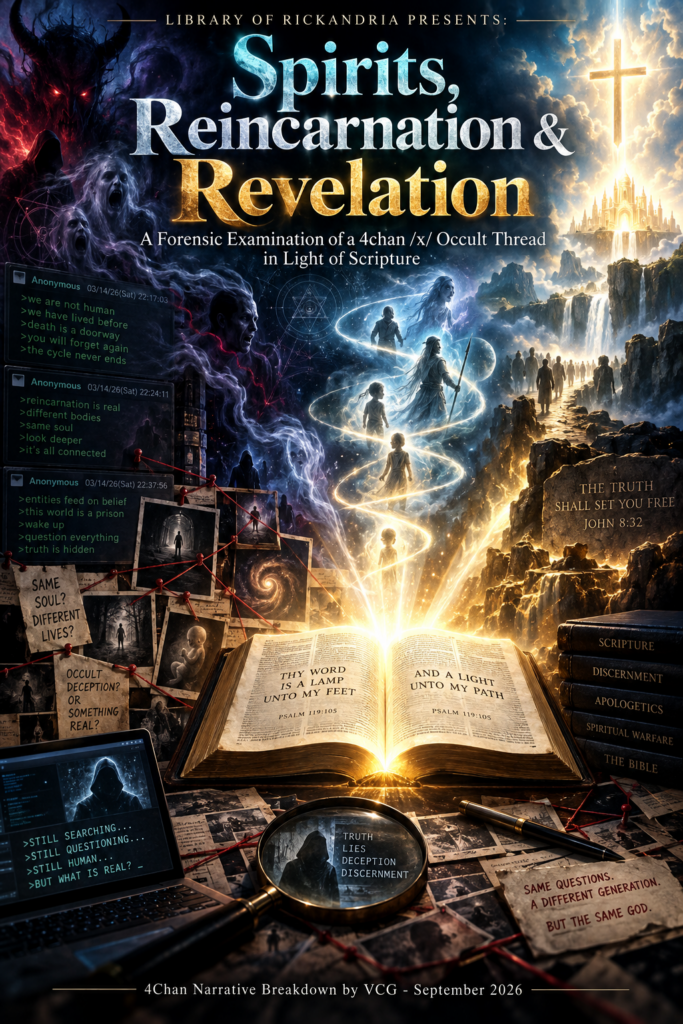
UPDATED BY VCG ON 9/17/2026 @ 05:55 EST
Anyone can do this, but most won’t.
ChatGPT – Library of Rickandria
Abstract
On September 15–16, 2026, an eight-post discussion appeared on 4chan’s paranormal board, /x/, beginning with a deceptively simple question:
“In what ways do less advanced spirits suffer?”
The answers quickly developed into a compact cosmology involving inferior and superior spirits, postmortem suffering, reincarnation, chosen trials, moral purification, samsara, animal embodiment, and the relationship between consciousness and morality.
/x/ – In what ways do less advanced spirits suffer? – Paranormal – 4chan
Taken at face value, the exchange can look like several anonymous people independently comparing spiritual knowledge. Source criticism changes that picture considerably. Two of the most detailed posts track Allan Kardec’s nineteenth-century The Spirits’ Book—particularly questions 970 and 975—with striking closeness in sequence, vocabulary, and doctrine. Kardec’s work, first published in 1857, is foundational to Spiritism, a movement teaching the survival and progressive development of spirits, mediumistic communication, reincarnation, and moral advancement through successive existences.
The final substantive post then moves away from straightforward Kardecian Spiritism. It introduces samsara, a hierarchy running from human beings through animals, fish, plants, and bacteria, and a theory in which souls enter progressively limited bodies because they prefer physical experience to higher “mental realms.” That combination resembles a modern syncretic construction more than any single historical religious tradition. Classical Buddhism, for example, joins rebirth to its doctrine of anātman or “not-self,” rather than to the transmigration of an enduring soul; Jainism explicitly affirms jīva or soul; Hindu traditions contain still other understandings of self, karma, and rebirth.
This paper therefore asks several different questions and deliberately refuses to collapse them into one. Historically, where did these claims come from? Methodologically, what evidence would be necessary to establish them? Psychologically, what ordinary processes could make such claims convincing without assuming dishonesty or mental illness? Philosophically, do the conclusions follow from the premises? Scientifically, what does current research on mediumship, claimed past-life memories, near-death experiences, animal cognition, plant consciousness, and microbial learning actually show? And finally, as a distinctly biblical inquiry, how do the thread’s teachings compare with the account of humanity, death, judgment, salvation, resurrection, and spiritual discernment presented in Scripture?
The central conclusion is narrower—and stronger—than simply declaring the paranormal impossible. The thread does not independently establish its metaphysical system. Much of its central teaching can be traced to a pre-existing Spiritist source; its later claims blend several religious and philosophical traditions; some of its posters directly disagree with one another; and the empirical literature, while containing genuine anomalies worthy of careful investigation, does not establish the detailed cosmology asserted in the thread. Biblically, the most important conflict is not whether a spiritual world exists. Scripture plainly affirms one. The conflict concerns what happens to human beings after death, how sin is dealt with, whether successive incarnations purify the soul, and where saving hope is located.
I. What We Are Actually Investigating
Before examining the thread, it is important to clarify the task.
There are at least five different kinds of questions here.
A historical question asks where an idea came from. That can often be answered by documents.
An empirical question asks whether an observable phenomenon occurs under controlled conditions. That requires evidence, controls, replication, and careful exclusion of competing explanations.
A psychological question asks how people form, remember, interpret, and communicate beliefs and experiences. Psychology can illuminate the process without determining whether the underlying metaphysical belief is true or false.
A philosophical question asks whether conclusions logically follow from premises and whether a theory explains more than competing theories.
A theological question asks whether a doctrine agrees with a particular revealed or canonical framework. In this paper that framework is the Holy Bible, quoted from the supplied Authorized King James Version, Pure Cambridge Edition.
These methods overlap, but they are not interchangeable.
A laboratory experiment cannot determine whether a doctrine agrees with Hebrews. Hebrews cannot tell us whether a particular anonymous poster secretly read Kardec. Psychology cannot establish that spirits do not exist. A historical source match cannot by itself prove that reincarnation is false. And an unusual subjective experience cannot, without additional argument, establish an entire metaphysical system.
Keeping those distinctions intact is one of the most important safeguards in an investigation like this.
II. The Thread at a Glance
The live thread contains eight posts. It begins on September 15, 2026 with post No. 42968592 asking how “less advanced spirits” suffer. A reply describes inferior spirits as tormented by envy, jealousy, anger, remorse, frustrated desires, and awareness of happiness they cannot attain. A follow-up asks whether inferior spirits understand the happiness of good spirits. Another participant offers the short personal claim that, in his experience, “they get frustrated.” A longer answer then introduces reincarnation, chosen trials, purification, responsibility for omitted good, and fuller moral awareness after death.
The next day one post contains only the letter “l.” Another poster challenges the claim that spirits are responsible for all good left undone, arguing that the amount of unrealized good would be effectively limitless. The final substantive poster introduces samsara, claims that all souls are fundamentally equivalent, places animals, fish, plants, and bacteria on progressively more restricted levels of awareness, denies that lower beings fully understand moral “oughts,” and says such bodies are suited to souls that preferred physical sensation over higher mental existence.
That is the entire evidentiary universe of the thread.
There are no records of experiments.
There are no mediumistic transcripts with independently verified targets.
There are no identities or credentials attached to the posters.
There are no references.
There are no specified methods for distinguishing imagination from an external entity.
There is no explanation of how the posters acquired their supposed knowledge of pre-incarnate decisions.
What the thread does contain is a series of claims.
That is where the investigation must begin.
III. The First Forensic Breakthrough: The Kardec Connection
The first important discovery is textual.
Post 42968607 describes the sufferings of inferior spirits as varying according to their imperfection, then speaks of envy toward superior happiness, jealousy, anger, remorse, anguish, longing, and the inability to satisfy desires.
Now compare the structure—not merely one isolated word—with Allan Kardec’s The Spirits’ Book, question 970.
Kardec asks what the suffering of inferior spirits consists of. The answer says that suffering corresponds to the spirit’s inferiority and proceeds through essentially the same cluster: envy of superior happiness, regret, jealousy, rage, despair, remorse, anguish, craving, and inability to satisfy those cravings.
The next 4chan question, post 42968625, asks whether less advanced spirits understand the happiness of the good.
Kardec’s question 975 asks whether inferior spirits understand the happiness of the virtuous.
Then comes post 42968659. It explains that the knowledge of higher happiness torments inferior spirits; that after freedom from matter the spirit seeks another incarnation; that another life can shorten its suffering; that it chooses appropriate trials; that it is responsible not only for committed evil but also neglected good and evil resulting from that neglect; and that once freed from bodily obscurity it sees its culpability clearly, as though emerging from fog.
Kardec 975 contains that same conceptual sequence: awareness of the happiness of the virtuous, torment resulting from deprivation, another physical existence, selected trials, atonement, responsibility for committed wrongdoing and omitted good, and an image of the spirit emerging from fog and seeing its condition clearly.
This is too specific to treat merely as a general similarity between spiritual traditions.
The careful formulation is not “we have proven the anonymous poster copied Kardec.” We cannot know the poster’s mental history. The material could have been deliberately quoted, paraphrased from memory, copied through an intermediate source, or absorbed from Spiritist literature indirectly.
What can be said with high confidence is that the posts are closely derivative of a pre-existing Kardecian doctrinal sequence.
That changes the evidentiary value of the thread immediately.
Multiple anonymous posts repeating material from the same historical source are not multiple independent witnesses.
They are multiple appearances of a tradition.
IV. Who Was Allan Kardec?
“Allan Kardec” was the pen name used by French educator Hippolyte Léon Denizard Rivail, who lived from 1804 to 1869. His Le Livre des Esprits—The Spirits’ Book—was first published in 1857 and became the foundational text of the religious-philosophical movement known as Spiritism. Spiritist sources themselves describe the book as the beginning or “codification” of Spiritism.
It would be unfair to present Kardec as someone who simply invented a cosmology one afternoon and demanded that everyone believe it.
Kardec believed he was investigating unusual phenomena. His followers describe him as gathering responses from different mediums and comparing apparently independent communications. The modern Allan Kardec organization describes a method in which questions were circulated among groups and concordant answers were regarded as more likely to be true.
A 2025 historical study of Kardec’s methods adds useful nuance. Its authors report that Kardec considered multiple hypotheses for mediumistic phenomena, including fraud, hallucination, physical forces, unconscious mental activity, telepathy-like mechanisms, and discarnate minds. They also note that many of his case reports did not contain the level of detail that later became normal in psychical research. Importantly, the authors explicitly state that their historical study was not designed to establish the scientific or epistemological validity of Kardec’s conclusions.
That is the historically fair position.
Kardec attempted systematic inquiry by nineteenth-century standards.
That fact deserves recognition.
It does not follow that his conclusions have thereby been scientifically established.
V. A Provenance Map of the Thread
Once the historical fingerprint is recognized, the thread can be reconstructed more accurately.
The opening question provides the frame: there are spirits, and some are more advanced than others.
Post 42968607 supplies a Kardecian description of inferior-spirit suffering.
Post 42968625 continues into the next recognizable Kardecian question.
Post 42968627 introduces personal experience.
Post 42968659 supplies an extensive Kardecian account of reincarnation, expiation, chosen trials, omission, and unveiled postmortem conscience.
Post 42971624 adds no decipherable argument.
Post 42971641 raises a philosophical objection about unlimited sins of omission.
Post 42971983 departs from straightforward Kardecian language and combines the language of soul, samsara, hierarchical embodiment, moral cognition, and speculative pre-incarnate preference.
The apparent map is therefore not:
Several independent occult experiencers → convergent discovery → shared spiritual reality.
It is closer to:
Kardecian Spiritism → anonymous restatement → personal anecdotal reinforcement → philosophical objection → syncretic alternative theory.
That does not settle whether any supernatural proposition is true.
It does settle something important about the thread itself.
The thread is not independent evidence for Kardec simply because Kardec’s ideas appear anonymously inside it.
VI. Walking Through the Thread
1. Post 42968592: “Less Advanced Spirits”
The opening question assumes the existence of “less advanced spirits.”
This is an example of presuppositional framing. The question is not asking whether spirits exist, whether human beings survive bodily death, or whether spirits can be ranked on a scale of advancement. All of those propositions are already embedded in the wording.
This is not automatically illegitimate. Every conversation has assumptions.
But an investigator should pull those assumptions back into view.
Before asking how less advanced spirits suffer, one would need independent reasons to believe that there are spirits of the relevant kind and that “advancement” is a real postmortem property rather than a term supplied by a particular religious system.
The question therefore begins inside Spiritist cosmology rather than establishing Spiritist cosmology.
That distinction follows us throughout the thread.
2. Post 42968607: Frustration, Jealousy and Unfulfilled Desire
This answer says, in substance, that spirits suffer according to their imperfections. They perceive goods beyond their reach and experience jealousy, anger, remorse, anguish, longing, and frustrated desire.
As shown above, this closely tracks Kardec 970.
Psychologically, the account is immediately intuitive because every emotion named is familiar to embodied human beings.
That makes the narrative powerful.
We know what jealousy feels like. We know frustration. We know the misery of wanting something we cannot obtain. The theory takes recognizable human psychology and projects it into a postmortem environment.
But there is an evidentiary gap between:
Human beings experience frustrated desire
and
Disembodied spirits experience frustrated desire in exactly this way.
The first proposition is ordinary psychological knowledge.
The second is a metaphysical claim.
The plausibility of the analogy cannot substitute for evidence that the proposed entities and afterlife conditions exist.
3. Post 42968625: Do Inferior Spirits Understand Higher Happiness?
This question is especially significant because it mirrors the movement from Kardec 970 toward Kardec 975.
Once the source is recognized, the discussion no longer looks like an anonymous group spontaneously drilling deeper into a newly encountered mystery. It looks substantially like the reappearance of an already structured nineteenth-century catechism.
This illustrates why source criticism precedes interpretation.
Had we begun only with psychology, we might spend pages interpreting why the posters generated these particular ideas.
Historical source tracing shows that they may not have generated them at all.
4. Post 42968627: “In My Experience”
The brief statement that frustrated spirits are known “in my experience” moves us from inherited doctrine to claimed personal encounter.
We should neither mock this statement nor treat it as proof.
The phrase “my experience” can refer to many different phenomena: perceived apparitions, mediumship, dreams, automatic writing, intuitions, sensed presences, altered states, religious experiences, or encounters interpreted retrospectively.
Without further description, we do not know.
This leads to one of the most useful distinctions in the entire investigation.
An experience and an explanation of that experience are not the same proposition.
A person could sincerely report:
“I experienced what seemed to be a presence.”
From that one might infer:
“The experience was produced by an entity outside my mind.”
Then:
“That entity was a deceased human being.”
Then:
“It belonged to a lower spiritual rank.”
Then:
“It was frustrated because it could perceive the happiness of higher spirits.”
Each step adds a new proposition.
Each needs support beyond the step before it.
A person can be completely honest about the first proposition while being mistaken about the fourth or fifth.
This is not a special rule invented for paranormal reports. It is simply the distinction between phenomenology and causal interpretation.
VII. Primary Experience Is Not Yet Metaphysics
This distinction deserves to be formalized.
Suppose someone reports hearing a voice when nobody else is present.
The first layer is phenomenology:
“I heard what seemed to be a voice.”
The second is memory and report:
“I accurately remember and describe what I experienced.”
The third is causal attribution:
“The voice originated outside my own cognitive system.”
The fourth is agent identification:
“The external source was a deceased person.”
The fifth is system inference:
“Because a deceased person communicated, Spiritist reincarnation and progressive spirit ranks are true.”
The fifth conclusion does not automatically follow even if the first four were granted.
This matters because discussions of paranormal experiences often race from experience to worldview without showing the bridge between them.
The same caution works in the opposite direction. Demonstrating that memory is reconstructive does not prove that every extraordinary experience is false. Demonstrating that hallucinations exist does not prove that every perceived entity is a hallucination.
Good investigation resists both shortcuts.
VIII. Post 42968659: Reincarnation, Trials, Purification and Moral Debt
This is the most doctrinally dense post in the thread.
It claims that inferior spirits recognize the happiness they have lost, seek reincarnation after becoming free from matter, can improve themselves through earthly existence, choose trials fitted to their purification, bear responsibility for both committed and omitted wrongdoing, and understand their culpability more clearly after death.
All of these themes are found together in Kardec 975.
That provenance answers the historical question.
It does not yet answer the truth question.
For that, we need to ask what evidence could distinguish the Spiritist explanation from alternatives.
IX. What Would Actually Count as Evidence?
If the claim is that a living person can obtain information from a deceased human being, the experiment should make ordinary information acquisition difficult.
A serious design would isolate the medium from the sitter, prevent the experimenter interacting with the medium from knowing target details, prevent feedback during the reading, use matched decoy readings, establish scoring rules in advance, preserve all readings rather than successful excerpts, and attempt replication by researchers who are not dependent on the original team.
This is not hypothetical. Researchers have attempted increasingly stringent versions of such designs.
O’Keeffe and Wiseman reported controlled experiments with professional mediums specifically designed to address methodological weaknesses in earlier testing; their results did not support genuine mediumistic ability.
On the other hand, a 2022 triple-blind experiment involving nine mediums and thirty-eight readings reported that 65.8 percent of intended readings were correctly selected where 50 percent would be expected by chance, and intended readings received more correct-information ratings than controls. The authors interpreted this as further evidence of anomalous information acquisition and argued that some results were compatible with deceased sources.
Those findings should not be hidden simply because they complicate a skeptical argument.
But neither should we move too quickly.
Even if anomalous information acquisition were conclusively demonstrated, the source of that information would remain a second question. A result exceeding chance could potentially be interpreted through fraud, unnoticed leakage, statistical issues, telepathy among living persons, some broader anomalous-information process, discarnate minds, or other hypotheses depending on what future controls eliminate.
An anomaly is not automatically an ontology.
That principle is crucial.
X. What Would Count as Evidence for Reincarnation?
Research on claimed past-life memories is also real and should not be dismissed with a wave of the hand.
A 2022 scoping review identified 78 academic studies. Eighty-four percent concerned children; case reports made up 60 percent; interviews were used in 73 percent; and documentary analysis appeared in half. The authors explicitly called for future research to address methodological limitations.
The existence of that literature establishes something narrower than reincarnation itself:
there are recurring human reports interpreted by researchers as possible past-life memories, and some have received systematic investigation.
A stronger prospective design would record a child’s statements before investigators locate a proposed previous personality; prevent relatives from supplying information during the investigation; document every statement rather than only matches; determine the probability of coincidental matches; independently verify records; use blinded evaluators where feasible; compare successful matches against controls; and preregister standards for what will count as confirmation.
Even if a case survives all of those controls, one must still ask what hypothesis best explains it.
Reincarnation may be one proposed explanation.
But a verified anomalous memory does not automatically establish Kardec’s additional claims concerning spirit ranks, voluntary trial selection, the moral mechanics of expiation, postmortem fog lifting, or the details of spiritual suffering.
Those propositions require their own evidence.
XI. Near-Death Experiences: Important, but Not a Shortcut
Near-death experiences are another body of evidence frequently brought into discussions of survival after death.
They should be studied rather than ridiculed.
The AWARE-II multicenter study examined consciousness during cardiac arrest using interviews, audiovisual targets, EEG and cerebral oxygen monitoring. Among 28 interviewed survivors, eleven described memories or perceptions suggestive of consciousness. None identified the visual image used for testing; one identified the auditory stimulus. The researchers also reported EEG activity consistent with organized cognitive processes emerging during prolonged resuscitation.
A 2024 scoping review found substantial variability in reported NDE incidence across prospective cardiac-arrest studies, and a 2024 neuroscience review summarized emerging physiological models involving activity and connectivity in the dying brain. A 2025 review went further in proposing an integrated neurophysiological account, although explanatory debate continues.
What follows?
NDEs are significant human experiences.
Some occur under extreme physiological conditions.
Their neurobiology is still being investigated.
None of those statements alone establishes reincarnation.
And even survival of consciousness, if someday established independently, would still not logically entail Kardecian Spiritism.
Again, the levels of inference must remain separate.
XII. The Problem of Sins of Omission
Post 42971641 notices a real philosophical problem in the preceding Spiritist claim.
If a spirit is guilty for all good that it could have done but did not, the poster argues, then the amount of omitted good appears limitless. At any moment a person could theoretically have been helping somebody else instead.
The objection is stronger than its joking tone suggests.
A moral theory must distinguish between:
something merely possible,
something practically possible,
something obligatory,
something known to be obligatory,
and something supererogatory—that is, good but not required.
If every unrealized good is culpable, moral debt becomes potentially infinite.
But the critic’s objection does not eliminate moral responsibility for omission altogether.
Scripture explicitly contains a category of omitted duty:
“Therefore to him that knoweth to do good, and doeth it not, to him it is sin.”— James 4:17
The context is important. James has just criticized presumptuous planning and reminds his readers of their dependence upon God. The statement concerns responsibility in relation to known good, not an assertion that every unrealized beneficial possibility in the universe becomes a separate sin.
So there is a meaningful distinction between the biblical idea of culpable omission and the most expansive possible reading of the thread’s formulation.
The deeper disagreement remains what happens to that guilt.
Spiritism places wrongdoing within successive opportunities for expiation and improvement.
The New Testament places forgiveness, reconciliation, and eternal life centrally in the work of Christ.
XIII. Post 42971983: The Thread Changes Religions
The final substantive post is especially revealing.
It says that all souls are fundamentally equivalent but differ according to the influence of samsara; awareness is more or less able to operate through different bodies; progressively “lower” embodiment runs through animals, fish, plants, and bacteria; lower beings experience primarily visceral suffering; moral good and evil require an “is versus ought” distinction; and certain bodies are used by souls that preferred physical sensation to mental realms.
There is no single historical tradition represented cleanly here.
The word samsara belongs to the religious history of India, where it describes cycles of birth, death, and rebirth associated with karma. Hindu, Buddhist, and Jain traditions share the term but differ substantially in their accounts of what—or whether any enduring thing—passes through that process.
Many Hindu philosophical traditions use the language of ātman or self, while differing over the relation between the individual self and ultimate reality.
Jainism explicitly affirms jīva, soul, and portrays souls as bound within samsara until liberation.
Classical Buddhism presents a major contrast: Buddhist philosophy is centrally associated with anātman—not-self—and does not explain rebirth through a permanent independent soul migrating intact from one body to the next.
Therefore, saying “samsara teaches that all souls do X” immediately oversimplifies several very different metaphysical traditions.
The 4chan post is better described as syncretic.
It borrows from several conceptual worlds and builds its own model.
Syncretism is not proof of falsehood.
But neither is vocabulary borrowed from several ancient traditions evidence that those traditions independently verify the new synthesis.
XIV. The Internal Contradiction
There is also a direct contradiction inside the thread.
The Kardecian answer says inferior spirits do understand the happiness of higher or virtuous spirits and that this awareness contributes to their suffering.
The final poster answers essentially no, arguing that lower beings cannot properly understand good and evil because they lack sufficient grasp of the distinction between what is and what ought to be.
Those cannot both be straightforwardly true in the same sense.
One could attempt a reconciliation by proposing different grades of spirits, different meanings of “understand,” or different stages of embodiment.
But the thread does not supply that reconciliation.
This matters because anonymous occult discussions often generate an impression of accumulated testimony.
Here, the evidence shows something else:
the posters are operating with different systems.
The disagreement itself is evidence against reading the thread as a unified revelation.
XV. Animals Are Not Simply “Almost Mindless”
The final post’s biological ladder also requires examination.
It suggests that moving from humans through animals and fish toward plants and bacteria corresponds to losing mind and intelligence almost entirely.
There certainly are enormous differences in nervous systems and cognitive capacities across species.
But contemporary comparative cognition is much more complicated than a simple “human → animal → fish → almost no mind” ladder.
A 2021 review of fish cognition surveys research in spatial navigation, learning, numeracy, decision-making, and even questions related to theory of mind. The authors also caution that laboratory findings must be interpreted carefully when generalizing to wild populations.
So the correction is not that fish think exactly like humans.
They do not.
The correction is that modern cognitive science does not license the blanket claim that fish have almost no mind or intelligence.
More importantly, no finding in comparative cognition establishes that a fish body represents a spiritually downgraded human-type soul.
That second proposition belongs to metaphysics, not zoology.
XVI. Plants and Consciousness
Plants present a different problem.
Plants unquestionably sense and respond to their environments. They use chemical and electrical signaling, alter growth, respond to light, gravity, water, injury, and other conditions.
Whether any of this amounts to subjective consciousness is disputed.
A substantial 2021 review examined leading arguments for plant consciousness and concluded that the evidence did not establish it, emphasizing the absence of relevant neural organization and criticizing the inference from stimulus-response behavior to conscious experience.
There are researchers who advocate broader conceptions of plant intelligence or consciousness, so the subject should not be presented as though nobody disagrees.
But even a future demonstration of some form of plant sentience would not establish the 4chan theory.
“Plants possess some form of experience” and “plants are bodies occupied by souls that chose lower physical existence” are radically different claims.
The latter requires evidence the former cannot provide.
XVII. Bacteria and “Cognition”
The same problem appears at the microbial level.
A 2026 review in Trends in Microbiology notes growing research into learning-like and memory-like phenomena in microorganisms. It simultaneously stresses conceptual ambiguity and the need for precise definitions when terms developed for nervous systems are applied to microbes.
That is fascinating science.
It does not show that bacteria contain reincarnated souls whose higher cognition is “covered.”
A bacterium can exhibit adaptive biological behavior without that fact deciding the metaphysics of personal identity.
Again:
biological complexity is one question; spiritual identity is another.
XVIII. Do Animals Understand “Ought”?
The final poster also says genuine comprehension of good and evil requires understanding the difference between what is and what ought to be.
That resembles an important philosophical distinction.
But the next move—therefore lower animals cannot possess relevant normative cognition—is not settled science.
The Stanford Encyclopedia of Philosophy’s 2026 treatment of animal normativity describes an active debate. Some models make normative cognition highly demanding and potentially distinctively human. Other approaches propose simpler forms of “naïve normativity,” socially learned norms, implicit standards, or evaluative behavior that may occur in some nonhuman species.
Thus, the correct conclusion is not:
Animals definitely make human-like moral judgments.
Nor is it:
Science has demonstrated that animals cannot possess any form of ought-sensitive cognition.
The question remains philosophically and empirically contested.
And regardless of the answer, it tells us nothing by itself about the pre-incarnate choices of souls.
XIX. Why This Kind of Thread Can Feel Convincing
Psychology becomes useful at this point, but it must be handled carefully.
To identify a cognitive mechanism is not to diagnose an anonymous poster.
It is also not a refutation.
Human beings who hold conventional beliefs, unconventional beliefs, religious beliefs, skeptical beliefs, and scientific beliefs are all subject to ordinary cognitive limitations.
A 2022 systematic review covering 71 studies and 20,993 participants examined relationships between paranormal belief and cognitive functioning. Among the more recurrent findings were associations involving intuitive thinking, confirmatory bias, conditional reasoning, and perception of randomness. The authors also emphasized heterogeneity and methodological limitations across the literature.
That research does not warrant statements like “people who believe in spirits are irrational.”
It does help us understand several mechanisms that may become especially important in ambiguous domains.
XX. Source Monitoring: Remembering the Idea but Losing Its Origin
One mechanism is particularly relevant here: source monitoring.
Memory does not function like a filing cabinet in which every remembered idea permanently carries an exact label identifying where it came from.
Research on source monitoring shows that people can remember content while misremembering whether it was perceived, imagined, inferred, suggested, heard from another person, or encountered previously.
A related phenomenon, cryptomnesia, occurs when previously encountered material returns without conscious recollection of its source and may be experienced as original thought.
This is relevant because the Kardec parallels are so strong.
But caution is essential.
We cannot conclude:
“The poster experienced cryptomnesia.”
We do not know that.
The poster may have been intentionally paraphrasing Kardec.
The proper statement is:
Source-monitoring research supplies one ordinary mechanism by which apparently original ideas can sometimes reproduce previously encountered material without deliberate deception.
The textual provenance can be demonstrated.
The poster’s private mental mechanism cannot.
XXI. Familiar Emotion as a Bridge to Unfamiliar Metaphysics
Another persuasive mechanism is what we might call familiar-emotion anchoring.
The thread’s spirits envy.
They regret.
They resent.
They feel deprived.
They want what they cannot have.
All of this is psychologically recognizable.
The unknown world after death is made intuitive by describing it through emotions we already know.
That can be rhetorically powerful.
A fictional character can display perfectly realistic jealousy without being a real person. Likewise, the psychological realism of a postmortem narrative cannot establish the postmortem world it describes.
Plausibility is evidence of coherence.
It is not the same as evidence of existence.
XXII. The Self-Sealing Explanation
A further problem appears when a theory can explain almost every possible observation after the fact.
Suppose a person recognizes Spiritist truth. That may be counted as spiritual insight.
Suppose another rejects it. Their embodiment or spiritual immaturity may explain their blindness.
Suppose someone suffers. Perhaps it is a chosen trial.
Suppose they do not remember choosing it. Incarnation supposedly obscures memory.
Suppose no experimental confirmation emerges. The spiritual realm may be said to operate beyond material measurement.
Suppose death occurs. The person will supposedly understand afterward.
A theory that accommodates every outcome may be internally flexible, but that flexibility creates a scientific problem.
If no conceivable observation counts substantially against the theory, then observation has little ability to distinguish the theory from alternatives.
That does not logically prove the theory false.
Metaphysical propositions are not always experimentally falsifiable.
But when such a theory is presented as established knowledge about the structure of reality, its resistance to disconfirmation becomes an important epistemic limitation.
XXIII. Why Anonymous Boards Intensify the Effect
The environment also matters.
John Suler’s influential account of the online disinhibition effect identifies several features of internet interaction that can alter how people communicate: anonymity, invisibility, asynchronicity, minimization of authority, and other features that weaken ordinary social constraints.
This does not mean anonymous users are necessarily lying.
Indeed, anonymity can enable honest disclosure.
But anonymous boards also remove many ordinary reputation costs attached to certainty.
A user can say “I know what happens after death” without attaching a name, publication history, methodology, career, institution, or permanent identity to the proposition.
A claim can therefore sound authoritative while carrying almost no visible accountability.
Anonymous boards also blur the distinction between:
personal experience,
role-playing,
quotation,
trolling,
sincere belief,
fiction,
secondhand lore,
and deliberate experiment.
The medium itself changes what can responsibly be inferred from a post.
XXIV. A Powerful Narrative: Suffering Must Have Been Chosen
The idea of pre-birth trial selection deserves special attention because it answers one of humanity’s hardest questions.
Why does one person suffer terribly while another does not?
The Spiritist answer can make suffering morally intelligible: perhaps the spirit chose a difficult life because it needed that particular lesson or expiation. Kardec explicitly connects earthly trials with spiritual progress and, elsewhere in The Spirits’ Book, describes spirits as choosing trials useful to them.
This has enormous explanatory appeal.
Random suffering becomes purposeful.
Unequal suffering becomes morally ordered.
Tragedy becomes education.
But explanatory satisfaction is not evidence that the explanation is true.
There is also a moral danger if such an account is applied carelessly to suffering people. It can encourage observers to infer hidden guilt, previous-life debt, or chosen punishment where they possess no evidence.
The biblical book of Job is especially important here because Job’s companions repeatedly attempt to infer a simple moral explanation for his suffering. The book ultimately refuses their neat calculus.
The lesson is not that suffering can never involve consequences for wrongdoing.
The lesson is that human observers are not authorized to infer an individual’s hidden moral history simply from the amount of suffering they endure.
XXV. Comparative Theology: These Systems Are Not Saying the Same Thing
One common response to material like this is that all religions are simply describing the same spiritual reality in different vocabulary.
The historical data do not support such an easy harmonization.
Spiritism teaches enduring spirits progressing through successive incarnations.
Many Hindu traditions connect samsara with karma and enduring concepts of self, although Hindu schools differ considerably concerning the nature of ātman, Brahman, grace, knowledge, and liberation.
Classical Buddhism denies an independent, permanent self even while maintaining causal continuity and rebirth.
Jainism explicitly affirms soul or jīva and a detailed karmic cosmology.
Biblical Christianity speaks instead of creation, human mortality, judgment, redemption, resurrection, and everlasting life.
There are partial similarities among these systems.
There are also major contradictions.
Calling them all “reincarnation” or “spirituality” can hide more than it reveals.
The final 4chan post is therefore best read as a modern synthesis assembled from concepts that historically belong to different systems.
XXVI. Biblical Anthropology: Is the Body Merely a Temporary Vehicle?
The thread’s final post speaks as though an independently existing soul selects or enters a body suited to a desired mode of experience.
Genesis presents human origins differently:
“And the LORD God formed man of the dust of the ground, and breathed into his nostrils the breath of life; and man became a living soul.”
— Genesis 2:7
The text says that the formed man became a living soul.
Exactly how this verse relates to later philosophical categories such as body, soul, and spirit has been debated among Christians. The verse should therefore not be forced to answer every later anthropological question.
But what it does not depict is a waiting, preexistent human soul choosing an available biological vehicle.
That entire narrative must be brought to the text from elsewhere.
XXVII. Resurrection Is Not Reincarnation
This is the central biblical correction.
Reincarnation and resurrection are sometimes spoken of as though they were two cultural descriptions of basically the same event.
They are not.
In reincarnation, an enduring principle or causal stream undergoes another earthly birth.
In biblical resurrection, the dead are raised.
Jesus says:
“the hour is coming, in the which all that are in the graves shall hear his voice,
And shall come forth; they that have done good, unto the resurrection of life; and they that have done evil, unto the resurrection of damnation.”— John 5:28–29
The immediate context concerns the Son’s authority to give life and execute judgment. The categories are resurrection and judgment—not successive educational embodiments.
Paul’s argument in 1 Corinthians 15 is even more extensive. Christianity rises or falls, Paul says, with resurrection. Christ is the “firstfruits” of those who sleep; those belonging to Christ are raised; and ultimately death itself is defeated.
Later in the chapter:
“the dead shall be raised incorruptible, and we shall be changed.”
And:
“this mortal must put on immortality.”
The movement is not:
one mortal body → another mortal body → another mortal body.
It is:
mortality → resurrection → immortality.
First Thessalonians likewise says:
“the dead in Christ shall rise first”
and concludes:
“so shall we ever be with the Lord.”
Revelation 20 portrays the dead standing before God and being judged, followed by the new heaven and new earth—not by another return to ordinary terrestrial life.
This gives us a coherent New Testament trajectory:
death → resurrection/judgment → everlasting destiny.
The Kardecian trajectory is:
death → spirit state → recognition/expiation → another embodiment → further progress.
Those systems cannot be made identical without substantially altering one of them.
XXVIII. Hebrews 9:27 in Context
Hebrews 9:27 is often quoted against reincarnation:
“And as it is appointed unto men once to die, but after this the judgment:”
It is important to read the surrounding argument.
Hebrews is comparing repeated priestly sacrifices with Christ’s singular sacrifice.
Christ does not repeatedly offer himself. He appeared “once” to put away sin, just as human death is followed by judgment; Christ likewise was “once offered” and will appear again.
So the force of the passage is stronger than isolating a slogan.
The author is constructing an analogy around non-repeatability.
Human beings die, judgment follows, and Christ’s sacrificial offering is correspondingly once-for-all.
The passage does not contain a technical treatise on every possible afterlife theory.
But reincarnational cycles sit very awkwardly inside the argument precisely because repeated ordinary deaths are not the sequence Hebrews presents.
XXIX. The Deeper Conflict: Purification or Redemption?
The thread does not merely teach multiple lives.
It describes repeated embodiment as part of the spirit’s purification and expiation.
That is where the disagreement becomes specifically evangelical.
The New Testament absolutely teaches moral transformation.
It teaches repentance.
It teaches discipline.
It teaches perseverance.
It teaches good works.
But those goods are not presented as a ladder by which a spirit earns its way through repeated incarnations into eventual blessedness.
Paul writes:
“For the wages of sin is death; but the gift of God is eternal life through Jesus Christ our Lord.”— Romans 6:23
And in Ephesians:
“For by grace are ye saved through faith; and that not of yourselves:
it is the gift of God:
Not of works, lest any man should boast.”
The next verse prevents an equally serious distortion:
“For we are his workmanship, created in Christ Jesus unto good works…”
Biblically, good works matter.
But the order is significant:
grace → salvation → transformed life and good works.
The Spiritist model places moral progress within successive incarnations in which the spirit atones, learns, and advances.
The Pauline gospel places reconciliation fundamentally in Christ.
This is not a small denominational disagreement.
It concerns the mechanism of salvation itself.
XXX. Can a Spirit Teach True Doctrine?
A Christian analysis should avoid another common mistake.
The biblical response to occult claims is not simply:
“Spirits cannot exist, so every experience is fake.”
That is not the biblical worldview.
Scripture presents spiritual beings as real.
Its warning is therefore more demanding:
spiritual manifestation does not automatically equal divine truth.
Isaiah places consultation of familiar spirits and the dead against seeking God and directs the people:
“To the law and to the testimony…”
Deuteronomy 13 gives an even more striking criterion. Even if a sign or wonder occurs, Israel is not to follow a message that turns them from the God already revealed to them.
That means supernatural effectiveness, by itself, does not authenticate doctrine.
In the New Testament, John writes:
“Beloved, believe not every spirit, but try the spirits whether they are of God…”
— 1 John 4:1
The immediate context supplies a Christological test and speaks of false prophets. We should not reduce the verse to a vague instruction to “trust your intuition.” The testing is doctrinally anchored.
Paul makes the point still more sharply:
“though we, or an angel from heaven, preach any other gospel unto you than that which we have preached unto you, let him be accursed.”— Galatians 1:8
The messenger’s apparent supernatural status does not outrank the gospel.
This gives Christianity an interesting epistemology of spiritual claims.
The decisive question is not merely:
Was the experience unusual?
Nor even:
Was something genuinely supernatural involved?
It is also:
What doctrine is being taught?
XXXI. A Necessary Caution About “Demons”
At this point, some Christian readers may want to conclude that every anomalous experience in the thread is necessarily demonic.
The biblical material does not warrant making that claim about specific anonymous experiences without evidence.
Scripture certainly warns of deceptive spirits, false teachers, and Satan appearing as an angel of light. Paul’s immediate context in 2 Corinthians 11 concerns false apostles, another Jesus, another spirit, and another gospel.
That makes spiritual deception a legitimate biblical category.
But we still do not know what post 42968627 actually experienced.
Possible explanations include imagination, misinterpretation, dreams, memory, deliberate role-play, sincere religious experience, deception by another person, or something genuinely anomalous.
A careful Christian investigation should therefore say:
Scripture warns that apparent spiritual phenomena are not self-authenticating.
That is stronger and more defensible than pretending we know the invisible cause of an undocumented anonymous experience.
XXXII. Even Scripture Does Not Encourage Credulity
The Bible’s approach to extraordinary claims is surprisingly unfriendly to naïve credulity.
Paul tells the Thessalonians:
“Prove all things; hold fast that which is good.”
John commands testing of spirits.
Deuteronomy supplies tests for prophetic claims and rejects the proposition that spectacular signs automatically establish theological truth.
This means a biblical worldview does not require us to choose between:
materialist dismissal of every extraordinary report
and
automatic belief in every extraordinary report.
There is a third position:
take the claim seriously enough to test it.
XXXIII. The Strongest Case Against Our Own Conclusion
A serious paper should present the strongest evidence that might push in the opposite direction.
The first category is controlled mediumship research.
Some controlled experiments have failed to support mediumistic ability.
Others, including triple-blind work, have reported statistically significant anomalous accuracy.
The second category is claimed past-life memory.
There are decades of case reports, particularly involving young children, and some cases contain correspondences investigators regard as difficult to explain conventionally. The field is sufficiently developed to have produced systematic reviews of its methods and evidence.
The third category is near-death experience.
Prospective cardiac-arrest studies confirm that some survivors report organized, vivid experiences, while research continues into what forms of conscious processing may remain possible during resuscitation.
None of this should be erased.
But there is an equally important point.
Even if future evidence persuaded researchers that some human consciousness survives bodily death, the following propositions would still require additional evidence:
that every person repeatedly reincarnates;
that spirits occupy measurable ranks of advancement;
that they select earthly suffering as expiatory trials;
that animal, fish, plant, and bacterial lives are stages available to human-type souls;
that specific moral omissions determine postmortem torment;
that souls choose bodies because they prefer physical sensation;
and that Kardec’s nineteenth-century communications provide a reliable map of the entire unseen world.
There is a great distance between:
“some evidence is anomalous”
and
“therefore this complete cosmology is true.”
The thread repeatedly crosses that distance without showing its work.
XXXIV. Claim-by-Claim Evidence Matrix
| Thread claim | What supports it | What the evidence actually establishes | Main difficulty | Biblical comparison |
|---|---|---|---|---|
| Inferior spirits suffer through envy, jealousy and frustrated desires | Closely parallels Kardec §970 | Establishes historical provenance of the idea, not its ontological truth | Human emotions are projected into a claimed spirit state | Scripture teaches postmortem judgment but does not give this Kardecian mechanism |
| Inferior spirits understand higher happiness | Kardec §975 | Established as Spiritist doctrine | No independent evidence supplied in thread | Scripture describes judgment/resurrection, not advancement through comparison with higher spirits |
| “In my experience” spirits become frustrated | Anonymous testimony | Establishes that someone made a personal claim | Experience is undefined; cause cannot be evaluated | 1 John 4 requires spiritual claims to be tested |
| Spirits seek another incarnation | Kardec §975; broader reincarnation traditions | Reincarnation is a longstanding religious/metaphysical doctrine; claimed past-life cases are researched | Case literature does not establish Kardec’s entire system | Hebrews 9, John 5, 1 Cor. 15 and 1 Thess. 4 present death, judgment and resurrection |
| Spirits choose trials for purification | Kardecian doctrine | Establishes what Spiritism teaches | Difficult to independently test; can retrospectively explain any suffering | NT grounds salvation in Christ; suffering can shape believers but is not reincarnational expiation |
| Spirits are accountable for neglected good | Kardec §975 | Has a recognizable historical source | “Could have done” requires a principled account of obligation | James 4:17 recognizes culpable omission in relation to known good |
| Death removes a veil and reveals full culpability | Kardec §975 | Spiritist doctrine, not independent 4chan discovery | Mostly inaccessible to present verification | Scripture teaches disclosure and judgment, but no subsequent remedial reincarnation |
| All souls are equivalent and governed by samsara | Anonymous synthesis | Samsara is real terminology from Indian religions | Hindu, Buddhist and Jain accounts of self differ substantially | Biblical anthropology does not teach samsaric rebirth |
| Souls descend through animal/fish/plant/bacterial bodies | Anonymous claim with loose parallels to some reincarnation traditions | Some traditions contain nonhuman rebirth, but not the post’s entire model | No empirical evidence identifies organisms as bodies of particular reincarnating souls | Genesis describes created living kinds and humanity; NT expectation is resurrection |
| Fish have almost no higher cognition | Anonymous claim | Modern research shows substantial fish cognition | Oversimplifies comparative cognition | Not a directly biblical scientific question |
| Plants/bacteria contain heavily covered mind/ego | Anonymous speculation | Plant consciousness remains disputed; microbial “learning-like” behavior is studied | Adaptive behavior does not establish subjective consciousness, much less reincarnated soul identity | Scripture does not present such a hierarchy |
| Lower animals cannot understand “ought” | Philosophical assertion | Animal normativity is actively debated | The cognitive threshold for normativity is unsettled | Scripture uniquely assigns humans moral covenantal responsibility, but this scientific inference is separate |
| Souls select bodies because they wanted physical sensation | No evidence given | Nothing in the thread independently supports it | Ad hoc preexistence narrative | Genesis 2:7 describes the formed human becoming a living soul |
XXXV. What the Thread Gets Right
A fair analysis should identify points of genuine moral insight.
The thread recognizes that actions shape persons.
It recognizes that uncontrolled desire can become a source of suffering.
It recognizes remorse.
It recognizes that failing to do known good can carry moral significance.
It recognizes that pleasure alone is not an adequate account of flourishing.
It recognizes that suffering can contribute to moral reflection.
Those observations should not be rejected merely because they occur within a worldview we are criticizing.
The crucial mistake lies elsewhere.
Plausible moral psychology is used to support metaphysical conclusions that require additional evidence.
A person may correctly observe that selfish desire produces misery and still be wrong about reincarnation.
Truth in one layer does not automatically authenticate every layer built above it.
XXXVI. What the Thread Has Not Established
After everything is separated out, the thread itself has not established that:
a particular discarnate human spirit communicated with any poster;
spirits exist in measurable evolutionary ranks;
reincarnation occurs;
pre-incarnate spirits choose suffering;
human-type souls inhabit animals, plants or bacteria;
moral cognition maps onto a cosmic reincarnation ladder;
death reveals the specific Kardecian spiritual landscape;
or self-purification through successive lives is the mechanism by which human beings reach ultimate happiness.
These are not small details.
They are the architecture of the system.
And that architecture is being asserted much more often than it is being demonstrated.
XXXVII. The Difference Between Evidence and Interpretation
The recurring error can be summarized through a simple chain:
Experience → Report → Verification → Causal explanation → Metaphysical interpretation → Religious doctrine
An investigation should stop at every arrow and ask whether the next step follows.
If somebody has an unusual experience, the experience deserves description.
If independently verifiable information appears, it deserves investigation.
If conventional information channels are excluded, an anomaly deserves recognition.
But even then we must ask what caused the anomaly.
And even after proposing a cause we must ask whether that cause supports the broader religious system being attached to it.
Most internet occult discussions collapse the chain into one movement:
“I experienced it, therefore I know what reality is.”
The evidentiary burden deserves more care than that.
XXXVIII. Biblical Judgment and Spiritist Progress Are Different Moral Universes
There is one final theological contrast worth making explicit.
Spiritism’s moral world is fundamentally developmental.
The spirit experiences consequences, recognizes errors, undergoes trials, reincarnates, learns, expiates, and progresses.
The New Testament’s moral world certainly includes growth, sanctification, chastening, perseverance, and judgment.
But its center is not the spirit’s accumulated self-purification.
Its center is Jesus Christ.
Hebrews speaks repeatedly of Christ’s singular sacrifice, culminating in the claim that:
“by one offering he hath perfected for ever them that are sanctified.”
Romans calls eternal life God’s gift through Christ.
Ephesians makes salvation a gift while retaining good works as the consequence and calling of the redeemed.
Revelation’s final vision is not an indefinitely improving cycle of terrestrial embodiments but creation renewed, judgment completed, the curse removed, and God’s servants dwelling before him.
That is the fundamental scriptural disagreement.
Spiritism offers progress through repeated existence.
The gospel proclaims redemption in Christ, resurrection, judgment, and new creation.
XXXIX. Limits of This Investigation
There are several conclusions this paper does not claim to have established.
It has not scientifically demonstrated that no human consciousness survives death.
It has not demonstrated that every medium is fraudulent.
It has not demonstrated that every claimed past-life memory has an ordinary explanation.
It has not demonstrated that every unusual spiritual experience is a hallucination.
It has not identified the psychological state of any anonymous 4chan poster.
It has not proven that posters deliberately copied Kardec rather than remembered, paraphrased, or inherited the material through another source.
And it has not treated biblical theology as though it were a laboratory instrument.
What has been demonstrated much more securely is the textual dependence between central thread material and Kardecian Spiritism; the lack of independent evidence inside the thread; the existence of competing interpretations for anomalous phenomena; the syncretic character of the final poster’s claims; several internal tensions; scientific problems with its simplified hierarchy of cognition; and substantial incompatibility between reincarnational purification and the New Testament’s resurrection-centered account.
That narrower conclusion is sufficient.
There is no need to claim more than the evidence supports.
XL. The Rickandria Forensic Method
The most useful outcome of this investigation may be a method that can be reused whenever another anonymous “insider,” occult document, prophetic post, paranormal testimony, conspiracy thread, or religious revelation appears.
Begin with SOURCE. Where did the claim actually originate? Search for earlier versions before assuming independent revelation.
Move to EVIDENCE. Ask what observation supports the claim and whether that information was obtained independently.
Then examine LOGIC. Determine whether the conclusion actually follows from the evidence or whether several unstated propositions have been inserted.
Consider ALTERNATIVES. Ask what else could produce the same experience or observation.
Check CONSISTENCY. Compare the claim not only with critics but with the other claims made by the same system and its supposed witnesses.
Finally, for specifically Christian discernment, compare SCRIPTURE with Scripture. Ask what the biblical text explicitly states, what can reasonably be inferred from it, what remains uncertain, and what has been imported from another worldview.
The order matters.
Starting with “this feels evil” is not investigation.
Starting with “science says spirits cannot exist” is not investigation either.
The better question is:
What exactly are we looking at, where did it come from, what does it establish, and how do we know?
XLI. Conclusion
The thread began with a question about the suffering of “less advanced spirits.”
By itself, that sounds like a small occult discussion.
Source criticism reveals something much larger.
The early exchange closely follows Allan Kardec’s The Spirits’ Book, especially questions 970 and 975. The similarity includes not merely a generic belief in spirits but a distinctive sequence of suffering, envy of higher spirits, awareness of superior happiness, reincarnation, chosen trials, omitted good, expiation, and the image of postmortem consciousness emerging from obscurity.
That discovery removes the appearance of independent revelation.
The thread is participating in a historical tradition.
The final poster then moves into another construction: souls, samsara, animal and microbial embodiment, degrees of mental restriction, and pre-incarnate preferences for bodily experience. That account does not cleanly represent Buddhism, Hinduism, Jainism, or Kardecian Spiritism. It combines elements of several systems while adding speculative propositions of its own.
The psychology helps explain why such narratives can be compelling. Familiar emotions make invisible beings intelligible. Source memory can separate ideas from remembered origins. Anonymous environments reduce normal reputation constraints. Flexible metaphysical systems can reinterpret nearly any circumstance as confirmation. None of these mechanisms proves the worldview false; they show why subjective conviction cannot substitute for verification.
The scientific literature deserves more respect than either side often gives it. Mediumship has been tested under controlled and even triple-blind conditions, with both negative and positive results appearing in the literature. Claimed past-life memories have produced dozens of academic studies, though much of the field remains observational and case-based. Near-death experiences are unquestionably reported and are being studied with increasingly sophisticated neurological methods.
Those findings justify continued investigation.
They do not justify pretending that the detailed cosmology in eight anonymous 4chan posts has been established.
And when the thread is tested against Scripture, the deepest disagreement becomes clear.
The Bible does not solve the problem by denying the supernatural.
It teaches us to test spiritual claims.
It does not direct the living to derive doctrine from the dead.
It does not present human beings as preexistent souls selecting bodies for successive educational incarnations.
It does not describe salvation as the gradual payment of spiritual debt across lifetimes.
Instead, its storyline moves from creation and fall to redemption, death, resurrection, judgment, and new creation.
Christ says the dead will come forth in resurrection.
Paul says the dead will be raised incorruptible.
Hebrews places death before judgment and Christ’s singular sacrifice at the center of redemption.
Ephesians locates salvation in grace rather than accumulated works while simultaneously calling the saved to a life of good works.
John commands believers not simply to believe spiritual claims, but to test them.
And Paul goes so far as to deny doctrinal authority even to an apparent angel if its gospel contradicts what has already been given.
That is perhaps the most important lesson of the thread.
The biblical issue is not whether a voice sounds spiritual.
It is not whether an experience feels profound.
It is not whether a doctrine offers an emotionally satisfying explanation of suffering.
It is not even whether something extraordinary happens.
The question is whether the claim is true.
And truth deserves patient examination.
Historical claims should be tested historically.
Scientific claims should be tested scientifically.
Psychological explanations should remain psychological explanations.
Philosophical arguments should be examined logically.
And claims about biblical revelation should be tested against the biblical text rather than being quietly imported into it.
That approach requires more work than either automatic belief or automatic dismissal.
But it also leaves us in a much better position than where the thread began.
We began with anonymous voices describing an unseen world.
We end with their historical sources exposed, their evidentiary claims separated from their interpretations, their disagreements made visible, their strongest supporting evidence fairly acknowledged, and their theology placed beside Scripture where the reader can examine both.
The task is not to fear questions.
The task is to ask better ones.
Appendix A — Thread Reconstruction
The thread consists of eight posts dated September 15–16, 2026. Post 42968592 asks how less advanced spirits suffer. Post 42968607 answers with a description closely corresponding to Kardec 970. Post 42968625 asks whether lower spirits understand higher happiness, corresponding closely to Kardec’s next relevant question. Post 42968627 offers a personal-experience claim concerning frustration. Post 42968659 closely follows Kardec 975 concerning higher happiness, reincarnation, chosen trials, purification, omissions, culpability, and clarified postmortem consciousness. Post 42971624 contains only an isolated letter and yields no substantive argument. Post 42971641 challenges the apparently unlimited scope of sins of omission. Post 42971983 presents a different model involving souls, samsara, animal/plant/microbial embodiments, normative cognition, and voluntary orientation toward physical experience.
For scholarly preservation, a stable screenshot or archival capture of the live thread should accompany any published edition of this paper because ephemeral imageboard threads may later disappear or become inaccessible.
Appendix B — Kardec Parallel
The strongest textual comparison is between the 4chan sequence and The Spirits’ Book §§970 and 975.
Kardec 970 asks about the suffering of inferior spirits and describes envy of superior happiness, jealousy, rage, regret, despair, remorse, anguish, desire, and inability to satisfy that desire.
Post 42968607 reproduces essentially that conceptual package.
Kardec 975 asks whether inferior spirits understand the happiness of the virtuous and answers yes; it then connects that perception to suffering, new physical existence, trials, atonement, wrongdoing, omitted good, culpability, and an analogy of emerging from fog.
Posts 42968625 and 42968659 reproduce the same question-and-answer movement and the same distinctive sequence of concepts.
The appropriate scholarly characterization is therefore close textual and doctrinal dependence, while leaving the exact route of transmission unknown.
Appendix C — Principal Scripture Index
Human origin and anthropology: Genesis 2:7 — the formed man becomes a living soul.
Death and judgment: Hebrews 9:24–28 — Christ’s once-for-all offering is compared with human death followed by judgment.
Resurrection: John 5:21–29 — Christ gives life, judges, and summons those in the graves to resurrection.
Resurrection body: 1 Corinthians 15:12–58 — Christ as firstfruits, resurrection of the dead, incorruption and immortality.
Return of Christ and resurrection: 1 Thessalonians 4:16–18 — the dead in Christ rise and remain with the Lord.
Final judgment: Revelation 20:11–15 — the dead stand before God and are judged.
New creation: Revelation 21–22 — final restoration and everlasting life before God.
Grace and works: Ephesians 2:8–10 — salvation by grace through faith, followed by a life created unto good works.
Eternal life: Romans 6:23 — eternal life as God’s gift through Jesus Christ.
Sins of omission: James 4:17 — culpability for knowingly failing to do good.
Consulting spirits: Isaiah 8:19–20 — the people are directed to seek God and test claims by the established testimony.
Testing supernatural claims: Deuteronomy 13:1–5 — even a fulfilled sign does not authorize departure from revealed truth.
Testing spirits: 1 John 4:1–6 — spiritual claims are not to be accepted automatically.
Another gospel: Galatians 1:6–9 — even an angelic messenger does not possess authority to replace the apostolic gospel.
Spiritual deception: 2 Corinthians 11:3–15 — Paul’s immediate concern is false apostles, another Jesus, another spirit, another gospel, and deceptive appearances.
General discernment: 1 Thessalonians 5:19–22 — spiritual claims are neither automatically suppressed nor automatically believed: “Prove all things; hold fast that which is good.”
Selected Research Sources
Primary thread: 4chan /x/, thread No. 42968592, “In what ways do less advanced spirits suffer?”, September 15–16, 2026; accessed September 17, 2026.
Primary Spiritist text: Allan Kardec, The Spirits’ Book, especially §§970 and 975, concerning the sufferings of inferior spirits, perception of higher happiness, renewed embodiment, trials, omitted good, culpability and postmortem awareness.
History of Spiritism: Allan Kardec organizations identify The Spirits’ Book as first published in 1857 and describe Kardec’s compilation and comparison of mediumistic material. Pimentel, Alberto and Moreira-Almeida’s 2025 historical study examines Kardec’s attempts to consider alternative hypotheses including fraud, hallucination, unconscious processes, telepathy-like explanations and discarnate minds while expressly distinguishing historical reconstruction from proof of his conclusions.
Mediumship research: O’Keeffe and Wiseman, “Testing alleged mediumship: methods and results,” British Journal of Psychology (2005), reported results that did not support genuine mediumistic ability. Tressoldi et al., “Mediumship accuracy: A quantitative and qualitative study with a triple-blind protocol,” Explore (2022), reported above-chance discrimination and higher accuracy for intended readings.
Past-life-memory research: Moraes et al., “Academic studies on claimed past-life memories: A scoping review,” Explore (2022), reviewed 78 studies and documented the field’s heavy reliance on child cases, interviews and observational case-report designs.
Near-death research: Parnia et al., AWARE-II, Resuscitation (2023), prospectively studied awareness during cardiac arrest with audiovisual targets and EEG monitoring. Kovoor et al. (2024) reviewed prospective cardiac-arrest NDE research and found substantial methodological and incidence variation. Mashour et al. (2024) and Martial et al.-era subsequent neuroscience work illustrate the growing investigation of neurophysiological explanations for NDE phenomena.
Psychology: Dean et al., “Paranormal beliefs and cognitive function,” PLOS ONE (2022), systematically reviewed 71 studies comprising 20,993 participants. Johnson, Hashtroudi and Lindsay’s source-monitoring framework and later work explain how people attribute remembered information to perceived, imagined, inferred and externally communicated sources and why such judgments can fail. Research on cryptomnesia documents inadvertent re-emergence of previously encountered ideas without accurate source recollection. Suler’s classic paper describes anonymity, invisibility, asynchronicity and related elements of online disinhibition.
Comparative religion: The Routledge Encyclopedia of Philosophy and Stanford Encyclopedia of Philosophy document significant differences between Hindu, Buddhist and Jain accounts of self, karma and rebirth; particularly important is classical Buddhism’s rejection of a permanent independent self.
Comparative cognition: Salena et al. (2021) review substantial evidence for learning, navigation, numerical abilities and decision-making in fishes. The 2026 Stanford Encyclopedia entry on animal normativity surveys competing models concerning whether and in what sense nonhuman animals can possess normative cognition. Reviews critical of plant-consciousness claims argue that existing evidence does not establish conscious experience in plants. A 2026 review of microorganisms describes learning-like and memory-like phenomena while emphasizing unresolved definitional and conceptual issues.
Closing Principle
A claim does not become revelation because it is anonymous.
An experience does not become an explanation merely because it is vivid.
An anomaly does not become a cosmology merely because it is unexplained.
And a spiritual message does not become biblical merely because it speaks about God, souls, morality, or the afterlife.
The work of discernment is slower:
find the source, examine the evidence, test the logic, consider alternatives, compare the claims for consistency, and then search the Scriptures carefully.
That is not fear of the unknown.
It is respect for truth.
4CHAN THREAD & POST BREAKDOWNS – Library of Rickandria
VCG PAPER PROJECTS – Library of Rickandria