
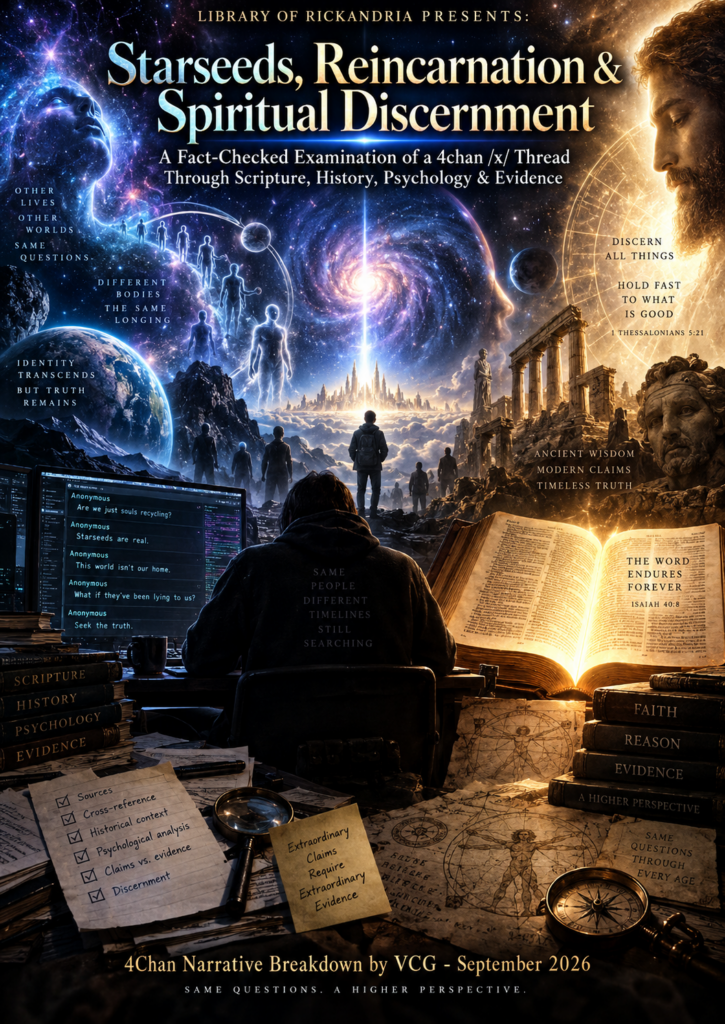
Starseeds, Reincarnation & Spiritual Discernment: A Fact-Checked Examination of a 4chan /x/ Thread Through Scripture, History, Psychology & Evidence
UPDATED BY VCG ON 9/20/2026 @ 04:44 EST
Anyone can do this, but most won’t.
ChatGPT – Library of Rickandria
LIBRARY OF RICKANDRIA PRESENTS
“PROVE ALL THINGS”
Starseeds, Reincarnation & Spiritual Discernment
A Fact-Checked Examination of a 4chan /x/ Thread Through Scripture, History, Psychology & Evidence
4Chan Narrative Breakdown by VCG — September 2026
Abstract
On September 17, 2026, an anonymous user on 4chan’s paranormal board, /x/, opened a thread titled “Starseeds.” The opening post began not with a question about reincarnation but with a declaration: reincarnation was said to be “100% real.” The uncertainty came afterward. The poster wondered whether “starseeds” were real, what advanced extraterrestrial races might supposedly be like, and how someone could determine his or her own starseed identity—perhaps simply by “gut feeling.”
/x/ – For starters, I know that reincarnation is 100% re – Paranormal – 4chan
What followed was a compact example of how contemporary online spirituality is constructed. The thread moved rapidly between reincarnation, extraterrestrial identity, New Age skepticism, Jewish Kabbalah, Isaac Luria, kundalini, “etheric DNA,” psychiatric experience, recovered memories, mockery, and personal insult. Some statements were plainly unsupported. Others contained genuine historical information. Still others referred to real psychological or religious phenomena but interpreted them through metaphysical frameworks that the available evidence could not verify.
This paper examines the thread post by post while deliberately refusing to collapse distinct questions into one another. Historical claims are tested historically. Scientific claims are tested empirically. Psychological explanations are treated as possible explanatory mechanisms rather than automatic debunkings. Religious traditions are described according to their own sources before they are compared with Christianity. Biblical claims are tested through Scripture, using the King James Bible supplied for this study, with particular attention to the biblical doctrines of creation, death, judgment, resurrection, spiritual discernment, and the person and work of Christ.
The central finding is not that every statement in the thread is false. Several are not. Rather, the thread repeatedly moves from a fact or experience to an interpretation without demonstrating the connecting inference. Past-life reports become proof of reincarnation. Feelings of alienation become evidence of extraterrestrial origin. Kabbalistic belief becomes evidence for reincarnation itself. Adverse experiences associated with meditation become proof of a particular spiritual-energy mechanism. Scientific terms such as “DNA” are transferred into metaphysical systems without corresponding biological measurements.
The resulting lesson is broader than one 4chan discussion. Careful discernment requires resisting two temptations at once: credulity and cynicism. An extraordinary claim should not be accepted merely because it is ancient, spiritual, emotionally powerful, or personally experienced. Neither should unfamiliar claims be dismissed through ridicule, historical distortion, armchair diagnosis, or unsupported counterclaims.
The governing principle of this paper is therefore the apostolic instruction:
“Prove all things; hold fast that which is good.”— 1 Thessalonians 5:21, KJV
I. The Thread and the Question Behind It
The thread appeared on 4chan’s /x/ board on September 17, 2026. Its opening poster asserted certainty about reincarnation while expressing uncertainty about starseeds. Replies accumulated through September 19 and included denial, abuse, skepticism, Kabbalistic history, kundalini advice, psychiatric testimony, and commentary on 4chan itself. The surviving thread contains eleven posts including the original post.
At first glance it is a small discussion. Yet its brevity makes it unusually useful.
Within a few hundred words, nearly every major difficulty involved in evaluating contemporary esoteric claims appears. There are empirical assertions, historical claims, personal experiences, identity statements, spiritual interpretations, scientific terminology, religious traditions, and theological conclusions.
These require different methods.
A historian asking whether Isaac Luria taught reincarnation is not asking the same question as a geneticist asking whether “etheric DNA” exists.
A psychologist investigating why an identity framework feels compelling is not thereby determining whether its metaphysical propositions are true.
A Christian examining whether reincarnation agrees with Scripture is making a theological and exegetical judgment, not conducting a laboratory experiment.
Much confusion disappears once those categories are separated.
II. Methodology: What Kind of Claim Are We Testing?
The paper uses six categories of claim.
| Type of claim | Example from the discussion | Appropriate method |
|---|---|---|
| Empirical | Reincarnation has been objectively demonstrated | Observation, controls, replication, competing hypotheses |
| Historical | Isaac Luria taught gilgul | Primary texts, specialist histories, historical scholarship |
| Psychological | Starseed identification may be reinforced through certain cognitive processes | Psychological research and cautious inference |
| Autobiographical | “Kundalini awakening made me bipolar” | Testimony establishes the report; clinical causation requires much more evidence |
| Metaphysical | Souls originate in the Pleiades or Sirius | Philosophical reasoning and independent evidence, if testable |
| Theological | Reincarnation agrees with biblical Christianity | Exegesis, context, comparison of Scripture with Scripture |
This distinction prevents one of the most common errors in paranormal discussion: treating evidence for one proposition as evidence for another.
For example, suppose a child reports accurate information apparently connected to a deceased person. That establishes an anomaly worth investigating. It does not, by itself, establish reincarnation as the only possible explanation.
Likewise, suppose a person undergoes a dramatic altered state while practicing kundalini yoga. The experience may be entirely real as an experience. That does not automatically establish the practitioner’s metaphysical interpretation of the experience.
Throughout this paper, an important rule will therefore be repeated:
Experience is data. Interpretation is a second step.
III. Evidence Grades
Instead of forcing each claim into a crude “true” or “false” category, the paper uses seven evidential judgments.
| Grade | Meaning |
|---|---|
| Verified | Strong, independent evidence directly supports the claim |
| Substantially accurate | Core claim is correct, though qualification is needed |
| Partly accurate | Contains factual material mixed with error or overstatement |
| Unsupported | Evidence supplied does not establish the assertion |
| Misleading | Technically contains some truth but creates a materially inaccurate impression |
| Unverifiable | Available evidence cannot presently confirm or refute it |
| Theological claim | Requires scriptural or doctrinal analysis rather than scientific testing |
This approach becomes particularly important with the thread’s discussion of Kabbalah. Simply labeling that entire reply “false” would itself be false. Gilgul is a genuine Kabbalistic doctrine, and Isaac Luria really was enormously influential. The errors occur mainly in generalization, simplification, and the move from “a tradition teaches this” to “therefore this is objectively true.”
IV. Source Hierarchy
Not all sources have equal evidential value.
For biblical text, this paper uses the supplied King James Bible rather than relying on remembered wording.
For modern scientific claims, systematic reviews, peer-reviewed studies, government scientific institutions, and major research centers are preferred.
For Jewish mystical history, specialist encyclopedias, recognized Jewish educational sources, academic theological resources, and translated Lurianic material are preferred to anonymous occult summaries.
For starseed history, scholarship on contemporary religion and anthropology is prioritized over commercial starseed websites.
The 4chan thread itself remains the primary source for what the anonymous posters actually claimed.
This hierarchy does not guarantee truth. It simply lowers the risk of building an argument on material that has never been critically checked.
V. A Brief History of the Starseed Idea
One of the thread’s most revealing comments advises readers to be suspicious of spiritual ideas invented within the last hundred years. That recommendation is not a reliable test of truth, but it raises a useful historical question.
How old is starseed belief?
The answer is more complicated than either “ancient wisdom” or “someone invented it on TikTok.”
Modern starseed belief is best understood as a synthesis.
Scholars of New Age religion describe the broader New Age environment as decentralized and eclectic, drawing together subjects such as channeling, meditation, healing, UFOs, astrology, Eastern religion, alternative science, and human potential. There is no single founder, creed, governing institution, or universally accepted doctrinal system.
The deeper background includes Western esotericism and Theosophical concepts, twentieth-century UFO contactee traditions, channeling, Spiritualism, and later New Age movements. Cambridge scholarship notes that the narrower historical “New Age” current developed partly through post-Theosophical networks in the mid-twentieth century, many of which were connected with UFO ideas.
Religious-studies scholarship has also documented the merging of extraterrestrial beings with older spirit-guide concepts. Jennifer Porter observed in the 1990s that some contemporary Spiritualists had incorporated extraterrestrials as spiritually advanced guides, creating a bridge between UFO belief and spirit-medium traditions.
A particularly important modern milestone came in 1976.
Brad Steiger’s Gods of Aquarius: UFOs and the Transformation of Man presented “Star People” as human beings connected, often through previous lives, with extraterrestrial beings. An encyclopedia entry on Steiger identifies this work as an important introduction of the Star People concept and notes that he subsequently received many letters from individuals identifying themselves that way.
Anthropologist Susannah Crockford has since studied people who identify as starseeds. In her work on spirituality in Sedona, starseeds are described as people who understand themselves as human bodies possessing alien consciousnesses. Reincarnation, other planets, other dimensions, spiritual advancement, “awakening,” and a sense of earthly mission can all appear within this worldview.
Crockford’s separate chapter “Starseeds” appears in Brill’s Handbook of UFO Religions, further demonstrating that starseed belief has become a recognizable subject within academic religious studies.
More recent scholarship illustrates how far the taxonomy can expand. A 2025 paper in Religions, for example, studied Lyran starseed beliefs involving supposed feline extraterrestrial beings and explicitly described the tradition as syncretic, combining UFO mythology, New Age spirituality, and other religious or cultural elements.
This history suggests a careful conclusion.
The general human ideas behind starseed belief—heavenly beings, transmigration, spirit communication, cosmic ascent, hidden wisdom—are old.
The contemporary system in which people classify themselves as Pleiadian, Sirian, Arcturian, Lyran, Andromedan, and similar extraterrestrial soul lineages is substantially modern.
An old ingredient does not make the modern recipe ancient.
VI. Timeline: From Esotericism to Internet Starseeds
| Period | Development |
|---|---|
| Nineteenth century | Western occultism, Spiritualism, Theosophy, and related esoteric systems provide concepts of hidden masters, spiritual evolution, subtle worlds, and reincarnation |
| 1940s–1950s | UFO culture and contactee movements increasingly imagine extraterrestrials as spiritually or technologically superior beings |
| Mid-twentieth century | Post-Theosophical New Age networks merge esotericism, cosmic evolution, and UFO expectation |
| 1970s | New Age spirituality expands in the West; Brad Steiger’s 1976 Gods of Aquarius develops the “Star People” concept |
| 1980s onward | Channeling and extraterrestrial spiritual-guide material proliferate |
| Internet era | Decentralized communities generate increasingly detailed extraterrestrial races, missions, awakening symptoms, quizzes, and self-diagnostic traits |
| 2010s–2020s | Social media accelerates starseed identity, “ascension,” disclosure narratives, energetic language, and increasingly elaborate cosmic taxonomies |
The timeline does not prove the beliefs false.
It does establish provenance.
That matters whenever a modern doctrine is presented as if it were an unchanged inheritance from antiquity.
VII. Thread Analysis: Post 42976558
The OP begins with certainty concerning reincarnation and uncertainty concerning starseeds. Reincarnation is called “100% real,” while the poster asks how to determine a starseed type, perhaps through intuition.
The first methodological problem appears immediately.
The strongest certainty in the post receives the least argument.
Nothing in the opening post establishes reincarnation, let alone establishes it with absolute certainty.
Yet it would also be inaccurate to say that reincarnation claims have never been studied.
Researchers associated with the University of Virginia’s Division of Perceptual Studies and others have investigated thousands of cases involving young children who report what appear to be memories of previous lives. Jim Tucker’s review describes cases in which children supplied details later connected with particular deceased persons and notes that such reports occur both in cultures accepting reincarnation and in Western settings.
A 2022 scoping review identified 78 academic studies of claimed past-life memories. Most involved children; case reports and interviews dominated the literature. The authors explicitly called for further research and methodological improvement.
That is meaningful evidence of a phenomenon requiring explanation.
It is not the same as demonstrating reincarnation.
Case reports have unavoidable limitations. Information leakage, retrospective matching, selective reporting, cultural influence, family reinforcement, coincidence, fraud in some cases, cryptomnesia, and other mechanisms must be considered before reincarnation is treated as the sole surviving explanation.
Some cases may remain genuinely difficult to explain.
“Unexplained,” however, is an epistemic category—not a synonym for “reincarnation proven.”
The OP’s “100%” therefore goes beyond what the research can justify.
Assessment: Unsupported at the stated level of certainty.
VIII. Past-Life Research Without Straw Men
Past-life-memory research deserves a more serious treatment than either believers or skeptics sometimes give it.
The strongest cases are not simply adults undergoing hypnosis and producing historical fantasies. Much of the academic literature concerns young children reporting memories spontaneously.
A 2024 case report, for example, described a child who made thirteen claims connected with a deceased granduncle, nine of which investigators classified as accurate and four as undetermined.
Such cases are interesting.
But a scientifically responsible conclusion must remain proportionate to the design.
Observational evidence can establish unusual correspondence.
It cannot easily establish the mechanism responsible for that correspondence.
A useful future methodology would prioritize cases recorded prospectively, before a deceased individual is identified; independently document statements; limit contact between families; register hypotheses before verification; track incorrect statements as carefully as correct ones; and employ investigators who do not all share the same theoretical expectation.
That kind of methodology would strengthen the field regardless of the final explanation.
A Christian analysis should have no interest in misrepresenting evidence merely because a proposed interpretation conflicts with Christian theology.
Truth does not need falsehood in its defense.
IX. Thread Analysis: “What Type of Starseed Am I?”
The OP’s second question may be even more revealing than the reincarnation claim.
How does someone distinguish one supposed extraterrestrial soul lineage from another?
The poster proposes “gut feeling.”
This is where the evidential structure of starseed classification becomes weak.
Suppose a webpage says Pleiadian starseeds are compassionate, sensitive, intuitive, uncomfortable with conflict, attracted to spirituality, and aware that they have a mission.
A large number of people could recognize themselves in such a description.
Psychology has a long history of studying the tendency to experience broad personality descriptions as uniquely personal. The phenomenon is commonly known as the Barnum or Forer effect. Reviews define it as people’s tendency to accept vague, general personality descriptions as specifically applicable to themselves.
That does not prove that anyone identifying as a starseed has been “fooled by the Barnum effect.”
It identifies a potential problem in the diagnostic method.
If the criteria consist mainly of high-base-rate human experiences—feeling different, being sensitive, loving animals, feeling drawn to stars, disliking injustice, experiencing vivid dreams—then perceived personal resonance does not discriminate effectively between competing explanations.
A robust diagnostic method would need characteristics that reliably separate a Pleiadian from a Sirian, an Arcturian from an Andromedan, and starseeds from ordinary controls.
The thread provides no such test.
Assessment: No validated method is supplied for determining starseed identity or subtype.
X. Falsifiability: What Could Prove a Starseed Diagnosis Wrong?
A powerful test of any explanatory system is to ask what evidence would count against it.
Imagine a person takes a starseed test and strongly identifies with Pleiadian traits.
The system says this is confirmation.
What if the person does not recognize those traits?
If the answer becomes “your memories are blocked,” the theory survives.
What if no supernatural experiences occur?
“You have not awakened yet.”
What if the person’s personality contradicts the proposed lineage?
“You are in a difficult incarnation.”
What if genetic testing shows nothing unusual?
“The relevant DNA is etheric.”
Each failure can therefore be reclassified as another confirmation.
This is a serious epistemological problem.
A proposition that cannot lose cannot meaningfully win.
Scientific testing works partly because hypotheses expose themselves to failure. A diagnostic system should specify in advance what observations count for and against it.
The thread supplies no falsification criterion.
XI. Thread Analysis: Post 42976672
The first respondent answers simply that the OP is not a starseed.
No evidence is offered.
The response therefore has the same logical weakness as the claim it rejects.
An unsupported negative assertion does not become evidence merely because it sounds skeptical.
The appropriate conclusion is not:
“You definitely are a starseed.”
Nor is it:
“You definitely are not.”
The evidence in the thread cannot establish the OP’s alleged extraterrestrial identity at all.
Assessment: Unsupported assertion.
XII. Thread Analysis: Post 42976698 and Online Aggression
The OP answers the denial with a crude sexual and homophobic insult rather than an argument.
Logically, the reply contributes nothing.
Whether the respondent is kind, offensive, intelligent, foolish, hypocritical, or immoral has no bearing on whether the starseed proposition is true.
This is straightforward ad hominem reasoning.
The exchange is nevertheless psychologically interesting.
A 2026 systematic review and meta-analysis covering 80 independent studies and 57,725 participants found positive associations between anonymity, online disinhibition, and cyber-aggression. The finding is statistical and population-level; it cannot tell us why this particular anonymous poster reacted as he did.
The distinction is important.
Psychological research can identify mechanisms that make a behavior more likely.
It cannot read the mind of an anonymous individual.
One plausible possibility is identity protection. Once a metaphysical belief becomes part of a person’s self-definition, criticism of the belief can feel like criticism of the person. The resulting defensive reaction may protect identity without defending the proposition itself.
But that remains interpretation, not diagnosis.
Assessment: The insult is evidentially irrelevant. Psychological motives remain uncertain.
XIII. Thread Analysis: Post 42976785 — “Beware Anything Made Up in the Last 100 Years”
Another respondent affirms reincarnation but dismisses much New Age material and recommends suspicion toward ideas less than a century old.
The caution has intuitive appeal.
It is also logically unreliable.
Age is not a truth test.
An ancient doctrine can be false.
A recent discovery can be true.
The proper question is not “How old is this?” but “What evidence supports this?”
Yet the remark becomes historically interesting when applied to starseeds themselves.
The modern Star People/starseed tradition is indeed recent. Steiger’s influential formulation appeared in the 1970s, while contemporary lineage systems expanded through later New Age and internet culture.
So, the poster’s rule, if consistently applied, would make modern starseed taxonomy one of the very things requiring heightened scrutiny.
Assessment: Historically relevant observation built on an invalid general rule of truth.
XIV. Ancient Does Not Mean Biblical
This point deserves special emphasis.
A doctrine may be ancient without being biblical.
It may also be Jewish without being taught in the Hebrew Bible.
It may be Christian in vocabulary without being apostolic.
It may be Hindu in origin without representing every Hindu tradition.
Religious history is full of development, interpretation, borrowing, synthesis, debate, and innovation.
Therefore, two questions must never be confused:
How old is this idea?
and
Does Scripture teach this idea?
The historical antiquity of reincarnation cannot establish its biblical validity.
Likewise, showing that a doctrine developed later does not automatically establish its falsity.
Historical provenance tells us where an idea came from.
Exegesis tells us whether Scripture teaches it.
Evidence tells us whether empirical claims connected with it are independently supported.
XV. Thread Analysis: Post 42977116
The OP later explains that text was accidentally entered into the “name” field rather than the subject field.
There is no paranormal claim here.
And that is worth noting.
Not every irregularity demands hidden significance.
Human beings make ordinary mistakes.
A disciplined investigator should prefer an adequate mundane explanation when the evidence supports one instead of creating mystery where none is required.
Assessment: Ordinary posting error; no further inference justified.
XVI. Thread Analysis: Post 42978459
A later respondent contributes a one-word insult.
Again, there is no argument to analyze.
The post illustrates a recurring problem in adversarial online discussion: high emotional intensity can create the appearance of intellectual conflict while the quantity of actual evidence remains close to zero.
Assessment: Evidentially irrelevant.
XVII. Thread Analysis: Post 42979392 — “How Do You Know?”
This is perhaps the most important reply in the thread.
A user responds to the claim that reincarnation is true with a simple question:
How do you know?
Everything in the paper follows from that question.
What observation produced the belief?
Was it documented beforehand?
What competing explanations were considered?
What would make the conclusion wrong?
Can another investigator reproduce the finding?
Is the certainty proportionate to the evidence?
The brilliance of the question is that it does not presuppose either acceptance or rejection.
It asks for the bridge between claim and conclusion.
That is close in spirit to Paul’s instruction:
“Prove all things; hold fast that which is good.”
The command is not “mock all things.”
It is not “believe all things.”
It is to test.
XVIII. Thread Analysis: Post 42979778 — Orthodox Judaism and Reincarnation
The longest substantive response argues that Orthodox Judaism accepts reincarnation and then introduces Isaac Luria, the Zohar, the ARI/ARIZaL title, and the idea that souls undergo a limited number of incarnations.
This reply is important because much of it has a genuine historical foundation.
Reincarnation, usually discussed under the Hebrew term gilgul, became an important part of Kabbalistic tradition.
The St Andrews Encyclopaedia of Theology notes an especially important distinction: developed reincarnation doctrine is not found in the Hebrew Bible or ancient rabbinic literature in the later Kabbalistic form, but it becomes significant in subsequent Jewish mystical thought.
The older Jewish Encyclopedia likewise documents both the adoption of transmigration theories and historical Jewish opposition to them.
This immediately corrects two opposite errors.
“Judaism has never taught reincarnation” is historically false.
“Reincarnation is simply the biblical Jewish doctrine” is also historically false.
The truth is more interesting.
Gilgul became important within particular currents of Jewish mysticism and later exerted considerable influence, especially through Kabbalistic and Hasidic traditions.
XIX. Isaac Luria: What the Thread Gets Right
Isaac Luria lived from 1534 to 1572 and became one of the most consequential figures in the history of Jewish mysticism.
His teachings transformed Kabbalah.
A reliable Jewish historical overview describes Luria as a central figure whose cosmology became enormously influential despite his short life and lack of extensive surviving writings. Most of his teaching was transmitted through disciples, especially Hayyim or Chaim Vital.
The thread is therefore substantially correct when it says that Luria wrote very little and that later Kabbalah was profoundly shaped by his teaching.
It is also correct that ARI is a traditional title associated with Luria. Jewish sources give formulations such as HaElohi Rabbi Yitzhak, “the divine Rabbi Isaac,” alongside other explanations and honorific developments.
Where the 4chan post goes too far is in saying, effectively, that all later Kabbalah is simply an attempt to interpret Luria.
Lurianic Kabbalah became extraordinarily influential, but Kabbalah predates Luria, and multiple streams of Jewish mystical interpretation continued.
A more defensible formulation would be:
Luria became one of the dominant influences on subsequent Kabbalah, and much later Jewish mysticism cannot be understood without him.
That preserves the historical significance without turning it into an absolute.
XX. The “Three or Five Lifetimes” Claim
The poster remembers that Luria supposedly taught that a soul requires three or five lifetimes to complete its purpose.
This appears to be an oversimplification.
Material presented from Sha’ar HaGilgulim, attributed to Luria and recorded by Chaim Vital, describes far more complicated processes.
One section describes an initial three gilgulim and, under particular circumstances, another set of three involving additional spiritual assistance.
Other sections distinguish nefesh, ruach, and neshama, describing different patterns by which levels of soul can undergo rectification across incarnations.
The system also distinguishes ordinary gilgul from ibur, and some texts discuss reincarnation through human, animal, vegetative, or even mineral forms.
This is not a simple “you get exactly three or five lives” doctrine.
Assessment: Partly accurate memory of a real Lurianic teaching, but significantly oversimplified.
XXI. Does Kabbalah Prove Reincarnation?
No historical study can make that leap.
History can establish:
Luria taught reincarnation.
Kabbalistic communities accepted forms of reincarnation.
Later Jewish mysticism developed intricate systems explaining it.
History cannot establish:
Therefore reincarnation occurs in objective reality.
That is the same distinction we would apply to any religion.
Showing that ancient Egyptians believed something does not establish it as fact.
Showing that early Christians believed Jesus rose from the dead establishes an early Christian belief; separate historical arguments are required to assess the event itself.
Showing that Kabbalists believed in gilgul establishes the doctrine’s existence and significance.
It does not by itself verify transmigration.
XXII. Christianity Is Not “Abrahamics”
The opening post dismisses “Abrahamics” as though Judaism, Christianity, and Islam presented one interchangeable doctrine of the afterlife.
This is too broad to be useful.
Judaism contains different historical ideas about death, resurrection, the world to come, and—as we have seen—later mystical reincarnation.
Christianity centers its eschatological hope on resurrection through Christ.
Islam has its own developed teachings concerning death, resurrection, judgment, paradise, and punishment.
Grouping all three under a single label may be useful when discussing historical relation to Abraham.
It becomes misleading when used to erase major doctrinal differences.
For this paper, the relevant question is not what “Abrahamics” supposedly believe.
It is what the biblical texts themselves teach.
XXIII. Biblical Anthropology: What Is a Human Being?
The Bible’s description of man begins not with extraterrestrial incarnation but divine creation.
Genesis says:
“And the LORD God formed man of the dust of the ground, and breathed into his nostrils the breath of life; and man became a living soul.” — Genesis 2:7
The wording deserves attention.
The text does not say that Adam was an ancient extraterrestrial soul inserted into a human biological container.
The formed man “became a living soul.”
Christians differ on technical questions concerning the relation between body, soul, and spirit, and Scripture itself uses these terms in varied contexts. The verse should therefore not be forced into a philosophical system it was not written to provide.
But the starseed narrative cannot simply be read out of Genesis.
The biblical account begins with human beings as God’s creatures.
The starseed system introduces an additional cosmology: previous extraterrestrial embodiments, cosmic races, soul missions, dimensional origin, blocked memories, and awakening.
Those ideas may be argued for from elsewhere.
They are not supplied by Genesis.
XXIV. Resurrection Versus Reincarnation
The clearest biblical contrast is not between “Christian souls” and “alien souls.”
It is between reincarnation and resurrection.
Daniel 12 anticipates those who “sleep in the dust of the earth” awakening, some to everlasting life and some to shame.
Jesus similarly says:
“the hour is coming, in the which all that are in the graves shall hear his voice,
And shall come forth…” — John 5:28–29
The two destinies Jesus names are resurrection to life and resurrection to damnation.
Paul develops the same doctrine at length in 1 Corinthians 15. The dead are “raised in incorruption”; mortality puts on immortality.
First Thessalonians says:
“the dead in Christ shall rise first.”
Philippians describes Christ changing the believer’s present body to be fashioned like his glorious body.
Revelation 20 again presents resurrection and judgment rather than a procession of earthly reincarnations.
Across these passages, the governing structure is consistent:
embodied human life → death → resurrection → judgment and final destiny.
That is conceptually different from:
life → death → new earthly embodiment → repeated lives → eventual completion.
XXV. Hebrews 9:27 in Context
The most frequently cited verse against reincarnation is Hebrews 9:27:
“And as it is appointed unto men once to die, but after this the judgment:”
It is important not to misuse it.
The immediate argument concerns Christ’s once-for-all sacrifice. Human death and judgment form an analogy for Christ being offered once and appearing again.
So Hebrews 9 is not written primarily as an anti-reincarnation tract.
Nevertheless, the sequence it assumes is striking.
The author does not describe repeated lives followed by progressive purification.
He states death, then judgment.
The larger book repeatedly emphasizes the once-for-all sufficiency of Christ’s sacrifice. Hebrews 10 says that Christ offered one sacrifice for sins and that by one offering he perfected those who are sanctified.
The contrast with many reincarnational systems is therefore deeper than simply counting how many times someone dies.
In the apostolic gospel, salvation ultimately rests on the completed work of Christ.
It does not rest on a soul gradually perfecting itself through enough embodiments.
XXVI. Elijah and John the Baptist: A Common Reincarnation Prooftext
The identification of John the Baptist with Elijah is frequently cited as evidence that the New Testament teaches reincarnation.
It is worth examining carefully.
Luke says that John would go before the Lord:
“in the spirit and power of Elias.”
John 1 records priests asking John directly:
“Art thou Elias?”
John answers:
“I am not.”
Yet Matthew 17 says that Elijah had already come and explains that the disciples understood Jesus to be speaking about John the Baptist.
These passages are not difficult to reconcile without reincarnation.
John fulfills Elijah’s prophetic role.
He comes in Elijah’s “spirit and power.”
He is the promised forerunner.
He is not presented as Elijah’s soul reborn in a second biological body.
Indeed, Matthew’s transfiguration narrative immediately before this discussion depicts Elijah himself appearing alongside Moses while John the Baptist had already lived and died.
The reincarnation interpretation therefore creates more difficulties than the typological/prophetic interpretation solves.
XXVII. Other Frequently Used Reincarnation Prooftexts
Several other passages are periodically recruited into reincarnation arguments.
John 9 records the disciples asking whether a man born blind sinned or his parents sinned. The question may reflect speculation about prenatal sin, inherited consequence, or contemporary theological assumptions. Jesus does not answer, “He sinned in a previous incarnation.” He rejects the proposed causal alternatives for this case.
Jeremiah 1:5 says that God knew Jeremiah before forming him in the womb. Divine foreknowledge does not itself establish Jeremiah’s conscious preexistence in another body.
Jesus’ command that one must be “born again” in John 3 is explained within the passage as birth “of the Spirit,” not another physical incarnation.
Ecclesiastes contains cyclical imagery concerning generations and nature, but does not teach that the same individual human souls repeatedly return as new persons.
When prooftexts are read in context, the supposed biblical case for reincarnation becomes much weaker than isolated phrases make it appear.
The dominant biblical hope remains resurrection.
XXVIII. Thread Analysis: “Kundalini Awakening of Your Etheric DNA”
A respondent tells the OP that starseed identity can be discovered through “kundalini awakening” of “etheric DNA.”
This sentence fuses several different traditions.
Kundalini belongs to the history of Indian yogic and tantric practice.
Modern scholarship emphasizes that “yoga,” “Tantra,” and “meditation” are historically complex categories and that traditional Indic practices do not map neatly onto modern Western adaptations.
Tantric systems developed forms of subtle-body physiology involving channels, internal flows, and centers that modern readers commonly associate with chakras and kundalini-type practice.
That makes kundalini a legitimate object of religious and historical study.
“Etheric DNA,” however, is a different matter.
DNA has a specific biological meaning.
The U.S. National Human Genome Research Institute defines DNA as the molecule carrying genetic information, composed of two linked strands with a sugar-phosphate backbone and the bases adenine, cytosine, guanine, and thymine.
If “etheric DNA” is supposed to be literal DNA, it should in principle be measurable in biological terms.
Where is it located?
What sequence changes?
What chromosome is affected?
What biochemical process constitutes activation?
What assay detects the change?
What observable phenotype results?
No answer appears in the thread.
If “etheric DNA” instead means a nonphysical spiritual structure, then “DNA” is being used metaphorically.
A metaphor may have spiritual significance within a belief system.
It is not genetics.
Assessment: Kundalini is a genuine religious/yogic concept; “etheric DNA” is not an established genetic entity.
XXIX. Borrowed Scientific Language
“Etheric DNA” illustrates a larger phenomenon.
Contemporary spiritual language frequently uses scientific terms such as energy, frequency, vibration, dimension, quantum, activation, DNA, and consciousness.
There is nothing inherently wrong with metaphor.
People have used the language of light, fire, water, birth, death, ascent, sleep, and awakening metaphorically for millennia.
The problem occurs when a metaphor borrows the authority of science while avoiding scientific measurement.
In physics, frequency is measurable.
In genetics, DNA is molecular.
In mathematics and physics, dimensions have defined meanings within particular models.
In everyday spirituality, the same words may refer to mood, moral condition, mystical awareness, or invisible planes of existence.
The meanings must not be quietly exchanged.
If a person says, “Prayer raises my vibration,” this may simply be figurative spiritual language.
If the same person claims a measurable physical frequency has changed, the claim has become empirical and can be tested.
Discernment begins by asking which meaning is intended.
XXX. Thread Analysis: “I Heard That Can Really Harm You”
Another poster warns that kundalini awakening can seriously affect someone who is unprepared.
Unlike the “etheric DNA” claim, this warning has an empirical foundation in a broader sense.
Meditation is not uniformly harmful, and substantial literature reports benefits under many conditions.
But adverse effects also exist.
A systematic review of 83 studies involving 6,703 participants found meditation-related adverse events in a substantial portion of the studies examined and estimated an overall prevalence around 8.3 percent, with considerable variation depending on study design. Reported categories included anxiety, depression, and cognitive anomalies.
A more recent clinical review emphasizes that adverse experiences range from transient discomfort to more serious functional impairment and that causality, individual vulnerability, practice intensity, retreat exposure, and prior mental-health conditions require further study.
This does not prove the metaphysics of kundalini.
It proves something more modest and useful:
intensive contemplative practices can be associated with adverse psychological experiences in some practitioners.
That is enough to justify caution without invoking invisible biological activation.
XXXI. Thread Analysis: “Kundalini Awakening Made Me Bipolar”
The next poster reports that kundalini awakening “made” him bipolar while also bringing up repressed memories that needed confrontation.
This statement combines three things:
a personal experience,
a psychiatric label,
and a causal conclusion.
Only the first is established by the post itself.
We know that an anonymous person reported this experience.
We do not know the person’s medical history, family history, substances, medications, sleep patterns, timing of symptoms, exact practice, previous mood episodes, diagnostic process, or clinician assessment.
The U.S. National Institute of Mental Health states that the exact cause of bipolar disorder remains unknown and that multiple factors, including genetics and environmental influences, are involved.
It is therefore scientifically unjustified to conclude from the post that kundalini caused bipolar disorder.
Several possibilities remain.
An intensive practice may have coincided with onset.
Sleep disruption or stress associated with practice may have contributed.
An existing vulnerability may have become clinically visible.
An altered state may have been interpreted through psychiatric language.
A diagnosis may or may not have been formally made.
The poster’s retrospective explanation may be correct, partly correct, or mistaken.
We do not have enough information to know.
Assessment: Valid as autobiographical testimony; insufficient for causal inference.
XXXII. Recovered and “Repressed” Memories
The same poster says that many repressed memories needed to be confronted.
This subject requires unusual care because simplistic answers can harm people.
Recovered memories are not automatically true.
Recovered memories are not automatically false.
A 2026 systematic review of 42 studies found that reports of recovered traumatic memories occur at widely varying rates depending on population, definitions, and context. The field remains contested partly because “recovered memory” may describe different processes—from spontaneous retrieval after ordinary forgetting to memories emerging during therapy.
A 2025 scoping review concerning retracted abuse memories stresses the potential influence of suggestive therapeutic procedures while explicitly noting that recovered memories are not, by definition, false.
Human memory is reconstructive.
Newly remembered material may correspond to real events.
It may contain distortions.
It may involve reinterpretation of something always partially remembered.
It may also be influenced by suggestion.
Therefore, a careful response to recovered memories is neither “believe everything immediately” nor “your memory is fake.”
It is to proceed with corroboration and care.
XXXIII. Psychology Without Armchair Diagnosis
It would be easy at this point to pathologize everyone in the thread.
That would be poor research.
Believing in starseeds does not by itself establish mental illness.
Reporting anomalous experiences does not by itself establish psychosis.
Using spiritual language does not by itself establish delusion.
Anthropologists have documented starseed identity as part of contemporary spirituality and identity formation, not merely as a clinical phenomenon. Crockford’s work shows how starseed self-understanding can reorganize relationships, work, personal identity, and “soul family.”
The appropriate psychological question is therefore not:
“What disorder makes someone believe this?”
It is:
“What ordinary and extraordinary psychological processes might contribute to the formation, maintenance, interpretation, or social reinforcement of this belief?”
Those are very different questions.
XXXIV. Identity, Alienation, and Chosenness
One reason starseed belief can be psychologically powerful is that it can transform painful ambiguity into meaningful identity.
Consider the sentence:
“I have never felt that I belong here.”
By itself, this can arise from countless human experiences: personality, family relationships, neurodivergence, trauma, migration, social isolation, religious dissatisfaction, adolescence, depression, intellectual difference, or ordinary existential alienation.
Now consider a second sentence:
“I have never felt that I belong here because my soul originated in the Pleiades.”
The second statement does more than describe alienation.
It interprets it.
Loneliness becomes evidence of origin.
Difference becomes mission.
Social displacement becomes cosmic identity.
A person who once felt defective may instead feel chosen.
This does not prove the belief false.
It explains why an interpretive system might be emotionally durable.
Psychological usefulness and metaphysical truth are separate questions.
A belief can be comforting and true.
Comforting and false.
Disturbing and true.
Disturbing and false.
Emotional effect alone settles none of them.
XXXV. Confirmation Bias and Pattern Completion
A 2022 systematic review of 71 studies involving nearly 21,000 participants examined relationships between paranormal belief and cognitive functioning. Findings were heterogeneous, and the authors warned about methodological weaknesses and limited external validity. Nevertheless, the most consistent associations involved greater intuitive thinking and confirmatory bias, along with some differences in conditional reasoning and perception of randomness.
Those findings must not be weaponized.
They do not justify saying:
“This specific starseed believer has poor reasoning.”
Group-level associations cannot diagnose individuals.
They do, however, illustrate mechanisms relevant to self-confirming belief systems.
Once someone considers the possibility of being a starseed, previously unrelated experiences can be reorganized:
A vivid dream becomes a past-life memory.
Interest in astronomy becomes unconscious remembrance.
Déjà vu becomes timeline leakage.
Sensitivity becomes evidence of higher vibration.
Estrangement from family becomes proof they are not one’s true soul family.
Coincidence becomes synchronicity.
The pattern becomes more persuasive as more experiences are reinterpreted through it.
This is a human process, not uniquely a New Age process.
Political beliefs, religious beliefs, conspiracy theories, romantic relationships, investment decisions, and ordinary self-concepts can all undergo similar reinforcement.
XXXVI. The Barnum Problem in Starseed Typologies
The Barnum effect is especially relevant to online starseed quizzes.
If a classification says:
“You are deeply sensitive but sometimes hide your feelings.”
“You often sense that you are meant for something more.”
“You dislike cruelty.”
“You sometimes feel misunderstood.”
“You have experienced periods when you did not fit in.”
these statements may feel deeply specific while applying to enormous numbers of people.
Research on the Barnum effect shows that general, favorable, personally framed statements are often accepted as uniquely descriptive.
A serious starseed classification system would therefore need to demonstrate not simply that believers recognize themselves in descriptions, but that descriptions successfully discriminate between groups under blinded conditions.
Without that, “resonance” remains psychologically interesting but evidentially weak.
XXXVII. Social Reinforcement and Digital Spirituality
Modern starseed belief is particularly suited to decentralized online culture.
There is no universally recognized starseed pope, creed, or council.
Different influencers can produce different lists of alien civilizations, awakening symptoms, historical narratives, galactic wars, and spiritual missions.
Recent reporting quoting Crockford emphasizes precisely this decentralized structure: people drift into and out of the wider spiritual milieu, often following online influencers rather than belonging to formal institutions.
This has an important consequence.
Contradictions do not necessarily break the system.
One teacher may say a person is Pleiadian.
Another may say Sirian.
A third may say the person has incarnated in both systems.
The decentralized structure permits synthesis rather than adjudication.
That flexibility can make a worldview personally adaptable.
It also makes falsification difficult.
XXXVIII. Syncretism: Real Pieces Do Not Prove the Whole
The thread illustrates another recurring pattern: spiritual synthesis.
A contemporary starseed framework may contain elements derived from:
reincarnation traditions,
Theosophy,
UFO contactee lore,
channeling,
yoga and Tantra,
Kabbalah,
Christian vocabulary,
astrology,
psychological self-help,
and scientific terminology.
Many individual ingredients are real traditions.
That does not validate the synthesis.
For example:
Kundalini is historically real as a religious concept.
DNA is biologically real.
Reincarnation is historically real as a religious doctrine.
Kabbalah is historically real.
UFO reports are real reports.
Altered states are real experiences.
None of those statements establishes that kundalini activates extraterrestrial etheric DNA inherited from a Pleiadian past life.
A chain is not proven merely because each noun in the sentence exists.
The relationships between the nouns must also be demonstrated.
XXXIX. Spiritual Experience: The Interpretation Gap
Suppose someone experiences an overwhelming presence during meditation.
Several conclusions are possible.
The person could interpret the experience neurologically.
Psychologically.
Spiritually.
Religiously.
Paranormally.
Within a Christian framework.
Within a Hindu framework.
Within a starseed framework.
The experience itself does not contain an explanatory label.
The label comes from interpretation.
This is one reason religious experiences often resemble the interpretive vocabulary available to the experiencer.
Again, that observation does not prove all spiritual experience reducible to culture or psychology.
It means interpretation requires another step.
The Christian Scriptures themselves warn believers not to treat spiritual phenomena as self-authenticating.
XL. Biblical Discernment: “Try the Spirits”
First John says:
“Beloved, believe not every spirit, but try the spirits whether they are of God…”
The context immediately concerns false prophets and confession regarding Jesus Christ.
This is important.
The verse is sometimes turned into a vague command to “sense the energy.”
That is not John’s test.
The theological content matters.
The confession concerning Christ matters.
The source of teaching matters.
Truth matters.
Likewise Isaiah warns Israel against seeking familiar spirits and wizards, then directs the people:
“To the law and to the testimony…”
Paul likewise warns that even an apparent “angel from heaven” does not possess authority to overthrow the gospel already delivered.
The biblical method therefore does not reason:
“This was supernatural, therefore it was from God.”
Scripture itself rejects that logic.
XLI. What Scripture Does—and Does Not—Say About Kundalini
The word kundalini does not occur in the Bible.
Scripture does not say:
“Kundalini is a demon.”
A responsible Christian paper should not pretend otherwise.
What Scripture does provide are theological boundaries for spiritual practice.
It warns against divination, necromancy, false prophecy, idolatry, and seeking spiritual authority apart from God.
It commands testing rather than credulity.
It centers access to God and salvation in Christ.
Therefore, evaluating a specific kundalini practice requires asking what is actually being done and what theology accompanies it.
A stretching exercise is not automatically necromancy.
A breathing exercise is not automatically worship.
But a practice explicitly designed to invoke spiritual powers, awaken a religiously defined subtle energy, contact entities, or obtain revelation raises different theological questions.
The details matter.
This is a more defensible biblical approach than declaring everything foreign “demonic” without textual argument.
XLII. Christian Identity Versus Starseed Identity
Starseed spirituality frequently frames the central human problem as forgetfulness:
You have forgotten who you really are.
You have forgotten your cosmic origin.
You have forgotten previous incarnations.
You have forgotten your mission.
Awakening restores this hidden identity.
The New Testament’s central diagnosis is different.
Humanity’s fundamental problem is not failure to remember an extraterrestrial origin.
It is sin, death, alienation from God, and the need for reconciliation.
Christian identity is likewise not recovered through remembering one’s former planetary lineage.
It is received in relation to Christ.
Paul describes believers as new creatures in Christ.
Philippians does say that the Christian’s “conversation is in heaven,” but the context immediately explains the hope: Christians await the Savior, who will transform their bodies.
“Heavenly citizenship” therefore should not be rewritten as “extraterrestrial reincarnation.”
The two systems use some superficially similar language while telling fundamentally different stories.
XLIII. Resurrection and Reincarnation Solve Different Problems
This distinction goes deeper.
In reincarnational traditions, repeated embodiment often performs some combination of moral education, karmic consequence, purification, or spiritual rectification.
Lurianic gilgul participates in a system of tikkun, rectification.
In biblical Christianity, the decisive saving event is not the soul’s accumulation of adequate incarnational progress.
It is Christ’s death and resurrection.
Hebrews repeatedly emphasizes the once-for-all character of his sacrifice.
First Corinthians 15 locates the believer’s hope in resurrection and transformation.
The theological structures are therefore different at their centers.
Reincarnation should not simply be inserted into Christianity as an optional mechanism while leaving everything else unchanged.
It changes anthropology, judgment, salvation, and eschatology.
XLIV. Thread Analysis: Final Post
The last respondent summarizes the absurdity of the exchange by juxtaposing the original denial with the OP’s obscene response and calling it typical 4chan.
That is a fitting conclusion to the thread itself.
A conversation that began with reincarnation certainty eventually contains only a small amount of genuine argument.
Yet the fragments of argument are instructive.
One participant asks the right epistemological question.
Another supplies partly accurate Kabbalistic history.
Another introduces a scientifically unsupported “etheric DNA” mechanism.
Another offers legitimate caution concerning psychological risk.
Another converts autobiography into causal certainty.
The thread is therefore neither meaningless nor reliable.
It is raw material.
The task of research is to separate those materials.
XLV. The Thread’s Recurring Reasoning Errors
Across the discussion, several inferential patterns repeatedly appear.
The first is:
I experienced X; therefore, my interpretation of X is correct.
The second is:
An ancient or respected tradition teaches X; therefore, X is objectively true.
The third is:
A scientific word appears in the explanation; therefore, the explanation is scientific.
The fourth is:
The phenomenon has not been completely explained; therefore, my preferred explanation wins.
The fifth is:
This description resonates with me; therefore, it identifies my hidden nature.
The sixth is:
Something happened after a spiritual practice; therefore, the practice caused it through the mechanism I believe in.
None of these inferences is automatically valid.
Each requires another evidential step.
XLVI. What Would Better Evidence Look Like?
For reincarnation, stronger evidence would include prospective documentation of a child’s statements before any matching deceased individual is identified; independent verification; careful recording of misses as well as hits; protection against information transfer; and preregistered criteria for what counts as a successful match.
For starseed identity, evidence would require operational definitions, independent diagnostic criteria, blinded classification, predictions that distinguish competing starseed types, and measurable outcomes.
For “etheric DNA,” evidence would require a clearly defined biological or physical phenomenon and instrumentation capable of detecting it.
For kundalini-related psychiatric risk, evidence would require prospective clinical studies that track practice intensity, sleep, vulnerability factors, medications, psychiatric history, and timing of symptoms.
For recovered memories, corroboration should be sought independently while minimizing suggestion.
These standards are demanding.
They should be.
Extraordinary certainty should require correspondingly strong evidence.
XLVII. A Note on “Extraordinary Claims Require Extraordinary Evidence”
The phrase is sometimes used as a slogan rather than an argument.
A better formulation is this:
The more a claim conflicts with well-established background knowledge, and the more alternative explanations are available, the stronger the evidence must be before confidence becomes rational.
If someone claims to own a dog, ordinary testimony may be enough.
If someone claims the dog remembers serving as a priest on Sirius three incarnations ago and possesses nonphysical DNA activated through kundalini, substantially more evidence is required.
The difference is not prejudice against spirituality.
It is proportionality between claim and evidence.
XLVIII. Discernment Without Cynicism
Skepticism can become intellectually lazy too.
A skeptic who answers every strange report with ridicule has not necessarily investigated anything.
A skeptic who invents psychological diagnoses from anonymous posts is doing the same kind of overreaching he criticizes.
A skeptic who says reincarnation cases do not exist is factually wrong; such reports have been studied.
A skeptic who says Jewish mysticism never taught reincarnation is historically wrong.
A skeptic who says meditation can never produce adverse experiences ignores published evidence.
Truth requires correcting one’s own side as readily as the other.
Christian discernment should therefore reject the temptation to fabricate certainty in defense of Scripture.
If a phenomenon is unexplained, call it unexplained.
If a Kabbalist really taught reincarnation, say so.
If research presents an anomaly, acknowledge it.
Then ask what follows.
Usually, less follows than advocates or opponents initially assume.
XLIX. Discernment Without Credulity
The opposite error is equally serious.
Mystery is not evidence.
Intensity is not evidence.
Sincerity is not evidence.
Antiquity is not evidence.
Personal transformation is not evidence.
A respected teacher’s confidence is not evidence.
A channeled entity’s claim to superior knowledge is not evidence.
A scientific-sounding word is not evidence.
These things may become part of an argument.
None can substitute for one.
Biblical Christianity is itself remarkably resistant to the principle that spectacular experience automatically establishes divine authority.
Paul’s warning concerning even an “angel from heaven” makes that clear.
The authority of the message must be tested.
L. What We Know and What We Do Not Know
| Question | Best-supported conclusion |
|---|---|
| Do people identify as starseeds? | Yes. It is a documented contemporary spiritual identity. |
| Are modern starseed taxonomies ancient? | Their ingredients have older precedents, but recognizable Star People/starseed systems are substantially modern. |
| Has extraterrestrial soul origin been scientifically established? | No reliable empirical demonstration was found. |
| Have claimed past-life memories been scientifically studied? | Yes. A significant observational literature exists. |
| Does that literature establish reincarnation with 100% certainty? | No. |
| Does Judaism contain reincarnation doctrine? | Yes, particularly in later Kabbalistic traditions. |
| Is gilgul plainly taught in the Hebrew Bible? | Specialist historical sources say the later doctrine is not present there in that developed form. |
| Was Isaac Luria enormously influential? | Yes. |
| Did Luria simply teach “three or five lives”? | The surviving Lurianic system is considerably more complex. |
| Is kundalini a real historical religious concept? | Yes, within complex Indic yogic/tantric traditions. |
| Is “etheric DNA” recognized genetics? | No. Biological DNA has a specific molecular definition. |
| Can meditation have adverse psychological effects? | Yes, adverse effects have been documented, though causality and severity vary. |
| Did kundalini cause the anonymous poster’s bipolar disorder? | The thread cannot establish this. |
| Are recovered memories always false? | No. |
| Are recovered memories automatically accurate? | No. Suggestion and reconstruction can affect memory. |
| Does the Bible teach reincarnation as the ordinary destiny of human beings? | The examined biblical pattern is resurrection, judgment, and final destiny rather than repeated earthly incarnation. |
| Does the Bible explicitly mention kundalini? | No. |
| Does Scripture command testing of spiritual claims? | Yes. |
LI. Limitations of This Investigation
Several limitations should remain visible.
The 4chan posters are anonymous. Their identities, education, mental-health histories, motives, sincerity, and actual experiences are unknown.
No psychiatric diagnosis can responsibly be made from these posts.
The thread is also an unusually small sample. Nothing in this paper should be taken to mean that all starseed believers, New Age practitioners, Kabbalists, reincarnation researchers, kundalini practitioners, or /x/ users reason in the same way.
Starseed spirituality is decentralized and variable. Claims attributed to one influencer or subgroup should not automatically be projected onto everyone using the term.
Past-life-memory research remains methodologically difficult and contested. Interesting cases should not be dismissed, but present evidence does not justify absolute conclusions.
Psychological mechanisms such as confirmation bias and the Barnum effect indicate possible processes. They do not prove a belief false simply because the mechanism could contribute to believing it.
Historical evidence can establish that a doctrine existed. It cannot by itself establish metaphysical truth.
Biblical analysis can determine whether a proposition agrees with the biblical texts under examination. It does not substitute for scientific research into empirical questions.
Finally, scientific evidence is always provisional. “Not established” does not mean “impossible.” It means the evidence currently available does not justify the stronger conclusion.
LII. Post-by-Post Claim Index
For reference, the substantive progression of the thread is as follows.
Post 42976558 asserts certainty about reincarnation, asks whether starseeds are real, and asks how to identify one’s lineage.
Post 42976672 denies that the OP is a starseed without supplying evidence.
Post 42976698 responds with personal abuse.
Post 42976785 affirms reincarnation, dismisses much modern New Age material, and proposes age as a rough test of reliability.
Post 42977116 explains an accidental entry in the name field.
Post 42978459 offers an insult.
Post 42979392 asks the central epistemological question: how does the OP know reincarnation is true?
Post 42979778 introduces Orthodox Judaism, gilgul, Isaac Luria, the ARIZaL title, numerical reincarnation claims, Luria’s limited writings, and an attributed statement concerning the difficulty of expressing mystical knowledge.
Post 42979806 proposes kundalini activation of “etheric DNA” as a way of identifying starseed origin.
Post 42981077 warns that kundalini can be psychologically dangerous if someone is unprepared.
Post 42981117 claims personal bipolar consequences and recovered memories.
Post 42981163 comments on the characteristically chaotic nature of the exchange.
That compact sequence supplies almost the entire architecture of the present study.
LIII. A Reusable Framework for Future /x/ Investigations
The same method can be applied to other paranormal threads.
Begin by preserving exactly what was claimed.
Then determine what kind of claim it is.
Do not use psychological research to answer a historical question.
Do not use Scripture as though it were a laboratory measurement.
Do not use scientific research as though it could determine theological orthodoxy.
Look for primary sources.
Search for the strongest evidence supporting the claim, not merely the easiest material to attack.
Identify alternative explanations.
Ask what would falsify the proposed interpretation.
Separate the reality of an experience from the explanation attached to it.
Then state the conclusion at the level of confidence the evidence actually warrants.
That is slower than online debate.
It is also more likely to find the truth.
LIV. Conclusion: “Prove All Things”
The 4chan thread begins with certainty.
That certainty is never demonstrated.
Yet the thread becomes more valuable when examined carefully than when simply mocked.
It leads into genuine research on children’s claimed past-life memories.
It touches a real doctrine of Jewish mysticism.
It points toward one of the most influential figures in Kabbalah.
It brushes against historically complex Indian spiritual practices.
It raises legitimate questions about meditation-related adverse experiences.
It touches unresolved controversies concerning memory.
It demonstrates online aggression and identity defense.
It illustrates how scientific language can migrate into metaphysical systems.
And throughout, it repeatedly shows the difference between experiencing something and explaining it.
The starseed framework provides a particularly powerful case study because it creates a complete interpretive world.
Alienation becomes extraterrestrial origin.
Intuition becomes memory.
Coincidence becomes synchronicity.
Spiritual longing becomes mission.
Mystical experiences become awakening.
Scientific terminology becomes metaphysical mechanism.
Contradiction becomes hidden complexity.
Failure to remember becomes evidence that memory remains blocked.
The system can therefore become increasingly difficult to falsify from within itself.
That does not authorize ridicule.
It calls for better questions.
How do we know?
What exactly is being claimed?
What evidence distinguishes this explanation from alternatives?
Which part is historical fact?
Which part is testimony?
Which part is interpretation?
Which part is psychological hypothesis?
Which part is theology?
Which part is measurable science?
And which part remains unknown?
Scripture adds another set of questions.
What has God actually said?
Does the doctrine arise from the text or arrive from somewhere else?
Does a spiritual experience agree with apostolic teaching?
Is human destiny framed as repeated incarnation, or resurrection?
Does salvation rest on hidden self-discovery, or the work of Christ?
The biblical texts examined in this paper repeatedly converge on a resurrection-centered picture.
Man is created by God.
The dead are raised.
The mortal puts on immortality.
Human beings face judgment.
Christ’s sacrifice is once for all.
Spiritual claims are tested rather than automatically accepted.
Even apparent heavenly messengers do not outrank the gospel already revealed.
The result is not a call to fear every strange experience.
Neither is it permission to believe every extraordinary narrative.
It is a call to discernment.
A Christian need not deny that mysteries exist.
A researcher need not pretend every anomaly has been explained.
A historian need not falsify another religion to defend his own.
A skeptic need not mock what he does not believe.
A believer need not call uncertainty faith.
Sometimes the most truthful conclusion is “we do not know.”
Sometimes the evidence is strong enough to say more.
Wisdom consists partly in knowing the difference.
The final lesson of Thread No. 42976558 is therefore not merely about starseeds.
It is about epistemology.
It is about what human beings do with mystery, identity, experience, tradition, suffering, and hope.
And the biblical standard remains unusually well suited to that task:
“Prove all things; hold fast that which is good.”— 1 Thessalonians 5:21, KJV
Selected Bibliography
Primary material. 4chan /x/, Thread No. 42976558, “Starseeds,” September 17–19, 2026; accessed September 20, 2026.
Biblical text. The Holy Bible, Authorized King James Version, Pure Cambridge Edition, supplied edition used throughout this study.
Crockford, Susannah. “Awakened Aliens: Crafting the Self on the Spiritual Path.” In Ripples of the Universe: Spirituality in Sedona, Arizona. University of Chicago Press, 2021.
Crockford, Susannah. “Starseeds.” In Handbook of UFO Religions, edited by Benjamin E. Zeller. Brill, 2021.
Dean, Charlotte E., et al. “Paranormal Beliefs and Cognitive Function: A Systematic Review and Assessment of Study Quality Across Four Decades of Research.” PLOS ONE 17, no. 5, 2022.
Dickson, D. H., and I. W. Kelly. “The ‘Barnum Effect’ in Personality Assessment: A Review of the Literature.” Psychological Reports 57, 1985.
Farias, Miguel, et al. “Adverse Events in Meditation Practices and Meditation-Based Therapies: A Systematic Review.” Acta Psychiatrica Scandinavica 142, 2020.
Moraes, Lucam J., et al. “Academic Studies on Claimed Past-Life Memories: A Scoping Review.” Explore 18, 2022.
Tucker, Jim B. “Children’s Reports of Past-Life Memories: A Review.” Explore 4, 2008.
Carey, Oisín G., et al. “When, Where, and How Often Do Individuals Recover Memories of Traumatic Experiences? A Systematic Review.” Memory 34, 2026.
Otgaar, Henry, et al. “The Recovery and Retraction of Memories of Abuse: A Scoping Review.” Frontiers in Psychology 16, 2025.
Samuel, Geoffrey. The Origins of Yoga and Tantra: Indic Religions to the Thirteenth Century. Cambridge University Press.
St Andrews Encyclopaedia of Theology. “Reincarnation.” 2026.
My Jewish Learning. “The Ari: Rabbi Isaac Luria.”
Luria, Isaac, teachings recorded by Chaim Vital. Sha’ar HaGilgulim, selections in translation concerning gilgul and ibur.
National Human Genome Research Institute. “Deoxyribonucleic Acid (DNA).” Genetics Glossary.
National Institute of Mental Health. “Bipolar Disorder.”
Chu, Xiaowei, et al. “Anonymity, Online Disinhibition, and Cyber Aggression: A Systematic Review and Meta-Analysis.” Trauma, Violence, & Abuse, 2026.
Closing Principle
Extraordinary claims should receive neither extraordinary hostility nor extraordinary privilege. They should receive careful examination.
History should be allowed to say what happened.
Psychology should be allowed to describe possible human processes without becoming a weapon.
Science should be allowed to say “not established.”
Mystery should be allowed to remain mystery when evidence runs out.
And Scripture should be allowed to say what Scripture actually says—no more, and no less.
4CHAN THREAD & POST BREAKDOWNS – Library of Rickandria
VCG PAPER PROJECTS – Library of Rickandria